EP0780483B1 - High-strength austenitic heat-resisting steel having improved weldability - Google Patents
High-strength austenitic heat-resisting steel having improved weldability Download PDFInfo
- Publication number
- EP0780483B1 EP0780483B1 EP19960120536 EP96120536A EP0780483B1 EP 0780483 B1 EP0780483 B1 EP 0780483B1 EP 19960120536 EP19960120536 EP 19960120536 EP 96120536 A EP96120536 A EP 96120536A EP 0780483 B1 EP0780483 B1 EP 0780483B1
- Authority
- EP
- European Patent Office
- Prior art keywords
- amount
- steels
- strength
- present
- content
- Prior art date
- Legal status (The legal status is an assumption and is not a legal conclusion. Google has not performed a legal analysis and makes no representation as to the accuracy of the status listed.)
- Expired - Lifetime
Links
Images




Classifications
-
- C—CHEMISTRY; METALLURGY
- C22—METALLURGY; FERROUS OR NON-FERROUS ALLOYS; TREATMENT OF ALLOYS OR NON-FERROUS METALS
- C22C—ALLOYS
- C22C38/00—Ferrous alloys, e.g. steel alloys
- C22C38/18—Ferrous alloys, e.g. steel alloys containing chromium
- C22C38/40—Ferrous alloys, e.g. steel alloys containing chromium with nickel
- C22C38/48—Ferrous alloys, e.g. steel alloys containing chromium with nickel with niobium or tantalum
-
- C—CHEMISTRY; METALLURGY
- C22—METALLURGY; FERROUS OR NON-FERROUS ALLOYS; TREATMENT OF ALLOYS OR NON-FERROUS METALS
- C22C—ALLOYS
- C22C38/00—Ferrous alloys, e.g. steel alloys
- C22C38/18—Ferrous alloys, e.g. steel alloys containing chromium
- C22C38/40—Ferrous alloys, e.g. steel alloys containing chromium with nickel
- C22C38/44—Ferrous alloys, e.g. steel alloys containing chromium with nickel with molybdenum or tungsten
-
- C—CHEMISTRY; METALLURGY
- C22—METALLURGY; FERROUS OR NON-FERROUS ALLOYS; TREATMENT OF ALLOYS OR NON-FERROUS METALS
- C22C—ALLOYS
- C22C38/00—Ferrous alloys, e.g. steel alloys
- C22C38/18—Ferrous alloys, e.g. steel alloys containing chromium
- C22C38/40—Ferrous alloys, e.g. steel alloys containing chromium with nickel
- C22C38/46—Ferrous alloys, e.g. steel alloys containing chromium with nickel with vanadium
Definitions
- the present invention relates to an austenitic heat-resisting steel having an excellent high-temperature strength, an improved weldability, and a high resistance to grain boundary corrosion and advantageously applicable to boilers used under severe service conditions.
- An object of the present invention is to provide an austenitic heat-resisting steel having a good weldability and high-temperature strength.
- a high-strength austenitic heat-resisting steel having improved weldability, consisting of:
- a high-strength austenitic heat-resisting steel having improved weldability, consisting of:
- the C amount must be reduced to as little as possible to prevent high-temperature cracking during welding or reduction in elongation. To ensure good weldability, the upper limit of the C content was determined based on the following experimental results.
- Figure 1 shows a Varestraint test result indicating the weldability for steels (plots " ⁇ ") containing main components in amounts falling within the specified range of the present invention (Cr: 18%, Ni: 13%, W: 4%) except that the C content was varied, and a reference steel of JIS SUS310STB (plots " ⁇ ", corresponding to Comparative Steel Q in Examples to follow). It can be seen from Fig. 1 that the weldability is better than that of JIS SUS310STB when the C content is less than 0.05%. The upper limit of the C content was thus determined to be less than 0.05%.
- Si is not only effective as a deoxidizer but also improves the oxidation resistance and the resistance to high-temperature corrosion. However, Si, when present in an excessive amount, reduces the creep rupture strength, the toughness and the weldability, and therefore, the Si content is limited to not more than 5%.
- Mn is a deoxidizer and improves the weldability and the hot workability.
- Mn when present in an excessive amount, causes degradation of the oxidation resistance, and therefore, the Mn content is limited to less than 2%.
- Cr is essential for the oxidation resistance, resistance to steam oxidation, and resistance to high-temperature corrosion. To ensure properties comparable with or better than those of the conventional austenitic stainless steels, Cr must be present in an amount of not less than 15%. However, Cr, when present in an excessive amount, causes an increase in the Ni amount necessary to stabilize austenite and is not economical, and therefore, the Cr content is limited to not more than 20%.
- Ni is essential for improving the stability of austenite and suppressing the formation of the ⁇ phase.
- Ni In the steel according to the present invention, Ni must be present in an amount of 6% or more to stabilize austenite with respect to Cr and other ferrite formers present in the specified amounts.
- the use of Ni in a large amount is not economical, and therefore, the Ni content is limited to not more than 15%.
- Mo, W: Mo and W improve the high-temperature strength by solid solution strengthening or precipitation of the Laves phase and the effect is generally described as a function of the (Mo + W)% as shown in Fig. 2. It can be seen from Fig. 2 that, when the total amount of Mo and W is 2% or more, the creep rupture strength is sharply improved and the improvement is not substantially increased if the total amount of Mo and W is more than 10%.
- the creep rupture strength substantially varies with the amounts of C and Nb.
- the amounts of C and Nb are 0.025% or more and 0.25% or more, respectively, an improved creep rupture strength is obtained through a synergistic or combined effect of the W or W + Mo amount and the C + Nb amount.
- the synergistic effect is not obtained when the W or W + Mo amount is less than 1.5%.
- Mo and W when present in a total amount of more than 10%, also cause a problem in that the Laves phase and other intermetallic compounds coarsen and reduce the creep rupture strength.
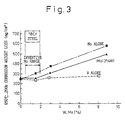
- W when Mo is added alone or not combined with W, the resistance to high-temperature corrosion is reduced with increase of the Mo amount as shown in Fig. 3.
- W even when added alone or not combined with Mo, does not cause reduction in the resistance to high-temperature corrosion, and when combined with Mo, improves the resistance to high-temperature corrosion in comparison with that achieved when Mo alone is added. Therefore, W must be present in an amount of 1.5 to 10%. Mo may be present in combination with W but the Mo content must not be more than 2.0% because the resistance to high-temperature corrosion is sharply reduced when the Mo content is more than 2.0%, even when combined with W.
- Nb sharply improves the long duration creep rupture strength by the formation of fine carbonitrides.
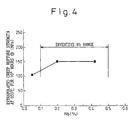
- the Nb content must be 0.1% or more as can be seen from Fig. 4. The effect becomes more significant as the Nb amount is increased within a range in which Nb is completely dissolvable in a solid solution state. However, when the Nb amount is more than this range, undissolved carbides and nitrides are retained to reduce the creep rupture strength. Therefore, the Nb amount must not be more than 0.5%.
- V forms fine nitrides and improves the long duration creep rupture strength. As shown in Fig. 5, this effect is obtained when the V amount is 0.05% or more and the improvement is reduced when the V amount is more than 1.5%. Therefore, the V amount is 0.05 to 1.5%.
- P forms phosphides and improves the long duration creep rupture strength as shown in Fig. 6.
- P when present in an excessive amount, sharply reduces not only the weldability but also the hot workability, and therefore, the P must not be present in an amount of more than 0.03%.
- S segregates at crystal grain boundaries and reduces the hot workability and also facilitates the grain boundary embrittlement under the creep condition, and therefore, the S content is limited to not more than 0.005%.
- N sharply improves the creep rupture strength by solid solution strengthening and the formation of nitrides. To compensate for the strength reduction because of the reduced C content for ensuring an improved weldability, N must be present in an amount of more than 0.15%. However, when N is present in an amount of more than 0.4%, the improvement in the long time creep rupture strength is not substantially increased but the toughness is reduced. Therefore, the N content is more than 0.15% and up to 0.4%.
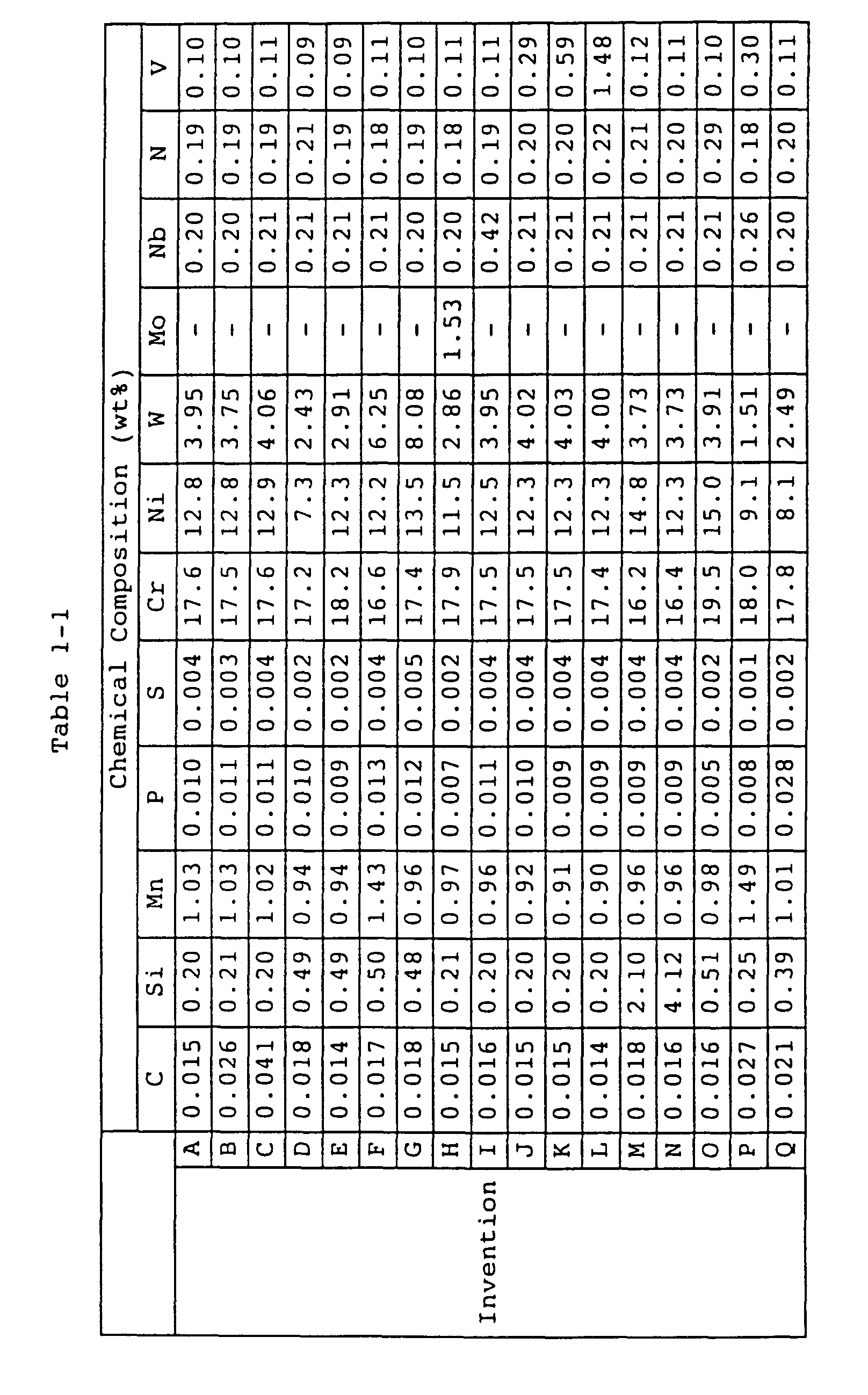
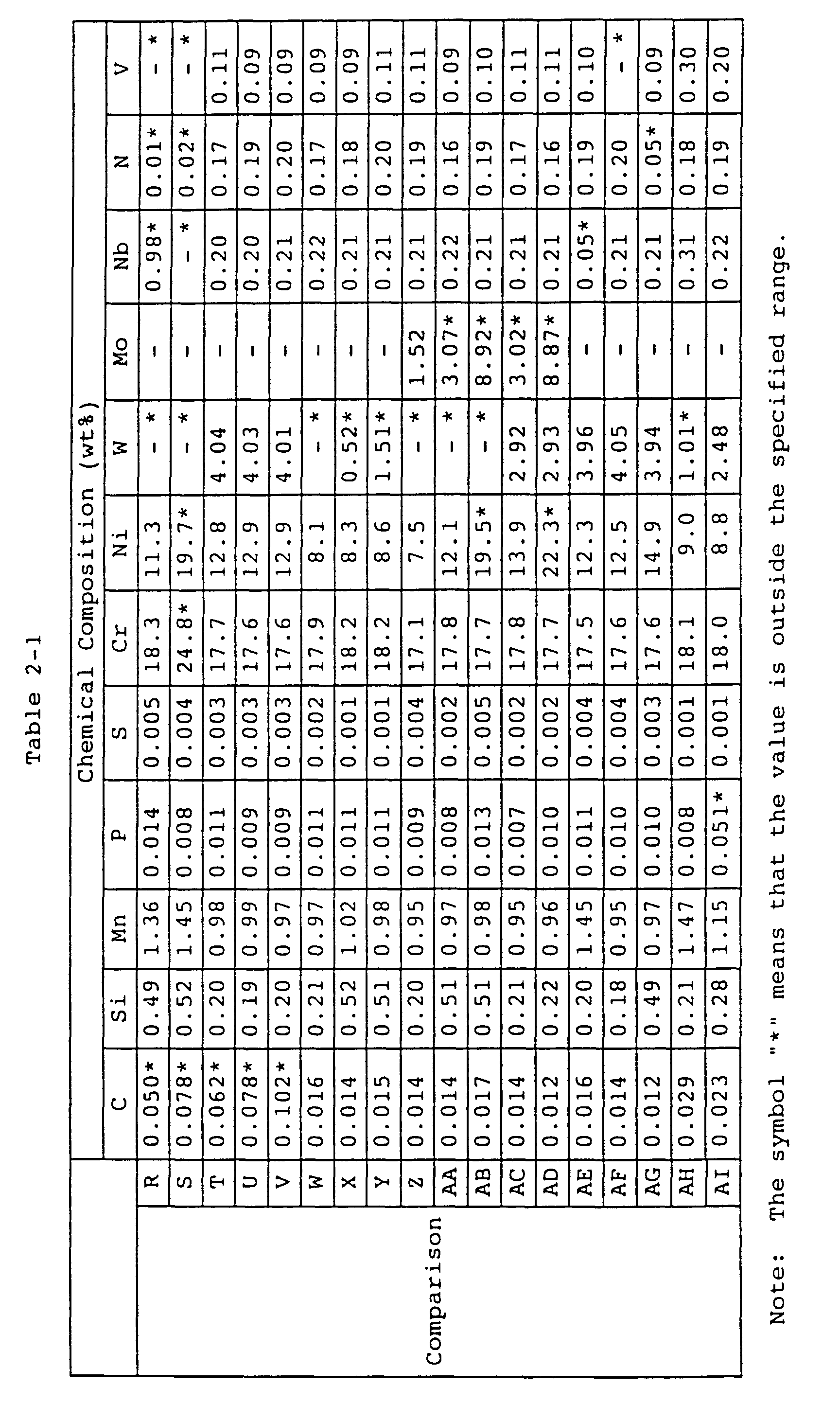
- Tables 1-1 and 2-1 summarize the chemical compositions and the properties of the steels tested. After being subjected to a solid solution heat treatment at 1250°C, the steels were subjected to a Varestraint test, a creep rupture test at 700, 750 and 800°C, and a high-temperature corrosion test at 650°C.
- the Varestraint test was carried out using the GTAW welding method, under the conditions of a test piece thickness of 4 mm, a welding voltage of 10V, a welding current of 80A, a welding speed of 80 mm/min, and an applied strain of 4%.
- the creep rupture data were standardized by the Larson-Miller method to estimate the creep rupture strength at 650°C for 100,000 hours.
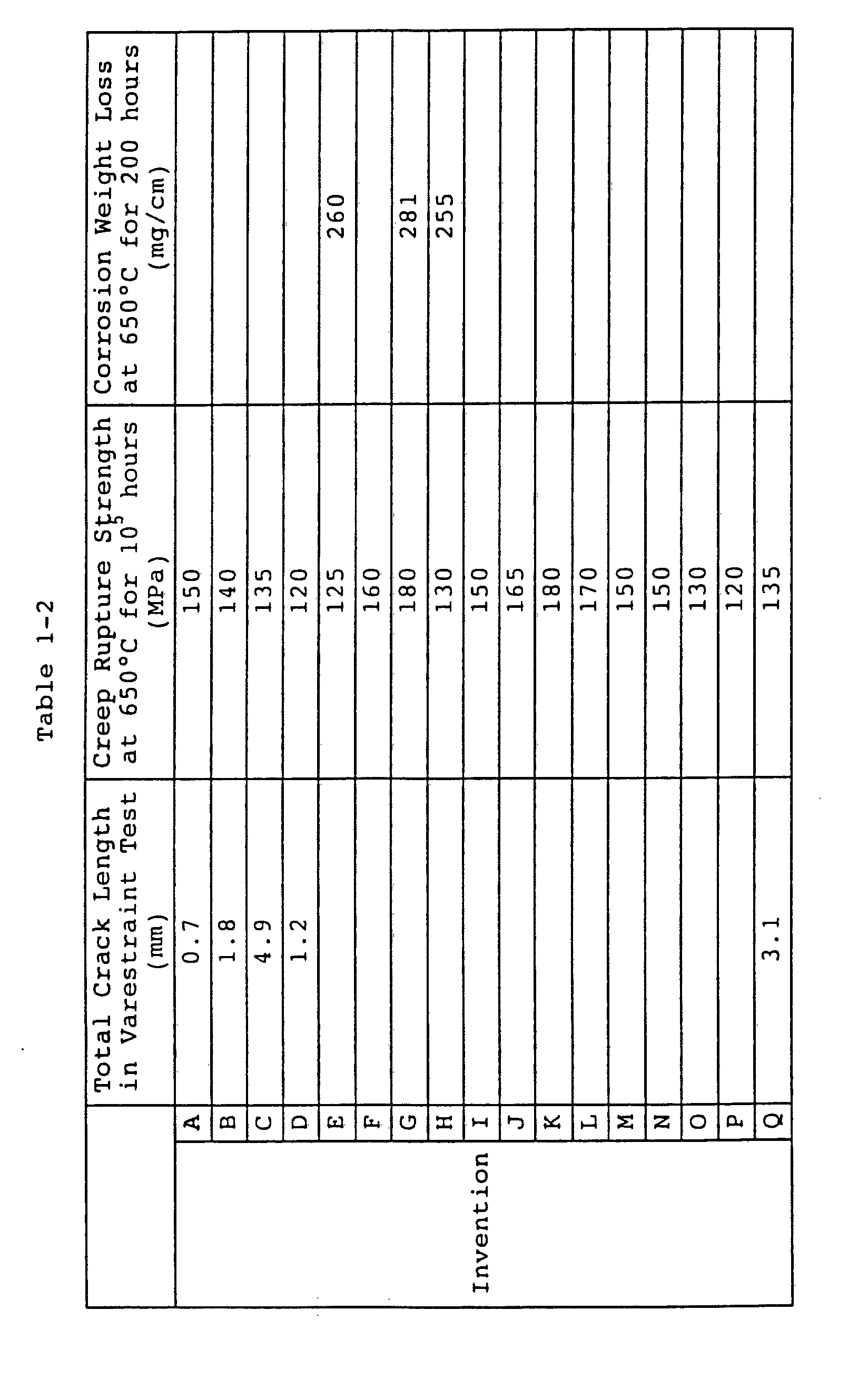
- the test results are summarized in Tables 1-2 and 2-2.
- the steels A to Q in Tables 1-1 and 1-2 are the present inventive steels and the steels R to AI in Tables 2-1 and 2-2 are comparative steels.
- Steels R and S correspond to JIS SUS347H and JIS SUS310S, respectively, which are commonly used in the conventional art.
- the present inventive steels A to Q have a remarkably improved high-temperature strength and resistance to high-temperature corrosion in comparison with the comparative steel R or JIS SUS347H and an improved weldability in comparison with the comparative steel S or JIS SUS310S.
- the comparative steels S to V have a poor weldability and exhibit a large total crack length in the Varestraint test.
- the comparative steels X to Z contain W in amounts less than the present inventive range and the comparative steels AE, AF, AG contain Nb, V and N in amounts less than the present inventive ranges, respectively, so that all these comparative steels X to AG have a poor high-temperature strength.
- the comparative steels AA to AD contain Mo in an amount more than the present inventive range and have an improved high-temperature strength but have a poor resistance to high-temperature corrosion.
- inventive steel P and the comparative steels W and AH demonstrate the synergistic effect of the combined addition of W with C and Nb, in which the inventive steel P contains more than 0.025% C and more than 0.25% Nb and has an improved high-temperature strength even though the W content is near the lower limit of the specified range, whereas the comparative steel W contains less than 0.025% C and less than 0.25% Nb and has a poor high-temperature strength and the comparative steel AH contains W in an amount less than the lower limit of the specified range and has a poor high-temperature strength although C and Nb are present in amounts more than 0.025% and 0.25%, respectively.
- the comparative steel AI contains an excessive amount of P and has an improved high-temperature strength but has a poor weldability.
- the present invention provides a high-strength austenitic heat-resisting steel, having an improved weldability, which is inexpensive and commercially applicable.
Landscapes
- Chemical & Material Sciences (AREA)
- Engineering & Computer Science (AREA)
- Materials Engineering (AREA)
- Mechanical Engineering (AREA)
- Metallurgy (AREA)
- Organic Chemistry (AREA)
- Heat Treatment Of Steel (AREA)
- Arc Welding In General (AREA)
Description
- The present invention relates to an austenitic heat-resisting steel having an excellent high-temperature strength, an improved weldability, and a high resistance to grain boundary corrosion and advantageously applicable to boilers used under severe service conditions.
- In planned thermal electric power generation plants, ultra-supercritical boilers will be used to achieve improved profitability and to comply with recent regulations regarding carbon dioxide gas exhaust. The conventional heat-resisting austenitic steels such as JIS SUS347H have too poor a creep rupture strength to be used under such severe conditions. New heat-resisting austenitic steels utilizing a precipitation strengthening by carbonitrides of Nb, Ti, etc. or a solid solution strengthening by Mo, etc. have been developed, as described in "Tetsu-to-Hagane (Iron and Steel)", vol. 70, page S1409 or "Thermal and Nuclear Electric Power Generation", vol. 38, page 75.
- However, these new heat-resisting steels contain large amounts of alloying elements and are not more weldable than JIS SUS310S which has relatively poor weldability for a conventional austenitic heat-resisting steel, and therefore, the welding workability must be improved.
- It is well known that purification of steels, including reduction in the P and S contents, and also reduction in the C content, is one of the most effective measures to improve weldability. However, many heat-resisting steels are strengthened by carbonitrides as mentioned above, and reduction in the C content would also reduce the high-temperature strength of the steels.
- An object of the present invention is to provide an austenitic heat-resisting steel having a good weldability and high-temperature strength.
- Regarding the steel compositions in which the C content is reduced to improve weldability, various experiments were conducted to compensate for a reduction in the high-temperature strength due to the reduced C content by adding other alloying elements, and it was finally found that a combined addition of W, Nb, V and N in an specified range will provide a synergistic effect to ensure high-strength at elevated temperatures. The steel also has a resistance to high-temperature corrosion comparable with those of conventional steels.
- According to the present invention, there is provided a high-strength austenitic heat-resisting steel, having improved weldability, consisting of:
- C: less than 0.05 wt%,
- Si: not more than 5 wt%,
- Mn: less than 2 wt%,
- P: not more than 0.03 wt%,
- S: not more than 0.005 wt%,
- Cr: 15 to 20 wt%,
- Ni: 6 to 15 wt%,
- W: 1.5 to 10 wt%,
- Nb: more than 0.1 up to 0.5 wt%,
- V: 0.05 to 1.5 wt%,
- N: more than 0.15 up to 0.4 wt%, and the balance consisting of Fe and unavoidable impurities.
-
- According to the present invention, there is also provided a high-strength austenitic heat-resisting steel, having improved weldability, consisting of:
- C: less than 0.05 wt%,
- Si: not more than 5 wt%,
- Mn: less than 2 wt%,
- P: not more than 0.03 wt%,
- S: not more than 0.005 wt%,
- Cr: 15 to 20 wt%,
- Ni: 6 to 15 wt%,
- W: 1.5 to 10 wt%,
- Mo: not more than 2.0 wt% and within the range defined by Mo + W ≦ 10 wt%,
- Nb: more than 0.1 up to 0.5 wt%,
- V: 0.05 to 1.5 wt%,
- N: more than 0.15 up to 0.4 wt%, and the balance consisting of Fe and unavoidable impurities.
-
- The amounts of the alloying elements are limited as specified above for the following reasons. For simplicity, "%" means "wt%" in the following discussion.
- C: The C amount must be reduced to as little as possible to prevent high-temperature cracking during welding or reduction in elongation. To ensure good weldability, the upper limit of the C content was determined based on the following experimental results.
- Figure 1 shows a Varestraint test result indicating the weldability for steels (plots "◆") containing main components in amounts falling within the specified range of the present invention (Cr: 18%, Ni: 13%, W: 4%) except that the C content was varied, and a reference steel of JIS SUS310STB (plots "□", corresponding to Comparative Steel Q in Examples to follow). It can be seen from Fig. 1 that the weldability is better than that of JIS SUS310STB when the C content is less than 0.05%. The upper limit of the C content was thus determined to be less than 0.05%.
- Si: Si is not only effective as a deoxidizer but also improves the oxidation resistance and the resistance to high-temperature corrosion. However, Si, when present in an excessive amount, reduces the creep rupture strength, the toughness and the weldability, and therefore, the Si content is limited to not more than 5%.
- Mn: Mn is a deoxidizer and improves the weldability and the hot workability. However, Mn, when present in an excessive amount, causes degradation of the oxidation resistance, and therefore, the Mn content is limited to less than 2%.
- Cr: Cr is essential for the oxidation resistance, resistance to steam oxidation, and resistance to high-temperature corrosion. To ensure properties comparable with or better than those of the conventional austenitic stainless steels, Cr must be present in an amount of not less than 15%. However, Cr, when present in an excessive amount, causes an increase in the Ni amount necessary to stabilize austenite and is not economical, and therefore, the Cr content is limited to not more than 20%.
- Ni: Ni is essential for improving the stability of austenite and suppressing the formation of the δ phase. In the steel according to the present invention, Ni must be present in an amount of 6% or more to stabilize austenite with respect to Cr and other ferrite formers present in the specified amounts. On the other hand, the use of Ni in a large amount is not economical, and therefore, the Ni content is limited to not more than 15%.
- Mo, W: Mo and W improve the high-temperature strength by solid solution strengthening or precipitation of the Laves phase and the effect is generally described as a function of the (Mo + W)% as shown in Fig. 2. It can be seen from Fig. 2 that, when the total amount of Mo and W is 2% or more, the creep rupture strength is sharply improved and the improvement is not substantially increased if the total amount of Mo and W is more than 10%.
- When the W amount or the total amount of Mo and W is 1.5 to 2.0%, the creep rupture strength substantially varies with the amounts of C and Nb. When the amounts of C and Nb are 0.025% or more and 0.25% or more, respectively, an improved creep rupture strength is obtained through a synergistic or combined effect of the W or W + Mo amount and the C + Nb amount. However, the synergistic effect is not obtained when the W or W + Mo amount is less than 1.5%.
- Mo and W, when present in a total amount of more than 10%, also cause a problem in that the Laves phase and other intermetallic compounds coarsen and reduce the creep rupture strength.
- Moreover, when Mo is added alone or not combined with W, the resistance to high-temperature corrosion is reduced with increase of the Mo amount as shown in Fig. 3. On the other hand, W, even when added alone or not combined with Mo, does not cause reduction in the resistance to high-temperature corrosion, and when combined with Mo, improves the resistance to high-temperature corrosion in comparison with that achieved when Mo alone is added. Therefore, W must be present in an amount of 1.5 to 10%. Mo may be present in combination with W but the Mo content must not be more than 2.0% because the resistance to high-temperature corrosion is sharply reduced when the Mo content is more than 2.0%, even when combined with W.
- Nb: Nb sharply improves the long duration creep rupture strength by the formation of fine carbonitrides. To achieve this effect, the Nb content must be 0.1% or more as can be seen from Fig. 4. The effect becomes more significant as the Nb amount is increased within a range in which Nb is completely dissolvable in a solid solution state. However, when the Nb amount is more than this range, undissolved carbides and nitrides are retained to reduce the creep rupture strength. Therefore, the Nb amount must not be more than 0.5%.
- V: V forms fine nitrides and improves the long duration creep rupture strength. As shown in Fig. 5, this effect is obtained when the V amount is 0.05% or more and the improvement is reduced when the V amount is more than 1.5%. Therefore, the V amount is 0.05 to 1.5%.
- P: P forms phosphides and improves the long duration creep rupture strength as shown in Fig. 6. However, P, when present in an excessive amount, sharply reduces not only the weldability but also the hot workability, and therefore, the P must not be present in an amount of more than 0.03%.
- S: S segregates at crystal grain boundaries and reduces the hot workability and also facilitates the grain boundary embrittlement under the creep condition, and therefore, the S content is limited to not more than 0.005%.
- N: N sharply improves the creep rupture strength by solid solution strengthening and the formation of nitrides. To compensate for the strength reduction because of the reduced C content for ensuring an improved weldability, N must be present in an amount of more than 0.15%. However, when N is present in an amount of more than 0.4%, the improvement in the long time creep rupture strength is not substantially increased but the toughness is reduced. Therefore, the N content is more than 0.15% and up to 0.4%.
- Figure 1 is a graph showing a Varestraint test result for steels containing elements other than C in amounts within the specified range of the present invention, in comparison with the result for a JIS SUS310STB steel;
- Fig. 2 is a graph showing the creep rupture strength as a function of the W + Mo content;
- Fig. 3 is a graph showing the resistance to high-temperature corrosion as a function of the amounts of W and Mo;
- Fig. 4 is a graph showing the creep rupture strength as a function of the Nb content;
- Fig. 5 is a graph showing the creep rupture strength as a function of the V content; and
- Fig. 6 is a graph showing the creep rupture strength as a function of the P content.
-
- The present invention will be described in detail by way of the following examples.
- Tables 1-1 and 2-1 summarize the chemical compositions and the properties of the steels tested. After being subjected to a solid solution heat treatment at 1250°C, the steels were subjected to a Varestraint test, a creep rupture test at 700, 750 and 800°C, and a high-temperature corrosion test at 650°C. The Varestraint test was carried out using the GTAW welding method, under the conditions of a test piece thickness of 4 mm, a welding voltage of 10V, a welding current of 80A, a welding speed of 80 mm/min, and an applied strain of 4%. The creep rupture data were standardized by the Larson-Miller method to estimate the creep rupture strength at 650°C for 100,000 hours. The high-temperature corrosion strength was carried out in a simulated combustion ash having the composition of K2SO4:Na2SO4:Fe2(SO4)3 = 0.28:0.2:0.5 (by weight), in which the steels were held at 650°C for 200 hours and the corrosion weight loss was determined. The test results are summarized in Tables 1-2 and 2-2.
- The steels A to Q in Tables 1-1 and 1-2 are the present inventive steels and the steels R to AI in Tables 2-1 and 2-2 are comparative steels. In the comparative steels, Steels R and S correspond to JIS SUS347H and JIS SUS310S, respectively, which are commonly used in the conventional art. The present inventive steels A to Q have a remarkably improved high-temperature strength and resistance to high-temperature corrosion in comparison with the comparative steel R or JIS SUS347H and an improved weldability in comparison with the comparative steel S or JIS SUS310S. The comparative steels S to V have a poor weldability and exhibit a large total crack length in the Varestraint test. The comparative steels X to Z contain W in amounts less than the present inventive range and the comparative steels AE, AF, AG contain Nb, V and N in amounts less than the present inventive ranges, respectively, so that all these comparative steels X to AG have a poor high-temperature strength. The comparative steels AA to AD contain Mo in an amount more than the present inventive range and have an improved high-temperature strength but have a poor resistance to high-temperature corrosion.
- The inventive steel P and the comparative steels W and AH demonstrate the synergistic effect of the combined addition of W with C and Nb, in which the inventive steel P contains more than 0.025% C and more than 0.25% Nb and has an improved high-temperature strength even though the W content is near the lower limit of the specified range, whereas the comparative steel W contains less than 0.025% C and less than 0.25% Nb and has a poor high-temperature strength and the comparative steel AH contains W in an amount less than the lower limit of the specified range and has a poor high-temperature strength although C and Nb are present in amounts more than 0.025% and 0.25%, respectively.
- The comparative steel AI contains an excessive amount of P and has an improved high-temperature strength but has a poor weldability.
- As herein described above, the present invention provides a high-strength austenitic heat-resisting steel, having an improved weldability, which is inexpensive and commercially applicable.

Claims (2)
- A high-strength austenitic heat-resisting steel having improved weldability, consisting of:the balance consisting of Fe and unavoidable impurities.C: less than 0.05 wt%,Si: not more than 5 wt%,Mn: less than 2 wt%,P: not more than 0.03 wt%,S: not more than 0.005 wt%,Cr: 15 to 20 wt%,Ni: 6 to 15 wt%,W: 1.5 to 10 wt%,Nb: more than 0.1 up to 0.5 wt%,V: 0.05 to 1.5 wt%,N: more than 0.15 up to 0.4 wt%, and
- A high-strength austenitic heat-resisting steel having improved weldability, consisting of:the balance consisting of Fe and unavoidable impurities.C: less than 0.05 wt%,Si: not more than 5 wt%,Mn: less than 2 wt%,P: not more than 0.03 wt%,S: not more than 0.005 wt%,Cr: 15 to 20 wt%,Ni: 6 to 15 wt%,W: 1.5 to 10 wt%,Mo: not more than 2.0 wt% and within the range defined by Mo + W ≦ 10 wt%,Nb: more than 0.1 up to 0.5 wt%,V: 0.05 to 1.5 wt%,N: more than 0.15 up to 0.4 wt%, and
Applications Claiming Priority (6)
| Application Number | Priority Date | Filing Date | Title |
|---|---|---|---|
| JP332341/95 | 1995-12-20 | ||
| JP33234195 | 1995-12-20 | ||
| JP33234195 | 1995-12-20 | ||
| JP135412/96 | 1996-05-29 | ||
| JP13541296 | 1996-05-29 | ||
| JP13541296A JP3388998B2 (en) | 1995-12-20 | 1996-05-29 | High strength austenitic heat-resistant steel with excellent weldability |
Publications (2)
| Publication Number | Publication Date |
|---|---|
| EP0780483A1 EP0780483A1 (en) | 1997-06-25 |
| EP0780483B1 true EP0780483B1 (en) | 2002-04-17 |
Family
ID=26469269
Family Applications (1)
| Application Number | Title | Priority Date | Filing Date |
|---|---|---|---|
| EP19960120536 Expired - Lifetime EP0780483B1 (en) | 1995-12-20 | 1996-12-19 | High-strength austenitic heat-resisting steel having improved weldability |
Country Status (3)
| Country | Link |
|---|---|
| EP (1) | EP0780483B1 (en) |
| JP (1) | JP3388998B2 (en) |
| DE (1) | DE69620722T2 (en) |
Families Citing this family (7)
| Publication number | Priority date | Publication date | Assignee | Title |
|---|---|---|---|---|
| JP4523696B2 (en) * | 2000-04-18 | 2010-08-11 | 新日本製鐵株式会社 | TIG welding material for austenitic heat resistant steel with excellent high temperature strength |
| DE10063117A1 (en) * | 2000-12-18 | 2003-06-18 | Alstom Switzerland Ltd | Conversion controlled nitride precipitation hardening tempering steel |
| JP3838216B2 (en) * | 2003-04-25 | 2006-10-25 | 住友金属工業株式会社 | Austenitic stainless steel |
| BR112013033576B1 (en) * | 2011-07-06 | 2018-10-16 | Nippon Steel & Sumitomo Metal Corp | welded joint of austenitic steel |
| JP5661001B2 (en) * | 2011-08-23 | 2015-01-28 | 山陽特殊製鋼株式会社 | High strength austenitic heat resistant steel with excellent post-aging toughness |
| JP5794945B2 (en) | 2012-03-30 | 2015-10-14 | 新日鐵住金ステンレス株式会社 | Heat resistant austenitic stainless steel sheet |
| JP6112270B1 (en) | 2015-06-05 | 2017-04-12 | 新日鐵住金株式会社 | Austenitic stainless steel |
Family Cites Families (4)
| Publication number | Priority date | Publication date | Assignee | Title |
|---|---|---|---|---|
| GB617194A (en) * | 1945-06-13 | 1949-02-02 | Haynes Stellite Co | Alloys for high temperature use |
| LU52783A1 (en) * | 1966-01-13 | 1967-03-10 | ||
| BE715586A (en) * | 1967-06-07 | 1968-10-16 | Ugine Kuhlmann | |
| JPH0694583B2 (en) * | 1984-10-03 | 1994-11-24 | 株式会社東芝 | Heat-resistant austenitic cast steel |
-
1996
- 1996-05-29 JP JP13541296A patent/JP3388998B2/en not_active Expired - Fee Related
- 1996-12-19 DE DE1996620722 patent/DE69620722T2/en not_active Expired - Lifetime
- 1996-12-19 EP EP19960120536 patent/EP0780483B1/en not_active Expired - Lifetime
Also Published As
| Publication number | Publication date |
|---|---|
| EP0780483A1 (en) | 1997-06-25 |
| JPH09228003A (en) | 1997-09-02 |
| JP3388998B2 (en) | 2003-03-24 |
| DE69620722D1 (en) | 2002-05-23 |
| DE69620722T2 (en) | 2002-12-05 |
Similar Documents
| Publication | Publication Date | Title |
|---|---|---|
| KR100216683B1 (en) | 2-phase stainless steel with excellent corrosion resistance | |
| US6485679B1 (en) | Heat resistant austenitic stainless steel | |
| EP0545753A1 (en) | Duplex stainless steel having improved strength and corrosion resistance | |
| JPH0621323B2 (en) | High strength and high chrome steel with excellent corrosion resistance and oxidation resistance | |
| EP0708184A1 (en) | High-strength austenitic heat-resisting steel with excellent weldability and good high-temperature corrosion resistance | |
| JP2000129403A (en) | Austenitic heat-resistant alloys with excellent high-temperature strength and corrosion resistance and applications | |
| EP0780483A1 (en) | High-strength austenitic heat-resisting steel having improved weldability | |
| JPS5914097B2 (en) | Ferritic heat-resistant steel with improved toughness | |
| JPS61113749A (en) | High corrosion resistance alloy for oil well | |
| JP2561592B2 (en) | Welding material for high Cr ferritic heat resistant steel | |
| JP3527640B2 (en) | Weld metal for high Cr ferritic heat resistant steel | |
| JPH07290275A (en) | Welding wire for high strength cr-mo steel | |
| JP4523696B2 (en) | TIG welding material for austenitic heat resistant steel with excellent high temperature strength | |
| JPH0770681A (en) | High chrome austenitic heat resistant alloy | |
| JP3418884B2 (en) | High Cr ferritic heat resistant steel | |
| JPH06262388A (en) | Coated arc welding rod for high Cr ferritic heat resistant steel | |
| JP2543801B2 (en) | Coated arc welding rod for high Cr ferritic heat resistant steel | |
| JPH0753898B2 (en) | High strength austenitic heat resistant alloy | |
| JPH0142346B2 (en) | ||
| JP2551511B2 (en) | Welding material for high Cr ferritic heat resistant steel | |
| JP2551512B2 (en) | Welding material for high Cr ferritic heat resistant steel | |
| JPH02156049A (en) | Heat resisting steel for ethylene decomposition furnace tube | |
| JPH06142981A (en) | Welding material for high Cr ferritic heat resistant steel | |
| JP2001234276A (en) | Cr-Mo steel with high toughness and excellent reheat cracking resistance | |
| JPS60162757A (en) | Austenitic stainless steel having high corrosion resistance at high temperature |
Legal Events
| Date | Code | Title | Description |
|---|---|---|---|
| PUAI | Public reference made under article 153(3) epc to a published international application that has entered the european phase |
Free format text: ORIGINAL CODE: 0009012 |
|
| 17P | Request for examination filed |
Effective date: 19970117 |
|
| AK | Designated contracting states |
Kind code of ref document: A1 Designated state(s): DE ES FR SE |
|
| GRAG | Despatch of communication of intention to grant |
Free format text: ORIGINAL CODE: EPIDOS AGRA |
|
| 17Q | First examination report despatched |
Effective date: 20001208 |
|
| GRAG | Despatch of communication of intention to grant |
Free format text: ORIGINAL CODE: EPIDOS AGRA |
|
| GRAH | Despatch of communication of intention to grant a patent |
Free format text: ORIGINAL CODE: EPIDOS IGRA |
|
| GRAH | Despatch of communication of intention to grant a patent |
Free format text: ORIGINAL CODE: EPIDOS IGRA |
|
| RAP1 | Party data changed (applicant data changed or rights of an application transferred) |
Owner name: NIPPON STEEL CORPORATION |
|
| GRAA | (expected) grant |
Free format text: ORIGINAL CODE: 0009210 |
|
| AK | Designated contracting states |
Kind code of ref document: B1 Designated state(s): DE ES FR SE |
|
| REF | Corresponds to: |
Ref document number: 69620722 Country of ref document: DE Date of ref document: 20020523 |
|
| ET | Fr: translation filed | ||
| PG25 | Lapsed in a contracting state [announced via postgrant information from national office to epo] |
Ref country code: ES Free format text: LAPSE BECAUSE OF FAILURE TO SUBMIT A TRANSLATION OF THE DESCRIPTION OR TO PAY THE FEE WITHIN THE PRESCRIBED TIME-LIMIT Effective date: 20021030 |
|
| PLBE | No opposition filed within time limit |
Free format text: ORIGINAL CODE: 0009261 |
|
| STAA | Information on the status of an ep patent application or granted ep patent |
Free format text: STATUS: NO OPPOSITION FILED WITHIN TIME LIMIT |
|
| 26N | No opposition filed |
Effective date: 20030120 |
|
| REG | Reference to a national code |
Ref country code: DE Ref legal event code: R082 Ref document number: 69620722 Country of ref document: DE Representative=s name: VOSSIUS & PARTNER PATENTANWAELTE RECHTSANWAELT, DE Effective date: 20130227 Ref country code: DE Ref legal event code: R082 Ref document number: 69620722 Country of ref document: DE Representative=s name: VOSSIUS & PARTNER, DE Effective date: 20130227 Ref country code: DE Ref legal event code: R081 Ref document number: 69620722 Country of ref document: DE Owner name: NIPPON STEEL & SUMITOMO METAL CORPORATION, JP Free format text: FORMER OWNER: NIPPON STEEL CORP., TOKIO/TOKYO, JP Effective date: 20130227 |
|
| REG | Reference to a national code |
Ref country code: FR Ref legal event code: CD Owner name: NIPPON STEEL & SUMITOMO METAL CORPORATION, JP Effective date: 20130913 Ref country code: FR Ref legal event code: CA Effective date: 20130913 |
|
| REG | Reference to a national code |
Ref country code: FR Ref legal event code: PLFP Year of fee payment: 20 |
|
| PGFP | Annual fee paid to national office [announced via postgrant information from national office to epo] |
Ref country code: DE Payment date: 20151215 Year of fee payment: 20 |
|
| PGFP | Annual fee paid to national office [announced via postgrant information from national office to epo] |
Ref country code: SE Payment date: 20151211 Year of fee payment: 20 Ref country code: FR Payment date: 20151110 Year of fee payment: 20 |
|
| REG | Reference to a national code |
Ref country code: DE Ref legal event code: R071 Ref document number: 69620722 Country of ref document: DE |
|
| REG | Reference to a national code |
Ref country code: SE Ref legal event code: EUG |