EP0780373B1 - Preparation of solutions of imido-alkancarboxylic acids suitable for peroxidation processes - Google Patents
Preparation of solutions of imido-alkancarboxylic acids suitable for peroxidation processes Download PDFInfo
- Publication number
- EP0780373B1 EP0780373B1 EP96120320A EP96120320A EP0780373B1 EP 0780373 B1 EP0780373 B1 EP 0780373B1 EP 96120320 A EP96120320 A EP 96120320A EP 96120320 A EP96120320 A EP 96120320A EP 0780373 B1 EP0780373 B1 EP 0780373B1
- Authority
- EP
- European Patent Office
- Prior art keywords
- imido
- water
- phase
- alkancarboxylic
- purification process
- Prior art date
- Legal status (The legal status is an assumption and is not a legal conclusion. Google has not performed a legal analysis and makes no representation as to the accuracy of the status listed.)
- Expired - Lifetime
Links
Classifications
-
- C—CHEMISTRY; METALLURGY
- C07—ORGANIC CHEMISTRY
- C07B—GENERAL METHODS OF ORGANIC CHEMISTRY; APPARATUS THEREFOR
- C07B63/00—Purification; Separation; Stabilisation; Use of additives
- C07B63/02—Purification; Separation; Stabilisation; Use of additives by treatment giving rise to a chemical modification
-
- C—CHEMISTRY; METALLURGY
- C07—ORGANIC CHEMISTRY
- C07D—HETEROCYCLIC COMPOUNDS
- C07D209/00—Heterocyclic compounds containing five-membered rings, condensed with other rings, with one nitrogen atom as the only ring hetero atom
- C07D209/02—Heterocyclic compounds containing five-membered rings, condensed with other rings, with one nitrogen atom as the only ring hetero atom condensed with one carbocyclic ring
- C07D209/44—Iso-indoles; Hydrogenated iso-indoles
- C07D209/48—Iso-indoles; Hydrogenated iso-indoles with oxygen atoms in positions 1 and 3, e.g. phthalimide
-
- C—CHEMISTRY; METALLURGY
- C11—ANIMAL OR VEGETABLE OILS, FATS, FATTY SUBSTANCES OR WAXES; FATTY ACIDS THEREFROM; DETERGENTS; CANDLES
- C11D—DETERGENT COMPOSITIONS; USE OF SINGLE SUBSTANCES AS DETERGENTS; SOAP OR SOAP-MAKING; RESIN SOAPS; RECOVERY OF GLYCEROL
- C11D3/00—Other compounding ingredients of detergent compositions covered in group C11D1/00
- C11D3/39—Organic or inorganic per-compounds
- C11D3/3945—Organic per-compounds
Definitions
- the present invention relates to a process for preparing imido-alkancarboxylic acids which are known precursors for preparing the corresponding peroxycarboxylic acids.
- the latter compounds are utilized as bleaching agents in detergent formulations or as main components of disinfectant or oxidizing compositions. These products combine good bleaching properties with a good storage stability.
- EP patent 349,940 (corresponding to USP 5,061,807 a process is described for preparing precursors obtained by reeaction of an anhydride and a lactam, or aminoacid, in the presence of water, under the conditions in general indicated above.
- the obtained product contains however a high amount of contaminants such as carboxylic acid, lactam or aminoacid and/or water.
- the imidoalkancarboxylic acids (indicated here generically by PAC), generally contain impurities in high amounts deriving from the reactants used.
- impurities are the following (% by weight):
- contaminants are those deriving from the reactants as indicated hereinafter by a1) (anhydrides or acids), b1) (aminoacids), b2) (lactams), c1) (water).
- the phthalic acid because of its poor solubility in the solvents often utilized in peroxidation, causes the product precipitation in the solvent solutions of the peroxidation process, with consequent plugging of pumps, filters, etc. Besides, such acid, in oxidizing environment, gives rise to peroxydic by-products, by taking away H 2 O 2 to the system with consequent yield decrease.
- purified precursor By means of this melting and evaporation process, purified precursor can be obtained which it would not be possible to get with the known purification processes, such as filtering or phase separation for the removal of the indicated contaminants.
- the Applicant has surprisingly and unexpectedly found a simplified process to obtain imido-alkancarboxylic acids precursors with the amounts of the above mentioned contaminants to such an extent as not to cause inconveniences either in the peroxidation phase, or in the storage phase of the final peracid.
- Object of the present invention is therefore a purification process of imido-alkancarboxylic acids from the contaminants represented by carboxylic acid, lactam or aminoacids and water comprising:
- the ratio by moles a1/(b1 or b2)/ c1) is comprised between 1/1.05-1.1/0.5-2.5, more preferably between 1/1.05-1.1/1-2.
- the preferred compounds of type b) are those of class b2).
- anhydride or the corresponding acids can be mentioned: trimellitic, phthalic, pyromellitic anhydride. Phthalic anhydride or pthalic acid are preferably used.
- omega-aminobutyric acid omega-aminovalerianic, omega-aminocaproic and omega-aminolauric acid.
- gamma-pyrrolidone gamma-pyrrolidone
- delta-piperidone epsilon-caprolactam
- omega-laurolactam epsilon-caprolatam
- the temperature is comprised between 130°C and 180°C and the pressure between 4 and 8 bar.
- any solvent immiscible with water can be utilized, such as for instance chlorobenzene, dichloroethane, CH 2 Cl 2 and CHCl 3 , solvents such as CH 2 Cl 2 and CHCl 3 are preferably utilized, more preferably CH 2 Cl 2 .
- the formation of the eutectic brings remarkable advantages to the process of the invention since it allows to discharge the melted mass of the PAC obtained in phase A) in the solvent of phase B) at temperatures ranging from 78-95°C, preferably 78-90°C, for the case of the eutectic indicated as an example, by using the preferred compounds.
- the amount of solvent in phase B) is such that the solution obtained is utilizable directly in the successive peroxidic synthesis phase if the chosen solvent utilized is fitted to this process.
- the temperature of the eutectic is lower than the melting temperature of the PAC purified according to the methods of the art, for instance according to EP 607,821, which results to be 107-108°C, it is obtained a lower loss of the solvent and a final temperature of the solution got in phase B) which is lower than the boiling temperature of the solvent.
- phase A) If the amount of water used in phase A) is lower than 2 moles per 1 mole of phthalic anhydride, water can be added also at the end of phase A) so that the amount of final water is equal to at least 2 moles, preferably higher, with respect to 1 mole of phthalic anhydride, to have the formation of the eutectic and to obtain therefore the advantages indicated above in phase B).
- the PAC obtained according to the process of the present invention after phase D leads to conversions into PAP of the same type of those indicated above, and the final organic solution obtained after phase D) appears clear and it easily separates from the aqueous layer.
- the PAP obtained by utilizing said PAC results stockable without using phlegmatising agents.
- the solutions obtained in phase D) are already prepared with the most suitable solvent for the peroxidation itself, when CH 2 Cl 2 is used as solvent, and moreover in the desired concentration, about 20% by weight of PAC.
- the preparation of said ready-to-use solution of PAC in CH 2 Cl 2 is easy thanks to the surprising property of the PAC precursor, preferably of the pthalimidohexanoic acid, to form an eutectic with H 2 O (about 12% weight/weight) which has melting point of 78°C, considerably lower than the PAC melting point of 107°C.
- the PAC precursor preferably of the pthalimidohexanoic acid
- the system is cooled at 85-90°C and the pressure of the reactor is then reduced up to the atmospheric value.
- reaction mixture is then discharged in acetonitrile or dioxane, and the content in PAC, phthalic acid and caprolactam is determined by HPLC analysis and the content in H 2 O of the mixture itself by Karl Fischer.
- the conversion was of 97.4% by weight.
- an aqueous surface layer is separated from the organic solution, which can be easily removed from the organic solution by means of the separatory funnel.
- the obtained organic solution (PAC in CH 2 Cl 2 ), ready to be sent to peroxidation, contains: PAC 19.92% by weight Caprolactam 0.14% by weight H 2 O 0.38% by weight Phthalic acid 0.009%. by weight, the remaining part 100% is formed by CH 2 Cl 2 .
- 74 g of phthalic anahydride, 59.5 g of caprolactam and 19 g of H 2 O are condensed in a 300 ml autoclave according to the modalities described in example 1, but utilizing a pressure of 7 bar, then proceeding as described in example 2.
- the PAC organic solution in CH 2 Cl 2 separated by the aqueous phase (Phase D) has the following composition: PAC 19.9% by weight Caprolactam 0.14% by weight H 2 O 0.42% (2.06% on PAC) by weight Phthalic acid 0.013% by weight, the remaining part 100% is formed by CH 2 Cl 2 .
- the residual content of water present in the PAC chloro-containing solution is determined via Karl Fischer.
- the obtained mixture (g 148) is discharged in 520 g of CH 2 Cl 2 (Phase B)). After 12 hours of staying, the solution still shows a strong emulsibility and a remarkable turbidity due to product in suspension (phthalic acid). It is not possible to clearly separate the aqueous phase from the organic one, not even by centrifugation.
Landscapes
- Chemical & Material Sciences (AREA)
- Organic Chemistry (AREA)
- Wood Science & Technology (AREA)
- Engineering & Computer Science (AREA)
- Chemical Kinetics & Catalysis (AREA)
- Oil, Petroleum & Natural Gas (AREA)
- Life Sciences & Earth Sciences (AREA)
- Inorganic Chemistry (AREA)
- Organic Low-Molecular-Weight Compounds And Preparation Thereof (AREA)
- Indole Compounds (AREA)
- Pyrrole Compounds (AREA)
- Acyclic And Carbocyclic Compounds In Medicinal Compositions (AREA)
- Detergent Compositions (AREA)
- Hydrogenated Pyridines (AREA)
- Pharmaceuticals Containing Other Organic And Inorganic Compounds (AREA)
Abstract
Description
- The present invention relates to a process for preparing imido-alkancarboxylic acids which are known precursors for preparing the corresponding peroxycarboxylic acids.
- The latter compounds are utilized as bleaching agents in detergent formulations or as main components of disinfectant or oxidizing compositions. These products combine good bleaching properties with a good storage stability.
- The preparation of these imido-alkancarboxylic acids is well known in the literature and considers, for instance for the phthalimidoalkancarboxylic acid class, a sum or condensation among phthalic anhydride, or phthalic acid, and aminoacids or lactams in absence or in presence of water, with a pressure from 1 to 30 bar, at temperatures ranging from 100 to 250°C and with reaction times from 5 to 20 hours.
- See for instance: J. Am. Chem. Soc., Vol. 70, 1473 (1948) ; J. Org. Chem. Soc., Vol. 24, 2062 (1959); J. Org. Chem., Vol. 21, 1353 (1956); J. Chem. Eng. Data, Vol. 10, 399 (1965).
- In EP patent 349,940 (corresponding to USP 5,061,807 a process is described for preparing precursors obtained by reeaction of an anhydride and a lactam, or aminoacid, in the presence of water, under the conditions in general indicated above.
- The obtained product contains however a high amount of contaminants such as carboxylic acid, lactam or aminoacid and/or water.
- By the processes known in the art the imidoalkancarboxylic acids (indicated here generically by PAC), generally contain impurities in high amounts deriving from the reactants used. In the case of phthalimidoalkancarboxylic acids, the usual impurities are the following (% by weight):
- 1.5-10% of phthalic acid,
- 0.5-10% of lactam,
- 1.0-20% of water.
-
- See for instance European patent application EP 607,821.
- In general contaminants are those deriving from the reactants as indicated hereinafter by a1) (anhydrides or acids), b1) (aminoacids), b2) (lactams), c1) (water).
- The presence of said contaminants agents leads to drawbacks since in the subsequent oxidation step for the preparation of the corresponding percarboxylic acids in the presence of hydrogen peroxide and of a strong acid some inconveniences occur. Even if the precursor is obtained with high yields of 97-98%, the impurities mentioned above give the following drawbacks for instance in the case of the class of phthalimidoalkancarboxylic acids.
- The phthalic acid, because of its poor solubility in the solvents often utilized in peroxidation, causes the product precipitation in the solvent solutions of the peroxidation process, with consequent plugging of pumps, filters, etc. Besides, such acid, in oxidizing environment, gives rise to peroxydic by-products, by taking away H2O2 to the system with consequent yield decrease.
- Moreover the by-products of the phthalic acid formed in the peroxidation process negatively influence the storage stability of the obtained peracid (here generically indicated by PAP).
- This leads to additional processes of the peracid phlegmatisation so that this maintains a good storage stability.
- Also the other mentioned contaminants, often not very soluble in the solvents utilized in the peroxidation phase, must be removed in order to have high yields in the peracid.
- Water, for instance, if not removed from the precursor, implies a remarkable increase of the amount of sulphuric acid to be used for the synthesis, with consequent problems of elimination of the refluent acids of the process and consequent increase of the production costs.
- For the caprolactam the same inconveniences indicated above occur if it is present in high amounts.
- Purification processes of the precursor to remove the impurities indicated above are therefore known.
- See for instance USP 3,210,313 wherein the imidocarboxylic acid is extracted by distillation under reduced pressure or EP 607,821 wherein the phthalimidoalkanacarboxylic acid prepared according to the processes of the art is brought to melting and the melt is maintained for a prolonged time at such a temperature that the contaminants are substantially removed from the melt in vapour phase and only successively the purified melted product is cooled. In the melting phase it is utilized an inert gas flow such as argon or nitrogen and/or reduced pressures comprised between 0.1 and 300 millibar to make the removal of the impurities easier. The treatment times are generally of 5 hours or lower if it is operated at higher temperatures or with higher vacuum degrees.
- By means of this melting and evaporation process, purified precursor can be obtained which it would not be possible to get with the known purification processes, such as filtering or phase separation for the removal of the indicated contaminants.
- The Applicant has surprisingly and unexpectedly found a simplified process to obtain imido-alkancarboxylic acids precursors with the amounts of the above mentioned contaminants to such an extent as not to cause inconveniences either in the peroxidation phase, or in the storage phase of the final peracid.
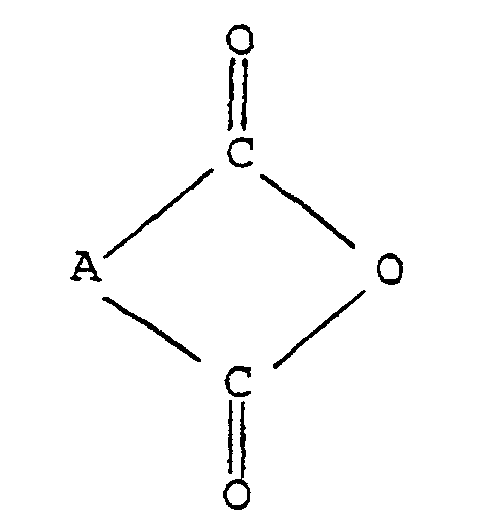
- Object of the present invention is therefore a purification process of imido-alkancarboxylic acids from the contaminants represented by carboxylic acid, lactam or aminoacids and water comprising:
- A) preparation of the imido-alkancarboxylic acid by reaction
of:
- a1) an anhydride of formula
or the corresponding acids,
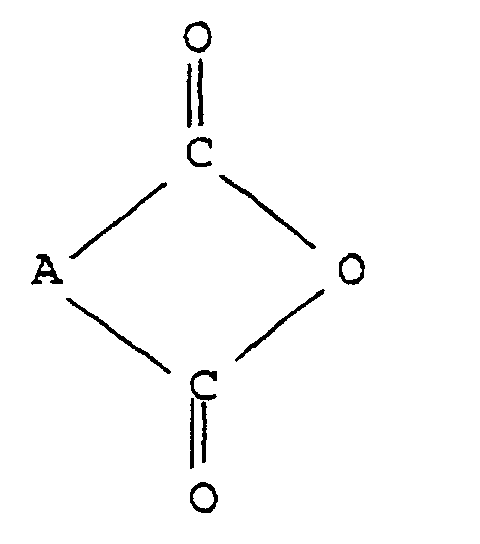
with - b1) an aminoacid of formula
with

- c1) water;
or - a1) with
- b2) a lactam of general formula
with
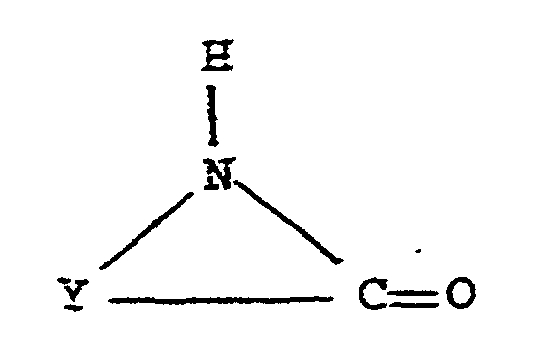
- c1) water; at temperatures comprised betweeen 100°C and 250°C, under pressure of an inert gas from 1 to 30 bar, for reaction times from 2 to 20 hours;
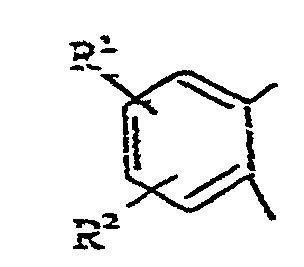
- n is an integer 0, 1 or 2,
- R1 is hydrogen, chlorine, bromine, alkyl C2-C20, alkenyl C2-C20, aryl or alkylaryl,
- R2 is hydrogen, chlorine, bromine or a group of formula-SO3M, -CO2M, -CO3M, -OSO3M,
- M indicates hydrogen, an alkaline metal or ammonium ion or the equivalent of an alkaline-earth metal ion
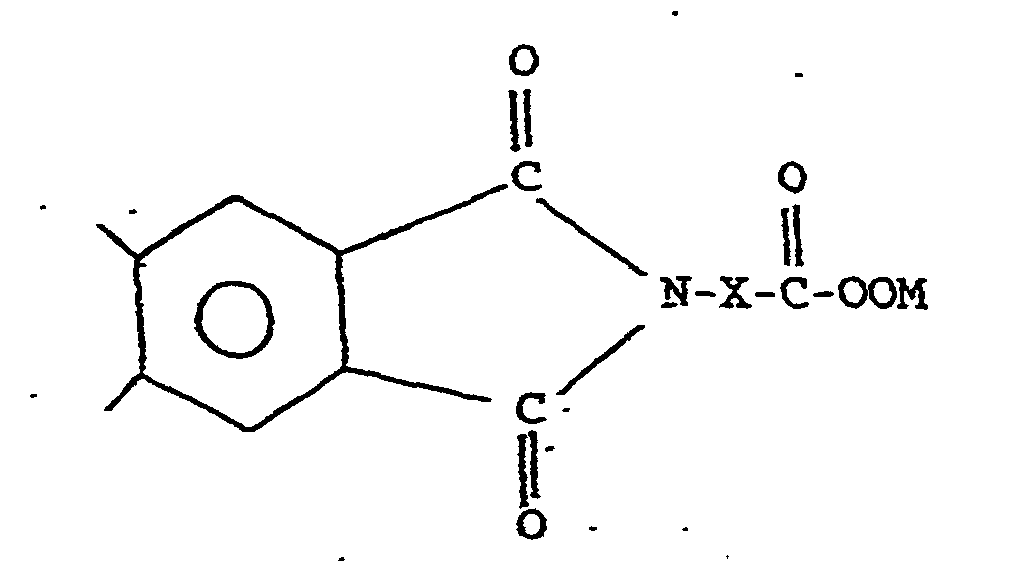
- and X indicates alkylene C1-C15 or arylene;
- Y is = X and is preferably an alkylene C3-C19;
- B) discharge of the precursor obtained in phase A) in a solvent immiscible with water;
- C) separation of the aqueous phases from the organic phase;
- D) recovery of the organic phase for the successive peroxidation reaction.
-
- Preferably the ratio by moles a1/(b1 or b2)/ c1) is comprised between 1/1.05-1.1/0.5-2.5, more preferably between 1/1.05-1.1/1-2.
- The preferred compounds of type b) are those of class b2).
- Among the compounds of class a1) the following anhydrides or the corresponding acids can be mentioned: trimellitic, phthalic, pyromellitic anhydride. Phthalic anhydride or pthalic acid are preferably used.
- Among the compounds of class b1) it can be mentioned: omega-aminobutyric acid, omega-aminovalerianic, omega-aminocaproic and omega-aminolauric acid.
- Among the compounds of class b2) can be mentioned as the preferred ones: gamma-pyrrolidone, delta-piperidone, epsilon-caprolactam and omega-laurolactam, epsilon-caprolatam (CPL) is particularly preferred.
- Preferably in phase A) the temperature is comprised between 130°C and 180°C and the pressure between 4 and 8 bar.
- In phase B) any solvent immiscible with water can be utilized, such as for instance chlorobenzene, dichloroethane, CH2Cl2 and CHCl3, solvents such as CH2Cl2 and CHCl3 are preferably utilized, more preferably CH2Cl2.
- These solvents, indeed, as described in EP patent 490,409, are the most suitable to carry out the subsequent peroxidation operation.
- Moreover it has been unexpectedly found that if one operates in reaction A) with an amount of water equal to 2 moles per mole of compound a1), preferably phthalic anhydride, and when compound b) is preferably of class b2), more preferably caprolactam, an eutectic of the precursor (PAC) with water is formed. In case the preferred compounds are used the amount of water in the eutectic being of about 12% by weight; the melting point of the eutectic being about 78°C.
- The formation of the eutectic brings remarkable advantages to the process of the invention since it allows to discharge the melted mass of the PAC obtained in phase A) in the solvent of phase B) at temperatures ranging from 78-95°C, preferably 78-90°C, for the case of the eutectic indicated as an example, by using the preferred compounds.
- The amount of solvent in phase B) is such that the solution obtained is utilizable directly in the successive peroxidic synthesis phase if the chosen solvent utilized is fitted to this process. In this way, since the temperature of the eutectic is lower than the melting temperature of the PAC purified according to the methods of the art, for instance according to EP 607,821, which results to be 107-108°C, it is obtained a lower loss of the solvent and a final temperature of the solution got in phase B) which is lower than the boiling temperature of the solvent.
- As an example reference has been made here to the preferred solvent CH2Cl2 as solvent of phase B).
- Indeed the process of successive peroxidation of the precursor (PAC) to peracid (PAP) is preferably carried out according to the process indicated in EP patent 490,409.
- If the amount of water used in phase A) is lower than 2 moles per 1 mole of phthalic anhydride, water can be added also at the end of phase A) so that the amount of final water is equal to at least 2 moles, preferably higher, with respect to 1 mole of phthalic anhydride, to have the formation of the eutectic and to obtain therefore the advantages indicated above in phase B).
- Tests carried out by the Applicant have shown that when in the peroxidation process (to PAP), for instance according to the process indicated in EP patent 490,409, a PAC purified according to the patent EP 607,821 is utilized, yields in final product of 94.35% by weight are obtained. Starting from PAC obtained according to the process of the present invention, by utilizing as reactants a1) phthalic anhydride, b2) caprolactam, c1) water, the amounts of impurities indicated above present according to EP patent 607,821 are extremely reduced, practically absent.
- In the peroxidation process molar ratios
PAC/H2O2/H2SO4 = 1/1.5/1.28,
have been utilized, by using a reaction temperature of 35°C and a reaction time of 1 hour. - The PAC obtained according to the process of the present invention after phase D (see examples 2-3) leads to conversions into PAP of the same type of those indicated above, and the final organic solution obtained after phase D) appears clear and it easily separates from the aqueous layer.
- The PAP obtained by utilizing said PAC results stockable without using phlegmatising agents.
- Moreover in the preferred embodiment according to the present invention, the solutions obtained in phase D) are already prepared with the most suitable solvent for the peroxidation itself, when CH2Cl2 is used as solvent, and moreover in the desired concentration, about 20% by weight of PAC.
- As alreeady said in the preferred embodiment according to the present invention the preparation of said ready-to-use solution of PAC in CH2Cl2 is easy thanks to the surprising property of the PAC precursor, preferably of the pthalimidohexanoic acid, to form an eutectic with H2O (about 12% weight/weight) which has melting point of 78°C, considerably lower than the PAC melting point of 107°C.
- This allows to introduce the melted mass obtained by the synthesis of PAC in phase A), at a temperature of 78-90°C, directly in phase B) in the solvent amount, preferably CH2CI2, required for the peroxidic synthesis, obtaining in the so formed solution a temperature lower than the boiling temperature of the solvent itself.
- A benefit in energy efficiency terms derives therefrom.
- The following examples are given for illustrative purposes and are not limitative of the scope of present invention.
- 7.4 g of phthalic anhydride, 5.65 of caprolactam and 1.8 g of H2O (molar ratios between the components 1:1:2) are introduced in a 30 ml steel autoclave equipped with a stirrer. Vacuum is carried out in the equipment and the system is brought then to atmospheric pressure with nitrogen. Such cycle is repeated three times. Then the inner pressure is brought to 1 bar with nitrogen. It is heated to 160°C and the mixture of the reactants is stirred by keeping it at this temperature for 6 hours, at the pressure of 6 bar.
- The system is cooled at 85-90°C and the pressure of the reactor is then reduced up to the atmospheric value.
- All the reaction mixture is then discharged in acetonitrile or dioxane, and the content in PAC, phthalic acid and caprolactam is determined by HPLC analysis and the content in H2O of the mixture itself by Karl Fischer.
- 14.78 g of mixture with the following composition (% by weight) were thus obtained:
PAC 86% Caprolactam 1.06% Water 11.7 % Phthalic acid 1.24%. - The conversion was of 97.4% by weight.
- 74 g of phthalic anhydride, 59.5 g of caprolactam and 18 g of H2O with molar ratio of the components 1:1.05:2, are condensed in a 300 ml autoclave according to the modalities described in Example 1 (phase A)).
- At the end of the reaction, the melted mass, eutectic PAC/H2O = 149 g, is slowly discharged at 85°C into 520 g of CH2Cl2 maintained under stirring in a 1000 ml separatory funnel (phase B)).
- After 3 hours of staying, (at 30-35°C), an aqueous surface layer is separated from the organic solution, which can be easily removed from the organic solution by means of the separatory funnel.
- The obtained organic solution (PAC in CH2Cl2), ready to be sent to peroxidation, contains:
PAC 19.92% by weight Caprolactam 0.14% by weight H2O 0.38% by weight Phthalic acid 0.009%. by weight, - 74 g of phthalic anahydride, 59.5 g of caprolactam and 19 g of H2O are condensed in a 300 ml autoclave according to the modalities described in example 1, but utilizing a pressure of 7 bar, then proceeding as described in example 2.
- The PAC organic solution in CH2Cl2, separated by the aqueous phase (Phase D)) has the following composition:
PAC 19.9% by weight Caprolactam 0.14% by weight H2O 0.42% (2.06% on PAC) by weight Phthalic acid 0.013% by weight, - The residual content of water present in the PAC chloro-containing solution is determined via Karl Fischer.
- 74 g of phthalic anhydride, 56.5 g of caprolactam and 18 g of H2O are condensed in a 300 ml autoclave, as in example 1
- The obtained mixture (g 148) is discharged in 520 g of CH2Cl2 (Phase B)). After 12 hours of staying, the solution still shows a strong emulsibility and a remarkable turbidity due to product in suspension (phthalic acid). It is not possible to clearly separate the aqueous phase from the organic one, not even by centrifugation.
- The successive peroxidation phase cannot even be carried out, for instance in the conditions of EP patent 490,409.
wherein A indicates a group of formula
Claims (10)
- Purification process of imido-alkancarboxylic acids from contaminants represented by carboxylic acid, lactam or aminoacids and water comprising:A) preparation of the imido-alkancarboxylic acid by reaction of:at temperatures comprised between 100°C and 250°C, under pressure of an inert gas from 1 to 30 bar, for reaction times from 2 to 20 hours;a1) an anhydride of formulaor the corresponding acids,
withb1) an aminoacid of formulawith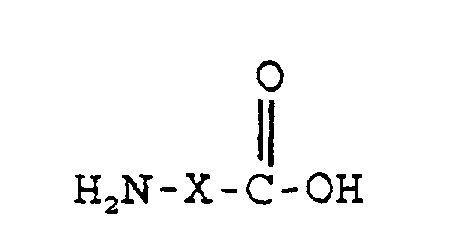 c1) water;
ora1) withb2) a lactam of general formulawith c1) water;
wherein A indicates a group of formula
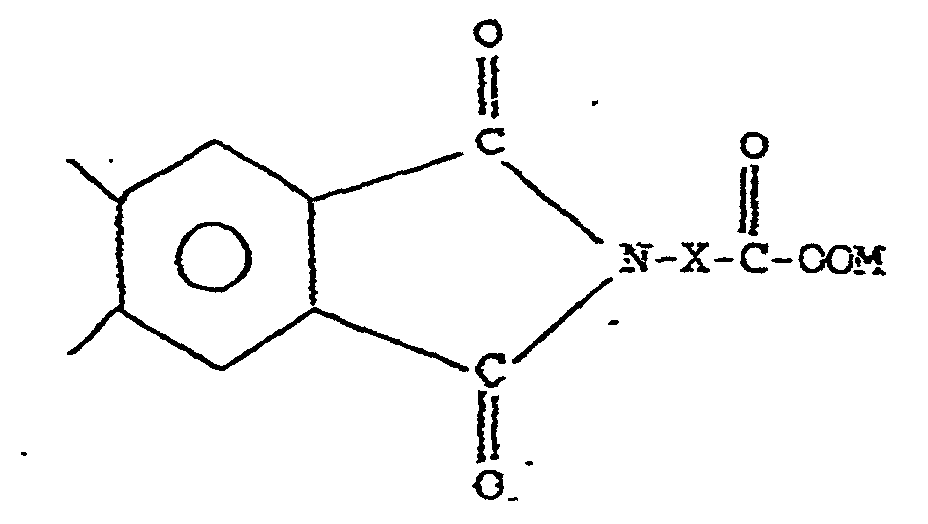 wherein the ratio by moles between a1/(b1 or b2)-/c1 is comprised between 1/1.05-1.1/2;n is an integer 0, 1 or 2,R1 is hydrogen, chlorine, bromine, alkyl C1-C20, alkenyl C2-C20, aryl or alkylaryl,R2 is hydrogen, chlorine, bromine or a group of formula-SO3M, -CO2M, -CO3M, -OSO3M,M indicates hydrogen, an alkaline metal or ammonium ion or the equivalent of an alkaline-earth metal ionand X indicates alkylene C1-C19 or arylene;Y = X and preferably an alkylene C3-C19.B) discharge of the precursor obtained in phase A) in a solvent immiscible with water;C) separation of the aqueous phases from the organic phase;D) recovery of the organic phase for the successive peroxidation reaction.
 - Purification process or imido-alkancarboxylic acids according to claim 1 wherein the compounds of the type b) are those or class b2), the compounds of class a1) are selected from the following anhydrides or the corresponding acids: trimellitic, phthalic, pyromellitic anhydride; the compounds of the class b1) are selected from: omega-aminobutyric acid, omega-aminovalerianic, omega-aminocaproic and omega-aminolauric acid; the compounds of class b2) are selected from: gamma-pyrrolidone, delta-piperidone, epsilon-caprolactam and omegalaurolactam.
- Purification process of imido-alkancarboxylic acids according to claim 2 wherein the compound a1) is selected from phthalic anhydride or pthalic acid, the compound b2) is epsilon-caprolactam (CPL).
- Purification process of imido-alkancarboxylic acids according to claims 1-3, wherein in phase A) the temperature is comprised between 130°C and 180°C and the pressure between 4 and 8 bar.
- Purification process of imido-alkancarboxylic acids according to claims 1-4, wherein in phase B) a solvent immiscible with water is employed.
- Purification process of imido-alkancarboxylic acids according to claim 5, wherein in phase B) the solvent is selected from CH2Cl2 and CHCl3.
- Purification process of imido-alkancarboxylic acids according to claims 1-6, wherein in reaction A) it is operated with an amount of water equal to at least 2 moles per mole of the compound a1).
- Purification process of imido-alkancarboxylic acids according to claims 1-6, wherein in phase A) it is operated with an amount of water lower than 2 moles per mole of the compound a1) and water is added at the and of phase A up to a total amount of at least 2 moles per 1 mole of the compound a1).
- Purification process of imido-alkancarbokylic acids ac-cording to claims 7-8, wherein the melt of the reaction A) is discharged in a solvent of phase B) at temperatures from 78 to 95°C.
- Process for preparing peroxycarboxylic acids in the presence of hydrogen peroxide and a strong acid wherein the imido-alkancarboxylic acid obtained according to claims 1-9 is utilized as a precursor.
Applications Claiming Priority (2)
| Application Number | Priority Date | Filing Date | Title |
|---|---|---|---|
| ITMI952718 | 1995-12-21 | ||
| IT95MI002718A IT1277686B1 (en) | 1995-12-21 | 1995-12-21 | PREPARATION OF IMMIDO-ALCANCARBOSSYLIC ACID SOLUTIONS SUITABLE FOR PEROXIDATION PROCESSES |
Publications (2)
| Publication Number | Publication Date |
|---|---|
| EP0780373A1 EP0780373A1 (en) | 1997-06-25 |
| EP0780373B1 true EP0780373B1 (en) | 2001-07-04 |
Family
ID=11372785
Family Applications (1)
| Application Number | Title | Priority Date | Filing Date |
|---|---|---|---|
| EP96120320A Expired - Lifetime EP0780373B1 (en) | 1995-12-21 | 1996-12-18 | Preparation of solutions of imido-alkancarboxylic acids suitable for peroxidation processes |
Country Status (14)
| Country | Link |
|---|---|
| US (1) | US5703242A (en) |
| EP (1) | EP0780373B1 (en) |
| JP (1) | JPH09286778A (en) |
| KR (1) | KR100461223B1 (en) |
| CN (2) | CN1070478C (en) |
| AT (1) | ATE202771T1 (en) |
| BR (1) | BR9606125A (en) |
| DE (1) | DE69613662T2 (en) |
| ES (1) | ES2158986T3 (en) |
| IN (1) | IN189787B (en) |
| IT (1) | IT1277686B1 (en) |
| PT (1) | PT780373E (en) |
| TW (1) | TW418190B (en) |
| ZA (1) | ZA9610728B (en) |
Families Citing this family (1)
| Publication number | Priority date | Publication date | Assignee | Title |
|---|---|---|---|---|
| CN101681837B (en) * | 2007-04-13 | 2016-05-18 | 索尔维公司 | Use of oxidizing agents for semiconductor wafer processing, use of compositions therefor and compositions |
Citations (1)
| Publication number | Priority date | Publication date | Assignee | Title |
|---|---|---|---|---|
| US3210313A (en) * | 1959-08-25 | 1965-10-05 | Allied Chem | Esters of epsilon-dicarboximido-caproic acids and polyvinyl resins plasticized therewith |
Family Cites Families (10)
| Publication number | Priority date | Publication date | Assignee | Title |
|---|---|---|---|---|
| DE3823172C2 (en) * | 1988-07-08 | 1998-01-22 | Hoechst Ag | Omega-phthalimidoperoxihexanoic acid, process for its preparation and its use |
| DE4003309A1 (en) * | 1990-02-05 | 1991-08-08 | Hoechst Ag | Continuous prodn. of imido-per:carboxylic acids - by mixing aq. hydrogen peroxide and acid soln. of corresp. imido-carboxylic acid in static mixer and precipitating in water |
| US5159108A (en) * | 1990-09-18 | 1992-10-27 | Merck & Co., Inc. | Process for preparing an antihypercalcemic agent |
| IT1245308B (en) * | 1990-12-13 | 1994-09-19 | Ausimont Spa | PROCESS FOR THE PRODUCTION OF AN ARYL-IMMIDO-PER-ALCANOIC ACID |
| GB9027975D0 (en) * | 1990-12-22 | 1991-02-13 | Interox Chemicals Ltd | Peroxycarboxylic acid |
| IT1254619B (en) * | 1992-02-21 | 1995-09-28 | Ausimont Spa | PROCEDURE FOR THE PURIFICATION OF PHTALIMID-PEROXICAPROIC ACID (PAP) FROM IMPURITIONS OF CHLORINATED SOLVENTS |
| US5487818A (en) * | 1992-03-10 | 1996-01-30 | Ausimont S.P.A. | Process for separating phthalimido-peroxycaproic acid from solutions in organic solvents |
| EP0607821A1 (en) | 1993-01-16 | 1994-07-27 | Hoechst Aktiengesellschaft | Process for preparation of purified phthalimidoalkanecarboxylic acids |
| DE69329622T2 (en) * | 1993-08-30 | 2001-06-13 | Sieber Technology Ltd., Thames | INORGANIC PHOSPHATE AND FUNGUS-CONTAINING MUSHROOMS CONTAINING PHOSPHATE |
| BE1009258A3 (en) * | 1995-03-24 | 1997-01-07 | Dsm Nv | PROCESS FOR THE PREPARATION OF A N-alkoxy- (tetra- or hexahydro) -phthalimide AND PROCESS FOR THE PREPARATION OF A N-alkoxy amine. |
-
1995
- 1995-12-21 IT IT95MI002718A patent/IT1277686B1/en active IP Right Grant
-
1996
- 1996-12-16 IN IN2159CA1996 patent/IN189787B/en unknown
- 1996-12-17 TW TW085115574A patent/TW418190B/en not_active IP Right Cessation
- 1996-12-18 AT AT96120320T patent/ATE202771T1/en not_active IP Right Cessation
- 1996-12-18 DE DE69613662T patent/DE69613662T2/en not_active Expired - Fee Related
- 1996-12-18 PT PT96120320T patent/PT780373E/en unknown
- 1996-12-18 ES ES96120320T patent/ES2158986T3/en not_active Expired - Lifetime
- 1996-12-18 EP EP96120320A patent/EP0780373B1/en not_active Expired - Lifetime
- 1996-12-19 ZA ZA9610728A patent/ZA9610728B/en unknown
- 1996-12-20 JP JP8342203A patent/JPH09286778A/en active Pending
- 1996-12-20 BR BR9606125A patent/BR9606125A/en not_active IP Right Cessation
- 1996-12-20 US US08/777,699 patent/US5703242A/en not_active Expired - Fee Related
- 1996-12-21 KR KR1019960069907A patent/KR100461223B1/en not_active Expired - Fee Related
- 1996-12-21 CN CN96121383A patent/CN1070478C/en not_active Expired - Fee Related
- 1996-12-21 CN CNB011032456A patent/CN1243733C/en not_active Expired - Fee Related
Patent Citations (1)
| Publication number | Priority date | Publication date | Assignee | Title |
|---|---|---|---|---|
| US3210313A (en) * | 1959-08-25 | 1965-10-05 | Allied Chem | Esters of epsilon-dicarboximido-caproic acids and polyvinyl resins plasticized therewith |
Also Published As
| Publication number | Publication date |
|---|---|
| CN1165812A (en) | 1997-11-26 |
| US5703242A (en) | 1997-12-30 |
| CN1310174A (en) | 2001-08-29 |
| BR9606125A (en) | 1998-11-03 |
| ZA9610728B (en) | 1997-06-26 |
| KR970042505A (en) | 1997-07-24 |
| KR100461223B1 (en) | 2005-05-16 |
| PT780373E (en) | 2001-10-30 |
| DE69613662T2 (en) | 2002-05-08 |
| ITMI952718A0 (en) | 1995-12-21 |
| ES2158986T3 (en) | 2001-09-16 |
| ITMI952718A1 (en) | 1997-06-21 |
| CN1070478C (en) | 2001-09-05 |
| CN1243733C (en) | 2006-03-01 |
| ATE202771T1 (en) | 2001-07-15 |
| IN189787B (en) | 2003-04-19 |
| EP0780373A1 (en) | 1997-06-25 |
| JPH09286778A (en) | 1997-11-04 |
| DE69613662D1 (en) | 2001-08-09 |
| TW418190B (en) | 2001-01-11 |
| IT1277686B1 (en) | 1997-11-11 |
Similar Documents
| Publication | Publication Date | Title |
|---|---|---|
| EP0061393B1 (en) | Continuous process for the preparation of propylene oxide | |
| FR2589155A1 (en) | PROCESS FOR EPOXYDING AN OLEFIN | |
| US5703242A (en) | Preparation of solutions of imido-alkancarboxylic acids suitable for peroxidation processes | |
| KR100362947B1 (en) | Process for Preparing Sulfoxide Compound | |
| JP3538439B2 (en) | Method for producing tetrafluorophthalic acid and / or tetrafluorophthalic anhydride | |
| KR100458669B1 (en) | Process for reducing water and polar impurities in imido-alkanpercarboxylic acid | |
| JPS6340184B2 (en) | ||
| RU2071473C1 (en) | Process for preparing cis-2-(1h-triazol-1-yl-methyl)-2- (halogenphenyl)-3-(halogenphenyl)oxirane | |
| EP0539460B1 (en) | Salts derived from dialkylaminoalkylsulphonyl-26 pristinamycin ii b | |
| US5075458A (en) | Purification of indigo | |
| EP0292362B1 (en) | Process for the preparation of halogenated imides | |
| KR100198047B1 (en) | Method for preparing 3,4,6-trifluorophthalic acid | |
| EP1151996A2 (en) | Process for the preparation of N,N'-carbonyl-bis-lactames | |
| US5596104A (en) | Preparation of 3,4,6-trifluorophthalic acid | |
| LU82437A1 (en) | GEMINED DIHALOGEN DERIVATIVES OF 4 CONDENSED PYRIMIDINE-ONE COMPOUNDS, METHOD OF PREPARATION AND PHARMACEUTICAL COMPOSITIONS CONTAINING SAME | |
| JPH072772A (en) | Production of purified phthalimidealkanecarboxylic acid | |
| EP0822184A1 (en) | Process for the preparation of N-substituted lactames | |
| FR2523580A1 (en) | PYRIMIDINE-DICARBAMATES AND THEIR USE IN THE PREPARATION OF KNOWN OXADIAZOLOPYRIMIDINES AS HYPOTENESS DRUGS | |
| FR2560872A1 (en) | Process using a single solvent for the preparation of esters of 3,5-dibromo-4-hydroxybenzonitrile | |
| EP0183628B1 (en) | Process for the preparation of 2-amylanthraquinone from amylbenzene and phthalic anhydride | |
| FR2632954A1 (en) | Process for the preparation of pyrimidine N-oxides | |
| FR2581642A1 (en) | PROCESS FOR THE PRODUCTION OF 6-HYDROXY-2-NAPHTOIC ACID | |
| BE904242A (en) | IMPROVED PROCESS FOR PREPARING DERIVATIVE CYTARABINE. | |
| HU187788B (en) | Process for producing n-trichloro-methyl-thio-ftalimide |
Legal Events
| Date | Code | Title | Description |
|---|---|---|---|
| PUAI | Public reference made under article 153(3) epc to a published international application that has entered the european phase |
Free format text: ORIGINAL CODE: 0009012 |
|
| AK | Designated contracting states |
Kind code of ref document: A1 Designated state(s): AT BE CH DE DK ES FI FR GB GR IE IT LI NL PT SE |
|
| 17P | Request for examination filed |
Effective date: 19971217 |
|
| 17Q | First examination report despatched |
Effective date: 19990820 |
|
| GRAG | Despatch of communication of intention to grant |
Free format text: ORIGINAL CODE: EPIDOS AGRA |
|
| GRAG | Despatch of communication of intention to grant |
Free format text: ORIGINAL CODE: EPIDOS AGRA |
|
| GRAH | Despatch of communication of intention to grant a patent |
Free format text: ORIGINAL CODE: EPIDOS IGRA |
|
| GRAH | Despatch of communication of intention to grant a patent |
Free format text: ORIGINAL CODE: EPIDOS IGRA |
|
| GRAA | (expected) grant |
Free format text: ORIGINAL CODE: 0009210 |
|
| ITF | It: translation for a ep patent filed | ||
| AK | Designated contracting states |
Kind code of ref document: B1 Designated state(s): AT BE CH DE DK ES FI FR GB GR IE IT LI NL PT SE |
|
| REF | Corresponds to: |
Ref document number: 202771 Country of ref document: AT Date of ref document: 20010715 Kind code of ref document: T |
|
| REG | Reference to a national code |
Ref country code: CH Ref legal event code: NV Representative=s name: BOVARD AG PATENTANWAELTE Ref country code: CH Ref legal event code: EP |
|
| REG | Reference to a national code |
Ref country code: IE Ref legal event code: FG4D |
|
| REF | Corresponds to: |
Ref document number: 69613662 Country of ref document: DE Date of ref document: 20010809 |
|
| ET | Fr: translation filed | ||
| REG | Reference to a national code |
Ref country code: ES Ref legal event code: FG2A Ref document number: 2158986 Country of ref document: ES Kind code of ref document: T3 |
|
| PG25 | Lapsed in a contracting state [announced via postgrant information from national office to epo] |
Ref country code: DK Free format text: LAPSE BECAUSE OF FAILURE TO SUBMIT A TRANSLATION OF THE DESCRIPTION OR TO PAY THE FEE WITHIN THE PRESCRIBED TIME-LIMIT Effective date: 20011004 |
|
| PG25 | Lapsed in a contracting state [announced via postgrant information from national office to epo] |
Ref country code: GR Free format text: LAPSE BECAUSE OF FAILURE TO SUBMIT A TRANSLATION OF THE DESCRIPTION OR TO PAY THE FEE WITHIN THE PRESCRIBED TIME-LIMIT Effective date: 20011005 |
|
| REG | Reference to a national code |
Ref country code: GB Ref legal event code: IF02 |
|
| PLBE | No opposition filed within time limit |
Free format text: ORIGINAL CODE: 0009261 |
|
| STAA | Information on the status of an ep patent application or granted ep patent |
Free format text: STATUS: NO OPPOSITION FILED WITHIN TIME LIMIT |
|
| 26N | No opposition filed | ||
| PGFP | Annual fee paid to national office [announced via postgrant information from national office to epo] |
Ref country code: SE Payment date: 20031204 Year of fee payment: 8 |
|
| PGFP | Annual fee paid to national office [announced via postgrant information from national office to epo] |
Ref country code: NL Payment date: 20031205 Year of fee payment: 8 |
|
| PGFP | Annual fee paid to national office [announced via postgrant information from national office to epo] |
Ref country code: AT Payment date: 20031211 Year of fee payment: 8 |
|
| PGFP | Annual fee paid to national office [announced via postgrant information from national office to epo] |
Ref country code: FI Payment date: 20031212 Year of fee payment: 8 |
|
| PGFP | Annual fee paid to national office [announced via postgrant information from national office to epo] |
Ref country code: IE Payment date: 20031218 Year of fee payment: 8 |
|
| PGFP | Annual fee paid to national office [announced via postgrant information from national office to epo] |
Ref country code: PT Payment date: 20031223 Year of fee payment: 8 |
|
| PG25 | Lapsed in a contracting state [announced via postgrant information from national office to epo] |
Ref country code: FI Free format text: LAPSE BECAUSE OF NON-PAYMENT OF DUE FEES Effective date: 20041204 |
|
| PG25 | Lapsed in a contracting state [announced via postgrant information from national office to epo] |
Ref country code: AT Free format text: LAPSE BECAUSE OF NON-PAYMENT OF DUE FEES Effective date: 20041218 |
|
| PG25 | Lapsed in a contracting state [announced via postgrant information from national office to epo] |
Ref country code: SE Free format text: LAPSE BECAUSE OF NON-PAYMENT OF DUE FEES Effective date: 20041219 |
|
| PG25 | Lapsed in a contracting state [announced via postgrant information from national office to epo] |
Ref country code: IE Free format text: LAPSE BECAUSE OF NON-PAYMENT OF DUE FEES Effective date: 20041220 |
|
| PG25 | Lapsed in a contracting state [announced via postgrant information from national office to epo] |
Ref country code: PT Free format text: LAPSE BECAUSE OF NON-PAYMENT OF DUE FEES Effective date: 20050620 |
|
| PG25 | Lapsed in a contracting state [announced via postgrant information from national office to epo] |
Ref country code: NL Free format text: LAPSE BECAUSE OF NON-PAYMENT OF DUE FEES Effective date: 20050701 |
|
| EUG | Se: european patent has lapsed | ||
| REG | Reference to a national code |
Ref country code: PT Ref legal event code: MM4A Effective date: 20050620 |
|
| NLV4 | Nl: lapsed or anulled due to non-payment of the annual fee |
Effective date: 20050701 |
|
| REG | Reference to a national code |
Ref country code: IE Ref legal event code: MM4A |
|
| PGFP | Annual fee paid to national office [announced via postgrant information from national office to epo] |
Ref country code: FR Payment date: 20051208 Year of fee payment: 10 |
|
| PGFP | Annual fee paid to national office [announced via postgrant information from national office to epo] |
Ref country code: GB Payment date: 20051214 Year of fee payment: 10 |
|
| PGFP | Annual fee paid to national office [announced via postgrant information from national office to epo] |
Ref country code: DE Payment date: 20051215 Year of fee payment: 10 |
|
| PGFP | Annual fee paid to national office [announced via postgrant information from national office to epo] |
Ref country code: CH Payment date: 20051229 Year of fee payment: 10 |
|
| PGFP | Annual fee paid to national office [announced via postgrant information from national office to epo] |
Ref country code: ES Payment date: 20060118 Year of fee payment: 10 |
|
| PG25 | Lapsed in a contracting state [announced via postgrant information from national office to epo] |
Ref country code: LI Free format text: LAPSE BECAUSE OF NON-PAYMENT OF DUE FEES Effective date: 20061231 Ref country code: CH Free format text: LAPSE BECAUSE OF NON-PAYMENT OF DUE FEES Effective date: 20061231 |
|
| PGFP | Annual fee paid to national office [announced via postgrant information from national office to epo] |
Ref country code: IT Payment date: 20061231 Year of fee payment: 11 |
|
| PGFP | Annual fee paid to national office [announced via postgrant information from national office to epo] |
Ref country code: BE Payment date: 20070222 Year of fee payment: 11 |
|
| PG25 | Lapsed in a contracting state [announced via postgrant information from national office to epo] |
Ref country code: DE Free format text: LAPSE BECAUSE OF NON-PAYMENT OF DUE FEES Effective date: 20070703 |
|
| REG | Reference to a national code |
Ref country code: CH Ref legal event code: PL |
|
| GBPC | Gb: european patent ceased through non-payment of renewal fee |
Effective date: 20061218 |
|
| REG | Reference to a national code |
Ref country code: FR Ref legal event code: ST Effective date: 20070831 |
|
| PG25 | Lapsed in a contracting state [announced via postgrant information from national office to epo] |
Ref country code: GB Free format text: LAPSE BECAUSE OF NON-PAYMENT OF DUE FEES Effective date: 20061218 |
|
| REG | Reference to a national code |
Ref country code: ES Ref legal event code: FD2A Effective date: 20061219 |
|
| PG25 | Lapsed in a contracting state [announced via postgrant information from national office to epo] |
Ref country code: FR Free format text: LAPSE BECAUSE OF NON-PAYMENT OF DUE FEES Effective date: 20070102 Ref country code: ES Free format text: LAPSE BECAUSE OF NON-PAYMENT OF DUE FEES Effective date: 20061219 |
|
| BERE | Be: lapsed |
Owner name: *AUSIMONT S.P.A. Effective date: 20071231 |
|
| PG25 | Lapsed in a contracting state [announced via postgrant information from national office to epo] |
Ref country code: BE Free format text: LAPSE BECAUSE OF NON-PAYMENT OF DUE FEES Effective date: 20071231 |
|
| PG25 | Lapsed in a contracting state [announced via postgrant information from national office to epo] |
Ref country code: IT Free format text: LAPSE BECAUSE OF NON-PAYMENT OF DUE FEES Effective date: 20071218 |