EP0779394B1 - Method and apparatus for preventing vibrations of a roll set - Google Patents
Method and apparatus for preventing vibrations of a roll set Download PDFInfo
- Publication number
- EP0779394B1 EP0779394B1 EP96660080A EP96660080A EP0779394B1 EP 0779394 B1 EP0779394 B1 EP 0779394B1 EP 96660080 A EP96660080 A EP 96660080A EP 96660080 A EP96660080 A EP 96660080A EP 0779394 B1 EP0779394 B1 EP 0779394B1
- Authority
- EP
- European Patent Office
- Prior art keywords
- roll
- temperature
- coating
- roll set
- rolls
- Prior art date
- Legal status (The legal status is an assumption and is not a legal conclusion. Google has not performed a legal analysis and makes no representation as to the accuracy of the status listed.)
- Expired - Lifetime
Links
- 238000000034 method Methods 0.000 title claims abstract description 13
- 239000011248 coating agent Substances 0.000 claims abstract description 40
- 238000000576 coating method Methods 0.000 claims abstract description 40
- 239000002826 coolant Substances 0.000 claims description 24
- 239000000123 paper Substances 0.000 claims description 21
- 238000001816 cooling Methods 0.000 claims description 17
- 230000000694 effects Effects 0.000 claims description 7
- 239000011111 cardboard Substances 0.000 claims description 6
- 230000003247 decreasing effect Effects 0.000 claims description 4
- 239000011087 paperboard Substances 0.000 claims description 4
- 238000010438 heat treatment Methods 0.000 description 9
- 239000000463 material Substances 0.000 description 6
- 229920001971 elastomer Polymers 0.000 description 5
- 230000005284 excitation Effects 0.000 description 5
- 238000012360 testing method Methods 0.000 description 5
- 229910000831 Steel Inorganic materials 0.000 description 4
- 238000010586 diagram Methods 0.000 description 4
- 239000010959 steel Substances 0.000 description 4
- XLYOFNOQVPJJNP-UHFFFAOYSA-N water Substances O XLYOFNOQVPJJNP-UHFFFAOYSA-N 0.000 description 4
- 230000010355 oscillation Effects 0.000 description 3
- 239000002861 polymer material Substances 0.000 description 3
- 206010001497 Agitation Diseases 0.000 description 2
- 238000011161 development Methods 0.000 description 2
- 239000000203 mixture Substances 0.000 description 2
- 229920000742 Cotton Polymers 0.000 description 1
- 244000043261 Hevea brasiliensis Species 0.000 description 1
- 230000005540 biological transmission Effects 0.000 description 1
- 230000015572 biosynthetic process Effects 0.000 description 1
- 238000003490 calendering Methods 0.000 description 1
- 238000010073 coating (rubber) Methods 0.000 description 1
- 238000010276 construction Methods 0.000 description 1
- 238000013016 damping Methods 0.000 description 1
- 230000003292 diminished effect Effects 0.000 description 1
- 239000012530 fluid Substances 0.000 description 1
- 239000003292 glue Substances 0.000 description 1
- 230000002706 hydrostatic effect Effects 0.000 description 1
- 238000004519 manufacturing process Methods 0.000 description 1
- 238000005259 measurement Methods 0.000 description 1
- 229920003052 natural elastomer Polymers 0.000 description 1
- 229920001194 natural rubber Polymers 0.000 description 1
- 230000000704 physical effect Effects 0.000 description 1
- 239000000049 pigment Substances 0.000 description 1
- 230000000630 rising effect Effects 0.000 description 1
- 229920003051 synthetic elastomer Polymers 0.000 description 1
- 229920001059 synthetic polymer Polymers 0.000 description 1
- 230000001960 triggered effect Effects 0.000 description 1
- 239000003190 viscoelastic substance Substances 0.000 description 1
- 239000002351 wastewater Substances 0.000 description 1
Images

Classifications
-
- D—TEXTILES; PAPER
- D21—PAPER-MAKING; PRODUCTION OF CELLULOSE
- D21G—CALENDERS; ACCESSORIES FOR PAPER-MAKING MACHINES
- D21G1/00—Calenders; Smoothing apparatus
- D21G1/0073—Accessories for calenders
- D21G1/008—Vibration-preventing or -eliminating devices
-
- D—TEXTILES; PAPER
- D21—PAPER-MAKING; PRODUCTION OF CELLULOSE
- D21G—CALENDERS; ACCESSORIES FOR PAPER-MAKING MACHINES
- D21G1/00—Calenders; Smoothing apparatus
- D21G1/02—Rolls; Their bearings
- D21G1/0253—Heating or cooling the rolls; Regulating the temperature
- D21G1/0266—Heating or cooling the rolls; Regulating the temperature using a heat-transfer fluid
Definitions
- the present invention relates to a method for preventing vibrations of roll sets comprising at least two rolls which form a nip wherethrough a paper or a cardboard web is guided comprising at least one soft roll coated with a compressible coating.
- the invention also relates to a paper making apparatus comprising a roll set and means for preventing vibrations of the roll set, wherein the roll set comprises at least two rolls which form a nip through which a paper or card board web can be guided and of which rolls at least one is a soft roll coated with a compressible coating.
- a roll set comprises at least two rolls which form a nip wherethrough a paper or a cardboard web is guided.
- Roll sets comprising at least one soft roll are used mainly in calenders and size presses.
- a size press is used for impregnating the paper web with glue or for coating the web with a pigment.
- a modern size press comprises two rolls coated with a soft rubber coating and means for applying coating mix on the surfaces of the rolls. The web travels through the nip formed by the rolls and the coating is formed on both sides of the web simultaneously when the rolls covered with the coating mix are pressed against the web.
- a roll set comprises a soft roll covered with a polymer material and a backing roll made of steel and the calander mostly has two roll sets for calandering both sides of the web.
- a roll set comprising three rolls may be used. This arrangement consists of two soft rolls and a backing roll. The backing roll forms a nip with both of the soft rolls and the web passes successiveively through both nips and is thereby calendered twice.
- a roll set of a supercalender comprises even more rolls and in a supercalender a soft roll is always placed between two hard backing rolls. Since polymer materials presently available do not endure two or more nips on a same roll, the soft coating of the supercalender rolls is made of cotton or paper discs which are tightly pressed on the core of the roll.
- the tendency of the machine to vibrate can be diminished by using rolls which have a thinner coating and a thicker core. In practice this solution is not very good since thicker core leads to heavier rolls.
- the thickness of the coating can be decreased only in a certain extent since rolls have to be grinded in regular intervals because of wearing and deformation of the coating.
- size presses and calenders are designed to use rolls having a certain kind of coating and using of different kind of rolls in existing apparatuses can be difficult.
- the United States Patent 5,024,150 discloses a process for reducing vibrations of successive rolls sets.
- the natural frequency of at least two successive roll sets is designed so that the natural frequencies are not the same for successive roll sets in order to prevent vibrations being transferred from the first to the second roll set. This is implemented by dimensioning the frames, rolls or other structural elements of the roll sets so that the possible random vibration of one set is not tranferred to other roll sets. Also dampers may be used.
- one of the roll sets includes a flexure controlled roll having a rotatable hollow cylinder supported by at least one supporting plunger on a stationary crosshead, the plunger having a hydrostatic chamber to form a supporting film of hydraulic fluid between the plunger and the cylinder, the natural frequency of the roll set can be changed during operation by varying the thickness of the supporting film.
- the vibrations of a roll set of a paper making apparatus are prevented by changing the natural frequency of the roll set during the operation of the apparatus by changing the temperature of the coating of the at least one soft roll.
- the temperature of the coating is changed by cooling the soft roll with circulating water. Furthermore, the cooling is initiated when increasing vibrations in the nip of the rolls is detected.
- soft roll is used as a general nomination for rolls having a steel core and a coating of compressible synthetic or natural rubber or synthetic polymer material material or other material which is softer and more easily deformed than steel.
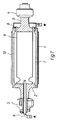
- Figure 1 is a schematic view of a typical water cooled soft roll.
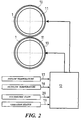
- Figure 2 is a diagram of a control system suitable for implementation of the method.
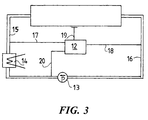
- Figure 3 is a diagram of a cooling/heating system suitable for implementation of the method.
- Figure 4 is a chart of a vibration test done on an apparatus which was run according to the present invention.
- the goal of the invention is to effect the vibrations of roll nips which are caused by heating of materials and structures. Heat can effect directly to excitations or the dynamic properties of the system. Heating of coating materials of soft rolls is such a variable.
- rolls of size presses are coated with rubber, which is a viscoelastic material.
- the mechanical properties of the material depend on its temperature, and for example the elastic modulus of rubber materials may decrease over 50% when temperature rises from 20°C to 65°C.
- the natural frequencies of the nip vibration depend very strongly on the properties of the rubber.
- the above mentioned change in elastic modulus transfers the nominal frequency of the roll set of one size press manufactured by the applicant from 64 Hz to 53 Hz.
- the amplitude of the change is different for different kinds of roll sets, but the changing properties of the coating clearly effect the nominal frequencies of roll sets in this manner.
- One particular feature that amplifies the vibrations relates to the internal damping of rubber. Deformations in rubber return quite slowly and since the time of one revolution in modern fast machines is about 0.3 s, the pattern caused by the opposing roll in the nip does not return during one revolution. This pattern is a wave-like formation which rises from the surface of the roll after the nip, sinks in the nip and rises after the nip. The rising part of the wave leaving the nip does not level down during one revolution and hits the nip during the next revolution. This causes a periodical excitation on the roll set.
- the vibration of the set increases, first gradually, but if the web speed remains same for a longer period, the amplitude begins to rise and leads quite rapidly to excessive vibration or a web break and the machine has to be stopped.
- the transmission and electrical motors of the apparatus as well as deformations in the web may also excite vibration of the roll set.
- the natural frequency of the roll set changes during the operation of the machine because of heating of the coating.
- the machine operates on a same speed for a long time if web breaks do not occur and excessive vibration does not arise.
- the natural frequency of the roll set changes and when the natural frequency and the frequency of the excitation fall close enough, the system settles on a resonance frequency and the vibration amplitude begins to rise.
- the apparatus seeks a steady state of operation wherein the natural freaquency of the roll set and the frequency of the excitation lead to resonance.
- the natural frequency of a roll set is controlled by an adjustable temperature controlling system.
- the natural frequency of the roll set By changing the natural frequency of the roll set the increasing of vibration is prevented since the natural frequency of the roll set is not let to stay on a resonance frequency. Thus the system does not find a steady state wherein resonance occurs and the amplitude of the vibration is increased. In principle the effect of the temperature change is same as the effect of a change in running speed; the frequencies of the excitements and the natural frequencies are prevented to fall close each other for a too long time.
- changing the natural frequency of the roll set for example by cooling one or more of the soft rolls the natural frequency of the roll set travels over the frequency of the excitement and no resonance occurs. It is not any more necassery to control the vibrations by changing the operation speed or by using only certain running speeds on which vibrations are minimized.
- the choice of the running speed of a paper machine depends on facts relating to paper quality and runnability of the machine. Obviously it is desirable to run the paper machine on a speed resulting in best quality and runnability and the speed changes have to avoided. For this reason the paper manufacturers do not purchase machinery which does not allow them to choose the running speed freely within the designed speed limits of the machine. If the vibrations of the machine are controlled according to the invention, the paper quality can be maintained uniform, the soft coating of rolls lasts longer and the frequency of breaks diminishes.
- the figure 1 shows a water cooled soft roll.
- the roll comprises a hollow core 1 and two ends attached to the ends of the core 1 and having axles extending outwards from the ends of the core 1.
- the axles are mounted on bearings 4, 5.
- the coolant which is usually water, is lead into the roll through a pipe 6 arranged within one end 2 of the roll.
- Within the core 1 is a inner core 7 attached to the ends 2, 3.
- the inner core 7 has a outer diameter that is smaller than the inner diameter of the core 1.
- the core 1 and the inner core 7 form a passage 9 for coolant extending from the entrance end 2 to the opposite end 3 wherein there are passages 8 for removal of the coolant.
- the coolant passage 9 extends along the inner surface of the core 1 and between the inner walls of the ends 2, 3.
- a soft surface coating 10 is arranged on the outer surface of the core 1 and the coating extends longitudinally over the area that is between the inner walls of the ends 2, 3 so that the entire area of soft coating is cooled.
- cooled roll is only one example of cooled soft rolls. Different kind of cooled rolls are widely used in the art and the invention is not limited to any specific construction of the roll.
- FIG 2 is schematically described a control system which can be used for controlling the vibrations of a roll set.
- the roll set of figure 2 comprises two cooled soft rolls 11.
- a control apparatus 12 handles data obtained from various sources and controls the temperature of the cooling medium.
- the control apparatus governs the heat load which is transferred from the roll 11 to the coolant. For this reason the temperature of the coolant entering the roll 11 is measured as well as the temparature of the leaving coolant and the volymetric flow.
- the cooling or heating power can be calculated from the temperature difference and the volymetric flow.
- the vibration of the roll set is also measured and when increasing of vibration is detected, the temperature of the entering coolant is changed.
- Figure 3 shows a closed circuit cooling system for implemantation of the invention.
- the coolant leaves the roll to an outflow duct 16 leading to a pump 13.
- the pump 13 feeds the coolant into a heat exhanger 14 wherefrom it flows through an inflow duct 15 into the roll.
- the temperature of inflowing and outflowing coolant is transferred to the control apparatus 12 through measurement lines 17 and 18.
- the volumetric flow of the coolant is also detected and transferred to the control apparatus 12 through line 20 and vibration data is transferred to the control apparatus through line 19.
- the natural frequency of the roll set can be changed either by cooling or heating at least one of the soft rolls. According to the present knowledge cooling of the roll is preferred.
- the vibration status of the roll set is measured and when increasing amplitude or vibration energy is detected, the temperature of soft rolls and especially their coating is cooled by feeding more or colder coolant into the rolls.
- the coating cools, its stiffness increases and the natural ferquency of the roll set is changed. After a while the natural frequency does not any more fall near the frequency of the excitements and the increasing of the vibration energy stops and if cooling is continued, begins to decrease.
- the temperature of the coating can be changed automatically in predetermined time intervals.
- the development of vibrations in soft roll nips takes a long time, typically several hours and if the temperature of the soft coating is changed for example every operating hour, the system does not find its stable state and resonance does not occur.
- the temperature of the coating may also be increased, which can be implemented either by heating the coolant in the heat exchanger or simply by decreasing the cooling power so that the coating heats because of its repeated deformation and internal friction.
- the operation of cooling or heating can be easily monitored by measuring the temperature of the outflowing coolant.
- the vibration status of the roll set can be monitored constantly and if the changing of the temperature of the roll coating is not sufficient to prevent the vibration, an alarm may be triggered. When alarm is noticed, web speed may be changed or the machine may be stopped in a controlled manner.
- the figure 4 is a diagram of a test run which was done on a size press for examining the vibrations of the rolls set when the apparatus was run according to the invention.
- the ordinata of diagram shows running time in hours and the abscissa shows vibration velocity of the bottom roll.
- a curve marked with square blocks shows an estimated development of the vibration when no control measures are taken and the vibration may develop freely. In a resonance situation the vibration velocity increases rapidly and if the web speed is not changed, increasing vibration leads to a web break and the machine must be stopped.
- cooling was started when the vibration velocity was over 1.5 mm/s rms. After that the increasing of vibration slowed rapidly and when the cooling had been on about two hours, began to slowly decrease. The test had to be stopped at three hours from starting but no web breaks did occur at the size press during the test. Similar behavior was observed also in confirmatory tests.
Landscapes
- Paper (AREA)
- Rolls And Other Rotary Bodies (AREA)
- Spinning Or Twisting Of Yarns (AREA)
Abstract
Description
- The present invention relates to a method for preventing vibrations of roll sets comprising at least two rolls which form a nip wherethrough a paper or a cardboard web is guided comprising at least one soft roll coated with a compressible coating.
- The invention also relates to a paper making apparatus comprising a roll set and means for preventing vibrations of the roll set, wherein the roll set comprises at least two rolls which form a nip through which a paper or card board web can be guided and of which rolls at least one is a soft roll coated with a compressible coating.
- In the paper making industry different kind of roll sets are used for several purposes. A roll set comprises at least two rolls which form a nip wherethrough a paper or a cardboard web is guided. Roll sets comprising at least one soft roll are used mainly in calenders and size presses. A size press is used for impregnating the paper web with glue or for coating the web with a pigment. A modern size press comprises two rolls coated with a soft rubber coating and means for applying coating mix on the surfaces of the rolls. The web travels through the nip formed by the rolls and the coating is formed on both sides of the web simultaneously when the rolls covered with the coating mix are pressed against the web.
- In soft calenders a roll set comprises a soft roll covered with a polymer material and a backing roll made of steel and the calander mostly has two roll sets for calandering both sides of the web. In some applications a roll set comprising three rolls may be used. This arrangement consists of two soft rolls and a backing roll. The backing roll forms a nip with both of the soft rolls and the web passes succesively through both nips and is thereby calendered twice. A roll set of a supercalender comprises even more rolls and in a supercalender a soft roll is always placed between two hard backing rolls. Since polymer materials presently available do not endure two or more nips on a same roll, the soft coating of the supercalender rolls is made of cotton or paper discs which are tightly pressed on the core of the roll.
- One relevantly frequent problem with rotating roll sets is oscillation of the nip formed by rolls. Oscillation of a nip formed of two or more hard steel rolls can be avoided in a large extent by balancing and proper dimensioning, but when the web speeds of paper making machinery have increased, it has been noted that a nip formed by two soft rolls or by a soft roll and two or more hard rolls tends to start to vibrate on certain web speeds. Reason for this has not been known so far. These oscillations could be easily avoided by changing the web speed of the machine so that the vibration is not located on the natural frequency of the roll set. However, size presses and soft calenders, in which soft rolls are most commonly used, are almost without exeption on-machine apparatuses. It is obvious that the paper makers want to run their machinery on a speed that results the best quality and productivity. For example, a head box usually works best on a certain speed. This speed depends on the thickness of the web and other variables and is different for each kind of paper. For this reason it is not acceptable to change the speed of the paper machine because of vibration of a size press or a calender. Speed changes also increase risk of web breaks which have a strong influence on the productivity of the machine. Changing and controlling the speed of an entire manufacturing line is very difficult and it is preferred to run the machine on a steady speed.
- The tendency of the machine to vibrate can be diminished by using rolls which have a thinner coating and a thicker core. In practice this solution is not very good since thicker core leads to heavier rolls. The thickness of the coating can be decreased only in a certain extent since rolls have to be grinded in regular intervals because of wearing and deformation of the coating. Furthermore, size presses and calenders are designed to use rolls having a certain kind of coating and using of different kind of rolls in existing apparatuses can be difficult.
- The United States Patent 5,024,150 discloses a process for reducing vibrations of successive rolls sets. According to this document, the natural frequency of at least two successive roll sets is designed so that the natural frequencies are not the same for successive roll sets in order to prevent vibrations being transferred from the first to the second roll set. This is implemented by dimensioning the frames, rolls or other structural elements of the roll sets so that the possible random vibration of one set is not tranferred to other roll sets. Also dampers may be used. In the case when one of the roll sets includes a flexure controlled roll having a rotatable hollow cylinder supported by at least one supporting plunger on a stationary crosshead, the plunger having a hydrostatic chamber to form a supporting film of hydraulic fluid between the plunger and the cylinder, the natural frequency of the roll set can be changed during operation by varying the thickness of the supporting film.
- According to the present invention, the vibrations of a roll set of a paper making apparatus, wherein the roll set comprises at least two rolls which form a nip therebetween through which a paper or cardboard web is guided and of which rolls at least one is a soft roll coated with a compressible coating and comprising a temperature control system, are prevented by changing the natural frequency of the roll set during the operation of the apparatus by changing the temperature of the coating of the at least one soft roll.
- According to the other aspects of the present invention, the temperature of the coating is changed by cooling the soft roll with circulating water. Furthermore, the cooling is initiated when increasing vibrations in the nip of the rolls is detected.
- In this application definition "soft roll" is used as a general nomination for rolls having a steel core and a coating of compressible synthetic or natural rubber or synthetic polymer material material or other material which is softer and more easily deformed than steel.
- Other objects and features of the invention will become apparent from the following detailed description considered in conjunction with the accompanying drawings. It is to be understood, however, that the drawings are intended solely for purposes of illustration and not as a definition of the limits of the invention as defined in the appended claims.
- Figure 1 is a schematic view of a typical water cooled soft roll.
- Figure 2 is a diagram of a control system suitable for implementation of the method.
- Figure 3 is a diagram of a cooling/heating system suitable for implementation of the method.
- Figure 4 is a chart of a vibration test done on an apparatus which was run according to the present invention.
- The goal of the invention is to effect the vibrations of roll nips which are caused by heating of materials and structures. Heat can effect directly to excitations or the dynamic properties of the system. Heating of coating materials of soft rolls is such a variable. For example, rolls of size presses are coated with rubber, which is a viscoelastic material. The mechanical properties of the material depend on its temperature, and for example the elastic modulus of rubber materials may decrease over 50% when temperature rises from 20°C to 65°C. The natural frequencies of the nip vibration depend very strongly on the properties of the rubber. The above mentioned change in elastic modulus transfers the nominal frequency of the roll set of one size press manufactured by the applicant from 64 Hz to 53 Hz. The amplitude of the change is different for different kinds of roll sets, but the changing properties of the coating clearly effect the nominal frequencies of roll sets in this manner.
- One particular feature that amplifies the vibrations relates to the internal damping of rubber. Deformations in rubber return quite slowly and since the time of one revolution in modern fast machines is about 0.3 s, the pattern caused by the opposing roll in the nip does not return during one revolution. This pattern is a wave-like formation which rises from the surface of the roll after the nip, sinks in the nip and rises after the nip. The rising part of the wave leaving the nip does not level down during one revolution and hits the nip during the next revolution. This causes a periodical excitation on the roll set. If the excitation frequency is close to the natural frequency of the roll set, the vibration of the set increases, first gradually, but if the web speed remains same for a longer period, the amplitude begins to rise and leads quite rapidly to excessive vibration or a web break and the machine has to be stopped. The transmission and electrical motors of the apparatus as well as deformations in the web may also excite vibration of the roll set.
- Since the physical properties of the soft coating vary according to its temperature, the natural frequency of the roll set changes during the operation of the machine because of heating of the coating. In a normal running situation, the machine operates on a same speed for a long time if web breaks do not occur and excessive vibration does not arise. During the running period the natural frequency of the roll set changes and when the natural frequency and the frequency of the excitation fall close enough, the system settles on a resonance frequency and the vibration amplitude begins to rise. Thus the apparatus seeks a steady state of operation wherein the natural freaquency of the roll set and the frequency of the excitation lead to resonance.
- According to the invention the natural frequency of a roll set is controlled by an adjustable temperature controlling system.
- By changing the natural frequency of the roll set the increasing of vibration is prevented since the natural frequency of the roll set is not let to stay on a resonance frequency. Thus the system does not find a steady state wherein resonance occurs and the amplitude of the vibration is increased. In principle the effect of the temperature change is same as the effect of a change in running speed; the frequencies of the excitements and the natural frequencies are prevented to fall close each other for a too long time. By changing the natural frequency of the roll set for example by cooling one or more of the soft rolls the natural frequency of the roll set travels over the frequency of the excitement and no resonance occurs. It is not any more necassery to control the vibrations by changing the operation speed or by using only certain running speeds on which vibrations are minimized. The choice of the running speed of a paper machine depends on facts relating to paper quality and runnability of the machine. Obviously it is desirable to run the paper machine on a speed resulting in best quality and runnability and the speed changes have to avoided. For this reason the paper manufacturers do not purchase machinery which does not allow them to choose the running speed freely within the designed speed limits of the machine. If the vibrations of the machine are controlled according to the invention, the paper quality can be maintained uniform, the soft coating of rolls lasts longer and the frequency of breaks diminishes.
- The figure 1 shows a water cooled soft roll. The roll comprises a
hollow core 1 and two ends attached to the ends of thecore 1 and having axles extending outwards from the ends of thecore 1. The axles are mounted onbearings end 2 of the roll. Within thecore 1 is ainner core 7 attached to theends inner core 7 has a outer diameter that is smaller than the inner diameter of thecore 1. Thecore 1 and theinner core 7 form apassage 9 for coolant extending from theentrance end 2 to theopposite end 3 wherein there arepassages 8 for removal of the coolant. Thecoolant passage 9 extends along the inner surface of thecore 1 and between the inner walls of theends soft surface coating 10 is arranged on the outer surface of thecore 1 and the coating extends longitudinally over the area that is between the inner walls of theends - The above described cooled roll is only one example of cooled soft rolls. Different kind of cooled rolls are widely used in the art and the invention is not limited to any specific construction of the roll.
- In figure 2 is schematically described a control system which can be used for controlling the vibrations of a roll set. The roll set of figure 2 comprises two cooled soft rolls 11. A
control apparatus 12 handles data obtained from various sources and controls the temperature of the cooling medium. Basicly the control apparatus governs the heat load which is transferred from theroll 11 to the coolant. For this reason the temperature of the coolant entering theroll 11 is measured as well as the temparature of the leaving coolant and the volymetric flow. The cooling or heating power can be calculated from the temperature difference and the volymetric flow. The vibration of the roll set is also measured and when increasing of vibration is detected, the temperature of the entering coolant is changed. - Figure 3 shows a closed circuit cooling system for implemantation of the invention. In modern paper mills the amount of waste water has to be kept in minimum and therefore only closed cooling systems are acceptable. Of course the invention can be without difficulty accomplished by using an open cooling or heating system. In the system of figure 3 the coolant leaves the roll to an
outflow duct 16 leading to apump 13. Thepump 13 feeds the coolant into aheat exhanger 14 wherefrom it flows through aninflow duct 15 into the roll. The temperature of inflowing and outflowing coolant is transferred to thecontrol apparatus 12 throughmeasurement lines control apparatus 12 throughline 20 and vibration data is transferred to the control apparatus throughline 19. - The natural frequency of the roll set can be changed either by cooling or heating at least one of the soft rolls. According to the present knowledge cooling of the roll is preferred. In this embodiment the vibration status of the roll set is measured and when increasing amplitude or vibration energy is detected, the temperature of soft rolls and especially their coating is cooled by feeding more or colder coolant into the rolls. When the coating cools, its stiffness increases and the natural ferquency of the roll set is changed. After a while the natural frequency does not any more fall near the frequency of the excitements and the increasing of the vibration energy stops and if cooling is continued, begins to decrease. Alternatively the temperature of the coating can be changed automatically in predetermined time intervals.
- The development of vibrations in soft roll nips takes a long time, typically several hours and if the temperature of the soft coating is changed for example every operating hour, the system does not find its stable state and resonance does not occur. In this case the temperature of the coating may also be increased, which can be implemented either by heating the coolant in the heat exchanger or simply by decreasing the cooling power so that the coating heats because of its repeated deformation and internal friction. In any case the operation of cooling or heating can be easily monitored by measuring the temperature of the outflowing coolant. The vibration status of the roll set can be monitored constantly and if the changing of the temperature of the roll coating is not sufficient to prevent the vibration, an alarm may be triggered. When alarm is noticed, web speed may be changed or the machine may be stopped in a controlled manner.
- The figure 4 is a diagram of a test run which was done on a size press for examining the vibrations of the rolls set when the apparatus was run according to the invention. The ordinata of diagram shows running time in hours and the abscissa shows vibration velocity of the bottom roll. A curve marked with square blocks shows an estimated development of the vibration when no control measures are taken and the vibration may develop freely. In a resonance situation the vibration velocity increases rapidly and if the web speed is not changed, increasing vibration leads to a web break and the machine must be stopped. When the machine was run according to the invention, cooling was started when the vibration velocity was over 1.5 mm/s rms. After that the increasing of vibration slowed rapidly and when the cooling had been on about two hours, began to slowly decrease. The test had to be stopped at three hours from starting but no web breaks did occur at the size press during the test. Similar behavior was observed also in confirmatory tests.
Claims (9)
- A method for preventing vibrations of a roll set of a paper making apparatus, wherein the roll set comprises at least two rolls (11) which form a nip therebetween through which a paper or cardboard web is guided and of which rolls at least one is a soft roll coated with a compressible coating (10), the method comprising changing the natural frequency of the roll set during operation of the apparatus, characterized in that the at least one soft roll (11) comprises a temperature control system (6, 8, 9, 13, 14, 15, 16) and that the natural frequency of the roll set during the operation of the apparatus is changed by changing the temperature of the coating (10) of the at least one soft roll (11).
- A method according to the claim 1, characterized by measuring the vibration status of the roll set and changing the temperature of the coating (10) of the at least one soft roll (11) when increasing vibration is detected.
- A method according to the claim 1, characterized by changing the temperature of the coating (10) of the at least one soft roll (11) in regular intervals.
- A method according to the claim 2 or 3, characterized by decreasing the temperature of the coating (10) by increasing the cooling effect of a coolant fed into the roll (11).
- A method according to the claim 2 or 3, characterized by increasing the temperature of the coating (10) by decreasing the cooling effect of a coolant fed into the roll (11).
- A paper making apparatus comprising a roll set and means for preventing vibrations of the roll set, wherein the roll set comprises at least two rolls (11) which form a nip therebetween through which a paper or cardboard web can be guided and of which rolls at least one is a soft roll (11) coated with a compressible coating (10), characterized in that the at least one soft roll (11) comprises a temperature control system (6, 8, 9, 13, 14, 15, 16) and that the means for preventing vibrations of the roll set comprise a control apparatus (12) for governing the temperature control system (6, 8, 9, 13, 14, 15, 16) so that the temperature of the coating (10) of the at least one soft roll (11) can be changed during the operation of the appararatus for changing the natural frequency of the roll set.
- An apparatus according to the claim 6, characterized by a temperature control system including means (6) for feeding coolant into the at least one soft roll (11), a heat exhanger (14) for controlling the temperature of the coolant and means (13, 15, 16) for receiving the coolant flow from the roll and returning it through the heat exhanger (14) back to the roll, the apparatus comprising means for detecting the temperature of the inflowing coolant (17), the temperature of the outflowing coolant (18), volymetric flow (20) of the coolant and vibration status (19) of the roll set, and means for delivering the measured information to the control apparatus (12).
- An apparatus according to the claim 6, wherein the paper making apparatus is a size press.
- An apparatus according to the claim 6, wherein the paper making apparatus is a calender.
Applications Claiming Priority (2)
| Application Number | Priority Date | Filing Date | Title |
|---|---|---|---|
| US08/570,266 US5768985A (en) | 1995-12-11 | 1995-12-11 | Method for preventing vibrations of a roll set |
| US570266 | 2000-05-12 |
Publications (2)
| Publication Number | Publication Date |
|---|---|
| EP0779394A1 EP0779394A1 (en) | 1997-06-18 |
| EP0779394B1 true EP0779394B1 (en) | 2000-05-10 |
Family
ID=24278927
Family Applications (1)
| Application Number | Title | Priority Date | Filing Date |
|---|---|---|---|
| EP96660080A Expired - Lifetime EP0779394B1 (en) | 1995-12-11 | 1996-11-05 | Method and apparatus for preventing vibrations of a roll set |
Country Status (6)
| Country | Link |
|---|---|
| US (2) | US5768985A (en) |
| EP (1) | EP0779394B1 (en) |
| JP (1) | JPH09176982A (en) |
| AT (1) | ATE192803T1 (en) |
| BR (1) | BR9605954A (en) |
| DE (1) | DE69608221T2 (en) |
Cited By (1)
| Publication number | Priority date | Publication date | Assignee | Title |
|---|---|---|---|---|
| US7311039B2 (en) | 2003-11-27 | 2007-12-25 | Metso Paper, Inc. | Method and arrangement for preventing vibrations in a multi-nip calender or calender array |
Families Citing this family (19)
| Publication number | Priority date | Publication date | Assignee | Title |
|---|---|---|---|---|
| DE19702325A1 (en) * | 1997-01-23 | 1998-07-30 | Alcan Gmbh | Process for the production of vibration-damped rollers and roller set |
| DE19824542B4 (en) * | 1998-06-03 | 2005-07-14 | Voith Paper Patent Gmbh | Roller, calender and method for operating a roller |
| FI104208B (en) * | 1998-07-17 | 1999-11-30 | Valmet Corp | A method for damping vibrations in a paper machine environment |
| FI104207B (en) | 1998-07-24 | 1999-11-30 | Valmet Corp | A method and apparatus for changing the characteristic frequency of a nip roll structure of a paper or board machine |
| CA2279609C (en) * | 1998-08-06 | 2007-05-01 | Voith Sulzer Papiertechnik Patent Gmbh | Device to actively weaken undesirable vibrations in a rotating roll; device for treatment of a material web; specifically a paper or cardboard web |
| FI104121B1 (en) | 1998-08-14 | 1999-11-15 | Valmet Corp | Method and apparatus for changing the intrinsic frequency of a nip roll construction in a paper or cardboard machine |
| DE19907078A1 (en) * | 1999-02-19 | 2000-08-24 | Voith Sulzer Papiertech Patent | System to counter contact oscillation in paired rollers processing a paper or cardboard web has systems to vary their mass/mass distribution and position and speed under control according to sensor measurements |
| DE19907079A1 (en) * | 1999-02-19 | 2000-08-24 | Voith Sulzer Papiertech Patent | System to counter contact oscillation in paired rollers processing a paper web has force units and tensioners within the rollers to modify their inner tension under control according to sensor measurements |
| FI115994B (en) * | 2000-01-07 | 2005-08-31 | Metso Paper Inc | attenuation |
| DE10006299B4 (en) | 2000-02-12 | 2005-10-27 | Voith Paper Patent Gmbh | Method for operating a calender roll and calender roll |
| DE10008800B4 (en) * | 2000-02-25 | 2005-10-27 | Voith Paper Patent Gmbh | Method for operating a calender roll and calender roll |
| US6629663B1 (en) | 2001-01-10 | 2003-10-07 | Valmet Corporation | Wound roll vibration detection system |
| FI20012327A7 (en) * | 2001-11-28 | 2003-05-29 | Metso Paper Inc | Method for manufacturing paper or cardboard web and apparatus in connection with a paper or cardboard web manufacturing line |
| EP1483444B1 (en) * | 2002-02-01 | 2005-12-28 | Koenig & Bauer Aktiengesellschaft | Method and device for reducing vibrations in rotating components |
| DE10213851A1 (en) * | 2002-03-27 | 2003-10-09 | Voith Paper Patent Gmbh | Method for operating a paper machine and paper machine |
| DE10358292B3 (en) * | 2003-12-12 | 2005-01-13 | Shw Casting Technologies Gmbh | Temperature-controlled calender drum to smooth surface of paper web has a slurry-filled void |
| DE102005022874A1 (en) * | 2005-05-18 | 2006-11-23 | Voith Patent Gmbh | Vibration reduction in machines such as presses or calenders having nip-forming rollers uses measures involving repeatedly varying the rotational speed of the rollers |
| US20070258831A1 (en) * | 2006-05-05 | 2007-11-08 | Ragain Air Compressors, Inc. | Single stage to two stage compressor |
| JP7484435B2 (en) * | 2020-06-02 | 2024-05-16 | 東レ株式会社 | Method for predicting occurrence of roller polygonization phenomenon and method for changing natural frequency of conveying system |
Family Cites Families (10)
| Publication number | Priority date | Publication date | Assignee | Title |
|---|---|---|---|---|
| US3111189A (en) * | 1962-01-12 | 1963-11-19 | Theodore R Scholl | Electrodynamic loudspeaker |
| US3111894A (en) * | 1962-04-17 | 1963-11-26 | West Virginia Pulp & Paper Co | Calender vibration eliminator |
| US3512475A (en) * | 1968-09-21 | 1970-05-19 | Beloit Corp | Self-damped calender roll |
| US3726338A (en) * | 1970-12-28 | 1973-04-10 | Beloit Corp | Controlled deflection roll with controlled temperature |
| JPS6052936B2 (en) * | 1980-06-27 | 1985-11-22 | 三菱重工業株式会社 | single facer |
| US4670102A (en) * | 1986-01-08 | 1987-06-02 | Westvaco Corporation | Tandem calender |
| DE3638070A1 (en) * | 1986-11-07 | 1988-05-19 | Voith Gmbh J M | ROLLER |
| DE3639009A1 (en) * | 1986-11-14 | 1988-05-26 | Kuesters Eduard Maschf | ROLLER FOR THE PRESSURE TREATMENT OF TRACKS |
| DE3815445A1 (en) * | 1988-05-06 | 1989-11-16 | Kuesters Eduard Maschf | METHOD FOR REDUCING VIBRATIONS ON SUCCESSIVE ROLLER PAIRS AND DEVICE HAVING SUCH ROLLER PAIRS |
| US5244448A (en) * | 1989-05-22 | 1993-09-14 | Valmet Paper Machinery Inc. | Method and apparatus for regulating the temperature of an adjustable-crown roll |
-
1995
- 1995-12-11 US US08/570,266 patent/US5768985A/en not_active Expired - Fee Related
-
1996
- 1996-11-05 DE DE69608221T patent/DE69608221T2/en not_active Expired - Lifetime
- 1996-11-05 EP EP96660080A patent/EP0779394B1/en not_active Expired - Lifetime
- 1996-11-05 AT AT96660080T patent/ATE192803T1/en not_active IP Right Cessation
- 1996-12-09 JP JP8328245A patent/JPH09176982A/en active Pending
- 1996-12-11 BR BR9605954A patent/BR9605954A/en not_active IP Right Cessation
-
1997
- 1997-12-10 US US08/988,122 patent/US5915297A/en not_active Expired - Fee Related
Cited By (1)
| Publication number | Priority date | Publication date | Assignee | Title |
|---|---|---|---|---|
| US7311039B2 (en) | 2003-11-27 | 2007-12-25 | Metso Paper, Inc. | Method and arrangement for preventing vibrations in a multi-nip calender or calender array |
Also Published As
| Publication number | Publication date |
|---|---|
| US5915297A (en) | 1999-06-29 |
| BR9605954A (en) | 1998-08-18 |
| EP0779394A1 (en) | 1997-06-18 |
| DE69608221D1 (en) | 2000-06-15 |
| DE69608221T2 (en) | 2000-09-07 |
| JPH09176982A (en) | 1997-07-08 |
| US5768985A (en) | 1998-06-23 |
| ATE192803T1 (en) | 2000-05-15 |
Similar Documents
| Publication | Publication Date | Title |
|---|---|---|
| US5915297A (en) | Apparatus for preventing vibrations of a roll set | |
| CA1264588A (en) | Method and apparatus for temperature gradient calendering | |
| CA1143039A (en) | Nip control method and apparatus | |
| US6418840B1 (en) | Calendering method and a calender that makes use of the method | |
| US4498383A (en) | Calendar | |
| EP0973972B1 (en) | Calendering method and a calender that makes use of the method | |
| US6274001B1 (en) | Method for calendering surface sized paper/paperboard to improve smoothness | |
| FI81632C (en) | FARING EQUIPMENT FOR FISHING FISHING AV EN BANA. | |
| JPH08247386A (en) | Control-monitor device for circulating lubrication of bearing for cylinder and roll of paper machine, etc. | |
| CA2144797A1 (en) | Paper calendering apparatus | |
| JPH03502824A (en) | Roll driving method | |
| US5746124A (en) | Calender for treating a web of paper | |
| EP1155190B1 (en) | Method and device for changing the natural frequency of a nip roll construction in a paper or board machine | |
| US6758135B2 (en) | Method and device for moisturization of a paper or board web in calendering | |
| US3753276A (en) | Calender roll cover | |
| US5060565A (en) | Smoothing and calibrating of paper | |
| FI110884B (en) | A method for adjusting the heat of a heated roll in a calender | |
| CA2393248C (en) | Calender and process for operating a calender | |
| US7481754B2 (en) | Roll | |
| FI111134B (en) | Method and apparatus for preventing vibration of rollers in a film press | |
| CN101688366A (en) | Device and method for compensating for periodic torque fluctuations | |
| US20190368946A1 (en) | Measuring Temperature for Monitoring and Control of a Fiber Web or Finishing Machine | |
| EP1217123B1 (en) | Roll in particular calender roll | |
| FI115994B (en) | attenuation | |
| DE102007041932A1 (en) | Calender smoothing web in e.g. papermaking industry, includes piezoelectric ultrasound generator acting on web in nip region |
Legal Events
| Date | Code | Title | Description |
|---|---|---|---|
| PUAI | Public reference made under article 153(3) epc to a published international application that has entered the european phase |
Free format text: ORIGINAL CODE: 0009012 |
|
| AK | Designated contracting states |
Kind code of ref document: A1 Designated state(s): AT DE FI FR GB IT SE |
|
| 17P | Request for examination filed |
Effective date: 19970423 |
|
| 17Q | First examination report despatched |
Effective date: 19981218 |
|
| GRAG | Despatch of communication of intention to grant |
Free format text: ORIGINAL CODE: EPIDOS AGRA |
|
| GRAG | Despatch of communication of intention to grant |
Free format text: ORIGINAL CODE: EPIDOS AGRA |
|
| GRAH | Despatch of communication of intention to grant a patent |
Free format text: ORIGINAL CODE: EPIDOS IGRA |
|
| GRAH | Despatch of communication of intention to grant a patent |
Free format text: ORIGINAL CODE: EPIDOS IGRA |
|
| GRAA | (expected) grant |
Free format text: ORIGINAL CODE: 0009210 |
|
| AK | Designated contracting states |
Kind code of ref document: B1 Designated state(s): AT DE FI FR GB IT SE |
|
| REF | Corresponds to: |
Ref document number: 192803 Country of ref document: AT Date of ref document: 20000515 Kind code of ref document: T |
|
| REF | Corresponds to: |
Ref document number: 69608221 Country of ref document: DE Date of ref document: 20000615 |
|
| ET | Fr: translation filed | ||
| ITF | It: translation for a ep patent filed | ||
| PLBE | No opposition filed within time limit |
Free format text: ORIGINAL CODE: 0009261 |
|
| STAA | Information on the status of an ep patent application or granted ep patent |
Free format text: STATUS: NO OPPOSITION FILED WITHIN TIME LIMIT |
|
| 26N | No opposition filed | ||
| REG | Reference to a national code |
Ref country code: GB Ref legal event code: IF02 |
|
| PGFP | Annual fee paid to national office [announced via postgrant information from national office to epo] |
Ref country code: FI Payment date: 20081114 Year of fee payment: 13 Ref country code: AT Payment date: 20081114 Year of fee payment: 13 |
|
| PGFP | Annual fee paid to national office [announced via postgrant information from national office to epo] |
Ref country code: IT Payment date: 20081125 Year of fee payment: 13 Ref country code: SE Payment date: 20081114 Year of fee payment: 13 |
|
| PGFP | Annual fee paid to national office [announced via postgrant information from national office to epo] |
Ref country code: FR Payment date: 20081113 Year of fee payment: 13 |
|
| PGFP | Annual fee paid to national office [announced via postgrant information from national office to epo] |
Ref country code: GB Payment date: 20081117 Year of fee payment: 13 |
|
| PGFP | Annual fee paid to national office [announced via postgrant information from national office to epo] |
Ref country code: DE Payment date: 20091120 Year of fee payment: 14 |
|
| EUG | Se: european patent has lapsed | ||
| GBPC | Gb: european patent ceased through non-payment of renewal fee |
Effective date: 20091105 |
|
| REG | Reference to a national code |
Ref country code: FR Ref legal event code: ST Effective date: 20100730 |
|
| PG25 | Lapsed in a contracting state [announced via postgrant information from national office to epo] |
Ref country code: FI Free format text: LAPSE BECAUSE OF NON-PAYMENT OF DUE FEES Effective date: 20091105 Ref country code: AT Free format text: LAPSE BECAUSE OF NON-PAYMENT OF DUE FEES Effective date: 20091105 |
|
| PG25 | Lapsed in a contracting state [announced via postgrant information from national office to epo] |
Ref country code: FR Free format text: LAPSE BECAUSE OF NON-PAYMENT OF DUE FEES Effective date: 20091130 |
|
| PG25 | Lapsed in a contracting state [announced via postgrant information from national office to epo] |
Ref country code: GB Free format text: LAPSE BECAUSE OF NON-PAYMENT OF DUE FEES Effective date: 20091105 |
|
| PG25 | Lapsed in a contracting state [announced via postgrant information from national office to epo] |
Ref country code: IT Free format text: LAPSE BECAUSE OF NON-PAYMENT OF DUE FEES Effective date: 20091105 |
|
| PG25 | Lapsed in a contracting state [announced via postgrant information from national office to epo] |
Ref country code: SE Free format text: LAPSE BECAUSE OF NON-PAYMENT OF DUE FEES Effective date: 20091106 |
|
| REG | Reference to a national code |
Ref country code: DE Ref legal event code: R119 Ref document number: 69608221 Country of ref document: DE Effective date: 20110601 Ref country code: DE Ref legal event code: R119 Ref document number: 69608221 Country of ref document: DE Effective date: 20110531 |
|
| PG25 | Lapsed in a contracting state [announced via postgrant information from national office to epo] |
Ref country code: DE Free format text: LAPSE BECAUSE OF NON-PAYMENT OF DUE FEES Effective date: 20110531 |