EP0776204B1 - Indole alkaloids useful as anti-inflammatory agents - Google Patents
Indole alkaloids useful as anti-inflammatory agents Download PDFInfo
- Publication number
- EP0776204B1 EP0776204B1 EP95928352A EP95928352A EP0776204B1 EP 0776204 B1 EP0776204 B1 EP 0776204B1 EP 95928352 A EP95928352 A EP 95928352A EP 95928352 A EP95928352 A EP 95928352A EP 0776204 B1 EP0776204 B1 EP 0776204B1
- Authority
- EP
- European Patent Office
- Prior art keywords
- compound
- ear
- compounds
- scytonemin
- inflammatory
- Prior art date
- Legal status (The legal status is an assumption and is not a legal conclusion. Google has not performed a legal analysis and makes no representation as to the accuracy of the status listed.)
- Expired - Lifetime
Links
- 239000002260 anti-inflammatory agent Substances 0.000 title claims abstract description 13
- 229940121363 anti-inflammatory agent Drugs 0.000 title claims abstract description 9
- 229930005303 indole alkaloid Natural products 0.000 title claims description 11
- 150000002475 indoles Chemical class 0.000 title description 3
- 125000002496 methyl group Chemical group [H]C([H])([H])* 0.000 claims abstract description 15
- WYTGDNHDOZPMIW-RCBQFDQVSA-N alstonine Chemical class C1=CC2=C3C=CC=CC3=NC2=C2N1C[C@H]1[C@H](C)OC=C(C(=O)OC)[C@H]1C2 WYTGDNHDOZPMIW-RCBQFDQVSA-N 0.000 claims abstract description 11
- 125000000217 alkyl group Chemical group 0.000 claims abstract description 7
- 125000004432 carbon atom Chemical group C* 0.000 claims abstract description 7
- 239000003223 protective agent Substances 0.000 claims abstract description 7
- 150000001875 compounds Chemical class 0.000 claims description 54
- -1 indole alkaloid compound Chemical class 0.000 claims description 6
- 230000003110 anti-inflammatory effect Effects 0.000 claims description 5
- 239000003814 drug Substances 0.000 claims description 5
- 239000003937 drug carrier Substances 0.000 claims description 3
- 238000002360 preparation method Methods 0.000 claims description 3
- 238000004519 manufacturing process Methods 0.000 claims 2
- 230000001681 protective effect Effects 0.000 abstract 1
- 229940125904 compound 1 Drugs 0.000 description 30
- CGZKSPLDUIRCIO-UHFFFAOYSA-N Scytonemin Natural products OC1=CC=C(C=C1)C=C1C(C(=C2C1=NC=1C=CC=CC2=1)C=1C(C(C2=NC=3C=CC=CC=3C2=1)=CC1=CC=C(C=C1)O)=O)=O CGZKSPLDUIRCIO-UHFFFAOYSA-N 0.000 description 22
- CGZKSPLDUIRCIO-RPCRKUJJSA-N scytonemin Chemical compound C1=CC(O)=CC=C1\C=C\1C2=NC3=CC=CC=C3C2=C(C=2C(C(=C/C=3C=CC(O)=CC=3)/C=3C=2C2=CC=CC=C2N=3)=O)C/1=O CGZKSPLDUIRCIO-RPCRKUJJSA-N 0.000 description 22
- WYURNTSHIVDZCO-UHFFFAOYSA-N Tetrahydrofuran Chemical compound C1CCOC1 WYURNTSHIVDZCO-UHFFFAOYSA-N 0.000 description 18
- OKKJLVBELUTLKV-UHFFFAOYSA-N Methanol Chemical compound OC OKKJLVBELUTLKV-UHFFFAOYSA-N 0.000 description 15
- 239000000049 pigment Substances 0.000 description 15
- 206010061218 Inflammation Diseases 0.000 description 14
- 206010030113 Oedema Diseases 0.000 description 12
- 230000004054 inflammatory process Effects 0.000 description 12
- 239000000047 product Substances 0.000 description 10
- YLQBMQCUIZJEEH-UHFFFAOYSA-N tetrahydrofuran Natural products C=1C=COC=1 YLQBMQCUIZJEEH-UHFFFAOYSA-N 0.000 description 9
- CSCPPACGZOOCGX-UHFFFAOYSA-N Acetone Chemical compound CC(C)=O CSCPPACGZOOCGX-UHFFFAOYSA-N 0.000 description 8
- YZXBAPSDXZZRGB-DOFZRALJSA-N arachidonic acid Chemical compound CCCCC\C=C/C\C=C/C\C=C/C\C=C/CCCC(O)=O YZXBAPSDXZZRGB-DOFZRALJSA-N 0.000 description 8
- 238000006722 reduction reaction Methods 0.000 description 8
- 241000192700 Cyanobacteria Species 0.000 description 7
- 238000003556 assay Methods 0.000 description 7
- 230000005764 inhibitory process Effects 0.000 description 7
- 238000000034 method Methods 0.000 description 7
- PHEDXBVPIONUQT-UHFFFAOYSA-N Cocarcinogen A1 Natural products CCCCCCCCCCCCCC(=O)OC1C(C)C2(O)C3C=C(C)C(=O)C3(O)CC(CO)=CC2C2C1(OC(C)=O)C2(C)C PHEDXBVPIONUQT-UHFFFAOYSA-N 0.000 description 6
- 210000005069 ears Anatomy 0.000 description 6
- 239000000203 mixture Substances 0.000 description 6
- PHEDXBVPIONUQT-RGYGYFBISA-N phorbol 13-acetate 12-myristate Chemical compound C([C@]1(O)C(=O)C(C)=C[C@H]1[C@@]1(O)[C@H](C)[C@H]2OC(=O)CCCCCCCCCCCCC)C(CO)=C[C@H]1[C@H]1[C@]2(OC(C)=O)C1(C)C PHEDXBVPIONUQT-RGYGYFBISA-N 0.000 description 6
- BWHMMNNQKKPAPP-UHFFFAOYSA-L potassium carbonate Chemical compound [K+].[K+].[O-]C([O-])=O BWHMMNNQKKPAPP-UHFFFAOYSA-L 0.000 description 6
- 238000012360 testing method Methods 0.000 description 6
- LCGLNKUTAGEVQW-UHFFFAOYSA-N Dimethyl ether Chemical compound COC LCGLNKUTAGEVQW-UHFFFAOYSA-N 0.000 description 5
- 102000004190 Enzymes Human genes 0.000 description 5
- 108090000790 Enzymes Proteins 0.000 description 5
- 102000003896 Myeloperoxidases Human genes 0.000 description 5
- 108090000235 Myeloperoxidases Proteins 0.000 description 5
- 240000001307 Myosotis scorpioides Species 0.000 description 5
- ZMXDDKWLCZADIW-UHFFFAOYSA-N N,N-Dimethylformamide Chemical compound CN(C)C=O ZMXDDKWLCZADIW-UHFFFAOYSA-N 0.000 description 5
- 230000006750 UV protection Effects 0.000 description 5
- 230000000694 effects Effects 0.000 description 5
- 230000000699 topical effect Effects 0.000 description 5
- RTZKZFJDLAIYFH-UHFFFAOYSA-N Diethyl ether Chemical compound CCOCC RTZKZFJDLAIYFH-UHFFFAOYSA-N 0.000 description 4
- XEKOWRVHYACXOJ-UHFFFAOYSA-N Ethyl acetate Chemical compound CCOC(C)=O XEKOWRVHYACXOJ-UHFFFAOYSA-N 0.000 description 4
- 241000699670 Mus sp. Species 0.000 description 4
- JUJWROOIHBZHMG-UHFFFAOYSA-N Pyridine Chemical compound C1=CC=NC=C1 JUJWROOIHBZHMG-UHFFFAOYSA-N 0.000 description 4
- 229940114079 arachidonic acid Drugs 0.000 description 4
- 235000021342 arachidonic acid Nutrition 0.000 description 4
- 238000006243 chemical reaction Methods 0.000 description 4
- 238000011200 topical administration Methods 0.000 description 4
- WFDIJRYMOXRFFG-UHFFFAOYSA-N Acetic anhydride Chemical compound CC(=O)OC(C)=O WFDIJRYMOXRFFG-UHFFFAOYSA-N 0.000 description 3
- IAZDPXIOMUYVGZ-UHFFFAOYSA-N Dimethylsulphoxide Chemical compound CS(C)=O IAZDPXIOMUYVGZ-UHFFFAOYSA-N 0.000 description 3
- LFQSCWFLJHTTHZ-UHFFFAOYSA-N Ethanol Chemical compound CCO LFQSCWFLJHTTHZ-UHFFFAOYSA-N 0.000 description 3
- DNIAPMSPPWPWGF-UHFFFAOYSA-N Propylene glycol Chemical compound CC(O)CO DNIAPMSPPWPWGF-UHFFFAOYSA-N 0.000 description 3
- 239000006096 absorbing agent Substances 0.000 description 3
- 239000003153 chemical reaction reagent Substances 0.000 description 3
- 239000000839 emulsion Substances 0.000 description 3
- 238000000605 extraction Methods 0.000 description 3
- 238000011534 incubation Methods 0.000 description 3
- 239000004615 ingredient Substances 0.000 description 3
- 210000000440 neutrophil Anatomy 0.000 description 3
- 229910000027 potassium carbonate Inorganic materials 0.000 description 3
- 230000005855 radiation Effects 0.000 description 3
- 239000000243 solution Substances 0.000 description 3
- 239000002904 solvent Substances 0.000 description 3
- 230000003595 spectral effect Effects 0.000 description 3
- JRBJSXQPQWSCCF-UHFFFAOYSA-N 3,3'-Dimethoxybenzidine Chemical compound C1=C(N)C(OC)=CC(C=2C=C(OC)C(N)=CC=2)=C1 JRBJSXQPQWSCCF-UHFFFAOYSA-N 0.000 description 2
- CIWBSHSKHKDKBQ-JLAZNSOCSA-N Ascorbic acid Chemical compound OC[C@H](O)[C@H]1OC(=O)C(O)=C1O CIWBSHSKHKDKBQ-JLAZNSOCSA-N 0.000 description 2
- HEDRZPFGACZZDS-UHFFFAOYSA-N Chloroform Chemical compound ClC(Cl)Cl HEDRZPFGACZZDS-UHFFFAOYSA-N 0.000 description 2
- 201000004624 Dermatitis Diseases 0.000 description 2
- 102000015439 Phospholipases Human genes 0.000 description 2
- 108010064785 Phospholipases Proteins 0.000 description 2
- VYPSYNLAJGMNEJ-UHFFFAOYSA-N Silicium dioxide Chemical compound O=[Si]=O VYPSYNLAJGMNEJ-UHFFFAOYSA-N 0.000 description 2
- KEAYESYHFKHZAL-UHFFFAOYSA-N Sodium Chemical compound [Na] KEAYESYHFKHZAL-UHFFFAOYSA-N 0.000 description 2
- 241001144983 Stypopodium zonale Species 0.000 description 2
- WGCOQYDRMPFAMN-ZDUSSCGKSA-N [(3S)-3-[4-(aminomethyl)-6-(trifluoromethyl)pyridin-2-yl]oxypiperidin-1-yl]-pyrimidin-5-ylmethanone Chemical compound NCC1=CC(=NC(=C1)C(F)(F)F)O[C@@H]1CN(CCC1)C(=O)C=1C=NC=NC=1 WGCOQYDRMPFAMN-ZDUSSCGKSA-N 0.000 description 2
- 238000010521 absorption reaction Methods 0.000 description 2
- 239000003659 bee venom Substances 0.000 description 2
- 238000001574 biopsy Methods 0.000 description 2
- 239000003638 chemical reducing agent Substances 0.000 description 2
- 231100000433 cytotoxic Toxicity 0.000 description 2
- 230000001472 cytotoxic effect Effects 0.000 description 2
- 230000006378 damage Effects 0.000 description 2
- 229940079593 drug Drugs 0.000 description 2
- 235000019439 ethyl acetate Nutrition 0.000 description 2
- 238000002000 high resolution fast-atom bombardment mass spectrometry Methods 0.000 description 2
- JYGXADMDTFJGBT-VWUMJDOOSA-N hydrocortisone Chemical compound O=C1CC[C@]2(C)[C@H]3[C@@H](O)C[C@](C)([C@@](CC4)(O)C(=O)CO)[C@@H]4[C@@H]3CCC2=C1 JYGXADMDTFJGBT-VWUMJDOOSA-N 0.000 description 2
- 230000007062 hydrolysis Effects 0.000 description 2
- 238000006460 hydrolysis reaction Methods 0.000 description 2
- 231100000254 ichtyotoxic Toxicity 0.000 description 2
- 230000002714 ichtyotoxic effect Effects 0.000 description 2
- 230000002779 inactivation Effects 0.000 description 2
- CGIGDMFJXJATDK-UHFFFAOYSA-N indomethacin Chemical compound CC1=C(CC(O)=O)C2=CC(OC)=CC=C2N1C(=O)C1=CC=C(Cl)C=C1 CGIGDMFJXJATDK-UHFFFAOYSA-N 0.000 description 2
- INQOMBQAUSQDDS-UHFFFAOYSA-N iodomethane Chemical compound IC INQOMBQAUSQDDS-UHFFFAOYSA-N 0.000 description 2
- 239000002085 irritant Substances 0.000 description 2
- 231100000021 irritant Toxicity 0.000 description 2
- 238000002955 isolation Methods 0.000 description 2
- 239000003550 marker Substances 0.000 description 2
- 239000002207 metabolite Substances 0.000 description 2
- AICOOMRHRUFYCM-ZRRPKQBOSA-N oxazine, 1 Chemical compound C([C@@H]1[C@H](C(C[C@]2(C)[C@@H]([C@H](C)N(C)C)[C@H](O)C[C@]21C)=O)CC1=CC2)C[C@H]1[C@@]1(C)[C@H]2N=C(C(C)C)OC1 AICOOMRHRUFYCM-ZRRPKQBOSA-N 0.000 description 2
- 230000003647 oxidation Effects 0.000 description 2
- 238000007254 oxidation reaction Methods 0.000 description 2
- 230000037361 pathway Effects 0.000 description 2
- UMJSCPRVCHMLSP-UHFFFAOYSA-N pyridine Natural products COC1=CC=CN=C1 UMJSCPRVCHMLSP-UHFFFAOYSA-N 0.000 description 2
- 238000012216 screening Methods 0.000 description 2
- 239000012312 sodium hydride Substances 0.000 description 2
- 229910000104 sodium hydride Inorganic materials 0.000 description 2
- 239000007787 solid Substances 0.000 description 2
- 239000000758 substrate Substances 0.000 description 2
- 238000001356 surgical procedure Methods 0.000 description 2
- XLYOFNOQVPJJNP-UHFFFAOYSA-N water Chemical compound O XLYOFNOQVPJJNP-UHFFFAOYSA-N 0.000 description 2
- 238000001644 13C nuclear magnetic resonance spectroscopy Methods 0.000 description 1
- ZIIUUSVHCHPIQD-UHFFFAOYSA-N 2,4,6-trimethyl-N-[3-(trifluoromethyl)phenyl]benzenesulfonamide Chemical compound CC1=CC(C)=CC(C)=C1S(=O)(=O)NC1=CC=CC(C(F)(F)F)=C1 ZIIUUSVHCHPIQD-UHFFFAOYSA-N 0.000 description 1
- 206010003402 Arthropod sting Diseases 0.000 description 1
- 208000023275 Autoimmune disease Diseases 0.000 description 1
- 241000894006 Bacteria Species 0.000 description 1
- 229940127291 Calcium channel antagonist Drugs 0.000 description 1
- LZZYPRNAOMGNLH-UHFFFAOYSA-M Cetrimonium bromide Chemical compound [Br-].CCCCCCCCCCCCCCCC[N+](C)(C)C LZZYPRNAOMGNLH-UHFFFAOYSA-M 0.000 description 1
- 102000008186 Collagen Human genes 0.000 description 1
- 108010035532 Collagen Proteins 0.000 description 1
- 208000027932 Collagen disease Diseases 0.000 description 1
- 206010015866 Extravasation Diseases 0.000 description 1
- WQZGKKKJIJFFOK-GASJEMHNSA-N Glucose Natural products OC[C@H]1OC(O)[C@H](O)[C@@H](O)[C@@H]1O WQZGKKKJIJFFOK-GASJEMHNSA-N 0.000 description 1
- 208000006877 Insect Bites and Stings Diseases 0.000 description 1
- 241001134698 Lyngbya Species 0.000 description 1
- 241000124008 Mammalia Species 0.000 description 1
- 241000699666 Mus <mouse, genus> Species 0.000 description 1
- 208000012902 Nervous system disease Diseases 0.000 description 1
- 208000025966 Neurological disease Diseases 0.000 description 1
- 229910019142 PO4 Inorganic materials 0.000 description 1
- 201000004681 Psoriasis Diseases 0.000 description 1
- 241000192119 Scytonema sp. Species 0.000 description 1
- 206010040070 Septic Shock Diseases 0.000 description 1
- 208000004078 Snake Bites Diseases 0.000 description 1
- 241000243446 Stigonema Species 0.000 description 1
- 241000159243 Toxicodendron radicans Species 0.000 description 1
- 241000387514 Waldo Species 0.000 description 1
- 208000027418 Wounds and injury Diseases 0.000 description 1
- 238000002835 absorbance Methods 0.000 description 1
- 238000000862 absorption spectrum Methods 0.000 description 1
- 150000001242 acetic acid derivatives Chemical class 0.000 description 1
- 230000021736 acetylation Effects 0.000 description 1
- 238000006640 acetylation reaction Methods 0.000 description 1
- 239000000654 additive Substances 0.000 description 1
- 238000009098 adjuvant therapy Methods 0.000 description 1
- 150000001298 alcohols Chemical class 0.000 description 1
- 208000026935 allergic disease Diseases 0.000 description 1
- XAGFODPZIPBFFR-UHFFFAOYSA-N aluminium Chemical compound [Al] XAGFODPZIPBFFR-UHFFFAOYSA-N 0.000 description 1
- 229910052782 aluminium Inorganic materials 0.000 description 1
- 238000004458 analytical method Methods 0.000 description 1
- 230000008485 antagonism Effects 0.000 description 1
- 229960005070 ascorbic acid Drugs 0.000 description 1
- 235000010323 ascorbic acid Nutrition 0.000 description 1
- 239000011668 ascorbic acid Substances 0.000 description 1
- 208000006673 asthma Diseases 0.000 description 1
- 230000000035 biogenic effect Effects 0.000 description 1
- 210000004369 blood Anatomy 0.000 description 1
- 239000008280 blood Substances 0.000 description 1
- 230000037396 body weight Effects 0.000 description 1
- 239000000480 calcium channel blocker Substances 0.000 description 1
- 235000021466 carotenoid Nutrition 0.000 description 1
- 150000001747 carotenoids Chemical class 0.000 description 1
- 210000004027 cell Anatomy 0.000 description 1
- 238000012512 characterization method Methods 0.000 description 1
- ATNHDLDRLWWWCB-AENOIHSZSA-M chlorophyll a Chemical class C1([C@@H](C(=O)OC)C(=O)C2=C3C)=C2N2C3=CC(C(CC)=C3C)=[N+]4C3=CC3=C(C=C)C(C)=C5N3[Mg-2]42[N+]2=C1[C@@H](CCC(=O)OC\C=C(/C)CCC[C@H](C)CCC[C@H](C)CCCC(C)C)[C@H](C)C2=C5 ATNHDLDRLWWWCB-AENOIHSZSA-M 0.000 description 1
- 238000004587 chromatography analysis Methods 0.000 description 1
- 229920001436 collagen Polymers 0.000 description 1
- 229940125782 compound 2 Drugs 0.000 description 1
- 229940126214 compound 3 Drugs 0.000 description 1
- 239000000470 constituent Substances 0.000 description 1
- 235000012343 cottonseed oil Nutrition 0.000 description 1
- 239000002385 cottonseed oil Substances 0.000 description 1
- 239000012043 crude product Substances 0.000 description 1
- 239000013078 crystal Substances 0.000 description 1
- 238000011161 development Methods 0.000 description 1
- 239000008121 dextrose Substances 0.000 description 1
- 125000000118 dimethyl group Chemical group [H]C([H])([H])* 0.000 description 1
- 201000010099 disease Diseases 0.000 description 1
- 208000037265 diseases, disorders, signs and symptoms Diseases 0.000 description 1
- 239000012153 distilled water Substances 0.000 description 1
- 239000002552 dosage form Substances 0.000 description 1
- 231100000673 dose–response relationship Toxicity 0.000 description 1
- 230000009977 dual effect Effects 0.000 description 1
- 238000001952 enzyme assay Methods 0.000 description 1
- 150000002170 ethers Chemical class 0.000 description 1
- 239000000284 extract Substances 0.000 description 1
- 230000036251 extravasation Effects 0.000 description 1
- 230000004907 flux Effects 0.000 description 1
- 239000012634 fragment Substances 0.000 description 1
- 239000013505 freshwater Substances 0.000 description 1
- 239000011521 glass Substances 0.000 description 1
- 239000008187 granular material Substances 0.000 description 1
- 239000001056 green pigment Substances 0.000 description 1
- 125000005843 halogen group Chemical group 0.000 description 1
- 229960000890 hydrocortisone Drugs 0.000 description 1
- 238000001727 in vivo Methods 0.000 description 1
- 229960000905 indomethacin Drugs 0.000 description 1
- 208000027866 inflammatory disease Diseases 0.000 description 1
- 208000030603 inherited susceptibility to asthma Diseases 0.000 description 1
- 208000014674 injury Diseases 0.000 description 1
- 239000002198 insoluble material Substances 0.000 description 1
- 238000001361 intraarterial administration Methods 0.000 description 1
- 238000001990 intravenous administration Methods 0.000 description 1
- 230000007794 irritation Effects 0.000 description 1
- 239000000944 linseed oil Substances 0.000 description 1
- 235000021388 linseed oil Nutrition 0.000 description 1
- 150000002632 lipids Chemical class 0.000 description 1
- 239000000463 material Substances 0.000 description 1
- 238000005259 measurement Methods 0.000 description 1
- 238000002844 melting Methods 0.000 description 1
- 230000008018 melting Effects 0.000 description 1
- 230000004060 metabolic process Effects 0.000 description 1
- GBMDVOWEEQVZKZ-UHFFFAOYSA-N methanol;hydrate Chemical compound O.OC GBMDVOWEEQVZKZ-UHFFFAOYSA-N 0.000 description 1
- 230000011987 methylation Effects 0.000 description 1
- 238000007069 methylation reaction Methods 0.000 description 1
- 239000000693 micelle Substances 0.000 description 1
- 230000000813 microbial effect Effects 0.000 description 1
- 201000006417 multiple sclerosis Diseases 0.000 description 1
- 206010028417 myasthenia gravis Diseases 0.000 description 1
- 239000000041 non-steroidal anti-inflammatory agent Substances 0.000 description 1
- 229940021182 non-steroidal anti-inflammatory drug Drugs 0.000 description 1
- 230000003287 optical effect Effects 0.000 description 1
- 210000000056 organ Anatomy 0.000 description 1
- 201000008482 osteoarthritis Diseases 0.000 description 1
- 238000005949 ozonolysis reaction Methods 0.000 description 1
- 239000003208 petroleum Substances 0.000 description 1
- 239000008194 pharmaceutical composition Substances 0.000 description 1
- 239000000546 pharmaceutical excipient Substances 0.000 description 1
- 150000002989 phenols Chemical class 0.000 description 1
- 125000001997 phenyl group Chemical group [H]C1=C([H])C([H])=C(*)C([H])=C1[H] 0.000 description 1
- NBIIXXVUZAFLBC-UHFFFAOYSA-K phosphate Chemical compound [O-]P([O-])([O-])=O NBIIXXVUZAFLBC-UHFFFAOYSA-K 0.000 description 1
- 239000010452 phosphate Substances 0.000 description 1
- 150000003904 phospholipids Chemical class 0.000 description 1
- 239000002504 physiological saline solution Substances 0.000 description 1
- 239000002491 polymer binding agent Substances 0.000 description 1
- 230000003389 potentiating effect Effects 0.000 description 1
- 238000012746 preparative thin layer chromatography Methods 0.000 description 1
- 230000002062 proliferating effect Effects 0.000 description 1
- 230000004224 protection Effects 0.000 description 1
- 238000000746 purification Methods 0.000 description 1
- 239000001054 red pigment Substances 0.000 description 1
- 208000004124 rheumatic heart disease Diseases 0.000 description 1
- 206010039073 rheumatoid arthritis Diseases 0.000 description 1
- 238000003345 scintillation counting Methods 0.000 description 1
- 239000013049 sediment Substances 0.000 description 1
- 238000000926 separation method Methods 0.000 description 1
- 230000036303 septic shock Effects 0.000 description 1
- 239000000741 silica gel Substances 0.000 description 1
- 229910002027 silica gel Inorganic materials 0.000 description 1
- 239000001488 sodium phosphate Substances 0.000 description 1
- 229910000162 sodium phosphate Inorganic materials 0.000 description 1
- 239000012064 sodium phosphate buffer Substances 0.000 description 1
- 230000003381 solubilizing effect Effects 0.000 description 1
- 241000894007 species Species 0.000 description 1
- 238000003756 stirring Methods 0.000 description 1
- 239000000126 substance Substances 0.000 description 1
- 230000000475 sunscreen effect Effects 0.000 description 1
- 239000000516 sunscreening agent Substances 0.000 description 1
- 238000004809 thin layer chromatography Methods 0.000 description 1
- RYFMWSXOAZQYPI-UHFFFAOYSA-K trisodium phosphate Chemical compound [Na+].[Na+].[Na+].[O-]P([O-])([O-])=O RYFMWSXOAZQYPI-UHFFFAOYSA-K 0.000 description 1
- 239000006097 ultraviolet radiation absorber Substances 0.000 description 1
- 239000003981 vehicle Substances 0.000 description 1
- 239000002435 venom Substances 0.000 description 1
- 231100000611 venom Toxicity 0.000 description 1
- 210000001048 venom Anatomy 0.000 description 1
- 238000005406 washing Methods 0.000 description 1
Classifications
-
- A—HUMAN NECESSITIES
- A61—MEDICAL OR VETERINARY SCIENCE; HYGIENE
- A61K—PREPARATIONS FOR MEDICAL, DENTAL OR TOILETRY PURPOSES
- A61K31/00—Medicinal preparations containing organic active ingredients
- A61K31/33—Heterocyclic compounds
- A61K31/395—Heterocyclic compounds having nitrogen as a ring hetero atom, e.g. guanethidine or rifamycins
- A61K31/40—Heterocyclic compounds having nitrogen as a ring hetero atom, e.g. guanethidine or rifamycins having five-membered rings with one nitrogen as the only ring hetero atom, e.g. sulpiride, succinimide, tolmetin, buflomedil
- A61K31/403—Heterocyclic compounds having nitrogen as a ring hetero atom, e.g. guanethidine or rifamycins having five-membered rings with one nitrogen as the only ring hetero atom, e.g. sulpiride, succinimide, tolmetin, buflomedil condensed with carbocyclic rings, e.g. carbazole
- A61K31/404—Indoles, e.g. pindolol
-
- A—HUMAN NECESSITIES
- A61—MEDICAL OR VETERINARY SCIENCE; HYGIENE
- A61P—SPECIFIC THERAPEUTIC ACTIVITY OF CHEMICAL COMPOUNDS OR MEDICINAL PREPARATIONS
- A61P29/00—Non-central analgesic, antipyretic or antiinflammatory agents, e.g. antirheumatic agents; Non-steroidal antiinflammatory drugs [NSAID]
Definitions
- the present invention relates generally to compounds which have more than one pharmaceutically desirable activity. More particularly, the present invention is directed to a newly isolated indole alkaloid compound and analogs thereof which have been found to be effective anti-inflammatory agents while also being useful as ultraviolet radiation absorbers, i.e. UV protective agents.
- a yellow-green pigment was first isolated from sheathed cyanobacteria in the late 1870's. Although the pigment included a complex mixture of unidentified compounds, the single term "scytonemin" was introduced to identify the pigment. Since its initial discovery, scytonemin has been isolated and identified in more than 30 species of sheathed cyanobacteria. These sheathed bacteria which contain scytonemin have been found in diverse geographic regions wherever exposure to strong solar irradiance occurs. These regions have included freshwater, terrestrial and marine habitats.
- scytonemin pigment An important characteristic of the scytonemin pigment is its ability to absorb ultra-violet (UV) radiation. Sheathed cyanobacteria or similar ancestral forms occur commonly as microfossils in strata of biogenic origin from the Proterozoic period and even earlier. Since UV fluxes were considerably higher then than now, it is likely that development of scytonemin for its UV-screening properties was important to the evolution of cyanobacteria. The scytonemin pigment absorbs most strongly in the UV-A spectral region. There is also significant absorbance in the UV-B region.
- scytonemin pigment has been known as a UV absorber for many years, the various complex group or groups of compounds which are present in the pigment have not been completely isolated or identified. Accordingly, the specific ingredient or ingredients in scytonemin pigment which provide it with such strong UV absorbing properties have remained unknown.
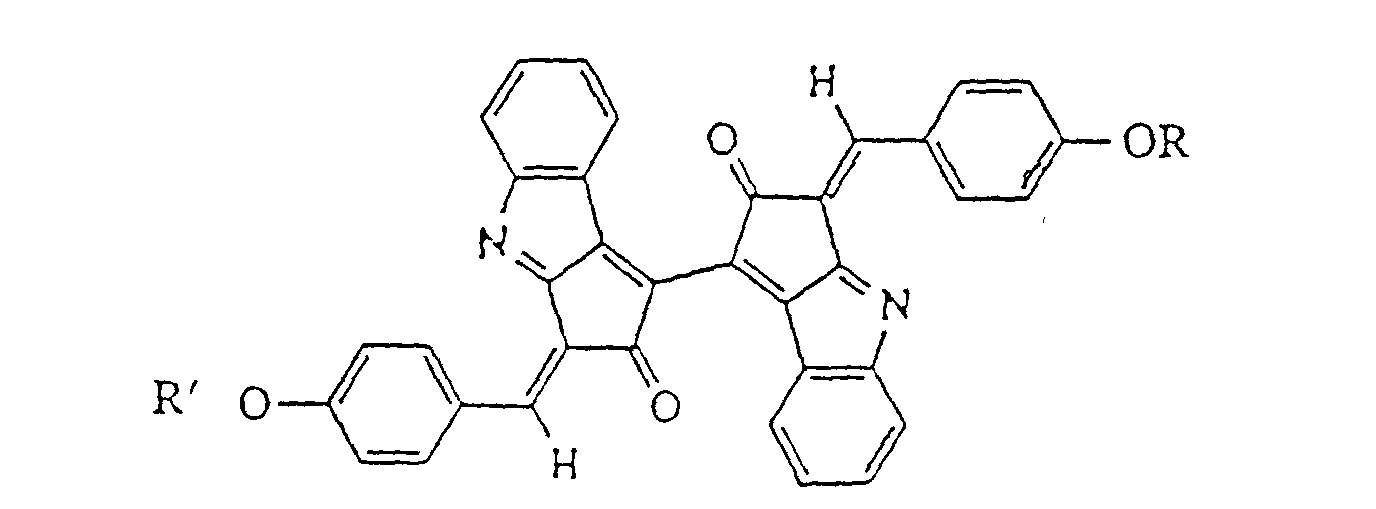
- one of the compounds present in scytonemin pigment is an indole alkaloid which not only is a strong UV absorber, but also exhibits strong activity as an anti-inflammation agent.
- the purified indole alkaloid, along with synthetically derived analogs, may be used alone or in combination with a pharmaceutically acceptable carrier to treat inflammation while at the same time providing UV protection.
- the compound where R and R' are H may be isolated and purified from naturally occurring scytonemin pigment.
- Ether analogs where R and R' are alkyl groups having up to 5 carbon atoms may be prepared from the naturally occurring dihydroxy indole alkaloid compound using conventional synthetic pathways.
- the diacetate analogs may also be prepared using well-known pathways for preparing acetate analogs from the naturally occurring dihydroxy indole alkaloid compound.
- the indole alkaloid compounds in accordance with the present invention are effective anti-inflammation agents which demonstrate high anti-inflammatory activity when subjected to standard anti-inflammatory test protocols. These indole alkaloids also exhibit strong UV absorption. As a result, the compounds of the present invention may advantageously be used to treat skin inflammation while at the same time functioning as a UV protective agent.
- Compound 1 can be isolated and purified from naturally occurring scytonemin pigment using conventional separation and purification procedures.
- the isolation and characterization of Compound 1 is set forth in P.J. Proteau et al., "The structure of scytonemin, an ultraviolet sunscreen pigment from the sheaths of cyanobacteria," Experientia 49 (1993), pages 825 to 829.
- the ether and diacetate analogs as defined in the above formula may be prepared according to conventional procedures for forming diether and diacetate derivatives.
- Acetylation was accomplished generally following the procedure detailed in Gerwick, W.H. and Fenical, W., "Ichthyotoxic and cytotoxic metabolites of the tropical brown alga Stypopodium zonale (lamouroux) Papenfuss," J. Org. Chem . 1981, 46, 22-27, except that the reaction was quenched with MeOH and the excess reagents and solvents were removed in vacuo .
- Metylation was accomplished generally following the method of Stoochnoff, B.A. and Benoiton, N.L., "The methylation of some phenols and alcohols with sodium hydride/methyl iodide in tetrahydrofuran at room temperature," Tetrahedron Lett. 1973, 21-24, except that anhydrous K 2 CO 3 (potassium carbonate) was used instead of sodium hydride as the base.
- anhydrous K 2 CO 3 potassium carbonate
- additional analogs may be prepared wherein one or more halogen groups are substituted on the phenyl rings adjacent to the -OR or OR' groups.
- the indole alkaloid compounds in accordance with the present invention are useful for treating inflammation.
- the compounds may be used in the same manner as conventional anti-inflammatory agents indomethacin, hydrocortisone, naprocin and other non-steroidal anti-inflammatory agents.
- the compounds are effective for both topical application and in vivo use. When used for topical application, the compounds function both as a UV protective agent and anti-inflammation agent.
- compositions which contain the indole alkaloids in accordance with the present invention are useful in the treatment of rheumatoid arthritis, osteoarthritis, rheumatic carditis, collagen and/or auto-immune diseases such as myasthenia gravis, allergic diseases, bronchial asthma and ocular and skin inflammatory diseases such as poison ivy.
- the compositions are also useful in treating proliferative diseases such as psoriasis.
- compositions are also useful as adjuvant therapy associated with organ and tissue transplants and any neurological disease involving metabolism of nervous tissue phospholipid such as multiple sclerosis.
- the compositions may also be used to treat secondary inflammation resulting from septic shock and reprefusion injury associated with coronary by-pass surgery and other intra arterial surgical procedures. Because of their selective antagonism of chemical irritation (i.e., PMA inflammation) the compounds can be useful in the treatment of insect bites, bee, wasp stings, snake bites or any venom in which a major constituent is the enzyme phospholipase A 2 .
- the compounds are also potent UV absorbers which absorb strongly in the spectral region from 250 to 425 nm.
- the compounds absorb radiation most strongly in the UV-A-violet-blue region (325-425 nm).
- the compounds exhibit lesser degrees of absorption in the UV-C (250 nm) and UV-B (280-320 nm) ranges.
- the indole alkaloid compounds in accordance with the present invention are administered to mammals including humans in an effective amount on the order of 1 to 100 mg per day per kilogram of body weight in divided or multiple forms.
- the drug may be administered orally, parenterally, topically or by other standard administration routes.
- a .5 to 10% by weight solution of the compound in a suitable emulsion is preferred.
- Suitable pharmaceutical carriers for topical administration include micelles, cottonseed oil, linseed oil with polymer binding agents, and alcohol based emulsions. Other conventional emulsions used for topical administration may be used. This level of dosage for topical administration provides both anti-inflammation efficacy and UV protection.
- the dosage form may be by tablet containing normal acceptable additives, excipients, etc.
- the parenteral form contains typical aqueous intravenous solution ingredients such as propylene glycol dextrose and physiological saline or other suitable lipid solubilizing carrier.
- Scytonemin pigment was obtained from Stigonema sp. from Waldo Lake, Oregon, from Scytonema sp. from Curacao, Netherlands Antilles and Lyngbya sp. from Huahine, French Polynesia.
- the scytonemin pigment was extracted to yield a crusty green solid.
- the extraction procedure was carried out as described by Garcia-Pichel, F. et al., Phycol. 27 (1991) 395.
- the procedure for extraction was as detailed in Garcia-Pichel, which involves the following: the fresh alga was repetitively extracted with warm EtOAc and MeOH.
- Compound 1 shows a variable degree of solubility in N,N-dimethylformamide (DMF), pyridine or tetrahydrofuran (THF).
- Simple chemical reduction of Compound 1 with a variety of mild reducing agents e.g., ascorbic acid
- yields a bright red pigment with slightly improved solubility properties Compound 1R.
- This reduction product often appears in scytonemin-containing sheaths when the cyanobacteria become buried in anoxic sediments and in microbial mat layers and when the cells are no longer viable.
- Compound 1 is easily reformed from Compound 1R by air oxidation on silica gel of NalO 4 oxidation.
- Compound 1 and its reduction product were both analyzed for C 36 H 22 N 2 O 4 (obs M + 546.1578, -0.2 mamu dev.) by high resolution fast atom bombardment mass spectrometry (HR FAB MS), and hence, appeared to possess 27 degrees of unsaturation.
- Compound 1 the oxidized form of the compound with 28 degrees of unsaturation, apparently undergoes a facile reduction in the mass spectrometer. 13 CNMR spectroscopy of Compound 1 and Compound 1R was also carried out. Based on the above analysis, the structure of Compound 1 and Compound 1R were determined to be as set forth in the above formulas where R and R' are methyl.
- Results are recorded as % decrease (inhibition) or % increase (potentiation) in edema relative to the PMA control group edema. The results of these tests are shown in Table 1.
- Inhibition of Mouse Ear Edema Compound Topical Dose Inhibition
- Compound 1 50 ug/ml 89%
- Compound 1R 50 ug/ml 94%
- Ozonolysis fragment of Compound 1 100 ug/ml 63%
- Compound 1R 100 ug/ear 98% 95% 50 ug/ear 89% 94% 25 ug/ear 90% 10 ug/ear 44% 49% 5 ug/ear 16% 17% 1 ug/ear 22%
- Arachidonic acid is an alternate edema-causing irritant which was used instead of PMA in a second study.
- Arachidonic acid was applied topically at 2 mg/ear in conjunction with the test compound.
- Arachidonic acid induced edema occurs more quickly, producing measurable edema within one hour, at which time the mice were sacrificed, the ears removed, and bores taken and weighed.
- Table 2 Inhibition of AA-Induced Mouse Ear Edema Compound Topical Dose Inhibition Compound 1 100 ug/ear 29% Compound 1 50 ug/ear 27%
- Phosphatidylcholine dipalmitoyl (labeled and unlabeled) was used as the substrate in monomolecular form. Test compounds were preincubated with the enzyme (25 units/0.5 ml) for 1 hour at 41°C. The reaction was initiated by the addition of an aliquot of the drug-enzyme mixture to the substrate (0.68 ⁇ mole/0.5 ml) and allowed to continue for 15 seconds. The reaction was terminated and the hydrolysis product was extracted and measured via scintillation counting.
- MPO Myeloperoxidase
- the neutrophil-specific marker released from primary granules, myeloperoxidase (MPO), in ear biopsies from treated and untreated mouse ears was extracted and quantitated according to a modified method of Bradley, P.O., Priebat, D.A., Christensen, R.D. and Rothstein, G., "Measurement of cutaneous inflammation estimation of neutrophil content with an enzyme marker," J. Invest Dermatology 78: 206-209, 1982. This enzyme is indicative of the extravasation of pro-inflammation neutrophils from blood into the skin.
- Ear bores from each treatment group from mouse ear edema assays were pooled and homogenized in 80mM sodium phosphate buffer (pH 5.4) containing 0.5% hexadecyltrimethylammonium bromide in a siliconized glass test tube for 1 min. at 0°C using a Brinkman Polytron. The mixtures were centrifuged at 10,000 x g at 4°C for 30 min. Samples (10 ⁇ l) from each group were then assayed in a 96-well microtiter plate.
- the assay was initiated by adding 250 ⁇ l of o-dianisi-dine/phosphate reagent (0.28 mg of dianisidine added to 1 ml of 50 mM sodium phosphate containing 0.0015 H 2 O 2 ) to each well. After a 30 minutes incubation of 37°C, the plates were read at 450 nm on a Molecular Devices microplate reader. Diluted control biopsies were utilized to develop a standard curve. Optical density values from drug-treated groups were compared to control groups to determine % of control values of enzyme activity. The results of the assays are shown in Table 4.
- the above assays demonstrate the ability of Compound 1 and its reduction product Compound 1R to reduce inflammation when administered topically.
- the anti-inflammation efficacy of the two compounds is also expected to be present when they are administered orally or parenterally to treat internal inflammation.
- the UV absorption spectra of Compounds 1 and 1R where both measured and found to absorb strongly in the 325 to 425 nm spectral region. Accordingly, these two compounds are useful as a dual purpose pharmaceutical compound which can be used to both treat inflammation and provide UV protection.
- the compounds are particularly well-suited for treating individuals with skin inflammation caused by over exposure to the sun.
- the reduced form of the methyl ether analog is prepared from the analog in the same manner as Compound 1R is prepared from Compound 1. Both the methyl ether analog and its reduction product may be used in the same manner as Compound 1 and Compound 1 R to treat inflammation of tissue and provide UV protection.
- the reduced form of the diacetate analog is prepared from the analog in the same manner as Compound 1R is prepared from Compound 1. Both the diacetate analog and its reduction product may be used in the same manner as Compound 1 to treat inflammation of tissue and provide UV protection.
Landscapes
- Health & Medical Sciences (AREA)
- Chemical & Material Sciences (AREA)
- Medicinal Chemistry (AREA)
- Pharmacology & Pharmacy (AREA)
- Life Sciences & Earth Sciences (AREA)
- Animal Behavior & Ethology (AREA)
- General Health & Medical Sciences (AREA)
- Public Health (AREA)
- Veterinary Medicine (AREA)
- Epidemiology (AREA)
- Pain & Pain Management (AREA)
- Rheumatology (AREA)
- Chemical Kinetics & Catalysis (AREA)
- General Chemical & Material Sciences (AREA)
- Nuclear Medicine, Radiotherapy & Molecular Imaging (AREA)
- Organic Chemistry (AREA)
- Pharmaceuticals Containing Other Organic And Inorganic Compounds (AREA)
- Medicines Containing Material From Animals Or Micro-Organisms (AREA)
- Medicines Containing Plant Substances (AREA)
- Indole Compounds (AREA)
Abstract
Description


| Inhibition of Mouse Ear Edema | ||
| Compound | Topical Dose | Inhibition |
| Compound 1 | 50 ug/ml | 89% |
| Compound 1R | 50 ug/ml | 94% |
| Ozonolysis fragment of Compound 1 | 100 ug/ml | 63% |
| Dose Response Inhibition of Mouse Ear Edema | ||
| Topical Dose | Compound 1 | Compound 1R |
| 100 ug/ear | 98% | 95% |
| 50 ug/ear | 89% | 94% |
| 25 ug/ear | 90% | |
| 10 ug/ear | 44% | 49% |
| 5 ug/ear | 16% | 17% |
| 1 ug/ear | 22% |
| Inhibition of AA-Induced Mouse Ear Edema | ||
| Compound | Topical Dose | Inhibition |
| Compound 1 | 100 ug/ear | 29% |
| Compound 1 | 50 ug/ear | 27% |
| Inactivation of Bee Venom pLA2 | ||
| Compound | Final Concentration | Inactivation |
| Compound 1 | 1.6 ug/ml | 39% |
| Compound 1 | 0.8 ug/ml | 30% |
| Compound 1 | 0.16 ug/ml | 27% |
| MPO Enzyme Activity | ||
| Dose | Compound | % of Control |
| 100 ug/ear | Compound 1 | 70% |
| 50 ug/ear | Compound 1 | 72% |
| 100 ug/ear | Compound 1R | 10% |
| 10 ug/ear | Compound 1R | 32% |
| 5 ug/ear | Compound 1R | 82% |
| 1 ug/ear | Compound 1R | 81% |
Claims (12)
- An indole alkaloid compound for use as an anti-inflammatory agent, said compound having the formulawhere R and R' are H, an alkyl group having up to 5 carbon atoms or -CO-(CH2)n-CH3 where n = 0 to 16,

provided that R and R' are not simultaneously H. - A compound according to claim 1 wherein R and R' are methyl.
- A compound according to claim 1 wherein R and R' are -CO-(CH2)n-CH3 where n = 0.
- A pharmaceutically preparation for use as anti-inflammatory agent comprising an effective amount of indole alkaloid compound as defined in claim 1, 2 or 3 and a pharmaceutically acceptable carrier for said compound.
- A compound according to claim 1, 2 or 3 for use as an anti-inflammatory and UV protective agent.
- A compound for use as an anti-inflammatory agent, said compound comprising the reduction product of an indole alkaloid having a formula according to claim 1, 2 or 3.
- A compound according to claim 6 for use as an anti-inflammatory and UV protective agent.
- Use of an indole alkaloid compound having the formulawhere R and R' are H, an alkyl group having up to 5 carbon atoms or -CO-(CH2)n-CH3 where n = 0 to 16,

in the manufacture of a medicament for use as an anti-inflammatory agent. - Use according to claim 8 wherein R and R' are methyl.
- Use according to claim 8 wherein R and R' are -CO-(CH2)n-CH3 where n = 0.
- Use of a compound comprising the reduction product of an indole alkaloid having a formula according to claim 8, 9 or 10 in the manufacture of a medicament for use as an anti-inflammatory agent.
- Use according to any one of claims 8 to 11 in which the medicament is for use as an anti-inflammatory and UV protective agent.
Applications Claiming Priority (3)
| Application Number | Priority Date | Filing Date | Title |
|---|---|---|---|
| US08/297,022 US5461070A (en) | 1994-08-29 | 1994-08-29 | Anti-flammatory method using indole alkaloids |
| US297022 | 1994-08-29 | ||
| PCT/US1995/010052 WO1996006607A1 (en) | 1994-08-29 | 1995-08-08 | Indole alkaloids useful as uv protective and anti-inflammatory agents |
Publications (3)
| Publication Number | Publication Date |
|---|---|
| EP0776204A1 EP0776204A1 (en) | 1997-06-04 |
| EP0776204A4 EP0776204A4 (en) | 1998-07-01 |
| EP0776204B1 true EP0776204B1 (en) | 2002-11-27 |
Family
ID=23144534
Family Applications (1)
| Application Number | Title | Priority Date | Filing Date |
|---|---|---|---|
| EP95928352A Expired - Lifetime EP0776204B1 (en) | 1994-08-29 | 1995-08-08 | Indole alkaloids useful as anti-inflammatory agents |
Country Status (7)
| Country | Link |
|---|---|
| US (3) | US5461070A (en) |
| EP (1) | EP0776204B1 (en) |
| AT (1) | ATE228364T1 (en) |
| AU (1) | AU3215795A (en) |
| DE (1) | DE69528983T2 (en) |
| ES (1) | ES2187565T3 (en) |
| WO (1) | WO1996006607A1 (en) |
Families Citing this family (17)
| Publication number | Priority date | Publication date | Assignee | Title |
|---|---|---|---|---|
| CA2251457A1 (en) * | 1998-10-23 | 2000-04-23 | Norman Huner | Compositions including naturally occurring compounds from plants, algae and cyanobacteria for protection against solar radiation |
| WO2001062900A1 (en) * | 2000-02-25 | 2001-08-30 | The Regents Of The University Of California. | Scytonemin and methods of using thereof |
| US6495588B2 (en) * | 2000-02-25 | 2002-12-17 | The Regents Of The University Of California | Scytonemin and methods of using thereof |
| WO2002006041A1 (en) * | 2000-07-17 | 2002-01-24 | Anderson-Tully Engineered Wood, L.L.C. | Veneer face plywood flooring and methods of making the same |
| GB0026114D0 (en) * | 2000-10-25 | 2000-12-13 | Smithkline Beecham Plc | New use |
| AU2002322720B2 (en) | 2001-07-25 | 2008-11-13 | Raptor Pharmaceutical Inc. | Compositions and methods for modulating blood-brain barrier transport |
| IL145250A0 (en) * | 2001-09-03 | 2002-06-30 | Hadasit Med Res Service | Natural sunscreen from cyanobacteria and lichens |
| CN102379684B (en) | 2005-04-28 | 2014-11-19 | 普罗透斯数字保健公司 | Pharma-informatics system |
| KR20090071598A (en) | 2006-09-18 | 2009-07-01 | 랩터 파마슈티컬 인코포레이티드 | Treatment of liver disease by administration of receptor binding protein (RAP) -conjugates |
| EP2398500B1 (en) | 2009-02-20 | 2019-03-13 | 2-BBB Medicines B.V. | Glutathione-based drug delivery system |
| ES2942923T3 (en) | 2009-05-06 | 2023-06-07 | Laboratory Skin Care Inc | Dermal delivery compositions comprising complexes of active agent-calcium phosphate particles and methods of use thereof |
| US20120077778A1 (en) | 2010-09-29 | 2012-03-29 | Andrea Bourdelais | Ladder-Frame Polyether Conjugates |
| US9485867B2 (en) * | 2010-10-27 | 2016-11-01 | Kyocera Corporation | Wiring board |
| WO2012091730A2 (en) * | 2010-11-16 | 2012-07-05 | New York University | Indole alkaloid compounds as melanogenesis promoters and uses thereof |
| JP6037548B2 (en) * | 2012-07-27 | 2016-12-07 | マイクロアルジェコーポレーション株式会社 | Anti-inflammatory agent |
| PL3153505T3 (en) * | 2015-10-05 | 2018-10-31 | Sanko Tekstil Isletmeleri San. Ve Tic. A.S. | Novel bis-indolylmethanes, a process for their preparation and uses thereof |
| US12233145B2 (en) | 2018-12-21 | 2025-02-25 | Ciimar—Centro Interdisciplinar De Investigacao Marinha E Ambiental | Ultra-violet absorbing compounds |
Family Cites Families (1)
| Publication number | Priority date | Publication date | Assignee | Title |
|---|---|---|---|---|
| DE68903907T2 (en) * | 1988-09-05 | 1993-06-09 | Sankyo Co | CYCLIC PEPTIDE, ITS PRODUCTION AND USE FOR TREATING CARDIOVASCULAR DISORDERS. |
-
1994
- 1994-08-29 US US08/297,022 patent/US5461070A/en not_active Expired - Fee Related
-
1995
- 1995-07-17 US US08/503,448 patent/US5508026A/en not_active Expired - Fee Related
- 1995-07-17 US US08/503,384 patent/US5498405A/en not_active Expired - Fee Related
- 1995-08-08 ES ES95928352T patent/ES2187565T3/en not_active Expired - Lifetime
- 1995-08-08 DE DE69528983T patent/DE69528983T2/en not_active Expired - Fee Related
- 1995-08-08 AT AT95928352T patent/ATE228364T1/en not_active IP Right Cessation
- 1995-08-08 EP EP95928352A patent/EP0776204B1/en not_active Expired - Lifetime
- 1995-08-08 WO PCT/US1995/010052 patent/WO1996006607A1/en not_active Ceased
- 1995-08-08 AU AU32157/95A patent/AU3215795A/en not_active Abandoned
Also Published As
| Publication number | Publication date |
|---|---|
| ATE228364T1 (en) | 2002-12-15 |
| US5498405A (en) | 1996-03-12 |
| AU3215795A (en) | 1996-03-22 |
| WO1996006607A1 (en) | 1996-03-07 |
| US5508026A (en) | 1996-04-16 |
| US5461070A (en) | 1995-10-24 |
| EP0776204A4 (en) | 1998-07-01 |
| EP0776204A1 (en) | 1997-06-04 |
| ES2187565T3 (en) | 2003-06-16 |
| DE69528983T2 (en) | 2003-10-09 |
| DE69528983D1 (en) | 2003-01-09 |
Similar Documents
| Publication | Publication Date | Title |
|---|---|---|
| US5508026A (en) | Indole alkaloids useful as UV protective and anti-inflammatory agents | |
| US4113881A (en) | Method of treating rheumatoid arthritis | |
| González-Coloma et al. | Antileishmanial, antitrypanosomal, and cytotoxic screening of ethnopharmacologically selected Peruvian plants | |
| Mbeunkui et al. | In vitro antiplasmodial activity of indole alkaloids from the stem bark of Geissospermum vellosii | |
| US6028198A (en) | Pharmaceutical composition for prevention and treatment of motion sickness syndrome | |
| EP0133376B1 (en) | Synthetic analgesic and/or anti-inflammatory derivatives of manoalide | |
| Wang et al. | Simultaneous determination of arctiin and its metabolites in rat urine and feces by HPLC | |
| Farinon et al. | Disease modifying anti-rheumatic activity of the alkaloid montanine on experimental arthritis and fibroblast-like synoviocytes | |
| RU2246299C2 (en) | Naphthoquinone derivatives and their applying for treatment and control of tuberculosis | |
| US5290777A (en) | Use for topsentin compounds and pharmaceutical compositions containing same | |
| US8183395B2 (en) | Compositions and methods for treating cancer | |
| US5599839A (en) | Antiviral composition | |
| US4616089A (en) | Synthetic anti-inflammatory derivatives of manoalide | |
| US20240269106A1 (en) | Small molecule modulator targeting a rare histone modification regulating adipogenesis and pharmaceutical formulation thereof | |
| US6998394B2 (en) | Process for isolating physalins from plants and pharmaceutical compositions containing physalins | |
| EP0383171A2 (en) | 2,3,23-trihydroxy-urs-12-ene derivatives for treating cognitive disorders | |
| DD298388A5 (en) | INDENOINDOLVERBINDUNGEN | |
| US4831053A (en) | Composition for prophylaxis and therapy of hepatitis | |
| US6242483B1 (en) | Selectively cytotoxic acetogenin compounds | |
| JP2003501423A (en) | Mycolactone and related compounds, compositions, and methods of use | |
| US20150299155A1 (en) | Sesquiterpene lactone-based pharmaceutical composition for treating gastrointestinal diseases | |
| US9776989B2 (en) | Chromone alkaloid dysoline for the treatment of cancer and inflammatory disorders | |
| CN101775019A (en) | Melotenine and pharmaceutical composition as well as preparation method and application thereof | |
| DE69717961T2 (en) | USE OF A FLAVONOID-EXTRACT OF THE PLANTS EUPHORBIA PROSTRATA FOR THE PRODUCTION OF A MEDICINAL PRODUCT FOR THE TREATMENT OF INORACTAL OR COLON DISORDERS | |
| JP7405855B2 (en) | bioactive compounds |
Legal Events
| Date | Code | Title | Description |
|---|---|---|---|
| PUAI | Public reference made under article 153(3) epc to a published international application that has entered the european phase |
Free format text: ORIGINAL CODE: 0009012 |
|
| 17P | Request for examination filed |
Effective date: 19970228 |
|
| AK | Designated contracting states |
Kind code of ref document: A1 Designated state(s): AT BE CH DE DK ES FR GB GR IE IT LI LU MC NL PT SE |
|
| A4 | Supplementary search report drawn up and despatched |
Effective date: 19980518 |
|
| AK | Designated contracting states |
Kind code of ref document: A4 Designated state(s): AT BE CH DE DK ES FR GB GR IE IT LI LU MC NL PT SE |
|
| 17Q | First examination report despatched |
Effective date: 19990817 |
|
| RAP1 | Party data changed (applicant data changed or rights of an application transferred) |
Owner name: THE REGENTS OF THE UNIVERSITY OF CALIFORNIA |
|
| RIC1 | Information provided on ipc code assigned before grant |
Free format text: 7A 61K 31/40 A, 7C 07D 209/94 B, 7A 61P 29/00 B |
|
| RTI1 | Title (correction) |
Free format text: INDOLE ALKALOIDS USEFUL AS ANTI-INFLAMMATORY AGENTS |
|
| RIC1 | Information provided on ipc code assigned before grant |
Free format text: 7A 61K 31/40 A, 7C 07D 209/94 B, 7A 61P 29/00 B |
|
| RTI1 | Title (correction) |
Free format text: INDOLE ALKALOIDS USEFUL AS ANTI-INFLAMMATORY AGENTS |
|
| GRAG | Despatch of communication of intention to grant |
Free format text: ORIGINAL CODE: EPIDOS AGRA |
|
| RIC1 | Information provided on ipc code assigned before grant |
Free format text: 7A 61K 31/40 A, 7C 07D 209/94 B, 7A 61P 29/00 B |
|
| RTI1 | Title (correction) |
Free format text: INDOLE ALKALOIDS USEFUL AS ANTI-INFLAMMATORY AGENTS |
|
| GRAG | Despatch of communication of intention to grant |
Free format text: ORIGINAL CODE: EPIDOS AGRA |
|
| GRAH | Despatch of communication of intention to grant a patent |
Free format text: ORIGINAL CODE: EPIDOS IGRA |
|
| GRAH | Despatch of communication of intention to grant a patent |
Free format text: ORIGINAL CODE: EPIDOS IGRA |
|
| GRAA | (expected) grant |
Free format text: ORIGINAL CODE: 0009210 |
|
| AK | Designated contracting states |
Kind code of ref document: B1 Designated state(s): AT BE CH DE DK ES FR GB GR IE IT LI LU MC NL PT SE |
|
| PG25 | Lapsed in a contracting state [announced via postgrant information from national office to epo] |
Ref country code: NL Free format text: LAPSE BECAUSE OF FAILURE TO SUBMIT A TRANSLATION OF THE DESCRIPTION OR TO PAY THE FEE WITHIN THE PRESCRIBED TIME-LIMIT Effective date: 20021127 Ref country code: GR Free format text: LAPSE BECAUSE OF FAILURE TO SUBMIT A TRANSLATION OF THE DESCRIPTION OR TO PAY THE FEE WITHIN THE PRESCRIBED TIME-LIMIT Effective date: 20021127 Ref country code: BE Free format text: LAPSE BECAUSE OF FAILURE TO SUBMIT A TRANSLATION OF THE DESCRIPTION OR TO PAY THE FEE WITHIN THE PRESCRIBED TIME-LIMIT Effective date: 20021127 Ref country code: AT Free format text: LAPSE BECAUSE OF FAILURE TO SUBMIT A TRANSLATION OF THE DESCRIPTION OR TO PAY THE FEE WITHIN THE PRESCRIBED TIME-LIMIT Effective date: 20021127 |
|
| REF | Corresponds to: |
Ref document number: 228364 Country of ref document: AT Date of ref document: 20021215 Kind code of ref document: T |
|
| REG | Reference to a national code |
Ref country code: GB Ref legal event code: FG4D |
|
| REG | Reference to a national code |
Ref country code: CH Ref legal event code: EP |
|
| REG | Reference to a national code |
Ref country code: IE Ref legal event code: FG4D |
|
| REF | Corresponds to: |
Ref document number: 69528983 Country of ref document: DE Date of ref document: 20030109 |
|
| PG25 | Lapsed in a contracting state [announced via postgrant information from national office to epo] |
Ref country code: SE Free format text: LAPSE BECAUSE OF FAILURE TO SUBMIT A TRANSLATION OF THE DESCRIPTION OR TO PAY THE FEE WITHIN THE PRESCRIBED TIME-LIMIT Effective date: 20030227 Ref country code: PT Free format text: LAPSE BECAUSE OF FAILURE TO SUBMIT A TRANSLATION OF THE DESCRIPTION OR TO PAY THE FEE WITHIN THE PRESCRIBED TIME-LIMIT Effective date: 20030227 Ref country code: DK Free format text: LAPSE BECAUSE OF FAILURE TO SUBMIT A TRANSLATION OF THE DESCRIPTION OR TO PAY THE FEE WITHIN THE PRESCRIBED TIME-LIMIT Effective date: 20030227 |
|
| REG | Reference to a national code |
Ref country code: CH Ref legal event code: NV Representative=s name: R. A. EGLI & CO. PATENTANWAELTE |
|
| NLV1 | Nl: lapsed or annulled due to failure to fulfill the requirements of art. 29p and 29m of the patents act | ||
| REG | Reference to a national code |
Ref country code: ES Ref legal event code: FG2A Ref document number: 2187565 Country of ref document: ES Kind code of ref document: T3 |
|
| ET | Fr: translation filed | ||
| PG25 | Lapsed in a contracting state [announced via postgrant information from national office to epo] |
Ref country code: LU Free format text: LAPSE BECAUSE OF NON-PAYMENT OF DUE FEES Effective date: 20030808 Ref country code: IE Free format text: LAPSE BECAUSE OF NON-PAYMENT OF DUE FEES Effective date: 20030808 |
|
| PG25 | Lapsed in a contracting state [announced via postgrant information from national office to epo] |
Ref country code: MC Free format text: LAPSE BECAUSE OF NON-PAYMENT OF DUE FEES Effective date: 20030831 |
|
| PLBE | No opposition filed within time limit |
Free format text: ORIGINAL CODE: 0009261 |
|
| STAA | Information on the status of an ep patent application or granted ep patent |
Free format text: STATUS: NO OPPOSITION FILED WITHIN TIME LIMIT |
|
| 26N | No opposition filed |
Effective date: 20030828 |
|
| REG | Reference to a national code |
Ref country code: IE Ref legal event code: MM4A |
|
| PGFP | Annual fee paid to national office [announced via postgrant information from national office to epo] |
Ref country code: GB Payment date: 20050804 Year of fee payment: 11 |
|
| PGFP | Annual fee paid to national office [announced via postgrant information from national office to epo] |
Ref country code: FR Payment date: 20050817 Year of fee payment: 11 |
|
| PGFP | Annual fee paid to national office [announced via postgrant information from national office to epo] |
Ref country code: CH Payment date: 20050819 Year of fee payment: 11 |
|
| PGFP | Annual fee paid to national office [announced via postgrant information from national office to epo] |
Ref country code: ES Payment date: 20050826 Year of fee payment: 11 |
|
| PGFP | Annual fee paid to national office [announced via postgrant information from national office to epo] |
Ref country code: DE Payment date: 20050930 Year of fee payment: 11 |
|
| PG25 | Lapsed in a contracting state [announced via postgrant information from national office to epo] |
Ref country code: LI Free format text: LAPSE BECAUSE OF NON-PAYMENT OF DUE FEES Effective date: 20060831 Ref country code: CH Free format text: LAPSE BECAUSE OF NON-PAYMENT OF DUE FEES Effective date: 20060831 |
|
| PGFP | Annual fee paid to national office [announced via postgrant information from national office to epo] |
Ref country code: IT Payment date: 20060831 Year of fee payment: 12 |
|
| PG25 | Lapsed in a contracting state [announced via postgrant information from national office to epo] |
Ref country code: DE Free format text: LAPSE BECAUSE OF NON-PAYMENT OF DUE FEES Effective date: 20070301 |
|
| REG | Reference to a national code |
Ref country code: CH Ref legal event code: PL |
|
| GBPC | Gb: european patent ceased through non-payment of renewal fee |
Effective date: 20060808 |
|
| REG | Reference to a national code |
Ref country code: FR Ref legal event code: ST Effective date: 20070430 |
|
| REG | Reference to a national code |
Ref country code: ES Ref legal event code: FD2A Effective date: 20060809 |
|
| PG25 | Lapsed in a contracting state [announced via postgrant information from national office to epo] |
Ref country code: GB Free format text: LAPSE BECAUSE OF NON-PAYMENT OF DUE FEES Effective date: 20060808 |
|
| PG25 | Lapsed in a contracting state [announced via postgrant information from national office to epo] |
Ref country code: ES Free format text: LAPSE BECAUSE OF NON-PAYMENT OF DUE FEES Effective date: 20060809 |
|
| PG25 | Lapsed in a contracting state [announced via postgrant information from national office to epo] |
Ref country code: FR Free format text: LAPSE BECAUSE OF NON-PAYMENT OF DUE FEES Effective date: 20060831 |
|
| PG25 | Lapsed in a contracting state [announced via postgrant information from national office to epo] |
Ref country code: IT Free format text: LAPSE BECAUSE OF NON-PAYMENT OF DUE FEES Effective date: 20070808 |