EP0773021A1 - Use of azacyclic or azabicyclic oxadiazole compounds for treating anxiety - Google Patents
Use of azacyclic or azabicyclic oxadiazole compounds for treating anxiety Download PDFInfo
- Publication number
- EP0773021A1 EP0773021A1 EP96308112A EP96308112A EP0773021A1 EP 0773021 A1 EP0773021 A1 EP 0773021A1 EP 96308112 A EP96308112 A EP 96308112A EP 96308112 A EP96308112 A EP 96308112A EP 0773021 A1 EP0773021 A1 EP 0773021A1
- Authority
- EP
- European Patent Office
- Prior art keywords
- group
- alkyl
- halogen
- cycloalkyl
- cycloalkylalkyl
- Prior art date
- Legal status (The legal status is an assumption and is not a legal conclusion. Google has not performed a legal analysis and makes no representation as to the accuracy of the status listed.)
- Withdrawn
Links
- 208000019901 Anxiety disease Diseases 0.000 title claims abstract description 39
- 230000036506 anxiety Effects 0.000 title claims abstract description 23
- 150000004866 oxadiazoles Chemical class 0.000 title abstract 2
- 150000001875 compounds Chemical class 0.000 claims description 76
- 229910052736 halogen Inorganic materials 0.000 claims description 49
- 150000002367 halogens Chemical group 0.000 claims description 44
- 125000001997 phenyl group Chemical group [H]C1=C([H])C([H])=C(*)C([H])=C1[H] 0.000 claims description 36
- 229910052739 hydrogen Inorganic materials 0.000 claims description 35
- 239000001257 hydrogen Substances 0.000 claims description 35
- 125000002023 trifluoromethyl group Chemical group FC(F)(F)* 0.000 claims description 30
- 125000004093 cyano group Chemical group *C#N 0.000 claims description 29
- 125000001424 substituent group Chemical group 0.000 claims description 29
- 125000004169 (C1-C6) alkyl group Chemical group 0.000 claims description 28
- 125000004435 hydrogen atom Chemical group [H]* 0.000 claims description 24
- 125000000876 trifluoromethoxy group Chemical group FC(F)(F)O* 0.000 claims description 20
- 150000003839 salts Chemical class 0.000 claims description 19
- 125000004433 nitrogen atom Chemical group N* 0.000 claims description 18
- 229910052760 oxygen Inorganic materials 0.000 claims description 18
- 125000000951 phenoxy group Chemical group [H]C1=C([H])C([H])=C(O*)C([H])=C1[H] 0.000 claims description 18
- 125000004178 (C1-C4) alkyl group Chemical group 0.000 claims description 17
- 125000000229 (C1-C4)alkoxy group Chemical group 0.000 claims description 16
- 229910052757 nitrogen Inorganic materials 0.000 claims description 15
- 125000006376 (C3-C10) cycloalkyl group Chemical group 0.000 claims description 14
- QVGXLLKOCUKJST-UHFFFAOYSA-N atomic oxygen Chemical group [O] QVGXLLKOCUKJST-UHFFFAOYSA-N 0.000 claims description 14
- 239000001301 oxygen Substances 0.000 claims description 14
- NINIDFKCEFEMDL-UHFFFAOYSA-N Sulfur Chemical group [S] NINIDFKCEFEMDL-UHFFFAOYSA-N 0.000 claims description 13
- 239000005864 Sulphur Chemical group 0.000 claims description 13
- 125000006527 (C1-C5) alkyl group Chemical group 0.000 claims description 12
- 238000011282 treatment Methods 0.000 claims description 12
- 125000004432 carbon atom Chemical group C* 0.000 claims description 11
- 125000001584 benzyloxycarbonyl group Chemical group C(=O)(OCC1=CC=CC=C1)* 0.000 claims description 10
- UYWQUFXKFGHYNT-UHFFFAOYSA-N phenylmethyl ester of formic acid Chemical group O=COCC1=CC=CC=C1 UYWQUFXKFGHYNT-UHFFFAOYSA-N 0.000 claims description 10
- 125000002373 5 membered heterocyclic group Chemical group 0.000 claims description 9
- 125000004070 6 membered heterocyclic group Chemical group 0.000 claims description 9
- 125000002924 primary amino group Chemical group [H]N([H])* 0.000 claims description 9
- 239000012453 solvate Substances 0.000 claims description 9
- 125000006552 (C3-C8) cycloalkyl group Chemical group 0.000 claims description 7
- 125000003178 carboxy group Chemical group [H]OC(*)=O 0.000 claims description 7
- 238000006467 substitution reaction Methods 0.000 claims description 7
- 125000000027 (C1-C10) alkoxy group Chemical group 0.000 claims description 6
- 125000004122 cyclic group Chemical group 0.000 claims description 6
- 125000005843 halogen group Chemical group 0.000 claims description 6
- 125000004029 hydroxymethyl group Chemical group [H]OC([H])([H])* 0.000 claims description 6
- UFHFLCQGNIYNRP-UHFFFAOYSA-N Hydrogen Chemical compound [H][H] UFHFLCQGNIYNRP-UHFFFAOYSA-N 0.000 claims description 5
- 101100070530 Neurospora crassa (strain ATCC 24698 / 74-OR23-1A / CBS 708.71 / DSM 1257 / FGSC 987) het-6 gene Proteins 0.000 claims description 3
- 125000004429 atom Chemical group 0.000 claims description 3
- 239000003085 diluting agent Substances 0.000 claims description 3
- 239000003814 drug Substances 0.000 claims description 3
- 239000008194 pharmaceutical composition Substances 0.000 claims description 3
- 239000003937 drug carrier Substances 0.000 claims description 2
- 238000004519 manufacturing process Methods 0.000 claims description 2
- 229920006395 saturated elastomer Polymers 0.000 claims description 2
- 150000002431 hydrogen Chemical group 0.000 claims 6
- 238000000034 method Methods 0.000 abstract description 21
- -1 thiadiazole compound Chemical class 0.000 description 36
- 238000012360 testing method Methods 0.000 description 18
- 125000000623 heterocyclic group Chemical group 0.000 description 13
- 230000000694 effects Effects 0.000 description 12
- 239000000126 substance Substances 0.000 description 12
- 239000000872 buffer Substances 0.000 description 11
- 230000009870 specific binding Effects 0.000 description 11
- 0 *CC([C@@]1C2CC1)I(*=I)N2N Chemical compound *CC([C@@]1C2CC1)I(*=I)N2N 0.000 description 10
- RTZKZFJDLAIYFH-UHFFFAOYSA-N Diethyl ether Chemical compound CCOCC RTZKZFJDLAIYFH-UHFFFAOYSA-N 0.000 description 10
- 239000002249 anxiolytic agent Substances 0.000 description 10
- 239000000203 mixture Substances 0.000 description 9
- 125000000217 alkyl group Chemical group 0.000 description 8
- 230000000049 anti-anxiety effect Effects 0.000 description 8
- 239000008188 pellet Substances 0.000 description 8
- 241000282412 Homo Species 0.000 description 7
- 229910052799 carbon Inorganic materials 0.000 description 7
- 125000005842 heteroatom Chemical group 0.000 description 7
- 108010009685 Cholinergic Receptors Proteins 0.000 description 6
- LRHPLDYGYMQRHN-UHFFFAOYSA-N N-Butanol Chemical compound CCCCO LRHPLDYGYMQRHN-UHFFFAOYSA-N 0.000 description 6
- 102000034337 acetylcholine receptors Human genes 0.000 description 6
- 230000003551 muscarinic effect Effects 0.000 description 6
- VLKZOEOYAKHREP-UHFFFAOYSA-N n-Hexane Chemical compound CCCCCC VLKZOEOYAKHREP-UHFFFAOYSA-N 0.000 description 6
- 208000019906 panic disease Diseases 0.000 description 6
- 125000000882 C2-C6 alkenyl group Chemical group 0.000 description 5
- 241000282693 Cercopithecidae Species 0.000 description 5
- 102000014415 Muscarinic acetylcholine receptor Human genes 0.000 description 5
- 108050003473 Muscarinic acetylcholine receptor Proteins 0.000 description 5
- 125000003118 aryl group Chemical group 0.000 description 5
- 229910052751 metal Inorganic materials 0.000 description 5
- 239000002184 metal Substances 0.000 description 5
- 125000004430 oxygen atom Chemical group O* 0.000 description 5
- 125000006239 protecting group Chemical group 0.000 description 5
- 239000002904 solvent Substances 0.000 description 5
- 239000003981 vehicle Substances 0.000 description 5
- JKMHFZQWWAIEOD-UHFFFAOYSA-N 2-[4-(2-hydroxyethyl)piperazin-1-yl]ethanesulfonic acid Chemical compound OCC[NH+]1CCN(CCS([O-])(=O)=O)CC1 JKMHFZQWWAIEOD-UHFFFAOYSA-N 0.000 description 4
- 206010002859 Anxiety disorder due to a general medical condition Diseases 0.000 description 4
- OKTJSMMVPCPJKN-UHFFFAOYSA-N Carbon Chemical group [C] OKTJSMMVPCPJKN-UHFFFAOYSA-N 0.000 description 4
- 208000011688 Generalised anxiety disease Diseases 0.000 description 4
- VEXZGXHMUGYJMC-UHFFFAOYSA-N Hydrochloric acid Chemical compound Cl VEXZGXHMUGYJMC-UHFFFAOYSA-N 0.000 description 4
- 241001465754 Metazoa Species 0.000 description 4
- JCXJVPUVTGWSNB-UHFFFAOYSA-N Nitrogen dioxide Chemical group O=[N]=O JCXJVPUVTGWSNB-UHFFFAOYSA-N 0.000 description 4
- 239000000556 agonist Substances 0.000 description 4
- 238000003556 assay Methods 0.000 description 4
- 230000027455 binding Effects 0.000 description 4
- 239000002775 capsule Substances 0.000 description 4
- 230000001713 cholinergic effect Effects 0.000 description 4
- 125000000753 cycloalkyl group Chemical group 0.000 description 4
- 235000013305 food Nutrition 0.000 description 4
- 238000009472 formulation Methods 0.000 description 4
- 208000029364 generalized anxiety disease Diseases 0.000 description 4
- 229910052740 iodine Inorganic materials 0.000 description 4
- 239000007788 liquid Substances 0.000 description 4
- 150000007522 mineralic acids Chemical class 0.000 description 4
- 230000009871 nonspecific binding Effects 0.000 description 4
- 150000007524 organic acids Chemical class 0.000 description 4
- RMHMFHUVIITRHF-UHFFFAOYSA-N pirenzepine Chemical compound C1CN(C)CCN1CC(=O)N1C2=NC=CC=C2NC(=O)C2=CC=CC=C21 RMHMFHUVIITRHF-UHFFFAOYSA-N 0.000 description 4
- 229960004633 pirenzepine Drugs 0.000 description 4
- 208000028173 post-traumatic stress disease Diseases 0.000 description 4
- 230000008569 process Effects 0.000 description 4
- 102000005962 receptors Human genes 0.000 description 4
- 108020003175 receptors Proteins 0.000 description 4
- 230000004044 response Effects 0.000 description 4
- 239000000725 suspension Substances 0.000 description 4
- VZCYOOQTPOCHFL-UHFFFAOYSA-N trans-butenedioic acid Natural products OC(=O)C=CC(O)=O VZCYOOQTPOCHFL-UHFFFAOYSA-N 0.000 description 4
- 125000000081 (C5-C8) cycloalkenyl group Chemical group 0.000 description 3
- IJGRMHOSHXDMSA-UHFFFAOYSA-N Atomic nitrogen Chemical compound N#N IJGRMHOSHXDMSA-UHFFFAOYSA-N 0.000 description 3
- 206010033664 Panic attack Diseases 0.000 description 3
- 241000700159 Rattus Species 0.000 description 3
- 230000009471 action Effects 0.000 description 3
- 150000004703 alkoxides Chemical class 0.000 description 3
- 230000002539 anti-aggressive effect Effects 0.000 description 3
- 150000001721 carbon Chemical group 0.000 description 3
- 239000000284 extract Substances 0.000 description 3
- 230000000144 pharmacologic effect Effects 0.000 description 3
- 239000000902 placebo Substances 0.000 description 3
- 229940068196 placebo Drugs 0.000 description 3
- 238000002360 preparation method Methods 0.000 description 3
- 239000007787 solid Substances 0.000 description 3
- 238000007920 subcutaneous administration Methods 0.000 description 3
- 125000004434 sulfur atom Chemical group 0.000 description 3
- 208000024891 symptom Diseases 0.000 description 3
- XLYOFNOQVPJJNP-UHFFFAOYSA-N water Substances O XLYOFNOQVPJJNP-UHFFFAOYSA-N 0.000 description 3
- 125000006273 (C1-C3) alkyl group Chemical group 0.000 description 2
- 125000003903 2-propenyl group Chemical group [H]C([*])([H])C([H])=C([H])[H] 0.000 description 2
- QTBSBXVTEAMEQO-UHFFFAOYSA-M Acetate Chemical compound CC([O-])=O QTBSBXVTEAMEQO-UHFFFAOYSA-M 0.000 description 2
- 208000008811 Agoraphobia Diseases 0.000 description 2
- KRKNYBCHXYNGOX-UHFFFAOYSA-K Citrate Chemical compound [O-]C(=O)CC(O)(CC([O-])=O)C([O-])=O KRKNYBCHXYNGOX-UHFFFAOYSA-K 0.000 description 2
- FEWJPZIEWOKRBE-JCYAYHJZSA-N Dextrotartaric acid Chemical compound OC(=O)[C@H](O)[C@@H](O)C(O)=O FEWJPZIEWOKRBE-JCYAYHJZSA-N 0.000 description 2
- LFQSCWFLJHTTHZ-UHFFFAOYSA-N Ethanol Chemical compound CCO LFQSCWFLJHTTHZ-UHFFFAOYSA-N 0.000 description 2
- XEKOWRVHYACXOJ-UHFFFAOYSA-N Ethyl acetate Chemical compound CCOC(C)=O XEKOWRVHYACXOJ-UHFFFAOYSA-N 0.000 description 2
- VZCYOOQTPOCHFL-OWOJBTEDSA-N Fumaric acid Chemical compound OC(=O)\C=C\C(O)=O VZCYOOQTPOCHFL-OWOJBTEDSA-N 0.000 description 2
- CPELXLSAUQHCOX-UHFFFAOYSA-N Hydrogen bromide Chemical compound Br CPELXLSAUQHCOX-UHFFFAOYSA-N 0.000 description 2
- JVTAAEKCZFNVCJ-UHFFFAOYSA-M Lactate Chemical compound CC(O)C([O-])=O JVTAAEKCZFNVCJ-UHFFFAOYSA-M 0.000 description 2
- GUBGYTABKSRVRQ-QKKXKWKRSA-N Lactose Natural products OC[C@H]1O[C@@H](O[C@H]2[C@H](O)[C@@H](O)C(O)O[C@@H]2CO)[C@H](O)[C@@H](O)[C@H]1O GUBGYTABKSRVRQ-QKKXKWKRSA-N 0.000 description 2
- 206010027951 Mood swings Diseases 0.000 description 2
- MZRVEZGGRBJDDB-UHFFFAOYSA-N N-Butyllithium Chemical compound [Li]CCCC MZRVEZGGRBJDDB-UHFFFAOYSA-N 0.000 description 2
- MUBZPKHOEPUJKR-UHFFFAOYSA-N Oxalic acid Chemical compound OC(=O)C(O)=O MUBZPKHOEPUJKR-UHFFFAOYSA-N 0.000 description 2
- 229910019142 PO4 Inorganic materials 0.000 description 2
- 206010034912 Phobia Diseases 0.000 description 2
- JUJWROOIHBZHMG-UHFFFAOYSA-N Pyridine Chemical compound C1=CC=NC=C1 JUJWROOIHBZHMG-UHFFFAOYSA-N 0.000 description 2
- SMWDFEZZVXVKRB-UHFFFAOYSA-N Quinoline Chemical compound N1=CC=CC2=CC=CC=C21 SMWDFEZZVXVKRB-UHFFFAOYSA-N 0.000 description 2
- 241000700157 Rattus norvegicus Species 0.000 description 2
- QAOWNCQODCNURD-UHFFFAOYSA-L Sulfate Chemical compound [O-]S([O-])(=O)=O QAOWNCQODCNURD-UHFFFAOYSA-L 0.000 description 2
- 206010042635 Suspiciousness Diseases 0.000 description 2
- 208000031674 Traumatic Acute Stress disease Diseases 0.000 description 2
- 208000026345 acute stress disease Diseases 0.000 description 2
- 238000013019 agitation Methods 0.000 description 2
- HJJPJSXJAXAIPN-UHFFFAOYSA-N arecoline Chemical compound COC(=O)C1=CCCN(C)C1 HJJPJSXJAXAIPN-UHFFFAOYSA-N 0.000 description 2
- 230000006399 behavior Effects 0.000 description 2
- 229940049706 benzodiazepine Drugs 0.000 description 2
- 229910052794 bromium Inorganic materials 0.000 description 2
- 244000309464 bull Species 0.000 description 2
- QWCRAEMEVRGPNT-UHFFFAOYSA-N buspirone Chemical compound C1C(=O)N(CCCCN2CCN(CC2)C=2N=CC=CN=2)C(=O)CC21CCCC2 QWCRAEMEVRGPNT-UHFFFAOYSA-N 0.000 description 2
- 229960002495 buspirone Drugs 0.000 description 2
- 125000001589 carboacyl group Chemical group 0.000 description 2
- 239000000969 carrier Substances 0.000 description 2
- 239000004359 castor oil Substances 0.000 description 2
- 235000019438 castor oil Nutrition 0.000 description 2
- 238000006243 chemical reaction Methods 0.000 description 2
- 229910052801 chlorine Inorganic materials 0.000 description 2
- 125000000392 cycloalkenyl group Chemical group 0.000 description 2
- 125000001316 cycloalkyl alkyl group Chemical group 0.000 description 2
- 230000003111 delayed effect Effects 0.000 description 2
- 235000014113 dietary fatty acids Nutrition 0.000 description 2
- 239000008298 dragée Substances 0.000 description 2
- 239000003995 emulsifying agent Substances 0.000 description 2
- 239000000194 fatty acid Substances 0.000 description 2
- 229930195729 fatty acid Natural products 0.000 description 2
- 150000002240 furans Chemical class 0.000 description 2
- 229960003692 gamma aminobutyric acid Drugs 0.000 description 2
- BTCSSZJGUNDROE-UHFFFAOYSA-N gamma-aminobutyric acid Chemical compound NCCCC(O)=O BTCSSZJGUNDROE-UHFFFAOYSA-N 0.000 description 2
- 239000003365 glass fiber Substances 0.000 description 2
- ZEMPKEQAKRGZGQ-XOQCFJPHSA-N glycerol triricinoleate Natural products CCCCCC[C@@H](O)CC=CCCCCCCCC(=O)OC[C@@H](COC(=O)CCCCCCCC=CC[C@@H](O)CCCCCC)OC(=O)CCCCCCCC=CC[C@H](O)CCCCCC ZEMPKEQAKRGZGQ-XOQCFJPHSA-N 0.000 description 2
- 238000011534 incubation Methods 0.000 description 2
- 230000005764 inhibitory process Effects 0.000 description 2
- 238000007918 intramuscular administration Methods 0.000 description 2
- 238000001990 intravenous administration Methods 0.000 description 2
- AWJUIBRHMBBTKR-UHFFFAOYSA-N isoquinoline Chemical compound C1=NC=CC2=CC=CC=C21 AWJUIBRHMBBTKR-UHFFFAOYSA-N 0.000 description 2
- 239000008101 lactose Substances 0.000 description 2
- 238000005567 liquid scintillation counting Methods 0.000 description 2
- HQKMJHAJHXVSDF-UHFFFAOYSA-L magnesium stearate Chemical compound [Mg+2].CCCCCCCCCCCCCCCCCC([O-])=O.CCCCCCCCCCCCCCCCCC([O-])=O HQKMJHAJHXVSDF-UHFFFAOYSA-L 0.000 description 2
- VZCYOOQTPOCHFL-UPHRSURJSA-N maleic acid Chemical compound OC(=O)\C=C/C(O)=O VZCYOOQTPOCHFL-UPHRSURJSA-N 0.000 description 2
- 230000007246 mechanism Effects 0.000 description 2
- 230000003340 mental effect Effects 0.000 description 2
- 125000001624 naphthyl group Chemical group 0.000 description 2
- 239000000546 pharmaceutical excipient Substances 0.000 description 2
- NBIIXXVUZAFLBC-UHFFFAOYSA-K phosphate Chemical compound [O-]P([O-])([O-])=O NBIIXXVUZAFLBC-UHFFFAOYSA-K 0.000 description 2
- 239000010452 phosphate Substances 0.000 description 2
- 238000000159 protein binding assay Methods 0.000 description 2
- 238000011160 research Methods 0.000 description 2
- 230000035939 shock Effects 0.000 description 2
- 239000000243 solution Substances 0.000 description 2
- 201000001716 specific phobia Diseases 0.000 description 2
- 229910021653 sulphate ion Inorganic materials 0.000 description 2
- 239000003826 tablet Substances 0.000 description 2
- 239000000454 talc Substances 0.000 description 2
- 229910052623 talc Inorganic materials 0.000 description 2
- 229940095064 tartrate Drugs 0.000 description 2
- 239000012085 test solution Substances 0.000 description 2
- 229930192474 thiophene Natural products 0.000 description 2
- 150000003577 thiophenes Chemical class 0.000 description 2
- 230000001755 vocal effect Effects 0.000 description 2
- SWNPXHMWSJALKU-GHMZBOCLSA-N (1r,2r)-2-[(4-butoxy-1,2,5-oxadiazol-3-yl)oxy]-n,n-dimethylcyclopentan-1-amine Chemical compound CCCCOC1=NON=C1O[C@H]1[C@H](N(C)C)CCC1 SWNPXHMWSJALKU-GHMZBOCLSA-N 0.000 description 1
- 125000006545 (C1-C9) alkyl group Chemical group 0.000 description 1
- 125000006730 (C2-C5) alkynyl group Chemical group 0.000 description 1
- JIHQDMXYYFUGFV-UHFFFAOYSA-N 1,3,5-triazine Chemical compound C1=NC=NC=N1 JIHQDMXYYFUGFV-UHFFFAOYSA-N 0.000 description 1
- OYWFSIYRJRNNQL-UHFFFAOYSA-N 1-azabicyclo[2.2.2]octan-3-ol Chemical compound C1CC2C(O)CN1CC2.C1CC2C(O)CN1CC2 OYWFSIYRJRNNQL-UHFFFAOYSA-N 0.000 description 1
- 125000006083 1-bromoethyl group Chemical group 0.000 description 1
- 125000004973 1-butenyl group Chemical group C(=CCC)* 0.000 description 1
- 125000004972 1-butynyl group Chemical group [H]C([H])([H])C([H])([H])C#C* 0.000 description 1
- 125000006017 1-propenyl group Chemical group 0.000 description 1
- 125000000530 1-propynyl group Chemical group [H]C([H])([H])C#C* 0.000 description 1
- SVUOLADPCWQTTE-UHFFFAOYSA-N 1h-1,2-benzodiazepine Chemical compound N1N=CC=CC2=CC=CC=C12 SVUOLADPCWQTTE-UHFFFAOYSA-N 0.000 description 1
- 125000004206 2,2,2-trifluoroethyl group Chemical group [H]C([H])(*)C(F)(F)F 0.000 description 1
- GVNVAWHJIKLAGL-UHFFFAOYSA-N 2-(cyclohexen-1-yl)cyclohexan-1-one Chemical compound O=C1CCCCC1C1=CCCCC1 GVNVAWHJIKLAGL-UHFFFAOYSA-N 0.000 description 1
- 125000005999 2-bromoethyl group Chemical group 0.000 description 1
- 125000000069 2-butynyl group Chemical group [H]C([H])([H])C#CC([H])([H])* 0.000 description 1
- VSWICNJIUPRZIK-UHFFFAOYSA-N 2-piperideine Chemical compound C1CNC=CC1 VSWICNJIUPRZIK-UHFFFAOYSA-N 0.000 description 1
- 125000001494 2-propynyl group Chemical group [H]C#CC([H])([H])* 0.000 description 1
- PLIHJANRRMFJCC-UHFFFAOYSA-N 3,4-bis(benzenesulfonyl)-2-oxido-1,2,5-oxadiazol-2-ium Chemical compound [O-][N+]=1ON=C(S(=O)(=O)C=2C=CC=CC=2)C=1S(=O)(=O)C1=CC=CC=C1 PLIHJANRRMFJCC-UHFFFAOYSA-N 0.000 description 1
- RPBRMUWJADZHQC-UHFFFAOYSA-N 3-(azetidin-3-yloxy)-4-butylsulfanyl-1,2,5-oxadiazole Chemical compound CCCCSC1=NON=C1OC1CNC1 RPBRMUWJADZHQC-UHFFFAOYSA-N 0.000 description 1
- 208000024827 Alzheimer disease Diseases 0.000 description 1
- 229920000856 Amylose Polymers 0.000 description 1
- 206010003591 Ataxia Diseases 0.000 description 1
- 229930003347 Atropine Natural products 0.000 description 1
- XZHJAVFKUHBBLF-UHFFFAOYSA-N C(CCC)OCCCC.[Na] Chemical compound C(CCC)OCCCC.[Na] XZHJAVFKUHBBLF-UHFFFAOYSA-N 0.000 description 1
- 125000000041 C6-C10 aryl group Chemical group 0.000 description 1
- KXDHJXZQYSOELW-UHFFFAOYSA-M Carbamate Chemical compound NC([O-])=O KXDHJXZQYSOELW-UHFFFAOYSA-M 0.000 description 1
- 101150065749 Churc1 gene Proteins 0.000 description 1
- 241000272201 Columbiformes Species 0.000 description 1
- 229920002261 Corn starch Polymers 0.000 description 1
- 206010011953 Decreased activity Diseases 0.000 description 1
- 206010012335 Dependence Diseases 0.000 description 1
- 102000015554 Dopamine receptor Human genes 0.000 description 1
- 108050004812 Dopamine receptor Proteins 0.000 description 1
- 102000005915 GABA Receptors Human genes 0.000 description 1
- 108010005551 GABA Receptors Proteins 0.000 description 1
- 102000004300 GABA-A Receptors Human genes 0.000 description 1
- 108090000839 GABA-A Receptors Proteins 0.000 description 1
- 208000017228 Gastrointestinal motility disease Diseases 0.000 description 1
- 239000001828 Gelatine Substances 0.000 description 1
- 208000010412 Glaucoma Diseases 0.000 description 1
- 102000017911 HTR1A Human genes 0.000 description 1
- 101150015707 HTR1A gene Proteins 0.000 description 1
- RKUNBYITZUJHSG-UHFFFAOYSA-N Hyosciamin-hydrochlorid Natural products CN1C(C2)CCC1CC2OC(=O)C(CO)C1=CC=CC=C1 RKUNBYITZUJHSG-UHFFFAOYSA-N 0.000 description 1
- 206010021639 Incontinence Diseases 0.000 description 1
- 241000282560 Macaca mulatta Species 0.000 description 1
- NPPQSCRMBWNHMW-UHFFFAOYSA-N Meprobamate Chemical compound NC(=O)OCC(C)(CCC)COC(N)=O NPPQSCRMBWNHMW-UHFFFAOYSA-N 0.000 description 1
- 208000021384 Obsessive-Compulsive disease Diseases 0.000 description 1
- 241000288906 Primates Species 0.000 description 1
- 102100038239 Protein Churchill Human genes 0.000 description 1
- 208000028017 Psychotic disease Diseases 0.000 description 1
- 125000002777 acetyl group Chemical group [H]C([H])([H])C(*)=O 0.000 description 1
- 239000002253 acid Substances 0.000 description 1
- 239000004480 active ingredient Substances 0.000 description 1
- 125000002252 acyl group Chemical group 0.000 description 1
- 150000001298 alcohols Chemical class 0.000 description 1
- 125000003342 alkenyl group Chemical group 0.000 description 1
- 239000003708 ampul Substances 0.000 description 1
- 239000005557 antagonist Substances 0.000 description 1
- 239000012223 aqueous fraction Substances 0.000 description 1
- 239000007864 aqueous solution Substances 0.000 description 1
- 150000004945 aromatic hydrocarbons Chemical class 0.000 description 1
- 125000003710 aryl alkyl group Chemical group 0.000 description 1
- 150000005840 aryl radicals Chemical class 0.000 description 1
- RKUNBYITZUJHSG-SPUOUPEWSA-N atropine Chemical compound O([C@H]1C[C@H]2CC[C@@H](C1)N2C)C(=O)C(CO)C1=CC=CC=C1 RKUNBYITZUJHSG-SPUOUPEWSA-N 0.000 description 1
- 229960000396 atropine Drugs 0.000 description 1
- 239000012752 auxiliary agent Substances 0.000 description 1
- 230000003542 behavioural effect Effects 0.000 description 1
- 150000001557 benzodiazepines Chemical class 0.000 description 1
- 125000001797 benzyl group Chemical group [H]C1=C([H])C([H])=C(C([H])=C1[H])C([H])([H])* 0.000 description 1
- 239000011230 binding agent Substances 0.000 description 1
- 230000015572 biosynthetic process Effects 0.000 description 1
- 230000037396 body weight Effects 0.000 description 1
- 210000004556 brain Anatomy 0.000 description 1
- 239000012267 brine Substances 0.000 description 1
- 125000000484 butyl group Chemical group [H]C([*])([H])C([H])([H])C([H])([H])C([H])([H])[H] 0.000 description 1
- 125000004063 butyryl group Chemical group O=C([*])C([H])([H])C([H])([H])C([H])([H])[H] 0.000 description 1
- 235000014633 carbohydrates Nutrition 0.000 description 1
- 150000001720 carbohydrates Chemical class 0.000 description 1
- 125000002915 carbonyl group Chemical group [*:2]C([*:1])=O 0.000 description 1
- 210000003169 central nervous system Anatomy 0.000 description 1
- 210000003710 cerebral cortex Anatomy 0.000 description 1
- 125000004218 chloromethyl group Chemical group [H]C([H])(Cl)* 0.000 description 1
- 238000004587 chromatography analysis Methods 0.000 description 1
- 125000000259 cinnolinyl group Chemical class N1=NC(=CC2=CC=CC=C12)* 0.000 description 1
- 238000004040 coloring Methods 0.000 description 1
- 238000004891 communication Methods 0.000 description 1
- 229940125904 compound 1 Drugs 0.000 description 1
- 230000002508 compound effect Effects 0.000 description 1
- 238000013270 controlled release Methods 0.000 description 1
- 238000007796 conventional method Methods 0.000 description 1
- 239000008120 corn starch Substances 0.000 description 1
- 125000001995 cyclobutyl group Chemical group [H]C1([H])C([H])([H])C([H])(*)C1([H])[H] 0.000 description 1
- 125000001162 cycloheptenyl group Chemical group C1(=CCCCCC1)* 0.000 description 1
- 125000000582 cycloheptyl group Chemical group [H]C1([H])C([H])([H])C([H])([H])C([H])([H])C([H])(*)C([H])([H])C1([H])[H] 0.000 description 1
- 125000000596 cyclohexenyl group Chemical group C1(=CCCCC1)* 0.000 description 1
- 125000000113 cyclohexyl group Chemical group [H]C1([H])C([H])([H])C([H])([H])C([H])(*)C([H])([H])C1([H])[H] 0.000 description 1
- 125000004210 cyclohexylmethyl group Chemical group [H]C([H])(*)C1([H])C([H])([H])C([H])([H])C([H])([H])C([H])([H])C1([H])[H] 0.000 description 1
- 125000000522 cyclooctenyl group Chemical group C1(=CCCCCCC1)* 0.000 description 1
- 125000000640 cyclooctyl group Chemical group [H]C1([H])C([H])([H])C([H])([H])C([H])([H])C([H])(*)C([H])([H])C([H])([H])C1([H])[H] 0.000 description 1
- 125000002433 cyclopentenyl group Chemical group C1(=CCCC1)* 0.000 description 1
- 125000001511 cyclopentyl group Chemical group [H]C1([H])C([H])([H])C([H])([H])C([H])(*)C1([H])[H] 0.000 description 1
- 125000001559 cyclopropyl group Chemical group [H]C1([H])C([H])([H])C1([H])* 0.000 description 1
- 230000006735 deficit Effects 0.000 description 1
- 238000011161 development Methods 0.000 description 1
- AAOVKJBEBIDNHE-UHFFFAOYSA-N diazepam Chemical compound N=1CC(=O)N(C)C2=CC=C(Cl)C=C2C=1C1=CC=CC=C1 AAOVKJBEBIDNHE-UHFFFAOYSA-N 0.000 description 1
- 229960003529 diazepam Drugs 0.000 description 1
- 208000037265 diseases, disorders, signs and symptoms Diseases 0.000 description 1
- 208000035475 disorder Diseases 0.000 description 1
- 238000001647 drug administration Methods 0.000 description 1
- 230000008030 elimination Effects 0.000 description 1
- 238000003379 elimination reaction Methods 0.000 description 1
- 230000001804 emulsifying effect Effects 0.000 description 1
- 206010015037 epilepsy Diseases 0.000 description 1
- 235000019439 ethyl acetate Nutrition 0.000 description 1
- 125000001495 ethyl group Chemical group [H]C([H])([H])C([H])([H])* 0.000 description 1
- 239000000796 flavoring agent Substances 0.000 description 1
- 229910052731 fluorine Inorganic materials 0.000 description 1
- 235000013355 food flavoring agent Nutrition 0.000 description 1
- 235000003599 food sweetener Nutrition 0.000 description 1
- 229920000159 gelatin Polymers 0.000 description 1
- 235000019322 gelatine Nutrition 0.000 description 1
- 125000001072 heteroaryl group Chemical group 0.000 description 1
- 125000006038 hexenyl group Chemical group 0.000 description 1
- 125000004051 hexyl group Chemical group [H]C([H])([H])C([H])([H])C([H])([H])C([H])([H])C([H])([H])C([H])([H])* 0.000 description 1
- 150000003840 hydrochlorides Chemical class 0.000 description 1
- 229920003063 hydroxymethyl cellulose Polymers 0.000 description 1
- 229940031574 hydroxymethyl cellulose Drugs 0.000 description 1
- 150000002460 imidazoles Chemical class 0.000 description 1
- 230000002401 inhibitory effect Effects 0.000 description 1
- 125000000959 isobutyl group Chemical group [H]C([H])([H])C([H])(C([H])([H])[H])C([H])([H])* 0.000 description 1
- 125000001449 isopropyl group Chemical group [H]C([H])([H])C([H])(*)C([H])([H])[H] 0.000 description 1
- 239000011344 liquid material Substances 0.000 description 1
- 235000019359 magnesium stearate Nutrition 0.000 description 1
- 238000005259 measurement Methods 0.000 description 1
- 230000010534 mechanism of action Effects 0.000 description 1
- 239000002609 medium Substances 0.000 description 1
- 239000012528 membrane Substances 0.000 description 1
- 229960004815 meprobamate Drugs 0.000 description 1
- 125000002496 methyl group Chemical group [H]C([H])([H])* 0.000 description 1
- 125000004123 n-propyl group Chemical group [H]C([H])([H])C([H])([H])C([H])([H])* 0.000 description 1
- QJGQUHMNIGDVPM-UHFFFAOYSA-N nitrogen group Chemical group [N] QJGQUHMNIGDVPM-UHFFFAOYSA-N 0.000 description 1
- 125000005447 octyloxy group Chemical group [H]C([H])([H])C([H])([H])C([H])([H])C([H])([H])C([H])([H])C([H])([H])C([H])([H])C([H])([H])O* 0.000 description 1
- 230000003204 osmotic effect Effects 0.000 description 1
- WCPAKWJPBJAGKN-UHFFFAOYSA-N oxadiazole Chemical compound C1=CON=N1 WCPAKWJPBJAGKN-UHFFFAOYSA-N 0.000 description 1
- 150000002916 oxazoles Chemical class 0.000 description 1
- 239000004031 partial agonist Substances 0.000 description 1
- 230000001575 pathological effect Effects 0.000 description 1
- 125000002255 pentenyl group Chemical group C(=CCCC)* 0.000 description 1
- 125000001147 pentyl group Chemical group C(CCCC)* 0.000 description 1
- 239000000825 pharmaceutical preparation Substances 0.000 description 1
- 229910052698 phosphorus Inorganic materials 0.000 description 1
- LFSXCDWNBUNEEM-UHFFFAOYSA-N phthalazine Chemical class C1=NN=CC2=CC=CC=C21 LFSXCDWNBUNEEM-UHFFFAOYSA-N 0.000 description 1
- 229920001223 polyethylene glycol Polymers 0.000 description 1
- 239000001267 polyvinylpyrrolidone Substances 0.000 description 1
- 229920000036 polyvinylpyrrolidone Polymers 0.000 description 1
- 235000013855 polyvinylpyrrolidone Nutrition 0.000 description 1
- 229920001592 potato starch Polymers 0.000 description 1
- 239000003755 preservative agent Substances 0.000 description 1
- 125000001325 propanoyl group Chemical group O=C([*])C([H])([H])C([H])([H])[H] 0.000 description 1
- 238000011321 prophylaxis Methods 0.000 description 1
- OSFBJERFMQCEQY-UHFFFAOYSA-N propylidene Chemical compound [CH]CC OSFBJERFMQCEQY-UHFFFAOYSA-N 0.000 description 1
- 208000020016 psychiatric disease Diseases 0.000 description 1
- 125000000561 purinyl group Chemical class N1=C(N=C2N=CNC2=C1)* 0.000 description 1
- 150000003216 pyrazines Chemical class 0.000 description 1
- 150000003217 pyrazoles Chemical class 0.000 description 1
- 150000004892 pyridazines Chemical class 0.000 description 1
- UMJSCPRVCHMLSP-UHFFFAOYSA-N pyridine Natural products COC1=CC=CN=C1 UMJSCPRVCHMLSP-UHFFFAOYSA-N 0.000 description 1
- 150000003222 pyridines Chemical class 0.000 description 1
- 150000003230 pyrimidines Chemical class 0.000 description 1
- 150000003233 pyrroles Chemical class 0.000 description 1
- 125000002294 quinazolinyl group Chemical class N1=C(N=CC2=CC=CC=C12)* 0.000 description 1
- 150000003254 radicals Chemical class 0.000 description 1
- 238000010992 reflux Methods 0.000 description 1
- 239000012266 salt solution Substances 0.000 description 1
- 201000000980 schizophrenia Diseases 0.000 description 1
- 125000002914 sec-butyl group Chemical group [H]C([H])([H])C([H])([H])C([H])(*)C([H])([H])[H] 0.000 description 1
- 239000000932 sedative agent Substances 0.000 description 1
- 230000001624 sedative effect Effects 0.000 description 1
- 239000012056 semi-solid material Substances 0.000 description 1
- RMAQACBXLXPBSY-UHFFFAOYSA-N silicic acid Chemical compound O[Si](O)(O)O RMAQACBXLXPBSY-UHFFFAOYSA-N 0.000 description 1
- 235000012239 silicon dioxide Nutrition 0.000 description 1
- 239000011734 sodium Substances 0.000 description 1
- HPALAKNZSZLMCH-UHFFFAOYSA-M sodium;chloride;hydrate Chemical compound O.[Na+].[Cl-] HPALAKNZSZLMCH-UHFFFAOYSA-M 0.000 description 1
- 239000011343 solid material Substances 0.000 description 1
- 238000010561 standard procedure Methods 0.000 description 1
- 239000007858 starting material Substances 0.000 description 1
- 229910052717 sulfur Inorganic materials 0.000 description 1
- 239000000375 suspending agent Substances 0.000 description 1
- 230000002459 sustained effect Effects 0.000 description 1
- 239000003765 sweetening agent Substances 0.000 description 1
- 238000003786 synthesis reaction Methods 0.000 description 1
- 239000006188 syrup Substances 0.000 description 1
- 235000020357 syrup Nutrition 0.000 description 1
- 235000012222 talc Nutrition 0.000 description 1
- 125000000999 tert-butyl group Chemical group [H]C([H])([H])C(*)(C([H])([H])[H])C([H])([H])[H] 0.000 description 1
- 150000004867 thiadiazoles Chemical class 0.000 description 1
- 150000003557 thiazoles Chemical class 0.000 description 1
- 125000001544 thienyl group Chemical group 0.000 description 1
- 230000032258 transport Effects 0.000 description 1
- 150000003852 triazoles Chemical class 0.000 description 1
- 125000003866 trichloromethyl group Chemical group ClC(Cl)(Cl)* 0.000 description 1
- CYTQBVOFDCPGCX-UHFFFAOYSA-N trimethyl phosphite Chemical compound COP(OC)OC CYTQBVOFDCPGCX-UHFFFAOYSA-N 0.000 description 1
- 239000000080 wetting agent Substances 0.000 description 1
Classifications
-
- A—HUMAN NECESSITIES
- A61—MEDICAL OR VETERINARY SCIENCE; HYGIENE
- A61K—PREPARATIONS FOR MEDICAL, DENTAL OR TOILETRY PURPOSES
- A61K31/00—Medicinal preparations containing organic active ingredients
- A61K31/33—Heterocyclic compounds
- A61K31/395—Heterocyclic compounds having nitrogen as a ring hetero atom, e.g. guanethidine or rifamycins
- A61K31/435—Heterocyclic compounds having nitrogen as a ring hetero atom, e.g. guanethidine or rifamycins having six-membered rings with one nitrogen as the only ring hetero atom
- A61K31/46—8-Azabicyclo [3.2.1] octane; Derivatives thereof, e.g. atropine, cocaine
-
- A—HUMAN NECESSITIES
- A61—MEDICAL OR VETERINARY SCIENCE; HYGIENE
- A61K—PREPARATIONS FOR MEDICAL, DENTAL OR TOILETRY PURPOSES
- A61K31/00—Medicinal preparations containing organic active ingredients
- A61K31/33—Heterocyclic compounds
- A61K31/395—Heterocyclic compounds having nitrogen as a ring hetero atom, e.g. guanethidine or rifamycins
-
- A—HUMAN NECESSITIES
- A61—MEDICAL OR VETERINARY SCIENCE; HYGIENE
- A61K—PREPARATIONS FOR MEDICAL, DENTAL OR TOILETRY PURPOSES
- A61K31/00—Medicinal preparations containing organic active ingredients
- A61K31/33—Heterocyclic compounds
- A61K31/395—Heterocyclic compounds having nitrogen as a ring hetero atom, e.g. guanethidine or rifamycins
- A61K31/41—Heterocyclic compounds having nitrogen as a ring hetero atom, e.g. guanethidine or rifamycins having five-membered rings with two or more ring hetero atoms, at least one of which being nitrogen, e.g. tetrazole
- A61K31/4245—Oxadiazoles
-
- A—HUMAN NECESSITIES
- A61—MEDICAL OR VETERINARY SCIENCE; HYGIENE
- A61K—PREPARATIONS FOR MEDICAL, DENTAL OR TOILETRY PURPOSES
- A61K31/00—Medicinal preparations containing organic active ingredients
- A61K31/33—Heterocyclic compounds
- A61K31/395—Heterocyclic compounds having nitrogen as a ring hetero atom, e.g. guanethidine or rifamycins
- A61K31/435—Heterocyclic compounds having nitrogen as a ring hetero atom, e.g. guanethidine or rifamycins having six-membered rings with one nitrogen as the only ring hetero atom
- A61K31/439—Heterocyclic compounds having nitrogen as a ring hetero atom, e.g. guanethidine or rifamycins having six-membered rings with one nitrogen as the only ring hetero atom the ring forming part of a bridged ring system, e.g. quinuclidine
-
- A—HUMAN NECESSITIES
- A61—MEDICAL OR VETERINARY SCIENCE; HYGIENE
- A61K—PREPARATIONS FOR MEDICAL, DENTAL OR TOILETRY PURPOSES
- A61K31/00—Medicinal preparations containing organic active ingredients
- A61K31/33—Heterocyclic compounds
- A61K31/395—Heterocyclic compounds having nitrogen as a ring hetero atom, e.g. guanethidine or rifamycins
- A61K31/435—Heterocyclic compounds having nitrogen as a ring hetero atom, e.g. guanethidine or rifamycins having six-membered rings with one nitrogen as the only ring hetero atom
- A61K31/44—Non condensed pyridines; Hydrogenated derivatives thereof
-
- A—HUMAN NECESSITIES
- A61—MEDICAL OR VETERINARY SCIENCE; HYGIENE
- A61K—PREPARATIONS FOR MEDICAL, DENTAL OR TOILETRY PURPOSES
- A61K31/00—Medicinal preparations containing organic active ingredients
- A61K31/33—Heterocyclic compounds
- A61K31/395—Heterocyclic compounds having nitrogen as a ring hetero atom, e.g. guanethidine or rifamycins
- A61K31/435—Heterocyclic compounds having nitrogen as a ring hetero atom, e.g. guanethidine or rifamycins having six-membered rings with one nitrogen as the only ring hetero atom
- A61K31/44—Non condensed pyridines; Hydrogenated derivatives thereof
- A61K31/445—Non condensed piperidines, e.g. piperocaine
- A61K31/4523—Non condensed piperidines, e.g. piperocaine containing further heterocyclic ring systems
- A61K31/454—Non condensed piperidines, e.g. piperocaine containing further heterocyclic ring systems containing a five-membered ring with nitrogen as a ring hetero atom, e.g. pimozide, domperidone
-
- A—HUMAN NECESSITIES
- A61—MEDICAL OR VETERINARY SCIENCE; HYGIENE
- A61K—PREPARATIONS FOR MEDICAL, DENTAL OR TOILETRY PURPOSES
- A61K31/00—Medicinal preparations containing organic active ingredients
- A61K31/33—Heterocyclic compounds
- A61K31/395—Heterocyclic compounds having nitrogen as a ring hetero atom, e.g. guanethidine or rifamycins
- A61K31/55—Heterocyclic compounds having nitrogen as a ring hetero atom, e.g. guanethidine or rifamycins having seven-membered rings, e.g. azelastine, pentylenetetrazole
-
- A—HUMAN NECESSITIES
- A61—MEDICAL OR VETERINARY SCIENCE; HYGIENE
- A61P—SPECIFIC THERAPEUTIC ACTIVITY OF CHEMICAL COMPOUNDS OR MEDICINAL PREPARATIONS
- A61P25/00—Drugs for disorders of the nervous system
- A61P25/22—Anxiolytics
Definitions
- the present invention relates to a method for using azacyclic or azabicyclic compounds for treating anxiety in a human.
- Buspirone is another compound which has been studied for the treatment of anxiety.
- the literature states that Buspirone interacts with reasonable potency only at the 5-HT 1A and dopamine receptors.
- the present invention relates to a method of treating anxiety. More specifically, the invention provides a method of treating anxiety in humans using a specified tetrahydropyridine or azabicyclic oxadiazole or thiadiazole compound. The activity of these compounds is believed to be based on agonist action at the m1 muscarinic cholinergic receptor.
- the present invention provides a method for treating anxiety in humans comprising administering to a human in need thereof, an antianxiety dose of a compound of Formula I wherein
- a pharmaceutical formulation adapted for the treatment of anxiety containing a compound of Formula I or the quaternized form thereof: wherein
- the invention claimed herein further provides a method for treating anxiety wherein the anxiety is selected from the group consisting of Panic Attack; Agoraphobia; Acute Stress Disorder; Specific Phobia; Panic Disorder; Psychoactive Substance Anxiety Disorder; Organic Anxiety Disorder; Obsessive-Compulsive Anxiety Disorder; Posttraumatic Stress Disorder; Generalized Anxiety Disorder; and Anxiety Disorder NOS.
- the anxiety is selected from the group consisting of Panic Attack; Agoraphobia; Acute Stress Disorder; Specific Phobia; Panic Disorder; Psychoactive Substance Anxiety Disorder; Organic Anxiety Disorder; Obsessive-Compulsive Anxiety Disorder; Posttraumatic Stress Disorder; Generalized Anxiety Disorder; and Anxiety Disorder NOS.
- treating includes prophylaxis of a physical and/or mental condition or amelioration or elimination of the developed physical and/or mental condition once it has been established or alleviation of the characteristic symptoms of such condition.
- antianxiety dose represents an amount of compound necessary to prevent or treat a human susceptible to or suffering from anxiety following administration to such human.
- the active compounds are effective over a wide dosage range. For example, dosages per day will normally fall within the range of about 0.005 to about 500 mg/kg of body weight. In the treatment of adult humans, the range of about 0.05 to about 100 mg/kg, in single or divided doses, is preferred.
- the amount of the compound actually administered will be determined by a physician, in the light of the relevant circumstances including the condition to be treated, the choice of compound to be administered, the age, weight, and response of the individual patient, the severity of the patient's symptoms, and the chosen route of administration, and therefore the above dosage ranges are not intended to limit the scope of the invention in any way.
- the present compounds are preferably administered orally to humans susceptible to or suffering from anxiety, the compounds may also be administered by a variety of other routes such as the transdermal, parenterally, subcutaneous, intranasal, intramuscular and intravenous routes.
- Such formulations may be designed to provide delayed or controlled release using formulation techniques which are known in the art.
- anxiety refers to an anxiety disorder.
- anxiety disorders which may preferredly be treated using an effective amount of a named compound or pharmaceutically acceptable salt thereof include, but are not limited to: Panic Attack; Agoraphobia; Acute Stress Disorder; Specific Phobia; Panic Disorder; Psychoactive Substance Anxiety Disorder; Organic Anxiety Disorder; Obsessive-Compulsive Anxiety Disorder; Posttraumatic Stress Disorder; Generalized Anxiety Disorder; and Anxiety Disorder NOS.
- anxiety disorders which may more preferredly be treated using an effective amount of a named compound or a pharmaceutically acceptable salt thereof include Panic Attack; Panic Disorder; Psychoactive Substance Anxiety Disorder; Organic Anxiety Disorder; Obsessive-Compulsive Anxiety Disorder; Posttraumatic Stress Disorder; Generalized Anxiety Disorder; and Anxiety Disorder NOS.
- Examples of the anxiety disorders which are most preferredly treated using a named compound include Organic Anxiety Disorder; Obsessive-Compulsive Disorder; Posttraumatic Stress Disorder; Generalized Anxiety Disorder; and Anxiety Disorder NOS.
- the named anxiety disorders have been characterized in the DSM-IV-R. Diagnostic and Statistical Manual of Mental Disorders, Revised , 4th Ed. (1994).
- the DSM-IV-R was prepared by the Task Force on Nomenclature and Statistics of the American Psychiatric Association, and provides clear descriptions of diagnostic catagories. The skilled artisan will recognize that there are alternative nomenclatures, nosologies, and classification systems for pathologic psychological conditions and that these systems evolve with medical scientific progress.
- the compounds employed in the invention are not believed to act via the GABA/benzodiazepine, 5HT1A, or D1 receptor systems in humans. Rather, the activity of the present compounds as antianxiety agents is believed to be based upon modulation of muscarinic cholinergic receptors. However, the mechanism by which the present compounds function is not necessarily the mechanism stated supra., and the present invention is not limited by any mode of operation.
- the -(CH 2 ) r -W-pyrazine moiety can be attached at any carbon atom of the azacyclic or azabicyclic ring. Further, R 1 and R 2 of the G substituent may be present at any position, including the point of attachment of the -(CH 2 ) r -W-oxadiazole or - (CH 2 ) r -W-pyrazine moiety.
- Examples of pharmaceutically acceptable salts include inorganic and organic acid addition salts such as hydrochloride, hydrobromide, sulphate, phosphate, acetate, fumarate, maleate, citrate, lactate, tartrate, oxalate, or similar pharmaceutically-acceptable inorganic or organic acid addition salts, and include the pharmaceutically acceptable salts listed in Journal of Pharmaceutical Science , 66 , 2 (1977) which are known to the skilled artisan.
- the compounds of this invention may form solvates with standard low molecular weight solvents using methods known to the skilled artisan.
- the -(CH 2 ) r -W-oxadiazole or -(CH 2 ) r -W-pyrazine moiety can be attached at any carbon atom of the azacyclic or azabicyclic ring.
- R 1 and R 2 of the G substituent may be present at any position, including the point of attachment of the -(CH 2 ) r -W-oxadiazole or -(CH 2 ) r -W-pyrazine moiety.
- Examples of pharmaceutically acceptable salts include inorganic and organic acid addition salts such as hydrochloride, hydrobromide, sulphate, phosphate, acetate, fumarate, maleate, citrate, lactate, tartrate, oxalate, or similar pharmaceutically-acceptable inorganic or organic acid addition salts, and include the pharmaceutically acceptable salts listed in Journal of Pharmaceutical Science , 66 , 2 (1977) which are known to the skilled artisan.
- the compounds of this invention may form solvates with standard low molecular weight solvents using methods known to the skilled artisan.
- ⁇ shall refer to a position on the G substituent which is one position away from the N atom of the G substituent.
- ⁇ shall refer to the position on the G substituent which is opposite the N atom.
- position 4 is considered ⁇ .
- ⁇ shall refer to the 3 and 5 position in the illustration.
- R 6 and R 7 together with the nitrogen atom optionally form a 4- to 6-member ring means that R 6 and R 7 are each independently hydrogen,C 1 -C 6 alkyl; the R 6 and R 7 groups may optionally join to form a 4- to 6-member ring including the nitrogen.
- optionally joined groups include, but not limited to:
- interacting with a muscarinic cholinergic receptor shall include compounds which block muscarinic cholinergic receptors or modulate such receptors.
- interacting with a nicotinic cholinergic receptor shall include compounds which block or modulate the receptor.
- the phrase shall include the effect observed when compounds act as agonists, partial agonists and/or antagonists at a cholinergic receptor.
- alkoxide metal As used herein, h + is alkoxide metal wherein the term "alkoxide metal” means a metal suitable for alkoxide formation.
- alkoxide metals include, but are not limited to, Li + , K + , Na + , Cs + , and Ca ++ .
- Especially preferred alkoxide metals include Li + , K + , and Na + .
- halogen means Cl, Br, F, and I. Especially preferred halogens include Cl, Br, and I.
- C 1 -C n' alkyl wherein n'can be from 2 through 15, as used herein, represent a branched or linear alkyl group having from one to the specified number of carbon atoms.
- Typical C 1 -C 6 alkyl groups include methyl, ethyl, n -propyl, iso -propyl, butyl, iso -butyl, sec -butyl, tert -butyl, pentyl, hexyl and the like.
- C 2 -C n' alkenyl wherein n' can be from 3 through 10, as used herein, represents an olefinically unsaturated branched or linear group having from 2 to the specified number of carbon atoms and at least one double bond.
- C 2 -C 5 alkynyl refers to an unsaturated branched or linear group having from 2 to 5 carbon atoms and at least one triple bond. Examples of such groups include, but are not limited to, 1-propynyl, 2-propynyl, 1-butynyl, 2-butynyl, 1-pentynyl, and the like.
- halogen(C 1 -C 6 )alkyl and “halogen(C 2 -C 6 )alkenyl” refer to alkyl or alkenyl substituents having one or more independently selected halogen atoms attached at one or more available carbon atoms.
- chloromethyl 1-bromoethyl, 2-bromoethyl, 1,1,1-trifluoroethyl, 1,1,2-trifluoroethyl, 1,2,2-trifluoroethyl, 2,2,2-trifluoroethyl, trifluoromethyl, trifluoroethylenyl, 3-bromopropyl, 3-bromo-1-propenyl, 2-bromopropyl, 2-bromo-1-propenyl, 3-chlorobutyl, 3-chloro-2-butenyl, 2,3-dichlorobutyl, 1-chloroethylenyl, 2-chloroethylenyl, 5-fluoro-3-pentenyl, 3-chloro-2-bromo-5-hexenyl, 3-chloro-2-bromobutyl, trichloromethyl, 1,1-dichloroethyl, 1,2-dichloroethyl, 1,2-d
- C 2 -C 10 alkanoyl represents a group of the formula C(O) (C 1 -C 9 ) alkyl.
- Typical C 2 -C 10 alkanoyl groups include acetyl, propanoyl, butanoyl, and the like.
- (C 1 -C 6 alkyl) amino refers to a monoalkylamino group. Examples of such groups are methylamino, ethylamino, iso -propylamino, n -propylamino, ( n -propyl)amino, ( iso -propyl)amino, n -propylamino, t -butylamino, and the like.
- substituted(C 5 -C n' ) cycloalkyl refers to a cycloalkyl group as described supra wherein the cycloalkyl group may be substituted with from one to four substituents independently selected from the group consisting of hydrogen, C 1 -C 6 alkyl, NO 2 , halogen, halogen(C 1 -C 6 )alkyl, halogen(C 2 -C 6 )alkenyl, C 2 -C 6 alkenyl, CO 2 R 20 , (C 1 -C 6 alkyl) amino, -SR 20 , and OR 20 ; wherein R 20 is selected from the group consisting of C 1-15 -alkyl, C 2-15 -alkenyl, and C 2-15 -alkynyl.
- C 3 -C 8 cycloalkyl-(C 1 -C 3 )alkyl represents an alkyl group substituted at a terminal carbon with a C 3 -C 8 cycloalkyl group.
- Typical cycloalkylalkyl groups include cyclohexylethyl, cyclohexylmethyl, 3-cyclopentylpropyl, and the like.
- C 5 -C 8 cycloalkenyl represents an olefinically unsaturated ring having five to eight carbon atoms.
- groups include, but are not limited to, cyclohexyl-1,3-dienyl, cyclohexenyl, cyclopentenyl, cycloheptenyl, cyclooctenyl, cyclohexyl-1,4-dienyl, cycloheptyl-1,4-dienyl, cyclooctyl-1,3,5-trienyl and the like.
- substituted (C 5 -C 8 ) cycloalkenyl refers to a cycloalkenyl group as described supra. wherein the cycloalkenyl group may be substituted with from one to four substituents independently selected from the group consisting of hydrogen, C 1 -C 6 alkyl, NO 2 , halogen, halogen(C 1 -C 6 )alkyl, halogen(C 2 -C 6 )alkenyl, C 2 -C 6 alkenyl, COR 20 , C 2 -C 10 alkanoyl, C 7 -C 16 arylalkyl, CO 2 R 20 , (C 1 -C 6 alkyl) amino, -SR 20 , and -OR 20 , Wherein R 20 is selected from the group consisting of C 1-15 -alkyl, C 2-15 -alkenyl, C 2-15 -alkynyl.
- C 5 -C 8 cycloalkenyl-(C 1 -C 3 )alkyl represents a C 1 -C 3 alkyl group substituted at a terminal carbon with a C 5 -C 8 cycloalkenyl group.
- the phrase "5 or 6 membered heterocyclic group” means a group containing from one to four N, O or S atom(s) or a combination thereof, which heterocyclic group is optionally substituted at carbon or nitrogen atom(s) with C 1-6 -alkyl, -CF 3 , phenyl, benzyl or thienyl, or a carbon atom in the heterocyclic group together with an oxygen atom form a carbonyl group, or which heterocyclic group is optionally fused with a phenyl group.
- the phrase “5 or 6 membered heterocyclic group” includes, but is not limited to, 5-membered heterocycles having one hetero atom (e.g.
- 5-membered heterocycles having two heteroatoms in 1,2 or 1,3 positions e.g. oxazoles, pyrazoles, imidazoles, thiazoles, purines
- 5-membered heterocycles having three heteroatoms e.g. triazoles, thiadiazoles
- 5-membered heterocycles having 3-heteroatoms 6-membered heterocycles with one heteroatom (e.g. pyridine, quinoline, isoquinoline, phenanthrine, 5,6-cycloheptenopyridine); 6-membered heterocycles with two heteroatoms (e.g.
- pyridazines cinnolines, phthalazines, pyrazines, pyrimidines, quinazolines
- 6-membered heterocycles with three heteroatoms e.g. 1,3,5-triazine
- 6-member heterocycles with four heteroatoms Particularly preferred are thiophenes, pyridines, and furans.
- heteroaryl refers to a group which is a 5 or 6 membered heterocycle containing one to four N, O, or S atoms or a combination thereof.
- carboxy refers to a substituent having the common meaning understood by the skilled artisan, wherein the point of attachment may be through the carbon or oxygen atom of the group.
- aryl means an organic radical derived from an aromatic hydrocarbon by the removal of one atom; e.g., phenyl or naphthyl. Most preferably, aryl refers to C 6 -C 10 aryl, wherein the aryl ring system, including any alkyl substitutions, comprises from 6 to 10 carbon atoms; e.g., phenyl, 3,3-dimethylphenyl, naphthyl, and the like.
- the aryl radical may be substituted by one or two C 1 -C 6 straight or branched alkyl.
- aryl(C 1 -C 3 )alkyl refers to any aryl group which is attached to the parent moiety via the alkyl group.
- the term “malfunctioning of the muscarinic cholinergic system” shall have the meaning accepted by the skilled artisan.
- the term “malfunctioning of the nicotinic cholinergic system” shall have the art recognized meaning.
- the term shall refer to, but is not in any way limited to, conditions such as glaucoma, psychosis, schizophrenia or schizophreniform conditions, depression, sleeping disorders, epilepsy, and gastrointestinal motility disorders. Other such conditions include Alzheimer's Disease and incontinence.
- Q may be N, O or S;
- R 24 is selected from the group consisting of hydrogen, R 4 , R 5 , R 6 , and R 7 ;
- R 25 is selected from the group consisting of SOR 4 and SO 2 R 4 ; all other meanings are as defined supra.
- Hal, W, r, and G are as defined supra.
- R 22 and R 23 are independently selected from the group consisting of hydrogen, R 6 and R 7 .
- the protecting group may be removed using standard methods known to the skilled artisan.
- An especially preferred protecting group is carbamate.
- One particularly useful reference concerning protecting groups is Greene, Protecting Groups in Organic Synthesis, (John Wiley & Sons, New York, 1981).
- the pharmacological properties of the compounds of the invention can be illustrated by determining their capability to inhibit the specific binding of 3 H-Oxotremorine-M ( 3 H-Oxo). Birdsdall N.J.M., Hulme E.C., and Burgen A.S.V. (1980). "The Character of Muscarinic Receptors in Different Regions of the Rat Brain”. Proc. Roy. Soc. London (Series B) 207,1.
- 3 H-Oxo labels muscarinic receptor in the CNS (with a preference for agonist domains of the receptors).
- Three different sites are labeled by 3 H-Oxo. These sites have affinity of 1.8, 20 and 3000 nM, respectively. Using the present experimental conditions only the high and medium affinity sites are determined.
- the inhibitory effects of compounds on 3 H-oxo binding reflects the affinity for muscarinic acetylcholine receptors.
- Fresh cortex (0.1-1 g) from male Wistar rats (150-250 g) is homogenized for 5-10 s in 10 mL 20 nM Hepes pH: 7.4, with an Ultra-Turrax homogenizer. The homogenizer is rinsed with 10 mL of buffer and the combined suspension centrifuged for 15 min. at 40,000 x g. The pellet is washed three times with buffer. In each step the pellet is homogenized as before in 2 x 10 mL of buffer and centrifuged for 10 min. at 40,000 x g.
- the final pellet is homogenized in 20 mM Hepes pH: 7.4 (100 mL per g of original tissue) and used for binding assay. Aliquots of 0.5 mL is added 25 ⁇ L of test solution and 25 ⁇ L of 3 H-Oxotremorine (1.0 nM, final concentration) mixed and incubated for 30 min. at 25°C. Non-specific binding is determined in triplicate using arecoline (1 ⁇ g/mL, final concentration) as the test substance. After incubation samples are added 5 mL of ice-cold buffer and poured directly onto Whatman GF/C glass fiber filters under suction and immediately washed 2 times with 5 mL of ice-cold buffer. The amount of radioactivity on the filters are determined by conventional liquid scintillation counting. Specific binding is total binding minus non specific binding.
- Test substances are dissolved in 10 mL water (if necessary heated on a steam-bath for less than 5 min.) at a concentration of 2.2 mg/mL. 25-75% inhibition of specific binding must be obtained before calculation of IC 50 .
- the test value will be given as IC 50 (the concentration (nM) of the test substance which inhibits the specific binding of 3 H-oxo by 50%).
- IC 50 (applied test substance concentration) x(C x /C o -C x )nM where C o is specific binding in control assays and C x is the specific binding in the test assay. (The calculations assume normal mass-action kinetics).
- the pharmacological properties of the compounds of the invention can also be illustrated by determining their capability to inhibit 3 HPRZ (pirenzepine, [N-methyl- 3 H]) binding to rat cerebral cortex membranes.
- 3 HPRZ pirenzepine, [N-methyl- 3 H]
- Pirenzepine binds selectively to subtype of muscarinic receptors. Historically the type is named the M 1 -site, whereas pirenzepine sensitive site would be more appropriate. Although selective for M 1 -sites pirenzepine also interact with M 2 -sites.
- Fresh cortex (0.1-1 9) from male Wistar rats (150-200 g) is homogenized for 5-10 s in 10 mL 20 mM Hepes pH: 7.4, with an Ultra-Turrax homogenizer. The homogenizer is rinsed with 2 x 10 mL of buffer and the combined suspension centrifuged for 15 min. at 40,000 x g. The pellet is washed three times with buffer. In each step the pellet is homogenized as before in 3 x 10 mL of buffer and centrifuged for 10 min. at 40,000 x g.
- the final pellet is homogenized in 20 mM Hepes pH: 7.4 (100 mL per g of original tissue) and used for binding assay. Aliquots of 0.5 mL is added 20 L of test solution and 25 ⁇ L of 3 HPRZ (1.0 nM, final conc.), mixed and incubated for 60 min. at 20°C. Non-specific binding is determined in triplicate using atropine (1.0 ⁇ g/mL, final conc.) as the test substance. After incubation samples are added 5 mL of ice-cold buffer and poured directly onto Whatman GF/C glass fiber filters under suction and immediately washed 2 times with 5 mL of ice-cold buffer. The amount of radioactivity on the filters are determined by conventional liquid scintillation counting. Specific binding is total binding minus non-specific binding.
- Test substances are dissolved in 10 mL water, at a concentration of 0.22 mg/mL. 25-75% inhibition of specific binding must be obtained before calculation of IC 50 .
- IC 50 the concentration (nM) of the test substance which inhibits the specific binding of 3 HPRZ by 50%).
- IC 50 (applied test substance concentration) x(C x /C o -C x )nM where C o is specific binding in control assays and C x is the specific binding in the test assay. (The calculations assume normal mass-action kinetics).
- the antianxiety activity of the compounds employed in the method of the present invention is established by demonstrating that the compounds increase punished responding. This procedure has been used to establish antianxiety activity in clinically established compounds.
- the responding of rats or pigeons is maintained by a multiple schedule of food presentation.
- responding produces food pellet presentation only.
- responding produces both food pellet presentation and is also punished by presentation of a brief electric shock.
- Each component of the multiple schedule is approximately 4 minutes in duration, and the shock duration is approximately 0.3 seconds.
- the shock intensity is adjusted for each individual animal so that the rate of punished responding is approximately 15 to 30% of the rate in the unpunished component of the multiple schedule.
- Sessions are conducted each weekday and are approximately 60 min in duration.
- Vehicle or a dose of compound are administered 30 min to 6 hr before the start of the test session by the subcutaneous or oral route.
- Compound effects for each dose for each animal are calculated as a percent of the vehicle control data for that animal. The data are expressed as the mean ⁇ the standard error of the mean.
- the antianxiety activity of the compounds is established by demonstrating that the compounds are effective in the monkey taming model.
- Plotnikoff Res. Comm. Chem. Path. & Pharmacol ., 5 : 128-134 (1973) described the response of rhesus monkeys to pole prodding as a method of evaluating the antiaggressive activity of a test compound.
- the antiaggressive activity of a compound was considered to be indicative of its antianxiety activity.
- Hypoactivity and ataxia were considered to be indicative of a sedative component of the compound.
- the present study is designed to measure the pole prod response-inhibition induced by a compound of this invention in comparison with that of a standard antianxiety compound such as diazepam as a measure of antiaggressive potential, and to obtain an indication of the duration of action of the compound.
- Aggressiveness and motor impairment are graded by response to a pole being introduced into the cage as described in Table 1.
- the individuals responsible for grading the responses are unaware of the dose levels received by the monkeys.
- the study was designed as a double-blind, parallel, placebo-controlled multicenter trial.
- the patients are randomized into four groups, placebo and 25, 50, and 75 mg tid of test compound.
- the dosages are administered orally with food. Patients are observed at four visits to provide baseline measurements. Visits 5-33 served as the treatment phase for the study.
- Treatment groups are compared with respect to the number and percent of patients who ever had the symptom during the double-blind portion of the study (visits 5 through 33), at a severity that was worse than during the baseline visits (1 through 4).
- compounds contemplated for use in treating anxiety include, but are not limited to: (+/-)-3-butylthio-4-(azabicyclo[2.2.2]octyl-3-oxy)-1,2,5-oxadiazole, (+/-)-3-(2-butyloxy)-4-[(+/-)-3-azabicyclo[2.2.2]octyloxy)-1,2,5-oxadiazole, (+/-)-3-butyloxy-4-[endo-(+/-)-6-[1-azabicyclo[3.2.1]octyloxy)]-1,2,5-oxadiazole, 3-(2,2,3,3,4,4,4-heptaflurorobutyloxy)-4-[(+/-)-3-(1-azabicyclo[2.2.2]octyloxy)]-1,2,5-oxadiazole, 3-methoxy-4-(1-azabicyclo[2.2.2]octyl-3-oxy)-1,2,2,3,
- the route of administration may be any route, which effectively transports the active compound to the appropriate or desired site of action, such as oral or parenteral e.g. rectal, transdermal, depot, subcutaneous, intravenous, intramuscular or intranasal, the oral route being preferred.
- oral or parenteral e.g. rectal, transdermal, depot, subcutaneous, intravenous, intramuscular or intranasal, the oral route being preferred.
- compositions include a compound of formula I or a pharmaceutically acceptable acid addition salt thereof, associated with a pharmaceutically acceptable excipient which may be a carrier, or a diluent or be diluted by a carrier, or enclosed within a carrier which can be in the form of a capsule, sachet, paper, or other container.
- a pharmaceutically acceptable excipient which may be a carrier, or a diluent or be diluted by a carrier, or enclosed within a carrier which can be in the form of a capsule, sachet, paper, or other container.
- the active compound will usually be mixed with a carrier, or diluted by a carrier, or enclosed within a carrier which may be in the form of a ampoule, capsule, sachet, paper, or other container.
- the carrier When the carrier serves as a diluent, it may be solid, semi-solid, or liquid material which acts as a vehicle, excipient, or medium for the active compound.
- the active compound can be adsorbed on a granular solid container for example in a sachet.
- suitable carriers are water, salt solutions, alcohols, polyethylene glycols, polyhydroxyethoxylated castor oil, gelatine, lactose, amylose, magnesium stearate, talc, silicic acid, fatty acid monoglycerides and diglycerides, pentaerythritol fatty acid esters, hydroxymethylcellulose and polyvinylpyrrolidone.
- the formulations may also include wetting agents, emulsifying and suspending agents, preserving agents, sweetening agents, or flavoring agents.
- the formulations of the invention may be formulated so as to provide quick, sustained, or delayed release of the active ingredient after administration to the patient by employing procedures well known in the art.
- the pharmaceutical preparations can be sterilized and mixed, if desired, with auxiliary agents, emulsifiers, salt for influencing osmotic pressure, buffers and/or coloring substances and the like, which do not deleteriously react with the active compounds.
- injectable solutions or suspensions preferably aqueous solutions with the active compound dissolved in polyhydroxylated castor oil.
- Tablets, dragees, or capsules having talc and/or a carbohydrate carrier or binder or the like are particularly suitable for oral application.
- Preferable carriers for tablets, dragees, or capsules include lactose, corn starch, and/or potato starch.
- a syrup or elixir can be used in cases where a sweetened vehicle can be employed.
- the compounds are dispensed in unit form comprising from about 0.1 to about 100 mg in a pharmaceutically acceptable carrier per unit dosage.
- Especially preferred compounds of this invention have the characteristics of A-F,P; A-F,Q; characteristics of A, G, H, M, F; characteristics of G-O,Q; or the characteristics of G-J,M,P; or G-J,M,Q.
- the characteristics of R and S may be particularly preferred.
- R groups include phenyl, benzyloxycarbonyl, -OR 5 Y, -SR 5 Y, OR 5 -Z-Y, -SR 5 zY, -O-R 4 -Z-R 5 or -S-R 4 -Z-R 5 , -SOR 4 , C 3-10 -cycloalkyl, C 4-12 -(cycloalkylalkyl), -Z-C 3-10 -cycloalkyl and -Z-C 4-12 -(cycloalkylalkyl) wherein Z is oxygen or sulphur, R 5 is C 1 - 15 -alkyl, C 2-15 -alkenyl, C 2-15 -alkynyl, Y is a 5 or 6 membered heterocyclic group containing one to four N, O or S atom(s) or a combination thereof, R 4 is C 1-15 -alkyl, C 2-15 -alkenyl, and C 2-15 -
- especially preferred G groups include the following heterocycles: wherein the point of attachment to the -(CH 2 ) r -W- group is as indicated
- G groups include It is another preferred embodiment of this invention that G is not an azabicycle, particularly when W is oxygen.
Landscapes
- Health & Medical Sciences (AREA)
- Chemical & Material Sciences (AREA)
- Medicinal Chemistry (AREA)
- Pharmacology & Pharmacy (AREA)
- Life Sciences & Earth Sciences (AREA)
- Animal Behavior & Ethology (AREA)
- General Health & Medical Sciences (AREA)
- Public Health (AREA)
- Veterinary Medicine (AREA)
- Epidemiology (AREA)
- Emergency Medicine (AREA)
- Engineering & Computer Science (AREA)
- Biomedical Technology (AREA)
- Neurology (AREA)
- Neurosurgery (AREA)
- Chemical Kinetics & Catalysis (AREA)
- General Chemical & Material Sciences (AREA)
- Nuclear Medicine, Radiotherapy & Molecular Imaging (AREA)
- Organic Chemistry (AREA)
- Bioinformatics & Cheminformatics (AREA)
- Pharmaceuticals Containing Other Organic And Inorganic Compounds (AREA)
- Nitrogen Condensed Heterocyclic Rings (AREA)
- Heterocyclic Carbon Compounds Containing A Hetero Ring Having Nitrogen And Oxygen As The Only Ring Hetero Atoms (AREA)
Abstract
The present invention relates a method for treating anxiety using azacyclic and azabicyclic oxadiazole compounds.
Description
- The present invention relates to a method for using azacyclic or azabicyclic compounds for treating anxiety in a human.
- Extensive research has been conducted for a number of years directed toward the development of compounds capable of treating anxiety in humans that are safer to the user and which exhibit fewer side-effects. For example, several clinically established anxiolytic agents such as the barbituates, meprobamate and the benzodiazepines have numerous side effects such as potential for abuse and addiction or potentiation of the effects of ethanol. The mechanism of action of these compounds is believed to involve the GABA/benzodiazepine receptor complex in humans.
- Buspirone is another compound which has been studied for the treatment of anxiety. The literature states that Buspirone interacts with reasonable potency only at the 5-HT1A and dopamine receptors. Alfred Goodman, et al., Goodman and Gilman's The Pharmacological Basis of Therapeutics, 8:482 (1990); Tompkins et al. Research Communications in Psychology, Psychiatry, and Behavior, 5:4, p. 338 (1980).
- The art has reported that compounds which act as agonists of the cholinergic muscarinic receptor can actually produce anxiety. See, Risch et al. Psychopharmacol. Bull., 19: 696-698 (1983), Nurnberger et al. Psychiatry Res., 9:191-200 (1983), and Nurnberger et al. Psychopharmacol. Bull., 17:80-82 (1982).
- Surprisingly, we have discovered that a group of compounds having muscarinic cholinergic activity can be useful for treating anxiety. The present invention relates to a method of treating anxiety. More specifically, the invention provides a method of treating anxiety in humans using a specified tetrahydropyridine or azabicyclic oxadiazole or thiadiazole compound. The activity of these compounds is believed to be based on agonist action at the m1 muscarinic cholinergic receptor.
- The present invention provides a method for treating anxiety in humans comprising administering to a human in need thereof, an antianxiety dose of a compound of Formula I

- W is oxygen or sulphur;
- R is hydrogen, amino, halogen, NHR6, NR6R7, R4, -OR4, -SR4, -SOR4, -SO2R4, C3-10-cycloalkyl, C4-12-(cycloalkylalkyl), -Z-C3-10-cycloalkyl and -Z-C4-12-(cycloalkylalkyl) wherein R4 is C1-15-alkyl, C2-15-alkenyl, C2-15-alkynyl, each of which is optionally substituted with one or more halogen(s), -CF3, -CN, Y, phenyl or phenoxy wherein phenyl or phenoxy is optionally substituted with halogen, -CN, C1-4-alkyl, C1-4-alkoxy, -OCF3, -CF3, -CONH2 or -CSNH2; or
- R is phenyl or benzyloxycarbonyl, each of which is optionally substituted with halogen, -CN, C1-4-alkyl, C1-4-alkoxy, -OCF3, -CF3, -CONH2 or -CSNH2; or
- R is -OR5Y, -SR5Y, OR5-Z-Y, -SR5ZY, -O-R5-Z-R4 or -S-R5-Z-R4 wherein Z is oxygen or sulphur, R5 is C1-15-alkyl, C2-15-alkenyl, C2-15-alkynyl, and Y is a 5 or 6 membered heterocyclic group; and
- G is selected from one of the following azacyclic or azabicyclic ring systems:


- or G can optionally be substituted C3-C8 cycloalkyl or optionally substituted C1-6-alkyl wherein the substitution is -NR6R7;
- R6 and R7 independently are hydrogen, C1-6-alkyl; or
- R6 and R7 together with the nitrogen atom optionally form a 4- to 6-member ring;
- R1 and R2 independently are hydrogen, C1-15-alkyl, C2-5-alkenyl, C2-5-alkynyl, C1-10-alkoxy, C1-5-alkyl substituted with -OH, -COR6', CH2-OH, halogen, -NH2, carboxy, or phenyl;
- R3 is hydrogen, C1-5-alkyl, C2-5-alkenyl or C2-5-alkynyl;
- R6' is hydrogen, C1-6-alkyl;
- n is 0, 1 or 2;
- m is 0, 1 or 2;
- p is 0, 1 or 2;
- q is 1 or 2;
- r is 0, 1 or 2;
- ....... is a single or double bond; or a pharmaceutically acceptable salt or solvate thereof.
- The use of a compound of Formula I or the quaternized form thereof:

- W is oxygen or sulphur;
- R is selected from the group consisting of hydrogen, amino, halogen, NHR6, NR6R7, R4, -OR4, -SR4, -SOR4, -SO2R4, C3-10-cycloalkyl, C4-12-(cycloalkylalkyl), -Z-C3-10-cycloalkyl and -Z-C4-12-(cycloalkylalkyl); R4 is selected from the group consisting of C1-15-alkyl, C2-15-alkenyl, and C2-15-alkynyl, each of which is optionally substituted with one or more independently selected from the group consisting of halogen(s), -CF3, -CN, Y, phenyl and phenoxy wherein phenyl or phenoxy is optionally substituted with one or more selected from the group consisting of halogen, -CN, C1-4-alkyl, C1-4-alkoxy, -OCF3, -CF3, -CONH2 and -CSNH2; or R is phenyl or benzyloxycarbonyl, each of which is optionally substituted with one or more substituents independently selected from the group consisting of halogen, -CN, C1-4-alkyl, C1-4-alkoxy, -OCF3, -CF3, -CONH2 and -CSNH2; or
- R is selected from the group consisting of -OR5Y, -SR5Y, OR5-Z-Y, -SR5ZY, -O-R5-Z-R4 and -S-R5-Z-R4;
- Z is oxygen or sulphur;
- R5 is selected from the group consisting of C1-15-alkyl, C2-15-alkenyl, and C2-15-alkynyl;
- Y is a 5 or 6 membered heterocyclic group; and
- G is selected from one of the following azacyclic or azabicyclic ring systems:


- or G can optionally be substituted C3-C8 cycloalkyl or substituted C1-6-alkyl wherein the substitution is -NR6R7;
- R6 and R7 independently are selected from the group consisting of hydrogen and C1-6-alkyl; or R6 and R7 together with the nitrogen atom optionally form a 4- to 6-member ring;
- R1 and R2 independently are selected from the group consisting of hydrogen, C1-15-alkyl, C2-5-alkenyl, C2-5-alkynyl, C1-10-alkoxy, and C1-5-alkyl substituted with a subsituent independently selected from the group consisting of -OH, -COR6', CH2-OH, halogen, -NH2, carboxy, and phenyl; R3 is selected from the group consisting of hydrogen, C1-5-alkyl, C2-5-alkenyl and C2-5-alkynyl;
- R6' is selected from the group consisting of hydrogen and C1-6-alkyl;
- n is 0, 1 or 2;
- m is 0, 1 or 2;
- p is 0, 1 or 2;
- q is 1 or 2;
- r is 0, 1 or 2;
- ....... is a single or double bond;
- A pharmaceutical formulation adapted for the treatment of anxiety containing a compound of Formula I or the quaternized form thereof:

- W is oxygen or sulphur;
- R is selected from the group consisting of hydrogen, amino, halogen, NHR6, NR6R7, R4, -OR4, -SR4, -SOR4, -SO2R4, C3-10-cycloalkyl, C4-12-(cycloalkylalkyl), -Z-C3-10-cycloalkyl and -Z-C4-12-(cycloalkylalkyl); R4 is selected from the group consisting of C1-15-alkyl, C2-15-alkenyl and C2-15-alkynyl, each of which is optionally substituted with one or more independently selected from the group consisting of halogen(s), -CF3, -CN, Y, phenyl and phenoxy wherein phenyl or phenoxy is optionally substituted with one or more selected from the group consisting of halogen, -CN, C1-4-alkyl, C1-4-alkoxy, -OCF3, -CF3, -CONH2 and -CSNH2; or R is phenyl or benzyloxycarbonyl, each of which is optionally substituted with one or more substituents independently selected from the group consisting of halogen, -CN, C1-4-alkyl, C1-4-alkoxy, -OCF3, -CF3, -CONH2 and -CSNH2; or
- R is selected from the group consisting of -OR5Y, -SR5Y, OR5-Z-Y, -SR5ZY, -O-R5-Z-R4 and -S-R5-Z-R4;
- Z is oxygen or sulphur;
- R5 is selected from the group consisting of C1-15-alkyl, C2-15-alkenyl, and C2-15-alkynyl;
- Y is a 5 or 6 membered heterocyclic group; and
- G is selected from one of the following azacyclic or azabicyclic ring systems:


- or G can optionally be substituted C3-C8 cycloalkyl or substituted C1-6-alkyl wherein the substitution is -NR6R7;
- R6 and R7 independently are selected from the group consisting of hydrogen and C1-6-alkyl; or R6 and R7 together with the nitrogen atom optionally form a 4- to 6-member ring;
- R1 and R2 independently are selected from the group consisting of hydrogen, C1-15-alkyl, C2-5-alkenyl, C2-5-alkynyl, C1-10-alkoxy, and C1-5-alkyl substituted with a subsituent independently selected from the group consisting of -OH, -COR6', CH2-OH, halogen, -NH2, carboxy, and phenyl;
- R3 is selected from the group consisting of hydrogen, C1-5-alkyl, C2-5-alkenyl and C2-5-alkynyl;
- R6' is selected from the group consisting of hydrogen and C1-6-alkyl;
- n is 0, 1 or 2;
- m is 0, 1 or 2;
- p is 0, 1 or 2;
- q is 1 or 2;
- r is 0, 1 or 2;
- ....... is a single or double bond;
- The invention claimed herein further provides a method for treating anxiety wherein the anxiety is selected from the group consisting of Panic Attack; Agoraphobia; Acute Stress Disorder; Specific Phobia; Panic Disorder; Psychoactive Substance Anxiety Disorder; Organic Anxiety Disorder; Obsessive-Compulsive Anxiety Disorder; Posttraumatic Stress Disorder; Generalized Anxiety Disorder; and Anxiety Disorder NOS.
- It is to be understood that the invention extends to each of the stereoisomeric forms of the compounds of the present invention as well as the pure diastereomeric, pure enatiomeric, and racemic forms of the compounds of Formula I.
- As used herein the term "treating" includes prophylaxis of a physical and/or mental condition or amelioration or elimination of the developed physical and/or mental condition once it has been established or alleviation of the characteristic symptoms of such condition.
- The term "antianxiety dose", as used herein, represents an amount of compound necessary to prevent or treat a human susceptible to or suffering from anxiety following administration to such human. The active compounds are effective over a wide dosage range. For example, dosages per day will normally fall within the range of about 0.005 to about 500 mg/kg of body weight. In the treatment of adult humans, the range of about 0.05 to about 100 mg/kg, in single or divided doses, is preferred. However, it will be understood that the amount of the compound actually administered will be determined by a physician, in the light of the relevant circumstances including the condition to be treated, the choice of compound to be administered, the age, weight, and response of the individual patient, the severity of the patient's symptoms, and the chosen route of administration, and therefore the above dosage ranges are not intended to limit the scope of the invention in any way. While the present compounds are preferably administered orally to humans susceptible to or suffering from anxiety, the compounds may also be administered by a variety of other routes such as the transdermal, parenterally, subcutaneous, intranasal, intramuscular and intravenous routes. Such formulations may be designed to provide delayed or controlled release using formulation techniques which are known in the art.
- As used herein the term "anxiety" refers to an anxiety disorder. Examples of anxiety disorders which may preferredly be treated using an effective amount of a named compound or pharmaceutically acceptable salt thereof include, but are not limited to: Panic Attack; Agoraphobia; Acute Stress Disorder; Specific Phobia; Panic Disorder; Psychoactive Substance Anxiety Disorder; Organic Anxiety Disorder; Obsessive-Compulsive Anxiety Disorder; Posttraumatic Stress Disorder; Generalized Anxiety Disorder; and Anxiety Disorder NOS.
- Examples of anxiety disorders which may more preferredly be treated using an effective amount of a named compound or a pharmaceutically acceptable salt thereof include Panic Attack; Panic Disorder; Psychoactive Substance Anxiety Disorder; Organic Anxiety Disorder; Obsessive-Compulsive Anxiety Disorder; Posttraumatic Stress Disorder; Generalized Anxiety Disorder; and Anxiety Disorder NOS.
- Examples of the anxiety disorders which are most preferredly treated using a named compound include Organic Anxiety Disorder; Obsessive-Compulsive Disorder; Posttraumatic Stress Disorder; Generalized Anxiety Disorder; and Anxiety Disorder NOS.
- The named anxiety disorders have been characterized in the DSM-IV-R. Diagnostic and Statistical Manual of Mental Disorders, Revised, 4th Ed. (1994). The DSM-IV-R was prepared by the Task Force on Nomenclature and Statistics of the American Psychiatric Association, and provides clear descriptions of diagnostic catagories. The skilled artisan will recognize that there are alternative nomenclatures, nosologies, and classification systems for pathologic psychological conditions and that these systems evolve with medical scientific progress.
- The compounds employed in the invention are not believed to act via the GABA/benzodiazepine, 5HT1A, or D1 receptor systems in humans. Rather, the activity of the present compounds as antianxiety agents is believed to be based upon modulation of muscarinic cholinergic receptors. However, the mechanism by which the present compounds function is not necessarily the mechanism stated supra., and the present invention is not limited by any mode of operation.
- As used herein with reference to the G substituent, the -(CH2)r-W-pyrazine moiety can be attached at any carbon atom of the azacyclic or azabicyclic ring. Further, R1 and R2 of the G substituent may be present at any position, including the point of attachment of the -(CH2)r-W-oxadiazole or - (CH2)r-W-pyrazine moiety.
- Examples of pharmaceutically acceptable salts include inorganic and organic acid addition salts such as hydrochloride, hydrobromide, sulphate, phosphate, acetate, fumarate, maleate, citrate, lactate, tartrate, oxalate, or similar pharmaceutically-acceptable inorganic or organic acid addition salts, and include the pharmaceutically acceptable salts listed in Journal of Pharmaceutical Science, 66, 2 (1977) which are known to the skilled artisan. The compounds of this invention may form solvates with standard low molecular weight solvents using methods known to the skilled artisan.
- As used herein with reference to the G substituent, the -(CH2)r-W-oxadiazole or -(CH2)r-W-pyrazine moiety can be attached at any carbon atom of the azacyclic or azabicyclic ring. Further, R1 and R2 of the G substituent may be present at any position, including the point of attachment of the -(CH2)r-W-oxadiazole or -(CH2)r-W-pyrazine moiety.
- Examples of pharmaceutically acceptable salts include inorganic and organic acid addition salts such as hydrochloride, hydrobromide, sulphate, phosphate, acetate, fumarate, maleate, citrate, lactate, tartrate, oxalate, or similar pharmaceutically-acceptable inorganic or organic acid addition salts, and include the pharmaceutically acceptable salts listed in Journal of Pharmaceutical Science, 66, 2 (1977) which are known to the skilled artisan. The compounds of this invention may form solvates with standard low molecular weight solvents using methods known to the skilled artisan.
- As used herein with reference to the G substituent, the numbering shall be as follows:
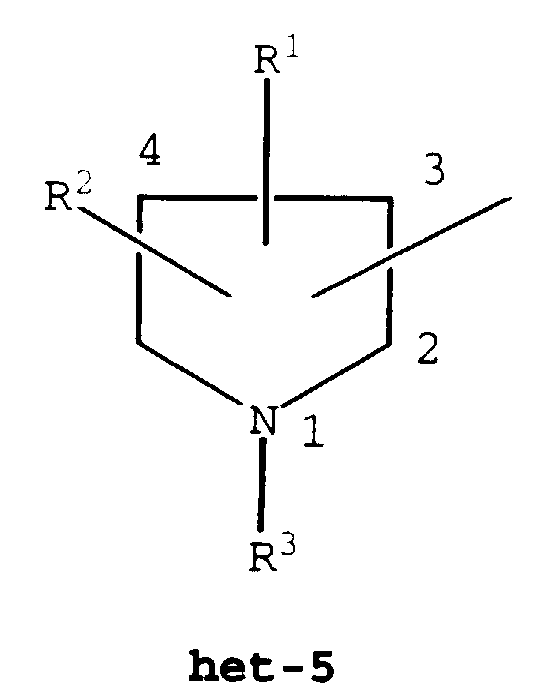
- As used herein the term α shall refer to a position on the G substituent which is one position away from the N atom of the G substituent. For example, in the following illustration (1E), both positions 2 and 6 are considered α. The term γ shall refer to the position on the G substituent which is opposite the N atom. For example, in the illustration (1E), position 4 is considered γ. Likewise, β shall refer to the 3 and 5 position in the illustration.

- As used herein with reference to the G substituent, the phrase "R6 and R7 together with the nitrogen atom optionally form a 4- to 6-member ring" means that R6 and R7 are each independently hydrogen,C1-C6 alkyl; the R6 and R7 groups may optionally join to form a 4- to 6-member ring including the nitrogen. For example, optionally joined groups include, but not limited to:

- As used herein the phrase "interacting with a muscarinic cholinergic receptor" shall include compounds which block muscarinic cholinergic receptors or modulate such receptors. Likewise, the term "interacting with a nicotinic cholinergic receptor" shall include compounds which block or modulate the receptor. The phrase shall include the effect observed when compounds act as agonists, partial agonists and/or antagonists at a cholinergic receptor.
- As used herein, h+ is alkoxide metal wherein the term "alkoxide metal" means a metal suitable for alkoxide formation. Such alkoxide metals include, but are not limited to, Li+, K+, Na+, Cs+, and Ca++. Especially preferred alkoxide metals include Li+, K+, and Na+.
- As used herein, the term "halogen" means Cl, Br, F, and I. Especially preferred halogens include Cl, Br, and I.
- The terms "C1-Cn' alkyl" wherein n'can be from 2 through 15, as used herein, represent a branched or linear alkyl group having from one to the specified number of carbon atoms. Typical C1-C6 alkyl groups include methyl, ethyl, n-propyl, iso-propyl, butyl, iso-butyl, sec-butyl, tert-butyl, pentyl, hexyl and the like.
- The terms "C2-Cn' alkenyl" wherein n' can be from 3 through 10, as used herein, represents an olefinically unsaturated branched or linear group having from 2 to the specified number of carbon atoms and at least one double bond. Examples of such groups include, but are not limited to, 1-propenyl, 2-propenyl (-CH2-CH=CH2), 1,3-butadienyl, (-CH=CHCH=CH2), 1-butenyl (-CH=CHCH2CH3), hexenyl, pentenyl, and the like.
- The term "C2-C5 alkynyl" refers to an unsaturated branched or linear group having from 2 to 5 carbon atoms and at least one triple bond. Examples of such groups include, but are not limited to, 1-propynyl, 2-propynyl, 1-butynyl, 2-butynyl, 1-pentynyl, and the like.
- The terms "halogen(C1-C6)alkyl" and "halogen(C2-C6)alkenyl" refer to alkyl or alkenyl substituents having one or more independently selected halogen atoms attached at one or more available carbon atoms. These terms include, but are not limited to, chloromethyl, 1-bromoethyl, 2-bromoethyl, 1,1,1-trifluoroethyl, 1,1,2-trifluoroethyl, 1,2,2-trifluoroethyl, 2,2,2-trifluoroethyl, trifluoromethyl, trifluoroethylenyl, 3-bromopropyl, 3-bromo-1-propenyl, 2-bromopropyl, 2-bromo-1-propenyl, 3-chlorobutyl, 3-chloro-2-butenyl, 2,3-dichlorobutyl, 1-chloroethylenyl, 2-chloroethylenyl, 5-fluoro-3-pentenyl, 3-chloro-2-bromo-5-hexenyl, 3-chloro-2-bromobutyl, trichloromethyl, 1,1-dichloroethyl, 1,2-dichloroethyl, 2,2-dichloroethyl, 1,4-dichlorobutyl, 3-bromopentyl, 1,3-dichlorobutyl, 1,1-dichloropropyl, and the like.
- The term "C2-C10 alkanoyl" represents a group of the formula C(O) (C1-C9) alkyl. Typical C2-C10 alkanoyl groups include acetyl, propanoyl, butanoyl, and the like.
- The term "(C1-C6 alkyl) amino" refers to a monoalkylamino group. Examples of such groups are methylamino, ethylamino, iso-propylamino, n-propylamino, (n-propyl)amino, (iso-propyl)amino, n-propylamino, t-butylamino, and the like.
- The term "C3-Cn cycloalkyl" wherein n=4-8, represents cyclopropyl, cyclobutyl, cyclopentyl, cyclohexyl, cycloheptyl, and cyclooctyl.
- The term "substituted(C5-Cn') cycloalkyl" refers to a cycloalkyl group as described supra wherein the cycloalkyl group may be substituted with from one to four substituents independently selected from the group consisting of hydrogen, C1-C6 alkyl, NO2, halogen, halogen(C1-C6)alkyl, halogen(C2-C6)alkenyl, C2-C6 alkenyl, CO2R20, (C1-C6 alkyl) amino, -SR20, and OR20; wherein R20 is selected from the group consisting of C1-15-alkyl, C2-15-alkenyl, and C2-15-alkynyl.
- The term "C3-C8 cycloalkyl-(C1-C3)alkyl" represents an alkyl group substituted at a terminal carbon with a C3-C8 cycloalkyl group. Typical cycloalkylalkyl groups include cyclohexylethyl, cyclohexylmethyl, 3-cyclopentylpropyl, and the like.
- The term "C5-C8 cycloalkenyl" represents an olefinically unsaturated ring having five to eight carbon atoms. Such groups include, but are not limited to, cyclohexyl-1,3-dienyl, cyclohexenyl, cyclopentenyl, cycloheptenyl, cyclooctenyl, cyclohexyl-1,4-dienyl, cycloheptyl-1,4-dienyl, cyclooctyl-1,3,5-trienyl and the like.
- The term "substituted (C5-C8) cycloalkenyl" refers to a cycloalkenyl group as described supra. wherein the cycloalkenyl group may be substituted with from one to four substituents independently selected from the group consisting of hydrogen, C1-C6 alkyl, NO2, halogen, halogen(C1-C6)alkyl, halogen(C2-C6)alkenyl, C2-C6 alkenyl, COR20, C2-C10 alkanoyl, C7-C16 arylalkyl, CO2R20, (C1-C6 alkyl) amino, -SR20, and -OR20, Wherein R20 is selected from the group consisting of C1-15-alkyl, C2-15-alkenyl, C2-15-alkynyl.
- The term "C5-C8 cycloalkenyl-(C1-C3)alkyl" represents a C1-C3 alkyl group substituted at a terminal carbon with a C5-C8 cycloalkenyl group.
- As used herein, the phrase "5 or 6 membered heterocyclic group" means a group containing from one to four N, O or S atom(s) or a combination thereof, which heterocyclic group is optionally substituted at carbon or nitrogen atom(s) with C1-6-alkyl, -CF3, phenyl, benzyl or thienyl, or a carbon atom in the heterocyclic group together with an oxygen atom form a carbonyl group, or which heterocyclic group is optionally fused with a phenyl group. The phrase "5 or 6 membered heterocyclic group" includes, but is not limited to, 5-membered heterocycles having one hetero atom (e.g. thiophenes, pyrroles, furans); 5-membered heterocycles having two heteroatoms in 1,2 or 1,3 positions (e.g. oxazoles, pyrazoles, imidazoles, thiazoles, purines); 5-membered heterocycles having three heteroatoms (e.g. triazoles, thiadiazoles); 5-membered heterocycles having 3-heteroatoms; 6-membered heterocycles with one heteroatom (e.g. pyridine, quinoline, isoquinoline, phenanthrine, 5,6-cycloheptenopyridine); 6-membered heterocycles with two heteroatoms (e.g. pyridazines, cinnolines, phthalazines, pyrazines, pyrimidines, quinazolines); 6-membered heterocycles with three heteroatoms (e.g. 1,3,5-triazine); and 6-member heterocycles with four heteroatoms. Particularly preferred are thiophenes, pyridines, and furans.
- The term "heteroaryl" refers to a group which is a 5 or 6 membered heterocycle containing one to four N, O, or S atoms or a combination thereof.
- As used herein the term "carboxy" refers to a substituent having the common meaning understood by the skilled artisan, wherein the point of attachment may be through the carbon or oxygen atom of the group.
- As used herein the term "aryl" means an organic radical derived from an aromatic hydrocarbon by the removal of one atom; e.g., phenyl or naphthyl. Most preferably, aryl refers to C6-C10 aryl, wherein the aryl ring system, including any alkyl substitutions, comprises from 6 to 10 carbon atoms; e.g., phenyl, 3,3-dimethylphenyl, naphthyl, and the like. The aryl radical may be substituted by one or two C1-C6 straight or branched alkyl. The term "aryl(C1-C3)alkyl" refers to any aryl group which is attached to the parent moiety via the alkyl group.
- As used herein the term "malfunctioning of the muscarinic cholinergic system" shall have the meaning accepted by the skilled artisan. Likewise, the term "malfunctioning of the nicotinic cholinergic system" shall have the art recognized meaning. For example the term shall refer to, but is not in any way limited to, conditions such as glaucoma, psychosis, schizophrenia or schizophreniform conditions, depression, sleeping disorders, epilepsy, and gastrointestinal motility disorders. Other such conditions include Alzheimer's Disease and incontinence.
- Compounds of this invention may be prepared by the process illustrated in Scheme II

- The artisan will recognize that the starting materials for the process of Scheme II are commercially available or can be prepared using methods familiar to the skilled artisan.
- Compounds of Formula I wherein R is an R4 group, can be prepared using methods well known in the art. See for example, U.S. Patent Number 5,043,345.
- Further, compounds of Formula I may be prepared using the process illustrated in the following Scheme III

- As used in Scheme III, Q may be N, O or S; R24 is selected from the group consisting of hydrogen, R4, R5, R6, and R7; R25 is selected from the group consisting of SOR4 and SO2R4; all other meanings are as defined supra.
- Additional compounds of Formula I may be prepared using the process illustrated by Scheme IV.

- As used in Scheme IV, Hal, W, r, and G are as defined supra. As used in Scheme IV, R22 and R23 are independently selected from the group consisting of hydrogen, R6 and R7.
- When the G substituent contains a secondary nitrogen protected by a protecting group, the protecting group may be removed using standard methods known to the skilled artisan. An especially preferred protecting group is carbamate. One particularly useful reference concerning protecting groups is Greene, Protecting Groups in Organic Synthesis, (John Wiley & Sons, New York, 1981).
- The pharmacological properties of the compounds of the invention can be illustrated by determining their capability to inhibit the specific binding of 3H-Oxotremorine-M (3H-Oxo). Birdsdall N.J.M., Hulme E.C., and Burgen A.S.V. (1980). "The Character of Muscarinic Receptors in Different Regions of the Rat Brain". Proc. Roy. Soc. London (Series B) 207,1.
- 3H-Oxo labels muscarinic receptor in the CNS (with a preference for agonist domains of the receptors). Three different sites are labeled by 3H-Oxo. These sites have affinity of 1.8, 20 and 3000 nM, respectively. Using the present experimental conditions only the high and medium affinity sites are determined.
- The inhibitory effects of compounds on 3H-oxo binding reflects the affinity for muscarinic acetylcholine receptors.
- All preparations are performed at 0-4°C unless otherwise indicated. Fresh cortex (0.1-1 g) from male Wistar rats (150-250 g) is homogenized for 5-10 s in 10 mL 20 nM Hepes pH: 7.4, with an Ultra-Turrax homogenizer. The homogenizer is rinsed with 10 mL of buffer and the combined suspension centrifuged for 15 min. at 40,000 x g. The pellet is washed three times with buffer. In each step the pellet is homogenized as before in 2 x 10 mL of buffer and centrifuged for 10 min. at 40,000 x g.
- The final pellet is homogenized in 20 mM Hepes pH: 7.4 (100 mL per g of original tissue) and used for binding assay. Aliquots of 0.5 mL is added 25 µL of test solution and 25 µL of 3H-Oxotremorine (1.0 nM, final concentration) mixed and incubated for 30 min. at 25°C. Non-specific binding is determined in triplicate using arecoline (1 µg/mL, final concentration) as the test substance. After incubation samples are added 5 mL of ice-cold buffer and poured directly onto Whatman GF/C glass fiber filters under suction and immediately washed 2 times with 5 mL of ice-cold buffer. The amount of radioactivity on the filters are determined by conventional liquid scintillation counting. Specific binding is total binding minus non specific binding.
- Test substances are dissolved in 10 mL water (if necessary heated on a steam-bath for less than 5 min.) at a concentration of 2.2 mg/mL. 25-75% inhibition of specific binding must be obtained before calculation of IC50. The test value will be given as IC50 (the concentration (nM) of the test substance which inhibits the specific binding of 3H-oxo by 50%).
IC50 = (applied test substance concentration) x(Cx/Co-Cx)nM where Co is specific binding in control assays and Cx is the specific binding in the test assay. (The calculations assume normal mass-action kinetics). - Furthermore the pharmacological properties of the compounds of the invention can also be illustrated by determining their capability to inhibit 3HPRZ (pirenzepine, [N-methyl-3H]) binding to rat cerebral cortex membranes.
- Pirenzepine binds selectively to subtype of muscarinic receptors. Historically the type is named the M1-site, whereas pirenzepine sensitive site would be more appropriate. Although selective for M1-sites pirenzepine also interact with M2-sites.
- All preparations are performed at 0-4°C unless otherwise indicated. Fresh cortex (0.1-1 9) from male Wistar rats (150-200 g) is homogenized for 5-10 s in 10 mL 20 mM Hepes pH: 7.4, with an Ultra-Turrax homogenizer. The homogenizer is rinsed with 2 x 10 mL of buffer and the combined suspension centrifuged for 15 min. at 40,000 x g. The pellet is washed three times with buffer. In each step the pellet is homogenized as before in 3 x 10 mL of buffer and centrifuged for 10 min. at 40,000 x g.
- The final pellet is homogenized in 20 mM Hepes pH: 7.4 (100 mL per g of original tissue) and used for binding assay. Aliquots of 0.5 mL is added 20 L of test solution and 25 µL of 3HPRZ (1.0 nM, final conc.), mixed and incubated for 60 min. at 20°C. Non-specific binding is determined in triplicate using atropine (1.0 µg/mL, final conc.) as the test substance. After incubation samples are added 5 mL of ice-cold buffer and poured directly onto Whatman GF/C glass fiber filters under suction and immediately washed 2 times with 5 mL of ice-cold buffer. The amount of radioactivity on the filters are determined by conventional liquid scintillation counting. Specific binding is total binding minus non-specific binding.
- Test substances are dissolved in 10 mL water, at a concentration of 0.22 mg/mL. 25-75% inhibition of specific binding must be obtained before calculation of IC50.
- The test value will be given as IC50 (the concentration (nM) of the test substance which inhibits the specific binding of 3HPRZ by 50%).
IC50 = (applied test substance concentration) x(Cx/Co-Cx)nM where Co is specific binding in control assays and Cx is the specific binding in the test assay. (The calculations assume normal mass-action kinetics). - Test results obtained by testing some compounds of the present invention will appear from the following table 1.


- The following Examples are studies to establish the usefulness of the named compounds for treating anxiety.
- The antianxiety activity of the compounds employed in the method of the present invention is established by demonstrating that the compounds increase punished responding. This procedure has been used to establish antianxiety activity in clinically established compounds.
- According to this procedure, the responding of rats or pigeons is maintained by a multiple schedule of food presentation. In one component of the schedule, responding produces food pellet presentation only. In a second component, responding produces both food pellet presentation and is also punished by presentation of a brief electric shock. Each component of the multiple schedule is approximately 4 minutes in duration, and the shock duration is approximately 0.3 seconds. The shock intensity is adjusted for each individual animal so that the rate of punished responding is approximately 15 to 30% of the rate in the unpunished component of the multiple schedule. Sessions are conducted each weekday and are approximately 60 min in duration. Vehicle or a dose of compound are administered 30 min to 6 hr before the start of the test session by the subcutaneous or oral route. Compound effects for each dose for each animal are calculated as a percent of the vehicle control data for that animal. The data are expressed as the mean ± the standard error of the mean.
- Further, the antianxiety activity of the compounds is established by demonstrating that the compounds are effective in the monkey taming model. Plotnikoff Res. Comm. Chem. Path. & Pharmacol., 5: 128-134 (1973) described the response of rhesus monkeys to pole prodding as a method of evaluating the antiaggressive activity of a test compound. In this method, the antiaggressive activity of a compound was considered to be indicative of its antianxiety activity. Hypoactivity and ataxia were considered to be indicative of a sedative component of the compound. The present study is designed to measure the pole prod response-inhibition induced by a compound of this invention in comparison with that of a standard antianxiety compound such as diazepam as a measure of antiaggressive potential, and to obtain an indication of the duration of action of the compound.
- Male and female rhesus or cynomologous monkeys, selected for their aggressiveness toward a pole, are housed individually in a primate colony room. Compounds or appropriate vehicle are administered orally or subcutaneously and the animals are observed by a trained observer at varying times after drug administration. A minimum of three days (usually a week or more) elapses between treatments. Treatments are assigned in random fashion except that no monkey receives the same compound two times consecutively.
- Aggressiveness and motor impairment are graded by response to a pole being introduced into the cage as described in Table 1. The individuals responsible for grading the responses are unaware of the dose levels received by the monkeys.


- Finally, the antianxiety activity of the named compounds can be demonstrated by human clinical trials. The study was designed as a double-blind, parallel, placebo-controlled multicenter trial. The patients are randomized into four groups, placebo and 25, 50, and 75 mg tid of test compound. The dosages are administered orally with food. Patients are observed at four visits to provide baseline measurements. Visits 5-33 served as the treatment phase for the study.
- During the visits, patients and their caregivers are questioned and observed for signs of agitation, mood swings, vocal outbursts, suspiciousness, and fearfulness. Each of these behaviors are indicative of the effect of the test compound on an anxiety disorder.
- For example, one study provided the following results:
Placebo 25 mg 50 mg 75 mg p-Value (N=87) (N=85) (N=83) (N=87) Behavioral Event n (%) n (%) n (%) n (%) Agitation 40 (46) 34 (40) 24 (29) 20 (23) .006 Mood swings Vocal 40 (46) 25 (29) 21 (25) 28 (32) .025 Outbursts 33 (38) 29 (34) 24 (29) 11 (13) .001 Suspiciousness 32 (37) 23 (27) 26 (31) 7 (8) <.001 Fearfulness 25 (29) 28 (33) 19 (23) 13 (15) .038 - Treatment groups are compared with respect to the number and percent of patients who ever had the symptom during the double-blind portion of the study (visits 5 through 33), at a severity that was worse than during the baseline visits (1 through 4).
- Some examples of compounds contemplated for use in treating anxiety include, but are not limited to: (+/-)-3-butylthio-4-(azabicyclo[2.2.2]octyl-3-oxy)-1,2,5-oxadiazole, (+/-)-3-(2-butyloxy)-4-[(+/-)-3-azabicyclo[2.2.2]octyloxy)-1,2,5-oxadiazole, (+/-)-3-butyloxy-4-[endo-(+/-)-6-[1-azabicyclo[3.2.1]octyloxy)]-1,2,5-oxadiazole, 3-(2,2,3,3,4,4,4-heptaflurorobutyloxy)-4-[(+/-)-3-(1-azabicyclo[2.2.2]octyloxy)]-1,2,5-oxadiazole, 3-methoxy-4-(1-azabicyclo[2.2.2]octyl-3-oxy)-1,2,5-oxadiazole, 3-pentylthio-4-(1-azabicyclo[2.2.2]ocytl-3-oxy)-1,2,5-oxadiazole, trans-3-butyloxy-4-(2-dimethylaminocyclopentyloxy)-1,2,5-oxadiazole, 3-butylthio-4-(3-azetidinyloxy)-1,2,5-oxadiazole, 3-(3-N-(2-thiazolidonyl)propylthio)-4-(1-azabicyclo[2.2.2]octyl-3-oxy)-1,2,5-oxadiazole, 3-chloro-4-(1-azabicyclo[3.2.1]octyl-6-oxy)-1,2,5-oxadiazole, 3-(2-2-thio-5-trifluoromethylthienyl)ethylthio)-4-azabicyclo[2.2.2]octyl-3-oxy)-1,2,5-oxadiazole, 3-butylthio-4-[3-±-endo-(1-azabicyclo[2.2.1]heptyloxy)]-1,2,5-oxadiazole, 3-hexyloxy-4-[6-±-endo-12-azabicyclo[2.2.2]ocyloxy)]-1,2,5-oxadiazole, 3-(4,4,4-trifluorobutylthio)-4-[2-±-exo-(7-azabicyclo[2.2.1]heptyloxy)]-1,2,5-oxadiazole, 3-(2-phenoxyethylthio)-4-[3-±-endo-(1-azabicyclo[3.2.1]octyloxy)]-1,2,5-oxadiazole, 3-(5-hexenyloxy)-4-[7-±-endo-(2-azabicyclo[2.2.1]heptyloxy)]-1,2,5-oxadiazole, 3-butyl-4-[5-(1-azabicyclo[3.2.1]octyloxy)]-1,2,5-oxadiazole, and 3-cyclobutylmethyl-4-[2-±-endo-(8-azabicyclo[3.2.1]octyloxy)]-1,2,5-oxadiazole.
- The route of administration may be any route, which effectively transports the active compound to the appropriate or desired site of action, such as oral or parenteral e.g. rectal, transdermal, depot, subcutaneous, intravenous, intramuscular or intranasal, the oral route being preferred.
- Typical compositions include a compound of formula I or a pharmaceutically acceptable acid addition salt thereof, associated with a pharmaceutically acceptable excipient which may be a carrier, or a diluent or be diluted by a carrier, or enclosed within a carrier which can be in the form of a capsule, sachet, paper, or other container. In making the compositions, conventional techniques for the preparation of pharmaceutical compositions may be used. For example, the active compound will usually be mixed with a carrier, or diluted by a carrier, or enclosed within a carrier which may be in the form of a ampoule, capsule, sachet, paper, or other container. When the carrier serves as a diluent, it may be solid, semi-solid, or liquid material which acts as a vehicle, excipient, or medium for the active compound. The active compound can be adsorbed on a granular solid container for example in a sachet. Some examples of suitable carriers are water, salt solutions, alcohols, polyethylene glycols, polyhydroxyethoxylated castor oil, gelatine, lactose, amylose, magnesium stearate, talc, silicic acid, fatty acid monoglycerides and diglycerides, pentaerythritol fatty acid esters, hydroxymethylcellulose and polyvinylpyrrolidone. The formulations may also include wetting agents, emulsifying and suspending agents, preserving agents, sweetening agents, or flavoring agents. The formulations of the invention may be formulated so as to provide quick, sustained, or delayed release of the active ingredient after administration to the patient by employing procedures well known in the art.
- The pharmaceutical preparations can be sterilized and mixed, if desired, with auxiliary agents, emulsifiers, salt for influencing osmotic pressure, buffers and/or coloring substances and the like, which do not deleteriously react with the active compounds.
- For parenteral application, particularly suitable are injectable solutions or suspensions, preferably aqueous solutions with the active compound dissolved in polyhydroxylated castor oil.
- Tablets, dragees, or capsules having talc and/or a carbohydrate carrier or binder or the like are particularly suitable for oral application. Preferable carriers for tablets, dragees, or capsules include lactose, corn starch, and/or potato starch. A syrup or elixir can be used in cases where a sweetened vehicle can be employed.
- Generally, the compounds are dispensed in unit form comprising from about 0.1 to about 100 mg in a pharmaceutically acceptable carrier per unit dosage.
- Some prefered characteristics of compounds for the treatment of anxiety are:
- A) W is S;
- B) r is 1 or 2;
- C) G is selected from het-1 and het-5;
- D) G is unsaturated;
- E) G is het-4;
- F) G is an azabicycle having 7 ring carbon atoms and a nitrogen atom;
- G) G is het-6;
- H) r is 0;
- I) R is selected from halogen, -OR5Y, -SR5Y, -OR5ZY, -SR5ZY, -OR5ZR4, -SR5ZR4, -OR4, and -SR4;
- J) W is O;
- K) m is 1;
- L) n is 1;
- M) p is 2;
- N) G is het-3
- O) G is het-2
- P) a compound of Formula I
- Q) a compound of Formula I'
- R) a compound of Formula I
- R is selected from the group consisting of hydrogen, amino, halogen, NHR6, NR6R7, R4, -OR4, -SR4, -SOR4, -SO2R4, C3-10-cycloalkyl, C4-12-(cycloalkylalkyl), -Z-C3-10-cycloalkyo and -Z-C4-12-(cycloalkylalkyl); R4 is selected from the group consisting of C1-15-alkyl, C2-15-alkenyl, and C2-15-alkynyl, each of which is optionally substituted with one or more independently selected from the group consisting of halogen(s), -CF3, -CN, Y, phenyl and phenoxy wherein phenyl or phenoxy is optionally substituted with one or more selected from the group consisting of halogen, -CN, C1-4-alkyl, C1-4-alkoxy, -OCF3, -CF3, -CONH2 and -CSNH2; or
- R is phenyl or benzyloxycarbonyl, each of which is optionally substituted with one or more substituents independently selected from the group consisting of halogen, -CN, C1-4-alkyl, C1-4-alkoxy, -OCF3, -CF3, -CONH2 and -CSNH2; or
- R is selected from the group consisting of -OR5Y, -SR5Y, OR5-Z-Y, -SR5ZY, -O-R5-Z-R4 and -S-R5-Z-R4;
- Z is oxygen or sulphur;
- R5 is selected from the group consisting of C1-15-alkyl, C2-15-alkenyl, and C2-15-alkynyl;
- Y is a 5 or 6 membered heterocyclic group; and
- G is selected from one of the following azacyclic or azabicyclic ring systems:


- or G can optionally be substituted C3-C8 cycloalkyl wherein the substitution is -NR6R7;
- R6 and R7 independently are selected from the group consisting of hydrogen and C1-6-alkyl; or R6 and R7 together with the nitrogen atom optionally form a 4- to 6-member ring;
- R1 and R2 independently are selected from the group consisting of hydrogen, C1-15-alkyl, C2-5-alkenyl, C2-5-alkynyl, C1-10-alkoxy, and C1-5-alkyl substituted with a subsituent independently selected from the group consisting of -OH, -COR6', CH2-OH, halogen, -NH2, carboxy, and phenyl;
- R3 is selected from the group consisting of hydrogen, C1-5-alkyl, C2-5-alkenyl and C2-5-alkynyl;
- R6' is selected from the group consisting of hydrogen and C1-6-alkyl;
- n is 0, 1 or 2;
- m is 0, 1 or 2;
- p is 0, 1 or 2;
- q is 1 or 2;
- r is 0, 1 or 2;
- ....... is a single or double bond;
- S) The G substituent is selected from the group consisting of


- T) The G substituent is

- U) R is selected from the group consisting of -SR4', SOR4', -SO2R4', substituted benzyloxycarbonyl wherein the substituents are one or more independently selected from the group consisting of -CN, -OCF3, -CF3, -CONH2 and -CSNH2; or C3-10-cycloalkyl, C4-12- (cycloalkylalkyl), -Z-C3-10-cycloalkyl and -Z-C4-12-(cycloalkylalkyl).
- V) R is selected from the group consisting of R4, C3-10-cycloalkyl, C4-12-(cycloalkylalkyl), -Z-C3-10-cycloalkyl and -Z-C4-12-(cycloalkylalkyl); and
R4 is selected from the group consisting of substituted C5-15-alkyl, optionally substituted C2-15-alkenyl, and optionally substituted C2-15-alkynyl, wherein such substituent is one or more independently selected from the group consisting of halogen(s), -CF3, -CN, Y, phenyl and phenoxy; wherein phenyl or phenoxy is optionally substituted with one or more substituents selected from the group consisting of halogen, -CN, C1-4-alkyl, C1-4-alkoxy, -OCF3, -CF3, -CONH2 and -CSNH2. - W) G is selected from the group consisting of het-4, het-7, het-6 wherein n=2; het-3 wherein one of n and m is 0 or 2; and het-3 wherein the I or I' group is attached at the bridgehead of het-3.
- Especially preferred compounds of this invention have the characteristics of A-F,P; A-F,Q; characteristics of A, G, H, M, F; characteristics of G-O,Q; or the characteristics of G-J,M,P; or G-J,M,Q. The characteristics of R and S may be particularly preferred.
- Further, especially preferred R groups include phenyl, benzyloxycarbonyl, -OR5Y, -SR5Y, OR5-Z-Y, -SR5zY, -O-R4-Z-R5 or -S-R4-Z-R5, -SOR4, C3-10-cycloalkyl, C4-12-(cycloalkylalkyl), -Z-C3-10-cycloalkyl and -Z-C4-12-(cycloalkylalkyl) wherein Z is oxygen or sulphur, R5 is C1-15-alkyl, C2-15-alkenyl, C2-15-alkynyl, Y is a 5 or 6 membered heterocyclic group containing one to four N, O or S atom(s) or a combination thereof, R4 is C1-15-alkyl, C2-15-alkenyl, and C2-15-alkynyl.
- Further, especially preferred G groups include the following heterocycles:


- Some particularly preferred G groups include


- Additionally, another embodiment of this invention which can be preferred is that when W is O and G is alkyl, R is not halogen.
- The invention will now be described in further detail with reference to the following examples. The examples are provided for illustrative purposes, and are not to be construed as limiting the scope of the invention in any way.
- A suspension of 3,4-diphenylsulfonyl-1,2,5-oxadiazole oxide (4.6 g, 0.126 mol, Ref. J.Chem. Soc. 1964, 904.) in 1-butanol (400 mL) was heated to 55-60°C as a solution of sodium 1-butyloxide (0.3 g Na, 40 mL 1-butanol) was added dropwise. After 1 h, the solvent was evaporated, residue was treated with H2O, and the mixture extracted with ether (3X). The extracts were washed with H2O, dried, and the solvent evaporated to give a white solid (3.15 g). The solid was heated to reflux overnight in P(OCH3)3 (30 mL) then poured into ice-H2O containing HCl (6 mL, 5N). The mixture was extracted with ether, the extracts washed with brine, dried, and the solvent evaporated to give a yellow liquid. Radial chromatography (15% EtOAc/hexane) gave a clear liquid (1.85 g). The liquid was dissolved in THF (30 mL) and added dropwise to a mixture prepared from 1-azabicyclo[2.2.2]octan-3-ol(1.85 g 0.014 mol), THF (20 mL), and 1.6 M n-butyl lithium in hexane (8.4 mL, 0.013 mol). The reaction was then warmed to 52°C for 5 h. The cooled reaction was acidified with dilute HCl and diluted wit ether. the aqueous fraction was washed with ether, made basic, and extracted with ether. The extracts were dried and evaporated to give a clear liquid. The HCl salt (1.4 g) crystallized from CHCl3-EtOAc-ether, m.p. 186-188°C. (Compound 1).
or a pharmaceutically acceptable salt or solvate thereof;
Claims (16)
- The use of a compound of Formula I or the quaternized form thereof:
 W is oxygen or sulphur;R is selected from the group consisting of hydrogen, amino, halogen, NHR6, NR6R7, R4, -OR4, -SR4, -SOR4, -SO2R4, C3-10-cycloalkyl, C4-12-(cycloalkylalkyl), -Z-C3-10-cycloalkyl and -Z-C4-12-(cycloalkylalkyl); R4 is selected from the group consisting of C1-15-alkyl, C2-15-alkenyl, and C2-15-alkynyl, each of which is optionally substituted with one or more independently selected from the group consisting of halogen(s), -CF3, -CN, Y, phenyl and phenoxy wherein phenyl or phenoxy is optionally substituted with one or more selected from the group consisting of halogen, -CN, C1-4-alkyl, C1-4-alkoxy, -OCF3, -CF3, -CONH2 and -CSNH2; orR is phenyl or benzyloxycarbonyl, each of which is optionally substituted with one or more substituents independently selected from the group consisting of halogen, -CN, C1-4-alkyl, C1-4-alkoxy, -OCF3, -CF3, -CONH2 and -CSNH2; orR is selected from the group consisting of -OR5Y, -SR5Y, OR5-Z-Y, -SR5ZY, -O-R5-Z-R4 and -S-R5-Z-R4;Z is oxygen or sulphur;R5 is selected from the group consisting of C1-15-alkyl, C2-15-alkenyl, and C2-15-alkynyl;Y is a 5 or 6 membered heterocyclic group; andG is selected from one of the following azacyclic or azabicyclic ring systems:
 or G can optionally be substituted C3-C8 cycloalkyl or substituted C1-6-alkyl wherein the substitution is -NR6R7;R6 and R7 independently are selected from the group consisting of hydrogen and C1-6-alkyl; or R6 and R7 together with the nitrogen atom optionally form a 4- to 6-member ring;R1 and R2 independently are selected from the group consisting of hydrogen, C1-15-alkyl, C2-5-alkenyl, C2-5-alkynyl, C1-10-alkoxy, and C1-5-alkyl substituted with a subsituent independently selected from the group consisting of -OH, -COR6', CH2-OH, halogen, -NH2, carboxy, and phenyl;R3 is selected from the group consisting of hydrogen, C1-5-alkyl, C2-5-alkenyl and C2-5-alkynyl;R6' is selected from the group consisting of hydrogen and C1-6-alkyl;n is 0, 1 or 2;m is 0, 1 or 2;p is 0, 1 or 2;q is 1 or 2;r is 0, 1 or 2;....... is a single or double bond;or a pharmaceutically acceptable salt or solvate thereof; for the manufacture of a medicament for the treatment of anxiety.
 - A use of Claim 1 wherein W is S.
- A use of Claim 1 wherein W is O; G is an azacycle.
- A use of Claim 3 wherein the compound is a compound of Formula I.
- A use of Claim 2 wherein r is 1 or 2.
- A use of Claim 1 wherein G is selected from the group consisting of:


- A use of Claim 6 wherein G is selected from the group consisting of


- A use of Claim 1 wherein the compound is (±)-3-Butyloxy-4-(1-azabicyclo[2.2.2]octyl-3-oxy)-1,2,5-oxadiazole
or a pharmaceutically acceptable salt or solvate thereof. - A pharmaceutical formulation for the treatment of anxiety comprising a compound of Claim 1 together with one or more pharmaceutically acceptable carriers or diluents having a label or package insert indicating that the compound of Claim 1 is useful for the treatment of anxiety.
- A use of Claim 1 wherein the compound is of Formula I
wherein W is oxygen or sulphur;R is selected from the group consisting of hydrogen, amino, halogen, NHR6, NR6R7, R4, -OR4, -SR4, -SOR4, -SO2R4, C3-10-cycloalkyl, C4-12-(cycloalkylalkyl), -Z-C3-10-cycloalkyl and -Z-C4-12-(cycloalkylalkyl); R4 is selected from the group consisting of C1-15-alkyl, C2-15-alkenylk and C2-15-alkynyl, each of which is optionally substituted with one or more independently selected from the group consisting of halogen(s), -CF3, -CN, Y, phenyl and phenoxy wherein phenyl or phenoxy is optionally substituted with one or more selected from the group consisting of halogen, -CN, C1-4-alkyl, C1-4-alkoxy, -OCF3, -CF3, -CONH2 and -CSNH2; orR is phenyl or benzyloxycarbonyl, each of which is optionally substituted with one or more substituents independently selected from the group consisting of halogen, -CN, C1-4-alkyl, C1-4-alkoxy, -OCF3, -CF3, -CONH2 and -CSNH2; orR is selected from the group consisting of -OR5Y, -SR5Y, OR5-Z-Y, -SR5ZY, -O-R5-Z-R4 and -S-R5-Z-R4;Z is oxygen or sulphur;R5 is selected from the group consisting of C1-15-alkyl, C2-15-alkenyl, and C2-15-alkynyl;Y is a 5 or 6 membered heterocyclic group; andG is selected from one of the following azacyclic or azabicyclic ring systems:
 or G can optionally be substituted C3-C8 cycloalkyl or optionally substituted C1-6-alkyl wherein the substitution is -NR6R7;R6 and R7 independently are selected from the group consisting of hydrogen and C1-6-alkyl; or R6 and R7 together with the nitrogen atom optionally form a 4- to 6-member ring;R1 and R2 independently are selected from the group consisting of hydrogen, C1-15-alkyl, C2-5-alkenyl, C2-5-alkynyl, C1-10-alkoxy, and C1-5-alkyl substituted with a subsituent independently selected from the group consisting of -OH, -COR6', CH2-OH, halogen, -NH2, carboxy, and phenyl;R3 is selected from the group consisting of hydrogen, C1-5-alkyl, C2-5-alkenyl and C2-5-alkynyl;R6' is selected from the group consisting of hydrogen and C1-6-alkyl;n is 0, 1 or 2;m is 0, 1 or 2;p is 0, 1 or 2;q is 1 or 2;r is 0, 1 or 2;....... is a single or double bond;provided that when W is O and G is a saturated azabicyclic group having from 7 to 11 ring carbon atoms and a nitrogen atom wherein the nitrogen atom is separated from the W atom by 2 to 3 ring carbon atoms;then R is selected from the group consisting of R4, C3-10-cycloalkyl, C4-12-(cycloalkylalkyl), -Z-C3-10-cycloalkyl and -Z-C4-12-(cycloalkylalkyl) wherein R4 is selected from the group consisting of optionally substituted C5-15-alkyl, optionally substituted C2-15-alkenyl, and optionally substituted C2-15-alkynyl, wherein such substituent is one or more independently selected from the group consisting of halogen(s), -CF3, -CN, Y, phenyl and phenoxy; wherein phenyl or phenoxy is optionally substituted with one or more substituents selected from the group consisting of halogen, -CN, C1-4-alkyl, C1-4-alkoxy, -OCF3, -CF3, -CONH2 and -CSNH2; orR4 is substituted C1-C4 alkyl wherein the substituent is selected from the group consisting of -CN, -OCF3, -CF3, -CONH2 and -CSNH2;R is phenyl which is substituted with -CN, -OCF3, -CONH2 or -CSNH2;orR is -OR5Y, -SR5Y, OR5-Z-Y, -SR5ZY, -O-R5-Z-R4 or -S-R5-Z-R4; orR is benzyloxycarbonyl, each of which is optionally substituted with halogen, -CN, C1-4-alkyl, C1-4-alkoxy, -OCF3, -CF3, -CONH2 or -CSNH2;or a pharmaceutically acceptable salt or solvate thereof.
 - A use of Claim 10 wherein G is selected from the group consisting of het-4, het-7, het-6 wherein n=2; het-3 wherein one of n and m is 0 or 2.
- A use of Claim 11 whererin R is selected from the group consisting of C3-10-cycloalkyl, C4-12-(cycloalkylalkyl), -Z-C3-10-cycloalkyl and -Z-C4-12-(cycloalkylalkyl).
- A use of Claim 10 wherein R is selected from the group consisting of R4, -OR4, SOR4', -SO2R4', C3-10-cycloalkyl, C4-12-(cycloalkylalkyl), -Z-C3-10-cycloalkyl and -Z-C4-12-(cycloalkylalkyl).
- A use of Claim 10 wherein R is selected from the group consisting of R4, C3-10-cycloalkyl, C4-12-(cycloalkylalkyl), -Z-C3-10-cycloalkyl and -Z-C4-12-(cycloalkylalkyl); and
R4 is selected from the group consisting of substituted C5-15-alkyl, optionally substituted C2-15-alkenyl, and optionally substituted C2-15-alkynyl, wherein such substituent is one or more independently selected from the group consisting of halogen(s), -CF3, -CN, Y, phenyl and phenoxy; wherein phenyl or phenoxy is optionally substituted with one or more substituents selected from the group consisting of halogen, -CN, C1-4-alkyl, C1-4-alkoxy, -OCF3, -CF3, -CONH2 and -CSNH2. - A use of Claim 10 wherein R is selected from the group consisting of -SR4', SOR4', -SO2R4', substituted benzyloxycarbonyl wherein the substituents are one or more independently selected from the group consisting of -CN, -OCF3, -CF3, -CONH2 and -CSNH2; or C3-10-cycloalkyl, C4-12-(cycloalkylalkyl), -Z-C3-10-cycloalkyl and -Z-C4-12-(cycloalkylalkyl).
- A use of Claim 1 wherein G is selected from the group consisting of


Applications Claiming Priority (2)
| Application Number | Priority Date | Filing Date | Title |
|---|---|---|---|
| US658495P | 1995-11-13 | 1995-11-13 | |
| US6584 | 1995-11-13 |
Publications (1)
| Publication Number | Publication Date |
|---|---|
| EP0773021A1 true EP0773021A1 (en) | 1997-05-14 |
Family
ID=21721597
Family Applications (1)
| Application Number | Title | Priority Date | Filing Date |
|---|---|---|---|
| EP96308112A Withdrawn EP0773021A1 (en) | 1995-11-13 | 1996-11-08 | Use of azacyclic or azabicyclic oxadiazole compounds for treating anxiety |
Country Status (6)
| Country | Link |
|---|---|
| US (1) | US5763457A (en) |
| EP (1) | EP0773021A1 (en) |
| JP (1) | JP2000500453A (en) |
| AU (1) | AU7726396A (en) |
| CA (1) | CA2237220A1 (en) |
| WO (1) | WO1997017956A1 (en) |
Cited By (1)
| Publication number | Priority date | Publication date | Assignee | Title |
|---|---|---|---|---|
| WO2009128057A2 (en) | 2008-04-18 | 2009-10-22 | UNIVERSITY COLLEGE DUBLIN, NATIONAL UNIVERSITY OF IRELAND, DUBLIN et al | Psycho-pharmaceuticals |
Families Citing this family (9)
| Publication number | Priority date | Publication date | Assignee | Title |
|---|---|---|---|---|
| US6391922B1 (en) | 1998-01-13 | 2002-05-21 | Synchroneuron, Llc | Treatment of posttraumatic stress disorder, obsessive-compulsive disorder and related neuropsychiatric disorders |
| US20120077825A1 (en) * | 1999-05-27 | 2012-03-29 | Merck Patentgesellschaft | Novel use of 1-[4-(5-cyanoindol-3-yl)butyl]-4-(2-carbamoyl-benzofuran-5-yl)-piperazine and its physiologically acceptable salts |
| TW518218B (en) * | 1999-05-27 | 2003-01-21 | Merck Patent Gmbh | Pharmaceutical compositions comprising 1-[4-(5-cyanoindol-3-yl)butyl]-4-(2-carbamoylbenzofuran-5-yl)piperazine or its physiologically acceptable salts for use in the treatment of sub-type anxiety disorders |
| MXPA05001702A (en) * | 2002-08-14 | 2005-04-19 | Neurosearch As | Novel quinuclidine derivatives and their use. |
| EP1638939A2 (en) * | 2003-06-24 | 2006-03-29 | Neurosearch A/S | Aza-ring derivatives and their use as monoamine neurotransmitter re-uptake inhibitors |
| WO2005016923A1 (en) * | 2003-08-13 | 2005-02-24 | Neurosearch A/S | Novel quinuclidine derivatives and their pharmaceutical use |
| US7160876B2 (en) | 2003-12-22 | 2007-01-09 | Abbott Laboratories | Fused bicycloheterocycle substituted quinuclidine derivatives |
| US7655657B2 (en) | 2003-12-22 | 2010-02-02 | Abbott Laboratories | Fused bicycloheterocycle substituted quinuclidine derivatives |
| RU2571286C1 (en) * | 2015-01-27 | 2015-12-20 | Федеральное государственное бюджетное научное учреждение "Научно-исследовательский институт фармакологии и регенеративной медицины имени Е.Д. Гольдберга" | Agent possessing anxiolytic activity |
Citations (7)
| Publication number | Priority date | Publication date | Assignee | Title |
|---|---|---|---|---|
| CH508650A (en) * | 1968-02-06 | 1971-06-15 | Ciba Geigy Ag | Process for the production of new furazan derivatives |
| US5043345A (en) | 1989-02-22 | 1991-08-27 | Novo Nordisk A/S | Piperidine compounds and their preparation and use |
| WO1995005174A1 (en) * | 1993-08-19 | 1995-02-23 | Novo Nordisk A/S | Antipsychotic method |
| WO1995005379A1 (en) * | 1993-08-19 | 1995-02-23 | Novo Nordisk A/S | Antipsychotic method |
| EP0709093A2 (en) * | 1994-10-31 | 1996-05-01 | Eli Lilly And Company | Method for treating anxiety using an azabicyclic oxadiazole or thiadiazole compound |
| EP0709094A2 (en) * | 1994-10-31 | 1996-05-01 | Eli Lilly And Company | Method for treating anxiety using a tetrahydropyridine oxadiazole or thiadiazole compound |
| WO1996012711A1 (en) * | 1994-10-24 | 1996-05-02 | Eli Lilly And Company | Heterocyclic compounds and their use |
Family Cites Families (2)
| Publication number | Priority date | Publication date | Assignee | Title |
|---|---|---|---|---|
| DE4217794A1 (en) * | 1992-05-29 | 1993-12-02 | Cassella Ag | Phenylfuroxane |
| US5574028A (en) * | 1994-10-31 | 1996-11-12 | Eli Lilly And Company | Method for treating anxiety |
-
1996
- 1996-10-22 US US08/735,300 patent/US5763457A/en not_active Expired - Fee Related
- 1996-11-08 AU AU77263/96A patent/AU7726396A/en not_active Abandoned
- 1996-11-08 WO PCT/US1996/018050 patent/WO1997017956A1/en not_active Ceased
- 1996-11-08 EP EP96308112A patent/EP0773021A1/en not_active Withdrawn
- 1996-11-08 CA CA002237220A patent/CA2237220A1/en not_active Abandoned
- 1996-11-08 JP JP9518972A patent/JP2000500453A/en active Pending
Patent Citations (7)
| Publication number | Priority date | Publication date | Assignee | Title |
|---|---|---|---|---|
| CH508650A (en) * | 1968-02-06 | 1971-06-15 | Ciba Geigy Ag | Process for the production of new furazan derivatives |
| US5043345A (en) | 1989-02-22 | 1991-08-27 | Novo Nordisk A/S | Piperidine compounds and their preparation and use |
| WO1995005174A1 (en) * | 1993-08-19 | 1995-02-23 | Novo Nordisk A/S | Antipsychotic method |
| WO1995005379A1 (en) * | 1993-08-19 | 1995-02-23 | Novo Nordisk A/S | Antipsychotic method |
| WO1996012711A1 (en) * | 1994-10-24 | 1996-05-02 | Eli Lilly And Company | Heterocyclic compounds and their use |
| EP0709093A2 (en) * | 1994-10-31 | 1996-05-01 | Eli Lilly And Company | Method for treating anxiety using an azabicyclic oxadiazole or thiadiazole compound |
| EP0709094A2 (en) * | 1994-10-31 | 1996-05-01 | Eli Lilly And Company | Method for treating anxiety using a tetrahydropyridine oxadiazole or thiadiazole compound |
Non-Patent Citations (11)
| Title |
|---|
| ALFRED GOODMAN, ET AL., GOODMAN AND GILMAN'S THE PHARMACOLOGICAL BASIS OF THERAPEUTICS, vol. 8, 1990, pages 482 |
| BIRDSDALL N.J.M., HULME E.C., BURGEN A.S.V.: "The Character of Muscarinic Receptors in Different Regions of the Rat Brain", PROC. ROY. SOC. LONDON (SERIES B) 207.1, 1980 |
| GREENE: "Protecting Groups in Organic Synthesis", 1981, JOHN WILEY & SONS, NEW YORK |
| J. CHEM. SOC., 1964, pages 904 |
| JOURNAL OF PHARMACEUTICAL SCIENCE, vol. 66, no. 2, 1977 |
| NURNBERGER ET AL., PSYCHIATRY RES., vol. 9, 1983, pages 191 - 200 |
| PLOTNIKOFF, RES. COMM. CHEM. PATH. & PHARMACOL., vol. 5, 1973, pages 128 - 134 |
| PSYCHOPHARMACOL. BULL., vol. 17, 1982, pages 80 - 82 |
| RISCH ET AL., PSYCHOPHARMACOL. BULL., vol. 19, 1983, pages 696 - 698 |
| TASK FORCE ON NOMENCLATURE AND STATISTICS OF THE AMERICAN PSYCHIATRIC ASSOCIATION: "Diagnostic and Statistical Manual of Mental Disorders, Revised, 4th Ed.", 1994, article "DSM-IV-R" |
| TOMPKINS ET AL., RESEARCH COMMUNICATIONS IN PSYCHOLOGY, PSYCHIATRY, AND BEHAVIOUR, vol. 5, no. 4, 1980, pages 338 |
Cited By (1)
| Publication number | Priority date | Publication date | Assignee | Title |
|---|---|---|---|---|
| WO2009128057A2 (en) | 2008-04-18 | 2009-10-22 | UNIVERSITY COLLEGE DUBLIN, NATIONAL UNIVERSITY OF IRELAND, DUBLIN et al | Psycho-pharmaceuticals |
Also Published As
| Publication number | Publication date |
|---|---|
| AU7726396A (en) | 1997-06-05 |
| JP2000500453A (en) | 2000-01-18 |
| CA2237220A1 (en) | 1997-05-22 |
| US5763457A (en) | 1998-06-09 |
| WO1997017956A1 (en) | 1997-05-22 |
Similar Documents
| Publication | Publication Date | Title |
|---|---|---|
| US5998434A (en) | Composition for treating pain | |
| US6194416B1 (en) | Heterocyclic compounds and their use | |
| RU2158262C2 (en) | Derivatives of 1,2,5-thiadiazole, intermediate compounds, methods of synthesis and pharmaceutical composition | |
| US5852037A (en) | Method for treating anxiety | |
| JPH09501658A (en) | Antipsychotic therapy | |
| WO1996013168A1 (en) | Method for treating anxiety | |
| US5763457A (en) | Method for treating anxiety | |
| WO1996013167A1 (en) | Method for treating anxiety | |
| US5888999A (en) | Method for treating anxiety with muscarinic cholinergic receptor agonists | |
| US5605908A (en) | Heterocyclic compounds and their use | |
| US5744489A (en) | Method of treating gastrointestinal motility disorders | |
| JP2002338497A (en) | Combination therapy for depression and anxiety | |
| US5889019A (en) | Heterocyclic compounds and their use | |
| AU715645B2 (en) | Method for treating pain | |
| EP0709093B1 (en) | Method for treating anxiety using an azabicyclic oxadiazole or thiadiazole compound | |
| WO1998027983A1 (en) | A method of treating hypercholesterolemia and related disorders | |
| US5484794A (en) | Method for treating anxiety | |
| EP0783304A1 (en) | Method for treating anxiety | |
| US5545638A (en) | Method of treating gastrointestinal motility disorders | |
| WO1997019669A2 (en) | Heterocyclic compounds and their use | |
| JP2000501708A (en) | Pain treatment composition |
Legal Events
| Date | Code | Title | Description |
|---|---|---|---|
| PUAI | Public reference made under article 153(3) epc to a published international application that has entered the european phase |
Free format text: ORIGINAL CODE: 0009012 |
|
| 17P | Request for examination filed |
Effective date: 19961118 |
|
| AK | Designated contracting states |
Kind code of ref document: A1 Designated state(s): AT BE CH DE DK ES FI FR GB GR IE IT LI LU NL PT SE |
|
| 17Q | First examination report despatched |
Effective date: 19991227 |
|
| GRAG | Despatch of communication of intention to grant |
Free format text: ORIGINAL CODE: EPIDOS AGRA |
|
| STAA | Information on the status of an ep patent application or granted ep patent |
Free format text: STATUS: THE APPLICATION IS DEEMED TO BE WITHDRAWN |
|
| 18D | Application deemed to be withdrawn |
Effective date: 20010530 |