EP0772492B1 - Para-xylene selective reforming/aromatization - Google Patents
Para-xylene selective reforming/aromatization Download PDFInfo
- Publication number
- EP0772492B1 EP0772492B1 EP95926730A EP95926730A EP0772492B1 EP 0772492 B1 EP0772492 B1 EP 0772492B1 EP 95926730 A EP95926730 A EP 95926730A EP 95926730 A EP95926730 A EP 95926730A EP 0772492 B1 EP0772492 B1 EP 0772492B1
- Authority
- EP
- European Patent Office
- Prior art keywords
- catalyst
- zsm
- para
- xylene
- hydrogen
- Prior art date
- Legal status (The legal status is an assumption and is not a legal conclusion. Google has not performed a legal analysis and makes no representation as to the accuracy of the status listed.)
- Expired - Lifetime
Links
- URLKBWYHVLBVBO-UHFFFAOYSA-N Para-Xylene Chemical group CC1=CC=C(C)C=C1 URLKBWYHVLBVBO-UHFFFAOYSA-N 0.000 title claims description 174
- 238000002407 reforming Methods 0.000 title claims description 44
- 238000005899 aromatization reaction Methods 0.000 title claims description 36
- 239000003054 catalyst Substances 0.000 claims description 162
- YXFVVABEGXRONW-UHFFFAOYSA-N Toluene Chemical compound CC1=CC=CC=C1 YXFVVABEGXRONW-UHFFFAOYSA-N 0.000 claims description 123
- 229910052739 hydrogen Inorganic materials 0.000 claims description 75
- 239000001257 hydrogen Substances 0.000 claims description 75
- UFHFLCQGNIYNRP-UHFFFAOYSA-N Hydrogen Chemical compound [H][H] UFHFLCQGNIYNRP-UHFFFAOYSA-N 0.000 claims description 74
- TVMXDCGIABBOFY-UHFFFAOYSA-N octane Chemical compound CCCCCCCC TVMXDCGIABBOFY-UHFFFAOYSA-N 0.000 claims description 65
- 238000000034 method Methods 0.000 claims description 63
- BASFCYQUMIYNBI-UHFFFAOYSA-N platinum Chemical group [Pt] BASFCYQUMIYNBI-UHFFFAOYSA-N 0.000 claims description 52
- 239000008096 xylene Substances 0.000 claims description 46
- 229930195733 hydrocarbon Natural products 0.000 claims description 41
- 150000002430 hydrocarbons Chemical class 0.000 claims description 41
- 150000003738 xylenes Chemical class 0.000 claims description 41
- 239000004215 Carbon black (E152) Substances 0.000 claims description 38
- 238000004939 coking Methods 0.000 claims description 30
- XEEYBQQBJWHFJM-UHFFFAOYSA-N Iron Chemical compound [Fe] XEEYBQQBJWHFJM-UHFFFAOYSA-N 0.000 claims description 24
- 239000002808 molecular sieve Substances 0.000 claims description 21
- URGAHOPLAPQHLN-UHFFFAOYSA-N sodium aluminosilicate Chemical compound [Na+].[Al+3].[O-][Si]([O-])=O.[O-][Si]([O-])=O URGAHOPLAPQHLN-UHFFFAOYSA-N 0.000 claims description 21
- 230000000694 effects Effects 0.000 claims description 19
- VYPSYNLAJGMNEJ-UHFFFAOYSA-N Silicium dioxide Chemical compound O=[Si]=O VYPSYNLAJGMNEJ-UHFFFAOYSA-N 0.000 claims description 16
- GYHNNYVSQQEPJS-UHFFFAOYSA-N Gallium Chemical compound [Ga] GYHNNYVSQQEPJS-UHFFFAOYSA-N 0.000 claims description 14
- 238000007323 disproportionation reaction Methods 0.000 claims description 14
- 229910052733 gallium Inorganic materials 0.000 claims description 14
- ATJFFYVFTNAWJD-UHFFFAOYSA-N Tin Chemical compound [Sn] ATJFFYVFTNAWJD-UHFFFAOYSA-N 0.000 claims description 13
- 229910052738 indium Inorganic materials 0.000 claims description 13
- APFVFJFRJDLVQX-UHFFFAOYSA-N indium atom Chemical compound [In] APFVFJFRJDLVQX-UHFFFAOYSA-N 0.000 claims description 13
- 239000007788 liquid Substances 0.000 claims description 13
- 239000011148 porous material Substances 0.000 claims description 13
- HCHKCACWOHOZIP-UHFFFAOYSA-N Zinc Chemical compound [Zn] HCHKCACWOHOZIP-UHFFFAOYSA-N 0.000 claims description 12
- 229910052742 iron Inorganic materials 0.000 claims description 12
- 229910052718 tin Inorganic materials 0.000 claims description 12
- 229910052725 zinc Inorganic materials 0.000 claims description 12
- 239000011701 zinc Substances 0.000 claims description 12
- 229910052697 platinum Inorganic materials 0.000 claims description 11
- ZOXJGFHDIHLPTG-UHFFFAOYSA-N Boron Chemical compound [B] ZOXJGFHDIHLPTG-UHFFFAOYSA-N 0.000 claims description 10
- 229910052796 boron Inorganic materials 0.000 claims description 10
- 230000002378 acidificating effect Effects 0.000 claims description 9
- 239000000571 coke Substances 0.000 claims description 9
- 239000000377 silicon dioxide Substances 0.000 claims description 8
- PNEYBMLMFCGWSK-UHFFFAOYSA-N aluminium oxide Inorganic materials [O-2].[O-2].[O-2].[Al+3].[Al+3] PNEYBMLMFCGWSK-UHFFFAOYSA-N 0.000 claims description 7
- 229910052809 inorganic oxide Inorganic materials 0.000 claims description 4
- 239000000126 substance Substances 0.000 claims 1
- 239000010457 zeolite Substances 0.000 description 31
- 230000008569 process Effects 0.000 description 30
- 229910021536 Zeolite Inorganic materials 0.000 description 25
- HNPSIPDUKPIQMN-UHFFFAOYSA-N dioxosilane;oxo(oxoalumanyloxy)alumane Chemical compound O=[Si]=O.O=[Al]O[Al]=O HNPSIPDUKPIQMN-UHFFFAOYSA-N 0.000 description 21
- 238000011282 treatment Methods 0.000 description 16
- UHOVQNZJYSORNB-UHFFFAOYSA-N Benzene Chemical compound C1=CC=CC=C1 UHOVQNZJYSORNB-UHFFFAOYSA-N 0.000 description 15
- 239000000047 product Substances 0.000 description 15
- IMNFDUFMRHMDMM-UHFFFAOYSA-N N-Heptane Chemical compound CCCCCCC IMNFDUFMRHMDMM-UHFFFAOYSA-N 0.000 description 13
- 238000006243 chemical reaction Methods 0.000 description 13
- 238000001994 activation Methods 0.000 description 12
- 230000004913 activation Effects 0.000 description 11
- -1 antimony oxide modified zeolite Chemical class 0.000 description 10
- 239000013078 crystal Substances 0.000 description 10
- 238000004519 manufacturing process Methods 0.000 description 10
- 229910052751 metal Inorganic materials 0.000 description 10
- 239000002184 metal Substances 0.000 description 10
- CTQNGGLPUBDAKN-UHFFFAOYSA-N O-Xylene Chemical compound CC1=CC=CC=C1C CTQNGGLPUBDAKN-UHFFFAOYSA-N 0.000 description 7
- 230000002829 reductive effect Effects 0.000 description 7
- 239000011230 binding agent Substances 0.000 description 6
- 150000001875 compounds Chemical class 0.000 description 6
- 238000005470 impregnation Methods 0.000 description 6
- BPQQTUXANYXVAA-UHFFFAOYSA-N Orthosilicate Chemical compound [O-][Si]([O-])([O-])[O-] BPQQTUXANYXVAA-UHFFFAOYSA-N 0.000 description 5
- 230000009849 deactivation Effects 0.000 description 5
- 238000005342 ion exchange Methods 0.000 description 5
- 238000006317 isomerization reaction Methods 0.000 description 5
- OKTJSMMVPCPJKN-UHFFFAOYSA-N Carbon Chemical compound [C] OKTJSMMVPCPJKN-UHFFFAOYSA-N 0.000 description 4
- YNQLUTRBYVCPMQ-UHFFFAOYSA-N Ethylbenzene Chemical compound CCC1=CC=CC=C1 YNQLUTRBYVCPMQ-UHFFFAOYSA-N 0.000 description 4
- KKEYFWRCBNTPAC-UHFFFAOYSA-N Terephthalic acid Chemical compound OC(=O)C1=CC=C(C(O)=O)C=C1 KKEYFWRCBNTPAC-UHFFFAOYSA-N 0.000 description 4
- 229910052799 carbon Inorganic materials 0.000 description 4
- 230000008859 change Effects 0.000 description 4
- 229910000323 aluminium silicate Inorganic materials 0.000 description 3
- 238000006555 catalytic reaction Methods 0.000 description 3
- 239000003795 chemical substances by application Substances 0.000 description 3
- 230000009977 dual effect Effects 0.000 description 3
- 238000002156 mixing Methods 0.000 description 3
- 239000000203 mixture Substances 0.000 description 3
- 238000002360 preparation method Methods 0.000 description 3
- AUHZEENZYGFFBQ-UHFFFAOYSA-N 1,3,5-trimethylbenzene Chemical compound CC1=CC(C)=CC(C)=C1 AUHZEENZYGFFBQ-UHFFFAOYSA-N 0.000 description 2
- HNRMPXKDFBEGFZ-UHFFFAOYSA-N 2,2-dimethylbutane Chemical compound CCC(C)(C)C HNRMPXKDFBEGFZ-UHFFFAOYSA-N 0.000 description 2
- ZFFMLCVRJBZUDZ-UHFFFAOYSA-N 2,3-dimethylbutane Chemical compound CC(C)C(C)C ZFFMLCVRJBZUDZ-UHFFFAOYSA-N 0.000 description 2
- IJGRMHOSHXDMSA-UHFFFAOYSA-N Atomic nitrogen Chemical compound N#N IJGRMHOSHXDMSA-UHFFFAOYSA-N 0.000 description 2
- BZLVMXJERCGZMT-UHFFFAOYSA-N Methyl tert-butyl ether Chemical compound COC(C)(C)C BZLVMXJERCGZMT-UHFFFAOYSA-N 0.000 description 2
- KDLHZDBZIXYQEI-UHFFFAOYSA-N Palladium Chemical compound [Pd] KDLHZDBZIXYQEI-UHFFFAOYSA-N 0.000 description 2
- 229910021626 Tin(II) chloride Inorganic materials 0.000 description 2
- 238000010521 absorption reaction Methods 0.000 description 2
- 238000004458 analytical method Methods 0.000 description 2
- 239000007864 aqueous solution Substances 0.000 description 2
- 125000003118 aryl group Chemical group 0.000 description 2
- RBAKORNXYLGSJB-UHFFFAOYSA-N azane;platinum(2+);dinitrate Chemical compound N.N.N.N.[Pt+2].[O-][N+]([O-])=O.[O-][N+]([O-])=O RBAKORNXYLGSJB-UHFFFAOYSA-N 0.000 description 2
- 238000009835 boiling Methods 0.000 description 2
- 230000003197 catalytic effect Effects 0.000 description 2
- 229910052681 coesite Inorganic materials 0.000 description 2
- 229910052906 cristobalite Inorganic materials 0.000 description 2
- 230000003247 decreasing effect Effects 0.000 description 2
- 238000006356 dehydrogenation reaction Methods 0.000 description 2
- 238000004821 distillation Methods 0.000 description 2
- SNRUBQQJIBEYMU-UHFFFAOYSA-N dodecane Chemical compound CCCCCCCCCCCC SNRUBQQJIBEYMU-UHFFFAOYSA-N 0.000 description 2
- QZQVBEXLDFYHSR-UHFFFAOYSA-N gallium(III) oxide Inorganic materials O=[Ga]O[Ga]=O QZQVBEXLDFYHSR-UHFFFAOYSA-N 0.000 description 2
- 150000002500 ions Chemical group 0.000 description 2
- IVSZLXZYQVIEFR-UHFFFAOYSA-N m-xylene Chemical group CC1=CC=CC(C)=C1 IVSZLXZYQVIEFR-UHFFFAOYSA-N 0.000 description 2
- 230000004048 modification Effects 0.000 description 2
- 238000012986 modification Methods 0.000 description 2
- VLKZOEOYAKHREP-UHFFFAOYSA-N n-Hexane Chemical compound CCCCCC VLKZOEOYAKHREP-UHFFFAOYSA-N 0.000 description 2
- UOHMMEJUHBCKEE-UHFFFAOYSA-N prehnitene Chemical compound CC1=CC=C(C)C(C)=C1C UOHMMEJUHBCKEE-UHFFFAOYSA-N 0.000 description 2
- 238000000746 purification Methods 0.000 description 2
- 230000007420 reactivation Effects 0.000 description 2
- 238000011084 recovery Methods 0.000 description 2
- 150000003839 salts Chemical class 0.000 description 2
- 229910052682 stishovite Inorganic materials 0.000 description 2
- 229910052905 tridymite Inorganic materials 0.000 description 2
- TXUICONDJPYNPY-UHFFFAOYSA-N (1,10,13-trimethyl-3-oxo-4,5,6,7,8,9,11,12,14,15,16,17-dodecahydrocyclopenta[a]phenanthren-17-yl) heptanoate Chemical compound C1CC2CC(=O)C=C(C)C2(C)C2C1C1CCC(OC(=O)CCCCCC)C1(C)CC2 TXUICONDJPYNPY-UHFFFAOYSA-N 0.000 description 1
- PFEOZHBOMNWTJB-UHFFFAOYSA-N 3-methylpentane Chemical compound CCC(C)CC PFEOZHBOMNWTJB-UHFFFAOYSA-N 0.000 description 1
- QTBSBXVTEAMEQO-UHFFFAOYSA-M Acetate Chemical compound CC([O-])=O QTBSBXVTEAMEQO-UHFFFAOYSA-M 0.000 description 1
- 239000005995 Aluminium silicate Substances 0.000 description 1
- VHUUQVKOLVNVRT-UHFFFAOYSA-N Ammonium hydroxide Chemical compound [NH4+].[OH-] VHUUQVKOLVNVRT-UHFFFAOYSA-N 0.000 description 1
- XDTMQSROBMDMFD-UHFFFAOYSA-N Cyclohexane Chemical compound C1CCCCC1 XDTMQSROBMDMFD-UHFFFAOYSA-N 0.000 description 1
- 229920004934 Dacron® Polymers 0.000 description 1
- 229910002651 NO3 Inorganic materials 0.000 description 1
- 239000004113 Sepiolite Substances 0.000 description 1
- FCUFAHVIZMPWGD-UHFFFAOYSA-N [O-][N+](=O)[Pt](N)(N)[N+]([O-])=O Chemical compound [O-][N+](=O)[Pt](N)(N)[N+]([O-])=O FCUFAHVIZMPWGD-UHFFFAOYSA-N 0.000 description 1
- 239000002253 acid Substances 0.000 description 1
- 230000006978 adaptation Effects 0.000 description 1
- 150000001336 alkenes Chemical class 0.000 description 1
- 229910052782 aluminium Inorganic materials 0.000 description 1
- XAGFODPZIPBFFR-UHFFFAOYSA-N aluminium Chemical compound [Al] XAGFODPZIPBFFR-UHFFFAOYSA-N 0.000 description 1
- 235000012211 aluminium silicate Nutrition 0.000 description 1
- HPTYUNKZVDYXLP-UHFFFAOYSA-N aluminum;trihydroxy(trihydroxysilyloxy)silane;hydrate Chemical compound O.[Al].[Al].O[Si](O)(O)O[Si](O)(O)O HPTYUNKZVDYXLP-UHFFFAOYSA-N 0.000 description 1
- QGZKDVFQNNGYKY-UHFFFAOYSA-N ammonia Natural products N QGZKDVFQNNGYKY-UHFFFAOYSA-N 0.000 description 1
- 150000003863 ammonium salts Chemical group 0.000 description 1
- 229910000410 antimony oxide Inorganic materials 0.000 description 1
- 229960000892 attapulgite Drugs 0.000 description 1
- KHCPSOMSJYAQSY-UHFFFAOYSA-L azane;dichloroplatinum Chemical compound N.N.N.N.Cl[Pt]Cl KHCPSOMSJYAQSY-UHFFFAOYSA-L 0.000 description 1
- NOWPEMKUZKNSGG-UHFFFAOYSA-N azane;platinum(2+) Chemical compound N.N.N.N.[Pt+2] NOWPEMKUZKNSGG-UHFFFAOYSA-N 0.000 description 1
- 239000000440 bentonite Substances 0.000 description 1
- 229910000278 bentonite Inorganic materials 0.000 description 1
- 235000012216 bentonite Nutrition 0.000 description 1
- SVPXDRXYRYOSEX-UHFFFAOYSA-N bentoquatam Chemical compound O.O=[Si]=O.O=[Al]O[Al]=O SVPXDRXYRYOSEX-UHFFFAOYSA-N 0.000 description 1
- 150000001555 benzenes Chemical class 0.000 description 1
- 230000015572 biosynthetic process Effects 0.000 description 1
- 239000006227 byproduct Substances 0.000 description 1
- 238000001354 calcination Methods 0.000 description 1
- 238000004523 catalytic cracking Methods 0.000 description 1
- 238000004517 catalytic hydrocracking Methods 0.000 description 1
- 238000002425 crystallisation Methods 0.000 description 1
- 230000008025 crystallization Effects 0.000 description 1
- 230000008021 deposition Effects 0.000 description 1
- 238000000605 extraction Methods 0.000 description 1
- 238000000895 extractive distillation Methods 0.000 description 1
- 239000000835 fiber Substances 0.000 description 1
- 239000000446 fuel Substances 0.000 description 1
- 238000004817 gas chromatography Methods 0.000 description 1
- 229910052621 halloysite Inorganic materials 0.000 description 1
- YUWFEBAXEOLKSG-UHFFFAOYSA-N hexamethylbenzene Chemical compound CC1=C(C)C(C)=C(C)C(C)=C1C YUWFEBAXEOLKSG-UHFFFAOYSA-N 0.000 description 1
- 150000002431 hydrogen Chemical class 0.000 description 1
- 125000004435 hydrogen atom Chemical group [H]* 0.000 description 1
- XLYOFNOQVPJJNP-UHFFFAOYSA-M hydroxide Chemical compound [OH-] XLYOFNOQVPJJNP-UHFFFAOYSA-M 0.000 description 1
- 229910052741 iridium Inorganic materials 0.000 description 1
- GKOZUEZYRPOHIO-UHFFFAOYSA-N iridium atom Chemical compound [Ir] GKOZUEZYRPOHIO-UHFFFAOYSA-N 0.000 description 1
- NLYAJNPCOHFWQQ-UHFFFAOYSA-N kaolin Chemical compound O.O.O=[Al]O[Si](=O)O[Si](=O)O[Al]=O NLYAJNPCOHFWQQ-UHFFFAOYSA-N 0.000 description 1
- GVALZJMUIHGIMD-UHFFFAOYSA-H magnesium phosphate Chemical class [Mg+2].[Mg+2].[Mg+2].[O-]P([O-])([O-])=O.[O-]P([O-])([O-])=O GVALZJMUIHGIMD-UHFFFAOYSA-H 0.000 description 1
- 239000004137 magnesium phosphate Substances 0.000 description 1
- 235000010994 magnesium phosphates Nutrition 0.000 description 1
- 239000000463 material Substances 0.000 description 1
- 230000007246 mechanism Effects 0.000 description 1
- 229910044991 metal oxide Inorganic materials 0.000 description 1
- 150000004706 metal oxides Chemical class 0.000 description 1
- 150000002739 metals Chemical class 0.000 description 1
- 230000007935 neutral effect Effects 0.000 description 1
- 229910052757 nitrogen Inorganic materials 0.000 description 1
- 229910000069 nitrogen hydride Inorganic materials 0.000 description 1
- 229940078552 o-xylene Drugs 0.000 description 1
- 229910052763 palladium Inorganic materials 0.000 description 1
- 229910052625 palygorskite Inorganic materials 0.000 description 1
- 239000012188 paraffin wax Substances 0.000 description 1
- 230000037361 pathway Effects 0.000 description 1
- 229920001225 polyester resin Polymers 0.000 description 1
- 239000004645 polyester resin Substances 0.000 description 1
- 239000005020 polyethylene terephthalate Substances 0.000 description 1
- 230000001737 promoting effect Effects 0.000 description 1
- 238000005215 recombination Methods 0.000 description 1
- 230000006798 recombination Effects 0.000 description 1
- 229910052702 rhenium Inorganic materials 0.000 description 1
- WUAPFZMCVAUBPE-UHFFFAOYSA-N rhenium atom Chemical compound [Re] WUAPFZMCVAUBPE-UHFFFAOYSA-N 0.000 description 1
- 238000004626 scanning electron microscopy Methods 0.000 description 1
- 238000000926 separation method Methods 0.000 description 1
- 229910052624 sepiolite Inorganic materials 0.000 description 1
- 235000019355 sepiolite Nutrition 0.000 description 1
- 159000000000 sodium salts Chemical class 0.000 description 1
- 238000001179 sorption measurement Methods 0.000 description 1
- 239000001119 stannous chloride Substances 0.000 description 1
- 235000011150 stannous chloride Nutrition 0.000 description 1
- 238000006467 substitution reaction Methods 0.000 description 1
- 230000002459 sustained effect Effects 0.000 description 1
- 238000003786 synthesis reaction Methods 0.000 description 1
- HVZJRWJGKQPSFL-UHFFFAOYSA-N tert-Amyl methyl ether Chemical compound CCC(C)(C)OC HVZJRWJGKQPSFL-UHFFFAOYSA-N 0.000 description 1
- NUMQCACRALPSHD-UHFFFAOYSA-N tert-butyl ethyl ether Chemical compound CCOC(C)(C)C NUMQCACRALPSHD-UHFFFAOYSA-N 0.000 description 1
- 239000011135 tin Substances 0.000 description 1
- 238000010555 transalkylation reaction Methods 0.000 description 1
- IMFACGCPASFAPR-UHFFFAOYSA-N tributylamine Chemical compound CCCCN(CCCC)CCCC IMFACGCPASFAPR-UHFFFAOYSA-N 0.000 description 1
Images


Classifications
-
- B—PERFORMING OPERATIONS; TRANSPORTING
- B01—PHYSICAL OR CHEMICAL PROCESSES OR APPARATUS IN GENERAL
- B01J—CHEMICAL OR PHYSICAL PROCESSES, e.g. CATALYSIS OR COLLOID CHEMISTRY; THEIR RELEVANT APPARATUS
- B01J29/00—Catalysts comprising molecular sieves
- B01J29/04—Catalysts comprising molecular sieves having base-exchange properties, e.g. crystalline zeolites
- B01J29/06—Crystalline aluminosilicate zeolites; Isomorphous compounds thereof
- B01J29/40—Crystalline aluminosilicate zeolites; Isomorphous compounds thereof of the pentasil type, e.g. types ZSM-5, ZSM-8 or ZSM-11, as exemplified by patent documents US3702886, GB1334243 and US3709979, respectively
- B01J29/42—Crystalline aluminosilicate zeolites; Isomorphous compounds thereof of the pentasil type, e.g. types ZSM-5, ZSM-8 or ZSM-11, as exemplified by patent documents US3702886, GB1334243 and US3709979, respectively containing iron group metals, noble metals or copper
- B01J29/44—Noble metals
-
- B—PERFORMING OPERATIONS; TRANSPORTING
- B01—PHYSICAL OR CHEMICAL PROCESSES OR APPARATUS IN GENERAL
- B01J—CHEMICAL OR PHYSICAL PROCESSES, e.g. CATALYSIS OR COLLOID CHEMISTRY; THEIR RELEVANT APPARATUS
- B01J29/00—Catalysts comprising molecular sieves
- B01J29/04—Catalysts comprising molecular sieves having base-exchange properties, e.g. crystalline zeolites
- B01J29/06—Crystalline aluminosilicate zeolites; Isomorphous compounds thereof
- B01J29/40—Crystalline aluminosilicate zeolites; Isomorphous compounds thereof of the pentasil type, e.g. types ZSM-5, ZSM-8 or ZSM-11, as exemplified by patent documents US3702886, GB1334243 and US3709979, respectively
- B01J29/405—Crystalline aluminosilicate zeolites; Isomorphous compounds thereof of the pentasil type, e.g. types ZSM-5, ZSM-8 or ZSM-11, as exemplified by patent documents US3702886, GB1334243 and US3709979, respectively containing rare earth elements, titanium, zirconium, hafnium, zinc, cadmium, mercury, gallium, indium, thallium, tin or lead
-
- C—CHEMISTRY; METALLURGY
- C07—ORGANIC CHEMISTRY
- C07C—ACYCLIC OR CARBOCYCLIC COMPOUNDS
- C07C5/00—Preparation of hydrocarbons from hydrocarbons containing the same number of carbon atoms
- C07C5/32—Preparation of hydrocarbons from hydrocarbons containing the same number of carbon atoms by dehydrogenation with formation of free hydrogen
- C07C5/373—Preparation of hydrocarbons from hydrocarbons containing the same number of carbon atoms by dehydrogenation with formation of free hydrogen with simultaneous isomerisation
- C07C5/393—Preparation of hydrocarbons from hydrocarbons containing the same number of carbon atoms by dehydrogenation with formation of free hydrogen with simultaneous isomerisation with cyclisation to an aromatic six-membered ring, e.g. dehydrogenation of n-hexane to benzene
- C07C5/41—Catalytic processes
- C07C5/415—Catalytic processes with metals
- C07C5/417—Catalytic processes with metals of the platinum group
-
- C—CHEMISTRY; METALLURGY
- C10—PETROLEUM, GAS OR COKE INDUSTRIES; TECHNICAL GASES CONTAINING CARBON MONOXIDE; FUELS; LUBRICANTS; PEAT
- C10G—CRACKING HYDROCARBON OILS; PRODUCTION OF LIQUID HYDROCARBON MIXTURES, e.g. BY DESTRUCTIVE HYDROGENATION, OLIGOMERISATION, POLYMERISATION; RECOVERY OF HYDROCARBON OILS FROM OIL-SHALE, OIL-SAND, OR GASES; REFINING MIXTURES MAINLY CONSISTING OF HYDROCARBONS; REFORMING OF NAPHTHA; MINERAL WAXES
- C10G35/00—Reforming naphtha
- C10G35/04—Catalytic reforming
- C10G35/06—Catalytic reforming characterised by the catalyst used
- C10G35/095—Catalytic reforming characterised by the catalyst used containing crystalline alumino-silicates, e.g. molecular sieves
-
- B—PERFORMING OPERATIONS; TRANSPORTING
- B01—PHYSICAL OR CHEMICAL PROCESSES OR APPARATUS IN GENERAL
- B01J—CHEMICAL OR PHYSICAL PROCESSES, e.g. CATALYSIS OR COLLOID CHEMISTRY; THEIR RELEVANT APPARATUS
- B01J2229/00—Aspects of molecular sieve catalysts not covered by B01J29/00
- B01J2229/10—After treatment, characterised by the effect to be obtained
- B01J2229/26—After treatment, characterised by the effect to be obtained to stabilize the total catalyst structure
-
- B—PERFORMING OPERATIONS; TRANSPORTING
- B01—PHYSICAL OR CHEMICAL PROCESSES OR APPARATUS IN GENERAL
- B01J—CHEMICAL OR PHYSICAL PROCESSES, e.g. CATALYSIS OR COLLOID CHEMISTRY; THEIR RELEVANT APPARATUS
- B01J2229/00—Aspects of molecular sieve catalysts not covered by B01J29/00
- B01J2229/30—After treatment, characterised by the means used
- B01J2229/42—Addition of matrix or binder particles
-
- B—PERFORMING OPERATIONS; TRANSPORTING
- B01—PHYSICAL OR CHEMICAL PROCESSES OR APPARATUS IN GENERAL
- B01J—CHEMICAL OR PHYSICAL PROCESSES, e.g. CATALYSIS OR COLLOID CHEMISTRY; THEIR RELEVANT APPARATUS
- B01J29/00—Catalysts comprising molecular sieves
- B01J29/04—Catalysts comprising molecular sieves having base-exchange properties, e.g. crystalline zeolites
- B01J29/06—Crystalline aluminosilicate zeolites; Isomorphous compounds thereof
- B01J29/65—Crystalline aluminosilicate zeolites; Isomorphous compounds thereof of the ferrierite type, e.g. types ZSM-21, ZSM-35 or ZSM-38, as exemplified by patent documents US4046859, US4016245 and US4046859, respectively
-
- B—PERFORMING OPERATIONS; TRANSPORTING
- B01—PHYSICAL OR CHEMICAL PROCESSES OR APPARATUS IN GENERAL
- B01J—CHEMICAL OR PHYSICAL PROCESSES, e.g. CATALYSIS OR COLLOID CHEMISTRY; THEIR RELEVANT APPARATUS
- B01J29/00—Catalysts comprising molecular sieves
- B01J29/04—Catalysts comprising molecular sieves having base-exchange properties, e.g. crystalline zeolites
- B01J29/06—Crystalline aluminosilicate zeolites; Isomorphous compounds thereof
- B01J29/70—Crystalline aluminosilicate zeolites; Isomorphous compounds thereof of types characterised by their specific structure not provided for in groups B01J29/08 - B01J29/65
-
- C—CHEMISTRY; METALLURGY
- C07—ORGANIC CHEMISTRY
- C07C—ACYCLIC OR CARBOCYCLIC COMPOUNDS
- C07C2529/00—Catalysts comprising molecular sieves
- C07C2529/04—Catalysts comprising molecular sieves having base-exchange properties, e.g. crystalline zeolites, pillared clays
- C07C2529/06—Crystalline aluminosilicate zeolites; Isomorphous compounds thereof
- C07C2529/064—Crystalline aluminosilicate zeolites; Isomorphous compounds thereof containing iron group metals, noble metals or copper
- C07C2529/068—Noble metals
-
- Y—GENERAL TAGGING OF NEW TECHNOLOGICAL DEVELOPMENTS; GENERAL TAGGING OF CROSS-SECTIONAL TECHNOLOGIES SPANNING OVER SEVERAL SECTIONS OF THE IPC; TECHNICAL SUBJECTS COVERED BY FORMER USPC CROSS-REFERENCE ART COLLECTIONS [XRACs] AND DIGESTS
- Y02—TECHNOLOGIES OR APPLICATIONS FOR MITIGATION OR ADAPTATION AGAINST CLIMATE CHANGE
- Y02P—CLIMATE CHANGE MITIGATION TECHNOLOGIES IN THE PRODUCTION OR PROCESSING OF GOODS
- Y02P20/00—Technologies relating to chemical industry
- Y02P20/50—Improvements relating to the production of bulk chemicals
- Y02P20/52—Improvements relating to the production of bulk chemicals using catalysts, e.g. selective catalysts
Definitions
- the present invention relates to a unique reforming or aromatization process for producing C 8 aromatics which are enriched to above equilibrium levels in para-xylene from feeds containing C 8 non-aromatics, the catalyst used in such a process and the methods of forming the catalyst.
- Para-xylene is useful for the production of terephthalic acid.
- Terephthalic acid is used for the production of polyester resins and fibers such as Dacron.
- Para-xylene is a byproduct of reforming processes for the manufacture of fuels, particularly for the manufacture of gasoline.
- Para-xylene occurs in approximately equilibrium amounts, about 22%, in the C 8 aromatics fraction of a typical reformate stream. (All %s mentioned herein are weight %s.)
- Para-xylene and other aromatics can be recovered from reformates using a combination of extraction and distillation steps.
- Para-xylene can be separated from other C 8 aromatics and purified by processes which include crystallization or adsorption processes.
- the other C 8 aromatics, which now contain para-xylene in less than equilibrium amounts, are typically recycled through an isomerization unit in order to bring the para-xylene percentage back up to near equilibrium levels. The resulting stream is then recycled to the separation and purification unit to recover additional para-xylene.
- Patents which illustrate the production of para-xylene rich xylene streams from the disproportionation of toluene include U.S. Patents 4,011,276; 4,016,219; 4,052,476; 4,029,716; 4,067,919; 4,097,543; 4,098,837; 4,127,616; 4,160,788; 4,182,923; 4,361,713; 4,365,104; 4,367,359; 4,370,508; 4,308,685 and 4,384,155.
- U.S. Patent 4,007,231 discloses the use of an antimony oxide modified zeolite, for example, HZSM-5, to produce para-xylene rich C 8 aromatics from toluene and from C 3 - C 10 paraffins, olefins, or naphthenes.
- U.S. Patent 4,117,026 utilizes an intermediate pore zeolite, for example, HZSM-5, which has been modified by metal oxides, precoking or using a large crystal form to produce para-xylene rich C 8 aromatics from toluene or high molecular weight olefinic or paraffinic feeds.
- a dodecane feed shows 63% para-xylene enrichment of the C 8 aromatics.
- the catalyst does not contain a platinum group component and is not utilized for processing a C 5 -C 9 predominantly paraffinic/olefinic hydrocarbon feedstock.
- Some catalysts are known to be shape selective for the isomerization of ethylbenzene into para-xylene rich xylenes. Isomerization catalysts and process of this nature are set forth in U.S. Patent 4,101,595; 5,028,573; 5,082,984; 4,783,571 and 5,043,512.
- None of the prior art is concerned with an aromatization process or a reforming process which will produce acceptably high yields of para-xylene rich xylenes starting with a C 8 non-aromatics containing feed such as a typical reformer feedstock.
- the present invention is directed to overcoming one or more of the problems as set forth above.
- a method is set forth of reforming or aromatizing a C 5 -C 9 predominantly paraffinic or olefinic hydrocarbon feedstock containing C 8 non-aromatics to produce a product stream which is enriched in para-xylene.
- the feedstock is contacted under reforming or aromatization conditions with a catalyst which comprises an intermediate pore size molecular sieve support, a platinum group component and a component selected from the group consisting of gallium, zinc, indium, iron, tin and boron.
- the catalyst is capable of converting a paraffinic feed in a reforming or aromatization operation under reforming or aromatization conditions to a product which includes xylenes which are enriched in para-xylene.
- the catalyst has an activity sufficient to produce a yield of benzene-toluene-xylenes-ethyl benzene (BTX) of at least 30% from the feedstock, based on the C 6 -C 8 non-aromatics content of the feedstock, on a hydrogen free basis. At least 15% of the BTX consists of xylenes with the xylenes being at least 30% para-xylene.
- BTX benzene-toluene-xylenes-ethyl benzene
- the catalyst has been coked sufficiently to be capable of converting toluene to xylenes which are enriched in para-xylene and following coking the catalyst has been exposed to a hydrogen containing atmosphere for a time sufficient so that it is capable of converting at least 30% of an n-octane feed to products other than n-octane at a temperature of 500°C, a liquid hourly space velocity of 0.5, a gauge pressure of 517 kPa (75 psi) and a hydrogen to carbon molar ratio of 10:1.
- a catalyst is set forth which is useful for reforming and aromatization and which comprises an intermediate pore size molecular sieve support, a platinum group component and a component selected from the group consisting of gallium, zinc, indium, iron, tin and boron.
- the catalyst is capable of converting a predominantly paraffinic or olefinic feed in a reforming or aromatization operation under reforming or aromatization conditions to a product which includes xylenes which are enriched in para-xylene.
- the catalyst has an activity sufficient to produce a yield of benzene-toluene-xylenes-ethyl benzene (BTX) from a hydrocarbon feedstock containing C 6 -C 8 non-aromatics of at least 30%, based on the C 6 -C 8 non-aromatics content of the feedstock on a hydrogen free basis. At least 15% of the BTX consists of xylenes with the xylenes being at least 30% para-xylene.
- BTX benzene-toluene-xylenes-ethyl benzene
- the catalyst has been coked sufficiently to be capable of converting toluene to xylenes which are enriched in para-xylene and following coking the catalyst has been exposed to a hydrogen containing atmosphere for a time sufficient so that it is capable of converting at least 30% of an n-octane feed to products other than n-octane at a temperature of 500°C, a liquid hourly space velocity of 0.5, a gauge pressure of 517 kPa (75 psi) and a hydrogen to carbon molar ratio of 10:1.
- a method is set forth of producing a catalyst having an activity under reforming or aromatization conditions as set forth above.
- the method comprises contacting a catalyst comprising an intermediate pore size molecular sieve support, a platinum group component and a component selected from the group consisting of gallium, zinc, indium, iron, tin and boron with a hydrocarbon feedstock until the catalyst becomes coated with coke sufficiently so that it is capable of converting toluene by disproportionation to xylenes which are rich in para-xylene.
- the catalyst prior to the contacting, is capable of converting an n-octane feed to products other than n-octane at a temperature of 500°C, a liquid hourly space velocity of 0.5 to 10, a gauge pressure of 0 to 5.52 MPa (0 to 800 psi) and a hydrogen to hydrocarbon molar ratio within the range from 1:1 to 20:1.
- the coked catalyst is exposed to a hydrogen atmosphere for a time sufficient so that, following such exposure, it is capable of converting at least 30% of an n-octane feed to products other than n-octane at a temperature of 500°C, a liquid hourly space velocity of 0.5, a gauge pressure of 517 kPa (75 psi) and a hydrogen to hydrocarbon molar ratio of 10:1.
- a large number of molecular sieves are known to have use as catalysts in various hydrocarbon conversion reactions such as disproportionation, aromatization including reforming, catalytic cracking, hydrocracking, dehydrocyclization, isomerization and dewaxing.
- Typical intermediate pore size molecular sieves of this nature include ZSM-5, silicalite, generally considered to be a high silica to alumina ratio form of ZSM-5, ZSM-11, ZSM-22, ZSM-23, ZSM-35, SSZ-32, SAPO-11, SAPO-31, SAPO-41, and the like.
- Zeolites such as ZSM-5, ZSM-11, ZSM-12, ZSM-23, ZSM-35 and ZSM-38 are described in U.S.
- the use of such catalysts, particularly para-selective forms of such catalysts which contain a platinum group aromatization promoting component, for the production of para-xylene enriched xylene products from a hydrocarbon, generally paraffinic feedstock, is not known and has generally not been contemplated.
- a typical primarily non-aromatic reformer feed for example a C 5 -C 9 feed with about a 148.9°C (300°F) end point, and reform the feed to form a product which contains para-xylene in above equilibrium amounts.
- the C 5 -C 9 feed can also contain minor amounts of C 10 + components. Generally at least about 30% of the C 8 aromatics will be in the form of para-xylene.
- the BTX fraction of the feed can be separated, for example by distillation, and utilized to produce benzene, toluene and xylenes, particularly para-xylene, which can then be utilized in chemical synthesis.
- the remainder of the reformate will generally be useful as a gasoline blending stock. This result is particularly surprising since, as will be demonstrated below, if one starts with a pure n-heptane (C 7 ) feed under the same conditions, the resulting product, while it contains substantial amounts of toluene and a C 8 aromatics fraction which is enriched in para-xylene, contains so little xylenes whereby the process would be highly inefficient in'the manufacture of para-xylene.
- a novel catalyst useful for reforming and/or aromatization forms one aspect of the present invention.
- the catalyst comprises an intermediate pore size molecular sieve support, a platinum group component and a component selected from the group consisting of gallium, zinc, indium, iron, tin, boron, and mixtures thereof.
- Zeolites can be characterized by their absorption characteristics at relatively low temperatures, for example from 77°K to 420°K, as described in , for example, Zeolite Molecular Sieves, Donald W. Breck, First Edition, John Wiley & Sons, 1974. These absorption characteristics are a function of the kinetic diameters of the particular molecule being absorbed and of the channel dimensions of the molecular sieve. Intermediate pore size molecular sieves useful in the practice of the invention in the H-form will typically admit molecules having kinetic diameters of 5.0 to 6.0 ⁇ with little hindrance.
- Examples of such compounds are: n-hexane (4.3), 3-methylpentan (5.5), benzene (5.8), and toluene (5.8).
- Compounds having kinetic diameters of about 6.0 to 6.8 ⁇ can be admitted into the pores, depending on the particular sieve, but do not penetrate as quickly and in some cases are effectively excluded.
- Compounds having kinetic diameters in the range of 6.0 to 6.8 ⁇ include: cyclohexane (6.0), 2,3-dimethylbutane (6.1), 2,2-dimethylbutane (6.2), m-xylene (6.1) 1,2,3,4-tetramethylbenzene (6.4) and o-xylene (6.8).
- compounds having kinetic diameters of greater than about 6.8 ⁇ do not penetrate the pore apertures and thus are not absorbed into the interior of the molecular sieve lattice.
- examples of such larger compounds include: hexamethylbenzene (7.1), 1,3,5-trimethylbenzene (7.5), and tributylamine (8.1).
- Such molecular sieves are described in the following publications: U.S. Patents Nos.
- the sieves are preferably bound with any of a variety of well-known inorganic oxide binders.
- Appropriate binders include inorganic compositions with which the molecular sieve can be combined, dispersed or otherwise intimately admixed.
- Preferred oxide binders include alumina, silica, naturally occurring and conventionally processed clays, for example, bentonite, kaolin, sepiolite, attapulgite and halloysite.
- the catalysts according to the present invention contain one or more platinum group metals, preferably iridium, palladium, and most preferably platinum. They are quite selective with regard to aromatization via dehydrocyclization and are also very stable under the dehydrocyclization reaction conditions.
- the preferred percentage of the platinum group metals, such as platinum, in the catalyst is between 0.1 wt.% and 5 wt.%, more preferably from 0.3 wt.% to 2.5 wt.%.
- Platinum group metals are preferably introduced into the crystalline silicate by impregnation, occlusion, or exchange in an aqueous solution of an appropriate salt.
- the operation may be carried out simultaneously or sequentially.
- the platinum group metal is finely dispersed within, and on, the crystalline silicate.
- platinum can be introduced by impregnation with an aqueous solution of tetraammineplatinum (II) nitrate, tetraammineplatinum (II) hydroxide, dinitrodiamino-platinum or tetraammineplatinum (II) chloride.
- platinum can be introduced by using cationic platinum complexes such as tetraammineplatinum (II) nitrate.
- a platinum complex is preferably introduced into the crystalline silicate during its formation.
- the other component of the catalyst is a component selected from the group consisting of gallium, zinc, indium, iron, tin and boron.
- This component serves the purpose of increasing the yield of aromatics in the aromatization or reforming process.
- Ga may play several roles. Replacing Al by Ga in the framework of ZSM-5 can modify catalytic activity by reducing the catalyst acidity (C.T.W. Chu and C.D. Chang, J. Phys. Chem. 89 (1995) 1569) and non-framework Ga may impart dehydrogenation activity to the catalyst (D.K. Simmons, R.
- Ga may promote dehydrogenation by facilitating H atom recombination to give H 2 .
- the gallium, indium, zinc, iron, tin and boron may be functioning by any or all of the above mentioned roles or by other yet to be discovered roles which serve to increase aromatics yields.
- the Ga may be introduced into the catalyst by any suitable method such as impregnation, ion exchange, or by using a Ga source in place of Al in the preparation of the zeolite structure.
- the preferred method is by substitution of Ga for Al in the preparation of the zeolite.
- a Ga ZSM-5 with Ga in the framework can be prepared by the procedure of D.K. Simmons, R. Szostak, P.K. Agraval and T.L. Thomas as described in the Journal of catalysis, 106 (1987), 287.
- a framework Ga ZSM-5 may also be prepared by using a Ga salt in place of the Al in the procedure for producing ZSM-5 as described in U.S. Patent 3,703,886, issued April 14, 1967 to R.J. Argauer and G.R.
- Landolt. Ga may be impregnated onto the ZSM-5 zeolite by the procedure of U.S. Patent 4,174,057, issued November 20, 1979 to E.E. Davies and A.J. Kolombos, Ga may also be exchanged or impregnated into the zeolite by the procedure of U.S. Patent 4,891,463, issued January 2, 1990 to C.T-W Chu.
- the preferred method gives a predominance of the Ga in the framework of the freshly prepared Ga ZSM-5.
- the Ga may occupy both framework and non-framework sites.
- Zinc can be introduced into the catalyst in the manner set forth in U.S. Patent 4,720,602 issued January 19, 1988 to C. T-W. Chu.
- Indium can be introduced into the catalyst in the manner set forth in U.S. Patent 4,822,942, issued April 18, 1989 to Ralph M. Dessau and Ernest W. Valyocsik.
- the Indium may also be introduced by standard impregnation or ion exchange methods.
- Iron can be introduced into the catalyst in the manner set forth in U.S. Patent 4,665,255, issued May 12, 1987 to Clarence D. Cheng and Joseph N. Miale.
- the iron may also be introduced by conventional impregnation or ion exchange methods.
- a borosilicate zeolite of intermediate pore structure can be synthesized by the procedure set forth in U. S. Patent 5,187,132, issued February 16, 1993 to Stacey I. Zones, et al.
- Tin may be introduced into the catalyst using a tin salt such as stannous chloride or acetate in conventional impregnation or ion exchange methods.
- a tin salt such as stannous chloride or acetate in conventional impregnation or ion exchange methods.
- the preferred component is gallium.
- the gallium, zinc, indium, iron, tin or boron is generally present in an amount from 0.1 wt.% to 10 wt.%, preferably from 1 wt.% to 5 wt.%, of the total catalyst.
- the catalyst of the present invention is used in the acidic or partially neutralized acidic form.
- the zeolite or molecular sieve component of the catalyst is typically prepared in the neutral or non-acidic form.
- the zeolite or molecular sieve component is ion exchanged to produce the ammonium salt form.
- the acid form of the catalyst is produced.
- the catalyst in accordance with the present invention can be coked to modify its properties. Coking can be accomplished by contacting the feed with toluene or any other hydrocarbon feed under conditions which include a temperature of 500°C to 700°C (preferably 500 °C to 600°C), a gauge pressure of 0 to 6.9 MPa (0 to 1,000 psi), (preferably 345 kPa to 4.14 MPa (50 to 600 psi)) a hydrogen to hydrocarbon mole ratio of 0 to 5 (preferably 0 to 1) and a liquid hourly space velocity of 0.1 to 20 (preferably 0.5 to 5).
- the catalyst will convert a C 5 -C 9 hydrocarbon feed in a reforming or aromatization operation under reforming or aromatization conditions to a product which includes xylenes which are enriched in para-xylene.
- the catalyst whether produced by coking or by other methods known in the art as set forth in the various patents showing para-selectivity, also has an activity sufficient to provide a BTX yield, based on the C 6 -C 8 non-aromatics fraction of the feed, of at least about 30% (generally 40% to 75%) on a hydrogen-free basis and at least about 35% (generally 35% to 70%) on a hydrogen inclusive basis.
- a BTX yield based on the C 6 -C 8 non-aromatics fraction of the feed, of at least about 30% (generally 40% to 75%) on a hydrogen-free basis and at least about 35% (generally 35% to 70%) on a hydrogen inclusive basis.
- At least about 15% of the BTX is generally xylenes.
- the para-xylene content of the xylenes will generally be at least about 30% (generally 25% to 80%).
- Typical feedstocks which may be utilized with the catalyst preferably include a C 8 paraffin component.
- substantially any conventional reformer feedstock can be utilized.
- the feedstock utilized is predominantly paraffinic or olefinic, by which is meant it generally has no more than about 30% aromatics, usually no more than about 20% aromatics. It will generally comprise C 5 -C 9 hydrocarbons and will have an endpoint of about 148.9°C (300°F).
- a preferred feed can comprise at least about 20% C 8 hydrocarbons and the process then being carried out is primarily a dehydrocyclization process for forming aromatics.
- the BTX fraction can be readily separated by conventional extractive distillation.
- a raffinate is also produced which is useful as a gasoline blending stock.
- the raffinate will generally have a relatively low octane, which is, however, sufficient so that it can be utilized with an appropriate oxygenated compound such as methyl tertiary butyl ether (MTBE), ethyl tertiary butyl ether (ETBE) or tertiary amyl methyl ether (TAME) to provide a low aromatics content gasoline having an octane value high enough for use in motor vehicles.
- MTBE methyl tertiary butyl ether
- ETBE ethyl tertiary butyl ether
- TAME tertiary amyl methyl ether
- a coked catalyst as set forth above can be produced by reacting a catalyst comprising an intermediate pore size molecular sieve support, a platinum group component and a component selected from the group consisting of gallium, zinc, indium, iron, tin and boron with a hydrocarbon until the catalyst becomes coated with coke sufficiently so that it is selectivated so as to be capable of disproportionating toluene to xylenes which are rich in para-xylene.
- the catalyst prior to being coked, must have an activity sufficient so that it is capable of converting at least about 30% of a n-octane feed to products other than n-octane at a temperature of 500°C, a liquid hourly space velocity of 0.5 to 2, a gauge pressure of 517 kPa (75 psi) and a hydrogen to hydrocarbon mole ratio of 8:1.
- the hydrocarbon coking agent is passed over the catalyst at a temperature in the range from 500°C to 600°C and a gauge pressure in the range from 345 kPa to 4.14 MPa (50 psi to 600 psi).
- Hydrogen may also be added preferably keeping the hydrogen to hydrocarbon molar ratio in the range from 0 to 1, more preferably near 0.
- the lower hydrogen to hydrocarbon ratios, especially near 0, favor achieving para-xylene selectivity more rapidly.
- the progress in improving para-xylene selectivity can be measured by passing toluene or a reforming feed over the catalyst at the high temperature coking conditions and measuring the para-xylene content of the C 8 aromatics.
- the para-xylene content of the C 8 aromatics will typically increase from its equilibrium value of about 22% to about 60% or higher.
- toluene is used as the coking agent and the para-xylene content of the xylenes produced by disproportionation of the toluene is a measure of achieving para-xylene selectivity. This can be done even though the catalysts of the present invention frequently give very low xylene yields from toluene.
- the coking is carried out only to the extent that the catalyst provides sufficient para-xylene selectivity without a major loss in activity as measured by the conversion of n-octane or a reformer feed to xylenes.
- Exposing of the coked catalyst to a reducing atmosphere can take place in any of the following manners under the conditions as specified in following:
- the reductive activation can also be accomplished by hydrogen treatments during the coking step for increasing para-xylene selectivity.
- the coking by hydrocarbon is periodically interrupted for hydrogen treatments at the coking temperature.
- toluene coking at about 600°C can be carried out until the para-xylene selectivity reaches 30%, preferably 40%, or higher (expressed as % of total xylenes).
- the toluene is turned off and the catalyst is treated with hydrogen at 600°C, typically for 10 to 100 hours.
- the para-xylene selectivity may temporarily decrease but will be rapidly regained when the toluene feed is restarted at 600°C.
- the alternating of toluene coking with hydrogen treatment may be repeated more than once, but one time is typically satisfactory.
- any catalyst which is para-selective for toluene disproportionation can be used in the practice of the invention.
- any catalyst which can be coked to provide para-selectivity during a toluene disproportionation process can be used in the process of the present invention. Examples of such catalysts are found in U.S. Patents 4,117,026 and 4,097,543 of Haag and Olson.
- the coked catalysts of the present invention are not "para-selective" as that term is known in the art (although they do exhibit para-selectivity) but are instead better considered as being para-modified by first being coked to produce para-selectivity and then being reduced so as to be useful for selective reforming/aromatization to form a para-xylene enriched reformate/aromatization product.
- para-modified means that the catalyst, when used in accordance with the present invention, will produce a BTX fraction in which at least 30% of the xylenes constitutes para-xylene. Indeed, as is shown in the examples well over 60% of the C 8 aromatics produced can be para-xylene.
- para-selective catalysts can also be utilized, for example, catalysts as set forth in previously mentioned U.S. Patents 4,011,276; 4,016,219; 4,052,476; 4,029,716; 4,067,919; 4,097,543; 4,098,837; 4,127,616; 4,160,788; 4,182,923; 4,361,713; 4,365,104; 4,367,359; 4,370,508; 4,308,685 and 4,384,155.
- zeolites having a minimum crystal dimension of greater than about 0.5 micron, generally in the approximate range of 1-20 microns and particularly 1-6 microns is generally preferred as adding to the para-selectivity.
- zeolite crystal size In assessment of zeolite crystal size, conventional scanning electron microscopy (SEM) techniques can be used, the minimum crystal dimension of a given crystal being taken as the dimension of reference.
- SEM scanning electron microscopy
- the crystalline aluminosilicate zeolites used in the present invention in substantial proportion are essentially characterized by a minimum crystal dimension of greater than about 0.5 micron. It is contemplated that the amount of zeolite of such crystal size will be such as to exert a directive influence in the desired selective production of paradialkyl substituted benzenes. Generally, the amount of zeolite of such crystal size will be present in predominate proportion, i.e., in an amount exceeding 50 weight percent, and preferably may constitute up to 100 weight percent of the total zeolite employed.
- the coked crystalline aluminosilicate zeolites employed have undergone modification prior to use by selective precoking thereof to deposit at least about 1 weight percent and generally between about 2 and about 40 weight percent of coke thereon, based on the weight of total catalyst. If the zeolite is employed in substantially pure form or in combination with a low coking binder, such as silica, then the weight percent of coke deposited is generally in the range of 2 to 20 weight percent. When the zeolite is combined with a binder of high coking tendencies, such as alumina, coke deposition content of the total catalyst, prior to its being exposed to a reducing environment, is in the approximate range of 10 to 40 weight percent.
- a binder of high coking tendencies such as alumina
- Precoking can be accomplished by contacting the catalyst with a hydrocarbon charge, e.g., toluene, under high severity conditions at a reduced hydrogen to hydrocarbon concentration, i.e., 0 to 1 mole ratio of hydrogen to hydrocarbon for a sufficient time to deposit the desired amount of coke thereon.
- a hydrocarbon charge e.g., toluene
- the catalyst is exposed to a reducing atmosphere as described elsewhere herein thereby reducing the coke content to provide the para-modified catalyst.
- the exposure to the reducing atmosphere is continued until the coked catalyst activity for converting n-octane to other products has risen to at least 30 wt.% but is not continued to an extent which would significantly reduce the para-selectivity of the catalyst.
- the ZSM-5 silicalite structure is the preferred zeolite for the reforming/aromatization/dehydrocyclization reaction.
- the ZSM-5 preferably has a silica to alumina mole ratio of between 10 and 20,000, generally between 10 and 1000.
- the preferred SiO 2 /Ga 2 O 3 mole ratio is in the range from about 10 to about 1,000.
- the process described herein is generally carried out as a semi-continuous or continuous operation utilizing a fixed or moving bed catalyst system.
- a hydrocarbon feedstock is contacted under reforming or aromatization conditions with a catalyst as defined above with the catalyst having been exposed to a hydrogen atmosphere following coking as described above.
- the process of the present invention can suitably be carried out under conditions which include a gauge pressure from 0 to 5.52 MPa (0 to 800 psi), preferably from 345 kPa to 2.76 MPa (50 to 400 psi), a liquid hourly space velocity of 0.5 to 10, preferably 0.5 to 5 and more preferably 1 to 4, a hydrogen to hydrocarbon mole ratio of 1 to 20, preferably 2 to 10.
- the conditions are generally adjusted so as to produce a BTX yield of about 40% on a hydrogen-free basis.
- the catalyst is used in the reforming operation followed by the use of a second stage non-acidic aromatization catalyst which will increase aromatics yield.
- the catalyst for increasing aromatics generation may be based on an inorganic oxide support, e.g., alumina or a molecular sieve such as L-zeolite or silicalite, with an inorganic oxide binder.
- Preferred catalysts for increasing aromatization yield include catalysts comprising platinum on non-acidic forms of beta-zeolite, ZSM-5, silicalite and L-zeolite.
- aromatization catalysts typically contain a catalytic metal, e.g., a platinum group metal such as platinum, disposed on any of a plethora of natural and man-made crystalline aluminosilicates.
- a catalytic metal e.g., a platinum group metal such as platinum
- Other promoter metals e.g., rhenium or tin, can also be included.
- the preferred catalyst for increasing aromatics yield is Pt on L-zeolite.
- L-zeolite suitable for this purpose can be made as set forth in U. S. Patent 4,634,518 issued January 6, 1987 to W. C. Buss and T. R. Hughes.
- L-zeolite catalyst for the second stage is set forth in commonly assigned U.S. patent application No. 5,609,751 of B. Mulaskey, et al.
- Ga ZSM-5 was prepared with a SiO 2 /Ga 2 O 3 ratio of approximately 50.
- the sodium salt of the Ga ZSM-5 was ion exchanged with Pt(NH 3 ) 4 (NO 3 ) 2 in aqueous ammonia at pH 9.
- the catalyst was dried at 121° C and calcined at 288°C to give, Pt/Ga HZSM-5. The amounts used calculate as providing 0.5% Pt by weight on Ga HZSM-5.
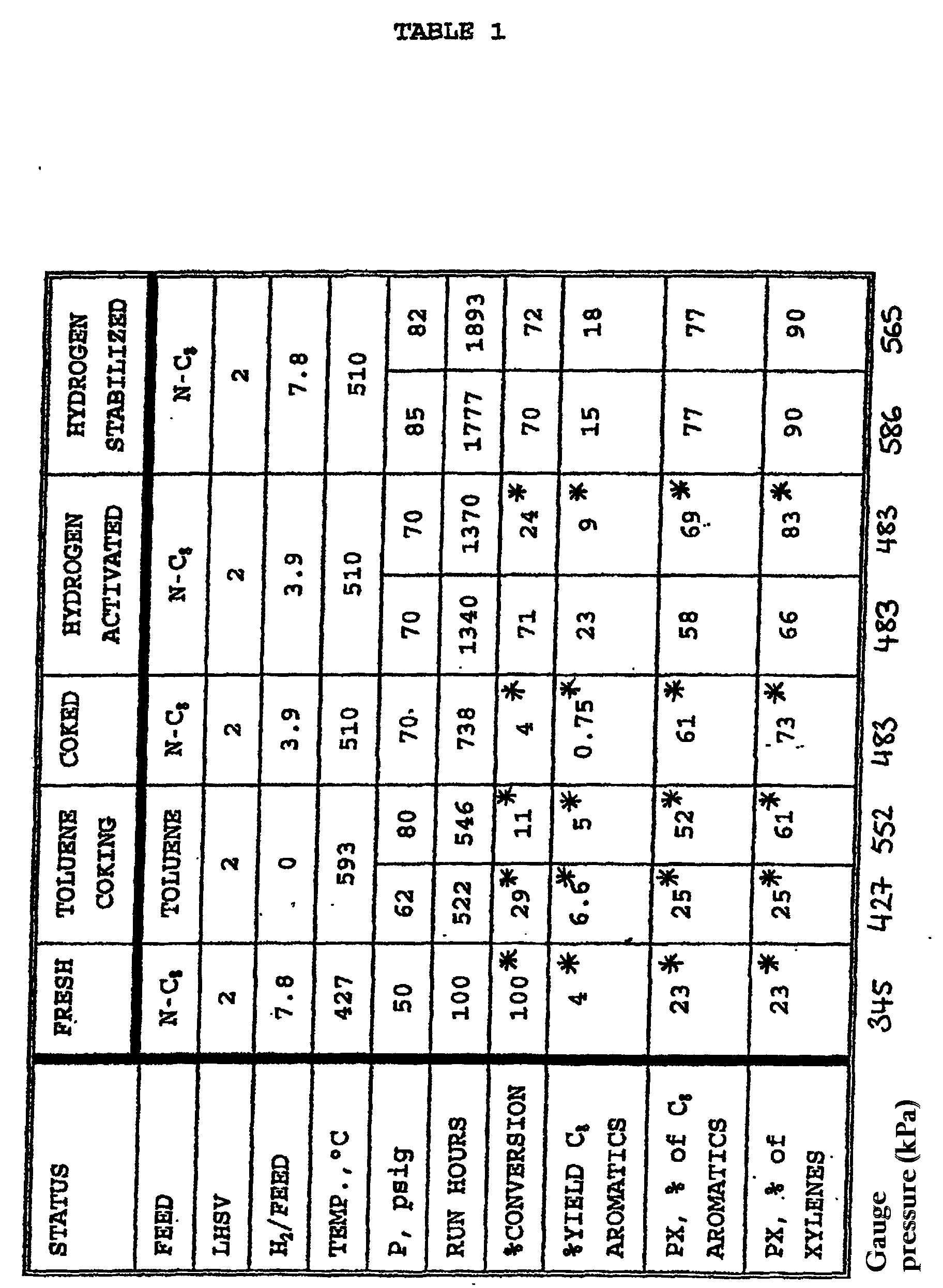
- This example illustrates coking and hydrogen activation procedures which provide a stabilized high conversion and high yield catalyst which is also selective for producing para-xylene at above equilibrium concentrations. It is especially surprising that the Pt containing catalyst can be coked to give a high para-xylene selectivity and then hydrogen activated to give high conversions and high aromatic yields without loss of para-xylene selectivity.
- the catalyst was subjected to high temperature coking conditions using toluene and decreasing amounts of hydrogen. After 25 hours at about 593°C with toluene and no hydrogen, the para-xylene content of the xylenes had increased to 61% but the toluene conversion had dropped to 11%.
- the xylenes from reforming n-octane at 510°C had a para-xylene content of 73%, well above equilibrium, but the feed conversion had dropped to 4%.
- the deactivated catalyst was hydrogen activated by turning the feed off and running hydrogen-only at 510°C for periods of 0.5 to several days. As a result of these hydrogen activation treatments, the activity was increased to give feed conversions of 70+% while the para-xylene selectivity was maintained well above equilibrium. However, under the conditions used, the activity fell rapidly over a period of a few hours after each hydrogen activation. As shown in Table 1 for the HYDROGEN ACTIVATED case, the conversion dropped from 71% to 24% in 30 hours.
- the catalyst activity was stabilized by hydrogen activation in combination with raising the hydrogen to feed ratio.
- Table 1 shows, the conversion was stabilized for more than 100 hours at 70+% with a C 8 aromatics yield of 15-18% and a para-xylene content of 90% of the xylenes.
- a comparison with the fresh catalyst results in Table 1 shows that the coking and hydrogen activation process of the present invention has increased both the C 8 aromatics yield and the para-xylene content.
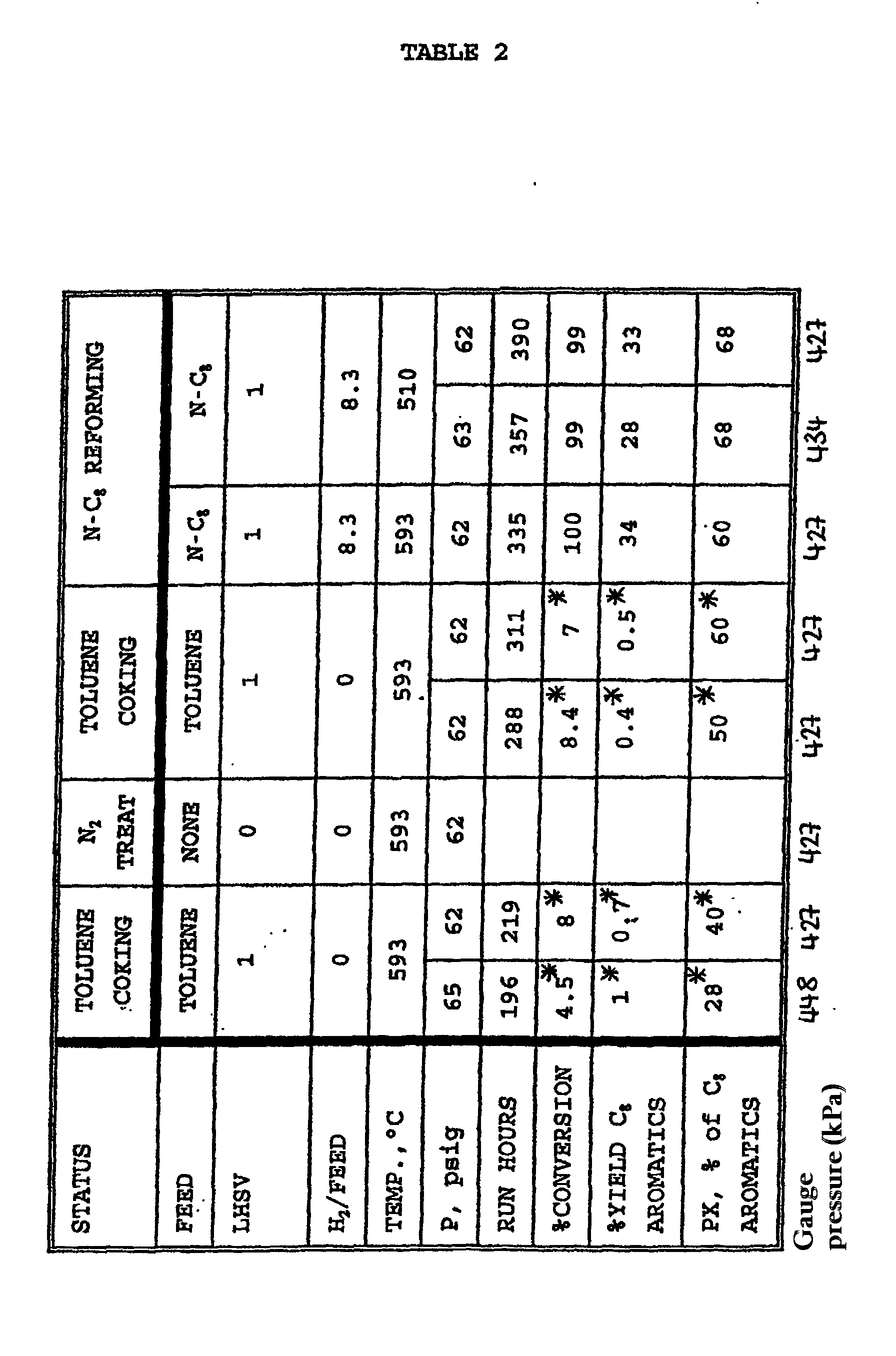
- This example illustrates the process where the high temperature coking is accomplished without deactivation.
- Example 2 About 0.5 cc of the Pt/Ga HZSM-5 from Example 1 was placed in a down-flow micro-reactor and reduced with hydrogen at about 510°C as in Example 2.
- the catalyst was subjected to high temperature toluene treatment at 593°C with no hydrogen in order to increase para-xylene selectivity. After about 24 hours, the toluene feed was turned off and the catalyst was held at 593°C for 64 hours with only nitrogen flowing. The high temperature toluene treatment was then continued until the para-xylene content of the C 8 aromatics had increased to 60%.
- the feed was changed to n-octane/hydrogen and the run was continued for a time at 593°C and then at 510°C.
- This example illustrates the use of the hydrogen treatment to activate the catalyst for the production of aromatics.
- This example is a continuation of the catalyst test described in Example 3. At about 390 hours of the run described in Example 3, the feed was turned off and the catalyst was treated with hydrogen for more than 60 hours. The n-octane feed was then turned on and the test continued. As the analytical results in Table 3 show, the hydrogen treatment resulted in increased yield of the aromatics.
- This example illustrates the use of the catalyst and process of the present invention to achieve para-xylene selective reforming with a broad range feed.
- the feed was a 149°C end point feed with the approximate composition by carbon number shown in Table 4.
- the aromatics content was less than 10%.
- the catalyst is the same one used in Examples 3 and 4.
- the catalyst test described in Example 4 was continued with a change from n-octane feed to the feed described in Table 4 at about 530 run hours.
- the test was continued for more than 100 hours with BTX yields of 42+%, C 8 aromatics yields of 18+% and para-xylene contents of 43+% of the C 8 aromatics.
- Table 5 The results are summarized in Table 5.
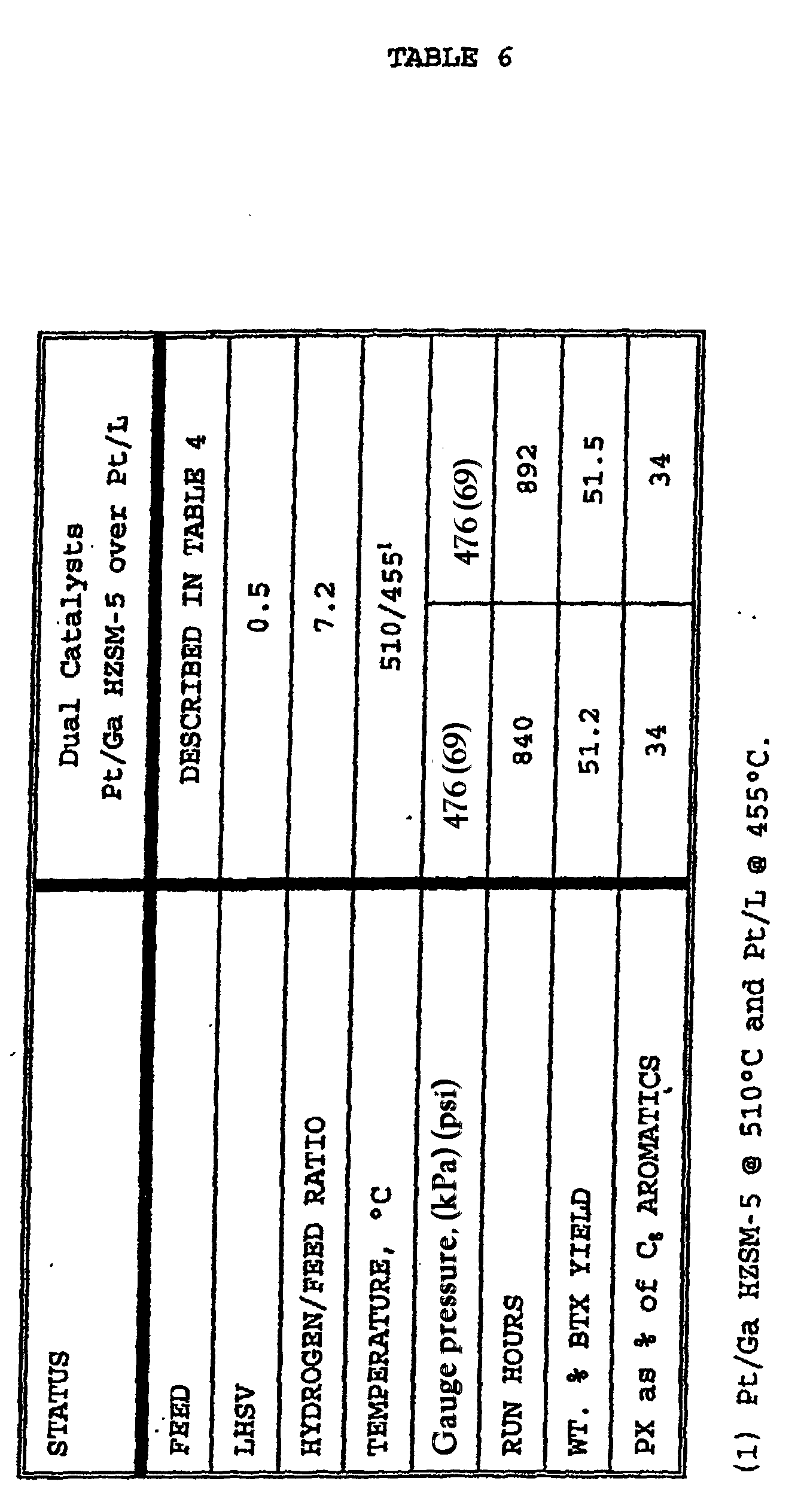
- This example illustrates the process of the present invention when used with two catalysts in sequence to increase aromatics yield.
- the catalyst test described in Example 5 was continued with the addition of a non-acidic Pt on L zeolite as an add-on catalyst.
- the non-acidic Pt on L zeolite was prepared as was the catalyst described in U.S. Patent 4,634,518 issued January 6, 1987 to W.C. Buss and T.R. Hughes.
- the Pt on L catalyst was downstream from the coked and hydrogen activated Pt/Ga HZSM-5 of Examples 3, 4, and 5.
- the feed was the same as that used in Example 5.
- the Pt/L catalyst was held at 455°C with the Pt/Ga HZSM-5 at 510°C.
- This example illustrates the present invention when implemented with two catalysts in the same reactor bed.
- a two-staged catalyst bed was prepared with the catalyst from Example 1 as the first stage above a Pt/L-zeolite second stage catalyst. This is similar to Example 6 except that both catalysts were in the same reactor and both catalysts were exposed to the same on-stream history.
- the second stage catalyst was also prepared as was the catalyst described in U.S. Patent 4,634,518 issued on January 6, 1987 to W.C. Buss and T.R. Hughes.
- the catalysts were pretreated with hydrogen at 510°C.
- the test was started with hydrogen/n-octane feed.
- the analytical results for samples taken during the run are summarized in Figure 1.
- the feed was 100% converted at 510°C but no xylenes were produced.
- the high temperature coking of the catalysts at 593°C was interspersed with periods of hydrogen-only treatments for a period of time spanning more than 300 hours.
- the coke buildup was accompanied by an increase in back pressure.
- the hydrogen-only treatments helped to keep the back pressure from becoming excessive but also may have helped avoid excessive catalyst deactivation during coking.
- the catalysts gave high feed conversions, high aromatics yields, and substantially higher than equilibrium contents of para-xylene in the C 8 aromatics.
- This example illustrates the present invention when implemented with two catalysts in the same reactor bed and with a broad range feed.
- the catalyst test described in Example 7 and Figure 1 was continued with the broad boiling range feed described in Table 4 and Example 5.
- Figure 2 shows the yield results after the test run had lined out at about 700 hours.
- the catalysts and process of the present invention gave high aromatics yields (50+% BTX and 20+% C 8 aromatics) and higher than equilibrium levels of para-xylene (40+%) in the C 8 aromatics.
- Figure 2 also shows that the high yield and selectivity was maintained for at least about 300 hours with no significant change in performance.
- This example illustrates that the catalysts and process of the present invention does not produce significant levels of para-xylene or other xylenes by the reforming and toluene disproportionation pathway.
- the low xylene yields obtained from toluene disproportionation in Example 2 and Table 1 as well as Example 3 and Table 2 have already shown that the catalysts of the present invention are not suitable as toluene disproportionation catalysts.
- the present example reinforces this point by showing that the catalysts and process of the present invention do not produce xylenes to a significant extent from the aromatization of feed components to toluene followed by toluene disproportionation to xylenes and benzene.
- Example 8 The catalyst test in Example 8 was continued with a change of feed to n-heptane at about 1000 hours run time. As Figure 2 shows, the change to n-heptane feed resulted in a sudden severe drop in C 8 aromatics yield. More details are provided in Table 7. Table 7 gives selected characteristic results that were obtained with the three different feeds which were used in Examples 7, 8, and 9. As Table 7 shows, n-heptane gave the highest yields of toluene and the lowest yields of xylenes.
- the present invention is useful for the production of aromatics, most particularly of para-xylene. It can also produce a gasoline blending stock along with the para-xylene enriched BTX fraction.
Landscapes
- Chemical & Material Sciences (AREA)
- Organic Chemistry (AREA)
- Chemical Kinetics & Catalysis (AREA)
- Crystallography & Structural Chemistry (AREA)
- Engineering & Computer Science (AREA)
- Materials Engineering (AREA)
- Oil, Petroleum & Natural Gas (AREA)
- General Chemical & Material Sciences (AREA)
- Catalysts (AREA)
- Production Of Liquid Hydrocarbon Mixture For Refining Petroleum (AREA)
- Organic Low-Molecular-Weight Compounds And Preparation Thereof (AREA)
- Low-Molecular Organic Synthesis Reactions Using Catalysts (AREA)
Description
In all of these methods there is potential for the Ga to occupy both framework and non-framework sites in the working catalyst. The preferred method gives a predominance of the Ga in the framework of the freshly prepared Ga ZSM-5. However, in the working form of the Ga ZSM-5, the Ga may occupy both framework and non-framework sites.
The para-xylene content of the xylenes will generally be at least about 30% (generally 25% to 80%).
The catalyst, prior to being coked, must have an activity sufficient so that it is capable of converting at least about 30% of a n-octane feed to products other than n-octane at a temperature of 500°C, a liquid hourly space velocity of 0.5 to 2, a gauge pressure of 517 kPa (75 psi) and a hydrogen to hydrocarbon mole ratio of 8:1.

| Carbon Number | Weight Percent |
| C4- | 0.45 |
| C5 | 1.99 |
| C6 | 14.26 |
| C7 | 46.93 |
| C8 | 32.04 |
| C9+ | 4.35 |


Claims (16)
- A catalyst useful for converting a paraffinic or olefinic feed in a reforming or aromatization operation under reforming or aromatization conditions to a product which includes xylenes which are enriched in para-xylene, the catalyst comprising an intermediate pore size molecular sieve support, a platinum group component and an additional component selected from the group consisting of gallium, zinc, indium, iron, tin and boron, the catalyst having an activity sufficient to produce a yield of at least about 30%, on a hydrogen free basis, based on a C6-C8 non-aromatics portion of the feedstock, of benzene-toluene-xylenes-ethyl benzene (BTX) from a C5-C9 predominantly paraffinic or olefinic hydrocarbon feedstock, the C6-C8 non-aromatics portion comprising at least 30% of the feedstock, at least 15% of the BTX consisting of xylenes, with the xylenes being at least about 30% para-xylene, and further wherein the catalyst has been coked sufficiently to be capable of converting toluene to xylenes which are enriched in para-xylene and following coking the catalyst has been exposed to a hydrogen containing atmosphere for a time sufficient so that it is capable of converting at least 30% of an n-octane feed to products other than n-octane at a temperature of 500°C, a liquid hourly space velocity of 0.5, a gauge pressure of 75 psi (517 kPa) and a hydrogen to hydrocarbon molar ratio of 10:1.
- A catalyst as set forth in claim 1, wherein the support is ZSM-5, ZSM-11, ZSM-12, 2SM-21, ZSM-22, ZSM-23, ZSM-35, ZSM-38, ZSM-48, ZSM-57, SSZ-23, SSZ-25, SSZ-32, SAGO-11, SAPO-31, SAPO-41, MAPO-11 or MAPO-31.
- A catalyst as set forth in claim 2, wherein the platinum group component is platinum in an amount within a range from 0.1 to 5 weight percent based on the support.
- A catalyst as set forth in claim 3, wherein the additional component is gallium in an amount within a range from 0.1 to 10 weight percent based on the support.
- A catalyst as set forth in claim 4, wherein the support comprises ZSM-5 having a silica to alumina mole ratio which falls within a range from 10:1 to 1,000:1.
- A method of producing a reforming or aromatization catalyst having an activity sufficient to convert at least 30%, based on the feed on a hydrogen free basis, of a n-octane feed to products other than n-octane at a temperature of 500°C, a liquid hourly space velocity of 0.5 to 10, a gauge pressure of 0 to 800 psi (0-5.52 MPa) and a hydrogen to hydrocarbon molar ratio within the range from 1:1 to 20:1, the products containing at least 15% xylenes, at least 30% of the xylenes consisting of para-xylene, the method comprising:contacting a catalyst comprising an intermediate pore size molecular sieve support, a platinum group component and a component selected from the group consisting of gallium, zinc, indium, iron, tin and boron with a hydrocarbon feedstock until the catalyst becomes coated with coke sufficiently so that it is capable of converting toluene by disproportionation to xylenes which are rich in para-xylene; andexposing the coked catalyst to a hydrogen atmosphere for a time sufficient so that, following such exposure, it is capable of converting at least 30% of an n-octane feed to chemicals other than n-octane at a temperature of 500°C, a liquid hourly space velocity of 0.5, a gauge pressure of 75 psi (517 kPa) and a hydrogen to hydrocarbon molar ratio of 10:1.
- A method as set forth in claim 6, wherein the contacting step is carried out at a temperature of 500°C to 700°C, a gauge pressure of 0 to 1,000 psi (0-6.9 MPa), a hydrogen to hydrocarbon mole ratio of 0 to 1 and a liquid hourly space velocity of 0.1 to 20.
- A method as set forth in claim 7, wherein the exposing step is carried out for a time sufficient so that the catalyst, following the exposing, is capable of converting at least 30% of an n-octane feed to products other than n-octane at a temperature of 500°C, a liquid hourly space velocity of 0.5, a gauge pressure of 75 psi (517 kPa) and a hydrogen to hydrocarbon molar ratio of 10:1.
- A method as set forth in claim 8, wherein the support is ZSM-5, ZSM-11, ZSM-12, ZSM-21, ZSM-22, ZSM-23, ZSM-35, ZSM-38, ZSM-48, ZSM-57, SSZ-23, SSZ-25, SSZ-32, SAPO-11, SAPO-31, SAPO-41, MAPO-11 or MAPO-31.
- A method as set forth in claim 9, wherein the platinum group component is platinum in an amount within a range from 0.1 to 5 weight percent based on the support.
- A method as set forth in claim 10, wherein the additional component is gallium in an amount within a range from 0.1 to 10 weight percent based on the support.
- A method as set forth in claim 11, wherein the support comprises ZSM-5 having a silica to alumina mole ratio which falls within a range from 10:1 to 1,000:1.
- A method of reforming or aromatizing a C5-C9 predominantly paraffinic or olefinic hydrocarbon feedstock to produce a reformate which is enriched in para-xylene, comprising:contacting the feedstock under reforming or aromatization conditions with a para-modified catalyst as claimed in any one or more of claims 1 to 5.
- A method as set forth in claim 13, further including:separating the reformate into a BTX containing fraction and a BTX-free raffinate fraction.
- A method as set forth in claim 13 or 14, wherein the feedstock contains no more than 30% aromatics.
- A method as set forth in claim 13, 14, or 15, further including:contacting the hydrocarbon product in a subsequent aromatization stage under reforming or aromatization conditions with an aromatization catalyst comprising a platinum group component on a non-acidic inorganic oxide support.
Applications Claiming Priority (3)
| Application Number | Priority Date | Filing Date | Title |
|---|---|---|---|
| US08/280,279 US5609751A (en) | 1994-07-26 | 1994-07-26 | Para-xylene selective reforming/aromatization |
| US280279 | 1994-07-26 | ||
| PCT/US1995/009033 WO1996003209A1 (en) | 1994-07-26 | 1995-07-18 | Para-xylene selective reforming/aromatization |
Publications (3)
| Publication Number | Publication Date |
|---|---|
| EP0772492A1 EP0772492A1 (en) | 1997-05-14 |
| EP0772492A4 EP0772492A4 (en) | 1998-07-29 |
| EP0772492B1 true EP0772492B1 (en) | 2003-01-02 |
Family
ID=23072407
Family Applications (1)
| Application Number | Title | Priority Date | Filing Date |
|---|---|---|---|
| EP95926730A Expired - Lifetime EP0772492B1 (en) | 1994-07-26 | 1995-07-18 | Para-xylene selective reforming/aromatization |
Country Status (12)
| Country | Link |
|---|---|
| US (1) | US5609751A (en) |
| EP (1) | EP0772492B1 (en) |
| JP (1) | JPH10503125A (en) |
| KR (1) | KR100351326B1 (en) |
| CN (1) | CN1070732C (en) |
| AU (1) | AU3100895A (en) |
| CA (1) | CA2195746A1 (en) |
| DE (1) | DE69529286T2 (en) |
| MX (1) | MX9700661A (en) |
| MY (1) | MY116358A (en) |
| TW (1) | TW319761B (en) |
| WO (1) | WO1996003209A1 (en) |
Families Citing this family (28)
| Publication number | Priority date | Publication date | Assignee | Title |
|---|---|---|---|---|
| FR2730728B1 (en) * | 1995-02-21 | 1997-05-23 | Inst Francais Du Petrole | PROCESS FOR SEPARATING P-XYLENE HAVING A SELECTIVE HYDROGENATION PRETREATMENT AND ACTIVATED EARTH |
| US6245219B1 (en) | 1997-04-18 | 2001-06-12 | Exxonmobil Chemical Patents Inc. | Naphtha aromatization process |
| CN1251123A (en) * | 1997-02-18 | 2000-04-19 | 埃克森化学专利公司 | Naphtha aromtization process |
| US6123834A (en) * | 1997-04-18 | 2000-09-26 | Exxon Chemical Patents Inc. | Catalytic upgrade of naphtha |
| US5873994A (en) * | 1997-07-15 | 1999-02-23 | Phillips Petroleum Company | Process for aromatization of a cracked gasoline feedstock using a catalyst containing an acid leached zeolite and tin |
| US6900365B2 (en) | 1999-11-15 | 2005-05-31 | Chevron Phillips Chemical Company Lp | Process for converting heavy hydrocarbon feeds to high octane gasoline, BTX and other valuable aromatics |
| US6864200B2 (en) * | 2001-01-23 | 2005-03-08 | Indian Petrochemicals Corporation Limited | Selectivated metallosilicate catalyst composite for alkylaromatic conversion, process for the preparation thereof, and use thereof in hydrocarbon conversion |
| JP2002263501A (en) * | 2001-03-05 | 2002-09-17 | Toyota Motor Corp | Carbon monoxide selective oxidation catalyst and method for producing the same |
| US6653518B2 (en) | 2001-06-15 | 2003-11-25 | Exxonmobil Chemical Patents Inc | Reforming process for manufacture of para-xylene |
| WO2004081147A2 (en) * | 2003-03-07 | 2004-09-23 | Conocophillips Company | Octane improvement of a hydrocarbon stream |
| ES2601799T3 (en) | 2009-06-12 | 2017-02-16 | Albemarle Europe Sprl. | SAPO molecular sieve catalysts and their preparation and uses |
| US20120029257A1 (en) * | 2010-07-28 | 2012-02-02 | Chevron U.S.A. Inc. | Process for the production of para-xylene |
| US8512674B1 (en) | 2012-03-01 | 2013-08-20 | Chevron U.S.A. Inc. | Preparation of molecular sieve SSZ-23 |
| BR112015008035A2 (en) * | 2012-10-10 | 2017-07-04 | Gtc Technology Us Llc | processes and systems for obtaining aromatics from hydrocarbon catalytic cracking |
| CN104107714B (en) * | 2013-04-16 | 2017-10-27 | 中国石油化工股份有限公司 | The toluene disproportionation catalyst of dimethylbenzene high selectivity and its application |
| CN104549465B (en) * | 2013-10-28 | 2017-07-14 | 中国石油化工股份有限公司 | Heavy aromatics lightening catalyst of voluminous dimethylbenzene and preparation method thereof |
| CN104549472A (en) * | 2013-10-28 | 2015-04-29 | 中国石油化工股份有限公司 | Aromatic alkyl transferring and deolefination catalyst and application thereof |
| US9732289B2 (en) * | 2014-06-27 | 2017-08-15 | Uop Llc | Integrated process for conversion of vacuum gas oil and heavy oil |
| US9950971B2 (en) * | 2014-07-23 | 2018-04-24 | Exxonmobil Chemical Patents Inc. | Process and catalyst for methane conversion to aromatics |
| CN105498824B (en) * | 2014-09-23 | 2018-06-19 | 中国石油化工股份有限公司 | Hydrocarbons reforming catalyst of containing mesopore molecular sieve and preparation method thereof |
| CN106367116B (en) * | 2015-07-23 | 2019-02-22 | 中国石油化工股份有限公司 | A method of light aromatics is prepared using reforming raffinate oil |
| CN106367112B (en) * | 2015-07-23 | 2019-02-22 | 中国石油化工股份有限公司 | A method of using reforming raffinate oil production aromatic hydrocarbons and improving by-product octane number |
| WO2017186452A1 (en) | 2016-04-26 | 2017-11-02 | Haldor Topsøe A/S | Induction heated aromatization of higher hydrocarbons |
| WO2017197515A1 (en) * | 2016-05-16 | 2017-11-23 | Meg Energy Corp. | Direct olefin reduction of thermally cracked hydrocarbon streams |
| US11459283B2 (en) * | 2018-09-03 | 2022-10-04 | Eneos Corporation | Method for producing xylene |
| CN112824365B (en) * | 2019-11-21 | 2023-03-10 | 中国石化工程建设有限公司 | Process for disproportionating alkylaromatic hydrocarbons |
| CN117160523B (en) * | 2023-08-25 | 2025-10-17 | 华中科技大学 | Propane aromatization reaction catalyst and preparation method and application thereof |
| CN117654596B (en) * | 2023-12-05 | 2025-11-21 | 中国科学院山西煤炭化学研究所 | Catalyst for preparing ethylbenzene by high selectivity of n-octane, preparation method and application thereof |
Family Cites Families (16)
| Publication number | Priority date | Publication date | Assignee | Title |
|---|---|---|---|---|
| US3751502A (en) * | 1970-05-04 | 1973-08-07 | Universal Oil Prod Co | Hydrocarbon isomerization process |
| US3821105A (en) * | 1971-12-30 | 1974-06-28 | Universal Oil Prod Co | Multimetallic catalyst composite and uses thereof |
| US4007231A (en) * | 1975-11-24 | 1977-02-08 | Mobil Oil Corporation | Selective production of para-xylene |
| US4117026A (en) * | 1976-05-12 | 1978-09-26 | Mobil Oil Corporation | Selective production of para dialkyl substituted benzenes |
| US4097543A (en) * | 1976-05-12 | 1978-06-27 | Mobil Oil Corporation | Selective disproportionation of toluene |
| US4101595A (en) * | 1977-05-02 | 1978-07-18 | Mobil Oil Corporation | Conversion of ethyl benzene to para xylene |
| US4118429A (en) * | 1977-09-26 | 1978-10-03 | Uop Inc. | Production and recovery of para-xylene |
| US4375573A (en) * | 1979-08-03 | 1983-03-01 | Mobil Oil Corporation | Selective production and reaction of p-Disubstituted aromatics over zeolite ZSM-48 |
| US4560820A (en) * | 1981-04-13 | 1985-12-24 | Chevron Research Company | Alkylaromatic dealkylation |
| US4443326A (en) * | 1981-10-16 | 1984-04-17 | Chevron Research Company | Two-step reforming process |
| US4469909A (en) * | 1982-06-18 | 1984-09-04 | Mobil Oil Corporation | Heavy aromatics process |
| AU628031B2 (en) * | 1987-11-17 | 1992-09-10 | Mobil Oil Corporation | A dehydrogenation and dehydrocyclization catalyst, its synthesis and use |
| JPH06104632B2 (en) * | 1988-09-29 | 1994-12-21 | 帝人株式会社 | Xylene isomerization method |
| US5028573A (en) * | 1990-01-29 | 1991-07-02 | Mobil Oil Corp. | Dual function catalyst and isomerization therewith |
| US5082984A (en) * | 1990-01-29 | 1992-01-21 | Mobil Oil Corp. | Dual function catalyst and isomerization therewith |
| FR2680515B1 (en) * | 1991-08-23 | 1993-10-22 | Institut Francais Petrole | USE OF A CATALYST CONTAINING A ZEOLITE, A NOBLE METAL OF THE PLATINUM FAMILY AND AN ADDITIONAL METAL IN THE FLAVORING OF HYDROCARBONS CONTAINING 5 TO 12 CARBON ATOMS PER MOLECULE. |
-
1994
- 1994-07-26 US US08/280,279 patent/US5609751A/en not_active Expired - Fee Related
-
1995
- 1995-07-04 MY MYPI95001853A patent/MY116358A/en unknown
- 1995-07-18 DE DE69529286T patent/DE69529286T2/en not_active Expired - Fee Related
- 1995-07-18 EP EP95926730A patent/EP0772492B1/en not_active Expired - Lifetime
- 1995-07-18 WO PCT/US1995/009033 patent/WO1996003209A1/en not_active Ceased
- 1995-07-18 MX MX9700661A patent/MX9700661A/en not_active IP Right Cessation
- 1995-07-18 JP JP8505826A patent/JPH10503125A/en not_active Ceased
- 1995-07-18 CA CA002195746A patent/CA2195746A1/en not_active Abandoned
- 1995-07-18 AU AU31008/95A patent/AU3100895A/en not_active Abandoned
- 1995-07-18 CN CN95194884A patent/CN1070732C/en not_active Expired - Fee Related
- 1995-07-18 KR KR1019970700471A patent/KR100351326B1/en not_active Expired - Fee Related
- 1995-07-21 TW TW084107586A patent/TW319761B/zh active
Also Published As
| Publication number | Publication date |
|---|---|
| MX9700661A (en) | 1997-04-30 |
| KR970704517A (en) | 1997-09-06 |
| MY116358A (en) | 2004-01-31 |
| JPH10503125A (en) | 1998-03-24 |
| CA2195746A1 (en) | 1996-02-08 |
| CN1070732C (en) | 2001-09-12 |
| CN1156976A (en) | 1997-08-13 |
| AU3100895A (en) | 1996-02-22 |
| EP0772492A4 (en) | 1998-07-29 |
| KR100351326B1 (en) | 2002-12-26 |
| EP0772492A1 (en) | 1997-05-14 |
| TW319761B (en) | 1997-11-11 |
| US5609751A (en) | 1997-03-11 |
| DE69529286D1 (en) | 2003-02-06 |
| DE69529286T2 (en) | 2003-10-09 |
| WO1996003209A1 (en) | 1996-02-08 |
Similar Documents
| Publication | Publication Date | Title |
|---|---|---|
| US5609751A (en) | Para-xylene selective reforming/aromatization | |
| EP0704416B1 (en) | Manufacture of high purity benzene and para-rich xylenes by combining aromatization and selective disproportionation of impure toluene | |
| US9144790B2 (en) | Process for the conversion of ethane to aromatic hydrocarbons | |
| US4899011A (en) | Xylene isomerization process to exhaustively convert ethylbenzene and non-aromatics | |
| CN101945702B (en) | Process for the conversion of ethane to aromatic hydrocarbons | |
| US5192728A (en) | Tin-colating microporous crystalline materials and their use as dehydrogenation, dehydrocyclization reforming catalysts | |
| CN101945840B (en) | Process for the conversion of ethane to aromatic hydrocarbons | |
| EP0393099B1 (en) | A dehydrogenation catalystsynthesis and its use | |
| US4990710A (en) | Tin-containing microporous crystalline materials and their use as dehydrogenation, dehydrocyclization and reforming catalysts | |
| US5013423A (en) | Reforming and dehydrocyclization | |
| US4935566A (en) | Dehydrocyclization and reforming process | |
| WO1996013331A1 (en) | Hydrocarbon conversion catalyst and method of catalytic conversion therewith | |
| WO2004094349A1 (en) | Isomerization of ethylbenzene and xylenes | |
| US20140315710A1 (en) | Process for the conversion of lower alkanes to aromatic hydrocarbons | |
| US5968343A (en) | Hydrocarbon conversion catalyst composition and processes therefor and therewith | |
| EP0400987A1 (en) | Process for the production of high-octane gasoline blending stock | |
| US6323381B1 (en) | Manufacture of high purity benzene and para-rich xylenes by combining aromatization and selective disproportionation of impure toluene | |
| CA1127104A (en) | Combination process for upgrading naphtha | |
| WO1991013127A1 (en) | Multi-stage reforming process | |
| GB2121427A (en) | Process for preparing an aromatics product of high benzene content | |
| WO1996040842A1 (en) | Process for maximizing xylene production | |
| EP1721953A1 (en) | Process for production of high-octane base gasoline | |
| CA2132947A1 (en) | Manufacture of high purity benzene and para-rich xylenes by combining aromatization and selective disproportionation of impure toluene | |
| MXPA99010544A (en) | Split-feed two-stage parallel aromatization for maximum para-xylene yield |
Legal Events
| Date | Code | Title | Description |
|---|---|---|---|
| PUAI | Public reference made under article 153(3) epc to a published international application that has entered the european phase |
Free format text: ORIGINAL CODE: 0009012 |
|
| 17P | Request for examination filed |
Effective date: 19970220 |
|
| AK | Designated contracting states |
Kind code of ref document: A1 Designated state(s): BE DE FR GB IT NL |
|
| RAP1 | Party data changed (applicant data changed or rights of an application transferred) |
Owner name: CHEVRON CHEMICAL COMPANY LLC |
|
| A4 | Supplementary search report drawn up and despatched |
Effective date: 19980610 |
|
| AK | Designated contracting states |
Kind code of ref document: A4 Designated state(s): BE DE FR GB IT NL |
|
| 17Q | First examination report despatched |
Effective date: 19991208 |
|
| RAP1 | Party data changed (applicant data changed or rights of an application transferred) |
Owner name: CHEVRON CHEMICAL COMPANY LLC |
|
| GRAG | Despatch of communication of intention to grant |
Free format text: ORIGINAL CODE: EPIDOS AGRA |
|
| GRAG | Despatch of communication of intention to grant |
Free format text: ORIGINAL CODE: EPIDOS AGRA |
|
| GRAH | Despatch of communication of intention to grant a patent |
Free format text: ORIGINAL CODE: EPIDOS IGRA |
|
| RAP1 | Party data changed (applicant data changed or rights of an application transferred) |
Owner name: CHEVRON PHILLIPS CHEMICAL COMPANY LP |
|
| GRAH | Despatch of communication of intention to grant a patent |
Free format text: ORIGINAL CODE: EPIDOS IGRA |
|
| GRAA | (expected) grant |
Free format text: ORIGINAL CODE: 0009210 |
|
| AK | Designated contracting states |
Kind code of ref document: B1 Designated state(s): BE DE FR GB IT NL |
|
| REG | Reference to a national code |
Ref country code: GB Ref legal event code: FG4D Free format text: 20030102 |
|
| REF | Corresponds to: |
Ref document number: 69529286 Country of ref document: DE Date of ref document: 20030206 Kind code of ref document: P |
|
| ET | Fr: translation filed | ||
| PLBE | No opposition filed within time limit |
Free format text: ORIGINAL CODE: 0009261 |
|
| STAA | Information on the status of an ep patent application or granted ep patent |
Free format text: STATUS: NO OPPOSITION FILED WITHIN TIME LIMIT |
|
| 26N | No opposition filed |
Effective date: 20031003 |
|
| PGFP | Annual fee paid to national office [announced via postgrant information from national office to epo] |
Ref country code: GB Payment date: 20040615 Year of fee payment: 10 |
|
| PGFP | Annual fee paid to national office [announced via postgrant information from national office to epo] |
Ref country code: NL Payment date: 20040621 Year of fee payment: 10 |
|
| PGFP | Annual fee paid to national office [announced via postgrant information from national office to epo] |
Ref country code: FR Payment date: 20040702 Year of fee payment: 10 |
|
| PGFP | Annual fee paid to national office [announced via postgrant information from national office to epo] |
Ref country code: BE Payment date: 20040728 Year of fee payment: 10 |
|
| PGFP | Annual fee paid to national office [announced via postgrant information from national office to epo] |
Ref country code: DE Payment date: 20040730 Year of fee payment: 10 |
|
| PG25 | Lapsed in a contracting state [announced via postgrant information from national office to epo] |
Ref country code: IT Free format text: LAPSE BECAUSE OF NON-PAYMENT OF DUE FEES Effective date: 20050718 Ref country code: GB Free format text: LAPSE BECAUSE OF NON-PAYMENT OF DUE FEES Effective date: 20050718 |
|
| PG25 | Lapsed in a contracting state [announced via postgrant information from national office to epo] |
Ref country code: BE Free format text: LAPSE BECAUSE OF NON-PAYMENT OF DUE FEES Effective date: 20050731 |
|
| PG25 | Lapsed in a contracting state [announced via postgrant information from national office to epo] |
Ref country code: NL Free format text: LAPSE BECAUSE OF NON-PAYMENT OF DUE FEES Effective date: 20060201 Ref country code: DE Free format text: LAPSE BECAUSE OF NON-PAYMENT OF DUE FEES Effective date: 20060201 |
|
| GBPC | Gb: european patent ceased through non-payment of renewal fee |
Effective date: 20050718 |
|
| PG25 | Lapsed in a contracting state [announced via postgrant information from national office to epo] |
Ref country code: FR Free format text: LAPSE BECAUSE OF NON-PAYMENT OF DUE FEES Effective date: 20060331 |
|
| NLV4 | Nl: lapsed or anulled due to non-payment of the annual fee |
Effective date: 20060201 |
|
| REG | Reference to a national code |
Ref country code: FR Ref legal event code: ST Effective date: 20060331 |
|
| BERE | Be: lapsed |
Owner name: *CHEVRON PHILLIPS CHEMICAL CY LP Effective date: 20050731 |