EP0767950B1 - Verfahren und vorrichtung zur anpassung eines spracherkenners an dialektische sprachvarianten - Google Patents
Verfahren und vorrichtung zur anpassung eines spracherkenners an dialektische sprachvarianten Download PDFInfo
- Publication number
- EP0767950B1 EP0767950B1 EP95925191A EP95925191A EP0767950B1 EP 0767950 B1 EP0767950 B1 EP 0767950B1 EP 95925191 A EP95925191 A EP 95925191A EP 95925191 A EP95925191 A EP 95925191A EP 0767950 B1 EP0767950 B1 EP 0767950B1
- Authority
- EP
- European Patent Office
- Prior art keywords
- speech
- model
- fundamental tone
- language
- input
- Prior art date
- Legal status (The legal status is an assumption and is not a legal conclusion. Google has not performed a legal analysis and makes no representation as to the accuracy of the status listed.)
- Expired - Lifetime
Links
Images

Classifications
-
- G—PHYSICS
- G10—MUSICAL INSTRUMENTS; ACOUSTICS
- G10L—SPEECH ANALYSIS TECHNIQUES OR SPEECH SYNTHESIS; SPEECH RECOGNITION; SPEECH OR VOICE PROCESSING TECHNIQUES; SPEECH OR AUDIO CODING OR DECODING
- G10L15/00—Speech recognition
- G10L15/06—Creation of reference templates; Training of speech recognition systems, e.g. adaptation to the characteristics of the speaker's voice
- G10L15/065—Adaptation
- G10L15/07—Adaptation to the speaker
-
- G—PHYSICS
- G10—MUSICAL INSTRUMENTS; ACOUSTICS
- G10L—SPEECH ANALYSIS TECHNIQUES OR SPEECH SYNTHESIS; SPEECH RECOGNITION; SPEECH OR VOICE PROCESSING TECHNIQUES; SPEECH OR AUDIO CODING OR DECODING
- G10L15/00—Speech recognition
- G10L15/08—Speech classification or search
- G10L15/18—Speech classification or search using natural language modelling
- G10L15/1807—Speech classification or search using natural language modelling using prosody or stress
-
- G—PHYSICS
- G10—MUSICAL INSTRUMENTS; ACOUSTICS
- G10L—SPEECH ANALYSIS TECHNIQUES OR SPEECH SYNTHESIS; SPEECH RECOGNITION; SPEECH OR VOICE PROCESSING TECHNIQUES; SPEECH OR AUDIO CODING OR DECODING
- G10L15/00—Speech recognition
- G10L15/08—Speech classification or search
- G10L15/18—Speech classification or search using natural language modelling
- G10L15/183—Speech classification or search using natural language modelling using context dependencies, e.g. language models
- G10L15/187—Phonemic context, e.g. pronunciation rules, phonotactical constraints or phoneme n-grams
-
- G—PHYSICS
- G10—MUSICAL INSTRUMENTS; ACOUSTICS
- G10L—SPEECH ANALYSIS TECHNIQUES OR SPEECH SYNTHESIS; SPEECH RECOGNITION; SPEECH OR VOICE PROCESSING TECHNIQUES; SPEECH OR AUDIO CODING OR DECODING
- G10L15/00—Speech recognition
- G10L15/08—Speech classification or search
- G10L15/18—Speech classification or search using natural language modelling
- G10L15/183—Speech classification or search using natural language modelling using context dependencies, e.g. language models
- G10L15/19—Grammatical context, e.g. disambiguation of the recognition hypotheses based on word sequence rules
-
- G—PHYSICS
- G10—MUSICAL INSTRUMENTS; ACOUSTICS
- G10L—SPEECH ANALYSIS TECHNIQUES OR SPEECH SYNTHESIS; SPEECH RECOGNITION; SPEECH OR VOICE PROCESSING TECHNIQUES; SPEECH OR AUDIO CODING OR DECODING
- G10L15/00—Speech recognition
- G10L15/02—Feature extraction for speech recognition; Selection of recognition unit
- G10L2015/025—Phonemes, fenemes or fenones being the recognition units
-
- G—PHYSICS
- G10—MUSICAL INSTRUMENTS; ACOUSTICS
- G10L—SPEECH ANALYSIS TECHNIQUES OR SPEECH SYNTHESIS; SPEECH RECOGNITION; SPEECH OR VOICE PROCESSING TECHNIQUES; SPEECH OR AUDIO CODING OR DECODING
- G10L25/00—Speech or voice analysis techniques not restricted to a single one of groups G10L15/00 - G10L21/00
- G10L25/90—Pitch determination of speech signals
Definitions
- the invention relates to a method and device for recognising a spoken language and, in particular, the recognition of different dialects in the language.
- the invention provides a method for recognising a spoken language in which a number of phonemes, from a segment of input speech, are identified and interpreted as possible words, or word combinations, to establish a model of the speech, the speech model having word and sentence accents according to a standardised pattern for the language concerned the method comprising the steps of determining the fundamental tone curve of the input speech; determining the intonation pattern of the fundamental tone of the input speech and thereby the maximum and minimum values of the fundamental tone curve and their respective positions; determining the intonation pattern of the fundamental tone curve of the speech model and thereby the maximum and minimum values of the fundamental tone curve and their respective positions; characterized in that the method includes the steps of; comparing the intonation pattern of the input speech with the intonation pattern of the speech model to identify a time difference between the occurrence of the maximum and minimum values of the fundamental tone curves of the incoming speech in relation to the maximum and minimum values of the fundamental tone curve of the speech model, the identified time difference being indicative of dialectal characteristics of the input speech; and adjusting
- the invention also provides a device for recognising a spoken language including speech recognition means for identifying a number of phonemes from a segment of input speech; and interpretation means for interpreting the phonemes, as possible words, or word combinations, to establish a model of the speech, the speech model having word and sentence accents according to a standardised pattern for the language concerned, extraction means for extracting the fundamental tone curve of the input speech; first analysing means for determining the intonation pattern of the fundamental tone of the input speech and thereby the maximum and minimum values of the fundamental tone curve and their respective positions; second analysing means for determining the intonation pattern of the fundamental tone curve of the speech model and thereby the maximum and minimum values of the fundamental tone curve and their respective positions; characterized in that the device further includes comparison means for comparing the intonation pattern of the input speech with the intonation pattern of the speech model to identify a time difference between the occurrence of the maximum and minimum values of the fundamental tone curves of the incoming speech in relation to the maximum and minimum values of the fundamental tone curve of the speech model, the
- the identified phonemes are combined into allophone strings which are used, in combination with the fundamental tone curve, to identify, and thereby detect the positions of, the maximum and minimum values of the fundamental tone of the input speech.
- the first analysing means are adapted, in response to receipt of the allophone strings from the speech recognition means, to identify, and thereby detect the positions of, the maximum and minimum values of the fundamental tone of the input speech.
- the time difference is preferably determined in relation to an intonation pattern reference point, for example, the point at which a consonant/vowel boundary, i.e. CV-boundary, occurs.
- an intonation pattern reference point for example, the point at which a consonant/vowel boundary, i.e. CV-boundary, occurs.
- the speech recognition method and device can recognise dialect variations in a language by comparing the maximum and minimum values of the fundamental tone curve of spoken language with corresponding values in a speech model, and obtaining details of the time difference therebetween, the time difference, which is indicative of the dialect in the spoken language, being used to adjust the model to make it correspond to the dialect concerned.
- a speech recognition method and device is, therefore, adapted to recognise different dialects in a language.
- the fundamental tone curve of the incoming speech is extracted and its maximum and minimum values are identified.
- a model of the speech is created during the speech recognition process by using a lexical and syntax analysis.
- the speech model is given a standard intonation.
- a comparison is then made between the maximum and minimum values of the fundamental tone curves respectively of the incoming speech and of the speech model.
- a time difference between the occurrence of the maximum and minimum values of the fundamental tone curve of the incoming speech and the maximum and minimum values of the fundamental tone curve of the speech model is identified.
- the identified time difference which is indicative of the dialect in the incoming speech is used to modify the speech model, i.e. the intonation of the speech model is brought into conformity with the intonation pattern of the incoming speech.
- a model of the speech can be obtained which corresponds, regarding language characteristics (including dialect), to the incoming speech.
- the present invention therefore provides an improved method and device for interpreting a given speech input.
- the speech model resulting from this process is used for speech recognition and increases the possibility of understanding the different dialects in the language.
- a reference is used, preferably a CV-boundary, for determining the time difference between the extreme values of the intonation patterns of the input speech and speech model.
- the outline of the fundamental tone of the speech model is based on lexical and syntactic information.
- the speech model has word and sentence accents according to a standard pattern for the language concerned.
- the lexical information includes information concerning orthography and phonetic transcription.
- the transcription information includes lexically abstracted accent information, of type stressed syllables, i.e. tonal word accents I and II, and information relating to the location of secondary accent, i.e. information given, for instance, in dictionaries.
- the classification of the intonation patterns of the fundamental tone curves of the input speech into different dialect categories is effected on the basis of stored intonation descriptions.
- the speech recognition device Whilst the speech recognition device, according to the present invention, is particularly suited for languages with tonal word accents and tonal languages, it can be used for any language.
- the following description of specific embodiments of the present invention relates to the Swedish language, where a detailed knowledge is available of how word accents and sentence accents are realised in different dialects.
- the description of the intonation pattern in the Swedish language is directly applicable to, for instance, the Norwegian language.
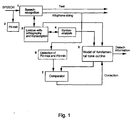
- the speech recognition device includes a speech recognition unit 1, an input of which is the input of the speech recognition device, and an extraction unit 2, in which the fundamental tone FO of the input speech is extracted.
- the input of the speech recognition device is also connected to an input of the extraction unit 2.
- the speech recognition unit 1 which operates in a known manner, for example, by using a Hidden Markov model, or an equivalent model, identifies a number of phonemes from the input speech which are combined into allophone strings, i.e. one of two, or more, forms of the same phoneme, at one of the outputs of the speech recognition unit 1.
- the fundamental tone FO extracted from the input speech, by the extraction unit 2, is applied to an input of an analysing unit 6 which is adapted to determine the intonation pattern of the fundamental tone curve FO(t) of the input speech and thereby the maximum, FO-max., and minimum, FO-min., values of the fundamental tone curve FO(t).
- the application of the allophone string, at the output of the speech recognition unit 1, to another input of the analysing unit 6, enables the extreme values, FO-max and FO-min, of the fundamental tone curve FO of the input speech, and their respective positions, to be determined.
- the allophone string is used, in combination with the fundamental tone curve, to identify, and thereby detect the positions of, the extreme values of the fundamental tone of the input speech.
- the information, concerning the recognised words and word combinations, i.e. phrases, generated by the speech recognition unit 1, is applied to a lexicon 3, i.e a dictionary, with orthography and transcription, wherein the words are checked lexically. Any of the words which do not exist in the language concerned, are excluded.
- the word combinations, or phrases, at an output of the lexicon 3, are checked by a syntax analysis unit 4. Any phrases, whose syntax does not correspond with the language concerned, are excluded during this syntax check.
- the lexical and syntactical information, respectively generated by the units 3 and 4, is used, by the unit 5, to create a model of the input speech.
- the intonation pattern of the speech model, created by the unit 5, is a standardised intonation pattern for the language concerned, or an intonation pattern, which has been established by training, or explicit knowledge, using a number of dialects of the language concerned.
- the speech model generating unit 5 To classify the incoming speech in dialect categories in accordance with stored descriptions of dialects concerned, i.e. stored intonation descriptions.
- the intonation pattern of the speech model i.e. the maximum and minimum values and their positions, is applied to a comparator unit 7, as is the intonation pattern output of the analysing unit 6.
- the maximum and minimum values of the fundamental tone curves of the input speech and speech model are compared by the comparator unit 7.
- the purpose of the comparison is to identify a time difference between the occurrence of the maximum and minimum values of the fundamental tone curve of the incoming speech and the maximum and minimum values of the fundamental tone curve of the speech model.
- the identified time difference which is indicative of the dialect in the input speech i.e. the spoken language, is applied to the speech model generating unit 5 to enable the intonation pattern of the speech model to be corrected so that it corresponds to the intonation pattern of the corresponding words and/or phrase of the input speech.
- this corrective process enables the dialectal information in the input speech to be incorporated into the speech model.
- the fundamental tone curve of the speech model at the output of the unit 5 is based on information from the lexicon 3 (orthography and transcription) and syntactic information.
- the transcription information includes lexically abstracted accent information, of type stressed syllables, i.e. tonal word accents I and II, and information relating to the location of secondary accent, i.e. information given, for instance, in dictionaries.
- the related fundamental tone information can be used to facilitate selection, by the speech recognition unit 1, of possible candidates for use, for example, in a speech-to-text conversion process.
- the dialectal information at an output of the speech model generating unit 5, is applied to an input (not illustrated) of the speech recognition unit 1, and is used to adjust the recognition pattern of the speech recognition model, for example, the Hidden Markov model, to take account of the dialectal information.
- the recognition pattern of the speech recognition model for example, the Hidden Markov model
- a further consequence of this speech model corrective process is that, through time, the speech model generating unit 5 will be trained, using a number of different dialects of the language concerned, so that the initially created speech model will have an intonation pattern, which has been established by the training process.
- the dialectal information, at an output of the speech model generating unit 5, may be used for other purposes, for example, in an artificial speech generating unit (not illustrated), to facilitate the generation of artificial speech in the dialect concerned.
- a speech generating unit having the ability to generate speech in any desired dialect, could be used in many different applications, for example, to provide a readily understandable response to users of voice-responsive systems which include a speech recognition device, according to the present invention, i.e. the system would be adapted to tailor the dialect of the verbal response to match the dialect of the voice input. This would provide a user friendly system because the language of the man-machine dialogue would be in accordance with the dialect of the user concerned.
- the speech model created by the speech recognition device, according to the present invention which is in dialectal correspondence with the input speech, i.e. the dialect characteristics of the input speech are incorporated into the speech models, is, in relation to the known prior art, a more exact interpretation of the input speech.
- Figures 2 and 3 of the accompanying drawings diagrammatically illustrate how the word accent (accent II, i.e. grave) can be schematically realised in two different Swedish dialects, i.e. dialect 'A' ( Figure 1) and dialect 'B' ( Figure 2).
- dialect 'A' Figure 1
- dialect 'B' Figure 2
- Figures 2 and 3 of the accompanying drawings diagrammatically illustrate how the word accent (accent II, i.e. grave) can be schematically realised in two different Swedish dialects, i.e. dialect 'A' ( Figure 1) and dialect 'B' ( Figure 2).
- the difference, in terms of intonation pattern, between different dialects can be described by different points in time for word and sentence accent.
- the locations of the maximum and minimum values for the fundamental tone curve for speech, (dialect 'A'), are respectively displaced, in time, relative to the CV-boundary for the word accent (accent II), by the times t1 and t2.
- the respective time differences, relative to the same CV-boundary are t1+k and t2+k.
- the maximum and minimum values of the fundamental tone curve for speech with the dialect 'B' are displaced, in time, from the corresponding values of the fundamental tone curve for speech with the dialect 'A', by the time k. It is, therefore, possible to identify dialects by using information concerning the points in time at which the extreme values, FO-max and FO-min, of the intonation pattern of the speech concerned occur.
- the dialectal information obtained in this manner can be used for the interpretation of speech, i.e. the information can be used, in the manner outlined above, to bring the intonation pattern of the speech model into conformity with the input speech. Since the corrected speech model exhibits the language characteristics (including dialect information) of the input speech it can be used to give an increased understanding of the input speech.
- the ability to detect speech, irrespective of dialect variations makes it possible to use speech in many different voice-responsive applications.
- the speech recognition method and device, according to the present invention could be used for controlling different equipments, for example, operation of vending machines, or to switch electrical equipment, such as, heating equipment, pumping stations, and the like, on and off, irrespective of dialect of the user.
- the invention could also be used to control and/or effect operation of telecommunication subscriber equipments, such as telephones, facsimile machines, answer phones, and the like.
- the present invention may also be used, as outlined above, in systems involving two-way man-machine communications, for example, unmanned voice-responsive computer based systems which are responsive to spoken instructions/commands, irrespective of dialect, and which are adapted to provide a response, or acknowledgement, in the dialect of the user.
- Typical applications for such systems are telecommunication services, such as, shopping by telephone, and banking services.
- the present invention may be used for speech-to-text conversion, for example, the output of the speech recognition unit 1 could be in the form of a print out of the words, and/or word combinations, from which the speech model is formed. Alternatively, the output of the unit 1 may be represented in other forms, for example, a visual display.
- the text at the output of the unit 1 could be used for many applications, for example, the production of reports, or text messages, or translation into another language using language conversion technology.
- the language-to-language conversion systems would be ideally suitable for use in personal translation systems because it would facilitate face-to-face communication between individuals who speak different languages, but not each others, and would not be affected by the dialects spoken by the individuals concerned. Also, it would be possible to make country-wide use of speech for many applications and/or services, for example, telecommunication and bank services of different kinds, without the need to use special codes, or to cater for possible differences in the dialects in different parts of the country.
Landscapes
- Engineering & Computer Science (AREA)
- Artificial Intelligence (AREA)
- Computational Linguistics (AREA)
- Health & Medical Sciences (AREA)
- Audiology, Speech & Language Pathology (AREA)
- Human Computer Interaction (AREA)
- Physics & Mathematics (AREA)
- Acoustics & Sound (AREA)
- Multimedia (AREA)
- Machine Translation (AREA)
Claims (21)
- Verfahren zum Erkennen einer gesprochenen Sprache, bei dem eine Anzahl von Phonemen aus einem Segment von Eingangssprache identifiziert und als mögliche Wörter oder Wortkombinationen interpretiert werden, um ein Modell der Sprache zu erstellen, wobei das Sprachmodell Wort- und Satzakzente gemäß einem standardisiertem Muster für die betreffende Sprache hat, wobei das Verfahren die Schritte aufweist: Bestimmung der Fundamentaltonkurve der Eingangssprache; Bestimmung des Intonationsmusters des Fundamentaltones der Eingangssprache und damit der Maximal- und Minimalwerte der Fundamentaltonkurve und deren jeweiligen Positionen; Bestimmung des Inonationsmusters der Fundamentaltonkurve des Sprachmodells und damit der Maximal- und Minimalwerte der Fundamentaltonkurve und deren jeweiliger Positionen, dadurch gekennzeichnet, daß das Verfahren die folgenden Schritte aufweist: Vergleichen des Intonationsmusters der Eingangssprache mit dem Intonationsmuster des Sprachmodells, um eine Zeitdifferenz zwischen dem Auftreten der Maximal- und Minimalwerte der Fundamentaltonkurve der ankommenden Sprache in Relation zu den die Maximal- und Minimalwerten der Fundamentaltonkurve des Sprachmodells zu identifizieren, wobei die identifizierte Zeitdifferenz eine Anzeige für Dialektbesonderheiten der Eingangssprache ist; und Adjustieren des Intonationsmusters des Sprachmodells unter Verwendung der identifizierten Zeitdifferenz, um das Sprachmodell in Übereinstimmung mit der Eingangssprache und dadurch mit den Dialektbesonderheiten der Eingangssprache zu bringen.
- Verfahren nach Anspruch 1, dadurch gekennzeichnet, daß die identifizierten Phoneme zu allophonen Strängen kombiniert werden und daß die allophonen Stränge zusammen mit der Fundamentaltonkurve dazu benutzt werden, um die Maximal- und Minimalwerte des Fundamentaltons der Eingangssprache zu identifizieren und dadurch deren Positionen zu detektieren.
- Verfahren nach Anspruch 1 oder 2, dadurch gekennzeichnet, daß die Zeitdifferenz bestimmt wird in Bezug auf einen Referenzpunkt des Intonationsmusters, welches der Punkt ist, an dem eine Konsonant/Vokal-Grenze auftritt.
- Verfahren nach einem der vorangehenden Ansprüche, dadurch gekennzeichnet, daß die Wörter in dem Sprachmodell lexikalisch geprüft werden, daß die Satzteile in dem Sprachmodell syntaktisch geprüft werden, und daß Wörter und Satzteile, die nicht lexikalisch identifiziert und syntaktisch analysiert werden, aus dem Sprachmodell ausgeschlossen werden, und daß die autographische und phonetische Transkription der Wörter in dem Sprachmodell geprüft wird.
- Verfahren nach Anspruch 4, dadurch gekennzeichnet, daß die Transkriptionsinformation lexikalisch abstrahierte Akzentinformation von typusbetonten Silben, und Information bezüglich der Lokalisierung von sekundären Akzenten enthält, und daß die Akzentinformation sich auf tonale Wortakzente I und Akzente II bezieht.
- Verfahren nach einem der vorangehenden Ansprüche, dadurch gekennzeichnet, daß die Intonationsmuster der Fundamentaltonkurven der Eingangssprache in Dialektkategorien klassifiziert werden entsprechend gespeicherten Beschreibungen der in Frage kommenden Dialekte.
- Verfahren nach einem der vorangehenden Ansprüche, dadurch gekennzeichnet, daß die Identifizierung einer Anzahl von Phonemen von der Eingangssprache mittels eines Spracherkennungsmodells erfolgt und daß die identifizierte Zeitdifferenz verwendet wird, um das Erkennungsmuster des Spracherkennungsmodells so anzupassen, daß es Dialektinformation berücksichtigt, und daß das erstellte Sprachmodell Wort- und Satzakzente gemäß einem Muster aufweist, das durch einen Lernprozeß oder durch ausdrückliche Kenntnis erstellt wurde, wobei identifizierte Zeitdifferenzen für eine Anzahl von verschiedenen Dialekten der betreffenden Sprache verwendet werden.
- Verfahren nach Anspruch 7, dadurch gekennzeichnet, daß das Spracherkennungsmodell ein Hidden-Markov-Modell ist.
- Vorrichtung zum Erkennen einer gesprochenen Sprache, mit Spracherkennungsmitteln (1) zum Identifizieren einer Anzahl von Phonemen aus einem Segment der Eingangssprache; und Interpretationsmitteln zum Interpretieren der Phoneme als mögliche Wörter oder Wortkombinationen zur Erstellung eines Modells der Sprache, wobei das Sprachmodell Wort- u. Satzakzente gemäß einem standardisierten Muster für die betreffende Sprache aufweist, Extraktionsmitteln (2) zum Extrahieren der Fundamentaltonkurve der Einganssprache; ersten Analysiermitteln (6) zum Bestimmen des Intonationsmusters des Fundamentaltons der Eingangssprache und damit der Maximal- und Minimalwerte der Fundamentaltonkurve und deren jeweiligen Positionen; zweite Analysiermittel (5) zum Bestimmen des Intonationsmusters der Fundamentaltonkurve des Sprachmodells und dadurch der Maximal- und Minimalwerte der Fundamentaltonkurve und deren jeweiligen Positionen; dadurch gekennzeichnet, daß die Vorrichtung ferner aufweist Vergleichsmittel (7) zum Vergleichen des Intonationsmusters der Eingangssprache mit dem Intonationsmuster des Sprachmodells zum Identifizieren einer Zeitdifferenz zwischen dem Auftreten der Maximal- und Minimalwerte der Fundamentaltonkurve der Eingangssprache in Bezug auf die Maximal- und Minimalwerte der Fundamentaltonkurve des Sprachmodells, wobei die identifizierte Zeitdifferenz Dialektbesonderheiten der Eingangssprache anzeigt; und Korrigiermittel zum Einstellen des Intonationsmusters des Sprachmodells unter Verwendung der identifizierten Zeitdifferenz, um das Sprachmodell in Übereinstimmung mit der Eingangssprache und dadurch mit den Dialektbesonderheiten der Eingangssprache zu bringen.
- Vorrichtung nach Anspruch 9, dadurch gekennzeichnet, daß die identifizierten Phoneme durch die Spracherkennungsmittel (1) zu allophonen Strängen kombiniert werden und daß die ersten Analysiermittel (6) so angepaßt sind, daß sie bei Empfang der allophonen Stränge von den Spracherkennungsmitteln (1) die Maximal- und Minimalwerte des Fundamentaltones der Eingangssprache identifizieren und dadurch deren Positionen detektieren.
- Vorrichtung nach Anspruch 9 oder 10, dadurch gekennzeichnet, daß die Zeitdifferenz in Bezug auf einen Referenzpunkt des Intonationsmusters bestimmt wird, welcher der Punkt ist, bei dem eine Konsonant/Vokal-Grenze auftritt.
- Vorrichtung nach einem der Ansprüche 9-11, dadurch gekennzeichnet, daß die Vorrichtung Überprüfungsmittel (3, 4) aufweist, um die Wörter in dem Sprachmodell lexikalisch zu prüfen und die Satzteile des Sprachmodells syntaktisch zu prüfen, und daß Wörter- und Satzteile, die nicht lexikalisch identifiziert und syntaktisch analysiert wurden, aus dem Sprachmodell ausgeschlossen werden, wobei die Überprüfungsmittel (3) die Orthographie und phonetische Transkription der Wörter in dem Sprachmodell prüfen.
- Vorrichtung nach Anspruch 12, dadurch gekennzeichnet, daß die Transkriptionsinformation lexikalisch abstrahierte Akzentinformation von typusbetonten Silben sowie Informationen bezüglich der Lokalisierung eines Sekundärakzentes aufweist, und daß die Akzentinformation sich auf tonale Wortakzente I und Akzente II bezieht.
- Vorrichtung nach einem der Ansprüche 9-13, dadurch gekennzeichnet, daß die Vorrichtung Mittel zum Klassifizieren der Intonationsmuster der Fundamentaltonkurven der Eingangssprache in Dialektkategorien entsprechend gespeicherten Beschreibungen der in Frage kommenden Dialekte umfaßt.
- Vorrichtung nach einem der Ansprüche 9-14, dadurch gekennzeichnet, daß die Identifizierung einer Anzahl von Phonemen aus der Eingangssprache mit einem Spracherkennungsmodell erfolgt, daß die identifizierte Zeitdifferenz den Spracherkennungsmitteln (1) zugeführt wird, und daß die Spracherkennungsmittel (1) so eingerichtet sind, daß sie die identifzierte Zeitdifferenz dazu verwenden, das Erkennungsmuster des Sprachmodells so anzupassen, daß es Dialektinformation berücksichtigt, und wobei die Interpretationsmittel trainiert werden können unter Verwendung der identifizierten Zeitdifferenzen einer Anzahl von verschiedenen Dialekten der betreffenden Sprache, und daß das von den Interpretationsmitteln erstellte Sprachmodell ein durch den Trainingsprozeß etabliertes Intonationsmuster hat.
- Vorrichtung nach Anspruch 15, dadurch gekennzeichnet, daß das Spracherkennungsmodell ein Hidden-Markov-Modell ist.
- Sprache-Text-Umwandlungssystem mit einer Vorrichtung nach einem der Ansprüche 9-16, oder mit Mitteln zum Durchführen der Schritte gemäß einem der Ansprüche 1-8.
- Sprache-Sprache-Umwandlungssystem mit einer Vorrichtung nach einem der Ansprüche 9-16, oder mit Mitteln zum Durchführen der Schritte nach einem der Ansprüche 1-8.
- Auf gesprochene Wörter reagierendes System, unabhängig vom Dialekt des Sprechers, mit einer Vorrichtung nach einem der Ansprüche 9-16 oder mit Mitteln zur Durchführung der Schritte nach einem der Ansprüche 1-8.
- System nach Anspruch 19, dadurch gekennzeichnet, daß das auf Stimme reagierende System eine elektrische Installation oder eine Telekommunikations-Kundeninstallation oder Teil einer solchen ist, wobei die elektrische Installation von einer Zentralheizungsanlage oder einer Pumpstation gebildet wird oder Teil einer solchen ist.
- System nach Anspruch 19, mit einer Kunstsprache-Erzeugeeinheit, die geeignet ist, in Abhängigkeit von Empfang der identifizierten Zeitdifferenz künstliche Sprache im Dialekt der gesprochenen Instruktionen zu erzeugen.
Applications Claiming Priority (3)
| Application Number | Priority Date | Filing Date | Title |
|---|---|---|---|
| SE9402284A SE504177C2 (sv) | 1994-06-29 | 1994-06-29 | Metod och anordning att adaptera en taligenkänningsutrustning för dialektala variationer i ett språk |
| SE9402284 | 1994-06-29 | ||
| PCT/SE1995/000710 WO1996000962A2 (en) | 1994-06-29 | 1995-06-13 | Method and device for adapting a speech recognition equipment for dialectal variations in a language |
Publications (2)
| Publication Number | Publication Date |
|---|---|
| EP0767950A2 EP0767950A2 (de) | 1997-04-16 |
| EP0767950B1 true EP0767950B1 (de) | 2000-10-25 |
Family
ID=20394556
Family Applications (1)
| Application Number | Title | Priority Date | Filing Date |
|---|---|---|---|
| EP95925191A Expired - Lifetime EP0767950B1 (de) | 1994-06-29 | 1995-06-13 | Verfahren und vorrichtung zur anpassung eines spracherkenners an dialektische sprachvarianten |
Country Status (7)
| Country | Link |
|---|---|
| US (1) | US5694520A (de) |
| EP (1) | EP0767950B1 (de) |
| JP (1) | JPH10504404A (de) |
| DE (1) | DE69519229T2 (de) |
| ES (1) | ES2152411T3 (de) |
| SE (1) | SE504177C2 (de) |
| WO (1) | WO1996000962A2 (de) |
Cited By (2)
| Publication number | Priority date | Publication date | Assignee | Title |
|---|---|---|---|---|
| CN101373593B (zh) * | 2007-07-25 | 2011-12-14 | 索尼株式会社 | 语音分析设备和语音分析方法 |
| CN107170454A (zh) * | 2017-05-31 | 2017-09-15 | 广东欧珀移动通信有限公司 | 语音识别方法及相关产品 |
Families Citing this family (16)
| Publication number | Priority date | Publication date | Assignee | Title |
|---|---|---|---|---|
| SE516526C2 (sv) * | 1993-11-03 | 2002-01-22 | Telia Ab | Metod och anordning vid automatisk extrahering av prosodisk information |
| SE514684C2 (sv) * | 1995-06-16 | 2001-04-02 | Telia Ab | Metod vid tal-till-textomvandling |
| SE9601811L (sv) * | 1996-05-13 | 1997-11-03 | Telia Ab | Metod och system för tal-till-tal-omvandling med extrahering av prosodiinformation |
| SE519273C2 (sv) * | 1996-05-13 | 2003-02-11 | Telia Ab | Förbättringar av , eller med avseende på, tal-till-tal- omvandling |
| EP1051701B1 (de) * | 1998-02-03 | 2002-11-06 | Siemens Aktiengesellschaft | Verfahren zum übermitteln von sprachdaten |
| US6343270B1 (en) * | 1998-12-09 | 2002-01-29 | International Business Machines Corporation | Method for increasing dialect precision and usability in speech recognition and text-to-speech systems |
| EP1096470B1 (de) * | 1999-10-29 | 2005-04-06 | Matsushita Electric Industrial Co., Ltd. | Normalisierung der Grundfrequenz zur Spracherkennung |
| CN1159702C (zh) | 2001-04-11 | 2004-07-28 | 国际商业机器公司 | 具有情感的语音-语音翻译系统和方法 |
| US20040266337A1 (en) * | 2003-06-25 | 2004-12-30 | Microsoft Corporation | Method and apparatus for synchronizing lyrics |
| US7940897B2 (en) | 2005-06-24 | 2011-05-10 | American Express Travel Related Services Company, Inc. | Word recognition system and method for customer and employee assessment |
| JP4264841B2 (ja) * | 2006-12-01 | 2009-05-20 | ソニー株式会社 | 音声認識装置および音声認識方法、並びに、プログラム |
| US8077836B2 (en) | 2008-07-30 | 2011-12-13 | At&T Intellectual Property, I, L.P. | Transparent voice registration and verification method and system |
| JP2015087649A (ja) * | 2013-10-31 | 2015-05-07 | シャープ株式会社 | 発話制御装置、方法、発話システム、プログラム、及び発話装置 |
| CN104464423A (zh) * | 2014-12-19 | 2015-03-25 | 科大讯飞股份有限公司 | 一种口语考试评测的校标优化方法及系统 |
| US11545132B2 (en) | 2019-08-28 | 2023-01-03 | International Business Machines Corporation | Speech characterization using a synthesized reference audio signal |
| CN110716523A (zh) * | 2019-11-06 | 2020-01-21 | 中水三立数据技术股份有限公司 | 一种基于语音识别的泵站智能决策系统及方法 |
Family Cites Families (5)
| Publication number | Priority date | Publication date | Assignee | Title |
|---|---|---|---|---|
| SE13680C1 (de) | 1902-02-01 | |||
| SE12386C1 (de) | 1901-05-04 | |||
| US5268990A (en) * | 1991-01-31 | 1993-12-07 | Sri International | Method for recognizing speech using linguistically-motivated hidden Markov models |
| SE516526C2 (sv) * | 1993-11-03 | 2002-01-22 | Telia Ab | Metod och anordning vid automatisk extrahering av prosodisk information |
| JP3450411B2 (ja) * | 1994-03-22 | 2003-09-22 | キヤノン株式会社 | 音声情報処理方法及び装置 |
-
1994
- 1994-06-29 SE SE9402284A patent/SE504177C2/sv unknown
-
1995
- 1995-06-13 DE DE69519229T patent/DE69519229T2/de not_active Expired - Fee Related
- 1995-06-13 JP JP8503055A patent/JPH10504404A/ja not_active Ceased
- 1995-06-13 EP EP95925191A patent/EP0767950B1/de not_active Expired - Lifetime
- 1995-06-13 WO PCT/SE1995/000710 patent/WO1996000962A2/en not_active Ceased
- 1995-06-13 ES ES95925191T patent/ES2152411T3/es not_active Expired - Lifetime
- 1995-06-13 US US08/532,823 patent/US5694520A/en not_active Expired - Lifetime
Non-Patent Citations (1)
| Title |
|---|
| H. FUJISAKI ET AL.: "Analysis an Modeling of Word Accent and Sentence Intonation in Swedish", SPEECH PROCESSING, vol. 2, no. II, 27 April 1993 (1993-04-27), MINNEAPOLIS (US), pages 211 - 214, XP010110431, DOI: doi:10.1109/ICASSP.1993.319271 * |
Cited By (3)
| Publication number | Priority date | Publication date | Assignee | Title |
|---|---|---|---|---|
| CN101373593B (zh) * | 2007-07-25 | 2011-12-14 | 索尼株式会社 | 语音分析设备和语音分析方法 |
| CN107170454A (zh) * | 2017-05-31 | 2017-09-15 | 广东欧珀移动通信有限公司 | 语音识别方法及相关产品 |
| CN107170454B (zh) * | 2017-05-31 | 2022-04-05 | Oppo广东移动通信有限公司 | 语音识别方法及相关产品 |
Also Published As
| Publication number | Publication date |
|---|---|
| WO1996000962A3 (en) | 1996-02-22 |
| JPH10504404A (ja) | 1998-04-28 |
| EP0767950A2 (de) | 1997-04-16 |
| US5694520A (en) | 1997-12-02 |
| DE69519229D1 (de) | 2000-11-30 |
| DE69519229T2 (de) | 2001-05-23 |
| WO1996000962A2 (en) | 1996-01-11 |
| SE9402284D0 (sv) | 1994-06-29 |
| SE504177C2 (sv) | 1996-12-02 |
| SE9402284L (sv) | 1995-12-30 |
| ES2152411T3 (es) | 2001-02-01 |
Similar Documents
| Publication | Publication Date | Title |
|---|---|---|
| EP0683483B1 (de) | Verfahren und Anordnung für die Umwandlung von Sprache in Text | |
| EP0767950B1 (de) | Verfahren und vorrichtung zur anpassung eines spracherkenners an dialektische sprachvarianten | |
| US6510410B1 (en) | Method and apparatus for recognizing tone languages using pitch information | |
| US20040039570A1 (en) | Method and system for multilingual voice recognition | |
| US5806033A (en) | Syllable duration and pitch variation to determine accents and stresses for speech recognition | |
| Mouaz et al. | Speech recognition of Moroccan dialect using hidden Markov models | |
| KR20170103209A (ko) | 원시 발화자의 목소리와 유사한 특성을 갖는 합성음을 생성하는 자동 통역 시스템 및 그 동작 방법 | |
| Li et al. | Analysis and modeling of F0 contours for Cantonese text-to-speech | |
| Fellbaum et al. | Principles of electronic speech processing with applications for people with disabilities | |
| US5677992A (en) | Method and arrangement in automatic extraction of prosodic information | |
| CN118447841A (zh) | 基于语音识别的对话方法、装置、终端设备及存储介质 | |
| US20060129393A1 (en) | System and method for synthesizing dialog-style speech using speech-act information | |
| Pugazhenthi et al. | AI-Driven Voice Inputs for Speech Engine Testing in Conversational Systems | |
| Kadambe et al. | Language identification with phonological and lexical models | |
| EP0919052B1 (de) | Verfahren und system zur sprache-in-sprache-umsetzung | |
| CN115881119A (zh) | 融合韵律特征的消歧方法、系统、制冷设备及存储介质 | |
| CN120319226A (zh) | 基于语音识别反馈的粤语发音训练系统 | |
| KR20150014235A (ko) | 자동 통역 장치 및 방법 | |
| EP0976026A1 (de) | Verbesserungen bei oder in bezug auf sprache-zu-sprache konversion | |
| Pranjol et al. | Bengali speech recognition: An overview | |
| Wu et al. | Speech activated telephony email reader (SATER) based on speaker verification and text-to-speech conversion | |
| KR20220036237A (ko) | 딥러닝을 기반으로 하는 가이드 음성 제공 시스템 | |
| Chomphan | Towards the development of speaker-dependent and speaker-independent hidden markov model-based Thai speech synthesis | |
| Meinedo et al. | The use of syllable segmentation information in continuous speech recognition hybrid systems applied to the Portuguese language. | |
| Tsai et al. | Open vocabulary Chinese name recognition with the help of character description and syllable spelling recognition |
Legal Events
| Date | Code | Title | Description |
|---|---|---|---|
| PUAI | Public reference made under article 153(3) epc to a published international application that has entered the european phase |
Free format text: ORIGINAL CODE: 0009012 |
|
| 17P | Request for examination filed |
Effective date: 19951004 |
|
| AK | Designated contracting states |
Kind code of ref document: A2 Designated state(s): BE CH DE ES FR GB LI NL |
|
| 17Q | First examination report despatched |
Effective date: 19981218 |
|
| GRAG | Despatch of communication of intention to grant |
Free format text: ORIGINAL CODE: EPIDOS AGRA |
|
| GRAG | Despatch of communication of intention to grant |
Free format text: ORIGINAL CODE: EPIDOS AGRA |
|
| GRAG | Despatch of communication of intention to grant |
Free format text: ORIGINAL CODE: EPIDOS AGRA |
|
| GRAH | Despatch of communication of intention to grant a patent |
Free format text: ORIGINAL CODE: EPIDOS IGRA |
|
| RIC1 | Information provided on ipc code assigned before grant |
Free format text: 7G 10L 15/18 A, 7G 10L 15/06 B |
|
| GRAH | Despatch of communication of intention to grant a patent |
Free format text: ORIGINAL CODE: EPIDOS IGRA |
|
| GRAA | (expected) grant |
Free format text: ORIGINAL CODE: 0009210 |
|
| AK | Designated contracting states |
Kind code of ref document: B1 Designated state(s): BE CH DE ES FR GB LI NL |
|
| PG25 | Lapsed in a contracting state [announced via postgrant information from national office to epo] |
Ref country code: NL Free format text: LAPSE BECAUSE OF FAILURE TO SUBMIT A TRANSLATION OF THE DESCRIPTION OR TO PAY THE FEE WITHIN THE PRESCRIBED TIME-LIMIT Effective date: 20001025 Ref country code: LI Free format text: LAPSE BECAUSE OF FAILURE TO SUBMIT A TRANSLATION OF THE DESCRIPTION OR TO PAY THE FEE WITHIN THE PRESCRIBED TIME-LIMIT Effective date: 20001025 Ref country code: CH Free format text: LAPSE BECAUSE OF FAILURE TO SUBMIT A TRANSLATION OF THE DESCRIPTION OR TO PAY THE FEE WITHIN THE PRESCRIBED TIME-LIMIT Effective date: 20001025 Ref country code: BE Free format text: LAPSE BECAUSE OF FAILURE TO SUBMIT A TRANSLATION OF THE DESCRIPTION OR TO PAY THE FEE WITHIN THE PRESCRIBED TIME-LIMIT Effective date: 20001025 |
|
| REG | Reference to a national code |
Ref country code: CH Ref legal event code: EP |
|
| REF | Corresponds to: |
Ref document number: 69519229 Country of ref document: DE Date of ref document: 20001130 |
|
| ET | Fr: translation filed | ||
| REG | Reference to a national code |
Ref country code: ES Ref legal event code: FG2A Ref document number: 2152411 Country of ref document: ES Kind code of ref document: T3 |
|
| NLV1 | Nl: lapsed or annulled due to failure to fulfill the requirements of art. 29p and 29m of the patents act | ||
| REG | Reference to a national code |
Ref country code: CH Ref legal event code: PL |
|
| PLBE | No opposition filed within time limit |
Free format text: ORIGINAL CODE: 0009261 |
|
| STAA | Information on the status of an ep patent application or granted ep patent |
Free format text: STATUS: NO OPPOSITION FILED WITHIN TIME LIMIT |
|
| 26N | No opposition filed | ||
| REG | Reference to a national code |
Ref country code: GB Ref legal event code: IF02 |
|
| PGFP | Annual fee paid to national office [announced via postgrant information from national office to epo] |
Ref country code: ES Payment date: 20020409 Year of fee payment: 8 |
|
| PG25 | Lapsed in a contracting state [announced via postgrant information from national office to epo] |
Ref country code: ES Free format text: LAPSE BECAUSE OF NON-PAYMENT OF DUE FEES Effective date: 20030614 |
|
| REG | Reference to a national code |
Ref country code: ES Ref legal event code: FD2A Effective date: 20030614 |
|
| PGFP | Annual fee paid to national office [announced via postgrant information from national office to epo] |
Ref country code: DE Payment date: 20080620 Year of fee payment: 14 |
|
| PGFP | Annual fee paid to national office [announced via postgrant information from national office to epo] |
Ref country code: GB Payment date: 20080620 Year of fee payment: 14 |
|
| GBPC | Gb: european patent ceased through non-payment of renewal fee |
Effective date: 20090613 |
|
| REG | Reference to a national code |
Ref country code: FR Ref legal event code: ST Effective date: 20100226 |
|
| PG25 | Lapsed in a contracting state [announced via postgrant information from national office to epo] |
Ref country code: FR Free format text: LAPSE BECAUSE OF NON-PAYMENT OF DUE FEES Effective date: 20090630 |
|
| PGFP | Annual fee paid to national office [announced via postgrant information from national office to epo] |
Ref country code: FR Payment date: 20080425 Year of fee payment: 14 |
|
| PG25 | Lapsed in a contracting state [announced via postgrant information from national office to epo] |
Ref country code: GB Free format text: LAPSE BECAUSE OF NON-PAYMENT OF DUE FEES Effective date: 20090613 |
|
| PG25 | Lapsed in a contracting state [announced via postgrant information from national office to epo] |
Ref country code: DE Free format text: LAPSE BECAUSE OF NON-PAYMENT OF DUE FEES Effective date: 20100101 |