EP0762857B1 - Polster vorrichtung - Google Patents
Polster vorrichtung Download PDFInfo
- Publication number
- EP0762857B1 EP0762857B1 EP96909649A EP96909649A EP0762857B1 EP 0762857 B1 EP0762857 B1 EP 0762857B1 EP 96909649 A EP96909649 A EP 96909649A EP 96909649 A EP96909649 A EP 96909649A EP 0762857 B1 EP0762857 B1 EP 0762857B1
- Authority
- EP
- European Patent Office
- Prior art keywords
- liner
- cushion
- cushioning material
- cushion liner
- polymeric
- Prior art date
- Legal status (The legal status is an assumption and is not a legal conclusion. Google has not performed a legal analysis and makes no representation as to the accuracy of the status listed.)
- Expired - Lifetime
Links
- 239000002480 mineral oil Substances 0.000 claims abstract description 19
- 235000010446 mineral oil Nutrition 0.000 claims abstract description 19
- 239000000203 mixture Substances 0.000 claims abstract description 19
- 210000003447 amputation stump Anatomy 0.000 claims abstract description 15
- 229920001400 block copolymer Polymers 0.000 claims abstract description 13
- 239000000463 material Substances 0.000 claims description 106
- 239000004744 fabric Substances 0.000 claims description 51
- 238000003032 molecular docking Methods 0.000 claims description 11
- 229920002725 thermoplastic elastomer Polymers 0.000 claims description 9
- KAKZBPTYRLMSJV-UHFFFAOYSA-N Butadiene Chemical compound C=CC=C KAKZBPTYRLMSJV-UHFFFAOYSA-N 0.000 claims description 8
- BXOUVIIITJXIKB-UHFFFAOYSA-N ethene;styrene Chemical group C=C.C=CC1=CC=CC=C1 BXOUVIIITJXIKB-UHFFFAOYSA-N 0.000 claims description 5
- ROGIWVXWXZRRMZ-UHFFFAOYSA-N 2-methylbuta-1,3-diene;styrene Chemical compound CC(=C)C=C.C=CC1=CC=CC=C1 ROGIWVXWXZRRMZ-UHFFFAOYSA-N 0.000 claims description 4
- 238000007598 dipping method Methods 0.000 claims description 4
- 239000003139 biocide Substances 0.000 claims description 3
- MTAZNLWOLGHBHU-UHFFFAOYSA-N butadiene-styrene rubber Chemical compound C=CC=C.C=CC1=CC=CC=C1 MTAZNLWOLGHBHU-UHFFFAOYSA-N 0.000 claims description 3
- 229920006132 styrene block copolymer Polymers 0.000 claims description 3
- 230000003115 biocidal effect Effects 0.000 claims description 2
- QQONPFPTGQHPMA-UHFFFAOYSA-N propylene Natural products CC=C QQONPFPTGQHPMA-UHFFFAOYSA-N 0.000 claims description 2
- 238000005096 rolling process Methods 0.000 claims 1
- 229920002379 silicone rubber Polymers 0.000 claims 1
- 229940088594 vitamin Drugs 0.000 claims 1
- 229930003231 vitamin Natural products 0.000 claims 1
- 235000013343 vitamin Nutrition 0.000 claims 1
- 239000011782 vitamin Substances 0.000 claims 1
- 150000003722 vitamin derivatives Chemical class 0.000 claims 1
- 210000003127 knee Anatomy 0.000 abstract description 35
- 238000004519 manufacturing process Methods 0.000 abstract description 3
- 239000000499 gel Substances 0.000 description 32
- 210000003414 extremity Anatomy 0.000 description 27
- 239000004753 textile Substances 0.000 description 21
- 239000004677 Nylon Substances 0.000 description 20
- 229920001778 nylon Polymers 0.000 description 20
- 229920001971 elastomer Polymers 0.000 description 17
- 229920002633 Kraton (polymer) Polymers 0.000 description 15
- 239000005060 rubber Substances 0.000 description 12
- 230000000694 effects Effects 0.000 description 11
- 229920002334 Spandex Polymers 0.000 description 10
- 229920001084 poly(chloroprene) Polymers 0.000 description 9
- 238000000034 method Methods 0.000 description 8
- 238000005516 engineering process Methods 0.000 description 7
- 229920000742 Cotton Polymers 0.000 description 6
- 239000000806 elastomer Substances 0.000 description 6
- 239000003921 oil Substances 0.000 description 6
- 229920000642 polymer Polymers 0.000 description 6
- 239000004759 spandex Substances 0.000 description 6
- 239000000725 suspension Substances 0.000 description 6
- 238000000465 moulding Methods 0.000 description 5
- 239000002904 solvent Substances 0.000 description 4
- 239000000126 substance Substances 0.000 description 4
- 229920001169 thermoplastic Polymers 0.000 description 4
- 239000004416 thermosoftening plastic Substances 0.000 description 4
- 210000002268 wool Anatomy 0.000 description 4
- 239000000835 fiber Substances 0.000 description 3
- 229920000728 polyester Polymers 0.000 description 3
- 210000002303 tibia Anatomy 0.000 description 3
- XUIMIQQOPSSXEZ-UHFFFAOYSA-N Silicon Chemical compound [Si] XUIMIQQOPSSXEZ-UHFFFAOYSA-N 0.000 description 2
- 239000003963 antioxidant agent Substances 0.000 description 2
- 235000006708 antioxidants Nutrition 0.000 description 2
- 230000008901 benefit Effects 0.000 description 2
- 239000011248 coating agent Substances 0.000 description 2
- 238000000576 coating method Methods 0.000 description 2
- 238000001035 drying Methods 0.000 description 2
- 238000001746 injection moulding Methods 0.000 description 2
- 210000002414 leg Anatomy 0.000 description 2
- 229920005996 polystyrene-poly(ethylene-butylene)-polystyrene Polymers 0.000 description 2
- 238000004826 seaming Methods 0.000 description 2
- 239000010703 silicon Substances 0.000 description 2
- 229910052710 silicon Inorganic materials 0.000 description 2
- 230000008961 swelling Effects 0.000 description 2
- 229920002994 synthetic fiber Polymers 0.000 description 2
- 229920001187 thermosetting polymer Polymers 0.000 description 2
- LQIAZOCLNBBZQK-UHFFFAOYSA-N 1-(1,2-Diphosphanylethyl)pyrrolidin-2-one Chemical compound PCC(P)N1CCCC1=O LQIAZOCLNBBZQK-UHFFFAOYSA-N 0.000 description 1
- JOYRKODLDBILNP-UHFFFAOYSA-N Ethyl urethane Chemical compound CCOC(N)=O JOYRKODLDBILNP-UHFFFAOYSA-N 0.000 description 1
- 239000004743 Polypropylene Substances 0.000 description 1
- 206010040880 Skin irritation Diseases 0.000 description 1
- 230000004308 accommodation Effects 0.000 description 1
- 230000009471 action Effects 0.000 description 1
- 150000001336 alkenes Chemical class 0.000 description 1
- 238000002266 amputation Methods 0.000 description 1
- 229920006231 aramid fiber Polymers 0.000 description 1
- 239000003212 astringent agent Substances 0.000 description 1
- 230000015572 biosynthetic process Effects 0.000 description 1
- 210000000988 bone and bone Anatomy 0.000 description 1
- FACXGONDLDSNOE-UHFFFAOYSA-N buta-1,3-diene;styrene Chemical compound C=CC=C.C=CC1=CC=CC=C1.C=CC1=CC=CC=C1 FACXGONDLDSNOE-UHFFFAOYSA-N 0.000 description 1
- 239000003795 chemical substances by application Substances 0.000 description 1
- 239000003086 colorant Substances 0.000 description 1
- 239000002131 composite material Substances 0.000 description 1
- 230000006835 compression Effects 0.000 description 1
- 238000007906 compression Methods 0.000 description 1
- 238000000748 compression moulding Methods 0.000 description 1
- 230000003750 conditioning effect Effects 0.000 description 1
- 230000008602 contraction Effects 0.000 description 1
- 230000008878 coupling Effects 0.000 description 1
- 238000010168 coupling process Methods 0.000 description 1
- 238000005859 coupling reaction Methods 0.000 description 1
- 230000003247 decreasing effect Effects 0.000 description 1
- 238000001514 detection method Methods 0.000 description 1
- FPAFDBFIGPHWGO-UHFFFAOYSA-N dioxosilane;oxomagnesium;hydrate Chemical compound O.[Mg]=O.[Mg]=O.[Mg]=O.O=[Si]=O.O=[Si]=O.O=[Si]=O.O=[Si]=O FPAFDBFIGPHWGO-UHFFFAOYSA-N 0.000 description 1
- 238000002845 discoloration Methods 0.000 description 1
- 239000003814 drug Substances 0.000 description 1
- 238000004043 dyeing Methods 0.000 description 1
- 210000005069 ears Anatomy 0.000 description 1
- 239000013536 elastomeric material Substances 0.000 description 1
- 238000001704 evaporation Methods 0.000 description 1
- 230000008020 evaporation Effects 0.000 description 1
- 239000006260 foam Substances 0.000 description 1
- 239000004088 foaming agent Substances 0.000 description 1
- 208000015181 infectious disease Diseases 0.000 description 1
- 238000002347 injection Methods 0.000 description 1
- 239000007924 injection Substances 0.000 description 1
- 230000007794 irritation Effects 0.000 description 1
- 210000000629 knee joint Anatomy 0.000 description 1
- 229920000126 latex Polymers 0.000 description 1
- 239000004816 latex Substances 0.000 description 1
- 230000003902 lesion Effects 0.000 description 1
- 239000007788 liquid Substances 0.000 description 1
- 239000000314 lubricant Substances 0.000 description 1
- 230000013011 mating Effects 0.000 description 1
- 239000002184 metal Substances 0.000 description 1
- 238000012986 modification Methods 0.000 description 1
- 230000004048 modification Effects 0.000 description 1
- 230000003183 myoelectrical effect Effects 0.000 description 1
- 231100000344 non-irritating Toxicity 0.000 description 1
- 239000004745 nonwoven fabric Substances 0.000 description 1
- 235000019645 odor Nutrition 0.000 description 1
- JRZJOMJEPLMPRA-UHFFFAOYSA-N olefin Natural products CCCCCCCC=C JRZJOMJEPLMPRA-UHFFFAOYSA-N 0.000 description 1
- 238000010422 painting Methods 0.000 description 1
- 210000004417 patella Anatomy 0.000 description 1
- 210000002640 perineum Anatomy 0.000 description 1
- 229920003023 plastic Polymers 0.000 description 1
- 239000004033 plastic Substances 0.000 description 1
- 239000004014 plasticizer Substances 0.000 description 1
- -1 polypropylene Polymers 0.000 description 1
- 229920001155 polypropylene Polymers 0.000 description 1
- 229920001296 polysiloxane Polymers 0.000 description 1
- 229920006306 polyurethane fiber Polymers 0.000 description 1
- 239000011148 porous material Substances 0.000 description 1
- 230000008569 process Effects 0.000 description 1
- 230000001681 protective effect Effects 0.000 description 1
- 239000012858 resilient material Substances 0.000 description 1
- 238000009958 sewing Methods 0.000 description 1
- 230000019491 signal transduction Effects 0.000 description 1
- 230000036556 skin irritation Effects 0.000 description 1
- 231100000475 skin irritation Toxicity 0.000 description 1
- 210000004872 soft tissue Anatomy 0.000 description 1
- 239000003381 stabilizer Substances 0.000 description 1
- 229920000468 styrene butadiene styrene block copolymer Polymers 0.000 description 1
- 239000000758 substrate Substances 0.000 description 1
- 238000004381 surface treatment Methods 0.000 description 1
- 230000035900 sweating Effects 0.000 description 1
- 229920003051 synthetic elastomer Polymers 0.000 description 1
- 239000005061 synthetic rubber Substances 0.000 description 1
- 239000012815 thermoplastic material Substances 0.000 description 1
- 235000019155 vitamin A Nutrition 0.000 description 1
- 239000011719 vitamin A Substances 0.000 description 1
- 235000019156 vitamin B Nutrition 0.000 description 1
- 239000011720 vitamin B Substances 0.000 description 1
- 235000019154 vitamin C Nutrition 0.000 description 1
- 239000011718 vitamin C Substances 0.000 description 1
- 239000002023 wood Substances 0.000 description 1
Images




Classifications
-
- A—HUMAN NECESSITIES
- A61—MEDICAL OR VETERINARY SCIENCE; HYGIENE
- A61F—FILTERS IMPLANTABLE INTO BLOOD VESSELS; PROSTHESES; DEVICES PROVIDING PATENCY TO, OR PREVENTING COLLAPSING OF, TUBULAR STRUCTURES OF THE BODY, e.g. STENTS; ORTHOPAEDIC, NURSING OR CONTRACEPTIVE DEVICES; FOMENTATION; TREATMENT OR PROTECTION OF EYES OR EARS; BANDAGES, DRESSINGS OR ABSORBENT PADS; FIRST-AID KITS
- A61F2/00—Filters implantable into blood vessels; Prostheses, i.e. artificial substitutes or replacements for parts of the body; Appliances for connecting them with the body; Devices providing patency to, or preventing collapsing of, tubular structures of the body, e.g. stents
- A61F2/50—Prostheses not implantable in the body
- A61F2/78—Means for protecting prostheses or for attaching them to the body, e.g. bandages, harnesses, straps, or stockings for the limb stump
- A61F2/7812—Interface cushioning members placed between the limb stump and the socket, e.g. bandages or stockings for the limb stump
-
- A—HUMAN NECESSITIES
- A61—MEDICAL OR VETERINARY SCIENCE; HYGIENE
- A61F—FILTERS IMPLANTABLE INTO BLOOD VESSELS; PROSTHESES; DEVICES PROVIDING PATENCY TO, OR PREVENTING COLLAPSING OF, TUBULAR STRUCTURES OF THE BODY, e.g. STENTS; ORTHOPAEDIC, NURSING OR CONTRACEPTIVE DEVICES; FOMENTATION; TREATMENT OR PROTECTION OF EYES OR EARS; BANDAGES, DRESSINGS OR ABSORBENT PADS; FIRST-AID KITS
- A61F2/00—Filters implantable into blood vessels; Prostheses, i.e. artificial substitutes or replacements for parts of the body; Appliances for connecting them with the body; Devices providing patency to, or preventing collapsing of, tubular structures of the body, e.g. stents
- A61F2/0077—Special surfaces of prostheses, e.g. for improving ingrowth
-
- A—HUMAN NECESSITIES
- A61—MEDICAL OR VETERINARY SCIENCE; HYGIENE
- A61F—FILTERS IMPLANTABLE INTO BLOOD VESSELS; PROSTHESES; DEVICES PROVIDING PATENCY TO, OR PREVENTING COLLAPSING OF, TUBULAR STRUCTURES OF THE BODY, e.g. STENTS; ORTHOPAEDIC, NURSING OR CONTRACEPTIVE DEVICES; FOMENTATION; TREATMENT OR PROTECTION OF EYES OR EARS; BANDAGES, DRESSINGS OR ABSORBENT PADS; FIRST-AID KITS
- A61F2/00—Filters implantable into blood vessels; Prostheses, i.e. artificial substitutes or replacements for parts of the body; Appliances for connecting them with the body; Devices providing patency to, or preventing collapsing of, tubular structures of the body, e.g. stents
- A61F2/02—Prostheses implantable into the body
- A61F2/30—Joints
- A61F2002/30001—Additional features of subject-matter classified in A61F2/28, A61F2/30 and subgroups thereof
- A61F2002/30003—Material related properties of the prosthesis or of a coating on the prosthesis
- A61F2002/3006—Properties of materials and coating materials
- A61F2002/30065—Properties of materials and coating materials thermoplastic, i.e. softening or fusing when heated, and hardening and becoming rigid again when cooled
-
- A—HUMAN NECESSITIES
- A61—MEDICAL OR VETERINARY SCIENCE; HYGIENE
- A61F—FILTERS IMPLANTABLE INTO BLOOD VESSELS; PROSTHESES; DEVICES PROVIDING PATENCY TO, OR PREVENTING COLLAPSING OF, TUBULAR STRUCTURES OF THE BODY, e.g. STENTS; ORTHOPAEDIC, NURSING OR CONTRACEPTIVE DEVICES; FOMENTATION; TREATMENT OR PROTECTION OF EYES OR EARS; BANDAGES, DRESSINGS OR ABSORBENT PADS; FIRST-AID KITS
- A61F2/00—Filters implantable into blood vessels; Prostheses, i.e. artificial substitutes or replacements for parts of the body; Appliances for connecting them with the body; Devices providing patency to, or preventing collapsing of, tubular structures of the body, e.g. stents
- A61F2/02—Prostheses implantable into the body
- A61F2/30—Joints
- A61F2002/30001—Additional features of subject-matter classified in A61F2/28, A61F2/30 and subgroups thereof
- A61F2002/30003—Material related properties of the prosthesis or of a coating on the prosthesis
- A61F2002/3006—Properties of materials and coating materials
- A61F2002/30074—Properties of materials and coating materials stretchable
-
- A—HUMAN NECESSITIES
- A61—MEDICAL OR VETERINARY SCIENCE; HYGIENE
- A61F—FILTERS IMPLANTABLE INTO BLOOD VESSELS; PROSTHESES; DEVICES PROVIDING PATENCY TO, OR PREVENTING COLLAPSING OF, TUBULAR STRUCTURES OF THE BODY, e.g. STENTS; ORTHOPAEDIC, NURSING OR CONTRACEPTIVE DEVICES; FOMENTATION; TREATMENT OR PROTECTION OF EYES OR EARS; BANDAGES, DRESSINGS OR ABSORBENT PADS; FIRST-AID KITS
- A61F2/00—Filters implantable into blood vessels; Prostheses, i.e. artificial substitutes or replacements for parts of the body; Appliances for connecting them with the body; Devices providing patency to, or preventing collapsing of, tubular structures of the body, e.g. stents
- A61F2/02—Prostheses implantable into the body
- A61F2/30—Joints
- A61F2002/30001—Additional features of subject-matter classified in A61F2/28, A61F2/30 and subgroups thereof
- A61F2002/30108—Shapes
- A61F2002/30199—Three-dimensional shapes
- A61F2002/30224—Three-dimensional shapes cylindrical
- A61F2002/30235—Three-dimensional shapes cylindrical tubular, e.g. sleeves
-
- A—HUMAN NECESSITIES
- A61—MEDICAL OR VETERINARY SCIENCE; HYGIENE
- A61F—FILTERS IMPLANTABLE INTO BLOOD VESSELS; PROSTHESES; DEVICES PROVIDING PATENCY TO, OR PREVENTING COLLAPSING OF, TUBULAR STRUCTURES OF THE BODY, e.g. STENTS; ORTHOPAEDIC, NURSING OR CONTRACEPTIVE DEVICES; FOMENTATION; TREATMENT OR PROTECTION OF EYES OR EARS; BANDAGES, DRESSINGS OR ABSORBENT PADS; FIRST-AID KITS
- A61F2/00—Filters implantable into blood vessels; Prostheses, i.e. artificial substitutes or replacements for parts of the body; Appliances for connecting them with the body; Devices providing patency to, or preventing collapsing of, tubular structures of the body, e.g. stents
- A61F2/02—Prostheses implantable into the body
- A61F2/30—Joints
- A61F2002/30001—Additional features of subject-matter classified in A61F2/28, A61F2/30 and subgroups thereof
- A61F2002/30316—The prosthesis having different structural features at different locations within the same prosthesis; Connections between prosthetic parts; Special structural features of bone or joint prostheses not otherwise provided for
- A61F2002/30317—The prosthesis having different structural features at different locations within the same prosthesis
- A61F2002/30324—The prosthesis having different structural features at different locations within the same prosthesis differing in thickness
-
- A—HUMAN NECESSITIES
- A61—MEDICAL OR VETERINARY SCIENCE; HYGIENE
- A61F—FILTERS IMPLANTABLE INTO BLOOD VESSELS; PROSTHESES; DEVICES PROVIDING PATENCY TO, OR PREVENTING COLLAPSING OF, TUBULAR STRUCTURES OF THE BODY, e.g. STENTS; ORTHOPAEDIC, NURSING OR CONTRACEPTIVE DEVICES; FOMENTATION; TREATMENT OR PROTECTION OF EYES OR EARS; BANDAGES, DRESSINGS OR ABSORBENT PADS; FIRST-AID KITS
- A61F2/00—Filters implantable into blood vessels; Prostheses, i.e. artificial substitutes or replacements for parts of the body; Appliances for connecting them with the body; Devices providing patency to, or preventing collapsing of, tubular structures of the body, e.g. stents
- A61F2/02—Prostheses implantable into the body
- A61F2/30—Joints
- A61F2002/30001—Additional features of subject-matter classified in A61F2/28, A61F2/30 and subgroups thereof
- A61F2002/30316—The prosthesis having different structural features at different locations within the same prosthesis; Connections between prosthetic parts; Special structural features of bone or joint prostheses not otherwise provided for
- A61F2002/30329—Connections or couplings between prosthetic parts, e.g. between modular parts; Connecting elements
- A61F2002/30461—Connections or couplings between prosthetic parts, e.g. between modular parts; Connecting elements sutured, ligatured or stitched
-
- A—HUMAN NECESSITIES
- A61—MEDICAL OR VETERINARY SCIENCE; HYGIENE
- A61F—FILTERS IMPLANTABLE INTO BLOOD VESSELS; PROSTHESES; DEVICES PROVIDING PATENCY TO, OR PREVENTING COLLAPSING OF, TUBULAR STRUCTURES OF THE BODY, e.g. STENTS; ORTHOPAEDIC, NURSING OR CONTRACEPTIVE DEVICES; FOMENTATION; TREATMENT OR PROTECTION OF EYES OR EARS; BANDAGES, DRESSINGS OR ABSORBENT PADS; FIRST-AID KITS
- A61F2/00—Filters implantable into blood vessels; Prostheses, i.e. artificial substitutes or replacements for parts of the body; Appliances for connecting them with the body; Devices providing patency to, or preventing collapsing of, tubular structures of the body, e.g. stents
- A61F2/50—Prostheses not implantable in the body
- A61F2002/5007—Prostheses not implantable in the body having elastic means different from springs, e.g. including an elastomeric insert
-
- A—HUMAN NECESSITIES
- A61—MEDICAL OR VETERINARY SCIENCE; HYGIENE
- A61F—FILTERS IMPLANTABLE INTO BLOOD VESSELS; PROSTHESES; DEVICES PROVIDING PATENCY TO, OR PREVENTING COLLAPSING OF, TUBULAR STRUCTURES OF THE BODY, e.g. STENTS; ORTHOPAEDIC, NURSING OR CONTRACEPTIVE DEVICES; FOMENTATION; TREATMENT OR PROTECTION OF EYES OR EARS; BANDAGES, DRESSINGS OR ABSORBENT PADS; FIRST-AID KITS
- A61F2/00—Filters implantable into blood vessels; Prostheses, i.e. artificial substitutes or replacements for parts of the body; Appliances for connecting them with the body; Devices providing patency to, or preventing collapsing of, tubular structures of the body, e.g. stents
- A61F2/50—Prostheses not implantable in the body
- A61F2/78—Means for protecting prostheses or for attaching them to the body, e.g. bandages, harnesses, straps, or stockings for the limb stump
- A61F2/7812—Interface cushioning members placed between the limb stump and the socket, e.g. bandages or stockings for the limb stump
- A61F2002/7818—Stockings or socks for the limb stump
-
- A—HUMAN NECESSITIES
- A61—MEDICAL OR VETERINARY SCIENCE; HYGIENE
- A61F—FILTERS IMPLANTABLE INTO BLOOD VESSELS; PROSTHESES; DEVICES PROVIDING PATENCY TO, OR PREVENTING COLLAPSING OF, TUBULAR STRUCTURES OF THE BODY, e.g. STENTS; ORTHOPAEDIC, NURSING OR CONTRACEPTIVE DEVICES; FOMENTATION; TREATMENT OR PROTECTION OF EYES OR EARS; BANDAGES, DRESSINGS OR ABSORBENT PADS; FIRST-AID KITS
- A61F5/00—Orthopaedic methods or devices for non-surgical treatment of bones or joints; Nursing devices ; Anti-rape devices
- A61F5/01—Orthopaedic devices, e.g. long-term immobilising or pressure directing devices for treating broken or deformed bones such as splints, casts or braces
- A61F5/0102—Orthopaedic devices, e.g. long-term immobilising or pressure directing devices for treating broken or deformed bones such as splints, casts or braces specially adapted for correcting deformities of the limbs or for supporting them; Ortheses, e.g. with articulations
- A61F2005/0132—Additional features of the articulation
- A61F2005/0172—Additional features of the articulation with cushions
-
- A—HUMAN NECESSITIES
- A61—MEDICAL OR VETERINARY SCIENCE; HYGIENE
- A61F—FILTERS IMPLANTABLE INTO BLOOD VESSELS; PROSTHESES; DEVICES PROVIDING PATENCY TO, OR PREVENTING COLLAPSING OF, TUBULAR STRUCTURES OF THE BODY, e.g. STENTS; ORTHOPAEDIC, NURSING OR CONTRACEPTIVE DEVICES; FOMENTATION; TREATMENT OR PROTECTION OF EYES OR EARS; BANDAGES, DRESSINGS OR ABSORBENT PADS; FIRST-AID KITS
- A61F2210/00—Particular material properties of prostheses classified in groups A61F2/00 - A61F2/26 or A61F2/82 or A61F9/00 or A61F11/00 or subgroups thereof
- A61F2210/0057—Particular material properties of prostheses classified in groups A61F2/00 - A61F2/26 or A61F2/82 or A61F9/00 or A61F11/00 or subgroups thereof stretchable
-
- A—HUMAN NECESSITIES
- A61—MEDICAL OR VETERINARY SCIENCE; HYGIENE
- A61F—FILTERS IMPLANTABLE INTO BLOOD VESSELS; PROSTHESES; DEVICES PROVIDING PATENCY TO, OR PREVENTING COLLAPSING OF, TUBULAR STRUCTURES OF THE BODY, e.g. STENTS; ORTHOPAEDIC, NURSING OR CONTRACEPTIVE DEVICES; FOMENTATION; TREATMENT OR PROTECTION OF EYES OR EARS; BANDAGES, DRESSINGS OR ABSORBENT PADS; FIRST-AID KITS
- A61F2210/00—Particular material properties of prostheses classified in groups A61F2/00 - A61F2/26 or A61F2/82 or A61F9/00 or A61F11/00 or subgroups thereof
- A61F2210/0071—Particular material properties of prostheses classified in groups A61F2/00 - A61F2/26 or A61F2/82 or A61F9/00 or A61F11/00 or subgroups thereof thermoplastic
-
- A—HUMAN NECESSITIES
- A61—MEDICAL OR VETERINARY SCIENCE; HYGIENE
- A61F—FILTERS IMPLANTABLE INTO BLOOD VESSELS; PROSTHESES; DEVICES PROVIDING PATENCY TO, OR PREVENTING COLLAPSING OF, TUBULAR STRUCTURES OF THE BODY, e.g. STENTS; ORTHOPAEDIC, NURSING OR CONTRACEPTIVE DEVICES; FOMENTATION; TREATMENT OR PROTECTION OF EYES OR EARS; BANDAGES, DRESSINGS OR ABSORBENT PADS; FIRST-AID KITS
- A61F2220/00—Fixations or connections for prostheses classified in groups A61F2/00 - A61F2/26 or A61F2/82 or A61F9/00 or A61F11/00 or subgroups thereof
- A61F2220/0025—Connections or couplings between prosthetic parts, e.g. between modular parts; Connecting elements
- A61F2220/0075—Connections or couplings between prosthetic parts, e.g. between modular parts; Connecting elements sutured, ligatured or stitched, retained or tied with a rope, string, thread, wire or cable
-
- A—HUMAN NECESSITIES
- A61—MEDICAL OR VETERINARY SCIENCE; HYGIENE
- A61F—FILTERS IMPLANTABLE INTO BLOOD VESSELS; PROSTHESES; DEVICES PROVIDING PATENCY TO, OR PREVENTING COLLAPSING OF, TUBULAR STRUCTURES OF THE BODY, e.g. STENTS; ORTHOPAEDIC, NURSING OR CONTRACEPTIVE DEVICES; FOMENTATION; TREATMENT OR PROTECTION OF EYES OR EARS; BANDAGES, DRESSINGS OR ABSORBENT PADS; FIRST-AID KITS
- A61F2230/00—Geometry of prostheses classified in groups A61F2/00 - A61F2/26 or A61F2/82 or A61F9/00 or A61F11/00 or subgroups thereof
- A61F2230/0063—Three-dimensional shapes
- A61F2230/0069—Three-dimensional shapes cylindrical
-
- A—HUMAN NECESSITIES
- A61—MEDICAL OR VETERINARY SCIENCE; HYGIENE
- A61F—FILTERS IMPLANTABLE INTO BLOOD VESSELS; PROSTHESES; DEVICES PROVIDING PATENCY TO, OR PREVENTING COLLAPSING OF, TUBULAR STRUCTURES OF THE BODY, e.g. STENTS; ORTHOPAEDIC, NURSING OR CONTRACEPTIVE DEVICES; FOMENTATION; TREATMENT OR PROTECTION OF EYES OR EARS; BANDAGES, DRESSINGS OR ABSORBENT PADS; FIRST-AID KITS
- A61F2250/00—Special features of prostheses classified in groups A61F2/00 - A61F2/26 or A61F2/82 or A61F9/00 or A61F11/00 or subgroups thereof
- A61F2250/0014—Special features of prostheses classified in groups A61F2/00 - A61F2/26 or A61F2/82 or A61F9/00 or A61F11/00 or subgroups thereof having different values of a given property or geometrical feature, e.g. mechanical property or material property, at different locations within the same prosthesis
- A61F2250/0036—Special features of prostheses classified in groups A61F2/00 - A61F2/26 or A61F2/82 or A61F9/00 or A61F11/00 or subgroups thereof having different values of a given property or geometrical feature, e.g. mechanical property or material property, at different locations within the same prosthesis differing in thickness
Definitions
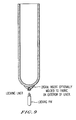
- the present invention relates to various articles of manufacture such as a cushion liner and a cushion locking liner for enclosing an amputation stump, preferably, a cushioned sock for use by, e.g., below-knee (BK) amputees.
- the cushioning devices are preferably provided in a contoured form fit configuration which adapts.to a right or left side bias of the bony prominence of the residuum (stump) or are provided in simple tube (i.e., tube-sock) shape with various optional cushioning.
- Cushioning material is provided on the inside and may optionally be provided on the outside of the liners to minimize the discomfort of, e.g., an orthotic device, such as a knee brace, or a prosthetic device, such as an artificial arm or leg.
- the cushioning material is adjusted in thickness and has a non-uniform thickness over the article surface.
- the liner has cushioning material in a recessed achilles configuration: the cushioning material does not contact the wearer at an upper posterior (i.e., knee crease), or upper anterior (i.e., elbow crease, etc.) portion of the limb or residuum, or minimally contacts the wearer at these positions due, e.g., to the thinning of cushioning material.
- the cushioning material can be thinner in these areas than in other places.
- a stump may generally have a roughly conical or cubical shape there are invariably recessed areas on, e.g., the medial side of the prominent tibia bone. Generally, on a below knee, left side residual limb the recessed area will be predominantly on the right side of the tibia bone. There is also typically a smaller recessed area on the left side. For right side residual limbs the predominant recessed area is on the left side of the bone, with smaller recessed areas on the right side.
- left side amputees typically have a right side bias to the bony prominence of the below knee stump, and right side amputees have a similar bias to the left side.
- Conventional tubular or conical elastic socks simply cannot account for these several variable conditions without using extremely high levels of elastic tension which compress the outer-most points along the stump's circumference, causing discomfort and a non-uniform fit.
- Amputees typically attach a prosthetic limb to their residual limb by means of a rigid socket, liner, and a suspension means.
- the rigid socket is often custom fabricated to match the shape of the intended user's residual limb and may be made of thermoplastic or fiber-reinforced thermoset materials, but can also be made from wood, metal, etc. Since such hard materials are generally uncomfortable when in intimate contact with the skin over long periods of time, especially under load bearing conditions, liners and/or prosthetic socks are often used as interface members between the hard socket and the residual limb to increase comfort.
- Such liners are generally of the open cell foam type, such as Pelite or Kemblo, but may also be made of silicon, urethane, etc. type materials. See, for example, U.S.
- Prosthetic socks may be made of wool, cotton, synthetic materials, etc, and amputees tend to prefer liners and socks which are easily changed to facilitate cieaning, to accommodate volume changes in the residual limb, or to accommodate different user activities.
- LERMAN discloses a stump sock for amputees comprising a flexible resilient material including a base layer of a flexible resilient open cell material; a skin-protecting first layer of a soft flexible porous material overlying a first face of the base layer, and a second layer of a protective fabric overlying a second face of the base layer
- Suspension systems which help to hold a prosthetic limb in place may or may not be an integral part of the rigid socket and/or liner.
- suspension systems include supracondylar or waist belt, joint and corset systems, neoprene or latex sleeves, socket ears which grip the condyles, suction or pin and lock systems such as those where the pin is attached to a liner and the lock is attached to a hard socket, etc.
- Examples of typical suspension systems may be found in U.S. 4,923,474, U.S. 4,923,475, U.S. 5,007,937, U.S. 5,108,456, U.S. 5,201,773, U.S. 5,201,774, U.S. 5.246,464, U.S. 5.263,923, U.S. 5.314,497, U.S. 5,387,245, U.S. 5,376,131 and U.S. 5,405,405.
- one object of this invention is to provide a gel which can be used alone or in combination with fabrics and which can be used in or formed into a cushion liner used by an amputee to provide increased comfort.
- Another object of the present invention is a cushion liner which can fit a range of residual limb sizes with minimal or no air pockets and which comprises, preferably, the gel with fabric, preferably having a non-uniform thickness throughout.
- Another object of the present invention is a cushion locking liner similar to the invention cushion liner but having docking means preferably at the distal end or side thereof for coupling the liner to, e.g., the hard socket of a prosthetic device.
- the docking means are preferably molded directly into the cushion liner.
- Another object of this invention is to provide a novel optionally cushioned sleeve member for enclosing an amputation stump having a form-fitting tubular shape.
- Another object of the present invention is to provide an optionally cushioned sleeve member having a bias pattern and contoured form fit which will equally accommodate a left side amputee and a right side amputee.
- Another object of the present invention is to provide a cushioned liner or locking liner having a contoured form fit shape and polymeric cushioning material arranged to provide an interface between an amputee's residuum and a prosthetic device.
- Another object of the present invention is to provide a cushioned sleeve member for enclosing an amputation stump having a contoured, form-fitting tubular shape wherein the interior of the closed end of the sleeve member is impregnated with or coated with a polymeric material arranged in a recessed achilles configuration which provides a cushioning effect at the interface between the residuum and a prosthetic device socket but which minimizes or eliminates contact with the skin in the crease of the knee or elbow.
- Another object of the present invention is to provide a cushioned liner or locking liner which allows for the timed-release of a skin conditioner, biocide, etc.
- Another object of the present invention is to provide a cushioned sleeve for an amputation residuum which is form fitting and which avoids the generation of air pockets and the obtrusive noises they provide.
- Another object of the present invention is to provide a sleeve member for enclosing an amputation stump which is form fitting and which is optionally cushioned, which is as thin as possible.
- Another object of the present invention is to provide a sock, including typical prior art tube socks, etc., having cushioning material on the inside thereof in a recessed achilles configuration.
- a polymeric gel composition useful in the present invention comprises, preferably, a block copolymer and mineral oil.
- the gels are nonfoamed or foamed with, e.g., a foaming agent.
- the mineral oil may be present in from 5-85% by weight based on total weight, more preferably 20-50% by weight, but also including all of any positive amount including 10, 15, 20, 25, 30, 35, 40, 45, 55, 60, 65, 70, 75 and 80% by weight and all values and ranges in between all these listed values.
- the invention gel preferably has a durometer (Shore A) of 1 - 20 and preferably a durometer that matches or approximates ( ⁇ 10%) human skin.
- the oil is present on an equal weight basis, or in a weight ratio of 1/4, with regard to the amount of polymeric material present.
- the polymeric material present is preferably a styrene isoprene/butadiene block copolymer or styrene-ethylene/butadiene-styrene block copolymer.
- styrene isoprene/butadiene block copolymer
- styrene-ethylene/butadiene-styrene block copolymer Preferable examples of such polymeric materials useful herein include C-Flex 1970-W5 (R70-339-000), C-Flex 1960-W5 (both manufactured by Consolidated Polymer Technologies, Largo, Florida, U.S.A.) and Kraton G1654 (manufactured by Shell Chemical Co.).
- a particularly prefered ratio is 1 part oil per 2 parts C-Flex material.
- Preferred ratios of polymer to mineral oil are 1/1-4/1 using C-Flex 1970-W5 or 1960-W5, one part Kraton G1654: 2.75 parts mineral oil, and 14 parts Kraton G1654: 15 parts C-Flex R70-306 (or R70-190 or R70-251 or any mixture thereof): 40 parts mineral oil.
- the C-Flex R70-339-000, R70-306, -190 and -251 materials are also preferred herein and are products of Consolidated Polymer Technologies. They are blends of S-EB-S block copolymer or SIB block copolymer with mineral oil. 10 parts Kraton G1654 and 11 parts C-Flex R70-306 and 27 parts Duoprime 70 oil is also preferred.
- the preferred polymers useful herein and listed above (C-Flex and Kraton materials), in addition to being styrene-isoprene/butadiene or styrene-ethylene/butadiene-styrene block copolymers (mixed with mineral oil in the case of the C-Flex R70-339-000, R70-306, -190 and -251 materials) also include styrene-butadiene-styrene and any thermoplastic elastomer having the Shore A characteristics listed above and capable of being blended with mineral oil. Mixtures of all mentioned polymers may be used.
- Several preferred polymeric materials useful in all aspects of the present invention are more particularly described with regard to the invention sleeve member infra .
- the mineral oil used herein is preferably purified mineral oil and is preferably USP grade.
- the present invention cushion liner and cushion locking liner may have an overall tube-sock shape or may be form-fitting (described more fully below with regard to the invention sleeve member). These shapes are referred to generically as sock-shaped coverings.
- the invention sleeve cushion liner and cushion locking liner can fit a range of residual or normal limb sizes with minimal or no air pockets, and preferably have a range of elasticity of from 10-400% and a range of distal radius of 19-102mm (3/4"-4") or whatever is required by the wearer.
- the cushion liner and cushion locking liner may be made of a combination of gel/fabric with appropriate seaming, where necessary.
- At least three standard geometries may be provided for both the invention cushion liner and cushion locking liner, those geometries being 1) uniform wall, 2) tapered wall and 3) contoured wall. These geometries are also useful with regard to the invention sleeve and open-ended sleeve member discussed below and refer to the thickness of the gel. Recessed achilles configuration (see infra ) can be used in all articles and aspects of the invention.
- the uniform wall cushion and cushion locking liner simply comprise a uniform thickness of gel.
- Tapered wall cushion liners and cushion locking liners are generally those having a layer of gel which is thicker distally for additional padding (and because most shrinkage of the residual limb occurs at this point of the limb) and thinner proximally (near the open end of the liner) to blend in and interface more easily with the residual limb.
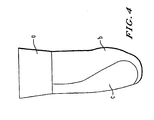
- Contoured wall cushion liners and cushion locking liners have uneven distribution of gel throughout to provide cushioning effects where needed and, in a preferable embodiment, have a thinner posterior middle and upper to allow maximum range of motion optionally with a thicker distal end both anterior-medial and anterior-lateral with less thickness in the region between these two areas so as to pad typical bony promenances.
- Contoured wall liners are often thicker distally and custom shapes can easily be provided to satisfy the individual user.
- the hatched area has a gel or polymeric material cushion thickness of 13 mm, the dotted portion 11 mm, the front of the liner 9 mm and the portion for behind the knee less than 9 mm.
- cushion liner and cushion locking liner combinations of gel with fabric include gel with a two-piece or three-piece form-fit sleeve (described below).
- Other configurations include gel coating inside a tube-sock fabric form.
- thermoplastic elastomers Foamed or nonfoamed thermoplastic elastomers or rubber only can also be used as cushioning material alone or in combination with the gel in the invention.
- the term "thermoplastic elastomers" has its typical meaning and excludes the invention gel.
- the foamed materials can exclude mineral oil.
- the inclusion of thermoplastic elastomers in the invention gel is advantageous in making the products customizable since such products will tend to take the shape of a limb or model of a limb when, e.g., heat and/or pressure are applied.
- the gel can be foamed and used in combination with fabric in all forms of the invention.
- transducers can be included therein to sense pressure, force, temperature, etc., to detect and/or transmit a signal from the residual limb to a prosthetic device, to send myoelectric signals, etc.
- any electrical device or other sensing device can be similarly incorporated for detection, signal transduction, etc. See, for example, U.S. 5,443,525.
- the cushion locking liner comprises docking means for attaching an external device, etc. to the liner.
- docking means includes pins, etc. and are typically those which help to attach and support a prosthetic device.
- These docking means are known in the art and are preferably incorporated in the cushion locking liner by means of direct molding, meaning the injection molding of an adapter into the fabric, etc.
- Such docking means including distal inserts, can be centered or can be offset to accommodate individual residual limb geometries.
- Other docking means include molding a raised configuration in the side of the liner which then mates with a recess on the inside of the prosthetic socket, allowing for a locking effect when the user dons the liner and steps into a socket.
- An open-ended cushion knee or elbow sleeve (also referred to herein as cushion knee sleeve or knee sleeve, etc., for brevity) is intended to be worn by an amputee and provide an interface between the residual limb and a prosthetic device, and is worn external to both, or may be worn by a person whose limb is intact but desires or requires padding or joint support.
- the knee sleeve is generally cylinder- or band-shaped and covered on the exterior with fabric and coated on the inside with invention gel.
- the sleeve can be any size but typically is from 25.4-635 mm (1-25 inches) long including 254, 381, 406.4, and 508 mm (10, 15, 16, and 20 inches), and any diameter (unstretched) such as 25.4 - 254 mm (1-10 inches), including 50.8, 88.9, 101.6 and 127 mm (2, 31 ⁇ 2, 4 and 5 inches). Fabric may cover the middle section of the interior, if desired.
- the cushion knee sleeve itself may have a conical (i.e., tapered) shape with a smaller diameter distally than proximally or smaller diameter distally and proximally as compared to a central diameter so as to grip and hold the prosthetic device or residuum at the smaller diameter end(s).
- the interior gel coating can be thinner at either or both of the distal and proximal end, and can be thinner or absent in the back of or whole of the middle section thereof so as to not bind in the crease of the knee or elbow when worn by the user. It is preferred that the wall thickness of the gel be thin at the ends regardless whether there is fabric covering the gel or whether the exterior or whole cushion knee sleeve is made simply of gel itself.
- the cushion knee sleeve can be used in combination with the invention cushion liner or cushion locking liner as a means for suspension of a prosthetic device, or can be used alone.
- the knee sleeve can have attached thereto, by molding into the gel, by attachment means such as pins, etc., an orthotic knee joint and optional support bars such that the sleeve constitutes a knee brace.
- All articles such as the (closed-ended) sleeve and liners can be provided with gel or thermoplastic on the outside thereof so as to come in contact and provide increased friction with the interior gel of the cushion knee sleeve.
- Such a configuration provides additional support and suspension of the prosthetic device.
- the present invention liner for enclosing an amputation stump overcomes the problems encountered with prior art tubular or conical socks which are either prone to air pocket sound effects or are so constricted as to be uncomfortable by providing a sleeve member which is made in the shape of or from a pattern and comprises the invention optionally combined with elastomer which provides elastic tension such that the liner form fits an amputee's residuum.
- This provides a sleeve member having a comfortable feel and avoiding the generation of obtrusive sounds which are directly traceable to the presence of air pockets between a sleeve member and an amputee's residuum or between sleeve member and prosthetic socket.
- the elasticity of the liner is preferably sufficient to accommodate the swelling or shrinkage of the residual limb typically experienced by an amputee and still maintain an intimate fit.
- the liner of the invention has enough elastic compression to form fit a stump but is not so tight as to be considered a stump shrinker, as in U.S. 4,840,635.
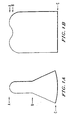
- Figure 1 depicts a typical pattern from which the present invention form-fitting sleeve member is constructed or shaped into.
- the pattern is a reflected two-piece pattern, one piece of which is designed to cover the bony prominence of a typical BK stump, ( Figure 1a) the other piece joined to the first at the edges thereof and circumscribing the typical onset of soft tissue around the stump ( Figure 1b).
- the two patterns can be used to cut out two or more pieces of textile material which are brought together such that the "X" on each of the patterns in Figures 1a and 1b are in contact with the "X" on the other pattern, followed by the sewing together of the edges of each pattern in typical fashion.
- a sleeve member which has a form fitting residuum-like (tubular) shape having an open end into which an amputation stump may be introduced, a closed end opposite to the open end, an interior and an exterior.
- the two-piece pattern may be cut out of the same textile material or different textile materials, and the two pieces of textile material may have the same color or different colors.
- the three-piece optionally banded reflected pattern of Figure 3 also provides a form-fit sleeve, piece (a) being optional.
- the form fit sleeve of the invention can be made from fabric, with gel, elastomer, and combinations thereof according to the patterns in Figure 1 or Figure 3.
- the' distance A-B divided by the distance B-C generally varies from 2/1 to 1/2 and is preferably about 1/1.
- the width of the pattern in Figure 1a at point B divided by the width at point C is generally approximately from 1/4-1/1, preferably about 1/2.
- the distance A-C divided by the distance B-C is generally preferably about 1.05-1.3, most preferably about 1.1.
- the dimensions may be varied so as to provide a comfortable form fit that avoids air pockets.
- the two or more pieces of textile material used to form the invention form fitting liner can be sewn together using any type of thread and any type stitch. This is also true for tube-sock shaped articles.
- woolly nylon is used to interconnect the two-piece or three-piece form-fitting liner of the invention or seam the tube-sock using a flat-locked stitch, which is a stitch well known to those in the art. This flat-locked stitch tends to create a smooth, non-irritating seam having a stretch comparable to jersey fabric.
- the size of the liner according to the invention can be varied depending upon the residuum to be enclosed by simply proportionally reducing or enlarging the pattern, as desired.
- the term "form fitting" residuum-like (tubular) shape as used herein refers to the shape of the invention liner which provides a contoured fit on an amputation stump, which substantially reduces or eliminates air pockets during pistoning of the amputation stump in a prosthetic socket and which is obtained by providing a liner composed of two or more pieces of fabric having the pattern described in Figure 1 or Figure 3 and/or comprised of gel and/or other elastomeric material in the shape provided by these patterns. Residuum-like configuration is further achieved via a bias molding technique that replicates contours of a normal amputation stump.
- the fabric-containing articles according to the present invention may be made with any textile material having any thickness (ply).
- Preferred textile fabrics are those having elasticity, including elasticities of 10-400%, such as stretchable non-wovens (e.g., the Xymid® line of fabrics including Wearforce® fabrics from DuPont which connect bulkable yarns with non-woven sheet substrates), Lycra® comprising segmented elastomeric polyurethane fibers (spandex), supplex nylon (an engineered nylon textile fabric with a cotton-like texture and appearance), neoprene fabrics (polychloroprene fabrics), nylon, spunbonded olefin, looped nylon, spunlaced fabrics, polyester, aramid fiber fabrics, etc.
- stretchable non-wovens e.g., the Xymid® line of fabrics including Wearforce® fabrics from DuPont which connect bulkable yarns with non-woven sheet substrates
- Lycra® comprising segmented elastomeric polyurethane fibers (spand
- any textile material may be used such as those described in Textiles , fourth edition, N. Hollen et al, MacMillan, New York, 1973, The Modern Textile Dictionary , Duell, Sloan and Pearce, New York, 1963 and Dyeing Chemical Technology of Textile Fibers , Trotman, E., Charles Griffin and Co., London, 1975:
- the fabrics used to make the invention articles are preferably elastic and are preferably jersey knit but include all woven, knitted and non-woven textile fabrics.
- those described in Volume 22, p. 762 ff and Vol. 16, p. 72 ff of the Kirk-Othmer Encyclopedia of Chemical Technology , Wiley, New York, 1983 and 1981, respectively, are also included.
- Preferred fabrics include mixtures of the above-mentioned fabrics, such as a fabric of neoprene, 88% supplex nylon/12% lycra spandex, 85% nylon/15% lycra spandex, 94% polyester/6% lycra spandex.
- Such mixed fabrics may be uniformly mixed or may have one type of fiber or predominantly one type of fiber on one face thereof.
- the lycra can be mixed throughout, can make up the entire or substantially the entire face, or the entire or substantially the entire back of the fabric once it is arranged in an invention article.
- the textile fabrics used in the invention may be treated/finished in any manner known in the art.
- a nylon tricot surface may be applied to the textile fabric, etc.
- the finishing need not be uniform over the entire invention article.
- the article may be selectively treated at, for example, above the knee (or elbow) portions, and with the same treatment, no treatment or another treatment being present below the knee or elbow.
- treatment on the outer surface of the invention sleeve member may be different from that on the inside thereof.
- the textile material used to make the invention articles is preferably elastic (stretchable) in one or more, preferably two, directions and is capable of adjusting to variations in form and size of the residuum or limb.
- a nylon, neoprene, looped nylon combination provides excellent comfort and durability.
- Preferred thicknesses of the invention textile material range from 0.254 - 5.08 mm (.010in - .200in), preferably 0.635 to 3.175 mm (.025in to .125in), all values and all ranges therebetween.
- the thickness of patterns pieces in Figures 1 and 3 are the same, but need not be.
- the liner according to the invention is preferably a cushioned sleeve member, that is a sleeve member having a form fitting shape with an open end into which an amputation stump may be introduced, a closed end opposite to said open end, an interior and an exterior, wherein the interior at the closed end is impregnated with a polymeric material arranged so as to provide a cushion between the amputee's residuum and any prosthetic device to be worn, attached to, etc. the residuum.
- the cushioning material is preferably a polymeric material, most preferably the aforementioned gel and/or a thermoplastic elastomer (referred to simply as thermoplastic herein) such as a thermoplastic rubber, silicon containing elastomer, etc. which provides an interface between the residuum and a prosthetic device but which does not contact or minimally contacts the skin at the back of the knee or elbow when worn by an amputee (recessed achilles).
- This cushioning material may also here and in other articles of the invention be a thermoset silicone.
- This cushioning material is thus provided in a "recessed achilles" arrangement which avoids the irritation occurring in the crease behind a knee or elbow provided by prior art cushion sleeves by thinning or eliminating cushioning polymeric material at this location. If the form fit sleeve is to be worn by an above-knee amputee the recessed (thinned or absent) portion of the cushion material may be arranged medially at, e.g., the perineum for increased comfort.
- the polymeric material which provides the cushioning effect in all aspects of this invention may be any polymeric material.
- Preferred materials other than the invention gel and those described above are those elastomers described at pgs. 446-640 of volume 8 of the Kirk-Othmer Encyclopedia of Chemical Technology , Wiley, New York, 1979 and those rubbers described in Synthetic Rubbers: Their Chemistry and Technology , Blackley, D., Applied Science Publishers, London, 1983 and Rubber Technology , Morton, M. Ed., Van Nostrand Reinhold Co., New York, 1987.
- a preferred embodiment of the present invention liner includes a cushioning material of Kraton®-type rubber material including those obtained from Shell, CPT, and GLS.
- Kraton® rubbers are styrene-ethylene/butylene-styrene block copolymers or styrene-ethylene/propylene block copolymers or styrene isoprene/butadiene block copolymers and are available in triblock or diblock form. See, e.g. the Kraton® Technical Bulletin from Shell Chemical Company, SC:1102-89, June, 1992.
- the cushioning polymeric material used in the present invention cushioned sleeve member is characterized by a certain durometer range.
- Durometers for the invention cushioning material preferably range from 1-20 on the Shore "A" scale. The lower the number the softer the material, typically due to a higher level of plasticizer.
- One preferred durometer range is 3-14 including all values therebetween and all ranges therebetween.
- the invention polymeric cushioning material may be a blend of, e.g., Kraton® rubbers and oils such as mineral oil, etc. including typical stabilizers, etc. which provide an average durometer of from 1-20, preferably 3-14. These blends typically comprise a rubber having a lower durometer (1-10 on the Shore "A" scale) and a rubber having a higher durometer (e.g., 11-20). The blends are preferably capable of being stretched 100% or more, preferably 400% or more before tearing and are capable of providing a form fit to the residuum due to their inherent elasticity. In addition, low durometer Kraton® rubbers and other materials tend to have a sticky feeling which, when present in the polymeric cushioning material, tends to enhance the form fitability of the sleeve essentially by mating against the skin.
- Kraton® rubbers and oils such as mineral oil, etc. including typical stabilizers, etc. which provide an average durometer of from 1-20, preferably 3-14. These blends typically comprise
- the invention article In donning those articles of the invention which, when worn, provide contact between, e.g., the invention gel, a thermoplastic material, a combination thereof, etc., with the skin and/or a prosthetic device it is preferred that the invention article be donned in a manner such that the polymeric material does not drag against the skin.
- the invention cushion liner or sleeve can be rolled before donning, and then unrolled on the limb and/or device. In this manner, the cushioning polymeric material encloses the limb and/or device without sliding or friction. If the invention article has an outer textile surface, the textile material slides against itself, providing easy action.
- this open-ended sleeve has an interior middle band of fabric.
- the distal and proximal portions of the open-ended sleeve can be rolled towards the middle of the sleeve, and the sleeve can be donned with contact between the wearer or device and fabric only.
- the thermoplastic-containing portions can then be unrolled onto the wearer and/or device.
- the invention articles can be taken off by reversing the above-describe processes.
- This aspect of the invention (easy donning and doffing) is an important advance in the art provided by the present invention. No lubricant, talcum powder, etc. is required, as with currently available materials.
- invention articles regardless of their composition, can be adapted such that the portion thereof which will come in contact with the user's apparel such as pant legs, shirt sleeves, etc. is fabric or covered with fabric such that the wearer's apparel does not stick to and bunch on the invention articles.
- the cushioning material may comprise antioxidants such as Vitamins A, B and C or any other antioxidants commonly used in polymers which can weep out on a time release basis.
- skin conditioning agents may be added to the polymeric material to soothe the skin during wear.
- skin conditioners include mineral oil, baby oil, etc. which may be added to the polymeric material prior to its application to the sleeve member.
- astringents, biocides, medicaments, etc. may be added or applied to the cushioning material to avoid infection or heal sores, etc.
- the cushioning material is preferably formed in a recessed achilles fashion on the interior of the invention articles.
- Cushioning material may also be applied to the exterior. In both cases, it is preferred that the cushioning material be applied such that it provides an interface between the amputee's stump and a prosthetic device or provides padding and/or joint support but minimizes or eliminates contact with the skin at the back of the knee or elbow when worn.
- the cushioning material may be separated from the skin by a piece of fabric, by an interior sock liner, or may contact the skin directly. Such contact with the skin can reduce sweating, etc.
- a preferred method includes the dipping of the closed end of the invention article into molten or liquified cushioning material at an angle of from 15° to 80°, preferably 20-50°, most preferably 24-45°, with respect to the surface of the molten or liquid cushioning material.
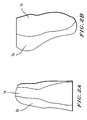
- the cushioning material extends up the article from the closed end thereof to a further extent on the side of the liner, sleeve, etc. to be positioned in front of the knee than behind the knee (e.g., the pattern in Figure 1a faces forward on a BK amputee).
- the material is in a recessed achilles configuration.
- the polymeric material comes up at least about 12.7 - 457.2 (1 ⁇ 2-18), preferably 12.7 - 254 (1 ⁇ 2-10), more preferably 76.2 - 203.2 mm (3-8 inches), including all values and ranges therebetween these several values, from the closed end of the articles in front of the knee or elbow and covers the knee or elbow.
- the difference in height of the cushioning material behind (i.e., in the crease of) the knee or elbow as opposed to in front of the knee or elbow can differ by several tens of mm (inches) measured from the closed end of the article, typically from 25.4 - 381 mm (1-15 inches), preferably 25.4 - 203.2 (1-8) and includes all values therebetween and all ranges therebetween these several values.
- the cushioning material is thicker at the closed end of the article than it is towards the open end.
- gel and/or polymeric cushioning material to, e.g., the sleeve member by dipping into liquified or molten polymeric material or painting the material on the article, etc.
- the article is generally spun with distal end angling downward to provide tapered thickness while drying.
- the thickness of the polymeric material applied to the invention articles in any fashion including in a recessed achilles fashion can be any thickness to, e.g., several tens of mm (inches) but preferably varies from 0.0254 - 12.7 mm (.001 - .500 inches), preferably 0.279 - 3.81 mm (.011 - .150 inches) but all values and all ranges therebetween these several values, and can be substantially nonconstant in thickness throughout.
- the cushioning material preferably may be thicker at the closed end of the sleeve (e.g. 3.175 (.125in)thick) and be tapered or feathered in decreasing thickness as the open end is approached.
- Such changes in thickness can be accomplished by techniques known to those of ordinary skill in this art and are within their skill. For example, compression molding can be used.
- Another preferred method of producing the invention articles is injection molding.
- the article is pulled over a core and inserted into a cavity with polymeric material being injected into the cavity.
- a form-fit next-to-skin sock was prepared from an 88% supplex nylon/12% lycra spandex jersey knit fabric using woolly nylon thread and a surged flat-locked stitch.
- the sock comprises two pieces of fabric, the first piece having the pattern described in Figure 1a, the second piece having the pattern described in Figure 1b.
- a mixture of melted Kraton® rubbers obtained from Shell (G1652) and GLS (6705) and Duoprime® 70 oil (mineral oil) was prepared, the sewn inverted sock was then placed over a mold facsimile of an amputation stump having recessed portions at what would be either side of the tibia and dipped into the molten Kraton® blend at an angle of 24°-28° with regard to the plane of the surface of the molten Kraton® and removed. The mold was spun during drying. A form-fit cushioned stump sock was obtained having adhered cushioning material in a recessed achilles arrangement on the interior thereof.
- a 1.5785 mm (1/16 inch) thick neoprene textile fabric with nylon tricot surface treatment for above the knee contact was used to prepare a three-piece form fitting sleeve member according to the present invention using the pattern described in Figure 3.
- the 1.5785 mm-(1/16 inch)neoprene material for the below the knee segment of the invention sleeve had nylon on the exterior side and looped nylon on the interior side.
- the against the skin side of the above knee segment of the invention sleeve was neoprene which provided a high friction bond.
- This form fitting sock was dipped into molten Kraton® (a blend of tough and soft Kraton® used in Example 1) at an angle of 24°-28° to provide a cushion material on the interior thereof.
- the resultant composite sock of nylon, neoprene, looped nylon and cushioning rubber provides a durable cushioned sleeve member which, when impregnated with rubber, has an approximate thickness of 3.175 mm (1 ⁇ 8 inch.
- a commercial cotton tube sock is inverted and dipped into molten elastomer at an angle of 26° relative to the plane of the molten elastomer.
- a sock having cushioning material in a recessed achilles configuration is obtained.
- a 2-piece form fitting sleeve was made from a fabric containing 57% polyester, 33% nylon, and 10% lycra and was placed over a core pattern.
- a 2-piece form fitting sleeve was made of a nylon/Lycra material.
- An adapter was injection molded into the closed end of the sleeve with polypropylene.
- the sleeve with adapter was then inverted and placed over a core.
- a mixture of molten C-Flex 1970-W5 (50 wt%) and Duoprime 70 mineral oil (50 wt%) was poured into a cavity and the core with sleeve was placed in the cavity to produce a cushion locking liner.
- a pin was threaded into the adapter which was adapted to mate with a lock built into a prosthetic socket.
- the invention articles are designed primarily for the human wearer, and thus are sized appropriately. Diameters typically vary from 25.4 - 203.2 mm (1- 8 inches) (unstretched) and overall lengths typically vary from 25.4 - 762 (1 - 30 inches) (unstretched). Obviously, numerous modifications are available which fall within the scope of the invention and appended claims.
Landscapes
- Health & Medical Sciences (AREA)
- Veterinary Medicine (AREA)
- Animal Behavior & Ethology (AREA)
- Transplantation (AREA)
- Engineering & Computer Science (AREA)
- Biomedical Technology (AREA)
- Heart & Thoracic Surgery (AREA)
- Vascular Medicine (AREA)
- Life Sciences & Earth Sciences (AREA)
- Cardiology (AREA)
- General Health & Medical Sciences (AREA)
- Oral & Maxillofacial Surgery (AREA)
- Public Health (AREA)
- Prostheses (AREA)
- Orthopedics, Nursing, And Contraception (AREA)
- Professional, Industrial, Or Sporting Protective Garments (AREA)
- Compositions Of Macromolecular Compounds (AREA)
- Dowels (AREA)
- Building Environments (AREA)
- Massaging Devices (AREA)
- Chair Legs, Seat Parts, And Backrests (AREA)
- Helmets And Other Head Coverings (AREA)
- Materials For Medical Uses (AREA)
- Telephone Function (AREA)
Claims (20)
- Polstervorrichtung zum Einschließen eines Amputationsstumpfes, wobei die Vorrichtung einen Stoff umfasst, der ein offenes Ende zum Einführen des Stumpfes und ein dem offenen Ende gegenüberliegendes geschlossenes Ende aufweist, dadurch gekennzeichnet, dass der Stoff auf wenigstens dessen Innenseite mit einem eng anliegenden Polymer-Polstermaterial beschichtet ist, welches die Haut des Amputationsstumpfes kontaktiert, wenn durch einen Verwender getragen, um Lufttaschen zu minimieren oder zu eliminieren.
- Polstervorrichtung gemäß Anspruch 1, wobei das Polymer-Polstermaterial an einem geschlossenem Ende der Vorrichtung dicker als an einem offenem Ende ist.
- Polstervorrichtung gemäß einem vorhergehendem Anspruch, wobei die Vorrichtung eine ungleichförmige Verteilung des Polymer-Polstermaterials besitzt, die ungleichförmige Verteilung einen dünneren hinteren Mittel- und Oberteil, und einen dickeren entfernten Vordermittel- und Vorderseitenteil umfasst.
- Polstervorrichtung gemäß einem vorhergehendem Anspruch, wobei das Polymer-Polstermaterial in einem vertieften Achilles-Aufbau angeordnet ist.
- Polstervorrichtung gemäß einem vorhergehendem Anspruch, die eine Länge vom geschlossenem Ende zum offenem Ende von 254 - 635 mm (10 - 25 Inch) besitzt.
- Polstervorrichtung gemäß einem vorhergehendem Anspruch, wobei das Polymer-Polstermaterial eine Dicke besitzt, die von 0,0254 - 12,7 mm (0,001 - 0,5 Inch) variiert.
- Polstervorrichtung gemäß Anspruch 1, wobei die Stoffbedeckung nur auf deren Innenseite mit dem Polymer-Polstermaterial beschichtet ist.
- Polstervorrichtung gemäß Anspruch 1, wobei die Stoffbedeckung durch direktes Eintauchen in verflüssigtes oder geschmolzenes Polymermaterial mit dem Polymer-Polstermaterial beschichtet ist.
- Polstervorrichtung gemäß einem vorhergehendem Anspruch, wobei das Polymer-Polstermaterial ein Biozid einschließt.
- Polstervorrichtung gemäß einem vorhergehendem Anspruch, wobei das Polymerpolstermaterial ein Vitamin einschließt.
- Polstervorrichtung, wobei die Vorrichtung durch Invertieren und Aufrollen auf den Amputationsstumpf angezogen werden kann.
- Polstervorrichtung gemäß einem vorhergehendem Anspruch, die ferner eine Andockeinrichtung an deren geschlossenem Ende umfasst.
- Polstervorrichtung gemäß Anspruch 12, wobei die Andockeinrichtung auf die Außenseite der Vorrichtung geformt ist.
- Polstervorrichtung gemäß Anspruch 12, wobei die Andockeinrichtung an den Soff auf der Außenseite der Vorrichtung geformt ist.
- Polstervorrichtung gemäß einem vorhergehendem Anspruch, wobei das Polymer-Polstermaterial aus der Gruppe ausgewählt ist, die aus geschäumten oder nichtgeschäumten thermoplastischen Elastomeren, thermoplastischen Kautschuken, Silikonkautschuken und Polymer-Gelzusammensetzungen, die ein Blockcopolymer umfassen, besteht.
- Polstervorrichtung gemäß einem der Ansprüche 1 bis 15, wobei das Polymer-Polstermaterial ein Blockcopolymer und Mineralöl umfasst.
- Polstervorrichtung gemäß Anspruch 16, wobei das Polymer-Polstermaterial eine Shore A - Härte von 1-20 besitzt.
- Polstervorrichtung gemäß Anspruch 16 oder Anspruch 17, wobei das Polymer-Polstermaterial 5-85 Gew.-% Mineralöl umfasst.
- Polstervorrichtung gemäß einem der Ansprüche 16-18, wobei das Blockcopolymer aus der Gruppe ausgewählt ist, die aus einem Styrol-Isopren/Butadien-Blockcopolymer, einem Styrol-Ethylen/Propylen-Blockcopolymer, oder einem Styrol-Ethylen/Butadien-Styrol-Blockcopolymer besteht.
- Polstervorrichtung gemäß einem vorhergehendem Anspruch, der einen Bereich mit einem entfernten Radius von 19 - 102 mm (3/4"-4") besitzt.
Priority Applications (2)
| Application Number | Priority Date | Filing Date | Title |
|---|---|---|---|
| DE69635400T DE69635400T3 (de) | 1995-03-20 | 1996-03-20 | Polster vorrichtung |
| EP05076931A EP1618858B1 (de) | 1995-03-20 | 1996-03-20 | Gel- und Polstervorrichtung |
Applications Claiming Priority (5)
| Application Number | Priority Date | Filing Date | Title |
|---|---|---|---|
| US406145 | 1995-03-20 | ||
| US08/406,145 US5603122A (en) | 1995-03-20 | 1995-03-20 | Form-fit sock |
| US611306 | 1996-03-05 | ||
| US08/611,306 US5830237A (en) | 1996-03-05 | 1996-03-05 | Gel and cushioning devices |
| PCT/US1996/003310 WO1996029033A1 (en) | 1995-03-20 | 1996-03-20 | Gel and cushioning devices |
Related Child Applications (2)
| Application Number | Title | Priority Date | Filing Date |
|---|---|---|---|
| EP05076931A Division EP1618858B1 (de) | 1995-03-20 | 1996-03-20 | Gel- und Polstervorrichtung |
| EP05076931A Division-Into EP1618858B1 (de) | 1995-03-20 | 1996-03-20 | Gel- und Polstervorrichtung |
Publications (5)
| Publication Number | Publication Date |
|---|---|
| EP0762857A1 EP0762857A1 (de) | 1997-03-19 |
| EP0762857A4 EP0762857A4 (de) | 2000-11-22 |
| EP0762857B1 true EP0762857B1 (de) | 2005-11-09 |
| EP0762857B8 EP0762857B8 (de) | 2006-01-18 |
| EP0762857B2 EP0762857B2 (de) | 2012-10-24 |
Family
ID=27019399
Family Applications (2)
| Application Number | Title | Priority Date | Filing Date |
|---|---|---|---|
| EP96909649A Expired - Lifetime EP0762857B2 (de) | 1995-03-20 | 1996-03-20 | Polster vorrichtung |
| EP05076931A Expired - Lifetime EP1618858B1 (de) | 1995-03-20 | 1996-03-20 | Gel- und Polstervorrichtung |
Family Applications After (1)
| Application Number | Title | Priority Date | Filing Date |
|---|---|---|---|
| EP05076931A Expired - Lifetime EP1618858B1 (de) | 1995-03-20 | 1996-03-20 | Gel- und Polstervorrichtung |
Country Status (9)
| Country | Link |
|---|---|
| EP (2) | EP0762857B2 (de) |
| AT (2) | ATE409017T1 (de) |
| AU (1) | AU5307596A (de) |
| CA (1) | CA2190764C (de) |
| DE (2) | DE69637694D1 (de) |
| DK (2) | DK1618858T3 (de) |
| ES (2) | ES2250986T5 (de) |
| PT (1) | PT1618858E (de) |
| WO (1) | WO1996029033A1 (de) |
Cited By (3)
| Publication number | Priority date | Publication date | Assignee | Title |
|---|---|---|---|---|
| US8523951B2 (en) | 1996-07-31 | 2013-09-03 | The Ohio Willow Wood Company | Prosthetic socket interface and assembly |
| US9265629B2 (en) | 2011-04-01 | 2016-02-23 | The Ohio Willow Wood Company | Fabric covered polymeric prosthetic liner |
| US10842653B2 (en) | 2007-09-19 | 2020-11-24 | Ability Dynamics, Llc | Vacuum system for a prosthetic foot |
Families Citing this family (10)
| Publication number | Priority date | Publication date | Assignee | Title |
|---|---|---|---|---|
| US5830237A (en) | 1996-03-05 | 1998-11-03 | Ohio Willow Wood Company | Gel and cushioning devices |
| DE19710230A1 (de) * | 1997-03-12 | 1998-09-17 | Biedermann Motech Gmbh | Schlauchförmiges Fasermaterial und Verfahren zur Herstellung eines Prothesenschaftes aus einem solchen Material |
| US5888230A (en) * | 1997-04-01 | 1999-03-30 | Helmy; Nashat N. | Modular liner for limb stump prosthesis |
| EP0976371A1 (de) * | 1998-07-30 | 2000-02-02 | Garnier, philippe | Verfahren zur herstellung einer manschette aus urethangel |
| FR2799953B1 (fr) * | 1999-10-22 | 2002-07-05 | Proteor Sa | Procede de fabrication d'un manchon pour prothese ou orthese ebauche utilisee dans ce procede et manchon ainsi obtenu |
| US8317873B2 (en) | 2010-02-23 | 2012-11-27 | The Ohio Willow Wood Company | Polymeric prosthetic liner with controlled stretch characteristics |
| US8795386B2 (en) | 2011-11-18 | 2014-08-05 | Otto Bock Healthcare Gmbh | Below knee amputee prosthesis liner |
| DE102012000103A1 (de) | 2012-01-04 | 2013-07-04 | Silcomed GmbH | Orthopädischer Liner |
| EP3419567A4 (de) * | 2016-02-22 | 2019-10-23 | The Ohio Willow Wood Company | Mit gewebe überzogene polymere protheseneinlage |
| LU100021B1 (en) * | 2017-01-13 | 2018-07-30 | Adapttech Ltd | Socket fitting system |
Family Cites Families (20)
| Publication number | Priority date | Publication date | Assignee | Title |
|---|---|---|---|---|
| US3732578A (en) * | 1971-03-01 | 1973-05-15 | H Pollack | Diagnostic and interfacial pad for use with the socket of a prosthetic device |
| US5334646B1 (en) * | 1977-03-17 | 1998-09-08 | Applied Elastomerics Inc | Thermoplastic elastomer gelatinous articles |
| US5336708A (en) † | 1977-03-17 | 1994-08-09 | Applied Elastomerics, Inc. | Gelatinous elastomer articles |
| US5262468A (en) * | 1977-03-17 | 1993-11-16 | Applied Elastomerics, Inc. | Thermoplastic elastomer gelatinous compositions |
| DE3129888C2 (de) * | 1981-07-29 | 1985-01-03 | Secans AG, Zug | Verfahren zur Herstellung einer Masse für die Abstützung von Teilen des menschlichen Körpers |
| US4542169A (en) † | 1983-12-12 | 1985-09-17 | Rohm And Haas Company | Biomedical devices containing isothiazolones to control bacteria growth |
| US4635626A (en) * | 1984-11-16 | 1987-01-13 | Max Lerman | Prosthetic stockings |
| US4832010A (en) * | 1985-06-11 | 1989-05-23 | Max Lerman | Orthopedic supports and material for making same |
| SE454943B (sv) * | 1986-06-26 | 1988-06-13 | Ossur Hf | Hylselement, speciellt for amputationsstump |
| US4840635A (en) * | 1986-08-08 | 1989-06-20 | Knit-Rite, Inc. | Full-fashion stump shrinker for the residual limb of a human amputee |
| US4822371A (en) † | 1987-01-23 | 1989-04-18 | Jolly David F | Reinforced elastic sleeve for use with a limb prosthetic device |
| US4814375A (en) * | 1987-09-24 | 1989-03-21 | The West Company | High strength elastomers for pharmaceutical products |
| US4908037A (en) * | 1988-09-16 | 1990-03-13 | Ross Michael R | Suspension prosthetic sleeve for rigorous activity |
| US5258037A (en) † | 1990-07-13 | 1993-11-02 | Caspers Carl A | Prosthetic liner and method of making the liner with a prosthesis socket |
| GB2261358B (en) * | 1991-11-13 | 1995-06-21 | Salt & Son Ltd | Sock |
| DE4321182C1 (de) * | 1993-06-25 | 1994-12-01 | Brado Trikotagen Gmbh Vormals | Gestrickter Stumpfstrumpf für Amputierte |
| US5480455A (en) † | 1993-08-25 | 1996-01-02 | W. L. Gore & Associates, Inc. | Lining material for use with prosthetics and similar devices and method for making and using same |
| WO1995027756A1 (en) * | 1994-04-08 | 1995-10-19 | Esposito Anthony S Jr | Elastomer |
| US5507834A (en) † | 1994-05-17 | 1996-04-16 | Laghi; Aldo A. | Transparent silicone suction socket |
| US5443525A (en) * | 1994-06-27 | 1995-08-22 | Laghi; Aldo A. | Conductive patch for control of prosthetic limbs |
-
1996
- 1996-03-20 ES ES96909649T patent/ES2250986T5/es not_active Expired - Lifetime
- 1996-03-20 WO PCT/US1996/003310 patent/WO1996029033A1/en not_active Ceased
- 1996-03-20 PT PT05076931T patent/PT1618858E/pt unknown
- 1996-03-20 AU AU53075/96A patent/AU5307596A/en not_active Abandoned
- 1996-03-20 AT AT05076931T patent/ATE409017T1/de active
- 1996-03-20 EP EP96909649A patent/EP0762857B2/de not_active Expired - Lifetime
- 1996-03-20 DK DK05076931T patent/DK1618858T3/da active
- 1996-03-20 AT AT96909649T patent/ATE308951T1/de active
- 1996-03-20 DK DK96909649.4T patent/DK0762857T4/da active
- 1996-03-20 CA CA002190764A patent/CA2190764C/en not_active Expired - Lifetime
- 1996-03-20 DE DE69637694T patent/DE69637694D1/de not_active Expired - Lifetime
- 1996-03-20 ES ES05076931T patent/ES2313199T3/es not_active Expired - Lifetime
- 1996-03-20 EP EP05076931A patent/EP1618858B1/de not_active Expired - Lifetime
- 1996-03-20 DE DE69635400T patent/DE69635400T3/de not_active Expired - Lifetime
Cited By (3)
| Publication number | Priority date | Publication date | Assignee | Title |
|---|---|---|---|---|
| US8523951B2 (en) | 1996-07-31 | 2013-09-03 | The Ohio Willow Wood Company | Prosthetic socket interface and assembly |
| US10842653B2 (en) | 2007-09-19 | 2020-11-24 | Ability Dynamics, Llc | Vacuum system for a prosthetic foot |
| US9265629B2 (en) | 2011-04-01 | 2016-02-23 | The Ohio Willow Wood Company | Fabric covered polymeric prosthetic liner |
Also Published As
| Publication number | Publication date |
|---|---|
| ATE308951T1 (de) | 2005-11-15 |
| WO1996029033A1 (en) | 1996-09-26 |
| DE69635400T3 (de) | 2013-03-07 |
| ES2250986T3 (es) | 2006-04-16 |
| EP1618858A2 (de) | 2006-01-25 |
| ES2250986T5 (es) | 2013-02-22 |
| DE69637694D1 (de) | 2008-11-06 |
| CA2190764A1 (en) | 1996-09-26 |
| EP1618858B1 (de) | 2008-09-24 |
| DE69635400D1 (de) | 2005-12-15 |
| ATE409017T1 (de) | 2008-10-15 |
| EP1618858A3 (de) | 2006-07-05 |
| EP0762857B2 (de) | 2012-10-24 |
| CA2190764C (en) | 2007-11-20 |
| ES2313199T3 (es) | 2009-03-01 |
| DK0762857T3 (da) | 2006-03-13 |
| DE69635400T2 (de) | 2006-06-14 |
| DK0762857T4 (da) | 2013-02-04 |
| PT1618858E (pt) | 2008-10-28 |
| AU5307596A (en) | 1996-10-08 |
| EP0762857B8 (de) | 2006-01-18 |
| DK1618858T3 (da) | 2008-11-17 |
| EP0762857A4 (de) | 2000-11-22 |
| EP0762857A1 (de) | 1997-03-19 |
Similar Documents
| Publication | Publication Date | Title |
|---|---|---|
| US7291182B1 (en) | Gel and cushioning devices | |
| EP0955964B1 (de) | Gel und polster-vorrichtung | |
| US6964688B1 (en) | Tube sock-shaped covering | |
| US5603122A (en) | Form-fit sock | |
| US20050101693A1 (en) | Gel and cushioning devices | |
| US6149690A (en) | Prosthesis suspension sleeve | |
| WO2012135839A1 (en) | Polymeric-based composite structures and associated articles of manufacture | |
| EP0762857B1 (de) | Polster vorrichtung | |
| US5888216A (en) | Prosthesis liner for below-knee amputees | |
| US4635626A (en) | Prosthetic stockings | |
| US20030181989A1 (en) | Cushioned liner and use with prosthetic devices | |
| US6918936B2 (en) | Thermoplastic liner blank | |
| US20050149202A1 (en) | Liner with exterior coating for use with prosthetic devices | |
| US9265629B2 (en) | Fabric covered polymeric prosthetic liner | |
| US20070162153A1 (en) | Prosthetic sock providing graduated thickness and tibial crest load reduction for an amputee limb remnant | |
| US9364347B2 (en) | Pocketed double fabric prosthetic liner |
Legal Events
| Date | Code | Title | Description |
|---|---|---|---|
| PUAI | Public reference made under article 153(3) epc to a published international application that has entered the european phase |
Free format text: ORIGINAL CODE: 0009012 |
|
| 17P | Request for examination filed |
Effective date: 19961220 |
|
| AK | Designated contracting states |
Kind code of ref document: A1 Designated state(s): AT BE CH DE DK ES FI FR GB GR IE IT LI LU MC NL PT SE |
|
| RAP1 | Party data changed (applicant data changed or rights of an application transferred) |
Owner name: THE OHIO WILLOW WOOD COMPANY, INC. |
|
| RIN1 | Information on inventor provided before grant (corrected) |
Inventor name: COLVIN, JAMES M. Inventor name: CAPPER, JAMES W. Inventor name: KANIA, BRUCE G. Inventor name: ARBOGAST, ROBERT E. |
|
| A4 | Supplementary search report drawn up and despatched |
Effective date: 20001006 |
|
| AK | Designated contracting states |
Kind code of ref document: A4 Designated state(s): AT BE CH DE DK ES FI FR GB GR IE IT LI LU MC NL PT SE |
|
| 17Q | First examination report despatched |
Effective date: 20030304 |
|
| GRAP | Despatch of communication of intention to grant a patent |
Free format text: ORIGINAL CODE: EPIDOSNIGR1 |
|
| RTI1 | Title (correction) |
Free format text: CUSHIONING LINER |
|
| GRAS | Grant fee paid |
Free format text: ORIGINAL CODE: EPIDOSNIGR3 |
|
| GRAA | (expected) grant |
Free format text: ORIGINAL CODE: 0009210 |
|
| AK | Designated contracting states |
Kind code of ref document: B1 Designated state(s): AT BE CH DE DK ES FI FR GB GR IE IT LI LU MC NL PT SE |
|
| PG25 | Lapsed in a contracting state [announced via postgrant information from national office to epo] |
Ref country code: IT Free format text: LAPSE BECAUSE OF FAILURE TO SUBMIT A TRANSLATION OF THE DESCRIPTION OR TO PAY THE FEE WITHIN THE PRESCRIBED TIME-LIMIT;WARNING: LAPSES OF ITALIAN PATENTS WITH EFFECTIVE DATE BEFORE 2007 MAY HAVE OCCURRED AT ANY TIME BEFORE 2007. THE CORRECT EFFECTIVE DATE MAY BE DIFFERENT FROM THE ONE RECORDED. Effective date: 20051109 Ref country code: BE Free format text: LAPSE BECAUSE OF FAILURE TO SUBMIT A TRANSLATION OF THE DESCRIPTION OR TO PAY THE FEE WITHIN THE PRESCRIBED TIME-LIMIT Effective date: 20051109 |
|
| REG | Reference to a national code |
Ref country code: GB Ref legal event code: FG4D |
|
| REG | Reference to a national code |
Ref country code: CH Ref legal event code: EP |
|
| RAP2 | Party data changed (patent owner data changed or rights of a patent transferred) |
Owner name: THE OHIO WILLOW WOOD COMPANY |
|
| REG | Reference to a national code |
Ref country code: IE Ref legal event code: FG4D |
|
| REF | Corresponds to: |
Ref document number: 69635400 Country of ref document: DE Date of ref document: 20051215 Kind code of ref document: P |
|
| REG | Reference to a national code |
Ref country code: CH Ref legal event code: NV Representative=s name: E. BLUM & CO. PATENTANWAELTE |
|
| NLT2 | Nl: modifications (of names), taken from the european patent patent bulletin |
Owner name: THE OHIO WILLOW WOOD COMPANY Effective date: 20051207 |
|
| PG25 | Lapsed in a contracting state [announced via postgrant information from national office to epo] |
Ref country code: GR Free format text: LAPSE BECAUSE OF FAILURE TO SUBMIT A TRANSLATION OF THE DESCRIPTION OR TO PAY THE FEE WITHIN THE PRESCRIBED TIME-LIMIT Effective date: 20060209 |
|
| REG | Reference to a national code |
Ref country code: SE Ref legal event code: TRGR |
|
| REG | Reference to a national code |
Ref country code: DK Ref legal event code: T3 |
|
| PG25 | Lapsed in a contracting state [announced via postgrant information from national office to epo] |
Ref country code: IE Free format text: LAPSE BECAUSE OF NON-PAYMENT OF DUE FEES Effective date: 20060320 |
|
| PG25 | Lapsed in a contracting state [announced via postgrant information from national office to epo] |
Ref country code: MC Free format text: LAPSE BECAUSE OF NON-PAYMENT OF DUE FEES Effective date: 20060331 Ref country code: LU Free format text: LAPSE BECAUSE OF NON-PAYMENT OF DUE FEES Effective date: 20060331 |
|
| REG | Reference to a national code |
Ref country code: ES Ref legal event code: FG2A Ref document number: 2250986 Country of ref document: ES Kind code of ref document: T3 |
|
| ET | Fr: translation filed | ||
| PLBI | Opposition filed |
Free format text: ORIGINAL CODE: 0009260 |
|
| PLBI | Opposition filed |
Free format text: ORIGINAL CODE: 0009260 |
|
| 26 | Opposition filed |
Opponent name: OTTO BOCK HEALTHCARE IP GMBH & CO. KG Effective date: 20060801 |
|
| 26 | Opposition filed |
Opponent name: F.G. STREIFENEDER KG Effective date: 20060808 Opponent name: OTTO BOCK HEALTHCARE IP GMBH & CO. KG Effective date: 20060801 |
|
| PLAX | Notice of opposition and request to file observation + time limit sent |
Free format text: ORIGINAL CODE: EPIDOSNOBS2 |
|
| NLR1 | Nl: opposition has been filed with the epo |
Opponent name: F.G. STREIFENEDER KG Opponent name: OTTO BOCK HEALTHCARE IP GMBH & CO. KG |
|
| REG | Reference to a national code |
Ref country code: IE Ref legal event code: MM4A |
|
| PLAF | Information modified related to communication of a notice of opposition and request to file observations + time limit |
Free format text: ORIGINAL CODE: EPIDOSCOBS2 |
|
| PLBB | Reply of patent proprietor to notice(s) of opposition received |
Free format text: ORIGINAL CODE: EPIDOSNOBS3 |
|
| REG | Reference to a national code |
Ref country code: CH Ref legal event code: PFA Owner name: THE OHIO WILLOW WOOD COMPANY Free format text: THE OHIO WILLOW WOOD COMPANY#15441 SCIOTO DARBY ROAD#MOUNT STERLING, OH 43143 (US) -TRANSFER TO- THE OHIO WILLOW WOOD COMPANY#15441 SCIOTO DARBY ROAD#MOUNT STERLING, OH 43143 (US) |
|
| RDAF | Communication despatched that patent is revoked |
Free format text: ORIGINAL CODE: EPIDOSNREV1 |
|
| APAH | Appeal reference modified |
Free format text: ORIGINAL CODE: EPIDOSCREFNO |
|
| APBP | Date of receipt of notice of appeal recorded |
Free format text: ORIGINAL CODE: EPIDOSNNOA2O |
|
| APBQ | Date of receipt of statement of grounds of appeal recorded |
Free format text: ORIGINAL CODE: EPIDOSNNOA3O |
|
| APAH | Appeal reference modified |
Free format text: ORIGINAL CODE: EPIDOSCREFNO |
|
| APBU | Appeal procedure closed |
Free format text: ORIGINAL CODE: EPIDOSNNOA9O |
|
| APBM | Appeal reference recorded |
Free format text: ORIGINAL CODE: EPIDOSNREFNO |
|
| APBP | Date of receipt of notice of appeal recorded |
Free format text: ORIGINAL CODE: EPIDOSNNOA2O |
|
| APAH | Appeal reference modified |
Free format text: ORIGINAL CODE: EPIDOSCREFNO |
|
| APBQ | Date of receipt of statement of grounds of appeal recorded |
Free format text: ORIGINAL CODE: EPIDOSNNOA3O |
|
| APBU | Appeal procedure closed |
Free format text: ORIGINAL CODE: EPIDOSNNOA9O |
|
| REG | Reference to a national code |
Ref country code: DE Ref legal event code: R008 Ref document number: 69635400 Country of ref document: DE |
|
| REG | Reference to a national code |
Ref country code: DE Ref legal event code: R039 Ref document number: 69635400 Country of ref document: DE Effective date: 20120511 |
|
| PUAH | Patent maintained in amended form |
Free format text: ORIGINAL CODE: 0009272 |
|
| STAA | Information on the status of an ep patent application or granted ep patent |
Free format text: STATUS: PATENT MAINTAINED AS AMENDED |
|
| 27A | Patent maintained in amended form |
Effective date: 20121024 |
|
| AK | Designated contracting states |
Kind code of ref document: B2 Designated state(s): AT BE CH DE DK ES FI FR GB GR IE IT LI LU MC NL PT SE |
|
| REG | Reference to a national code |
Ref country code: DE Ref legal event code: R102 Ref document number: 69635400 Country of ref document: DE |
|
| REG | Reference to a national code |
Ref country code: CH Ref legal event code: AEN Free format text: AUFRECHTERHALTUNG DES PATENTES IN GEAENDERTER FORM |
|
| REG | Reference to a national code |
Ref country code: DE Ref legal event code: R102 Ref document number: 69635400 Country of ref document: DE Effective date: 20121024 |
|
| REG | Reference to a national code |
Ref country code: DE Ref legal event code: R082 Ref document number: 69635400 Country of ref document: DE Ref country code: DE Ref legal event code: R082 Ref document number: 69635400 Country of ref document: DE Representative=s name: TBK, DE |
|
| REG | Reference to a national code |
Ref country code: DK Ref legal event code: T4 |
|
| REG | Reference to a national code |
Ref country code: SE Ref legal event code: RPEO |
|
| RIN2 | Information on inventor provided after grant (corrected) |
Inventor name: KANIA, BRUCE G. |
|
| REG | Reference to a national code |
Ref country code: ES Ref legal event code: DC2A Ref document number: 2250986 Country of ref document: ES Kind code of ref document: T5 Effective date: 20130222 |
|
| REG | Reference to a national code |
Ref country code: NL Ref legal event code: T3 |
|
| PGFP | Annual fee paid to national office [announced via postgrant information from national office to epo] |
Ref country code: PT Payment date: 20130311 Year of fee payment: 18 |
|
| REG | Reference to a national code |
Ref country code: DE Ref legal event code: R097 Ref document number: 69635400 Country of ref document: DE |
|
| REG | Reference to a national code |
Ref country code: DE Ref legal event code: R040 Ref document number: 69635400 Country of ref document: DE Effective date: 20130726 |
|
| REG | Reference to a national code |
Ref country code: DE Ref legal event code: R082 Ref document number: 69635400 Country of ref document: DE |
|
| PGFP | Annual fee paid to national office [announced via postgrant information from national office to epo] |
Ref country code: DK Payment date: 20140331 Year of fee payment: 19 Ref country code: FI Payment date: 20140331 Year of fee payment: 19 Ref country code: CH Payment date: 20140328 Year of fee payment: 19 |
|
| PGFP | Annual fee paid to national office [announced via postgrant information from national office to epo] |
Ref country code: ES Payment date: 20140324 Year of fee payment: 19 |
|
| REG | Reference to a national code |
Ref country code: PT Ref legal event code: MM4A Free format text: LAPSE DUE TO NON-PAYMENT OF FEES Effective date: 20140922 |
|
| PG25 | Lapsed in a contracting state [announced via postgrant information from national office to epo] |
Ref country code: PT Free format text: LAPSE BECAUSE OF NON-PAYMENT OF DUE FEES Effective date: 20140922 |
|
| REG | Reference to a national code |
Ref country code: FR Ref legal event code: PLFP Year of fee payment: 20 |
|
| PGFP | Annual fee paid to national office [announced via postgrant information from national office to epo] |
Ref country code: NL Payment date: 20150309 Year of fee payment: 20 Ref country code: DE Payment date: 20150317 Year of fee payment: 20 |
|
| PGFP | Annual fee paid to national office [announced via postgrant information from national office to epo] |
Ref country code: GB Payment date: 20150318 Year of fee payment: 20 Ref country code: SE Payment date: 20150311 Year of fee payment: 20 Ref country code: FR Payment date: 20150309 Year of fee payment: 20 Ref country code: AT Payment date: 20150225 Year of fee payment: 20 |
|
| REG | Reference to a national code |
Ref country code: DK Ref legal event code: EBP Effective date: 20150331 |
|
| PG25 | Lapsed in a contracting state [announced via postgrant information from national office to epo] |
Ref country code: FI Free format text: LAPSE BECAUSE OF NON-PAYMENT OF DUE FEES Effective date: 20150320 |
|
| REG | Reference to a national code |
Ref country code: CH Ref legal event code: PL |
|
| PG25 | Lapsed in a contracting state [announced via postgrant information from national office to epo] |
Ref country code: LI Free format text: LAPSE BECAUSE OF NON-PAYMENT OF DUE FEES Effective date: 20150331 Ref country code: CH Free format text: LAPSE BECAUSE OF NON-PAYMENT OF DUE FEES Effective date: 20150331 |
|
| REG | Reference to a national code |
Ref country code: DE Ref legal event code: R071 Ref document number: 69635400 Country of ref document: DE |
|
| REG | Reference to a national code |
Ref country code: NL Ref legal event code: MK Effective date: 20160319 |
|
| REG | Reference to a national code |
Ref country code: GB Ref legal event code: PE20 Expiry date: 20160319 |
|
| REG | Reference to a national code |
Ref country code: ES Ref legal event code: FD2A Effective date: 20160426 |
|
| PG25 | Lapsed in a contracting state [announced via postgrant information from national office to epo] |
Ref country code: GB Free format text: LAPSE BECAUSE OF EXPIRATION OF PROTECTION Effective date: 20160319 Ref country code: DK Free format text: LAPSE BECAUSE OF NON-PAYMENT OF DUE FEES Effective date: 20150331 |
|
| REG | Reference to a national code |
Ref country code: SE Ref legal event code: EUG |
|
| REG | Reference to a national code |
Ref country code: AT Ref legal event code: MK07 Ref document number: 308951 Country of ref document: AT Kind code of ref document: T Effective date: 20160320 |
|
| PG25 | Lapsed in a contracting state [announced via postgrant information from national office to epo] |
Ref country code: ES Free format text: LAPSE BECAUSE OF NON-PAYMENT OF DUE FEES Effective date: 20150321 |