EP0760362B1 - diaminomethylidene derivative - Google Patents
diaminomethylidene derivative Download PDFInfo
- Publication number
- EP0760362B1 EP0760362B1 EP95918729A EP95918729A EP0760362B1 EP 0760362 B1 EP0760362 B1 EP 0760362B1 EP 95918729 A EP95918729 A EP 95918729A EP 95918729 A EP95918729 A EP 95918729A EP 0760362 B1 EP0760362 B1 EP 0760362B1
- Authority
- EP
- European Patent Office
- Prior art keywords
- group
- alkyl group
- fluorobenzyl
- compound
- hydrogen atom
- Prior art date
- Legal status (The legal status is an assumption and is not a legal conclusion. Google has not performed a legal analysis and makes no representation as to the accuracy of the status listed.)
- Expired - Lifetime
Links
- -1 diaminomethylidene Chemical class 0.000 title claims description 153
- 150000001875 compounds Chemical class 0.000 claims description 79
- 125000003118 aryl group Chemical group 0.000 claims description 26
- 125000004178 (C1-C4) alkyl group Chemical group 0.000 claims description 24
- 125000004169 (C1-C6) alkyl group Chemical group 0.000 claims description 20
- 239000000203 mixture Substances 0.000 claims description 18
- 208000037265 diseases, disorders, signs and symptoms Diseases 0.000 claims description 16
- 210000001035 gastrointestinal tract Anatomy 0.000 claims description 16
- 125000004435 hydrogen atom Chemical group [H]* 0.000 claims description 16
- 150000003839 salts Chemical class 0.000 claims description 15
- 125000002496 methyl group Chemical group [H]C([H])([H])* 0.000 claims description 12
- 125000005913 (C3-C6) cycloalkyl group Chemical group 0.000 claims description 10
- 201000010099 disease Diseases 0.000 claims description 10
- 230000002496 gastric effect Effects 0.000 claims description 10
- 125000001997 phenyl group Chemical group [H]C1=C([H])C([H])=C(*)C([H])=C1[H] 0.000 claims description 10
- 125000005843 halogen group Chemical group 0.000 claims description 9
- 125000004176 4-fluorobenzyl group Chemical group [H]C1=C([H])C(=C([H])C([H])=C1F)C([H])([H])* 0.000 claims description 7
- 208000007882 Gastritis Diseases 0.000 claims description 7
- 208000008469 Peptic Ulcer Diseases 0.000 claims description 7
- 125000001797 benzyl group Chemical group [H]C1=C([H])C([H])=C(C([H])=C1[H])C([H])([H])* 0.000 claims description 7
- 229910052799 carbon Inorganic materials 0.000 claims description 7
- 208000023652 chronic gastritis Diseases 0.000 claims description 7
- 206010012601 diabetes mellitus Diseases 0.000 claims description 7
- 239000003814 drug Substances 0.000 claims description 7
- 238000013110 gastrectomy Methods 0.000 claims description 7
- 208000008384 ileus Diseases 0.000 claims description 7
- 208000002551 irritable bowel syndrome Diseases 0.000 claims description 7
- 208000011906 peptic ulcer disease Diseases 0.000 claims description 7
- 208000035475 disorder Diseases 0.000 claims description 6
- 208000021302 gastroesophageal reflux disease Diseases 0.000 claims description 6
- 125000000959 isobutyl group Chemical group [H]C([H])([H])C([H])(C([H])([H])[H])C([H])([H])* 0.000 claims description 6
- 229910052760 oxygen Inorganic materials 0.000 claims description 6
- 208000000689 peptic esophagitis Diseases 0.000 claims description 6
- 125000004191 (C1-C6) alkoxy group Chemical group 0.000 claims description 5
- 239000004480 active ingredient Substances 0.000 claims description 5
- 125000000113 cyclohexyl group Chemical group [H]C1([H])C([H])([H])C([H])([H])C([H])(*)C([H])([H])C1([H])[H] 0.000 claims description 5
- 125000004454 (C1-C6) alkoxycarbonyl group Chemical group 0.000 claims description 4
- 125000000217 alkyl group Chemical group 0.000 claims description 4
- 125000003277 amino group Chemical group 0.000 claims description 4
- 238000002560 therapeutic procedure Methods 0.000 claims description 4
- 125000004172 4-methoxyphenyl group Chemical group [H]C1=C([H])C(OC([H])([H])[H])=C([H])C([H])=C1* 0.000 claims description 3
- 239000000654 additive Substances 0.000 claims description 3
- 125000001072 heteroaryl group Chemical group 0.000 claims description 3
- 238000004519 manufacturing process Methods 0.000 claims description 3
- 229910052717 sulfur Inorganic materials 0.000 claims description 3
- 230000000996 additive effect Effects 0.000 claims description 2
- HEDRZPFGACZZDS-MICDWDOJSA-N Trichloro(2H)methane Chemical compound [2H]C(Cl)(Cl)Cl HEDRZPFGACZZDS-MICDWDOJSA-N 0.000 description 62
- 238000005160 1H NMR spectroscopy Methods 0.000 description 33
- WEVYAHXRMPXWCK-UHFFFAOYSA-N Acetonitrile Chemical compound CC#N WEVYAHXRMPXWCK-UHFFFAOYSA-N 0.000 description 30
- 238000000034 method Methods 0.000 description 25
- 238000002360 preparation method Methods 0.000 description 24
- 239000000243 solution Substances 0.000 description 20
- ZMXDDKWLCZADIW-UHFFFAOYSA-N N,N-Dimethylformamide Chemical compound CN(C)C=O ZMXDDKWLCZADIW-UHFFFAOYSA-N 0.000 description 19
- LFQSCWFLJHTTHZ-UHFFFAOYSA-N Ethanol Chemical compound CCO LFQSCWFLJHTTHZ-UHFFFAOYSA-N 0.000 description 18
- JHSPPBBJOLKJDH-UHFFFAOYSA-N [4-[(4-fluorophenyl)methyl]morpholin-2-yl]methanamine Chemical compound C1COC(CN)CN1CC1=CC=C(F)C=C1 JHSPPBBJOLKJDH-UHFFFAOYSA-N 0.000 description 16
- OAYLNYINCPYISS-UHFFFAOYSA-N ethyl acetate;hexane Chemical compound CCCCCC.CCOC(C)=O OAYLNYINCPYISS-UHFFFAOYSA-N 0.000 description 16
- XEKOWRVHYACXOJ-UHFFFAOYSA-N Ethyl acetate Chemical compound CCOC(C)=O XEKOWRVHYACXOJ-UHFFFAOYSA-N 0.000 description 15
- 239000011541 reaction mixture Substances 0.000 description 14
- 239000000126 substance Substances 0.000 description 14
- VEXZGXHMUGYJMC-UHFFFAOYSA-N Hydrochloric acid Chemical compound Cl VEXZGXHMUGYJMC-UHFFFAOYSA-N 0.000 description 13
- 230000008569 process Effects 0.000 description 11
- INQOMBQAUSQDDS-UHFFFAOYSA-N iodomethane Chemical compound IC INQOMBQAUSQDDS-UHFFFAOYSA-N 0.000 description 10
- 238000010898 silica gel chromatography Methods 0.000 description 10
- YXFVVABEGXRONW-UHFFFAOYSA-N Toluene Chemical compound CC1=CC=CC=C1 YXFVVABEGXRONW-UHFFFAOYSA-N 0.000 description 9
- 238000006243 chemical reaction Methods 0.000 description 9
- 238000001816 cooling Methods 0.000 description 9
- HEDRZPFGACZZDS-UHFFFAOYSA-N Chloroform Chemical compound ClC(Cl)Cl HEDRZPFGACZZDS-UHFFFAOYSA-N 0.000 description 8
- 125000001495 ethyl group Chemical group [H]C([H])([H])C([H])([H])* 0.000 description 8
- 238000003756 stirring Methods 0.000 description 7
- XLYOFNOQVPJJNP-UHFFFAOYSA-N water Substances O XLYOFNOQVPJJNP-UHFFFAOYSA-N 0.000 description 7
- NSDDRJXKROCWRZ-UHFFFAOYSA-N 1-isothiocyanato-2-methylpropane Chemical compound CC(C)CN=C=S NSDDRJXKROCWRZ-UHFFFAOYSA-N 0.000 description 6
- CSCPPACGZOOCGX-UHFFFAOYSA-N Acetone Chemical compound CC(C)=O CSCPPACGZOOCGX-UHFFFAOYSA-N 0.000 description 6
- UHOVQNZJYSORNB-UHFFFAOYSA-N Benzene Chemical compound C1=CC=CC=C1 UHOVQNZJYSORNB-UHFFFAOYSA-N 0.000 description 6
- YMWUJEATGCHHMB-UHFFFAOYSA-N Dichloromethane Chemical compound ClCCl YMWUJEATGCHHMB-UHFFFAOYSA-N 0.000 description 6
- PEDCQBHIVMGVHV-UHFFFAOYSA-N Glycerine Chemical compound OCC(O)CO PEDCQBHIVMGVHV-UHFFFAOYSA-N 0.000 description 6
- LGDSHSYDSCRFAB-UHFFFAOYSA-N Methyl isothiocyanate Chemical compound CN=C=S LGDSHSYDSCRFAB-UHFFFAOYSA-N 0.000 description 6
- HEMHJVSKTPXQMS-UHFFFAOYSA-M Sodium hydroxide Chemical compound [OH-].[Na+] HEMHJVSKTPXQMS-UHFFFAOYSA-M 0.000 description 6
- OIPILFWXSMYKGL-UHFFFAOYSA-N acetylcholine Chemical compound CC(=O)OCC[N+](C)(C)C OIPILFWXSMYKGL-UHFFFAOYSA-N 0.000 description 6
- 229960004373 acetylcholine Drugs 0.000 description 6
- MDKCFLQDBWCQCV-UHFFFAOYSA-N benzyl isothiocyanate Chemical compound S=C=NCC1=CC=CC=C1 MDKCFLQDBWCQCV-UHFFFAOYSA-N 0.000 description 6
- ZIUSEGSNTOUIPT-UHFFFAOYSA-N ethyl 2-cyanoacetate Chemical compound CCOC(=O)CC#N ZIUSEGSNTOUIPT-UHFFFAOYSA-N 0.000 description 6
- QKFJKGMPGYROCL-UHFFFAOYSA-N phenyl isothiocyanate Chemical compound S=C=NC1=CC=CC=C1 QKFJKGMPGYROCL-UHFFFAOYSA-N 0.000 description 6
- 239000002904 solvent Substances 0.000 description 6
- CUONGYYJJVDODC-UHFFFAOYSA-N malononitrile Chemical compound N#CCC#N CUONGYYJJVDODC-UHFFFAOYSA-N 0.000 description 5
- 239000002325 prokinetic agent Substances 0.000 description 5
- 0 *C(NCC1OCCN(Cc(cc2)ccc2F)C1)=C(C#N)C#N Chemical compound *C(NCC1OCCN(Cc(cc2)ccc2F)C1)=C(C#N)C#N 0.000 description 4
- RTZKZFJDLAIYFH-UHFFFAOYSA-N Diethyl ether Chemical compound CCOCC RTZKZFJDLAIYFH-UHFFFAOYSA-N 0.000 description 4
- IAZDPXIOMUYVGZ-UHFFFAOYSA-N Dimethylsulphoxide Chemical compound CS(C)=O IAZDPXIOMUYVGZ-UHFFFAOYSA-N 0.000 description 4
- FAPWRFPIFSIZLT-UHFFFAOYSA-M Sodium chloride Chemical compound [Na+].[Cl-] FAPWRFPIFSIZLT-UHFFFAOYSA-M 0.000 description 4
- WYURNTSHIVDZCO-UHFFFAOYSA-N Tetrahydrofuran Chemical compound C1CCOC1 WYURNTSHIVDZCO-UHFFFAOYSA-N 0.000 description 4
- 239000002253 acid Substances 0.000 description 4
- 239000003795 chemical substances by application Substances 0.000 description 4
- 230000008602 contraction Effects 0.000 description 4
- 230000000694 effects Effects 0.000 description 4
- QCHYOHHBDMUJHF-UHFFFAOYSA-N ethyl 2-cyano-3-(cyclohexylamino)-3-methylsulfanylprop-2-enoate Chemical compound CCOC(=O)C(C#N)=C(SC)NC1CCCCC1 QCHYOHHBDMUJHF-UHFFFAOYSA-N 0.000 description 4
- NUVBSKCKDOMJSU-UHFFFAOYSA-N ethylparaben Chemical compound CCOC(=O)C1=CC=C(O)C=C1 NUVBSKCKDOMJSU-UHFFFAOYSA-N 0.000 description 4
- 238000009472 formulation Methods 0.000 description 4
- 239000012948 isocyanate Substances 0.000 description 4
- 125000001449 isopropyl group Chemical group [H]C([H])([H])C([H])(*)C([H])([H])[H] 0.000 description 4
- 125000004108 n-butyl group Chemical group [H]C([H])([H])C([H])([H])C([H])([H])C([H])([H])* 0.000 description 4
- 125000001280 n-hexyl group Chemical group C(CCCCC)* 0.000 description 4
- 125000000740 n-pentyl group Chemical group [H]C([H])([H])C([H])([H])C([H])([H])C([H])([H])C([H])([H])* 0.000 description 4
- 125000004123 n-propyl group Chemical group [H]C([H])([H])C([H])([H])C([H])([H])* 0.000 description 4
- 125000001971 neopentyl group Chemical group [H]C([*])([H])C(C([H])([H])[H])(C([H])([H])[H])C([H])([H])[H] 0.000 description 4
- 239000003960 organic solvent Substances 0.000 description 4
- 238000010992 reflux Methods 0.000 description 4
- 239000003826 tablet Substances 0.000 description 4
- 125000000229 (C1-C4)alkoxy group Chemical group 0.000 description 3
- 125000000094 2-phenylethyl group Chemical group [H]C1=C([H])C([H])=C(C([H])=C1[H])C([H])([H])C([H])([H])* 0.000 description 3
- QTBSBXVTEAMEQO-UHFFFAOYSA-N Acetic acid Chemical compound CC(O)=O QTBSBXVTEAMEQO-UHFFFAOYSA-N 0.000 description 3
- JVADSHLWCRWBRK-UHFFFAOYSA-N C(#N)C(C(=S)OCC)=C(C)NC Chemical compound C(#N)C(C(=S)OCC)=C(C)NC JVADSHLWCRWBRK-UHFFFAOYSA-N 0.000 description 3
- OKKJLVBELUTLKV-UHFFFAOYSA-N Methanol Chemical compound OC OKKJLVBELUTLKV-UHFFFAOYSA-N 0.000 description 3
- QAADZYUXQLUXFX-UHFFFAOYSA-N N-phenylmethylthioformamide Natural products S=CNCC1=CC=CC=C1 QAADZYUXQLUXFX-UHFFFAOYSA-N 0.000 description 3
- MUBZPKHOEPUJKR-UHFFFAOYSA-N Oxalic acid Chemical compound OC(=O)C(O)=O MUBZPKHOEPUJKR-UHFFFAOYSA-N 0.000 description 3
- RWRDLPDLKQPQOW-UHFFFAOYSA-N Pyrrolidine Chemical compound C1CCNC1 RWRDLPDLKQPQOW-UHFFFAOYSA-N 0.000 description 3
- PMZURENOXWZQFD-UHFFFAOYSA-L Sodium Sulfate Chemical compound [Na+].[Na+].[O-]S([O-])(=O)=O PMZURENOXWZQFD-UHFFFAOYSA-L 0.000 description 3
- 150000001412 amines Chemical class 0.000 description 3
- 239000007864 aqueous solution Substances 0.000 description 3
- 230000015572 biosynthetic process Effects 0.000 description 3
- 239000013078 crystal Substances 0.000 description 3
- 239000002552 dosage form Substances 0.000 description 3
- 229940079593 drug Drugs 0.000 description 3
- UHGQLNZRXVBRPA-UHFFFAOYSA-N ethyl 2-cyano-3-(cyclohexylamino)-3-[2-[2-[(4-fluorophenyl)methylamino]ethoxy]ethylamino]prop-2-enoate Chemical compound C1CCCCC1NC(=C(C#N)C(=O)OCC)NCCOCCNCC1=CC=C(F)C=C1 UHGQLNZRXVBRPA-UHFFFAOYSA-N 0.000 description 3
- MVEAAGBEUOMFRX-UHFFFAOYSA-N ethyl acetate;hydrochloride Chemical compound Cl.CCOC(C)=O MVEAAGBEUOMFRX-UHFFFAOYSA-N 0.000 description 3
- 239000008187 granular material Substances 0.000 description 3
- 150000002513 isocyanates Chemical class 0.000 description 3
- MZSJGCPBOVTKHR-UHFFFAOYSA-N isothiocyanatocyclohexane Chemical compound S=C=NC1CCCCC1 MZSJGCPBOVTKHR-UHFFFAOYSA-N 0.000 description 3
- HAMGRBXTJNITHG-UHFFFAOYSA-N methyl isocyanate Chemical compound CN=C=O HAMGRBXTJNITHG-UHFFFAOYSA-N 0.000 description 3
- 239000012044 organic layer Substances 0.000 description 3
- 229940117953 phenylisothiocyanate Drugs 0.000 description 3
- 230000001737 promoting effect Effects 0.000 description 3
- 125000001436 propyl group Chemical group [H]C([*])([H])C([H])([H])C([H])([H])[H] 0.000 description 3
- 229920006395 saturated elastomer Polymers 0.000 description 3
- 229910052938 sodium sulfate Inorganic materials 0.000 description 3
- 235000011152 sodium sulphate Nutrition 0.000 description 3
- 230000000638 stimulation Effects 0.000 description 3
- 238000003786 synthesis reaction Methods 0.000 description 3
- RYHBNJHYFVUHQT-UHFFFAOYSA-N 1,4-Dioxane Chemical compound C1COCCO1 RYHBNJHYFVUHQT-UHFFFAOYSA-N 0.000 description 2
- IQHBUYQYKOYCMF-UHFFFAOYSA-N 1-[[4-[(4-fluorophenyl)methyl]morpholin-2-yl]methyl]-3-methylurea Chemical compound C1COC(CNC(=O)NC)CN1CC1=CC=C(F)C=C1 IQHBUYQYKOYCMF-UHFFFAOYSA-N 0.000 description 2
- JRZQVAAGXNKSNC-UHFFFAOYSA-N 1-[[4-[(4-fluorophenyl)methyl]morpholin-2-yl]methyl]-3-phenylurea Chemical compound C1=CC(F)=CC=C1CN1CC(CNC(=O)NC=2C=CC=CC=2)OCC1 JRZQVAAGXNKSNC-UHFFFAOYSA-N 0.000 description 2
- VRPQCVLBOZOYCG-UHFFFAOYSA-N 1-isothiocyanato-4-methoxybenzene Chemical compound COC1=CC=C(N=C=S)C=C1 VRPQCVLBOZOYCG-UHFFFAOYSA-N 0.000 description 2
- 125000006282 2-chlorobenzyl group Chemical group [H]C1=C([H])C(Cl)=C(C([H])=C1[H])C([H])([H])* 0.000 description 2
- 125000004847 2-fluorobenzyl group Chemical group [H]C1=C([H])C(F)=C(C([H])=C1[H])C([H])([H])* 0.000 description 2
- 125000006512 3,4-dichlorobenzyl group Chemical group [H]C1=C(Cl)C(Cl)=C([H])C(=C1[H])C([H])([H])* 0.000 description 2
- 125000002774 3,4-dimethoxybenzyl group Chemical group [H]C1=C([H])C(=C([H])C(OC([H])([H])[H])=C1OC([H])([H])[H])C([H])([H])* 0.000 description 2
- 125000003852 3-chlorobenzyl group Chemical group [H]C1=C([H])C(=C([H])C(Cl)=C1[H])C([H])([H])* 0.000 description 2
- 125000006284 3-fluorobenzyl group Chemical group [H]C1=C([H])C(=C([H])C(F)=C1[H])C([H])([H])* 0.000 description 2
- 125000006283 4-chlorobenzyl group Chemical group [H]C1=C([H])C(=C([H])C([H])=C1Cl)C([H])([H])* 0.000 description 2
- 208000024827 Alzheimer disease Diseases 0.000 description 2
- HVRXUQQJPDSZID-UHFFFAOYSA-N C(#N)C(C(=S)OCC)=C(C)NC1=CC=C(C=C1)OC Chemical compound C(#N)C(C(=S)OCC)=C(C)NC1=CC=C(C=C1)OC HVRXUQQJPDSZID-UHFFFAOYSA-N 0.000 description 2
- VHZBXQHCICAQFA-UHFFFAOYSA-N C(#N)C(C(=S)OCC)=C(C)NC1=CC=CC=C1 Chemical compound C(#N)C(C(=S)OCC)=C(C)NC1=CC=CC=C1 VHZBXQHCICAQFA-UHFFFAOYSA-N 0.000 description 2
- FJMXOACLLFNRTK-UHFFFAOYSA-N C(#N)C(C(=S)OCC)=C(C)NCC(C)C Chemical compound C(#N)C(C(=S)OCC)=C(C)NCC(C)C FJMXOACLLFNRTK-UHFFFAOYSA-N 0.000 description 2
- 229920002261 Corn starch Polymers 0.000 description 2
- FBPFZTCFMRRESA-FSIIMWSLSA-N D-Glucitol Natural products OC[C@H](O)[C@H](O)[C@@H](O)[C@H](O)CO FBPFZTCFMRRESA-FSIIMWSLSA-N 0.000 description 2
- FBPFZTCFMRRESA-JGWLITMVSA-N D-glucitol Chemical compound OC[C@H](O)[C@@H](O)[C@H](O)[C@H](O)CO FBPFZTCFMRRESA-JGWLITMVSA-N 0.000 description 2
- OKKJLVBELUTLKV-MZCSYVLQSA-N Deuterated methanol Chemical compound [2H]OC([2H])([2H])[2H] OKKJLVBELUTLKV-MZCSYVLQSA-N 0.000 description 2
- IAZDPXIOMUYVGZ-WFGJKAKNSA-N Dimethyl sulfoxide Chemical compound [2H]C([2H])([2H])S(=O)C([2H])([2H])[2H] IAZDPXIOMUYVGZ-WFGJKAKNSA-N 0.000 description 2
- GUBGYTABKSRVRQ-QKKXKWKRSA-N Lactose Natural products OC[C@H]1O[C@@H](O[C@H]2[C@H](O)[C@@H](O)C(O)O[C@@H]2CO)[C@H](O)[C@@H](O)[C@H]1O GUBGYTABKSRVRQ-QKKXKWKRSA-N 0.000 description 2
- YNAVUWVOSKDBBP-UHFFFAOYSA-N Morpholine Chemical compound C1COCCN1 YNAVUWVOSKDBBP-UHFFFAOYSA-N 0.000 description 2
- JFGFGOMYYBFFTH-UHFFFAOYSA-N O-ethyl 3-(benzylamino)-2-cyanobut-2-enethioate Chemical compound C(C1=CC=CC=C1)NC(=C(C(=S)OCC)C#N)C JFGFGOMYYBFFTH-UHFFFAOYSA-N 0.000 description 2
- NBIIXXVUZAFLBC-UHFFFAOYSA-N Phosphoric acid Chemical compound OP(O)(O)=O NBIIXXVUZAFLBC-UHFFFAOYSA-N 0.000 description 2
- KEAYESYHFKHZAL-UHFFFAOYSA-N Sodium Chemical compound [Na] KEAYESYHFKHZAL-UHFFFAOYSA-N 0.000 description 2
- 229930006000 Sucrose Natural products 0.000 description 2
- CZMRCDWAGMRECN-UGDNZRGBSA-N Sucrose Chemical compound O[C@H]1[C@H](O)[C@@H](CO)O[C@@]1(CO)O[C@@H]1[C@H](O)[C@@H](O)[C@H](O)[C@@H](CO)O1 CZMRCDWAGMRECN-UGDNZRGBSA-N 0.000 description 2
- NINIDFKCEFEMDL-UHFFFAOYSA-N Sulfur Chemical compound [S] NINIDFKCEFEMDL-UHFFFAOYSA-N 0.000 description 2
- QAOWNCQODCNURD-UHFFFAOYSA-N Sulfuric acid Chemical compound OS(O)(=O)=O QAOWNCQODCNURD-UHFFFAOYSA-N 0.000 description 2
- QVGXLLKOCUKJST-UHFFFAOYSA-N atomic oxygen Chemical compound [O] QVGXLLKOCUKJST-UHFFFAOYSA-N 0.000 description 2
- 238000009835 boiling Methods 0.000 description 2
- 125000004432 carbon atom Chemical group C* 0.000 description 2
- 239000001913 cellulose Substances 0.000 description 2
- 229920002678 cellulose Polymers 0.000 description 2
- 239000008120 corn starch Substances 0.000 description 2
- PAFZNILMFXTMIY-UHFFFAOYSA-N cyclohexylamine Chemical compound NC1CCCCC1 PAFZNILMFXTMIY-UHFFFAOYSA-N 0.000 description 2
- 125000001511 cyclopentyl group Chemical group [H]C1([H])C([H])([H])C([H])([H])C([H])(*)C1([H])[H] 0.000 description 2
- 125000001559 cyclopropyl group Chemical group [H]C1([H])C([H])([H])C1([H])* 0.000 description 2
- 239000000839 emulsion Substances 0.000 description 2
- SUYHDEZYSIFOSS-UHFFFAOYSA-N ethyl 2-cyano-3-(cyclohexylamino)-3-[[4-[(4-fluorophenyl)methyl]morpholin-2-yl]methylamino]prop-2-enoate Chemical compound C1CCCCC1NC(=C(C#N)C(=O)OCC)NCC(OCC1)CN1CC1=CC=C(F)C=C1 SUYHDEZYSIFOSS-UHFFFAOYSA-N 0.000 description 2
- KXTZVBZAULAYDY-UHFFFAOYSA-N ethyl 2-cyano-3-(cyclohexylamino)-6-[2-[(4-fluorophenyl)methyl-[(2-methylpropan-2-yl)oxycarbonyl]amino]ethoxy]hex-2-enoate Chemical compound C1CCCCC1NC(=C(C#N)C(=O)OCC)CCCOCCN(C(=O)OC(C)(C)C)CC1=CC=C(F)C=C1 KXTZVBZAULAYDY-UHFFFAOYSA-N 0.000 description 2
- IUNCVYNRCVIYCQ-UHFFFAOYSA-N ethyl 2-cyano-3-[[4-[(4-fluorophenyl)methyl]morpholin-2-yl]methylamino]-3-(2-methylpropylamino)prop-2-enoate Chemical compound C1COC(CNC(NCC(C)C)=C(C#N)C(=O)OCC)CN1CC1=CC=C(F)C=C1 IUNCVYNRCVIYCQ-UHFFFAOYSA-N 0.000 description 2
- GPUSUQGHUAFITR-UHFFFAOYSA-N ethyl 2-cyano-3-[[4-[(4-fluorophenyl)methyl]morpholin-2-yl]methylamino]-3-(methylamino)prop-2-enoate Chemical compound C1COC(CNC(NC)=C(C#N)C(=O)OCC)CN1CC1=CC=C(F)C=C1 GPUSUQGHUAFITR-UHFFFAOYSA-N 0.000 description 2
- VMVRKXVABZXYBE-UHFFFAOYSA-N ethyl 2-cyano-3-[[4-[(4-fluorophenyl)methyl]morpholin-2-yl]methylamino]-3-[(4-methoxyphenyl)methylamino]prop-2-enoate Chemical compound C=1C=C(OC)C=CC=1CNC(=C(C#N)C(=O)OCC)NCC(OCC1)CN1CC1=CC=C(F)C=C1 VMVRKXVABZXYBE-UHFFFAOYSA-N 0.000 description 2
- OHXBMUPKNVCNRY-UHFFFAOYSA-N ethyl 3-(benzylamino)-2-cyano-3-[[4-[(4-fluorophenyl)methyl]morpholin-2-yl]methylamino]prop-2-enoate Chemical compound C=1C=CC=CC=1CNC(=C(C#N)C(=O)OCC)NCC(OCC1)CN1CC1=CC=C(F)C=C1 OHXBMUPKNVCNRY-UHFFFAOYSA-N 0.000 description 2
- LBTRIULNHJGWMG-UHFFFAOYSA-N ethyl 3-anilino-2-cyano-3-[[4-[(4-fluorophenyl)methyl]morpholin-2-yl]methylamino]prop-2-enoate Chemical compound C=1C=CC=CC=1NC(=C(C#N)C(=O)OCC)NCC(OCC1)CN1CC1=CC=C(F)C=C1 LBTRIULNHJGWMG-UHFFFAOYSA-N 0.000 description 2
- 239000004403 ethyl p-hydroxybenzoate Substances 0.000 description 2
- 235000010228 ethyl p-hydroxybenzoate Nutrition 0.000 description 2
- 238000001914 filtration Methods 0.000 description 2
- 239000000796 flavoring agent Substances 0.000 description 2
- 235000019634 flavors Nutrition 0.000 description 2
- 230000006870 function Effects 0.000 description 2
- 230000005176 gastrointestinal motility Effects 0.000 description 2
- 125000000623 heterocyclic group Chemical group 0.000 description 2
- 229910052739 hydrogen Inorganic materials 0.000 description 2
- 239000001257 hydrogen Substances 0.000 description 2
- 239000008101 lactose Substances 0.000 description 2
- HQKMJHAJHXVSDF-UHFFFAOYSA-L magnesium stearate Chemical compound [Mg+2].CCCCCCCCCCCCCCCCCC([O-])=O.CCCCCCCCCCCCCCCCCC([O-])=O HQKMJHAJHXVSDF-UHFFFAOYSA-L 0.000 description 2
- HZVOZRGWRWCICA-UHFFFAOYSA-N methanediyl Chemical compound [CH2] HZVOZRGWRWCICA-UHFFFAOYSA-N 0.000 description 2
- 125000000325 methylidene group Chemical group [H]C([H])=* 0.000 description 2
- 210000003205 muscle Anatomy 0.000 description 2
- 210000003249 myenteric plexus Anatomy 0.000 description 2
- YQFHPXZGXNYYLD-UHFFFAOYSA-N n-methyl-1-methylsulfanyl-2-nitroethenamine Chemical compound CNC(SC)=C[N+]([O-])=O YQFHPXZGXNYYLD-UHFFFAOYSA-N 0.000 description 2
- 125000001624 naphthyl group Chemical group 0.000 description 2
- 239000001301 oxygen Substances 0.000 description 2
- DGTNSSLYPYDJGL-UHFFFAOYSA-N phenyl isocyanate Chemical compound O=C=NC1=CC=CC=C1 DGTNSSLYPYDJGL-UHFFFAOYSA-N 0.000 description 2
- BASFCYQUMIYNBI-UHFFFAOYSA-N platinum Chemical compound [Pt] BASFCYQUMIYNBI-UHFFFAOYSA-N 0.000 description 2
- 239000000843 powder Substances 0.000 description 2
- 125000002924 primary amino group Chemical group [H]N([H])* 0.000 description 2
- 239000004405 propyl p-hydroxybenzoate Substances 0.000 description 2
- 235000010232 propyl p-hydroxybenzoate Nutrition 0.000 description 2
- QELSKZZBTMNZEB-UHFFFAOYSA-N propylparaben Chemical compound CCCOC(=O)C1=CC=C(O)C=C1 QELSKZZBTMNZEB-UHFFFAOYSA-N 0.000 description 2
- 239000011780 sodium chloride Substances 0.000 description 2
- 239000012312 sodium hydride Substances 0.000 description 2
- 229910000104 sodium hydride Inorganic materials 0.000 description 2
- 229960002920 sorbitol Drugs 0.000 description 2
- 239000005720 sucrose Substances 0.000 description 2
- YLQBMQCUIZJEEH-UHFFFAOYSA-N tetrahydrofuran Natural products C=1C=COC=1 YLQBMQCUIZJEEH-UHFFFAOYSA-N 0.000 description 2
- 150000003672 ureas Chemical class 0.000 description 2
- 238000010792 warming Methods 0.000 description 2
- IIFVWLUQBAIPMJ-UHFFFAOYSA-N (4-fluorophenyl)methanamine Chemical compound NCC1=CC=C(F)C=C1 IIFVWLUQBAIPMJ-UHFFFAOYSA-N 0.000 description 1
- 125000006570 (C5-C6) heteroaryl group Chemical group 0.000 description 1
- BJEPYKJPYRNKOW-REOHCLBHSA-N (S)-malic acid Chemical compound OC(=O)[C@@H](O)CC(O)=O BJEPYKJPYRNKOW-REOHCLBHSA-N 0.000 description 1
- IQXXEPZFOOTTBA-UHFFFAOYSA-N 1-benzylpiperazine Chemical compound C=1C=CC=CC=1CN1CCNCC1 IQXXEPZFOOTTBA-UHFFFAOYSA-N 0.000 description 1
- NNZVKALEGZPYKL-UHFFFAOYSA-N 1-isocyanato-2-methylpropane Chemical compound CC(C)CN=C=O NNZVKALEGZPYKL-UHFFFAOYSA-N 0.000 description 1
- FMDGXCSMDZMDHZ-UHFFFAOYSA-N 1-isocyanato-4-methoxybenzene Chemical compound COC1=CC=C(N=C=O)C=C1 FMDGXCSMDZMDHZ-UHFFFAOYSA-N 0.000 description 1
- HELVYVGHOJPCEV-UHFFFAOYSA-L 2-(2-acetyloxypropanoyloxy)ethyl-trimethylazanium;naphthalene-1,5-disulfonate Chemical compound CC(=O)OC(C)C(=O)OCC[N+](C)(C)C.CC(=O)OC(C)C(=O)OCC[N+](C)(C)C.C1=CC=C2C(S(=O)(=O)[O-])=CC=CC2=C1S([O-])(=O)=O HELVYVGHOJPCEV-UHFFFAOYSA-L 0.000 description 1
- ZRPAUEVGEGEPFQ-UHFFFAOYSA-N 2-[4-[2-(2,3-dihydro-1H-inden-2-ylamino)pyrimidin-5-yl]pyrazol-1-yl]-1-(2,4,6,7-tetrahydrotriazolo[4,5-c]pyridin-5-yl)ethanone Chemical compound C1C(CC2=CC=CC=C12)NC1=NC=C(C=N1)C=1C=NN(C=1)CC(=O)N1CC2=C(CC1)NN=N2 ZRPAUEVGEGEPFQ-UHFFFAOYSA-N 0.000 description 1
- 125000004182 2-chlorophenyl group Chemical group [H]C1=C([H])C(Cl)=C(*)C([H])=C1[H] 0.000 description 1
- 125000004198 2-fluorophenyl group Chemical group [H]C1=C([H])C(F)=C(*)C([H])=C1[H] 0.000 description 1
- 125000004200 2-methoxyethyl group Chemical group [H]C([H])([H])OC([H])([H])C([H])([H])* 0.000 description 1
- 125000006479 2-pyridyl methyl group Chemical group [H]C1=C([H])C([H])=C([H])C(=N1)C([H])([H])* 0.000 description 1
- 125000004189 3,4-dichlorophenyl group Chemical group [H]C1=C([H])C(Cl)=C(Cl)C([H])=C1* 0.000 description 1
- 125000003762 3,4-dimethoxyphenyl group Chemical group [H]C1=C([H])C(OC([H])([H])[H])=C(OC([H])([H])[H])C([H])=C1* 0.000 description 1
- 125000004179 3-chlorophenyl group Chemical group [H]C1=C([H])C(*)=C([H])C(Cl)=C1[H] 0.000 description 1
- 125000004180 3-fluorophenyl group Chemical group [H]C1=C([H])C(*)=C([H])C(F)=C1[H] 0.000 description 1
- ABGXADJDTPFFSZ-UHFFFAOYSA-N 4-benzylpiperidine Chemical compound C=1C=CC=CC=1CC1CCNCC1 ABGXADJDTPFFSZ-UHFFFAOYSA-N 0.000 description 1
- 125000001255 4-fluorophenyl group Chemical group [H]C1=C([H])C(*)=C([H])C([H])=C1F 0.000 description 1
- 125000000590 4-methylphenyl group Chemical group [H]C1=C([H])C(=C([H])C([H])=C1*)C([H])([H])[H] 0.000 description 1
- UZOFELREXGAFOI-UHFFFAOYSA-N 4-methylpiperidine Chemical group CC1CCNCC1 UZOFELREXGAFOI-UHFFFAOYSA-N 0.000 description 1
- 102000012440 Acetylcholinesterase Human genes 0.000 description 1
- 108010022752 Acetylcholinesterase Proteins 0.000 description 1
- BVKZGUZCCUSVTD-UHFFFAOYSA-L Carbonate Chemical compound [O-]C([O-])=O BVKZGUZCCUSVTD-UHFFFAOYSA-L 0.000 description 1
- 241000700199 Cavia porcellus Species 0.000 description 1
- 206010010774 Constipation Diseases 0.000 description 1
- 206010012289 Dementia Diseases 0.000 description 1
- 201000004624 Dermatitis Diseases 0.000 description 1
- FEWJPZIEWOKRBE-JCYAYHJZSA-N Dextrotartaric acid Chemical compound OC(=O)[C@H](O)[C@@H](O)C(O)=O FEWJPZIEWOKRBE-JCYAYHJZSA-N 0.000 description 1
- 206010012735 Diarrhoea Diseases 0.000 description 1
- 206010013954 Dysphoria Diseases 0.000 description 1
- 208000027776 Extrapyramidal disease Diseases 0.000 description 1
- CPELXLSAUQHCOX-UHFFFAOYSA-N Hydrogen bromide Chemical class Br CPELXLSAUQHCOX-UHFFFAOYSA-N 0.000 description 1
- 229920002153 Hydroxypropyl cellulose Polymers 0.000 description 1
- 206010028372 Muscular weakness Diseases 0.000 description 1
- 206010028813 Nausea Diseases 0.000 description 1
- GRYLNZFGIOXLOG-UHFFFAOYSA-N Nitric acid Chemical compound O[N+]([O-])=O GRYLNZFGIOXLOG-UHFFFAOYSA-N 0.000 description 1
- 206010039966 Senile dementia Diseases 0.000 description 1
- VYPSYNLAJGMNEJ-UHFFFAOYSA-N Silicium dioxide Chemical compound O=[Si]=O VYPSYNLAJGMNEJ-UHFFFAOYSA-N 0.000 description 1
- KDYFGRWQOYBRFD-UHFFFAOYSA-N Succinic acid Natural products OC(=O)CCC(O)=O KDYFGRWQOYBRFD-UHFFFAOYSA-N 0.000 description 1
- 239000005864 Sulphur Substances 0.000 description 1
- FEWJPZIEWOKRBE-UHFFFAOYSA-N Tartaric acid Natural products [H+].[H+].[O-]C(=O)C(O)C(O)C([O-])=O FEWJPZIEWOKRBE-UHFFFAOYSA-N 0.000 description 1
- 208000025865 Ulcer Diseases 0.000 description 1
- 206010047700 Vomiting Diseases 0.000 description 1
- DGYIJVNZSDYBOE-UHFFFAOYSA-N [CH2]C1=CC=NC=C1 Chemical group [CH2]C1=CC=NC=C1 DGYIJVNZSDYBOE-UHFFFAOYSA-N 0.000 description 1
- 208000019790 abdominal distention Diseases 0.000 description 1
- 230000005856 abnormality Effects 0.000 description 1
- 235000011054 acetic acid Nutrition 0.000 description 1
- 229940022698 acetylcholinesterase Drugs 0.000 description 1
- 150000007513 acids Chemical class 0.000 description 1
- 229950008605 aclatonium Drugs 0.000 description 1
- 230000009471 action Effects 0.000 description 1
- BJEPYKJPYRNKOW-UHFFFAOYSA-N alpha-hydroxysuccinic acid Natural products OC(=O)C(O)CC(O)=O BJEPYKJPYRNKOW-UHFFFAOYSA-N 0.000 description 1
- 229910000147 aluminium phosphate Inorganic materials 0.000 description 1
- 208000022531 anorexia Diseases 0.000 description 1
- 239000003416 antiarrhythmic agent Substances 0.000 description 1
- 239000003963 antioxidant agent Substances 0.000 description 1
- 239000000872 buffer Substances 0.000 description 1
- KDYFGRWQOYBRFD-NUQCWPJISA-N butanedioic acid Chemical compound O[14C](=O)CC[14C](O)=O KDYFGRWQOYBRFD-NUQCWPJISA-N 0.000 description 1
- WORJEOGGNQDSOE-UHFFFAOYSA-N chloroform;methanol Chemical compound OC.ClC(Cl)Cl WORJEOGGNQDSOE-UHFFFAOYSA-N 0.000 description 1
- 230000001713 cholinergic effect Effects 0.000 description 1
- 238000011097 chromatography purification Methods 0.000 description 1
- 239000003086 colorant Substances 0.000 description 1
- VXVVUHQULXCUPF-UHFFFAOYSA-N cycloheptanamine Chemical compound NC1CCCCCC1 VXVVUHQULXCUPF-UHFFFAOYSA-N 0.000 description 1
- UKJLNMAFNRKWGR-UHFFFAOYSA-N cyclohexatrienamine Chemical group NC1=CC=C=C[CH]1 UKJLNMAFNRKWGR-UHFFFAOYSA-N 0.000 description 1
- KQWGXHWJMSMDJJ-UHFFFAOYSA-N cyclohexyl isocyanate Chemical compound O=C=NC1CCCCC1 KQWGXHWJMSMDJJ-UHFFFAOYSA-N 0.000 description 1
- 125000004210 cyclohexylmethyl group Chemical group [H]C([H])(*)C1([H])C([H])([H])C([H])([H])C([H])([H])C([H])([H])C1([H])[H] 0.000 description 1
- NISGSNTVMOOSJQ-UHFFFAOYSA-N cyclopentanamine Chemical compound NC1CCCC1 NISGSNTVMOOSJQ-UHFFFAOYSA-N 0.000 description 1
- 125000004186 cyclopropylmethyl group Chemical group [H]C([H])(*)C1([H])C([H])([H])C1([H])[H] 0.000 description 1
- 206010061428 decreased appetite Diseases 0.000 description 1
- 230000003111 delayed effect Effects 0.000 description 1
- 230000000994 depressogenic effect Effects 0.000 description 1
- 238000007907 direct compression Methods 0.000 description 1
- 239000012153 distilled water Substances 0.000 description 1
- 239000003210 dopamine receptor blocking agent Substances 0.000 description 1
- 239000008298 dragée Substances 0.000 description 1
- 201000006549 dyspepsia Diseases 0.000 description 1
- 125000004341 endo-2-norbornyl group Chemical group [H]C1([H])C([H])([H])[C@@]2([H])C([H])([H])[C@]1([H])C([H])([H])[C@@]2([H])* 0.000 description 1
- 210000003238 esophagus Anatomy 0.000 description 1
- UYMKPFRHYYNDTL-UHFFFAOYSA-N ethenamine Chemical compound NC=C UYMKPFRHYYNDTL-UHFFFAOYSA-N 0.000 description 1
- 125000005448 ethoxyethyl group Chemical group [H]C([H])([H])C([H])([H])OC([H])([H])C([H])([H])* 0.000 description 1
- VTKGPFSGXHFHDK-UHFFFAOYSA-N ethyl 2-cyano-3-(2-methylpropylamino)-3-methylsulfanylprop-2-enoate Chemical compound CCOC(=O)C(C#N)=C(SC)NCC(C)C VTKGPFSGXHFHDK-UHFFFAOYSA-N 0.000 description 1
- SNQYHFDRBPGNOD-UHFFFAOYSA-N ethyl 2-cyano-3-(4-methoxyanilino)-3-methylsulfanylprop-2-enoate Chemical compound CCOC(=O)C(C#N)=C(SC)NC1=CC=C(OC)C=C1 SNQYHFDRBPGNOD-UHFFFAOYSA-N 0.000 description 1
- RXXVKSHDQQDVFX-UHFFFAOYSA-N ethyl 2-cyano-3-(methylamino)-3-methylsulfanylprop-2-enoate Chemical compound CCOC(=O)C(C#N)=C(NC)SC RXXVKSHDQQDVFX-UHFFFAOYSA-N 0.000 description 1
- ISEPBQLSTLEBPU-UHFFFAOYSA-N ethyl 3-(benzylamino)-2-cyano-3-methylsulfanylprop-2-enoate Chemical compound CCOC(=O)C(C#N)=C(SC)NCC1=CC=CC=C1 ISEPBQLSTLEBPU-UHFFFAOYSA-N 0.000 description 1
- SXJJUZCQEIWUAO-UHFFFAOYSA-N ethyl 3-anilino-2-cyano-3-methylsulfanylprop-2-enoate Chemical compound CCOC(=O)C(C#N)=C(SC)NC1=CC=CC=C1 SXJJUZCQEIWUAO-UHFFFAOYSA-N 0.000 description 1
- 238000011156 evaluation Methods 0.000 description 1
- 238000000605 extraction Methods 0.000 description 1
- 238000001125 extrusion Methods 0.000 description 1
- 235000003599 food sweetener Nutrition 0.000 description 1
- 238000005469 granulation Methods 0.000 description 1
- 230000003179 granulation Effects 0.000 description 1
- 239000007902 hard capsule Substances 0.000 description 1
- 208000024798 heartburn Diseases 0.000 description 1
- VKYKSIONXSXAKP-UHFFFAOYSA-N hexamethylenetetramine Chemical compound C1N(C2)CN3CN1CN2C3 VKYKSIONXSXAKP-UHFFFAOYSA-N 0.000 description 1
- 239000001863 hydroxypropyl cellulose Substances 0.000 description 1
- 235000010977 hydroxypropyl cellulose Nutrition 0.000 description 1
- 210000003405 ileum Anatomy 0.000 description 1
- 239000007924 injection Substances 0.000 description 1
- 238000002347 injection Methods 0.000 description 1
- YDNLNVZZTACNJX-UHFFFAOYSA-N isocyanatomethylbenzene Chemical compound O=C=NCC1=CC=CC=C1 YDNLNVZZTACNJX-UHFFFAOYSA-N 0.000 description 1
- 210000002429 large intestine Anatomy 0.000 description 1
- 125000005647 linker group Chemical group 0.000 description 1
- 239000000314 lubricant Substances 0.000 description 1
- 235000019359 magnesium stearate Nutrition 0.000 description 1
- 239000001630 malic acid Substances 0.000 description 1
- 235000011090 malic acid Nutrition 0.000 description 1
- 230000007074 memory dysfunction Effects 0.000 description 1
- 150000007522 mineralic acids Chemical class 0.000 description 1
- 125000002950 monocyclic group Chemical group 0.000 description 1
- 230000036473 myasthenia Effects 0.000 description 1
- 230000008693 nausea Effects 0.000 description 1
- 239000002858 neurotransmitter agent Substances 0.000 description 1
- 229910017604 nitric acid Inorganic materials 0.000 description 1
- 125000000449 nitro group Chemical group [O-][N+](*)=O 0.000 description 1
- 150000007524 organic acids Chemical class 0.000 description 1
- 235000005985 organic acids Nutrition 0.000 description 1
- 235000006408 oxalic acid Nutrition 0.000 description 1
- 125000004430 oxygen atom Chemical group O* 0.000 description 1
- 125000003854 p-chlorophenyl group Chemical group [H]C1=C([H])C(*)=C([H])C([H])=C1Cl 0.000 description 1
- 238000007911 parenteral administration Methods 0.000 description 1
- 239000008194 pharmaceutical composition Substances 0.000 description 1
- 239000000546 pharmaceutical excipient Substances 0.000 description 1
- 239000000825 pharmaceutical preparation Substances 0.000 description 1
- 125000003386 piperidinyl group Chemical group 0.000 description 1
- 229910052697 platinum Inorganic materials 0.000 description 1
- 239000003755 preservative agent Substances 0.000 description 1
- 238000000746 purification Methods 0.000 description 1
- 239000008213 purified water Substances 0.000 description 1
- 150000003242 quaternary ammonium salts Chemical class 0.000 description 1
- 150000003254 radicals Chemical class 0.000 description 1
- 238000001953 recrystallisation Methods 0.000 description 1
- 239000012266 salt solution Substances 0.000 description 1
- 239000003369 serotonin 5-HT3 receptor antagonist Substances 0.000 description 1
- 239000000741 silica gel Substances 0.000 description 1
- 229910002027 silica gel Inorganic materials 0.000 description 1
- 210000000813 small intestine Anatomy 0.000 description 1
- 239000007901 soft capsule Substances 0.000 description 1
- 239000007787 solid Substances 0.000 description 1
- 239000003381 stabilizer Substances 0.000 description 1
- 239000007858 starting material Substances 0.000 description 1
- 239000007940 sugar coated tablet Substances 0.000 description 1
- 239000000725 suspension Substances 0.000 description 1
- 239000003765 sweetening agent Substances 0.000 description 1
- 235000020357 syrup Nutrition 0.000 description 1
- 239000006188 syrup Substances 0.000 description 1
- 239000011975 tartaric acid Substances 0.000 description 1
- 235000002906 tartaric acid Nutrition 0.000 description 1
- GEDALLODDZQKSL-UHFFFAOYSA-N tert-butyl n-[2-(2-aminoethoxy)ethyl]-n-[(4-fluorophenyl)methyl]carbamoperoxoate Chemical compound NCCOCCN(C(=O)OOC(C)(C)C)CC1=CC=C(F)C=C1 GEDALLODDZQKSL-UHFFFAOYSA-N 0.000 description 1
- 229940124597 therapeutic agent Drugs 0.000 description 1
- 231100000397 ulcer Toxicity 0.000 description 1
- 230000008673 vomiting Effects 0.000 description 1
- 239000000080 wetting agent Substances 0.000 description 1
Classifications
-
- C—CHEMISTRY; METALLURGY
- C07—ORGANIC CHEMISTRY
- C07D—HETEROCYCLIC COMPOUNDS
- C07D265/00—Heterocyclic compounds containing six-membered rings having one nitrogen atom and one oxygen atom as the only ring hetero atoms
- C07D265/28—1,4-Oxazines; Hydrogenated 1,4-oxazines
- C07D265/30—1,4-Oxazines; Hydrogenated 1,4-oxazines not condensed with other rings
-
- C—CHEMISTRY; METALLURGY
- C07—ORGANIC CHEMISTRY
- C07C—ACYCLIC OR CARBOCYCLIC COMPOUNDS
- C07C211/00—Compounds containing amino groups bound to a carbon skeleton
- C07C211/01—Compounds containing amino groups bound to a carbon skeleton having amino groups bound to acyclic carbon atoms
- C07C211/20—Compounds containing amino groups bound to a carbon skeleton having amino groups bound to acyclic carbon atoms of an acyclic unsaturated carbon skeleton
- C07C211/24—Compounds containing amino groups bound to a carbon skeleton having amino groups bound to acyclic carbon atoms of an acyclic unsaturated carbon skeleton the carbon skeleton being further substituted by halogen atoms or by nitro or nitroso groups
-
- A—HUMAN NECESSITIES
- A61—MEDICAL OR VETERINARY SCIENCE; HYGIENE
- A61K—PREPARATIONS FOR MEDICAL, DENTAL OR TOILETRY PURPOSES
- A61K31/00—Medicinal preparations containing organic active ingredients
- A61K31/04—Nitro compounds
-
- C—CHEMISTRY; METALLURGY
- C07—ORGANIC CHEMISTRY
- C07C—ACYCLIC OR CARBOCYCLIC COMPOUNDS
- C07C255/00—Carboxylic acid nitriles
- C07C255/01—Carboxylic acid nitriles having cyano groups bound to acyclic carbon atoms
- C07C255/30—Carboxylic acid nitriles having cyano groups bound to acyclic carbon atoms containing cyano groups and singly-bound nitrogen atoms, not being further bound to other hetero atoms, bound to the same unsaturated acyclic carbon skeleton
-
- C—CHEMISTRY; METALLURGY
- C07—ORGANIC CHEMISTRY
- C07D—HETEROCYCLIC COMPOUNDS
- C07D205/00—Heterocyclic compounds containing four-membered rings with one nitrogen atom as the only ring hetero atom
- C07D205/02—Heterocyclic compounds containing four-membered rings with one nitrogen atom as the only ring hetero atom not condensed with other rings
- C07D205/04—Heterocyclic compounds containing four-membered rings with one nitrogen atom as the only ring hetero atom not condensed with other rings having no double bonds between ring members or between ring members and non-ring members
-
- C—CHEMISTRY; METALLURGY
- C07—ORGANIC CHEMISTRY
- C07D—HETEROCYCLIC COMPOUNDS
- C07D265/00—Heterocyclic compounds containing six-membered rings having one nitrogen atom and one oxygen atom as the only ring hetero atoms
- C07D265/28—1,4-Oxazines; Hydrogenated 1,4-oxazines
- C07D265/34—1,4-Oxazines; Hydrogenated 1,4-oxazines condensed with carbocyclic rings
-
- C—CHEMISTRY; METALLURGY
- C07—ORGANIC CHEMISTRY
- C07D—HETEROCYCLIC COMPOUNDS
- C07D295/00—Heterocyclic compounds containing polymethylene-imine rings with at least five ring members, 3-azabicyclo [3.2.2] nonane, piperazine, morpholine or thiomorpholine rings, having only hydrogen atoms directly attached to the ring carbon atoms
- C07D295/04—Heterocyclic compounds containing polymethylene-imine rings with at least five ring members, 3-azabicyclo [3.2.2] nonane, piperazine, morpholine or thiomorpholine rings, having only hydrogen atoms directly attached to the ring carbon atoms with substituted hydrocarbon radicals attached to ring nitrogen atoms
- C07D295/14—Heterocyclic compounds containing polymethylene-imine rings with at least five ring members, 3-azabicyclo [3.2.2] nonane, piperazine, morpholine or thiomorpholine rings, having only hydrogen atoms directly attached to the ring carbon atoms with substituted hydrocarbon radicals attached to ring nitrogen atoms substituted by carbon atoms having three bonds to hetero atoms with at the most one bond to halogen, e.g. ester or nitrile radicals
- C07D295/145—Heterocyclic compounds containing polymethylene-imine rings with at least five ring members, 3-azabicyclo [3.2.2] nonane, piperazine, morpholine or thiomorpholine rings, having only hydrogen atoms directly attached to the ring carbon atoms with substituted hydrocarbon radicals attached to ring nitrogen atoms substituted by carbon atoms having three bonds to hetero atoms with at the most one bond to halogen, e.g. ester or nitrile radicals with the ring nitrogen atoms and the carbon atoms with three bonds to hetero atoms attached to the same carbon chain, which is not interrupted by carbocyclic rings
-
- C—CHEMISTRY; METALLURGY
- C07—ORGANIC CHEMISTRY
- C07C—ACYCLIC OR CARBOCYCLIC COMPOUNDS
- C07C2601/00—Systems containing only non-condensed rings
- C07C2601/12—Systems containing only non-condensed rings with a six-membered ring
- C07C2601/14—The ring being saturated
Definitions
- This invention relates to novel diaminomethylidene derivatives and pharmacologically acceptable acid addition salts and quaternary ammonium salts thereof.
- this invention relates to new diaminomethylidene derivatives having a promoting action of the release of acetylcholine in digestive tracts, thus being useful for the treatment of digestive tract disorders derived from chronic gastritis, diabetes mellitus, post-gastrectomy and peptic ulcer and digestive tract diseases including reflux esophagitis, irritable bowel syndrome and spurious ileus, as well as a gastrointestinal prokinetic agent which comprises as an active ingredient the said derivatives.
- the abnormality in function of a gastrointestinal mobility by various causes such as chronic gastritis, diabetes, post-gastrectomy, peptic ulcer and others could result in the reflux of the gastric content into the esophagus, delayed emptying of the gastric content and the depressed function of the small and large intestines.
- the agents for the treatment of these conditions and diseases include direct cholinergic agent (e.g. Aclatonium Napadisilate) or Dopamine antagonist (e.g. Doperidone).
- direct cholinergic agent e.g. Aclatonium Napadisilate
- Dopamine antagonist e.g. Doperidone
- problems in their effects and side-effects which may include, for example, diarrhea and extrapyramidal syndrome.
- acetylcholine is the neurotransmitter participating in the control of gastrointestinal motility. Accordingly, it may be considered that a compound capable of promoting the release of acetylcholine in the digestive tract may be a gastrointestinal prokinetic agent showing far more effectiveness and less side effects. In view of this, it has been desired to find out such a type of compounds and develop a process for obtaining them.
- EP-A-0377967 describes compounds of formula: (wherein X is a phenyl group or a monocyclic 5 or 6 membered heteroaryl group, either of which groups is optionally fused to a saturated or unsaturated 5-7 membered carbocyclic or heterocyclic ring; A is a linking moiety; Z is oxygen or sulphur; and R is methyl or ethyl) and their pharmaceutically acceptable salts.
- the compounds are described as having 5-HT 3 receptor antagonist activity.
- EP-A-0526313 describes urea derivatives of the general formula: in which R 1 represents a C 1 -C 4 alkyl group; R 2 represents a C 5 -C 7 cycoalkyl group, a cycoalkyl methyl group wherein the cycoalkyl radical contains 5 to 7 carbon atoms, a benzyl group or a benzyl group in which the aromatic ring carries a C 1 -C 4 alkyl group, a C 1 -C 4 alkoxy group, a halogen atom or a nitro group; A represents an oxygen atom or a methylene radical; n represents I or 2; X represents an oxygen or sulphur atom, and B represents a direct bond, a methylene radical or a carbonyl radical, as well as the therapeutically acceptable salts of these molecules.
- the urea derivatives are said to inhibit acetylcholinesterase and are said to be useful for the treatment of illnesses such
- EP-A-0092647 describes compounds of formula: (in which R is a piperidine group, 4-methyl piperidine, (3-N-ethyl-piperidinyl) amine, 4-(2-hydroxyethyl)-1-piperazine, 4-benzyl piperidine, 4-benzyl piperazine, ethylene amine, cyclopropylene amine, cyclohexyl amine, 1,4-cyclohexadienyl amine, 1,4-cyclohexadienyl-2-methyl amine, 1,4-cyclohexadienyl-2-ethyl amine, hexamethylene amine, (N-hexamethylene amine) amine, cycloheptyl amine, cyclopentyl amine, pyrrolidine, morpholine, endo-2-norbornyl amine, norbornen-2-yl amine) and their pharmaceutically acceptable salts and their use in the treatment of ulcers and skin allergy symptons
- US-A-4071524 describes compounds of formula: wherein R f is a perfluoroalkyl radical containing one to three carbon atoms, n is one to three, p is one or two, Q is a carbon-nitrogen bond, methylene or methylmethylene, R and R 1 are hydrogen, methyl or ethyl, and R 2 is lower alkyl or hydrogen, provided that when Q is a carbon-nitrogen bond it is bonded to the 3 position of the heterocyclic ring and when it is methylene or methylmethylene it is bonded to the 2 position, and pharmaceutically acceptable salts thereof. These compounds are suitable as active antiarrhythmic agents.
- diaminomethylidene derivatives can promote the release of aceytlcholine.
- the C 1 -C 6 alkyl group represented by R 1 may include methyl, ethyl, n-propyl, isopropyl, n-butyl, isobutyl, n-pentyl, neo-pentyl, n-hexyl and the like;
- the C 3 -C 6 cycloalkyl group may include cyclopropyl, cyclopentyl or cyclohexyl;
- the aryl group may include phenyl, naphthyl, o-fluorophenyl, m-fluorophenyl, p-fluorophenyl, o-chlorophenyl, m-chlorophenyl, p-chlorophenyl, 3,4-dichlorophenyl, o-methylphenyl, m-methylphenyl, p-methylphenyl, o
- the aryl C 1 -C 4 alkyl group represented by R 5 in formulae (II) - (IV) may include benzyl, phenethyl, o-fluorobenzyl, m-fluorobenzyl, p-fluorobenzyl, o-chlorobenzyl, m-chlorobenzyl, p-chlorobenzyl, 3,4-dichlorobenzyl, o-methylbenzyl, m-methylbenzyl, p-methylbenzyl, o-trifluoromethylbenzyl, m-trifluoromethylbenzyl, p-trifluoromethylbenzyl, o-methoxybenzyl, m-methoxybenzyl, p-methoxybenzyl, 3,4-dimethoxybenzyl, o-methoxycarbonylbenzyl, m-methoxycarbonylbenzyl, p-methoxycarbonylbenzyl
- the C 1 -C 6 alkyl group represented by R 7 may include methyl, ethyl, n-propyl, isopropyl, n-butyl, isobutyl, n-pentyl, neo-pentyl, n-hexyl and the like;
- the C 1 -C 4 alkoxy C 2 -C 4 alkyl group may include methoxyethyl, ethoxyethyl and the like.
- the compounds represented by formula (I) of this invention may be prepared according to the process as explained below.
- the compound represented by formula (I) may be prepared by reacting a methylthioaminomethylidene compound represented by formula (XI) wherein R 1 has the same meaning as above and X' is CHNO 2 , C(COOR 4 ) 2 , C(COOR 4 )CN or C(CN) 2 , and R 4 is a C 1 -C 6 alkyl group, a C 3 -C 6 cycloalkyl group, an aryl group or an aryl C 1 -C 4 alkyl group, with an amino compound represented by formula (XII) R 2 R 3 NH wherein R 2 and R 3 have the same meanings as above.
- XI methylthioaminomethylidene compound represented by formula (XI) wherein R 1 has the same meaning as above and X' is CHNO 2 , C(COOR 4 ) 2 , C(COOR 4 )CN or C(CN) 2 , and R 4 is a C 1 -C 6 alkyl group
- methylthioaminomethylidene compounds may illustratively include 2-benzylamino-2-methylthio-1,1-ethylenedicarbonitrile, 2-methylamino-2-methylthio-1,1-ethylenedicarbonitrile, 2-phenylamino-2-methylthio-1,1-ethylenedicarbonitrile, 2-cyclohexylamino-2-methylthio-1,1-ethylenedicarbonitrile, 2-isobutylamino-2-methylthio-1,1-ethylenedicarbonitrile, ethyl 3-cyclohexylamino-3-methylthio-2-cyanoacrylate, ethyl 2-cyano-3-methylamino-3-methylthioacrylate, ethyl 2-cyano-3-phenylamino-3-methylthioacrylate, ethyl 2-cyano-3-isobutylamino-3-methylthioacrylate, ethyl 3-benzylamino-2-cyano-3-methylthioacrylate, 2-benz
- amino compounds may illustratively include 2-aminomethyl-4-(p-fluorobenzyl)morpholine, endo-7-amino-9-(p-fluorobenzyl)-9-aza-3-oxabicyclo[3.3.1]-nonane, endo-7-amino-9-[3-(p-fluorophenoxypropyl)]-9-aza-3-oxabicyclo[3.3.1]nonane and the like.
- the reaction of the aminomethylidene compound with the amino compound may be carried out using an amount of the amino compound of 0.2-5 moles, preferably 0.5-2 moles, per mole of the methylthioaminomethylidene compound.
- the reaction may be preferably carried out in an organic solvent at a temperature ranging from -78°C to a boiling point of the solvent used, and the reaction may proceed very easily so that the reaction may proceed usually at a temperature from room temperature to about 45°C under warming.
- the organic solvent which may be employed herein may include dimethylformamide, acetonitrile, dimethyl sulfoxide, acetone, ethyl acetate, ether, chloroform, methylene chloride, tetrahydrofuran, dioxane, toluene, benzene and the like and dimethylformamide or acetonitrile may be preferably used.
- the desired product thus prepared may be isolated and purified from the reaction mixture by way of well-known purification means such as concentration, extraction, chromatographic purification, recrystallization and others.
- the compounds represented by formula (I) wherein X is 0 or S may be prepared by the reaction of an isocyanate or isothiocyanate compound represented by formula (XIII) R 1 NCX" wherein R 2 has the same meaning as above and X" is O or S, with an amino compound represented by formula (XII) R 2 R 3 NH wherein R 2 represents a group of formula (II) or (III) above and R 3 has the same meanings as above.
- Examples of the isocyanate compounds may illustratively include phenyl isocyanate, methyl isocyanate, benzyl isocyanate, cyclohexyl isocyanate, isobutyl isocyanate, p-methoxyphenyl isocyanate and the like.
- Examples of the isothiocyanate compounds may illustratively include phenyl isothiocyanate, methyl isothiocyanate, benzyl isothiocyanate, cyclohexyl isothiocyanate, isobutyl isothiocyanate, p-methoxyphenyl isothiocyanate and the like.
- amino compounds may illustratively include 2-aminomethyl-4-(p-fluorobenzyl)morpholine, endo-7-amino-9-(p-fluorobenzyl)-9-aza-3-oxabicyclo[3.3.1]-nonane, endo-7-amino-9-[3-(p-fluorophenoxypropyl)]-9-aza-3-oxabicyclo[3.3.1]nonane and the like.
- the reaction of the isocyanate or isothiocyanate compound with the amino compound may be carried out using an amount of the amino compound of 0.2-5 moles, preferably 0.5-2 moles, per mole of the isocyanate or isothiocyante compound.
- the reaction may be preferably carried out in an organic solvent at a temperature ranging from room temperature to a boiling point of the solvent used, and the reaction may proceed very easily so that the reaction may be proceed usually at a temperature from room temperature to about 45°C by under slightly warming.
- the organic solvent which may be employed may include dimethylformamide, acetonitrile, dimethylsulfoxide, acetone, ethyl acetate, ether, chloroform, methylene chloride, tetrahydrofuran, dioxane, toluene, benzene and the like and dimethylformamide or acetonitrile may be preferably used.
- dimethylformamide, acetonitrile, dimethylsulfoxide, acetone, ethyl acetate, ether, chloroform, methylene chloride, tetrahydrofuran, dioxane, toluene, benzene and the like and dimethylformamide or acetonitrile may be preferably used.
- Illustrative compounds of the present invention may be given below in terms of their chemical names;
- the compounds of the present invention as described above have a remarkable gastrointestinal prokinetic action, thus being useful as a therapeutic agent for digestive tract diseases, as will be proved in the following Examples.
- the present compounds represented by formula (I) may be converted, if desired, to the corresponding acid addition salts with pharmaceutically acceptable acids.
- the acid addition salts are included within the scope of this invention, which include, for example, the salts with inorganic acids such as hydrochloric acid, hydrobromic acids, sulfuric acid, nitric acid, phosphoric acid and the like, or the salts with organic acids such as acetic acid, succinic acid, oxalic acid, malic acid, tartaric acid and the like.
- the compounds represented by formula (I) when they are to be applied as medicines may be formulated to various dosage forms. More specifically, the preparations thus formed may be administered orally in a dosage form of tablets, sugar-coated tablets, hard capsules, soft capsules or in the form of solutions, emulsions, suspensions and the like. In parenteral administration, they may be given in the form of injections.
- the present compounds may be formulated using those additives conventionally used for formulation, such as excipients, stabilizers, preservatives, solubilizers, wetting agents, emulsions, lubricants, sweeteners, colorants, flavorings, tonicity agents, buffers, antioxidants and the like.
- additives conventionally used for formulation such as excipients, stabilizers, preservatives, solubilizers, wetting agents, emulsions, lubricants, sweeteners, colorants, flavorings, tonicity agents, buffers, antioxidants and the like.
- Route and dosage of administration for the present gastrointestinal prokinetic agent are not specifically limited and are appropriately chosen depending upon various dosage forms, sex of the patients, severity of the diseases.
- Daily dose of the active ingredient is 0.001 mg to 1000 mg.
- a gastrointestinal prokinetic agent which comprises as active ingredient a compound of formula (I) or a pharmacologically acceptable salt thereof, if necessary, in admixture with a pharmaceutically acceptable additive.
- the invention provides a compound of the formula (I) or a pharmaceutically acceptable salt thereof for use in the therapy of digestive tract disorders derived from chronic gastritis, diabetes mellitus, post-gastrectomy and peptic ulcer and digestive tract diseases including reflux esophagitis, irritable bowel syndrome and spurious ileus.
- a further aspect of the present invention provides use of the compound of formula (I) or a pharmacologically acceptable salt thereof in the manufacture of a medicament for use in the treatment of digestive tract disorders derived from chronic gastritis, diabetes mellitus, post-gastrectomy and peptic ulcer and digestive tract diseases including reflux esophagitis, irritable bowel syndrome and spurious ileus.
- Acetylcholine-release promoting action of the present compounds in the gastrointestinal tract was investigated according to the following procedure.
- a longitudinal muscle sample (including myenteric plexus) was prepared from the ileum excised from guinea pig and suspended in Magnus' tube. This sample was perfused in a physiological salt solution and stimulated by the electric current via platinum electrodes. Acetylcholine was released from the myenteric plexus of the sample by this stimulation and the longitudinal muscle was observed to contract. This contraction was isometrically recorded. Accordingly, the drug capable of accelerating the release of acetylcholine could enhance the contraction caused by electric stimulation only. Evaluation of the compounds was represented in terms of increase ratio in contraction by electrical stimulation. The tested compounds are shown in terms of the numbers of the corresponding Examples.
- compositions which comprises as an active ingredient the present compound are given below by way of the following Examples.
- Example 8 The compound of Example 8 1 mg Lactose 70 mg Crystalline cellulose 20 mg Corn starch 8 mg Magnesium stearate 1 mg Total 100 mg
- Example 9 A The compound of Example 9 1 mg Lactose 99 mg Corn starch 50 mg Crystalline cellulose 50 mg B Hydroxypropylcellulose 10 mg Ethanol 9 mg
- the solution of the above group B was added.
- the mixture was kneaded, graded by an extrusion granulation method and then dried in a drier at 50°C.
- the granules as dried up was sieved to a grain size of 297 ⁇ m - 1460 ⁇ m, thereby forming granules.
- One package comprised 200 mg.
- Example 1 The compound of Example 1 0.100 g Sucrose 30.000 g D-Sorbitol 70w/v% 25.900 g Ethyl para-hydroxybenzoate 0.030 g Propyl para-hydroxybenzoate 0.015 g Flavors 0.200 g Glycerol 0.150 g 96% Ethanol 0.500 g Distilled water to make up a total volume to 100 ml
- sucrose, D-sorbitol, ethyl para-hydroxybenzoate, propyl para-hydroxybenzoate and compound of Example 1 were dissolved in 60 g of hot water. After cooling, a solution of the flavors in the glycerol and ethanol was added. Then, the water was added to the resulting mixture to make up to a 100 ml volume.
- the diaminomethylidene derivatives (I) or pharmacologically acceptable salts thereof as provided by the present invention can be applied for the therapy of digestive tract disorders derived from chronic gastritis, diabetes mellitus, post-gastrectomy and peptic ulcer and digestive tract diseases including reflux esophagitis, irritable bowel syndrome and spurious ileus, thus being useful as a gastrointestinal prokinetic agent.
Landscapes
- Chemical & Material Sciences (AREA)
- Organic Chemistry (AREA)
- Health & Medical Sciences (AREA)
- Medicinal Chemistry (AREA)
- Pharmacology & Pharmacy (AREA)
- Epidemiology (AREA)
- Life Sciences & Earth Sciences (AREA)
- Animal Behavior & Ethology (AREA)
- General Health & Medical Sciences (AREA)
- Public Health (AREA)
- Veterinary Medicine (AREA)
- Pharmaceuticals Containing Other Organic And Inorganic Compounds (AREA)
- Saccharide Compounds (AREA)
Description
- This invention relates to novel diaminomethylidene derivatives and pharmacologically acceptable acid addition salts and quaternary ammonium salts thereof.
- More specifically, this invention relates to new diaminomethylidene derivatives having a promoting action of the release of acetylcholine in digestive tracts, thus being useful for the treatment of digestive tract disorders derived from chronic gastritis, diabetes mellitus, post-gastrectomy and peptic ulcer and digestive tract diseases including reflux esophagitis, irritable bowel syndrome and spurious ileus, as well as a gastrointestinal prokinetic agent which comprises as an active ingredient the said derivatives.
- The abnormality in function of a gastrointestinal mobility by various causes such as chronic gastritis, diabetes, post-gastrectomy, peptic ulcer and others could result in the reflux of the gastric content into the esophagus, delayed emptying of the gastric content and the depressed function of the small and large intestines.
- This can lead to appearances of nausea, vomiting, heartburn, anorexia, abdominal distention, epigastric dysphoria, abdominaglia, constipation and further reflux espophagitis. One cause of the diseases such as irritable bowel syndrome and spurious ileus has been considered to be the depression in gastrointestinal motility.
- The agents for the treatment of these conditions and diseases include direct cholinergic agent (e.g. Aclatonium Napadisilate) or Dopamine antagonist (e.g. Doperidone). However, it is well-known that these known agents have problems in their effects and side-effects, which may include, for example, diarrhea and extrapyramidal syndrome.
- It is well-known that acetylcholine is the neurotransmitter participating in the control of gastrointestinal motility. Accordingly, it may be considered that a compound capable of promoting the release of acetylcholine in the digestive tract may be a gastrointestinal prokinetic agent showing far more effectiveness and less side effects. In view of this, it has been desired to find out such a type of compounds and develop a process for obtaining them.
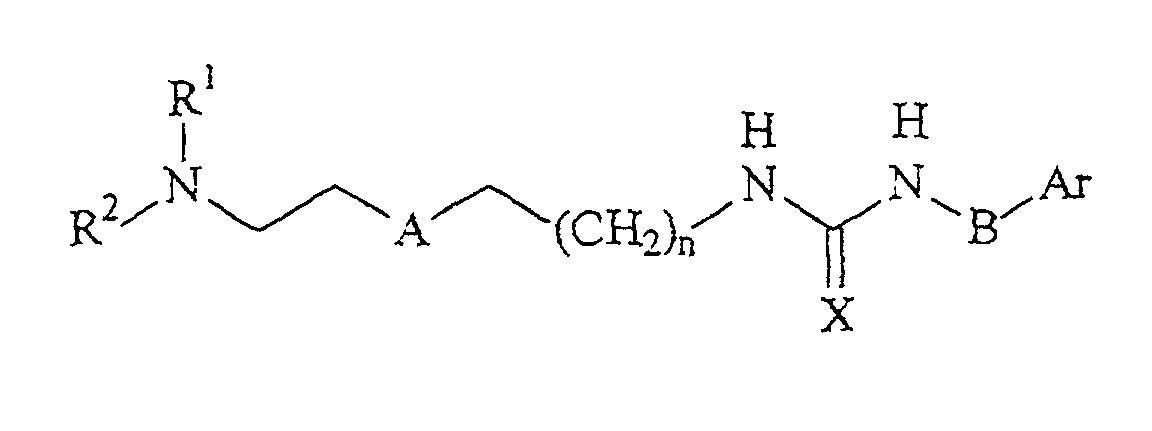
- EP-A-0377967 describes compounds of formula:(wherein X is a phenyl group or a monocyclic 5 or 6 membered heteroaryl group, either of which groups is optionally fused to a saturated or unsaturated 5-7 membered carbocyclic or heterocyclic ring; A is a linking moiety; Z is oxygen or sulphur; and R is methyl or ethyl) and their pharmaceutically acceptable salts. The compounds are described as having 5-HT3 receptor antagonist activity.

- EP-A-0526313 describes urea derivatives of the general formula:in which R1 represents a C1-C4 alkyl group; R2 represents a C5-C7 cycoalkyl group, a cycoalkyl methyl group wherein the cycoalkyl radical contains 5 to 7 carbon atoms, a benzyl group or a benzyl group in which the aromatic ring carries a C1-C4 alkyl group, a C1-C4 alkoxy group, a halogen atom or a nitro group; A represents an oxygen atom or a methylene radical; n represents I or 2; X represents an oxygen or sulphur atom, and B represents a direct bond, a methylene radical or a carbonyl radical, as well as the therapeutically acceptable salts of these molecules. The urea derivatives are said to inhibit acetylcholinesterase and are said to be useful for the treatment of illnesses such as myasthenia, memory dysfunction and dementia, such as senile dementia and Alzheimer's disease.
- EP-A-0092647 describes compounds of formula:(in which R is a piperidine group, 4-methyl piperidine, (3-N-ethyl-piperidinyl) amine, 4-(2-hydroxyethyl)-1-piperazine, 4-benzyl piperidine, 4-benzyl piperazine, ethylene amine, cyclopropylene amine, cyclohexyl amine, 1,4-cyclohexadienyl amine, 1,4-cyclohexadienyl-2-methyl amine, 1,4-cyclohexadienyl-2-ethyl amine, hexamethylene amine, (N-hexamethylene amine) amine, cycloheptyl amine, cyclopentyl amine, pyrrolidine, morpholine, endo-2-norbornyl amine, norbornen-2-yl amine) and their pharmaceutically acceptable salts and their use in the treatment of ulcers and skin allergy symptons.

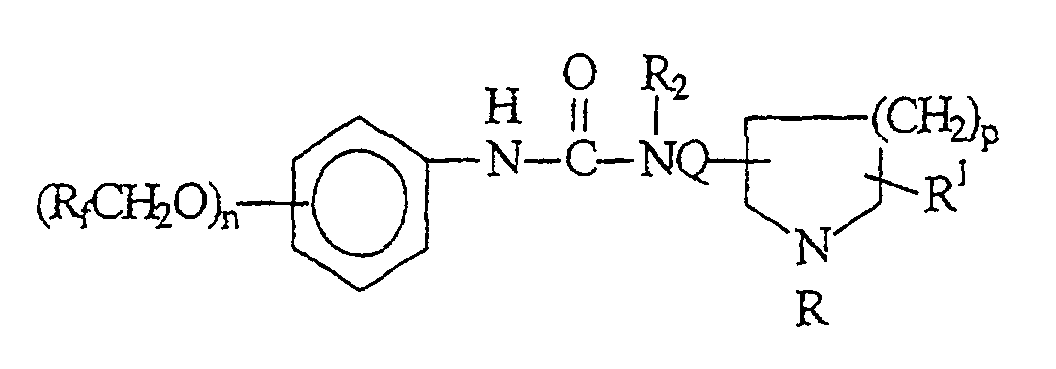
- US-A-4071524 describes compounds of formula:wherein Rf is a perfluoroalkyl radical containing one to three carbon atoms, n is one to three, p is one or two, Q is a carbon-nitrogen bond, methylene or methylmethylene, R and R1 are hydrogen, methyl or ethyl, and R2 is lower alkyl or hydrogen, provided that when Q is a carbon-nitrogen bond it is bonded to the 3 position of the heterocyclic ring and when it is methylene or methylmethylene it is bonded to the 2 position, and pharmaceutically acceptable salts thereof. These compounds are suitable as active antiarrhythmic agents.
- According to one aspect of the invention, there is provided a diaminomethylidene derivative represented by formula (1)wherein
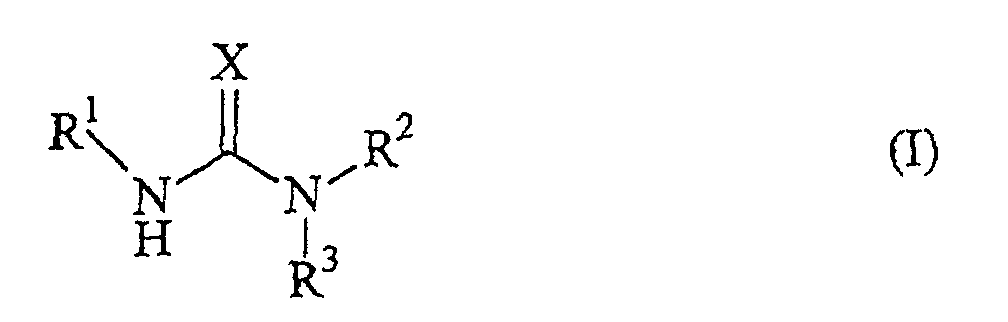
- R1 is a hydrogen atom, a C1-C6 alkyl group, a C3-C6 cycloalkyl group, a C3-C6 cycloalkyl C1-C4 alkyl group, an aryl group or an aryl C1-C4 alkyl group, in which the aryl moiety of the aryl group or aryl C1-C4 alkyl group may be optionally substituted with a halogen atom, a C1-C6 alkyl group, a halo C1-C6 alkyl group, a C1-C6 alkoxy group, a C1-C6 alkoxycarbonyl group, a phenyl group or an amino group;
- X is O, S, CHNO2, C(COOR4)2, C(COOR4) CN or C(CN)2, in which R4 is a C1-C6 alkyl group, a C3-C6 cycloalkyl group, an aryl group, or an aryl C1-C4 alkyl group; and
- R2 is a group of the following general formula (II) or (III)

- X is CHNO2, C(COOR4)2, C(COOR4) CN or C(CN)2, in which R4 is as defined above; and
- R2 is a group of the following general formula (IV)
(wherein j is 0-3, k is 0-3, and the sum of j and k is 1-6, and Q is O);

- R3 is a hydrogen atom, a C1-C6 alkyl group or a C1-C6 alkoxy C2-C6 alkyl group;
- R5 is an aryl C1-C4 alkyl group, a heteroaryl C1-C4 alkyl group, an aryloxy C2-C6 alkyl group, or a pyrrolidinylcarbonyl C1-C4 alkyl group, in which the aryl moiety of the said groups may be optionally substituted with a halogen atom, a C1-C6 alkyl group, a halo C1-C6 alkyl group, a C1-C6 alkoxy group, a C1-C6 alkoxycarbonyl group, a phenyl group or an amino group; and
- R7 is a hydrogen atom, a C1-C6 alkyl group or a C1-C4 alkoxy C2-C4 alkyl group; or a pharmacologically acceptable salt thereof.
-
- These diaminomethylidene derivatives can promote the release of aceytlcholine.
- In formula (I) for the diaminomethylidene derivatives of this invention, the C1-C6 alkyl group represented by R1 may include methyl, ethyl, n-propyl, isopropyl, n-butyl, isobutyl, n-pentyl, neo-pentyl, n-hexyl and the like; the C3-C6 cycloalkyl group may include cyclopropyl, cyclopentyl or cyclohexyl; the aryl group may include phenyl, naphthyl, o-fluorophenyl, m-fluorophenyl, p-fluorophenyl, o-chlorophenyl, m-chlorophenyl, p-chlorophenyl, 3,4-dichlorophenyl, o-methylphenyl, m-methylphenyl, p-methylphenyl, o-ethylphenyl, m-ethylphenyl, p-ethylphenyl, o-methoxyphenyl, m-methoxyphenyl, p-methoxyphenyl, o-ethoxyphenyl, m-ethoxyphenyl, p-ethoxyphenyl, 3,4-dimethoxyphenyl, o-methoxycarbonylphenyl, m-methoxycarbonylphenyl, p-methoxycarbonylphenyl, o-aminophenyl, m-aminophenyl, p-aminophenyl and the like; the C3-C6 cycloalkyl C1-C4 alkyl group may include cyclopropylmethyl, cyclohexylmethyl and the like; the aryl C1-C4 alkyl group may include benzyl, phenethyl, o-fluorobenzyl, m-fluorobenzyl, p-fluorobenzyl, o-chlorobenzyl, m-chlorobenzyl, p-chlorobenzyl, 3,4-dichlorobenzyl, o-methylbenzyl, m-methylbenzyl, p-methylbenzyl, o-trifluoromethylbenzyl, m-trifluoromethylbenzyl, p-trifluoromethylbenzyl, o-methoxybenzyl, m-methoxybenzyl, p-methoxybenzyl, 3,4-dimethoxybenzyl, o-methoxycarbonylbenzyl, m-methoxycarbonylbenzyl, p-methoxycarbonylbenzyl, biphenyl-2-ylmethyl, biphenyl-3-ylmethyl, biphenyl-4-ylmethyl, o-aminobenzyl, m-aminobenzyl, p-aminobenzyl, o-fluorophenethyl, m-fluorophenethyl, p-fluorophenethyl, o-chlorophenethyl, m-chlorophenethyl, p-chlorophenethyl, 3,4-dichlorophenethyl, o-methylphenethyl, m-methylphenethyl, p-methylphenethyl, o-trifluoromethylphenethyl, m-trifluoromethylphenethyl, p-trifluoromethylphenethyl, o-methoxyphenethyl, m-methoxyphenethyl, p-methoxyphenethyl, 3,4-dimethoxyphenethyl, o-methoxycarbonylphenethyl, m-methoxycarbonylphenethyl, p-methoxycarbonylphenethyl, 2-(biphenyl-2-yl)ethyl, 2-(biphenyl-3-yl)ethyl, 2-(biphenyl-4-yl)ethyl, o-aminophenethyl, m-aminophenethyl, p-aminophenethyl and the like; the C1-C6 alkyl group represented by R4 may include methyl, ethyl, n-propyl, isopropyl, n-butyl, isobutyl, n-pentyl, neo-pentyl, n-hexyl and the like; the C3-C6 cycloalkyl group may include cyclopropyl, cyclopentyl, cyclohexyl and the like; the aryl group may include phenyl, naphthyl and the like; the aryl C1-C4 alkyl group may include benzyl, phenethyl and the like; the C1-C6 alkyl group represented by R3 may include methyl, ethyl, n-propyl, isopropyl, n-butyl, isobutyl, n-pentyl, neo-pentyl, n-hexyl and the like; the C1-C6 alkoxy C2-C6 alkyl group may include 2-methoxyethyl, 2-ethoxyethyl and the like.
- The aryl C1-C4 alkyl group represented by R5 in formulae (II) - (IV) may include benzyl, phenethyl, o-fluorobenzyl, m-fluorobenzyl, p-fluorobenzyl, o-chlorobenzyl, m-chlorobenzyl, p-chlorobenzyl, 3,4-dichlorobenzyl, o-methylbenzyl, m-methylbenzyl, p-methylbenzyl, o-trifluoromethylbenzyl, m-trifluoromethylbenzyl, p-trifluoromethylbenzyl, o-methoxybenzyl, m-methoxybenzyl, p-methoxybenzyl, 3,4-dimethoxybenzyl, o-methoxycarbonylbenzyl, m-methoxycarbonylbenzyl, p-methoxycarbonylbenzyl, biphenyl-2-ylmethyl, biphenyl-3-ylmethyl, biphenyl-4-ylmethyl, o-aminobenzyl, m-aminobenzyl, p-aminobenzyl, o-fluorophenethyl, m-fluorophenethyl, p-fluorophenethyl, o-chlorophenethyl, m-chlorophenethyl, p-chlorophenethyl, 3,4-dichlorophenethyl, o-methylphenethyl, m-methylphenethyl, p-methylphenethyl, o-trifluoromethylphenethyl, m-trifluoromethylphenethyl, p-trifluoromethylphenethyl, o-methoxyphenethyl, m-methoxyphenethyl, p-methoxyphenethyl, 3,4-dimethoxyphenethyl, o-methoxycarbonylphenethyl, m-methoxycarbonylphenethyl, p-methoxycarbonylphenethyl, 2-(biphenyl-2-yl)ethyl, 2-(biphenyl-3-yl)ethyl, 2-(biphenyl-4-yl)ethyl, o-aminophenethyl, m-aminophenethyl, p-aminophenethyl and the like; the heteroaryl C1-C4 alkyl group may include 2-pyridylmethyl, 3-pyridylmethyl, 4-pyridylmethyl, lH-indol-3-ylethyl and the like; the aryloxy C2-C6 alkyl group may include phenoxy-2-ethyl, phenoxy-3-propyl, 2-fluorophenoxy-3-propyl, 3-fluorophenoxy-3-propyl, 4-fluorophenoxy-3-propyl, 2-chlorophenoxy-3-propyl, 3-chlorophenoxy-3-propyl, 4-chlorophenoxy-3-propyl, 3,4-dichlorophenoxy-3-propyl and the like; the pyrrolidinylcarbonyl C1-C4 alkyl group may include pyrrolidinylcarbonylmethyl group and the like.
- The C1-C6 alkyl group represented by R7 may include methyl, ethyl, n-propyl, isopropyl, n-butyl, isobutyl, n-pentyl, neo-pentyl, n-hexyl and the like; the C1-C4 alkoxy C2-C4 alkyl group may include methoxyethyl, ethoxyethyl and the like.
- The compounds represented by formula (I) of this invention may be prepared according to the process as explained below.
- That is to say, the compound represented by formula (I) may be prepared by reacting a methylthioaminomethylidene compound represented by formula (XI)wherein R1 has the same meaning as above and X' is CHNO2, C(COOR4)2, C(COOR4)CN or C(CN)2, and R4 is a C1-C6 alkyl group, a C3-C6 cycloalkyl group, an aryl group or an aryl C1-C4 alkyl group, with an amino compound represented by formula (XII)

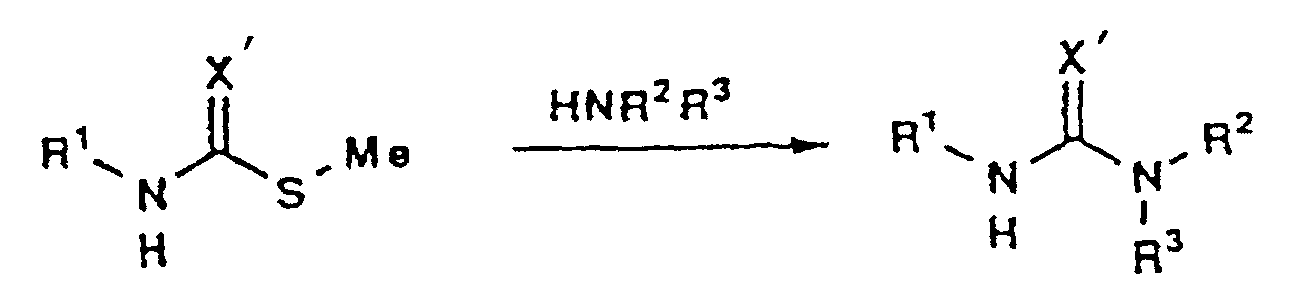
- Examples of the methylthioaminomethylidene compounds may illustratively include 2-benzylamino-2-methylthio-1,1-ethylenedicarbonitrile, 2-methylamino-2-methylthio-1,1-ethylenedicarbonitrile, 2-phenylamino-2-methylthio-1,1-ethylenedicarbonitrile, 2-cyclohexylamino-2-methylthio-1,1-ethylenedicarbonitrile, 2-isobutylamino-2-methylthio-1,1-ethylenedicarbonitrile, ethyl 3-cyclohexylamino-3-methylthio-2-cyanoacrylate, ethyl 2-cyano-3-methylamino-3-methylthioacrylate, ethyl 2-cyano-3-phenylamino-3-methylthioacrylate, ethyl 2-cyano-3-isobutylamino-3-methylthioacrylate, ethyl 3-benzylamino-2-cyano-3-methylthioacrylate, ethyl 2-cyano-3-(p-methoxyphenyl)amino-3-methylthioacrylate, N-(1-methylthio-2-nitrovinyl)-N-methylamine, 2-[4-(p-fluorobenzyl)-2-morpholinylmethylamino]-2-methylthio-1,1-ethylenedicarbonitrile and the like.
- Examples of the amino compounds may illustratively include 2-aminomethyl-4-(p-fluorobenzyl)morpholine, endo-7-amino-9-(p-fluorobenzyl)-9-aza-3-oxabicyclo[3.3.1]-nonane, endo-7-amino-9-[3-(p-fluorophenoxypropyl)]-9-aza-3-oxabicyclo[3.3.1]nonane and the like.
- The reaction of the aminomethylidene compound with the amino compound may be carried out using an amount of the amino compound of 0.2-5 moles, preferably 0.5-2 moles, per mole of the methylthioaminomethylidene compound. The reaction may be preferably carried out in an organic solvent at a temperature ranging from -78°C to a boiling point of the solvent used, and the reaction may proceed very easily so that the reaction may proceed usually at a temperature from room temperature to about 45°C under warming. The organic solvent which may be employed herein may include dimethylformamide, acetonitrile, dimethyl sulfoxide, acetone, ethyl acetate, ether, chloroform, methylene chloride, tetrahydrofuran, dioxane, toluene, benzene and the like and dimethylformamide or acetonitrile may be preferably used.
- The desired product thus prepared may be isolated and purified from the reaction mixture by way of well-known purification means such as concentration, extraction, chromatographic purification, recrystallization and others.
- Further, the compounds represented by formula (I) wherein X is 0 or S may be prepared by the reaction of an isocyanate or isothiocyanate compound represented by formula (XIII)

- Examples of the isocyanate compounds may illustratively include phenyl isocyanate, methyl isocyanate, benzyl isocyanate, cyclohexyl isocyanate, isobutyl isocyanate, p-methoxyphenyl isocyanate and the like. Examples of the isothiocyanate compounds may illustratively include phenyl isothiocyanate, methyl isothiocyanate, benzyl isothiocyanate, cyclohexyl isothiocyanate, isobutyl isothiocyanate, p-methoxyphenyl isothiocyanate and the like.
- Examples of the amino compounds may illustratively include 2-aminomethyl-4-(p-fluorobenzyl)morpholine, endo-7-amino-9-(p-fluorobenzyl)-9-aza-3-oxabicyclo[3.3.1]-nonane, endo-7-amino-9-[3-(p-fluorophenoxypropyl)]-9-aza-3-oxabicyclo[3.3.1]nonane and the like.
- The reaction of the isocyanate or isothiocyanate compound with the amino compound may be carried out using an amount of the amino compound of 0.2-5 moles, preferably 0.5-2 moles, per mole of the isocyanate or isothiocyante compound. The reaction may be preferably carried out in an organic solvent at a temperature ranging from room temperature to a boiling point of the solvent used, and the reaction may proceed very easily so that the reaction may be proceed usually at a temperature from room temperature to about 45°C by under slightly warming. The organic solvent which may be employed may include dimethylformamide, acetonitrile, dimethylsulfoxide, acetone, ethyl acetate, ether, chloroform, methylene chloride, tetrahydrofuran, dioxane, toluene, benzene and the like and dimethylformamide or acetonitrile may be preferably used. Illustrative compounds of the present invention may be given below in terms of their chemical names;
- 2-benzylamino-2-[4-(p-fluorobenzyl)-2-morpholinylmethylamino]-1,1-ethylenedicarbonitrile,
- 2-cyclohexylamino-2-[4-(p-fluorobenzyl)-2-morpholinylmethylamino]-1,1-ethylenedicarbonitrile,
- 2-[4-(p-fluorobenzyl)-2-morpholinylmethylamino]-2-phenylamino-1,1-ethylenedicarbonitrile,
- 2-[4-(p-fluorobenzyl)-2-morpholinylmethylamino]-2-methylamino-1,1-ethylenedicarbonitrile,
- 2-[4-(p-fluorobenzyl)-2-morpholinylmethylamino]-2-isobutylamino-1,1-ethylenedicarbonitrile,
- ethyl 3-benzylamino-3-[4-(p-fluorobenzyl)-2-morpholinylmethylamino]-2-cyanoacrylate,
- ethyl 3-[4-(p-fluorobenzyl)-2-morpholinylmethylamino]-3-phenylamino-2-cyanoacrylate,
- ethyl 3-[4-(p-fluorobenzyl)-2-morpholinylmethylamino]-3-isobutylamino-2-cyanoacrylate,
- ethyl 3-cyclohexylamino-3-[4-(p-fluorobenzyl)-2-morpholinylmethylamino]-2-cyanoacrylate,
- ethyl 3-[4-(p-fluorobenzyl)-2-morpholinylmethylamino]-3-(p-methoxybenzyl)amino-2-cyanoacrylate,
- ethyl 3-[4-(p-fluorobenzyl)-2-morpholinylmethylamino]-3-methylamino-2-cyanoacrylate,
- ethyl 3-cyclohexylamino-3-[7-(p-fluorophenyl)-6-aza-3-oxaheptylamino]-2-cyanoacrylate,
- 2-(p-fluorobenzylamino)-2-[4-(p-fluorobenzyl)-2-morpholinylmethylamino]-1,1-ethylenedicarbonitrile,
- ethyl 2-cyano-3-[endo-9-(p-fluorobenzyl)-9-aza-3-oxabicyclo-[3.3.1]non-7-ylamino]-3-methylaminoacrylate,
- 2-[endo-9-(p-fluorobenzyl)-9-aza-3-oxabicyclo[3.3.1]non-7-ylamino]-2-methylamino-1,1-ethylenedicarbonitrile,
- 2-[endo-9-[3-(p-fluorophenoxy)propyl]-9-aza-3-oxabicyclo-[3.3.1]non-7-ylamino]-2-methylamino-1,1-ethylenedicarbonitrile,
- N-[endo-9-(p-fluorobenzyl)-9-aza-3-oxabicyclo[3.3.1]non-7-yl]-N'-methyl-2-nitrovinylidene-1,1-diamine,
- 1-[4-(p-fluorobenzyl)-2-morpholinylmethyl]-3-phenylurea, 1-[4-(p-fluorobenzyl)-2-morpholinylmethyl]-3-methylurea,
- 1-[endo-9-(p-fluorobenzyl)-9-aza-3-oxabicyclo[3.3.1]non-7-yl]-3-methylurea,
- 2-[4-(p-chlorobenzyl)-2-morpholinylmethylamino]-2-methylamino-1,1-ethylenedicarbonitrile,
- 2-[4-(3,4-dichlorobenzyl)-2-morpholinylmethylamino]-2-methylamino-1,1-ethylenedicarbonitrile,
- 2-[4-(p-trifluoromethylbenzyl)-2-morpholinylmethylamino]-2-methylamino-1,1-ethylenedicarbonitrile,
- 2-(4-benzyl-2-morpholinylmethylamino)-2-methylamino-1,1-ethylenedicarbonitrile,
- 2-methylamino-2-[4-(4-pyridylmethyl)-2-morpholinylmethylamino]-1,1-ethylenedicarbonitrile,
- 2-[4-(biphenyl-4-ylmethyl)-2-morpholinylmethylamino]-2-methylamino-1,1-ethylenedicarbonitrile,
- 2-[4-(p-methoxybenzyl)-2-morpholinylmethylamino]-2-methylamino-1,1-ethylenedicarbonitrile,
- 2-[4-(p-fluorobenzyl)-3-morpholinylmethylamino]-2-methylamino-1,1-ethylenedicarbonitrile,
- 2-[endo-9-(p-fluorobenzyl)-9-aza-3-oxabicyclo[3.3.1]non-7-ylamino]-2-methylamino-1,1-ethylenedicarbonitrile,
- 2-[exo-9-(p-fluorobenzyl)-9-aza-3-oxabicyclo[3.3.1]non-7-ylamino]-2-methylamino-1,1-ethylenedicarbonitrile,
-
- The compounds of the present invention as described above have a remarkable gastrointestinal prokinetic action, thus being useful as a therapeutic agent for digestive tract diseases, as will be proved in the following Examples.
- The present compounds represented by formula (I) may be converted, if desired, to the corresponding acid addition salts with pharmaceutically acceptable acids. The acid addition salts are included within the scope of this invention, which include, for example, the salts with inorganic acids such as hydrochloric acid, hydrobromic acids, sulfuric acid, nitric acid, phosphoric acid and the like, or the salts with organic acids such as acetic acid, succinic acid, oxalic acid, malic acid, tartaric acid and the like.
- The compounds represented by formula (I) when they are to be applied as medicines may be formulated to various dosage forms. More specifically, the preparations thus formed may be administered orally in a dosage form of tablets, sugar-coated tablets, hard capsules, soft capsules or in the form of solutions, emulsions, suspensions and the like. In parenteral administration, they may be given in the form of injections.
- In preparing such pharmaceutical preparations, the present compounds may be formulated using those additives conventionally used for formulation, such as excipients, stabilizers, preservatives, solubilizers, wetting agents, emulsions, lubricants, sweeteners, colorants, flavorings, tonicity agents, buffers, antioxidants and the like.
- Route and dosage of administration for the present gastrointestinal prokinetic agent are not specifically limited and are appropriately chosen depending upon various dosage forms, sex of the patients, severity of the diseases. Daily dose of the active ingredient is 0.001 mg to 1000 mg.
- According to a further aspect of the present invention there is a provided a gastrointestinal prokinetic agent which comprises as active ingredient a compound of formula (I) or a pharmacologically acceptable salt thereof, if necessary, in admixture with a pharmaceutically acceptable additive.
- According to another aspect the invention provides a compound of the formula (I) or a pharmaceutically acceptable salt thereof for use in the therapy of digestive tract disorders derived from chronic gastritis, diabetes mellitus, post-gastrectomy and peptic ulcer and digestive tract diseases including reflux esophagitis, irritable bowel syndrome and spurious ileus.
- A further aspect of the present invention provides use of the compound of formula (I) or a pharmacologically acceptable salt thereof in the manufacture of a medicament for use in the treatment of digestive tract disorders derived from chronic gastritis, diabetes mellitus, post-gastrectomy and peptic ulcer and digestive tract diseases including reflux esophagitis, irritable bowel syndrome and spurious ileus.
- This invention will be explained in greater detail by way of the following Preparation Examples and Examples. However, it is to be noted that Preparation Examples are given to explain the synthetic examples in regard to the starting compounds to be used for preparing the present compounds, while the Examples are given for explaining the synthesis and use of this invention as medicines. Those Preparation Examples and Examples are given simply for the purpose of explaining this invention.
-

- To a solution of malononitrile (1.21 g, 18.3 mmol) in DMF (40 ml) was added under ice-cooling sodium hydride (0.77 g, 19.2 mmol). After stirring for one hour, benzyl isothiocyanate (2.73 g, 18.3 mmol) was added dropwise. After stirring under ice-cooling for 1.5 hours, methyl iodide (2.60 g, 18.3 mmol) was added dropwise. After stirring at room temperature for 15 hours, water (400 ml) was added to the reaction mixture, which was then extracted with ethyl acetate (100 ml x 2). The organic layer was washed with a saturated aqueous solution of sodium chloride, dried over sodium sulfate and concentrated under reduced pressure. The residue was purified by silica gel column chromatography to give the title compound as a yellow oily substance (2.94 g) from the fraction from hexane-ethyl acetate (2/1). Yield=70%.
1HNMR(CDCl3) δ2.63(s,3H), 4.71(d,J=6Hz,2H), 6.82(bs,1H), 7.22-7.42(m,5H)
IR(film) 3204, 2190, 1727, 1638, 1561, 1408, 1235, 1045, 735cm-1
MS m/z 229(M+) -

- This compound was synthesized from malononitrile and methyl isothiocyanate according to the same process as in Preparation Example 1. Yield=43%.
m.p. 118-121°C (recrystallized from hexane-ethyl acetate)
1HNMR(CDCl3) δ2.68(s,3H), 3.22(d,J=5Hz,3H), 6.28(bs,1H)
IR(KBr) 3318, 2208, 2186, 1548, 1403, 1285cm-1
MS m/z 153(M+) -
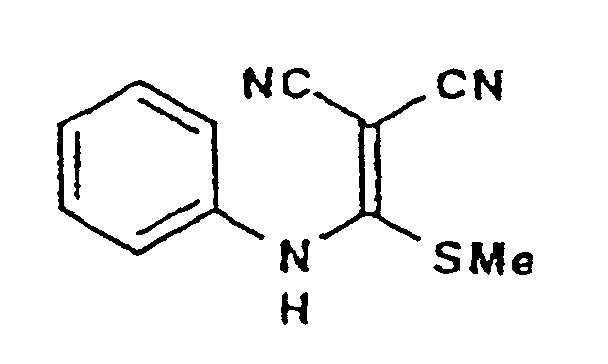
- This compound was synthesized from malononitrile, phenyl isothiocyanate and methyl iodide according to the same process as in Preparation Example 1. Yield=66%.
m.p. 170-176°C (recrystallized from ethanol)
1HNMR(CDCl3) δ2.29(s,3H), 7.26-7.29(m,2H), 7.31-7.36(m,1H), 7.41-7.46(m,2H), 7.86(bs,1H)
IR(KBr) 3292, 2208, 2198, 2184, 1597, 1526, 1494, 1451, 1265, 968, 761, 701cm-1
MS m/z 215(M+) -
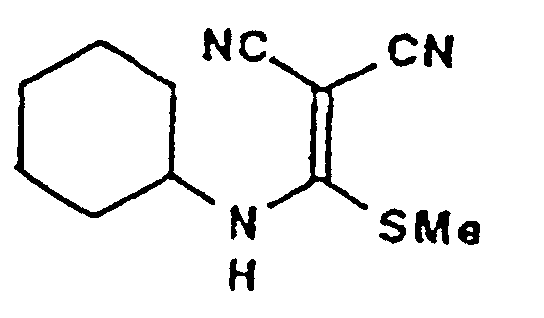
- This compound was synthesized from malononitrile, cyclohexyl isothiocyanate and methyl iodide according to the same process as in Preparation Example 1. Yield=99%.
m.p. 102-103°C (recrystallized from hexane-ethyl acetate)
1HNMR(CDCl3) δ1.21-1.41(m,5H), 1.64-1.68(m,1H), 1.78-1.83(m,2H), 1.97-2.00(m,2H), 2.68(s,3H), 3.86-3.94(m,1H), 5.99(bs,1H)
IR(KBr) 3252, 2936, 2210, 2192, 1568, 1562, 1422, 1357, 732 cm-1
MS m/z 221(M+) -

- This compound was synthesized as a yellow oily substance from malononitrile, isobutyl isothiocyanate and methyl iodide according to the same process as in Preparation Example 1. Yield=91%.
1HNMR(CDCl3) δ0.98(d,J=7Hz,6H), 1.85-1.96(m,1H), 2.67(s,3H), 3.38(t,J=6Hz,2H), 6.49(bs,1H)
IR(film) 3242, 2962, 2210, 1562, 1373, 1271cm-1
MS m/z 195(M+) -

- To a solution of ethyl cyanoacetate (2.07 g, 18.3 mmol) in DMF (40 ml) was added under ice-cooling sodium hydride (0.77 g, 19.2 mmol). After stirring for one hour, cyclohexyl isothiocyanate (2.59 g, 18.3 mmol) was added dropwise. After stirring under ice-cooling for 1.5 hours, methyl iodide (2.60 g, 18.3 mmol) was added dropwise. After stirring at room temperature for 15 hours, water (400 ml) was added to the reaction mixture, which was then extracted with ethyl acetate (100 ml x 2). The organic layer was washed with a saturated aqueous solution of sodium chloride, dried over sodium sulfate and concentrated under reduced pressure. The residue was purified by silica gel column chromatography to give the title compound as a yellow oily substance (4.76 g) from the fraction from hexane-ethyl acetate (4/1). Yield=97%.
1HNMR(CDCl3) δ1.24-1.41(m,5H), 1.32(t,J=7Hz,3H), 1.61-1.64(m,1H), 1.75-1.78(m,2H), 1.90-1.93(m,2H), 2.70(s,3H), 3.93-3.96(m,1H), 4.21(q,J=7Hz,2H), 10.10(bs,1H)
IR(KBr) 2932, 2856, 2206, 1656, 1563, 1259, 1143, 1031, 783 cm-1.
MS m/z 268(M+) -
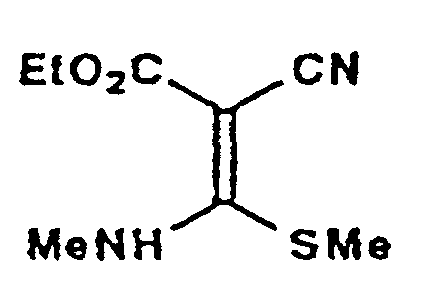
- This compound was synthesized from ethyl cyanoacetate, methyl isothiocyanate and methyl iodide according to the same process as in Preparation Example 6. Yield=98%.
m.p. 87-88°C (recrystallized from hexane-ethyl acetate)
1HNMR(CDCl3) δ1.32(t,J=7Hz,3H), 2.68(s,3H), 3.20(d,J=5Hz,3H),4.21(q,J=7Hz,2H), 10.00(bs,1H)
IR(KBr) 2200, 1650, 1587, 1382, 1266, 1031, 775cm-1
MS m/z 200(M+) -
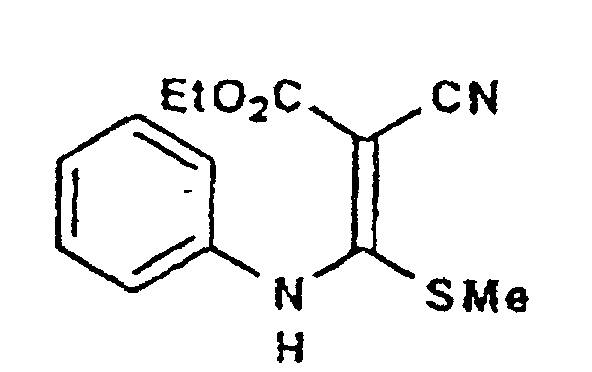
- This compound was synthesized from ethyl cyanoacetate, phenyl isothiocyanate and methyl iodide according to the same process as in Preparation Example 6. Yield=68%.
m.p. 70-71°C (recrystallized from hexane-ethyl acetate)
1HNMR(CDCl3) δ1.35(t,J=7Hz,3H), 2.23(s,3H), 4.26(q,J=7Hz,2H),7.29-7.32(m,3H), 7.38-7.43(m,2H), 11.51(bs,1H)
IR(KBr) 2204, 1656, 1561, 1377, 1265, 1027, 767cm-1
MS m/z 263(M+) -
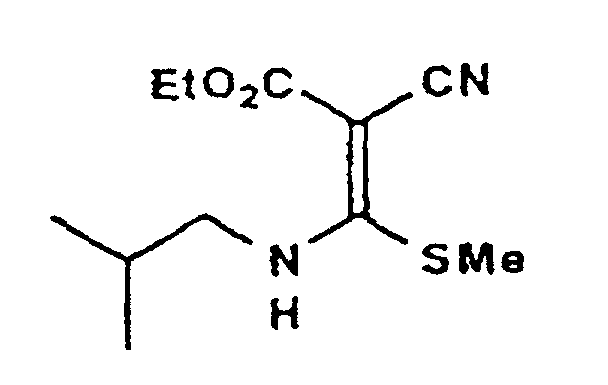
- This compound was synthesized as a yellow oily substance from ethyl cyanoacetate, isobutyl isothiocyanate and methyl iodide according to the same process as in Preparation Example 6. Yield=80%.
1HNMR(CDCl3) δ0.98(d,J=7Hz,6H), 1.33(t,J=7Hz,3H), 1.82-1.96(m,1H), 2.67(s,3H), 3.42(t,J=7Hz,2H), 4.22(q,J=7Hz,2H), 10.17(bs,1H)
IR(KBr) 2874, 2206, 1655, 1573, 1400, 1383, 1270, 1188, 1137, 784cm-1
MS m/z 242(M+) -

- This compound was synthesized from ethyl cyanoacetate, benzyl isothiocyanate and methyl iodide according to the same process as in Preparation Example 6. Yield=61%.
m.p. 61-62°C (recrystallized from hexane-ethyl acetate)
1HNMR(CDCl3) δ1.31(t,J=7Hz,3H), 2.65(s,3H), 4.20(q,J=7Hz,2H), 4.77(d,J=6Hz,2H), 7.23-7.39(m,5H), 10.39(bs,1H)
IR(KBr) 3176, 2206, 1674, 1544, 1401, 1264, 1246, 1195, 742 cm-1
MS m/z 276(M+) -
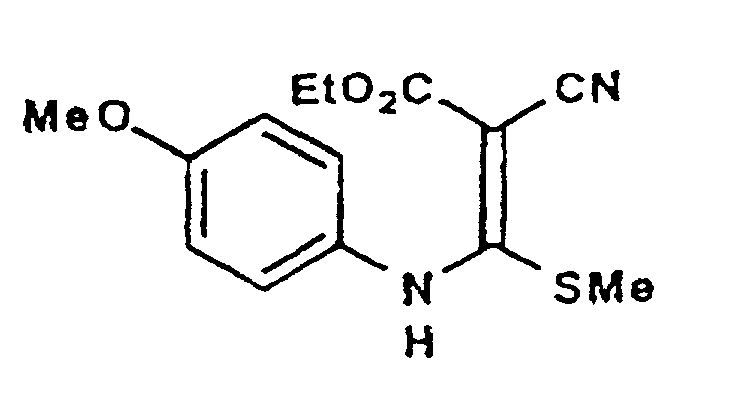
- This compound was synthesized from ethyl cyanoacetate, p-methoxyphenyl isothiocyanate and methyl iodide according to the same process as in Preparation Example 6.
m.p. 83-85°C (recrystallized from hexane-ethyl acetate)
1HNMR(CDCl3) δ1.35(t,J=7Hz,3H), 2.27(s,3H), 3.83(s,3H), 4.26(q,J=7Hz,2H), 6.91(d,J=9Hz,2H), 7.19(d,J=9Hz,2H), 11.42(bs,1H)
IR(KBr) 3122, 2208, 1667, 1611, 1540, 1509, 1378, 1263, 1245, 1168, 1018, 781cm-1
MS m/z 292(M+) -

- To a solution of 2-benzylamino-2-methylthio-1,1-ethylenedicarbonitrile (0.80 g, 3.49 mmol) in acetonitrile (20 ml) was added 2-aminomethyl-4-(p-fluorobenzyl)morpholine (1.17 g, 5.23 mmol) and the mixture was stirred at room temperature for 8 hours. The reaction mixture was concentrated under reduced pressure and the residue was purified by silica gel column chromatography to give the title compound as a yellow oily substance (0.90 g) from the fraction from hexane-ethyl acetate (1/1). Yield=64%.
1HNMR(CDCl3) δ1.88(t,J=11Hz,1H), 2.02-2.08(m,1H), 2.61(t,J=10Hz,2H), 3.16-3.23(m,1H), 3.29-3.35(m,1H), 3.42(d,J=13Hz,1H), 3.46(d,J=13Hz,1H), 3.54-3.60(m,2H), 3.67(dd,J=2Hz,11Hz,1H), 4.53-4.62(m,2H), 6.02(bs,1H), 6.98-7.04(m,2H), 7.14(bs,1H), 7.23-7.41(m,6H)
MS m/z 405(M+) - To a solution of the title compound (0.50 g) in ethanol (10 ml) was added under ice-cooling while stirring a solution of 4N hydrochloric acid-ethyl acetate (0.3 ml). The reaction mixture was concentrated under reduced pressure to give the corresponding hydrochloride (0.40 g) as a yellow amorphous.
m.p. 112-114°C
IR(KBr) 3300, 2202, 2176, 1562, 1515, 1229, 700cm-1 -

- This compound was synthesized as a yellow oily substance from 2-cyclohexylamino-2-methylthio-1,1-ethylenedicarbonitrile and 2-aminomethyl-4-(p-fluorobenzyl)-morpholine according to the same procedure as in Example 1. Yield=27%.
1HNMR(CDCl3) δ1.21-1.28(m,4H), 1.35-1.44(m,2H), 1.59-1.72(m,4H), 1.91-2.00(m,3H), 2.14(dt,J=3Hz,11Hz,1H), 2.63-2.69(m,2H), 3.29-3.34(m,1H), 3.43(d,J=13Hz,1H), 3.47(d,J=13Hz,1H), 3.62-3.74(m,2H), 3.84-3.91(m,1H), 6.98-7.04(m,2H), 7.25-7.29(m,2H)
MS m/z 397(M+) - Then, the corresponding hydrochloride was prepared in a conventional manner.
m.p. 128-132°C
IR(KBr) 3240, 2930, 2200, 2174, 1515, 1228cm-1 -

- This compound was synthesized from 2-phenylamino-2-methylthio-1,1-ethylenedicarbonitrile and 2-aminomethyl-4-(p-fluorobenzyl)morpholine according to the same procedure as in Example 1. Yield=61%.
m.p. 65-67°C (a foamy solid)
1HNMR(CDCl3) δ1.95(t,J=11Hz,1H), 2.18(dt,J=3Hz,12Hz,1H), 2.65-2.70(m,2H), 3.25-3.31(m,2H), 3.40-3.52(m,3H), 3.67-3.75(m,2H), 3.54(d,J=10Hz,1H), 6.24(bs,1H), 7.00-7.04(m,2H), 7.10(d,J=8Hz,2H), 7.20-7.29(m,3H), 7.36-7.40(m,2H), 8.36(bs,1H)
IR(KBr) 3258, 2206, 2182, 1607, 1588, 1510, 1222, 692cm-1
MS m/z 391(M+) -

- This compound was synthesized from 2-methylamino-2-methylthio-1,1-ethylenedicarbonitrile and 2-aminomethyl-4-(p-fluorobenzyl)morpholine according to the same procedure as in Example 1. Yield=87%.
m.p. 143-144°C (recrystallized from ethanol)
1HNMR(CDCl3) δ1.93(t,J=10Hz,1H), 2.17(dt,J=3Hz,11Hz,1H), 2.67(t,J=10Hz,2H), 3.08(d,J=5Hz,3H), 3.17-3.24(m,1H), 3.30-3.36(m,1H), 3.46(d,J=13Hz,1H), 3.51(d,J=13Hz,1H), 3.62-3.66(m,1H), 3.71(dt,J=2Hz,11Hz,1H), 3.92(dd,J=2Hz,11Hz,1H), 5.70(t,J=5Hz,1H), 6.69(bs,1H), 6.99-7.05(m,2H), 7.23-7.30(m,2H)
IR(KBr) 3294, 2870, 2204, 2174, 1603, 1586, 1509, 1221, 1058, 845cm-1
MS m/z 329(M+) -

- This compound was synthesized as a yellow oily substance from 2-isobutylamino-2-methylthio-1,1-ethylenedicarbonitrile and 2-aminomethyl-4-(p-fluorobenzyl)-morpholine according to the same procedure as in Example 1. Yield=48%.
1HNMR(CDCl3)δ0.97 (d,J=7Hz,6H), 1.82-1.92(m,1H), 1.95(t,J=11Hz,1H), 2.15(dt,J=3Hz,12Hz,1H), 2.67(d,J=12Hz,2H), 3.17-3.35(m,4H),3.47(d,J=13Hz,1H), 3.51(d,J=13Hz,1H), 3.62-3.66(m,1H), 3.71(dt,J=2Hz,11Hz,1H), 3.88(dd,J=2Hz,11Hz,1H), 5.96(t,J=6Hz,1H), 7.00-7.05(m,2H), 7.26-7.29(m,2H)
IR(KBr) 3310, 2960, 2202, 2176, 1575, 1516, 1230, 1092, 845cm-1
MS m/z 371(M+) - Then, the corresponding hydrochloride was prepared in a conventional manner.
m.p. 110-114°C -
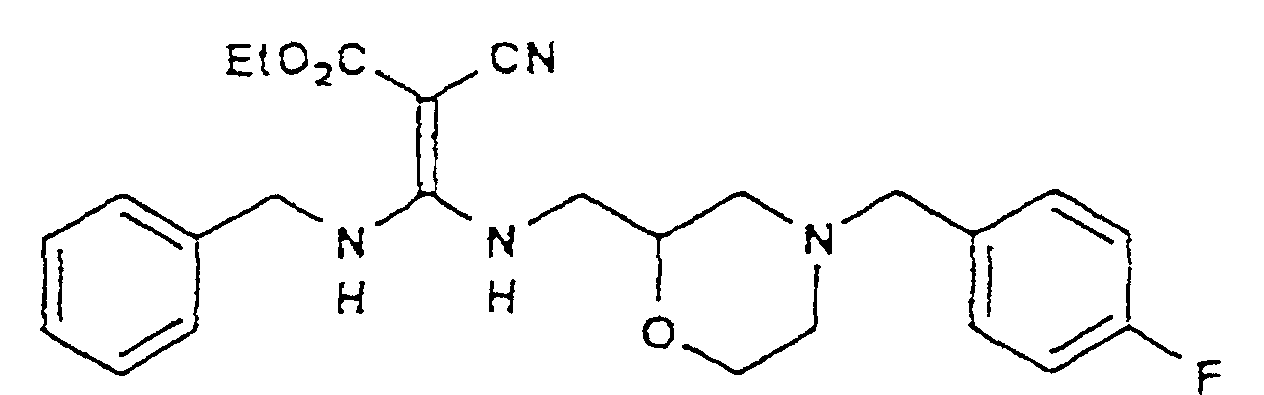
- To a solution of ethyl 3-benzylamino-3-methylthio-2-cyanoacrylate (1.07 g, 3.87 mmol) in acetonitrile (10 ml) was added 2-aminomethyl-4-(p-fluorobenzyl)morpholine (0.90 g, 4.02 mmol) and the mixture was stirred at room temperature for 10 hours. The reaction mixture was concentrated under reduced pressure and the residue was purified by silica gel column chromatography to give the title compound as white crystals (0.70 g) from the fraction from hexane-ethyl acetate (1/1). Yield=40%.
m.p. 107-108°C (recrystallized from hexane-ethyl acetate)
1HNMR(CDCl3) δ1.30(t,J=7Hz,3H), 1.86(t,J=11Hz,1H), 2.08(dd,J=3Hz, 12Hz,1H), 2.59(d,J=11Hz,2H), 3.27(bs,1H), 3.37-3.46(br,1H),3.38(d,J=13Hz,1H), 3.45(d,J=13Hz,1H), 3.53-3.59(m,2H), 3.70(d,J=11Hz,1H), 4.18(q,J=7Hz,2H), 4.58(bs,2H), 6.97-7.02(m,2H), 7.22-7.39(m,7H)
IR(KBr) 3220, 2192, 1657, 1604, 1515, 1288, 1228, 1123, 1096, 775cm-1
MS m/z 452(M+) - Then, the corresponding hydrochloride was prepared in a conventional manner.
m.p. 103-107°C -

- This compound was synthesized from ethyl 3-phenylamino-3-methylthio-2-cyanoacrylate and 2-aminomethyl-4-(p-fluorobenzyl)morpholine according to the same procedure as in Example 6. Yield=66%.
m.p. 114-116°C
1HNMR(CD3OD) δ1.26(bs,3H), 1.89(t,J=11Hz,1H), 2.19(t,J=11Hz,1H), 2.65(m,2H), 3.15-3.24(m,2H), 3.45(d,J=13Hz,1H), 3.50(d,J=13Hz,1H), 3.66(bs,2H), 3.91(d,J=11Hz,1H), 4.14(bs,2H), 7.02-7.33(m,9H)
IR(KBr) 3168, 2482, 2200, 1654, 1612, 1516, 1455, 1285, 1113, 1096, 771, 751, 696cm-1
MS m/z 438(M+) - Then, the corresponding hydrochloride was prepared in a conventional manner.
m.p. 174-179°C. -

- This compound was synthesized as a yellow oily substance from ethyl 3-isobutylamino-3-methylthio-2-cyanoacrylate and 2-aminomethyl-4-(p-fluorobenzyl)morpholine according to the same procedure as in Example 6. Yield=22%.
1HNMR(CDCl3) δ0.98(d,J=7Hz,6H), 1.29(t,J=7Hz,3H), 1.82-1.90(m,1H), 1.96(t,J=11Hz,1H), 2.17(dt,J=3Hz,12Hz,1H), 2.66(d,J=11Hz,2H), 3.15-3.42(m,4H), 3.43(d,J=13Hz,1H), 3.50(d,J=13Hz,1H), 3.64-3.73(m,2H), 3.90(dd,J=2Hz,11Hz,1H), 4.16(q,J=7Hz,2H), 6.98-7.03(m,2H), 7.25-7.29(m,2H)
IR(film) 3254, 2960, 2190, 1656, 1605, 1569, 1517, 1288, 1232,1112, 776cm-1
MS m/z 418(M+) - Then, the corresponding hydrochloride was prepared in a conventional manner.
m.p. 133-136°C -

- This compound was synthesized as a yellow oily substance from ethyl 3-cyclohexylamino-3-methylthio-2-cyanoacrylate and 2-aminomethyl-4-(p-fluorobenzyl)-morpholine according to the same procedure as in Example 6. Yield=10%.
1HNMR(CDCl3) δ1.22-1.31(m,6H), 1.28(t,J=7Hz,3H), 1.35-1.44(m,2H), 1.58-1.61(m,1H), 1.70-1.73(m,2H), 1.98-1.93(m,3H), 2.17(dt,J=3Hz,11Hz,1H), 2.66(d,J=11Hz,2H), 3.27(bs,1H), 3.40(bs,1H), 3.44(d,J=13Hz,1H), 3.50(d,J=13Hz,1H), 3.67-3.72(m,2H), 3.90(dd,J=2Hz,11Hz,1H), 4.16(q,J=7Hz,2H), 6.98-7.03(m,2H), 7.25-7.29(m,2H)
IR(film) 3228, 2856, 2190, 1656, 1605, 1515, 1287, 1228, 1124, 1094, 77cm-1
MS m/z 444(M+) - Then, the corresponding hydrochloride was prepared in a conventional manner.
m.p. 105-113°C -
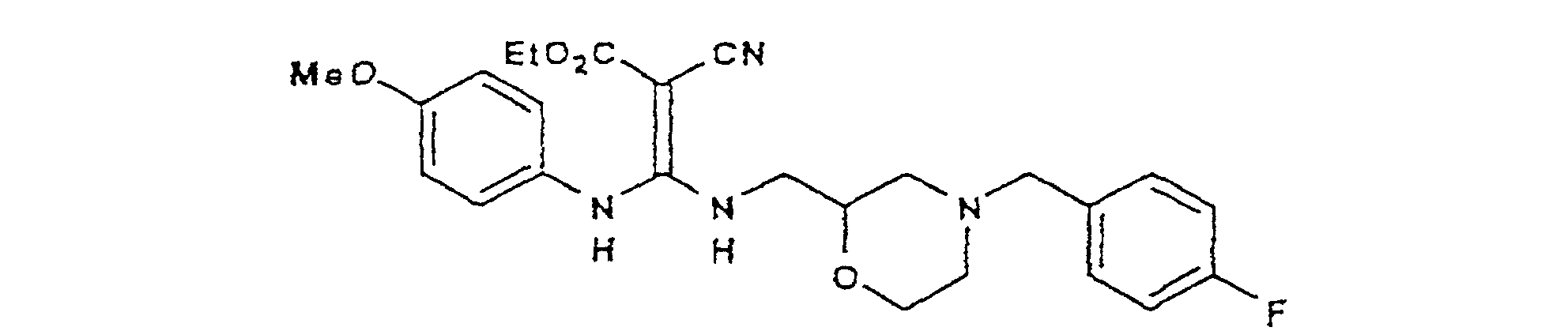
- This compound was synthesized from ethyl 3-(p-methoxyphenyl)amino-3-methylthio-2-cyanoacrylate and 2-aminomethyl-4-(p-fluorobenzyl)morpholine according to the same procedure as in Example 6. Yield=71%.
m.p. 131-133°C
1HNMR(DMSO-d6) δ1.18(t,J=7Hz,3H), 1.79(t,J=11Hz,1H), 2.08(dt,J=3Hz,11Hz,1H), 2.59(d,J=11Hz,2H), 3.12-3.27(m,2H), 3.34(s,3H), 3.39(d,J=13Hz,1H), 3.47(d,J=13Hz,1H), 3.50-3.57(m,2H), 3.82(d,J=11Hz,1H), 4.05(q,J=7Hz,2H), 6.88(d,J=9Hz,2H), 7.00(d,J=9Hz,2H), 7.10-7.14(m,2H), 7.29-7.33(m,2H)
IR(KBr) 3240, 2932, 2196, 1656, 1615, 1513, 1250, 1239, 1220, 1117, 1142, 825cm-1
MS m/z 468(M+) - Then, the corresponding hydrochloride was prepared in a conventional manner.
m.p. 125-131°C -
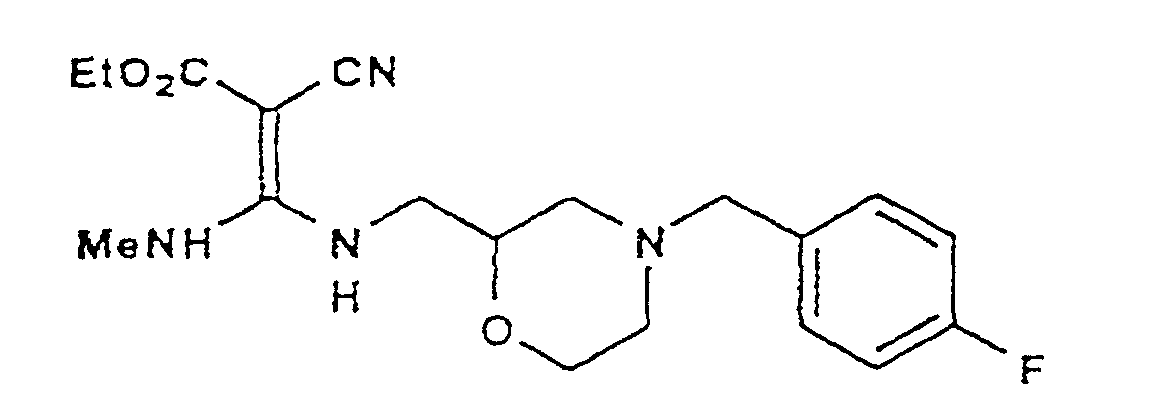
- This compound was synthesized as a yellow oily substance from ethyl 3-methylamino-3-methylthio-2-cyanoacrylate and 2-aminomethyl-4-(p-fluorobenzyl)morpholine according to the same procedure as in Example 6. Yield=53%.
1HNMR(CDCl3) δ1.30(t,J=7Hz,3H), 1.95(1,J=11Hz,1H), 2.17(dt,J=3Hz,11Hz,1H), 2.65(d,J=11Hz,2H), 3.06(bs,3H), 3.23-3.55(m,2H), 3.43(d,J=13Hz,1H), 3.50(d,J=13Hz,1H), 3.66-3.73(m,2H), 3.91(dd,J=2Hz,11Hz,1H), 4.17(q,J=7Hz,2H), 6.99-7.03(m,2H), 7.29-7.50(m,2H)
IR(film) 3232, 2186, 1738cm-1
MS m/z 376(M+) -
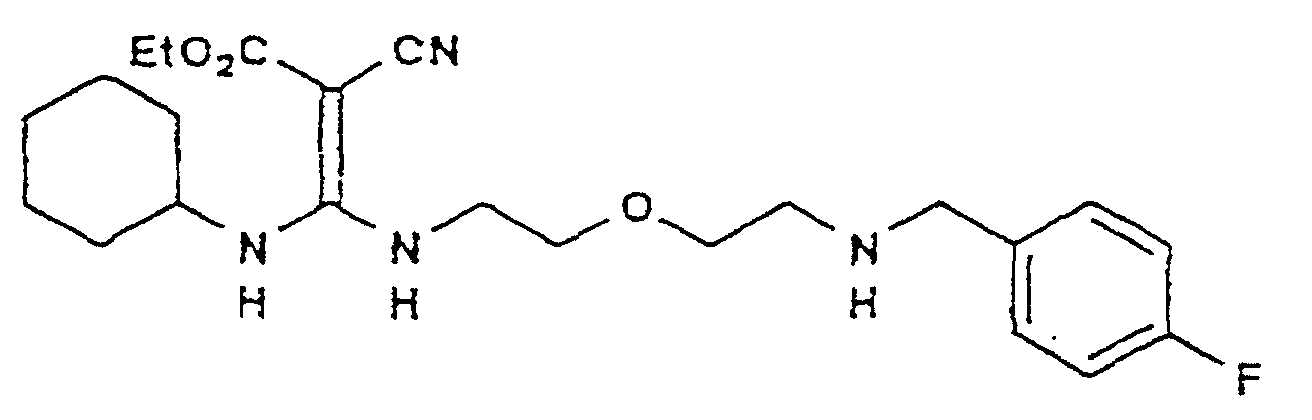
- To a solution of ethyl 3-cyclohexylamino-3-methylthio-2-cyanoacrylate (1.50 g, 5.60 mmol) in acetonitrile (10 ml) was added tert-butoxy N-(5-amino-3-oxapentyl)-N-(p-fluorobenzyl)carbamate (3.10 g, 11.2 mmol) and the mixture was stirred at room temperature for 18 hours. The reaction mixture was concentrated and the residue was purified by silica gel column chromatography to give the title compound as a pale yellow oily substance (1.72 g) from the fraction from hexane-ethyl acetate (2/1). Yield=58%.
1HNMR(CDCl3) δ1.16-1.44(m,4H), 1.29(t,J=7Hz,3H), 1.44(bs,9H),1.58-1.64(m,2H), 1.70-1.72(m,2H), 1.94-2.04(m,2H), 3.33-3.55(m,8H), 4.16(q,J=7Hz,2H), 4.43(bs,2H), 6.99-7.04(m,2H), 7.19(bs, 2H)
IR(film) 3308, 2932, 2193, 1607, 1513cm-1 - To a solution of ethyl 3-[6-(tert-butyloxycarbonyl)-7-(p-fluorophenyl)-6-aza-3-oxaheptylmethyl]-3-cyclohexylamino-2-cyanoacrylate (1.72 g, 3.23 mmol) in methanol (15 ml) was added a 4N hydrochloric acid-ethyl acetate solution (2.5 ml) and the mixture was stirred at room temperature for 14 hours. The reaction mixture was concentrated and water (50 ml) was added to the residue. The mixture was adjusted to pH 12 with an aqueous solution of sodium hydroxide and extracted with chloroform (50 ml x 3). The organic layer was dried over sodium sulfate and the solvent was distilled off under reduced pressure. The residue was purified by silica gel column chromatography to give the title compound as a yellow oily substance (1.06 g) from the fraction from chloroform-methanol-aqueous ammonia (30/1/0.05). Yield=76%.
1HNMR(CDCl3) δ1.23-1.40(m,8H), 1.58-1.61(m,1H), 1.70-1.75(m,4H), 1.95-1.98(m,2H), 2.81(t,J=5Hz,2H), 3.58-3.65(m,5H), 3.78(s,2H), 4.13(q,J=7Hz,2H), 6.99-7.03(m,2H), 7.26-7.31(m,2H)
IR(film) 3222, 2856, 2190, 1649, 1223, 778cm-1
MS m/z 432(M+) - Then, the corresponding hydrochloride was prepared in a conventional manner (a colorless and high viscous oil).
-

-
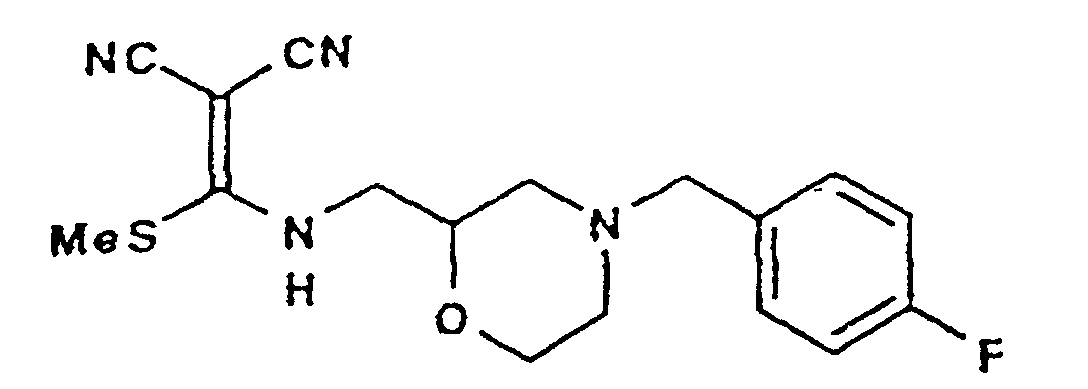
- To a solution of 2-aminomethyl-4-(p-fluorobenzyl)-morpholine (500 mg, 2.23 mmol) in acetonitrile (10 ml) was added 2,2-dimethylthio-1,1-ethylenedicarbonitrile (417 mg, 2.46 mmol) and the mixture was stirred at room temperature for 2.5 hours. The reaction mixture was concentrated under reduced pressure and the residue was subjected to silica gel column chromatography to give the title compound (650 mg) from the fraction from ethyl acetate-hexane (2/1). Yield=84%.
1HNMR(CDCl3) δ1.92(t,J=10Hz,1H), 2.21(dt,J=3Hz,11Hz,1H), 2.52-2.76(m,2H), 2.62(s,3H), 3.35-3.57(m,3H), 3.58-3.79(m,3H), 3.82-3.97(s,1H), 6.30-6.53(br,1H), 7.02(t,J=8Hz,2H), 7.15-7.36(m,2H) - To a solution of 2-[4-(p-fluorobenzyl)-2-morpholinylmethylamino]-2-methylthio-1,1-ethylenedicarbonitrile (650 mg, 1.88 mmol) in acetonitrile (7 ml) was added p-fluorobenzylamine (0.24 ml, 2.1 mmol), and the mixture was heated under reflux for 13 hours. The reaction mixture was concentrated under reduced pressure to distill off the solvent and the residue was chromatographed using silica gel column to give the title compound (760 mg) as a pale yellow oily substance from the fraction from ethyl acetate-hexane (2/1). Yield=96%.
1HNMR(CDCl3) δ1.87(t,J=11.23Hz,1H), 1.98-2.12(m,1H), 2.51-2.68(m,2H), 3.11-3.23(m,1H), 3.23-3.36(m,1H), 3.42(d,J=12.7Hz,1H), 3.48(d,J=13.19Hz,1H), 3.51-3.73(m,3H), 4.56(d,J=4.88Hz,2H),5.62-5.78(brm,1H), 6.90-7.13(m,4H), 7.18-7.32(m,4H)
IR(film) 3300, 2205, 2180, 1600, 1580, 1505cm-1 -

- To a solution of endo-7-amino-9-(p-fluorobenzyl)-9-aza-3-oxabicyclo[3.3.1]nonane (280 mg, 0.979 mmol) in acetonitrile (5 ml) was added ethyl 2-cyano-3-methylamino-3-methylthioacrylate (249 mg, 1.27 mmol) and the mixture was stirred at room temperature for 1.5 hours and then heated under reflux for 8 hours. The reaction mixture was concentrated under reduced pressure and the residue was subjected to silica gel column chromatography to give the title compound (220 mg) from the fraction with ethyl acetate-hexane (1/1). Yield=52%.
1HNMR(CDCl3) δ1.29(t,J=7Hz,3H), 1.54(d,J=16Hz,2H), 2.41-2.58(m,2H), 2.65-2.80(m,2H), 2.85(d,J=5Hz,3H), 3.79(d,J=14Hz,4H), 3.98(d,J=11Hz,2H), 4.17(q,J=7Hz,2H), 4.73(bs,1H), 6.95-7.06(m,2H), 7.29(m,2H), 7.82(bs,1H), 9.00(bs,1H)
IR(KBr) 3275, 2200, 1645cm-1 -

- This compound was synthesized from endo-7-amino-9-(p-fluorobenzyl)-9-aza-3-oxabicyclo[3.3.1]nonane and 2-methylamino-2-methylthio-1,1-ethylenedicarbonitrile according to the same procedure as in Example 14. Yield=100%.
m.p. 226.5-228°C
1HNMR(CDCl3) δ1.42-1.72(m,4H), 1.40-1.60(m,2H), 2.65-2.80(br,2H), 2.86(d,J=5Hz,3H), 3.76(d,J=9Hz,2H), 3.99(d,J=11Hz,2H), 3.41-3.63(br,1H), 5.23-5.42(br,1H), 7.01(t,J=8Hz,2H), 7.18-7.47(m,2H), 8.13(d,J=11Hz,1H)
IR(film) 2200, 2175, 1560cm-1 -

- This compound was synthesized from 2-methylamino-2-methylthio-1,1-ethylenedicarbonitrile and endo-7-amino-9-[3-(p-fluorophenoxy)propyl]-9-aza-3-oxabicyclo[3.3.1]-nonane according to the same procedure as in Example 14. Yield=32%.
m.p. 195-196°C (recrystallized from hexane-ethyl acetate)
1HNMR(CDCl3)δ 1.52(d,J=16Hz,2H), 1.86(dd,J=6Hz,7Hz,2H), 2.43-2.50(m,2H), 2.78-2.81(m,4H), 2.85(d,J=5Hz,3H), 3.77(d,J=12Hz, 2H), 3.96(d,J=11Hz,2H), 3.99(t,J=6Hz,2H), 4.46(bs,1H), 5.51(bs,1H), 6.80-6.85(m,2H), 6.94-7.00(m,2H), 8.10(d,J=10Hz,1H)
IR(KBr) 3282, 2200, 2176, 1559, 1509, 1428, 1386, 1338, 1247, 1205, 831cm-1
MS m/z 399(M+) -
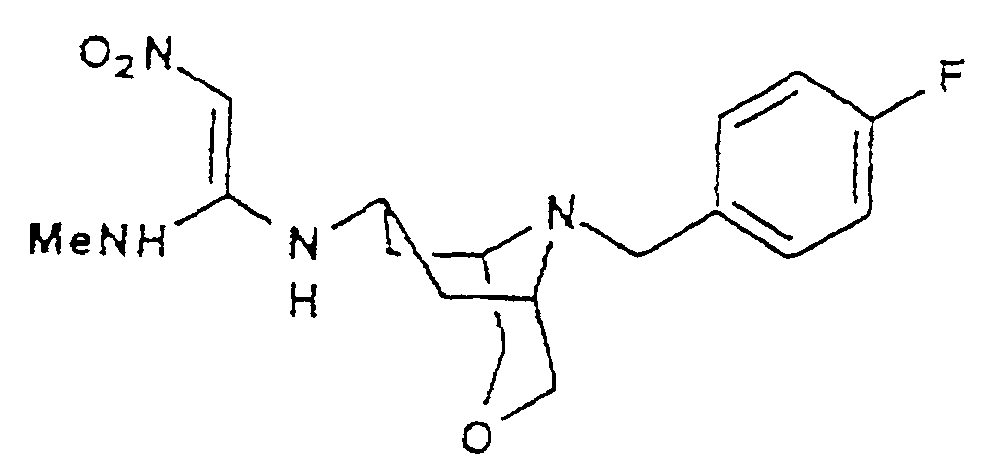
- endo-7-Amino-9-aza-9-(p-fluorobenzyl)-3-oxabicyclo[3.3.1]nonane (1.55 g) and N-(1-methylthio-2-nitrovinyl)-N-methylamine (2.11 g) were heated at 80°C for 2 hours. The reaction mixture was purified by silica gel column chromatography to give the title compound (0.65 g) from the fraction from chloroform-methanol-aqueous ammonia (20/1/0.5). Yield=30%.
m.p. 184-186°C
1HNMR(CDCl3) δ1.48(d,J=15Hz,2H), 2.39-2.45(m,2H), 2.73(bs, 2H), 2.89(d,J=5Hz,3H), 3.73(d,J=11Hz,2H), 3.80(s,2H), 3.81-3.87(m,2H), 4.01(d,J=11Hz,2H), 6.66(s,1H), 6.99-7.05(m,2H), 7.30- 7.34(m,2H), 7.85(d,J=10Hz,1H), 10.23(bs,1H)
IR(KBr) 2940, 1676, 1570, 1516, 1229, 1072, 924cm-1 - To a solution of the title compound (0.63 g) in chloroform (10 ml) was added uncer ice-cooling a 4N hydrochloric acid-ethyl acetate solution (0.5 ml). The crystal thus separated out was recovered by filtration and dried under reduced pressure to give the corresponding hydrochloride (0.64 g).
m.p. 180°C (dec.) -

- To a solution of 2-aminomethyl-4-(p-fluorobenzyl)-morpholine (1.0 g, 4.5 mmol) in dimethylformamide (10 ml) was added under ice-cooling phenyl isocyanate (0.53 ml, 4.9 mmol) and the mixture was stirred for 30 minutes- To the reaction mixture was added purified water (20 ml) and the crystals thus separated out were then recovered by filtration to give the title compound (1.1 g). Yield=72%.
1HNMR(CDCl3) δ1.93(t,J=11Hz,1H,), 2.13(dt,J=3Hz,12Hz,1H,), 2.63(d,J=11Hz,1H,), 2.70(d,J=11Hz,1H), 3.10-3.22(m,1H), 3.38- 3.50(m,1H), 3.44(s,2H), 3.58-3.70(m,2H), 3.84(dd,J=1Hz,11Hz,1H),5.10-5.23(br,1H), 6.70-6.89(br,1H), 6.94-7.14(m,3H), 7.19-7.39(m,6H)
IR(KBr) 3350, 1648, 1562, 1500, 1220cm-1 - Then, the corresponding hydrochloride was prepared in a conventional manner.
m.p. 183-187°C -
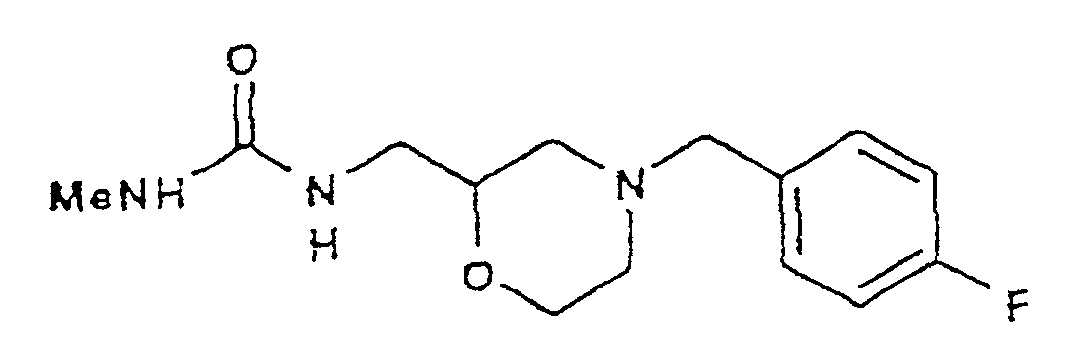
- This compound was synthesized from 2-aminomethyl-4-(p-fluorobenzyl)morpholine and methyl isocyanate according to the same procedure as in Example 18. Yield=65%.
m.p. 164-166°C
1HNMR(CDCl3) δ1.90(t,J=11Hz,1H), 2.12(dt,J=3Hz,11Hz,1H), 2.62(dd,J=1Hz,11Hz,1H), 2.69(dd,J=2Hz,11Hz,1H), 2.76(d,J=5Hz,3H), 3.01-3.13(m,1H), 3.31-3.49(m,1H), 3.44(s,2H), 3.52-3.61(m,2H), 3.75-3.90(m,1H), 4.50-4.82(br,2H), 7.00(t,J=9Hz,2H), 7.18-7.34(m,2H)
IR(film) 3320, 1638, 1590cm-1 -

- To a solution of endo-7-amino-9-(p-fluorobenzyl)-9-aza-3-oxabicyclo[3.3.1]nonane (670 mg, 2.34 mmol) in toluene (7 ml) was added under ice-cooling methyl isocyanate (0.15 ml, 2.6 mmol) and the mixture was stirred for 30 minutes. To the reaction mixture was added ethyl acetate (30 ml) and the mixture was washed with a 10% aqueous sodium hydroxide solution (20 ml), dried over potassiun carbonate and the solvent was distilled off under reduced pressure. The residue was subjected to silica gel column chromatography to give the title compound (690 mg) from the fraction from methanol-chloroform (1/9). Yield=86%.
m.p. 167-169°C
1HNMR(CDCl3) δ1.41(d,J=15Hz,2H), 2.31-2.44(m,2H), 2.62(bs, 2H), 2.74(d,J=5Hz,3H), 3.72(d,J=11Hz,2H), 3.78(s,2H), 3.94(d,J=11Hz,2H), 4.29-4.40(m,1H), 4.44-4.61(m,1H), 6.93-7.12(m,2H), 7.26-7.39(m,2H)
IR(film) 3375, 1645cm-1 - Acetylcholine-release promoting action of the present compounds in the gastrointestinal tract was investigated according to the following procedure. A longitudinal muscle sample (including myenteric plexus) was prepared from the ileum excised from guinea pig and suspended in Magnus' tube. This sample was perfused in a physiological salt solution and stimulated by the electric current via platinum electrodes. Acetylcholine was released from the myenteric plexus of the sample by this stimulation and the longitudinal muscle was observed to contract. This contraction was isometrically recorded. Accordingly, the drug capable of accelerating the release of acetylcholine could enhance the contraction caused by electric stimulation only. Evaluation of the compounds was represented in terms of increase ratio in contraction by electrical stimulation. The tested compounds are shown in terms of the numbers of the corresponding Examples. The results are shown below.
Contraction increase rate (%) Example No. 10-7M 10-5M 1 3.9 12.3 2 5.3 5 4.9 6 3.0 20.3 7 0.7 8 8.5 32.4 9 8.7 31.9 10 9.1 11.8 12 0.8 7.9 13 4.9 15.0 15 3.9 16 3.1 17 3.2 5.7 19 9.8 20 4.2 - Finally, illustrative examples of the pharmaceutical compositions which comprises as an active ingredient the present compound are given below by way of the following Examples.
-
The compound of Example 8 1 mg Lactose 70 mg Crystalline cellulose 20 mg Corn starch 8 mg Magnesium stearate 1 mg Total 100 mg - All components were uniformly mixed to form a powder for direct compression. This powder was formed to tablets, each having a diameter of 6 mm and a weight of 100 mg.
-
A The compound of Example 9 1 mg Lactose 99 mg Corn starch 50 mg Crystalline cellulose 50 mg B Hydroxypropylcellulose 10 mg Ethanol 9 mg - After all components of the above group A were uniformly mixed, the solution of the above group B was added. The mixture was kneaded, graded by an extrusion granulation method and then dried in a drier at 50°C. The granules as dried up was sieved to a grain size of 297 µm - 1460 µm, thereby forming granules. One package comprised 200 mg.
-
The compound of Example 1 0.100 g Sucrose 30.000 g D-Sorbitol 70w/v% 25.900 g Ethyl para-hydroxybenzoate 0.030 g Propyl para-hydroxybenzoate 0.015 g Flavors 0.200 g Glycerol 0.150 g 96% Ethanol 0.500 g Distilled water to make up a total volume to 100 ml - The sucrose, D-sorbitol, ethyl para-hydroxybenzoate, propyl para-hydroxybenzoate and compound of Example 1 were dissolved in 60 g of hot water. After cooling, a solution of the flavors in the glycerol and ethanol was added. Then, the water was added to the resulting mixture to make up to a 100 ml volume.
- The diaminomethylidene derivatives (I) or pharmacologically acceptable salts thereof as provided by the present invention can be applied for the therapy of digestive tract disorders derived from chronic gastritis, diabetes mellitus, post-gastrectomy and peptic ulcer and digestive tract diseases including reflux esophagitis, irritable bowel syndrome and spurious ileus, thus being useful as a gastrointestinal prokinetic agent.
Claims (16)
- A diaminomethylidene derivative represented by formula (1)wherein
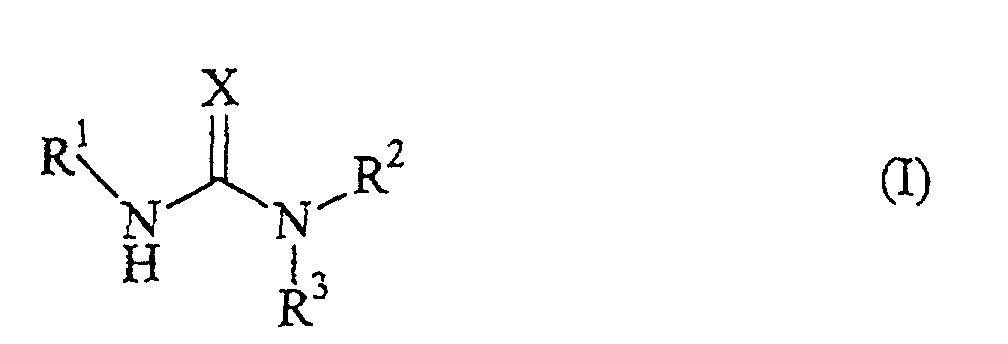 R1 is a hydrogen atom, a C1-C6 alkyl group, a C3-C6 cycloalkyl group, a C3-C6 cycloalkyl C1-C4 alkyl group, an aryl group or an aryl C1-C4 alkyl group, in which the aryl moiety of the aryl group or aryl C1-C4 alkyl group may be optionally substituted with a halogen atom, a C1-C6 alkyl group, a halo C1-C6 alkyl group, a C1-C6 alkoxy group, a C1-C6 alkoxycarbonyl group, a phenyl group or an amino group;X is O, S, CHNO2, C(COOR4)2, C(COOR4) CN or C(CN)2, in which R4 is a C1-C6 alkyl group, a C3-C6 cycloalkyl group, an aryl group, or an aryl C1-C4 alkyl group; andR2 is a group of the following general formula (II) or (III); or
 X is CHNO2, C(COOR4)2, C(COOR4) CN or C(CN)2, in which R4 is as defined above; andR2 is a group of the following general formula (IV)(wherein j is 0-3, k is 0-3, and the sum of j and k is 1-6, and Q is O);
 R3 is a hydrogen atom, a C1-C6 alkyl group or a C1-C6 alkoxy C2-C6 alkyl group;R5 is an aryl C1-C4 alkyl group, a heteroaryl C1-C4 alkyl group, an aryloxy C2-C6 alkyl group, or a pyrrolidinylcarbonyl C1-C4 alkyl group, in which the aryl moiety of the said groups may be optionally substituted with a halogen atom, a C1-C6 alkyl group, a halo C1-C6 alkyl group, a C1-C6 alkoxy group, a C1-C6 alkoxycarbonyl group, a phenyl group or an amino group; andR7 is a hydrogen atom, a C1-C6 alkoxy C2-C4 alkyl group;or a C1-C4 alkyl group; or a pharmacologically acceptable salt thereof.
 - A compound according to claim 1 where R1 is a methyl, isobutyl, cyclohexyl, phenyl, p-methoxyphenyl, benzyl or p-fluorobenzyl group.
- A compound according to claim 1 or 2 wherein R3 is a hydrogen atom.
- A compound according to any preceding claim wherein R5 is a p-fluorobenzyl or a 3-(p-fluorophenoxy) propyl group.
- A compound according to claim 1 in whichR1 is a methyl, isobutyl, cyclohexyl, phenyl or benzyl group,X is C(COOC2H5)CN or C(CN)2,R2 is p-fluorobenzyl-2-morpholinyl methyl, andR3 is a hydrogen atom.
- A compound according to claim 1 whereinR1 is a p-methoxyphenyl group,X is a C(COOC2H5)CN group,R2 is p-fluorobenzyl-2-morpholinyl methyl, andR3 is a hydrogen atom.
- A compound according to claim 1 whereinR' is a p-fluorobenzyl group,X is a C(CN)2 group,R2 is p-fluorobenzyl-2-morpholinyl methyl, andR3 is a hydrogen atom.
- A compound according to claim 1 whereinR' is a methyl group,X is O, C(COOC2H5)CN, CHNO2 or C(CN)2 group,R2 is a group of the fomnula (II), wherein R5 is a p-fluorobenzyl group, andR3 is a hydrogen atom.
- A compound according to claim 1 whereinR1 is a cyclohexyl group,X is a C(COOC2H5)CN group,R2 is a 7-(p-fluorophenyl) - 6 aza-3oxaheptyl group andR3 is a hydrogen atom.
- A compound according to claim 1 whereinR' is a methyl group,X is C(CN)2,R2 is a compound of formula (II) wherein R5 is a 3-(p-fluorophenoxy)propyl group, andR3 is a hydrogen atom.
- A compound according to claim 1 whereinR' is a methyl or phenyl group,X is O,R2 is a group of the formula (III),R5 is a p-fluorobenzyl group, andR3 is a hydrogen atom.
- A gastrointestinal prokinetic composition which comprises, as active ingredient, a compound as claimed in any preceding claim, optionally, in admixture with a pharmaceutically acceptable additive.
- A compound as claimed in any one of claims I to 11 for use in the therapy of digestive tract disorders derived from chronic gastritis, diabetes mellitus, post-gastrectomy or peptic ulcer or digestive tract diseases.
- A compound as claimed in any one of claims I to 11 for use in the therapy of reflux esophagitis, irritable bowel syndrome or spurious ileus.
- Use of a compound as claimed in any one of claims 1 to 11 in the manufacture of a medicament for use in the treatment of digestive tract disorders derived from chronic gastritis, diabetes mellitus, post-gastrectomy or peptic ulcer or digestive tract diseases.
- Use of a compound as claimed in any one of claims 1 to 11 in the manufacture of a medicament for use in the treatment of reflux esophagitis, irritable bowel syndrome or spurious ileus.
Applications Claiming Priority (4)
| Application Number | Priority Date | Filing Date | Title |
|---|---|---|---|
| JP10357094 | 1994-05-18 | ||
| JP103570/94 | 1994-05-18 | ||
| JP10357094 | 1994-05-18 | ||
| PCT/JP1995/000938 WO1995031431A1 (en) | 1994-05-18 | 1995-05-17 | Novel diaminomethylidene derivative |
Publications (3)
| Publication Number | Publication Date |
|---|---|
| EP0760362A1 EP0760362A1 (en) | 1997-03-05 |
| EP0760362A4 EP0760362A4 (en) | 1999-09-01 |
| EP0760362B1 true EP0760362B1 (en) | 2002-08-14 |
Family
ID=14357465
Family Applications (1)
| Application Number | Title | Priority Date | Filing Date |
|---|---|---|---|
| EP95918729A Expired - Lifetime EP0760362B1 (en) | 1994-05-18 | 1995-05-17 | diaminomethylidene derivative |
Country Status (6)
| Country | Link |
|---|---|
| EP (1) | EP0760362B1 (en) |
| KR (1) | KR970703301A (en) |
| BR (1) | BR9507892A (en) |
| CA (1) | CA2189964A1 (en) |
| DE (1) | DE69527786T2 (en) |
| WO (1) | WO1995031431A1 (en) |
Families Citing this family (10)
| Publication number | Priority date | Publication date | Assignee | Title |
|---|---|---|---|---|
| US6152966A (en) * | 1998-05-13 | 2000-11-28 | Novo Nordisk A/S | Treatment of cork with a phenol oxidizing enzyme |
| US6362205B2 (en) | 1998-11-05 | 2002-03-26 | Novo Nordisk A/S | Substituted 3,3-diamino-2-propenenitriles, their preparation and use |
| AU6327199A (en) | 1998-11-05 | 2000-05-29 | Novo Nordisk A/S | Substituted 3,3-diamino-2-propenenitriles, their preparation and use |
| CZ20031194A3 (en) | 2000-09-29 | 2003-08-13 | Glaxo Group Limited | Urea derivatives |
| IL155093A0 (en) | 2000-09-29 | 2003-10-31 | Glaxo Group Ltd | Morpholin-acetamide derivatives for the treatment on inflammatory diseases |
| GB0207436D0 (en) * | 2002-03-28 | 2002-05-08 | Glaxo Group Ltd | Novel compounds |
| GB0207447D0 (en) * | 2002-03-28 | 2002-05-08 | Glaxo Group Ltd | Novel compounds |
| GB0207432D0 (en) | 2002-03-28 | 2002-05-08 | Glaxo Group Ltd | Novel compounds |
| GB0211759D0 (en) * | 2002-05-22 | 2002-07-03 | Glaxo Group Ltd | Novel compounds |
| GB0212357D0 (en) * | 2002-05-29 | 2002-07-10 | Glaxo Group Ltd | Novel compounds |
Family Cites Families (9)
| Publication number | Priority date | Publication date | Assignee | Title |
|---|---|---|---|---|
| US3585142A (en) * | 1968-09-30 | 1971-06-15 | Richardson Co | Method of removing copper-containing incrustations from ferrous metal surfaces using an aqueous acid solution of aminoalkyl thiourea |
| JPS50117790A (en) * | 1974-03-06 | 1975-09-16 | Sankyo Co | Shukugofukusokankagobutsu no seiho |
| US4071524A (en) * | 1976-11-08 | 1978-01-31 | Riker Laboratories, Inc. | Derivatives of urea |
| US4416669A (en) * | 1982-02-22 | 1983-11-22 | Shell Oil Company | Fuel and lubricant compositions for octane requirement reduction |
| IT1190793B (en) * | 1982-04-27 | 1988-02-24 | Magis Farmaceutici | ACTIVE COMPOUNDS IN THE TREATMENT OF THE ULCER AND ALLERGIC SKIN SYMPTOMS |
| NZ223654A (en) * | 1987-03-09 | 1990-03-27 | Janssen Pharmaceutica Nv | 1-alkyl-substituted-benzimidazole-4-piperidinamines and pharmaceutical compositions |
| GB8829079D0 (en) * | 1988-12-13 | 1989-01-25 | Beecham Group Plc | Novel compounds |
| JPH0477464A (en) * | 1990-07-19 | 1992-03-11 | Res Assoc Util Of Light Oil | Method for synthesizing water-soluble carbodiimide |
| FR2679555B1 (en) * | 1991-07-25 | 1993-11-19 | Fabre Medicament Pierre | NEW DERIVATIVES OF UREAE, THEIR PREPARATION AND THEIR APPLICATION IN THERAPEUTICS. |
-
1995
- 1995-05-17 WO PCT/JP1995/000938 patent/WO1995031431A1/en not_active Ceased
- 1995-05-17 CA CA002189964A patent/CA2189964A1/en not_active Abandoned
- 1995-05-17 BR BR9507892A patent/BR9507892A/en not_active Application Discontinuation
- 1995-05-17 KR KR1019960706566A patent/KR970703301A/en not_active Withdrawn
- 1995-05-17 DE DE69527786T patent/DE69527786T2/en not_active Expired - Fee Related
- 1995-05-17 EP EP95918729A patent/EP0760362B1/en not_active Expired - Lifetime
Also Published As
| Publication number | Publication date |
|---|---|
| CA2189964A1 (en) | 1995-11-23 |
| WO1995031431A1 (en) | 1995-11-23 |
| DE69527786D1 (en) | 2002-09-19 |
| BR9507892A (en) | 1997-11-18 |
| KR970703301A (en) | 1997-07-03 |
| EP0760362A4 (en) | 1999-09-01 |
| EP0760362A1 (en) | 1997-03-05 |
| DE69527786T2 (en) | 2003-04-10 |
Similar Documents
| Publication | Publication Date | Title |
|---|---|---|
| CA2176012C (en) | Novel phenylalkylaminoalcohol carbamates and process for preparing the same | |
| EP1641748B1 (en) | N-alkyl phenylcarboxamide beta-secretase inhibitors for the treatment of alzheimer s disease | |
| EP1638970B1 (en) | Pyrid (2, 1-a) - isoquinoline derivatives as dpp-iv inhibitors | |
| US8952030B2 (en) | Morphinan derivative | |
| US7855218B2 (en) | Compounds | |
| AU2022267220A1 (en) | Substituted amide macrocyclic compounds with orexin-2 receptor agonist activity | |
| WO2022251302A1 (en) | Substituted fused bicyclic macrocyclic compounds and related methods of treatment | |
| EP0760368A1 (en) | Novel pyrimidine derivative | |
| EP4347604B1 (en) | Substituted carbamate macrocyclic compounds and related methods of treatment | |
| EP0760362A1 (en) | Novel diaminomethylidene derivative | |
| JP5389917B2 (en) | Diazepan and piperazine derivative modulators of chemokine receptors | |
| JP2009514801A (en) | Quaternary .ALPHA.-aminocarboxamide derivatives as regulators of voltage-gated sodium channels | |
| US4824861A (en) | Pyrrolidone derivatives and memory enhancement use thereof | |
| US5753654A (en) | Diaminomethylidene derivatives | |
| WO1994022843A1 (en) | 2-substituted morpholine and thiomorpholine derivatives as gaba-b antagonists | |
| US4868313A (en) | A process for making pyrrolidone derivatives | |
| HK24194A (en) | Pyrrolo[1,2-a][4,1]benzoxazepines, process for their preparation, pharmaceutical compositions containing these compounds and therapeutical use | |
| US3862943A (en) | 2-Hydroxyalkyl-4,5-dihydropyridazin-3(2H)-one derivatives | |
| NZ203252A (en) | Ergot 5's-(2r-butyl)peptide alkaloid derivatives and pharmaceutical compositions | |
| JPWO1995031431A1 (en) | Novel diaminomethylidene derivatives | |
| US5977355A (en) | Processes and intermediates for preparing 3-amino-benzo(b)azepinones | |
| CN101238111A (en) | Cyclic ketal beta-secretase inhibitors for the treatment of Alzheimer's disease | |
| HK1001395A1 (en) | 6-methoxy-1h-benzotriazole-5-carboxamide derivatives, process for producing the same, and medicinal composition containing the same | |
| FR2944283A1 (en) | New N-((2-aza-bicyclo(2.1.1)hex-1-yl)-aryl-methyl)-heterobenzamide derivatives are glycine-1 transporters useful for treating e.g. cognitive disorders, psychotic depression, bipolar disorder, manic disorders and mood disorders | |
| HK1001395B (en) | 6-methoxy-1h-benzotriazole-5-carboxamide derivatives, process for producing the same, and medicinal composition containing the same |
Legal Events
| Date | Code | Title | Description |
|---|---|---|---|
| PUAI | Public reference made under article 153(3) epc to a published international application that has entered the european phase |
Free format text: ORIGINAL CODE: 0009012 |
|
| 17P | Request for examination filed |
Effective date: 19961112 |
|
| AK | Designated contracting states |
Kind code of ref document: A1 Designated state(s): BE CH DE ES FR GB IT LI NL SE |
|
| A4 | Supplementary search report drawn up and despatched |
Effective date: 19990720 |
|
| AK | Designated contracting states |
Kind code of ref document: A4 Designated state(s): BE CH DE ES FR GB IT LI NL SE |
|
| 17Q | First examination report despatched |
Effective date: 20001130 |
|
| GRAG | Despatch of communication of intention to grant |
Free format text: ORIGINAL CODE: EPIDOS AGRA |
|
| RTI1 | Title (correction) |
Free format text: DIAMINOMETHYLIDENE DERIVATIVE |
|
| GRAG | Despatch of communication of intention to grant |
Free format text: ORIGINAL CODE: EPIDOS AGRA |
|
| GRAH | Despatch of communication of intention to grant a patent |
Free format text: ORIGINAL CODE: EPIDOS IGRA |
|
| GRAG | Despatch of communication of intention to grant |
Free format text: ORIGINAL CODE: EPIDOS AGRA |
|
| GRAH | Despatch of communication of intention to grant a patent |
Free format text: ORIGINAL CODE: EPIDOS IGRA |
|
| RAP1 | Party data changed (applicant data changed or rights of an application transferred) |
Owner name: NISSHIN SEIFUN GROUP INC. |
|
| GRAH | Despatch of communication of intention to grant a patent |
Free format text: ORIGINAL CODE: EPIDOS IGRA |
|
| GRAA | (expected) grant |
Free format text: ORIGINAL CODE: 0009210 |
|
| AK | Designated contracting states |
Kind code of ref document: B1 Designated state(s): BE CH DE ES FR GB IT LI NL SE |
|
| PG25 | Lapsed in a contracting state [announced via postgrant information from national office to epo] |
Ref country code: NL Free format text: LAPSE BECAUSE OF FAILURE TO SUBMIT A TRANSLATION OF THE DESCRIPTION OR TO PAY THE FEE WITHIN THE PRESCRIBED TIME-LIMIT Effective date: 20020814 Ref country code: LI Free format text: LAPSE BECAUSE OF FAILURE TO SUBMIT A TRANSLATION OF THE DESCRIPTION OR TO PAY THE FEE WITHIN THE PRESCRIBED TIME-LIMIT Effective date: 20020814 Ref country code: CH Free format text: LAPSE BECAUSE OF FAILURE TO SUBMIT A TRANSLATION OF THE DESCRIPTION OR TO PAY THE FEE WITHIN THE PRESCRIBED TIME-LIMIT Effective date: 20020814 Ref country code: BE Free format text: LAPSE BECAUSE OF FAILURE TO SUBMIT A TRANSLATION OF THE DESCRIPTION OR TO PAY THE FEE WITHIN THE PRESCRIBED TIME-LIMIT Effective date: 20020814 |
|
| REG | Reference to a national code |
Ref country code: GB Ref legal event code: FG4D |
|
| REG | Reference to a national code |
Ref country code: CH Ref legal event code: EP |
|
| REF | Corresponds to: |
Ref document number: 69527786 Country of ref document: DE Date of ref document: 20020919 |
|
| PG25 | Lapsed in a contracting state [announced via postgrant information from national office to epo] |
Ref country code: SE Free format text: LAPSE BECAUSE OF FAILURE TO SUBMIT A TRANSLATION OF THE DESCRIPTION OR TO PAY THE FEE WITHIN THE PRESCRIBED TIME-LIMIT Effective date: 20021114 |
|
| NLV1 | Nl: lapsed or annulled due to failure to fulfill the requirements of art. 29p and 29m of the patents act | ||
| PG25 | Lapsed in a contracting state [announced via postgrant information from national office to epo] |
Ref country code: FR Free format text: LAPSE BECAUSE OF FAILURE TO SUBMIT A TRANSLATION OF THE DESCRIPTION OR TO PAY THE FEE WITHIN THE PRESCRIBED TIME-LIMIT Effective date: 20030221 |
|
| PG25 | Lapsed in a contracting state [announced via postgrant information from national office to epo] |
Ref country code: ES Free format text: LAPSE BECAUSE OF FAILURE TO SUBMIT A TRANSLATION OF THE DESCRIPTION OR TO PAY THE FEE WITHIN THE PRESCRIBED TIME-LIMIT Effective date: 20030228 |
|
| REG | Reference to a national code |
Ref country code: CH Ref legal event code: PL |
|
| ET | Fr: translation filed | ||
| PLBE | No opposition filed within time limit |
Free format text: ORIGINAL CODE: 0009261 |
|
| STAA | Information on the status of an ep patent application or granted ep patent |
Free format text: STATUS: NO OPPOSITION FILED WITHIN TIME LIMIT |
|
| 26N | No opposition filed |
Effective date: 20030515 |
|
| PGFP | Annual fee paid to national office [announced via postgrant information from national office to epo] |
Ref country code: DE Payment date: 20060511 Year of fee payment: 12 |
|
| PGFP | Annual fee paid to national office [announced via postgrant information from national office to epo] |
Ref country code: FR Payment date: 20060515 Year of fee payment: 12 |
|
| PGFP | Annual fee paid to national office [announced via postgrant information from national office to epo] |
Ref country code: GB Payment date: 20060517 Year of fee payment: 12 |
|
| PGFP | Annual fee paid to national office [announced via postgrant information from national office to epo] |
Ref country code: IT Payment date: 20060531 Year of fee payment: 12 |
|
| GBPC | Gb: european patent ceased through non-payment of renewal fee |
Effective date: 20070517 |
|
| REG | Reference to a national code |
Ref country code: FR Ref legal event code: ST Effective date: 20080131 |
|
| PG25 | Lapsed in a contracting state [announced via postgrant information from national office to epo] |
Ref country code: DE Free format text: LAPSE BECAUSE OF NON-PAYMENT OF DUE FEES Effective date: 20071201 |
|
| PG25 | Lapsed in a contracting state [announced via postgrant information from national office to epo] |
Ref country code: GB Free format text: LAPSE BECAUSE OF NON-PAYMENT OF DUE FEES Effective date: 20070517 |
|
| PG25 | Lapsed in a contracting state [announced via postgrant information from national office to epo] |
Ref country code: IT Free format text: LAPSE BECAUSE OF NON-PAYMENT OF DUE FEES Effective date: 20070517 |