EP0758639A1 - Process for preparing isovanillin - Google Patents
Process for preparing isovanillin Download PDFInfo
- Publication number
- EP0758639A1 EP0758639A1 EP96401733A EP96401733A EP0758639A1 EP 0758639 A1 EP0758639 A1 EP 0758639A1 EP 96401733 A EP96401733 A EP 96401733A EP 96401733 A EP96401733 A EP 96401733A EP 0758639 A1 EP0758639 A1 EP 0758639A1
- Authority
- EP
- European Patent Office
- Prior art keywords
- group
- formula
- process according
- hydrogen atom
- represented
- Prior art date
- Legal status (The legal status is an assumption and is not a legal conclusion. Google has not performed a legal analysis and makes no representation as to the accuracy of the status listed.)
- Withdrawn
Links
- 0 C*(C)C(C(C)CCC1C=O)C1C1CCCCCCC1 Chemical compound C*(C)C(C(C)CCC1C=O)C1C1CCCCCCC1 0.000 description 2
Classifications
-
- C—CHEMISTRY; METALLURGY
- C07—ORGANIC CHEMISTRY
- C07C—ACYCLIC OR CARBOCYCLIC COMPOUNDS
- C07C45/00—Preparation of compounds having >C = O groups bound only to carbon or hydrogen atoms; Preparation of chelates of such compounds
- C07C45/61—Preparation of compounds having >C = O groups bound only to carbon or hydrogen atoms; Preparation of chelates of such compounds by reactions not involving the formation of >C = O groups
- C07C45/67—Preparation of compounds having >C = O groups bound only to carbon or hydrogen atoms; Preparation of chelates of such compounds by reactions not involving the formation of >C = O groups by isomerisation; by change of size of the carbon skeleton
- C07C45/673—Preparation of compounds having >C = O groups bound only to carbon or hydrogen atoms; Preparation of chelates of such compounds by reactions not involving the formation of >C = O groups by isomerisation; by change of size of the carbon skeleton by change of size of the carbon skeleton
Definitions
- This invention relates to a novel process for preparing isovanillin (3-hydroxy-4-methoxybenzaldehyde).
- Isovanillin is useful as an intermediate, for example, when a medicine, particularly an antidepressant is synthesized.
- Isovanillin can be converted into diethyl 3-isobutoxy-4-methoxybenzalmalonate according to, for example, the method described in U.S. Patent No. 4,193,926 by reacting it with isobutyl bromide to convert into 3-isobutoxy-4-methoxybenzaldehyde, and then, reacting the obtained compound with diethyl malonate.
- diethyl 3-isobutoxy-4-methoxybenzalmalonate is reacted with potassium cyanide to be converted into ethyl 3-(3-isobuzoxy-4-methoxyphenyl)-3-cyanopropionate, and the obtained compound is further hydrogenated in glacial acetic acid in the presence of platinum oxide and then reacted with methanolic hydrochloric acid to be converted into ethyl 3-(3-isobutoxy-4-methoxyphenyl)-4-aminobutanoate hydrochloride.
- ethyl 3-(3-isobutoxy-4-methoxyphenyl)-4-aminobutanoate hydrochloride can be converted into 4-(3-isobutoxy-4-methoxyphenyl)-2-pyrrolidone having an antidepressant activity by reacting it with triethyl-amine.
- the present inventors have studied intensively in order to solve the problems in the above known preparation processes, and consequently found that when a 3-alkoxy-4-methoxybenzaldehyde is reacted with a sulfide compound in the presence of sulfuric acid, isovanillin can be obtained with a good yield without requiring a long period of time as described above, to accomplish the present invention.
- An object of the present invention is to provide a process for preparing isovanillin in a short period of time with a good yield, by reacting a 3-alkoxy-4-methoxybenzaldehyde with a sulfide compound in the presence of sulfuric acid.
- the present invention relates to a process for preparing isovanillin, which comprises reacting a 3-alkoxy-4-methoxybenzaldehyde represented by the formula (1): wherein R 1 represents an alkyl group or a cycloalkyl group, with a sulfide compound represented by the formula (2): R 2 -S-R 3 (2) wherein R 2 represents an alkyl group or a group of the formula (3): -CH 2 COOR 4 (3) wherein R 4 represents a hydrogen atom or an alkyl group, and R 3 represents a group represented by the formula (4): wherein R 5 represents a hydrogen atom or an alkyl group, or a group of the above formula (3), or a salt thereof in the presence of sulfuric acid to obtain isovanillin (3-hydroxy-4-methoxybenzaldehyde) .
- the preparation process of the present invention can be represented by, for example, Reaction scheme (1) as shown below. wherein R 1 and R 5 have the same meanings as described above.
- R 1 in the 3-alkoxy-4-methoxybenzaldehyde (hereinafter also referred to as "the compound (1) ") represented by the formula (1) to be used in the preparation process of the present invention represents an alkyl group or a cycloalkyl group.
- alkyl group represented by R 1 in the compound (1) there may be mentioned, for example, an alkyl group having 1 to 10 carbon atoms, preferably a methyl group, an ethyl group, a propyl group (including the respective isomers such as n- and isopropyl groups) and a butyl group (including the respective isomers such as n-, iso-, sec- and tert-butyl groups) .
- cycloalkyl group represented by R 1 in the compound (1) there may be mentioned, for example, a cycloalkyl group having 3 to 10 carbon atoms, preferably a cyclopropyl group, a cyclopentyl group and a cyclohexyl group.
- 3-alkoxy-4-methoxybenzaldehyde represented by the formula (1) having such a substituent there may be mentioned, for example, veratraldehyde (3,4-dimethoxybenzaldehyde), 3-ethoxy-4-methoxybenzaldehyde, 3-n-butoxy-4-methoxybenzaldehyde, 3-cyclopentyloxy-4-methoxybenzaldehyde and 3-cyclohexyloxy-4-methoxybenzaldehyde, preferably veratraldehyde and 3-ethoxy-4-methoxybenzaldehyde.
- veratraldehyde (3,4-dimethoxybenzaldehyde)
- 3-ethoxy-4-methoxybenzaldehyde 3-n-butoxy-4-methoxybenzaldehyde
- 3-cyclopentyloxy-4-methoxybenzaldehyde and 3-cyclohexyloxy-4-methoxybenzaldehyde preferably ver
- R 2 of the sulfide compound (hereinafter also referred to as "the compound (2)") represented by the formula (2) to be used in the preparation process of the present invention represents an alkyl group or a group represented by the formula (3) .
- alkyl group represented by R 2 in the compound (2) there may be mentioned, for example, an alkyl group having 1 to 10 carbon atoms, preferably a methyl group, an ethyl group, a propyl group (including the respective isomers as mentioned above) and a butyl group (including the respective isomers as mentioned above).
- R 4 of the formula (3) represented by R 2 in the compound (2) represents a hydrogen atom or an alkyl group.
- alkyl group represented by R 4 in the compound (1) there may be mentioned, for example, an alkyl group having 1 to 10 carbon atoms, preferably a methyl group, an ethyl group, a propyl group (including the respective isomers as mentioned above) and a butyl group (including the respective isomers as mentioned above) .
- R 3 in the compound (2) represents a group represented by the formula (3) or the formula (4).
- R 4 of the formula (3) represented by R 3 in the compound (2) represents a hydrogen atom or an alkyl group.
- alkyl group represented by R 4 in the compound (2) there may be mentioned, for example, an alkyl group having 1 to 10 carbon atoms, preferably a methyl group, an ethyl group, a propyl group (including the respective isomers as mentioned above) and a butyl group (including the respective isomers as mentioned above).
- R 5 of the formula (4) represented by R 3 in the compound (2) represents a hydrogen atom or an alkyl group.
- alkyl group represented by R 5 in the compound (2) there may be mentioned, for example, an alkyl group having 1 to 10 carbon atoms, preferably a methyl group, an ethyl group, a propyl group (including the respective isomers as mentioned above) and a butyl group (including the respective isomers as mentioned above).
- methionine derivatives such as methionine, methionine methyl ester, methionine ethyl ester, methionine propyl ester (including the respective isomers) , methionine butyl ester (including the respective isomers), methionine pentyl ester (including the respective isomers), methionine hexyl ester (including the respective isomers), methionine heptyl ester (including the respective isomers), methionine octyl ester (including the respective isomers), methionine nonyl ester (including the respective isomers) and methionine decyl ester (including the respective isomers), and thioglycolic acid derivatives such as thiodiglycolic acid, dimethyl thiodiglycolate, S-methyl-thioglycoli
- the methionine derivatives may be used in any form, but the form of an inorganic acid salt such as sulfate, hydrochloride and phosphate is generally preferred.
- an inorganic acid salt such as sulfate, hydrochloride and phosphate is generally preferred.
- optically active D- and L-isomers exist in the methionine derivatives to be used in the preparation process of the present invention. Either of the optically active isomers and also the racemic modification may be used in the preparation process of the present invention.
- the amount of the sulfide compound to be used in the preparation process of the present invention is generally an amount of 0.5 to 3.0 mole, preferably 0.8 to 2.0 mole per 1 mole of the 3-alkoxy-4-methoxybenzaldehyde.
- the concentration of sulfuric acid to be used in the preparation process of the present invention is generally 80 % by weight or more, preferably 90 % by weight or more.
- the amount of sulfuric acid to be used in the preparation process of the present invention is generally in the range of 3 to 30 times, preferably 4 to 20 times the weight of the 3-alkoxy-4-methoxybenzaldehyde. If the amount of sulfuric acid to be used is less than the required amount, undesirable by-products such as vanillin are increased, while if said amount is more than the required amount, productivity is worsened.
- the reaction temperature in the preparation process of the present invention is generally 20 °C to 150 °C, preferably 40 °C to 120 °C.
- the reaction time may vary depending on the amount of sulfuric acid and the reaction temperature to be used, but it is preferably 0.5 to 8 hours.
- the reaction can be carried out generally under atmospheric pressure, but may be carried out under pressure or under reduced pressure.
- produced isovanillin can be obtained from a reaction mixture by a combination of conventional washing operation and separation operation.
- the desired compound can be obtained by a method of adding water to the reaction mixture, stirring the mixture, subjecting the mixture to extraction with an appropriate solvent, washing with water, etc. and drying operations and carrying out recrystallization.
- isovanillin which is a desired compound can be obtained in a short period of time with a good yield.
- a flask having an inner volume of 100 ml was charged with 30 g of conc. sulfuric acid (98 %), and 3.32 g (20 mmol) of veratraldehyde was added thereto while stirring to obtain a sulfuric acid solution. While stirring the obtained sulfuric acid solution at room temperature (20 °C), 3.3 g (22 mmol) of D,L-methionine was gradually added to the solution with divided small amounts over 10 minutes. After completion of the addition, the mixture was reacted under stirring at 65 °C for 3 hours.
- the resulting reaction mixture was poured into 50 ml of ice water, 25 ml of ethyl acetate was added thereto, and the mixture was stirred and then separated to obtain an ethyl acetate layer (x 3 times).
- the combined ethyl acetate layer was quantitated by liquid chromatography and gas chromatography. As a result, the conversion ratio of veratraldehyde was 95.3 %, and the yield of isovanillin based on veratraldehyde was 82.7 %.
- the obtained ethyl acetate layer was concentrated by a rotary evaporator, toluene was added to the concentrate.
- the mixture was heated and then cooled to room temperature to precipitate crystals, and the precipitated crystals were collected by filtration.
- the isolation yield of isovanillin based on veratraldehyde was 72 %.
- a flask having an inner volume of 100 ml was charged with 30 g of conc. sulfuric acid (98 %), and 3.32 g (20 mmol) of veratraldehyde was added thereto while stirring to obtain a sulfuric acid solution.
- the obtained sulfuric acid solution was reacted under stirring at 65 °C for 3 hours.
- the resulting reaction mixture was poured into 50 ml of ice water, 25 ml of ethyl acetate was added thereto, and the mixture was stirred and then separated to obtain an ethyl acetate layer (x 3 times).
- the combined ethyl acetate layer was quantitated by liquid chromatography and gas chromatography. As a result, the conversion ratio of veratraldehyde was 52.0 %, and the yield of isovanillin based on veratraldehyde was 44.1 %.
- a flask having an inner volume of 100 ml was charged with 30 g of conc. sulfuric acid (98 %), and 3.32 g (20 mmol) of veratraldehyde was added thereto while stirring to obtain a sulfuric acid solution. While stirring the obtained sulfuric acid solution at room temperature (20 °C), 3.3 g (22 mmol) of D,L-methionine was gradually added to the solution with divided small amounts over 10 minutes. After completion of the addition, the mixture was reacted under stirring at 50 °C for 5 hours.
- the resulting reaction mixture was poured into 50 ml of ice water, 25 ml of ethyl acetate was added thereto, and the mixture was stirred and then separated to obtain an ethyl acetate layer (x 3 times).
- the combined ethyl acetate layer was quantitated by liquid chromatography and gas chromatography. As a result, the conversion ratio of veratraldehyde was 89.0 %, and the yield of isovanillin based on veratraldehyde was 79.6 %.
- a flask having an inner volume of 100 ml was charged with 26 g of methanesulfonic acid, and 3.32 g (20 mmol) of veratraldehyde was added thereto while stirring to obtain a methanesulfonic acid solution. After the obtained methane-sulfonic acid solution was cooled with ice, 3.3 g (22 mmol) of D,L-methionine was gradually added to the solution over 10 minutes. After completion of the addition, the mixture was reacted under stirring at 50 °C for 6 hours.
- the resulting reaction mixture was poured into 50 ml of ice water, 25 ml of ethyl acetate was added thereto, and the mixture was stirred and then separated to obtain an ethyl acetate layer (x 3 times).
- the combined ethyl acetate layer was quantitated by liquid chromatography and gas chromatography. As a result, the conversion ratio of veratraldehyde was 67.1 %, and the yield of isovanillin based on veratraldehyde was 48.8 %.
- a flask having an inner volume of 100 ml was charged with 15 g of conc. sulfuric acid, and 2.2 g (11 mmol) of L-methionine methyl ester hydrochloride was gradually added thereto over 10 minutes while stirring under ice cooling to obtain a sulfuric acid solution. 1.66 g (10 mmol) of veratraldehyde was added to the obtained sulfuric acid solution. After completion of the addition, the mixture was reacted by stirring at 65 °C for 3 hours.
- the resulting reaction mixture was poured into 40 ml of ice water, 25 ml of ethyl acetate was added thereto, and the mixture was stirred and then separated to obtain an ethyl acetate layer (x 3 times).
- the combined ethyl acetate layer was quantitated by liquid chromatography and gas chromatography. As a result, the conversion ratio of veratraldehyde was 75.4 %, and the yield of isovanillin based on veratraldehyde was 64.7 %.
Landscapes
- Chemical & Material Sciences (AREA)
- Organic Chemistry (AREA)
- Chemical Kinetics & Catalysis (AREA)
- Tires In General (AREA)
- Piezo-Electric Or Mechanical Vibrators, Or Delay Or Filter Circuits (AREA)
- Organic Low-Molecular-Weight Compounds And Preparation Thereof (AREA)
Abstract
Disclosed is a process for preparing isovanillin, which comprises reacting a 3-alkoxy-4-methoxybenzaldehyde represented by the formula (1) :
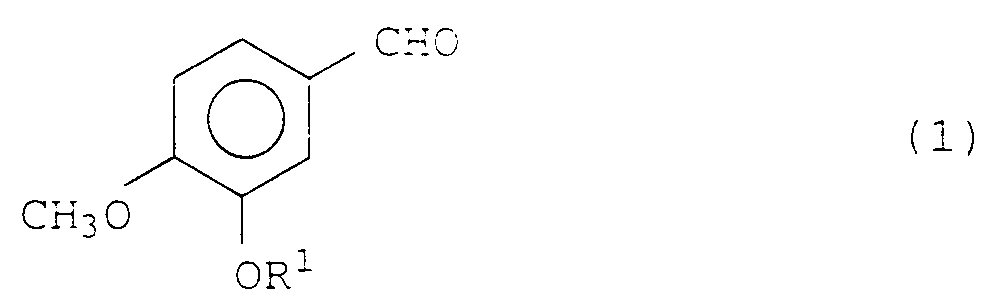
wherein R1 represents an alkyl group or a cycloalkyl group,
with a sulfide compound represented by the formula (2) :
R2-S-R3 (2)
wherein R2 represents an alkyl group or a group of the formula (3) :
-CH2COOR4 (3)
wherein R4 represents a hydrogen atom or an alkyl group,
and R3 represents a group of the formula (4) : 
wherein R5 represents a hydrogen atom or an alkyl group,
or a group of the above formula (3), or a salt thereof in the presence of sulfuric acid.
with a sulfide compound represented by the formula (2) :
R2-S-R3 (2)
wherein R2 represents an alkyl group or a group of the formula (3) :
-CH2COOR4 (3)
wherein R4 represents a hydrogen atom or an alkyl group,
and R3 represents a group of the formula (4) :
or a group of the above formula (3), or a salt thereof in the presence of sulfuric acid.
Description
- This invention relates to a novel process for preparing isovanillin (3-hydroxy-4-methoxybenzaldehyde).
- The above isovanillin is useful as an intermediate, for example, when a medicine, particularly an antidepressant is synthesized. Isovanillin can be converted into diethyl 3-isobutoxy-4-methoxybenzalmalonate according to, for example, the method described in U.S. Patent No. 4,193,926 by reacting it with isobutyl bromide to convert into 3-isobutoxy-4-methoxybenzaldehyde, and then, reacting the obtained compound with diethyl malonate. The obtained diethyl 3-isobutoxy-4-methoxybenzalmalonate is reacted with potassium cyanide to be converted into ethyl 3-(3-isobuzoxy-4-methoxyphenyl)-3-cyanopropionate, and the obtained compound is further hydrogenated in glacial acetic acid in the presence of platinum oxide and then reacted with methanolic hydrochloric acid to be converted into ethyl 3-(3-isobutoxy-4-methoxyphenyl)-4-aminobutanoate hydrochloride. The obtained ethyl 3-(3-isobutoxy-4-methoxyphenyl)-4-aminobutanoate hydrochloride can be converted into 4-(3-isobutoxy-4-methoxyphenyl)-2-pyrrolidone having an antidepressant activity by reacting it with triethyl-amine.
- As a conventional process for preparing isovanillin, there may be mentioned the following processes.
- (1) In Journal of Organic Chemistry (J. Org. Chem.), Vol. 32, No. 4, pp. 1269 and 1270 (1967), there has been disclosed a process for preparing isovanillin by heating veratraldehyde in conc. sulfuric acid.
However, the above process (1) is not an industrially satisfactory process in the points that the process requires a long period of time as long as 20 hours with a low yield. - (2) In Journal of Chemical Society (J. Chem. Soc.), Perkin Transactions, Vol. 1, No. 20, pp. 2288 and 2289 (1977), there has been disclosed a process for preparing isovanillin by reacting veratraldehyde with methionine in the presence of methanesulfonic acid.
- However, the above process (2) is not an industrially satisfactory process in the points that the process requires a long period of time as long as 24 hours with a low yield.
- Therefore, both of the known preparation processes (1) and (2) are not satisfactory as a process for obtaining isovanillin.
- The present inventors have studied intensively in order to solve the problems in the above known preparation processes, and consequently found that when a 3-alkoxy-4-methoxybenzaldehyde is reacted with a sulfide compound in the presence of sulfuric acid, isovanillin can be obtained with a good yield without requiring a long period of time as described above, to accomplish the present invention.
- An object of the present invention is to provide a process for preparing isovanillin in a short period of time with a good yield, by reacting a 3-alkoxy-4-methoxybenzaldehyde with a sulfide compound in the presence of sulfuric acid.
- That is, the present invention relates to a process for preparing isovanillin, which comprises reacting a 3-alkoxy-4-methoxybenzaldehyde represented by the formula (1):
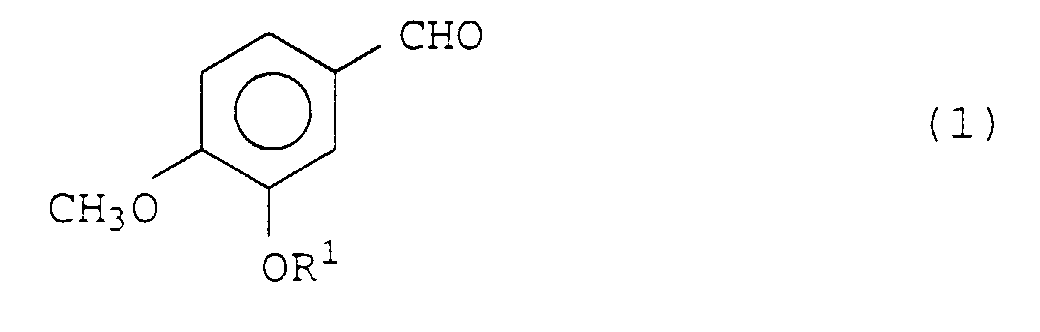
with a sulfide compound represented by the formula (2):
R2-S-R3 (2)
wherein R2 represents an alkyl group or a group of the formula (3):
-CH2COOR4 (3)
wherein R4 represents a hydrogen atom or an alkyl group,
and R3 represents a group represented by the formula (4):
or a group of the above formula (3),
or a salt thereof in the presence of sulfuric acid to obtain isovanillin (3-hydroxy-4-methoxybenzaldehyde) . - Preferred embodiments of the above preparation process of the present invention are as described below.
- 1) In the above process for preparing isovanillin, the 3-alkoxy-4-methoxybenzaldehyde represented by the above formula (1) is veratraldehyde.
- 2) In the above process for preparing isovanillin, the sulfide compound represented by the above formula (2) or a salt thereof is a methionine derivative.
- 3) In the above process for preparing isovanillin, the sulfide compound represented by the above formula (2) or a salt thereof is a thioglycolic acid derivative.
- 4) In the above process for preparing isovanillin, the sulfide compound represented by the above formula (2) or a salt thereof is methionine or methionine methyl ester.
- 5) In the above process for preparing isovanillin, the sulfide compound represented by the above formula (2) or a salt thereof is thiodiglycolic acid.
- 6 ) In the above process for preparing isovanillin, the 3-alkoxy-4-methoxybenzaldehyde represented by the above formula (1) is veratraldehyde, and the sulfide compound represented by the above formula (2) or a salt thereof is methionine or methionine methyl ester.
- 7) In the above process for preparing isovanillin, the 3-alkoxy-4-methoxybenzaldehyde represented by the above formula (1) is veratraldehyde, and the sulfide compound represented by the above formula (2) or a salt thereof is thiodiglycolic acid.
- In the following, the present invention is explained in detail.
- The preparation process of the present invention can be represented by, for example, Reaction scheme (1) as shown below.

- R1 in the 3-alkoxy-4-methoxybenzaldehyde (hereinafter also referred to as "the compound (1) ") represented by the formula (1) to be used in the preparation process of the present invention represents an alkyl group or a cycloalkyl group.
- As the alkyl group represented by R1 in the compound (1), there may be mentioned, for example, an alkyl group having 1 to 10 carbon atoms, preferably a methyl group, an ethyl group, a propyl group (including the respective isomers such as n- and isopropyl groups) and a butyl group (including the respective isomers such as n-, iso-, sec- and tert-butyl groups) .
- As the cycloalkyl group represented by R1 in the compound (1), there may be mentioned, for example, a cycloalkyl group having 3 to 10 carbon atoms, preferably a cyclopropyl group, a cyclopentyl group and a cyclohexyl group.
- As a specific example of the 3-alkoxy-4-methoxybenzaldehyde represented by the formula (1) having such a substituent, there may be mentioned, for example, veratraldehyde (3,4-dimethoxybenzaldehyde), 3-ethoxy-4-methoxybenzaldehyde, 3-n-butoxy-4-methoxybenzaldehyde, 3-cyclopentyloxy-4-methoxybenzaldehyde and 3-cyclohexyloxy-4-methoxybenzaldehyde, preferably veratraldehyde and 3-ethoxy-4-methoxybenzaldehyde.
- R2 of the sulfide compound (hereinafter also referred to as "the compound (2)") represented by the formula (2) to be used in the preparation process of the present invention represents an alkyl group or a group represented by the formula (3) .
- As the alkyl group represented by R2 in the compound (2), there may be mentioned, for example, an alkyl group having 1 to 10 carbon atoms, preferably a methyl group, an ethyl group, a propyl group (including the respective isomers as mentioned above) and a butyl group (including the respective isomers as mentioned above).
- R4 of the formula (3) represented by R2 in the compound (2) represents a hydrogen atom or an alkyl group.
- As the alkyl group represented by R4 in the compound (1), there may be mentioned, for example, an alkyl group having 1 to 10 carbon atoms, preferably a methyl group, an ethyl group, a propyl group (including the respective isomers as mentioned above) and a butyl group (including the respective isomers as mentioned above) .
- R3 in the compound (2) represents a group represented by the formula (3) or the formula (4).
- R4 of the formula (3) represented by R3 in the compound (2) represents a hydrogen atom or an alkyl group.
- As the alkyl group represented by R4 in the compound (2), there may be mentioned, for example, an alkyl group having 1 to 10 carbon atoms, preferably a methyl group, an ethyl group, a propyl group (including the respective isomers as mentioned above) and a butyl group (including the respective isomers as mentioned above).
- R5 of the formula (4) represented by R3 in the compound (2) represents a hydrogen atom or an alkyl group.
- As the alkyl group represented by R5 in the compound (2), there may be mentioned, for example, an alkyl group having 1 to 10 carbon atoms, preferably a methyl group, an ethyl group, a propyl group (including the respective isomers as mentioned above) and a butyl group (including the respective isomers as mentioned above).
- As a specific example of the sulfide compound represented by the formula (2) having such substituents, there may be mentioned, for example, methionine derivatives such as methionine, methionine methyl ester, methionine ethyl ester, methionine propyl ester (including the respective isomers) , methionine butyl ester (including the respective isomers), methionine pentyl ester (including the respective isomers), methionine hexyl ester (including the respective isomers), methionine heptyl ester (including the respective isomers), methionine octyl ester (including the respective isomers), methionine nonyl ester (including the respective isomers) and methionine decyl ester (including the respective isomers), and thioglycolic acid derivatives such as thiodiglycolic acid, dimethyl thiodiglycolate, S-methyl-thioglycolic acid and methyl S-methylthioglycolate, preferably methionine, methionine methyl ester, methionine ethyl ester, thiodiglycolic acid and S-methylthioglycolic acid.
- Among the sulfide compounds to be used in the preparation process of the present invention, the methionine derivatives may be used in any form, but the form of an inorganic acid salt such as sulfate, hydrochloride and phosphate is generally preferred. In the methionine derivatives to be used in the preparation process of the present invention, optically active D- and L-isomers exist. Either of the optically active isomers and also the racemic modification may be used in the preparation process of the present invention.
- The amount of the sulfide compound to be used in the preparation process of the present invention is generally an amount of 0.5 to 3.0 mole, preferably 0.8 to 2.0 mole per 1 mole of the 3-alkoxy-4-methoxybenzaldehyde.
- The concentration of sulfuric acid to be used in the preparation process of the present invention is generally 80 % by weight or more, preferably 90 % by weight or more.
- The amount of sulfuric acid to be used in the preparation process of the present invention is generally in the range of 3 to 30 times, preferably 4 to 20 times the weight of the 3-alkoxy-4-methoxybenzaldehyde. If the amount of sulfuric acid to be used is less than the required amount, undesirable by-products such as vanillin are increased, while if said amount is more than the required amount, productivity is worsened.
- The reaction temperature in the preparation process of the present invention is generally 20 °C to 150 °C, preferably 40 °C to 120 °C.
- In the preparation process of the present invention, the reaction time may vary depending on the amount of sulfuric acid and the reaction temperature to be used, but it is preferably 0.5 to 8 hours.
- The reaction can be carried out generally under atmospheric pressure, but may be carried out under pressure or under reduced pressure.
- In the preparation process of the present invention, produced isovanillin can be obtained from a reaction mixture by a combination of conventional washing operation and separation operation. For example, the desired compound can be obtained by a method of adding water to the reaction mixture, stirring the mixture, subjecting the mixture to extraction with an appropriate solvent, washing with water, etc. and drying operations and carrying out recrystallization.
- According to the present invention, by reacting the 3-alkoxy-4-methoxybenzaldehyde represented by the above formula (1) with the sulfide compound of the formula (2) in the presence of sulfuric acid, isovanillin which is a desired compound can be obtained in a short period of time with a good yield.
- The present invention is described in detail by referring to Examples, but the scope of the present invention is not limited thereby. Analysis conditions of liquid chromatography (analysis of veratraldehyde) and gas chromatography (analysis of isovanillin) in Examples and Comparative examples are as shown below.
-
- Column: ODS-80TM (trade name, manufactured by TOSOH Co., 4.6 mm ID x 25 cm L)
- Temperature: 40 °C
- Eluent: H2O : CH3CN = 6 : 4, pH = 3.0
- Flow rate: 1.0 ml/min
- Detection wavelength: 254 nm
- Internal standard reference material: anisole
-
- Column: 2 % Silicone OV-17 (trade name, manufactured by GL Science Co.), support: Uniport HS (trade name, manufactured by GL Science Co.)
- Temperature of column : 120 to 160 °C (3 °C/min)
- Temperature of evaporation room: 200 °C
- Carrier gas: helium
- Flow rate: 40 ml/min
- Detector: FID
- Internal standard reference material: n-tetradecane
- A flask having an inner volume of 100 ml was charged with 30 g of conc. sulfuric acid (98 %), and 3.32 g (20 mmol) of veratraldehyde was added thereto while stirring to obtain a sulfuric acid solution. While stirring the obtained sulfuric acid solution at room temperature (20 °C), 3.3 g (22 mmol) of D,L-methionine was gradually added to the solution with divided small amounts over 10 minutes. After completion of the addition, the mixture was reacted under stirring at 65 °C for 3 hours.
- The resulting reaction mixture was poured into 50 ml of ice water, 25 ml of ethyl acetate was added thereto, and the mixture was stirred and then separated to obtain an ethyl acetate layer (x 3 times). The combined ethyl acetate layer was quantitated by liquid chromatography and gas chromatography. As a result, the conversion ratio of veratraldehyde was 95.3 %, and the yield of isovanillin based on veratraldehyde was 82.7 %. After the obtained ethyl acetate layer was concentrated by a rotary evaporator, toluene was added to the concentrate. The mixture was heated and then cooled to room temperature to precipitate crystals, and the precipitated crystals were collected by filtration. The obtained crystals were analyzed by a mass spectrometer to find out that the molecular weight of the crystals was coincident with that of isovanillin. m/e = 18, 81, 151, 152. The isolation yield of isovanillin based on veratraldehyde was 72 %.
- A flask having an inner volume of 100 ml was charged with 30 g of conc. sulfuric acid (98 %), and 3.32 g (20 mmol) of veratraldehyde was added thereto while stirring to obtain a sulfuric acid solution. The obtained sulfuric acid solution was reacted under stirring at 65 °C for 3 hours.
- The resulting reaction mixture was poured into 50 ml of ice water, 25 ml of ethyl acetate was added thereto, and the mixture was stirred and then separated to obtain an ethyl acetate layer (x 3 times). The combined ethyl acetate layer was quantitated by liquid chromatography and gas chromatography. As a result, the conversion ratio of veratraldehyde was 52.0 %, and the yield of isovanillin based on veratraldehyde was 44.1 %.
- A flask having an inner volume of 100 ml was charged with 30 g of conc. sulfuric acid (98 %), and 3.32 g (20 mmol) of veratraldehyde was added thereto while stirring to obtain a sulfuric acid solution. While stirring the obtained sulfuric acid solution at room temperature (20 °C), 3.3 g (22 mmol) of D,L-methionine was gradually added to the solution with divided small amounts over 10 minutes. After completion of the addition, the mixture was reacted under stirring at 50 °C for 5 hours.
- The resulting reaction mixture was poured into 50 ml of ice water, 25 ml of ethyl acetate was added thereto, and the mixture was stirred and then separated to obtain an ethyl acetate layer (x 3 times). The combined ethyl acetate layer was quantitated by liquid chromatography and gas chromatography. As a result, the conversion ratio of veratraldehyde was 89.0 %, and the yield of isovanillin based on veratraldehyde was 79.6 %.
- A flask having an inner volume of 100 ml was charged with 26 g of methanesulfonic acid, and 3.32 g (20 mmol) of veratraldehyde was added thereto while stirring to obtain a methanesulfonic acid solution. After the obtained methane-sulfonic acid solution was cooled with ice, 3.3 g (22 mmol) of D,L-methionine was gradually added to the solution over 10 minutes. After completion of the addition, the mixture was reacted under stirring at 50 °C for 6 hours.
- The resulting reaction mixture was poured into 50 ml of ice water, 25 ml of ethyl acetate was added thereto, and the mixture was stirred and then separated to obtain an ethyl acetate layer (x 3 times). The combined ethyl acetate layer was quantitated by liquid chromatography and gas chromatography. As a result, the conversion ratio of veratraldehyde was 67.1 %, and the yield of isovanillin based on veratraldehyde was 48.8 %.
- Procedures were carried out in the same manner as in Example 2 except for changing the reaction temperature from 50 °C to 80 °C and the reaction time from 5 hours to 1 hour. The conversion ratio of veratraldehyde was 95.9 %, and the yield of isovanillin based on veratraldehyde was 82.4 %.
- Procedures were carried out in the same manner as in Example 3 except for changing the amount of conc. sulfuric acid used from 30 g to 20 g and the reaction time from 1 hour to 4 hours. The conversion ratio of veratraldehyde was 94.1 %, and the yield of isovanillin based on veratraldehyde was 73.8 %.
- A flask having an inner volume of 100 ml was charged with 15 g of conc. sulfuric acid, and 2.2 g (11 mmol) of L-methionine methyl ester hydrochloride was gradually added thereto over 10 minutes while stirring under ice cooling to obtain a sulfuric acid solution. 1.66 g (10 mmol) of veratraldehyde was added to the obtained sulfuric acid solution. After completion of the addition, the mixture was reacted by stirring at 65 °C for 3 hours.
- The resulting reaction mixture was poured into 40 ml of ice water, 25 ml of ethyl acetate was added thereto, and the mixture was stirred and then separated to obtain an ethyl acetate layer (x 3 times). The combined ethyl acetate layer was quantitated by liquid chromatography and gas chromatography. As a result, the conversion ratio of veratraldehyde was 75.4 %, and the yield of isovanillin based on veratraldehyde was 64.7 %.
- Procedures were carried out in the same manner as in Example 5 except for using 1.65 g of thiodiglycolic acid in place of L-methionine methyl ester hydrochloride and changing the reaction temperature from 65 °C to 70 °C. The conversion ratio of veratraldehyde was 90.4 %, and the yield of isovanillin based on veratraldehyde was 75.1 %.
Claims (21)
- A process for preparing isovanillin, which comprises reacting a 3-alkoxy-4-methoxybenzaldehyde represented by the formula (1):

with a sulfide compound represented by the formula (2):
R2-S-R3 (2)
wherein R2 represents an alkyl group or a group of the formula (3):
-CH2COOR4 (3)
wherein R4 represents a hydrogen atom or an alkyl group,
and R3 represents a group of the formula (4):
or a group of the above formula (3),
or a salt thereof in the presence of sulfuric acid. - The process according to Claim 1, wherein R1 is an alkyl group having 1 to 10 carbon atoms or a cycloalkyl group having 3 to 10 carbon atoms.
- The process according to Claim 1, wherein R1 is an alkyl group having 1 to 6 carbon atoms or a cycloalkyl group having 3 to 6 carbon atoms.
- The process according to any one of Claims 1 to 3, wherein R1 is a methyl group, an ethyl group, a propyl group, a butyl group, a cyclopropyl group, a cyclopentyl group or a cyclohexyl group.
- The process according to Claim 1, wherein R1 is a methyl group.
- The process according to any one of Claims 1 to 5, wherein R2 is an alkyl group having 1 to 10 carbon atoms or a group represented by the formula (3):
-CH2COOR4 (3)
wherein R4 represents a hydrogen atom or an alkyl group having 1 to 10 carbon atoms. - The process according to any one of Claims 1 to 5, wherein R2 is an alkyl group having 1 to 6 carbon atoms or a group represented by the formula (3):
-CH2COOR4 (3)
wherein R4 represents a hydrogen atom or an alkyl group having 1 to 6 carbon atoms. - The process according to any one of Claims 1 to 7, wherein R2 is a methyl group, an ethyl group, a propyl group, a butyl group, or a group represented by the formula (3):
-CH2COOR4 (3)
wherein R4 represents a hydrogen atom, a methyl group, an ethyl group, a propyl group or a butyl group. - The process according to any one of Claims 1 to 8, wherein R2 is a methyl group, -CH2COOH or -CH2COOCH3.
- The process according to any one of Claims 1 to 9, wherein R3 is a group represented by the formula (4):

or a group represented by the formula (3):
-CH2COOR4 (3)
wherein R4 represents a hydrogen atom or an alkyl group having 1 to 10 carbon atoms. - The process according to any one of Claims 1 to 9, wherein R3 is a group represented by the formula (4):

or a group represented by the formula (3):
-CH2COOR4 (3)
wherein R4 represents a hydrogen atom or an alkyl group having 1 to 6 carbon atoms. - The process according to any one of Claims 1 to 11, wherein R3 is a group represented by the formula (4):

or a group represented by the formula (3):
-CH2COOR4 (3)
wherein R4 represents a hydrogen atom, a methyl group, an ethyl group, a propyl group or a butyl group. - The process according to any one of Claims 1 to 12, wherein R3 is a group represented by the formula (4):

or a group represented by the formula (3):
-CH2COOR4 (3)
wherein R4 represents a hydrogen atom or a methyl group. - The process according to any one of Claims 1 to 13, wherein R1 is a methyl group, R2 is a methyl group; and R3 is a group represented by the formula (4):

- The process according to any one of Claims 1 to 10, wherein R1 is a methyl group, R2 is -CH2COOH or -CH2COOCH3; and R3 is -CH2COOH or -CH2COOCH3.
- The process according to any one of Claims 1 to 15, wherein the sulfide compound is used in an amount of 0.5 to 3.0 mole per mole of the 3-alkoxy-4-methoxybenzaldehyde.
- The process according to any one of Claims 1 to 15, wherein the sulfide compound is used in an amount of 0.8 to 2.0 mole per mole of the 3-alkoxy-4-methoxybenzaldehyde.
- The process according to any one of Claims 1 to 15, wherein the sulfuric acid is used in an amount in the range of 3 to 30 times the weight of the 3-alkoxy-4-methoxybenzaldehyde.
- The process according to any one of Claims 1 to 15, wherein the sulfuric acid is used in an amount in the range of 4 to 20 times the weight of the 3-alkoxy-4-methoxybenzaldehyde.
- The process according to any one of Claims 1 to 19, wherein the reaction is carried out at 20°C to 150°C for 0.5 to 8 hours under ambient pressure.
- The process according to any one of Claims 1 to 19, wherein the reaction is carried out at 40°C to 120°C for 0.5 to 8 hours under ambient pressure.
Applications Claiming Priority (4)
| Application Number | Priority Date | Filing Date | Title |
|---|---|---|---|
| JP205725/95 | 1995-08-11 | ||
| JP20572595 | 1995-08-11 | ||
| JP8386596 | 1996-04-05 | ||
| JP83865/96 | 1996-04-05 |
Publications (1)
| Publication Number | Publication Date |
|---|---|
| EP0758639A1 true EP0758639A1 (en) | 1997-02-19 |
Family
ID=26424911
Family Applications (1)
| Application Number | Title | Priority Date | Filing Date |
|---|---|---|---|
| EP96401733A Withdrawn EP0758639A1 (en) | 1995-08-11 | 1996-08-05 | Process for preparing isovanillin |
Country Status (2)
| Country | Link |
|---|---|
| EP (1) | EP0758639A1 (en) |
| NO (1) | NO963174L (en) |
Cited By (1)
| Publication number | Priority date | Publication date | Assignee | Title |
|---|---|---|---|---|
| US7981939B2 (en) | 2005-08-25 | 2011-07-19 | Institute Of Radiation Medicine, Academy Of Military Medical Sciences, Pla | Application of 2-bromide-isovanillin for the manufacture of a medicament for anti-cancer or/and radiation/chemotherapy sensitization |
Citations (1)
| Publication number | Priority date | Publication date | Assignee | Title |
|---|---|---|---|---|
| US3367972A (en) * | 1964-11-19 | 1968-02-06 | Sterling Drug Inc | Selective hydrolysis of dialkyl ethers of protocatechuic aldehyde |
-
1996
- 1996-07-30 NO NO963174A patent/NO963174L/en unknown
- 1996-08-05 EP EP96401733A patent/EP0758639A1/en not_active Withdrawn
Patent Citations (1)
| Publication number | Priority date | Publication date | Assignee | Title |
|---|---|---|---|---|
| US3367972A (en) * | 1964-11-19 | 1968-02-06 | Sterling Drug Inc | Selective hydrolysis of dialkyl ethers of protocatechuic aldehyde |
Non-Patent Citations (1)
| Title |
|---|
| FUJII N ET AL: "Regioselective cleavage of aromatic methyl ethers by methanesulfonic acid in the presence of methionine", J. CHEM. SOC., PERKIN TRANS. 1 (JCPRB4,0300922X);77; (20); PP.2288-9, KYOTO UNIV.;FAC. PHARM. SCI.; KYOTO; JAPAN, XP002018663 * |
Cited By (1)
| Publication number | Priority date | Publication date | Assignee | Title |
|---|---|---|---|---|
| US7981939B2 (en) | 2005-08-25 | 2011-07-19 | Institute Of Radiation Medicine, Academy Of Military Medical Sciences, Pla | Application of 2-bromide-isovanillin for the manufacture of a medicament for anti-cancer or/and radiation/chemotherapy sensitization |
Also Published As
| Publication number | Publication date |
|---|---|
| NO963174D0 (en) | 1996-07-30 |
| NO963174L (en) | 1997-02-12 |
Similar Documents
| Publication | Publication Date | Title |
|---|---|---|
| CA1334417C (en) | Process for preparing pyridine-2,3-dicarboxylic acid compounds | |
| PL164457B1 (en) | - {exo-bicyclo [2.2.1] hept-2-yloxy} -4-methoxyphenyl / glutaric PL PL PL PL PL | |
| EP0605392B1 (en) | Process for producing methoxyminoacetamide compounds | |
| EP0193405B1 (en) | Racemization process | |
| US4910326A (en) | β-ketonitrils | |
| KR960000758B1 (en) | Optically active hydroxybenzylamine derivatives and preparation method thereof | |
| EP0388620B1 (en) | Process for the preparation of o-carboxypyridyl- and o-carboxyquinolylimidazolinones | |
| JPH0742269B2 (en) | 4-Alkoxy-3-pyrrolin-2-one-1-yl-acetic acid alkyl ester and process for producing the same | |
| KR960002371B1 (en) | Method for producing 1-propargyl-2,4-dioxoimidazolidine | |
| KR0131338B1 (en) | Method for preparing 1,4-dihydro-pyridine derivative | |
| US5869694A (en) | Process for preparing 4-hydroxy-2-pyrrolidone | |
| US5177247A (en) | Process for the preparation of hydroxyphenylpropionates | |
| CN112479967B (en) | Biliverdin compound and its preparation method and use | |
| US4257949A (en) | Bisnoraldehyde-22-enamine process | |
| KR0163770B1 (en) | Method for preparing 3,4-epoxybutyrate and intermediates therefor | |
| US4284562A (en) | Process for preparing pyrrole-2-acetic acids | |
| NO963174L (en) | Process for the preparation of isovanillin | |
| US5599949A (en) | Bisphenol derivative and its manufacturing method | |
| JP2588969B2 (en) | Method for producing phenoxyethylaminopyrimidine derivative | |
| EP1109797B1 (en) | Process for manufacturing an optically active (s)-3,4-epoxybutyric acid salt | |
| US5057624A (en) | Process for the synthesis of the n-methyl-3,4-dimethoxyphenylethylamine | |
| JP2659587B2 (en) | 4-aziridinyl pyrimidine derivatives and their production | |
| JP4667589B2 (en) | Method for producing 2,4-dihydroxypyridine | |
| US4789746A (en) | Process for the preparation of the (+)-antipode of (E)-1-cyclohexyl-4,4-dimethyl-3-hydroxy-2-(1,2,4-triazol-1-yl)-pent-1-ene | |
| JP4123606B2 (en) | Process for producing 4,5-dichloro-6- (α-fluoroalkyl) pyrimidine |
Legal Events
| Date | Code | Title | Description |
|---|---|---|---|
| PUAI | Public reference made under article 153(3) epc to a published international application that has entered the european phase |
Free format text: ORIGINAL CODE: 0009012 |
|
| AK | Designated contracting states |
Kind code of ref document: A1 Designated state(s): DE FR GB IT |
|
| 17P | Request for examination filed |
Effective date: 19970617 |
|
| 17Q | First examination report despatched |
Effective date: 19990316 |
|
| STAA | Information on the status of an ep patent application or granted ep patent |
Free format text: STATUS: THE APPLICATION IS DEEMED TO BE WITHDRAWN |
|
| 18D | Application deemed to be withdrawn |
Effective date: 19990302 |