EP0754746B1 - Needle coke for graphite electrode and process for producing the same - Google Patents
Needle coke for graphite electrode and process for producing the same Download PDFInfo
- Publication number
- EP0754746B1 EP0754746B1 EP95914539A EP95914539A EP0754746B1 EP 0754746 B1 EP0754746 B1 EP 0754746B1 EP 95914539 A EP95914539 A EP 95914539A EP 95914539 A EP95914539 A EP 95914539A EP 0754746 B1 EP0754746 B1 EP 0754746B1
- Authority
- EP
- European Patent Office
- Prior art keywords
- coke
- needle coke
- weight
- producing
- needle
- Prior art date
- Legal status (The legal status is an assumption and is not a legal conclusion. Google has not performed a legal analysis and makes no representation as to the accuracy of the status listed.)
- Expired - Lifetime
Links
Classifications
-
- H—ELECTRICITY
- H01—ELECTRIC ELEMENTS
- H01M—PROCESSES OR MEANS, e.g. BATTERIES, FOR THE DIRECT CONVERSION OF CHEMICAL ENERGY INTO ELECTRICAL ENERGY
- H01M4/00—Electrodes
- H01M4/86—Inert electrodes with catalytic activity, e.g. for fuel cells
- H01M4/96—Carbon-based electrodes
-
- C—CHEMISTRY; METALLURGY
- C01—INORGANIC CHEMISTRY
- C01B—NON-METALLIC ELEMENTS; COMPOUNDS THEREOF; METALLOIDS OR COMPOUNDS THEREOF NOT COVERED BY SUBCLASS C01C
- C01B32/00—Carbon; Compounds thereof
- C01B32/05—Preparation or purification of carbon not covered by groups C01B32/15, C01B32/20, C01B32/25, C01B32/30
-
- C—CHEMISTRY; METALLURGY
- C01—INORGANIC CHEMISTRY
- C01B—NON-METALLIC ELEMENTS; COMPOUNDS THEREOF; METALLOIDS OR COMPOUNDS THEREOF NOT COVERED BY SUBCLASS C01C
- C01B32/00—Carbon; Compounds thereof
- C01B32/20—Graphite
- C01B32/205—Preparation
-
- C—CHEMISTRY; METALLURGY
- C04—CEMENTS; CONCRETE; ARTIFICIAL STONE; CERAMICS; REFRACTORIES
- C04B—LIME, MAGNESIA; SLAG; CEMENTS; COMPOSITIONS THEREOF, e.g. MORTARS, CONCRETE OR LIKE BUILDING MATERIALS; ARTIFICIAL STONE; CERAMICS; REFRACTORIES; TREATMENT OF NATURAL STONE
- C04B35/00—Shaped ceramic products characterised by their composition; Ceramics compositions; Processing powders of inorganic compounds preparatory to the manufacturing of ceramic products
- C04B35/515—Shaped ceramic products characterised by their composition; Ceramics compositions; Processing powders of inorganic compounds preparatory to the manufacturing of ceramic products based on non-oxide ceramics
- C04B35/52—Shaped ceramic products characterised by their composition; Ceramics compositions; Processing powders of inorganic compounds preparatory to the manufacturing of ceramic products based on non-oxide ceramics based on carbon, e.g. graphite
- C04B35/528—Shaped ceramic products characterised by their composition; Ceramics compositions; Processing powders of inorganic compounds preparatory to the manufacturing of ceramic products based on non-oxide ceramics based on carbon, e.g. graphite obtained from carbonaceous particles with or without other non-organic components
- C04B35/532—Shaped ceramic products characterised by their composition; Ceramics compositions; Processing powders of inorganic compounds preparatory to the manufacturing of ceramic products based on non-oxide ceramics based on carbon, e.g. graphite obtained from carbonaceous particles with or without other non-organic components containing a carbonisable binder
-
- C—CHEMISTRY; METALLURGY
- C10—PETROLEUM, GAS OR COKE INDUSTRIES; TECHNICAL GASES CONTAINING CARBON MONOXIDE; FUELS; LUBRICANTS; PEAT
- C10L—FUELS NOT OTHERWISE PROVIDED FOR; NATURAL GAS; SYNTHETIC NATURAL GAS OBTAINED BY PROCESSES NOT COVERED BY SUBCLASSES C10G OR C10K; LIQUIFIED PETROLEUM GAS; USE OF ADDITIVES TO FUELS OR FIRES; FIRE-LIGHTERS
- C10L9/00—Treating solid fuels to improve their combustion
- C10L9/08—Treating solid fuels to improve their combustion by heat treatments, e.g. calcining
-
- C—CHEMISTRY; METALLURGY
- C10—PETROLEUM, GAS OR COKE INDUSTRIES; TECHNICAL GASES CONTAINING CARBON MONOXIDE; FUELS; LUBRICANTS; PEAT
- C10L—FUELS NOT OTHERWISE PROVIDED FOR; NATURAL GAS; SYNTHETIC NATURAL GAS OBTAINED BY PROCESSES NOT COVERED BY SUBCLASSES C10G OR C10K; LIQUIFIED PETROLEUM GAS; USE OF ADDITIVES TO FUELS OR FIRES; FIRE-LIGHTERS
- C10L9/00—Treating solid fuels to improve their combustion
- C10L9/10—Treating solid fuels to improve their combustion by using additives
-
- C—CHEMISTRY; METALLURGY
- C01—INORGANIC CHEMISTRY
- C01P—INDEXING SCHEME RELATING TO STRUCTURAL AND PHYSICAL ASPECTS OF SOLID INORGANIC COMPOUNDS
- C01P2004/00—Particle morphology
- C01P2004/10—Particle morphology extending in one dimension, e.g. needle-like
-
- Y—GENERAL TAGGING OF NEW TECHNOLOGICAL DEVELOPMENTS; GENERAL TAGGING OF CROSS-SECTIONAL TECHNOLOGIES SPANNING OVER SEVERAL SECTIONS OF THE IPC; TECHNICAL SUBJECTS COVERED BY FORMER USPC CROSS-REFERENCE ART COLLECTIONS [XRACs] AND DIGESTS
- Y02—TECHNOLOGIES OR APPLICATIONS FOR MITIGATION OR ADAPTATION AGAINST CLIMATE CHANGE
- Y02E—REDUCTION OF GREENHOUSE GAS [GHG] EMISSIONS, RELATED TO ENERGY GENERATION, TRANSMISSION OR DISTRIBUTION
- Y02E60/00—Enabling technologies; Technologies with a potential or indirect contribution to GHG emissions mitigation
- Y02E60/30—Hydrogen technology
- Y02E60/50—Fuel cells
Definitions
- the present invention relates to a needle coke having small puffing in producing electrodes and'a process for producing the same.
- Artificial graphite electrodes are produced by pulverizing a coal coke or a petroleum coke and classifying it to a fixed particle size distribution and then subjecting it to kneading with a binder pitch, extrusion-molding, baking, impregnation, secondary baking, and graphitization.
- calcined electrodes are graphitized at about 3000°C, wherein an Acheson furnace has so far mainly been used.
- an LWG furnace direct current flow type
- graphitization in this LWG furnace accelerates a temperature elevating rate, a generating rate of gas is increased, and therefore an abnormal expansion phenomenon called puffing is liable to take place. Puffing not only lowers a density of an electrode but also sometimes damages the electrode when the phenomenon is severe. Accordingly, processes for producing a needle coke having reduced puffing and puffing inhibitors added in producing electrodes have so far been investigated.
- An object of the present invention is to provide a needle coke for graphite electrodes which can reduce puffing in producing the graphite electrodes regardless of the kind of raw material cokes from coal or petroleum and which can enhance the yield in a graphitization step and improve the product characteristics.
- the present invention relates to:
- any of a conventional green needle coke having a volatile matter content of about 15 % or less which is produced by delayed coking from either one or both of petroleum series and coal series heavy oils used as a raw material, a calcined coke obtained up to a step before calcination in the final step in the case where calcination and cooling are repeated in a multistage, and a needle coke obtained after finishing the calcination.
- Used as the coke-adhering substance used in the present invention for a purpose of reducing puffing is a substance having a softening point, or a melting point or a temperature at which it thermally decomposes without leaving a residue after subjecting the substance to a heat treatment at 200°C or higher, which does not exceed 1800°C.
- the softening point means a temperature at which a viscosity of the substance is lowered down to 10 7.6 poise or less.
- This substance includes synthetic or natural high molecular substances such as natural rubber, polyamide resins, and PTFE which leave no carbon in thermal decomposition.
- At least one selected from the group consisting of a boron compound, a phosphorus compound, a silicon compound, and pyrex glass is preferably used, and in particular, boric acid, phosphoric acid, silicic acid, and alkaline metal salts thereof are preferred.
- These substances may be adhered to any of a green needle coke, a calcined coke obtained up to a step before calcination in the final stage in the case where calcination and cooling are repeated in a multistage process, or a needle coke obtained after finishing the calcination.
- a method can be used as well in which the substances are sprayed or impregnated in the form of solutions of suitable solvents.
- Spraying alone evenly with a spray can be applied as a method for spraying or impregnating, or a method in which a coke is impregnated with the solution by means of a decompression device can be used.
- the substances When the substances are applied in the form of a suspension, they have preferably such small particle diameters that the substances can get into the inside of a coke.
- the substances having a diameter of 100 ⁇ m or less, preferably 50 ⁇ m or less are used.
- An amount of these substances adhered to a coke is 0.03 to 16 parts by weight per 100 parts by weight of the coke, and in the case of at least one selected from a boron compound, a phosphorus compound, a silicon compound, and pyrex glass, the amount is preferably 0.05 to 5 parts by weight, more preferably 0.1 to 2 parts by weight.
- the adhering amount is insufficient deviating from these ranges, a puffing-reducing effect is not sufficiently high in terms of practical use.
- the adhering amount is excessive, not only an effect for increasing the amount is not notably revealed, but also the residual ash content exerts an effect which is not preferred in terms of the quality of product electrodes depending on the uses thereof.
- the green needle coke After spraying or impregnating a green needle coke with the suspension or the solution of these substances, the green needle coke continues to be calcined as it is and can be used as a material coke for graphite electrodes.
- the calcination may be carried out at, for example, 1200 to 1600°C in one stage as usual, or multistage calcination may be carried out, wherein a green needle coke is baked in the first stage at lower calcining temperatures than usual, for example, about 800°C, and then this is once cooled down and calcined again in the second stage at temperatures falling in a range of 1200 to 1600°C.
- a half-calcined needle coke obtained up to a stage before the calcination in the final stage may be sprayed or impregnated with the suspension or the solution of these substances.
- the needle coke may be sprayed or impregnated with the suspension or the solution of these substances in or after cooling the needle coke after the calcination. In this case, however, it is required to subject the coke further to a heat treatment at 200°C or higher after that.
- iron compounds usually used as puffing inhibitors may be omitted to use, but the use thereof is more preferred since an effect of further reducing puffing can be obtained. They can suitably be selected taking the required quality and the profitability into consideration.
- Electrodes are produced from the needle coke thus prepared.
- Electrodes are produced in a kneading step, a baking step, an impregnating step, a secondary baking step, and a graphitizing step. Kneading of a needle coke, to which these substances are adhered, with a binder pitch prevents the binder pitch from penetrating into the depth of the pores due to the substances remaining and adhering in the pores of the coke. Accordingly, this substance may be any one as long as it can remain in the form of a solid matter at 200°C or higher (i.e. at impregnated binder pitch-kneading temperature), and is molten, softened or thermally decomposes to leave no residue up to 1800°C. In impregnation after baking, the substances contained in the pores can prevent an impregnated pitch from penetrating into the depth of the pores as is the case with a binder pitch.
- the electrodes thus prepared is subjected to secondary baking and then to graphitization.
- Gas causing puffing starts to be generated at about 1700°C, and a generating ratio thereof increases at about 1800°C. Accordingly, a softening point or a melting point of the substances contained in the pores, or a temperature at which the substances thermally decompose without leaving a residue is required to be 1800°C or lower.
- a needle coke prepared by calcining a green needle coke produced from a coal heavy oil used as a raw material by delayed coking.
- the calcined needle coke of 3 kg was sprayed with a disodium phosphate aqueous solution of 1.5 kg having a concentration of 10 % by weight, and after leaving for standing for 30 minutes, the needle coke was dried at 150°C and then further subjected to a heat treatment at 900°C.
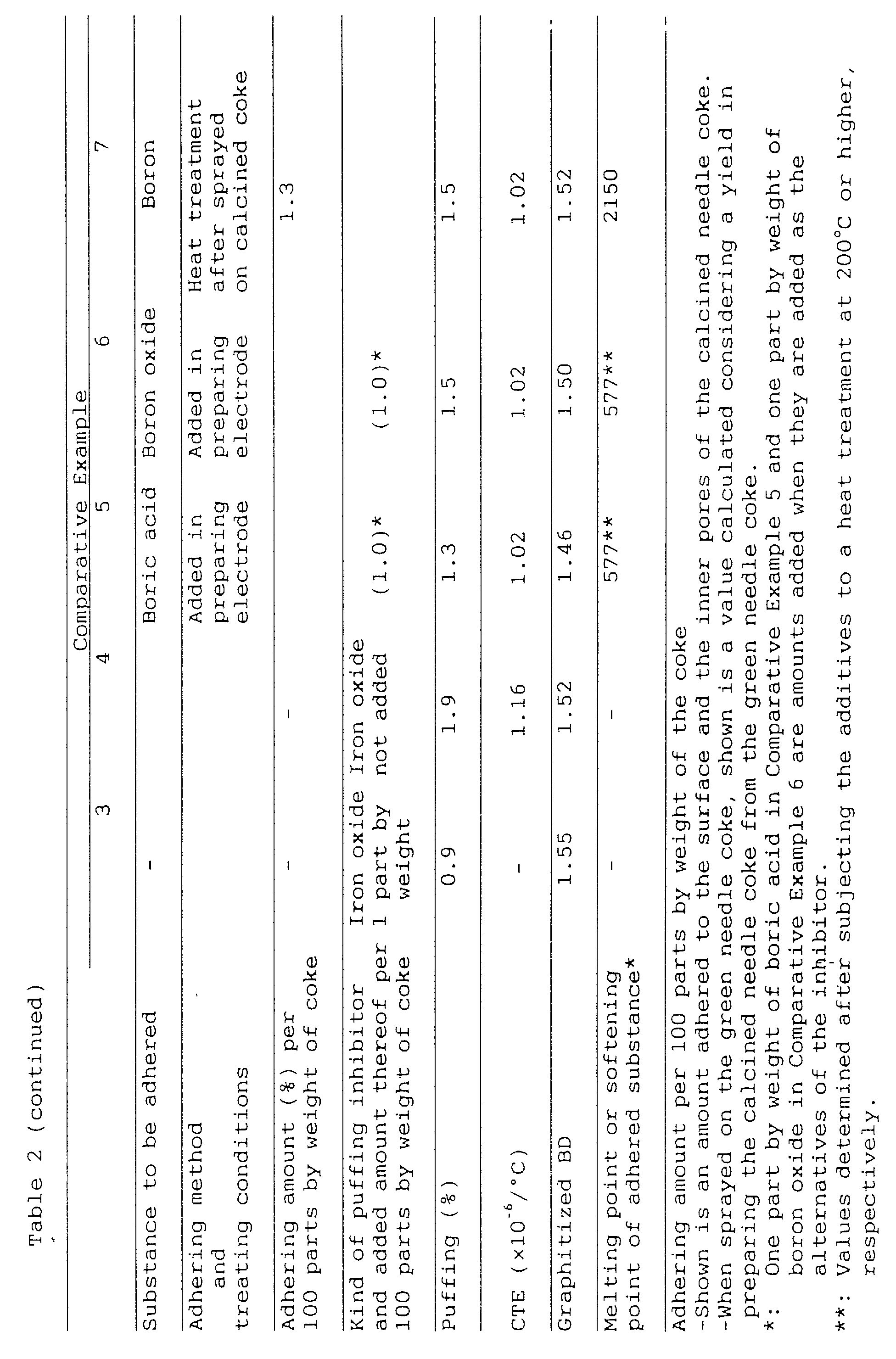
- the puffing and the coefficient of thermal expansion (hereinafter called CTE) were determined by the methods described later, and the results thereof are shown in Table 1.
- a needle coke prepared by calcining a green needle coke produced from a coal heavy oil used as a raw material by delayed coking.
- the calcined needle coke of 3 kg was sprayed with a sodium silicate aqueous solution of 1.5 kg having a concentration of 10 % by weight, and after leaving for standing for 30 minutes, the needle coke was dried at 150°C and then further subjected to a heat treatment at 900°C.
- the puffing and the CTE were determined by the methods described later, and the results thereof are shown in Table 1.
- a needle coke prepared by calcining a green needle coke produced from a coal heavy oil used as a raw material by delayed coking.
- the calcined needle coke of 3 kg was sprayed with a disodium phosphate aqueous solution of 1.5 kg having a concentration of 10 % by weight, and after leaving for standing for 30 minutes, the needle coke was dried at 150°C and then further subjected to a heat treatment at 900°C.
- iron oxide of 1 part by weight was added to the coke of 100 parts by weight and a binder pitch of 30 parts by weight in kneading, and then an electrode was prepared.
- the puffing and the CTE were determined by the methods described separately, and the results thereof are shown in Table 1.
- the green needle coke of 3 kg was sprayed with a boric acid aqueous solution of 1.5 kg having a concentration of 10 % by weight, and after leaving for standing for 30 minutes, the needle coke was dried at 150°C and then calcined at 1400°C.
- the puffing and the CTE were determined by the methods described later, and the results thereof are shown in Table 2.
- a needle coke prepared by calcining a green needle coke produced from a coal heavy oil used as a raw material by delayed coking.
- the calcined needle coke of 3 kg was sprayed with a boric acid aqueous solution of 1.5 kg having a concentration of 10 % by weight, and after leaving for standing for 30 minutes, the needle coke was dried at 150°C and then further subjected to a heat treatment at 900°C.
- the puffing and the CTE were determined by the methods described later, and the results thereof are shown in Table 2.
- a needle coke prepared by calcining a green needle coke produced from a petroleum heavy oil used as a raw material by delayed coking.
- the calcined needle coke of 3 kg was sprayed with a boric acid aqueous solution of 1.5 kg having a concentration of 10 % by weight, and after leaving for standing for 30 minutes, the needle coke was dried at 150°C and then further subjected to a heat treatment at 900°C.
- the puffing and the CTE were determined by the methods described later, and the results thereof are shown in Table 2.
- a needle coke prepared by calcining a green needle coke produced from a coal heavy oil used as a raw material by delayed coking.
- the calcined needle coke of 3 kg was sprayed with a boric acid aqueous solution of 1.5 kg having a concentration of 10 % by weight, and after leaving for standing for 30 minutes, the needle coke was dried at 150°C and then further subjected to a heat treatment at 900°C.
- iron oxide of 1 part by weight was added to the coke of 100 parts by weight and the binder pitch of 30 parts by weight in kneading, and then an electrode was prepared.
- the puffing and the CTE were determined by the methods described later, and the results thereof are shown in Table 2.
- boric acid of 1 part by weight was added to the coke of 100 parts by weight and the binder pitch of 30 parts by weight in kneading, and then an electrode was prepared.
- the puffing and the CTE were determined by the methods described later, and the results thereof are shown in Table 2.
- metal boron was pulverized with a crusher, and the particle size was adjusted to 200 mesh sieve through.
- a 5 weight % aqueous suspension was prepared therefrom, and the calcined needle coke of 3 kg was sprayed with the suspension of 1.0 kg. After leaving for standing for 30 minutes, the needle coke was dried at 150°C and subjected to a heat treatment at 900°C.
- the puffing and the CTE were determined in the following manners.
- the particle size is adjusted (8 to 16 mesh: 40 %, 48 to 200 mesh: 35 %, and 200 mesh or less: 25 %), and the pulverized coke is blended with a binder pitch of 30 % at 160°C for 20 minutes. This is molded into a size of 20 mm ⁇ x 100 mm.
- a molded test piece is baked up to 900°C in a electric furnace, and after impregnated with an impregnating pitch, the test piece is subjected again to a secondary baking at 900°C. This is used as a sample for determining the puffing. In determining the puffing, the test piece is heated up to 2500°C at a temperature-elevating rate of 10°C/min, and the puffing is expressed by a maximum elongation percentage at 1500 to 2500°C.
- the particle size is adjusted (16 to 60 mesh: 20 %, 60 to 200 mesh: 45 %, and 200 mesh or less: 35 %), and the pulverized coke is blended with a binder pitch at 160°C for 20 minutes.
- An addition amount of the binder pitch is selected so that molded BD is maximized. This is extrusion-molded into a size of 20 mm ⁇ x 100 mm.
- a molded test piece is baked at 900°C and graphitized at 2500°C to prepare a sample for determining the CTE. An average coefficient of thermal expansion at RT ⁇ 500°C is measured to determine the CTE.
- An outer cylinder of a device for determining a glass viscosity by a rotating cylinder method is stopped in a position where the cylinder is rotated by some angle, and the time spent for causing an inner cylinder rotated accordingly to return to the initial position is determined, wherein the softening point is defined by a temperature at which the reduced viscosity is 10 7.6 poise ("Glass Engineering” written by S. Naruse, published by Kyoritsu Shuppan Co., Ltd.).
- a sample is put in a crucible equipped with a thermo couple, and the temperature is elevated, wherein the melting point is defined by a stagnation or curvature point of the temperature in a temperature-time curve ("Base of Thermal Analysis" written by Y. Saito, published by Kyoritsu Shuppan Co., Ltd.).
- the volume is determined from the diameter and the length of a test piece, and the weight is measured as well to calculate the bulk density by dividing the weight by the volume.
- the use of a coke in which adhered to the pores thereof is a substance in which a softening point, or a melting point or a temperature at which it thermally decomposes without leaving a residue measured after subjecting it to a heat treatment at 200°C or higher does not exceed 1800°C, for example, a boron compound, disodium phosphate, sodium silicate, and pyrex glass can effectively inhibit puffing in a graphitizing step and improve the yield of an electrode as well as enhancing the product characteristics, which in turn can provide a considerable amount of an industrial profit.
Landscapes
- Chemical & Material Sciences (AREA)
- Organic Chemistry (AREA)
- Engineering & Computer Science (AREA)
- Oil, Petroleum & Natural Gas (AREA)
- Inorganic Chemistry (AREA)
- Ceramic Engineering (AREA)
- Combustion & Propulsion (AREA)
- General Life Sciences & Earth Sciences (AREA)
- Structural Engineering (AREA)
- Physics & Mathematics (AREA)
- Life Sciences & Earth Sciences (AREA)
- Manufacturing & Machinery (AREA)
- Geology (AREA)
- Materials Engineering (AREA)
- Thermal Sciences (AREA)
- Chemical Kinetics & Catalysis (AREA)
- Electrochemistry (AREA)
- General Chemical & Material Sciences (AREA)
- Carbon And Carbon Compounds (AREA)
- Ceramic Products (AREA)
- Coke Industry (AREA)
Abstract
Description


Claims (8)
- A needle coke for graphite electrodes comprising 100 parts by weight of coke having adhered thereto in its pores 0.03 to 16 parts by weight of a substance having a softening point, or a melting point, or a temperature at which it thermally decomposes without leaving a residue after subjecting it to a heat treatment at 200°C or higher, which does not exceed 1800°C.
- A needle coke for graphite electrodes according to claim 1, said needle coke comprising 100 parts by weight of a coke having adhered thereto in its pores 0.05 to 5 parts by weight of at least one substance selected from a boron compound, a phosphorus compound, a silicon compound, and pyrex glass as the substance described in claim 1.
- A process for producing the needle coke for graphite electrodes as described in any one of claims 1 or 2, comprising spraying or impregnating a green coke produced by delayed coking from at least one of petroleum and coal heavy oils used as a coke material with a suspension or a solution of the substance having a softening point, or melting point, or a temperature at which it thermally decomposes without leaving a residue after subjecting it to a heat treatment at 200°C or higher, which does not exceed 1800°C, and then calcining the green coke.
- A process for producing the needle coke for graphite electrodes as described in claim 3, comprising spraying or impregnating a green coke produced by delayed coking from at least one of petroleum and coal heavy oils used as a coke material with a suspension or a solution of at least one selected from a boron compound, a phosphorus compound, a silicon compound, and pyrex glass, and then calcining the green coke.
- A process for producing a needle coke for graphite electrodes as described in claim 3, wherein in repeating calcination and cooling in a multistage process, a calcined coke obtained up to a stage before calcination in the final stage is sprayed or impregnated with the suspension or the solution.
- A process for producing a needle coke for graphite electrodes as described in claim 4, wherein in repeating calcination and cooling in a multistage process, a calcined coke obtained up to a stage before calcination in the final stage is sprayed or impregnated with the suspension or the solution.
- A process for producing the needle coke for graphite electrodes as described in claim 3, comprising spraying or impregnating a crude coke produced by delayed coking with a suspension or a solution of the substance having a softening point, or melting point, or a temperature at which it thermally decomposes without leaving a residue after subjecting it a heat treatment at 200°C or higher, which does not exceed 1800°C, in or after cooling the coke after calcination, and then subjecting it to a heat treatment at temperatures of 200°C or higher.
- A process for producing the needle coke for graphite electrodes as described in claim 4, comprising spraying or impregnating a coke produced by delayed coking with a suspension or a solution of at least one selected from a boron compound, a phosphorus compound, a silicon compound, and pyrex glass in or after cooling the coke after calcination, and then subjecting it to a heat treatment at temperatures of 200°C or higher.
Applications Claiming Priority (5)
| Application Number | Priority Date | Filing Date | Title |
|---|---|---|---|
| JP9380494 | 1994-04-07 | ||
| JP93804/94 | 1994-04-07 | ||
| JP249653/94 | 1994-10-14 | ||
| JP24965394 | 1994-10-14 | ||
| PCT/JP1995/000686 WO1995027766A1 (en) | 1994-04-07 | 1995-04-07 | Needle coke for graphite electrode and process for producing the same |
Publications (3)
| Publication Number | Publication Date |
|---|---|
| EP0754746A1 EP0754746A1 (en) | 1997-01-22 |
| EP0754746A4 EP0754746A4 (en) | 1997-07-16 |
| EP0754746B1 true EP0754746B1 (en) | 1998-09-02 |
Family
ID=26435098
Family Applications (1)
| Application Number | Title | Priority Date | Filing Date |
|---|---|---|---|
| EP95914539A Expired - Lifetime EP0754746B1 (en) | 1994-04-07 | 1995-04-07 | Needle coke for graphite electrode and process for producing the same |
Country Status (5)
| Country | Link |
|---|---|
| US (1) | US5900189A (en) |
| EP (1) | EP0754746B1 (en) |
| JP (1) | JP3751020B2 (en) |
| CN (1) | CN1076044C (en) |
| WO (1) | WO1995027766A1 (en) |
Cited By (1)
| Publication number | Priority date | Publication date | Assignee | Title |
|---|---|---|---|---|
| US11434428B2 (en) | 2016-01-29 | 2022-09-06 | Tokai Cobex Gmbh | Coke with additives |
Families Citing this family (27)
| Publication number | Priority date | Publication date | Assignee | Title |
|---|---|---|---|---|
| TW494591B (en) * | 1999-07-21 | 2002-07-11 | Mitsubishi Materials Corp | Carbon powder having enhanced electrical characteristics and its use |
| JP4945029B2 (en) * | 2001-03-06 | 2012-06-06 | 新日鐵化学株式会社 | Material for negative electrode of lithium secondary battery, method for producing the same, and lithium secondary battery |
| WO2007074939A1 (en) | 2005-12-27 | 2007-07-05 | Nippon Oil Corporation | Raw coal for making carbonaceous material for electricity storage or needle coke |
| US7658902B2 (en) * | 2006-09-12 | 2010-02-09 | Graftech International Holdings Inc. | Low CTE highly isotropic graphite |
| WO2009001610A1 (en) * | 2007-06-22 | 2008-12-31 | Nippon Petroleum Refining Co., Ltd. | Process for producing petroleum coke |
| CN101658901B (en) * | 2008-03-10 | 2014-10-29 | 王宇新 | Processing method and special casting equipment for preventing ductile iron liquor from generating spheroidization recession and reducing casting temperature in process of casting |
| US8007659B2 (en) * | 2008-06-03 | 2011-08-30 | Graftech International Holdings Inc. | Reduced puffing needle coke from coal tar distillate |
| US8007658B2 (en) * | 2008-06-03 | 2011-08-30 | Graftech International Holdings Inc. | Reduced puffing needle coke from coal tar |
| US9375656B2 (en) * | 2009-01-09 | 2016-06-28 | Phillips 66 Company | Slurry oil upgrading while preserving aromatic content |
| US20100176029A1 (en) * | 2009-01-09 | 2010-07-15 | Conocophillips Company | Upgrading Slurry Oil Using Chromatographic Reactor Systems |
| JP5662698B2 (en) | 2009-05-15 | 2015-02-04 | 新日鉄住金化学株式会社 | Negative electrode active material for lithium secondary battery and in-vehicle lithium secondary battery using the same |
| CN101768457B (en) * | 2010-01-28 | 2013-03-13 | 鞍钢股份有限公司 | Non-coal-series composite additive and application thereof in coking |
| CN103066299B (en) * | 2013-01-08 | 2016-12-28 | 东莞新能源科技有限公司 | Native graphite of borosilicate coating modification and preparation method thereof |
| CN103964415B (en) * | 2014-05-16 | 2016-04-27 | 成都蓉光炭素股份有限公司 | The coated baked for producing method of carbon product |
| DE102015222434A1 (en) * | 2015-11-13 | 2017-05-18 | Sgl Carbon Se | New processes for the production of polygranular graphite bodies |
| DE102015222439B4 (en) * | 2015-11-13 | 2024-06-27 | Resonac Graphite Germany Gmbh | Process for the production of graphite bodies |
| EP3431458B1 (en) * | 2016-03-17 | 2023-03-08 | NIPPON STEEL Chemical & Material Co., Ltd. | Method for manufacturing artificial graphite electrode |
| TWI720805B (en) * | 2020-01-31 | 2021-03-01 | 台灣中油股份有限公司 | Soft carbon and its preparation method |
| CN111486702A (en) * | 2020-04-16 | 2020-08-04 | 山西中科化美科技有限责任公司 | Needle coke two-stage calcination coupling flue gas internal circulation method and device |
| CN111925816A (en) * | 2020-07-22 | 2020-11-13 | 山东益大新材料股份有限公司 | Production method of low CTE coal-series needle coke |
| KR102508856B1 (en) * | 2020-11-27 | 2023-03-09 | 재단법인 포항산업과학연구원 | Binder composition and graphite electrode using the same and method for manufacturing thereof |
| MX2023011811A (en) * | 2021-04-09 | 2023-10-13 | Mitsubishi Chem Corp | Needle coke for graphite electrode, needle coke manufacturing method, and inhibitor. |
| CN117120373A (en) * | 2021-04-09 | 2023-11-24 | 三菱化学株式会社 | Needle coke for graphite electrodes, its manufacturing method and inhibitor |
| JPWO2024080302A1 (en) * | 2022-10-11 | 2024-04-18 | ||
| JP2024056497A (en) * | 2022-10-11 | 2024-04-23 | 三菱ケミカル株式会社 | Raw material composition for needle coke, raw coke and its manufacturing method, needle coke for graphite electrodes and its manufacturing method, and manufacturing method of graphite electrodes |
| CN115924902B (en) * | 2022-11-14 | 2024-07-30 | 宁波杉杉新材料科技有限公司 | Artificial graphite negative electrode material, preparation method and application thereof, and battery |
| CN120008356A (en) * | 2025-03-04 | 2025-05-16 | 山西三元炭素有限责任公司 | A male and female buckle graphite electrode for electric arc furnace |
Family Cites Families (9)
| Publication number | Priority date | Publication date | Assignee | Title |
|---|---|---|---|---|
| JPS55110190A (en) * | 1979-02-19 | 1980-08-25 | Continental Oil Co | Manufacture of premium delayed petroleum coke |
| JPS57117585A (en) * | 1980-12-30 | 1982-07-22 | Standard Oil Co | Reduction of carboxy reactivity of coke |
| JPS59122585A (en) * | 1982-12-28 | 1984-07-16 | Nitsutetsu Kagaku Kogyo Kk | Manufacturing method of needle coke |
| JPS60190491A (en) * | 1984-03-13 | 1985-09-27 | Nittetsu Kakoki Kk | Coal tar pitch coke |
| US5110359A (en) * | 1988-03-07 | 1992-05-05 | Ucar Carbon Technology Corporation | Treatment of petroleum cokes to inhibit coke puffing |
| JP2689509B2 (en) * | 1988-08-16 | 1997-12-10 | 三菱化学株式会社 | Method for producing needle coke for carbon molded body |
| DE4039026A1 (en) * | 1990-12-07 | 1992-06-11 | Bayer Ag | METHOD FOR PRODUCING ANILINE |
| JPH05335801A (en) * | 1991-03-05 | 1993-12-17 | Japan Atom Energy Res Inst | Microwave through-window structure |
| JPH05105881A (en) * | 1991-10-16 | 1993-04-27 | Nippon Steel Chem Co Ltd | Manufacture of needle coke |
-
1995
- 1995-04-07 US US08/722,134 patent/US5900189A/en not_active Expired - Lifetime
- 1995-04-07 JP JP52624295A patent/JP3751020B2/en not_active Expired - Fee Related
- 1995-04-07 WO PCT/JP1995/000686 patent/WO1995027766A1/en not_active Ceased
- 1995-04-07 CN CN95192449A patent/CN1076044C/en not_active Expired - Lifetime
- 1995-04-07 EP EP95914539A patent/EP0754746B1/en not_active Expired - Lifetime
Cited By (1)
| Publication number | Priority date | Publication date | Assignee | Title |
|---|---|---|---|---|
| US11434428B2 (en) | 2016-01-29 | 2022-09-06 | Tokai Cobex Gmbh | Coke with additives |
Also Published As
| Publication number | Publication date |
|---|---|
| WO1995027766A1 (en) | 1995-10-19 |
| US5900189A (en) | 1999-05-04 |
| EP0754746A1 (en) | 1997-01-22 |
| CN1076044C (en) | 2001-12-12 |
| CN1145089A (en) | 1997-03-12 |
| JP3751020B2 (en) | 2006-03-01 |
| EP0754746A4 (en) | 1997-07-16 |
Similar Documents
| Publication | Publication Date | Title |
|---|---|---|
| EP0754746B1 (en) | Needle coke for graphite electrode and process for producing the same | |
| JPWO1995027766A1 (en) | Needle coke for graphite electrodes and its manufacturing method | |
| US4140623A (en) | Inhibition of coke puffing | |
| US3194855A (en) | Method of vibratorily extruding graphite | |
| US4100265A (en) | Process for preparation of high quality coke | |
| AU2015261350B2 (en) | Method for preparing a composite carbon material with a view to the use thereof for manufacturing carbon blocks | |
| JPH05163491A (en) | Needle coke manufacturing method | |
| CA1112590A (en) | Thermal desulfurization and calcination of petroleum coke | |
| EP1065189A1 (en) | Process for the preparation of needle coke for graphite electrodes | |
| AU759993B2 (en) | Ceramic product based on lithium aluminium silicate | |
| US5104518A (en) | Process for the inhibition of the puffing of cokes produced from coal tar pitches | |
| CN110282960A (en) | A kind of preparation method of carbon composite refractory | |
| JPS63227692A (en) | Premium coking method | |
| CN118256260A (en) | A method for producing high-quality needle coke using calcination pretreatment process | |
| RU2085571C1 (en) | Method of producing petroleum electrode pitch | |
| JPS58173186A (en) | Delayed coking process | |
| JP2689509B2 (en) | Method for producing needle coke for carbon molded body | |
| RU2788294C1 (en) | Method for protection of graphitized electrodes from high-temperature oxidation | |
| JPH066510B2 (en) | Manufacturing method of artificial graphite electrode | |
| KR102775761B1 (en) | Release coating composition for preventing an attachment of lump of steel | |
| EP4686700A1 (en) | Carbon precursor material for the manufacturing of electrodes and batttery materials | |
| JPS62179590A (en) | Production of needle coke | |
| JPH06321662A (en) | Production of brick for coke oven and structure of furnace | |
| CA1139712A (en) | Method for lining an aluminum electrolytic cell | |
| RU1811210C (en) | Coke calcination method |
Legal Events
| Date | Code | Title | Description |
|---|---|---|---|
| PUAI | Public reference made under article 153(3) epc to a published international application that has entered the european phase |
Free format text: ORIGINAL CODE: 0009012 |
|
| 17P | Request for examination filed |
Effective date: 19960925 |
|
| AK | Designated contracting states |
Kind code of ref document: A1 Designated state(s): GB |
|
| A4 | Supplementary search report drawn up and despatched | ||
| AK | Designated contracting states |
Kind code of ref document: A4 Designated state(s): DE |
|
| GRAG | Despatch of communication of intention to grant |
Free format text: ORIGINAL CODE: EPIDOS AGRA |
|
| 17Q | First examination report despatched |
Effective date: 19971126 |
|
| RBV | Designated contracting states (corrected) |
Designated state(s): GB |
|
| GRAG | Despatch of communication of intention to grant |
Free format text: ORIGINAL CODE: EPIDOS AGRA |
|
| GRAH | Despatch of communication of intention to grant a patent |
Free format text: ORIGINAL CODE: EPIDOS IGRA |
|
| REG | Reference to a national code |
Ref country code: DE Ref legal event code: 8566 |
|
| GRAH | Despatch of communication of intention to grant a patent |
Free format text: ORIGINAL CODE: EPIDOS IGRA |
|
| GRAA | (expected) grant |
Free format text: ORIGINAL CODE: 0009210 |
|
| AK | Designated contracting states |
Kind code of ref document: B1 Designated state(s): GB |
|
| PLBE | No opposition filed within time limit |
Free format text: ORIGINAL CODE: 0009261 |
|
| STAA | Information on the status of an ep patent application or granted ep patent |
Free format text: STATUS: NO OPPOSITION FILED WITHIN TIME LIMIT |
|
| 26N | No opposition filed | ||
| REG | Reference to a national code |
Ref country code: GB Ref legal event code: IF02 |
|
| PGFP | Annual fee paid to national office [announced via postgrant information from national office to epo] |
Ref country code: GB Payment date: 20140402 Year of fee payment: 20 |
|
| REG | Reference to a national code |
Ref country code: GB Ref legal event code: PE20 Expiry date: 20150406 |
|
| PG25 | Lapsed in a contracting state [announced via postgrant information from national office to epo] |
Ref country code: GB Free format text: LAPSE BECAUSE OF EXPIRATION OF PROTECTION Effective date: 20150406 |