EP0751928B1 - Dl- di- or tri-hydroxyphenylglycine alkyl esters for the treatment of inflammatory and allergic conditions - Google Patents
Dl- di- or tri-hydroxyphenylglycine alkyl esters for the treatment of inflammatory and allergic conditions Download PDFInfo
- Publication number
- EP0751928B1 EP0751928B1 EP95913088A EP95913088A EP0751928B1 EP 0751928 B1 EP0751928 B1 EP 0751928B1 EP 95913088 A EP95913088 A EP 95913088A EP 95913088 A EP95913088 A EP 95913088A EP 0751928 B1 EP0751928 B1 EP 0751928B1
- Authority
- EP
- European Patent Office
- Prior art keywords
- formula
- compound
- compounds
- treatment
- inflammatory
- Prior art date
- Legal status (The legal status is an assumption and is not a legal conclusion. Google has not performed a legal analysis and makes no representation as to the accuracy of the status listed.)
- Expired - Lifetime
Links
- 230000002757 inflammatory effect Effects 0.000 title claims description 6
- 206010027654 Allergic conditions Diseases 0.000 title description 3
- 150000001875 compounds Chemical class 0.000 claims abstract description 62
- 239000000203 mixture Substances 0.000 claims abstract description 26
- 239000003814 drug Substances 0.000 claims abstract description 7
- 239000002537 cosmetic Substances 0.000 claims abstract description 5
- 229940124597 therapeutic agent Drugs 0.000 claims abstract description 3
- FYSNRJHAOHDILO-UHFFFAOYSA-N thionyl chloride Chemical compound ClS(Cl)=O FYSNRJHAOHDILO-UHFFFAOYSA-N 0.000 claims description 10
- 238000002360 preparation method Methods 0.000 claims description 9
- 238000000034 method Methods 0.000 claims description 8
- 239000008194 pharmaceutical composition Substances 0.000 claims description 6
- 125000002496 methyl group Chemical group [H]C([H])([H])* 0.000 claims description 4
- 239000002671 adjuvant Substances 0.000 claims description 3
- 230000001741 anti-phlogistic effect Effects 0.000 claims description 3
- 230000004663 cell proliferation Effects 0.000 claims description 3
- 239000000812 cholinergic antagonist Substances 0.000 claims description 3
- 230000002048 spasmolytic effect Effects 0.000 claims description 3
- 239000000126 substance Substances 0.000 claims description 3
- 206010003210 Arteriosclerosis Diseases 0.000 claims description 2
- LFQSCWFLJHTTHZ-UHFFFAOYSA-N Ethanol Chemical compound CCO LFQSCWFLJHTTHZ-UHFFFAOYSA-N 0.000 claims description 2
- 201000004681 Psoriasis Diseases 0.000 claims description 2
- 230000000172 allergic effect Effects 0.000 claims description 2
- 150000001413 amino acids Chemical class 0.000 claims description 2
- 208000011775 arteriosclerosis disease Diseases 0.000 claims description 2
- 208000006673 asthma Diseases 0.000 claims description 2
- 208000010668 atopic eczema Diseases 0.000 claims description 2
- 208000030603 inherited susceptibility to asthma Diseases 0.000 claims description 2
- 239000003937 drug carrier Substances 0.000 claims 1
- 230000000202 analgesic effect Effects 0.000 abstract description 4
- 239000002253 acid Substances 0.000 abstract description 3
- 230000003266 anti-allergic effect Effects 0.000 abstract description 3
- 230000003110 anti-inflammatory effect Effects 0.000 abstract description 3
- 150000002148 esters Chemical class 0.000 abstract description 3
- 230000001088 anti-asthma Effects 0.000 abstract description 2
- DNIAPMSPPWPWGF-UHFFFAOYSA-N Propylene glycol Chemical compound CC(O)CO DNIAPMSPPWPWGF-UHFFFAOYSA-N 0.000 description 29
- 239000004480 active ingredient Substances 0.000 description 16
- XLYOFNOQVPJJNP-UHFFFAOYSA-N water Substances O XLYOFNOQVPJJNP-UHFFFAOYSA-N 0.000 description 14
- 230000000694 effects Effects 0.000 description 10
- BXWNKGSJHAJOGX-UHFFFAOYSA-N hexadecan-1-ol Chemical compound CCCCCCCCCCCCCCCCO BXWNKGSJHAJOGX-UHFFFAOYSA-N 0.000 description 10
- MHAJPDPJQMAIIY-UHFFFAOYSA-N Hydrogen peroxide Chemical compound OO MHAJPDPJQMAIIY-UHFFFAOYSA-N 0.000 description 9
- KFZMGEQAYNKOFK-UHFFFAOYSA-N Isopropanol Chemical compound CC(C)O KFZMGEQAYNKOFK-UHFFFAOYSA-N 0.000 description 8
- 206010030113 Oedema Diseases 0.000 description 8
- 230000005764 inhibitory process Effects 0.000 description 8
- 230000015572 biosynthetic process Effects 0.000 description 7
- 238000006243 chemical reaction Methods 0.000 description 7
- 239000000243 solution Substances 0.000 description 7
- QTBSBXVTEAMEQO-UHFFFAOYSA-N Acetic acid Chemical compound CC(O)=O QTBSBXVTEAMEQO-UHFFFAOYSA-N 0.000 description 6
- RTZKZFJDLAIYFH-UHFFFAOYSA-N Diethyl ether Chemical compound CCOCC RTZKZFJDLAIYFH-UHFFFAOYSA-N 0.000 description 6
- 241001465754 Metazoa Species 0.000 description 6
- 229960000541 cetyl alcohol Drugs 0.000 description 5
- 238000007912 intraperitoneal administration Methods 0.000 description 5
- KBPLFHHGFOOTCA-UHFFFAOYSA-N 1-Octanol Chemical compound CCCCCCCCO KBPLFHHGFOOTCA-UHFFFAOYSA-N 0.000 description 4
- VBICKXHEKHSIBG-UHFFFAOYSA-N 1-monostearoylglycerol Chemical compound CCCCCCCCCCCCCCCCCC(=O)OCC(O)CO VBICKXHEKHSIBG-UHFFFAOYSA-N 0.000 description 4
- FLPJVCMIKUWSDR-UHFFFAOYSA-N 2-(4-formylphenoxy)acetamide Chemical compound NC(=O)COC1=CC=C(C=O)C=C1 FLPJVCMIKUWSDR-UHFFFAOYSA-N 0.000 description 4
- BSYNRYMUTXBXSQ-UHFFFAOYSA-N Aspirin Chemical compound CC(=O)OC1=CC=CC=C1C(O)=O BSYNRYMUTXBXSQ-UHFFFAOYSA-N 0.000 description 4
- -1 BW755c Chemical compound 0.000 description 4
- 241000699670 Mus sp. Species 0.000 description 4
- 239000005662 Paraffin oil Substances 0.000 description 4
- 102000004005 Prostaglandin-endoperoxide synthases Human genes 0.000 description 4
- 108090000459 Prostaglandin-endoperoxide synthases Proteins 0.000 description 4
- 229920002125 Sokalan® Polymers 0.000 description 4
- HVUMOYIDDBPOLL-XWVZOOPGSA-N Sorbitan monostearate Chemical compound CCCCCCCCCCCCCCCCCC(=O)OC[C@@H](O)[C@H]1OC[C@H](O)[C@H]1O HVUMOYIDDBPOLL-XWVZOOPGSA-N 0.000 description 4
- GSEJCLTVZPLZKY-UHFFFAOYSA-N Triethanolamine Chemical compound OCCN(CCO)CCO GSEJCLTVZPLZKY-UHFFFAOYSA-N 0.000 description 4
- 229960001138 acetylsalicylic acid Drugs 0.000 description 4
- YZXBAPSDXZZRGB-DOFZRALJSA-N arachidonic acid Chemical compound CCCCC\C=C/C\C=C/C\C=C/C\C=C/CCCC(O)=O YZXBAPSDXZZRGB-DOFZRALJSA-N 0.000 description 4
- 229940074979 cetyl palmitate Drugs 0.000 description 4
- 238000009472 formulation Methods 0.000 description 4
- PXDJXZJSCPSGGI-UHFFFAOYSA-N hexadecanoic acid hexadecyl ester Natural products CCCCCCCCCCCCCCCCOC(=O)CCCCCCCCCCCCCCC PXDJXZJSCPSGGI-UHFFFAOYSA-N 0.000 description 4
- 0 *OC(C(c(cc1)cc(O)c1O)N)=O Chemical compound *OC(C(c(cc1)cc(O)c1O)N)=O 0.000 description 3
- CSCPPACGZOOCGX-UHFFFAOYSA-N Acetone Chemical compound CC(C)=O CSCPPACGZOOCGX-UHFFFAOYSA-N 0.000 description 3
- 102000009515 Arachidonate 15-Lipoxygenase Human genes 0.000 description 3
- 108010048907 Arachidonate 15-lipoxygenase Proteins 0.000 description 3
- 229920000715 Mucilage Polymers 0.000 description 3
- 241000700159 Rattus Species 0.000 description 3
- 239000000853 adhesive Substances 0.000 description 3
- 229940114079 arachidonic acid Drugs 0.000 description 3
- 239000002775 capsule Substances 0.000 description 3
- 239000000679 carrageenan Substances 0.000 description 3
- 235000010418 carrageenan Nutrition 0.000 description 3
- 229920001525 carrageenan Polymers 0.000 description 3
- 229940113118 carrageenan Drugs 0.000 description 3
- 239000000499 gel Substances 0.000 description 3
- 238000002347 injection Methods 0.000 description 3
- 239000007924 injection Substances 0.000 description 3
- 239000002304 perfume Substances 0.000 description 3
- 239000001587 sorbitan monostearate Substances 0.000 description 3
- 235000011076 sorbitan monostearate Nutrition 0.000 description 3
- 229940035048 sorbitan monostearate Drugs 0.000 description 3
- 239000000758 substrate Substances 0.000 description 3
- UHVMMEOXYDMDKI-JKYCWFKZSA-L zinc;1-(5-cyanopyridin-2-yl)-3-[(1s,2s)-2-(6-fluoro-2-hydroxy-3-propanoylphenyl)cyclopropyl]urea;diacetate Chemical compound [Zn+2].CC([O-])=O.CC([O-])=O.CCC(=O)C1=CC=C(F)C([C@H]2[C@H](C2)NC(=O)NC=2N=CC(=CC=2)C#N)=C1O UHVMMEOXYDMDKI-JKYCWFKZSA-L 0.000 description 3
- IQXJCCZJOIKIAD-UHFFFAOYSA-N 1-(2-methoxyethoxy)hexadecane Chemical compound CCCCCCCCCCCCCCCCOCCOC IQXJCCZJOIKIAD-UHFFFAOYSA-N 0.000 description 2
- ZBWTWPZGSGMRTG-UHFFFAOYSA-N 2-azaniumyl-2-(3,4-dihydroxyphenyl)acetate Chemical compound OC(=O)C(N)C1=CC=C(O)C(O)=C1 ZBWTWPZGSGMRTG-UHFFFAOYSA-N 0.000 description 2
- HIQIXEFWDLTDED-UHFFFAOYSA-N 4-hydroxy-1-piperidin-4-ylpyrrolidin-2-one Chemical compound O=C1CC(O)CN1C1CCNCC1 HIQIXEFWDLTDED-UHFFFAOYSA-N 0.000 description 2
- KGIJOOYOSFUGPC-CABOLEKPSA-N 5-HETE Natural products CCCCC\C=C/C\C=C/C\C=C/C=C/[C@H](O)CCCC(O)=O KGIJOOYOSFUGPC-CABOLEKPSA-N 0.000 description 2
- KGIJOOYOSFUGPC-MSFIICATSA-N 5-Hydroxyeicosatetraenoic acid Chemical compound CCCCCC=CCC=CCC=C\C=C\[C@@H](O)CCCC(O)=O KGIJOOYOSFUGPC-MSFIICATSA-N 0.000 description 2
- 102000001381 Arachidonate 5-Lipoxygenase Human genes 0.000 description 2
- 108010093579 Arachidonate 5-lipoxygenase Proteins 0.000 description 2
- NTYJJOPFIAHURM-UHFFFAOYSA-N Histamine Chemical compound NCCC1=CN=CN1 NTYJJOPFIAHURM-UHFFFAOYSA-N 0.000 description 2
- GUBGYTABKSRVRQ-QKKXKWKRSA-N Lactose Natural products OC[C@H]1O[C@@H](O[C@H]2[C@H](O)[C@@H](O)C(O)O[C@@H]2CO)[C@H](O)[C@@H](O)[C@H]1O GUBGYTABKSRVRQ-QKKXKWKRSA-N 0.000 description 2
- 229920000168 Microcrystalline cellulose Polymers 0.000 description 2
- ISWSIDIOOBJBQZ-UHFFFAOYSA-N Phenol Chemical compound OC1=CC=CC=C1 ISWSIDIOOBJBQZ-UHFFFAOYSA-N 0.000 description 2
- 235000021355 Stearic acid Nutrition 0.000 description 2
- XSQUKJJJFZCRTK-UHFFFAOYSA-N Urea Chemical compound NC(N)=O XSQUKJJJFZCRTK-UHFFFAOYSA-N 0.000 description 2
- 235000021342 arachidonic acid Nutrition 0.000 description 2
- 238000003556 assay Methods 0.000 description 2
- 229950009789 cetomacrogol 1000 Drugs 0.000 description 2
- 239000003795 chemical substances by application Substances 0.000 description 2
- 239000006071 cream Substances 0.000 description 2
- 229940117173 croton oil Drugs 0.000 description 2
- 210000005069 ears Anatomy 0.000 description 2
- 238000000921 elemental analysis Methods 0.000 description 2
- 239000000839 emulsion Substances 0.000 description 2
- 230000002255 enzymatic effect Effects 0.000 description 2
- 239000000017 hydrogel Substances 0.000 description 2
- 239000001866 hydroxypropyl methyl cellulose Substances 0.000 description 2
- 235000010979 hydroxypropyl methyl cellulose Nutrition 0.000 description 2
- 229920003088 hydroxypropyl methyl cellulose Polymers 0.000 description 2
- UFVKGYZPFZQRLF-UHFFFAOYSA-N hydroxypropyl methyl cellulose Chemical compound OC1C(O)C(OC)OC(CO)C1OC1C(O)C(O)C(OC2C(C(O)C(OC3C(C(O)C(O)C(CO)O3)O)C(CO)O2)O)C(CO)O1 UFVKGYZPFZQRLF-UHFFFAOYSA-N 0.000 description 2
- 238000000099 in vitro assay Methods 0.000 description 2
- 230000001939 inductive effect Effects 0.000 description 2
- XUGNVMKQXJXZCD-UHFFFAOYSA-N isopropyl palmitate Chemical compound CCCCCCCCCCCCCCCC(=O)OC(C)C XUGNVMKQXJXZCD-UHFFFAOYSA-N 0.000 description 2
- 239000008101 lactose Substances 0.000 description 2
- 238000012417 linear regression Methods 0.000 description 2
- 239000000155 melt Substances 0.000 description 2
- 229940016286 microcrystalline cellulose Drugs 0.000 description 2
- 235000019813 microcrystalline cellulose Nutrition 0.000 description 2
- 239000008108 microcrystalline cellulose Substances 0.000 description 2
- QIQXTHQIDYTFRH-UHFFFAOYSA-N octadecanoic acid Chemical compound CCCCCCCCCCCCCCCCCC(O)=O QIQXTHQIDYTFRH-UHFFFAOYSA-N 0.000 description 2
- OQCDKBAXFALNLD-UHFFFAOYSA-N octadecanoic acid Natural products CCCCCCCC(C)CCCCCCCCC(O)=O OQCDKBAXFALNLD-UHFFFAOYSA-N 0.000 description 2
- 239000002674 ointment Substances 0.000 description 2
- 239000012071 phase Substances 0.000 description 2
- 239000000843 powder Substances 0.000 description 2
- BDERNNFJNOPAEC-UHFFFAOYSA-N propan-1-ol Chemical compound CCCO BDERNNFJNOPAEC-UHFFFAOYSA-N 0.000 description 2
- 125000001436 propyl group Chemical group [H]C([*])([H])C([H])([H])C([H])([H])[H] 0.000 description 2
- 229920002545 silicone oil Polymers 0.000 description 2
- 239000007921 spray Substances 0.000 description 2
- 239000008117 stearic acid Substances 0.000 description 2
- 238000003756 stirring Methods 0.000 description 2
- 208000011580 syndromic disease Diseases 0.000 description 2
- 230000009885 systemic effect Effects 0.000 description 2
- UFTFJSFQGQCHQW-UHFFFAOYSA-N triformin Chemical compound O=COCC(OC=O)COC=O UFTFJSFQGQCHQW-UHFFFAOYSA-N 0.000 description 2
- CUNWUEBNSZSNRX-RKGWDQTMSA-N (2r,3r,4r,5s)-hexane-1,2,3,4,5,6-hexol;(z)-octadec-9-enoic acid Chemical compound OC[C@H](O)[C@@H](O)[C@H](O)[C@H](O)CO.OC[C@H](O)[C@@H](O)[C@H](O)[C@H](O)CO.CCCCCCCC\C=C/CCCCCCCC(O)=O.CCCCCCCC\C=C/CCCCCCCC(O)=O.CCCCCCCC\C=C/CCCCCCCC(O)=O CUNWUEBNSZSNRX-RKGWDQTMSA-N 0.000 description 1
- WRIDQFICGBMAFQ-UHFFFAOYSA-N (E)-8-Octadecenoic acid Natural products CCCCCCCCCC=CCCCCCCC(O)=O WRIDQFICGBMAFQ-UHFFFAOYSA-N 0.000 description 1
- SOQQSPURSLWWMI-UHFFFAOYSA-N 1,3-thiazole-4-carbothioamide Chemical compound NC(=S)C1=CSC=N1 SOQQSPURSLWWMI-UHFFFAOYSA-N 0.000 description 1
- XNWFRZJHXBZDAG-UHFFFAOYSA-N 2-METHOXYETHANOL Chemical compound COCCO XNWFRZJHXBZDAG-UHFFFAOYSA-N 0.000 description 1
- QQNNBCKCTFTQHF-UHFFFAOYSA-N 2-amino-2-(3,4,5-trihydroxyphenyl)acetic acid Chemical compound OC(=O)C(N)C1=CC(O)=C(O)C(O)=C1 QQNNBCKCTFTQHF-UHFFFAOYSA-N 0.000 description 1
- QKNYBSVHEMOAJP-UHFFFAOYSA-N 2-amino-2-(hydroxymethyl)propane-1,3-diol;hydron;chloride Chemical compound Cl.OCC(N)(CO)CO QKNYBSVHEMOAJP-UHFFFAOYSA-N 0.000 description 1
- LQJBNNIYVWPHFW-UHFFFAOYSA-N 20:1omega9c fatty acid Natural products CCCCCCCCCCC=CCCCCCCCC(O)=O LQJBNNIYVWPHFW-UHFFFAOYSA-N 0.000 description 1
- FJKROLUGYXJWQN-UHFFFAOYSA-M 4-hydroxybenzoate Chemical compound OC1=CC=C(C([O-])=O)C=C1 FJKROLUGYXJWQN-UHFFFAOYSA-M 0.000 description 1
- QSBYPNXLFMSGKH-UHFFFAOYSA-N 9-Heptadecensaeure Natural products CCCCCCCC=CCCCCCCCC(O)=O QSBYPNXLFMSGKH-UHFFFAOYSA-N 0.000 description 1
- 238000011749 CBA mouse Methods 0.000 description 1
- UUXHSMBGVLJNRL-UHFFFAOYSA-N CC(C(C(C(OC)=O)N)C=C1O)C(O)=C1O Chemical compound CC(C(C(C(OC)=O)N)C=C1O)C(O)=C1O UUXHSMBGVLJNRL-UHFFFAOYSA-N 0.000 description 1
- BLEDBBPEBDJXGP-UHFFFAOYSA-N COC(C(c(cc1)cc(O)c1O)N)=O Chemical compound COC(C(c(cc1)cc(O)c1O)N)=O BLEDBBPEBDJXGP-UHFFFAOYSA-N 0.000 description 1
- 102000011632 Caseins Human genes 0.000 description 1
- 108010076119 Caseins Proteins 0.000 description 1
- 241000700199 Cavia porcellus Species 0.000 description 1
- 102000004190 Enzymes Human genes 0.000 description 1
- 108090000790 Enzymes Proteins 0.000 description 1
- 239000001828 Gelatine Substances 0.000 description 1
- 101000620009 Homo sapiens Polyunsaturated fatty acid 5-lipoxygenase Proteins 0.000 description 1
- 206010061218 Inflammation Diseases 0.000 description 1
- 239000005642 Oleic acid Substances 0.000 description 1
- ZQPPMHVWECSIRJ-UHFFFAOYSA-N Oleic acid Natural products CCCCCCCCC=CCCCCCCCC(O)=O ZQPPMHVWECSIRJ-UHFFFAOYSA-N 0.000 description 1
- 241000283973 Oryctolagus cuniculus Species 0.000 description 1
- 229910019142 PO4 Inorganic materials 0.000 description 1
- 241001494479 Pecora Species 0.000 description 1
- BELBBZDIHDAJOR-UHFFFAOYSA-N Phenolsulfonephthalein Chemical compound C1=CC(O)=CC=C1C1(C=2C=CC(O)=CC=2)C2=CC=CC=C2S(=O)(=O)O1 BELBBZDIHDAJOR-UHFFFAOYSA-N 0.000 description 1
- 229920001214 Polysorbate 60 Polymers 0.000 description 1
- 102100022364 Polyunsaturated fatty acid 5-lipoxygenase Human genes 0.000 description 1
- 241000700157 Rattus norvegicus Species 0.000 description 1
- PMZURENOXWZQFD-UHFFFAOYSA-L Sodium Sulfate Chemical compound [Na+].[Na+].[O-]S([O-])(=O)=O PMZURENOXWZQFD-UHFFFAOYSA-L 0.000 description 1
- 229920000392 Zymosan Polymers 0.000 description 1
- 238000010521 absorption reaction Methods 0.000 description 1
- OIPILFWXSMYKGL-UHFFFAOYSA-N acetylcholine Chemical compound CC(=O)OCC[N+](C)(C)C OIPILFWXSMYKGL-UHFFFAOYSA-N 0.000 description 1
- 229960004266 acetylcholine chloride Drugs 0.000 description 1
- 150000001298 alcohols Chemical class 0.000 description 1
- 125000003545 alkoxy group Chemical group 0.000 description 1
- 125000003282 alkyl amino group Chemical group 0.000 description 1
- 125000005907 alkyl ester group Chemical group 0.000 description 1
- 125000000217 alkyl group Chemical group 0.000 description 1
- XAGFODPZIPBFFR-UHFFFAOYSA-N aluminium Chemical compound [Al] XAGFODPZIPBFFR-UHFFFAOYSA-N 0.000 description 1
- 229910052782 aluminium Inorganic materials 0.000 description 1
- 239000004411 aluminium Substances 0.000 description 1
- 229940121363 anti-inflammatory agent Drugs 0.000 description 1
- 239000002260 anti-inflammatory agent Substances 0.000 description 1
- 230000002682 anti-psoriatic effect Effects 0.000 description 1
- 239000000924 antiasthmatic agent Substances 0.000 description 1
- 239000008346 aqueous phase Substances 0.000 description 1
- WDIHJSXYQDMJHN-UHFFFAOYSA-L barium chloride Chemical compound [Cl-].[Cl-].[Ba+2] WDIHJSXYQDMJHN-UHFFFAOYSA-L 0.000 description 1
- 229910001626 barium chloride Inorganic materials 0.000 description 1
- 229940045511 barium chloride Drugs 0.000 description 1
- 235000013871 bee wax Nutrition 0.000 description 1
- 239000012166 beeswax Substances 0.000 description 1
- 239000000872 buffer Substances 0.000 description 1
- 239000004202 carbamide Substances 0.000 description 1
- 239000005018 casein Substances 0.000 description 1
- BECPQYXYKAMYBN-UHFFFAOYSA-N casein, tech. Chemical compound NCCCCC(C(O)=O)N=C(O)C(CC(O)=O)N=C(O)C(CCC(O)=N)N=C(O)C(CC(C)C)N=C(O)C(CCC(O)=O)N=C(O)C(CC(O)=O)N=C(O)C(CCC(O)=O)N=C(O)C(C(C)O)N=C(O)C(CCC(O)=N)N=C(O)C(CCC(O)=N)N=C(O)C(CCC(O)=N)N=C(O)C(CCC(O)=O)N=C(O)C(CCC(O)=O)N=C(O)C(COP(O)(O)=O)N=C(O)C(CCC(O)=N)N=C(O)C(N)CC1=CC=CC=C1 BECPQYXYKAMYBN-UHFFFAOYSA-N 0.000 description 1
- 235000021240 caseins Nutrition 0.000 description 1
- 210000004027 cell Anatomy 0.000 description 1
- 230000001413 cellular effect Effects 0.000 description 1
- 239000001913 cellulose Substances 0.000 description 1
- 235000010980 cellulose Nutrition 0.000 description 1
- 229920002678 cellulose Polymers 0.000 description 1
- 239000007795 chemical reaction product Substances 0.000 description 1
- 238000013375 chromatographic separation Methods 0.000 description 1
- 239000000470 constituent Substances 0.000 description 1
- 230000008602 contraction Effects 0.000 description 1
- 239000012050 conventional carrier Substances 0.000 description 1
- 238000001816 cooling Methods 0.000 description 1
- 229960001259 diclofenac Drugs 0.000 description 1
- DCOPUUMXTXDBNB-UHFFFAOYSA-N diclofenac Chemical compound OC(=O)CC1=CC=CC=C1NC1=C(Cl)C=CC=C1Cl DCOPUUMXTXDBNB-UHFFFAOYSA-N 0.000 description 1
- 235000014113 dietary fatty acids Nutrition 0.000 description 1
- 229940079919 digestives enzyme preparation Drugs 0.000 description 1
- 239000006185 dispersion Substances 0.000 description 1
- 239000003995 emulsifying agent Substances 0.000 description 1
- 239000003623 enhancer Substances 0.000 description 1
- 229940088598 enzyme Drugs 0.000 description 1
- 239000003885 eye ointment Substances 0.000 description 1
- 239000000194 fatty acid Substances 0.000 description 1
- 229930195729 fatty acid Natural products 0.000 description 1
- 150000004665 fatty acids Chemical class 0.000 description 1
- 238000011049 filling Methods 0.000 description 1
- 239000000706 filtrate Substances 0.000 description 1
- 238000001914 filtration Methods 0.000 description 1
- 239000006260 foam Substances 0.000 description 1
- 125000000524 functional group Chemical group 0.000 description 1
- 239000007789 gas Substances 0.000 description 1
- 230000002178 gastroprotective effect Effects 0.000 description 1
- 229920000159 gelatin Polymers 0.000 description 1
- 235000019322 gelatine Nutrition 0.000 description 1
- 239000003862 glucocorticoid Substances 0.000 description 1
- 210000003714 granulocyte Anatomy 0.000 description 1
- 229910052736 halogen Inorganic materials 0.000 description 1
- 150000002367 halogens Chemical class 0.000 description 1
- 229960001340 histamine Drugs 0.000 description 1
- 125000004356 hydroxy functional group Chemical group O* 0.000 description 1
- 210000003405 ileum Anatomy 0.000 description 1
- 238000005462 in vivo assay Methods 0.000 description 1
- 238000011534 incubation Methods 0.000 description 1
- 230000004054 inflammatory process Effects 0.000 description 1
- QXJSBBXBKPUZAA-UHFFFAOYSA-N isooleic acid Natural products CCCCCCCC=CCCCCCCCCC(O)=O QXJSBBXBKPUZAA-UHFFFAOYSA-N 0.000 description 1
- DKYWVDODHFEZIM-UHFFFAOYSA-N ketoprofen Chemical compound OC(=O)C(C)C1=CC=CC(C(=O)C=2C=CC=CC=2)=C1 DKYWVDODHFEZIM-UHFFFAOYSA-N 0.000 description 1
- 229960000991 ketoprofen Drugs 0.000 description 1
- 235000019388 lanolin Nutrition 0.000 description 1
- 239000002502 liposome Substances 0.000 description 1
- 230000004060 metabolic process Effects 0.000 description 1
- MYWUZJCMWCOHBA-VIFPVBQESA-N methamphetamine Chemical compound CN[C@@H](C)CC1=CC=CC=C1 MYWUZJCMWCOHBA-VIFPVBQESA-N 0.000 description 1
- 230000003228 microsomal effect Effects 0.000 description 1
- 230000003387 muscular Effects 0.000 description 1
- 230000006959 non-competitive inhibition Effects 0.000 description 1
- GDLOFAQCTNQFMI-UHFFFAOYSA-N octyl 2-amino-2-(3,4-dihydroxyphenyl)acetate;hydrochloride Chemical compound Cl.CCCCCCCCOC(=O)C(N)C1=CC=C(O)C(O)=C1 GDLOFAQCTNQFMI-UHFFFAOYSA-N 0.000 description 1
- ZQPPMHVWECSIRJ-KTKRTIGZSA-N oleic acid Chemical compound CCCCCCCC\C=C/CCCCCCCC(O)=O ZQPPMHVWECSIRJ-KTKRTIGZSA-N 0.000 description 1
- 210000000056 organ Anatomy 0.000 description 1
- 230000003647 oxidation Effects 0.000 description 1
- 238000007254 oxidation reaction Methods 0.000 description 1
- 229940094443 oxytocics prostaglandins Drugs 0.000 description 1
- 230000037368 penetrate the skin Effects 0.000 description 1
- 230000035515 penetration Effects 0.000 description 1
- 239000008177 pharmaceutical agent Substances 0.000 description 1
- 230000000144 pharmacologic effect Effects 0.000 description 1
- 239000008196 pharmacological composition Substances 0.000 description 1
- 229960003531 phenolsulfonphthalein Drugs 0.000 description 1
- 125000001997 phenyl group Chemical group [H]C1=C([H])C([H])=C(*)C([H])=C1[H] 0.000 description 1
- NBIIXXVUZAFLBC-UHFFFAOYSA-K phosphate Chemical compound [O-]P([O-])([O-])=O NBIIXXVUZAFLBC-UHFFFAOYSA-K 0.000 description 1
- 239000010452 phosphate Substances 0.000 description 1
- 229960002702 piroxicam Drugs 0.000 description 1
- QYSPLQLAKJAUJT-UHFFFAOYSA-N piroxicam Chemical compound OC=1C2=CC=CC=C2S(=O)(=O)N(C)C=1C(=O)NC1=CC=CC=N1 QYSPLQLAKJAUJT-UHFFFAOYSA-N 0.000 description 1
- 239000001818 polyoxyethylene sorbitan monostearate Substances 0.000 description 1
- 235000010989 polyoxyethylene sorbitan monostearate Nutrition 0.000 description 1
- 229920000136 polysorbate Polymers 0.000 description 1
- 229950008882 polysorbate Drugs 0.000 description 1
- 229940113124 polysorbate 60 Drugs 0.000 description 1
- 239000002244 precipitate Substances 0.000 description 1
- 239000003755 preservative agent Substances 0.000 description 1
- 230000002335 preservative effect Effects 0.000 description 1
- 239000003380 propellant Substances 0.000 description 1
- 150000003180 prostaglandins Chemical class 0.000 description 1
- 239000011252 protective cream Substances 0.000 description 1
- 238000000746 purification Methods 0.000 description 1
- 230000002285 radioactive effect Effects 0.000 description 1
- 239000011541 reaction mixture Substances 0.000 description 1
- 230000035484 reaction time Effects 0.000 description 1
- 210000001995 reticulocyte Anatomy 0.000 description 1
- 229920006395 saturated elastomer Polymers 0.000 description 1
- 239000012047 saturated solution Substances 0.000 description 1
- 210000001625 seminal vesicle Anatomy 0.000 description 1
- 239000011734 sodium Substances 0.000 description 1
- NRHMKIHPTBHXPF-TUJRSCDTSA-M sodium cholate Chemical compound [Na+].C([C@H]1C[C@H]2O)[C@H](O)CC[C@]1(C)[C@@H]1[C@@H]2[C@@H]2CC[C@H]([C@@H](CCC([O-])=O)C)[C@@]2(C)[C@@H](O)C1 NRHMKIHPTBHXPF-TUJRSCDTSA-M 0.000 description 1
- 229910052938 sodium sulfate Inorganic materials 0.000 description 1
- 235000011152 sodium sulphate Nutrition 0.000 description 1
- 239000002904 solvent Substances 0.000 description 1
- 229960005078 sorbitan sesquioleate Drugs 0.000 description 1
- 229950011392 sorbitan stearate Drugs 0.000 description 1
- 230000003637 steroidlike Effects 0.000 description 1
- 239000000725 suspension Substances 0.000 description 1
- 230000008961 swelling Effects 0.000 description 1
- 229940037128 systemic glucocorticoids Drugs 0.000 description 1
- 230000001225 therapeutic effect Effects 0.000 description 1
- 230000000699 topical effect Effects 0.000 description 1
- 210000003437 trachea Anatomy 0.000 description 1
- 229940099259 vaseline Drugs 0.000 description 1
- 201000010653 vesiculitis Diseases 0.000 description 1
- 239000003871 white petrolatum Substances 0.000 description 1
Classifications
-
- C—CHEMISTRY; METALLURGY
- C07—ORGANIC CHEMISTRY
- C07C—ACYCLIC OR CARBOCYCLIC COMPOUNDS
- C07C229/00—Compounds containing amino and carboxyl groups bound to the same carbon skeleton
- C07C229/02—Compounds containing amino and carboxyl groups bound to the same carbon skeleton having amino and carboxyl groups bound to acyclic carbon atoms of the same carbon skeleton
- C07C229/34—Compounds containing amino and carboxyl groups bound to the same carbon skeleton having amino and carboxyl groups bound to acyclic carbon atoms of the same carbon skeleton the carbon skeleton containing six-membered aromatic rings
- C07C229/36—Compounds containing amino and carboxyl groups bound to the same carbon skeleton having amino and carboxyl groups bound to acyclic carbon atoms of the same carbon skeleton the carbon skeleton containing six-membered aromatic rings with at least one amino group and one carboxyl group bound to the same carbon atom of the carbon skeleton
Definitions
- the present invention relates to novel DL-hydroxyphenylamino acid esters, to a process for the preparation of these compounds and to pharmaceutical compositions containing them.
- the invention further relates to the use of the novel compounds as therapeutic or cosmetic agents and to the use of such compounds for the preparation of medicaments for the treatment of inflammatory and allergic conditions.
- glucocorticoids for the topical treatment of inflammatory and allergic conditions. It is common knowledge that these compounds can have unwanted side-effects.
- non-steroidal antiinflammatory medicaments containing therapeutic agents such as ketoprofen, BW755c, piroxicam, diclofenac or indomethazin cannot effectively be applied topically, but only systemically (q.v. inter alia G.B. Kasting et al., Pharmacol. Skin., Vol. 1, pp. 138-153, Karger, Basel 1987).
- DD-A-262021 and "Agents and Actions", 32(1/2), 1991, p. 65-66 disclose Di-alkoxyphenylglycine alkyl esters having pharmacological activity.
- phenylglycinoctylesterhydrochlorides with analgesic, spasmolytic and antiphlogistic properties are disclosed.
- the compounds are substituted in the para-position of the phenyl ring with functional groups like alkyl, alkoxy, halogen, hydroxy or alkylamino groups.
- compositions having pharmacologically useful properties, in particular inflammatory, analgesic, antiallergic and antiasthmatic properties, especially when administered locally and/or by inhalation.
- the compounds of formula (1) are useful for the treatment of inflammatory and allergic spasmolytic conditions, as well as for the treatment of psoriasis, bronchial asthma, arteriosclerosis and conditions involving disturbances of cell proliferation.
- the compounds of formula (1) inhibit the paw oedema in rats induced by carrageenan (q.v. Example 14).
- the compounds of formula (1) effect non-competitive inhibition of contractions induced by histamine, acetyl choline or barium chloride in isolated smooth muscular organs (guinea pig ileum and trachea).
- Galenic formulations compriosing the compounds of formula (1) will be understood as meaning in particular emulsions, ointments, gels, sprays, powders and the like.
- Compounds of formula (1) may also be contained in liposomes or used in pharmacological compositions with conventional carriers and penetration enhancers, for example urea, propylene glycol, oleic acid and the like [q.v. also Barry, B.W.in: Schroot, B.; Schaefer,H. (Eds.): Pharmacol. Skin., Vol. 1, pp.121, Karger, Basel 1987].
- the pharmaceutical composition will usually contain the compounds of formula (1) in amounts of 0.01 to 15 % by weight, preferably of 0.1 to 5 % by weight, of the total mixture.
- the pharmaceutical composition of this invention may contain, in addition to the compounds of formula (1), further pharmaceutical agents having antiphlogistic activity, typically including antiinflammatory agents, antipsoriatic agents, cell proliferation regulators, and antiallergic, gastroprotective and antiasthmatic agents.
- further pharmaceutical agents having antiphlogistic activity typically including antiinflammatory agents, antipsoriatic agents, cell proliferation regulators, and antiallergic, gastroprotective and antiasthmatic agents.
- the invention further relates to a cosmetic composition
- a cosmetic composition comprising a compound of formula (1), together with a cosmetically acceptable carrier or adjuvant.
- the compounds of formula (1) are novel.
- the process for their preparation is also an object of the invention (Examples 1 and 2).
- the process comprises reacting the amino acid of formula with an alcohol of formula (5) HO-(CH 2 ) n -CH 3 in the presence of thionyl chloride, to compounds of formula (1).
- an alcohol of formula (5) HO-(CH 2 ) n -CH 3 in the presence of thionyl chloride
- the reaction time is from 2 to 10, preferably from 2.5 to 5, hours.
- the reaction temperature is conveniently in the range from 60 to 80, preferably from 75 to 80°C.
- Example 1 Preparation of DL-3,4-dihydroxyphenylglycine octyl ester hydrochloride With stirring, 9.52 g (0.08 mol) of thionyl chloride are added dropwise to a suspension of 9.16 g (0.05 mol) of DL-3,4-dihydroxyphenylglycine and 97.7 g (0.75 mol) of n-octyl alcohol. The mixture is heated for 3 hours to 80°C and then cooled. A further 3.57 g (0.03 mol) of thionyl chloride are added and the reaction mixture is again heated for 1 hour to 80°C.
- Example 2 The procedure of Example 1 is repeated, but replacing 0.05 mol of DL-3,4-dihydroxyphenylglycine with 0.05 mol of DL-3,4,5-trihydroxyphenylglycine, giving 6.44 g (yield: 37 % of theory) of the compound of formula Elemental analysis: C H N clcd 55.25 7.53 4.03 found 55.21 8.03 3.95
- Example 3 to 5 The procedure of Example 1 is repeated, but replacing 0.75 mol of n-octyl alcohol by
- Example 6 An ointment containing 2 % of the compound of formula (102) can be prepared as follows: Composition: active ingredient 2 % vaseline 45.0 % paraffin oil 19.6 % cetyl alcohol 5.00 % beeswax 5.00 % sorbitan sesquioleate 5.00 % p-hydroxybenzoate 0.20 % demineralised water to make up 100.00 %
- the fatty substances and emulsifiers are fused together and the active ingredient is dissolved therein.
- the preservative is dissolved in water and the solution is emulsified at elevated temperature into the melt and the emulsion is then stirred until cold.
- Example 7 A cream containing 1 % of the compound of formula (101) can be prepared as follows: Composition: active ingredient 1 % isopropyl palmitate 8.0 % cetyl palmitate 1.5 % silicone oil 100 0.5 % sorbitan monostearate 3.0 % polysorbate 60 3.5 % 1,2-propylene glycol PH 20.0 % acrylic acid polymer 0.5 % triethanolamine 0.7 % demineralised water to make up 100.00 %
- the acrylic acid polymer is suspended in a mixture of demineralised water and 1,2-propylene glycol. With stirring, triethanolamine is added to form a mucilage.
- a mixture of isopropyl palmitate, cetyl palmitate, silicone oil, sorbitan monostearate and polysorbate is heated to c. 75°C and the active igredient is dissolved therein. This fatty phase is stirred into the mucilage, which is also heated to c. 75°C, and the batch is stirred until cold.
- Example 8 A cream containing 0.5 % of the compound of formula (102) can be prepared as follows: Composition: active ingredient 0.5 % cetyl palmitate PH 2.00 % cetyl alcohol PH 2.00 % triglyceride mixture of saturated medium fatty acids 5.00 % stearic acid 3.00 % glycerol stearate PH 4.00 % Cetomacrogol 1000 1.00 % microcrystalline cellulose 0.50 % 1,2-propylene glycol, dist. 20.00 % demineralised water to make up 100.00 %.
- Cetyl alcohol, cetyl palmitate, the triglyceride mixture, stearic acid and glycerol stearate are fused together and the active ingredient is dissolved therein.
- the microcrystalline cellulose is dispersed in some of the water.
- Cetomacrogol is dissolved in the remainder of the water and the propylene glycol and the mucilage are mixed therewith.
- the fatty phase is then stirred into the aqueous phase and stirred until cold.
- the formulation is suitable for use as a moisturising skin-protective cream.
- Example 9 A transparent hydrogel containing 0.2 % of the compound of formula (102) is prepared as follows: Composition: active ingredient 0.2 % propylene glycol 10.0-20.0 % isopropanol 20.0 % hydroxypropylmethyl cellulose 2.0 % water to make up 100.00 %
- the hydroxypropylmethyl cellulose is swollen in water.
- the active ingredient is dissolved in a mixture of isopropanol and propylene glycol. Then the active ingredient solution is mixed with a swollen cellulose derivative and, if desired, perfume is added (0.1%).
- the formulation is suitable for use as a moisturising skin gel.
- Example 10 A transparent hydrogel containing 0.02 % of the compound of formula (102) is prepared as follows: Composition: active ingredient 0.02 % propylene glycol 20.0 % isopropanol 20.0 % acrylic acid polymer 2.0 % triethanolamine 3.0 % water to make up 100.00 %
- Acrylic acid polymer and water are dispersed and the dispersion is neutralised with triethanolamine.
- the active ingredient is dissolved in a mixture of isopropanol and propylene glycol.
- the active ingredient solution is then mixed with a gel and, if desired, perfume oil (0.1 %) can be added.
- Example 11 A foam spray containing 1 % of the compound of formula (102) can be prepared as follows: Composition: active ingredient 1 % cetyl alcohol PH 1.70 % viscous paraffin oil 1.00 % isopropyl myristate 2.00 % Cetomacrogol 1000 2.40 % sorbitan monostearate 1.50 % 1,2-propylene glycol PH 5.00 % methyl parabene 0.18 % propyl parabene 0.02 % Chemoderm 314 0.10 % demineralised water to make up 100.00 %
- Cetyl alcohol, paraffin oil, isopropyl myristate, Cetomacrogol and sorbitan stearate are fused together and the active ingredient is dissolved therein.
- Methyl and propyl parabene are dissolved in propylene glycol and the solution is added to the hot water. The melt and the solution are afterwards mixed. After cooling, the Chemoderm is added and, if desired, perfume oil (0.1%) the formulation is bulked with water to the final weight.
- An aluminium dispenser is filled with 20 ml of the mixture.
- the dispenser is fitted with a nozzle and propellant gas is introduced under pressure.
- Example 12 An eye ointment containing 0.01 % of the compound of formula (101) can be prepared as follows: Composition: active ingredient 0.01 % viscous paraffin oil 10 % wool grease anhyd. 10 % white vaseline 79 % 100%
- the constituents are fused together and filtered under sterile conditions.
- Capsules suitable for insufflation and containing 0.025 % of the compound of formula (102) can be prepared as follows: Composition: (for 1000 capsules) active ingredient 25.00 g milled lactose 25.00 g
- the active ingredient and the microfine lactose are thoroughly blended.
- the powder is sieved and filled in 0.05 g portions into gelatine capsules.
- Example 14 Action on the carrageenan oedema after systemic application
- the DL-phenylamino acid ester prepared in Examples 1 and 2 is assayed for its activity in male and female Wistar rats ((100-150 g, 8 animals per group).
- the oedema is induced by subplantar injection of 0.1 ml of a 1 % solution of carrageenan (viscarin®) into both hind paws of the rats.
- the compounds of formulae (101) and (102) are administered simultaneously i.p.
- the paw diameters are measured before and 3 hours after inducing the oedema.
- the percentage inhibition of the paw swelling is determined by comparison with the control group.
- Example 15 Antioedamatous activity
- the assays for determining the antioedamatous activity of the novel compounds of formulae (101) and (102) prepared in Examples 1 and 2 are carried out on male AB mice (18-22 g, 9 animals per group).
- the ear oedema is induced by applying 2x10 ⁇ l of croton oil (1 % in acetone) to the ears of the mice. After 1 hour the novel compounds (2x 10 ⁇ l of a 5 % ethanolic solution of each compound) are applied. After a further 5 hours (6 hours after inducing oedema) the animals are sacrificed, and pieces of ear tissue having a diameter of 8 mm are obtained.
- the oedema weight is determined as the difference between the contralateral ear.
- the percentage inhibition is calculated from a comparison with the control animals. (Table 2). Inhibition [%] compound of formula (101) 23.9 compound of formula (102) 45.7
- Example 16 Activity against the writhing syndrome
- the activity of the novel compounds of formulae (101) and (102) against the writhing syndrome is carried out on female CBA mice (c. 20 g, 9 animals per group).
- the compounds of formulae (101) and (102) are administered i.p. in a dose of 5x10 -5 mol/kg 30 minutes before inducement of the writhing reactions, and the percentage inhibition of the number of reactions is determined (Table 3).
- Inhibition [%] compound of formula (101) 80.2 compound of formula (102) 80.7 acetylsalicylic acid 32.3
- Example 17 Inhibition of arachidonic acid metabolism
- Prostaglandin H synthase is prepared from the seminal vesicles of sheep (F.S. Van der Ouderaa, M. Buytenhek.: Methods Enzymol. 86, 60-68 (1982)), and 15-lipoxygenase from rabbit reticulocytes (T. Schewe, R. Wiesner, S.M. Rapoport: Methods Enzymol. 71, 430-441 (1981)). Both enzymatic activities are measured oxygraphically at 25°C.
- the prostaglandin H synthase activity is determined in 0.1 molar tris-HCl at pH 8.0 containing 0.1 ⁇ mol/l of EDTA-Na, and 0.5 ⁇ mol of phenol, using microsomal enzyme preparations with 30 ⁇ mol/l of arachidonic acid as substrate (Ch. Schewe, P. Ludwig, H.G. Holz priser, T. Schewe: Pharmazie 46, 804-809 (1991)).
- the 15-lipoxygenase activity is measured using 265 ⁇ mol/l of potassium linoleate as substrate in 0.1 molar phosphate puffer at pH 7.4 and 0.2 % sodium cholate (T. Schewe, H. kuhn, S.M. Rapoport, in: Prostaglandins and Related Substances - A Practical Approach pp. 229-242, C. Benedetto, R.G. McDonald-Gibson, S. Nigam, T.F. Slater (Eds.); IRL Press, Oxford, Washington (1987)).
- the compounds are freshly dissolved in 2-methoxyethanol and preincubated for 5 minutes with the enzyme preparation, and the reaction is started by addition of substrate.
- Example 18 Inhibition of hydrogen peroxide formation
- the influence of the novel compounds of formulae (101) and (102) on the formation of hydrogen peroxide induced by opsonated zymosan is determined using casein-stimulated peritoneal granulocytes of rats (5x10 6 cells/ml).
- the oxidation of phenol red induced by H 2 O 2 is measured from the absorption at 610 nm (E. Pick, Y. Keisari: J. Immunol.Meth. 38 , 161-170 (1980)).
- After an incubation time of 30 min the percentage inhibition of the formation of hydrogen peroxide and the IC 50 is computed by means of linear regression (Table 5).
- IC 50 [10 -6 mol/l] compound of formula (101) 2.3 compound of formula (102) 5.3 acetylsalicylic acid > 100
Landscapes
- Chemical & Material Sciences (AREA)
- Organic Chemistry (AREA)
- Organic Low-Molecular-Weight Compounds And Preparation Thereof (AREA)
- Acyclic And Carbocyclic Compounds In Medicinal Compositions (AREA)
- Pharmaceuticals Containing Other Organic And Inorganic Compounds (AREA)
- Cosmetics (AREA)
Abstract
Description
- The present invention relates to novel DL-hydroxyphenylamino acid esters, to a process for the preparation of these compounds and to pharmaceutical compositions containing them. The invention further relates to the use of the novel compounds as therapeutic or cosmetic agents and to the use of such compounds for the preparation of medicaments for the treatment of inflammatory and allergic conditions.
- It is standard practice to use glucocorticoids for the topical treatment of inflammatory and allergic conditions. It is common knowledge that these compounds can have unwanted side-effects.
- Owing to their insufficient ability to penetrate the skin, non-steroidal antiinflammatory medicaments containing therapeutic agents such as ketoprofen, BW755c, piroxicam, diclofenac or indomethazin cannot effectively be applied topically, but only systemically (q.v. inter alia G.B. Kasting et al., Pharmacol. Skin., Vol. 1, pp. 138-153, Karger, Basel 1987).
- DD-A-262021 and "Agents and Actions", 32(1/2), 1991, p. 65-66 disclose Di-alkoxyphenylglycine alkyl esters having pharmacological activity.
- In Pharmazie, 454(1), 1990, p. 925-928 phenylglycinoctylesterhydrochlorides with analgesic, spasmolytic and antiphlogistic properties are disclosed. The compounds are substituted in the para-position of the phenyl ring with functional groups like alkyl, alkoxy, halogen, hydroxy or alkylamino groups.
- It is the object of this invention to provide pharmaceutical compositions having pharmacologically useful properties, in particular inflammatory, analgesic, antiallergic and antiasthmatic properties, especially when administered locally and/or by inhalation.
- Surprisingly, it has been found that compounds of formulawherein

- n
- is 3 to 12 and
- m
- is 2 or 3,
- Those compounds of formula (1) have proved particularly interesting in which
- n
- is 3 to 9.
- Compounds of very particular interest are those of formulaor those of formula
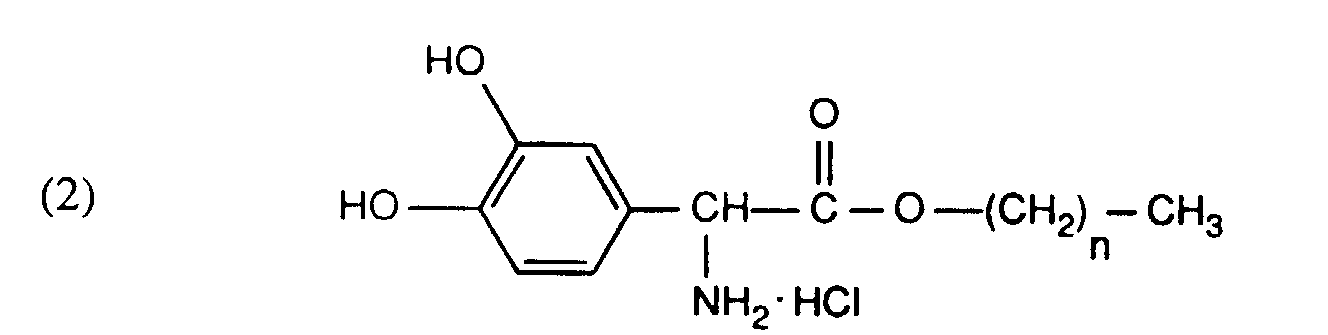 wherein
- n
- is 3 to 9.
- The compounds of formula (1) are useful for the treatment of inflammatory and allergic spasmolytic conditions, as well as for the treatment of psoriasis, bronchial asthma, arteriosclerosis and conditions involving disturbances of cell proliferation.
- As a function of their structure and in systemic dose-related administration, the compounds of formula (1) inhibit the paw oedema in rats induced by carrageenan (q.v. Example 14).
- They are also effective when applied locally to the oedema on mice ears induced by croton oil (q.v. Example 15).
- The compounds of formula (1) also have analgesic action. For example, they inhibit the writhing reactions induced in mice by i.p (= intraperitoneal) administration of acetic acid (q.v. Example 16).
- It can be demonstrated that the compounds of formula (1) effect non-competitive inhibition of contractions induced by histamine, acetyl choline or barium chloride in isolated smooth muscular organs (guinea pig ileum and trachea).
- In vitro assays show that the compounds of formula (1) inhibit the formation of different mediators that are an important factor in inflammation. They reduce the activities of PGH synthase as well as 5- and 15-lipoxygenase (q.v. Example 17). Furthermore, they inhibit the formation of hydrogen peroxide (cf. Example 18).
- Galenic formulations compriosing the compounds of formula (1) will be understood as meaning in particular emulsions, ointments, gels, sprays, powders and the like. Compounds of formula (1) may also be contained in liposomes or used in pharmacological compositions with conventional carriers and penetration enhancers, for example urea, propylene glycol, oleic acid and the like [q.v. also Barry, B.W.in: Schroot, B.; Schaefer,H. (Eds.): Pharmacol. Skin., Vol. 1, pp.121, Karger, Basel 1987]. The pharmaceutical composition will usually contain the compounds of formula (1) in amounts of 0.01 to 15 % by weight, preferably of 0.1 to 5 % by weight, of the total mixture. For the treatment of the conditions listed hereinabove, the pharmaceutical composition of this invention may contain, in addition to the compounds of formula (1), further pharmaceutical agents having antiphlogistic activity, typically including antiinflammatory agents, antipsoriatic agents, cell proliferation regulators, and antiallergic, gastroprotective and antiasthmatic agents.
- The invention further relates to a cosmetic composition comprising a compound of formula (1), together with a cosmetically acceptable carrier or adjuvant.
- The compounds of formula (1) are novel. The process for their preparation is also an object of the invention (Examples 1 and 2). The process comprises reacting the amino acid of formulawith an alcohol of formula

- m
- is 2 or 3, and
- n
- is 3 to 12.
- The reaction time is from 2 to 10, preferably from 2.5 to 5, hours. The reaction temperature is conveniently in the range from 60 to 80, preferably from 75 to 80°C.
- The general reaction of DL-phenylamino acids with alcohols in the presence of thionyl chloride is described in Pharmazie 47, 55 (1992).
- The following Examples will serve to illustrate the invention without implying any restriction to what is described therein. Unless otherwise indicated, percentages are by weight.
- Example 1: Preparation of DL-3,4-dihydroxyphenylglycine octyl ester hydrochloride With stirring, 9.52 g (0.08 mol) of thionyl chloride are added dropwise to a suspension of 9.16 g (0.05 mol) of DL-3,4-dihydroxyphenylglycine and 97.7 g (0.75 mol) of n-octyl alcohol. The mixture is heated for 3 hours to 80°C and then cooled. A further 3.57 g (0.03 mol) of thionyl chloride are added and the reaction mixture is again heated for 1 hour to 80°C. The solvent is removed under vacuum and, for purification, the residue is taken up in 150 ml of a saturated solution of (NH4)2CO3 and extracted with 2x100 ml of diethyl ether. The combined ethereal extract is dried over sodium sulfate and filtered. Dry HCl is then passed through the filtrate. The precipitate is isolated by filtration and recrystallised from a mixture of n-propanol/diethyl ether, affording 4.15 g (yield: 25 % of theory) of the compound of formula
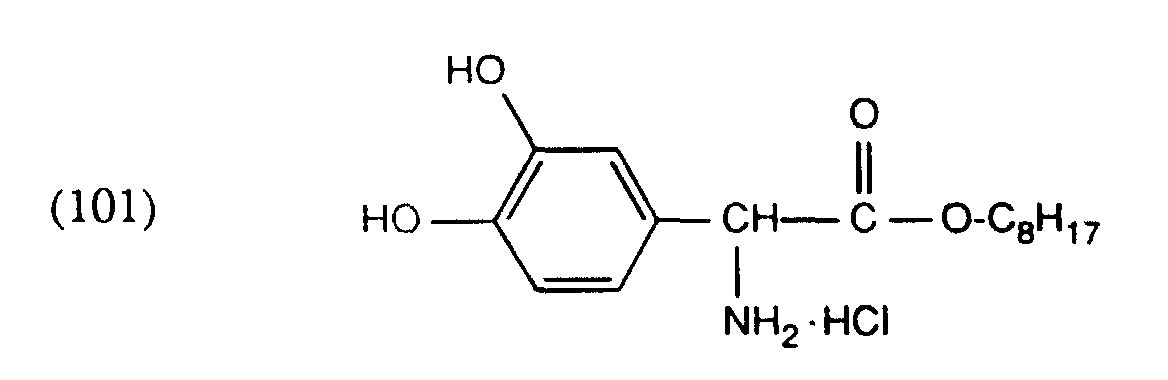
Elemental analysis: C H N clcd 57.91 7.90 4.22 found 57.57 7.72 4.26 - Example 2: The procedure of Example 1 is repeated, but replacing 0.05 mol of DL-3,4-dihydroxyphenylglycine with 0.05 mol of DL-3,4,5-trihydroxyphenylglycine, giving 6.44 g (yield: 37 % of theory) of the compound of formula

Elemental analysis: C H N clcd 55.25 7.53 4.03 found 55.21 8.03 3.95 - Examples 3 to 5: The procedure of Example 1 is repeated, but replacing 0.75 mol of n-octyl alcohol by
- -n-nonylalkonhol (Example 3),
- -n-decylalkonhol (Example 4), and
- -n-dodecylalkonhol (Example 5).
-
- Compounds of the formulae (103)-(106)

- (103): R1 n-nonyl
- (104): R1 n-decyl
- (105): R1 n-dodecyl are obtained.
-
- Example 6: An ointment containing 2 % of the compound of formula (102) can be prepared as follows:
Composition: active ingredient 2 % vaseline 45.0 % paraffin oil 19.6 % cetyl alcohol 5.00 % beeswax 5.00 % sorbitan sesquioleate 5.00 % p-hydroxybenzoate 0.20 % demineralised water to make up 100.00 % - The fatty substances and emulsifiers are fused together and the active ingredient is dissolved therein. The preservative is dissolved in water and the solution is emulsified at elevated temperature into the melt and the emulsion is then stirred until cold.
- Example 7: A cream containing 1 % of the compound of formula (101) can be prepared as follows:
Composition: active ingredient 1 % isopropyl palmitate 8.0 % cetyl palmitate 1.5 % silicone oil 100 0.5 % sorbitan monostearate 3.0 % polysorbate 60 3.5 % 1,2-propylene glycol PH 20.0 % acrylic acid polymer 0.5 % triethanolamine 0.7 % demineralised water to make up 100.00 % - The acrylic acid polymer is suspended in a mixture of demineralised water and 1,2-propylene glycol. With stirring, triethanolamine is added to form a mucilage. A mixture of isopropyl palmitate, cetyl palmitate, silicone oil, sorbitan monostearate and polysorbate is heated to c. 75°C and the active igredient is dissolved therein. This fatty phase is stirred into the mucilage, which is also heated to c. 75°C, and the batch is stirred until cold.
- Example 8: A cream containing 0.5 % of the compound of formula (102) can be prepared as follows:
Composition: active ingredient 0.5 % cetyl palmitate PH 2.00 % cetyl alcohol PH 2.00 % triglyceride mixture of saturated medium fatty acids 5.00 % stearic acid 3.00 % glycerol stearate PH 4.00 % Cetomacrogol 1000 1.00 % microcrystalline cellulose 0.50 % 1,2-propylene glycol, dist. 20.00 % demineralised water to make up 100.00 %. - Cetyl alcohol, cetyl palmitate, the triglyceride mixture, stearic acid and glycerol stearate are fused together and the active ingredient is dissolved therein. The microcrystalline cellulose is dispersed in some of the water. Cetomacrogol is dissolved in the remainder of the water and the propylene glycol and the mucilage are mixed therewith. The fatty phase is then stirred into the aqueous phase and stirred until cold.
- The formulation is suitable for use as a moisturising skin-protective cream.
- Example 9: A transparent hydrogel containing 0.2 % of the compound of formula (102) is prepared as follows:
Composition: active ingredient 0.2 % propylene glycol 10.0-20.0 % isopropanol 20.0 % hydroxypropylmethyl cellulose 2.0 % water to make up 100.00 % - The hydroxypropylmethyl cellulose is swollen in water. The active ingredient is dissolved in a mixture of isopropanol and propylene glycol. Then the active ingredient solution is mixed with a swollen cellulose derivative and, if desired, perfume is added (0.1%).
- The formulation is suitable for use as a moisturising skin gel.
- Example 10: A transparent hydrogel containing 0.02 % of the compound of formula (102) is prepared as follows:
Composition: active ingredient 0.02 % propylene glycol 20.0 % isopropanol 20.0 % acrylic acid polymer 2.0 % triethanolamine 3.0 % water to make up 100.00 % - Acrylic acid polymer and water are dispersed and the dispersion is neutralised with triethanolamine. The active ingredient is dissolved in a mixture of isopropanol and propylene glycol. The active ingredient solution is then mixed with a gel and, if desired, perfume oil (0.1 %) can be added.
- Example 11: A foam spray containing 1 % of the compound of formula (102) can be prepared as follows:
Composition: active ingredient 1 % cetyl alcohol PH 1.70 % viscous paraffin oil 1.00 % isopropyl myristate 2.00 % Cetomacrogol 1000 2.40 % sorbitan monostearate 1.50 % 1,2-propylene glycol PH 5.00 % methyl parabene 0.18 % propyl parabene 0.02 % Chemoderm 314 0.10 % demineralised water to make up 100.00 % - Cetyl alcohol, paraffin oil, isopropyl myristate, Cetomacrogol and sorbitan stearate are fused together and the active ingredient is dissolved therein. Methyl and propyl parabene are dissolved in propylene glycol and the solution is added to the hot water. The melt and the solution are afterwards mixed. After cooling, the Chemoderm is added and, if desired, perfume oil (0.1%) the formulation is bulked with water to the final weight.
- An aluminium dispenser is filled with 20 ml of the mixture. The dispenser is fitted with a nozzle and propellant gas is introduced under pressure.
- Example 12: An eye ointment containing 0.01 % of the compound of formula (101) can be prepared as follows:
Composition: active ingredient 0.01 % viscous paraffin oil 10 % wool grease anhyd. 10 % white vaseline 79 % 100% - The constituents are fused together and filtered under sterile conditions.
- Example 13: Capsules suitable for insufflation and containing 0.025 % of the compound of formula (102) can be prepared as follows:
Composition: (for 1000 capsules) active ingredient 25.00 g milled lactose 25.00 g - The active ingredient and the microfine lactose are thoroughly blended. The powder is sieved and filled in 0.05 g portions into gelatine capsules.
- Example 14: Action on the carrageenan oedema after systemic application
The DL-phenylamino acid ester prepared in Examples 1 and 2 is assayed for its activity in male and female Wistar rats ((100-150 g, 8 animals per group). The oedema is induced by subplantar injection of 0.1 ml of a 1 % solution of carrageenan (viscarin®) into both hind paws of the rats. The compounds of formulae (101) and (102) are administered simultaneously i.p. The paw diameters are measured before and 3 hours after inducing the oedema. The percentage inhibition of the paw swelling is determined by comparison with the control group. The following ED50 values (ED = effective dose) are found by linear regression (Table 1):ED50[10-4 mol/kg] compound of formula (101) 1.5 compound of formula (102) 0.8 acetylsalicylic acid 15.2 - Example 15: Antioedamatous activity
The assays for determining the antioedamatous activity of the novel compounds of formulae (101) and (102) prepared in Examples 1 and 2 are carried out on male AB mice (18-22 g, 9 animals per group). The ear oedema is induced by applying 2x10 µl of croton oil (1 % in acetone) to the ears of the mice. After 1 hour the novel compounds (2x 10 µl of a 5 % ethanolic solution of each compound) are applied. After a further 5 hours (6 hours after inducing oedema) the animals are sacrificed, and pieces of ear tissue having a diameter of 8 mm are obtained. The oedema weight is determined as the difference between the contralateral ear. The percentage inhibition is calculated from a comparison with the control animals. (Table 2).Inhibition [%] compound of formula (101) 23.9 compound of formula (102) 45.7 - Example 16: Activity against the writhing syndrome
The activity of the novel compounds of formulae (101) and (102) against the writhing syndrome is carried out on female CBA mice (c. 20 g, 9 animals per group). The writhing reactions are induced by i.p. (= intraperitoneal) injection of 0.1 ml of 1 % acetic acid/10 g and recorded over a period of 20 minutes after injection. The compounds of formulae (101) and (102) are administered i.p. in a dose of 5x10⁻⁵ mol/kg 30 minutes before inducement of the writhing reactions, and the percentage inhibition of the number of reactions is determined (Table 3).Inhibition [%] compound of formula (101) 80.2 compound of formula (102) 80.7 acetylsalicylic acid 32.3 - Example 17: Inhibition of arachidonic acid metabolism
Prostaglandin H synthase is prepared from the seminal vesicles of sheep (F.S. Van der Ouderaa, M. Buytenhek.: Methods Enzymol. 86, 60-68 (1982)), and 15-lipoxygenase from rabbit reticulocytes (T. Schewe, R. Wiesner, S.M. Rapoport: Methods Enzymol. 71, 430-441 (1981)). Both enzymatic activities are measured oxygraphically at 25°C. - The prostaglandin H synthase activity is determined in 0.1 molar tris-HCl at pH 8.0 containing 0.1 µmol/l of EDTA-Na, and 0.5 µmol of phenol, using microsomal enzyme preparations with 30 µmol/l of arachidonic acid as substrate (Ch. Schewe, P. Ludwig, H.G. Holzhütter, T. Schewe: Pharmazie 46, 804-809 (1991)).
- The 15-lipoxygenase activity is measured using 265 µmol/l of potassium linoleate as substrate in 0.1 molar phosphate puffer at pH 7.4 and 0.2 % sodium cholate (T. Schewe, H. Kühn, S.M. Rapoport, in: Prostaglandins and Related Substances - A Practical Approach pp. 229-242, C. Benedetto, R.G. McDonald-Gibson, S. Nigam, T.F. Slater (Eds.); IRL Press, Oxford, Washington (1987)). The compounds are freshly dissolved in 2-methoxyethanol and preincubated for 5 minutes with the enzyme preparation, and the reaction is started by addition of substrate.
- The influence of the formation of 5-HETE by 5-lipoxygenase of human polymorphonuclear leucozytes from 1-14C-arachidonic acid (10 µmol/l) by the compounds is determined, after thin-layer chromatographic separation, by the radioactive distribution of the reaction products (Table 4) (Ch. Schewe, E. Schulz, G. Vietinghoff, W.-D. Sprung, M. Kobow, S. Loose, T. Schewe: Biomed.Biochim.Acta 50, 189-198 (1991)).
PGH Synthase 5-LOX 5-HETE formation IC50 10-6mol/l IC50 10-6mol/l IC50 10-6mol/l compound of formula (101) 110 3.9 6.9 compound of formula (102) 85 250 1.3 acetylsalicylic acid 50 >1000 - - Example 18: Inhibition of hydrogen peroxide formation
The influence of the novel compounds of formulae (101) and (102) on the formation of hydrogen peroxide induced by opsonated zymosan is determined using casein-stimulated peritoneal granulocytes of rats (5x10⁶ cells/ml). In this assay, the oxidation of phenol red induced by H2O2 is measured from the absorption at 610 nm (E. Pick, Y. Keisari: J. Immunol.Meth. 38, 161-170 (1980)). After an incubation time of 30 min the percentage inhibition of the formation of hydrogen peroxide and the IC50 is computed by means of linear regression (Table 5).IC50[10-6mol/l] compound of formula (101) 2.3 compound of formula (102) 5.3 acetylsalicylic acid > 100
Claims (10)
- A compound of formulawherein

- n
- is 3 to 12 and
- m
- is 2 or 3.
- A compound according to claim 1, wherein
- n
- is 3 to 9.
- A compound according to claim 1 or 2 of formulawherein
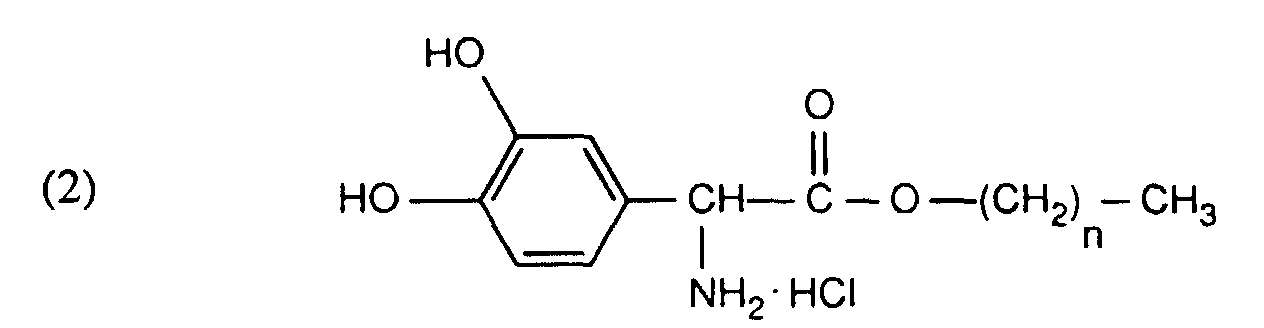
- n
- is 3 to 9.
- A compound according to either claim 1 or claim 2 of formulawherein
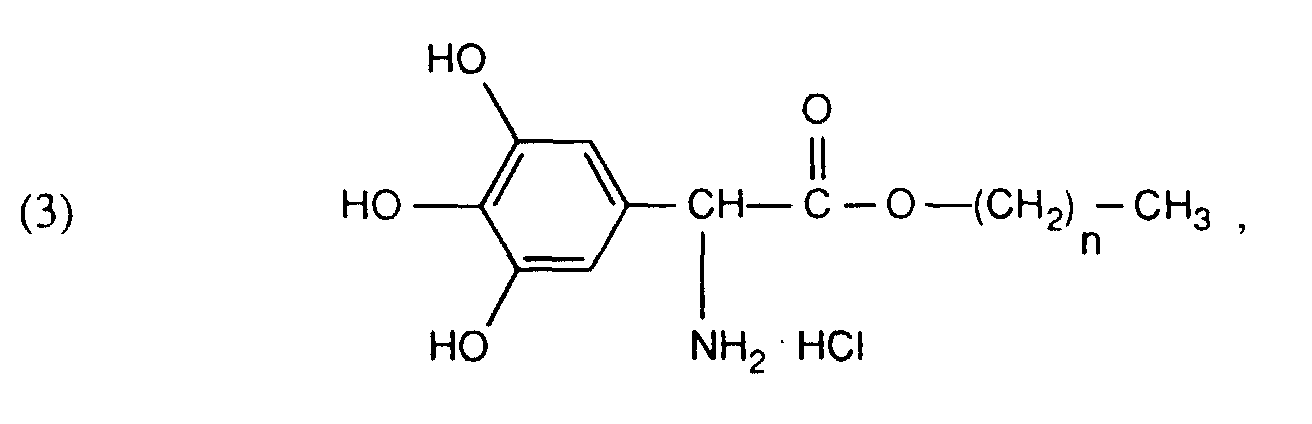
- n
- is 3 to 9.
- A compound according to any one of claims 1 to 4 for use as therapeutic agent.
- A pharmaceutical composition comprising at least one compound as claimed in any one of claims 1 to 4, together with a pharmaceutically acceptable carrier or adjuvant.
- A pharmaceutical composition according to claim 6, which additionally comprises at least one substance having antiphlogistic action.
- Use of a compound according to any one of claims 1 to 4 for the preparation of a medicament for the treatment of inflammatory and allergic spasmolytic conditions, as well as for the treatment of psoriasis, bronchial asthma, arteriosclerosis and conditions involving disturbances of cell proliferation.
- A cosmetic composition comprising a compound as claimed in any one of claims 1 to 4, together with a cosmetically acceptable carrier or adjuvant.
- A process for the preparation of a compound of formula (1), which comprises reacting the amino acid of formulawith an alcohol of formula

- m
- is 2 or 3, and
- n
- is 3 to 12.
Applications Claiming Priority (4)
| Application Number | Priority Date | Filing Date | Title |
|---|---|---|---|
| CH88494 | 1994-03-24 | ||
| CH884/94 | 1994-03-24 | ||
| CH88494 | 1994-03-24 | ||
| PCT/EP1995/000914 WO1995025715A1 (en) | 1994-03-24 | 1995-03-13 | Dl- di- or tri-hydroxyphenylglycine alkyl esters for the treatment of inflammatory and allergic conditions |
Publications (2)
| Publication Number | Publication Date |
|---|---|
| EP0751928A1 EP0751928A1 (en) | 1997-01-08 |
| EP0751928B1 true EP0751928B1 (en) | 1999-11-17 |
Family
ID=4197422
Family Applications (1)
| Application Number | Title | Priority Date | Filing Date |
|---|---|---|---|
| EP95913088A Expired - Lifetime EP0751928B1 (en) | 1994-03-24 | 1995-03-13 | Dl- di- or tri-hydroxyphenylglycine alkyl esters for the treatment of inflammatory and allergic conditions |
Country Status (9)
| Country | Link |
|---|---|
| US (1) | US5834511A (en) |
| EP (1) | EP0751928B1 (en) |
| JP (1) | JP3798427B2 (en) |
| AT (1) | ATE186719T1 (en) |
| AU (1) | AU2068895A (en) |
| BR (1) | BR9507135A (en) |
| DE (1) | DE69513389T2 (en) |
| ES (1) | ES2139890T3 (en) |
| WO (1) | WO1995025715A1 (en) |
Families Citing this family (6)
| Publication number | Priority date | Publication date | Assignee | Title |
|---|---|---|---|---|
| ES2103204B1 (en) * | 1995-11-27 | 1998-04-01 | Dsm Deretil S A | CHIRAL DERIVATIVES OF HYDROXYPHENYLGLYCINE AND ITS USE IN THE SYNTHESIS OF ACTIVE PHARMACEUTICAL PRINCIPLES. |
| JP3948844B2 (en) * | 1998-06-12 | 2007-07-25 | トヨタ自動車株式会社 | Wet friction material |
| US8263580B2 (en) * | 1998-09-11 | 2012-09-11 | Stiefel Research Australia Pty Ltd | Vitamin formulation |
| AUPP583198A0 (en) * | 1998-09-11 | 1998-10-01 | Soltec Research Pty Ltd | Mousse composition |
| DE10252816B4 (en) * | 2002-11-13 | 2008-02-14 | Schwan-Stabilo Cosmetics Gmbh & Co. Kg | Cosmetic preparation, and a process for its preparation and its use |
| ES2447301T3 (en) | 2005-06-01 | 2014-03-11 | Glaxosmithkline Intellectual Property Development Limited | Vitamin formulation |
Family Cites Families (1)
| Publication number | Priority date | Publication date | Assignee | Title |
|---|---|---|---|---|
| DD262021A1 (en) * | 1987-07-14 | 1988-11-16 | Univ Rostock | METHOD FOR THE PRODUCTION OF HYDROCHLORIDES OF LENGTH-STRINGED ALKYLESTER RINGS-SUPPORTED DL-PHENYLAMINOSAURES |
-
1995
- 1995-03-13 ES ES95913088T patent/ES2139890T3/en not_active Expired - Lifetime
- 1995-03-13 DE DE69513389T patent/DE69513389T2/en not_active Expired - Lifetime
- 1995-03-13 AU AU20688/95A patent/AU2068895A/en not_active Abandoned
- 1995-03-13 AT AT95913088T patent/ATE186719T1/en not_active IP Right Cessation
- 1995-03-13 JP JP52434695A patent/JP3798427B2/en not_active Expired - Fee Related
- 1995-03-13 BR BR9507135A patent/BR9507135A/en not_active IP Right Cessation
- 1995-03-13 EP EP95913088A patent/EP0751928B1/en not_active Expired - Lifetime
- 1995-03-13 WO PCT/EP1995/000914 patent/WO1995025715A1/en not_active Ceased
-
1997
- 1997-06-27 US US08/884,332 patent/US5834511A/en not_active Expired - Lifetime
Also Published As
| Publication number | Publication date |
|---|---|
| BR9507135A (en) | 1997-09-30 |
| JP3798427B2 (en) | 2006-07-19 |
| WO1995025715A1 (en) | 1995-09-28 |
| DE69513389D1 (en) | 1999-12-23 |
| JPH09510464A (en) | 1997-10-21 |
| EP0751928A1 (en) | 1997-01-08 |
| ATE186719T1 (en) | 1999-12-15 |
| AU2068895A (en) | 1995-10-09 |
| ES2139890T3 (en) | 2000-02-16 |
| US5834511A (en) | 1998-11-10 |
| DE69513389T2 (en) | 2000-06-29 |
Similar Documents
| Publication | Publication Date | Title |
|---|---|---|
| US6239119B1 (en) | Topical administration of amifostine and related compounds | |
| US6180669B1 (en) | Method for treatment of dermatological disorders | |
| US4933330A (en) | Benzoic acid derivatives and use thereof | |
| US5780504A (en) | Topical alkyl-2-O-L-ascorbyl-phosphates | |
| US4482495A (en) | Mixed anhydrides of N'-acetylaminothioalkanoates | |
| CN101500983A (en) | Positively charged water-soluble prodrugs of diflunisal and related compounds with fast skin penetration rates | |
| US6020510A (en) | Cytoprotective compounds | |
| RU2060731C1 (en) | Agents showing antiallergic and antiinflammatory activities at skin damage of nonmicrobial genesis | |
| US5834511A (en) | DL- DI- or tri-hydroxyphenylglycine alkyl esters for the treatment of inflammatory and allergic conditions | |
| EP0352826B1 (en) | Use of 5-aminosalicylic acid in the treatment of dermatological disorders | |
| US5061720A (en) | Substituted-4-thiazolidinone derivatives | |
| JPH039089B2 (en) | ||
| US6730703B2 (en) | Dual inhibitors of cholesteryl ester and wax ester synthesis for sebaceous gland disorders | |
| US4134989A (en) | Guaiacol p-isobutyl hydratropate | |
| CZ2194A3 (en) | (all-e)-3,7-dimethyl-9-/3,5-dimethyl-2-(nonyloxy)phenyl /-2,4,6,8-nonatetraenic acid, process of its preparation and pharmaceutical preparations based thereon | |
| CA2124852A1 (en) | Use of a known chemical compound for the production of a pharmaceutical composition for topical application | |
| FR2567402A1 (en) | NOVEL PHARMACEUTICAL AND COSMETIC COMPOSITIONS CONTAINING DIHYDROXY-1,8 PHENYL-10 ANTHRONE-9 AS ACTIVE INGREDIENT, AND PROCESS FOR PREPARING THE ACTIVE INGREDIENT | |
| HU183325B (en) | Process for preparing new apovincaminol-3',4',5'-trimethoxy-benzoates substituted with a nitro group | |
| JPS6149289B2 (en) | ||
| HK1217015A1 (en) | Positively charged water-soluble prodrugs of diflunisal and related compounds | |
| HK1136814B (en) | Positively charged water-soluble prodrugs of diflunisal and related compounds with very fast skin penetration rate | |
| CN105439877A (en) | Positively charged water-soluble prodrug of diflunisal and related compound | |
| HK1022140A (en) | Method for treatment of dermatological disorders | |
| HK1003942B (en) | New alkaloid derivatives, their use and pharmaceutical formulations containing them | |
| AU2016222329A1 (en) | Positively charged water-soluble pro-drugs of ibuprofen |
Legal Events
| Date | Code | Title | Description |
|---|---|---|---|
| PUAI | Public reference made under article 153(3) epc to a published international application that has entered the european phase |
Free format text: ORIGINAL CODE: 0009012 |
|
| 17P | Request for examination filed |
Effective date: 19960822 |
|
| AK | Designated contracting states |
Kind code of ref document: A1 Designated state(s): AT BE CH DE ES FR GB IT LI NL |
|
| RAP1 | Party data changed (applicant data changed or rights of an application transferred) |
Owner name: CIBA SC HOLDING AG |
|
| RAP3 | Party data changed (applicant data changed or rights of an application transferred) |
Owner name: CIBA SPECIALTY CHEMICALS HOLDING INC. |
|
| 17Q | First examination report despatched |
Effective date: 19980203 |
|
| GRAG | Despatch of communication of intention to grant |
Free format text: ORIGINAL CODE: EPIDOS AGRA |
|
| GRAG | Despatch of communication of intention to grant |
Free format text: ORIGINAL CODE: EPIDOS AGRA |
|
| GRAH | Despatch of communication of intention to grant a patent |
Free format text: ORIGINAL CODE: EPIDOS IGRA |
|
| GRAH | Despatch of communication of intention to grant a patent |
Free format text: ORIGINAL CODE: EPIDOS IGRA |
|
| GRAA | (expected) grant |
Free format text: ORIGINAL CODE: 0009210 |
|
| AK | Designated contracting states |
Kind code of ref document: B1 Designated state(s): AT BE CH DE ES FR GB IT LI NL |
|
| REF | Corresponds to: |
Ref document number: 186719 Country of ref document: AT Date of ref document: 19991215 Kind code of ref document: T |
|
| REG | Reference to a national code |
Ref country code: CH Ref legal event code: EP |
|
| REF | Corresponds to: |
Ref document number: 69513389 Country of ref document: DE Date of ref document: 19991223 |
|
| ITF | It: translation for a ep patent filed | ||
| REG | Reference to a national code |
Ref country code: ES Ref legal event code: FG2A Ref document number: 2139890 Country of ref document: ES Kind code of ref document: T3 |
|
| ET | Fr: translation filed | ||
| PLBE | No opposition filed within time limit |
Free format text: ORIGINAL CODE: 0009261 |
|
| STAA | Information on the status of an ep patent application or granted ep patent |
Free format text: STATUS: NO OPPOSITION FILED WITHIN TIME LIMIT |
|
| 26N | No opposition filed | ||
| REG | Reference to a national code |
Ref country code: GB Ref legal event code: IF02 |
|
| PGFP | Annual fee paid to national office [announced via postgrant information from national office to epo] |
Ref country code: AT Payment date: 20020327 Year of fee payment: 8 |
|
| PG25 | Lapsed in a contracting state [announced via postgrant information from national office to epo] |
Ref country code: AT Free format text: LAPSE BECAUSE OF NON-PAYMENT OF DUE FEES Effective date: 20030313 |
|
| REG | Reference to a national code |
Ref country code: CH Ref legal event code: PFA Owner name: CIBA HOLDING INC. Free format text: CIBA SPECIALTY CHEMICALS HOLDING INC.#KLYBECKSTRASSE 141#4057 BASEL (CH) -TRANSFER TO- CIBA HOLDING INC.#KLYBECKSTRASSE 141#4057 BASEL (CH) |
|
| PGFP | Annual fee paid to national office [announced via postgrant information from national office to epo] |
Ref country code: IT Payment date: 20120322 Year of fee payment: 18 |
|
| PGFP | Annual fee paid to national office [announced via postgrant information from national office to epo] |
Ref country code: ES Payment date: 20120427 Year of fee payment: 18 |
|
| PGFP | Annual fee paid to national office [announced via postgrant information from national office to epo] |
Ref country code: CH Payment date: 20130326 Year of fee payment: 19 Ref country code: GB Payment date: 20130328 Year of fee payment: 19 |
|
| PGFP | Annual fee paid to national office [announced via postgrant information from national office to epo] |
Ref country code: BE Payment date: 20130430 Year of fee payment: 19 Ref country code: DE Payment date: 20130531 Year of fee payment: 19 |
|
| PGFP | Annual fee paid to national office [announced via postgrant information from national office to epo] |
Ref country code: FR Payment date: 20130422 Year of fee payment: 19 Ref country code: NL Payment date: 20130322 Year of fee payment: 19 |
|
| REG | Reference to a national code |
Ref country code: DE Ref legal event code: R119 Ref document number: 69513389 Country of ref document: DE |
|
| REG | Reference to a national code |
Ref country code: NL Ref legal event code: V1 Effective date: 20141001 |
|
| REG | Reference to a national code |
Ref country code: CH Ref legal event code: PL |
|
| GBPC | Gb: european patent ceased through non-payment of renewal fee |
Effective date: 20140313 |
|
| REG | Reference to a national code |
Ref country code: FR Ref legal event code: ST Effective date: 20141128 |
|
| REG | Reference to a national code |
Ref country code: DE Ref legal event code: R119 Ref document number: 69513389 Country of ref document: DE Effective date: 20141001 |
|
| PG25 | Lapsed in a contracting state [announced via postgrant information from national office to epo] |
Ref country code: GB Free format text: LAPSE BECAUSE OF NON-PAYMENT OF DUE FEES Effective date: 20140313 Ref country code: LI Free format text: LAPSE BECAUSE OF NON-PAYMENT OF DUE FEES Effective date: 20140331 Ref country code: DE Free format text: LAPSE BECAUSE OF NON-PAYMENT OF DUE FEES Effective date: 20141001 Ref country code: FR Free format text: LAPSE BECAUSE OF NON-PAYMENT OF DUE FEES Effective date: 20140331 Ref country code: CH Free format text: LAPSE BECAUSE OF NON-PAYMENT OF DUE FEES Effective date: 20140331 |
|
| PG25 | Lapsed in a contracting state [announced via postgrant information from national office to epo] |
Ref country code: NL Free format text: LAPSE BECAUSE OF NON-PAYMENT OF DUE FEES Effective date: 20141001 |
|
| PG25 | Lapsed in a contracting state [announced via postgrant information from national office to epo] |
Ref country code: IT Free format text: LAPSE BECAUSE OF NON-PAYMENT OF DUE FEES Effective date: 20140313 |
|
| REG | Reference to a national code |
Ref country code: ES Ref legal event code: FD2A Effective date: 20150427 |
|
| PG25 | Lapsed in a contracting state [announced via postgrant information from national office to epo] |
Ref country code: ES Free format text: LAPSE BECAUSE OF NON-PAYMENT OF DUE FEES Effective date: 20140314 |
|
| PG25 | Lapsed in a contracting state [announced via postgrant information from national office to epo] |
Ref country code: BE Free format text: LAPSE BECAUSE OF NON-PAYMENT OF DUE FEES Effective date: 20140331 |