EP0750294B1 - Speech recognizing device and method - Google Patents
Speech recognizing device and method Download PDFInfo
- Publication number
- EP0750294B1 EP0750294B1 EP96304619A EP96304619A EP0750294B1 EP 0750294 B1 EP0750294 B1 EP 0750294B1 EP 96304619 A EP96304619 A EP 96304619A EP 96304619 A EP96304619 A EP 96304619A EP 0750294 B1 EP0750294 B1 EP 0750294B1
- Authority
- EP
- European Patent Office
- Prior art keywords
- pattern
- speech
- reference pattern
- frame
- partial
- Prior art date
- Legal status (The legal status is an assumption and is not a legal conclusion. Google has not performed a legal analysis and makes no representation as to the accuracy of the status listed.)
- Expired - Lifetime
Links
- 238000000034 method Methods 0.000 title claims description 74
- 230000001186 cumulative effect Effects 0.000 claims description 55
- 238000004364 calculation method Methods 0.000 claims description 19
- 238000012545 processing Methods 0.000 claims description 17
- 238000003909 pattern recognition Methods 0.000 claims description 3
- 230000007423 decrease Effects 0.000 claims 1
- 230000014509 gene expression Effects 0.000 description 21
- 230000015572 biosynthetic process Effects 0.000 description 2
- 238000007796 conventional method Methods 0.000 description 2
- 238000001514 detection method Methods 0.000 description 2
- 210000005069 ears Anatomy 0.000 description 2
- 238000003786 synthesis reaction Methods 0.000 description 2
- 230000002194 synthesizing effect Effects 0.000 description 2
- RRLHMJHRFMHVNM-BQVXCWBNSA-N [(2s,3r,6r)-6-[5-[5-hydroxy-3-(4-hydroxyphenyl)-4-oxochromen-7-yl]oxypentoxy]-2-methyl-3,6-dihydro-2h-pyran-3-yl] acetate Chemical compound C1=C[C@@H](OC(C)=O)[C@H](C)O[C@H]1OCCCCCOC1=CC(O)=C2C(=O)C(C=3C=CC(O)=CC=3)=COC2=C1 RRLHMJHRFMHVNM-BQVXCWBNSA-N 0.000 description 1
- 238000009825 accumulation Methods 0.000 description 1
- 238000004458 analytical method Methods 0.000 description 1
- 230000006835 compression Effects 0.000 description 1
- 238000007906 compression Methods 0.000 description 1
- 230000003247 decreasing effect Effects 0.000 description 1
- 238000010586 diagram Methods 0.000 description 1
- 238000002474 experimental method Methods 0.000 description 1
- 239000000284 extract Substances 0.000 description 1
- 230000006870 function Effects 0.000 description 1
- 230000012447 hatching Effects 0.000 description 1
- 230000010365 information processing Effects 0.000 description 1
- 239000000463 material Substances 0.000 description 1
- 238000012986 modification Methods 0.000 description 1
- 230000004048 modification Effects 0.000 description 1
- 238000012805 post-processing Methods 0.000 description 1
- 238000003672 processing method Methods 0.000 description 1
- 238000005070 sampling Methods 0.000 description 1
- 230000001360 synchronised effect Effects 0.000 description 1
- 230000000699 topical effect Effects 0.000 description 1
Images





Classifications
-
- G—PHYSICS
- G10—MUSICAL INSTRUMENTS; ACOUSTICS
- G10L—SPEECH ANALYSIS TECHNIQUES OR SPEECH SYNTHESIS; SPEECH RECOGNITION; SPEECH OR VOICE PROCESSING TECHNIQUES; SPEECH OR AUDIO CODING OR DECODING
- G10L15/00—Speech recognition
- G10L15/08—Speech classification or search
- G10L15/10—Speech classification or search using distance or distortion measures between unknown speech and reference templates
-
- G—PHYSICS
- G10—MUSICAL INSTRUMENTS; ACOUSTICS
- G10L—SPEECH ANALYSIS TECHNIQUES OR SPEECH SYNTHESIS; SPEECH RECOGNITION; SPEECH OR VOICE PROCESSING TECHNIQUES; SPEECH OR AUDIO CODING OR DECODING
- G10L15/00—Speech recognition
- G10L15/08—Speech classification or search
- G10L2015/088—Word spotting
Definitions
- the present invention relates to a speech recognizing device and method for recognizing an input speech and, more particularly, to a speech recognizing device and method for extracting a time-series feature-parameter from sequentially inputted voice signals, calculating a distance between the extracted time-series feature-parameter and time-series known feature (e.g., phoneme) parameter of a reference pattern by using continuous dynamic programming (DP) method and recognizing a partial speech sentence, for example, a word in the process of recognizing a speech sentence by detecting a time-series feature-parameter of a reference pattern at which a shortest distance between both parameters is measured.
- DP continuous dynamic programming
- This method recognizes a partial speech sentence by simultaneously determining the consistency of a predetermined segment of a reference pattern represented by continuous words with an input speech in a process of calculating operation on a whole reference pattern.
- the above-mentioned method requires a user to manually specify a scope of a partial spoken sentence to calculate its distance.
- a speech recognising device according to claim 1.
- Fig. 1 is a view for explaining a conventional method for obtaining a cumulative distance of a partial reference pattern.
- Fig. 2 is a view for explaining a continuous DP method.
- Fig. 3 is a view for explaining a method for obtaining a cumulative distance of a partial reference of a first embodiment.
- Fig. 4 is a view for explaining the optimality of the first embodiment.
- Fig. 5 is a block diagram showing a system of the first embodiment of the present invention.
- Fig. 6 is a view for explaining a speech recognition method relating to the first embodiment of the present invention.
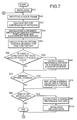
- Fig. 7 is a flow chart of speech recognition procedure relating to the first embodiment of the present invention.
- Fig. 8 shows a reference pattern of a second embodiment of the present invention.
- Fig. 9 is a view for explaining a processing according to the second embodiment of the present invention.
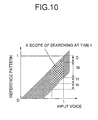
- Fig. 10 is a view for explaining a processing according to the second embodiment of the present invention.
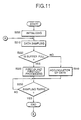
- Fig. 11 is a flow chart of speech recognition procedure according to the second embodiment of the present invention.
- Figs. 12A and 12B are views for explaining a processing according to the third embodiment of the present invention.
- Fig. 13 is a flow chart of speech recognition procedure according to the third embodiment of the present invention.
- Fig. 14 is a view for explaining a processing according to the fourth embodiment of the present invention.
- Fig. 15 is a flow chart of speech recognition procedure according to the fourth embodiment of the present invention.
- Fig. 1 is a view for explaining a conventional method mentioned the above Y. Ito et al. for obtaining a cumulative distance of a partial reference pattern.
- the horizontal axis represents an input speech which content is expressed by characters and the vertical axis represents a reference pattern which content is expressed by characters.
- practical speech recognition performs matching a reference pattern with an input speech by using a sequence of so called feature parameters which are speech features extracted from an input speech in a specified unit time and arranged according to the time series, the following description will be made by using characters for easier understanding.
- a reference pattern (template) is ⁇ NIWATORI ⁇ and segments are specified as ⁇ NIWA ⁇ and ⁇ TORI ⁇ .
- a voice ⁇ NI ⁇ is inputted, calculation of distances is conducted in all combinations. For example, a distance between ⁇ NI ⁇ of the reference pattern and the input ⁇ NI ⁇ and distances from ⁇ NI ⁇ , ⁇ WA ⁇ , ⁇ TO ⁇ and ⁇ RI ⁇ , respectively, of the reference pattern to the input ⁇ NI ⁇ are calculated in sequence.
- a voice ⁇ WA ⁇ is inputted, a distance between ⁇ NI ⁇ of the reference pattern and the input ⁇ WA ⁇ and a distance between ⁇ WA ⁇ and the input ⁇ WA ⁇ are calculated.
- the distance calculation results thus obtained are added to the distance calculation results obtained at a preceding point of time. Accumulation of distances calculated at a point of time between a voice input and a segment pattern of a reference pattern to those obtained at preceding points of time can determine an optimal linkage route among the several calculation results. Such a combination of patterns that may absorb time compression or expansion of an input speech and reference pattern as shown in Fig. 2 is usually used. In this example, a shortest cumulative distance is selected among cumulative distances obtained along a path A ⁇ B ⁇ P, a path C ⁇ P and a path E ⁇ D ⁇ P when a point P is supposed as a cumulative distance between a segment reference pattern ⁇ NIWATO ⁇ and an input speech ⁇ NIWATO ⁇ . In Fig.
- a point A represents a cumulative distance between ⁇ NIWA ⁇ of the reference pattern and ⁇ NI ⁇ of the input speech and a point C represents a cumulative distance between ⁇ NIWA ⁇ of the reference pattern and ⁇ NIWA ⁇ of the input speech. Cumulative distances between various combinations are thus determined for every input speech.
- a cumulative distance between the reference pattern ⁇ NIWATORI ⁇ and a current input speech becomes smaller than a threshold when an input speech becomes ⁇ NIWATORI ⁇ . At this point of time, the input speech is therefore recognized to be ⁇ NIWATORI ⁇ .
- the above-mentioned distance calculation is, of course, performed on each of plural reference patterns prepared. By doing so, it is possible to recognize on the spot a sentence matching with a specified reference pattern among a plurality of continuously inputted spoken sentences.
- a cumulative distance of the partial sentence ⁇ TORI ⁇ is determined by subtracting a cumulative distance D1 of ⁇ NIWA ⁇ from a cumulative distance D1 of ⁇ NIWATORI ⁇ .
- the above-mentioned method requires a user to manually specify a scope of a partial spoken sentence to calculate its distance.
- the present invention is directed to provide a speech recognizing device and method for automatically obtaining a distance between a reference pattern of any partial sentence and a spoken input.
- a speech recognition method used for this example is as follows:
- the following equation (1) expresses a reference pattern sequence R and an input pattern sequence I.
- T(r) represents r-th feature parameter in a reference pattern sequence and i(i) represents i-th feature parameter in an input pattern
- a unit of a speech is referred to as a frame in which the feature parameter has been obtained and an input time instant is expressed by t.
- a segment that is common to an input pattern and a reference pattern is defined as follows:
- Each frame T(T) of a reference pattern holds a whole history (hysteresis) of a cumulative distance of a path ending in the frame at a specified time instant. Therefore, a distance of a segment preceding to a current frame is determined as a difference between two histories. By normalizing the segment distance by the number of frames therein it becomes possible to check a matching degree of two segments.
- a normalized distance for example, from a frame ⁇ 3 to a frame ⁇ 6 at a time t1 is determined as (D(6, 6) - D(6, 3))/3 that can be compared with a normalized distance from ⁇ 3 to ⁇ 5, i.e., (D(5, 5) - D(5, 3))/2.
- D( ⁇ 2, ⁇ 1) ⁇ 1 ⁇ 2 ⁇ represents a cumulative distance at a frame ⁇ ( ⁇ 1) on the path ending in a frame ⁇ ( ⁇ 2). Accordingly, a matching degree of two optional segments can be effectively determined in the process of continuous DP calculation on a reference pattern for a continuously spoken input. It is also possible to specify the limited number of hysteresis frames as a shortest and a longest duration of a word if necessary.
- a partial path thereof may have the optimality.
- a partial path from (tj, ⁇ j) to (t3, ⁇ 3) is optimal if a path from (t0, ⁇ 0) to (t3, ⁇ 3) is optimal.
- a path from ⁇ 1 to ⁇ 3 is also optimal if t0 is determined from a free starting position according to the continuous DP method. In this case, the optimality of the path from the frame ⁇ 1 to the frame ⁇ 3 can not always be assured and an optimal path shown by a dotted line may also exist between frames ⁇ 1 and ⁇ 3.
- the continuous DP method allowing a starting point to be free can not guarantee that a partial path obtained from an optimal path of a whole reference pattern may always be optimal.
- spotting experiments carried-out by the applicant shows that the embodiment can normally work even if partial path is not optimal.
- a procedure for calculating a cumulative segment distance based on the above-mentioned principle is as follows:
- the vertical axis represents a time base ⁇ (1 ⁇ T) of a reference pattern and the horizontal axis represents a time base of an input speech.
- Each frame is designated by ⁇ ( ⁇ ).
- a local distance between an input speech frame at a time t and a reference pattern frame ⁇ is expressed as d(t, ⁇ ).
- Any restricted gradient used in the continuous DP calculation has an object-weighted coefficient as shown in Fig. 2.
- a cumulative distance to a frame t1 a cumulative distance weight coefficient and an input passing time (at which an input passed the frame ⁇ 1) are expressed respectively by D(t1, ⁇ 2, ⁇ 1), L(t, ⁇ 2, ⁇ 1) and S(t, ⁇ 2, ⁇ 1). Consequently, if D(t, ⁇ 2, 0) is 0, a cumulative distance from the frame 0 to the frame ⁇ 2 at a time t has an expression of D(t, ⁇ 2, ⁇ 2).
- a cumulative distance between segments ⁇ 1 and ⁇ 2 is determined as D ⁇ (t, ⁇ 2, ⁇ 2) - D(t, ⁇ 2, ⁇ 1-1) ⁇ .
- D( ⁇ 1, ⁇ 2) is D(t, ⁇ 1, ⁇ 2).
- An initial condition is defined as follows:
- CONST is such a constant value that is so large to obtain a low consistency even by normalizing by the number of longest frames (T).
- a common segment may become a longest detectable segment if a maximal value of ⁇ 2 is set.
- a recurrence formula that can be used for determining values D, L and S on the frame synchronous condition.
- P (t, ⁇ , 1) D (t-2, ⁇ -1, ⁇ -1) + 2 ⁇ d(t-1, ⁇ ) + d(t, ⁇ )
- P (t, ⁇ , 2) D (t-1, ⁇ -1, ⁇ -1) + 2 ⁇ d(t, ⁇ )
- P (t, ⁇ , 3) D (t-1, ⁇ -2, ⁇ -2) + 2 ⁇ d(t-1, ⁇ ) + d(t, ⁇ )
- Q (t, ⁇ , 1) L (t-2, ⁇ -1, ⁇ -1) + 3
- Q (t, ⁇ , 2) L (t-1, ⁇ -1, ⁇ -1) + 2
- Q (t, ⁇ , 3) L (t-1, ⁇ -2, ⁇ -2) + 3.
- a cumulative distance history from the selected optimal path is copied to the frame T according to the following equations 8 - 10 and the cumulative distance and cumulative weight to the frame T are updated by using P(t, ⁇ , ⁇ *) and Q(t, ⁇ , ⁇ *) according to the equation 11.
- D (t, ⁇ , k) D (t-1, ⁇ -2, k)
- S (t, ⁇ , k) S (t-1, ⁇ -2, k) 1 ⁇ k ⁇ ⁇ - 2
- L (t, ⁇ , k) L (t-1, ⁇ -2, k) ( if ⁇ 3)
- D (t, ⁇ , ⁇ -1) P (t, ⁇ , ⁇ *) - d (t, ⁇ )
- L (t, ⁇ , ⁇ -1) Q (t, ⁇ , ⁇ *) - 1
- Cumulative distances and cumulative weights for three respective DP paths to frame ⁇ 6 at a time t are determined according to Equation 5 and an optimal one of the three paths, which has a minimal cumulative distance, is selected according to Equation 7.
- the value ⁇ * is equal to 2 when a DP path starting from a frame 5 at a time t-1 is optimal.
- a cumulative distance history D(1, 5) ⁇ t-1 ⁇ - D(5, 6) ⁇ t-1 ⁇ of the frame 5 at the time t-1 is copied to a history D(1,5) ⁇ t ⁇ - D(5, 6) ⁇ t ⁇ according to Equation (10).
- Equation 12 Equation 12:
- Equation 8 to 10 only a cumulative distance D is calculated by Equations 8 to 10, thereby assuring considerable saving the necessary capacity of a computer and a memory to be used.
- a value of Nmax as a restricted longest continuation to be described later is given by adding a term of 1 ⁇ Nmax to each of Equations 8 to 10.
- the above-mentioned operations are performed for every input speech frame to determine a cumulative distance between a reference pattern and a continuous speech pattern as well as a segment cumulative pattern between a partial speech pattern and a partial reference pattern.
- Common segment cumulative distances can be obtained between various combinations of partial reference pattern and input speech pattern, for example, a partial reference pattern ⁇ NI ⁇ in the reference pattern and a partial speech pattern ⁇ NI ⁇ in the continuous spoken input, a partial reference pattern ⁇ NIWA ⁇ in the reference pattern and a partial speech pattern ⁇ NIWA ⁇ in the continuous spoken input and so on.
- the calculation of very short segments such as phonemes may not be practical because it can only increase an amount of operations. Accordingly, it is preferred to detect a common segment of a word-level length or more for further calculation. Presetting a shortest length of a common segment Nmin makes it possible to obtain an optimal common segment according to the following procedure:
- a matching degree (consistency) A (t, ⁇ , n) of a segment that precedes the frame ⁇ by n (n ⁇ Nmin) can be determined according to the following equation:
- a (t, ⁇ , n) ⁇ D (t, ⁇ , ⁇ ) - D (t, ⁇ , ⁇ -n) ⁇ / ⁇ L (t, ⁇ , ⁇ ) - L (t, ⁇ , ⁇ -n) ⁇ Consequently, among all frames T and all segments n, an optimal common segment at the time t is defined by values r* and n* which assures a minimum matching A (t, ⁇ , n) determined according to the following equation:
- ⁇ *, n* arg Nmin ⁇ ⁇ ⁇ T, min Nmin ⁇ n ⁇ r A (t, ⁇ , n)
- a method for judging a common segment by a speech recognizing device is as follows:
- Fig. 5 shows an exemplified system of a speech recognizing device that uses the above-described speech recognition method.
- numeral 11 designates an information processing device such as a personal computer.
- a spoken input through a microphone 1 is converted into an analog electrical signal that is further converted into a digital signal by an analog-to-digital converter 2 and is then transferred to an input-output interface 3 of the personal computer 11.
- the digital speech signal is processed for example by Fourier analysis to extract therefrom a feature parameter of each frame of the speech signal.
- the feature parameter extracted in the mode of preparing a reference pattern is stored as a reference pattern in a hard disk storage (HDD) 9 under the control of a central processing unit (CPU) 4.
- CPU central processing unit
- the character recognizing mode the digitized speech signal inputted in the personal computer 11 is converted into a feature parameter that is recognized as a speech by the CPU 4. More practically, the reference pattern, which has been stored by the above-mentioned speech recognizing method into the hard disk storage 9, and an input pattern obtained from the speech signal are compared with each other for matching in their feature parameters (distance) according to the continuous DP matching method.
- Speech signals inputted at specified intervals are similarly processed for matching with corresponding reference signals.
- the matching results are sequentially stored in a random-access memory (RAM) 6 and accumulated results are also stored in the RAM 6.
- data on matched partial patterns according to the present invention is stored in the RAM 6.
- the matched reference pattern in the character form is displayed as a recognition result on a display 7.
- the speech is also outputted from a speaker 13 through a digital-to-analog converter 12.
- the CPU 4 also detects a match of partial patterns (e.g., a word) between a reference pattern and an input speech pattern and indicates its recognition result on the display 7.
- the CPU 4 performs the above-mentioned sequential control of the component units according to a system program stored in a read-only memory (ROM) 5 as well as the above-mentioned processing operations for speech recognition according to a special program stored in the hard disk (HDD) 9.
- ROM read-only memory
- HDD hard disk
- Fig. 6 shows results of matching frames composing a reference pattern with frames composing an input speech pattern and how to combine objective frames (i.e., DP paths to be compared with each other).
- matching results are represented by symbol ⁇ indicating no similarity of frames and by numeral 0 indicating similarity of frames. The notation, however, is made only for the sake of explaining and the practical matching results are expressed in the numerical form.
- the vertical axis represents a reference pattern and the horizontal axis represents an input speech pattern inputted in a time series.
- Fig. 7 shows a speech recognizing procedure to be performed by the CPU 4. This procedure is programmed by using programming language suitable for CPU 4 and stored in the hard disk (HDD) 9. For the sake of explanation, each processing step describes what to do.
- the CPU 4 starts the processing procedure of Fig. 7 and sets initial values necessary for calculation (Step S10).
- the personal computer 11 inputs the input speech pattern frame by frame and extracts a feature parameter therefrom (Step S20).
- a frame ⁇ SO ⁇ is obtained.
- the CPU 4 compares reference pattern frames ⁇ NI ⁇ , ⁇ WA ⁇ ⁇ ⁇ RI ⁇ with the frame ⁇ SO ⁇ in the input speech pattern and stores the comparison results in respective (combination-depending) positions in the random-access memory RAM 5. Using the comparison results, the CPU 4 also calculates an initial value of a cumulative result for each combination position according to the initial conditional expression and stores each calculation result (Step S30).
- the CPU 4 compares a cumulative distance of the reference pattern frame ⁇ RI ⁇ with a threshold value. In this instance, the cumulative distance of the frame ⁇ RI ⁇ exceeds the threshold value and the reference pattern of the sentence is therefore judged not to match with the input speech pattern (Step S40).
- the number of frames of the reference pattern side is 1 that is smaller than the shortest common segment 2. Therefore, the CPU only passes steps S50 to S100 and waits the second input-speech frame. Having received the second input-speech frame ⁇ U ⁇ , CPU 4 compares it with each frames of the reference pattern and stores the comparison results in respective positions reflecting those shown in Fig. 6 in the random-access memory RAM 6. The CPU 4 forms a judgment on the sentence in the same manner as described before (Step S30 to S40).
- the CPU 4 compares the reference pattern segment ⁇ NIWA ⁇ with the input-speech pattern segment ⁇ SOU ⁇ and stores the comparison result in the random-access memory RAM 6.
- the comparison result is stored as a temporary minimal value (Step S60 ⁇ Step S80).
- the CPU 4 determines a cumulative distance at a position P shown in Fig. 6 by using the restricted gradient of Fig. 2 according to Equation 5. Namely, the minimum of three cumulative distance values defined by paths A, B and C respectively according to Equation 5 is determined as a cumulative distance value at position P.
- the path having this cumulative distance value is defined as an optimal path, i.e., a sequence of combined frames which might be most likely at this instant.
- the CPU 4 calculates a cumulative distance value for a combination of an input speech frame ⁇ CHI ⁇ with a reference pattern frame ⁇ RI ⁇ according to Equation 5 (Step S30).
- the CPU 4 determines a distance of a segment having a length not less than two-frames existing backward in the time series from the point P by calculating a difference between two cumulative distances at the respective time instants and stores the calculation result in the random-access memory RAM 6 (Step S40). At this time, the CPU 4 obtains two distance values of two segments which have respective frame lengths 2 and 3 and stores the minimum of two values as an optimal segment distance at this position (Step S50). The CPU 4 also compares the minimal value of the new optimal segment with the minimal value of the preceding optimal segment and stores the new optimal distance as a current minimal value (Step S75).
- the CPU 4 performs the similar operations on every new frame input to determine a distance on a reference pattern, a distance of a segment defined backward starting from the current instant and an optimal segment distance in sequence. Every specified number of frames, for example, every 5 frames, a partial reference pattern having the optimal segment distance is indicated as a recognition result on the display 7 and a temporary minimal value is set for next processing (Steps S80 ⁇ S90 ⁇ S100).
- a cumulative distance of a path is calculated from the time instant t1 to the time instant t4 at which a cumulative distance value at a sentence end position Q becomes smaller than a specified threshold and, at the same time, a reference pattern ⁇ NIWATORI ⁇ is displayed as a recognition result on the display 7 (Step S60 ⁇ Step S65).
- the shown embodiment is capable of performing conventional continuous DP matching and, at the same time, of calculating a distance of a specified length segment starting from the current instant and detecting a match of a partial reference pattern with a partial input-speech pattern. This makes a user be free from specifying a segment to be calculated as the prior art device requires.
- the first embodiment can realize the following variations:
- a topic may have an important keyword (e.g., a proper noun which may be supposed to frequently appear and to sound longer than other common word. Accordingly, a specific word used in a topic is assumed to possess the following specific features:
- the second embodiment is intended to detect a partial sentence that appears several times in a specified duration of a speech by using the method for detecting a partial sentence composed of words, which was described for the first embodiment.
- the application of the embodiment can detect only a keyword being cleaned off attributing thereto adverb, conjunction and other unnecessary words.
- the second embodiment is similar in its system to the first embodiment but differs from the latter by the following point:
- the first embodiment uses previously prepared reference patterns of which the content can not be changed.
- the second embodiment uses a speech pattern of a specified length extracted from an input speech as a reference pattern which may vary accordingly with an input speech keeping the specified pattern-length as unchanged.
- a reference pattern used in practice for DP matching at an instant t-1 supposed as the current time is a feature parameter series extracted from an input speech from a last instant t-W-1 to the instant t-1, i.e., an input speech pattern.
- this embodiment erases the data obtained at the instant t-W-1 from the reference pattern and adds new data obtained at the instant t, thereby maintaining a fixed length W of data stored.
- a path of the reference pattern is set to have a start position and an end position in the form shown in Fig. 9.
- the other calculating methods are the same as those of the first embodiment.
- a segment of a reference pattern which is similar to a recognizable segment of an input speech pattern ending at an instant t of the time series, is searched within an area shown in Fig. 10, where character W designates the maximal length of the reference pattern and character H designates the maximal length of the similar segment.
- Fig. 7 shows a processing procedure for inputting data on which the central processing unit (CPU) 4 performs the above-mentioned calculating operations.
- input data i.e., speech feature parameter
- a buffer RAM 6 for storing reference patterns until the buffer becomes full
- Step S210 ⁇ Step S240 When the buffer was filled up, the speech feature parameter stored in the top place is erased and an input data is added to the last place in the buffer just like a FIFO (first-in first-out) type memory works (Step S210 ⁇ Step S220 ⁇ Step S230).
- Detection of a partial sentence is conducted by thus changing the reference pattern.
- the calculation by the method described in the first embodiment results in that a word frequently appearing in a specified duration W may have a smaller cumulative segment distance than any other word. Consequently, the smaller cumulative segment distance is selected and the frequently appeared word is outputted as a similar word.
- the second embodiment can also realize the following modification:
- Similar words (segments) extracted by the similar word extracting method applied in the first embodiment may overlap each other in the time series or have a space between words as shown in Fig. 12. Consequently, the extracted similar words may be hard to hear if they were directly reproduced.
- the third embodiment is intended to merge similar words having a gap therebetween or overlapping each other in the time series and then process them to be reproduced in sequence.
- Fig. 13 shows a processing procedure that the central processing unit (CPU) 4 performs to achieve the above-mentioned object.
- the CPU 4 stores a first extracted similar word as an initial synthesized similar word in the random-access memory (RAM) 6.
- RAM random-access memory
- the CPU 4 examines whether the similar words overlap each other (apart from each other) by comparing the positions of start and end positions of the similar words on the time axis of the initial synthesized word (Step S300 ⁇ Step S310). If these two similar words overlap each other, the overlap part of one of two words is erased and then two words are merged (Step S320). When the two similar words are apart from each other, the start point of the proceeding word (i.e., being behind in time series) is combined to the end point of the preceding word (Step S330).
- the synthesized similar word thus prepared is stored in place of the precedent one in the RAM 6. Whenever a new similar word is obtained, the above-mentioned procedure is repeated to synthesize one similar word by eliminating an overlap and a space between similar words. After repeating the procedure by the specified number of times or for a specified period (Step S340), the CPU 4 causes the synthesized similar word to be reproduced through the speaker 13 (Step S350). The procedure for synthesizing and reproducing similar words in sequence is further repeated.
- this embodiment detects similar segments for a speech containing a plurality of topics by the method applied in the first embodiment. It may be supposed that there are many similar segments in the same topic whereas similar segments are hardly found between different topics.
- the passing frequency of lines combining two corresponding segments at each instant of time series may be particularly low at a boundary zone between the topics as shown in Fig. 14. Therefore, the boundary between two topics may be found with a high probability in the time zone wherein the passing frequency of tie lines is locally decreased.
- the embodiment counts the tie-line passing frequency for the detected similar words and compares it with a specified threshold.
- the boundary between two topics is decided at a point where the count result is below the threshold.
- the CPU 4 performs the procedure shown in Fig. 15.
- the CPU 4 detects a similar word by the same method that is used in the first embodiment, it generates a rectangular image having long sides whose length is equal to a distance (time length) from a start point to an end point of the similar word and having short sides of a specified length in a two-dimensional space (having a time axis and a passing frequency axis) on the random-access memory RAM 6.
- This rectangular image raises every time that a similar word is detected.
- the time at which the boundary between the topics exists can be detected on this graph by comparing the frequency of use at instants of the time series (the number of dots in the passage-frequency axis direction) with a threshold (Step S400). This boundary point time is stored in the RAM 6 (Step S410).
- the fourth embodiment can also be adapted to realize the following:
- the speech recognition device and method according to the present invention can recognize words during speech recognition of a sentence and can eliminate the need for manually designating a partial reference pattern (template) as the prior art requires.
- the speech recognition device and method according to the present invention can realize word-by-word recognition omitting character recognition by increasing the number of frames to be extracted as partial reference patterns (templates) more than the specified number.
- the speech recognition device and method according to the present invention can obtain a partial sentence composed of a plurality of the same words included in an input speech pattern of a specified length as a result of partial speech recognition by preparing a reference pattern from an input speech pattern. Repeatedly used separate words may be thus obtained and used as important key words.
- the speech recognition device and method according to the present invention can use a FIFO type memory as a buffer, that may save a memory capacity.
- the speech recognition device and method according to the present invention can synthesize results of partial speech pattern recognition into one synthesis which content may be handled as a summary of a speech or a group of key words.
- the speech recognition device and method according to the present invention enable hearer to recognize by ears a speaker's speech summary by means of voice reproduction of the synthesized content.
- the speech recognition device and method according to the present invention can automatically detect a break in a speaker's speech.
Landscapes
- Engineering & Computer Science (AREA)
- Computational Linguistics (AREA)
- Health & Medical Sciences (AREA)
- Audiology, Speech & Language Pathology (AREA)
- Human Computer Interaction (AREA)
- Physics & Mathematics (AREA)
- Acoustics & Sound (AREA)
- Multimedia (AREA)
- Machine Translation (AREA)
- Mobile Radio Communication Systems (AREA)
- Image Analysis (AREA)
Description
- The present invention relates to a speech recognizing device and method for recognizing an input speech and, more particularly, to a speech recognizing device and method for extracting a time-series feature-parameter from sequentially inputted voice signals, calculating a distance between the extracted time-series feature-parameter and time-series known feature (e.g., phoneme) parameter of a reference pattern by using continuous dynamic programming (DP) method and recognizing a partial speech sentence, for example, a word in the process of recognizing a speech sentence by detecting a time-series feature-parameter of a reference pattern at which a shortest distance between both parameters is measured.
- In the material of Y. Itoh, J. Kiyama and R. Oka : " methods for partial sentence recognition and unknown words detection by sentence spotting in continuous speech ", D-II, J77-D-II, No. 8 (1994-8), there is proposed a method for recognizing a partial spoken sentence, e.g., a word in the process of speech recognition per spoken sentence, i.e., sentence-spotted speech recognition by the continuous DP method.
- This method recognizes a partial speech sentence by simultaneously determining the consistency of a predetermined segment of a reference pattern represented by continuous words with an input speech in a process of calculating operation on a whole reference pattern.
- The above-mentioned method, however, requires a user to manually specify a scope of a partial spoken sentence to calculate its distance.
- According to one aspect of the present invention, there is provided a speech recognising device according to
claim 1. - According to another aspect of the present invention, there is provided a speech recognising method according to
claim 3. - It is an object of the present invention to provide a speech recognizing device and method for automatically obtaining a distance between a reference pattern of any partial sentence and a spoken input.
- It is another object of the present invention to provide a speech recognizing device and method for recognizing words during speech recognition of a sentence and for eliminating the need for manually designating a partial reference pattern as the prior art requires.
- It is another object of the present invention to provide a speech recognizing device and method for realizing word-by-word recognition omitting character recognition by increasing the number of frames to be extracted as partial reference patterns (templates) more than the specified number.
- It is another object of the present invention to provide a speech recognizing device and method for obtaining a partial sentence composed of a plurality of the same words included in an input speech pattern of a specified length as a result of partial speech recognition by preparing a reference pattern from an input speech pattern.
- It is another object of the present invention to provide a speech recognizing device and method for using a FIFO type memory as a buffer, that may save memory capacity.
- It is another object of the present invention to provide a speech recognizing device and method for synthesizing results of partial speech pattern recognition into one synthesis which content may be handled as a summary of a speech or a group of key words.
- It is another object of the present invention to provide a speech recognizing device and method for enabling hearer to recognize by ears a speaker's speech summary by means of voice reproduction of the synthesized content.
- It is another object of the present invention to provide a speech recognizing device and method for detecting automatically a break in a speaker's speech.
- Fig. 1 is a view for explaining a conventional method for obtaining a cumulative distance of a partial reference pattern.
- Fig. 2 is a view for explaining a continuous DP method.
- Fig. 3 is a view for explaining a method for obtaining a cumulative distance of a partial reference of a first embodiment.
- Fig. 4 is a view for explaining the optimality of the first embodiment.
- Fig. 5 is a block diagram showing a system of the first embodiment of the present invention.
- Fig. 6 is a view for explaining a speech recognition method relating to the first embodiment of the present invention.
- Fig. 7 is a flow chart of speech recognition procedure relating to the first embodiment of the present invention.
- Fig. 8 shows a reference pattern of a second embodiment of the present invention.
- Fig. 9 is a view for explaining a processing according to the second embodiment of the present invention.
- Fig. 10 is a view for explaining a processing according to the second embodiment of the present invention.
- Fig. 11 is a flow chart of speech recognition procedure according to the second embodiment of the present invention.
- Figs. 12A and 12B are views for explaining a processing according to the third embodiment of the present invention.
- Fig. 13 is a flow chart of speech recognition procedure according to the third embodiment of the present invention.
- Fig. 14 is a view for explaining a processing according to the fourth embodiment of the present invention.
- Fig. 15 is a flow chart of speech recognition procedure according to the fourth embodiment of the present invention.
- Fig. 1 is a view for explaining a conventional method mentioned the above Y. Ito et al. for obtaining a cumulative distance of a partial reference pattern. In the Fig. 1, the horizontal axis represents an input speech which content is expressed by characters and the vertical axis represents a reference pattern which content is expressed by characters. Although practical speech recognition performs matching a reference pattern with an input speech by using a sequence of so called feature parameters which are speech features extracted from an input speech in a specified unit time and arranged according to the time series, the following description will be made by using characters for easier understanding.
- It is supposed that a reference pattern (template) is ┌NIWATORI┘ and segments are specified as ┌NIWA┘ and ┌TORI┘. When a voice ┌NI┘ is inputted, calculation of distances is conducted in all combinations. For example, a distance between ┌NI┘ of the reference pattern and the input ┌NI┘ and distances from ┌NI┘, ┌WA┘, ┌TO┘ and ┌RI┘, respectively, of the reference pattern to the input ┌NI┘ are calculated in sequence. When a voice ┌WA┘ is inputted, a distance between ┌NI┘ of the reference pattern and the input ┌WA┘ and a distance between ┌WA┘ and the input ┌WA┘ are calculated. The distance calculation results thus obtained are added to the distance calculation results obtained at a preceding point of time. Accumulation of distances calculated at a point of time between a voice input and a segment pattern of a reference pattern to those obtained at preceding points of time can determine an optimal linkage route among the several calculation results. Such a combination of patterns that may absorb time compression or expansion of an input speech and reference pattern as shown in Fig. 2 is usually used. In this example, a shortest cumulative distance is selected among cumulative distances obtained along a path A→B→P, a path C→P and a path E→D→P when a point P is supposed as a cumulative distance between a segment reference pattern ┌NIWATO┘ and an input speech ┌NIWATO┘. In Fig. 2, a point A represents a cumulative distance between ┌NIWA┘ of the reference pattern and ┌NI┘ of the input speech and a point C represents a cumulative distance between ┌NIWA┘ of the reference pattern and ┌NIWA┘ of the input speech. Cumulative distances between various combinations are thus determined for every input speech. A cumulative distance between the reference pattern ┌NIWATORI┘ and a current input speech becomes smaller than a threshold when an input speech becomes ┌NIWATORI┘. At this point of time, the input speech is therefore recognized to be ┌NIWATORI┘. The above-mentioned distance calculation (so called calculation according to continuous DP method) is, of course, performed on each of plural reference patterns prepared. By doing so, it is possible to recognize on the spot a sentence matching with a specified reference pattern among a plurality of continuously inputted spoken sentences.
- As shown in Fig. 1, a cumulative distance of the partial sentence ┌TORI┘ is determined by subtracting a cumulative distance D1 of ┌NIWA┘ from a cumulative distance D1 of ┌NIWATORI┘.
- The above-mentioned method, however, requires a user to manually specify a scope of a partial spoken sentence to calculate its distance.
- Accordingly, the present invention is directed to provide a speech recognizing device and method for automatically obtaining a distance between a reference pattern of any partial sentence and a spoken input.
- Referring to the accompanying drawings, preferred embodiments of the present invention will be described as follows:
- A speech recognition method used for this example is as follows:
- The following equation (1) expresses a reference pattern sequence R and an input pattern sequence I.
-
- In the expressions, T(r) represents r-th feature parameter in a reference pattern sequence and i(i) represents i-th feature parameter in an input pattern In the following description, a unit of a speech is referred to as a frame in which the feature parameter has been obtained and an input time instant is expressed by t. A segment that is common to an input pattern and a reference pattern is defined as follows:
-
- Each frame T(T) of a reference pattern holds a whole history (hysteresis) of a cumulative distance of a path ending in the frame at a specified time instant. Therefore, a distance of a segment preceding to a current frame is determined as a difference between two histories. By normalizing the segment distance by the number of frames therein it becomes possible to check a matching degree of two segments. In Fig. 3, a normalized distance, for example, from a frame τ3 to a frame τ6 at a time t1 is determined as (D(6, 6) - D(6, 3))/3 that can be compared with a normalized distance from τ3 to τ5, i.e., (D(5, 5) - D(5, 3))/2. In Fig. 3, D(τ2, τ1) {τ1≦τ2} represents a cumulative distance at a frame τ(τ1) on the path ending in a frame τ(τ2). Accordingly, a matching degree of two optional segments can be effectively determined in the process of continuous DP calculation on a reference pattern for a continuously spoken input. It is also possible to specify the limited number of hysteresis frames as a shortest and a longest duration of a word if necessary.
- In an optimal path obtained by the continuous DP method, a partial path thereof may have the optimality. In Fig. 4, a partial path from (tj, τj) to (t3, τ3) is optimal if a path from (t0, τ0) to (t3, τ3) is optimal. However, a path from τ1 to τ3 is also optimal if t0 is determined from a free starting position according to the continuous DP method. In this case, the optimality of the path from the frame τ1 to the frame τ3 can not always be assured and an optimal path shown by a dotted line may also exist between frames τ1 and τ3. Namely, the continuous DP method allowing a starting point to be free can not guarantee that a partial path obtained from an optimal path of a whole reference pattern may always be optimal. However, spotting experiments carried-out by the applicant shows that the embodiment can normally work even if partial path is not optimal.
- A procedure for calculating a cumulative segment distance based on the above-mentioned principle is as follows:
- In Fig. 4, the vertical axis represents a time base τ (1≦τ≦T) of a reference pattern and the horizontal axis represents a time base of an input speech. Each frame is designated by τ(τ). A local distance between an input speech frame at a time t and a reference pattern frame τ is expressed as d(t, τ).
- Any restricted gradient used in the continuous DP calculation has an object-weighted coefficient as shown in Fig. 2. In a path ending in a frame τ2 at a time t, a cumulative distance to a frame t1, a cumulative distance weight coefficient and an input passing time (at which an input passed the frame τ1) are expressed respectively by D(t1, τ2, τ1), L(t, τ2, τ1) and S(t, τ2, τ1). Consequently, if D(t, τ2, 0) is 0, a cumulative distance from the frame 0 to the frame τ2 at a time t has an expression of D(t, τ2, τ2). A cumulative distance between segments τ1 and τ2 is determined as D{(t, τ2, τ2) - D(t, τ2, τ1-1)}. In Fig. 3, D(τ1, τ2) is D(t, τ1, τ2).
- An initial condition is defined as follows:
-
- In the expressions, CONST is such a constant value that is so large to obtain a low consistency even by normalizing by the number of longest frames (T). A common segment may become a longest detectable segment if a maximal value of τ2 is set. A recurrence formula that can be used for determining values D, L and S on the frame synchronous condition.
- When τ=1,
- When τ ≧ 2,
- But, in case of τ=2,
- Three DP paths (Fig. 2) determined according to the above-mentioned equations are normalized by the following equation for selecting an optimal path among them by comparison.
-
- A cumulative distance history from the selected optimal path is copied to the frame T according to the following equations 8 - 10 and the cumulative distance and cumulative weight to the frame T are updated by using P(t, τ, α*) and Q(t, τ, α*) according to the
equation 11. - In case of α* = 1,
- In case of α* = 2,
- In case of α* = 3,
-
- Referring to Fig. 3, the above-mentioned equations will be explained as follows:
- Cumulative distances and cumulative weights for three respective DP paths to frame τ6 at a time t are determined according to
Equation 5 and an optimal one of the three paths, which has a minimal cumulative distance, is selected according toEquation 7. The value α* is equal to 2 when a DP path starting from aframe 5 at a time t-1 is optimal. A cumulative distance history D(1, 5){t-1} - D(5, 6){t-1} of theframe 5 at the time t-1 is copied to a history D(1,5){t} - D(5, 6){t} according to Equation (10). Namely, a copy is made from D(t-1, 5, 1) - D(t-1, 5, 5) to D(t, 6, 1) - D(t, 6, 5) in Equation (10). Finally, the cumulative distance D(6, 6){t} of the selected path is updated. The cumulative weight must be similarly processed. - The above-mentioned DP paths have symmetric weight coefficients as shown in Fig. 2 but it may use asymmetric weight for weighting only in the frame direction, by which values L and Q can be omitted and therefore
Equations -

- In this case, only a cumulative distance D is calculated by
Equations 8 to 10, thereby assuring considerable saving the necessary capacity of a computer and a memory to be used. A value of Nmax as a restricted longest continuation to be described later is given by adding a term of 1≦τ≦Nmax to each ofEquations 8 to 10. - The above-mentioned operations are performed for every input speech frame to determine a cumulative distance between a reference pattern and a continuous speech pattern as well as a segment cumulative pattern between a partial speech pattern and a partial reference pattern.
- A correlation between a reference pattern ┌NIWATORI┘ and a word ┌NIWATORI┘ in a continuous speech is studied below:
- Common segment cumulative distances can be obtained between various combinations of partial reference pattern and input speech pattern, for example, a partial reference pattern ┌NI┘ in the reference pattern and a partial speech pattern ┌NI┘ in the continuous spoken input, a partial reference pattern ┌NIWA┘ in the reference pattern and a partial speech pattern ┌NIWA┘ in the continuous spoken input and so on. The calculation of very short segments such as phonemes may not be practical because it can only increase an amount of operations. Accordingly, it is preferred to detect a common segment of a word-level length or more for further calculation. Presetting a shortest length of a common segment Nmin makes it possible to obtain an optimal common segment according to the following procedure:
- On the assumption that a frame τ is an end of a path at a time t, a matching degree (consistency) A (t, τ, n) of a segment that precedes the frame τ by n (n≧Nmin) can be determined according to the following equation:
-
-
- An optimal common segment and an optimal matching have the following expressions:
-
-
- A method for judging a common segment by a speech recognizing device is as follows:
- (1) An optimal common segment at a time at which an optimal matching is minimal is considered as an optimal common segment among all segments. A method for detecting a common segment in synchronism with a frame is as follows:
- (2) A common segment that becomes a local minimum in a time series is considered as an optimal common segment.
-
- The above-mentioned methods will be used in embodiments to be described below.
- Fig. 5 shows an exemplified system of a speech recognizing device that uses the above-described speech recognition method. In Fig. 5, numeral 11 designates an information processing device such as a personal computer.
- A spoken input through a
microphone 1 is converted into an analog electrical signal that is further converted into a digital signal by an analog-to-digital converter 2 and is then transferred to an input-output interface 3 of thepersonal computer 11. The digital speech signal is processed for example by Fourier analysis to extract therefrom a feature parameter of each frame of the speech signal. The feature parameter extracted in the mode of preparing a reference pattern is stored as a reference pattern in a hard disk storage (HDD) 9 under the control of a central processing unit (CPU) 4. At this time, characters indicating a content of the speech is inputted from an input unit such as a keyboard and are stored together with the related feature parameter. On the other hand, in the character recognizing mode, the digitized speech signal inputted in thepersonal computer 11 is converted into a feature parameter that is recognized as a speech by theCPU 4. More practically, the reference pattern, which has been stored by the above-mentioned speech recognizing method into thehard disk storage 9, and an input pattern obtained from the speech signal are compared with each other for matching in their feature parameters (distance) according to the continuous DP matching method. - Speech signals inputted at specified intervals are similarly processed for matching with corresponding reference signals. The matching results are sequentially stored in a random-access memory (RAM) 6 and accumulated results are also stored in the
RAM 6. Furthermore, data on matched partial patterns according to the present invention is stored in theRAM 6. When an input speech pattern is recognized to match with a reference pattern, the matched reference pattern in the character form is displayed as a recognition result on adisplay 7. The speech is also outputted from aspeaker 13 through a digital-to-analog converter 12. - The
CPU 4 also detects a match of partial patterns (e.g., a word) between a reference pattern and an input speech pattern and indicates its recognition result on thedisplay 7. TheCPU 4 performs the above-mentioned sequential control of the component units according to a system program stored in a read-only memory (ROM) 5 as well as the above-mentioned processing operations for speech recognition according to a special program stored in the hard disk (HDD) 9. - The speech recognizing processing operations to be performed by the above-described system will be described referring to Figs. 6 and 7.
- Fig. 6 shows results of matching frames composing a reference pattern with frames composing an input speech pattern and how to combine objective frames (i.e., DP paths to be compared with each other). In Fig. 6, matching results are represented by symbol ┌∞┘ indicating no similarity of frames and by numeral 0 indicating similarity of frames. The notation, however, is made only for the sake of explaining and the practical matching results are expressed in the numerical form. In Fig. 6, the vertical axis represents a reference pattern and the horizontal axis represents an input speech pattern inputted in a time series.
- Fig. 7 shows a speech recognizing procedure to be performed by the
CPU 4. This procedure is programmed by using programming language suitable forCPU 4 and stored in the hard disk (HDD) 9. For the sake of explanation, each processing step describes what to do. In this embodiment, the shortest common segment (Nmin = 2) is preset for a word which length corresponds to two frames (characters) or more. - With an instruction of the speech recognizing mode, the
CPU 4 starts the processing procedure of Fig. 7 and sets initial values necessary for calculation (Step S10). When an input speech to be recognized entered through themicrophone 1, thepersonal computer 11 inputs the input speech pattern frame by frame and extracts a feature parameter therefrom (Step S20). In the example shown in Fig. 6, a frame ┌SO┘ is obtained. TheCPU 4 compares reference pattern frames ┌NI┘, ┌WA┘ ··· ┌RI┘ with the frame ┌SO┘ in the input speech pattern and stores the comparison results in respective (combination-depending) positions in the random-access memory RAM 5. Using the comparison results, theCPU 4 also calculates an initial value of a cumulative result for each combination position according to the initial conditional expression and stores each calculation result (Step S30). - The
CPU 4 compares a cumulative distance of the reference pattern frame ┌RI┘ with a threshold value. In this instance, the cumulative distance of the frame ┌RI┘ exceeds the threshold value and the reference pattern of the sentence is therefore judged not to match with the input speech pattern (Step S40). - At this instant of the time series, the number of frames of the reference pattern side is 1 that is smaller than the shortest
common segment 2. Therefore, the CPU only passes steps S50 to S100 and waits the second input-speech frame. Having received the second input-speech frame ┌U┘,CPU 4 compares it with each frames of the reference pattern and stores the comparison results in respective positions reflecting those shown in Fig. 6 in the random-access memory RAM 6. TheCPU 4 forms a judgment on the sentence in the same manner as described before (Step S30 to S40). - At this time, the number of the input speech frames is 2 and, hence, the
CPU 4 compares the reference pattern segment ┌NIWA┘ with the input-speech pattern segment ┌SOU┘ and stores the comparison result in the random-access memory RAM 6. The comparison result is stored as a temporary minimal value (Step S60 → Step S80). With the third input-speech frame ┌CHI┘ inputted, theCPU 4 determines a cumulative distance at a position P shown in Fig. 6 by using the restricted gradient of Fig. 2 according toEquation 5. Namely, the minimum of three cumulative distance values defined by paths A, B and C respectively according toEquation 5 is determined as a cumulative distance value at position P. Consequently, the path having this cumulative distance value is defined as an optimal path, i.e., a sequence of combined frames which might be most likely at this instant. TheCPU 4 calculates a cumulative distance value for a combination of an input speech frame ┌CHI┘ with a reference pattern frame ┌RI┘ according to Equation 5 (Step S30). - The
CPU 4 determines a distance of a segment having a length not less than two-frames existing backward in the time series from the point P by calculating a difference between two cumulative distances at the respective time instants and stores the calculation result in the random-access memory RAM 6 (Step S40). At this time, theCPU 4 obtains two distance values of two segments which haverespective frame lengths CPU 4 also compares the minimal value of the new optimal segment with the minimal value of the preceding optimal segment and stores the new optimal distance as a current minimal value (Step S75). - The
CPU 4 performs the similar operations on every new frame input to determine a distance on a reference pattern, a distance of a segment defined backward starting from the current instant and an optimal segment distance in sequence. Every specified number of frames, for example, every 5 frames, a partial reference pattern having the optimal segment distance is indicated as a recognition result on thedisplay 7 and a temporary minimal value is set for next processing (Steps S80→S90→S100). - In the example of Fig. 6, a cumulative distance of a path is calculated from the time instant t1 to the time instant t4 at which a cumulative distance value at a sentence end position Q becomes smaller than a specified threshold and, at the same time, a reference pattern ┌NIWATORI┘ is displayed as a recognition result on the display 7 (Step S60 → Step S65).
- As described above, the shown embodiment is capable of performing conventional continuous DP matching and, at the same time, of calculating a distance of a specified length segment starting from the current instant and detecting a match of a partial reference pattern with a partial input-speech pattern. This makes a user be free from specifying a segment to be calculated as the prior art device requires.
- The first embodiment can realize the following variations:
- 1) A result of recognizing a spoken sentence can be outputted by using any desired kind of output unit such as a display unit, speaker, printer and so on.
- 2) Although a reference pattern used in the above-described embodiment is composed of an objective or words, it may be a spoken partial sentence having a phrase-level length.
-
- A topic may have an important keyword (e.g., a proper noun which may be supposed to frequently appear and to sound longer than other common word. Accordingly, a specific word used in a topic is assumed to possess the following specific features:
- It appears twice or more times in a topical speech.
- It has sufficient length.
- On the basis of the above-mentioned assumption, many segments containing the important word can be detected by extracting phonemically similar segments of sufficient length in a speech.
- However, common words such as function words, adverb and conjunction may also satisfy the above-mentioned conditions and they may be inevitably contained in segments extracted by phonemic similarity. Therefore, it is necessary to exclude such unnecessary information by post-processing.
- Accordingly, the second embodiment is intended to detect a partial sentence that appears several times in a specified duration of a speech by using the method for detecting a partial sentence composed of words, which was described for the first embodiment. The application of the embodiment can detect only a keyword being cleaned off attributing thereto adverb, conjunction and other unnecessary words.
- The second embodiment is similar in its system to the first embodiment but differs from the latter by the following point:
- The first embodiment uses previously prepared reference patterns of which the content can not be changed. On the contrary, the second embodiment uses a speech pattern of a specified length extracted from an input speech as a reference pattern which may vary accordingly with an input speech keeping the specified pattern-length as unchanged.
- Referring to Fig. 8, a reference pattern used in practice for DP matching at an instant t-1 supposed as the current time is a feature parameter series extracted from an input speech from a last instant t-W-1 to the instant t-1, i.e., an input speech pattern. When a new part of speech is inputted, this embodiment erases the data obtained at the instant t-W-1 from the reference pattern and adds new data obtained at the instant t, thereby maintaining a fixed length W of data stored.
- In applying the above-mentioned reference pattern, how to calculate cumulative distances at both ends of the reference pattern must be devised. In the shown embodiment, a path of the reference pattern is set to have a start position and an end position in the form shown in Fig. 9. The other calculating methods are the same as those of the first embodiment.
- A segment of a reference pattern, which is similar to a recognizable segment of an input speech pattern ending at an instant t of the time series, is searched within an area shown in Fig. 10, where character W designates the maximal length of the reference pattern and character H designates the maximal length of the similar segment. In Fig. 10, character D denotes a delay time required not to detect a segment ending at the instant t. If D=O, said segment itself is always detected. Searching is conducted usually in an area shown by hatching.
- Fig. 7 shows a processing procedure for inputting data on which the central processing unit (CPU) 4 performs the above-mentioned calculating operations. When speech data sampling began, input data (i.e., speech feature parameter) is accumulated in sequence in a
buffer RAM 6 for storing reference patterns until the buffer becomes full (Step S210 → Step S240). When the buffer was filled up, the speech feature parameter stored in the top place is erased and an input data is added to the last place in the buffer just like a FIFO (first-in first-out) type memory works (Step S210 → Step S220 → Step S230). - Detection of a partial sentence is conducted by thus changing the reference pattern. The calculation by the method described in the first embodiment results in that a word frequently appearing in a specified duration W may have a smaller cumulative segment distance than any other word. Consequently, the smaller cumulative segment distance is selected and the frequently appeared word is outputted as a similar word.
- The second embodiment can also realize the following modification:
- 1) The result of detecting a partial sentence by using
a fixed reference pattern as described in the first
embodiment is stored in the random-access memory (RAM)
6. Whenever a new partial sentence is detected, the
reference is made to the content of the
RAM 6 for checking whether the same partial sentence is stored therein. If there is the same partial sentence, the frequency of occurrence of the partial sentence is counted and said frequently used partial sentence is detected. This method, however, is inferior to the first method of the second embodiment if it is used for detecting only frequently appearing partial sentences without counting the frequency of their occurrence. In this case, the first method is faster in processing and uses a smaller memory space. -
- Similar words (segments) extracted by the similar word extracting method applied in the first embodiment may overlap each other in the time series or have a space between words as shown in Fig. 12. Consequently, the extracted similar words may be hard to hear if they were directly reproduced.
- Accordingly, the third embodiment is intended to merge similar words having a gap therebetween or overlapping each other in the time series and then process them to be reproduced in sequence.
- Fig. 13 shows a processing procedure that the central processing unit (CPU) 4 performs to achieve the above-mentioned object. The
CPU 4 stores a first extracted similar word as an initial synthesized similar word in the random-access memory (RAM) 6. When a second similar word was obtained, theCPU 4 examines whether the similar words overlap each other (apart from each other) by comparing the positions of start and end positions of the similar words on the time axis of the initial synthesized word (Step S300 → Step S310). If these two similar words overlap each other, the overlap part of one of two words is erased and then two words are merged (Step S320). When the two similar words are apart from each other, the start point of the proceeding word (i.e., being behind in time series) is combined to the end point of the preceding word (Step S330). - The synthesized similar word thus prepared is stored in place of the precedent one in the
RAM 6. Whenever a new similar word is obtained, the above-mentioned procedure is repeated to synthesize one similar word by eliminating an overlap and a space between similar words. After repeating the procedure by the specified number of times or for a specified period (Step S340), theCPU 4 causes the synthesized similar word to be reproduced through the speaker 13 (Step S350). The procedure for synthesizing and reproducing similar words in sequence is further repeated. - In practice, input speech scarcely matches with reference patterns of unit sentences which were prepared in the first embodiment. Therefore, a partial sentence is detected and outputted. In this case, there may occur such a problem that a pause in a spoken sentence is hard to find if a partial sentence is separately outputted.
- On the basis of the fact that different topics use different word sets, this embodiment detects similar segments for a speech containing a plurality of topics by the method applied in the first embodiment. It may be supposed that there are many similar segments in the same topic whereas similar segments are hardly found between different topics. The passing frequency of lines combining two corresponding segments at each instant of time series may be particularly low at a boundary zone between the topics as shown in Fig. 14. Therefore, the boundary between two topics may be found with a high probability in the time zone wherein the passing frequency of tie lines is locally decreased.
- Accordingly, the embodiment counts the tie-line passing frequency for the detected similar words and compares it with a specified threshold. The boundary between two topics is decided at a point where the count result is below the threshold.
- For this purpose, the
CPU 4 performs the procedure shown in Fig. 15. When theCPU 4 detected a similar word by the same method that is used in the first embodiment, it generates a rectangular image having long sides whose length is equal to a distance (time length) from a start point to an end point of the similar word and having short sides of a specified length in a two-dimensional space (having a time axis and a passing frequency axis) on the random-access memory RAM 6. This rectangular image raises every time that a similar word is detected. The time at which the boundary between the topics exists can be detected on this graph by comparing the frequency of use at instants of the time series (the number of dots in the passage-frequency axis direction) with a threshold (Step S400). This boundary point time is stored in the RAM 6 (Step S410). - The fourth embodiment can also be adapted to realize the following:
- 1) Although similar segments are accumulated by an image processing method in the shown example, it is also possible to determine the passing frequency at every instant by numerical calculation.
-
- As described above, the speech recognition device and method according to the present invention, which are defined in
claims - The speech recognition device and method according to the present invention, which are defined in
claims - This may reduce a processing time, saving a memory capacity.
- The speech recognition device and method according to the present invention, which are defined in
claim 5, can obtain a partial sentence composed of a plurality of the same words included in an input speech pattern of a specified length as a result of partial speech recognition by preparing a reference pattern from an input speech pattern. Repeatedly used separate words may be thus obtained and used as important key words. - The speech recognition device and method according to the present invention, which are defined in
claim 6, can use a FIFO type memory as a buffer, that may save a memory capacity. - The speech recognition device and method according to the present invention, which are defined in
claim 7, can synthesize results of partial speech pattern recognition into one synthesis which content may be handled as a summary of a speech or a group of key words. - The speech recognition device and method according to the present invention, which are defined in
claim 8, enable hearer to recognize by ears a speaker's speech summary by means of voice reproduction of the synthesized content. - The speech recognition device and method according to the present invention, which are defined in
claim 9, can automatically detect a break in a speaker's speech.
Claims (9)
- A speech recognizing device (11) for sequentially performing frame-by-frame calculation of a distance between an input speech pattern extracted from an input speech signal and a reference sentence pattern by a continuous dynamic programming method, accumulating results of the frame-by-frame distance calculations in the direction from a starting position to an ending position of the reference pattern and determining the reference pattern as a recognition result of a part of the input speech pattern when a cumulative result corresponding to the ending position of the reference pattern becomes smaller than a specified threshold value,
characterized by:arithmetic processing means (4) arranged to calculate a difference of the cumulative distance at each current frame within the starting position and ending position of the reference pattern from the cumulative distance at a preceding frame nearer to the starting position of the reference pattern, considering the current frame as an end point of the current partial reference pattern, and to detect a minimal value among the calculated differences between said cumulative distances and to determine a partial reference pattern corresponding to the detected minimal value as a result of recognizing a partial speech pattern composing the input speech pattern. - A speech recognizing device as defined in claim 1, characterized in that the number of frames included between the end point and the start point of the partial reference pattern is not less than a specified quantity.
- A speech recognizing method for performing sequential frame-by-frame calculation of a distance between an input speech pattern extracted from an input speech signal and a reference sentence pattern by a continuous dynamic programming method, accumulating the frame-by-frame distance calculation results in the direction from a starting position to an ending position of the reference pattern, and determining the reference pattern as a recognition result of a part of the input speech pattern, when a cumulative result corresponding to the ending position of the reference pattern becomes smaller than a specified threshold value,
characterised by
calculating (540) a difference of the cumulative distance at each current frame within the starting position and ending position of the reference pattern from the cumulative distance at a preceding frame nearer to the starting position of the reference pattern, considering the current frame as an end point of the current partial reference pattern, detecting (570, 575) a minimal value among the calculated differences between said cumulative distances and outputting (580, 590) a partial reference pattern corresponding to the detected minimal value as a result of recognizing a partial speech pattern composing the input speech pattern. - A speech recognizing method as defined in claim 3, characterized in that the number of frames included within the end point and the start point of the partial reference pattern is not less than a specified quantity.
- A speech recognizing device as claimed in claim 1 or 2, wherein the reference pattern is an input speech pattern of a specified length W from a current time instant toward a prior time instant.
- A speech recognizing device as defined in claim 5, including a buffer for storing the input speech pattern of the specified length W, which buffer works by serially accumulating therein one frame of a new input pattern and at the same time by erasing an oldest one of the stored input pattern frames therefrom when a new input speech pattern is inputted.
- A speech recognizing device according to claim 1 or claim 2, arranged to synthesize a plurality of the recognized partial speech patterns in a time series with no spacing and no overlapping.
- A speech recognizing device as defined in claim 7, wherein the synthesized recognition results are reproduced and outputted as a voice signal.
- A speech recognizing device according to claim 1 or claim 2, including counting means for counting a passing frequency at a time axis of the partial voice pattern recognition results and topics boundary detecting means for determining a boundary between topics by detecting a time point where the counted passing frequency decreases below a specified threshold value.
Applications Claiming Priority (3)
| Application Number | Priority Date | Filing Date | Title |
|---|---|---|---|
| JP156539/95 | 1995-06-22 | ||
| JP15653995A JP3576272B2 (en) | 1995-06-22 | 1995-06-22 | Speech recognition apparatus and method |
| JP15653995 | 1995-06-22 |
Publications (3)
| Publication Number | Publication Date |
|---|---|
| EP0750294A2 EP0750294A2 (en) | 1996-12-27 |
| EP0750294A3 EP0750294A3 (en) | 1998-04-29 |
| EP0750294B1 true EP0750294B1 (en) | 2002-04-03 |
Family
ID=15630012
Family Applications (1)
| Application Number | Title | Priority Date | Filing Date |
|---|---|---|---|
| EP96304619A Expired - Lifetime EP0750294B1 (en) | 1995-06-22 | 1996-06-21 | Speech recognizing device and method |
Country Status (4)
| Country | Link |
|---|---|
| US (1) | US5799275A (en) |
| EP (1) | EP0750294B1 (en) |
| JP (1) | JP3576272B2 (en) |
| DE (1) | DE69620304T2 (en) |
Families Citing this family (11)
| Publication number | Priority date | Publication date | Assignee | Title |
|---|---|---|---|---|
| EP1006507A1 (en) * | 1998-11-27 | 2000-06-07 | Ascom Systec AG | Method for realizing speaker recognition |
| EP1006508A1 (en) * | 1998-11-27 | 2000-06-07 | Ascom Systec AG | Method for verifying user authorisation |
| US6195636B1 (en) * | 1999-02-19 | 2001-02-27 | Texas Instruments Incorporated | Speech recognition over packet networks |
| JP4072718B2 (en) | 2002-11-21 | 2008-04-09 | ソニー株式会社 | Audio processing apparatus and method, recording medium, and program |
| DE10305821A1 (en) * | 2003-02-12 | 2004-09-02 | Infineon Technologies Ag | Input vector comparison method in which a multiplicity of input vectors are compared with reference vectors using a ring-buffer analogous method |
| US8583439B1 (en) * | 2004-01-12 | 2013-11-12 | Verizon Services Corp. | Enhanced interface for use with speech recognition |
| JP4265474B2 (en) * | 2004-04-27 | 2009-05-20 | 日産自動車株式会社 | Abnormal sound source identification device and abnormal noise source identification method |
| JP4591947B2 (en) * | 2004-05-13 | 2010-12-01 | 日本電信電話株式会社 | Information filtering apparatus and method |
| US8255216B2 (en) * | 2006-10-30 | 2012-08-28 | Nuance Communications, Inc. | Speech recognition of character sequences |
| DK2293289T3 (en) * | 2008-06-06 | 2012-06-25 | Raytron Inc | SPEECH RECOGNITION SYSTEM AND PROCEDURE |
| KR102676221B1 (en) | 2017-10-23 | 2024-06-19 | 삼성전자주식회사 | Method and apparatus for speech recognition |
Family Cites Families (10)
| Publication number | Priority date | Publication date | Assignee | Title |
|---|---|---|---|---|
| GB1557286A (en) * | 1975-10-31 | 1979-12-05 | Nippon Electric Co | Speech recognition |
| JPS5529803A (en) * | 1978-07-18 | 1980-03-03 | Nippon Electric Co | Continuous voice discriminating device |
| JPS60179797A (en) * | 1983-10-27 | 1985-09-13 | 日本電気株式会社 | Pattern matching unit |
| JPS60211498A (en) * | 1984-04-05 | 1985-10-23 | 日本電気株式会社 | Continuous voice recognition equipment |
| US4783809A (en) * | 1984-11-07 | 1988-11-08 | American Telephone And Telegraph Company, At&T Bell Laboratories | Automatic speech recognizer for real time operation |
| JPS62169199A (en) * | 1986-01-22 | 1987-07-25 | 株式会社デンソー | Voice recognition equipment |
| JPS62187897A (en) * | 1986-02-14 | 1987-08-17 | 日本電気株式会社 | Continuous voice recognition equipment |
| EP0283902B1 (en) * | 1987-03-16 | 1993-06-30 | Nec Corporation | Pattern matching system |
| JP2870224B2 (en) * | 1991-06-19 | 1999-03-17 | 松下電器産業株式会社 | Voice recognition method |
| JPH06161488A (en) * | 1992-11-17 | 1994-06-07 | Ricoh Co Ltd | Speech recognizing device |
-
1995
- 1995-06-22 JP JP15653995A patent/JP3576272B2/en not_active Expired - Fee Related
-
1996
- 1996-06-18 US US08/665,502 patent/US5799275A/en not_active Expired - Lifetime
- 1996-06-21 EP EP96304619A patent/EP0750294B1/en not_active Expired - Lifetime
- 1996-06-21 DE DE69620304T patent/DE69620304T2/en not_active Expired - Lifetime
Also Published As
| Publication number | Publication date |
|---|---|
| JPH096385A (en) | 1997-01-10 |
| DE69620304D1 (en) | 2002-05-08 |
| EP0750294A3 (en) | 1998-04-29 |
| US5799275A (en) | 1998-08-25 |
| EP0750294A2 (en) | 1996-12-27 |
| DE69620304T2 (en) | 2002-11-07 |
| JP3576272B2 (en) | 2004-10-13 |
Similar Documents
| Publication | Publication Date | Title |
|---|---|---|
| US10074363B2 (en) | Method and apparatus for keyword speech recognition | |
| US8311832B2 (en) | Hybrid-captioning system | |
| JP3814459B2 (en) | Speech recognition method and apparatus, and storage medium | |
| US5799275A (en) | Speech recognizing device and method assuming a current frame is an end point of a current reference pattern | |
| US20110077943A1 (en) | System for generating language model, method of generating language model, and program for language model generation | |
| US5369728A (en) | Method and apparatus for detecting words in input speech data | |
| JP3834169B2 (en) | Continuous speech recognition apparatus and recording medium | |
| US8892435B2 (en) | Text data processing apparatus, text data processing method, and recording medium storing text data processing program | |
| US7072835B2 (en) | Method and apparatus for speech recognition | |
| US5309547A (en) | Method of speech recognition | |
| JPH029359B2 (en) | ||
| JP2000172293A (en) | Device and method for recognizing continuous speech | |
| CN110189750B (en) | Word detection system, word detection method, and recording medium | |
| JP4532862B2 (en) | Speech synthesis method, speech synthesizer, and speech synthesis program | |
| JPH10187181A (en) | Voice recognition device | |
| JP3226716B2 (en) | Voice recognition device | |
| JP2757356B2 (en) | Word speech recognition method and apparatus | |
| JP3033479B2 (en) | Voice recognition device | |
| JP3893911B2 (en) | Speech recognition system | |
| JP3369121B2 (en) | Voice recognition method and voice recognition device | |
| JP2003122380A (en) | Pitch mark providing apparatus, processing method thereof, and storage medium | |
| JPH06110496A (en) | Speech synthesizer | |
| JP4621936B2 (en) | Speech synthesis apparatus, learning data generation apparatus, pose prediction apparatus, and program | |
| JP2002341891A (en) | Speech recognition device and speech recognition method | |
| JPH0262879B2 (en) |
Legal Events
| Date | Code | Title | Description |
|---|---|---|---|
| PUAI | Public reference made under article 153(3) epc to a published international application that has entered the european phase |
Free format text: ORIGINAL CODE: 0009012 |
|
| AK | Designated contracting states |
Kind code of ref document: A2 Designated state(s): DE FR GB |
|
| PUAL | Search report despatched |
Free format text: ORIGINAL CODE: 0009013 |
|
| AK | Designated contracting states |
Kind code of ref document: A3 Designated state(s): DE FR GB |
|
| 17P | Request for examination filed |
Effective date: 19980630 |
|
| 17Q | First examination report despatched |
Effective date: 20000327 |
|
| RIC1 | Information provided on ipc code assigned before grant |
Free format text: 7G 10L 15/10 A |
|
| GRAG | Despatch of communication of intention to grant |
Free format text: ORIGINAL CODE: EPIDOS AGRA |
|
| RAP1 | Party data changed (applicant data changed or rights of an application transferred) |
Owner name: REAL WORLD COMPUTING PARTNERSHIP Owner name: SHARP KABUSHIKI KAISHA |
|
| GRAG | Despatch of communication of intention to grant |
Free format text: ORIGINAL CODE: EPIDOS AGRA |
|
| GRAH | Despatch of communication of intention to grant a patent |
Free format text: ORIGINAL CODE: EPIDOS IGRA |
|
| GRAH | Despatch of communication of intention to grant a patent |
Free format text: ORIGINAL CODE: EPIDOS IGRA |
|
| RAP1 | Party data changed (applicant data changed or rights of an application transferred) |
Owner name: SHARP KABUSHIKI KAISHA |
|
| REG | Reference to a national code |
Ref country code: GB Ref legal event code: IF02 |
|
| GRAH | Despatch of communication of intention to grant a patent |
Free format text: ORIGINAL CODE: EPIDOS IGRA |
|
| GRAA | (expected) grant |
Free format text: ORIGINAL CODE: 0009210 |
|
| AK | Designated contracting states |
Kind code of ref document: B1 Designated state(s): DE FR GB |
|
| REF | Corresponds to: |
Ref document number: 69620304 Country of ref document: DE Date of ref document: 20020508 |
|
| ET | Fr: translation filed | ||
| PLBE | No opposition filed within time limit |
Free format text: ORIGINAL CODE: 0009261 |
|
| STAA | Information on the status of an ep patent application or granted ep patent |
Free format text: STATUS: NO OPPOSITION FILED WITHIN TIME LIMIT |
|
| 26N | No opposition filed |
Effective date: 20030106 |
|
| PGFP | Annual fee paid to national office [announced via postgrant information from national office to epo] |
Ref country code: FR Payment date: 20110621 Year of fee payment: 16 |
|
| PGFP | Annual fee paid to national office [announced via postgrant information from national office to epo] |
Ref country code: GB Payment date: 20110615 Year of fee payment: 16 |
|
| PGFP | Annual fee paid to national office [announced via postgrant information from national office to epo] |
Ref country code: DE Payment date: 20110615 Year of fee payment: 16 |
|
| GBPC | Gb: european patent ceased through non-payment of renewal fee |
Effective date: 20120621 |
|
| REG | Reference to a national code |
Ref country code: FR Ref legal event code: ST Effective date: 20130228 |
|
| PG25 | Lapsed in a contracting state [announced via postgrant information from national office to epo] |
Ref country code: GB Free format text: LAPSE BECAUSE OF NON-PAYMENT OF DUE FEES Effective date: 20120621 Ref country code: DE Free format text: LAPSE BECAUSE OF NON-PAYMENT OF DUE FEES Effective date: 20130101 Ref country code: FR Free format text: LAPSE BECAUSE OF NON-PAYMENT OF DUE FEES Effective date: 20120702 |
|
| REG | Reference to a national code |
Ref country code: DE Ref legal event code: R119 Ref document number: 69620304 Country of ref document: DE Effective date: 20130101 |