EP0750052B1 - Ferrite-type hot-rolled stainless steel sheet having excellent resistance to surface roughening and to high-temperature fatigue after working - Google Patents
Ferrite-type hot-rolled stainless steel sheet having excellent resistance to surface roughening and to high-temperature fatigue after working Download PDFInfo
- Publication number
- EP0750052B1 EP0750052B1 EP96304546A EP96304546A EP0750052B1 EP 0750052 B1 EP0750052 B1 EP 0750052B1 EP 96304546 A EP96304546 A EP 96304546A EP 96304546 A EP96304546 A EP 96304546A EP 0750052 B1 EP0750052 B1 EP 0750052B1
- Authority
- EP
- European Patent Office
- Prior art keywords
- content
- stainless steel
- weight
- steel sheet
- ferrite
- Prior art date
- Legal status (The legal status is an assumption and is not a legal conclusion. Google has not performed a legal analysis and makes no representation as to the accuracy of the status listed.)
- Expired - Lifetime
Links
Images

Classifications
-
- C—CHEMISTRY; METALLURGY
- C22—METALLURGY; FERROUS OR NON-FERROUS ALLOYS; TREATMENT OF ALLOYS OR NON-FERROUS METALS
- C22C—ALLOYS
- C22C38/00—Ferrous alloys, e.g. steel alloys
- C22C38/18—Ferrous alloys, e.g. steel alloys containing chromium
-
- C—CHEMISTRY; METALLURGY
- C22—METALLURGY; FERROUS OR NON-FERROUS ALLOYS; TREATMENT OF ALLOYS OR NON-FERROUS METALS
- C22C—ALLOYS
- C22C38/00—Ferrous alloys, e.g. steel alloys
- C22C38/18—Ferrous alloys, e.g. steel alloys containing chromium
- C22C38/24—Ferrous alloys, e.g. steel alloys containing chromium with vanadium
-
- C—CHEMISTRY; METALLURGY
- C22—METALLURGY; FERROUS OR NON-FERROUS ALLOYS; TREATMENT OF ALLOYS OR NON-FERROUS METALS
- C22C—ALLOYS
- C22C38/00—Ferrous alloys, e.g. steel alloys
- C22C38/18—Ferrous alloys, e.g. steel alloys containing chromium
- C22C38/28—Ferrous alloys, e.g. steel alloys containing chromium with titanium or zirconium
-
- C—CHEMISTRY; METALLURGY
- C22—METALLURGY; FERROUS OR NON-FERROUS ALLOYS; TREATMENT OF ALLOYS OR NON-FERROUS METALS
- C22C—ALLOYS
- C22C38/00—Ferrous alloys, e.g. steel alloys
- C22C38/18—Ferrous alloys, e.g. steel alloys containing chromium
- C22C38/32—Ferrous alloys, e.g. steel alloys containing chromium with boron
Definitions
- This invention relates to ferrite-type hot-rolled stainless steel sheets that offer good workability and, in particular, excellent surface roughening resistance and high-temperature fatigue characteristics after working.
- a ferrite-type stainless steel has excellent resistance to stress corrosion cracking and in addition it is inexpensive and hence has been widely applied to various kitchen fixtures and automotive exhaust components (exhaust manifolds, exhaust pipes, converter housings, mufflers and the like).
- Japanese Patent Laid-Open Nos. 51-14811, 51-14812 and 52-31919 discloses a highly corrosion-resistant ferrite-type stainless steel having a V content of 0.05 to 2.0% and a Cu content of 0.5 to 2.0%. This stainless steel thus has relatively high amounts of Cu so as to improve corrosion resistance.
- This stainless steel is exclusively useful as a cold-rolled steel material for automotive exterior trims, hot-water supply installations and other kitchen fixtures, and therefore is unconcerned with the various mechanical characteristics required for a hot-rolled stainless steel, particularly high-temperature properties such as high-temperature fatigue resistance and the like.
- ferrite-type stainless steel sheets are produced by heating a continuous casting slab and then subjecting the same to a series of process steps, i.e. hot rolling of the heated slab to obtain a hot-rolled sheet, annealing and pickling of the hot-rolled sheet, cold rolling of the annealed sheet, and final annealing and pickling of the cold-rolled sheet. If it were possible to omit any of the process steps, especially cold rolling and its subsequent steps, a conspicuous reduction of the plant investments and operating costs would be attained. This would mean that a ferrite type stainless steel sheet, already of lower cost than an austenite type equivalent, could be manufactured with further cost savings and shortened production time, and hence with greater commercial merit.
- Hot-rolled ferritic stainless steel sheets generally have a coarse crystal grain after hot rolling and subsequent annealing as compared to cold-rolled ferritic stainless steel sheets, thus providing a steel product with a considerably roughened surface.
- Such crystal grain coarseness and surface roughness after working impair the aesthetic appearance of the steel product and moreover reduce the high-temperature fatigue properties of those steel components which are exposed to vibration as by engines at elevated temperatures, for example, automotive exhaust parts (exhaust pipes and the like).
- the last-mentioned phenomenon may be explained by the fact that, in a high-temperature fatigue environment, fatigue failure more readily occurs at grain boundaries than within crystal grains in a steel structure composed of large crystal grains. Alternatively such failure can result from stresses which are localized on the roughened surface of the steel sheet.
- EP-A-0 492 602 discloses a Cr containing steel sheet that is excellent in terms of mechanical workability and has good corrosion resistance. Said sheet is suitable for use in the manufacture of shaped articles such as automobile bodies. It is formed by reducing the amount of C and N, controlling S in an extremely reduced amount, and simultaneously adding not less than 5% and less than 11% by weight of Cr and a small amount of V. In addition, the workability can be further enhanced by adding appropriate amounts of Ti, Nb, Zr, Al and/or B.
- the present invention therefore, provides a ferrite-type hot-rolled stainless steel sheet which is greatly resistant to surface roughening and to high-temperature fatigue after working and is highly workable even after omitting cold rolling and subsequent process steps.
- a ferrite-type hot-rolled stainless steel sheet that has excellent resistance to surface roughening and to high-temperature fatigue after working, which comprises, by weight, :
- a ferrite-type hot-rolled stainless steel sheet that has excellent resistance to surface roughening and to high-temperature fatigue after working, which comprises, by weight,
- a ferrite-type hot-rolled stainless steel sheet that has excellent resistance to surface roughening and to high-temperature fatigue after working, which comprises, by weight,
- a ferrite-type hot-rolled stainless steel sheet that has excellent resistance to surface roughening and to high-temperature fatigue after working, which comprises, by weight,
- the hot-rolled stainless steel sheet has a crystal grain size of not greater than 50 ⁇ m on its surface after hot rolling and subsequent annealing, and a structure composed entirely of recrystallized grains in the central portion of the stainless steel sheet extending from the surface of the latter in a direction perpendicular to the thickness of the latter.
- Fig. 1 is a view of a specimen for Schenk's high-temperature plane flexural fatigue test.
- Fig. 2 is a schematic view explanatory of the principles of Schenk's test referred to in Fig. 1.
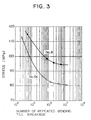
- Fig. 3 is a graphic representation of the relationship between the breakage lifetime and threshold fatigue stress with respect to two, inventive and comparative, hot-rolled stainless steel sheets subjected to the high-temperature fatigue test.
- the present invention is directed towards incorporating various selected elements in their respective specific amounts into a ferrite-type stainless steel.
- the amounts of solid solutions of C and N in the stainless steel are reduced by adding Ti or Nb in a specified amount such that C and N are effectively fixed with the result that improved workability can be achieved.
- the invention contemplates making microcrystalline the crystal grains of the stainless steel sheet after hot rolling and annealing with both V and B added in specified amounts and also setting the maximum crystal grain size at not greater than 50 ⁇ m on the sheet surface with crystal growth being prevented after recrystallization, thereby achieving improved resistance to surface roughening after working.
- C should preferably be reduced to as low a level as possible since it is an element prone to impair the workability (r value) and corrosion resistance of the finished ferrite type hot-rolled stainless steel sheet. Furthermore, the amount of C in solid solution in the steel stock should preferably be reduced as much as possible in order for V to assume its role as will be described later.
- C is fixed by adding Ti alone or in combination with Nb, thereby alleviating detrimental effects upon the workability of the resultant steel sheet and upon the stability of the ferrite, and thus allowing V to fully exert its desirable effects. Contents of C exceeding 0.03% by weight lead to increased deposition of carbides in the steel sheet, resulting in reduced workability and deteriorated surface properties.
- C should constitute not more than 0.03% by weight, and preferably be less than 0.015% by weight, of the steel sheet.
- Si is an element effective for deoxidizing a desired stainless steel and also for improving the resistance of the steel to high-temperature oxidation and corrosion by salt. Contents of Si exceeding 2.0% by weight promote reduced elongation of the steel sheet and hence this element should constitute not more than 2.0% by weight of the steel.
- Mn is an element that acts to deposit and fix S in a desired stainless steel to thereby improve the hot rolling capability of the steel. However, it tends to deteriorate the working performance of the resultant steel sheet. Thus, Mn should be present in a content of not more than 0.8% by weight, preferably less than 0.5% by weight, in the steel sheet.
- S is a detrimental element liable to impair the hot rolling workability of a given stainless steel.
- S When the content is more than 0.03% by weight in the steel, S usually forms MnS with Mn and hardly poses adverse effects.
- S exceeds 0.03% by weight, the MnS deposited causes rusting thereby deteriorating the corrosion resistance of the finished steel sheet and also is incorporated into the crystal grain boundaries thereby making the grain boundaries more brittle.
- S should be present in a content of not more than 0.03% by weight, preferably less than 0.005% by weight, in the steel.
- Cr is an element absolutely necessary for improving the resistance to corrosion and to high-temperature oxidation of a desired stainless steel. Contents of Cr of more than 25% by weight result in reduced workability of the steel sheet as well as an increase in the cost of the starting steel stock.
- Contents of not more than 15% by weight of Cr are preferred for applications where workability is taken as the primary requirement.
- N is an element liable to reduce the workability (r value) of a given stainless steel sheet, as is the case with C, and hence, N should preferably be decreased to as great an extent as possible.
- the amount of N in solid solution should also preferably be reduced as much as possible in order to allow B to afford its desirable effects as discussed hereinafter.
- N is fixed by adding Ti alone, or together with Nb, thereby precluding any physical deterioration of the steel. More than 0.03% by weight of N is responsible for poor workability of steel sheet because of the increasing deposition of nitrides.
- N should be present in an amount of not more than 0.03% by weight, preferably less than 0.01% by weight.
- Al is an element effective for deoxidizing but excess Al results in deteriorated workability of a given stainless steel sheet after hot rolling and annealing.
- this element should be present in a content of not more than 0.3% by weight, preferably less than 0.1% by weight, in the steel.
- Ti is an element capable of greatly stabilizing C and N to thereby improve the workability of a desired stainless steel sheet and also of preventing carbides and nitrides of Cr from being deposited in the grain boundaries, thereby improving the corrosion resistance of the steel.
- Ti needs to be added in such an amount as to satisfy certain specific correlations with C and N, as described below. Contents of Ti larger than 0.4% by weight may conversely render the resultant steel sheet less workable and bring about a sharp decline in the workability of the weld zone. Thus, Ti should be in an amount of not more than 0.4% by weight in the steel.
- V and B are extremely important elements in implementing the present invention.
- V and B are added in amounts, respectively, of 0.02 to 0.4% by weight and 0.0002 to 0.0050% by weight with the ratio V/B > 10 being satisfied, the two elements act to effectively microcrystallize the crystal grains of a desired stainless steel sheet after hot rolling and annealing, and to prevent grain growth after recrystallization.
- V would presumably remain in solid solution in the ferrite grains to thereby microcrystallize recrystallized grains during annealing and prevent growth of such grains
- B would probably concentrate into the ferrite boundaries and retard travel of the latter and assist in preventing the grain growth.
- Such effects depend on the ratio of V to B, and this is probably because of the balance between the volume of ferrite grains and the area of ferrite grain boundaries.
- the microcrystallization of crystal grains contributes greatly to enhanced resistance to surface roughening of a desired stainless steel sheet after working, and also to improved fatigue properties of those steel materials which are subjected to mechanical vibration under high-temperature and rapid-cycle conditions, for example automotive exhaust parts (exhaust pipes and the like).
- V reacts with C and deposits as V 2 C or VC, thereby failing to sufficiently prevent grain growth.
- B reacts with N and deposits as BN, adversely facilitating grain growth.
- N should therefore be deposited and fixed by adding ample amounts of Ti and Nb, i.e. stronger carbide-forming elements than V.
- N should likewise be treated by adding an ample amount of Ti, i.e. a stronger nitride-forming element than V and B.
- this element facilitates the accumulation of strains during hot rolling and promotes the formation of ⁇ 111 ⁇ planes as regards the recrystallization texture after annealing, contributing to the improved workability of a desired hot-rolled stainless steel sheet.
- the addition of B is especially important for a hot-rolled stainless steel sheet that is otherwise less workable than a cold-rolled equivalent.
- V and B in excessive amounts, i.e. greater than 0.4% and 0.0050% by weight, respectively, yield no improvement in terms of microcrystallizing crystal grains during annealing thereby preventing grain growth and improving workability. Conversely, the resulting stainless steel sheet becomes too hard, less elongated and less workable with higher amounts of V and B.
- V should be present in an amount of 0.02 to 0.4% by weight
- B should be present in an amount of 0.0002 to 0.0050% by weight
- V and B should satisfy the ratio V/B > 10 in the steel.
- Nb not more than 0.5% by weight
- Ti and Nb are added to ensure that the desired effects of V and B stated hereinbefore are achieved, that is, N is deposited and fixed as TiN and C as TiC or NbC.
- Ti when employed alone should be in an amount to satisfy Ti/48 > N/14 + C/12
- Ti and Nb when used in combination should be in an amount to satisfy both Ti/48 > N/14 and Ti/48 + Nb/92 > N/14 + C/12.
- the hot-rolled stainless steel sheet of the present invention may also contain, where desired, the following elements.
- Ca forms CaS in the molten steel stock thereby preventing clogging of nozzles caused by TiS inclusions which are prone to arise during casting of a Ti-containing molten steel stock. Excess Ca results in reduced corrosion resistance of the steel sheet.
- Ca should be in a content of not more than 0.01% by weight, preferably in a range of S ⁇ (32/40) Ca ⁇ 1.5 S (that is, the mole ratio Ca/S should be between 1 and 1.5),
- Mo is effective for further improving the corrosion resistance of a given stainless steel. Contents of Mo above 2.0% by weight cause reduced hot rolling workability. Thus, Mo should be in a content of not more than 2.0% by weight in the steel.
- Cu further improves the corrosion resistance of. a desired stainless steel sheet. Increasing contents of Cu produce largely varied grain sizes during annealing of the steel sheet after hot rolling, thereby making the crystal grain size less controllable. When the Cu content is more than 0.4% by weight , the welded parts and heat affected zone become brittle and thus this element should be present in an amount of not more than 0.4% by weight in the steel sheet.
- P like Pb and Sn, causes frequent hot fracture of a given stainless steel, thereby impairing the hot rolling workability and toughness of the steel.
- the P content of the steel should not exceed 0.03% by weight.
- the hot-rolled stainless steel sheet of the present invention may be produced preferably by hot-rolling a starting stainless steel stock at a heating temperature of 1050 to 1250°C, rolling at a finishing temperature of 600 to 900°C, coiling at a coiling temperature of less than 700°C, and subsequently annealing the resulting hot-rolled coil at a temperature of 800 to 1,100°C.
- a JIS No. 13B specimen for tensile testing was cut along the direction of rolling, from each of the above steel sheets after hot rolling and subsequent annealing. Measurement was made of r value by a three-point method after the specimen was subjected to a tensile strain of 15%. The specimens were then checked for surface roughness (Ra) in the direction of rolling. Thereafter, each specimen was stretched to breakage in order to determine its elongation at break (E1).
- Fig. 1 High-temperature fatigue properties were evaluated with use of the specimen shown in Fig. 1 and Schenk's high-temperature plane flexural testing apparatus in which a bending moment was imparted at a test temperature of 700°C and at a test speed of 1,700 cycles/minute.
- the general principles of the test method are illustrated in Fig. 2 in which the specimen was exposed at its one free end to repeated bending moments, with the other end firmly secured.
- Fig. 3 shows, as one of various experiments, the test results obtained from No. 8 (inventive) and No. 6b (comparative). From these test results, the stress required for breakage life to reach a cycle of 10 7 was computed (the stress being hereunder called “threshold fatigue stress").
- Steel Nos. 6 to 12 consisted of a 15% Cr system having Ti and Nb added in combination.
- Annealing at 1,000 °C (Experiment No. 6b) allowed recrystallization to proceed up to the central portion of the sheet thickness, but caused the recrystallized crystal grain to grow up to 82 ⁇ m, resulting in deteriorated surface roughening resistance and high-temperature fatigue properties.
- Steel Nos. 8 to 10 all according to the present invention, contain both V and B and have acceptable workability with full recrystallization up to the central portion of the sheet thickness; surface roughening resistance (Ra: less than 3.0 ⁇ m) with microcrystalline crystal grains on the sheet surface, and high-temperature fatigue properties (threshold fatigue stress: more than 90 MPa, which is an 11% increase compared to No. 6b containing insufficient V and B).
- Steel No. 11 was a comparative example and contained excess B, and steel No. 12, was a comparative example and contained excess V. In both cases reduced workability (elongation and r valuer) occurred.
- Nos. 16, 17, 18a and 19 all inventive, are excellent in terms of their surface roughening resistance and high-temperature fatigue properties.
- Experiment No. 18b was annealed at a higher temperature of 1,100°C yet produced adequately controlled crystal grains of 45 ⁇ m at the most and thus showed better workability, surface roughening resistance and high-temperature fatigue properties than No. 13, which was a comparative example and was annealed at 1,050°C.
- a ferrite-type hot-rolled stainless steel sheet which excels in workability, surface roughening resistance and high-temperature fatigue properties after working even with cold rolling and its subsequent process steps omitted.
- steel sheet is suitably useful for automotive exhaust components which have heretofore been dominated by expensive cold-rolled stainless steel sheet.
- the range of annealing temperatures is so wide that the above steel sheet is producible with utmost ease.
Landscapes
- Chemical & Material Sciences (AREA)
- Engineering & Computer Science (AREA)
- Materials Engineering (AREA)
- Mechanical Engineering (AREA)
- Metallurgy (AREA)
- Organic Chemistry (AREA)
- Heat Treatment Of Sheet Steel (AREA)
- Heat Treatment Of Steel (AREA)
Description
- This invention relates to ferrite-type hot-rolled stainless steel sheets that offer good workability and, in particular, excellent surface roughening resistance and high-temperature fatigue characteristics after working.
- Though somewhat less workable and less resistant to corrosion than an austenite-type stainless steel, a ferrite-type stainless steel has excellent resistance to stress corrosion cracking and in addition it is inexpensive and hence has been widely applied to various kitchen fixtures and automotive exhaust components (exhaust manifolds, exhaust pipes, converter housings, mufflers and the like).
- To improve the workability of such a ferrite-type stainless steel sheet so as to be suitable for the above stated applications, it is common to fix impurity elements such as C and N in solid solution in the stock by the addition of elements such as Ti and Nb.
- Such a technique is disclosed for instance in Japanese Patent Laid-Open Nos. 51-14811, 51-14812 and 52-31919. On the other hand, Japanese Patent Laid-Open No. 60-46352 discloses a highly corrosion-resistant ferrite-type stainless steel having a V content of 0.05 to 2.0% and a Cu content of 0.5 to 2.0%. This stainless steel thus has relatively high amounts of Cu so as to improve corrosion resistance. This stainless steel is exclusively useful as a cold-rolled steel material for automotive exterior trims, hot-water supply installations and other kitchen fixtures, and therefore is unconcerned with the various mechanical characteristics required for a hot-rolled stainless steel, particularly high-temperature properties such as high-temperature fatigue resistance and the like.
- In general, ferrite-type stainless steel sheets are produced by heating a continuous casting slab and then subjecting the same to a series of process steps, i.e. hot rolling of the heated slab to obtain a hot-rolled sheet, annealing and pickling of the hot-rolled sheet, cold rolling of the annealed sheet, and final annealing and pickling of the cold-rolled sheet. If it were possible to omit any of the process steps, especially cold rolling and its subsequent steps, a conspicuous reduction of the plant investments and operating costs would be attained. This would mean that a ferrite type stainless steel sheet, already of lower cost than an austenite type equivalent, could be manufactured with further cost savings and shortened production time, and hence with greater commercial merit.
- Hot-rolled ferritic stainless steel sheets, however, generally have a coarse crystal grain after hot rolling and subsequent annealing as compared to cold-rolled ferritic stainless steel sheets, thus providing a steel product with a considerably roughened surface. Such crystal grain coarseness and surface roughness after working impair the aesthetic appearance of the steel product and moreover reduce the high-temperature fatigue properties of those steel components which are exposed to vibration as by engines at elevated temperatures, for example, automotive exhaust parts (exhaust pipes and the like). The last-mentioned phenomenon may be explained by the fact that, in a high-temperature fatigue environment, fatigue failure more readily occurs at grain boundaries than within crystal grains in a steel structure composed of large crystal grains. Alternatively such failure can result from stresses which are localized on the roughened surface of the steel sheet.
- The crystal grain sizes, which are closely associated with the surface roughening and fatigue failure of a steel sheet after working, may be adjusted to some degree by varying the temperatures and times for annealing. However, when annealed at a lower temperature and for a shorter time in order to render the crystal grain sizes microcrystalline, the steel sheet fails to completely recrystallize and retains its hot-rolled band structure in the vicinity of the central portion in the direction perpendicular to the plate thickness. This problem results in a decrease in the Lankford value (r value), taken as a measure of deep drawing and elongation (El), and hence causes insufficient working performance. Consequently, good workability and excellent resistance to surface roughening and to high-temperature fatigue are difficult to achieve in a well-balanced manner with a ferrite-type hot-rolled stainless steel sheet, and this poses a serious limitation on the use of the steel sheet for automotive exhaust parts requiring such characteristics.
- EP-A-0 492 602 discloses a Cr containing steel sheet that is excellent in terms of mechanical workability and has good corrosion resistance. Said sheet is suitable for use in the manufacture of shaped articles such as automobile bodies. It is formed by reducing the amount of C and N, controlling S in an extremely reduced amount, and simultaneously adding not less than 5% and less than 11% by weight of Cr and a small amount of V. In addition, the workability can be further enhanced by adding appropriate amounts of Ti, Nb, Zr, Al and/or B.
- The present invention, therefore, provides a ferrite-type hot-rolled stainless steel sheet which is greatly resistant to surface roughening and to high-temperature fatigue after working and is highly workable even after omitting cold rolling and subsequent process steps.
- As a result of intensive research made to achieve the above object and leading to the invention, the present inventors have found that a ferrite-type hot-rolled stainless steel sheet capable of exhibiting excellent resistance to surface roughening and to high-temperature fatigue after working and good workability can be obtained by fixing C and N of the starting steel stock by the addition of Ti and by adjusting the chemical composition of the steel stock in a specific range of constituent elements with the addition of V and B.
- According to one aspect of the present invention there is provided a ferrite-type hot-rolled stainless steel sheet that has excellent resistance to surface roughening and to high-temperature fatigue after working, which comprises, by weight, :
- C in a content of not more than 0.03%,
- Si in a content of not more than 2.0%,
- Mn in a content of not more than 0.8%,
- S in a content of not more than 0.03%,
- Cr in a content of from 11 to 25%,
- N in a content of not more than 0.03%,
- Al in a content of not more than 0.3%,
- Ti in a content of not more than 0.4%,
- V in a content of from 0.02 to 0.4% and
- B in a content of from 0.0002 to 0.0050%, wherein the following formulae are satisfied,
-
- According to another aspect of the present invention there is provided a ferrite-type hot-rolled stainless steel sheet that has excellent resistance to surface roughening and to high-temperature fatigue after working, which comprises, by weight,
- C in a content of not more than 0.03 %
- Si in a content of not more than 2.0%,
- Mn in a content of not more than 0.8%,
- S in a content of not more than 0.03%,
- Cr in a content of from 11 to 25%,
- N in a content of not more than 0.03%,
- Al in a content of not more than 0.3%,
- Ti in a content of not more than 0.4%,
- V in a content of from 0.02 to 0.4%,
- B in a content of from 0.0002 to 0.0050% and
- Nb in a content of not more than 0.5%, wherein
-
- According to a further aspect of the present invention there is provided a ferrite-type hot-rolled stainless steel sheet that has excellent resistance to surface roughening and to high-temperature fatigue after working, which comprises, by weight,
- C in a content of not more than 0.03%
- Si in a content of not more than 2.0%,
- Mn in a content of not more than 0.8%,
- S in a content of not more than 0.03%,
- Cr in a content of from 11 to 25%,
- N in a content of not more than 0.03%,
- Al in a content of not more than 0.3%,
- Ti in a content of not more than 0.4%,
- V in a content of from 0.02 to 0.4% and
- B in a content of from 0.0002 to 0.0050%, wherein
- Ca in a content of not more than 0.01%,
- Mo in a content of not more than 2.0% and
- Cu in a content of not more than 0.4%,
-
- According to yet another aspect of the present invention there is provided a ferrite-type hot-rolled stainless steel sheet that has excellent resistance to surface roughening and to high-temperature fatigue after working, which comprises, by weight,
- C in a content of not more than 0.03%
- Si in a content of not more than 2.0%,
- Mn in a content of not more than 0.8%,
- S in a content of not more than 0.03%,
- Cr in a content of from 11 to 25%,
- N in a content of not more than 0.03%,
- Al in a content of not more than 0.3%,
- Ti in a content of not more than 0.4%,
- V in a content of from 0.02 to 0.4%,
- B in a content of from 0.0002 to 0.0050% and
- Nb in a content of not more than 0.5%, wherein
- Ca in a content of not more than 0.01%,
- Mo in a content of not more than 2.0% and
- Cu in a content of not more than 0.4%, the balance being Fe and inevitable impurities.
-
- Preferably the hot-rolled stainless steel sheet has a crystal grain size of not greater than 50µm on its surface after hot rolling and subsequent annealing, and a structure composed entirely of recrystallized grains in the central portion of the stainless steel sheet extending from the surface of the latter in a direction perpendicular to the thickness of the latter.
- The above and other objects, features and advantages of the present invention will become manifest to those versed in the art upon making reference to the following description and accompanying drawings.
- Fig. 1 is a view of a specimen for Schenk's high-temperature plane flexural fatigue test.
- Fig. 2 is a schematic view explanatory of the principles of Schenk's test referred to in Fig. 1.
- Fig. 3 is a graphic representation of the relationship between the breakage lifetime and threshold fatigue stress with respect to two, inventive and comparative, hot-rolled stainless steel sheets subjected to the high-temperature fatigue test.
- Focusing on the foregoing problems of the prior art, the present inventors have done continued research and have ultimately discovered that even where cold rolling is omitted from a series of process steps in common use, a stainless steel sheet can be obtained with excellent resistance to surface roughening and to high-temperature fatigue after working as well as good workability.
- The present invention is directed towards incorporating various selected elements in their respective specific amounts into a ferrite-type stainless steel. In particular, the amounts of solid solutions of C and N in the stainless steel are reduced by adding Ti or Nb in a specified amount such that C and N are effectively fixed with the result that improved workability can be achieved. Moreover, the invention contemplates making microcrystalline the crystal grains of the stainless steel sheet after hot rolling and annealing with both V and B added in specified amounts and also setting the maximum crystal grain size at not greater than 50 µm on the sheet surface with crystal growth being prevented after recrystallization, thereby achieving improved resistance to surface roughening after working.
- Based upon the research done by the present inventors, the following elemental requirements need to be strictly observed in order to obtain a hot-rolled stainless steel sheet having not only excellent resistance to surface roughening and to high-temperature fatigue after working, but also sufficient working performance, even in the case of the omission of cold rolling and its ensuing process steps.
- The ferrite-type hot-rolled stainless steel sheet of the present invention should be made up of a specific chemical composition as defined in the appended claims. The reasoning will now be described in detail.
- C should preferably be reduced to as low a level as possible since it is an element prone to impair the workability (r value) and corrosion resistance of the finished ferrite type hot-rolled stainless steel sheet. Furthermore, the amount of C in solid solution in the steel stock should preferably be reduced as much as possible in order for V to assume its role as will be described later. In the practice of the present invention, C is fixed by adding Ti alone or in combination with Nb, thereby alleviating detrimental effects upon the workability of the resultant steel sheet and upon the stability of the ferrite, and thus allowing V to fully exert its desirable effects. Contents of C exceeding 0.03% by weight lead to increased deposition of carbides in the steel sheet, resulting in reduced workability and deteriorated surface properties. Thus, C should constitute not more than 0.03% by weight, and preferably be less than 0.015% by weight, of the steel sheet.
- Si is an element effective for deoxidizing a desired stainless steel and also for improving the resistance of the steel to high-temperature oxidation and corrosion by salt. Contents of Si exceeding 2.0% by weight promote reduced elongation of the steel sheet and hence this element should constitute not more than 2.0% by weight of the steel.
- Contents of not less than 0.6% by weight of Si are preferred for use in automotive exhaust parts.
- Mn is an element that acts to deposit and fix S in a desired stainless steel to thereby improve the hot rolling capability of the steel. However, it tends to deteriorate the working performance of the resultant steel sheet. Thus, Mn should be present in a content of not more than 0.8% by weight, preferably less than 0.5% by weight, in the steel sheet.
- S is a detrimental element liable to impair the hot rolling workability of a given stainless steel. When the content is more than 0.03% by weight in the steel, S usually forms MnS with Mn and hardly poses adverse effects. However, when S exceeds 0.03% by weight, the MnS deposited causes rusting thereby deteriorating the corrosion resistance of the finished steel sheet and also is incorporated into the crystal grain boundaries thereby making the grain boundaries more brittle. Thus, S should be present in a content of not more than 0.03% by weight, preferably less than 0.005% by weight, in the steel.
- Cr is an element absolutely necessary for improving the resistance to corrosion and to high-temperature oxidation of a desired stainless steel. Contents of Cr of more than 25% by weight result in reduced workability of the steel sheet as well as an increase in the cost of the starting steel stock.
- Contents of not more than 15% by weight of Cr are preferred for applications where workability is taken as the primary requirement.
- N is an element liable to reduce the workability (r value) of a given stainless steel sheet, as is the case with C, and hence, N should preferably be decreased to as great an extent as possible. The amount of N in solid solution should also preferably be reduced as much as possible in order to allow B to afford its desirable effects as discussed hereinafter. According to the present invention, N is fixed by adding Ti alone, or together with Nb, thereby precluding any physical deterioration of the steel. More than 0.03% by weight of N is responsible for poor workability of steel sheet because of the increasing deposition of nitrides. Thus, N should be present in an amount of not more than 0.03% by weight, preferably less than 0.01% by weight.
- Al is an element effective for deoxidizing but excess Al results in deteriorated workability of a given stainless steel sheet after hot rolling and annealing. Thus, this element should be present in a content of not more than 0.3% by weight, preferably less than 0.1% by weight, in the steel.
- Ti is an element capable of greatly stabilizing C and N to thereby improve the workability of a desired stainless steel sheet and also of preventing carbides and nitrides of Cr from being deposited in the grain boundaries, thereby improving the corrosion resistance of the steel. To this end, Ti needs to be added in such an amount as to satisfy certain specific correlations with C and N, as described below. Contents of Ti larger than 0.4% by weight may conversely render the resultant steel sheet less workable and bring about a sharp decline in the workability of the weld zone. Thus, Ti should be in an amount of not more than 0.4% by weight in the steel.
- V and B are extremely important elements in implementing the present invention. When V and B are added in amounts, respectively, of 0.02 to 0.4% by weight and 0.0002 to 0.0050% by weight with the ratio V/B > 10 being satisfied, the two elements act to effectively microcrystallize the crystal grains of a desired stainless steel sheet after hot rolling and annealing, and to prevent grain growth after recrystallization.
- Although the reason for the above beneficial effects is not exactly known, V would presumably remain in solid solution in the ferrite grains to thereby microcrystallize recrystallized grains during annealing and prevent growth of such grains, whereas B would probably concentrate into the ferrite boundaries and retard travel of the latter and assist in preventing the grain growth. Such effects depend on the ratio of V to B, and this is probably because of the balance between the volume of ferrite grains and the area of ferrite grain boundaries. The microcrystallization of crystal grains contributes greatly to enhanced resistance to surface roughening of a desired stainless steel sheet after working, and also to improved fatigue properties of those steel materials which are subjected to mechanical vibration under high-temperature and rapid-cycle conditions, for example automotive exhaust parts (exhaust pipes and the like).
- The improved fatigue properties achievable through the microcrystallization of crystal grains are believed attributable to the following reasons.
- 1) Roughened surface after working, which is apt to cause breakage due to stresses localized thereon, can be alleviated.
- 2) Grain boundaries are highly susceptible to localized stresses and can lead to crack propagation. Microcrystallization of the grain boundaries increases their area thereby relaxing the localized stresses per unit of grain boundary.
- 3) Concentration of B into the grain boundaries affords reinforced strength to the latter.
-
- Where C is not fully deposited and fixed by Ti and Nb, V reacts with C and deposits as V2C or VC, thereby failing to sufficiently prevent grain growth. In the case of insufficient deposition and fixing of N by Ti, B reacts with N and deposits as BN, adversely facilitating grain growth.
- C should therefore be deposited and fixed by adding ample amounts of Ti and Nb, i.e. stronger carbide-forming elements than V. N should likewise be treated by adding an ample amount of Ti, i.e. a stronger nitride-forming element than V and B.
- In addition to the foregoing beneficial effects accruing from the addition of B, this element facilitates the accumulation of strains during hot rolling and promotes the formation of {111} planes as regards the recrystallization texture after annealing, contributing to the improved workability of a desired hot-rolled stainless steel sheet. Hence, the addition of B is especially important for a hot-rolled stainless steel sheet that is otherwise less workable than a cold-rolled equivalent.
- The desired effects of V and B discussed above are achievable only where V is present in a content of not less than 0.02% by weight, B is present in a content of not less than 0.0002% by weight, and V and B satisfy the ratio V/B > 10. V and B in excessive amounts, i.e. greater than 0.4% and 0.0050% by weight, respectively, yield no improvement in terms of microcrystallizing crystal grains during annealing thereby preventing grain growth and improving workability. Conversely, the resulting stainless steel sheet becomes too hard, less elongated and less workable with higher amounts of V and B. Thus, V should be present in an amount of 0.02 to 0.4% by weight, B should be present in an amount of 0.0002 to 0.0050% by weight, and V and B should satisfy the ratio V/B > 10 in the steel.
- Nb is an element capable of stabilizing C and N. Nb cooperates with Ti in improving the workability of a desired stainless steel sheet and also in preventing carbides and nitrides of Cr from becoming deposited in grain boundaries, giving the steel sheet improved corrosion resistance.
- For Nb to afford these desirable effects, this element needs to be added in an amount which satisfies certain specific correlations with C and N, as explained hereunder. Contents of Nb exceeding 0.5% by weight result in reduced workability of the steel sheet and impaired workability of the weld zone and the heat affected zone(HAZ). Thus, Nb should be in an amount of not more than 0.5% by weight in the steel. When Nb is used in combination with Ti, the two elements should preferably not exceed a combined amount of 0.6% by weight.
- Ti and Nb are added to ensure that the desired effects of V and B stated hereinbefore are achieved, that is, N is deposited and fixed as TiN and C as TiC or NbC. Stoichiometrically, Ti when employed alone should be in an amount to satisfy Ti/48 > N/14 + C/12, and Ti and Nb when used in combination should be in an amount to satisfy both Ti/48 > N/14 and Ti/48 + Nb/92 > N/14 + C/12.
- The hot-rolled stainless steel sheet of the present invention may also contain, where desired, the following elements.
- Ca forms CaS in the molten steel stock thereby preventing clogging of nozzles caused by TiS inclusions which are prone to arise during casting of a Ti-containing molten steel stock. Excess Ca results in reduced corrosion resistance of the steel sheet. Ca should be in a content of not more than 0.01% by weight, preferably in a range of S ≤ (32/40) Ca ≤ 1.5 S (that is, the mole ratio Ca/S should be between 1 and 1.5),
- Mo is effective for further improving the corrosion resistance of a given stainless steel. Contents of Mo above 2.0% by weight cause reduced hot rolling workability. Thus, Mo should be in a content of not more than 2.0% by weight in the steel.
- Cu further improves the corrosion resistance of. a desired stainless steel sheet. Increasing contents of Cu produce largely varied grain sizes during annealing of the steel sheet after hot rolling, thereby making the crystal grain size less controllable. When the Cu content is more than 0.4% by weight , the welded parts and heat affected zone become brittle and thus this element should be present in an amount of not more than 0.4% by weight in the steel sheet.
- P, like Pb and Sn, causes frequent hot fracture of a given stainless steel, thereby impairing the hot rolling workability and toughness of the steel. Thus, the P content of the steel should not exceed 0.03% by weight.
- The hot-rolled stainless steel sheet of the present invention may be produced preferably by hot-rolling a starting stainless steel stock at a heating temperature of 1050 to 1250°C, rolling at a finishing temperature of 600 to 900°C, coiling at a coiling temperature of less than 700°C, and subsequently annealing the resulting hot-rolled coil at a temperature of 800 to 1,100°C.
- The present invention will be further described below in greater detail with reference to the following examples.
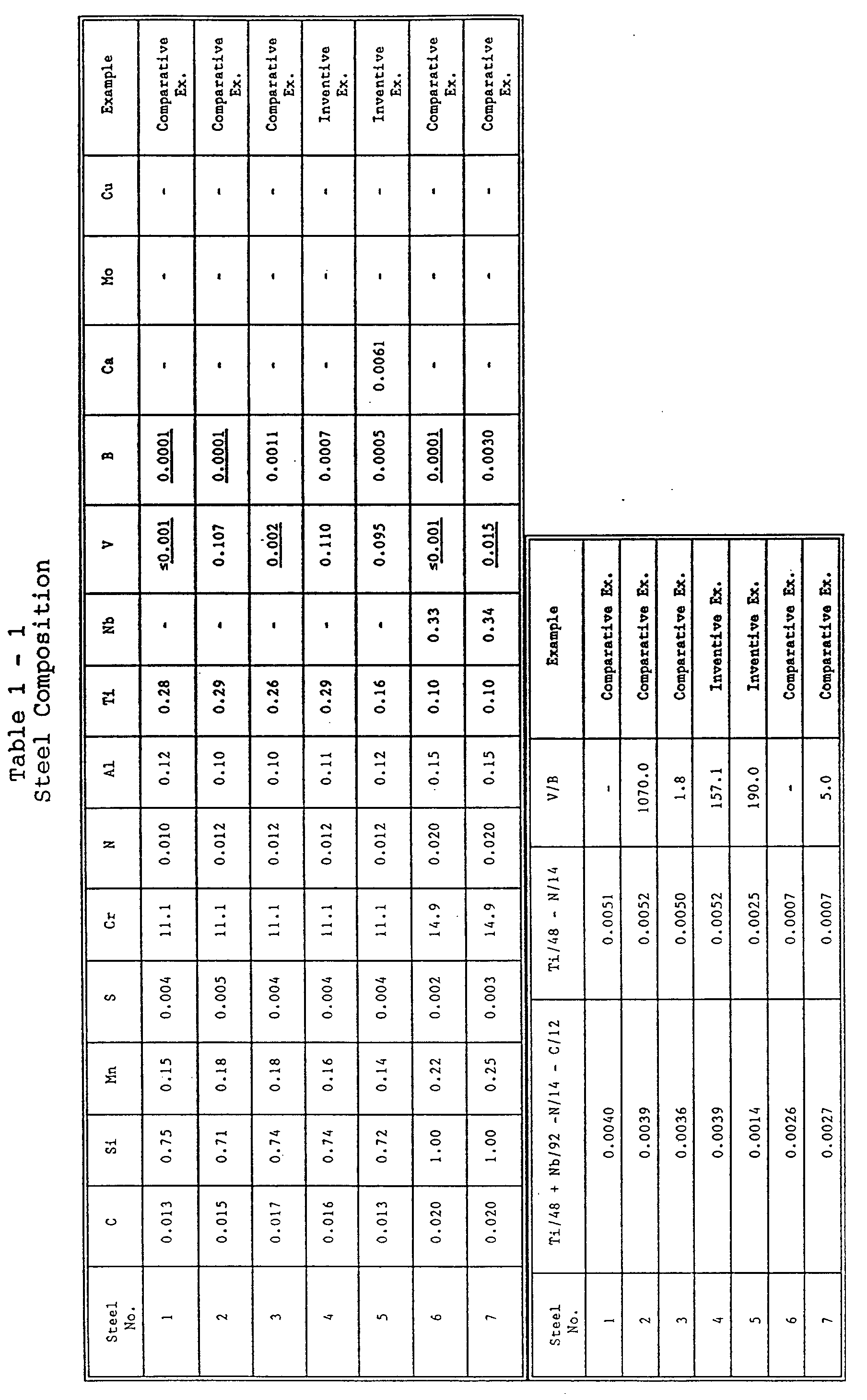
- Steels composed as shown in Table 1, Nos. 1 to 23, were melted and cast in a 30kg vacuum melting furnace. Each of the resultant small slabs was re-heated at 1,250°C, followed by hot rolling at a finishing temperature of 700°C with a rolling pass number of 8, whereby a 2 mm-thick hot-rolled steel sheet was produced. The steel sheet was annealed for 60 seconds at the temperature shown in Table 2 and was thereafter pickled.


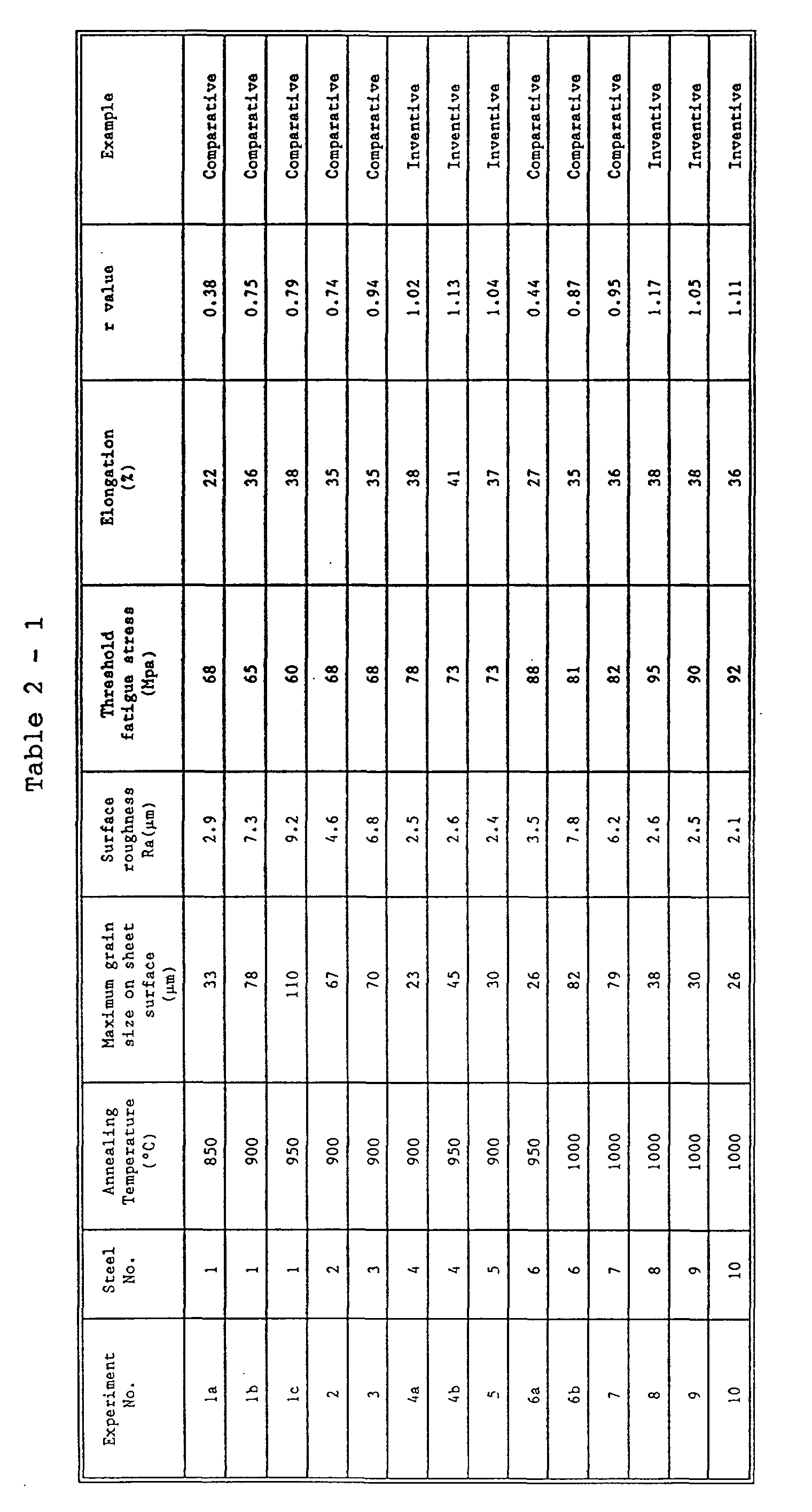

- A JIS No. 13B specimen for tensile testing was cut along the direction of rolling, from each of the above steel sheets after hot rolling and subsequent annealing. Measurement was made of r value by a three-point method after the specimen was subjected to a tensile strain of 15%. The specimens were then checked for surface roughness (Ra) in the direction of rolling. Thereafter, each specimen was stretched to breakage in order to determine its elongation at break (E1).
- High-temperature fatigue properties were evaluated with use of the specimen shown in Fig. 1 and Schenk's high-temperature plane flexural testing apparatus in which a bending moment was imparted at a test temperature of 700°C and at a test speed of 1,700 cycles/minute. The general principles of the test method are illustrated in Fig. 2 in which the specimen was exposed at its one free end to repeated bending moments, with the other end firmly secured. Fig. 3 shows, as one of various experiments, the test results obtained from No. 8 (inventive) and No. 6b (comparative). From these test results, the stress required for breakage life to reach a cycle of 107 was computed (the stress being hereunder called "threshold fatigue stress").
- By means of the foregoing procedures, performance evaluation was made of workability (r value and elongation at break), surface roughening (Ra) and high-temperature fatigue properties (threshold fatigue stress) with the results shown in Table 2. The surface structure of the test steel sheet was inspected in an area of 1,000 µm x 1,000 µm in order to determine the crystal grain sizes, with the maximum grain size being listed in Table 2.
- Steel Nos. 1 to 5 contained 11% by weight of Cr. Experiment No. 1a, using Steel No. 1, where the amounts of V and B were too low, annealed at 850°C, revealed a small crystal grain size of 33 µm at most on its annealed surface. However, because of the low annealing temperature, No 1a exhibited a hot-rolled band structure in the central portion of the sheet thickness, and failed to fully recrystallize resulting in low elongation and low r value and hence insufficient workability.
- In Experiment No. 1b, Steel No. 1 was annealed at 900°C and was satisfactory in respect of workability with high elongation and an adequate r value. However it had an excessively roughened surface after working. In Experiment No. 1c, Steel No. 1 was annealed at a higher temperature of 950°C and had an even rougher surface and moreover a reduced threshold fatigue stress (a 7.7% drop as compared to No. 1b annealed at a temperature high enough to meet with the workability requirement, hence involving reduced high-temperature fatigue properties). In Experiment No. 2, Steel No. 2 made with too little B and annealed at 900°C, had a slightly higher surface roughening resistance and high-temperature fatigue properties than Steel No. 1 in Experiment No. 1b, but not significantly so. Similar results were obtained for Experiment No. 3, in which Steel No. 3 contained too little V.
- Experiment No. 4a, in which Steel No. 4 (inventive) was annealed at 900°C, exhibits not only sufficient workability with full recrystallization up to a central portion of the sheet thickness, but also a noticeable rise in surface roughening resistance with a maximum microcrystalline crystal grain size of 23 µm and a surface roughness of Ra = 2.5 µm. Moreover, Steel No. 4 has excellent high-temperature fatigue properties with a threshold fatigue stress of 78 MPa, which is 20% greater than Steel No. 1 in Experiment No. 1b (comparative). Steel No. 4 was also annealed at 950°C (Experiment No. 4b). The annealing temperature of 950°C is far higher than the recrystallization temperature for an 11% Cr - Ti system. At that annealing temperature Experiment No. 1c led to a sharp decline in surface roughening resistance and high-temperature fatigue properties, as a result of its crystal grain coarseness. In contrast Steel No. 4 in Experiment No. 4b has been found to be excellent in its workability, surface roughening resistance and high-temperature fatigue properties. Consequently, the steel according to the present invention has a wide range of annealing temperatures that produce satisfactory workability, surface roughening resistance and high-temperature fatigue properties, thereby contributing greatly to improved productivity and simple control by relatively unskilled labor.
- In the 11% Cr system above, Ca is also effective in improving workability, surface roughening resistance and high-temperature fatigue properties as is evident from Steel No. 5 (inventive).
- Steel Nos. 6 to 12 consisted of a 15% Cr system having Ti and Nb added in combination. Steel No. 6, having too little V and Band annealed at 950°C (Experiment No. 6a), had low elongation and r value and insufficient recrystallization at the central portion of the sheet thickness. Annealing at 1,000 °C (Experiment No. 6b) allowed recrystallization to proceed up to the central portion of the sheet thickness, but caused the recrystallized crystal grain to grow up to 82 µm, resulting in deteriorated surface roughening resistance and high-temperature fatigue properties. Steel No. 7, having too low a V/B ratio despite the addition of V and B, was slightly superior in surface roughening resistance and high-temperature fatigue properties compared to No. 6b, but not to a significant degree.
- Steel Nos. 8 to 10, all according to the present invention, contain both V and B and have acceptable workability with full recrystallization up to the central portion of the sheet thickness; surface roughening resistance (Ra: less than 3.0µm) with microcrystalline crystal grains on the sheet surface, and high-temperature fatigue properties (threshold fatigue stress: more than 90 MPa, which is an 11% increase compared to No. 6b containing insufficient V and B).
- Steel No. 11 was a comparative example and contained excess B, and steel No. 12, was a comparative example and contained excess V. In both cases reduced workability (elongation and r valuer) occurred.
- Steel Nos. 13 to 22 consisted of an 18% Cr system. No. 13, which had too little V and B, revealed reduced surface roughening resistance and high-temperature fatigue properties, with crystal grains grown up to 78 µm on the sheet surface. No. 14, in which C was excessive, was inferior in workability at normal temperature and also in surface roughening resistance and high-temperature fatigue properties. No. 15 in which the Ti content was too low relative to N was unacceptable in terms of its surface roughening resistance.
- Nos. 16, 17, 18a and 19, all inventive, are excellent in terms of their surface roughening resistance and high-temperature fatigue properties. Experiment No. 18b was annealed at a higher temperature of 1,100°C yet produced adequately controlled crystal grains of 45 µm at the most and thus showed better workability, surface roughening resistance and high-temperature fatigue properties than No. 13, which was a comparative example and was annealed at 1,050°C.
- The tendency noted above has been confirmed in the cases (Nos. 20, 21 and 23) in which corrosion resistance was improved by the addition of Mo and Cu. However, No. 22 in which the amount of Cu departed from the scope of the invention proved unacceptable, though satisfactory in respect of workability, in regard to surface roughening resistance, with crystal grains partially grown up to about 60 µm on the sheet surface.
- According to the present invention, as described and shown hereinabove, a ferrite-type hot-rolled stainless steel sheet is provided which excels in workability, surface roughening resistance and high-temperature fatigue properties after working even with cold rolling and its subsequent process steps omitted. Thus, such steel sheet is suitably useful for automotive exhaust components which have heretofore been dominated by expensive cold-rolled stainless steel sheet.
- Furthermore, in accordance with the invention, the range of annealing temperatures is so wide that the above steel sheet is producible with utmost ease.
Claims (8)
- A ferrite-type hot-rolled stainless steel sheet that has excellent resistance to surface roughening and to high-temperature fatigue after working, which comprises, by weight,whereinC in a content of not more than 0.03%,Si in a content of not more than 2.0%,Mn in a content of not more than 0.8%,S in a content of not more than 0.03%,Cr in a content of from 11 to 25%,N in a content of not more than 0.03%,Al in a content of not more than 0.3%,Ti in a content of not more than 0.4%,V in a content of from 0.02 to 0.4% andB in a content of from 0.0002 to 0.0050%,
- A ferrite-type hot-rolled stainless steel sheet that has excellent resistance to surface roughening and to high-temperature fatigue after working, which comprises, by weight,whereinC in a content of not more than 0.03%,Si in a content of not more than 2.0%,Mn in a content of not more than 0.8%,S in a content of not more than 0.03%,Cr in a content of from 11 to 25%,N in a content of not more than 0.03%,Al in a content of not more than 0.3%,Ti in a content of not more than 0.4%,V in a content of from 0.02 to 0.4%,B in a content of from 0.0002 to 0.0050% andNb in a content of not more than 0.5%,
- A ferrite-type hot-rolled stainless steel sheet that has excellent resistance to surface roughening and to high-temperature fatigue after working, which comprises, by weight,whereinC in a content of not more than 0.03%,Si in a content of not more than 2.0%,Mn in a content of not more than 0.8%,S in a content of not more than 0.03%,Cr in a content of from 11 to 25%,N in a content of not more than 0.03%,Al in a content of not more than 0.3%,Ti in a content of not more than 0.4%,V in a content of from 0.02 to 0.4% andB in a content of from 0.0002 to 0.0050%,the balance being Fe and inevitable impurities.Ca in a content of not more than 0.01%,Mo in a content of not more than 2.0% andCu in a content of not more than 0.4%,
- A ferrite-type hot-rolled stainless steel sheet that has excellent resistance to surface roughening and to high-temperature fatigue after working, which comprises, by weight,whereinC in a content of not more than 0.03%,Si in a content of not more than 2.0%,Mn in a content of not more than 0.8%,S in a content of not more than 0.03%,Cr in a content of from 11 to 25%,N in a content of not more than 0.03%,Al in a content of not more than 0.3%,Ti in a content of not more than 0.4%,V in a content of from 0.02 to 0.4%,B in a content of from 0.0002 to 0.0050% andNb in a content of not more than 0.5%,the balance being Fe and inevitable impurities.Ca in a content of not more than 0.01%.Mo in a content of not more than 2.0% andCu in a content of not more than 0.4%,
- A ferrite-type hot-rolled stainless steel sheet according to claim 1 to 4 which has a crystal grain size of not greater than 50 µm on its surface after hot rolling and subsequent annealing, and a structure composed entirely of recrystallized grains in the central portion of the stainless steel sheet,from a surface of said sheet along a direction perpendicular to said surface.
- A ferrite-type hot-rolled stainless steel sheet according to any preceding claim, wherein C is present in an amount of less than 0.015% by weight, and N is present in an amount of less than 0.01% by weight.
- A ferrite-type hot-rolled stainless steel sheet according to any preceding claim , wherein Mn is present in an amount of less than 0.5% by weight, and S is present in an amount of less than 0.005 by weight.
- A ferrite-type hot-rolled stainless steel sheet according to any preceding claim , wherein Cr is present in an amount of 11-15% by weight.
Applications Claiming Priority (3)
| Application Number | Priority Date | Filing Date | Title |
|---|---|---|---|
| JP15644095 | 1995-06-22 | ||
| JP156440/95 | 1995-06-22 | ||
| JP7156440A JP3064871B2 (en) | 1995-06-22 | 1995-06-22 | Ferritic stainless steel hot-rolled steel sheet with excellent roughening resistance and high temperature fatigue properties after forming |
Publications (2)
| Publication Number | Publication Date |
|---|---|
| EP0750052A1 EP0750052A1 (en) | 1996-12-27 |
| EP0750052B1 true EP0750052B1 (en) | 2001-08-29 |
Family
ID=15627806
Family Applications (1)
| Application Number | Title | Priority Date | Filing Date |
|---|---|---|---|
| EP96304546A Expired - Lifetime EP0750052B1 (en) | 1995-06-22 | 1996-06-19 | Ferrite-type hot-rolled stainless steel sheet having excellent resistance to surface roughening and to high-temperature fatigue after working |
Country Status (5)
| Country | Link |
|---|---|
| US (1) | US5653825A (en) |
| EP (1) | EP0750052B1 (en) |
| JP (1) | JP3064871B2 (en) |
| KR (1) | KR100259739B1 (en) |
| DE (1) | DE69614778T2 (en) |
Families Citing this family (17)
| Publication number | Priority date | Publication date | Assignee | Title |
|---|---|---|---|---|
| JP3290598B2 (en) * | 1996-10-25 | 2002-06-10 | 川崎製鉄株式会社 | Ferritic stainless steel sheet excellent in formability and ridging resistance and method for producing the same |
| JPH11197517A (en) * | 1998-01-08 | 1999-07-27 | Honda Motor Co Ltd | Metal carrier for catalyst |
| JP3350499B2 (en) * | 2000-01-20 | 2002-11-25 | 新日本製鐵株式会社 | Rough surface finish metal foil with good corrugation and catalyst carrier for exhaust gas purification |
| JP2002038242A (en) * | 2000-07-27 | 2002-02-06 | Kawasaki Steel Corp | Stainless steel pipe for automotive structural members with excellent secondary workability |
| US6935529B2 (en) | 2000-08-01 | 2005-08-30 | Nisshin Steel Co., Ltd. | Stainless steel fuel tank for automobile |
| US6488790B1 (en) | 2001-01-22 | 2002-12-03 | International Steel Group Inc. | Method of making a high-strength low-alloy hot rolled steel |
| KR100762151B1 (en) * | 2001-10-31 | 2007-10-01 | 제이에프이 스틸 가부시키가이샤 | Ferritic stainless steel sheet having excellent deep-drawability and brittle resistance to secondary processing and method for making the same |
| RU2237102C2 (en) * | 2002-04-22 | 2004-09-27 | Открытое акционерное общество "Ижорские заводы" | Fire-resistant steel |
| JP4185425B2 (en) * | 2002-10-08 | 2008-11-26 | 日新製鋼株式会社 | Ferritic steel sheet with improved formability and high temperature strength, high temperature oxidation resistance and low temperature toughness at the same time |
| KR101092157B1 (en) * | 2004-06-17 | 2011-12-09 | 주식회사 포스코 | Stainless steel having excellent sag resistance, phase stability and oxidation property at high temperature and the method for manufacturing thereof |
| JP5208450B2 (en) * | 2006-07-04 | 2013-06-12 | 新日鐵住金ステンレス株式会社 | Cr-containing steel with excellent thermal fatigue properties |
| CN100434200C (en) * | 2006-12-31 | 2008-11-19 | 山西太钢不锈钢股份有限公司 | Method for Preventing Peeling of Oxide Film on the Surface of Nickel-Chromium Roller |
| US8152937B2 (en) * | 2007-06-21 | 2012-04-10 | Jfe Steel Corporation | Ferritic stainless steel sheet having superior sulfuric acid corrosion resistance and method for manufacturing the same |
| JP5609786B2 (en) * | 2010-06-25 | 2014-10-22 | Jfeスチール株式会社 | High-tensile hot-rolled steel sheet excellent in workability and manufacturing method thereof |
| DE102012100289A1 (en) | 2012-01-13 | 2013-07-18 | Benteler Automobiltechnik Gmbh | Stainless ferritic steel and method of making a high temperature component |
| JP5561447B1 (en) * | 2012-12-17 | 2014-07-30 | Jfeスチール株式会社 | Stainless steel plate and stainless steel foil |
| JP5505575B1 (en) | 2013-03-18 | 2014-05-28 | Jfeスチール株式会社 | Ferritic stainless steel sheet |
Family Cites Families (12)
| Publication number | Priority date | Publication date | Assignee | Title |
|---|---|---|---|---|
| JPS5114811A (en) * | 1974-07-29 | 1976-02-05 | Nippon Steel Corp | KOJINSEIFUERAITOKEISUTENRESUKO |
| JPS5114812A (en) * | 1974-07-30 | 1976-02-05 | Nippon Steel Corp | KOJINSEIFUERAITOKEISUTENRESUKO |
| JPS5231919A (en) * | 1976-09-20 | 1977-03-10 | Kawasaki Steel Corp | Low carbon ferrite system c -stainless -stainless steel,having rust re sistance and supeior forming property |
| JPS56123356A (en) * | 1980-03-01 | 1981-09-28 | Nippon Steel Corp | Ferritic stainless steel with superior formability |
| US4515644A (en) * | 1980-10-21 | 1985-05-07 | Nippon Steel Corporation | Method for producing ferritic stainless steel sheets or strips containing aluminum |
| JPS6046352A (en) * | 1983-08-25 | 1985-03-13 | Kawasaki Steel Corp | Ferritic stainless steel excellent in corrosion resistance |
| JPH0635615B2 (en) * | 1986-11-05 | 1994-05-11 | 日新製鋼株式会社 | Manufacturing method of ferritic stainless steel with excellent corrosion resistance of welds |
| JP3027012B2 (en) * | 1990-12-28 | 2000-03-27 | 日新製鋼株式会社 | High-strength chromium-containing steel sheet with excellent corrosion resistance and workability |
| JP3027011B2 (en) * | 1990-12-28 | 2000-03-27 | 日新製鋼株式会社 | Chromium-containing steel sheet with excellent corrosion resistance and workability |
| JPH06220545A (en) * | 1993-01-28 | 1994-08-09 | Nippon Steel Corp | Method for producing Cr-based stainless steel ribbon having excellent toughness |
| CA2123470C (en) * | 1993-05-19 | 2001-07-03 | Yoshihiro Yazawa | Ferritic stainless steel exhibiting excellent atmospheric corrosion resistance and crevice corrosion resistance |
| EP0678587B1 (en) * | 1994-04-21 | 1997-09-17 | Kawasaki Steel Corporation | Hot-rolled ferritic steel for motor vehicle exhaust members |
-
1995
- 1995-06-22 JP JP7156440A patent/JP3064871B2/en not_active Expired - Lifetime
-
1996
- 1996-06-19 DE DE69614778T patent/DE69614778T2/en not_active Expired - Fee Related
- 1996-06-19 EP EP96304546A patent/EP0750052B1/en not_active Expired - Lifetime
- 1996-06-21 US US08/667,645 patent/US5653825A/en not_active Expired - Fee Related
- 1996-06-21 KR KR1019960022753A patent/KR100259739B1/en not_active Expired - Fee Related
Also Published As
| Publication number | Publication date |
|---|---|
| DE69614778T2 (en) | 2002-03-07 |
| EP0750052A1 (en) | 1996-12-27 |
| KR100259739B1 (en) | 2000-06-15 |
| JP3064871B2 (en) | 2000-07-12 |
| KR970001580A (en) | 1997-01-24 |
| US5653825A (en) | 1997-08-05 |
| JPH093606A (en) | 1997-01-07 |
| DE69614778D1 (en) | 2001-10-04 |
Similar Documents
| Publication | Publication Date | Title |
|---|---|---|
| EP2415893B1 (en) | Steel sheet excellent in workability and method for producing the same | |
| US5653825A (en) | Ferrite-type hot-rolled stainless steel sheet having excellent resistance to surface roughening and to high-temperature fatigue after working | |
| EP1960562B1 (en) | High strenght cold rolled steel sheet having excellent formability and coating property, zinc-based metal plated steel sheet made of it and the method for manufacturing thereof | |
| CN102985578B (en) | Cold-formable high-strength steel and flat products made of this steel | |
| EP1734143B1 (en) | Ferritic stainless steel sheet excellent in formability and method for production thereof | |
| EP2089556B1 (en) | Low yield ratio dual phase steel linepipe with superior strain aging resistance | |
| EP0108268B1 (en) | Method for the production of cold rolled steel sheet having super deep drawability | |
| KR100799240B1 (en) | Ferritic stainless steel sheet with excellent workability and its manufacturing method | |
| CN103370434A (en) | Austenitic, lightweight, high-strength steel sheet of which the yield ratio and flexibility are outstanding and a production method therefor | |
| EP3828301B1 (en) | High-strength steel sheet having excellent impact resistant property and method for manufacturing thereof | |
| JP2003138347A (en) | Ferritic stainless steel sheet and method for producing the same | |
| US5662864A (en) | Fe-Cr alloy exhibiting excellent ridging resistance and surface characteristics | |
| CA2601497C (en) | Galvannealed steel sheet and method for producing the same | |
| JPH05320756A (en) | Production of high strength austenitic stainless steel excellent in seawater corrosion rest stance | |
| EP0501605B1 (en) | Galvanized high-strength steel sheet having low yield ratio and method of producing the same | |
| JP4754362B2 (en) | Austenitic stainless hot-rolled steel with good corrosion resistance, proof stress, and low-temperature toughness, and method for producing the same | |
| US20240229184A1 (en) | Coiling temperature influenced cold rolled strip or steel | |
| JP2025143414A (en) | High-strength steel plate with excellent thermal stability and its manufacturing method | |
| EP0535238A1 (en) | High-strength steel sheet for forming and production thereof | |
| JP3549483B2 (en) | Hydroform forming steel pipe excellent in processability and manufacturing method | |
| JP4133003B2 (en) | High-strength steel sheet with excellent formability and its manufacturing method | |
| JPH0713252B2 (en) | Method for producing high strength austenitic stainless steel with excellent seawater resistance | |
| JP2718550B2 (en) | Method for producing high-strength hot-rolled steel sheet for strong working with excellent fatigue properties | |
| KR102908191B1 (en) | Blank for hot stamping, hot stamping component manufactured using the same and method for manufacturing the same | |
| JP7762202B2 (en) | High-strength steel plate with high yield ratio and excellent thermal stability and its manufacturing method |
Legal Events
| Date | Code | Title | Description |
|---|---|---|---|
| PUAI | Public reference made under article 153(3) epc to a published international application that has entered the european phase |
Free format text: ORIGINAL CODE: 0009012 |
|
| AK | Designated contracting states |
Kind code of ref document: A1 Designated state(s): DE FR GB |
|
| 17P | Request for examination filed |
Effective date: 19970327 |
|
| 17Q | First examination report despatched |
Effective date: 19990705 |
|
| GRAG | Despatch of communication of intention to grant |
Free format text: ORIGINAL CODE: EPIDOS AGRA |
|
| GRAG | Despatch of communication of intention to grant |
Free format text: ORIGINAL CODE: EPIDOS AGRA |
|
| GRAH | Despatch of communication of intention to grant a patent |
Free format text: ORIGINAL CODE: EPIDOS IGRA |
|
| GRAH | Despatch of communication of intention to grant a patent |
Free format text: ORIGINAL CODE: EPIDOS IGRA |
|
| GRAA | (expected) grant |
Free format text: ORIGINAL CODE: 0009210 |
|
| AK | Designated contracting states |
Kind code of ref document: B1 Designated state(s): DE FR GB |
|
| REF | Corresponds to: |
Ref document number: 69614778 Country of ref document: DE Date of ref document: 20011004 |
|
| REG | Reference to a national code |
Ref country code: GB Ref legal event code: IF02 |
|
| ET | Fr: translation filed | ||
| PLBE | No opposition filed within time limit |
Free format text: ORIGINAL CODE: 0009261 |
|
| STAA | Information on the status of an ep patent application or granted ep patent |
Free format text: STATUS: NO OPPOSITION FILED WITHIN TIME LIMIT |
|
| 26N | No opposition filed | ||
| PGFP | Annual fee paid to national office [announced via postgrant information from national office to epo] |
Ref country code: FR Payment date: 20040608 Year of fee payment: 9 |
|
| PGFP | Annual fee paid to national office [announced via postgrant information from national office to epo] |
Ref country code: GB Payment date: 20040616 Year of fee payment: 9 |
|
| PGFP | Annual fee paid to national office [announced via postgrant information from national office to epo] |
Ref country code: DE Payment date: 20040701 Year of fee payment: 9 |
|
| PG25 | Lapsed in a contracting state [announced via postgrant information from national office to epo] |
Ref country code: GB Free format text: LAPSE BECAUSE OF NON-PAYMENT OF DUE FEES Effective date: 20050619 |
|
| PG25 | Lapsed in a contracting state [announced via postgrant information from national office to epo] |
Ref country code: DE Free format text: LAPSE BECAUSE OF NON-PAYMENT OF DUE FEES Effective date: 20060103 |
|
| PG25 | Lapsed in a contracting state [announced via postgrant information from national office to epo] |
Ref country code: FR Free format text: LAPSE BECAUSE OF NON-PAYMENT OF DUE FEES Effective date: 20060228 |
|
| GBPC | Gb: european patent ceased through non-payment of renewal fee |
Effective date: 20050619 |
|
| REG | Reference to a national code |
Ref country code: FR Ref legal event code: ST Effective date: 20060228 |