EP0745897B1 - Light-sensitive imaging element - Google Patents
Light-sensitive imaging element Download PDFInfo
- Publication number
- EP0745897B1 EP0745897B1 EP96201398A EP96201398A EP0745897B1 EP 0745897 B1 EP0745897 B1 EP 0745897B1 EP 96201398 A EP96201398 A EP 96201398A EP 96201398 A EP96201398 A EP 96201398A EP 0745897 B1 EP0745897 B1 EP 0745897B1
- Authority
- EP
- European Patent Office
- Prior art keywords
- imaging element
- layer
- aliphatic
- light
- gelatin
- Prior art date
- Legal status (The legal status is an assumption and is not a legal conclusion. Google has not performed a legal analysis and makes no representation as to the accuracy of the status listed.)
- Expired - Lifetime
Links
- 238000003384 imaging method Methods 0.000 title claims description 17
- -1 silver halide Chemical class 0.000 claims description 30
- 108010010803 Gelatin Proteins 0.000 claims description 22
- 229920000159 gelatin Polymers 0.000 claims description 22
- 239000008273 gelatin Substances 0.000 claims description 22
- 235000019322 gelatine Nutrition 0.000 claims description 22
- 235000011852 gelatine desserts Nutrition 0.000 claims description 22
- 229920002635 polyurethane Polymers 0.000 claims description 15
- 239000004814 polyurethane Substances 0.000 claims description 15
- 229920006267 polyester film Polymers 0.000 claims description 11
- 229910052709 silver Inorganic materials 0.000 claims description 10
- 239000004332 silver Substances 0.000 claims description 10
- 238000004132 cross linking Methods 0.000 claims description 9
- WNLRTRBMVRJNCN-UHFFFAOYSA-N adipic acid Chemical compound OC(=O)CCCCC(O)=O WNLRTRBMVRJNCN-UHFFFAOYSA-N 0.000 claims description 6
- 125000001931 aliphatic group Chemical group 0.000 claims description 6
- 150000003839 salts Chemical group 0.000 claims description 6
- 239000000084 colloidal system Substances 0.000 claims description 5
- 229920005906 polyester polyol Polymers 0.000 claims description 5
- XLYOFNOQVPJJNP-UHFFFAOYSA-N water Substances O XLYOFNOQVPJJNP-UHFFFAOYSA-N 0.000 claims description 5
- 229920000877 Melamine resin Polymers 0.000 claims description 4
- JDSHMPZPIAZGSV-UHFFFAOYSA-N melamine Chemical compound NC1=NC(N)=NC(N)=N1 JDSHMPZPIAZGSV-UHFFFAOYSA-N 0.000 claims description 4
- 229920000768 polyamine Polymers 0.000 claims description 4
- 229920000642 polymer Polymers 0.000 claims description 4
- 239000001361 adipic acid Substances 0.000 claims description 3
- 235000011037 adipic acid Nutrition 0.000 claims description 3
- 125000005442 diisocyanate group Chemical group 0.000 claims description 3
- ACCCMOQWYVYDOT-UHFFFAOYSA-N hexane-1,1-diol Chemical compound CCCCCC(O)O ACCCMOQWYVYDOT-UHFFFAOYSA-N 0.000 claims description 2
- SLCVBVWXLSEKPL-UHFFFAOYSA-N neopentyl glycol Chemical class OCC(C)(C)CO SLCVBVWXLSEKPL-UHFFFAOYSA-N 0.000 claims description 2
- 239000012948 isocyanate Substances 0.000 claims 2
- 150000002513 isocyanates Chemical class 0.000 claims 2
- 229920003232 aliphatic polyester Polymers 0.000 claims 1
- 229920005862 polyol Polymers 0.000 claims 1
- 150000003077 polyols Chemical class 0.000 claims 1
- 239000010410 layer Substances 0.000 description 59
- 239000000839 emulsion Substances 0.000 description 19
- 238000000576 coating method Methods 0.000 description 16
- 239000011248 coating agent Substances 0.000 description 15
- ZUNKMNLKJXRCDM-UHFFFAOYSA-N silver bromoiodide Chemical compound [Ag].IBr ZUNKMNLKJXRCDM-UHFFFAOYSA-N 0.000 description 13
- XMBWDFGMSWQBCA-UHFFFAOYSA-N hydrogen iodide Chemical compound I XMBWDFGMSWQBCA-UHFFFAOYSA-N 0.000 description 12
- 150000001875 compounds Chemical class 0.000 description 11
- 229920000728 polyester Polymers 0.000 description 10
- 208000028659 discharge Diseases 0.000 description 8
- 239000006185 dispersion Substances 0.000 description 8
- 239000000463 material Substances 0.000 description 8
- 125000004432 carbon atom Chemical group C* 0.000 description 7
- 239000000499 gel Substances 0.000 description 7
- 239000000203 mixture Substances 0.000 description 7
- 230000000873 masking effect Effects 0.000 description 6
- 238000000034 method Methods 0.000 description 6
- 239000002253 acid Substances 0.000 description 5
- 239000000243 solution Substances 0.000 description 5
- YCKRFDGAMUMZLT-UHFFFAOYSA-N Fluorine atom Chemical compound [F] YCKRFDGAMUMZLT-UHFFFAOYSA-N 0.000 description 4
- BQCADISMDOOEFD-UHFFFAOYSA-N Silver Chemical compound [Ag] BQCADISMDOOEFD-UHFFFAOYSA-N 0.000 description 4
- KKEYFWRCBNTPAC-UHFFFAOYSA-N Terephthalic acid Chemical compound OC(=O)C1=CC=C(C(O)=O)C=C1 KKEYFWRCBNTPAC-UHFFFAOYSA-N 0.000 description 4
- 239000000853 adhesive Substances 0.000 description 4
- 230000001070 adhesive effect Effects 0.000 description 4
- 150000001298 alcohols Chemical class 0.000 description 4
- 235000014113 dietary fatty acids Nutrition 0.000 description 4
- GNTDGMZSJNCJKK-UHFFFAOYSA-N divanadium pentaoxide Chemical compound O=[V](=O)O[V](=O)=O GNTDGMZSJNCJKK-UHFFFAOYSA-N 0.000 description 4
- 239000000194 fatty acid Substances 0.000 description 4
- 229930195729 fatty acid Natural products 0.000 description 4
- 229910052731 fluorine Inorganic materials 0.000 description 4
- 239000011737 fluorine Substances 0.000 description 4
- 238000002360 preparation method Methods 0.000 description 4
- 230000001737 promoting effect Effects 0.000 description 4
- 238000011160 research Methods 0.000 description 4
- 0 CC(C(NC(C=C[C@]1*=C2C=CC(C#N)=CC2)=CC1O)=O)Oc1ccc(*)cc1* Chemical compound CC(C(NC(C=C[C@]1*=C2C=CC(C#N)=CC2)=CC1O)=O)Oc1ccc(*)cc1* 0.000 description 3
- LYCAIKOWRPUZTN-UHFFFAOYSA-N Ethylene glycol Chemical compound OCCO LYCAIKOWRPUZTN-UHFFFAOYSA-N 0.000 description 3
- WSFSSNUMVMOOMR-UHFFFAOYSA-N Formaldehyde Chemical compound O=C WSFSSNUMVMOOMR-UHFFFAOYSA-N 0.000 description 3
- DNIAPMSPPWPWGF-UHFFFAOYSA-N Propylene glycol Chemical compound CC(O)CO DNIAPMSPPWPWGF-UHFFFAOYSA-N 0.000 description 3
- ZMANZCXQSJIPKH-UHFFFAOYSA-N Triethylamine Chemical compound CCN(CC)CC ZMANZCXQSJIPKH-UHFFFAOYSA-N 0.000 description 3
- 229910052783 alkali metal Inorganic materials 0.000 description 3
- 125000002947 alkylene group Chemical group 0.000 description 3
- 239000003795 chemical substances by application Substances 0.000 description 3
- 239000000975 dye Substances 0.000 description 3
- 150000004665 fatty acids Chemical class 0.000 description 3
- 239000004816 latex Substances 0.000 description 3
- 229920000126 latex Polymers 0.000 description 3
- 239000002245 particle Substances 0.000 description 3
- 229920003207 poly(ethylene-2,6-naphthalate) Polymers 0.000 description 3
- 239000011112 polyethylene naphthalate Substances 0.000 description 3
- 229920000139 polyethylene terephthalate Polymers 0.000 description 3
- 239000005020 polyethylene terephthalate Substances 0.000 description 3
- 229920001296 polysiloxane Polymers 0.000 description 3
- 238000012545 processing Methods 0.000 description 3
- 239000004094 surface-active agent Substances 0.000 description 3
- 239000001043 yellow dye Substances 0.000 description 3
- 239000004970 Chain extender Substances 0.000 description 2
- ZQPPMHVWECSIRJ-UHFFFAOYSA-N Oleic acid Natural products CCCCCCCCC=CCCCCCCCC(O)=O ZQPPMHVWECSIRJ-UHFFFAOYSA-N 0.000 description 2
- 238000005299 abrasion Methods 0.000 description 2
- 150000008051 alkyl sulfates Chemical class 0.000 description 2
- OIDPCXKPHYRNKH-UHFFFAOYSA-J chrome alum Chemical compound [K]OS(=O)(=O)O[Cr]1OS(=O)(=O)O1 OIDPCXKPHYRNKH-UHFFFAOYSA-J 0.000 description 2
- UKMSUNONTOPOIO-UHFFFAOYSA-N docosanoic acid Chemical compound CCCCCCCCCCCCCCCCCCCCCC(O)=O UKMSUNONTOPOIO-UHFFFAOYSA-N 0.000 description 2
- POULHZVOKOAJMA-UHFFFAOYSA-N dodecanoic acid Chemical compound CCCCCCCCCCCC(O)=O POULHZVOKOAJMA-UHFFFAOYSA-N 0.000 description 2
- 238000001035 drying Methods 0.000 description 2
- ZQPPMHVWECSIRJ-MDZDMXLPSA-N elaidic acid Chemical compound CCCCCCCC\C=C\CCCCCCCC(O)=O ZQPPMHVWECSIRJ-MDZDMXLPSA-N 0.000 description 2
- 150000002148 esters Chemical class 0.000 description 2
- IPCSVZSSVZVIGE-UHFFFAOYSA-N hexadecanoic acid Chemical compound CCCCCCCCCCCCCCCC(O)=O IPCSVZSSVZVIGE-UHFFFAOYSA-N 0.000 description 2
- 239000011229 interlayer Substances 0.000 description 2
- QXJSBBXBKPUZAA-UHFFFAOYSA-N isooleic acid Natural products CCCCCCCC=CCCCCCCCCC(O)=O QXJSBBXBKPUZAA-UHFFFAOYSA-N 0.000 description 2
- QQVIHTHCMHWDBS-UHFFFAOYSA-N isophthalic acid Chemical compound OC(=O)C1=CC=CC(C(O)=O)=C1 QQVIHTHCMHWDBS-UHFFFAOYSA-N 0.000 description 2
- 239000000314 lubricant Substances 0.000 description 2
- VNWKTOKETHGBQD-UHFFFAOYSA-N methane Chemical compound C VNWKTOKETHGBQD-UHFFFAOYSA-N 0.000 description 2
- GHMLBKRAJCXXBS-UHFFFAOYSA-N resorcinol Chemical compound OC1=CC=CC(O)=C1 GHMLBKRAJCXXBS-UHFFFAOYSA-N 0.000 description 2
- ADZWSOLPGZMUMY-UHFFFAOYSA-M silver bromide Chemical compound [Ag]Br ADZWSOLPGZMUMY-UHFFFAOYSA-M 0.000 description 2
- XOLBLPGZBRYERU-UHFFFAOYSA-N tin dioxide Chemical compound O=[Sn]=O XOLBLPGZBRYERU-UHFFFAOYSA-N 0.000 description 2
- 229910001887 tin oxide Inorganic materials 0.000 description 2
- PUPZLCDOIYMWBV-UHFFFAOYSA-N (+/-)-1,3-Butanediol Chemical compound CC(O)CCO PUPZLCDOIYMWBV-UHFFFAOYSA-N 0.000 description 1
- ALSTYHKOOCGGFT-KTKRTIGZSA-N (9Z)-octadecen-1-ol Chemical compound CCCCCCCC\C=C/CCCCCCCCO ALSTYHKOOCGGFT-KTKRTIGZSA-N 0.000 description 1
- OYHQOLUKZRVURQ-NTGFUMLPSA-N (9Z,12Z)-9,10,12,13-tetratritiooctadeca-9,12-dienoic acid Chemical compound C(CCCCCCC\C(=C(/C\C(=C(/CCCCC)\[3H])\[3H])\[3H])\[3H])(=O)O OYHQOLUKZRVURQ-NTGFUMLPSA-N 0.000 description 1
- WRIDQFICGBMAFQ-UHFFFAOYSA-N (E)-8-Octadecenoic acid Natural products CCCCCCCCCC=CCCCCCCC(O)=O WRIDQFICGBMAFQ-UHFFFAOYSA-N 0.000 description 1
- QMMJWQMCMRUYTG-UHFFFAOYSA-N 1,2,4,5-tetrachloro-3-(trifluoromethyl)benzene Chemical compound FC(F)(F)C1=C(Cl)C(Cl)=CC(Cl)=C1Cl QMMJWQMCMRUYTG-UHFFFAOYSA-N 0.000 description 1
- PTBDIHRZYDMNKB-UHFFFAOYSA-N 2,2-Bis(hydroxymethyl)propionic acid Chemical compound OCC(C)(CO)C(O)=O PTBDIHRZYDMNKB-UHFFFAOYSA-N 0.000 description 1
- OMRXVBREYFZQHU-UHFFFAOYSA-N 2,4-dichloro-1,3,5-triazine Chemical class ClC1=NC=NC(Cl)=N1 OMRXVBREYFZQHU-UHFFFAOYSA-N 0.000 description 1
- NHUXFMNHQIITCP-UHFFFAOYSA-N 2-butoxyethyl octadecanoate Chemical compound CCCCCCCCCCCCCCCCCC(=O)OCCOCCCC NHUXFMNHQIITCP-UHFFFAOYSA-N 0.000 description 1
- LQJBNNIYVWPHFW-UHFFFAOYSA-N 20:1omega9c fatty acid Natural products CCCCCCCCCCC=CCCCCCCCC(O)=O LQJBNNIYVWPHFW-UHFFFAOYSA-N 0.000 description 1
- SJIDAAGFCNIAJP-UHFFFAOYSA-N 6-methylheptyl octadecanoate Chemical compound CCCCCCCCCCCCCCCCCC(=O)OCCCCCC(C)C SJIDAAGFCNIAJP-UHFFFAOYSA-N 0.000 description 1
- QSBYPNXLFMSGKH-UHFFFAOYSA-N 9-Heptadecensaeure Natural products CCCCCCCC=CCCCCCCCC(O)=O QSBYPNXLFMSGKH-UHFFFAOYSA-N 0.000 description 1
- 235000021357 Behenic acid Nutrition 0.000 description 1
- 235000008733 Citrus aurantifolia Nutrition 0.000 description 1
- RPNUMPOLZDHAAY-UHFFFAOYSA-N Diethylenetriamine Chemical compound NCCNCCN RPNUMPOLZDHAAY-UHFFFAOYSA-N 0.000 description 1
- 239000004593 Epoxy Substances 0.000 description 1
- PIICEJLVQHRZGT-UHFFFAOYSA-N Ethylenediamine Chemical compound NCCN PIICEJLVQHRZGT-UHFFFAOYSA-N 0.000 description 1
- 244000043261 Hevea brasiliensis Species 0.000 description 1
- 239000005639 Lauric acid Substances 0.000 description 1
- OFOBLEOULBTSOW-UHFFFAOYSA-N Malonic acid Chemical compound OC(=O)CC(O)=O OFOBLEOULBTSOW-UHFFFAOYSA-N 0.000 description 1
- 229920001730 Moisture cure polyurethane Polymers 0.000 description 1
- 239000005642 Oleic acid Substances 0.000 description 1
- 229910019142 PO4 Inorganic materials 0.000 description 1
- 235000021314 Palmitic acid Nutrition 0.000 description 1
- 229910021607 Silver chloride Inorganic materials 0.000 description 1
- 235000021355 Stearic acid Nutrition 0.000 description 1
- 235000011941 Tilia x europaea Nutrition 0.000 description 1
- 239000013504 Triton X-100 Substances 0.000 description 1
- 229920004890 Triton X-100 Polymers 0.000 description 1
- OCKWAZCWKSMKNC-UHFFFAOYSA-N [3-octadecanoyloxy-2,2-bis(octadecanoyloxymethyl)propyl] octadecanoate Chemical compound CCCCCCCCCCCCCCCCCC(=O)OCC(COC(=O)CCCCCCCCCCCCCCCCC)(COC(=O)CCCCCCCCCCCCCCCCC)COC(=O)CCCCCCCCCCCCCCCCC OCKWAZCWKSMKNC-UHFFFAOYSA-N 0.000 description 1
- SJOOOZPMQAWAOP-UHFFFAOYSA-N [Ag].BrCl Chemical compound [Ag].BrCl SJOOOZPMQAWAOP-UHFFFAOYSA-N 0.000 description 1
- 239000006096 absorbing agent Substances 0.000 description 1
- 150000007513 acids Chemical class 0.000 description 1
- 239000011149 active material Substances 0.000 description 1
- IBVAQQYNSHJXBV-UHFFFAOYSA-N adipic acid dihydrazide Chemical compound NNC(=O)CCCCC(=O)NN IBVAQQYNSHJXBV-UHFFFAOYSA-N 0.000 description 1
- 238000013019 agitation Methods 0.000 description 1
- 150000001346 alkyl aryl ethers Chemical class 0.000 description 1
- 125000005263 alkylenediamine group Chemical group 0.000 description 1
- DTOSIQBPPRVQHS-PDBXOOCHSA-N alpha-linolenic acid Chemical compound CC\C=C/C\C=C/C\C=C/CCCCCCCC(O)=O DTOSIQBPPRVQHS-PDBXOOCHSA-N 0.000 description 1
- 235000020661 alpha-linolenic acid Nutrition 0.000 description 1
- 125000000129 anionic group Chemical group 0.000 description 1
- 238000000137 annealing Methods 0.000 description 1
- 229910052787 antimony Inorganic materials 0.000 description 1
- WATWJIUSRGPENY-UHFFFAOYSA-N antimony atom Chemical compound [Sb] WATWJIUSRGPENY-UHFFFAOYSA-N 0.000 description 1
- 239000002216 antistatic agent Substances 0.000 description 1
- 238000013459 approach Methods 0.000 description 1
- 239000007864 aqueous solution Substances 0.000 description 1
- 239000002585 base Substances 0.000 description 1
- 239000011324 bead Substances 0.000 description 1
- 229940116226 behenic acid Drugs 0.000 description 1
- 230000001588 bifunctional effect Effects 0.000 description 1
- 239000004203 carnauba wax Substances 0.000 description 1
- 235000013869 carnauba wax Nutrition 0.000 description 1
- 238000006243 chemical reaction Methods 0.000 description 1
- 239000002131 composite material Substances 0.000 description 1
- 238000009833 condensation Methods 0.000 description 1
- 229920001577 copolymer Polymers 0.000 description 1
- 229910052802 copper Inorganic materials 0.000 description 1
- 239000013078 crystal Substances 0.000 description 1
- PDXRQENMIVHKPI-UHFFFAOYSA-N cyclohexane-1,1-diol Chemical compound OC1(O)CCCCC1 PDXRQENMIVHKPI-UHFFFAOYSA-N 0.000 description 1
- 238000011161 development Methods 0.000 description 1
- 150000001991 dicarboxylic acids Chemical class 0.000 description 1
- 150000005690 diesters Chemical class 0.000 description 1
- 239000003085 diluting agent Substances 0.000 description 1
- LQZZUXJYWNFBMV-UHFFFAOYSA-N dodecan-1-ol Chemical compound CCCCCCCCCCCCO LQZZUXJYWNFBMV-UHFFFAOYSA-N 0.000 description 1
- UHPJWJRERDJHOJ-UHFFFAOYSA-N ethene;naphthalene-1-carboxylic acid Chemical compound C=C.C1=CC=C2C(C(=O)O)=CC=CC2=C1 UHPJWJRERDJHOJ-UHFFFAOYSA-N 0.000 description 1
- 230000009477 glass transition Effects 0.000 description 1
- 150000002334 glycols Chemical class 0.000 description 1
- 230000005484 gravity Effects 0.000 description 1
- XXMIOPMDWAUFGU-UHFFFAOYSA-N hexane-1,6-diol Chemical compound OCCCCCCO XXMIOPMDWAUFGU-UHFFFAOYSA-N 0.000 description 1
- 230000003301 hydrolyzing effect Effects 0.000 description 1
- 239000004571 lime Substances 0.000 description 1
- 229960004488 linolenic acid Drugs 0.000 description 1
- KQQKGWQCNNTQJW-UHFFFAOYSA-N linolenic acid Natural products CC=CCCC=CCC=CCCCCCCCC(O)=O KQQKGWQCNNTQJW-UHFFFAOYSA-N 0.000 description 1
- 229910052744 lithium Inorganic materials 0.000 description 1
- 238000005461 lubrication Methods 0.000 description 1
- 238000004519 manufacturing process Methods 0.000 description 1
- 229910052751 metal Inorganic materials 0.000 description 1
- 239000002184 metal Substances 0.000 description 1
- 229910044991 metal oxide Inorganic materials 0.000 description 1
- 150000004706 metal oxides Chemical class 0.000 description 1
- 125000002496 methyl group Chemical group [H]C([H])([H])* 0.000 description 1
- AJDUTMFFZHIJEM-UHFFFAOYSA-N n-(9,10-dioxoanthracen-1-yl)-4-[4-[[4-[4-[(9,10-dioxoanthracen-1-yl)carbamoyl]phenyl]phenyl]diazenyl]phenyl]benzamide Chemical compound O=C1C2=CC=CC=C2C(=O)C2=C1C=CC=C2NC(=O)C(C=C1)=CC=C1C(C=C1)=CC=C1N=NC(C=C1)=CC=C1C(C=C1)=CC=C1C(=O)NC1=CC=CC2=C1C(=O)C1=CC=CC=C1C2=O AJDUTMFFZHIJEM-UHFFFAOYSA-N 0.000 description 1
- WQEPLUUGTLDZJY-UHFFFAOYSA-N n-Pentadecanoic acid Natural products CCCCCCCCCCCCCCC(O)=O WQEPLUUGTLDZJY-UHFFFAOYSA-N 0.000 description 1
- KYTZHLUVELPASH-UHFFFAOYSA-N naphthalene-1,2-dicarboxylic acid Chemical class C1=CC=CC2=C(C(O)=O)C(C(=O)O)=CC=C21 KYTZHLUVELPASH-UHFFFAOYSA-N 0.000 description 1
- RXOHFPCZGPKIRD-UHFFFAOYSA-N naphthalene-2,6-dicarboxylic acid Chemical compound C1=C(C(O)=O)C=CC2=CC(C(=O)O)=CC=C21 RXOHFPCZGPKIRD-UHFFFAOYSA-N 0.000 description 1
- WPUMVKJOWWJPRK-UHFFFAOYSA-N naphthalene-2,7-dicarboxylic acid Chemical compound C1=CC(C(O)=O)=CC2=CC(C(=O)O)=CC=C21 WPUMVKJOWWJPRK-UHFFFAOYSA-N 0.000 description 1
- 229920003052 natural elastomer Polymers 0.000 description 1
- 229920001194 natural rubber Polymers 0.000 description 1
- 238000006386 neutralization reaction Methods 0.000 description 1
- QIQXTHQIDYTFRH-UHFFFAOYSA-N octadecanoic acid Chemical compound CCCCCCCCCCCCCCCCCC(O)=O QIQXTHQIDYTFRH-UHFFFAOYSA-N 0.000 description 1
- OQCDKBAXFALNLD-UHFFFAOYSA-N octadecanoic acid Natural products CCCCCCCC(C)CCCCCCCCC(O)=O OQCDKBAXFALNLD-UHFFFAOYSA-N 0.000 description 1
- IIGMITQLXAGZTL-UHFFFAOYSA-N octyl octadecanoate Chemical compound CCCCCCCCCCCCCCCCCC(=O)OCCCCCCCC IIGMITQLXAGZTL-UHFFFAOYSA-N 0.000 description 1
- QWPNJOHZHSJFIY-UHFFFAOYSA-N octyl tetradecanoate Chemical compound CCCCCCCCCCCCCC(=O)OCCCCCCCC QWPNJOHZHSJFIY-UHFFFAOYSA-N 0.000 description 1
- 235000021313 oleic acid Nutrition 0.000 description 1
- 229940055577 oleyl alcohol Drugs 0.000 description 1
- XMLQWXUVTXCDDL-UHFFFAOYSA-N oleyl alcohol Natural products CCCCCCC=CCCCCCCCCCCO XMLQWXUVTXCDDL-UHFFFAOYSA-N 0.000 description 1
- 150000002894 organic compounds Chemical class 0.000 description 1
- 229940086560 pentaerythrityl tetrastearate Drugs 0.000 description 1
- MOQRZWSWPNIGMP-UHFFFAOYSA-N pentyl octadecanoate Chemical compound CCCCCCCCCCCCCCCCCC(=O)OCCCCC MOQRZWSWPNIGMP-UHFFFAOYSA-N 0.000 description 1
- 235000021317 phosphate Nutrition 0.000 description 1
- 229920003229 poly(methyl methacrylate) Polymers 0.000 description 1
- 239000004848 polyfunctional curative Substances 0.000 description 1
- 229920000151 polyglycol Polymers 0.000 description 1
- 239000010695 polyglycol Substances 0.000 description 1
- 239000004926 polymethyl methacrylate Substances 0.000 description 1
- 229920000098 polyolefin Polymers 0.000 description 1
- 229920013636 polyphenyl ether polymer Polymers 0.000 description 1
- 229910052700 potassium Inorganic materials 0.000 description 1
- 239000011241 protective layer Substances 0.000 description 1
- 239000001397 quillaja saponaria molina bark Substances 0.000 description 1
- 230000002040 relaxant effect Effects 0.000 description 1
- 229930182490 saponin Natural products 0.000 description 1
- 150000007949 saponins Chemical class 0.000 description 1
- 229920002545 silicone oil Polymers 0.000 description 1
- HKZLPVFGJNLROG-UHFFFAOYSA-M silver monochloride Chemical compound [Cl-].[Ag+] HKZLPVFGJNLROG-UHFFFAOYSA-M 0.000 description 1
- 239000002356 single layer Substances 0.000 description 1
- 229910052708 sodium Inorganic materials 0.000 description 1
- 239000007787 solid Substances 0.000 description 1
- 239000002904 solvent Substances 0.000 description 1
- 235000011078 sorbitan tristearate Nutrition 0.000 description 1
- 239000003381 stabilizer Substances 0.000 description 1
- 230000003068 static effect Effects 0.000 description 1
- 239000008117 stearic acid Substances 0.000 description 1
- 239000000758 substrate Substances 0.000 description 1
- 230000008961 swelling Effects 0.000 description 1
- 150000003512 tertiary amines Chemical class 0.000 description 1
- 238000012360 testing method Methods 0.000 description 1
- TUNFSRHWOTWDNC-HKGQFRNVSA-N tetradecanoic acid Chemical compound CCCCCCCCCCCCC[14C](O)=O TUNFSRHWOTWDNC-HKGQFRNVSA-N 0.000 description 1
- 150000005691 triesters Chemical class 0.000 description 1
- 239000003039 volatile agent Substances 0.000 description 1
- 239000001993 wax Substances 0.000 description 1
Classifications
-
- G—PHYSICS
- G03—PHOTOGRAPHY; CINEMATOGRAPHY; ANALOGOUS TECHNIQUES USING WAVES OTHER THAN OPTICAL WAVES; ELECTROGRAPHY; HOLOGRAPHY
- G03C—PHOTOSENSITIVE MATERIALS FOR PHOTOGRAPHIC PURPOSES; PHOTOGRAPHIC PROCESSES, e.g. CINE, X-RAY, COLOUR, STEREO-PHOTOGRAPHIC PROCESSES; AUXILIARY PROCESSES IN PHOTOGRAPHY
- G03C1/00—Photosensitive materials
- G03C1/76—Photosensitive materials characterised by the base or auxiliary layers
- G03C1/91—Photosensitive materials characterised by the base or auxiliary layers characterised by subbing layers or subbing means
- G03C1/93—Macromolecular substances therefor
-
- G—PHYSICS
- G03—PHOTOGRAPHY; CINEMATOGRAPHY; ANALOGOUS TECHNIQUES USING WAVES OTHER THAN OPTICAL WAVES; ELECTROGRAPHY; HOLOGRAPHY
- G03C—PHOTOSENSITIVE MATERIALS FOR PHOTOGRAPHIC PURPOSES; PHOTOGRAPHIC PROCESSES, e.g. CINE, X-RAY, COLOUR, STEREO-PHOTOGRAPHIC PROCESSES; AUXILIARY PROCESSES IN PHOTOGRAPHY
- G03C1/00—Photosensitive materials
- G03C1/76—Photosensitive materials characterised by the base or auxiliary layers
- G03C1/795—Photosensitive materials characterised by the base or auxiliary layers the base being of macromolecular substances
- G03C1/7954—Polyesters
-
- G—PHYSICS
- G03—PHOTOGRAPHY; CINEMATOGRAPHY; ANALOGOUS TECHNIQUES USING WAVES OTHER THAN OPTICAL WAVES; ELECTROGRAPHY; HOLOGRAPHY
- G03C—PHOTOSENSITIVE MATERIALS FOR PHOTOGRAPHIC PURPOSES; PHOTOGRAPHIC PROCESSES, e.g. CINE, X-RAY, COLOUR, STEREO-PHOTOGRAPHIC PROCESSES; AUXILIARY PROCESSES IN PHOTOGRAPHY
- G03C1/00—Photosensitive materials
- G03C1/76—Photosensitive materials characterised by the base or auxiliary layers
- G03C1/91—Photosensitive materials characterised by the base or auxiliary layers characterised by subbing layers or subbing means
- G03C1/915—Photosensitive materials characterised by the base or auxiliary layers characterised by subbing layers or subbing means using mechanical or physical means therefor, e.g. corona
-
- Y—GENERAL TAGGING OF NEW TECHNOLOGICAL DEVELOPMENTS; GENERAL TAGGING OF CROSS-SECTIONAL TECHNOLOGIES SPANNING OVER SEVERAL SECTIONS OF THE IPC; TECHNICAL SUBJECTS COVERED BY FORMER USPC CROSS-REFERENCE ART COLLECTIONS [XRACs] AND DIGESTS
- Y10—TECHNICAL SUBJECTS COVERED BY FORMER USPC
- Y10S—TECHNICAL SUBJECTS COVERED BY FORMER USPC CROSS-REFERENCE ART COLLECTIONS [XRACs] AND DIGESTS
- Y10S430/00—Radiation imagery chemistry: process, composition, or product thereof
- Y10S430/136—Coating process making radiation sensitive element
-
- Y—GENERAL TAGGING OF NEW TECHNOLOGICAL DEVELOPMENTS; GENERAL TAGGING OF CROSS-SECTIONAL TECHNOLOGIES SPANNING OVER SEVERAL SECTIONS OF THE IPC; TECHNICAL SUBJECTS COVERED BY FORMER USPC CROSS-REFERENCE ART COLLECTIONS [XRACs] AND DIGESTS
- Y10—TECHNICAL SUBJECTS COVERED BY FORMER USPC
- Y10S—TECHNICAL SUBJECTS COVERED BY FORMER USPC CROSS-REFERENCE ART COLLECTIONS [XRACs] AND DIGESTS
- Y10S430/00—Radiation imagery chemistry: process, composition, or product thereof
- Y10S430/138—Corona discharge process
Definitions
- This invention relates to light-sensitive imaging elements and particularly to photographic elements having a polyester film support with an adhesion promoting layer on at least one surface of the polyester support.
- subbing materials such as poly(methyl acrylate-co-vinylidene chloride-co-itaconic acid) and poly(acrylonitrile-co-vinylidene chloride-co-acrylic acid) disclosed in U.S. Patents 3,201,249 and 3,143,421, respectively, provide the required adhesion when applied before orientation but are not as effective when applied on oriented support.
- the effectiveness of these adhesive materials may be enhanced by the use of swelling or attack agents such as resorcinol.
- EP 0583787 A2 discloses the use of glow discharge treatment to enhance the adhesion of photographic elements. This treatment involves the use of high energy plasma under vacuum which requires specific equipment.
- U.S. Patent 5,378,592 discloses the use of a subbing layer (for photographic materials) that comprises a polyurethane latex cured with an epoxy compound or a dichloro-s-triazine derivative. It is not a self-crosslinkable polyurethane.
- polyester film supports having improved wet and dry adhesion of hydrophilic colloid emulsions. It is also desirable to provide such supports that are free of photosensitive active materials.
- This invention provides an imaging element having a polyester support and at least one light-sensitive imaging layer, the support having at least one surface coated with greater than 0.17 g/m 2 , preferably from 0.18 to 0.55 g/m 2 , of a self-crosslinking polyurethane derived from a polyurethane prepolymer chain extended with an aliphatic polyamine and end-capped with N-methylol hydrazide groups, the prepolymer being derived from (a) a diisocyanate and (b) a polyester polyol and having pendant water dispersing, carboxylic salt groups on the polymer chain.
- the polyurethane adhesive promoting layer may be applied to the polyester film support either during the preparation of the film support or subsequently thereto. That is, in the preparation of polyester film supports, the polymer is melt extruded into a sheet and subsequently oriented by stretching in both the machine and transverse directions and subsequently treated by several steps including heat treating, heat relaxing, annealing, and the like. This procedure is well known in the art and requires no further explanation.
- the polyurethane adhesive promoting layer may be applied at any stage in the known process of preparing polyester photographic film base, including before orienting, between the orienting steps, or before or after any of the subsequent steps in the preparation of the support.
- the application of the polyurethane adhesive promoting layer is particularly advantageous after completion of the polyester support because it provides adhesion not attributable to previously known subbing layers when applied at this point.
- polyester film supports are polymeric linear polyesters of bifunctional aromatic dicarboxylic acids and dihydroxy organic compounds. Generally, they are polyesters derived from terephthalic acid or naphthalene dicarboxylic acids and alkylene glycols. Polyester film supports are well known and can be prepared from any of the polyester compositions described, for example, in Nadeau U.S. Patent No. 2,943,937 or in Alles et al., U.S. Patent No. 2,627,088.
- Suitable polyester for use as supports include those prepared from dicarboxylic acids or derivatives thereof, such as terephthalic acid, isophthalic acid, 2,6-naphthalene dicarboxylic acid, 2,7-naphthalene dicarboxylic acid, adipic acid, succinnic acid and mixtures thereof and glycols, such as, ethylene glycol, propylene glycol, butylene glycol, hexamethylene glycol, cyclohexane diol, 1,4-cyclohexane dimethylol, and mixtures thereof.
- Especially useful polyester film supports are poly(ethylene terephthalate) or poly (ethylene naphthalate).
- the supports preferably are initially treated with corona discharge (CDT), UV, glow discharge (GDT), flame or other such methods that alter the support surface.
- CDT corona discharge
- GDT glow discharge
- the preferred method is glow discharge treatment as described in U. S. Patent 5,425,980; U. S. Patents 3,288,638; 3,837,886; 4,451,497; 4,933,267; and EPO 0 544 364.
- the self-crosslinking polyurethane layer is applied to the polyester film support from an aqueous dispersion.
- the self-crosslinking polyurethane is derived from an NCO-containing prepolymer.
- the prepolymer is chain extended with an aliphatic polyamine chain extender such as an alkylene triamine.
- the chain extender is a triamine-containing polyamine such as a mixture of a lower alkylene diamine and a lower alkylene triamine.
- a dihydrazide end-capper such as adipic dihydrazide is added to the dispersion.
- the resulting hydrazide end-capped prepolymer is then partially or completely N-methylolated with formaldehyde.
- the polyurethane is thus provided with internal crosslinking, curable hardening groups activated to self-condensation and crosslinking upon drying of the latex film on a substrate at room or elevated temperature.
- the prepolymer for the polyurethane is a derivative of a polyester polyol prepared from aliphatic diols and an aliphatic dicarboxylic acid.
- the preferred prepolymer is derived from neopentyl glycol, hexanediol and adipic acid.
- the prepolymer is NCO-terminated and contains units in the chain derived from melamine and pendant water-dispersing carboxylic salt groups.
- the polyester polyol is reacted with melamine and an aliphatic diisocyanate such as 4,4'-bis(isocyanatocyclohexyl) methane.
- Carboxylic salt groups are attached to the chain by reaction with an alpha, alpha-dimethylol C 2-10 alkanoic acid such as 2,2-dimethylol propionic acid followed by neutralization with a salt forming agent such as tertiary amine, e.g., triethylamine.
- a salt forming agent such as tertiary amine, e.g., triethylamine.
- Witcobond W-240 a product of Witco Corporation of Houston, Texas 77245.
- Typical properties of Witcobond W-240 dispersion are listed in Table 1. Appearance Translucent Solids,% 30 Particle Charge Anionic Particle Size Colloidal pH at 25°C. 8.5 Viscosity at 25°C. (77°F.) ⁇ 75 Brookfield LVF, cps Flash Point, Tag Closed Cup, °C.
- Any suitable hydrophilic colloid layer may be applied over the self-crosslinking polyurethane layer in accordance with this invention such as, those set forth in U.S. Patent 5,405,741.
- Gelatin is the preferred material. Any suitable type of gelatin may be used, such as, acid or lime processed gelatin. Acid processed, deionized gelatin is preferred in this application. A hardening agent such as chrome alum and matte particles such as poly(methyl methacrylate) beads may be added to the gel sub if desired. For coatability, any surfactants such as Olin 10G, Saponin or Alkanol-XC may be used.
- Photographic elements in accordance with this invention include at least one photosensitive layer.
- Such photosensitive layers can be image-forming layers containing photographic silver halides such as silver chloride, silver bromide, silver bromoiodide, silver chlorobromide and the like. Both negative and reversal silver halide elements are contemplated.
- the emulsion layers as taught in U.S. Patent No. 5,236,817, especially Examples 16 and 21, are particularly suitable. Any of the known silver halide emulsion layers, such as those described in Research Disclosure, Vol. 176, December 1978 Item 17643 and Research Disclosure Vol. 225, January 1983 Item 22534, are useful in preparing photographic elements in accordance with this invention.
- the photographic element is prepared by coating the subbed support film with one or more layers comprising a dispersion of silver halide crystals in an aqueous solution of gelatin.
- the coating process can be carried out on a continuously operating machine wherein a single layer or a plurality of layers are applied to the support.
- layers can be coated simultaneously on the composite support film as described in U.S. Patent No. 2,761,792 and U.S. Patent No. 3,508,947. Additional useful coating and drying procedures are described in Research Disclosure, Vol. 176, December 1978, Item 17643.
- Suitable photosensitive image forming layers are those which provide color or black and white images.
- the photographic elements according to this invention can contain one or more conducting layers such as antistatic layers and/or anti-halation layers such as described in Research Disclosure, Vol. 176, December 1978, Item 17643 to prevent undesirable static discharges during manufacture, exposure and processing of the photographic element.
- Antistatic layers conventionally used in color films have been found to be satisfactory for use herewith. Any of the antistatic agents set forth in U.S. Patent No. 5,147,768, which is incorporated herein by reference may be employed.
- Preferred antistats include metal oxides, for example, tin oxide, antimony doped tin oxide and vanadium pentoxide, silver doped vanadium pentoxide and mixtures thereof.
- the photographic elements according to this invention can be provided on the side opposite to the emulsion layers with a transparent magnetic recording layer as described in U.S. Patent 5,397,826.
- the outermost layer on either side of the photographic element may contain a lubricant, such as a wax in, on or over the transparent magnetic recording layer.
- Suitable lubricants include silicone oil, silicones having polar groups, fatty acid-modified silicones, fluorine-containing silicones, fluorine-containing alcohols, fluorine-containing esters, polyolefins, polyglycol alkyl phosphates and alkali metal salts thereof, alkyl sulfates and alkali metal salts thereof, polyphenyl ethers, fluorine-containing alkyl sulfates and alkali metal salts thereof, monobasic fatty acids having 10 to 24 carbon atoms (which may contain unsaturated bonds or may be branched) and metal salts thereof (such as Li, Na, K and Cu), monovalent, divalent, trivalent, tetravalent, pentavalent, and hexavalent alcohols having 12 to 22 carbon atoms, (which may contain unsaturated bonds or may
- these compounds include lauric acid, myristic acid, palmitic acid, stearic acid, behenic acid, butyl stearate, oleic acid, linoleic acid, linolenic acid, elaidic acid, octyl stearate, amyl stearate, isooctyl stearate, octyl myristate, butoxyethyl stearate, anhydrosorbitan monostearate, anhydrosorbitan distearate, anhydrosorbitan tristearate, pentaerythrityl tetrastearate, oleyl alcohol and lauryl alcohol. Carnauba wax is preferred.
- A-PEN polyethylene naphthalate
- Corona discharge treating 200 watts at 6.1 m/min (20 ft/min) is used prior to coating the Witcobond W240 and the gel sub, except where noted.
- C-1 a Poly(n-butylacrylate-co-2-aminoethyl methacrylate hydrochloride-co-2-hydroxyethyl methacrylate) (50/5/45 wt ratio)/gel 85/15 sub is coated as disclosed in U.S. 4,695,532.
- the coating solutions are applied using a coating hopper and dried for a time sufficient to remove water.
- the coating is scored with a razor blade in a grid pattern (5 one inch lines, 0.2 inches apart and another 5 at a 45 degree angle to the first set).
- a piece of 610 Scotch tape is applied over the scored area and the tape is pulled off by hand.
- a 35 mm strip of the coating is soaked at 37.8°C (100°F). for 3 min 15 sec. in Kodak Flexicolor Developer Replenisher.
- the strip is then scored with a razor blade and placed in a small trough filled with developer solution.
- a weighted (900 g) filled natural rubber pad, 3.49 cm diameter, is placed on top. The pad is moved back and forth across the strip 100 times. The amount of removal is then assessed given in units of % removed.
- Photographic elements are prepared by coating the following layers in order on the Witcobond W-240/gel subbed 1x10 -4 n (4 mil) oriented and annealed polyethylene naphthalate support that is corona discharge treated as in Sample 5 of Example 1.
- the coating solutions are applied using a coating hopper and dried for a time sufficient to remove water.
- the quantities of silver halide are given in grams of silver per m 2 .
- the quantities of other materials are given in g per m 2 .
- This film is hardened at coating with 2% by weight to total gelatin of hardener H-1.
- Surfactants, coating aids, scavengers, soluble absorber dyes and stabilizers are added to the various layers of this sample as is commonly practiced in the art.
- the side of the support opposite to that described above may contain magnetic recording layers, antistatic layers, subbing layers, lubrication layers, and the like as described in U.S. Patent No. 5,395,743, assigned to the same assignee as this application.
- the sample exhibits excellent wet adhesion (no removal in AO abrasion) and excellent dry adhesion, before and after C41 photographic processing.
Landscapes
- Physics & Mathematics (AREA)
- Spectroscopy & Molecular Physics (AREA)
- Chemical & Material Sciences (AREA)
- Engineering & Computer Science (AREA)
- Materials Engineering (AREA)
- General Physics & Mathematics (AREA)
- Laminated Bodies (AREA)
- Coating Of Shaped Articles Made Of Macromolecular Substances (AREA)
Description
- This invention relates to light-sensitive imaging elements and particularly to photographic elements having a polyester film support with an adhesion promoting layer on at least one surface of the polyester support.
- It is difficult to adhere photographic emulsions to oriented polyester supports, such as polyethylene terephthalate and polyethylene naphthalate. This problem is exacerbated by the conditions to which photographic elements are subjected; i.e., the adhesion must not fail in the raw and processed dry state, as well as when the film is wet during the development process.
- Several subbing materials, such as poly(methyl acrylate-co-vinylidene chloride-co-itaconic acid) and poly(acrylonitrile-co-vinylidene chloride-co-acrylic acid) disclosed in U.S. Patents 3,201,249 and 3,143,421, respectively, provide the required adhesion when applied before orientation but are not as effective when applied on oriented support. The effectiveness of these adhesive materials may be enhanced by the use of swelling or attack agents such as resorcinol.
- An alternative approach disclosed in U.S. Patent 4,695,532 describes a discharged treated polyester film support having coated directly thereon a crosslinked layer of an aqueous vinyl acrylate copolymer and gelatin mixture. Although this system has good adhesion before processing, the adhesion performance is severely degraded by photographic developing solutions.
- EP 0583787 A2 discloses the use of glow discharge treatment to enhance the adhesion of photographic elements. This treatment involves the use of high energy plasma under vacuum which requires specific equipment.
- U.S. Patent 5,378,592 discloses the use of a subbing layer (for photographic materials) that comprises a polyurethane latex cured with an epoxy compound or a dichloro-s-triazine derivative. It is not a self-crosslinkable polyurethane.
- It is desirable to provide polyester film supports having improved wet and dry adhesion of hydrophilic colloid emulsions. It is also desirable to provide such supports that are free of photosensitive active materials.
- This invention provides an imaging element having a polyester support and at least one light-sensitive imaging layer, the support having at least one surface coated with greater than 0.17 g/m2, preferably from 0.18 to 0.55 g/m2, of a self-crosslinking polyurethane derived from a polyurethane prepolymer chain extended with an aliphatic polyamine and end-capped with N-methylol hydrazide groups, the prepolymer being derived from (a) a diisocyanate and (b) a polyester polyol and having pendant water dispersing, carboxylic salt groups on the polymer chain.
- In the process of making a photographic element in accordance with this invention, the polyurethane adhesive promoting layer may be applied to the polyester film support either during the preparation of the film support or subsequently thereto. That is, in the preparation of polyester film supports, the polymer is melt extruded into a sheet and subsequently oriented by stretching in both the machine and transverse directions and subsequently treated by several steps including heat treating, heat relaxing, annealing, and the like. This procedure is well known in the art and requires no further explanation. The polyurethane adhesive promoting layer may be applied at any stage in the known process of preparing polyester photographic film base, including before orienting, between the orienting steps, or before or after any of the subsequent steps in the preparation of the support. The application of the polyurethane adhesive promoting layer is particularly advantageous after completion of the polyester support because it provides adhesion not attributable to previously known subbing layers when applied at this point.
- Suitable polyester film supports are polymeric linear polyesters of bifunctional aromatic dicarboxylic acids and dihydroxy organic compounds. Generally, they are polyesters derived from terephthalic acid or naphthalene dicarboxylic acids and alkylene glycols. Polyester film supports are well known and can be prepared from any of the polyester compositions described, for example, in Nadeau U.S. Patent No. 2,943,937 or in Alles et al., U.S. Patent No. 2,627,088. Suitable polyester for use as supports include those prepared from dicarboxylic acids or derivatives thereof, such as terephthalic acid, isophthalic acid, 2,6-naphthalene dicarboxylic acid, 2,7-naphthalene dicarboxylic acid, adipic acid, succinnic acid and mixtures thereof and glycols, such as, ethylene glycol, propylene glycol, butylene glycol, hexamethylene glycol, cyclohexane diol, 1,4-cyclohexane dimethylol, and mixtures thereof. Especially useful polyester film supports are poly(ethylene terephthalate) or poly (ethylene naphthalate).
- The supports preferably are initially treated with corona discharge (CDT), UV, glow discharge (GDT), flame or other such methods that alter the support surface. The preferred method is glow discharge treatment as described in U. S. Patent 5,425,980; U. S. Patents 3,288,638; 3,837,886; 4,451,497; 4,933,267; and EPO 0 544 364.
- The self-crosslinking polyurethane layer is applied to the polyester film support from an aqueous dispersion.
- Dispersions of this kind are described in detail in the patent to Dabi et al., U.S. Patent No. 4,335,029 issued June 15, 1982.
- According to the Dabi et al. patent, the self-crosslinking polyurethane is derived from an NCO-containing prepolymer. To make the polyurethane, the prepolymer is chain extended with an aliphatic polyamine chain extender such as an alkylene triamine. Preferably, the chain extender is a triamine-containing polyamine such as a mixture of a lower alkylene diamine and a lower alkylene triamine. Especially preferred is a mixture of ethylene diamine and diethylene triamine. After chain extension, a dihydrazide end-capper such as adipic dihydrazide is added to the dispersion. The resulting hydrazide end-capped prepolymer is then partially or completely N-methylolated with formaldehyde. The polyurethane is thus provided with internal crosslinking, curable hardening groups activated to self-condensation and crosslinking upon drying of the latex film on a substrate at room or elevated temperature.
- The prepolymer for the polyurethane is a derivative of a polyester polyol prepared from aliphatic diols and an aliphatic dicarboxylic acid. The preferred prepolymer is derived from neopentyl glycol, hexanediol and adipic acid. The prepolymer is NCO-terminated and contains units in the chain derived from melamine and pendant water-dispersing carboxylic salt groups. To synthesize the prepolymer, the polyester polyol is reacted with melamine and an aliphatic diisocyanate such as 4,4'-bis(isocyanatocyclohexyl) methane. Carboxylic salt groups are attached to the chain by reaction with an alpha, alpha-dimethylol C2-10 alkanoic acid such as 2,2-dimethylol propionic acid followed by neutralization with a salt forming agent such as tertiary amine, e.g., triethylamine. Through the use of appropriate diluents and agitation during preparation of the polyurethane, as described in the Dabi et al. patent, a latex dispersion is obtained. This can be further diluted with water or solvents to obtain the optimum viscosity for coating the polyester support.
- A specific and preferred example, which applicants believe from their own analysis and from the disclosure of Dabi et al. to be such a self-crosslinking dispersion, is "Witcobond W-240" dispersion, a product of Witco Corporation of Houston, Texas 77245. Typical properties of Witcobond W-240 dispersion are listed in Table 1.
Appearance Translucent Solids,% 30 Particle Charge Anionic Particle Size Colloidal pH at 25°C. 8.5 Viscosity at 25°C. (77°F.) < 75 Brookfield LVF, cps Flash Point, Tag Closed Cup, °C. > 100 Fugitive Organic Volatiles, weight % 13.4 Surface Tension, dynes/cm 54 Density, lb/gal 8.724 Specific Gravity at 25°C. 1.05 Glass Transition Temperature (Tg), °C. -53 Shear Stability Excellent Freeze-Thaw Stability (-18°C.) Excellent after 6 cycles Tensile Strength at Yield, psi 6000 Ultimate Elongation, % 70 Hydrolytic Stability Excellent - Any suitable hydrophilic colloid layer may be applied over the self-crosslinking polyurethane layer in accordance with this invention such as, those set forth in U.S. Patent 5,405,741.
- Gelatin is the preferred material. Any suitable type of gelatin may be used, such as, acid or lime processed gelatin. Acid processed, deionized gelatin is preferred in this application. A hardening agent such as chrome alum and matte particles such as poly(methyl methacrylate) beads may be added to the gel sub if desired. For coatability, any surfactants such as Olin 10G, Saponin or Alkanol-XC may be used.
- Photographic elements in accordance with this invention include at least one photosensitive layer. Such photosensitive layers can be image-forming layers containing photographic silver halides such as silver chloride, silver bromide, silver bromoiodide, silver chlorobromide and the like. Both negative and reversal silver halide elements are contemplated. For reversal films, the emulsion layers as taught in U.S. Patent No. 5,236,817, especially Examples 16 and 21, are particularly suitable. Any of the known silver halide emulsion layers, such as those described in Research Disclosure, Vol. 176, December 1978 Item 17643 and Research Disclosure Vol. 225, January 1983 Item 22534, are useful in preparing photographic elements in accordance with this invention. Generally, the photographic element is prepared by coating the subbed support film with one or more layers comprising a dispersion of silver halide crystals in an aqueous solution of gelatin. The coating process can be carried out on a continuously operating machine wherein a single layer or a plurality of layers are applied to the support. For multicolor elements, layers can be coated simultaneously on the composite support film as described in U.S. Patent No. 2,761,792 and U.S. Patent No. 3,508,947. Additional useful coating and drying procedures are described in Research Disclosure, Vol. 176, December 1978, Item 17643. Suitable photosensitive image forming layers are those which provide color or black and white images.
- The photographic elements according to this invention can contain one or more conducting layers such as antistatic layers and/or anti-halation layers such as described in Research Disclosure, Vol. 176, December 1978, Item 17643 to prevent undesirable static discharges during manufacture, exposure and processing of the photographic element. Antistatic layers conventionally used in color films have been found to be satisfactory for use herewith. Any of the antistatic agents set forth in U.S. Patent No. 5,147,768, which is incorporated herein by reference may be employed. Preferred antistats include metal oxides, for example, tin oxide, antimony doped tin oxide and vanadium pentoxide, silver doped vanadium pentoxide and mixtures thereof.
- The photographic elements according to this invention can be provided on the side opposite to the emulsion layers with a transparent magnetic recording layer as described in U.S. Patent 5,397,826.
- Further, the outermost layer on either side of the photographic element may contain a lubricant, such as a wax in, on or over the transparent magnetic recording layer. Suitable lubricants include silicone oil, silicones having polar groups, fatty acid-modified silicones, fluorine-containing silicones, fluorine-containing alcohols, fluorine-containing esters, polyolefins, polyglycol alkyl phosphates and alkali metal salts thereof, alkyl sulfates and alkali metal salts thereof, polyphenyl ethers, fluorine-containing alkyl sulfates and alkali metal salts thereof, monobasic fatty acids having 10 to 24 carbon atoms (which may contain unsaturated bonds or may be branched) and metal salts thereof (such as Li, Na, K and Cu), monovalent, divalent, trivalent, tetravalent, pentavalent, and hexavalent alcohols having 12 to 22 carbon atoms, (which may contain unsaturated bonds or may be branched), alkoxy alcohols having 12 to 22 carbon atoms, mono-, di- and tri-esters of monobasic fatty acids having 10 to 24 carbon atoms (which may contain unsaturated bonds or may be branched) and one of monovalent, divalent, trivalent, tetravalent, pentavalent, and hexavalent alcohols having 2 to 12 carbon atoms (which may contain unsaturated bonds or may be branched), fatty acid esters of monoalkyl ethers of alkylene oxide polymers, fatty acid amides having 8 to 22 carbon atoms and aliphatic amines having 8 to 22 carbon atoms.
- Specific examples of these compounds (i.e., alcohols, acids or esters) include lauric acid, myristic acid, palmitic acid, stearic acid, behenic acid, butyl stearate, oleic acid, linoleic acid, linolenic acid, elaidic acid, octyl stearate, amyl stearate, isooctyl stearate, octyl myristate, butoxyethyl stearate, anhydrosorbitan monostearate, anhydrosorbitan distearate, anhydrosorbitan tristearate, pentaerythrityl tetrastearate, oleyl alcohol and lauryl alcohol. Carnauba wax is preferred.
- The invention will be further illustrated by the following example.
- The following layers are coated in order on a 4 mil oriented and annealed polyethylene naphthalate (A-PEN) support:
- 1) A-1: Witcobond W240 (coverage indicated below).
- 2) a gelatin layer (gel sub) at 0.11 g/m2 containing Type V gelatin with 2 wt% chrome alum and 0.1% (by wt of total solution mass) Triton X-100 (Rohm & Haas) as surfactant.
- 3) a gelatin silver halide emulsion layer (antihalation layer, approximately 19.8 g/m2) .
-
- Corona discharge treating (200 watts at 6.1 m/min (20 ft/min)) is used prior to coating the Witcobond W240 and the gel sub, except where noted. As a comparison, C-1, a Poly(n-butylacrylate-co-2-aminoethyl methacrylate hydrochloride-co-2-hydroxyethyl methacrylate) (50/5/45 wt ratio)/gel 85/15 sub is coated as disclosed in U.S. 4,695,532. The coating solutions are applied using a coating hopper and dried for a time sufficient to remove water.
- Samples are incubated (24 hours, 32.2°C./50% RH) and evaluated for both wet and dry adhesion in the following manner (results in Table 2):
- The coating is scored with a razor blade in a grid pattern (5 one inch lines, 0.2 inches apart and another 5 at a 45 degree angle to the first set). A piece of 610 Scotch tape is applied over the scored area and the tape is pulled off by hand. The amount of adhesion is ranked in the following manner: Good - no removal of the coating, Fair = slight removal, Poor = substantial removal of the coating.
- A 35 mm strip of the coating is soaked at 37.8°C (100°F). for 3 min 15 sec. in Kodak Flexicolor Developer Replenisher. The strip is then scored with a razor blade and placed in a small trough filled with developer solution. A weighted (900 g) filled natural rubber pad, 3.49 cm diameter, is placed on top. The pad is moved back and forth across the strip 100 times. The amount of removal is then assessed given in units of % removed.
Sample # Support CDT before sub Sub CDT before gel Gel overcoat Dry Adhesion Wet Adhesion 1 A-PEN Yes C-1, -- none Good 5% (comparison) 0.385 g/m2 2 A-PEN Yes A-1, Yes Yes Good 100% (comparison) 0.110 g/m2 3 A-PEN Yes A-1, Yes Yes Good 0% 0.176 g/m2 4 A-PEN Yes A-1, Yes Yes Good 0% 0.253 g/m2 5 A-PEN Yes A-1, Yes Yes Good 0% 0.330 g/m2 6 A-PEN Yes A-1, No Yes Good 0% 0.330 g/m2 7 A-PEN No A-1, Yes Yes Poor 100% 0.330 g/m2 8 PET Yes A-1, Yes Yes Good 0% 0.330 g/m2 - Photographic elements are prepared by coating the following layers in order on the Witcobond W-240/gel subbed 1x10⁻⁴n (4 mil) oriented and annealed polyethylene naphthalate support that is corona discharge treated as in Sample 5 of Example 1. The coating solutions are applied using a coating hopper and dried for a time sufficient to remove water. The quantities of silver halide are given in grams of silver per m2. The quantities of other materials are given in g per m2.
- Layer 1 {Antihalation Layer} black colloidal silver sol containing 0.236 g of silver, with 2.44 g gelatin.
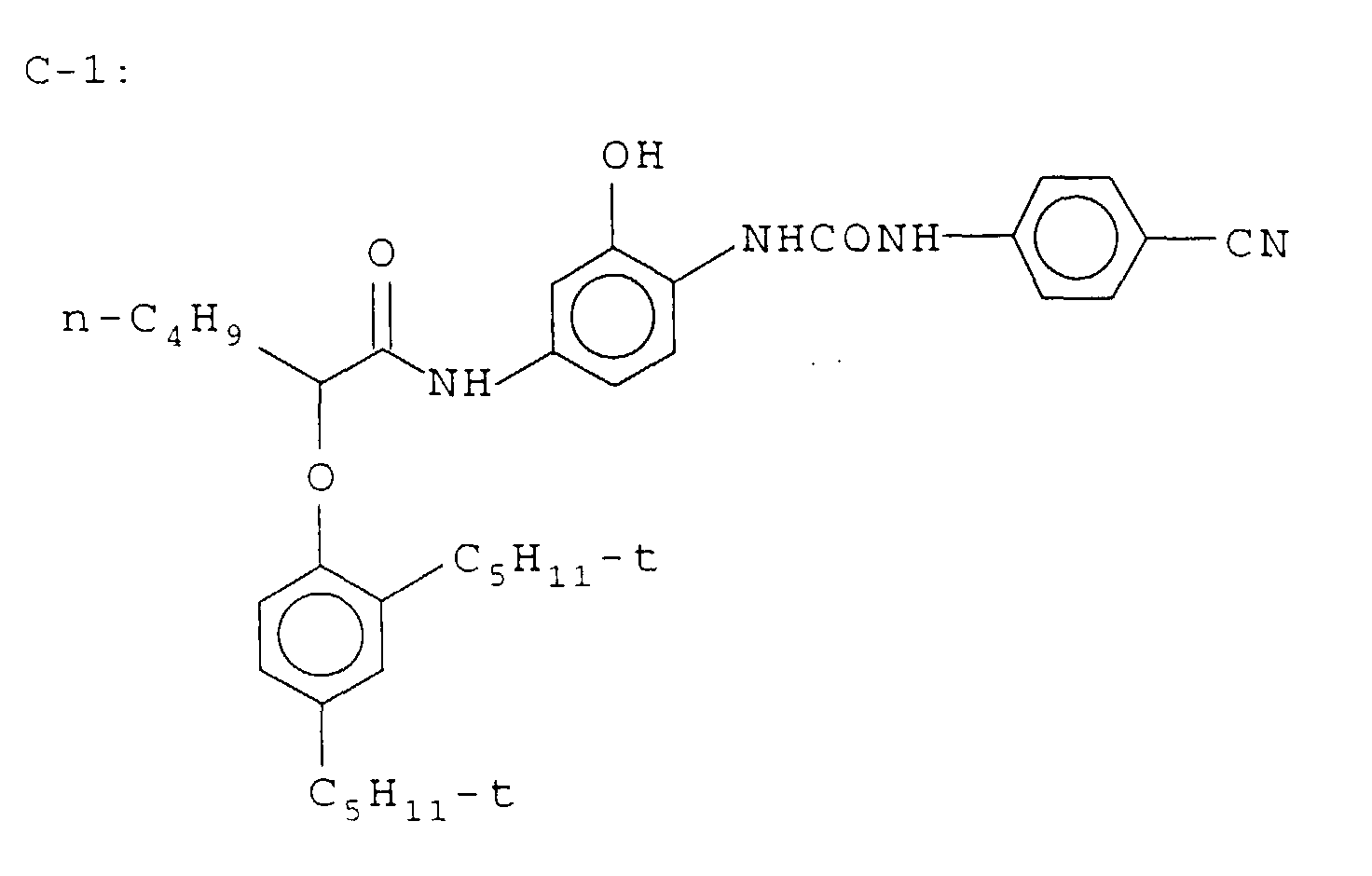
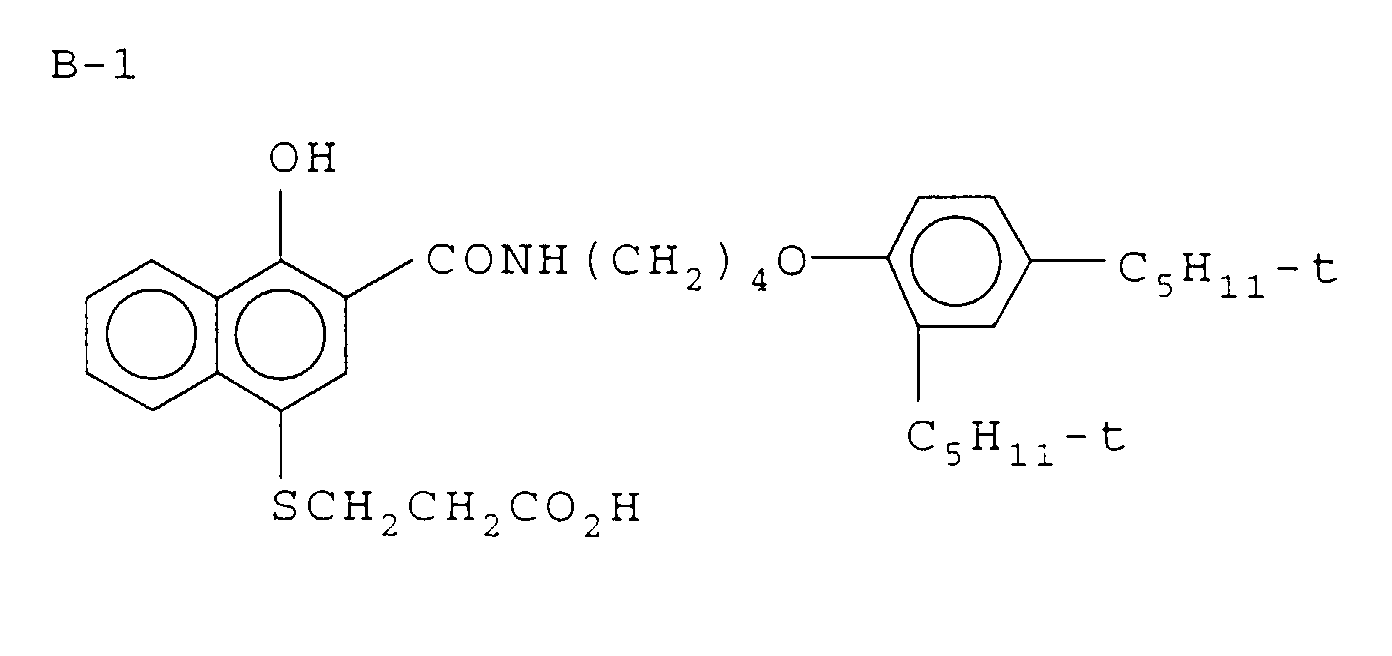
- Layer 2 {First (least) Red-Sensitive Layer} Red sensitized silver iodobromide emulsion [1.3 mol % iodide, average grain diameter 0.55 microns, average thickness 0.08 microns] at 0.49 g, red sensitized silver iodobromide emulsion [4 mol % iodide, average grain diameter 1.0 microns, average thickness 0.09 microns] at 0.48 g, cyan dye-forming image coupler C-1 at 0.56 g, cyan dye-forming masking coupler CM-1 at 0.033 g, BAR compound B-1 at 0.039 g, with gelatin at 1.83 g.
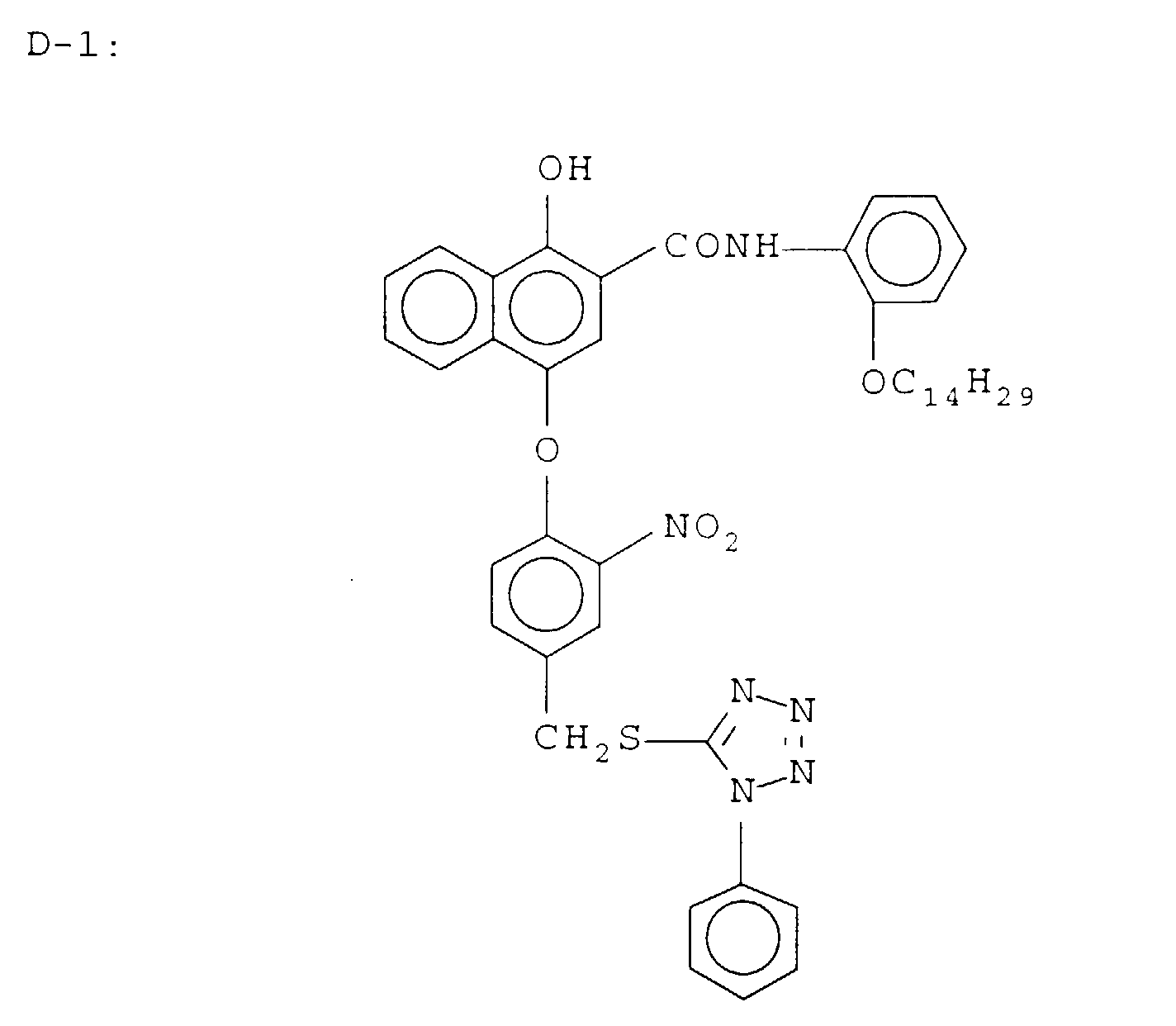
- Layer 3 {Second (more) Red-Sensitive Layer} Red sensitive silver iodobromide emulsion [4 mol % iodide, average grain diameter 1.3 microns, average grain thickness 0.12 microns] at 0.72 g, cyan dye-forming image coupler C-1 at 0.23 g, cyan dye-forming masking coupler CM-1 at 0.022 g, DIR compound D-1 at 0.011 g, with gelatin at 1.66 g.
- Layer 4 {Third (most) Red-Sensitive Layer} Red sensitized silver iodobromide emulsion [4 mol % iodide, average grain diameter 2.6 microns, average grain thickness 0.13 microns] at 1.11 g, cyan dye-forming dye-forming image coupler C-1 at 0.13 g, cyan masking coupler CM-1 at 0.033 g, DIR compound D-1 at 0.024 g, DIR compound D-2 at 0.050 g, with gelatin at 1.36 g.
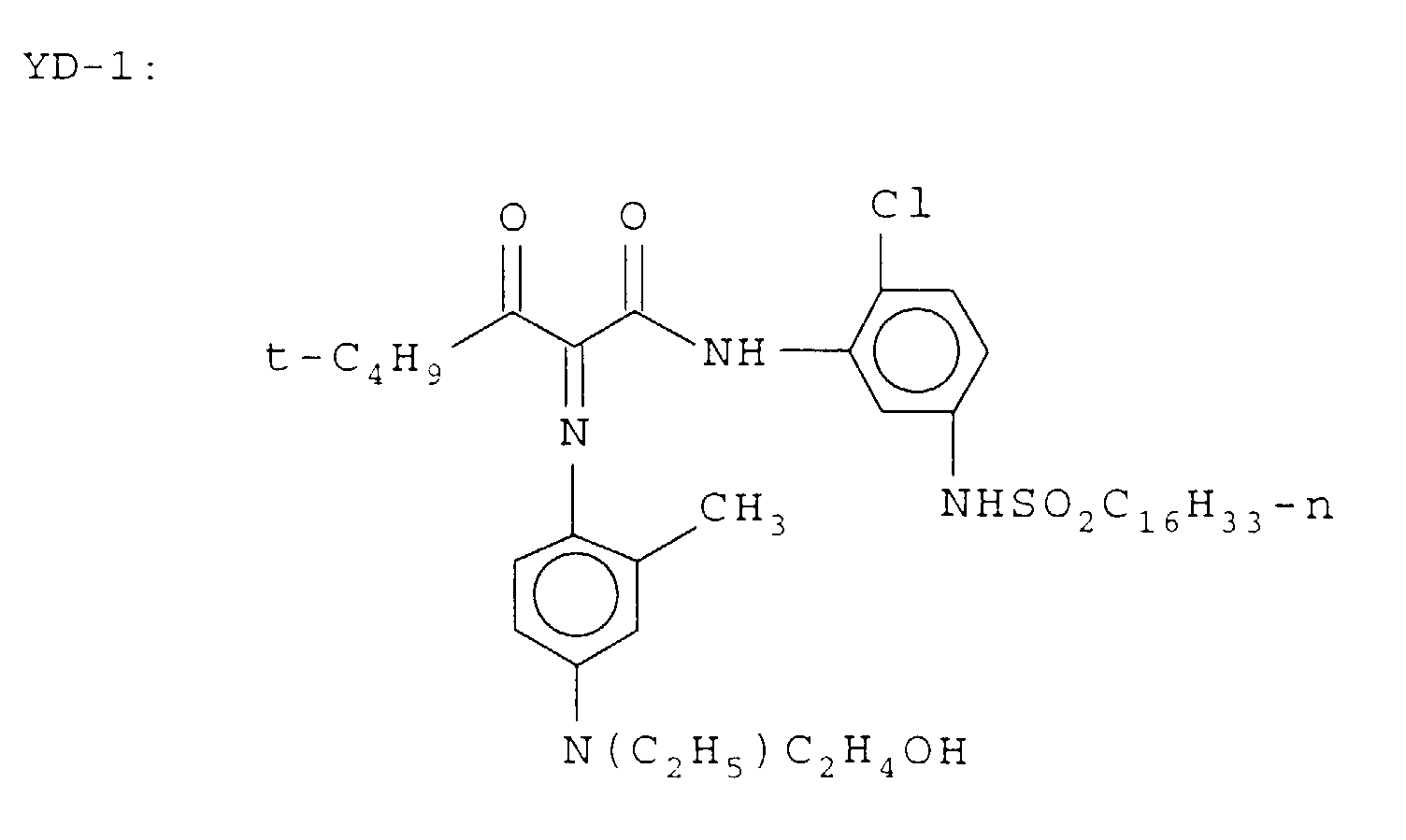
- Layer 5 {Interlayer} Yellow dye material YD-1 at 0.11 g and 1.33 g of gelatin
- Layer 6 {First (least) Green-Sensitive Layer} Green sensitized silver iodobromide emulsion [1.3 mol % iodide, average grain diameter 0.55 microns, average grain thickness 0.08 microns] at 0.62 g, green sensitized silver iodobromide emulsion [4 mol % iodide, average grain diameter 1.0 microns, average grain thickness 0.09 microns] at 0.32 g, magenta dye-forming image coupler M-1 at 0.24 g, magenta dye-forming masking coupler MM-1 at 0.067 g with gelatin at 1.78 g.
- Layer 7 {Second (more) Green-Sensitive Layer} Green sensitized silver iodobromide emulsion [4 mol % iodide, average grain diameter 1.25 microns, average grain thickness 0.12 microns] at 1.00 g, magenta dye-forming image coupler M-1 at 0.091 g, magenta dye-forming masking coupler MM-1 at 0.067 g, DIR compound D-1 at 0.024 g with gelatin at 1.48 g.
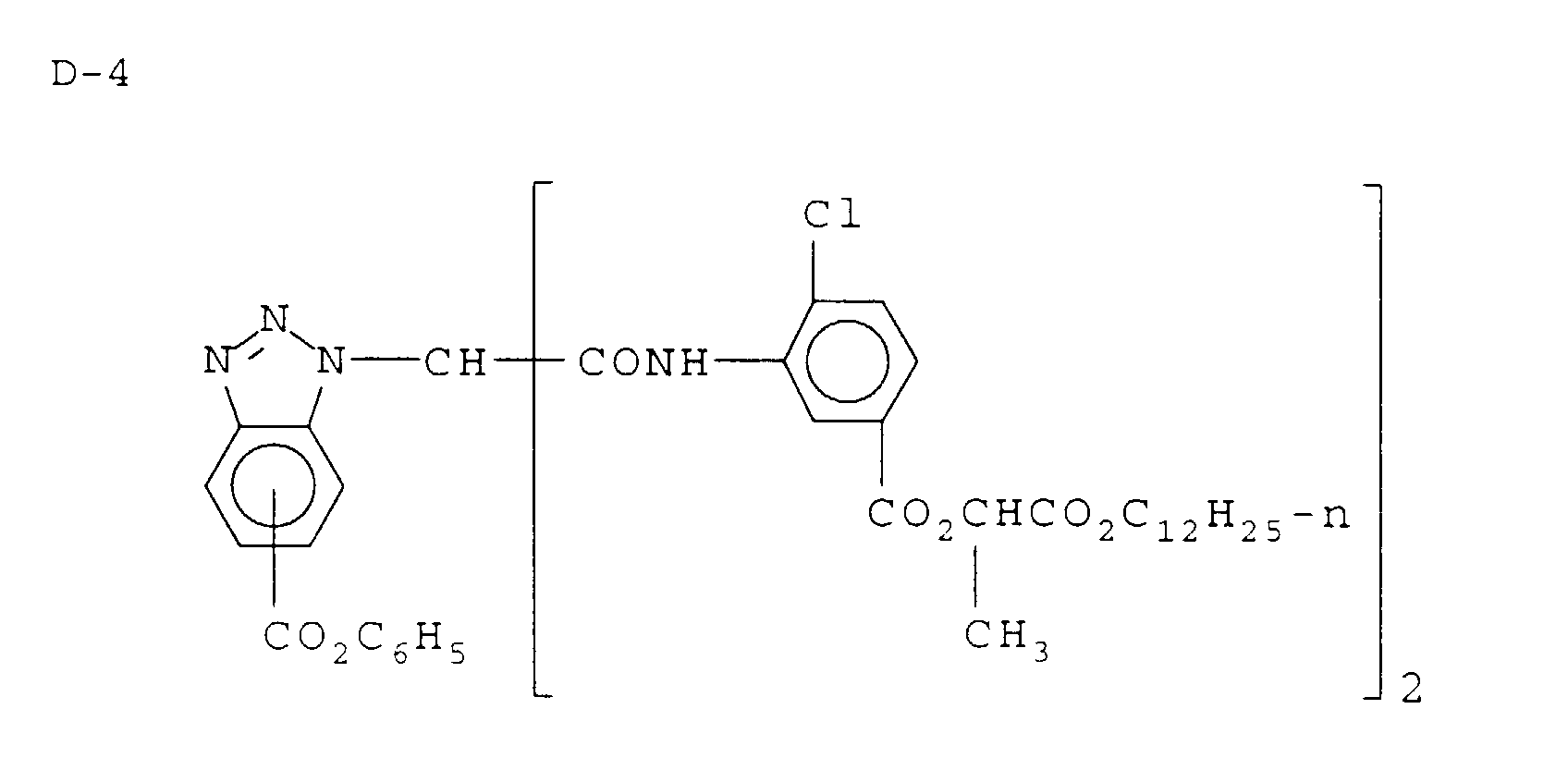
- Layer 8 {Third (most) Green-Sensitive Layer) Green sensitized silver iodobromide emulsion [4 mol % iodide, average grain diameter 2.16 microns, average grain thickness 0.12 microns] at 1.00 g, magenta dye-forming image coupler M-1 at 0.072 g, magenta dye-forming masking coupler MM-1 at 0.056 g, DIR compound D-3 at 0.01 g, DIR compound D-4 at 0.011 g, with gelatin at 1.33 g.
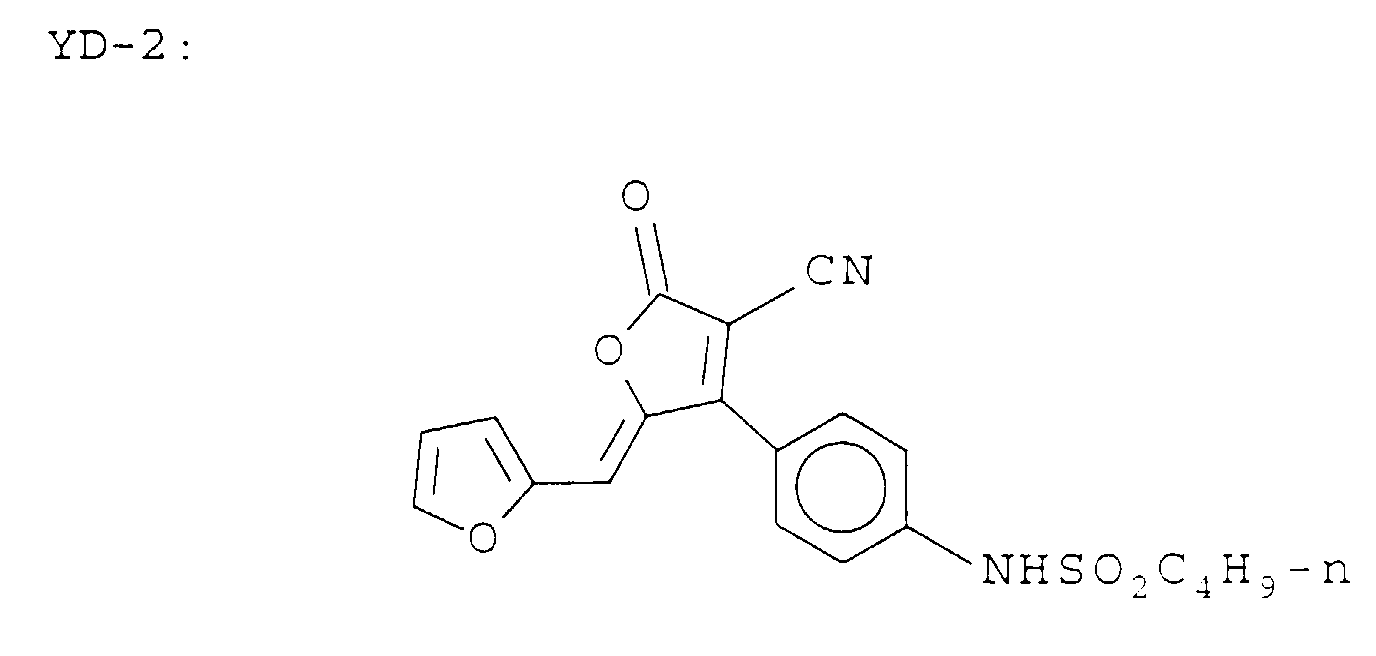
- Layer 9 {Interlayer} Yellow dye material YD-2 at 0.11 g with 1.33 g gelatin.
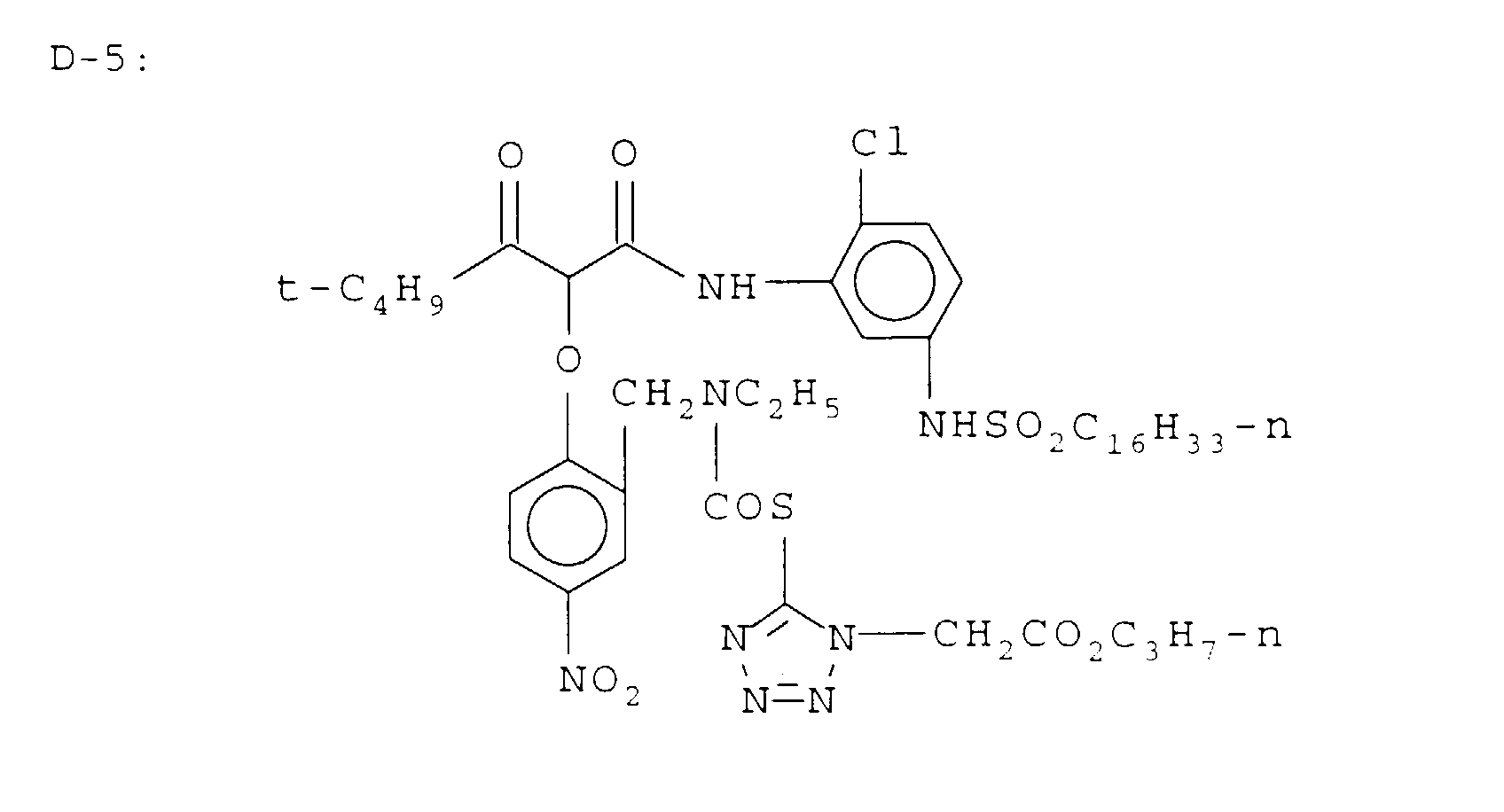
- Layer 10 {First (less) Blue-Sensitive Layer} Blue sensitized silver iodobromide emulsion [1.3 mol % iodide, average grain diameter 0.55, average grain thickness 0.08 microns] at 0.24 g, blue sensitized silver iodobromide emulsion [6 mol % iodide, average grain diameter 1.0 microns, average grain thickness 0.26 microns] at 0.61 g, yellow dye-forming image coupler Y-1 at 0.29 g, yellow dye forming image coupler Y-2 at 0.72 g, cyan dye-forming image coupler C-1 at 0.017 g, DIR compound D-5 at 0.067 g, BAR compound B-1 at 0.003 g with gelatin at 2.6 g.
- Layer 11 {Second (more) Blue-Sensitive Layer} Blue sensitized silver iodobromide emulsion [4 mol % iodide, average grain diameter 3.0 microns, average grain thickness 0.14 microns] at 0.23 g, blue sensitized silver iodobromide emulsion [9 mol % iodide, average grain diameter 1.0 microns] at 0.59 g, yellow dye-forming image coupler Y-1 at 0.090 g, yellow dye-forming image coupler Y-2 at 0.23 g, cyan dye-forming image coupler C-1 0.022 g, DIR compound D-5 at 0.05 g, BAR compound B-1 at 0.006 g with gelatin at 1.97 g.
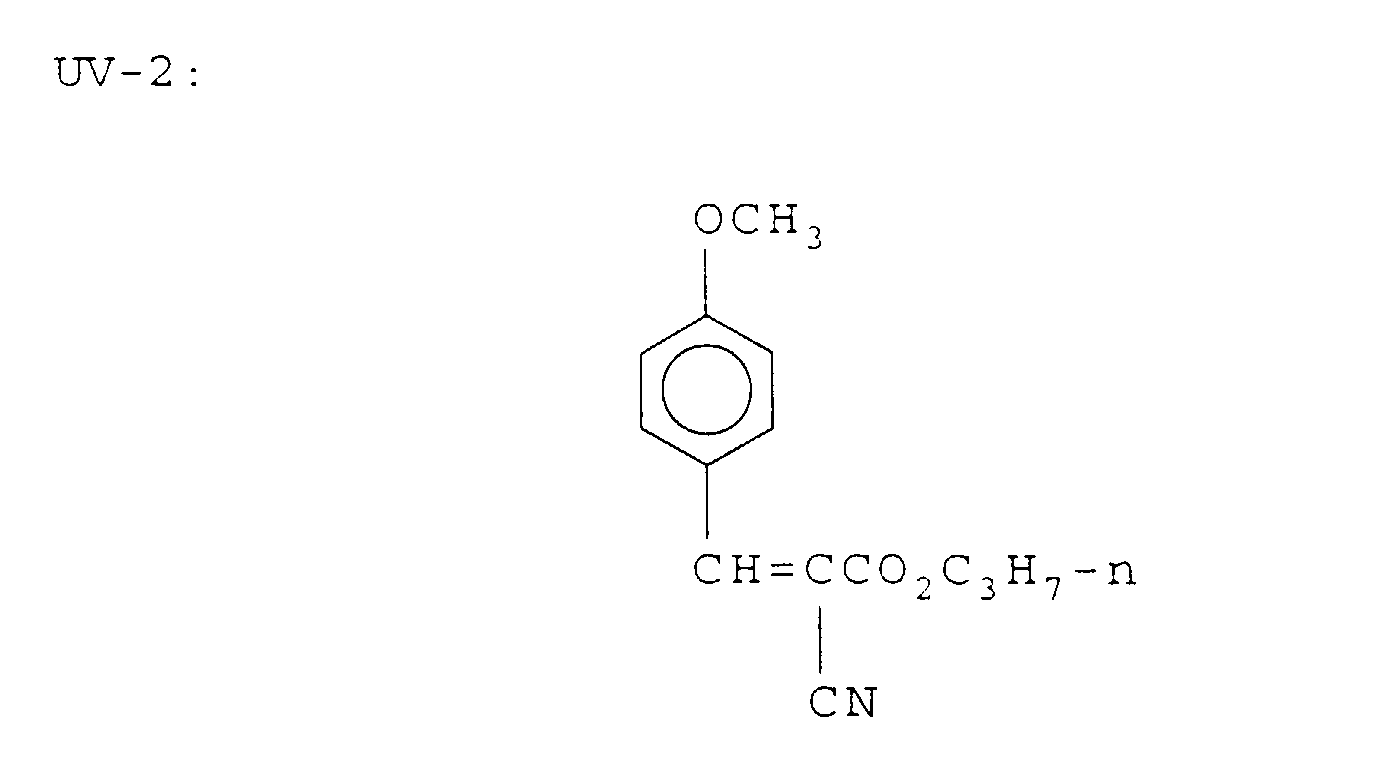
- Layer 12 {Protective Layer} 0.111 g of dye UV-1, 0.111 g of dye UV-2, unsensitized silver bromide Lippman emulsion at 0.222 g, 2.03 g.
-
- This film is hardened at coating with 2% by weight to total gelatin of hardener H-1. Surfactants, coating aids, scavengers, soluble absorber dyes and stabilizers are added to the various layers of this sample as is commonly practiced in the art.
- The formulas for the component materials are as follows:






- The side of the support opposite to that described above may contain magnetic recording layers, antistatic layers, subbing layers, lubrication layers, and the like as described in U.S. Patent No. 5,395,743, assigned to the same assignee as this application.
- The sample exhibits excellent wet adhesion (no removal in AO abrasion) and excellent dry adhesion, before and after C41 photographic processing.
Claims (11)
- An imaging element comprising a light-sensitive imaging layer and a polyester film support having coated thereon greater than 0.17 g/n2 of a layer of a self-crosslinking polyurethane derived from an isocyanate terminated prepolymer extended with an aliphatic polyamine and end-capped with N-methylol hydrazide groups, the prepolymer being derived from (a) a diisocyanate, and (b) a polyester polyol and having pendant water dispersing, carboxylic salt groups on the polymer chain.
- The imaging element of Claim 1 wherein a hydrophilic colloid layer is coated on the self-crosslinking polyurethane layer.
- The imaging element of Claim 2 wherein the hydrophilic colloid is gelatin.
- The imaging element of Claim 1 wherein the diisocyanate is aliphatic.
- The imaging element of Claim 1 wherein the polyester polyol is aliphatic.
- The imaging element of Claim 1 wherein the isocyanate terminated prepolymer contains units derived from melamine.
- The imaging element of Claim 5 wherein the aliphatic polyester polyol is a derivative of neopentyl glycol, hexanediol, and adipic acid.
- The imaging element of Claim 7 wherein the prepolymer contains units derived from melamine.
- The imaging element of Claim 1 wherein the light-sensitive imaging layer contains silver halide.
- The imaging element of Claim 2 wherein the light-sensitive layer is applied on the hydrophilic colloid layer.
- The imaging element of Claim 1 wherein the polyester film support is treated with corona discharge, UV, glow discharge, or flame.
Applications Claiming Priority (2)
| Application Number | Priority Date | Filing Date | Title |
|---|---|---|---|
| US08/459,247 US5532118A (en) | 1995-06-02 | 1995-06-02 | Light-sensitive imaging element |
| US459247 | 1995-06-02 |
Publications (3)
| Publication Number | Publication Date |
|---|---|
| EP0745897A2 EP0745897A2 (en) | 1996-12-04 |
| EP0745897A3 EP0745897A3 (en) | 1997-03-05 |
| EP0745897B1 true EP0745897B1 (en) | 2001-01-03 |
Family
ID=23824006
Family Applications (1)
| Application Number | Title | Priority Date | Filing Date |
|---|---|---|---|
| EP96201398A Expired - Lifetime EP0745897B1 (en) | 1995-06-02 | 1996-05-17 | Light-sensitive imaging element |
Country Status (4)
| Country | Link |
|---|---|
| US (1) | US5532118A (en) |
| EP (1) | EP0745897B1 (en) |
| JP (1) | JPH0915791A (en) |
| DE (1) | DE69611398T2 (en) |
Families Citing this family (9)
| Publication number | Priority date | Publication date | Assignee | Title |
|---|---|---|---|---|
| US5726001A (en) * | 1996-06-12 | 1998-03-10 | Eastman Kodak Company | Composite support for imaging elements comprising an electrically-conductive layer and polyurethane adhesion promoting layer on an energetic surface-treated polymeric film |
| GB2331271B (en) | 1997-10-18 | 2001-10-10 | Eastman Kodak Co | Method of forming an image |
| US5948857A (en) * | 1998-06-04 | 1999-09-07 | Eastman Kodak Company | Gelatin-modified polyurethane |
| US5910401A (en) * | 1998-06-04 | 1999-06-08 | Eastman Kodak Company | Gelatin-modified polyurethane and polyester film base |
| US6214530B1 (en) | 1999-06-30 | 2001-04-10 | Tulalip Consultoria Comercial Sociedade Unidessoal S.A. | Base film with a conductive layer and a magnetic layer |
| ITSV20000004A1 (en) | 2000-02-15 | 2001-08-15 | Ferrania Spa | PHOTOGRAPHIC ELEMENT WITH A LAYER THAT IMPROVES THE ADHESION TO THE SUPPORT. |
| US6514660B1 (en) | 2001-10-29 | 2003-02-04 | Eastman Kodak Company | Polyethyleneimine primer for imaging materials |
| US6881492B2 (en) * | 2002-09-27 | 2005-04-19 | Eastman Kodak Company | Primer composition for polyesters |
| US6749982B2 (en) | 2002-09-27 | 2004-06-15 | Eastman Kodak Company | Imaging member with polyester base |
Family Cites Families (10)
| Publication number | Priority date | Publication date | Assignee | Title |
|---|---|---|---|---|
| US3143421A (en) * | 1960-03-17 | 1964-08-04 | Eastman Kodak Co | Adhering photographic subbing layers to polyester film |
| US3201249A (en) * | 1961-08-25 | 1965-08-17 | Eastman Kodak Co | Composite film element and composition therefor including anti-halation material |
| US4335029A (en) * | 1980-12-15 | 1982-06-15 | Witco Chemical Corporation | Aqueous polyurethane compositions |
| DE3431144A1 (en) * | 1984-08-24 | 1986-03-06 | Hüls AG, 4370 Marl | COLD CROSSLINKING PUR DISPERSIONS, THEIR PRODUCTION AND USE |
| US4689359A (en) * | 1985-08-22 | 1987-08-25 | Eastman Kodak Company | Composition formed from gelatin and polymer of vinyl monomer having a primary amine addition salt group |
| US4913970A (en) * | 1987-11-03 | 1990-04-03 | Eastman Kodak Company | Adhesion promoting composition and coated film |
| US4933237A (en) * | 1989-02-17 | 1990-06-12 | Eastman Kodak Company | Paint coated sheet material with adhesion promoting composition |
| US5034275A (en) * | 1989-11-24 | 1991-07-23 | Pearson James M | Paint coated sheet material with adhesion promoting composition |
| EP0583787B1 (en) * | 1992-08-20 | 2000-03-22 | Fuji Photo Film Co., Ltd. | Silver halide photographic material |
| US5378592A (en) * | 1993-02-02 | 1995-01-03 | Fuji Photo Film Co., Ltd. | Photographic material |
-
1995
- 1995-06-02 US US08/459,247 patent/US5532118A/en not_active Expired - Fee Related
-
1996
- 1996-05-17 EP EP96201398A patent/EP0745897B1/en not_active Expired - Lifetime
- 1996-05-17 DE DE69611398T patent/DE69611398T2/en not_active Expired - Fee Related
- 1996-05-31 JP JP8139175A patent/JPH0915791A/en active Pending
Also Published As
| Publication number | Publication date |
|---|---|
| JPH0915791A (en) | 1997-01-17 |
| EP0745897A3 (en) | 1997-03-05 |
| DE69611398T2 (en) | 2001-06-28 |
| US5532118A (en) | 1996-07-02 |
| EP0745897A2 (en) | 1996-12-04 |
| DE69611398D1 (en) | 2001-02-08 |
Similar Documents
| Publication | Publication Date | Title |
|---|---|---|
| EP0962819B1 (en) | Gelatin-modified polyurethane and polyester film base | |
| EP0307856A2 (en) | Photographic element having polymer particles covalently bonded to gelatin | |
| JP2002365766A (en) | Photographic element | |
| US5532118A (en) | Light-sensitive imaging element | |
| US5876910A (en) | Aqueous coating compositions for surface protective layers for imaging elements | |
| EP0829757B1 (en) | Imaging element comprising one layer the binder of which comprises a mixture of a polyurethane and a acrylic polymer | |
| US6428948B2 (en) | Imaged element with improved wet abrasion resistance | |
| US6232049B1 (en) | Protective overcoat for photographic elements | |
| EP0829760B1 (en) | Imaging element comprising protective overcoat for antistatic layer | |
| US5824461A (en) | Fluoropolyether containing aqueous coating compositions for an imaging element | |
| US5932405A (en) | Surface protective layer for photographic elements containing a siloxane polyurethane | |
| US6037108A (en) | Thermally stable subbing layer for imaging elements | |
| EP1050780B1 (en) | Photographic element with a layer improving the adhesion to the support | |
| US20020127410A1 (en) | Annealable imaging support | |
| EP1220030B1 (en) | Amine modified gelatin layer for improved adhesion of photographic elements after annealing | |
| US6432623B1 (en) | Method for processing a photographic element comprising a simultaneously coated protective overcoat | |
| EP0911695A1 (en) | Aqueous coating compositions for surface protective layers for imaging elements | |
| US6043014A (en) | Imaging elements comprising an electrically-conductive layer and a protective overcoat composition containing a solvent-dispersible polyurethane | |
| US6348305B2 (en) | Photographic element with a layer improving the adhesion to the support base | |
| EP0566909A2 (en) | Silver halide color photographic light-sensitive material in roll form | |
| US6645705B2 (en) | Protective overcoat for photographic elements | |
| US6451431B1 (en) | Film support with annealable layer and improved adhesion | |
| JP3496165B2 (en) | Photographic support | |
| US20020136902A1 (en) | Annealable imaging support | |
| EP1220031A2 (en) | Film support with improved adhesion upon annealing |
Legal Events
| Date | Code | Title | Description |
|---|---|---|---|
| PUAI | Public reference made under article 153(3) epc to a published international application that has entered the european phase |
Free format text: ORIGINAL CODE: 0009012 |
|
| AK | Designated contracting states |
Kind code of ref document: A2 Designated state(s): DE FR GB |
|
| PUAL | Search report despatched |
Free format text: ORIGINAL CODE: 0009013 |
|
| AK | Designated contracting states |
Kind code of ref document: A3 Designated state(s): DE FR GB |
|
| 17P | Request for examination filed |
Effective date: 19970516 |
|
| 17Q | First examination report despatched |
Effective date: 19980114 |
|
| GRAG | Despatch of communication of intention to grant |
Free format text: ORIGINAL CODE: EPIDOS AGRA |
|
| 17Q | First examination report despatched |
Effective date: 19980114 |
|
| GRAG | Despatch of communication of intention to grant |
Free format text: ORIGINAL CODE: EPIDOS AGRA |
|
| GRAH | Despatch of communication of intention to grant a patent |
Free format text: ORIGINAL CODE: EPIDOS IGRA |
|
| GRAH | Despatch of communication of intention to grant a patent |
Free format text: ORIGINAL CODE: EPIDOS IGRA |
|
| GRAA | (expected) grant |
Free format text: ORIGINAL CODE: 0009210 |
|
| AK | Designated contracting states |
Kind code of ref document: B1 Designated state(s): DE FR GB |
|
| REF | Corresponds to: |
Ref document number: 69611398 Country of ref document: DE Date of ref document: 20010208 |
|
| ET | Fr: translation filed | ||
| PLBE | No opposition filed within time limit |
Free format text: ORIGINAL CODE: 0009261 |
|
| STAA | Information on the status of an ep patent application or granted ep patent |
Free format text: STATUS: NO OPPOSITION FILED WITHIN TIME LIMIT |
|
| REG | Reference to a national code |
Ref country code: GB Ref legal event code: IF02 |
|
| 26N | No opposition filed | ||
| PGFP | Annual fee paid to national office [announced via postgrant information from national office to epo] |
Ref country code: GB Payment date: 20050406 Year of fee payment: 10 |
|
| PGFP | Annual fee paid to national office [announced via postgrant information from national office to epo] |
Ref country code: FR Payment date: 20050517 Year of fee payment: 10 |
|
| PGFP | Annual fee paid to national office [announced via postgrant information from national office to epo] |
Ref country code: DE Payment date: 20050531 Year of fee payment: 10 |
|
| PG25 | Lapsed in a contracting state [announced via postgrant information from national office to epo] |
Ref country code: GB Free format text: LAPSE BECAUSE OF NON-PAYMENT OF DUE FEES Effective date: 20060517 |
|
| PG25 | Lapsed in a contracting state [announced via postgrant information from national office to epo] |
Ref country code: DE Free format text: LAPSE BECAUSE OF NON-PAYMENT OF DUE FEES Effective date: 20061201 |
|
| GBPC | Gb: european patent ceased through non-payment of renewal fee |
Effective date: 20060517 |
|
| REG | Reference to a national code |
Ref country code: FR Ref legal event code: ST Effective date: 20070131 |
|
| PG25 | Lapsed in a contracting state [announced via postgrant information from national office to epo] |
Ref country code: FR Free format text: LAPSE BECAUSE OF NON-PAYMENT OF DUE FEES Effective date: 20060531 |