EP0745675B1 - A method of amplifying nucleic acid and a reagent therefor - Google Patents
A method of amplifying nucleic acid and a reagent therefor Download PDFInfo
- Publication number
- EP0745675B1 EP0745675B1 EP96108613A EP96108613A EP0745675B1 EP 0745675 B1 EP0745675 B1 EP 0745675B1 EP 96108613 A EP96108613 A EP 96108613A EP 96108613 A EP96108613 A EP 96108613A EP 0745675 B1 EP0745675 B1 EP 0745675B1
- Authority
- EP
- European Patent Office
- Prior art keywords
- dna polymerase
- nucleic acid
- thermostable dna
- dna
- target nucleic
- Prior art date
- Legal status (The legal status is an assumption and is not a legal conclusion. Google has not performed a legal analysis and makes no representation as to the accuracy of the status listed.)
- Expired - Lifetime
Links
- 108020004707 nucleic acids Proteins 0.000 title claims description 100
- 102000039446 nucleic acids Human genes 0.000 title claims description 100
- 150000007523 nucleic acids Chemical class 0.000 title claims description 100
- 238000000034 method Methods 0.000 title claims description 32
- 239000003153 chemical reaction reagent Substances 0.000 title claims description 12
- 108010014303 DNA-directed DNA polymerase Proteins 0.000 claims description 134
- 102000016928 DNA-directed DNA polymerase Human genes 0.000 claims description 111
- 230000000694 effects Effects 0.000 claims description 31
- 108060002716 Exonuclease Proteins 0.000 claims description 29
- 102000013165 exonuclease Human genes 0.000 claims description 29
- 230000000295 complement effect Effects 0.000 claims description 24
- 239000007853 buffer solution Substances 0.000 claims description 17
- 125000003275 alpha amino acid group Chemical group 0.000 claims description 15
- 239000000523 sample Substances 0.000 claims description 15
- 150000001768 cations Chemical class 0.000 claims description 8
- 239000002773 nucleotide Substances 0.000 claims description 8
- 125000003729 nucleotide group Chemical group 0.000 claims description 8
- 238000001514 detection method Methods 0.000 claims description 5
- 108020004414 DNA Proteins 0.000 description 92
- 239000002585 base Substances 0.000 description 54
- 241000617156 archaeon Species 0.000 description 41
- 239000012634 fragment Substances 0.000 description 29
- 210000004027 cell Anatomy 0.000 description 28
- 108010002747 Pfu DNA polymerase Proteins 0.000 description 26
- 238000003752 polymerase chain reaction Methods 0.000 description 25
- 108090000623 proteins and genes Proteins 0.000 description 22
- 108010006785 Taq Polymerase Proteins 0.000 description 19
- 102000004190 Enzymes Human genes 0.000 description 16
- 108090000790 Enzymes Proteins 0.000 description 16
- 108091092195 Intron Proteins 0.000 description 16
- 238000006243 chemical reaction Methods 0.000 description 15
- 241000588724 Escherichia coli Species 0.000 description 13
- 239000000047 product Substances 0.000 description 11
- 239000000126 substance Substances 0.000 description 11
- 108091028043 Nucleic acid sequence Proteins 0.000 description 10
- 230000003321 amplification Effects 0.000 description 10
- 239000000872 buffer Substances 0.000 description 10
- 239000013604 expression vector Substances 0.000 description 10
- 238000003199 nucleic acid amplification method Methods 0.000 description 10
- 239000013598 vector Substances 0.000 description 9
- 230000006820 DNA synthesis Effects 0.000 description 8
- TWRXJAOTZQYOKJ-UHFFFAOYSA-L Magnesium chloride Chemical compound [Mg+2].[Cl-].[Cl-] TWRXJAOTZQYOKJ-UHFFFAOYSA-L 0.000 description 8
- 241000205156 Pyrococcus furiosus Species 0.000 description 8
- 241000205180 Thermococcus litoralis Species 0.000 description 8
- 238000001962 electrophoresis Methods 0.000 description 8
- 102000004169 proteins and genes Human genes 0.000 description 8
- 230000035484 reaction time Effects 0.000 description 8
- 108010001244 Tli polymerase Proteins 0.000 description 7
- 230000001580 bacterial effect Effects 0.000 description 7
- 239000000758 substrate Substances 0.000 description 7
- 238000007669 thermal treatment Methods 0.000 description 7
- 239000000203 mixture Substances 0.000 description 6
- 239000013612 plasmid Substances 0.000 description 6
- 238000003786 synthesis reaction Methods 0.000 description 6
- 108020004511 Recombinant DNA Proteins 0.000 description 5
- 108010020713 Tth polymerase Proteins 0.000 description 5
- 239000013611 chromosomal DNA Substances 0.000 description 5
- 238000005259 measurement Methods 0.000 description 5
- 239000002609 medium Substances 0.000 description 5
- 238000003259 recombinant expression Methods 0.000 description 5
- 238000011282 treatment Methods 0.000 description 5
- YBJHBAHKTGYVGT-ZKWXMUAHSA-N (+)-Biotin Chemical compound N1C(=O)N[C@@H]2[C@H](CCCCC(=O)O)SC[C@@H]21 YBJHBAHKTGYVGT-ZKWXMUAHSA-N 0.000 description 4
- QKNYBSVHEMOAJP-UHFFFAOYSA-N 2-amino-2-(hydroxymethyl)propane-1,3-diol;hydron;chloride Chemical compound Cl.OCC(N)(CO)CO QKNYBSVHEMOAJP-UHFFFAOYSA-N 0.000 description 4
- 108091034117 Oligonucleotide Proteins 0.000 description 4
- 238000002105 Southern blotting Methods 0.000 description 4
- 229920004890 Triton X-100 Polymers 0.000 description 4
- 239000013504 Triton X-100 Substances 0.000 description 4
- 150000001413 amino acids Chemical class 0.000 description 4
- BFNBIHQBYMNNAN-UHFFFAOYSA-N ammonium sulfate Chemical compound N.N.OS(O)(=O)=O BFNBIHQBYMNNAN-UHFFFAOYSA-N 0.000 description 4
- 229910052921 ammonium sulfate Inorganic materials 0.000 description 4
- 230000015572 biosynthetic process Effects 0.000 description 4
- 238000010367 cloning Methods 0.000 description 4
- 238000012258 culturing Methods 0.000 description 4
- 229910001629 magnesium chloride Inorganic materials 0.000 description 4
- 108091008146 restriction endonucleases Proteins 0.000 description 4
- 239000000243 solution Substances 0.000 description 4
- 241000894006 Bacteria Species 0.000 description 3
- PEDCQBHIVMGVHV-UHFFFAOYSA-N Glycerine Chemical compound OCC(O)CO PEDCQBHIVMGVHV-UHFFFAOYSA-N 0.000 description 3
- HEMHJVSKTPXQMS-UHFFFAOYSA-M Sodium hydroxide Chemical compound [OH-].[Na+] HEMHJVSKTPXQMS-UHFFFAOYSA-M 0.000 description 3
- 238000000137 annealing Methods 0.000 description 3
- 102000005936 beta-Galactosidase Human genes 0.000 description 3
- 108010005774 beta-Galactosidase Proteins 0.000 description 3
- 238000005119 centrifugation Methods 0.000 description 3
- 239000002299 complementary DNA Substances 0.000 description 3
- 238000007796 conventional method Methods 0.000 description 3
- 230000002255 enzymatic effect Effects 0.000 description 3
- 238000009396 hybridization Methods 0.000 description 3
- 230000006698 induction Effects 0.000 description 3
- 238000011419 induction treatment Methods 0.000 description 3
- 230000002194 synthesizing effect Effects 0.000 description 3
- 238000009210 therapy by ultrasound Methods 0.000 description 3
- -1 1,2-dioxetane compound Chemical class 0.000 description 2
- OPIFSICVWOWJMJ-AEOCFKNESA-N 5-bromo-4-chloro-3-indolyl beta-D-galactoside Chemical compound O[C@@H]1[C@@H](O)[C@@H](O)[C@@H](CO)O[C@H]1OC1=CNC2=CC=C(Br)C(Cl)=C12 OPIFSICVWOWJMJ-AEOCFKNESA-N 0.000 description 2
- 229920000936 Agarose Polymers 0.000 description 2
- 102000002260 Alkaline Phosphatase Human genes 0.000 description 2
- 108020004774 Alkaline Phosphatase Proteins 0.000 description 2
- 241001478240 Coccus Species 0.000 description 2
- 102000053602 DNA Human genes 0.000 description 2
- RTZKZFJDLAIYFH-UHFFFAOYSA-N Diethyl ether Chemical compound CCOCC RTZKZFJDLAIYFH-UHFFFAOYSA-N 0.000 description 2
- SHIBSTMRCDJXLN-UHFFFAOYSA-N Digoxigenin Natural products C1CC(C2C(C3(C)CCC(O)CC3CC2)CC2O)(O)C2(C)C1C1=CC(=O)OC1 SHIBSTMRCDJXLN-UHFFFAOYSA-N 0.000 description 2
- LFQSCWFLJHTTHZ-UHFFFAOYSA-N Ethanol Chemical compound CCO LFQSCWFLJHTTHZ-UHFFFAOYSA-N 0.000 description 2
- JLVVSXFLKOJNIY-UHFFFAOYSA-N Magnesium ion Chemical compound [Mg+2] JLVVSXFLKOJNIY-UHFFFAOYSA-N 0.000 description 2
- 108700026244 Open Reading Frames Proteins 0.000 description 2
- 108010010677 Phosphodiesterase I Proteins 0.000 description 2
- 108020004682 Single-Stranded DNA Proteins 0.000 description 2
- 239000007983 Tris buffer Substances 0.000 description 2
- JLCPHMBAVCMARE-UHFFFAOYSA-N [3-[[3-[[3-[[3-[[3-[[3-[[3-[[3-[[3-[[3-[[3-[[5-(2-amino-6-oxo-1H-purin-9-yl)-3-[[3-[[3-[[3-[[3-[[3-[[5-(2-amino-6-oxo-1H-purin-9-yl)-3-[[5-(2-amino-6-oxo-1H-purin-9-yl)-3-hydroxyoxolan-2-yl]methoxy-hydroxyphosphoryl]oxyoxolan-2-yl]methoxy-hydroxyphosphoryl]oxy-5-(5-methyl-2,4-dioxopyrimidin-1-yl)oxolan-2-yl]methoxy-hydroxyphosphoryl]oxy-5-(6-aminopurin-9-yl)oxolan-2-yl]methoxy-hydroxyphosphoryl]oxy-5-(6-aminopurin-9-yl)oxolan-2-yl]methoxy-hydroxyphosphoryl]oxy-5-(6-aminopurin-9-yl)oxolan-2-yl]methoxy-hydroxyphosphoryl]oxy-5-(6-aminopurin-9-yl)oxolan-2-yl]methoxy-hydroxyphosphoryl]oxyoxolan-2-yl]methoxy-hydroxyphosphoryl]oxy-5-(5-methyl-2,4-dioxopyrimidin-1-yl)oxolan-2-yl]methoxy-hydroxyphosphoryl]oxy-5-(4-amino-2-oxopyrimidin-1-yl)oxolan-2-yl]methoxy-hydroxyphosphoryl]oxy-5-(5-methyl-2,4-dioxopyrimidin-1-yl)oxolan-2-yl]methoxy-hydroxyphosphoryl]oxy-5-(5-methyl-2,4-dioxopyrimidin-1-yl)oxolan-2-yl]methoxy-hydroxyphosphoryl]oxy-5-(6-aminopurin-9-yl)oxolan-2-yl]methoxy-hydroxyphosphoryl]oxy-5-(6-aminopurin-9-yl)oxolan-2-yl]methoxy-hydroxyphosphoryl]oxy-5-(4-amino-2-oxopyrimidin-1-yl)oxolan-2-yl]methoxy-hydroxyphosphoryl]oxy-5-(4-amino-2-oxopyrimidin-1-yl)oxolan-2-yl]methoxy-hydroxyphosphoryl]oxy-5-(4-amino-2-oxopyrimidin-1-yl)oxolan-2-yl]methoxy-hydroxyphosphoryl]oxy-5-(6-aminopurin-9-yl)oxolan-2-yl]methoxy-hydroxyphosphoryl]oxy-5-(4-amino-2-oxopyrimidin-1-yl)oxolan-2-yl]methyl [5-(6-aminopurin-9-yl)-2-(hydroxymethyl)oxolan-3-yl] hydrogen phosphate Polymers Cc1cn(C2CC(OP(O)(=O)OCC3OC(CC3OP(O)(=O)OCC3OC(CC3O)n3cnc4c3nc(N)[nH]c4=O)n3cnc4c3nc(N)[nH]c4=O)C(COP(O)(=O)OC3CC(OC3COP(O)(=O)OC3CC(OC3COP(O)(=O)OC3CC(OC3COP(O)(=O)OC3CC(OC3COP(O)(=O)OC3CC(OC3COP(O)(=O)OC3CC(OC3COP(O)(=O)OC3CC(OC3COP(O)(=O)OC3CC(OC3COP(O)(=O)OC3CC(OC3COP(O)(=O)OC3CC(OC3COP(O)(=O)OC3CC(OC3COP(O)(=O)OC3CC(OC3COP(O)(=O)OC3CC(OC3COP(O)(=O)OC3CC(OC3COP(O)(=O)OC3CC(OC3COP(O)(=O)OC3CC(OC3COP(O)(=O)OC3CC(OC3CO)n3cnc4c(N)ncnc34)n3ccc(N)nc3=O)n3cnc4c(N)ncnc34)n3ccc(N)nc3=O)n3ccc(N)nc3=O)n3ccc(N)nc3=O)n3cnc4c(N)ncnc34)n3cnc4c(N)ncnc34)n3cc(C)c(=O)[nH]c3=O)n3cc(C)c(=O)[nH]c3=O)n3ccc(N)nc3=O)n3cc(C)c(=O)[nH]c3=O)n3cnc4c3nc(N)[nH]c4=O)n3cnc4c(N)ncnc34)n3cnc4c(N)ncnc34)n3cnc4c(N)ncnc34)n3cnc4c(N)ncnc34)O2)c(=O)[nH]c1=O JLCPHMBAVCMARE-UHFFFAOYSA-N 0.000 description 2
- 239000000061 acid fraction Substances 0.000 description 2
- 229960002685 biotin Drugs 0.000 description 2
- 235000020958 biotin Nutrition 0.000 description 2
- 239000011616 biotin Substances 0.000 description 2
- SUYVUBYJARFZHO-RRKCRQDMSA-N dATP Chemical compound C1=NC=2C(N)=NC=NC=2N1[C@H]1C[C@H](O)[C@@H](COP(O)(=O)OP(O)(=O)OP(O)(O)=O)O1 SUYVUBYJARFZHO-RRKCRQDMSA-N 0.000 description 2
- SUYVUBYJARFZHO-UHFFFAOYSA-N dATP Natural products C1=NC=2C(N)=NC=NC=2N1C1CC(O)C(COP(O)(=O)OP(O)(=O)OP(O)(O)=O)O1 SUYVUBYJARFZHO-UHFFFAOYSA-N 0.000 description 2
- RGWHQCVHVJXOKC-SHYZEUOFSA-J dCTP(4-) Chemical compound O=C1N=C(N)C=CN1[C@@H]1O[C@H](COP([O-])(=O)OP([O-])(=O)OP([O-])([O-])=O)[C@@H](O)C1 RGWHQCVHVJXOKC-SHYZEUOFSA-J 0.000 description 2
- HAAZLUGHYHWQIW-KVQBGUIXSA-N dGTP Chemical compound C1=NC=2C(=O)NC(N)=NC=2N1[C@H]1C[C@H](O)[C@@H](COP(O)(=O)OP(O)(=O)OP(O)(O)=O)O1 HAAZLUGHYHWQIW-KVQBGUIXSA-N 0.000 description 2
- QONQRTHLHBTMGP-UHFFFAOYSA-N digitoxigenin Natural products CC12CCC(C3(CCC(O)CC3CC3)C)C3C11OC1CC2C1=CC(=O)OC1 QONQRTHLHBTMGP-UHFFFAOYSA-N 0.000 description 2
- SHIBSTMRCDJXLN-KCZCNTNESA-N digoxigenin Chemical compound C1([C@@H]2[C@@]3([C@@](CC2)(O)[C@H]2[C@@H]([C@@]4(C)CC[C@H](O)C[C@H]4CC2)C[C@H]3O)C)=CC(=O)OC1 SHIBSTMRCDJXLN-KCZCNTNESA-N 0.000 description 2
- 238000005516 engineering process Methods 0.000 description 2
- 210000003495 flagella Anatomy 0.000 description 2
- 239000000499 gel Substances 0.000 description 2
- 238000011534 incubation Methods 0.000 description 2
- 239000007788 liquid Substances 0.000 description 2
- 229910001425 magnesium ion Inorganic materials 0.000 description 2
- 238000004519 manufacturing process Methods 0.000 description 2
- 244000005700 microbiome Species 0.000 description 2
- 238000007500 overflow downdraw method Methods 0.000 description 2
- 238000000746 purification Methods 0.000 description 2
- 101150038671 strat gene Proteins 0.000 description 2
- 230000009466 transformation Effects 0.000 description 2
- KIAPWMKFHIKQOZ-UHFFFAOYSA-N 2-[[(4-fluorophenyl)-oxomethyl]amino]benzoic acid methyl ester Chemical compound COC(=O)C1=CC=CC=C1NC(=O)C1=CC=C(F)C=C1 KIAPWMKFHIKQOZ-UHFFFAOYSA-N 0.000 description 1
- FVFVNNKYKYZTJU-UHFFFAOYSA-N 6-chloro-1,3,5-triazine-2,4-diamine Chemical compound NC1=NC(N)=NC(Cl)=N1 FVFVNNKYKYZTJU-UHFFFAOYSA-N 0.000 description 1
- 108090001008 Avidin Proteins 0.000 description 1
- AHCYMLUZIRLXAA-SHYZEUOFSA-N Deoxyuridine 5'-triphosphate Chemical compound O1[C@H](COP(O)(=O)OP(O)(=O)OP(O)(O)=O)[C@@H](O)C[C@@H]1N1C(=O)NC(=O)C=C1 AHCYMLUZIRLXAA-SHYZEUOFSA-N 0.000 description 1
- KCXVZYZYPLLWCC-UHFFFAOYSA-N EDTA Chemical compound OC(=O)CN(CC(O)=O)CCN(CC(O)=O)CC(O)=O KCXVZYZYPLLWCC-UHFFFAOYSA-N 0.000 description 1
- 241000206602 Eukaryota Species 0.000 description 1
- 102100029075 Exonuclease 1 Human genes 0.000 description 1
- 102000002464 Galactosidases Human genes 0.000 description 1
- 108010093031 Galactosidases Proteins 0.000 description 1
- 101000918264 Homo sapiens Exonuclease 1 Proteins 0.000 description 1
- 108020004711 Nucleic Acid Probes Proteins 0.000 description 1
- 238000012408 PCR amplification Methods 0.000 description 1
- 102000003992 Peroxidases Human genes 0.000 description 1
- ISWSIDIOOBJBQZ-UHFFFAOYSA-N Phenol Chemical compound OC1=CC=CC=C1 ISWSIDIOOBJBQZ-UHFFFAOYSA-N 0.000 description 1
- 102000006382 Ribonucleases Human genes 0.000 description 1
- 108010083644 Ribonucleases Proteins 0.000 description 1
- 240000004808 Saccharomyces cerevisiae Species 0.000 description 1
- 101500027797 Thermococcus kodakarensis (strain ATCC BAA-918 / JCM 12380 / KOD1) Homing endonuclease PI-PkoI Proteins 0.000 description 1
- 101500027794 Thermococcus kodakarensis (strain ATCC BAA-918 / JCM 12380 / KOD1) Homing endonuclease PI-PkoII Proteins 0.000 description 1
- 241000589500 Thermus aquaticus Species 0.000 description 1
- 241000589499 Thermus thermophilus Species 0.000 description 1
- 239000007997 Tricine buffer Substances 0.000 description 1
- 239000011543 agarose gel Substances 0.000 description 1
- 239000003513 alkali Substances 0.000 description 1
- QVGXLLKOCUKJST-UHFFFAOYSA-N atomic oxygen Chemical compound [O] QVGXLLKOCUKJST-UHFFFAOYSA-N 0.000 description 1
- 230000004071 biological effect Effects 0.000 description 1
- 210000004899 c-terminal region Anatomy 0.000 description 1
- 210000000170 cell membrane Anatomy 0.000 description 1
- 238000003508 chemical denaturation Methods 0.000 description 1
- 238000004587 chromatography analysis Methods 0.000 description 1
- 230000000052 comparative effect Effects 0.000 description 1
- 108091036078 conserved sequence Proteins 0.000 description 1
- 238000010276 construction Methods 0.000 description 1
- 238000001816 cooling Methods 0.000 description 1
- NHVNXKFIZYSCEB-XLPZGREQSA-N dTTP Chemical compound O=C1NC(=O)C(C)=CN1[C@@H]1O[C@H](COP(O)(=O)OP(O)(=O)OP(O)(O)=O)[C@@H](O)C1 NHVNXKFIZYSCEB-XLPZGREQSA-N 0.000 description 1
- 238000013461 design Methods 0.000 description 1
- 230000001747 exhibiting effect Effects 0.000 description 1
- 238000002474 experimental method Methods 0.000 description 1
- 239000012530 fluid Substances 0.000 description 1
- 230000037433 frameshift Effects 0.000 description 1
- 230000004927 fusion Effects 0.000 description 1
- 239000001963 growth medium Substances 0.000 description 1
- 238000010438 heat treatment Methods 0.000 description 1
- 230000001939 inductive effect Effects 0.000 description 1
- 101150066555 lacZ gene Proteins 0.000 description 1
- 150000002632 lipids Chemical class 0.000 description 1
- 238000002156 mixing Methods 0.000 description 1
- 238000010369 molecular cloning Methods 0.000 description 1
- 239000002853 nucleic acid probe Substances 0.000 description 1
- 229910052760 oxygen Inorganic materials 0.000 description 1
- 239000001301 oxygen Substances 0.000 description 1
- 108040007629 peroxidase activity proteins Proteins 0.000 description 1
- 239000013600 plasmid vector Substances 0.000 description 1
- 230000001376 precipitating effect Effects 0.000 description 1
- 239000000941 radioactive substance Substances 0.000 description 1
- 239000011535 reaction buffer Substances 0.000 description 1
- 230000006798 recombination Effects 0.000 description 1
- 238000005215 recombination Methods 0.000 description 1
- 238000011160 research Methods 0.000 description 1
- 150000003839 salts Chemical class 0.000 description 1
- 238000002415 sodium dodecyl sulfate polyacrylamide gel electrophoresis Methods 0.000 description 1
- 239000011550 stock solution Substances 0.000 description 1
- 239000006228 supernatant Substances 0.000 description 1
- LENZDBCJOHFCAS-UHFFFAOYSA-N tris Chemical compound OCC(N)(CO)CO LENZDBCJOHFCAS-UHFFFAOYSA-N 0.000 description 1
Images



Classifications
-
- C—CHEMISTRY; METALLURGY
- C12—BIOCHEMISTRY; BEER; SPIRITS; WINE; VINEGAR; MICROBIOLOGY; ENZYMOLOGY; MUTATION OR GENETIC ENGINEERING
- C12Q—MEASURING OR TESTING PROCESSES INVOLVING ENZYMES, NUCLEIC ACIDS OR MICROORGANISMS; COMPOSITIONS OR TEST PAPERS THEREFOR; PROCESSES OF PREPARING SUCH COMPOSITIONS; CONDITION-RESPONSIVE CONTROL IN MICROBIOLOGICAL OR ENZYMOLOGICAL PROCESSES
- C12Q1/00—Measuring or testing processes involving enzymes, nucleic acids or microorganisms; Compositions therefor; Processes of preparing such compositions
- C12Q1/68—Measuring or testing processes involving enzymes, nucleic acids or microorganisms; Compositions therefor; Processes of preparing such compositions involving nucleic acids
- C12Q1/6844—Nucleic acid amplification reactions
- C12Q1/686—Polymerase chain reaction [PCR]
-
- C—CHEMISTRY; METALLURGY
- C12—BIOCHEMISTRY; BEER; SPIRITS; WINE; VINEGAR; MICROBIOLOGY; ENZYMOLOGY; MUTATION OR GENETIC ENGINEERING
- C12N—MICROORGANISMS OR ENZYMES; COMPOSITIONS THEREOF; PROPAGATING, PRESERVING, OR MAINTAINING MICROORGANISMS; MUTATION OR GENETIC ENGINEERING; CULTURE MEDIA
- C12N9/00—Enzymes; Proenzymes; Compositions thereof; Processes for preparing, activating, inhibiting, separating or purifying enzymes
- C12N9/10—Transferases (2.)
- C12N9/12—Transferases (2.) transferring phosphorus containing groups, e.g. kinases (2.7)
- C12N9/1241—Nucleotidyltransferases (2.7.7)
- C12N9/1252—DNA-directed DNA polymerase (2.7.7.7), i.e. DNA replicase
Definitions
- the present invention relates to a method of amplifying nucleic acid wherein DNA or RNA is amplified within a short reaction time and with a high fidelity, to a method of identifying nucleic acid utilizing said amplifying method and to a DNA polymerase and a reagent kit used for those methods.
- DNA polymerase of mesophilic microorganisms such as Escherichia coli and for DNA polymerase derived from phages infectable by the mesophilic microorganisms.
- heat stable DNA polymerases which are useful in a recombinant DNA technique by means of nucleic acid amplification such as a polymerase chain reaction (PCR).
- PCR polymerase chain reaction
- Examples of the heat-stable polymerases which are used for the PCR are DNA polymerase (Tth polymerase) mostly derived from Thermus thermophilus and DNA polymerase (Taq polymerase) derived from Thermus aquaticus .
- Other known examples are DNA polymerase (Pfu polymerase) derived from Pyrococcus furiosus and DNA polymerase (Vent polymerase) derived from Thermococcus litoralis .
- a PCR whereby 20 kb or more DNA is amplified (hereinafter, referred to as a long-PCR) has been developed.
- both Taq polymerase and Pfu polymerase are mixed whereby properties of both enzymes are utilized.
- some discrepancies might occur in their appropriate reaction conditions whereby there is a question whether the high extension rate and fidelity which are the advantages of each of those enzymes can be still maintained.
- the stability when they are stored in the same container.
- thermostable polymerase which exhibits both of those advantages.
- thermostable DNA polymerase from a hyperthermophilic archaeon strain KOD1
- thermostable DNA polymerase exhibits the advantages of the above-mentioned two enzymes, i.e. high extension rate and high fidelity, whereby the present invention has been achieved.
- the present invention relates to a method for amplifying a target nucleic acid comprises reacting the target nucleic acid with four kinds of dNTP and primer complementary to said target nucleic acid in a buffer solution which contains a thermostable DNA polymerase having a DNA extension rate of at least 30 bases/second and a 3'-5'exonuclease activity such that the above mentioned primer is annealed to the target nucleic acid and an extention product is synthesized from the primer.
- the present invention further relates to a method for amplifying a target nucleic acid in a sample wherein each target nucleic acid consists of two separate complementary strands which comprises the following steps A to D, characterized in that a thermostable DNA polymerase having a DNA extension rate of at least 30 bases/second and a 3'-5' exonuclease activity is used as a thermostable DNA polymerase;
- the present invention further relates to a method for detecting a target nucleic acid in a sample wherein each target nucleic acid consists of two separate complementary strands which comprises the following steps A to E, characterized in that a thermostable DNA polymerase having a DNA extension rate of at least 30 bases/second and a 3'-5' exonuclease activity is used as a thermostable DNA polymerase;
- the present invention further relates to a reagent kit for amplifying target nucleic acid which comprises primers, wherein said primers are selected so as to be sufficiently complementary to different strands of target nucleic acid to anneal therewith, four kinds of dNTP, divalent cation, thermostable DNA polymerase having a DNA extension rate of at least 30 bases/second and a 3'-5' exonuclease activity and buffer solution.
- the present invention further relates to a reagent kit for detecting target nucleic acid which comprises primers, wherein said primers are selected so as to be sufficiently complementary to different strands of target nucleic acid to anneal therewith, four kinds of dNTP, divalent cation, thermostable DNA polymerase having a DNA extension rate of at least 30 bases/second and a 3'-5' exonuclease activity, amplifying buffer solution, a probe capable of hybridizing with amplified nucleic acid and a detection buffer solution.
- the present invention relates to a thermos table DNA polymerase which is obtainable from a strain KOD1 which belongs to a hyperthermophilic archaeon strain.
- the present invention relates to an isolated DNA comprising a nucleotide sequence that encodes the thermostable DNA polymerase derived from a KOD1 strain which belongs to hyperthermophilic archaeon.
- said DNA comprises the nucleotide sequence of SEQ ID No. 5 or a nucleotide sequence encoding the thermostable polymerase which has the amino acid sequence of SEQ ID No. 1.
- the present invention also relates to a thermostable DNA polymerase with the above mentioned biological activities and being encoded by one of said DNA's and, in addition, to a kit comprising said thermostable DNA polymerase.
- the present invention further relates to a recombinant DNA expression vector that comprises the DNA sequence inserted into a vector, wherein the DNA sequence encodes the thermostable DNA polymerase derived from a KOD1 strain which belongs to hyperthermophilic archaeon.
- the present invention further relates to a transformed recombinant host cell using a recombinant DNA expression vector that comprises the DNA sequence inserted into a vector, wherein the DNA sequence encodes the thermostable DNA polymerase derived from a KOD1 strain which belongs to hyperthermophilic archaeon.
- the present invention relates to a method for producing a DNA polymerase obtainable from a KOD1 strain which belongs to hyperthermophilic archaeon, comprises culturing recombinant host cells which is transformed by a recombinant DNA expression vector that comprises the DNA sequence inserted into a vector, wherein the DNA sequence encodes the thermostable DNA polymerase derived from a KOD1 strain which belongs to hyperthermophilic archaeon, and recovering the produced thermostable DNA polymerase.
- the present invention further relates to a method for purifying the DNA polymerase obtainable from a KOD1 strain which belongs to hyperthermophilic archaeon, comprises culturing the recombinant host cells which is transformed by a recombinant DNA expression vector that comprises the DNA sequence inserted into a vector, wherein the DNA sequence encodes the thermostable DNA polymerase derived from a KOD1 strain which belongs to hyperthermophilic archaeon, and further (a) recovering the cultured recombinant host cells, disintegrating them and preparing the cell extract, and (b) removing the impurified proteins derived from recombinant host cells.
- the nucleic acid which is to be amplified by the present invention is DNA or RNA. There is no restriction at all for the sample in which such a nucleic acid is contained.
- thermostable enzyme which is used in the present invention is a thermostable DNA polymerase having at least 30 bases/second of DNA extension rate and having a 3'-5' exonuclease activity. Its specific example is a DNA polymerase derived from a hyperthermophilic archaeon strain KOD1 (called a KOD polymerase) and said enzyme may be either a thermostable enzyme purified from nature or an enzyme manufactured by a gene recombination technique.
- the DNA extension rate in the present invention is calculated from the relationship between the reaction time and the size of the synthesized DNA in the reaction of various kinds of DNA polymerases such as KOD, Pfu, Deep Vent, Taq, etc. (5U) in each buffer using a substrate prepared by annealing a single-stranded DNA (1.6 ⁇ g) of M13 with a primer (16 pmoles) complementary thereto. It is essential in the present invention that the DNA extension rate is at least 30 bases/second.
- the DNA extension rates for each of the polymerases are 105-130 bases/second for KOD polymerase, 24.8 bases/second for Pfu polymerase, 23.3 bases/second for Deep Vent polymerase and 61.0 bases/second for Taq polymerase.
- thermostable DNA polymerase has a 3'-5' exonuclease activity.
- the 3'-5' exonuclease activity is determined by checking the rate of release of 3 H under the optimum condition for each polymerase using a substrate wherein the 3'-end of the lambda-DNA digested with HindIII labeled with [ 3 H]TTP.
- free- 3 H is found to be only 10-20% in the case of Taq polymerase and Tth polymerase after an incubation period of three hours, in KOD polymerase and Pfu polymerase, it is 50-70%.
- the KOD polymerase used in the present invention has a 3'-5' exonuclease activity and that, in the gene which codes for KOD polymerase, there is a DNA conserved sequence showing a 3'-5' exonuclease activity the same as in the case of Pfu polymerase.
- the fact whether there is a 3'-5' exonuclease activity is checked in such a manner that KOD polymerase is allowed to stand, using a DNA fragment into which the DNA of [ 3 H]TTP-labelled-lambda-DNA digested with HindIII is incorporated as a substrate, at the reaction temperature of 75°C in a buffer (20mM Tris-HCl of pH 6.5, 10mM KCl, 6mM (NH 4 ) 2 SO 4 , 2mM MgCl 2 , 0.1% Triton X-100 and 10 ⁇ g/ml BSA) and the ratio of the free-[ 3 H]TTP is determined.
- Taq polymerase and Tth polymerase having no 3'-5' exonuclease activity and Pfu polymerase having a 3'-5' exonuclease activity were checked using a buffer for each of them by the same manner as in the control experiments.
- the titer of each of the used polymerases was made 2.5 units.
- the substrate DNA was prepared in such a manner that, first, 0.2 mM of dATP, dGTP, dCTP and [ 3 H]TTP were added to 10 ⁇ g of lambda-DNA digested with HindIII, the 3'-end was elongated by Klenow polymerase, then DNA fragments were recovered by extracting with phenol and precipitating with ethanol and free mononucleotides were removed by a Spin column (manufactured by Clontech).
- thermostable DNA polymerase contains an amino acid sequence given in SEQ ID No.1.
- thermostable DNA polymerase is an enzyme having the following physical and chemical properties.
- thermostable DNA polymerase gene was cloned from strain KOD1 which was isolated from a solfatara at a wharf on Kodakara Island, Kagoshima so that a recombinant expression vector was constructed, then a transformant prepared by transformation by said recombinant vector was cultured and the thermostable DNA polymerase was collected from the culture followed by purifying.
- the DNA polymerase derived from the above-mentioned hyperthermophilic archaeon strain KOD1 has a DNA synthesizing activity and a 3'-5' exonuclease activity and has a DNA extension rate of at least 30 bases/second. This property is used for conducting an amplification of nucleic acid
- the amplifying method of the present invention includes the following steps A to D.
- the target nucleic acid is denatured if necessary to give a single-stranded nucleic acid.
- the means therefor may be a thermal treatment, a chemical denaturation or an enzymatic treatment. Preferably, it is a thermal treatment.
- said single-stranded nucleic acid is made to react with four kinds of dNTP (dATP, dGTP, dCTP and dTTP or dUTP) and primers with regular and inverted directions having complementary base sequences to the target nucleic acid in a buffer solution containing a thermostable DNA polymerase so that said primers are annealed to the single-stranded nucleic acid to conduct a primer extention reaction.
- dNTP dATP, dGTP, dCTP and dTTP or dUTP
- a primer with a regular direction and that with an inverted direction having complementary base sequences to the target nucleic acid are oligonucleotides having a base sequence which is complementary to one of target nucleic acid and is homologous to another. Accordingly, one primer may be complementary to another primer elongate.
- Preferred buffer solutions containing a thermostable DNA polymerase are Tris buffers containing divalent cation such as magnesium ion.
- An example of the conditions for conducting an elongation reaction by annealing the primer is a method in which a cycle of 98°C/1 second-1 minute and 68°C/1 second-10 minutes is repeated for 30 times.
- the step of separating an elongated primer for making a single strand in the step C may be a thermal treatment, a chemical treatment or an enzymatic treatment.
- it is a thermal treatment or an enzymatic treatment using RNase.
- step D the above-mentioned steps B and C are repeated.
- heating and cooling of 98°C/20 seconds and 68°C/30 seconds are repeated at least for 30 cycles.
- An amplifying method of the present invention is applicable to a PCR for amplifying a DNA of 20 kb or more (hereinafter, referred to as a long-PCR) as well.
- a long-PCR advantages of both high DNA extension rate of Taq polymerase and high fidelity in DNA synthesis caused by a 3'-5' exonuclease activity of Pfu polymerase are necessary and both enzymes are used after mixing them.
- the amplified product produced by the above-mentioned amplification such as a labeled probe is used whereby a target nucleic acid can be detected.
- Labeled probe is an oligonucleotide having a base sequence which is complementary to a target nucleic acid and is bonded with a labeled substance or a labeled binding substance.
- labeled substance examples include enzymes such as alkaline phosphatase, peroxidase and galactosidase, fluorescent substances and radioactive substances while examples of the labeled binding substances are biotin and digoxigenin. Labeled substance may be bonded via biotin, digoxigenin or avidin.
- a method of introducing those labels into a probe is that, during the synthesis of oligonucleotide, dNTP to which those labeled substances or labeled binding substances are bonded is used as one of the components of dNTP whereby a synthesis is conducted.
- Examples of detecting a nucleic acid bonded with a labeled probe are conventionally known methods such as a Southern hybridization and a Northern hybridization.
- a Southern hybridization the fact that a hybrid is formed when single-stranded DNA and RNA are complementary each other is utilized whereby unknown nucleic acid fraction group is subjected to an agarose electrophoresis to separate its size, then the nucleic acid fraction in the gel is subjected, for example, to an alkali treatment, the resulting single strand is transferred to a filter, immobilized and hybridized with a labeled probe.
- a detection of the label in case an alkaline phosphatase is used as a labeled substance, when a chemoluminescent substrate such as a 1,2-dioxetane compound (PPD) is made to react therewith, only nucleic acid forming a hybrid is illuminated. This is sensitized to an X-ray film whereby the size of the target nucleic acid and its position on electrophoresis can be confirmed.
- PPD 1,2-dioxetane compound
- a reagent kit for nucleic acid amplification according to the present invention contains primers of regular and inverted directions having base sequences complementary to target nucleic acid, four kinds of dNTP, divalent cation, thermostable DNA polymerase having a DNA extension rate of at least 30 bases/second and having a 3'-5' exonuclease activity and a buffer solution.
- divalent cation is magnesium ion. Its concentration is preferably about 1-3 mM.
- buffer solution examples include tris buffer (pH 6.5, 75°C) and tricine buffer (pH 6.5, 75°C).
- composition is as follows: 20mM Tris-HCl (pH 6.5, 75°C) 10mM KCl 6mM (NH 4 ) 2 SO 4 1-3mM MgCl 2 0.1% Triton X-100 10 ⁇ g/ml BSA 20-200 ⁇ M dNTPs 0.1pM-1 ⁇ M primer 0.1-250ng template DNA.
- a reagent kit for nucleic acid amplification contains a nucleic acid amplifying reagent comprising primers of regular and inverted directions having base sequences complementary to target nucleic acid, four kinds of dNTP, divalent cation, thermostable DNA polymerase having a DNA extension rate of at least 30 bases/second and having a 3'-5' exonuclease activity and a buffer solution for amplification, a target nucleic acid probe and a buffer for detection.
- the buffer for detection is that the detecting reagent varies depending upon the label. For example, it includes a color reagent or a luminous reagent.
- KOD1 which is a kind of hyperthermophilic archaeon used in the present invention is a strain isolated from a solfatara at a wharf on Kodakara Island, Kagoshima.
- Mycological properties of said strain are as follows. Shape of cells: coccus, diplococcus; having flagella. Temperature range for the growth: 65-100°C Optimum temperature for the growth: 95°C pH range for the growth: 5-9 Optimum pH: 6 Optimum salt concentration: 2-3% Auxotrophy: heterotrophic Oxygen demand: aerophobic Cell membrane lipids: ether type GC content of DNA: 38%
- the hyperthermophilic archaeon strain KOD1 was a coccus having a diameter of about 1 ⁇ m and had plural polar flagella. From the mycological properties of the strain, its close relationship with Pfu DNA polymerase-productive bacterium ( Pyrococcus furiosus) and with Tli (Vent) DNA polymerase-productive bacterium ( Thermococcus litoralis ) was suggested.
- thermostable DNA polymerase gene of the present invention Cloning of the thermostable DNA polymerase gene of the present invention is carried out as follows.
- the cloning method is that a primer is designed and synthesized depending upon an amino acid sequence in a conserved region of Pfu DNA polymerase ( Nucleic Acids Research, 1993, vol.21, No.2, 259-265 ).
- a PCR is conducted using the above-prepared primers (e.g., SEQ ID Nos.7 and 8) taking chromosomal DNA of the hyperthermophilic archaeon strain KOD1 as a template to amplify the DNA fragment.
- the DNA sequence (e.g., SEQ ID No.9) of the amplified fragment is determined and, after confirming that the originally set amino acid sequence is coded for, a Southern hybridization is conducted to the cleaved product of the chromosomal DNA with a restriction enzyme using said fragment as a probe. It is preferred that the approximate size of the fragment containing the aimed DNA polymerase gene is limited to about 4-7 Kbp.
- DNA fragment of about 4-7 Kbp is recovered from the gel, a DNA library is prepared by Escherichia coli using said fragment and a colony hybridization is carried out using the above-mentioned PCR-amplified DNA fragment (e.g., SEQ ID No.9) to collect a clone strain.
- a DNA library is prepared by Escherichia coli using said fragment and a colony hybridization is carried out using the above-mentioned PCR-amplified DNA fragment (e.g., SEQ ID No.9) to collect a clone strain.
- the DNA polymerase gene of the strain KOD1 cloned in the present invention is composed of 5010 bases (estimated numbers of amino acids: 1670) (SEQ ID No.5).
- thermostable DNA polymerase gene of the hyperthermophilic archaeon strain KOD1 is compared with Pfu DNA polymerase gene derived from Pyrococcus furiosus (Japanese Laid-Open Patent Publication Hei-05/328969 ) and with Tli (Vent) DNA polymerase gene derived from Thermococcus litoralis (Japanese Laid-Open Patent Publication He-06/7160 ) which are known enzymes
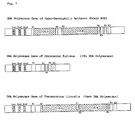
- intervening sequence is present in the gene of the strain KOD1 of the present invention while there is no intervening sequence in the gene of the above-mentioned Pfu DNA polymerase and, in the Tli DNA polymerase gene, there are two kinds of intervening sequences but they are present within Regions 2 and 3 which are conserved regions and that greatly differs from the location where the intervening sequence in the thermostable DNA polymerase gene of KOD1 strain of the present invention exists ( see Fig. 7 ).
- the gene of the present invention is a DNA which codes for the DNA polymerase derived from the hyperthermophilic archaeon strain KOD1.
- An example of said DNA contains a base sequence which codes for the amino acid sequence mentioned in SEQ ID No. 1 or 5. Further, such a DNA contains a base sequence mentioned in SEQ ID No. 5 or 6 or a part thereof.
- thermostable DNA polymerase derived from the hyperthermophilic archaeon strain KOD1 of the present invention in Escherichia coli the intervening sequences of 1374-2453 bp and 2708-4316 bp in the base sequence shown by SEQ ID No.5 are removed by means of a PCR gene fusion to construct a DNA polymerase gene of a complete form.
- a PCR is conducted on a cloned gene containing the intervening sequence by a combination of three pairs of primers to amplify the three fragments which are divided by the intervening sequence.
- a part of the fragment which is to be bonded to its terminal is contained in its 5'-end.
- thermostable DNA polymerase derived from KOD1 e.g. a phage or plasmid.
- An example of the plasmid is a plasmid vector wherein an expression induced by T7 promoter is possible such as pET-8c.
- Other examples of the plasmid are pUC19, pBR322, pBluescript, pSP73, pGW7, pET3A and pET11C and so on.
- the phage are lambda gt11, lambda DASH and lambda ZapII and so on.
- Examples of the host cell used in the present invention are Escherichia coli and yeasts.
- Examples of Escherichia coli are JM109, 101, XL1, PR1 and BL21(DE3)pysS and so on.
- the gene coding for the thermostable DNA polymerase derived from the above-mentioned KOD1 is inserted into the above-mentioned vector to give a recombinant vector and the host cell is subjected to a transformation using said recombinant vector.
- the above-mentioned recombinant host cell is cultured whereby the thermostable DNA polymerase gene derived from the strain KOD1 is induced and expressed.
- the culture medium used for the culture of the recombinant host cell and the conditions therefor follow the conventional methods.
- Escherichia coli which is transformed by pET-8c plasmid containing a DNA polymerase gene in a complete form containing no intervening sequence derived from the strain KOD1 is cultured, for example, in a TB medium whereby an induction treatment is conducted. It is preferred that the induction treatment of T7 promoter is carried out by addition of isopropylthio- ⁇ -D-galactoside.
- the purifying method of the present invention includes, after culturing the recombinant host cells, a step wherein (a) recombinant host cells are collected, disintegrated and the cell extract is prepared and a step wherein (b) impure protein derived from the host cells is removed.
- thermostable DNA polymerase which is produced from the recombinant host cells is separated and recovered from the culture liquid by means of centrifugation or the like after culturing the host bacterial cells in a medium followed by inducing. After said bacterial cells are resuspended in a buffer, they are disintegrated by means of ultrasonic treatment, Dyno mill, French press, etc. Then a thermal treatment is conducted and the heat stable DNA polymerase is recovered from the supernatant fluid. In disintegrating the bacterial cells, ultrasonic treatment, Dyno mill and French press method are preferred.
- a thermal treatment is preferred as one of the steps for removing the impure protein derived from the host cells.
- the condition for the thermal treatment is at 70°C or higher or, preferably, at 90° or higher.
- Other means for removing the impure protein are various chromatographic techniques.
- thermostable DNA polymerase derived from the hyperthermophilic archaeon strain KOD1 obtained as such is about 90 KDa (cf. Fig. 5 ).
- thermostable DNA polymerase When a polymerase chain reaction is conducted using said thermostable DNA polymerase, a sufficient amplification of the aimed DNA fragments is confirmed (cf. Fig. 6 ).
- the hyperthermophilic archaeon strain KOD1 isolated in Kodakara Island, Kagoshima was cultured at 95°C and then the bacterial cells were recovered. Chromosomal DNA of the hyperthermophilic archaeon strain KOD1 was prepared by a conventional method from the resulting bacterial cells.
- Two kinds of primers (5'-GGATTAGTATAGTGCCAATGGAAGGCGAC-3' [SEQ ID No.7] and 5'-GAGGGCGAAGTTTATTCCGAGCTT-3' [SEQ ID No.8]) were synthesized based upon the amino acid sequence at the conserved region of the DNA polymerase (Pfu polymerase) derived from Pyrococcus furiosus .
- a PCR was carried out using those two primers where the prepared chromosomal DNA was used as a template.
- a colony hybridization was conducted using a probe (SEQ ID No.9) used for the Southern hybridization to obtain a clone strain ( E. coli JM109/pBSK0D1) which is thought to contain the DNA polymerase gene derived from strain KOD1.
- a plasmid pBSKOD1 was recovered from the clone strain E. coli JM109/pBSKOD1 obtained in Example 1 and its base sequence (SEQ ID No.5) was determined by a conventional method. Further, the amino acid sequence was derived from the determined base sequence.
- the DNA polymerase gene derived from KOD1 strain comprised 5010 bases wherein 1670 amino acids were coded.
- the intervening sequence parts at two places were removed by a PCR fusion method.
- the PCR fusion method three pairs of primers (SEQ ID Nos.11-16) were combined using a primer recovered from the clone strain as a template and a PCR was conducted for each of them to amplify three fragments wherefrom the intervening sequences were removed.
- the primer used for the PCR was designed in such a manner that the side which binds to another fragment has the same sequence as the binding partner has.
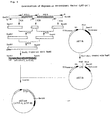
- said gene was subcloned using an expression vector which can be induced by T7 promoter, an NcoI/BamHI site of pET-8c and the previously-created restriction enzyme site to give a recombinant expression vector (pET-pol).
- Escherichia coli (BL21(DE3)) was transformed using a recombinant expression vector (pET-pol) obtained in Example 3, the resulting transformant was cultured in a TB medium (mentioned in Molecular Cloning, p.A.2, 1989 ) and, one hour before collecting the bacterial cells, an induction treatment of T7 promoter was conducted by addition of isopropylthio- ⁇ -D-galactopyrenoside. Bacterial cells were recovered from the cultured liquid by means of centrifugation. They were resuspended in a buffer and disintegrated by an ultrasonic treatment to give a cell extract.
- the disintegrated cell solution was treated at 94°C for 20 minutes whereby the impure protein derived from the host cells was isolated by centrifugation to give a thermostable DNA polymerase derived from strain KOD1.
- the Eschericia coli BL21 (DE3) pER-pol was deposited on April 22, 1996 under the Budapest Treaty at National Institute of Bioscience and Human-Technology Agency of Industrial Science and Technology (1-3, Higashi 1 chome Tsukuba-shi Ibaraki-ken 305, JAPAN) in accordance with the Budapest Treaty under the accession number FERM BP-5513.
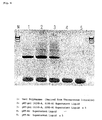
- thermostable DNA polymerase derived from KOD1 obtained in Example 4 was calculated by means of an SDS-PAGE method whereby it was found to be about 86-92 kDa ( Fig. 5 ). Further, a PCR was conducted using the thermostable DNA polymerase derived from KOD1 obtained in Example 4 and the known template primer whereupon a DNA fragment which was to be a target was confirmed ( Fig. 6 ) by the same manner as in the case where the thermostable DNA polymerase derived from Thermococcus litoralis was used and a high thermostable DNA polymerase activity was confirmed.
- Amino acid sequences were estimated from the DNA sequences of the DNA polymerase gene derived from the hyperthermophilic archaeon strain KOD1 of the present invention (SEQ ID No.6), the thermostable DNA polymerase gene derived from Pyrococcus furiosus (Japanese Laid-Open Patent Publication Hei-5/328969 ) and the thermostable DNA polymerase gene derived from Thermococcus litoralis (Japanese Laid-Open Patent Publication Hei-6/7160 ) and were compared and investigated.
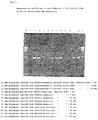
- DNA prepared by annealing the M13mp18DNA with M13P7 primer having a base sequence as mentioned in SEQ ID No.2 was used as a substrate and the rate of synthesizing the DNA in a reaction buffer solution [20 mM Tris-HCl (pH 7.5 at 75°C), 10 mM KCl, 6 mM (NH 4 ) 2 SO 4 , 2 mM MgCl 2 , 0.1% Triton X-100 and 10 ⁇ g/ml nuclease-free BSA] containing the DNA polymerase derived from the hyperthermophilic archaeon strain KOD1 manufactured in Examples 1-5 was investigated for the reaction time of 20, 40, 60, 80 and 100 seconds ( Fig. 1 ) or 40, 60, 80 and 100 seconds ( Fig. 2 ). The results are given in Fig. 1 and in Fig. 2 .
- a part of the DNA sample during the elongation reaction was taken out for each reaction time and was added to a reaction stopping solution (60 mM EDTA, 60 ⁇ M NaOH, 0.1% BPB and 30% glycerol) in the same amount.
- a reaction stopping solution 60 mM EDTA, 60 ⁇ M NaOH, 0.1% BPB and 30% glycerol
- the DNA samples obtained in the above process were separated and analyzed by means of an alkaline agarose electrophoresis and the size of the synthesized DNA was checked.
- Fig. 1 show the results of the reactions for 0.3 minute (20 seconds), 0.7 minute (40 seconds), 1 minute (60 seconds), 1.3 minutes (80 seconds) and 1.7 minutes (100 seconds), respectively. It is apparent from Fig. 1 that the DNA extension rate of the DNA polymerase derived from the hyperthermophilic archaeon strain KOD1 was 105 bases/second.
- Fig. 2 show the results of the reaction for 0.7 minute (40 seconds), 1 minute (60 seconds), 1.3 minutes (80 seconds) and 1.7 minutes (100 seconds), respectively. It is apparent from Fig. 2 that the DNA extension rate of the DNA polymerase derived from the hyperthermophilic archaeon strain KOD1 was 138 bases/second.
- the DNA synthesizing rate of each of Pfu polymerase (Stratgene), Deep Vent polymerase (New England Biolabo) and Taq polymerase (Takara Shuzo) was measured by the same manner in each of the buffers therefor ( Fig. 2a and Fig. 2b ).
- the DNA extension rates of those DNA polymerases were 24.8 bases/second for Pfu polymerase, 23.2 bases/second for Deep Vent polymerase and 61.0 bases/second for Taq polymerase.
- the DNA extension rate of the DNA polymerase derived from the hyperthermophilic archaeon strain KOD1 was about six-fold of those of Pfu polymerase and Deep Vent polymerase and about two-fold of that of Taq polymerase.
- the error rate in the DNA synthesis was measured by the method of Kunkel ( Kunkel, 1985, Journal of Biological Chemistry, 260, 5787-5796 ).
- Kunkel a DNA synthesis reaction was conducted using a DNA polymerase derived from the hyperthermophilic archaeon strain KOD1 manufactured in Examples 1-5 using an M13mp18DNA having a gap at a laqZ part containing a part of the genes coding for ⁇ -galactosidase as a substrate and transfected to E.
- the rate of induction of error in the DNA synthesis was also measured for Pfu polymerase (Stratgene), Taq polymerase (Takara Shuzo) and delta Tth polymerase (Toyobo) which were made to react by the same manner.
- lambda-DNA (3 pg) was used as a target nucleic acid; oligonucleotides having a sequence as mentioned in SEQ ID Nos. 3 and 4 were used as primers; and a buffer containing 20 mM Tris-HCl (pH 7.5 at 75°C), 10 mM KCl, 6 mM (NH 4 ) 2 SO 4 , 2 mM MgCl 2 , 0.1% Triton X-100, 10 ⁇ g/ml BSA and 200 ⁇ M dNTPs was used as a buffer.
- DNA polymerase derived from hyperthermophilic archaeon strain KOD1 (KOD polymerase), Taq polymerase which is widely used for PCR and Pfu polymerase which exhibits 3'-5' exonuclease activity were also used as the thermostable DNA polymerases.
- the used titer of each polymerase was 2 units.
- a PCR amplification reaction was conducted using a DNA Thermal Cycler (Perkin-Elmer) in a schedule wherein a cycle comprising 94°C/20 seconds and 68°C/x second (x: reaction time) was repeated for 30 times.
- amplification of the target DNA was confirmed by conducting 30 cycles of 94°C/20 seconds-68°C/1 second while, in the case of Taq polymerase, amplification of DNA was first confirmed by conducting 30 cycles of 94°C/20 seconds-68°C/10 seconds.
- Pfu polymerase amplification of DNA was at least confirmed by conducting 30 cycles of 94°C/20 seconds-68°C/1 minute. The results are given in Fig. 3 .
- thermostable DNA polymerase having at least 30 bases/second of DNA extension rate and having a 3'-5' exonuclease activity.
- thermostable DNA polymerase having both high extension rate (at least 30 bases/second) which has not been available yet and 3'-5' exonuclease activity is used, it is possible to shorten the time for the primer extention reaction and to amplify the relatively big product with a high fidelity.
Landscapes
- Chemical & Material Sciences (AREA)
- Life Sciences & Earth Sciences (AREA)
- Health & Medical Sciences (AREA)
- Organic Chemistry (AREA)
- Wood Science & Technology (AREA)
- Zoology (AREA)
- Engineering & Computer Science (AREA)
- Bioinformatics & Cheminformatics (AREA)
- Genetics & Genomics (AREA)
- Molecular Biology (AREA)
- Chemical Kinetics & Catalysis (AREA)
- Microbiology (AREA)
- Proteomics, Peptides & Aminoacids (AREA)
- Biotechnology (AREA)
- Biochemistry (AREA)
- General Engineering & Computer Science (AREA)
- General Health & Medical Sciences (AREA)
- Medicinal Chemistry (AREA)
- Physics & Mathematics (AREA)
- Analytical Chemistry (AREA)
- Biophysics (AREA)
- Biomedical Technology (AREA)
- Immunology (AREA)
- Measuring Or Testing Involving Enzymes Or Micro-Organisms (AREA)
- Enzymes And Modification Thereof (AREA)
- Micro-Organisms Or Cultivation Processes Thereof (AREA)
- Preparation Of Compounds By Using Micro-Organisms (AREA)
Description
- The present invention relates to a method of amplifying nucleic acid wherein DNA or RNA is amplified within a short reaction time and with a high fidelity, to a method of identifying nucleic acid utilizing said amplifying method and to a DNA polymerase and a reagent kit used for those methods.
- Many studies have been made already for DNA polymerase of mesophilic microorganisms such as Escherichia coli and for DNA polymerase derived from phages infectable by the mesophilic microorganisms. In addition, many studies have been also made already for heat stable DNA polymerases which are useful in a recombinant DNA technique by means of nucleic acid amplification such as a polymerase chain reaction (PCR). Examples of the heat-stable polymerases which are used for the PCR are DNA polymerase (Tth polymerase) mostly derived from Thermus thermophilus and DNA polymerase (Taq polymerase) derived from Thermus aquaticus. Other known examples are DNA polymerase (Pfu polymerase) derived from Pyrococcus furiosus and DNA polymerase (Vent polymerase) derived from Thermococcus litoralis.
- However, with the Taq polymerase, fidelity and thermostability upon the synthesis of DNA are not sufficient. Although the Pfu polymerase exhibiting excellent fidelity and thermostability has been developed, said Pfu polymerase has some problems that its DNA extension rate is slow and a processivity is low whereby it has been used only for a specific PCR.
- Recently, a PCR whereby 20 kb or more DNA is amplified (hereinafter, referred to as a long-PCR) has been developed. In said long-PCR, both Taq polymerase and Pfu polymerase are mixed whereby properties of both enzymes are utilized. However, when two enzymes having different properties are used in the same reaction system, some discrepancies might occur in their appropriate reaction conditions whereby there is a question whether the high extension rate and fidelity which are the advantages of each of those enzymes can be still maintained. Moreover, because of the difference in the thermostabilities and in the composition of the stock solutions of both enzymes, there is a question as to the stability when they are stored in the same container.
- In view of the above, there has been a keen demand for novel thermostable polymerase which exhibits both of those advantages.
- The present inventors have succeeded in preparing a thermostable DNA polymerase from a hyperthermophilic archaeon strain KOD1, and, when its properties are investigated, it has been found that said DNA polymerase exhibits the advantages of the above-mentioned two enzymes, i.e. high extension rate and high fidelity, whereby the present invention has been achieved.
- Thus, the present invention relates to a method for amplifying a target nucleic acid comprises reacting the target nucleic acid with four kinds of dNTP and primer complementary to said target nucleic acid in a buffer solution which contains a thermostable DNA polymerase having a DNA extension rate of at least 30 bases/second and a 3'-5'exonuclease activity such that the above mentioned primer is annealed to the target nucleic acid and an extention product is synthesized from the primer.
- The present invention further relates to a method for amplifying a target nucleic acid in a sample wherein each target nucleic acid consists of two separate complementary strands which comprises the following steps A to D, characterized in that a thermostable DNA polymerase having a DNA extension rate of at least 30 bases/second and a 3'-5' exonuclease activity is used as a thermostable DNA polymerase;
- A: modifying the target nucleic acid, if necessary, to produce single-stranded nucleic acids;
- B: reacting the single-stranded nucleic acids with four kinds of dNTP and primers, wherein said primers are selected so as to be sufficiently complementary to different strands of target nucleic acid to anneal therewith, in a buffer solution which contains a thermostable DNA polymerase such that the above mentioned primers are annealed to the Single-stranded nucleic acids and extention products are synthesized from the primers,
- C: separating the primer extention products from the templates on which they are synthesized to produce single-stranded nucleic acids; and
- D: repeatedly conducting the above mentioned steps B and C.
- The present invention further relates to a method for detecting a target nucleic acid in a sample wherein each target nucleic acid consists of two separate complementary strands which comprises the following steps A to E, characterized in that a thermostable DNA polymerase having a DNA extension rate of at least 30 bases/second and a 3'-5' exonuclease activity is used as a thermostable DNA polymerase;
- A: modifying the target nucleic acid, if necessary, to produce single-stranded nucleic acids;
- B: reacting the single-stranded nucleic acids with four kinds of dNTP and primers, wherein said primers are selected so as to be sufficiently complementary to different strands of target nucleic acid to anneal therewith, in a buffer solution which contains a thermostable DNA polymerase such that the above mentioned primers are annealed to the single-stranded nucleic acids and extention products are synthesized from the primers,
- C: separating the primer extention products from the templates on which they are synthesized to produce single-stranded nucleic acids;
- D: repeatedly conducting the above mentioned steps B and C, and
- E: detecting an amplified nucleic acid.
- The present invention further relates to a reagent kit for amplifying target nucleic acid which comprises primers, wherein said primers are selected so as to be sufficiently complementary to different strands of target nucleic acid to anneal therewith, four kinds of dNTP, divalent cation, thermostable DNA polymerase having a DNA extension rate of at least 30 bases/second and a 3'-5' exonuclease activity and buffer solution.
- The present invention further relates to a reagent kit for detecting target nucleic acid which comprises primers, wherein said primers are selected so as to be sufficiently complementary to different strands of target nucleic acid to anneal therewith, four kinds of dNTP, divalent cation, thermostable DNA polymerase having a DNA extension rate of at least 30 bases/second and a 3'-5' exonuclease activity, amplifying buffer solution, a probe capable of hybridizing with amplified nucleic acid and a detection buffer solution.
- The present invention relates to a thermos table DNA polymerase which is obtainable from a strain KOD1 which belongs to a hyperthermophilic archaeon strain.
- The present invention relates to an isolated DNA comprising a nucleotide sequence that encodes the thermostable DNA polymerase derived from a KOD1 strain which belongs to hyperthermophilic archaeon. Preferably, said DNA comprises the nucleotide sequence of SEQ ID No. 5 or a nucleotide sequence encoding the thermostable polymerase which has the amino acid sequence of SEQ ID No. 1.
- The present invention also relates to a thermostable DNA polymerase with the above mentioned biological activities and being encoded by one of said DNA's and, in addition, to a kit comprising said thermostable DNA polymerase.
- The present invention further relates to a recombinant DNA expression vector that comprises the DNA sequence inserted into a vector, wherein the DNA sequence encodes the thermostable DNA polymerase derived from a KOD1 strain which belongs to hyperthermophilic archaeon.
- The present invention further relates to a transformed recombinant host cell using a recombinant DNA expression vector that comprises the DNA sequence inserted into a vector, wherein the DNA sequence encodes the thermostable DNA polymerase derived from a KOD1 strain which belongs to hyperthermophilic archaeon.
- The present invention relates to a method for producing a DNA polymerase obtainable from a KOD1 strain which belongs to hyperthermophilic archaeon, comprises culturing recombinant host cells which is transformed by a recombinant DNA expression vector that comprises the DNA sequence inserted into a vector, wherein the DNA sequence encodes the thermostable DNA polymerase derived from a KOD1 strain which belongs to hyperthermophilic archaeon, and recovering the produced thermostable DNA polymerase.
- The present invention further relates to a method for purifying the DNA polymerase obtainable from a KOD1 strain which belongs to hyperthermophilic archaeon, comprises culturing the recombinant host cells which is transformed by a recombinant DNA expression vector that comprises the DNA sequence inserted into a vector, wherein the DNA sequence encodes the thermostable DNA polymerase derived from a KOD1 strain which belongs to hyperthermophilic archaeon, and further (a) recovering the cultured recombinant host cells, disintegrating them and preparing the cell extract, and (b) removing the impurified proteins derived from recombinant host cells.
- The nucleic acid which is to be amplified by the present invention is DNA or RNA. There is no restriction at all for the sample in which such a nucleic acid is contained.
- The thermostable enzyme which is used in the present invention is a thermostable DNA polymerase having at least 30 bases/second of DNA extension rate and having a 3'-5' exonuclease activity. Its specific example is a DNA polymerase derived from a hyperthermophilic archaeon strain KOD1 (called a KOD polymerase) and said enzyme may be either a thermostable enzyme purified from nature or an enzyme manufactured by a gene recombination technique.
- The DNA extension rate in the present invention is calculated from the relationship between the reaction time and the size of the synthesized DNA in the reaction of various kinds of DNA polymerases such as KOD, Pfu, Deep Vent, Taq, etc. (5U) in each buffer using a substrate prepared by annealing a single-stranded DNA (1.6 µg) of M13 with a primer (16 pmoles) complementary thereto. It is essential in the present invention that the DNA extension rate is at least 30 bases/second.
- The DNA extension rates for each of the polymerases are 105-130 bases/second for KOD polymerase, 24.8 bases/second for Pfu polymerase, 23.3 bases/second for Deep Vent polymerase and 61.0 bases/second for Taq polymerase.
- On the other hand, it is essential in the present invention that the thermostable DNA polymerase has a 3'-5' exonuclease activity.
- In the present invention, the 3'-5' exonuclease activity is determined by checking the rate of release of 3H under the optimum condition for each polymerase using a substrate wherein the 3'-end of the lambda-DNA digested with HindIII labeled with [3H]TTP.
- In the 3'-5' exonuclease activity of each polymerase, free-3H is found to be only 10-20% in the case of Taq polymerase and Tth polymerase after an incubation period of three hours, in KOD polymerase and Pfu polymerase, it is 50-70%.
- It has been confirmed that the KOD polymerase used in the present invention has a 3'-5' exonuclease activity and that, in the gene which codes for KOD polymerase, there is a DNA conserved sequence showing a 3'-5' exonuclease activity the same as in the case of Pfu polymerase.
- In the present invention, the fact whether there is a 3'-5' exonuclease activity is checked in such a manner that KOD polymerase is allowed to stand, using a DNA fragment into which the DNA of [3H]TTP-labelled-lambda-DNA digested with HindIII is incorporated as a substrate, at the reaction temperature of 75°C in a buffer (20mM Tris-HCl of pH 6.5, 10mM KCl, 6mM (NH4)2SO4, 2mM MgCl2, 0.1% Triton X-100 and 10 µg/ml BSA) and the ratio of the free-[3H]TTP is determined.
- At the same time, Taq polymerase and Tth polymerase having no 3'-5' exonuclease activity and Pfu polymerase having a 3'-5' exonuclease activity were checked using a buffer for each of them by the same manner as in the control experiments. The titer of each of the used polymerases was made 2.5 units.
- The substrate DNA was prepared in such a manner that, first, 0.2 mM of dATP, dGTP, dCTP and [3H]TTP were added to 10 µg of lambda-DNA digested with HindIII, the 3'-end was elongated by Klenow polymerase, then DNA fragments were recovered by extracting with phenol and precipitating with ethanol and free mononucleotides were removed by a Spin column (manufactured by Clontech).
- In the case of KOD polymerase and Pfu polymerase, 50-70% of free [3H]TTP were detected after an incubation period of three hours, in the case of Taq polymerase and Tth polymerase, only 10-20% of free [3H]TTP was noted.
- It is preferred that said thermostable DNA polymerase contains an amino acid sequence given in SEQ ID No.1.
- It is also preferred that said thermostable DNA polymerase is an enzyme having the following physical and chemical properties.
- Action: It has a DNA synthetic activity and a 3'-5' exonuclease activity.
DNA extension rate: at least 30 bases/second
Optimum pH: 6.5-7.5 (at 75°C)
Optimum temperature: 75°C
Molecular weight: about 88-90 Kda
Amino acid sequence: as mentioned in SEQ ID No.1 - An example of the methods for manufacturing DNA polymerase derived from a hyperthermophilic archaeon strain KOD1 is that thermostable DNA polymerase gene was cloned from strain KOD1 which was isolated from a solfatara at a wharf on Kodakara Island, Kagoshima so that a recombinant expression vector was constructed, then a transformant prepared by transformation by said recombinant vector was cultured and the thermostable DNA polymerase was collected from the culture followed by purifying.
- In the present invention, the DNA polymerase derived from the above-mentioned hyperthermophilic archaeon strain KOD1 has a DNA synthesizing activity and a 3'-5' exonuclease activity and has a DNA extension rate of at least 30 bases/second. This property is used for conducting an amplification of nucleic acid
- The amplifying method of the present invention includes the following steps A to D.
- A: modifying the target nucleic acid, if necessary, to produce single-stranded nucleic acids;
- B: reacting the single-stranded nucleic acids with four kinds of dNTP and primers, wherein said primers are selected so as to be sufficiently complementary to different strands of target nucleic acid to anneal therewith, in a buffer solution which contains a thermostable DNA polymerase such that the above mentioned primers are annealed to the single-stranded nucleic acids and extention products are synthesized from the primers,
- C: separating the primer extention products from the templates on which they are synthesized to produce single-stranded nucleic acids; and
- D: repeatedly conducting the above mentioned steps B and C.
- In the step A, the target nucleic acid is denatured if necessary to give a single-stranded nucleic acid. The means therefor may be a thermal treatment, a chemical denaturation or an enzymatic treatment. Preferably, it is a thermal treatment.
- In the step B, said single-stranded nucleic acid is made to react with four kinds of dNTP (dATP, dGTP, dCTP and dTTP or dUTP) and primers with regular and inverted directions having complementary base sequences to the target nucleic acid in a buffer solution containing a thermostable DNA polymerase so that said primers are annealed to the single-stranded nucleic acid to conduct a primer extention reaction.
- A primer with a regular direction and that with an inverted direction having complementary base sequences to the target nucleic acid are oligonucleotides having a base sequence which is complementary to one of target nucleic acid and is homologous to another. Accordingly, one primer may be complementary to another primer elongate.
- Preferred buffer solutions containing a thermostable DNA polymerase are Tris buffers containing divalent cation such as magnesium ion.
- An example of the conditions for conducting an elongation reaction by annealing the primer is a method in which a cycle of 98°C/1 second-1 minute and 68°C/1 second-10 minutes is repeated for 30 times.
- The step of separating an elongated primer for making a single strand in the step C may be a thermal treatment, a chemical treatment or an enzymatic treatment. Preferably, it is a thermal treatment or an enzymatic treatment using RNase.
- In the step D, the above-mentioned steps B and C are repeated. To be more specific, it is preferred that heating and cooling of 98°C/20 seconds and 68°C/30 seconds are repeated at least for 30 cycles.
- An amplifying method of the present invention is applicable to a PCR for amplifying a DNA of 20 kb or more (hereinafter, referred to as a long-PCR) as well. In this long-PCR, advantages of both high DNA extension rate of Taq polymerase and high fidelity in DNA synthesis caused by a 3'-5' exonuclease activity of Pfu polymerase are necessary and both enzymes are used after mixing them. In this case, there is a question on a stability when both enzymes are stored in the same container because of the difference between their thermostabilities and that between the compositions of their stored solutions. However, in the DNA polymerase derived from a hyperthermophilic archaeon strain KOD1, a single enzyme exhibits both high DNA extension rate and high fidelity due to its 3',-5' exonuclease activity whereby it is possible that a long-PCR can be conducted by its sole use.
- In the present invention, the amplified product produced by the above-mentioned amplification such as a labeled probe is used whereby a target nucleic acid can be detected.
- Labeled probe is an oligonucleotide having a base sequence which is complementary to a target nucleic acid and is bonded with a labeled substance or a labeled binding substance.
- Examples of the labeled substance are enzymes such as alkaline phosphatase, peroxidase and galactosidase, fluorescent substances and radioactive substances while examples of the labeled binding substances are biotin and digoxigenin. Labeled substance may be bonded via biotin, digoxigenin or avidin.
- A method of introducing those labels into a probe is that, during the synthesis of oligonucleotide, dNTP to which those labeled substances or labeled binding substances are bonded is used as one of the components of dNTP whereby a synthesis is conducted.
- Examples of detecting a nucleic acid bonded with a labeled probe are conventionally known methods such as a Southern hybridization and a Northern hybridization. In those methods, the fact that a hybrid is formed when single-stranded DNA and RNA are complementary each other is utilized whereby unknown nucleic acid fraction group is subjected to an agarose electrophoresis to separate its size, then the nucleic acid fraction in the gel is subjected, for example, to an alkali treatment, the resulting single strand is transferred to a filter, immobilized and hybridized with a labeled probe.
- As to a detection of the label in case an alkaline phosphatase is used as a labeled substance, when a chemoluminescent substrate such as a 1,2-dioxetane compound (PPD) is made to react therewith, only nucleic acid forming a hybrid is illuminated. This is sensitized to an X-ray film whereby the size of the target nucleic acid and its position on electrophoresis can be confirmed.
- A reagent kit for nucleic acid amplification according to the present invention contains primers of regular and inverted directions having base sequences complementary to target nucleic acid, four kinds of dNTP, divalent cation, thermostable DNA polymerase having a DNA extension rate of at least 30 bases/second and having a 3'-5' exonuclease activity and a buffer solution.
- An example of divalent cation is magnesium ion. Its concentration is preferably about 1-3 mM. Examples of the buffer solution are tris buffer (pH 6.5, 75°C) and tricine buffer (pH 6.5, 75°C).
- A specific example of the composition is as follows:
20mM Tris-HCl (pH 6.5, 75°C)
10mM KCl
6mM (NH4)2SO4
1-3mM MgCl2
0.1% Triton X-100
10 µg/ml BSA
20-200 µM dNTPs
0.1pM-1µM primer
0.1-250ng template DNA. - A reagent kit for nucleic acid amplification according to the present invention contains a nucleic acid amplifying reagent comprising primers of regular and inverted directions having base sequences complementary to target nucleic acid, four kinds of dNTP, divalent cation, thermostable DNA polymerase having a DNA extension rate of at least 30 bases/second and having a 3'-5' exonuclease activity and a buffer solution for amplification, a target nucleic acid probe and a buffer for detection. The buffer for detection is that the detecting reagent varies depending upon the label. For example, it includes a color reagent or a luminous reagent.
- KOD1 which is a kind of hyperthermophilic archaeon used in the present invention is a strain isolated from a solfatara at a wharf on Kodakara Island, Kagoshima.
- Mycological properties of said strain are as follows.
Shape of cells: coccus, diplococcus; having flagella.
Temperature range for the growth: 65-100°C
Optimum temperature for the growth: 95°C
pH range for the growth: 5-9
Optimum pH: 6
Optimum salt concentration: 2-3%
Auxotrophy: heterotrophic
Oxygen demand: aerophobic
Cell membrane lipids: ether type
GC content of DNA: 38% - The hyperthermophilic archaeon strain KOD1 was a coccus having a diameter of about 1 µm and had plural polar flagella. From the mycological properties of the strain, its close relationship with Pfu DNA polymerase-productive bacterium (Pyrococcus furiosus) and with Tli (Vent) DNA polymerase-productive bacterium (Thermococcus litoralis) was suggested.
- Cloning of the thermostable DNA polymerase gene of the present invention is carried out as follows.
- The cloning method is that a primer is designed and synthesized depending upon an amino acid sequence in a conserved region of Pfu DNA polymerase (Nucleic Acids Research, 1993, vol.21, No.2, 259-265).
- First, a PCR is conducted using the above-prepared primers (e.g., SEQ ID Nos.7 and 8) taking chromosomal DNA of the hyperthermophilic archaeon strain KOD1 as a template to amplify the DNA fragment. The DNA sequence (e.g., SEQ ID No.9) of the amplified fragment is determined and, after confirming that the originally set amino acid sequence is coded for, a Southern hybridization is conducted to the cleaved product of the chromosomal DNA with a restriction enzyme using said fragment as a probe. It is preferred that the approximate size of the fragment containing the aimed DNA polymerase gene is limited to about 4-7 Kbp.
- Then DNA fragment of about 4-7 Kbp is recovered from the gel, a DNA library is prepared by Escherichia coli using said fragment and a colony hybridization is carried out using the above-mentioned PCR-amplified DNA fragment (e.g., SEQ ID No.9) to collect a clone strain.
- The DNA polymerase gene of the strain KOD1 cloned in the present invention is composed of 5010 bases (estimated numbers of amino acids: 1670) (SEQ ID No.5).
- Upon comparison with other DNA polymerases, there is a conserved region of αDNA polymerase which is an eukaryote type (Regions 1-5) in the gene of the present invention. In addition, there are
EXO Regions 1, 2) of the thermostable DNA polymerase gene derived from the hyperthermophilic archaeon strain KOD1, each of the intervening sequences is present and they are connected in a form where the open reading frame (ORF) is conserved. - When the thermostable DNA polymerase gene of the hyperthermophilic archaeon strain KOD1 is compared with Pfu DNA polymerase gene derived from Pyrococcus furiosus (Japanese Laid-Open Patent Publication
Hei-05/328969 He-06/7160 Regions Fig. 7 ). - The gene of the present invention is a DNA which codes for the DNA polymerase derived from the hyperthermophilic archaeon strain KOD1. An example of said DNA contains a base sequence which codes for the amino acid sequence mentioned in SEQ ID No. 1 or 5. Further, such a DNA contains a base sequence mentioned in SEQ ID No. 5 or 6 or a part thereof.
- In order to express the thermostable DNA polymerase derived from the hyperthermophilic archaeon strain KOD1 of the present invention in Escherichia coli, the intervening sequences of 1374-2453 bp and 2708-4316 bp in the base sequence shown by SEQ ID No.5 are removed by means of a PCR gene fusion to construct a DNA polymerase gene of a complete form. To be specific, a PCR is conducted on a cloned gene containing the intervening sequence by a combination of three pairs of primers to amplify the three fragments which are divided by the intervening sequence. In designing the primers used here, a part of the fragment which is to be bonded to its terminal is contained in its 5'-end. Then a PCR is conducted using the fragments to be bonded utilizing the duplicated sequence of the terminal whereby each of the fragments is bonded. Further PCR is conducted by the same manner using the resulting two kinds of fragments to give a DNA polymerase gene in a complete form containing no DNA polymerase gene derived from the strain KOD1 containing no intervening sequence.
- Any vector may be used in the present invention so far as it makes cloning and expression of the thermostable DNA polymerase derived from KOD1 possible, e.g. a phage or plasmid. An example of the plasmid is a plasmid vector wherein an expression induced by T7 promoter is possible such as pET-8c. Other examples of the plasmid are pUC19, pBR322, pBluescript, pSP73, pGW7, pET3A and pET11C and so on. Examples of the phage are lambda gt11, lambda DASH and lambda ZapII and so on.
- Examples of the host cell used in the present invention are Escherichia coli and yeasts. Examples of Escherichia coli are JM109, 101, XL1, PR1 and BL21(DE3)pysS and so on.
- In the present invention, the gene coding for the thermostable DNA polymerase derived from the above-mentioned KOD1 is inserted into the above-mentioned vector to give a recombinant vector and the host cell is subjected to a transformation using said recombinant vector.
- In the producing method of the present invention, the above-mentioned recombinant host cell is cultured whereby the thermostable DNA polymerase gene derived from the strain KOD1 is induced and expressed. The culture medium used for the culture of the recombinant host cell and the conditions therefor follow the conventional methods.
- In a specific example, Escherichia coli which is transformed by pET-8c plasmid containing a DNA polymerase gene in a complete form containing no intervening sequence derived from the strain KOD1 is cultured, for example, in a TB medium whereby an induction treatment is conducted. It is preferred that the induction treatment of T7 promoter is carried out by addition of isopropylthio-β-D-galactoside.
- The purifying method of the present invention includes, after culturing the recombinant host cells, a step wherein (a) recombinant host cells are collected, disintegrated and the cell extract is prepared and a step wherein (b) impure protein derived from the host cells is removed.
- The thermostable DNA polymerase which is produced from the recombinant host cells is separated and recovered from the culture liquid by means of centrifugation or the like after culturing the host bacterial cells in a medium followed by inducing. After said bacterial cells are resuspended in a buffer, they are disintegrated by means of ultrasonic treatment, Dyno mill, French press, etc. Then a thermal treatment is conducted and the heat stable DNA polymerase is recovered from the supernatant fluid. In disintegrating the bacterial cells, ultrasonic treatment, Dyno mill and French press method are preferred.
- A thermal treatment is preferred as one of the steps for removing the impure protein derived from the host cells. The condition for the thermal treatment is at 70°C or higher or, preferably, at 90° or higher. Other means for removing the impure protein are various chromatographic techniques.
- Molecular weight of the thermostable DNA polymerase derived from the hyperthermophilic archaeon strain KOD1 obtained as such is about 90 KDa (cf.
Fig. 5 ). - When a polymerase chain reaction is conducted using said thermostable DNA polymerase, a sufficient amplification of the aimed DNA fragments is confirmed (cf.
Fig. 6 ). - Now the present invention will be illustrated by referring partly to the drawings wherein:
-
Fig. 1 is a photographic picture of electrophoresis as a substitute for a drawing and shows the result of the measurement of the DNA extension rate of the KOD polymerase; -
Fig. 2 is a photographic picture of electrophoresis as a substitute for a drawing and shows the comparison of the DNA extension rate of various thermostable DNA polymerases in whichFig. 2a shows the cases of KOD polymerase and Pfu polymerase whileFig. 2b shows the cases of Deep Vent polymerase and Taq polymerase; -
Fig. 3 is a photographic picture of electrophoresis as a substitute for a drawing and shows the comparison of the PCR due to the difference in the reaction time of various thermostable DNA polymerase; -
Fig. 4 shows the constructive charts of the recombinant expression vector; -
Fig. 5 is a photographic picture of electrophoresis as a substitute for a drawing and shows the result of the measurement of molecular weight of the thermostable DNA polymerase derived from KOD1; -
Fig. 6 is a photographic picture of electrophoresis as a substitute for a drawing and shows the result of the PCR by the thermostable DNA polymerase derived from KOD1; and -
Fig. 7 shows drawings which show a comparison of the DNA polymerase gene derived from the hyperthermophilic archaeon strain KOD1 with the thermostable DNA polymerase gene derived from Pyrococcus furiosus and that derived from Thermococcus litoralis which are thought to be similar bacteria. - The hyperthermophilic archaeon strain KOD1 isolated in Kodakara Island, Kagoshima was cultured at 95°C and then the bacterial cells were recovered. Chromosomal DNA of the hyperthermophilic archaeon strain KOD1 was prepared by a conventional method from the resulting bacterial cells.
- Two kinds of primers (5'-GGATTAGTATAGTGCCAATGGAAGGCGAC-3' [SEQ ID No.7] and 5'-GAGGGCGAAGTTTATTCCGAGCTT-3' [SEQ ID No.8]) were synthesized based upon the amino acid sequence at the conserved region of the DNA polymerase (Pfu polymerase) derived from Pyrococcus furiosus. A PCR was carried out using those two primers where the prepared chromosomal DNA was used as a template.
- After the base sequence (SEQ ID No.9) of the PCR-amplified DNA fragment was determined and the amino acid sequence (SEQ ID No.10) was determined, a Southern hybridization was conducted using said amplified DNA fragment to the product of the strain KOD1 chromosomal DNA treated with a restriction enzyme whereby the size of the fragment coding for the DNA polymerase was calculated (about 4-7 Kbp). Further, the DNA fragment of this size was recovered from agarose gel, inserted into a plasmid pBS (manufactured by Stratagene) and Escherichia coli (E. coli JM 109) was transformed by this mixture to prepare a library.
- A colony hybridization was conducted using a probe (SEQ ID No.9) used for the Southern hybridization to obtain a clone strain (E. coli JM109/pBSK0D1) which is thought to contain the DNA polymerase gene derived from strain KOD1.
- A plasmid pBSKOD1 was recovered from the clone strain E. coli JM109/pBSKOD1 obtained in Example 1 and its base sequence (SEQ ID No.5) was determined by a conventional method. Further, the amino acid sequence was derived from the determined base sequence. The DNA polymerase gene derived from KOD1 strain comprised 5010 bases wherein 1670 amino acids were coded.
- In order to prepare a complete polymerase gene, the intervening sequence parts at two places (1374-2453 bp and 2708-4316 bp) were removed by a PCR fusion method. In the PCR fusion method, three pairs of primers (SEQ ID Nos.11-16) were combined using a primer recovered from the clone strain as a template and a PCR was conducted for each of them to amplify three fragments wherefrom the intervening sequences were removed. At that time, the primer used for the PCR was designed in such a manner that the side which binds to another fragment has the same sequence as the binding partner has. In addition, a design was conducted in such a manner that different restriction enzyme sites (EcoRV at the N-terminus while BamHI at the C-terminus) were created at both ends.
After that, among the PCR-amplified fragments, that which is located at the central part of the structure and that which is located at the N-terminal side are mixed and a PCR was conducted using each of the fragments as a primer. At the same time, the fragment located at the central part of the structure and that located at the C-terminal side are mixed and a PCR was conducted using each of the fragments as a primer. Two kinds of fragments obtained as such were subjected to a PCR once again to give gene fragments in a complete form having no intervening sequence, having EcoRV and BamHI sites at the N- and C-termini, respectively and coding for the DNA polymerase derived from strain KOD1. - Further, said gene was subcloned using an expression vector which can be induced by T7 promoter, an NcoI/BamHI site of pET-8c and the previously-created restriction enzyme site to give a recombinant expression vector (pET-pol).
- Escherichia coli (BL21(DE3)) was transformed using a recombinant expression vector (pET-pol) obtained in Example 3, the resulting transformant was cultured in a TB medium (mentioned in Molecular Cloning, p.A.2, 1989) and, one hour before collecting the bacterial cells, an induction treatment of T7 promoter was conducted by addition of isopropylthio-β-D-galactopyrenoside. Bacterial cells were recovered from the cultured liquid by means of centrifugation. They were resuspended in a buffer and disintegrated by an ultrasonic treatment to give a cell extract. In order to remove the impure protein derived from the host cells, the disintegrated cell solution was treated at 94°C for 20 minutes whereby the impure protein derived from the host cells was isolated by centrifugation to give a thermostable DNA polymerase derived from strain KOD1.
- The Eschericia coli BL21 (DE3) pER-pol was deposited on April 22, 1996 under the Budapest Treaty at National Institute of Bioscience and Human-Technology Agency of Industrial Science and Technology (1-3,
Higashi 1 chome Tsukuba-shi Ibaraki-ken 305, JAPAN) in accordance with the Budapest Treaty under the accession number FERM BP-5513. - Molecular weight of the thermostable DNA polymerase derived from KOD1 obtained in Example 4 was calculated by means of an SDS-PAGE method whereby it was found to be about 86-92 kDa (
Fig. 5 ). Further, a PCR was conducted using the thermostable DNA polymerase derived from KOD1 obtained in Example 4 and the known template primer whereupon a DNA fragment which was to be a target was confirmed (Fig. 6 ) by the same manner as in the case where the thermostable DNA polymerase derived from Thermococcus litoralis was used and a high thermostable DNA polymerase activity was confirmed. - Amino acid sequences were estimated from the DNA sequences of the DNA polymerase gene derived from the hyperthermophilic archaeon strain KOD1 of the present invention (SEQ ID No.6), the thermostable DNA polymerase gene derived from Pyrococcus furiosus (Japanese Laid-Open Patent Publication
Hei-5/328969 Hei-6/7160 - In the DNA polymerase derived from KOD1 of the present invention, there were regions 1-5 which were the conserved regions of αDNA polymerase of an eurokaryotic type. Further, there were EXO1, 2 and 3 which were 3→5' exonuclease motives at the N-terminal side. However, in each of the
Region 1 andRegion 2 which were the αDNA polymerase conserved regions, there were intervening sequences IVS-A and IVS-B (refer toFig. 7 ). - On the other hand, in Pfu polymerase which is a thermostable DNA polymerase derived from Pyrococcus furiosus, there was no intervening sequence. In the case of Vent polymerase which is a thermostable DNA polymerase derived from Thermococcus litoralis, there were the intervening sequences (IVS1 and IVS2) in the αDNA polymerase conserved regions (
Region 2 and Region 3) ( seeFig.7 ). - DNA prepared by annealing the M13mp18DNA with M13P7 primer having a base sequence as mentioned in SEQ ID No.2 was used as a substrate and the rate of synthesizing the DNA in a reaction buffer solution [20 mM Tris-HCl (pH 7.5 at 75°C), 10 mM KCl, 6 mM (NH4)2SO4, 2 mM MgCl2, 0.1% Triton X-100 and 10 µg/ml nuclease-free BSA] containing the DNA polymerase derived from the hyperthermophilic archaeon strain KOD1 manufactured in Examples 1-5 was investigated for the reaction time of 20, 40, 60, 80 and 100 seconds (
Fig. 1 ) or 40, 60, 80 and 100 seconds (Fig. 2 ). The results are given inFig. 1 and inFig. 2 . - A part of the DNA sample during the elongation reaction was taken out for each reaction time and was added to a reaction stopping solution (60 mM EDTA, 60 µM NaOH, 0.1% BPB and 30% glycerol) in the same amount.
- The DNA samples obtained in the above process were separated and analyzed by means of an alkaline agarose electrophoresis and the size of the synthesized DNA was checked.
- 1, 2, 3, 4 and 5 in
Fig. 1 show the results of the reactions for 0.3 minute (20 seconds), 0.7 minute (40 seconds), 1 minute (60 seconds), 1.3 minutes (80 seconds) and 1.7 minutes (100 seconds), respectively. It is apparent fromFig. 1 that the DNA extension rate of the DNA polymerase derived from the hyperthermophilic archaeon strain KOD1 was 105 bases/second. - 1, 2, 3 and 4 in
Fig. 2 show the results of the reaction for 0.7 minute (40 seconds), 1 minute (60 seconds), 1.3 minutes (80 seconds) and 1.7 minutes (100 seconds), respectively. It is apparent fromFig. 2 that the DNA extension rate of the DNA polymerase derived from the hyperthermophilic archaeon strain KOD1 was 138 bases/second. - On the other hand, the DNA synthesizing rate of each of Pfu polymerase (Stratgene), Deep Vent polymerase (New England Biolabo) and Taq polymerase (Takara Shuzo) was measured by the same manner in each of the buffers therefor (
Fig. 2a and Fig. 2b ). The DNA extension rates of those DNA polymerases were 24.8 bases/second for Pfu polymerase, 23.2 bases/second for Deep Vent polymerase and 61.0 bases/second for Taq polymerase. - From the above results, it was suggested that the DNA extension rate of the DNA polymerase derived from the hyperthermophilic archaeon strain KOD1 was about six-fold of those of Pfu polymerase and Deep Vent polymerase and about two-fold of that of Taq polymerase.
- The error rate in the DNA synthesis was measured by the method of Kunkel (Kunkel, 1985, Journal of Biological Chemistry, 260, 5787-5796). In this method, a DNA synthesis reaction was conducted using a DNA polymerase derived from the hyperthermophilic archaeon strain KOD1 manufactured in Examples 1-5 using an M13mp18DNA having a gap at a laqZ part containing a part of the genes coding for β-galactosidase as a substrate and transfected to E. coli JM109 in an NZY medium containing 5-bromo-4-chloro-3-indolyl-β-D-galactoside and isopro-isopropyl-thio-β-D-galactoside using an M13mp18DNA in which lacZ part was double-stranded.
- When β-galactosidase wherein a function is lost or lowered was expressed due to a reading error or a frame shift during the synthetic reaction of DNA, it is not possible to utilize 5-bromo-4-chloro-3-indolyl-β-D-galactoside whereupon the color of plaque becomes colorless or light blue. On the other hand, when there is no error in the synthesized DNA and a complete β-galactosidase was expressed, plaque becomes blue. The rate of induction of error was measured in the DNA synthesis from the rate of the sum of colorless and light blue plaque to the total plaque.
- The rate of induction of error in the DNA synthesis was also measured for Pfu polymerase (Stratgene), Taq polymerase (Takara Shuzo) and delta Tth polymerase (Toyobo) which were made to react by the same manner.
- Further, the rate of induction of error in the DNA synthesis was also measured for a mixture of Taq polymerase and Pfu polymerase. The results are given in Table 1.
Table 1 Measurement of Fidelity in the Reaction of DNA Synthesis of DNA Polymerase Derived from Hyperthermophilic archaeon strain KOD1 Enzyme Light Blue White Mutant Total Mutant Frequence(10-4) KOD1 pol. 12 11 23 6619 37.7 Pfu 15 15 30 7691 39.0 Taq 30 24 54 4141 130 ▲Tth 70 45 115 7375 156 Taq/Pfu(20:1) 10 20 30 4238 63.7 Taq/Pfu(50:1) 10 13 23 4489 53.5 - It is apparent from Table 1 that the fidelity of the DNA polymerase derived from hyperthermophilic archaeon strain KOD1 in the DNA synthesis reaction is suggested to be superior to Taq polymerase and same as Pfu polymerase. In addition, a mixture of Taq polymerase and Pfu polymerase exhibits a medium fidelity that it is superior to Taq polymerase and inferior to Pfu polymerase.
- lambda-DNA (3 pg) was used as a target nucleic acid; oligonucleotides having a sequence as mentioned in SEQ ID Nos. 3 and 4 were used as primers; and a buffer containing 20 mM Tris-HCl (pH 7.5 at 75°C), 10 mM KCl, 6 mM (NH4)2SO4, 2 mM MgCl2, 0.1% Triton X-100, 10 µg/ml BSA and 200 µM dNTPs was used as a buffer. DNA polymerase derived from hyperthermophilic archaeon strain KOD1 (KOD polymerase), Taq polymerase which is widely used for PCR and Pfu polymerase which exhibits 3'-5' exonuclease activity were also used as the thermostable DNA polymerases. The used titer of each polymerase was 2 units.
- A PCR amplification reaction was conducted using a DNA Thermal Cycler (Perkin-Elmer) in a schedule wherein a cycle comprising 94°C/20 seconds and 68°C/x second (x: reaction time) was repeated for 30 times. In the case of the DNA polymerase derived from the hyperthermophilic archaeon strain KOD1 (KOD polymerase), amplification of the target DNA was confirmed by conducting 30 cycles of 94°C/20 seconds-68°C/1 second while, in the case of Taq polymerase, amplification of DNA was first confirmed by conducting 30 cycles of 94°C/20 seconds-68°C/10 seconds. In the case of Pfu polymerase, amplification of DNA was at least confirmed by conducting 30 cycles of 94°C/20 seconds-68°C/1 minute. The results are given in
Fig. 3 . - In the present invention, it is possible to amplify the DNA with a high fidelity within a short reaction time when a DNA polymerase derived from hyperthermophilic archaeon strain KOD1 which is a thermostable DNA polymerase having at least 30 bases/second of DNA extension rate and having a 3'-5' exonuclease activity. When this method is carried out, it is possible to improve the simplicity and convenience. In addition, when such kind of thermostable DNA polymerase having both high extension rate (at least 30 bases/second) which has not been available yet and 3'-5' exonuclease activity is used, it is possible to shorten the time for the primer extention reaction and to amplify the relatively big product with a high fidelity.
-
- SEQ ID No.1
Length: 774 base pairs
Type: amino acid
Topology: linear
Type: protein - Sequence Description:


- SEQ ID No.2
Length: 24 base pairs
Type: nucleic acid
Topology: linear
Type: synthetic DNA - Sequence Description:
CGCCAGGGTT TTCCAGTCA CGAC 24 - SEQ ID No.3
Length: 20 base pairs
Type: nucleic acid
Topology: linear
Molecular Type: synthetic DNA - Sequence Description:
GGGCGGCGAC CTCGCGGGTT 20 - SEQ ID No.4
Length: 24 base pairs
Type: nucleic acid
Topology: linear
Molecular Type: synthetic DNA - Sequence Description:
GCCCATAATA ATCTGCCGGT CAAT 24 - SEQ ID No.5
Length: 5342 base pairs
Type: nucleic acid (DNA)
Strandedness: double
Topology: linear
Molecular Type: cDNA
Source: hyperthermophilic archaeon
Strain name: KOD1
- Sequence Description:
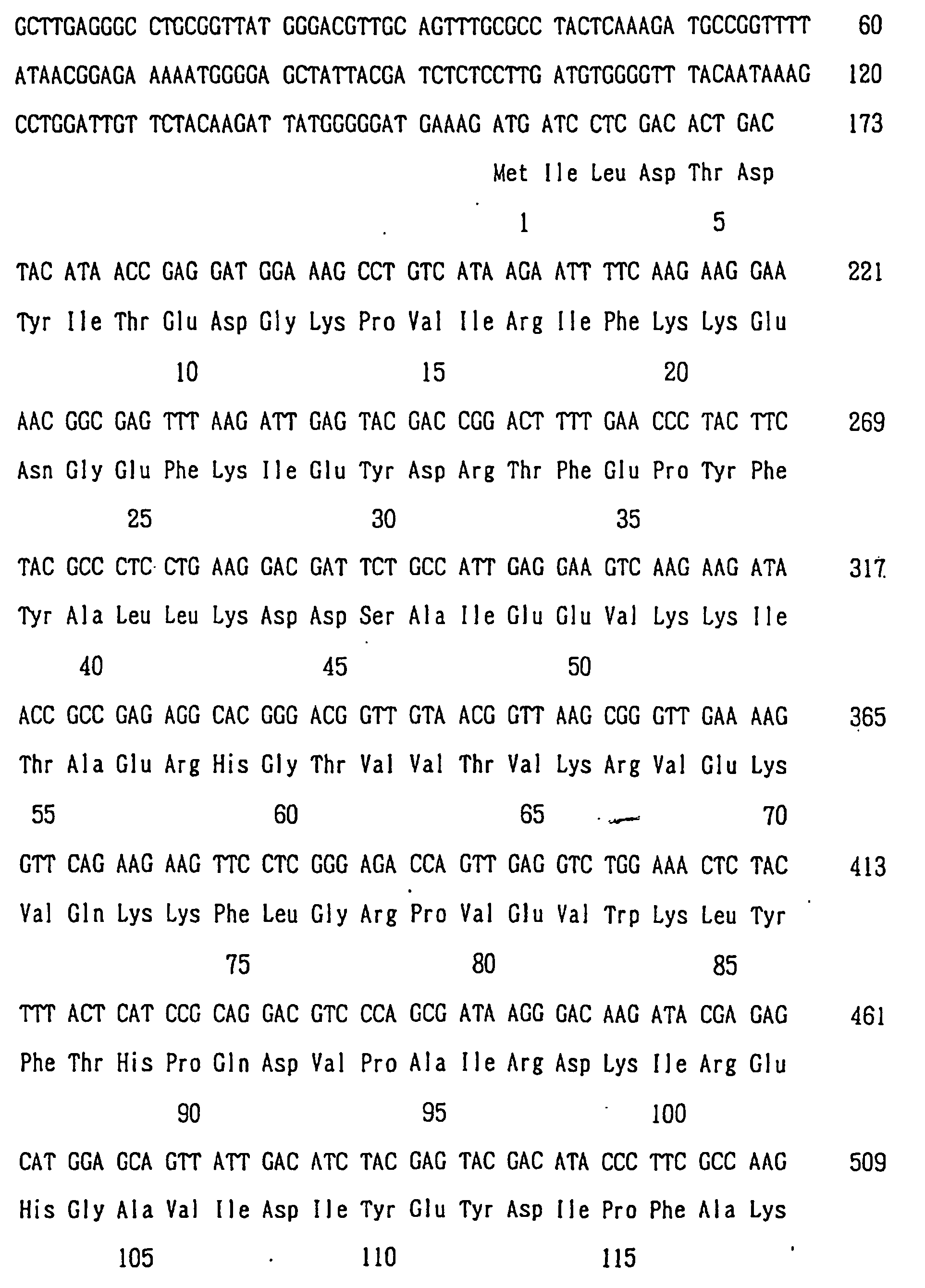


- SEQ ID No.6
Length: 5342 base pairs
Type: nucleic acid (DNA)
Strandedness: double
Topology: linear
Molecular Type: cDNA
Source: hyperthermophilic archaeon
Strain name: KOD1 - Sequence Description:


- SEQ ID No.7
Length: 24 base pairs
Type: nucleic acid
Topology: linear
Molecular Type: synthetic DNA - Sequence Description:
GGATTAGTGC CAATGGAAGG CGAC 24 - SEQ ID No.8
Length: 24 base pairs
Type: nucleic acid
Topology: linear
Molecular Type: synthetic DNA - Sequence Description:
GAGGGCGAAG TTTATTCCGA GCTT 24 - SEQ ID No.9
Length: 324 base pairs
Type: nucleic acid (DNA)
Strandedness: double
Topology: linear
Molecular Type: cDNA - Sequence Description:

- SEQ ID No.10
Length: 108 base pairs
Type: amino acid
Topology: linear
Molecular Type: protein - Sequence Description:

- SEQ ID No.11
Length: 42 base pairs
Type: nucleic acid (DNA)
Strandedness: single
Molecular Type: synthetic DNA - Sequence Description:
GCCATCAAGA TCCTGGCAAA CAGCTACTAC GGTTACTACG GC 42 - SEQ ID No.12
Length: 32 base pairs
Type: nucleic acid (DNA)
Strandedness: single
Molecular Type: synthetic DNA - Sequence Description:
GATGGATCCA ACTTCTCAAC GTTGAACCCT CG 32 - SEQ ID No.13
Length: 46 base pairs
Type: nucleic acid (DNA)
Strandedness: single
Molecular Type: synthetic DNA - Sequence Description:
GAACATAGTG TACCTAGATT TTAGATCCCT GTACCCCTCA ATCATC 46 - SEQ ID No.14
Length: 42 base pairs
Type: nucleic acid (DNA)
Strandedness: single
Molecular Type: synthetic DNA - Sequence Description:
GCCGTAGTAA CCGTAGTAGC TGTTTGCCAG GATCTTGATG GC 42 - SEQ ID No.15
Length: 33 base pairs
Type: nucleic acid (DNA)
Strandedness: single
Molecular Type: synthetic DNA - Sequence Description:
ATCGATATCC TCGACACTGA CTACATAACC GAG 33 - SEQ ID No.16
Length: 46 base pairs
Type: nucleic acid (DNA)
Strandedness: single
Molecular Type: synthetic DNA - Sequence Description:
GATGATTGAG GGGTACAGGG ATCTAAAATC TAGGTACACT ATGTTC 46
Claims (7)
- A method for amplifying a target nucleic acid comprising reacting the target nucleic acid with four kinds of dNTP and primer sufficiently complementary to said target nucleic acid in a buffer solution which contains a thermostable DNA polymerase having a DNA extension rate of at least 30 bases/second and a 3'-5' exonuclease activity such that the above mentioned primer is annealed to the target nucleic acid and an extension product is synthesized from the primer,
wherein said thermostable DNA polymerase has the amino acid sequence of SEQ ID NO:1, or said thermostable DNA polymerase is encoded by the DNA having the nucleotide sequence of SEQ ID NO:5. - A method for amplifying a target nucleic acid in a sample wherein each target nucleic acid consists of two separate complementary strands which comprises the following steps(a) to (d), characterized in that a thermostable DNA polymerase having a DNA extension rate of at least 30 bases/second and a 3'-5' exonuclease activity is used as a thermostable DNA polymerase:(a) modifying the target nucleic acid, if necessary, to produce single-stranded nucleic acids;(b) reacting the single-stranded nucleic acids with four kinds of dNTP and primers, wherein said primers are selected so as to be sufficiently complementary to different strands of target nucleic acid to anneal therewith, in a buffer solution which contains said thermostable DNA polymerase such that the above mentioned primers are annealed to the single-stranded nucleic acids and extension products are synthesized from the primers;(c) separating the primer extension products from the templates on which they are synthesized to produce single-stranded nucleic acids; and(d) repeatedly conducting the above mentioned steps (b) and (c),wherein said thermostable DNA polymerase has the amino acid sequence of SEQ ID NO:1, or said thermostable DNA polymerase is encoded by the DNA having the nucleotide sequence of SEQ ID NO:5.
- The method of claim 2, wherein step (b) is conducted at 94°C for 20 seconds and step (c) is conducted at 68°C for 1 second, and steps (b) and (c) are repeated 30 times.
- A method for detecting a target nucleic acid in a sample wherein each target nucleic acid consists of two separate complementary strands which comprises the following steps (a) to (e), characterized in that a thermostable DNA polymerase having a DNA extension rate of at least 30 bases/second and a 3'-5' exonuclease activity is used as a thermostable DNA polymerase:(a) modifying the target nucleic acid, if necessary, to produce single-stranded nucleic acids;(b) reacting the single-stranded nucleic acids with four kinds of dNTP and primers, wherein said primers are selected so as to be sufficiently complementary to different strands of target nucleic acid to anneal therewith, in a buffer solution which contains said thermostable DNA polymerase such that the above mentioned primers are annealed to the single-stranded nucleic acids and extension products are synthesized from the primers;(c) separating the primer extension products from the templates on which they are synthesized to produce single-stranded nucleic acids;(d) repeatedly conducting the above mentioned steps (b) and (c); and(e) detecting an amplified nucleic acid,wherein said thermostable DNA polymerase has the amino acid sequence of SEQ ID NO:1, or said thermostable DNA polymerase is encoded by the DNA having the nucleotide sequence of SEQ ID NO:5.
- The method of any one of claims 1 to 4, wherein said thermostable DNA polymerase is a thermostable DNA polymerase obtainable from a hyperthermophilic archeon strain having a DNA extension rate of at least 30 bases/second and a 3'-5' exonuclease activity.
- A reagent kit for amplifying target nucleic acid which comprises primers, wherein said primers are selected so as to be sufficiently complementary to different strands of target nucleic acid to anneal therewith, four kinds of dNTP, divalent cation and a thermostable DNA polymerase which is a thermostable DNA polymerase obtainable from a hyperthermophilic archeon strain having a DNA extension rate of at least 30 bases/second and a 3'-5' exonuclease activity,
wherein said thermostable DNA polymerase has the amino acid sequence of SEQ ID NO:1, or said thermostable DNA polymerase is encoded by the DNA having the nucleotide sequence of SEQ ID NO:5. - A reagent kit for detecting target nucleic acid which comprises primers, wherein said primers are selected so as to be sufficiently complementary to different strands of target nucleic acid to anneal therewith, four kinds of dNTP, divalent cation, thermostable DNA polymerase which is a thermostable DNA polymerase obtainable from hyperthermophilic archeon strain having a DNA extension rate of at least 30 bases/second and a 3'-5' exonuclease activity, an amplifying buffer solution, a probe capable of hybridizing with amplified nucleic acid and a detection buffer solution,
wherein said thermostable DNA polymerase has the amino acid sequence of SEQ ID NO:1, or said thermostable DNA polymerase is encoded by the DNA having the nucleotide sequence of SEQ ID NO:5.
Applications Claiming Priority (2)
| Application Number | Priority Date | Filing Date | Title |
|---|---|---|---|
| JP134096/95 | 1995-05-31 | ||
| JP07134096A JP3112148B2 (en) | 1995-05-31 | 1995-05-31 | Nucleic acid amplification method and reagent therefor |
Publications (3)
| Publication Number | Publication Date |
|---|---|
| EP0745675A2 EP0745675A2 (en) | 1996-12-04 |
| EP0745675A3 EP0745675A3 (en) | 1996-12-27 |
| EP0745675B1 true EP0745675B1 (en) | 2008-07-02 |
Family
ID=15120351
Family Applications (1)
| Application Number | Title | Priority Date | Filing Date |
|---|---|---|---|
| EP96108613A Expired - Lifetime EP0745675B1 (en) | 1995-05-31 | 1996-05-30 | A method of amplifying nucleic acid and a reagent therefor |
Country Status (4)
| Country | Link |
|---|---|
| US (3) | US6054301A (en) |
| EP (1) | EP0745675B1 (en) |
| JP (1) | JP3112148B2 (en) |
| DE (1) | DE69637579D1 (en) |
Cited By (1)
| Publication number | Priority date | Publication date | Assignee | Title |
|---|---|---|---|---|
| KR20140022962A (en) * | 2009-01-15 | 2014-02-25 | 홋카이도 미쓰이가가쿠 가부시키가이샤 | Enzymatic preparation containing thermostable dna polymerase, process for producing same, and method for detecting analyte organism |
Families Citing this family (20)
| Publication number | Priority date | Publication date | Assignee | Title |
|---|---|---|---|---|
| DE19611759A1 (en) * | 1996-03-25 | 1997-10-02 | Boehringer Mannheim Gmbh | Thermostable DNA polymerase from Thermococcus spec. |
| FR2750999B1 (en) * | 1996-07-10 | 1998-11-20 | Appligene Oncor | THERMOSTABLE DNA POLYMERASE OF ARCHAEBACTERIA OF THE GENUS PYROCOCCUS SP |
| JP3487394B2 (en) | 1996-07-29 | 2004-01-19 | 東洋紡績株式会社 | Modified thermostable DNA polymerase and use thereof |
| EP0822256B1 (en) * | 1996-07-29 | 2003-09-24 | Toyo Boseki Kabushiki Kaisha | Modified thermostable DNA polymerase, and DNA polymerase composition for nucleic acid amplification |
| EP1111044A4 (en) * | 1998-09-08 | 2003-06-04 | Takara Shuzo Co | DNA SYNTHESIS PROCESS |
| ATE395420T1 (en) | 2000-02-17 | 2008-05-15 | Qiagen Gmbh | THERMOSTABLE CHIMERIC NUCLEIC ACID POLYMERASES AND USES THEREOF |
| EP1154017B1 (en) | 2000-05-11 | 2010-01-20 | Toyo Boseki Kabushiki Kaisha | Modified thermostable dna polymerase from pyrococcus kodakarensis |
| DE10049211A1 (en) * | 2000-10-05 | 2002-04-18 | Qiagen Gmbh | Thermostable polymerase from Thermococcus pacificus |
| DE60231901D1 (en) | 2001-11-14 | 2009-05-20 | Toyo Boseki | DNA SYNTHESIS ENGINES, FACTORS ASSOCIATED WITH DNA POLYMERASE, AND USE THEREOF |
| US20060248617A1 (en) * | 2002-08-30 | 2006-11-02 | Japan Science And Technology Corporation | Method of targeted gene disruption, genome of hyperthermostable bacterium and genome chip using the same |
| DE10315640A1 (en) * | 2003-04-04 | 2004-10-14 | Ignatov, Konstantin | Process for the controlled release of components into a solution |
| CA2568998A1 (en) | 2004-06-04 | 2005-12-15 | Takara Bio Inc. | Polypeptides having dna polymerase activity |
| US8962293B2 (en) * | 2006-10-18 | 2015-02-24 | Roche Molecular Systems, Inc. | DNA polymerases and related methods |
| KR100825279B1 (en) * | 2006-11-30 | 2008-04-25 | 한국해양연구원 | DNA Increase Enzyme Activity Protein and Gene Encoding it |
| KR100777230B1 (en) * | 2006-11-30 | 2007-11-28 | 한국해양연구원 | Thermococcus-derived mutant DNA polymerases and their genes |
| US8026091B2 (en) * | 2007-07-13 | 2011-09-27 | Roche Molecular Systems, Inc. | DNA polymerases and related methods |
| GB0803628D0 (en) | 2008-02-28 | 2008-04-02 | Genesys Ltd | Enzyme |
| JP5608998B2 (en) * | 2009-03-31 | 2014-10-22 | 東洋紡株式会社 | Nucleic acid amplification detection reagent kit with excellent storage stability |
| CN106754816B (en) * | 2017-02-24 | 2020-10-27 | 依科赛生物科技(太仓)有限公司 | A kind of high-fidelity rapid amplification fusion enzyme and preparation method thereof |
| CN109628424B (en) * | 2018-12-31 | 2022-04-26 | 苏州近岸蛋白质科技股份有限公司 | Novel chimeric DNA polymerase and preparation method thereof |
Family Cites Families (7)
| Publication number | Priority date | Publication date | Assignee | Title |
|---|---|---|---|---|
| US5500363A (en) * | 1990-04-26 | 1996-03-19 | New England Biolabs, Inc. | Recombinant thermostable DNA polymerase from archaebacteria |
| US5352778A (en) * | 1990-04-26 | 1994-10-04 | New England Biolabs, Inc. | Recombinant thermostable DNA polymerase from archaebacteria |
| US5210036A (en) * | 1990-04-26 | 1993-05-11 | New England Biolabs, Inc. | Purified thermostable DNA polymerase obtainable from thermococcus litoralis |
| JPH067160A (en) * | 1991-12-18 | 1994-01-18 | New England Biolabs Inc | Recombinant thermostable DNA polymerase from archaea |
| US5491086A (en) * | 1993-05-14 | 1996-02-13 | Hoffmann-La Roche Inc. | Purified thermostable nucleic acid polymerase and DNA coding sequences from pyrodictium species |
| US5353778A (en) * | 1993-05-24 | 1994-10-11 | Blankenship Harry J | Adjustable arrow rest apparatus |
| JP3132624B2 (en) * | 1994-05-09 | 2001-02-05 | 東洋紡績株式会社 | DNA polymerase gene derived from hyperthermophilic archaeon and uses thereof |
-
1995
- 1995-05-31 JP JP07134096A patent/JP3112148B2/en not_active Expired - Lifetime
-
1996
- 1996-05-24 US US08/656,005 patent/US6054301A/en not_active Expired - Lifetime
- 1996-05-30 EP EP96108613A patent/EP0745675B1/en not_active Expired - Lifetime
- 1996-05-30 DE DE69637579T patent/DE69637579D1/en not_active Expired - Lifetime
-
1998
- 1998-05-06 US US09/073,259 patent/US6143536A/en not_active Expired - Fee Related
-
1999
- 1999-07-30 US US09/363,095 patent/US6187573B1/en not_active Expired - Fee Related
Cited By (2)
| Publication number | Priority date | Publication date | Assignee | Title |
|---|---|---|---|---|
| KR20140022962A (en) * | 2009-01-15 | 2014-02-25 | 홋카이도 미쓰이가가쿠 가부시키가이샤 | Enzymatic preparation containing thermostable dna polymerase, process for producing same, and method for detecting analyte organism |
| AU2010205133B2 (en) * | 2009-01-15 | 2015-01-22 | Hokkaido Mitsui Chemicals Inc. | Enzyme preparation containing thermostable dna polymerase, method for producing same, and method for detecting subject organism to be detected |
Also Published As
| Publication number | Publication date |
|---|---|
| US6143536A (en) | 2000-11-07 |
| DE69637579D1 (en) | 2008-08-14 |
| US6054301A (en) | 2000-04-25 |
| US6187573B1 (en) | 2001-02-13 |
| JP3112148B2 (en) | 2000-11-27 |
| JPH08322597A (en) | 1996-12-10 |
| EP0745675A3 (en) | 1996-12-27 |
| EP0745675A2 (en) | 1996-12-04 |
Similar Documents
| Publication | Publication Date | Title |
|---|---|---|
| EP0745675A2 (en) | A method of amplifying nucleic acid and a reagent therefor | |
| EP0823479B1 (en) | Modified thermostable DNA polymerase | |
| EP0902035B1 (en) | Altered thermostable DNA polymerases for sequencing | |
| US6699981B2 (en) | Method and compositions for improved polynucleotide synthesis | |
| EP0699760A1 (en) | Purified DNA polymerase from bacillus stearothermophilus | |
| US6225065B1 (en) | Kit for amplifying nucleic acid | |
| JP3742659B2 (en) | DNA polymerase-related factors | |
| EP0517418B1 (en) | A method for cloning of a gene for Pol I type DNA polymerase | |
| JPWO1999000506A1 (en) | DNA polymerase-associated factors | |
| US8183023B2 (en) | Thermus egertssonii DNA polymerases | |
| EP2292767B1 (en) | Polypepdides having DNA polymerase activity | |
| JPH07298879A (en) | Dna polymerase gene derived from ultrathermophilic protobacterium and its use | |
| WO2007143436A2 (en) | Dna polymerase from spirochaeta thermophila | |
| WO2007117331A2 (en) | Novel dna polymerase from thermoanaerobacter tengcongenesis | |
| JPH07327684A (en) | DNA polymerase gene | |
| KR100218919B1 (en) | Purified dna polymerase from bacillus stearothermophilus | |
| JP2000023687A (en) | Thermally stabilized dna polymerase | |
| JP2000354496A (en) | Amplification of nucleic acid and reagent therefor |
Legal Events
| Date | Code | Title | Description |
|---|---|---|---|
| PUAI | Public reference made under article 153(3) epc to a published international application that has entered the european phase |
Free format text: ORIGINAL CODE: 0009012 |
|
| PUAL | Search report despatched |
Free format text: ORIGINAL CODE: 0009013 |
|
| AK | Designated contracting states |
Kind code of ref document: A2 Designated state(s): CH DE FR GB IT LI |
|
| AK | Designated contracting states |
Kind code of ref document: A3 Designated state(s): CH DE FR GB IT LI |
|
| 17P | Request for examination filed |
Effective date: 19970120 |
|
| 17Q | First examination report despatched |
Effective date: 20020307 |
|
| GRAP | Despatch of communication of intention to grant a patent |
Free format text: ORIGINAL CODE: EPIDOSNIGR1 |
|
| RAP1 | Party data changed (applicant data changed or rights of an application transferred) |
Owner name: TOYO BOSEKI KABUSHIKI KAISHA |
|
| RIC1 | Information provided on ipc code assigned before grant |
Ipc: C12Q 1/68 20060101ALI20071113BHEP Ipc: C12N 15/70 20060101ALI20071113BHEP Ipc: C12N 1/21 20060101ALI20071113BHEP Ipc: C12N 9/12 20060101ALI20071113BHEP Ipc: C12N 15/54 20060101AFI20071113BHEP |
|
| GRAS | Grant fee paid |
Free format text: ORIGINAL CODE: EPIDOSNIGR3 |
|
| GRAA | (expected) grant |
Free format text: ORIGINAL CODE: 0009210 |
|
| AK | Designated contracting states |
Kind code of ref document: B1 Designated state(s): CH DE FR GB IT LI |
|
| REG | Reference to a national code |
Ref country code: GB Ref legal event code: FG4D |
|
| REG | Reference to a national code |
Ref country code: CH Ref legal event code: EP |
|
| REF | Corresponds to: |
Ref document number: 69637579 Country of ref document: DE Date of ref document: 20080814 Kind code of ref document: P |
|
| PLBE | No opposition filed within time limit |
Free format text: ORIGINAL CODE: 0009261 |
|
| STAA | Information on the status of an ep patent application or granted ep patent |
Free format text: STATUS: NO OPPOSITION FILED WITHIN TIME LIMIT |
|
| 26N | No opposition filed |
Effective date: 20090403 |
|
| PGFP | Annual fee paid to national office [announced via postgrant information from national office to epo] |
Ref country code: CH Payment date: 20110512 Year of fee payment: 16 Ref country code: FR Payment date: 20110523 Year of fee payment: 16 |
|
| PGFP | Annual fee paid to national office [announced via postgrant information from national office to epo] |
Ref country code: GB Payment date: 20110525 Year of fee payment: 16 |
|
| PGFP | Annual fee paid to national office [announced via postgrant information from national office to epo] |
Ref country code: IT Payment date: 20110422 Year of fee payment: 16 |
|
| REG | Reference to a national code |
Ref country code: CH Ref legal event code: PL |
|
| GBPC | Gb: european patent ceased through non-payment of renewal fee |
Effective date: 20120530 |
|
| PG25 | Lapsed in a contracting state [announced via postgrant information from national office to epo] |
Ref country code: CH Free format text: LAPSE BECAUSE OF NON-PAYMENT OF DUE FEES Effective date: 20120531 Ref country code: LI Free format text: LAPSE BECAUSE OF NON-PAYMENT OF DUE FEES Effective date: 20120531 |
|
| PG25 | Lapsed in a contracting state [announced via postgrant information from national office to epo] |
Ref country code: IT Free format text: LAPSE BECAUSE OF NON-PAYMENT OF DUE FEES Effective date: 20120530 |
|
| REG | Reference to a national code |
Ref country code: FR Ref legal event code: ST Effective date: 20130131 |
|
| PG25 | Lapsed in a contracting state [announced via postgrant information from national office to epo] |
Ref country code: GB Free format text: LAPSE BECAUSE OF NON-PAYMENT OF DUE FEES Effective date: 20120530 Ref country code: FR Free format text: LAPSE BECAUSE OF NON-PAYMENT OF DUE FEES Effective date: 20120531 |
|
| PGFP | Annual fee paid to national office [announced via postgrant information from national office to epo] |
Ref country code: DE Payment date: 20150527 Year of fee payment: 20 |
|
| REG | Reference to a national code |
Ref country code: DE Ref legal event code: R071 Ref document number: 69637579 Country of ref document: DE |