EP0745403B1 - Arrangement and method for determining an optimal opening pressure in a lung system - Google Patents
Arrangement and method for determining an optimal opening pressure in a lung system Download PDFInfo
- Publication number
- EP0745403B1 EP0745403B1 EP96108346A EP96108346A EP0745403B1 EP 0745403 B1 EP0745403 B1 EP 0745403B1 EP 96108346 A EP96108346 A EP 96108346A EP 96108346 A EP96108346 A EP 96108346A EP 0745403 B1 EP0745403 B1 EP 0745403B1
- Authority
- EP
- European Patent Office
- Prior art keywords
- pressure
- opening pressure
- measured
- control unit
- respiratory gas
- Prior art date
- Legal status (The legal status is an assumption and is not a legal conclusion. Google has not performed a legal analysis and makes no representation as to the accuracy of the status listed.)
- Expired - Lifetime
Links
- 210000004072 lung Anatomy 0.000 title claims description 67
- 238000000034 method Methods 0.000 title description 2
- 239000007789 gas Substances 0.000 claims description 50
- 230000000241 respiratory effect Effects 0.000 claims description 33
- 239000008280 blood Substances 0.000 claims description 21
- 210000004369 blood Anatomy 0.000 claims description 21
- 230000001105 regulatory effect Effects 0.000 claims description 12
- QVGXLLKOCUKJST-UHFFFAOYSA-N atomic oxygen Chemical compound [O] QVGXLLKOCUKJST-UHFFFAOYSA-N 0.000 claims description 6
- 229910052760 oxygen Inorganic materials 0.000 claims description 6
- 239000001301 oxygen Substances 0.000 claims description 6
- 244000144985 peep Species 0.000 description 8
- 238000010586 diagram Methods 0.000 description 7
- CURLTUGMZLYLDI-UHFFFAOYSA-N Carbon dioxide Chemical compound O=C=O CURLTUGMZLYLDI-UHFFFAOYSA-N 0.000 description 4
- 208000014674 injury Diseases 0.000 description 4
- 238000005259 measurement Methods 0.000 description 4
- 239000004094 surface-active agent Substances 0.000 description 4
- 239000000523 sample Substances 0.000 description 3
- 230000008733 trauma Effects 0.000 description 3
- 206010001052 Acute respiratory distress syndrome Diseases 0.000 description 2
- 208000000782 Intrinsic Positive-Pressure Respiration Diseases 0.000 description 2
- 208000013616 Respiratory Distress Syndrome Diseases 0.000 description 2
- 201000000028 adult respiratory distress syndrome Diseases 0.000 description 2
- 229910002092 carbon dioxide Inorganic materials 0.000 description 2
- 239000001569 carbon dioxide Substances 0.000 description 2
- 238000001595 flow curve Methods 0.000 description 2
- 210000003456 pulmonary alveoli Anatomy 0.000 description 2
- 230000029058 respiratory gaseous exchange Effects 0.000 description 2
- 230000004044 response Effects 0.000 description 2
- 230000035945 sensitivity Effects 0.000 description 2
- 206010061688 Barotrauma Diseases 0.000 description 1
- 208000007123 Pulmonary Atelectasis Diseases 0.000 description 1
- 208000027418 Wounds and injury Diseases 0.000 description 1
- 230000009286 beneficial effect Effects 0.000 description 1
- 210000000621 bronchi Anatomy 0.000 description 1
- 238000010276 construction Methods 0.000 description 1
- 230000002596 correlated effect Effects 0.000 description 1
- 230000000875 corresponding effect Effects 0.000 description 1
- 230000006378 damage Effects 0.000 description 1
- 230000001419 dependent effect Effects 0.000 description 1
- 201000010099 disease Diseases 0.000 description 1
- 208000037265 diseases, disorders, signs and symptoms Diseases 0.000 description 1
- 229940079593 drug Drugs 0.000 description 1
- 239000003814 drug Substances 0.000 description 1
- 230000000694 effects Effects 0.000 description 1
- 208000000122 hyperventilation Diseases 0.000 description 1
- 230000000870 hyperventilation Effects 0.000 description 1
- 238000012623 in vivo measurement Methods 0.000 description 1
- 230000003434 inspiratory effect Effects 0.000 description 1
- 239000007788 liquid Substances 0.000 description 1
- 230000006461 physiological response Effects 0.000 description 1
- 230000002269 spontaneous effect Effects 0.000 description 1
- 230000035882 stress Effects 0.000 description 1
Images


Classifications
-
- A—HUMAN NECESSITIES
- A61—MEDICAL OR VETERINARY SCIENCE; HYGIENE
- A61M—DEVICES FOR INTRODUCING MEDIA INTO, OR ONTO, THE BODY; DEVICES FOR TRANSDUCING BODY MEDIA OR FOR TAKING MEDIA FROM THE BODY; DEVICES FOR PRODUCING OR ENDING SLEEP OR STUPOR
- A61M16/00—Devices for influencing the respiratory system of patients by gas treatment, e.g. ventilators; Tracheal tubes
- A61M16/021—Devices for influencing the respiratory system of patients by gas treatment, e.g. ventilators; Tracheal tubes operated by electrical means
- A61M16/022—Control means therefor
- A61M16/024—Control means therefor including calculation means, e.g. using a processor
-
- A—HUMAN NECESSITIES
- A61—MEDICAL OR VETERINARY SCIENCE; HYGIENE
- A61M—DEVICES FOR INTRODUCING MEDIA INTO, OR ONTO, THE BODY; DEVICES FOR TRANSDUCING BODY MEDIA OR FOR TAKING MEDIA FROM THE BODY; DEVICES FOR PRODUCING OR ENDING SLEEP OR STUPOR
- A61M16/00—Devices for influencing the respiratory system of patients by gas treatment, e.g. ventilators; Tracheal tubes
- A61M16/0003—Accessories therefor, e.g. sensors, vibrators, negative pressure
- A61M2016/0027—Accessories therefor, e.g. sensors, vibrators, negative pressure pressure meter
-
- A—HUMAN NECESSITIES
- A61—MEDICAL OR VETERINARY SCIENCE; HYGIENE
- A61M—DEVICES FOR INTRODUCING MEDIA INTO, OR ONTO, THE BODY; DEVICES FOR TRANSDUCING BODY MEDIA OR FOR TAKING MEDIA FROM THE BODY; DEVICES FOR PRODUCING OR ENDING SLEEP OR STUPOR
- A61M16/00—Devices for influencing the respiratory system of patients by gas treatment, e.g. ventilators; Tracheal tubes
- A61M16/0003—Accessories therefor, e.g. sensors, vibrators, negative pressure
- A61M2016/003—Accessories therefor, e.g. sensors, vibrators, negative pressure with a flowmeter
- A61M2016/0033—Accessories therefor, e.g. sensors, vibrators, negative pressure with a flowmeter electrical
- A61M2016/0039—Accessories therefor, e.g. sensors, vibrators, negative pressure with a flowmeter electrical in the inspiratory circuit
-
- A—HUMAN NECESSITIES
- A61—MEDICAL OR VETERINARY SCIENCE; HYGIENE
- A61M—DEVICES FOR INTRODUCING MEDIA INTO, OR ONTO, THE BODY; DEVICES FOR TRANSDUCING BODY MEDIA OR FOR TAKING MEDIA FROM THE BODY; DEVICES FOR PRODUCING OR ENDING SLEEP OR STUPOR
- A61M2205/00—General characteristics of the apparatus
- A61M2205/33—Controlling, regulating or measuring
- A61M2205/3331—Pressure; Flow
- A61M2205/3344—Measuring or controlling pressure at the body treatment site
-
- A—HUMAN NECESSITIES
- A61—MEDICAL OR VETERINARY SCIENCE; HYGIENE
- A61M—DEVICES FOR INTRODUCING MEDIA INTO, OR ONTO, THE BODY; DEVICES FOR TRANSDUCING BODY MEDIA OR FOR TAKING MEDIA FROM THE BODY; DEVICES FOR PRODUCING OR ENDING SLEEP OR STUPOR
- A61M2230/00—Measuring parameters of the user
- A61M2230/20—Blood composition characteristics
- A61M2230/205—Blood composition characteristics partial oxygen pressure (P-O2)
Definitions
- the present invention relates to an arrangement for determining an optimal opening pressure in a lung system according to the preamble of claim 1.
- a healthy lung air passes during inspiration through the airways and bronchi to the alveoli in the lungs.
- An exchange of gases occurs in the alveoli, whereby blood is oxygenated and carbon dioxide is simultaneously transferred to the air within the alveoli.
- the inhaled air, furnished with carbon dioxide is exhaled from the alveoli, permitting the entry of fresh air during the following inspiration. Since a healthy lung has a large compliance, i.e. a high flexibility, a relatively large volume of air can be inhaled during every breath, without excessive increases in the air pressure in the lungs.
- the function of the lung can be affected to such a degree, that a life threatening condition could develop.
- the alveoli might collapse, thereby impairing or, worse, preventing the essential exchange of gases between air in the alveoli and blood in the minute capillaries of the lungs.
- the lungs can also have atelectatic regions, which reduces the compliance so much, that an insufficient volume of air is inhaled in each breath. Connection of the damaged lung to a ventilator/respirator may then be necessary to keep a patient alive until the damaged lung has healed enough.
- a ventilator/respirator can deliver a respiratory gas to the lungs with a pressure high enough to open up the collapsed alveoli in order to provide a sufficient gas exchange.
- the respiratory gas usually consists of ordinary air, possibly enriched with oxygen. The more successfully the lungs can be opened, the less will the need be for enrichment of oxygen in the respiratory gas.
- the alveoli may be depleted of surfactant causing a constant surface tension in the alveoli. Such depletion of surfactant can also occur in healthy lungs during extended periods of hyperventilation, either spontaneous or forced.
- ARDS acute Respiratory Distress Syndrome
- a ventilator/respirator which can determine an opening pressure of a lung based on the relation between measured pressure values and volume values of a respiratory gas supplied to a patient.
- the ventilator delivers a constant flow of respiratory gas during an inspiration phase.
- the resulting pressure on the lungs is measured and the volume of respiratory gas entering the lungs is calculated.
- the pressure will increase rapidly whereas the volume only will increase slowly.
- the alveoli open up the volume entering the lungs will begin to increase more rapidly in relation to the pressure.
- the opening pressure is then determined by identifying the inflection point, where the increase in volume becomes more rapid.
- this determining procedure provides an opening pressure which can be used for determining the further treatment of the patient, it lacks somewhat of sensitivity for determining an optimal opening pressure. For instance, there may be further inflection points or regions at higher pressures in the P-V-diagram, which may occur when smaller compartments of alveoli open up. These "higher" inflection points or regions are not immediately identifiable as such in the P-V-diagram, since the P-V relation will also display other irregularities. Further, this approach does not guarantee that all collapsed alveoli have been opened up properly.
- an inspiration pulse having a predetermined pressure morphology is delivered to the lung system.
- the predetermined inspiration pulse has an end pressure which is higher than the start pressure. This results in a much more controlled increase of pressure towards the lung system, which is more beneficial to the lung system, since the risk of sudden excessive pressures within the lungs is basically removed completely. It is also easier to correlate a controlled pressure variable to a measured respiratory parameter.
- a suitable shape of the inspiration pulse can be selected for increasing the sensitivity of the determination of the optimal opening pressure. For instance, the inspiration pulse can be selected in such way, that the pressure increases rapidly at the onset of the inspiration phase and slowly in the neighbourhood of the suspected optimal opening pressure. The resulting reaction in the measured respiratory gas parameter in this neighbourhood can then be more thoroughly evaluated.
- an inspiration pulse having a pressure increase in linear pressure stages from the start pressure up to the end pressure is utilised.
- an inspiration pulse having a duration of nine seconds is to be given and the optimal opening pressure is suspected to be around 40 cmH 2 O.
- the inspiration pulse could then consist of a first linear pressure stage, which elevates the pressure from 0 to 30 cmH 2 O in two seconds and a second linear pressure stage, which elevates the pressure from 30 cmH 2 O to 50 cmH 2 O in the remaining seven seconds.
- the second linear pressure stage will be flatter and since the optimal opening pressure for a completely collapsed lung was suspected to be in the region of 30-50 cmH 2 O, the slow increase during the latter part of the inspiration pulse will enhance the possibility of obtaining the optimal opening pressure.
- Other pressure and timing values can of course be utilised, depending on the individual case. In particular, the number of pressure stages, their respective duration and pressure, could be selected from a vast range of possibilities.
- the respiratory gas flow is measured by a flow meter in the measuring unit and the control unit determines the optimal opening pressure based on the measured respiratory gas flow. If a flow curve is recorded and correlated to the applied pressure, the flow curve will show inflection points or inflection regions where an increase in flow follows the opening up of alveoli. The amount of alveoli opening up is reflected in the size of the increase in the flow. In other words, if a major part of the alveoli open up at the same time, a large increase in flow will be noted and if only a smaller number of alveoli open up, the increase will be smaller. As the pressure increases during the inspiration pulse, several inflection regions can occur.
- the applied pressure can be obtained either directly from the regulating unit or by disposing a pressure gauge in or near the lung system for measuring the pressure on site.
- the regulator unit is adapted to deliver a sequence of such series.
- Each series can comprise a different shaped inspiration pulse and the control unit can determine an interim opening pressure for each series.
- the optimal opening pressure can then be determined from the interim opening pressures.
- the optimum opening pressure can, for instance, be determined by relating the supplied gas volume to the interim opening pressure. For instance, the quotient obtained by dividing each interim opening pressure by the supplied gas volume in the interval from on-set of the inspiration pulse up to the interim opening pressure could be minimised. In other words, as large volume as possible should be supplied at a pressure, which is as low as possible.
- a first interim opening pressure determined for one series of inspiration pulses, for determining the pressures of the following series of inspiration pulses. For instance, in one delivered series of inspiration pulses having a pressure ramp from 10 to 30 cmH 2 O an interim opening pressure of 25 cmH 2 O is determined. The next series of inspiration pulses could then have a pressure ramp from 22 to 35 cmH 2 O.
- a blood gas analysing unit is connectable to a blood system related to the lung system for measuring the partial pressure of oxygen in the blood system (P a O 2 ).
- the control unit determines the optimal opening pressure based on the measured respiratory gas parameters and the measured P a O 2 .
- P a O 2 should be above a certain threshold level when the lungs are sufficiently opened up. Since there is a physiological response time for the blood system to react on the changes in the state of the lungs, the same inspiration pulse should be supplied to the patient several times to allow for the blood system to respond.
- the efficient inspiration time is shorter than the set inspiration time. Even though the lungs open up eventually, the remaining efficient inspiration time could be insufficient for providing for a good gas exchange.
- the peak pressure of these square-shaped pulses should be related to the determined interim opening pressure, e.g. of the same magnitude, 10% higher or similar.
- the blood system will have responded to improvements in gas exchange (if any) and the P a O 2 can be measured. If the measured P a O 2 exceeds the threshold, the lungs have been opened up sufficiently and the determined interim opening pressure is an optimal opening pressure. If the threshold is not reached, the interim opening pressure is not optimal, or the lungs are so damaged that the P a O 2 can never reach the threshold. In the latter case, the previously described determination to obtain the optimal opening pressure is preferable. Care should also be taken to avoid overdistension and trauma.
- the P a O 2 is used to determine the optimal opening pressure either by selecting the first determined opening pressure at which the measured P a O 2 exceeds a predetermined threshold as the optimal opening pressure or, if several interim opening pressures have been determined, the lowest interim opening pressure at which the measured P a O 2 exceeds the predetermined threshold.
- the partial pressure of oxygen is used as a relevant prerequisite for determining when the lungs are sufficiently opened up, i.e. a major part of the collapsed alveoli have been opened.
- the determined opening pressure for a specific inspiration pulse can be related to the resulting P a O 2 .
- An optimal opening pressure can then be defined as an opening pressure which results in a P a O 2 which is higher than the predetermined threshold.
- a functional block does not necessarily represent separate physical apparatus.
- a functional block may consist of several apparatus and some of the functional blocks may be included within one apparatus.
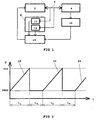
- a regulating unit 2 is connected to a patient 4 via a gas delivery system 6.
- the regulating unit 2 can deliver a respiratory gas to the patient and remove exhaled gas from the patient 4.
- the regulating unit 2 could basically be a ventilator/respirator of any known construction, such as Servo Ventilator 300, Siemens-Elema AB, Sweden.
- a measuring unit 8 comprising a pressure gauge 10 and a flow meter 12 is connected to the gas delivery system 6 for measuring respiratory gas flow and pressure.
- the measured values are supplied to a control unit 14, which calculates an opening pressure based on the measured respiratory gas flow and pressure values.
- the control unit 14 can send signals to the regulating unit 2, e.g. when an optimal opening pressure has been found.
- a blood gas analysing unit 16 is also connected to the patient 4 for measuring the partial pressure of oxygen (P a O 2 ) in the patient's blood system.
- P a O 2 partial pressure of oxygen
- the interconnection between the blood gas analysing unit 16 and the patient's 4 blood system can be made in several ways. For instance, a blood sample could be extracted from the blood system and analysed in an analysing probe outside the patient, or a probe could be inserted into the patient's 4 blood system for in vivo measurement of the blood gas. Also, measurements can be made at varying time intervals. The measurement of P a O 2 is made for obtaining an important parameter in the determining of an optimal opening pressure for the patient's 4 lungs.
- the regulating unit 2 is adapted to deliver inspiration pulses of any shape regarding pressure.
- the regulating unit 2 can deliver inspiration pulses with a controlled pressure, which varies in a predetermined manner.
- inspiration pulse 18 has a start pressure at PEEP level and an end pressure at PIP level.
- PEEP stands for Positive End Expiratory Pressure and is related to atmospheric pressure and can thus be any numeral larger than or equal to zero.
- PIP stands for Peak Inspiratory Pressure and in relation to this application the PIP pressure is between 30 and 60 cmH 2 O for determining the optimal opening pressure.
- both PEEP and PIP could be selected from pressures outside the mentioned limits if necessary for opening up a collapsed lung.
- the inspiration pulse 18 has a duration of t i , which is the inspiration time. In connection with the present application, inspiration times of 5 to 10 seconds are used. However, as with the pressures, shorter and longer inspiration times can be used when necessary.
- the inspiration time t i is followed by an expiration time t e and thereafter a second inspiration pulse 20 is delivered. As shown in FIG. 2 several identical inspiration pulses 18, 20, 22 can be delivered in a sequence when determining the opening pressure. When delivering several identical inspiration pulses 18, 20, 22, the measured respiratory gas flow is averaged. The calculated average flow is then utilised in determining the opening pressure.
- the determining of the opening pressure is illustrated in FIG. 4, where a diagram with a pressure-axis and a flow-axis has been drawn.
- the curve 26 is measured flow in relation to measured pressure(or average flow in relation to pressure).
- a first inflection region 28 can be identified where a sudden increase in flow has occurred. This inflection region represents the opening up of a number of collapsed alveoli in the lung system of the patient 4.
- a second inflection region 30 can be identified at an even higher pressure. The second inflection region is much smaller than the first inflection region 28, but still represents the opening up of some alveoli. Since it is preferable to open up as much of the lung as possible, it is the upper pressure value of the second inflection region 30 that is selected as the opening pressure P o .
- inspiration pulses having a start pressure equal to or higher than the determined opening pressure are delivered to the patient. These pulses could be square-shaped and are delivered for testing whether the lungs will open up sufficiently or not.
- the P a O 2 is then measured and if the measured P a O 2 does not exceed a predetermined threshold, the determined opening pressure P o indicated in FIG. 4 is not high enough to achieve a sufficient opening up of the lungs.
- a different inspiration pulse or series of inspiration pulses will then be delivered to the patient 4.
- the new inspiration pulse may for instance have a higher PEEP or a higher PIP (or both). These values can be selected based on the previously determined opening pressure.
- the next inspiration pulse or pulses may also have another relation between inspiration time and expiration time.
- varying inspiration times t i in relation to expiration times t e can be used to create intrinsic PEEP.
- Another respiration frequency can also be used for creating an intrinsic PEEP. All these factors interact in different ways for different lungs and it is therefore not possible to have one specific inspiration pulse which will guarantee the opening up of all collapsed lungs.
- a second series of inspiration pulses e.g. having both a higher PEEP and a higher PIP may result in a measured P a O 2 which exceeds the predetermined threshold.
- the measured P a O 2 indicates that the lungs have opened up sufficiently and the determined opening pressure P o for that inspiration pulse is therefore the optimal opening pressure for this particular patient 4 at this particular time.
- the individual response to the inspiration pulse may vary as the state of the lungs improves.
- Another way of determining the optimal opening pressure is to deliver a sequence of inspiration pulses, all being different as to selected PEEP, PIP, t i , t e or frequency. For all these inspiration pulses, an interim opening pressure is determined as shown in FIG. 4. A relation is then calculated based on the determined interim opening pressures and the supplied volume up to the determined interim opening pressure in each breath. In other words, the integral from zero to P o in the diagram of FIG. 4 for the curve 26 is calculated. In order to choose the optimal opening pressure, the quotient of interim opening pressure divided by calculated volume should be minimised. The minimisation indicates that a large volume is delivered at a low pressure. It is also possible to use other mathematical relations between pressure and volume in order to obtain the optimal opening pressure. For example, the square value of volume could be used in the quotient above, in order to increase the importance of supplying sufficient volumes at a low pressure.
- FIG. 3 shows another kind of inspiration pulse 24, in which the increase in pressure is divided into several linear pressure stages, in this case three stages.
- a first pressure stage 24A elevates the pressure from the start pressure PEEP to pressure P1 at a time interval t1
- a second pressure stage 24B elevates the pressure from P1 to P2 during time interval t2
- a third pressure stage 24C elevates the pressure from P2 to PIP during the time interval t3.
- Pressure levels P1 and P2 are preferably selected so that the pressure P2 is slightly below a suspected value for the optimal pressure or slightly below a previously determined interim opening pressure.
- the time intervals t1, t2, t3 are preferably selected so that the third pressure stage 24C at least covers more than one third of the total inspiration time t i .
- the pressure increase during the third pressure stage 24C will be less steep than a ramp similar to the one in the inspiration pulse 18 in FIG. 2.
- the opening pressure will be situated in the third pressure stage 24C and the curve in the flow-pressure diagram will be more sensitive to minute changes in the flow.
- FIG. 5 shows a flow chart for determining an optimal opening pressure which can be carried out by the arrangement in FIG. 1.
- the flow chart only shows the necessary steps for obtaining the optimal opening pressure.
- an inspiration pulse is delivered to the patient. Respiratory gas flow and pressure are then measured, block 32.
- the steps described in blocks 32 and 34 can be repeated, if the same inspiration pulse is to be delivered several times, whereby average values for the measured respiratory gas flow are calculated.
- an interim opening pressure is determined in the way shown in FIG. 4.
- a series of square-shaped inspiration pulses, having a PIP equal to or higher than the determined interim opening pressure is delivered, block 38.
- the P a O 2 is then measured, block 40, and the measured value is compared with a predetermined threshold, block 42. If the measured P a O 2 is lower than the threshold, output No in block 42, a new shape of the inspiration pulse is selected, block 46. The new inspiration pulse is then delivered as indicated in block 32 and the determining of an interim opening pressure and measurement of P a O 2 is repeated.
- the last determined interim opening pressure is selected as the optimal opening pressure for the lung system, block 44.
Landscapes
- Health & Medical Sciences (AREA)
- Emergency Medicine (AREA)
- Pulmonology (AREA)
- Engineering & Computer Science (AREA)
- Anesthesiology (AREA)
- Biomedical Technology (AREA)
- Heart & Thoracic Surgery (AREA)
- Hematology (AREA)
- Life Sciences & Earth Sciences (AREA)
- Animal Behavior & Ethology (AREA)
- General Health & Medical Sciences (AREA)
- Public Health (AREA)
- Veterinary Medicine (AREA)
- Measurement Of The Respiration, Hearing Ability, Form, And Blood Characteristics Of Living Organisms (AREA)
Applications Claiming Priority (2)
| Application Number | Priority Date | Filing Date | Title |
|---|---|---|---|
| SE9502031A SE9502031D0 (sv) | 1995-06-02 | 1995-06-02 | Arrangement and method for determining an optimal opening pressure in a lung system |
| SE9502031 | 1995-06-02 |
Publications (2)
| Publication Number | Publication Date |
|---|---|
| EP0745403A1 EP0745403A1 (en) | 1996-12-04 |
| EP0745403B1 true EP0745403B1 (en) | 2002-09-04 |
Family
ID=20398502
Family Applications (1)
| Application Number | Title | Priority Date | Filing Date |
|---|---|---|---|
| EP96108346A Expired - Lifetime EP0745403B1 (en) | 1995-06-02 | 1996-05-24 | Arrangement and method for determining an optimal opening pressure in a lung system |
Country Status (5)
| Country | Link |
|---|---|
| US (1) | US5660170A (enExample) |
| EP (1) | EP0745403B1 (enExample) |
| JP (1) | JP3761247B2 (enExample) |
| DE (1) | DE69623389T2 (enExample) |
| SE (1) | SE9502031D0 (enExample) |
Families Citing this family (23)
| Publication number | Priority date | Publication date | Assignee | Title |
|---|---|---|---|---|
| SE9801427D0 (sv) * | 1998-04-23 | 1998-04-23 | Siemens Elema Ab | Förfarande för bestämning av minst en parameter samt en andningsapparat |
| DE19849571B4 (de) * | 1998-10-27 | 2004-12-02 | Map Medizin-Technologie Gmbh | Beatmungsgerät zur Zufuhr eines Atemgases zu einem Patienten unter einem auf den Patienten abgestimmten Behandlungsdruck |
| EP1124605B1 (en) * | 1998-11-06 | 2010-01-27 | Caradyne (R & D) Limited | Portable respirator |
| US8701664B2 (en) * | 1998-11-06 | 2014-04-22 | Caradyne (R&D) Limited | Apparatus and method for relieving dyspnoea |
| DE19857090A1 (de) * | 1998-12-10 | 2000-06-29 | Stephan Boehm | Verfahren zur regionalen Bestimmung des alveolären Öffnens und des alveolären Schließens der Lunge |
| EP1148907B1 (de) | 1999-01-29 | 2003-12-10 | Siemens-Elema AB | Nichtinvasives verfahren zur optimierung der beatmung atelektatischer lungen |
| USRE40402E1 (en) | 1999-01-29 | 2008-06-24 | Maquet Critical Care Ab | Non-invasive method for optimizing the respiration of atelectatic lungs |
| US6355002B1 (en) * | 2000-05-22 | 2002-03-12 | Comedica Technologies Incorporated | Lung inflection point monitor apparatus and method |
| US6557553B1 (en) | 2000-09-05 | 2003-05-06 | Mallinckrodt, Inc. | Adaptive inverse control of pressure based ventilation |
| US7872635B2 (en) * | 2003-05-15 | 2011-01-18 | Optimetrics, Inc. | Foveated display eye-tracking system and method |
| EP1579882A1 (en) | 2004-03-26 | 2005-09-28 | Stephan Dr. Böhm | Non-invasive method and apparatus for optimizing the respiration for atelectatic lungs |
| JP2009508645A (ja) * | 2005-09-20 | 2009-03-05 | ルッツ フレイテッグ, | 患者の呼吸を補助するためのシステム、方法、および装置 |
| US20070062533A1 (en) * | 2005-09-21 | 2007-03-22 | Choncholas Gary J | Apparatus and method for identifying FRC and PEEP characteristics |
| EP1984050B1 (en) * | 2006-01-30 | 2010-10-13 | Hamilton Medical AG | An apparatus for regulating a mechanical ventilation |
| ATE479460T1 (de) * | 2006-01-30 | 2010-09-15 | Hamilton Medical Ag | O2-steuerung |
| DE102006018199B4 (de) * | 2006-04-19 | 2016-01-07 | Drägerwerk AG & Co. KGaA | Vorrichtung zur Lungenventilation |
| US8202226B2 (en) * | 2007-01-23 | 2012-06-19 | Kci Licensing, Inc. | Providing automated or manual guidance on dynamic patient positioning based on measured variables for ventilation control |
| US8640699B2 (en) * | 2008-03-27 | 2014-02-04 | Covidien Lp | Breathing assistance systems with lung recruitment maneuvers |
| EP2228009B1 (en) * | 2009-03-09 | 2018-05-16 | Drägerwerk AG & Co. KGaA | Apparatus and method to determine functional lung characteristics |
| AU2015261740B2 (en) * | 2010-03-03 | 2016-12-08 | Forschungszentrum Borstel Leibniz-Zentrum Fur Medizin Und Biowissenschaften | Ventilation method and ventilation device |
| US11433211B2 (en) | 2016-03-17 | 2022-09-06 | Zoll Medical Corporation | Flow sensor for ventilation |
| EP3934723A4 (en) * | 2019-03-05 | 2022-12-14 | MediPines Corporation | FAN PARAMETER ADJUSTMENT SYSTEM |
| CN112546388B (zh) * | 2020-12-04 | 2023-03-14 | 可孚医疗科技股份有限公司 | 一种自适应脉冲式制氧机及其供氧控制方法和装置 |
Family Cites Families (8)
| Publication number | Priority date | Publication date | Assignee | Title |
|---|---|---|---|---|
| CH568756A5 (enExample) * | 1973-09-07 | 1975-11-14 | Hoffmann La Roche | |
| EP0273258B1 (de) * | 1986-12-22 | 1991-11-21 | Siemens Aktiengesellschaft | Anordnung zur Untersuchung eines flüssigen Mediums und Verfahren zum Betrieb der Anordnung |
| DE3817053A1 (de) * | 1988-05-19 | 1989-11-30 | Draegerwerk Ag | Verfahren zur steuerung eines beatmungsgeraetes und vorrichtung hierzu |
| US5239995A (en) * | 1989-09-22 | 1993-08-31 | Respironics, Inc. | Sleep apnea treatment apparatus |
| DE59010343D1 (de) * | 1990-07-11 | 1996-06-27 | Siemens Ag | Anordnung zur elektrochemischen Bestimmung des Sauerstoffpartialdruckes pO2 in einem flüssigen Messmedium und Verfahren zum Betrieb der Anordnung |
| US5365922A (en) * | 1991-03-19 | 1994-11-22 | Brigham And Women's Hospital, Inc. | Closed-loop non-invasive oxygen saturation control system |
| AU5016593A (en) * | 1992-08-19 | 1994-03-15 | Lawrence A. Lynn | Apparatus for the diagnosis of sleep apnea |
| SE501560C2 (sv) * | 1994-02-14 | 1995-03-13 | Siemens Elema Ab | Ventilator/Respirator |
-
1995
- 1995-06-02 SE SE9502031A patent/SE9502031D0/xx unknown
-
1996
- 1996-05-22 US US08/651,717 patent/US5660170A/en not_active Expired - Lifetime
- 1996-05-24 DE DE69623389T patent/DE69623389T2/de not_active Expired - Lifetime
- 1996-05-24 EP EP96108346A patent/EP0745403B1/en not_active Expired - Lifetime
- 1996-05-31 JP JP13917996A patent/JP3761247B2/ja not_active Expired - Lifetime
Also Published As
| Publication number | Publication date |
|---|---|
| DE69623389T2 (de) | 2003-04-30 |
| SE9502031D0 (sv) | 1995-06-02 |
| JPH09632A (ja) | 1997-01-07 |
| DE69623389D1 (de) | 2002-10-10 |
| EP0745403A1 (en) | 1996-12-04 |
| US5660170A (en) | 1997-08-26 |
| JP3761247B2 (ja) | 2006-03-29 |
Similar Documents
| Publication | Publication Date | Title |
|---|---|---|
| EP0745403A1 (en) | Arrangement and method for determining an optimal opening pressure in a lung system | |
| US5738090A (en) | Respiratory system for determining an opening pressure of a long system and maintaining the lung system open | |
| EP0753320B1 (en) | Artificial ventilation system | |
| Stroetz et al. | Tidal volume maintenance during weaning with pressure support | |
| EP0549685B1 (en) | Arterial co 2 monitor and closed loop controller | |
| US5957128A (en) | Method and device for determination of the functional residual capacity (FRC) | |
| US6709405B2 (en) | Breathing apparatus and method for operation thereof for examining pulmonary mechanics of a respiratory system | |
| EP1108391B1 (en) | Method for assessing pulmonary stress and a breathing apparatus | |
| US6612995B2 (en) | Non-invasive method for optimizing the respiration of atelectatic lungs | |
| US6578575B1 (en) | Method and apparatus for optimization of mechanical ventilation | |
| EP1765442B1 (en) | APPARATUS FOR NON-INVASIVE PREDICTION OF INTRINSIC POSITIVE END-EXPIRATORY PRESSURE (PEEPi) IN PATIENTS RECEIVING VENTILATORY SUPPORT | |
| US6394962B1 (en) | Arrangement for the determination of the effective pulmonary blood flow | |
| EP0671180A1 (en) | Device for determining an opening pressure in a lung | |
| EP1421902A1 (en) | Method for assessing pulmonary stress and a breathing apparatus | |
| US20020193699A1 (en) | Method for assessing pulmonary stress and a breathing apparatus | |
| EP2228009A1 (en) | Apparatus and method to determine functional lung characteristics | |
| CA2920624C (en) | Systems and methods for providing ventilation | |
| Laubscher et al. | Automatic selection of tidal volume, respiratory frequency and minute ventilation in intubated ICU patients as startup procedure for closed-loop controlled ventilation | |
| JP2006517813A (ja) | 自然の、かつ、制御された換気の間において肺を介して心臓関連パラメータを非侵襲的に測定するための新規な方法 | |
| EP1919353A2 (en) | Lung volume monitoring method and device | |
| US20060211950A1 (en) | Pressure-volume curve monitoring device | |
| EP1030593A1 (en) | Method and apparatus for determining a pulmonary function parameter for gas exchange | |
| CN118140272A (zh) | 利用特别是针对异质性损伤肺的肺部诊断来控制人工肺通气的方法以及用于实现所述方法的肺呼吸器 | |
| CN116194167A (zh) | 呼吸设备和用于确定气道中的至少是组织相关阻力的方法 | |
| Peters et al. | Clinical basis and use of an automated ICU testing system |
Legal Events
| Date | Code | Title | Description |
|---|---|---|---|
| PUAI | Public reference made under article 153(3) epc to a published international application that has entered the european phase |
Free format text: ORIGINAL CODE: 0009012 |
|
| AK | Designated contracting states |
Kind code of ref document: A1 Designated state(s): CH DE ES FI FR GB IT LI NL SE |
|
| 17P | Request for examination filed |
Effective date: 19970222 |
|
| 17Q | First examination report despatched |
Effective date: 19990723 |
|
| GRAG | Despatch of communication of intention to grant |
Free format text: ORIGINAL CODE: EPIDOS AGRA |
|
| GRAG | Despatch of communication of intention to grant |
Free format text: ORIGINAL CODE: EPIDOS AGRA |
|
| GRAG | Despatch of communication of intention to grant |
Free format text: ORIGINAL CODE: EPIDOS AGRA |
|
| GRAH | Despatch of communication of intention to grant a patent |
Free format text: ORIGINAL CODE: EPIDOS IGRA |
|
| GRAH | Despatch of communication of intention to grant a patent |
Free format text: ORIGINAL CODE: EPIDOS IGRA |
|
| GRAA | (expected) grant |
Free format text: ORIGINAL CODE: 0009210 |
|
| AK | Designated contracting states |
Kind code of ref document: B1 Designated state(s): CH DE ES FI FR GB IT LI NL SE |
|
| PG25 | Lapsed in a contracting state [announced via postgrant information from national office to epo] |
Ref country code: NL Free format text: LAPSE BECAUSE OF FAILURE TO SUBMIT A TRANSLATION OF THE DESCRIPTION OR TO PAY THE FEE WITHIN THE PRESCRIBED TIME-LIMIT Effective date: 20020904 Ref country code: LI Free format text: LAPSE BECAUSE OF FAILURE TO SUBMIT A TRANSLATION OF THE DESCRIPTION OR TO PAY THE FEE WITHIN THE PRESCRIBED TIME-LIMIT Effective date: 20020904 Ref country code: IT Free format text: LAPSE BECAUSE OF FAILURE TO SUBMIT A TRANSLATION OF THE DESCRIPTION OR TO PAY THE FEE WITHIN THE PRE;WARNING: LAPSES OF ITALIAN PATENTS WITH EFFECTIVE DATE BEFORE 2007 MAY HAVE OCCURRED AT ANY TIME BEFORE 2007. THE CORRECT EFFECTIVE DATE MAY BE DIFFERENT FROM THE ONE RECORDED.SCRIBED TIME-LIMIT Effective date: 20020904 Ref country code: FI Free format text: LAPSE BECAUSE OF FAILURE TO SUBMIT A TRANSLATION OF THE DESCRIPTION OR TO PAY THE FEE WITHIN THE PRESCRIBED TIME-LIMIT Effective date: 20020904 Ref country code: CH Free format text: LAPSE BECAUSE OF FAILURE TO SUBMIT A TRANSLATION OF THE DESCRIPTION OR TO PAY THE FEE WITHIN THE PRESCRIBED TIME-LIMIT Effective date: 20020904 |
|
| REG | Reference to a national code |
Ref country code: GB Ref legal event code: FG4D |
|
| REG | Reference to a national code |
Ref country code: CH Ref legal event code: EP |
|
| REF | Corresponds to: |
Ref document number: 69623389 Country of ref document: DE Date of ref document: 20021010 |
|
| PG25 | Lapsed in a contracting state [announced via postgrant information from national office to epo] |
Ref country code: SE Free format text: LAPSE BECAUSE OF FAILURE TO SUBMIT A TRANSLATION OF THE DESCRIPTION OR TO PAY THE FEE WITHIN THE PRESCRIBED TIME-LIMIT Effective date: 20021204 |
|
| NLV1 | Nl: lapsed or annulled due to failure to fulfill the requirements of art. 29p and 29m of the patents act | ||
| REG | Reference to a national code |
Ref country code: CH Ref legal event code: PL |
|
| ET | Fr: translation filed | ||
| PG25 | Lapsed in a contracting state [announced via postgrant information from national office to epo] |
Ref country code: ES Free format text: LAPSE BECAUSE OF FAILURE TO SUBMIT A TRANSLATION OF THE DESCRIPTION OR TO PAY THE FEE WITHIN THE PRESCRIBED TIME-LIMIT Effective date: 20030328 |
|
| PG25 | Lapsed in a contracting state [announced via postgrant information from national office to epo] |
Ref country code: GB Free format text: LAPSE BECAUSE OF NON-PAYMENT OF DUE FEES Effective date: 20030524 |
|
| PLBE | No opposition filed within time limit |
Free format text: ORIGINAL CODE: 0009261 |
|
| STAA | Information on the status of an ep patent application or granted ep patent |
Free format text: STATUS: NO OPPOSITION FILED WITHIN TIME LIMIT |
|
| 26N | No opposition filed |
Effective date: 20030605 |
|
| GBPC | Gb: european patent ceased through non-payment of renewal fee |
Effective date: 20030524 |
|
| REG | Reference to a national code |
Ref country code: FR Ref legal event code: PLFP Year of fee payment: 20 |
|
| PGFP | Annual fee paid to national office [announced via postgrant information from national office to epo] |
Ref country code: DE Payment date: 20150519 Year of fee payment: 20 |
|
| PGFP | Annual fee paid to national office [announced via postgrant information from national office to epo] |
Ref country code: FR Payment date: 20150508 Year of fee payment: 20 |
|
| REG | Reference to a national code |
Ref country code: DE Ref legal event code: R071 Ref document number: 69623389 Country of ref document: DE |