EP0742646B1 - Data compression method and apparatus with expansion protection - Google Patents
Data compression method and apparatus with expansion protection Download PDFInfo
- Publication number
- EP0742646B1 EP0742646B1 EP95305641A EP95305641A EP0742646B1 EP 0742646 B1 EP0742646 B1 EP 0742646B1 EP 95305641 A EP95305641 A EP 95305641A EP 95305641 A EP95305641 A EP 95305641A EP 0742646 B1 EP0742646 B1 EP 0742646B1
- Authority
- EP
- European Patent Office
- Prior art keywords
- compression
- segment
- data
- code
- raw
- Prior art date
- Legal status (The legal status is an assumption and is not a legal conclusion. Google has not performed a legal analysis and makes no representation as to the accuracy of the status listed.)
- Expired - Lifetime
Links
Images


Classifications
-
- G—PHYSICS
- G06—COMPUTING OR CALCULATING; COUNTING
- G06T—IMAGE DATA PROCESSING OR GENERATION, IN GENERAL
- G06T9/00—Image coding
- G06T9/005—Statistical coding, e.g. Huffman, run length coding
-
- H—ELECTRICITY
- H03—ELECTRONIC CIRCUITRY
- H03M—CODING; DECODING; CODE CONVERSION IN GENERAL
- H03M7/00—Conversion of a code where information is represented by a given sequence or number of digits to a code where the same, similar or subset of information is represented by a different sequence or number of digits
- H03M7/30—Compression; Expansion; Suppression of unnecessary data, e.g. redundancy reduction
- H03M7/3084—Compression; Expansion; Suppression of unnecessary data, e.g. redundancy reduction using adaptive string matching, e.g. the Lempel-Ziv method
- H03M7/3088—Compression; Expansion; Suppression of unnecessary data, e.g. redundancy reduction using adaptive string matching, e.g. the Lempel-Ziv method employing the use of a dictionary, e.g. LZ78
-
- H—ELECTRICITY
- H03—ELECTRONIC CIRCUITRY
- H03M—CODING; DECODING; CODE CONVERSION IN GENERAL
- H03M7/00—Conversion of a code where information is represented by a given sequence or number of digits to a code where the same, similar or subset of information is represented by a different sequence or number of digits
- H03M7/30—Compression; Expansion; Suppression of unnecessary data, e.g. redundancy reduction
- H03M7/46—Conversion to or from run-length codes, i.e. by representing the number of consecutive digits, or groups of digits, of the same kind by a code word and a digit indicative of that kind
- H03M7/48—Conversion to or from run-length codes, i.e. by representing the number of consecutive digits, or groups of digits, of the same kind by a code word and a digit indicative of that kind alternating with other codes during the code conversion process, e.g. run-length coding being performed only as long as sufficientlylong runs of digits of the same kind are present
Definitions
- This disclosure relates to data compression and decompression methods and apparatus, and more particularly to implementations of data compression that are subject to occasional net expansion of data upon compression.
- Data compression is used to increase the storage capacity of digital data storage devices such as disc and tape drives, and memory chips. Whether the data is being stored indefinitely such as on a disc or tape, or temporarily in a memory chip during delivery to another destination, the data is compressed to a smaller size prior to storage, and decompressed upon retrieval. With lossless compression/decompression techniques, the decompressed data is identical to the original data.
- LZ Lempel-Ziv
- the above referenced LZSD2 technique uses a "dictionary" containing a multitude of changeable entries reflecting common strings or segments of the data being compressed. Because most data tends to have repeated combinations of characters or other data patterns, the dictionary contains a brief unique code for each entry. As the data is compressed, the dictionary entries are created and updated, and the brief codes substituted for the (usually) longer strings they represent.
- the dictionary code may be larger than the string it represents. This causes an undesirable expansion of data when the code is stored instead of the raw data.
- various techniques have been employed. Dual buffers, one for raw data and one for compressed data, are filled with blocks of data. When one becomes entirely full, the other's more compact contents are output. However, this does not detect the variations of compressibility within a block of data, giving less compression for such a block. Also, control codes appended to the output to indicate whether the block is in the from of coded or raw data tend to reduce the net compression effectiveness by adding bits to the block, particularly if smaller blocks are employed.
- the buffers require significant memory when implemented in software, and significant integrated circuit area when implemented in hardware.
- EP-A-0 372 970 describes a data compression method using control codes to indicate transitions between compressed and transparent modes, so that the decompression can be limited only to data which have been compressed.
- the disclosed apparatus and method avoid or reduce these disadvantages by providing a method as defined by claim 1 and a circuit as defined by claim 6.
- the method may also include decompression of the output data, and may be performed in a circuit comprising a memory device for receiving a stream of uncompressed data, a compression element operable to receive a raw data segment from the memory device and operable to generate a compressed data segment based on the raw data segment.
- the compression element may have an active state and an inactive state, wherein the compression element outputs the compressed data segment when in the active state, and outputs the raw data segment when in the compression inactive state
- the circuit may include a comparator connected to the compression element for calculating a compression coefficient based on at least the size of the raw data segment and the compressed data segment, and for changing the compression element between the active and inactive states based on the compression coefficient, such that compressed data is output only when compression has recently proven effective, and raw data is output when compression has recently proven ineffective.
- Fig. 1 is a block diagram of a circuit according to a preferred embodiment of the invention.
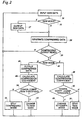
- Fig. 2 is a simplified flow chart showing data compression according to a preferred embodiment of the invention.
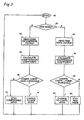
- Fig. 3 is a simplified flow chart showing data decompression according to a preferred embodiment of the invention.
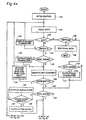
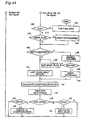
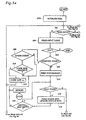
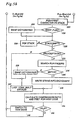
- Figs. 4a and 4b are portions of a detailed flow chart showing data compression according to a preferred embodiment of the invention.
- Figs. 5a, 5b, and 5c are portions of a detailed flow chart showing data decompression according to a preferred embodiment of the invention.
- FIG. 1 is a block diagram of a compression/decompression circuit 10 for a dictionary based system according to a preferred embodiment of the invention.
- the circuit includes a compression/decompression (CD) engine 12, an uncompressed data interface 14, a compressed data interface 16, and a processor interface 18.
- the uncompressed interface 14 transfers uncompressed or raw data over a data bus 20, and the compressed interface 16 transfers compressed data over a data bus 22.
- External control signals for interfaces 14 and 16 are received over control busses 24 and 26, respectively.
- Each interface 14, 16 contains a respective First-in/First-out (FIFO) data buffer 28, 30 and additional conventional interface circuitry.
- FIFO First-in/First-out
- the uncompressed data interface 14 receives uncompressed data blocks, strings, segments, or characters from the data bus 20 and supplies them via data buffer 28 to the compression/decompression engine 12.
- a string table memory or dictionary 32 and control logic 34 within the CD engine 12 compress the characters into code words that may be output on data bus 22.
- the control logic includes a mode switch that is switchable between a compression active state in which the raw data is compressed, and a compression inactive or raw mode state in which raw data is simply output as raw data in its original form.
- the control logic also includes a comparator for measuring and comparing the relative size or length of raw data strings and the corresponding compressed code.
- the compressed data interface 16 receives possibly compressed data including code words and/or raw data from the data bus 22, and provides them to the CD engine via data buffer 30.
- the dictionary 32 and control logic 34 cooperatively decompress the data code words into raw data strings and output the result on data bus 20 via buffer 28.
- Fig. 2 shows a simplified compression flow chart.
- raw data is input at block 36.
- step 35 determines whether the circuit is in raw mode. If so, The raw data is output per step 37, without having been stored in a buffer.
- the raw data is preferably in the form of an 8 bit character which, alone or in conjunction with a string of prior characters, is the subject of a search in the dictionary in step 38. If found, the code associated with the character or string is noted, if not found, the character or string is encoded as a new entry, and a new code is created. The resulting code is effectively generated in step 38.
- the dictionary entries are updated and may be shifted between dictionaries.
- Step 40 determines whether the circuit is in raw mode or compressed mode. If in compressed mode, the compressed code is output as in step 44. After outputting the data, and before reading new data, the circuit calculates a compression coefficient (CC) in step 46. If in raw mode, the circuit proceeds directly to the calculation of a CC in step 48, having already output the raw data in step 37.
- CC compression coefficient
- the compression coefficient is a moving average based on a compression ratio of the current raw data string size to the current compressed code size, and on the previous compression coefficient.
- the previous CC is multiplied by 63/64 and summed with 1/64th of the current compression ratio.
- Division by a "SPAN" of 64 which can be expressed as an exponent 2 n , permits a simple bit shift to achieve the calculation.
- a six bit shift provides division by 64, and subtraction of a six-bit-shifted instance of the previous CC from itself provides multiplication by 63/64.
- the use of a moving average is useful for data that, as most data, exhibits a significant correlation between current compressibility and previous compressibility.
- the SPAN value should preferably be between 16 and 128, although other values may be suitable for some applications.
- step 50 determines whether the CC has fallen below a raw threshold of preferably 1.0. While the CC remains above 1.0, compression over the recently weighted history is having some beneficial compressive effect., and the circuit stays in compressed mode as noted in step 52. When CC drops below 1.0, expansion of data has occurred and is likely to continue to occur. Therefore, step 54 requires changing to raw mode so that future data is not expanded by attempts to compress it.
- step 56 determines whether the CC has risen above a compression threshold of preferably 1.0. While the CC remains below 1.0, the circuit stays in raw mode as noted in step 58. When CC rises above 1.0, the trend in the characteristics of the data suggests that there will be a compressive benefit to switch to compression mode as in step 60.
- the compression threshold may be set slightly greater than the raw threshold to provide hysteresis that avoids jumping between modes in cases of marginal compressibility. After changing or maintaining modes, the process repeats by inputting new raw data in step 36.
- Figure 3 shows a simplified decompression flow chart.
- Selectively compressed output generated by the above process does not contain any codes indicating whether particular segments of the "compressed" data are in fact compressed or raw.
- the decompression process infers from the data whether the data was compressed by repeating the calculation of the compression coefficient.
- the decompression process mimics the original compression process to achieve the same results. For instance, when during decompression of compressed data the compression coefficient drops below the raw threshold upon decompression, it will be known that the next segment of data will be in raw mode.
- Step 62 is the start of the cycle during ongoing decompression. If step 64 indicates that the circuit is not in raw mode, but in compression mode, the next data segment is read as code in step 66, then decompressed by looking up the dictionary entry corresponding to the code, and output as decompressed data. Based on a comparison of the compressed code and the decompressed data, a compression coefficient is calculated in step 68 using the same formula as during compression. The CC is compared with the raw threshold in step 70. If it remains above the threshold, the circuit stays in compressed mode per step 72. If the CC has fallen below the raw threshold, step 74 indicates that the circuit is switched to raw mode.
- step 76 When in raw mode, data is read as raw data and output in step 76. Then, a compression coefficient is calculated in step 78 as in step 68. Step 80 compares the CC to the compression threshold. If the CC remains below the threshold, the circuit remains in raw mode per step 82. If the CC rises above the threshold, step 84 requires a change to compressed mode. During decompression, the dictionaries are created and modified in exactly the same manner as during compression to ensure that the compression codes and corresponding entries provide precise decoding.
- Initialization 100 At start up, all of the normal LZSD2 start-up procedures must be followed.
- the compressor is put in a known, consistent state.
- Each dictionary entry is set to some predetermined value, typically (0x000,0x00,FREE/PD).
- the Output formatter is reset to its empty initial state.
- the SWAP_FLAG is unset, CODE_SIZE is set to minimum (9), LAST_CODE_BUILT is set to INVALID, and DEPTH is set to 0.
- the expansion protection specific initializations are to set the RAW_MODE flag so that the first few characters are output unencoded and to initialize the compression ratio moving average (CR) to its start up value, typically one.
- Read Data 102 Get an WS bit character from the input stream and assign it to variable CH.
- Pad Final Bits 108 The last code or character output may not completely fill the last output word. Statistically, only 1 out of WS will do so. In the other (WS - 1) cases the leftover bits need to be padded with 0's (or 1's, it really doesn't matter) out to WS bits and this final word is then output. At this point, the compression process is finished.
- RAW_MODE 110 If the RAW_MODE flag is set then exit at the Y point which will output PREVCH, the final character of the data stream. If the RAW_MODE flag is not set then exit at the N point which will output PREVCODE, the final code of the data stream.
- Output PREVCH by packing the WS bits of this character with the leftover bits of the previous character or code output into WS bit words. Output all complete words to the output stream.
- Prep For Next Character 116 This step takes the input character (CH) and assigns it to PREVCODE.
- PREVCODE now represents a one character string and so DEPTH is set to 1.
- the input character (CH) is also assigned to PREVCH.
- RAW_MODE 118 If the raw mode flag is set then exit at the Y point which will output PREVCH. If the raw mode flag is not set then exit at the N point which will continue with the compression process by doing a dictionary search.
- Output Raw Character 120 Output PREVCH by packing the WS bits of this character with the leftover bits of the previous output character or code into WS bit words. Output all complete words to the output stream.
- Search Dictionaries 122 Search the dictionary for a location which contains PREVCODE in the code field and CH in the character field. Do not look at the status field when doing the search. Use a priority encoder to resolve multiple matches by selecting the match address with the lowest value. If a location is found which matches (PREVCODE, CH, *), then set the MATCH flag and assign the match address to FOUNDCODE. If no location is found which matches (PREVCODE, CH, *) then unset the MATCH flag.
- RAW_MODE 128 If the raw mode flag is set then exit at the Y point which may add a new string to the dictionary. If the raw mode flag is not set then exit at the N point which will output PREVCODE and then add a new string to the dictionary.
- Output GROW Code 132 Output a GROW control code using CODE_SIZE bits. The code must be packed into words by the formatter before it can be output. Increment CODE_SIZE so all future output codes will be represented by one more bit than before. It is possible, though rare, for the output code to require more than one more bit in order to be output. To handle this case, it is necessary to go back and check if another grow code is needed before actually outputting PREVCODE.
- Output PREVCODE 134 Output PREVCODE using CODE_SIZE bits. The code together with the leftover bits from the previous output code or character must be packed into words by the formatter before it can be output to the output stream.
- EOF? 136 This is essentially a continuation of EOF? 104.
- the Y point of EOF? 104 may come back into the main compression flow in order to output the last best match code.
- the flowchart could simply repeat the output GROW code and PREVCODE steps at the Y point of EOF? 104 but this method makes it clear that the output functionality is the same for the final code as it is for all previous codes. If the end of the input stream has been reached then exit at the Y point, else exit at the N point.
- Pad Final Bits 138 The last code output may not completely fill the last output word. Statistically, only I out of WS will do so. In the other (WS - 1) cases the leftover bits need to be padded with 0s (or 1s) out to WS bits and this final word is then output. At this point, the compression process is finished.
- SWAP_FLAG? 140 If the SWAP_FLAG is set then exit at the Y point which will swap the dictionaries. If it is not set then exit at the N point which may update the dictionary with (PREVCODE, CH, CD).
- Swap Dictionaries 142 Since the status field is two bits, there are four possible codes: 00 01 10 11. These codes are mapped to SD, CD, FREE/PD, and INV (invalid), not necessarily in that order. Swapping the dictionaries does not actually change any data in the CAM. What changes is how the status field is interpreted.
- the code that represented SD represents CD after the swap, CD switches to FREE/PD, FREE/PD becomes INV, and INV becomes SD. INV remains empty because FREE/PD was empty before the swap so INV is empty afterwards. Also, since INV was empty before the swap (INV is always empty), after the swap, the Standby dictionary (SD) is empty.
- DEPTH ⁇ MAXDEPTH? 144. If the string length of PREVCODE is less than the maximum string length then exit at the Y point which will add (PREVCODE, CH, CD) to the dictionary if there is a location available. If DEPTH > MAXDEPTH then exit at the N point which will not add (PREVCODE, CH, CH) to the dictionary as it is too long to be used as an output code.
- Search for Free 146 Search the dictionary for a location which contains FREE/PD in the status field. Do not look at the Code or Character fields when doing the search, i.e. a match can be successful no matter what the Code or Character fields contain. Use a priority encoder to reduce possible multiple matches to the one with the lowest value. If a location is found which matches (*,*,FREE/PD) then set the MATCH flag and assign the match address to NEXTCODE.
- LAST_CODE_BUILT INVALID 152.
- LAST_CODE_BUILT is used to prevent the compressor from outputting the most recently built code. However, if a (PREVCODE, CH) combination that could have been built but was not because the maximum string length was exceeded or the dictionary was full then the most recently built code can be used as an output code. To facilitate this, LAST_CODE_BUILT is set to an INVALID address which cannot be matched in the search operation.
- SPAN controls the weight of recent codes versus older codes.
- Good results can be obtained using values for SPAN which are between 20 and 100, as determined empirically, but these are not absolute limits.
- Using a value for SPAN that is a multiple of 2 makes some of the math operations easier and faster in hardware by permitting a simple bit shift for multiplying or dividing functions.
- the preferred embodiment uses a value of 64 for SPAN.
- DEPTH is the string length of PREVCODE
- the expression (DEPTH x WS/CODE_SIZE) is the compression ratio for PREVCODE (i.e. the number of bits in the string represented by PREVCODE divided by the number of bits in the code PREVCODE). This calculation is done for each output code while in compress mode and for each code that would have been output if not in raw mode, while in raw mode.
- Prep for Next String 158 Use CH as the initial string for the next search, i.e. assign CH to PREVCODE.
- PREVCODE now represents a one character string and so DEPTH is set to 1. Assign CH to PREVCH for possible use as the next raw character.
- RAW_MODE? 160 If in raw mode then exit at the Y point which will decide if a switch to compress mode is desired. If not in raw mode, then exit at the N point which will decide if a switch to raw mode is desired.
- the typical value for RT is I but any other values can be used as long as it is less than or equal to the value used for CT (see 166.). If CR is greater than or equal to RT then exit at the N point which will go back to the top of the flow to read the next character.
- Switch to Raw Mode 164 Switching to raw mode is done by simply setting the RAW_MODE flag. From here go to the top of the flow to read the next character.
- CR>CT? 166 If the compression ratio (CR) is greater than CT then exit at the Y point which will switch the compressor from raw mode to compress mode.
- the typical value for CT is 1 but any other value can be used as long as it is greater than or equal to the value used for RT (see step 162). If CR is less than or equal to RT then exit at the N point which will go back to the top of the flow to read the next character.
- Switch to Compress Mode 168 The switch from raw mode to compress mode is more complicated than the reverse. First, output PREVCH to the formatter which will pack it into words and output all completed words. Then set DEPTH equal to 0 and LAST_CODE_BUILT to INVALID. Lastly, unset the RAW_MODE flag. From here go to the top of the flow to read the next character.
- Initialization 200 At start up, all of the normal LZSD2 start-up procedures must be followed.
- the compressor is put in a known, consistent state.
- Each dictionary entry is set to some predetermined value, typically (0x000,0x00,FREE/PD).
- the input formatter is reset to its empty initial state.
- CODE_SIZE is set to minimum (9) and PREVDEPTH is set to 0.
- the expansion protection specific initializations are to set the RAW_MODE flag, unset the NEW_TO_RAW flag, unset the SWAP_FLAG, set DEPTH to 0, set LAST_CODE_BUILT to INVALID, and set the initial moving average compression ratio (CR) to its start up value, typically one.
- RAW_MODE? 202 If the RAW_MODE indicator is set then exit at the Y point which will follow the raw mode decompression flow. If the RAW_MODE indicator is not set then exit at the N point which will follow the compress mode decompression flow.
- Read Input Code 204 Read a word from the input stream and unpack it into a CODE_SIZE bit codes. If there are not enough bits available, read more words until there are enough. Assign the code to INCODE. Keep leftover bits for use in the next code.
- EOF? 205 If the Read Input Code failed due to reaching the end of the file (EOF), then the decompression process is finished. Exit at the Y point which will end the algorithm. If Read Input Code did not fail due to EOF, then exit at the N point which will continue the algorithm.
- INCODE is a reserved code then exit at the Y point which will determine which reserved code it is and take the appropriate action. If INCODE is not a reserved code, then exit at the N point which will continue with the decompression process by converting the code into a string.
- GROW Code 208. If INCODE is a GROW code, then exit at the Y point which will execute the steps necessary to grow the code size. If INCODE is not a GROW code, then exit at the N point. If other control codes are needed, this is where they will be evaluated. Currently this algorithm only uses one reserve code so an N point exit means an algorithm failure.
- a GROW code indicates to the decompressor that all future codes will be one bit longer than what is currently being used. If the current CODE_SIZE is already at the maximum when a GROW code is encountered, then an error has occurred. Exit at the N point which will signal an error and stop the process. If CODE_SIZE is less than the maximum code size, then exit at the Y point which will increase the code size by one bit.
- Increment CODE_SIZE 212 Increase the value of CODE_SIZE by one. This means that all future codes will be one bit longer than before. From here, go to the top of the algorithm to read another code. Although the flow chart shows the return to top going to step 202. It is equally valid and possible more efficient to go to step 204.
- Prep for Decode 214 Initialize for decoding of INCODE. Since INCODE represents at least a one character string, we will count it now by setting DEPTH to 1. Since INCODE will be needed later in the algorithm, we must use a different variable or register during decoding; set TCODE (Temporary inCODE) equal to INCODE.
- Root Code 216. If TCODE is less than 256 it represents a one character string. Exit at the Y point which will put this one character on the string reversal STACK. If TCODE is greater than or equal to 256, then is must be a multiple character string. Exit at the N point which will put the last character of the string represented by TCODE onto the string reversal STACK.
- Push STACK and Update Status Bits 218 Put the character at CAM address TCODE onto the top of the STACK. This character is the last character in the string represented by TCODE. Put TCODE into the Standby Dictionary by setting the Status bits at CAM address TCODE to SD. Add one to DEPTH which is equal to the number of characters on the STACK plus one. The plus one is the first character of the string that we counted in the Prep for Decode step. Lastly, take the code at CAM address TCODE and assign it to TCODE. TCODE now represent the remaining string which has not yet been decoded.
- DEPTH ⁇ MAXDEPTH? 220.
- DEPTH must be less than or equal to MAXDEPTH, if it is not, the LIFO string reversal STACK will overflow. This will not occur if the data input to this algorithm was created by the LZSD2 compressor. This check is here only to check for improper input data. If DEPTH is greater than MAXDEPTH, then exit at the N point which will stop the decompression process. If DEPTH is less than or equal to MAXDEPTH, then exit at the Y point which will continue the decompress process.
- TCODE now represents a one character string. Although it is not a requirement of LZSD2, this algorithm maps all single character strings to the same code as the ASCII code for that character. This allows us to simply place TCODE onto the top of the STACK as the first character of the string INCODE without doing a CAM look up. This first character will be used later in the algorithm so its value is stored in a separate variable or register, namely FIRST_CHAR. (Actually, TCODE will not change between now and when FIRST_CHAR is used so a variable/register could be eliminated by simply using TCODE when FIRST_CHAR is needed later. FIRST_CHAR is only used to make the algorithm more readable.) Depth is now equal to the number of characters on the STACK.
- Swap Dictionaries 226 Since the status field is two bits, there are four possible codes: 00 01 10 11. These codes are mapped to SD, CD, FREE/PD, and INV (invalid), not necessarily in that order. Swapping the dictionaries does not actually change any data in the CAM. What changes is how the status field is interpreted.
- the code that represented SD represents CD after the swap, CD switches to FREE/PD, FREE/PD becomes INV, and INV becomes SD. INV remains empty because FREE/PD was empty before the swap so INV is empty afterwards. Also, since INV was empty before the swap, after the swap, the Standby Dictionary (SD) is empty.
- STACK empty? 228. If TDEPTH is greater than 0 then the STACK is not empty. Exit at the N point which will pop a character off of the STACK. If TDEPTH 0, then the STACK is empty. Exit at the Y point which may add a new string to the CAM.
- Pop STACK 230 Take the top character off of the STACK and output it. Subtract one from TDEPTH so the value of TDEPTH is equal to the number of characters on the STACK.
- Search for FREE/PD 234. Search the CAM for a location that is in the Previous Dictionary, which means a location which contains FREE/PD in the status field. Do not look at the Code or Character fields when doing the search, i.e. a match can be successful no matter what the Code or Character fields contain. Since it is possible for more than one address to meet this condition, the multiple matches must be reduced to one. This is done by using a priority encoder which will select the match address with the lowest value. If a location is found which matches (*,*,FREE/PD) then set the MATCH flag and assign the match address to NEXTCODE.
- Swap Dictionaries 238 Swap the dictionaries using the same procedure described in step 226.
- LAST_CODE_BUILT INVALID 242.
- LAST_CODE_BUILT is used in raw mode to prevent the decompressor from building a new string with the most recently built code as a substring. However, if a (PREVCODE, CH) combination that could have been built but was not because the maximum string length was exceeded or the dictionary was full then the most recently built code can be used as a substring for the next code built. To facilitate this, at this point LAST_CODE_BUILT is set to an INVALID address which cannot be matched in the search operation.
- CC Compression Ratio
- Prep for next code 244.
- the compression ratio calculation is done in way that gives more weight to the most recent codes.
- SPAN controls how much more recent codes are weighted versus older codes.
- Good results can be obtained using values for SPAN which are between 20 and 100, as determined empirically, but these are not absolute limits. Using a value for SPAN that is a multiple of 2 makes some of the math operations easier and faster in hardware.
- the preferred embodiment uses a value of 64 for SPAN.
- the compression ratio (CC) is limited to a value of MaxCR.
- MaxCR 2
- MaxCR 2
- the stored CC is limited.
- a transition to incompressible data after very compressible data does not create an extreme delay in the transition to raw mode. Without the limit, an excessively high CC would dominate the moving average calculation for an undesirably extended period.
- DEPTH is the string length of INCODE
- the expression: (DEPTH x WS/CODE_SIZE) is the compression ratio for INCODE, i.e. the number of bits in the string represented by INCODE divided by the number of bits in the code INCODE. This calculation is done for each input code while in compress mode and for each code that would have been input if not in raw mode, while in raw mode.
- PREVCODE equal to the value of INCODE.
- PREVCODE may be used the next pass through the algorithm to make a new string using the first character of the next string as an extension character.
- PREVDEPTH is set equal to the value of DEPTH in order to keep track of the string length of PREVCODE.
- PREVDEPTH is used to prevent a greater than maximum length string from being added to the CAM.
- CR ⁇ RT 246 If the compression ratio (CR) as calculated in step 244 is less than RT, then a switch to raw mode is desired. Exit at the Y point which signal this switch. If the CR is greater than or equal to RT, then exit at the N point which will continue the algorithm in compress mode.
- the typical value for RT is I but any other values can be used as long as it is less than or equal to the value used for CT. (see step 238.)
- Switch to raw mode 248 Switching to raw mode from compress mode is easy. Simply set the RAW_MODE flag and the NEW_TO_RAW flag.
- Read Data 250 Get an WS bit character from the input stream and assign it to variable CH. This character is not necessarily an input word as it could be split between two input words, taking n characters from the end of first word and WS-n characters from the beginning of the second word.
- Output CH 254. Output the character CH to the output stream. Since we are in raw mode, there is no decoding to do and the input characters can be output as is immediately.
- PREVCODE now represents a one character string and so DEPTH is set to 1.
- Search Dictionaries 260 Search the dictionary for a location which contains PREVCODE in the code field and CH in the character field. Do not look at the status field when doing the search. Use a priority encoder to resolve multiple matches by selecting the match address with the lowest value. If a location is found which matches (PREVCODE, CH, *), then set the MATCH flag and assign the match address to FOUNDCODE. If no location is found which matches (PREVCODE, CH, *) then unset the MATCH flag.
- FOUNDCODE cannot be equal to LAST_CODE_BUILT which prevents the most recently built dictionary entry from being used to build a new dictionary entry.
- a string in the dictionary that is longer than MAXDEPTH. To prevent matching a string like this the string length of FOUNDCODE must be checked. If the string is in the dictionary and the other two tests are OK, then exit this decision box at the Y point which will get another character to add to the string. If the string is not in the dictionary or either of the other two test fail, then exit at the N point which may add (PREVCODE, CH, CD) to the dictionary.
- Swap Dictionaries 268 Swap the dictionaries using the same procedure described in step 226.
- DEPTH ⁇ MAXDEPTH? 270. If the string length of PREVCODE is less than the maximum string length then exit at the Y point which will add (PREVCODE, CH, CD) to the dictionary if there is a location available. If DEPTH > MAXDEPTH then exit at the N point which will not add (PREVCODE, CH, CH) to the dictionary as it is too long to be used as an output code.
- Search for Free 272. Search the dictionary for a location which contains FREE/PD in the status field. Do not look at the Code or Character fields when doing the search, i. e. a match can be successful no matter what the Code or Character fields contain. Use a priority encoder to reduce possible multiple matches to the one with the lowest value. If a location is found which matches (*,*,FREE/PD) then set the MATCH flag and assign the match address to NEXTCODE.
- LAST_CODE_BUILT INVALID 280.
- LAST_CODE_BUILT is used to prevent the raw mode decompressor from building a string in the dictionary using the most recently built code. However, if a (PREVCODE, CH) combination that could have been built but was not because the maximum string length was exceeded or the dictionary was full then the most recently built code can be used as to build a new entry. To facilitate this, LAST_CODE_BUILT is set to an INVALID address which cannot be matched in the search operation.
- Prep for Next String 288 Use CH as the initial string for the next search, i.e. assign CH to PREVCODE.
- PREVCODE now represents a one character string and so DEPTH is set to 1.
- CR>CT 290 If the compression ratio (CR) is greater than CT then exit at the Y point which will switch the compressor from raw mode to compress mode.
- the typical value for CT is 1 but any other value can be used as long as it is greater than or equal to the value used for RT (see step 246). If CR is less than or equal to CT then exit at the N point which will go back to the top of the flow to read the next character.
- variable values in the compression process can be adjusted to trade off increases in the average compression ratio with increases in variability of individual compression ratios.
- the choices made for the following variables in the preferred embodiment result in slightly less than the maximum possible compression ratio for typical data sets with some variability in individual compression ratios. These values are preferred for both the Expanding Data Performance and Compressing Data Performance data sets.
- Variable Value WS 8 Initial CR 1.00 RT 1.00 CT 1.00 MAXCR 2.00 SPAN 64 MAXBITS 10 MAXDEPTH 128
Landscapes
- Engineering & Computer Science (AREA)
- Theoretical Computer Science (AREA)
- Multimedia (AREA)
- Physics & Mathematics (AREA)
- General Physics & Mathematics (AREA)
- Compression, Expansion, Code Conversion, And Decoders (AREA)
Applications Claiming Priority (2)
| Application Number | Priority Date | Filing Date | Title |
|---|---|---|---|
| US437263 | 1982-10-28 | ||
| US08/437,263 US5686912A (en) | 1995-05-08 | 1995-05-08 | Data compression method and apparatus with optimized transitions between compressed and uncompressed modes |
Publications (2)
| Publication Number | Publication Date |
|---|---|
| EP0742646A1 EP0742646A1 (en) | 1996-11-13 |
| EP0742646B1 true EP0742646B1 (en) | 2003-04-02 |
Family
ID=23735727
Family Applications (1)
| Application Number | Title | Priority Date | Filing Date |
|---|---|---|---|
| EP95305641A Expired - Lifetime EP0742646B1 (en) | 1995-05-08 | 1995-08-14 | Data compression method and apparatus with expansion protection |
Country Status (4)
| Country | Link |
|---|---|
| US (1) | US5686912A (enExample) |
| EP (1) | EP0742646B1 (enExample) |
| JP (1) | JP3342798B2 (enExample) |
| DE (1) | DE69530182T2 (enExample) |
Families Citing this family (14)
| Publication number | Priority date | Publication date | Assignee | Title |
|---|---|---|---|---|
| US5838963A (en) * | 1995-10-25 | 1998-11-17 | Microsoft Corporation | Apparatus and method for compressing a data file based on a dictionary file which matches segment lengths |
| US6219097B1 (en) * | 1996-05-08 | 2001-04-17 | Olympus Optical Co., Ltd. | Image pickup with expanded dynamic range where the first exposure is adjustable and second exposure is predetermined |
| US5931904A (en) * | 1996-10-11 | 1999-08-03 | At&T Corp. | Method for reducing the delay between the time a data page is requested and the time the data page is displayed |
| US5838927A (en) * | 1996-11-22 | 1998-11-17 | Webtv Networks | Method and apparatus for compressing a continuous, indistinct data stream |
| US7898442B1 (en) * | 1997-05-30 | 2011-03-01 | International Business Machines Corporation | On-line data compression analysis and regulation |
| JP3578445B2 (ja) * | 1999-01-26 | 2004-10-20 | 松下電器産業株式会社 | データ圧縮記録装置 |
| US6281816B1 (en) | 1999-08-24 | 2001-08-28 | International Business Machines Corporation | Method and apparatus for reducing data expansion during data compression |
| US6271775B1 (en) | 1999-08-24 | 2001-08-07 | International Business Machines Corporation | Method for reducing data expansion during data compression |
| US6961011B2 (en) * | 2001-08-27 | 2005-11-01 | Freescale Semiconductor, Inc. | Data compression system |
| US7302010B2 (en) * | 2004-01-14 | 2007-11-27 | Silicon Laboratories | Method for handling data transmissions within a modem |
| US8423522B2 (en) * | 2011-01-04 | 2013-04-16 | International Business Machines Corporation | Query-aware compression of join results |
| TW201342813A (zh) * | 2012-04-03 | 2013-10-16 | Novatek Microelectronics Corp | 資料編碼及解碼方法與裝置 |
| US20140229576A1 (en) * | 2013-02-08 | 2014-08-14 | Alpine Audio Now, LLC | System and method for buffering streaming media utilizing double buffers |
| US20140358874A1 (en) * | 2013-05-31 | 2014-12-04 | Avaya Inc. | Compression system and method |
Family Cites Families (8)
| Publication number | Priority date | Publication date | Assignee | Title |
|---|---|---|---|---|
| JPS5411614A (en) * | 1977-06-27 | 1979-01-27 | Nec Corp | Code conversion unit for digital signal |
| US4558302A (en) * | 1983-06-20 | 1985-12-10 | Sperry Corporation | High speed data compression and decompression apparatus and method |
| US4870415A (en) * | 1987-10-19 | 1989-09-26 | Hewlett-Packard Company | Data compression system with expansion protection |
| US4847619A (en) * | 1987-10-19 | 1989-07-11 | Hewlett-Packard Company | Performance-based reset of data compression dictionary |
| GB8828499D0 (en) * | 1988-12-07 | 1989-01-11 | British Telecomm | Data compression |
| US5177480A (en) * | 1988-12-07 | 1993-01-05 | British Telecommunications Public Limited Company | Data communication having transmitter-controlled mode switching from compressed-to-transparent mode but local synchronous transmitter-controlled and receiver-controlled mode switching from transparent-to-compressed mode |
| US5175543A (en) * | 1991-09-25 | 1992-12-29 | Hewlett-Packard Company | Dictionary reset performance enhancement for data compression applications |
| US5373290A (en) * | 1991-09-25 | 1994-12-13 | Hewlett-Packard Corporation | Apparatus and method for managing multiple dictionaries in content addressable memory based data compression |
-
1995
- 1995-05-08 US US08/437,263 patent/US5686912A/en not_active Expired - Lifetime
- 1995-08-14 DE DE69530182T patent/DE69530182T2/de not_active Expired - Lifetime
- 1995-08-14 EP EP95305641A patent/EP0742646B1/en not_active Expired - Lifetime
-
1996
- 1996-03-21 JP JP06454096A patent/JP3342798B2/ja not_active Expired - Fee Related
Also Published As
| Publication number | Publication date |
|---|---|
| DE69530182T2 (de) | 2003-12-04 |
| US5686912A (en) | 1997-11-11 |
| JPH08307280A (ja) | 1996-11-22 |
| EP0742646A1 (en) | 1996-11-13 |
| JP3342798B2 (ja) | 2002-11-11 |
| DE69530182D1 (de) | 2003-05-08 |
Similar Documents
| Publication | Publication Date | Title |
|---|---|---|
| EP0666651B1 (en) | Apparatus and method for lempel ziv data compression with management of multiple dictionaries in content addressable memory | |
| JP2713369B2 (ja) | データ圧縮装置及び方法 | |
| EP0573208B1 (en) | Apparatus and method for managing multiple dictionaries in content addressable based data compression | |
| US5175543A (en) | Dictionary reset performance enhancement for data compression applications | |
| US5686912A (en) | Data compression method and apparatus with optimized transitions between compressed and uncompressed modes | |
| US5243341A (en) | Lempel-Ziv compression scheme with enhanced adapation | |
| US9792308B2 (en) | Content estimation data compression | |
| JP3342700B2 (ja) | ストリングリバーサル機構を具備した単一クロックサイクルデータ圧縮装置/圧縮解除装置 | |
| US5463390A (en) | Data compression apparatus and method | |
| US5058144A (en) | Search tree data structure encoding for textual substitution data compression systems | |
| AU637826B2 (en) | Improved data compression apparatus | |
| US4847619A (en) | Performance-based reset of data compression dictionary | |
| US7071848B1 (en) | Hardware-friendly general purpose data compression/decompression algorithm | |
| US5126739A (en) | Data compression apparatus and method | |
| US5001478A (en) | Method of encoding compressed data | |
| US5109226A (en) | Parallel processors sequentially encoding/decoding compaction maintaining format compatibility | |
| EP0729237A2 (en) | Adaptive multiple dictionary data compression | |
| JPH0568893B2 (enExample) | ||
| US6140944A (en) | Variable-length coding device and method using table that holds information on presence/absence of code correspondingly to region represented by combination of run data and level data | |
| EP0582907A2 (en) | Data compression apparatus and method using matching string searching and Huffman encoding | |
| WO1995019662A1 (en) | Data compression apparatus and method | |
| EP1201036B1 (en) | Method and apparatus for reducing the time required for compressing data | |
| EP0435802B1 (en) | Method of decompressing compressed data | |
| US5010344A (en) | Method of decoding compressed data | |
| RU2450441C1 (ru) | Способ и устройство сжатия данных |
Legal Events
| Date | Code | Title | Description |
|---|---|---|---|
| PUAI | Public reference made under article 153(3) epc to a published international application that has entered the european phase |
Free format text: ORIGINAL CODE: 0009012 |
|
| AK | Designated contracting states |
Kind code of ref document: A1 Designated state(s): DE FR GB IT |
|
| 17P | Request for examination filed |
Effective date: 19970114 |
|
| 17Q | First examination report despatched |
Effective date: 20000530 |
|
| RAP1 | Party data changed (applicant data changed or rights of an application transferred) |
Owner name: HEWLETT-PACKARD COMPANY, A DELAWARE CORPORATION |
|
| GRAH | Despatch of communication of intention to grant a patent |
Free format text: ORIGINAL CODE: EPIDOS IGRA |
|
| GRAH | Despatch of communication of intention to grant a patent |
Free format text: ORIGINAL CODE: EPIDOS IGRA |
|
| GRAA | (expected) grant |
Free format text: ORIGINAL CODE: 0009210 |
|
| AK | Designated contracting states |
Designated state(s): DE FR GB IT |
|
| REG | Reference to a national code |
Ref country code: GB Ref legal event code: FG4D |
|
| REF | Corresponds to: |
Ref document number: 69530182 Country of ref document: DE Date of ref document: 20030508 Kind code of ref document: P |
|
| ET | Fr: translation filed | ||
| PLBE | No opposition filed within time limit |
Free format text: ORIGINAL CODE: 0009261 |
|
| STAA | Information on the status of an ep patent application or granted ep patent |
Free format text: STATUS: NO OPPOSITION FILED WITHIN TIME LIMIT |
|
| 26N | No opposition filed |
Effective date: 20040105 |
|
| PGFP | Annual fee paid to national office [announced via postgrant information from national office to epo] |
Ref country code: IT Payment date: 20060831 Year of fee payment: 12 |
|
| PGFP | Annual fee paid to national office [announced via postgrant information from national office to epo] |
Ref country code: FR Payment date: 20070817 Year of fee payment: 13 |
|
| REG | Reference to a national code |
Ref country code: FR Ref legal event code: ST Effective date: 20090430 |
|
| PG25 | Lapsed in a contracting state [announced via postgrant information from national office to epo] |
Ref country code: FR Free format text: LAPSE BECAUSE OF NON-PAYMENT OF DUE FEES Effective date: 20080901 |
|
| PG25 | Lapsed in a contracting state [announced via postgrant information from national office to epo] |
Ref country code: IT Free format text: LAPSE BECAUSE OF NON-PAYMENT OF DUE FEES Effective date: 20070814 |
|
| PGFP | Annual fee paid to national office [announced via postgrant information from national office to epo] |
Ref country code: GB Payment date: 20090825 Year of fee payment: 15 |
|
| PGFP | Annual fee paid to national office [announced via postgrant information from national office to epo] |
Ref country code: DE Payment date: 20090827 Year of fee payment: 15 |
|
| GBPC | Gb: european patent ceased through non-payment of renewal fee |
Effective date: 20100814 |
|
| REG | Reference to a national code |
Ref country code: DE Ref legal event code: R119 Ref document number: 69530182 Country of ref document: DE Effective date: 20110301 |
|
| PG25 | Lapsed in a contracting state [announced via postgrant information from national office to epo] |
Ref country code: DE Free format text: LAPSE BECAUSE OF NON-PAYMENT OF DUE FEES Effective date: 20110301 |
|
| PG25 | Lapsed in a contracting state [announced via postgrant information from national office to epo] |
Ref country code: GB Free format text: LAPSE BECAUSE OF NON-PAYMENT OF DUE FEES Effective date: 20100814 |