EP0741362A2 - Automatisches Erzeugen von konditionellen Exponentialmodellen aus elementaren Merkmalen - Google Patents
Automatisches Erzeugen von konditionellen Exponentialmodellen aus elementaren Merkmalen Download PDFInfo
- Publication number
- EP0741362A2 EP0741362A2 EP96106142A EP96106142A EP0741362A2 EP 0741362 A2 EP0741362 A2 EP 0741362A2 EP 96106142 A EP96106142 A EP 96106142A EP 96106142 A EP96106142 A EP 96106142A EP 0741362 A2 EP0741362 A2 EP 0741362A2
- Authority
- EP
- European Patent Office
- Prior art keywords
- word
- model
- features
- target
- words
- Prior art date
- Legal status (The legal status is an assumption and is not a legal conclusion. Google has not performed a legal analysis and makes no representation as to the accuracy of the status listed.)
- Withdrawn
Links
Images






Classifications
-
- G—PHYSICS
- G06—COMPUTING OR CALCULATING; COUNTING
- G06F—ELECTRIC DIGITAL DATA PROCESSING
- G06F40/00—Handling natural language data
- G06F40/40—Processing or translation of natural language
- G06F40/42—Data-driven translation
- G06F40/44—Statistical methods, e.g. probability models
Definitions
- the invention relates to computerized language translation, such as computerized translation of a French sentence into an English sentence.
- F) of the target language text E given the source language text F can be written as P(E
- F) P(F
- the probability P(E) of the target language text E is a language model match score and may be estimated from a target language model. While any known language model may be used to estimate the probability P(E) of the target language text E, Brown et al describe an n-gram language model comprising a 1-gram model, a 2-gram model, and a 3-gram model combined by parameters whose values are obtained by interpolated estimation.
- E) in Equation 2a is a translation match score.
- E) for a source text F comprising a series of source words, given a target hypothesis E comprising a series of target words may be estimated by finding all possible alignments connecting the source words in the source text F with the target words in the target text E, including alignments in which one or more source words are not connected to any target words, but not including alignments where a source word is connected to more than one target word.
- Brown et al further estimate the distortion probability a(j
- a lexical score for the alignment is obtained.
- ⁇ 0 is the number of target words in the target text E that are not connected with any source words
- E) for the source text F and the target hypothesis E may be the sum of the translation match scores for all permitted alignments between the source text F and the target hypothesis E.
- E) for the source text F and the target hypothesis E is the translation match score for the alignment estimated to be most probable.
- Equation 2a may be used to directly estimate the target hypothesis match score P(F
- Brown et al estimate the target hypothesis match score P(F
- Each intermediate target language word e' represents a class of related target language words.
- Each intermediate source language word f' represents a class of related source language words.
- a source language transducer converts the source language text F to the intermediate form F'.
- E')P(E') is estimated from Equation 2a.
- a target language transducer converts the best matched intermediate target language text E ⁇ ' to the target language text E ⁇ .
- Brown et al estimate the lexical probability of each source word f as the conditional probability t(f
- Statistical modelling addresses the problem of construction a parameterized model to predict the future behavior of a random process.
- this model we typically have at our disposal a sample of output from the process. This output embodies our incomplete state of knowledge of the process; the modelling problem is to parlay this incomplete knowledge into an accurate representation of the process.
- Statistical modelling is rarely an end in itself, but rather a tool to aid in decision-making.
- the first task is to determine a set of statistics which capture the behavior of a random process. If the process is a sequence of words uttered by a speaker, one informative statistic is the average number of words in the speaker's sentences. Another statistic is the percentage of words that are adjective. A third statistic is the number of times the speaker uses each different word.
- the second task Given a set of statistics representing a collection of facts about the process, the second task is to corral these facts into an accurate model of the process - a model capable of predicting the future output of the process.
- the first task is one of feature selection; the second is one of model selection.
- the invention is a method for modelling a stochastic process, comprising the steps of: a) providing a set of candidate features exhibited in the output of the process; b) providing a sample of data representing the output of the process being modeled; c) choosing an initial model of the process; d) initializing an active set S of features contained in the model; e) computing a score representing the benefit of adding the feature to the model for all features; f) selecting one or more features with the highest scores; g) if none of the scores is sufficiently high, stop; h) adding selected features to the set S of active features; i) computing a model Ps containing the features in S; j) repeating steps (e)-(i) until the stop condition of step (g) is satisfied.
- Figure 1 is a linear subset C of the space of all probability distributions P.
- Figure 2 is a nested sequence of subsets.
- Figure 3 is an alignments of a French-English sentence pair.
- Figure 4 shows typical errors encountered using EM-based model in French-to-English translation resulting from the method of the present invention.
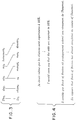
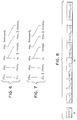
- Figure 6 is an example of an unsafe segmentation.
- Figure 7 is an example of a safe segmentation.
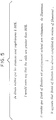
- Figure 8 shows x,y pairs for a sentence segmentation.
- Figure 9 shows the change in log-likelihood during segmenting model-growing.
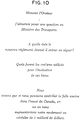
- Figure 10 shows maximum entropy segmenter behavior on four sentences.
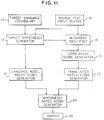
- Figure 11 is a block diagram of an example of an apparatus for translating words from a first language to a second language according to the present invention.
- Figure 12 schematically shows an example of an alignment between a hypothetical series of source words and a hypothetical series of target words.
- Figure 13 schematically shows an example of a second alignment between the hypothetical series of source words and the hypothetical series of target words of Figure 12.
- Figure 14 schematically shows an example of a third alignment between the hypothetical series of source words and the hypothetical series of target words of Figure 12.
- Figure 15 is a flow diagram describing the process of constructing an exponential model.
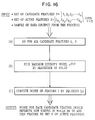
- Figure 16 is a detailed flow diagram of step (a) of Figure 15.
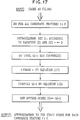
- FIG 17 is an alternative detailed flow diagram of step (a) of Figure 15.
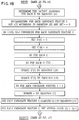
- FIG 18 is another alternative detailed flow diagram of step (a) of Figure 15.
- Figure 19 is a flow diagram describing an alternative method for constructing an exponential model.
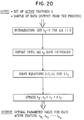
- FIG 20 is a detailed flow diagram of step (e) of Figure 15.
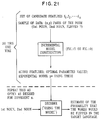
- Figure 21 shows an overview of the process for incremental construction of and usage of an exponential model to predict whether to reorder a French "noun-de-noun” phrase.
- Figure 22 is a detailed flow diagram of the step of pruning redundant features.
- Figure 11 is a block diagram of an example of an apparatus for translating words from a first language to a second language according to the present invention.
- the apparatus comprises a source text input device 10 for inputting a series of source words.
- the source text input device 10 may comprise, for example, a keyboard, a computer disk drive, or a computer tape drive.
- the source text input device 10 may further comprise means for transforming the input series of source words into a series of transformed source words.
- Each transformed source word may represent a set of related input source words.
- each of the input source words in the set ⁇ etre, etant, ete, suis, es, est, Struktur, etes, thank, fus, fumes, serai, serons, sois, transport, s models, srung, ska ⁇ are forms of the verb infinitive "etre", and may be transformed to "etre" with a tag representing the tense of the original input source word.
- the means for transforming the input series of source words into a series of transformed source words may comprise the source transducers described in Sections 3, 4, and 11 of Brown et al, above, which are incorporated herein by reference. In essence, these transducers check and correct the spelling of the input source words, check and correct the case of the input source words, detect titles of documents in the input series of source words, and detect names in the input series of source words. The transducers also tag each input source word with the most likely part of speech of the source word, and flag unknown source words (which are not contained in a stored vocabulary of source words). The means for transforming the input series of source words also collapses multi-word units of input source words into single transformed source words, and splits compound input source words into two or more transformed source words.
- the means for transforming the input series of source words into a series of transformed source words further performs linguistic or morphological transformations of different forms of a word into a single basic form.
- the means for transforming the input series of source words may also estimate the sense of each input source word, and assign that sense to the transformed source word.
- Table 1a shows a hypothetical example of an input series of source words according to the invention.
- the source words are French words.
- the translation apparatus further comprises a target hypothesis generator 12.
- the target hypothesis generator 12 generates at least two target hypotheses.
- Each target hypothesis comprises a series of target words selected from a vocabulary of words in the second language.
- the vocabulary of words in the second language may be stored in a target language vocabulary store 14.
- Each target word in a target hypothesis has a context comprising at least one other word in the target hypothesis.
- Table 2a shows a hypothetical example of target hypotheses E 1 , E 2 , and E 3 .
- the target words are English language words.
- TABLE 2a Target Hypotheses E h E h e h,1 e h,2 e h,3 e h,4 e h,5 e h,6 E 1
- the key is in the door .
- E 2 The key is in the gate .
- E 3 The wrench is in the door .
- each target hypothesis comprises a series of target words selected from a vocabulary comprising words in the second language, and a null word representing the absence of a word.
- all of the target hypotheses E h will be considered to include the "null" word.
- the translation apparatus comprises a language model match score generator 16 for generating, for each target hypothesis, a language model match score comprising an estimate of the probability of occurrence of the series of words in the target hypothesis.
- a language model match score generator 16 for generating, for each target hypothesis, a language model match score comprising an estimate of the probability of occurrence of the series of words in the target hypothesis.
- the translation apparatus further comprises an alignment identifier 18 for identifying at least one alignment between the input series of source words and each target hypothesis.
- the alignment connects each source word with at least one target word in the target hypothesis.
- FIGs 12, 13, and 14 schematically show examples of possible alignments between the hypothetical input series of source words in Table 1a and the hypothetical input series of target words in target hypothesis E 1 in Table 2a.
- each source word in the input series of source words F is connected with at least one target word in the target hypothesis E 1 by a solid line.
- the second occurrence of the source word "La” has no solid line therefrom, and is therefore considered to be connected to the "null" word.
- Tables 3a, 4a, and 5a provide alternate descriptions of the alignments of Figures 12, 13, and 14, respectively.
- each parameter j ranging from 1 to m (where m is the number of words in the input series of source words), there is another parameter a j having a single value in the range from 0 to l (where l is the number of words in the target hypothesis).
- each word f j in the input series of source words is connected to the word in the target hypothesis.
- each source word may be connected to either the null source word or one or more non-null target words. If each source word is constrained to be connected to only one null or non-null target word, then there are possible alignments.
- only one alignment between the input series of source words and each target hypothesis is identified for obtaining a word match score, described below, for each source word.
- the one identified alignment for the series of source words and each target hypothesis is preferably that which is produced by the target hypothesis generator, as described in Section 14 of Brown et al, cited above, which is incorporated herein by reference.
- the alignment identifier 18 identifies at least one alignment between the series of transformed source words and each target hypothesis. The alignment connects each transformed source word with at least one target word in the target hypothesis.
- the translation apparatus further comprises a word match score generator 20.
- the word match score generator 20 generates, for each source word and each target hypothesis, a word match score comprising an estimate of the conditional probability P(f
- Table 6a illustrates a hypothetical example of the context X of each target word in the target hypothesis E 1 of Table 2a for the alignment A 1,1 of Table 3a with the input series of source words F of Table 1a.
- the context X of a selected target word consists of the three target words preceding the selected target word and the three target words following the selected target word in the target hypothesis.
- the context also includes punctuation and absence of words.
- the context of the target word in the target hypothesis E which is connected to a source word f j may be contained in at least one of two or more context classes.
- the estimated conditional probability of occurrence of a source word, given the target word in the target hypothesis which is connected to the source word and given the context of the target word connected to the source word, may comprise at least one function having a value dependent on the class containing the context of the target word which is connected to the source word.
- the context may comprise at least one word having a part of speech in the target hypothesis.
- the estimated conditional probability of occurrence of a source word, given the target word in the target hypothesis which is connected to the source word and given the context of the target word which is connected to the source word, may comprise at least one function having a value dependent on the part of speech in the target hypothesis of at least one word in the context of the target word which is connected to the source word.
- the context of the target word in the target hypothesis which is connected to a source word comprises at least one word having an identity.
- the estimated conditional probability of occurrence of the source word, given the target word in the target hypothesis which is connected to the source word and given the context of the target word which is connected to the source word comprises at least one function having a value dependent on the identity of at least one word in the context of the target word which is connected to the source word.
- Equations 3a, 4a, 5a, and 6a are hypothetical examples of functions having values dependent on the context of the target word which is connected to a source word.
- Equation 3a the function g 1 has a value of 1, if the source word f is "clef”, if the target word e is "key”, and if the word in the context X immediately preceding "key” is "the”. If these conditions are not met, the context function g 1 has a value of 0.
- the hypothetical context function g 2 of Equation 4a has a value of 1, if the source word f is "clef”, if the target word e is "key”, and if the word in the context X immediately preceding "key” is "car”. If these conditions are not met, the function g 2 has a value of 0.
- the context function g 3 has a value of 1 if the source word f is "ton”, if the target word e is "key”, and if the word in the context X immediately preceding "key” is "the”. If these conditions are not met, the context function g 3 has a value of 0.
- the hypothetical context function g 4 in Equation 6 has a value of 1 if the source word f is "ton”, the target word e is "key”, and if the word in the context X immediately following "key", or the word in the context X next following "key” is an element of the set ⁇ A, B, C, D, E, F, G ⁇ . If these conditions are not met, the context function g 4 has a value of 0.
- the context function g 1 has a value of 1, and the context functions g 2 , g 3 and g 4 have values of 0.
- the word match score for each source word and each target hypothesis comprises an estimate of the conditional probability P(f
- the word match score may be obtained, for example, using a model defined by Equation 7a as follows. P(f
- e, X) 1 N(e,X) e i ⁇ (e, i) g i (f,e,X)
- Equation 7a the functions g i (f,e,X) are functions having values dependent on the context X of the target word e which is connected to the source word f in an alignment between an input series of source words and a target hypothesis.
- the parameters ⁇ (e,i) are parameters representing the relative strength of each context function g i in predicting the source word f from the target word e in the context X.
- the quantity N(e,X) is a normalization factor which depends on the target word e and the context X of the target word e, as shown in Equation 8a.
- Equation 9a is a hypothetical model for generating word match scores for source words f.
- Equation 10a For the purpose of Equation 9a, the normalization N(e,X) is given by Equation 10a.
- Table 8a illustrates the computation of the word match score from Equations 7a and 9a for the source word "clef”, the target word "key”, and the context X of "key” in the target hypothesis E 1 of Table 2a.
- "key", X) of occurrence of the source word "clef” given the target word "key” in the target hypothesis which is connected to the source word "clef” and given the context X of the target word "key” in the target hypothesis which is connected to the source word “clef” is equal to 0.507 (from Equations 9a and 10a).
- the word match score generator If the alignment identifier 18 identifies two or more alignments between the input series of source words and each target hypothesis, the word match score generator generates a word match score for each source word and each alignment and each target hypothesis. Each word match score may be estimated using the model of Equation 7a.
- the word match score generator generates a word match score for each transformed source word and each target hypothesis.
- the word match score comprises an estimate of conditional probability of occurrence of the transformed source word, given the target word in the target hypothesis which is connected to the transformed source word and given the context of the target word in the target hypothesis which is connected to the transformed source word.
- the word match score for a transformed word may also be estimated using the model of Equation 7a.
- the translation apparatus further comprises a translation match score generator 22.
- the translation match score generator 22 generates, for each target hypothesis, a translation match score comprising a combination of the word match scores for the target hypothesis and the source words in the input series of source words.
- the translation match score for a target hypothesis may, for example, comprise the product of the word match scores for the target hypothesis and the source words in the input series of source words.
- Table 9a illustrates the computation of a translation match score for the input series of source words f j of Table 1a, and for the target words in the target hypothesis E 1 of Table 2a.
- Each word match score is obtained from Equation 7a.
- the numbers in Table 9a are hypothetical numbers.
- the fertility and distortion scores of Brown et al, described above, are assumed equal to one.
- the translation apparatus comprises a hypothesis match score generator 24 for generating a target hypothesis match score for each target hypothesis.
- Each target hypothesis match score comprises a combination (for example, the product) of the language model match score for the target hypothesis and the translation match score for the target hypothesis.
- the language model match score may be obtained from known language models such as the n-gram language models described by Brown et al.
- the translation match score for each target hypothesis comprises a combination of the word match scores for the target hypothesis and the alignments and the source words in the input series of source words.
- the translation match score comprises a combination of the words match scores for the target hypothesis and the transformed source words.
- the translation apparatus further comprises an output 26.
- the output 26 outputs the target hypothesis having the best target hypothesis match score.
- the output 26 may comprise, for example, a display or a printer.
- the output 26 comprises means for synthesizing a series of output words from the target hypothesis having the best target hypothesis match score.
- the means for synthesizing output words from the target hypothesis may comprise target transducers such as those described at Section 5 of Brown et al (cited above) which is incorporated herein by reference.
- the target word "be” with a tag representing the tense of the original input source word may be transformed to one of the synthesized output words ⁇ be, was, were, been, %am, are, is, being ⁇ which are forms of the verb infinitive "be".
- Equation 7a is an example of a model which may be used to obtain word match scores according to the present invention.
- the context functions g i (f,e,X) of the word match score model, and the parameters ⁇ (e,i) , of the word match score model may be obtained as follows.
- Candidate context functions g i (f,e,X) may be obtained, for example, by limiting the context X of the target word in the target hypothesis to three words to the left of the targets word e and three words to the right off the target word e, as shown in the example of Table 6a, above.
- a training text of source language sentences and target language sentences which are translations of each other is obtained.
- Corresponding source language sentences and target language sentences which are translations of each other may be identified, for example, by a skilled translator.
- Preferably, corresponding source language sentences and target language sentences which are translations of each other may be identified automatically, for example, by the method described in Sections 12 and 13 of Brown et al (cited above), which are incorporated herein by reference.
- the estimated most probable alignment between the source words and the target words is found using the method described above used by the alignment identifier 18.
- Each occurrence of a target word in the training text is then identified and tagged with the source word f j connected to the target word in each alignment.
- the target word is also tagged with its context X in each target sentence.
- Table 10a illustrates a hypothetical example of training events for a target word in a training text of aligned source language sentences and target language sentences.
- candidate context functions g i may be obtained by first identifying types of context functions. For example, one type of context function tests for the presence of a particular word in one or more positions in the context. Another type of context function tests for the presence of a particular word class (for example, part of speech) in one or more positions in the context.
- the particular words or word classes to be tested for in a context function for a target word e can be obtained from the words and classes in the context of the target word e in the training text.
- candidate context functions g i (f,e,X) may be obtained by clustering the training events according to their context X using the method described in Section 7 of Brown et al (cited above), which is incorporated herein by reference.
- G(i) (Eg i (f,e,X) - E ⁇ g i (f,e,X)) 2 E(g i (f,e,X) - E(g i (f,e,X)
- (12a) Eg i (f,e,X) f,X P(f
- (12a) E ⁇ g i (f,e,X) f,X P ⁇ (f,X)g i (f,X) (14a) E(g i (f,e,X)
- X) f,X P(f
- Equation 11a through 14a the conditional probability P(f
- the probability P ⁇ (X) of a context X is obtained by counting occurrences of the target word e and the context X in the training text events of the type shown in Table 10a, and dividing the count by the total number of events in the training text in which the target word is e.
- the probability P ⁇ (f,X) of a source word f and a context X are obtained by counting occurrences of the target word e, the context X, and the source word f in the training text events of the type shown in Table 10a, and dividing each count by the total number of events in the training text in which the target word is e.
- the context function g i (f,e,X) having the highest "measure of merit" G(i) from Equation 11a is selected as a context function to be used in Equation 7a.
- X)g i (f,e,X)e [ ⁇ (e,i) i g i (f,e,X) ] f,X P ⁇ (f,X)g i (f,e,X)
- a new value of ⁇ (e,i) is obtained by adding the value of ⁇ (e,i) to the previous value of ⁇ (e,i) .
- Equation 15a is then again solved for a new value of ⁇ (e,i) .
- the process is repeated, each time updating the value of ⁇ (e,i) , until the value of ⁇ (e,i) falls below a selected threshold. This method is known as iterative scaling.
- Equation 7a the new model for the word match score (Equation 7a)
- the "measures of merit" G(i) of Equation 11a are recomputed for the remaining candidate context functions g i (f,e,X) to identify the remaining context function having the highest "measure of merit”.
- the best remaining context function is added to the word match score model of Equation 7a and new values of all of the parameters ⁇ (e,i) are calculated using the iterative scaling method and Equation 15a.
- the word match score model of Equation 7a contains two or more parameters ⁇ (e,i)
- every parameter ⁇ (e,i) is updated exactly once per iteration, so all parameters ⁇ (e,i) converge in the same iteration.
- the process is repeated on the remaining candidate context functions g i (f,e,X) until the "measure of merit" of the best context function falls below a selected threshold.
- the target hypothesis generator 12, the language model match score generator 16, the alignment identifier 18, the word match score generator 20, the translation match score generator 22, and the hypothesis match score generator 24 may be suitably programmed general purpose or special purpose digital signal processors.
- the target language vocabulary store 14 may be computer storage, such as random access memory.
- the means for transforming the input series of source words into a series of transformed source words in the source text input device 10, and the means for synthesizing a series of output words from the target hypothesis having the best target hypothesis match score of the output 26 may also be suitably programmed general purpose or special purpose digital signal processors.
- the i th sample consists of a context x i and an output y i of the process for that context.
- each sample would consist of a phrase x containing the words surrounding in , together with the translation y of in which the process produced.
- x ) is E [ f ] ⁇ x , y p ⁇ ( x ) p ( y
- this expected value is the same as the expected value of f in the training sample.
- the set contains an infinite number of probability distributions. Which one should we choose? According to the maximum entropy philosophy, we seek the distribution which is most uniform. But now we face a question left open in Section 2: what does "uniform" mean?
- x ) is provided by the conditional entropy ⁇ H ( p ) ⁇ - x , y p ⁇ ( x ) p ( y
- the entropy is bounded from below by zero, the entropy of a model with no uncertainty at all, and from above by log
- X ) A more common notation for this conditional entropy is H ( Y
- p * is the element in with greatest entropy, that is, the uniform distribution.
- p * is the model with maximum entropy in this restricted subset.
- the maximum entropy principle determines a unique model from among all those distributions satisfying the constraints.
- ⁇ ⁇ It might be that the dual function ⁇ ( ⁇ ) does not achieve its maximum at any finity ⁇ *.In this case, the maximum entropy model will not have the form p ⁇ for any ⁇ . However, it will be the limit of models of this form as indicated by the following result which is proved in [14]: Suppose that ⁇ n is any sequence such that ⁇ ( ⁇ n ) converges to the maximum of ⁇ ( ⁇ ). Then converges to p *.
- the maximum entropy model subject to the constraints has the parametric form p ⁇ * of equation (8), where the parameter values ⁇ * can be determined by maximizing the dual function ⁇ ( ⁇ ).
- L ( p , p ⁇ ) of the empirical distribution p ⁇ as predicted by a model p is defined by L ( p , p ⁇ ) ⁇ log x , y p ( y
- x ) p ⁇ ( x , y ) x , y p ⁇ ( x , y ) log p ( y
- x ) It is easy to check that the dual function ⁇ ( ⁇ ) of the previous section is, in fact, just the log-likelihood for the exponential model p ⁇ ; that is ⁇ ( ⁇ ) L ( p ⁇ , p ⁇ )
- the model p * ⁇ with maximum entropy H ( p ) is the model in the parametric family p ⁇ ( y
- the incremental growth procedure may be outlined as follows. Every stage of the process is characterized by a current set of active features , a corresponding constrained space ( ) and a model p , the model with maximum entropy subject to the constraints determined by the features in :
- Algorithm 2 is not a practical algorithm for incremental feature selection. For each candidate feature f ⁇ considered in Step 2, we must compute the maximum entropy model p ⁇ f , a task that is computationally costly even with the efficient iterative scaling algorithm described in Section 3.5.
- the first modification is to replace the exorbitant (albeit exact) computation of the gain of a feature of step 2 with an easier-to-compute approximate gain.
- this approximation we describe this approximation; in the next section we give an algorithm for computing this approximate gain for a single feature.
- the second modification described in Section 4.6, is to select features in batches, rather than one per iteration.
- the final modification described in Section 4.7, relates to a more careful selection criterion for the batches of added features.
- the model p ⁇ f can be expressed in terms of the model p as
- the algorithm constructs a sequence ⁇ n ⁇ for which G ( ⁇ n , f ) converges monotonically to its maximum value ⁇ L ( f ).
- the algorithm is based on the fact that the maximum of G ( ⁇ , f ) occurs (except in rare cases) at the unique value ⁇ at which the derivative G' ( ⁇ , f ) is zero. To find this zero we apply Newton's iterative root-finding, method. An important twist is that we do not use the updates obtained by applying Newton's method directly in the variable ⁇ . This is because there is no guarantee that G ( ⁇ n , f ) increases monotonically for such updates.
- the function G' ( ⁇ , f ) has no particular convexity as a function of ⁇ . However, it can be shown (by taking derivatives) that G' ( ⁇ , f ) is decreasing and convex- ⁇ in e ⁇ , and is increasing and convex- ⁇ in e - ⁇ . Thus, if ⁇ > 0 so that e 0 > e ⁇ , we can apply Newton's method in e ⁇ to obtain a sequence of ⁇ n for which G' ( ⁇ n , f ) increases monotonically to zero.
- We call such features redundant Clearly, we would like to minimize the number of redundant features in our selected batch . Towards this end, we consider how to determine whether two features f and f' are redundant.
- ⁇ f ( x ) assumes the value 1 when ⁇ y ⁇ f ( x , y ) > 0, and 0 elsewhere.
- ⁇ ( f , f' ) is in some sense measuring the same thing as ⁇ ( f , f' ), though only approximately: for one, ⁇ ( f , f' ) is a function of the initial model p and ⁇ is independent of p .
- the algorithm is robust with respect to a false approximation: if, during the processing of a batch of features, the algorithm "accidentally" discards a feature f (as a result of overestimating ⁇ ( f , f' ) for some f' ⁇ ), that feature has the opportunity to be incorporated in a subsequent batch.
- Section 5.1 we describe how we have applied maximum entropy modelling to predict the French translation of an English word in context.
- Section 5.3 we describe maximum entropy models that predict differences between French word order and English word order.
- Section 5.4 we describe a maximum entropy model that predicts how to divide a French sentence into short segments that can be translated sequentially.
- Candide's task is to locate the English sentence E which is most likely given F . That is, the system seeks
- An alignment A is parametrized by a sequence of
- a j is the word position in E of the English word that generates m j .
- Figure 3 depicts a typical alignment.
- the basic translation model has one major shortcoming: it does not take the English context into account. That is, the model does not account for surrounding English words when predicting the appropriate French rendering of an English word. As we pointed out in Section 3, this is not how successful translation works.
- the best French translation of in is a function of the surrounding English words: if a month's time are the subsequent words, pendant might be more likely, but if the fiscal year 1992 are what follows, then dans is more likely.
- the basic model is blind to context, always assigning a probability of 0.3004 to dans and 0.0044 to pendant .
- Table 5 lists the first few selected features for the model for translating the English word run .
- the "Hansard flavor” ⁇ the rather specific domain of parliamentary discourse related to Canadian affairs ⁇ is easy to detect in many of the features in this Table 4.
- Figure 5 illustrates how using this improved translation model in the Candide system led to improved translations for the two sample sentences given earlier.
- m with the probability p ⁇ ( m ) determined by the empirical data. This is exactly the distribution employed by the Basic Translation Model.
- Template 1 features are independent of x
- the maximum entropy model which employs only constraints derived from Template 1 features takes no account of contextual information in assigning a probability to m .
- constraints derived from Template 2 features we take our first step towards a context-dependent model. Rather than simply constraining the expected probability of a French word m to equal its empirical probability, these constraints require that the expected joint probability of the English word immediately following in and the French rendering of in be equal to its empirical probability.
- Templates 3, 4 and 5 consider, each in a different way, different parts of the context. For instance, Template 5 constraints allow us to model how an expert translator is biased by the appearance of a word somewhere in the three words following the word he is translating. If house appears within the next three words (as in the phrases in the house and in the red house ), then dans might be a more likely translation. On the other hand, if year appears within the same window of words (as in in the year 1941 or in that fateful year ), then au cours de might be more likely. Together, the five constraint templates allow the model to condition its assignment of probabilities on a window of six words around e 0 , the word in question.
- the set of features under consideration is vast, but is expressed in an abbreviated form in Table 3.
- the symbol ⁇ is a placeholder for a possible French word and the symbol ⁇ is placeholder for a possible English word.
- Template 1 features give rise to constraints that enforce equality between the probability of any French translation m of in according to the model and the probability of that translation in the empirical distribution. Examples of such constraints are A maximum entropy model that uses only Template 1 features predicts each French translation English word which generates embarrassedes . But if the expert were privy to the fact that 50% was among the next few words, be might be more inclined to select greater or higher . Similarly, in the second example, the incorrect rendering o f Il as He might have been avoided had the translation model used the fact that the word following it is appears .
- a common task in machine translation is to find safe positions at which to split input sentences in order to speed the translation process.
- "Safe" is a vague term; one might, for instance, reasonably define a safe segmentation as one which results in coherent blocks of words. For our purposes, however, a safe segmentation is dependent on the Viterbi alignment A ⁇ between the input French sentence F and its English translation E .
- We define a segmentation as safe if in the Viterbi alignment A ⁇ , no word in the English sentence E aligned to words in different segments of the French sentence F .
- a rift as a position i in E such that for all k ⁇ j , a k ⁇ a j and for all k > j , a k ⁇ a j . in one were to draw the alignments as in Figure 3, this condition is met when no lines cross the line connecting m j and In other words, the words to the left of m j are generated by words to the left of and the words to the right of m j are generated by words to the right of In that alignment, there are rifts at positions 1,2,4 and 5 in the French sentence. Using our definition of rifts, we can redefine a "safe" segmentation as one in which the segment boundaries are located only at rifts. Figure 6 illustrates an unsafe segmentation, in which a segment boundary is placed between a and mangé , where there is no rift.
- Figure 7 illustrates a safe segmentation.
- a safe segmentation does not necessarily result in semantically coherent segments: mes and devoirs are certainly part of one logical unit, yet are separated in this safe segmentation. This is in fact the appropriate behavior for a segmenting module within the statistical machine translation system we have been discussing.
- the context information x is reminiscent of that employed in the word translation application described earlier. It indudes a six-word window of French words, three to the left of m j and three to the right of m j . It also includes the part-of-speech tags for these words. The complete ( x , y ) pair is illustrated in Figure 8.
- the algorithm selects constraints on the basis of how much they increase this objective function. As the algorithm proceeds, more and more constraints are imposed on the model p , bringing it into ever-stricter compliance with the empirical data p ⁇ ( x , y ). This is useful to a point; insofar as the empirical data embodies the expert knowledge of the French segmenter, we would like to incorporate this knowledge into a model. But the data contains only so much expert knowledge; the algorithm should terminate when it has extracted this knowledge. Otherwise, the model p ( y
- a standard approach in statistical modelling to avoid this problem of "overfitting" the training data is to separate the empirical data p ⁇ ( x , y ) into two segments. Call one the training data, denoted by p ⁇ r , and the other held-out data, denoted by p ⁇ h .
- p ⁇ r the training data
- p ⁇ h the other held-out data
- L ( p , p ⁇ r ) will thus increase monotomcally As long as each new constraint imposed allows p to better account for the random process which generated both p ⁇ r and p ⁇ h , the quantity L ( p , p ⁇ h ) will also increase. At the point when overfitting begins, however, the new constraints no longer help p model the random process, but will instead require p to model the noise in the sample p ⁇ r itself. At this point, L ( p , p ⁇ r ) continues to rise, but L ( p , p ⁇ h ) no longer does. It is at this point that the the algorithm should terminate.
- Figure 9 illustrates the change in log-likelihood of training data L ( p , p ⁇ r ) and held-out data
- Translating a French sentence into English involves not only selecting appropriate English renderings of the words in the French sentence, but also selecting a word order for the English words. This order is often very different from the French word order.
- word-order difference are captured by allowing alignments with crossing lines.
- Candide also performs, during a pre-processing stage, a word reordering step which shuffles the words in the input French sentence into an order more closely resembling English word order.
- Template 1 features consider only the left noun. We expect these features to be relevant when the decision of whether to interchange the nouns is influenced by the identity of the left noun. For example, including the Template 1 feature gives the model sensitivity to the fact that the nouns in French phrases NOUN de NOUN which begin ancestral (such ashyroid de surveillance and ancestral de quota ) are more likely to be interchanged in the English translation. Similarly, including the Template 1 feature gives the model sensitivity to the fact that French NOUN de NOUN phrases which begin with mois , such as mois de mai (month of May) are more likely to be translated word for word.
- Template 3 features are useful in dealing with translating NOUN de NOUN phrases in which the interchange decision is influenced by the pair of nouns. For example, NOUN de NOUN phrases ending in minus are sometimes translated word for word, as in Spotify d' tone ( conflict of interest ) and are sometimes interchanged, as in taux d' tone (interest rate) .
- NOUN de NOUN word-reordering module which interchanges the order of the nouns if p (interchange) > 0.5 and keeps the order the same otherwise.
- Table 8 compares performance on heldout test data of this module against a baseline NOUN de NOUN reordering module which never the swaps the word order.
- Table 9 shows some randomly-chosen NOUN de NOUN phrases extracted from this test suite along with p (interchange
- phrases such as Resomme d'hiver for which the model strongly predicted an inversion.
- phrases which the model strongly prefers not to interchange such as somme d'argent, abus de privilège and perhaps most interesting are those phrases which lie in the middle, such as taux d'inflation , which can translate either to inflation rate or rate of inflation .
Landscapes
- Engineering & Computer Science (AREA)
- Physics & Mathematics (AREA)
- Theoretical Computer Science (AREA)
- Probability & Statistics with Applications (AREA)
- Health & Medical Sciences (AREA)
- Artificial Intelligence (AREA)
- Audiology, Speech & Language Pathology (AREA)
- Computational Linguistics (AREA)
- General Health & Medical Sciences (AREA)
- General Engineering & Computer Science (AREA)
- General Physics & Mathematics (AREA)
- Machine Translation (AREA)
Applications Claiming Priority (2)
| Application Number | Priority Date | Filing Date | Title |
|---|---|---|---|
| US43159795A | 1995-05-01 | 1995-05-01 | |
| US431597 | 1995-05-01 |
Publications (2)
| Publication Number | Publication Date |
|---|---|
| EP0741362A2 true EP0741362A2 (de) | 1996-11-06 |
| EP0741362A3 EP0741362A3 (de) | 2005-10-26 |
Family
ID=23712647
Family Applications (1)
| Application Number | Title | Priority Date | Filing Date |
|---|---|---|---|
| EP96106142A Withdrawn EP0741362A3 (de) | 1995-05-01 | 1996-04-19 | Automatisches Erzeugen von konditionellen Exponentialmodellen aus elementaren Merkmalen |
Country Status (1)
| Country | Link |
|---|---|
| EP (1) | EP0741362A3 (de) |
Cited By (2)
| Publication number | Priority date | Publication date | Assignee | Title |
|---|---|---|---|---|
| CN111625291A (zh) * | 2020-05-13 | 2020-09-04 | 北京字节跳动网络技术有限公司 | 数据处理模型自动迭代方法、装置及电子设备 |
| CN117520786A (zh) * | 2024-01-03 | 2024-02-06 | 卓世科技(海南)有限公司 | 基于nlp和循环神经网络的大语言模型构建方法 |
Family Cites Families (1)
| Publication number | Priority date | Publication date | Assignee | Title |
|---|---|---|---|---|
| US5477451A (en) * | 1991-07-25 | 1995-12-19 | International Business Machines Corp. | Method and system for natural language translation |
-
1996
- 1996-04-19 EP EP96106142A patent/EP0741362A3/de not_active Withdrawn
Cited By (4)
| Publication number | Priority date | Publication date | Assignee | Title |
|---|---|---|---|---|
| CN111625291A (zh) * | 2020-05-13 | 2020-09-04 | 北京字节跳动网络技术有限公司 | 数据处理模型自动迭代方法、装置及电子设备 |
| CN111625291B (zh) * | 2020-05-13 | 2023-06-27 | 北京字节跳动网络技术有限公司 | 数据处理模型自动迭代方法、装置及电子设备 |
| CN117520786A (zh) * | 2024-01-03 | 2024-02-06 | 卓世科技(海南)有限公司 | 基于nlp和循环神经网络的大语言模型构建方法 |
| CN117520786B (zh) * | 2024-01-03 | 2024-04-02 | 卓世科技(海南)有限公司 | 基于nlp和循环神经网络的大语言模型构建方法 |
Also Published As
| Publication number | Publication date |
|---|---|
| EP0741362A3 (de) | 2005-10-26 |
Similar Documents
| Publication | Publication Date | Title |
|---|---|---|
| US6304841B1 (en) | Automatic construction of conditional exponential models from elementary features | |
| US5680511A (en) | Systems and methods for word recognition | |
| Berger et al. | A maximum entropy approach to natural language processing | |
| EP0651340B1 (de) | Sprachübersetzungsgerät und -verfahren mit Hilfe von kontextbasierten Übersetzungsmodellen | |
| Crocker et al. | Wide-coverage probabilistic sentence processing | |
| Dermatas et al. | Automatic stochastic tagging of natural language texts | |
| EP0525470B1 (de) | Verfahren und System zur Sprachübersetzung | |
| Kanakaraddi et al. | Survey on parts of speech tagger techniques | |
| EP0953192B1 (de) | Parser für natürliche sprache mit wörterbuch-basierten teilwahrscheinlichkeiten | |
| US7739286B2 (en) | Topic specific language models built from large numbers of documents | |
| US8077984B2 (en) | Method for computing similarity between text spans using factored word sequence kernels | |
| EP0637805B1 (de) | Kontextsensitive Methode zum Auffinden von Informationen über ein Wort in einem elektronischen Wörterbuch | |
| JP3768205B2 (ja) | 形態素解析装置、形態素解析方法及び形態素解析プログラム | |
| Erdogan et al. | Using semantic analysis to improve speech recognition performance | |
| US5285386A (en) | Machine translation apparatus having means for translating polysemous words using dominated codes | |
| US20060015326A1 (en) | Word boundary probability estimating, probabilistic language model building, kana-kanji converting, and unknown word model building | |
| EP0813156A2 (de) | Verfahren und Apparat zur Sprachübersetzung | |
| EP1939758A2 (de) | Unterschiedliche Ausbildung von Modellen für die Folgeklassifizierung | |
| Levinger et al. | Learning morpho-lexical probabilities from an untagged corpus with an application to Hebrew | |
| JP2001273293A (ja) | 単語推定方法及び装置及び単語推定プログラムを格納した記録媒体 | |
| Cavalieri et al. | Combination of language models for word prediction: An exponential approach | |
| Zupan et al. | How to tag non-standard language: Normalisation versus domain adaptation for slovene historical and user-generated texts | |
| Bobrow | Statistical agenda parsing | |
| EP0741362A2 (de) | Automatisches Erzeugen von konditionellen Exponentialmodellen aus elementaren Merkmalen | |
| Clergeau-Tournemire et al. | Integration of lexical and syntactical knowledge in a handwriting-recognition system |
Legal Events
| Date | Code | Title | Description |
|---|---|---|---|
| PUAI | Public reference made under article 153(3) epc to a published international application that has entered the european phase |
Free format text: ORIGINAL CODE: 0009012 |
|
| AK | Designated contracting states |
Kind code of ref document: A2 Designated state(s): AT BE CH DE ES FR GB IT LI NL SE |
|
| 17P | Request for examination filed |
Effective date: 19970325 |
|
| PUAL | Search report despatched |
Free format text: ORIGINAL CODE: 0009013 |
|
| AK | Designated contracting states |
Kind code of ref document: A3 Designated state(s): AT BE CH DE ES FR GB IT LI NL SE |
|
| 17Q | First examination report despatched |
Effective date: 20060726 |
|
| STAA | Information on the status of an ep patent application or granted ep patent |
Free format text: STATUS: THE APPLICATION IS DEEMED TO BE WITHDRAWN |
|
| 18D | Application deemed to be withdrawn |
Effective date: 20061206 |