EP0739589B1 - Triglycerides, rich in Polyunsaturated fatty acids - Google Patents
Triglycerides, rich in Polyunsaturated fatty acids Download PDFInfo
- Publication number
- EP0739589B1 EP0739589B1 EP96200999A EP96200999A EP0739589B1 EP 0739589 B1 EP0739589 B1 EP 0739589B1 EP 96200999 A EP96200999 A EP 96200999A EP 96200999 A EP96200999 A EP 96200999A EP 0739589 B1 EP0739589 B1 EP 0739589B1
- Authority
- EP
- European Patent Office
- Prior art keywords
- oil
- fat
- blends
- triglyceride
- triglycerides
- Prior art date
- Legal status (The legal status is an assumption and is not a legal conclusion. Google has not performed a legal analysis and makes no representation as to the accuracy of the status listed.)
- Expired - Lifetime
Links
- 150000003626 triacylglycerols Chemical class 0.000 title claims description 25
- 235000020777 polyunsaturated fatty acids Nutrition 0.000 title description 9
- 239000000203 mixture Substances 0.000 claims description 104
- 239000003925 fat Substances 0.000 claims description 79
- 235000019197 fats Nutrition 0.000 claims description 79
- 239000003921 oil Substances 0.000 claims description 43
- 235000019198 oils Nutrition 0.000 claims description 43
- UFTFJSFQGQCHQW-UHFFFAOYSA-N triformin Chemical compound O=COCC(OC=O)COC=O UFTFJSFQGQCHQW-UHFFFAOYSA-N 0.000 claims description 35
- 150000004671 saturated fatty acids Chemical class 0.000 claims description 17
- 235000019486 Sunflower oil Nutrition 0.000 claims description 15
- 239000002600 sunflower oil Substances 0.000 claims description 15
- 235000015243 ice cream Nutrition 0.000 claims description 13
- 235000003441 saturated fatty acids Nutrition 0.000 claims description 13
- 230000000295 complement effect Effects 0.000 claims description 11
- 235000020978 long-chain polyunsaturated fatty acids Nutrition 0.000 claims description 11
- ZQPPMHVWECSIRJ-KTKRTIGZSA-N oleic acid group Chemical group C(CCCCCCC\C=C/CCCCCCCC)(=O)O ZQPPMHVWECSIRJ-KTKRTIGZSA-N 0.000 claims description 10
- 235000019482 Palm oil Nutrition 0.000 claims description 9
- 239000007788 liquid Substances 0.000 claims description 9
- 239000002540 palm oil Substances 0.000 claims description 9
- 102000004190 Enzymes Human genes 0.000 claims description 7
- 108090000790 Enzymes Proteins 0.000 claims description 7
- 125000004432 carbon atom Chemical group C* 0.000 claims description 7
- 229920006395 saturated elastomer Polymers 0.000 claims description 7
- 239000007787 solid Substances 0.000 claims description 7
- 235000019868 cocoa butter Nutrition 0.000 claims description 5
- 229940110456 cocoa butter Drugs 0.000 claims description 5
- 235000013310 margarine Nutrition 0.000 claims description 5
- 235000019485 Safflower oil Nutrition 0.000 claims description 4
- 244000299461 Theobroma cacao Species 0.000 claims description 4
- 235000019219 chocolate Nutrition 0.000 claims description 4
- 238000000576 coating method Methods 0.000 claims description 4
- 235000009508 confectionery Nutrition 0.000 claims description 4
- 239000006071 cream Substances 0.000 claims description 4
- 235000013305 food Nutrition 0.000 claims description 4
- 239000008268 mayonnaise Substances 0.000 claims description 4
- 235000010746 mayonnaise Nutrition 0.000 claims description 4
- 230000003647 oxidation Effects 0.000 claims description 4
- 238000007254 oxidation reaction Methods 0.000 claims description 4
- 235000005713 safflower oil Nutrition 0.000 claims description 4
- 239000003813 safflower oil Substances 0.000 claims description 4
- 235000015067 sauces Nutrition 0.000 claims description 4
- 239000004322 Butylated hydroxytoluene Substances 0.000 claims description 3
- 235000019484 Rapeseed oil Nutrition 0.000 claims description 3
- 230000003078 antioxidant effect Effects 0.000 claims description 3
- 239000003264 margarine Substances 0.000 claims description 3
- 239000003381 stabilizer Substances 0.000 claims description 3
- 239000004255 Butylated hydroxyanisole Substances 0.000 claims description 2
- 229940123457 Free radical scavenger Drugs 0.000 claims description 2
- 244000068988 Glycine max Species 0.000 claims description 2
- 235000010469 Glycine max Nutrition 0.000 claims description 2
- 235000008452 baby food Nutrition 0.000 claims description 2
- 235000015173 baked goods and baking mixes Nutrition 0.000 claims description 2
- 235000013351 cheese Nutrition 0.000 claims description 2
- 235000019877 cocoa butter equivalent Nutrition 0.000 claims description 2
- 235000005687 corn oil Nutrition 0.000 claims description 2
- 235000012343 cottonseed oil Nutrition 0.000 claims description 2
- 239000002385 cottonseed oil Substances 0.000 claims description 2
- 235000015071 dressings Nutrition 0.000 claims description 2
- 239000003346 palm kernel oil Substances 0.000 claims description 2
- 235000019865 palm kernel oil Nutrition 0.000 claims description 2
- 239000002516 radical scavenger Substances 0.000 claims description 2
- 235000014347 soups Nutrition 0.000 claims description 2
- 239000011732 tocopherol Substances 0.000 claims description 2
- 229930003799 tocopherol Natural products 0.000 claims description 2
- 235000019149 tocopherols Nutrition 0.000 claims description 2
- QUEDXNHFTDJVIY-UHFFFAOYSA-N γ-tocopherol Chemical class OC1=C(C)C(C)=C2OC(CCCC(C)CCCC(C)CCCC(C)C)(C)CCC2=C1 QUEDXNHFTDJVIY-UHFFFAOYSA-N 0.000 claims description 2
- UYXTWWCETRIEDR-UHFFFAOYSA-N Tributyrin Chemical compound CCCC(=O)OCC(OC(=O)CCC)COC(=O)CCC UYXTWWCETRIEDR-UHFFFAOYSA-N 0.000 description 52
- VLKZOEOYAKHREP-UHFFFAOYSA-N n-Hexane Chemical compound CCCCCC VLKZOEOYAKHREP-UHFFFAOYSA-N 0.000 description 27
- 229910052799 carbon Inorganic materials 0.000 description 25
- OKTJSMMVPCPJKN-UHFFFAOYSA-N Carbon Chemical compound [C] OKTJSMMVPCPJKN-UHFFFAOYSA-N 0.000 description 24
- 208000016444 Benign adult familial myoclonic epilepsy Diseases 0.000 description 23
- 208000016427 familial adult myoclonic epilepsy Diseases 0.000 description 23
- 235000019387 fatty acid methyl ester Nutrition 0.000 description 23
- ZGNITFSDLCMLGI-UHFFFAOYSA-N flubendiamide Chemical compound CC1=CC(C(F)(C(F)(F)F)C(F)(F)F)=CC=C1NC(=O)C1=CC=CC(I)=C1C(=O)NC(C)(C)CS(C)(=O)=O ZGNITFSDLCMLGI-UHFFFAOYSA-N 0.000 description 23
- 238000000034 method Methods 0.000 description 20
- PEDCQBHIVMGVHV-UHFFFAOYSA-N Glycerine Chemical compound OCC(O)CO PEDCQBHIVMGVHV-UHFFFAOYSA-N 0.000 description 18
- 238000009884 interesterification Methods 0.000 description 18
- 239000000047 product Substances 0.000 description 14
- XLYOFNOQVPJJNP-UHFFFAOYSA-N water Substances O XLYOFNOQVPJJNP-UHFFFAOYSA-N 0.000 description 14
- 150000004665 fatty acids Chemical group 0.000 description 13
- PHYFQTYBJUILEZ-IUPFWZBJSA-N triolein Chemical compound CCCCCCCC\C=C/CCCCCCCC(=O)OCC(OC(=O)CCCCCCC\C=C/CCCCCCCC)COC(=O)CCCCCCC\C=C/CCCCCCCC PHYFQTYBJUILEZ-IUPFWZBJSA-N 0.000 description 13
- IJGRMHOSHXDMSA-UHFFFAOYSA-N Atomic nitrogen Chemical compound N#N IJGRMHOSHXDMSA-UHFFFAOYSA-N 0.000 description 12
- 238000004458 analytical method Methods 0.000 description 12
- TUNFSRHWOTWDNC-UHFFFAOYSA-N tetradecanoic acid Chemical group CCCCCCCCCCCCCC(O)=O TUNFSRHWOTWDNC-UHFFFAOYSA-N 0.000 description 12
- DCXXMTOCNZCJGO-UHFFFAOYSA-N tristearoylglycerol Chemical compound CCCCCCCCCCCCCCCCCC(=O)OCC(OC(=O)CCCCCCCCCCCCCCCCC)COC(=O)CCCCCCCCCCCCCCCCC DCXXMTOCNZCJGO-UHFFFAOYSA-N 0.000 description 12
- JAZBEHYOTPTENJ-UHFFFAOYSA-N eicosapentaenoic acid Natural products CCC=CCC=CCC=CCC=CCC=CCCCC(O)=O JAZBEHYOTPTENJ-UHFFFAOYSA-N 0.000 description 11
- 235000019688 fish Nutrition 0.000 description 11
- SBHCLVQMTBWHCD-UHFFFAOYSA-N icosa-2,4,6,8,10-pentaenoic acid Chemical compound CCCCCCCCCC=CC=CC=CC=CC=CC(O)=O SBHCLVQMTBWHCD-UHFFFAOYSA-N 0.000 description 11
- BSYNRYMUTXBXSQ-UHFFFAOYSA-N Aspirin Chemical compound CC(=O)OC1=CC=CC=C1C(O)=O BSYNRYMUTXBXSQ-UHFFFAOYSA-N 0.000 description 10
- 238000002474 experimental method Methods 0.000 description 10
- 235000021323 fish oil Nutrition 0.000 description 10
- LFQSCWFLJHTTHZ-UHFFFAOYSA-N Ethanol Chemical compound CCO LFQSCWFLJHTTHZ-UHFFFAOYSA-N 0.000 description 9
- 239000004367 Lipase Substances 0.000 description 9
- 102000004882 Lipase Human genes 0.000 description 9
- 108090001060 Lipase Proteins 0.000 description 9
- 235000014113 dietary fatty acids Nutrition 0.000 description 9
- UKMSUNONTOPOIO-UHFFFAOYSA-N docosanoic acid Chemical compound CCCCCCCCCCCCCCCCCCCCCC(O)=O UKMSUNONTOPOIO-UHFFFAOYSA-N 0.000 description 9
- 229930195729 fatty acid Natural products 0.000 description 9
- 239000000194 fatty acid Substances 0.000 description 9
- 235000021588 free fatty acids Nutrition 0.000 description 9
- 235000019421 lipase Nutrition 0.000 description 9
- 239000002253 acid Substances 0.000 description 8
- LADGBHLMCUINGV-UHFFFAOYSA-N tricaprin Chemical compound CCCCCCCCCC(=O)OCC(OC(=O)CCCCCCCCC)COC(=O)CCCCCCCCC LADGBHLMCUINGV-UHFFFAOYSA-N 0.000 description 8
- 229940093633 tricaprin Drugs 0.000 description 8
- PNEYBMLMFCGWSK-UHFFFAOYSA-N aluminium oxide Inorganic materials [O-2].[O-2].[O-2].[Al+3].[Al+3] PNEYBMLMFCGWSK-UHFFFAOYSA-N 0.000 description 7
- 238000006243 chemical reaction Methods 0.000 description 7
- QIQXTHQIDYTFRH-UHFFFAOYSA-N octadecanoic acid Chemical compound CCCCCCCCCCCCCCCCCC(O)=O QIQXTHQIDYTFRH-UHFFFAOYSA-N 0.000 description 7
- CSCPPACGZOOCGX-UHFFFAOYSA-N Acetone Chemical compound CC(C)=O CSCPPACGZOOCGX-UHFFFAOYSA-N 0.000 description 6
- 150000007513 acids Chemical class 0.000 description 6
- YZXBAPSDXZZRGB-DOFZRALJSA-N arachidonic acid Chemical compound CCCCC\C=C/C\C=C/C\C=C/C\C=C/CCCC(O)=O YZXBAPSDXZZRGB-DOFZRALJSA-N 0.000 description 6
- POULHZVOKOAJMA-UHFFFAOYSA-N dodecanoic acid Chemical compound CCCCCCCCCCCC(O)=O POULHZVOKOAJMA-UHFFFAOYSA-N 0.000 description 6
- 229910052757 nitrogen Inorganic materials 0.000 description 6
- FERIUCNNQQJTOY-UHFFFAOYSA-N Butyric acid Chemical compound CCCC(O)=O FERIUCNNQQJTOY-UHFFFAOYSA-N 0.000 description 5
- 239000008346 aqueous phase Substances 0.000 description 5
- 239000000839 emulsion Substances 0.000 description 5
- 238000002156 mixing Methods 0.000 description 5
- 241000235403 Rhizomucor miehei Species 0.000 description 4
- XSQUKJJJFZCRTK-UHFFFAOYSA-N Urea Chemical compound NC(N)=O XSQUKJJJFZCRTK-UHFFFAOYSA-N 0.000 description 4
- 230000009286 beneficial effect Effects 0.000 description 4
- 239000012141 concentrate Substances 0.000 description 4
- 235000008504 concentrate Nutrition 0.000 description 4
- 238000001914 filtration Methods 0.000 description 4
- 238000005194 fractionation Methods 0.000 description 4
- 230000001590 oxidative effect Effects 0.000 description 4
- 239000012071 phase Substances 0.000 description 4
- 239000011541 reaction mixture Substances 0.000 description 4
- 238000009482 thermal adhesion granulation Methods 0.000 description 4
- QTBSBXVTEAMEQO-UHFFFAOYSA-N Acetic acid Chemical compound CC(O)=O QTBSBXVTEAMEQO-UHFFFAOYSA-N 0.000 description 3
- 238000005481 NMR spectroscopy Methods 0.000 description 3
- KWYUFKZDYYNOTN-UHFFFAOYSA-M Potassium hydroxide Chemical compound [OH-].[K+] KWYUFKZDYYNOTN-UHFFFAOYSA-M 0.000 description 3
- 241001125048 Sardina Species 0.000 description 3
- 239000003240 coconut oil Substances 0.000 description 3
- 235000019864 coconut oil Nutrition 0.000 description 3
- 230000000052 comparative effect Effects 0.000 description 3
- 230000000694 effects Effects 0.000 description 3
- 238000011156 evaluation Methods 0.000 description 3
- 230000008020 evaporation Effects 0.000 description 3
- 238000001704 evaporation Methods 0.000 description 3
- 238000010348 incorporation Methods 0.000 description 3
- 239000004615 ingredient Substances 0.000 description 3
- 239000000463 material Substances 0.000 description 3
- 230000008018 melting Effects 0.000 description 3
- 238000002844 melting Methods 0.000 description 3
- WWZKQHOCKIZLMA-UHFFFAOYSA-N octanoic acid Chemical compound CCCCCCCC(O)=O WWZKQHOCKIZLMA-UHFFFAOYSA-N 0.000 description 3
- 235000019512 sardine Nutrition 0.000 description 3
- 239000002904 solvent Substances 0.000 description 3
- 238000003756 stirring Methods 0.000 description 3
- 235000021357 Behenic acid Nutrition 0.000 description 2
- 102000002322 Egg Proteins Human genes 0.000 description 2
- 108010000912 Egg Proteins Proteins 0.000 description 2
- 239000005913 Maltodextrin Substances 0.000 description 2
- 229920002774 Maltodextrin Polymers 0.000 description 2
- VYPSYNLAJGMNEJ-UHFFFAOYSA-N Silicium dioxide Chemical compound O=[Si]=O VYPSYNLAJGMNEJ-UHFFFAOYSA-N 0.000 description 2
- 235000021355 Stearic acid Nutrition 0.000 description 2
- 239000003963 antioxidant agent Substances 0.000 description 2
- 235000006708 antioxidants Nutrition 0.000 description 2
- -1 behenic acid Chemical class 0.000 description 2
- 229940116226 behenic acid Drugs 0.000 description 2
- 239000004202 carbamide Substances 0.000 description 2
- 238000009885 chemical interesterification Methods 0.000 description 2
- 235000013365 dairy product Nutrition 0.000 description 2
- 230000003247 decreasing effect Effects 0.000 description 2
- 230000006866 deterioration Effects 0.000 description 2
- 235000019621 digestibility Nutrition 0.000 description 2
- 235000013345 egg yolk Nutrition 0.000 description 2
- 210000002969 egg yolk Anatomy 0.000 description 2
- 229940013317 fish oils Drugs 0.000 description 2
- 239000000796 flavoring agent Substances 0.000 description 2
- 235000019634 flavors Nutrition 0.000 description 2
- 235000019869 fractionated palm oil Nutrition 0.000 description 2
- 125000005456 glyceride group Chemical group 0.000 description 2
- 238000010438 heat treatment Methods 0.000 description 2
- 238000004128 high performance liquid chromatography Methods 0.000 description 2
- JVTAAEKCZFNVCJ-UHFFFAOYSA-N lactic acid Chemical compound CC(O)C(O)=O JVTAAEKCZFNVCJ-UHFFFAOYSA-N 0.000 description 2
- 229940035034 maltodextrin Drugs 0.000 description 2
- 238000005259 measurement Methods 0.000 description 2
- OQCDKBAXFALNLD-UHFFFAOYSA-N octadecanoic acid Natural products CCCCCCCC(C)CCCCCCCCC(O)=O OQCDKBAXFALNLD-UHFFFAOYSA-N 0.000 description 2
- 239000002245 particle Substances 0.000 description 2
- 239000004033 plastic Substances 0.000 description 2
- 239000000843 powder Substances 0.000 description 2
- 238000002360 preparation method Methods 0.000 description 2
- 238000005215 recombination Methods 0.000 description 2
- 230000006798 recombination Effects 0.000 description 2
- 235000020183 skimmed milk Nutrition 0.000 description 2
- 239000008117 stearic acid Substances 0.000 description 2
- 239000000052 vinegar Substances 0.000 description 2
- 235000021419 vinegar Nutrition 0.000 description 2
- 229920001285 xanthan gum Polymers 0.000 description 2
- SPFMQWBKVUQXJV-BTVCFUMJSA-N (2r,3s,4r,5r)-2,3,4,5,6-pentahydroxyhexanal;hydrate Chemical compound O.OC[C@@H](O)[C@@H](O)[C@H](O)[C@@H](O)C=O SPFMQWBKVUQXJV-BTVCFUMJSA-N 0.000 description 1
- CHHHXKFHOYLYRE-UHFFFAOYSA-M 2,4-Hexadienoic acid, potassium salt (1:1), (2E,4E)- Chemical compound [K+].CC=CC=CC([O-])=O CHHHXKFHOYLYRE-UHFFFAOYSA-M 0.000 description 1
- 241000251468 Actinopterygii Species 0.000 description 1
- DPUOLQHDNGRHBS-UHFFFAOYSA-N Brassidinsaeure Natural products CCCCCCCCC=CCCCCCCCCCCCC(O)=O DPUOLQHDNGRHBS-UHFFFAOYSA-N 0.000 description 1
- 241000273930 Brevoortia tyrannus Species 0.000 description 1
- 241000589513 Burkholderia cepacia Species 0.000 description 1
- URXZXNYJPAJJOQ-UHFFFAOYSA-N Erucic acid Natural products CCCCCCC=CCCCCCCCCCCCC(O)=O URXZXNYJPAJJOQ-UHFFFAOYSA-N 0.000 description 1
- 108010010803 Gelatin Proteins 0.000 description 1
- 239000005639 Lauric acid Substances 0.000 description 1
- 241000940612 Medina Species 0.000 description 1
- 240000001749 Quercus lobata Species 0.000 description 1
- 235000013400 Quercus lobata Nutrition 0.000 description 1
- FOIXSVOLVBLSDH-UHFFFAOYSA-N Silver ion Chemical compound [Ag+] FOIXSVOLVBLSDH-UHFFFAOYSA-N 0.000 description 1
- 240000008042 Zea mays Species 0.000 description 1
- 235000005824 Zea mays ssp. parviglumis Nutrition 0.000 description 1
- 235000002017 Zea mays subsp mays Nutrition 0.000 description 1
- 241000179532 [Candida] cylindracea Species 0.000 description 1
- 238000010521 absorption reaction Methods 0.000 description 1
- OENHQHLEOONYIE-UKMVMLAPSA-N all-trans beta-carotene Natural products CC=1CCCC(C)(C)C=1/C=C/C(/C)=C/C=C/C(/C)=C/C=C/C=C(C)C=CC=C(C)C=CC1=C(C)CCCC1(C)C OENHQHLEOONYIE-UKMVMLAPSA-N 0.000 description 1
- OBETXYAYXDNJHR-UHFFFAOYSA-N alpha-ethylcaproic acid Natural products CCCCC(CC)C(O)=O OBETXYAYXDNJHR-UHFFFAOYSA-N 0.000 description 1
- 235000021342 arachidonic acid Nutrition 0.000 description 1
- 229940114079 arachidonic acid Drugs 0.000 description 1
- 235000013734 beta-carotene Nutrition 0.000 description 1
- TUPZEYHYWIEDIH-WAIFQNFQSA-N beta-carotene Natural products CC(=C/C=C/C=C(C)/C=C/C=C(C)/C=C/C1=C(C)CCCC1(C)C)C=CC=C(/C)C=CC2=CCCCC2(C)C TUPZEYHYWIEDIH-WAIFQNFQSA-N 0.000 description 1
- 239000011648 beta-carotene Substances 0.000 description 1
- 229960002747 betacarotene Drugs 0.000 description 1
- 210000004556 brain Anatomy 0.000 description 1
- 150000001721 carbon Chemical class 0.000 description 1
- 239000003054 catalyst Substances 0.000 description 1
- 230000007073 chemical hydrolysis Effects 0.000 description 1
- 239000007795 chemical reaction product Substances 0.000 description 1
- 239000003795 chemical substances by application Substances 0.000 description 1
- KRKNYBCHXYNGOX-UHFFFAOYSA-N citric acid Natural products OC(=O)CC(O)(C(O)=O)CC(O)=O KRKNYBCHXYNGOX-UHFFFAOYSA-N 0.000 description 1
- 235000005822 corn Nutrition 0.000 description 1
- 208000029078 coronary artery disease Diseases 0.000 description 1
- 239000012043 crude product Substances 0.000 description 1
- 239000008367 deionised water Substances 0.000 description 1
- 238000011161 development Methods 0.000 description 1
- 229960000673 dextrose monohydrate Drugs 0.000 description 1
- 230000029087 digestion Effects 0.000 description 1
- DPUOLQHDNGRHBS-KTKRTIGZSA-N erucic acid Chemical compound CCCCCCCC\C=C/CCCCCCCCCCCC(O)=O DPUOLQHDNGRHBS-KTKRTIGZSA-N 0.000 description 1
- 238000011049 filling Methods 0.000 description 1
- 239000012467 final product Substances 0.000 description 1
- 230000008014 freezing Effects 0.000 description 1
- 238000007710 freezing Methods 0.000 description 1
- 229920000159 gelatin Polymers 0.000 description 1
- 239000008273 gelatin Substances 0.000 description 1
- 235000019322 gelatine Nutrition 0.000 description 1
- 235000011852 gelatine desserts Nutrition 0.000 description 1
- 239000011521 glass Substances 0.000 description 1
- 239000011084 greaseproof paper Substances 0.000 description 1
- 230000007407 health benefit Effects 0.000 description 1
- 238000006460 hydrolysis reaction Methods 0.000 description 1
- 239000004310 lactic acid Substances 0.000 description 1
- 235000014655 lactic acid Nutrition 0.000 description 1
- 150000002632 lipids Chemical class 0.000 description 1
- 235000004213 low-fat Nutrition 0.000 description 1
- 150000004667 medium chain fatty acids Chemical class 0.000 description 1
- 235000016709 nutrition Nutrition 0.000 description 1
- 239000008188 pellet Substances 0.000 description 1
- 235000010241 potassium sorbate Nutrition 0.000 description 1
- 239000004302 potassium sorbate Substances 0.000 description 1
- 229940069338 potassium sorbate Drugs 0.000 description 1
- 238000012545 processing Methods 0.000 description 1
- 238000005086 pumping Methods 0.000 description 1
- 150000004666 short chain fatty acids Chemical class 0.000 description 1
- 239000000377 silicon dioxide Substances 0.000 description 1
- 238000001179 sorption measurement Methods 0.000 description 1
- 239000000126 substance Substances 0.000 description 1
- 239000006188 syrup Substances 0.000 description 1
- 235000020357 syrup Nutrition 0.000 description 1
- OENHQHLEOONYIE-JLTXGRSLSA-N β-Carotene Chemical compound CC=1CCCC(C)(C)C=1\C=C\C(\C)=C\C=C\C(\C)=C\C=C\C=C(/C)\C=C\C=C(/C)\C=C\C1=C(C)CCCC1(C)C OENHQHLEOONYIE-JLTXGRSLSA-N 0.000 description 1
Classifications
-
- C—CHEMISTRY; METALLURGY
- C11—ANIMAL OR VEGETABLE OILS, FATS, FATTY SUBSTANCES OR WAXES; FATTY ACIDS THEREFROM; DETERGENTS; CANDLES
- C11C—FATTY ACIDS FROM FATS, OILS OR WAXES; CANDLES; FATS, OILS OR FATTY ACIDS BY CHEMICAL MODIFICATION OF FATS, OILS, OR FATTY ACIDS OBTAINED THEREFROM
- C11C3/00—Fats, oils, or fatty acids by chemical modification of fats, oils, or fatty acids obtained therefrom
- C11C3/04—Fats, oils, or fatty acids by chemical modification of fats, oils, or fatty acids obtained therefrom by esterification of fats or fatty oils
- C11C3/10—Ester interchange
-
- A—HUMAN NECESSITIES
- A23—FOODS OR FOODSTUFFS; TREATMENT THEREOF, NOT COVERED BY OTHER CLASSES
- A23B—PRESERVATION OF FOODS, FOODSTUFFS OR NON-ALCOHOLIC BEVERAGES; CHEMICAL RIPENING OF FRUIT OR VEGETABLES
- A23B20/00—Preservation of edible oils or fats
- A23B20/30—Preservation of other edible oils or fats, e.g. shortenings or cooking oils
-
- A—HUMAN NECESSITIES
- A23—FOODS OR FOODSTUFFS; TREATMENT THEREOF, NOT COVERED BY OTHER CLASSES
- A23D—EDIBLE OILS OR FATS, e.g. MARGARINES, SHORTENINGS OR COOKING OILS
- A23D7/00—Edible oil or fat compositions containing an aqueous phase, e.g. margarines
- A23D7/015—Reducing calorie content; Reducing fat content, e.g. "halvarines"
-
- A—HUMAN NECESSITIES
- A23—FOODS OR FOODSTUFFS; TREATMENT THEREOF, NOT COVERED BY OTHER CLASSES
- A23D—EDIBLE OILS OR FATS, e.g. MARGARINES, SHORTENINGS OR COOKING OILS
- A23D9/00—Other edible oils or fats, e.g. shortenings or cooking oils
-
- A—HUMAN NECESSITIES
- A23—FOODS OR FOODSTUFFS; TREATMENT THEREOF, NOT COVERED BY OTHER CLASSES
- A23G—COCOA; COCOA PRODUCTS, e.g. CHOCOLATE; SUBSTITUTES FOR COCOA OR COCOA PRODUCTS; CONFECTIONERY; CHEWING GUM; ICE-CREAM; PREPARATION THEREOF
- A23G3/00—Sweetmeats; Confectionery; Marzipan; Coated or filled products
- A23G3/34—Sweetmeats, confectionery or marzipan; Processes for the preparation thereof
- A23G3/346—Finished or semi-finished products in the form of powders, paste or liquids
-
- A—HUMAN NECESSITIES
- A23—FOODS OR FOODSTUFFS; TREATMENT THEREOF, NOT COVERED BY OTHER CLASSES
- A23L—FOODS, FOODSTUFFS OR NON-ALCOHOLIC BEVERAGES, NOT OTHERWISE PROVIDED FOR; PREPARATION OR TREATMENT THEREOF
- A23L33/00—Modifying nutritive qualities of foods; Dietetic products; Preparation or treatment thereof
- A23L33/10—Modifying nutritive qualities of foods; Dietetic products; Preparation or treatment thereof using additives
- A23L33/115—Fatty acids or derivatives thereof; Fats or oils
- A23L33/12—Fatty acids or derivatives thereof
-
- A—HUMAN NECESSITIES
- A23—FOODS OR FOODSTUFFS; TREATMENT THEREOF, NOT COVERED BY OTHER CLASSES
- A23G—COCOA; COCOA PRODUCTS, e.g. CHOCOLATE; SUBSTITUTES FOR COCOA OR COCOA PRODUCTS; CONFECTIONERY; CHEWING GUM; ICE-CREAM; PREPARATION THEREOF
- A23G2200/00—COCOA; COCOA PRODUCTS, e.g. CHOCOLATE; SUBSTITUTES FOR COCOA OR COCOA PRODUCTS; CONFECTIONERY; CHEWING GUM; ICE-CREAM; PREPARATION THEREOF containing organic compounds, e.g. synthetic flavouring agents
- A23G2200/08—COCOA; COCOA PRODUCTS, e.g. CHOCOLATE; SUBSTITUTES FOR COCOA OR COCOA PRODUCTS; CONFECTIONERY; CHEWING GUM; ICE-CREAM; PREPARATION THEREOF containing organic compounds, e.g. synthetic flavouring agents containing cocoa fat if specifically mentioned or containing products of cocoa fat or containing other fats, e.g. fatty acid, fatty alcohol, their esters, lecithin, paraffins
Definitions
- fats with a superior digestibility and absorptivity are obtained, when these fats are composed of triglycerides having a specific amount of C 8 to C 14 fatty acid residues at the 2-position, while residues with C 18 or higher fatty acids are bonded at the 1.3-positions.
- Typical examples of the C 18 and higher fatty acids are polyunsaturated fatty acids, such as arachidonic acid, eicosapentenoic acid and dodecahexenoic acid.
- fatblends that contain unhardened fish oil have significant health benefits.
- Fish oil often contains appreciable amounts of two different polyunsaturated fatty acids, e.g. DHA and EPA.
- DHA and EPA polyunsaturated fatty acids
- fish oil has a number of draw backs, such as a low oxidative stability (e.g. noticed as off taste during storage at ambient temperature).
- Further fish oils do not have structuring properties, which makes it difficult to apply them in fat compositions wherein a structuring agent is required in order to give the fat composition a performance, that is desired to make the fat applicable in foodproducts.
- US 5,151,291 discloses triglycerides that are rich in EPA and that also contain "higher fatty acid residues".
- the higher fatty acid residues are defined as saturated fatty acid with at least 14 C-atoms, but also DHA could be considered as such.
- the products obtained must combine a high EPA level with a high melting point in order to make them suitable as margarine fat.
- a statistical programm was used to calculate a carbon number based on the randomized distribution of the fatty acids in a triglyceride molecule. This programm was checked by using the FAME results of a (random) chemical interesterification for a standard interesterified fat mix from palm oil stearin/palm kernel stearin and comparing the calculated carbon number profile with the measured carbon number profile (see table 3). The differences were very small so that it was concluded that the programm gives the correct results. Then the enzymic interesterification according to the invention was tested. The FAME and carbon number of the enzymic interesterified product was measured. The measured carbon number was equated to the calculated carbon number and the differences were very small.
- the tributyrin, tricaprin, (BOO)s and fhPO are the same as in example II (see table 2).
- the fatty acids (100g) were added with stirring to a hot (60°C) solution of 400g of Urea and 800 mls of ethanol. The mixture was stirred for 1 hour before the temperature was reduced by 1°C/ hour to 4°C at which temperature the mixture was held for 16 hours. The mixture was fractionated to remove the stearin fraction. The ethanol was removed from the olein fraction by evaporation. The olein was mixed with 250 mls of hexane and 250 mls of 1 M HCl. The hexane layer was isolated and the aqueous layer washed with a further 100 ml hexane. The hexane was removed by evaporation.
- Tuna acids 47 g were mixed with approximately 4 g of glycerol and 4 g of Rhizomucor miehei in a jacketed vessel at 55°C with a magnetic stirrer. Nitrogen was allowed to blow over the surface to remove any water produced during the reaction. The reaction was allowed to continue for 10 days until the FFA had been substantially reduced. The product after removal of the enzyme by filtration was stirred at 60°C with 50 g of basic alumina in 100 mls of hexane. The alumina was removed by filtration.
- the free fatty acids were divided into 4 samples which were recombined to triglyceride on 12 to 15 g scale in glass vials at 55°C in a magnetic hot block. Typically 14 g of free fatty acid were mixed with 1.3 g glycerol and 0.7 g Rhizomucor miehei. Nitrogen was allowed to flow over the surface to remove water. The reactions were allowed to continue for 1 week. 50 g of product, after removal of the enzyme by filtration, was stirred at 60°C with 270 g of basic alumina in 100 mls of hexane. The alumina was removed by filtration.
- a large batch of aqueous phase was manufactured and used for all the dressings.
- the water and maltodextrin were first blended using a Silverson mixer.
- the egg yolk, xanthum gum and vinegar were sequentially added whilst continuing to stir with the Silverson until complete mixing had occurred.
- the pH 3.25, therefore no further adjustment to the pH was made.
- the oils were slowly added to the aqueous phase whilst mixing using the Silverson. Mixing was continued until all the oil had been dispersed.
- the dressings were transferred to 200 ml plastic sterile bottles.
- the viscosities of the samples were determined using a Brookfield Viscometer fitted with a number 4 spindle rotating at 10 rpm.
- the samples were contained in identical 200 ml plastic bottles hence the viscosities are directly comparable with each other.
- For each sample the avarage of three measurements was taken with the sample being allowed to relax for 1 minute between each 1 minute of shear.
- the viscosity results of the dressings are listed in table 23.
- the fat blend for the reference was HS1 / Sunflower oil 13/87 and the fat blends according to the invention were as follows:
- the aqueous phase was prepared by heating the required amount of water to approximately 80°C and then, using a silverson mixer, slowly mixing in the ingredients.
- the pH of the system was adjusted to 5.1 by adding 20% Lactic acid solution as required.
Landscapes
- Chemical & Material Sciences (AREA)
- Life Sciences & Earth Sciences (AREA)
- Engineering & Computer Science (AREA)
- Food Science & Technology (AREA)
- Polymers & Plastics (AREA)
- Oil, Petroleum & Natural Gas (AREA)
- Wood Science & Technology (AREA)
- Zoology (AREA)
- Mycology (AREA)
- Health & Medical Sciences (AREA)
- Nutrition Science (AREA)
- General Chemical & Material Sciences (AREA)
- Chemical Kinetics & Catalysis (AREA)
- Organic Chemistry (AREA)
- Edible Oils And Fats (AREA)
Description
- According to EP 265 699 fats with a superior digestibility and absorptivity are obtained, when these fats are composed of triglycerides having a specific amount of C8 to C14 fatty acid residues at the 2-position, while residues with C18 or higher fatty acids are bonded at the 1.3-positions. Typical examples of the C18 and higher fatty acids are polyunsaturated fatty acids, such as arachidonic acid, eicosapentenoic acid and dodecahexenoic acid. However nothing is disclosed about fat compositions that combine in the fat saturated fatty acid residues and at least two different long chain polyunsaturated fatty acid residues. In WO 90/04012 it is disclosed that triglycerides that contain saturated C8/C10 fatty acid residues in 1.3 and simultaneously a polyunsaturated fatty acid residue (in particular DHA) in the 2-position, have beneficial nutritional properties, in particular for enteral or parenteral purposes. However again, nothing is disclosed about fat compositions that contain in the fat specific amounts of saturated and two different polyunsaturated fatty acid residues.
- From WO 94/00044 it is known that fatblends that contain unhardened fish oil have significant health benefits. Fish oil often contains appreciable amounts of two different polyunsaturated fatty acids, e.g. DHA and EPA. However it is also known that fish oil has a number of draw backs, such as a low oxidative stability (e.g. noticed as off taste during storage at ambient temperature). Further fish oils do not have structuring properties, which makes it difficult to apply them in fat compositions wherein a structuring agent is required in order to give the fat composition a performance, that is desired to make the fat applicable in foodproducts.
- From Endo c.s in Bioscience Biotechn. Biochem. 57 (12) 1993 pages 2202-2024 it is known, that incorporation of myristic acid groups into sardine oil leads to a product with a slightly improved oxidation rate, whereas incorporation of stearic acid in the sardine oil hardly had any effect on the oxidation rate. This incorporation of saturated fatty acid is performed by an enzymic process, applying Candida cylindracea or lypozyme as an enzyme. It is taught that starting from sardine oil with about 8 % DHA and 12 % EPA, products are obtained with a decreased amount of total long chain polyunsaturated fatty acids (about 11 % if C14:0 was incorporated and about 17.5 % if stearic acid was incorporated).
- Therefore, above document does not disclose triglycerides that contain at least 20 wt% of a most abundant long chain polyunsaturated fatty acid in combination with at least 2 % of saturated C2-C12 or C20-C24 fatty acids.
- US 5,151,291 discloses triglycerides that are rich in EPA and that also contain "higher fatty acid residues". The higher fatty acid residues are defined as saturated fatty acid with at least 14 C-atoms, but also DHA could be considered as such. The products obtained must combine a high EPA level with a high melting point in order to make them suitable as margarine fat. Because of above requirements the triglyceride products never will combine levels of a most abundant long chain polyunsaturated fatty - acid of more than 20 % with the presence of a second most abundant long chain polyunsaturated fatty acid in a ratio between these two LCPUFA's of more than 2, while also at least 2 % saturated C2-C12 or C20-C24 fatty acid will be present in these triglycerides.
- We have performed a study to find out, whether fat compositions existed, that could overcome the draw backs of the known fat compositions, while they would retain the beneficial effects of the presence of relatively high amounts of polyunsaturated fatty acids. This study has resulted in the finding of novel fats, that combine the following beneficial product properties:
- our novel fats display better oxidative stability than triglycerides with similar compositions, however not having our levels of saturated fatty acids present;
- our novel fats are better for the development of the brain, in particular when consumed by infants. This effect is due to the relatively high levels of dodecahexenoic acid (DHA) in our fats;
- our novel fats also can contain relatively high levels of eicosapentenoic acid (EPA), which makes our fats healthier, due to the effect of EPA on coronary diseases;
- our novel fats display a lower calorific behaviour.
This is due to the presence of the short chain saturated fatty acid, which will decrease the molecular weight of our fats and thereby will decrease simultaneously its caloric contents. Fats, that contain long chain saturated fatty acids, such as behenic acid, display a reduced fat absorption by the body and thus display a decreased digestibility; - our novel fats display better structuring properties than fats without the saturated fatty acids;
- our novel fats can be obtained as a result of interesterification reactions, in particular enzymic interesterification, which results in fats with a better triglyceride-distribution than known fats. Simultaneously these fats will display an improved melting behaviour as our fats will hardly contain any trisaturated triglycerides.
- our interesterified fats will also give better digestion of polyunsaturated fatty acids because, as a result of the interesterification with short or medium chain fatty acids tripolyunsaturated triglycerides will be hardly present in our fats.
- So our inventions concerns with novel fats, that display one or more of above beneficial effects. Our novel fats can be described as a triglyceride-composition, comprising at least two long chain poly-unsaturated fatty acids L1 and L2, both having at least 3 unsaturations and having at least 20 carbon atoms from which L1 is the most abundant and L2 is the second most abundant, wherein the triglyceride composition contains at least 20 wt% of L1, while the weight ratio L1:L2 is at least 2, and the triglyceride composition also contains at least 2 wt% preferably at least 5 wt%, more preferably at least 15 wt%, most preferably at least 30 wt% of saturated fatty acids with 2-12 and/or 20-24 carbon atoms, whereas the triglyceride composition does not contain more than 10 wt% of saturated fatty acids with 16-18 carbon atoms, while at least 5 wt % of the saturated C2-C12 or C20 - C24 fatty acid residues is bonded on a triglyceride molecule, wherein at least L1 and/or L2 is present.
- Preferred fats are triglyceride compositions according to claim 1, wherein the amount of L1 is more than 30 wt%, while the weight ratio L1:L2 is at least 3, while triglyceride compositions according to claims 1 or 2, wherein the amount of L1 is at least 40 wt% and the weight ratio of L1:L2 is at least 3.5 are even more preferred.
- The most preferred C2-C12 saturated fatty acids are acetic acid, butyric acid, octanoic acid, and lauric acid. It was found, that fats with relatively low levels of C16-C18 saturated fatty acids could be obtained. Advantageously the level of C16-C18 saturated fatty acids is less than 8 wt%, in particular less than 5 wt%.
- The most abundant polyunsaturated fatty acid L, is preferably DHA (= C22:6). The second most abundant polyunsaturated fatty acid advantageously is EPA (C20:5). Very useful triglycerides are obtained, when L1 = EPA and L2 = DHA.
- We found that the best oxidative stability was obtained, if at least 5 wt%, preferably at least 10 wt%, most preferably at least 20 wt% of the saturated C2 -C12 or C20 - C24 fatty acid residues is bonded on a triglyceride molecule, wherein at least L1 and/or L2 is present.
- Our triglycerides can be applied as such in foodproducts, however it can also be very suitable to blend our novel fats first, before applying them. Therefore part of our invention is also a blend of triglycerides, comprising
0.3 - 95 wt% of triglycerides according to claims 1 - 7, and 99.7 - 5 wt% of a complementary fat, having a solid fat index at 10°C (N10) that is either at least 5% more, or at least 5% less than the N10 of the triglycerides according to claims 1 - 7. - Above blends suitably can be composed of 5-80 wt%, in particular 20-70 wt% of the triglycerides according to claims 1 - 7, and 95 - 20 wt%, in particular 80-30 wt% of the complementary fat.
- Many types of complementary fat could be applied. However we prefer to use complementary fats having a solid fat content (NMR-pulse; not stabilized) of more than 15 at 20°C, preferably more than 20. The N-values were measured on fats subjected to the following T-regime: 5 minutes at 60°C, 60 minutes at 0°C and 30 minutes at the measuring temperature.
- Very useful complementary fats for our blends can be selected from cocoa butter equivalents, cocoa butter, palm oil or fractions thereof, palmkernel oil or fractions thereof, interesterified mixtures of above fats or fractions or hardened components thereof, or from liquid oil, such as sunflower oil, high oleic sunflower oil, soyabean oil, rapeseed oil, cottonseed oil, safflower oil, high oleic safflower oil, maize oil, MCT oils or fish oils.
- The blends so obtained display a solid fat content (NMR-pulse; not stabilized) of 0-85, preferably 10 - 70, most preferably 20 - 60 at 5°C and less than 30, preferably < 20, most preferably < 5 at 35°C.
- Although our fats already have an improved oxidative stability, we found that this stability can be further improved when our blends contain an effective amount of an oxidation stabilizer, selected from the group consisting of: natural or synthetic tocopherols, other natural antioxidants, BHT, BHA, free radical scavengers, enzymes with anti-oxidant properties.
Effective amounts can range from 100 ppm to 5 wt% (on fat). - Part of our invention are also the foodproducts, comprising a fat phase, such as spreads, margarine, cream alternative, infant food, chocolate, confectionery, bakery products, sauces, ice-creams, ice-cream coatings, cheese, soups, mayonnaise, dressings, enteral or parental products, wherein the fat phase contains a fat according to claims 1-13.
- Our fats can be obtained by preparing the pure triglycerides and blending these in the required ratios. However a very useful method for the preparation of our blends is an interesterification of a (non-hardened) fish oil with a saturated fatty acid. This interesterification can be performed by using an enzyme. In that case enzymes can be applied, that display a specificity for e.g. long chain polyunsaturated fatty acids over saturated fatty acids, or that display a preference for one long chain polyunsaturated fatty acid over another long chain polyunsaturated fatty acid.
- In our example I we have set out another possible interesterification method for the preparation of our novel fats. According to this method a fish oil is first subjected to a glycerolysis in the presence of a lipase. The crude reaction product obtained is enriched in long chain polyunsaturated fatty acids. This crude product is reconverted to triglycerides by performing an interesterification, using a fat high in saturated fatty acids.
- Other methods to prepare our novel fats are illustrated by our other examples.
-
- wf(TUNA)f = TUNAf =
- The olein fraction of semi refined tuna oil obtained by low temperature solvent fractionation, having at least 35 % of DHA.
- (BOO)s =
- The stearin fraction of an enzymic interesterified blend of high oleic sunflower oil and behenic acid.
- fhPO =
- Fully hardened palm oil.
- CCB =
- Cocoa butter.
- POf37 =
- Partially hardened palm oil olein fraction melting point of 37°C.
- CN =
- Coconut oil.
- CNs =
- Coconut oil stearin fraction.
- nPOm =
- Wet fractionated palm oil mid fraction.
- df(PO)f =
- Dry fractionated palm oil olein fraction.
- HS1 = Hardstock =
- The stearin fraction of a chemical interesterrified blend of fully hardened palm oil and a fully hardened palm kernel olein fraction.
- SF =
- Sunflower oil.
- PO =
- Palm oil.
- in =
- Interesterified.
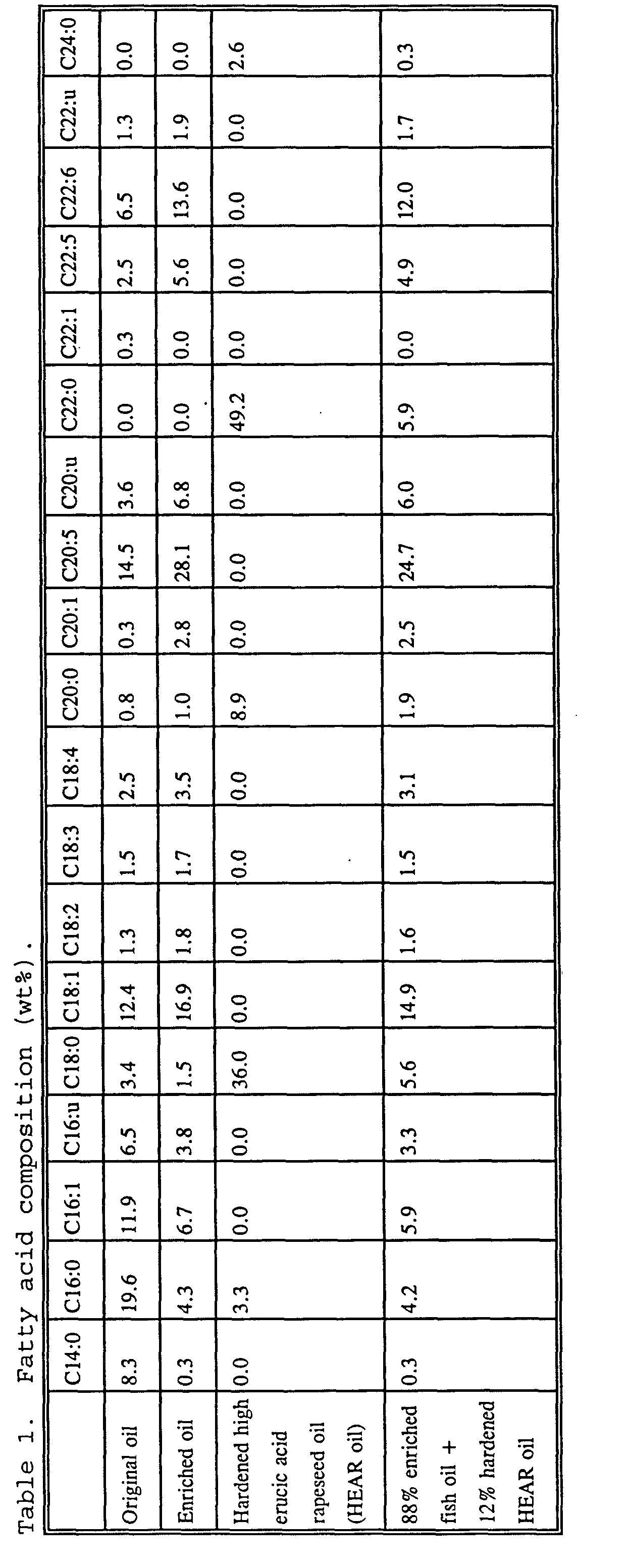
- A fish oil enriched in 20:5 and 22:6 is prepared by reacting menhaden oil (composition given in table 1.) with glycerol in the presence of Pseudomonas cepacia lipase at a temperature of 37°C. The ratio of oil to glycerol is 3 (wt/wt) and the quantity of lipase is 1% by weight on oil. 5% water by weight is present in the glycerol. After 48 hours the reaction is terminated by heating to 100°C and the glycerol is separated from the reaction mixture. The triglycerides are separated from the glyceride fraction by adsorption of the partial glycerides and the free fatty acids (FFA) onto silica, to give the enriched oil of composition shown in table 1. This oil is interesterified with hardened high erucic acid rapeseed oil (composition in table 1.) using a lipase catalyst (Rhizomucor miehei), to give the final product oil with a composition given in table 1. All the above processes are carried out under nitrogen to prevent deterioration of the oil.
- A low temperature solvent fractionation at -70°C was done on semi refined tuna oil with the composition , mentioned in table II, under the conditions as mentioned in "Progress in the chemistry of fats and other lipids" vol. 3 Holman R.T. et al 1995, using 4 L of acetone per Kg tuna oil to enrich the oil in DHA and EPA. After removal of the acetone the olein fraction of the tuna oil (= wf(tuna)f) with the composition, mentioned in table 2, was obtained. This fraction was stored in the freezer under nitrogen.
- All the ingredients for the enzymic interesterification were stored at ambient for at least one hour. All oils were used as liquid oils. To the tuna oil olein fraction 400 ppm of anti-oxidant (BHT) was added.
- The tuna oil olein fraction was divided in different portions. Then the liquid complementary fat was added to each of the tuna oil olein fractions and mixed in. A sample was taken for carbon number and FAME analyses. For the enzymic interesterification a 1,3 specific lipase (Rhizomucor Miehei) was used. The lipase was added to the mixed oils in a weight ratio of 40:1 oil:lipase. A nitrogen blanket was put over the mixture to prevent deterioration of the oil. The reaction mixture was put in a magnetic stirred heatblock and the temperature was adjusted to 60°C. After 96 hours the reaction was stopped.
- The samples were cleaned through an alumina column to remove FFA, mono- and diglycerides. Carbon number and FAME analyses were done via GC on the samples before and after lipase treatment.
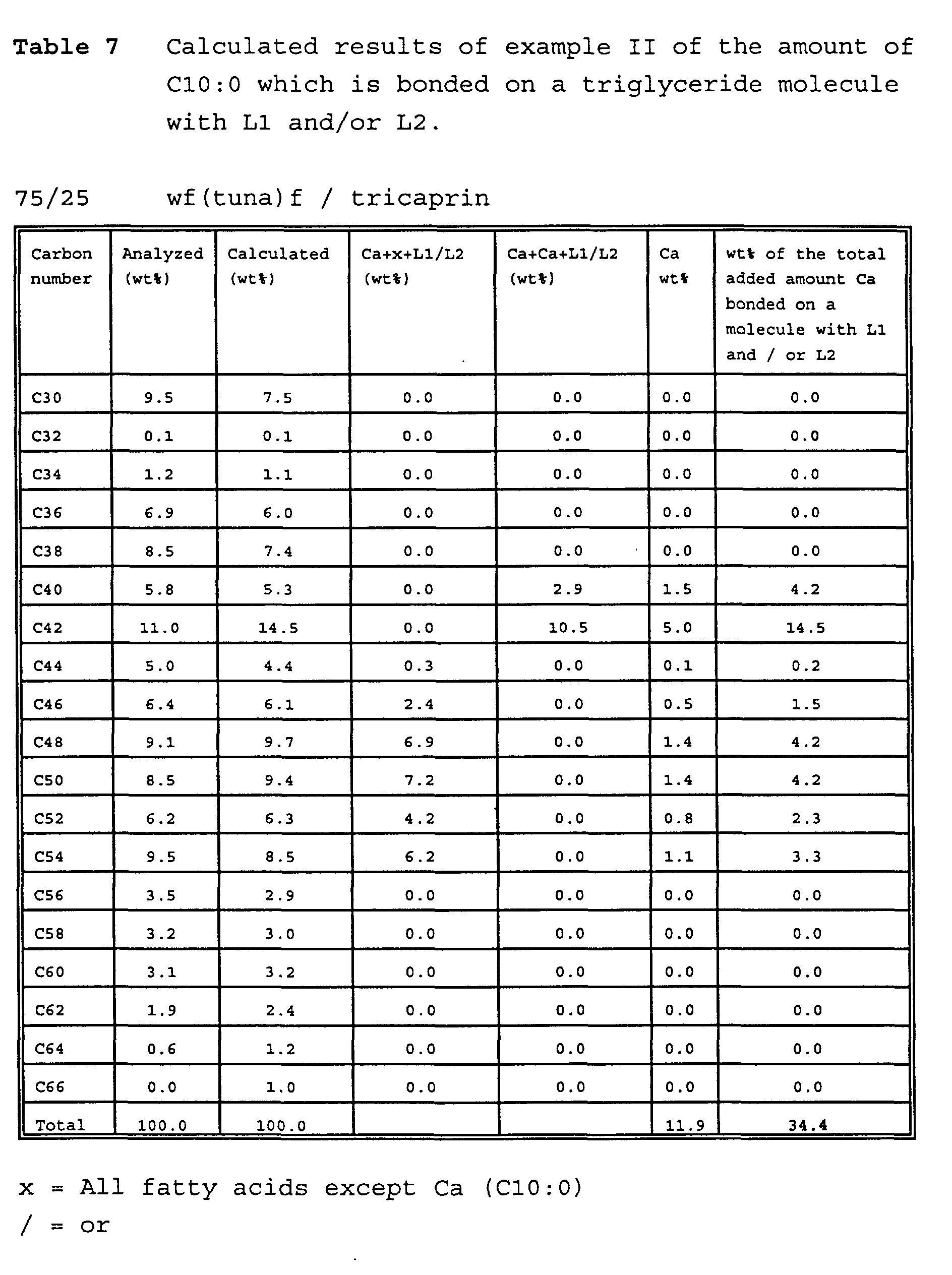
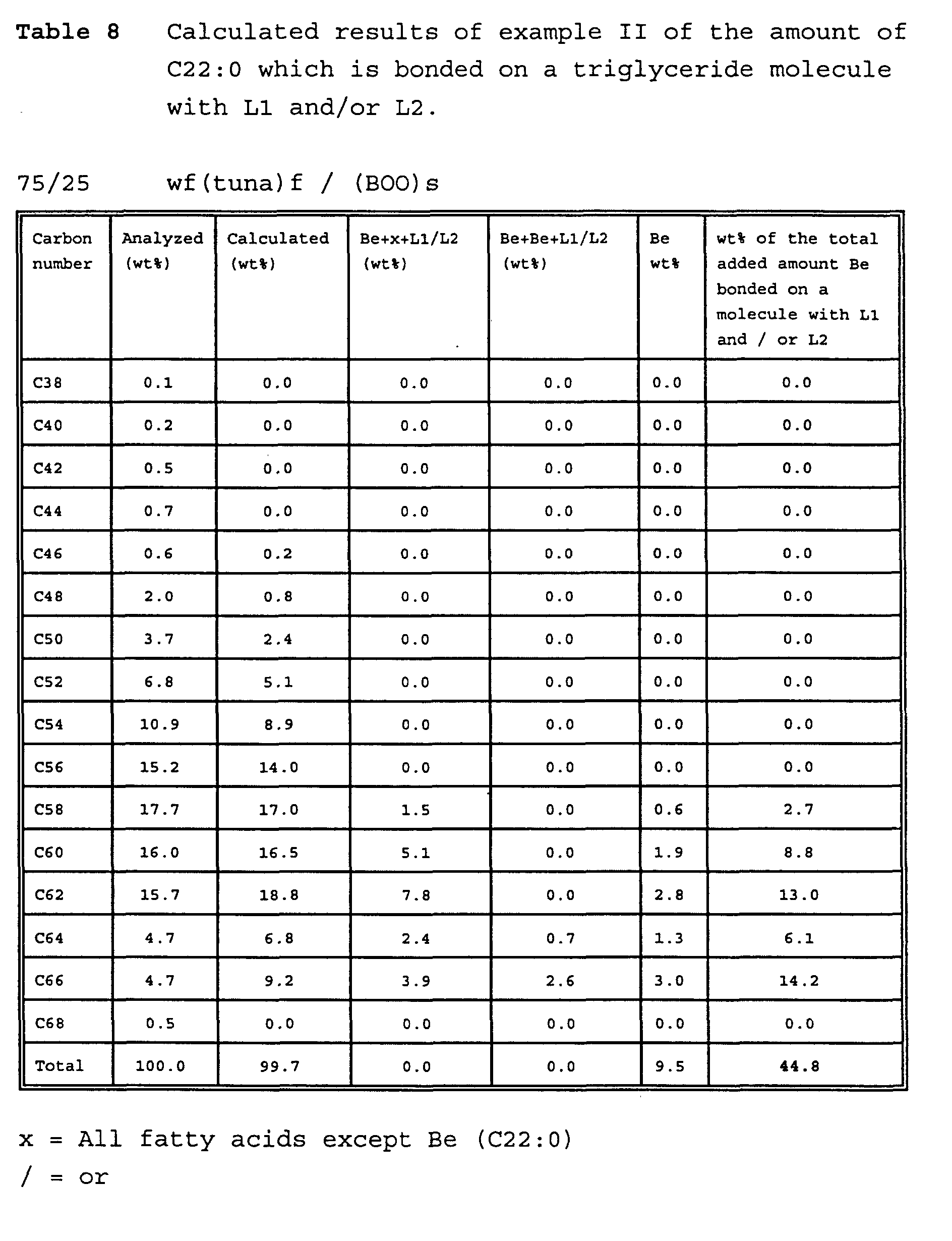
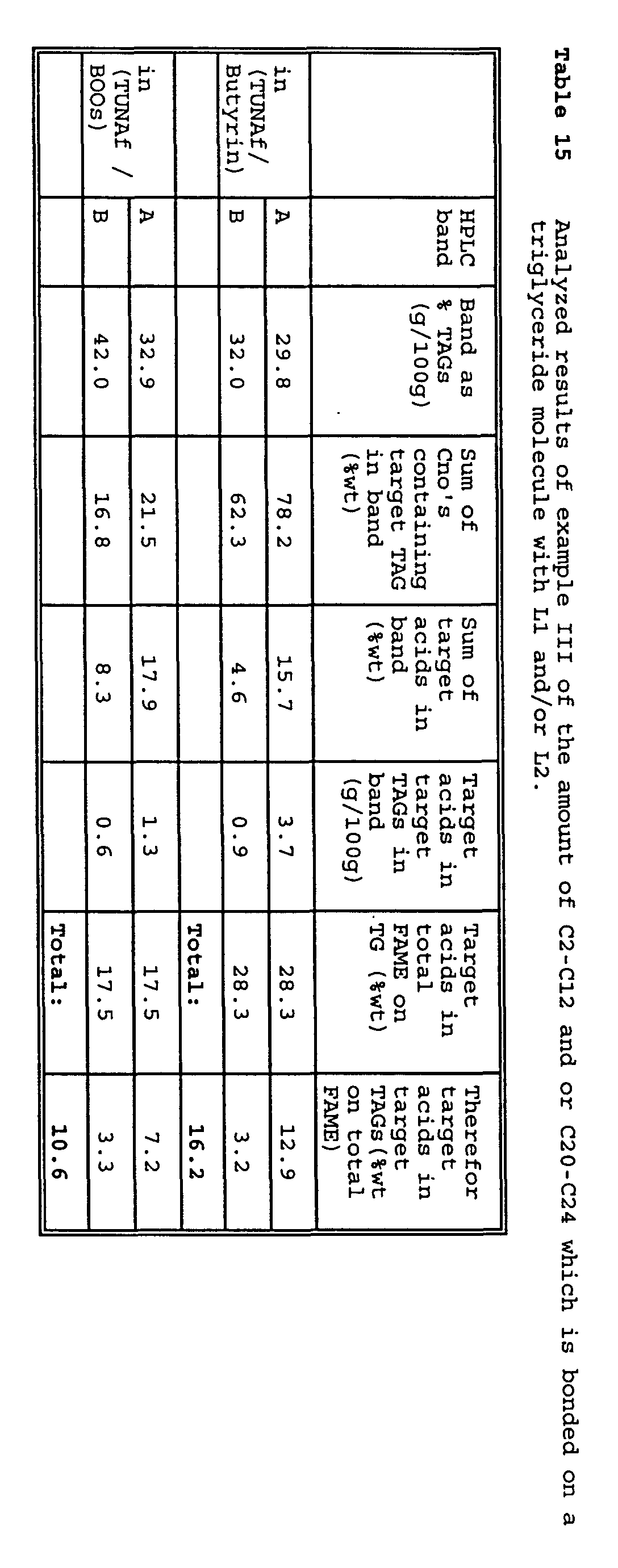
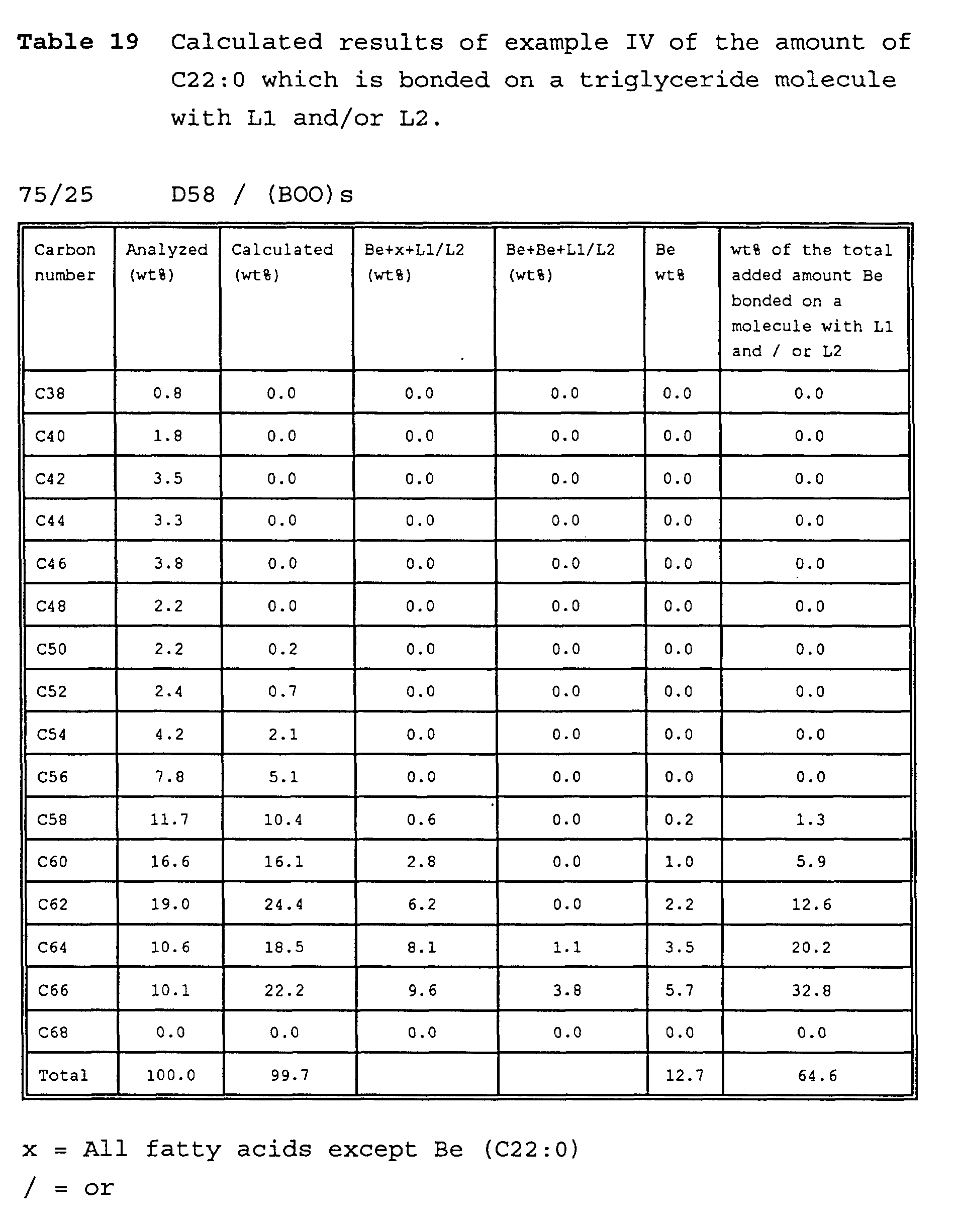
- Two methods were used to prove that at least 5% of the total amount of C2-C12 and/or C20-C24 was bonded on a triglyceride molecule with L1 and/or L2. The first method involves a calculation and gives the maximum amount which is bonded on a triglyceride molecule with L1 and / or L2. The second method which involves an analytical method gives some information about the minimum amount which is bonded on the same triglyceride molecule with L1 and / or L2.
- A statistical programm was used to calculate a carbon number based on the randomized distribution of the fatty acids in a triglyceride molecule. This programm was checked by using the FAME results of a (random) chemical interesterification for a standard interesterified fat mix from palm oil stearin/palm kernel stearin and comparing the calculated carbon number profile with the measured carbon number profile (see table 3). The differences were very small so that it was concluded that the programm gives the correct results. Then the enzymic interesterification according to the invention was tested. The FAME and carbon number of the enzymic interesterified product was measured. The measured carbon number was equated to the calculated carbon number and the differences were very small. Because of this we concluded that the enzymic interesterification resulted in a random distribution of the fatty acids in the triglyceride molecule. In a randomized interesterified product it is possible to calculate the amount of C2-C12 and/or C20-C24 bonded on a triglyceride molecule with L1 and/or L2.
- The second method is an analytical method. Two parts of the sample (Band a and band b) with a certain amount of unsaturation were collected by using Silver-ion HPLC. Band A had about 6 till 9 unsaturations and Band B had 9 till 18 unsaturations. On the triglycerides of the two bands FAME and carbon number analyses were done. From these FAME analyses a carbon number was calculated by using the statistical programm. This carbon number was equated to the measured carbon number. From these analyses and calculations it was possible to calculate the minimum amount of C2-C12 and/or C20-C24 which was bonded on a triglyceride molecule with L1 and/or L2. The actual amount will be even higher because there was more sample than just the two analyzed bands.
- Interesterification experiments were done on the following blends:
75/25 wf(tuna)f / tributyrin 75/25 wf(tuna)f / tricaprin 75/25 wf (tuna) f / (BOO)s 75/25 wf(tuna)f / fhPO (= comparative example) - The composition of tributyrin; tricaprin; (BOO)s and fhPO are given in table 2.
- The experiments were done according to the method described above. The experiments were stopped after 96 hours. The carbon number and FAME of the blends and the interesterified blends were determined. The results of the FAME analyses are listed in table 4 and the results of the carbon number analyses are listed in table 5.
- The results of the calculated amount of C2-C12 and/or C20-C24 which is bonded on a triglyceride molecule with L1 and/or L2 are listed in table 6, 7 and 8. The results of the analyzed amount of C2-C12 and/or C20-C24 which is bonded on a triglyceride molecule with L1 and/or L2 are listed in table 9.
- Interesterification experiments were done on the following blends:
- A: 75/25
- wf(tuna)f / tributyrin
- B: 75/25
- wf(tuna)f / tricaprin
- C: 75/25
- wf(tuna)f / (BOO)s
- D: 75/25
- wf(tuna)f / fhPO (comparative example)
- The tributyrin, tricaprin, (BOO)s and fhPO are the same as in example II (see table 2).
- The experiments were done according to the method described in example II. This tuna olein fraction was alumina treated to remove FFA, mono- and diglycerides, before lipase treatment. After 96 hours the experiments were stopped. The analyses of the reaction mixtures of tributyrin, tricaprin and (BOO)s were done. The results of all these analyses are listed in tables 10 and 11. Part of the reaction mixture was cleaned again by using an alumina column to remove the FFA, mono- and diglycerides and oxidised materials. This cleaned material was mixed in a ratio of 1/99 with a palm oil olein fraction with a bland smell. This was stored at ambient for three days and evaluated by the panel. The results from the panel using the different products obtained were as follows:
The panel was asked to make a ranking of the samples on fish smell.C B A D C B A D C A B D B C A D Least flavour --> Strongest flavour - Everyone in the panel agreed that the product from D was the worst and the others were far better. So the samples according to the invention (A, B and C) were all better than the comparative example (D).
- The results of the calculated amount of C2-C12 and/or C20-C24 which is bonded on a triglyceride molecule with L1 and/or L2 are listed in table 12, 13 and 14. The results of the analyzed amount of C2-C12 and/or C20-C24 which is bonded on a triglyceride molecule with L1 and/or L2 are listed in table 15.
- A fish oil concentrate was made according to the following procedure.
- Tuna oil (200g) was refluxed for 1 hour in an atmosphere of nitrogen with a mixture of 47 g of potassium hydroxide pellets, 260 mls ethanol (96%), and 88 mls deionised water. The saponified mixture was diluted with 500 mls of water and the non-saponifiable matter was extracted with hexane (3 x 100ml). The aqueous layer was neutralised with 500mls of 1 M HCl . The free fatty acids were extracted into hexane (3x 100ml). The hexane was removed by evaporation.
- The fatty acids (100g) were added with stirring to a hot (60°C) solution of 400g of Urea and 800 mls of ethanol. The mixture was stirred for 1 hour before the temperature was reduced by 1°C/ hour to 4°C at which temperature the mixture was held for 16 hours. The mixture was fractionated to remove the stearin fraction. The ethanol was removed from the olein fraction by evaporation. The olein was mixed with 250 mls of hexane and 250 mls of 1 M HCl. The hexane layer was isolated and the aqueous layer washed with a further 100 ml hexane. The hexane was removed by evaporation.
- 47 g of Tuna acids were mixed with approximately 4 g of glycerol and 4 g of Rhizomucor miehei in a jacketed vessel at 55°C with a magnetic stirrer. Nitrogen was allowed to blow over the surface to remove any water produced during the reaction. The reaction was allowed to continue for 10 days until the FFA had been substantially reduced. The product after removal of the enzyme by filtration was stirred at 60°C with 50 g of basic alumina in 100 mls of hexane. The alumina was removed by filtration.
- The free fatty acids were divided into 4 samples which were recombined to triglyceride on 12 to 15 g scale in glass vials at 55°C in a magnetic hot block. Typically 14 g of free fatty acid were mixed with 1.3 g glycerol and 0.7 g Rhizomucor miehei. Nitrogen was allowed to flow over the surface to remove water. The reactions were allowed to continue for 1 week. 50 g of product, after removal of the enzyme by filtration, was stirred at 60°C with 270 g of basic alumina in 100 mls of hexane. The alumina was removed by filtration.
- The oil from "Recombination to triglycerides" batch 1 was called D58.
- Interesterification experiments were done on the following blends:
75/25 fish oil concentrate (= D58) / tricaprin 75/25 fish oil concentrate (= D58) / (BOO)s - The interesterification experiments were done according to the method of example II.
- The interesterification experiments of the fish oil concentrate and the tricaprin and (BOO)s were stopped after 115 hours. The FAME and carbon number analysis were done, the results are listed in table 16 and 17.
- The results of the calculated amount C2-C12 and/or C20-C24 which is bonded on a triglyceride molecule with L1 and/or L2 of these samples are listed in table 18 and 19.
- The interesterification experiments were done according to the method of example II. This time the interesterification reactions were stopped after 46 hours.
- The two following interesterified blends were used :
70 / 30 wf(TUNA)f (= D40) / Tributyrin 70 / 30 wf(TUNA)f (= D40) / (BOO)s - The FAME and carbon numbers of these interesterified mixtures are listed in table 20 and 21.
- D40 being a tuna oil olein fraction, obtained by low temperature solvent fractionation, having about 38 wt % of DHA.
- Blends were made of the two interesterified mixtures (= in(FISH)) and a complementary fat / fat blend for the following applications:
Application Reference Blends inside the patent Chocolate Cocoa butter Cocoa butter/in(FISH) 99/1 Bakery POf37/df(PO)f 40/60 POf37/df(PO)f/in(FISH) 40/50/10 Ice cream coatings Coconut oil CN/CNs/in(FISH) 90/5/5 Ice cream PO PO/in(FISH) 90/10 Non dairy creams nPOm/df(PO)f 40/60 nPOm/df(PO)f/in (FISH) 40/40/20 Health margarines / Health spreads HS1/SF 13/87 HS1/SF/in(FISH) 13/77/10 Confectionery fillings nPOm/df(PO)f 60/40 nPOm/df(PO)f/in (FISH) 60/20/20 Mayonnaise / Sauces SF SF/in(FISH) 90/10 Dressings SF SF/in(FISH) 90/10 - The range of N-values of the references and measured N-values for the blends are listed in table 22a and 22b.
- Range style dressings were made according to the following recipe:
wt% Liquid oil 25.0 Maltodextrin 20.0 Dried egg yolk 0.8 Xanthum gum 0.4 Vinegar 5.0 Water 44.8 - In above recipe three different liquid oils were applied. The liquid oil for the reference was Sunflower oil and the liquid oils according to the invention were as follows:
- Sunflower oil / in(D40/tributyrin) 90/10
- Sunflower oil / in(D40/(BOO)s) 90/10
- The FAME results of the in(D40/tributyrin) and the in (D40/(BOO)s) are listed in table 20. Results of the NMR measurements of the two blends according to the invention are listed in table 22b.
- A large batch of aqueous phase was manufactured and used for all the dressings. The water and maltodextrin were first blended using a Silverson mixer. The egg yolk, xanthum gum and vinegar were sequentially added whilst continuing to stir with the Silverson until complete mixing had occurred. At this stage the pH = 3.25, therefore no further adjustment to the pH was made.
- The oils were slowly added to the aqueous phase whilst mixing using the Silverson. Mixing was continued until all the oil had been dispersed. The dressings were transferred to 200 ml plastic sterile bottles.
- The viscosities of the samples were determined using a Brookfield Viscometer fitted with a number 4 spindle rotating at 10 rpm. The samples were contained in identical 200 ml plastic bottles hence the viscosities are directly comparable with each other. For each sample the avarage of three measurements was taken with the sample being allowed to relax for 1 minute between each 1 minute of shear. The viscosity results of the dressings are listed in table 23.
- The oil droplet size distribution was determined using a Malvern Mastersizer using a 45 mm filter. The results of these measurements, as Sauter-mean particle diameter are listed in table 23.
- Spreads were made according to the following recipe:
Fat Phase Fat Blend 40 % Hymono 7804 0.3 % Colour (2% β-carotene) 0.02 % Total 40.32 % Aqueous Phase (to pH 5.1) Water 56.44 % Skimmed Milk Powder 1.5 % Gelatin (270 bloom) 1.5 % Potassium Sorbate 0.15 % Citric Acid Powder 0.07 % Total 59.66 % - In above recipe three different fat blends were applied. The fat blend for the reference was HS1 / Sunflower oil 13/87 and the fat blends according to the invention were as follows:
- HS1 / Sunflower oil / in(D40/tributyrin) 13/77/10
- HS1 / Sunflower oil / in(D40/(BOO)s) 13/77/10
- The FAME results of the in(D40/tributyrin) and the in(D40/(BOO)s) are listed in table 20. Results of the NMR measurements of the two blends according to the invention are listed in table 22a.
- The spreads were processed according to the following procedure: 2 kg of material was prepared and processed.
- A micro-votator processing line was set up as follows:
Premix conditions Stirrer Speed 60 rpm Temperature 50°C pump Proportioning pump set at 60% (30 g/min.). A1 conditions Shaft speed 1000 rpm Temperature set at 8°C C1 conditions Shaft speed 1000 rpm Temperature set to 10°C A2 conditions Shaft Speed 1000 rpm Temperature set to 10°C C2 conditions Shaft speed 1000 rpm Temperature set to 13°C - The aqueous phase was prepared by heating the required amount of water to approximately 80°C and then, using a silverson mixer, slowly mixing in the ingredients. The pH of the system was adjusted to 5.1 by adding 20% Lactic acid solution as required.
- A premix was prepared by stirring the fat phase in the premix tank and then slowly adding in the aqueous phase. When addition was complete, the mix was stirred for a further 5 minutes before pumping through the line. When the process had stabilised (around 20 minutes), product was collected for storage and evaluation.
- The typical process conditions were as follows:
Sample A1 Exit (°C) C1 Exit (°C) A2 Exit (°C) C2 Exit (°C) Line Pressure (bar) Reference 13.2 18.7 13.6 15.6 0.5 to 2 HS1/SF/in(D40/tributyrin) 13/77/10 13.2 19.5 13.8 15.6 1 to 3.4 HS1/SF/in(D40/(BOO)s) 13/77/10 12.3 19.1 13.8 15.5 1.2 to 3.5 - For all three systems, very good oil continuous low fat spreads were produced using this system.
- Evaluations were done on C-value and on conductivity. The C-value in g/cm2 of the spreads was measured by using a cone penetrometer. The conductivity in µ siemens/cm was measured by using a Wayne Kerr.
20°C Sample C-value Conductivity Reference 190 10-5 HS1/SF/in(D40/tr ibutyrin) 180 10-5 HS1/SF/in(D40/(BOO)s) 180 10-5 - All samples spread very easily on grease-proof paper, with no obvious signs of water loss.
- Ice cream was made according to the following recipe:
wt% Fat blend 10.0 Skimmed milk powder 10.0 Icing sugar 12.0 Corn syrup solids 4.0 Dextrose monohydrate 2.0 Sherex IC 9330® 0.6 Water 61.4 Total 100.0 - Sherex IC 9330® is a product from Quest International and comprises mono- and diglycerides admixed with different stabilizers.
In above recipe three different fat blends were applied. The fat blend for the reference was PO / Sunflower oil 90/10 and the fat blends according to the invention were as follows: - PO / in(D40/tributyrin) 90/10
- PO / in(D40/(BOO)s) 90/10
- The FAME results of the in(D40/tributyrin) and the in(D40/(BOO)s) are listed in table 20. Results of the NMR measurements of the two blends according to the invention are listed in table 22a.
- All ingredients except the water and the fat were mixed. Then the cold water was added to this mixture. This mixture was heated in a water bath till a temperature of 70°C. Then the fully liquid palm oil was added to the mixture while "stirred" in the ultra-turrax. This emulsion was cooled in a water bath at 20°C untill a temperature of 30°C was reached. The emulsion was stirred in the ultra-turrax again. The batch ice cream machine was held for 24 hours at -28°C prior to use. The emulsion was placed in the batch ice cream machine and stirred for 15 minutes. The resulting ice cream was stored at -20°C for 24 hours and then evaluated.
- The viscosity of the ice cream emulsion, prior to freezing was measured. The overrun and hardness were determined. The viscosity was measured by using the Haake viscometer. Hardness was measured by using a Stevens texture analyser with a 45° cone at a speed of 0.5 mm/second till a deepness of 2 mm.
Sample Overrun (%) Hardness (gram) Reference 31.5 142 PO / in(D40 /tributyrin) 31.5 148 PO / in(D40 /(BOO)s) 36.7 185 - The viscosities of the emulsions were similar.
FAME data for the components used FAME Semi refined tuna oil wf(TUNA) f Tributyrin Tricaprin (BOO)s fhPO C4:0 0.0 0.0 99.0 0.0 0.0 0.0 C10:0 0.0 0.0 0.0 99.7 0.0 0.0 C12:0 0.1 0.0 0.0 0.3 0.0 0.3 C12:othe 0.0 0.0 0.0 0.0 0.0 0.0 C14:0 3.5 1.7 0.0 0.0 0.1 1.0 C14:othe 1.6 0.3 0.0 0.0 0.0 0.0 C16:0 20.8 3.1 0.0 0.0 1.9 41.7 C16:1 5.4 7.6 0.0 0.0 0.0 0.0 C16:othe 4.7 3.2 0.0 0.0 0.0 0.0 C18:0 6.1 0.6 0.0 0.0 3.1 54.6 C18:1 14.8 16.1 0.0 0.0 29.0 1.5 C18:2 1.2 3.1 0.0 0.0 2.3 0.2 C18:3 0.7 0.9 0.0 0.0 0.0 0.0 C18:othe 1.9 1.7 0.0 0.0 0.0 0.0 C20:0 0.4 0.0 0.0 0.0 3.4 0.5 C20:1 1.1 1.1 0.0 0.0 0.1 0.0 C20:2 0.0 0.2 0.0 0.0 0.0 0.0 C20:3 0.0 0.0 0.0 0.0 0.0 0.0 C20:4 0.0 0.0 0.0 0.0 0.0 0.0 C20:5 5.1 12.0 0.0 0.0 0.0 0.0 C20:othe 3.1 4.0 0.0 0.0 0.0 0.0 C22:0 0.0 0.0 0.0 0.0 58.5 0.1 C22:1 0.3 0.0 0.0 0.0 0.1 0.0 C22:5 1.5 2.1 0.0 0.0 0.0 0.0 C22:6 24.8 39.6 0.0 0.0 0.0 0.0 C22:othe 2.9 2.8 0.0 0.0 0.0 0.0 C24:0 0.0 0.0 0.0 0.0 1.5 0.1 Others 0.0 0.0 1.0 0.0 0.0 0.0 Total 100.0 100.0 100.0 100.0 100.0 100.0 Programm check on chemical interesterification. wfPOs/PKs (blend) in(wfPOs/PKs) Calculated by statistica l programm FAME C8:0 (%) 0.6 0.6 C10:0 (%) 1.1 1.1 C12:0 (%) 22.5 22.5 C14:0 (%) 10.0 9.9 C16:0 (%) 50.2 50.5 C17:0 (%) 0.1 0.1 C18:0 (%) 40.3 4.3 C18:1 (%) 9.9 10.0 C18:2 (%) 0.6 0.7 C20:0 (%) 0.3 0.3 C22:0 (%) 0.1 0.0 Carbon number C28 0.1 0.0 0.0 C30 0.2 0.0 0.0 C32 1.4 0.4 0.2 C34 2.7 0.7 0.4 C36 11.5 3.3 2.5 C38 10.4 4.2 3.4 C40 6.4 12.7 11.4 C42 4.1 12.3 11.7 C44 2.4 21.9 22.1 C46 3.7 17.0 17.8 C48 30.5 15.5 17.0 C50 21.7 9.0 10.2 C52 3.8 2.5 2.9 C54 1.1 0.4 0.3 C56 0.1 0.1 0.0 C58 0.1 0.0 0.0 
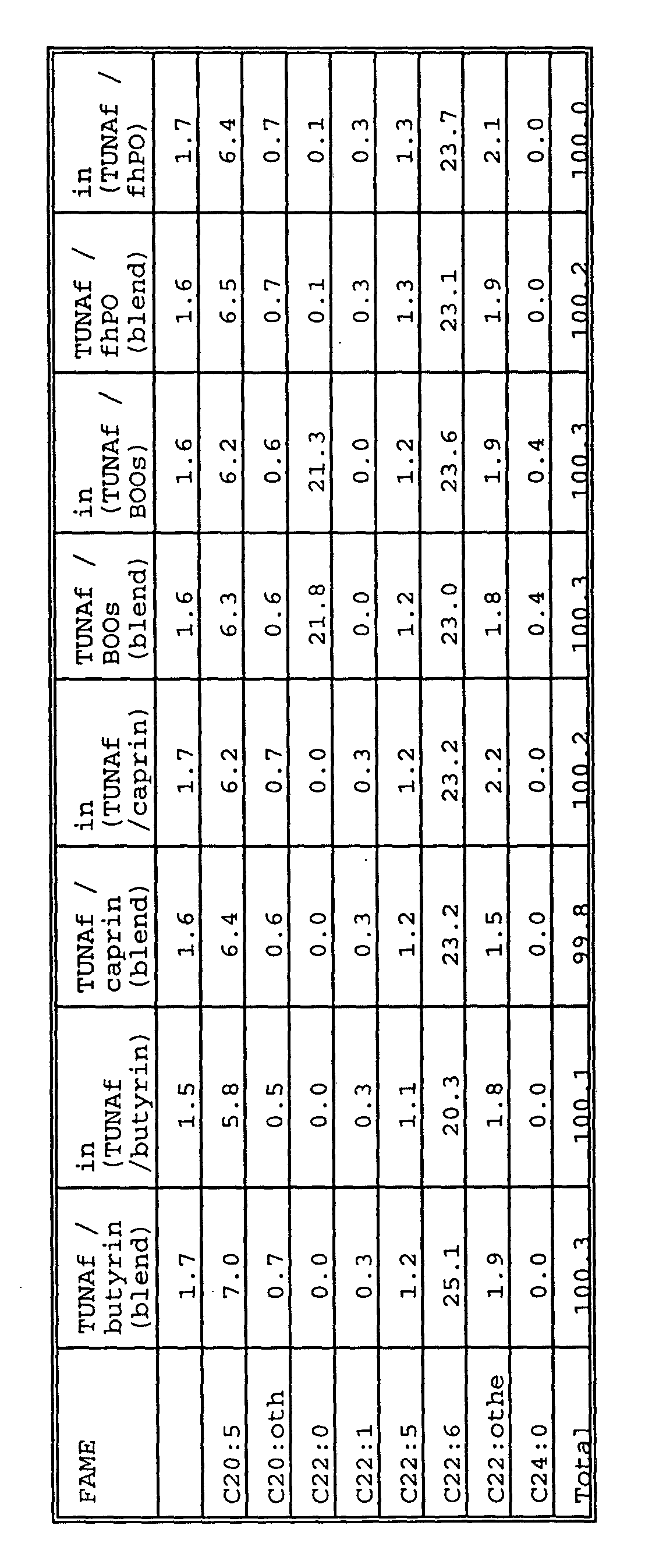
Carbon number results Carbon number TUNAf/butyrin (blend) in(TUNAf/butyrin) TUNAf/caprin (blend) in(TUNAf/caprin) TUNAf/BOOs (blend) in(TUNAf/BOOs) TUNAf/fhPO (blend) in(TUNAf/fhPO) C12 19.9 11.0 0.0 0.0 0.0 0.0 0.0 0.0 C20 0.0 0.1 0.0 0.0 0.0 0.0 0.0 0.0 C22 0.0 2.7 0.0 0.0 0.0 0.0 0.0 0.0 C24 0.0 12.7 0.0 0.0 0.0 0.0 0.0 0.0 C26 0.0 11.2 0.0 0.0 0.0 0.0 0.0 0.0 C28 0.0 6.7 0.0 0.0 0.0 0.0 0.0 0.0 C30 0.0 6.0 37.6 9.5 0.0 0.0 0.0 0.0 C32 0.0 0.2 0.2 0.1 0.0 0.0 0.0 0.0 C34 0.2 0.7 0.1 1.2 0.0 0.0 0.0 0.0 C36 0.4 2.2 0.1 6.9 0.2 0.0 0.0 0.0 C38 0.7 3.8 0.3 8.5 0.4 0.1 0.0 0.0 C40 1.2 5.6 0.5 5.8 0.7 0.2 0.0 0.0 C42 1.4 7.1 0.7 11.0 1.1 0.5 0.0 0.0 C44 1.2 6.3 0.7 5.0 0.9 0.7 0.0 0.2 C46 1.4 4.7 0.9 6.4 0.7 0.6 0.2 0.6 C48 1.9 6.7 1.4 9.1 1.9 2.0 3.2 2.9 C50 4.0 1.6 3.1 8.5 3.7 3.7 14.9 10.2 C52 6.9 1.4 5.3 6.2 5.5 6.8 18.6 16.2 C54 11.0 1.9 8.7 9.5 9.3 10.9 13.5 18.7 C56 14.0 2.3 11.2 3.5 12.8 15.2 11.6 16.6 C58 14.5 2.2 11.1 3.2 19.1 17.7 12.4 14.3 C60 12.5 1.9 10.3 3.1 15.5 16.0 13.4 10.1 C62 7.1 1.0 6.2 1.9 25.2 15.7 12.1 10.2 C64 1.7 0.0 1.6 0.6 2.1 4.7 0.0 0.0 C66 0.0 0.0 0.0 0.0 0.9 4.7 0.0 0.0 C68 0.0 0.0 0.0 0.0 0.0 0.5 0.0 0.0 Total 100.0 100.0 100.0 100.0 100.0 100.0 99.9 100.0 
Analyzed results of example II of the amount of C2-C12 and or C20-C24 which is bonded on a triglyceride molecule with L1 and/or L2. HPLC band Band as % TAGs (g/100g) Sum of Cno's containing target TAG in band (%wt) Sum of target acids in band (%wt) Target acids in target TAGs in band (g/100g) Target acids in total FAME on TG (%wt) Therefore target acids in target TAGs(%wt on total FAME) in(TUNAf /Butyrin) A 21.9 79.8 20.2 3.5 36.7 9.6 B 19.5 62.8 5.9 0.7 36.7 2.0 Total: 11.6 in(TUNAf/Caprin) A 28.3 92.0 28.9 7.5 34.5 21.8 B 26.5 56.6 21.1 1.8 34.5 5.3 Total: 27.1 in(TUNAf/BOOs) A 34.2 15.3 21.5 1.1 21.3 4.9 B 32.0 10.0 8.4 0.3 21.3 1.2 Total: 6.1 FAME results example III FAME TUNAf/butyrin (blend) in(TUNAf/butyrin ) TUNAf/caprin (blend) in(TUNAf/caprin) TUNAf/BOOs (blend) in(TUNAf/BOOs) in(TUNA f/fhPO) C4:0 27.6 28.3 0.0 0.0 0.0 0.0 0.0 C10:0 0.0 0.0 29.7 28.5 0.0 0.0 0.0 C12:0 0.0 0.0 0.1 0.1 0.1 0.1 0.1 C12:other 0.4 0.3 0.1 0.1 0.1 0.1 0.1 C14:0 1.5 1.5 1.4 1.4 1.4 1.5 1.8 C14:other 0.5 0.4 0.5 0.5 0.5 0.5 0.6 C16:0 2.7 2.7 2.5 2.5 3.1 3.2 14.8 C16:1 5.2 5.2 5.1 5.0 5.0 5.1 5.2 C16:other 2.5 2.7 2.3 2.5 2.5 2.5 2.6 C18:0 0.3 0.4 0.3 0.3 1.2 1.2 17.3 C18:1 11.4 11.4 11.1 11.0 19.9 20.5 12.1 C18:2 1.3 1.3 1.3 1.3 2.0 2.0 1.4 C18:3 0.7 0.7 0.7 0.7 0.7 0.7 0.7 C18:other 2.1 2.0 1.9 2.0 1.9 1.9 1.8 C20:0 0.0 0.0 0.0 0.0 0.9 0.9 0.2 C20:1 0.7 0.7 0.7 0.7 0.8 0.8 0.8 C20:2 0.2 0.2 0.2 0.2 0.2 0.2 0.2 C20:3 0.2 0.2 0.2 0.2 0.3 0.3 0.2 C20:4 1.8 1.8 1.8 1.8 1.8 1.7 1.7 C20:5 8.2 7.9 8.0 8.0 8.1 7.6 7.5 C20:other 0.9 0.9 0.9 0.9 0.9 0.9 0.7 C22:0 0.0 0.0 0.0 0.0 16.4 17.5 0.0 C22:1 0.2 0.2 0.2 0.3 0.0 0.0 0.3 C22:5 1.4 1.3 1.3 1.3 1.5 1.4 1.3 C22:6 28.1 28.3 27.6 28.9 28.5 27.4 26.6 C22:other 1.9 1.9 1.9 1.9 1.9 1.9 1.8 C24:0 0.0 0.0 0.0 0.0 0.3 0.3 0.0 Total 99.8 100.3 99.8 100.1 100.0 100.2 99.8 Carbon number results example III Carbon number TUNAf/butyrin (blend) in(TUNAf/butyrin) TUNAf/caprin (blend) in(TUNAf/caprin) TUNAf/BOOs (blend) in(TUNAf/BOOs) in(TUNA f/fhPO) C12 16.6 6.7 0.0 0.0 0.0 0.0 0.0 C20 0.0 0.1 0.0 0.0 0.0 0.0 0.0 C22 0.0 1.4 0.0 0.0 0.0 0.0 0.0 C24 0.0 6.3 0.0 0.0 0.0 0.0 0.0 C26 0.0 9.4 0.0 0.0 0.0 0.0 0.0 C28 0.0 6.1 0.0 0.0 0.0 0.0 0.0 C30 0.0 7.3 30.0 4.7 0.0 0.0 0.0 C32 0.0 0.2 0.2 0.1 0.0 0.0 0.0 C34 0.0 0.4 0.1 0.9 0.0 0.0 0.0 C36 0.0 1.7 0.2 4.2 0.0 0.0 0.1 C38 0.1 3.5 0.0 6.1 0.0 0.0 0.1 C40 0.2 5.9 0.0 5.0 0.2 0.1 0.2 C42 0.3 8.0 0.0 9.3 0.4 0.4 0.4 C44 0.4 8.1 0.1 4.3 0.4 0.5 0.6 C46 0.9 6.2 0.3 6.2 0.7 0.8 1.3 C48 1.1 11.0 0.6 9.3 1.0 1.6 3.9 C50 3.1 0.9 2.3 9.7 2.9 3.6 9.7 C52 5.8 1.2 4.7 7.6 5.3 7.2 14.9 C54 10.1 2.1 8.3 11.5 9.0 11.5 17.7 C56 14.3 3.0 12.4 4.9 13.6 16.4 17.5 C58 16.5 3.6 14.4 4.9 20.5 19.4 13.1 C60 14.9 3.6 13.8 5.2 16.1 17.3 10.7 C62 11.0 2.9 8.6 4.4 25.5 15.6 7.0 C64 3.4 0.4 3.5 1.7 3.5 3.9 2.3 C66 1.3 0.0 0.5 0.0 0.9 1.7 0.5 C68 0.0 0.0 0.0 0.0 0.0 0.0 0.0 Total 100.0 100.0 100.0 100.0 100.0 100.0 100.0 


FAME results example IV FAME D58 in(D58 / caprin) in(D58 / (BOO)s) C10:0 0.0 29.1 0.0 C12:0 0.0 0.1 0.0 C12:other 0.0 0.1 0.0 C14:0 0.1 0.1 0.1 C14:other 0.5 0.3 0.3 C16:0 0.1 0.3 0.7 C16:1 1.0 0.9 0.7 C16:other 3.4 2.7 2.5 C18:0 0.2 0.4 1.1 C18:1 0.9 1.2 10.4 C18:2 1.8 1.7 2.2 C18:3 0.8 0.6 0.5 C18:other 3.5 2.4 2.2 C20:0 0.0 0.1 1.1 C20:1 0.1 0.1 0.1 C20:2 0.0 0.0 0.0 C20:3 0.4 0.4 0.4 C20:4 4.6 3.3 3.3 C20:5 16.1 10.8 10.4 C20:other 1.4 1.1 1.0 C22:0 0.0 0.1 19.7 C22:1 0.1 0.0 0.0 C22:5 2.0 1.3 1.4 C22:6 57.3 39.8 37.4 C22:other 5.6 3.5 4.1 C24:0 0.0 0.0 0.4 Total 99.9 100.4 100.0 Carbon number results example IV Carbon number D58 / caprin (blend) in(D58 / caprin) D58 / (BOO)s (blend) in(D58 / (BOO)s) C30 43.0 10.4 0.0 0.0 C32 0.5 0.7 0.0 0.0 C34 0.5 1.6 0.0 0.0 C36 0.4 2.2 0.0 0.0 C38 0.1 2.9 0.0 0.8 C40 0.2 9.3 0.3 1.8 C42 0.2 19.4 1.0 3.5 C44 0.7 2.3 0.8 3.3 C46 0.7 2.9 1.1 3.8 C48 0.5 5.0 1.0 2.2 C50 1.3 7.5 1.7 2.2 C52 0.9 10.6 1.5 2.4 C54 2.3 14.0 2.6 4.2 C56 4.1 1.4 5.9 7.8 C58 7.3 1.8 17.0 11.7 C60 9.9 2.8 15.8 16.6 C62 12.2 3.1 39.0 19.0 C64 9.0 2.1 7.9 10.6 C66 6.2 0.0 4.4 10.1 C68 0.0 0.0 0.0 0.0 Total 100.0 100.0 100.0 100.0 
FAME results of the interesterified mixtures used for the blends. Fatty Acid Composition (wt%) D40 tributyrin/D40 (BOO)s/D40 C4:0 0.0 30 0 C14:0 3.7 3 3 C14unsat/C15 1.1 0 1 C16:0 6.7 0 4 C16:1 4.3 5 3 C16unsat/C17 0.0 6 4 C18:0 2.4 2 3 C18:1 15.6 11 18 C18:2 1.2 1 2 C18:3 0.8 0 0 C18:4 1.4 1 1 Other C18 0.4 0 1 C20:0 0.1 0 1 C20:1 2.0 1 2 C20:2 0.0 0 0 C20:3 0.0 0 0 C20:4 0.0 1 1 C20:5 7.2 5 5 Other C20 1.8 1 0 C22:0 0.0 0 21 C22:1 2.7 2 1 C22:5 4.1 3 3 C22:6 38.4 27 24 Other C22 2.0 1 2 Carbon number results of the interesterified mixtures used for the blends. Carbon Number tributyrin/D40 (BOO)s/D40 0-time 46 hours 0-time 46 hours C12 30.0 7.7 0.0 0.0 C20 0.0 0.1 0.0 0.0 C22 0.0 2.0 0.0 0.0 C24 0.0 7.4 0.0 0.0 C26 0.0 8.0 0.0 0.0 C28 0.0 6.2 0.0 0.0 C30 0.0 13.1 0.0 0.0 C32 0.0 1.2 0.0 0.0 C34 0.0 1.2 0.0 0.0 C36 0.0 1.6 0.0 0.0 C38 0.0 3.3 0.0 0.0 C40 0.0 5.6 0.0 0.0 C42 0.3 6.5 0.3 0.4 C44 1.9 9.4 0.7 1.6 C46 2.0 5.9 2.6 2.0 C48 1.6 8.8 2.4 1.7 C50 2.8 1.7 3.4 3.5 C52 5.1 1.1 5.8 5.7 C54 9.3 1.6 8.8 10.3 C56 9.9 1.6 11.6 13.9 C58 11.8 2.0 17.6 17.7 C60 11.2 2.0 13.7 14.9 C62 9.2 1.6 27.0 18.2 C64 2.7 0.3 4.2 5.2 C66 2.2 0.0 1.9 4.5 C68 0.0 0.0 0.0 0.4 N-values of the blends. Application Blend N-5 n.s. (%) N-10 n.s. (%) N-20 n.s. (%) N-35 n.s. (%) Chocolate Typical values 85 - 95 80 - 95 55 - 65 < 1 99/1 CCB / in(D40/butyrin) 88.2 85.6 59.0 0.1 99/1 CCB / in(D40/(BOO)s) 89.3 85.9 59.5 0.0 Bakery Typical values 40 - 80 30 - 75 20 - 45 < 15 40/50/10 POf37 / dfPOf / in(D40/butyrin) 41.9 34.6 21.2 0.1 40/50/10 POf37/ dfPOf / in(D40/(BOO)s) 42.2 37.3 23.4 0.4 Ice cream coatings Typical values 65 - 90 > 35 > 15 < 1 90/5/5 CN / CNs / in(D40/butyrin) 72.3 37.9 31.2 0.2 90/5/5 CN / CNs / in(D40/(BOO)s) 74.7 61.7 34.2 0.0 Ice cream Typical values 40 - 60 15 - 30 < 5 90/10 PO/in(D40/butyrin) 52.9 21.4 3.6 90/10 PO/in(D40/(BOO)s) 52.0 20.8 3.9 Non dairy creams Typical values 1 - 70 0 - 37 0 - 11 40/40/20 nPOm / dfPOf / in(D40/butyrin) 50.1 12.5 0.2 40/40/20 nPOm / dfPOf / in(D40/(BOO)s) 55.4 10.6 0.0 Health margarines/Health spreads Typical values 7 - 20 3 - 12 < 2.5 13/77/10 HS1 / SF / in(D40/butyrin) 14.7 9.6 1.6 13/77/10 HS1 / SF / in(D40/(BOO)s) 17.7 10.6 2.0 N-values of the blends. Application Blend N-5 n.s. (%) N-10 n.s. (%) N-20 n.s. (%) N-35 n.s. (%) Confectionery filling Typical values > 50 > 40 > 25 < 1 60/20/20 nPOm / dfPOf / in(D40/butyrin) 65.8 58.3 31.8 0.1 60/20/20 nPOm / dfPOf / in(D40/(BOO)s) 69.5 61.7 31.3 0.4 Mayonnaise / Sauces Typical values 0 - 10 0 - 5 < 1 < 0.5 90/10 SF/in(D40/butyrin) 0.0 0.0 0.0 0.0 90/10 SF/in(D40/(BOO)s) 0.0 0.7 0.7 0.3 Dressings Typical values 0 - 10 0 - 5 < 1 < 0.5 90/10 SF/in(D40/butyrin) 0.0 0.0 0.0 0.0 90/10 SF/in(D40/(BOO)s) 0.0 0.7 0.7 0.3 Evaluation results of example VII OIL VISCOSITY cP SAUTER MEAN PARTICLE DIAMETER µM Reference 5940 19.30 Sunflower oil / in(D40/tributyrin) 90/10 5633 16.79 Sunflower oil / in(D40/(BOO)s) 90/10 5600 24.53
Claims (14)
- Triglyceride-composition, comprising at least two long chain poly-unsaturated fatty acids L1 and L2, both having at least 3 unsaturations and having at least 20 carbon atoms from which L1 is the most abundant and L2 is the second most abundant, wherein the triglyceride composition contains at least 20 wt% of L1, while the weight ratio L1:L2 is at least 2, and the triglyceride composition also contains at least 2 wt% preferably at least 5 wt%, more preferably at least 15 wt%, most preferably at least 30 wt% of saturated fatty acids with 2-12 and/or 20-24 carbon atoms, whereas the triglyceride composition does not contain more than 10 wt% of saturated fatty acids with 16-18 carbon atoms, while at least 5 wt%, preferably at least 10 wt%, most preferably at least 20 wt% of the saturated C2 -C12 or C20 - C24 fatty acid residues is bonded on a triglyceride molecule, wherein at least L1 and/or L2 is present.
- Triglyceride composition according to claim 1, wherein the amount of L1 is more than 30 wt%, while the weight ratio L1:L2 is at least 3.
- Triglyceride composition according to claims 1 or 2, wherein the amount of L1 is at least 40 wt% and the weight ratio of L1:L2 is at least 3.5.
- Triglyceride composition according to claims 1 - 3, wherein the amount of C16-C18 saturated fatty acids is less than 8 wt%, in particular less than 5 wt%.
- Triglyceride composition according to claims 1 - 4, wherein L1 = DHA (= C22:6).
- Triglyceride composition according to claims 1 - 5, wherein L2 = EPA (= C20:5).
- Triglyceride composition according to claims 1 - 6, wherein L1 = EPA and L2 = DHA.
- Blends of triglycerides comprising:
0.3 - 95 wt% of triglycerides according to claims 1 - 7, and 99.7 - 5 wt% of a complementary fat, having a solid fat index at 10°C (N10) that is either at least 5% more, or at least 5% less than the N10 of the triglycerides according to claims 1 - 7. - Blends of triglycerides, according to claim 8, comprising 5-80 wt%, in particular 20-70 wt% of the triglycerides according to claims 1 - 7, and 95 - 20 wt%, in particular 80-30 wt% of the complementary fat.
- Blends according to claims 8 - 9, wherein the complementary fat has a solid fat content (NMR-pulse; not stabilized) of more than 15 at 20°C, preferably more than 20.
- Blends according to claims 8 - 10, wherein the complementary fat is selected from cocoa butter equivalents, cocoa butter, palm oil or fractions thereof, palmkernel oil or fractions thereof, interesterified mixtures of above fats or fractions or hardened components thereof, or from liquid oil, such as sunflower oil, high oleic sunflower oil, soyabean oil, rapeseed oil, cottonseed oil, safflower oil, high oleic safflower oil, maize oil or MCT oils.
- Blends according to claims 8 - 11, wherein the blend displays a solid fat content (NMR-pulse; not stabilized) of 0-85, preferably 10 - 70, most preferably 20 - 60 at 5°C and less than 30, preferably < 20, most preferably < 5 at 35°C.
- Triglyceride compositions or blends containing them, according to claims 1 - 12, wherein the compositions or the blends contain an effective amount of an oxidation stabilizer, selected from the group consisting of: natural or synthetic tocopherols, BHT, BHA, free radical scavengers, enzymes with anti-oxidant properties.
- Food products, comprising a fat phase, such as spreads, margarine, cream alternative, infant food, chocolate, confectionery, bakery products, sauces, ice-creams, ice-cream coatings, cheese, soups, mayonnaise, dressings, enteral or parental products, wherein the fat phase contains a fat according to claims 1 - 13.
Priority Applications (1)
| Application Number | Priority Date | Filing Date | Title |
|---|---|---|---|
| EP96200999A EP0739589B1 (en) | 1995-04-28 | 1996-04-16 | Triglycerides, rich in Polyunsaturated fatty acids |
Applications Claiming Priority (3)
| Application Number | Priority Date | Filing Date | Title |
|---|---|---|---|
| EP95302942 | 1995-04-28 | ||
| EP95302942 | 1995-04-28 | ||
| EP96200999A EP0739589B1 (en) | 1995-04-28 | 1996-04-16 | Triglycerides, rich in Polyunsaturated fatty acids |
Publications (2)
| Publication Number | Publication Date |
|---|---|
| EP0739589A1 EP0739589A1 (en) | 1996-10-30 |
| EP0739589B1 true EP0739589B1 (en) | 2001-06-13 |
Family
ID=26140141
Family Applications (1)
| Application Number | Title | Priority Date | Filing Date |
|---|---|---|---|
| EP96200999A Expired - Lifetime EP0739589B1 (en) | 1995-04-28 | 1996-04-16 | Triglycerides, rich in Polyunsaturated fatty acids |
Country Status (1)
| Country | Link |
|---|---|
| EP (1) | EP0739589B1 (en) |
Cited By (1)
| Publication number | Priority date | Publication date | Assignee | Title |
|---|---|---|---|---|
| US8304010B2 (en) | 2007-05-15 | 2012-11-06 | Fuji Oil Company, Limited | Structured food products with low content of saturated and trans unsaturated fats |
Families Citing this family (3)
| Publication number | Priority date | Publication date | Assignee | Title |
|---|---|---|---|---|
| US6165518A (en) * | 1996-04-11 | 2000-12-26 | Loders Croklaan B.V. | Free flowing fat compositions |
| ES2428506T3 (en) * | 2004-12-23 | 2013-11-08 | Unilever N.V. | Frozen aerated sweets |
| KR102860846B1 (en) * | 2019-05-22 | 2025-09-16 | 후지세유 가부시키가이샤 | Frozen dessert compositions and frozen dessert chocolates |
Family Cites Families (8)
| Publication number | Priority date | Publication date | Assignee | Title |
|---|---|---|---|---|
| US5151291A (en) * | 1985-12-27 | 1992-09-29 | Nisshin Flour Milling Co., Ltd. | Glycerides of eicosapentaenoic acid, processes for preparing the same and oil and fat products containing the same |
| JPS6387988A (en) * | 1986-10-01 | 1988-04-19 | Nisshin Oil Mills Ltd:The | Oil and fat having excellent digestibility and absorbability |
| DE3722540A1 (en) * | 1987-07-08 | 1989-01-19 | Fresenius Ag | FAT EMULSION, METHOD FOR THEIR PRODUCTION AND THEIR USE |
| DK657689D0 (en) * | 1989-12-22 | 1989-12-22 | Novo Nordisk As | MEDICINE WITH BIOLOGICAL EFFECT ON THE GAS MILK |
| JP3082280B2 (en) * | 1991-04-08 | 2000-08-28 | 不二製油株式会社 | How to reduce calories in food |
| JP2516860B2 (en) * | 1991-10-03 | 1996-07-24 | 工業技術院長 | Method for producing concentrated highly unsaturated fatty acid-containing fats and oils |
| AU673700B2 (en) * | 1993-01-27 | 1996-11-21 | Scotia Holdings Plc | Triglycerides |
| ATE154205T1 (en) * | 1993-04-23 | 1997-06-15 | Loders Croklaan Bv | NUTRITIONAL FATS WITH IMPROVED DIGESTIBILITY |
-
1996
- 1996-04-16 EP EP96200999A patent/EP0739589B1/en not_active Expired - Lifetime
Cited By (1)
| Publication number | Priority date | Publication date | Assignee | Title |
|---|---|---|---|---|
| US8304010B2 (en) | 2007-05-15 | 2012-11-06 | Fuji Oil Company, Limited | Structured food products with low content of saturated and trans unsaturated fats |
Also Published As
| Publication number | Publication date |
|---|---|
| EP0739589A1 (en) | 1996-10-30 |
Similar Documents
| Publication | Publication Date | Title |
|---|---|---|
| US6410078B1 (en) | Triglycerides, rich in polyunsaturated fatty acids | |
| US5756143A (en) | Triglycerides, rich in polyunsaturated fatty acids | |
| Osborn et al. | Structured lipids‐novel fats with medical, nutraceutical, and food applications | |
| EP0862369B1 (en) | Composition based on fish oil | |
| KR100300826B1 (en) | Process for the Preparation of Materials with a High Content of Long Chain Polyunsaturated Fatty Acids | |
| EP2115107B1 (en) | Process for producing a glyceride composition | |
| EP0758199B1 (en) | Ice-cream coating fats | |
| US5908654A (en) | Triglycerides rich in polyunsaturated fatty acids | |
| JPH10508496A (en) | Margarine and fat blend for water-in-oil spreads | |
| JP6854679B2 (en) | Freezing confectionery mix and frozen confectionery using it | |
| JPH10508497A (en) | Method for producing fat mixture and plastic spread containing obtained fat mixture | |
| EP1557090A1 (en) | Fat composition for spread | |
| WO1996037586A1 (en) | Production method for fats with long chain polyunsaturated fatty acids | |
| JP3238658B2 (en) | Oil composition for foaming cream and foaming cream | |
| WO1996037587A1 (en) | Production of materials high in long chain polyunsaturated fatty acids | |
| EP0739591B1 (en) | Triglycerides rich in polyunsaturated fatty acids | |
| CN103781363B (en) | Fat or oil composition | |
| EP0739590B1 (en) | Triglycerides, rich in polyunsaturated fatty acids | |
| EP0739589A1 (en) | Triglyceridus, rich in Polyunsaturated fatty acids | |
| JP3103766B2 (en) | Triglycerides rich in polyunsaturated fatty acids | |
| EP2749175B1 (en) | Hard butter | |
| EP4707364A2 (en) | Fat composition, fat blend and water-in-oil emulsion | |
| Potter et al. | Fats, oils, and related products | |
| CN118317698A (en) | Grease for frozen dessert ingredients | |
| Heldman | Fats, Oils, and Related Products |
Legal Events
| Date | Code | Title | Description |
|---|---|---|---|
| PUAI | Public reference made under article 153(3) epc to a published international application that has entered the european phase |
Free format text: ORIGINAL CODE: 0009012 |
|
| AK | Designated contracting states |
Kind code of ref document: A1 Designated state(s): AT BE CH DE DK ES FR GB GR IE IT LI NL PT SE |
|
| 17P | Request for examination filed |
Effective date: 19960920 |
|
| GRAG | Despatch of communication of intention to grant |
Free format text: ORIGINAL CODE: EPIDOS AGRA |
|
| 17Q | First examination report despatched |
Effective date: 20000904 |
|
| GRAG | Despatch of communication of intention to grant |
Free format text: ORIGINAL CODE: EPIDOS AGRA |
|
| GRAH | Despatch of communication of intention to grant a patent |
Free format text: ORIGINAL CODE: EPIDOS IGRA |
|
| GRAH | Despatch of communication of intention to grant a patent |
Free format text: ORIGINAL CODE: EPIDOS IGRA |
|
| GRAA | (expected) grant |
Free format text: ORIGINAL CODE: 0009210 |
|
| AK | Designated contracting states |
Kind code of ref document: B1 Designated state(s): AT BE CH DE DK ES FR GB GR IE IT LI NL PT SE |
|
| PG25 | Lapsed in a contracting state [announced via postgrant information from national office to epo] |
Ref country code: LI Free format text: LAPSE BECAUSE OF FAILURE TO SUBMIT A TRANSLATION OF THE DESCRIPTION OR TO PAY THE FEE WITHIN THE PRESCRIBED TIME-LIMIT Effective date: 20010613 Ref country code: CH Free format text: LAPSE BECAUSE OF FAILURE TO SUBMIT A TRANSLATION OF THE DESCRIPTION OR TO PAY THE FEE WITHIN THE PRESCRIBED TIME-LIMIT Effective date: 20010613 Ref country code: AT Free format text: LAPSE BECAUSE OF FAILURE TO SUBMIT A TRANSLATION OF THE DESCRIPTION OR TO PAY THE FEE WITHIN THE PRESCRIBED TIME-LIMIT Effective date: 20010613 |
|
| REF | Corresponds to: |
Ref document number: 201960 Country of ref document: AT Date of ref document: 20010615 Kind code of ref document: T |
|
| RTI1 | Title (correction) |
Free format text: TRIGLYCERIDES, RICH IN POLYUNSATURATED FATTY ACIDS |
|
| REF | Corresponds to: |
Ref document number: 69613271 Country of ref document: DE Date of ref document: 20010719 |
|
| REG | Reference to a national code |
Ref country code: IE Ref legal event code: FG4D |
|
| NLR4 | Nl: receipt of corrected translation in the netherlands language at the initiative of the proprietor of the patent | ||
| ITF | It: translation for a ep patent filed | ||
| PG25 | Lapsed in a contracting state [announced via postgrant information from national office to epo] |
Ref country code: SE Free format text: LAPSE BECAUSE OF FAILURE TO SUBMIT A TRANSLATION OF THE DESCRIPTION OR TO PAY THE FEE WITHIN THE PRESCRIBED TIME-LIMIT Effective date: 20010913 Ref country code: DK Free format text: LAPSE BECAUSE OF FAILURE TO SUBMIT A TRANSLATION OF THE DESCRIPTION OR TO PAY THE FEE WITHIN THE PRESCRIBED TIME-LIMIT Effective date: 20010913 |
|
| PG25 | Lapsed in a contracting state [announced via postgrant information from national office to epo] |
Ref country code: GR Free format text: LAPSE BECAUSE OF FAILURE TO SUBMIT A TRANSLATION OF THE DESCRIPTION OR TO PAY THE FEE WITHIN THE PRESCRIBED TIME-LIMIT Effective date: 20010914 |
|
| PG25 | Lapsed in a contracting state [announced via postgrant information from national office to epo] |
Ref country code: PT Free format text: LAPSE BECAUSE OF FAILURE TO SUBMIT A TRANSLATION OF THE DESCRIPTION OR TO PAY THE FEE WITHIN THE PRESCRIBED TIME-LIMIT Effective date: 20010917 |
|
| ET | Fr: translation filed | ||
| PG25 | Lapsed in a contracting state [announced via postgrant information from national office to epo] |
Ref country code: ES Free format text: LAPSE BECAUSE OF FAILURE TO SUBMIT A TRANSLATION OF THE DESCRIPTION OR TO PAY THE FEE WITHIN THE PRESCRIBED TIME-LIMIT Effective date: 20011220 |
|
| REG | Reference to a national code |
Ref country code: CH Ref legal event code: PL |
|
| REG | Reference to a national code |
Ref country code: GB Ref legal event code: IF02 |
|
| PG25 | Lapsed in a contracting state [announced via postgrant information from national office to epo] |
Ref country code: IE Free format text: LAPSE BECAUSE OF NON-PAYMENT OF DUE FEES Effective date: 20020416 |
|
| PLBE | No opposition filed within time limit |
Free format text: ORIGINAL CODE: 0009261 |
|
| STAA | Information on the status of an ep patent application or granted ep patent |
Free format text: STATUS: NO OPPOSITION FILED WITHIN TIME LIMIT |
|
| 26N | No opposition filed | ||
| REG | Reference to a national code |
Ref country code: IE Ref legal event code: MM4A |
|
| PGFP | Annual fee paid to national office [announced via postgrant information from national office to epo] |
Ref country code: GB Payment date: 20100325 Year of fee payment: 15 |
|
| PGFP | Annual fee paid to national office [announced via postgrant information from national office to epo] |
Ref country code: NL Payment date: 20100402 Year of fee payment: 15 Ref country code: IT Payment date: 20100419 Year of fee payment: 15 Ref country code: DE Payment date: 20100430 Year of fee payment: 15 |
|
| PGFP | Annual fee paid to national office [announced via postgrant information from national office to epo] |
Ref country code: BE Payment date: 20100423 Year of fee payment: 15 |
|
| PGFP | Annual fee paid to national office [announced via postgrant information from national office to epo] |
Ref country code: FR Payment date: 20110426 Year of fee payment: 16 |
|
| BERE | Be: lapsed |
Owner name: *LODERS CROKLAAN B.V. Effective date: 20110430 |
|
| REG | Reference to a national code |
Ref country code: DE Ref legal event code: R119 Ref document number: 69613271 Country of ref document: DE |
|
| REG | Reference to a national code |
Ref country code: DE Ref legal event code: R119 Ref document number: 69613271 Country of ref document: DE |
|
| REG | Reference to a national code |
Ref country code: NL Ref legal event code: V1 Effective date: 20111101 |
|
| GBPC | Gb: european patent ceased through non-payment of renewal fee |
Effective date: 20110416 |
|
| PG25 | Lapsed in a contracting state [announced via postgrant information from national office to epo] |
Ref country code: BE Free format text: LAPSE BECAUSE OF NON-PAYMENT OF DUE FEES Effective date: 20110430 Ref country code: NL Free format text: LAPSE BECAUSE OF NON-PAYMENT OF DUE FEES Effective date: 20111101 |
|
| PG25 | Lapsed in a contracting state [announced via postgrant information from national office to epo] |
Ref country code: IT Free format text: LAPSE BECAUSE OF NON-PAYMENT OF DUE FEES Effective date: 20110416 Ref country code: GB Free format text: LAPSE BECAUSE OF NON-PAYMENT OF DUE FEES Effective date: 20110416 |
|
| REG | Reference to a national code |
Ref country code: FR Ref legal event code: ST Effective date: 20121228 |
|
| PG25 | Lapsed in a contracting state [announced via postgrant information from national office to epo] |
Ref country code: FR Free format text: LAPSE BECAUSE OF NON-PAYMENT OF DUE FEES Effective date: 20120430 |
|
| PG25 | Lapsed in a contracting state [announced via postgrant information from national office to epo] |
Ref country code: DE Free format text: LAPSE BECAUSE OF NON-PAYMENT OF DUE FEES Effective date: 20111031 |