EP0738960A2 - Verfahren und Gerät zur Reduzierung von Abrundungsfehlern beim Evaluieren von binären Fliesskommapolynomialen - Google Patents
Verfahren und Gerät zur Reduzierung von Abrundungsfehlern beim Evaluieren von binären Fliesskommapolynomialen Download PDFInfo
- Publication number
- EP0738960A2 EP0738960A2 EP96106006A EP96106006A EP0738960A2 EP 0738960 A2 EP0738960 A2 EP 0738960A2 EP 96106006 A EP96106006 A EP 96106006A EP 96106006 A EP96106006 A EP 96106006A EP 0738960 A2 EP0738960 A2 EP 0738960A2
- Authority
- EP
- European Patent Office
- Prior art keywords
- floating point
- term
- stored
- point register
- register
- Prior art date
- Legal status (The legal status is an assumption and is not a legal conclusion. Google has not performed a legal analysis and makes no representation as to the accuracy of the status listed.)
- Ceased
Links
Images





Classifications
-
- G—PHYSICS
- G06—COMPUTING OR CALCULATING; COUNTING
- G06F—ELECTRIC DIGITAL DATA PROCESSING
- G06F7/00—Methods or arrangements for processing data by operating upon the order or content of the data handled
- G06F7/38—Methods or arrangements for performing computations using exclusively denominational number representation, e.g. using binary, ternary, decimal representation
- G06F7/48—Methods or arrangements for performing computations using exclusively denominational number representation, e.g. using binary, ternary, decimal representation using non-contact-making devices, e.g. tube, solid state device; using unspecified devices
- G06F7/544—Methods or arrangements for performing computations using exclusively denominational number representation, e.g. using binary, ternary, decimal representation using non-contact-making devices, e.g. tube, solid state device; using unspecified devices for evaluating functions by calculation
- G06F7/552—Powers or roots, e.g. Pythagorean sums
-
- G—PHYSICS
- G06—COMPUTING OR CALCULATING; COUNTING
- G06F—ELECTRIC DIGITAL DATA PROCESSING
- G06F2207/00—Indexing scheme relating to methods or arrangements for processing data by operating upon the order or content of the data handled
- G06F2207/552—Indexing scheme relating to groups G06F7/552 - G06F7/5525
- G06F2207/5523—Calculates a power, e.g. the square, of a number or a function, e.g. polynomials
-
- G—PHYSICS
- G06—COMPUTING OR CALCULATING; COUNTING
- G06F—ELECTRIC DIGITAL DATA PROCESSING
- G06F7/00—Methods or arrangements for processing data by operating upon the order or content of the data handled
- G06F7/38—Methods or arrangements for performing computations using exclusively denominational number representation, e.g. using binary, ternary, decimal representation
- G06F7/48—Methods or arrangements for performing computations using exclusively denominational number representation, e.g. using binary, ternary, decimal representation using non-contact-making devices, e.g. tube, solid state device; using unspecified devices
- G06F7/483—Computations with numbers represented by a non-linear combination of denominational numbers, e.g. rational numbers, logarithmic number system or floating-point numbers
-
- G—PHYSICS
- G06—COMPUTING OR CALCULATING; COUNTING
- G06F—ELECTRIC DIGITAL DATA PROCESSING
- G06F7/00—Methods or arrangements for processing data by operating upon the order or content of the data handled
- G06F7/38—Methods or arrangements for performing computations using exclusively denominational number representation, e.g. using binary, ternary, decimal representation
- G06F7/48—Methods or arrangements for performing computations using exclusively denominational number representation, e.g. using binary, ternary, decimal representation using non-contact-making devices, e.g. tube, solid state device; using unspecified devices
- G06F7/499—Denomination or exception handling, e.g. rounding or overflow
- G06F7/49942—Significance control
- G06F7/49947—Rounding
Definitions
- the present invention generally relates to data processing systems, and more specifically to reducing rounding error when evaluating binary floating point polynomials.
- the value ⁇ is the angle between the x-axis and a line with slope s .
- a pair of numbers ( x , y ) define a point in the x-y plane.
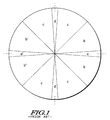
- FIG. 1 is a unit circle showing the different regions which are considered for numerical arguments in the teachings of Gal and Bachelis.
- Region "b” includes arguments s which satisfy 2 -4 ⁇
- the value 2 8 is chosen so that the relative size of the remaining terms to the first term is about 2 -8 , setting the scale for the maximum error of about 2 -8 ulp.
- the reference values s i are chosen so that the leading term P i 0 is almost exactly the arctangent of s i .
- Region "c” includes arguments for which 1 ⁇
- a division is first used to compute 1
- , which lies in the interval [2 -4 ,1) and the result is computed using the mathematical identity: tan -1 ( s ) sign ( s )( ⁇ 2 - tan -1 ( 1
- the arctangent on the right-hand side of EQ. (3) is computed using the method appropriate for region b but for argument 1
- Region "d” includes arguments for which 2 4 ⁇ s .
- a division is first used to compute 1
- the arctangent on the right-hand side of EQ. (3) is computed using the method appropriate for region a with argument 1
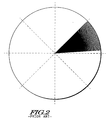
- FIG. 2 is a unit circle illustrating the density of polynomials needed for this method. For each line extending from the center to the edge of the unit circle there are actually three different sets of polynomial coefficients required. Using this many coefficients is likely to severely impact performance of any cached memory system from which these coefficients are obtained.
- the value s on the right-hand side of EQ. (4) is the floating point value of y / x computed using by a division operation.
- an extra division operation is performed to compute a correction term ⁇ which very nearly equals the difference between s and y / x . Without this correction term, the accuracy would be limited to about 1/2 ulp before rounding.
- the tan -1 ( s + ⁇ ) appearing on the right-hand side is computed using EQ. (1). Only the linear term in ⁇ from EQ. (1) is needed, but it must be added at the right time to avoid loss of significance.
- tan -1 ( y , x ) sign ( y )tan -1 (
- ) sign ( y )tan -1 ( s + ⁇ ) which requires a division.
- the value s on the right-hand side of EQ. (5) is the floating point value of
- an extra division operation is performed to compute a correction term ⁇ which very nearly equals the difference between s and
- the tan -1 ( s + ⁇ ) appearing on the right-hand side is computed using EQ. (2). Only the linear term in ⁇ from EQ. (2) is needed, but it must be added at the right time to avoid loss of significance.
- tan -1 ( y , x ) sign ( y )( ⁇ 2 - sign ( x )tan -1 (
- )) sign ( y )( ⁇ 2 - sign ( x )tan -1 ( s + ⁇ )) which requires a division.
- the value s on the right-hand side of EQ. (6) is the floating point value of
- an extra division operation is performed to compute a correction term ⁇ which very nearly equals the difference between s and
- tan -1 ( s + ⁇ ) appearing on the right-hand side is computed using EQ. (2). Only the linear term in ⁇ from EQ. (2) is needed, but it must be added at the right time to avoid loss of significance. In addition, since the exact value of ⁇ 2 is not exactly representable as a single floating point number, it is approximated as the sum of two floating point numbers. Care is taken so that the additions are done in an order which preserves the accuracy of the result to about 2 -8 ulp before the final rounding.
- tan -1 ( y , x ) sign ( y )( ⁇ - tan -1 (
- )) sign ( y )( ⁇ - tan -1 ( s + ⁇ )) which requires a division.
- the value s on the right-hand side of EQ. (7) is the floating point value of
- an extra division operation is performed to compute a correction term ⁇ which very nearly equals the difference between s and
- tan -1 ( s + ⁇ ) appearing on the right-hand side is computed using EQ. (1). Only the linear term in ⁇ from EQ. (1) is needed, but it must be added at the right time to avoid loss of significance. In addition, since the exact value of ⁇ is not exactly representable as a single floating point number, it is approximated as the sum of two floating point numbers. Care is taken so that the additions are done in an order which preserves the accuracy of the result to about 2 -8 ulp before the final rounding.
- the computation is performed using the relationship of EQ. (7) which requires a division.
- the value s on the right-hand side of EQ. (7) is the floating point value of
- an extra division operation is performed to compute a correction term ⁇ which very nearly equals the difference between s and
- the tan -1 ( s + ⁇ ) appearing on the right-hand side is computed using EQ. (2). Only the linear term in ⁇ from EQ. (2) is needed, but it must be added at the right time to avoid loss of significance.
- FIG. 2 illustrates the density of polynomials needed for this method. For each line from the center to the edge of the unit circle there are approximately four different sets of polynomial coefficients which are needed. Using this many coefficients is likely to severely impact performance of a cached memory system from which these coefficients are obtained.
- the first division is used to compute an approximation to either x / y or y / x .
- the second is used in computing the correction ⁇ . This is disadvantageous because for many floating point processors division is very much slower than multiplication or addition and may also prevent execution of other floating point operations until the division is completed.
- Rounding error can be reduced when evaluating binary floating point polynomials utilizing a Floating Point Unit (58) by first computing the sum of products of second and higher order polynomial terms. Next, the Floating Point Unit (58) adds a zero th level term to the product of a first order coefficient and an independent variable to form a "Big” term. The Floating Point Unit (58) calculates as a "Little” term the rounding error resulting from the computation of the "Big” term. The "Little” term is then added to the sum of products of higher order terms to form an "Intermediate” term. Finally, the Floating Point Unit (58) adds the "Big” term to the "Intermediate” term to form the polynomial result corrected by the rounding error introduced by the computation of the low order terms.
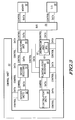
- FIG. 3 is a block diagram showing high level components of a Data Processor, in accordance with the current invention.
- a Control Unit 50 is coupled to one or more Integer arithmetic Units 52 which carry out arithmetic and logical operations on values stored in a set of Integer Registers 54 , one or more Floating Point arithmetic Units 58 which carry out operations on values stored in Floating Point Registers 60 , one or more Load/Store Units (not shown) which connect the Integer Registers 54 and Floating Point Registers 60 to external Memory 66 and input/output units 68 through a Bus interface 64 , and an Instruction Unit 62 and Branch Processing Unit 63 which control the fetching, dispatching and completion of instructions. In some processors, some of these units may be combined or the functionality otherwise partitioned in some similar fashion.
- the computation of the arctangent ( tan -1 ) is typically initiated when the argument value or pair of argument values are in Floating Point Registers 60 and a user instruction to the Branch Processing Unit 63 has caused a branch or subroutine call which causes the first instruction of the method to be fetched and dispatched by the Instruction Unit 62 .
- the Floating Point Unit 58 is assumed to comply with IEEE-754 standards for 32 and 64 bit floating point arithmetic.
- the IEEE-754 64-bit execution model implements binary floating point numbers with a one bit sign ("G"), an 11 bit exponent ("E"), and a 52 bit fraction (“F") part.
- the 11 bit exponent (E) is unsigned and biased by 1023, resulting in a range of 2 -1022 to 2 +1023 .
- This invention can be utilized with other floating point representations, making the appropriate numerical changes.
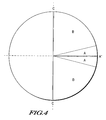
- FIG. 4 is a graphical representation of a unit circle divided into regions to show the range of the different methods utilized to compute tan -1 (s) , in accordance with the current invention.
- ⁇ tan -1 ( s )
- different cases are used depending on whether the argument s lies in the region A, A', B or C in FIG. 4.
- Region A' includes only arguments s which satisfy
- the relative error of omitting all other terms is less than (2 -30 ) 2 (or 2 -60 ), which sets the scale for the maximum error in units in the last place (ulp) of about 2 -8 (i.e. 2 -60 *2 52 ) ulp.
- Region A includes arguments s which satisfy 2 -30 ⁇
- Region B includes arguments s which satisfy 2 - M ⁇
- a roughly logarithmic index is computed by extracting the exponent bits and a number F of fraction bits from the floating point representation of the argument s.
- this index value (“ i ") enables a polynomial approximation to be used over an extremely large range of values.
- N was chosen to be 20 to ease computation in region C. This enables computations to be performed over a very wide range of slopes without the use of any divisions.
- the s i value can always be chosen so that
- tan -1 ( s ) sign ( s )( big + small + Q i 2 ⁇ (
- - s i ) L ), where the new terms big and small are obtained by the sequence of operations t 1 ⁇ Q i 1 ⁇ (
- - s i ) ⁇ t 2 ⁇ Q i 1 ⁇ (
- the angle brackets denote the result of carrying out the given floating point as an atomic operation and then rounding.
- the computation of the term t 2 can be carried out as a single operation, while on others the computation may require using single precision arithmetic to obtain an approximation to t 2 .
- the contribution to the relative error from just rounding the next term in EQ. (11) then becomes about 2 -2( F +1) .
- the effect of this is that by doing the particular sequence of computations described in EQ. (12), the density of polynomial tables which is needed to achieve a given error before the operation which does the final rounding is reduced by a factor of about 2 -( F +1) .
- this method of utilizing big and small is equally useful in maintaining accuracy when evaluating other polynomials.
- this method can be used to improve the accuracy of computating arcsin ( sin -1 ), arccosin ( cos -1 ), gamma, and error functions.
- Region C includes numeric arguments s which satisfy 2 N ⁇
- the probability of finding an argument in this region is about 2 - N .
- N 20
- This approximation has a maximum relative error of about 2 -9 ulp before the final rounding. It is unimportant to compute a correction to the reciprocal. For arguments greater than or equal to 2 53 the reciprocal may be neglected.
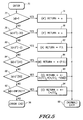
- FIG. 5 is a flowchart showing the method utilized to compute tan -1 (s) , in accordance with the current invention.
- the flow chart shows the logical sequence of operations used in computing tan -1 ( s ) .
- the consideration of cases is presented in this figure sequentially, although in specific implementations it is likely that rearrangement of the logical structure to take advantage of processor structure will result in improved performance.
- step 72 it is determined whether the argument s is a signed zero. If it is, the argument is in region A' and the result returned in step 74 is the argument s according to EQ. (8). Otherwise, the argument is compared to 2 -30 in a step 76 . If it is smaller, the argument is in region A' and the result returned in step 78 is the argument s according to EQ. (8). Otherwise, the argument is compared to 2 - M in step 80 , where in a particular implementation M was chosen to be 2. If it is smaller, the argument is in region A and the result returned in step 82 is given by EQ. (9) where the polynomial coefficients were chosen to minimize the maximum relative error.
- the argument is compared to 2 N in step 84 . If it is smaller, the argument is in region B, an index i , a reference value s i , and a set of polynomial coefficients Q i j are looked up and the result returned in step 86 is obtained following EQ. (12). Otherwise, the argument is compared with 2 53 in step 88 . If it is smaller, the result returned in step 90 is given by EQ. (13). This is the only circumstance in this method for which a division is needed to compute tan -1 ( s ) .
- step 92 checks to see if the argument is numeric. If it is, the result returned in step 94 is given by EQ. (13) but with the term with the division omitted. All of the return results in steps 74, 78, 82, 86, 90 and 94 are normal exits in step 98 unless inexact exceptions are to be allowed. If inexact exceptions are allowed, then only step 74 is a normal exit and steps 78 , 82 , 86 , 90 and 94 are inexact exceptions and step 98 should cause inexact exception processing to be performed in a system-dependent manner. Finally, if step 92 determines that the argument is not numeric, an exception condition is signaled in step 96 .
- FIG. 6 is a graphical representation of a unit circle divided into quarters showing the approximate density of the polynomials utilized to compute tan -1 ( s ) , in accordance with the current invention. Except near the vertical limit, each line corresponds to a single polynomial rather than the approximately four polynomials shown for the prior art in FIG. 2. The significant decrease in the density, total number of polynomials, and total number of coefficients is a big improvement over the prior art.
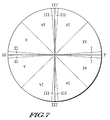
- FIG. 7 is a graphical representation of a unit circle divided into regions to show the range of the different methods utilized to compute tan -1 (y, x) , in accordance with the current invention.
- ⁇ tan -1 ( y , x )
- different cases are used depending on the values of the arguments y and x .
- the main regions to be considered are the regions I, I', II, II', III, III', IV, V and VI shown in FIG. 7.
- the general process used is to take the reciprocal of the absolute value of the larger of the two arguments. While that division is taking place, it is possible to determine an acceptable region for the arguments.
- the use of slightly overlapping regions makes it possible to choose a region without having to do high-precision floating point comparisons.
- One method uses the Integer Unit 52 to compare exponents (E) extracted from each argument.
- Regions I' and II' include arguments for which
- Region III' include arguments for which
- Region I includes arguments for which x >
- M was taken to be 3.
- Region II includes arguments for which - x >
- and b
- Region III includes arguments for which
- Region IV includes arguments for which x ⁇
- and b x .
- a roughly logarithmic index "i" is obtained by extracting the exponent and first F fraction bits of r .
- This sequence of operations is important because it makes the critical rounding proportional to 2 -2 M ulp rather than 2 - M ulp as in the prior art. This allows many fewer polynomials to be used, although more coefficients are needed in each one. On balance, there is a substantial savings in the number of coefficients which are needed and the present embodiment will not degrade cache memory performance nearly as much as the prior art.
- Region V includes arguments for which - x ⁇
- and b
- a roughly logarithmic index "i" is obtained by extracting the exponent and first F fraction bits of r .
- This sequence of operations is important because it makes the critical rounding proportional to 2 -2 M ulp rather than 2 - M ulp as in the prior art. This allows many fewer polynomials to be used, although more coefficients are needed in each one. On balance, there is a substantial savings in the number of coefficients which are needed and the present embodiment will not degrade cache memory performance nearly as much as the prior art.
- Region VI includes arguments for which
- and b
- a roughly logarithmic index "i" is obtained by extracting the exponent (E) and first "f" fraction bits (F) of r .
- t 17 major - ⁇ _ high 2
- This sequence of operations is important because it makes the critical rounding proportional to 2 -2 M ulp rather than 2 - M ulp as in the prior art. This allows many fewer polynomials to be used, although more coefficients are needed in each one. On balance, there is a substantial savings in the number of coefficients which are needed and the present embodiment will not degrade cache memory performance nearly as much as the prior art.
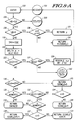
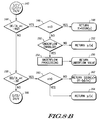
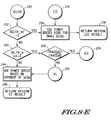
- the flowchart consists of five connected subfigures (FIG. 8-A through FIG. 8-E).
- the computation is entered in a step 100 .
- the absolute values of x and y are compared in a step 104 .
- the purpose is to determine which quadrant the argument lies in.
- the comparisons of x and y with 0 were performed at the same time to allow the result of the comparison of absolute values to be more likely to be completed before branching based on the result.
- step 104 if the magnitude of x is less than the magnitude of y , the next step taken is step 200 . Otherwise, the comparison of y with 0 is used in step 106 to determine whether a quick result can be determined. If y is 0, then step 108 determines whether the sign of x is positive or negative (a negative 0 should still be considered negative). If the sign of x is positive, the result returned is y (exact) in step 110 .
- step 116 If the sign of x is negative, the result returned is sign ( y ) ⁇ ⁇ in step 116 . If y is not 0, then in step 118 the inverse of
- step 122 the check is made to see if the biased exponent of x is zero.
- the argument x cannot be zero because it is at least as big in magnitude as y which is not zero.
- the exponent can be zero if x is a denormalized number.
- the reciprocal initiated in step 118 is likely to overflow.
- step 124 a check is made to see if that is indeed likely by looking at the fraction bits to see if
- step 126 scales both arguments by a factor of 2 52 and the process is restarted at step 102 , which simply repeats the steps starting at step 100 . If the check in step 124 guarantees no overflow in the reciprocal operation, then control proceeds via step 142 , where the actual case will be selected from the possible cases I, I', I, II', IV and V.
- step 132 checks to see if the biased exponent of y is 2047. If it is, then y is either numeric or infinity. Step 133 determines which of these two cases prevails. If y is not numeric, then step 134 returns the appropriate indication of an invalid argument. If y is numeric, then step 137 determines whether the argument x is positive. If it is, then step 138 returns sign ( y ) ⁇ ⁇ 4 . This result is inexact, since the exact result cannot be represented exactly by a floating point number. If the argument x is negative, then step 139 returns sign ( y ) ⁇ 3 ⁇ 4 .
- step 134 check the sign of the argument x . If it is positive, then step 135 returns an exact 0 with the sign of y . Otherwise step 136 returns an inexact ⁇ with the sign of y .
- Step 142 is reached by the above logic if x is larger in magnitude than y and not infinite. It leads to step 144 , which compares the difference in exponents ⁇ e with -1021. If it is greater than or equal, then in step 158 , the difference in exponents ⁇ e is compared with -30. If it is greater than or equal to -30, then step 166 is taken to determine whether the region is I, II, IV or V. If it is less than -30, then step 160 uses the sign of x to determine whether to return the result of EQ. (16) in step 164 for positive x or the result of EQ. (17) in step 162 for negative x .
- step 146 examines the sign of x . If it is negative, then step 148 returns sign ( y ) ⁇ ⁇ . Otherwise if step 150 determines that underflow exceptions are disabled, step 152 returns the result of EQ. (16). Otherwise, it is likely that the result will underflow and step 154 performs underflow processing and step 156 returns an adjusted underflow value.
- Step 166 is reached when it is necessary to determine which of the cases I, II, IV or V is present.
- Step 170 determines whether ⁇ e is less than - M which in this implementation is -3. If it is, then step 172 determines whether to use EQ. (19) in step 178 to return the region I result or EQ. (22) in step 176 to return the region II result.. Either result is inexact. Otherwise, step 180 determines whether ⁇ e is larger than -M. If not, then a comparison of the leading fraction bits of the two arguments is performed in step 182 . If the x fraction bits are not larger than the y fraction bits, then the region is either I or II and control proceeds through step 168 to step 172 .
- step 180 determines that ⁇ e is larger than -M or step 182 determines that the x fraction bits are at least as large as the y fraction bits and proceeds through step 184 , step 190 selects the reference value and polynomial coefficients to be evaluated through an index value computed by extracting the exponent and leading fraction bits of
- Step 192 uses the sign of x to determine whether to evaluate and return the region IV result of EQ. (24) in steps 195 and 197 (inexact) or the region V result of EQ. (27)in steps 196 and 198 .
- Step 200 is initiated if the arguments lie in region III, III' or VI or are invalid.
- Step 202 determines if x is zero. If it is zero, step 204 returns sign ( y ) ⁇ ⁇ 2 . Otherwise, the computation of the reciprocal of
- the difference of exponents ⁇ e (in this case the exponent of x minus the exponent of y ) is computed in step 208 . Again, this value will be used in making decisions while the floating point division is executing.
- step 210 the biased exponent of y is compared with zero. If it is zero, step 212 checks to see if
- step 218 returns the inexact result sign ( y ) ⁇ ⁇ 2 . If y is finite and numeric, step 220 checks to see whether ⁇ e is smaller than -1021. If it is, then step 222 returns the inexact result of sign ( y ) ⁇ ⁇ 2 . Otherwise, step 224 checks to see if ⁇ e is less than -30. If it is, step 226 returns the inexact region III' result of EQ. (18). Otherwise, step 230 starts the selection of region III or VI.
- step 232 ⁇ e is compared with -3. If it is smaller, then it is in region III and the polynomial coefficients are obtained in step 236 and the inexact result given by EQ. (23) is returned in step 238 . If ⁇ e is found to be -3 in step 240 , step 242 compares the high-order fraction bits of the arguments. If the fraction bits (F) of y are larger, then the arguments are in region III and step 234 leads to the region III processing starting with step 236 .
- step 244 constructs an index ("i") by extracting the exponent and fraction bits of
- Step 246 then returns the region VI result given by EQ. (28).
- FIG. 9 shows a line for every polynomial needed. This illustrates that the number of polynomials and coefficients needed in the embodiment is much smaller than in the prior art.
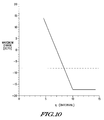
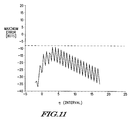
- FIGS. 10-11 are graphs that show some of the analysis of minmax polynomials which was considered in designing particular implementations of the new method for computing tan -1 ( s ) .
- the x-axis measures the number of coefficients in the polynomial.
- the units on the y-axis are the bit position, relative to the lowest bit position of the result, of the relative error. For example, an error of -11 indicates that the maximum error resulting from a mathematically exact evaluation of the best polynomial would give a maximum error of about 2 -11 ulp.
- the x-axis shows the index value "i" multiplied by 2 - F
- the y-axis shows the same measure of error as FIG. 10. Curves for larger or smaller numbers of coefficients had smaller or larger errors, respectively, but the curves had similar shapes. It is seen from this figure that for a given number of polynomial coefficients, the worst case errors occur for medium values of s around 8 or 16, not much larger arguments.
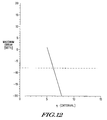
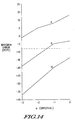
- FIGS. 12-13 are graphs that show some of the analysis of minmax polynomials which was considered in designing particular implementations of the new method for computing tan -1 ( y , x ) .
- the x-axis measures the number of coefficients in the polynomial.
- the y-axis represents the same measure of error as FIG. 10.
- the optimal choice was 7 coefficients with an error of 2 -15 ulp.
- the x-axis shows the index value "i" multiplied by 2 - F
- the y-axis shows the same measure of error as FIG. 10.
- the curves for 6, 8, and 10 coefficients were not calculated at all points.
- the error threshold shown as a dotted line, required 11 coefficients.
- the sum of the remaining terms would already have a rounding error which in general was no less than 1/2 ulp of the sum of the remaining terms, so the total error could be as large or larger than 1/2 ulp of the result plus 1/2 ulp of the sum of the remaining terms.
- the error could easily be larger. For example, if the sum of the remaining terms is computed by adding (c 1 *v) to the sum (c 2 *v 2 +...+c n *v n ), there are additional rounding errors in the evaluation of (c 1 *v) as well as in the sum (c 2 *v 2 +...+c n *v n ). This could possibly add another error of about 1/2 ulp of the sum of the remaining terms to the maximum possible rounding error. Even without this source of error, the extra rounding error, defined as the maximum rounding error introduced prior to the last floating operation, could be as large as 1/2 ulp of the sum of the remaining terms for this example.
- the extra rounding error is reduced to be roughly proportional to 1 ulp of the term c 2 *v 2 .
- P(v) big + (small + c 2 *v 2 + ... + c n *v n )
- the magnitude of the term in parentheses in EQ. (31) is in many cases c 2 *v 2 , and as a result the rounding error is proportional to 1 ulp in that quantity. Since c 2 *v 2 is often much smaller than c 1 *v, a given level of acceptable rounding error can often allow a much larger value of v and hence require far fewer ranges for polynomial evaluation.
- the second method assumes the existence of an operation to reduce the precision of a number to at most half the number of significant bits. This operation will be indicated by brackets [ ].
- t5 [c 1 ]
- t6 [v]
Landscapes
- Physics & Mathematics (AREA)
- General Physics & Mathematics (AREA)
- Engineering & Computer Science (AREA)
- Computational Mathematics (AREA)
- Mathematical Analysis (AREA)
- Pure & Applied Mathematics (AREA)
- Theoretical Computer Science (AREA)
- Computing Systems (AREA)
- Mathematical Optimization (AREA)
- General Engineering & Computer Science (AREA)
- Complex Calculations (AREA)
Applications Claiming Priority (2)
| Application Number | Priority Date | Filing Date | Title |
|---|---|---|---|
| US424032 | 1995-04-18 | ||
| US08/424,032 US5646876A (en) | 1995-04-18 | 1995-04-18 | Method and apparatus for reducing rounding error when evaluating binary floating point polynomials |
Publications (2)
| Publication Number | Publication Date |
|---|---|
| EP0738960A2 true EP0738960A2 (de) | 1996-10-23 |
| EP0738960A3 EP0738960A3 (de) | 1997-01-15 |
Family
ID=23681182
Family Applications (1)
| Application Number | Title | Priority Date | Filing Date |
|---|---|---|---|
| EP96106006A Ceased EP0738960A3 (de) | 1995-04-18 | 1996-04-17 | Verfahren und Gerät zur Reduzierung von Abrundungsfehlern beim Evaluieren von binären Fliesskommapolynomialen |
Country Status (2)
| Country | Link |
|---|---|
| US (1) | US5646876A (de) |
| EP (1) | EP0738960A3 (de) |
Families Citing this family (3)
| Publication number | Priority date | Publication date | Assignee | Title |
|---|---|---|---|---|
| US9792087B2 (en) | 2012-04-20 | 2017-10-17 | Futurewei Technologies, Inc. | System and method for a floating-point format for digital signal processors |
| GB2527859B (en) * | 2014-09-08 | 2017-05-24 | Imagination Tech Ltd | Evaluation of polynomials with floating-point components |
| US10331405B2 (en) | 2016-04-22 | 2019-06-25 | Imagination Technologies Limited | Evaluating polynomials in hardware logic |
Family Cites Families (4)
| Publication number | Priority date | Publication date | Assignee | Title |
|---|---|---|---|---|
| JPH01169627A (ja) * | 1987-12-25 | 1989-07-04 | Toshiba Corp | 高精度加算装置 |
| US5197024A (en) * | 1989-06-14 | 1993-03-23 | Pickett Lester C | Method and apparatus for exponential/logarithmic computation |
| US5042001A (en) * | 1989-10-02 | 1991-08-20 | Cyrix Corporation | Method and apparatus for performing mathematical functions using polynomial approximation and a rectangular aspect ratio multiplier |
| EP0596175A1 (de) * | 1992-11-05 | 1994-05-11 | International Business Machines Corporation | Gerät zum Ausführen der Argumentreduktion in Exponentialberechnungen von IEEE-Norm-Gleitkommazahlen |
-
1995
- 1995-04-18 US US08/424,032 patent/US5646876A/en not_active Expired - Fee Related
-
1996
- 1996-04-17 EP EP96106006A patent/EP0738960A3/de not_active Ceased
Non-Patent Citations (1)
| Title |
|---|
| SHMUEL GAL; BORIS BACHELIS: "An Accurate Elementary Mathematical Library for the IEEE Floating Point Standard", ACM TRANSACTIONS ON MATHEMATICAL SOFTWARE, vol. 17, 1991, pages 26 - 45 |
Also Published As
| Publication number | Publication date |
|---|---|
| EP0738960A3 (de) | 1997-01-15 |
| US5646876A (en) | 1997-07-08 |
Similar Documents
| Publication | Publication Date | Title |
|---|---|---|
| EP0421092B1 (de) | Verfahren und Gerät zur Ausführung mathematischer Funktionen mit Hilfe polynomialer Annäherung und eines Multiplizierers rechteckigen Seitenverhältnisses | |
| US5570310A (en) | Method and data processor for finding a logarithm of a number | |
| US5515308A (en) | Floating point arithmetic unit using modified Newton-Raphson technique for division and square root | |
| US6240433B1 (en) | High accuracy estimates of elementary functions | |
| US5631859A (en) | Floating point arithmetic unit having logic for quad precision arithmetic | |
| Antelo et al. | High performance rotation architectures based on the radix-4 CORDIC algorithm | |
| US6360241B1 (en) | Computer method and apparatus for division and square root operations using signed digit | |
| Kota et al. | Numerical accuracy and hardware tradeoffs for CORDIC arithmetic for special-purpose processors | |
| EP0377837B1 (de) | Gleitkommaeinheit mit gleichzeitiger Multiplikation und Addition | |
| US6847985B1 (en) | Floating point divide and square root processor | |
| US6697832B1 (en) | Floating-point processor with improved intermediate result handling | |
| US5404324A (en) | Methods and apparatus for performing division and square root computations in a computer | |
| US5954789A (en) | Quotient digit selection logic for floating point division/square root | |
| US5768170A (en) | Method and apparatus for performing microprocessor integer division operations using floating point hardware | |
| US5197024A (en) | Method and apparatus for exponential/logarithmic computation | |
| US6842765B2 (en) | Processor design for extended-precision arithmetic | |
| US5245564A (en) | Apparatus for multiplying operands | |
| US20080183791A1 (en) | Processor With Improved Accuracy For Multiply-Add Operations | |
| EP0658256B1 (de) | Hochleistungsmantissendividierer. | |
| US5729481A (en) | Method and system of rounding for quadratically converging division or square root | |
| EP0622727A1 (de) | System für die Optimierung der Argumentreduzierung | |
| US5305248A (en) | Fast IEEE double precision reciprocals and square roots | |
| US5648924A (en) | Method and apparatus for finding arctangents | |
| USH1222H (en) | Apparatus for determining sticky bit value in arithmetic operations | |
| Jacobi | Formal verification of a fully IEEE compliant floating point unit |
Legal Events
| Date | Code | Title | Description |
|---|---|---|---|
| PUAI | Public reference made under article 153(3) epc to a published international application that has entered the european phase |
Free format text: ORIGINAL CODE: 0009012 |
|
| AK | Designated contracting states |
Kind code of ref document: A2 Designated state(s): DE FR GB |
|
| PUAL | Search report despatched |
Free format text: ORIGINAL CODE: 0009013 |
|
| AK | Designated contracting states |
Kind code of ref document: A3 Designated state(s): DE FR GB |
|
| 17P | Request for examination filed |
Effective date: 19970715 |
|
| 17Q | First examination report despatched |
Effective date: 19980121 |
|
| GRAG | Despatch of communication of intention to grant |
Free format text: ORIGINAL CODE: EPIDOS AGRA |
|
| STAA | Information on the status of an ep patent application or granted ep patent |
Free format text: STATUS: THE APPLICATION HAS BEEN REFUSED |
|
| 18R | Application refused |
Effective date: 19991004 |