EP0736918A1 - Electrode for secondary battery with nonaqueous electrolyte and process for producing the same - Google Patents
Electrode for secondary battery with nonaqueous electrolyte and process for producing the same Download PDFInfo
- Publication number
- EP0736918A1 EP0736918A1 EP96105486A EP96105486A EP0736918A1 EP 0736918 A1 EP0736918 A1 EP 0736918A1 EP 96105486 A EP96105486 A EP 96105486A EP 96105486 A EP96105486 A EP 96105486A EP 0736918 A1 EP0736918 A1 EP 0736918A1
- Authority
- EP
- European Patent Office
- Prior art keywords
- active material
- electrode plate
- collector
- coating layer
- secondary battery
- Prior art date
- Legal status (The legal status is an assumption and is not a legal conclusion. Google has not performed a legal analysis and makes no representation as to the accuracy of the status listed.)
- Granted
Links
Images


Classifications
-
- H—ELECTRICITY
- H01—ELECTRIC ELEMENTS
- H01M—PROCESSES OR MEANS, e.g. BATTERIES, FOR THE DIRECT CONVERSION OF CHEMICAL ENERGY INTO ELECTRICAL ENERGY
- H01M4/00—Electrodes
- H01M4/02—Electrodes composed of, or comprising, active material
- H01M4/13—Electrodes for accumulators with non-aqueous electrolyte, e.g. for lithium-accumulators; Processes of manufacture thereof
- H01M4/134—Electrodes based on metals, Si or alloys
-
- H—ELECTRICITY
- H01—ELECTRIC ELEMENTS
- H01M—PROCESSES OR MEANS, e.g. BATTERIES, FOR THE DIRECT CONVERSION OF CHEMICAL ENERGY INTO ELECTRICAL ENERGY
- H01M4/00—Electrodes
- H01M4/02—Electrodes composed of, or comprising, active material
- H01M4/04—Processes of manufacture in general
-
- H—ELECTRICITY
- H01—ELECTRIC ELEMENTS
- H01M—PROCESSES OR MEANS, e.g. BATTERIES, FOR THE DIRECT CONVERSION OF CHEMICAL ENERGY INTO ELECTRICAL ENERGY
- H01M4/00—Electrodes
- H01M4/02—Electrodes composed of, or comprising, active material
- H01M4/04—Processes of manufacture in general
- H01M4/0402—Methods of deposition of the material
- H01M4/0404—Methods of deposition of the material by coating on electrode collectors
-
- H—ELECTRICITY
- H01—ELECTRIC ELEMENTS
- H01M—PROCESSES OR MEANS, e.g. BATTERIES, FOR THE DIRECT CONVERSION OF CHEMICAL ENERGY INTO ELECTRICAL ENERGY
- H01M4/00—Electrodes
- H01M4/02—Electrodes composed of, or comprising, active material
- H01M4/04—Processes of manufacture in general
- H01M4/0402—Methods of deposition of the material
- H01M4/0409—Methods of deposition of the material by a doctor blade method, slip-casting or roller coating
-
- H—ELECTRICITY
- H01—ELECTRIC ELEMENTS
- H01M—PROCESSES OR MEANS, e.g. BATTERIES, FOR THE DIRECT CONVERSION OF CHEMICAL ENERGY INTO ELECTRICAL ENERGY
- H01M4/00—Electrodes
- H01M4/02—Electrodes composed of, or comprising, active material
- H01M4/04—Processes of manufacture in general
- H01M4/0402—Methods of deposition of the material
- H01M4/0416—Methods of deposition of the material involving impregnation with a solution, dispersion, paste or dry powder
-
- H—ELECTRICITY
- H01—ELECTRIC ELEMENTS
- H01M—PROCESSES OR MEANS, e.g. BATTERIES, FOR THE DIRECT CONVERSION OF CHEMICAL ENERGY INTO ELECTRICAL ENERGY
- H01M4/00—Electrodes
- H01M4/02—Electrodes composed of, or comprising, active material
- H01M4/04—Processes of manufacture in general
- H01M4/043—Processes of manufacture in general involving compressing or compaction
- H01M4/0435—Rolling or calendering
-
- H—ELECTRICITY
- H01—ELECTRIC ELEMENTS
- H01M—PROCESSES OR MEANS, e.g. BATTERIES, FOR THE DIRECT CONVERSION OF CHEMICAL ENERGY INTO ELECTRICAL ENERGY
- H01M2300/00—Electrolytes
- H01M2300/0017—Non-aqueous electrolytes
-
- H—ELECTRICITY
- H01—ELECTRIC ELEMENTS
- H01M—PROCESSES OR MEANS, e.g. BATTERIES, FOR THE DIRECT CONVERSION OF CHEMICAL ENERGY INTO ELECTRICAL ENERGY
- H01M4/00—Electrodes
- H01M4/02—Electrodes composed of, or comprising, active material
- H01M4/36—Selection of substances as active materials, active masses, active liquids
- H01M4/48—Selection of substances as active materials, active masses, active liquids of inorganic oxides or hydroxides
- H01M4/50—Selection of substances as active materials, active masses, active liquids of inorganic oxides or hydroxides of manganese
- H01M4/505—Selection of substances as active materials, active masses, active liquids of inorganic oxides or hydroxides of manganese of mixed oxides or hydroxides containing manganese for inserting or intercalating light metals, e.g. LiMn2O4 or LiMn2OxFy
-
- H—ELECTRICITY
- H01—ELECTRIC ELEMENTS
- H01M—PROCESSES OR MEANS, e.g. BATTERIES, FOR THE DIRECT CONVERSION OF CHEMICAL ENERGY INTO ELECTRICAL ENERGY
- H01M4/00—Electrodes
- H01M4/02—Electrodes composed of, or comprising, active material
- H01M4/36—Selection of substances as active materials, active masses, active liquids
- H01M4/48—Selection of substances as active materials, active masses, active liquids of inorganic oxides or hydroxides
- H01M4/52—Selection of substances as active materials, active masses, active liquids of inorganic oxides or hydroxides of nickel, cobalt or iron
- H01M4/525—Selection of substances as active materials, active masses, active liquids of inorganic oxides or hydroxides of nickel, cobalt or iron of mixed oxides or hydroxides containing iron, cobalt or nickel for inserting or intercalating light metals, e.g. LiNiO2, LiCoO2 or LiCoOxFy
-
- Y—GENERAL TAGGING OF NEW TECHNOLOGICAL DEVELOPMENTS; GENERAL TAGGING OF CROSS-SECTIONAL TECHNOLOGIES SPANNING OVER SEVERAL SECTIONS OF THE IPC; TECHNICAL SUBJECTS COVERED BY FORMER USPC CROSS-REFERENCE ART COLLECTIONS [XRACs] AND DIGESTS
- Y02—TECHNOLOGIES OR APPLICATIONS FOR MITIGATION OR ADAPTATION AGAINST CLIMATE CHANGE
- Y02E—REDUCTION OF GREENHOUSE GAS [GHG] EMISSIONS, RELATED TO ENERGY GENERATION, TRANSMISSION OR DISTRIBUTION
- Y02E60/00—Enabling technologies; Technologies with a potential or indirect contribution to GHG emissions mitigation
- Y02E60/10—Energy storage using batteries
Definitions
- the present invention relates to an electrode plate, for a secondary battery with a nonaqueous electrolyte, which can enhance the utilization factor of an active material resulting in high battery performance characteristics, and a process for producing the same.
- alkaline batteries exemplified by conventional nickel-cadmium batteries and the like are being replaced with secondary batteries with an nonaqueous electrolyte, exemplified by a lithium ion secondary battery, by virtue of properties, specifically higher energy density, higher battery capacity, better storage properties, wider service temperature range and the like.
- Japanese Patent Laid-Open Nos. 10456/1988 and 285262/1991 disclose a process for producing an electrode plate, comprising the steps of: adding a solution of a conductive agent and a binder in a suitable wetting agent (a solvent) to an active material powder, for a positive plate, such as an oxide, a sulfide, a halide or the like of a metal, to prepare a paste; coating the paste on a collector of a metallic foil; and drying the coating.
- a suitable wetting agent such as an oxide, a sulfide, a halide or the like of a metal
- fluororesins such as polytetrafluoroethylene and polyvinylidene fluoride, are generally used as the binder from the viewpoint of ease of handling, such as coatability.
- the use of the binder is likely to substantially reduce the area of contact between the active material and the electrolyte because the binder unavoidably covers a considerable area of the surface of the active material and the conductive agent. Therefore, the effective reaction area which enables doping and undoping of ions for the active material is reduced, lowering the utilization factor of the whole active material. This makes it impossible to provide high battery performance characteristics.
- an object of the present invention is to provide an electrode plate, for a secondary battery with a nonaqueous electrolyte, which can enhance the utilization factor of an active material to develop high battery performance characteristics.
- the electrode plate for a secondary battery with a nonaqueous electrolyte comprises: a collector; and a coating layer provided on the collector, the coating layer comprising a powdery active material, a conductive agent, and a binder, the powdery active material being constituted by particles with a lamellar structure having lamellar cracks.
- the process for producing an electrode plate for a secondary battery with a nonaqueous electrolyte comprises the steps of: mixing a powdery active material, a powdery conductive agent, and a binder with a predetermined solvent to prepare an active material-containing mixture in a slurry form; coating the active material-containing mixture onto a collector; and removing the solvent from the wet coating to form a coating layer of an active material-containing mixture on the collector, wherein the active material is pressed either before the preparation of the active material-containing mixture or after the formation of the coating layer, thereby forming lamellar microcracks in the active material particles.
- lamellar microcracks in an active material is considered to increase the specific surface area of the active material particles, resulting in markedly increased area of contact of the active material with an electrolyte. Further, this facilitates the penetration of the electrolyte into gaps among microcracks, increasing portions where the active material comes into contact with the electrolyte as a whole.
- the increased contact area increases the area where an electrochemical reaction which causes doping and undoping of ions for the active material occurs, leading to an improvement in utilization factor of the whole active material and an increase in discharge capacity, resulting in improved performance of the battery.
- Fig. 3 is a photomicrograph (magnification: 3000 times) showing the structure of a particle of an active material prepared in Example 1 of the present invention, which demonstrates that lamellar microcracks are formed in the active material.
- the lamellar pattern has such an appearance as found in a wind-wrought pattern on the sands.
- the active material particles in the present invention have a lamellar structure with lamellar microcracks.
- the active material particles in the present invention have a lamellar cleavage structure, and the lamellar microcracks or pattern like a wind-wrought pattern on the sands are considered to be formed by pressing.
- Preferable active materials include LiCoO 2 and other lithium compounds, such as LiNiO 2 , LiMnO 2 , LiMn 2 O 4 , and LiCo 1-x Ni x O 2 (wherein 0 ⁇ x ⁇ 1).
- the average particle diameter of the LiCoO 2 powder used as the active material is preferably 1 to 100 ⁇ m, more preferably 10 to 60 ⁇ m. When it is less than 1 ⁇ m, the particles are so fine that it is difficult to form the wind-wrought pattern on the sands or microcracks and, at the same time, the handling of the active material per se becomes difficult. On the other hand, when the average particle diameter exceeds 100 ⁇ m, the active material per se is likely to be broken, unfavorably resulting in deteriorated characteristics.
- the electrode plate may be produced by the conventional method except for the provision of the step of pressing.
- an active material such as a LiCoO 2 powder, a conductive agent, such as a graphite powder, a binder, such as a polyvinylidene fluoride resin, and a predetermined solvent are mixed together, and the mixture is stirred by means of a homogenizer to prepare an active material-containing mixture in a slurry form.
- the active material-containing mixture is coated on a collector of an aluminum foil or the like by means of a slot die coater, and the wet coating is then dried to remove the solvent, thereby forming a coating layer of an active material-containing mixture on the collector. Water is removed from the coating layer by aging or the like.
- the pressing of the active material may be carried out either after the formation of the coating layer or in the stage of a powdery raw material.
- Conventional pressing devices such as a bench press and a roller press, may be used as means for the formation of a lamellar pattern, like a wind-wrought pattern on the sands, or microcracks in the active material particles.
- the pressure for the pressing treatment is less than 500 kgf/cm 2 , the pattern like a wind-wrought pattern on the sands or the microcrack is difficult to be formed, while when it exceeds 7500 kgf/cm 2 , the active material particles are ground or alternatively the electrode plate per se, including the collector substrate, is unfavorably broken.
- the pressure is preferably in the range of from 500 to 7500 kgf/cm 2 .
- a nonelectrolyte prepared by dissolving a lithium salt as a solute in an organic solvent is preferably used as the electrolyte.
- Organic solvents usable herein include cyclic esters, chain esters, cyclic ethers, and chain ethers.
- the cyclic esters include propylene carbonate, butylene carbonate, ⁇ -butyrolactone, vinylene carbonate, 2-methyl- ⁇ -butyrolactone, acetyl- ⁇ -butyrolactone, and ⁇ -valerolactone;
- examples of the chain esters include dimethyl carbonate, diethyl carbonate, dibutyl carbonate, dipropyl carbonate, methyl ethyl carbonate, methyl butyl carbonate, methyl propyl carbonate, ethyl butyl carbonate, ethyl propyl carbonate, butyl propyl carbonate, an alkyl ester of propionic acid, a dialkyl ester of malonic acid, and an alkyl ester of acetic acid;
- examples of the cyclic ethers include tetrahydrofuran, an al
- Lithium salts as the solute include inorganic lithium salts, such as LiClO 4 , LiBF 4 , LiPF 6 , LiAsF 6 , LiCl, and LiBr, and organolithium salts, such as LiB(C 6 H 5 ) 4 , LiN(SO 2 CF 3 ) 2 , LiC(SO 2 CF 3 ) 3 , LiOSO 2 CF 3 , LiOSO 2 C 2 F 5 , LiOSO 2 C 3 F 7 , LiOSO 2 C 4 F 9 , LiOSO 2 C 5 F 11 , LiOSO 2 C 6 F 13 , and LiOSO 2 C 7 F 15 .
- organolithium salts such as LiB(C 6 H 5 ) 4 , LiN(SO 2 CF 3 ) 2 , LiC(SO 2 CF 3 ) 3 , LiOSO 2 CF 3 , LiOSO 2 C 2 F 5 , LiOSO 2 C 3 F 7 , LiOSO 2 C 4 F
- a LiCoO 2 powder as an active material with an average particle diameter of 10 ⁇ m, having neither any pattern like a wind-wrought pattern on the sands nor any microcrack
- 5.0 parts by weight of a graphite powder as a conductive agent 5.0 parts by weight of a polyvinylidene fluoride resin (Neoflon VDF VP-850, manufactured by Daikin Industries, Ltd.)
- 20 parts by weight of N-methylpyrrolidone were mixed together with stirring by means of a homogenizer at 8000 rpm for 10 min, thereby preparing a mixture, containing an active material for a positive plate, in a slurry form.
- the mixture containing an active material for a positive plate was coated on one side of a collector of a 20 ⁇ m-thick aluminum foil by means of a slot die coater, and the coating was dried in an oven of 120°C to remove the solvent, thereby forming an 80 ⁇ m-thick coating layer of an active material-containing mixture on the collector.
- the surface of the coating layer, formed of an active material-containing mixture, on the collector was roller-pressed (pressure: 4000 kgf/cm 2 ) to level the coating layer and, at the same time, to form a pattern, like a wind-wrought pattern on the sands, or microcracks in LiCoO 2 per se contained in the coating layer, thereby preparing a contemplated electrode plate for a secondary battery with a nonaqueous electrolyte.
- a photomicrograph of the active material contained in the pressed coating layer is shown in Fig. 3.
- the electrode plate thus obtained was aged in a vacuum oven of 80°C for 48 hr, thereby removing water.
- LiCoO 2 powder (average particle diameter: 10 ⁇ m) as an active material, which had been previously pressed at 4000 kgf/cm 2 to form a pattern, like a wind-wrought pattern on the sands, or microcracks in LiCoO 2
- a graphite powder as a conductive agent
- a polyvinylidene fluoride resin (Neoflon VDF VP-850, manufactured by Daikin Industries, Ltd.)
- N-methylpyrrolidone stirred by means of a homogenizer at 8000 rpm for 10 min, thereby preparing a mixture, containing an active material for a positive plate, in a slurry form.
- the mixture containing an active material for a positive plate was coated on one side of a collector of a 20 ⁇ m-thick aluminum foil by means of a slot die coater, and the coating was dried in an oven of 120°C to remove the solvent, thereby forming an 80 ⁇ m-thick coating layer on the collector.
- the electrode plate thus obtained was aged in a vacuum oven of 80°C for 48 hr, thereby removing water.
- An electrode plate for a secondary battery with a nonaqueous electrolyte was prepared in the same manner as in Example 1, except that the pressing of the coating layer was carried out at 3000 kgf/cm 2 .
- a photomicrograph of the active material contained in the pressed coating layer is shown in Fig. 4.
- the electrode plate thus obtained was aged in a vacuum oven of 80°C for 48 hr, thereby removing water.
- An electrode plate for a secondary battery with a nonaqueous electrolyte was prepared in the same manner as in Example 1, except that the pressing of the coating layer was carried out at 2000 kgf/cm 2 .
- a photomicrograph of the active material contained in the pressed coating layer is shown in Fig. 5.
- the electrode plate thus obtained was aged in a vacuum oven of 80°C for 48 hr, thereby removing water.
- a LiCoO 2 powder as an active material (average particle diameter: 10 ⁇ m), having neither any pattern like a wind wrought pattern on the sands nor any microcrack
- 5.0 parts by weight of a graphite powder as a conductive agent 5.0 parts by weight of a polyvinylidene fluoride resin (Neoflon VDF VP-850, manufactured by Daikin Industries, Ltd.)
- 20 parts by weight of N-methylpyrrolidone were stirred by means of a homogenizer at 8000 rpm for 10 min, thereby preparing a mixture, containing an active material for a positive plate, in a slurry form.
- the mixture containing an active material for a positive plate was coated on one side of a collector of a 20 ⁇ m-thick aluminum foil by means of a slot die coater, and the coating was dried in an oven of 100°C to remove the solvent, thereby forming an 80 ⁇ m-thick coating layer of an active material-containing mixture on the collector.
- a photomicrograph of the active material contained in the coating layer is shown in Fig. 6.
- the electrode plate thus obtained was aged in a vacuum oven of 80°C for 48 hr, thereby removing water.
- Electrodes with a nonaqueous electrolyte were constructed using electrode plates, prepared in the above examples and comparative example were used, as a positive electrode in combination with a negative plate.
- the negative plate was prepared as follows. 90 parts by weight of a graphite powder, 10 parts by weight of a styrene-butadiene rubber resin, and 30 parts by weight of toluene were mixed together, and the mixture was stirred by means of a homogenizer at 8,000 rpm for 10 min, thereby preparing a mixture, containing an active material for a negative electrode, in a slurry form.
- the mixture containing an active material for a negative electrode was coated by means of a slot die coater on both sides of a collector of a 10 ⁇ m-thick copper foil, and the coating was dried in an oven of 120°C to remove the solvent, thereby forming an 90 ⁇ m-thick coating layer, formed of an active material-containing mixture, on the collector.
- the surface of the coating layer, formed of an active material-containing mixture, on the collector was roller-pressed to level the coating layer, thereby preparing a contemplated electrode plate for a secondary battery with a nonaqueous electrolyte.
- the electrode plate thus obtained was aged in a vacuum oven of 80°C for 72 hr.
- a separator of a microporous polyolefin (polypropylene, polyethylene, or a copolymer of polypropylene with polyethylene) film, with a three-dimensional hole structure (a spongy structure), having a larger width than the positive and negative plates was interposed between the positive plates prepared in Examples 1 to 4 and Comparative Example and the negative plate prepared just above, and spirally wound to prepare an electrode.
- the electrode was inserted into a closed-end cylindrical stainless steel container serving also as a terminal, for the negative electrode, to assembly a battery, of size AA, having a rated capacity of 500 mAh.
- EC ethylene carbonate
- PC propylene carbonate
- DME diimethoxyethane
- charge-discharge characteristics were measured at 25°C on 20 cells per battery using a charge-discharge measuring apparatus by repeating charging and discharging 100 cycles under such conditions that the battery was charged at a maximum current of 0.2 CmA to a battery voltage of 4.1 V, the charging was stopped for 10 min, the battery was discharged at the same current to 2.75 V, and the discharging was stopped for 10 min.
- Fig. 1 shows the average discharge capacity for individual batteries, each consisting of 20 cells, constructed using electrode plates prepared in Examples 1 to 4 and Comparative Example.
- the average value of the initial capacities is taken as 100%.
- the average discharge capacity was maintained at not less than about 60% even after the 100th cycle, whereas for Comparative Example, the capacity was remarkably lowered from an early stage with the retention of the capacity after the 100th cycle being only about 30%.
- Fig. 2 shows the average discharge capacity of batteries for each cycle by taking the average value of the initial capacities as 100%.
- the batteries each consist of 20 cells constructed using electrode plates prepared in the same manner as in Example 1, except that three kinds of LiCoO 2 having different particles diameters were used as the active material.
- the electrode plate for a secondary battery with a nonaqueous electrode comprises a collector having thereon a coating layer containing a powdery active material, a conductive agent, and a binder, wherein the active material has a pattern, like a wind wrought pattern on the sands, or microcracks.
- This constitution can enhance the utilization factor of the active material resulting in very high battery performance characteristics.
Landscapes
- Chemical & Material Sciences (AREA)
- Engineering & Computer Science (AREA)
- Chemical Kinetics & Catalysis (AREA)
- Electrochemistry (AREA)
- General Chemical & Material Sciences (AREA)
- Manufacturing & Machinery (AREA)
- Dispersion Chemistry (AREA)
- Materials Engineering (AREA)
- Battery Electrode And Active Subsutance (AREA)
Abstract
Description
- The present invention relates to an electrode plate, for a secondary battery with a nonaqueous electrolyte, which can enhance the utilization factor of an active material resulting in high battery performance characteristics, and a process for producing the same.
- In recent years, a reduction in size and a reduction in weight of electronic equipment and communication equipment, exemplified by 8 mm video cameras for high-discharge purposes, have been rapidly advanced. This advance has required a reduction in size and a reduction in weight of batteries used as a driving power source for these equipment, and, for this purpose, commercialization of secondary batteries having high voltage and high energy density has been strongly demanded in the art.
- In this type of batteries, alkaline batteries exemplified by conventional nickel-cadmium batteries and the like are being replaced with secondary batteries with an nonaqueous electrolyte, exemplified by a lithium ion secondary battery, by virtue of properties, specifically higher energy density, higher battery capacity, better storage properties, wider service temperature range and the like.
- Regarding electrode plates which greatly influence the performance of the secondary batteries with a nonaqueous electrolyte, methods for reducing the thickness and increasing the area of the electrode plate have been proposed in order to prolong the charge-discharge cycle life and to increase the energy density. For example, Japanese Patent Laid-Open Nos. 10456/1988 and 285262/1991 disclose a process for producing an electrode plate, comprising the steps of: adding a solution of a conductive agent and a binder in a suitable wetting agent (a solvent) to an active material powder, for a positive plate, such as an oxide, a sulfide, a halide or the like of a metal, to prepare a paste; coating the paste on a collector of a metallic foil; and drying the coating. In the preparation of such an electrode for a secondary battery with a nonaqueous electrolyte, fluororesins, such as polytetrafluoroethylene and polyvinylidene fluoride, are generally used as the binder from the viewpoint of ease of handling, such as coatability.
- In the electrode plate prepared by the above process, however, the use of the binder is likely to substantially reduce the area of contact between the active material and the electrolyte because the binder unavoidably covers a considerable area of the surface of the active material and the conductive agent. Therefore, the effective reaction area which enables doping and undoping of ions for the active material is reduced, lowering the utilization factor of the whole active material. This makes it impossible to provide high battery performance characteristics.
- In view of the above problems, the present invention has been made, and an object of the present invention is to provide an electrode plate, for a secondary battery with a nonaqueous electrolyte, which can enhance the utilization factor of an active material to develop high battery performance characteristics.
- In order to attain the above object, the electrode plate for a secondary battery with a nonaqueous electrolyte according to the present invention comprises: a collector; and a coating layer provided on the collector, the coating layer comprising a powdery active material, a conductive agent, and a binder, the powdery active material being constituted by particles with a lamellar structure having lamellar cracks.
- The process for producing an electrode plate for a secondary battery with a nonaqueous electrolyte according to the present invention comprises the steps of: mixing a powdery active material, a powdery conductive agent, and a binder with a predetermined solvent to prepare an active material-containing mixture in a slurry form; coating the active material-containing mixture onto a collector; and removing the solvent from the wet coating to form a coating layer of an active material-containing mixture on the collector, wherein the active material is pressed either before the preparation of the active material-containing mixture or after the formation of the coating layer, thereby forming lamellar microcracks in the active material particles.
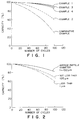
- Fig. 1 is a diagram showing discharge curves for batteries constructed using electrode plates prepared in the examples of the present invention and the comparative example;
- Fig. 2 is a diagram showing average discharge capacities of batteries constructed using electrode plates prepared in the same manner as in Example 1, except that three kinds of LiCoO2 having different average particle diameters are used as an active material;
- Fig. 3 is a photomicrograph (magnification: 3000 times) showing a microstructure of an active material prepared in Example 1 of the present invention;
- Fig. 4 is a photomicrograph (magnification: 3000 times) showing a microstructure of an active material prepared in Example 3 of the present invention;
- Fig. 5 is a photomicrograph (magnification: 3000 times) showing a microstructure of an active material prepared in Example 4 of the present invention;
- Fig. 6 is a photomicrograph (magnification: 2000 times) showing a particle structure of an active material prepared in Comparative Example.
- The formation of lamellar microcracks in an active material is considered to increase the specific surface area of the active material particles, resulting in markedly increased area of contact of the active material with an electrolyte. Further, this facilitates the penetration of the electrolyte into gaps among microcracks, increasing portions where the active material comes into contact with the electrolyte as a whole. The increased contact area increases the area where an electrochemical reaction which causes doping and undoping of ions for the active material occurs, leading to an improvement in utilization factor of the whole active material and an increase in discharge capacity, resulting in improved performance of the battery.
- Fig. 3 is a photomicrograph (magnification: 3000 times) showing the structure of a particle of an active material prepared in Example 1 of the present invention, which demonstrates that lamellar microcracks are formed in the active material. The lamellar pattern has such an appearance as found in a wind-wrought pattern on the sands.
- As shown in Fig. 3, the active material particles in the present invention have a lamellar structure with lamellar microcracks. In other words, the active material particles in the present invention have a lamellar cleavage structure, and the lamellar microcracks or pattern like a wind-wrought pattern on the sands are considered to be formed by pressing.
- Preferable active materials include LiCoO2 and other lithium compounds, such as LiNiO2, LiMnO2, LiMn2O4, and LiCo1-xNixO2 (wherein 0<x<1).
- The average particle diameter of the LiCoO2 powder used as the active material is preferably 1 to 100 µm, more preferably 10 to 60 µm. When it is less than 1 µm, the particles are so fine that it is difficult to form the wind-wrought pattern on the sands or microcracks and, at the same time, the handling of the active material per se becomes difficult. On the other hand, when the average particle diameter exceeds 100 µm, the active material per se is likely to be broken, unfavorably resulting in deteriorated characteristics.
- The electrode plate may be produced by the conventional method except for the provision of the step of pressing. In general, an active material, such as a LiCoO2 powder, a conductive agent, such as a graphite powder, a binder, such as a polyvinylidene fluoride resin, and a predetermined solvent are mixed together, and the mixture is stirred by means of a homogenizer to prepare an active material-containing mixture in a slurry form. Subsequently, the active material-containing mixture is coated on a collector of an aluminum foil or the like by means of a slot die coater, and the wet coating is then dried to remove the solvent, thereby forming a coating layer of an active material-containing mixture on the collector. Water is removed from the coating layer by aging or the like.
- The pressing of the active material may be carried out either after the formation of the coating layer or in the stage of a powdery raw material.
- Conventional pressing devices, such as a bench press and a roller press, may be used as means for the formation of a lamellar pattern, like a wind-wrought pattern on the sands, or microcracks in the active material particles.
- When the pressure for the pressing treatment is less than 500 kgf/cm2, the pattern like a wind-wrought pattern on the sands or the microcrack is difficult to be formed, while when it exceeds 7500 kgf/cm2, the active material particles are ground or alternatively the electrode plate per se, including the collector substrate, is unfavorably broken. In general, the pressure is preferably in the range of from 500 to 7500 kgf/cm2.
- In the production of a secondary battery using the electrode plate prepared above, a nonelectrolyte prepared by dissolving a lithium salt as a solute in an organic solvent is preferably used as the electrolyte.
- Organic solvents usable herein include cyclic esters, chain esters, cyclic ethers, and chain ethers. Examples of the cyclic esters include propylene carbonate, butylene carbonate, γ-butyrolactone, vinylene carbonate, 2-methyl-γ-butyrolactone, acetyl-γ-butyrolactone, and γ-valerolactone; examples of the chain esters include dimethyl carbonate, diethyl carbonate, dibutyl carbonate, dipropyl carbonate, methyl ethyl carbonate, methyl butyl carbonate, methyl propyl carbonate, ethyl butyl carbonate, ethyl propyl carbonate, butyl propyl carbonate, an alkyl ester of propionic acid, a dialkyl ester of malonic acid, and an alkyl ester of acetic acid; examples of the cyclic ethers include tetrahydrofuran, an alkyl tetrahydrofuran, a dialkyl tetrahydrofuran, an alkoxy tetrahydrofuran, a dialkoxy tetrahydrofuran, 1,3-dioxolane, an alkyl-1,3-dioxolane, and 1,4-dioxolane; and examples of the chain ethers include 1,2-dimethoxyethane, 1,2-diethoxyethane, diethyl ether, an ethylene glycol dialkyl ether, a diethylene glycol dialkyl ether, a triethylene glycol dialkyl ether, and a tetraethylene glycol dialkyl ether.
- Lithium salts as the solute include inorganic lithium salts, such as LiClO4, LiBF4, LiPF6, LiAsF6, LiCl, and LiBr, and organolithium salts, such as LiB(C6H5)4, LiN(SO2CF3)2, LiC(SO2CF3)3, LiOSO2CF3, LiOSO2C2F5, LiOSO2C3F7, LiOSO2C4F9, LiOSO2C5F11, LiOSO2C6F13, and LiOSO2C7F15.
- The present invention will be described in more detail with reference to the following examples. These examples are presented for illustrative purposes only and are not intended to limit the technical scope of the present invention.
- 90 parts by weight of a LiCoO2 powder as an active material, with an average particle diameter of 10 µm, having neither any pattern like a wind-wrought pattern on the sands nor any microcrack, 5.0 parts by weight of a graphite powder as a conductive agent, 5.0 parts by weight of a polyvinylidene fluoride resin (Neoflon VDF VP-850, manufactured by Daikin Industries, Ltd.), and 20 parts by weight of N-methylpyrrolidone were mixed together with stirring by means of a homogenizer at 8000 rpm for 10 min, thereby preparing a mixture, containing an active material for a positive plate, in a slurry form.
- The mixture containing an active material for a positive plate was coated on one side of a collector of a 20 µm-thick aluminum foil by means of a slot die coater, and the coating was dried in an oven of 120°C to remove the solvent, thereby forming an 80 µm-thick coating layer of an active material-containing mixture on the collector.
- For each collector, the surface of the coating layer, formed of an active material-containing mixture, on the collector was roller-pressed (pressure: 4000 kgf/cm2) to level the coating layer and, at the same time, to form a pattern, like a wind-wrought pattern on the sands, or microcracks in LiCoO2 per se contained in the coating layer, thereby preparing a contemplated electrode plate for a secondary battery with a nonaqueous electrolyte. A photomicrograph of the active material contained in the pressed coating layer is shown in Fig. 3.
- The electrode plate thus obtained was aged in a vacuum oven of 80°C for 48 hr, thereby removing water.
- 90 parts by weight of a LiCoO2 powder (average particle diameter: 10 µm) as an active material, which had been previously pressed at 4000 kgf/cm2 to form a pattern, like a wind-wrought pattern on the sands, or microcracks in LiCoO2, 5.0 parts by weight of a graphite powder as a conductive agent, 5.0 parts by weight of a polyvinylidene fluoride resin (Neoflon VDF VP-850, manufactured by Daikin Industries, Ltd.), and 20 parts by weight of N-methylpyrrolidone stirred by means of a homogenizer at 8000 rpm for 10 min, thereby preparing a mixture, containing an active material for a positive plate, in a slurry form.
- The mixture containing an active material for a positive plate was coated on one side of a collector of a 20 µm-thick aluminum foil by means of a slot die coater, and the coating was dried in an oven of 120°C to remove the solvent, thereby forming an 80 µm-thick coating layer on the collector.
- The electrode plate thus obtained was aged in a vacuum oven of 80°C for 48 hr, thereby removing water.
- An electrode plate for a secondary battery with a nonaqueous electrolyte was prepared in the same manner as in Example 1, except that the pressing of the coating layer was carried out at 3000 kgf/cm2. A photomicrograph of the active material contained in the pressed coating layer is shown in Fig. 4.
- The electrode plate thus obtained was aged in a vacuum oven of 80°C for 48 hr, thereby removing water.
- An electrode plate for a secondary battery with a nonaqueous electrolyte was prepared in the same manner as in Example 1, except that the pressing of the coating layer was carried out at 2000 kgf/cm2. A photomicrograph of the active material contained in the pressed coating layer is shown in Fig. 5.
- The electrode plate thus obtained was aged in a vacuum oven of 80°C for 48 hr, thereby removing water.
- 90 parts by weight of a LiCoO2 powder, as an active material (average particle diameter: 10 µm), having neither any pattern like a wind wrought pattern on the sands nor any microcrack, 5.0 parts by weight of a graphite powder as a conductive agent, 5.0 parts by weight of a polyvinylidene fluoride resin (Neoflon VDF VP-850, manufactured by Daikin Industries, Ltd.), and 20 parts by weight of N-methylpyrrolidone were stirred by means of a homogenizer at 8000 rpm for 10 min, thereby preparing a mixture, containing an active material for a positive plate, in a slurry form.
- The mixture containing an active material for a positive plate was coated on one side of a collector of a 20 µm-thick aluminum foil by means of a slot die coater, and the coating was dried in an oven of 100°C to remove the solvent, thereby forming an 80 µm-thick coating layer of an active material-containing mixture on the collector. A photomicrograph of the active material contained in the coating layer is shown in Fig. 6.
- The electrode plate thus obtained was aged in a vacuum oven of 80°C for 48 hr, thereby removing water.
- Secondary batteries with a nonaqueous electrolyte were constructed using electrode plates, prepared in the above examples and comparative example were used, as a positive electrode in combination with a negative plate.
- The negative plate was prepared as follows. 90 parts by weight of a graphite powder, 10 parts by weight of a styrene-butadiene rubber resin, and 30 parts by weight of toluene were mixed together, and the mixture was stirred by means of a homogenizer at 8,000 rpm for 10 min, thereby preparing a mixture, containing an active material for a negative electrode, in a slurry form. The mixture containing an active material for a negative electrode was coated by means of a slot die coater on both sides of a collector of a 10 µm-thick copper foil, and the coating was dried in an oven of 120°C to remove the solvent, thereby forming an 90 µm-thick coating layer, formed of an active material-containing mixture, on the collector. For each collector, the surface of the coating layer, formed of an active material-containing mixture, on the collector was roller-pressed to level the coating layer, thereby preparing a contemplated electrode plate for a secondary battery with a nonaqueous electrolyte. The electrode plate thus obtained was aged in a vacuum oven of 80°C for 72 hr.
- A separator of a microporous polyolefin (polypropylene, polyethylene, or a copolymer of polypropylene with polyethylene) film, with a three-dimensional hole structure (a spongy structure), having a larger width than the positive and negative plates was interposed between the positive plates prepared in Examples 1 to 4 and Comparative Example and the negative plate prepared just above, and spirally wound to prepare an electrode. The electrode was inserted into a closed-end cylindrical stainless steel container serving also as a terminal, for the negative electrode, to assembly a battery, of size AA, having a rated capacity of 500 mAh.
- An electrolyte prepared by dissolving one mol of LiPF6 as an electrolytic salt in one liter of a mixed solvent prepared by mixing EC (ethylene carbonate), PC (propylene carbonate), and DME (dimethoxyethane) together in a volume ratio of 1 : 1 : 2 was poured into the battery.
- For battery performance characteristics, charge-discharge characteristics were measured at 25°C on 20 cells per battery using a charge-discharge measuring apparatus by repeating charging and discharging 100 cycles under such conditions that the battery was charged at a maximum current of 0.2 CmA to a battery voltage of 4.1 V, the charging was stopped for 10 min, the battery was discharged at the same current to 2.75 V, and the discharging was stopped for 10 min.
- Fig. 1 shows the average discharge capacity for individual batteries, each consisting of 20 cells, constructed using electrode plates prepared in Examples 1 to 4 and Comparative Example. In this case, for each battery, the average value of the initial capacities is taken as 100%. As is apparent from Fig. 1, in discharge curves for batteries constructed using electrode plates prepared in Examples 1 to 4, the average discharge capacity was maintained at not less than about 60% even after the 100th cycle, whereas for Comparative Example, the capacity was remarkably lowered from an early stage with the retention of the capacity after the 100th cycle being only about 30%.
- Fig. 2 shows the average discharge capacity of batteries for each cycle by taking the average value of the initial capacities as 100%. In this case, the batteries each consist of 20 cells constructed using electrode plates prepared in the same manner as in Example 1, except that three kinds of LiCoO2 having different particles diameters were used as the active material.
- From Fig. 2, it is apparent that, for a battery using an electrode plate prepared from LiCoO2 with an average particle diameter of 1 to 100 µm, the retention of the average discharge capacity was not less than about 80% after the 100th cycle, whereas for batteries using electrode plates prepared from LiCoO2 with an average particle diameter of less than 1 µm and an average particle diameter of not less than 100 µm, the capacity was remarkably lowered in an early stage with the retentions of the capacity after the 100th cycle being respectively about 60% and about 70%.
- As described above, the electrode plate for a secondary battery with a nonaqueous electrode according to the present invention comprises a collector having thereon a coating layer containing a powdery active material, a conductive agent, and a binder, wherein the active material has a pattern, like a wind wrought pattern on the sands, or microcracks. This constitution can enhance the utilization factor of the active material resulting in very high battery performance characteristics.
Claims (13)
- An electrode plate for a secondary battery with a nonaqueous electrolyte, comprising: a collector; and a coating layer provided on the collector, the coating layer comprising a powdery active material, a conductive agent, and a binder,
the powdery active material being constituted by particles with a lamellar structure having lamellar cracks. - The electrode plate according to claim 1, wherein the average diameter of the active material particles is 1 to 100 µm.
- The electrode plate according to claim 1 or 2, wherein the active material comprises a lithium compound.
- The electrode plate according to claim 1, 2 or 3, wherein the active material is at least one member selected from the group consisting of LiCoO2, LiNiO2, LiMnO2, LiMn2O4, and LiCo1-xNixO2 (wherein 0<x<1).
- The electrode plate according to anyone of the preceding claims, wherein the conductive agent is a graphite powder.
- The electrode plate according to anyone of the preceding claims, wherein the binder is a resin.
- A process for producing an electrode plate for a secondary battery with a nonaqueous electrolyte, comprising the steps of:
mixing a powdery active material, a powdery conductive agent, and a binder with a predetermined solvent to prepare an active material-containing mixture in a slurry form;
coating the active material-containing mixture onto a collector; and
removing the solvent from the wet coating to form a coating layer of an active material-containing mixture on the collector,
wherein the active material is pressed either before the preparation of the active material-containing mixture or after the formation of the coating layer, thereby forming lamellar microcracks in the active material particles. - The process according to claim 7, wherein the active material particles have a lamellar structure and an average diameter of 1 to 100 µm.
- The process according to claim 7 or 8, wherein the active material comprises a lithium compound.
- The process according to claim 7, 8 or 9, wherein the active material is at least one lithium compound selected from the group consisting of LiCoO2, LiNiO2, LiMnO2, LiMn2O4, and LiCo1-xNixO2 (wherein 0<x<1).
- The process according to anyone of claims 7 to 10, wherein the conductive agent is a graphite powder.
- The process according to anyone of claims 7 to 11, wherein the binder is a resin.
- The process according to anyone of claims 7 to 12, wherein the pressing is carried out at a pressure of 500 to 7500 kgf/cm2.
Applications Claiming Priority (3)
| Application Number | Priority Date | Filing Date | Title |
|---|---|---|---|
| JP102949/95 | 1995-04-04 | ||
| JP10294995 | 1995-04-04 | ||
| JP10294995 | 1995-04-04 |
Publications (2)
| Publication Number | Publication Date |
|---|---|
| EP0736918A1 true EP0736918A1 (en) | 1996-10-09 |
| EP0736918B1 EP0736918B1 (en) | 1999-07-07 |
Family
ID=14341074
Family Applications (1)
| Application Number | Title | Priority Date | Filing Date |
|---|---|---|---|
| EP96105486A Expired - Lifetime EP0736918B1 (en) | 1995-04-04 | 1996-04-04 | Electrode for secondary battery with nonaqueous electrolyte and process for producing the same |
Country Status (2)
| Country | Link |
|---|---|
| EP (1) | EP0736918B1 (en) |
| DE (1) | DE69603116T2 (en) |
Cited By (6)
| Publication number | Priority date | Publication date | Assignee | Title |
|---|---|---|---|---|
| US6824924B1 (en) | 1998-07-06 | 2004-11-30 | Tdk Corporation | Electrode for nonaqueous electrolyte battery |
| EP1067613A4 (en) * | 1998-03-26 | 2005-12-14 | Tdk Corp | Method of manufacturing electrode of nonaqueous electrolytic battery |
| CN101218698B (en) * | 2005-07-11 | 2010-12-22 | 松下电器产业株式会社 | Lithium-ion secondary battery |
| CN103682254A (en) * | 2012-09-13 | 2014-03-26 | 大日本网屏制造株式会社 | Method for manufacturing electrode for battery |
| CN108598577A (en) * | 2017-12-22 | 2018-09-28 | 国联汽车动力电池研究院有限责任公司 | a kind of lithium ion battery manufacturing method |
| WO2021254808A1 (en) * | 2020-06-16 | 2021-12-23 | Basf Se | Process for making an electrode, and electrode active materials |
Citations (5)
| Publication number | Priority date | Publication date | Assignee | Title |
|---|---|---|---|---|
| JPS5471337A (en) * | 1977-11-17 | 1979-06-07 | Tokyo Shibaura Electric Co | Preparation of plate for spiral type alkaline battery |
| JPH04179054A (en) * | 1990-11-09 | 1992-06-25 | Sanyo Electric Co Ltd | Manufacture of storage battery with metal hydride |
| JPH04206149A (en) * | 1990-11-28 | 1992-07-28 | Matsushita Electric Ind Co Ltd | Inorganic nonaqueous electrolyte battery and manufacture thereof |
| RU1809933C (en) * | 1991-10-17 | 1993-04-15 | Производственно-научно-технологическое малое предприятие "Электромобиль" | Process of manufacture of iron electrode |
| EP0609609A2 (en) * | 1993-02-05 | 1994-08-10 | Sanyo Electric Co., Ltd | Hydrogen-absorbing alloy for a negative electrode and manufacturing method therefor |
-
1996
- 1996-04-04 DE DE69603116T patent/DE69603116T2/en not_active Expired - Fee Related
- 1996-04-04 EP EP96105486A patent/EP0736918B1/en not_active Expired - Lifetime
Patent Citations (5)
| Publication number | Priority date | Publication date | Assignee | Title |
|---|---|---|---|---|
| JPS5471337A (en) * | 1977-11-17 | 1979-06-07 | Tokyo Shibaura Electric Co | Preparation of plate for spiral type alkaline battery |
| JPH04179054A (en) * | 1990-11-09 | 1992-06-25 | Sanyo Electric Co Ltd | Manufacture of storage battery with metal hydride |
| JPH04206149A (en) * | 1990-11-28 | 1992-07-28 | Matsushita Electric Ind Co Ltd | Inorganic nonaqueous electrolyte battery and manufacture thereof |
| RU1809933C (en) * | 1991-10-17 | 1993-04-15 | Производственно-научно-технологическое малое предприятие "Электромобиль" | Process of manufacture of iron electrode |
| EP0609609A2 (en) * | 1993-02-05 | 1994-08-10 | Sanyo Electric Co., Ltd | Hydrogen-absorbing alloy for a negative electrode and manufacturing method therefor |
Non-Patent Citations (4)
| Title |
|---|
| DATABASE WPI Section Ch Week 7929, Derwent World Patents Index; Class A85, AN 79-53425B, XP002009402 * |
| DATABASE WPI Section Ch Week 9425, Derwent World Patents Index; Class L03, AN 94-208001, XP002009403 * |
| PATENT ABSTRACTS OF JAPAN vol. 016, no. 488 (E - 1277) 9 October 1992 (1992-10-09) * |
| PATENT ABSTRACTS OF JAPAN vol. 016, no. 535 (E - 1288) 5 November 1992 (1992-11-05) * |
Cited By (8)
| Publication number | Priority date | Publication date | Assignee | Title |
|---|---|---|---|---|
| EP1067613A4 (en) * | 1998-03-26 | 2005-12-14 | Tdk Corp | Method of manufacturing electrode of nonaqueous electrolytic battery |
| US6824924B1 (en) | 1998-07-06 | 2004-11-30 | Tdk Corporation | Electrode for nonaqueous electrolyte battery |
| CN101218698B (en) * | 2005-07-11 | 2010-12-22 | 松下电器产业株式会社 | Lithium-ion secondary battery |
| US8236449B2 (en) * | 2005-07-11 | 2012-08-07 | Panasonic Corporation | Lithium ion secondary battery with improved electrode stability and safety |
| CN103682254A (en) * | 2012-09-13 | 2014-03-26 | 大日本网屏制造株式会社 | Method for manufacturing electrode for battery |
| CN108598577A (en) * | 2017-12-22 | 2018-09-28 | 国联汽车动力电池研究院有限责任公司 | a kind of lithium ion battery manufacturing method |
| CN108598577B (en) * | 2017-12-22 | 2020-08-07 | 国联汽车动力电池研究院有限责任公司 | Method for manufacturing lithium ion battery |
| WO2021254808A1 (en) * | 2020-06-16 | 2021-12-23 | Basf Se | Process for making an electrode, and electrode active materials |
Also Published As
| Publication number | Publication date |
|---|---|
| DE69603116D1 (en) | 1999-08-12 |
| DE69603116T2 (en) | 2000-03-09 |
| EP0736918B1 (en) | 1999-07-07 |
Similar Documents
| Publication | Publication Date | Title |
|---|---|---|
| EP3561918B1 (en) | Pre-lithiation method for anode for secondary battery | |
| KR102265214B1 (en) | Pre-lithiation Method of Silicon oxide Anode Electrodes for secondary battery | |
| CN103050707B (en) | Lithium rechargeable battery | |
| US11417888B2 (en) | Electrode additives and coatings for minimizing cathode transition metal dissolution | |
| US11735725B2 (en) | Ceramic coating for lithium or sodium metal electrodes | |
| US7854773B2 (en) | Method of producing an electrode plate for a nonaqueous electrolyte secondary battery | |
| JPH07235291A (en) | Secondary battery | |
| KR20220103469A (en) | Method for charging and discharging secondary battery | |
| JPH09306540A (en) | Lithium secondary battery | |
| JP2011192561A (en) | Manufacturing method for nonaqueous electrolyte secondary battery | |
| KR102530195B1 (en) | Method for manufacturing negative electrode for secondary battery | |
| KR20210120686A (en) | Method for manufacturing negative electrode | |
| US20150188196A1 (en) | Non-aqueous electrolytic secondary battery | |
| JP5546957B2 (en) | Negative electrode for lithium ion secondary battery and lithium ion secondary battery | |
| EP0736918B1 (en) | Electrode for secondary battery with nonaqueous electrolyte and process for producing the same | |
| KR20100075543A (en) | Nonaqueous electrolytic secondary battery and the manufacturing method thereof | |
| JP3503697B2 (en) | Non-aqueous electrolyte battery | |
| JP5078330B2 (en) | Negative electrode plate for non-aqueous electrolyte secondary battery and non-aqueous electrolyte secondary battery using this negative electrode plate | |
| JP4270904B2 (en) | Non-aqueous lithium secondary battery | |
| KR101116551B1 (en) | Negative electrode for lithium secondary battery and lithium secondary battery comprising same | |
| JP5181607B2 (en) | Method for producing electrode plate for negative electrode of non-aqueous electrolyte secondary battery | |
| JP3575308B2 (en) | Non-aqueous electrolyte secondary battery | |
| JPH09259890A (en) | Electrode coating solution and electrode plate for non-aqueous electrolyte secondary battery | |
| JP2001015168A (en) | Lithium secondary battery | |
| KR100635740B1 (en) | Anode active material for lithium secondary battery and lithium secondary battery comprising same |
Legal Events
| Date | Code | Title | Description |
|---|---|---|---|
| PUAI | Public reference made under article 153(3) epc to a published international application that has entered the european phase |
Free format text: ORIGINAL CODE: 0009012 |
|
| AK | Designated contracting states |
Kind code of ref document: A1 Designated state(s): DE FR GB |
|
| 17P | Request for examination filed |
Effective date: 19961113 |
|
| 17Q | First examination report despatched |
Effective date: 19970128 |
|
| GRAG | Despatch of communication of intention to grant |
Free format text: ORIGINAL CODE: EPIDOS AGRA |
|
| GRAG | Despatch of communication of intention to grant |
Free format text: ORIGINAL CODE: EPIDOS AGRA |
|
| GRAH | Despatch of communication of intention to grant a patent |
Free format text: ORIGINAL CODE: EPIDOS IGRA |
|
| GRAH | Despatch of communication of intention to grant a patent |
Free format text: ORIGINAL CODE: EPIDOS IGRA |
|
| GRAA | (expected) grant |
Free format text: ORIGINAL CODE: 0009210 |
|
| AK | Designated contracting states |
Kind code of ref document: B1 Designated state(s): DE FR GB |
|
| REF | Corresponds to: |
Ref document number: 69603116 Country of ref document: DE Date of ref document: 19990812 |
|
| ET | Fr: translation filed | ||
| PLBE | No opposition filed within time limit |
Free format text: ORIGINAL CODE: 0009261 |
|
| STAA | Information on the status of an ep patent application or granted ep patent |
Free format text: STATUS: NO OPPOSITION FILED WITHIN TIME LIMIT |
|
| 26N | No opposition filed | ||
| PGFP | Annual fee paid to national office [announced via postgrant information from national office to epo] |
Ref country code: GB Payment date: 20010307 Year of fee payment: 6 |
|
| REG | Reference to a national code |
Ref country code: GB Ref legal event code: IF02 |
|
| PG25 | Lapsed in a contracting state [announced via postgrant information from national office to epo] |
Ref country code: GB Free format text: LAPSE BECAUSE OF NON-PAYMENT OF DUE FEES Effective date: 20020404 |
|
| GBPC | Gb: european patent ceased through non-payment of renewal fee |
Effective date: 20020404 |
|
| PGFP | Annual fee paid to national office [announced via postgrant information from national office to epo] |
Ref country code: FR Payment date: 20050415 Year of fee payment: 10 |
|
| PGFP | Annual fee paid to national office [announced via postgrant information from national office to epo] |
Ref country code: DE Payment date: 20050427 Year of fee payment: 10 |
|
| PG25 | Lapsed in a contracting state [announced via postgrant information from national office to epo] |
Ref country code: DE Free format text: LAPSE BECAUSE OF NON-PAYMENT OF DUE FEES Effective date: 20061101 |
|
| REG | Reference to a national code |
Ref country code: FR Ref legal event code: ST Effective date: 20061230 |
|
| PG25 | Lapsed in a contracting state [announced via postgrant information from national office to epo] |
Ref country code: FR Free format text: LAPSE BECAUSE OF NON-PAYMENT OF DUE FEES Effective date: 20060502 |