EP0736108B1 - Co-cr-mo powder metallurgy articles and process for their manufacture - Google Patents
Co-cr-mo powder metallurgy articles and process for their manufacture Download PDFInfo
- Publication number
- EP0736108B1 EP0736108B1 EP95902705A EP95902705A EP0736108B1 EP 0736108 B1 EP0736108 B1 EP 0736108B1 EP 95902705 A EP95902705 A EP 95902705A EP 95902705 A EP95902705 A EP 95902705A EP 0736108 B1 EP0736108 B1 EP 0736108B1
- Authority
- EP
- European Patent Office
- Prior art keywords
- alloy
- max
- carbon
- powder
- nitrogen
- Prior art date
- Legal status (The legal status is an assumption and is not a legal conclusion. Google has not performed a legal analysis and makes no representation as to the accuracy of the status listed.)
- Expired - Lifetime
Links
Classifications
-
- B—PERFORMING OPERATIONS; TRANSPORTING
- B22—CASTING; POWDER METALLURGY
- B22F—WORKING METALLIC POWDER; MANUFACTURE OF ARTICLES FROM METALLIC POWDER; MAKING METALLIC POWDER; APPARATUS OR DEVICES SPECIALLY ADAPTED FOR METALLIC POWDER
- B22F3/00—Manufacture of workpieces or articles from metallic powder characterised by the manner of compacting or sintering; Apparatus specially adapted therefor ; Presses and furnaces
- B22F3/02—Compacting only
- B22F3/03—Press-moulding apparatus therefor
-
- A—HUMAN NECESSITIES
- A61—MEDICAL OR VETERINARY SCIENCE; HYGIENE
- A61L—METHODS OR APPARATUS FOR STERILISING MATERIALS OR OBJECTS IN GENERAL; DISINFECTION, STERILISATION OR DEODORISATION OF AIR; CHEMICAL ASPECTS OF BANDAGES, DRESSINGS, ABSORBENT PADS OR SURGICAL ARTICLES; MATERIALS FOR BANDAGES, DRESSINGS, ABSORBENT PADS OR SURGICAL ARTICLES
- A61L27/00—Materials for grafts or prostheses or for coating grafts or prostheses
- A61L27/02—Inorganic materials
- A61L27/04—Metals or alloys
- A61L27/045—Cobalt or cobalt alloys
-
- B—PERFORMING OPERATIONS; TRANSPORTING
- B22—CASTING; POWDER METALLURGY
- B22F—WORKING METALLIC POWDER; MANUFACTURE OF ARTICLES FROM METALLIC POWDER; MAKING METALLIC POWDER; APPARATUS OR DEVICES SPECIALLY ADAPTED FOR METALLIC POWDER
- B22F9/00—Making metallic powder or suspensions thereof
- B22F9/02—Making metallic powder or suspensions thereof using physical processes
- B22F9/06—Making metallic powder or suspensions thereof using physical processes starting from liquid material
- B22F9/08—Making metallic powder or suspensions thereof using physical processes starting from liquid material by casting, e.g. through sieves or in water, by atomising or spraying
- B22F9/082—Making metallic powder or suspensions thereof using physical processes starting from liquid material by casting, e.g. through sieves or in water, by atomising or spraying atomising using a fluid
-
- C—CHEMISTRY; METALLURGY
- C22—METALLURGY; FERROUS OR NON-FERROUS ALLOYS; TREATMENT OF ALLOYS OR NON-FERROUS METALS
- C22C—ALLOYS
- C22C1/00—Making non-ferrous alloys
- C22C1/04—Making non-ferrous alloys by powder metallurgy
- C22C1/0433—Nickel- or cobalt-based alloys
-
- C—CHEMISTRY; METALLURGY
- C22—METALLURGY; FERROUS OR NON-FERROUS ALLOYS; TREATMENT OF ALLOYS OR NON-FERROUS METALS
- C22C—ALLOYS
- C22C19/00—Alloys based on nickel or cobalt
- C22C19/07—Alloys based on nickel or cobalt based on cobalt
-
- A—HUMAN NECESSITIES
- A61—MEDICAL OR VETERINARY SCIENCE; HYGIENE
- A61F—FILTERS IMPLANTABLE INTO BLOOD VESSELS; PROSTHESES; DEVICES PROVIDING PATENCY TO, OR PREVENTING COLLAPSING OF, TUBULAR STRUCTURES OF THE BODY, e.g. STENTS; ORTHOPAEDIC, NURSING OR CONTRACEPTIVE DEVICES; FOMENTATION; TREATMENT OR PROTECTION OF EYES OR EARS; BANDAGES, DRESSINGS OR ABSORBENT PADS; FIRST-AID KITS
- A61F2310/00—Prostheses classified in A61F2/28 or A61F2/30 - A61F2/44 being constructed from or coated with a particular material
- A61F2310/00005—The prosthesis being constructed from a particular material
- A61F2310/00011—Metals or alloys
- A61F2310/00029—Cobalt-based alloys, e.g. Co-Cr alloys or Vitallium
-
- B—PERFORMING OPERATIONS; TRANSPORTING
- B22—CASTING; POWDER METALLURGY
- B22F—WORKING METALLIC POWDER; MANUFACTURE OF ARTICLES FROM METALLIC POWDER; MAKING METALLIC POWDER; APPARATUS OR DEVICES SPECIALLY ADAPTED FOR METALLIC POWDER
- B22F2201/00—Treatment under specific atmosphere
- B22F2201/02—Nitrogen
-
- Y—GENERAL TAGGING OF NEW TECHNOLOGICAL DEVELOPMENTS; GENERAL TAGGING OF CROSS-SECTIONAL TECHNOLOGIES SPANNING OVER SEVERAL SECTIONS OF THE IPC; TECHNICAL SUBJECTS COVERED BY FORMER USPC CROSS-REFERENCE ART COLLECTIONS [XRACs] AND DIGESTS
- Y10—TECHNICAL SUBJECTS COVERED BY FORMER USPC
- Y10S—TECHNICAL SUBJECTS COVERED BY FORMER USPC CROSS-REFERENCE ART COLLECTIONS [XRACs] AND DIGESTS
- Y10S75/00—Specialized metallurgical processes, compositions for use therein, consolidated metal powder compositions, and loose metal particulate mixtures
- Y10S75/95—Consolidated metal powder compositions of >95% theoretical density, e.g. wrought
Definitions
- Co-Cr-Mo alloys designated as ASTM F75, "STELLITE” Alloy No. 21, “CARPENTER CCM” and GADS “VITALLIUM” are used in medical devices, particularly surgical implants. Such devices require good wear resistance for their articulating surfaces and high strength to handle the loads imposed during use.
- the "STELLITE” Alloy No. 21 has been extensively used in implant devices. In the late 1980's, the upper weight percent limit for nickel in ASTM F75 (F75-87) was lowered from 3% to 1% in order to reduce the risk of in vivo allergic reactions to nickel. The lower nickel specification of F75-87 separated the two alloy grades and currently both "STELLITE" Alloy No. 21, containing up to 3% nickel, and ASTM F75-87, containing up to 1% nickel, are used in cast form for medical implant devices.
- Cast material suffers from microstructural defects such as porosity and carbide segregation (carbide networking or carbide pooling). Porosity leads to localized corrosion and degradation of mechanical properties of a cast implant. Carbide segregation in a cast alloy is believed to be a cause of corrosion related failure of cast implants. It is known to subject a cast implant to a homogenization heat treatment in order to reduce carbide segregation. Hot isostatic pressing (HIP) of cast parts is used to eliminate porosity resulting from the casting operation.
- HIP Hot isostatic pressing
- post-casting thermal treatments are to increase the performance of the implants in use by eliminating local defects in the microstructure.
- thermal treatments reduce the overall hardness and strength of the material and, thus, adversely affect the wear resistance provided by the alloys.
- an aging treatment can be used to increase the strength of a cast surgical implant that has been homogenized or HIP'd.
- the base F75-87 alloy composition was modified by lowering the carbon content to a nominal 0.05% and adding up to 0.20% nitrogen.
- the composition of the modified alloy is defined in ASTM F799-87 (F799).
- the "CARPENTER CCM” alloy is typical of such grades. The reduction in carbon reduces the amount of carbide segregation present in the cast ingot.
- the addition of nitrogen increases the strength of the alloy and compensates for the loss of strength that would otherwise result from the lower carbon content.
- the nitrogen-strengthened material is frequently prepared by thermomechanical processing (TMP), a combination of thermal treatment and simultaneous mechanical hot working below the recrystallization temperature, to achieve the higher mechanical properties and hardness specified in ASTM F799 for surgical implants.
- TMP is performed at temperatures in the range of 926.7 - 1038 C (1700-1900F).
- TMP requires close control to assure that all of the material possesses the same amount of mechanical working to achieve uniform and reproducible mechanical properties from bar to bar or part to part. This is particularly true during the forging of finished or near-finished products from bar-stock, where several reheats and forging passes are employed to shape the product.
- the forging practice changes with the product geometry, particularly its thickness.
- the ability to achieve ASTM F799 properties becomes difficult or impossible depending on the ability to forge the material at the proper temperature to achieve the desired amount of residual stress in the forged part.
- This means using TMP'd bar-stock that meets ASTM F799 mechanical properties does not guarantee a forger that the forged product he makes will meet the properties specified in ASTM F799. Part-to-part reproducibility is also a concern as is die wear, which increases as lower temperatures are used to "work in" the desired mechanical properties.
- Nitrogen in the form of nitrides, does not retard grain growth as well as carbon in the form of carbides. That characteristic presents a problem in connection with porous coated, i.e., uncemented, implants. Such implants were developed to provide better fixation in the body than cemented implants.
- porous coated i.e., uncemented, implants.
- metal powder or fine wire is sintered onto the alloy substrate. The sintering operation requires heating the article to a high temperature to properly bond the powder to the substrate. Unless special precautions are taken, such a high temperature cycle can cause grain growth, segregation, and microporosity in the substrate material with a resulting loss of corrosion resistance and strength, particularly fatigue strength.
- a dispersion strengthened version of the "VITALLIUM” alloy (GADS "VITALLIUM") has been developed.
- GADS "VITALLIUM” alloy contains a dispersion of metal oxides that offset the adverse effects of the sintering process.
- the GADS "VITALLIUM” alloy can only be produced using powder metallurgy processing as opposed to cast/wrought processing.
- the GADS "VITALLIUM” alloy contains a dispersion of relatively hard metal oxide particles which appreciably strengthens the alloy, but can also render it relatively difficult to process.
- the GADS "VITALLIUM” alloy powder is consolidated and hot worked to produce bar-stock.
- the finished bar-stock of the alloy may contain small ultrasonic indications resulting from microporosity that forms during hot working of the alloy. Such indications apparently result from the hot working parameters selected (billet temperature or amount of reduction per pass) and/or the difference in plasticity between the matrix material and the dispersed metal oxides.
- the GADS "VITALLIUM” alloy is also difficult to machine because of the dispersed metal oxides. Consequently, this alloy is supplied primarily in forge-bar form. The forge bar can be further hot worked to eliminate any microporosity.
- Powder metallurgy processing has also been used to produce surgical implants from the "STELLITE 21" and F75-87 alloys. It is generally known that powder metallurgy products possess a more homogeneous microstructure than cast/wrought products. The mechanical properties of the known powder metallurgy products generally meet the requirements of ASTM F75-87 (448 MPa (65 ksi) yield strength min.), but do not meet those of ASTM F799 (827.4 MPa (120 ksi) yield strength min.). The known powder metallurgy products can be thermomechanically processed in order to meet the mechanical properties of ASTM F799. The powder metallurgy products can also be subjected to an aging heat treatment to increase the hardness and to improve the mechanical properties such as yield strength.
- Annealing a powder metallurgy product results in a significant reduction in the strength and hardness of the alloy, such that the powder metallurgy alloy product does not have a hardness of at least 35 HRC, the minimum hardness specified in ASTM F799.
- a hardness equal to or greater than 35 HRC is desired in the implant industry to achieve the best performance of implant devices during in vivo use.
- a method for producing a steel alloy article having a unique combination of strength, hardness, ductility, and corrosion resistance includes the step of preparing a powdered alloy charge consisting of, in weight percent, 0.35% max. C, 1.00% max. Mn, 1.00% max. Si, 26.0-30.0% Cr, 5.0-7.0% Mo, 3% max. Ni, 0.13-0.25% N, 1.00% max. Fe, and the balance Co.
- C and N are controlled such that they satisfy the relationship: 62.866+360.93 ⁇ (%C)+286.633 ⁇ (%N)-682.165 ⁇ (%C) 2 -641.702 ⁇ (%N) 2 ⁇ 120.
- the oxide forming elements of magnesium, calcium, aluminum, yttrium, lanthanum, titanium, or zirconium are maintained a very low levels, i.e., not more than 0.01%, in order to avoid the formation of metal-oxide phases that adversely affect the properties of the powder metallurgy article according to the invention.
- substantially fully dense means a metal powder compact that has essentially no interconnected porosity.
- a substantially fully dense body has a density that is at least about 95% of theoretical density. After consolidation, the compact can be mechanically hot worked to provide a desired product form.
- a substantially fully dense, powder metallurgy article formed from a Co-Cr-Mo alloy powder The alloy powder consists of, in weight percent, 0.35% max. C, 1.00% max. Mn, 1.00% max. Si, 26.0-30.0% Cr, 5.0-7.0% Mo, 3.00% max. Ni, 0.13-0.25% N, 1.00% max. Fe, and the balance Co. Within their respective weight percent limits C and N are controlled such that they satisfy the relationship: 62.866+360.93 ⁇ (%C)+286.633 ⁇ (%N)-682.165 ⁇ (%C) 2 -641.702 ⁇ (%N) 2 ⁇ 120. As described above, the alloy powder contains not more than 0.01% of the oxide forming metals herein before given by claim 1 or claim 11.
- an alloy powder charge is prepared, consolidated to substantially full density, and then hot worked to a desired shape or form.
- the alloy powder has a composition that generally conforms to either ASTM F75-87 or ASTM F799-87.
- the carbon and nitrogen are controlled such that, in the as-hot-worked condition, an article formed from the alloy powder has mechanical properties, i.e., yield and tensile strength, ductility, and hardness, that meet or exceed ASTM F75-87 and ASTM F799-87.
- the preferred composition of a powder metallurgy article made in accordance with this invention consists of, in weight percent, 0.35% max. carbon, 1.0% max. each of manganese, silicon, and iron, 26-30% chromium, up to 3%, preferably up to 1.0% max., nickel, 4-7% molybdenum, 0.13-0.25% nitrogen, and the balance cobalt.
- the powder metallurgy article contains no more than 0.01% of oxide forming metals in order to avoid the presence of metal oxide phases in the alloy structure. Such metal oxide phases can adversely affect the desired properties of the powder metallurgy article according to this invention.
- the carbon and nitrogen are controlled such that the following relationship is satisfied: 62.866+360.93 ⁇ (%C)+286.633 ⁇ (%N)-682.165 ⁇ (%C) 2 -641.702 ⁇ (%N) 2 ⁇ 120.
- the alloy powder contains at least 0.31% carbon and nitrogen combined. Good results have been obtained with alloy powder containing 0.19-0.29% carbon. For best results, the alloy powder contains 0.25-0.28% carbon and 0.15-0.20% nitrogen.
- the preferred method of making the alloy powder is to melt a heat of alloying materials to provide a molten alloy having the following weight percent composition: 0.35% max. carbon, 1.00% max. manganese, 1.00% max. silicon, 26.0-30.0% chromium, 5.0-7.0% molybdenum, 3% max. nickel, 1.00% max. iron, 0.01% max oxide-forming mets and the balance cobalt.
- the preferred melting technique is vacuum induction melting (VIM), although other melting techniques can be used.
- the VIM furnace is backfilled with a partial pressure of an inert gas such as argon.
- the VIM furnace is backfilled with a partial pressure of a cover gas that contains an inert gas and nitrogen gas.
- the molten alloy is superheated to a temperature selected to provide a desired level of nitrogen in the molten alloy.
- the equilibrium nitrogen solubility in a molten Co-Cr-Mo alloy is inversely related to the temperature of the molten alloy and directly related to the square root of the partial pressure of nitrogen in the melting vessel.
- the superheated, molten alloy is atomized with nitrogen gas so as to provide substantially spherical powder particles.
- the atomized alloy is preferably cooled in an inert atmosphere to prevent excessive nitriding and oxidizing of the powder particles.
- the alloy powder is screened to a desired particle size and then blended.
- the screened and blended alloy powder is then filled into a stainless steel canister to a desired fill density and the canister is then closed.
- the canister is preferably equipped with a fitting that permits the canister to be connected to a vacuum pump.
- the powder-filled canister is baked at an elevated temperature while a vacuum is drawn on the interior of the canister. The heating and vacuum treatment is continued for a time sufficient to substantially degas the powder and the interior of the canister.
- the powder-filled canister After the powder-filled canister is degassed, it is sealed and disconnected from the vacuum pump. The powder-filled canister is then consolidated at elevated temperature and pressure for a time sufficient to substantially fully densify the alloy powder.
- the preferred consolidation technique is hot isostatic pressing (HIP), although other known techniques such as ceramic granular consolidation (CERACON), rapid omnidirectional compaction (ROC) or other fluid die consolidation technique, or hot extrusion can be used.
- the powder-filled canister is preferably consolidated at as high a temperature as practical in order to benefit the hot workability of the consolidated alloy powder charge. However, it is preferred that the consolidation temperature does not exceed the incipient melting temperature of the alloy powder.
- the consolidated alloy powder is hot worked in a known manner such as by cogging, forging, pressing, or rolling to provide a desired product form.
- the consolidated alloy powder is preferably hot worked from a temperature of about 1149C (2100F).
- the as-hot-worked alloy powder compact can be machined to a final dimension for commercial sale.
- the canister remnant is removed from the hot-worked billet preferably by machining.
- the hot-worked alloy powder compact can be annealed. It has been found that an article made in accordance with the process of the present invention provides a hardness greater than about 35 HRC after having been annealed at temperatures up to about 1215.5C (2220F).
- the metallurgical advantage of annealed material over as-hot-worked material is that the carbide morphology is more uniform throughout the material. In the annealed material the carbides are uniformly present both within the grains and at the grain boundaries, whereas in the as-hot-worked material, the carbides are predominantly at the grain boundaries. A uniform carbide distribution may be desirable for certain applications.
- Examples 1-4 having the weight percent compositions shown in Table I below were produced by vacuum induction melting (VIM) in a VIM capable gas atomization unit. Also shown in Table I is the weight percent composition of similarly prepared, commercially available powder, Heat A, having a composition that conforms to ASTM F75-87.
- the furnace was initially evacuated to a subatmospheric pressure of about 9 ⁇ m Hg.
- the VIM furnace was backfilled to a partial pressure of about 508 mm (20in) Hg with argon gas.
- the VIM furnace was backfilled to a partial pressure of about 508 mm (20in) Hg with nitrogen gas and then to a partial pressure of about 254 mm (10in) Hg with argon gas.
- each heat was superheated to a temperature of about 1593.3C (2900F).
- the molten alloys of Examples 1-4 were tapped and atomized in nitrogen gas to produce substantially spherical powder particles.
- the molten alloy of Heat A was atomized in argon gas.
- the alloy powders of Examples 1-4 were cooled under a partial pressure of argon gas.
- the alloy powder from each of the five heats was screened to 150 ⁇ m (-100 mesh) and blended.
- Powder from each of Examples 1-4 was air filled into a 10.16 cm rd. x 0.165 cm wall thickness x 243.8 cm/long (4in rd. x 0.065in wall thickness x 96in long) stainless steel canister.
- the powder from Example 3 was used to fill two canisters hereinafter designated Examples 3A and 3B.
- the alloy powder was vibrated to maximize the powder fill density in the canisters and then each canister was sealed with a top plate having an evacuation tube.
- the filled canisters were connected to a vacuum pump and were evacuated to a subatmospheric pressure of less than lmm Hg while simultaneously being heated at 121.1C (250F) for sufficient time to degas the alloy powder and the canister interior. After the baking and degassing step, the canisters were sealed by crimping and welding the evacuation tubes.
- the canisters were then hot isostatically pressed (HIP'd) at 1204.4C (2200F) for 4h at a pressure of 103.4 MPa (15ksi) to substantially full density.
- the HIP'd canisters were heated to 1135 ⁇ 13.9C (2075 ⁇ 25F) in an air furnace and then cogged from 9.14 cm (3.6in) rd. to 6.35 cm (2.5in) rd.
- the 6.35 cm (2.5in) rd. bars were then cut, reheated to 1135 ⁇ 13.9C (2075 ⁇ 25F), and hot rolled to 3.81 cm (1.5in) rd, bars with a finish temperature in excess of 1038C (1900F). All of the canisters hot worked well.
- the powder of comparative Heat A was processed similarly into 6.35 cm (2.5in) and 3.81 cm (1.5in) round bars.
- Samples were taken from all of the 6.35 cm (2.5in) rd, bars of Examples 1-4 and from three (3) of the 6.35 cm (2.5in) rd. bars of Heat A (AA, AB, and AC), the commercially available ASTM F75 material. Samples were also taken from all of the 3.81 cm (1.5in) rd. bars of Examples 1-4 and from five (5) of the 3.81 cm (1.5in) rd. bars of Heat A (AD, AE, AF, AG, and AH). Low stress ground room temperature tensile specimens (0.64 cm (0.252in) gage diameter) were prepared from each sample and then tested.
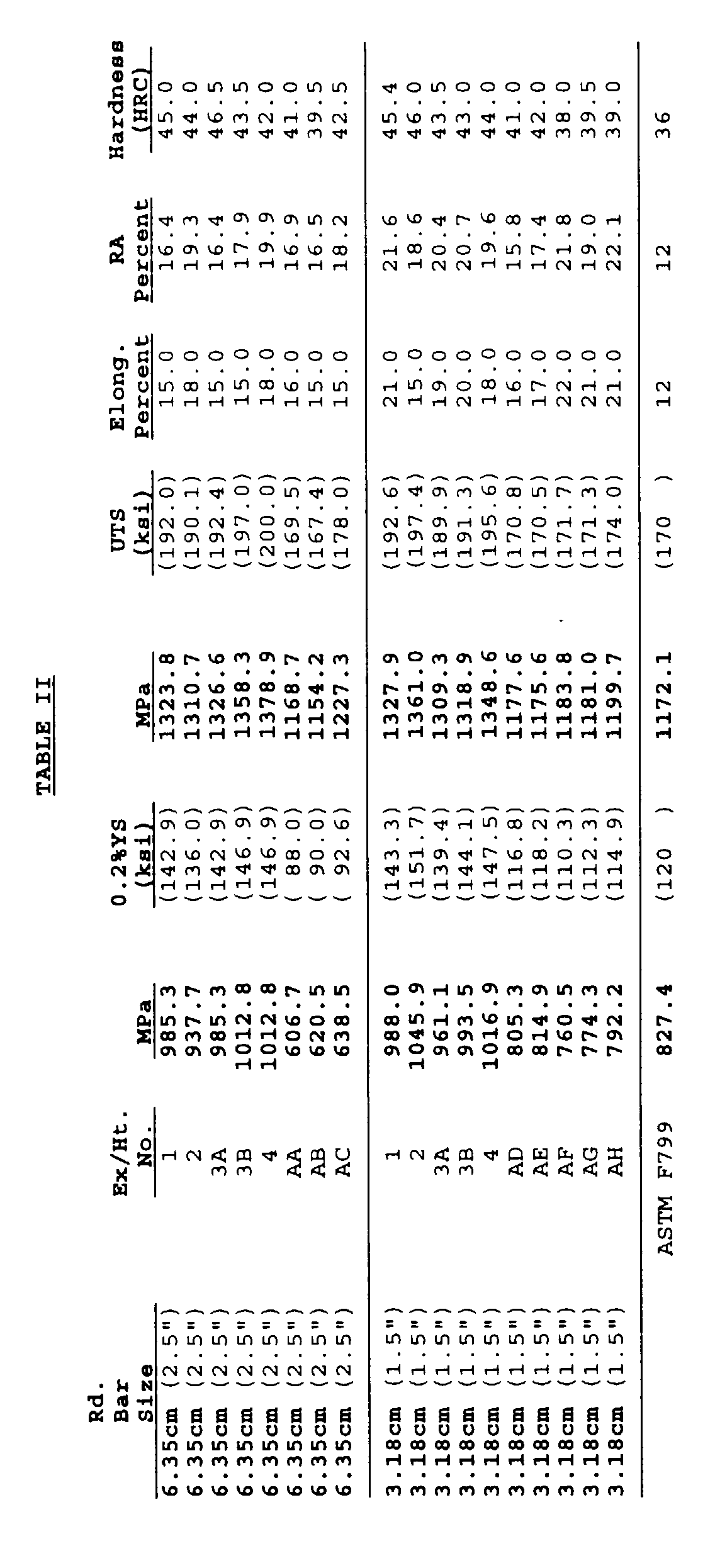
- Table II Shown in Table II are the results of room temperature tensile testing including the 0.2% Offset Yield Strength (0.2%YS) and Ultimate Tensile Strength (UTS) in MPa (ksi), the percent elongation (Elong. Percent), the percent reduction in cross-sectional area (RA Percent), and the Rockwell C-scale hardness (Hardness - HRC). Also shown in Table II for easy reference are the minimum mechanical requirements specified in ASTM F799-87. The data in Table II show that the hot-rolled 6.35 cm (2.5 in) rd. bars prepared in accordance with the present invention meet the yield and tensile strength requirements of ASTM F799-87 while those prepared from the ASTM F75 alloy powder do not.
- the 3.18 cm (1.5in) rd. bars prepared from the commercial F75 alloy powder do not meet the yield strength requirement of ASTM F799-87, whereas the 3.18 cm (1.5in) rd, bars prepared in accordance with the present invention significantly exceed the strength and hardness requirements of ASTM F799-87 while maintaining excellent ductility.
- the 3.18 cm (1.5") rd. hot-rolled bars were then separated into two lots with bars from Examples 1-4 in each lot.
- One lot of bars was straightened on a Medart straightening machine with the bars in the hot-rolled, unannealed condition.
- the second lot of bars was annealed at 1215.5C (2220F) and then gag straightened.
- the annealing was performed by charging the bars into a furnace that was heated to nominally 815.5C (1500F), heating to the annealing temperature, holding at the annealing temperature for 2h, and then water quenching to room temperature.
- the unannealed and annealed bars were then turned to remove the remainder of the HIP'g canister. After decanning, the bars were restraightened as required to permit grinding of the turned surfaces.
- the ground bars were then visually inspected for surface defects and ultrasonically tested for internal defects. The bar surfaces were acceptable and no internal defects were detected.
- Table IIIB The results of metallographic examination for grain size measurement of the unannealed bars are shown in Table IIIB.
- the data in Table IIIB include the weight percents of carbon, nitrogen, and carbon-plus-nitrogen and the measured ASTM grain size.
- the results of room temperature tensile testing of the annealed bars are tabulated in Table IVA for the unannealed material, including the 0.2% Offset Yield Strength (0.2%YS) and Ultimate Tensile Strength (UTS) in MPa (ksi), the percent elongation (Elong. Percent), the percent reduction in cross-sectional area (RA Percent), and the Rockwell C-scale hardness (Hardness - HRC).
- Table IVB The results of metallographic examination for grain size measurement of the unannealed bars are shown in Table IVB.
- the data in Table IVB include the weight percents of carbon, nitrogen, and carbon-plus-nitrogen and the measured ASTM grain size.
- Tables IIIA and IIIB show that unannealed powder metallurgy articles prepared in accordance with the present invention significantly exceed the mechanical requirements of ASTM F799-87 and provide the desired fine grain size.
- Tables IVA and IVB show that although powder metallurgy articles prepared in accordance with the present invention and annealed at 1215.5C (2220F) do not meet the yield strength requirement of ASTM F799-87, such articles made from the preferred composition, i.e., Examples 3A, 3B, and 4, do provide a hardness level greater than 35 HRC.
- a powder metallurgy article made in accordance with the present invention is suitable for uses that require high hardness in the annealed condition.
- the present invention provides novel powder metallurgy products and a novel process for producing such articles.
- Powder metallurgy millform products such as bar, wire, or sheet, net-shape or near net-shape products, and forgings produced in accordance with this invention meet or exceed the requirements of ASTM F799-87 without the need for thermomechanical processing.
- powder metallurgy millforms and forgings of the present invention have significantly reduced microporosity compared to the known powder metallurgy products. Because they do not contain a dispersion of metal oxides, powder metallurgy millforms prepared in accordance with this invention provide excellent forgeability and machinability.
- Surgical implants and other medical devices made from powder metallurgy products of this invention have a more refined and homogeneous structure than cast or cast-and-wrought articles.
- the improved microstructure of the powder metallurgy articles according to the present invention results in better piece-to-piece consistency of production, as well as better consistency of mechanical properties compared to cast or cast-wrought products.
Landscapes
- Chemical & Material Sciences (AREA)
- Health & Medical Sciences (AREA)
- Engineering & Computer Science (AREA)
- Mechanical Engineering (AREA)
- Materials Engineering (AREA)
- Metallurgy (AREA)
- Organic Chemistry (AREA)
- Medicinal Chemistry (AREA)
- Life Sciences & Earth Sciences (AREA)
- Dermatology (AREA)
- Veterinary Medicine (AREA)
- Oral & Maxillofacial Surgery (AREA)
- Transplantation (AREA)
- Epidemiology (AREA)
- Inorganic Chemistry (AREA)
- Animal Behavior & Ethology (AREA)
- General Health & Medical Sciences (AREA)
- Public Health (AREA)
- Manufacturing & Machinery (AREA)
- Powder Metallurgy (AREA)
- Manufacture Of Metal Powder And Suspensions Thereof (AREA)
- Materials For Medical Uses (AREA)
Abstract
Description
- Co-Cr-Mo alloys designated as ASTM F75, "STELLITE" Alloy No. 21, "CARPENTER CCM" and GADS "VITALLIUM" are used in medical devices, particularly surgical implants. Such devices require good wear resistance for their articulating surfaces and high strength to handle the loads imposed during use. The "STELLITE" Alloy No. 21 has been extensively used in implant devices. In the late 1980's, the upper weight percent limit for nickel in ASTM F75 (F75-87) was lowered from 3% to 1% in order to reduce the risk of in vivo allergic reactions to nickel. The lower nickel specification of F75-87 separated the two alloy grades and currently both "STELLITE" Alloy No. 21, containing up to 3% nickel, and ASTM F75-87, containing up to 1% nickel, are used in cast form for medical implant devices.
- Cast material suffers from microstructural defects such as porosity and carbide segregation (carbide networking or carbide pooling). Porosity leads to localized corrosion and degradation of mechanical properties of a cast implant. Carbide segregation in a cast alloy is believed to be a cause of corrosion related failure of cast implants. It is known to subject a cast implant to a homogenization heat treatment in order to reduce carbide segregation. Hot isostatic pressing (HIP) of cast parts is used to eliminate porosity resulting from the casting operation.
- The purpose of the post-casting thermal treatments is to increase the performance of the implants in use by eliminating local defects in the microstructure. However, such thermal treatments reduce the overall hardness and strength of the material and, thus, adversely affect the wear resistance provided by the alloys. To offset the loss of hardness and strength resulting from a post-casting thermal treatment, an aging treatment can be used to increase the strength of a cast surgical implant that has been homogenized or HIP'd.
- Because of the difficulties encountered with cast material, the use of cast and wrought material was pursued. Manufacturing of the F75-87 alloy by standard cast/wrought practices has proven to be difficult because the carbide segregation present in the as-cast ingot makes the material difficult to hot work. In an effort to make the F75-87 alloy easier to hot work without resorting to special techniques, the base F75-87 alloy composition was modified by lowering the carbon content to a nominal 0.05% and adding up to 0.20% nitrogen. The composition of the modified alloy is defined in ASTM F799-87 (F799). The "CARPENTER CCM" alloy is typical of such grades. The reduction in carbon reduces the amount of carbide segregation present in the cast ingot. The addition of nitrogen increases the strength of the alloy and compensates for the loss of strength that would otherwise result from the lower carbon content. The nitrogen-strengthened material is frequently prepared by thermomechanical processing (TMP), a combination of thermal treatment and simultaneous mechanical hot working below the recrystallization temperature, to achieve the higher mechanical properties and hardness specified in ASTM F799 for surgical implants. Typically, TMP is performed at temperatures in the range of 926.7 - 1038 C (1700-1900F).
- TMP requires close control to assure that all of the material possesses the same amount of mechanical working to achieve uniform and reproducible mechanical properties from bar to bar or part to part. This is particularly true during the forging of finished or near-finished products from bar-stock, where several reheats and forging passes are employed to shape the product. The forging practice changes with the product geometry, particularly its thickness. The ability to achieve ASTM F799 properties becomes difficult or impossible depending on the ability to forge the material at the proper temperature to achieve the desired amount of residual stress in the forged part. This means using TMP'd bar-stock that meets ASTM F799 mechanical properties does not guarantee a forger that the forged product he makes will meet the properties specified in ASTM F799. Part-to-part reproducibility is also a concern as is die wear, which increases as lower temperatures are used to "work in" the desired mechanical properties.
- Nitrogen, in the form of nitrides, does not retard grain growth as well as carbon in the form of carbides. That characteristic presents a problem in connection with porous coated, i.e., uncemented, implants. Such implants were developed to provide better fixation in the body than cemented implants. To produce a porous coated implant, metal powder or fine wire is sintered onto the alloy substrate. The sintering operation requires heating the article to a high temperature to properly bond the powder to the substrate. Unless special precautions are taken, such a high temperature cycle can cause grain growth, segregation, and microporosity in the substrate material with a resulting loss of corrosion resistance and strength, particularly fatigue strength.
- To remedy the grain size problem, a dispersion strengthened version of the "VITALLIUM" alloy (GADS "VITALLIUM") has been developed. As described in U.S. Patent No. 4,668,290, (to which EP-A-0,213,781 corresponds) and in the publication "The Development of a New Dispersion Strangthened Vitallium Alloy For Medical Implants", Wang et al., Conference : Modern Developments in PM, Vol 20, Orlando, FI., USA, 5-10/6/88, the GADS "VITALLIUM" alloy contains a dispersion of metal oxides that offset the adverse effects of the sintering process. The GADS "VITALLIUM" alloy can only be produced using powder metallurgy processing as opposed to cast/wrought processing.
- The GADS "VITALLIUM" alloy contains a dispersion of relatively hard metal oxide particles which appreciably strengthens the alloy, but can also render it relatively difficult to process. The GADS "VITALLIUM" alloy powder is consolidated and hot worked to produce bar-stock. The finished bar-stock of the alloy may contain small ultrasonic indications resulting from microporosity that forms during hot working of the alloy. Such indications apparently result from the hot working parameters selected (billet temperature or amount of reduction per pass) and/or the difference in plasticity between the matrix material and the dispersed metal oxides. Bar-stock of the GADS "VITALLIUM" alloy has been found to be difficult to cold straighten and the material is known to break on occasion during the cold-straightening process, apparently because of stress intensification resulting from the presence of the metal oxide particles. The limited ability to cold straighten bar forms of the GADS "VITALLIUM" alloy, makes it more difficult and expensive to process the material into finished bar.
- The GADS "VITALLIUM" alloy is also difficult to machine because of the dispersed metal oxides. Consequently, this alloy is supplied primarily in forge-bar form. The forge bar can be further hot worked to eliminate any microporosity.
- The use of nitrogen as a strengthening agent for porous coated implants is known, as described in T. Kilner et al., Nitrogen Strengthening of F75-76 Alloys , Proceedings of the 11th Annual Meeting of the Society for Biometals, April 25-28, 1985. That reference shows that the yield strength of porous coated F75-76 alloy (3.00% max. Ni) can be increased to about 517 MPa (75 ksi) by nitriding the alloy. However, the increased yield strength does not meet the 827.4 MPa (120 ksi) minimum yield strength required by ASTM F799. The non-nitrided material has a carbon content of 0.07% and provides a yield strength of about 340 MPa (50 ksi).
- Combinations of nitrogen and carbon have also been studied in connection with the ASTM F75 alloy to improve the alloy's ductility as well as its yield and tensile strengths. U.S. Patent No. 3,865,585 describes an alloy containing up to 0.5% carbon and 0.15 to 0.5% nitrogen. Despite the improvement in ductility reported for that alloy, its yield and tensile strengths do not meet the mechanical requirements of ASTM F799.
- Powder metallurgy processing has also been used to produce surgical implants from the "STELLITE 21" and F75-87 alloys. It is generally known that powder metallurgy products possess a more homogeneous microstructure than cast/wrought products. The mechanical properties of the known powder metallurgy products generally meet the requirements of ASTM F75-87 (448 MPa (65 ksi) yield strength min.), but do not meet those of ASTM F799 (827.4 MPa (120 ksi) yield strength min.). The known powder metallurgy products can be thermomechanically processed in order to meet the mechanical properties of ASTM F799. The powder metallurgy products can also be subjected to an aging heat treatment to increase the hardness and to improve the mechanical properties such as yield strength. Annealing a powder metallurgy product results in a significant reduction in the strength and hardness of the alloy, such that the powder metallurgy alloy product does not have a hardness of at least 35 HRC, the minimum hardness specified in ASTM F799. A hardness equal to or greater than 35 HRC is desired in the implant industry to achieve the best performance of implant devices during in vivo use.
- The aforementioned problems associated with the cast or cast/wrought products and the known powder metallurgy products are solved to a large degree by preparing Co-Cr-Mo steel articles by a process according to the present invention. In accordance with one aspect of this invention given in claim 1 there is provided a method for producing a steel alloy article having a unique combination of strength, hardness, ductility, and corrosion resistance. The process includes the step of preparing a powdered alloy charge consisting of, in weight percent, 0.35% max. C, 1.00% max. Mn, 1.00% max. Si, 26.0-30.0% Cr, 5.0-7.0% Mo, 3% max. Ni, 0.13-0.25% N, 1.00% max. Fe, and the balance Co. Within their respective weight percent limits C and N are controlled such that they satisfy the relationship:
- The powder alloy charge is consolidated to produce a substantially fully dense compact. Here and throughout this specification the term "substantially fully dense" means a metal powder compact that has essentially no interconnected porosity. For purposes of the present invention, a substantially fully dense body has a density that is at least about 95% of theoretical density. After consolidation, the compact can be mechanically hot worked to provide a desired product form.
- In accordance with another aspect of the present invention given in claim 11, there is provided a substantially fully dense, powder metallurgy article formed from a Co-Cr-Mo alloy powder. The alloy powder consists of, in weight percent, 0.35% max. C, 1.00% max. Mn, 1.00% max. Si, 26.0-30.0% Cr, 5.0-7.0% Mo, 3.00% max. Ni, 0.13-0.25% N, 1.00% max. Fe, and the balance Co. Within their respective weight percent limits C and N are controlled such that they satisfy the relationship:
- In carrying out the process according to the present invention, an alloy powder charge is prepared, consolidated to substantially full density, and then hot worked to a desired shape or form. The alloy powder has a composition that generally conforms to either ASTM F75-87 or ASTM F799-87. However, the carbon and nitrogen are controlled such that, in the as-hot-worked condition, an article formed from the alloy powder has mechanical properties, i.e., yield and tensile strength, ductility, and hardness, that meet or exceed ASTM F75-87 and ASTM F799-87.
- The preferred composition of a powder metallurgy article made in accordance with this invention consists of, in weight percent, 0.35% max. carbon, 1.0% max. each of manganese, silicon, and iron, 26-30% chromium, up to 3%, preferably up to 1.0% max., nickel, 4-7% molybdenum, 0.13-0.25% nitrogen, and the balance cobalt. The powder metallurgy article contains no more than 0.01% of oxide forming metals in order to avoid the presence of metal oxide phases in the alloy structure. Such metal oxide phases can adversely affect the desired properties of the powder metallurgy article according to this invention.
- In preparing the alloy powder charge, the carbon and nitrogen are controlled such that the following relationship is satisfied:
- The preferred method of making the alloy powder is to melt a heat of alloying materials to provide a molten alloy having the following weight percent composition: 0.35% max. carbon, 1.00% max. manganese, 1.00% max. silicon, 26.0-30.0% chromium, 5.0-7.0% molybdenum, 3% max. nickel, 1.00% max. iron, 0.01% max oxide-forming mets and the balance cobalt. The preferred melting technique is vacuum induction melting (VIM), although other melting techniques can be used.
- During the melting process, the VIM furnace is backfilled with a partial pressure of an inert gas such as argon. Alternatively, the VIM furnace is backfilled with a partial pressure of a cover gas that contains an inert gas and nitrogen gas. In the presence of the inert gas or the cover gas, the molten alloy is superheated to a temperature selected to provide a desired level of nitrogen in the molten alloy. As is known to those skilled in the art, the equilibrium nitrogen solubility in a molten Co-Cr-Mo alloy is inversely related to the temperature of the molten alloy and directly related to the square root of the partial pressure of nitrogen in the melting vessel.
- The superheated, molten alloy is atomized with nitrogen gas so as to provide substantially spherical powder particles. The atomized alloy is preferably cooled in an inert atmosphere to prevent excessive nitriding and oxidizing of the powder particles. When cooled, the alloy powder is screened to a desired particle size and then blended.
- The screened and blended alloy powder is then filled into a stainless steel canister to a desired fill density and the canister is then closed. The canister is preferably equipped with a fitting that permits the canister to be connected to a vacuum pump. When appropriately connected to a vacuum pump, the powder-filled canister is baked at an elevated temperature while a vacuum is drawn on the interior of the canister. The heating and vacuum treatment is continued for a time sufficient to substantially degas the powder and the interior of the canister.
- After the powder-filled canister is degassed, it is sealed and disconnected from the vacuum pump. The powder-filled canister is then consolidated at elevated temperature and pressure for a time sufficient to substantially fully densify the alloy powder. The preferred consolidation technique is hot isostatic pressing (HIP), although other known techniques such as ceramic granular consolidation (CERACON), rapid omnidirectional compaction (ROC) or other fluid die consolidation technique, or hot extrusion can be used.
- The powder-filled canister is preferably consolidated at as high a temperature as practical in order to benefit the hot workability of the consolidated alloy powder charge. However, it is preferred that the consolidation temperature does not exceed the incipient melting temperature of the alloy powder.
- The consolidated alloy powder is hot worked in a known manner such as by cogging, forging, pressing, or rolling to provide a desired product form. The consolidated alloy powder is preferably hot worked from a temperature of about 1149C (2100F). When desired, the as-hot-worked alloy powder compact can be machined to a final dimension for commercial sale. The canister remnant is removed from the hot-worked billet preferably by machining.
- Although either annealed or unannealed material can be used as forging or machining stock, it is preferred that the unannealed material be used because it has a finer grain size. For certain uses that do not require very high strength, the hot-worked alloy powder compact can be annealed. It has been found that an article made in accordance with the process of the present invention provides a hardness greater than about 35 HRC after having been annealed at temperatures up to about 1215.5C (2220F). The metallurgical advantage of annealed material over as-hot-worked material is that the carbide morphology is more uniform throughout the material. In the annealed material the carbides are uniformly present both within the grains and at the grain boundaries, whereas in the as-hot-worked material, the carbides are predominantly at the grain boundaries. A uniform carbide distribution may be desirable for certain applications.
- Four nominally 226.8 kg (500 lb) heats of alloy powder, Examples 1-4, having the weight percent compositions shown in Table I below were produced by vacuum induction melting (VIM) in a VIM capable gas atomization unit. Also shown in Table I is the weight percent composition of similarly prepared, commercially available powder, Heat A, having a composition that conforms to ASTM F75-87.
- In melting the example heats, the furnace was initially evacuated to a subatmospheric pressure of about 9µm Hg. During the melting stages for Examples 1 and 2 and Heat A, the VIM furnace was backfilled to a partial pressure of about 508 mm (20in) Hg with argon gas. During the melting stages of Examples 3 and 4, the VIM furnace was backfilled to a partial pressure of about 508 mm (20in) Hg with nitrogen gas and then to a partial pressure of about 254 mm (10in) Hg with argon gas.
- When in the molten state, each heat was superheated to a temperature of about 1593.3C (2900F). After superheating, the molten alloys of Examples 1-4 were tapped and atomized in nitrogen gas to produce substantially spherical powder particles. The molten alloy of Heat A was atomized in argon gas. To prevent excessive nitriding during cooling, the alloy powders of Examples 1-4 were cooled under a partial pressure of argon gas. The alloy powder from each of the five heats was screened to 150 µm (-100 mesh) and blended.
Ex. 1 Ex. 2 Ex. 3 Ex. 4 Heat A C 0.22 0.27 0.19 0.26 0.28 Mn 0.28 0.28 0.28 0.28 0.27 Si 0.68 0.64 0.66 0.65 0.65 P 0.002 0.003 0.003 0.003 0.001 S 0.002 0.001 0.002 0.001 0.001 Cr 28.62 28.45 28.55 28.50 28.58 Ni 0.09 0.21 0.11 0.18 0.20 Mo 6.05 6.09 6.05 6.09 6.07 Cu <0.01 <0.01 <0.01 <0.01 <0.01 Fe 0.13 0.23 0.13 0.15 0.17 Al 0.004 0.004 0.003 0.005 0.009 N 0.15 0.15 0.20 0.18 0.004 O 0.0155 0.0156 0.0151 0.0134 0.0150 Co Bal. Bal. Bal. Bal. Bal. - Powder from each of Examples 1-4 was air filled into a 10.16 cm rd. x 0.165 cm wall thickness x 243.8 cm/long (4in rd. x 0.065in wall thickness x 96in long) stainless steel canister. The powder from Example 3 was used to fill two canisters hereinafter designated Examples 3A and 3B. The alloy powder was vibrated to maximize the powder fill density in the canisters and then each canister was sealed with a top plate having an evacuation tube. The filled canisters were connected to a vacuum pump and were evacuated to a subatmospheric pressure of less than lmm Hg while simultaneously being heated at 121.1C (250F) for sufficient time to degas the alloy powder and the canister interior. After the baking and degassing step, the canisters were sealed by crimping and welding the evacuation tubes.
- The canisters were then hot isostatically pressed (HIP'd) at 1204.4C (2200F) for 4h at a pressure of 103.4 MPa (15ksi) to substantially full density. The HIP'd canisters were heated to 1135 ± 13.9C (2075±25F) in an air furnace and then cogged from 9.14 cm (3.6in) rd. to 6.35 cm (2.5in) rd. The 6.35 cm (2.5in) rd. bars were then cut, reheated to 1135 ± 13.9C (2075±25F), and hot rolled to 3.81 cm (1.5in) rd, bars with a finish temperature in excess of 1038C (1900F). All of the canisters hot worked well. The powder of comparative Heat A was processed similarly into 6.35 cm (2.5in) and 3.81 cm (1.5in) round bars.
- Samples were taken from all of the 6.35 cm (2.5in) rd, bars of Examples 1-4 and from three (3) of the 6.35 cm (2.5in) rd. bars of Heat A (AA, AB, and AC), the commercially available ASTM F75 material. Samples were also taken from all of the 3.81 cm (1.5in) rd. bars of Examples 1-4 and from five (5) of the 3.81 cm (1.5in) rd. bars of Heat A (AD, AE, AF, AG, and AH). Low stress ground room temperature tensile specimens (0.64 cm (0.252in) gage diameter) were prepared from each sample and then tested. Shown in Table II are the results of room temperature tensile testing including the 0.2% Offset Yield Strength (0.2%YS) and Ultimate Tensile Strength (UTS) in MPa (ksi), the percent elongation (Elong. Percent), the percent reduction in cross-sectional area (RA Percent), and the Rockwell C-scale hardness (Hardness - HRC). Also shown in Table II for easy reference are the minimum mechanical requirements specified in ASTM F799-87.The data in Table II show that the hot-rolled 6.35 cm (2.5 in) rd. bars prepared in accordance with the present invention meet the yield and tensile strength requirements of ASTM F799-87 while those prepared from the ASTM F75 alloy powder do not. Furthermore, the 3.18 cm (1.5in) rd. bars prepared from the commercial F75 alloy powder do not meet the yield strength requirement of ASTM F799-87, whereas the 3.18 cm (1.5in) rd, bars prepared in accordance with the present invention significantly exceed the strength and hardness requirements of ASTM F799-87 while maintaining excellent ductility.
- The 3.18 cm (1.5") rd. hot-rolled bars were then separated into two lots with bars from Examples 1-4 in each lot. One lot of bars was straightened on a Medart straightening machine with the bars in the hot-rolled, unannealed condition. The second lot of bars was annealed at 1215.5C (2220F) and then gag straightened. The annealing was performed by charging the bars into a furnace that was heated to nominally 815.5C (1500F), heating to the annealing temperature, holding at the annealing temperature for 2h, and then water quenching to room temperature. The unannealed and annealed bars were then turned to remove the remainder of the HIP'g canister. After decanning, the bars were restraightened as required to permit grinding of the turned surfaces. The ground bars were then visually inspected for surface defects and ultrasonically tested for internal defects. The bar surfaces were acceptable and no internal defects were detected.
- Samples of the bars were taken after turning for additional testing. A low stress ground tensile specimen and metallographic specimens were prepared from each sample. The results of room temperature tensile testing of the unannealed bars are tabulated in Table IIIA for the unannealed material, including the 0.2% Offset Yield Strength (0.2%YS) and Ultimate Tensile Strength (UTS) in MPa (ksi), the percent elongation (Elong. Percent), the percent reduction in cross-sectional area (RA percent), and the Rockwell C-scale hardness (Hardness-HRC).

- The results of metallographic examination for grain size measurement of the unannealed bars are shown in Table IIIB. The data in Table IIIB include the weight percents of carbon, nitrogen, and carbon-plus-nitrogen and the measured ASTM grain size.
Example No. Wt% Carbon Wt% Nitrogen Wt% C + N ASTM Grain Size No. 1 0.20 0.22 0.41 12 2 0.21 0.16 0.36 11-12 3A 0.27 0.15 0.42 12 3B 0.27 0.15 0.42 12 4 0.27 0.19 0.46 12 - The results of room temperature tensile testing of the annealed bars are tabulated in Table IVA for the unannealed material, including the 0.2% Offset Yield Strength (0.2%YS) and Ultimate Tensile Strength (UTS) in MPa (ksi), the percent elongation (Elong. Percent), the percent reduction in cross-sectional area (RA Percent), and the Rockwell C-scale hardness (Hardness - HRC).

- The results of metallographic examination for grain size measurement of the unannealed bars are shown in Table IVB. The data in Table IVB include the weight percents of carbon, nitrogen, and carbon-plus-nitrogen and the measured ASTM grain size.
Example No. Wt% Carbon Wt% Nitrogen Wt% C + N ASTM Grain Size No. 1 0.20 0.22 0.41 6-8 2 0.21 0.16 0.36 6-7 3A 0.27 0.15 0.42 7-9 3B 0.27 0.15 0.42 7-9 4 0.27 0.19 0.46 7-9 - The data in Tables IIIA and IIIB show that unannealed powder metallurgy articles prepared in accordance with the present invention significantly exceed the mechanical requirements of ASTM F799-87 and provide the desired fine grain size. The data in Tables IVA and IVB show that although powder metallurgy articles prepared in accordance with the present invention and annealed at 1215.5C (2220F) do not meet the yield strength requirement of ASTM F799-87, such articles made from the preferred composition, i.e., Examples 3A, 3B, and 4, do provide a hardness level greater than 35 HRC. Thus, a powder metallurgy article made in accordance with the present invention is suitable for uses that require high hardness in the annealed condition.
- In the light of the foregoing description of the invention and the accompanying examples, it can be seen that the present invention provides novel powder metallurgy products and a novel process for producing such articles. Powder metallurgy millform products, such as bar, wire, or sheet, net-shape or near net-shape products, and forgings produced in accordance with this invention meet or exceed the requirements of ASTM F799-87 without the need for thermomechanical processing. Furthermore, powder metallurgy millforms and forgings of the present invention have significantly reduced microporosity compared to the known powder metallurgy products. Because they do not contain a dispersion of metal oxides, powder metallurgy millforms prepared in accordance with this invention provide excellent forgeability and machinability. Surgical implants and other medical devices made from powder metallurgy products of this invention have a more refined and homogeneous structure than cast or cast-and-wrought articles. The improved microstructure of the powder metallurgy articles according to the present invention results in better piece-to-piece consistency of production, as well as better consistency of mechanical properties compared to cast or cast-wrought products.
- The terms and expressions which have been employed are used as terms of description and not of limitation. There is no intention in the use of such terms and expressions of excluding any equivalents of the features shown and described or portions thereof. It is recognized, however, that various modifications are possible within the scope of the invention as claimed.
Claims (17)
- A method for producing a Co-Cr-Mo alloy article having a unique combination of strength, hardness, ductility, and corrosion resistance comprising the steps of:
melting material in a vessel to form a molten alloy having a composition containing, in weight percent:% Carbon 0.35 max Manganese 1.00 max Silicon 1.00 max Chromium 26.0 - 30.0 Molybdenum 5.0 - 7.0 Nickel 3.00 max Iron 1.00 max Oxide-Forming Metals 0.01 max
atomizing said molten alloy with nitrogen gas to form an alloy powder containing 0.13 to 0.25% nitrogen,wherein the amounts of carbon and nitrogen in said alloy powder satisfy the relationship: - The method of Claim 1 wherein the combined amount of carbon and nitrogen in the alloy powder is at least 0.31%.
- The method of Claim 2 wherein the alloy powder contains at least 0.19% carbon.
- The method of Claim 3 wherein the alloy powder contains not more than 0.30% carbon.
- The method of any of Claims 1 to 4, wherein the 10 alloy powder contains 1.0% max. nickel.
- The method of any of Claims 1 to 5 also including the step of mechanically hot working the compact to provide a desired product form.
- The method of any of Claims 1 to 6 also including 15 the step of filling a metallic canister with the alloy powder after it has been cooled.
- The method of Claim 7 wherein the step of melting the material is performed at subatmospheric pressure.
- The method of Claim 8 wherein the step of melting 20 the material is performed under a partial pressure of an inert gas.
- The method of Claim 8 wherein the step of melting the material is performed under a partial pressure of a cover gas that includes an inert gas and nitrogen gas.
- A consolidated powder metallurgy article, formed from a Co-Cr-Mo alloy powder having a composition in weight percent of:
% Carbon 0.35 max Manganese 1.00 max Silicon 1.00 max Chromium 26.0 - 30.0 Molybdenum 5.0 - 7.0 Nitrogen 0.13 - 0.25 Iron 1.00 max Oxide-Forming Metals 0.01 max - The powder metallurgy article of Claim 11 wherein the combined amount of carbon and nitrogen is at least 0.31%.
- The powder metallurgy article of Claim 12 wherein said alloy contains at least 0.19% carbon.
- The powder metallurgy article of Claim 13 wherein the alloy contains not more than 0.30% carbon.
- The powder metallurgy article of Claim 11 wherein the alloy contains 0.19-0.29% carbon.
- The powder metallurgy article of Claim 11 wherein the alloy contains 0.25-0.28% carbon and 0.15-0.20% nitrogen.
- The powder metallurgy article of any of Claims 11 to 16 wherein the alloy contains 1.0% max. nickel.
Applications Claiming Priority (3)
| Application Number | Priority Date | Filing Date | Title |
|---|---|---|---|
| US08/173,343 US5462575A (en) | 1993-12-23 | 1993-12-23 | Co-Cr-Mo powder metallurgy articles and process for their manufacture |
| US173343 | 1993-12-23 | ||
| PCT/US1994/013683 WO1995017530A1 (en) | 1993-12-23 | 1994-11-30 | Co-cr-mo powder metallurgy articles and process for their manufacture |
Publications (2)
| Publication Number | Publication Date |
|---|---|
| EP0736108A1 EP0736108A1 (en) | 1996-10-09 |
| EP0736108B1 true EP0736108B1 (en) | 1999-06-16 |
Family
ID=22631594
Family Applications (1)
| Application Number | Title | Priority Date | Filing Date |
|---|---|---|---|
| EP95902705A Expired - Lifetime EP0736108B1 (en) | 1993-12-23 | 1994-11-30 | Co-cr-mo powder metallurgy articles and process for their manufacture |
Country Status (10)
| Country | Link |
|---|---|
| US (1) | US5462575A (en) |
| EP (1) | EP0736108B1 (en) |
| JP (1) | JP3010378B2 (en) |
| KR (1) | KR100236151B1 (en) |
| AT (1) | ATE181372T1 (en) |
| CA (1) | CA2178808C (en) |
| DE (1) | DE69419176T2 (en) |
| ES (1) | ES2135038T3 (en) |
| TW (1) | TW310344B (en) |
| WO (1) | WO1995017530A1 (en) |
Families Citing this family (83)
| Publication number | Priority date | Publication date | Assignee | Title |
|---|---|---|---|---|
| GB9623540D0 (en) * | 1996-11-12 | 1997-01-08 | Johnson & Johnson Professional | Hip joint prosthesis |
| US7967855B2 (en) | 1998-07-27 | 2011-06-28 | Icon Interventional Systems, Inc. | Coated medical device |
| US8070796B2 (en) * | 1998-07-27 | 2011-12-06 | Icon Interventional Systems, Inc. | Thrombosis inhibiting graft |
| US6395327B1 (en) * | 1999-03-12 | 2002-05-28 | Zimmer, Inc. | Enhanced fatigue strength orthopaedic implant with porous coating and method of making same |
| US6733603B1 (en) * | 1999-11-15 | 2004-05-11 | Deloro Stellite Company, Inc. | Cobalt-based industrial cutting tool inserts and alloys therefor |
| AU2002345328A1 (en) | 2001-06-27 | 2003-03-03 | Remon Medical Technologies Ltd. | Method and device for electrochemical formation of therapeutic species in vivo |
| DE10207161B4 (en) * | 2002-02-20 | 2004-12-30 | Universität Hannover | Process for the production of implants |
| ATE455518T1 (en) | 2002-09-19 | 2010-02-15 | Villiers Malan De | INTERVERTEBRAL PROSTHESIS |
| US20040105774A1 (en) * | 2002-11-26 | 2004-06-03 | Del Corso Gregory J. | Process for improving the hot workability of a cast superalloy ingot |
| ZA200506026B (en) | 2003-01-31 | 2006-11-29 | Spinalmotion Inc | Intervertebral prosthesis placement instrument |
| EP2329778A3 (en) | 2003-01-31 | 2012-06-20 | Spinalmotion, Inc. | Spinal midline indicator |
| US20060198751A1 (en) * | 2003-03-27 | 2006-09-07 | Hoganas Ab, | Co-based water-atomised powder composition for die compaction |
| SE0300881D0 (en) * | 2003-03-27 | 2003-03-27 | Hoeganaes Ab | Powder metal composition and method for producing components thereof |
| US7300488B2 (en) * | 2003-03-27 | 2007-11-27 | Höganäs Ab | Powder metal composition and method for producing components thereof |
| US20050155679A1 (en) * | 2003-04-09 | 2005-07-21 | Coastcast Corporation | CoCr alloys and methods for making same |
| US7520947B2 (en) * | 2003-05-23 | 2009-04-21 | Ati Properties, Inc. | Cobalt alloys, methods of making cobalt alloys, and implants and articles of manufacture made therefrom |
| US7575599B2 (en) | 2004-07-30 | 2009-08-18 | Spinalmotion, Inc. | Intervertebral prosthetic disc with metallic core |
| WO2004105638A2 (en) | 2003-05-27 | 2004-12-09 | Spinalmotion, Inc. | Prosthetic disc for intervertebral insertion |
| US10052211B2 (en) | 2003-05-27 | 2018-08-21 | Simplify Medical Pty Ltd. | Prosthetic disc for intervertebral insertion |
| US7585326B2 (en) | 2004-08-06 | 2009-09-08 | Spinalmotion, Inc. | Methods and apparatus for intervertebral disc prosthesis insertion |
| WO2006054358A1 (en) * | 2004-11-19 | 2006-05-26 | Iwate University | METHOD FOR RENDERING ALLERGY TOXICITY DERIVED FROM Ni TRACE IMPURITY IN BIO-ALLOY UNHARMFUL |
| US8083797B2 (en) | 2005-02-04 | 2011-12-27 | Spinalmotion, Inc. | Intervertebral prosthetic disc with shock absorption |
| JP4467064B2 (en) * | 2005-02-24 | 2010-05-26 | 日本発條株式会社 | Co-Cr-Mo alloy and method for producing the same |
| US9107899B2 (en) | 2005-03-03 | 2015-08-18 | Icon Medical Corporation | Metal alloys for medical devices |
| US7540995B2 (en) * | 2005-03-03 | 2009-06-02 | Icon Medical Corp. | Process for forming an improved metal alloy stent |
| AU2006221046B2 (en) * | 2005-03-03 | 2012-02-02 | Icon Medical Corp. | Improved metal alloys for medical device |
| US20080195214A1 (en) * | 2005-03-28 | 2008-08-14 | Akihiko Chiba | Co-Cr-Mo Alloy for Artificial Joint Having Excellent Wear Resistance |
| US8840660B2 (en) | 2006-01-05 | 2014-09-23 | Boston Scientific Scimed, Inc. | Bioerodible endoprostheses and methods of making the same |
| US8089029B2 (en) | 2006-02-01 | 2012-01-03 | Boston Scientific Scimed, Inc. | Bioabsorbable metal medical device and method of manufacture |
| CA2649107A1 (en) | 2006-04-12 | 2007-10-25 | Spinal Motion, Inc. | Posterior spinal device and method |
| US8048150B2 (en) | 2006-04-12 | 2011-11-01 | Boston Scientific Scimed, Inc. | Endoprosthesis having a fiber meshwork disposed thereon |
| JP2009545407A (en) | 2006-08-02 | 2009-12-24 | ボストン サイエンティフィック サイムド,インコーポレイテッド | End prosthesis with 3D decomposition control |
| EP2210625B8 (en) | 2006-09-15 | 2012-02-29 | Boston Scientific Scimed, Inc. | Bioerodible endoprosthesis with biostable inorganic layers |
| WO2008034031A2 (en) | 2006-09-15 | 2008-03-20 | Boston Scientific Limited | Bioerodible endoprostheses and methods of making the same |
| JP2010503494A (en) | 2006-09-15 | 2010-02-04 | ボストン サイエンティフィック リミテッド | Biodegradable endoprosthesis and method for producing the same |
| US8052744B2 (en) | 2006-09-15 | 2011-11-08 | Boston Scientific Scimed, Inc. | Medical devices and methods of making the same |
| JP2010503482A (en) | 2006-09-18 | 2010-02-04 | ボストン サイエンティフィック リミテッド | Endoprosthesis |
| EP2125065B1 (en) | 2006-12-28 | 2010-11-17 | Boston Scientific Limited | Bioerodible endoprostheses and methods of making same |
| EP2104456A4 (en) * | 2007-01-16 | 2012-11-14 | Icon Medical Corp | Improved metal alloys for medical devices |
| US20090043391A1 (en) | 2007-08-09 | 2009-02-12 | Spinalmotion, Inc. | Customized Intervertebral Prosthetic Disc with Shock Absorption |
| US8052745B2 (en) | 2007-09-13 | 2011-11-08 | Boston Scientific Scimed, Inc. | Endoprosthesis |
| US20090105833A1 (en) | 2007-10-22 | 2009-04-23 | Spinalmotion, Inc. | Method and Spacer Device for Spanning a Space Formed upon Removal of an Intervertebral Disc |
| US8118857B2 (en) * | 2007-11-29 | 2012-02-21 | Boston Scientific Corporation | Medical articles that stimulate endothelial cell migration |
| JP5125488B2 (en) * | 2007-12-26 | 2013-01-23 | 大同特殊鋼株式会社 | Hard particle powder for sintered body and sintered body |
| US8764833B2 (en) | 2008-03-11 | 2014-07-01 | Spinalmotion, Inc. | Artificial intervertebral disc with lower height |
| US9034038B2 (en) | 2008-04-11 | 2015-05-19 | Spinalmotion, Inc. | Motion limiting insert for an artificial intervertebral disc |
| KR20110009216A (en) | 2008-05-05 | 2011-01-27 | 스피날모우션, 인코포레이티드 | Polyaryletherketone artificial intervertebral disc |
| US7998192B2 (en) | 2008-05-09 | 2011-08-16 | Boston Scientific Scimed, Inc. | Endoprostheses |
| US8236046B2 (en) | 2008-06-10 | 2012-08-07 | Boston Scientific Scimed, Inc. | Bioerodible endoprosthesis |
| US9220603B2 (en) | 2008-07-02 | 2015-12-29 | Simplify Medical, Inc. | Limited motion prosthetic intervertebral disc |
| EP2299944A4 (en) | 2008-07-17 | 2013-07-31 | Spinalmotion Inc | SYSTEM FOR INSTALLING ARTIFICIAL INTERVERTEBRAL DISCS |
| EP2299941A1 (en) | 2008-07-18 | 2011-03-30 | Spinalmotion Inc. | Posterior prosthetic intervertebral disc |
| US7985252B2 (en) | 2008-07-30 | 2011-07-26 | Boston Scientific Scimed, Inc. | Bioerodible endoprosthesis |
| US8382824B2 (en) | 2008-10-03 | 2013-02-26 | Boston Scientific Scimed, Inc. | Medical implant having NANO-crystal grains with barrier layers of metal nitrides or fluorides |
| WO2010101901A2 (en) | 2009-03-02 | 2010-09-10 | Boston Scientific Scimed, Inc. | Self-buffering medical implants |
| US20100329920A1 (en) * | 2009-06-26 | 2010-12-30 | Edward Rosenberg | Cobalt-based jewelry article |
| IT1395649B1 (en) * | 2009-07-31 | 2012-10-16 | Avio Spa | PROCESS OF MANUFACTURE OF COMPONENTS OBTAINED BY SINTERING CO-CR-MO ALLOYS WITH IMPROVED DUCTILITY AT HIGH TEMPERATURES |
| ES2394385B1 (en) * | 2009-10-16 | 2013-12-13 | Juan Carlos Garcia Aparicio | MANUFACTURING PROCEDURE OF SINTERED PARTS AND PARTS OBTAINED BY SUCH PROCEDURE |
| US8398916B2 (en) | 2010-03-04 | 2013-03-19 | Icon Medical Corp. | Method for forming a tubular medical device |
| WO2011119573A1 (en) | 2010-03-23 | 2011-09-29 | Boston Scientific Scimed, Inc. | Surface treated bioerodible metal endoprostheses |
| US8875220B2 (en) | 2010-07-01 | 2014-10-28 | Raytheom Company | Proxy-based network access protection |
| US20140271317A1 (en) * | 2011-10-21 | 2014-09-18 | Kyocera Medical Corporation | BIOCOMPATIBLE Co-Cr-Mo ALLOY |
| JP6015002B2 (en) * | 2011-12-26 | 2016-10-26 | 株式会社Ihi | Method for producing nitrogen-containing cobalt alloy |
| US9246298B2 (en) * | 2012-06-07 | 2016-01-26 | Cymer, Llc | Corrosion resistant electrodes for laser chambers |
| US9427322B1 (en) | 2012-06-27 | 2016-08-30 | Signal Medical Corporation | Hip implant |
| DE102013003434A1 (en) * | 2013-02-27 | 2014-08-28 | Gernot Hausch | Milling blank, useful for manufacturing dental prosthesis parts by CAD/computer-aided manufacturing method, comprises alloy containing specified amount of chromium, molybdenum, iron, manganese, silicon, nickel, carbon, nitrogen and cobalt |
| JP6492512B2 (en) * | 2014-01-31 | 2019-04-03 | セイコーエプソン株式会社 | Dental blank material, metal powder for powder metallurgy, metal frame for dental porcelain baking, and dental prosthesis |
| JP6451064B2 (en) * | 2014-03-26 | 2019-01-16 | セイコーエプソン株式会社 | Decorative article, skin contact material, metal powder for powder metallurgy, and method for producing decorative article |
| CN104028770B (en) * | 2014-06-09 | 2017-03-08 | 宝鸡飞利有色金属材料有限公司 | A kind of preparation method of medical vitallium spheroidal particle |
| BR112016030273A2 (en) | 2014-06-24 | 2017-08-22 | Icon Medical Corp | MEDICAL DEVICE AND METHOD FOR FORMING SAID DEVICE |
| WO2017151548A1 (en) | 2016-03-04 | 2017-09-08 | Mirus Llc | Stent device for spinal fusion |
| DE102016111594A1 (en) | 2016-06-24 | 2017-12-28 | Vdm Metals International Gmbh | PRECIO-METAL-FREE METAL POWDER |
| US10849759B2 (en) | 2017-03-13 | 2020-12-01 | Floyd G. Goodman | Ceramic multi-hooded enarthrodial joint implant |
| US11583405B2 (en) | 2017-03-13 | 2023-02-21 | Floyd G. Goodman | Hard substance multi-hooded enarthrodial joint implant |
| US10524921B2 (en) | 2017-03-14 | 2020-01-07 | Floyd G. Goodman | Universal joint implant for shoulder |
| US11224915B2 (en) * | 2017-06-05 | 2022-01-18 | General Electric Company | Method of repairing a component using an additive manufacture replacement coupon, and alloy for additive manufacturing |
| KR102024555B1 (en) * | 2017-12-18 | 2019-09-24 | 주식회사 포스코 | Porous metal and menufacturing method for the same |
| CN108396199B (en) * | 2018-02-05 | 2020-05-29 | 三峡大学 | Cobalt-chromium-nickel alloy material and powder metallurgy preparation method thereof |
| CN111790913A (en) * | 2019-03-20 | 2020-10-20 | 金川集团股份有限公司 | Preparation method of medical cobalt-chromium-molybdenum alloy powder for laser 3D printing |
| US11155904B2 (en) | 2019-07-11 | 2021-10-26 | L.E. Jones Company | Cobalt-rich wear resistant alloy and method of making and use thereof |
| WO2021231285A1 (en) | 2020-05-11 | 2021-11-18 | Haynes International, Inc. | Wroughtable, chromium-bearing, cobalt-based alloys with improved resistance to galling and chloride-induced crevice attack |
| WO2023245504A1 (en) * | 2022-06-22 | 2023-12-28 | 得利钟表制品厂有限公司 | Cobalt-based alloy, wearable article and preparation method for metal product |
| CN115161516B (en) * | 2022-07-18 | 2023-03-21 | 嘉兴数字三维智能制造研究院有限公司 | Cobalt-chromium alloy powder material special for dentistry |
Family Cites Families (5)
| Publication number | Priority date | Publication date | Assignee | Title |
|---|---|---|---|---|
| DE2225577C3 (en) * | 1972-05-26 | 1980-01-31 | Edelstahlwerk Witten Ag, 5810 Witten | Use of a cobalt-chromium-based alloy as a biomaterial |
| JPS5410224A (en) * | 1977-06-23 | 1979-01-25 | Howmedica | Nitrogen containing cobalt cromium molibuden alloy |
| US4631082A (en) * | 1985-02-20 | 1986-12-23 | Pfizer Hospital Products Group Inc. | Cobalt-chromium superalloy |
| US4668290A (en) * | 1985-08-13 | 1987-05-26 | Pfizer Hospital Products Group Inc. | Dispersion strengthened cobalt-chromium-molybdenum alloy produced by gas atomization |
| US5002731A (en) * | 1989-04-17 | 1991-03-26 | Haynes International, Inc. | Corrosion-and-wear-resistant cobalt-base alloy |
-
1993
- 1993-12-23 US US08/173,343 patent/US5462575A/en not_active Expired - Lifetime
-
1994
- 1994-01-12 TW TW083100201A patent/TW310344B/zh active
- 1994-11-30 ES ES95902705T patent/ES2135038T3/en not_active Expired - Lifetime
- 1994-11-30 AT AT95902705T patent/ATE181372T1/en active
- 1994-11-30 KR KR1019960703341A patent/KR100236151B1/en not_active Expired - Lifetime
- 1994-11-30 WO PCT/US1994/013683 patent/WO1995017530A1/en not_active Ceased
- 1994-11-30 CA CA002178808A patent/CA2178808C/en not_active Expired - Fee Related
- 1994-11-30 DE DE69419176T patent/DE69419176T2/en not_active Expired - Lifetime
- 1994-11-30 EP EP95902705A patent/EP0736108B1/en not_active Expired - Lifetime
- 1994-11-30 JP JP7517432A patent/JP3010378B2/en not_active Expired - Fee Related
Also Published As
| Publication number | Publication date |
|---|---|
| CA2178808C (en) | 2001-06-05 |
| KR100236151B1 (en) | 1999-12-15 |
| TW310344B (en) | 1997-07-11 |
| ES2135038T3 (en) | 1999-10-16 |
| WO1995017530A1 (en) | 1995-06-29 |
| KR970700255A (en) | 1997-01-08 |
| US5462575A (en) | 1995-10-31 |
| DE69419176T2 (en) | 2000-01-05 |
| ATE181372T1 (en) | 1999-07-15 |
| DE69419176D1 (en) | 1999-07-22 |
| CA2178808A1 (en) | 1995-06-29 |
| JP3010378B2 (en) | 2000-02-21 |
| EP0736108A1 (en) | 1996-10-09 |
| JPH09506142A (en) | 1997-06-17 |
Similar Documents
| Publication | Publication Date | Title |
|---|---|---|
| US5462575A (en) | Co-Cr-Mo powder metallurgy articles and process for their manufacture | |
| EP0213781B1 (en) | Dispersion strengthened cobalt-chromium-molybdenum alloy produced by gas atomization | |
| US4714468A (en) | Prosthesis formed from dispersion strengthened cobalt-chromium-molybdenum alloy produced by gas atomization | |
| EP2330227B1 (en) | METHOD OF FORMING FINE CRYSTAL GRAINS IN NITROGEN-DOPED Co-Cr-Mo ALLOY AND NITROGEN-DOPED Co-Cr-Mo ALLOY | |
| US4714587A (en) | Method for producing very fine microstructures in titanium alloy powder compacts | |
| EP0636701B1 (en) | Creep resistant titanium aluminide alloy | |
| Gomez et al. | Relationship between microstructure and ductility of investment cast ASTM F‐75 implant alloy | |
| EP1627091B1 (en) | Methods of making cobalt alloys, and implants and articles of manufacture made therefrom | |
| EP0195513B1 (en) | Cobalt-chromium superalloy | |
| Marek et al. | Powder metallurgy preparation of Co-based alloys for biomedical applications | |
| Okazaki | Development of low-cost manufacturing process and effects of adding small amounts of Ta, O, and N on the physical and mechanical properties of highly biocompatible Ti alloys | |
| EP0270230B1 (en) | Nickel-base powder metallurgy article | |
| CN117737548A (en) | High-ductility cobalt-chromium-based alloy for biomedical capillary and preparation method thereof | |
| EP1052298A1 (en) | Creep resistant gamma titanium aluminide | |
| KR20250017015A (en) | Co-Cr-Mo powder metallurgy products and their manufacturing methods | |
| JPH10130757A (en) | Ti alloy implant material | |
| EP0953653A1 (en) | Method for producing forged iron-nickel-base superalloys | |
| Wang et al. | A dispersion strengthened Co-Cr-Mo alloy for medical implants | |
| EP1274525A2 (en) | Combination of processes for making wrought components | |
| Robert | Manufacturing Processes of Metals: The Processing and Properties of Metal Implants | |
| Loretto | TiAl-based alloys for aeroengine applications | |
| Gerling et al. | Properties of Spray Formed Gamma Titanium Aluminides | |
| Del Corso | Effect of Cold Drawing & Heat Treating on Powder Metallurgy Processed ASTM F 1537 Alloy 1 & Alloy 2 Barstock | |
| JP2004162181A (en) | Titanium alloy torsion bar |
Legal Events
| Date | Code | Title | Description |
|---|---|---|---|
| PUAI | Public reference made under article 153(3) epc to a published international application that has entered the european phase |
Free format text: ORIGINAL CODE: 0009012 |
|
| 17P | Request for examination filed |
Effective date: 19960708 |
|
| AK | Designated contracting states |
Kind code of ref document: A1 Designated state(s): AT CH DE ES FR GB IE IT LI SE |
|
| D17P | Request for examination filed (deleted) | ||
| R17P | Request for examination filed (corrected) |
Effective date: 19960708 |
|
| 17Q | First examination report despatched |
Effective date: 19961122 |
|
| GRAG | Despatch of communication of intention to grant |
Free format text: ORIGINAL CODE: EPIDOS AGRA |
|
| GRAG | Despatch of communication of intention to grant |
Free format text: ORIGINAL CODE: EPIDOS AGRA |
|
| GRAH | Despatch of communication of intention to grant a patent |
Free format text: ORIGINAL CODE: EPIDOS IGRA |
|
| GRAH | Despatch of communication of intention to grant a patent |
Free format text: ORIGINAL CODE: EPIDOS IGRA |
|
| GRAA | (expected) grant |
Free format text: ORIGINAL CODE: 0009210 |
|
| AK | Designated contracting states |
Kind code of ref document: B1 Designated state(s): AT CH DE ES FR GB IE IT LI SE |
|
| REF | Corresponds to: |
Ref document number: 181372 Country of ref document: AT Date of ref document: 19990715 Kind code of ref document: T |
|
| REG | Reference to a national code |
Ref country code: CH Ref legal event code: EP |
|
| REF | Corresponds to: |
Ref document number: 69419176 Country of ref document: DE Date of ref document: 19990722 |
|
| ITF | It: translation for a ep patent filed | ||
| REG | Reference to a national code |
Ref country code: IE Ref legal event code: FG4D |
|
| REG | Reference to a national code |
Ref country code: CH Ref legal event code: NV Representative=s name: ISLER & PEDRAZZINI AG |
|
| ET | Fr: translation filed | ||
| REG | Reference to a national code |
Ref country code: ES Ref legal event code: FG2A Ref document number: 2135038 Country of ref document: ES Kind code of ref document: T3 |
|
| PLBE | No opposition filed within time limit |
Free format text: ORIGINAL CODE: 0009261 |
|
| STAA | Information on the status of an ep patent application or granted ep patent |
Free format text: STATUS: NO OPPOSITION FILED WITHIN TIME LIMIT |
|
| 26N | No opposition filed | ||
| REG | Reference to a national code |
Ref country code: GB Ref legal event code: IF02 |
|
| REG | Reference to a national code |
Ref country code: CH Ref legal event code: PCAR Free format text: ISLER & PEDRAZZINI AG;POSTFACH 1772;8027 ZUERICH (CH) |
|
| REG | Reference to a national code |
Ref country code: CH Ref legal event code: PFA Owner name: CRS HOLDINGS, INC. Free format text: CRS HOLDINGS, INC.#209F BAYNARD BUILDING, 3411 SILVERSIDE ROAD#WILMINGTON, DELAWARE 19810 (US) -TRANSFER TO- CRS HOLDINGS, INC.#1105 NORTH MARKET STREET SUITE 601#WILMINGTON, DE 19801 (US) |
|
| PGFP | Annual fee paid to national office [announced via postgrant information from national office to epo] |
Ref country code: IE Payment date: 20121026 Year of fee payment: 19 Ref country code: CH Payment date: 20121129 Year of fee payment: 19 Ref country code: DE Payment date: 20121204 Year of fee payment: 19 Ref country code: FR Payment date: 20121129 Year of fee payment: 19 |
|
| PGFP | Annual fee paid to national office [announced via postgrant information from national office to epo] |
Ref country code: SE Payment date: 20121107 Year of fee payment: 19 Ref country code: GB Payment date: 20121129 Year of fee payment: 19 Ref country code: ES Payment date: 20121029 Year of fee payment: 19 Ref country code: IT Payment date: 20121110 Year of fee payment: 19 |
|
| PGFP | Annual fee paid to national office [announced via postgrant information from national office to epo] |
Ref country code: AT Payment date: 20121108 Year of fee payment: 19 |
|
| REG | Reference to a national code |
Ref country code: CH Ref legal event code: PL |
|
| REG | Reference to a national code |
Ref country code: AT Ref legal event code: MM01 Ref document number: 181372 Country of ref document: AT Kind code of ref document: T Effective date: 20131130 |
|
| GBPC | Gb: european patent ceased through non-payment of renewal fee |
Effective date: 20131130 |
|
| REG | Reference to a national code |
Ref country code: SE Ref legal event code: EUG |
|
| PG25 | Lapsed in a contracting state [announced via postgrant information from national office to epo] |
Ref country code: CH Free format text: LAPSE BECAUSE OF NON-PAYMENT OF DUE FEES Effective date: 20131130 Ref country code: LI Free format text: LAPSE BECAUSE OF NON-PAYMENT OF DUE FEES Effective date: 20131130 |
|
| REG | Reference to a national code |
Ref country code: FR Ref legal event code: ST Effective date: 20140731 |
|
| REG | Reference to a national code |
Ref country code: IE Ref legal event code: MM4A |
|
| REG | Reference to a national code |
Ref country code: DE Ref legal event code: R119 Ref document number: 69419176 Country of ref document: DE Effective date: 20140603 |
|
| PG25 | Lapsed in a contracting state [announced via postgrant information from national office to epo] |
Ref country code: DE Free format text: LAPSE BECAUSE OF NON-PAYMENT OF DUE FEES Effective date: 20140603 Ref country code: SE Free format text: LAPSE BECAUSE OF NON-PAYMENT OF DUE FEES Effective date: 20131201 Ref country code: AT Free format text: LAPSE BECAUSE OF NON-PAYMENT OF DUE FEES Effective date: 20131130 Ref country code: IT Free format text: LAPSE BECAUSE OF NON-PAYMENT OF DUE FEES Effective date: 20131130 |
|
| PG25 | Lapsed in a contracting state [announced via postgrant information from national office to epo] |
Ref country code: IE Free format text: LAPSE BECAUSE OF NON-PAYMENT OF DUE FEES Effective date: 20131130 |
|
| PG25 | Lapsed in a contracting state [announced via postgrant information from national office to epo] |
Ref country code: GB Free format text: LAPSE BECAUSE OF NON-PAYMENT OF DUE FEES Effective date: 20131130 Ref country code: FR Free format text: LAPSE BECAUSE OF NON-PAYMENT OF DUE FEES Effective date: 20131202 |
|
| REG | Reference to a national code |
Ref country code: ES Ref legal event code: FD2A Effective date: 20150401 |
|
| PG25 | Lapsed in a contracting state [announced via postgrant information from national office to epo] |
Ref country code: ES Free format text: LAPSE BECAUSE OF NON-PAYMENT OF DUE FEES Effective date: 20131201 |