EP0736040B1 - Use of igf-bp for refolding of igf - Google Patents
Use of igf-bp for refolding of igf Download PDFInfo
- Publication number
- EP0736040B1 EP0736040B1 EP95901661A EP95901661A EP0736040B1 EP 0736040 B1 EP0736040 B1 EP 0736040B1 EP 95901661 A EP95901661 A EP 95901661A EP 95901661 A EP95901661 A EP 95901661A EP 0736040 B1 EP0736040 B1 EP 0736040B1
- Authority
- EP
- European Patent Office
- Prior art keywords
- igf
- native
- binding protein
- refolding
- insulin
- Prior art date
- Legal status (The legal status is an assumption and is not a legal conclusion. Google has not performed a legal analysis and makes no representation as to the accuracy of the status listed.)
- Expired - Lifetime
Links
Images

Classifications
-
- C—CHEMISTRY; METALLURGY
- C07—ORGANIC CHEMISTRY
- C07K—PEPTIDES
- C07K14/00—Peptides having more than 20 amino acids; Gastrins; Somatostatins; Melanotropins; Derivatives thereof
- C07K14/435—Peptides having more than 20 amino acids; Gastrins; Somatostatins; Melanotropins; Derivatives thereof from animals; from humans
- C07K14/575—Hormones
- C07K14/65—Insulin-like growth factors, i.e. somatomedins, e.g. IGF-1, IGF-2
Definitions
- the present invention relates to the use of Insulin-like growth factor binding protein (IGF-BP) for refolding of Insulin-like growth factor (IGF) and to a process for the production of biologically active and native IGF-I, characterised in that IGF -I in a reduced or misfolded form is subjected to treatment with IGF-BP to obtain disulphides bridges between cysteine residues 6-48, 18-61 and 47-52, respectively.
- IGF-BP Insulin-like growth factor binding protein
- a major problem when recombinant proteins are overproduced in efficient bacterial expression systems is related to the folding of the protein products into their native conformations.
- Many high level expression system in Escherichia coli results in the production of aggregates of denatured proteins, so called inclusion bodies, which in some cases may be refolded into the wanted native protein.
- the inclusion body In this refolding process, the inclusion body must be dissolved e.g. with a denaturant, such as guanidine or urea. If needed, reduction of disulphide bonds are also performed.
- a denaturant such as guanidine or urea.
- the protein can be refolded into its native three dimensional conformation.
- the yield of a refolding procedure is unpredictable since the protein product often aggregates or gets modified.
- the soluble refolded fraction will contain misfolded species and the overall yield of correctly folded growth factor is rather low (Samuelsson, E., et al (1991) Bio/Technology Vol. 9, Page 363).
- WO 93/11240 (Genentech) a method for refolding of insoluble and improperly folded IGF-I is described involving solubilisation and refolding in a single buffer system.
- This invention has solved the problem of getting native, correctly folded IGF in a higher amount in a process when IGF which is obtained in a reduced or misfolded state.
- IGF-BP-1 Insulin-like Growth Factor Binding Protein 1
- IGF-I Native and mis-matched IGF-I were produced in E. coli as fusion proteins and purified to homogeneity as described (Forsberg, G., et al (1990) Biochem. J. Vol. 271, Page 357).
- DTT dithiothreitol
- IGF-BP-1 Recombinant IGF-BP-1 was purified from conditioned medium of DON cells expressing a human IGF-BP-1 gene. The gene was harboured on a Bovine Papilloma Viral vector. IGF-BP-1 was purified to homogeneity by IGF-I affinity chromatography and RP-HPLC.
- Disulphide exchange reactions were carried out for 1 hour at 37 °C at an IGF-I concentration of 30 mM in a buffer containing 0.1 M Tris, pH 8.7, 0.2 M KCl, 1 mM EDTA, 10 mM reduced glutathione (GSH) and 1 mM oxidized glutathione (GSSG). Disulphide exchanges were terminated by alkylating free thiols using 160 mM vinylpyridine (VP). The pyridylethylation reaction was allowed to proceed for 15 minutes in the dark whereafter the buffer was exchanged to 10 mM HCl using gel filtration on Sephadex G-25 (Pharmacia LKB Biotechnology, Sweden).
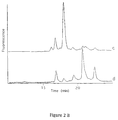
- IGF-I In the GSSG/GSH buffer system and in the absence of IGF-BP-1, native IGF-I accounts for 22% of the total amount of IGF-I at equilibrium and the most populated specie only has two disulphide bridges (Hober S et al (1992) Biochemistry Vol. 31, Page 1749). However, in the presence of IGF-BP-1, in similar molar concentration as IGF-I, IGF-I attains its native conformation to 89% (Table 1, Figure 2A, at appr 18 min). The relative amounts of the analysed different forms of IGF-I are shown in Table 1.
Landscapes
- Health & Medical Sciences (AREA)
- Chemical & Material Sciences (AREA)
- Organic Chemistry (AREA)
- Life Sciences & Earth Sciences (AREA)
- Biochemistry (AREA)
- Genetics & Genomics (AREA)
- Gastroenterology & Hepatology (AREA)
- Toxicology (AREA)
- Endocrinology (AREA)
- Biophysics (AREA)
- General Health & Medical Sciences (AREA)
- Zoology (AREA)
- Medicinal Chemistry (AREA)
- Molecular Biology (AREA)
- Proteomics, Peptides & Aminoacids (AREA)
- Diabetes (AREA)
- Medicines That Contain Protein Lipid Enzymes And Other Medicines (AREA)
- Peptides Or Proteins (AREA)
- Preparation Of Compounds By Using Micro-Organisms (AREA)
Abstract
Description
WO 91/02807 (Amgen) (=US 5158875) discloses a method for refolding IGF-I in the presence of a fused short positively charged leader sequence, in which amino acids such as lysine, arginine and histidine are fused at the N-terminus of IGF-I. In WO 93/11240 (Genentech) a method for refolding of insoluble and improperly folded IGF-I is described involving solubilisation and refolding in a single buffer system.
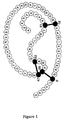
- Figure 1:
- A schematical representation of native IGF-I.
- Figure 2:
- RP-HPLC separation of different forms of IGF-I
- Figure 2 A
- In a gluthatione redox buffer a in presence and b in absence of IGF-BP-1.
- Figure 2 B
- Air oxidation of reduced IGF-I in one hour c with and d without IGF-BP-1.
| Relative amounts of the different IGF-I conformations in presence and absence of IGF-BP-1 or albumin (control). The IGF-I protein concentration was 30 mM in all experiments. 0 is the reduced IGF-I, I is a one disulphide form, IIa and IIb are different forms containing two disulphides, III' is mismatched IGF-I and III is native IGF-I. | |||||||||
| start | GSSG/G BP1 | Albumin | III' | IIa | III | IIb | I | 0 | |
| SH | [µM] | [µM] | [%] | [%] | [%] | [%] | [%] | [%] | |
| 0 | 1/10 | 30 | 0 | <4 | 11 | 89 | <4 | <4 | <4 |
| 0 | 1/10 | 0 | 0 | 11 | 30 | 22 | 12 | 25 | <4 |
| 0 | 1/10 | 0 | 30 | 10 | 30 | 23 | 11 | 26 | <4 |
| 0 | - | 30 | 0 | 4.5 | 15 | 56 | 5.5 | 15 | 4 |
| 0 | - | 0 | 0 | <4 | 12 | 4 | 12.5 | 50 | 21.5 |
| III' | 1/10 | 30 | 0 | 5 | 11 | 84 | <4 | <4 | <4 |
| III' | 1/10 | 0 | 0 | 10 | 31 | 22 | 12 | 25 | <4 |
| III | 1/10 | 30 | 0 | 4 | 10 | 86 | <4 | <4 | <4 |
| III | 1/10 | 3 | 0 | 9 | 30 | 29 | 8 | 24 | <4 |
| III | 1/10 | 0.3 | 0 | 11 | 32 | 26 | 8 | 23 | <4 |
| III | 1/10 | 0 | 0 | 10 | 32 | 22 | 9 | 27 | <4 |
Claims (11)
- Use of Insulin-like growth factor binding protein (IGF-BP) for refolding of Insulin-like growth factor (IGF).
- Use according to claim 1 in which the binding protein is any of IGF-BP-1, IGF-BP-2, IGF-BP-3, IGF-BP-4, IGF-BP-5 and IGF-BP-6.
- Use according to any of claims 1-3 in which the Insulin-like growth factor is IGF-I.
- Use according to any of claims 1-2 in which the binding protein is IGF-BP-1.
- Use according to any of claims 1-2 in which the binding protein is in equal molar amount to that of IGF.
- Process for the production of biologically active, native IGF-I or IGE-II, characterised in that IGF-I or IGF-II in a reduced or misfolded form is subjected to treatment with IGF-BP.
- Process according to claim 6 in which the binding protein is IGF-BP-1.
- Process according to any of claims 6 or 7 characterised by a treatment in vitro in which IGF-BP and IGF-I is admixtured, preferably in the presence of a redox system, and thereafter recovering of the native IGF-I.
- Process according to any of claims 6 or 7 characterised by coexpression of IGF-I and the binding protein in an in vivo system in E. coli and thereafter recovering the native IGF-I.
- Process according to claim 9 characterised by coexpression of IGF-I and IGF-BP-1 in an in vivo system in E. coli and thereafter recovering the native IGF-I.
- Process according to any of claims 6 or 7 characterised by that the binding protein is in equal molar amount as that of IGF.
Applications Claiming Priority (3)
| Application Number | Priority Date | Filing Date | Title |
|---|---|---|---|
| SE9303784 | 1993-11-16 | ||
| SE9303784A SE9303784D0 (en) | 1993-11-16 | 1993-11-16 | IGF |
| PCT/SE1994/001076 WO1995014034A1 (en) | 1993-11-16 | 1994-11-14 | Use of igf-bp for refolding of igf |
Publications (2)
| Publication Number | Publication Date |
|---|---|
| EP0736040A1 EP0736040A1 (en) | 1996-10-09 |
| EP0736040B1 true EP0736040B1 (en) | 2000-03-15 |
Family
ID=20391767
Family Applications (1)
| Application Number | Title | Priority Date | Filing Date |
|---|---|---|---|
| EP95901661A Expired - Lifetime EP0736040B1 (en) | 1993-11-16 | 1994-11-14 | Use of igf-bp for refolding of igf |
Country Status (12)
| Country | Link |
|---|---|
| US (1) | US5683980A (en) |
| EP (1) | EP0736040B1 (en) |
| JP (1) | JP3609410B2 (en) |
| AT (1) | ATE190627T1 (en) |
| AU (1) | AU684117B2 (en) |
| CA (1) | CA2176599A1 (en) |
| DE (1) | DE69423516T2 (en) |
| FI (1) | FI962081A7 (en) |
| NO (1) | NO961995L (en) |
| NZ (1) | NZ276520A (en) |
| SE (1) | SE9303784D0 (en) |
| WO (1) | WO1995014034A1 (en) |
Families Citing this family (4)
| Publication number | Priority date | Publication date | Assignee | Title |
|---|---|---|---|---|
| US5789547A (en) * | 1995-06-07 | 1998-08-04 | Celtrix Pharmaceuticals, Inc. | Method of producing insulin-like growth factor-I (IGF-I) and insulin-like growth factor binding protein-3 (IGFBP-3) with correct folding and disulfide bonding |
| US6417330B1 (en) | 1998-06-01 | 2002-07-09 | Celtrix Pharmaceuticals, Inc. | Insulin-like growth factor binding protein variants |
| JP3734634B2 (en) * | 1999-03-03 | 2006-01-11 | ヒゲタ醤油株式会社 | Protein activation method and apparatus |
| KR20020074749A (en) * | 2001-03-21 | 2002-10-04 | 한국생명공학연구원 | Large scale production of recombinant human insulin like growth factor-1 |
Family Cites Families (6)
| Publication number | Priority date | Publication date | Assignee | Title |
|---|---|---|---|---|
| GB8826451D0 (en) * | 1988-11-11 | 1988-12-14 | Sandoz Ltd | Improvements in/relating to organic compounds |
| US5158875A (en) * | 1989-08-25 | 1992-10-27 | Amgen Inc. | Production of biologically active insulin-like growth factor i from high expression host cell systems |
| WO1992014834A1 (en) * | 1991-02-14 | 1992-09-03 | The Whittier Institute For Diabetes And Endocrinology | Insulin-like growth factor binding protein |
| US5288931A (en) * | 1991-12-06 | 1994-02-22 | Genentech, Inc. | Method for refolding insoluble, misfolded insulin-like growth factor-I into an active conformation |
| AU3812993A (en) * | 1992-03-24 | 1993-10-21 | Synergen, Inc. | Refolding and purification of insulin-like growth factor I |
| US5407913A (en) * | 1992-12-03 | 1995-04-18 | Celtrix Pharmaceuticals, Inc. | Method and composition for systemic treatment of tissue injury |
-
1993
- 1993-11-16 SE SE9303784A patent/SE9303784D0/en unknown
-
1994
- 1994-11-14 NZ NZ276520A patent/NZ276520A/en unknown
- 1994-11-14 WO PCT/SE1994/001076 patent/WO1995014034A1/en not_active Ceased
- 1994-11-14 CA CA002176599A patent/CA2176599A1/en not_active Abandoned
- 1994-11-14 US US08/646,365 patent/US5683980A/en not_active Expired - Fee Related
- 1994-11-14 EP EP95901661A patent/EP0736040B1/en not_active Expired - Lifetime
- 1994-11-14 AU AU10808/95A patent/AU684117B2/en not_active Ceased
- 1994-11-14 JP JP51439095A patent/JP3609410B2/en not_active Expired - Fee Related
- 1994-11-14 DE DE69423516T patent/DE69423516T2/en not_active Expired - Fee Related
- 1994-11-14 FI FI962081A patent/FI962081A7/en unknown
- 1994-11-14 AT AT95901661T patent/ATE190627T1/en not_active IP Right Cessation
-
1996
- 1996-05-15 NO NO961995A patent/NO961995L/en unknown
Also Published As
| Publication number | Publication date |
|---|---|
| FI962081A0 (en) | 1996-05-15 |
| NZ276520A (en) | 1997-11-24 |
| FI962081L (en) | 1996-07-15 |
| WO1995014034A1 (en) | 1995-05-26 |
| DE69423516D1 (en) | 2000-04-20 |
| NO961995D0 (en) | 1996-05-15 |
| ATE190627T1 (en) | 2000-04-15 |
| FI962081A7 (en) | 1996-07-15 |
| AU1080895A (en) | 1995-06-06 |
| EP0736040A1 (en) | 1996-10-09 |
| US5683980A (en) | 1997-11-04 |
| CA2176599A1 (en) | 1995-05-26 |
| SE9303784D0 (en) | 1993-11-16 |
| AU684117B2 (en) | 1997-12-04 |
| JP3609410B2 (en) | 2005-01-12 |
| JPH09505077A (en) | 1997-05-20 |
| NO961995L (en) | 1996-05-15 |
| DE69423516T2 (en) | 2000-09-14 |
Similar Documents
| Publication | Publication Date | Title |
|---|---|---|
| Bibi et al. | In vivo expression of the lacY gene in two segments leads to functional lac permease. | |
| Ladisch et al. | Recombinant human insulin | |
| KR100547922B1 (en) | Insulin derivatives with increased zinc binding and pharmaceutical preparations containing them | |
| CN101186940A (en) | Process for obtaining insulin or insulin derivatives with properly bonded cystine bonds | |
| JP4019432B2 (en) | Method for refolding human activin A | |
| RU2073686C1 (en) | Method for production of stable somatotropins, stable somatotropins and composition of stable somatotropin | |
| JPH11507037A (en) | Methods for Producing IGF-I and IGFBP-3 with Correct Folding and Disulfide Bonds | |
| AU684117B2 (en) | Use of IGF-BP for refolding of IGF | |
| EP0312358A2 (en) | Method for promoting intramolecular disulfide bond formation in recombinant proteins contained in a denaturant solution | |
| US6605706B1 (en) | Method for producing a correctly folded, biological active recombinant protein | |
| US4769361A (en) | Method for purifying and isolating two ionic forms of somatomedin C | |
| US6586575B1 (en) | Purification of somatotropin from transformed microorganisms | |
| EP0329622B1 (en) | Method of cleavage at methionine of polypeptides | |
| KR100247668B1 (en) | Stable and Biologically Modified Somatotropin | |
| HK1023781B (en) | Method for producing a correctly folded, biological active recombinant protein | |
| JP2813370B2 (en) | Method for producing human interleukin 5 | |
| KR920008377B1 (en) | Method for purification of igf-i | |
| Gagliano et al. | In Vitro Solubilization of a Recombinant Elongation Factor Tu, Carrying the Asp138Asn Mutation |
Legal Events
| Date | Code | Title | Description |
|---|---|---|---|
| PUAI | Public reference made under article 153(3) epc to a published international application that has entered the european phase |
Free format text: ORIGINAL CODE: 0009012 |
|
| 17P | Request for examination filed |
Effective date: 19960521 |
|
| AK | Designated contracting states |
Kind code of ref document: A1 Designated state(s): AT BE CH DE DK ES FR GB GR IE IT LI LU MC NL PT SE |
|
| RAP1 | Party data changed (applicant data changed or rights of an application transferred) |
Owner name: PHARMACIA & UPJOHN AKTIEBOLAG |
|
| GRAG | Despatch of communication of intention to grant |
Free format text: ORIGINAL CODE: EPIDOS AGRA |
|
| RAP1 | Party data changed (applicant data changed or rights of an application transferred) |
Owner name: CHIRON CORPORATION |
|
| 17Q | First examination report despatched |
Effective date: 19990312 |
|
| GRAG | Despatch of communication of intention to grant |
Free format text: ORIGINAL CODE: EPIDOS AGRA |
|
| GRAH | Despatch of communication of intention to grant a patent |
Free format text: ORIGINAL CODE: EPIDOS IGRA |
|
| RIC1 | Information provided on ipc code assigned before grant |
Free format text: 6C 07K 14/475 A |
|
| GRAH | Despatch of communication of intention to grant a patent |
Free format text: ORIGINAL CODE: EPIDOS IGRA |
|
| GRAA | (expected) grant |
Free format text: ORIGINAL CODE: 0009210 |
|
| AK | Designated contracting states |
Kind code of ref document: B1 Designated state(s): AT BE CH DE DK ES FR GB GR IE IT LI LU MC NL PT SE |
|
| PG25 | Lapsed in a contracting state [announced via postgrant information from national office to epo] |
Ref country code: SE Free format text: THE PATENT HAS BEEN ANNULLED BY A DECISION OF A NATIONAL AUTHORITY Effective date: 20000315 Ref country code: NL Free format text: LAPSE BECAUSE OF FAILURE TO SUBMIT A TRANSLATION OF THE DESCRIPTION OR TO PAY THE FEE WITHIN THE PRESCRIBED TIME-LIMIT Effective date: 20000315 Ref country code: GR Free format text: LAPSE BECAUSE OF NON-PAYMENT OF DUE FEES Effective date: 20000315 Ref country code: ES Free format text: THE PATENT HAS BEEN ANNULLED BY A DECISION OF A NATIONAL AUTHORITY Effective date: 20000315 Ref country code: BE Free format text: LAPSE BECAUSE OF FAILURE TO SUBMIT A TRANSLATION OF THE DESCRIPTION OR TO PAY THE FEE WITHIN THE PRESCRIBED TIME-LIMIT Effective date: 20000315 Ref country code: AT Free format text: LAPSE BECAUSE OF FAILURE TO SUBMIT A TRANSLATION OF THE DESCRIPTION OR TO PAY THE FEE WITHIN THE PRESCRIBED TIME-LIMIT Effective date: 20000315 |
|
| REF | Corresponds to: |
Ref document number: 190627 Country of ref document: AT Date of ref document: 20000415 Kind code of ref document: T |
|
| REG | Reference to a national code |
Ref country code: CH Ref legal event code: EP |
|
| ITF | It: translation for a ep patent filed | ||
| REF | Corresponds to: |
Ref document number: 69423516 Country of ref document: DE Date of ref document: 20000420 |
|
| REG | Reference to a national code |
Ref country code: IE Ref legal event code: FG4D |
|
| REG | Reference to a national code |
Ref country code: CH Ref legal event code: NV Representative=s name: PATENTANWAELTE SCHAAD, BALASS, MENZL & PARTNER AG |
|
| PG25 | Lapsed in a contracting state [announced via postgrant information from national office to epo] |
Ref country code: PT Free format text: LAPSE BECAUSE OF FAILURE TO SUBMIT A TRANSLATION OF THE DESCRIPTION OR TO PAY THE FEE WITHIN THE PRESCRIBED TIME-LIMIT Effective date: 20000615 Ref country code: DK Free format text: LAPSE BECAUSE OF FAILURE TO SUBMIT A TRANSLATION OF THE DESCRIPTION OR TO PAY THE FEE WITHIN THE PRESCRIBED TIME-LIMIT Effective date: 20000615 |
|
| ET | Fr: translation filed | ||
| NLV1 | Nl: lapsed or annulled due to failure to fulfill the requirements of art. 29p and 29m of the patents act | ||
| PG25 | Lapsed in a contracting state [announced via postgrant information from national office to epo] |
Ref country code: LU Free format text: LAPSE BECAUSE OF NON-PAYMENT OF DUE FEES Effective date: 20001114 Ref country code: IE Free format text: LAPSE BECAUSE OF NON-PAYMENT OF DUE FEES Effective date: 20001114 |
|
| PG25 | Lapsed in a contracting state [announced via postgrant information from national office to epo] |
Ref country code: MC Free format text: THE PATENT HAS BEEN ANNULLED BY A DECISION OF A NATIONAL AUTHORITY Effective date: 20001130 |
|
| PLBE | No opposition filed within time limit |
Free format text: ORIGINAL CODE: 0009261 |
|
| STAA | Information on the status of an ep patent application or granted ep patent |
Free format text: STATUS: NO OPPOSITION FILED WITHIN TIME LIMIT |
|
| 26N | No opposition filed | ||
| REG | Reference to a national code |
Ref country code: IE Ref legal event code: MM4A |
|
| REG | Reference to a national code |
Ref country code: GB Ref legal event code: IF02 |
|
| PGFP | Annual fee paid to national office [announced via postgrant information from national office to epo] |
Ref country code: DE Payment date: 20071108 Year of fee payment: 14 |
|
| PGFP | Annual fee paid to national office [announced via postgrant information from national office to epo] |
Ref country code: CH Payment date: 20071114 Year of fee payment: 14 |
|
| REG | Reference to a national code |
Ref country code: CH Ref legal event code: PFA Owner name: NOVARTIS VACCINES & DIAGNOSTICS, INC. Free format text: CHIRON CORPORATION#4560 HORTON STREET#EMERYVILLE, CALIFORNIA 94608-2916 (US) -TRANSFER TO- NOVARTIS VACCINES & DIAGNOSTICS, INC.#4560 HORTON STREET#EMERYVILLE, CA 94608-2916 (US) |
|
| PGFP | Annual fee paid to national office [announced via postgrant information from national office to epo] |
Ref country code: GB Payment date: 20071114 Year of fee payment: 14 Ref country code: FR Payment date: 20071108 Year of fee payment: 14 |
|
| REG | Reference to a national code |
Ref country code: FR Ref legal event code: CD |
|
| REG | Reference to a national code |
Ref country code: CH Ref legal event code: PL |
|
| GBPC | Gb: european patent ceased through non-payment of renewal fee |
Effective date: 20081114 |
|
| PG25 | Lapsed in a contracting state [announced via postgrant information from national office to epo] |
Ref country code: IT Free format text: LAPSE BECAUSE OF NON-PAYMENT OF DUE FEES Effective date: 20071114 |
|
| PGFP | Annual fee paid to national office [announced via postgrant information from national office to epo] |
Ref country code: IT Payment date: 20071123 Year of fee payment: 14 |
|
| REG | Reference to a national code |
Ref country code: FR Ref legal event code: ST Effective date: 20090731 |
|
| PG25 | Lapsed in a contracting state [announced via postgrant information from national office to epo] |
Ref country code: LI Free format text: LAPSE BECAUSE OF NON-PAYMENT OF DUE FEES Effective date: 20081130 Ref country code: DE Free format text: LAPSE BECAUSE OF NON-PAYMENT OF DUE FEES Effective date: 20090603 Ref country code: CH Free format text: LAPSE BECAUSE OF NON-PAYMENT OF DUE FEES Effective date: 20081130 |
|
| PG25 | Lapsed in a contracting state [announced via postgrant information from national office to epo] |
Ref country code: GB Free format text: LAPSE BECAUSE OF NON-PAYMENT OF DUE FEES Effective date: 20081114 |
|
| PG25 | Lapsed in a contracting state [announced via postgrant information from national office to epo] |
Ref country code: FR Free format text: LAPSE BECAUSE OF NON-PAYMENT OF DUE FEES Effective date: 20081130 |