EP0735099B1 - Process for the preparation of a precured silicone emulsion - Google Patents
Process for the preparation of a precured silicone emulsion Download PDFInfo
- Publication number
- EP0735099B1 EP0735099B1 EP95301233A EP95301233A EP0735099B1 EP 0735099 B1 EP0735099 B1 EP 0735099B1 EP 95301233 A EP95301233 A EP 95301233A EP 95301233 A EP95301233 A EP 95301233A EP 0735099 B1 EP0735099 B1 EP 0735099B1
- Authority
- EP
- European Patent Office
- Prior art keywords
- polydiorganosiloxane
- process according
- emulsion
- radicals
- water
- Prior art date
- Legal status (The legal status is an assumption and is not a legal conclusion. Google has not performed a legal analysis and makes no representation as to the accuracy of the status listed.)
- Expired - Lifetime
Links
- 239000000839 emulsion Substances 0.000 title claims description 49
- 229920001296 polysiloxane Polymers 0.000 title claims description 20
- 238000000034 method Methods 0.000 title claims description 18
- 238000002360 preparation method Methods 0.000 title claims description 4
- 239000000203 mixture Substances 0.000 claims description 37
- XLYOFNOQVPJJNP-UHFFFAOYSA-N water Substances O XLYOFNOQVPJJNP-UHFFFAOYSA-N 0.000 claims description 33
- 239000003054 catalyst Substances 0.000 claims description 22
- 239000000945 filler Substances 0.000 claims description 22
- RTAQQCXQSZGOHL-UHFFFAOYSA-N Titanium Chemical compound [Ti] RTAQQCXQSZGOHL-UHFFFAOYSA-N 0.000 claims description 21
- 229910052719 titanium Inorganic materials 0.000 claims description 21
- 239000010936 titanium Substances 0.000 claims description 21
- -1 polydimethylsiloxane Polymers 0.000 claims description 18
- YHWCPXVTRSHPNY-UHFFFAOYSA-N butan-1-olate;titanium(4+) Chemical compound [Ti+4].CCCC[O-].CCCC[O-].CCCC[O-].CCCC[O-] YHWCPXVTRSHPNY-UHFFFAOYSA-N 0.000 claims description 13
- 239000004205 dimethyl polysiloxane Substances 0.000 claims description 12
- VLKZOEOYAKHREP-UHFFFAOYSA-N n-Hexane Chemical group CCCCCC VLKZOEOYAKHREP-UHFFFAOYSA-N 0.000 claims description 12
- 229920000435 poly(dimethylsiloxane) Polymers 0.000 claims description 12
- 239000004215 Carbon black (E152) Substances 0.000 claims description 11
- 229930195733 hydrocarbon Natural products 0.000 claims description 11
- 239000003960 organic solvent Substances 0.000 claims description 11
- 229920001971 elastomer Polymers 0.000 claims description 10
- 239000000806 elastomer Substances 0.000 claims description 10
- 239000003381 stabilizer Substances 0.000 claims description 8
- DBMJMQXJHONAFJ-UHFFFAOYSA-M Sodium laurylsulphate Chemical compound [Na+].CCCCCCCCCCCCOS([O-])(=O)=O DBMJMQXJHONAFJ-UHFFFAOYSA-M 0.000 claims description 6
- 239000012530 fluid Substances 0.000 claims description 6
- 235000019333 sodium laurylsulphate Nutrition 0.000 claims description 6
- 125000004432 carbon atom Chemical group C* 0.000 claims description 5
- XUIMIQQOPSSXEZ-UHFFFAOYSA-N Silicon Chemical group [Si] XUIMIQQOPSSXEZ-UHFFFAOYSA-N 0.000 claims description 4
- 125000005370 alkoxysilyl group Chemical group 0.000 claims description 4
- 125000001495 ethyl group Chemical group [H]C([H])([H])C([H])([H])* 0.000 claims description 4
- 150000005826 halohydrocarbons Chemical class 0.000 claims description 4
- 150000002430 hydrocarbons Chemical class 0.000 claims description 4
- 125000002496 methyl group Chemical group [H]C([H])([H])* 0.000 claims description 4
- 125000001436 propyl group Chemical group [H]C([*])([H])C([H])([H])C([H])([H])[H] 0.000 claims description 4
- 239000012763 reinforcing filler Substances 0.000 claims description 4
- 229910052710 silicon Inorganic materials 0.000 claims description 4
- 125000001931 aliphatic group Chemical group 0.000 claims description 3
- 125000000484 butyl group Chemical group [H]C([*])([H])C([H])([H])C([H])([H])C([H])([H])[H] 0.000 claims description 3
- 230000001804 emulsifying effect Effects 0.000 claims description 3
- 238000002156 mixing Methods 0.000 claims description 2
- 229920000642 polymer Polymers 0.000 description 21
- 239000010408 film Substances 0.000 description 17
- VYPSYNLAJGMNEJ-UHFFFAOYSA-N Silicium dioxide Chemical compound O=[Si]=O VYPSYNLAJGMNEJ-UHFFFAOYSA-N 0.000 description 11
- IMNFDUFMRHMDMM-UHFFFAOYSA-N N-Heptane Chemical compound CCCCCCC IMNFDUFMRHMDMM-UHFFFAOYSA-N 0.000 description 7
- 125000003545 alkoxy group Chemical group 0.000 description 7
- 239000004615 ingredient Substances 0.000 description 6
- 239000007787 solid Substances 0.000 description 6
- 239000008367 deionised water Substances 0.000 description 5
- 229910021641 deionized water Inorganic materials 0.000 description 5
- VTYYLEPIZMXCLO-UHFFFAOYSA-L Calcium carbonate Chemical compound [Ca+2].[O-]C([O-])=O VTYYLEPIZMXCLO-UHFFFAOYSA-L 0.000 description 4
- 239000006185 dispersion Substances 0.000 description 4
- 239000000693 micelle Substances 0.000 description 4
- VXUYXOFXAQZZMF-UHFFFAOYSA-N titanium(IV) isopropoxide Chemical compound CC(C)O[Ti](OC(C)C)(OC(C)C)OC(C)C VXUYXOFXAQZZMF-UHFFFAOYSA-N 0.000 description 4
- YXFVVABEGXRONW-UHFFFAOYSA-N Toluene Chemical compound CC1=CC=CC=C1 YXFVVABEGXRONW-UHFFFAOYSA-N 0.000 description 3
- 125000000129 anionic group Chemical group 0.000 description 3
- 238000006243 chemical reaction Methods 0.000 description 3
- 229920006037 cross link polymer Polymers 0.000 description 3
- 238000001035 drying Methods 0.000 description 3
- 229940093858 ethyl acetoacetate Drugs 0.000 description 3
- 239000007764 o/w emulsion Substances 0.000 description 3
- 239000002245 particle Substances 0.000 description 3
- 230000000704 physical effect Effects 0.000 description 3
- 239000000565 sealant Substances 0.000 description 3
- 239000000377 silicon dioxide Substances 0.000 description 3
- UQSXHKLRYXJYBZ-UHFFFAOYSA-N Iron oxide Chemical compound [Fe]=O UQSXHKLRYXJYBZ-UHFFFAOYSA-N 0.000 description 2
- GWEVSGVZZGPLCZ-UHFFFAOYSA-N Titan oxide Chemical compound O=[Ti]=O GWEVSGVZZGPLCZ-UHFFFAOYSA-N 0.000 description 2
- 229910000019 calcium carbonate Inorganic materials 0.000 description 2
- 239000007795 chemical reaction product Substances 0.000 description 2
- NKSJNEHGWDZZQF-UHFFFAOYSA-N ethenyl(trimethoxy)silane Chemical group CO[Si](OC)(OC)C=C NKSJNEHGWDZZQF-UHFFFAOYSA-N 0.000 description 2
- 238000001704 evaporation Methods 0.000 description 2
- 230000008020 evaporation Effects 0.000 description 2
- 238000002474 experimental method Methods 0.000 description 2
- 229910021485 fumed silica Inorganic materials 0.000 description 2
- 238000010438 heat treatment Methods 0.000 description 2
- 238000004519 manufacturing process Methods 0.000 description 2
- 239000004033 plastic Substances 0.000 description 2
- 229920003023 plastic Polymers 0.000 description 2
- 239000000047 product Substances 0.000 description 2
- 230000002787 reinforcement Effects 0.000 description 2
- 239000000243 solution Substances 0.000 description 2
- 125000000391 vinyl group Chemical group [H]C([*])=C([H])[H] 0.000 description 2
- 229920002554 vinyl polymer Polymers 0.000 description 2
- CMCBDXRRFKYBDG-UHFFFAOYSA-N 1-dodecoxydodecane Chemical compound CCCCCCCCCCCCOCCCCCCCCCCCC CMCBDXRRFKYBDG-UHFFFAOYSA-N 0.000 description 1
- IHEDBVUTTQXGSJ-UHFFFAOYSA-M 2-[bis(2-oxidoethyl)amino]ethanolate;titanium(4+);hydroxide Chemical compound [OH-].[Ti+4].[O-]CCN(CC[O-])CC[O-] IHEDBVUTTQXGSJ-UHFFFAOYSA-M 0.000 description 1
- KTXWGMUMDPYXNN-UHFFFAOYSA-N 2-ethylhexan-1-olate;titanium(4+) Chemical compound [Ti+4].CCCCC(CC)C[O-].CCCCC(CC)C[O-].CCCCC(CC)C[O-].CCCCC(CC)C[O-] KTXWGMUMDPYXNN-UHFFFAOYSA-N 0.000 description 1
- 239000004971 Cross linker Substances 0.000 description 1
- 239000005909 Kieselgur Substances 0.000 description 1
- 229920003171 Poly (ethylene oxide) Polymers 0.000 description 1
- 239000004793 Polystyrene Substances 0.000 description 1
- 125000002947 alkylene group Chemical group 0.000 description 1
- 239000008346 aqueous phase Substances 0.000 description 1
- 239000007864 aqueous solution Substances 0.000 description 1
- 238000000149 argon plasma sintering Methods 0.000 description 1
- 239000006229 carbon black Substances 0.000 description 1
- 239000011248 coating agent Substances 0.000 description 1
- 238000000576 coating method Methods 0.000 description 1
- 239000008119 colloidal silica Substances 0.000 description 1
- 150000001875 compounds Chemical class 0.000 description 1
- 238000007796 conventional method Methods 0.000 description 1
- 238000004132 cross linking Methods 0.000 description 1
- 239000013536 elastomeric material Substances 0.000 description 1
- 238000004945 emulsification Methods 0.000 description 1
- XYIBRDXRRQCHLP-UHFFFAOYSA-N ethyl acetoacetate Chemical compound CCOC(=O)CC(C)=O XYIBRDXRRQCHLP-UHFFFAOYSA-N 0.000 description 1
- 239000004744 fabric Substances 0.000 description 1
- 239000010419 fine particle Substances 0.000 description 1
- 125000002887 hydroxy group Chemical group [H]O* 0.000 description 1
- 239000004816 latex Substances 0.000 description 1
- 229920000126 latex Polymers 0.000 description 1
- 239000000463 material Substances 0.000 description 1
- 239000003973 paint Substances 0.000 description 1
- 125000001997 phenyl group Chemical group [H]C1=C([H])C([H])=C(*)C([H])=C1[H] 0.000 description 1
- 229920002223 polystyrene Polymers 0.000 description 1
- 238000001556 precipitation Methods 0.000 description 1
- 239000010453 quartz Substances 0.000 description 1
- 230000003014 reinforcing effect Effects 0.000 description 1
- 150000004756 silanes Chemical class 0.000 description 1
- 239000010703 silicon Substances 0.000 description 1
- 229920002379 silicone rubber Polymers 0.000 description 1
- 239000004590 silicone sealant Substances 0.000 description 1
- 230000000087 stabilizing effect Effects 0.000 description 1
- 239000000126 substance Substances 0.000 description 1
- 230000008961 swelling Effects 0.000 description 1
- 239000010409 thin film Substances 0.000 description 1
- 239000012974 tin catalyst Substances 0.000 description 1
- 150000003608 titanium Chemical class 0.000 description 1
- 239000004408 titanium dioxide Substances 0.000 description 1
- 125000000725 trifluoropropyl group Chemical group [H]C([H])(*)C([H])([H])C(F)(F)F 0.000 description 1
- GFQYVLUOOAAOGM-UHFFFAOYSA-N zirconium(iv) silicate Chemical compound [Zr+4].[O-][Si]([O-])([O-])[O-] GFQYVLUOOAAOGM-UHFFFAOYSA-N 0.000 description 1
Classifications
-
- C—CHEMISTRY; METALLURGY
- C08—ORGANIC MACROMOLECULAR COMPOUNDS; THEIR PREPARATION OR CHEMICAL WORKING-UP; COMPOSITIONS BASED THEREON
- C08J—WORKING-UP; GENERAL PROCESSES OF COMPOUNDING; AFTER-TREATMENT NOT COVERED BY SUBCLASSES C08B, C08C, C08F, C08G or C08H
- C08J3/00—Processes of treating or compounding macromolecular substances
- C08J3/02—Making solutions, dispersions, lattices or gels by other methods than by solution, emulsion or suspension polymerisation techniques
- C08J3/03—Making solutions, dispersions, lattices or gels by other methods than by solution, emulsion or suspension polymerisation techniques in aqueous media
-
- C—CHEMISTRY; METALLURGY
- C08—ORGANIC MACROMOLECULAR COMPOUNDS; THEIR PREPARATION OR CHEMICAL WORKING-UP; COMPOSITIONS BASED THEREON
- C08J—WORKING-UP; GENERAL PROCESSES OF COMPOUNDING; AFTER-TREATMENT NOT COVERED BY SUBCLASSES C08B, C08C, C08F, C08G or C08H
- C08J3/00—Processes of treating or compounding macromolecular substances
- C08J3/24—Crosslinking, e.g. vulcanising, of macromolecules
- C08J3/26—Crosslinking, e.g. vulcanising, of macromolecules of latex
-
- C—CHEMISTRY; METALLURGY
- C08—ORGANIC MACROMOLECULAR COMPOUNDS; THEIR PREPARATION OR CHEMICAL WORKING-UP; COMPOSITIONS BASED THEREON
- C08K—Use of inorganic or non-macromolecular organic substances as compounding ingredients
- C08K5/00—Use of organic ingredients
- C08K5/0091—Complexes with metal-heteroatom-bonds
-
- C—CHEMISTRY; METALLURGY
- C08—ORGANIC MACROMOLECULAR COMPOUNDS; THEIR PREPARATION OR CHEMICAL WORKING-UP; COMPOSITIONS BASED THEREON
- C08K—Use of inorganic or non-macromolecular organic substances as compounding ingredients
- C08K5/00—Use of organic ingredients
- C08K5/04—Oxygen-containing compounds
- C08K5/05—Alcohols; Metal alcoholates
- C08K5/057—Metal alcoholates
-
- C—CHEMISTRY; METALLURGY
- C08—ORGANIC MACROMOLECULAR COMPOUNDS; THEIR PREPARATION OR CHEMICAL WORKING-UP; COMPOSITIONS BASED THEREON
- C08K—Use of inorganic or non-macromolecular organic substances as compounding ingredients
- C08K5/00—Use of organic ingredients
- C08K5/04—Oxygen-containing compounds
- C08K5/09—Carboxylic acids; Metal salts thereof; Anhydrides thereof
- C08K5/098—Metal salts of carboxylic acids
-
- C—CHEMISTRY; METALLURGY
- C08—ORGANIC MACROMOLECULAR COMPOUNDS; THEIR PREPARATION OR CHEMICAL WORKING-UP; COMPOSITIONS BASED THEREON
- C08K—Use of inorganic or non-macromolecular organic substances as compounding ingredients
- C08K5/00—Use of organic ingredients
- C08K5/56—Organo-metallic compounds, i.e. organic compounds containing a metal-to-carbon bond
- C08K5/57—Organo-tin compounds
-
- C—CHEMISTRY; METALLURGY
- C08—ORGANIC MACROMOLECULAR COMPOUNDS; THEIR PREPARATION OR CHEMICAL WORKING-UP; COMPOSITIONS BASED THEREON
- C08J—WORKING-UP; GENERAL PROCESSES OF COMPOUNDING; AFTER-TREATMENT NOT COVERED BY SUBCLASSES C08B, C08C, C08F, C08G or C08H
- C08J2383/00—Characterised by the use of macromolecular compounds obtained by reactions forming in the main chain of the macromolecule a linkage containing silicon with or without sulfur, nitrogen, oxygen, or carbon only; Derivatives of such polymers
- C08J2383/04—Polysiloxanes
Definitions
- This invention relates to the preparation of an aqueous silicone emulsion which gives an elastomer when dried.
- This invention provides an aqueous silicone emulsion which yields an elastomer upon removal of the water and comprises an emulsion of a polydiorganosiloxane having at least four silicon-bonded alkoxy groups per molecule, ,sufficient titanium catalyst to crosslink the polydiorganosiloxane by reaction of the alkoxy groups, and optionally a filler.
- EP A 0 640 645 is a reference relevant under Article 54(3) EPC which relates to a precured silicone emulsion.
- EP A 0 640 645 discloses an aqueous silicone emulsion which yields an elastomer upon removal of the water which comprises a polydiorganosiloxane having alkoxysilyl endblocking groups with at least two alkoxy groups attached to the silicon atom, titanium catalyst and, optionally, a filler.
- This invention relates to a process for the preparation of an aqueous silicone emulsion which yields an elastomer upon removal of the water by mixing (A) 100 parts by weight of polydiorganosiloxane having alkoxysilyl endblocking groups with at least two alkoxy radicals attached to the silicon atom, and (B) from 0.2 to 6 parts by weight of titanium catalyst sufficient to crosslink the polydiorganosiloxane of (A), and thereafter adding water and ionic or nonionic stabilizer, emulsifying the resulting product, and obtaining the aqueous silicone emulsion, with the proviso that the combination of (A) methyldimethoxy endblocked polydimethylsiloxane fluid having a viscosity of 11.5 Pa.s at 25°C with (B) tetrabutyltitanate in the weight ratio 20/0.2 is excluded.
- the aqueous silicone emulsion which is obtained is unique in that the reactive groups which cause crosslinking of the polymer, to form an elastomer upon removal of water, are all present on the polymer ends and are not formed by reaction of the polymer and another ingredient which acts as a crosslinker.
- Each terminal group of the polydiorganosiloxane (A) has either 2 or 3 alkoxy groups attached to silicon.
- the method of this invention preferably uses a polymer of the formula where each R is a radical free of aliphatic unsaturation and is at least one radical selected from monovalent hydrocarbon, monovalent halohydrocarbon, and monovalent cyanoalkyl radicals of 1 to 18 inclusive carbon atoms, each D is selected from radicals of the formula and radicals of the formula where each R" is at least one selected from methyl, ethyl, propyl, and butyl, Z is a divalent hydrocarbon radical or a combination of divalent hydrocarbon radicals and siloxane radicals, m is 0 or 1, x is of a value such that the polymer has a viscosity of from 0.5 to 3,000 Pa ⁇ s at 25°C., and R is as defined above.
- each R is free of aliphatic unsaturation and is at least one selected from monovalent hydrocarbon, monovalent halohydrocarbon, and monovalent cyanoalkyl radicals of 1 to 18 inclusive carbon atoms
- each R" is at least one selected from methyl, ethyl, propyl, and butyl
- m is 0 or 1
- x is of a value such that the polymer has a viscosity of from 0.5 to 3,000 Pa ⁇ s at 25°C.
- R can be any of those monovalent hydrocarbon, monovalent halohydrocarbon, or monovalent cyanoalkyl radicals of 1 to 18 inclusive carbon atoms which are known to be useful in silicone sealant materials.
- the preferred radicals are methyl, ethyl, propyl, phenyl, and trifluoropropyl.
- Alkoxy endblocked polydiorganosiloxanes are well known types of polymers. They can be prepared by the addition of an excess of alkyltrialkoxysilane to a hydroxy endblocked polydiorganosiloxane.
- polymer (1) When (D) of polymer (1) is the radical, the polymer is of the formula an alkoxysilalkylene endblocked polymer, where each R, each R", m, and x are as defined above, Z is a divalent hydrocarbon radical or combination of divalent hydrocarbon radicals and siloxane radicals.
- the divalent hydrocarbon radical can be from 2 to 15 carbon atoms in the form of a divalent alkylene or arylene radical such as ethylene, propylene, hexylene, phenylene, and
- a preferred Z may be represented by the formula where R is as defined above, b is 0 or 1, and c is from 1 to 6.
- the preferred viscosity of polymer (1) is from 1 to 1,000 Pa ⁇ s at 25°C.
- Alkoxysilalkylene endblocked polymers of the above formula can be manufactured following the methods taught in US-A 4,888,380, which shows typical polymers and their method of manufacture.
- the polydiorganosiloxane compositions used in the present invention are crosslinked by the use of a titanium catalyst, (B).
- the titanium catalyst can be those known to be useful in catalyzing the moisture induced reaction of alkoxycontaining siloxanes or silanes.
- titanium catalysts such as titanium esters, the tetraalkyltitanates such as tetrabutyltitanate, tetraisopropyltitanate, tetra-2-ethylhexyltitanate, tetraphenyltitanate, triethanolaminetitanate, organosiloxytitanium compounds such as those described in US-A 3,294,739, and beta-dicarbonyl titanium compounds, such as those described in US-A 3,334,067.
- the tetraalkyltitanates such as tetrabutyltitanate, tetraisopropyltitanate, tetra-2-ethylhexyltitanate, tetraphenyltitanate, triethanolaminetitanate
- organosiloxytitanium compounds such as those described in US-A 3,294,739
- beta-dicarbonyl titanium compounds such
- Preferred catalysts include tetrabutyltitanate, tetraisopropyltitanate, bis(acetylacetonyl)diisopropyltitanate, and 2,5-diisopropoxy-bis(ethylacetoacetate)titanium.
- the amount of catalyst is from 0.2 to 6.0 parts by weight per 100 parts by weight of polydiorganosiloxane (A).
- Preferred amounts are from 0.5 to 3.0 parts by weight per 100 parts by weight of polydioganosiloxane (A).
- the polydiorganosiloxane (A) is mixed with the titanium catalyst (B) before the polymer is emulsified.
- the titanium catalyst is a tetraalkoxytitanate
- the tetraalkoxytitanate is sensitive to water and is inactivated as a catalyst when contacted with water before it is combined with the polydiorganosiloxane, whereas the beta-dicarbonyl titanium compound is not so limited.
- titanium catalysts are not readily soluble in the polydiorganosiloxanes and in those situations, an organic solvent which is non-reactive with the titanium catalyst can be used to bring the ingredients into a state of solution where they can react with one another.
- organic solvent which is non-reactive with the titanium catalyst can be used to bring the ingredients into a state of solution where they can react with one another.
- non-titanium catalyst-reactive organic solvents include toluene, n-hexane, and n-heptane. Because they are not desirable from an ecological and marketing point of view, it is desired that they be removed, and therefore, the amount of such organic solvent should be the minimum to do the job and be economically removed.
- the polydiorganosiloxane and the titanium catalyst are formed into a mixture, it can be emulsified by conventional techniques known in the art for such purposes.
- the mixture of polydiorganosiloxane and titanium catalyst is emulsified by first adding water and a stabilizer and then the resulting mixture is mechanically emulsified, such as with a high speed mixer, or an ultrasonic probe-type processor.
- the aqueous silicone emulsion is obtained, if an organic solvent was used, it is preferred that it be removed.
- the removal of organic solvent from the aqueous silicone emulsion can be accomplished by heating the emulsion, especially practical are those techniques which use thin layers of the emulsion while applying heat.
- the ionic and nonionic stabilizers can be those which are conventionally used for stabilizing silicone emulsions, such as sodium lauryl sulfate and polyethylene oxide lauryl ether.
- Useful silicone elastomeric compositions are commonly produced with a filler as one of the ingredients. These fillers are well known in the industry. They are added to the mixture to provide reinforcement of the polymer so as to control the physical properties of the elastomer which is formed. The addition of the filler can be done at various points during the manufacture of the aqueous silicone emulsion, preferably after the aqueous silicone emulsion is prepared. Reinforcing fillers, such as fumed silica, precipitated silica, and diatomaceous earth are used to give the highest physical strengths to the elastomer. Reinforcing fillers are generally recognized as being very fine particles having a surface area from about 50 to 700 m 2 /g.
- fillers may be used with untreated filler surfaces or with treated filler surfaces, the treatment being used to modify the filler surface so that it properly interacts with the polymer and the other ingredients in the sealant.
- Calcium carbonate fillers are now available which are produced by precipitation, which have a surface area of about 20 m 2 /g, which have a reinforcing effect. Extending fillers such as titanium dioxide, zirconium silicate, ground calcium carbonate, iron oxide, ground quartz, and carbon black may be used.
- the amounts of filler used can obviously be varied within wide limits in accordance with the intended use. For example, in some cases the crosslinked polymer could be used with no filler, but it would have very low physical properties.
- Reinforcing fillers are commonly used in amounts from about 5 to 20 parts by weight to give the highest physical properties, such as tensile strength. Extending fillers are finely ground with usual average particle sizes in the range of from about 1 to 10 micrometers. Extending fillers are used to modify the sealant properties and to provide opacity in some cases. When silica is used as the filler there is no problem with the shelf life of the emulsion; unlike those compositions which include polymer, silica, and stannic tin catalyst.
- colloidal silica in the form of an aqueous dispersion, such as the NALCOAGTM dispersions of Nalco Chemical Company.
- a separately prepared anionic, stable dispersion of fumed silica in water is available as CAB-O-SPERSETM dispersions from the Cab-O-SilTM division of Cabot Corporation. These fillers are added after the aqueous silicone emulsion is prepared because they contain water which can inactivate the titanium catalyst, especially the tetraalkyltitanate catalysts.
- composition obtained by the process of this invention can be used as a coating for protection or release when applied to surfaces such as cloth or paper and then dried.
- the composition includes filler, it can be used to form paints and sealants, depending upon the amount and type of filler added. In all cases, the composition gives an elastomeric material upon removal of the water and has excellent shelf life as an emulsion before drying.
- n-hexane and 0.2 g of tetrabutyltitanate (TBT) was added to 20 g of the methyldimethoxysiloxy endblocked polydimethylsiloxane fluid having a viscosity of about 11.5 Pa ⁇ s at 25°C. and the mixture was shaken until a solution resulted. Then, 1.2 g of a 30 percent aqueous solution of sodium lauryl sulfate was added followed by 14.8 g of deionized water. The mixture was emulsified for 2.5 minutes using an ultrasonic probe-type processor. The resulting emulsion was allowed to stand for 24 hours after which n-hexane was removed by heating the emulsion to 60°C. under vacuum for one hour using a rotary evaporator.
- TBT tetrabutyltitanate
- the resulting composition consisted of a 60 weight percent solids emulsion of precured polydimethylsiloxane.
- a film was cast by pouring 8 g of the emulsion into a 100 mm diameter polystyrene Petri dish and allowing the emulsion to dry at ambient conditions for 24 hours. An elastomeric film resulted.
- swell/gel properties were determined by swelling the elastomeric film in n-hexane.
- the cured latex had a volume swell of 912 +/- 27 percent and a gel content of 85.6 +/- 0.6 percent.
- WHIP MIX (R) high speed mixer
- methyldimethoxysiloxy endblocked polydimethylsiloxane fluid having a viscosity of 11.5 Pa ⁇ s at 25°C. was added to 10 g of an aqueous mixture of sodium lauryl sulfate (50 percent in water) and the mixture was agititated for 1 minute under vacuum in a high speed mixer (WHIP MIX (R)).
- WHIP MIX (R) high speed mixer
- deionized water was added to this mixture and it was stirred again for 1 minute, also in vacuo.
- An additional 4 g of deionized water was added and the mixture was stirred in vacuo for 1 minute.
- the resulting composition consisted of an anionically stabilized, oil in water emulsion having a solids content of 84 percent by weight. Average particle size of the emulsion micelles were determined by light scattering (NIACOMP) and found to be 1600 nm.
- a 30 g portion of the emulsion was placed into a jar followed by 0.48 g of diisopropyl-bis-(ethylacetoacetate)titanium. The mixture was stirred with a spatula for several minutes until the emulsion had a homogeneous appearance. The jar was capped and the emulsion was allowed to stand undisturbed. After 4 hours, a small amount of emulsion was removed and spread into a film. The film was allowed to dry in air for 16 hours. It was inspected and found to be slightly elastomeric. Another sample of the catalyzed emulsion was removed after it had stood undisturbed for 20 hours and this sample was spread into a thin film and allowed to dry for 20 hours. The resulting film was elastomeric.
- the film was allowed to dry in air for a total of 7 days then it was allowed to swell (2.5 cm disks) in heptane for 6 days. Volume swell and gel content were determined:
- WHIP MIX (R) high speed mixer
- tetrabutyltitanate becomes inactivated by the aqueous phase before it can migrate into the polydiorganosiloxane micelles and function as a curing catalyst.
- tetraalkyltitanates function differently than the beta-dicarbonyl titanium compounds, such as illustrated by Comparison Example 1 and Comparison Example 2.
Landscapes
- Chemical & Material Sciences (AREA)
- Health & Medical Sciences (AREA)
- Chemical Kinetics & Catalysis (AREA)
- Medicinal Chemistry (AREA)
- Polymers & Plastics (AREA)
- Organic Chemistry (AREA)
- Dispersion Chemistry (AREA)
- Compositions Of Macromolecular Compounds (AREA)
- Processes Of Treating Macromolecular Substances (AREA)
Description
- This invention relates to the preparation of an aqueous silicone emulsion which gives an elastomer when dried.
- Representative of the prior art for such emulsions is the following United States patents: 3,383,355; 3,924,725; 4,743,474; 4,883,380 and 5,017,672.
- This invention provides an aqueous silicone emulsion which yields an elastomer upon removal of the water and comprises an emulsion of a polydiorganosiloxane having at least four silicon-bonded alkoxy groups per molecule, ,sufficient titanium catalyst to crosslink the polydiorganosiloxane by reaction of the alkoxy groups, and optionally a filler.
- EP A 0 640 645 is a reference relevant under Article 54(3) EPC which relates to a precured silicone emulsion. EP A 0 640 645 discloses an aqueous silicone emulsion which yields an elastomer upon removal of the water which comprises a polydiorganosiloxane having alkoxysilyl endblocking groups with at least two alkoxy groups attached to the silicon atom, titanium catalyst and, optionally, a filler.
- This invention relates to a process for the preparation of an aqueous silicone emulsion which yields an elastomer upon removal of the water by mixing (A) 100 parts by weight of polydiorganosiloxane having alkoxysilyl endblocking groups with at least two alkoxy radicals attached to the silicon atom, and (B) from 0.2 to 6 parts by weight of titanium catalyst sufficient to crosslink the polydiorganosiloxane of (A), and thereafter adding water and ionic or nonionic stabilizer, emulsifying the resulting product, and obtaining the aqueous silicone emulsion, with the proviso that the combination of (A) methyldimethoxy endblocked polydimethylsiloxane fluid having a viscosity of 11.5 Pa.s at 25°C with (B) tetrabutyltitanate in the weight ratio 20/0.2 is excluded.
- The aqueous silicone emulsion which is obtained is unique in that the reactive groups which cause crosslinking of the polymer, to form an elastomer upon removal of water, are all present on the polymer ends and are not formed by reaction of the polymer and another ingredient which acts as a crosslinker. Each terminal group of the polydiorganosiloxane (A) has either 2 or 3 alkoxy groups attached to silicon. When these polymers are mixed with a titanium catalyst in an amount sufficient to crosslink polydiorganosiloxane (A), and when water and an ionic or nonionic stabilizer is then added and the resulting mixture is emulsified, the polymer ends react with each other to form a crosslinked polymer within the emulsion micelles. When the water of the emulsion is removed, the crosslinked polymer particles coalesce to form an elastomer. This elastomer can be reinforced by the addition of filler.
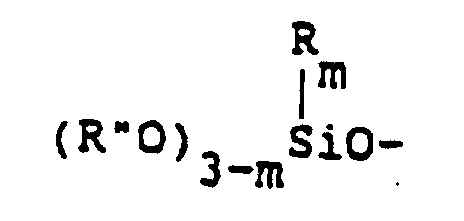
- The method of this invention preferably uses a polymer of the formulawhere each R is a radical free of aliphatic unsaturation and is at least one radical selected from monovalent hydrocarbon, monovalent halohydrocarbon, and monovalent cyanoalkyl radicals of 1 to 18 inclusive carbon atoms, each D is selected from radicals of the formula
 and radicals of the formula
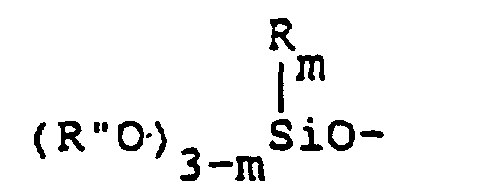 where each R" is at least one selected from methyl, ethyl, propyl, and butyl, Z is a divalent hydrocarbon radical or a combination of divalent hydrocarbon radicals and siloxane radicals, m is 0 or 1, x is of a value such that the polymer has a viscosity of from 0.5 to 3,000 Pa·s at 25°C., and R is as defined above.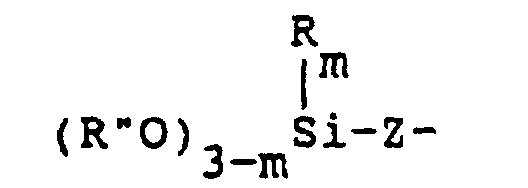
- When D of polymer (1) is theradical, the polymer is of the formula
 where each R is free of aliphatic unsaturation and is at least one selected from monovalent hydrocarbon, monovalent halohydrocarbon, and monovalent cyanoalkyl radicals of 1 to 18 inclusive carbon atoms, each R" is at least one selected from methyl, ethyl, propyl, and butyl, m is 0 or 1, and x is of a value such that the polymer has a viscosity of from 0.5 to 3,000 Pa·s at 25°C. R can be any of those monovalent hydrocarbon, monovalent halohydrocarbon, or monovalent cyanoalkyl radicals of 1 to 18 inclusive carbon atoms which are known to be useful in silicone sealant materials. The preferred radicals are methyl, ethyl, propyl, phenyl, and trifluoropropyl.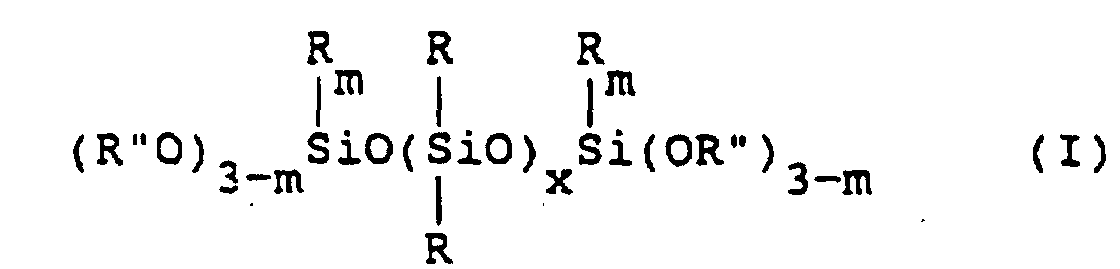
- Alkoxy endblocked polydiorganosiloxanes are well known types of polymers. They can be prepared by the addition of an excess of alkyltrialkoxysilane to a hydroxy endblocked polydiorganosiloxane.
- When (D) of polymer (1) is theradical, the polymer is of the formula
 an alkoxysilalkylene endblocked polymer, where each R, each R", m, and x are as defined above, Z is a divalent hydrocarbon radical or combination of divalent hydrocarbon radicals and siloxane radicals. The divalent hydrocarbon radical can be from 2 to 15 carbon atoms in the form of a divalent alkylene or arylene radical such as ethylene, propylene, hexylene, phenylene, and
 A preferred Z may be represented by the formula
 where R is as defined above, b is 0 or 1, and c is from 1 to 6. The preferred viscosity of polymer (1) is from 1 to 1,000 Pa·s at 25°C.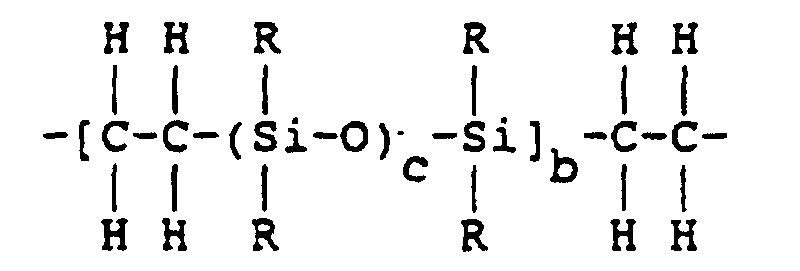
- Alkoxysilalkylene endblocked polymers of the above formula can be manufactured following the methods taught in US-A 4,888,380, which shows typical polymers and their method of manufacture.
- The polydiorganosiloxane compositions used in the present invention are crosslinked by the use of a titanium catalyst, (B). The titanium catalyst can be those known to be useful in catalyzing the moisture induced reaction of alkoxycontaining siloxanes or silanes. Preferred are titanium catalysts such as titanium esters, the tetraalkyltitanates such as tetrabutyltitanate, tetraisopropyltitanate, tetra-2-ethylhexyltitanate, tetraphenyltitanate, triethanolaminetitanate, organosiloxytitanium compounds such as those described in US-A 3,294,739, and beta-dicarbonyl titanium compounds, such as those described in US-A 3,334,067. Preferred catalysts include tetrabutyltitanate, tetraisopropyltitanate, bis(acetylacetonyl)diisopropyltitanate, and 2,5-diisopropoxy-bis(ethylacetoacetate)titanium. The amount of catalyst is from 0.2 to 6.0 parts by weight per 100 parts by weight of polydiorganosiloxane (A). Preferred amounts are from 0.5 to 3.0 parts by weight per 100 parts by weight of polydioganosiloxane (A).
- The polydiorganosiloxane (A) is mixed with the titanium catalyst (B) before the polymer is emulsified. When the titanium catalyst is a tetraalkoxytitanate, it is essential that the polydiorganosiloxane and the tetraalkoxytitanate be combined prior to contact with water and stabilizing agents. If (A) and (B) are not mixed prior to emulsification when the titanium catalyst is a tetraalkoxytitanate, the micelles of the emulsion are not crosslinked and the emulsion does not form a cured silicone elastomer upon evaporation of the water. The tetraalkoxytitanate is sensitive to water and is inactivated as a catalyst when contacted with water before it is combined with the polydiorganosiloxane, whereas the beta-dicarbonyl titanium compound is not so limited.
- Some of the titanium catalysts are not readily soluble in the polydiorganosiloxanes and in those situations, an organic solvent which is non-reactive with the titanium catalyst can be used to bring the ingredients into a state of solution where they can react with one another. These non-titanium catalyst-reactive organic solvents include toluene, n-hexane, and n-heptane. Because they are not desirable from an ecological and marketing point of view, it is desired that they be removed, and therefore, the amount of such organic solvent should be the minimum to do the job and be economically removed.
- After the polydiorganosiloxane and the titanium catalyst are formed into a mixture, it can be emulsified by conventional techniques known in the art for such purposes. The mixture of polydiorganosiloxane and titanium catalyst is emulsified by first adding water and a stabilizer and then the resulting mixture is mechanically emulsified, such as with a high speed mixer, or an ultrasonic probe-type processor. After the aqueous silicone emulsion is obtained, if an organic solvent was used, it is preferred that it be removed. The removal of organic solvent from the aqueous silicone emulsion can be accomplished by heating the emulsion, especially practical are those techniques which use thin layers of the emulsion while applying heat. During this process of the organic solvent removal, water can be lost, and if this is the case, additional water may be desirably added to bring the aqueous silicone emulsion back to its intended solids content. However, this is not a requirement of this invention, because emulsions of various solids can make useful products. Likewise, one may wish to use a more diluted form of the aqueous silicone emulsion and therefore, additional water may be added over and above the amount lost during organic solvent removal.
- The ionic and nonionic stabilizers can be those which are conventionally used for stabilizing silicone emulsions, such as sodium lauryl sulfate and polyethylene oxide lauryl ether.
- Useful silicone elastomeric compositions are commonly produced with a filler as one of the ingredients. These fillers are well known in the industry. They are added to the mixture to provide reinforcement of the polymer so as to control the physical properties of the elastomer which is formed. The addition of the filler can be done at various points during the manufacture of the aqueous silicone emulsion, preferably after the aqueous silicone emulsion is prepared. Reinforcing fillers, such as fumed silica, precipitated silica, and diatomaceous earth are used to give the highest physical strengths to the elastomer. Reinforcing fillers are generally recognized as being very fine particles having a surface area from about 50 to 700 m2/g. These fillers may be used with untreated filler surfaces or with treated filler surfaces, the treatment being used to modify the filler surface so that it properly interacts with the polymer and the other ingredients in the sealant. Calcium carbonate fillers are now available which are produced by precipitation, which have a surface area of about 20 m2/g, which have a reinforcing effect. Extending fillers such as titanium dioxide, zirconium silicate, ground calcium carbonate, iron oxide, ground quartz, and carbon black may be used. The amounts of filler used can obviously be varied within wide limits in accordance with the intended use. For example, in some cases the crosslinked polymer could be used with no filler, but it would have very low physical properties. Reinforcing fillers are commonly used in amounts from about 5 to 20 parts by weight to give the highest physical properties, such as tensile strength. Extending fillers are finely ground with usual average particle sizes in the range of from about 1 to 10 micrometers. Extending fillers are used to modify the sealant properties and to provide opacity in some cases. When silica is used as the filler there is no problem with the shelf life of the emulsion; unlike those compositions which include polymer, silica, and stannic tin catalyst.
- Another type of reinforcement is colloidal silica in the form of an aqueous dispersion, such as the NALCOAG™ dispersions of Nalco Chemical Company. A separately prepared anionic, stable dispersion of fumed silica in water is available as CAB-O-SPERSE™ dispersions from the Cab-O-Sil™ division of Cabot Corporation. These fillers are added after the aqueous silicone emulsion is prepared because they contain water which can inactivate the titanium catalyst, especially the tetraalkyltitanate catalysts.
- The composition obtained by the process of this invention can be used as a coating for protection or release when applied to surfaces such as cloth or paper and then dried. When the composition includes filler, it can be used to form paints and sealants, depending upon the amount and type of filler added. In all cases, the composition gives an elastomeric material upon removal of the water and has excellent shelf life as an emulsion before drying.
- The following examples are included for illustrative purposes only and should not be construed as limiting the invention which is properly set forth in the appended claims.
- First, 4 g of n-hexane and 0.2 g of tetrabutyltitanate (TBT) was added to 20 g of the methyldimethoxysiloxy endblocked polydimethylsiloxane fluid having a viscosity of about 11.5 Pa·s at 25°C. and the mixture was shaken until a solution resulted. Then, 1.2 g of a 30 percent aqueous solution of sodium lauryl sulfate was added followed by 14.8 g of deionized water. The mixture was emulsified for 2.5 minutes using an ultrasonic probe-type processor. The resulting emulsion was allowed to stand for 24 hours after which n-hexane was removed by heating the emulsion to 60°C. under vacuum for one hour using a rotary evaporator.
- Additional water was added to the emulsion to replace that water that had been removed by evaporation during the removal of the n-hexane; the resulting composition consisted of a 60 weight percent solids emulsion of precured polydimethylsiloxane. A film was cast by pouring 8 g of the emulsion into a 100 mm diameter polystyrene Petri dish and allowing the emulsion to dry at ambient conditions for 24 hours. An elastomeric film resulted.
- After the film had dried at ambient conditions for an additional 6 days, swell/gel properties were determined by swelling the elastomeric film in n-hexane. The cured latex had a volume swell of 912 +/- 27 percent and a gel content of 85.6 +/- 0.6 percent.
- A mixture of 30 g of reaction product containing 90 percent by weight of trimethoxysilylethylene endblocked polydimethylsiloxane having a viscosity of 50 Pa·s at 25°C. and 10 percent unreacted ingredients, predominately vinyl endblocked polydimethylsiloxane, was mixed with 3.5 g of an aqueous mixture of sodium lauryl sulfate (44 percent in water) and the mixture was agitated for 1 minute under vacuum in a high speed mixer (WHIP MIX (R)). Next, 4 g of deionized water was added to the mixture and stirred for 1 minute. Then, 0.45 g of diisopropyl-bis-(ethylacetoacetate)titanium was added to the mixture and it was stirred for 1 minute under vacuum. This mixture was an anionic, oil in water emulsion of alkoxy functional polydimethylsiloxane fluid of approximately 80 weight percent solids. It had a paste-like consistency. The catalyzed emulsion was allowed to stand undisturbed in a closed container for one week. During this time, portions of the emulsion were removed from the container after 1 hour, 1 day, 2 days, and 7 days and smeared onto a plastic dish and allowed to dry. The resulting films were inspected after drying for 24 hours in air. Only the film which had stood for 7 days before drying was elastomeric. The properties of this film were measured after it had dried for a total of 4 days. The tensile properties are given in Table I.
MPa psi Tensile Strength 0.29 42 50 percent Modulus 0.02 3 100 " " 0.03 5 150 " " 0.05 7 200 " " 0.07 10 250 " " 0.08 12 300 " " 0.1 14 - First 90 g of methyldimethoxysiloxy endblocked polydimethylsiloxane fluid having a viscosity of 11.5 Pa·s at 25°C. was added to 10 g of an aqueous mixture of sodium lauryl sulfate (50 percent in water) and the mixture was agititated for 1 minute under vacuum in a high speed mixer (WHIP MIX (R)). Next 4 g of deionized water was added to this mixture and it was stirred again for 1 minute, also in vacuo. An additional 4 g of deionized water was added and the mixture was stirred in vacuo for 1 minute. The resulting composition consisted of an anionically stabilized, oil in water emulsion having a solids content of 84 percent by weight. Average particle size of the emulsion micelles were determined by light scattering (NIACOMP) and found to be 1600 nm.
- A 30 g portion of the emulsion was placed into a jar followed by 0.48 g of diisopropyl-bis-(ethylacetoacetate)titanium. The mixture was stirred with a spatula for several minutes until the emulsion had a homogeneous appearance. The jar was capped and the emulsion was allowed to stand undisturbed. After 4 hours, a small amount of emulsion was removed and spread into a film. The film was allowed to dry in air for 16 hours. It was inspected and found to be slightly elastomeric. Another sample of the catalyzed emulsion was removed after it had stood undisturbed for 20 hours and this sample was spread into a thin film and allowed to dry for 20 hours. The resulting film was elastomeric.
- The film was allowed to dry in air for a total of 7 days then it was allowed to swell (2.5 cm disks) in heptane for 6 days. Volume swell and gel content were determined:
- Volume Swell = 933 %
- % Gel = 84.8 % Tensile properties of the film were also obtained after it had dried for a total of 7 days and these were as shown in Table II.
-
- A mixture of 30 g of reaction product containing 90 percent by weight of trimethoxysilylethylene endblocked polydimethylsiloxane having a viscosity of 50 Pa·s at 25°C. and 10 percent unreacted ingredients, predominately vinyl endblocked polydimethylsiloxane, was mixed with 3.5 g of an aqueous mixture of sodium lauryl sulfate (44 percent in water) and the mixture was agitated for 1 minute under vacuum in a high speed mixer (WHIP MIX (R)). Next 4 g of deionized water was added to the mixture and stirred for 1 minute. Then, 0.45 g of tetrabutyltitanate was added to the mixture and it was stirred for one minute under vacuum. This mixture was an anionic, oil in water emulsion of alkoxy functional polydimethylsiloxane fluid of approximately 80 weight percent solids. The paste-like emulsion was allowed to stand undisturbed in a closed container for one week. During this time, portions of the emulsion were removed from the container after 1 hour, 1 day, 2 days, and 7 days and spread into a film onto a plastic dish. The films were allowed to dry under ambient conditions for 24 hours after which they were inspected. None of the films had cured. The films consisted of tacky polymeric gums that were not elastomeric and they were soluble in heptane.
- The above experiment was repeated two more times using 1.0 g and 1.5 g of tetrabutyltitanate respectively. These concentrations of tetrabutyltitanate resulted in the same uncured films as did the 0.45 g of tetrabutyltitanate. These experiments demonstrated that the tetrabutyltitanate, a tetraalkyltitanate, is incapable of curing an alkoxyfunctional polydiorganosiloxane emulsion using the method of adding the titanium catalyst to the aqueous emulsion of the polydiorganosiloxane. It is believed that the tetrabutyltitanate becomes inactivated by the aqueous phase before it can migrate into the polydiorganosiloxane micelles and function as a curing catalyst. Thus, tetraalkyltitanates function differently than the beta-dicarbonyl titanium compounds, such as illustrated by Comparison Example 1 and Comparison Example 2.
| Property | Tensile | Elongation % | 50% M | 100% M | 200% M | ||||
| MPa | psi | MPa | psi | MPa | psi | MPa | psi | ||
| Value | 0.60 | 87 | 385 | 0.15 | 22 | 0.25 | 36 | 0.37 | 54 |
| Standard deviation | 0.1 | 14 | 1 | 0.007 | 1 | 0.014 | 2 | 0.04 | 6 |
Claims (9)
- A process for the preparation of an aqueous silicone emulsion which yields an elastomer upon removal of the water which comprises mixing water and an ionic or nonionic stabilizer withemulsifying the resulting product, and obtaining the aqueous silicone emulsion, characterised in that components (A) and (B) are mixed together and thereafter water and the ionic or nonionic stabilizer are added, with the proviso that the combination of (A) methyldimethoxy endblocked polydimethylsiloxane fluid having a viscosity of 11.5 Pa.s at 25°C with (B) tetrabutyltitanate in the weight ratio 20/0.2 is excluded.(A) 100 parts by weight of polydiorganosiloxane having alkoxysilyl endblocking groups with at least two alkoxy radicals attached to the silicon atom, and(B) from 0.2 to 6 parts by weight of titanium catalyst sufficient to crosslink the polydiorganosiloxane of (A),
- A process according to claim 1, in which the alkoxysilyl endblocking group is selected from radicals of the formulaand radicals of the formula
 where each R is a radical free aliphatic unsaturation and is at least one radical selected from monovalent hydrocarbon, monovalent halohydrocarbon, and monovalent cyanoalkyl radicals of 1 to 18 inclusive carbon atoms and each R" is at least one selected from methyl, ethyl, propyl, and butyl, Z is a divalent hydrocarbon radical or a combination of divalent hydrocarbon radicals and siloxane radicals, and m is 0 or 1.
- A process according to claim 1 in which the polydiorganosiloxane of (A) is an alkoxysilethylene endblocked polydiorganosiloxane.
- A process according to claim 1 in which the polydiorganosiloxane of (A) is a polydiorganosiloxane havingendblocking.
- A process according to claims 3 or 4, wherein the emulsion further comprises a filler.
- A process according to claim 5 in which the filler is a reinforcing filler.
- A process according to claim 1 wherein component (B) comprises an organic solvent which is non-reactive with tetraalkyltitanate, and a tetraalkyltitanate, and after emulsifying the resulting mixture, the organic solvent is removed to obtain the aqueous silicone emulsion.
- A process according to claim 7 in which the organic solvent is n-hexane, the tetraalkyltitanate is tetrabutyltitanate, the polydiorganosiloxane is methyl-(dimethoxy)siloxy endblocked polydimethylsiloxane, and the stabilizer is sodium lauryl sulfate.
- A process according to claim 7 further comprising adding water sufficient to replace water lost during the removal of the organic solvent.
Applications Claiming Priority (2)
| Application Number | Priority Date | Filing Date | Title |
|---|---|---|---|
| US369194 | 1995-01-05 | ||
| US08/369,194 US5624997A (en) | 1993-08-30 | 1995-01-05 | Precured silicone emulsion |
Publications (2)
| Publication Number | Publication Date |
|---|---|
| EP0735099A1 EP0735099A1 (en) | 1996-10-02 |
| EP0735099B1 true EP0735099B1 (en) | 2001-11-21 |
Family
ID=23454488
Family Applications (1)
| Application Number | Title | Priority Date | Filing Date |
|---|---|---|---|
| EP95301233A Expired - Lifetime EP0735099B1 (en) | 1995-01-05 | 1995-02-27 | Process for the preparation of a precured silicone emulsion |
Country Status (5)
| Country | Link |
|---|---|
| US (1) | US5624997A (en) |
| EP (1) | EP0735099B1 (en) |
| JP (1) | JPH08188715A (en) |
| CA (1) | CA2143530A1 (en) |
| DE (1) | DE69524057D1 (en) |
Families Citing this family (6)
| Publication number | Priority date | Publication date | Assignee | Title |
|---|---|---|---|---|
| JP3524635B2 (en) * | 1995-06-30 | 2004-05-10 | 東レ・ダウコーニング・シリコーン株式会社 | Silicone aqueous emulsion release agent and method for producing the same |
| US5998325A (en) * | 1997-01-24 | 1999-12-07 | Sandia Corporation | Composition and method for polymer moderated catalytic water formation |
| DE60200529T2 (en) * | 2001-03-30 | 2005-06-02 | Central Glass Co., Ltd., Ube | Hydrophobic object |
| KR101519025B1 (en) * | 2013-11-20 | 2015-05-12 | 한국과학기술연구원 | Method for producing functional ladder-like polysilsesquioxane particle |
| CN106029760B (en) * | 2014-02-26 | 2020-08-21 | 日立化成株式会社 | Aerogel |
| CN113913017B (en) * | 2021-10-21 | 2023-04-28 | 北京天山新材料技术有限公司 | Rubber composition, single-component dealcoholized silicone rubber and preparation method thereof |
Family Cites Families (12)
| Publication number | Priority date | Publication date | Assignee | Title |
|---|---|---|---|---|
| GB1024024A (en) * | 1963-04-08 | 1966-03-30 | Dow Corning | Improvements in or relating to polymerising or co-polymerising organosilicon compounds |
| GB1154724A (en) * | 1965-08-11 | 1969-06-11 | Midland Silicones Ltd | Improvements in or relating to Organopolysiloxanes |
| US4341842A (en) * | 1980-06-30 | 1982-07-27 | General Electric Company | Method of coating automotive parts with silicone compositions |
| US4743474A (en) * | 1983-08-05 | 1988-05-10 | Dow Corning Corporation | Coating process and moisture-curable organopolysiloxane compositions therefor |
| US5017672A (en) * | 1987-09-11 | 1991-05-21 | Dow Corning Corporation | Polyalkoxysilylalkylenedisilazanes and silylamines |
| US4888380A (en) * | 1988-09-26 | 1989-12-19 | Dow Corning Corporation | Clear, non-slumping silicone sealants |
| NO893998L (en) * | 1988-10-28 | 1990-04-30 | Dow Corning | SEALANT ON SILICONE BASE. |
| FR2647798B1 (en) * | 1989-05-31 | 1991-09-13 | Rhone Poulenc Chimie | AQUEOUS DISPERSION BASED ON FUNCTIONALIZED SILICON OILS WHICH CAN CROSSLINK TO AN ELASTOMER BY REMOVING WATER |
| US5321075A (en) * | 1989-09-25 | 1994-06-14 | Dow Corning Corporation | Precured silicone emulsion |
| US4954565A (en) * | 1989-09-25 | 1990-09-04 | Dow Corning Corporation | Precured silicone emulsion |
| US5145907A (en) * | 1989-09-25 | 1992-09-08 | Dow Corning Corporation | Precured silicone emulsion |
| US5438095A (en) * | 1993-08-30 | 1995-08-01 | Dow Corning Corporation | Precured silicone emulsion |
-
1995
- 1995-01-05 US US08/369,194 patent/US5624997A/en not_active Expired - Fee Related
- 1995-02-27 DE DE69524057T patent/DE69524057D1/en not_active Expired - Lifetime
- 1995-02-27 EP EP95301233A patent/EP0735099B1/en not_active Expired - Lifetime
- 1995-02-28 CA CA002143530A patent/CA2143530A1/en not_active Abandoned
- 1995-03-02 JP JP7042703A patent/JPH08188715A/en not_active Withdrawn
Also Published As
| Publication number | Publication date |
|---|---|
| JPH08188715A (en) | 1996-07-23 |
| EP0735099A1 (en) | 1996-10-02 |
| DE69524057D1 (en) | 2002-01-03 |
| CA2143530A1 (en) | 1996-07-06 |
| US5624997A (en) | 1997-04-29 |
Similar Documents
| Publication | Publication Date | Title |
|---|---|---|
| US4618642A (en) | Silicone water-based caulking material | |
| EP0236044B1 (en) | Method of adjusting physical properties in silicone elastomeric sealant | |
| AU645520B2 (en) | Precured silicone emulsion | |
| EP0166396B1 (en) | Emulsions of crosslinked polydiorganosiloxanes | |
| DE69628714T2 (en) | Crosslinked emulsions of prepolymerized silicon-modified organic polymers | |
| US4816506A (en) | Aqueous silicone dispersions | |
| US4100124A (en) | Silicone binding compositions useful in preparing gaskets and packings | |
| US8012544B2 (en) | Silicone MQ resin reinforced silicone elastomer emulsions | |
| AU705974B2 (en) | Surface modified silicone elastomers from aqueous silicone emulsions | |
| KR0163048B1 (en) | Neutral curing silicone sealant | |
| EP1680459B1 (en) | Silicone mq resin reinforced silicone elastomer emulsions | |
| US4587288A (en) | Silicone water-based putty | |
| US5145907A (en) | Precured silicone emulsion | |
| KR930012216B1 (en) | Elastic caulking composition based on silicon water | |
| US5708070A (en) | Silicone emulsions which crosslink by Michael addition reactions | |
| US5624997A (en) | Precured silicone emulsion | |
| US4918131A (en) | Aqueous silicone dispersions | |
| EP0640645B1 (en) | Precured silicone emulsion | |
| US5321075A (en) | Precured silicone emulsion |
Legal Events
| Date | Code | Title | Description |
|---|---|---|---|
| PUAI | Public reference made under article 153(3) epc to a published international application that has entered the european phase |
Free format text: ORIGINAL CODE: 0009012 |
|
| AK | Designated contracting states |
Kind code of ref document: A1 Designated state(s): DE FR GB IT |
|
| 17P | Request for examination filed |
Effective date: 19961028 |
|
| 17Q | First examination report despatched |
Effective date: 19981223 |
|
| RTI1 | Title (correction) |
Free format text: PROCESS FOR THE PREPARATION OF A PRECURED SILICONE EMULSION |
|
| GRAG | Despatch of communication of intention to grant |
Free format text: ORIGINAL CODE: EPIDOS AGRA |
|
| GRAG | Despatch of communication of intention to grant |
Free format text: ORIGINAL CODE: EPIDOS AGRA |
|
| GRAH | Despatch of communication of intention to grant a patent |
Free format text: ORIGINAL CODE: EPIDOS IGRA |
|
| GRAH | Despatch of communication of intention to grant a patent |
Free format text: ORIGINAL CODE: EPIDOS IGRA |
|
| GRAA | (expected) grant |
Free format text: ORIGINAL CODE: 0009210 |
|
| AK | Designated contracting states |
Kind code of ref document: B1 Designated state(s): DE FR GB IT |
|
| PG25 | Lapsed in a contracting state [announced via postgrant information from national office to epo] |
Ref country code: IT Free format text: LAPSE BECAUSE OF FAILURE TO SUBMIT A TRANSLATION OF THE DESCRIPTION OR TO PAY THE FEE WITHIN THE PRE;WARNING: LAPSES OF ITALIAN PATENTS WITH EFFECTIVE DATE BEFORE 2007 MAY HAVE OCCURRED AT ANY TIME BEFORE 2007. THE CORRECT EFFECTIVE DATE MAY BE DIFFERENT FROM THE ONE RECORDED.SCRIBED TIME-LIMIT Effective date: 20011121 Ref country code: FR Free format text: LAPSE BECAUSE OF FAILURE TO SUBMIT A TRANSLATION OF THE DESCRIPTION OR TO PAY THE FEE WITHIN THE PRESCRIBED TIME-LIMIT Effective date: 20011121 |
|
| REG | Reference to a national code |
Ref country code: GB Ref legal event code: IF02 |
|
| REF | Corresponds to: |
Ref document number: 69524057 Country of ref document: DE Date of ref document: 20020103 |
|
| PG25 | Lapsed in a contracting state [announced via postgrant information from national office to epo] |
Ref country code: DE Free format text: LAPSE BECAUSE OF FAILURE TO SUBMIT A TRANSLATION OF THE DESCRIPTION OR TO PAY THE FEE WITHIN THE PRESCRIBED TIME-LIMIT Effective date: 20020222 |
|
| PG25 | Lapsed in a contracting state [announced via postgrant information from national office to epo] |
Ref country code: GB Free format text: LAPSE BECAUSE OF NON-PAYMENT OF DUE FEES Effective date: 20020227 |
|
| PLBE | No opposition filed within time limit |
Free format text: ORIGINAL CODE: 0009261 |
|
| STAA | Information on the status of an ep patent application or granted ep patent |
Free format text: STATUS: NO OPPOSITION FILED WITHIN TIME LIMIT |
|
| EN | Fr: translation not filed | ||
| GBPC | Gb: european patent ceased through non-payment of renewal fee |
Effective date: 20020227 |
|
| 26N | No opposition filed |