EP0733034B1 - Process for the carbonylation of an acetylenically unsaturated compound - Google Patents
Process for the carbonylation of an acetylenically unsaturated compound Download PDFInfo
- Publication number
- EP0733034B1 EP0733034B1 EP95902857A EP95902857A EP0733034B1 EP 0733034 B1 EP0733034 B1 EP 0733034B1 EP 95902857 A EP95902857 A EP 95902857A EP 95902857 A EP95902857 A EP 95902857A EP 0733034 B1 EP0733034 B1 EP 0733034B1
- Authority
- EP
- European Patent Office
- Prior art keywords
- unsaturated compound
- compound
- palladium
- carbonylation
- optionally substituted
- Prior art date
- Legal status (The legal status is an assumption and is not a legal conclusion. Google has not performed a legal analysis and makes no representation as to the accuracy of the status listed.)
- Expired - Lifetime
Links
Classifications
-
- C—CHEMISTRY; METALLURGY
- C07—ORGANIC CHEMISTRY
- C07C—ACYCLIC OR CARBOCYCLIC COMPOUNDS
- C07C67/00—Preparation of carboxylic acid esters
- C07C67/36—Preparation of carboxylic acid esters by reaction with carbon monoxide or formates
- C07C67/38—Preparation of carboxylic acid esters by reaction with carbon monoxide or formates by addition to an unsaturated carbon-to-carbon bond
Definitions
- the invention relates to a process for the carbonylation of an acetylenically unsaturated compound with carbon monoxide in the presence of water, an alcohol and/or carboxylic acid/
- Such a compound may be carbonylated with carbon monoxide in the presence of water, an alcohol and/or carboxylic acid to yield carboxylic acids, esters or anhydrides respectively.
- European Patent EP 0194707 B discloses the hydrocarboxylation of an acetylenically unsaturated compound with carbon monoxide and a carboxylic acid in the liquid phase. The reaction is shown to proceed at a temperature of 115°C in the presence of a catalyst system prepared from a palladium (II) compound and a triorganic phosphine, wherein the ratio of the number of moles of triorganic phosphine to gram atom of palladium (II) is greater than 15. The most effective of those triorganic phosphines described, in terms of reaction rate, is triphenyl phosphine.
- a suitable feedstock which contains an acetylenically unsaturated compound may be obtained from the cracking of oil fractions.
- Such a feedstock frequently contains an allenically unsaturated compound in addition to the acetylenically unsaturated compound.
- an allenically unsaturated compound can have a detrimental effect on the catalyst system as described in EP 0271144 A. Consequently, the use of such a catalyst system requires the elimination of any allenically unsaturated compound from the feedstock prior to carbonylation thereof.
- the elimination of the allenically unsaturated compounds requires the use of additional feedstock preparation stages, e.g. isomerization and separation, which add to the overall expense and complexity of the conventional carbonylation process.
- the present invention provides a process capable of the low temperature carbonylation of an acetylenically unsaturated compound with carbon monoxide in the presence of an allenically unsaturated compound and a catalytic system which is capable of catalysing the carbonylation of the acetylenically unsaturated compound and which is at least tolerant of the allenically unsaturated compound, the catalytic system being formed from
- the cyclic moiety may act to provide a source of electrons and/or to regulate the access of unsaturated compounds to the catalyst. It is therefore preferred that the cyclic moiety is a relatively rigid structure which contains from 4 to 15, particularly from 6 to 13, and especially from 8 to 11, optionally substituted alkylene groups.
- the phosphorus atom and the cyclic moiety join to form a mono or polycyclic structure.
- the organic phosphine is one in which the phosphorus atom forms a link within at least one cyclic group.
- a particularly preferred organic phosphine is one in which the phosphorus atom, R 2 and R 3 form a polycyclic group in which the phosphorus atom is a link on a bridge shared by at least two cyclic groups.
- Particularly preferred polycyclic groups include 9-phosphabicyclo[4.2.1]-nonane and 9-phosphabicyclo[3,3,1]-nonane.
- Especially preferred is the [4.2,1] isomer.
- the group R 1 is an optionally substituted aryl group.
- Preferred groups include anthryl, naphthyl and phenyl all of which may be optionally substituted. Particularly preferred is optionally substituted phenyl and especially preferred is phenyl.
- the palladium compound and protonic acid may be any used in EP 0194707 B and EP 0271144 A. Suitable combinations employ palladium acetate with a protonic acid such as phenylphosphonic acid or methanesulphonic acid.
- the quantity of palladium compound used can be varied within a wide range. Typically a molar ratio from 10 -6 :1 to 1:1, preferably from 10 -5 :1 to 1:1 and particularly from 10 -5 :1 to 10 -2 :1 of palladium to unsaturated compound may be used.
- the quantity of organic phosphine to palladium compound can also vary within a wide range. Typically a ratio from 200:1 to 1:1 of organic phosphine to palladium compound may be used.
- the quantity of protonic acid used is not critical and can be varied within a wide range. Typically a ratio from 200:1 to 0.1 of protonic acid to organic phosphine may be used.
- Suitable acetylenically unsaturated compounds which may be used in the present invention include one or more unsaturated alkyne having from 2 to 20 carbon atoms, for example ethyne, propyne, 1-butyne, 2-butyne, 1-pentyne, 1-hexyne, 1-heptyne, 1-octyne, 2-octyne, 4-octyne, 5-methyl-3-heptyne, 4-propyl-2-pentyne, 1-nonyne, benzylethyne and cyclohexylethyne.
- the acetylenically unsaturated compound may also be substituted by one or more groups or atoms for example halo, cyano, ester alkoxy, aryl and hydroxy groups.
- Suitable allenically unsaturated compounds which may be used in the present invention include one or more alkadiene having from 3 to 20 carbon atoms, for example propadiene (allene), 1, 2-butadiene, 1, 2-pentadiene, 3, 4-octadiene and 3-methyl-1, 2-butadiene.
- the allenically unsaturated compound may also be substituted by one or more groups or atoms, such substituents include halo, cyano, ester, alkoxy, aryl and hydroxy groups.
- the catalyst systems used in the present invention may not only tolerate the presence of allenically unsaturated compounds, but adventitiously may also carbonylate such compounds.
- R 1 is phenyl and R 2 and R 3 represent the preferred polycyclic groups then such a catalyst system shows a propensity for carbonylating allene to methyl methacrylate under the same conditions used for the carbonylation of, for example, propyne
- the carbonylation process of the present invention may use any suitable source of hydroxy groups, for example water, an alcohol or carboxylic acid, or mixtures thereof.
- hydroxy groups are provided by an alcohol, e.g. methanol.
- the carbonylation process of the present invention may also be conducted in the presence of a suitable solvent.
- suitable solvents include anisole and diphenyl ether.
- Other solvents include those disclosed in the prior art acknowledged supra.
- the present catalyst system may be used at elevated temperatures, for example from 115°C to 150°C.
- the present catalyst system adventitiuosly allows the use of relatively low temperatures as compared to those conventionally employed when triphenylphosphine is used as the organic phosphine compound.
- the temperature at which the carbonylation is performed is less than 115°C, preferably less than 100°C, for example from 20 to 90°C, and is preferably from 40 and 90°C and especially from 50 to 90°C, for example from 50 to 70°C.
- the pressure under which the carbonylation is performed may be selected by the skilled person in order to suit the particular catalyst system used. Typically, a total pressure from 5 to 100 bar, and in particular from 30 to 80 bar may be used.
- a 1 litre capacity Hastalloy C autoclave was evacuated and then charged with a catalyst solution comprising palladium acetate (0.8 mmol), phosphine ligand (9-phenyl 9-phosphabicyclo nonane (PPBN) (40 mmol), phenylphosphonic acid (40 mmol), methanol (40 cm 3 ) and anisole (160 cm 3 ).
- a catalyst solution comprising palladium acetate (0.8 mmol), phosphine ligand (9-phenyl 9-phosphabicyclo nonane (PPBN) (40 mmol), phenylphosphonic acid (40 mmol), methanol (40 cm 3 ) and anisole (160 cm 3 ).
- the PPBN used was a mixture of the [3,3,1] and [4,2,1] isomers which were present in the approximate molar ratio of 1:4.
- Methyl acetylene (30 g) was then introduced and the autoclave pressurised to 60 bar with carbon monoxide and heated to 60°C.
- Example 1 was repeated except that triphenyl phosphine was used as the phosphine ligand instead of PPBN.
- the results of Examples 1 and 2 are shown in Table 1 as the percentage (w/v) of methyl methacrylate detected in the withdrawn samples.
- LIGAND REACTION TIME (HOURS) 2 24 PPBN 0.5 1.6 Triphenyl phosphine 0.0 0.4
- Examples 1 and 2 were repeated except that in respect of the PPBN, two experiments were conducted using different amounts of palladium acetate, phenylphosphonic acid and PPBN.
- the amounts of these components were as follows (i) 0.1 g palladium acetate in association with 3.6 g of phenylphosphonic acid and 5.0 g of PPBN and (ii) 0.05 g palladium acetate in association with 1.84 g of phenylphosphonic acid and 2.6 g of PPBN. In both experiments the results were approximately the same.
- Example 1 was repeated except that the propyne was replaced by allene. Also 0.04 g of palladium acetate were used in association 1.36 g of phenylphosphonic acid and 1.9 g of PPBN.
- Example 4 was repeated except that triphenyl phosphine was used as the phosphine ligand instead of PPBN. Also 0.18 g of palladium acetate were used in association 6.32 g of phenylphosphonic acid and 10.5 g of triphenyl phosphine.
- Example 1 was repeated except that the individual isomers were used instead of a mixture of the isomers. Also, different amounts of palladium acetate, phenylphosphonic acid and isomers were used as follows: (i) 0.08 g palladium acetate in association with 3.9 g of phenylphosphonic acid and 4.0 g of [3,3,1] isomer; (ii) 0.09 g palladium acetate in association with 3.07 g of phenylphosphonic acid and 4.3 g of [4,2,1] isomer; and (iii) 0.09 g palladium acetate in association with 3.13 g of phenylphosphonic acid and 4.6 g of [4,2,1] isomer. In both experiments using the [4,2,1] isomer the results were approximately the same.
- Example 1 In a first run, the procedure of Example 1 was followed using a catalyst having a formulation of 0.03 g palladium acetate in association with 0.89 g of phenylphosphonic acid and 1.3 g of [4,2,1] isomer. After a reaction time of one hour, the entire contents of the autoclave were removed under nitrogen for analysis by gas chromatography. The analysis showed the presence of methyl methacrylate, methanol and unreacted propyne. After removal of volatiles under reduced pressure, a fresh charge of methanol was added and on further analysis the solution was shown to be free from residual methyl methacrylate.
- a second run was then performed in a similar manner to the first run but using the catalyst from the first run instead of fresh catalyst. The analysis was repeated at the end of the second run.
- Example 1 The procedure of Example 1 was repeated using a catalyst having a formulation of 0.04 g palladium acetate in association with 1.73 g of phenylphosphonic acid and 2.3 g of [4,2,1] isomer, except that the temperature was raised to 90°C. Analysis showed that 1.7% w/v of methyl methacrylate was present at the end of the run and that the catalyst had a Relative Rate of 146.
Landscapes
- Chemical & Material Sciences (AREA)
- Organic Chemistry (AREA)
- Chemical Kinetics & Catalysis (AREA)
- Organic Low-Molecular-Weight Compounds And Preparation Thereof (AREA)
- Catalysts (AREA)
- Low-Molecular Organic Synthesis Reactions Using Catalysts (AREA)
Abstract
Description

- R1 is an optionally substituted aryl group;
- R2 and R3 are joined to form an optionally substituted cyclic moiety comprising at least one optionally substituted alkylene group.
| LIGAND | REACTION TIME (HOURS) | |
| 2 | 24 | |
| PPBN | 0.5 | 1.6 |
| Triphenyl phosphine | 0.0 | 0.4 |
| LIGAND | REACTION TIME (HOURS) | |
| 2 | 24 | |
| PPBN | 8.5 | 7.3 |
| Triphenyl phosphine | 0.0 | 0.5 |
| LIGAND | REACTION TIME (HOURS) | |
| 2 | 24 | |
| PPBN | 6.3 | 5.3 |
| Triphenyl phosphine | 0.0 | 0.5 |
| LIGAND | REACTION TIME (HOURS) | |
| 2 | 24 | |
| PPBN | 0.1 | 1.4 |
| Triphenyl phosphine | 0.0 | 0.5 |
| LIGAND | REACTION TIME (HOURS) | |
| 2 | 24 | |
| PPBN | 7.4 | 6.6 |
| Triphenyl phosphine | 0.0 | 0.5 |
| LIGAND | AFTER 1 HOUR REACTION TIME |
| [3,3,1] | 10.0 |
| [4,2,1] | 45.0 |
Claims (12)
- A process capable of the low temperature carbonylation of an acetylenically unsaturated compound with carbon monoxide in the presence of an allenically unsaturated compound and a catalytic system which is capable of catalysing the carbonylation of the acetylenically unsaturated compound and which is at least tolerant of the allenically unsaturated compound, the catalytic system being formed from(a)a palladium compound;(b)a protonic acid;(c)an organic phosphine of the form (I)wherein
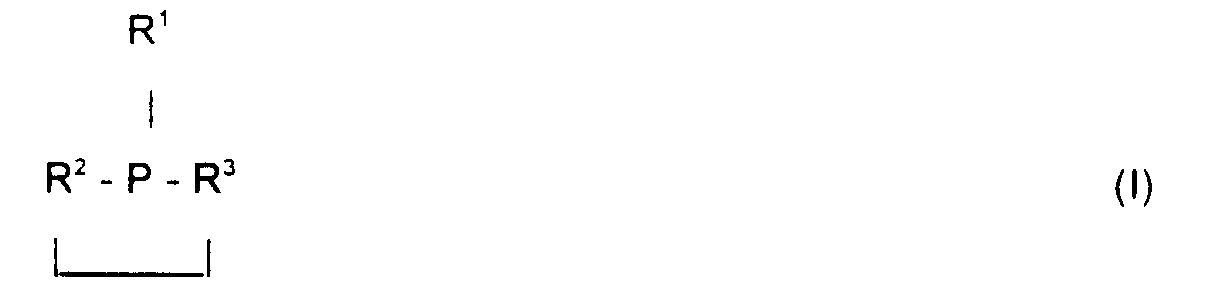 R1 is an optionally substituted aryl group;R2 and R3 are joined to form an optionally substituted cyclic moiety comprising at least one optionally substituted alkylene group.
 - A process as claimed in claim 1 wherein the cyclic moiety is a relatively rigid structure which contains from 4 to 15 optionally substituted alkylene groups.
- A process as claimed in either claim 1 or claim 2 wherein the organic phosphine is one in which the phosphorus atom, R2 and R3 form a polycyclic group in which the phosphorus atom is a link on a bridge shared by at least two cyclic groups.
- A process as claimed in claim 3 wherein the polycyclic groups are selected from 9-phosphabicyclo[4,2,1]-nonane and 9-phosphabicyclo[3,3,1]-nonane.
- A process as claimed in any one of claims 1 to 4 wherein the group R1 is selected from anthryl, naphthyl and phenyl and substituted analogues thereof.
- A process as claimed in claim 5 wherein the group R1 is phenyl.
- A process as claimed in any one of claims 1 to 6 wherein the palladium compound is palladium acetate and the protonic acid is phenylphosphonic acid.
- A process as claimed in any one of claims 1 to 7 wherein the quantity of palladium compound used is such that the molar ratio of palladium to unsaturated compound is from 10-6:1 to 1:1.
- A process as claimed in any one of claims 1 to 8 wherein the quantity of organic phosphine used is such that the molar ratio of organic phosphine to palladium compound is from 200:1 to 1:1.
- A process as claimed in any one of claims 1 to 9 wherein the acetylenically unsaturated compound is one or more unsaturated alkyne having from 2 to 20 carbon atoms.
- A process as claimed in any one of claims 1 to 10 wherein the allenically unsaturated compound is one or more alkadiene having from 3 to 20 carbon atoms.
- A process as claimed in any one of claims 1 to 11 wherein the temperature at which the carbonylation is performed is less than 115°C.
Applications Claiming Priority (3)
| Application Number | Priority Date | Filing Date | Title |
|---|---|---|---|
| GB939325377A GB9325377D0 (en) | 1993-12-10 | 1993-12-10 | Process for the carbonylation of an acetylenically unsaturated compound |
| GB9325377 | 1993-12-10 | ||
| PCT/GB1994/002667 WO1995015938A1 (en) | 1993-12-10 | 1994-12-06 | Process for the carbonylation of an acetylenically unsaturated compound |
Publications (2)
| Publication Number | Publication Date |
|---|---|
| EP0733034A1 EP0733034A1 (en) | 1996-09-25 |
| EP0733034B1 true EP0733034B1 (en) | 1998-09-02 |
Family
ID=10746460
Family Applications (1)
| Application Number | Title | Priority Date | Filing Date |
|---|---|---|---|
| EP95902857A Expired - Lifetime EP0733034B1 (en) | 1993-12-10 | 1994-12-06 | Process for the carbonylation of an acetylenically unsaturated compound |
Country Status (12)
| Country | Link |
|---|---|
| EP (1) | EP0733034B1 (en) |
| JP (1) | JPH09506364A (en) |
| CN (1) | CN1046936C (en) |
| AT (1) | ATE170507T1 (en) |
| AU (1) | AU680325B2 (en) |
| CA (1) | CA2178739A1 (en) |
| DE (1) | DE69413060T2 (en) |
| ES (1) | ES2121334T3 (en) |
| GB (1) | GB9325377D0 (en) |
| NO (1) | NO305945B1 (en) |
| TW (1) | TW316263B (en) |
| WO (1) | WO1995015938A1 (en) |
Families Citing this family (1)
| Publication number | Priority date | Publication date | Assignee | Title |
|---|---|---|---|---|
| JP2013193992A (en) * | 2012-03-21 | 2013-09-30 | Sumitomo Chemical Co Ltd | Method of producing alkyl methacrylate |
Family Cites Families (3)
| Publication number | Priority date | Publication date | Assignee | Title |
|---|---|---|---|---|
| DE3175174D1 (en) * | 1981-01-06 | 1986-09-25 | Shell Int Research | Process for the carbonylation of olefins |
| GB8432376D0 (en) * | 1984-12-21 | 1985-02-06 | Shell Int Research | Carbonylation of acetylenically unsaturated compounds |
| ES2088082T3 (en) * | 1991-01-15 | 1996-08-01 | Shell Int Research | OLEPHINE CARBONILATION. |
-
1993
- 1993-12-10 GB GB939325377A patent/GB9325377D0/en active Pending
-
1994
- 1994-12-06 CA CA002178739A patent/CA2178739A1/en not_active Abandoned
- 1994-12-06 WO PCT/GB1994/002667 patent/WO1995015938A1/en not_active Ceased
- 1994-12-06 DE DE69413060T patent/DE69413060T2/en not_active Expired - Fee Related
- 1994-12-06 ES ES95902857T patent/ES2121334T3/en not_active Expired - Lifetime
- 1994-12-06 EP EP95902857A patent/EP0733034B1/en not_active Expired - Lifetime
- 1994-12-06 AU AU11951/95A patent/AU680325B2/en not_active Ceased
- 1994-12-06 AT AT95902857T patent/ATE170507T1/en not_active IP Right Cessation
- 1994-12-06 CN CN94194963A patent/CN1046936C/en not_active Expired - Fee Related
- 1994-12-06 JP JP7516033A patent/JPH09506364A/en active Pending
- 1994-12-08 TW TW083111441A patent/TW316263B/zh active
-
1996
- 1996-06-07 NO NO962410A patent/NO305945B1/en not_active IP Right Cessation
Also Published As
| Publication number | Publication date |
|---|---|
| NO962410D0 (en) | 1996-06-07 |
| EP0733034A1 (en) | 1996-09-25 |
| GB9325377D0 (en) | 1994-02-16 |
| ATE170507T1 (en) | 1998-09-15 |
| CN1046936C (en) | 1999-12-01 |
| NO962410L (en) | 1996-08-07 |
| WO1995015938A1 (en) | 1995-06-15 |
| AU680325B2 (en) | 1997-07-24 |
| DE69413060D1 (en) | 1998-10-08 |
| NO305945B1 (en) | 1999-08-23 |
| CA2178739A1 (en) | 1995-06-15 |
| AU1195195A (en) | 1995-06-27 |
| TW316263B (en) | 1997-09-21 |
| JPH09506364A (en) | 1997-06-24 |
| ES2121334T3 (en) | 1998-11-16 |
| DE69413060T2 (en) | 1999-02-18 |
| CN1142814A (en) | 1997-02-12 |
Similar Documents
| Publication | Publication Date | Title |
|---|---|---|
| US4940787A (en) | Process for the carbonylation of acetylenic unsaturated compounds | |
| US5874610A (en) | Process for the recovery of a carbonylation product | |
| CA2011294C (en) | Carbonylation catalyst system | |
| AU624483B2 (en) | Carbonylation catalyst system | |
| GB2089803A (en) | Preparation of carboxylic acids | |
| JPH06340574A (en) | Production of carboxylic acid or corresponding ester in presence of catalyst based on rhodium and iridium | |
| KR880001256B1 (en) | The selective hydrocarboxylation of propulene to isobutyric acid | |
| EP0284310B1 (en) | Process for producing ibuprofen | |
| Garegg et al. | Nucleoside 3'-H-phosphonates. 8. Activation of hydrogen phosphonate monoesters by chlorophosphates and arenesulfonyl derivatives | |
| KR20220064907A (en) | Double alkoxycarbonylation of dienes as one-pot synthesis | |
| US3859319A (en) | Carboalkoxylation of unsaturated compounds with a palladium catalyst containing bridging phosphido groups | |
| US4335059A (en) | Preparation of carboxylic acid anhydrides | |
| US5350876A (en) | Carbonylation of conjugated dienes | |
| EP0565199B1 (en) | Carbonylation process using palladium phosphine catalyst | |
| GB2059794A (en) | Process for preparing carboxylic acid anhydrides | |
| EP0733034A1 (en) | Process for the carbonylation of an acetylenically unsaturated compound | |
| US4482497A (en) | Preparation of carboxylic acids | |
| DE69608587T2 (en) | Process for the carbonylation of butadiene or a butadiene derivative | |
| KR100191081B1 (en) | Process for producing alkyl propionate | |
| US5719313A (en) | Carbonylation catalyst system and a process for the carbonylation of acetylenically unsaturated compounds | |
| US4483804A (en) | Preparation of carboxylic acid anhydrides | |
| US4381221A (en) | Process for recovering a reaction product while preventing decomposition of the catalyst | |
| JP2775907B2 (en) | Hydroformylation method | |
| US4461910A (en) | Process for the co-production of dicarboxylates and acids | |
| EP0194707B1 (en) | Process for the hydrocarboxylation of acetylenically unsaturated compounds |
Legal Events
| Date | Code | Title | Description |
|---|---|---|---|
| PUAI | Public reference made under article 153(3) epc to a published international application that has entered the european phase |
Free format text: ORIGINAL CODE: 0009012 |
|
| 17P | Request for examination filed |
Effective date: 19960605 |
|
| AK | Designated contracting states |
Kind code of ref document: A1 Designated state(s): AT BE CH DE DK ES FR GB GR IE IT LI LU MC NL PT SE |
|
| GRAG | Despatch of communication of intention to grant |
Free format text: ORIGINAL CODE: EPIDOS AGRA |
|
| 17Q | First examination report despatched |
Effective date: 19971020 |
|
| GRAG | Despatch of communication of intention to grant |
Free format text: ORIGINAL CODE: EPIDOS AGRA |
|
| GRAH | Despatch of communication of intention to grant a patent |
Free format text: ORIGINAL CODE: EPIDOS IGRA |
|
| GRAH | Despatch of communication of intention to grant a patent |
Free format text: ORIGINAL CODE: EPIDOS IGRA |
|
| GRAA | (expected) grant |
Free format text: ORIGINAL CODE: 0009210 |
|
| ITF | It: translation for a ep patent filed | ||
| AK | Designated contracting states |
Kind code of ref document: B1 Designated state(s): AT BE CH DE DK ES FR GB GR IE IT LI LU MC NL PT SE |
|
| PG25 | Lapsed in a contracting state [announced via postgrant information from national office to epo] |
Ref country code: LI Free format text: LAPSE BECAUSE OF FAILURE TO SUBMIT A TRANSLATION OF THE DESCRIPTION OR TO PAY THE FEE WITHIN THE PRESCRIBED TIME-LIMIT Effective date: 19980902 Ref country code: GR Free format text: LAPSE BECAUSE OF NON-PAYMENT OF DUE FEES Effective date: 19980902 Ref country code: CH Free format text: LAPSE BECAUSE OF FAILURE TO SUBMIT A TRANSLATION OF THE DESCRIPTION OR TO PAY THE FEE WITHIN THE PRESCRIBED TIME-LIMIT Effective date: 19980902 Ref country code: AT Free format text: LAPSE BECAUSE OF FAILURE TO SUBMIT A TRANSLATION OF THE DESCRIPTION OR TO PAY THE FEE WITHIN THE PRESCRIBED TIME-LIMIT Effective date: 19980902 |
|
| REF | Corresponds to: |
Ref document number: 170507 Country of ref document: AT Date of ref document: 19980915 Kind code of ref document: T |
|
| REG | Reference to a national code |
Ref country code: CH Ref legal event code: EP |
|
| REF | Corresponds to: |
Ref document number: 69413060 Country of ref document: DE Date of ref document: 19981008 |
|
| REG | Reference to a national code |
Ref country code: ES Ref legal event code: FG2A Ref document number: 2121334 Country of ref document: ES Kind code of ref document: T3 |
|
| ET | Fr: translation filed | ||
| PG25 | Lapsed in a contracting state [announced via postgrant information from national office to epo] |
Ref country code: SE Free format text: LAPSE BECAUSE OF FAILURE TO SUBMIT A TRANSLATION OF THE DESCRIPTION OR TO PAY THE FEE WITHIN THE PRESCRIBED TIME-LIMIT Effective date: 19981202 Ref country code: DK Free format text: LAPSE BECAUSE OF FAILURE TO SUBMIT A TRANSLATION OF THE DESCRIPTION OR TO PAY THE FEE WITHIN THE PRESCRIBED TIME-LIMIT Effective date: 19981202 |
|
| REG | Reference to a national code |
Ref country code: IE Ref legal event code: FG4D |
|
| PG25 | Lapsed in a contracting state [announced via postgrant information from national office to epo] |
Ref country code: LU Free format text: LAPSE BECAUSE OF NON-PAYMENT OF DUE FEES Effective date: 19981206 Ref country code: IE Free format text: LAPSE BECAUSE OF NON-PAYMENT OF DUE FEES Effective date: 19981206 |
|
| PG25 | Lapsed in a contracting state [announced via postgrant information from national office to epo] |
Ref country code: PT Free format text: LAPSE BECAUSE OF FAILURE TO SUBMIT A TRANSLATION OF THE DESCRIPTION OR TO PAY THE FEE WITHIN THE PRESCRIBED TIME-LIMIT Effective date: 19981209 |
|
| REG | Reference to a national code |
Ref country code: CH Ref legal event code: PL |
|
| PG25 | Lapsed in a contracting state [announced via postgrant information from national office to epo] |
Ref country code: MC Free format text: LAPSE BECAUSE OF NON-PAYMENT OF DUE FEES Effective date: 19990630 |
|
| PLBE | No opposition filed within time limit |
Free format text: ORIGINAL CODE: 0009261 |
|
| STAA | Information on the status of an ep patent application or granted ep patent |
Free format text: STATUS: NO OPPOSITION FILED WITHIN TIME LIMIT |
|
| 26N | No opposition filed | ||
| REG | Reference to a national code |
Ref country code: IE Ref legal event code: MM4A |
|
| PGFP | Annual fee paid to national office [announced via postgrant information from national office to epo] |
Ref country code: FR Payment date: 19991111 Year of fee payment: 6 |
|
| PGFP | Annual fee paid to national office [announced via postgrant information from national office to epo] |
Ref country code: GB Payment date: 19991117 Year of fee payment: 6 |
|
| PGFP | Annual fee paid to national office [announced via postgrant information from national office to epo] |
Ref country code: NL Payment date: 19991122 Year of fee payment: 6 |
|
| PGFP | Annual fee paid to national office [announced via postgrant information from national office to epo] |
Ref country code: DE Payment date: 19991129 Year of fee payment: 6 |
|
| PGFP | Annual fee paid to national office [announced via postgrant information from national office to epo] |
Ref country code: BE Payment date: 19991208 Year of fee payment: 6 |
|
| PGFP | Annual fee paid to national office [announced via postgrant information from national office to epo] |
Ref country code: ES Payment date: 19991210 Year of fee payment: 6 |
|
| PG25 | Lapsed in a contracting state [announced via postgrant information from national office to epo] |
Ref country code: GB Free format text: LAPSE BECAUSE OF NON-PAYMENT OF DUE FEES Effective date: 20001206 |
|
| PG25 | Lapsed in a contracting state [announced via postgrant information from national office to epo] |
Ref country code: BE Free format text: LAPSE BECAUSE OF NON-PAYMENT OF DUE FEES Effective date: 20001231 |
|
| BERE | Be: lapsed |
Owner name: IMPERIAL CHEMICAL INDUSTRIES P.L.C. Effective date: 20001231 |
|
| PG25 | Lapsed in a contracting state [announced via postgrant information from national office to epo] |
Ref country code: NL Free format text: LAPSE BECAUSE OF NON-PAYMENT OF DUE FEES Effective date: 20010701 |
|
| GBPC | Gb: european patent ceased through non-payment of renewal fee |
Effective date: 20001206 |
|
| PG25 | Lapsed in a contracting state [announced via postgrant information from national office to epo] |
Ref country code: FR Free format text: LAPSE BECAUSE OF NON-PAYMENT OF DUE FEES Effective date: 20010831 |
|
| NLV4 | Nl: lapsed or anulled due to non-payment of the annual fee |
Effective date: 20010701 |
|
| REG | Reference to a national code |
Ref country code: FR Ref legal event code: ST |
|
| PG25 | Lapsed in a contracting state [announced via postgrant information from national office to epo] |
Ref country code: DE Free format text: LAPSE BECAUSE OF NON-PAYMENT OF DUE FEES Effective date: 20011002 |
|
| PG25 | Lapsed in a contracting state [announced via postgrant information from national office to epo] |
Ref country code: ES Free format text: LAPSE BECAUSE OF NON-PAYMENT OF DUE FEES Effective date: 20011207 |
|
| REG | Reference to a national code |
Ref country code: ES Ref legal event code: FD2A Effective date: 20020112 |
|
| PG25 | Lapsed in a contracting state [announced via postgrant information from national office to epo] |
Ref country code: IT Free format text: LAPSE BECAUSE OF NON-PAYMENT OF DUE FEES Effective date: 20051206 |