EP0732430B1 - Manganese oxide-based single crystal having a laminar structure and method for the preparation thereof - Google Patents
Manganese oxide-based single crystal having a laminar structure and method for the preparation thereof Download PDFInfo
- Publication number
- EP0732430B1 EP0732430B1 EP96301512A EP96301512A EP0732430B1 EP 0732430 B1 EP0732430 B1 EP 0732430B1 EP 96301512 A EP96301512 A EP 96301512A EP 96301512 A EP96301512 A EP 96301512A EP 0732430 B1 EP0732430 B1 EP 0732430B1
- Authority
- EP
- European Patent Office
- Prior art keywords
- powder
- single crystal
- range
- oxygen
- subscript
- Prior art date
- Legal status (The legal status is an assumption and is not a legal conclusion. Google has not performed a legal analysis and makes no representation as to the accuracy of the status listed.)
- Expired - Lifetime
Links
Images



Classifications
-
- C—CHEMISTRY; METALLURGY
- C30—CRYSTAL GROWTH
- C30B—SINGLE-CRYSTAL GROWTH; UNIDIRECTIONAL SOLIDIFICATION OF EUTECTIC MATERIAL OR UNIDIRECTIONAL DEMIXING OF EUTECTOID MATERIAL; REFINING BY ZONE-MELTING OF MATERIAL; PRODUCTION OF A HOMOGENEOUS POLYCRYSTALLINE MATERIAL WITH DEFINED STRUCTURE; SINGLE CRYSTALS OR HOMOGENEOUS POLYCRYSTALLINE MATERIAL WITH DEFINED STRUCTURE; AFTER-TREATMENT OF SINGLE CRYSTALS OR A HOMOGENEOUS POLYCRYSTALLINE MATERIAL WITH DEFINED STRUCTURE; APPARATUS THEREFOR
- C30B29/00—Single crystals or homogeneous polycrystalline material with defined structure characterised by the material or by their shape
- C30B29/10—Inorganic compounds or compositions
- C30B29/16—Oxides
- C30B29/22—Complex oxides
-
- C—CHEMISTRY; METALLURGY
- C30—CRYSTAL GROWTH
- C30B—SINGLE-CRYSTAL GROWTH; UNIDIRECTIONAL SOLIDIFICATION OF EUTECTIC MATERIAL OR UNIDIRECTIONAL DEMIXING OF EUTECTOID MATERIAL; REFINING BY ZONE-MELTING OF MATERIAL; PRODUCTION OF A HOMOGENEOUS POLYCRYSTALLINE MATERIAL WITH DEFINED STRUCTURE; SINGLE CRYSTALS OR HOMOGENEOUS POLYCRYSTALLINE MATERIAL WITH DEFINED STRUCTURE; AFTER-TREATMENT OF SINGLE CRYSTALS OR A HOMOGENEOUS POLYCRYSTALLINE MATERIAL WITH DEFINED STRUCTURE; APPARATUS THEREFOR
- C30B13/00—Single-crystal growth by zone-melting; Refining by zone-melting
Definitions
- the present invention relates to a novel manganese oxide-based single crystal having a laminar structure and a method for the preparation thereof. More particularly, the invention relates to a single crystal of lanthanum-strontium manganite having a laminar structure, which is useful as a material of a memory-switching type magnetic resistance element having greatly improved magnetic conductivity characteristics as well as a method for the preparation thereof.
- La 0.69 Pb 0.31 MnO 3 as one of the manganese oxide-based composite oxides belonging to this class, a large negative magnetic resistance is observed in the vicinity of the magnetic phase transition temperature. According to the results reported recently in Applied Physics Letters, volume 63, page 1990, Science, volume 264, page 413 and Physical Review Letters, volume 71, page 2331, thin films of (La,Ca)MnO 3 and (La,Ba)MnO 3 equally exhibit a negative magnetic resistance.
- the present invention accordingly has an object to provide a novel manganese oxide-based single-crystal material capable of exhibiting unique characteristics of magnetic conduction and having usefulness, for example, as an element of a memory-switching magnetic resistance device and a method for the preparation thereof.
- the manganese oxide-based material provided by the present invention is a single crystal body having a laminar structure, of which the chemical composition is expressed by the general formula (La x Sr 1-x ) y+1 Mn y O 3y+1 , in which the subscript x is a number in the range from 0.3 to 0.5 and the subscript y is a number of 1 or 2.
- the above defined single crystal body having a laminar structure is prepared by a process which comprises the steps of:
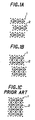
- Figures 1A, 1B and 1C are each a schematic illustration of the arrangement of the lanthanum and strontium atoms and the MnO 6 units in various types of manganese oxide-based single crystals including those of a single-layered structure, double-layered structure and infinite-layered structure, respectively.
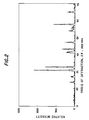
- Figure 2 is a powder X-ray diffractometric diagram of the inventive single crystal of a single-layered structure obtained in Example 1.
- Figure 3 is a powder X-ray diffractometric diagram of the inventive single crystal of a double-layered structure obtained in Example 2.
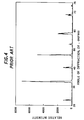
- Figure 4 is a powder X-ray diffractometric diagram of the single crystal of an infinite-layered structure obtained in Comparative Example 1.
- Figure 5 is a graph showing the magnetization curves of the inventive single crystal obtained in Example 2 and the conventional single crystal obtained in Comparative Example 2.
- Figure 6 is a graph showing the electric resistivity of the single crystals obtained in Example 2 and Comparative Example 2 within or in the absence of a magnetic field as a function of temperature.
- Figure 7 is a graph showing the electric resistivity of the single crystals obtained in Example 2 and Comparative Example 2 at a temperature of 294K as a function of magnetic field.
- the manganese oxide-based single crystal of the invention having a laminar structure has a chemical composition represented by the general formula (La x Sr 1-x ) y+1 Mn y O 3y+1 , in which the subscript x is a number in the range from 0.3 to 0.5 and the subscript y is a number of 1 or 2.
- the inventive single crystal having a double-layered laminar structure has a greatly enhanced magnetic conductivity characteristic as compared with that having a single-layered structure. While a single crystal of the formula La 0.6 Sr 1.4 MnO 4 having a single-layered structure exhibits a conductivity characteristic similar to that of a semiconductor over the whole temperature range, for example, a single crystal of a double-layered structure having a chemical composition of La 1.2 Sr 1.8 Mn 2 O 7 corresponding to the value x of 0.4 exhibits great changes in the electric resistivity measured in a magnetic field and magnetization below and above a critical temperature of around 126K.
- the single crystal which is an insulating material at elevated temperatures, is susceptible to a phase transition into a ferromagnetic metallic material at the critical temperature.
- the electric resistivity of the single crystal exhibits a great dependence not only on the temperature but also on the magnetic field.
- the electric resistivity of the single crystal measured in a magnetic field of 1 T is only about one hundredth of the value in the absence of magnetic field.
- the above mentioned great changes in the magnetic conductivity characteristics can be understood in terms of following two mechanisms. Firstly, the localized spin interaction on the manganese atoms is imparted with anisotropy to cause an increase in the response of the spin to the magnetic field so that the movement of the conductive electrons can be energized with a relatively small magnetic field to alter the spin arrangement. Secondly, the synergistic effect of the localized spin arrangement and the movement of the conductive electrons cause a decrease in the electric resistivity to some extent which results in a transition into a ferromagnetic metallic state in an avalanche-like fashion. In this sense, the phenomenon of magnetic conductivity in this phase can be considered to be a transition between an insulating material and a ferromagnetic metal induced by the magnetic field.
- the above defined single crystals of the invention having the unique laminar structure can be prepared by a process which comprises the steps of:
- step (a) of the above described process it is essential that the blending proportion of the lanthanum oxide and strontium oxide falls within the range that the subscript x in the general formula (I) is in the range from 0.3 to 0.5 since, if the blending proportion of these oxides is outside of this range, the desired single crystal having the unique laminar structure cannot be obtained even by undertaking the subsequent steps as described above.
- the subscript y in the general formula (I), which is 1 or 2 should be satisfied, preferably, with a permissible error not exceeding ⁇ 1%.
- the oxide powders of lanthanum, strontium and manganese suitable as the starting materials in step (a) include those expressed by the formulas La 2 O 3 , SrO and Mn 3 O 4 although other kinds of manganese oxides can be used.
- the compounds of these elements convertible into the respective oxides by heating, either in an oxidizing atmosphere or in a non-oxidizing atmosphere include carbonates such as lanthanum carbonate La 2 (CO 3 ) 3 , strontium carbonate SrCO 3 and manganese carbonate MnCO 3 , hydrogencarbonates such as lanthanum hydrogencarbonate La(HCO 3 ) 3 , strontium hydrogencarbonate Sr(HCO 3 ) 2 and manganese hydrogencarbonate Mn(HCO 3 ) 2 and the like, though not particularly limitative thereto.
- the powders as the starting materials can be blended in any known method including the dry and wet processes but the wet process is preferred in respect of the uniformity of the blend.
- the powders are mixed together with addition of a small volume of a volatile solvent such as alcohols, ketones and the like having a relatively low boiling point followed by drying.
- the powder blend thus obtained is heated in air at a temperature of 1000 to 1400 °C for at least 10 hours to give a sintered mass which is then disintegrated or pulverized into a fine powder. If necessary, the cycle of sintering of the powder and disintegration of the sintered mass is repeated twice or more for completeness of the reaction of the metal oxides.
- the fine powder thus obtained is shaped by a suitable method such as compression molding into a green body of a desired form such as a cylinder either without or with use of a binder according to need and the green body is subjected to sintering by heating in air at a temperature in the range from 1100 to 1500 °C . Sintering of the green body is complete usually within 20 hours.
- the thus sintered body is finally subjected to the process of floating zone melting by using a seed crystal for the growth of a single crystal in an atmosphere of an oxidizing gas which is preferably oxygen gas pressurized to a superatmospheric pressure in order to ensure a high valency state of the manganese ions.
- the velocity of the crystal growing in the floating zone melting process is preferably in the range from 5 to 25 mm/hour.
- the single crystalline body having a laminar structure is subjected to various analytical procedures for the determination of the chemical composition and the crystalline structure determined by the subscripts x and y in the formula (I) including X-ray powder diffractometry, X-ray diffraction Laue's photographic method, neutron diffraction, electron probe microanalysis, chemical analysis and so on.
- the inventive single crystalline body of the composite oxide having a laminar structure exhibits a large temperature dependence of the electric resistivity and magnetization along with a magnetic field dependence of the electric resistivity so that the single crystalline body can be used as an element of a memory switching magnetic resistance device by utilizing this excellent magnetic conductivity behavior.
- a single crystalline body of La 0.6 Sr 1.4 MnO 4 having a single-layered laminar structure was prepared in the following manner.
- 7.702 g of a powder of lanthanum oxide La 2 O 3 , 16.287 g of a powder of strontium carbonate SrCO 3 and 6.010 g of a powder of manganese oxide Mn 3 O 4 were mixed together to correspond to the formula La 0.6 Sr 1.4 MnO 4 with addition of a small volume of ethyl alcohol for 30 minutes in a ball mill.
- the powder blend was calcined in air at 1250 °C for 24 hours to give a sintered mass and the mass was finely disintegrated into a powder which was again subjected to calcination in air at 1250 °C for 24 hours and disintegration into a fine powder.
- the thus obtained oxide powder was shaped by compression molding under a molding pressure of 2 tons/cm 2 into a cylindrical green body having a diameter of 6 mm and a length of 80 mm which was subjected to sintering in air at 1350 °C for 48 hours.
- the sintered rod was subjected to the process of floating zone melting in a furnace equipped with two halogen sun lamps and semi-elliptic focusing mirrors in an atmosphere of oxygen gas pressurized to 2 atmospheres.
- the sintered rod and the seed crystal were rotated in the reverse directions at a relative velocity of 30 rpm and a single crystal was grown at a rate of 10 to 20 mm/hour.
- Chemical analysis of the crystal for the contents of lanthanum, strontium and manganese gave a result that the chemical composition of the crystal was identical with the formulation of the starting powder mixture.
- a diagram obtained in the powder X-ray diffractometry of the product, carried out with CuK ⁇ is shown in Figure 2.
- a single crystalline body of La 1.2 Sr 1.8 Mn 2 O 7 having a double-layered laminar structure was prepared in the following manner.
- 9.555 g of a powder of lanthanum oxide La 2 O 3 12.989 g of a powder of strontium carbonate SrCO 3 and 9.456 g of a powder of manganese oxide Mn 3 O 4 were mixed together to correspond to the formula La 1.2 Sr 1.8 Mn 2 O 7 with addition of a small volume of ethyl alcohol for 30 minutes in a ball mill.
- the powder blend was calcined in air at 1350 °C for 24 hours to give a sintered mass and the mass was finely disintegrated into a powder which was again subjected to calcination in air at 1350 °C for 24 hours and disintegration into a fine powder.
- the thus obtained oxide powder was shaped by compression molding under a molding pressure of 2 tons/cm 2 into a cylindrical green body having a diameter of 6 mm and a length of 80 mm which was subjected to sintering in air at 1400 °C for 48 hours.
- the sintered rod was subjected to the process of floating zone melting in a furnace equipped with two halogen sun lamps and semi-elliptic focusing mirrors in an atmosphere of oxygen gas pressurized to 2 atmospheres.
- the sintered rod and the seed crystal were rotated in the reverse directions at a relative velocity of 30 rpm and a single crystal was grown at a rate of 10 to 20 mm/hour.
- Chemical analysis of the crystal for the contents of lanthanum, strontium and manganese gave a result that the chemical composition of the crystal was identical with the formulation of the starting powder mixture.
- a single crystalline body of La 0.6 Sr 0.4 MnO 3 having a perovskite structure was prepared in the following manner.
- a powder of lanthanum oxide La 2 O 3 , powder of strontium carbonate SrCO 3 and powder of manganese oxide Mn 3 O 4 were mixed together in such a proportion that the atomic ratio of Mn:La:Sr was 1:0.6:0.4 to correspond to the formula La 0.6 Sr 0.4 MnO 3 with addition of a small volume of acetone for 1 hour in a ball mill.
- the powder blend was calcined in air at 1200 °C for 24 hours to give a sintered mass which was disintegrated into a fine powder.
- the thus obtained oxide powder was shaped by compression molding under a molding pressure of 2 tons/cm 2 into a cylindrical green body having a diameter of 5 mm and a length of 80 mm which was subjected to sintering in air at 1200 °C for 12 hours.
- the sintered rod was subjected to the process of floating zone melting in a furnace equipped with two halogen sun lamps and semi-elliptic focusing mirrors in an atmosphere of air.
- the sintered rod and the seed crystal were rotated in the reverse directions at a relative velocity of 30 rpm and a single crystal was grown at a rate of 8 to 10 mm/hour.
- Chemical analysis of the crystal for the contents of lanthanum, strontium and manganese gave a result that the chemical composition of the crystal was identical with the formulation of the starting powder mixture.
- a single crystalline body of La 0.825 Sr 0.175 MnO 3 having a perovskite structure belonging to the orthorhombic crystal system was prepared in substantially the same manner as in Comparative Example 1 excepting modification of the weight proportion of the oxide and carbonate powders in the starting powder blend to be in conformity with the above given composition formula.
- the single crystal having a double-layered laminar structure of La 1.2 Sr 1.8 Mn 2 O 7 prepared in Example 2 was subjected to the measurement of the magnetization curve at a temperature of 140K, higher by 10K than the ferromagnetic transition temperature Tc, in a magnetic field of up to 5 T to give the result shown by the solid line curve in Figure 5, in which the magnetization is given by ⁇ B per manganese atom.
- the perovskite single crystal of La 0.825 Sr 0.175 MnO 3 prepared in Comparative Example 2 was subjected to the measurement of the magnetization curve at a temperature of 294K, higher by 10K than the ferromagnetic transition temperature Tc, in a magnetic field of up to 7 T to give the result shown by the broken line curve in Figure 5.
- magnetization of the single crystal of the double-layered laminar structure according to the invention is much easier than the perovskite single crystal.
- the single crystal having a double-layered laminar structure of La 1.2 Sr 1.8 Mn 2 O 7 prepared in Example 2 was subjected to the measurement of the electric resistivity at varied temperatures in the range from 100K to 350K in a magnetic field of 2 T and in the absence of magnetic field to give the result shown by the curves I and II, respectively, in Figure 6.
- the perovskite single crystal of the formula La 0.825 Sr 0.175 MnO 3 prepared in Comparative Example 2 was subjected to the measurement of the electric resistivity at varied temperatures in the range from 100K to 350K in a magnetic field of 2 T and in the absence of magnetic field to give the result shown by the curves III and IV, respectively, in Figure 6.
- the single crystal having a double-layered laminar structure of La 1.2 Sr 1.8 Mn 2 O 7 prepared in Example 2 was subjected to the measurement of the electric resistivity under varied magnetic fields up to 7 T at a temperature of 140K to give the result shown by the solid line curve in Figure 7.
- the perovskite single crystal of the formula La 0.825 Sr 0.175 MnO 3 prepared in Comparative Example 2 was subjected to the measurement of the electric resistivity under varied magnetic fields up to 7 T at a temperature of 294K to give the result shown by the broken line curve in Figure 7.
- the electric resistivity of the single crystal of the double-layered laminar structure according to the invention is much more sensitive to the changes in the magnetic field than the perovskite single crystal.
Landscapes
- Chemical & Material Sciences (AREA)
- Engineering & Computer Science (AREA)
- Crystallography & Structural Chemistry (AREA)
- Materials Engineering (AREA)
- Metallurgy (AREA)
- Organic Chemistry (AREA)
- Inorganic Chemistry (AREA)
- Crystals, And After-Treatments Of Crystals (AREA)
- Hall/Mr Elements (AREA)
Description
Claims (6)
- A single crystal body having a laminar structure, of which the chemical composition is expressed by the general formula
- A method for the preparation of a single crystal body having a laminar structure, of which the chemical composition is expressed by the general formula(a) mixing together powders of oxides of lanthanum, strontium and manganese or compounds of lanthanum, strontium and manganese capable of being converted into the oxides of the respective elements by heating in a molar proportion corresponding to the formula(b) sintering the powder blend by heating at a temperature in the range from 1000 to 1400 °C in an oxygen-containing atmosphere to give a sintered mass;(c) pulverizing the sintered mass into a powder;(d) shaping the powder into a green body of the powder;(e) sintering the green body of the powder by heating at a temperature in the range from 1100 to 1500 °C in an oxygen-containing atmosphere to give a sintered body; and(f) subjecting the sintered body to a process of floating zone melting in an oxygen-containing atmosphere to effect crystallization into a single crystal.
- The method as claimed in claim 2 in which the oxygen-containing atmosphere in step (f) is an atmosphere of oxygen gas.
- The method as claimed in claim 3 in which the atmosphere of oxygen gas is pressurized to a pressure of at least 2 atmospheres.
- The method as claimed in claim 2 in which the rate of crystallization in the process of floating zone melting is in the range from 5 mm to 25 mm per hour.
- Use of a single crystal body as claimed in claim 1 or when prepared by the method claimed in any one of claims 2 to 5 in a memory-switching type magnetic resistance element.
Applications Claiming Priority (2)
| Application Number | Priority Date | Filing Date | Title |
|---|---|---|---|
| JP57744/95 | 1995-03-16 | ||
| JP7057744A JP2961149B2 (en) | 1995-03-16 | 1995-03-16 | Layered manganese oxide-based single crystal and method for producing the same |
Publications (3)
| Publication Number | Publication Date |
|---|---|
| EP0732430A2 EP0732430A2 (en) | 1996-09-18 |
| EP0732430A3 EP0732430A3 (en) | 1996-10-02 |
| EP0732430B1 true EP0732430B1 (en) | 1998-10-21 |
Family
ID=13064423
Family Applications (1)
| Application Number | Title | Priority Date | Filing Date |
|---|---|---|---|
| EP96301512A Expired - Lifetime EP0732430B1 (en) | 1995-03-16 | 1996-03-05 | Manganese oxide-based single crystal having a laminar structure and method for the preparation thereof |
Country Status (4)
| Country | Link |
|---|---|
| EP (1) | EP0732430B1 (en) |
| JP (1) | JP2961149B2 (en) |
| KR (1) | KR0169871B1 (en) |
| DE (1) | DE69600811T2 (en) |
Families Citing this family (7)
| Publication number | Priority date | Publication date | Assignee | Title |
|---|---|---|---|---|
| JP4536210B2 (en) * | 2000-05-23 | 2010-09-01 | 独立行政法人科学技術振興機構 | Method for producing grain-free magnetoresistive material |
| CN100408717C (en) * | 2002-06-21 | 2008-08-06 | 北京航空航天大学 | Method for preparing magnetically driven memory alloy single crystal by zone melting and directional solidification |
| FR2907472B1 (en) * | 2006-10-24 | 2009-12-04 | Saint Gobain Ct Recherches | PROCESS FOR MANUFACTURING PEROVSKITE OF LANTHAN - STRONTIUM - MANGANESE (LSM) |
| FR2907473B1 (en) * | 2006-10-24 | 2010-11-19 | Saint Gobain Ct Recherches | PROCESS FOR PRODUCING A PEROVSKITE PRODUCT |
| JP5354563B2 (en) * | 2008-03-14 | 2013-11-27 | 独立行政法人産業技術総合研究所 | Method for producing strontium-doped lanthanum manganate fine particles |
| WO2012147583A1 (en) * | 2011-04-28 | 2012-11-01 | 日産自動車株式会社 | Layered complex oxide, oxidation catalyst and diesel particulate filter |
| CN112663142B (en) * | 2020-12-04 | 2022-06-07 | 广东省科学院半导体研究所 | Ruddlesden-Popper type manganese oxide single crystal and preparation method thereof |
-
1995
- 1995-03-16 JP JP7057744A patent/JP2961149B2/en not_active Expired - Lifetime
-
1996
- 1996-03-05 EP EP96301512A patent/EP0732430B1/en not_active Expired - Lifetime
- 1996-03-05 DE DE69600811T patent/DE69600811T2/en not_active Expired - Fee Related
- 1996-03-16 KR KR1019960007114A patent/KR0169871B1/en not_active Expired - Fee Related
Also Published As
| Publication number | Publication date |
|---|---|
| DE69600811D1 (en) | 1998-11-26 |
| DE69600811T2 (en) | 1999-04-15 |
| JP2961149B2 (en) | 1999-10-12 |
| JPH08259393A (en) | 1996-10-08 |
| KR960034480A (en) | 1996-10-22 |
| KR0169871B1 (en) | 1999-01-15 |
| EP0732430A3 (en) | 1996-10-02 |
| EP0732430A2 (en) | 1996-09-18 |
Similar Documents
| Publication | Publication Date | Title |
|---|---|---|
| US5665664A (en) | Grain boundary-free crystalline body of manganese-based composite oxide and method for the preparation thereof | |
| Troyanchuk et al. | Magnetotransport phenomena in A (Mn 3− x Cu x) Mn 4 O 12 (A= Ca, Tb, Tm) perovskites | |
| EP0961299B1 (en) | Method of producing semiconductor ceramic having positive temperature coefficient | |
| Yu et al. | A new manganese oxide with the Aurivillius structure: Bi2Sr2Nb2MnO12− δ | |
| Song et al. | Preparation and magnetic properties of the double-perovskite A 2 FeMoO 6 (A= Ca, Sr, Ba) polycrystals with nanometer-scale particles | |
| Abdel-Latif et al. | The influence of tilt angle on the CMR in Sm0. 6Sr0. 4MnO3 | |
| Belous et al. | Effects of Chemical Composition and Sintering Temperature on the Structure of La1–x Sr x MnO3±γ Solid Solutions | |
| EP0732430A2 (en) | Manganese oxide-based single crystal having a laminar structure and method for the preparation thereof | |
| EP0710735B1 (en) | Grain boundaryless manganese-based oxide crystalline body and method for the preparation thereof | |
| Laffez et al. | Structural phase transition at low temperature, corresponding to charge ordering in the CMR perovskites LN0. 5A0. 5MNO3 | |
| US6137395A (en) | Magnetoresistor with ordered double perovskite structure and method for the production thereof | |
| Karma et al. | Synthesis and characterization of La substituted BiFeO3-BaTiO3 composites to emphasize on their various physical properties | |
| JP2812913B2 (en) | Grain-free manganese oxide-based crystal and low-field-sensitive magnetoresistive element | |
| JP2812915B2 (en) | Grain-free manganese oxide-based crystal and magnetoresistive element using the same | |
| JP2815360B2 (en) | Oxide superconducting material and manufacturing method thereof | |
| JP3694762B2 (en) | Optical memory material | |
| Kröll et al. | Effect of Excess Lead Oxide and Thermal Treatment on Dielectric and Magnetic Properties of Pb (Fe 2/3 W 1/3) O 3 | |
| Itoh et al. | Fabrication and Properties of BiFeO3-SrTiO3 Ceramics by Solid State Reaction | |
| JP3010203B1 (en) | Double aligned perovskite structure magnetoresistive element and method of manufacturing the same | |
| JPH11284249A (en) | Double aligned perovskite structure magnetoresistive element | |
| WO1991003426A1 (en) | Superconducting material and production thereof | |
| Dabrowski et al. | Synthesis and properties of new family of superconducting copper oxides based on GaO layers | |
| JPH0974015A (en) | Magnetoresistance effect composition and magnetoresistance effect element | |
| Nik-Jaafar et al. | The Effect of Sr-substitution on the Electrical and Structural Properties in Colossal Magnetoresistive La1-x Sr x MnO3 with x= 0.05, 0.12, 0.18, 0.30 and 0.40 | |
| Gomi et al. | Magnetoelectric Effect in Multiferroic Perovskite-Oxide Composites |
Legal Events
| Date | Code | Title | Description |
|---|---|---|---|
| PUAI | Public reference made under article 153(3) epc to a published international application that has entered the european phase |
Free format text: ORIGINAL CODE: 0009012 |
|
| PUAL | Search report despatched |
Free format text: ORIGINAL CODE: 0009013 |
|
| 17P | Request for examination filed |
Effective date: 19960717 |
|
| AK | Designated contracting states |
Kind code of ref document: A2 Designated state(s): DE FR GB |
|
| AK | Designated contracting states |
Kind code of ref document: A3 Designated state(s): DE FR GB |
|
| GRAG | Despatch of communication of intention to grant |
Free format text: ORIGINAL CODE: EPIDOS AGRA |
|
| 17Q | First examination report despatched |
Effective date: 19980227 |
|
| GRAG | Despatch of communication of intention to grant |
Free format text: ORIGINAL CODE: EPIDOS AGRA |
|
| GRAH | Despatch of communication of intention to grant a patent |
Free format text: ORIGINAL CODE: EPIDOS IGRA |
|
| GRAH | Despatch of communication of intention to grant a patent |
Free format text: ORIGINAL CODE: EPIDOS IGRA |
|
| GRAA | (expected) grant |
Free format text: ORIGINAL CODE: 0009210 |
|
| AK | Designated contracting states |
Kind code of ref document: B1 Designated state(s): DE FR GB |
|
| REF | Corresponds to: |
Ref document number: 69600811 Country of ref document: DE Date of ref document: 19981126 |
|
| ET | Fr: translation filed | ||
| PLBE | No opposition filed within time limit |
Free format text: ORIGINAL CODE: 0009261 |
|
| STAA | Information on the status of an ep patent application or granted ep patent |
Free format text: STATUS: NO OPPOSITION FILED WITHIN TIME LIMIT |
|
| 26N | No opposition filed | ||
| REG | Reference to a national code |
Ref country code: GB Ref legal event code: IF02 |
|
| REG | Reference to a national code |
Ref country code: GB Ref legal event code: 732E |
|
| REG | Reference to a national code |
Ref country code: FR Ref legal event code: TQ |
|
| PGFP | Annual fee paid to national office [announced via postgrant information from national office to epo] |
Ref country code: GB Payment date: 20070219 Year of fee payment: 12 |
|
| PGFP | Annual fee paid to national office [announced via postgrant information from national office to epo] |
Ref country code: DE Payment date: 20070331 Year of fee payment: 12 |
|
| PGFP | Annual fee paid to national office [announced via postgrant information from national office to epo] |
Ref country code: FR Payment date: 20070328 Year of fee payment: 12 |
|
| GBPC | Gb: european patent ceased through non-payment of renewal fee |
Effective date: 20080305 |
|
| REG | Reference to a national code |
Ref country code: FR Ref legal event code: ST Effective date: 20081125 |
|
| PG25 | Lapsed in a contracting state [announced via postgrant information from national office to epo] |
Ref country code: DE Free format text: LAPSE BECAUSE OF NON-PAYMENT OF DUE FEES Effective date: 20081001 |
|
| PG25 | Lapsed in a contracting state [announced via postgrant information from national office to epo] |
Ref country code: FR Free format text: LAPSE BECAUSE OF NON-PAYMENT OF DUE FEES Effective date: 20080331 |
|
| PG25 | Lapsed in a contracting state [announced via postgrant information from national office to epo] |
Ref country code: GB Free format text: LAPSE BECAUSE OF NON-PAYMENT OF DUE FEES Effective date: 20080305 |