EP0729626B2 - Support pour instrument de musique - Google Patents
Support pour instrument de musique Download PDFInfo
- Publication number
- EP0729626B2 EP0729626B2 EP94904045A EP94904045A EP0729626B2 EP 0729626 B2 EP0729626 B2 EP 0729626B2 EP 94904045 A EP94904045 A EP 94904045A EP 94904045 A EP94904045 A EP 94904045A EP 0729626 B2 EP0729626 B2 EP 0729626B2
- Authority
- EP
- European Patent Office
- Prior art keywords
- stand
- bell
- support means
- saxophone
- legs
- Prior art date
- Legal status (The legal status is an assumption and is not a legal conclusion. Google has not performed a legal analysis and makes no representation as to the accuracy of the status listed.)
- Expired - Lifetime
Links
- WURBVZBTWMNKQT-UHFFFAOYSA-N 1-(4-chlorophenoxy)-3,3-dimethyl-1-(1,2,4-triazol-1-yl)butan-2-one Chemical compound C1=NC=NN1C(C(=O)C(C)(C)C)OC1=CC=C(Cl)C=C1 WURBVZBTWMNKQT-UHFFFAOYSA-N 0.000 description 7
- 229910052751 metal Inorganic materials 0.000 description 6
- 239000002184 metal Substances 0.000 description 6
- 239000012858 resilient material Substances 0.000 description 6
- 239000004033 plastic Substances 0.000 description 5
- 229920003023 plastic Polymers 0.000 description 5
- 230000008878 coupling Effects 0.000 description 4
- 238000010168 coupling process Methods 0.000 description 4
- 238000005859 coupling reaction Methods 0.000 description 4
- 239000000463 material Substances 0.000 description 4
- 238000005452 bending Methods 0.000 description 3
- 230000005484 gravity Effects 0.000 description 2
- 230000002787 reinforcement Effects 0.000 description 2
- 239000007787 solid Substances 0.000 description 2
- 241000531807 Psophiidae Species 0.000 description 1
- RTAQQCXQSZGOHL-UHFFFAOYSA-N Titanium Chemical compound [Ti] RTAQQCXQSZGOHL-UHFFFAOYSA-N 0.000 description 1
- 238000004026 adhesive bonding Methods 0.000 description 1
- 239000004411 aluminium Substances 0.000 description 1
- 229910052782 aluminium Inorganic materials 0.000 description 1
- XAGFODPZIPBFFR-UHFFFAOYSA-N aluminium Chemical compound [Al] XAGFODPZIPBFFR-UHFFFAOYSA-N 0.000 description 1
- 239000011248 coating agent Substances 0.000 description 1
- 238000000576 coating method Methods 0.000 description 1
- 238000010276 construction Methods 0.000 description 1
- 230000001419 dependent effect Effects 0.000 description 1
- 238000005304 joining Methods 0.000 description 1
- 238000004519 manufacturing process Methods 0.000 description 1
- 230000004048 modification Effects 0.000 description 1
- 238000012986 modification Methods 0.000 description 1
- 238000000465 moulding Methods 0.000 description 1
- 230000003014 reinforcing effect Effects 0.000 description 1
- 238000003860 storage Methods 0.000 description 1
- 239000010936 titanium Substances 0.000 description 1
- 229910052719 titanium Inorganic materials 0.000 description 1
- 238000003466 welding Methods 0.000 description 1
Images



Classifications
-
- G—PHYSICS
- G10—MUSICAL INSTRUMENTS; ACOUSTICS
- G10G—REPRESENTATION OF MUSIC; RECORDING MUSIC IN NOTATION FORM; ACCESSORIES FOR MUSIC OR MUSICAL INSTRUMENTS NOT OTHERWISE PROVIDED FOR, e.g. SUPPORTS
- G10G5/00—Supports for musical instruments
Definitions
- the present invention relates to musical instrument stands, and more particular, to collapsible stands adapted for supporting musical instruments having a portion comprising keys, which portion is substantially vertical when held in a normal playing orientation, and furthermore having a bell extending substantially vertically from the bottom of said portion.
- musical instruments are e.g. saxophones and bass clarinets.
- saxophone when used, all such instruments having the above explained configuration are meant.
- the straight versions of the soprano and sopranino saxophones are excluded, though.
- Musical instrument stands for e.g. flutes, clarinets or trumpets are relatively easy to provide, since such instruments can be supported by directing the end opening of the flute or the bell of the clarinet or the trumpet to a support on the floor.
- a trumpet support of this kind is disclosed in FR-A-2 011 027 . Having such a stand, the trumpeter can easily and readily reach for the trumpet while e.g. being on stage.
- the stand according to FR-A-2 011 027 can, however, not be used for the saxophone, since saxophones are provided with a substantially upright bell, when held in their normal playing orientation, which bell cannot be turned against the floor, since the middle part of the instrument, which bears all the keys, extends further beyond the bell, so that such a stand cannot even be reached by the bell. Even if it were possible to reach the stand, e.g.
- the stand of FR-A-2 011 027 could still not be used, since the position of the centre of gravity of a saxophone is such, that the saxophone would fall off the stage. Furthermore, the saxophonist would not be able to reach for the saxophone easily and readily, since he or she would have to turn it around before playing on it.
- FR-A-2 642 211 discloses a saxophone stand, which requires a holding device in the shape of a hook, which carries the weight of the saxophone, and a further holding device, which solely supports the bell of the saxophone for keeping it in a position of equilibrium.
- This saxophone stand is certainly collapsible, but it cannot be easily carried by the saxophonist.
- Another saxophone stand is documented by the document US-A-4 572 050 , in which the saxophone is stood in an upright position. This stand solves the problem of holding the saxophone in such a position, that a strap around the neck is not necessary. Though the stand solves the problem of supporting the instrument, and though the stand is collapsible, it is not collapsible to such an extent that it is easily portable. It is also not light.
- US-A-4 407 182 discloses a musical instrument stand, which can be stored in the bell of e.g. a trumpet. This stand could, however, never be used for a saxophone for the same reasons as given above concerning the document FR-A-2 011 027 .
- Yet another object of the invention is to provide a musical instrument stand, which is easy and cheap to manufacture.
- At least the base and the support of the musical instrument stand according to the invention can be easily transported in the bell of the saxophone.
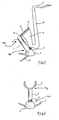
- a saxophone fitted onto a music instrument stand 1 in accordance with the invention is shown in FIG 1 .
- a saxophone consists of a bell A, a middle part B, which bears the keys, and a mouthpiece holder C.
- Saxophones are made in different standard sizes, namely - starting from the largest - bass saxophone, baritone saxophone, tenor saxophone. C-saxophone, alto saxophone, soprano saxophone and sopranino saxophone. All of these are made curved, but the soprano and the sopranino saxophones are also made in a straight version, looking like a clarinet. The stand according to the invention is thus only applicable to curved saxophones, disregarding size, but not to straight ones.
- the stand in accordance with the invention can also be used for other types of instruments that are "saxophone-like" in form, i.e. which have a bell that extends upwards, when held in their normal playing orientation, from the bottom of a substantially vertical middle part which bears the keys.
- the bass clarinet belongs to the group of "saxophone-like" instruments.
- the stand 1 (see FIGS 1 and 2 ) according to the invention consists of a base 2, which is additionally supported by legs 3.
- the number of legs needed depends on the size of the saxophone. When only two legs are used, a substantially flat surface of the base 2 constitutes one supporting point. When more than two legs are used, the base can either be made such that the stand rests against a substantially horizontal surface, e.g. the floor, or it can be made such, that the base is not in contact with the surface at all, i.e. the stand rests solely on the legs.
- the stand 1 is furthermore provided with a support 4 which is arranged at an angle, which may be determined by two factors:
- the angle ⁇ between the support 4 and the substantially flat surface of the base 2 should be chosen such, that when the base 2 is fitted into the opening b of the bell of the saxophone, the thereon mounted support 4 should be able to fit into the bell A as well.
- the angle ⁇ is not the same for all sizes of saxophones, since e.g. the angle between the bell opening b and the bell on the tenor saxophone is smaller than that of the alto saxophone.
- the angle ⁇ between the assembled support and the horizontal surface should preferably be chosen such that the saxophone leans on the bell, when mounted on the stand, i.e. the centre of gravity should be biased to the direction to the bell.
- the base 2 need not be provided with a flat surface, Instead, the base may have any suitable shape, e.g. spherical or conical, as long as it fits into the bell opening of the saxophone.
- the maximum length 1 of the base 2 together with mounted support 4 is, of course, equivalent to the depth of the bell A. Certainly, the length could be chosen shorter.
- the support 4 may consist of two or more pieces arranged telescopically within each other. As will be more clearly explained below, a telescopical support 4 may require telescopical legs 3.
- a stand 1 having a telescopical support 4 may fit into both the tenor and the alto saxophones, respectively, and may be used for both.
- the legs 3 must be telescopical, since the stand for a tenor saxophone needs relatively long legs. Therefore, if the legs should fit into the bell of the alto saxophone, the legs must be telescopical.
- the shape of the base 2 as shown in the figures is only a rough outline. On the contrary, the shape thereof depends on the size of saxophone, to which the stand is supposed to be adapted. Hence, it is the shape of the opening b of the saxophone that determines the shape of the base.
- the bottom of the base could align with the opening of the saxophone, and the rest could be made to smoothly aligh with the narrowing tapered inner surface thereof.
- the base 2 may have, as mentioned before, any suitable form, such as spherical, conical etc.
- bell rest or holder means 5 which grips the outer surface of the bell underneath the widening portion a of the saxophone.
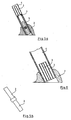
- Figure 4 shows a first embodiment of a collapsed stand in accordance with the invention.
- the support 4 is solid or hollow and is mounted into the base 2.
- the legs 3 and optionally also the bell rest or holder means 5 are placed in lumens 6 in the base 2 but outside the periphery of the support 4.
- the exact position for the lumens 6 is chosen differently for different sizes of saxophones, since the angle between the bell and the bell opening differs from size to size.
- the base 2 is furthermore provided with recesses 32 or any other suitable mounting means for the legs 3 for the erected state of the stand.
- Figure 5a illustrates a second embodiment of a collapsed stand in accordance with the invention, whereby the support 4 mounted on the base 2 is hollow for receiving the legs 3 and optionally also the bell rest or holder means 5, either within the hollow legs 3, as shown in figure 5a , or adjacent the legs within the support (not shown).
- Figure 5b shows one possibility of joining two legs.
- One leg is provided with one end, which has an enlarged diameter, for receiving the other leg.
- the legs 3 can alternatively be fitted loosely into the support 4.
- Figure 6 shows a third embodiment of the invention, whereby one leg 3 is fitted completely into another, hollow leg 3 and is placed in a hollow support 4.
- three or four legs may be desirable. If three legs are chosen, it is preferable that one leg is fitted into another hollow leg, which has been connected to the hollow or solid leg, or vice versa.
- the three or four legs 3 can be fitted loosely into the support, either within each other or adjacent to each other, depending on the size chosen for the support 4 and the legs 3, respectively.
- one or more legs may be fitted into a lumen or lumens 6 of the base 2 instead.
- a bell rest or holder means 5 can be fitted either within the legs 3 or in an optional space between the legs and the support 4 or in a separate lumen, as shown in figure 4 , or not at all, i.e. it is stored at another place in the saxophone case (cf. the embodiment of figure 14 ).
- one or more legs 3 and the bell rest or holder means 5 can be dropped into the bell A of the saxophone and then the support 4 is fitted in afterwards into the bell A.
- This solution requires a relatively small diameter of the support 4 to give space for the legs and optionally also the bell rest or holder means 5 outside the periphery of the support.
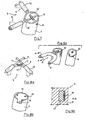
- Figure 7 shows a first preferred embodiment of a bell rest or holder means 5 according to the invention, mounted on a support 4.
- the bell rest or holder means 5 consists of two relatively rigid bars or members 9 fitted into front and rear holes 15'. 15 of support 4.
- the angle between the bars or members 9 are chosen such that they will efficiently support a saxophone rested thereon.
- the bars or members 9 are preferably covered with a coating or a tube 10 of a soft, resilient material, in order to protect the saxophone against scratches.
- Figure 8a illustrates a second preferred embodiment of the bell rest according to the invention.
- the two relatively rigid bars or members 9 are joined at a hinge joint 11. and a spring 12 may be provided, which keeps the members 9 in such a position that pressure is put on protrusions 14, which fit into holes 15 in the support 4. Since such a bell rest or holder means 5 cannot be pushed through holes 15' according to figure 7 , a cutout 16 is made in the end of the support 4 for receiving the bell rest (see figure 8b ).
- Resilient material 10 and a spring cover 13 may be provided to protect the saxophone from scratches. Even though it has been implied, that the bars or members 9 would be straight, it is obvious that they could be bent, as indicated with broken lines in figures 7 and 8a to better fit the rounded cross-section of the saxophone. It should be noted, though, that different sizes of saxophones require varying sizes of bell rests, a varying angle between the bars or members 9 and also varying bending (as indicated with broken lines in figures 7 and 8a ) of the bars or members 9.
- Figure 9a illustrates a third embodiment of the bell rest or holder means 5 of the invention.
- the bell rest or holder means 5 in this preferred embodiment consists of (see FIG 9b ) a metal or plastic member 17, which is relatively soft and bendable, a relatively thin, but wide strip 18 made of e.g. sheet metal or a hard, bendable plastic material and a cover 19 of a resilient material, to protect the saxophone against scratches.
- the rear end of the bell rest or holder means 5 is fitted into a slit 16 in the front of the support 4 and into an opening 30 in the rear of the support.
- the bendable member 17 gives the bell rest or holder means the property of being bendable to any configuration in any direction, whereas the strip 18 restricts the number of bending directions to substantially two, namely transversely to an axis along the width of the cross-section thereof.
- the strip 18 furthermore helps to carry the saxophone, since the strip is relatively stiff in a direction transverse to the bending direction.
- FIGS 10a to c illustrate a further embodiment of the bell rest or holder means, in accordance with the invention.
- two lumens 24 are provided in or inside the wall.
- the lumens 24 are covered at a portion 25 closest to the top of the support 3, where outlets 26 are provided.
- each lumen 24 is provided with a slit 27 in the outer wall of the support 4, which slit 27 is narrower than the width of the lumen 24.
- a bar or member 9 preferably made of sheet metal or a hard, bendable plastics material.
- the bar or member 9 is wider than the slit 27.
- the cross section of the bar or member 9 could be circular, oval, triangular, square, rectangular or any polygonal shape, even though an oval cross-section (see figure 10b ) is preferred for reasons of stability.
- the bars or members 9 may be covered with a resilient material.
- a button 28 is mounted on the bar or member 9 by means of a portion of reduced cross-section positioned in the slit 27 in such a way that when the bar or member 9 is in its retracted portion, within the lumen, the button 28 is substantially in one of its end positions of the slit 27.
- the buttons or members 9 are forced through the outlets 26.
- the openings are arranged at such an angle to one another, that the bars or members 9 will adopt an angle, such that the widening portion a of the bell of the saxophone can be supported thereon.
- Figure 10c is a cross-sectional view of the bell rest illustrated in figure 10a .
- the holder means 5 of the embodiments of figures 9a-b and 10a-c could be provided with a reinforcing cover, which can be mounted on the bars or members 9 while assembling the stand.
- FIGS 11a-d illustrate another embodiment of a bell rest according to the invention.
- a plug 20 is provided with threads 21 corresponding to threads inside or outside the wall of the support 3. Bars or members 9 are connected to the plug 20 by means of hinges 22.
- the plug 20 is provided with two slits 23, so as to accommodate the ends of each bar or member 9 and for enabling swinging thereof from a position where the bars or members 9 can be fitted into the support to a position where the swung out bars or members 9 are locked between the plug and the support 3 to an angle which is suitable for supporting the saxophone.
- the bars or members 9 can of course be bent to conform with the rounded surface of the saxophone, but only to a limited extent, since there is only limited space within support 4.
- the plug 20 and the support 4 could also be provided with a bayonet coupling or be a press fit one with the other.
- the bars or members 9 could be provided with a cover of resilient material, for reasons already described.
- saxophone bell holder which consists of a U-shape bell rest made of metal or hard plastics material, and being covered with a resilient material (cf. US-A-4 572 050 ) could be used on the stand according to the invention, but the bell rest would not fit into the bell of the saxophone: it would have to be stored somewhere else in the saxophone bag.
- the connection between the bell rest and the support 4 could be performed as is shown in the embodiment of figure 8a .
- an additional bell rest for a lower point of the saxophone may be provided, even though not necessary, since the base 2 can form a lower additional bell rest in itself. It is, of course, possible to provide the base 2 with a groove for receiving a lower point of the saxophone. If such a groove is not sufficient, a rubber cup 7a ( figure 12 ) or a brace 7b ( figure 13 ) having a substantial U-shape could be provided.
- the stand may be provided with such additional bell rests 7a, 7b at points corresponding to a lower point of each saxophone of a smaller size, than the stand is intended for, in the sense of storing in the bell.
- the expression "lower point” refers to a point on the bell relatively close to the bottom of the saxophone, when held in a normal playing orientation.
- the additional bell rests 7a, 7b may be fastened to the support 4 by means of a screw 29, a clamp (not shown) or any other suitable fastening means.
- Figure 14 illustrates one arrangement for mounting the legs 3 to the base 2.
- the leg 3 and the base 2 are provided with a bayonet coupling 31 provided on the leg 3 and in recesses 32 in the base, respectively. It is obvious that other kinds of coupling means could be used, such as threads, press fits, expanders or the like. This also applies to the connection between the base 2 and the support 4, even though it is preferred that they are permanentty connected to each other, e.g. by gluing or welding.
- the base 2 and the support 4 could also be formed by moulding in one piece.
- the base 2, the legs 3, the support 4 and the bell rest or holder means 5 can be made of any metal, but in order to achieve a light stand, a light metal, such as aluminium or titanium should be chosen, but also suitable plastics materials could be used.
- Figure 15a shows a fourth embodiment of a collapsed stand according to the invention.
- three legs 3 are pivotally connected to a connecting member 34 by means of hinges 37 (see figure 15c ).
- the base 2 is provided with recesses 35 and a stop member 36.
- the legs When the stand is assembled, the legs are pushed or pulled out of the interior of the support 4. The legs 3 can only be moved until the connecting member 34 engages the stop member 36. Now, the legs are pivoted about the hinges 37 to alignment with the recesses 35 (see figure 15c ).
- the recesses 35 may be provided with reinforcement means in order to better withstand the weight of the saxophone.
- reinforcement means is a part of the support 4, which has been bent to at least partly cover the surface of the recesses 35.
- one or more springs may be arranged between the connecting member 34 and the legs 3, such that the legs 3 are biased to pivot about the hinges 37 to the position shown in figure 15c .
- the collapsed stand 1 is taken out of the space inside the bell A of the saxophone.
- the legs 3 are taken away from their preferred storage, as disclosed above.
- the legs 3 are fitted into the base of the stand 1 and the bell rest or holder means 5 is mounted on the support 4.
- an additional support 7a, 7b is provided to give support to a lower part of the saxophone. The stand is now ready for use.
- a standard clarinet stand or a flute stand consisting of a conical member or a cylindrical member, respectively, and not being part of this invention, may advantageously be arranged on one of the legs 3 where the stand according to the invention is assembled.
Landscapes
- Physics & Mathematics (AREA)
- Engineering & Computer Science (AREA)
- Acoustics & Sound (AREA)
- Multimedia (AREA)
- Auxiliary Devices For Music (AREA)
- Electrophonic Musical Instruments (AREA)
Claims (14)
- Support repliable (1) pour un saxophone du type ayant un pavillon replié vers le corps d'instrument, le support comprenant :- un moyen de support (4) ayant une première portion (40) et une deuxième portion (42), la deuxième portion (42) étant sensiblement opposée à la première portion (40),- au moins deux bras (3) reliés de façon détachable ou agencés mobilement avec la première portion (40) du moyen de support (4) pour maintenir le support sur une surface sensiblement horizontale, et- un moyen de maintien (5) relié de façon détachable ou indétachable mais mobile au moyen de support (4) au niveau de la deuxième portion (42) et adapté pour servir de support à la surface extérieure du pavillon d'un saxophone,- le moyen de support (4) formant un angle (β) avec la surface horizontale, différent de 90°, lorsque le support (1) est monté, caractérisé en ce que la longueur du moyen de support (4) est déterminée de façon à ce que, lorsque le support est replié, le moyen de support (4), incluant la première portion (40) et la deuxième portion (42), soit insérable et épouse sensiblement l'intérieur du pavillon du saxophone, et en ce que le moyen de maintien (5) comprend deux éléments en saillie articulés et est ajustable pour épouser l'intérieur du pavillon.
- Support selon la revendication 1, dans lequel le moyen de support (4) est creux pour recevoir les bras (3), au nombre minimum de deux et/ou le moyen de maintien (5).
- Support repliable (1) pour un saxophone du type ayant un pavillon replié vers le corps d'instrument, le support comprenant :- un moyen de support (4) ayant une première portion (40) et une deuxième portion (42), la deuxième portion (42) étant sensiblement opposée à la première portion (40),- au moins deux bras (3) reliés de façon détachable ou agencés mobilement avec la première portion (40) du moyen de support (4) pour maintenir le support sur une surface sensiblement horizontale, et- un moyen de maintien (5) relié de façon détachable ou indétachable mais mobile au moyen de support (4) au niveau de la deuxième portion (42) et adapté pour servir de support à la surface extérieure du pavillon d'un saxophone,- le moyen de support (4) formant un angle (β) avec la surface horizontale, différent de 90°, lorsque le support (1) est monté, caractérisé en ce que la longueur du moyen de support (4) est déterminée de façon à ce que, lorsque le support est replié, le moyen de support (4), incluant la première portion (40) et la deuxième portion (42), soit insérable et épouse sensiblement l'intérieur du pavillon du saxophone, le moyen de support étant creux afin de recevoir les bras (3), au nombre minimum de deux et/ou le moyen de maintien (5).
- Support selon la revendication 3, dans lequel le moyen de maintien (5) est ajustable pour épouser l'intérieur du pavillon.
- Support selon l'une quelconque des revendications précédentes, dans lequel le moyen de maintien (5) est ajustable pour pénétrer entièrement à l'intérieur du pavillon.
- Support selon l'une quelconque des revendications précédentes, dans lequel le moyen de maintien (5) comprend une paire d'éléments (9) en saillie reliés de manière articulée à un moyen d'interconnexion (20) muni d'une paire de fentes (23), chaque fente étant adaptée pour recevoir l'un des éléments en saillie (9), chaque élément en saillie (9) pouvant pivoter dans sa fente correspondante, le moyen d'interconnexion (20) étant situé au niveau de la deuxième portion (42) du moyen de support (4).
- Support selon la revendication 5 ou 6, dans lequel le moyen de maintien (5) est muni d'un moyen élastique (10, 13) ayant des première et deuxième parties (10) élastiques agencées sur chaque élément en saillie (9) et une troisième partie (13) interconnectant les première et deuxième parties élastiques (10).
- Support selon l'une quelconque des revendications précédentes, dans lequel les bras (3) sont articulés par rapport au moyen de support (4).
- Support selon l'une quelconque des revendications 2 à 8, dans lequel les bras (3), au nombre minimum de deux, sont articulés à un moyen de connexion (34).
- Support selon la revendication 9, dans lequel les bras (3) et le moyen de connexion (34) sont agencés ensemble à l'intérieur du moyen de support creux (4) de façon coulissante.
- Support selon l'une quelconque des revendications précédentes, dans lequel les bras (3) sont articulés au niveau du moyen de support (4) lorsque le support est monté.
- Support selon l'une quelconque des revendications précédentes, dans lequel un moyen de support additionnel (7a, 7b) est prévu sur le moyen de support (4) en un point plus proche de la première portion (40) que de la deuxième portion (42) pour servir de support à un point inférieur du saxophone.
- Support selon l'une quelconque des revendications précédentes, dans lequel le moyen de support (4) est muni, au niveau de sa première portion (40), d'un élément de base (2) relié de façon détachable ou indétachable au moyen de support (4).
- Support selon la revendication 13, dans lequel la forme de l'élément de base (2) est adaptée à la forme de la surface intérieure du pavillon du saxophone.
Applications Claiming Priority (3)
| Application Number | Priority Date | Filing Date | Title |
|---|---|---|---|
| SE9300285 | 1993-01-29 | ||
| SE9300285A SE500029C2 (sv) | 1993-01-29 | 1993-01-29 | Hopfällbart ställ för musikinstrument med ett klockstycke, såsom saxofoner eller liknande |
| PCT/SE1993/000990 WO1994017511A1 (fr) | 1993-01-29 | 1993-11-18 | Support pour instrument de musique |
Publications (3)
| Publication Number | Publication Date |
|---|---|
| EP0729626A1 EP0729626A1 (fr) | 1996-09-04 |
| EP0729626B1 EP0729626B1 (fr) | 2006-01-25 |
| EP0729626B2 true EP0729626B2 (fr) | 2009-10-28 |
Family
ID=20388710
Family Applications (1)
| Application Number | Title | Priority Date | Filing Date |
|---|---|---|---|
| EP94904045A Expired - Lifetime EP0729626B2 (fr) | 1993-01-29 | 1993-11-18 | Support pour instrument de musique |
Country Status (7)
| Country | Link |
|---|---|
| EP (1) | EP0729626B2 (fr) |
| AT (1) | ATE316677T1 (fr) |
| AU (1) | AU5824994A (fr) |
| DE (2) | DE69333970T3 (fr) |
| NO (1) | NO952919D0 (fr) |
| SE (1) | SE500029C2 (fr) |
| WO (1) | WO1994017511A1 (fr) |
Families Citing this family (2)
| Publication number | Priority date | Publication date | Assignee | Title |
|---|---|---|---|---|
| FR2735961A1 (fr) * | 1995-06-27 | 1997-01-03 | Hernandez Alain | Presentoir pour instruments de musique a vent et a cordes |
| LT5512B (lt) | 2006-09-15 | 2008-08-25 | Jonas ŠILEIKA | Muzikos instrumento laikiklis |
Family Cites Families (5)
| Publication number | Priority date | Publication date | Assignee | Title |
|---|---|---|---|---|
| DE1773637C3 (de) * | 1968-06-15 | 1978-06-15 | Johannes 2000 Hamburg Mueller | Zusammenlegbarer Ständer, insbesondere für Musikinstrumente |
| US4407182A (en) * | 1981-10-09 | 1983-10-04 | Allsop, Inc. | Musical instrument stand |
| US4572050A (en) * | 1983-11-21 | 1986-02-25 | Werner Milton M | No strap saxophone stand |
| FR2642211B1 (fr) * | 1989-01-23 | 1992-01-24 | Ponthus Daniel | Pied-support pour saxophone |
| DE4205143C1 (en) * | 1992-02-20 | 1993-03-04 | Koenig & Meyer Gmbh & Co Kg, 6980 Wertheim, De | Support stand for trombone - has telescopic bar, whose end is connectable selectively to one of two socket ends |
-
1993
- 1993-01-29 SE SE9300285A patent/SE500029C2/sv not_active IP Right Cessation
- 1993-11-18 EP EP94904045A patent/EP0729626B2/fr not_active Expired - Lifetime
- 1993-11-18 AT AT94904045T patent/ATE316677T1/de not_active IP Right Cessation
- 1993-11-18 DE DE69333970T patent/DE69333970T3/de not_active Expired - Lifetime
- 1993-11-18 AU AU58249/94A patent/AU5824994A/en not_active Abandoned
- 1993-11-18 DE DE0729626T patent/DE729626T1/de active Pending
- 1993-11-18 WO PCT/SE1993/000990 patent/WO1994017511A1/fr not_active Ceased
-
1995
- 1995-07-24 NO NO952919A patent/NO952919D0/no unknown
Also Published As
| Publication number | Publication date |
|---|---|
| NO952919D0 (no) | 1995-07-24 |
| AU5824994A (en) | 1994-08-15 |
| DE729626T1 (de) | 1998-07-16 |
| SE9300285D0 (sv) | 1993-01-29 |
| DE69333970T2 (de) | 2006-11-02 |
| SE500029C2 (sv) | 1994-03-21 |
| ATE316677T1 (de) | 2006-02-15 |
| DE69333970D1 (de) | 2006-04-13 |
| DE69333970T3 (de) | 2010-05-20 |
| EP0729626A1 (fr) | 1996-09-04 |
| SE9300285L (sv) | 1993-11-18 |
| EP0729626B1 (fr) | 2006-01-25 |
| WO1994017511A1 (fr) | 1994-08-04 |
Similar Documents
| Publication | Publication Date | Title |
|---|---|---|
| US5852250A (en) | Portable instrument stand | |
| US6130375A (en) | Stringed instrument stand | |
| US4582282A (en) | Supporting stand for a stringed musical instrument | |
| US5692719A (en) | Sheet music stand | |
| US6316706B1 (en) | Multi-purpose entertainer stand | |
| US6353164B1 (en) | Stringed instrument with folding neck | |
| US5973244A (en) | Collapsible and portable stand for musical instruments | |
| US4407182A (en) | Musical instrument stand | |
| US20040217026A1 (en) | Case for storing, carrying and displaying a handheld stringed musical instrument | |
| CA2395184C (fr) | Procede et systeme pour le traitement de fichiers en continu au moyen d'une unite de disque | |
| WO1993001587A1 (fr) | Support pour instrument de musique | |
| US6800798B2 (en) | Musical instrument display stand | |
| US6622981B1 (en) | Folding arm for a musical instrument stand | |
| USD436465S1 (en) | Foldable guitar stand | |
| US6220459B1 (en) | Saxophone stand | |
| US20050121567A1 (en) | Hinged stand with breakaway action | |
| US7291775B2 (en) | Multifunctional musical instrument stand | |
| US6559365B2 (en) | Stand | |
| EP0729626B2 (fr) | Support pour instrument de musique | |
| US4913027A (en) | Violin holder | |
| US5116005A (en) | Compactly folding tripod support system for guitars | |
| US5106048A (en) | Support stands | |
| EP0108113B1 (fr) | Pied reglable pour violoncelle | |
| US5553529A (en) | Thumbrest ring adapter for musical instrument | |
| US7459622B2 (en) | Portable trumpet stand |
Legal Events
| Date | Code | Title | Description |
|---|---|---|---|
| PUAI | Public reference made under article 153(3) epc to a published international application that has entered the european phase |
Free format text: ORIGINAL CODE: 0009012 |
|
| 17P | Request for examination filed |
Effective date: 19950821 |
|
| AK | Designated contracting states |
Kind code of ref document: A1 Designated state(s): AT CH DE DK FR GB LI |
|
| DET | De: translation of patent claims | ||
| 17Q | First examination report despatched |
Effective date: 19990406 |
|
| GRAG | Despatch of communication of intention to grant |
Free format text: ORIGINAL CODE: EPIDOS AGRA |
|
| GRAG | Despatch of communication of intention to grant |
Free format text: ORIGINAL CODE: EPIDOS AGRA |
|
| GRAH | Despatch of communication of intention to grant a patent |
Free format text: ORIGINAL CODE: EPIDOS IGRA |
|
| GRAH | Despatch of communication of intention to grant a patent |
Free format text: ORIGINAL CODE: EPIDOS IGRA |
|
| TPAD | Observations filed by third parties |
Free format text: ORIGINAL CODE: EPIDOS TIPA |
|
| RAP1 | Party data changed (applicant data changed or rights of an application transferred) |
Owner name: STEIN, JAN |
|
| RIN1 | Information on inventor provided before grant (corrected) |
Inventor name: STEIN, JAN |
|
| RAP1 | Party data changed (applicant data changed or rights of an application transferred) |
Owner name: STEIN, JAN |
|
| RIN1 | Information on inventor provided before grant (corrected) |
Inventor name: STEIN, JAN |
|
| RAP1 | Party data changed (applicant data changed or rights of an application transferred) |
Owner name: STEIN, JAN |
|
| RIN1 | Information on inventor provided before grant (corrected) |
Inventor name: STEIN, JAN |
|
| GRAI | Information related to approval/disapproval following communication of intention to grant deleted |
Free format text: ORIGINAL CODE: EPIDOSDAGR3 |
|
| GRAK | Information related to despatch of communication of intention to grant deleted |
Free format text: ORIGINAL CODE: EPIDOSDAGR1 |
|
| GRAP | Despatch of communication of intention to grant a patent |
Free format text: ORIGINAL CODE: EPIDOSNIGR1 |
|
| GRAS | Grant fee paid |
Free format text: ORIGINAL CODE: EPIDOSNIGR3 |
|
| GRAA | (expected) grant |
Free format text: ORIGINAL CODE: 0009210 |
|
| AK | Designated contracting states |
Kind code of ref document: B1 Designated state(s): AT CH DE DK FR GB LI |
|
| REG | Reference to a national code |
Ref country code: GB Ref legal event code: FG4D |
|
| REG | Reference to a national code |
Ref country code: CH Ref legal event code: EP |
|
| REF | Corresponds to: |
Ref document number: 69333970 Country of ref document: DE Date of ref document: 20060413 Kind code of ref document: P |
|
| PG25 | Lapsed in a contracting state [announced via postgrant information from national office to epo] |
Ref country code: DK Free format text: LAPSE BECAUSE OF FAILURE TO SUBMIT A TRANSLATION OF THE DESCRIPTION OR TO PAY THE FEE WITHIN THE PRESCRIBED TIME-LIMIT Effective date: 20060425 |
|
| REG | Reference to a national code |
Ref country code: CH Ref legal event code: NV Representative=s name: ISLER & PEDRAZZINI AG |
|
| ET | Fr: translation filed | ||
| PLBI | Opposition filed |
Free format text: ORIGINAL CODE: 0009260 |
|
| 26 | Opposition filed |
Opponent name: CERMAK, NORBERT Effective date: 20061020 |
|
| PLAX | Notice of opposition and request to file observation + time limit sent |
Free format text: ORIGINAL CODE: EPIDOSNOBS2 |
|
| PLBB | Reply of patent proprietor to notice(s) of opposition received |
Free format text: ORIGINAL CODE: EPIDOSNOBS3 |
|
| REG | Reference to a national code |
Ref country code: CH Ref legal event code: PCAR Free format text: ISLER & PEDRAZZINI AG;POSTFACH 1772;8027 ZUERICH (CH) |
|
| PLAY | Examination report in opposition despatched + time limit |
Free format text: ORIGINAL CODE: EPIDOSNORE2 |
|
| PLBC | Reply to examination report in opposition received |
Free format text: ORIGINAL CODE: EPIDOSNORE3 |
|
| RAP2 | Party data changed (patent owner data changed or rights of a patent transferred) |
Owner name: STEIN PATENT AB |
|
| RIN2 | Information on inventor provided after grant (corrected) |
Inventor name: STEIN PATENT AB |
|
| PLAH | Information related to despatch of examination report in opposition + time limit modified |
Free format text: ORIGINAL CODE: EPIDOSCORE2 |
|
| PLAT | Information related to reply to examination report in opposition deleted |
Free format text: ORIGINAL CODE: EPIDOSDORE3 |
|
| PLBC | Reply to examination report in opposition received |
Free format text: ORIGINAL CODE: EPIDOSNORE3 |
|
| PLAL | Information related to reply to examination report in opposition modified |
Free format text: ORIGINAL CODE: EPIDOSCORE3 |
|
| PLAP | Information related to despatch of examination report in opposition + time limit deleted |
Free format text: ORIGINAL CODE: EPIDOSDORE2 |
|
| PLAT | Information related to reply to examination report in opposition deleted |
Free format text: ORIGINAL CODE: EPIDOSDORE3 |
|
| PLAY | Examination report in opposition despatched + time limit |
Free format text: ORIGINAL CODE: EPIDOSNORE2 |
|
| PLBC | Reply to examination report in opposition received |
Free format text: ORIGINAL CODE: EPIDOSNORE3 |
|
| REG | Reference to a national code |
Ref country code: CH Ref legal event code: PUE Owner name: STEIN PATENT AB Free format text: STEIN, JAN#EDDAVAEGEN 12#182 63 DJURSHOLM (SE) -TRANSFER TO- STEIN PATENT AB#EDDAVAEGEN 12#182 63 DJURSHOLM (SE) |
|
| PUAH | Patent maintained in amended form |
Free format text: ORIGINAL CODE: 0009272 |
|
| STAA | Information on the status of an ep patent application or granted ep patent |
Free format text: STATUS: PATENT MAINTAINED AS AMENDED |
|
| 27A | Patent maintained in amended form |
Effective date: 20091028 |
|
| AK | Designated contracting states |
Kind code of ref document: B2 Designated state(s): AT CH DE DK FR GB LI |
|
| REG | Reference to a national code |
Ref country code: CH Ref legal event code: AEN Free format text: AUFRECHTERHALTUNG DES PATENTES IN GEAENDERTER FORM |
|
| PGFP | Annual fee paid to national office [announced via postgrant information from national office to epo] |
Ref country code: CH Payment date: 20091119 Year of fee payment: 17 Ref country code: AT Payment date: 20091119 Year of fee payment: 17 |
|
| PGFP | Annual fee paid to national office [announced via postgrant information from national office to epo] |
Ref country code: GB Payment date: 20091119 Year of fee payment: 17 Ref country code: FR Payment date: 20091203 Year of fee payment: 17 |
|
| PGFP | Annual fee paid to national office [announced via postgrant information from national office to epo] |
Ref country code: DE Payment date: 20101125 Year of fee payment: 18 |
|
| REG | Reference to a national code |
Ref country code: CH Ref legal event code: PL |
|
| GBPC | Gb: european patent ceased through non-payment of renewal fee |
Effective date: 20101118 |
|
| PG25 | Lapsed in a contracting state [announced via postgrant information from national office to epo] |
Ref country code: CH Free format text: LAPSE BECAUSE OF NON-PAYMENT OF DUE FEES Effective date: 20101130 Ref country code: LI Free format text: LAPSE BECAUSE OF NON-PAYMENT OF DUE FEES Effective date: 20101130 |
|
| REG | Reference to a national code |
Ref country code: FR Ref legal event code: ST Effective date: 20110801 |
|
| PG25 | Lapsed in a contracting state [announced via postgrant information from national office to epo] |
Ref country code: AT Free format text: LAPSE BECAUSE OF NON-PAYMENT OF DUE FEES Effective date: 20101118 |
|
| PG25 | Lapsed in a contracting state [announced via postgrant information from national office to epo] |
Ref country code: FR Free format text: LAPSE BECAUSE OF NON-PAYMENT OF DUE FEES Effective date: 20101130 |
|
| PG25 | Lapsed in a contracting state [announced via postgrant information from national office to epo] |
Ref country code: GB Free format text: LAPSE BECAUSE OF NON-PAYMENT OF DUE FEES Effective date: 20101118 |
|
| REG | Reference to a national code |
Ref country code: DE Ref legal event code: R119 Ref document number: 69333970 Country of ref document: DE Effective date: 20120601 |
|
| PG25 | Lapsed in a contracting state [announced via postgrant information from national office to epo] |
Ref country code: DE Free format text: LAPSE BECAUSE OF NON-PAYMENT OF DUE FEES Effective date: 20120601 |