EP0729509B1 - Vaccine against mumps containing a jeryl-lynn virus strain - Google Patents
Vaccine against mumps containing a jeryl-lynn virus strain Download PDFInfo
- Publication number
- EP0729509B1 EP0729509B1 EP95900751A EP95900751A EP0729509B1 EP 0729509 B1 EP0729509 B1 EP 0729509B1 EP 95900751 A EP95900751 A EP 95900751A EP 95900751 A EP95900751 A EP 95900751A EP 0729509 B1 EP0729509 B1 EP 0729509B1
- Authority
- EP
- European Patent Office
- Prior art keywords
- isolate
- jeryl
- lynn
- mumps
- virus
- Prior art date
- Legal status (The legal status is an assumption and is not a legal conclusion. Google has not performed a legal analysis and makes no representation as to the accuracy of the status listed.)
- Expired - Lifetime
Links
Images

Classifications
-
- C—CHEMISTRY; METALLURGY
- C07—ORGANIC CHEMISTRY
- C07K—PEPTIDES
- C07K14/00—Peptides having more than 20 amino acids; Gastrins; Somatostatins; Melanotropins; Derivatives thereof
- C07K14/005—Peptides having more than 20 amino acids; Gastrins; Somatostatins; Melanotropins; Derivatives thereof from viruses
-
- A—HUMAN NECESSITIES
- A61—MEDICAL OR VETERINARY SCIENCE; HYGIENE
- A61K—PREPARATIONS FOR MEDICAL, DENTAL OR TOILETRY PURPOSES
- A61K39/00—Medicinal preparations containing antigens or antibodies
- A61K39/0015—Combination vaccines based on measles-mumps-rubella
-
- A—HUMAN NECESSITIES
- A61—MEDICAL OR VETERINARY SCIENCE; HYGIENE
- A61K—PREPARATIONS FOR MEDICAL, DENTAL OR TOILETRY PURPOSES
- A61K39/00—Medicinal preparations containing antigens or antibodies
- A61K39/12—Viral antigens
-
- A—HUMAN NECESSITIES
- A61—MEDICAL OR VETERINARY SCIENCE; HYGIENE
- A61K—PREPARATIONS FOR MEDICAL, DENTAL OR TOILETRY PURPOSES
- A61K39/00—Medicinal preparations containing antigens or antibodies
- A61K39/12—Viral antigens
- A61K39/155—Paramyxoviridae, e.g. parainfluenza virus
- A61K39/165—Mumps or measles virus
-
- A—HUMAN NECESSITIES
- A61—MEDICAL OR VETERINARY SCIENCE; HYGIENE
- A61P—SPECIFIC THERAPEUTIC ACTIVITY OF CHEMICAL COMPOUNDS OR MEDICINAL PREPARATIONS
- A61P31/00—Antiinfectives, i.e. antibiotics, antiseptics, chemotherapeutics
- A61P31/04—Antibacterial agents
-
- A—HUMAN NECESSITIES
- A61—MEDICAL OR VETERINARY SCIENCE; HYGIENE
- A61P—SPECIFIC THERAPEUTIC ACTIVITY OF CHEMICAL COMPOUNDS OR MEDICINAL PREPARATIONS
- A61P31/00—Antiinfectives, i.e. antibiotics, antiseptics, chemotherapeutics
- A61P31/12—Antivirals
-
- A—HUMAN NECESSITIES
- A61—MEDICAL OR VETERINARY SCIENCE; HYGIENE
- A61P—SPECIFIC THERAPEUTIC ACTIVITY OF CHEMICAL COMPOUNDS OR MEDICINAL PREPARATIONS
- A61P31/00—Antiinfectives, i.e. antibiotics, antiseptics, chemotherapeutics
- A61P31/12—Antivirals
- A61P31/14—Antivirals for RNA viruses
-
- A—HUMAN NECESSITIES
- A61—MEDICAL OR VETERINARY SCIENCE; HYGIENE
- A61P—SPECIFIC THERAPEUTIC ACTIVITY OF CHEMICAL COMPOUNDS OR MEDICINAL PREPARATIONS
- A61P31/00—Antiinfectives, i.e. antibiotics, antiseptics, chemotherapeutics
- A61P31/12—Antivirals
- A61P31/20—Antivirals for DNA viruses
-
- A—HUMAN NECESSITIES
- A61—MEDICAL OR VETERINARY SCIENCE; HYGIENE
- A61P—SPECIFIC THERAPEUTIC ACTIVITY OF CHEMICAL COMPOUNDS OR MEDICINAL PREPARATIONS
- A61P31/00—Antiinfectives, i.e. antibiotics, antiseptics, chemotherapeutics
- A61P31/12—Antivirals
- A61P31/20—Antivirals for DNA viruses
- A61P31/22—Antivirals for DNA viruses for herpes viruses
-
- C—CHEMISTRY; METALLURGY
- C12—BIOCHEMISTRY; BEER; SPIRITS; WINE; VINEGAR; MICROBIOLOGY; ENZYMOLOGY; MUTATION OR GENETIC ENGINEERING
- C12N—MICROORGANISMS OR ENZYMES; COMPOSITIONS THEREOF; PROPAGATING, PRESERVING, OR MAINTAINING MICROORGANISMS; MUTATION OR GENETIC ENGINEERING; CULTURE MEDIA
- C12N7/00—Viruses; Bacteriophages; Compositions thereof; Preparation or purification thereof
-
- A—HUMAN NECESSITIES
- A61—MEDICAL OR VETERINARY SCIENCE; HYGIENE
- A61K—PREPARATIONS FOR MEDICAL, DENTAL OR TOILETRY PURPOSES
- A61K39/00—Medicinal preparations containing antigens or antibodies
- A61K2039/51—Medicinal preparations containing antigens or antibodies comprising whole cells, viruses or DNA/RNA
- A61K2039/525—Virus
- A61K2039/5254—Virus avirulent or attenuated
-
- A—HUMAN NECESSITIES
- A61—MEDICAL OR VETERINARY SCIENCE; HYGIENE
- A61K—PREPARATIONS FOR MEDICAL, DENTAL OR TOILETRY PURPOSES
- A61K39/00—Medicinal preparations containing antigens or antibodies
- A61K2039/70—Multivalent vaccine
-
- C—CHEMISTRY; METALLURGY
- C12—BIOCHEMISTRY; BEER; SPIRITS; WINE; VINEGAR; MICROBIOLOGY; ENZYMOLOGY; MUTATION OR GENETIC ENGINEERING
- C12N—MICROORGANISMS OR ENZYMES; COMPOSITIONS THEREOF; PROPAGATING, PRESERVING, OR MAINTAINING MICROORGANISMS; MUTATION OR GENETIC ENGINEERING; CULTURE MEDIA
- C12N2760/00—MICROORGANISMS OR ENZYMES; COMPOSITIONS THEREOF; PROPAGATING, PRESERVING, OR MAINTAINING MICROORGANISMS; MUTATION OR GENETIC ENGINEERING; CULTURE MEDIA ssRNA viruses negative-sense
- C12N2760/00011—Details
- C12N2760/18011—Paramyxoviridae
- C12N2760/18411—Morbillivirus, e.g. Measles virus, canine distemper
- C12N2760/18434—Use of virus or viral component as vaccine, e.g. live-attenuated or inactivated virus, VLP, viral protein
-
- C—CHEMISTRY; METALLURGY
- C12—BIOCHEMISTRY; BEER; SPIRITS; WINE; VINEGAR; MICROBIOLOGY; ENZYMOLOGY; MUTATION OR GENETIC ENGINEERING
- C12N—MICROORGANISMS OR ENZYMES; COMPOSITIONS THEREOF; PROPAGATING, PRESERVING, OR MAINTAINING MICROORGANISMS; MUTATION OR GENETIC ENGINEERING; CULTURE MEDIA
- C12N2760/00—MICROORGANISMS OR ENZYMES; COMPOSITIONS THEREOF; PROPAGATING, PRESERVING, OR MAINTAINING MICROORGANISMS; MUTATION OR GENETIC ENGINEERING; CULTURE MEDIA ssRNA viruses negative-sense
- C12N2760/00011—Details
- C12N2760/18011—Paramyxoviridae
- C12N2760/18711—Rubulavirus, e.g. mumps virus, parainfluenza 2,4
- C12N2760/18721—Viruses as such, e.g. new isolates, mutants or their genomic sequences
-
- C—CHEMISTRY; METALLURGY
- C12—BIOCHEMISTRY; BEER; SPIRITS; WINE; VINEGAR; MICROBIOLOGY; ENZYMOLOGY; MUTATION OR GENETIC ENGINEERING
- C12N—MICROORGANISMS OR ENZYMES; COMPOSITIONS THEREOF; PROPAGATING, PRESERVING, OR MAINTAINING MICROORGANISMS; MUTATION OR GENETIC ENGINEERING; CULTURE MEDIA
- C12N2760/00—MICROORGANISMS OR ENZYMES; COMPOSITIONS THEREOF; PROPAGATING, PRESERVING, OR MAINTAINING MICROORGANISMS; MUTATION OR GENETIC ENGINEERING; CULTURE MEDIA ssRNA viruses negative-sense
- C12N2760/00011—Details
- C12N2760/18011—Paramyxoviridae
- C12N2760/18711—Rubulavirus, e.g. mumps virus, parainfluenza 2,4
- C12N2760/18722—New viral proteins or individual genes, new structural or functional aspects of known viral proteins or genes
-
- C—CHEMISTRY; METALLURGY
- C12—BIOCHEMISTRY; BEER; SPIRITS; WINE; VINEGAR; MICROBIOLOGY; ENZYMOLOGY; MUTATION OR GENETIC ENGINEERING
- C12N—MICROORGANISMS OR ENZYMES; COMPOSITIONS THEREOF; PROPAGATING, PRESERVING, OR MAINTAINING MICROORGANISMS; MUTATION OR GENETIC ENGINEERING; CULTURE MEDIA
- C12N2760/00—MICROORGANISMS OR ENZYMES; COMPOSITIONS THEREOF; PROPAGATING, PRESERVING, OR MAINTAINING MICROORGANISMS; MUTATION OR GENETIC ENGINEERING; CULTURE MEDIA ssRNA viruses negative-sense
- C12N2760/00011—Details
- C12N2760/18011—Paramyxoviridae
- C12N2760/18711—Rubulavirus, e.g. mumps virus, parainfluenza 2,4
- C12N2760/18734—Use of virus or viral component as vaccine, e.g. live-attenuated or inactivated virus, VLP, viral protein
-
- C—CHEMISTRY; METALLURGY
- C12—BIOCHEMISTRY; BEER; SPIRITS; WINE; VINEGAR; MICROBIOLOGY; ENZYMOLOGY; MUTATION OR GENETIC ENGINEERING
- C12N—MICROORGANISMS OR ENZYMES; COMPOSITIONS THEREOF; PROPAGATING, PRESERVING, OR MAINTAINING MICROORGANISMS; MUTATION OR GENETIC ENGINEERING; CULTURE MEDIA
- C12N2760/00—MICROORGANISMS OR ENZYMES; COMPOSITIONS THEREOF; PROPAGATING, PRESERVING, OR MAINTAINING MICROORGANISMS; MUTATION OR GENETIC ENGINEERING; CULTURE MEDIA ssRNA viruses negative-sense
- C12N2760/00011—Details
- C12N2760/18011—Paramyxoviridae
- C12N2760/18711—Rubulavirus, e.g. mumps virus, parainfluenza 2,4
- C12N2760/18761—Methods of inactivation or attenuation
- C12N2760/18762—Methods of inactivation or attenuation by genetic engineering
-
- C—CHEMISTRY; METALLURGY
- C12—BIOCHEMISTRY; BEER; SPIRITS; WINE; VINEGAR; MICROBIOLOGY; ENZYMOLOGY; MUTATION OR GENETIC ENGINEERING
- C12N—MICROORGANISMS OR ENZYMES; COMPOSITIONS THEREOF; PROPAGATING, PRESERVING, OR MAINTAINING MICROORGANISMS; MUTATION OR GENETIC ENGINEERING; CULTURE MEDIA
- C12N2770/00—MICROORGANISMS OR ENZYMES; COMPOSITIONS THEREOF; PROPAGATING, PRESERVING, OR MAINTAINING MICROORGANISMS; MUTATION OR GENETIC ENGINEERING; CULTURE MEDIA ssRNA viruses positive-sense
- C12N2770/00011—Details
- C12N2770/36011—Togaviridae
- C12N2770/36211—Rubivirus, e.g. rubella virus
- C12N2770/36234—Use of virus or viral component as vaccine, e.g. live-attenuated or inactivated virus, VLP, viral protein
-
- Y—GENERAL TAGGING OF NEW TECHNOLOGICAL DEVELOPMENTS; GENERAL TAGGING OF CROSS-SECTIONAL TECHNOLOGIES SPANNING OVER SEVERAL SECTIONS OF THE IPC; TECHNICAL SUBJECTS COVERED BY FORMER USPC CROSS-REFERENCE ART COLLECTIONS [XRACs] AND DIGESTS
- Y02—TECHNOLOGIES OR APPLICATIONS FOR MITIGATION OR ADAPTATION AGAINST CLIMATE CHANGE
- Y02A—TECHNOLOGIES FOR ADAPTATION TO CLIMATE CHANGE
- Y02A50/00—TECHNOLOGIES FOR ADAPTATION TO CLIMATE CHANGE in human health protection, e.g. against extreme weather
- Y02A50/30—Against vector-borne diseases, e.g. mosquito-borne, fly-borne, tick-borne or waterborne diseases whose impact is exacerbated by climate change
Definitions
- Mumps is essentially a disease of childhood, which normally presents itself with only minor symptoms.
- the clinical consequences of mumps infection are serious.
- mumps is the most common cause of meningoencephalitis in children under 15 years of age in the UK, and a cause of permanent sensorineural deafness in childhood.
- 30-40% of natural mumps infection are symptomless, the very fact that salivary gland involvement can be unpleasant and that in the adult population mumps can cause 1st trimester abortions and orchitis of men as well as the neurological complications noted above, has led, in many countries, to the adoption of mass vaccination programs.
- Jeryl-Lynn (B-level) is a live attenuated variant which has been characterised by sequence analysis of the F,P,HN,M genes.
- the Jeryl-Lynn strain has been sold commercially by Merck Sharp and Dohme for many years under the trade name "MumpsVax”.
- the Jeryl-Lynn strain was obtained from a clinical sample of a patient suffering from mumps, by amniotic inoculation into embryonated hen's eggs (Proc. Soc. Exptl. Biol. Med. 123 (3) (1966)).
- the present inventors have surprisingly identified a yet further isolate which differs from both JL-2 and JL-5 of Afzal et al .
- the difference was determined by nucleotide sequence analysis of the SH gene and regions surrounding it, more particularly the nontranslated intercistronic region 3' to the SH coding sequence and 5' to the HN gene.
- This isolate in clinical trials induces a higher zero conversion and have highest geometric mean titre of mumps antibody than the commercially available mumps vaccine.
- Jeryl-Lynn mumps strain containing the nucleotide sequence as set forth in Figure 1. This sequence encodes the SH gene and the N terminus of the HN gene.
- the strain is herein referred to as SBB JL-1.
- Figure 1 there is shown the c DNA sequence of the JL-1 mumps virus isolate over the SH gene coding and SH-HN intergenic regions.
- the present invention also provides a mumps vaccine comprising a immunogenic Jeryl-Lynn isolate, the isolate not contaminated with more than 10%, and preferably less than 5% and most preferably less than 1% of another Jeryl-Lynn isolate as defined by the sequence of the region set forth above.
- the vaccine contains a pure homogenous Jeryl-Lynn isolate i.e. devoid of any contamination with other Jeryl-Lynn mumps isolates which differ within the region set forth in Figure 1.
- a vaccine comprising homogenous SBB JL-1 devoid of contamination with JL-2.
- the pure isolate does not suffer from the disadvantages of potential batch to batch variation between substrains and provides a product which is easier to ensure will meet consistent quality guidelines.
- Homogenous Jeryl-Lynn may be obtained by passaging commercially available MumpsVax on Chick Embryo Fibroblast (CEF) cells, and selecting pure cultures by either limit dilution and examination of resulting isolates or by individual plaque isolation.
- Other suitable cell lines include Vero cells and MRC5 cells. This requires that methods are available for detection of minor proportions of a known variant virus within a population. Such examination methods include the Maprec assay proposed by Chumakov et al for attenuated polio virus (WO 92/07958 and PNAS 1991, 88 ; 199 - 203), and direct sequencing of viral plaques and differential hybridization of viral plaques.
- the vaccine of the invention may advantageously contain other components, such as attenuated measles virus, and/or attenuated rubella virus, killed or subunits thereof for providing protection against measles and/or rubella infections.
- Trivalent mumps measles and rubella vaccines are well known in the art and the present mumps isolate would be formulated in a trivalent vaccine in an analogous manner to those vaccines already available.
- the vaccine of the invention may contain a live Varicella Zoster attenuated virus for providing protection against varicella (chicken pox) or Zoster (shingles).
- the Varicella Zoster virus will be the Oka strain as disclosed by Andre F E Postgraduate MED J. (1985) 61(Suppl.
- the vaccine of the invention will be quadrivalent and provide protection against mumps, rubella measles and varicella zoster viruses.
- the invention also provides a process for preparing a whole virus vaccine, for example by freeze drying the virus in the presence of suitable stabilisers or admixing the strain according to the invention with a suitable carrier or adjuvant. It may also be advantageous to formulate the strain of the invention in liposomes or with carrier particles. Alternatively or in addition immunostimulants such as 3 de-O- acyl monophosphoryl Lipid A (Ribi Immunochem) or the saponin derivative QS21 (Cambridge Biotech) may be included in the formulation.
- the invention provides a method of treating mumps infection in humans, which method comprises administering to a human subject in need thereof an immunologically effective dose of the vaccine according to the invention.
- the mode of administration of the vaccine of the invention may be any suitable route which delivers an immunoprotective amount of the strain and other immunogenic component of the vaccine to the subject.
- the vaccine is preferably administered parenterally via the intramuscular or deep subcutaneous routes.
- Other modes of administration may also be employed, where desired, such as oral administration or via other parenteral routes, i.e., intradermally, intranasally, or intravenously.
- the appropriate immunoprotective and non-toxic dose of such vaccine can be determined readily by those skilled in the art, i.e., the appropriate immunoprotective and non-toxic amount of the strain of this invention contained in the vaccine of this invention may be in the range of the effective amounts of antigen in conventional whole virus vaccines. It will be understood, however, that the specific dose level for any particular patient will depend upon a variety of factors including the age, general health, sex, and diet of the patient; the time of administration; the route of administration; synergistic effects with any other drugs being administered; and the degree of protection being sought. Of course, the administration can be repeated at suitable intervals if necessary.
- mumps typically in a monovalent presentation at least 3.7 log TC1D50 of virus and more generally 4.5 log TC1D50 will be present per dose.
- mumps component will be present at around 4.8 log TC1D50 to offset the interference of the other two viral components.
- MumpsVax virus was passaged on confluent monolayers of Vero cells grown in 25 cm 2 flasks with dMEM Biorich medium (50/50 v/v) with 0.5 % foetal calf serum using about 3.0 log TCID50 as inoculum.
- the infected cells were recovered after 7 days incubation at 34°C and the RNA extracted by the method of Ferré and Garduno (Nucleic Acids Research 1989, 17; 2141) into 100 mcl of water treated with diethylpyrocarbonate for 5 minutes at 100°C.
- RNAsin 40 units Boehringer Mannheim, Germany
- 4 mcl of 5X concentrated reverse transcriptase buffer Bethesda Research Labs,
- 10 pmole of NH2 oligonucleotide primer 1 mcl of Moloney murine leukemia virus (MMLV) reverse transcriptase (Bethesda Research Labs, 200 units per mcl) and water to a final volume of 20 mcl.
- MMLV Moloney murine leukemia virus
- Oligonucleotide NH2 has homology to the F gene of the Urabe strain of mumps virus. The mixture was incubated for 45 min at 37°C and then heated for 5 min at 95 °C. The cDNA was then amplified by two successive rounds of PCR reaction using oligonucleotides NH8 and NH14 as primers and using 1 mcl of a thousand fold dilution of the first round reaction as starting material for the second round. Each PCR round consisted of 25 cycles of heating at 94°C for 1 min, 53°C for 1 min, 72°C for 1 min.
- the PCR product corresponding to the SH gene was sequenced in both directions after further PCR amplification in the presence of fluorodideoxynucleotide terminators and either NH8 or NH14 as primers and analysis of the products on an Applied Biosystems automatic (373A DNA sequencer) sequencer according to the suppliers protocol and recommendations. Ambiguities were observed at a number of positions in the sequence and confirmed on both strands.
- the sequence obtained differed from that of Takeuchi et al (Virology 1991,181; 364 - 366) for Jeryl Lynn at 17 of 361 bases including 4 unassigned bases.
- the sequence further differed from part of that obtained by Afzal et al (J. Gen Virol.
- MumpsVax virus was used to infect Vero cells and total RNA was prepared as described above.
- the RNA was reverse transcribed using random primers and PCR amplified using oligonucleotides NH22 and NH23 as primers.
- NH22 contains a HindIII restriction site within the primer
- NH23 contains a BamHI restriction site within the primer to facilitate cloning of the amplified DNA fragment.
- the amplified DNA was restricted with HindIII and BamHI endonucleases and cloned into the vector pUC9. Eleven clones containing an insert corresponding to the mumps SH gene region were recovered. All eleven had a sequence corresponding to that of Takeuchi et al (loc cit).
- MumpsVax virus was also passaged directly on Chicken Embryo Fibroblast (CEF) cells. Virus was recovered at the third passage from 5 different lots including the lot MJ05 used to prepare the lyophilized sample MJ05A42 for injection in animals. The 5 virus preparations were used to infect Vero cells and RNA was recovered and prepared for DNA sequencing by amplification with primers NH8 and NH14 table as described above except that random primers were used to prime the reverse transcriptase reaction. All 5 lots of virus displayed a sequence identical to that of JL-2 (Takeuchi et al) and without ambiguities.
- CEF Chicken Embryo Fibroblast
- MumpsVax Three dilutions of MumpsVax containing an estimated 100, 50 and 10 virus particles per 0.5 ml aliquot were used to infect confluent monolayers of Vero cells in 5 cm Petri dishes after removal of the medium and washing with dMEM Biorich 50:50 v/v medium (Biorich) without serum. Virus was allowed to adsorb during 30 minutes at 34°C. The cells were then covered with 5 ml of overlay agar held at 42°C and containing 2.5 ml of dMEM Biorich medium with 0.5% FCS and 2.5 ml of 3% (w/v) low gelling temperature agarose.
- the agar layer was covered with 3 ml of dMEM Biorich medium with 0.5% foetal calf serum and incubated at 34°C. After 7 days incubation the viral plaques were visualized by removing the superficial liquid medium and adding 0.03 % (w/v) neutral red solution and allowing this to diffuse for 1 hour. The liquid and agar was then removed and a dry nylon filter applied to the bottom of the dish with finger pressure. The filter was then wet with a few drops of 2X SSC and lifted.
- Virus was fixed to the filter by placing it on paper soaked in 2X SSC for 5 min and then on paper soaked in 2X SSC, 0.2% (w/v) sodium dodecyl sulphate for 30 min and then exposing the filters to UV light for three to five minutes. Twenty individual plaques were cut from the nylon filters and the piece of membrane was immersed in 100 mcl of water and 1 mcl of RNAsin (Boehringer Mannheim, 40 units) was, added before heating at 65°C for 30 minutes. The 100 mcl of liquid was transferred to a fresh tube and the nucleic acids precipitated by adding 10 mcl of 3M sodium acetate followed by 250 mcl of ethanol.
- the mixture was held overnight at -20°C or for 1 hour at -70°C before centrifugation.
- the pellet was then dried.
- the material was then reverse transcribed by adding the following solutions to the pellet: 4 mcl 5X concentrated reverse transcriptase buffer (Bethesda Research Labs,) 2 mcl of 0.1M dithiothreitiol, 1 mcl of a mixture of deoxynucleotide triphosphates (Perkin Elmer - Cetus, 10 mM concentration), 1 mcl of N6 random primer oligonucleotides (New England Biolabs, concentration 100 mcg per ml) and 11 mcl of water.
- MMLV reverse transcriptase 1 mcl of MMLV reverse transcriptase was then added and the mixture incubated for 1 hour at 37°C and then for 5 min at 95°C.
- the cDNA was then PCR amplified by taking 10 mcl of the above mixture and adding 500 ng of each of the oligonucleotide primers NH30bis and NH31bis, PCR buffer and 1 mcl of Stoffel DNA polymerase (Perkin Elmer - Cetus, concentration 10 ug mcl in 100 mcl final volume and heating the mixture for 30 cycles of 1 min at 95°C, 1 min at 60°C and 1 min at 72°C.
- the resulting fragment was purified using a MagicPrep kit (Promega Biotech A7170,) according to the suppliers instructions. Sequencing was done after further asymmetric PCR amplification using either NH30bis or NH31bis as primers and fluorodideoxynucleotide terminators by a non-radioactive method on an Applied Biosystems (373A) automatic sequencer using the methods and reactants of the supplier.
- 19 were found to differ by 11 of 275 bases from the JL-2 sequence of Takeuchi et al (loc cit) and by 2 bases from the JL-5 sequence of Afzal et al (loc cit).
- One plaque gave a sequence with ambiguities.
- MumpsVax may contain a variant or variants which differ in this region from the dominant JL-5 strain found by Afzal et al.
- the two bases differing between JL-5 and the plaques sequenced are at positions 270 and 279 and are located in the intergenic region between the SH and HN coding regions.
- MumpsVax virus and the passaged virus of lot MJ05 were used to infect Vero cell monolayers and obtain plaques which were then lifted onto nylon membranes and the nucleic acids fixed as described above.
- the filters were prehybridized for 3 hours at 65 °C in 200 ml of the following solution: 5X SSC (SSC is 0.15M sodium chloride 0.01M sodium citrate pH 7.2), (10X concentrated Denhardts solution (10X concentrated Denhardts solution is: 0.2% w/v Ficoll 400, 0.2% bovine serum albumin, 0.2% polyvinyl chloride), 0.1% (w/v) sodium dodecyl sulphate, Salmon sperm DNA 50 mcg per ml.
- the filters were then hybridized with gentle agitation for 2.5 hours at 65°C in 50 ml of a solution with the same composition as above and preheated to 65°C and with the addition of the radioactive probe and cold competitor probe solution.
- the oligonucleotides used as variant specific probes were BC252 which hybridizes with JL-5 variants and BC253 which hybridizes with JL-2 variants.
- the oligonucleotides were labelled with gamma 32 P-ATP by kination in a solution of the following composition: 100ng of the oligonucleotide to be labelled, 3 mcl of 10X concentrated kinase buffer (10x concentrated kinase buffer contains: 0.5M Tris -HCl pH 7.6, 0.1M MgCl2, 50mM dithiothreitol, 1mM spermidine and 1mM EDTA pH 8.0), 3 mcl of 32 P- ATP (Amersham International, 3000 Ci/nmole, 10 mCi/mcl) and 2 mcl of T4 polynucleotide kinase (Boehringer Mannheim,) made up to 30 mcl with sterile water.
- Viral RNA recovered was reverse transcribed by adding 20 mcl of the following mixture to the pellet. 4 mcl of 5x core RT buffer (Bethesda Research Labs), 2 mcl of 10 nM deoxynucleotide triphosphate mixture (Perkin Elmer, Cetus), 1 mcl of random primers N6 (Biolabs, at 100 mcg/ML), 11 mcl of H20, 1 mcl of MMLV reverse transcriptase (Bethesda Research Labs). This mixture was incubated for 1 hour at 37°C followed by 5 minutes at 95°C to inhibit the reverse transcriptase.
- 5x core RT buffer Bethesda Research Labs
- 2 mcl of 10 nM deoxynucleotide triphosphate mixture Perkin Elmer, Cetus
- 1 mcl of random primers N6 Biolabs, at 100 mcg/ML
- 11 mcl of H20 1 mcl of
- the six isolates reacting only with the JL-5 probe were inoculated onto Vero cells to obtain plaques. These were lifted onto nylon membranes and the membranes hybridized with oligonucleotide BC252 and with oligonucleotide BC253, both labelled with 32P by kination as described above. Hybridization was done n 5x SSC at 65°C for 2.5 hours using about 100 ng of labelled oligonucleotides and 10 mcg of cold competitor oligonucleotide in a volume of 50 ml. About 200 plaques were tested for each isolate and none reacted with the JL-2 probe (oligonucleotide BC253). All plaques reacted with BC252.
- Sequencing was performed directly on the virus pool of the JL-1 strain recovered at the fourth passage on CEF cells by centrifugation and ethanol precipitation of the virus followed by reverse transcription using random primers as described above.
- the cDNA was amplified by PCR reaction using oligonucleotides NH14 and BC265 as primers and with the following heating programme: 1 minute at 94°C, 1 minute at 60°C, 1 minute at 72° C, for 30 cycles.
- the resulting DNA fragment was purified on a MagicPrep column (Promega Biotech) according to the suppliers' instructions and sequenced on an Applied Biosystems 373A automatic sequencer according to the manufacturers' instructions and using oligonucleotides NH14, BC 265, NH 30bis and NH31bis as primers.
- the sequence shown in Figure 1 was obtained. This sequence surprisingly differs from that obtained by Afzal et al for their JL-5 isolate at six positions in the intergenic region between the SH and HN coding regions.
- the JL-1 isolate therefore represents a further variant virus present in the MumpsVax preparation.
- a second virus isolate identified as 10H5F which also reacted only with the JL-5 probe, was sequenced by infecting Vero cells with passage two virus, lifting a plaque onto a nylon membrane and performing sequencing after PCR amplification using NH14 and BC265 oligonucleotides as primers. This gave a sequence identical to that for 9H2A above and differing from the published JL-5 isolate sequence by 6 bases in the SH-HN intergenic region.
- the immunogenicity of the JL-1 strain from Example 6 was tested in monkeys.
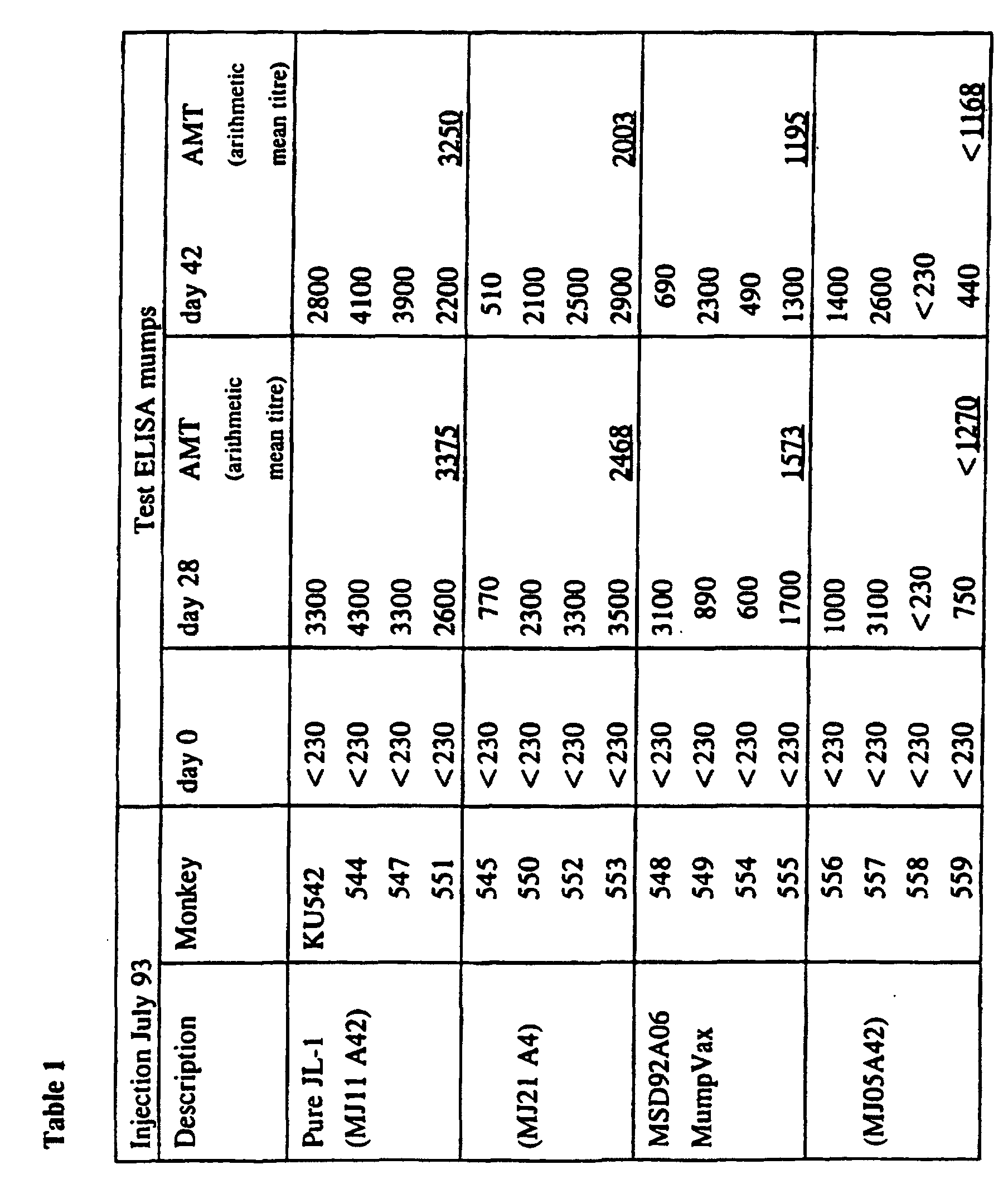
- a lyophilized JL-1 virus preparation called MJ11A42, at the fourth passage from MumpsVax and harvested after 6 days growth at 34°C on CEF cells and at a dose of of 4.2 log TCID50 was used to immunize a group of four African Green monkeys by subcutaneous injection.
- Three further groups of four monkeys were injected with : (a) MumpsVax at a concentration of 4.3 log TCID50; (b) with a lyophilized preparation, MJ21A42, at a concentration of 4.3 log TCID50 per dose from virus harvested after 9 days growth at 32°C and derived from three direct passages of MumpsVax on CEF cells; (c) with a lyophilized preparation, MJ05A42, at a concentration of 4.2 TCID50 per dose from virus harvested after 7 days growth at 34°C and derived from three direct passages of MumpsVax on CEF cells the passages being different from those for the MJ21A42 preparation.
- the JL-1 strain was further tested in a clinical trial with seronegative children of about 15 months of age.
- Trivalent measles, mumps and rubella vaccines were formulated and lyophilized using either pure JL-1 stain as the mumps component or with mumps virus derived by directly passaging Mumps Vax on CEF cells as in Example 6 above.
- Commercial M-M-R®II vaccine produced by Merck and Co Inc and obtainable from Merck Frossr Inc Kirkland, Quebec, Canada was also included in the trial; it contains the Jeryl-Lynn (B-level) strian as the mumps components.
- the titres of mumps virus in the three vaccine preparations were measured as 4.5 log TCID doses for the vaccine lot number MJR111D42 containing the pure JL-1 strain, 4.7 log TCID doses for the vaccine lot number MJR121C42 containing the passaged MumpsVax virus and 4.5 log TCID doses for the lot number 80391 OU commercial M-M-R® II vaccine.
Landscapes
- Health & Medical Sciences (AREA)
- Life Sciences & Earth Sciences (AREA)
- Chemical & Material Sciences (AREA)
- Virology (AREA)
- Medicinal Chemistry (AREA)
- General Health & Medical Sciences (AREA)
- Organic Chemistry (AREA)
- Public Health (AREA)
- Veterinary Medicine (AREA)
- Pharmacology & Pharmacy (AREA)
- Animal Behavior & Ethology (AREA)
- Immunology (AREA)
- Microbiology (AREA)
- Engineering & Computer Science (AREA)
- Genetics & Genomics (AREA)
- Communicable Diseases (AREA)
- Epidemiology (AREA)
- Mycology (AREA)
- Zoology (AREA)
- Wood Science & Technology (AREA)
- Bioinformatics & Cheminformatics (AREA)
- Molecular Biology (AREA)
- Oncology (AREA)
- Biotechnology (AREA)
- Nuclear Medicine, Radiotherapy & Molecular Imaging (AREA)
- General Chemical & Material Sciences (AREA)
- Biochemistry (AREA)
- Chemical Kinetics & Catalysis (AREA)
- Pulmonology (AREA)
- General Engineering & Computer Science (AREA)
- Biomedical Technology (AREA)
- Gastroenterology & Hepatology (AREA)
- Biophysics (AREA)
- Proteomics, Peptides & Aminoacids (AREA)
- Medicines Containing Antibodies Or Antigens For Use As Internal Diagnostic Agents (AREA)
- Micro-Organisms Or Cultivation Processes Thereof (AREA)
- Measuring Or Testing Involving Enzymes Or Micro-Organisms (AREA)
- Medicines Containing Material From Animals Or Micro-Organisms (AREA)
Abstract
Description
- Mumps is essentially a disease of childhood, which normally presents itself with only minor symptoms. However, in certain cases the clinical consequences of mumps infection are serious. For example, mumps is the most common cause of meningoencephalitis in children under 15 years of age in the UK, and a cause of permanent sensorineural deafness in childhood. Although 30-40% of natural mumps infection are symptomless, the very fact that salivary gland involvement can be unpleasant and that in the adult population mumps can cause 1st trimester abortions and orchitis of men as well as the neurological complications noted above, has led, in many countries, to the adoption of mass vaccination programs.
- Mumps virus belonging to Paramyxoviridae is constituted by a single strand genomic RNA of the minus sense and is about 15,3kb with the gene order 3' N-P-M-F-SH-HN-L5' (N-nucleocapsid protein, P=phosphoprotein, M=matrix protein, F=fusion protein, SH=potentially expressed as small hydrophobic protein, HN-haemagglutinin neuraminidase, L=large protein). Among various mumps strains, Jeryl-Lynn (B-level) is a live attenuated variant which has been characterised by sequence analysis of the F,P,HN,M genes.
- Until recently, two mumps virus strains have been approved for vaccination against Mumps. These are Urabe Am 9 and Jeryl-Lynn. However in September 1992 the Urabe strain was withdrawn following a reported incidence of unacceptable level of side effects [European Journal of Pediatrics (1993) 152:387].
- The Jeryl-Lynn strain has been sold commercially by Merck Sharp and Dohme for many years under the trade name "MumpsVax". The Jeryl-Lynn strain was obtained from a clinical sample of a patient suffering from mumps, by amniotic inoculation into embryonated hen's eggs (Proc. Soc. Exptl. Biol. Med. 123 (3) (1966)).
- Afzal et al recently reported (J. of Gen. Virology 1993 74 917) that the Jeryl-Lynn strain used in mumps vaccines in the UK is in fact a mixture of two viruses, named JL-2 and JL-5.
- Takeuchi et al Virology (1991) 181 p364-366 report that among different mumps strains there can be substantial nucleotide sequence variation at the SH gene level.
- Afzal et al have emphasised that the present commercially available vaccine "Mumps Vax" is made under carefully controlled conditions including a cell bank and passage limits and which are likely to preserve the proportion of the two variants from batch to batch. However with further passaging of the Jeryl-Lynn strain there is no guarantee that this balance between the two variants will be retained. Moreover it is difficult to assess the proportion of the two variants in any given batch of vaccine.
- The present inventors have surprisingly identified a yet further isolate which differs from both JL-2 and JL-5 of Afzal et al. The difference was determined by nucleotide sequence analysis of the SH gene and regions surrounding it, more particularly the nontranslated intercistronic region 3' to the SH coding sequence and 5' to the HN gene. This isolate in clinical trials induces a higher zero conversion and have highest geometric mean titre of mumps antibody than the commercially available mumps vaccine.
- Accordingly the present inventors provide an attenuated Jeryl-Lynn mumps strain containing the nucleotide sequence as set forth in Figure 1. This sequence encodes the SH gene and the N terminus of the HN gene. The strain is herein referred to as SBB JL-1.
- In Figure 1 there is shown the c DNA sequence of the JL-1 mumps virus isolate over the SH gene coding and SH-HN intergenic regions.
- The present invention also provides a mumps vaccine comprising a immunogenic Jeryl-Lynn isolate, the isolate not contaminated with more than 10%, and preferably less than 5% and most preferably less than 1% of another Jeryl-Lynn isolate as defined by the sequence of the region set forth above. In a preferred embodiment of the invention, the vaccine contains a pure homogenous Jeryl-Lynn isolate i.e. devoid of any contamination with other Jeryl-Lynn mumps isolates which differ within the region set forth in Figure 1.
- In one embodiment of the invention there is provided a vaccine comprising homogenous SBB JL-1 devoid of contamination with JL-2.
- The pure isolate does not suffer from the disadvantages of potential batch to batch variation between substrains and provides a product which is easier to ensure will meet consistent quality guidelines.
- Homogenous Jeryl-Lynn according to the invention may be obtained by passaging commercially available MumpsVax on Chick Embryo Fibroblast (CEF) cells, and selecting pure cultures by either limit dilution and examination of resulting isolates or by individual plaque isolation. Other suitable cell lines include Vero cells and MRC5 cells. This requires that methods are available for detection of minor proportions of a known variant virus within a population. Such examination methods include the Maprec assay proposed by Chumakov et al for attenuated polio virus (WO 92/07958 and PNAS 1991,88; 199 - 203), and direct sequencing of viral plaques and differential hybridization of viral plaques.
- The vaccine of the invention may advantageously contain other components, such as attenuated measles virus, and/or attenuated rubella virus, killed or subunits thereof for providing protection against measles and/or rubella infections. Trivalent mumps measles and rubella vaccines are well known in the art and the present mumps isolate would be formulated in a trivalent vaccine in an analogous manner to those vaccines already available. Additionally or alternatively the vaccine of the invention may contain a live Varicella Zoster attenuated virus for providing protection against varicella (chicken pox) or Zoster (shingles). In a preferred embodiment the Varicella Zoster virus will be the Oka strain as disclosed by Andre F E Postgraduate MED J. (1985) 61(Suppl. 4), 113-120 or Veskari T et al Acta paediatr. Scand. 80 : 1051-1057, 1991. Preferably the vaccine of the invention will be quadrivalent and provide protection against mumps, rubella measles and varicella zoster viruses.
- The invention also provides a process for preparing a whole virus vaccine, for example by freeze drying the virus in the presence of suitable stabilisers or admixing the strain according to the invention with a suitable carrier or adjuvant. It may also be advantageous to formulate the strain of the invention in liposomes or with carrier particles. Alternatively or in addition immunostimulants such as 3 de-O- acyl monophosphoryl Lipid A (Ribi Immunochem) or the saponin derivative QS21 (Cambridge Biotech) may be included in the formulation.
- In a further aspect, the invention provides a method of treating mumps infection in humans, which method comprises administering to a human subject in need thereof an immunologically effective dose of the vaccine according to the invention.
- The mode of administration of the vaccine of the invention may be any suitable route which delivers an immunoprotective amount of the strain and other immunogenic component of the vaccine to the subject. However, the vaccine is preferably administered parenterally via the intramuscular or deep subcutaneous routes. Other modes of administration may also be employed, where desired, such as oral administration or via other parenteral routes, i.e., intradermally, intranasally, or intravenously.
- The appropriate immunoprotective and non-toxic dose of such vaccine can be determined readily by those skilled in the art, i.e., the appropriate immunoprotective and non-toxic amount of the strain of this invention contained in the vaccine of this invention may be in the range of the effective amounts of antigen in conventional whole virus vaccines. It will be understood, however, that the specific dose level for any particular patient will depend upon a variety of factors including the age, general health, sex, and diet of the patient; the time of administration; the route of administration; synergistic effects with any other drugs being administered; and the degree of protection being sought. Of course, the administration can be repeated at suitable intervals if necessary. Typically in a monovalent presentation at least 3.7 log TC1D50 of virus and more generally 4.5 log TC1D50 will be present per dose. In a trivalent mumps, measles, rubella vaccine the mumps component will be present at around 4.8 log TC1D50 to offset the interference of the other two viral components.
- Commercial MumpsVax virus was passaged on confluent monolayers of Vero cells grown in 25 cm2 flasks with dMEM Biorich medium (50/50 v/v) with 0.5 % foetal calf serum using about 3.0 log TCID50 as inoculum. The infected cells were recovered after 7 days incubation at 34°C and the RNA extracted by the method of Ferré and Garduno (Nucleic Acids Research 1989, 17; 2141) into 100 mcl of water treated with diethylpyrocarbonate for 5 minutes at 100°C. 5 mcl of this extract was reverse transcribed by adding the following reagents: RNAsin 40 units (Boehringer Mannheim, Germany), 4 mcl of 5X concentrated reverse transcriptase buffer (Bethesda Research Labs,), 2 mcl of a mixture of the four deoxynucleotide triphosphates at 10mM, 10 pmole of NH2 oligonucleotide primer, 1 mcl of Moloney murine leukemia virus (MMLV) reverse transcriptase (Bethesda Research Labs, 200 units per mcl) and water to a final volume of 20 mcl. Oligonucleotide NH2 has homology to the F gene of the Urabe strain of mumps virus. The mixture was incubated for 45 min at 37°C and then heated for 5 min at 95 °C. The cDNA was then amplified by two successive rounds of PCR reaction using oligonucleotides NH8 and NH14 as primers and using 1 mcl of a thousand fold dilution of the first round reaction as starting material for the second round. Each PCR round consisted of 25 cycles of heating at 94°C for 1 min, 53°C for 1 min, 72°C for 1 min. The PCR product corresponding to the SH gene was sequenced in both directions after further PCR amplification in the presence of fluorodideoxynucleotide terminators and either NH8 or NH14 as primers and analysis of the products on an Applied Biosystems automatic (373A DNA sequencer) sequencer according to the suppliers protocol and recommendations. Ambiguities were observed at a number of positions in the sequence and confirmed on both strands. The sequence obtained differed from that of Takeuchi et al (Virology 1991,181; 364 - 366) for Jeryl Lynn at 17 of 361 bases including 4 unassigned bases. The sequence further differed from part of that obtained by Afzal et al (J. Gen Virol. 1993, 74; 917 - 920) for their JL-5 isolate by 9 of 319 bases including 4 unassigned bases. Ambiguities were also observed when the same region was sequenced directly from 4.0 to 5.0 log TCID50 MumpsVax virus recovered by ultracentrifugation, without prior passage on Vero cells, and after reverse transcription of viral RNA into cDNA with random primers followed by PCR amplification with oligonucleotides NH30bis and NH31bis as primers.
- MumpsVax virus was used to infect Vero cells and total RNA was prepared as described above. The RNA was reverse transcribed using random primers and PCR amplified using oligonucleotides NH22 and NH23 as primers. ( NH22 contains a HindIII restriction site within the primer and NH23 contains a BamHI restriction site within the primer to facilitate cloning of the amplified DNA fragment). The amplified DNA was restricted with HindIII and BamHI endonucleases and cloned into the vector pUC9. Eleven clones containing an insert corresponding to the mumps SH gene region were recovered. All eleven had a sequence corresponding to that of Takeuchi et al (loc cit). In addition five clones had a DdeI restriction site, absent in the six other clones. No insert corresponding to the JL-5 sequence was recovered. This result and the sequencing ambiguities suggested that the JL-2 variant virus defined by Afzal et al forms a substantial or easily detectable proportion of MumpsVax virus.
- MumpsVax virus was also passaged directly on Chicken Embryo Fibroblast (CEF) cells. Virus was recovered at the third passage from 5 different lots including the lot MJ05 used to prepare the lyophilized sample MJ05A42 for injection in animals. The 5 virus preparations were used to infect Vero cells and RNA was recovered and prepared for DNA sequencing by amplification with primers NH8 and NH14 table as described above except that random primers were used to prime the reverse transcriptase reaction. All 5 lots of virus displayed a sequence identical to that of JL-2 (Takeuchi et al) and without ambiguities.
- To investigate this further the direct sequencing method on viral plaques was used as described above. The 5 lots were used to infect Vero cell cultures and obtain plaques which were processed for sequencing using NH30bis and NH31bis as primers. Of a total of 26 plaques tested for the 5 lots, 13 gave a sequence identical to Takeuchi et al for the JL-2 sequence, 5 gave a sequence very similar to JL-5 except for two base differences at positions 270 and 279 and 8 plaques gave sequences with ambiguities indicating a mixture of virus.
- Three dilutions of MumpsVax containing an estimated 100, 50 and 10 virus particles per 0.5 ml aliquot were used to infect confluent monolayers of Vero cells in 5 cm Petri dishes after removal of the medium and washing with dMEM Biorich 50:50 v/v medium (Biorich) without serum. Virus was allowed to adsorb during 30 minutes at 34°C. The cells were then covered with 5 ml of overlay agar held at 42°C and containing 2.5 ml of dMEM Biorich medium with 0.5% FCS and 2.5 ml of 3% (w/v) low gelling temperature agarose. After solidification the agar layer was covered with 3 ml of dMEM Biorich medium with 0.5% foetal calf serum and incubated at 34°C. After 7 days incubation the viral plaques were visualized by removing the superficial liquid medium and adding 0.03 % (w/v) neutral red solution and allowing this to diffuse for 1 hour. The liquid and agar was then removed and a dry nylon filter applied to the bottom of the dish with finger pressure. The filter was then wet with a few drops of 2X SSC and lifted. Virus was fixed to the filter by placing it on paper soaked in 2X SSC for 5 min and then on paper soaked in 2X SSC, 0.2% (w/v) sodium dodecyl sulphate for 30 min and then exposing the filters to UV light for three to five minutes. Twenty individual plaques were cut from the nylon filters and the piece of membrane was immersed in 100 mcl of water and 1 mcl of RNAsin (Boehringer Mannheim, 40 units) was, added before heating at 65°C for 30 minutes. The 100 mcl of liquid was transferred to a fresh tube and the nucleic acids precipitated by adding 10 mcl of 3M sodium acetate followed by 250 mcl of ethanol. The mixture was held overnight at -20°C or for 1 hour at -70°C before centrifugation. The pellet was then dried. The material was then reverse transcribed by adding the following solutions to the pellet: 4 mcl 5X concentrated reverse transcriptase buffer (Bethesda Research Labs,) 2 mcl of 0.1M dithiothreitiol, 1 mcl of a mixture of deoxynucleotide triphosphates (Perkin Elmer - Cetus, 10 mM concentration), 1 mcl of N6 random primer oligonucleotides (New England Biolabs, concentration 100 mcg per ml) and 11 mcl of water. 1 mcl of MMLV reverse transcriptase was then added and the mixture incubated for 1 hour at 37°C and then for 5 min at 95°C. The cDNA was then PCR amplified by taking 10 mcl of the above mixture and adding 500 ng of each of the oligonucleotide primers NH30bis and NH31bis, PCR buffer and 1 mcl of Stoffel DNA polymerase (Perkin Elmer - Cetus, concentration 10 ug mcl in 100 mcl final volume and heating the mixture for 30 cycles of 1 min at 95°C, 1 min at 60°C and 1 min at 72°C. The resulting fragment was purified using a MagicPrep kit (Promega Biotech A7170,) according to the suppliers instructions. Sequencing was done after further asymmetric PCR amplification using either NH30bis or NH31bis as primers and fluorodideoxynucleotide terminators by a non-radioactive method on an Applied Biosystems (373A) automatic sequencer using the methods and reactants of the supplier. Of the twenty plaques from MumpsVax, 19 were found to differ by 11 of 275 bases from the JL-2 sequence of Takeuchi et al (loc cit) and by 2 bases from the JL-5 sequence of Afzal et al (loc cit). One plaque gave a sequence with ambiguities. This result suggested that MumpsVax may contain a variant or variants which differ in this region from the dominant JL-5 strain found by Afzal et al. The two bases differing between JL-5 and the plaques sequenced are at positions 270 and 279 and are located in the intergenic region between the SH and HN coding regions.
- To attempt to determine more directly the proportion of the JL-5 and JL-2 type variants in MumpsVax and derivative cultures a plaque hybridization method was used. MumpsVax virus and the passaged virus of lot MJ05 were used to infect Vero cell monolayers and obtain plaques which were then lifted onto nylon membranes and the nucleic acids fixed as described above. The filters were prehybridized for 3 hours at 65 °C in 200 ml of the following solution: 5X SSC (SSC is 0.15M sodium chloride 0.01M sodium citrate pH 7.2), (10X concentrated Denhardts solution (10X concentrated Denhardts solution is: 0.2% w/v Ficoll 400, 0.2% bovine serum albumin, 0.2% polyvinyl chloride), 0.1% (w/v) sodium dodecyl sulphate, Salmon sperm DNA 50 mcg per ml. The filters were then hybridized with gentle agitation for 2.5 hours at 65°C in 50 ml of a solution with the same composition as above and preheated to 65°C and with the addition of the radioactive probe and cold competitor probe solution. The oligonucleotides used as variant specific probes were BC252 which hybridizes with JL-5 variants and BC253 which hybridizes with JL-2 variants. The oligonucleotides were labelled with gamma 32P-ATP by kination in a solution of the following composition: 100ng of the oligonucleotide to be labelled, 3 mcl of 10X concentrated kinase buffer (10x concentrated kinase buffer contains: 0.5M Tris -HCl pH 7.6, 0.1M MgCl2, 50mM dithiothreitol, 1mM spermidine and 1mM EDTA pH 8.0), 3 mcl of 32P- ATP (Amersham International, 3000 Ci/nmole, 10 mCi/mcl) and 2 mcl of T4 polynucleotide kinase (Boehringer Mannheim,) made up to 30 mcl with sterile water. This mixture was incubated for 30 minutes at 37°C and the reaction stopped by heating for 5 minutes at 95°C. Cold competitor oligonucleotide was then added at a (w/w) ratio of 100 to 1, that is 10 mcg of cold competitor oligonucleotide was added for every 100 ng of labelled probe, before adding the mixture to the hybridization solution. After hybridization the filters were washed once for 30 minutes at 65°C in 100 ml of a solution with the same composition as the hybridization solution and then washed at 65°C in two changes of 100 ml of a solution of the following composition: SSC 5X, 0.1 % sodium dodecyl sulphate. The filters were then dried and exposed to X-ray film with an intensifying screen. When MumpsVax was examined by this technique a large excess of plaques hybridized with oligonucleotide BC252 specific for the JL-5 variant compared to the hybridization found with BC253. When lot MJ05 was examined, although there were approximately equal numbers of plaques hybridizing with both probes, relatively more plaques hybridized with BC253 than with BC252.
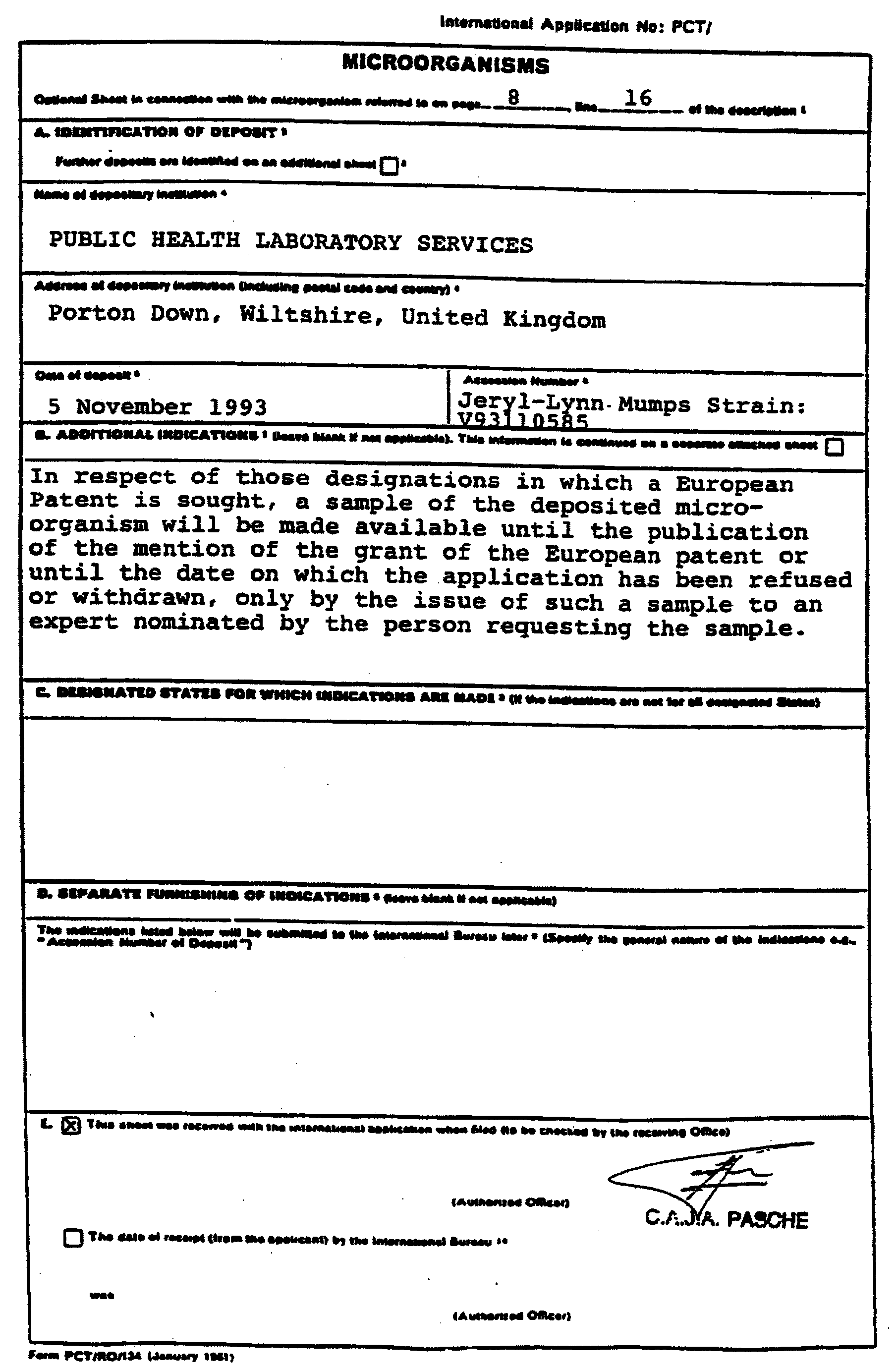
- To recover pure isolates of the JL-5 and JL-2 variants, a sample of commercial Mumps Vax (lot 92A06 from Merck Sharp and Dohme deposited at the Public Heath Laboratory Services, Porton Down, Wiltshire, UK under Accession No. Jeryl-Lynn Mumps Strain: V93110585 on 5th November, 1993) at a stated titre of 4-6 log TCID50 infections units was limit diluted and used to infect Chicken Embryo Fibroblast cells in 96 well microtiter plates at an estimated inoculum of 0.1 infections units per well. The plates were incubated 11 days at 34° C to permit development of the virus. Seventeen wells of a total of 192 inoculated showed a cytopathic effect indicating viral growth and these were used to inoculate further cultures of CEF cells. The identity of the virus isolated was determined on this second passage material which titred about 4.9 log TCID50 by filtering the virus preparations through a 0.8 µm filter, centrifugation for 1 hour at 42,000 rpm and resuspension of the viral pellet with 100 mcl H2O. One mcl of RNase inhibitor (Boehringer Mannheim, 40 units per mcl) was added and the mixture incubated for 30 minutes at 65° before addition of 1/10 volume 3 M Na Acetate (pH 4.5) followed by 2.5 volumes of ethanol. The material was allowed to precipitate overnight at -20°C or for one hour at - 70°C before being centrifuged for 30 minutes at 4°C in an Eppendorf bench-top centrifuge and the pellet dried.
- Viral RNA recovered was reverse transcribed by adding 20 mcl of the following mixture to the pellet. 4 mcl of 5x core RT buffer (Bethesda Research Labs), 2 mcl of 10 nM deoxynucleotide triphosphate mixture (Perkin Elmer, Cetus), 1 mcl of random primers N6 (Biolabs, at 100 mcg/ML), 11 mcl of H20, 1 mcl of MMLV reverse transcriptase (Bethesda Research Labs). This mixture was incubated for 1 hour at 37°C followed by 5 minutes at 95°C to inhibit the reverse transcriptase. 10 mcl of the heated mixture was then subjected to PCR amplification in 100 mcl final volume with the primers NH30 bis and NH31bis using the following heading programme for 30 cycles : 1 minute at 95°C, 1 minute at 60°C, 1 minute at 72°C. The resulting fragments were purified by Magic Prep (Promega) according to the manufacturers' protocol.
- The six isolates reacting only with the JL-5 probe were inoculated onto Vero cells to obtain plaques. These were lifted onto nylon membranes and the membranes hybridized with oligonucleotide BC252 and with oligonucleotide BC253, both labelled with 32P by kination as described above. Hybridization was done n 5x SSC at 65°C for 2.5 hours using about 100 ng of labelled oligonucleotides and 10 mcg of cold competitor oligonucleotide in a volume of 50 ml. About 200 plaques were tested for each isolate and none reacted with the JL-2 probe (oligonucleotide BC253). All plaques reacted with BC252.
- One virus isolate, originating from well 9H2A of the micro titre plate and further identified as SBB strain JL-1 was taken through two further passages on CEF cells. After the last passage (4 passages from the original Mumps Vax material), the virus was used to infect Vero cells and to obtain plaques. These were lifted onto nylon membranes and tested by hybridization with oligonucleotides BC252 and BC253 which had been labelled with 32P by kination. Over 2000 plaques were tested with the JL-2 specific probe BC253 and none was found to react with this. A lesser number of plaques was tested with oligonucleotide BC252 and all gave a positive reaction. Sequencing was performed directly on the virus pool of the JL-1 strain recovered at the fourth passage on CEF cells by centrifugation and ethanol precipitation of the virus followed by reverse transcription using random primers as described above. The cDNA was amplified by PCR reaction using oligonucleotides NH14 and BC265 as primers and with the following heating programme: 1 minute at 94°C, 1 minute at 60°C, 1 minute at 72° C, for 30 cycles. The resulting DNA fragment was purified on a MagicPrep column (Promega Biotech) according to the suppliers' instructions and sequenced on an Applied Biosystems 373A automatic sequencer according to the manufacturers' instructions and using oligonucleotides NH14, BC 265, NH 30bis and NH31bis as primers. The sequence shown in Figure 1 was obtained. This sequence surprisingly differs from that obtained by Afzal et al for their JL-5 isolate at six positions in the intergenic region between the SH and HN coding regions. The JL-1 isolate therefore represents a further variant virus present in the MumpsVax preparation.
- A second virus isolate, identified as 10H5F which also reacted only with the JL-5 probe, was sequenced by infecting Vero cells with passage two virus, lifting a plaque onto a nylon membrane and performing sequencing after PCR amplification using NH14 and BC265 oligonucleotides as primers. This gave a sequence identical to that for 9H2A above and differing from the published JL-5 isolate sequence by 6 bases in the SH-HN intergenic region.
- The immunogenicity of the JL-1 strain from Example 6 was tested in monkeys. A lyophilized JL-1 virus preparation , called MJ11A42, at the fourth passage from MumpsVax and harvested after 6 days growth at 34°C on CEF cells and at a dose of of 4.2 log TCID50 was used to immunize a group of four African Green monkeys by subcutaneous injection. Three further groups of four monkeys were injected with : (a) MumpsVax at a concentration of 4.3 log TCID50; (b) with a lyophilized preparation, MJ21A42, at a concentration of 4.3 log TCID50 per dose from virus harvested after 9 days growth at 32°C and derived from three direct passages of MumpsVax on CEF cells; (c) with a lyophilized preparation, MJ05A42, at a concentration of 4.2 TCID50 per dose from virus harvested after 7 days growth at 34°C and derived from three direct passages of MumpsVax on CEF cells the passages being different from those for the MJ21A42 preparation.
- Blood samples were taken before injection on day 0 and on days 28 and 42 after vaccination and tested for the presence of IgG antibodies to mumps virus using the commercial Enzygnost Anti-Parotitis Virus kit from Behring (Behringwerke AG, Marburg, Germany) as described by the supplier. As shown in Table 1 the preparation derived from the pure JL-1 strain induces a higher titre of anti-mumps virus antibodies in the animals than the other preparations, including MumpsVax. These sera were also tested at two-fold serial dilutions in a plaque reduction assay using MumpsVax as test virus. The sera from the animals injected with lot MJ11A42 gave a higher average reduction in the number of plaques compared to the other sera.
- The JL-1 strain was further tested in a clinical trial with seronegative children of about 15 months of age. Trivalent measles, mumps and rubella vaccines were formulated and lyophilized using either pure JL-1 stain as the mumps component or with mumps virus derived by directly passaging Mumps Vax on CEF cells as in Example 6 above. Commercial M-M-R®II vaccine produced by Merck and Co Inc and obtainable from Merck Frossr Inc Kirkland, Quebec, Canada was also included in the trial; it contains the Jeryl-Lynn (B-level) strian as the mumps components.
- The titres of mumps virus in the three vaccine preparations were measured as 4.5 log TCID doses for the vaccine lot number MJR111D42 containing the pure JL-1 strain, 4.7 log TCID doses for the vaccine lot number MJR121C42 containing the passaged MumpsVax virus and 4.5 log TCID doses for the lot number 80391 OU commercial M-M-R® II vaccine.
- Blood samples were taken from the children before vaccination and at 42 days post vaccination.
- The presence of IgG antibodies to mumps virus was tested using the same commercial kit described above in Example 6. As shown in Table 3 the pure JL-1 strain MMR vaccine induced both the highest seroconversion rate and gave the highest geometric mean titre of the three preparations.

SEROCONVERSION AND GEOMETRIC MEAN TITRE (GMT) TO MUMPS VIRUS IN SERONEGATIVE SUBJECTS Vaccine Timing Number Number seroconverting GMT MJR111D42 pre 15 0 - day 42 15 15 1434 MJR121C42 pre 13 0 - day 42 13 11 971 803910U pre 17 0 - day 42 17 16 1247 -
- (1) GENERAL INFORMATION:
- (i) APPLICANT: Smithkline Beecham Biologicals sa
- (ii) TITLE OF INVENTION: Vaccines
- (iii) NUMBER OF SEQUENCES: 13
- (iv) CORRESPONDENCE ADDRESS:
- (A) ADDRESSEE: Smithkline Beecham Corporate Intellectual Property
- (B) STREET: SB House L/5 Great West Road
- (C) CITY: Brentford
- (D) STATE: Middlesex
- (E) COUNTRY: United Kingdom
- (F) ZIP: TW8 9BD
- (v) COMPUTER READABLE FORM:
- (A) MEDIUM TYPE: Floppy disk
- (B) COMPUTER: IBM PC compatible
- (C) OPERATING SYSTEM: PC-DOS/MS-DOS
- (D) SOFTWARE: PatentIn Release #1.0, Version #1.25
- (vi) CURRENT APPLICATION DATA:
- (A) APPLICATION NUMBER:
- (B) FILING DATE:
- (C) CLASSIFICATION:
- (viii) ATTORNEY/AGENT INFORMATION:
- (A) NAME: Dalton, Marcus JW
- (ix) TELECOMMUNICATION INFORMATION:
- (A) TELEPHONE: 44 181 975 4093
- (B) TELEFAX: 44 181 975 3688
- (2) INFORMATION FOR SEQ ID NO:1:
- (i) SEQUENCE CHARACTERISTICS:
- (A) LENGTH: 393 base pairs
- (B) TYPE: nucleic acid
- (C) STRANDEDNESS: single
- (D) TOPOLOGY: linear
- (ii) MOLECULE TYPE: DNA (genomic)
- (iii) HYPOTHETICAL: NO
- (iv) ANTI-SENSE: NO
- (vi) ORIGINAL SOURCE:
- (A) ORGANISM: Mumps Virus
- (B) STRAIN: Jeryl lynn - 1
- (xi) SEQUENCE DESCRIPTION: SEQ ID NO:1:

- (2) INFORMATION FOR SEQ ID NO:2:
- (i) SEQUENCE CHARACTERISTICS:
- (A) LENGTH: 15 base pairs
- (B) TYPE: nucleic acid
- (C) STRANDEDNESS: single
- (D) TOPOLOGY: linear
- (ii) MOLECULE TYPE: DNA (genomic)
- (iii) HYPOTHETICAL: NO
- (iv) ANTI-SENSE: NO
- (vi) ORIGINAL SOURCE:
- (A) ORGANISM: nh2
- (xi) SEQUENCE DESCRIPTION: SEQ ID NO:2:

- (2) INFORMATION FOR SEQ ID NO:3:
- (i) SEQUENCE CHARACTERISTICS:
- (A) LENGTH: 20 base pairs
- (B) TYPE: nucleic acid
- (C) STRANDEDNESS: single
- (D) TOPOLOGY: linear
- (ii) MOLECULE TYPE: DNA (genomic)
- (vi) ORIGINAL SOURCE:
- (A) ORGANISM: NH8
- (xi) SEQUENCE DESCRIPTION: SEQ ID NO:3:

- (2) INFORMATION FOR SEQ ID NO:4:
- (i) SEQUENCE CHARACTERISTICS:
- (A) LENGTH: 21 base pairs
- (B) TYPE: nucleic acid
- (C) STRANDEDNESS: single
- (D) TOPOLOGY: linear
- (ii) MOLECULE TYPE: DNA (genomic)
- (vi) ORIGINAL SOURCE:
- (A) ORGANISM: NH14
- (xi) SEQUENCE DESCRIPTION: SEQ ID NO:4:

- (2) INFORMATION FOR SEQ ID NO:5:
- (i) SEQUENCE CHARACTERISTICS:
- (A) LENGTH: 33 base pairs
- (B) TYPE: nucleic acid
- (C) STRANDEDNESS: single
- (D) TOPOLOGY: linear
- (ii) MOLECULE TYPE: DNA (genomic)
- (vi) ORIGINAL SOURCE:
- (A) ORGANISM: NH22
- (xi) SEQUENCE DESCRIPTION: SEQ ID NO:5:

- (2) INFORMATION FOR SEQ ID NO:6:
- (i) SEQUENCE CHARACTERISTICS:
- (A) LENGTH: 32 base pairs
- (B) TYPE: nucleic acid
- (C) STRANDEDNESS: single
- (D) TOPOLOGY: linear
- (ii) MOLECULE TYPE: DNA (genomic)
- (vi) ORIGINAL SOURCE:
- (A) ORGANISM: NH23
- (xi) SEQUENCE DESCRIPTION: SEQ ID NO:6:

- (2) INFORMATION FOR SEQ ID NO:7:
- (i) SEQUENCE CHARACTERISTICS:
- (A) LENGTH: 18 base pairs
- (B) TYPE: nucleic acid
- (C) STRANDEDNESS: single
- (D) TOPOLOGY: linear
- (ii) MOLECULE TYPE: DNA (genomic)
- (vi) ORIGINAL SOURCE:
- (A) ORGANISM: NH30
- (xi) SEQUENCE DESCRIPTION: SEQ ID NO:7:

- (2) INFORMATION FOR SEQ ID NO:8:
- (i) SEQUENCE CHARACTERISTICS:
- (A) LENGTH: 18 base pairs
- (B) TYPE: nucleic acid
- (C) STRANDEDNESS: single
- (D) TOPOLOGY: linear
- (ii) MOLECULE TYPE: DNA (genomic)
- (vi) ORIGINAL SOURCE:
- (A) ORGANISM: NH31
- (xi) SEQUENCE DESCRIPTION: SEQ ID NO:8:

- (2) INFORMATION FOR SEQ ID NO:9:
- (i) SEQUENCE CHARACTERISTICS:
- (A) LENGTH: 28 base pairs
- (B) TYPE: nucleic acid
- (C) STRANDEDNESS: single
- (D) TOPOLOGY: linear
- (ii) MOLECULE TYPE: DNA (genomic)
- (vi) ORIGINAL SOURCE:
- (A) ORGANISM: NH30BIS
- (xi) SEQUENCE DESCRIPTION: SEQ ID NO:9:

- (2) INFORMATION FOR SEQ ID NO:10:
- (i) SEQUENCE CHARACTERISTICS:
- (A) LENGTH: 24 base pairs
- (B) TYPE: nucleic acid
- (C) STRANDEDNESS: single
- (D) TOPOLOGY: linear
- (ii) MOLECULE TYPE: DNA (genomic)
- (vi) ORIGINAL SOURCE:
- (A) ORGANISM: NH31BIS
- (xi) SEQUENCE DESCRIPTION: SEQ ID NO:10:

- (2) INFORMATION FOR SEQ ID NO:11:
- (i) SEQUENCE CHARACTERISTICS:
- (A) LENGTH: 29 base pairs
- (B) TYPE: nucleic acid
- (C) STRANDEDNESS: single
- (D) TOPOLOGY: linear
- (ii) MOLECULE TYPE: DNA (genomic)
- (vi) ORIGINAL SOURCE:
- (A) ORGANISM: BC265
- (xi) SEQUENCE DESCRIPTION: SEQ ID NO:11:

- (2) INFORMATION FOR SEQ ID NO:12:
- (i) SEQUENCE CHARACTERISTICS:
- (A) LENGTH: 31 base pairs
- (B) TYPE: nucleic acid
- (C) STRANDEDNESS: single
- (D) TOPOLOGY: linear
- (ii) MOLECULE TYPE: DNA (genomic)
- (vi) ORIGINAL SOURCE:
- (A) ORGANISM: bc252
- (xi) SEQUENCE DESCRIPTION: SEO ID NO:12:

- (2) INFORMATION FOR SEQ ID NO:13:
- (i) SEQUENCE CHARACTERISTICS:
- (A) LENGTH: 31 base pairs
- (B) TYPE: nucleic acid
- (C) STRANDEDNESS: single
- (D) TOPOLOGY: linear
- (ii) MOLECULE TYPE: DNA (genomic)
- (vi) ORIGINAL SOURCE:
- (A) ORGANISM: Bc253
- (xi) SEQUENCE DESCRIPTION: SEQ ID NO:13:

-
Claims (12)
- An attenuated Jeryl-lynn mumps virus strain characterised in that it contains the nucleotide sequence as depicted in figure 1.
- A mumps vaccine comprising a immunogenic Jeryl-Lynn isolate, the isolate not contaminated with more than 10% of another Jeryl-Lynn isolate.
- A mumps vaccine as claimed in claim 2 comprising a homogenous isolate of claim 1.
- A vaccine according to claim 2 or 3 additional comprising one or more of attenuated measles virus, or attenuated rubella virus or killed measles or rubella virus, or subunits of such viruses.
- A vaccine according to claim 4, wherein the additional components comprise an attenuated measles virus and an attenuated rubella virus.
- A vaccine as claimed in any of claims 3 - 5 additionally comprising an agent for the protection against varicella or zoster infections.
- A vaccine according to claim 6, wherein the agent for protection against varicella or zoster infections is Varicella Zoster virus (VZV) OKA strain.
- A method of producing a vaccine comprising a immunogenic Jeryl-Lynn isolate, the isolate not contaminated with more than 10% of another Jeryl-Lynn isolate the method comprising:Passaging a Jeryl-Lynn preparation on a suitable cell line,Selecting pure culture using the steps of either:a) limit dilution; orb) individual plaque isolation.
- A immunogenic Jeryl-Lynn isolate for use in medicine, the isolate not contaminated with more than 10% of another Jeryl-Lynn isolate.
- A Jeryl-Lynn isolate according to claim 9 , wherein the isolate is homogenous.
- Use of an attenuated Jeryl-Lynn mumps strain according to claim 1 in the manufacture if a medicament for inducing immunity in a mammal susceptible to mumps infection.
- Use of an immunogenic Jeryl-Lynn isolate , the isolate not contaminated with more than 10% of another Jeryl-Lynn isolate, in the manufacture of a medicament for inducing immunity in a mammal susceptible to mumps infection.
Priority Applications (2)
| Application Number | Priority Date | Filing Date | Title |
|---|---|---|---|
| EP04075732A EP1484391A1 (en) | 1993-11-19 | 1994-11-15 | Vaccine against mumps |
| SI9430462T SI0729509T1 (en) | 1993-11-19 | 1994-11-15 | Vaccine against mumps containing a jeryl-lynn virus strain |
Applications Claiming Priority (5)
| Application Number | Priority Date | Filing Date | Title |
|---|---|---|---|
| GB939323820A GB9323820D0 (en) | 1993-11-19 | 1993-11-19 | Vaccine |
| GB9323820 | 1993-11-19 | ||
| GB9406480A GB9406480D0 (en) | 1994-03-31 | 1994-03-31 | Vaccine |
| GB9406480 | 1994-03-31 | ||
| PCT/EP1994/003801 WO1995014083A1 (en) | 1993-11-19 | 1994-11-15 | Vaccine against mumps containing a jeryl-lynn virus strain |
Related Child Applications (1)
| Application Number | Title | Priority Date | Filing Date |
|---|---|---|---|
| EP04075732A Division EP1484391A1 (en) | 1993-11-19 | 1994-11-15 | Vaccine against mumps |
Publications (2)
| Publication Number | Publication Date |
|---|---|
| EP0729509A1 EP0729509A1 (en) | 1996-09-04 |
| EP0729509B1 true EP0729509B1 (en) | 2004-05-06 |
Family
ID=26303889
Family Applications (2)
| Application Number | Title | Priority Date | Filing Date |
|---|---|---|---|
| EP04075732A Withdrawn EP1484391A1 (en) | 1993-11-19 | 1994-11-15 | Vaccine against mumps |
| EP95900751A Expired - Lifetime EP0729509B1 (en) | 1993-11-19 | 1994-11-15 | Vaccine against mumps containing a jeryl-lynn virus strain |
Family Applications Before (1)
| Application Number | Title | Priority Date | Filing Date |
|---|---|---|---|
| EP04075732A Withdrawn EP1484391A1 (en) | 1993-11-19 | 1994-11-15 | Vaccine against mumps |
Country Status (19)
| Country | Link |
|---|---|
| US (4) | US6024962A (en) |
| EP (2) | EP1484391A1 (en) |
| JP (1) | JPH09504954A (en) |
| KR (1) | KR100362051B1 (en) |
| CN (2) | CN101948816A (en) |
| AT (1) | ATE266090T1 (en) |
| AU (1) | AU687922B2 (en) |
| CA (1) | CA2176929C (en) |
| CY (2) | CY2540B1 (en) |
| DE (3) | DE69433760T2 (en) |
| DK (1) | DK0729509T3 (en) |
| ES (1) | ES2219658T3 (en) |
| LU (1) | LU91458I2 (en) |
| NL (1) | NL300336I2 (en) |
| NZ (1) | NZ276102A (en) |
| PT (1) | PT729509E (en) |
| SG (1) | SG52780A1 (en) |
| SI (1) | SI0729509T1 (en) |
| WO (1) | WO1995014083A1 (en) |
Families Citing this family (6)
| Publication number | Priority date | Publication date | Assignee | Title |
|---|---|---|---|---|
| PT729509E (en) | 1993-11-19 | 2004-09-30 | Glaxosmithkline Biolog Sa | VIRGIN AGAINST PAPEIRA CONTAINING A STRAIN OF JERRYL-LYNN VIRUS |
| JP2003506039A (en) * | 1999-08-02 | 2003-02-18 | ワイス | Rescue of epidemic parotitis virus from cDNA |
| MX2017012389A (en) * | 2015-03-27 | 2018-09-19 | Cadila Healthcare Ltd | Recombinant mumps virus jeryl lynn 2 based vaccine. |
| US20220023413A1 (en) * | 2018-12-12 | 2022-01-27 | The U.S.A., As Represented By The Secretary, Department Of Health And Human Services | Recombinant mumps virus vaccine expressing genotype g fusion and hemagglutinin-neuraminidase proteins |
| RU2750818C1 (en) * | 2020-11-19 | 2021-07-05 | Федеральное государственное бюджетное научное учреждение "Научно-исследовательский институт вакцин и сывороток им. И.И. Мечникова" (ФГБНУ НИИВС им. И.И. Мечникова | Viral strain for obtaining attenuated live culture vaccine for prevention and treatment of herpes zoster for adult population |
| CN114457046A (en) * | 2022-02-16 | 2022-05-10 | 科兴(大连)疫苗技术有限公司 | Method for subculturing and purifying mumps virus by dilution method |
Family Cites Families (4)
| Publication number | Priority date | Publication date | Assignee | Title |
|---|---|---|---|---|
| US3555149A (en) | 1968-07-05 | 1971-01-12 | Merck & Co Inc | Mumps vaccine and its preparation |
| US4337242A (en) | 1980-02-05 | 1982-06-29 | Merck & Co., Inc. | Vaccine stabilizer containing L-glutamic acid and L-arginine |
| JP3026029B2 (en) * | 1991-04-26 | 2000-03-27 | 財団法人阪大微生物病研究会 | Recombinant varicella virus and its production method |
| PT729509E (en) | 1993-11-19 | 2004-09-30 | Glaxosmithkline Biolog Sa | VIRGIN AGAINST PAPEIRA CONTAINING A STRAIN OF JERRYL-LYNN VIRUS |
-
1994
- 1994-11-15 PT PT95900751T patent/PT729509E/en unknown
- 1994-11-15 EP EP04075732A patent/EP1484391A1/en not_active Withdrawn
- 1994-11-15 NZ NZ276102A patent/NZ276102A/en not_active IP Right Cessation
- 1994-11-15 WO PCT/EP1994/003801 patent/WO1995014083A1/en not_active Ceased
- 1994-11-15 CN CN2010101643698A patent/CN101948816A/en active Pending
- 1994-11-15 US US08/649,654 patent/US6024962A/en not_active Expired - Lifetime
- 1994-11-15 ES ES95900751T patent/ES2219658T3/en not_active Expired - Lifetime
- 1994-11-15 CA CA002176929A patent/CA2176929C/en not_active Expired - Lifetime
- 1994-11-15 CN CN94194807A patent/CN1150819A/en active Pending
- 1994-11-15 DK DK95900751T patent/DK0729509T3/en active
- 1994-11-15 SG SG1996009415A patent/SG52780A1/en unknown
- 1994-11-15 EP EP95900751A patent/EP0729509B1/en not_active Expired - Lifetime
- 1994-11-15 JP JP7514221A patent/JPH09504954A/en active Pending
- 1994-11-15 KR KR1019960702618A patent/KR100362051B1/en not_active Expired - Lifetime
- 1994-11-15 DE DE69433760T patent/DE69433760T2/en not_active Expired - Lifetime
- 1994-11-15 DE DE122007000003C patent/DE122007000003I2/en active Active
- 1994-11-15 SI SI9430462T patent/SI0729509T1/en unknown
- 1994-11-15 DE DE1994633760 patent/DE122007000003I1/en active Pending
- 1994-11-15 AU AU81441/94A patent/AU687922B2/en not_active Expired
- 1994-11-15 AT AT95900751T patent/ATE266090T1/en active
-
2000
- 2000-12-22 US US09/748,343 patent/US20020018784A1/en not_active Abandoned
-
2002
- 2002-08-07 US US10/213,965 patent/US6656476B2/en not_active Expired - Fee Related
-
2003
- 2003-11-03 US US10/699,751 patent/US6899884B2/en not_active Expired - Fee Related
-
2005
- 2005-09-30 CY CY0500054A patent/CY2540B1/en unknown
-
2008
- 2008-02-12 NL NL300336C patent/NL300336I2/en unknown
- 2008-02-19 CY CY2008005C patent/CY2008005I2/en unknown
- 2008-06-24 LU LU91458C patent/LU91458I2/en unknown
Also Published As
Similar Documents
| Publication | Publication Date | Title |
|---|---|---|
| JP3826055B2 (en) | Immunization with recombinant avipoxvirus | |
| JP2000507825A (en) | Method of influenza virus replication in cell culture, and influenza virus obtainable by the method | |
| JP2004331673A (en) | Animal cell and process for replication of influenza virus | |
| JPH03504963A (en) | Preparation of recombinant subunit vaccine against pseudorabies infection | |
| US6180110B1 (en) | Attenuated hepatitis a virus vaccine which grows in MRC-5 cells | |
| KR100884673B1 (en) | Relief of the mumps virus from CDN | |
| CN113293148A (en) | Construction of H gene replaced chimeric measles attenuated strain | |
| US11918638B2 (en) | Recombinant respiratory syncytial virus strains comprising NS1 and NS2 gene shifts | |
| AU687922B2 (en) | Vaccine against mumps containing a jeryl-lynn virus strain | |
| Afzal et al. | Evaluation of the neurovirulence test for mumps vaccines | |
| Provost et al. | Successful infection of the common marmoset (Callithrix jacchus) with human varicella-zoster virus | |
| Smith et al. | Development and trial of a bovine herpesvirus 1‐thymidine kinase deletion virus as a vaccine | |
| HK1012421B (en) | Vaccine against mumps containing a jeryl-lynn virus strain | |
| JP3037756B2 (en) | Vaccine against mumps containing jeryl-lynn virus strain | |
| HK1070383A (en) | Vaccine against mumps | |
| US9434768B2 (en) | Viruses lacking epithelial cell receptor entry | |
| US5783194A (en) | Homogeneous isolate of urabe mumps virus and vaccines containing the isolate | |
| CN1763181B (en) | Vaccine against mumps containing a JERYL-LYNN virus strain | |
| US20150299669A1 (en) | Novel Pneumovirus Compositions and Methods For Using the Same |
Legal Events
| Date | Code | Title | Description |
|---|---|---|---|
| PUAI | Public reference made under article 153(3) epc to a published international application that has entered the european phase |
Free format text: ORIGINAL CODE: 0009012 |
|
| 17P | Request for examination filed |
Effective date: 19960506 |
|
| AK | Designated contracting states |
Kind code of ref document: A1 Designated state(s): AT BE CH DE DK ES FR GB GR IE IT LI LU MC NL PT SE |
|
| AX | Request for extension of the european patent |
Free format text: SI PAYMENT 960506 |
|
| RAX | Requested extension states of the european patent have changed |
Free format text: SI PAYMENT 960506 |
|
| RAP1 | Party data changed (applicant data changed or rights of an application transferred) |
Owner name: GLAXOSMITHKLINE BIOLOGICALS S.A. |
|
| 17Q | First examination report despatched |
Effective date: 20030807 |
|
| GRAP | Despatch of communication of intention to grant a patent |
Free format text: ORIGINAL CODE: EPIDOSNIGR1 |
|
| RIN1 | Information on inventor provided before grant (corrected) |
Inventor name: DIDELEZ, J.,SMITHKLINE BEECHAM BIOLOGICALS (S.A) Inventor name: COLAU, B.D.A.,SMITHKLINE BEECHAM BIO. (S.A) Inventor name: HARFORD, NIGEL MAURICE |
|
| GRAS | Grant fee paid |
Free format text: ORIGINAL CODE: EPIDOSNIGR3 |
|
| GRAA | (expected) grant |
Free format text: ORIGINAL CODE: 0009210 |
|
| AK | Designated contracting states |
Kind code of ref document: B1 Designated state(s): AT BE CH DE DK ES FR GB GR IE IT LI LU MC NL PT SE |
|
| AX | Request for extension of the european patent |
Extension state: SI |
|
| REG | Reference to a national code |
Ref country code: GB Ref legal event code: FG4D |
|
| REG | Reference to a national code |
Ref country code: CH Ref legal event code: EP |
|
| REG | Reference to a national code |
Ref country code: CH Ref legal event code: NV Representative=s name: ISLER & PEDRAZZINI AG |
|
| REF | Corresponds to: |
Ref document number: 69433760 Country of ref document: DE Date of ref document: 20040609 Kind code of ref document: P |
|
| REG | Reference to a national code |
Ref country code: GR Ref legal event code: EP Ref document number: 20040401689 Country of ref document: GR |
|
| REG | Reference to a national code |
Ref country code: IE Ref legal event code: FG4D |
|
| REG | Reference to a national code |
Ref country code: DK Ref legal event code: T3 |
|
| REG | Reference to a national code |
Ref country code: SE Ref legal event code: TRGR |
|
| REG | Reference to a national code |
Ref country code: PT Ref legal event code: SC4A Free format text: AVAILABILITY OF NATIONAL TRANSLATION Effective date: 20040802 |
|
| ET | Fr: translation filed | ||
| REG | Reference to a national code |
Ref country code: ES Ref legal event code: FG2A Ref document number: 2219658 Country of ref document: ES Kind code of ref document: T3 |
|
| REG | Reference to a national code |
Ref country code: AT Ref legal event code: UEP Ref document number: 266090 Country of ref document: AT Kind code of ref document: T |
|
| REG | Reference to a national code |
Ref country code: SI Ref legal event code: IF |
|
| REG | Reference to a national code |
Ref country code: HK Ref legal event code: GR Ref document number: 1012421 Country of ref document: HK |
|
| PLBE | No opposition filed within time limit |
Free format text: ORIGINAL CODE: 0009261 |
|
| STAA | Information on the status of an ep patent application or granted ep patent |
Free format text: STATUS: NO OPPOSITION FILED WITHIN TIME LIMIT |
|
| 26N | No opposition filed |
Effective date: 20050208 |
|
| REG | Reference to a national code |
Ref country code: DE Ref legal event code: 8364 Ref document number: 69433760 Country of ref document: DE |
|
| REG | Reference to a national code |
Ref country code: DE Ref legal event code: V448 Ref document number: 69433760 Country of ref document: DE Free format text: PRODUCT NAME: MASERN-MUMPS-ROETELN-VARIZELLEN-LEBENDIMPFSTOFF; REGISTRATION NO/DATE: PEI.H.03395.01.1, PEI.H.03396.01.1; 20060718 Spc suppl protection certif: 12 2007 000 003 Filing date: 20070111 |
|
| REG | Reference to a national code |
Ref country code: DE Ref legal event code: R065 Ref document number: 69433760 Country of ref document: DE Spc suppl protection certif: 122007000003 Filing date: 20070111 Expiry date: 20141116 Extension date: 20191115 Effective date: 20070320 |
|
| REG | Reference to a national code |
Ref country code: CH Ref legal event code: PCAR Free format text: ISLER & PEDRAZZINI AG;POSTFACH 1772;8027 ZUERICH (CH) |
|
| REG | Reference to a national code |
Ref country code: CH Ref legal event code: SPCF Free format text: PRODUCT NAME: MASERNVIRUS STAMM SCHWARZ, MUMPSVIRUS STAMM RIT 4385, ROETELNVIRUS STAMM RA 27/3, VARIZELLENVIRUS STAMM OKA; REGISTRATION NUMBER/DATE: SWISSMEDIC 58158 02.08.2007 Filing date: 20080201 |
|
| REG | Reference to a national code |
Ref country code: IE Ref legal event code: SPCF Free format text: SPC007/2008: 20080206 Spc suppl protection certif: SPC007/2008 Filing date: 20080206 |
|
| REG | Reference to a national code |
Ref country code: NL Ref legal event code: AC1 Spc suppl protection certif: 300336 Filing date: 20080212 |
|
| REG | Reference to a national code |
Ref country code: SE Ref legal event code: SPCF Free format text: PRODUCT NAME: FOERSVAGAT PAROTITVIRUS, STAM RIT 4385 (JL-1); FOERSVAGAT MAESSLINGVIRUS;; NAT REG. NO/DATE: DE PEI.H.03395.01.1 20060726; FIRST REG.: SE 25160 20071026 Spc suppl protection certif: 0890016-9 Filing date: 20071026 |
|
| REG | Reference to a national code |
Ref country code: FR Ref legal event code: CP Free format text: PRODUCT NAME: VIRUS ATTENUE DES OREILLONS SOUCHE RIT4385 (JL-1); VIRUS ATTENUE DE LA ROUGEOLE SOUCHE SCHWARZ; VIRUS ATTENUE DE LA RUBEOLE SOUCHE WISTAR RA 27/3; VIRUS ATTENUE DE LA VARICELLE SOUCHE OKA; NAT. REGISTRATION NO/DATE: NL 33920 20080110; FIRST REGISTRATION: DE - PEI.H.03395.01.1 20060726 Spc suppl protection certif: 08C0030 Filing date: 20080709 |
|
| REG | Reference to a national code |
Ref country code: AT Ref legal event code: ESZA Ref document number: 266090 Country of ref document: AT Kind code of ref document: T Free format text: PRODUCT NAME: LEBEND ATTENUIERTES MUMPSVIRUS, STAMM RIT 4385, ABGELEITET VOM STAMM JERYL LYNN, LEBEND ATTENUIERTES MASERNVIRUS, STAMM SCHWARZ, LEBEND ATTENUIERTES ROETELNVIRUS, STAMM WISTAR RA 27/3 Spc suppl protection certif: SZ 14/2008 Filing date: 20080505 |
|
| REG | Reference to a national code |
Ref country code: IT Ref legal event code: SPCF Ref document number: 502004901234011 Country of ref document: IT Free format text: PRODUCT NAME: VIRUS DELLA PAROTITE, CEPPO RIT4385 (JL-1) ATTENUATO, VIRUS DEL MORBILLO ATTENUATO, VIRUS DELLA ROSOLIA ATTENUATO E VIRUS DELLA VARICELLA ATTENUATO(PRIORIX TETRA); AUTHORISATION NUMBER(S) AND DATE(S): PEI.H.03395.01.1, 20060726;DA 038200010/M A 038200123/M, 20080201 Spc suppl protection certif: 132008901652073 |
|
| REG | Reference to a national code |
Ref country code: FR Ref legal event code: CR Free format text: PRODUCT NAME: VIRUS ATTENUE DES OREILLONS SOUICHE RIT4385(JL-1), - VIRUS ATTENUE DE LA ROUGEOLE - VIRUS ATTENUE DE LA RUBEOLE - VIRUS ATTENUE DE LA VARICELLE; REGISTRATION NO/DATE IN FRANCE: NL 33920 DU 20080110; REGISTRATION NO/DATE AT EEC: PEI.H.03395.01.1 DU 20060726 Spc suppl protection certif: 08C0030 Filing date: 20080709 |
|
| REG | Reference to a national code |
Ref country code: LU Ref legal event code: CCP Free format text: 91458, EXPIRES: 20191115 Spc suppl protection certif: 91458 Expiry date: 20191115 |
|
| REG | Reference to a national code |
Ref country code: IT Ref legal event code: SPCG Ref document number: 502004901234011 Country of ref document: IT Free format text: PRODUCT NAME: VIRUS DELLA PAROTITE, CEPPO RIT4385 (JL-1) ATTENUATO, VIRUS DEL MORBILLO ATTENUATO, VIRUS DELLA ROSOLIA ATTENUATO E VIRUS DELLA VARICELLA ATTENUATO(PRIORIX TETRA); AUTHORISATION NUMBER(S) AND DATE(S): PEI.H.03395.01.1, 20060726;DA 038200010/M A 038200123/M, 20080201 Spc suppl protection certif: 132008901652073 Extension date: 20191115 |
|
| REG | Reference to a national code |
Ref country code: IE Ref legal event code: SPCG Free format text: SPC007/2008: 20081125, EXPIRES: 20191114 Spc suppl protection certif: SPC007/2008 Filing date: 20081125 Expiry date: 20191114 |
|
| REG | Reference to a national code |
Ref country code: FR Ref legal event code: CP |
|
| REG | Reference to a national code |
Ref country code: NL Ref legal event code: KC1 Free format text: 300336, 20141115, EXPIRES: 20191114 Spc suppl protection certif: 300336 Filing date: 20141115 Expiry date: 20191114 |
|
| REG | Reference to a national code |
Ref country code: DE Ref legal event code: R067 Ref document number: 69433760 Country of ref document: DE Spc suppl protection certif: 122007000003 Filing date: 20070111 Expiry date: 20141116 Extension date: 20191115 |
|
| REG | Reference to a national code |
Ref country code: DE Ref legal event code: V484 Ref document number: 69433760 Country of ref document: DE Free format text: PRODUCT NAME: MASERN-MUMPS-ROETELN-VARIZELLEN-LEBENDIMPFSTOFF; REGISTRATION NO/DATE: PEI.H.03395.01.1, PEI.H.03396.01.1; 20060718 Spc suppl protection certif: 12 2007 000 003 Filing date: 20070111 |
|
| REG | Reference to a national code |
Ref country code: CH Ref legal event code: SPCG Free format text: PRODUCT NAME: MASERNVIRUS STAMM SCHWARZ, MUMPSVIRUS STAMM RIT 4385, ROETELNVIRUS STAMM RA 27/3, VARIZELLENVIRUS STAMM OKA; REGISTRATION NUMBER/DATE: SWISSMEDIC 58158 02.08.2007 Spc suppl protection certif: C00729509/01 Filing date: 20080201 Extension date: 20191114 |
|
| REG | Reference to a national code |
Ref country code: DE Ref legal event code: V457 Ref document number: 69433760 Country of ref document: DE Free format text: PRODUCT NAME: MASERN-MUMPS-ROETELN-VARIZELLEN-LEBENDIMPFSTOFF; REGISTRATION NO/DATE: PEI.H.03395.01.1, PEI.H.03396.01.1; 20060718 Spc suppl protection certif: 12 2007 000 003 Filing date: 20070111 |
|
| REG | Reference to a national code |
Ref country code: DE Ref legal event code: R069 Ref document number: 69433760 Country of ref document: DE Spc suppl protection certif: 122007000003 Filing date: 20070111 Expiry date: 20141116 Extension date: 20191115 |
|
| REG | Reference to a national code |
Ref country code: FR Ref legal event code: AV Spc suppl protection certif: 08C0030 Ref country code: FR Ref legal event code: CY Free format text: PRODUCT NAME: VIRUS ATTENUE DES OREILLONS, SOUCHE RIT4385 (JL-1) - VIRUS ATTENUE DE LE ROUGEOLE, SOUCHE SCHWARTH - VIRUS ATTENUE DE LA RUBEOLE, SOUCHE WINSTAR RA 27/3 - VIRUS ATTENUE DE LA VARICELLE SOUCHE OKA ; REGISTRATION NO/DATE IN FRANCE: NL 33920 DU 20080110; REGISTRATION NO/DATE AT EEC: PEI.H.03395.01.1 DU 20060726 Spc suppl protection certif: 08C0030 Filing date: 20080709 Extension date: 20191114 Ref country code: FR Ref legal event code: AV |
|
| REG | Reference to a national code |
Ref country code: GB Ref legal event code: CTFG Free format text: PRODUCT NAME: ATTENUATED MUMPS VIRUS, STRAIN RIT4385 (JL-1); ATTENUATED MEASLES VIRUS, SCHWARTZ STRAIN; ATTENUATED RUBELLA VIRUS, WISTAR RA 27/3 STRAIN; ATTENUATED VARICELLA VIRUS, OKA STRAIN; REGISTERED: DE PEI.H.03395.01.1 20060726; UK PL 10592/0297-0001 20070809 Spc suppl protection certif: SPC/GB08/010 Filing date: 20080208 Extension date: 20191114 Effective date: 20100621 |
|
| REG | Reference to a national code |
Ref country code: AT Ref legal event code: EEZF Ref document number: 266090 Country of ref document: AT Kind code of ref document: T Free format text: LEBEND ATTENUIERTES MUMPSVIRUS, STAMM RIT 4385, ABGELEITET VOM STAMM JERYL LYNN, LEBEND ATTENUIERTES MASERNVIRUS, STAMM SCHWARZ, LEBEND ATTENUIERTES ROETELNVIRUS, STAMM WISTAR RA 27/3 Spc suppl protection certif: SZ 14/2008 Filing date: 20080505 Extension date: 20191115 Effective date: 20100413 |
|
| REG | Reference to a national code |
Ref country code: SE Ref legal event code: SPCG Spc suppl protection certif: 08900169.L |
|
| PGFP | Annual fee paid to national office [announced via postgrant information from national office to epo] |
Ref country code: DK Payment date: 20131025 Year of fee payment: 20 |
|
| PGFP | Annual fee paid to national office [announced via postgrant information from national office to epo] |
Ref country code: DE Payment date: 20131129 Year of fee payment: 20 Ref country code: SE Payment date: 20131107 Year of fee payment: 20 Ref country code: AT Payment date: 20131025 Year of fee payment: 20 Ref country code: IE Payment date: 20131030 Year of fee payment: 20 Ref country code: GB Payment date: 20131028 Year of fee payment: 20 Ref country code: PT Payment date: 20130515 Year of fee payment: 20 Ref country code: FR Payment date: 20131025 Year of fee payment: 20 Ref country code: MC Payment date: 20131030 Year of fee payment: 20 Ref country code: CH Payment date: 20131029 Year of fee payment: 20 |
|
| PGFP | Annual fee paid to national office [announced via postgrant information from national office to epo] |
Ref country code: LU Payment date: 20131203 Year of fee payment: 20 Ref country code: ES Payment date: 20131121 Year of fee payment: 20 Ref country code: NL Payment date: 20131112 Year of fee payment: 20 Ref country code: GR Payment date: 20131029 Year of fee payment: 20 Ref country code: IT Payment date: 20131121 Year of fee payment: 20 |
|
| PGFP | Annual fee paid to national office [announced via postgrant information from national office to epo] |
Ref country code: BE Payment date: 20131202 Year of fee payment: 20 |
|
| REG | Reference to a national code |
Ref country code: CH Ref legal event code: PL |
|
| REG | Reference to a national code |
Ref country code: DE Ref legal event code: R071 Ref document number: 69433760 Country of ref document: DE |
|
| REG | Reference to a national code |
Ref country code: DK Ref legal event code: EUP Effective date: 20141115 |
|
| REG | Reference to a national code |
Ref country code: PT Ref legal event code: MM4A Free format text: MAXIMUM VALIDITY LIMIT REACHED Effective date: 20141115 |
|
| REG | Reference to a national code |
Ref country code: NL Ref legal event code: V4 Effective date: 20141115 |
|
| REG | Reference to a national code |
Ref country code: GB Ref legal event code: PE20 Expiry date: 20141114 Ref country code: GB Ref legal event code: CTFE Free format text: PRODUCT NAME: ATTENUATED MUMPS VIRUS, STRAIN RIT4385 (JL-1); ATTENUATED MEASLES VIRUS, SCHWARTZ STRAIN; ATTENUATED RUBELLA VIRUS, WISTAR RA 27/3 STRAIN; ATTENUATED VARICELLA VIRUS, OKA STRAIN; REGISTERED: DE PEI.H.03395.01.1 20060726; UK PL 10592/0297-0001 20070809 Spc suppl protection certif: SPC/GB08/010 Filing date: 20080208 Expiry date: 20141115 Extension date: 20191114 |
|
| REG | Reference to a national code |
Ref country code: NL Ref legal event code: KC1 Free format text: PRODUCT NAME: COMBINATIE VAN LEVEND VERZWAKT MAZELENVIRUS SCHWARZ STAM, LEVEND VERZWAKT BOFVIRUS RIT4385 (JL-1)STAM, LEVEND VERZWAKT RUBELLAVIRUS WISTAR RA 27/3 STAM EN LEVEND VERZWAKT VARICELLAVIRUS OKA STAM; NAT. REGISTRATION NO/DATE: RVG 34975RVG 35077 2007130813; FIRST REGISTRATION: PEI.H.03395.01.1 20060726 Spc suppl protection certif: C300336 Filing date: 20080212 Extension date: 20191114 |
|
| REG | Reference to a national code |
Ref country code: IE Ref legal event code: MK9A |
|
| REG | Reference to a national code |
Ref country code: AT Ref legal event code: MK07 Ref document number: 266090 Country of ref document: AT Kind code of ref document: T Effective date: 20141115 |
|
| REG | Reference to a national code |
Ref country code: ES Ref legal event code: FD2A Effective date: 20150126 |
|
| PG25 | Lapsed in a contracting state [announced via postgrant information from national office to epo] |
Ref country code: PT Free format text: LAPSE BECAUSE OF EXPIRATION OF PROTECTION Effective date: 20141125 Ref country code: GB Free format text: LAPSE BECAUSE OF EXPIRATION OF PROTECTION Effective date: 20141114 Ref country code: IE Free format text: LAPSE BECAUSE OF EXPIRATION OF PROTECTION Effective date: 20141115 |
|
| REG | Reference to a national code |
Ref country code: GR Ref legal event code: MA Ref document number: 20040401689 Country of ref document: GR Effective date: 20141116 |
|
| REG | Reference to a national code |
Ref country code: SE Ref legal event code: EUG |
|
| PG25 | Lapsed in a contracting state [announced via postgrant information from national office to epo] |
Ref country code: ES Free format text: LAPSE BECAUSE OF EXPIRATION OF PROTECTION Effective date: 20141116 |
|
| REG | Reference to a national code |
Ref country code: FR Ref legal event code: SPAY Free format text: PRODUCT NAME: VIRUS ATTENUE DES OREILLONS SOUCHE RIT4385 (JL-1); VIRUS ATTENUE DE LA ROUGEOLE SOUCHE SCHWARZ; VIRUS ATTENUE DE LA RUBEOLE SOUCHE WISTAR RA 27/3; VIRUS ATTENUE DE LA VARICELLE SOUCHE OKA; NAT. REGISTRATION NO/DATE: NL 33920 20080110; FIRST REGISTRATION: DE - PEI.H.03395.01.1 20060726 Spc suppl protection certif: 08C0030 Filing date: 20080709 Year of fee payment: 2 Extension date: 20191114 |
|
| REG | Reference to a national code |
Ref country code: FR Ref legal event code: SPAY Free format text: PRODUCT NAME: VIRUS ATTENUE DES OREILLONS SOUCHE RIT4385 (JL-1); VIRUS ATTENUE DE LA ROUGEOLE SOUCHE SCHWARZ; VIRUS ATTENUE DE LA RUBEOLE SOUCHE WISTAR RA 27/3; VIRUS ATTENUE DE LA VARICELLE SOUCHE OKA; NAT. REGISTRATION NO/DATE: NL 33920 20080110; FIRST REGISTRATION: DE - PEI.H.03395.01.1 20060726 Spc suppl protection certif: 08C0030 Filing date: 20080709 Year of fee payment: 3 Extension date: 20191114 |
|
| REG | Reference to a national code |
Ref country code: DE Ref legal event code: R120 Ref document number: 69433760 Country of ref document: DE Spc suppl protection certif: 122007000003 Filing date: 20070111 Expiry date: 20141116 Extension date: 20191115 |
|
| REG | Reference to a national code |
Ref country code: NL Ref legal event code: SPCW Free format text: PRODUCT NAME: COMBINATIE VAN LEVEND VERZWAKT MAZELENVIRUS SCHWARZ STAM, LEVEND VERZWAKT BOFVIRUS RIT4385 (JL-1)STAM, LEVEND VERZWAKT RUBELLAVIRUS WISTAR RA 27/3 STAM EN LEVEND VERZWAKT VARICELLAVIRUS OKA STAM; NATIONAL REGISTRATION NO/DATE: RVG 34975 20070813; FIRST REGISTRATION: DE PEI.H.03395.01.1 20060726 Spc suppl protection certif: 300336 Filing date: 20080212 Expiry date: 20141114 Extension date: 20191114 |
|
| REG | Reference to a national code |
Ref country code: SE Ref legal event code: SPCL Spc suppl protection certif: 0890016-9 Ref country code: SE Ref legal event code: SPCX Spc suppl protection certif: 0890016-9 |
|
| REG | Reference to a national code |
Ref country code: GB Ref legal event code: S29 Free format text: SPC/GB08/010 |
|
| REG | Reference to a national code |
Ref country code: IE Ref legal event code: SPCR Free format text: PRODUCT NAME: ATTENUATED MUMPS VIRUS, STRAIN RIT 4385 (JL-1);ATTENUATED MEASLES VIRUS;ATTENUATED RUBELLA VIRUS; ANDATTENUATED VARICELLA VIRUS.; NAT REGISTRATION NO/DATE: PA1077/117/001-PA1077/117/003 20070810; FIRST REGISTRATION NO/DATE: PEI.H.03395.01.1 26/07/2006 SUPPLEMENTARY PROTECTION CERTIFICATE NO. 2008/007 LAPSED IN ACCORDANCE WITH ARTICLE 14(B) OF REGULATION (EC) NO. Spc suppl protection certif: 2008/007 Filing date: 20081125 |
|
| REG | Reference to a national code |
Ref country code: CH Ref legal event code: SPCL Spc suppl protection certif: C00729509/01 |
|
| REG | Reference to a national code |
Ref country code: GB Ref legal event code: S29 Free format text: OFFER ACCEPTED |
|
| REG | Reference to a national code |
Ref country code: AT Ref legal event code: SPCW Ref document number: 266090 Country of ref document: AT Kind code of ref document: T Free format text: PRODUCT NAME: LEBEND ATTENUIERTES MUMPSVIRUS, STAMM RIT 4385, ABGELEITET VOM STAMM JERYL LYNN, LEBEND ATTENUIERTES MASERNVIRUS, STAMM SCHWARZ, LEBEND ATTENUIERTES ROETELNVIRUS, STAMM WISTAR RA 27/3 UND LEBEND ATTENUIERTES VARICELLAVIRUS, STAMM OKA.; NAT. REGISTRATION NO/DATE: 2-00333 UND 2-00334 20071109; FIRST REGISTRATION: DE PEI.H.03395.01.1 20060726 Spc suppl protection certif: 14/2008 Filing date: 20080505 Expiry date: 20141115 Extension date: 20191115 Effective date: 20171101 |
|
| REG | Reference to a national code |
Ref country code: FR Ref legal event code: SPCI Free format text: PRODUCT NAME: VIRUS ATTENUE DES OREILLONS SOUCHE RIT4385 (JL-1); VIRUS ATTENUE DE LA ROUGEOLE SOUCHE SCHWARZ; VIRUS ATTENUE DE LA RUBEOLE SOUCHE WISTAR RA 27/3; VIRUS ATTENUE DE LA VARICELLE SOUCHE OKA; NAT. REGISTRATION NO/DATE: NL 33920 20080110; FIRST REGISTRATION: DE - PEI.H.03395.01.1 20060726 Spc suppl protection certif: 08C0030 Filing date: 20080709 Extension date: 20191114 |
|
| REG | Reference to a national code |
Ref country code: BE Ref legal event code: SPCW Free format text: PRODUCT NAME: VIRUS VIVANTS ATTENUES DE LA ROUGEOLE(SOUCHE SCHWARZ),VIRUS VIVANTS ATTENUES DES OREILLONS(SOUCHE RIT 4385),VIRUS VIVANTS ATTENUES DE LA RUBEOLE(SOUCHE WISTAR RA 27/3),VIRUS VIVANTS ATTENUES DE LA VARICELLE(SOUCHE OKA); AUTHORISATION NUMBER AND DATE: PEI.H.03395011 20071008 Spc suppl protection certif: 2008C/011 Ref country code: GB Ref legal event code: CTFL Free format text: PRODUCT NAME: ATTENUATED MUMPS VIRUS, STRAIN RIT4385 (JL-1); ATTENUATED MEASLES VIRUS, SCHWARTZ STRAIN; ATTENUATED RUBELLA VIRUS, WISTAR RA 27/3 STRAIN; ATTENUATED VARICELLA VIRUS, OKA STRAIN; REGISTERED: DE PEI.H.03395.01.1 20060726; UK PL 10592/0297-0001 20070809; REASON FOR LAPSE: SURRENDERED Spc suppl protection certif: SPC/GB08/010 Filing date: 20080208 Effective date: 20180207 |
|
| REG | Reference to a national code |
Ref country code: FR Ref legal event code: SPCL Free format text: PRODUCT NAME: VIRUS ATTENUE DES OREILLONS SOUCHE RIT4385 (JL-1); VIRUS ATTENUE DE LA ROUGEOLE SOUCHE SCHWARZ; VIRUS ATTENUE DE LA RUBEOLE SOUCHE WISTAR RA 27/3; VIRUS ATTENUE DE LA VARICELLE SOUCHE OKA; NAT. REGISTRATION NO/DATE: NL 33920 20080110; FIRST REGISTRATION: DE - PEI.H.03395.01.1 20060726 Spc suppl protection certif: 08C0030 Filing date: 20080709 Extension date: 20191114 |