EP0729410B1 - Verfahren zum Reparieren einer Windscheibe unter Gebrauch von Harzen gewählter Viskositäten - Google Patents
Verfahren zum Reparieren einer Windscheibe unter Gebrauch von Harzen gewählter Viskositäten Download PDFInfo
- Publication number
- EP0729410B1 EP0729410B1 EP95901807A EP95901807A EP0729410B1 EP 0729410 B1 EP0729410 B1 EP 0729410B1 EP 95901807 A EP95901807 A EP 95901807A EP 95901807 A EP95901807 A EP 95901807A EP 0729410 B1 EP0729410 B1 EP 0729410B1
- Authority
- EP
- European Patent Office
- Prior art keywords
- crack
- resin
- mpa
- viscosity
- bar
- Prior art date
- Legal status (The legal status is an assumption and is not a legal conclusion. Google has not performed a legal analysis and makes no representation as to the accuracy of the status listed.)
- Expired - Lifetime
Links
- 239000011347 resin Substances 0.000 title claims abstract description 135
- 229920005989 resin Polymers 0.000 title claims abstract description 135
- 238000000034 method Methods 0.000 title claims description 26
- 239000011521 glass Substances 0.000 claims abstract description 41
- 230000007613 environmental effect Effects 0.000 claims 1
- 230000008439 repair process Effects 0.000 abstract description 59
- 230000006866 deterioration Effects 0.000 description 22
- 239000004575 stone Substances 0.000 description 13
- 238000002347 injection Methods 0.000 description 12
- 239000007924 injection Substances 0.000 description 12
- 238000000926 separation method Methods 0.000 description 10
- 238000012360 testing method Methods 0.000 description 9
- 230000000694 effects Effects 0.000 description 6
- 230000002045 lasting effect Effects 0.000 description 5
- 239000000463 material Substances 0.000 description 5
- 239000000853 adhesive Substances 0.000 description 4
- 230000001070 adhesive effect Effects 0.000 description 4
- 238000004140 cleaning Methods 0.000 description 3
- 230000001010 compromised effect Effects 0.000 description 3
- 230000008602 contraction Effects 0.000 description 2
- 238000003780 insertion Methods 0.000 description 2
- 230000037431 insertion Effects 0.000 description 2
- 238000011835 investigation Methods 0.000 description 2
- 239000011435 rock Substances 0.000 description 2
- 238000009825 accumulation Methods 0.000 description 1
- 230000002411 adverse Effects 0.000 description 1
- 238000007605 air drying Methods 0.000 description 1
- 238000005452 bending Methods 0.000 description 1
- 230000015572 biosynthetic process Effects 0.000 description 1
- 238000007664 blowing Methods 0.000 description 1
- 210000004556 brain Anatomy 0.000 description 1
- 230000001351 cycling effect Effects 0.000 description 1
- 238000005553 drilling Methods 0.000 description 1
- 230000002708 enhancing effect Effects 0.000 description 1
- 230000009969 flowable effect Effects 0.000 description 1
- 238000009472 formulation Methods 0.000 description 1
- 238000010438 heat treatment Methods 0.000 description 1
- 230000001678 irradiating effect Effects 0.000 description 1
- 238000003475 lamination Methods 0.000 description 1
- 230000007774 longterm Effects 0.000 description 1
- 230000007246 mechanism Effects 0.000 description 1
- 239000000203 mixture Substances 0.000 description 1
- 230000000750 progressive effect Effects 0.000 description 1
- 238000007790 scraping Methods 0.000 description 1
- 239000002904 solvent Substances 0.000 description 1
- 238000012549 training Methods 0.000 description 1
- 238000010792 warming Methods 0.000 description 1
Images
Classifications
-
- B—PERFORMING OPERATIONS; TRANSPORTING
- B29—WORKING OF PLASTICS; WORKING OF SUBSTANCES IN A PLASTIC STATE IN GENERAL
- B29C—SHAPING OR JOINING OF PLASTICS; SHAPING OF MATERIAL IN A PLASTIC STATE, NOT OTHERWISE PROVIDED FOR; AFTER-TREATMENT OF THE SHAPED PRODUCTS, e.g. REPAIRING
- B29C73/00—Repairing of articles made from plastics or substances in a plastic state, e.g. of articles shaped or produced by using techniques covered by this subclass or subclass B29D
- B29C73/02—Repairing of articles made from plastics or substances in a plastic state, e.g. of articles shaped or produced by using techniques covered by this subclass or subclass B29D using liquid or paste-like material
- B29C73/025—Repairing of articles made from plastics or substances in a plastic state, e.g. of articles shaped or produced by using techniques covered by this subclass or subclass B29D using liquid or paste-like material fed under pressure
-
- B—PERFORMING OPERATIONS; TRANSPORTING
- B29—WORKING OF PLASTICS; WORKING OF SUBSTANCES IN A PLASTIC STATE IN GENERAL
- B29C—SHAPING OR JOINING OF PLASTICS; SHAPING OF MATERIAL IN A PLASTIC STATE, NOT OTHERWISE PROVIDED FOR; AFTER-TREATMENT OF THE SHAPED PRODUCTS, e.g. REPAIRING
- B29C73/00—Repairing of articles made from plastics or substances in a plastic state, e.g. of articles shaped or produced by using techniques covered by this subclass or subclass B29D
- B29C73/04—Repairing of articles made from plastics or substances in a plastic state, e.g. of articles shaped or produced by using techniques covered by this subclass or subclass B29D using preformed elements
- B29C73/06—Repairing of articles made from plastics or substances in a plastic state, e.g. of articles shaped or produced by using techniques covered by this subclass or subclass B29D using preformed elements using plugs sealing in the hole
- B29C73/08—Apparatus therefor, e.g. for inserting
-
- B—PERFORMING OPERATIONS; TRANSPORTING
- B32—LAYERED PRODUCTS
- B32B—LAYERED PRODUCTS, i.e. PRODUCTS BUILT-UP OF STRATA OF FLAT OR NON-FLAT, e.g. CELLULAR OR HONEYCOMB, FORM
- B32B17/00—Layered products essentially comprising sheet glass, or glass, slag, or like fibres
- B32B17/06—Layered products essentially comprising sheet glass, or glass, slag, or like fibres comprising glass as the main or only constituent of a layer, next to another layer of a specific material
- B32B17/10—Layered products essentially comprising sheet glass, or glass, slag, or like fibres comprising glass as the main or only constituent of a layer, next to another layer of a specific material of synthetic resin
- B32B17/10005—Layered products essentially comprising sheet glass, or glass, slag, or like fibres comprising glass as the main or only constituent of a layer, next to another layer of a specific material of synthetic resin laminated safety glass or glazing
- B32B17/10807—Making laminated safety glass or glazing; Apparatus therefor
- B32B17/10963—Making laminated safety glass or glazing; Apparatus therefor specially adapted for repairing the layered products
-
- B—PERFORMING OPERATIONS; TRANSPORTING
- B29—WORKING OF PLASTICS; WORKING OF SUBSTANCES IN A PLASTIC STATE IN GENERAL
- B29L—INDEXING SCHEME ASSOCIATED WITH SUBCLASS B29C, RELATING TO PARTICULAR ARTICLES
- B29L2031/00—Other particular articles
- B29L2031/30—Vehicles, e.g. ships or aircraft, or body parts thereof
- B29L2031/3052—Windscreens
Definitions
- the present invention pertains to glass crack repair, and more particularly, to repair, in place, of automobile windshield cracks.
- a crack in glass is visible because as light rays pass the boundary between the glass and the air in the crack they are bent due to the difference in the speed of light in glass as compared with the speed in air. Light that is reflected back from such boundaries comes at a different angle than if there were no crack and hence the eyes and brain of the observer sense the discontinuity.
- Index of refraction for any material is a ratio of the speed of light in that material compared to the speed in a vacuum. If two materials have the same index of refraction there will be no bending of the light rays at a boundary between the materials and an observer will not sense the discontinuity. Thus a crack filled with such a resin will essentially seem to disappear.
- Automobile windshields are typically made of a "sandwich" of two layers of glass laminated to an inner layer of resin material such as polybutyral.
- the windshield has a periphery which defines a glass area within the periphery for each glass layer.
- the glass area for each layer has an exposed surface and an inner surface in contact with the inner plastic (polybutyral) layer.
- Many types of breaks may occur in such windshields.
- a bullseye is a type of a stone break which has a circular appearance. It often has a cone shaped piece of glass detached from the outer layer. The apex of the cone faces the outer surface and the base of the cone may be forced partly into the inner layer. The apex may or may not connect to
- Stone damage art cannot be used to repair cracks which are "surfaced", that is where the crack is open at the surface of the glass. Such cracks have been consistently referred to in the art as over 6 inches in length. There has been an inability to effectively repair cracks over 6 inches, and a long felt need for a method and equipment to do so. Stone damage art employs resin viscosity normally in the range of 10-30 mPa.s, but not exceeding about 50 mPa.s. In general the viscosity must be low enough to easily flow in the tight cracks around a stone break. Thus a thin watery viscosity has been desired.
- a further method has been discovered and is disclosed for selecting resins for use in different portions of long cracks.
- the various portions of cracks and the failure modes when the wrong resin is used Further there has been determined the lowest viscosity which will work effectively in long cracks under various climate conditions.
- the viscosity of the resin has been determined to be the controlling variable.
- the lowest effective viscosity is defined.
- the method of the present invention can be implemented using the repair kits and the repair techniques disclosed in US-A-5 116 441.
- Resin for inserting into cracks to repair windshields is available in a range of viscosities. In general as high a viscosity as possible should be used because the completed repair will be more likely to remain clear of spots and lines of refraction. High viscosity also keeps the repair from splitting apart due to temperature changes and stress. However, because it is hardest to get the resin to flow near the point of a crack, lower viscosity resin may be used there. The colder the climate, the higher the viscosity should be. When performing crack repairs in cold weather the glass must be warmed gradually before starting.
- the cure time which in the case of U.V. curable resins, is the time during which the resin is irradiated with ultraviolet light, is five to seven minutes. If, after curing, a thin line of refraction appears, this can be resolved by drilling into the crack in the middle of this line and using a repair bridge in both the vacuum and pressure mode as disclosed in US-A-5 116 441 (indicated by reference number 160 in figures 2-5 thereof) to inject resin.
- the resin viscosity may extend in a range from about 60 mPa.s, to about 1,500 mPa.s.
- the resin viscosity may extend in a range from about 60 mPa.s to 4,000 mPa.s. The reason for this is that the higher the viscosity in most resins (e.g. aerobic, two-part and U.V.) the greater will be the holding power. This holding power is needed with windshields during thermal expansion and contraction cycles. Warming of the resin for the injection procedure will make injection easier.
- Holding power refers to adhesion of the resin to the glass as well as to the internal strength and elasticity of the resin. After curing a thicker (higher viscosity) resin gives a more clear even appearance with less possibility for air spots being formed during injection.
- the additional invention resides in discovering and defining the various modes and types of failure, in considering the needs and capabilities of workers in the field to be able to effectively made good, lasting repairs and in determining the controlling resin variable or variables in making effective repairs in long cracks.
- long cracks (over 6 inches (15 cm) in length) have a surfaced portion which is repaired by progressive insertion of resin from the surface, also referred to as sliding surface injection of resin. Most such long cracks extend to the edge of the windshield. The crack is widest nearer to the edge of the windshield and is narrower as it progresses to a point in the glass area. Also, a crack that proceeds to the edge will be substantially wider than an equivalent length crack which does not. Also, the longer the crack, the wider it is at the extreme open end.
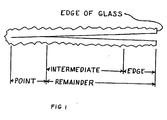
- FIG. 1 shows schematically a crack of the type under consideration. This shows the point portion, the remainder portion, the edge portion, and the intermediate portion. Because of the way windshields are curved and stressed especially in the curved portion of the glass, the crack is much wider at the edge and 95% (a rough estimate) of all cracks over 6" (15 cm) in length will run to the edge. In fact when observed, a crack which proceeds to the edge will make a crackling or clicking sound and can be seen when magnified to open substantially when the crack reaches the edge.
- the point portion terminates in the glass area and is either unsurfaced or very tight.
- the point portion is, in general, that portion which standing alone would fall within the scope of "stone damage” and would be repairable with stone damage art as described previously.
- the impact point will appear in the remainder portion. If the impact point is a bullseye, star or combination, that portion will be repaired by stone damage pressure techniques, such as point pressure injection. Often the impact point will be very small, such as the size of a pin head, and can be ignored.
- the point portion can be filled by sliding surface injection.
- the viscosity of the selected resin is very thin such as 10 - 20 mPa.s it may flow into even a tight surfaced crack.
- an unsurfaced crack may surface and open and a tight surfaced crack may open enough for sliding surface injection of a thin resin. Sliding surface injection is easier than point pressure injection if the right tools are used.
- the remainder portion of the crack is surfaced, and is relatively wider than the point portion presenting sufficient gap that it is repairable by sliding surface injection.
- the remainder portion is typically in that part of the crack which extends from the point portion to the edge of the glass.
- edge portion In a 12 to 18 inch (30-46 cm) crack it would be expected that the edge portion would extend 1 to 6 inches (3 to 15 cm) in length depending on the crack location and configuration.
- the point portion is defined above.
- the intermediate portion has a gap of not unusual width.
- the edge portion is noticeably wider. In some cases there will be little or no intermediate portion; in other cases the edge portion may be of not unusual width. Defining these portions is important to aid the technician in recognizing them so as to analyze the crack and determine the optimal repair procedure. The definitions are also important in order to specify the process.
- any length crack an be repaired As for the length of the crack, in theory any length crack an be repaired.
- the bonding strength of the resin will be sufficient to restore the windshield. But, it has been found that when a crack exceeds 18 inches (46 cm), a different set of problems often appear. Such long cracks are often the result of extension of an older shorter crack. Consequently, such a crack will be dirty, due to its age, and repair is not recommended unless sufficient cleaning of the crack an be ensured, or if it is relatively new and clean. Cleaning can be done by injecting a cleaning solvent into the crack and blowing it out with compressed air.
- the primary factors to be considered in choosing the resins to be used in a crack repair are the immediate and the lasting quality of the repair.
- the immediate quality concern is basically how the repair looks after it is finished, that is that the crack be completely filled with resin leaving no air gaps or bubbles.
- the resin must be in complete contact with the sides and bottom of the crack. There must be no bubbles in the resin itself.
- Overall the goal is to eliminate any refraction surfaces to minimize or eliminate light refraction. As noted above separation can be an immediate quality factor because it can occur as early as during curing or shortly thereafter. This concern is affected by the flow quality of the resin, that is its viscosity, the tools used, and the operators skill.
- the lasting quality concern is that a well executed repair remain so. It has been found that the mechanisms for poor lasting quality can be characterized as separation, deterioration and failure as defined above.
- resins which are known to purchase are: adhesion strength, tensile strength, and viscosity. Resins are also characterized by a manufacturer as being adhesive type or structural adhesive type. It has been determined by the test and examples herein that viscosity can sufficiently define the desired quality of the resin to accomplish effective repairs.
- the appropriate viscosity in terms of immediate quality of repair is relatively easy to ascertain; it is a viscosity such that the resin can be easily inserted, will flow smoothly and readily, will enter the crack readily and will fully fill the crack including the pits and its crevices.
- the point portion will still employ the stone damage techniques of the past, using very thin resins to enable flow into an access passageway such as an impact point or drilled access passageway, or to flow into a tight but surfaced portion.
- the highest viscosity which can be used in the point at room temperature is usually about 80 mPa.s with some difficulty.
- 40 - 60 mPa.s works best for ease of use and 90 - 100 mPa.s can usually only be used in temperatures exceeding 85°F (29°c).
- 40 - 60 mPa.s will hold and will not deteriorate in the point section. Under 40 mPa.s will have separation from the lamination too often.
- 40 - 80 mPa.s is recommended with 40 - 60 mPa.s being the easiest.
- a series of tests were conducted. The test data and results are shown in Table I, and are described below.
- the table records viscosity of resin as specified by manufacturers which is understood to be specified at room temperature. Some of the resins were prepared by mixing other compatible resins to arrive at at desired viscosity. The table also records adhesive strength and tensile strength of resins. Repaired windshields were examined at least three months after repair. The table records the presence or absence of various faults:
- the minimum viscosity that will hold in the remainder portion is 90 to 100 mPa.s. But this viscosity resin results in deterioration.
- a premise of the tests is that a four season climate presents the most problematical circumstance and that failure or deterioration in Southern California implies that failure or deterioration would occur in a four season climate. But, non-failure in Southern California is not indicative of the failure potential in a four season climate. Deterioration observations in Southern California and in a four season climate were consistent.
- Room Temperature is a commonly used reference understood to mean that temperature at which a room will be comfortable for human occupation.
- a temperature between 68°F (20°C) and about 76°F (24°C) is generally the range considered to be room temperature.
- environment below room temperature means about 65°F (18°C) and lower although a lower limit of this range is suggested by a limit of human comfort and adverse effects on the resin. While these are not precise definitions it is important to distinguish the line below room temperature as substantially affecting the viscosity of a resin, such that the manufacturers specified viscosity as at room temperature is no longer applicable and the viscosity increases to the extent that the crack is not properly filled.
- the business of windshield repair must be also considered. This business is operated by entrepreneurs or others whose training and skill is often modest.
- the repair technician typically buys tools and resins from a windshield repair supplier such as Ultra-Bond Inc. of Riverside California.
- the resins are not supplied in fine gradations of viscosity, rather a typical set of resins may contain 4 - 8 different resins.
- a technician must be able to do repairs outside at the customers location. Temperatures lower than room temperature have greater impact on the potential for problems than do temperatures at or higher than room temperature. In other words operations in a four season climate present the greatest potential for problems, both because of the problems presented during the repair and the impact of wide temperature variations after the repair is made.
- viscosity refers to viscosity specified by the manufacturer which is understood to be measured at room temperature. A colder ambient temperature will effect the viscosity, raising it, while a warmer ambient temperature will lower the viscosity. A good rule of thumb is that viscosity will reduce by about 1 ⁇ 2 at about 100°F - 110°F (38-43°C) and the resin should not be heated more than about 115°F(46°C)
- Another variable in methodology is heating the windshield, injector and/or the resins when the ambient temperature is cold. This will enhance flow by reducing the viscosity of the resin temporarily thereby ensuring good crack filling and good adhesion. Enhancing flow is not always desirable, a thick resin not only works better in a wide crack, but fills the crack better than a thin resin. If it is made too thin, it may not fill or stay in the crack prior to curing. This the resin flow characteristics should be such that it can be readily inserted into the crack, will flow into tiny pits and crevices and will stay in place until cured. As noted herein, beyond those flow characteristics, the resistance to deterioration and failure also enter into the choice of resin.
- a minimum of two resins is preferred. For example a 1,000 mPa.s resin at the edge and through the entire remainder portion and a 40 mPa.s resin in the point portion.
- three resins could be used, for example a 4,000 mPa.s resin in the edge portion, a 300 mPa.s resin in the intermediate portion and a 40 mPa.s resin in the point portion.
- many gradations could be used, but as pointed out above practical considerations, skill of the technician, time, type of tool used, and the temperature of the environment in which the repair is conducted urge limiting the number of resins in a particular crack. It is considered that a resin which is not successful in Southern California will not be successful in a four season climate. On the other hand the four season climate presents the greatest challenge.
Landscapes
- Engineering & Computer Science (AREA)
- Mechanical Engineering (AREA)
- Application Of Or Painting With Fluid Materials (AREA)
- Working Measures On Existing Buildindgs (AREA)
- Laminated Bodies (AREA)
- Optical Elements Other Than Lenses (AREA)
- Vehicle Cleaning, Maintenance, Repair, Refitting, And Outriggers (AREA)
- Surface Treatment Of Glass Fibres Or Filaments (AREA)
Claims (9)
- Verfahren zur Reparatur eines Risses in einer Windschutzscheibe, wobei der Riss mehr als 6 Inches (15 cm) lang ist und einen Bereich aufweist, der sich unterhalb der Oberfläche erstreckt oder fest ist und einen Punktbereich bildet, und einen Bereich, der sich bis zur Oberfläche erstreckt oder gegenüber der Außenseite geöffnet ist und einen Restbereich bildet, umfassend:Einführen eines Harzes in den Restbereich, wobei das Harz eine Sollviskosität im Bereich von 150 mPa.s bis 1.000 mPa.s aufweist.
- Verfahren nach Anspruch 1, wobei die Windschutzscheibe vor dem Einführen des Harzes in einer Umgebung mit einer unter 65°F (18°C) liegenden Raumtemperatur platziert wird.
- Verfahren zur Reparatur eines Risses in einer Windschutzscheibe, wobei der Riss länger als 6 Inches (15 cm) ist und einen Bereich aufweist, der sich unterhalb der Oberfläche erstreckt oder fest ist und einen Punktbereich bildet, und einen Bereich, der sich bis zur Oberfläche erstreckt und gegenüber der Außenseite geöffnet ist und einen Restbereich bildet, umfassend:Einführen eines Harzes in den Restbereich, wobei das Harz eine Soliviskosität von zumindest 200 mPa.s und bevorzugterweise von zumindest 300 mPa.s aufweist.
- Verfahren nach Anspruch 3, wobei das in den Restbereich eingeführte Harz eine Sollviskosität von zumindest 500 mPa.s aufweist.
- Verfahren nach Anspruch 3 oder Anspruch 4, wobei das in den Restbereich eingeführte Harz eine Sollviskosität von nicht mehr als 1.000 mPa.s aufweist.
- Verfahren nach einem der Ansprüche 3-5, wobei die Windschutzscheibe vor dem Einführen des Harzes in einer Umgebung mit einer Raumtemperatur von weniger als 65°F (18°C) platziert wird.
- Verfahren nach einem der Ansprüche 1-6, außerdem umfassend das Einführen eines Harzes mit einer Sollviskosität von weniger als 100 mPa.s in den Punktbereich.
- Verfahren zur Reparatur eines Risses in einer Windschutzscheibe, wobei der Riss länger als 6 Inches (15 cm) ist und einen Bereich aufweist, der sich unterhalb der Oberfläche erstreckt oder fest ist und einen Punktbereich bildet, und einen Bereich, der sich bis zur Oberfläche erstreckt und gegenüber der Außenseite geöffnet ist und einen Restbereich bildet, umfassend:Platzieren der Windschutzscheibe in einer Umgebungstemperatur von 68°F (20°C) oder höher,Einführen eines Harzes in den Restbereich, wobei das Harz eine Sollviskosität von mehr als 1.000 mPa.s aufweist.
- Verfahren zur Reparatur eines Risses in einer Windschutzscheibe mit 2 Glasschichten und einer zwischen den zwei Glasschichten befindlichen Kunststoffschicht, wobei jede Glasschicht eine Außenfläche aufweist, die eine Glasfläche bildet, welche eine äußere Oberfläche innerhalb der Außenfläche aufweist und welche zumindest eine Kante aufweist, die an die Glasfläche im Bereich der Außenfläche angrenzt, wobei der Riss sich in einer Schicht erstreckt und länger als 6 Inches (15 cm) ist und ein erstes Ende innerhalb der Glasfläche aufweist sowie ein zweites Ende entweder innerhalb der Glasfläche oder an der Kante des Glases und wobei ein Längenabschnitt des Risses sich bis zur Oberfläche erstreckt oder nach außen offen ist und einen Restbereich bildet und wobei ein Längenabschnitt des Risses sich nicht bis zur Oberfläche erstreckt oder fest ist und einen effektiv unter der Oberfläche bleibenden Bereich bildet, umfassend:Einführen eines ersten Harzes mit einer ausgewählten Viskosität in den effektiv unter der Oberfläche verlaufenden Bereich des Risses;Einführen eines zweiten Harzes mit einer Viskosität, die höher ist als diejenige des ersten Harzes, in den Restbereich des Risses durch schrittweises Injizieren des Harzes entlang dem sich bis zur Oberfläche erstreckenden Längenabschnitt des Risses; undAushärten der Harze.
Priority Applications (1)
| Application Number | Priority Date | Filing Date | Title |
|---|---|---|---|
| EP99125753A EP1033233A3 (de) | 1993-11-19 | 1994-11-14 | Satz zur Reparatur von Glas und Verwendungsverfahren |
Applications Claiming Priority (3)
| Application Number | Priority Date | Filing Date | Title |
|---|---|---|---|
| US08/155,452 US5425827A (en) | 1990-09-10 | 1993-11-19 | Glass repair kit and method of use |
| PCT/US1994/012819 WO1995013922A1 (en) | 1993-11-19 | 1994-11-14 | Glass repair kit and method of use |
| US155452 | 2002-05-23 |
Related Child Applications (1)
| Application Number | Title | Priority Date | Filing Date |
|---|---|---|---|
| EP99125753A Division EP1033233A3 (de) | 1993-11-19 | 1994-11-14 | Satz zur Reparatur von Glas und Verwendungsverfahren |
Publications (3)
| Publication Number | Publication Date |
|---|---|
| EP0729410A1 EP0729410A1 (de) | 1996-09-04 |
| EP0729410A4 EP0729410A4 (de) | 1997-03-05 |
| EP0729410B1 true EP0729410B1 (de) | 2000-07-12 |
Family
ID=22555492
Family Applications (2)
| Application Number | Title | Priority Date | Filing Date |
|---|---|---|---|
| EP95901807A Expired - Lifetime EP0729410B1 (de) | 1993-11-19 | 1994-11-14 | Verfahren zum Reparieren einer Windscheibe unter Gebrauch von Harzen gewählter Viskositäten |
| EP99125753A Withdrawn EP1033233A3 (de) | 1993-11-19 | 1994-11-14 | Satz zur Reparatur von Glas und Verwendungsverfahren |
Family Applications After (1)
| Application Number | Title | Priority Date | Filing Date |
|---|---|---|---|
| EP99125753A Withdrawn EP1033233A3 (de) | 1993-11-19 | 1994-11-14 | Satz zur Reparatur von Glas und Verwendungsverfahren |
Country Status (8)
| Country | Link |
|---|---|
| US (4) | US5425827A (de) |
| EP (2) | EP0729410B1 (de) |
| AT (1) | ATE194547T1 (de) |
| BR (1) | BR9408103A (de) |
| CA (1) | CA2176593A1 (de) |
| DE (1) | DE69425271T2 (de) |
| DK (1) | DK0729410T3 (de) |
| WO (1) | WO1995013922A1 (de) |
Families Citing this family (46)
| Publication number | Priority date | Publication date | Assignee | Title |
|---|---|---|---|---|
| US5512116A (en) * | 1990-09-10 | 1996-04-30 | Campfield; Richard A. | Method of repairing automobile windshield |
| US5425827A (en) * | 1990-09-10 | 1995-06-20 | Ultra Bond Licensing Corp. | Glass repair kit and method of use |
| US5565217A (en) * | 1995-03-16 | 1996-10-15 | Tcg International Inc. | Windshield repair apparatus |
| US5635116A (en) | 1995-06-07 | 1997-06-03 | New Glass, Inc. | Method for repairing cracks in windshields |
| CA2165737A1 (en) * | 1995-12-20 | 1997-06-21 | Ronald J. Shrimpton | Windshield repair tool with pressure |
| US5897882A (en) * | 1996-04-12 | 1999-04-27 | Gonzalez; Juan | Glass repair system |
| US6276741B1 (en) | 1996-05-07 | 2001-08-21 | Edgeguard, Inc. | Method and means for protecting a windshield from cracks |
| US5653497A (en) | 1996-05-07 | 1997-08-05 | Campfield; Richard A. | Method and means for protecting a windshield from cracks and method |
| USD403563S (en) * | 1996-10-02 | 1999-01-05 | Tcg International, Inc. | Windshield repair bridge |
| US5776506A (en) * | 1996-10-02 | 1998-07-07 | Tcg International Inc. | Windshield repair apparatus including crack repair fixture and method |
| US5952012A (en) * | 1996-10-02 | 1999-09-14 | Tcg International Inc. | Windshield repair apparatus including bridge |
| US6139300A (en) * | 1996-10-02 | 2000-10-31 | Tcg International Inc. | Windshield repair apparatus including bridge and injector holder |
| USD398495S (en) | 1996-10-02 | 1998-09-22 | Tcg International Inc. | Windshield crack spreader bar |
| USD398496S (en) | 1996-10-02 | 1998-09-22 | Tcg International Inc. | Slideable crack repair fixture |
| US5954901A (en) * | 1997-03-05 | 1999-09-21 | Henderson; Jack | Windshield repair apparatus and method |
| USD406029S (en) * | 1997-10-01 | 1999-02-23 | Tcg International Inc. | Windshield repair bridge |
| USD407285S (en) | 1998-01-23 | 1999-03-30 | Break Away Systems | Windshield repair apparatus |
| US6338619B1 (en) | 1998-09-15 | 2002-01-15 | Auto Glass Specialists, Inc. | Fixture for window repair |
| USD435211S (en) * | 1998-09-15 | 2000-12-19 | Auto Glass Specialists, Inc. | Leg for a window repair fixture |
| US6190150B1 (en) * | 1998-10-09 | 2001-02-20 | Quick Fix Windshield Repair, Inc. | Windshield repair injector |
| US6170894B1 (en) * | 1999-06-10 | 2001-01-09 | Rhonda Baker | Glass pane lifter apparatus |
| GB2354032B (en) * | 1999-09-11 | 2001-12-12 | Alan Wallis | Alignment apparatus |
| US6485281B1 (en) | 1999-11-22 | 2002-11-26 | Michael J. Curl | Windshield and glass repair device |
| US6663371B2 (en) * | 1999-11-22 | 2003-12-16 | Michael Jeffrey Curl | Windshield and window repair assembly |
| WO2001060616A1 (en) * | 2000-02-17 | 2001-08-23 | Colin Alfred Clulee | Glass repair apparatus |
| US6422849B1 (en) * | 2000-02-24 | 2002-07-23 | Christopher A. Grubb | Windshield crack repair tool |
| USD452124S1 (en) | 2000-03-28 | 2001-12-18 | Tcg International Inc. | Windshield repair bridge |
| US6302670B1 (en) | 2000-03-28 | 2001-10-16 | Tcg International Inc. | Windshield repair apparatus |
| US6561778B2 (en) * | 2001-01-29 | 2003-05-13 | Timothy D. Evans | Automotive windshield repair bridge |
| US6500366B2 (en) * | 2001-01-29 | 2002-12-31 | Timothy D. Evans | Multi-injection head for windshield chip and crack repair |
| GB2387381B (en) * | 2002-03-27 | 2005-08-31 | Ritec Internat Ltd | A method of masking scratches in transparent surfaces |
| US20050087285A1 (en) * | 2003-10-27 | 2005-04-28 | Heien Troy A. | Method and means for facilitating the repair of chipped glass |
| US9963870B2 (en) | 2004-07-01 | 2018-05-08 | Darren E. Merlob | Structural crack repair apparatus and method |
| US20060280824A1 (en) * | 2005-06-09 | 2006-12-14 | Chi-Tsai Chang | Glass repairer |
| DE602005010864D1 (de) * | 2005-09-07 | 2008-12-18 | Luca Toncelli | Bearbeitungsverfahren mit Entsorgung von Spänen aus in Harz eingebundenem Fibermaterial |
| US20080156414A1 (en) * | 2007-01-03 | 2008-07-03 | Richard Campfield | Method and System for Repair of Glass |
| US8268104B1 (en) | 2008-03-24 | 2012-09-18 | Hybrid Windshield Repair, LLC | Methods of using UV curing cationic epoxy for windshield repair |
| US7993121B1 (en) * | 2009-11-19 | 2011-08-09 | Yi-Chang Chan | Windshield repair apparatus |
| US8822961B2 (en) * | 2010-03-04 | 2014-09-02 | Tcg International Inc. | LED curing lamp and method |
| TWM431838U (en) * | 2012-03-02 | 2012-06-21 | Yu-Hong Lin | Glass repairing device |
| US8721311B2 (en) * | 2012-03-21 | 2014-05-13 | Tcg International Inc. | Windshield repair apparatus |
| USD720589S1 (en) | 2012-03-21 | 2015-01-06 | Tcg International Inc. | Windshield repair bridge |
| USD857487S1 (en) * | 2017-05-04 | 2019-08-27 | Dawn Marie Thompson | Post-tensioning concrete repair staple |
| USD898561S1 (en) * | 2018-07-12 | 2020-10-13 | Charlie Pizanias | Adjustable lock down door bar |
| USD891894S1 (en) * | 2020-03-20 | 2020-08-04 | Shenzhen GeLiSiTong Technology Co., Ltd | Windshield repair kit |
| EP4255643A4 (de) * | 2020-12-02 | 2025-04-30 | National Research Council of Canada | Verbessertes vakuumgreifverfahren für raue oberflächen |
Family Cites Families (13)
| Publication number | Priority date | Publication date | Assignee | Title |
|---|---|---|---|---|
| US4047863A (en) * | 1976-03-19 | 1977-09-13 | Glass Medic, Inc. | Apparatus for repair of shatterproof glass |
| US4569808A (en) * | 1985-03-27 | 1986-02-11 | Luigi Smali | Glass repair method and apparatus |
| CA1214612A (en) * | 1985-04-12 | 1986-12-02 | Luigi Smali | Glass repair method and apparatus |
| US4775305A (en) * | 1987-11-16 | 1988-10-04 | Alexander George E | Windshield repair device |
| US4995798A (en) * | 1989-06-30 | 1991-02-26 | Ameter Stephen L | Apparatus for windshield repair |
| US5104304A (en) * | 1990-06-25 | 1992-04-14 | Dotson Jimmy R | Glass repair apparatus |
| US5425827A (en) * | 1990-09-10 | 1995-06-20 | Ultra Bond Licensing Corp. | Glass repair kit and method of use |
| US5116441B1 (en) * | 1990-09-10 | 1993-11-02 | Richard A. Campfield, Jr. | Glass repair kit and method of use |
| US5234325A (en) * | 1992-04-02 | 1993-08-10 | Elgie Hill | Apparatus for windshield glass repair |
| US5328649A (en) * | 1992-10-26 | 1994-07-12 | Newsome Joyce D | Apparatus and method for repairing glass windshield or the like |
| US5565217A (en) * | 1995-03-16 | 1996-10-15 | Tcg International Inc. | Windshield repair apparatus |
| US5643609A (en) * | 1995-08-22 | 1997-07-01 | Jan; Yih-Jang | Windshield repair device |
| US5670180A (en) * | 1996-04-05 | 1997-09-23 | Glas-Weld Systems, Inc. | Laminated glass and windshield repair device |
-
1993
- 1993-11-19 US US08/155,452 patent/US5425827A/en not_active Expired - Lifetime
-
1994
- 1994-11-14 CA CA002176593A patent/CA2176593A1/en not_active Abandoned
- 1994-11-14 AT AT95901807T patent/ATE194547T1/de not_active IP Right Cessation
- 1994-11-14 BR BR9408103A patent/BR9408103A/pt not_active IP Right Cessation
- 1994-11-14 DE DE69425271T patent/DE69425271T2/de not_active Expired - Fee Related
- 1994-11-14 DK DK95901807T patent/DK0729410T3/da active
- 1994-11-14 EP EP95901807A patent/EP0729410B1/de not_active Expired - Lifetime
- 1994-11-14 WO PCT/US1994/012819 patent/WO1995013922A1/en not_active Ceased
- 1994-11-14 EP EP99125753A patent/EP1033233A3/de not_active Withdrawn
-
1995
- 1995-05-08 US US08/436,591 patent/US5589018A/en not_active Expired - Fee Related
- 1995-05-08 US US08/436,155 patent/US5614046A/en not_active Expired - Fee Related
-
1996
- 1996-11-12 US US08/747,239 patent/US6187124B1/en not_active Expired - Fee Related
Also Published As
| Publication number | Publication date |
|---|---|
| US6187124B1 (en) | 2001-02-13 |
| EP1033233A2 (de) | 2000-09-06 |
| EP1033233A3 (de) | 2001-08-01 |
| DE69425271T2 (de) | 2001-02-08 |
| US5614046A (en) | 1997-03-25 |
| CA2176593A1 (en) | 1995-05-26 |
| US5425827A (en) | 1995-06-20 |
| EP0729410A4 (de) | 1997-03-05 |
| US5589018A (en) | 1996-12-31 |
| WO1995013922A1 (en) | 1995-05-26 |
| EP0729410A1 (de) | 1996-09-04 |
| ATE194547T1 (de) | 2000-07-15 |
| DE69425271D1 (de) | 2000-08-17 |
| DK0729410T3 (da) | 2000-11-06 |
| BR9408103A (pt) | 1997-08-05 |
Similar Documents
| Publication | Publication Date | Title |
|---|---|---|
| EP0729410B1 (de) | Verfahren zum Reparieren einer Windscheibe unter Gebrauch von Harzen gewählter Viskositäten | |
| US5512116A (en) | Method of repairing automobile windshield | |
| US5116441A (en) | Glass repair kit and method of use | |
| US20210017807A1 (en) | Manufacture of laminated glazing | |
| US20140322472A1 (en) | Protective laminate films | |
| US20110134385A1 (en) | Method for reworking adhesively bonded liquid crystal displays | |
| US6033507A (en) | Method of repairing glass | |
| US4753695A (en) | Apparatus and a method for repairing a windshield | |
| US5954901A (en) | Windshield repair apparatus and method | |
| NZ276595A (en) | Windscreen repair kit; method for repairing windscreen crack over six inches long using resin or resins of defined viscosity | |
| US5328649A (en) | Apparatus and method for repairing glass windshield or the like | |
| EP1442873B1 (de) | Reparaturverfahren | |
| US8268104B1 (en) | Methods of using UV curing cationic epoxy for windshield repair | |
| AU696328B2 (en) | Glass repair kit and method of use | |
| US5635116A (en) | Method for repairing cracks in windshields | |
| US20080156414A1 (en) | Method and System for Repair of Glass | |
| AU9703398A (en) | Glass repair kit, method of use and a resin injector | |
| US5897725A (en) | Crack patch for repair of windshield long cracks | |
| AU673293B2 (en) | Glass repair | |
| US20210323279A1 (en) | Method for repairing delamination and moisture by heat, pressure and adhesive | |
| EP1612041A1 (de) | Verfahren zur Reparatur von sichtbaren Fehlern in der Oberfläche von Glasscheiben insbesondere in Frontscheiben von Kraftfahrzeugen | |
| US20240198652A1 (en) | Method for repairing delamination and moisture by heat, pressure and adhesive | |
| Abonyi Sylvester | Analysis of windshield repair technology | |
| CA2410130A1 (en) | Multi-injection head for windshield chip and crack repair | |
| JP2000335383A (ja) | 自動車窓ガラスの損傷箇所の補修方法およびその補修用キット |
Legal Events
| Date | Code | Title | Description |
|---|---|---|---|
| PUAI | Public reference made under article 153(3) epc to a published international application that has entered the european phase |
Free format text: ORIGINAL CODE: 0009012 |
|
| 17P | Request for examination filed |
Effective date: 19960619 |
|
| AK | Designated contracting states |
Kind code of ref document: A1 Designated state(s): AT BE CH DE DK ES FR GB GR IE IT LI LU MC NL PT SE |
|
| A4 | Supplementary search report drawn up and despatched |
Effective date: 19970117 |
|
| AK | Designated contracting states |
Kind code of ref document: A4 Designated state(s): AT BE CH DE DK ES FR GB GR IE IT LI LU MC NL PT SE |
|
| 17Q | First examination report despatched |
Effective date: 19971222 |
|
| GRAG | Despatch of communication of intention to grant |
Free format text: ORIGINAL CODE: EPIDOS AGRA |
|
| RTI1 | Title (correction) |
Free format text: METHODS OF REPAIRING A CRACK IN A WINDSHIELD, USING RESINS OF SELECTED VISCOSITIES |
|
| RTI1 | Title (correction) |
Free format text: METHODS OF REPAIRING A CRACK IN A WINDSHIELD, USING RESINS OF SELECTED VISCOSITIES |
|
| GRAG | Despatch of communication of intention to grant |
Free format text: ORIGINAL CODE: EPIDOS AGRA |
|
| GRAG | Despatch of communication of intention to grant |
Free format text: ORIGINAL CODE: EPIDOS AGRA |
|
| GRAH | Despatch of communication of intention to grant a patent |
Free format text: ORIGINAL CODE: EPIDOS IGRA |
|
| GRAH | Despatch of communication of intention to grant a patent |
Free format text: ORIGINAL CODE: EPIDOS IGRA |
|
| GRAA | (expected) grant |
Free format text: ORIGINAL CODE: 0009210 |
|
| AK | Designated contracting states |
Kind code of ref document: B1 Designated state(s): AT BE CH DE DK ES FR GB GR IE IT LI LU MC NL PT SE |
|
| PG25 | Lapsed in a contracting state [announced via postgrant information from national office to epo] |
Ref country code: NL Free format text: LAPSE BECAUSE OF FAILURE TO SUBMIT A TRANSLATION OF THE DESCRIPTION OR TO PAY THE FEE WITHIN THE PRESCRIBED TIME-LIMIT Effective date: 20000712 Ref country code: GR Free format text: LAPSE BECAUSE OF NON-PAYMENT OF DUE FEES Effective date: 20000712 Ref country code: ES Free format text: THE PATENT HAS BEEN ANNULLED BY A DECISION OF A NATIONAL AUTHORITY Effective date: 20000712 Ref country code: BE Free format text: LAPSE BECAUSE OF FAILURE TO SUBMIT A TRANSLATION OF THE DESCRIPTION OR TO PAY THE FEE WITHIN THE PRESCRIBED TIME-LIMIT Effective date: 20000712 |
|
| REF | Corresponds to: |
Ref document number: 194547 Country of ref document: AT Date of ref document: 20000715 Kind code of ref document: T |
|
| REG | Reference to a national code |
Ref country code: CH Ref legal event code: EP |
|
| REG | Reference to a national code |
Ref country code: IE Ref legal event code: FG4D |
|
| REF | Corresponds to: |
Ref document number: 69425271 Country of ref document: DE Date of ref document: 20000817 |
|
| RAP2 | Party data changed (patent owner data changed or rights of a patent transferred) |
Owner name: ULTRA BOND LICENSING CORPORATION |
|
| RIN2 | Information on inventor provided after grant (corrected) |
Free format text: CAMPFIELD, RICHARD A. |
|
| ITF | It: translation for a ep patent filed | ||
| PG25 | Lapsed in a contracting state [announced via postgrant information from national office to epo] |
Ref country code: SE Free format text: LAPSE BECAUSE OF FAILURE TO SUBMIT A TRANSLATION OF THE DESCRIPTION OR TO PAY THE FEE WITHIN THE PRESCRIBED TIME-LIMIT Effective date: 20001012 Ref country code: PT Free format text: LAPSE BECAUSE OF FAILURE TO SUBMIT A TRANSLATION OF THE DESCRIPTION OR TO PAY THE FEE WITHIN THE PRESCRIBED TIME-LIMIT Effective date: 20001012 |
|
| REG | Reference to a national code |
Ref country code: CH Ref legal event code: NV Representative=s name: TROESCH SCHEIDEGGER WERNER AG |
|
| NLT2 | Nl: modifications (of names), taken from the european patent patent bulletin |
Owner name: ULTRA BOND LICENSING CORPORATION |
|
| REG | Reference to a national code |
Ref country code: DK Ref legal event code: T3 |
|
| RIN2 | Information on inventor provided after grant (corrected) |
Free format text: CAMPFIELD, RICHARD A. |
|
| ET | Fr: translation filed | ||
| PG25 | Lapsed in a contracting state [announced via postgrant information from national office to epo] |
Ref country code: LU Free format text: LAPSE BECAUSE OF NON-PAYMENT OF DUE FEES Effective date: 20001114 |
|
| PG25 | Lapsed in a contracting state [announced via postgrant information from national office to epo] |
Ref country code: MC Free format text: THE PATENT HAS BEEN ANNULLED BY A DECISION OF A NATIONAL AUTHORITY Effective date: 20001130 |
|
| NLV1 | Nl: lapsed or annulled due to failure to fulfill the requirements of art. 29p and 29m of the patents act | ||
| PGFP | Annual fee paid to national office [announced via postgrant information from national office to epo] |
Ref country code: CH Payment date: 20010208 Year of fee payment: 7 |
|
| PLBE | No opposition filed within time limit |
Free format text: ORIGINAL CODE: 0009261 |
|
| STAA | Information on the status of an ep patent application or granted ep patent |
Free format text: STATUS: NO OPPOSITION FILED WITHIN TIME LIMIT |
|
| 26N | No opposition filed | ||
| PG25 | Lapsed in a contracting state [announced via postgrant information from national office to epo] |
Ref country code: LI Free format text: LAPSE BECAUSE OF NON-PAYMENT OF DUE FEES Effective date: 20011130 Ref country code: CH Free format text: LAPSE BECAUSE OF NON-PAYMENT OF DUE FEES Effective date: 20011130 |
|
| REG | Reference to a national code |
Ref country code: GB Ref legal event code: IF02 |
|
| REG | Reference to a national code |
Ref country code: CH Ref legal event code: PL |
|
| PGFP | Annual fee paid to national office [announced via postgrant information from national office to epo] |
Ref country code: FR Payment date: 20041122 Year of fee payment: 11 Ref country code: DE Payment date: 20041122 Year of fee payment: 11 Ref country code: AT Payment date: 20041122 Year of fee payment: 11 |
|
| PGFP | Annual fee paid to national office [announced via postgrant information from national office to epo] |
Ref country code: IE Payment date: 20041124 Year of fee payment: 11 |
|
| PGFP | Annual fee paid to national office [announced via postgrant information from national office to epo] |
Ref country code: DK Payment date: 20041127 Year of fee payment: 11 |
|
| PG25 | Lapsed in a contracting state [announced via postgrant information from national office to epo] |
Ref country code: IT Free format text: LAPSE BECAUSE OF NON-PAYMENT OF DUE FEES Effective date: 20051114 Ref country code: IE Free format text: LAPSE BECAUSE OF NON-PAYMENT OF DUE FEES Effective date: 20051114 Ref country code: AT Free format text: LAPSE BECAUSE OF NON-PAYMENT OF DUE FEES Effective date: 20051114 |
|
| PG25 | Lapsed in a contracting state [announced via postgrant information from national office to epo] |
Ref country code: DK Free format text: LAPSE BECAUSE OF NON-PAYMENT OF DUE FEES Effective date: 20051130 |
|
| PG25 | Lapsed in a contracting state [announced via postgrant information from national office to epo] |
Ref country code: DE Free format text: LAPSE BECAUSE OF NON-PAYMENT OF DUE FEES Effective date: 20060601 |
|
| REG | Reference to a national code |
Ref country code: DK Ref legal event code: EBP |
|
| PG25 | Lapsed in a contracting state [announced via postgrant information from national office to epo] |
Ref country code: FR Free format text: LAPSE BECAUSE OF NON-PAYMENT OF DUE FEES Effective date: 20060731 |
|
| REG | Reference to a national code |
Ref country code: IE Ref legal event code: MM4A |
|
| REG | Reference to a national code |
Ref country code: FR Ref legal event code: ST Effective date: 20060731 |
|
| PGFP | Annual fee paid to national office [announced via postgrant information from national office to epo] |
Ref country code: GB Payment date: 20091222 Year of fee payment: 16 |
|
| GBPC | Gb: european patent ceased through non-payment of renewal fee |
Effective date: 20101114 |
|
| PG25 | Lapsed in a contracting state [announced via postgrant information from national office to epo] |
Ref country code: GB Free format text: LAPSE BECAUSE OF NON-PAYMENT OF DUE FEES Effective date: 20101114 |