EP0726266A1 - Indazole compounds and the use thereof as fungicides, insecticides and miticides - Google Patents
Indazole compounds and the use thereof as fungicides, insecticides and miticides Download PDFInfo
- Publication number
- EP0726266A1 EP0726266A1 EP96101596A EP96101596A EP0726266A1 EP 0726266 A1 EP0726266 A1 EP 0726266A1 EP 96101596 A EP96101596 A EP 96101596A EP 96101596 A EP96101596 A EP 96101596A EP 0726266 A1 EP0726266 A1 EP 0726266A1
- Authority
- EP
- European Patent Office
- Prior art keywords
- group
- alkyl
- ring
- phenoxy
- substituents
- Prior art date
- Legal status (The legal status is an assumption and is not a legal conclusion. Google has not performed a legal analysis and makes no representation as to the accuracy of the status listed.)
- Granted
Links
- 239000000417 fungicide Substances 0.000 title claims abstract description 28
- 239000002917 insecticide Substances 0.000 title claims abstract description 28
- 239000000642 acaricide Substances 0.000 title claims abstract description 25
- 125000003453 indazolyl group Chemical class N1N=C(C2=C1C=CC=C2)* 0.000 title 1
- -1 indazole compound Chemical class 0.000 claims abstract description 130
- 125000000951 phenoxy group Chemical group [H]C1=C([H])C([H])=C(O*)C([H])=C1[H] 0.000 claims abstract description 27
- 125000004178 (C1-C4) alkyl group Chemical group 0.000 claims abstract description 21
- 125000004435 hydrogen atom Chemical group [H]* 0.000 claims abstract description 19
- 230000000855 fungicidal effect Effects 0.000 claims abstract description 17
- 125000003545 alkoxy group Chemical group 0.000 claims abstract description 16
- 125000004209 (C1-C8) alkyl group Chemical group 0.000 claims abstract description 14
- 125000004767 (C1-C4) haloalkoxy group Chemical group 0.000 claims abstract description 11
- 125000004414 alkyl thio group Chemical group 0.000 claims abstract description 11
- 125000000000 cycloalkoxy group Chemical group 0.000 claims abstract description 11
- 125000000229 (C1-C4)alkoxy group Chemical group 0.000 claims abstract description 9
- 125000002490 anilino group Chemical group [H]N(*)C1=C([H])C([H])=C([H])C([H])=C1[H] 0.000 claims abstract description 7
- 239000000203 mixture Substances 0.000 claims description 31
- 239000004480 active ingredient Substances 0.000 claims description 27
- 125000005843 halogen group Chemical group 0.000 claims description 25
- 125000001997 phenyl group Chemical group [H]C1=C([H])C([H])=C(*)C([H])=C1[H] 0.000 claims description 25
- 125000001424 substituent group Chemical group 0.000 claims description 22
- 239000000575 pesticide Substances 0.000 claims description 12
- 125000004765 (C1-C4) haloalkyl group Chemical group 0.000 claims description 9
- 125000002252 acyl group Chemical group 0.000 claims description 9
- 150000002473 indoazoles Chemical class 0.000 claims description 9
- YLQBMQCUIZJEEH-UHFFFAOYSA-N Furan Chemical group C=1C=COC=1 YLQBMQCUIZJEEH-UHFFFAOYSA-N 0.000 claims description 8
- 125000000587 piperidin-1-yl group Chemical group [H]C1([H])N(*)C([H])([H])C([H])([H])C([H])([H])C1([H])[H] 0.000 claims description 6
- 125000004453 alkoxycarbonyl group Chemical group 0.000 claims description 5
- 125000002883 imidazolyl group Chemical group 0.000 claims description 5
- 125000004043 oxo group Chemical group O=* 0.000 claims description 5
- 125000002112 pyrrolidino group Chemical group [*]N1C([H])([H])C([H])([H])C([H])([H])C1([H])[H] 0.000 claims description 5
- 125000000168 pyrrolyl group Chemical group 0.000 claims description 5
- 239000002671 adjuvant Substances 0.000 claims description 4
- 125000004093 cyano group Chemical group *C#N 0.000 claims description 4
- 125000000449 nitro group Chemical group [O-][N+](*)=O 0.000 claims description 4
- 239000003905 agrochemical Substances 0.000 claims description 3
- 125000004429 atom Chemical group 0.000 claims description 3
- 125000004184 methoxymethyl group Chemical group [H]C([H])([H])OC([H])([H])* 0.000 claims description 3
- 125000004200 2-methoxyethyl group Chemical group [H]C([H])([H])OC([H])([H])C([H])([H])* 0.000 claims description 2
- 125000003236 benzoyl group Chemical group [H]C1=C([H])C([H])=C(C([H])=C1[H])C(*)=O 0.000 claims description 2
- 125000000524 functional group Chemical group 0.000 claims description 2
- 125000005034 trifluormethylthio group Chemical group FC(S*)(F)F 0.000 claims description 2
- 238000004519 manufacturing process Methods 0.000 claims 2
- 229910052736 halogen Inorganic materials 0.000 abstract 2
- 150000002367 halogens Chemical class 0.000 abstract 2
- 229910052739 hydrogen Inorganic materials 0.000 abstract 2
- 239000001257 hydrogen Substances 0.000 abstract 2
- 150000001875 compounds Chemical class 0.000 description 66
- YXFVVABEGXRONW-UHFFFAOYSA-N Toluene Chemical compound CC1=CC=CC=C1 YXFVVABEGXRONW-UHFFFAOYSA-N 0.000 description 30
- 201000010099 disease Diseases 0.000 description 17
- 208000037265 diseases, disorders, signs and symptoms Diseases 0.000 description 17
- 239000000243 solution Substances 0.000 description 15
- XLYOFNOQVPJJNP-UHFFFAOYSA-N water Substances O XLYOFNOQVPJJNP-UHFFFAOYSA-N 0.000 description 13
- ZMXDDKWLCZADIW-UHFFFAOYSA-N N,N-Dimethylformamide Chemical compound CN(C)C=O ZMXDDKWLCZADIW-UHFFFAOYSA-N 0.000 description 12
- 125000001309 chloro group Chemical group Cl* 0.000 description 12
- FYSNRJHAOHDILO-UHFFFAOYSA-N thionyl chloride Chemical compound ClS(Cl)=O FYSNRJHAOHDILO-UHFFFAOYSA-N 0.000 description 12
- 241000238631 Hexapoda Species 0.000 description 11
- VYPSYNLAJGMNEJ-UHFFFAOYSA-N Silicium dioxide Chemical compound O=[Si]=O VYPSYNLAJGMNEJ-UHFFFAOYSA-N 0.000 description 11
- 238000009472 formulation Methods 0.000 description 11
- 238000000034 method Methods 0.000 description 10
- XEKOWRVHYACXOJ-UHFFFAOYSA-N Ethyl acetate Chemical compound CCOC(C)=O XEKOWRVHYACXOJ-UHFFFAOYSA-N 0.000 description 9
- JUJWROOIHBZHMG-UHFFFAOYSA-N Pyridine Chemical group C1=CC=NC=C1 JUJWROOIHBZHMG-UHFFFAOYSA-N 0.000 description 9
- ZMANZCXQSJIPKH-UHFFFAOYSA-N Triethylamine Chemical compound CCN(CC)CC ZMANZCXQSJIPKH-UHFFFAOYSA-N 0.000 description 9
- 230000000749 insecticidal effect Effects 0.000 description 9
- 241000209094 Oryza Species 0.000 description 8
- CDBYLPFSWZWCQE-UHFFFAOYSA-L Sodium Carbonate Chemical compound [Na+].[Na+].[O-]C([O-])=O CDBYLPFSWZWCQE-UHFFFAOYSA-L 0.000 description 8
- HEDRZPFGACZZDS-MICDWDOJSA-N Trichloro(2H)methane Chemical compound [2H]C(Cl)(Cl)Cl HEDRZPFGACZZDS-MICDWDOJSA-N 0.000 description 8
- 229910052801 chlorine Inorganic materials 0.000 description 8
- 230000001276 controlling effect Effects 0.000 description 8
- 125000001570 methylene group Chemical group [H]C([H])([*:1])[*:2] 0.000 description 8
- 230000003129 miticidal effect Effects 0.000 description 8
- 239000002904 solvent Substances 0.000 description 8
- 241000233866 Fungi Species 0.000 description 7
- 239000003795 chemical substances by application Substances 0.000 description 7
- 125000002496 methyl group Chemical group [H]C([H])([H])* 0.000 description 7
- 238000005507 spraying Methods 0.000 description 7
- 238000011282 treatment Methods 0.000 description 7
- CSCPPACGZOOCGX-UHFFFAOYSA-N Acetone Chemical compound CC(C)=O CSCPPACGZOOCGX-UHFFFAOYSA-N 0.000 description 6
- WKBOTKDWSSQWDR-UHFFFAOYSA-N Bromine atom Chemical group [Br] WKBOTKDWSSQWDR-UHFFFAOYSA-N 0.000 description 6
- IAZDPXIOMUYVGZ-UHFFFAOYSA-N Dimethylsulphoxide Chemical compound CS(C)=O IAZDPXIOMUYVGZ-UHFFFAOYSA-N 0.000 description 6
- FAPWRFPIFSIZLT-UHFFFAOYSA-M Sodium chloride Chemical compound [Na+].[Cl-] FAPWRFPIFSIZLT-UHFFFAOYSA-M 0.000 description 6
- WYURNTSHIVDZCO-UHFFFAOYSA-N Tetrahydrofuran Chemical compound C1CCOC1 WYURNTSHIVDZCO-UHFFFAOYSA-N 0.000 description 6
- 239000000969 carrier Substances 0.000 description 6
- 244000053095 fungal pathogen Species 0.000 description 6
- 238000002360 preparation method Methods 0.000 description 6
- 239000004563 wettable powder Substances 0.000 description 6
- 241000238876 Acari Species 0.000 description 5
- LYCAIKOWRPUZTN-UHFFFAOYSA-N Ethylene glycol Chemical compound OCCO LYCAIKOWRPUZTN-UHFFFAOYSA-N 0.000 description 5
- 241001454293 Tetranychus urticae Species 0.000 description 5
- 125000000217 alkyl group Chemical group 0.000 description 5
- 239000004495 emulsifiable concentrate Substances 0.000 description 5
- 125000000956 methoxy group Chemical group [H]C([H])([H])O* 0.000 description 5
- 238000002156 mixing Methods 0.000 description 5
- 230000003449 preventive effect Effects 0.000 description 5
- 0 **c1c(/C=C(\*)/*=C/C=C2)c2n[n]1* Chemical compound **c1c(/C=C(\*)/*=C/C=C2)c2n[n]1* 0.000 description 4
- 238000005160 1H NMR spectroscopy Methods 0.000 description 4
- ZCYVEMRRCGMTRW-UHFFFAOYSA-N 7553-56-2 Chemical group [I] ZCYVEMRRCGMTRW-UHFFFAOYSA-N 0.000 description 4
- 238000005481 NMR spectroscopy Methods 0.000 description 4
- PMZURENOXWZQFD-UHFFFAOYSA-L Sodium Sulfate Chemical compound [Na+].[Na+].[O-]S([O-])(=O)=O PMZURENOXWZQFD-UHFFFAOYSA-L 0.000 description 4
- 238000004458 analytical method Methods 0.000 description 4
- 239000003945 anionic surfactant Substances 0.000 description 4
- 239000007864 aqueous solution Substances 0.000 description 4
- 125000001495 ethyl group Chemical group [H]C([H])([H])C([H])([H])* 0.000 description 4
- 229910052731 fluorine Inorganic materials 0.000 description 4
- 125000001153 fluoro group Chemical group F* 0.000 description 4
- 229910052740 iodine Inorganic materials 0.000 description 4
- 230000003032 phytopathogenic effect Effects 0.000 description 4
- 125000002924 primary amino group Chemical group [H]N([H])* 0.000 description 4
- 229910000029 sodium carbonate Inorganic materials 0.000 description 4
- 239000007787 solid Substances 0.000 description 4
- 239000004094 surface-active agent Substances 0.000 description 4
- ZWEHNKRNPOVVGH-UHFFFAOYSA-N 2-Butanone Chemical compound CCC(C)=O ZWEHNKRNPOVVGH-UHFFFAOYSA-N 0.000 description 3
- ABRISPFTOZIXMP-UHFFFAOYSA-N 2-methylindazole-3-carboxylic acid Chemical compound C1=CC=CC2=C(C(O)=O)N(C)N=C21 ABRISPFTOZIXMP-UHFFFAOYSA-N 0.000 description 3
- WEVYAHXRMPXWCK-UHFFFAOYSA-N Acetonitrile Chemical compound CC#N WEVYAHXRMPXWCK-UHFFFAOYSA-N 0.000 description 3
- UHOVQNZJYSORNB-UHFFFAOYSA-N Benzene Chemical compound C1=CC=CC=C1 UHOVQNZJYSORNB-UHFFFAOYSA-N 0.000 description 3
- YMWUJEATGCHHMB-UHFFFAOYSA-N Dichloromethane Chemical compound ClCCl YMWUJEATGCHHMB-UHFFFAOYSA-N 0.000 description 3
- OKKJLVBELUTLKV-UHFFFAOYSA-N Methanol Chemical compound OC OKKJLVBELUTLKV-UHFFFAOYSA-N 0.000 description 3
- 241001556089 Nilaparvata lugens Species 0.000 description 3
- CTQNGGLPUBDAKN-UHFFFAOYSA-N O-Xylene Chemical compound CC1=CC=CC=C1C CTQNGGLPUBDAKN-UHFFFAOYSA-N 0.000 description 3
- MUBZPKHOEPUJKR-UHFFFAOYSA-N Oxalic acid Chemical compound OC(=O)C(O)=O MUBZPKHOEPUJKR-UHFFFAOYSA-N 0.000 description 3
- 241000233622 Phytophthora infestans Species 0.000 description 3
- 241000500437 Plutella xylostella Species 0.000 description 3
- KWYUFKZDYYNOTN-UHFFFAOYSA-M Potassium hydroxide Chemical compound [OH-].[K+] KWYUFKZDYYNOTN-UHFFFAOYSA-M 0.000 description 3
- HEMHJVSKTPXQMS-UHFFFAOYSA-M Sodium hydroxide Chemical compound [OH-].[Na+] HEMHJVSKTPXQMS-UHFFFAOYSA-M 0.000 description 3
- 125000002777 acetyl group Chemical group [H]C([H])([H])C(*)=O 0.000 description 3
- 239000002253 acid Substances 0.000 description 3
- 150000001555 benzenes Chemical class 0.000 description 3
- 125000004432 carbon atom Chemical group C* 0.000 description 3
- KRKNYBCHXYNGOX-UHFFFAOYSA-N citric acid Chemical compound OC(=O)CC(O)(C(O)=O)CC(O)=O KRKNYBCHXYNGOX-UHFFFAOYSA-N 0.000 description 3
- 238000004440 column chromatography Methods 0.000 description 3
- 239000000428 dust Substances 0.000 description 3
- 230000000694 effects Effects 0.000 description 3
- 235000013601 eggs Nutrition 0.000 description 3
- 125000001301 ethoxy group Chemical group [H]C([H])([H])C([H])([H])O* 0.000 description 3
- 230000009969 flowable effect Effects 0.000 description 3
- 239000008187 granular material Substances 0.000 description 3
- 239000005457 ice water Substances 0.000 description 3
- RAXXELZNTBOGNW-UHFFFAOYSA-N imidazole Natural products C1=CNC=N1 RAXXELZNTBOGNW-UHFFFAOYSA-N 0.000 description 3
- 125000000959 isobutyl group Chemical group [H]C([H])([H])C([H])(C([H])([H])[H])C([H])([H])* 0.000 description 3
- 125000004108 n-butyl group Chemical group [H]C([H])([H])C([H])([H])C([H])([H])C([H])([H])* 0.000 description 3
- 125000004123 n-propyl group Chemical group [H]C([H])([H])C([H])([H])C([H])([H])* 0.000 description 3
- 239000002736 nonionic surfactant Substances 0.000 description 3
- 230000000361 pesticidal effect Effects 0.000 description 3
- 238000010298 pulverizing process Methods 0.000 description 3
- 238000010992 reflux Methods 0.000 description 3
- 229920006395 saturated elastomer Polymers 0.000 description 3
- 239000000741 silica gel Substances 0.000 description 3
- 229910002027 silica gel Inorganic materials 0.000 description 3
- 239000011780 sodium chloride Substances 0.000 description 3
- 239000002689 soil Substances 0.000 description 3
- 239000007921 spray Substances 0.000 description 3
- 239000000126 substance Substances 0.000 description 3
- 239000008096 xylene Substances 0.000 description 3
- 125000006012 2-chloroethoxy group Chemical group 0.000 description 2
- 125000001340 2-chloroethyl group Chemical group [H]C([H])(Cl)C([H])([H])* 0.000 description 2
- VTYYLEPIZMXCLO-UHFFFAOYSA-L Calcium carbonate Chemical compound [Ca+2].[O-]C([O-])=O VTYYLEPIZMXCLO-UHFFFAOYSA-L 0.000 description 2
- HEDRZPFGACZZDS-UHFFFAOYSA-N Chloroform Chemical compound ClC(Cl)Cl HEDRZPFGACZZDS-UHFFFAOYSA-N 0.000 description 2
- VEXZGXHMUGYJMC-UHFFFAOYSA-N Hydrochloric acid Chemical compound Cl VEXZGXHMUGYJMC-UHFFFAOYSA-N 0.000 description 2
- 235000007688 Lycopersicon esculentum Nutrition 0.000 description 2
- 241001344131 Magnaporthe grisea Species 0.000 description 2
- LRHPLDYGYMQRHN-UHFFFAOYSA-N N-Butanol Chemical compound CCCCO LRHPLDYGYMQRHN-UHFFFAOYSA-N 0.000 description 2
- SECXISVLQFMRJM-UHFFFAOYSA-N N-Methylpyrrolidone Chemical compound CN1CCCC1=O SECXISVLQFMRJM-UHFFFAOYSA-N 0.000 description 2
- 244000046052 Phaseolus vulgaris Species 0.000 description 2
- NBIIXXVUZAFLBC-UHFFFAOYSA-N Phosphoric acid Chemical compound OP(O)(O)=O NBIIXXVUZAFLBC-UHFFFAOYSA-N 0.000 description 2
- 240000003768 Solanum lycopersicum Species 0.000 description 2
- QAOWNCQODCNURD-UHFFFAOYSA-N Sulfuric acid Chemical compound OS(O)(=O)=O QAOWNCQODCNURD-UHFFFAOYSA-N 0.000 description 2
- 150000004945 aromatic hydrocarbons Chemical class 0.000 description 2
- 239000004927 clay Substances 0.000 description 2
- 239000012141 concentrate Substances 0.000 description 2
- 125000003113 cycloheptyloxy group Chemical group C1(CCCCCC1)O* 0.000 description 2
- 125000002933 cyclohexyloxy group Chemical group C1(CCCCC1)O* 0.000 description 2
- 125000001887 cyclopentyloxy group Chemical group C1(CCCC1)O* 0.000 description 2
- 238000011161 development Methods 0.000 description 2
- 230000018109 developmental process Effects 0.000 description 2
- 238000010790 dilution Methods 0.000 description 2
- 239000012895 dilution Substances 0.000 description 2
- 239000002270 dispersing agent Substances 0.000 description 2
- 239000003995 emulsifying agent Substances 0.000 description 2
- 238000003912 environmental pollution Methods 0.000 description 2
- 150000002148 esters Chemical class 0.000 description 2
- 125000004705 ethylthio group Chemical group C(C)S* 0.000 description 2
- 239000011521 glass Substances 0.000 description 2
- 238000003898 horticulture Methods 0.000 description 2
- 125000002887 hydroxy group Chemical group [H]O* 0.000 description 2
- 125000001449 isopropyl group Chemical group [H]C([H])([H])C([H])(*)C([H])([H])[H] 0.000 description 2
- NLYAJNPCOHFWQQ-UHFFFAOYSA-N kaolin Chemical compound O.O.O=[Al]O[Si](=O)O[Si](=O)O[Al]=O NLYAJNPCOHFWQQ-UHFFFAOYSA-N 0.000 description 2
- 150000002576 ketones Chemical class 0.000 description 2
- 239000007788 liquid Substances 0.000 description 2
- 125000002816 methylsulfanyl group Chemical group [H]C([H])([H])S[*] 0.000 description 2
- 125000004708 n-butylthio group Chemical group C(CCC)S* 0.000 description 2
- 125000003506 n-propoxy group Chemical group [H]C([H])([H])C([H])([H])C([H])([H])O* 0.000 description 2
- 125000004706 n-propylthio group Chemical group C(CC)S* 0.000 description 2
- 231100000194 ovacidal Toxicity 0.000 description 2
- 230000003151 ovacidal effect Effects 0.000 description 2
- BWHMMNNQKKPAPP-UHFFFAOYSA-L potassium carbonate Chemical compound [K+].[K+].[O-]C([O-])=O BWHMMNNQKKPAPP-UHFFFAOYSA-L 0.000 description 2
- 230000003389 potentiating effect Effects 0.000 description 2
- 125000002572 propoxy group Chemical group [*]OC([H])([H])C(C([H])([H])[H])([H])[H] 0.000 description 2
- 239000011347 resin Substances 0.000 description 2
- 229920005989 resin Polymers 0.000 description 2
- 150000003839 salts Chemical class 0.000 description 2
- 125000002914 sec-butyl group Chemical group [H]C([H])([H])C([H])([H])C([H])(*)C([H])([H])[H] 0.000 description 2
- 241000894007 species Species 0.000 description 2
- 238000004381 surface treatment Methods 0.000 description 2
- 239000000725 suspension Substances 0.000 description 2
- 229910052623 talc Inorganic materials 0.000 description 2
- 125000000999 tert-butyl group Chemical group [H]C([H])([H])C(*)(C([H])([H])[H])C([H])([H])[H] 0.000 description 2
- 125000002023 trifluoromethyl group Chemical group FC(F)(F)* 0.000 description 2
- KOPFBMUYUCISLR-UHFFFAOYSA-N (6-butylpyridin-3-yl)methanamine Chemical compound CCCCC1=CC=C(CN)C=N1 KOPFBMUYUCISLR-UHFFFAOYSA-N 0.000 description 1
- BJEPYKJPYRNKOW-REOHCLBHSA-N (S)-malic acid Chemical compound OC(=O)[C@@H](O)CC(O)=O BJEPYKJPYRNKOW-REOHCLBHSA-N 0.000 description 1
- RYHBNJHYFVUHQT-UHFFFAOYSA-N 1,4-Dioxane Chemical compound C1COCCO1 RYHBNJHYFVUHQT-UHFFFAOYSA-N 0.000 description 1
- HYZJCKYKOHLVJF-UHFFFAOYSA-N 1H-benzimidazole Chemical compound C1=CC=C2NC=NC2=C1 HYZJCKYKOHLVJF-UHFFFAOYSA-N 0.000 description 1
- BAXOFTOLAUCFNW-UHFFFAOYSA-N 1H-indazole Chemical compound C1=CC=C2C=NNC2=C1 BAXOFTOLAUCFNW-UHFFFAOYSA-N 0.000 description 1
- DITBWPUMEUDVLU-UHFFFAOYSA-N 1h-indazole-3-carboxamide Chemical class C1=CC=C2C(C(=O)N)=NNC2=C1 DITBWPUMEUDVLU-UHFFFAOYSA-N 0.000 description 1
- BHXVYTQDWMQVBI-UHFFFAOYSA-N 1h-indazole-3-carboxylic acid Chemical compound C1=CC=C2C(C(=O)O)=NNC2=C1 BHXVYTQDWMQVBI-UHFFFAOYSA-N 0.000 description 1
- 125000004793 2,2,2-trifluoroethoxy group Chemical group FC(CO*)(F)F 0.000 description 1
- 125000004206 2,2,2-trifluoroethyl group Chemical group [H]C([H])(*)C(F)(F)F 0.000 description 1
- YQTCQNIPQMJNTI-UHFFFAOYSA-N 2,2-dimethylpropan-1-one Chemical group CC(C)(C)[C]=O YQTCQNIPQMJNTI-UHFFFAOYSA-N 0.000 description 1
- 125000004791 2-fluoroethoxy group Chemical group FCCO* 0.000 description 1
- 125000004777 2-fluoroethyl group Chemical group [H]C([H])(F)C([H])([H])* 0.000 description 1
- YPSBZCOIXKHCPH-UHFFFAOYSA-N 5-(aminomethyl)-n-phenylpyridin-2-amine Chemical compound N1=CC(CN)=CC=C1NC1=CC=CC=C1 YPSBZCOIXKHCPH-UHFFFAOYSA-N 0.000 description 1
- 241000256118 Aedes aegypti Species 0.000 description 1
- 239000005995 Aluminium silicate Substances 0.000 description 1
- 241001124076 Aphididae Species 0.000 description 1
- 240000007124 Brassica oleracea Species 0.000 description 1
- 235000003899 Brassica oleracea var acephala Nutrition 0.000 description 1
- 235000011301 Brassica oleracea var capitata Nutrition 0.000 description 1
- 235000001169 Brassica oleracea var oleracea Nutrition 0.000 description 1
- 241001313742 Callosobruchus chinensis Species 0.000 description 1
- 229920002134 Carboxymethyl cellulose Polymers 0.000 description 1
- 241000426499 Chilo Species 0.000 description 1
- 241001489607 Cicadella viridis Species 0.000 description 1
- 241000098289 Cnaphalocrocis medinalis Species 0.000 description 1
- 241000254173 Coleoptera Species 0.000 description 1
- 241000633318 Culex pipiens molestus Species 0.000 description 1
- XDTMQSROBMDMFD-UHFFFAOYSA-N Cyclohexane Chemical compound C1CCCCC1 XDTMQSROBMDMFD-UHFFFAOYSA-N 0.000 description 1
- 241001466044 Delphacidae Species 0.000 description 1
- FEWJPZIEWOKRBE-JCYAYHJZSA-N Dextrotartaric acid Chemical compound OC(=O)[C@H](O)[C@@H](O)C(O)=O FEWJPZIEWOKRBE-JCYAYHJZSA-N 0.000 description 1
- 241000255925 Diptera Species 0.000 description 1
- 241000196324 Embryophyta Species 0.000 description 1
- 241000221787 Erysiphe Species 0.000 description 1
- LFQSCWFLJHTTHZ-UHFFFAOYSA-N Ethanol Chemical compound CCO LFQSCWFLJHTTHZ-UHFFFAOYSA-N 0.000 description 1
- 241000258937 Hemiptera Species 0.000 description 1
- 241000209219 Hordeum Species 0.000 description 1
- 235000007340 Hordeum vulgare Nutrition 0.000 description 1
- 239000005909 Kieselgur Substances 0.000 description 1
- 241001470017 Laodelphax striatella Species 0.000 description 1
- 241000255777 Lepidoptera Species 0.000 description 1
- NTIZESTWPVYFNL-UHFFFAOYSA-N Methyl isobutyl ketone Chemical compound CC(C)CC(C)=O NTIZESTWPVYFNL-UHFFFAOYSA-N 0.000 description 1
- UIHCLUNTQKBZGK-UHFFFAOYSA-N Methyl isobutyl ketone Natural products CCC(C)C(C)=O UIHCLUNTQKBZGK-UHFFFAOYSA-N 0.000 description 1
- 241000257159 Musca domestica Species 0.000 description 1
- 241000721621 Myzus persicae Species 0.000 description 1
- GRYLNZFGIOXLOG-UHFFFAOYSA-N Nitric acid Chemical compound O[N+]([O-])=O GRYLNZFGIOXLOG-UHFFFAOYSA-N 0.000 description 1
- 239000000020 Nitrocellulose Substances 0.000 description 1
- 241000238814 Orthoptera Species 0.000 description 1
- 235000007164 Oryza sativa Nutrition 0.000 description 1
- 241000233679 Peronosporaceae Species 0.000 description 1
- OAICVXFJPJFONN-UHFFFAOYSA-N Phosphorus Chemical compound [P] OAICVXFJPJFONN-UHFFFAOYSA-N 0.000 description 1
- 241000233614 Phytophthora Species 0.000 description 1
- 229920003171 Poly (ethylene oxide) Polymers 0.000 description 1
- 239000004372 Polyvinyl alcohol Substances 0.000 description 1
- XBDQKXXYIPTUBI-UHFFFAOYSA-M Propionate Chemical compound CCC([O-])=O XBDQKXXYIPTUBI-UHFFFAOYSA-M 0.000 description 1
- 241000221300 Puccinia Species 0.000 description 1
- CZPWVGJYEJSRLH-UHFFFAOYSA-N Pyrimidine Chemical compound C1=CN=CN=C1 CZPWVGJYEJSRLH-UHFFFAOYSA-N 0.000 description 1
- DBMJMQXJHONAFJ-UHFFFAOYSA-M Sodium laurylsulphate Chemical compound [Na+].CCCCCCCCCCCCOS([O-])(=O)=O DBMJMQXJHONAFJ-UHFFFAOYSA-M 0.000 description 1
- 241000176086 Sogatella furcifera Species 0.000 description 1
- 229920002472 Starch Polymers 0.000 description 1
- VBIIFPGSPJYLRR-UHFFFAOYSA-M Stearyltrimethylammonium chloride Chemical compound [Cl-].CCCCCCCCCCCCCCCCCC[N+](C)(C)C VBIIFPGSPJYLRR-UHFFFAOYSA-M 0.000 description 1
- FEWJPZIEWOKRBE-UHFFFAOYSA-N Tartaric acid Natural products [H+].[H+].[O-]C(=O)C(O)C(O)C([O-])=O FEWJPZIEWOKRBE-UHFFFAOYSA-N 0.000 description 1
- 241000344246 Tetranychus cinnabarinus Species 0.000 description 1
- 241000209140 Triticum Species 0.000 description 1
- 235000021307 Triticum Nutrition 0.000 description 1
- 241000607479 Yersinia pestis Species 0.000 description 1
- RNIJDMRJIQREKH-UHFFFAOYSA-N [6-(4-methylphenoxy)pyridin-3-yl]methanamine Chemical compound C1=CC(C)=CC=C1OC1=CC=C(CN)C=N1 RNIJDMRJIQREKH-UHFFFAOYSA-N 0.000 description 1
- KXKVLQRXCPHEJC-UHFFFAOYSA-N acetic acid trimethyl ester Natural products COC(C)=O KXKVLQRXCPHEJC-UHFFFAOYSA-N 0.000 description 1
- 230000002411 adverse Effects 0.000 description 1
- 150000001298 alcohols Chemical class 0.000 description 1
- BJEPYKJPYRNKOW-UHFFFAOYSA-N alpha-hydroxysuccinic acid Natural products OC(=O)C(O)CC(O)=O BJEPYKJPYRNKOW-UHFFFAOYSA-N 0.000 description 1
- PNEYBMLMFCGWSK-UHFFFAOYSA-N aluminium oxide Inorganic materials [O-2].[O-2].[O-2].[Al+3].[Al+3] PNEYBMLMFCGWSK-UHFFFAOYSA-N 0.000 description 1
- 229910000147 aluminium phosphate Inorganic materials 0.000 description 1
- 235000012211 aluminium silicate Nutrition 0.000 description 1
- 150000001408 amides Chemical class 0.000 description 1
- 239000002280 amphoteric surfactant Substances 0.000 description 1
- 239000010775 animal oil Substances 0.000 description 1
- 229940053202 antiepileptics carboxamide derivative Drugs 0.000 description 1
- 150000003974 aralkylamines Chemical class 0.000 description 1
- 125000003118 aryl group Chemical group 0.000 description 1
- 239000000440 bentonite Substances 0.000 description 1
- 229910000278 bentonite Inorganic materials 0.000 description 1
- SVPXDRXYRYOSEX-UHFFFAOYSA-N bentoquatam Chemical compound O.O=[Si]=O.O=[Al]O[Al]=O SVPXDRXYRYOSEX-UHFFFAOYSA-N 0.000 description 1
- 150000003939 benzylamines Chemical class 0.000 description 1
- 238000009835 boiling Methods 0.000 description 1
- 125000004106 butoxy group Chemical group [*]OC([H])([H])C([H])([H])C(C([H])([H])[H])([H])[H] 0.000 description 1
- 125000000484 butyl group Chemical group [H]C([*])([H])C([H])([H])C([H])([H])C([H])([H])[H] 0.000 description 1
- 229910000019 calcium carbonate Inorganic materials 0.000 description 1
- DKVNPHBNOWQYFE-UHFFFAOYSA-N carbamodithioic acid Chemical compound NC(S)=S DKVNPHBNOWQYFE-UHFFFAOYSA-N 0.000 description 1
- 229910052799 carbon Inorganic materials 0.000 description 1
- 125000002915 carbonyl group Chemical group [*:2]C([*:1])=O 0.000 description 1
- 239000001768 carboxy methyl cellulose Substances 0.000 description 1
- 235000010948 carboxy methyl cellulose Nutrition 0.000 description 1
- 239000008112 carboxymethyl-cellulose Substances 0.000 description 1
- 239000003093 cationic surfactant Substances 0.000 description 1
- UOCJDOLVGGIYIQ-PBFPGSCMSA-N cefatrizine Chemical group S([C@@H]1[C@@H](C(N1C=1C(O)=O)=O)NC(=O)[C@H](N)C=2C=CC(O)=CC=2)CC=1CSC=1C=NNN=1 UOCJDOLVGGIYIQ-PBFPGSCMSA-N 0.000 description 1
- 235000015165 citric acid Nutrition 0.000 description 1
- 125000004122 cyclic group Chemical group 0.000 description 1
- GUJOJGAPFQRJSV-UHFFFAOYSA-N dialuminum;dioxosilane;oxygen(2-);hydrate Chemical compound O.[O-2].[O-2].[O-2].[Al+3].[Al+3].O=[Si]=O.O=[Si]=O.O=[Si]=O.O=[Si]=O GUJOJGAPFQRJSV-UHFFFAOYSA-N 0.000 description 1
- 235000014113 dietary fatty acids Nutrition 0.000 description 1
- 125000004786 difluoromethoxy group Chemical group [H]C(F)(F)O* 0.000 description 1
- 125000001028 difluoromethyl group Chemical group [H]C(F)(F)* 0.000 description 1
- 239000003085 diluting agent Substances 0.000 description 1
- 239000012990 dithiocarbamate Substances 0.000 description 1
- 235000013399 edible fruits Nutrition 0.000 description 1
- RTZKZFJDLAIYFH-UHFFFAOYSA-N ether Substances CCOCC RTZKZFJDLAIYFH-UHFFFAOYSA-N 0.000 description 1
- 125000003754 ethoxycarbonyl group Chemical group C(=O)(OCC)* 0.000 description 1
- 239000000194 fatty acid Substances 0.000 description 1
- 229930195729 fatty acid Natural products 0.000 description 1
- 150000004665 fatty acids Chemical class 0.000 description 1
- 239000010433 feldspar Substances 0.000 description 1
- 239000003337 fertilizer Substances 0.000 description 1
- 239000010419 fine particle Substances 0.000 description 1
- 239000002316 fumigant Substances 0.000 description 1
- 238000005469 granulation Methods 0.000 description 1
- 230000003179 granulation Effects 0.000 description 1
- 150000008282 halocarbons Chemical class 0.000 description 1
- 230000012447 hatching Effects 0.000 description 1
- 239000004009 herbicide Substances 0.000 description 1
- 150000004677 hydrates Chemical class 0.000 description 1
- WGCNASOHLSPBMP-UHFFFAOYSA-N hydroxyacetaldehyde Natural products OCC=O WGCNASOHLSPBMP-UHFFFAOYSA-N 0.000 description 1
- 238000007654 immersion Methods 0.000 description 1
- 230000000266 injurious effect Effects 0.000 description 1
- JEIPFZHSYJVQDO-UHFFFAOYSA-N iron(III) oxide Inorganic materials O=[Fe]O[Fe]=O JEIPFZHSYJVQDO-UHFFFAOYSA-N 0.000 description 1
- 125000002510 isobutoxy group Chemical group [H]C([H])([H])C([H])(C([H])([H])[H])C([H])([H])O* 0.000 description 1
- 125000005929 isobutyloxycarbonyl group Chemical group [H]C([H])([H])C([H])(C([H])([H])[H])C([H])([H])OC(*)=O 0.000 description 1
- 125000001972 isopentyl group Chemical group [H]C([H])([H])C([H])(C([H])([H])[H])C([H])([H])C([H])([H])* 0.000 description 1
- 125000003253 isopropoxy group Chemical group [H]C([H])([H])C([H])(O*)C([H])([H])[H] 0.000 description 1
- 125000005928 isopropyloxycarbonyl group Chemical group [H]C([H])([H])C([H])(OC(*)=O)C([H])([H])[H] 0.000 description 1
- 239000002949 juvenile hormone Substances 0.000 description 1
- 229910052622 kaolinite Inorganic materials 0.000 description 1
- 229940094506 lauryl betaine Drugs 0.000 description 1
- 239000001630 malic acid Substances 0.000 description 1
- 235000011090 malic acid Nutrition 0.000 description 1
- 238000002844 melting Methods 0.000 description 1
- 230000008018 melting Effects 0.000 description 1
- PFIUFAQBXKLCJZ-UHFFFAOYSA-N methanamine;naphthalene Chemical class NC.C1=CC=CC2=CC=CC=C21 PFIUFAQBXKLCJZ-UHFFFAOYSA-N 0.000 description 1
- 125000001160 methoxycarbonyl group Chemical group [H]C([H])([H])OC(*)=O 0.000 description 1
- 150000007522 mineralic acids Chemical class 0.000 description 1
- 239000012046 mixed solvent Substances 0.000 description 1
- 229910052901 montmorillonite Inorganic materials 0.000 description 1
- AQORQKXXAINOBN-UHFFFAOYSA-N n-[(6-anilinopyridin-3-yl)methyl]-2-methylindazole-3-carboxamide Chemical compound CN1N=C2C=CC=CC2=C1C(=O)NCC(C=N1)=CC=C1NC1=CC=CC=C1 AQORQKXXAINOBN-UHFFFAOYSA-N 0.000 description 1
- DWNVELCCVYSRMJ-UHFFFAOYSA-N n-[(6-butylpyridin-3-yl)methyl]-2-methylindazole-3-carboxamide Chemical compound C1=NC(CCCC)=CC=C1CNC(=O)C1=C2C=CC=CC2=NN1C DWNVELCCVYSRMJ-UHFFFAOYSA-N 0.000 description 1
- 125000006606 n-butoxy group Chemical group 0.000 description 1
- DVEKCXOJTLDBFE-UHFFFAOYSA-N n-dodecyl-n,n-dimethylglycinate Chemical compound CCCCCCCCCCCC[N+](C)(C)CC([O-])=O DVEKCXOJTLDBFE-UHFFFAOYSA-N 0.000 description 1
- 125000003136 n-heptyl group Chemical group [H]C([H])([H])C([H])([H])C([H])([H])C([H])([H])C([H])([H])C([H])([H])C([H])([H])* 0.000 description 1
- 125000001280 n-hexyl group Chemical group C(CCCCC)* 0.000 description 1
- 125000000740 n-pentyl group Chemical group [H]C([H])([H])C([H])([H])C([H])([H])C([H])([H])C([H])([H])* 0.000 description 1
- 229920005615 natural polymer Polymers 0.000 description 1
- 229910017604 nitric acid Inorganic materials 0.000 description 1
- 229920001220 nitrocellulos Polymers 0.000 description 1
- 229910052757 nitrogen Inorganic materials 0.000 description 1
- 125000004433 nitrogen atom Chemical group N* 0.000 description 1
- 239000003921 oil Substances 0.000 description 1
- 235000019198 oils Nutrition 0.000 description 1
- 230000003287 optical effect Effects 0.000 description 1
- 150000007524 organic acids Chemical class 0.000 description 1
- 235000005985 organic acids Nutrition 0.000 description 1
- 235000006408 oxalic acid Nutrition 0.000 description 1
- 229910052698 phosphorus Inorganic materials 0.000 description 1
- 239000011574 phosphorus Substances 0.000 description 1
- XKJCHHZQLQNZHY-UHFFFAOYSA-N phthalimide Chemical compound C1=CC=C2C(=O)NC(=O)C2=C1 XKJCHHZQLQNZHY-UHFFFAOYSA-N 0.000 description 1
- 230000008635 plant growth Effects 0.000 description 1
- 229920003023 plastic Polymers 0.000 description 1
- 239000004033 plastic Substances 0.000 description 1
- 239000002798 polar solvent Substances 0.000 description 1
- 229920000259 polyoxyethylene lauryl ether Polymers 0.000 description 1
- 229920002451 polyvinyl alcohol Polymers 0.000 description 1
- 229910000027 potassium carbonate Inorganic materials 0.000 description 1
- 239000000843 powder Substances 0.000 description 1
- 239000000047 product Substances 0.000 description 1
- 125000001501 propionyl group Chemical group O=C([*])C([H])([H])C([H])([H])[H] 0.000 description 1
- 125000001436 propyl group Chemical group [H]C([*])([H])C([H])([H])C([H])([H])[H] 0.000 description 1
- UMJSCPRVCHMLSP-UHFFFAOYSA-N pyridine Natural products COC1=CC=CN=C1 UMJSCPRVCHMLSP-UHFFFAOYSA-N 0.000 description 1
- 150000003222 pyridines Chemical class 0.000 description 1
- 239000010453 quartz Substances 0.000 description 1
- 230000001105 regulatory effect Effects 0.000 description 1
- 238000011160 research Methods 0.000 description 1
- 235000009566 rice Nutrition 0.000 description 1
- 102200025554 rs730882050 Human genes 0.000 description 1
- 125000005920 sec-butoxy group Chemical group 0.000 description 1
- 125000005930 sec-butyloxycarbonyl group Chemical group [H]C([H])([H])C([H])([H])C([H])(OC(*)=O)C([H])([H])[H] 0.000 description 1
- 239000000377 silicon dioxide Substances 0.000 description 1
- 239000002002 slurry Substances 0.000 description 1
- 235000019333 sodium laurylsulphate Nutrition 0.000 description 1
- 229920005552 sodium lignosulfonate Polymers 0.000 description 1
- 229910052938 sodium sulfate Inorganic materials 0.000 description 1
- 235000011152 sodium sulphate Nutrition 0.000 description 1
- 239000012453 solvate Substances 0.000 description 1
- 238000001228 spectrum Methods 0.000 description 1
- 239000008107 starch Substances 0.000 description 1
- 235000019698 starch Nutrition 0.000 description 1
- 150000003462 sulfoxides Chemical class 0.000 description 1
- 239000003826 tablet Substances 0.000 description 1
- 239000000454 talc Substances 0.000 description 1
- 239000011975 tartaric acid Substances 0.000 description 1
- 235000002906 tartaric acid Nutrition 0.000 description 1
- 235000013616 tea Nutrition 0.000 description 1
- 231100000419 toxicity Toxicity 0.000 description 1
- 230000001988 toxicity Effects 0.000 description 1
- 150000003852 triazoles Chemical class 0.000 description 1
- 125000000876 trifluoromethoxy group Chemical group FC(F)(F)O* 0.000 description 1
- 235000015112 vegetable and seed oil Nutrition 0.000 description 1
- 239000008158 vegetable oil Substances 0.000 description 1
- 235000013311 vegetables Nutrition 0.000 description 1
- 239000002023 wood Substances 0.000 description 1
- 239000000230 xanthan gum Substances 0.000 description 1
- 229920001285 xanthan gum Polymers 0.000 description 1
- 229940082509 xanthan gum Drugs 0.000 description 1
- 235000010493 xanthan gum Nutrition 0.000 description 1
Classifications
-
- C—CHEMISTRY; METALLURGY
- C07—ORGANIC CHEMISTRY
- C07D—HETEROCYCLIC COMPOUNDS
- C07D231/00—Heterocyclic compounds containing 1,2-diazole or hydrogenated 1,2-diazole rings
- C07D231/02—Heterocyclic compounds containing 1,2-diazole or hydrogenated 1,2-diazole rings not condensed with other rings
- C07D231/10—Heterocyclic compounds containing 1,2-diazole or hydrogenated 1,2-diazole rings not condensed with other rings having two or three double bonds between ring members or between ring members and non-ring members
- C07D231/12—Heterocyclic compounds containing 1,2-diazole or hydrogenated 1,2-diazole rings not condensed with other rings having two or three double bonds between ring members or between ring members and non-ring members with only hydrogen atoms, hydrocarbon or substituted hydrocarbon radicals, directly attached to ring carbon atoms
-
- A—HUMAN NECESSITIES
- A01—AGRICULTURE; FORESTRY; ANIMAL HUSBANDRY; HUNTING; TRAPPING; FISHING
- A01N—PRESERVATION OF BODIES OF HUMANS OR ANIMALS OR PLANTS OR PARTS THEREOF; BIOCIDES, e.g. AS DISINFECTANTS, AS PESTICIDES OR AS HERBICIDES; PEST REPELLANTS OR ATTRACTANTS; PLANT GROWTH REGULATORS
- A01N43/00—Biocides, pest repellants or attractants, or plant growth regulators containing heterocyclic compounds
- A01N43/48—Biocides, pest repellants or attractants, or plant growth regulators containing heterocyclic compounds having rings with two nitrogen atoms as the only ring hetero atoms
- A01N43/56—1,2-Diazoles; Hydrogenated 1,2-diazoles
-
- C—CHEMISTRY; METALLURGY
- C07—ORGANIC CHEMISTRY
- C07D—HETEROCYCLIC COMPOUNDS
- C07D233/00—Heterocyclic compounds containing 1,3-diazole or hydrogenated 1,3-diazole rings, not condensed with other rings
- C07D233/54—Heterocyclic compounds containing 1,3-diazole or hydrogenated 1,3-diazole rings, not condensed with other rings having two double bonds between ring members or between ring members and non-ring members
- C07D233/56—Heterocyclic compounds containing 1,3-diazole or hydrogenated 1,3-diazole rings, not condensed with other rings having two double bonds between ring members or between ring members and non-ring members with only hydrogen atoms or radicals containing only hydrogen and carbon atoms, attached to ring carbon atoms
-
- C—CHEMISTRY; METALLURGY
- C07—ORGANIC CHEMISTRY
- C07D—HETEROCYCLIC COMPOUNDS
- C07D249/00—Heterocyclic compounds containing five-membered rings having three nitrogen atoms as the only ring hetero atoms
- C07D249/02—Heterocyclic compounds containing five-membered rings having three nitrogen atoms as the only ring hetero atoms not condensed with other rings
- C07D249/08—1,2,4-Triazoles; Hydrogenated 1,2,4-triazoles
-
- C—CHEMISTRY; METALLURGY
- C07—ORGANIC CHEMISTRY
- C07D—HETEROCYCLIC COMPOUNDS
- C07D401/00—Heterocyclic compounds containing two or more hetero rings, having nitrogen atoms as the only ring hetero atoms, at least one ring being a six-membered ring with only one nitrogen atom
- C07D401/02—Heterocyclic compounds containing two or more hetero rings, having nitrogen atoms as the only ring hetero atoms, at least one ring being a six-membered ring with only one nitrogen atom containing two hetero rings
- C07D401/12—Heterocyclic compounds containing two or more hetero rings, having nitrogen atoms as the only ring hetero atoms, at least one ring being a six-membered ring with only one nitrogen atom containing two hetero rings linked by a chain containing hetero atoms as chain links
-
- C—CHEMISTRY; METALLURGY
- C07—ORGANIC CHEMISTRY
- C07D—HETEROCYCLIC COMPOUNDS
- C07D401/00—Heterocyclic compounds containing two or more hetero rings, having nitrogen atoms as the only ring hetero atoms, at least one ring being a six-membered ring with only one nitrogen atom
- C07D401/14—Heterocyclic compounds containing two or more hetero rings, having nitrogen atoms as the only ring hetero atoms, at least one ring being a six-membered ring with only one nitrogen atom containing three or more hetero rings
-
- C—CHEMISTRY; METALLURGY
- C07—ORGANIC CHEMISTRY
- C07D—HETEROCYCLIC COMPOUNDS
- C07D405/00—Heterocyclic compounds containing both one or more hetero rings having oxygen atoms as the only ring hetero atoms, and one or more rings having nitrogen as the only ring hetero atom
- C07D405/14—Heterocyclic compounds containing both one or more hetero rings having oxygen atoms as the only ring hetero atoms, and one or more rings having nitrogen as the only ring hetero atom containing three or more hetero rings
Definitions
- the present invention relates to a novel indazole compound.
- the present invention further relates to an insecticidal, miticidal, and fungicidal composition for use in agriculture and horticulture which comprises the indazole compound as an active ingredient.
- An object of the present invention is to provide chemical substances which have high controlling activities against various pathogenic fungi and harmful insects that are resistant to ordinary and widely used agricultural and horticultural fungicides, insecticides and miticides and thus are useful as active ingredients of agricultural and horticultural compositions as fungicides and insecticides.
- Another object of the present invention is to provide chemical substances useful as active ingredients of agricultural and horticultural compositions as fungicides and insecticides which have the above features and high safeties due to reduced problems of residual toxicities and environmental pollutions.
- Further object of the present invention from another aspect is to provide novel indazole derivatives having the aforementioned utilities which have 2H-indazole as acid moieties and pyridylmethylamines as amino moieties.
- the inventors of the present invention couducted various researches to achieve the foregoing objects, and as a result, they found that novel indazole compounds represented by the formula set out below have the aforementioned features.
- the present invention was achieved on the basis of the findings.
- the present invention thus provides indazole compounds represented by the following formula (I); and agricultural and horticultural fungicides, insecticides and miticides which comprise said compounds as active ingredients.
- R 1 represents a hydrogen atom, a C 1 -C 4 alkyl group, a C 1 -C 4 alkoxy group, or a halogen atom
- R 2 represents a hydrogen atom, a C 1 -C 4 alkyl group, a C 2 -C 5 alkanoyl group, methoxymethyl group, or 2-methoxy ethyl group
- R 3 represents a hydrogen atom or a C 1 -C 4 alkyl group
- R 4 represents a hydrogen atom, a C 1 -C 8 alkyl group, a C 1 -C 8 alkoxy group, a halogen atom, a C 1 -C 4 haloalkoxy group, a 5-membered to 7-membered cycloalkoxy group which may be substituted, a C 1 -C 4 alkylthio group, a phenylamino group which may be substituted, an N-(C 1 -C 4 alkyl)-
- R 1 may substitute at any position on the phenyl nucleus of the indazole compound.
- Straight- or branched-chain C 1 -C 4 alkyl groups can be used as the C 1 -C 4 alkyl group represented by R 1 , and more specifically, such alkyls as methyl group, ethyl group, n-propyl group, isopropyl group, n-butyl group, isobutyl group, sec-butyl group, and t-butyl group may be used.
- C 1 -C 4 alkoxy group straight- or branched-chain C 1 -C 4 alkoxy groups can be used, and more specifically, such alkoxys as methoxy group, ethoxy group, n-propoxy group, isopropoxy group, n-butoxy group, isobutoxy group, sec-butoxy group, and t-butoxy group may be used.
- the halogen atom represented by R 1 any one of a fluorine atom, a chlorine atom, a bromine atom, or an iodine atom may be used.
- R 1 includes, for example, a hydrogen atom, methyl group, methoxy group, and a chlorine atom.
- R 1 is the alkyl group or the alkoxy group, it is preferred that R 1 substitues at the 7-position of the nucleus of the indazole compound.
- R 1 is a halogen atom, the atom perferably substitutes at the 6- or 7-position of the nucleus of the indazole compound.
- the aforementioned alkyls may be used as the C 1 -C 4 alkyl group represented by R 2 .
- the C 2 -C 5 alkanoyl group straight- or branched-C 2 -C 5 alkanoyl groups can be used, and, for example, acetyl group, propionyl group, n-butyryl group, n-valeryl group, isovaleryl group, 2-methylbutyryl group, and pivaloyl group may be used.
- Preferred R 2 includes, for example, a hydrogen atom, methyl group, ethyl group, methoxymethyl group, and acetyl group. A hydrogen atom is particularly preferred.
- the compounds having hydrogen atoms as R 1 and R 2 are preferred embodiments of the present invention.
- R 3 The above-mentioned alkyls can be used as the C 1 -C 4 alkyl group represented by R 3 .
- Preferred R 3 include, for example, a hydrogen atom and methyl group. A hydrogen atom is particularly preferred.
- the methylene group attached with R 3 and the substituent represented by R 4 may substitute at any position of the pyridine nucleus.
- Preferred compounds are those having the R 3 -substituted methylene group at the 3-position and R 4 at the 6-position of the pyridine ring; those having the R 3 -substituted methylene group at the 2-position and R 4 at the 6-position of the pyridine ring; and those having the R 3 -substituted methylene group at the 4-position and R 4 at the 2-position of the pyridine ring.
- Particularly preferred compounds are those having the R 3 -substituted methylene group at the 3-position and R 4 at the 6-position of the pyridine ring.
- C 1 -C 8 alkyl group represented by R 4 straight- or branched-chain C 1 -C 8 alkyl groups can be used.
- alkyls such as methyl group, ethyl group, n-propyl group, isopropyl group, n-butyl group, isobutyl group, sec-butyl group, t-butyl group, n-amyl group, isoamyl group, t-amyl group, n-hexyl group, 1-ethyl-1-methylpropyl group, n-heptyl group, n-octyl group and 2-ethylhexyl group may preferably used.
- alkoxy groups corresponding to the above C 1 -C 8 alkyl groups may be used. Any one of fluorine atom, chlorine atom, bromine atom, or iodine atom may be used as the halogen atom.
- C 1 -C 4 haloalkoxy group represented by R 4 straight- or branched-chain C 1 -C 4 alkoxy groups that are substituted by one or more halogen atoms selected from fluorine atom, chlorine atom, bromine atom or iodine atom can be used.
- Examples include, for example, monofluoromethoxy group, difluoromethoxy group, trifluoromethoxy group, 2-fluoroethoxy group, 2-chloroethoxy group, 2,2,2-trifluoroethoxy group, 2-chloroethoxy group, 3-chloropropoxy group, 3-bromopropoxy group, 3,3,3-trifluoropropoxy group, 2,2,3,3-tetrafluoropropoxy group, 2,2,3,3,3-pentafluoropropoxy group, 2,2-dichloro-3,3,3-trifluoropropoxy group, 1-trifluoromethylethoxy group, 1,3-difluoro-2-propoxy group, 1,1,1,3,3,3-hexafluoro-2-propoxy group, 4-chlorobutoxy group, 4,4,4-trifluorobutoxy group, 3,3,4,4,4-pentafluorobutoxy group, 2,2,3,3,4,4-hexafluorobutoxy group, 2,2,3,4,4,4-hexa
- 5 to 7-membered cycloalkoxy groups having one or more (preferably one) substituents such as C 1 -C 4 alkyl groups or one 5 to 7-membered condensed aromatic ring, e.g., a condensed benzene ring as well as unsubstituted 5 to 7-membered cycloalkoxy groups can be used.
- cyclopentyloxy group cyclohexyloxy group, cycloheptyloxy group, 2-methylcyclopentyloxy group, 2,4-dimethylcyclopentyloxy group, 2,3,4-trimethylcyclopentyloxy group, 4-methylcyclohexyloxy group, 2,4-dimethylcyclohexyloxy group, 4,4-dimethylcyclohexyloxy group, 1,2,3,4-tetrahydronaphthyl-1-yloxy group, 1,2,3,4-tetrahydronaphthyl-2-yloxy group may be used.
- C 1 -C 4 alkylthio group represented by R 4 straight- or branched-chain C 1 -C 4 alkylthio groups can be used, and more specifically, methylthio group, ethylthio group, n-propylthio group, isopropylthio group, n-butylthio group, isobutylthio group, sec-butylthio group, t-butylthio group and the like may be used.
- the phenyl amino group represented by R 4 may have a C 1 -C 4 alkyl group, preferably a methyl group, on the nitrogen atom, and may have one or more (preferably one) halogen atoms or one or more (preferably one) C 1 -C 4 haloalkyl groups on the benzene nucleus.
- the piperidino group represented by R 4 may have one condensed benzene ring on its nucleus and may form, for example, 1,2,3,4-tetrahydroquinoline-1-yl group or 1,2,3,4-tetrahydroisoquinoline-2-yl group.
- the phenoxy group may have from one to three (preferably two or three) substituents selected from the group consisting of a C 1 -C 8 alkyl group, a C 1 -C 8 alkoxy group, a halogen atom, nitro group, cyano group, a C 1 -C 4 haloalkyl group, a C 1 -C 4 haloalkoxy group, phenyl group, phenoxy group, a C 2 -C 5 alkanoyl group whose oxo group may be protected by a ketal group, benzoyl group, a C 1 -C 4 alkoxycarbonyl group, a C 1 -C 4 alkylthio group, trifluoromethylthio group, and methylenedioxy group.
- the substitutents may be the same or different.
- C 1 -C 8 alkyl group As the substituents on the phenoxy group, C 1 -C 8 alkyl group, the C 1 -C 8 alkoxy group, the halogen atom, and the C 1 -C 8 alkoxy group as described above may be used.
- C 2 -C 5 alkanoyl group those mentioned above may be used.
- those having an oxo group protected by a ketal group, preferably a cyclic ketal group may also be used.
- acetyl group protected by ethyenedioxyketal group or the like may be used.
- C 1 -C 4 haloalkyl group straight- or branched-chain C 1 -C 4 alkyl groups substituted with one or more halogen atoms selected from fluorine atom, chlorine atom, bromine atom, or iodine atom can be used.
- Examples include, for example, monofluoromethyl group, difluoromethyl group, trifluoromethyl group, 2-fluoroethyl group, 2-chloroethyl group, 2,2,2-trifluoroethyl group, 2-chloroethyl group, 3-chloropropyl group, 3-bromopropyl group, 3,3,3-trifluoropropyl group, 2,2,3,3-tetrafluoropropyl group, 2,2,3,3,3-pentafluoropropyl group, 2,2-dichloro-3,3,3-trifluoropropyl group, 1-trifluoromethyl-ethyl group, 1,3-difluoro-2-propyl group, 1,1,1,3,3,3-hexafluoro-2-propyl group, 4-chlorobutyl group, 4,4,4-trifluorobutyl group, 3,3,4,4,4-pentafluorobutyl group, 2,2,3,3,4,4-hexafluoro
- C 1 -C 4 alkoxycarbonyl group carbonyl groups substituted with the above-described C 1 -C 4 alkoxy groups can be used, and more specifically, methoxycarbonyl group, ethoxycarbonyl group, n-propoxycarbonyl group, isopropoxycarbonyl group, n-butoxycarbonyl group, isobutoxycarbonyl group, sec-butoxycarbonyl group, and t-butoxycarbonyl group may be used.
- the above-described C 1 -C 4 alkylthio groups can be used, and more specifically, methylthio group, ethylthio group, n-propylthio group, isopropylthio group, n-butylthio group, isobutylthio group, sec-butylthio group, and t-butylthio group may be used.
- the benzene nucleus of the phenoxy group represented by R 4 may have one condensed benzene ring.
- One or two, preferably one halogen atom, or alternatively, one or two, preferably one C 1 -C 4 alkoxy group may substitute on the condensed benzene ring.
- examples of such groups include, for example, 1-naphthoxy group, 2-naphthoxy group, and 6-bromo-2-naphthoxy group.
- the benzene nucleus of the phenoxy group may further have one condensed saturated furan ring.
- One or two, preferably two C 1 -C 4 alkyl groups may substitute on the furan ring.
- An example of the group is 2,3-dihydro-2,2-dimethyl-benzo[b]furan-7-yl-oxy group.
- R 4 examples include, for example, n-propyl group, n-butyl group, iso-butyl group, n-pentyl group, n-propoxy group, cyclopentyloxy group, cyclohexyloxy group, 3-methylcyclohexyloxy group, cycloheptyloxy group, 2,2,2-trifluoro-1-methylethyloxy group, 3,3,3-trifluoropropyl group, 2,2,3,3-tetrafluoropropyl group, chlorine atom, unsubstituted phenoxy group, 4-methylphenoxy group, 3-methylphenoxy group, 4-ethylphenoxy group, 3-ethylphenoxy group, 3-isopropylphenoxy group, 3-tert-butylphenoxy group, 4-methoxyphenoxy group, 3-methoxyphenoxy group, 3-n-butoxyphenoxy group, 3-trifluoromethyloxyphenoxy group, 3-phenyloxyphenoxy group, 4-chlorophenoxy group,
- indazole derivatives of the present invention have one or two asymmetric carbon atoms in their molecules depending on structures of R 1 through R 4 .
- Any optical isomers derived from one or more such asymmetric carbon atoms and diastereoisomers derived from two or more asymmetric carbon atoms, any mixtures of the foregoing isomers, and racemates fall within the scope of the present invention.
- some of the compounds of the present invention can form acid addition salts with inorganic acids such as hydrochloric acid, sulfuric acid, phosphoric acid, and nitric acid, or organic acids such as oxalic acid, citric acid, tartaric acid, and malic acid. Such acid addition salts also fall within the scope of the present invention.
- any hydrates and solvates also fall within the scope of the invention.
- the compound of the present invention represented by the general formula (I) can be prepared, for example, according to the scheme set out below, which includes the step of reacting a compound of formula (II) with a compound of formula (III) in the presence or absence of a solvent and preferably in the presence of a base.
- R 1 , R 2 , R 3 and R 4 are the same as those defined above, and Z represents a chlorine atom, a bromine atom, hydroxy group, methoxy group, ethoxy group, or propoxy group.
- Z of the compound of general formula (II) is a chlorine atom or bromine atom
- solvents for example, aromatic hydrocarbons such as benzene, toluene, and xylene; ketones such as acetone, methyl ethyl ketone, and methyl isobutyl ketone; halogenated hydrocarbons such as chloroform and methylene chloride; water; esters such as methyl acetate and ethyl acetate; and polar solvents such as tetrahydrofuran, acetonitrile, dioxane, N,N-dimethylformamide, N-methylpyrrolidone and dimethyl sulfoxide may be used.
- aromatic hydrocarbons such as benzene, toluene, and xylene
- ketones such as acetone, methyl ethyl ketone, and methyl isobutyl ketone
- halogenated hydrocarbons such as chloroform and
- the reaction may be carried out at a temperature of from 0 to 30°C, preferably from 0 to 5°C, in the presence of a base.
- a base for example, sodium hydroxide, potassium hydroxide, sodium carbonate, potassium carbonate, pyridine may be used.
- the reaction may be carried out at a temperature of from 150 to 250°C, preferably from 200 to 250°C in the absence of a solvent, or alternatively, using a solvent having a high boiling point, e.g. N,N-dimethylformamide, N-methylpyrrolidone, and dimethyl sulfoxide.
- a solvent having a high boiling point e.g. N,N-dimethylformamide, N-methylpyrrolidone, and dimethyl sulfoxide.
- the compounds represented by general formula (II) can be prepared, for example, according to the method described in Annalen der Chemie, Justus Liebig's, 536, 97, 1938.
- the compounds represented by general formula (III) can be prepared, for example, according to the method described in Journal fuer Praktician Chemie, 146, 95, 1936.
- R 1 :-7-Me represents that CH 3 - as R 1 substitutes on the 7-position of the nucleus of the indazole compound
- R 4 :3-(O-n-Bu)-phenoxy and 4-CF 3 -phenoxy represent phenoxy groups whose benzene rings are substituted with normal butoxy group at the 3-position and trifluoromethyl group at the 4-position as R 4 s, respectively.
- the compounds of the present invention represented by general formula (I) have potent controlling activities against kinds of insects, mites, and pathogenic fungi of agricultural and horticultural plants.
- the compounds of the present invention are useful as active ingredients of agricultural and horticultural pesticides, e.g. agricultural and horticultural fungicides, insecticides, and miticides.
- the compounds of the present invention have potent fungicidal activity against phytopathogenic fungi such as Piricularia (Blast causing fungi); Puccinia (Rust causing fungi); Phytophthora; Erysiphe (Downy mildew causing fungi), and thus are useful as active ingredients of agricultural and horticultural fungicides.
- phytopathogenic fungi such as Piricularia (Blast causing fungi); Puccinia (Rust causing fungi); Phytophthora; Erysiphe (Downy mildew causing fungi), and thus are useful as active ingredients of agricultural and horticultural fungicides.
- the compounds of the present invention have high controlling activities against insects belonging to Hemiptera such as, for example, Delphacidae whose examples including, for example, Sogatella furcifera, Nilaparvata lugens, and Laodelphax striatellus, Deltocephalidae whose examples including, for example, Nephotellix cincticeps and Cicadella viridis, and Aphididae whose examples including, for example, Myzus persicae; Lepidoptera such as, for example, Spodontera lithura, Chilo suppresalis, Cnaphalocrocis medinalis, and Plutella xylostella; Coleoptera such as, for example, Callosobruchus chinensis; Diptera such as, for example, Musca domestica, Aedes aegypti, and Culex pipiens molestus; and Orthoptera.
- Hemiptera such
- the compounds are also useful as active ingredients of agricultural and horticultural insecticides and miticides.
- phytopathogenic fungi, insects, and mites which can be controlled by the compounds of the present invention are not limited to those mentioned above as examples.
- the compounds of the present invention represented by general formula (I) are used as agricultural and horticultural fungicides, insecticides, and/or miticides
- the compounds, per se may be used.
- agricultural and horticultural fungicides, insecticides, and/or miticides in the form of compositions may be used, which can be prepared by using pesticidal adjuvants widely used in the agrochemical art.
- the forms of agricultural and horticultural fungicides, insecticides, and/or miticides are not particularly limited, forms such as emulsifiable concentrates, wettable powder, dust, flowable products, fine particles, granules, tablets, oil solutions, spray liquids, fumigants are preferred.
- One or more of the compounds of the present invention as described above may be formulated as the active ingredient.
- the pesticidal adjuvants for the preparation of the aforementioned agricultural and horticultural fungicides, insecticides, and/or miticides may be used, for example, to improve pesticidal activities and to increase stabilities and dispersabilities of the agricultural and horticultural fungicides, insecticides, and/or miticides.
- carriers diiluents
- spreaders emulsifying agents
- wetting-out agents emulsifying agents
- dispersing agents emulsifying agents
- disintegrating agents may be used.
- liquid carriers examples include, for example, water; aromatic hydrocarbons such as toluene and xylene; alcohols such as methanol, butanol, and glycol; ketones such as acetone; amides such as dimethylformamide; sulfoxides such as dimethylsulfoxide; methylnaphtalene; cyclohexane; animal oils; vegetable oils; and fatty acids.
- solid carriers clay, kaolin, talc, diatomaceous earth, silica, calcium carbonate, montmorillonite, bentonite, feldspar, quartz, alumina, wood shavings, nitrocellulose, starch, and gummi arabiacum may be used.
- emulsifying agents and the dispersing agents ordinary surface active agents may be used.
- anionic surfactants such as, for example, higher alcohol sodium sulfate, stearyl trimethylammonium chloride, polyoxyethylene alkylphenyl ether, and lauryl betaine; cationic surfactants; nonionic surfactants; and amphoteric surfactants may be used.
- Spreaders such as polyoxyethylene nonylphenyl ether and polyoxyethylene lauryl ether; wetting-out agents such as polyoxyethylene nonylphenyl ether and dialkylsulfosuccinate; fixing agents such as carboxymethyl cellulose and polyvinyl alcohol; and disintegrating agents such as sodium lignosulfonate and sodium lauryl sulfate may also be used.
- compositions of the active ingredients of the agricultural and horticultural fungicides, insecticides, and/or miticides of the present invention can generally be chosen between the range of from 0.1 to 99.5 % by weight, which may be appropriately determined depending on various factors such as the forms of the compositions and methods of applications.
- the compositions may be prepared so as to contain the active ingredient at about 0.5 to 20% by weight, preferably 1 to 10% by weight for dusts; about 1 to 90% by weight, preferably 10 to 80% by weight for wettable powders; and about 1 to 90% by weight, preferably 10 to 40% by weight for emulsifiable concentrates.
- neat stock concentrates can be prepared by mixing solvents, surfactants and the like to the aforementioned compounds as the active ingredients, and the resulting neat concentrates can be diluted with water to prescribed concentrations before use and then applied.
- neat stock compositions can be prepared as the mixture of the aforementioned compounds as the active ingredients, solid carriers, surfactant and the like, and the resulting stock compositions can be diluted to prescribed concentrations before use and then applied.
- Dusts may be prepared by mixing the above compounds as the active ingredients with solid carriers and the like, and the resulting mixture, per se, may be applied.
- Granules can be prepared by granulations of mixutures of the above compounds as active ingredients, solid carriers, surfactant and the like, and the resulting compositions, per se, may be applied. Methods for preparations of the compositions in the aforementioned forms are not limited to those set out above, and the processes may appropriately be chosen by ordinary artisens depending on, for example, the types of the active ingredients and the purposes of applications.
- Agricultural and horticultural fungicides, insecticides, and/or miticides of the present invention may optionally contain, in addition to the compounds of the present invention as the active ingredients, other active ingredients such as, for example, other fungicides, insecticides, miticides, herbicides, insect growth regulators, fertilizers, soil conditioners.
- Methods of applications agricultural and horticultural fungicides, insecticides and/or miticides of the present invention are not particularly limited. Any routs of applications may be used, which include, for example, foliar sprays, water surface treatments, soil treatments, and seed treatments.
- solutions at concentrations of from 5 to 1,000 ppm, preferably from 10 to 500 ppm may be applied at amounts of from 100 to 200 liters/10a.
- Application amounts for water surface treatments are generally 1 to 10 kg/10a using granules containing 5 to 15% by weight of the active ingredients.
- solutions at concentrations of from 5 to 1,000 ppm may be applied at amounts of from 1 to 10 liter/m 2 .
- solutions at concentrations of from 10 to 1,000 ppm may be applied at amounts of from 10 to 100 ml per 1 kg of seeds.
- the toluene layer was successively washed with an aqueous solution of sodium carbonate, water, and saturated aqueous sodium chloride. After dryness over anhydrous sodium sulfate, the solvent was evaporated under reduced pressure. The residue was purified column chromatography on silica gel to afford the titled compound (5.86 g) shown in Table 2 as No.A.
- Table 2 The compounds listed in Table 2 were obtained according to the methods of Examples 1-3.
- A, B, and C series of compounds are as set out below, and physicochemical properties except melting points are refractive indexes (n 24 D , with asterisks).
- the abbreviations in the table are the same as those used in Table 1.
- a wettable powder containing 20% by weight of the active ingredient was prepared by uniformly mixing and pulverizing 20 parts by weight of the compound of the present invention, 20 parts by weight of Carplex #80 (trademark, white carbon, Shionogi & Co., Ltd.), 52 parts by weight of ST Kaolin Clay (trademark, kaolinite, Tsuchiya Kaolin Co., Ltd.), 5 parts by weight of Sorpol 9047K (trademark, anionic surfactant, Toho Kagaku Co., Ltd.) and 3 parts by weight of Runox P65L (trademark, anionic surfactant, Toho Kagaku Co., Ltd.).
- a dust containing 2% by weight of the active ingredient was prepared by uniformly mixing and pulverizing 2 parts by weight of a compound of the present invention, 93 parts by weight of clay (Nippon Talc Co., Ltd.) and 5 parts by weight of Carplex #80 (trademark, white carbon, Shionogi & Co., Ltd.).
- An emulsifiable concentrate containing 20% by weight of the active ingredient was prepared by dissolving 20 parts by weight of a compound of the present invention in a mixed solvent consisting of 35 parts by weight of xylene and 30 parts by weight of dimethylformamide, and adding 15 parts by weight of Sorpol 3005X (trademark, the mixture of non-ionic surfactant and anionic surfactant, Toho Kagaku Co., Ltd.) to the resulting solution.
- Sorpol 3005X trademark, the mixture of non-ionic surfactant and anionic surfactant, Toho Kagaku Co., Ltd.
- a flowable agent containing 20% by weight of the active ingredient was prepared by pulverizing 30 parts by weight of the compound of the present invention, 5 parts by weight of Sorpol 9047K, 3 parts by weight of Solbon T-20 (trademark, non-ionic surfactant, Toho Kagaku Co., Ltd.), 8 parts by weight of ethylene glycol, and 44 parts by weight of water in the DYNO-Mill (Shinmaru Enterprises Co., Ltd.) in wet process, adding 10 parts by weight of 1% aqueous solution of xanthan gum (natural polymer) to the resulting slurry mixture, and then mixing and dispersing the resulting mixuture sufficiently.
- Seedlings of rice plant were placed in a glass cylinder with 3 cm inner diameter and 17 cm height, and then, five larvae of four instar were put into the cylinder.
- Aqueous dilution (0.5 ml) of the agricultural and horticultural insecticide of the present invention prepared according to Formulation Example 3 was sprayed into the above glass cylinder (one concentration, two replicates) using a spraying tower (manufactured by Mizuho Rika, Co., Ltd.).
- Five days after the treatment, death and agony of the larvae were examined and the mortality (%) was calculated by counting one agonizing larva as being 1/2 death.
- the results are shown in Table 3 (Compound numbers in the table correspond to those described in Table 2.).
- the agricultural and horticultural fungicide (wettable powder) of the present invention prepared according to Formulation Example 1 was diluted with water upto the prescribed concentration, and then applied by foliage spraying onto the rice plants (3- to 4-leaf stages) in the amount of 10 ml per pot. After the sprayed solution was air-dried, a suspension of zoosporangiums (5.0 ⁇ 10 4 zoosporangiums/ml) obtained from the culture of Phytophthora infestans on sliced tomato leaves was inoculated onto the rice plants by spraying, and then the pots were kept in a moist chamber at 25 °C for 24 hours. Then, the pots were left for 4 days in a greenhouse (22 to 25 °C). The numbers of appeared disease spots in the leaves were measured and represented by disease indexes, and the preventive value was calculated from the following equation. The results are shown in Table 6.
- the indazole compounds of the present invention have extremely high controlling effects against various types of phytopathogenic fungi, harmful insects, and mites, and thus, they are useful as active ingredients of agricultural and horticultural fungicides, insecticides, and miticides.
Landscapes
- Chemical & Material Sciences (AREA)
- Organic Chemistry (AREA)
- Life Sciences & Earth Sciences (AREA)
- Dentistry (AREA)
- Pest Control & Pesticides (AREA)
- Plant Pathology (AREA)
- Health & Medical Sciences (AREA)
- Engineering & Computer Science (AREA)
- Agronomy & Crop Science (AREA)
- General Health & Medical Sciences (AREA)
- Wood Science & Technology (AREA)
- Zoology (AREA)
- Environmental Sciences (AREA)
- Plural Heterocyclic Compounds (AREA)
- Agricultural Chemicals And Associated Chemicals (AREA)
- Pharmaceuticals Containing Other Organic And Inorganic Compounds (AREA)
Abstract
Description
- The present invention relates to a novel indazole compound. The present invention further relates to an insecticidal, miticidal, and fungicidal composition for use in agriculture and horticulture which comprises the indazole compound as an active ingredient.
- In the field of agriculture and horticulture, various fungicides and insecticides have been developed and practically used so far today for the purpose of controlling numbers of crop diseases and insect pests. However, agricultural and horticultural fungicides and insecticides ordinarily and widely used are not always satisfactory from viewpoints of fungicidal and insecticidal activities, fungicidal and insecticidal spectra, and safeties such as residual activities. In addition, they fail to meet requiements of reducing application frequencies and amounts.
- The appearance of phytopathogenic fungi and injurious insects which have aquired resistance to ordinary and widely used pesticides also raises a problem. For example, in the cultivations of vegetables, fruit trees, flowers, teas, barleys, wheats, rice and the like, numbers of pathogenic fungi and harmful insects appeared in various parts of the world, which have acquired resistance to various types of pesticides such as triazole type, imidazole type, pyrimidine type, benzimidazole type, dicarboxyimido type, phenylamido type, and organic phosphorus type. Thus, from year to year, it becomes more difficult to control these pathogenic fungi and harmful insects.
- There still remain several pesticides, e.g. dithiocarbamate type and phthalimide type pesticids, to which pathogenic fungi or harmful insects have not yet acquired resistance. However, these pesticides are not preferred in view of environmental pollutions due to their generally high application amounts and frequencies. Accordingly, developments of novel fungicides and insecticides are highly desired which have satisfactory controlling activities, at low application amounts, against various pathogenic fungi or harmful insects that have acquired resistances to ordinary and widely used agricultural and horticultural fungicides and insecticides, and also have reduced adverse effects on environment. Furthermore, as regards miticides, developments of miticides are desired which have high safety and excellent controlling effect against mites that have acquired resistances to conventional miticides.
- United States Patent No. 3,457,269; German Patents Nos. 2,015,568 and 2,135,398; United States Patents Nos. 3,647,819, 3,678,059, 3,681,382 and 3,711,610; Japanese Patent Unexamined Publication (KOKAI) No. 81858/1973; and Magy. Kem. Lapja., 30, 208, 1975 disclose indazole derivatives having pharmaceutical activities. However, all of these compounds are 1H-deviratives, and none of these documents teaches or suggests that the disclosed indazole derivatives have insecticidal, miticidal or fungicidal activities.
- Japanese Patent Unexamined Publication (KOKAI) No.207208/1989 discloses that esters of 1H-indazole-3-carboxylic acid and carboxamide derivatives (lower-alkylamines as amino moieties) have plant growth regulating activity. However, this publication neither teach nor suggest insecticidal, miticidal or fungicidal activity of the compounds.
- In addition, International Publication WO 94/5642 discloses 2H-indazole-3-carboxamides compounds and their insecticidal, miticidal or fungicidal activity. These compounds are characterized to have aralkylamines as amino moieties. More specifically, this documents merely exemplifies benzylamines and naphthalene methylamines which may be substituted. Accordingly, this publication neither teach nor suggest compounds having heteroaralkylamines as amino moieties as well as processes for preparation and insecticidal, miticidal and fungicidal activities of the compounds.
- An object of the present invention is to provide chemical substances which have high controlling activities against various pathogenic fungi and harmful insects that are resistant to ordinary and widely used agricultural and horticultural fungicides, insecticides and miticides and thus are useful as active ingredients of agricultural and horticultural compositions as fungicides and insecticides. Another object of the present invention is to provide chemical substances useful as active ingredients of agricultural and horticultural compositions as fungicides and insecticides which have the above features and high safeties due to reduced problems of residual toxicities and environmental pollutions. Further object of the present invention from another aspect is to provide novel indazole derivatives having the aforementioned utilities which have 2H-indazole as acid moieties and pyridylmethylamines as amino moieties.
- The inventors of the present invention couducted various researches to achieve the foregoing objects, and as a result, they found that novel indazole compounds represented by the formula set out below have the aforementioned features. The present invention was achieved on the basis of the findings. The present invention thus provides indazole compounds represented by the following formula (I);

- In the above formula, R1 represents a hydrogen atom, a C1-C4 alkyl group, a C1-C4 alkoxy group, or a halogen atom; R2 represents a hydrogen atom, a C1-C4 alkyl group, a C2-C5 alkanoyl group, methoxymethyl group, or 2-methoxy ethyl group; R3 represents a hydrogen atom or a C1-C4 alkyl group; R4 represents a hydrogen atom, a C1-C8 alkyl group, a C1-C8 alkoxy group, a halogen atom, a C1-C4 haloalkoxy group, a 5-membered to 7-membered cycloalkoxy group which may be substituted, a C1-C4 alkylthio group, a phenylamino group which may be substituted, an N-(C1-C4 alkyl)-phenylamino group, pyrrolyl group, imidazolyl group, pyrrolidino group, a piperidino group which may be substituted, or a phenoxy group which may be substituted (where a functional group selected from the group consisting of cycloalkoxy, phenylamino, piperidino, and phenoxy has two or more substituents on its nucleus, any two adjacent substituents among said substituents may form a ring structure together with two atoms on the nucleus to which the adjacent substituents bind, and said ring strucuture may further has one or more substitutents on the ring.).
- In the general formula (I), R1 may substitute at any position on the phenyl nucleus of the indazole compound. Straight- or branched-chain C1-C4 alkyl groups can be used as the C1 -C4 alkyl group represented by R1, and more specifically, such alkyls as methyl group, ethyl group, n-propyl group, isopropyl group, n-butyl group, isobutyl group, sec-butyl group, and t-butyl group may be used. As the C1-C4 alkoxy group, straight- or branched-chain C1-C4 alkoxy groups can be used, and more specifically, such alkoxys as methoxy group, ethoxy group, n-propoxy group, isopropoxy group, n-butoxy group, isobutoxy group, sec-butoxy group, and t-butoxy group may be used. As the halogen atom represented by R1, any one of a fluorine atom, a chlorine atom, a bromine atom, or an iodine atom may be used. Preferably used R1 includes, for example, a hydrogen atom, methyl group, methoxy group, and a chlorine atom. Where R1 is the alkyl group or the alkoxy group, it is preferred that R1 substitues at the 7-position of the nucleus of the indazole compound. Where R1 is a halogen atom, the atom perferably substitutes at the 6- or 7-position of the nucleus of the indazole compound.
- The aforementioned alkyls may be used as the C1-C4 alkyl group represented by R2. As the C2-C5 alkanoyl group, straight- or branched-C2-C5 alkanoyl groups can be used, and, for example, acetyl group, propionyl group, n-butyryl group, n-valeryl group, isovaleryl group, 2-methylbutyryl group, and pivaloyl group may be used. Preferred R2 includes, for example, a hydrogen atom, methyl group, ethyl group, methoxymethyl group, and acetyl group. A hydrogen atom is particularly preferred. The compounds having hydrogen atoms as R1 and R2are preferred embodiments of the present invention.
- The above-mentioned alkyls can be used as the C1-C4 alkyl group represented by R3. Preferred R3 include, for example, a hydrogen atom and methyl group. A hydrogen atom is particularly preferred. In the general formula (I), the methylene group attached with R3 and the substituent represented by R4 may substitute at any position of the pyridine nucleus. Preferred compounds are those having the R3-substituted methylene group at the 3-position and R4 at the 6-position of the pyridine ring; those having the R3-substituted methylene group at the 2-position and R4 at the 6-position of the pyridine ring; and those having the R3-substituted methylene group at the 4-position and R4 at the 2-position of the pyridine ring. Particularly preferred compounds are those having the R3-substituted methylene group at the 3-position and R4 at the 6-position of the pyridine ring.
- As the C1-C8 alkyl group represented by R4, straight- or branched-chain C1-C8 alkyl groups can be used. For example, alkyls such as methyl group, ethyl group, n-propyl group, isopropyl group, n-butyl group, isobutyl group, sec-butyl group, t-butyl group, n-amyl group, isoamyl group, t-amyl group, n-hexyl group, 1-ethyl-1-methylpropyl group, n-heptyl group, n-octyl group and 2-ethylhexyl group may preferably used. As the C1-C8 alkoxy group represented by R4, alkoxy groups corresponding to the above C1-C8 alkyl groups may be used. Any one of fluorine atom, chlorine atom, bromine atom, or iodine atom may be used as the halogen atom.
- As the C1-C4 haloalkoxy group represented by R4, straight- or branched-chain C1-C4 alkoxy groups that are substituted by one or more halogen atoms selected from fluorine atom, chlorine atom, bromine atom or iodine atom can be used. Examples include, for example, monofluoromethoxy group, difluoromethoxy group, trifluoromethoxy group, 2-fluoroethoxy group, 2-chloroethoxy group, 2,2,2-trifluoroethoxy group, 2-chloroethoxy group, 3-chloropropoxy group, 3-bromopropoxy group, 3,3,3-trifluoropropoxy group, 2,2,3,3-tetrafluoropropoxy group, 2,2,3,3,3-pentafluoropropoxy group, 2,2-dichloro-3,3,3-trifluoropropoxy group, 1-trifluoromethylethoxy group, 1,3-difluoro-2-propoxy group, 1,1,1,3,3,3-hexafluoro-2-propoxy group, 4-chlorobutoxy group, 4,4,4-trifluorobutoxy group, 3,3,4,4,4-pentafluorobutoxy group, 2,2,3,3,4,4-hexafluorobutoxy group, 2,2,3,4,4,4-hexafluorobutoxy group, 2,2,3,3,4,4,4-heptafluorobutoxy group, 1-trifluoromethylpropoxy group, 1,1,1,2,2-pentafluoro-3-butoxy group.
- As the 5-membered to 7-membered cycloalkoxy group represented by R4, 5 to 7-membered cycloalkoxy groups having one or more (preferably one) substituents such as C1-C4 alkyl groups or one 5 to 7-membered condensed aromatic ring, e.g., a condensed benzene ring as well as unsubstituted 5 to 7-membered cycloalkoxy groups can be used. For example, cyclopentyloxy group, cyclohexyloxy group, cycloheptyloxy group, 2-methylcyclopentyloxy group, 2,4-dimethylcyclopentyloxy group, 2,3,4-trimethylcyclopentyloxy group, 4-methylcyclohexyloxy group, 2,4-dimethylcyclohexyloxy group, 4,4-dimethylcyclohexyloxy group, 1,2,3,4-tetrahydronaphthyl-1-yloxy group, 1,2,3,4-tetrahydronaphthyl-2-yloxy group may be used.
- As the C1-C4 alkylthio group represented by R4, straight- or branched-chain C1-C4 alkylthio groups can be used, and more specifically, methylthio group, ethylthio group, n-propylthio group, isopropylthio group, n-butylthio group, isobutylthio group, sec-butylthio group, t-butylthio group and the like may be used. The phenyl amino group represented by R4 may have a C1-C4 alkyl group, preferably a methyl group, on the nitrogen atom, and may have one or more (preferably one) halogen atoms or one or more (preferably one) C1-C4 haloalkyl groups on the benzene nucleus. The piperidino group represented by R4 may have one condensed benzene ring on its nucleus and may form, for example, 1,2,3,4-tetrahydroquinoline-1-yl group or 1,2,3,4-tetrahydroisoquinoline-2-yl group.
- When R4 is a phenoxy group, the phenoxy group may have from one to three (preferably two or three) substituents selected from the group consisting of a C1-C8 alkyl group, a C1-C8 alkoxy group, a halogen atom, nitro group, cyano group, a C1-C4 haloalkyl group, a C1-C4 haloalkoxy group, phenyl group, phenoxy group, a C2-C5 alkanoyl group whose oxo group may be protected by a ketal group, benzoyl group, a C1-C4 alkoxycarbonyl group, a C1-C4 alkylthio group, trifluoromethylthio group, and methylenedioxy group. Where the phenoxy group has two or three substituents, the substitutents may be the same or different.
- As the substituents on the phenoxy group, C1-C8 alkyl group, the C1-C8 alkoxy group, the halogen atom, and the C1-C8 alkoxy group as described above may be used. As the C2-C5 alkanoyl group, those mentioned above may be used. In addition, those having an oxo group protected by a ketal group, preferably a cyclic ketal group, may also be used. For example, acetyl group protected by ethyenedioxyketal group or the like may be used.
- As the C1-C4 haloalkyl group, straight- or branched-chain C1-C4 alkyl groups substituted with one or more halogen atoms selected from fluorine atom, chlorine atom, bromine atom, or iodine atom can be used. Examples include, for example, monofluoromethyl group, difluoromethyl group, trifluoromethyl group, 2-fluoroethyl group, 2-chloroethyl group, 2,2,2-trifluoroethyl group, 2-chloroethyl group, 3-chloropropyl group, 3-bromopropyl group, 3,3,3-trifluoropropyl group, 2,2,3,3-tetrafluoropropyl group, 2,2,3,3,3-pentafluoropropyl group, 2,2-dichloro-3,3,3-trifluoropropyl group, 1-trifluoromethyl-ethyl group, 1,3-difluoro-2-propyl group, 1,1,1,3,3,3-hexafluoro-2-propyl group, 4-chlorobutyl group, 4,4,4-trifluorobutyl group, 3,3,4,4,4-pentafluorobutyl group, 2,2,3,3,4,4-hexafluorobutyl group, 2,2,3,4,4,4-hexafluorobutyl group, 2,2,3,3,4,4,4-heptafluorobutyl group, 1-trifluoromethylpropyl group, and 1,1,1,2,2-pentafluoro-3-butyl group.
- As the C1-C4 alkoxycarbonyl group, carbonyl groups substituted with the above-described C1-C4 alkoxy groups can be used, and more specifically, methoxycarbonyl group, ethoxycarbonyl group, n-propoxycarbonyl group, isopropoxycarbonyl group, n-butoxycarbonyl group, isobutoxycarbonyl group, sec-butoxycarbonyl group, and t-butoxycarbonyl group may be used. As the C1-C4 alkylthio group, the above-described C1-C4 alkylthio groups can be used, and more specifically, methylthio group, ethylthio group, n-propylthio group, isopropylthio group, n-butylthio group, isobutylthio group, sec-butylthio group, and t-butylthio group may be used.
- The benzene nucleus of the phenoxy group represented by R4 may have one condensed benzene ring. One or two, preferably one halogen atom, or alternatively, one or two, preferably one C1-C4 alkoxy group may substitute on the condensed benzene ring. Examples of such groups include, for example, 1-naphthoxy group, 2-naphthoxy group, and 6-bromo-2-naphthoxy group. In addition, the benzene nucleus of the phenoxy group may further have one condensed saturated furan ring. One or two, preferably two C1-C4 alkyl groups may substitute on the furan ring. An example of the group is 2,3-dihydro-2,2-dimethyl-benzo[b]furan-7-yl-oxy group.
- Examples of preferred R4 include, for example, n-propyl group, n-butyl group, iso-butyl group, n-pentyl group, n-propoxy group, cyclopentyloxy group, cyclohexyloxy group, 3-methylcyclohexyloxy group, cycloheptyloxy group, 2,2,2-trifluoro-1-methylethyloxy group, 3,3,3-trifluoropropyl group, 2,2,3,3-tetrafluoropropyl group, chlorine atom, unsubstituted phenoxy group, 4-methylphenoxy group, 3-methylphenoxy group, 4-ethylphenoxy group, 3-ethylphenoxy group, 3-isopropylphenoxy group, 3-tert-butylphenoxy group, 4-methoxyphenoxy group, 3-methoxyphenoxy group, 3-n-butoxyphenoxy group, 3-trifluoromethyloxyphenoxy group, 3-phenyloxyphenoxy group, 4-chlorophenoxy group, 3-chlorophenoxy group, 4-fluorophenoxy group, 3-fluorophenoxy group, 4-bromophenoxy group, 3-bromophenoxy group, 4-trifluoromethylphenoxy group, 3-trifluoromethylphenoxy group, 2-trifluoromethylphenoxy group, 3-phenylphenoxy group, 3-acetylphenoxy group, 4-methoxycarbonylphenoxy group, 4-methylthiophenoxy group, 3-nitrophenoxy group, 3,4-methylenedioxyphenoxy group, 2-naphthoxy group, and 6-bromo-2-naphthoxy group.
- Some of the indazole derivatives of the present invention have one or two asymmetric carbon atoms in their molecules depending on structures of R1 through R4. Any optical isomers derived from one or more such asymmetric carbon atoms and diastereoisomers derived from two or more asymmetric carbon atoms, any mixtures of the foregoing isomers, and racemates fall within the scope of the present invention. Furthermore, some of the compounds of the present invention can form acid addition salts with inorganic acids such as hydrochloric acid, sulfuric acid, phosphoric acid, and nitric acid, or organic acids such as oxalic acid, citric acid, tartaric acid, and malic acid. Such acid addition salts also fall within the scope of the present invention. In addition, any hydrates and solvates also fall within the scope of the invention.
- The compound of the present invention represented by the general formula (I) can be prepared, for example, according to the scheme set out below, which includes the step of reacting a compound of formula (II) with a compound of formula (III) in the presence or absence of a solvent and preferably in the presence of a base. In the formulas (II) and (III), R1, R2, R3 and R4 are the same as those defined above, and Z represents a chlorine atom, a bromine atom, hydroxy group, methoxy group, ethoxy group, or propoxy group.

- More specifically, where Z of the compound of general formula (II)is a chlorine atom or bromine atom, solvents, for example, aromatic hydrocarbons such as benzene, toluene, and xylene; ketones such as acetone, methyl ethyl ketone, and methyl isobutyl ketone; halogenated hydrocarbons such as chloroform and methylene chloride; water; esters such as methyl acetate and ethyl acetate; and polar solvents such as tetrahydrofuran, acetonitrile, dioxane, N,N-dimethylformamide, N-methylpyrrolidone and dimethyl sulfoxide may be used. The reaction may be carried out at a temperature of from 0 to 30°C, preferably from 0 to 5°C, in the presence of a base. As the base, for example, sodium hydroxide, potassium hydroxide, sodium carbonate, potassium carbonate, pyridine may be used.
- Where Z of the compound of general formula (II) is hydroxy group, methoxy group, ethoxy group, or propoxy group, the reaction may be carried out at a temperature of from 150 to 250°C, preferably from 200 to 250°C in the absence of a solvent, or alternatively, using a solvent having a high boiling point, e.g. N,N-dimethylformamide, N-methylpyrrolidone, and dimethyl sulfoxide. The compounds represented by general formula (II) can be prepared, for example, according to the method described in Annalen der Chemie, Justus Liebig's, 536, 97, 1938. The compounds represented by general formula (III) can be prepared, for example, according to the method described in Journal fuer Praktische Chemie, 146, 95, 1936.
- Compounds No.1 through 200 are specifically described below as examples of preferred compounds of the present invention, where each of the compounds has R3-substituted methylene group at the 3-position and R4 at the 6-position on the pyridine nucleus. However, the compounds of the present invention are not limited to these examples. The abbreviations in the table are Me: methyl group; Et: ethyl group; Pr: propyl group; Bu: butyl group; and Ph: phenyl group. For example, R1:-7-Me represents that CH3- as R1 substitutes on the 7-position of the nucleus of the indazole compound, and R4:3-(O-n-Bu)-phenoxy and 4-CF3-phenoxy represent phenoxy groups whose benzene rings are substituted with normal butoxy group at the 3-position and trifluoromethyl group at the 4-position as R4s, respectively.

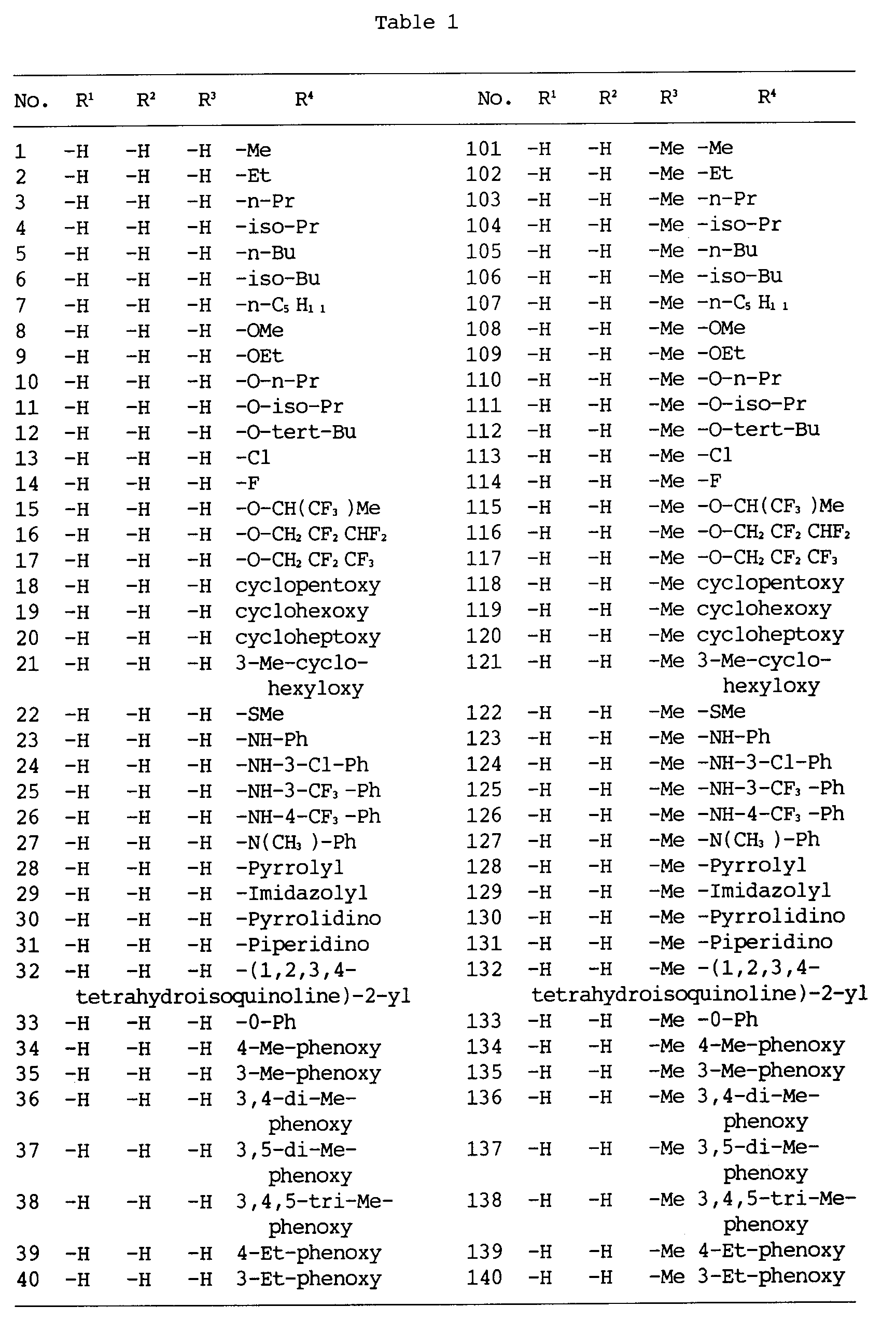


- Compounds having the same R2, R3, and R4 as those of the above-described Compounds No.1 to 200 and its R1 being 4-Cl, 5-Cl, 6-Cl, 7-Cl, 7-Me, or 7-OMe; and compounds having the same R1, R3, and R4 as those of each of the above-described compounds and its R2 being Me, Et, -CH2OCH3, or -COCH3 are also preferred. In addition, also preferred are compounds having the same R1, R2, R3 and R4 as those of the above-described compounds and having the R3-substituted methylene group at the 2-position of the pyridine nucleus and R4 at the 6-position; and compounds having the same R1, R2, R3 and R4 as those of the above-mentioned compounds and having R3-substituted methylene group at the 4-position of the pyridine nucleus and R4 at the 2-position. The compounds listed in Table 2 set out in Examples are also preferred compounds of the present invention.
- The compounds of the present invention represented by general formula (I) have potent controlling activities against kinds of insects, mites, and pathogenic fungi of agricultural and horticultural plants. Thus, the compounds of the present invention are useful as active ingredients of agricultural and horticultural pesticides, e.g. agricultural and horticultural fungicides, insecticides, and miticides.
- The compounds of the present invention have potent fungicidal activity against phytopathogenic fungi such as Piricularia (Blast causing fungi); Puccinia (Rust causing fungi); Phytophthora; Erysiphe (Downy mildew causing fungi), and thus are useful as active ingredients of agricultural and horticultural fungicides. The compounds of the present invention have high controlling activities against insects belonging to Hemiptera such as, for example, Delphacidae whose examples including, for example, Sogatella furcifera, Nilaparvata lugens, and Laodelphax striatellus, Deltocephalidae whose examples including, for example, Nephotellix cincticeps and Cicadella viridis, and Aphididae whose examples including, for example, Myzus persicae; Lepidoptera such as, for example, Spodontera lithura, Chilo suppresalis, Cnaphalocrocis medinalis, and Plutella xylostella; Coleoptera such as, for example, Callosobruchus chinensis; Diptera such as, for example, Musca domestica, Aedes aegypti, and Culex pipiens molestus; and Orthoptera. In addition, they have high controlling activities against eggs and larvas of Acarina such as, for example, Tetranychus urticae, Tetranychus cinnabarinus, and Panoychus citri. Accordingly, the compounds are also useful as active ingredients of agricultural and horticultural insecticides and miticides. However, phytopathogenic fungi, insects, and mites which can be controlled by the compounds of the present invention are not limited to those mentioned above as examples.
- Where the compounds of the present invention represented by general formula (I) are used as agricultural and horticultural fungicides, insecticides, and/or miticides, the compounds, per se, may be used. Preferably, agricultural and horticultural fungicides, insecticides, and/or miticides in the form of compositions may be used, which can be prepared by using pesticidal adjuvants widely used in the agrochemical art. Although the forms of agricultural and horticultural fungicides, insecticides, and/or miticides are not particularly limited, forms such as emulsifiable concentrates, wettable powder, dust, flowable products, fine particles, granules, tablets, oil solutions, spray liquids, fumigants are preferred. One or more of the compounds of the present invention as described above may be formulated as the active ingredient.
- The pesticidal adjuvants for the preparation of the aforementioned agricultural and horticultural fungicides, insecticides, and/or miticides may be used, for example, to improve pesticidal activities and to increase stabilities and dispersabilities of the agricultural and horticultural fungicides, insecticides, and/or miticides. For example, carriers (diluents), spreaders, emulsifying agents, wetting-out agents, dispersing agents, and disintegrating agents may be used.
- Examples of the liquid carriers include, for example, water; aromatic hydrocarbons such as toluene and xylene; alcohols such as methanol, butanol, and glycol; ketones such as acetone; amides such as dimethylformamide; sulfoxides such as dimethylsulfoxide; methylnaphtalene; cyclohexane; animal oils; vegetable oils; and fatty acids. As the solid carriers, clay, kaolin, talc, diatomaceous earth, silica, calcium carbonate, montmorillonite, bentonite, feldspar, quartz, alumina, wood shavings, nitrocellulose, starch, and gummi arabiacum may be used.
- As the emulsifying agents and the dispersing agents, ordinary surface active agents may be used. For example, anionic surfactants such as, for example, higher alcohol sodium sulfate, stearyl trimethylammonium chloride, polyoxyethylene alkylphenyl ether, and lauryl betaine; cationic surfactants; nonionic surfactants; and amphoteric surfactants may be used. Spreaders such as polyoxyethylene nonylphenyl ether and polyoxyethylene lauryl ether; wetting-out agents such as polyoxyethylene nonylphenyl ether and dialkylsulfosuccinate; fixing agents such as carboxymethyl cellulose and polyvinyl alcohol; and disintegrating agents such as sodium lignosulfonate and sodium lauryl sulfate may also be used.
- Contents of the active ingredients of the agricultural and horticultural fungicides, insecticides, and/or miticides of the present invention can generally be chosen between the range of from 0.1 to 99.5 % by weight, which may be appropriately determined depending on various factors such as the forms of the compositions and methods of applications. For example, the compositions may be prepared so as to contain the active ingredient at about 0.5 to 20% by weight, preferably 1 to 10% by weight for dusts; about 1 to 90% by weight, preferably 10 to 80% by weight for wettable powders; and about 1 to 90% by weight, preferably 10 to 40% by weight for emulsifiable concentrates.
- For example, where emulsifiable concentrates are used, neat stock concentrates can be prepared by mixing solvents, surfactants and the like to the aforementioned compounds as the active ingredients, and the resulting neat concentrates can be diluted with water to prescribed concentrations before use and then applied. Where wettable powder are used, neat stock compositions can be prepared as the mixture of the aforementioned compounds as the active ingredients, solid carriers, surfactant and the like, and the resulting stock compositions can be diluted to prescribed concentrations before use and then applied. Dusts may be prepared by mixing the above compounds as the active ingredients with solid carriers and the like, and the resulting mixture, per se, may be applied. Granules can be prepared by granulations of mixutures of the above compounds as active ingredients, solid carriers, surfactant and the like, and the resulting compositions, per se, may be applied. Methods for preparations of the compositions in the aforementioned forms are not limited to those set out above, and the processes may appropriately be chosen by ordinary artisens depending on, for example, the types of the active ingredients and the purposes of applications.
- Agricultural and horticultural fungicides, insecticides, and/or miticides of the present invention may optionally contain, in addition to the compounds of the present invention as the active ingredients, other active ingredients such as, for example, other fungicides, insecticides, miticides, herbicides, insect growth regulators, fertilizers, soil conditioners. Methods of applications agricultural and horticultural fungicides, insecticides and/or miticides of the present invention are not particularly limited. Any routs of applications may be used, which include, for example, foliar sprays, water surface treatments, soil treatments, and seed treatments. For example, when foliar sprays are employed, solutions at concentrations of from 5 to 1,000 ppm, preferably from 10 to 500 ppm, may be applied at amounts of from 100 to 200 liters/10a. Application amounts for water surface treatments are generally 1 to 10 kg/10a using granules containing 5 to 15% by weight of the active ingredients. For soil treatments, solutions at concentrations of from 5 to 1,000 ppm may be applied at amounts of from 1 to 10 liter/m2. For seed treatments, solutions at concentrations of from 10 to 1,000 ppm may be applied at amounts of from 10 to 100 ml per 1 kg of seeds.
- The present invention will be further explained by examples. However, the scope of the present invention is not limited to the examples set out below.
- 2-Methylindazole-3-carboxylic acid (3.2 g) and thionyl chloride (5.3 g) were heated under reflux for 1 hour. After thionyl chloride was evaporated under reduced pressure, the residue was dissolved in toluene (20 ml). This solution was added dropwise to a solution of 5-aminomethyl-2-n-butylpyridine (3.0 g) and triethylamine (1.9 g) in toluene (30 ml) at 0 to 10°C. After the dropwise addition, the mixture was stirred for 2 hours at room temperature, and then, poured into ice water and extracted with toluene. The toluene layer was successively washed with an aqueous solution of sodium carbonate, water, and saturated aqueous sodium chloride. After dryness over anhydrous sodium sulfate, the solvent was evaporated under reduced pressure. The residue was purified column chromatography on silica gel to afford the titled compound (5.86 g) shown in Table 2 as No.A. The results of NMR and IR analyses of this compound were as follows:
1H-NMR(CDCl3) δ ppm : 0.94(3H,t),1.38(2H,q),1.71(2H,m), 2.80(2H,t),4.49(3H,s),4.72(2H,d),6.55(1H,b),7.18(1H,d), 7.25(1H,m),7.33(1H,t),7.61(1H,d),7.67(1H,d)
IR(KBr) ν cm-1 : 3260, 2960, 1640, 1540, 1390, 1230, 740 - 2-Methylindazole-3-carboxylic acid (3.2 g) and thionyl chloride (5.3 g) were heated under reflux for 1 hour. After thionyl chloride was evaporated under reduced pressure, the residue was dissolved in toluene (20 ml). This solution was added dropwise to a solution of 5-aminomethyl-2-(4-methylphenoxy)-pyridine (3.9 g) and triethylamine (1.9 g) in toluene (30 ml) at 0 to 10 °C. After the dropwise addition, the mixture was stirred for 2 hours at room temperature, andthen, poured into ice water and extracted with toluene. The toluene layer was washed successively with an aqueous solution of sodium carbonate, water, and saturated aqueous sodium chloride. After dryness over anhydrous sodium sulfate, the solvent was evaporated under reduced pressure. The residue was purified by column chromatography on silica gel to afford the titled compound (5.83 g) shown in Table 2 as No.A-12. The results of NMR and IR analyses of this compound were as follows.
1H-NMR(CDCl3) δ ppm : 2.35(3H,t),4.49(3H,s),4.67(2H,d), 6.46(1H,bs),6.91(1H,d),7.02(2H,d),7.21(3H,m),7.34(1H,m), 7.60(1H,d),7.78(2H,m),8.22(1H,d)
IR(KBr) ν cm-1 : 3300, 1650, 1550, 1485, 1295 - 2-Methylindazole-3-carboxylic acid (3.2 g) and thionyl chloride (5.3 g) were heated under reflux for 1 hour. After thionyl chloride was removed under reduced pressure, the residue was dissolved in tetrahydrofuran (20 ml). This solution was added dropwise to a solution of 5-aminomethyl-2-phenylaminopyridine (3.6 g) and triethylamine (1.9 g) in tetrahydrofuran (30 ml) at 0 to 10 °C. After the dropwise addition, the mixture was stirred for 2 hours at room temperature, and then, poured into ice water and extracted with ethyl acetate. The ethyl acetate layer was washed successively with an aqueous solution of sodium carbonate, water, and saturated aqueous sodium chloride. After dryness over anhydrous sodium sulfate, the solvent was evaporated under reduced pressure. The residue was purified column chromatography on silica gel to afford the titled compound (5.37 g) shown in Table 2 as No. A-75. The results of NMR and IR analyses of this compound were as follows.
1H-NMR(CDCl3) δ ppm : 4.50(3H,s),4.66(2H,d),5.77(1H,s), 6.41(1H,b),6.95(1H,t),7.09(4H,m),7.18-7.37(6H,m),7.61(1H,d), 7.77(1H,d)
IR(KBr) ν cm-1 : 3310, 1635, 1620, 1608, 1520, 1495, 1325, 1225, 750, 740, 730, 510 - The compounds listed in Table 2 were obtained according to the methods of Examples 1-3. In the table, A, B, and C series of compounds are as set out below, and physicochemical properties except melting points are refractive indexes (n24 D, with asterisks). The abbreviations in the table are the same as those used in Table 1.

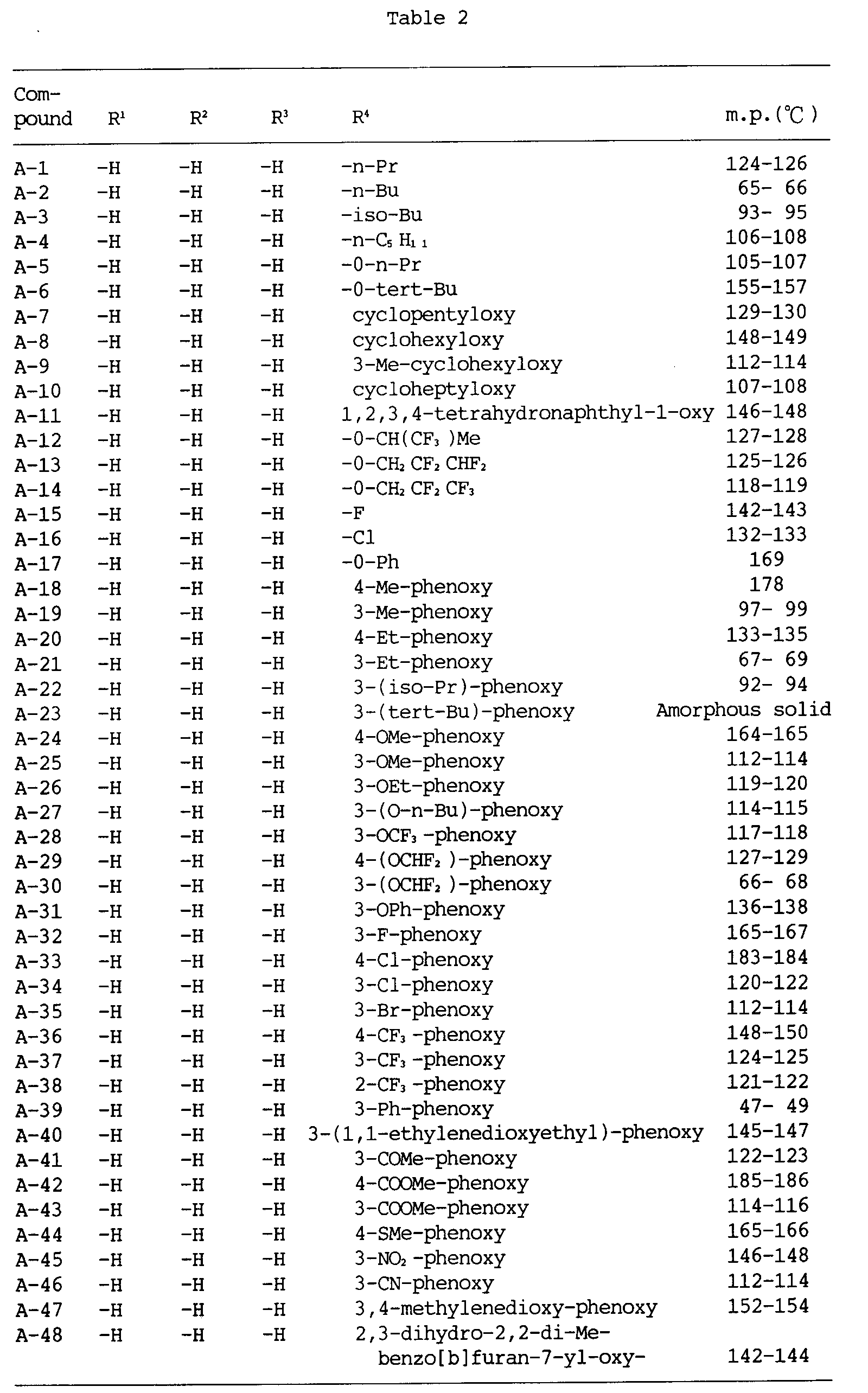

- The results of NMR and IR analyses of Compound A-17 were as follows:
1H-NMR(CDCl3) δ ppm : 1.23(9H,s),4.33(3H,s),4.56(2H,d), 6.81(1H,d),6.88(1H,dd),7.08(3H,m),7.21(3H,m),7.56(1H,dd), 7.64(2H,m),8.12(1H,d)
IR(KBr) cm-1 : 3400, 2960, 1655, 1600, 1580, 1520, 1475, 1425, 1395, 1365, 1250, 930 - Examples of formulations of the agricultural and horticultural fungicides, insecticides, and/or miticides comprising the compounds of the present invention are explained below. However, the forms of the agricultural and horticultural pesticides of the present invention are not limited to the following examples.
- A wettable powder containing 20% by weight of the active ingredient was prepared by uniformly mixing and pulverizing 20 parts by weight of the compound of the present invention, 20 parts by weight of Carplex #80 (trademark, white carbon, Shionogi & Co., Ltd.), 52 parts by weight of ST Kaolin Clay (trademark, kaolinite, Tsuchiya Kaolin Co., Ltd.), 5 parts by weight of Sorpol 9047K (trademark, anionic surfactant, Toho Kagaku Co., Ltd.) and 3 parts by weight of Runox P65L (trademark, anionic surfactant, Toho Kagaku Co., Ltd.).
- A dust containing 2% by weight of the active ingredient was prepared by uniformly mixing and pulverizing 2 parts by weight of a compound of the present invention, 93 parts by weight of clay (Nippon Talc Co., Ltd.) and 5 parts by weight of Carplex #80 (trademark, white carbon, Shionogi & Co., Ltd.).
- An emulsifiable concentrate containing 20% by weight of the active ingredient was prepared by dissolving 20 parts by weight of a compound of the present invention in a mixed solvent consisting of 35 parts by weight of xylene and 30 parts by weight of dimethylformamide, and adding 15 parts by weight of Sorpol 3005X (trademark, the mixture of non-ionic surfactant and anionic surfactant, Toho Kagaku Co., Ltd.) to the resulting solution.
- A flowable agent containing 20% by weight of the active ingredient was prepared by pulverizing 30 parts by weight of the compound of the present invention, 5 parts by weight of Sorpol 9047K, 3 parts by weight of Solbon T-20 (trademark, non-ionic surfactant, Toho Kagaku Co., Ltd.), 8 parts by weight of ethylene glycol, and 44 parts by weight of water in the DYNO-Mill (Shinmaru Enterprises Co., Ltd.) in wet process, adding 10 parts by weight of 1% aqueous solution of xanthan gum (natural polymer) to the resulting slurry mixture, and then mixing and dispersing the resulting mixuture sufficiently.
- Seedlings of rice plant were placed in a glass cylinder with 3 cm inner diameter and 17 cm height, and then, five larvae of four instar were put into the cylinder. Aqueous dilution (0.5 ml) of the agricultural and horticultural insecticide of the present invention prepared according to Formulation Example 3 was sprayed into the above glass cylinder (one concentration, two replicates) using a spraying tower (manufactured by Mizuho Rika, Co., Ltd.). Five days after the treatment, death and agony of the larvae were examined and the mortality (%) was calculated by counting one agonizing larva as being 1/2 death. The results are shown in Table 3 (Compound numbers in the table correspond to those described in Table 2.).
- Slices of cabbage leaves (6 cm diameter) were immersed for one minute in the aqueous dilution of the agricultural and horticultural insecticide of the present invention prepared according to Formulation Example 1. The leaves were air-dried after the immersion, and then placed in a plastic cup (7cm inner diameter). Five larvae of third instar were put in the cup (one concentration, two replicates). Four days after the introduction of the larvae, death and agony of the larvae were examined and the mortality (%) was calculated by counting one agonizing larva as being 1/2 death. The results are shown in Table 3 (Compound numbers in the table below correspond to those shown in Table 2).
Table 3 Compound No. Concentration (ppm) Mortality (%) Nilaparvata lugens Plutella xylostella A-1 500 100 100 A-2 " " " A-3 " " " A-4 " " " A-5 " " " A-6 " " 95 A-7 " " 100 A-8 " " " A-9 " " 95 A-10 " " 100 A-12 " " " A-13 " " " A-14 " " " A-17 " " " A-18 " " 95 A-19 " " 100 A-20 " " " A-21 " 90 90 A-24 " " 100 A-26 " 100 " A-29 " " " A-33 " " " A-36 " " " A-37 " " " A-38 " 90 " A-49 " 100 " A-63 " " " A-72 " " " B-2 " " " B-3 " " " - Ten female adults of Tetranychus urticae were put on disks (3 cm diameter) of kidney bean leaf. The agricultural and horticultural miticide of the present invention prepared according to Formulation Example 1 was diluted with water upto the prescribed concentration. The resulting solution (3.5 ml) was sprayed onto the disks (one concentration, two replicates) using a rotary spraying tower (manufactured by Mizuho Rika Co., Ltd.). Twenty-four hours after the treatment, the dead larvae were counted and the miticidal rate (%) was calculated. The results are shown in Table 4.
- Five female adults of Tetranychus urticae were put on disks (3 cm diameter) of kidney bean leaf. The adults were allowed to oviposit for 20 hours, then the female adults were removed. The agricultural and horticultural miticide of the present invention prepared according to Formulation Example 1 was diluted with water upto the prescribed concentration. The resulting solution (3.5 ml) was sprayed onto the disks (one concentration, two replicates) using a rotary spraying tower (manufactured by Mizuho Rika CO., Ltd.). Eight days after the treatment, unhatched eggs and larvae after hatching were counted and the ovicidal rate (%) was calculated. The results are shown in Table 4.
Table 4 Compound No. Concentration (ppm) Mitecidal rate (%) Ovicidal rate (%) A-1 500 100 90 A-4 " " " A-9 " 95 " A-10 " 100 100 A-12 " " " A-13 " " " A-36 " " 70 A-72 " " 100 - Ten stocks of rice plant (species: Akinishiki) per pot were nursed by using resin pots of 6 cm diameter. The agricultural and horticultural fungicide (wettable powder) of the present invention prepared according to Formulation Example 1 was diluted with water upto the prescribed concentration, and then applied by foliage spraying onto the rice plants (3- to 4-leaf stages) in the amount of 10 ml per pot. After the sprayed solution was air-dried, a suspension of spores (5.0 × 10⁵ spores/ml) obtained from the culture of Magnaporthe grisea in oatmeal cultivation medium was inoculated to the rice plants by spraying, and then, the pots were kept for 24 hours under a moist chamber at 25 °C. Then, the pots were left for 7 days in a greenhouse (22 to 25°C ), and the numbers of appeared disease spots were measured and the preventive value was calculated from the following equation. The results are shown in Table 5.

Table 5 Compond No. Concentration (ppm) Preventive value(%) A-2 250 94 A-4 " 100 A-6 " 91 A-7 " 100 A-10 " 100 A-14 " 100 A-16 " 90 A-19 " 94 A-26 " 100 A-28 " 96 A-29 " 100 A-30 " 96 A-34 " 90 A-35 " 100 A-37 " 100 A-39 " 90 A-45 " 100 A-46 " 95 A-49 " 100 A-50 " 100 A-57 " 92 A-67 " 94 A-69 " 94 A-70 " 100 A-71 " 100 A-72 " 100 B-1 " 95 B-2 " 100 B-3 " 100 B-4 " 94 C-1 " 100 C-2 " 95 - Three stocks of rice plant (species: Red Cherry) per pot were nursed by using resin pots of 6 cm diameter. The agricultural and horticultural fungicide (wettable powder) of the present invention prepared according to Formulation Example 1 was diluted with water upto the prescribed concentration, and then applied by foliage spraying onto the rice plants (3- to 4-leaf stages) in the amount of 10 ml per pot. After the sprayed solution was air-dried, a suspension of zoosporangiums (5.0× 10⁴ zoosporangiums/ml) obtained from the culture of Phytophthora infestans on sliced tomato leaves was inoculated onto the rice plants by spraying, and then the pots were kept in a moist chamber at 25 °C for 24 hours. Then, the pots were left for 4 days in a greenhouse (22 to 25 °C). The numbers of appeared disease spots in the leaves were measured and represented by disease indexes, and the preventive value was calculated from the following equation. The results are shown in Table 6.
-
- 0:
- no disease spot was observed.
- 1:
- disease area was 1/3 or less.
- 3:
- disease area was from 1/3 to 2/3.
- 5:
- disease area was 2/3 or more.
- nx :
- Numbers of tomato leaves per pot having the disease index of x.
- By using Compounds No. A-1, A-2, A-3, A-4, A-5, A-8, A-17, A-29, A-33, A-36, A-37, A-42, A-47, A-49, A-64, A-65, B-3 and C-1 of the present invention, fungicidal effects against Phytophthora infestans were examined according to the method of Test Example 6, except that their concentrations were varied as shown in Table 7. As reference compounds, Compounds IV and V disclosed in the International Publication No. WO 94/5642 whose chemical structures are shown below.


- From the foregoing description, it can be uderstood that the indazole compounds of the present invention have extremely high controlling effects against various types of phytopathogenic fungi, harmful insects, and mites, and thus, they are useful as active ingredients of agricultural and horticultural fungicides, insecticides, and miticides.


Claims (13)
- An indazole compound represented by the following formula:

- The indazole compounds according to claim 1, wherein R4 is a hydrogen atom, a C1-C8 alkyl group, a C1-C8 alkoxy group, a halogen atom, a C1-C4 haloalkoxy group, a 5- to 7-membered cycloalkoxy group which may optionally have one or more C1-C4 alkyl groups or a condensed benzene ring, a phenylamino group which may optionally have one or more halogen atoms or one or more C1-C4 haloalkyl group, an N-(C1-C4 alkyl)-phenylamino group, pyrrolyl group, imidazolyl group, pyrrolidino group, a piperidino group which may optionally have a condensed benzene ring, or a phenoxy group which may optionally have one to three substituents selected from the group consisting of a C1-C8 alkyl group, a C1-C8 alkoxy group, a halogen atom, nitro group, cyano group, a C1-C4 haloalkyl group, a C1-C4 haloalkoxy group, phenyl group, phenoxy group, a C2-C5 alkanoyl group whose oxo group may be protected with a ketal group, benzoyl group, a C1-C4 alkoxycarbonyl group, a C1-C4 alkylthio group, trifluoromethylthio group, and methylenedioxy group (where said phenoxy group has two or three substituents, the substituents may be the same or different), and the benzene ring of said phenoxy group may have a condensed benzene ring (said ring may further be substituted with one or more halogen atoms or one or more C1-C4 alkoxy groups) or a condensed saturated furan ring (said ring may further be substituted with one or more C1-C4 alkyl groups).
- The indazole compound according to claims 1 or 2, wherein R4 is a C1-C8 alkyl group, a C1-C8 alkoxy group, a halogen atom, a C1-C4 haloalkoxy group, a 5- to 7-membered cycloalkoxy group which may optionally have one or more C1-C4 alkyl groups or one condensed benzene ring, a phenylamino group which may optionally have one or more halogen atoms or one or more C1-C4 haloalkyl groups, an N-(C1-C4 alkyl)-phenylamino group, pyrrolyl group, imidazolyl group, pyrrolidino group, a piperidino group which may optionally have one condensed benzene ring, or a phenoxy group which may optionally have one to three substituents selected from the group consisting of a C1-C8 alkyl group, a C1-C8 alkoxy group, a halogen atom, nitro group, cyano group, a C1-C4 haloalkyl group, a C1-C4 haloalkoxy group, phenyl group, phenoxy group, a C2-C5 alkanoyl group whose oxo group may be protected with a ketal group, a C1-C4 alkoxycarbonyl group, a C1-C4 alkylthio group, and methylenedioxy group (where said phenoxy group has two or three substituents, the substituents may be the same or different), and the benzene ring of said phenoxy group may have one condensed benzene ring the benzene ring of the phenoxy group may have one condensed benzene ring (said ring may further be substituted with one or more halogen atoms) or one condensed saturated furan ring (said ring may further be substituted with one or more C1-C4 alkyl groups).
- The indazole compound according to any one of claims 1 to 3, wherein R4 is a C1-C8 alkyl group, a C1-C8 alkoxy group, a halogen atom, a C1-C4 haloalkoxy group, a 5- to 7-membered cycloalkoxy group which may optionally have one C1-C4 alkyl group or one condensed benzene ring, a phenylamino group which may optionally have one halogen atom or one C1-C4 haloalkyl group, an N-(C1-C4 alkyl)-phenylamino group, pyrrolyl group, imidazolyl group, pyrrolidino group, a piperidino group which may optionally have one condensed benzene ring, or a phenoxy group which may optionally have one or two substituents selected from the group consisting of a C1-C8 alkyl group, a C1-C8 alkoxy group, a halogen atom, nitro group, cyano group, a C1-C4 haloalkyl group, a C1-C4 haloalkoxy group, phenyl group, phenoxy group, a C2-C5 alkanoyl group whose oxo group may be protected with a ketal group, a C1-C4 alkoxycarbonyl group, a C1-C4 alkylthio group, and a methylenedioxy group (where said phenoxy group has two substituents, the substituents may be the same or different), and the benzene ring of said phenoxy group may have one condensed benzene ring (said ring may further be substituted with one halogen atom) or one condensed saturated furan ring (said ring may further be substituted with one C1-C4 alkyl group).
- The indazole compound according to any one of claims 1 to 4, wherein R2 and R3 are hydrogen atoms.
- A pesticide comprising the indazole compound according to any one of claims 1 to 5.
- An agricultural and horticultural pesticide comprising as an active ingredient the indazole compound according to any one of claims 1 to 5.
- The agricultural and horticultural pesticide according to claim 7 useful as an insecticide.
- The agricultural and horticultural pesticide according to claim 7 useful as a miticide.
- The agricultural and horticultural pesticide according to claim 7 useful as a fungicide.
- An agricultural and horticultural composition as an insecticide, miticide, and/or fungicide which comprises an effective amount of the indazole compound according to any one of claims 1 to 5 as an active ingredient together with an agrochemical adjuvant.
- Use of the indazole compound according to any one of claims 1 to 5 for the manufacture of a pesticide comprising the said indazole compounds as an active ingredient.
- Use of the indazole compound according to any one of claims 1 to 5 for the manufacture of an agricultural and horticultural composition as insecticide, miticide, and/or fungicide which comprises an effective amount of said indazole compound as an active ingredient together with an agrochemical adjuvant.
Applications Claiming Priority (4)
| Application Number | Priority Date | Filing Date | Title |
|---|---|---|---|
| JP2138395 | 1995-02-09 | ||
| JP21383/95 | 1995-02-09 | ||
| JP4963/96 | 1996-01-16 | ||
| JP8004963A JPH08277287A (en) | 1995-02-09 | 1996-01-16 | Indazoles and their uses |
Publications (2)
| Publication Number | Publication Date |
|---|---|
| EP0726266A1 true EP0726266A1 (en) | 1996-08-14 |
| EP0726266B1 EP0726266B1 (en) | 1998-01-07 |
Family
ID=26338833
Family Applications (1)
| Application Number | Title | Priority Date | Filing Date |
|---|---|---|---|
| EP96101596A Expired - Lifetime EP0726266B1 (en) | 1995-02-09 | 1996-02-05 | Indazole compounds and the use thereof as fungicides, insecticides and miticides |
Country Status (8)
| Country | Link |
|---|---|
| US (1) | US5705453A (en) |
| EP (1) | EP0726266B1 (en) |
| JP (1) | JPH08277287A (en) |
| CN (1) | CN1137523A (en) |
| AT (1) | ATE161841T1 (en) |
| AU (1) | AU4331196A (en) |
| DE (1) | DE69600134T2 (en) |
| ES (1) | ES2112656T3 (en) |
Cited By (4)
| Publication number | Priority date | Publication date | Assignee | Title |
|---|---|---|---|---|
| WO2001011966A1 (en) * | 1999-08-18 | 2001-02-22 | Aventis Cropscience Gmbh | Fungicides |
| WO2008061688A1 (en) | 2006-11-22 | 2008-05-29 | Aziende Chimiche Riunite Angelini Francesco A.C.R.A.F. S.P.A. | 2 -alkyl- indazole compounds for the treatment of certain cns-related disorders |
| WO2018177781A1 (en) * | 2017-03-28 | 2018-10-04 | Basf Se | Pesticidal compounds |
| WO2021076617A1 (en) | 2019-10-14 | 2021-04-22 | The Regents Of The University Of California | Broad spectrum anti-cancer compounds |
Families Citing this family (5)
| Publication number | Priority date | Publication date | Assignee | Title |
|---|---|---|---|---|
| AU2178597A (en) * | 1996-04-05 | 1997-10-29 | Mitsubishi Chemical Corporation | Pyrazoles and agricultural chemicals containing them as active ingredients |
| WO2000039102A1 (en) | 1998-12-23 | 2000-07-06 | Du Pont Pharmaceuticals Company | THROMBIN OR FACTOR Xa INHIBITORS |
| JP2001199984A (en) * | 2000-01-24 | 2001-07-24 | Mitsubishi Chemicals Corp | Pyrazole-5-carboxylic acid amides, and insecticides and acaricides containing the same as an active ingredient |
| DE10130397A1 (en) * | 2001-06-23 | 2003-01-09 | Bayer Cropscience Gmbh | Herbicidally substituted pyridines, processes for their preparation and their use as herbicides and plant growth regulators |
| CN102464618B (en) | 2010-11-03 | 2014-07-23 | 中国中化股份有限公司 | Pyrazolecarboxamide compound and application thereof |
Citations (1)
| Publication number | Priority date | Publication date | Assignee | Title |
|---|---|---|---|---|
| WO1994005642A1 (en) * | 1992-08-28 | 1994-03-17 | Ciba-Geigy Ag | Indazole derivatives |
Family Cites Families (13)
| Publication number | Priority date | Publication date | Assignee | Title |
|---|---|---|---|---|
| US3457269A (en) * | 1967-02-24 | 1969-07-22 | Sterling Drug Inc | N-substituted phenyl and n-substituted phenylalkyl 3 - indazolecarboxamides and preparation thereof |
| US3681382A (en) * | 1969-02-07 | 1972-08-01 | Ciba Geigy Corp | 3-aminoindazoles |
| US3705175A (en) * | 1969-04-01 | 1972-12-05 | Egyt Gyogyszervegyeszeti Gyar | Indazole-3-carboxylic amides |
| US3647819A (en) * | 1969-09-19 | 1972-03-07 | Sterling Drug Inc | Indazolylphenylureas and indazolyl-phenylthioureas |
| US3678059A (en) * | 1969-10-07 | 1972-07-18 | Ciba Geigy Corp | 3-aminoalkylidene-indazoles |
| FR2100909A1 (en) * | 1970-07-15 | 1972-03-24 | Egyt Gyogyszervegyeszeti Gyar | Indazole-3-carboxylic acid amides - prodn from corres acids analgesics and antiinflammatories |
| US3711610A (en) * | 1971-06-01 | 1973-01-16 | Sterling Drug Inc | Anticoccidiosis method and compositions involving indazolylphenylureas and indazolylphenylthioureas |
| JPS512466B2 (en) * | 1972-02-07 | 1976-01-26 | ||
| US4806554A (en) * | 1988-01-11 | 1989-02-21 | Hoechst-Roussel Pharmaceuticals, Inc. | Pyrazol and indazolpyridinamines |
| JPH01207208A (en) * | 1988-02-10 | 1989-08-21 | Nissan Chem Ind Ltd | Plant growth regulator |
| JP2751309B2 (en) * | 1988-02-16 | 1998-05-18 | 三菱化学株式会社 | Pyrazoles and insecticides, miticides, fungicides containing them as an active ingredient |
| DE3841520A1 (en) * | 1988-12-09 | 1990-06-13 | Hoechst Ag | ENZYME-INFRINGING DERIVATIVES OF DIPEPTIDES, METHOD FOR THE PRODUCTION THEREOF, METHODS CONTAINING THEM AND THEIR USE |
| DE9405642U1 (en) * | 1994-04-05 | 1995-02-02 | Kramm, Ulrich, 58239 Schwerte | Device for saving energy in fax machines |
-
1996
- 1996-01-16 JP JP8004963A patent/JPH08277287A/en active Pending
- 1996-02-01 AU AU43311/96A patent/AU4331196A/en not_active Abandoned
- 1996-02-05 AT AT96101596T patent/ATE161841T1/en not_active IP Right Cessation
- 1996-02-05 ES ES96101596T patent/ES2112656T3/en not_active Expired - Lifetime
- 1996-02-05 DE DE69600134T patent/DE69600134T2/en not_active Expired - Fee Related
- 1996-02-05 EP EP96101596A patent/EP0726266B1/en not_active Expired - Lifetime
- 1996-02-08 US US08/599,340 patent/US5705453A/en not_active Expired - Fee Related
- 1996-02-09 CN CN96105733A patent/CN1137523A/en active Pending
Patent Citations (1)
| Publication number | Priority date | Publication date | Assignee | Title |
|---|---|---|---|---|
| WO1994005642A1 (en) * | 1992-08-28 | 1994-03-17 | Ciba-Geigy Ag | Indazole derivatives |
Cited By (10)
| Publication number | Priority date | Publication date | Assignee | Title |
|---|---|---|---|---|
| WO2001011966A1 (en) * | 1999-08-18 | 2001-02-22 | Aventis Cropscience Gmbh | Fungicides |
| US6630495B1 (en) | 1999-08-18 | 2003-10-07 | Bayer Cropscience Gmbh | Fungicides |
| WO2008061688A1 (en) | 2006-11-22 | 2008-05-29 | Aziende Chimiche Riunite Angelini Francesco A.C.R.A.F. S.P.A. | 2 -alkyl- indazole compounds for the treatment of certain cns-related disorders |
| US8507528B2 (en) | 2006-11-22 | 2013-08-13 | Aziende Chimiche Riunite Angelini Francesco A.C.R.A.F. S.P.A. | 2-alkyl-indazole compounds for the treatment of certain cns-related disorders |
| WO2018177781A1 (en) * | 2017-03-28 | 2018-10-04 | Basf Se | Pesticidal compounds |
| US11160280B2 (en) | 2017-03-28 | 2021-11-02 | Basf Se | Pesticial compounds |
| AU2018241406B2 (en) * | 2017-03-28 | 2021-11-11 | Basf Se | Pesticidal compounds |
| IL268863B (en) * | 2017-03-28 | 2022-08-01 | Basf Se | History of 6,5-heteroaryl in nitrogen-containing annelids and preparations containing them for the control of fungi |
| WO2021076617A1 (en) | 2019-10-14 | 2021-04-22 | The Regents Of The University Of California | Broad spectrum anti-cancer compounds |
| EP4045498A4 (en) * | 2019-10-14 | 2023-09-27 | The Regents of the University of California | BROAD-SPECTRUM ANTI-CANCER COMPOUNDS |
Also Published As
| Publication number | Publication date |
|---|---|
| ATE161841T1 (en) | 1998-01-15 |
| DE69600134D1 (en) | 1998-02-12 |
| EP0726266B1 (en) | 1998-01-07 |
| ES2112656T3 (en) | 1998-04-01 |
| JPH08277287A (en) | 1996-10-22 |
| DE69600134T2 (en) | 1998-05-20 |
| US5705453A (en) | 1998-01-06 |
| AU4331196A (en) | 1996-08-15 |
| CN1137523A (en) | 1996-12-11 |
Similar Documents
| Publication | Publication Date | Title |
|---|---|---|
| EP0976737B1 (en) | Pyrazole derivatives, process for preparing the same, intermediates, and pest control agent containing the same as active ingredient | |
| US4203995A (en) | 1-Phenyl-2-azolyl-4,4-dimethyl-1-penten-3-ols and the fungicidal use thereof | |
| CA2213111C (en) | Substituted carboxanilide derivative and plant disease control agent comprising same as active ingredient | |
| US4840959A (en) | Pyridinecarboxamide derivatives and their use as fungicide | |
| US4877441A (en) | Fungicidal substituted carboxylic acid derivatives | |
| US4510154A (en) | Thiazolidine compound and fungicidal composition containing it | |
| DE69231679T2 (en) | 2-CHINOLINONE DERIVATIVES, METHOD FOR THE PRODUCTION THEREOF AND FUNGICIDES AND INSECTICIDES CONTAINING THEM | |
| JP2751309B2 (en) | Pyrazoles and insecticides, miticides, fungicides containing them as an active ingredient | |
| EP0726266B1 (en) | Indazole compounds and the use thereof as fungicides, insecticides and miticides | |
| EP0891975A1 (en) | Pyrazoles and agricultural chemicals containing them as active ingredients | |
| JPH1053583A (en) | Pyrazole compounds and fungicides, insecticidal and acaricides containing the same as active ingredients | |
| US20050085524A1 (en) | Pyrazolecarboxamides, intermediates therefor and pest control agent comprising the same as active ingredients | |
| HK1003832B (en) | Pyrazole derivatives having herbicidal activity, their preparation and their use | |
| HK1003832A1 (en) | Pyrazole derivatives having herbicidal activity, their preparation and their use | |
| US5116838A (en) | Guanidine derivatives and fungicides for agriculture and horticulture containing the same | |
| DE69117872T2 (en) | Pyrazolylacrylic acid derivatives, their intermediates, and fungicides containing these derivatives for agriculture and horticulture | |
| JP4336906B2 (en) | Pyrazole derivatives, process for producing the same, intermediates, and pest control agents containing the same as active ingredients | |
| EP0655444B1 (en) | Oxazoline derivative, process for preparing the same and agricultural and horticultural chemical for controlling noxious organisms containing the same | |
| US5049575A (en) | Substituted carboxylic acid, fungicidal compositions and use | |
| JP2002363164A (en) | Pyrazolecarboxamides, intermediates thereof and pest control agents containing the same as an active ingredient | |
| US4405743A (en) | Pyrazolylpyrimidine derivatives | |
| JPH09278775A (en) | Pyrazole compounds and insecticides, acaricides and fungicides containing the same as active ingredients | |
| JP4565286B2 (en) | 6-haloalkyl-3- (substituted amino) -1,2,4-triazin-5-one derivatives, agricultural chemicals containing this as an active ingredient, and production intermediates thereof | |
| JPH1053582A (en) | Pyrazole compounds and fungicides and insecticides containing them as active ingredients | |
| JPH07173139A (en) | Alkoxypyrazolecarboxamide, and insecticide, acaricide and agricultural and horticultural fungicide comprising the same as active ingredient |
Legal Events
| Date | Code | Title | Description |
|---|---|---|---|
| PUAI | Public reference made under article 153(3) epc to a published international application that has entered the european phase |
Free format text: ORIGINAL CODE: 0009012 |
|
| AK | Designated contracting states |
Kind code of ref document: A1 Designated state(s): AT BE CH DE DK ES FR GB IT LI NL PT |
|
| 17P | Request for examination filed |
Effective date: 19960705 |
|
| GRAG | Despatch of communication of intention to grant |
Free format text: ORIGINAL CODE: EPIDOS AGRA |
|
| 17Q | First examination report despatched |
Effective date: 19970213 |
|
| GRAG | Despatch of communication of intention to grant |
Free format text: ORIGINAL CODE: EPIDOS AGRA |
|
| GRAG | Despatch of communication of intention to grant |
Free format text: ORIGINAL CODE: EPIDOS AGRA |
|
| GRAH | Despatch of communication of intention to grant a patent |
Free format text: ORIGINAL CODE: EPIDOS IGRA |
|
| GRAH | Despatch of communication of intention to grant a patent |
Free format text: ORIGINAL CODE: EPIDOS IGRA |
|
| GRAA | (expected) grant |
Free format text: ORIGINAL CODE: 0009210 |
|
| AK | Designated contracting states |
Kind code of ref document: B1 Designated state(s): AT BE CH DE DK ES FR GB IT LI NL PT |
|
| PG25 | Lapsed in a contracting state [announced via postgrant information from national office to epo] |
Ref country code: LI Free format text: LAPSE BECAUSE OF FAILURE TO SUBMIT A TRANSLATION OF THE DESCRIPTION OR TO PAY THE FEE WITHIN THE PRESCRIBED TIME-LIMIT Effective date: 19980107 Ref country code: CH Free format text: LAPSE BECAUSE OF FAILURE TO SUBMIT A TRANSLATION OF THE DESCRIPTION OR TO PAY THE FEE WITHIN THE PRESCRIBED TIME-LIMIT Effective date: 19980107 Ref country code: BE Free format text: LAPSE BECAUSE OF FAILURE TO SUBMIT A TRANSLATION OF THE DESCRIPTION OR TO PAY THE FEE WITHIN THE PRESCRIBED TIME-LIMIT Effective date: 19980107 Ref country code: AT Free format text: LAPSE BECAUSE OF FAILURE TO SUBMIT A TRANSLATION OF THE DESCRIPTION OR TO PAY THE FEE WITHIN THE PRESCRIBED TIME-LIMIT Effective date: 19980107 |
|
| REF | Corresponds to: |
Ref document number: 161841 Country of ref document: AT Date of ref document: 19980115 Kind code of ref document: T |
|
| RIN1 | Information on inventor provided before grant (corrected) |
Inventor name: HIGASHINO, YOSHIAKI, C/O MITSUBISHI CHEM. CORP. Inventor name: TOMITAI, HIROHUMI, C/O MITSUBISHI CHEM. CORP. Inventor name: SUZUKI, SHIGERU, C/O MITSUBISHI CHEM. CORP. Inventor name: IKEDA, YOSHIYA, C/O MITSUBISHI CHEM. CORP. Inventor name: OKUI, SHUKO, C/O MITSUBISHI CHEM. CORP. Inventor name: KYOMURA, NOBUO, C/O MITSUBISHI CHEM. CORP. |
|
| REG | Reference to a national code |
Ref country code: CH Ref legal event code: EP |
|
| REF | Corresponds to: |
Ref document number: 69600134 Country of ref document: DE Date of ref document: 19980212 |
|
| ITF | It: translation for a ep patent filed | ||
| ET | Fr: translation filed | ||
| REG | Reference to a national code |
Ref country code: ES Ref legal event code: FG2A Ref document number: 2112656 Country of ref document: ES Kind code of ref document: T3 |
|
| PG25 | Lapsed in a contracting state [announced via postgrant information from national office to epo] |
Ref country code: DK Free format text: LAPSE BECAUSE OF FAILURE TO SUBMIT A TRANSLATION OF THE DESCRIPTION OR TO PAY THE FEE WITHIN THE PRESCRIBED TIME-LIMIT Effective date: 19980407 |
|
| REG | Reference to a national code |
Ref country code: PT Ref legal event code: SC4A Free format text: AVAILABILITY OF NATIONAL TRANSLATION Effective date: 19980401 |
|
| REG | Reference to a national code |
Ref country code: CH Ref legal event code: PL |
|
| PLBE | No opposition filed within time limit |
Free format text: ORIGINAL CODE: 0009261 |
|
| STAA | Information on the status of an ep patent application or granted ep patent |
Free format text: STATUS: NO OPPOSITION FILED WITHIN TIME LIMIT |
|
| 26N | No opposition filed | ||
| PGFP | Annual fee paid to national office [announced via postgrant information from national office to epo] |
Ref country code: DE Payment date: 19991231 Year of fee payment: 5 |
|
| PGFP | Annual fee paid to national office [announced via postgrant information from national office to epo] |
Ref country code: PT Payment date: 20000114 Year of fee payment: 5 |
|
| PGFP | Annual fee paid to national office [announced via postgrant information from national office to epo] |
Ref country code: GB Payment date: 20000202 Year of fee payment: 5 |
|
| PGFP | Annual fee paid to national office [announced via postgrant information from national office to epo] |
Ref country code: FR Payment date: 20000210 Year of fee payment: 5 |
|
| PGFP | Annual fee paid to national office [announced via postgrant information from national office to epo] |
Ref country code: ES Payment date: 20000222 Year of fee payment: 5 |
|
| PGFP | Annual fee paid to national office [announced via postgrant information from national office to epo] |
Ref country code: NL Payment date: 20000228 Year of fee payment: 5 |
|
| PG25 | Lapsed in a contracting state [announced via postgrant information from national office to epo] |
Ref country code: GB Free format text: LAPSE BECAUSE OF NON-PAYMENT OF DUE FEES Effective date: 20010205 |
|
| PG25 | Lapsed in a contracting state [announced via postgrant information from national office to epo] |
Ref country code: ES Free format text: LAPSE BECAUSE OF NON-PAYMENT OF DUE FEES Effective date: 20010206 |
|
| PG25 | Lapsed in a contracting state [announced via postgrant information from national office to epo] |
Ref country code: PT Free format text: LAPSE BECAUSE OF NON-PAYMENT OF DUE FEES Effective date: 20010831 |
|
| PG25 | Lapsed in a contracting state [announced via postgrant information from national office to epo] |
Ref country code: NL Free format text: LAPSE BECAUSE OF NON-PAYMENT OF DUE FEES Effective date: 20010901 |
|
| GBPC | Gb: european patent ceased through non-payment of renewal fee |
Effective date: 20010205 |
|
| PG25 | Lapsed in a contracting state [announced via postgrant information from national office to epo] |
Ref country code: FR Free format text: LAPSE BECAUSE OF NON-PAYMENT OF DUE FEES Effective date: 20011031 |
|
| NLV4 | Nl: lapsed or anulled due to non-payment of the annual fee |
Effective date: 20010901 |
|
| REG | Reference to a national code |
Ref country code: FR Ref legal event code: ST |
|
| PG25 | Lapsed in a contracting state [announced via postgrant information from national office to epo] |
Ref country code: DE Free format text: LAPSE BECAUSE OF NON-PAYMENT OF DUE FEES Effective date: 20011201 |
|
| REG | Reference to a national code |
Ref country code: PT Ref legal event code: MM4A Free format text: LAPSE DUE TO NON-PAYMENT OF FEES Effective date: 20010831 |
|
| REG | Reference to a national code |
Ref country code: ES Ref legal event code: FD2A Effective date: 20020916 |
|
| PG25 | Lapsed in a contracting state [announced via postgrant information from national office to epo] |
Ref country code: IT Free format text: LAPSE BECAUSE OF NON-PAYMENT OF DUE FEES Effective date: 20050205 |