EP0726165B1 - Wahlpapiere und ihre Druckverfahren - Google Patents
Wahlpapiere und ihre Druckverfahren Download PDFInfo
- Publication number
- EP0726165B1 EP0726165B1 EP19950300833 EP95300833A EP0726165B1 EP 0726165 B1 EP0726165 B1 EP 0726165B1 EP 19950300833 EP19950300833 EP 19950300833 EP 95300833 A EP95300833 A EP 95300833A EP 0726165 B1 EP0726165 B1 EP 0726165B1
- Authority
- EP
- European Patent Office
- Prior art keywords
- ballots
- ballot
- candidate
- names
- name
- Prior art date
- Legal status (The legal status is an assumption and is not a legal conclusion. Google has not performed a legal analysis and makes no representation as to the accuracy of the status listed.)
- Expired - Lifetime
Links
- 238000000034 method Methods 0.000 title claims description 22
- 230000008569 process Effects 0.000 description 2
- 208000003443 Unconsciousness Diseases 0.000 description 1
- 230000008901 benefit Effects 0.000 description 1
- 238000003780 insertion Methods 0.000 description 1
- 230000037431 insertion Effects 0.000 description 1
- 238000004519 manufacturing process Methods 0.000 description 1
- 238000012986 modification Methods 0.000 description 1
- 230000004048 modification Effects 0.000 description 1
Images
Classifications
-
- B—PERFORMING OPERATIONS; TRANSPORTING
- B42—BOOKBINDING; ALBUMS; FILES; SPECIAL PRINTED MATTER
- B42D—BOOKS; BOOK COVERS; LOOSE LEAVES; PRINTED MATTER CHARACTERISED BY IDENTIFICATION OR SECURITY FEATURES; PRINTED MATTER OF SPECIAL FORMAT OR STYLE NOT OTHERWISE PROVIDED FOR; DEVICES FOR USE THEREWITH AND NOT OTHERWISE PROVIDED FOR; MOVABLE-STRIP WRITING OR READING APPARATUS
- B42D15/00—Printed matter of special format or style not otherwise provided for
Definitions
- This invention relates generally to improvements in ballots for use in the electoral process and a method for producing such ballots.
- Ill-advised voters further tend to be influenced not only by the position of a candidate's name relative to the ballot but also relative to the other names on the ballot. For example, if there is one outstanding candidate, voters tend to prefer candidates whose names are adjacent that outstanding candidate. Similarly, if there is a particular candidate which a majority of voters would tend to avoid, ill-informed voters would tend also not to choose a candidate whose name appears adjacent to the one being avoided.
- a method of producing sets of ballots comprising the steps of:
- a sufficient number of groups of said ballots is produced so that, in the ballots of said set taken collectively, each candidate's name appears substantially an equal number of times in each of said discrete locations.
- a sufficient number of groups of said ballots may be produced so that, in the ballots of said set taken collectively, each of said names appears adjacent each other of said names generally an equal number of times.
- the sets of ballots may be produced by programme means, computer means and printer means.
- a group of ballots in which each ballot has a plurality of discrete locations in each of which is received the name of one candidate, a number of said ballots forming a group of ballots, characterised in that the candidate names received in said location in each ballot in said group is different from the candidate name received in said location in each other ballot in said group, and there are a number of said groups of ballots forming a set of ballots, said number being sufficient so that, taken collectively, the name of each candidate appears generally an equal number of times in each of said discrete locations, whereby to reduce the effect of possible voter tendency to check a particular location such as the top of the ballot when a voter marks said ballot.
- each of said names appears adjacent each other of said names on generally an equal number of ballots in said set, whereby to reduce the effect of possible voter tendency to avoid or prefer names adjacent to a given name.
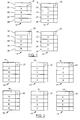
- FIG. 1 there are shown four ballots identified by reference numbers 10, 12, 14 and 16. Each ballot is divided into two adjacent columns, 18 and 20 respectively. The columns are divided into four rows, 22, 24, 26 and 28 respectively.
- the rows 22 through 28 of the columns 18 each contain one of the letters A, B, C, or D marked thereon. Each of these letters denotes the name of a different candidate on the ballot.
- Each row 22, 24, 26 and 28 of column 18 on each ballot 10, 12, 14 and 16, represents a different discrete location on the ballot. Rows 22, 24, 26 and 28 of column 20 are left blank for insertion of a mark by the voter to indicate which candidate they have selected.
- the sequential order of names remains the same.
- the letter C is always adjacent at least one of the letters B or D and is never adjacent the letter A.
- the letter A is always adjacent one of the letters D or B and never adjacent the letter C, and so forth. Accordingly, if the candidate whose name is represented by the letter A would be particularly undesirable to a large number of voters, and if ill-informed voters are disinclined to select a candidate whose name appears adjacent the name of this undesirable candidate, then such ill-informed voters would be more inclined to pick the candidate represented by the letter C over either of the candidates represented by letters D or B respectively. In this manner, the candidate represented by letter C has an unfair advantage over the candidate represented by letters B or D respectively.
- Figure 2 illustrates six ballots, 32, 34, 36, 38, 40 and 42 respectively, each of which has a different sequence of candidates' names represented by letters A, B, C and D, thereon.
- the letter A appears adjacent each of the remaining letters B, C and D two times.
- each of the six sequences shown on ballots 32, 34, 36, 38, 40 and 42 is rotated four times as discussed above concerning the ballots of Figure 1, twenty-four ballots will be produced in which each candidate's name will occupy a given one of the four rows 22, 24, 26, or 28 of column 18 an equal number of times and as well, each candidate's name will be adjacent another candidate's name an equal number of times.
- the set of ballots will contain an equal number of each of these twenty- four different ballots.
- Sets of ballots can be produced by separately printing batches of ballots corresponding to each desired arrangement of names and subsequently collating the ballots into groups. In each group, each ballot representing a different arrangement. With this method, any desired number of groups can be compiled to form a set of ballots containing a desired number of ballots.
- the ballots can be printed sequentially with each subsequent ballot having a different arrangement of names thereon until all of the permutations have been exhausted at which point the cycle would again be repeated.
- One way of accomplishing this latter method is to program the sequence of names into a computer which controls a printer, such as a laser printer. The computer would then drive the laser printer to print out the ballots in sequence.
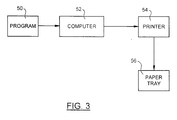
- a further refinement of the latter method is, as diagrammatically indicated in Figure 3, to enter an appropriate program 50 into a computer 52 which is connected to a printer (e.g. a laser printer) 54.
- the program 50 functions such that when a series of names is entered into a computer, the program arranges the names in all possible combinations, as shown in Figure 2, so that each name appears adjacent each other name an equal number of times.
- the program then causes the names to be rotated so that in addition, each name appears in each location generally an equal number of times.
- the computer then directs the printer 54 to print sets of ballots meeting the above explained criteria.
- the sets of ballots emerge into a paper tray 56 and are repeated until a desired number of ballots has been printed.
Landscapes
- Time Recorders, Dirve Recorders, Access Control (AREA)
- Management, Administration, Business Operations System, And Electronic Commerce (AREA)
Claims (7)
- Verfahren zum Herstellen eines Satzes von Stimmzetteln (10 bis 16), wobei das Verfahren folgende Schritte umfaßt.i) das Aufnehmen des Namens (A bis D) eines Kandidaten in jeder einer Vielzahl getrennter Positionen (22 bis 28) auf jedem Stimmzettel, undii) das Wiederholen des Schritts (i), um eine Gruppe von Stimmzetteln herzustellen,
wobei das Verfahren dadurch gekennzeichnet ist, daß:iii) sich der in jeder Position (22 bis 28) auf jedem Stimmzettel (10 bis 16) aufgenommene Kandidatenname (A bis D) der Gruppe vom in der Position (22 bis 28) auf jedem anderen Stimmzettel (10 bis 16) der Gruppe aufgenommenen Kandidatennamen unterscheidet, sowieiv) durch das Herstellen einer gewünschten Anzahl der Gruppen, wobei die Gruppen zusammen einen Stimmzettel-Satz bilden. - Verfahren nach Anspruch 1, worin eine ausreichende Anzahl von Gruppen der Stimmzettel (10 bis 16) hergestellt wird, so daß auf den Stimmzetteln des Satzes zusammen genommen jeder Kandidatenname (A bis D) im wesentlichen gleich häufig an jeder der getrennten Positionen (22 bis 28) aufscheint.
- Verfahren nach Anspruch 1 oder 2, worin eine ausreichende Anzahl von Gruppen der Stimmzettel (10 bis 16) erzeugt wird, so daß auf den Stimmzetteln des Satzes zusammen genommen jeder der Namen (A bis D) in Nachbarschaft eines jeden anderen der Namen (A bis D) allgemein gleich häufig aufscheint.
- Verfahren nach Anspruch 1, worin der Satz Stimmzetteln (10 bis 16) durch Programmittel (50), Computermittel (52) und Druckermittel (54) hergestellt wird.
- Gruppe von Stimmzetteln (10 bis 16), bei der jeder Stimmzettel (10 bis 16) eine Vielzahl getrennter Positionen (22 bis 28) aufweist, an denen jeweils der Name (A bis D) eines Kandidaten aufgenommen wird, wobei eine Anzahl der Stimmzettel eine Stimmzettelgruppe bildet, dadurch gekennzeichnet, daß sich die Kandidatennamen (A bis D), die an den Positionen (22 bis 28) auf jedem Stimmzettel (10 bis 16) in der Gruppe aufgenommen sind, von dem Kandidatennamen (A bis D) unterscheiden, der an dieser Position (22 bis 28) auf jedem anderen Stimmzettel (10 bis 16) in der Gruppe aufgenommen ist und eine Anzahl der Stimmzettelgruppen vorhanden ist, die einen Stimmzettelsatz bilden, wobei die Anzahl ausreicht, damit zusammen genommen der Name (A bis D) eines jeden Kandidaten im allgemeinen gleich häufig an jeder der getrennten Positionen (22 bis 28) erscheint, wodurch die Wirkung der möglichen Tendenz der Wähler verringert wird, beim Markieren des Stimmzettels eine bestimmte Position wie etwa die oberste des Stimmzettels (10 bis 16) anzukreuzen.
- Stimmzettelsatz nach Anspruch 5, worin jeder der Namen (A bis D) im allgemeinen auf einer gleichen Anzahl von Stimmzetteln (10 bis 16) im Satz in Nachbarschaft eines jeden anderen Namens erscheint, wodurch die Wirkung der möglichen Tendenz der Wähler verringert wird, beim Markieren des Stimmzettels Namen in Nachbarschaft eines bestimmten Namens zu vermeiden oder vorzuziehen.
- Verfahren zum Herstellen von Sätzen von Stimmzetteln (10 bis 16), wobei das Verfahren folgende Schritte umfaßt:i) das Drucken des Namens (A bis D) eines Kandidaten auf jede einer Vielzahl getrennter Positionen (22 bis 28) auf jedem Stimmzettel (10 bis 16), undii) das Wiederholen des Schritts (i), um eine Gruppe von Stimmzetteln (10 bis 16) herzustellen,
wobei das Verfahren gekennzeichnet ist durch:iii) das Drucken eines ersten Stimmzettels (10 bis 16), auf dem die Namen (A bis D) der Kandidaten an der Vielzahl getrennter Positionen in einer bestimmten Abfolge aufscheinen;iv) das Drucken eines zweiten Stimmzettels (10 bis 16), auf dem die Namen (A bis D) der Kandidaten in der Vielzahl getrennter Positionen in einer anderen Abfolge als auf dem ersten Stimmzettel aufscheinen;v) das Wiederholen von Schritt iv), bis alle Permutationen der verschiedenen Abfolgen erschöpft sind, so daß eine Gruppe von Stimmzetteln (10 bis 16) hergestellt ist;vi) das Wiederholen der Schritte iii) bis v), bis eine gewünschte Anzahl von Gruppen von Stimmzetteln (10 bis 16) gedruckt worden ist, undviii) das Ordnen der Stimmzettel (10 bis 16) zu einem Satz von Stimmzetteln.
Priority Applications (2)
| Application Number | Priority Date | Filing Date | Title |
|---|---|---|---|
| EP19950300833 EP0726165B1 (de) | 1995-02-10 | 1995-02-10 | Wahlpapiere und ihre Druckverfahren |
| DE1995612883 DE69512883T2 (de) | 1995-02-10 | 1995-02-10 | Wahlpapiere und ihre Druckverfahren |
Applications Claiming Priority (1)
| Application Number | Priority Date | Filing Date | Title |
|---|---|---|---|
| EP19950300833 EP0726165B1 (de) | 1995-02-10 | 1995-02-10 | Wahlpapiere und ihre Druckverfahren |
Publications (2)
| Publication Number | Publication Date |
|---|---|
| EP0726165A1 EP0726165A1 (de) | 1996-08-14 |
| EP0726165B1 true EP0726165B1 (de) | 1999-10-20 |
Family
ID=8221080
Family Applications (1)
| Application Number | Title | Priority Date | Filing Date |
|---|---|---|---|
| EP19950300833 Expired - Lifetime EP0726165B1 (de) | 1995-02-10 | 1995-02-10 | Wahlpapiere und ihre Druckverfahren |
Country Status (2)
| Country | Link |
|---|---|
| EP (1) | EP0726165B1 (de) |
| DE (1) | DE69512883T2 (de) |
Family Cites Families (2)
| Publication number | Priority date | Publication date | Assignee | Title |
|---|---|---|---|---|
| US4807908A (en) * | 1987-03-02 | 1989-02-28 | Business Records Corporation | Ballot for use in automatic tallying apparatus |
| JPH01210395A (ja) * | 1988-02-19 | 1989-08-23 | Marukei:Kk | 投票用紙 |
-
1995
- 1995-02-10 DE DE1995612883 patent/DE69512883T2/de not_active Expired - Fee Related
- 1995-02-10 EP EP19950300833 patent/EP0726165B1/de not_active Expired - Lifetime
Also Published As
| Publication number | Publication date |
|---|---|
| DE69512883T2 (de) | 2000-03-09 |
| DE69512883D1 (de) | 1999-11-25 |
| EP0726165A1 (de) | 1996-08-14 |
Similar Documents
| Publication | Publication Date | Title |
|---|---|---|
| US5577727A (en) | Instantaneous bingo tracking method and apparatus | |
| DE69406951T2 (de) | Glücksspiel | |
| US5116049A (en) | Lottery game system and method of playing | |
| USRE34673E (en) | Two level scratch game | |
| US4807908A (en) | Ballot for use in automatic tallying apparatus | |
| RU2134903C1 (ru) | Способ обработки листов с оттисками бланков ценных бумаг (варианты) | |
| GB2182469A (en) | Method of making bingo cards | |
| WO2000009227A1 (en) | Device for manufacturing playing counters and drawing sequences in a lottery | |
| EP0864429B1 (de) | Zufalls-Maskenmuster in einem Multipegel-Tintenstrahldrucker | |
| EP1539496B1 (de) | Nummerierungsverfahren und nummerierungskasten zur durchführung des verfahrens | |
| CA1235820A (en) | Method of making bingo cards | |
| GB1563756A (en) | Pattern matching method and apparatus | |
| CA2182210C (en) | Method for printing books of bingo paper | |
| EP0726165B1 (de) | Wahlpapiere und ihre Druckverfahren | |
| EP0160504B2 (de) | Numerierte Dokumente, Herstellungsverfahren und -mittel hierzu | |
| US20050167910A1 (en) | Scratch-off ticket or playing card | |
| CA1334985C (en) | Ballot sets and method of printing ballots | |
| CA2141858C (en) | A system for drawing winners in a lottery | |
| JPH06278353A (ja) | ナンバリング方法およびその装置 | |
| Perring | Data-processing for the Atlas of the British Flora | |
| DE4339792C2 (de) | Verfahren zur Sicherung des aktuellen Spielzustandes | |
| US4813707A (en) | Perpetual calendar | |
| JP2000197723A (ja) | 印刷物及び冊子体 | |
| US20060087542A1 (en) | Method and system for efficiently printing and sorting multiple orders of transaction cards | |
| RU13267U1 (ru) | Бюллетень для тайного голосования |
Legal Events
| Date | Code | Title | Description |
|---|---|---|---|
| PUAI | Public reference made under article 153(3) epc to a published international application that has entered the european phase |
Free format text: ORIGINAL CODE: 0009012 |
|
| AK | Designated contracting states |
Kind code of ref document: A1 Designated state(s): DE FR GB |
|
| 17P | Request for examination filed |
Effective date: 19961126 |
|
| 17Q | First examination report despatched |
Effective date: 19971107 |
|
| GRAG | Despatch of communication of intention to grant |
Free format text: ORIGINAL CODE: EPIDOS AGRA |
|
| GRAG | Despatch of communication of intention to grant |
Free format text: ORIGINAL CODE: EPIDOS AGRA |
|
| GRAH | Despatch of communication of intention to grant a patent |
Free format text: ORIGINAL CODE: EPIDOS IGRA |
|
| GRAH | Despatch of communication of intention to grant a patent |
Free format text: ORIGINAL CODE: EPIDOS IGRA |
|
| GRAA | (expected) grant |
Free format text: ORIGINAL CODE: 0009210 |
|
| AK | Designated contracting states |
Kind code of ref document: B1 Designated state(s): DE FR GB |
|
| REF | Corresponds to: |
Ref document number: 69512883 Country of ref document: DE Date of ref document: 19991125 |
|
| ET | Fr: translation filed | ||
| PLBE | No opposition filed within time limit |
Free format text: ORIGINAL CODE: 0009261 |
|
| STAA | Information on the status of an ep patent application or granted ep patent |
Free format text: STATUS: NO OPPOSITION FILED WITHIN TIME LIMIT |
|
| 26N | No opposition filed | ||
| REG | Reference to a national code |
Ref country code: GB Ref legal event code: IF02 |
|
| PGFP | Annual fee paid to national office [announced via postgrant information from national office to epo] |
Ref country code: FR Payment date: 20030219 Year of fee payment: 9 |
|
| PGFP | Annual fee paid to national office [announced via postgrant information from national office to epo] |
Ref country code: DE Payment date: 20030224 Year of fee payment: 9 |
|
| PGFP | Annual fee paid to national office [announced via postgrant information from national office to epo] |
Ref country code: GB Payment date: 20040204 Year of fee payment: 10 |
|
| PG25 | Lapsed in a contracting state [announced via postgrant information from national office to epo] |
Ref country code: DE Free format text: LAPSE BECAUSE OF NON-PAYMENT OF DUE FEES Effective date: 20040901 |
|
| PG25 | Lapsed in a contracting state [announced via postgrant information from national office to epo] |
Ref country code: FR Free format text: LAPSE BECAUSE OF NON-PAYMENT OF DUE FEES Effective date: 20041029 |
|
| REG | Reference to a national code |
Ref country code: FR Ref legal event code: ST |
|
| PG25 | Lapsed in a contracting state [announced via postgrant information from national office to epo] |
Ref country code: GB Free format text: LAPSE BECAUSE OF NON-PAYMENT OF DUE FEES Effective date: 20050210 |
|
| GBPC | Gb: european patent ceased through non-payment of renewal fee |
Effective date: 20050206 |