EP0724561B1 - Calcium receptor-active arylalkyl amines - Google Patents
Calcium receptor-active arylalkyl amines Download PDFInfo
- Publication number
- EP0724561B1 EP0724561B1 EP94931982A EP94931982A EP0724561B1 EP 0724561 B1 EP0724561 B1 EP 0724561B1 EP 94931982 A EP94931982 A EP 94931982A EP 94931982 A EP94931982 A EP 94931982A EP 0724561 B1 EP0724561 B1 EP 0724561B1
- Authority
- EP
- European Patent Office
- Prior art keywords
- cell
- calcium
- receptor
- extracellular
- inorganic ion
- Prior art date
- Legal status (The legal status is an assumption and is not a legal conclusion. Google has not performed a legal analysis and makes no representation as to the accuracy of the status listed.)
- Expired - Lifetime
Links
- 239000011575 calcium Substances 0.000 title abstract description 41
- OYPRJOBELJOOCE-UHFFFAOYSA-N Calcium Chemical compound [Ca] OYPRJOBELJOOCE-UHFFFAOYSA-N 0.000 title description 42
- 229910052791 calcium Inorganic materials 0.000 title description 40
- 150000003975 aryl alkyl amines Chemical class 0.000 title 1
- 208000037265 diseases, disorders, signs and symptoms Diseases 0.000 claims abstract description 44
- 201000010099 disease Diseases 0.000 claims abstract description 23
- 208000035475 disorder Diseases 0.000 claims abstract description 21
- 150000001875 compounds Chemical class 0.000 claims description 40
- 230000002159 abnormal effect Effects 0.000 claims description 16
- 125000003118 aryl group Chemical group 0.000 claims description 10
- 230000004094 calcium homeostasis Effects 0.000 claims description 10
- 150000003839 salts Chemical class 0.000 claims description 9
- -1 methylene dioxy Chemical group 0.000 claims description 8
- 238000004519 manufacturing process Methods 0.000 claims description 7
- QSLPNSWXUQHVLP-UHFFFAOYSA-N $l^{1}-sulfanylmethane Chemical compound [S]C QSLPNSWXUQHVLP-UHFFFAOYSA-N 0.000 claims description 6
- 208000001132 Osteoporosis Diseases 0.000 claims description 6
- 125000001449 isopropyl group Chemical group [H]C([H])([H])C([H])(*)C([H])([H])[H] 0.000 claims description 6
- GRVDJDISBSALJP-UHFFFAOYSA-N methyloxidanyl Chemical compound [O]C GRVDJDISBSALJP-UHFFFAOYSA-N 0.000 claims description 6
- 239000000126 substance Substances 0.000 claims description 5
- 208000037147 Hypercalcaemia Diseases 0.000 claims description 4
- 230000000148 hypercalcaemia Effects 0.000 claims description 4
- 208000030915 hypercalcemia disease Diseases 0.000 claims description 4
- 125000002496 methyl group Chemical group [H]C([H])([H])* 0.000 claims description 4
- 206010020707 Hyperparathyroidism primary Diseases 0.000 claims description 3
- 201000000981 Primary Hyperparathyroidism Diseases 0.000 claims description 3
- 125000001495 ethyl group Chemical group [H]C([H])([H])C([H])([H])* 0.000 claims description 3
- VOLGAXAGEUPBDM-UHFFFAOYSA-N $l^{1}-oxidanylethane Chemical compound CC[O] VOLGAXAGEUPBDM-UHFFFAOYSA-N 0.000 claims description 2
- 206010020772 Hypertension Diseases 0.000 claims description 2
- 125000000484 butyl group Chemical group [H]C([*])([H])C([H])([H])C([H])([H])C([H])([H])[H] 0.000 claims description 2
- 229910052739 hydrogen Inorganic materials 0.000 claims description 2
- 239000001257 hydrogen Substances 0.000 claims description 2
- 125000004435 hydrogen atom Chemical class [H]* 0.000 claims description 2
- 125000000959 isobutyl group Chemical group [H]C([H])([H])C([H])(C([H])([H])[H])C([H])([H])* 0.000 claims description 2
- 125000001436 propyl group Chemical group [H]C([*])([H])C([H])([H])C([H])([H])[H] 0.000 claims description 2
- 125000000999 tert-butyl group Chemical group [H]C([H])([H])C(*)(C([H])([H])[H])C([H])([H])[H] 0.000 claims description 2
- 239000008194 pharmaceutical composition Substances 0.000 claims 3
- 208000010191 Osteitis Deformans Diseases 0.000 claims 1
- 208000027868 Paget disease Diseases 0.000 claims 1
- 208000005770 Secondary Hyperparathyroidism Diseases 0.000 claims 1
- 239000003937 drug carrier Substances 0.000 claims 1
- 208000027202 mammary Paget disease Diseases 0.000 claims 1
- 230000000694 effects Effects 0.000 abstract description 79
- 108010050543 Calcium-Sensing Receptors Proteins 0.000 abstract description 67
- 102000013830 Calcium-Sensing Receptors Human genes 0.000 abstract description 67
- 229910001410 inorganic ion Inorganic materials 0.000 abstract description 59
- 102000005962 receptors Human genes 0.000 abstract description 54
- 108020003175 receptors Proteins 0.000 abstract description 54
- 230000003278 mimic effect Effects 0.000 abstract description 11
- 210000004027 cell Anatomy 0.000 description 101
- 229910001424 calcium ion Inorganic materials 0.000 description 75
- BHPQYMZQTOCNFJ-UHFFFAOYSA-N Calcium cation Chemical compound [Ca+2] BHPQYMZQTOCNFJ-UHFFFAOYSA-N 0.000 description 74
- 102000003982 Parathyroid hormone Human genes 0.000 description 38
- 108090000445 Parathyroid hormone Proteins 0.000 description 38
- 239000000199 parathyroid hormone Substances 0.000 description 38
- 229960001319 parathyroid hormone Drugs 0.000 description 38
- 230000000849 parathyroid Effects 0.000 description 36
- 239000003795 chemical substances by application Substances 0.000 description 34
- 230000028327 secretion Effects 0.000 description 33
- VLKZOEOYAKHREP-UHFFFAOYSA-N n-Hexane Chemical compound CCCCCC VLKZOEOYAKHREP-UHFFFAOYSA-N 0.000 description 26
- 230000015572 biosynthetic process Effects 0.000 description 18
- RTZKZFJDLAIYFH-UHFFFAOYSA-N Diethyl ether Chemical compound CCOCC RTZKZFJDLAIYFH-UHFFFAOYSA-N 0.000 description 16
- 210000000988 bone and bone Anatomy 0.000 description 16
- 239000000203 mixture Substances 0.000 description 15
- 210000003292 kidney cell Anatomy 0.000 description 14
- 210000003771 C cell Anatomy 0.000 description 13
- 230000002092 calcimimetic effect Effects 0.000 description 13
- 210000002997 osteoclast Anatomy 0.000 description 13
- 238000003786 synthesis reaction Methods 0.000 description 12
- 238000011282 treatment Methods 0.000 description 11
- LFQSCWFLJHTTHZ-UHFFFAOYSA-N Ethanol Chemical compound CCO LFQSCWFLJHTTHZ-UHFFFAOYSA-N 0.000 description 10
- 210000001789 adipocyte Anatomy 0.000 description 10
- 238000000338 in vitro Methods 0.000 description 10
- 239000011541 reaction mixture Substances 0.000 description 10
- 230000001052 transient effect Effects 0.000 description 10
- XLYOFNOQVPJJNP-UHFFFAOYSA-N water Substances O XLYOFNOQVPJJNP-UHFFFAOYSA-N 0.000 description 10
- 102000055006 Calcitonin Human genes 0.000 description 9
- 108060001064 Calcitonin Proteins 0.000 description 9
- 201000002980 Hyperparathyroidism Diseases 0.000 description 9
- BBBFJLBPOGFECG-VJVYQDLKSA-N calcitonin Chemical compound N([C@H](C(=O)N[C@@H](CC(C)C)C(=O)NCC(=O)N[C@@H](CCCCN)C(=O)N[C@@H](CC(C)C)C(=O)N[C@@H](CO)C(=O)N[C@@H](CCC(N)=O)C(=O)N[C@@H](CCC(O)=O)C(=O)N[C@@H](CC(C)C)C(=O)N[C@@H](CC=1NC=NC=1)C(=O)N[C@@H](CCCCN)C(=O)N[C@@H](CC(C)C)C(=O)N[C@@H](CCC(N)=O)C(=O)N[C@@H]([C@@H](C)O)C(=O)N[C@@H](CC=1C=CC(O)=CC=1)C(=O)N1[C@@H](CCC1)C(=O)N[C@@H](CCCNC(N)=N)C(=O)N[C@@H]([C@@H](C)O)C(=O)N[C@@H](CC(N)=O)C(=O)N[C@@H]([C@@H](C)O)C(=O)NCC(=O)N[C@@H](CO)C(=O)NCC(=O)N[C@@H]([C@@H](C)O)C(=O)N1[C@@H](CCC1)C(N)=O)C(C)C)C(=O)[C@@H]1CSSC[C@H](N)C(=O)N[C@@H](CO)C(=O)N[C@@H](CC(N)=O)C(=O)N[C@@H](CC(C)C)C(=O)N[C@@H](CO)C(=O)N[C@@H]([C@@H](C)O)C(=O)N1 BBBFJLBPOGFECG-VJVYQDLKSA-N 0.000 description 9
- 229960004015 calcitonin Drugs 0.000 description 9
- 230000007423 decrease Effects 0.000 description 9
- 230000001126 calcilytic effect Effects 0.000 description 8
- 108020004999 messenger RNA Proteins 0.000 description 8
- VEXZGXHMUGYJMC-UHFFFAOYSA-N Hydrochloric acid Chemical compound Cl VEXZGXHMUGYJMC-UHFFFAOYSA-N 0.000 description 7
- OKKJLVBELUTLKV-UHFFFAOYSA-N Methanol Chemical compound OC OKKJLVBELUTLKV-UHFFFAOYSA-N 0.000 description 7
- 102000003923 Protein Kinase C Human genes 0.000 description 7
- 108090000315 Protein Kinase C Proteins 0.000 description 7
- 241000269370 Xenopus <genus> Species 0.000 description 7
- 210000000287 oocyte Anatomy 0.000 description 7
- 230000004044 response Effects 0.000 description 7
- BEOOHQFXGBMRKU-UHFFFAOYSA-N sodium cyanoborohydride Chemical compound [Na+].[B-]C#N BEOOHQFXGBMRKU-UHFFFAOYSA-N 0.000 description 7
- 239000007787 solid Substances 0.000 description 7
- 0 CC(*CCc1ccc*2c1cccc2)[C@@](c1cccc2ccccc12)N Chemical compound CC(*CCc1ccc*2c1cccc2)[C@@](c1cccc2ccccc12)N 0.000 description 6
- HEDRZPFGACZZDS-UHFFFAOYSA-N Chloroform Chemical compound ClC(Cl)Cl HEDRZPFGACZZDS-UHFFFAOYSA-N 0.000 description 6
- VYPSYNLAJGMNEJ-UHFFFAOYSA-N Silicium dioxide Chemical compound O=[Si]=O VYPSYNLAJGMNEJ-UHFFFAOYSA-N 0.000 description 6
- 238000010828 elution Methods 0.000 description 6
- 230000001965 increasing effect Effects 0.000 description 6
- 238000000034 method Methods 0.000 description 6
- PHEDXBVPIONUQT-RGYGYFBISA-N phorbol 13-acetate 12-myristate Chemical compound C([C@]1(O)C(=O)C(C)=C[C@H]1[C@@]1(O)[C@H](C)[C@H]2OC(=O)CCCCCCCCCCCCC)C(CO)=C[C@H]1[C@H]1[C@]2(OC(C)=O)C1(C)C PHEDXBVPIONUQT-RGYGYFBISA-N 0.000 description 6
- 239000000741 silica gel Substances 0.000 description 6
- 229910002027 silica gel Inorganic materials 0.000 description 6
- PUZPDOWCWNUUKD-UHFFFAOYSA-M sodium fluoride Chemical compound [F-].[Na+] PUZPDOWCWNUUKD-UHFFFAOYSA-M 0.000 description 6
- VXUYXOFXAQZZMF-UHFFFAOYSA-N titanium(IV) isopropoxide Chemical compound CC(C)O[Ti](OC(C)C)(OC(C)C)OC(C)C VXUYXOFXAQZZMF-UHFFFAOYSA-N 0.000 description 6
- 210000004509 vascular smooth muscle cell Anatomy 0.000 description 6
- RTCUCQWIICFPOD-SECBINFHSA-N (1r)-1-naphthalen-1-ylethanamine Chemical compound C1=CC=C2C([C@H](N)C)=CC=CC2=C1 RTCUCQWIICFPOD-SECBINFHSA-N 0.000 description 5
- 208000006386 Bone Resorption Diseases 0.000 description 5
- IVOMOUWHDPKRLL-KQYNXXCUSA-N Cyclic adenosine monophosphate Chemical compound C([C@H]1O2)OP(O)(=O)O[C@H]1[C@@H](O)[C@@H]2N1C(N=CN=C2N)=C2N=C1 IVOMOUWHDPKRLL-KQYNXXCUSA-N 0.000 description 5
- 108010081690 Pertussis Toxin Proteins 0.000 description 5
- IVOMOUWHDPKRLL-UHFFFAOYSA-N UNPD107823 Natural products O1C2COP(O)(=O)OC2C(O)C1N1C(N=CN=C2N)=C2N=C1 IVOMOUWHDPKRLL-UHFFFAOYSA-N 0.000 description 5
- MMWCIQZXVOZEGG-HOZKJCLWSA-N [(1S,2R,3S,4S,5R,6S)-2,3,5-trihydroxy-4,6-diphosphonooxycyclohexyl] dihydrogen phosphate Chemical compound O[C@H]1[C@@H](O)[C@H](OP(O)(O)=O)[C@@H](OP(O)(O)=O)[C@H](O)[C@H]1OP(O)(O)=O MMWCIQZXVOZEGG-HOZKJCLWSA-N 0.000 description 5
- 239000012190 activator Substances 0.000 description 5
- 230000001174 ascending effect Effects 0.000 description 5
- 210000001772 blood platelet Anatomy 0.000 description 5
- 230000024279 bone resorption Effects 0.000 description 5
- 230000000747 cardiac effect Effects 0.000 description 5
- 210000003169 central nervous system Anatomy 0.000 description 5
- 239000012043 crude product Substances 0.000 description 5
- 229940095074 cyclic amp Drugs 0.000 description 5
- 208000037765 diseases and disorders Diseases 0.000 description 5
- 238000004128 high performance liquid chromatography Methods 0.000 description 5
- 238000001727 in vivo Methods 0.000 description 5
- 230000005764 inhibitory process Effects 0.000 description 5
- 238000002347 injection Methods 0.000 description 5
- 239000007924 injection Substances 0.000 description 5
- 229910052500 inorganic mineral Inorganic materials 0.000 description 5
- 230000000968 intestinal effect Effects 0.000 description 5
- 230000003834 intracellular effect Effects 0.000 description 5
- 210000002510 keratinocyte Anatomy 0.000 description 5
- 210000004216 mammary stem cell Anatomy 0.000 description 5
- 239000011707 mineral Substances 0.000 description 5
- 235000010755 mineral Nutrition 0.000 description 5
- 150000007523 nucleic acids Chemical class 0.000 description 5
- 210000001428 peripheral nervous system Anatomy 0.000 description 5
- 230000002829 reductive effect Effects 0.000 description 5
- 239000006228 supernatant Substances 0.000 description 5
- 210000001685 thyroid gland Anatomy 0.000 description 5
- 210000002993 trophoblast Anatomy 0.000 description 5
- 241000283690 Bos taurus Species 0.000 description 4
- 241001465754 Metazoa Species 0.000 description 4
- 230000009471 action Effects 0.000 description 4
- 230000001746 atrial effect Effects 0.000 description 4
- 210000000227 basophil cell of anterior lobe of hypophysis Anatomy 0.000 description 4
- 238000005119 centrifugation Methods 0.000 description 4
- 150000001982 diacylglycerols Chemical class 0.000 description 4
- 230000003292 diminished effect Effects 0.000 description 4
- 210000002615 epidermis Anatomy 0.000 description 4
- 210000002406 gastrin-secreting cell Anatomy 0.000 description 4
- 210000001035 gastrointestinal tract Anatomy 0.000 description 4
- 229940088597 hormone Drugs 0.000 description 4
- 239000005556 hormone Substances 0.000 description 4
- 210000002865 immune cell Anatomy 0.000 description 4
- 150000002500 ions Chemical class 0.000 description 4
- 239000000463 material Substances 0.000 description 4
- 108020004707 nucleic acids Proteins 0.000 description 4
- 102000039446 nucleic acids Human genes 0.000 description 4
- 210000002826 placenta Anatomy 0.000 description 4
- 210000002381 plasma Anatomy 0.000 description 4
- 239000002244 precipitate Substances 0.000 description 4
- 239000000047 product Substances 0.000 description 4
- 210000000512 proximal kidney tubule Anatomy 0.000 description 4
- 239000012321 sodium triacetoxyborohydride Substances 0.000 description 4
- 238000010561 standard procedure Methods 0.000 description 4
- 210000005239 tubule Anatomy 0.000 description 4
- JWZZKOKVBUJMES-UHFFFAOYSA-N (+-)-Isoprenaline Chemical compound CC(C)NCC(O)C1=CC=C(O)C(O)=C1 JWZZKOKVBUJMES-UHFFFAOYSA-N 0.000 description 3
- LUZOFMGZMUZSSK-LRDDRELGSA-N (-)-indolactam V Chemical compound C1[C@@H](CO)NC(=O)[C@H](C(C)C)N(C)C2=CC=CC3=C2C1=CN3 LUZOFMGZMUZSSK-LRDDRELGSA-N 0.000 description 3
- LUZOFMGZMUZSSK-UHFFFAOYSA-N Indolactam-V Natural products C1C(CO)NC(=O)C(C(C)C)N(C)C2=CC=CC3=C2C1=CN3 LUZOFMGZMUZSSK-UHFFFAOYSA-N 0.000 description 3
- 108091034057 RNA (poly(A)) Proteins 0.000 description 3
- HEMHJVSKTPXQMS-UHFFFAOYSA-M Sodium hydroxide Chemical compound [OH-].[Na+] HEMHJVSKTPXQMS-UHFFFAOYSA-M 0.000 description 3
- 230000009286 beneficial effect Effects 0.000 description 3
- 230000000903 blocking effect Effects 0.000 description 3
- 210000004369 blood Anatomy 0.000 description 3
- 239000008280 blood Substances 0.000 description 3
- 230000003247 decreasing effect Effects 0.000 description 3
- 239000003814 drug Substances 0.000 description 3
- 230000019948 ion homeostasis Effects 0.000 description 3
- 229940039009 isoproterenol Drugs 0.000 description 3
- 150000002576 ketones Chemical class 0.000 description 3
- DLEDLHFNQDHEOJ-UDTOXTEMSA-N mezerein Chemical compound O([C@@H]1[C@H]([C@@]23[C@H]4[C@](C(C(C)=C4)=O)(O)[C@H](O)[C@@]4(CO)O[C@H]4[C@H]3[C@H]3O[C@@](O2)(O[C@]31C(C)=C)C=1C=CC=CC=1)C)C(=O)\C=C\C=C\C1=CC=CC=C1 DLEDLHFNQDHEOJ-UDTOXTEMSA-N 0.000 description 3
- DLEDLHFNQDHEOJ-KVZAMRGJSA-N mezerein Natural products CC1C(OC(=O)C=C/C=C/c2ccccc2)C3(OC4(OC3C5C6OC6(CO)C(O)C7(O)C(C=C(C)C7=O)C15O4)c8ccccc8)C(=C)C DLEDLHFNQDHEOJ-KVZAMRGJSA-N 0.000 description 3
- 239000002831 pharmacologic agent Substances 0.000 description 3
- 239000008196 pharmacological composition Substances 0.000 description 3
- 102000004169 proteins and genes Human genes 0.000 description 3
- 108090000623 proteins and genes Proteins 0.000 description 3
- 230000001105 regulatory effect Effects 0.000 description 3
- 239000011775 sodium fluoride Substances 0.000 description 3
- 235000013024 sodium fluoride Nutrition 0.000 description 3
- 210000001519 tissue Anatomy 0.000 description 3
- SRPCRBVBOIYYHS-UHFFFAOYSA-N 1-(4-methoxy-3-methylphenyl)ethanone Chemical compound COC1=CC=C(C(C)=O)C=C1C SRPCRBVBOIYYHS-UHFFFAOYSA-N 0.000 description 2
- NTPLXRHDUXRPNE-UHFFFAOYSA-N 4-methoxyacetophenone Chemical compound COC1=CC=C(C(C)=O)C=C1 NTPLXRHDUXRPNE-UHFFFAOYSA-N 0.000 description 2
- CSCPPACGZOOCGX-UHFFFAOYSA-N Acetone Chemical compound CC(C)=O CSCPPACGZOOCGX-UHFFFAOYSA-N 0.000 description 2
- 102000005701 Calcium-Binding Proteins Human genes 0.000 description 2
- 108010045403 Calcium-Binding Proteins Proteins 0.000 description 2
- YMWUJEATGCHHMB-UHFFFAOYSA-N Dichloromethane Chemical compound ClCCl YMWUJEATGCHHMB-UHFFFAOYSA-N 0.000 description 2
- KFZMGEQAYNKOFK-UHFFFAOYSA-N Isopropanol Chemical compound CC(C)O KFZMGEQAYNKOFK-UHFFFAOYSA-N 0.000 description 2
- 239000007832 Na2SO4 Substances 0.000 description 2
- PMZURENOXWZQFD-UHFFFAOYSA-L Sodium Sulfate Chemical compound [Na+].[Na+].[O-]S([O-])(=O)=O PMZURENOXWZQFD-UHFFFAOYSA-L 0.000 description 2
- GXBMIBRIOWHPDT-UHFFFAOYSA-N Vasopressin Natural products N1C(=O)C(CC=2C=C(O)C=CC=2)NC(=O)C(N)CSSCC(C(=O)N2C(CCC2)C(=O)NC(CCCN=C(N)N)C(=O)NCC(N)=O)NC(=O)C(CC(N)=O)NC(=O)C(CCC(N)=O)NC(=O)C1CC1=CC=CC=C1 GXBMIBRIOWHPDT-UHFFFAOYSA-N 0.000 description 2
- 108010004977 Vasopressins Proteins 0.000 description 2
- 102000002852 Vasopressins Human genes 0.000 description 2
- 230000009102 absorption Effects 0.000 description 2
- 238000010521 absorption reaction Methods 0.000 description 2
- 150000001299 aldehydes Chemical class 0.000 description 2
- 150000001413 amino acids Chemical group 0.000 description 2
- KBZOIRJILGZLEJ-LGYYRGKSSA-N argipressin Chemical compound C([C@H]1C(=O)N[C@@H](CCC(N)=O)C(=O)N[C@@H](CC(N)=O)C(=O)N[C@@H](CSSC[C@@H](C(N[C@@H](CC=2C=CC(O)=CC=2)C(=O)N1)=O)N)C(=O)N1[C@@H](CCC1)C(=O)N[C@@H](CCCN=C(N)N)C(=O)NCC(N)=O)C1=CC=CC=C1 KBZOIRJILGZLEJ-LGYYRGKSSA-N 0.000 description 2
- 238000003556 assay Methods 0.000 description 2
- 125000004432 carbon atom Chemical group C* 0.000 description 2
- 150000001768 cations Chemical class 0.000 description 2
- 238000006243 chemical reaction Methods 0.000 description 2
- 239000002299 complementary DNA Substances 0.000 description 2
- WTWBUQJHJGUZCY-UHFFFAOYSA-N cuminaldehyde Chemical compound CC(C)C1=CC=C(C=O)C=C1 WTWBUQJHJGUZCY-UHFFFAOYSA-N 0.000 description 2
- 230000007547 defect Effects 0.000 description 2
- 238000013461 design Methods 0.000 description 2
- 125000004925 dihydropyridyl group Chemical group N1(CC=CC=C1)* 0.000 description 2
- 231100000673 dose–response relationship Toxicity 0.000 description 2
- 229940079593 drug Drugs 0.000 description 2
- 230000000763 evoking effect Effects 0.000 description 2
- 238000009472 formulation Methods 0.000 description 2
- 239000012458 free base Substances 0.000 description 2
- 230000000121 hypercalcemic effect Effects 0.000 description 2
- 230000004941 influx Effects 0.000 description 2
- 230000002401 inhibitory effect Effects 0.000 description 2
- PGHMRUGBZOYCAA-ADZNBVRBSA-N ionomycin Chemical compound O1[C@H](C[C@H](O)[C@H](C)[C@H](O)[C@H](C)/C=C/C[C@@H](C)C[C@@H](C)C(/O)=C/C(=O)[C@@H](C)C[C@@H](C)C[C@@H](CCC(O)=O)C)CC[C@@]1(C)[C@@H]1O[C@](C)([C@@H](C)O)CC1 PGHMRUGBZOYCAA-ADZNBVRBSA-N 0.000 description 2
- PGHMRUGBZOYCAA-UHFFFAOYSA-N ionomycin Natural products O1C(CC(O)C(C)C(O)C(C)C=CCC(C)CC(C)C(O)=CC(=O)C(C)CC(C)CC(CCC(O)=O)C)CCC1(C)C1OC(C)(C(C)O)CC1 PGHMRUGBZOYCAA-UHFFFAOYSA-N 0.000 description 2
- 210000003734 kidney Anatomy 0.000 description 2
- 210000004185 liver Anatomy 0.000 description 2
- 230000007246 mechanism Effects 0.000 description 2
- 239000002674 ointment Substances 0.000 description 2
- 210000000056 organ Anatomy 0.000 description 2
- 239000012044 organic layer Substances 0.000 description 2
- 230000001599 osteoclastic effect Effects 0.000 description 2
- 230000000144 pharmacologic effect Effects 0.000 description 2
- BWHMMNNQKKPAPP-UHFFFAOYSA-L potassium carbonate Chemical compound [K+].[K+].[O-]C([O-])=O BWHMMNNQKKPAPP-UHFFFAOYSA-L 0.000 description 2
- 238000002360 preparation method Methods 0.000 description 2
- 150000003141 primary amines Chemical class 0.000 description 2
- 230000002035 prolonged effect Effects 0.000 description 2
- 230000004043 responsiveness Effects 0.000 description 2
- 210000002966 serum Anatomy 0.000 description 2
- 229910052938 sodium sulfate Inorganic materials 0.000 description 2
- 239000000243 solution Substances 0.000 description 2
- ATHGHQPFGPMSJY-UHFFFAOYSA-N spermidine Chemical compound NCCCCNCCCN ATHGHQPFGPMSJY-UHFFFAOYSA-N 0.000 description 2
- PFNFFQXMRSDOHW-UHFFFAOYSA-N spermine Chemical compound NCCCNCCCCNCCCN PFNFFQXMRSDOHW-UHFFFAOYSA-N 0.000 description 2
- 238000003756 stirring Methods 0.000 description 2
- 238000007910 systemic administration Methods 0.000 description 2
- 238000002560 therapeutic procedure Methods 0.000 description 2
- 229960003726 vasopressin Drugs 0.000 description 2
- WGHZSZLDJURQDX-GBNZRNLASA-N (1r)-1-(4-methoxy-3-methylphenyl)-n-[(1r)-1-naphthalen-1-ylethyl]ethanamine;hydrochloride Chemical compound Cl.C1=C(C)C(OC)=CC=C1[C@@H](C)N[C@H](C)C1=CC=CC2=CC=CC=C12 WGHZSZLDJURQDX-GBNZRNLASA-N 0.000 description 1
- DJCPOIGTJSLVEL-QNBGGDODSA-N (1r)-1-(4-methoxyphenyl)-n-[(1r)-1-naphthalen-1-ylethyl]ethanamine;hydrochloride Chemical compound Cl.C1=CC(OC)=CC=C1[C@@H](C)N[C@H](C)C1=CC=CC2=CC=CC=C12 DJCPOIGTJSLVEL-QNBGGDODSA-N 0.000 description 1
- ZTNUWNXGQXKJTM-UNTBIKODSA-N (1r)-1-naphthalen-1-yl-n-[(4-propan-2-ylphenyl)methyl]ethanamine;hydrochloride Chemical compound Cl.C1=CC(C(C)C)=CC=C1CN[C@H](C)C1=CC=CC2=CC=CC=C12 ZTNUWNXGQXKJTM-UNTBIKODSA-N 0.000 description 1
- YVCFWTWORDUGDV-JAXOOIEVSA-N (1r)-1-naphthalen-2-yl-n-[(1r)-1-naphthalen-1-ylethyl]ethanamine;hydrochloride Chemical compound Cl.C1=CC=CC2=CC([C@H](N[C@H](C)C=3C4=CC=CC=C4C=CC=3)C)=CC=C21 YVCFWTWORDUGDV-JAXOOIEVSA-N 0.000 description 1
- HMTUJIUTOMFXPW-PFEQFJNWSA-N (1r)-n-[(3-chloro-4-methoxyphenyl)methyl]-1-naphthalen-1-ylethanamine;hydrochloride Chemical compound Cl.C1=C(Cl)C(OC)=CC=C1CN[C@H](C)C1=CC=CC2=CC=CC=C12 HMTUJIUTOMFXPW-PFEQFJNWSA-N 0.000 description 1
- SGTNSNPWRIOYBX-UHFFFAOYSA-N 2-(3,4-dimethoxyphenyl)-5-{[2-(3,4-dimethoxyphenyl)ethyl](methyl)amino}-2-(propan-2-yl)pentanenitrile Chemical compound C1=C(OC)C(OC)=CC=C1CCN(C)CCCC(C#N)(C(C)C)C1=CC=C(OC)C(OC)=C1 SGTNSNPWRIOYBX-UHFFFAOYSA-N 0.000 description 1
- XSAYZAUNJMRRIR-UHFFFAOYSA-N 2-acetylnaphthalene Chemical compound C1=CC=CC2=CC(C(=O)C)=CC=C21 XSAYZAUNJMRRIR-UHFFFAOYSA-N 0.000 description 1
- NMKSAYKQLCHXDK-UHFFFAOYSA-N 3,3-diphenyl-N-(1-phenylethyl)-1-propanamine Chemical compound C=1C=CC=CC=1C(C)NCCC(C=1C=CC=CC=1)C1=CC=CC=C1 NMKSAYKQLCHXDK-UHFFFAOYSA-N 0.000 description 1
- WYVGYYIZXPXHAZ-UHFFFAOYSA-N 3-Chlor-4-methoxy-benzaldehyd Natural products COC1=CC=C(C=O)C=C1Cl WYVGYYIZXPXHAZ-UHFFFAOYSA-N 0.000 description 1
- QCQCHGYLTSGIGX-GHXANHINSA-N 4-[[(3ar,5ar,5br,7ar,9s,11ar,11br,13as)-5a,5b,8,8,11a-pentamethyl-3a-[(5-methylpyridine-3-carbonyl)amino]-2-oxo-1-propan-2-yl-4,5,6,7,7a,9,10,11,11b,12,13,13a-dodecahydro-3h-cyclopenta[a]chrysen-9-yl]oxy]-2,2-dimethyl-4-oxobutanoic acid Chemical compound N([C@@]12CC[C@@]3(C)[C@]4(C)CC[C@H]5C(C)(C)[C@@H](OC(=O)CC(C)(C)C(O)=O)CC[C@]5(C)[C@H]4CC[C@@H]3C1=C(C(C2)=O)C(C)C)C(=O)C1=CN=CC(C)=C1 QCQCHGYLTSGIGX-GHXANHINSA-N 0.000 description 1
- LXBHHIZIQVZGFN-UHFFFAOYSA-N 4-hydroxy-3-methylacetophenone Chemical compound CC(=O)C1=CC=C(O)C(C)=C1 LXBHHIZIQVZGFN-UHFFFAOYSA-N 0.000 description 1
- 206010001497 Agitation Diseases 0.000 description 1
- 102000002260 Alkaline Phosphatase Human genes 0.000 description 1
- 108020004774 Alkaline Phosphatase Proteins 0.000 description 1
- 208000024827 Alzheimer disease Diseases 0.000 description 1
- 208000019901 Anxiety disease Diseases 0.000 description 1
- 101800001288 Atrial natriuretic factor Proteins 0.000 description 1
- 102400001282 Atrial natriuretic peptide Human genes 0.000 description 1
- 101800001890 Atrial natriuretic peptide Proteins 0.000 description 1
- 208000023275 Autoimmune disease Diseases 0.000 description 1
- 210000002237 B-cell of pancreatic islet Anatomy 0.000 description 1
- 208000010392 Bone Fractures Diseases 0.000 description 1
- 206010065687 Bone loss Diseases 0.000 description 1
- PMPBFICDXLLSRM-UHFFFAOYSA-N CC(C)c1cccc2c1cccc2 Chemical compound CC(C)c1cccc2c1cccc2 PMPBFICDXLLSRM-UHFFFAOYSA-N 0.000 description 1
- OFMIVXZTNPNRPE-UHFFFAOYSA-N CCC(C=C1)=CCC1OC Chemical compound CCC(C=C1)=CCC1OC OFMIVXZTNPNRPE-UHFFFAOYSA-N 0.000 description 1
- 102000000584 Calmodulin Human genes 0.000 description 1
- 108010041952 Calmodulin Proteins 0.000 description 1
- 241000282472 Canis lupus familiaris Species 0.000 description 1
- OKTJSMMVPCPJKN-UHFFFAOYSA-N Carbon Chemical compound [C] OKTJSMMVPCPJKN-UHFFFAOYSA-N 0.000 description 1
- 101150015280 Cel gene Proteins 0.000 description 1
- 206010010904 Convulsion Diseases 0.000 description 1
- 206010012289 Dementia Diseases 0.000 description 1
- 206010012735 Diarrhoea Diseases 0.000 description 1
- 206010049119 Emotional distress Diseases 0.000 description 1
- 241000283086 Equidae Species 0.000 description 1
- 241000282326 Felis catus Species 0.000 description 1
- 206010016654 Fibrosis Diseases 0.000 description 1
- 102400000921 Gastrin Human genes 0.000 description 1
- 108010052343 Gastrins Proteins 0.000 description 1
- 102000051325 Glucagon Human genes 0.000 description 1
- 108060003199 Glucagon Proteins 0.000 description 1
- 239000012981 Hank's balanced salt solution Substances 0.000 description 1
- 206010019196 Head injury Diseases 0.000 description 1
- 208000010496 Heart Arrest Diseases 0.000 description 1
- 206010019280 Heart failures Diseases 0.000 description 1
- 208000023105 Huntington disease Diseases 0.000 description 1
- 206010021143 Hypoxia Diseases 0.000 description 1
- 206010053198 Inappropriate antidiuretic hormone secretion Diseases 0.000 description 1
- 241000124008 Mammalia Species 0.000 description 1
- 102000018697 Membrane Proteins Human genes 0.000 description 1
- 108010052285 Membrane Proteins Proteins 0.000 description 1
- 208000020161 Mineral related disease Diseases 0.000 description 1
- 206010049816 Muscle tightness Diseases 0.000 description 1
- 229930193140 Neomycin Natural products 0.000 description 1
- 206010029164 Nephrotic syndrome Diseases 0.000 description 1
- 201000005625 Neuroleptic malignant syndrome Diseases 0.000 description 1
- 208000021384 Obsessive-Compulsive disease Diseases 0.000 description 1
- 208000018737 Parkinson disease Diseases 0.000 description 1
- 241000288906 Primates Species 0.000 description 1
- 102100028255 Renin Human genes 0.000 description 1
- 108090000783 Renin Proteins 0.000 description 1
- 208000006011 Stroke Diseases 0.000 description 1
- 241000282898 Sus scrofa Species 0.000 description 1
- 208000000323 Tourette Syndrome Diseases 0.000 description 1
- 208000016620 Tourette disease Diseases 0.000 description 1
- 206010052779 Transplant rejections Diseases 0.000 description 1
- OKJPEAGHQZHRQV-UHFFFAOYSA-N Triiodomethane Natural products IC(I)I OKJPEAGHQZHRQV-UHFFFAOYSA-N 0.000 description 1
- 102000004903 Troponin Human genes 0.000 description 1
- 108090001027 Troponin Proteins 0.000 description 1
- 208000025865 Ulcer Diseases 0.000 description 1
- 239000002253 acid Substances 0.000 description 1
- 230000004913 activation Effects 0.000 description 1
- 230000004075 alteration Effects 0.000 description 1
- 150000001412 amines Chemical class 0.000 description 1
- 239000002647 aminoglycoside antibiotic agent Substances 0.000 description 1
- 230000001195 anabolic effect Effects 0.000 description 1
- 239000003242 anti bacterial agent Substances 0.000 description 1
- 229940088710 antibiotic agent Drugs 0.000 description 1
- 230000036506 anxiety Effects 0.000 description 1
- 230000004888 barrier function Effects 0.000 description 1
- 230000008901 benefit Effects 0.000 description 1
- 239000003833 bile salt Substances 0.000 description 1
- 229940093761 bile salts Drugs 0.000 description 1
- 238000004166 bioassay Methods 0.000 description 1
- 230000004071 biological effect Effects 0.000 description 1
- 238000004159 blood analysis Methods 0.000 description 1
- 230000023555 blood coagulation Effects 0.000 description 1
- 210000004204 blood vessel Anatomy 0.000 description 1
- 210000002449 bone cell Anatomy 0.000 description 1
- 230000010072 bone remodeling Effects 0.000 description 1
- 210000004556 brain Anatomy 0.000 description 1
- 239000000872 buffer Substances 0.000 description 1
- 230000001593 cAMP accumulation Effects 0.000 description 1
- 239000002775 capsule Substances 0.000 description 1
- NSQLIUXCMFBZME-MPVJKSABSA-N carperitide Chemical compound C([C@H]1C(=O)NCC(=O)NCC(=O)N[C@@H](CCCNC(N)=N)C(=O)N[C@@H](CCSC)C(=O)N[C@@H](CC(O)=O)C(=O)N[C@@H](CCCNC(N)=N)C(=O)N[C@H](C(NCC(=O)N[C@@H](C)C(=O)N[C@@H](CCC(N)=O)C(=O)N[C@@H](CO)C(=O)NCC(=O)N[C@@H](CC(C)C)C(=O)NCC(=O)N[C@@H](CSSC[C@@H](C(=O)N1)NC(=O)[C@H](CO)NC(=O)[C@H](CO)NC(=O)[C@H](CCCNC(N)=N)NC(=O)[C@H](CCCNC(N)=N)NC(=O)[C@H](CC(C)C)NC(=O)[C@@H](N)CO)C(=O)N[C@@H](CC(N)=O)C(=O)N[C@@H](CO)C(=O)N[C@@H](CC=1C=CC=CC=1)C(=O)N[C@@H](CCCNC(N)=N)C(=O)N[C@@H](CC=1C=CC(O)=CC=1)C(O)=O)=O)[C@@H](C)CC)C1=CC=CC=C1 NSQLIUXCMFBZME-MPVJKSABSA-N 0.000 description 1
- 125000002091 cationic group Chemical group 0.000 description 1
- 230000005779 cell damage Effects 0.000 description 1
- 230000003915 cell function Effects 0.000 description 1
- 208000037887 cell injury Diseases 0.000 description 1
- 230000004663 cell proliferation Effects 0.000 description 1
- 230000001413 cellular effect Effects 0.000 description 1
- 230000036755 cellular response Effects 0.000 description 1
- AOXOCDRNSPFDPE-UKEONUMOSA-N chembl413654 Chemical compound C([C@H](C(=O)NCC(=O)N[C@H](CC=1C2=CC=CC=C2NC=1)C(=O)N[C@H](CCSC)C(=O)N[C@H](CC(O)=O)C(=O)N[C@H](CC=1C=CC=CC=1)C(N)=O)NC(=O)[C@@H](C)NC(=O)[C@@H](CCC(O)=O)NC(=O)[C@@H](CCC(O)=O)NC(=O)[C@@H](CCC(O)=O)NC(=O)[C@H](CCC(O)=O)NC(=O)[C@H](CCC(O)=O)NC(=O)[C@H](CC(C)C)NC(=O)[C@H](CC=1C2=CC=CC=C2NC=1)NC(=O)[C@H]1N(CCC1)C(=O)CNC(=O)[C@@H](N)CCC(O)=O)C1=CC=C(O)C=C1 AOXOCDRNSPFDPE-UKEONUMOSA-N 0.000 description 1
- 239000003153 chemical reaction reagent Substances 0.000 description 1
- 238000004587 chromatography analysis Methods 0.000 description 1
- 230000007882 cirrhosis Effects 0.000 description 1
- 208000019425 cirrhosis of liver Diseases 0.000 description 1
- 238000009833 condensation Methods 0.000 description 1
- 230000005494 condensation Effects 0.000 description 1
- 230000001054 cortical effect Effects 0.000 description 1
- 239000006071 cream Substances 0.000 description 1
- 230000007812 deficiency Effects 0.000 description 1
- 238000001739 density measurement Methods 0.000 description 1
- 230000000881 depressing effect Effects 0.000 description 1
- 230000000994 depressogenic effect Effects 0.000 description 1
- 239000003599 detergent Substances 0.000 description 1
- 238000011161 development Methods 0.000 description 1
- 238000003745 diagnosis Methods 0.000 description 1
- 235000005911 diet Nutrition 0.000 description 1
- 230000000378 dietary effect Effects 0.000 description 1
- 230000009699 differential effect Effects 0.000 description 1
- 230000004069 differentiation Effects 0.000 description 1
- HSUGRBWQSSZJOP-RTWAWAEBSA-N diltiazem Chemical compound C1=CC(OC)=CC=C1[C@H]1[C@@H](OC(C)=O)C(=O)N(CCN(C)C)C2=CC=CC=C2S1 HSUGRBWQSSZJOP-RTWAWAEBSA-N 0.000 description 1
- 229960004166 diltiazem Drugs 0.000 description 1
- 230000009429 distress Effects 0.000 description 1
- 239000002552 dosage form Substances 0.000 description 1
- 239000012636 effector Substances 0.000 description 1
- 239000003480 eluent Substances 0.000 description 1
- 150000002081 enamines Chemical class 0.000 description 1
- 230000002124 endocrine Effects 0.000 description 1
- 206010015037 epilepsy Diseases 0.000 description 1
- 210000003722 extracellular fluid Anatomy 0.000 description 1
- 230000006870 function Effects 0.000 description 1
- IECPWNUMDGFDKC-MZJAQBGESA-N fusidic acid Chemical class O[C@@H]([C@@H]12)C[C@H]3\C(=C(/CCC=C(C)C)C(O)=O)[C@@H](OC(C)=O)C[C@]3(C)[C@@]2(C)CC[C@@H]2[C@]1(C)CC[C@@H](O)[C@H]2C IECPWNUMDGFDKC-MZJAQBGESA-N 0.000 description 1
- 239000000499 gel Substances 0.000 description 1
- 239000011521 glass Substances 0.000 description 1
- MASNOZXLGMXCHN-ZLPAWPGGSA-N glucagon Chemical compound C([C@@H](C(=O)N[C@H](C(=O)N[C@@H](CCC(N)=O)C(=O)N[C@@H](CC=1C2=CC=CC=C2NC=1)C(=O)N[C@@H](CC(C)C)C(=O)N[C@@H](CCSC)C(=O)N[C@@H](CC(N)=O)C(=O)N[C@@H]([C@@H](C)O)C(O)=O)C(C)C)NC(=O)[C@H](CC(O)=O)NC(=O)[C@H](CCC(N)=O)NC(=O)[C@H](C)NC(=O)[C@H](CCCNC(N)=N)NC(=O)[C@H](CCCNC(N)=N)NC(=O)[C@H](CO)NC(=O)[C@H](CC(O)=O)NC(=O)[C@H](CC(C)C)NC(=O)[C@H](CC=1C=CC(O)=CC=1)NC(=O)[C@H](CCCCN)NC(=O)[C@H](CO)NC(=O)[C@H](CC=1C=CC(O)=CC=1)NC(=O)[C@H](CC(O)=O)NC(=O)[C@H](CO)NC(=O)[C@@H](NC(=O)[C@H](CC=1C=CC=CC=1)NC(=O)[C@@H](NC(=O)CNC(=O)[C@H](CCC(N)=O)NC(=O)[C@H](CO)NC(=O)[C@@H](N)CC=1NC=NC=1)[C@@H](C)O)[C@@H](C)O)C1=CC=CC=C1 MASNOZXLGMXCHN-ZLPAWPGGSA-N 0.000 description 1
- 229960004666 glucagon Drugs 0.000 description 1
- 210000002175 goblet cell Anatomy 0.000 description 1
- 230000010243 gut motility Effects 0.000 description 1
- 230000036541 health Effects 0.000 description 1
- 210000002837 heart atrium Anatomy 0.000 description 1
- 125000000623 heterocyclic group Chemical group 0.000 description 1
- 230000003284 homeostatic effect Effects 0.000 description 1
- 206010020718 hyperplasia Diseases 0.000 description 1
- 230000007954 hypoxia Effects 0.000 description 1
- 150000002466 imines Chemical class 0.000 description 1
- 238000011065 in-situ storage Methods 0.000 description 1
- 201000008284 inappropriate ADH syndrome Diseases 0.000 description 1
- 238000007918 intramuscular administration Methods 0.000 description 1
- 238000007912 intraperitoneal administration Methods 0.000 description 1
- 238000001990 intravenous administration Methods 0.000 description 1
- INQOMBQAUSQDDS-UHFFFAOYSA-N iodomethane Chemical compound IC INQOMBQAUSQDDS-UHFFFAOYSA-N 0.000 description 1
- 208000002551 irritable bowel syndrome Diseases 0.000 description 1
- 230000000670 limiting effect Effects 0.000 description 1
- 239000006193 liquid solution Substances 0.000 description 1
- 230000007774 longterm Effects 0.000 description 1
- 238000002844 melting Methods 0.000 description 1
- 230000008018 melting Effects 0.000 description 1
- 230000004079 mineral homeostasis Effects 0.000 description 1
- 230000001483 mobilizing effect Effects 0.000 description 1
- 210000003205 muscle Anatomy 0.000 description 1
- 239000007922 nasal spray Substances 0.000 description 1
- 230000009125 negative feedback regulation Effects 0.000 description 1
- 230000030991 negative regulation of bone resorption Effects 0.000 description 1
- 229960004927 neomycin Drugs 0.000 description 1
- 208000009928 nephrosis Diseases 0.000 description 1
- 231100001027 nephrosis Toxicity 0.000 description 1
- 231100000417 nephrotoxicity Toxicity 0.000 description 1
- 210000005036 nerve Anatomy 0.000 description 1
- 230000004770 neurodegeneration Effects 0.000 description 1
- 208000015122 neurodegenerative disease Diseases 0.000 description 1
- 210000002569 neuron Anatomy 0.000 description 1
- 238000004305 normal phase HPLC Methods 0.000 description 1
- 239000003960 organic solvent Substances 0.000 description 1
- 230000011164 ossification Effects 0.000 description 1
- 210000000963 osteoblast Anatomy 0.000 description 1
- NXJCBFBQEVOTOW-UHFFFAOYSA-L palladium(2+);dihydroxide Chemical compound O[Pd]O NXJCBFBQEVOTOW-UHFFFAOYSA-L 0.000 description 1
- 208000019906 panic disease Diseases 0.000 description 1
- 210000002990 parathyroid gland Anatomy 0.000 description 1
- 239000008188 pellet Substances 0.000 description 1
- 230000000704 physical effect Effects 0.000 description 1
- 230000001766 physiological effect Effects 0.000 description 1
- 230000036470 plasma concentration Effects 0.000 description 1
- 239000013612 plasmid Substances 0.000 description 1
- 208000028173 post-traumatic stress disease Diseases 0.000 description 1
- 229910000027 potassium carbonate Inorganic materials 0.000 description 1
- 244000144977 poultry Species 0.000 description 1
- 239000002243 precursor Substances 0.000 description 1
- 230000002265 prevention Effects 0.000 description 1
- 230000008569 process Effects 0.000 description 1
- 238000000746 purification Methods 0.000 description 1
- 239000013014 purified material Substances 0.000 description 1
- 230000009103 reabsorption Effects 0.000 description 1
- 238000006268 reductive amination reaction Methods 0.000 description 1
- 201000000306 sarcoidosis Diseases 0.000 description 1
- 201000000980 schizophrenia Diseases 0.000 description 1
- 238000012216 screening Methods 0.000 description 1
- 230000035945 sensitivity Effects 0.000 description 1
- 210000004927 skin cell Anatomy 0.000 description 1
- 239000012279 sodium borohydride Substances 0.000 description 1
- 229910000033 sodium borohydride Inorganic materials 0.000 description 1
- 229940063673 spermidine Drugs 0.000 description 1
- 229940063675 spermine Drugs 0.000 description 1
- 208000020431 spinal cord injury Diseases 0.000 description 1
- 238000007920 subcutaneous administration Methods 0.000 description 1
- 239000000829 suppository Substances 0.000 description 1
- 239000000725 suspension Substances 0.000 description 1
- 230000002459 sustained effect Effects 0.000 description 1
- 208000011580 syndromic disease Diseases 0.000 description 1
- 230000008685 targeting Effects 0.000 description 1
- 230000001225 therapeutic effect Effects 0.000 description 1
- 235000015961 tonic Nutrition 0.000 description 1
- 230000001256 tonic effect Effects 0.000 description 1
- 229960000716 tonics Drugs 0.000 description 1
- 238000011200 topical administration Methods 0.000 description 1
- 231100000331 toxic Toxicity 0.000 description 1
- 230000002588 toxic effect Effects 0.000 description 1
- 231100000419 toxicity Toxicity 0.000 description 1
- 230000001988 toxicity Effects 0.000 description 1
- 230000010245 tubular reabsorption Effects 0.000 description 1
- 230000036325 urinary excretion Effects 0.000 description 1
- 230000002227 vasoactive effect Effects 0.000 description 1
- 229960001722 verapamil Drugs 0.000 description 1
- 239000011710 vitamin D Substances 0.000 description 1
- 229940046008 vitamin d Drugs 0.000 description 1
- 238000005406 washing Methods 0.000 description 1
Images










Classifications
-
- A—HUMAN NECESSITIES
- A61—MEDICAL OR VETERINARY SCIENCE; HYGIENE
- A61K—PREPARATIONS FOR MEDICAL, DENTAL OR TOILETRY PURPOSES
- A61K31/00—Medicinal preparations containing organic active ingredients
- A61K31/70—Carbohydrates; Sugars; Derivatives thereof
-
- A—HUMAN NECESSITIES
- A61—MEDICAL OR VETERINARY SCIENCE; HYGIENE
- A61K—PREPARATIONS FOR MEDICAL, DENTAL OR TOILETRY PURPOSES
- A61K31/00—Medicinal preparations containing organic active ingredients
- A61K31/33—Heterocyclic compounds
- A61K31/395—Heterocyclic compounds having nitrogen as a ring hetero atom, e.g. guanethidine or rifamycins
-
- A—HUMAN NECESSITIES
- A61—MEDICAL OR VETERINARY SCIENCE; HYGIENE
- A61K—PREPARATIONS FOR MEDICAL, DENTAL OR TOILETRY PURPOSES
- A61K31/00—Medicinal preparations containing organic active ingredients
- A61K31/13—Amines
-
- A—HUMAN NECESSITIES
- A61—MEDICAL OR VETERINARY SCIENCE; HYGIENE
- A61K—PREPARATIONS FOR MEDICAL, DENTAL OR TOILETRY PURPOSES
- A61K31/00—Medicinal preparations containing organic active ingredients
- A61K31/13—Amines
- A61K31/135—Amines having aromatic rings, e.g. ketamine, nortriptyline
-
- A—HUMAN NECESSITIES
- A61—MEDICAL OR VETERINARY SCIENCE; HYGIENE
- A61K—PREPARATIONS FOR MEDICAL, DENTAL OR TOILETRY PURPOSES
- A61K31/00—Medicinal preparations containing organic active ingredients
- A61K31/13—Amines
- A61K31/135—Amines having aromatic rings, e.g. ketamine, nortriptyline
- A61K31/137—Arylalkylamines, e.g. amphetamine, epinephrine, salbutamol, ephedrine or methadone
-
- A—HUMAN NECESSITIES
- A61—MEDICAL OR VETERINARY SCIENCE; HYGIENE
- A61K—PREPARATIONS FOR MEDICAL, DENTAL OR TOILETRY PURPOSES
- A61K31/00—Medicinal preparations containing organic active ingredients
- A61K31/16—Amides, e.g. hydroxamic acids
- A61K31/165—Amides, e.g. hydroxamic acids having aromatic rings, e.g. colchicine, atenolol, progabide
-
- A—HUMAN NECESSITIES
- A61—MEDICAL OR VETERINARY SCIENCE; HYGIENE
- A61K—PREPARATIONS FOR MEDICAL, DENTAL OR TOILETRY PURPOSES
- A61K31/00—Medicinal preparations containing organic active ingredients
- A61K31/185—Acids; Anhydrides, halides or salts thereof, e.g. sulfur acids, imidic, hydrazonic or hydroximic acids
- A61K31/19—Carboxylic acids, e.g. valproic acid
- A61K31/195—Carboxylic acids, e.g. valproic acid having an amino group
-
- A—HUMAN NECESSITIES
- A61—MEDICAL OR VETERINARY SCIENCE; HYGIENE
- A61K—PREPARATIONS FOR MEDICAL, DENTAL OR TOILETRY PURPOSES
- A61K31/00—Medicinal preparations containing organic active ingredients
- A61K31/21—Esters, e.g. nitroglycerine, selenocyanates
- A61K31/215—Esters, e.g. nitroglycerine, selenocyanates of carboxylic acids
-
- A—HUMAN NECESSITIES
- A61—MEDICAL OR VETERINARY SCIENCE; HYGIENE
- A61K—PREPARATIONS FOR MEDICAL, DENTAL OR TOILETRY PURPOSES
- A61K31/00—Medicinal preparations containing organic active ingredients
- A61K31/275—Nitriles; Isonitriles
-
- A—HUMAN NECESSITIES
- A61—MEDICAL OR VETERINARY SCIENCE; HYGIENE
- A61K—PREPARATIONS FOR MEDICAL, DENTAL OR TOILETRY PURPOSES
- A61K31/00—Medicinal preparations containing organic active ingredients
- A61K31/33—Heterocyclic compounds
- A61K31/335—Heterocyclic compounds having oxygen as the only ring hetero atom, e.g. fungichromin
-
- A—HUMAN NECESSITIES
- A61—MEDICAL OR VETERINARY SCIENCE; HYGIENE
- A61K—PREPARATIONS FOR MEDICAL, DENTAL OR TOILETRY PURPOSES
- A61K31/00—Medicinal preparations containing organic active ingredients
- A61K31/33—Heterocyclic compounds
- A61K31/335—Heterocyclic compounds having oxygen as the only ring hetero atom, e.g. fungichromin
- A61K31/34—Heterocyclic compounds having oxygen as the only ring hetero atom, e.g. fungichromin having five-membered rings with one oxygen as the only ring hetero atom, e.g. isosorbide
-
- A—HUMAN NECESSITIES
- A61—MEDICAL OR VETERINARY SCIENCE; HYGIENE
- A61K—PREPARATIONS FOR MEDICAL, DENTAL OR TOILETRY PURPOSES
- A61K31/00—Medicinal preparations containing organic active ingredients
- A61K31/33—Heterocyclic compounds
- A61K31/335—Heterocyclic compounds having oxygen as the only ring hetero atom, e.g. fungichromin
- A61K31/35—Heterocyclic compounds having oxygen as the only ring hetero atom, e.g. fungichromin having six-membered rings with one oxygen as the only ring hetero atom
-
- A—HUMAN NECESSITIES
- A61—MEDICAL OR VETERINARY SCIENCE; HYGIENE
- A61K—PREPARATIONS FOR MEDICAL, DENTAL OR TOILETRY PURPOSES
- A61K31/00—Medicinal preparations containing organic active ingredients
- A61K31/33—Heterocyclic compounds
- A61K31/335—Heterocyclic compounds having oxygen as the only ring hetero atom, e.g. fungichromin
- A61K31/357—Heterocyclic compounds having oxygen as the only ring hetero atom, e.g. fungichromin having two or more oxygen atoms in the same ring, e.g. crown ethers, guanadrel
- A61K31/36—Compounds containing methylenedioxyphenyl groups, e.g. sesamin
-
- A—HUMAN NECESSITIES
- A61—MEDICAL OR VETERINARY SCIENCE; HYGIENE
- A61K—PREPARATIONS FOR MEDICAL, DENTAL OR TOILETRY PURPOSES
- A61K31/00—Medicinal preparations containing organic active ingredients
- A61K31/33—Heterocyclic compounds
- A61K31/38—Heterocyclic compounds having sulfur as a ring hetero atom
-
- A—HUMAN NECESSITIES
- A61—MEDICAL OR VETERINARY SCIENCE; HYGIENE
- A61K—PREPARATIONS FOR MEDICAL, DENTAL OR TOILETRY PURPOSES
- A61K31/00—Medicinal preparations containing organic active ingredients
- A61K31/33—Heterocyclic compounds
- A61K31/395—Heterocyclic compounds having nitrogen as a ring hetero atom, e.g. guanethidine or rifamycins
- A61K31/40—Heterocyclic compounds having nitrogen as a ring hetero atom, e.g. guanethidine or rifamycins having five-membered rings with one nitrogen as the only ring hetero atom, e.g. sulpiride, succinimide, tolmetin, buflomedil
-
- A—HUMAN NECESSITIES
- A61—MEDICAL OR VETERINARY SCIENCE; HYGIENE
- A61K—PREPARATIONS FOR MEDICAL, DENTAL OR TOILETRY PURPOSES
- A61K31/00—Medicinal preparations containing organic active ingredients
- A61K31/33—Heterocyclic compounds
- A61K31/395—Heterocyclic compounds having nitrogen as a ring hetero atom, e.g. guanethidine or rifamycins
- A61K31/41—Heterocyclic compounds having nitrogen as a ring hetero atom, e.g. guanethidine or rifamycins having five-membered rings with two or more ring hetero atoms, at least one of which being nitrogen, e.g. tetrazole
- A61K31/415—1,2-Diazoles
-
- A—HUMAN NECESSITIES
- A61—MEDICAL OR VETERINARY SCIENCE; HYGIENE
- A61K—PREPARATIONS FOR MEDICAL, DENTAL OR TOILETRY PURPOSES
- A61K31/00—Medicinal preparations containing organic active ingredients
- A61K31/33—Heterocyclic compounds
- A61K31/395—Heterocyclic compounds having nitrogen as a ring hetero atom, e.g. guanethidine or rifamycins
- A61K31/41—Heterocyclic compounds having nitrogen as a ring hetero atom, e.g. guanethidine or rifamycins having five-membered rings with two or more ring hetero atoms, at least one of which being nitrogen, e.g. tetrazole
- A61K31/425—Thiazoles
-
- A—HUMAN NECESSITIES
- A61—MEDICAL OR VETERINARY SCIENCE; HYGIENE
- A61K—PREPARATIONS FOR MEDICAL, DENTAL OR TOILETRY PURPOSES
- A61K31/00—Medicinal preparations containing organic active ingredients
- A61K31/33—Heterocyclic compounds
- A61K31/395—Heterocyclic compounds having nitrogen as a ring hetero atom, e.g. guanethidine or rifamycins
- A61K31/435—Heterocyclic compounds having nitrogen as a ring hetero atom, e.g. guanethidine or rifamycins having six-membered rings with one nitrogen as the only ring hetero atom
- A61K31/44—Non condensed pyridines; Hydrogenated derivatives thereof
-
- A—HUMAN NECESSITIES
- A61—MEDICAL OR VETERINARY SCIENCE; HYGIENE
- A61K—PREPARATIONS FOR MEDICAL, DENTAL OR TOILETRY PURPOSES
- A61K31/00—Medicinal preparations containing organic active ingredients
- A61K31/33—Heterocyclic compounds
- A61K31/395—Heterocyclic compounds having nitrogen as a ring hetero atom, e.g. guanethidine or rifamycins
- A61K31/55—Heterocyclic compounds having nitrogen as a ring hetero atom, e.g. guanethidine or rifamycins having seven-membered rings, e.g. azelastine, pentylenetetrazole
-
- A—HUMAN NECESSITIES
- A61—MEDICAL OR VETERINARY SCIENCE; HYGIENE
- A61K—PREPARATIONS FOR MEDICAL, DENTAL OR TOILETRY PURPOSES
- A61K31/00—Medicinal preparations containing organic active ingredients
- A61K31/70—Carbohydrates; Sugars; Derivatives thereof
- A61K31/715—Polysaccharides, i.e. having more than five saccharide radicals attached to each other by glycosidic linkages; Derivatives thereof, e.g. ethers, esters
-
- A—HUMAN NECESSITIES
- A61—MEDICAL OR VETERINARY SCIENCE; HYGIENE
- A61K—PREPARATIONS FOR MEDICAL, DENTAL OR TOILETRY PURPOSES
- A61K38/00—Medicinal preparations containing peptides
- A61K38/16—Peptides having more than 20 amino acids; Gastrins; Somatostatins; Melanotropins; Derivatives thereof
-
- A—HUMAN NECESSITIES
- A61—MEDICAL OR VETERINARY SCIENCE; HYGIENE
- A61P—SPECIFIC THERAPEUTIC ACTIVITY OF CHEMICAL COMPOUNDS OR MEDICINAL PREPARATIONS
- A61P19/00—Drugs for skeletal disorders
- A61P19/08—Drugs for skeletal disorders for bone diseases, e.g. rachitism, Paget's disease
- A61P19/10—Drugs for skeletal disorders for bone diseases, e.g. rachitism, Paget's disease for osteoporosis
-
- A—HUMAN NECESSITIES
- A61—MEDICAL OR VETERINARY SCIENCE; HYGIENE
- A61P—SPECIFIC THERAPEUTIC ACTIVITY OF CHEMICAL COMPOUNDS OR MEDICINAL PREPARATIONS
- A61P3/00—Drugs for disorders of the metabolism
-
- A—HUMAN NECESSITIES
- A61—MEDICAL OR VETERINARY SCIENCE; HYGIENE
- A61P—SPECIFIC THERAPEUTIC ACTIVITY OF CHEMICAL COMPOUNDS OR MEDICINAL PREPARATIONS
- A61P3/00—Drugs for disorders of the metabolism
- A61P3/12—Drugs for disorders of the metabolism for electrolyte homeostasis
- A61P3/14—Drugs for disorders of the metabolism for electrolyte homeostasis for calcium homeostasis
-
- A—HUMAN NECESSITIES
- A61—MEDICAL OR VETERINARY SCIENCE; HYGIENE
- A61P—SPECIFIC THERAPEUTIC ACTIVITY OF CHEMICAL COMPOUNDS OR MEDICINAL PREPARATIONS
- A61P43/00—Drugs for specific purposes, not provided for in groups A61P1/00-A61P41/00
-
- A—HUMAN NECESSITIES
- A61—MEDICAL OR VETERINARY SCIENCE; HYGIENE
- A61P—SPECIFIC THERAPEUTIC ACTIVITY OF CHEMICAL COMPOUNDS OR MEDICINAL PREPARATIONS
- A61P5/00—Drugs for disorders of the endocrine system
- A61P5/18—Drugs for disorders of the endocrine system of the parathyroid hormones
-
- A—HUMAN NECESSITIES
- A61—MEDICAL OR VETERINARY SCIENCE; HYGIENE
- A61P—SPECIFIC THERAPEUTIC ACTIVITY OF CHEMICAL COMPOUNDS OR MEDICINAL PREPARATIONS
- A61P9/00—Drugs for disorders of the cardiovascular system
- A61P9/12—Antihypertensives
-
- C—CHEMISTRY; METALLURGY
- C07—ORGANIC CHEMISTRY
- C07C—ACYCLIC OR CARBOCYCLIC COMPOUNDS
- C07C211/00—Compounds containing amino groups bound to a carbon skeleton
- C07C211/01—Compounds containing amino groups bound to a carbon skeleton having amino groups bound to acyclic carbon atoms
- C07C211/26—Compounds containing amino groups bound to a carbon skeleton having amino groups bound to acyclic carbon atoms of an unsaturated carbon skeleton containing at least one six-membered aromatic ring
- C07C211/27—Compounds containing amino groups bound to a carbon skeleton having amino groups bound to acyclic carbon atoms of an unsaturated carbon skeleton containing at least one six-membered aromatic ring having amino groups linked to the six-membered aromatic ring by saturated carbon chains
-
- C—CHEMISTRY; METALLURGY
- C07—ORGANIC CHEMISTRY
- C07C—ACYCLIC OR CARBOCYCLIC COMPOUNDS
- C07C211/00—Compounds containing amino groups bound to a carbon skeleton
- C07C211/01—Compounds containing amino groups bound to a carbon skeleton having amino groups bound to acyclic carbon atoms
- C07C211/26—Compounds containing amino groups bound to a carbon skeleton having amino groups bound to acyclic carbon atoms of an unsaturated carbon skeleton containing at least one six-membered aromatic ring
- C07C211/29—Compounds containing amino groups bound to a carbon skeleton having amino groups bound to acyclic carbon atoms of an unsaturated carbon skeleton containing at least one six-membered aromatic ring the carbon skeleton being further substituted by halogen atoms or by nitro or nitroso groups
-
- C—CHEMISTRY; METALLURGY
- C07—ORGANIC CHEMISTRY
- C07C—ACYCLIC OR CARBOCYCLIC COMPOUNDS
- C07C211/00—Compounds containing amino groups bound to a carbon skeleton
- C07C211/01—Compounds containing amino groups bound to a carbon skeleton having amino groups bound to acyclic carbon atoms
- C07C211/26—Compounds containing amino groups bound to a carbon skeleton having amino groups bound to acyclic carbon atoms of an unsaturated carbon skeleton containing at least one six-membered aromatic ring
- C07C211/30—Compounds containing amino groups bound to a carbon skeleton having amino groups bound to acyclic carbon atoms of an unsaturated carbon skeleton containing at least one six-membered aromatic ring the six-membered aromatic ring being part of a condensed ring system formed by two rings
-
- C—CHEMISTRY; METALLURGY
- C07—ORGANIC CHEMISTRY
- C07C—ACYCLIC OR CARBOCYCLIC COMPOUNDS
- C07C211/00—Compounds containing amino groups bound to a carbon skeleton
- C07C211/33—Compounds containing amino groups bound to a carbon skeleton having amino groups bound to carbon atoms of rings other than six-membered aromatic rings
- C07C211/39—Compounds containing amino groups bound to a carbon skeleton having amino groups bound to carbon atoms of rings other than six-membered aromatic rings of an unsaturated carbon skeleton
- C07C211/41—Compounds containing amino groups bound to a carbon skeleton having amino groups bound to carbon atoms of rings other than six-membered aromatic rings of an unsaturated carbon skeleton containing condensed ring systems
- C07C211/42—Compounds containing amino groups bound to a carbon skeleton having amino groups bound to carbon atoms of rings other than six-membered aromatic rings of an unsaturated carbon skeleton containing condensed ring systems with six-membered aromatic rings being part of the condensed ring systems
-
- C—CHEMISTRY; METALLURGY
- C07—ORGANIC CHEMISTRY
- C07C—ACYCLIC OR CARBOCYCLIC COMPOUNDS
- C07C215/00—Compounds containing amino and hydroxy groups bound to the same carbon skeleton
- C07C215/46—Compounds containing amino and hydroxy groups bound to the same carbon skeleton having hydroxy groups bound to carbon atoms of at least one six-membered aromatic ring and amino groups bound to acyclic carbon atoms or to carbon atoms of rings other than six-membered aromatic rings of the same carbon skeleton
- C07C215/48—Compounds containing amino and hydroxy groups bound to the same carbon skeleton having hydroxy groups bound to carbon atoms of at least one six-membered aromatic ring and amino groups bound to acyclic carbon atoms or to carbon atoms of rings other than six-membered aromatic rings of the same carbon skeleton with amino groups linked to the six-membered aromatic ring, or to the condensed ring system containing that ring, by carbon chains not further substituted by hydroxy groups
- C07C215/52—Compounds containing amino and hydroxy groups bound to the same carbon skeleton having hydroxy groups bound to carbon atoms of at least one six-membered aromatic ring and amino groups bound to acyclic carbon atoms or to carbon atoms of rings other than six-membered aromatic rings of the same carbon skeleton with amino groups linked to the six-membered aromatic ring, or to the condensed ring system containing that ring, by carbon chains not further substituted by hydroxy groups linked by carbon chains having two carbon atoms between the amino groups and the six-membered aromatic ring or the condensed ring system containing that ring
-
- C—CHEMISTRY; METALLURGY
- C07—ORGANIC CHEMISTRY
- C07C—ACYCLIC OR CARBOCYCLIC COMPOUNDS
- C07C217/00—Compounds containing amino and etherified hydroxy groups bound to the same carbon skeleton
- C07C217/54—Compounds containing amino and etherified hydroxy groups bound to the same carbon skeleton having etherified hydroxy groups bound to carbon atoms of at least one six-membered aromatic ring and amino groups bound to acyclic carbon atoms or to carbon atoms of rings other than six-membered aromatic rings of the same carbon skeleton
- C07C217/56—Compounds containing amino and etherified hydroxy groups bound to the same carbon skeleton having etherified hydroxy groups bound to carbon atoms of at least one six-membered aromatic ring and amino groups bound to acyclic carbon atoms or to carbon atoms of rings other than six-membered aromatic rings of the same carbon skeleton with amino groups linked to the six-membered aromatic ring, or to the condensed ring system containing that ring, by carbon chains not further substituted by singly-bound oxygen atoms
- C07C217/58—Compounds containing amino and etherified hydroxy groups bound to the same carbon skeleton having etherified hydroxy groups bound to carbon atoms of at least one six-membered aromatic ring and amino groups bound to acyclic carbon atoms or to carbon atoms of rings other than six-membered aromatic rings of the same carbon skeleton with amino groups linked to the six-membered aromatic ring, or to the condensed ring system containing that ring, by carbon chains not further substituted by singly-bound oxygen atoms with amino groups and the six-membered aromatic ring, or the condensed ring system containing that ring, bound to the same carbon atom of the carbon chain
-
- C—CHEMISTRY; METALLURGY
- C07—ORGANIC CHEMISTRY
- C07C—ACYCLIC OR CARBOCYCLIC COMPOUNDS
- C07C217/00—Compounds containing amino and etherified hydroxy groups bound to the same carbon skeleton
- C07C217/54—Compounds containing amino and etherified hydroxy groups bound to the same carbon skeleton having etherified hydroxy groups bound to carbon atoms of at least one six-membered aromatic ring and amino groups bound to acyclic carbon atoms or to carbon atoms of rings other than six-membered aromatic rings of the same carbon skeleton
- C07C217/56—Compounds containing amino and etherified hydroxy groups bound to the same carbon skeleton having etherified hydroxy groups bound to carbon atoms of at least one six-membered aromatic ring and amino groups bound to acyclic carbon atoms or to carbon atoms of rings other than six-membered aromatic rings of the same carbon skeleton with amino groups linked to the six-membered aromatic ring, or to the condensed ring system containing that ring, by carbon chains not further substituted by singly-bound oxygen atoms
- C07C217/60—Compounds containing amino and etherified hydroxy groups bound to the same carbon skeleton having etherified hydroxy groups bound to carbon atoms of at least one six-membered aromatic ring and amino groups bound to acyclic carbon atoms or to carbon atoms of rings other than six-membered aromatic rings of the same carbon skeleton with amino groups linked to the six-membered aromatic ring, or to the condensed ring system containing that ring, by carbon chains not further substituted by singly-bound oxygen atoms linked by carbon chains having two carbon atoms between the amino groups and the six-membered aromatic ring or the condensed ring system containing that ring
-
- C—CHEMISTRY; METALLURGY
- C07—ORGANIC CHEMISTRY
- C07C—ACYCLIC OR CARBOCYCLIC COMPOUNDS
- C07C217/00—Compounds containing amino and etherified hydroxy groups bound to the same carbon skeleton
- C07C217/54—Compounds containing amino and etherified hydroxy groups bound to the same carbon skeleton having etherified hydroxy groups bound to carbon atoms of at least one six-membered aromatic ring and amino groups bound to acyclic carbon atoms or to carbon atoms of rings other than six-membered aromatic rings of the same carbon skeleton
- C07C217/56—Compounds containing amino and etherified hydroxy groups bound to the same carbon skeleton having etherified hydroxy groups bound to carbon atoms of at least one six-membered aromatic ring and amino groups bound to acyclic carbon atoms or to carbon atoms of rings other than six-membered aromatic rings of the same carbon skeleton with amino groups linked to the six-membered aromatic ring, or to the condensed ring system containing that ring, by carbon chains not further substituted by singly-bound oxygen atoms
- C07C217/62—Compounds containing amino and etherified hydroxy groups bound to the same carbon skeleton having etherified hydroxy groups bound to carbon atoms of at least one six-membered aromatic ring and amino groups bound to acyclic carbon atoms or to carbon atoms of rings other than six-membered aromatic rings of the same carbon skeleton with amino groups linked to the six-membered aromatic ring, or to the condensed ring system containing that ring, by carbon chains not further substituted by singly-bound oxygen atoms linked by carbon chains having at least three carbon atoms between the amino groups and the six-membered aromatic ring or the condensed ring system containing that ring
-
- C—CHEMISTRY; METALLURGY
- C07—ORGANIC CHEMISTRY
- C07C—ACYCLIC OR CARBOCYCLIC COMPOUNDS
- C07C225/00—Compounds containing amino groups and doubly—bound oxygen atoms bound to the same carbon skeleton, at least one of the doubly—bound oxygen atoms not being part of a —CHO group, e.g. amino ketones
- C07C225/02—Compounds containing amino groups and doubly—bound oxygen atoms bound to the same carbon skeleton, at least one of the doubly—bound oxygen atoms not being part of a —CHO group, e.g. amino ketones having amino groups bound to acyclic carbon atoms of the carbon skeleton
- C07C225/14—Compounds containing amino groups and doubly—bound oxygen atoms bound to the same carbon skeleton, at least one of the doubly—bound oxygen atoms not being part of a —CHO group, e.g. amino ketones having amino groups bound to acyclic carbon atoms of the carbon skeleton the carbon skeleton being unsaturated
- C07C225/16—Compounds containing amino groups and doubly—bound oxygen atoms bound to the same carbon skeleton, at least one of the doubly—bound oxygen atoms not being part of a —CHO group, e.g. amino ketones having amino groups bound to acyclic carbon atoms of the carbon skeleton the carbon skeleton being unsaturated and containing six-membered aromatic rings
-
- C—CHEMISTRY; METALLURGY
- C07—ORGANIC CHEMISTRY
- C07C—ACYCLIC OR CARBOCYCLIC COMPOUNDS
- C07C229/00—Compounds containing amino and carboxyl groups bound to the same carbon skeleton
- C07C229/38—Compounds containing amino and carboxyl groups bound to the same carbon skeleton having amino groups bound to acyclic carbon atoms and carboxyl groups bound to carbon atoms of six-membered aromatic rings of the same carbon skeleton
-
- C—CHEMISTRY; METALLURGY
- C07—ORGANIC CHEMISTRY
- C07C—ACYCLIC OR CARBOCYCLIC COMPOUNDS
- C07C233/00—Carboxylic acid amides
- C07C233/01—Carboxylic acid amides having carbon atoms of carboxamide groups bound to hydrogen atoms or to acyclic carbon atoms
- C07C233/02—Carboxylic acid amides having carbon atoms of carboxamide groups bound to hydrogen atoms or to acyclic carbon atoms having nitrogen atoms of carboxamide groups bound to hydrogen atoms or to carbon atoms of unsubstituted hydrocarbon radicals
- C07C233/04—Carboxylic acid amides having carbon atoms of carboxamide groups bound to hydrogen atoms or to acyclic carbon atoms having nitrogen atoms of carboxamide groups bound to hydrogen atoms or to carbon atoms of unsubstituted hydrocarbon radicals with carbon atoms of carboxamide groups bound to acyclic carbon atoms of an acyclic saturated carbon skeleton
- C07C233/05—Carboxylic acid amides having carbon atoms of carboxamide groups bound to hydrogen atoms or to acyclic carbon atoms having nitrogen atoms of carboxamide groups bound to hydrogen atoms or to carbon atoms of unsubstituted hydrocarbon radicals with carbon atoms of carboxamide groups bound to acyclic carbon atoms of an acyclic saturated carbon skeleton having the nitrogen atoms of the carboxamide groups bound to hydrogen atoms or to acyclic carbon atoms
-
- C—CHEMISTRY; METALLURGY
- C07—ORGANIC CHEMISTRY
- C07C—ACYCLIC OR CARBOCYCLIC COMPOUNDS
- C07C255/00—Carboxylic acid nitriles
- C07C255/49—Carboxylic acid nitriles having cyano groups bound to carbon atoms of six-membered aromatic rings of a carbon skeleton
- C07C255/58—Carboxylic acid nitriles having cyano groups bound to carbon atoms of six-membered aromatic rings of a carbon skeleton containing cyano groups and singly-bound nitrogen atoms, not being further bound to other hetero atoms, bound to the carbon skeleton
-
- C—CHEMISTRY; METALLURGY
- C07—ORGANIC CHEMISTRY
- C07C—ACYCLIC OR CARBOCYCLIC COMPOUNDS
- C07C317/00—Sulfones; Sulfoxides
- C07C317/26—Sulfones; Sulfoxides having sulfone or sulfoxide groups and nitrogen atoms, not being part of nitro or nitroso groups, bound to the same carbon skeleton
- C07C317/32—Sulfones; Sulfoxides having sulfone or sulfoxide groups and nitrogen atoms, not being part of nitro or nitroso groups, bound to the same carbon skeleton with sulfone or sulfoxide groups bound to carbon atoms of six-membered aromatic rings of the carbon skeleton
-
- C—CHEMISTRY; METALLURGY
- C07—ORGANIC CHEMISTRY
- C07C—ACYCLIC OR CARBOCYCLIC COMPOUNDS
- C07C323/00—Thiols, sulfides, hydropolysulfides or polysulfides substituted by halogen, oxygen or nitrogen atoms, or by sulfur atoms not being part of thio groups
- C07C323/23—Thiols, sulfides, hydropolysulfides or polysulfides substituted by halogen, oxygen or nitrogen atoms, or by sulfur atoms not being part of thio groups containing thio groups and nitrogen atoms, not being part of nitro or nitroso groups, bound to the same carbon skeleton
- C07C323/31—Thiols, sulfides, hydropolysulfides or polysulfides substituted by halogen, oxygen or nitrogen atoms, or by sulfur atoms not being part of thio groups containing thio groups and nitrogen atoms, not being part of nitro or nitroso groups, bound to the same carbon skeleton having the sulfur atom of at least one of the thio groups bound to a carbon atom of a six-membered aromatic ring of the carbon skeleton
- C07C323/32—Thiols, sulfides, hydropolysulfides or polysulfides substituted by halogen, oxygen or nitrogen atoms, or by sulfur atoms not being part of thio groups containing thio groups and nitrogen atoms, not being part of nitro or nitroso groups, bound to the same carbon skeleton having the sulfur atom of at least one of the thio groups bound to a carbon atom of a six-membered aromatic ring of the carbon skeleton having at least one of the nitrogen atoms bound to an acyclic carbon atom of the carbon skeleton
-
- C—CHEMISTRY; METALLURGY
- C07—ORGANIC CHEMISTRY
- C07D—HETEROCYCLIC COMPOUNDS
- C07D209/00—Heterocyclic compounds containing five-membered rings, condensed with other rings, with one nitrogen atom as the only ring hetero atom
- C07D209/02—Heterocyclic compounds containing five-membered rings, condensed with other rings, with one nitrogen atom as the only ring hetero atom condensed with one carbocyclic ring
- C07D209/04—Indoles; Hydrogenated indoles
- C07D209/10—Indoles; Hydrogenated indoles with substituted hydrocarbon radicals attached to carbon atoms of the hetero ring
- C07D209/14—Radicals substituted by nitrogen atoms, not forming part of a nitro radical
-
- C—CHEMISTRY; METALLURGY
- C07—ORGANIC CHEMISTRY
- C07D—HETEROCYCLIC COMPOUNDS
- C07D209/00—Heterocyclic compounds containing five-membered rings, condensed with other rings, with one nitrogen atom as the only ring hetero atom
- C07D209/02—Heterocyclic compounds containing five-membered rings, condensed with other rings, with one nitrogen atom as the only ring hetero atom condensed with one carbocyclic ring
- C07D209/04—Indoles; Hydrogenated indoles
- C07D209/10—Indoles; Hydrogenated indoles with substituted hydrocarbon radicals attached to carbon atoms of the hetero ring
- C07D209/14—Radicals substituted by nitrogen atoms, not forming part of a nitro radical
- C07D209/16—Tryptamines
-
- C—CHEMISTRY; METALLURGY
- C07—ORGANIC CHEMISTRY
- C07D—HETEROCYCLIC COMPOUNDS
- C07D209/00—Heterocyclic compounds containing five-membered rings, condensed with other rings, with one nitrogen atom as the only ring hetero atom
- C07D209/02—Heterocyclic compounds containing five-membered rings, condensed with other rings, with one nitrogen atom as the only ring hetero atom condensed with one carbocyclic ring
- C07D209/04—Indoles; Hydrogenated indoles
- C07D209/10—Indoles; Hydrogenated indoles with substituted hydrocarbon radicals attached to carbon atoms of the hetero ring
- C07D209/18—Radicals substituted by carbon atoms having three bonds to hetero atoms with at the most one bond to halogen, e.g. ester or nitrile radicals
-
- C—CHEMISTRY; METALLURGY
- C07—ORGANIC CHEMISTRY
- C07D—HETEROCYCLIC COMPOUNDS
- C07D213/00—Heterocyclic compounds containing six-membered rings, not condensed with other rings, with one nitrogen atom as the only ring hetero atom and three or more double bonds between ring members or between ring members and non-ring members
- C07D213/02—Heterocyclic compounds containing six-membered rings, not condensed with other rings, with one nitrogen atom as the only ring hetero atom and three or more double bonds between ring members or between ring members and non-ring members having three double bonds between ring members or between ring members and non-ring members
- C07D213/04—Heterocyclic compounds containing six-membered rings, not condensed with other rings, with one nitrogen atom as the only ring hetero atom and three or more double bonds between ring members or between ring members and non-ring members having three double bonds between ring members or between ring members and non-ring members having no bond between the ring nitrogen atom and a non-ring member or having only hydrogen or carbon atoms directly attached to the ring nitrogen atom
- C07D213/24—Heterocyclic compounds containing six-membered rings, not condensed with other rings, with one nitrogen atom as the only ring hetero atom and three or more double bonds between ring members or between ring members and non-ring members having three double bonds between ring members or between ring members and non-ring members having no bond between the ring nitrogen atom and a non-ring member or having only hydrogen or carbon atoms directly attached to the ring nitrogen atom with substituted hydrocarbon radicals attached to ring carbon atoms
- C07D213/36—Radicals substituted by singly-bound nitrogen atoms
- C07D213/38—Radicals substituted by singly-bound nitrogen atoms having only hydrogen or hydrocarbon radicals attached to the substituent nitrogen atom
-
- C—CHEMISTRY; METALLURGY
- C07—ORGANIC CHEMISTRY
- C07D—HETEROCYCLIC COMPOUNDS
- C07D233/00—Heterocyclic compounds containing 1,3-diazole or hydrogenated 1,3-diazole rings, not condensed with other rings
- C07D233/54—Heterocyclic compounds containing 1,3-diazole or hydrogenated 1,3-diazole rings, not condensed with other rings having two double bonds between ring members or between ring members and non-ring members
- C07D233/64—Heterocyclic compounds containing 1,3-diazole or hydrogenated 1,3-diazole rings, not condensed with other rings having two double bonds between ring members or between ring members and non-ring members with substituted hydrocarbon radicals attached to ring carbon atoms, e.g. histidine
-
- C—CHEMISTRY; METALLURGY
- C07—ORGANIC CHEMISTRY
- C07D—HETEROCYCLIC COMPOUNDS
- C07D319/00—Heterocyclic compounds containing six-membered rings having two oxygen atoms as the only ring hetero atoms
- C07D319/10—1,4-Dioxanes; Hydrogenated 1,4-dioxanes
- C07D319/14—1,4-Dioxanes; Hydrogenated 1,4-dioxanes condensed with carbocyclic rings or ring systems
- C07D319/16—1,4-Dioxanes; Hydrogenated 1,4-dioxanes condensed with carbocyclic rings or ring systems condensed with one six-membered ring
- C07D319/18—Ethylenedioxybenzenes, not substituted on the hetero ring
-
- C—CHEMISTRY; METALLURGY
- C07—ORGANIC CHEMISTRY
- C07K—PEPTIDES
- C07K14/00—Peptides having more than 20 amino acids; Gastrins; Somatostatins; Melanotropins; Derivatives thereof
- C07K14/435—Peptides having more than 20 amino acids; Gastrins; Somatostatins; Melanotropins; Derivatives thereof from animals; from humans
- C07K14/705—Receptors; Cell surface antigens; Cell surface determinants
-
- G—PHYSICS
- G01—MEASURING; TESTING
- G01N—INVESTIGATING OR ANALYSING MATERIALS BY DETERMINING THEIR CHEMICAL OR PHYSICAL PROPERTIES
- G01N33/00—Investigating or analysing materials by specific methods not covered by groups G01N1/00 - G01N31/00
- G01N33/48—Biological material, e.g. blood, urine; Haemocytometers
- G01N33/50—Chemical analysis of biological material, e.g. blood, urine; Testing involving biospecific ligand binding methods; Immunological testing
- G01N33/5005—Chemical analysis of biological material, e.g. blood, urine; Testing involving biospecific ligand binding methods; Immunological testing involving human or animal cells
- G01N33/5008—Chemical analysis of biological material, e.g. blood, urine; Testing involving biospecific ligand binding methods; Immunological testing involving human or animal cells for testing or evaluating the effect of chemical or biological compounds, e.g. drugs, cosmetics
-
- G—PHYSICS
- G01—MEASURING; TESTING
- G01N—INVESTIGATING OR ANALYSING MATERIALS BY DETERMINING THEIR CHEMICAL OR PHYSICAL PROPERTIES
- G01N33/00—Investigating or analysing materials by specific methods not covered by groups G01N1/00 - G01N31/00
- G01N33/48—Biological material, e.g. blood, urine; Haemocytometers
- G01N33/50—Chemical analysis of biological material, e.g. blood, urine; Testing involving biospecific ligand binding methods; Immunological testing
- G01N33/53—Immunoassay; Biospecific binding assay; Materials therefor
- G01N33/566—Immunoassay; Biospecific binding assay; Materials therefor using specific carrier or receptor proteins as ligand binding reagents where possible specific carrier or receptor proteins are classified with their target compounds
-
- G—PHYSICS
- G01—MEASURING; TESTING
- G01N—INVESTIGATING OR ANALYSING MATERIALS BY DETERMINING THEIR CHEMICAL OR PHYSICAL PROPERTIES
- G01N33/00—Investigating or analysing materials by specific methods not covered by groups G01N1/00 - G01N31/00
- G01N33/48—Biological material, e.g. blood, urine; Haemocytometers
- G01N33/50—Chemical analysis of biological material, e.g. blood, urine; Testing involving biospecific ligand binding methods; Immunological testing
- G01N33/53—Immunoassay; Biospecific binding assay; Materials therefor
- G01N33/566—Immunoassay; Biospecific binding assay; Materials therefor using specific carrier or receptor proteins as ligand binding reagents where possible specific carrier or receptor proteins are classified with their target compounds
- G01N33/567—Immunoassay; Biospecific binding assay; Materials therefor using specific carrier or receptor proteins as ligand binding reagents where possible specific carrier or receptor proteins are classified with their target compounds utilising isolate of tissue or organ as binding agent
-
- G—PHYSICS
- G01—MEASURING; TESTING
- G01N—INVESTIGATING OR ANALYSING MATERIALS BY DETERMINING THEIR CHEMICAL OR PHYSICAL PROPERTIES
- G01N33/00—Investigating or analysing materials by specific methods not covered by groups G01N1/00 - G01N31/00
- G01N33/48—Biological material, e.g. blood, urine; Haemocytometers
- G01N33/50—Chemical analysis of biological material, e.g. blood, urine; Testing involving biospecific ligand binding methods; Immunological testing
- G01N33/68—Chemical analysis of biological material, e.g. blood, urine; Testing involving biospecific ligand binding methods; Immunological testing involving proteins, peptides or amino acids
- G01N33/6872—Intracellular protein regulatory factors and their receptors, e.g. including ion channels
-
- G—PHYSICS
- G01—MEASURING; TESTING
- G01N—INVESTIGATING OR ANALYSING MATERIALS BY DETERMINING THEIR CHEMICAL OR PHYSICAL PROPERTIES
- G01N33/00—Investigating or analysing materials by specific methods not covered by groups G01N1/00 - G01N31/00
- G01N33/48—Biological material, e.g. blood, urine; Haemocytometers
- G01N33/50—Chemical analysis of biological material, e.g. blood, urine; Testing involving biospecific ligand binding methods; Immunological testing
- G01N33/68—Chemical analysis of biological material, e.g. blood, urine; Testing involving biospecific ligand binding methods; Immunological testing involving proteins, peptides or amino acids
- G01N33/6893—Chemical analysis of biological material, e.g. blood, urine; Testing involving biospecific ligand binding methods; Immunological testing involving proteins, peptides or amino acids related to diseases not provided for elsewhere
-
- G—PHYSICS
- G01—MEASURING; TESTING
- G01N—INVESTIGATING OR ANALYSING MATERIALS BY DETERMINING THEIR CHEMICAL OR PHYSICAL PROPERTIES
- G01N33/00—Investigating or analysing materials by specific methods not covered by groups G01N1/00 - G01N31/00
- G01N33/48—Biological material, e.g. blood, urine; Haemocytometers
- G01N33/50—Chemical analysis of biological material, e.g. blood, urine; Testing involving biospecific ligand binding methods; Immunological testing
- G01N33/84—Chemical analysis of biological material, e.g. blood, urine; Testing involving biospecific ligand binding methods; Immunological testing involving inorganic compounds or pH
-
- C—CHEMISTRY; METALLURGY
- C07—ORGANIC CHEMISTRY
- C07C—ACYCLIC OR CARBOCYCLIC COMPOUNDS
- C07C2601/00—Systems containing only non-condensed rings
- C07C2601/12—Systems containing only non-condensed rings with a six-membered ring
- C07C2601/14—The ring being saturated
-
- G—PHYSICS
- G01—MEASURING; TESTING
- G01N—INVESTIGATING OR ANALYSING MATERIALS BY DETERMINING THEIR CHEMICAL OR PHYSICAL PROPERTIES
- G01N2500/00—Screening for compounds of potential therapeutic value
- G01N2500/10—Screening for compounds of potential therapeutic value involving cells
-
- G—PHYSICS
- G01—MEASURING; TESTING
- G01N—INVESTIGATING OR ANALYSING MATERIALS BY DETERMINING THEIR CHEMICAL OR PHYSICAL PROPERTIES
- G01N2800/00—Detection or diagnosis of diseases
- G01N2800/04—Endocrine or metabolic disorders
Definitions
- This invention relates to the design, development, composition and use of novel molecules able to modulate the activity of inorganic ion receptor.
- One such specialized cell is the parathyroid cell which secretes parathyroid hormone (PTH).
- PTH is the principal endocrine factor regulating Ca 2+ homeostasis in the blood and extracellular fluids.
- PTH by acting on bone and kidney cells, increases the level of Ca 2+ in the blood. This increase in [Ca 2+ ] then acts as a negative feedback signal, depressing PTH secretion.
- the reciprocal relationship between [Ca 2+ ] and PTH secretion forms the essential mechanism maintaining bodily Ca 2+ homeostasis.
- Extracellular Ca 2+ acts directly on parathyroid cells to regulate PTH secretion.
- the existence of a parathyroid cell surface protein which detects changes in [Ca 2+ ] has been confirmed. Brown et al ., 366 Nature 574, 1993. In parathyroid cells, this protein acts as a receptor for extracellular Ca 2+ ("the calcium receptor"), and detects changes in [Ca 2+ ] and to initiate a functional cellular response, PTH secretion.
- Extracellular Ca 2+ can exert effects on different cell functions, reviewed in Nemeth et al. , 11 Cell Calcium 319, 1990.
- the role of extracellular Ca 2+ in parafollicular (C-cells) and parathyroid cells is discussed in Nemeth, 11 Cell Calcium 323, 1990. These cells have been shown to express similar Ca 2+ receptor. Brown et al ., 366 Nature 574, 1993; Mithal et al., 9 Suppl. 1 J . Bone and Mineral Res. s282, 1994; Rogers et al ., 9 Suppl. 1 J. Bone and Mineral Res. s409, 1994; Garrett et al., 9 Suppl. 1 J. Bone and Mineral Res, s409, 1994.
- Nemeth et al ., PCT/US93/01642, International Publication Number WO 94/18959, and Nemeth et al., PCT/US92/07175, International Publication Number WO 93/04373, describe various compounds which can modulate the effect of an inorganic ion on a cell having an inorganic ion receptor, preferably modulate the effects of calcium on a calcium receptor.
- the present invention features molecules which can modulate one or activities of an inorganic ion receptor.
- the molecule can mimic or block the effect of extracellular Ca 2+ on a calcium receptor.
- the preferred use of such molecules is to treat diseases or disorders by altering inorganic ion receptor activity, preferably calcium receptor activity.
- Extracellular Ca 2+ is under tight homeostatic control and controls various processes such as blood clotting, nerve and muscle excitability, and proper bone formation.
- Calcium receptor proteins enable certain specialized cells to respond to changes in extracellular Ca 2+ concentration.
- extracellular Ca 2+ inhibits the secretion of parathyroid hormone from parathyroid cells, inhibits bone resorption by osteoclasts, and stimulates secretion of calcitonin from C-cells.
- Compounds modulating inorganic ion receptor activity can be used to treat diseases or disorders by affecting one or more activities of an inorganic ion receptor resulting in a beneficial effect to the patient.
- osteoporosis is an age related disorder characterized by loss of bone mass and increased risk of bone fracture.
- Compounds blocking osteoclastic bone resorption either directly (e.g. , a osteoclast ionmimetic compound) or indirectly by increasing endogenous calcitonin levels (e.g. , a C-cell ionmimetic), and/or by decreasing parathyroid hormone levels (e.g. , a parathyroid cell ionmimetic) can retard bone loss and, thus, result in beneficial effects to patients suffering from osteoporosis.
- diseases or disorders characterized by a defect in one or more inorganic ion receptor activities may be treated by the present invention.
- certain forms of primary hyperparathyroidism are characterized by abnormally high levels of parathyroid hormone and decreased parathyroid gland responsiveness to circulating calcium.
- Calcium receptor modulating agents can be used to modulate parathyroid cell responsiveness to calcium.
- the compound modulates calcium receptor activity and is used in the treatment of diseases or disorders which can be affected by modulating one or more activities of a calcium receptor.
- the disease or disorder is characterized by abnormal bone and mineral homeostasis, more preferably calcium homeostasis.
- Abnormal calcium homeostasis is characterized by one or more of the following activities: (1) an abnormal increase or decrease in serum calcium; (2) an abnormal increase or decrease in urinary excretion of calcium; (3) an abnormal increase or decrease in bone calcium levels, for example, as assessed by bone mineral density measurements; (4) an abnormal absorption of dietary calcium; and (5) an abnormal increase or decrease in the production and/or release of circulating messengers or hormones which affect calcium homeostasis such as parathyroid hormone and calcitonin.
- the abnormal increase or decrease in these different aspects of calcium homeostasis is relative to that occurring in the general population and is generally associated with a disease or disorder.
- a molecule which modulates the activity of an inorganic ion receptor is useful in the treatment of diseases characterized by abnormal inorganic ion homeostasis.
- the molecule modulates one or more effects of an inorganic ion receptor.
- Inorganic ion receptor modulating agents include ionmimetics, ionlytics, calcimimetics, and calcilytics.
- Ionmimetics are molecules which mimic the effects of increasing ion concentration at an inorganic ion receptor.
- the molecule affects one or more calcium receptor activities.
- Calcimimetics are ionmimetics which affect one or more calcium receptor activities and preferably binds to a calcium receptor.
- Ionlytics are molecules which reduce or block one or more activities caused by an inorganic ion on an inorganic ion receptor.
- the molecule inhibits one or more calcium receptor activities.
- Calcilytics are ionlytics which inhibit one or more calcium receptor activities evoked by extracellular calcium and preferably bind to a calcium receptor.
- Inorganic ion receptor modulating agents can be formulated as pharmacological agents or compositions to facilitate administration in a patient.
- Pharmacological agents or compositions are agents or compositions in a form suitable for administration into a mammal, preferably a human. Considerations concerning forms suitable for administration are known in the art and include toxic effects, solubility, route of administration, and maintaining activity.
- a first aspect the invention features an inorganic ion receptor modulating agent comprising a molecule which either evokes one or more inorganic ion receptor activities, or blocks one or more inorganic ion receptor activity caused by an extracellular inorganic ion.
- the molecule has the formula: where each Y is independently selected from the group consisting of isopropyl, CH 3 O, CH 3 S, and a fused aromatic ring; and n is independently between 0 and 5 inclusive.
- the aromatic ring has 5 to 7 members. More preferably, the aromatic ring contains only carbon atoms ( i.e. , the ring is not a heterocyclic ring).
- the molecule either evokes one or more calcium receptor activities, or blocks one or more calcium receptor activities caused by extracellular calcium.
- each Y independently is selected from the group consisting of CH 3 , CH 3 O, CH 3 CH 2 O, methylene dioxy, Br, Cl, F, CF 3 , CH 3 S, OH, CH 3 CH 2 , propyl, isopropyl, butyl, isobutyl, t -butyl, and a fused aromatic ring; each R independently is selected from the group consisting of hydrogen, and methyl, and n is independently between 0 and 5 inclusive.
- the molecule either evokes one or more inorganic ion receptor activities, or blocks one or more inorganic ion receptor activities caused by an extracellular inorganic ion.
- the molecule either evokes one or more calcium receptor activities, or blocks one or more calcium receptor activities caused by extracellular calcium.
- each Y is independently selected from the group consisting of isopropyl, CH 3 O, CH 3 S, a fused aromatic ring.
- the fused aromatic ring has 5 to 7 members. More preferably, the aromatic and ring contains only carbon atoms.
- Another aspect of the present invention features an inorganic ion receptor modulating agent comprising a molecule selected from the group consisting of compound compound 9R, compound 11X, compound 14U, compound 16M and compound 16P.
- aspects of the present invention feature the use of the agents described herein in the preparation of medicaments for treating diseases or disorders by modulating inorganic ion receptor activity.
- Patients in need of such treatments can be identified by standard medical techniques, such as routine blood analysis. For example, by detecting a deficiency of protein whose production or secretion is affected by changes in inorganic ion concentrations, or by detecting abnormal levels of inorganic ions or hormones which effect inorganic ion homeostasis.
- Diseases and disorders characterized by abnormal calcium homeostasis include hyperparathyroidism, osteoporosis and other bone and mineral-related disorders, and the like (as described, e.g. , in standard medical text books, such as "Harrison's Principles of Internal Medicine”).
- Such diseases and disorders are treated using calcium receptor modulating agents which mimic or block one or more of the effects of Ca 2+ and, thereby, directly or indirectly affect the levels of proteins or other molecules in the body of the patient.
- the patient has a disease or disorder characterized by an abnormal level of one or more calcium receptor regulated components and the molecule is active on a calcium receptor of a cell selected from the group consisting of parathyroid cell, bone osteoclast, juxtaglomerular kidney cell, proximal tubule kidney cell, distal tubule kidney cell, central nervous system cell, peripheral nervous system cell, cell of the thick ascending limb of Henle's loop and/or collecting duct, keratinocyte in the epidermis, parafollicular cell in the thyroid (C-cell), intestinal cell, trophoblast in the placenta, platelet, vascular smooth muscle cell, cardiac atrial cell, gastrin-secreting cell, glucagon-secreting cell, kidney mesangial cell, mammary cell, beta cell, fat/adipose cell, immune cell and GI tract cell.
- a cell selected from the group consisting of parathyroid cell, bone osteoclast, juxtaglomerular kidney cell, proximal
- the cell is a parathyroid cell and the molecule reduces the level of parathyroid hormone in the serum of the patient, even more preferably the level is reduced to a degree sufficient to cause a decrease in plasma Ca 2+ , most preferably the parathyroid hormone level is reduced to that present in a normal individual.
- the present invention features agents useful in the treatment of diseases and disorders by modulating inorganic ion receptor activity.
- the molecules of the present invention can be used to target calcium receptors on different cell types that detect and respond to changes to external calcium.
- molecules mimicking external calcium may be used to selectively depress secretion of parathyroid hormone from parathyroid cells, or depress bone resorption by osteoclasts, or stimulate secretion of calcitonin from C-cells.
- Such molecules can be used to treat diseases or disorders characterized by abnormal calcium homeostasis such as hyperparathyroidism and osteoporosis.
- Figs 1 to 21 show the chemical structures of molecules derived from diphenylpropyl- ⁇ -phenethylamine illustrating a family of molecules according to the invention.
- the present invention describes inorganic ion receptor modulating agents able to mimic or block an effect of an inorganic ion at an inorganic ion receptor.
- the preferred use of inorganic ion receptor modulating agents is to treat a disease or disorder by modulating inorganic ion receptor activity.
- the molecules are used to treat diseases or disorders characterized by abnormal ion homeostasis, more preferably abnormal calcium homeostasis.
- Other uses of inorganic ion receptor modulating agents, such as diagnostics uses, are known in the art. Nemeth et al ., PCT/US93/01642, International Publication Number WO 94/18959.
- Calcium receptors and nucleic acid encoding calcium receptors are described by Nemeth et al ., PCT/US93/01642, International Publication Number WO 94/18959.
- Calcium receptors are present on different cell types such as parathyroid cell, bone osteoclast, juxtaglomerular kidney cell, proximal tubule kidney cell, distal tubule kidney cell, central nervous system cell, peripheral nervous system cell, cell of the thick ascending limb of Henle's loop and/or collecting duct, keratinocyte in the epidermis, parafollicular cell in the thyroid (C-cell), intestinal cell, trophoblast in the placenta, platelet, vascular smooth muscle cell, cardiac atrial cell, gastrin-secreting cell, glucagon-secreting cell, kidney mesangial cell, mammary cell, beta cell, fat/adipose cell, immune cell, and GI tract cell.
- the calcium receptor on these cell types may be different. It is also possible that
- calcium receptors can respond to a variety of di- and trivalent cations.
- the parathyroid calcium receptor responds to calcium and Gd 3+
- osteoclasts respond to divalent cations such as calcium but does not respond to Gd 3+ .
- the parathyroid calcium receptor is pharmacologically distinct from calcium receptor on the osteoclast.
- the nucleic acid sequences encoding calcium receptors present in parathyroid cells and C-cells indicate that these receptors have a very similar amino acid structure. Nevertheless, calcimimetic compounds exhibit differential pharmacology and regulate different activities at parathyroid cells and C-cells. Thus, pharmacological properties of calcium receptors may vary significantly depending upon the cell type or organ in which they are expressed even though the calcium receptors may have similar structures.
- Calcium receptors in general, have a low affinity for extracellular Ca 2+ (apparent K d generally greater than about 0.5 mM). Calcium receptors may include a free or bound effector mechanism as defined by Cooper, Bloom and Roth, "The Biochemical Basis of Neuropharmacology", Ch. 4, and are thus distinct from intracellular calcium receptors, e.g. , calmodulin and the troponins.
- Calcium receptors respond to changes in extracellular calcium levels. The exact changes depend on the particular receptor and cell line containing the receptor. For example, the in vitro effect of calcium on the calcium receptor in a parathyroid cell include the following:
- the effect of calcium on other calcium receptors in different cells can be readily determined. Such effects may be similar in regard to the increase in internal calcium observed in parathyroid cells. However, the effect is expected to differ in other aspects, such as causing or inhibiting the release of a hormone other than parathyroid hormone.
- Inorganic ion receptor modulating agents either evokes one or more inorganic ion receptor activities, or blocks one or more inorganic ion receptor activities caused by an extracellular inorganic ion.
- Calcium receptor modulating agents can mimic or block an effect of extracellular Ca 2+ on a calcium receptor.
- Preferred calcium receptor modulating agents are calcimimetics and calcilytics. Generic and specific structures of inorganic ion receptor modulating agents are provided in the Summary supra, and in Figures 1 to 21.
- Inorganic ion receptor modulating agents can be identified by screening molecules which are modelled after a molecule shown to have a particular activity (i.e. , a lead molecule). Nemeth et al. , PCT/US93/01642, International Publication Number WO 94/18959.
- Preferred inorganic ion receptor modulation agents described by the present invention are compounds are 9R, 11X, 14U, 16M, and 16P. These compounds all have EC 50 values of less than 5 ⁇ M.
- the EC 50 is the concentration of the molecule which evokes a half-maximal effect.
- the IC 50 is the concentration of molecule which causes a half-maximal blocking effect.
- the EC 50 or IC 50 can be determined by assaying one or more of the activities of an inorganic ion at an inorganic ion receptor. Preferably, such assays are specific to a particular calcium receptor. For example, assays which measure hormones whose production or secretion is modulated by a particular inorganic ion receptor are preferred.
- Increases in [Ca 2+ ] i can be detected using standard techniques such as by using fluorimetric indicators or by measuring an increase in Cl - current in a Xenopus oocyte injected with nucleic acid coding for a calcium receptor. Nemeth et al ., PCT/US93/01642, International Publication Number WO 94/18959.
- poly(A) + mRNA can be obtained from cells expressing a calcium receptor, such as a parathyroid cell, bone osteoclast, juxtaglomerular kidney cell, proximal tubule kidney cell, distal tubule kidney cell, cell of the thick ascending limb of Henle's loop and/or collecting duct, keratinocyte in the epidermis, parafollicular cell in the thyroid (C-cell), intestinal cell, central nervous cell, peripheral nervous system cell, trophoblast in the placenta, platelet, vascular smooth muscle cell, cardiac atrial cell, gastrin-secreting cell, glucagon-secreting cell, kidney mesangial cell, mammary cell, beta cell, fat/adipose cell, immune cell, and GI tract cell.
- the nucleic acid is from a parathyroid cell, C-cell, or osteoclast. More preferably, the nucleic acid encodes a calcium receptor and is present on a plasmid or vector.
- the molecule is either a calcimimetic or calcilytic having an EC 50 or IC 50 at a calcium receptor of less than or equal to 5 ⁇ M, and even more preferably less than or equal to 1 ⁇ M, 100 nmolar, 10 nmolar, or 1 nmolar.
- Such lower EC 50 's or IC 50 's are advantageous since they allow lower concentrations of molecules to be used in vivo or in vitro for therapy or diagnosis.
- the discovery of molecules with such low EC 50 's and IC 50 's enables the design and synthesis of additional molecules having similar potency and effectiveness.
- the calcium receptor modulating agent is a calcimimetic which inhibits parathyroid hormone secretion from a parathyroid cell in vitro and decreases PTH secretion in vivo ; stimulates calcitonin secretion from a C-cell in vitro and elevates calcitonin levels in vivo; or blocks osteoclastic bone resorption in vitro and inhibits bone resorption in vivo.
- the calcium receptor modulating agent is a calcilytic which evokes the secretion of parathyroid hormone from parathyroid cells in vitro and elevates the level of parathyroid hormone in vivo .
- the agent selectively targets inorganic ion receptor activity, more preferably calcium receptor activity, in a particular cell.
- inorganic ion receptor activity more preferably calcium receptor activity
- the agent selectively targets inorganic ion receptor activity, more preferably calcium receptor activity, in a particular cell.
- selective is meant that the molecule exerts a greater effect on inorganic ion receptor activity in one cell type than at another cell type for a given concentration of agent.
- the differential effect is 10-fold or greater.
- the concentration refers to blood plasma concentration and the measured effect is the production of extracellular messengers such as plasma calcitonin, parathyroid hormone or plasma calcium.
- the agent selectively targets PTH secretion over calcitonin secretion.
- the molecule has an EC 50 or IC 50 less than or equal to 5 ⁇ M at one or more, but not all cells chosen from the group consisting of parathyroid cell, bone osteoclast, juxtaglomerular kidney cell, proximal tubule kidney cell, distal tubule kidney cell, cell of the thick ascending limb of Henle's loop and/or collecting duct, central nervous system cell, peripheral nervous system cell, keratinocyte in the epidermis, parafollicular cell in the thyroid (C-cell), intestinal cell, trophoblast in the placenta, platelet, vascular smooth muscle cell, cardiac atrial cell, gastrin-secreting cell, glucagon-secreting cell, kidney mesangial cell, mammary cell, beta cell, fat/adipose cell, immune cell and GI tract cell.
- parathyroid cell bone osteoclast, juxtaglomerular kidney cell, proximal tubule kidney cell, distal tubule kidney cell, cell of the thick ascend
- inorganic ion receptor modulating agents mimic or block all of the effects of extracellular ion in a cell having an inorganic ion receptor.
- calcium receptor modulating agents preferably mimic or block all of the effects of extracellular ion in a cell having a calcium receptor.
- Calcimimetics need not possess all the biological activities of extracellular Ca 2+ , but, rather, at least one such activity is mimicked.
- calcilytics need not reduce or prevent all of the activities caused by extracellular calcium.
- different calcimimetics and different calcilytics do not need to bind to the same site on the calcium receptor as does extracellular Ca 2+ to exert their effects.
- calcimimetics possess one or more and preferably all of the following activities when tested on parathyroid cells in vitro:
- the agent as measured by the bioassays described herein, or by Nemeth et al. , PCT/US93/01642, International Publication Number WO 94/18959 has one or more, more preferably all of the following activities: evokes a transient increase in internal calcium, having a duration of less that 30 seconds (preferably by mobilizing internal calcium); evokes a rapid increase in [Ca 2+ ] i , occurring within thirty seconds; evokes a sustained increase (greater than thirty seconds) in [Ca 2+ ] i (preferably by causing an influx of external calcium); evokes an increase in inositol-1,4,5-triphosphate or diacylglycerol levels, preferably within less than 60 seconds; and inhibits dopamine- or isoproterenol-stimulated cyclic AMP formation.
- the transient increase in [Ca 2+ ] i is preferably abolished by pretreatment of the cell for ten minutes with 10 mM sodium fluoride, or the transient increase is diminished by brief pretreatment (not more than ten minutes) of the cell with an activator of protein kinase C, preferably, phorbol myristate acetate (PMA), mezerein or (-) indolactam V.
- an activator of protein kinase C preferably, phorbol myristate acetate (PMA), mezerein or (-) indolactam V.
- a molecule to block the activity of external calcium can be determined using standard techniques. Nemeth et al ., PCT/US93/01642, International Publication Number WO 94/18959.
- molecules which block the effect of external calcium when used in reference to a parathyroid cell, possess one or more, and preferably all of the following characteristics when tested on parathyroid cells in vitro:
- a preferred use of the compounds described by the present invention is in the treatment or prevention of different diseases or disorders by modulating inorganic ion receptor activity.
- the inorganic ion receptor modulating agents of the present invention can exert an affect on a inorganic ion receptor causing one or more cellular effects ultimately producing a therapeutic effect.
- HPT hyperparathyroidism
- a defect associated with the major type of HPT is a diminished sensitivity of parathyroid cells to negative feedback regulation by extracellular Ca 2+ .
- tissue from patients with primary HPT the "set-point" for extracellular Ca 2+ is shifted to the right so that higher than normal concentrations of extracellular Ca 2+ are required to depress PTH secretion.
- even high concentrations of extracellular Ca 2+ often depress PTH secretion only partially.
- Molecules that mimic the action of extracellular Ca 2+ are beneficial in the long-term management of both primary and secondary HPT. Such molecules provide the added impetus required to suppress PTH secretion which the hypercalcemic condition alone cannot achieve and, thereby, help to relieve the hypercalcemic condition. Molecules with greater efficacy than extracellular Ca 2+ may overcome the apparent nonsuppressible component of PTH secretion which is particularly troublesome in adenomatous tissue. Alternatively or additionally, such molecules can depress synthesis of PTH, as prolonged hypercalcemia has been shown to depress the levels of preproPTH mRNA in bovine and human adenomatous parathyroid tissue. Prolonged hypercalcemia also depresses parathyroid cell proliferation in vitro , so calcimimetics can also be effective in limiting the parathyroid cell hyperplasia characteristic of secondary HPT.
- Cells other than parathyroid cells can respond directly to physiological changes in the concentration of extracellular Ca 2+ .
- calcitonin secretion from parafollicular cells in the thyroid is regulated by changes in the concentration of extracellular Ca 2+ .
- Isolated osteoclasts respond to increases in the concentration of extracellular Ca 2+ with corresponding increases in [Ca 2+ ] i that arise partly from the mobilization of intracellular Ca 2+ . Increases in [Ca 2+ ] i in osteoclasts are associated with the inhibition of bone resorption. Release of alkaline phosphatase from bone-forming osteoblasts is directly stimulated by calcium.
- Renin secretion from juxtaglomerular cells in the kidney is depressed by increased concentrations of extracellular Ca 2+ .
- Extracellular Ca 2+ causes the mobilization of intracellular Ca 2+ in these cells.
- Other kidney cells respond to calcium as follows: elevated Ca 2+ inhibits formation of 1,25(OH) 2 -vitamin D by proximal tubular cells, stimulates production of calcium-binding protein in distal tubular cells, and inhibits tubular reabsorption of Ca 2+ and Mg 2+ and the action of vasopressin on the medullary thick ascending limb of Henle's loop (MTAL), reduces vasopressin action in the cortical collecting duct cells, and affects vascular smooth muscle cells in blood vessels of the renal glomerulus.
- MTAL medullary thick ascending limb of Henle's loop
- Calcium also promotes the differentiation of intestinal goblet cells, mammary cells, and skin cells; inhibits atrial natriuretic peptide secretion from cardiac atria; reduces cAMP accumulation in platelets; alters gastrin and glucagon secretion; acts on vascular smooth muscle cells to modify cell secretion of vasoactive factors; and affects cells of the central nervous system and peripheral nervous system.
- Molecules of this invention can be used in the treatment of diseases or disorders associated with disrupted Ca 2+ responses in these cells.
- Specific diseases and disorders which might be treated or prevented, based upon the affected cells also include those of the central nervous system such as seizures, stroke, head trauma, spinal cord injury, hypoxia-induced nerve cell damage such as in cardiac arrest or neonatal distress, epilepsy, neurodegenerative diseases such as Alzheimer's disease, Huntington's disease and Parkinson's disease, dementia, muscle tension, depression, anxiety, panic disorder, obsessive-compulsive disorder, post-traumatic stress disorder, schizophrenia, neuroleptic malignant syndrome, and Tourette's syndrome; diseases involving excess water reabsorption by the kidney such as syndrome of inappropriate ADH secretion (SIAH), cirrhosis, heart failure, and nephrosis; hypertension; preventing and/or decreasing renal toxicity from cationic antibiotics (e.g. , aminoglycoside antibiotics); gut motility disorders such as diarrhea, and spastic colon; GI ulcer diseases; GI absorption diseases such as sarcoidosis; and autoimmune diseases and organ transplant rejection.
- cationic antibiotics
- inorganic ion receptor modulating agents of the present invention will typically be used in therapy for human patients, they may be used to treat similar or identical diseases or disorders in other warm-blooded animal species such as other primates, farm animals such as swine, cattle, and poultry; and sports animals and pets such as horses, dogs and cats.
- the molecules of the invention can be formulated for a variety of modes of administration to treat patients by modulating inorganic ion receptor activity. Techniques and formulations for administration of compounds generally may be found in Remington's Pharmaceutical Sciences , Mack Publishing Co., Easton, PA. Administration of ionmimetics and ionlytics is discussed by Nemeth et al ., PCT/US93/01642, International Publication Number WO 94/18959.
- Suitable forms depend upon the use or the route of entry, for example oral, transdermal, or by injection. Such forms should allow the agent to reach a target cell whether the target cell is present in a multicellular host or in culture.
- pharmacological agents or compositions injected into the blood stream should be soluble in the concentrations used.
- Other factors are known in the art, and include considerations such as toxicity and forms which prevent the agent or composition from exerting its effect.
- Agents can also be formulated as pharmaceutically acceptable salts (e . g ., acid addition salts) and complexes thereof.
- the preparation of such salts can facilitate the pharmacological use by altering the physical characteristics of the agent without preventing it from exerting its physiological effect. Examples of useful alterations in physical properties include lowering the melting point to facilitate transmucosal administration and increasing the solubility to facilitate administering higher concentrations of the drug.
- the molecules of the invention are formulated in liquid solutions, preferably in physiologically compatible buffers such as Hank's solution or Ringer's solution.
- the molecules may be formulated in solid form and redissolved or suspended immediately prior to use. Lyophilized forms can also be produced.
- Systemic administration can also be by transmucosal or transdermal means, or the molecules can be administered orally.
- penetrants appropriate to the barrier to be permeated are used in the formulation.
- penetrants are generally known in the art, and include, for example, for transmucosal administration, bile salts and fusidic acid derivatives.
- detergents may be used to facilitate permeation.
- Transmucosal administration may be through nasal sprays, for example, or using suppositories.
- the molecules are formulated into conventional oral administration dosage forms such as capsules, tablets, and tonics.
- the molecules of the invention are formulated into ointments, salves, gels, or creams, as is generally known in the art.
- a therapeutically effective amount is between about 1 nmole and 3 ⁇ mole of the molecule, preferably 0.1 nmole and 1 ⁇ mole depending on its EC 50 or IC 50 and on the age and size of the patient, and the disease or disorder associated with the patient. Generally it is an amount between about 0.1 and 50 mg/kg, preferably 0.01 and 20 mg/kg, animal to be treated.
- the compounds described herein can be synthesized using standard techniques such as those described by Nemeth et al ., PCT/US93/01642, International Publication Number WO 94/18959. Examples describing the syntheses of compounds 9R, 11X, 14U, 16M and 16P are provided below.
- Compounds 11X and 16M were prepared from the condensation of a primary amine with an aldehyde or ketone in the presence of titanium(IV) isopropoxide. The resulting intermediate imines were then reduced in situ by the action of sodium cyanoborohydride, sodium borohydride, or sodium triacetoxyborohydride.
- the intermediate enamine for the synthesis of compound 8U was catalytically reduced using palladium hydroxide.
- Synthesis of compounds 9R, 14U, and 16P were prepared by reductive amination of a commercially available aldehyde or ketone with a primary amine in the presence of sodium cyanoborohydride or sodium triacetoxyborohydride. It was found for the syntheses of these three compounds (9R, 14U, and 16P) that sodium triacetoxyborohydride afforded the desired diastereomers with greater diastereoselectivity than using sodium cyanoborohydride. The enriched mixtures were further purified to a single diastereomer by normal-phase HPLC or by recystallization from organic solvents.
- the amines in these syntheses were (1) purchased from Aldrich Chemical Co., Milwaukee, WI, (2) purchased from celgene Corp., Warren, NJ, or (3) prepared synthetically using standard techniques. All other reagent chemicals were purchased from Aldrich Chemical Co.
- the desired diastereomer was further purified by HPLC chromatography [SUPELCOSILTM PLC-Si, 18 ⁇ M silica gel; 25 cm x 21.2 mm (Supelco, Inc., Bellefonte, PA), 7 mL per minute; UV det. 275 nM: 20% EtOAc-80% hexane (elution time 9.5 - 11.0 min)]. Injections (800 ⁇ L aliquots) of the mixture (100 mg/mL solution in eluent) provided 65 mg of the desired isomer. Multiple HPLC injections provided 1.0 g of purified material.
Landscapes
- Health & Medical Sciences (AREA)
- Chemical & Material Sciences (AREA)
- Organic Chemistry (AREA)
- Life Sciences & Earth Sciences (AREA)
- General Health & Medical Sciences (AREA)
- Medicinal Chemistry (AREA)
- Pharmacology & Pharmacy (AREA)
- Veterinary Medicine (AREA)
- Public Health (AREA)
- Animal Behavior & Ethology (AREA)
- Engineering & Computer Science (AREA)
- Epidemiology (AREA)
- Immunology (AREA)
- Molecular Biology (AREA)
- Biomedical Technology (AREA)
- Hematology (AREA)
- Urology & Nephrology (AREA)
- Bioinformatics & Cheminformatics (AREA)
- Cell Biology (AREA)
- Biochemistry (AREA)
- Analytical Chemistry (AREA)
- Physics & Mathematics (AREA)
- Biotechnology (AREA)
- Chemical Kinetics & Catalysis (AREA)
- Pathology (AREA)
- Microbiology (AREA)
- General Physics & Mathematics (AREA)
- General Chemical & Material Sciences (AREA)
- Food Science & Technology (AREA)
- Nuclear Medicine, Radiotherapy & Molecular Imaging (AREA)
- Proteomics, Peptides & Aminoacids (AREA)
- Diabetes (AREA)
- Rheumatology (AREA)
- Physical Education & Sports Medicine (AREA)
- Endocrinology (AREA)
- Obesity (AREA)
- Toxicology (AREA)
- Emergency Medicine (AREA)
- Orthopedic Medicine & Surgery (AREA)
- Gastroenterology & Hepatology (AREA)
Abstract
Description
- This invention relates to the design, development, composition and use of novel molecules able to modulate the activity of inorganic ion receptor.
- Certain cells in the body respond not only to chemical signals, but also to ions such as extracellular calcium ions (Ca2+). Changes in the concentration of extracellular Ca2+ (referred to herein as "[Ca2+]") alter the functional responses of these cells. One such specialized cell is the parathyroid cell which secretes parathyroid hormone (PTH). PTH is the principal endocrine factor regulating Ca2+ homeostasis in the blood and extracellular fluids.
- PTH, by acting on bone and kidney cells, increases the level of Ca2+ in the blood. This increase in [Ca2+] then acts as a negative feedback signal, depressing PTH secretion. The reciprocal relationship between [Ca2+] and PTH secretion forms the essential mechanism maintaining bodily Ca2+ homeostasis.
- Extracellular Ca2+ acts directly on parathyroid cells to regulate PTH secretion. The existence of a parathyroid cell surface protein which detects changes in [Ca2+] has been confirmed. Brown et al., 366 Nature 574, 1993. In parathyroid cells, this protein acts as a receptor for extracellular Ca2+ ("the calcium receptor"), and detects changes in [Ca2+] and to initiate a functional cellular response, PTH secretion.
- Extracellular Ca2+ can exert effects on different cell functions, reviewed in Nemeth et al., 11 Cell Calcium 319, 1990. The role of extracellular Ca2+ in parafollicular (C-cells) and parathyroid cells is discussed in Nemeth, 11 Cell Calcium 323, 1990. These cells have been shown to express similar Ca2+ receptor. Brown et al., 366 Nature 574, 1993; Mithal et al., 9 Suppl. 1 J . Bone and Mineral Res. s282, 1994; Rogers et al., 9 Suppl. 1 J. Bone and Mineral Res. s409, 1994; Garrett et al., 9 Suppl. 1 J. Bone and Mineral Res, s409, 1994. The role of extracellular Ca2+ on bone osteoclasts is discussed by Zaidi, 10 Bioscience Reports 493, 1990. In addition keratinocytes, juxtaglomerular cells, trophoblasts, pancreatic beta cells and fat/adipose cells all respond to increases in extracellular calcium which likely reflects activation of calcium receptors of these cells.
- The ability of various compounds to mimic extracellular Ca2+ in vitro is discussed by Nemeth et al., (spermine and spermidine) in "Calcium-Binding Proteins in Health and Disease," 1987, Academic Press, Inc., pp. 33-35; Brown et al., (e.g., neomycin) 128 Endocrinology 3047, 1991; Chen et al., (diltiazem and its analog, TA-3090) 5 J. Bone and Mineral Res. 581, 1990; and Zaidi et al., (verapamil) 167 Biochem. Biophys. Res. Commun. 807, 1990. Nemeth et al., PCT/US93/01642, International Publication Number WO 94/18959, and Nemeth et al., PCT/US92/07175, International Publication Number WO 93/04373, describe various compounds which can modulate the effect of an inorganic ion on a cell having an inorganic ion receptor, preferably modulate the effects of calcium on a calcium receptor.
- The references provided in the background are not admitted to be prior art.
- The present invention features molecules which can modulate one or activities of an inorganic ion receptor. Preferably, the molecule can mimic or block the effect of extracellular Ca2+ on a calcium receptor. The preferred use of such molecules is to treat diseases or disorders by altering inorganic ion receptor activity, preferably calcium receptor activity.
- Extracellular Ca2+ is under tight homeostatic control and controls various processes such as blood clotting, nerve and muscle excitability, and proper bone formation. Calcium receptor proteins enable certain specialized cells to respond to changes in extracellular Ca2+ concentration. For example, extracellular Ca2+ inhibits the secretion of parathyroid hormone from parathyroid cells, inhibits bone resorption by osteoclasts, and stimulates secretion of calcitonin from C-cells.
- Compounds modulating inorganic ion receptor activity can be used to treat diseases or disorders by affecting one or more activities of an inorganic ion receptor resulting in a beneficial effect to the patient. For example, osteoporosis is an age related disorder characterized by loss of bone mass and increased risk of bone fracture. Compounds blocking osteoclastic bone resorption either directly (e.g., a osteoclast ionmimetic compound) or indirectly by increasing endogenous calcitonin levels (e.g., a C-cell ionmimetic), and/or by decreasing parathyroid hormone levels (e.g., a parathyroid cell ionmimetic) can retard bone loss and, thus, result in beneficial effects to patients suffering from osteoporosis.
- In addition, it is known that intermittent low dosing with PTH results in an anabolic effect on bone mass and appropriate bone remodeling. Thus, compounds and dosing regiments evoking transient increases in parathyroid hormone (e.g., intermittent dosing with a parathyroid cell ionlytic) can increase bone mass in patients suffering from osteoporosis.
- Additionally, diseases or disorders characterized by a defect in one or more inorganic ion receptor activities may be treated by the present invention. For example, certain forms of primary hyperparathyroidism are characterized by abnormally high levels of parathyroid hormone and decreased parathyroid gland responsiveness to circulating calcium. Calcium receptor modulating agents can be used to modulate parathyroid cell responsiveness to calcium.
- Preferably, the compound modulates calcium receptor activity and is used in the treatment of diseases or disorders which can be affected by modulating one or more activities of a calcium receptor. Preferably, the disease or disorder is characterized by abnormal bone and mineral homeostasis, more preferably calcium homeostasis.
- Abnormal calcium homeostasis is characterized by one or more of the following activities: (1) an abnormal increase or decrease in serum calcium; (2) an abnormal increase or decrease in urinary excretion of calcium; (3) an abnormal increase or decrease in bone calcium levels, for example, as assessed by bone mineral density measurements; (4) an abnormal absorption of dietary calcium; and (5) an abnormal increase or decrease in the production and/or release of circulating messengers or hormones which affect calcium homeostasis such as parathyroid hormone and calcitonin. The abnormal increase or decrease in these different aspects of calcium homeostasis is relative to that occurring in the general population and is generally associated with a disease or disorder.
- More generally, a molecule which modulates the activity of an inorganic ion receptor is useful in the treatment of diseases characterized by abnormal inorganic ion homeostasis. Preferably, the molecule modulates one or more effects of an inorganic ion receptor. Inorganic ion receptor modulating agents include ionmimetics, ionlytics, calcimimetics, and calcilytics.
- Ionmimetics are molecules which mimic the effects of increasing ion concentration at an inorganic ion receptor. Preferably, the molecule affects one or more calcium receptor activities. Calcimimetics are ionmimetics which affect one or more calcium receptor activities and preferably binds to a calcium receptor.
- Ionlytics are molecules which reduce or block one or more activities caused by an inorganic ion on an inorganic ion receptor. Preferably, the molecule inhibits one or more calcium receptor activities. Calcilytics are ionlytics which inhibit one or more calcium receptor activities evoked by extracellular calcium and preferably bind to a calcium receptor.
- Inorganic ion receptor modulating agents can be formulated as pharmacological agents or compositions to facilitate administration in a patient. Pharmacological agents or compositions are agents or compositions in a form suitable for administration into a mammal, preferably a human. Considerations concerning forms suitable for administration are known in the art and include toxic effects, solubility, route of administration, and maintaining activity.
- Thus, a first aspect the invention features an inorganic ion receptor modulating agent comprising a molecule which either evokes one or more inorganic ion receptor activities, or blocks one or more inorganic ion receptor activity caused by an extracellular inorganic ion. The molecule has the formula:where each Y is independently selected from the group consisting of isopropyl, CH3O, CH3S, and a fused aromatic ring; and

n is independently between 0 and 5 inclusive. - Preferably, the aromatic ring has 5 to 7 members. More preferably, the aromatic ring contains only carbon atoms (i.e., the ring is not a heterocyclic ring).
- Preferably, the molecule either evokes one or more calcium receptor activities, or blocks one or more calcium receptor activities caused by extracellular calcium.
- Another aspect of the present invention features an inorganic ion receptor modulating agent having the formula:where each Y independently is selected from the group consisting of CH3, CH3O, CH3CH2O, methylene dioxy, Br, Cl, F, CF3, CH3S, OH, CH3CH2, propyl, isopropyl, butyl, isobutyl, t-butyl, and a fused aromatic ring;
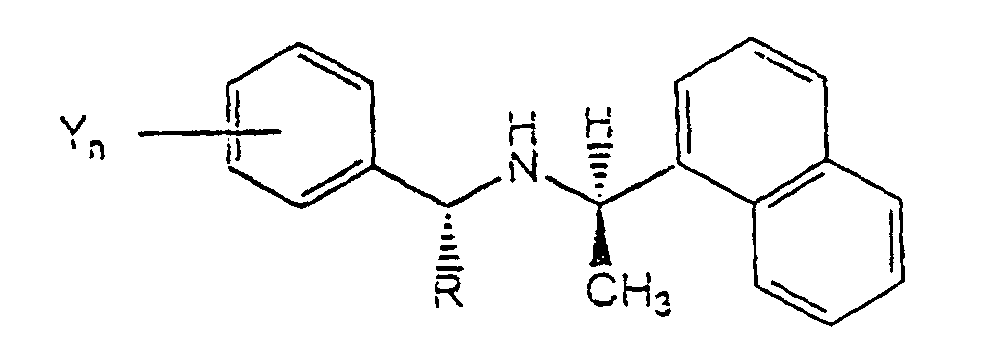
each R independently is selected from the group consisting of hydrogen, and methyl, and n is independently between 0 and 5 inclusive. - The molecule either evokes one or more inorganic ion receptor activities, or blocks one or more inorganic ion receptor activities caused by an extracellular inorganic ion. Preferably, the molecule either evokes one or more calcium receptor activities, or blocks one or more calcium receptor activities caused by extracellular calcium.
- In preferred embodiments each Y is independently selected from the group consisting of isopropyl, CH3O, CH3S, a fused aromatic ring. Preferably, the fused aromatic ring has 5 to 7 members. More preferably, the aromatic and ring contains only carbon atoms.
- Another aspect of the present invention features an inorganic ion receptor modulating agent comprising a molecule selected from the group consisting of
compound compound 9R, compound 11X, compound 14U,compound 16M and compound 16P. - Other aspects of the present invention feature the use of the agents described herein in the preparation of medicaments for treating diseases or disorders by modulating inorganic ion receptor activity. Patients in need of such treatments can be identified by standard medical techniques, such as routine blood analysis. For example, by detecting a deficiency of protein whose production or secretion is affected by changes in inorganic ion concentrations, or by detecting abnormal levels of inorganic ions or hormones which effect inorganic ion homeostasis.
- Diseases and disorders characterized by abnormal calcium homeostasis include hyperparathyroidism, osteoporosis and other bone and mineral-related disorders, and the like (as described, e.g., in standard medical text books, such as "Harrison's Principles of Internal Medicine"). Such diseases and disorders are treated using calcium receptor modulating agents which mimic or block one or more of the effects of Ca2+ and, thereby, directly or indirectly affect the levels of proteins or other molecules in the body of the patient.
- In a preferred embodiment, the patient has a disease or disorder characterized by an abnormal level of one or more calcium receptor regulated components and the molecule is active on a calcium receptor of a cell selected from the group consisting of parathyroid cell, bone osteoclast, juxtaglomerular kidney cell, proximal tubule kidney cell, distal tubule kidney cell, central nervous system cell, peripheral nervous system cell, cell of the thick ascending limb of Henle's loop and/or collecting duct, keratinocyte in the epidermis, parafollicular cell in the thyroid (C-cell), intestinal cell, trophoblast in the placenta, platelet, vascular smooth muscle cell, cardiac atrial cell, gastrin-secreting cell, glucagon-secreting cell, kidney mesangial cell, mammary cell, beta cell, fat/adipose cell, immune cell and GI tract cell.
- More preferably, the cell is a parathyroid cell and the molecule reduces the level of parathyroid hormone in the serum of the patient, even more preferably the level is reduced to a degree sufficient to cause a decrease in plasma Ca2+, most preferably the parathyroid hormone level is reduced to that present in a normal individual.
- Thus, the present invention features agents useful in the treatment of diseases and disorders by modulating inorganic ion receptor activity. For example, the molecules of the present invention can be used to target calcium receptors on different cell types that detect and respond to changes to external calcium. For example, molecules mimicking external calcium may be used to selectively depress secretion of parathyroid hormone from parathyroid cells, or depress bone resorption by osteoclasts, or stimulate secretion of calcitonin from C-cells. Such molecules can be used to treat diseases or disorders characterized by abnormal calcium homeostasis such as hyperparathyroidism and osteoporosis.
- Other features and advantages of the invention will be apparent from the following description of the preferred embodiments thereof and from the claims.
- Figs 1 to 21 show the chemical structures of molecules derived from diphenylpropyl-α-phenethylamine illustrating a family of molecules according to the invention.
- The present invention describes inorganic ion receptor modulating agents able to mimic or block an effect of an inorganic ion at an inorganic ion receptor. The preferred use of inorganic ion receptor modulating agents is to treat a disease or disorder by modulating inorganic ion receptor activity. Preferably, the molecules are used to treat diseases or disorders characterized by abnormal ion homeostasis, more preferably abnormal calcium homeostasis. Other uses of inorganic ion receptor modulating agents, such as diagnostics uses, are known in the art. Nemeth et al., PCT/US93/01642, International Publication Number WO 94/18959.
- Calcium receptors and nucleic acid encoding calcium receptors are described by Nemeth et al., PCT/US93/01642, International Publication Number WO 94/18959. Calcium receptors are present on different cell types such as parathyroid cell, bone osteoclast, juxtaglomerular kidney cell, proximal tubule kidney cell, distal tubule kidney cell, central nervous system cell, peripheral nervous system cell, cell of the thick ascending limb of Henle's loop and/or collecting duct, keratinocyte in the epidermis, parafollicular cell in the thyroid (C-cell), intestinal cell, trophoblast in the placenta, platelet, vascular smooth muscle cell, cardiac atrial cell, gastrin-secreting cell, glucagon-secreting cell, kidney mesangial cell, mammary cell, beta cell, fat/adipose cell, immune cell, and GI tract cell. The calcium receptor on these cell types may be different. It is also possible that a cell can have more than one type of calcium receptor.
- Comparison of calcium receptor activities and amino acid sequences from different cells indicate that distinct calcium receptor types exist. For example, calcium receptors can respond to a variety of di- and trivalent cations. The parathyroid calcium receptor responds to calcium and Gd3+, while osteoclasts respond to divalent cations such as calcium but does not respond to Gd3+. Thus, the parathyroid calcium receptor is pharmacologically distinct from calcium receptor on the osteoclast.
- On the other hand, the nucleic acid sequences encoding calcium receptors present in parathyroid cells and C-cells indicate that these receptors have a very similar amino acid structure. Nevertheless, calcimimetic compounds exhibit differential pharmacology and regulate different activities at parathyroid cells and C-cells. Thus, pharmacological properties of calcium receptors may vary significantly depending upon the cell type or organ in which they are expressed even though the calcium receptors may have similar structures.
- Calcium receptors, in general, have a low affinity for extracellular Ca2+ (apparent Kd generally greater than about 0.5 mM). Calcium receptors may include a free or bound effector mechanism as defined by Cooper, Bloom and Roth, "The Biochemical Basis of Neuropharmacology", Ch. 4, and are thus distinct from intracellular calcium receptors, e.g., calmodulin and the troponins.
- Calcium receptors respond to changes in extracellular calcium levels. The exact changes depend on the particular receptor and cell line containing the receptor. For example, the in vitro effect of calcium on the calcium receptor in a parathyroid cell include the following:
- 1. An increase in internal calcium. The
increase is due to the influx of external calcium and/or
mobilization of internal calcium. Characteristics of the
increase in internal calcium include the following:
- (a) A rapid (time to peak < 5 seconds) and transient increase in [Ca2+]i that is refractory to inhibition by 1 µM La3+ or 1 µM Gd3+ and is abolished by pretreatment with ionomycin (in the absence of extracellular Ca2+);
- (b) The increase is not inhibited by dihydropyridines;
- (c) The transient increase is abolished by pretreatment for 10 minutes with 10 mM sodium fluoride;
- (d) The transient increase is diminished by pretreatment with an activator of protein kinase C (PKC), such as phorbol myristate acetate (PMA), mezerein or (-)-indolactam V. The overall effect of the protein kinase C activator is to shift the concentration-response curve to calcium to the right without affecting the maximal response; and
- (e) Treatment with pertussis toxin (100 ng/ml for > 4 hours) does not affect the increase.
- 2. A rapid (< 30 seconds) increase in the formation of inositol-1,4,5-triphosphate or diacylglycerol. Treatment with pertussis toxin (100 ng/ml for > 4 hours) does not affect this increase;
- 3. The inhibition of dopamine- and isopro-terenol-stimulated cyclic AMP formation. This effect is blocked by pretreatment with pertussis toxin (100 ng/ml for > 4 hours); and
- 4. The inhibition of PTH secretion. Treatment with pertussis toxin (100 ng/ml for > 4 hours) does not affect the inhibition in PTH secretion.
-
- Using techniques known in the art, the effect of calcium on other calcium receptors in different cells can be readily determined. Such effects may be similar in regard to the increase in internal calcium observed in parathyroid cells. However, the effect is expected to differ in other aspects, such as causing or inhibiting the release of a hormone other than parathyroid hormone.
- Inorganic ion receptor modulating agents either evokes one or more inorganic ion receptor activities, or blocks one or more inorganic ion receptor activities caused by an extracellular inorganic ion. Calcium receptor modulating agents can mimic or block an effect of extracellular Ca2+ on a calcium receptor. Preferred calcium receptor modulating agents are calcimimetics and calcilytics. Generic and specific structures of inorganic ion receptor modulating agents are provided in the Summary supra, and in Figures 1 to 21.
- Inorganic ion receptor modulating agents can be identified by screening molecules which are modelled after a molecule shown to have a particular activity (i.e., a lead molecule). Nemeth et al., PCT/US93/01642, International Publication Number WO 94/18959.
- Preferred inorganic ion receptor modulation agents described by the present invention are compounds are 9R, 11X, 14U, 16M, and 16P. These compounds all have EC50 values of less than 5 µM.
- The EC50 is the concentration of the molecule which evokes a half-maximal effect. The IC50 is the concentration of molecule which causes a half-maximal blocking effect. The EC50 or IC50 can be determined by assaying one or more of the activities of an inorganic ion at an inorganic ion receptor. Preferably, such assays are specific to a particular calcium receptor. For example, assays which measure hormones whose production or secretion is modulated by a particular inorganic ion receptor are preferred.
- Increases in [Ca2+]i can be detected using standard techniques such as by using fluorimetric indicators or by measuring an increase in Cl- current in a Xenopus oocyte injected with nucleic acid coding for a calcium receptor. Nemeth et al., PCT/US93/01642, International Publication Number WO 94/18959. For example, poly(A)+ mRNA can be obtained from cells expressing a calcium receptor, such as a parathyroid cell, bone osteoclast, juxtaglomerular kidney cell, proximal tubule kidney cell, distal tubule kidney cell, cell of the thick ascending limb of Henle's loop and/or collecting duct, keratinocyte in the epidermis, parafollicular cell in the thyroid (C-cell), intestinal cell, central nervous cell, peripheral nervous system cell, trophoblast in the placenta, platelet, vascular smooth muscle cell, cardiac atrial cell, gastrin-secreting cell, glucagon-secreting cell, kidney mesangial cell, mammary cell, beta cell, fat/adipose cell, immune cell, and GI tract cell. Preferably, the nucleic acid is from a parathyroid cell, C-cell, or osteoclast. More preferably, the nucleic acid encodes a calcium receptor and is present on a plasmid or vector.
- Preferably, the molecule is either a calcimimetic or calcilytic having an EC50 or IC50 at a calcium receptor of less than or equal to 5 µM, and even more preferably less than or equal to 1 µM, 100 nmolar, 10 nmolar, or 1 nmolar. Such lower EC50's or IC50's are advantageous since they allow lower concentrations of molecules to be used in vivo or in vitro for therapy or diagnosis. The discovery of molecules with such low EC50's and IC50's enables the design and synthesis of additional molecules having similar potency and effectiveness.
- In preferred embodiments the calcium receptor modulating agent is a calcimimetic which inhibits parathyroid hormone secretion from a parathyroid cell in vitro and decreases PTH secretion in vivo; stimulates calcitonin secretion from a C-cell in vitro and elevates calcitonin levels in vivo; or blocks osteoclastic bone resorption in vitro and inhibits bone resorption in vivo.
- In another preferred embodiment the calcium receptor modulating agent is a calcilytic which evokes the secretion of parathyroid hormone from parathyroid cells in vitro and elevates the level of parathyroid hormone in vivo.
- Preferably, the agent selectively targets inorganic ion receptor activity, more preferably calcium receptor activity, in a particular cell. By "selectively" is meant that the molecule exerts a greater effect on inorganic ion receptor activity in one cell type than at another cell type for a given concentration of agent. Preferably, the differential effect is 10-fold or greater. Preferably, the concentration refers to blood plasma concentration and the measured effect is the production of extracellular messengers such as plasma calcitonin, parathyroid hormone or plasma calcium. For example, in a preferred embodiment, the agent selectively targets PTH secretion over calcitonin secretion.
- In another preferred embodiment, the molecule has an EC50 or IC50 less than or equal to 5 µM at one or more, but not all cells chosen from the group consisting of parathyroid cell, bone osteoclast, juxtaglomerular kidney cell, proximal tubule kidney cell, distal tubule kidney cell, cell of the thick ascending limb of Henle's loop and/or collecting duct, central nervous system cell, peripheral nervous system cell, keratinocyte in the epidermis, parafollicular cell in the thyroid (C-cell), intestinal cell, trophoblast in the placenta, platelet, vascular smooth muscle cell, cardiac atrial cell, gastrin-secreting cell, glucagon-secreting cell, kidney mesangial cell, mammary cell, beta cell, fat/adipose cell, immune cell and GI tract cell.
- Preferably, inorganic ion receptor modulating agents mimic or block all of the effects of extracellular ion in a cell having an inorganic ion receptor. For example, calcium receptor modulating agents preferably mimic or block all of the effects of extracellular ion in a cell having a calcium receptor. Calcimimetics need not possess all the biological activities of extracellular Ca2+, but, rather, at least one such activity is mimicked. Similarly, calcilytics need not reduce or prevent all of the activities caused by extracellular calcium. Additionally, different calcimimetics and different calcilytics do not need to bind to the same site on the calcium receptor as does extracellular Ca2+ to exert their effects.
- The ability of molecules to mimic or block the activity of Ca2+ at calcium receptors can be determined using procedures known in the art and described by Nemeth et al., PCT/US93/01642, International Publication Number WO 94/18959. For example, calcimimetics possess one or more and preferably all of the following activities when tested on parathyroid cells in vitro:
- 1. The molecule causes a rapid (time to peak < 5 seconds) and transient increase in [Ca2+]i that is refractory to inhibition by 1 µM La3+ or 1 µM Gd3+. The increase in [Ca2+]i persists in the absence of extracellular Ca2+ but is abolished by pretreatment with ionomycin (in the absence of extracellular Ca2+);
- 2. The molecule potentiates increases in [Ca2+]i elicited by submaximal concentrations of extracellular Ca2+;
- 3. The increase in [Ca2+]i elicited by extracellular Ca2+ is not inhibited by dihydropyridines;
- 4. The transient increase in [Ca2+]i caused by the molecule is abolished by pretreatment for 10 minutes with 10 mM sodium fluoride;
- 5. The transient increase in [Ca2+]i caused by the molecule is diminished by pretreatment with an activator of protein kinase C (PKC), such as phorbol myristate acetate (PMA), mezerein or (-)-indolactam V. The overall effect of the protein kinase C activator is to shift the concentration-response curve of the molecule to the right without affecting the maximal response;
- 6. The molecule causes a rapid (< 30 seconds) increase in the formation of inositol-1,4,5-triphosphate and/or diacylglycerol;
- 7. The molecule inhibits dopamine- or isopro-terenol-stimulated cyclic AMP formation;
- 8. The molecule inhibits PTH secretion;
- 9. Pretreatment with pertussis toxin (100 ng/ml for > 4 hours) blocks the inhibitory effect of the molecule on cyclic AMP formation but does not effect increases in [Ca2+]i, inositol-1,4,5-triphosphate, or diacylglycerol, nor decreases in PTH secretion;
- 10. The molecule elicits increases in Cl- current in Xenopus oocytes injected with poly (A) +- enriched mRNA from bovine or human parathyroid cells, but is without effect in Xenopus oocytes injected with water, or rat brain or liver mRNA; and
- 11. Similarly, using a cloned calcium receptor from a parathyroid cell, the molecule will elicit a response in Xenopus oocytes injected with the specific cDNA or mRNA encoding the receptor.
-
- Different calcium activities can be measured using available techniques. Nemeth et al., PCT/US93/01642, International Publication Number WO 94/18959. Parallel definitions of molecules mimicking Ca2+ activity on other calcium responsive cell, preferably at a calcium receptor, are evident from the examples provided herein and Nemeth et al., PCT/US93/01642, International Publication Number WO 94/18959.
- Preferably, the agent as measured by the bioassays described herein, or by Nemeth et al., PCT/US93/01642, International Publication Number WO 94/18959, has one or more, more preferably all of the following activities: evokes a transient increase in internal calcium, having a duration of less that 30 seconds (preferably by mobilizing internal calcium); evokes a rapid increase in [Ca2+]i, occurring within thirty seconds; evokes a sustained increase (greater than thirty seconds) in [Ca2+]i (preferably by causing an influx of external calcium); evokes an increase in inositol-1,4,5-triphosphate or diacylglycerol levels, preferably within less than 60 seconds; and inhibits dopamine- or isoproterenol-stimulated cyclic AMP formation.
- The transient increase in [Ca2+]i is preferably abolished by pretreatment of the cell for ten minutes with 10 mM sodium fluoride, or the transient increase is diminished by brief pretreatment (not more than ten minutes) of the cell with an activator of protein kinase C, preferably, phorbol myristate acetate (PMA), mezerein or (-) indolactam V.
- The ability of a molecule to block the activity of external calcium can be determined using standard techniques. Nemeth et al., PCT/US93/01642, International Publication Number WO 94/18959. For example, molecules which block the effect of external calcium, when used in reference to a parathyroid cell, possess one or more, and preferably all of the following characteristics when tested on parathyroid cells in vitro:
- 1. The molecule blocks, either partially or
completely, the ability of increased concentrations of
extracellular Ca2+ to:
- (a) increase [Ca2+]i
- (b) mobilize intracellular Ca2+,
- (c) increase the formation of inositol-1,4,5-triphosphate,
- (d) decrease dopamine- or isoprpterenol-stimulated cyclic AMP formation, and
- (e) inhibit PTH secretion;
- 2. The molecule blocks increases in Cl- current in Xenopus oocytes injected with poly(A)+ mRNA from bovine or human parathyroid cells elicited by extracellular Ca2+ or calcimimetic compounds, but not in Xenopus oocytes injected with water or liver mRNA;
- 3. Similarly, using a cloned calcium receptor from a parathyroid cell, the molecule will block a response in Xenopus oocytes injected with the specific cDNA, mRNA or cRNA encoding the calcium receptor, elicited by extracellular Ca2+ or a calcimimetic compound.
-
- Parallel definitions of molecules blocking Ca2+ activity on a calcium responsive cell, preferably at a calcium receptor, are evident from the examples provided herein and Nemeth et al., PCT/US93/01642, International Publication Number WO 94/18959..
- A preferred use of the compounds described by the present invention is in the treatment or prevention of different diseases or disorders by modulating inorganic ion receptor activity. The inorganic ion receptor modulating agents of the present invention can exert an affect on a inorganic ion receptor causing one or more cellular effects ultimately producing a therapeutic effect.
- Different diseases and disorders can be treated by the present invention by targeting cells having an inorganic ion receptor, such as a calcium receptor. For example, primary hyperparathyroidism (HPT) is characterized by hypercalcemia and elevated levels of circulating PTH. A defect associated with the major type of HPT is a diminished sensitivity of parathyroid cells to negative feedback regulation by extracellular Ca2+. Thus, in tissue from patients with primary HPT, the "set-point" for extracellular Ca2+ is shifted to the right so that higher than normal concentrations of extracellular Ca2+ are required to depress PTH secretion. Moreover, in primary HPT, even high concentrations of extracellular Ca2+ often depress PTH secretion only partially. In secondary (uremic) HPT, a similar increase in the set-point for extracellular Ca2+ is observed even though the degree to which Ca2+ suppresses PTH secretion is normal. The changes in PTH secretion are paralleled by changes in [Ca2+]i: the set-point for extracellular Ca2+-induced increases in [Ca2+]i is shifted to the right and the magnitude of such increases is reduced.
- Molecules that mimic the action of extracellular Ca2+ are beneficial in the long-term management of both primary and secondary HPT. Such molecules provide the added impetus required to suppress PTH secretion which the hypercalcemic condition alone cannot achieve and, thereby, help to relieve the hypercalcemic condition. Molecules with greater efficacy than extracellular Ca2+ may overcome the apparent nonsuppressible component of PTH secretion which is particularly troublesome in adenomatous tissue. Alternatively or additionally, such molecules can depress synthesis of PTH, as prolonged hypercalcemia has been shown to depress the levels of preproPTH mRNA in bovine and human adenomatous parathyroid tissue. Prolonged hypercalcemia also depresses parathyroid cell proliferation in vitro, so calcimimetics can also be effective in limiting the parathyroid cell hyperplasia characteristic of secondary HPT.
- Cells other than parathyroid cells can respond directly to physiological changes in the concentration of extracellular Ca2+. For example, calcitonin secretion from parafollicular cells in the thyroid (C-cells) is regulated by changes in the concentration of extracellular Ca2+.
- Isolated osteoclasts respond to increases in the concentration of extracellular Ca2+ with corresponding increases in [Ca2+]i that arise partly from the mobilization of intracellular Ca2+. Increases in [Ca2+]i in osteoclasts are associated with the inhibition of bone resorption. Release of alkaline phosphatase from bone-forming osteoblasts is directly stimulated by calcium.
- Renin secretion from juxtaglomerular cells in the kidney, like PTH secretion, is depressed by increased concentrations of extracellular Ca2+. Extracellular Ca2+ causes the mobilization of intracellular Ca2+ in these cells. Other kidney cells respond to calcium as follows: elevated Ca2+ inhibits formation of 1,25(OH)2-vitamin D by proximal tubular cells, stimulates production of calcium-binding protein in distal tubular cells, and inhibits tubular reabsorption of Ca2+ and Mg2+ and the action of vasopressin on the medullary thick ascending limb of Henle's loop (MTAL), reduces vasopressin action in the cortical collecting duct cells, and affects vascular smooth muscle cells in blood vessels of the renal glomerulus.
- Calcium also promotes the differentiation of intestinal goblet cells, mammary cells, and skin cells; inhibits atrial natriuretic peptide secretion from cardiac atria; reduces cAMP accumulation in platelets; alters gastrin and glucagon secretion; acts on vascular smooth muscle cells to modify cell secretion of vasoactive factors; and affects cells of the central nervous system and peripheral nervous system.
- Thus, there are sufficient indications to suggest that Ca2+, in addition to its ubiquitous role as an intracellular signal, also functions as an extracellular signal to regulate the responses of certain specialized cells. Molecules of this invention can be used in the treatment of diseases or disorders associated with disrupted Ca2+ responses in these cells.
- Specific diseases and disorders which might be treated or prevented, based upon the affected cells, also include those of the central nervous system such as seizures, stroke, head trauma, spinal cord injury, hypoxia-induced nerve cell damage such as in cardiac arrest or neonatal distress, epilepsy, neurodegenerative diseases such as Alzheimer's disease, Huntington's disease and Parkinson's disease, dementia, muscle tension, depression, anxiety, panic disorder, obsessive-compulsive disorder, post-traumatic stress disorder, schizophrenia, neuroleptic malignant syndrome, and Tourette's syndrome; diseases involving excess water reabsorption by the kidney such as syndrome of inappropriate ADH secretion (SIAH), cirrhosis, heart failure, and nephrosis; hypertension; preventing and/or decreasing renal toxicity from cationic antibiotics (e.g., aminoglycoside antibiotics); gut motility disorders such as diarrhea, and spastic colon; GI ulcer diseases; GI absorption diseases such as sarcoidosis; and autoimmune diseases and organ transplant rejection.
- While inorganic ion receptor modulating agents of the present invention will typically be used in therapy for human patients, they may be used to treat similar or identical diseases or disorders in other warm-blooded animal species such as other primates, farm animals such as swine, cattle, and poultry; and sports animals and pets such as horses, dogs and cats.
- The molecules of the invention can be formulated for a variety of modes of administration to treat patients by modulating inorganic ion receptor activity. Techniques and formulations for administration of compounds generally may be found in Remington's Pharmaceutical Sciences, Mack Publishing Co., Easton, PA. Administration of ionmimetics and ionlytics is discussed by Nemeth et al., PCT/US93/01642, International Publication Number WO 94/18959.
- Suitable forms, in part, depend upon the use or the route of entry, for example oral, transdermal, or by injection. Such forms should allow the agent to reach a target cell whether the target cell is present in a multicellular host or in culture. For example, pharmacological agents or compositions injected into the blood stream should be soluble in the concentrations used. Other factors are known in the art, and include considerations such as toxicity and forms which prevent the agent or composition from exerting its effect.
- Agents can also be formulated as pharmaceutically acceptable salts (e.g., acid addition salts) and complexes thereof. The preparation of such salts can facilitate the pharmacological use by altering the physical characteristics of the agent without preventing it from exerting its physiological effect. Examples of useful alterations in physical properties include lowering the melting point to facilitate transmucosal administration and increasing the solubility to facilitate administering higher concentrations of the drug.
- For systemic administration, oral administration is preferred. Alternatively, injection may be used, e.g., intramuscular, intravenous, intraperitoneal, and subcutaneous. For injection, the molecules of the invention are formulated in liquid solutions, preferably in physiologically compatible buffers such as Hank's solution or Ringer's solution. In addition, the molecules may be formulated in solid form and redissolved or suspended immediately prior to use. Lyophilized forms can also be produced.
- Systemic administration can also be by transmucosal or transdermal means, or the molecules can be administered orally. For transmucosal or transdermal administration, penetrants appropriate to the barrier to be permeated are used in the formulation. Such penetrants are generally known in the art, and include, for example, for transmucosal administration, bile salts and fusidic acid derivatives. In addition, detergents may be used to facilitate permeation. Transmucosal administration may be through nasal sprays, for example, or using suppositories. For oral administration, the molecules are formulated into conventional oral administration dosage forms such as capsules, tablets, and tonics.
- For topical administration, the molecules of the invention are formulated into ointments, salves, gels, or creams, as is generally known in the art.
- Generally, a therapeutically effective amount is between about 1 nmole and 3 µmole of the molecule, preferably 0.1 nmole and 1 µmole depending on its EC50 or IC50 and on the age and size of the patient, and the disease or disorder associated with the patient. Generally it is an amount between about 0.1 and 50 mg/kg, preferably 0.01 and 20 mg/kg, animal to be treated.
- The compounds described herein can be synthesized using standard techniques such as those described by Nemeth et al., PCT/US93/01642, International Publication Number WO 94/18959. Examples describing the syntheses of
compounds Compounds 11X and 16M were prepared from the condensation of a primary amine with an aldehyde or ketone in the presence of titanium(IV) isopropoxide. The resulting intermediate imines were then reduced in situ by the action of sodium cyanoborohydride, sodium borohydride, or sodium triacetoxyborohydride. The intermediate enamine for the synthesis of compound 8U was catalytically reduced using palladium hydroxide. - Synthesis of
compounds 9R, 14U, and 16P were prepared by reductive amination of a commercially available aldehyde or ketone with a primary amine in the presence of sodium cyanoborohydride or sodium triacetoxyborohydride. It was found for the syntheses of these three compounds (9R, 14U, and 16P) that sodium triacetoxyborohydride afforded the desired diastereomers with greater diastereoselectivity than using sodium cyanoborohydride. The enriched mixtures were further purified to a single diastereomer by normal-phase HPLC or by recystallization from organic solvents. - Compounds which were converted to their corresponding hydrochloride were done so by treatment of the free base with ethereal HCl to afford white solids.
- The amines in these syntheses were (1) purchased from Aldrich Chemical Co., Milwaukee, WI, (2) purchased from celgene Corp., Warren, NJ, or (3) prepared synthetically using standard techniques. All other reagent chemicals were purchased from Aldrich Chemical Co.
- A mixture of (R)-(+)-1-(1-naphthyl)ethylamine (10.0 g, 58 mmol), 2'-acetonaphthone (9.4 g, 56 mmol), titanium (IV) isopropoxide (20.7 g, 73.0 mmol), and EtOH (abs.) (100 mL) was heated to 60°C for 3 hours. Sodium cyanoborohydride (NaCNBH3) (3.67 g, 58.4 mmol) was then added. The reaction mixture was stirred at room temperature for 18 hours. Ether (1 L) and H2O (10 mL) were added to the reaction mixture and the resulting precipitate was then removed by centrifugation. The supernatant was evaporated under vacuum and the crude product was recrystallized four times from hot hexane, to provide 1.5 g of pure (98+%) diastereomer. The free base was dissolved in hexane, filtered, and then ethereal HCl was added to precipitate the product as a white solid (1.1 g, 6 % yield), m.p.: softens 200-240 °C (dec.).
- A mixture of (R)-(+)-1-(1-naphthyl)ethylamine (1.06 g, 6.2 mmol), 4-isopropylbenzaldehyde (0.92 g, 6.2 mmol), and titanium (IV) isopropoxide (2.2 g, 7.7 mmol) was heated to 100°C for 5 min then allowed to stir at room temperature for 4 hours. Sodium cyanoborohydride (NaCNBH3) (0.39 g, 6.2 mmol) was then added followed by EtOH (1 mL). The reaction mixture was stirred at room temperature for 18 hours. Ether (100 mL) and H2O (1 mL) were added to the reaction mixture and the resulting precipitate was then removed by centrifugation. The supernatant was evaporated under vacuum and the crude product was chromatographed on silica gel (50 mm X 30 cm column) (elution with 1% MeoH/CHCl3). The chromatographed material was then dissolved in hexane and ethereal HCl was added to precipitate the product as a white solid (0.67 g, 35 % yield), m.p.; 257-259°C.
- A mixture of (R)-(+)-1-(1-naphthyl)ethylamine (1.1 g, 6.2 mmol), 4'-methoxyacetophenone (0.93 g, 6.2 mmol), titanium (IV) isopropoxide (2.2 g, 7.7 mmol), and EtoH (abs.) (1 mL) was heated to 60°C for 3 hours. Sodium cyanoborohydride (NaCNBH3) (0.39 g, 6.2 mmol) was then added, and the reaction mixture was stirred at room temperature for 18 hours. Ether (200 mL) and H2O (2 mL) were added to the reaction mixture and the resulting precipitate was then removed by centrifugation. The supernatant was evaporated under vacuum and the crude product was chromatographed on silica gel (25 mm X 25 cm column) (elution with 1% MeOH/CHCl3). A portion of this material was HPLC chromatographed [Selectosil, 5 µM silica gel; 25 cm x 10.0 mm (Phenomenex, Torrance, CA), 4 mL per minute; UV det. 275 nM; 12% ethyl acetate-88% hexane (elution time 12.0 min)]. The HPLC purified diastereomer was then dissolved in hexanes and ethereal HCl was added to precipitate the product as a white solid (20 mg), m.p.: 209-210°C(dec.).
- A mixture of (R)-(+)-1-(1-naphthyl)ethylamine (6.6 g, 39 mmol), 3'-chloro-4'-methoxybenzaldehyde (6.6 g, 39 mmol), and titanium (IV) isopropoxide (13.8 g, 48.8 mmol), and EtOH (abs.) (30 mL) was heated to 80°C for 30 minutes then allowed to stir at room temperature for 3 hours. Sodium cyanoborohydride (NaCNBH3) (2.45 g, 39 mmol) was then added. The reaction mixture was stirred at room temperature for 18 hours. Ether (100 mL) and H2O (2 mL) were added to the reaction mixture and the resulting precipitate was then removed by centrifugation. The supernatant was evaporated under vacuum and the crude product was chromatographed on silica gel (50 mm X 30 cm column) (elution with CH2Cl2). The chromatographed material was then dissolved in hexane (500 mL), decolorized with Norit® filtered (0.2 µM), and then ethereal HCl was added to precipitate the product as a while solid (10.2 g, 56 % yield), m.p.: 241-242°C (dec.).
- A mixture of 4'-hydroxy-3'-methylacetophenone (5.0 g, 33.3 mmol), iodomethane (5.7 g, 40.0 mmol), K2CO3 (granular, anhydrous) (23.0 g, 167 mmol), and acetone (250 mL) was refluxed for 3 hours. The reaction mixture was then cooled to room temperature, filtered to remove the inorganic salts, and evaporated under vacuum. The crude product was dissolved in ether (100 mL) and washed with H2O (2 x 20 mL). The organic layer was dried (Na2SO4) and evaporated to yield 4.5 g, 82.4% yield. The ketone was used in the following reaction without further purification.
- A mixture of (R)-(+)-1-(1-naphthyl)ethylamine (4.24 g, 24.8 mmol), 4'-methoxy-3'-methylacetophenone (4.06 g, 24.8 mmol), and titanium (IV) isopropoxide(8.8 g, 30.9 mmol), and EtOH (abs.) (1 mL) was heated to 100°C for 2 hours. Isopropanol (45 mL) was added and the reaction was then cooled to 10°C in an ice bath. Sodium triacetoxyborohydride (NaHB(O2CCH3)3) (10.5 g, 49.5 mmol) was then added in portions over 15 minutes. The reaction mixture was then heated to 70°C for 18 hours. The mixture was cooled to room temperature and poured into ether (400 mL). The suspension was centrifuged, the supernatant was collected and the pellet was washed with ether (400 mL). The combined organic washings were evaporated under vacuum. The residue was dissolved in ether (400 mL) and washed with 1 N NaOH (4 x 50 mL) and H2O (2 x 50 mL). The organic layer was dried (Na2SO4), filtered and evaporated under vacuum. EtOH (abs.) was added to the wet residue which was then dried thoroughly on a rotary evaporator to provide an oil. The mixture was then chromatographed on silica gel (50 mm x 30 cm) [elution with (1% MeOH:1% IPA:CHCl3) to give 4.8 g of an oil].
- The desired diastereomer was further purified by HPLC chromatography [SUPELCOSIL™ PLC-Si, 18 µM silica gel; 25 cm x 21.2 mm (Supelco, Inc., Bellefonte, PA), 7 mL per minute; UV det. 275 nM: 20% EtOAc-80% hexane (elution time 9.5 - 11.0 min)]. Injections (800 µL aliquots) of the mixture (100 mg/mL solution in eluent) provided 65 mg of the desired isomer. Multiple HPLC injections provided 1.0 g of purified material. The HPLC chromatographed material was dissolved in hexane (50 mL) and the hydrochloride salt was precipitated with ethereal HCl. The salt was collected on fritted glass and washed with hexane to provide 1.0 g of a white solid, mp 204-205°C.
- Other embodiments are within the following claims.
Claims (9)
- A compound having the formula:wherein each Y is independently selected from the group consisting of isopropyl, CH3O, CH3S and a fused aromatic ring; and n is independently between 0 and 5 inclusive; or a pharmaceutically acceptable salt or complex thereof.
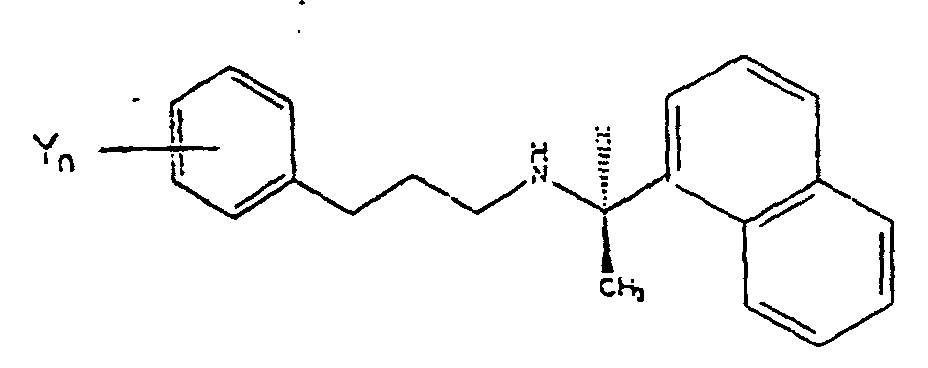
- A compound having the formula:wherein each Y is independently selected from the group consisting of CH3, CH3O, CH3CH2O, methylene dioxy, Br, Cl, F, CF3, CH3S, OH, CH3CH2, propyl, isopropyl, butyl, isobutyl, t-butyl and a fused aromatic ring; R is selected from the group consisting of hydrogen, methyl; and each n is independently between 0 and 5 inclusive; or a pharmaceutically acceptable salt or complex thereof.

- The compound of claim 2 wherein R is H.
- The compound of claim 3 wherein each Y is independently selected from the group consisting of isopropyl, CH3O, CH3S and a fused aromatic ring.
- A compound having the chemical formulaor a pharmaceutically acceptable salt or complex thereof.
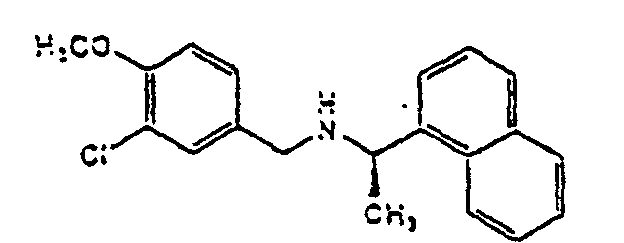
- A compound having the chemical formulaor a pharmaceutically acceptable salt or complex thereof.
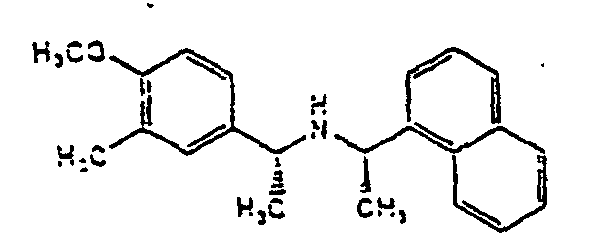
- A pharmaceutical composition comprising the compound of any one of claims 1 to 6 and a pharmaceutically acceptable carrier.
- Use of the compound of claim 1 or 2 for the manufacture of a pharmaceutical composition for treating a patient having a disease or disorder characterized by abnormal calcium homeostasis.
- Use of the compound of any one of claims 1 to 6 for the manufacture of a pharmaceutical composition for treating a disease or disorder selected from the group consisting of primary or secondary hyperparathyroidism, Paget's disease, hypercalcemia, osteoporosis or hypertension.
Priority Applications (1)
| Application Number | Priority Date | Filing Date | Title |
|---|---|---|---|
| EP04008763A EP1466888A1 (en) | 1991-08-23 | 1994-10-21 | Calcium receptor-active arylalkyl amines |
Applications Claiming Priority (10)
| Application Number | Priority Date | Filing Date | Title |
|---|---|---|---|
| US74945191A | 1991-08-23 | 1991-08-23 | |
| US83404492A | 1992-02-11 | 1992-02-11 | |
| US93416192A | 1992-08-21 | 1992-08-21 | |
| US1712793A | 1993-02-12 | 1993-02-12 | |
| US938993A | 1993-02-23 | 1993-02-23 | |
| US14124893A | 1993-10-22 | 1993-10-22 | |
| US141248 | 1993-10-22 | ||
| US29282794A | 1994-08-19 | 1994-08-19 | |
| US292827 | 1994-08-19 | ||
| PCT/US1994/012117 WO1995011221A1 (en) | 1991-08-23 | 1994-10-21 | Calcium receptor-active arylalkyl amines |
Related Child Applications (1)
| Application Number | Title | Priority Date | Filing Date |
|---|---|---|---|
| EP04008763A Division EP1466888A1 (en) | 1991-08-23 | 1994-10-21 | Calcium receptor-active arylalkyl amines |
Publications (2)
| Publication Number | Publication Date |
|---|---|
| EP0724561A1 EP0724561A1 (en) | 1996-08-07 |
| EP0724561B1 true EP0724561B1 (en) | 2004-04-14 |
Family
ID=27567425
Family Applications (2)
| Application Number | Title | Priority Date | Filing Date |
|---|---|---|---|
| EP04008763A Withdrawn EP1466888A1 (en) | 1991-08-23 | 1994-10-21 | Calcium receptor-active arylalkyl amines |
| EP94931982A Expired - Lifetime EP0724561B1 (en) | 1991-08-23 | 1994-10-21 | Calcium receptor-active arylalkyl amines |
Family Applications Before (1)
| Application Number | Title | Priority Date | Filing Date |
|---|---|---|---|
| EP04008763A Withdrawn EP1466888A1 (en) | 1991-08-23 | 1994-10-21 | Calcium receptor-active arylalkyl amines |
Country Status (11)
| Country | Link |
|---|---|
| EP (2) | EP1466888A1 (en) |
| JP (2) | JP4555401B2 (en) |
| CN (1) | CN1192011C (en) |
| AT (1) | ATE264292T1 (en) |
| AU (1) | AU702629B2 (en) |
| CA (1) | CA2173747C (en) |
| DE (1) | DE69433714T2 (en) |
| DK (1) | DK0724561T3 (en) |
| ES (1) | ES2218531T3 (en) |
| PT (1) | PT724561E (en) |
| WO (1) | WO1995011221A1 (en) |
Families Citing this family (52)
| Publication number | Priority date | Publication date | Assignee | Title |
|---|---|---|---|---|
| US6031003A (en) * | 1991-08-23 | 2000-02-29 | Nps Pharmaceuticals, Inc. | Calcium receptor-active molecules |
| US5858684A (en) * | 1991-08-23 | 1999-01-12 | The Brigham And Women's Hospital, Inc. | Method of screening calcium receptor-active molecules |
| US5763569A (en) * | 1991-08-23 | 1998-06-09 | The Brigham And Women's Hospital, Inc | Calcium receptor-active molecules |
| US6313146B1 (en) | 1991-08-23 | 2001-11-06 | Nps Pharmaceuticals, Inc. | Calcium receptor-active molecules |
| US5962314A (en) * | 1993-02-23 | 1999-10-05 | Nps Pharmaceuticals, Inc. | Calcium receptor-active molecules |
| EP1275635A1 (en) | 1994-10-21 | 2003-01-15 | Nps Pharmaceuticals, Inc. | Calcium receptor-active compounds |
| US6057346A (en) * | 1994-12-12 | 2000-05-02 | The United States Of America As Represented By The Department Of Health And Human Services | Inhibition of retroviral LTR promoters by calcium response modifiers |
| US6084084A (en) * | 1996-02-21 | 2000-07-04 | Nps Pharmaceuticals, Inc. | Human metabotropic glutamate receptor |
| US6818660B2 (en) | 1996-04-09 | 2004-11-16 | Nps Pharmaceuticals, Inc. | Calcilytic compounds |
| SG99290A1 (en) | 1996-04-09 | 2003-10-27 | Nps Pharma Inc | Calcilytic compounds |
| JP4117506B2 (en) * | 1996-05-01 | 2008-07-16 | エヌピーエス ファーマシューティカルズ インコーポレイテッド | Inorganic ion active compound |
| EP1258471B1 (en) * | 1996-05-01 | 2007-01-24 | Nps Pharmaceuticals, Inc. | Inorganic ion receptor-active compounds |
| EP1770083B1 (en) * | 1996-05-01 | 2009-04-29 | Nps Pharmaceuticals, Inc. | Inorganic ion receptor-active compounds |
| AU3146797A (en) * | 1996-05-16 | 1997-12-05 | Board Of Regents, The University Of Texas System | Methods of identifying modulators of perivascular sensory nerve ca2+ receptors |
| WO1998001417A1 (en) | 1996-07-08 | 1998-01-15 | Kirin Beer Kabushiki Kaisha | Calcium receptor-active compounds |
| US7202261B2 (en) | 1996-12-03 | 2007-04-10 | Nps Pharmaceuticals, Inc. | Calcilytic compounds |
| TW483881B (en) | 1996-12-03 | 2002-04-21 | Nps Pharma Inc | Calcilytic compounds |
| FR2812875B1 (en) * | 2000-08-08 | 2003-12-12 | Centre Nat Rech Scient | NOVEL DIAMINES HAVING CASR MODULATING ACTIVITY AND THEIR METHOD OF PREPARATION |
| US6908935B2 (en) | 2002-05-23 | 2005-06-21 | Amgen Inc. | Calcium receptor modulating agents |
| US7176322B2 (en) | 2002-05-23 | 2007-02-13 | Amgen Inc. | Calcium receptor modulating agents |
| US6849761B2 (en) | 2002-09-05 | 2005-02-01 | Wyeth | Substituted naphthoic acid derivatives useful in the treatment of insulin resistance and hyperglycemia |
| AR045637A1 (en) | 2003-09-12 | 2005-11-02 | Amgen Inc | QUICK DISSOLUTION FORMULATION OF AN ACTIVE COMPOUND AGAINST CALCIUM RECEIVERS |
| WO2005065050A2 (en) | 2003-12-25 | 2005-07-21 | Asahi Kasei Pharma Corporation | Bicyclic compound |
| JP4629036B2 (en) | 2004-05-28 | 2011-02-09 | 田辺三菱製薬株式会社 | Arylalkylamine compound and process for producing the same |
| US7361789B1 (en) | 2004-07-28 | 2008-04-22 | Amgen Inc. | Dihydronaphthalene compounds, compositions, uses thereof, and methods for synthesis |
| FR2885129B1 (en) | 2005-04-29 | 2007-06-15 | Proskelia Sas | NOVEL DERIVATIVES OF UREEE SUBSTITUTED WITH THIAZOLE OR BENZOTHIAZOLE, PROCESS FOR THE PREPARATION THEREOF, THEIR USE AS MEDICAMENTS, THE PHARMACEUTICAL COMPOSITIONS CONTAINING SAME AND THE USE THEREOF |
| CA2620469C (en) * | 2005-09-02 | 2014-04-01 | Amgen Inc. | Methods of modulating intestinal fluid balance |
| US7875609B2 (en) | 2005-11-25 | 2011-01-25 | Galapagos Sasu | Urea derivatives, processes for their preparation, their use as medicaments, and pharmaceutical compositions containing them |
| MX2008012061A (en) | 2006-03-23 | 2008-12-17 | Amgen Inc | Methods and compositions for making and using polymorphs of cinacalcet. |
| WO2007124465A2 (en) * | 2006-04-20 | 2007-11-01 | Amgen Inc. | Stable emulsion formulations |
| CA2681582C (en) | 2007-03-30 | 2015-07-14 | Amgen Inc. | Methods of treating bowel disorders |
| WO2009107660A1 (en) | 2008-02-25 | 2009-09-03 | 味の素株式会社 | Prophylactic or therapeutic agent for diabetes or obesity |
| WO2009119554A1 (en) | 2008-03-24 | 2009-10-01 | 味の素株式会社 | Promoter for bicarbonate secretion in gastrointestinal tract |
| WO2009128523A1 (en) | 2008-04-17 | 2009-10-22 | 味の素株式会社 | Immunostimulating agent |
| WO2010042642A1 (en) * | 2008-10-08 | 2010-04-15 | Amgen Inc. | Calcium receptor modulating agents |
| WO2010104882A1 (en) | 2009-03-10 | 2010-09-16 | Amgen Inc. | Methods of modulating sperm motility |
| WO2010118055A1 (en) * | 2009-04-09 | 2010-10-14 | Cognition Therapeutics, Inc. | Inhibitors of cognitive decline |
| JP2012528084A (en) | 2009-05-27 | 2012-11-12 | レオ ファーマ アクティーゼルスカブ | Novel calcium-sensing receptor modulatory compound and pharmaceutical use thereof |
| WO2010136037A1 (en) | 2009-05-27 | 2010-12-02 | Leo Pharma A/S | Novel calcium sensing receptor modulating compounds and pharmaceutical use thereof |
| RU2012107457A (en) | 2009-07-31 | 2013-09-10 | Когнишн Терапьютикс, Инк. | COGNITIVE IMPAIRMENT INHIBITORS |
| US8946474B2 (en) | 2010-06-30 | 2015-02-03 | Leo Pharma A/S | Polymorphic form of a calcimimetic compound |
| EP2588445A1 (en) | 2010-06-30 | 2013-05-08 | Leo Pharma A/S | New polymorphic form of a calcimimetic compound |
| RU2013128981A (en) | 2010-11-26 | 2015-01-10 | Лео Фарма А/С | COMPOUNDS ACTIVE AGAINST CALCIUM SENSITIVE RECEPTORS |
| CN103270018A (en) | 2010-11-26 | 2013-08-28 | 利奥制药有限公司 | Calcium-sensing receptor-active compounds |
| WO2012069402A1 (en) | 2010-11-26 | 2012-05-31 | Leo Pharma A/S | Substituted cyclopentyl - azines as casr- active compounds |
| WO2012069421A1 (en) | 2010-11-26 | 2012-05-31 | Leo Pharma A/S | Calcium-sensing receptor-active compounds |
| GB201217330D0 (en) | 2012-09-28 | 2012-11-14 | Univ Cardiff | Therapeutic for treating inflammatory lung disorders |
| WO2015116923A1 (en) | 2014-01-31 | 2015-08-06 | Cognition Therapeutics, Inc. | Isoindoline compositions and methods for treating neurodegenerative disease |
| WO2015136329A1 (en) | 2014-03-14 | 2015-09-17 | Abdi Ibrahim Ilac Sanayi Ve Ticaret Anonim Sirketi | Pharmaceutical composition of cinacalcet |
| ES3063712T3 (en) | 2017-05-15 | 2026-04-20 | Cognition Therapeutics Inc | Compositions for treating neurodegenerative diseases |
| EP4108233A1 (en) | 2021-06-24 | 2022-12-28 | Faran S.A. | Oral solution comprising a cinacalcet salt |
| CN119811491A (en) * | 2024-12-29 | 2025-04-11 | 中国农业科学院烟草研究所(中国烟草总公司青州烟草研究所) | A screening and verification method for maltol as a sweetening substance |
Family Cites Families (5)
| Publication number | Priority date | Publication date | Assignee | Title |
|---|---|---|---|---|
| US5001251A (en) * | 1988-01-15 | 1991-03-19 | E. R. Squibb & Sons, Inc. | Optical resolution of DL-3-acylthio-2-methylpropanoic acid |
| DE69206306T2 (en) * | 1991-04-08 | 1996-06-13 | Sumitomo Chemical Co | Optically active secondary amine compound, process for producing an optically active secondary amine compound and process for producing optically active carboxylic acid by using this compound. |
| DE69233586T2 (en) * | 1991-08-23 | 2006-09-28 | NPS Pharmaceuticals, Inc., Salt Lake City | Calcium receptor active compounds |
| JP3175339B2 (en) * | 1992-10-07 | 2001-06-11 | 住友化学工業株式会社 | Optically active amine compound, its production method, its intermediate and its use |
| AU3777093A (en) * | 1993-02-23 | 1994-09-14 | Brigham And Women's Hospital | Calcium receptor-active molecules |
-
1994
- 1994-10-21 AU AU80872/94A patent/AU702629B2/en not_active Ceased
- 1994-10-21 DE DE69433714T patent/DE69433714T2/en not_active Expired - Lifetime
- 1994-10-21 DK DK94931982T patent/DK0724561T3/en active
- 1994-10-21 CN CNB941945774A patent/CN1192011C/en not_active Expired - Fee Related
- 1994-10-21 PT PT94931982T patent/PT724561E/en unknown
- 1994-10-21 EP EP04008763A patent/EP1466888A1/en not_active Withdrawn
- 1994-10-21 ES ES94931982T patent/ES2218531T3/en not_active Expired - Lifetime
- 1994-10-21 WO PCT/US1994/012117 patent/WO1995011221A1/en not_active Ceased
- 1994-10-21 JP JP51224495A patent/JP4555401B2/en not_active Expired - Fee Related
- 1994-10-21 AT AT94931982T patent/ATE264292T1/en active
- 1994-10-21 CA CA002173747A patent/CA2173747C/en not_active Expired - Fee Related
- 1994-10-21 EP EP94931982A patent/EP0724561B1/en not_active Expired - Lifetime
-
2007
- 2007-03-12 JP JP2007062008A patent/JP2007145867A/en active Pending
Also Published As
| Publication number | Publication date |
|---|---|
| DE69433714T2 (en) | 2005-03-31 |
| HK1012620A1 (en) | 1999-08-06 |
| ES2218531T3 (en) | 2004-11-16 |
| JP2007145867A (en) | 2007-06-14 |
| CN1139917A (en) | 1997-01-08 |
| EP1466888A1 (en) | 2004-10-13 |
| CN1192011C (en) | 2005-03-09 |
| WO1995011221A1 (en) | 1995-04-27 |
| EP0724561A1 (en) | 1996-08-07 |
| ATE264292T1 (en) | 2004-04-15 |
| PT724561E (en) | 2004-07-30 |
| JPH09504032A (en) | 1997-04-22 |
| CA2173747A1 (en) | 1995-04-27 |
| DE69433714D1 (en) | 2004-05-19 |
| CA2173747C (en) | 2006-05-23 |
| DK0724561T3 (en) | 2004-06-28 |
| AU702629B2 (en) | 1999-02-25 |
| AU8087294A (en) | 1995-05-08 |
| JP4555401B2 (en) | 2010-09-29 |
Similar Documents
| Publication | Publication Date | Title |
|---|---|---|
| US6001884A (en) | Calcium receptor-active molecules | |
| AU702629B2 (en) | Calcium receptor-active arylalkyl amines | |
| EP0907631B1 (en) | Inorganic ion receptor-active compounds | |
| EP1203761B1 (en) | Calcium receptor-active compounds | |
| HK1012620B (en) | Calcium receptor-active arylalkyl amines | |
| EP1258471B1 (en) | Inorganic ion receptor-active compounds | |
| HK1070351A (en) | Calcium receptor-active arylalkyl amines | |
| AU3122699A (en) | Calcium receptor active arylakyl amines | |
| RU2194499C2 (en) | Arylalkylamine exhibiting activity with respect to calcium receptors | |
| KR100491062B1 (en) | Calcium receptor active arylalkylamine | |
| EP1770083B1 (en) | Inorganic ion receptor-active compounds | |
| AU2640601A (en) | Inorganic ion receptor-active compounds | |
| HK1077807A (en) | Calcium receptor-active compounds | |
| HK1002454B (en) | Calcium receptor-active compounds | |
| HK1102806B (en) | Inorganic ion receptor-active compounds |
Legal Events
| Date | Code | Title | Description |
|---|---|---|---|
| PUAI | Public reference made under article 153(3) epc to a published international application that has entered the european phase |
Free format text: ORIGINAL CODE: 0009012 |
|
| 17P | Request for examination filed |
Effective date: 19960521 |
|
| AK | Designated contracting states |
Kind code of ref document: A1 Designated state(s): AT BE CH DE DK ES FR GB GR IE IT LI LU MC NL PT SE |
|
| 17Q | First examination report despatched |
Effective date: 19970424 |
|
| GRAP | Despatch of communication of intention to grant a patent |
Free format text: ORIGINAL CODE: EPIDOSNIGR1 |
|
| GRAS | Grant fee paid |
Free format text: ORIGINAL CODE: EPIDOSNIGR3 |
|
| GRAA | (expected) grant |
Free format text: ORIGINAL CODE: 0009210 |
|
| AK | Designated contracting states |
Kind code of ref document: B1 Designated state(s): AT BE CH DE DK ES FR GB GR IE IT LI LU MC NL PT SE |
|
| REG | Reference to a national code |
Ref country code: GB Ref legal event code: FG4D |
|
| REG | Reference to a national code |
Ref country code: CH Ref legal event code: EP |
|
| REF | Corresponds to: |
Ref document number: 69433714 Country of ref document: DE Date of ref document: 20040519 Kind code of ref document: P |
|
| REG | Reference to a national code |
Ref country code: IE Ref legal event code: FG4D |
|
| REG | Reference to a national code |
Ref country code: SE Ref legal event code: TRGR |
|
| REG | Reference to a national code |
Ref country code: DK Ref legal event code: T3 |
|
| REG | Reference to a national code |
Ref country code: GR Ref legal event code: EP Ref document number: 20040401970 Country of ref document: GR |
|
| REG | Reference to a national code |
Ref country code: PT Ref legal event code: SC4A Free format text: AVAILABILITY OF NATIONAL TRANSLATION Effective date: 20040526 |
|
| REG | Reference to a national code |
Ref country code: CH Ref legal event code: NV Representative=s name: BOVARD AG PATENTANWAELTE |
|
| REG | Reference to a national code |
Ref country code: ES Ref legal event code: FG2A Ref document number: 2218531 Country of ref document: ES Kind code of ref document: T3 |
|
| ET | Fr: translation filed | ||
| REG | Reference to a national code |
Ref country code: HK Ref legal event code: GR Ref document number: 1012620 Country of ref document: HK |
|
| PLBE | No opposition filed within time limit |
Free format text: ORIGINAL CODE: 0009261 |
|
| STAA | Information on the status of an ep patent application or granted ep patent |
Free format text: STATUS: NO OPPOSITION FILED WITHIN TIME LIMIT |
|
| 26N | No opposition filed |
Effective date: 20050117 |
|
| REG | Reference to a national code |
Ref country code: CH Ref legal event code: PFA Owner name: NPS PHARMACEUTICALS, INC. Free format text: NPS PHARMACEUTICALS, INC.#420 CHIPETA WAY#SALT LAKE CITY UTAH 84108 (US) -TRANSFER TO- NPS PHARMACEUTICALS, INC.#383 COLOROW DRIVE#SALT LAKE CITY, UT 84108 (US) |
|
| REG | Reference to a national code |
Ref country code: PT Ref legal event code: TE4A Owner name: NPS PHARMACEUTICALS, INC., US Effective date: 20060622 |
|
| REG | Reference to a national code |
Ref country code: FR Ref legal event code: CA |
|
| PGFP | Annual fee paid to national office [announced via postgrant information from national office to epo] |
Ref country code: AT Payment date: 20101014 Year of fee payment: 17 |
|
| PGFP | Annual fee paid to national office [announced via postgrant information from national office to epo] |
Ref country code: DE Payment date: 20101013 Year of fee payment: 17 |
|
| REG | Reference to a national code |
Ref country code: CH Ref legal event code: PFA Owner name: NPS PHARMACEUTICALS, INC. Free format text: NPS PHARMACEUTICALS, INC.#383 COLOROW DRIVE#SALT LAKE CITY, UT 84108 (US) -TRANSFER TO- NPS PHARMACEUTICALS, INC.#383 COLOROW DRIVE#SALT LAKE CITY, UT 84108 (US) |
|
| PGFP | Annual fee paid to national office [announced via postgrant information from national office to epo] |
Ref country code: GB Payment date: 20101020 Year of fee payment: 17 Ref country code: IT Payment date: 20101023 Year of fee payment: 17 |
|
| PGFP | Annual fee paid to national office [announced via postgrant information from national office to epo] |
Ref country code: MC Payment date: 20110928 Year of fee payment: 18 |
|
| PGFP | Annual fee paid to national office [announced via postgrant information from national office to epo] |
Ref country code: GR Payment date: 20110914 Year of fee payment: 18 |
|
| PGFP | Annual fee paid to national office [announced via postgrant information from national office to epo] |
Ref country code: PT Payment date: 20111020 Year of fee payment: 18 Ref country code: SE Payment date: 20111011 Year of fee payment: 18 Ref country code: CH Payment date: 20111012 Year of fee payment: 18 Ref country code: BE Payment date: 20111012 Year of fee payment: 18 Ref country code: LU Payment date: 20111013 Year of fee payment: 18 Ref country code: IE Payment date: 20111011 Year of fee payment: 18 Ref country code: ES Payment date: 20111115 Year of fee payment: 18 Ref country code: DK Payment date: 20111011 Year of fee payment: 18 Ref country code: FR Payment date: 20111103 Year of fee payment: 18 Ref country code: NL Payment date: 20111021 Year of fee payment: 18 |
|
| BERE | Be: lapsed |
Owner name: *NPS PHARMACEUTICALS INC. Effective date: 20121031 |
|
| REG | Reference to a national code |
Ref country code: PT Ref legal event code: MM4A Free format text: LAPSE DUE TO NON-PAYMENT OF FEES Effective date: 20130422 |
|
| REG | Reference to a national code |
Ref country code: NL Ref legal event code: V1 Effective date: 20130501 |
|
| PG25 | Lapsed in a contracting state [announced via postgrant information from national office to epo] |
Ref country code: MC Free format text: LAPSE BECAUSE OF NON-PAYMENT OF DUE FEES Effective date: 20121031 |
|
| REG | Reference to a national code |
Ref country code: CH Ref legal event code: PL |
|
| REG | Reference to a national code |
Ref country code: DK Ref legal event code: EBP |
|
| REG | Reference to a national code |
Ref country code: AT Ref legal event code: MM01 Ref document number: 264292 Country of ref document: AT Kind code of ref document: T Effective date: 20121021 |
|
| REG | Reference to a national code |
Ref country code: GR Ref legal event code: ML Ref document number: 20040401970 Country of ref document: GR Effective date: 20130508 |
|
| GBPC | Gb: european patent ceased through non-payment of renewal fee |
Effective date: 20121021 |
|
| REG | Reference to a national code |
Ref country code: IE Ref legal event code: MM4A |
|
| REG | Reference to a national code |
Ref country code: FR Ref legal event code: ST Effective date: 20130628 |
|
| PG25 | Lapsed in a contracting state [announced via postgrant information from national office to epo] |
Ref country code: LI Free format text: LAPSE BECAUSE OF NON-PAYMENT OF DUE FEES Effective date: 20121031 Ref country code: BE Free format text: LAPSE BECAUSE OF NON-PAYMENT OF DUE FEES Effective date: 20121031 Ref country code: GB Free format text: LAPSE BECAUSE OF NON-PAYMENT OF DUE FEES Effective date: 20121021 Ref country code: DE Free format text: LAPSE BECAUSE OF NON-PAYMENT OF DUE FEES Effective date: 20130501 Ref country code: SE Free format text: LAPSE BECAUSE OF NON-PAYMENT OF DUE FEES Effective date: 20121022 Ref country code: CH Free format text: LAPSE BECAUSE OF NON-PAYMENT OF DUE FEES Effective date: 20121031 Ref country code: IE Free format text: LAPSE BECAUSE OF NON-PAYMENT OF DUE FEES Effective date: 20121021 Ref country code: AT Free format text: LAPSE BECAUSE OF NON-PAYMENT OF DUE FEES Effective date: 20121021 |
|
| REG | Reference to a national code |
Ref country code: DE Ref legal event code: R119 Ref document number: 69433714 Country of ref document: DE Effective date: 20130501 |
|
| PG25 | Lapsed in a contracting state [announced via postgrant information from national office to epo] |
Ref country code: NL Free format text: LAPSE BECAUSE OF NON-PAYMENT OF DUE FEES Effective date: 20130501 Ref country code: FR Free format text: LAPSE BECAUSE OF NON-PAYMENT OF DUE FEES Effective date: 20121031 Ref country code: PT Free format text: LAPSE BECAUSE OF NON-PAYMENT OF DUE FEES Effective date: 20130422 Ref country code: GR Free format text: LAPSE BECAUSE OF NON-PAYMENT OF DUE FEES Effective date: 20130508 Ref country code: IT Free format text: LAPSE BECAUSE OF NON-PAYMENT OF DUE FEES Effective date: 20121021 |
|
| PG25 | Lapsed in a contracting state [announced via postgrant information from national office to epo] |
Ref country code: DK Free format text: LAPSE BECAUSE OF NON-PAYMENT OF DUE FEES Effective date: 20121031 |
|
| REG | Reference to a national code |
Ref country code: ES Ref legal event code: FD2A Effective date: 20140115 |
|
| PG25 | Lapsed in a contracting state [announced via postgrant information from national office to epo] |
Ref country code: ES Free format text: LAPSE BECAUSE OF NON-PAYMENT OF DUE FEES Effective date: 20121022 |
|
| PG25 | Lapsed in a contracting state [announced via postgrant information from national office to epo] |
Ref country code: LU Free format text: LAPSE BECAUSE OF NON-PAYMENT OF DUE FEES Effective date: 20121021 |