EP0721516B1 - Improved air gap spinning process for aramids - Google Patents
Improved air gap spinning process for aramids Download PDFInfo
- Publication number
- EP0721516B1 EP0721516B1 EP94929253A EP94929253A EP0721516B1 EP 0721516 B1 EP0721516 B1 EP 0721516B1 EP 94929253 A EP94929253 A EP 94929253A EP 94929253 A EP94929253 A EP 94929253A EP 0721516 B1 EP0721516 B1 EP 0721516B1
- Authority
- EP
- European Patent Office
- Prior art keywords
- poly
- recited
- coagulant
- aramid
- ppm
- Prior art date
- Legal status (The legal status is an assumption and is not a legal conclusion. Google has not performed a legal analysis and makes no representation as to the accuracy of the status listed.)
- Expired - Lifetime
Links
- 229920003235 aromatic polyamide Polymers 0.000 title claims abstract description 24
- 238000009987 spinning Methods 0.000 title claims abstract description 16
- 239000000701 coagulant Substances 0.000 claims abstract description 37
- 239000004760 aramid Substances 0.000 claims abstract description 23
- 238000000034 method Methods 0.000 claims abstract description 22
- 229920000620 organic polymer Polymers 0.000 claims abstract description 12
- 229920006231 aramid fiber Polymers 0.000 claims abstract description 8
- 239000003638 chemical reducing agent Substances 0.000 claims abstract description 6
- -1 poly(ethylene oxide) Polymers 0.000 claims description 44
- 229920003171 Poly (ethylene oxide) Polymers 0.000 claims description 13
- 229920003366 poly(p-phenylene terephthalamide) Polymers 0.000 claims description 8
- 229920002401 polyacrylamide Polymers 0.000 claims description 8
- 125000001140 1,4-phenylene group Chemical group [H]C1=C([H])C([*:2])=C([H])C([H])=C1[*:1] 0.000 claims description 6
- QAOWNCQODCNURD-UHFFFAOYSA-N Sulfuric acid Chemical compound OS(O)(=O)=O QAOWNCQODCNURD-UHFFFAOYSA-N 0.000 claims description 4
- 230000002535 lyotropic effect Effects 0.000 claims description 3
- 229920000889 poly(m-phenylene isophthalamide) Polymers 0.000 claims description 3
- 239000002904 solvent Substances 0.000 claims description 3
- 229920002907 Guar gum Polymers 0.000 claims description 2
- 229960002154 guar gum Drugs 0.000 claims description 2
- 235000010417 guar gum Nutrition 0.000 claims description 2
- 239000000665 guar gum Substances 0.000 claims description 2
- 229920001285 xanthan gum Polymers 0.000 claims description 2
- 239000000835 fiber Substances 0.000 abstract description 20
- 230000000704 physical effect Effects 0.000 abstract description 3
- 238000002166 wet spinning Methods 0.000 abstract description 3
- 230000006866 deterioration Effects 0.000 abstract description 2
- 229920000642 polymer Polymers 0.000 description 28
- XLYOFNOQVPJJNP-UHFFFAOYSA-N water Substances O XLYOFNOQVPJJNP-UHFFFAOYSA-N 0.000 description 23
- 239000002202 Polyethylene glycol Substances 0.000 description 5
- 230000015271 coagulation Effects 0.000 description 4
- 238000005345 coagulation Methods 0.000 description 4
- 238000010791 quenching Methods 0.000 description 4
- 239000000725 suspension Substances 0.000 description 4
- CURLTUGMZLYLDI-UHFFFAOYSA-N Carbon dioxide Chemical compound O=C=O CURLTUGMZLYLDI-UHFFFAOYSA-N 0.000 description 3
- LYCAIKOWRPUZTN-UHFFFAOYSA-N Ethylene glycol Chemical compound OCCO LYCAIKOWRPUZTN-UHFFFAOYSA-N 0.000 description 3
- 235000011089 carbon dioxide Nutrition 0.000 description 3
- 238000002474 experimental method Methods 0.000 description 3
- CSCPPACGZOOCGX-UHFFFAOYSA-N Acetone Chemical compound CC(C)=O CSCPPACGZOOCGX-UHFFFAOYSA-N 0.000 description 2
- IJGRMHOSHXDMSA-UHFFFAOYSA-N Atomic nitrogen Chemical compound N#N IJGRMHOSHXDMSA-UHFFFAOYSA-N 0.000 description 2
- 238000007865 diluting Methods 0.000 description 2
- 239000012153 distilled water Substances 0.000 description 2
- 229920000233 poly(alkylene oxides) Polymers 0.000 description 2
- 239000007787 solid Substances 0.000 description 2
- 238000003756 stirring Methods 0.000 description 2
- 239000002253 acid Substances 0.000 description 1
- 230000015572 biosynthetic process Effects 0.000 description 1
- 230000037237 body shape Effects 0.000 description 1
- 230000001112 coagulating effect Effects 0.000 description 1
- 150000001875 compounds Chemical class 0.000 description 1
- 230000003247 decreasing effect Effects 0.000 description 1
- 230000002939 deleterious effect Effects 0.000 description 1
- 239000000284 extract Substances 0.000 description 1
- 238000001914 filtration Methods 0.000 description 1
- 230000008014 freezing Effects 0.000 description 1
- 238000007710 freezing Methods 0.000 description 1
- 239000007789 gas Substances 0.000 description 1
- 239000004615 ingredient Substances 0.000 description 1
- 239000007788 liquid Substances 0.000 description 1
- 238000004519 manufacturing process Methods 0.000 description 1
- 239000000463 material Substances 0.000 description 1
- 239000000203 mixture Substances 0.000 description 1
- 229920005615 natural polymer Polymers 0.000 description 1
- 229910052757 nitrogen Inorganic materials 0.000 description 1
- 229920001515 polyalkylene glycol Polymers 0.000 description 1
- 229920001223 polyethylene glycol Polymers 0.000 description 1
- 229920005594 polymer fiber Polymers 0.000 description 1
- 238000010926 purge Methods 0.000 description 1
- HIFJUMGIHIZEPX-UHFFFAOYSA-N sulfuric acid;sulfur trioxide Chemical compound O=S(=O)=O.OS(O)(=O)=O HIFJUMGIHIZEPX-UHFFFAOYSA-N 0.000 description 1
Classifications
-
- D—TEXTILES; PAPER
- D01—NATURAL OR MAN-MADE THREADS OR FIBRES; SPINNING
- D01F—CHEMICAL FEATURES IN THE MANUFACTURE OF ARTIFICIAL FILAMENTS, THREADS, FIBRES, BRISTLES OR RIBBONS; APPARATUS SPECIALLY ADAPTED FOR THE MANUFACTURE OF CARBON FILAMENTS
- D01F6/00—Monocomponent artificial filaments or the like of synthetic polymers; Manufacture thereof
- D01F6/58—Monocomponent artificial filaments or the like of synthetic polymers; Manufacture thereof from homopolycondensation products
- D01F6/60—Monocomponent artificial filaments or the like of synthetic polymers; Manufacture thereof from homopolycondensation products from polyamides
- D01F6/605—Monocomponent artificial filaments or the like of synthetic polymers; Manufacture thereof from homopolycondensation products from polyamides from aromatic polyamides
Definitions
- Disclosed herein is an improved air gap aramid fiber spinning process in which a polymeric drag reducing agent is added to an aqueous coagulant. This allows more fiber or fiber with a smaller diameter to be produced on the same apparatus.
- a solution of a polymer such as an aramid is forced through a spinneret.
- the face of the spinneret is in contact only with a gas, usually air.
- a gas usually air.
- the solution enters a coagulant, which extracts the solvent from the polymer, resulting in the formation of a polymer fiber.
- this coagulant is water based, although anything that is miscible with the material that the polymer is dissolved in, and in which the polymer is insoluble and preferably does not swell appreciably, may be used.
- the fiber solution which is usually quite viscous and somewhat viscoelastic, is drawn, resulting in a smaller diameter jet of aramid solution entering the coagulant than was extruded from the spinneret holes.
- the amount of drawing that can be done is limited, because above some maximum draw value fiber physical properties such as tensile strength, start to decrease.
- use of a drag reducer in the coagulant bath allows higher draw ratios to be achieved in the spinning process without deleterious effects on fiber physical properties.
- U.S. Patent 4,529,763 discloses that coagulant baths may contain relatively high amounts, preferably 30% or more, polyalkylene oxides, and no mention is made of using very high molecular weight polyalkylene oxides.
- Japanese Patent 76-118323 describes a spinning process in which the coagulating bath is a pure polyalkylene glycol, preferably polyethylene glycol.
- This invention concerns a process for the air gap spinning of an aramid fiber from an aramid solution, wherein the improvement comprises, an aqueous coagulant which contains from 1 ppm to 1,000 ppm by weight of an organic polymer which acts as a drag reducer, and provided said organic polymer is soluble in said coagulant.
- Preferred aramids are poly(p-phenylene terephthalamide), poly(p-phenylene p,p'-biphenyldicarboxamide, and poly(p-phenylene 1,5-naphthalenedicarobxamide) which can all form lyotropic solutions, and poly(m-phenylene isophthalamide), which forms isotropic solutions.
- Particularly preferred aramids are those that form lyotropic solutions, and an especially preferred aramid is poly(p-phenylene terephthalamide).
- a preferred aramid solution is poly(p-phenylene terephthalamide) dissolved in sulfuric acid.
- an aqueous coagulant herein is meant a liquid which contains at least 50% by weight water, before being used as a coagulant.
- the coagulant mixes with (dissolves) the solvent(s) in which the aramid is dissolved, so the composition of the coagulant changes during use. It is preferred if the unused coagulant contains at least 85% by weight of water, more preferred if it contains at least 95% by weight of water, and especially preferred if it contains at least 99% by weight of water.
- the coagulant described herein also contains a drag reducing polymer.
- a drag reducing polymer is meant a polymer which reduces the frictional force between the polymer solution and an object moving with respect to that solution, such as the solution flowing through a pipe, or a fiber being pulled through the solution.
- Such polymers, their properties, and tests for drag reduction are known in the art, see for instance J. W. Hoyt in H. Mark, et al. Ed., Encyclopedia of Polymer Science and Engineering, vol. 5, 3rd Ed., p. 129-151 (1986), which is hereby included by reference.
- the higher the molecular weight of the polymer the more effective the polymer is as a drag reducer. Therefore, it is preferred if the (number average) molecular weight of the polymer is at least 200,000, more preferably at least 500,000, and especially preferably at least 1,000,000.
- Useful drag reducing polymers include, but are not limited to poly(ethylene oxide), poly(acrylamide), xanthans and guar gum. Poly(ethylene oxide) and poly(acrylamide) are preferred polymers, and poly(ethylene oxide) is especially preferred.
- the drag reducing polymers are usually soluble in water, and should be soluble in the coagulant actually used.
- the concentration of the drag reducing polymer is about 1 ppm (part per million) to 1,000 ppm by weight, preferably 5 ppm to 500 ppm, and more preferably 8 ppm to 200 ppm. The optimum concentration will depend on many factors such as the drag reducing polymer being used, the aramid being spun and spinneret size. Generally speaking, the higher the molecular weight of the drag reducing polymer, the lower the concentration that will be needed in the coagulant.
- Some drag reducing polymers may have some fraction that is insoluble in water. This insoluble fraction should preferably be removed, as by filtration of the solution.
- the coagulant may contain any other ingredients normally found in coagulants as long as the drag reducing polymer is soluble in the coagulant.
- the temperature of the coagulant bath is not critical, and a temperature range of about -40°C to about 80°C, preferably -20°C to 60°C is convenient (the freezing temperature of the coagulant can be lowered, if desired, by addition of compounds such as ethylene glycol).
- spin-stretch factor herein is meant the linear windup rate of the coagulated fiber divided by the linear rate of flow (JV, jet velocity) of the aramid solution through a spinneret hole. It has been found in many cases (see Examples 1 and 2) that if the SSF exceeds a certain value the tensile strength (also called tenacity) of the fiber starts decreasing. Thus for uses where tenacity is important, there is an upper limitation on the SSF, which for any given fiber diameter, means an upper limitation on the amount of fiber that can be spun through a particular spinneret, and/or a lower limitation on the diameter of the fiber with any particular spinneret.
- the drag reducing polymer allows the polymer solution exiting the spinneret to be more highly drawn (higher SSF), resulting in a capacity increase for the spinning apparatus if a spinneret with larger holes is used, or allowing finer (lower diameter) fibers to be made at the same spin rates using the original spinneret.
- capacity is meant the weight of aramid fiber produced per unit time. Finer aramid fibers are particularly useful in garments, such a bullet proof garment or fire fighter's coats, where they are more comfortable because they more readily conform to body shape and movement.
- a 0.1% (by weight) solution of poly(ethylene oxide) (Polyox® 301 from Union Carbide, reported to be 4,000,000 molecular weight) was prepared in distilled water. The polymer was added to the water with rapid stirring to make a well dispersed suspension. The suspension was then placed on a roller mill and rolled until everything went into solution.
- Poly(ethylene oxide) Polyox® 301 from Union Carbide, reported to be 4,000,000 molecular weight
- a PPD-T dope of 19.4% solids was prepared as follows: a double helix mixer (made by Atlantic) was prechilled with a dry ice/acetone bath, then 145.4 grams of 100.05% fuming sulfuric acid was poured in and the mixer turned on to slow speed while maintaining a nitrogen purge. The acid was chilled to -5°C with an external dry ice bath, and 35.0 grams of PPD-T was added to the mixer. The polymer was mixed for twenty minutes before the dry ice was removed. The mixer was first dipped in warm water to bring its temperature to room temperature and later heated to 72°C. The dope was mixed under these conditions for 1.5 hours and the mixer was then heated to 80°C. After reaching that temperature, vacuum was applied and the dope was mixed for an additional hour. The dope was charged into a preheated spinning cell through an opening in the mixer base plate. The cell temperature was maintained at ⁇ 80°C.
- a 0.1% (by weight) solution of poly(acrylamide) (Polyscience, Catalog No. 02806, reported to be 5-6,000,000 molecular weight) was prepared in distilled water. The polymer was added to the water with rapid stirring to make a well dispersed suspension. The suspension was then placed on a roller mill and rolled until everything went into solution. A 0.1% (by weight) solution of poly(acrylamide) (Polyscience, Catalog No. 18522, reported to be 18,000,000 molecular weight) was prepared similarly.
- a 19.4% solids spin dope of PPD-T was prepared and air gap spun in the manner similar to that described in Example 1.
- Two quench bath coagulants were prepared by diluting the two poly(acrylamide) polymer solutions, molecular weights 5-6,000,000 and 18,000,000, respectively, in water to 100 parts per million concentration.
- a plain water quench bath was used as a control.
- the spinning experiment was carried out by collecting samples at increasing spin stretch factors using the three baths described above. Results are summarized in Table 2.
Landscapes
- Chemical & Material Sciences (AREA)
- Chemical Kinetics & Catalysis (AREA)
- General Chemical & Material Sciences (AREA)
- Engineering & Computer Science (AREA)
- Textile Engineering (AREA)
- Artificial Filaments (AREA)
Abstract
Description
- Disclosed herein is an improved air gap aramid fiber spinning process in which a polymeric drag reducing agent is added to an aqueous coagulant. This allows more fiber or fiber with a smaller diameter to be produced on the same apparatus.
- One method of wet spinning fibers is called air gap spinning (or alternately "dry-jet wet spinning"), and it is particularly useful for spinning aramid fibers from solutions of aramids. Such processes are well known in the art, see for instance U.S. Patents 3,767,756 and 3,869,429, and B. Huang, et al., Zhongquo Fangzhi Daxue Xuebao, vol. 16, p. 23-30 (1990), all of which are hereby included by reference.
- In air gap spinning, a solution of a polymer such as an aramid is forced through a spinneret. The face of the spinneret is in contact only with a gas, usually air. After travelling a short distance through the air, typically 0.1-10 cm., the solution (in the form of a fine "jet") enters a coagulant, which extracts the solvent from the polymer, resulting in the formation of a polymer fiber. Often this coagulant is water based, although anything that is miscible with the material that the polymer is dissolved in, and in which the polymer is insoluble and preferably does not swell appreciably, may be used. Importantly, in the gap between the spinneret face and the coagulant, the fiber solution, which is usually quite viscous and somewhat viscoelastic, is drawn, resulting in a smaller diameter jet of aramid solution entering the coagulant than was extruded from the spinneret holes.
- The amount of drawing that can be done is limited, because above some maximum draw value fiber physical properties such as tensile strength, start to decrease. In the invention described herein, use of a drag reducer in the coagulant bath allows higher draw ratios to be achieved in the spinning process without deleterious effects on fiber physical properties.
- U.S. Patent 4,529,763 discloses that coagulant baths may contain relatively high amounts, preferably 30% or more, polyalkylene oxides, and no mention is made of using very high molecular weight polyalkylene oxides.
- Japanese Patent 76-118323 describes a spinning process in which the coagulating bath is a pure polyalkylene glycol, preferably polyethylene glycol.
- This invention concerns a process for the air gap spinning of an aramid fiber from an aramid solution, wherein the improvement comprises, an aqueous coagulant which contains from 1 ppm to 1,000 ppm by weight of an organic polymer which acts as a drag reducer, and provided said organic polymer is soluble in said coagulant.
- This process is particularly useful for spinning aramid fibers. Preferred aramids are poly(p-phenylene terephthalamide), poly(p-phenylene p,p'-biphenyldicarboxamide, and poly(p-phenylene 1,5-naphthalenedicarobxamide) which can all form lyotropic solutions, and poly(m-phenylene isophthalamide), which forms isotropic solutions. Particularly preferred aramids are those that form lyotropic solutions, and an especially preferred aramid is poly(p-phenylene terephthalamide). A preferred aramid solution is poly(p-phenylene terephthalamide) dissolved in sulfuric acid.
- By an aqueous coagulant herein is meant a liquid which contains at least 50% by weight water, before being used as a coagulant. During use the coagulant mixes with (dissolves) the solvent(s) in which the aramid is dissolved, so the composition of the coagulant changes during use. It is preferred if the unused coagulant contains at least 85% by weight of water, more preferred if it contains at least 95% by weight of water, and especially preferred if it contains at least 99% by weight of water.
- The coagulant described herein also contains a drag reducing polymer. By a drag reducing polymer is meant a polymer which reduces the frictional force between the polymer solution and an object moving with respect to that solution, such as the solution flowing through a pipe, or a fiber being pulled through the solution. Such polymers, their properties, and tests for drag reduction, are known in the art, see for instance J. W. Hoyt in H. Mark, et al. Ed., Encyclopedia of Polymer Science and Engineering, vol. 5, 3rd Ed., p. 129-151 (1986), which is hereby included by reference. As explained in this reference, the higher the molecular weight of the polymer, the more effective the polymer is as a drag reducer. Therefore, it is preferred if the (number average) molecular weight of the polymer is at least 200,000, more preferably at least 500,000, and especially preferably at least 1,000,000.
- Useful drag reducing polymers include, but are not limited to poly(ethylene oxide), poly(acrylamide), xanthans and guar gum. Poly(ethylene oxide) and poly(acrylamide) are preferred polymers, and poly(ethylene oxide) is especially preferred. The drag reducing polymers are usually soluble in water, and should be soluble in the coagulant actually used. The concentration of the drag reducing polymer is about 1 ppm (part per million) to 1,000 ppm by weight, preferably 5 ppm to 500 ppm, and more preferably 8 ppm to 200 ppm. The optimum concentration will depend on many factors such as the drag reducing polymer being used, the aramid being spun and spinneret size. Generally speaking, the higher the molecular weight of the drag reducing polymer, the lower the concentration that will be needed in the coagulant.
- Some drag reducing polymers, particularly natural polymers, may have some fraction that is insoluble in water. This insoluble fraction should preferably be removed, as by filtration of the solution. The coagulant may contain any other ingredients normally found in coagulants as long as the drag reducing polymer is soluble in the coagulant. The temperature of the coagulant bath is not critical, and a temperature range of about -40°C to about 80°C, preferably -20°C to 60°C is convenient (the freezing temperature of the coagulant can be lowered, if desired, by addition of compounds such as ethylene glycol).
- By the draw ratio, or spin-stretch factor (SSF), herein is meant the linear windup rate of the coagulated fiber divided by the linear rate of flow (JV, jet velocity) of the aramid solution through a spinneret hole. It has been found in many cases (see Examples 1 and 2) that if the SSF exceeds a certain value the tensile strength (also called tenacity) of the fiber starts decreasing. Thus for uses where tenacity is important, there is an upper limitation on the SSF, which for any given fiber diameter, means an upper limitation on the amount of fiber that can be spun through a particular spinneret, and/or a lower limitation on the diameter of the fiber with any particular spinneret.
- Use of the drag reducing polymer allows the polymer solution exiting the spinneret to be more highly drawn (higher SSF), resulting in a capacity increase for the spinning apparatus if a spinneret with larger holes is used, or allowing finer (lower diameter) fibers to be made at the same spin rates using the original spinneret. By capacity is meant the weight of aramid fiber produced per unit time. Finer aramid fibers are particularly useful in garments, such a bullet proof garment or fire fighter's coats, where they are more comfortable because they more readily conform to body shape and movement.
- In the Examples, the following abbreviations are used:
- dpf - denier per filament
- gpd - grams per denier
- JV - jet velocity (linear velocity of polymer exiting a spinneret hole
- MW - (number average) molecular weight
- PEO - poly(ethylene oxide)
- PPD-T - poly(p-phenylene terephthalamide)
- SSF - spin-stretch factor
- A 0.1% (by weight) solution of poly(ethylene oxide) (Polyox® 301 from Union Carbide, reported to be 4,000,000 molecular weight) was prepared in distilled water. The polymer was added to the water with rapid stirring to make a well dispersed suspension. The suspension was then placed on a roller mill and rolled until everything went into solution.
- A PPD-T dope of 19.4% solids was prepared as follows: a double helix mixer (made by Atlantic) was prechilled with a dry ice/acetone bath, then 145.4 grams of 100.05% fuming sulfuric acid was poured in and the mixer turned on to slow speed while maintaining a nitrogen purge. The acid was chilled to -5°C with an external dry ice bath, and 35.0 grams of PPD-T was added to the mixer. The polymer was mixed for twenty minutes before the dry ice was removed. The mixer was first dipped in warm water to bring its temperature to room temperature and later heated to 72°C. The dope was mixed under these conditions for 1.5 hours and the mixer was then heated to 80°C. After reaching that temperature, vacuum was applied and the dope was mixed for an additional hour. The dope was charged into a preheated spinning cell through an opening in the mixer base plate. The cell temperature was maintained at ∼80°C.
- All fiber was spun into a stagnant water bath at 0-5°C with a 0.5 cm air gap. Two quench bath coagulants were prepared by diluting PEO of four million molecular weight in water to 10 and 100 parts per million concentrations, respectively. A spinning experiment with a pure water coagulant bath was also conducted as a control. A 3-hole spin pack was used consisting of spinnerets of 0.076 mm diameter and 3.0 L/D. JV was controlled at 20 m/min. The experiment was carried out by collecting fiber samples, with different quench baths, at increasing spin stretch factors (SSF). Maximum obtainable SSF was determined and tensile properties of samples collected at different SSF's were assessed. Results are summarized in Table 1.
TABLE 1 Sample # JV SSF Tenacity (gpd) Elongation (%) Modulus (gpd) dpf WATER COAGULANT CONTAINING 10 PPM POLYETHYLENE OXIDE 1 20.5 3.4 22.5 6.23 346 4.5 2 20.9 6.9 25.5 6.65 327 2.3 3 20.7 9.2 23.0 5.93 319 1.6 4 20.1 14.0 25.8 5.91 343 1.3 5 18.3 18.2 20.9 4.47 443 0.84 WATER COAGULANT CONTAINING 100 PPM POLYETHYLENE OXIDE 6 20.1 3.4 21.4 6.4 296 4.8 7 20.8 6.8 25.2 7.2 297 2.4 8 21.3 8.8 25.7 7.2 288 2.0 9 21.5 13.3 24.9 5.9 342 1.1 10 20.3 18.4 21.5 5.1 387 0.90 WATER COAGULANT BATH (CONTROL) 11 21.7 3.4 22.1 6.9 276 4.1 12 22.8 7.1 24.9 6.6 336 2.3 13 22.6 9.1 24.8 6.5 326 1.9 14 21.8 14.0 14.6 3.7 388 1.0 15 19.5 13.5 21.8 5.1 399 1.3 - The results indicated that fiber tenacity increased initially for all three coagulation baths as fiber orientation improved with increasing attenuation. However, as the SSF increased beyond a critical value, e.g., ∼8 for this example, the fiber tensile properties started to deteriorate with further attenuation under the normal spinning practice using water as coagulant. If a bath containing PEO was used as the coagulant, the critical SSF could be extended to ∼14 before the onset of tensile deterioration. Both PEO concentrations studied in this example, i.e., 10 and 100 ppm, worked equally well. The results also reflected the benefits of using a coagulation bath of this invention which permitted the reduction of filament denier beyond what can be achieved with a plain water coagulation bath making possible the production of subdenier (less than 1 denier per filament) products.
- A 0.1% (by weight) solution of poly(acrylamide) (Polyscience, Catalog No. 02806, reported to be 5-6,000,000 molecular weight) was prepared in distilled water. The polymer was added to the water with rapid stirring to make a well dispersed suspension. The suspension was then placed on a roller mill and rolled until everything went into solution. A 0.1% (by weight) solution of poly(acrylamide) (Polyscience, Catalog No. 18522, reported to be 18,000,000 molecular weight) was prepared similarly.
- A 19.4% solids spin dope of PPD-T was prepared and air gap spun in the manner similar to that described in Example 1. Two quench bath coagulants were prepared by diluting the two poly(acrylamide) polymer solutions, molecular weights 5-6,000,000 and 18,000,000, respectively, in water to 100 parts per million concentration. A plain water quench bath was used as a control.
- The spinning experiment was carried out by collecting samples at increasing spin stretch factors using the three baths described above. Results are summarized in Table 2.
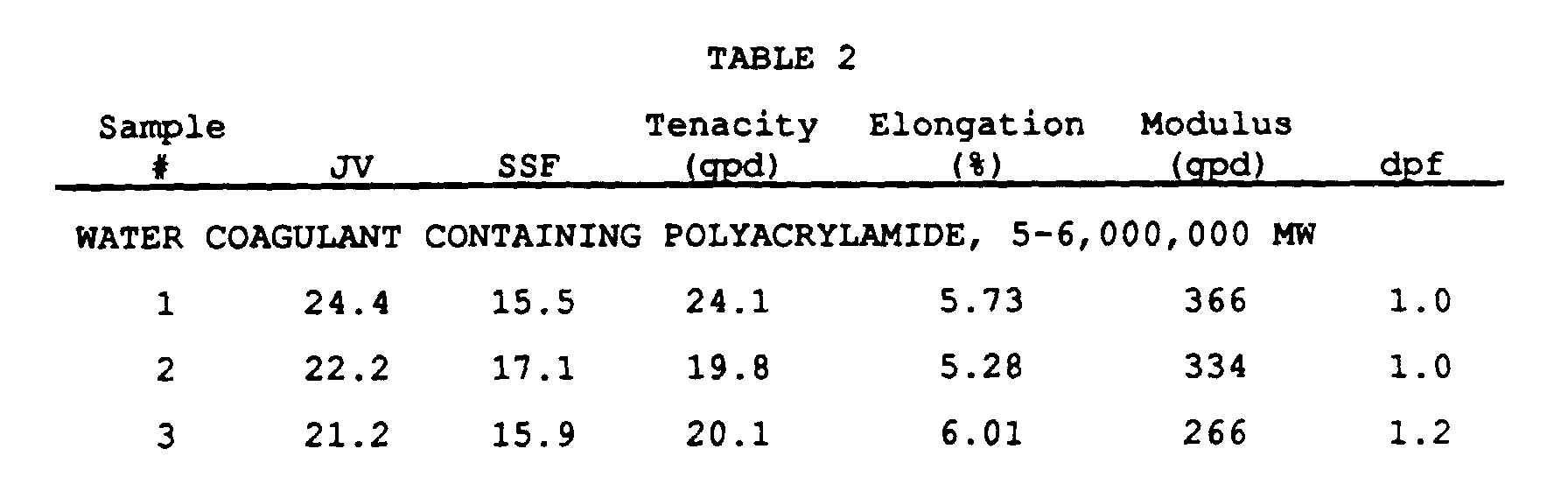

- The results indicated that the coagulation baths containing poly(acrylamide) enabled achievement of greater SSF than did the control plain water bath. In addition, fibers derived therefrom exhibited higher tenacity than the controls over the entire range of SSF studied.
Claims (16)
- A process for the air gap spinning of an aramid fiber from an aramid solution, using an aqueous coagulant, characterised in that an aqueous coagulant is used which contains from 1 ppm to 1,000 ppm by weight of an organic polymer which acts as a drag reducer, provided that said organic polymer is soluble in said coagulant.
- The process as recited in Claim 1 wherein said organic polymer is selected from the group consisting of poly(ethylene oxide), polyacrylamide, xanthans and guar gum.
- The process as recited in Claim 2 wherein said organic polymer is selected from the group consisting of poly(ethylene oxide) and polyacrylamide.
- The process as recited in Claim 1 wherein said organic polymer has a molecular weight of 200,000 or more.
- The process as recited in Claim 4 wherein said molecular weight is 500,000 or more.
- The process as recited in Claim 5 wherein said molecular weight is 1,000,000 or more.
- The process as recited in Claim 3 wherein said organic polymer has a molecular weight of 1,000,000 or more.
- The process as recited in Claim 1 wherein said coagulant contains 5 ppm to 500 ppm of said organic polymer.
- The process as recited in Claim 1 wherein said coagulant contains 8 ppm to 200 ppm of said organic polymer.
- The process as recited in Claim 7 wherein said coagulant contains 8 ppm to 200 ppm of said organic polymer.
- The process as recited in Claim 1 wherein said aramid in the aramid solution is selected from the group consisting of poly(p-phenylene terephthalamide), poly(p-phenylene p,p'-biphenyldicarboxamide, poly(p-phenylene 1,5-naphthalenedicarobxamide) and poly(m-phenylene isophthalamide).
- The process as recited in Claim 10 wherein said aramid in the aramid solution is selected from the group consisting of poly(p-phenylene terephthalamide), poly(p-phenylene p,p'-biphenyldicarboxamide, poly(p-phenylene 1,5-naphthalenedicarobxamide) and poly(m-phenylene isophthalamide).
- The process as recited in Claim 1 wherein said aramid in the aramid solution is poly(p-phenylene terephthalamide).
- The process as recited in Claim 10 wherein said aramid in the aramid solution is poly(p-phenylene terephthalamide).
- The process as recited in Claim 14 wherein said aramid solution contains sulfuric acid as a solvent.
- The process as recited in Claim 1 wherein said aramid solution is lyotropic.
Applications Claiming Priority (3)
| Application Number | Priority Date | Filing Date | Title |
|---|---|---|---|
| US08/131,255 US5393477A (en) | 1993-10-01 | 1993-10-01 | Air gap spinning process for aramids |
| US131255 | 1993-10-01 | ||
| PCT/US1994/010591 WO1995009940A1 (en) | 1993-10-01 | 1994-09-30 | Improved air gap spinning process for aramids |
Publications (2)
| Publication Number | Publication Date |
|---|---|
| EP0721516A1 EP0721516A1 (en) | 1996-07-17 |
| EP0721516B1 true EP0721516B1 (en) | 1997-04-09 |
Family
ID=22448630
Family Applications (1)
| Application Number | Title | Priority Date | Filing Date |
|---|---|---|---|
| EP94929253A Expired - Lifetime EP0721516B1 (en) | 1993-10-01 | 1994-09-30 | Improved air gap spinning process for aramids |
Country Status (5)
| Country | Link |
|---|---|
| US (1) | US5393477A (en) |
| EP (1) | EP0721516B1 (en) |
| JP (1) | JPH09503559A (en) |
| DE (1) | DE69402560T2 (en) |
| WO (1) | WO1995009940A1 (en) |
Families Citing this family (3)
| Publication number | Priority date | Publication date | Assignee | Title |
|---|---|---|---|---|
| US5466425A (en) * | 1994-07-08 | 1995-11-14 | Amphion International, Limited | Biological decontamination system |
| ES2141575T3 (en) * | 1996-08-09 | 2000-03-16 | Akzo Nobel Nv | PAR-AROMATIC POLYAMIDE THREAD THAT HAS A LOW LINEAR FILAMENT DENSITY AND A PROCEDURE TO MANUFACTURE IT. |
| US20110110843A1 (en) * | 2007-10-29 | 2011-05-12 | William March Rice University | Neat carbon nanotube articles processed from super acid solutions and methods for production thereof |
Family Cites Families (7)
| Publication number | Priority date | Publication date | Assignee | Title |
|---|---|---|---|---|
| US3414645A (en) * | 1964-06-19 | 1968-12-03 | Monsanto Co | Process for spinning wholly aromatic polyamide fibers |
| US3742104A (en) * | 1970-05-08 | 1973-06-26 | Celanese Corp | Production of shaped synthetic articles having improved dyeability |
| US3869429A (en) * | 1971-08-17 | 1975-03-04 | Du Pont | High strength polyamide fibers and films |
| US3767756A (en) * | 1972-06-30 | 1973-10-23 | Du Pont | Dry jet wet spinning process |
| JPS5345422A (en) * | 1976-09-29 | 1978-04-24 | Unitika Ltd | Production of heat-resistant molded articles |
| CA1125940A (en) * | 1978-08-16 | 1982-06-15 | Yorikazu Tamura | Aromatic polyamide composition |
| JPS5569649A (en) * | 1978-11-21 | 1980-05-26 | Teijin Ltd | Aromatic polyamide composition |
-
1993
- 1993-10-01 US US08/131,255 patent/US5393477A/en not_active Expired - Lifetime
-
1994
- 1994-09-30 JP JP7510824A patent/JPH09503559A/en not_active Ceased
- 1994-09-30 WO PCT/US1994/010591 patent/WO1995009940A1/en not_active Ceased
- 1994-09-30 DE DE69402560T patent/DE69402560T2/en not_active Expired - Fee Related
- 1994-09-30 EP EP94929253A patent/EP0721516B1/en not_active Expired - Lifetime
Also Published As
| Publication number | Publication date |
|---|---|
| EP0721516A1 (en) | 1996-07-17 |
| US5393477A (en) | 1995-02-28 |
| DE69402560D1 (en) | 1997-05-15 |
| WO1995009940A1 (en) | 1995-04-13 |
| DE69402560T2 (en) | 1997-07-17 |
| JPH09503559A (en) | 1997-04-08 |
Similar Documents
| Publication | Publication Date | Title |
|---|---|---|
| JP5742877B2 (en) | High-strength polyethylene fiber and method for producing the same | |
| EP0775222B1 (en) | Method for preparing polybenzoxazole or polybenzothiazole fibers | |
| US5385702A (en) | Method for stable rapid spinning of a polybenzoxazole or polybenzothiazole fiber | |
| EP0311386A2 (en) | High-tenacity conjugated fiber and process for preparation thereof | |
| JPH07102413A (en) | Polytetrafluoroethylene filament | |
| US5393477A (en) | Air gap spinning process for aramids | |
| EP0338534A2 (en) | Polyvinyl alcohol fiber having excellent resistance to hot water and process for producing the same | |
| EP0011785B1 (en) | Aromatic polyamide composition and processes for preparing film and fiber therefrom | |
| EP1678355B1 (en) | Improved wet spinning process for aramid polymer containing salts | |
| EP0647282B1 (en) | Polyketone yarn and a method of manufacturing same | |
| JP5497255B2 (en) | High-strength polyethylene fiber and method for producing the same | |
| US3470686A (en) | Polyblend yarns | |
| JP2971335B2 (en) | Method for producing meta-type aromatic polyamide fiber | |
| JPS61167015A (en) | High-modulus fiber and its production | |
| EP0563233B1 (en) | Microporous elastic segmented polyurethane shaped structure | |
| US5756031A (en) | Process for preparing polybenzazole filaments and fiber | |
| CN117295855A (en) | Monofilament and its manufacturing method | |
| CN121718977B (en) | Preparation method of coarse denier high-strength polyethylene fiber and polyethylene fiber | |
| EP0399528A2 (en) | Polyvinyl alcohol monofilament yarns and process for producing the same | |
| EP0804639B1 (en) | Process for preparing polybenzazole filaments and fiber | |
| JPH10158928A (en) | Splittable acrylic synthetic yarn and its production | |
| CN121718977A (en) | Preparation method of heavy denier high-strength polyethylene fiber and polyethylene fiber | |
| EP0404145B1 (en) | Mixed solvent for aramid spinning dopes | |
| JPH11293522A (en) | Molten liquid crystalline polyester fiber and method for producing the same | |
| KR930011335B1 (en) | Manufacturing method of high strength, low shrink polyamide |
Legal Events
| Date | Code | Title | Description |
|---|---|---|---|
| PUAI | Public reference made under article 153(3) epc to a published international application that has entered the european phase |
Free format text: ORIGINAL CODE: 0009012 |
|
| 17P | Request for examination filed |
Effective date: 19960306 |
|
| AK | Designated contracting states |
Kind code of ref document: A1 Designated state(s): DE FR GB IT NL |
|
| GRAG | Despatch of communication of intention to grant |
Free format text: ORIGINAL CODE: EPIDOS AGRA |
|
| GRAH | Despatch of communication of intention to grant a patent |
Free format text: ORIGINAL CODE: EPIDOS IGRA |
|
| 17Q | First examination report despatched |
Effective date: 19960823 |
|
| GRAH | Despatch of communication of intention to grant a patent |
Free format text: ORIGINAL CODE: EPIDOS IGRA |
|
| GRAA | (expected) grant |
Free format text: ORIGINAL CODE: 0009210 |
|
| AK | Designated contracting states |
Kind code of ref document: B1 Designated state(s): DE FR GB IT NL |
|
| REF | Corresponds to: |
Ref document number: 69402560 Country of ref document: DE Date of ref document: 19970515 |
|
| ITF | It: translation for a ep patent filed | ||
| ET | Fr: translation filed | ||
| PLBE | No opposition filed within time limit |
Free format text: ORIGINAL CODE: 0009261 |
|
| STAA | Information on the status of an ep patent application or granted ep patent |
Free format text: STATUS: NO OPPOSITION FILED WITHIN TIME LIMIT |
|
| 26N | No opposition filed | ||
| REG | Reference to a national code |
Ref country code: GB Ref legal event code: IF02 |
|
| PGFP | Annual fee paid to national office [announced via postgrant information from national office to epo] |
Ref country code: NL Payment date: 20030922 Year of fee payment: 10 |
|
| PGFP | Annual fee paid to national office [announced via postgrant information from national office to epo] |
Ref country code: FR Payment date: 20040908 Year of fee payment: 11 |
|
| PGFP | Annual fee paid to national office [announced via postgrant information from national office to epo] |
Ref country code: DE Payment date: 20040923 Year of fee payment: 11 |
|
| PGFP | Annual fee paid to national office [announced via postgrant information from national office to epo] |
Ref country code: GB Payment date: 20040929 Year of fee payment: 11 |
|
| PG25 | Lapsed in a contracting state [announced via postgrant information from national office to epo] |
Ref country code: NL Free format text: LAPSE BECAUSE OF NON-PAYMENT OF DUE FEES Effective date: 20050401 |
|
| NLV4 | Nl: lapsed or anulled due to non-payment of the annual fee |
Effective date: 20050401 |
|
| PG25 | Lapsed in a contracting state [announced via postgrant information from national office to epo] |
Ref country code: IT Free format text: LAPSE BECAUSE OF NON-PAYMENT OF DUE FEES;WARNING: LAPSES OF ITALIAN PATENTS WITH EFFECTIVE DATE BEFORE 2007 MAY HAVE OCCURRED AT ANY TIME BEFORE 2007. THE CORRECT EFFECTIVE DATE MAY BE DIFFERENT FROM THE ONE RECORDED. Effective date: 20050930 Ref country code: GB Free format text: LAPSE BECAUSE OF NON-PAYMENT OF DUE FEES Effective date: 20050930 |
|
| PG25 | Lapsed in a contracting state [announced via postgrant information from national office to epo] |
Ref country code: DE Free format text: LAPSE BECAUSE OF NON-PAYMENT OF DUE FEES Effective date: 20060401 |
|
| GBPC | Gb: european patent ceased through non-payment of renewal fee |
Effective date: 20050930 |
|
| PG25 | Lapsed in a contracting state [announced via postgrant information from national office to epo] |
Ref country code: FR Free format text: LAPSE BECAUSE OF NON-PAYMENT OF DUE FEES Effective date: 20060531 |
|
| REG | Reference to a national code |
Ref country code: FR Ref legal event code: ST Effective date: 20060531 |