EP0718265A2 - Method for producing an alcohol - Google Patents
Method for producing an alcohol Download PDFInfo
- Publication number
- EP0718265A2 EP0718265A2 EP95308891A EP95308891A EP0718265A2 EP 0718265 A2 EP0718265 A2 EP 0718265A2 EP 95308891 A EP95308891 A EP 95308891A EP 95308891 A EP95308891 A EP 95308891A EP 0718265 A2 EP0718265 A2 EP 0718265A2
- Authority
- EP
- European Patent Office
- Prior art keywords
- group
- optically active
- reaction
- compound
- alcohol
- Prior art date
- Legal status (The legal status is an assumption and is not a legal conclusion. Google has not performed a legal analysis and makes no representation as to the accuracy of the status listed.)
- Granted
Links
Classifications
-
- C—CHEMISTRY; METALLURGY
- C07—ORGANIC CHEMISTRY
- C07D—HETEROCYCLIC COMPOUNDS
- C07D213/00—Heterocyclic compounds containing six-membered rings, not condensed with other rings, with one nitrogen atom as the only ring hetero atom and three or more double bonds between ring members or between ring members and non-ring members
- C07D213/02—Heterocyclic compounds containing six-membered rings, not condensed with other rings, with one nitrogen atom as the only ring hetero atom and three or more double bonds between ring members or between ring members and non-ring members having three double bonds between ring members or between ring members and non-ring members
- C07D213/04—Heterocyclic compounds containing six-membered rings, not condensed with other rings, with one nitrogen atom as the only ring hetero atom and three or more double bonds between ring members or between ring members and non-ring members having three double bonds between ring members or between ring members and non-ring members having no bond between the ring nitrogen atom and a non-ring member or having only hydrogen or carbon atoms directly attached to the ring nitrogen atom
- C07D213/24—Heterocyclic compounds containing six-membered rings, not condensed with other rings, with one nitrogen atom as the only ring hetero atom and three or more double bonds between ring members or between ring members and non-ring members having three double bonds between ring members or between ring members and non-ring members having no bond between the ring nitrogen atom and a non-ring member or having only hydrogen or carbon atoms directly attached to the ring nitrogen atom with substituted hydrocarbon radicals attached to ring carbon atoms
- C07D213/28—Radicals substituted by singly-bound oxygen or sulphur atoms
- C07D213/30—Oxygen atoms
-
- C—CHEMISTRY; METALLURGY
- C07—ORGANIC CHEMISTRY
- C07B—GENERAL METHODS OF ORGANIC CHEMISTRY; APPARATUS THEREFOR
- C07B41/00—Formation or introduction of functional groups containing oxygen
- C07B41/02—Formation or introduction of functional groups containing oxygen of hydroxy or O-metal groups
-
- C—CHEMISTRY; METALLURGY
- C07—ORGANIC CHEMISTRY
- C07B—GENERAL METHODS OF ORGANIC CHEMISTRY; APPARATUS THEREFOR
- C07B53/00—Asymmetric syntheses
-
- C—CHEMISTRY; METALLURGY
- C07—ORGANIC CHEMISTRY
- C07C—ACYCLIC OR CARBOCYCLIC COMPOUNDS
- C07C29/00—Preparation of compounds having hydroxy or O-metal groups bound to a carbon atom not belonging to a six-membered aromatic ring
- C07C29/132—Preparation of compounds having hydroxy or O-metal groups bound to a carbon atom not belonging to a six-membered aromatic ring by reduction of an oxygen containing functional group
- C07C29/136—Preparation of compounds having hydroxy or O-metal groups bound to a carbon atom not belonging to a six-membered aromatic ring by reduction of an oxygen containing functional group of >C=O containing groups, e.g. —COOH
- C07C29/143—Preparation of compounds having hydroxy or O-metal groups bound to a carbon atom not belonging to a six-membered aromatic ring by reduction of an oxygen containing functional group of >C=O containing groups, e.g. —COOH of ketones
- C07C29/145—Preparation of compounds having hydroxy or O-metal groups bound to a carbon atom not belonging to a six-membered aromatic ring by reduction of an oxygen containing functional group of >C=O containing groups, e.g. —COOH of ketones with hydrogen or hydrogen-containing gases
-
- C—CHEMISTRY; METALLURGY
- C07—ORGANIC CHEMISTRY
- C07C—ACYCLIC OR CARBOCYCLIC COMPOUNDS
- C07C403/00—Derivatives of cyclohexane or of a cyclohexene or of cyclohexadiene, having a side-chain containing an acyclic unsaturated part of at least four carbon atoms, this part being directly attached to the cyclohexane or cyclohexene or cyclohexadiene rings, e.g. vitamin A, beta-carotene, beta-ionone
- C07C403/06—Derivatives of cyclohexane or of a cyclohexene or of cyclohexadiene, having a side-chain containing an acyclic unsaturated part of at least four carbon atoms, this part being directly attached to the cyclohexane or cyclohexene or cyclohexadiene rings, e.g. vitamin A, beta-carotene, beta-ionone having side-chains substituted by singly-bound oxygen atoms
- C07C403/08—Derivatives of cyclohexane or of a cyclohexene or of cyclohexadiene, having a side-chain containing an acyclic unsaturated part of at least four carbon atoms, this part being directly attached to the cyclohexane or cyclohexene or cyclohexadiene rings, e.g. vitamin A, beta-carotene, beta-ionone having side-chains substituted by singly-bound oxygen atoms by hydroxy groups
-
- C—CHEMISTRY; METALLURGY
- C07—ORGANIC CHEMISTRY
- C07C—ACYCLIC OR CARBOCYCLIC COMPOUNDS
- C07C41/00—Preparation of ethers; Preparation of compounds having groups, groups or groups
- C07C41/01—Preparation of ethers
- C07C41/18—Preparation of ethers by reactions not forming ether-oxygen bonds
- C07C41/26—Preparation of ethers by reactions not forming ether-oxygen bonds by introduction of hydroxy or O-metal groups
-
- C—CHEMISTRY; METALLURGY
- C07—ORGANIC CHEMISTRY
- C07C—ACYCLIC OR CARBOCYCLIC COMPOUNDS
- C07C67/00—Preparation of carboxylic acid esters
- C07C67/30—Preparation of carboxylic acid esters by modifying the acid moiety of the ester, such modification not being an introduction of an ester group
- C07C67/31—Preparation of carboxylic acid esters by modifying the acid moiety of the ester, such modification not being an introduction of an ester group by introduction of functional groups containing oxygen only in singly bound form
-
- C—CHEMISTRY; METALLURGY
- C07—ORGANIC CHEMISTRY
- C07F—ACYCLIC, CARBOCYCLIC OR HETEROCYCLIC COMPOUNDS CONTAINING ELEMENTS OTHER THAN CARBON, HYDROGEN, HALOGEN, OXYGEN, NITROGEN, SULFUR, SELENIUM OR TELLURIUM
- C07F17/00—Metallocenes
- C07F17/02—Metallocenes of metals of Groups 8, 9 or 10 of the Periodic Table
-
- C—CHEMISTRY; METALLURGY
- C07—ORGANIC CHEMISTRY
- C07B—GENERAL METHODS OF ORGANIC CHEMISTRY; APPARATUS THEREFOR
- C07B2200/00—Indexing scheme relating to specific properties of organic compounds
- C07B2200/07—Optical isomers
-
- C—CHEMISTRY; METALLURGY
- C07—ORGANIC CHEMISTRY
- C07B—GENERAL METHODS OF ORGANIC CHEMISTRY; APPARATUS THEREFOR
- C07B2200/00—Indexing scheme relating to specific properties of organic compounds
- C07B2200/09—Geometrical isomers
-
- C—CHEMISTRY; METALLURGY
- C07—ORGANIC CHEMISTRY
- C07C—ACYCLIC OR CARBOCYCLIC COMPOUNDS
- C07C2601/00—Systems containing only non-condensed rings
- C07C2601/12—Systems containing only non-condensed rings with a six-membered ring
- C07C2601/14—The ring being saturated
-
- C—CHEMISTRY; METALLURGY
- C07—ORGANIC CHEMISTRY
- C07C—ACYCLIC OR CARBOCYCLIC COMPOUNDS
- C07C2601/00—Systems containing only non-condensed rings
- C07C2601/12—Systems containing only non-condensed rings with a six-membered ring
- C07C2601/16—Systems containing only non-condensed rings with a six-membered ring the ring being unsaturated
-
- C—CHEMISTRY; METALLURGY
- C07—ORGANIC CHEMISTRY
- C07C—ACYCLIC OR CARBOCYCLIC COMPOUNDS
- C07C2602/00—Systems containing two condensed rings
- C07C2602/02—Systems containing two condensed rings the rings having only two atoms in common
- C07C2602/04—One of the condensed rings being a six-membered aromatic ring
- C07C2602/10—One of the condensed rings being a six-membered aromatic ring the other ring being six-membered, e.g. tetraline
-
- C—CHEMISTRY; METALLURGY
- C07—ORGANIC CHEMISTRY
- C07C—ACYCLIC OR CARBOCYCLIC COMPOUNDS
- C07C2603/00—Systems containing at least three condensed rings
- C07C2603/02—Ortho- or ortho- and peri-condensed systems
- C07C2603/04—Ortho- or ortho- and peri-condensed systems containing three rings
- C07C2603/06—Ortho- or ortho- and peri-condensed systems containing three rings containing at least one ring with less than six ring members
- C07C2603/10—Ortho- or ortho- and peri-condensed systems containing three rings containing at least one ring with less than six ring members containing five-membered rings
- C07C2603/12—Ortho- or ortho- and peri-condensed systems containing three rings containing at least one ring with less than six ring members containing five-membered rings only one five-membered ring
- C07C2603/18—Fluorenes; Hydrogenated fluorenes
-
- C—CHEMISTRY; METALLURGY
- C07—ORGANIC CHEMISTRY
- C07C—ACYCLIC OR CARBOCYCLIC COMPOUNDS
- C07C2603/00—Systems containing at least three condensed rings
- C07C2603/02—Ortho- or ortho- and peri-condensed systems
- C07C2603/04—Ortho- or ortho- and peri-condensed systems containing three rings
- C07C2603/22—Ortho- or ortho- and peri-condensed systems containing three rings containing only six-membered rings
- C07C2603/26—Phenanthrenes; Hydrogenated phenanthrenes
Definitions
- the present invention relates to a method for producing an alcohol. More particularly, the present invention relates to a novel method for efficient production at a high yield of alcohol useful as medical drugs, agricultural chemicals, various other chemicals or raw material or a synthetic intermediate thereof, and to a new method for producing optically active alcohol, which is excellent in practicability and useful in various uses including synthetic intermediates of medical drugs and material for liquid crystal.
- Method for producing alcohol have been conventionally known, which comprise hydrogenation of carbonyl compound, by using a homogeneous catalyst system, thereby obtaining corresponding alcohol, including for example: (1) a method using a ruthenium complex as described in Comprehensive Organometallic Chemistry, Vol 4, p. 931 (1982), Eds. G.Wilkinson, F.G.A. Stone and E.W. Abel; (2) methods using a rhodium complex as described in Inorg. Nucl. Chem. Letters, Vol. 12, p. 865(1976); J. Organomet. Chem., Vol. 129, p. 239 (1997); Chem. Letters, P. 261 (1982); and Tetrahedron Letters, Vol 35, p, 4963 (1994); and (3) a method using an iridium complex as described in J. Am. Chem. Soc., Vol. 115, p. 3318 (1993).
- the conventionally known methods for asymmetrically synthesizing optically active alcohol include: 1) a method using an enzyme such as baker's yeast, and 2) a method for asymmetric hydrogenation of a carbonyl compound by the use of a metal complex catalyst.
- asymmetric catalyst reactions including for example: (1) a method of asymmetric hydrogenation of a carbonyl compound having a functional group using optically active ruthenium catalyst described in detail in Asymmetric Catalysis In Organic Synthesis, p. 56-82 (1994) ed. R.
- the method using an enzyme gives alcohol with a relatively high optical purity, however, it is defective in that kinds of reaction substrates are limited, and the resultant alcohol is limited to one having a specific absolute configuration.
- the method using an asymmetric hydrogenation catalyst based on a transition metal while realizing production of optially active alcohol with a high selectivity for such a substrate as keto acid, for example, it has a drawback of a low reaction rate, and in addition, the method is not valid for relatively simple carbonyl compound having no functional group in the molecule.
- the present invention has therefore an object to solve these problem in the prior arts, and provide a novel method for producing an alcohol through a hydrogenation reaction with a high efficiency by the use of an inexpensive catalyst system.
- the present invention provides a method for producing an alcohol, which comprises the step of subjecting a carbonyl compound to a hydrogenation reaction in the presence of a homogeneous hydrogenation catalyst, a base, and a nitrogen-containing organic compound.
- a catalyst of a VIII-group metal complex is used as a catalyst of a higher activity.
- a base and a nitrogen-containing organic compound are else used in addition to the VIII-group metal complex.
- the carbonyl compound which is the raw material for producing an alcohol through hydrogenation reaction for example, a compound expressed by the following formula (1): (where, R1 and R2 are aromatic monocyclic or polycyclic hydrocarbon groups or hetero-monocyclic or polycyclic groups containing heteroatoms, which may have the same or different substitution groups or a saturated or unsaturated chain or cyclic hydrocarbon group, any one of which may be hydrogen atom. R1 and R2 also may form a cyclic group by themselves) may appropriately be used.
- the present invention also provides a method for producing an optically active alcohol, which comprises the step of subjecting a carbonyl compound expressed by the following general formula (2): (where, R3 is an aromatic monocyclic or polycyclic hydrocarbon group, a saturated or unsaturated aliphatic or cyclo-hydrocarbon group, or a hetero-monocyclic or polycyclic group containing heteroatoms, which may have a substitution group; and R4 is a saturated or non-saturated chain, cyclic or aromatic cyclic hydrocarbon or heterocyclic group, which may have hydrogen or a substitution group.
- a carbonyl compound expressed by the following general formula (2): (where, R3 is an aromatic monocyclic or polycyclic hydrocarbon group, a saturated or unsaturated aliphatic or cyclo-hydrocarbon group, or a hetero-monocyclic or polycyclic group containing heteroatoms, which may have a substitution group; and R4 is a saturated or non-saturated chain, cyclic or aromatic cyclic hydro
- R3 and R4 also may form a cyclic groups by themselves.) to a hydrogenation reaction in the presence of an asymmetric hydrogenation catalyst of a transition metal, a base and a optically active nitrogen-containing compound thereby producing optically active alcohol expressed by the following general formula (3): (where, R3 and R4 are the same organic groups as above).
- any of various organic groups which never impairs hydrogenation reaction such as hydrocarbon group, halogen group, hydroxy group, alkoxy group, carboxyl group, ester group, amino group and heterocyclic group may appropriately be used.
- R1 and R2 applicable ones include hydrogen atom; aromatic monocyclic or polycyclic groups such as phenyl group, 2-methylphenyl, 2-ethylphenyl, 2-isopropylphenyl, 2-tert-butylphenyl, 2-methoxyphenyl, 2-chlorophenyl, 2-vinylphenyl, 3-methylphenyl, 3-ethylphenyl, 3-isopropylphenyl, 3-methoxyphenyl, 3-chlorophenyl, 3-vlnylphenyl, 4-methylphenyl, 4-ethylphenyl, cumenyl, mesityl, xylyl, 1-naphthyl, 2-naphthyl, anthryl, phenanthryl, and indenyl; heteromonocyclic or polycyclic groups such as thienyl, furyl, pyranyl, xanthenyl, pyridyl, imidazolyl, indo
- saturated or unsaturated cyclo-aliphatic groups providing cyclic ketone such as cyclopentanone, cyclohexanone, cycloheptanone, cyclopentenone, cyclohexenone, cycloheptenone; substituted saturated or unsaturated cyclo-aliphatic groups having substitution groups selected from alkyl, aryl, unsaturated alkyl, aliphatic or cyclo-aliphatic group containing hetero atom; are mentioned.
- the VIII-group metals include rhodium (Rh), ruthenium (Ru), iridium (Ir), palladium(Pd), and platinum(Pt). Particularly, ruthenium(Ru) is used for a high activity in the present invention for producing an alcohol.
- This catalyst can be expressed by the following general formula (4).
- M is a VIII-group metal
- X is halogen atom, carboxyl group, alkoxy group or hydroxy group
- L is phosphine, olefin, diolefin, cycloolefin, CO, arsine, amine or other organic ligand
- phosphine ligand can be expressed by a general formula PR5R6R7, where R5, R6, and R7 may be the same or different, and are aliphatic groups, alicyclic groups or aromatic groups, or may be bidentate phosphine ligands
- Applicable phosphine ligands include, for example, such tert-phosphines as trimethylphosphine, triethylphosphine, tributyl-phosphine, triphenylphosphine, tricyclohexylphosphine, tri(p-tollyl)phosphine, diphenylmethylphosphine, dimethylphenylphosphine, and bidentate tert-phosphine compounds such as bis-diphenyl-phosphinoethane, bis-diphenylphosphinopropane, bis-diphenylphosphinebutane, bis-dimethylphosphinoethane, and
- ruthenium complex has a high activity. More specifically, applicable complexes include RuCl2[P(C6H5)3]4, RuCl2[P(C6H5)3]3, RuH2[P(C6H5)3]4, RuHCl[P(C6H5)3]4, RuH(HCOO)[P(C6H5)3]3, RuH(CH3COO)[P(C6H5)3]3, RuCl2[P(CH3)(C6H5)2]4, RuCl2[(C6H5)2P(CH2)2P(C6H5)2]2, RuCl2[P(CH3)3]4, RuHCl[P(CH3)3]4, RuBr2[P(C6H5)3]4, and RuI2[P(C6H5)3]4. It is needless to mention that complexes
- the amount of the VIII-group transition metal complex for the method of production of an alcohol can be at a ratio within a range of from 1/100 to 1/100,000 in mole ratio, or more preferably, within a range of from 1/500 to 1/100,000 in mole ratio relative to the carbonyl compound which is the raction raw material.
- Bases applicable in the present invention include inorganic and organic bases.
- M is an alkali metal or an alkali erth metal
- Y is a hydroxy group, alkoxy group, mercapto group or naphthyl group
- applicable ones include KOH, KOCH3, KOCH(CH3)2, KC10H8, KOC(CH3)3, LiOH, LiOCH3, and LiOCH(CH3)2, NaOH, NaOCH3, NaOCH(CH3)2 as well as quarternary ammonium salt.
- the amount of the base as described above should be within a ragnge of from 0.5 to 10,000 equivalents, or more preferably, from 2 to 40 equivalents relative to the VIII-group transition metal complex.
- amine compounds are typical examples.
- the amine compound may be a mono-amine comprising of primary amine, secondary-amine, or tertiary amine expressed by a general fomrmula NR8R9R10, or a diamine expressed by a general formula R11R12 N-Z-NR13R14.
- R8, R9, R10, R11, R12, R13 and R14 indicate hydrogen, or the same or different ones selected from alkyl group, cycloalkyl group and aryl group having a carbon number within a range of from 1 to 10, and may include cyclic diamine.
- Z is a group selected from alkyl group, cycloalkyl group and aryl group having a carbon number of from 1 to 6.
- Examples include mono amine compounds such as methylamine, ethylamine, propylamine, butylamine, pentylamine, hexylamine, cyclopentylamine, cyclohexylamine, benzylamine, dimethylamine, diethylamine, dipropylamine, dihexylamine, dicylopentylamine, dicyclohexylamine, dibenzylamine, diphenylamine, phenylethylamine, piperidine and piperadine; and diamine compounds such as methylenediamine, ethylenediamine, 1,2-diaminopropane, 1,3-diaminopropane, 1,4-diaminobutane, 2,3-diaminobutane, 1,2-cyclopentanediamine, 1,2-cyclohexanediamine, N-methylethylenediamine, N,N'-dimethylethylenediamine, N,N,N'-trimethylethylenediamine,
- the amount of these compounds should be within a range of from 1 to 1000 equivalents relative to the transition metal complex in the case of monoamine compound, or more preferably, from 2 to 4 equivalents, and within a range of from 0.5 to 2.5 equivalents in the case of diamine compound, or more preferably, from 1 to 2 equivalents.
- the transition metal complex used as the catalyst, the base and the nitrogen-containing compound are indispensable for ensuring smooth progress of raction. The absence of even any of those constituents makes it impossible to obtain a sufficient reaction activity.
- any liquid solvent which can dissolve the raction raw materials and catalyst constituents may be used.
- Applicable solvents include aromatic hydrocarbon solvents such as toluene and xylene, aliphatic hydrocarbon solvents such as pentane and hexane, halogen-containing hydrocarbon solvents such as metylene chloride, ether type solvents such as ether and tetrahydrofuran, alcohol type solvents such as methanol, ethanol, 2-propanol, butanol, bnzyl alcohol, and organic solvents containing heteroatoms such as acetonitrile, DMF and DMSO. Since the product is alcohol, alcohol type solvents are preferable. More preferably, 2-propanol may be preferably used.
- a mixed solvent comprising ones selected from those enumerated above may be used.
- the amount of the solvent is determined from solubility of the reaction substrate and relative economic merits.
- the reaction may be caused at a substrate concentration within a range of from a low concentration of under 1% to a state near the non-existence of solvent, but it is preferable to use it at a concentration within a range of from 20 to 50 wt%.
- the hydrogenation sufficiently proceeds under 1 atm of hydrogen, because the catalyst has a very high activity. Taking accout of economic merits, however, it should preferably be within a range of from 1 to 100 atm, or more preferably, from 3 to 50 atm. Considering economic merits for the process, it is possible to maintain a high activity even under a pressure of up to 10 atm.
- the reaction temperature should preferably be within a range of from 15 to 100°C, while it is possible to cause the reaction at a temperature near the room temperature as within a range of from 25 to 40°C.
- the present invention is characterized in that the raction proceeds even at a low temperature of from -100 to 0°C.
- the reaction is completed in a period of time within a range of from a few minutes to ten hours, depending upon such reaction conditions as reaction substrate concentration, temperature and pressure.
- the reaction system in the present invention may be in batch or continous.
- the present invention relating to the method for producing an optically active alcohol provides also an embodiment wherein the above-mentioned asymmetric hydrogenation catalyst is a complex of a VIII-group metal, for example, a metal complex having an optically active ligand, one wherein the base is a hydroxide or a salt of an alkali metal or an alkali earth metal, or a quarternary ammonium salt, and one wherein the optically active compound as a nitrogen-containing asymmetric compound is a optically active amine compound.
- a VIII-group metal for example, a metal complex having an optically active ligand, one wherein the base is a hydroxide or a salt of an alkali metal or an alkali earth metal, or a quarternary ammonium salt, and one wherein the optically active compound as a nitrogen-containing asymmetric compound is a optically active amine compound.
- An asymmetric hydrogenation catalyst can be expressed, for example, by the following general formula (5): M I XmLn (5) (where, M I is a VIII-group transition metal such as ruthenium, rhodium, iridium, palladium, or platinum; X is hydrogen, a halogen atom, a carboxyl group, a hydroxy group, or a alkoxy group, L is an optically active phosphine ligand or an optically active organic arsenic ligand; and m and n are integers), and the base may be a metal salt or a quarternary ammonium salt expressed by the following general formula (6): M2Y (6) (where, M2 is an alkali metal or an alkali earth metal; and Y is hydroxy group, alkoxy group, mercapto group or naphthyl group).
- M I is a VIII-group transition metal such as ruthenium, rhodium, iridium, palladium, or
- R3 is a non-substituted or substituted aromatic monocyclic or polycyclic hydrocarbon group, a saturated or unsaturated aliphatic or cyclic-hydrocarbon group, or a hetero-monocyclic or polycyclic group containing heteroatoms such as nitrogen, oxygen or sulfur atoms, and applicable ones include, for example, aromatic monocyclic or polycyclic groups such as phenyl group, 2-methylphenyl, 2-ethylphenyl, 2-isopropylphenyl, 2-tert-butylphenyl, 2-methoxyphenyl, 2-chlorophenyl, 2-vinylphenyl, 3-methylphenyl, 3-ethylphenyl, 3-isopropylphenyl, 3-methoxyphenyl, 3-chlorophenyl, 3-vinylphenyl, 4-methylphenyl, 4-ethylphenyl, 4-is
- R4 is hydrogen, saturated or unsaturated hydrocarbon group, aryl group, or a functional group containing heteroatoms, and applicable ones include, for example, alkyl groups such as methyl, ethyl, propyl, butyl, pentyl, hexyl and heptyl; cycloalkyl groups such as cyclopropyl, cyclobutyl, cyclopentyl and cyclohexyl; and unsaturated hydrocarbon and other groups such as benzyl, vinyl and allyl.
- alkyl groups such as methyl, ethyl, propyl, butyl, pentyl, hexyl and heptyl
- cycloalkyl groups such as cyclopropyl, cyclobutyl, cyclopentyl and cyclohexyl
- unsaturated hydrocarbon and other groups such as benzyl, vinyl and allyl.
- saturated or unsaturated cyclo-aliphatic groups providing cyclic ketone such as cyclopentanone, cyclohexanone, cycloheptanone, cyclopentenone, cyclohexenone, cycloheptenone; substituted saturated or unsaturated cyclo-aliphatic groups having substitution groups selected from alkyl, aryl, unsaturated alkyl, aliphatic or cyclo-aliphatic group containing hetro atom; are mentioned.
- M1 is a VIII-group transition metal such as ruthenium, rhodium, iridium, palladium and platinum, and among others, ruthenium is particularly preferable.
- X is hydrogen, halogen atom, carboxyl group, hydroxyl group or alkoxy group.
- L is an optically active phosphine ligand or the like, and applicable ones include BINAP:2,2'-bis-(diphenylphosphino)-1,1'-binaphthyl, BINAP derivative having alkyl group or aryl group connected to naphty ring, such as H8BINAP; BINAP derivative having 1-5 alkyl substitution group(s) at site of aromatic ring on phosphorus atom, for example TolBINAP: 2,2'-bis-(di-p-tolylphosphino)-1,1'-binaphthyl, BICHEP: 2,2'-bis-(dicyclohexylphosphino)-6,6'-dimethyl-1,1'-biphenyl, BPPFA: 1-[1,2-bis(diphenylphosphino)ferrocenyl] ethyldimethylamine, CHIRAPHOS: 2,3-bis(diphenlphosphino) butane,
- an optcally active phosphine ligand (an optically active phosphine ligand comprising substitution group having different group, or an optically active phosphine ligand of which at least one group is an optically active group) may be used.
- a bidentate phosphine ligand has an n of 1 or 2
- a monodentate phosphine ligand has an n of 3 or 4. It is needless to mention that the optically active phosphine ligand applicable in the present invention is not limited at all to these values, and the metal is not limited at all to ruthenium.
- the amount of the VIII-group transition metal complex in the present invention can be at a ratio within a range of from 1/100 to 1/100,000 in mole ratio, or more preferably, within a range of from 1/500 to 1/10,000 in mole ratio relative to the carbonyl compound which is the reaction substrate.
- M2 is an alkali metal or an alkali earth metal
- Y is hydroxy group, alkoxy group, mercapto group or naphthyl group
- applicable ones include KOH, KOCH3, KOCH(CH3)2, KOC(CH3)3, KC10H8, LiOH, LiOH3, and LiOCH(CH3)2, NaOH, NaOCH3, NaOCH(CH3)2, NaOC(CH3)3 as well as quarternary ammonium salt.
- the amount of the base as described above should be within a range of from 0.5 to 100 equivalents, or more preferably, from 2 to 40 equivalents relative to the VIII-group transition metal complex.
- the nitrogen-containing compound such as an optical active amine compound used in the present invention may be an optically active monoamine in which at least one of the substitution groups is an optically active group and the remaining ones include hydrogen, or saturated or unsaturated hydrocarbon group or aryl group, or an optically active diamine compound expressed by the following general formula (7): (where, R15, R16, R17 and R18 are hydrogen or saturated or unsaturated hydrocarbon group, aryl group, urethane group or sulfonyl group, and R 1 9, R20, R21 and R22 are the same or different groups such that carbons bonded with these substitution groups form centers of asymmetricity, and represent hydrogen or alkyl group, aromatic monocyclic or polycyclic, saturated or unsaturated hydrocarbon group, and cyclic hydrocarbon group).
- optically active diamine compounds examples include such optically active diamine compounds as optically active 1,2-diphenylethylene diamine, 1,2-cyclohexanediamine, 1,2-cycloheptanediamine, 2,3-dimethylbutanediamine, 1-methyl-2,2-diphenyl ethylenediamine, 1-isobutyl-2,2-diphenylethylenediamine, 1-isopropyl-2,2-diphenylethylenediamine, 1-methyl-2,2-di(p-methoxyphenyl)ethylenediamine, 1-isobutyl-2,2-di(p-methoxyphenyl)ethylenediamine, 1-isopropyl-2,2-di(p-methoxyphenyl)ethylenediamine, 1-benzyl-2,2-di(p-methoxyphenyl)ethylenediamine, 1-methyl-2,2-dinaphthylethylenediamine, 1-isobutyl-2,2-dinaphthylethylencdiamine, and 1-is
- Optically active diamine compounds are not limited to the optically active ethylene-diamine derivatives enumerated above, but include also optically active propanediamine, buteanediamine and phenylenediamine derivatives.
- the amount of these optically active amine compounds should be within a range of from 1 to 10 equivalents relative to the transition metal complex in the case of a monoamine compound, or more preferably, from 2 to 4 equivalents, and within a range of from 0.5 to 2.5 equivalents in the case of a diamine compound, or more preferably, from 1 to 2 equivalents.
- optical active transition metal complex, the base and the optical active nitrogen-containing compound used as catalyst component in the present invention as described above are indispensable for achieving a high optical yield. Lack of even any of these constituents makes it impossible to obtain alcohol with a sufficient optical activity and a high purity.
- any liquid solvent which can dissolve the reaction raw materials and catalyst components may be used.
- Applicable solvents include aromatic hydrocarbon solvents such as toluene and xylene, aliphatic hydrocarbon solvents such as pentane and hexane, halogen-containing hydrocarbon solvents such as methylene chloride, ether type solvents such as diethylether and tetrahydrofuran, alcohol type solvents such as methanol, ethanol, 2-propanol, butanol, benzyl alcohol, and organic solvents containing heteroatoms such as acetonitrile, DMF and DMSO. Since the product is alcohol, alcohol type solvents are preferable. More preferably, 2-propanol may be preferably used.
- a mixed solvent comprising ones selected from those enumerated above may be used.
- the amount of solvent is determined from solubility of the reaction substrate and relative economic merits.
- the reaction may be caused at a substrate concentration within a range of from a low concentration of under 1%, to a state near the non-existence of solvent, but it is preferable to use it at a concentration within a range of from 20 to 50 wt.%.
- the hydrogenation sufficiently proceeds under 1 atm of hydrogen because the catalyst has a very high activity. Taking account of economic merits, however, it should preferably be within a range of from 1 to 100 atm, or more preferably, from 3 to 50 atm. Considering economic merits for the process as a whole, it is possible to maintain a high activity even under a pressure of up to 10 atm.
- the reaction temperature should preferably be within a range of from 15 to 100°C, while it is possible to cause the reaction at a temperature near the room temperature as within a range of from 25 to 40°C.
- the present invention is characterized in that the reaction proceeds even at a low temperature of from -100 to 0°C.
- the reaction is completed in a period of time within a range of from a few minutes to ten hours, depending upon such reaction conditions as reaction substrate concentration, temperature and pressure.
- the form of reaction in the present invention may be in batch or continuous.
- RuCl2[P(C6H5)3]3(9.6 mg, 0.01 mmol), KOH(0.02 mmol), ethylenediamine (0.01 mmol) and acetophenone (60 mg. 5.0 mmol) were dissolved into 3 ml of 2-propanol, and after deaeration for argon substitution, the resultant mixture was totally transferred into a glass autoclave of 100 ml. Then, hydrogen was charged into it until a prescribed pressure (3 atm) was achieved and reaction was started. After stirring the reaction mixture for 30 minutes, the reaction pressure was brought back to the atmospheric pressure. Phenetylalcohol was identified as the reaction product by gas chromatography and NMR analysis of the reaction mixure, and the product was quantitatively measured. The reaction substrate was totally consumed, giving a phenetyl alcohol yield as the product of over 99%.
- Example 2 Uner the conditions shown in Example 1, with a reaction substrate changed from acetophenone, hydrogenation was conducted, and a corresponding alcohol compound was obtained substantially in a theoretical amount in each of these Examples.
- the raw material carbonyl compounds and the yields of the resultant compounds are shown in Table 1 to 3.
- the ratio of the reaction substrate to the catalyst was set to 5,000 and reaction was caused to determine the initial reaction rate.
- acetophenone (20 mol), RuCl2 [P(C6H5)3]3 (3.8 mg, 0.004 mol), KOH (0.08 mol) and ethylenediamine (0.004 mol) were dissolved into 12 ml 2-propanol, and after deaeration and substitution with argon gas, the resultant mixture was totally transferred to a 500 ml glass autoclave. Hydrogen was then injected to a prescribed pressure (3 atom) and reaction was started. The reaction was caused by direct connection to a hydrogen cylinder so as to keep a constant hydrogen pressure. The reaction was completed in 80 minutes, and the initial rate of the reaction was determined to be 6,700 mol/Ru catalyst mol. hr.
- Reaction was conducted under the same condition as in Example 1 except for a hydrogen pressure of 1 atom.
- the initial rate was 880 mol/Ru catalyst mol.hr.
- Reaction was conducted under the same conditions as in Example 1 except for a hydrogen pressure of 50 atom.
- the initial rate was 23, 000 mol/Ru catalyst mol. hr.
- Reaction was conducted under the same conditions as in Example 1 except for a reaction temperature of -20°C. The reaction was completed in ten hours and phenethylalcohol was obtained at a yield of 98%.
- Reaction was conducted under the same conditions as in Example 1 except that KOH and ethylene diamine were not added.
- the reaction rate was 5 mol/Ru catalyst mol. hr., and the reaction showed almost no progress.
- Reaction was conducted under the same conditions as in Example 1, but without adding ethylenediamine.
- the reaction rate was 70 mol./Ru catalyst mol. hr. even in the absence of hydrogen.
- Reaction was conducted under the same conditions as in Example1, but without adding KOH.
- the reaction rate was 5 mol/Ru catalyst mol.hr., and the reaction showed almost no progress.
- Reaction was conducted under the same conditions as in Example 1, but without infecting hydrogen.
- the reaction rate was 8 mol/Ru catalyst mol.hr., and the reaction showed almost no progress.
- reaction substrates optically active phosphines and diamine ligands as typical examples are shown in Table 6. and Table 7.
- Example 45 In the same manner as in Example 45, the reaction was caused under the reaction conditions including optically active diamine, hydrogen pressure, temperature and reaction type with the carbonyl compounds as shown in Table 6 as the reaction substrates, and respective optically active alcohol products were obtained with high yields. The results are shown in Table 8.
- Table 8 Example Carbonyl compound Photoactive ligand Reaction condition Product Phosphine Diamine H2 atm. Temp. °C Time.
- Example 45 hydrogenation reactions were carried out using unsaturated carbonyl compounds having the carbon-carbon double bonds in each molecular structure as raw materials. Corresponding optically active alcohols were obtained at high yield.
- Example 45 hydrogenation was conducted by using a unsaturated cyclicketone(Compound No. 16 shown in Table 6)(0.35g, 2.5mmol), and corresponding optically active unsaturated alcohol was quantitatively obtained. As shown in Table 8, optical purity was 93%ee.
- racemic 2-methyl cyclohexanone (compound No. 17, shown in Table 6, (0.57g, 5.0mmol) was hydrogenated.
- the reaction provides optical active alcohol having cis/trans ratio of 97.7:2.3 by procedure of dynamic kinetic resolution at site of 2-asymmetric carbon.
- optical purity of cis form was 80%ee.
- racemic compound (No. 18, shown in Table 6) (1.05g, 5 mmol) was hydrogenated.
- reaction was carried out though dynamic kinetic resolution, and provides optically active alcohol having anti/sym ratio of 97.0:3.0.
- optical purity of anti-form was 91%ee.
Landscapes
- Chemical & Material Sciences (AREA)
- Organic Chemistry (AREA)
- Chemical Kinetics & Catalysis (AREA)
- Organic Low-Molecular-Weight Compounds And Preparation Thereof (AREA)
Abstract
Description
- The present invention relates to a method for producing an alcohol. More particularly, the present invention relates to a novel method for efficient production at a high yield of alcohol useful as medical drugs, agricultural chemicals, various other chemicals or raw material or a synthetic intermediate thereof, and to a new method for producing optically active alcohol, which is excellent in practicability and useful in various uses including synthetic intermediates of medical drugs and material for liquid crystal.
- Method for producing alcohol have been conventionally known, which comprise hydrogenation of carbonyl compound, by using a homogeneous catalyst system, thereby obtaining corresponding alcohol, including for example: (1) a method using a ruthenium complex as described in Comprehensive Organometallic Chemistry, Vol 4, p. 931 (1982), Eds. G.Wilkinson, F.G.A. Stone and E.W. Abel; (2) methods using a rhodium complex as described in Inorg. Nucl. Chem. Letters, Vol. 12, p. 865(1976); J. Organomet. Chem., Vol. 129, p. 239 (1997); Chem. Letters, P. 261 (1982); and Tetrahedron Letters, Vol 35, p, 4963 (1994); and (3) a method using an iridium complex as described in J. Am. Chem. Soc., Vol. 115, p. 3318 (1993).
- However, these conventional methods require as a catalyst any of such metals as ruthenium, rhodium, iridium, palladium and platinum which are relatively expensive novel metals, and the metals have problems in that the hydrogenation activity is low and the reaction requires specific conditions including a relatively high temperature or a high hydrogen pressure, thus making these materials unsuitable for practical use.
- Additionally, the conventionally known methods for asymmetrically synthesizing optically active alcohol include: 1) a method using an enzyme such as baker's yeast, and 2) a method for asymmetric hydrogenation of a carbonyl compound by the use of a metal complex catalyst. Particularly, regarding the latter method, many cases of asymmetric catalyst reactions have been reported, including for example: (1) a method of asymmetric hydrogenation of a carbonyl compound having a functional group using optically active ruthenium catalyst described in detail in Asymmetric Catalysis In Organic Synthesis, p. 56-82 (1994) ed. R. Noyori; (2) a method based on hydrogen transfer type reduction reaction through asymmetric complex catalysis of ruthenium, rhodium and iridium described in Chem. Rev., Vol. 92, p. 1051-1069 (1992); (3) a method of asymmetric hydrogenation using a nickel catalyst prepared by modifying tartaric acid described in Petr. Chem., p. 882-831 (1980) and Advances in Catalysis, Vol. 32, p. 215 (1983) ed. Y. Izumi; (4) a method based on asymmetric hydrosilation as described in Asymmetric Synthesis, Vol. 5, Chap. 4 (1985) ed. J.D. Morrison and J. Organomet. Chem., Vol. 346, p. 413-424 (1988); and a method of borane-reduction in the presence of chiral ligands described in J. Chem. Soc., Perkin Trans. 1, p. 2039-2044 (1985) and J. Am. Chem. Soc., Vol. 109, p. 5551-5553 (1987).
- Although the method using an enzyme gives alcohol with a relatively high optical purity, however, it is defective in that kinds of reaction substrates are limited, and the resultant alcohol is limited to one having a specific absolute configuration. In the case of the method using an asymmetric hydrogenation catalyst based on a transition metal, while realizing production of optially active alcohol with a high selectivity for such a substrate as keto acid, for example, it has a drawback of a low reaction rate, and in addition, the method is not valid for relatively simple carbonyl compound having no functional group in the molecule.
- For these reasons, there has been a demand for achievement of a new synthetic method for producing an optically active alcohol having a high generality and using a highly active catalyst.
- The present invention has therefore an object to solve these problem in the prior arts, and provide a novel method for producing an alcohol through a hydrogenation reaction with a high efficiency by the use of an inexpensive catalyst system.
- As means to solve the above-mentioned problems, the present invention provides a method for producing an alcohol, which comprises the step of subjecting a carbonyl compound to a hydrogenation reaction in the presence of a homogeneous hydrogenation catalyst, a base, and a nitrogen-containing organic compound.
- Particularly, in the present invention, a catalyst of a VIII-group metal complex is used as a catalyst of a higher activity. A base and a nitrogen-containing organic compound are else used in addition to the VIII-group metal complex.
- As the carbonyl compound which is the raw material for producing an alcohol through hydrogenation reaction, for example, a compound expressed by the following formula (1):

(where, R¹ and R² are aromatic monocyclic or polycyclic hydrocarbon groups or hetero-monocyclic or polycyclic groups containing heteroatoms, which may have the same or different substitution groups or a saturated or unsaturated chain or cyclic hydrocarbon group, any one of which may be hydrogen atom. R¹ and R² also may form a cyclic group by themselves) may appropriately be used. - The present invention also provides a method for producing an optically active alcohol, which comprises the step of subjecting a carbonyl compound expressed by the following general formula (2):

(where, R³ is an aromatic monocyclic or polycyclic hydrocarbon group, a saturated or unsaturated aliphatic or cyclo-hydrocarbon group, or a hetero-monocyclic or polycyclic group containing heteroatoms, which may have a substitution group; and R⁴ is a saturated or non-saturated chain, cyclic or aromatic cyclic hydrocarbon or heterocyclic group, which may have hydrogen or a substitution group. R³ and R⁴ also may form a cyclic groups by themselves.) to a hydrogenation reaction in the presence of an asymmetric hydrogenation catalyst of a transition metal, a base and a optically active nitrogen-containing compound thereby producing optically active alcohol expressed by the following general formula (3):
(where, R³ and R⁴ are the same organic groups as above). - Regarding to the present invention for a method of producing an alcohol, the substitution group in the case of formula (1), any of various organic groups which never impairs hydrogenation reaction, such as hydrocarbon group, halogen group, hydroxy group, alkoxy group, carboxyl group, ester group, amino group and heterocyclic group may appropriately be used.
- As R¹ and R², applicable ones include hydrogen atom; aromatic monocyclic or polycyclic groups such as phenyl group, 2-methylphenyl, 2-ethylphenyl, 2-isopropylphenyl, 2-tert-butylphenyl, 2-methoxyphenyl, 2-chlorophenyl, 2-vinylphenyl, 3-methylphenyl, 3-ethylphenyl, 3-isopropylphenyl, 3-methoxyphenyl, 3-chlorophenyl, 3-vlnylphenyl, 4-methylphenyl, 4-ethylphenyl, cumenyl, mesityl, xylyl, 1-naphthyl, 2-naphthyl, anthryl, phenanthryl, and indenyl; heteromonocyclic or polycyclic groups such as thienyl, furyl, pyranyl, xanthenyl, pyridyl, imidazolyl, indolyl, and phenanthrolyl; and ferrocenyl group, cyclic or acylic hydrocarbon groups, for example, alkyl groups such as methyl, ethyl, propyl, butyl, pentyl, hexyl, and heptyl, cycloalkyl groups such as cyclopropyl, cyclobutyl, cyclopentyl and cyclohexyl, and unsaturated hydrocarbons such as benzyl, vinyl and allyl.
- In case of cyclic group formed by connecting R¹ and R², for example, saturated or unsaturated cyclo-aliphatic groups providing cyclic ketone such as cyclopentanone, cyclohexanone, cycloheptanone, cyclopentenone, cyclohexenone, cycloheptenone; substituted saturated or unsaturated cyclo-aliphatic groups having substitution groups selected from alkyl, aryl, unsaturated alkyl, aliphatic or cyclo-aliphatic group containing hetero atom; are mentioned.
- The VIII-group metals include rhodium (Rh), ruthenium (Ru), iridium (Ir), palladium(Pd), and platinum(Pt). Particularly, ruthenium(Ru) is used for a high activity in the present invention for producing an alcohol.
- These VIII-groups metals are used in the form of soluble complex catalyst as homogeneous catalyst. For example, this catalyst can be expressed by the following general formula (4).
MXmLn (4)
(where, M is a VIII-group metal; X is halogen atom, carboxyl group, alkoxy group or hydroxy group; and L is phosphine, olefin, diolefin, cycloolefin, CO, arsine, amine or other organic ligand) - For example, phosphine ligand can be expressed by a general formula PR⁵R⁶R⁷, where R⁵, R⁶, and R⁷ may be the same or different, and are aliphatic groups, alicyclic groups or aromatic groups, or may be bidentate phosphine ligands Applicable phosphine ligands include, for example, such tert-phosphines as trimethylphosphine, triethylphosphine, tributyl-phosphine, triphenylphosphine, tricyclohexylphosphine, tri(p-tollyl)phosphine, diphenylmethylphosphine, dimethylphenylphosphine, and bidentate tert-phosphine compounds such as bis-diphenyl-phosphinoethane, bis-diphenylphosphinopropane, bis-diphenylphosphinebutane, bis-dimethylphosphinoethane, and bis-dimethylphosphinoporpane.
- As complex based on ligand described above, preferable examples include complexes of ruthenium, rhodium, iridium, palladium and platinum. Among others, ruthenium complex has a high activity. More specifically, applicable complexes include RuCl₂[P(C₆H₅)₃]₄, RuCl₂[P(C₆H₅)₃]₃, RuH₂[P(C₆H₅)₃]₄, RuHCl[P(C₆H₅)₃]₄, RuH(HCOO)[P(C₆H₅)₃]₃, RuH(CH₃COO)[P(C₆H₅)₃]₃, RuCl₂[P(CH₃)(C₆H₅)₂]₄, RuCl₂[(C₆H₅)₂P(CH₂)₂P(C₆H₅)₂]₂, RuCl₂[P(CH₃)₃]₄, RuHCl[P(CH₃)₃]₄, RuBr₂[P(C₆H₅)₃]₄, and RuI₂[P(C₆H₅)₃]₄. It is needless to mention that complexes applicable are not limited to those enumerated above.
- The amount of the VIII-group transition metal complex for the method of production of an alcohol, varying with the reactor volume and economic merits, can be at a ratio within a range of from 1/100 to 1/100,000 in mole ratio, or more preferably, within a range of from 1/500 to 1/100,000 in mole ratio relative to the carbonyl compound which is the raction raw material.
- Bases applicable in the present invention include inorganic and organic bases. In the bases expressed by the general formula MY, for example, M is an alkali metal or an alkali erth metal, and Y is a hydroxy group, alkoxy group, mercapto group or naphthyl group, and more specifically, applicable ones include KOH, KOCH3, KOCH(CH₃)₂, KC₁₀H₈, KOC(CH₃)₃, LiOH, LiOCH₃, and LiOCH(CH₃)₂, NaOH, NaOCH₃, NaOCH(CH₃)₂ as well as quarternary ammonium salt.
- The amount of the base as described above should be within a ragnge of from 0.5 to 10,000 equivalents, or more preferably, from 2 to 40 equivalents relative to the VIII-group transition metal complex.
- As the nitrogen-containing organic compound used in the present invention, amine compounds are typical examples.
- The amine compound may be a mono-amine comprising of primary amine, secondary-amine, or tertiary amine expressed by a general fomrmula NR⁸R⁹R¹⁰, or a diamine expressed by a general formula R¹¹R¹² N-Z-NR¹³R¹⁴.
- In these formula, R⁸, R⁹, R¹⁰, R¹¹, R¹², R¹³ and R¹⁴ indicate hydrogen, or the same or different ones selected from alkyl group, cycloalkyl group and aryl group having a carbon number within a range of from 1 to 10, and may include cyclic diamine. Z is a group selected from alkyl group, cycloalkyl group and aryl group having a carbon number of from 1 to 6. Examples include mono amine compounds such as methylamine, ethylamine, propylamine, butylamine, pentylamine, hexylamine, cyclopentylamine, cyclohexylamine, benzylamine, dimethylamine, diethylamine, dipropylamine, dihexylamine, dicylopentylamine, dicyclohexylamine, dibenzylamine, diphenylamine, phenylethylamine, piperidine and piperadine; and diamine compounds such as methylenediamine, ethylenediamine, 1,2-diaminopropane, 1,3-diaminopropane, 1,4-diaminobutane, 2,3-diaminobutane, 1,2-cyclopentanediamine, 1,2-cyclohexanediamine, N-methylethylenediamine, N,N'-dimethylethylenediamine, N,N,N'-trimethylethylenediamine, N,N,N',N'-tetramethylethylenediamine, o-phenylenediamine, and p-phenylenediamine.
- The amount of these compounds should be within a range of from 1 to 1000 equivalents relative to the transition metal complex in the case of monoamine compound, or more preferably, from 2 to 4 equivalents, and within a range of from 0.5 to 2.5 equivalents in the case of diamine compound, or more preferably, from 1 to 2 equivalents.
- The transition metal complex used as the catalyst, the base and the nitrogen-containing compound are indispensable for ensuring smooth progress of raction. The absence of even any of those constituents makes it impossible to obtain a sufficient reaction activity.
- In the present invention, furthermore, any liquid solvent which can dissolve the raction raw materials and catalyst constituents may be used. Applicable solvents include aromatic hydrocarbon solvents such as toluene and xylene, aliphatic hydrocarbon solvents such as pentane and hexane, halogen-containing hydrocarbon solvents such as metylene chloride, ether type solvents such as ether and tetrahydrofuran, alcohol type solvents such as methanol, ethanol, 2-propanol, butanol, bnzyl alcohol, and organic solvents containing heteroatoms such as acetonitrile, DMF and DMSO. Since the product is alcohol, alcohol type solvents are preferable. More preferably, 2-propanol may be preferably used. When the reaction substrate is hardly soluble in a solvent, a mixed solvent comprising ones selected from those enumerated above may be used.
- The amount of the solvent is determined from solubility of the reaction substrate and relative economic merits. In the case of 2-propanol, the reaction may be caused at a substrate concentration within a range of from a low concentration of under 1% to a state near the non-existence of solvent, but it is preferable to use it at a concentration within a range of from 20 to 50 wt%.
- In the present invention, the hydrogenation sufficiently proceeds under 1 atm of hydrogen, because the catalyst has a very high activity. Taking accout of economic merits, however, it should preferably be within a range of from 1 to 100 atm, or more preferably, from 3 to 50 atm. Considering economic merits for the process, it is possible to maintain a high activity even under a pressure of up to 10 atm.
- The reaction temperature should preferably be within a range of from 15 to 100°C, while it is possible to cause the reaction at a temperature near the room temperature as within a range of from 25 to 40°C. However, the present invention is characterized in that the raction proceeds even at a low temperature of from -100 to 0°C. The reaction is completed in a period of time within a range of from a few minutes to ten hours, depending upon such reaction conditions as reaction substrate concentration, temperature and pressure.
- The reaction system in the present invention may be in batch or continous.
- Now, the method of the present invention is described in further detail below by means of examples.
- In addition, the present invention relating to the method for producing an optically active alcohol provides also an embodiment wherein the above-mentioned asymmetric hydrogenation catalyst is a complex of a VIII-group metal, for example, a metal complex having an optically active ligand, one wherein the base is a hydroxide or a salt of an alkali metal or an alkali earth metal, or a quarternary ammonium salt, and one wherein the optically active compound as a nitrogen-containing asymmetric compound is a optically active amine compound.
- An asymmetric hydrogenation catalyst can be expressed, for example, by the following general formula (5):
MI XmLn (5)
(where, MI is a VIII-group transition metal such as ruthenium, rhodium, iridium, palladium, or platinum; X is hydrogen, a halogen atom, a carboxyl group, a hydroxy group, or a alkoxy group, L is an optically active phosphine ligand or an optically active organic arsenic ligand; and m and n are integers), and the base may be a metal salt or a quarternary ammonium salt expressed by the following general formula (6):
M²Y (6)
(where, M² is an alkali metal or an alkali earth metal; and Y is hydroxy group, alkoxy group, mercapto group or naphthyl group). - The carbonyl compound which is the raw material in the present invention is expressed by the general formula (2). In this case, R³ is a non-substituted or substituted aromatic monocyclic or polycyclic hydrocarbon group, a saturated or unsaturated aliphatic or cyclic-hydrocarbon group, or a hetero-monocyclic or polycyclic group containing heteroatoms such as nitrogen, oxygen or sulfur atoms, and applicable ones include, for example, aromatic monocyclic or polycyclic groups such as phenyl group, 2-methylphenyl, 2-ethylphenyl, 2-isopropylphenyl, 2-tert-butylphenyl, 2-methoxyphenyl, 2-chlorophenyl, 2-vinylphenyl, 3-methylphenyl, 3-ethylphenyl, 3-isopropylphenyl, 3-methoxyphenyl, 3-chlorophenyl, 3-vinylphenyl, 4-methylphenyl, 4-ethylphenyl, 4-isopropylphenyl, 4-tert-butylphenyl, 4-vinylphenyl, cumenyl, mesityl, xylyl 1-naphthyl, 2-naphthyl, anthryl, phenanthryl, and indenyl; and hetero-monocyclic or polycyclic groups and ferrocenyl group such ss thienyl, furyl, pyranyl, xanthenyl, pyridyl, imidazolyl, indolyl, carbazolyl, and phenanthrolyl. R⁴ is hydrogen, saturated or unsaturated hydrocarbon group, aryl group, or a functional group containing heteroatoms, and applicable ones include, for example, alkyl groups such as methyl, ethyl, propyl, butyl, pentyl, hexyl and heptyl; cycloalkyl groups such as cyclopropyl, cyclobutyl, cyclopentyl and cyclohexyl; and unsaturated hydrocarbon and other groups such as benzyl, vinyl and allyl. Furthermore, β-keto acid derivatives having a functional group at β-position are also applicable.
- In case of cyclic group formed by connecting R³ and R⁴, for example, saturated or unsaturated cyclo-aliphatic groups providing cyclic ketone such as cyclopentanone, cyclohexanone, cycloheptanone, cyclopentenone, cyclohexenone, cycloheptenone; substituted saturated or unsaturated cyclo-aliphatic groups having substitution groups selected from alkyl, aryl, unsaturated alkyl, aliphatic or cyclo-aliphatic group containing hetro atom; are mentioned.
- In the transition metal complex expressed by the general formula (5) in the present invention, M¹ is a VIII-group transition metal such as ruthenium, rhodium, iridium, palladium and platinum, and among others, ruthenium is particularly preferable. X is hydrogen, halogen atom, carboxyl group, hydroxyl group or alkoxy group. L is an optically active phosphine ligand or the like, and applicable ones include BINAP:2,2'-bis-(diphenylphosphino)-1,1'-binaphthyl, BINAP derivative having alkyl group or aryl group connected to naphty ring, such as H₈BINAP; BINAP derivative having 1-5 alkyl substitution group(s) at site of aromatic ring on phosphorus atom, for example TolBINAP: 2,2'-bis-(di-p-tolylphosphino)-1,1'-binaphthyl, BICHEP: 2,2'-bis-(dicyclohexylphosphino)-6,6'-dimethyl-1,1'-biphenyl, BPPFA: 1-[1,2-bis(diphenylphosphino)ferrocenyl] ethyldimethylamine, CHIRAPHOS: 2,3-bis(diphenlphosphino) butane, CYCPHOS: 1-cyclohexyl-1,2-bis(diphenylphosphino)ethane, DEGPHOS: substitution-3,4-bis(diphenylphosphino)pyrrolidine, DIOP: 2,3-0-isopropyliodene-2,3-dihydroxy-1,4-bis(diphenyl-phosphino)butane, DIPAMP: 1,2-bis[(0-methoxyphenyl phenylphosphino]ethane, DuPHOS: substitued-1,2-bis(phospholano) benzene, NORPHOS: 5,6-bis(diphenylphosphino)-2-norbornene, PNNP: N,N'-bis(diphonylphosphino)-N,N'-bis(1-phenylethyl) ethylenediamine, PROPHOS: 1,2-bis(diphenylphosphino)propane, and SKEWPHOS: 2,4-bis(diphenylphosphino)pentane. In addition, an optcally active phosphine ligand (an optically active phosphine ligand comprising substitution group having different group, or an optically active phosphine ligand of which at least one group is an optically active group) may be used. A bidentate phosphine ligand has an n of 1 or 2, and a monodentate phosphine ligand has an n of 3 or 4. It is needless to mention that the optically active phosphine ligand applicable in the present invention is not limited at all to these values, and the metal is not limited at all to ruthenium.
- The amount of the VIII-group transition metal complex in the present invention, varying with the reactor, the reaction system and economic merits, can be at a ratio within a range of from 1/100 to 1/100,000 in mole ratio, or more preferably, within a range of from 1/500 to 1/10,000 in mole ratio relative to the carbonyl compound which is the reaction substrate.
- In the base expressed by the general formula M²Y used in the present invention, M² is an alkali metal or an alkali earth metal, and Y is hydroxy group, alkoxy group, mercapto group or naphthyl group, and more specifically, applicable ones include KOH, KOCH₃, KOCH(CH₃)₂, KOC(CH₃)₃, KC₁₀H₈, LiOH, LiOH₃, and LiOCH(CH₃)₂, NaOH, NaOCH₃, NaOCH(CH₃)₂, NaOC(CH₃)₃ as well as quarternary ammonium salt.
- The amount of the base as described above should be within a range of from 0.5 to 100 equivalents, or more preferably, from 2 to 40 equivalents relative to the VIII-group transition metal complex.
- The nitrogen-containing compound such as an optical active amine compound used in the present invention may be an optically active monoamine in which at least one of the substitution groups is an optically active group and the remaining ones include hydrogen, or saturated or unsaturated hydrocarbon group or aryl group, or an optically active diamine compound expressed by the following general formula (7):

(where, R¹⁵, R¹⁶, R¹⁷ and R¹⁸ are hydrogen or saturated or unsaturated hydrocarbon group, aryl group, urethane group or sulfonyl group, and R¹⁹, R²⁰, R²¹ and R²² are the same or different groups such that carbons bonded with these substitution groups form centers of asymmetricity, and represent hydrogen or alkyl group, aromatic monocyclic or polycyclic, saturated or unsaturated hydrocarbon group, and cyclic hydrocarbon group). Examples include such optically active diamine compounds as optically active 1,2-diphenylethylene diamine, 1,2-cyclohexanediamine, 1,2-cycloheptanediamine, 2,3-dimethylbutanediamine, 1-methyl-2,2-diphenyl ethylenediamine, 1-isobutyl-2,2-diphenylethylenediamine, 1-isopropyl-2,2-diphenylethylenediamine, 1-methyl-2,2-di(p-methoxyphenyl)ethylenediamine, 1-isobutyl-2,2-di(p-methoxyphenyl)ethylenediamine, 1-isopropyl-2,2-di(p-methoxyphenyl)ethylenediamine, 1-benzyl-2,2-di(p-methoxyphenyl)ethylenediamine, 1-methyl-2,2-dinaphthylethylenediamine, 1-isobutyl-2,2-dinaphthylethylencdiamine, and 1-isopropyl-2,2-dinaphthyl-ethylenediamine, and optically active diamine compounds in which one or both of the substitution groups R¹⁵ and R¹⁷ are sulfonyl group or urethane group. Optically active diamine compounds are not limited to the optically active ethylene-diamine derivatives enumerated above, but include also optically active propanediamine, buteanediamine and phenylenediamine derivatives. The amount of these optically active amine compounds should be within a range of from 1 to 10 equivalents relative to the transition metal complex in the case of a monoamine compound, or more preferably, from 2 to 4 equivalents, and within a range of from 0.5 to 2.5 equivalents in the case of a diamine compound, or more preferably, from 1 to 2 equivalents. - In the present invention, it is important, in order to obtain a high optical yield, to achieve an appropriate combination of an absolute configuration of the optically active ligand and the absolute configuration of the optically active nitrogen-containing compound in the asymmetric hydrogenation catalyst as the catalyst component. The combination of S-phosphine ligand and S,S-diamine is, for example, best choice and gives (R)- alcohol. The combination of S-phosphine ligand and R,R-diamine, while the reaction proceeds, results in an extremely low optical yield.
- The optical active transition metal complex, the base and the optical active nitrogen-containing compound used as catalyst component in the present invention as described above are indispensable for achieving a high optical yield. Lack of even any of these constituents makes it impossible to obtain alcohol with a sufficient optical activity and a high purity.
- In the present invention, furthermore, any liquid solvent which can dissolve the reaction raw materials and catalyst components may be used. Applicable solvents include aromatic hydrocarbon solvents such as toluene and xylene, aliphatic hydrocarbon solvents such as pentane and hexane, halogen-containing hydrocarbon solvents such as methylene chloride, ether type solvents such as diethylether and tetrahydrofuran, alcohol type solvents such as methanol, ethanol, 2-propanol, butanol, benzyl alcohol, and organic solvents containing heteroatoms such as acetonitrile, DMF and DMSO. Since the product is alcohol, alcohol type solvents are preferable. More preferably, 2-propanol may be preferably used. When the reaction substrate is hardly soluble in a solvent, a mixed solvent comprising ones selected from those enumerated above may be used.
- The amount of solvent is determined from solubility of the reaction substrate and relative economic merits. In the case of 2-propanol, the reaction may be caused at a substrate concentration within a range of from a low concentration of under 1%, to a state near the non-existence of solvent, but it is preferable to use it at a concentration within a range of from 20 to 50 wt.%.
- In the present invention, the hydrogenation sufficiently proceeds under 1 atm of hydrogen because the catalyst has a very high activity. Taking account of economic merits, however, it should preferably be within a range of from 1 to 100 atm, or more preferably, from 3 to 50 atm. Considering economic merits for the process as a whole, it is possible to maintain a high activity even under a pressure of up to 10 atm.
- The reaction temperature should preferably be within a range of from 15 to 100°C, while it is possible to cause the reaction at a temperature near the room temperature as within a range of from 25 to 40°C. However, the present invention is characterized in that the reaction proceeds even at a low temperature of from -100 to 0°C. The reaction is completed in a period of time within a range of from a few minutes to ten hours, depending upon such reaction conditions as reaction substrate concentration, temperature and pressure. Now, the present invention is described in detail by means of examples.
- The form of reaction in the present invention may be in batch or continuous.
- RuCl₂[P(C₆H₅)₃]₃(9.6 mg, 0.01 mmol), KOH(0.02 mmol), ethylenediamine (0.01 mmol) and acetophenone (60 mg. 5.0 mmol) were dissolved into 3 ml of 2-propanol, and after deaeration for argon substitution, the resultant mixture was totally transferred into a glass autoclave of 100 ml. Then, hydrogen was charged into it until a prescribed pressure (3 atm) was achieved and reaction was started. After stirring the reaction mixture for 30 minutes, the reaction pressure was brought back to the atmospheric pressure. Phenetylalcohol was identified as the reaction product by gas chromatography and NMR analysis of the reaction mixure, and the product was quantitatively measured. The reaction substrate was totally consumed, giving a phenetyl alcohol yield as the product of over 99%.
- Uner the conditions shown in Example 1, with a reaction substrate changed from acetophenone, hydrogenation was conducted, and a corresponding alcohol compound was obtained substantially in a theoretical amount in each of these Examples. The raw material carbonyl compounds and the yields of the resultant compounds are shown in Table 1 to 3.


- Under the conditions shown in Example 1, hydrogenation reaction using unsaturated carbonyl compounds having the carbon-carbon double bond or the carbon-carbon triple bond. Corresponding alcohol compounds were obtained at high yields.
- Carbon-carbon multiple bonds were not hydrogenated, and cabonyl groups only were hydrogenated. The result of above reaction are shown in Table 4.

- Under the conditions shown in Example 1, with 4-methylcyclohexynone and 2-phenylmethylketone having chiral carbon atom group in molecular structure, the effect of added phosphine ligands were surveyed.
- Each reaction provides quantitatively alcohol products. The resultant cis/trans ratio of alcohols derived from 4-methylcyclohexanone and syn/anti ratio of alcohol derived from 2-phenylmethylketone were shown in Table 5.

- To prove the high activity of the catalyst of the present invention, the ratio of the reaction substrate to the catalyst was set to 5,000 and reaction was caused to determine the initial reaction rate.
- More specifically, acetophenone (20 mol), RuCl₂ [P(C₆H₅)₃]₃ (3.8 mg, 0.004 mol), KOH (0.08 mol) and ethylenediamine (0.004 mol) were dissolved into 12 ml 2-propanol, and after deaeration and substitution with argon gas, the resultant mixture was totally transferred to a 500 ml glass autoclave. Hydrogen was then injected to a prescribed pressure (3 atom) and reaction was started. The reaction was caused by direct connection to a hydrogen cylinder so as to keep a constant hydrogen pressure. The reaction was completed in 80 minutes, and the initial rate of the reaction was determined to be 6,700 mol/Ru catalyst mol. hr.
- Reaction was conducted under the same condition as in Example 1 except for a hydrogen pressure of 1 atom. The initial rate was 880 mol/Ru catalyst mol.hr.
- Reaction was conducted under the same conditions as in Example 1 except for a hydrogen pressure of 50 atom. The initial rate was 23, 000 mol/Ru catalyst mol. hr.
- Reaction was conducted under the same conditions as in Example 1 except for a reaction temperature of -20°C. The reaction was completed in ten hours and phenethylalcohol was obtained at a yield of 98%.
- Reaction was conducted under the same conditions as in Example 1 except that KOH and ethylene diamine were not added. The reaction rate was 5 mol/Ru catalyst mol. hr., and the reaction showed almost no progress.
- Reaction was conducted under the same conditions as in Example 1, but without adding ethylenediamine. The reaction rate was 70 mol./Ru catalyst mol. hr. even in the absence of hydrogen.
- Reaction was conducted under the same conditions as in Example1, but without adding KOH. The reaction rate was 5 mol/Ru catalyst mol.hr., and the reaction showed almost no progress.
- Reaction was conducted under the same conditions as in Example 1, but without infecting hydrogen. The reaction rate was 8 mol/Ru catalyst mol.hr., and the reaction showed almost no progress.
- Reaction was conducted under the same conditions as in Example 1 except for the use of p-diacetylbenzene as a carbonyl compound. This gave p-bis(1-hydroxy)benzene was obtained at a yield of 99%.
- According to the present invention, as described above in detail, it is possible to manufacture alcohol from a carbonyl compound efficiently at a high yield.
- Following examples show the present invention for producing optically active alcohols.
- The applicable reaction substrates, optically active phosphines and diamine ligands as typical examples are shown in Table 6. and Table 7.
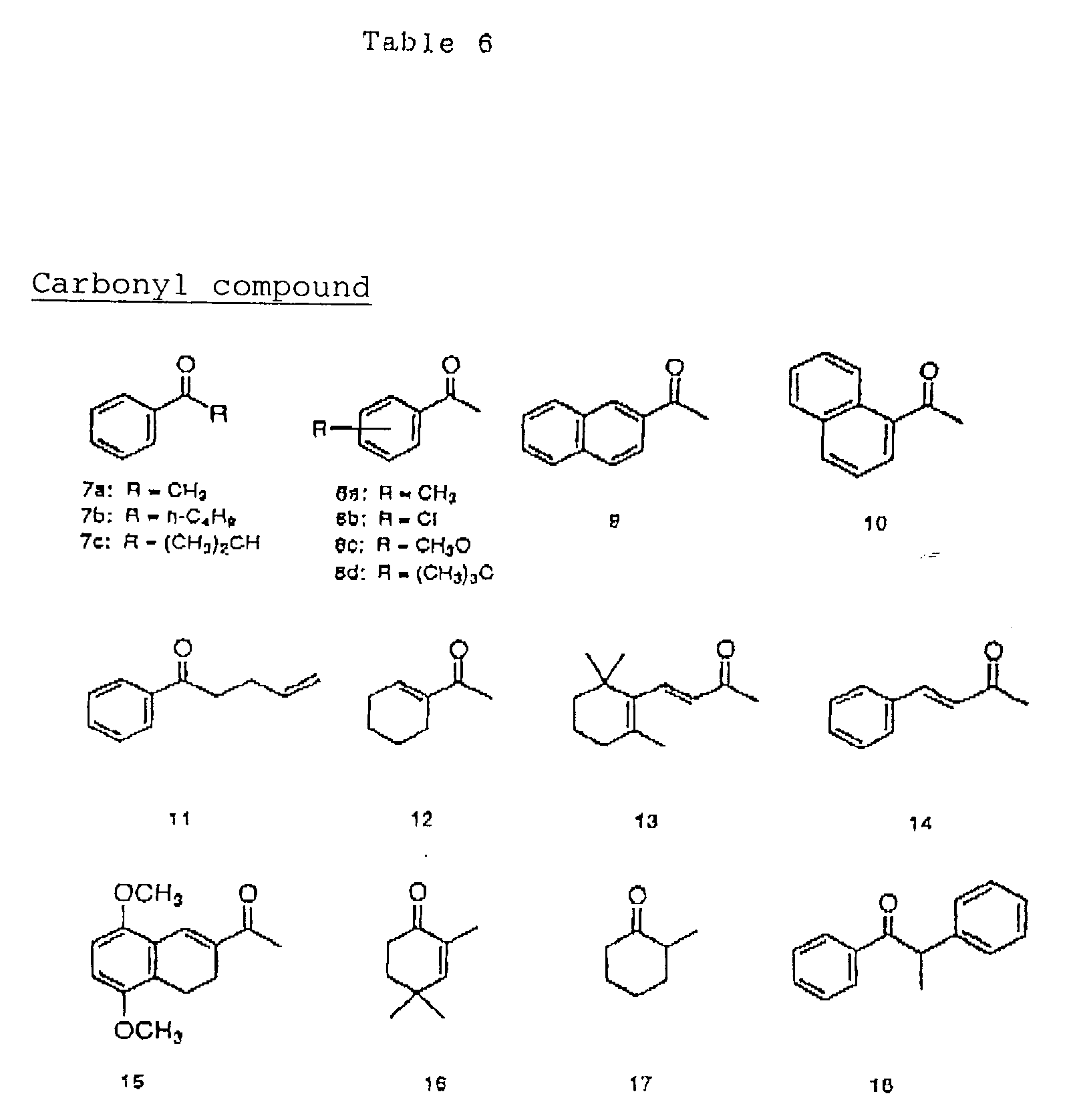

- Into a Schlenk reaction tube, 0.5 M 2-propanol solution (40 µL) of KOH, (S,S)-diphenylethylenediamine (2.1 mg, 0.01 mol), 1'-acetonaphthone (Compound 10 in Table 6)(85 mg, 5.0 mol) and 3 ml 2-propanol were charged in an argon gas flow. After deaeration and argon substitution, the reaction solution was adjusted by adding RuCl₂((S)-binap)(dmf)n (9.6 mg, 0.01 mol). This solution was repeatedly subjected to deaeration and argon substitution to achieve complete dissolution, and then, the reaction was started by transferring the solution into a 100 ml glass autoclave and injecting hydrogen into it to a prescribed pressure. After stirring for six hours at 28°C, temperature was brought to the room temperature, and the reaction product was subjected to gas chromatography and, H NMR analysis to identify the product and determine reaction yield (higher than 99%). Further, the optical purity of the resultant (R)-1-(1-naphthyl)-ethanol was determined by means of an optically active column from HPLC, the result being 97%ee.
- In the same manner as in Example 45, the reaction was caused under the reaction conditions including optically active diamine, hydrogen pressure, temperature and reaction type with the carbonyl compounds as shown in Table 6 as the reaction substrates, and respective optically active alcohol products were obtained with high yields. The results are shown in Table 8.
Table 8 Example Carbonyl compound Photoactive ligand Reaction condition Product Phosphine Diamine H₂ atm. Temp. °C Time. h % yield %ee confign 46 7a (S)-1 (S)-8 4 28 3 >99 87 R 47 7b (S)-1 (S)-7 4 28 3 >99 90 R 48 7c (S)-2 (S)-9 8 28 6 >99 95 R 49 o-8a (S)-2 (S,S)-5 4 28 5 >99 94 R 50 p-8a (R)-1 (R)-9 4 28 3 >99 91 S 51 o-8b (S)-2 (S,S)-5 50 28 3 >99 94 R 52 m-8b (S)-2 (S)-9 8 28 1 96 90 R 53 p-8b (S)-2 (S)-9 8 28 16 >99 94 R 54 m-8c (R)-1 (R)-9 8 30 3 99 88 S 55 p-8c (R)-1 (R)-9 4 28 3 >99 92 S 56 p-8d (S)-2 (S,S)-5 4 24 1.5 >99 96 R 57 9 (S)-2 (S)-9 1 26 18 99 95 R 58 9 (S)-2 (S)-9 50 -22 3 98 97 R 61 11 (S)-1 (S)-9 8 28 3 97 90 R 62 12 (S)-1 (S)-9 8 28 5 91 98 R 63 13 (R)-1 (R,R)-6 8 -20 20 95 92 S 64 13 (2R,3R)-4 (S,S)-5 4 28 19 >99 53 S 65 14 (R)-3 (S)-7 4 28 1 >99 69 S 66 15 (R)-1 (R)-9 8 28 1.5 100 94 S 67 16 (S)-1 (R)-5 8 28 2 100 93 R 68 17 (S)-1 (R)-6 8 28 2.5 100 80(cis) 69 18 (S)-1 (S)-9 8 28 20 96 91 (1R,2R) - In the same manner as in Example 1, p-diacetylbenzene was used as the reaction substrate, and (S)-isopropyl-2,2-di(p-methoxyphenyl)ethylenediamine was used as the optically active diamine. Reaction was caused under a hydrogen pressure of 4 atom at 28°C for 1.5 hours. The resultant diol had a ratio of optically active compound to meso compound of 85:15 and the optical active material had an optical purity of over 99%.
- Reaction was caused in a scale increased to 35 times as large as that of Example 1. From 30 g 1'-acetonaphthone (Compound 10 in Table 1), (R)-1-(1-naphthyl)ethanol was obtained in an amount of 27.90 g. The reaction product was separated by vacuum distillation (98-101°C/0.5 mmHg), and a pure product of an optical purity of 95% was obtained.
- Reaction was carried out under the same conditions as in Example 1, using ethylene diamine in place of (S,S)-diamine. Corresponding optically active alcohol was obtained with an optical purity of 57%.
- Under same conditions shown in Example 45, hydrogenation reactions were carried out using unsaturated carbonyl compounds having the carbon-carbon double bonds in each molecular structure as raw materials. Corresponding optically active alcohols were obtained at high yield.
- Carbon-carbon multiple bonds were not hydrogenated and carbonyl groups only were hydrogenated. The results are shown in above Table 8.
- Under the same condition of the Example 45, hydrogenation was conducted by using a unsaturated cyclicketone(Compound No. 16 shown in Table 6)(0.35g, 2.5mmol), and corresponding optically active unsaturated alcohol was quantitatively obtained. As shown in Table 8, optical purity was 93%ee.
- Under the same condition except addition of KOH of 0.2mmol(0.4M, 2-propamol solution 444 µl), racemic 2-methyl cyclohexanone (compound No. 17, shown in Table 6, (0.57g, 5.0mmol) was hydrogenated. The reaction provides optical active alcohol having cis/trans ratio of 97.7:2.3 by procedure of dynamic kinetic resolution at site of 2-asymmetric carbon.
- As shown in Table 8, optical purity of cis form was 80%ee.
- Under same condition of Example 68, racemic compound (No. 18, shown in Table 6) (1.05g, 5 mmol) was hydrogenated.
- The reaction was carried out though dynamic kinetic resolution, and provides optically active alcohol having anti/sym ratio of 97.0:3.0.
- As shown in Table 8, optical purity of anti-form was 91%ee.
Claims (12)
- A method for producing an alcohol, which comprises the step of causing a carbonyl compound to react with hydrogen in the presence of a homogeneous hydrogenation catalyst, a base and a nitrogen-containing organic compound.
- A method as claimed in claim 1, wherein said homogeneous hydrogenation catalyst is a transition metal complex catalyst of a VIII-group metal.
- A method as claimed in claim 2, wherein said transition metal is a metal selected from the group consisting of rhodium, ruthenium, iridium, palladium and platinum.
- A method as claimed in claim 1, wherein said base is a hydroxide of an alkali metal or an alkali earth metal or a salt thereof, or a quarternary ammonium salt.
- A method as claimed in claim 1, wherein said nitrogen-containing organic compound is an amine compound or an amine derivative.
- A method as claimed in claim 1, wherein said carbonyl compound is expressed by the following general formula (1);

- A method for producing an optically active alcohol, which comprises the step of subjecting a carbonyl compound expressed by the following general formula (2):


- A method as claimed in claim 7, wherein said asymmetric hydrogenation catalyst is a complex of a VIII-group metal.
- A method as claimed in claim 7, wherein said asymmetric hydrogenation catalyst has an optically active ligand.
- A method is claimed in claim 9, wherein said optically active ligand is a phosphine ligand.
- A method as claimed in claim 7, wherein said base is a hydroxide or a salt of an alkali metal or an alkali earth metal, or a quarternary ammonium salt.
- A method as claimed in claim 7, wherein said optically active nitrogen-containing compound is an optically active amine compound.
Applications Claiming Priority (6)
| Application Number | Priority Date | Filing Date | Title |
|---|---|---|---|
| JP304070/94 | 1994-12-07 | ||
| JP30407194 | 1994-12-07 | ||
| JP30407094 | 1994-12-07 | ||
| JP30407194 | 1994-12-07 | ||
| JP304071/94 | 1994-12-07 | ||
| JP30407094 | 1994-12-07 |
Publications (3)
| Publication Number | Publication Date |
|---|---|
| EP0718265A2 true EP0718265A2 (en) | 1996-06-26 |
| EP0718265A3 EP0718265A3 (en) | 1996-07-31 |
| EP0718265B1 EP0718265B1 (en) | 2000-08-23 |
Family
ID=26563775
Family Applications (1)
| Application Number | Title | Priority Date | Filing Date |
|---|---|---|---|
| EP95308891A Expired - Lifetime EP0718265B1 (en) | 1994-12-07 | 1995-12-07 | Method for producing an alcohol |
Country Status (4)
| Country | Link |
|---|---|
| US (1) | US5763688A (en) |
| EP (1) | EP0718265B1 (en) |
| CA (1) | CA2164685C (en) |
| DE (1) | DE69518497T2 (en) |
Cited By (9)
| Publication number | Priority date | Publication date | Assignee | Title |
|---|---|---|---|---|
| EP0781749A3 (en) * | 1995-12-28 | 1997-10-29 | Takasago Perfumery Co Ltd | Process for producing optically active benzhydrol compounds |
| EP0901997A1 (en) * | 1997-09-05 | 1999-03-17 | Takasago International Corporation | Process for producing optically active alcohol compound |
| WO2002008169A1 (en) * | 2000-07-24 | 2002-01-31 | Chirotech Technology Limited | Ruthenium complexes and their use in asymmetric hydrogenation |
| DE10105104A1 (en) * | 2001-02-05 | 2002-08-08 | Bayer Ag | Process for the preparation of non-chiral and optically active hydroxyl-containing organic compounds |
| US6605723B2 (en) | 2000-03-22 | 2003-08-12 | Hoffman-La Roche Inc. | Process for the preparation of ethanesul fonyl-piperidine derivatives |
| WO2002022526A3 (en) * | 2000-09-13 | 2003-09-12 | Firmenich & Cie | Catalytic hydrogenation processes |
| EP1369410A1 (en) * | 2002-06-07 | 2003-12-10 | Bayer Ag | Process for the stereoselective reduction of derivatives of 4-aryl-4-oxobutyric acid |
| CN102311299A (en) * | 2010-07-02 | 2012-01-11 | 中国科学院兰州化学物理研究所 | Method for synthesizing chiral secondary alcohol through asymmetric hydrogenation reaction |
| CN111548269A (en) * | 2020-04-29 | 2020-08-18 | 兰州大学 | Preparation method of diarylmethane structure compound |
Families Citing this family (26)
| Publication number | Priority date | Publication date | Assignee | Title |
|---|---|---|---|---|
| JPH06329679A (en) * | 1993-01-20 | 1994-11-29 | Nissan Chem Ind Ltd | Optically active beta-aminoalkoxyborane complex |
| US6143922A (en) * | 1998-10-07 | 2000-11-07 | Zaitsev; Boris A. | Diols and unsaturated monomers |
| US6258909B1 (en) | 1998-10-07 | 2001-07-10 | Boris A. Zaitsev | Polyester resins |
| EP1129116A1 (en) * | 1998-10-07 | 2001-09-05 | Boris A. Zaitsev | Novel polymerizable materials and novel polyester resins |
| JP2000178215A (en) * | 1998-12-16 | 2000-06-27 | Japan Science & Technology Corp | Production method of alcohols |
| US6410749B1 (en) * | 1999-01-18 | 2002-06-25 | Nippon Soda Co., Ltd. | Process for the preparation of optically active amino alcohols |
| TW519537B (en) | 1999-03-26 | 2003-02-01 | Asahi Chemical Ind | Process for the preparation of tricylic amino-alcohol derivatives |
| KR20020025092A (en) * | 1999-07-01 | 2002-04-03 | 폴락 돈나 엘. | Process for the synthesis of (R)-1-(3,5-bis(trifluoromethyl)-phenyl)ethan-1-ol by asymmetric transfer hydrogenation |
| AU6596800A (en) * | 1999-09-03 | 2001-04-10 | Asahi Kasei Kabushiki Kaisha | Processes for the preparation of tricyclic amino alcohol derivatives |
| JP3720235B2 (en) | 2000-03-14 | 2005-11-24 | 高砂香料工業株式会社 | Method for producing optically active ruthenium phosphine complex and method for producing optically active alcohol using the complex |
| US6867302B2 (en) * | 2001-07-13 | 2005-03-15 | Board Of Trustees Of Michigan State University | Process for the catalytic synthesis of biaryls and polymers from aryl compounds |
| JP3504254B2 (en) | 2001-10-31 | 2004-03-08 | 関東化学株式会社 | Method for producing optically active amino alcohols and intermediates thereof |
| JP3566955B2 (en) | 2001-12-28 | 2004-09-15 | 関東化学株式会社 | Novel ruthenium complex and method for producing alcohol compound using the same as catalyst |
| US6743921B2 (en) | 2002-01-24 | 2004-06-01 | Dsm Catalytica Pharmaceuticals, Inc. | Process for the preparation of nonracemic syn-1-(4-hydroxy-phenyl)-2-(4-hydroxy-4-phenyl-piperidin-1-yl)-1-propanol compounds |
| GB0204129D0 (en) * | 2002-02-21 | 2002-04-10 | Novartis Ag | Process for the manufacture of organic compounds |
| GB0316439D0 (en) | 2003-07-15 | 2003-08-20 | Johnson Matthey Plc | Catalysts |
| US7326784B2 (en) | 2003-12-19 | 2008-02-05 | Altana Pharma Ag | Intermediates for the preparation of tricyclic dihydropyrano-imidazo-pyridines derivatives |
| JP5172124B2 (en) * | 2006-09-29 | 2013-03-27 | 関東化学株式会社 | Method for producing optically active quinuclidinols having a substituent at the 2-position |
| JP2009023941A (en) * | 2007-07-19 | 2009-02-05 | Kanto Chem Co Inc | Organometallic compound and method for producing optically active alcohol using the same |
| US7615671B2 (en) | 2007-11-30 | 2009-11-10 | Eastman Chemical Company | Hydrogenation process for the preparation of 1,2-diols |
| EP2374783A4 (en) * | 2008-12-11 | 2012-08-01 | Takasago Perfumery Co Ltd | PROCESS FOR PRODUCING ALCOHOL COMPOUND |
| US8680302B2 (en) * | 2008-12-11 | 2014-03-25 | Takasago International Corporation | Method for producing alcohol compound |
| JP5727127B2 (en) * | 2009-04-10 | 2015-06-03 | 関東化学株式会社 | Asymmetric catalyst and method for producing optically active alcohols using the same |
| US9056874B2 (en) | 2012-05-04 | 2015-06-16 | Novartis Ag | Complement pathway modulators and uses thereof |
| CN105229003B (en) | 2013-03-14 | 2017-03-15 | 诺华股份有限公司 | 2- (1H-indol-4-ylmethyl) -3H-imidazo [4,5-B ] pyridine-6-carbonitrile derivatives as complement factor B inhibitors for the treatment of ophthalmic diseases |
| CN105849090A (en) | 2013-10-30 | 2016-08-10 | 诺华股份有限公司 | 2-benzyl-benzimidazole complement factor b inhibitors and uses thereof |
Family Cites Families (8)
| Publication number | Priority date | Publication date | Assignee | Title |
|---|---|---|---|---|
| US3532760A (en) * | 1966-08-15 | 1970-10-06 | Dow Chemical Co | Reduction of chlorophenones |
| DE3008671A1 (en) * | 1979-03-08 | 1980-09-11 | Montedison Spa | METHOD FOR CATALYTICALLY CONVERTING CARBONYL COMPOUNDS OR HYDROXYL COMPOUNDS |
| US4321414A (en) * | 1980-08-26 | 1982-03-23 | The Halcon Sd Group, Inc. | Catalytic hydrogenation of glycolaldehyde to produce ethylene glycol |
| JPH064544B2 (en) * | 1987-06-19 | 1994-01-19 | 高砂香料工業株式会社 | Method for producing optically active alcohol |
| FR2623800B1 (en) * | 1987-12-01 | 1990-01-26 | Rhone Poulenc Sante | PROCESS FOR THE PREPARATION OF UNSATURATED ALCOHOLS |
| US5227538A (en) * | 1990-11-21 | 1993-07-13 | Massachusetts Institute Of Technology | Catalytic asymmetric reduction of ketones using metal catalysts |
| GB9118603D0 (en) * | 1991-08-30 | 1991-10-16 | Shell Int Research | Process for the preparation of alcohols |
| DE4134497A1 (en) * | 1991-10-18 | 1993-04-22 | Basf Ag | METHOD FOR PRODUCING 4-HALOGENBENZYL ALCOHOLS |
-
1995
- 1995-12-07 DE DE69518497T patent/DE69518497T2/en not_active Expired - Lifetime
- 1995-12-07 EP EP95308891A patent/EP0718265B1/en not_active Expired - Lifetime
- 1995-12-07 CA CA002164685A patent/CA2164685C/en not_active Expired - Lifetime
- 1995-12-07 US US08/568,589 patent/US5763688A/en not_active Expired - Lifetime
Non-Patent Citations (10)
| Title |
|---|
| "Advances in Catalysis", vol. 32, 1983, pages: 215 |
| "Asymmetric Catalysis In Organic Synthesis", 1994, pages: 56 - 82 |
| "Asymmetric Synthesis", vol. 5, 1985 |
| "Inorg. Nucl. Chcm. Letters", vol. 12, 1976, pages: 865 |
| J. AM. CHEM. SOC., vol. 109, 1987, pages 5551 - 5553 |
| J. AM. CHEM. SOC., vol. 115, 1993, pages 3318 |
| J. CHEM. SOC., PERKIN TRANS. 1, 1985, pages 2039 - 2044 |
| J. ORGANOMET. CHEM., vol. 129, 1997, pages 239 |
| J. ORGANOMET. CHEM., vol. 346, 1988, pages 413 - 424 |
| PETR. CHEM., 1980, pages 882 - 831 |
Cited By (13)
| Publication number | Priority date | Publication date | Assignee | Title |
|---|---|---|---|---|
| EP0781749A3 (en) * | 1995-12-28 | 1997-10-29 | Takasago Perfumery Co Ltd | Process for producing optically active benzhydrol compounds |
| US5780692A (en) * | 1995-12-28 | 1998-07-14 | Takasago International Corporation | Process for producing optically active benzhydrol compounds |
| EP0901997A1 (en) * | 1997-09-05 | 1999-03-17 | Takasago International Corporation | Process for producing optically active alcohol compound |
| US6605723B2 (en) | 2000-03-22 | 2003-08-12 | Hoffman-La Roche Inc. | Process for the preparation of ethanesul fonyl-piperidine derivatives |
| US6528687B2 (en) | 2000-07-24 | 2003-03-04 | Chirotech Technology Limited | Ruthenium complexes and their use in asymmetric hydrogenation |
| WO2002008169A1 (en) * | 2000-07-24 | 2002-01-31 | Chirotech Technology Limited | Ruthenium complexes and their use in asymmetric hydrogenation |
| WO2002022526A3 (en) * | 2000-09-13 | 2003-09-12 | Firmenich & Cie | Catalytic hydrogenation processes |
| WO2002076997A1 (en) * | 2001-02-05 | 2002-10-03 | Ligand Chemie Gmbh | Method for producing non-chiral organic compounds containing optically active hydroxy groups |
| DE10105104A1 (en) * | 2001-02-05 | 2002-08-08 | Bayer Ag | Process for the preparation of non-chiral and optically active hydroxyl-containing organic compounds |
| EP1369410A1 (en) * | 2002-06-07 | 2003-12-10 | Bayer Ag | Process for the stereoselective reduction of derivatives of 4-aryl-4-oxobutyric acid |
| CN102311299A (en) * | 2010-07-02 | 2012-01-11 | 中国科学院兰州化学物理研究所 | Method for synthesizing chiral secondary alcohol through asymmetric hydrogenation reaction |
| CN111548269A (en) * | 2020-04-29 | 2020-08-18 | 兰州大学 | Preparation method of diarylmethane structure compound |
| CN111548269B (en) * | 2020-04-29 | 2023-10-27 | 兰州大学 | Preparation method of diarylmethane structural compound |
Also Published As
| Publication number | Publication date |
|---|---|
| EP0718265A3 (en) | 1996-07-31 |
| CA2164685C (en) | 2005-03-08 |
| DE69518497D1 (en) | 2000-09-28 |
| EP0718265B1 (en) | 2000-08-23 |
| DE69518497T2 (en) | 2001-04-19 |
| US5763688A (en) | 1998-06-09 |
| CA2164685A1 (en) | 1996-06-08 |
Similar Documents
| Publication | Publication Date | Title |
|---|---|---|
| EP0718265B1 (en) | Method for producing an alcohol | |
| JP4004123B2 (en) | Method for producing alcohol compound using ruthenium complex as catalyst | |
| CN108774271A (en) | A kind of chiral nitrogen nitrogen phosphine tridentate ligand and its application based on ferrocene frame having ferrocene frame | |
| JP2731377B2 (en) | Method for producing optically active alcohols | |
| EP1153908B1 (en) | Method for producing 1-menthol | |
| EP0901997B1 (en) | Process for producing optically active alcohol compound | |
| US6451727B2 (en) | Catalysts for use in asymmetric synthesis comprising transition metals and chiral amine oxazolinyl ligands | |
| WO2002008169A1 (en) | Ruthenium complexes and their use in asymmetric hydrogenation | |
| EP1813621B1 (en) | Ruthenium complex and process for producing tert-alkyl alcohol therewith | |
| CN1926083B (en) | Preparation method of optically active alcohol | |
| JPH09157196A (en) | Method for producing optically active alcohols | |
| EP1134226B1 (en) | Process for producing an optically active ruthenium-phosphine complex and process for producing an optically active alcohol by using the complex | |
| JP5244158B2 (en) | Production method of optically active alcohol | |
| JPH08225467A (en) | Alcohol production method | |
| JP3771615B2 (en) | Method for producing optically active benzhydrol compound | |
| EP2921228A1 (en) | Method for producing optically active isopulegol and optically active menthol | |
| EP1601635B1 (en) | Process for producing optically active alcohol in the presence of rhodium, a chiral ferrocenyldiphosphine and an optically active diamine | |
| JP4795559B2 (en) | Method for producing l-menthol | |
| JPH10273456A (en) | Method for producing optically active alcohols | |
| JPH09110750A (en) | Process for producing optically active cyclohexanols | |
| JP2003192681A (en) | Process for producing (S) -3-chloro-1- (2-thienyl) -1-propanol and (S) -3-N-methylamino-1- (2-thienyl) -1-propanol | |
| JP4658293B2 (en) | Process for producing optically active β-amino alcohols having anti-configuration |
Legal Events
| Date | Code | Title | Description |
|---|---|---|---|
| PUAI | Public reference made under article 153(3) epc to a published international application that has entered the european phase |
Free format text: ORIGINAL CODE: 0009012 |
|
| PUAL | Search report despatched |
Free format text: ORIGINAL CODE: 0009013 |
|
| AK | Designated contracting states |
Kind code of ref document: A2 Designated state(s): DE FR GB |
|
| AK | Designated contracting states |
Kind code of ref document: A3 Designated state(s): DE FR GB |
|
| 17P | Request for examination filed |
Effective date: 19970123 |
|
| 17Q | First examination report despatched |
Effective date: 19971219 |
|
| RAP1 | Party data changed (applicant data changed or rights of an application transferred) |
Owner name: SEIDO, NOBUO Owner name: HASHIGUCHI, SHOHEI Owner name: OOKA, HIROHITO Owner name: IKARIYA, TAKAO Owner name: JAPAN SCIENCE AND TECHNOLOGY CORPORATION |
|
| RIN1 | Information on inventor provided before grant (corrected) |
Inventor name: NOYORI, RYOJI Inventor name: SEIDO, NOBUO Inventor name: HASHIGUCHI, SHOHEI Inventor name: OOKA, HIROHITO Inventor name: OHKUMA, TAKESHI Inventor name: IKARIYA, TAKAO |
|
| RAP1 | Party data changed (applicant data changed or rights of an application transferred) |
Owner name: TAGASAKO INTERNATIONAL CORPORATION Owner name: JAPAN SCIENCE AND TECHNOLOGY CORPORATION Owner name: TAKEDA CHEMICAL INDUSTRIES, LTD. Owner name: IKARIYA, TAKAO Owner name: NIPPON SODA CO., LTD. |
|
| RAP1 | Party data changed (applicant data changed or rights of an application transferred) |
Owner name: TAGASAKO INTERNATIONAL CORPORATION Owner name: JAPAN SCIENCE AND TECHNOLOGY CORPORATION Owner name: TAKEDA CHEMICAL INDUSTRIES, LTD. Owner name: NIPPON SODA CO., LTD. Owner name: NKK CORPORATION |
|
| GRAG | Despatch of communication of intention to grant |
Free format text: ORIGINAL CODE: EPIDOS AGRA |
|
| RAP1 | Party data changed (applicant data changed or rights of an application transferred) |
Owner name: TAKASAGO INTERNATIONAL CORPORATION Owner name: JAPAN SCIENCE AND TECHNOLOGY CORPORATION Owner name: TAKEDA CHEMICAL INDUSTRIES, LTD. Owner name: NIPPON SODA CO., LTD. Owner name: NKK CORPORATION |
|
| GRAG | Despatch of communication of intention to grant |
Free format text: ORIGINAL CODE: EPIDOS AGRA |
|
| GRAH | Despatch of communication of intention to grant a patent |
Free format text: ORIGINAL CODE: EPIDOS IGRA |
|
| GRAH | Despatch of communication of intention to grant a patent |
Free format text: ORIGINAL CODE: EPIDOS IGRA |
|
| GRAA | (expected) grant |
Free format text: ORIGINAL CODE: 0009210 |
|
| AK | Designated contracting states |
Kind code of ref document: B1 Designated state(s): DE FR GB |
|
| REF | Corresponds to: |
Ref document number: 69518497 Country of ref document: DE Date of ref document: 20000928 |
|
| ET | Fr: translation filed | ||
| PLBE | No opposition filed within time limit |
Free format text: ORIGINAL CODE: 0009261 |
|
| STAA | Information on the status of an ep patent application or granted ep patent |
Free format text: STATUS: NO OPPOSITION FILED WITHIN TIME LIMIT |
|
| 26N | No opposition filed | ||
| REG | Reference to a national code |
Ref country code: GB Ref legal event code: IF02 |
|
| REG | Reference to a national code |
Ref country code: FR Ref legal event code: CD |
|
| PGFP | Annual fee paid to national office [announced via postgrant information from national office to epo] |
Ref country code: DE Payment date: 20141111 Year of fee payment: 20 Ref country code: GB Payment date: 20141111 Year of fee payment: 20 Ref country code: FR Payment date: 20141111 Year of fee payment: 20 |
|
| REG | Reference to a national code |
Ref country code: DE Ref legal event code: R071 Ref document number: 69518497 Country of ref document: DE |
|
| REG | Reference to a national code |
Ref country code: GB Ref legal event code: PE20 Expiry date: 20151206 |
|
| PG25 | Lapsed in a contracting state [announced via postgrant information from national office to epo] |
Ref country code: GB Free format text: LAPSE BECAUSE OF EXPIRATION OF PROTECTION Effective date: 20151206 |