EP0717315A1 - Photographic material containing cyan coupler - Google Patents
Photographic material containing cyan coupler Download PDFInfo
- Publication number
- EP0717315A1 EP0717315A1 EP95309134A EP95309134A EP0717315A1 EP 0717315 A1 EP0717315 A1 EP 0717315A1 EP 95309134 A EP95309134 A EP 95309134A EP 95309134 A EP95309134 A EP 95309134A EP 0717315 A1 EP0717315 A1 EP 0717315A1
- Authority
- EP
- European Patent Office
- Prior art keywords
- group
- silver halide
- coupler
- dye
- halide emulsion
- Prior art date
- Legal status (The legal status is an assumption and is not a legal conclusion. Google has not performed a legal analysis and makes no representation as to the accuracy of the status listed.)
- Granted
Links
- 239000000463 material Substances 0.000 title claims abstract description 28
- -1 silver halide Chemical class 0.000 claims abstract description 63
- 239000004332 silver Substances 0.000 claims abstract description 45
- 229910052709 silver Inorganic materials 0.000 claims abstract description 45
- 239000000839 emulsion Substances 0.000 claims abstract description 43
- 239000000975 dye Substances 0.000 claims description 45
- 150000001875 compounds Chemical class 0.000 claims description 20
- SJOOOZPMQAWAOP-UHFFFAOYSA-N [Ag].BrCl Chemical compound [Ag].BrCl SJOOOZPMQAWAOP-UHFFFAOYSA-N 0.000 claims description 13
- 125000004432 carbon atom Chemical group C* 0.000 claims description 10
- 238000006243 chemical reaction Methods 0.000 claims description 8
- 125000000753 cycloalkyl group Chemical group 0.000 claims description 8
- 125000004435 hydrogen atom Chemical group [H]* 0.000 claims description 7
- 125000001424 substituent group Chemical group 0.000 claims description 7
- 239000003795 chemical substances by application Substances 0.000 claims description 6
- BQCADISMDOOEFD-UHFFFAOYSA-N Silver Chemical compound [Ag] BQCADISMDOOEFD-UHFFFAOYSA-N 0.000 claims description 5
- 229910021607 Silver chloride Inorganic materials 0.000 claims description 5
- HKZLPVFGJNLROG-UHFFFAOYSA-M silver monochloride Chemical compound [Cl-].[Ag+] HKZLPVFGJNLROG-UHFFFAOYSA-M 0.000 claims description 5
- 125000000547 substituted alkyl group Chemical group 0.000 claims description 5
- 230000003647 oxidation Effects 0.000 claims description 4
- 238000007254 oxidation reaction Methods 0.000 claims description 4
- 150000004820 halides Chemical class 0.000 claims description 2
- AJDUTMFFZHIJEM-UHFFFAOYSA-N n-(9,10-dioxoanthracen-1-yl)-4-[4-[[4-[4-[(9,10-dioxoanthracen-1-yl)carbamoyl]phenyl]phenyl]diazenyl]phenyl]benzamide Chemical compound O=C1C2=CC=CC=C2C(=O)C2=C1C=CC=C2NC(=O)C(C=C1)=CC=C1C(C=C1)=CC=C1N=NC(C=C1)=CC=C1C(C=C1)=CC=C1C(=O)NC1=CC=CC2=C1C(=O)C1=CC=CC=C1C2=O AJDUTMFFZHIJEM-UHFFFAOYSA-N 0.000 claims description 2
- 239000001043 yellow dye Substances 0.000 claims description 2
- 239000010410 layer Substances 0.000 description 37
- 239000000243 solution Substances 0.000 description 27
- 239000003381 stabilizer Substances 0.000 description 20
- 230000033458 reproduction Effects 0.000 description 15
- 108010010803 Gelatin Proteins 0.000 description 14
- 239000000654 additive Substances 0.000 description 14
- 229920000159 gelatin Polymers 0.000 description 14
- 239000008273 gelatin Substances 0.000 description 14
- 235000019322 gelatine Nutrition 0.000 description 14
- 235000011852 gelatine desserts Nutrition 0.000 description 14
- 230000000996 additive effect Effects 0.000 description 13
- 230000015572 biosynthetic process Effects 0.000 description 11
- QTBSBXVTEAMEQO-UHFFFAOYSA-N Acetic acid Chemical compound CC(O)=O QTBSBXVTEAMEQO-UHFFFAOYSA-N 0.000 description 9
- XEKOWRVHYACXOJ-UHFFFAOYSA-N Ethyl acetate Chemical compound CCOC(C)=O XEKOWRVHYACXOJ-UHFFFAOYSA-N 0.000 description 9
- 238000010521 absorption reaction Methods 0.000 description 8
- 125000000217 alkyl group Chemical group 0.000 description 8
- 0 **c1n[n]2c(-c3ccccc3)n[n]c2c1* Chemical compound **c1n[n]2c(-c3ccccc3)n[n]c2c1* 0.000 description 7
- 239000002250 absorbent Substances 0.000 description 7
- 230000002745 absorbent Effects 0.000 description 7
- 239000000203 mixture Substances 0.000 description 7
- XLYOFNOQVPJJNP-UHFFFAOYSA-N water Substances O XLYOFNOQVPJJNP-UHFFFAOYSA-N 0.000 description 7
- WEVYAHXRMPXWCK-UHFFFAOYSA-N Acetonitrile Chemical compound CC#N WEVYAHXRMPXWCK-UHFFFAOYSA-N 0.000 description 6
- VEXZGXHMUGYJMC-UHFFFAOYSA-M Chloride anion Chemical compound [Cl-] VEXZGXHMUGYJMC-UHFFFAOYSA-M 0.000 description 6
- 125000004414 alkyl thio group Chemical group 0.000 description 5
- 125000003118 aryl group Chemical group 0.000 description 5
- 125000005110 aryl thio group Chemical group 0.000 description 5
- 239000011248 coating agent Substances 0.000 description 5
- 238000000576 coating method Methods 0.000 description 5
- 125000000623 heterocyclic group Chemical group 0.000 description 5
- 239000004094 surface-active agent Substances 0.000 description 5
- 238000003786 synthesis reaction Methods 0.000 description 5
- BKUSIKGSPSFQAC-RRKCRQDMSA-N 2'-deoxyinosine-5'-diphosphate Chemical compound O1[C@H](CO[P@@](O)(=O)OP(O)(O)=O)[C@@H](O)C[C@@H]1N1C(NC=NC2=O)=C2N=C1 BKUSIKGSPSFQAC-RRKCRQDMSA-N 0.000 description 4
- 102100033183 Epithelial membrane protein 1 Human genes 0.000 description 4
- FAPWRFPIFSIZLT-UHFFFAOYSA-M Sodium chloride Chemical compound [Na+].[Cl-] FAPWRFPIFSIZLT-UHFFFAOYSA-M 0.000 description 4
- GWEVSGVZZGPLCZ-UHFFFAOYSA-N Titan oxide Chemical compound O=[Ti]=O GWEVSGVZZGPLCZ-UHFFFAOYSA-N 0.000 description 4
- 239000002253 acid Substances 0.000 description 4
- 125000004442 acylamino group Chemical group 0.000 description 4
- 125000004423 acyloxy group Chemical group 0.000 description 4
- 125000003342 alkenyl group Chemical group 0.000 description 4
- 125000003545 alkoxy group Chemical group 0.000 description 4
- 125000004104 aryloxy group Chemical group 0.000 description 4
- 238000009835 boiling Methods 0.000 description 4
- 230000000052 comparative effect Effects 0.000 description 4
- DOIRQSBPFJWKBE-UHFFFAOYSA-N dibutyl phthalate Chemical compound CCCCOC(=O)C1=CC=CC=C1C(=O)OCCCC DOIRQSBPFJWKBE-UHFFFAOYSA-N 0.000 description 4
- 108010008594 epithelial membrane protein-1 Proteins 0.000 description 4
- 125000005843 halogen group Chemical group 0.000 description 4
- 150000002430 hydrocarbons Chemical group 0.000 description 4
- 238000000034 method Methods 0.000 description 4
- IOLCXVTUBQKXJR-UHFFFAOYSA-M potassium bromide Chemical compound [K+].[Br-] IOLCXVTUBQKXJR-UHFFFAOYSA-M 0.000 description 4
- 238000012545 processing Methods 0.000 description 4
- 239000011241 protective layer Substances 0.000 description 4
- SQGYOTSLMSWVJD-UHFFFAOYSA-N silver(1+) nitrate Chemical compound [Ag+].[O-]N(=O)=O SQGYOTSLMSWVJD-UHFFFAOYSA-N 0.000 description 4
- 230000003595 spectral effect Effects 0.000 description 4
- 125000000565 sulfonamide group Chemical group 0.000 description 4
- LFQSCWFLJHTTHZ-UHFFFAOYSA-N Ethanol Chemical compound CCO LFQSCWFLJHTTHZ-UHFFFAOYSA-N 0.000 description 3
- LYCAIKOWRPUZTN-UHFFFAOYSA-N Ethylene glycol Chemical compound OCCO LYCAIKOWRPUZTN-UHFFFAOYSA-N 0.000 description 3
- 101000832225 Homo sapiens Stabilin-1 Proteins 0.000 description 3
- 239000004698 Polyethylene Substances 0.000 description 3
- KWYUFKZDYYNOTN-UHFFFAOYSA-M Potassium hydroxide Chemical compound [OH-].[K+] KWYUFKZDYYNOTN-UHFFFAOYSA-M 0.000 description 3
- HEMHJVSKTPXQMS-UHFFFAOYSA-M Sodium hydroxide Chemical compound [OH-].[Na+] HEMHJVSKTPXQMS-UHFFFAOYSA-M 0.000 description 3
- 102100024471 Stabilin-1 Human genes 0.000 description 3
- YXFVVABEGXRONW-UHFFFAOYSA-N Toluene Chemical compound CC1=CC=CC=C1 YXFVVABEGXRONW-UHFFFAOYSA-N 0.000 description 3
- 125000002252 acyl group Chemical group 0.000 description 3
- 125000004466 alkoxycarbonylamino group Chemical group 0.000 description 3
- 125000004397 aminosulfonyl group Chemical group NS(=O)(=O)* 0.000 description 3
- 125000005162 aryl oxy carbonyl amino group Chemical group 0.000 description 3
- 125000005161 aryl oxy carbonyl group Chemical group 0.000 description 3
- BJQHLKABXJIVAM-UHFFFAOYSA-N bis(2-ethylhexyl) phthalate Chemical compound CCCCC(CC)COC(=O)C1=CC=CC=C1C(=O)OCC(CC)CCCC BJQHLKABXJIVAM-UHFFFAOYSA-N 0.000 description 3
- 125000003917 carbamoyl group Chemical group [H]N([H])C(*)=O 0.000 description 3
- 125000001951 carbamoylamino group Chemical group C(N)(=O)N* 0.000 description 3
- 125000003178 carboxy group Chemical group [H]OC(*)=O 0.000 description 3
- 125000000392 cycloalkenyl group Chemical group 0.000 description 3
- 239000006185 dispersion Substances 0.000 description 3
- 125000002887 hydroxy group Chemical group [H]O* 0.000 description 3
- VLKZOEOYAKHREP-UHFFFAOYSA-N n-Hexane Chemical compound CCCCCC VLKZOEOYAKHREP-UHFFFAOYSA-N 0.000 description 3
- 150000004780 naphthols Chemical class 0.000 description 3
- 150000002989 phenols Chemical class 0.000 description 3
- 125000005499 phosphonyl group Chemical group 0.000 description 3
- 229920000573 polyethylene Polymers 0.000 description 3
- 239000004848 polyfunctional curative Substances 0.000 description 3
- 238000002360 preparation method Methods 0.000 description 3
- 125000004469 siloxy group Chemical group [SiH3]O* 0.000 description 3
- AKHNMLFCWUSKQB-UHFFFAOYSA-L sodium thiosulfate Chemical compound [Na+].[Na+].[O-]S([O-])(=O)=S AKHNMLFCWUSKQB-UHFFFAOYSA-L 0.000 description 3
- 235000019345 sodium thiosulphate Nutrition 0.000 description 3
- 150000003413 spiro compounds Chemical group 0.000 description 3
- 238000003860 storage Methods 0.000 description 3
- 125000000475 sulfinyl group Chemical group [*:2]S([*:1])=O 0.000 description 3
- 125000000472 sulfonyl group Chemical group *S(*)(=O)=O 0.000 description 3
- MQIUGAXCHLFZKX-UHFFFAOYSA-N Di-n-octyl phthalate Natural products CCCCCCCCOC(=O)C1=CC=CC=C1C(=O)OCCCCCCCC MQIUGAXCHLFZKX-UHFFFAOYSA-N 0.000 description 2
- KCXVZYZYPLLWCC-UHFFFAOYSA-N EDTA Chemical compound OC(=O)CN(CC(O)=O)CCN(CC(O)=O)CC(O)=O KCXVZYZYPLLWCC-UHFFFAOYSA-N 0.000 description 2
- 102100033176 Epithelial membrane protein 2 Human genes 0.000 description 2
- 108050009423 Epithelial membrane protein 2 Proteins 0.000 description 2
- 102100030146 Epithelial membrane protein 3 Human genes 0.000 description 2
- 101710143764 Epithelial membrane protein 3 Proteins 0.000 description 2
- VEXZGXHMUGYJMC-UHFFFAOYSA-N Hydrochloric acid Chemical compound Cl VEXZGXHMUGYJMC-UHFFFAOYSA-N 0.000 description 2
- CSNNHWWHGAXBCP-UHFFFAOYSA-L Magnesium sulfate Chemical compound [Mg+2].[O-][S+2]([O-])([O-])[O-] CSNNHWWHGAXBCP-UHFFFAOYSA-L 0.000 description 2
- JUJWROOIHBZHMG-UHFFFAOYSA-N Pyridine Chemical compound C1=CC=NC=C1 JUJWROOIHBZHMG-UHFFFAOYSA-N 0.000 description 2
- QAOWNCQODCNURD-UHFFFAOYSA-N Sulfuric acid Chemical compound OS(O)(=O)=O QAOWNCQODCNURD-UHFFFAOYSA-N 0.000 description 2
- 125000004453 alkoxycarbonyl group Chemical group 0.000 description 2
- 125000003282 alkyl amino group Chemical group 0.000 description 2
- 125000000304 alkynyl group Chemical group 0.000 description 2
- 125000003277 amino group Chemical group 0.000 description 2
- 125000002490 anilino group Chemical group [H]N(*)C1=C([H])C([H])=C([H])C([H])=C1[H] 0.000 description 2
- 239000007864 aqueous solution Substances 0.000 description 2
- 238000004061 bleaching Methods 0.000 description 2
- GDTBXPJZTBHREO-UHFFFAOYSA-N bromine Chemical compound BrBr GDTBXPJZTBHREO-UHFFFAOYSA-N 0.000 description 2
- 238000012937 correction Methods 0.000 description 2
- 239000013078 crystal Substances 0.000 description 2
- 125000004093 cyano group Chemical group *C#N 0.000 description 2
- 239000011229 interlayer Substances 0.000 description 2
- 230000007935 neutral effect Effects 0.000 description 2
- 125000000449 nitro group Chemical group [O-][N+](*)=O 0.000 description 2
- 229910052757 nitrogen Inorganic materials 0.000 description 2
- 125000004433 nitrogen atom Chemical group N* 0.000 description 2
- 239000003960 organic solvent Substances 0.000 description 2
- GZTPJDLYPMPRDF-UHFFFAOYSA-N pyrrolo[3,2-c]pyrazole Chemical compound N1=NC2=CC=NC2=C1 GZTPJDLYPMPRDF-UHFFFAOYSA-N 0.000 description 2
- 239000011541 reaction mixture Substances 0.000 description 2
- 238000010992 reflux Methods 0.000 description 2
- 230000001235 sensitizing effect Effects 0.000 description 2
- 229910001961 silver nitrate Inorganic materials 0.000 description 2
- 239000011780 sodium chloride Substances 0.000 description 2
- 239000002904 solvent Substances 0.000 description 2
- 125000000020 sulfo group Chemical group O=S(=O)([*])O[H] 0.000 description 2
- 125000003396 thiol group Chemical group [H]S* 0.000 description 2
- 239000004408 titanium dioxide Substances 0.000 description 2
- 238000005406 washing Methods 0.000 description 2
- 229940116368 1,2-benzisothiazoline-3-one Drugs 0.000 description 1
- HFZLSTDPRQSZCQ-UHFFFAOYSA-N 1-pyrrolidin-3-ylpyrrolidine Chemical compound C1CCCN1C1CNCC1 HFZLSTDPRQSZCQ-UHFFFAOYSA-N 0.000 description 1
- SZLHQHZVDSXZDG-UHFFFAOYSA-N 5-amino-2-[2-(4-aminophenyl)ethenyl]benzenesulfonic acid Chemical class C1=CC(N)=CC=C1C=CC1=CC=C(N)C=C1S(O)(=O)=O SZLHQHZVDSXZDG-UHFFFAOYSA-N 0.000 description 1
- 150000007578 6-membered cyclic compounds Chemical class 0.000 description 1
- 150000007579 7-membered cyclic compounds Chemical class 0.000 description 1
- VHUUQVKOLVNVRT-UHFFFAOYSA-N Ammonium hydroxide Chemical compound [NH4+].[OH-] VHUUQVKOLVNVRT-UHFFFAOYSA-N 0.000 description 1
- CPELXLSAUQHCOX-UHFFFAOYSA-M Bromide Chemical compound [Br-] CPELXLSAUQHCOX-UHFFFAOYSA-M 0.000 description 1
- DKPFZGUDAPQIHT-UHFFFAOYSA-N Butyl acetate Natural products CCCCOC(C)=O DKPFZGUDAPQIHT-UHFFFAOYSA-N 0.000 description 1
- KZBUYRJDOAKODT-UHFFFAOYSA-N Chlorine Chemical compound ClCl KZBUYRJDOAKODT-UHFFFAOYSA-N 0.000 description 1
- PQUCIEFHOVEZAU-UHFFFAOYSA-N Diammonium sulfite Chemical compound [NH4+].[NH4+].[O-]S([O-])=O PQUCIEFHOVEZAU-UHFFFAOYSA-N 0.000 description 1
- ZVFDTKUVRCTHQE-UHFFFAOYSA-N Diisodecyl phthalate Chemical compound CC(C)CCCCCCCOC(=O)C1=CC=CC=C1C(=O)OCCCCCCCC(C)C ZVFDTKUVRCTHQE-UHFFFAOYSA-N 0.000 description 1
- DBVJJBKOTRCVKF-UHFFFAOYSA-N Etidronic acid Chemical compound OP(=O)(O)C(O)(C)P(O)(O)=O DBVJJBKOTRCVKF-UHFFFAOYSA-N 0.000 description 1
- YSMRWXYRXBRSND-UHFFFAOYSA-N TOTP Chemical compound CC1=CC=CC=C1OP(=O)(OC=1C(=CC=CC=1)C)OC1=CC=CC=C1C YSMRWXYRXBRSND-UHFFFAOYSA-N 0.000 description 1
- 239000012190 activator Substances 0.000 description 1
- 239000012670 alkaline solution Substances 0.000 description 1
- 125000005194 alkoxycarbonyloxy group Chemical group 0.000 description 1
- 125000005115 alkyl carbamoyl group Chemical group 0.000 description 1
- 125000003806 alkyl carbonyl amino group Chemical group 0.000 description 1
- 125000004448 alkyl carbonyl group Chemical group 0.000 description 1
- 125000005196 alkyl carbonyloxy group Chemical group 0.000 description 1
- 125000005153 alkyl sulfamoyl group Chemical group 0.000 description 1
- 125000004644 alkyl sulfinyl group Chemical group 0.000 description 1
- 125000004390 alkyl sulfonyl group Chemical group 0.000 description 1
- 125000004656 alkyl sulfonylamino group Chemical group 0.000 description 1
- 125000005278 alkyl sulfonyloxy group Chemical group 0.000 description 1
- 125000005281 alkyl ureido group Chemical group 0.000 description 1
- 125000002947 alkylene group Chemical group 0.000 description 1
- 239000000908 ammonium hydroxide Substances 0.000 description 1
- XYXNTHIYBIDHGM-UHFFFAOYSA-N ammonium thiosulfate Chemical compound [NH4+].[NH4+].[O-]S([O-])(=O)=S XYXNTHIYBIDHGM-UHFFFAOYSA-N 0.000 description 1
- 239000002216 antistatic agent Substances 0.000 description 1
- 125000005116 aryl carbamoyl group Chemical group 0.000 description 1
- 125000004658 aryl carbonyl amino group Chemical group 0.000 description 1
- 125000005129 aryl carbonyl group Chemical group 0.000 description 1
- 125000005199 aryl carbonyloxy group Chemical group 0.000 description 1
- 125000005135 aryl sulfinyl group Chemical group 0.000 description 1
- 125000004657 aryl sulfonyl amino group Chemical group 0.000 description 1
- 125000004391 aryl sulfonyl group Chemical group 0.000 description 1
- 125000005279 aryl sulfonyloxy group Chemical group 0.000 description 1
- XNSQZBOCSSMHSZ-UHFFFAOYSA-K azane;2-[2-[bis(carboxylatomethyl)amino]ethyl-(carboxymethyl)amino]acetate;iron(3+) Chemical compound [NH4+].[Fe+3].[O-]C(=O)CN(CC([O-])=O)CCN(CC([O-])=O)CC([O-])=O XNSQZBOCSSMHSZ-UHFFFAOYSA-K 0.000 description 1
- DMSMPAJRVJJAGA-UHFFFAOYSA-N benzo[d]isothiazol-3-one Chemical compound C1=CC=C2C(=O)NSC2=C1 DMSMPAJRVJJAGA-UHFFFAOYSA-N 0.000 description 1
- 229910052794 bromium Inorganic materials 0.000 description 1
- 239000000460 chlorine Substances 0.000 description 1
- 229910052801 chlorine Inorganic materials 0.000 description 1
- DHNRXBZYEKSXIM-UHFFFAOYSA-N chloromethylisothiazolinone Chemical compound CN1SC(Cl)=CC1=O DHNRXBZYEKSXIM-UHFFFAOYSA-N 0.000 description 1
- 239000000084 colloidal system Substances 0.000 description 1
- 239000003086 colorant Substances 0.000 description 1
- 238000004440 column chromatography Methods 0.000 description 1
- 238000007796 conventional method Methods 0.000 description 1
- 230000001808 coupling effect Effects 0.000 description 1
- 125000000113 cyclohexyl group Chemical group [H]C1([H])C([H])([H])C([H])([H])C([H])(*)C([H])([H])C1([H])[H] 0.000 description 1
- 125000002704 decyl group Chemical group [H]C([H])([H])C([H])([H])C([H])([H])C([H])([H])C([H])([H])C([H])([H])C([H])([H])C([H])([H])C([H])([H])C([H])([H])* 0.000 description 1
- DROMNWUQASBTFM-UHFFFAOYSA-N dinonyl benzene-1,2-dicarboxylate Chemical compound CCCCCCCCCOC(=O)C1=CC=CC=C1C(=O)OCCCCCCCCC DROMNWUQASBTFM-UHFFFAOYSA-N 0.000 description 1
- 238000001035 drying Methods 0.000 description 1
- 125000006575 electron-withdrawing group Chemical group 0.000 description 1
- 125000001495 ethyl group Chemical group [H]C([H])([H])C([H])([H])* 0.000 description 1
- 229910052731 fluorine Inorganic materials 0.000 description 1
- 125000001153 fluoro group Chemical group F* 0.000 description 1
- FUZZWVXGSFPDMH-UHFFFAOYSA-N hexanoic acid Chemical compound CCCCCC(O)=O FUZZWVXGSFPDMH-UHFFFAOYSA-N 0.000 description 1
- 238000002329 infrared spectrum Methods 0.000 description 1
- 125000001449 isopropyl group Chemical group [H]C([H])([H])C([H])(*)C([H])([H])[H] 0.000 description 1
- 229910052943 magnesium sulfate Inorganic materials 0.000 description 1
- 235000019341 magnesium sulphate Nutrition 0.000 description 1
- 238000004519 manufacturing process Methods 0.000 description 1
- 230000000873 masking effect Effects 0.000 description 1
- 238000001819 mass spectrum Methods 0.000 description 1
- 239000006224 matting agent Substances 0.000 description 1
- 238000002844 melting Methods 0.000 description 1
- 230000008018 melting Effects 0.000 description 1
- 125000002496 methyl group Chemical group [H]C([H])([H])* 0.000 description 1
- QJGQUHMNIGDVPM-UHFFFAOYSA-N nitrogen group Chemical group [N] QJGQUHMNIGDVPM-UHFFFAOYSA-N 0.000 description 1
- 125000002347 octyl group Chemical group [H]C([*])([H])C([H])([H])C([H])([H])C([H])([H])C([H])([H])C([H])([H])C([H])([H])C([H])([H])[H] 0.000 description 1
- 230000003287 optical effect Effects 0.000 description 1
- 125000001997 phenyl group Chemical group [H]C1=C([H])C([H])=C(*)C([H])=C1[H] 0.000 description 1
- ACVYVLVWPXVTIT-UHFFFAOYSA-N phosphinic acid Chemical compound O[PH2]=O ACVYVLVWPXVTIT-UHFFFAOYSA-N 0.000 description 1
- XHXFXVLFKHQFAL-UHFFFAOYSA-N phosphoryl trichloride Chemical compound ClP(Cl)(Cl)=O XHXFXVLFKHQFAL-UHFFFAOYSA-N 0.000 description 1
- XNGIFLGASWRNHJ-UHFFFAOYSA-L phthalate(2-) Chemical compound [O-]C(=O)C1=CC=CC=C1C([O-])=O XNGIFLGASWRNHJ-UHFFFAOYSA-L 0.000 description 1
- 125000005544 phthalimido group Chemical group 0.000 description 1
- 229920000642 polymer Chemical group 0.000 description 1
- 239000002243 precursor Substances 0.000 description 1
- 230000002035 prolonged effect Effects 0.000 description 1
- 125000001436 propyl group Chemical group [H]C([*])([H])C([H])([H])C([H])([H])[H] 0.000 description 1
- 238000000425 proton nuclear magnetic resonance spectrum Methods 0.000 description 1
- UMJSCPRVCHMLSP-UHFFFAOYSA-N pyridine Natural products COC1=CC=CN=C1 UMJSCPRVCHMLSP-UHFFFAOYSA-N 0.000 description 1
- 238000011160 research Methods 0.000 description 1
- 239000000837 restrainer Substances 0.000 description 1
- ADZWSOLPGZMUMY-UHFFFAOYSA-M silver bromide Chemical compound [Ag]Br ADZWSOLPGZMUMY-UHFFFAOYSA-M 0.000 description 1
- KSQXVLVXUFHGJQ-UHFFFAOYSA-N sodium;2-phenylphenol Chemical compound [Na+].OC1=CC=CC=C1C1=CC=CC=C1 KSQXVLVXUFHGJQ-UHFFFAOYSA-N 0.000 description 1
- SYWDUFAVIVYDMX-UHFFFAOYSA-M sodium;4,6-dichloro-1,3,5-triazin-2-olate Chemical compound [Na+].[O-]C1=NC(Cl)=NC(Cl)=N1 SYWDUFAVIVYDMX-UHFFFAOYSA-M 0.000 description 1
- 230000006641 stabilisation Effects 0.000 description 1
- 238000011105 stabilization Methods 0.000 description 1
- 230000000087 stabilizing effect Effects 0.000 description 1
- 125000000999 tert-butyl group Chemical group [H]C([H])([H])C(*)(C([H])([H])[H])C([H])([H])[H] 0.000 description 1
Classifications
-
- C—CHEMISTRY; METALLURGY
- C07—ORGANIC CHEMISTRY
- C07D—HETEROCYCLIC COMPOUNDS
- C07D487/00—Heterocyclic compounds containing nitrogen atoms as the only ring hetero atoms in the condensed system, not provided for by groups C07D451/00 - C07D477/00
- C07D487/02—Heterocyclic compounds containing nitrogen atoms as the only ring hetero atoms in the condensed system, not provided for by groups C07D451/00 - C07D477/00 in which the condensed system contains two hetero rings
- C07D487/04—Ortho-condensed systems
-
- G—PHYSICS
- G03—PHOTOGRAPHY; CINEMATOGRAPHY; ANALOGOUS TECHNIQUES USING WAVES OTHER THAN OPTICAL WAVES; ELECTROGRAPHY; HOLOGRAPHY
- G03C—PHOTOSENSITIVE MATERIALS FOR PHOTOGRAPHIC PURPOSES; PHOTOGRAPHIC PROCESSES, e.g. CINE, X-RAY, COLOUR, STEREO-PHOTOGRAPHIC PROCESSES; AUXILIARY PROCESSES IN PHOTOGRAPHY
- G03C7/00—Multicolour photographic processes or agents therefor; Regeneration of such processing agents; Photosensitive materials for multicolour processes
- G03C7/30—Colour processes using colour-coupling substances; Materials therefor; Preparing or processing such materials
- G03C7/32—Colour coupling substances
- G03C7/36—Couplers containing compounds with active methylene groups
- G03C7/38—Couplers containing compounds with active methylene groups in rings
- G03C7/381—Heterocyclic compounds
- G03C7/382—Heterocyclic compounds with two heterocyclic rings
- G03C7/3825—Heterocyclic compounds with two heterocyclic rings the nuclei containing only nitrogen as hetero atoms
- G03C7/3835—Heterocyclic compounds with two heterocyclic rings the nuclei containing only nitrogen as hetero atoms four nitrogen atoms
Definitions
- the present invention is related a silver halide color photographic light sensitive material containing a cyan coupler and particularly to a photographic cyan coupler improved in dye forming property and color reproduction.
- a cyan dye image obtained from the phenols or naphthols known in the art has a problem in color reproduction.
- it has an unsharp absorption form in a shorter wave length range, further having an unwanted absorption, i.e., asymmetric absorption in a green wavelength region.
- correction for the asymmetric absorption must be made by means of masking; in a color paper, however, there is no means for the correction so that it deterirates color reproduction.
- the dye image obtained from the phenols and naphthols known in the art has still problems in storage stability threof.
- a dye image obtained from a 2-acylaminophenol cyan coupler as disclosed in U.S. Patent Nos. 2,367,531 and 2,423,730 was found to be inferior in heat fastness.
- a dye image obtained from a 2,5-diacylaminophenol cyan coupler as disclosed in U.S. Patent Nos. 2,369,929 and 2,772,162 was inferior in light fastness and a dye image obtained from a l-hydroxy-2-naphthamide cyan coupler was generally insufficient in light and heat fastness.
- an object of the present invention is to provide a cyan dye-forming coupler for use in a silver halide color photographic light sensitive material, which is superior in dye formation to form a vivid, cyan color image having a sufficiently high density and an absorption with a sharp edge and little secondary absorption in a blue and green region, socalled, being excellent in spectral absorption characteristics.
- Another object of the invention is to provide a photographic cyan dye-forming coupler capable of forming a cyan dye image which causes no hue change against heat and light.
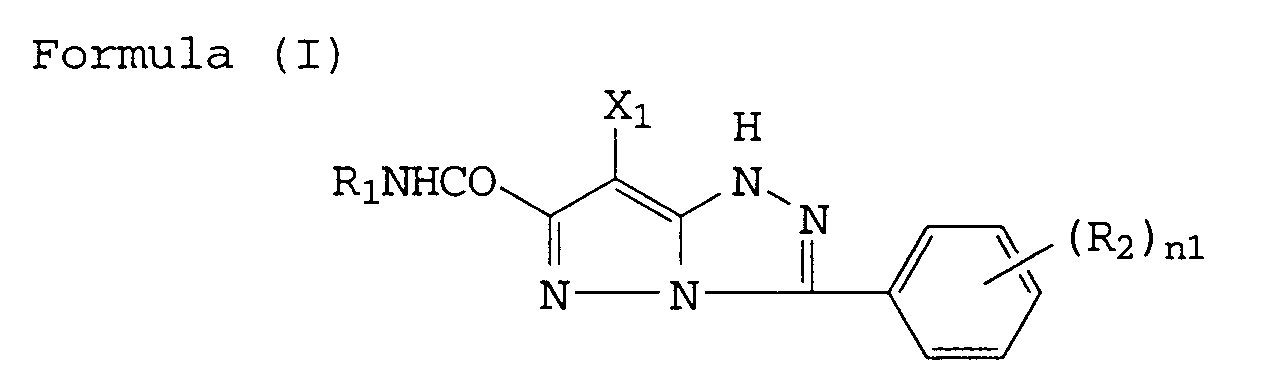
- R 1 and R 3 represents a substituted alkyl group or a cycloalkyl group
- R 2 and R 4 represents a hydrogen atom or a substituent
- X 1 and X 2 represent a hydrogen atom or a group capable of being leaving upon reaction with an oxidation product of a color developing agent
- n 1 and n 2 are each an integer of 1 to 5.
- R 1 and R 3 independently represent a substituted alkyl group or a cycloalkyl group.
- the alkyl group has preferably 1 to 32 carbon atoms, which may be branched or unbranched.
- examples of the unbranched alkyl group are cited methyl, ethyl, propyl, octyl and decyl.
- the branched alkyl group includes iso-propyl or tert-butyl.
- R 1 or R 3 is not limitative but representative examples thereof include an alkyl group (preferably, having 1 to 32 carbon atoms) aryl group, anilino group, acylamino group, sulfonamide group, alkylthio group, arylthio, alkenyl and cycloalkyl group.
- halogen atom cycloalkenyl group, alkynyl group, heterocyclic group, sulfonyl group, sulfinyl group, phosphonyl group, acyl group, carbamoyl group, sulfamoyl group, cyano group, alkoxy group, aryloxy group, heterocyclic-oxy group, siloxy group, acyloxy group, sulfonyloxy, carbamoyloxy group, amino group, alkylamino group, imido group, ureido group, sulfamoylamino group, alkoxycarbonylamino, aryloxycarbonylamino group, alkoxycarbonyl group, aryloxycarbonyl group, heterocyclic-thio group, thioureido group, carboxy group, hydroxy group, mercapto group, nitro group, sulfo group, spiro-compound residue and bridged
- R 1 or R 3 is also a cycloalkyl group such as cyclohexyl, which may have a substituent.
- the substituent is the same as in the case when R 1 or R 3 is a substituted alkyl group.
- a substituent represented by R 2 and R4 of formula (I) and (II) is not limitative but as representative examples thereof are cited an alkyl group, aryl group, anilino group, acylamino group, sulfonamide group, alkylthio group, arylthio, alkenyl and cycloalkyl group.
- halogen atom cycloalkenyl group, alkynyl group, heterocyclic group, sulfonyl group, sulfinyl group, phosphonyl group, acyl group, carbamoyl group, sulfamoyl group, cyano group, alkoxy group, aryloxy group, heterocyclic-oxy group, siloxy group, acyloxy group, sulfonyloxy, carbamoyloxy group, amino group, alkylamino group, imido group, ureido group, sulfamoylamino group, alkoxycarbonylamino, aryloxycarbonylamino group, alkoxycarbonyl group, aryloxycarbonyl group, heterocyclic-thio group, thioureido group, carboxy group, hydroxy group, mercapto group, nitro group, sulfo group, spiro-compound residue and bridged
- an alkyl group is preferably one having 1 to 32 carbon atoms, which may be branched or unbranched.
- An aryl group is preferably a phenyl group.
- acylamino group is cited an alkylcarbonylamino group or arylcarbonylamino group.
- a sulfonamide group is cited an alkylsulfonylamino group or arylsulfonylamino group.
- alkyl moiety and an aryl moiety in an alkylthio group and arylthio group are respectively the same as an alkyl group and aryl group represented by R 2 and R 4 described above.
- An alkenyl group has preferably 2 to 32 carbon atoms, and as a cycloalkyl group is preferably one having 3 to 12 carbon atoms, more preferably, 5 to 7 carbon atoms.
- An alkenyl group may be branched or unbranched.
- a cycloalkenyl group has preferably 3 to 12 carbon atoms, more preferably, 5 to 7 carbon atoms.
- a sulfonyl group such as a alkylsulfonyl group or arylsulfonyl group
- a sulfinyl group such as a alkylsulfinyl group or arylsulfinyl group
- a phosphonyl group such as an alkylphosphonyl group, alkoxyphosphonyl, aryloxyphosphonyl group or arylphosphonyl group
- an acyl group such as an alkylcarbonyl group or arylcarbonyl group; a carbamoyl group such as an alkylcarbamoyl group or arylcarbamoyl group
- a sulfamoyl group such as an alkylsulfamoyl group or arylsulfamoyl group
- an acyloxy group such as an alkylcarbonyloxy group or arylcarbonyloxy group
- the above groups may be substituted by a ballast group such as long-chained hydrocarbon group or polymer residue.
- n 1 and n 2 are each an integer of 1 to 5, provided that, when n 1 or n 2 is 2 or more, R 2 and R 4 may be the same with or different from each other.
- a group capble of leaving upon reaction with an oxidation product of a developing agent, as represented by X includes a halogen atom (a chlorine, bromine and fluorine atom), alkylene group, alkoxy group, aryloxy group, heterocyclic-oxy group, acyloxy group, sulfonyloxy group, alkoxycarbonyloxy group, aryloxycarbonyl group, alkyloxalyloxy group, alkoxyoxalyloxy group, alkylthio, arylthio group, heterocyclic-thio group, alkyloxythiocarbonylthio group, acylamino group, sulfonamide group, nitrogen-containing heterocyclic group having a bond at the nitrogen atom (i.e., it connects an other group through the nitrogen atom), alkyloxycarbonylamino group, aryloxycarbonylamino group, and carboxy group.
- a halogen atom a chlorine, bromine and fluorine atom
- Compound (1) was synthesized according to the following scheme.
- couplers of the invention can be synthesized in a manner similar to the above method.
- the inventive coupler is used in an amount of 1x10 -3 to 1 mol per mol of silver halide, preferably, 1x10 -2 to 8x10 -1 mol per mol of silver halide.
- the coupler may be used in combination with another kind of a cyan coupler.
- the coupler of the present invention can be employed as a dye-forming material for use in any type of color photography.
- coupler-in developer type dye formation and coupler-in-emulsion type dye formation.
- the coupler of the invention is dissolved in an aqueous alkaline solution or organic solvent such as an alcohol and added to a developer to be used.
- the coupler of the invention is incorporated in a photographic light sensitive element.
- the inventive coupler is incorporated in a silver halide emulsion and the emulsion is coated on a support to prepare a color photographic light sensitive material.
- the coupler of the present invention can be used for a color photographic light sensitive material such as negative-working or positive-working film, or color print paper.
- the color photographic light sensitive material including a color print paper in which the inventive coupler is used may be used for monocolor or multicolor.
- the inventive coupler may be incorporated in any layer thereof and conventionally, the coupler is contained in green-sensitive silver halide emulsion layer and/or red-sensitive silver halide emulsion layer.
- the multicolor photographic light sensitive material comprises dye image forming units which are respectively sensitive to the spectral ranges of three primary colors.
- Each of the image forming units comprises one or more silver halide emulsion layers sensitive to a spectral range. Constituting layers of the photographic material including the image forming units can be arranged in various orders as known in the photographic art.
- a representative multicolor photographic light sensitive material comprises a support having thereon a cyan dye image forming unit comprising a red-sensitive silver halide emulsion layer containing a cyan dye-forming coupler, a magenta dye image forming unit comprising a green-sensitive silver halide emulsion layer containing a magenta dye-forming coupler and a yellow dye image forming unit comprising a blue-sensitive silver halide emulsion layer containing a yellow dye-forming coupler, in which at least one of the cyan and/or magenta dye-forming couplers is a coupler of the present invention.
- the photographic light sensitive material may further have an additional layer such as a filter laye, interlayer, protective layer, sublayer or under-coat layer.
- the coupler of the present invention can be contained in a silver halide emulsion layer according to a method known in the art.
- the inventive coupler is, singly or in combination, dissolved in a high boiling organic solvent having a boiling point of 175°C or higher such as tricresyl phosphate or dibutyl phthalate, a low boiling solvent such as butyl acetate or butyl propionate, or a mixture thereof; the resulting solution is mixed with a aqueous gelatin solution containing a surfactant to be emulsified with a high speed mixer or colloid mill and the resulting dispersion is added into a silver halide emulsion to obtain an emulsion used for the present invention.
- Silver halide employed in the photographic light sensitive material containing the inventive coupler is preferably silver chloride, silver chlorobromide or silver iodochlorobromide.
- a mixture such as a blend of silver chloride and silver bromide may be employed.
- a silver halide emulsion is desired to have a high developability so that the silver halide emulsion grains contain preferably chloride; and silver chloride, or 1% or more chloride-containing silver chlorobromide or silver iodochlorobromide is preferable.
- the silver halide emulsion can be chemically sensitized in accordance with conventional methods.
- the emulsion can be also spectrally sensitized to a desired spectral region.
- a compound known as a fog restrainer or stabilizer can be added to the silver halide emulsion.
- a color photographic light sensitive material containing the inventive coupler there can be incorporated various additives such as anticolor-stain agent, dye image stabilizer, UV absorbent, antistatic agent, matting agent and surfactant.
- additives such as anticolor-stain agent, dye image stabilizer, UV absorbent, antistatic agent, matting agent and surfactant.
- the color photographic light sensitive material containing the inventive coupler is color-developed according to the manner known in the art to form a color image.
- the color photographic light sensitive material containing the inventive coupler may contain a color developing agent or a precursor thereof in a hydrophilic colloidal layer, which is processed in an alkaline activator bath.
- the color photographic light sensitive material containing the inventive coupler is, after color-developing, further subjected to bleaching and fixing. Bleaching and fixing may be conducted simultaneously.
- Stabilization may be conducted in place of washing or in combination thereof.
- Emulsion layer Emulsion layer
- a red-sensitive emulsion layer comprises gelatin of 1.3 g, a red-sensitive silver bromochloride emulsion (containing 99.5 mol% silver chloride) of 0.21 mol and a comparative cyan coupler a of 9.1x10 -4 mol dissolved in dioctyl phthalate of 0.45 g.
- a protective layer comprises gelatin of 0.50 g, in which a hardener, 2,4-dichloro-6-hydroxy-s-triazine sodium salt was added in an amount of 0.017 g per g of gelatin.
- inventive Samples 2 to 8 were prepared in the same manner as Sample 1, except that a comparative coupler a was replaced by an equimolar amount of a coupler as shown in Table 1.
- the processing condition is as follows. Processing step Temperature Time Color developing 35.0 ⁇ 0.3°C 45 sec. Bleach-fixing 35.0 ⁇ 0.5°C 45 sec. Stabilizing 30 to 34°C 90 sec. Drying 60 to 80°C 60 sec.
- Ferric ammonium ethylenediaminetetraacetate dihydride 60 g Ethylenediaminetetraacetic acid 3 g Ammonium thiosulfate (70% aq. solution) 100 ml Ammonium sulfite (40% aq. solution) 27.5 ml
- Samples 1 to 8 thus-processed were sensitometrically measured with respect to a maximum density (Dmax) using a densitometer (Type KD-7, product of Konica), and after processed samples were allowed to stand for 21 days under the condition of a high temperature and humidity (85°C, 60% R.H.), the samples were evaluated with respect to heat stability of the dye image. The heat stability was shown as percentage of residual density of the image having an initial density of 1.0 (residual dye ratio).
- Table 1 Sample No. Coupler Dmax Residual dye ratio (%) 1 Comp. a 2.30 81 2 Comp. b 1.79 94 3 Inv. (1) 2.49 99 4 Inv. (5) 2.52 100 5 Inv. (11) 2.58 99 6 Inv. (14) 2.44 98 7 Inv. (19) 2.40 99 8 Inv. (21) 2.51 98
- Example 9 Using a paper support laminated with polyethylene on one side thereof and on another side laminated with polyethylene containing titanium dioxide, the following layers were coated on the titanium dioxide-containing side to prepare a silver halide color photographic light sensitive material (Sample 9). Coating solutions were prepared in the following manner.
- Coating solutions for the 2nd layer through the 7th layer were prepared in a manner similar to the 1st layer coating solution.
- a hardener (H-1) was added to the 2nd and 4th layers, and hardener (H-2) was added to the 7th layer.
- As a coating aid were added surfactants (SU-2 and SU-3) to make adjustment of a surface tension.
- the amount to be added to the silver halide photographic material was expressed in g per m 2 . The amount of silver halide was converted to that of silver.
- Solution A Sodium chloride 3.42 g Potassium bromide 0.03 g Water to make 200 ml Solution B Silver nitrate 10 g Water to make 200 ml Solution C Sodium chloride 102.7 g Potassium bromide 1.0 g Water to 600 ml Solution D Silver nitrate 300 g Water to make 600 ml
- the emulsion was desalted using an aqueou 5% solution of Demol N (product of Kao/Atlas) and 2% magnesium sulfate solution and then was further mixed with an aqueous gelatin solution to obtain a monodispersed, silver bromochloride cubic grain emulsion (EMP-1) having an average grain size (F) of 0.85 ⁇ m, a variation coefficient of grain size ( ⁇ /F) of 0.07 and chloride content of 99.5 mol%.
- EMP-1 monodispersed, silver bromochloride cubic grain emulsion having an average grain size (F) of 0.85 ⁇ m, a variation coefficient of grain size ( ⁇ /F) of 0.07 and chloride content of 99.5 mol%.
- the emulsion (EMP-1) was chemically sensitized at 50°C for 90 min. using the following compounds to obtain a blue-sensitive silver halide emulsion (Em-B).
- Em-B blue-sensitive silver halide emulsion
- Sodium thiosulfate 0.8 mg/mol AgX Chloroauric acid 0.5 mg/mol AgX Stabilizer STAB-1 6x10 -4 mol/mol AgX Sensitizing dye BS-1 4x10 -4 mol/mol AgX Sensitizinf dye BS-2 1x10 -4 mol/mol AgX
- a monodispersed, cubic silver bromochloride grain emulsion (EMP-2) having an average grain size (F) of 0.43 ⁇ m, a variation coefficient of grain size ( ⁇ /F) of 0.08 and chloride content of 99.5 mol% was prepared in the same manner as emulsion (EMP-1), except that the addition time of solutions A and B, and the addition time of solutions C and D were respectively varied.
- the emulsion (EMP-2) was chemically sensitized at 55°C for 120 min. using the following compounds to obtain a green-sensitive silver halide emulsion (Em-G).
- Em-G green-sensitive silver halide emulsion
- Chloroauric acid 1.0 mg/mol AgX Stabilizer STAB-1 6x10 -4 mol/mol AgX Sensitizing dye GS-1 4x10 -4 mol/mol AgX
- a monodispersed, cubic silver bromochloride grain emulsion (EMP-3) having an average grain size (F) of 0.50 ⁇ m, a variation coefficient of grain size ( ⁇ /F) of 0.08 and chloride content of 99.5 mol% was prepared in the same manner as emulsion (EMP-1), except that the addition time of solutions A and B, and the addition time of solutions C and D were respectively varied.
- the emulsion (EMP-3) was chemically sensitized at 60°C for 900 min. using the following compounds to obtain a red-sensitive silver halide emulsion (Em-R).
- Em-R red-sensitive silver halide emulsion
- Sodium thiosulfate 1.8 mg/mol AgX
- Chloroauric acid 2.0 mg/mol AgX Stabilizer STAB-1 6x10 -4 mol/mol AgX Sensitizinf dye RS-1 1x10 -4 mol/mol AgX
- Samples 10 to 22 were prepared in the same manner as in Sample 9, except that cyan couplers C-1 and C-2 were replaced by a coupler as shown in Table 2, in an amount equivalent to that of C-1 and C-2 in total.
- a Macbeth Color Checker (product of Macbeth Corp.) was photographed using a color negative film (Konica Color LV-400, product of Konica) and a camera (Konica FT-1 MOTOR, product of Konica).
- the film photographed was subjected to processing fora color negative film (CNK-4, product of Konica) and, using a printer (Konica Color Printer CL-P 2000, product of Konica), the resulting negative image was printed on each of Samples 9 to 22 in size of 82mm x 117mm to obtain a print.
- the printer was adjusted so that neutral gray of the checker is reproduced in neutral gray of the print.
- Prints thus-obtained were each visually evaluated with respect to color reproduction and blackness (black tone).
- the color reproduction was evaluated based on five grades, 1 (poor) to 5 (excellent).
- Sample 9 which contains comparative couplers C-1 and C-2 was remarkably insuffiecient in color reproduction.
- Samples 10 and 11 which contains each comparative couplers c and d resulted in improvement in blue-color reproduction. However, each of them led to no improvement in cyan or green color reproduction and was insufficient in blackness due to a low maximum density thereof.
- Samples 12 to 22 which contain each the inventive couple achieved improvements in any of cyan, blue and green color reproductions, and high in dye forming property (Dmax) and excellent in blackness.
Landscapes
- Chemical & Material Sciences (AREA)
- Organic Chemistry (AREA)
- Physics & Mathematics (AREA)
- General Physics & Mathematics (AREA)
- Silver Salt Photography Or Processing Solution Therefor (AREA)
- Nitrogen Condensed Heterocyclic Rings (AREA)
Abstract
Description
- The present invention is related a silver halide color photographic light sensitive material containing a cyan coupler and particularly to a photographic cyan coupler improved in dye forming property and color reproduction.
- As cyan dye image forming couplers, there have been known phenols and naphthols.
- However, a cyan dye image obtained from the phenols or naphthols known in the art has a problem in color reproduction. Thus, it has an unsharp absorption form in a shorter wave length range, further having an unwanted absorption, i.e., asymmetric absorption in a green wavelength region. Accordingly, in a negative film, correction for the asymmetric absorption must be made by means of masking; in a color paper, however, there is no means for the correction so that it deterirates color reproduction.
- Furthermore, the dye image obtained from the phenols and naphthols known in the art has still problems in storage stability threof. Thus, a dye image obtained from a 2-acylaminophenol cyan coupler as disclosed in U.S. Patent Nos. 2,367,531 and 2,423,730 was found to be inferior in heat fastness. A dye image obtained from a 2,5-diacylaminophenol cyan coupler as disclosed in U.S. Patent Nos. 2,369,929 and 2,772,162 was inferior in light fastness and a dye image obtained from a l-hydroxy-2-naphthamide cyan coupler was generally insufficient in light and heat fastness.
- A 2,5-diacylaminophenol cyan coupler as disclosed in U.S. Patent No. 4,122,369 and JP-A 57-155538 (1982) (the term "JP-A" means an "unexamined published Japanese patent application) and 2,5-diacylaminophenol cyan coupler having a hydroxy group within a ballast group, as disclosed in U.S Patent No. 3,880,661 have not achieved sufficiently satisfactory level in the light and heat fastness and yellow stain occurred during the prolonged storage of the dye image.
- For the purpose of solving these problems, there was proposed pyrazoloazole type cyan coupler as disclosed in JP-A 64-554 (1989), 63-250649 (1988) and 63-250650 (1988).
- An electron-withdrawing group and a group capable of hydrogen-bonding were introduced into each of these couplers so as to satisfy an absorption wavelength of a dye formed, so that good color reproduction was attained. However, coupling activity did not reach a sufficiently satisfactory level, so that dye forming property and color reproduction could not be satisfied simultaneously.
- In view of these conditions, the inventors of the present invention have made studies broadly and succeeded to find out pyrazoloazole type cyan coupler having improved color reproduction and excellent dye forming property.
- Accordingly, an object of the present invention is to provide a cyan dye-forming coupler for use in a silver halide color photographic light sensitive material, which is superior in dye formation to form a vivid, cyan color image having a sufficiently high density and an absorption with a sharp edge and little secondary absorption in a blue and green region, socalled, being excellent in spectral absorption characteristics.
- Further, another object of the invention is to provide a photographic cyan dye-forming coupler capable of forming a cyan dye image which causes no hue change against heat and light.
- The above objects of the invention can be accomplished by a silver halide photographic light sensitive material containing a cyan coupler represented by the following formula (I) or (II).


- In the formula, R1 and R3 represents a substituted alkyl group or a cycloalkyl group; R2 and R4 represents a hydrogen atom or a substituent; X1 and X2 represent a hydrogen atom or a group capable of being leaving upon reaction with an oxidation product of a color developing agent; and n1 and n2 are each an integer of 1 to 5.
- First, with regard to a compound represented by formula (I) or (II), detailed explanation is provided. R1 and R3 independently represent a substituted alkyl group or a cycloalkyl group. The alkyl group has preferably 1 to 32 carbon atoms, which may be branched or unbranched. As examples of the unbranched alkyl group are cited methyl, ethyl, propyl, octyl and decyl. The branched alkyl group includes iso-propyl or tert-butyl. The substituent of R1 or R3 is not limitative but representative examples thereof include an alkyl group (preferably, having 1 to 32 carbon atoms) aryl group, anilino group, acylamino group, sulfonamide group, alkylthio group, arylthio, alkenyl and cycloalkyl group. Furthermore are cited a halogen atom, cycloalkenyl group, alkynyl group, heterocyclic group, sulfonyl group, sulfinyl group, phosphonyl group, acyl group, carbamoyl group, sulfamoyl group, cyano group, alkoxy group, aryloxy group, heterocyclic-oxy group, siloxy group, acyloxy group, sulfonyloxy, carbamoyloxy group, amino group, alkylamino group, imido group, ureido group, sulfamoylamino group, alkoxycarbonylamino, aryloxycarbonylamino group, alkoxycarbonyl group, aryloxycarbonyl group, heterocyclic-thio group, thioureido group, carboxy group, hydroxy group, mercapto group, nitro group, sulfo group, spiro-compound residue and bridged hydrocarbon compound residue.
- R1 or R3 is also a cycloalkyl group such as cyclohexyl, which may have a substituent. The substituent is the same as in the case when R1 or R3 is a substituted alkyl group.
- A substituent represented by R2 and R4 of formula (I) and (II) is not limitative but as representative examples thereof are cited an alkyl group, aryl group, anilino group, acylamino group, sulfonamide group, alkylthio group, arylthio, alkenyl and cycloalkyl group. Furthermore are cited a halogen atom, cycloalkenyl group, alkynyl group, heterocyclic group, sulfonyl group, sulfinyl group, phosphonyl group, acyl group, carbamoyl group, sulfamoyl group, cyano group, alkoxy group, aryloxy group, heterocyclic-oxy group, siloxy group, acyloxy group, sulfonyloxy, carbamoyloxy group, amino group, alkylamino group, imido group, ureido group, sulfamoylamino group, alkoxycarbonylamino, aryloxycarbonylamino group, alkoxycarbonyl group, aryloxycarbonyl group, heterocyclic-thio group, thioureido group, carboxy group, hydroxy group, mercapto group, nitro group, sulfo group, spiro-compound residue and bridged hydrocarbon compound residue.
- With regard to the group represented by R2 or R4, an alkyl group is preferably one having 1 to 32 carbon atoms, which may be branched or unbranched.
- An aryl group is preferably a phenyl group.
- As an acylamino group is cited an alkylcarbonylamino group or arylcarbonylamino group.
- As a sulfonamide group is cited an alkylsulfonylamino group or arylsulfonylamino group.
- An alkyl moiety and an aryl moiety in an alkylthio group and arylthio group are respectively the same as an alkyl group and aryl group represented by R2 and R4 described above.
- An alkenyl group has preferably 2 to 32 carbon atoms, and as a cycloalkyl group is preferably one having 3 to 12 carbon atoms, more preferably, 5 to 7 carbon atoms. An alkenyl group may be branched or unbranched.
- A cycloalkenyl group has preferably 3 to 12 carbon atoms, more preferably, 5 to 7 carbon atoms.
- There are cited a sulfonyl group such as a alkylsulfonyl group or arylsulfonyl group; a sulfinyl group such as a alkylsulfinyl group or arylsulfinyl group; a phosphonyl group such as an alkylphosphonyl group, alkoxyphosphonyl, aryloxyphosphonyl group or arylphosphonyl group; an acyl group such as an alkylcarbonyl group or arylcarbonyl group; a carbamoyl group such as an alkylcarbamoyl group or arylcarbamoyl group; a sulfamoyl group such as an alkylsulfamoyl group or arylsulfamoyl group; an acyloxy group such as an alkylcarbonyloxy group or arylcarbonyloxy group; a sulfonyloxy group such as an alkylsulfonyloxy or arylsulfonyloxy group; a carbamoyloxy group such as an alkylcarbamoyloxy group or arylcarbamoyloxy group; a ureido group such as an alkylureido group or arylureido group; a sulfamoylamino group such as an alkylsulfamoylamino group or arylsulfamoylamino group; a heterocyclic group, which is preferably 5, 6 or 7-membered cycle, such as a 3,4,5,6-tetrahydropyranyl-2-oxy group or 1-phenyltetrazole-5-oxy group; a heterocyclic-thio group, which is preferably 5 to 7-membered one, such as a 2-pyridylthio group, 2-benzothiazolylthio group, 2,4-diphenoxy-1,3,5-triazole-6-thio group; a siloxy group such as a trimethysiloxy group, triethylsiloxy group or dimethylbutylsiloxy group; an imido group such as a succinimido group, 3-heptadecylsuccinimido group, phthalimido group or glutarimido group; a spiro compound residue such as spiro[3,3]heptane-1-yl; and a bridged hydrocarbon compound residue such as bicyclo[2,2,1]heptane-1-yl, tricyclo[3,3,1,137]decane-1-yl or 7,7-dimethylbicyclo[2,2,1]heptane-1-yl.
- The above groups may be substituted by a ballast group such as long-chained hydrocarbon group or polymer residue.
- In formulas (I) and (II), n1 and n2 are each an integer of 1 to 5, provided that, when n1 or n2 is 2 or more, R2 and R4 may be the same with or different from each other.
- A group capble of leaving upon reaction with an oxidation product of a developing agent, as represented by X includes a halogen atom (a chlorine, bromine and fluorine atom), alkylene group, alkoxy group, aryloxy group, heterocyclic-oxy group, acyloxy group, sulfonyloxy group, alkoxycarbonyloxy group, aryloxycarbonyl group, alkyloxalyloxy group, alkoxyoxalyloxy group, alkylthio, arylthio group, heterocyclic-thio group, alkyloxythiocarbonylthio group, acylamino group, sulfonamide group, nitrogen-containing heterocyclic group having a bond at the nitrogen atom (i.e., it connects an other group through the nitrogen atom), alkyloxycarbonylamino group, aryloxycarbonylamino group, and carboxy group. Among these are preferable a hydrogen atom, halogen atom, alkoxy group, aryloxy group, heteroyclic-oxy group, alkylthio group, arylthio group, heterocyclic-thio group and nitogen-containing heterocyclic group
- Among compounds represented by formula (I) and (II), is preferable a compound represented by formula (I) from the point of color reproduction.
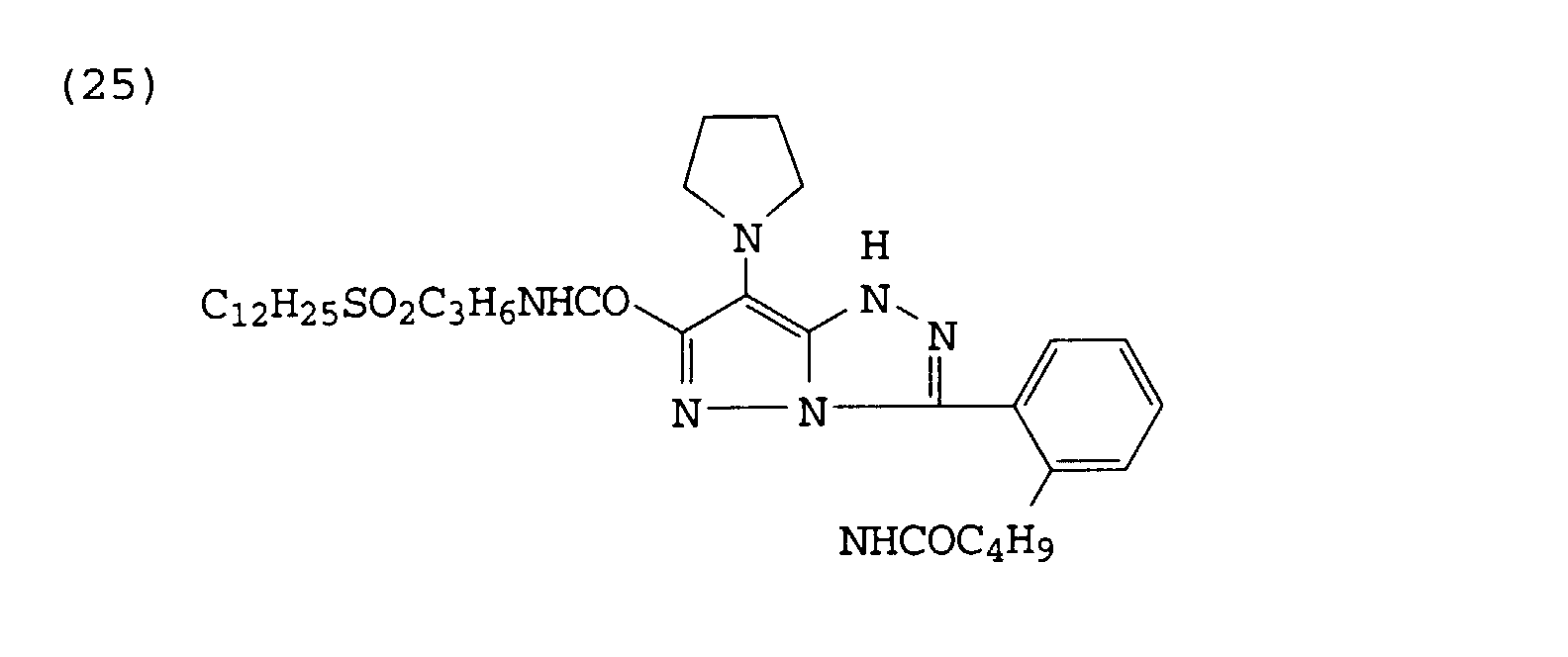
- Examples of compounds represented by formula (I) or (II) are shown as below but the present invention is not limited thereto.


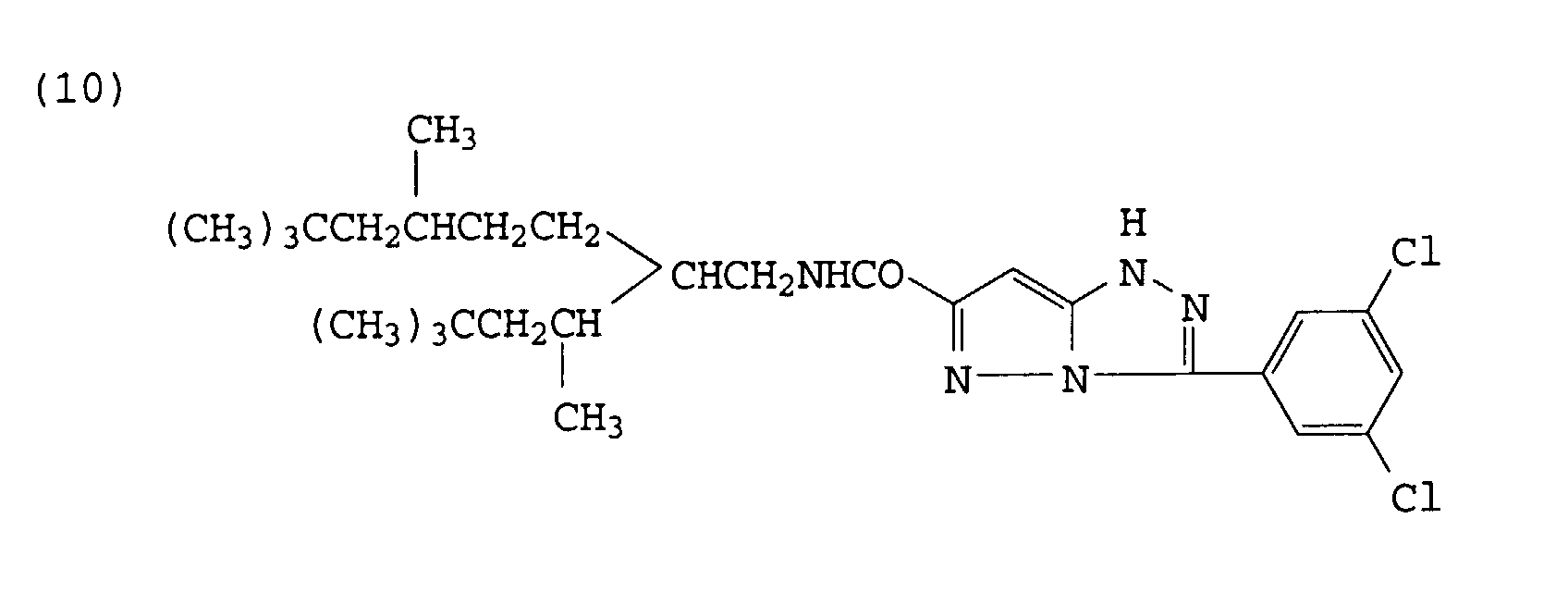

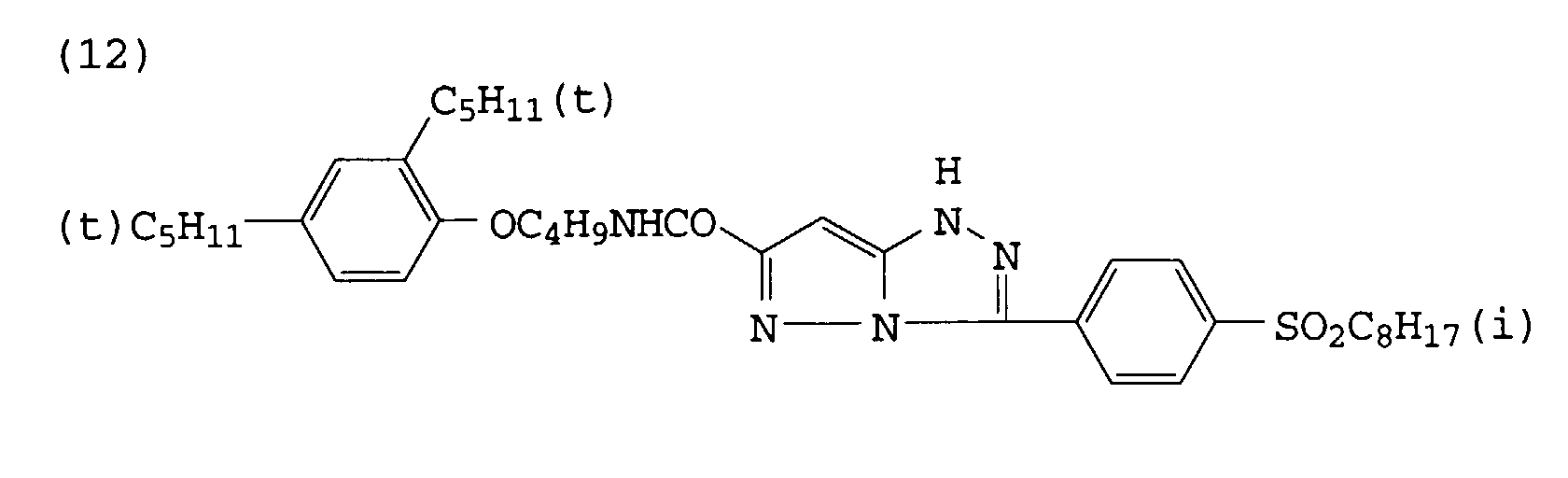


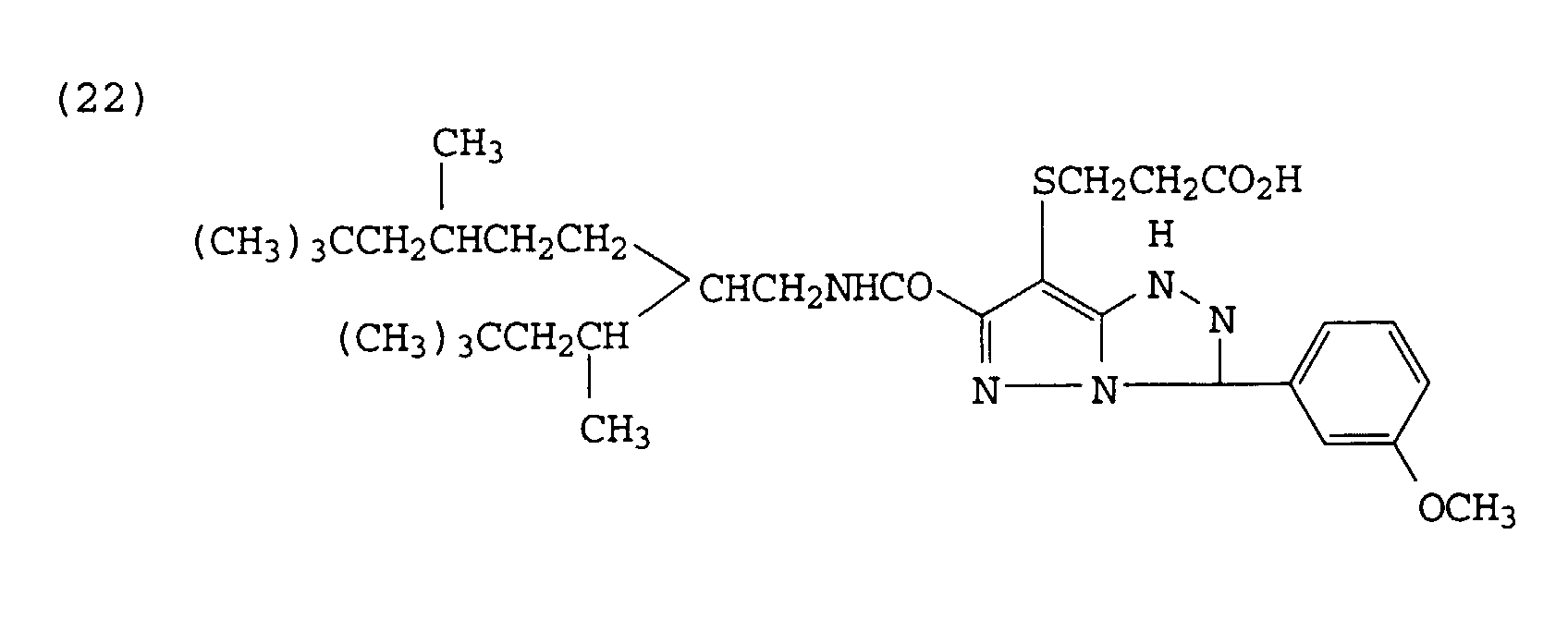




- Compound (1) was synthesized according to the following scheme.

- Compound (1a) of 69.8 g (0.267 mol) was dispersed in 500 ml of ethanol and thereto was dropwise added a compound (1b) of 54.6 g (0.280 mol) at room temperature. The mixture was heated under reflux for 9 hrs. After completing the reaction, the reaction mixture was allowed to stand to be cooled and precipitated crystals were filtered off to obtain an intermediate (1c) of 85.5 g in a 89.4% yield.
- Compound (1c) of 85.5 g (0.239 mol) was heated with anhydrous acetic acid of 250 ml under reflux for 3.5 hrs. After completing the reaction, anhydrous acetic acid was distilled away. Thereafter, acetic acid of 580 ml, concentrated hydrochloric acid of 127 ml and 32-36% hypophosphorous acid of 30 ml were added thereto and the mixture was reacted for 4 hrs. at 100°C. After completing the reaction, precipitated crystals were filtered off and washed with acetonitrile and then with hexane to obtain Intermediate (1d) of 60.8 g in a 85.6% yield.
- Intermediate (1d) of 3.0 g (10.1 mmol) was dispersed in pyridine of 40 ml and toluene of 20 ml, thereto was added phosphorous oxychloride of 0.5 g and the mixture was reacted further for 4 hrs at room temperature. After completing the reaction, ethyl acetate was added to the reaction mixture, which was then washed and concentrated. The resulting residue was refined by the use of column chromatography and recrystalized in a mixture of acetonitrile and ethyl acetate to obtain objective Compound (1) of 1.95 g in a 33% yield. The melting point of the product obtained was 138 to 140°C and the structure thereof was confirmed by 1H-NMR, IR and Mass spectrum.
- Other couplers of the invention can be synthesized in a manner similar to the above method. The inventive coupler is used in an amount of 1x10⁻³ to 1 mol per mol of silver halide, preferably, 1x10⁻² to 8x10⁻¹ mol per mol of silver halide. The coupler may be used in combination with another kind of a cyan coupler.
- To the inventive coupler, there can be applied a method or technique used in a conventional dye forming coupler.
- The coupler of the present invention can be employed as a dye-forming material for use in any type of color photography. As embodiments thereof are cited coupler-in developer type dye formation and coupler-in-emulsion type dye formation. In the case when used in the coupler-in-developer type dye formation, the coupler of the invention is dissolved in an aqueous alkaline solution or organic solvent such as an alcohol and added to a developer to be used.
- In the case when used in the coupler-in-emulsion type dye formation, the coupler of the invention is incorporated in a photographic light sensitive element.
- In a preferred embodiment thereof, the inventive coupler is incorporated in a silver halide emulsion and the emulsion is coated on a support to prepare a color photographic light sensitive material.
- The coupler of the present invention can be used for a color photographic light sensitive material such as negative-working or positive-working film, or color print paper.
- The color photographic light sensitive material including a color print paper in which the inventive coupler is used may be used for monocolor or multicolor. In a multicolor photographic material, the inventive coupler may be incorporated in any layer thereof and conventionally, the coupler is contained in green-sensitive silver halide emulsion layer and/or red-sensitive silver halide emulsion layer. The multicolor photographic light sensitive material comprises dye image forming units which are respectively sensitive to the spectral ranges of three primary colors. Each of the image forming units comprises one or more silver halide emulsion layers sensitive to a spectral range. Constituting layers of the photographic material including the image forming units can be arranged in various orders as known in the photographic art.
- A representative multicolor photographic light sensitive material comprises a support having thereon a cyan dye image forming unit comprising a red-sensitive silver halide emulsion layer containing a cyan dye-forming coupler, a magenta dye image forming unit comprising a green-sensitive silver halide emulsion layer containing a magenta dye-forming coupler and a yellow dye image forming unit comprising a blue-sensitive silver halide emulsion layer containing a yellow dye-forming coupler, in which at least one of the cyan and/or magenta dye-forming couplers is a coupler of the present invention.
- The photographic light sensitive material may further have an additional layer such as a filter laye, interlayer, protective layer, sublayer or under-coat layer.
- The coupler of the present invention can be contained in a silver halide emulsion layer according to a method known in the art. Exemplarily, the inventive coupler is, singly or in combination, dissolved in a high boiling organic solvent having a boiling point of 175°C or higher such as tricresyl phosphate or dibutyl phthalate, a low boiling solvent such as butyl acetate or butyl propionate, or a mixture thereof; the resulting solution is mixed with a aqueous gelatin solution containing a surfactant to be emulsified with a high speed mixer or colloid mill and the resulting dispersion is added into a silver halide emulsion to obtain an emulsion used for the present invention.
- Silver halide employed in the photographic light sensitive material containing the inventive coupler is preferably silver chloride, silver chlorobromide or silver iodochlorobromide. A mixture such as a blend of silver chloride and silver bromide may be employed. In the case when used for a color print paper, a silver halide emulsion is desired to have a high developability so that the silver halide emulsion grains contain preferably chloride; and silver chloride, or 1% or more chloride-containing silver chlorobromide or silver iodochlorobromide is preferable.
- The silver halide emulsion can be chemically sensitized in accordance with conventional methods. The emulsion can be also spectrally sensitized to a desired spectral region.
- In order to prevent fogging occurred during the course of manufacture, storage or photographic processing thereof or to stabilize the photographic performance thereof, a compound known as a fog restrainer or stabilizer can be added to the silver halide emulsion.
- Into a color photographic light sensitive material containing the inventive coupler, there can be incorporated various additives such as anticolor-stain agent, dye image stabilizer, UV absorbent, antistatic agent, matting agent and surfactant.
- These compounds are referred to, for example, Research Disclosure Vol. 176, pages 22-31 (Dec. 1978).
- The color photographic light sensitive material containing the inventive coupler is color-developed according to the manner known in the art to form a color image.
- The color photographic light sensitive material containing the inventive coupler may contain a color developing agent or a precursor thereof in a hydrophilic colloidal layer, which is processed in an alkaline activator bath.
- The color photographic light sensitive material containing the inventive coupler is, after color-developing, further subjected to bleaching and fixing. Bleaching and fixing may be conducted simultaneously.
- It is conventional that, after fixing, the photographic material is subjected to washing. Stabilization may be conducted in place of washing or in combination thereof.
- The present invention will be exemplarily explained as below but the invention is not limited thereto.
- On a paper support laminated on both sides with polyethylene, the following layers were coated in this order from the support to prepare a red-sensitive color photographic light sensitive material Sample 1. Unless otherwise noted, the addition amount of a compound is expressed in per m2 of the photographic material. The amount of silver halide was converted to that of silver.
- A red-sensitive emulsion layer comprises gelatin of 1.3 g, a red-sensitive silver bromochloride emulsion (containing 99.5 mol% silver chloride) of 0.21 mol and a comparative cyan coupler a of 9.1x10⁻⁴ mol dissolved in dioctyl phthalate of 0.45 g.
- A protective layer comprises gelatin of 0.50 g, in which a hardener, 2,4-dichloro-6-hydroxy-s-triazine sodium salt was added in an amount of 0.017 g per g of gelatin.
- Further, inventive Samples 2 to 8 were prepared in the same manner as Sample 1, except that a comparative coupler a was replaced by an equimolar amount of a coupler as shown in Table 1.
- Thus prepared Samples 1 to 8 were exposed through an optical wedge according in a conventional manner and processed according to the following steps.
- The processing condition is as follows.
Processing step Temperature Time Color developing 35.0 ± 0.3°C 45 sec. Bleach-fixing 35.0 ± 0.5°C 45 sec. Stabilizing 30 to 34°C 90 sec. Drying 60 to 80°C 60 sec. -


- Water was added to make 1 liter in total and the pH was adjusted to 10.10.
-
Ferric ammonium ethylenediaminetetraacetate dihydride 60 g Ethylenediaminetetraacetic acid 3 g Ammonium thiosulfate (70% aq. solution) 100 ml Ammonium sulfite (40% aq. solution) 27.5 ml - Water was added to make 1 liter in total and the pH was adjusted to 5.7.
-
5-Chloro-2-methyl-4-isothiazoline-3-one 0.2 g 1,2-Benzisothiazoline-3-one 0.3 g Ethylene glycol 1.0 g 1-Hydroxyethylidene-1,1-diphosphonic acid 2.0 g o-Phenylphenol sodium salt 1.0 g Ethylenediaminetetraacetic acid 1.0 g Ammonium hydroxide (20% aq. solution) 3.0 g Brightener (4,4'-diaminostilbene sulfonic acid derivative) 1.5 g - Water was added to make 1 liter in total and the pH was adjusted to 7.0 with sulfiric acid or potassium hydroxide.
- Samples 1 to 8 thus-processed were sensitometrically measured with respect to a maximum density (Dmax) using a densitometer (Type KD-7, product of Konica), and after processed samples were allowed to stand for 21 days under the condition of a high temperature and humidity (85°C, 60% R.H.), the samples were evaluated with respect to heat stability of the dye image. The heat stability was shown as percentage of residual density of the image having an initial density of 1.0 (residual dye ratio).


Table 1 Sample No. Coupler Dmax Residual dye ratio (%) 1 Comp. a 2.30 81 2 Comp. b 1.79 94 3 Inv. (1) 2.49 99 4 Inv. (5) 2.52 100 5 Inv. (11) 2.58 99 6 Inv. (14) 2.44 98 7 Inv. (19) 2.40 99 8 Inv. (21) 2.51 98 - As can be seen from Table 1, samples containing an inventive coupler were proved to be high in Dmax and the residual dye ratio, and excellent in dye formation and tropical heat stability.
- Using a paper support laminated with polyethylene on one side thereof and on another side laminated with polyethylene containing titanium dioxide, the following layers were coated on the titanium dioxide-containing side to prepare a silver halide color photographic light sensitive material (Sample 9). Coating solutions were prepared in the following manner.
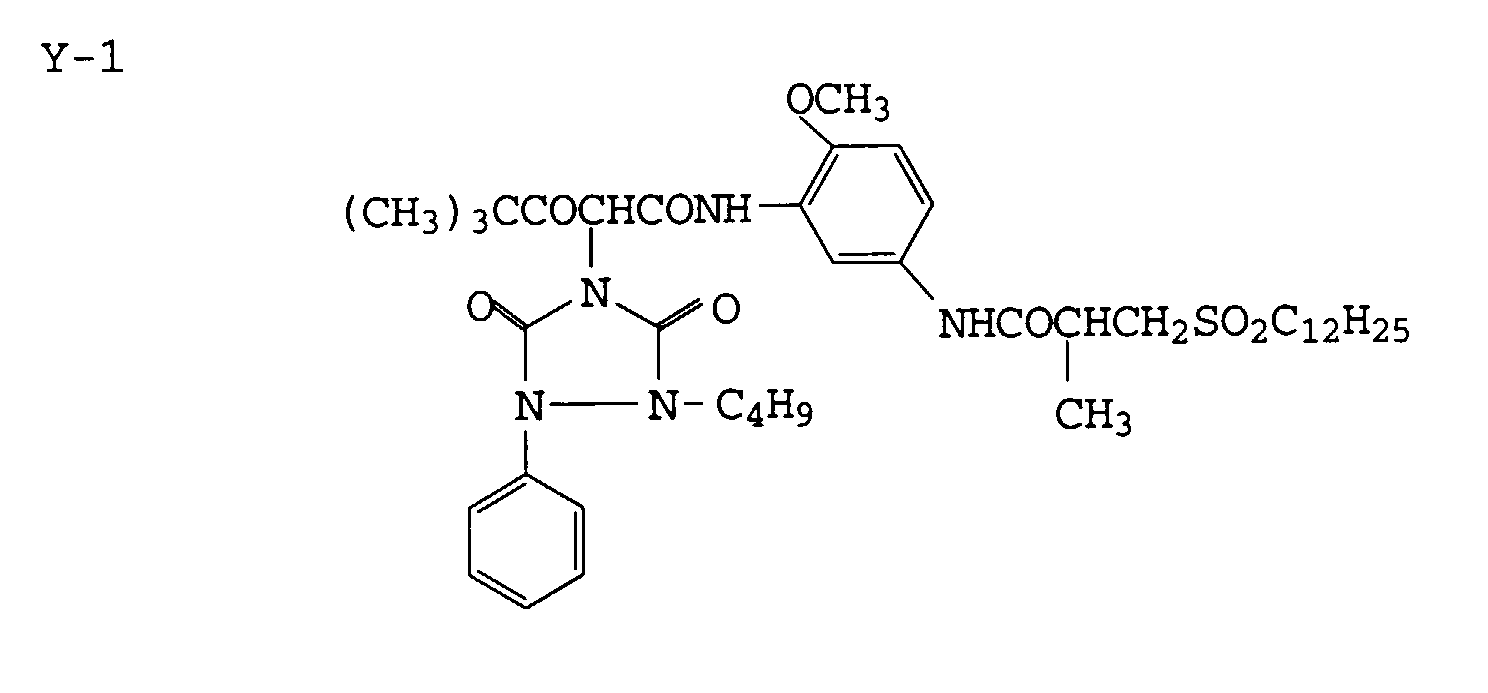
- To a yellow coupler (Y-1) of 26.7 g, dye image stabilizer (ST-1) of 10.0 g, dye image stabilizer (ST-2) of 6.67 g, additive (HQ-1) of 0.67 g, anti-irradiation dye (AI-3) and high boiling solvent (DNP) of 6.67 g, there was added ethyl acetate of 60 ml, and the resulting solution was dispersed in 220 ml of an aqueous 20% gelatin solution containing surfactant (SU-1) of 7 ml to prepare a yellow coupler dispersion. This dispersion was mixed with a blue-sensitive silver halide emulsion prepared according to the condition described below to prepare a coating solution for the 1st layer.
- Coating solutions for the 2nd layer through the 7th layer were prepared in a manner similar to the 1st layer coating solution.
- In addition, a hardener (H-1) was added to the 2nd and 4th layers, and hardener (H-2) was added to the 7th layer. As a coating aid were added surfactants (SU-2 and SU-3) to make adjustment of a surface tension. Unless otherwise noted, the amount to be added to the silver halide photographic material was expressed in g per m2. The amount of silver halide was converted to that of silver.
7th Layer (protective layer)Gelatin 1.00 (g/m2) DIDP 0.005 Additive (HQ-2) 0.002 Additive (HQ-3) 0.002 Additive (HQ-4) 0.004 Additive (HQ-5) 0.02 Compound (F-1) 0.002
6th Layer (UV absorbing layer)gelatin 0.40 UV absorbent (UV-1) 0.10 UV absorbent (UV-2) 0.04 UV absorbent (UV-3) 0.16 Additive (HQ-5) 0.04 DNP 0.20 PVP 0.03 Anti-irradiation dye AI-2) 0.02 Anti-irradiation dye (AI-4) 0.01
5th Layer (red-sensitive layer)Gelatin 1.30 Red-sensitive silver bromochloride (Em-R) 0.21 Cyan coupler (C-1) 0.17 Cyan coupler (C-2) 0.25 Dye image stabilizer (ST-1) 0.20 Additive (HQ-1) 0.01 HBS-1 0.20 DOP 0.20
4th Layer (UV absorbing layer)Gelatin 0.94 UV absorbent (UV-1) 0.28 UV absorbent (UV-2) 0.09 UV absorbent (UV-3) 0.38 Additive (HQ-5) 0.10 DNP 0.40
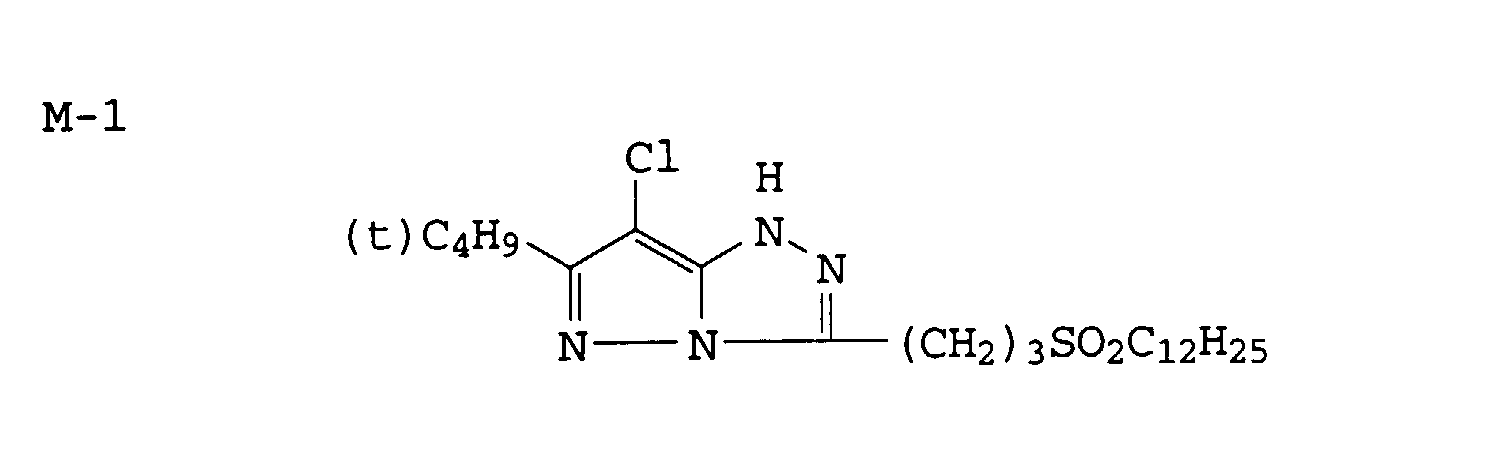
3rd Layer (green-sensitive layer)Gelatin 1.40 Green-sensitive silver bromochloride (Em-G) 0.17 Magenta coupler (M-1) 0.23 Dye image stabilizer (ST-3) 0.20 Due image stabilizer (ST-4) 0.17 DIDP 0.13 DBP 0.13 Anti-irradiation dye (AI-1) 0.01
2nd Layer (interlayer)Gelatin 1.20 Additive (HQ-2) 0.03 Additive (HQ-3) 0.03 Additive (HQ-4) 0.05 Additive (HQ-5) 0.23 DIDP 0.06 Compound (F-1) 0.002
1st Layer (blue-sensitive layer)Gelatin 1.20 Blue-sensitive silver bromochloride (Em-B) 0.26 Yellow coupler (Y-1) 0.80 Dye image stabilizer (ST-1) 0.30 Dye image stabilizer (ST-2) 0.20 Additive (HQ-1) 0.02 Anti-iradiation dye (AI-3) 0.01 DNP 0.20 - Polyethylene-laminated paper


- DBP:
- Dibuthyl phthalate
- DOP:
- Dioctylphthalate
- DNP:
- Dinonyl phthalate
- DIDP:
- Diisodecylphthalate
- PVP:
- Polyvinylpyrroridone
- To 1000 ml of a 2% gelatin aqueous solution maintained at 40°C were simultaneously added solutions A and B for a period of 30 min., while being controlled at a pAg of 6.5 and pH of 3.0, and then solutions C and D were simultaneously added for a period of 180 min., while being controlled at a pAg of 7.3 and pH of 5.5. The pH was controlled with an aqueous solution of sulfuric acid or sodium hydroxide. The pAg was controlled with a mixed halide solution comprising chloride and bromide in a molar ratio of 99.8:0.2, of which concentration was 0.1 mol/liter when solutions A and B were mixed and 1 mol/liter, when solutions C and D were mixed.
Solution ASodium chloride 3.42 g Potassium bromide 0.03 g Water to make 200 ml
Solution BSilver nitrate 10 g Water to make 200 ml
Solution CSodium chloride 102.7 g Potassium bromide 1.0 g Water to 600 ml
Solution DSilver nitrate 300 g Water to make 600 ml - After completing addition, the emulsion was desalted using an aqueou 5% solution of Demol N (product of Kao/Atlas) and 2% magnesium sulfate solution and then was further mixed with an aqueous gelatin solution to obtain a monodispersed, silver bromochloride cubic grain emulsion (EMP-1) having an average grain size (F) of 0.85 µm, a variation coefficient of grain size (σ/F) of 0.07 and chloride content of 99.5 mol%.
- The emulsion (EMP-1) was chemically sensitized at 50°C for 90 min. using the following compounds to obtain a blue-sensitive silver halide emulsion (Em-B).
Sodium thiosulfate 0.8 mg/mol AgX Chloroauric acid 0.5 mg/mol AgX Stabilizer STAB-1 6x10⁻⁴ mol/mol AgX Sensitizing dye BS-1 4x10⁻⁴ mol/mol AgX Sensitizinf dye BS-2 1x10⁻⁴ mol/mol AgX - A monodispersed, cubic silver bromochloride grain emulsion (EMP-2) having an average grain size (F) of 0.43 µm, a variation coefficient of grain size (σ/F) of 0.08 and chloride content of 99.5 mol% was prepared in the same manner as emulsion (EMP-1), except that the addition time of solutions A and B, and the addition time of solutions C and D were respectively varied.
- The emulsion (EMP-2) was chemically sensitized at 55°C for 120 min. using the following compounds to obtain a green-sensitive silver halide emulsion (Em-G).
Sodium thiosulfate 1.5 mg/mol AgX Chloroauric acid 1.0 mg/mol AgX Stabilizer STAB-1 6x10⁻⁴ mol/mol AgX Sensitizing dye GS-1 4x10⁻⁴ mol/mol AgX - A monodispersed, cubic silver bromochloride grain emulsion (EMP-3) having an average grain size (F) of 0.50 µm, a variation coefficient of grain size (σ/F) of 0.08 and chloride content of 99.5 mol% was prepared in the same manner as emulsion (EMP-1), except that the addition time of solutions A and B, and the addition time of solutions C and D were respectively varied.
- The emulsion (EMP-3) was chemically sensitized at 60°C for 900 min. using the following compounds to obtain a red-sensitive silver halide emulsion (Em-R).
Sodium thiosulfate 1.8 mg/mol AgX Chloroauric acid 2.0 mg/mol AgX Stabilizer STAB-1 6x10⁻⁴ mol/mol AgX Sensitizinf dye RS-1 1x10⁻⁴ mol/mol AgX - The variation coefficient was determined from a standard deviation (σ) and average grain size (r), based on the following relation,


- Samples 10 to 22 were prepared in the same manner as in Sample 9, except that cyan couplers C-1 and C-2 were replaced by a coupler as shown in Table 2, in an amount equivalent to that of C-1 and C-2 in total.
- Thus prepared samples were exposed and processed in a manner similar to Example 1, and sensitometrically measured with respect to the maximum density (Dmax) of the red-sensitive layer.
- Further, with respect to color reproduction, samples were evaluated in the following maner.
- First, a Macbeth Color Checker (product of Macbeth Corp.) was photographed using a color negative film (Konica Color LV-400, product of Konica) and a camera (Konica FT-1 MOTOR, product of Konica). The film photographed was subjected to processing fora color negative film (CNK-4, product of Konica) and, using a printer (Konica Color Printer CL-P 2000, product of Konica), the resulting negative image was printed on each of Samples 9 to 22 in size of 82mm x 117mm to obtain a print. When being printed, the printer was adjusted so that neutral gray of the checker is reproduced in neutral gray of the print.
- Prints thus-obtained were each visually evaluated with respect to color reproduction and blackness (black tone). The color reproduction was evaluated based on five grades, 1 (poor) to 5 (excellent).
- Results thereof are shown in Table 2.
Table 2 Sample No. Cyan coupler Dmax Color reproduction Blackness Remarks Cyan Blue Green 9 C-1/C-2 2.49 3 3 3 Ex. * Comp. 10 c 2.10 3 5 3 Is. Comp. 11 d 2.27 3 5 3 Is. Comp. 12 (1) 2.54 5 5 5 S. Inv. 13 (4) 2.58 4 5 5 S. Inv. 14 (9) 2.53 5 5 5 S. Inv. 15 (13) 2.49 5 5 5 S. Inv. 16 (18) 2.49 5 5 5 S. Inv. 17 (24) 2.59 5 5 5 S. Inv. 18 (28) 2.48 5 5 5 S. Inv. 19 (29) 2.54 5 5 5 S. Inv. 20 (30) 2.41 3 5 5 S. Inv. 21 (32) 2.42 3 5 5 S. Inv. 22 (33) 2.40 3 5 5 S. Inv. * Ex.:Excellent, S.:Sufficient, Is.:Insufficient 

- As can be seen from Table 2, Sample 9, which contains comparative couplers C-1 and C-2 was remarkably insuffiecient in color reproduction. Samples 10 and 11, which contains each comparative couplers c and d resulted in improvement in blue-color reproduction. However, each of them led to no improvement in cyan or green color reproduction and was insufficient in blackness due to a low maximum density thereof.
- Cotrarily to that, Samples 12 to 22 which contain each the inventive couple achieved improvements in any of cyan, blue and green color reproductions, and high in dye forming property (Dmax) and excellent in blackness.


H-1 C(CH2SO2CH=CH2)4


Claims (5)
- A silver halide photographic light sensitive material comprising a support having thereon a silver halide emulsion layer containing a cyan dye-forming coupler represented by the following formula (I) or (II),


- The photographic material of claim 1, wherein said cyan coupler is contained in an amount of 1x10⁻³ to 1 mol per mol of silver halide.
- The photographic material of claim 1, wherein said silver halide emulsion layer further contains silver halide grains comprising silver chloride, silver chlorobromide or silver iodochlorobromide.
- A multicolor silver halide photographic light sensitive material comprising a support having thereon a cyan dye image-forming unit comprised of at least one red-sensitive silver halide emulsion layer containing a cyan dye-forming coupler represented by the formula (I) or (II) as claimed in claim 1, a magenta dye image-forming unit comprised of at least one green-sensitive silver halide emulsion layer containig a magenta dye-forming coupler and a yellow dye image-forming unit comprised of at least one blue-sensitive ailver halide emulsion layer containg a yellow dye-forming coupler.
- A compound represented by the following formula (I) or (II),


Applications Claiming Priority (3)
| Application Number | Priority Date | Filing Date | Title |
|---|---|---|---|
| JP33336694 | 1994-12-15 | ||
| JP333366/94 | 1994-12-15 | ||
| JP33336694A JP3236461B2 (en) | 1994-12-15 | 1994-12-15 | Photo cyan coupler |
Publications (2)
| Publication Number | Publication Date |
|---|---|
| EP0717315A1 true EP0717315A1 (en) | 1996-06-19 |
| EP0717315B1 EP0717315B1 (en) | 2002-02-27 |
Family
ID=18265310
Family Applications (1)
| Application Number | Title | Priority Date | Filing Date |
|---|---|---|---|
| EP95309134A Expired - Lifetime EP0717315B1 (en) | 1994-12-15 | 1995-12-14 | Photographic material containing cyan coupler |
Country Status (4)
| Country | Link |
|---|---|
| US (1) | US5658720A (en) |
| EP (1) | EP0717315B1 (en) |
| JP (1) | JP3236461B2 (en) |
| DE (1) | DE69525598T2 (en) |
Cited By (2)
| Publication number | Priority date | Publication date | Assignee | Title |
|---|---|---|---|---|
| EP0802454A1 (en) * | 1996-04-19 | 1997-10-22 | Konica Corporation | Silver halide color photographic light-sensitive material |
| US6242169B1 (en) | 1998-09-19 | 2001-06-05 | Agfa-Gevaert | Color photographic material |
Families Citing this family (4)
| Publication number | Priority date | Publication date | Assignee | Title |
|---|---|---|---|---|
| JPH10198010A (en) * | 1997-01-14 | 1998-07-31 | Konica Corp | Silver halide color photographic sensitive material |
| JP2003089698A (en) * | 2001-09-18 | 2003-03-28 | Konica Corp | Method for producing pyrazolotriazole derivative |
| EP1914594A3 (en) | 2004-01-30 | 2008-07-02 | FUJIFILM Corporation | Silver halide color photographic light-sensitive material and color image-forming method |
| US20220168277A1 (en) * | 2019-03-25 | 2022-06-02 | Howard University | Drug inhibitor against migration and invasion of cancer cells and methods of treating against metastasis of cancer cells |
Citations (4)
| Publication number | Priority date | Publication date | Assignee | Title |
|---|---|---|---|---|
| JPS63250649A (en) * | 1987-04-07 | 1988-10-18 | Konica Corp | Silver halide color photographic sensitive material containing novel cyan coupler |
| EP0287265A1 (en) * | 1987-04-07 | 1988-10-19 | Konica Corporation | Silver halide color photographic light-sensitive material |
| JPH01106057A (en) * | 1987-10-20 | 1989-04-24 | Konica Corp | Silver halide color photographic sensitive material |
| JPH01167840A (en) * | 1987-12-24 | 1989-07-03 | Konica Corp | Novel photographic cyan coupler |
Family Cites Families (3)
| Publication number | Priority date | Publication date | Assignee | Title |
|---|---|---|---|---|
| JPH01118132A (en) * | 1987-10-31 | 1989-05-10 | Konica Corp | Silver halide color photographic sensitive material |
| JPH01172956A (en) * | 1987-12-28 | 1989-07-07 | Konica Corp | Silver halide photographic sensitive material having excellent color reproducibility |
| JP2665628B2 (en) * | 1990-11-22 | 1997-10-22 | 富士写真フイルム株式会社 | Silver halide color photographic materials |
-
1994
- 1994-12-15 JP JP33336694A patent/JP3236461B2/en not_active Expired - Fee Related
-
1995
- 1995-12-11 US US08/570,324 patent/US5658720A/en not_active Expired - Lifetime
- 1995-12-14 EP EP95309134A patent/EP0717315B1/en not_active Expired - Lifetime
- 1995-12-14 DE DE69525598T patent/DE69525598T2/en not_active Expired - Lifetime
Patent Citations (4)
| Publication number | Priority date | Publication date | Assignee | Title |
|---|---|---|---|---|
| JPS63250649A (en) * | 1987-04-07 | 1988-10-18 | Konica Corp | Silver halide color photographic sensitive material containing novel cyan coupler |
| EP0287265A1 (en) * | 1987-04-07 | 1988-10-19 | Konica Corporation | Silver halide color photographic light-sensitive material |
| JPH01106057A (en) * | 1987-10-20 | 1989-04-24 | Konica Corp | Silver halide color photographic sensitive material |
| JPH01167840A (en) * | 1987-12-24 | 1989-07-03 | Konica Corp | Novel photographic cyan coupler |
Cited By (3)
| Publication number | Priority date | Publication date | Assignee | Title |
|---|---|---|---|---|
| EP0802454A1 (en) * | 1996-04-19 | 1997-10-22 | Konica Corporation | Silver halide color photographic light-sensitive material |
| US5879871A (en) * | 1996-04-19 | 1999-03-09 | Konica Corporation | Silver halide color photographic light sensitive material |
| US6242169B1 (en) | 1998-09-19 | 2001-06-05 | Agfa-Gevaert | Color photographic material |
Also Published As
| Publication number | Publication date |
|---|---|
| JP3236461B2 (en) | 2001-12-10 |
| US5658720A (en) | 1997-08-19 |
| DE69525598D1 (en) | 2002-04-04 |
| EP0717315B1 (en) | 2002-02-27 |
| DE69525598T2 (en) | 2002-09-05 |
| JPH08171185A (en) | 1996-07-02 |
Similar Documents
| Publication | Publication Date | Title |
|---|---|---|
| JPH06236011A (en) | Novel photographic cyan coupler | |
| EP0717315B1 (en) | Photographic material containing cyan coupler | |
| EP0398664A2 (en) | A silver halide photographic light-sensitive material containing a novel photographic coupler | |
| JPH07244361A (en) | Novel photographic coupler and silver halide photographic sensitive material | |
| JPH0792632A (en) | Novel photographic cyan coupler | |
| US5011765A (en) | Dye forming coupler for photographic use | |
| US5565313A (en) | Silver halide color photographic light-sensitive material | |
| EP0583472B1 (en) | Silver halide color photographic photosensitive material | |
| EP0744655B1 (en) | Silver halide color photographic light-sensitive material | |
| EP0620489B1 (en) | Method of forming photographic cyan dye image | |
| EP0802454B1 (en) | Silver halide color photographic light-sensitive material | |
| EP1271240B1 (en) | Silver halide color photographic material | |
| US6007975A (en) | Silver halide color photographic light-sensitive material | |
| EP0656561B1 (en) | Silver halide color photographic light-sensitive material | |
| US5336593A (en) | Silver halide color photographic materials | |
| US5306610A (en) | Photographic coupler | |
| JP3551396B2 (en) | New cyan coupler for silver halide color photographic light-sensitive materials | |
| EP0827021B1 (en) | Silver halide color photographic light-sensitive material | |
| US5368998A (en) | Silver halide color photographic light sensitive material | |
| JPH07261345A (en) | Novel photographic coupler | |
| JP2001249435A (en) | Silver halide color photographic sensitive material | |
| JPH07244362A (en) | Novel photographic coupler | |
| JP2000347367A (en) | Silver halide color photo-graphic sensitive material | |
| JPH05323530A (en) | Halogenized silver chromatic photosensitive material | |
| JP2001215667A (en) | Silver halide color photographic sensitive material |
Legal Events
| Date | Code | Title | Description |
|---|---|---|---|
| PUAI | Public reference made under article 153(3) epc to a published international application that has entered the european phase |
Free format text: ORIGINAL CODE: 0009012 |
|
| 17P | Request for examination filed |
Effective date: 19960226 |
|
| AK | Designated contracting states |
Kind code of ref document: A1 Designated state(s): DE FR GB |
|
| 17Q | First examination report despatched |
Effective date: 19991201 |
|
| GRAG | Despatch of communication of intention to grant |
Free format text: ORIGINAL CODE: EPIDOS AGRA |
|
| GRAG | Despatch of communication of intention to grant |
Free format text: ORIGINAL CODE: EPIDOS AGRA |
|
| GRAH | Despatch of communication of intention to grant a patent |
Free format text: ORIGINAL CODE: EPIDOS IGRA |
|
| GRAH | Despatch of communication of intention to grant a patent |
Free format text: ORIGINAL CODE: EPIDOS IGRA |
|
| REG | Reference to a national code |
Ref country code: GB Ref legal event code: IF02 |
|
| GRAA | (expected) grant |
Free format text: ORIGINAL CODE: 0009210 |
|
| AK | Designated contracting states |
Kind code of ref document: B1 Designated state(s): DE FR GB |
|
| REF | Corresponds to: |
Ref document number: 69525598 Country of ref document: DE Date of ref document: 20020404 |
|
| ET | Fr: translation filed | ||
| PLBE | No opposition filed within time limit |
Free format text: ORIGINAL CODE: 0009261 |
|
| STAA | Information on the status of an ep patent application or granted ep patent |
Free format text: STATUS: NO OPPOSITION FILED WITHIN TIME LIMIT |
|
| 26N | No opposition filed |
Effective date: 20021128 |
|
| PGFP | Annual fee paid to national office [announced via postgrant information from national office to epo] |
Ref country code: DE Payment date: 20141209 Year of fee payment: 20 Ref country code: GB Payment date: 20141210 Year of fee payment: 20 |
|
| PGFP | Annual fee paid to national office [announced via postgrant information from national office to epo] |
Ref country code: FR Payment date: 20141208 Year of fee payment: 20 |
|
| REG | Reference to a national code |
Ref country code: DE Ref legal event code: R071 Ref document number: 69525598 Country of ref document: DE |
|
| REG | Reference to a national code |
Ref country code: GB Ref legal event code: PE20 Expiry date: 20151213 |
|
| PG25 | Lapsed in a contracting state [announced via postgrant information from national office to epo] |
Ref country code: GB Free format text: LAPSE BECAUSE OF EXPIRATION OF PROTECTION Effective date: 20151213 |