EP0713487B1 - Novel quinolone carboxylic acid derivatives - Google Patents
Novel quinolone carboxylic acid derivatives Download PDFInfo
- Publication number
- EP0713487B1 EP0713487B1 EP94904772A EP94904772A EP0713487B1 EP 0713487 B1 EP0713487 B1 EP 0713487B1 EP 94904772 A EP94904772 A EP 94904772A EP 94904772 A EP94904772 A EP 94904772A EP 0713487 B1 EP0713487 B1 EP 0713487B1
- Authority
- EP
- European Patent Office
- Prior art keywords
- fluoro
- pyridyl
- dihydro
- carboxylic acid
- preparation
- Prior art date
- Legal status (The legal status is an assumption and is not a legal conclusion. Google has not performed a legal analysis and makes no representation as to the accuracy of the status listed.)
- Expired - Lifetime
Links
- 0 C*c1c(CC(C(*)CN2*)=O)c2nc(*)c1F Chemical compound C*c1c(CC(C(*)CN2*)=O)c2nc(*)c1F 0.000 description 1
- JSMRMEYFZHIPJV-UHFFFAOYSA-N C1C2CCC1C2 Chemical compound C1C2CCC1C2 JSMRMEYFZHIPJV-UHFFFAOYSA-N 0.000 description 1
Classifications
-
- C—CHEMISTRY; METALLURGY
- C07—ORGANIC CHEMISTRY
- C07D—HETEROCYCLIC COMPOUNDS
- C07D401/00—Heterocyclic compounds containing two or more hetero rings, having nitrogen atoms as the only ring hetero atoms, at least one ring being a six-membered ring with only one nitrogen atom
- C07D401/02—Heterocyclic compounds containing two or more hetero rings, having nitrogen atoms as the only ring hetero atoms, at least one ring being a six-membered ring with only one nitrogen atom containing two hetero rings
- C07D401/04—Heterocyclic compounds containing two or more hetero rings, having nitrogen atoms as the only ring hetero atoms, at least one ring being a six-membered ring with only one nitrogen atom containing two hetero rings directly linked by a ring-member-to-ring-member bond
-
- A—HUMAN NECESSITIES
- A61—MEDICAL OR VETERINARY SCIENCE; HYGIENE
- A61P—SPECIFIC THERAPEUTIC ACTIVITY OF CHEMICAL COMPOUNDS OR MEDICINAL PREPARATIONS
- A61P31/00—Antiinfectives, i.e. antibiotics, antiseptics, chemotherapeutics
- A61P31/04—Antibacterial agents
-
- C—CHEMISTRY; METALLURGY
- C07—ORGANIC CHEMISTRY
- C07D—HETEROCYCLIC COMPOUNDS
- C07D401/00—Heterocyclic compounds containing two or more hetero rings, having nitrogen atoms as the only ring hetero atoms, at least one ring being a six-membered ring with only one nitrogen atom
- C07D401/14—Heterocyclic compounds containing two or more hetero rings, having nitrogen atoms as the only ring hetero atoms, at least one ring being a six-membered ring with only one nitrogen atom containing three or more hetero rings
-
- C—CHEMISTRY; METALLURGY
- C07—ORGANIC CHEMISTRY
- C07D—HETEROCYCLIC COMPOUNDS
- C07D471/00—Heterocyclic compounds containing nitrogen atoms as the only ring hetero atoms in the condensed system, at least one ring being a six-membered ring with one nitrogen atom, not provided for by groups C07D451/00 - C07D463/00
- C07D471/02—Heterocyclic compounds containing nitrogen atoms as the only ring hetero atoms in the condensed system, at least one ring being a six-membered ring with one nitrogen atom, not provided for by groups C07D451/00 - C07D463/00 in which the condensed system contains two hetero rings
- C07D471/04—Ortho-condensed systems
Definitions
- the present invention relates to the novel quinolone carboxylic acid derivatives, their esters, their pharmaceutically acceptable salts and their hydrates as shown in formula (I) and a process for preparing these compounds. Furthermore, some of the invented chinolone carboxylic acid derivatives as shown in formula (I) show broad spectrum and excellent pharmacokinetic properties and low toxicity.
- quinolone-type antibiotics which have been heretofore developed are ones having small alkyl and cycloalkyl group at N-1 position [e.g. Norfloxacin : USP 4,146,719, Ciprofloxacin : USP 4,620,007 ] and ones having aromatic group at N-1 position [e.g. Temafloxacin : J. Med. Chem., 34, 168 (1991), Tosufloxacin : USP 4,704,459].
- EP A1 350,950 discloses a process for preparing the quinoline compounds of the following formula wherein R1 is halogen, R2 is halogen or hydrogen and R3 is hydrogen or lower alkyl.
- the known compounds disclosed by the EP A1 350,950 have a phenyl group at the N-1 position.
- EP, A1, 0,401,623 discloses a process for the preparation of compounds of the following formula wherein X 1 represent hydrogen, amino, alkylamino, hydroxyl, alkoxy, mercapto, alkylthio, arylthio, halogen or alkyl, R 1 represents alkyl, alkenyl, cyloalkyl, hydroxyethyl, methoxy, amino, methylamino, ethylamino, dimethylamino or optionally substituted phenyl, R 2 represents hydrogen, alkyl or (5-methyl-2-oxo-1,3-doxol-4-yl)methyl, R 3 represents hydrogen, alkyl, hydroxyl, alkoxy alkylthio or halogen, R 4 represents hydrogen or methyl, R 5 and R 6 are hydrogen or methyl, m represents 0, 1 or 2, n represents 0 or 1, and A represents N or C-R 7 wherein R 7 represents hydrogen, halogen, methyl, cyano, nitro
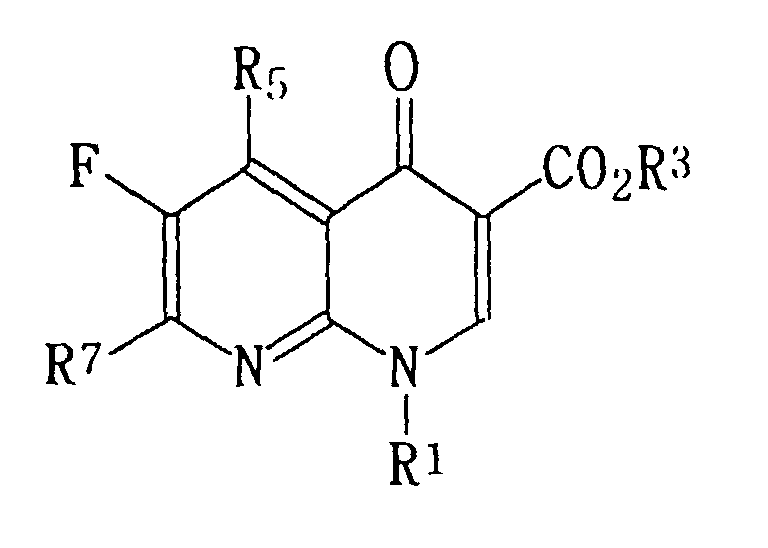
- EP 0,387,802 A2 dislcoses naphthyridine compounds of the following formula wherein R 1 is cycloalkyl, phenyl or substituted phenyl, etc., R 3 is hydrogen, alkyl, ester or carboxy-protecting group, R 5 is lower alkyl, lower alkenyl, etc., R 7 is a nitrogen heterocycle. Likewise, the above-said prior art discloses not compounds having a pyridyl group at the N-1 position.
- the compounds developed up to now generally have good in vitro activity, but such in vitro activity could not leads to in vivo because of poor pharmacokinetics including half-life(t 1/2 ), maximum blood level(C max ), bioavilability (BA), area under curve(AUC) etc, which are important properties of a compound for good in vitro activity to be maintained in vivo.
- the object of this invention is to develope compounds having excellent pharmacokinetic properties by introducing fluoro pyridyl group which is a heteroaromatic group at N-1 position, thereby to produce compounds having good antibiotic power in vivo and long half-life(t 1/2 ) which enable once a day of dose. Therefore, the present invention provides a series of compounds having even more excellent pharmacokinetic properties than those of the conventional quinolone antibiotics by introducing 5-fluoro-2-pyridyl group and 3-fluoro-4-pyridyl group into mother nuclei of quinolone and naphthyridine.
- the present invention relates to novel quinolone carboxylic acid derivatives which have a fluoropyridine group at N - 1 position.
- the object of the present invention is to provide the novel quinolone carboxylic acids, their esters, their pharmaceutically acceptable salts, and their hydrates in which are some compounds having broad spectrums, excellent pharmacokinetic properties and low toxicity which are important factors for a drug to be administrated and function in the body, and a process for preparing these compounds.
- Some of these quinolone derivatives have longer half-life(t 1/2 ), even higher maximum blood level(C max ) and bioavailability(BA) and even larger area under curve (AUC) compared to ciprofloxacin of the prior art. In addition, they have still far longer half-life(t 1/2 ) and larger area under curve (AUC) compared to ofloxacin which is known to have excellent pharmacokinetics. For instance, the pharmacokinetic properties of one compound prepared by the present invention showed that half-life (hr) is 8.07, C max ( ⁇ g/ml) : 11.46, AUC ( ⁇ g.h/ml): 41.05, bioavailability (%) : 73.95 by oral administration to mice.
- the mean values of the ED 50 (mg/kg) of the compound and ciprofloxacin showed 25 and >50 respectively against systemic infection in mice caused by S. aureus giorgio organism.
- Minimum inhibitory concentration (MIC, ⁇ g/ml) in vitro of the two compounds mentioned above are o.78 and 0.39 respectively. Accordingly, some of the novel quinolone carboxylic acid derivatives of the present invention are expected to have highly increased in vivo activity.
- the compound of the formula (I) can be prepared as follows. Each compound in the formula (I) is prepared by the substantially same method except the reaction temperature, irrespective of the kind of X, Y, Z in the compound of the formula (II). Wherein X, Y, Z, R 1 , R 2 and R 3 are each as described above.
- the above reaction is carried out in a solvent selected from the alcohols such as methanol, ethanol, the ethers such as tetrahydrofuran, dioxane, 1,2-dimethoxyethane, diglyme, aromatic hydrocarbons such as benzene, toluene, xylene, and the inert solvents such as acetonitrile, N,N-dimethylformamide, dimethyl sulfoxide, pyridine etc., at 0 °C to 150 °C temperature for 5 minutes to 48 hours.
- the above reaction is generally carried out in the presence of an acid-acceptor, the desirable amount of which is 1 to 3 equivalent of the compound (II).
- an excess of the compound (VI) may be used as an acid-acceptor.
- an acid-acceptor a tertiary amine such as pyridine, triethylamine or 1,8-diazabicyclo[5.4.0] undec-7-ene, or an alkali metal carbonate such as sodium hydrogen carbonate, sodium carbonate or potassium carbonate may be used.
- the compound of the formula (II'') (wherein R 1 is a hydrogen) and HR 3 of the formula (VI) (wherein R 3 is the same as described above) can be reacted; or otherwise the compound of the formula (II') (wherein R 1 is an alkyl group) and HR 3 of the formula (VI) (wherein R 3 is the same as described above) can be reacted first and then hydrolysis using an acid or alkali can be carried out.
- an acid such as hydrochloric acid and sulfuric acid
- in the alkaline hydrolysis may be used an alkali such as sodium hydroxide and potassium hydroxide.
- the acid or alkali may be used in the hydrolysis as a solution in water or water-containing ethanol or methanol.
- X, Y, Z, R 1 and R 2 are each as defined above.
- the compound of the formula (III) is prepared by the conventional method [Ger. Offen. DE 3, 142, 854; Ger. Offen. DE 3, 318, 145 ; J. Med. Chem., 29 , 2363(1986)] and thereby obtained compound of the formula (III) is reacted with the compound of the formula(IV) prepared by the conventional method [Rocz. chem., 38 , 777-783(1964); Synthesis, 12 , 905-908(1989)] in an alcohol solvent such as methanol and ethanol, or a haloformic solvent such as dichloromethane and chloroform at -10 °C - 30°C to obtain the compound of the formula (V).
- an alcohol solvent such as methanol and ethanol
- a haloformic solvent such as dichloromethane and chloroform at -10 °C - 30°C
- the obtained compound of the formula (V) is subjected to a ring-closing reaction using potassium carbonate and 18-crown-6 in acetonitrile, or a ring-closing reaction using sodium hydride in N,N-dimethyl formamide, to obtain the compound of the formula (II').
- the reaction temperature is desirably from 0°C to the reflux temperature.
- the compound of the formula (II') is hydrolyzed by treatment with an acid or alkali to obtain the compound of the formula (II'') and the compounds of the formula (II') and (II'') are designated totally as the formula (II).
- an acid such as hydrochloric acid or sulfuric acid
- an alkali such as sodium hydroxide or potassium hydroxide
- the acid or alkali may be used in the hydrolysis as a solution in water or water-containing ethanol or methanol.
- novel quinolone carboxylic acid derivatives according to this invention may be used as free compounds, acid addition salts thereof or salts of the carboxyl groups thereof.
- suitable acids for salt formation include inorganic acids such as hydrochloric acid, phosphoric acid and organic acids such as acetic acid, oxalic acid, succinic acid, methanesulfonic acid, maleic acid, malonic acid, gluconic acid.
- Pharmaceutically acceptable base salts of the above described compounds of the formula (I) are formed with alkali metals such as sodium, potassium or alkaline earth metals such as magnesium, calcium.
- alkali metals such as sodium, potassium or alkaline earth metals such as magnesium, calcium.
- the free compounds of the present invention, their acid addition salts and their salts of the carboxyl groups of pyridone carboxylic acid derivatives may exist as hydrates.
- the mixture is refluxed for 3 hours and then cooled, added with 100ml of water and stirred during 30 minutes, then filtered and dried to obtain 1.3g of the desired compound.
- the residue is recrystallized in a mixed solvent of ethanol and water to obtain 0.22g of the desired compound.
- ethyl 1-(5-fluoro-2-pyridyl)-6-fluoro-7-(1-piperazinyl)-1,4-dihydro-4-oxo-1,8-naphthyridine-3-carboxylate is added to 10ml of water and 10ml of conc. hydrochloric acid.
- the mixture is refluxed for 24 hours, cooled to room temperature and concentrated under a reduced pressure.
- the concentrate is added with 20ml of ethanol and stirred at room temperature for 2 hours, filtered and dried.
- the product is recrystallized in a mixed solvent of water and methanol to obtain 0.39g of the desired compound.
- ethyl 1-(5-fluoro-2-pyridyl)-6-fluoro-7-(acetamido-1-pyrrolidinyl)-1,4-dihydro-4-oxo-1,8-naphthyridine-3-carboxylate is added to 10ml of water and 10ml of conc. hydrochloric acid.
- the mixture is refluxed for 24 hours, cooled to room temperature and concentrated under a reduced pressure.
- the concentrate is added with 20ml of ethanol and dissolved completely.
- 70ml of ethyl ether is added for precipitation, and then stirred at room temperature for 2 hours, filtered and dried.
- the product is recrystallized in a mixed solvent of methanol and water to obtain 0.35g of the desired compound
- the in vitro antibiotic activity of the present compound is measured using 2-fold dilution method with a micro-well plate and the bacteria are inoculated in about 10 5 cfu/ml after an overnight culture in a brain-heart infusion(BHI) broth at 37°C.
- the novel compounds of the present invention are converted to a hydrochloride salt form and diluted with a sterilized distilled water to make 10mg/ml aqueous solution.
- the respective 0.1ml of diluted liquor is transferred to a well and is inoculated with 0.1ml of the culture fluid to make about (10 5 -10 6 )/2 cfu/ml.
- Table I - V show the minimum inhibitory concentrations(MIC).
- the pharmacokinetic properties are tested by orally administrating and subcutaneously injecting a test compound and a substance for control to a ICR Mouse with 22g ⁇ 10% weight, drawing blood after 10, 20, 30, 45, 60, 90, 120, 150, 180 and 240 minutes and analyzed by Bio-Assay(Agar well method).
- the mean values of the ED 50 (mg/kg) of the compound of Example 13 and ciprofloxacin showed 25 and >50 respectively against systemic infection in mice caused by S. aureus giorgio organism.
- Minimum inhibitory concentration (MIC, ⁇ g/ml) in vitro of the two compounds mentioned above are o.78 and 0.39 respectively.
- the LD 50 of example 13 was about 1,000g/kg and example 18 about > 3,000g/kg. (Oral, mice)
Landscapes
- Chemical & Material Sciences (AREA)
- Organic Chemistry (AREA)
- Health & Medical Sciences (AREA)
- Chemical Kinetics & Catalysis (AREA)
- Life Sciences & Earth Sciences (AREA)
- General Chemical & Material Sciences (AREA)
- Medicinal Chemistry (AREA)
- Nuclear Medicine, Radiotherapy & Molecular Imaging (AREA)
- Communicable Diseases (AREA)
- Pharmacology & Pharmacy (AREA)
- Oncology (AREA)
- Animal Behavior & Ethology (AREA)
- General Health & Medical Sciences (AREA)
- Public Health (AREA)
- Veterinary Medicine (AREA)
- Pharmaceuticals Containing Other Organic And Inorganic Compounds (AREA)
- Nitrogen Condensed Heterocyclic Rings (AREA)
- Plural Heterocyclic Compounds (AREA)
Abstract
Description
- The present invention relates to the novel quinolone carboxylic acid derivatives, their esters, their pharmaceutically acceptable salts and their hydrates as shown in formula (I) and a process for preparing these compounds. Furthermore, some of the invented chinolone carboxylic acid derivatives as shown in formula (I) show broad spectrum and excellent pharmacokinetic properties and low toxicity.Wherein

- X is CH or a nitrogen atom,
- Y is hydrogen or methyl group,
- R1 is a hydrogen or C1-C5 alkyl group,
- R2 is
(wherein A and B are CF or nitrogen atom, provided that, if A=CF, B=N and if A=N, B=CF).

- R3 is
(wherein R4 is an amino group to make a racemate or (S) -enantiomer) or
 (wherein R5, R6 and R7 are respectively hydrogen or alkyl group having 1 to 3 carbon atoms).
-
- In general, most of the quinolone-type antibiotics which have been heretofore developed are ones having small alkyl and cycloalkyl group at N-1 position [e.g. Norfloxacin : USP 4,146,719, Ciprofloxacin : USP 4,620,007 ] and ones having aromatic group at N-1 position [e.g. Temafloxacin : J. Med. Chem., 34, 168 (1991), Tosufloxacin : USP 4,704,459].
- However, a noticeable quinolone antibiotic having heteroaomatic group at N-1 position has not yet been developed.
- DE 3,517,535 A1 discloses 1-aryl-4-quinolone-3-carboxylic acids of the following formulain which X1 is halogen or nitro, X2 is halogen, R is an optionally substituted phenyl radical, or an amine radical -NR5R6 wherein R5 and R6 are respectively hydrogen or alkyl or form an aromatic heterocylic radical with 5-7 atoms and A is halogen or optionally substituted piperazine or pyrrolidine. These known compounds have a halogen atom or nitro radical at the 8 position of the quinoline ring, whereas the present compounds have no substituent at the same position. Further the present compounds have eccentially a fluorine-substituted pyridyl group at the N-1 position but the above-said document disclose several compounds having only a unsubstituted pyridyl radical at the N-1 position.

D2 : EP A1 350,950 discloses a process for preparing the quinoline compounds of the following formulawherein R1 is halogen, R2 is halogen or hydrogen and R3 is hydrogen or lower alkyl. The known compounds disclosed by the EP A1 350,950 have a phenyl group at the N-1 position.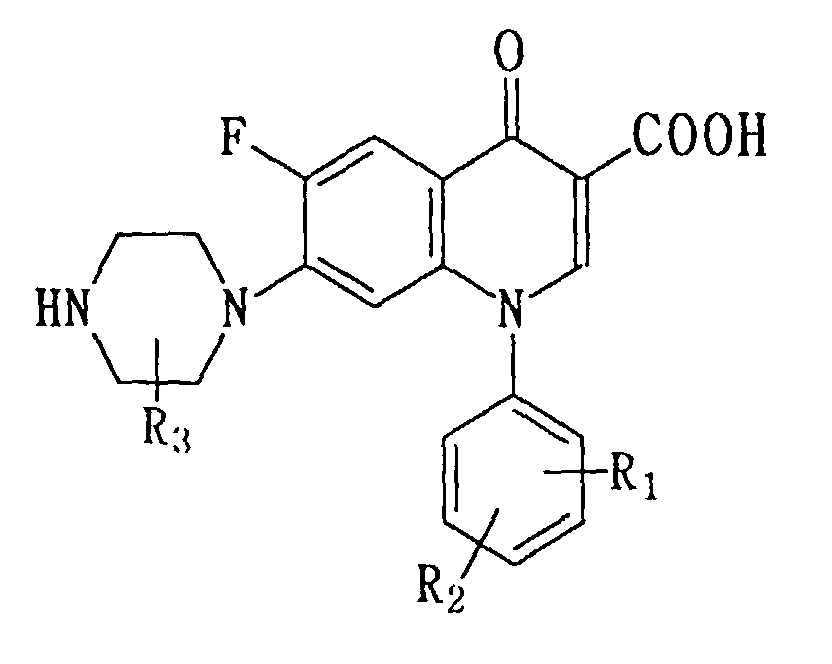
- EP, A1, 0,401,623 discloses a process for the preparation of compounds of the following formulawherein X1 represent hydrogen, amino, alkylamino, hydroxyl, alkoxy, mercapto, alkylthio, arylthio, halogen or alkyl, R1 represents alkyl, alkenyl, cyloalkyl, hydroxyethyl, methoxy, amino, methylamino, ethylamino, dimethylamino or optionally substituted phenyl, R2 represents hydrogen, alkyl or (5-methyl-2-oxo-1,3-doxol-4-yl)methyl, R3 represents hydrogen, alkyl, hydroxyl, alkoxy alkylthio or halogen, R4 represents hydrogen or methyl, R5 and R6 are hydrogen or methyl, m represents 0, 1 or 2, n represents 0 or 1, and A represents N or C-R7 wherein R7 represents hydrogen, halogen, methyl, cyano, nitro, hydroxyl or methoxy, etc. However, the above-cited document discloses no compounds having a pyridyl group at the N-1 position.

- EP 0,387,802 A2 dislcoses naphthyridine compounds of the following formulawherein R1 is cycloalkyl, phenyl or substituted phenyl, etc., R3 is hydrogen, alkyl, ester or carboxy-protecting group, R5 is lower alkyl, lower alkenyl, etc., R7 is a nitrogen heterocycle. Likewise, the above-said prior art discloses not compounds having a pyridyl group at the N-1 position.
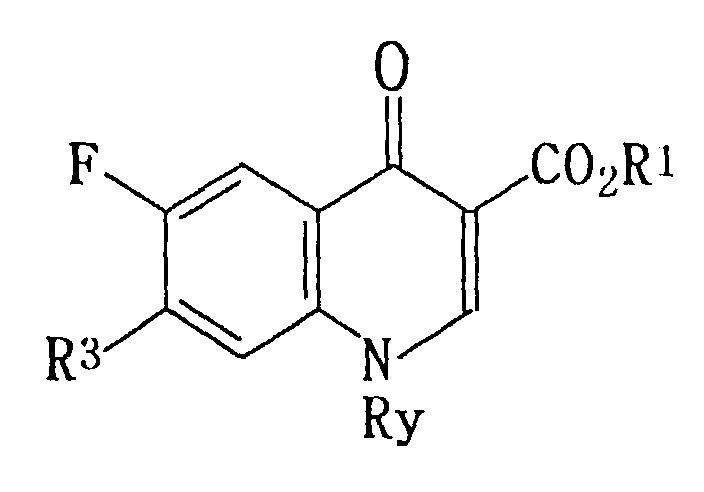
- Chemical Abstracts, vol. 105, No. 3, issued 1986, July 21, page 634, column 1, the abstract no. 24 198h discloses compounds of the following formulawherein R1 is hydrogen or carboxy protecting group, Ry is (un)substituted aryl, R3 is halo or (un)substituted amino. Also, the document do not disclose quinolone compounds having a pyridyl group at the N-1 position.
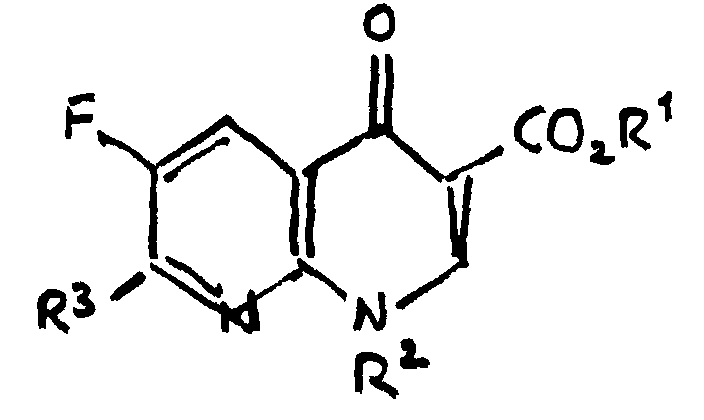
- Chemical Abstracts, vol. 106, no. 25 ; issued 1987, June 22, page 662, column 1, abstract no. 213923x discloses compounds having antibacterial activity of the following formulawherein R1 is hydrogen or protecting group, R2 is (substituted heterocycle) and R3 is halo, (substituted) cyclic amino. The patent to which this abstract refers (JP 62 33, 176) discloses compounds of the above formula wherein R2 is a 6-fluoro-3-pyridyl group.
- Otsuka, Toyama and others reported their researches upon introducing heteroaromatic group such as furyl, thienyl, thiazol, imidazol, pyridyl, pyrimidyl group at N-1 position, but a compound available in vivo has not been yet developed. (JPK 61-251667-A, 62-174053-A, 02-85255-A).
- In particular, the compounds developed up to now generally have good in vitro activity, but such in vitro activity could not leads to in vivo because of poor pharmacokinetics including half-life(t1/2), maximum blood level(Cmax), bioavilability (BA), area under curve(AUC) etc, which are important properties of a compound for good in vitro activity to be maintained in vivo.
- Therefore, the object of this invention is to develope compounds having excellent pharmacokinetic properties by introducing fluoro pyridyl group which is a heteroaromatic group at N-1 position, thereby to produce compounds having good antibiotic power in vivo and long half-life(t1/2) which enable once a day of dose. Therefore, the present invention provides a series of compounds having even more excellent pharmacokinetic properties than those of the conventional quinolone antibiotics by introducing 5-fluoro-2-pyridyl group and 3-fluoro-4-pyridyl group into mother nuclei of quinolone and naphthyridine.
- The present invention relates to novel quinolone carboxylic acid derivatives which have a fluoropyridine group at N - 1 position.
- The object of the present invention is to provide the novel quinolone carboxylic acids, their esters, their pharmaceutically acceptable salts, and their hydrates in which are some compounds having broad spectrums, excellent pharmacokinetic properties and low toxicity which are important factors for a drug to be administrated and function in the body, and a process for preparing these compounds.
- Some of these quinolone derivatives have longer half-life(t1/2), even higher maximum blood level(Cmax) and bioavailability(BA) and even larger area under curve (AUC) compared to ciprofloxacin of the prior art. In addition, they have still far longer half-life(t1/2) and larger area under curve (AUC) compared to ofloxacin which is known to have excellent pharmacokinetics. For instance, the pharmacokinetic properties of one compound prepared by the present invention showed that half-life (hr) is 8.07, Cmax (µg/ml) : 11.46, AUC (µg.h/ml): 41.05, bioavailability (%) : 73.95 by oral administration to mice.
- On the other hand, ciprofloxacin showed that half-life is 0.92, Cmax : 1.71, AUC 2.27, bioavailability : 14.6. Therefore, the compounds of present invention proved to have highly increased in vivo activity by such excellent pharmacokinetic properties.
- The mean values of the ED50 (mg/kg) of the compound and ciprofloxacin showed 25 and >50 respectively against systemic infection in mice caused by S. aureus giorgio organism. Minimum inhibitory concentration (MIC, µg/ml) in vitro of the two compounds mentioned above are o.78 and 0.39 respectively. Accordingly, some of the novel quinolone carboxylic acid derivatives of the present invention are expected to have highly increased in vivo activity.
- Wherein
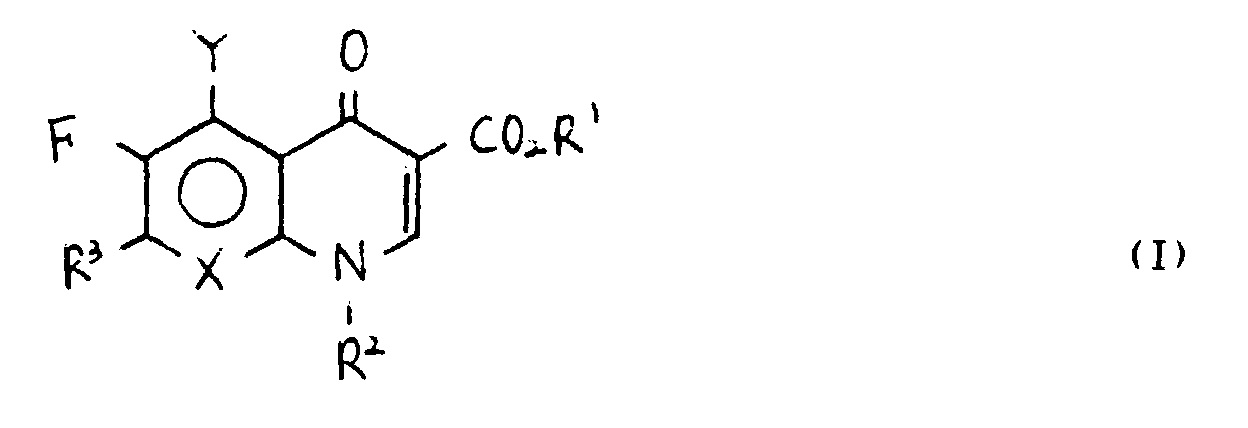
- X is a hydrocarbon, fluorocarbon or nitrogen atom,
- Y is a hydrogen or methyl group,
- R1 is a hydrogen or C1-C5 alkyl group,
- R2 is
(wherein A and B are fluorocarbon or nitrogen atom, provided that if A=CF, B=N and if A=N, B=CF)

- R3 is
(wherein R4 is an amino group to make a racemate or (S) -enantiomer.) or
 (wherein R5, R6 and R7 are C1- C3 alkyl groups.)
-
- The compound of the formula (I) can be prepared as follows. Each compound in the formula (I) is prepared by the substantially same method except the reaction temperature, irrespective of the kind of X, Y, Z in the compound of the formula (II).Wherein X, Y, Z, R1, R2 and R3 are each as described above.

- The above reaction is carried out in a solvent selected from the alcohols such as methanol, ethanol, the ethers such as tetrahydrofuran, dioxane, 1,2-dimethoxyethane, diglyme, aromatic hydrocarbons such as benzene, toluene, xylene, and the inert solvents such as acetonitrile, N,N-dimethylformamide, dimethyl sulfoxide, pyridine etc., at 0 °C to 150 °C temperature for 5 minutes to 48 hours. In addition, the above reaction is generally carried out in the presence of an acid-acceptor, the desirable amount of which is 1 to 3 equivalent of the compound (II). Alternatively, an excess of the compound (VI) may be used as an acid-acceptor. As an acid-acceptor, a tertiary amine such as pyridine, triethylamine or 1,8-diazabicyclo[5.4.0] undec-7-ene, or an alkali metal carbonate such as sodium hydrogen carbonate, sodium carbonate or potassium carbonate may be used.
- In order to prepare the compound of the formula (I) wherein R1 is a hydrogen, the compound of the formula (II'') (wherein R1 is a hydrogen) and HR3 of the formula (VI) (wherein R3 is the same as described above) can be reacted; or otherwise the compound of the formula (II') (wherein R1 is an alkyl group) and HR3 of the formula (VI) (wherein R3 is the same as described above) can be reacted first and then hydrolysis using an acid or alkali can be carried out. At this time, in the acidic hydrolysis may be used an acid such as hydrochloric acid and sulfuric acid and in the alkaline hydrolysis may be used an alkali such as sodium hydroxide and potassium hydroxide. The acid or alkali may be used in the hydrolysis as a solution in water or water-containing ethanol or methanol.
- The compound of the formula (II) can be prepared as follows. (II = II'+II'')
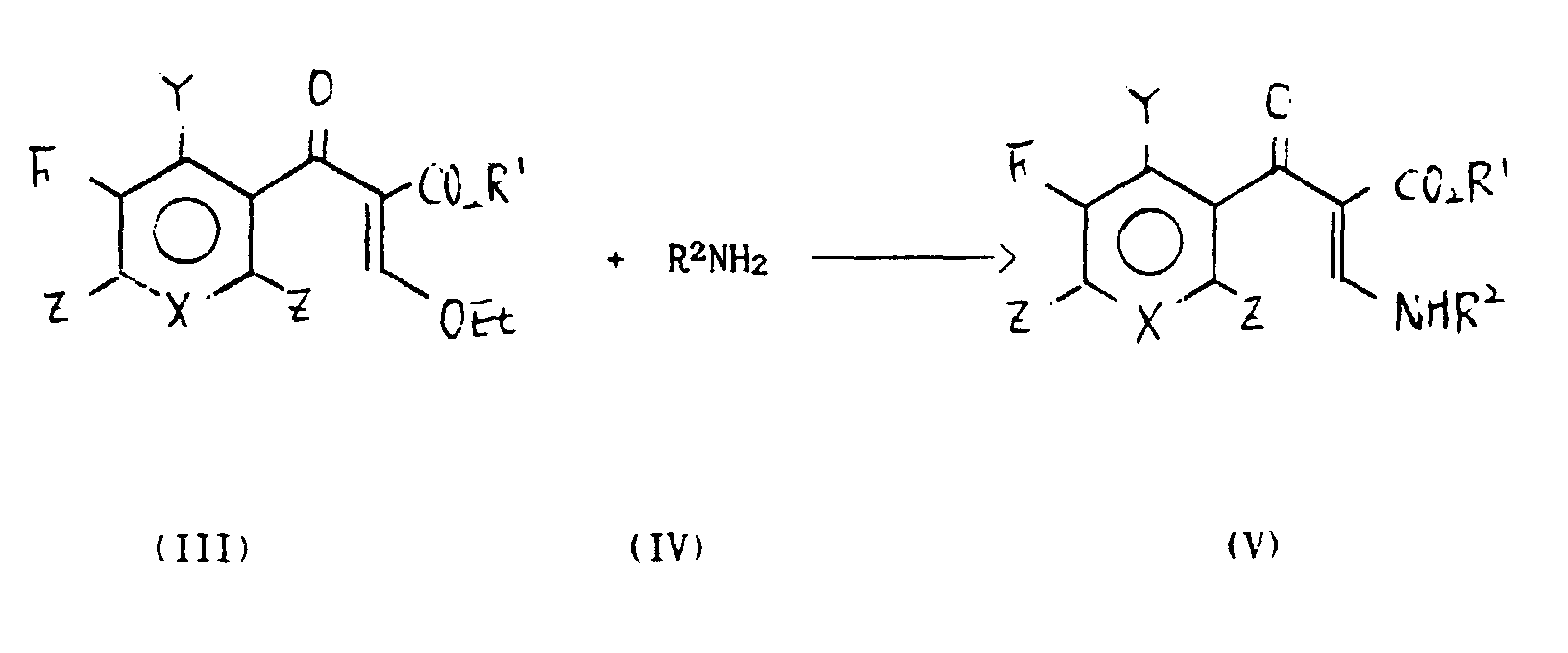

- Wherein X, Y, Z, R1 and R2 are each as defined above.
- The compound of the formula (III) is prepared by the conventional method [Ger. Offen. DE 3, 142, 854; Ger. Offen. DE 3, 318, 145 ; J. Med. Chem., 29, 2363(1986)] and thereby obtained compound of the formula (III) is reacted with the compound of the formula(IV) prepared by the conventional method [Rocz. chem., 38, 777-783(1964); Synthesis, 12, 905-908(1989)] in an alcohol solvent such as methanol and ethanol, or a haloformic solvent such as dichloromethane and chloroform at -10 °C - 30°C to obtain the compound of the formula (V). The obtained compound of the formula (V) is subjected to a ring-closing reaction using potassium carbonate and 18-crown-6 in acetonitrile, or a ring-closing reaction using sodium hydride in N,N-dimethyl formamide, to obtain the compound of the formula (II'). At this time the reaction temperature is desirably from 0°C to the reflux temperature. The compound of the formula (II') is hydrolyzed by treatment with an acid or alkali to obtain the compound of the formula (II'') and the compounds of the formula (II') and (II'') are designated totally as the formula (II). At this time, in the acidic hydrolysis may be used an acid such as hydrochloric acid or sulfuric acid, and in the alkaline hydrolysis may be used an alkali such as sodium hydroxide or potassium hydroxide. The acid or alkali may be used in the hydrolysis as a solution in water or water-containing ethanol or methanol.
- Representative examples of the novel quinolone carboxylic acid derivatives according to the present invention are as follows ;
- 1. 1-(3-fluoro-4-pyridyl)-6-fluoro-7-(1-piperazinyl)-1,4-dihydro-4-oxoquinoline-3-carboxylic acid
- 2. 1-(3-fluoro-4-pyridyl)-6-fluoro-7-(4-methyl-1-piperazinyl)-1,4-dihydro-4-oxoquinoline-3-carboxylic acid
- 3. 1-(3-fluoro-4-pyridyl)-6-fluoro-7-(3-methyl-1-piperazinyl)-1,4-dihydro-4-oxoquinoline-3-carboxylic acid
- 4. 1-(3-fluoro-4-pyridyl)-6-fluoro-7-(3,5-dimethyl-1-piperazinyl)-1,4-dihydro-4-oxoquinoline-3-carboxylic acid
- 5. 1-(3-fluoro-4-pyridyl)-6-fluoro-7-(3-amino-1-pyrrolidinyl)-1,4-dihydro-4-oxoquinoline-3-carboxylic acid
- 6. 1-(3-fluoro-4-pyridyl)-6-fluoro-7-[(3S)-3-amino-1-pyrrolidinyl]-1,4-dihydro-4-oxoquinoline-3-carboxylic acid
- 7. 1-(3-fluoro-4-pyridyl)-6-fluoro-7-(1-piperazinyl)-1,4-dihydro-4-oxo-1,8-naphthyridine-3-carboxylic acid
- 8. 1-(3-fluoro-4-pyridyl)-6-fluoro-7-(4-methyl-1-piperazinyl)-1,4-dihydro-4-oxo-1,8 -naphthyridine-3-carboxylic acid
- 9. 1-(3-fluoro-4-pyridyl)-6-fluoro-7-(3-methyl-1-piperazinyl)-1,4-dihydro-4-oxo-1,8 -naphthyridine-3-carboxylic acid
- 10. 1-(3-fluoro-4-pyridyl)-6-fluoro-7-(3,5-dimethyl-1-piperazinyl)-1,4-dihydro-4-oxo-1,8-naphthyridine-3-carboxylic acid
- 11. 1-(3-fluoro-4-pyridyl)-6-fluoro-7-[(3S)-3-amino-1-pyrrolidinyl)-1,4-dihydro-4-oxo-1,8-naphthyridine-3-carboxylic acid
- 12. 1-(5-fluoro-2-pyridyl)-6-fluoro-7-(1-piperazinyl)-1,4-dihydro-oxo-1,8-naphthyridine-3-carboxylic acid
- 13. 1-(5-fluoro-2-pyridyl)-6-fluoro-7-(4-methyl-1-piperazinyl)-1,4-dihydro-4-oxo-1,8-naphthyridine-3-carboxylic acid
- 14. 1-(5-fluoro-2-pyridyl)-6-fluoro-7-(3-methyl-1-piperazinyl)-1,4-dihydro-4-oxo-1,8-naphthyridine-3-carboxylic acid
- 15. 1-(5-fluoro-2-pyridyl)-6-fluoro-7-(3,5-dimethyl-1-piperazinyl)-1,4-dihydro-4-oxo-1,8-naphthyridine-3-carboxylic acid
- 16. 1-(5-fluoro-2-pyridyl)-6-fluoro-7-(3-amino-1-pyrrolidinyl)-1,4-dihydro-4-oxo-1,8-naphthyridine-3-carboxylic acid
- 17. 1-(5-fluoro-2-pyridyl)-6-fluoro-7-(1-piperazinyl)-1,4-dihydro-4-oxoquinoline-3-carboxylic acid
- 18. 1-(5-fluoro-2-pyridyl)-6-fluoro-7-(4-methyl-1-piperazinyl)-1,4-dihydro-4-oxoquinoline-3-carboxylic acid
- 19. 1-(5-fluoro-2-pyridyl)-6-fluoro-7-(3-methyl-1-piperazinyl)-1,4-dihydro-4-oxoquinoline-3-carboxylic acid
- 20. 1-(5-fluoro-2-pyridyl)-6-fluoro-7-(3,5-dimethyl-1-piperazinyl)-1,4-dihydro-4-oxoquinoline-3-carboxylic acid
- 21. 1-(5-fluoro-2-pyridyl)-6-fluoro-7-(3-amino-1-pyrrolidinyl)-1,4-dihydro-4-oxoquinoline-3-carboxylic acid
- 22. 1-(5-fluoro-2-pyridyl)-6-fluoro-7-[(3S)-3-amino-1-pyrrolidinyl)-1,4-dihydro-4-oxoquinoline-3-carboxylic acid
- 23. 1-(5-fluoro-2-pyridyl)-6,8-difluoro-7-(1-piperazinyl)-1,4-dihydro-4-oxoquinoline-3-carboxylic acid
- 24. 1-(5-fluoro-2-pyridyl)-6,8-difluoro-7-(4-methyl-1-piperazinyl)-1,4-dihydro-4-oxoquinoline-3-carboxylic acid
- 25. 1-(5-fluoro-2-pyridyl)-6,8-difluoro-7-(3-methyl-1-piperazinyl)-1,4-dihydro-4-oxoquinoline-3-carboxylic acid
- 26. 1-(5-fluoro-2-pyridyl)-6,8-difluoro-7-(3,5-dimethyl-1-piperazinyl)-1,4-dihydro-4-oxoquinoline-3-carboxylic acid
- 27. 1-(5-fluoro-2-pyridyl)-6,8-difluoro-7-(3-amino-1-pyrrolidinyl)-1,4-dihydro-4-oxoquinoline-3-carboxylic acid
- 28. 5-methyl-7-(4-methyl-1-piperazinyl)-1-(5-fluoro-2-pyridyl)-6-fluoro-1,4-dihydro -4-oxoquinoline-3-carboxylic acid
- 29. 5-methyl-7-(3-methyl-1-piperazinyl)-1-(5-fluoro-2-pyridyl)-6-fluoro-1,4-dihydro -4-oxoquinoline-3-carboxylic acid
-
- Meanwhile, the novel quinolone carboxylic acid derivatives according to this invention may be used as free compounds, acid addition salts thereof or salts of the carboxyl groups thereof. The suitable acids for salt formation include inorganic acids such as hydrochloric acid, phosphoric acid and organic acids such as acetic acid, oxalic acid, succinic acid, methanesulfonic acid, maleic acid, malonic acid, gluconic acid.
- Pharmaceutically acceptable base salts of the above described compounds of the formula (I) are formed with alkali metals such as sodium, potassium or alkaline earth metals such as magnesium, calcium. The free compounds of the present invention, their acid addition salts and their salts of the carboxyl groups of pyridone carboxylic acid derivatives may exist as hydrates.
- The following examples are provided to illustrate the desirable preparation of the compounds of the present invention.
- 2.5g of ethyl 2,4,5-trifluorobenzoyl acetate, 2.55ml of triethyl o-formate, 12ml of acetic anhydride are mixed together and refluxed for 3 to 5 hours, cooled to room temperature, and distilled under a reduced pressure. The obtained product is dissolved in 50ml of anhydrous dichloromethane and added with 1.26g of 4-amino-3-fluoropyridine and stirred at room temperature for 5 hours, and then concentrated under a reduced pressure. The product is used in the next reaction without further purification.
- A procedure substantially similar to the procedure in Preparation 1 is carried out to prepare the title compound.
- A procedure substantially similar to the procedure in Preparation 1 is carried out to prepare the title compound.
- A procedure substantially similar to the procedure in Preparation 1 is carried out to prepare the title compound.
- A procedure substantially similar to the procedure in Preparation 1 is carried out to prepare the title compound.
- A procedure substantially similar to the procedure in Preparation 1 is carried out to prepare the title compound.
- 2.0g of ethyl 3-(3-fluoro-4-pyridyl)amino-2-(2,4,5-trifluorobenzoyl)acrylate, 1.50g of potassium carbonate and 0.43g of 18-crown-6 are mixed with 40ml of anhydrous acetonitrile.
- The mixture is refluxed for 3 hours and then cooled, added with 100ml of water and stirred during 30 minutes, then filtered and dried to obtain 1.3g of the desired compound.
- m.p. : 212°C
- 1H-NMR(CDCl3, ppm) : 1.26 (t,3H, J=7.20Hz), 4.40(q,2H,J=7.20Hz), 6.50-6.80(m,1H), 7.40-7.60(m,1H), 8.22-8.42(m,2H), 8.68-8.96(m,2H)
-
- A procedure substantially similar to the procedure in Preparation 7 is carried out to prepare the title compound.
- m.p. : 226°C
- 1H-NMR(CDCl3, ppm) : 1.42 (t,3H,J=7.20Hz), 4.42(q,2H,J=7.20Hz), 7.46-7.50(m,1H), 8.48-8.54(m,2H), 8.70-8.82(m,2H)
-
- A procedure substantially similar to the procedure in Preparation 7 is carried out to prepare the title compound.
- m.p. : 230°C
- 1H-NMR(CDCl3, ppm) : 1.36 (t,3H,J=7.20Hz), 4.38(q,2H,J=7.20Hz), 7.60-7.80(m,2H), 8.36-8.54(m,2H), 8.94(s,1H)
-
- A procedure substantially similar to the procedure in Preparation 7 is carried out to prepare the title compound.
- m.p. : 210-213°C
- 1H-NMR(CDCl3, ppm) : 1.50 (t,3H,J=8.00Hz), 4.70(q,2H,J=8.00Hz), 7.42(dd,1H, J=3.04Hz,J=10.04Hz), 7.92-8.19(m,2H), 8.50-8.79(m,2H), 9.45(s,1H)
-
- A procedure substantially similar to the procedure in Preparation 7 is carried out to prepare the title compound.
- m.p. : 203-205°C
- 1H-NMR(CDCl3, ppm) : 1.32 (t,3H,J=7.20Hz), 4.32(q,2H,J=7.20Hz), 7.36-7.72(m,2H), 8.00-8.22(m,1H), 8.30-8.50(m,2H)
-
- 5g of ethyl 1-(3-fluoro-4-pyridyl)-6,7-difluoro-1,4-dihydro-4-oxoquinoline-3-carboxylate is added with 20ml of water, 30ml of ethanol and 15 ml of conc. hydrochloric acid and refluxed for 8 hours. After cooling to room temperature and standing for 2 hours, filtering and drying are carried out to obtain 4.2g of the desired compound.
- m.p. : 271-273°C
- 1H-NMR(CF3COOD, ppm) : 7.28-7.58(m,1H), 8.26-8.88(m,2H), 9.22-9.62(m,3H)
-
- A procedure substantially similar to the procedure in Preparation 12 is carried out to prepare the title compound.
- m.p.: 228-230°C
- 1H NMR(CDCl3, ppm) : 8.50-8.74(m,2H), 9.16-9.42(m,3H)
-
- A procedure substantially similar to the procedure in Preparation 12 is carried out to prepare the title compound.
- m.p.: 275-280°C
- 1H NMR(CF3COOD, ppm) : 7.40(dd,1H,J=3.02Hz,J=10.06Hz), 7.92-8.18(m,2H), 8.39-8.78(m,2H), 9.50(s,1H)
-
- A procedure substantially similar to the procedure in Preparation 12 is carried out to prepare the title compound.
- m.p.: 234-238°C
- 1H NMR(CDCl3, ppm) : 8.58-8.84(m,2H), 9.18-9.42(m,3H)
-
- 0.5g of ethyl 1-(5-fluoro-2-pyridyl)-6-fluoro-7-chloro-1,4-dihydro-4-oxo-1,8-naphthyridine-3-carboxylate and 0.35g of piperazine are added to 45ml of pyridine.
- The mixture is stirred at 10°C for 1 hour and then concentrated under a reduced pressure and subjected to a column chromatography (acetone/n-hexane=5/2) to obtain 0.47g of the desired compound, which is then subjected to the next reaction to identify its structure. (next reaction : Example 12)
- A procedure substantially similar to the procedure in Preparation 16 is carried out to prepare the title compound.
- Yield : 85.0%
-
- out to prepare the title compound.
- Yield : 91.5%
-
- A procedure substantially similar to the procedure in Preparation 16 is carried out to prepare the title compound.
- Yield : 84.1%
- m.p. : 165°C
- 1H NMR(CDCl3, ppm) : 0.94(s,3H), 1.00(s,3H), 1.35(t,3H,J=6.40Hz), 2.24-3.06(m,4H), 4.00-4.42(m,4H), 7.44-8.24(m,3H), 8.38-8.52(m,1H), 8.76(s,1H)
-
- A procedure substantially similar to the procedure in Preparation 16 is carried out to prepare the title compound.
- Yield : 90.3%
- m.p. : 200-202°C
- 1H NMR(CDCl3, ppm) : 1.30(t,3H,J=6.40Hz), 1.90-2.16(m,5H), 3.40-3.94(m,4H), 4.28(q,2H,J=6.40Hz), 4.76(m,1H), 7.44-8.06(m,3H), 8.32-8.46(m,1H), 8.68(s,1H)
-
- A procedure substantially similar to the procedure in Preparation 16 is carried out to prepare the title compound.
- Yield : 90.3%
-
- A procedure substantially similar to the procedure in Preparation 16 is carried out to prepare the title compound.
- Yield : 91.3%
-
- A procedure substantially similar to the procedure in Preparation 16 is carried out to prepare the title compound.
- Yield : 87.5%
-
- A procedure substantially similar to the procedure in Preparation 16 is carried out to prepare the title compound.
- Yield : 89.3%
-
- A procedure substantially similar to the procedure in Preparation 16 is carried out to prepare the title compound.
- Yield : 90.3%
-
- A procedure substantially similar to the procedure in Preparation 16 is carried out to prepare the title compound.
- Yield : 84.5%
-
- A procedure substantially similar to the procedure in Preparation 16 is carried out to prepare the title compound.
- Yield : 88.7%
-
- A procedure substantially similar to the procedure in Preparation 16 is carried out to prepare the title compound.
- Yield : 83.7%
-
- A procedure substantially similar to the procedure in Preparation 16 is carried out to prepare the title compound.
- Yield : 88.7%
-
- A procedure substantially similar to the procedure in Preparation 16 is carried out to prepare the title compound.
- Yield : 92.7%
-
- 0.22g of 1-(3-fluoro-4-pyridyl)-6,7-difluoro-1,4-dihydro-4-oxoquinoline-3-carboxylic acid and 0.11g of 3-acetamidopyrrolidine are added to 12ml of pyridine, and added with 0.13ml of 1.8-diazabicyclo[5.4.0]undec-7-ene. The mixture is stirred at room temperature for 24 hours, and then concentrated under a reduced pressure to remove the solvent completely. The residue is added with 20ml of acetone and stirred at room temperature for 1 hour to obtain a product, which is then filtered and dried and used in the next reaction. (next reaction : Example 5)
- A procedure substantially similar to the procedure in Preparation 16 is carried out to prepare the title compound.
- Yield : 82.5%
-
- A procedure substantially similar to the procedure in Preparation 16 is carried out to prepare the title compound.
- Yield : 85.0%
-
- 0.66g of 1-(3-fluoro-4-pyridyl)-6,7-difluoro-1,4-dihydro-4-oxoquinoline-3-carboxylic acid and 0.22mg of piperazine are added to 30ml of pyridine. The mixture is added with 0.39ml of 1,8-diazabicyclo[5.4.0]undec-7-ene, stirred at room temperature for 24 hours and concentrated under a reduced pressure. The concentrate is subjected to a column chromatography(chloroform/methanol/ammonia water=15/12/1) to seperate the desired product, which is then concentrated under a reduced pressure. After then, the residue is added with 15ml of ethanol, 10ml of water and 5ml of conc. hydrochloric acid and stirred at room temperature for 3 hours, filtered and dried. The obtained product is recrystallized in a mixed solvent of methanol or ethanol and water to obtain 0.47g of the desired compound.
- m.p.: 284-286°C(dec.)
- 1H NMR(CF3COOD, ppm) : 3.26-4.24(m,8H), 6.84(d,1H,J=4.82Hz), 8.38(d,1H,J=12.82Hz), 8.70-9.02(m,1H), 9.20-9.62(m,3H)
-
- A procedure substantially similar to the procedure in Example 1 is carried out to prepare the title compound.
- m.p. : 274-276°C(dec.)
- 1H NMR(CF3COOD, ppm) : 3.12(s,3H), 3.28-4.32(m,8H), 6.88(d,1H,J=4.80Hz), 8.38(d,1H,J=12.80Hz), 8.68-8.98(m,1H), 9.20-9.60(m,3H)
-
- A procedure substantially similar to the procedure in Example 1 is carried out to prepare the title compound.
- m.p. : 270-272°C(dec.)
- 1H NMR(CF3COOD, ppm) : 1.52(d,3H,J=5.62Hz), 3.36-4.24(m,7H), 6.86(d,1H,J=4.80Hz), 8.36(d,1H,J=12.80Hz), 8.70-8.92(m,1H), 9.26-9.60(m,3H)
-
- A procedure substantially similar to the procedure in Example 1 is carried out to prepare the title compound.
- m.p. : 285-287°C(dec.)
- 1H NMR(CF3COOD, ppm) : 1.38-1.62(m,6H), 3.20-4.28(m,6H), 6.90(d,1H,J=4.80Hz), 8.38(d,1H,J=12.80Hz), 8.68-9.00(m,1H), 9.20-9.56(m,3H)
-
- 0.5g of 1-(3-fluoro-4-pyridyl)-6-fluoro-7-(3-acetamido-1-pyrrolidyl)-1,4-dihydro-4-oxoquinoline-3-carboxylic acid is added to 15ml of ethanol, 10ml of water and 5ml of conc. hydrochloric acid. The reaction mixture is refluxed for 18 hours, cooled and concentrated under a reduced pressure to remove the solvent completely.
- The residue is recrystallized in a mixed solvent of ethanol and water to obtain 0.22g of the desired compound.
- m.p.: 274-276°C(dec.)
- 1H NMR(CF3COOD, ppm) : 2.38-2.70(m,2H), 3.60-4.08(m,2H), 4.10-4.52(m,3H), 6.24(d,1H,J=4.80Hz), 8.22(d,1H,J=12.82Hz), 8.68-9.00(m,1H), 9.16-9.60(m,3H)
-
- A procedure substantially similar to the procedure in Example 1 is carried out to prepare the title compound.
- m.p. : 225-227°C(dec.)
- 1H NMR(CF3COOD, ppm) : 2.38-2.72(m,2H), 3.60-3.98(m,2H), 4.18-4.60(m,3H), 6.26(d,1H,J=4.80Hz), 8.28(d,1H,J=12.82Hz), 8.58-8.84(m,1H), 9.12-9.52(m,3H)
-
- A procedure substantially similar to the procedure in Example 1 is carried out to prepare the title compound.
- m.p. : 273-275°C(dec.)
- 1H NMR(CF3COOD, ppm) : 3.42-4.60(m,8H), 8.32(d,1H,J=12.02Hz), 8.60-8.86(m,1H), 9.10-9.58(m,3H)
-
- A procedure substantially similar to the procedure in Example 1 is carried out to prepare the title compound.
- m.p. : 275°C
- 1H NMR(CF3COOD, ppm) : 3.10(s,3H), 3.14-4.10(m,6H), 4.26-4.92(m,2H), 8.30(d,1H,J=12.00Hz), 8.60-8.88(m,1H), 9.20-9.50(m,3H)
-
- A procedure substantially similar to the procedure in Example 1 is carried out to prepare the title compound.
- m.p. : 277-279°C(dec.)
- 1H NMR(CF3COOD, ppm) : 1.32-1.68(m,3H), 3.32-4.08(m,5H), 4.34-4.84(m,2H), 8.32(d,1H,J=12.02Hz), 8.60-8.90(m,1H), 9.20-9.50(m,3H)
-
- A procedure substantially similar to the procedure in Example 1 is carried out to prepare the title compound.
- m.p. : 270°C(dec.)
- 1H NMR(CF3COOD, ppm) : 1.30-1.60(m,6H), 3.32-3.92(m,4H), 4.44-4.92(m,2H), 8.38(d,1H,J=12.02Hz), 8.82-8.90(m,1H), 9.16-9.52(m,3H)
-
- A procedure substantially similar to the procedure in Example 1 is carried out to prepare the title compound.
- m.p. : 269°C
- 1H NMR(CF3COOD, ppm) : 2.14-2.84(m,2H), 3.56-4.64(m,5H), 8.23(d,1H,J=42.04Hz), 8.62-8.96(m,1H), 9.10-9.52(m,3H)
-
- 0.5g of ethyl 1-(5-fluoro-2-pyridyl)-6-fluoro-7-(1-piperazinyl)-1,4-dihydro-4-oxo-1,8-naphthyridine-3-carboxylate is added to 10ml of water and 10ml of conc. hydrochloric acid. The mixture is refluxed for 24 hours, cooled to room temperature and concentrated under a reduced pressure. The concentrate is added with 20ml of ethanol and stirred at room temperature for 2 hours, filtered and dried. The product is recrystallized in a mixed solvent of water and methanol to obtain 0.39g of the desired compound.
- m.p.: >300°C
- 1H NMR(CF3COOD, ppm) : 3.60-3.80(m,4H), 4.14-4.46(m,4H), 7.92-8.50(m,3H), 8.70(bs,1H), 9.40(s,1H)
-
- Preparation of 1-(5-fluoro-2-pyridyl)-6-fluoro-7-(4-methyl-1-piperazinyl)-1,4-dihydro-4-oxo-1,8-naphthyridine-3-carboxylic acid hydrochloride
- A procedure substantially similar to the procedure in Example 12 is carried out to prepare the title compound.
- m.p. : 275-277°C
- 1H NMR(CF3COOD, ppm) : 3.10(s,3H), 3.60-5.00(m,8H), 7.84-8.50(m,3H), 8.68(bs,1H), 9.38(s,1H)
-
- A procedure substantially similar to the procedure in Example 12 is carried out to prepare the title compound.
- m.p. : 268°C(dec.)
- 1H NMR(CF3COOD, ppm) : 1.40-1.60(m,3H), 3.50-3.90(m,5H), 4.56-4.80(m,2H), 8.12-8.46(m,3H), 8.74(bs,1H), 9.40(s,1H)
-
- A procedure substantially similar to the procedure in Example 12 is carried out to prepare the title compound.
- m.p. : 289°C(dec.)
- 1H NMR(CF3COOD, ppm) : 1.30-1.64(m,6H), 3.28-4.00(m,4H), 4.52-4.92(m,2H), 7.96-8.48(m,3H), 8.78(bs,1H), 9.40(s,1H)
-
- 0.5g of ethyl 1-(5-fluoro-2-pyridyl)-6-fluoro-7-(acetamido-1-pyrrolidinyl)-1,4-dihydro-4-oxo-1,8-naphthyridine-3-carboxylate is added to 10ml of water and 10ml of conc. hydrochloric acid. The mixture is refluxed for 24 hours, cooled to room temperature and concentrated under a reduced pressure. The concentrate is added with 20ml of ethanol and dissolved completely. After then, 70ml of ethyl ether is added for precipitation, and then stirred at room temperature for 2 hours, filtered and dried. The product is recrystallized in a mixed solvent of methanol and water to obtain 0.35g of the desired compound
- m.p. : 208-210°C
- 1H NMR(CF3COOD, ppm) : 2.30-2.80(m,2H), 3.78-4.68(m,5H), 7.96-8.32(m,3H), 8.70(bs,1H), 9.32(s,1H)
-
- A procedure substantially similar to the procedure in Example 12 is carried out to prepare the title compound.
- m.p. : 300°C(dec.)
- 1H NMR(CF3COOD, ppm) : 3.51-4.05(m,8H), 6.80(d,1H,J=7.60Hz), 7.84-8.21(m,2H), 8.32(d,1H,J=12.04Hz), 8.70(bs,1H) 9.30(s,1H)
-
- A procedure substantially similar to the procedure in Example 12 is carried out to prepare the title compound.
- m.p. : > 300°C(dec.)
- 1H NMR(CF3COOD, ppm) : 3.12(s,3H), 3.28-4.29(m,8H), 6.81(d,1H,J=7.60Hz), 7.84-8.15(m,2H), 8.33(d,1H,J=12.20Hz), 8.71(bs,1H), 9.29(s,1H)
-
- A procedure substantially similar to the procedure in Example 12 is carried out to prepare the title compound.
- m.p. : 295°C(dec.)
- 1H NMR(CF3COOD, ppm) : 1.51(d,3H,J=4.40Hz), 3.23-4.11(m,7H), 6.80(d,1H,J=6.20Hz), 7.96-8.16(m,2H), 8.30(d,1H,J=14.00Hz), 8.69(s,1H), 9.30(s,1H)
-
- A procedure substantially similar to the procedure in Example 12 is carried out to prepare the title compound.
- m.p. : 297°C(dec.)
- 1H NMR(CF3COOD, ppm) : 1.30-1.65(m,6H), 3.10-4.57(m,6H), 6.89(d,1H,J=6.20Hz), 7.93-8.20(m,2H), 8.70(d,1H,J=12.82Hz), 8.48(s,1H), 9.32(s,1H)
-
- A procedure substantially similar to the procedure in Example 16 is carried out to prepare the title compound.
- m.p. : 275°C(dec.)
- 1H NMR(CF3COOD, ppm) : 2.40-2.73(m,2H), 3.60-4.56(m,5H), 6.33(d,1H,J=6.20Hz), 7.98-8.37(m,3H), 8.75(s,1H), 9.24(s,1H)
-
- A procedure substantially similar to the procedure in Example 1 is carried out to prepare the title compound.
- m.p. : 268-272°C(dec.)
- 1H NMR(CF3COOD, ppm) : 2.40-2.73(m,2H), 3.60-4.56(m,5H), 6.33(d,1H,J=6.20Hz), 7.98-8.37(m,3H), 8.75(s,1H), 9.24(s,1H)
-
- A procedure substantially similar to the procedure in Example 12 is carried out to prepare the title compound.
- m.p. : 300°C(dec.)
- 1H NMR(CF3COOD, ppm) : 3.76-4.02(m,8H), 8.00-8.48(m,3H), 8.68(bs,1H), 9.32(s,1H)
-
- A procedure substantially similar to the procedure in Example 12 is carried out to prepare the title compound.
- m.p. : 247°C(dec.)
- 1H NMR(CF3COOD, ppm) : 3.10(s,3H), 3.20-4.00(m,8H), 7.98-8.38(m,3H). 8.58(bs,1H), 9.30(s,1H)
-
- A procedure substantially similar to the procedure in Example 12 is carried out to prepare the title compound.
- m.p. : 295°C(dec.)
- 1H NMR(CF3COOD, ppm) : 1.45-1.60(d,3H,J=3.20Hz), 3.38-4.02(m,7H), 7.92-8.50(m,3H), 8.70(bs,1H), 9.30(s,1H)
-
- A procedure substantially similar to the procedure in Example 12 is carried out to prepare the title compound.
- m.p. : 297°C(dec.)
- 1H NMR(CF3COOD, ppm) : 1.32-1.60(m,6H), 3.38-3.90(m,6H), 7.96-8.41(m,3H), 8.64(bs,1H), 9.32(s,1H)
-
- A procedure substantially similar to the procedure in Example 16 is carried out to prepare the title compound.
- m.p. : 275°C(dec.)
- 1H NMR(CF3COOD, ppm) : 2.40-2.60(m,2H), 3.98-4.24(m,5H), 8.08-8.38(m,3H), 8.64(s,1H), 9.24(s,1H)
-
- A procedure substantially similar to the procedure in Example 12 is carried out to prepare the title compound.
- m.p. : 262°C(dec.)
- 1H NMR(CF3COOD, ppm) : 2.99(s,3H), 3.10(s,3H), 3.15-4.20(m,8H), 6.60(d,1H,J=7.20Hz), 8.02(m,2H), 8.70(s,1H), 9.24(s,1H)
-
- A procedure substantially similar to the procedure in Example 12 is carried out to prepare the title compound.
- m.p. : 276°C(dec.)
- 1H NMR(CF3COOD, ppm) : 1.60(d,3H,J=6.00Hz), 2.97(s,3H), 3.15-4.21(m,7H), 6.60(d,1H,J=8.00Hz), 8.40(m,2H), 8.65(s,1H), 9.25(s,1H)
-
- The in vitro antibiotic activity of the present compound is measured using 2-fold dilution method with a micro-well plate and the bacteria are inoculated in about 105 cfu/ml after an overnight culture in a brain-heart infusion(BHI) broth at 37°C. The novel compounds of the present invention are converted to a hydrochloride salt form and diluted with a sterilized distilled water to make 10mg/ml aqueous solution. After the mother liquor wherein the compound is diluted to the two-fold concentration has been obtained in the form of an aqueous solution, the respective 0.1ml of diluted liquor is transferred to a well and is inoculated with 0.1ml of the culture fluid to make about (105-106)/2 cfu/ml.
- After cultivation at 37°C, the minimum inhibitory concentration(MIC) is measured and recorded in Table I-V.
- Table I - V show the minimum inhibitory concentrations(MIC).

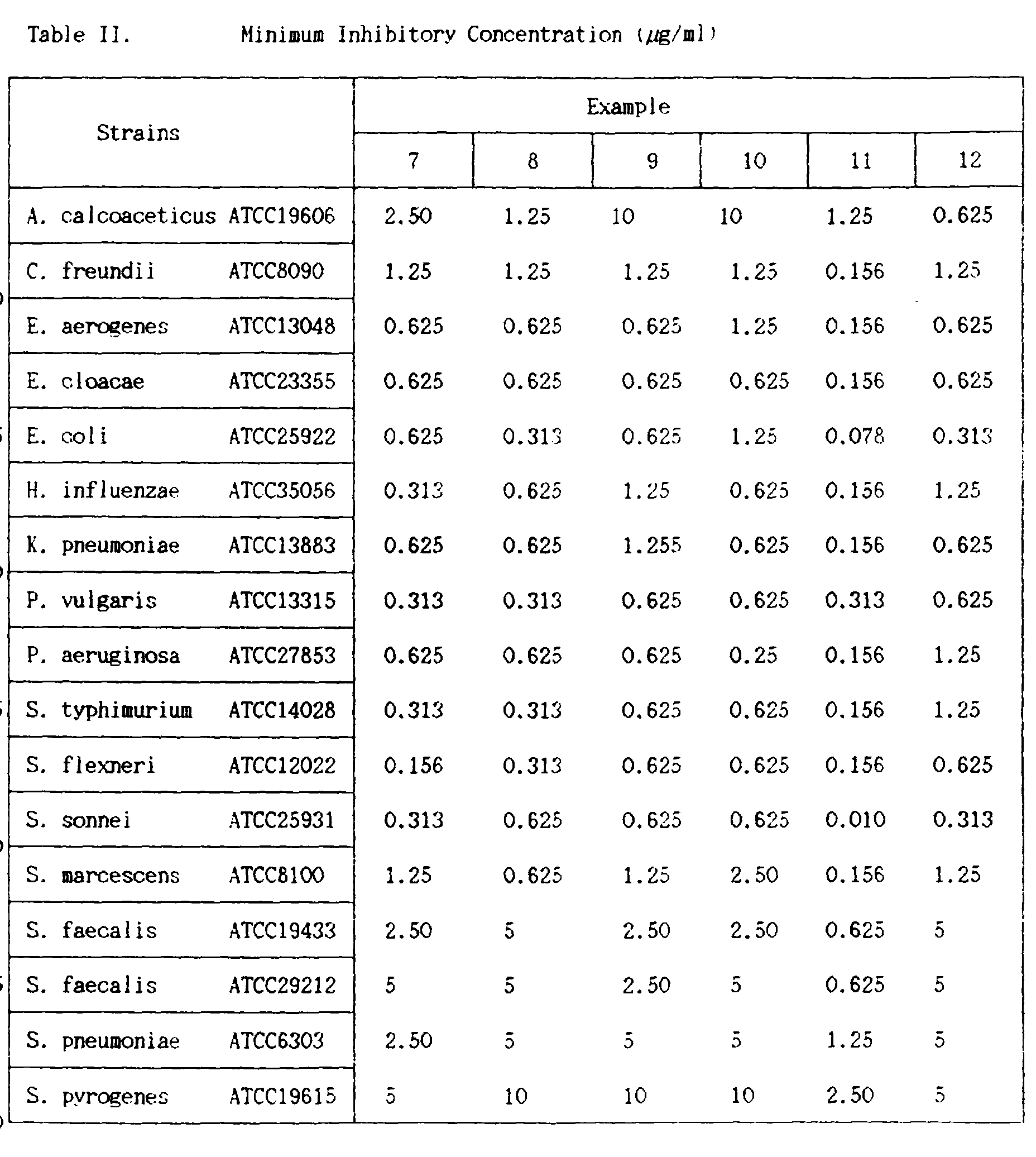
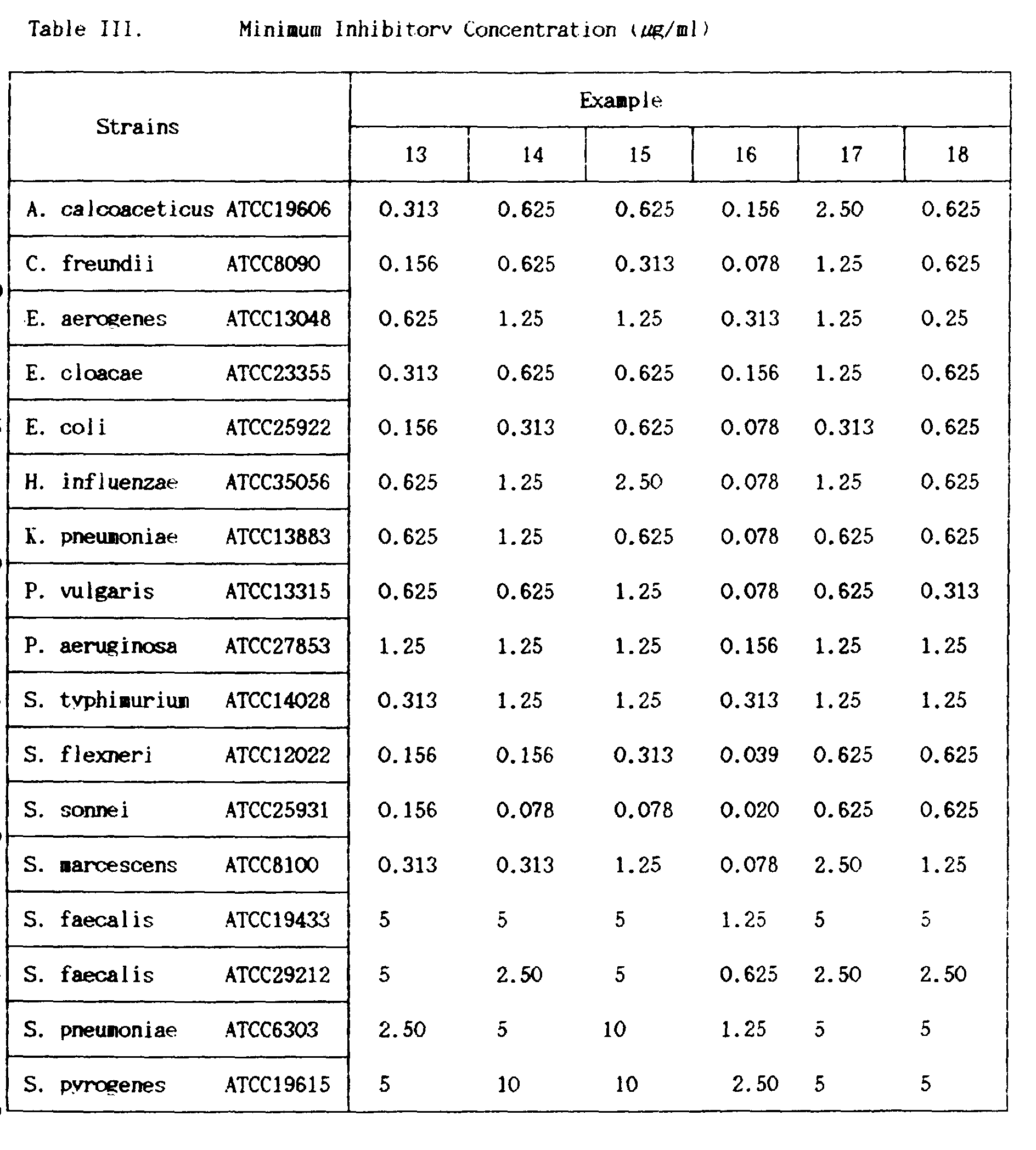

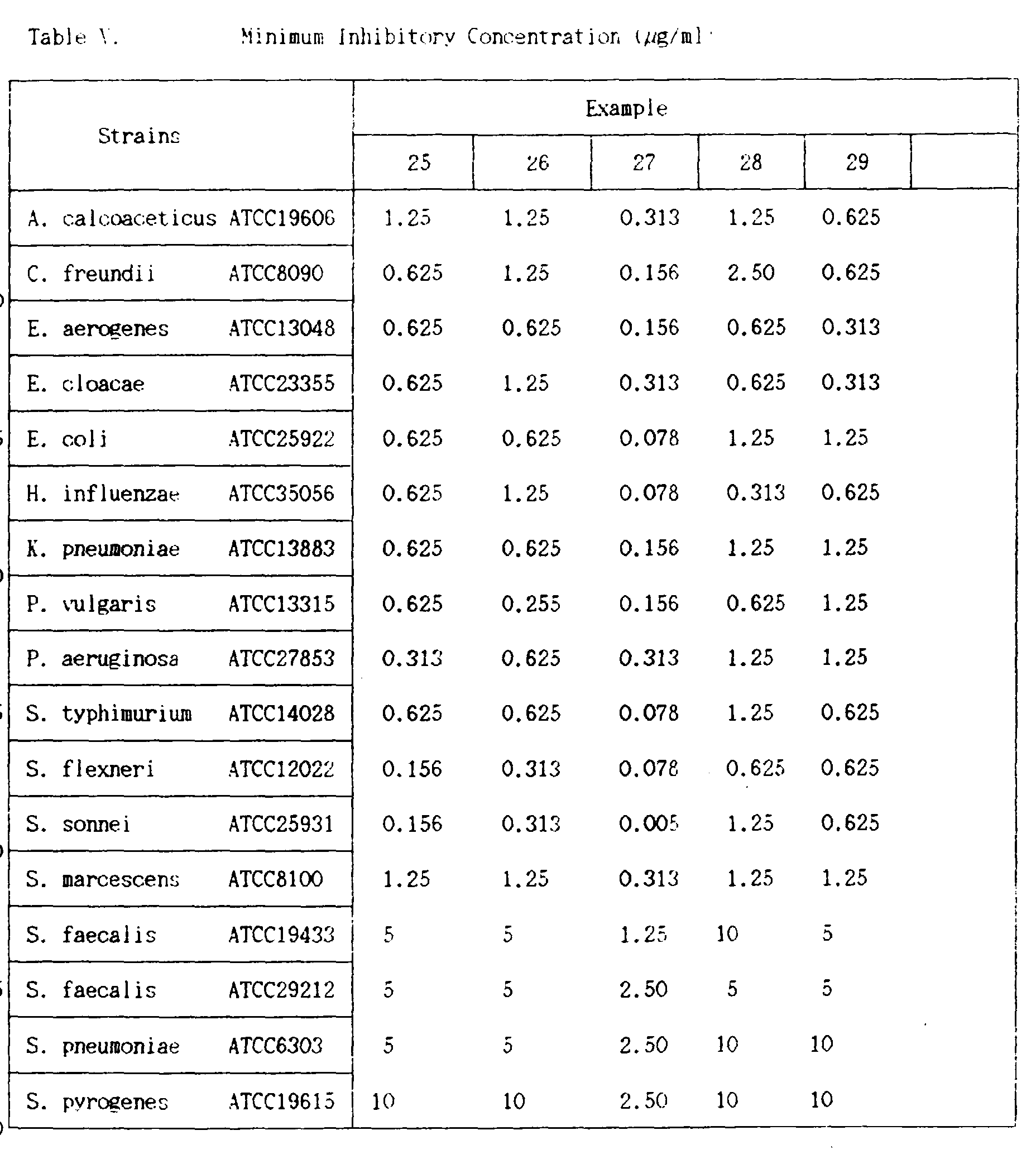
- The followings are the original names for strains in Table I - V.
- Acinetobacter calcoaceticus ATCC 19606
- Citrobacter freundii ATCC 8090
- Enterobacter aerogenes ATCC 13048
- Enterobacter cloacae ATCC 23355
- Escherichia coli ATCC 25922
- Haemophilus influenza ATCC 35056
- Klebsiella pneumoniae ATCC 13883
- Proteus vulgaris ATCC 13315
- Pseudomonas aeruginosa ATCC 27853
- Salmonella typhimurium ATCC 14028
- Shigella flexneri ATCC 12022
- Shigella sonnei ATCC 25931
- Serratia marcescens ATCC 8100
- Streptococcus faecalis ATCC 19433
- Streptococcus faecalis ATCC 29212
- Streptococcus pneumoniae ATCC 6303
- Streptococcus pyrogens ATCC 19615
-
- The pharmacokinetic properties are tested by orally administrating and subcutaneously injecting a test compound and a substance for control to a ICR Mouse with 22g±10% weight, drawing blood after 10, 20, 30, 45, 60, 90, 120, 150, 180 and 240 minutes and analyzed by Bio-Assay(Agar well method).
- The average values from four tests for each compound are recorded in the following Table VI.
Example Route Dose (mg/kg) t1/2 (h) Cmax (µg/ml) Tmax (h) AUC (µg·h/ml) Bioavailability(%) Urine Recovery(%) 13 P.O 40 8.07 11.46 1.12 41.05 73.95 19.59 S.C 40 11.46 8.00 0.81 55.51 30.82 14 P.O 40 3.81 2.12 0.87 12.46 44.00 58.89 S.C 40 7.28 4.28 0.60 28.07 21.10 18 P.O 40 3.44 9.18 0.94 42.24 68.56 28.14 S.C 40 3.15 19.56 1.00 63.45 39.85 19 P.O 40 8.42 3.11 0.87 16.92 72.74 29.00 S.C 40 5.32 5.11 0.87 23.26 48.69 28 P.O 40 7.57 6.36 0.87 62.44 81.28 25.24 S.C 40 7.26 6.94 1.00 76.12 13.36 29 P.O 40 N.D N.D N.D N.D N.D 9.35 S.C 40 2.31 8.34 1.23 32.59 12.80 Ciprofloxacin P.O 40 0.92 1.72 1.47 2.27 14.60 21.10 S.C 40 2.37 7.77 1.56 15.55 61.80 Ofloxacin P.O 40 N.D 9.41 0.75 12.79 89.75 32.20 S.C 40 0.42 12.93 0.42 14.25 39.10 - On the other hand, ciprofloxacin showed that half-life is 0.92, Cmax : 1.71, AUC 2.27, bioavailability : 14.6. Therefore, the compounds of present invention proved to have highly increased in vivo activity by such excellent pharmacokinetic properties.
- The mean values of the ED50 (mg/kg) of the compound of Example 13 and ciprofloxacin showed 25 and >50 respectively against systemic infection in mice caused by S. aureus giorgio organism. Minimum inhibitory concentration (MIC, µg/ml) in vitro of the two compounds mentioned above are o.78 and 0.39 respectively.
- The LD50 of example 13 was about 1,000g/kg and example 18 about > 3,000g/kg. (Oral, mice)
Claims (13)
- Quinolone carboxylic acid derivatives of the formula (I), their pharmaceutically acceptable salts and their hydrates.
 Wherein X is CH or a nitrogen atom,Y is a hydrogen or methyl group,R1 is a hydrogen or alkyl group having 1 to 5 carbon atom,R2 is(wherein A and B is CF or nitrogen atom, provided that, if A=CF, B=N and if A=N, B=CF) and
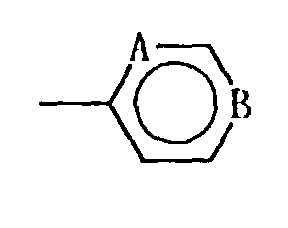 R3 is(wherein R4 is an amino group which makes a racemate or (S)-enantiomer) or
 (wherein R5, R6 and R7 are respectively hydrogen or alkyl group having 1 to 3 carbon atom.).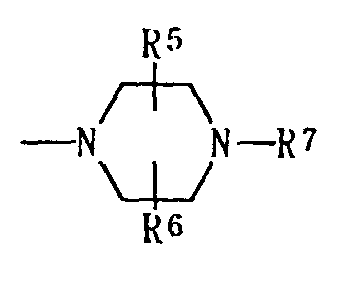
- The compound as claimed in claim 1, corresponding to the following formula (IA), wherein R3 is piperazine derivativeswherein X, Y, R1, R2, R5, R6 and R7 are each as defined in the claim 1.

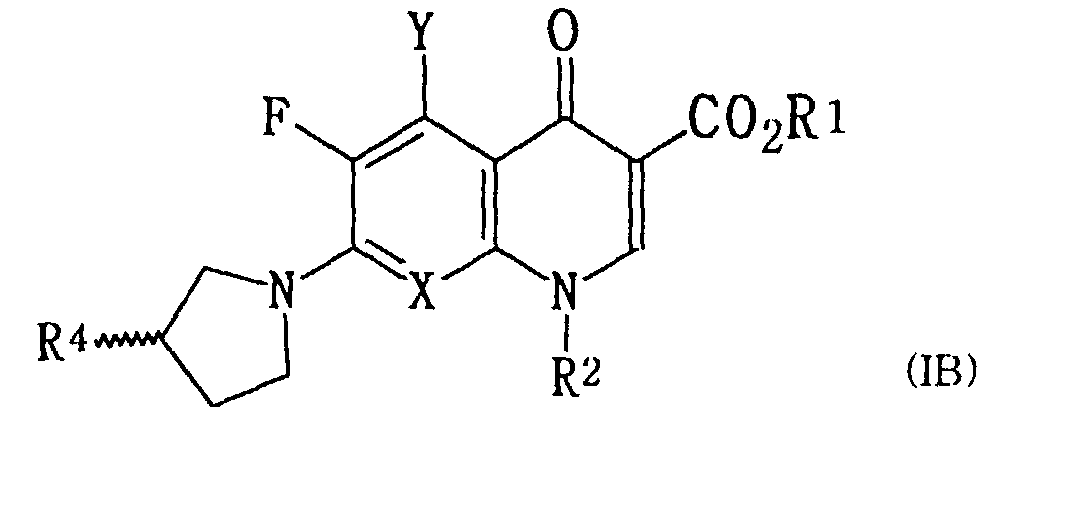
- The compound as claimed in claim 1, corresponding to the following formula (IB), wherein R3 is pyrolidine derivativeswherein X, Y, R1, R2 and R4 are each as defined in the claim 1.
- 1-(5-fluoro-2-pyridyl)-6-fluoro-7-(4-methyl-1-piperazinyl)-1,4-dihydro-4-oxo-1,8-naphthyridine-3-carboxylic acid, according to claim 2.
- 1-(5-fluoro-2-pyridyl)-6-fluoro-7-(3-methyl-1-piperazinyl)-1,4-dihydro-4-oxo-1,8-naphthyridine-3-carboxylic acid, according to claim 2.
- 1-(5-fluoro-2-pyridyl)-6-fluoro-7-(4-methyl-1-piperazinyl)-1,4-dihydro-4-oxoquinoline-3-carboxylic acid, according to claim 2.
- 1-(5-fluoro-2-pyridyl)-6-fluoro-7-(3-methyl-1-piperazinyl)-1,4-dihydro-4-oxoquinoline-3-carboxylic acid, according to claim 2.
- 5-methyl-7-(4-methyl-1-piperazinyl)-1-(5-fluoro-2-pyridyl)-6-fluoro-1,4-dihydro-4-oxoquinoline-3-carboxylic acid, according to claim 2.
- 5-methyl-7-(3-methyl-1-piperazinyl)-1-(5-fluoro-2-pyridyl)-6-fluoro-1,4-dihydro-4-oxoquinoline-3-carboxylic acid, according to claim 2.
- 1-(3-fluoro-4-pyridyl)-6-fluoro-7-[(3S)-3-amino-1-pyrrolidinyl]-1,4-dihydro-4-oxoquinoline-3-carboxylic acid, according to claim 3.
- 1-(5-fluoro-2-pyridyl)-6-fluoro-7-[(3S)-3-amino-1-pyrrolidinyl]-1,4-dihydro-4-oxoquinoline-3-carboxylic acid, according to claim 3.
- A process for preparing the compound of the formula (I) and its pharmaceutically acceptable salts, which comprises the condensation of the compound of the formula (II) and the compound of the formula (VI) in a solvent in the presence of an acid-acceptorwherein X, Y, Z, R1, R2 and R3 are each as described in the claim 1.

- The process according to claim 12, wherein the acid-acceptor is selected from the group consisting of tertiary amines including pyridine, triethylamine and 1,8-diazabicyclo[5.4.0]undec-7-ene and alkali metal carbonates including potassium carbonate, or an excess of the compound of the formula (VI) which is a reactant; and the solvent is selected from the group consisting of pyridine, acetonitrile and N,N-dimethylformamide; and the reaction mixture consisting of 1 to 3 mol of the compound of the formula(VI) per 1 mol of the compound of the formula (II) is subjected to a condensation at a temperature from 0°C to 150 °C depending on the kind of the mother nucleus.
Applications Claiming Priority (4)
| Application Number | Priority Date | Filing Date | Title |
|---|---|---|---|
| KR9315724 | 1993-08-13 | ||
| KR1019930015724A KR0169500B1 (en) | 1993-08-13 | 1993-08-13 | Novel quinolone carboxylic acid derivatives and their preparation method |
| PCT/KR1994/000006 WO1995005373A1 (en) | 1993-08-13 | 1994-01-21 | Novel quinolone carboxylic acid derivatives |
| US08/193,475 US5496947A (en) | 1993-08-13 | 1994-02-08 | Quinolone carboxylic acid derivatives |
Publications (2)
| Publication Number | Publication Date |
|---|---|
| EP0713487A1 EP0713487A1 (en) | 1996-05-29 |
| EP0713487B1 true EP0713487B1 (en) | 2000-04-19 |
Family
ID=26629827
Family Applications (1)
| Application Number | Title | Priority Date | Filing Date |
|---|---|---|---|
| EP94904772A Expired - Lifetime EP0713487B1 (en) | 1993-08-13 | 1994-01-21 | Novel quinolone carboxylic acid derivatives |
Country Status (9)
| Country | Link |
|---|---|
| US (1) | US5496947A (en) |
| EP (1) | EP0713487B1 (en) |
| JP (1) | JP2758722B2 (en) |
| CN (1) | CN1041202C (en) |
| AU (1) | AU679961B2 (en) |
| BR (1) | BR9407283A (en) |
| CA (1) | CA2168764C (en) |
| HU (1) | HU216803B (en) |
| WO (1) | WO1995005373A1 (en) |
Families Citing this family (12)
| Publication number | Priority date | Publication date | Assignee | Title |
|---|---|---|---|---|
| DE4342186A1 (en) * | 1993-12-10 | 1995-06-14 | Bayer Ag | One-pot process for the production of 3-quinolonecarboxylic acid derivatives |
| RU2171252C2 (en) * | 1995-09-22 | 2001-07-27 | Вакунага Фармасьютикал КО., Лтд. | Amino compounds for preparing novel derivatives of pyridone-carboxylic acid and salts thereof |
| JP3280388B2 (en) | 1997-06-26 | 2002-05-13 | ドング ホワ ファーマシューチカル インダストリアル カンパニー,リミテッド | Quinolonecarboxylic acid derivatives |
| CA2367373C (en) | 1999-03-17 | 2011-09-20 | Daiichi Pharmaceutical Co., Ltd. | Medicinal compositions |
| CA2376760C (en) * | 1999-07-01 | 2008-11-25 | Wakunaga Pharmaceutical Co., Ltd. | Quinolinecarboxylic acid derivative or salts thereof |
| US20050239061A1 (en) * | 2000-03-01 | 2005-10-27 | Marshall William S | Identification and use of effectors and allosteric molecules for the alteration of gene expression |
| PL1776109T3 (en) | 2004-08-13 | 2009-06-30 | Schering Plough Ltd | Pharmaceutical formulation comprising an antibiotic, a triazole and a corticosteroid |
| CR20170566A (en) | 2015-06-09 | 2018-03-20 | Bayer Pharma AG | POSITIVE ALLOSTERIC MODULATORS OF THE M2 MUSCARINIC RECEIVER |
| CN109689654A (en) | 2016-07-11 | 2019-04-26 | 拜耳医药股份有限公司 | 7-Substituted 1-pyridyl-naphthyridine-3-carboxamides and their uses |
| JOP20190045A1 (en) * | 2016-09-14 | 2019-03-14 | Bayer Ag | Amide-1-aryl-naphthridine-3-carboxylic acid amide compounds are substituted at position 7 and used. |
| EP3296298A1 (en) * | 2016-09-14 | 2018-03-21 | Bayer Pharma Aktiengesellschaft | 7-substituted 1-aryl-naphthyridin-3-carboxamides and their use |
| EA038451B1 (en) * | 2016-12-06 | 2021-08-30 | Байер Акциенгезельшафт | 7-substituted 1-aryl-naphthyridine-3-carboxylic acid amides and use thereof |
Citations (1)
| Publication number | Priority date | Publication date | Assignee | Title |
|---|---|---|---|---|
| JPS6233176A (en) * | 1985-08-05 | 1987-02-13 | Toyama Chem Co Ltd | 1,4-dihydro-4-oxonaphthyridine derivative and salt thereof |
Family Cites Families (17)
| Publication number | Priority date | Publication date | Assignee | Title |
|---|---|---|---|---|
| JPS53141286A (en) * | 1977-05-16 | 1978-12-08 | Kyorin Seiyaku Kk | Novel substituted quinolinecarboxylic acid |
| US4670444B1 (en) * | 1980-09-03 | 1999-02-09 | Bayer Ag | and-naphthyridine-3-carboxylic acids and antibacte7-amino-1-cyclopropyl-4-oxo-1,4-dihydro-quinoline-rial agents containing these compounds |
| US4620007A (en) * | 1980-09-03 | 1986-10-28 | Bayer Aktiengesellschaft | 6-fluoro-7-chloro-1-cyclopropyl-4-oxo-1,4-dihydro-quinoline-3-carboxylic acid |
| DE3318145A1 (en) * | 1983-05-18 | 1984-11-22 | Bayer Ag, 5090 Leverkusen | 7-AMINO-1-CYCLOPROPYL-6,8-DIFLUOR-1,4-DIHYDRO-4-OXO-3-CHINOLINE CARBONIC ACIDS, METHOD FOR THE PRODUCTION THEREOF AND THEIR CONTAINING ANTIBACTERIAL AGENTS |
| NZ208470A (en) * | 1983-07-18 | 1988-06-30 | Abbott Lab | 6-fluoro-1,4-dihydro-4-oxo-quinoline-3-carboxylic acid derivatives and antibacterial compositions containing such |
| JPS60237069A (en) * | 1984-04-19 | 1985-11-25 | Toyama Chem Co Ltd | 1,4-dihydro-4-oxoquinoline derivative and its salt |
| JPS6193949A (en) * | 1984-10-15 | 1986-05-12 | Hitachi Ltd | Eddy current inspection device |
| JPS62174053A (en) * | 1984-11-14 | 1987-07-30 | Otsuka Pharmaceut Co Ltd | Benzoheterocyclic compound and antibacterial agent containing same |
| JPS61152682A (en) * | 1984-12-27 | 1986-07-11 | Dainippon Pharmaceut Co Ltd | Pyridonecarboxylic acid derivative, its ester and salt |
| AT392789B (en) * | 1985-01-23 | 1991-06-10 | Toyama Chemical Co Ltd | METHOD FOR PRODUCING 1-SUBSTITUTED ARYL-1,4-DIHYDRO-4-OXONAPHTHYRIDINE DERIVATIVES |
| US4617308A (en) * | 1985-01-25 | 1986-10-14 | Warner-Lambert Company | 7-substituted amino-1-aryl-6,8-difluoro-1,4-dihydro-4-oxo-3-quinolinecarboxylic acids and derivatives thereof as antibacterial agents |
| JPS61251667A (en) * | 1985-04-30 | 1986-11-08 | Otsuka Pharmaceut Co Ltd | Benzo-heterocyclic compound |
| DE3517535A1 (en) * | 1985-05-15 | 1986-11-20 | Bayer Ag, 5090 Leverkusen | 1-ARYL-4-CHINOLON-3-CARBONIC ACIDS |
| JP2704428B2 (en) * | 1988-06-15 | 1998-01-26 | 富山化学工業株式会社 | Quinolonecarboxylic acid derivative or salt thereof |
| NZ229605A (en) * | 1988-07-15 | 1990-07-26 | Abbott Lab | Preparation of 1,4-dihydro-6-fluoro-7-(piperazin-1-yl)-4-oxo-3-quinoline (or naphthyridine) carboxylic acid derivatives |
| AU5123690A (en) * | 1989-03-13 | 1990-09-13 | Bristol-Myers Squibb Company | 5-substituted-1,4-dihydro-4-oxo-nephthyridine-3-carboxylate antibacterial agents |
| DE3918544A1 (en) * | 1989-06-07 | 1990-12-13 | Bayer Ag | METHOD FOR PRODUCING 7- (3-AMINO AND 3-AMINO-METHYL-1-PYRROLIDINYL) -3-CHINOLONIC CARBONIC ACIDS AND -NAPHTHYRIDONE CARBONIC ACIDS |
-
1994
- 1994-01-21 AU AU58666/94A patent/AU679961B2/en not_active Ceased
- 1994-01-21 CN CN94193069A patent/CN1041202C/en not_active Expired - Fee Related
- 1994-01-21 BR BR9407283A patent/BR9407283A/en not_active Application Discontinuation
- 1994-01-21 EP EP94904772A patent/EP0713487B1/en not_active Expired - Lifetime
- 1994-01-21 JP JP7506869A patent/JP2758722B2/en not_active Expired - Lifetime
- 1994-01-21 CA CA002168764A patent/CA2168764C/en not_active Expired - Fee Related
- 1994-01-21 HU HU9600322A patent/HU216803B/en not_active IP Right Cessation
- 1994-01-21 WO PCT/KR1994/000006 patent/WO1995005373A1/en not_active Ceased
- 1994-02-08 US US08/193,475 patent/US5496947A/en not_active Expired - Fee Related
Patent Citations (1)
| Publication number | Priority date | Publication date | Assignee | Title |
|---|---|---|---|---|
| JPS6233176A (en) * | 1985-08-05 | 1987-02-13 | Toyama Chem Co Ltd | 1,4-dihydro-4-oxonaphthyridine derivative and salt thereof |
Non-Patent Citations (1)
| Title |
|---|
| CHEMICAL ABSTRACTS, vol. 106, no. 25, 22 June 1987, Columbus, Ohio, US; abstract no. 213923X, HIROKAZU ET AL.: "Preparation of 6-Fluoro-1,4-dihydro-4-oxo-1,8-naphthyridine-3-carboxylates as bactericides" page 662; column 1; * |
Also Published As
| Publication number | Publication date |
|---|---|
| CN1128995A (en) | 1996-08-14 |
| JPH09500143A (en) | 1997-01-07 |
| JP2758722B2 (en) | 1998-05-28 |
| WO1995005373A1 (en) | 1995-02-23 |
| HU9600322D0 (en) | 1996-04-29 |
| CA2168764C (en) | 2000-01-18 |
| AU679961B2 (en) | 1997-07-17 |
| HUT75640A (en) | 1997-05-28 |
| AU5866694A (en) | 1995-03-14 |
| CN1041202C (en) | 1998-12-16 |
| HU216803B (en) | 1999-08-30 |
| BR9407283A (en) | 1996-10-01 |
| US5496947A (en) | 1996-03-05 |
| EP0713487A1 (en) | 1996-05-29 |
| CA2168764A1 (en) | 1995-02-23 |
Similar Documents
| Publication | Publication Date | Title |
|---|---|---|
| EP0132845B1 (en) | Novel 1,8-naphthyridine derivatives, and process for preparation thereof | |
| RU2177945C1 (en) | Derivative of pyridone carboxylic acid or its salt | |
| JP2742248B2 (en) | Novel quinolinecarboxylic acid derivative having 7- (4-aminomethyl-3-oxime) pyrrolidine substituent and method for producing the same | |
| US5091384A (en) | Anti-bacterial quinolone- and naphthyridone-carboxylic acid compounds | |
| JP2844079B2 (en) | Pyridonecarboxylic acid antibacterial agent | |
| FI113652B (en) | New quinolone or naphthyridonicarboxylic acid derivatives or their salts | |
| EP0390215B1 (en) | Quinolone derivatives and salts thereof, preparation process es thereof, and antibacterial agents containing the same | |
| CS246065B2 (en) | Method of new 7-substituted cyclic aminonaphthyridine-,quinoline-and benzoxazinecarboxylic acids production | |
| EP0690862B1 (en) | Quinolone derivatives and processes for preparing the same | |
| IL75021A (en) | 1-(2, 4-difluorophenyl)-6-fluoro-7- halo-1,4-dihydro-4-oxo-1,8-naphthydridine-3-carboxylic acid and esters thereof | |
| AU679961B2 (en) | Novel quinolone carboxylic acid derivatives | |
| CA1339373C (en) | 6-7-disubstituted 1-cyclopropyl-1,4-dihydro-4-oxo-1,8-naphthyridine-3-c arboxylic acids | |
| US6586604B2 (en) | Tricyclic amine derivatives | |
| US5409933A (en) | Quinoline derivatives and processes for preparing the same | |
| EP0549857A1 (en) | Antibacterial quinolone carboxylic acid derivatives | |
| US20210221832A1 (en) | Substituted pyridoindoles for the treatment and prophylaxis of bacterial infection | |
| DK169786B1 (en) | 7- (2-methyl-4-aminopyrrolidinyl) -naphthyridine and quinoline compounds, antibacterial agents containing them, and use of the compounds for the preparation of a drug for the treatment of a bacterial infection | |
| RU2120941C1 (en) | Derivatives of quinolone carboxylic acid or their pharmaceutically acceptable salt | |
| JP2704428B2 (en) | Quinolonecarboxylic acid derivative or salt thereof | |
| KR0174373B1 (en) | Novel quinoline carboxylic acid derivatives having 7- (4-aminomethyl-4-alkyl-3-alkyloxime) pyrrolidine substituents and methods for their preparation | |
| KR970001159B1 (en) | Novel 1.8-naphtyridine derivatives and their process for preparing them | |
| US7713997B2 (en) | Pyridonecarboxylic acid derivatives or salts thereof | |
| EP1193266B1 (en) | Quinolinecarboxylic acid derivative or salts thereof | |
| JPH07300472A (en) | Novel quinolonecarboxylic acid derivative and method for producing the same | |
| JPH05345777A (en) | 7- (4,4-dialkyl-3-amino-substituted pyrrolidinyl) quinolone-3-carboxylic acid derivative |
Legal Events
| Date | Code | Title | Description |
|---|---|---|---|
| PUAI | Public reference made under article 153(3) epc to a published international application that has entered the european phase |
Free format text: ORIGINAL CODE: 0009012 |
|
| 17P | Request for examination filed |
Effective date: 19960307 |
|
| AK | Designated contracting states |
Kind code of ref document: A1 Designated state(s): AT BE CH DE DK ES FR GB IT LI NL PT SE |
|
| 17Q | First examination report despatched |
Effective date: 19980814 |
|
| GRAG | Despatch of communication of intention to grant |
Free format text: ORIGINAL CODE: EPIDOS AGRA |
|
| GRAG | Despatch of communication of intention to grant |
Free format text: ORIGINAL CODE: EPIDOS AGRA |
|
| GRAH | Despatch of communication of intention to grant a patent |
Free format text: ORIGINAL CODE: EPIDOS IGRA |
|
| GRAH | Despatch of communication of intention to grant a patent |
Free format text: ORIGINAL CODE: EPIDOS IGRA |
|
| GRAA | (expected) grant |
Free format text: ORIGINAL CODE: 0009210 |
|
| AK | Designated contracting states |
Kind code of ref document: B1 Designated state(s): AT BE CH DE DK ES FR GB IT LI NL PT SE |
|
| PG25 | Lapsed in a contracting state [announced via postgrant information from national office to epo] |
Ref country code: NL Free format text: LAPSE BECAUSE OF FAILURE TO SUBMIT A TRANSLATION OF THE DESCRIPTION OR TO PAY THE FEE WITHIN THE PRESCRIBED TIME-LIMIT Effective date: 20000419 Ref country code: LI Free format text: LAPSE BECAUSE OF FAILURE TO SUBMIT A TRANSLATION OF THE DESCRIPTION OR TO PAY THE FEE WITHIN THE PRESCRIBED TIME-LIMIT Effective date: 20000419 Ref country code: ES Free format text: THE PATENT HAS BEEN ANNULLED BY A DECISION OF A NATIONAL AUTHORITY Effective date: 20000419 Ref country code: CH Free format text: LAPSE BECAUSE OF FAILURE TO SUBMIT A TRANSLATION OF THE DESCRIPTION OR TO PAY THE FEE WITHIN THE PRESCRIBED TIME-LIMIT Effective date: 20000419 Ref country code: BE Free format text: LAPSE BECAUSE OF FAILURE TO SUBMIT A TRANSLATION OF THE DESCRIPTION OR TO PAY THE FEE WITHIN THE PRESCRIBED TIME-LIMIT Effective date: 20000419 Ref country code: AT Free format text: LAPSE BECAUSE OF FAILURE TO SUBMIT A TRANSLATION OF THE DESCRIPTION OR TO PAY THE FEE WITHIN THE PRESCRIBED TIME-LIMIT Effective date: 20000419 |
|
| REF | Corresponds to: |
Ref document number: 191911 Country of ref document: AT Date of ref document: 20000515 Kind code of ref document: T |
|
| REG | Reference to a national code |
Ref country code: CH Ref legal event code: EP |
|
| ET | Fr: translation filed | ||
| REF | Corresponds to: |
Ref document number: 69424052 Country of ref document: DE Date of ref document: 20000525 |
|
| ITF | It: translation for a ep patent filed | ||
| PG25 | Lapsed in a contracting state [announced via postgrant information from national office to epo] |
Ref country code: SE Free format text: LAPSE BECAUSE OF FAILURE TO SUBMIT A TRANSLATION OF THE DESCRIPTION OR TO PAY THE FEE WITHIN THE PRESCRIBED TIME-LIMIT Effective date: 20000719 Ref country code: PT Free format text: LAPSE BECAUSE OF FAILURE TO SUBMIT A TRANSLATION OF THE DESCRIPTION OR TO PAY THE FEE WITHIN THE PRESCRIBED TIME-LIMIT Effective date: 20000719 Ref country code: DK Free format text: LAPSE BECAUSE OF FAILURE TO SUBMIT A TRANSLATION OF THE DESCRIPTION OR TO PAY THE FEE WITHIN THE PRESCRIBED TIME-LIMIT Effective date: 20000719 |
|
| NLV1 | Nl: lapsed or annulled due to failure to fulfill the requirements of art. 29p and 29m of the patents act | ||
| REG | Reference to a national code |
Ref country code: CH Ref legal event code: PL |
|
| PLBE | No opposition filed within time limit |
Free format text: ORIGINAL CODE: 0009261 |
|
| STAA | Information on the status of an ep patent application or granted ep patent |
Free format text: STATUS: NO OPPOSITION FILED WITHIN TIME LIMIT |
|
| 26N | No opposition filed | ||
| REG | Reference to a national code |
Ref country code: GB Ref legal event code: IF02 |
|
| PGFP | Annual fee paid to national office [announced via postgrant information from national office to epo] |
Ref country code: DE Payment date: 20020322 Year of fee payment: 9 |
|
| PGFP | Annual fee paid to national office [announced via postgrant information from national office to epo] |
Ref country code: GB Payment date: 20020509 Year of fee payment: 9 |
|
| PGFP | Annual fee paid to national office [announced via postgrant information from national office to epo] |
Ref country code: FR Payment date: 20020624 Year of fee payment: 9 |
|
| PG25 | Lapsed in a contracting state [announced via postgrant information from national office to epo] |
Ref country code: GB Free format text: LAPSE BECAUSE OF NON-PAYMENT OF DUE FEES Effective date: 20030121 |
|
| PG25 | Lapsed in a contracting state [announced via postgrant information from national office to epo] |
Ref country code: DE Free format text: LAPSE BECAUSE OF NON-PAYMENT OF DUE FEES Effective date: 20030801 |
|
| GBPC | Gb: european patent ceased through non-payment of renewal fee | ||
| PG25 | Lapsed in a contracting state [announced via postgrant information from national office to epo] |
Ref country code: FR Free format text: LAPSE BECAUSE OF NON-PAYMENT OF DUE FEES Effective date: 20030930 |
|
| REG | Reference to a national code |
Ref country code: FR Ref legal event code: ST |
|
| PG25 | Lapsed in a contracting state [announced via postgrant information from national office to epo] |
Ref country code: IT Free format text: LAPSE BECAUSE OF NON-PAYMENT OF DUE FEES;WARNING: LAPSES OF ITALIAN PATENTS WITH EFFECTIVE DATE BEFORE 2007 MAY HAVE OCCURRED AT ANY TIME BEFORE 2007. THE CORRECT EFFECTIVE DATE MAY BE DIFFERENT FROM THE ONE RECORDED. Effective date: 20050121 |