EP0712906A2 - Phthalocyanine monoazo compounds and a process for producing the same - Google Patents
Phthalocyanine monoazo compounds and a process for producing the same Download PDFInfo
- Publication number
- EP0712906A2 EP0712906A2 EP95307847A EP95307847A EP0712906A2 EP 0712906 A2 EP0712906 A2 EP 0712906A2 EP 95307847 A EP95307847 A EP 95307847A EP 95307847 A EP95307847 A EP 95307847A EP 0712906 A2 EP0712906 A2 EP 0712906A2
- Authority
- EP
- European Patent Office
- Prior art keywords
- group
- unsubstituted
- substituted
- atom
- lower alkyl
- Prior art date
- Legal status (The legal status is an assumption and is not a legal conclusion. Google has not performed a legal analysis and makes no representation as to the accuracy of the status listed.)
- Ceased
Links
- YOMIKGALCDHAJI-UHFFFAOYSA-N Cc(c(C)c1)cc(C)c1S(=O)=O Chemical compound Cc(c(C)c1)cc(C)c1S(=O)=O YOMIKGALCDHAJI-UHFFFAOYSA-N 0.000 description 1
- PRMIRTIFBDQSHH-UHFFFAOYSA-N Cc(c(OC)c1)ccc1S(=O)=O Chemical compound Cc(c(OC)c1)ccc1S(=O)=O PRMIRTIFBDQSHH-UHFFFAOYSA-N 0.000 description 1
- NARFKFLZUACUBH-UHFFFAOYSA-N Cc(cc(C)c(S(=O)=O)c1)c1OC Chemical compound Cc(cc(C)c(S(=O)=O)c1)c1OC NARFKFLZUACUBH-UHFFFAOYSA-N 0.000 description 1
- BJBKOVWDSRNLGB-UHFFFAOYSA-N Cc(cc(c(S(=O)=O)c1)OC)c1OC Chemical compound Cc(cc(c(S(=O)=O)c1)OC)c1OC BJBKOVWDSRNLGB-UHFFFAOYSA-N 0.000 description 1
- VMBAUQZYJZISFO-UHFFFAOYSA-N Cc(cc1)ccc1S(=O)=O Chemical compound Cc(cc1)ccc1S(=O)=O VMBAUQZYJZISFO-UHFFFAOYSA-N 0.000 description 1
- BJOLNTWWAPQUKK-UHFFFAOYSA-N Cc(ccc(S(=O)=O)c1)c1S(O)(=O)=O Chemical compound Cc(ccc(S(=O)=O)c1)c1S(O)(=O)=O BJOLNTWWAPQUKK-UHFFFAOYSA-N 0.000 description 1
- APLISCZNDMAXMS-UHFFFAOYSA-N Cc(ccc1c2ccc(S(=O)=O)c1)c2S(O)(=O)=O Chemical compound Cc(ccc1c2ccc(S(=O)=O)c1)c2S(O)(=O)=O APLISCZNDMAXMS-UHFFFAOYSA-N 0.000 description 1
- 0 Cc1c(*)cccc1 Chemical compound Cc1c(*)cccc1 0.000 description 1
- ACSXNQVAJHDCBG-UHFFFAOYSA-N Cc1cc(S(=O)=O)ccc1 Chemical compound Cc1cc(S(=O)=O)ccc1 ACSXNQVAJHDCBG-UHFFFAOYSA-N 0.000 description 1
- HGKOMBZZRJLNPR-UHFFFAOYSA-N Cc1cc(S(=O)=O)ccc1OC Chemical compound Cc1cc(S(=O)=O)ccc1OC HGKOMBZZRJLNPR-UHFFFAOYSA-N 0.000 description 1
- DVKWNWDRVVSXID-UHFFFAOYSA-N Cc1cc(S(=O)=O)ccc1S(O)(=O)=O Chemical compound Cc1cc(S(=O)=O)ccc1S(O)(=O)=O DVKWNWDRVVSXID-UHFFFAOYSA-N 0.000 description 1
Classifications
-
- C—CHEMISTRY; METALLURGY
- C09—DYES; PAINTS; POLISHES; NATURAL RESINS; ADHESIVES; COMPOSITIONS NOT OTHERWISE PROVIDED FOR; APPLICATIONS OF MATERIALS NOT OTHERWISE PROVIDED FOR
- C09B—ORGANIC DYES OR CLOSELY-RELATED COMPOUNDS FOR PRODUCING DYES, e.g. PIGMENTS; MORDANTS; LAKES
- C09B62/00—Reactive dyes, i.e. dyes which form covalent bonds with the substrates or which polymerise with themselves
- C09B62/44—Reactive dyes, i.e. dyes which form covalent bonds with the substrates or which polymerise with themselves with the reactive group not directly attached to a heterocyclic ring
- C09B62/4401—Reactive dyes, i.e. dyes which form covalent bonds with the substrates or which polymerise with themselves with the reactive group not directly attached to a heterocyclic ring with two or more reactive groups at least one of them being directly attached to a heterocyclic system and at least one of them being directly attached to a non-heterocyclic system
- C09B62/4403—Reactive dyes, i.e. dyes which form covalent bonds with the substrates or which polymerise with themselves with the reactive group not directly attached to a heterocyclic ring with two or more reactive groups at least one of them being directly attached to a heterocyclic system and at least one of them being directly attached to a non-heterocyclic system the heterocyclic system being a triazine ring
-
- C—CHEMISTRY; METALLURGY
- C09—DYES; PAINTS; POLISHES; NATURAL RESINS; ADHESIVES; COMPOSITIONS NOT OTHERWISE PROVIDED FOR; APPLICATIONS OF MATERIALS NOT OTHERWISE PROVIDED FOR
- C09B—ORGANIC DYES OR CLOSELY-RELATED COMPOUNDS FOR PRODUCING DYES, e.g. PIGMENTS; MORDANTS; LAKES
- C09B62/00—Reactive dyes, i.e. dyes which form covalent bonds with the substrates or which polymerise with themselves
- C09B62/44—Reactive dyes, i.e. dyes which form covalent bonds with the substrates or which polymerise with themselves with the reactive group not directly attached to a heterocyclic ring
- C09B62/503—Reactive dyes, i.e. dyes which form covalent bonds with the substrates or which polymerise with themselves with the reactive group not directly attached to a heterocyclic ring the reactive group being an esterified or non-esterified hydroxyalkyl sulfonyl or mercaptoalkyl sulfonyl group, a quaternised or non-quaternised aminoalkyl sulfonyl group, a heterylmercapto alkyl sulfonyl group, a vinyl sulfonyl or a substituted vinyl sulfonyl group, or a thiophene-dioxide group
Definitions
- the present invention relates to a fiber-reactive phthalocyanine monoazo compound and a process for producing the same.
- the compounds are suitable for using as a fiber-reactive green dye for a conventional dyeing or printing process.
- Phthalocyanine monoazo compounds usable for dyeing fiber materials in green color are described in JP-A-1-22l460, JP-A-2-115276, JP-A-4-261 470, etc.
- the present inventors have conducted extensive studies to solve the problems of the conventional dye such as the difference in affinity and diffusion property and to develop a novel compound usable for dyeing fiber materials in green color which is satisfactory in evenness of dyeing, dyeing reproducibility, build-up property, fastness and other widely demanded properties as dyes.
- a specific kind of phthalocyanine monoazo compound has excellent properties and the present invention was accomplished.
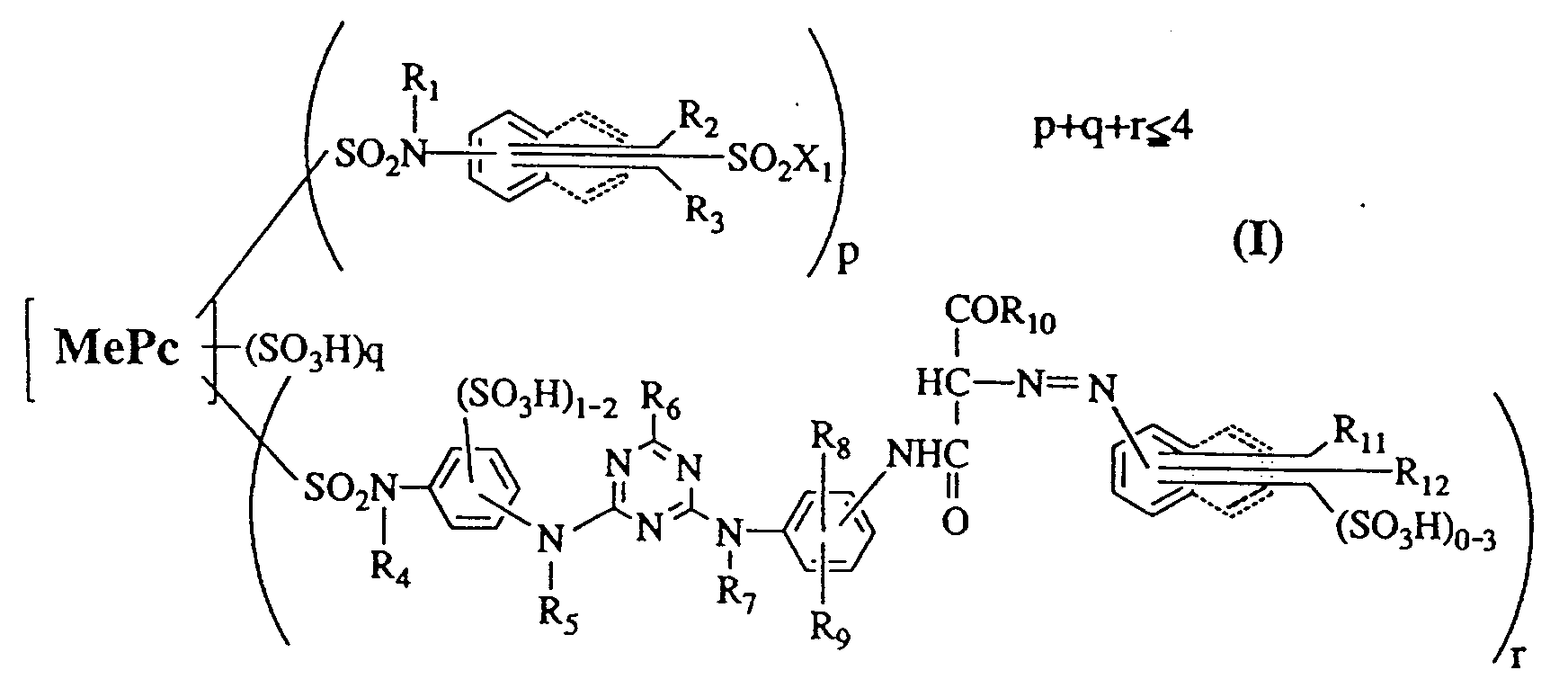
- Compound (I) which is represented by the following general formula (I):
- the term lower means that a group has about 4 or less carbon atoms, and alkyl groups or moieties are straight or branched chain unless otherwise mentioned.
- alkyl groups When alkyl groups are substituted they preferably carry one or two substituents, more preferably one substituent.
- groups which can be a substituent in the substituted lower alkyl group a hydroxy group, a cyano group, an alkoxy group, a halogen atom, a carboxy group, a carbamoyl group, an alkoxycarbonyl group, an alkylcarbonyloxy group, a sulfo group, and a sulfamoyl group are preferred.
- Examples of the lower alkyl group which may be substituted in the formula (I) include a methyl group, an ethyl group, a n-propyl group, an isopropyl group, a n-butyl group, an isobutyl group, a sec-butyl group, a 2-hydroxyethyl group, a 2-hydroxypropyl group, a 3-hydroxypropyl group, a 2-hydroxybutyl group, a 3-hydroxybutyl group, a 4-hydroxybutyl group, a 2,3-dihydroxypropyl group, a 3,4-dihydroxybutyl group, a cyanomethyl group, a 2-cyanoethyl group, a 3-cyanopropyl group, a methoxymethyl group, an ethoxymethyl group, a 2-methoxyethyl group, a 2-ethoxyethyl group, a 3-methoxypropyl group, a 3-ethoxypropyl group, a 2-
- examples of the lower alkylamino group which may be substituted include a methylamino group, an ethylamino group, an isopropylamino group, a n-propylamino group, a n-butylamino group, a sec-butylamino group and an isobutylamino group each of which may be substituted by a lower alkoxy group, a carboxy group, a sulfo group or a lower alkoxycarbonyl group, and the like.
- examples of the saturated nitrogen-containing heterocyclic group include a morpholino group, a piperidino group and a piperazino group.
- examples of the group removable by the action of an alkali represented by "Y" include a sulfato group, a thiosulfato group, a phosphato group, a group OCOCH3, a chloro group, a fluoro group and a bromo group, among which the sulfato group and the chloro group are preferred.
- Nickel and copper are preferred as Me in the formula (I) and a hydrogen atom, a methyl group and an ethyl group are preferred as R1 in the formula (I).
- a hydrogen atom and a sulfo group are preferred as R2 or R3 in the formula (I) and as examples of the phenylene or naphthylene substituted by R2 and R3, following can be mentioned: wherein X1 has the same meaning as defined above.
- a hydrogen atom, methyl group and ethyl group are preferred as R4, R5 or R7 in the formula (I).
- R8 or R9 in the formula (I) a methyl group, an ethyl group, a methoxy group and a sulfo group are preferred and a methoxy group and a sulfo group are more preferred.
- the position on which the acetoacetanilide monoazo residue is located in the phenylene group substituted by R8 and R9 is preferably 3- or 4- position against -NR7 and more preferably 4- position.
- R10 is preferably a methyl group or an ethyl group, and more preferably a methyl group.
- R11 or R12 in the formula (I) a methyl group, an ethyl group and a hydrogen atom are preferred.
- Compound (I) when Compound (I) is in the form of a salt, kind of the cation accompanied by the sulfo group or by the carboxy group, if any, is not limited.
- the cation may be any one of non-chromophoric cations usual in the field of fiber-reacting dyes, in so far as the corresponding salt is water soluble.
- Examples of such cations include alkali metal cations such as a lithium, sodium and potassium cation, an unsubstituted ammonium cation and substituted ammonium cations such as a mono-, di-, tri-, or tetra-methylammonium, triethylammonium and mono-, di- or triethanolammonium cation.
- alkali metal cations such as a lithium, sodium and potassium cation
- an unsubstituted ammonium cation and substituted ammonium cations such as a mono-, di-, tri-, or tetra-methylammonium, triethylammonium and mono-, di- or triethanolammonium cation.
- the cations attached to the sulfo groups and those attached to the carboxy group, if any, may be the same or different and may be a mixture of cations such as the above listed cations. That is, Compound (I) may be in the form of a mixed salt.
- Compound (I) can be produced, for example, by the following process. This process comprises condensing, in any optional order;
- Examples of the unsubstituted or substituted lower alkylamino group represented by R6' include a methylamino group, an ethylamino group, an isopropylamino group, a n-propylamino group, a n-butylamino group, a sec-butylamino group and an isobutylamino group each of which is unsubstituted or substituted by, for example, a lower alkoxy group, a carboxy group, a sulfo group or a lower alkoxycarbonyl group.
- Examples of the saturated nitrogen-containing heterocyclic group represented by R6' include a morpholino group, a piperidino group and a piperazino group.
- Examples of the unsubstituted or substituted phenylamino group represented by R6' include groups listed above as examples of substituted phenylamino groups represented by R6.
- Examples of the lower alkoxy group represented by R6' include a methoxy group, an ethoxy group, an isopropoxy group, a n-propoxy group, a n-butoxy group, a sec-butoxy group and an isobutoxy group.
- the order of the condensation reaction of 2,4,6-trihalogeno-s-triazine with other raw materials is not particularly limited.
- the reaction conditions are not limited particularly, usually the condensation reaction of the unsubstituted 2,4,6-trihalogeno-s-triazine is conducted at the reaction temperature in a range of -10 °C to 40 °C and the pH in a range of 2 to 9, the condensation reaction of the monosubstituted halogeno-s-triazine is conducted at the temperature in a range of 0 °C to 70°C and the pH in a range of 2 to 9 and the condensation reaction of the disubstituted halogeno-s-triazine is conducted at the temperature in a range of 10°C to 100 °C and the pH in a range of 2 to 7.
- the phthalocyanine compound of formula (II), one of the starting material, are known or can be prepared by the known method using the known compounds.
- the phthalocyanine compounds can be prepared, for example, by conducting a chlorosufonation of a phthalocyanine compound usual in the phthalocyanine dye field, followed by reactions with a diamine and an amine represented by the following general formulae (V) and (VI), respectively: wherein R1, R2, R3, R4, R5 and X1 have the same meanings as defined above.
- the order of condensation is not particularly limited.
- the monoazo compound represented by the formula (III), the starting materials also can easily be obtained by the known method, for example, by diazotizing a compound represented by the general formula (VII), shown below, and coupling with a compound represented by the general formula (VIII), shown below: wherein R7, R8, R9, R10, R11 and R12 have the same meanings as defined above.
- -SO2X1, -SO2X2 or -SO2X3 in the present invention is -SO2CH2CH2Y and the group removable by the action of an alkali represented by Y is an ester group such as a sulfato group or a phosphato group or a group OCOCH3, the formation of such esters may be carried out after the condensation reaction or the coupling reaction.
- Compound (I) can be obtained by conducting a synthesis according to the method described above using
- R1, R2 and R3 have the same meaning as defined above, R13 represents a hydrogen atom or a lower alkyl group which may be substituted, A and B are the same or different and represent a lower alkyl group, a lower alkoxy group, a chlorine atom, a fluorine atom, a bromine atom, -COOH, -SO3H or -SO2X2.
- the starting material cyanuric chloride and cyanuric fluoride are particularly preferred.
- the compound of the invention is obtained in the form of a free acid or in the form of a salt or a mixed salt containing one or more cations such as cations described above.
- the form of a salt or a mixed salt is preferred.
- the compound can be converted from the free acid form to a salt form or vice versa or a salt form to another salt form, by conventional means.
- Compound (I) and a mixture thereof are useful as fiber-reactive dyes for dyeing or printing hydroxy- or nitrogen-containing organic substrates.
- Preferred substrates are fiber materials containing or consisting of leathers, natural or synthetic polyamides and particularly natural cellulose, for example, cotton, viscose and cuprammonium rayon.
- the most preferred substrate is a fiber material containing cotton or that consisting of cotton.
- the dyeing or printing is carried out according to a usual known method for the fiber-reactive dyes and considering the physicochemical properties of the fiber materials.
- Compound (I) and a mixture thereof do not give an un-levelness which has been a problem when a brilliant green dyeing of a substrate containing cotton is conducted using a combination of a phthalocyanine blue and a yellow.
- the compounds of the invention have sufficient compatibility with other fiber-reactive dyes and can be applied in combination with other suitable fiber-reactive dyes of yellow, blue or the like having similar dyeing properties, for example, general fastness properties and degree of exhaustion from dye bath to fibers.
- Compound (I) and a mixture thereof have a good build-up properties and give an excellent degree of exhaustion and fixation rates. Any unfixed material can easily be removed by washing from the substrate. Further, they have a good solubility, are less susceptible to variation of the amount of dyeing auxiliaries such as salts, alkali agents and the like and liquor ratio and give a stable dyed product.
- the obtained dyed products and printed products exhibit extremely good dry and wet color fastness to light. Also, they are excellent in wet color fastness properties, for example, excellent in washing, water, sea-water and perspiration fastness, and have a good color fastness to chlorination and fastness to washing with oxidative substances, for example, chlorinated water, hypochlorite bleaching agent or peroxide. Further, the obtained dyed products are less susceptible to discoloration on fixing treatment or resin finishing.
- part and % mean part by weight and % by weight.
- the diazotized solution was added dropwise in an about 10 % aqueous solution of 25.7 parts of 2-amino-4-methoxy-5-(3'-oxobutyrylamino) benzenesulfonic acid. During this period, about 45 parts of 15 % aqueous sodium carbonate solution was added in order to keep pH at 6.0 - 6.5. About 700 parts of Yellow base reaction solution was obtained.
- Example 1 By conducting the same processes in Example 1 except that 1-aminobenzene-3- ⁇ -sulfatoethylsulfone used in the preparation of the Blue condensate solution in Example 1 is replaced with each of aminobenzene compounds or aminonaphthalene derivatives shown in the column 1 of the following Table 1-4 and 2,4-diaminobenzene sulfonic acid is replaced with each of diaminobenzene derivatives shown in the column 2 of the following Table 1-4, the corresponding phthalocyanine monoazo compound can be obtained. By conducting the dyeing by using them, dyed products having color shown in the column 3 of the following Table 1-4 can be obtained.
- Example 2 By conducting the same processes in Example 1 except that 2-aminonaphthalene-3,6,8-trisulfonic acid used in the preparation of the Yellow base in Example 1 is replaced with each of aminobenzene compounds or aminonaphthalene derivatives shown by the following formula (The numbers of the following formulae correspond to the Example number.), the corresponding phthalocyanine monoazo compound can be obtained.
- Example 2 To the final reaction solution obtained in Example 1, 28.1 parts of 1-aminobenzene-3- ⁇ -sulfatoethylsulfone dissolved in 60 parts of water with the aid of sodium carbonate was added and then the reaction was conducted at 65-70°C for 8-10 hours. During this periods, about 35 parts of 15 % sodium carbonate solution was added in order to keep pH at 2.5 - 3.0. Thus, the compound represented by the following formula wherein p is 1.4, q is 1 and r is 0.8 was obtained in the free acid form. ⁇ max : 398, 670 nm wherein Pc represents phthalocyanine group.
- Example 1 was repeated except that, in the synthesis of (1) Blue condensate solution, the amount of 2,4-diaminobenzene sulfonic acid was 18.8 parts, 22.5 parts or 28.2 parts instead of 16 parts, and the amount of 1-aminobenzene-3- ⁇ -sulfatoethylsulfone was 22.5 parts, 14.1 parts or 0 part, respectively instead of the 39 parts; and, in the (3) Formation of dye, the amount of cyanuric chloride was 19 parts, 23 parts or 28 parts, respectively instead of 16.2 parts and the amount of Yellow base was changed so that it became 1.06 fold, 1.18 fold or 1.29 fold of the amount in Example 1, respectively.
- example 112 was repeated except that as the final reaction solution, the final reaction solution of the above reaction was used and the amount of 1-aminobenzene-3- ⁇ -sulfatoethylsulfone was 33 parts, 42 parts or 53 parts, respectively, instead of 28.1 parts to obtain a compound represented by the formula shown in Example 112 wherein p is 0.8, 0.5 or 0, q is 2.3, 2.55 or 3.0 and r is 0.9, 0.95 or 1.0, respectively.
- Example 112 By conducting the same processes in Example 112 except that 1-aminobenzene-3- ⁇ -sulfatoethylsulfone used in Example 112 is replaced with a compound represented by RNHR" wherein the meanings of R and R" are as described in Table 7-9, the corresponding phthalocyanine monoazo compound can be obtained and green dyed product can be obtained by conducting dyeing by using them.
- RNHR a compound represented by RNHR
- Example 1 or 112 0.3 Part of each of the monoazo compound obtained in Example 1 or 112 was dissolved in 200 parts of water. Then 10 parts of sodium sulfate and 10 parts of a cotton cloth was added thereto and the bath temperature was raised to 70-90 °C. After keeping 30 minutes, 4 parts of sodium carbonate was added thereto and dyeing was conducted for one hour. After completion of the dyeing, washing and soaping were conducted to obtain a green dyed product which is excellent in various fastness and good in build-up property.
- Example 112 By conducting the same processes in Example 1 and, if necessary, the same processes in Example 112 except that copper phthalocyanine blue used in Example 1-112 and 114-163 is replaced with nickel phthalocyanine blue, the corresponding nickel phthalocyanine derivative of each Examples can be obtained.
- the compound of the present invention exhibits good evenness and reproducibility of dyeing as a hydroxy- or nitrogen-containing organic substrate and has good dyeing property such as build-up property, temperature sensitivity, salt sensitivity, alkali sensitivity and bath-ratio dependency and is good in various fastness.
Landscapes
- Chemical & Material Sciences (AREA)
- Organic Chemistry (AREA)
- Coloring (AREA)
- Nitrogen Condensed Heterocyclic Rings (AREA)
- Paper (AREA)
Abstract
wherein Pc represents a phthalocyanine group; Me represents nickel, cobalt or copper;
R₁ represents a hydrogen atom or a lower alkyl group;
R₂ and R₃ represent a hydrogen atom, a lower alkyl group, a lower alkoxy group or a sulfo group;
R₄, R₅ and R₇ represent a hydrogen or a lower alkyl group;
R₆ represents a chlorine atom, a fluorine atom, a bromine atom, a lower alkoxy group, a lower alkylamino group, an alicyclic amino group or a phenylamino group;
R₈ and R₉ represent a hydrogen atom, a lower alkyl group, a lower alkoxy group or a sulfo group;
R₁₀ represents a lower alkyl group;
R₁₁ and R₁₂ represent a hydrogen atom, a lower alkyl group, a lower alkoxy group, a phenoxy group, an acetylamino group, a propionylamino group, a maleinylamino group, a succinylamino group or -SO₂X₃;
X₁, X₂ and X₃ represent -CH=CH₂ or -CH₂CH₂Y; Y represents a group splittable by the action of an alkali;
p is a number of 0 - 2; q is a number of 1 - 3; r is a number of 1 - 2; p+q+r is 4 or less
provided that when p is 0, R₆ is a chlorine atom, a fluorine atom, a bromine atom or a phenylamino group which is substituted by at least one SO₂X₂;
or which is a salt of the compound of formula (I).
Description
- The present invention relates to a fiber-reactive phthalocyanine monoazo compound and a process for producing the same. The compounds are suitable for using as a fiber-reactive green dye for a conventional dyeing or printing process.
- Phthalocyanine monoazo compounds usable for dyeing fiber materials in green color are described in JP-A-1-22l460, JP-A-2-115276, JP-A-4-261 470, etc.
- Hitherto, various kinds of reactive dyes for dyeing fiber materials in green color have been widely used in the field of dyeing or printing fiber-materials. However, the present technical level is not satisfactory to satisfy the high demand level in properties required for a specific dyeing method or to satisfy the trend of these days toward higher demand in fastness of dyed materials. The known reactive dyes mentioned above are not satisfactory in dyeing properties such as temperature sensitivity, salt sensitivity, alkaline sensitivity, liquor ratio dependency and build-up property. Hence, more improved dyes have been strongly demanded. Particularly, superior build-up property has become very important these days, because the demand level in economy of dyeing methods has been getting higher and higher.
- So far, when dyeing a fiber material in green color is conducted with a mixed dye of a phthalocyanine type blue dye such as Reactive Blue 21, and a bright yellow dye, it is often difficult to dye fiber materials evenly with good reproducibility, due to the differences between the blue dye and the yellow dye in affinity and diffusion property. Hence, it is strongly demanded to solve the problems in dyeing properties of the conventional dyeing method such as uneven dyeing.
- The present inventors have conducted extensive studies to solve the problems of the conventional dye such as the difference in affinity and diffusion property and to develop a novel compound usable for dyeing fiber materials in green color which is satisfactory in evenness of dyeing, dyeing reproducibility, build-up property, fastness and other widely demanded properties as dyes. As a result, it was found that a specific kind of phthalocyanine monoazo compound has excellent properties and the present invention was accomplished.
- Thus, present invention provides a phthalocyanine monoazo compound (hereinafter referred to as Compound (I) which is represented by the following general formula (I):

- wherein Pc represents a phthalocyanine group; Me represents nickel, cobalt or copper;
- R₁ represents a hydrogen atom or an unsubstituted or substituted lower alkyl group;
- R₂ and R₃ are the same or different and represent a hydrogen atom, an unsubstituted or substituted lower alkyl group, a lower alkoxy group or a sulfo group;
- R₄, R₅ and R₇ are the same or different and represent a hydrogen atom, or an unsubstituted or substituted lower alkyl group;
- R₆ represents a chlorine atom, a fluorine atom, a bromine atom, a lower alkoxy group, an unsubstituted or substituted lower alkylamino group, a saturated nitrogen-containing heterocyclic group attached to the triazine nucleus via nitrogen, preferably containing 5 or 6 atoms in the ring and optionally containing an additional hetero atom selected from oxygen and nitrogen, or a phenylamino group which is unsubstituted or substituted by 1-3 groups or atoms selected from an unsubstituted or substituted lower alkyl group, a lower alkoxy group, a chlorine atom, a fluorine atom, a bromine atom, -COOH, -SO₃H or -SO₂X₂ group on the phenyl ring and which is unsubstituted or substituted by a substituted or unsubstituted lower alkyl group at the nitrogen atom of the amino group;
- R₈ and R₉ are the same or different and represent a hydrogen atom, an unsubstituted or substituted lower alkyl group, a lower alkoxy group or a sulfo group;
- R₁₀ represents an unsubstituted or substituted lower alkyl group;
- R₁₁ and R₁₂ are the same or different and represent a hydrogen atom, an unsubstituted or substituted lower alkyl group, a lower alkoxy group, a phenoxy group, an acetylamino group, a propionylamino group, a maleinylamino group, a fumarylamino group, a succinylamino group or -SO₂X₃;
- X₁, X₂ and X₃ are the same or different and represent -CH=CH₂ or -CH₂CH₂Y; Y represents a group removable by the action of an alkali;
- p is from 0-2; q is from 1-3; r is from 1-2; p+q+r is 4 or less;
- provided that when p is 0, R₆ is a chlorine atom, a fluorine atom, a bromine atom or a phenylamino group which is substituted by at least one group SO₂X₂;
- or a salt thereof;
- and a method of dyeing or printing of a hydroxy- or nitrogen-containing organic material using the said compound or a mixture thereof.
- In the present invention, the term lower means that a group has about 4 or less carbon atoms, and alkyl groups or moieties are straight or branched chain unless otherwise mentioned. When alkyl groups are substituted they preferably carry one or two substituents, more preferably one substituent. In the present invention, as groups which can be a substituent in the substituted lower alkyl group, a hydroxy group, a cyano group, an alkoxy group, a halogen atom, a carboxy group, a carbamoyl group, an alkoxycarbonyl group, an alkylcarbonyloxy group, a sulfo group, and a sulfamoyl group are preferred. Examples of the lower alkyl group which may be substituted in the formula (I) include a methyl group, an ethyl group, a n-propyl group, an isopropyl group, a n-butyl group, an isobutyl group, a sec-butyl group, a 2-hydroxyethyl group, a 2-hydroxypropyl group, a 3-hydroxypropyl group, a 2-hydroxybutyl group, a 3-hydroxybutyl group, a 4-hydroxybutyl group, a 2,3-dihydroxypropyl group, a 3,4-dihydroxybutyl group, a cyanomethyl group, a 2-cyanoethyl group, a 3-cyanopropyl group, a methoxymethyl group, an ethoxymethyl group, a 2-methoxyethyl group, a 2-ethoxyethyl group, a 3-methoxypropyl group, a 3-ethoxypropyl group, a 2-hydroxy-3-methoxypropyl group, a chloromethyl group, a bromomethyl group, a 2-chloroethyl group, a 2-bromoethyl group, a 3-chloropropyl group, a 2-bromopropyl group, a 4-chlorobutyl group, a 4-bromobutyl group, a carboxymethyl group, a 2-carboxyethyl group, a 3-carboxypropyl group, a 4-carboxybutyl group, a 1,2-dicarboxyethyl group, a carbamoylmethyl group, a 2-carbamoylethyl group, a 3-carbamoylpropyl group, a 4-carbamoylbutyl group, a methoxycarbonylmethyl group, an ethoxycarbonylmethyl group, a 2-methoxycarbonylethyl group, a 2-ethoxycarbonylethyl group, a 3-methoxycarbonylpropyl group, a 3-ethoxycarbonylpropyl group, a 4-methoxycarbonylbutyl group, a 4-ethoxycarbonylbutyl group, a methylcarbonyloxymethyl group, an ethylcarbonyloxymethyl group, a 2-methylcarbonyloxyethyl group, a 2-ethylcarbonyloxyethyl group, a 3-methylcarbonyloxypropyl group, a 3-ethylcarbonyloxypropyl group, a 4-methylcarbonyloxy butyl group, a 4-ethylcarbonyloxybutyl group, a sulfomethyl group, a 2-sulfoethyl group, a 3-sulfopropyl group, a 4-sulfobutyl group, a sulfamoylmethyl group, a 2-sulfamoylethyl group, a 3-sulfamoylpropyl group and a 4-sulfamoylbutyl group.
- In the present invention, examples of the lower alkylamino group which may be substituted include a methylamino group, an ethylamino group, an isopropylamino group, a n-propylamino group, a n-butylamino group, a sec-butylamino group and an isobutylamino group each of which may be substituted by a lower alkoxy group, a carboxy group, a sulfo group or a lower alkoxycarbonyl group, and the like.
- In the present invention, examples of the saturated nitrogen-containing heterocyclic group include a morpholino group, a piperidino group and a piperazino group.
- In the present invention, examples of the group removable by the action of an alkali represented by "Y" include a sulfato group, a thiosulfato group, a phosphato group, a group OCOCH₃, a chloro group, a fluoro group and a bromo group, among which the sulfato group and the chloro group are preferred.
- Nickel and copper are preferred as Me in the formula (I) and a hydrogen atom, a methyl group and an ethyl group are preferred as R₁ in the formula (I).
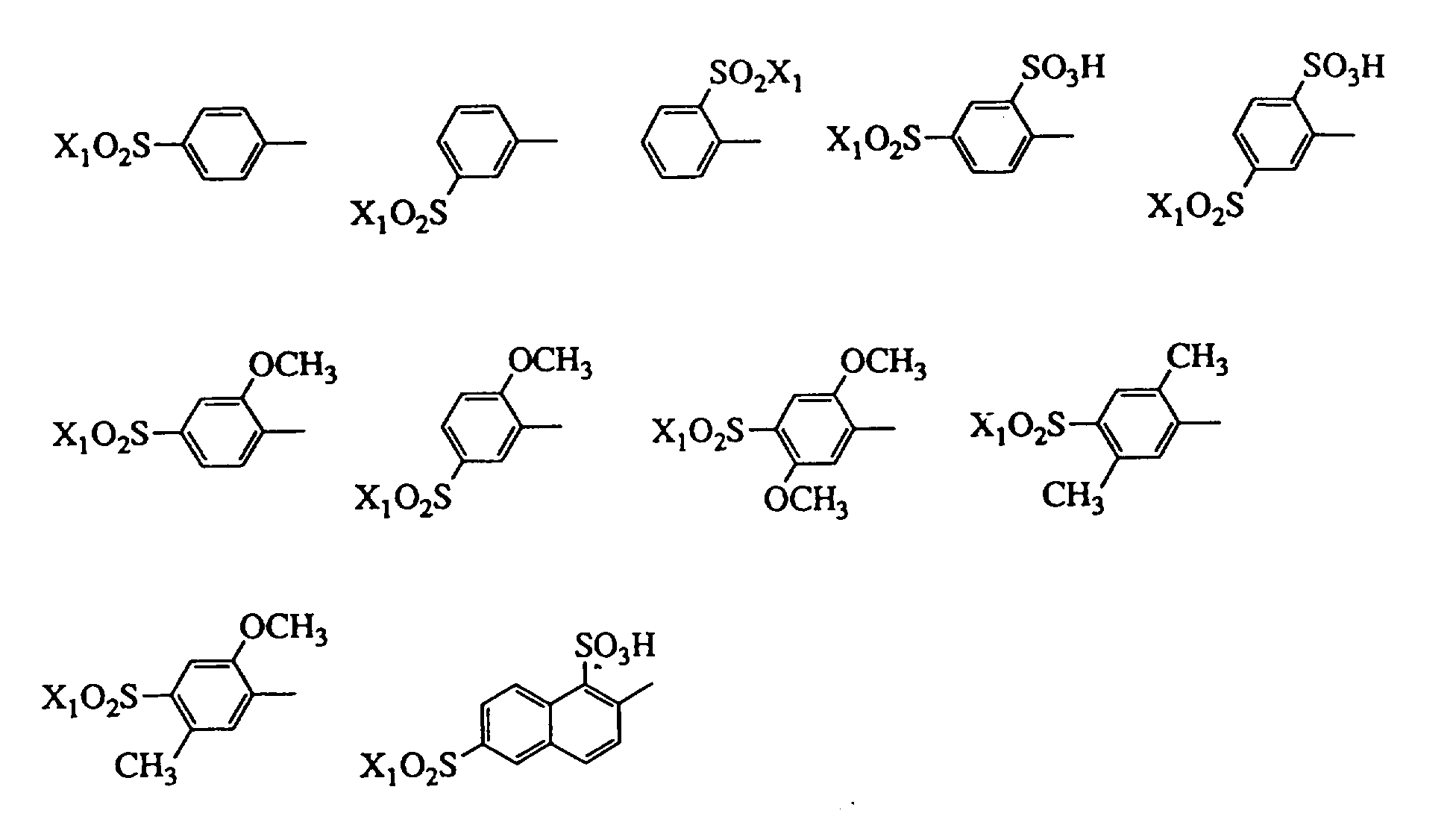
- A hydrogen atom and a sulfo group are preferred as R₂ or R₃ in the formula (I) and as examples of the phenylene or naphthylene substituted by R₂ and R₃, following can be mentioned:
- A hydrogen atom, methyl group and ethyl group are preferred as R₄, R₅ or R₇ in the formula (I).
- As examples of the phenylamino group of R₆ in the formula (I), following can be mentioned:


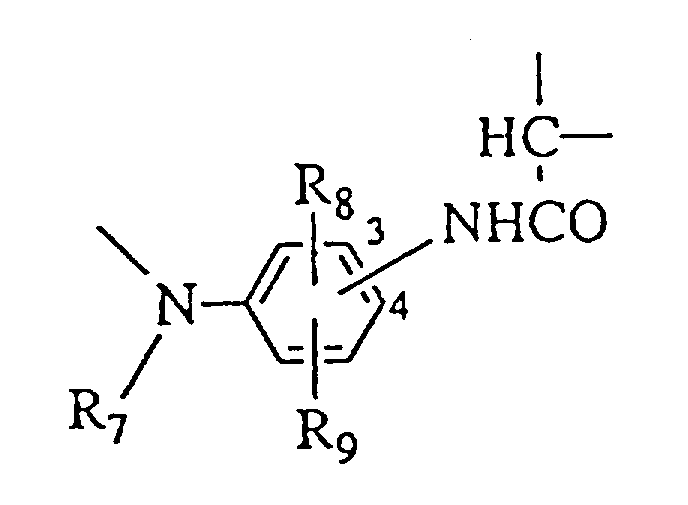
- As R₈ or R₉ in the formula (I), a methyl group, an ethyl group, a methoxy group and a sulfo group are preferred and a methoxy group and a sulfo group are more preferred. The position on which the acetoacetanilide monoazo residue is located in the phenylene group substituted by R₈ and R₉ is preferably 3- or 4- position against -NR₇ and more preferably 4- position.
- In the present invention, R₁₀ is preferably a methyl group or an ethyl group, and more preferably a methyl group.
- As R₁₁ or R₁₂ in the formula (I), a methyl group, an ethyl group and a hydrogen atom are preferred.
- As examples of the phenylene or naphthylene substituted by R₁₁ and R₁₂ following can be mentioned:


- In the present invention, when Compound (I) is in the form of a salt, kind of the cation accompanied by the sulfo group or by the carboxy group, if any, is not limited. The cation may be any one of non-chromophoric cations usual in the field of fiber-reacting dyes, in so far as the corresponding salt is water soluble. Examples of such cations include alkali metal cations such as a lithium, sodium and potassium cation, an unsubstituted ammonium cation and substituted ammonium cations such as a mono-, di-, tri-, or tetra-methylammonium, triethylammonium and mono-, di- or triethanolammonium cation.
- The cations attached to the sulfo groups and those attached to the carboxy group, if any, may be the same or different and may be a mixture of cations such as the above listed cations. That is, Compound (I) may be in the form of a mixed salt.
- Compound (I) can be produced, for example, by the following process. This process comprises condensing, in any optional order;
- a phthalocyanine compound represented by the following general formula (II):

which is in the form of a free acid or of a salt; - a monoazo compound represented by the following general formula (III):

- a 2,4,6-trihalogeno-s-triazine in which the halogen is fluorine, chlorine or bromine and;
- if necessary, a compound represented by the general formula (IV) :
R₆'H (IV)
wherein R₆' represents an unsubstituted or substituted lower alkylamino group, a saturated nitrogen-containing heterocyclic group attached to the hydrogen atom via nitrogen preferably containing 5 or 6 atoms in the ring and optionally containing an additional hetero atom selected from oxygen and nitrogen, a phenylamino group which is unsubstituted or substituted or a lower alkoxy group. - Examples of the unsubstituted or substituted lower alkylamino group represented by R₆' include a methylamino group, an ethylamino group, an isopropylamino group, a n-propylamino group, a n-butylamino group, a sec-butylamino group and an isobutylamino group each of which is unsubstituted or substituted by, for example, a lower alkoxy group, a carboxy group, a sulfo group or a lower alkoxycarbonyl group.
- Examples of the saturated nitrogen-containing heterocyclic group represented by R₆' include a morpholino group, a piperidino group and a piperazino group.
- Examples of the unsubstituted or substituted phenylamino group represented by R₆' include groups listed above as examples of substituted phenylamino groups represented by R₆.
- Examples of the lower alkoxy group represented by R₆' include a methoxy group, an ethoxy group, an isopropoxy group, a n-propoxy group, a n-butoxy group, a sec-butoxy group and an isobutoxy group.
- In the process for producing Compound (I), the order of the condensation reaction of 2,4,6-trihalogeno-s-triazine with other raw materials is not particularly limited. Although the reaction conditions are not limited particularly, usually the condensation reaction of the unsubstituted 2,4,6-trihalogeno-s-triazine is conducted at the reaction temperature in a range of -10 °C to 40 °C and the pH in a range of 2 to 9, the condensation reaction of the monosubstituted halogeno-s-triazine is conducted at the temperature in a range of 0 °C to 70°C and the pH in a range of 2 to 9 and the condensation reaction of the disubstituted halogeno-s-triazine is conducted at the temperature in a range of 10°C to 100 °C and the pH in a range of 2 to 7.
- The phthalocyanine compound of formula (II), one of the starting material, are known or can be prepared by the known method using the known compounds. The phthalocyanine compounds can be prepared, for example, by conducting a chlorosufonation of a phthalocyanine compound usual in the phthalocyanine dye field, followed by reactions with a diamine and an amine represented by the following general formulae (V) and (VI), respectively:

- The monoazo compound represented by the formula (III), the starting materials, also can easily be obtained by the known method, for example, by diazotizing a compound represented by the general formula (VII), shown below, and coupling with a compound represented by the general formula (VIII), shown below:

- When -SO₂X₁, -SO₂X₂ or -SO₂X₃ in the present invention is -SO₂CH₂CH₂Y and the group removable by the action of an alkali represented by Y is an ester group such as a sulfato group or a phosphato group or a group OCOCH₃, the formation of such esters may be carried out after the condensation reaction or the coupling reaction.
- For example, Compound (I) can be obtained by conducting a synthesis according to the method described above using
- a compound represented by general formula (IX) depicted below;
- when the above monoazo compound (III) has a reactive group, a hydrolysate of its reactive group; and
- when R₆' has a fiber-reacting group, i.e., has at least one group represented by SO₂X₂ wherein X₂ has the same meaning as defined above, a compound represented by general formula (X) depicted below; and then converting the compound thus obtained by known methods, e.g. esterification, to a compound of formula (I). In the method mentioned above, together with the hydrolysates, their corresponding ester may be used.
- The compounds of general formula (IX) and (X) are:

- As 2,4,6-trihalogeno-s-triazine, the starting material, cyanuric chloride and cyanuric fluoride are particularly preferred.
- Depending on the conditions of the reaction and isolation, the compound of the invention is obtained in the form of a free acid or in the form of a salt or a mixed salt containing one or more cations such as cations described above. The form of a salt or a mixed salt is preferred. The compound can be converted from the free acid form to a salt form or vice versa or a salt form to another salt form, by conventional means.
- Compound (I) and a mixture thereof are useful as fiber-reactive dyes for dyeing or printing hydroxy- or nitrogen-containing organic substrates. Preferred substrates are fiber materials containing or consisting of leathers, natural or synthetic polyamides and particularly natural cellulose, for example, cotton, viscose and cuprammonium rayon. The most preferred substrate is a fiber material containing cotton or that consisting of cotton. The dyeing or printing is carried out according to a usual known method for the fiber-reactive dyes and considering the physicochemical properties of the fiber materials.
- Compound (I) and a mixture thereof do not give an un-levelness which has been a problem when a brilliant green dyeing of a substrate containing cotton is conducted using a combination of a phthalocyanine blue and a yellow. In addition, the compounds of the invention have sufficient compatibility with other fiber-reactive dyes and can be applied in combination with other suitable fiber-reactive dyes of yellow, blue or the like having similar dyeing properties, for example, general fastness properties and degree of exhaustion from dye bath to fibers.
- Compound (I) and a mixture thereof have a good build-up properties and give an excellent degree of exhaustion and fixation rates. Any unfixed material can easily be removed by washing from the substrate. Further, they have a good solubility, are less susceptible to variation of the amount of dyeing auxiliaries such as salts, alkali agents and the like and liquor ratio and give a stable dyed product. The obtained dyed products and printed products exhibit extremely good dry and wet color fastness to light. Also, they are excellent in wet color fastness properties, for example, excellent in washing, water, sea-water and perspiration fastness, and have a good color fastness to chlorination and fastness to washing with oxidative substances, for example, chlorinated water, hypochlorite bleaching agent or peroxide. Further, the obtained dyed products are less susceptible to discoloration on fixing treatment or resin finishing.
- The following Examples are given to further illustrate the present invention. In the Examples, part and % mean part by weight and % by weight.
- Into 240 parts of chlorosulfonic acid was charged 57.6 parts of copper phthalocyanine blue with agitation and the mixture was stirred at 120 - 130° C for 3 - 4 hours. After cooling the mixture to 70 °C, 50 parts of thionyl chloride was charged at 70 °C over 3 - 5 hours. Then, the mixture was gradually heated to 110 - 120 °C and kept at the same temperature for 1 - 2 hours. The obtained reaction mass was discharged into ice-water at 0 - 5 °C and filtered to give a wet cake. The wet cake was washed with water and then pasted with ice-water to afford about 450 parts of copper phthalocyanine sulfochloride slurry.
- Into the above sulfochloride slurry were added a solution of 16 parts of 2,4-diaminobenzenesulfonic acid dissolved in 60 parts of water with the aid of caustic alkali, a solution of 39 parts of 1-aminobenzene-3-β-sulfatoethylsulfone dissolved in 70 parts of water with the aid of sodium carbonate and 1.5 part of pyridine. The mixture was stirred at about 20 °C for 10 - 15 hours. During this period, about 200 parts of 15 % aqueous sodium carbonate solution was used in order to keep pH at 6.0 - 6.5. About 900 parts of Blue condensate reaction solution was obtained.
- With the aid of sodium hydroxide solution, 33 parts of 2-aminonaphthalene-3,6,8-trisulfonic acid was dissolved in 70 parts of water at pH of 7.0 - 8.0, and 6.0 parts of sodium nitrite was added to the resulting solution. The solution thus obtained was added dropwise into a mixture of 20 parts of 35 % hydrochloric acid, 70 parts of water and 70 % of ice at or below 10 °C to effect diazotization. After excess sodium nitrite was quenched with sulfamic acid, the diazotized solution was added dropwise in an about 10 % aqueous solution of 25.7 parts of 2-amino-4-methoxy-5-(3'-oxobutyrylamino) benzenesulfonic acid. During this period, about 45 parts of 15 % aqueous sodium carbonate solution was added in order to keep pH at 6.0 - 6.5. About 700 parts of Yellow base reaction solution was obtained.
- Into a mixture of 80 parts of water and 80 parts of ice was charged 16.2 parts of 2,4,6-trichloro-s-triazine and the mixture was stirred to effect sufficient dispersion. Thereto, the Yellow base reaction solution described in above (2) was added and the mixture was stirred at 10 - 15 °C for 1 - 2 hours. Then, the Blue condensate solution described in above (1) was added and the mixture was stirred at 40 - 45 °C for 3 - 4 hours. During these periods, about 35 parts of 15 % sodium carbonate solution was added in order to keep pH at 4.0 - 4.5 and 5.0 - 5.5, respectively. Thus, the compound represented by the following formula or salt thereof was obtained.
λmax : 398, 670 nm
- 0.3 Part of the monoazo compound thus obtained was dissolved in 200 parts of water. Then 10 parts of sodium sulfate and 10 parts of a cotton cloth was added thereto and the bath temperature was raised to 60 °C. After keeping 30 minutes, 4 parts of sodium carbonate was added thereto and dyeing was conducted for one hour. After completion of the dyeing, washing and soaping were conducted to obtain a green dyed product which excellent in various fastness. The compound exhibited good dyeing reproducibility.
- By conducting the same processes in Example 1 except that 1-aminobenzene-3-β-sulfatoethylsulfone used in the preparation of the Blue condensate solution in Example 1 is replaced with each of aminobenzene compounds or aminonaphthalene derivatives shown in the column 1 of the following Table 1-4 and 2,4-diaminobenzene sulfonic acid is replaced with each of diaminobenzene derivatives shown in the column 2 of the following Table 1-4, the corresponding phthalocyanine monoazo compound can be obtained. By conducting the dyeing by using them, dyed products having color shown in the column 3 of the following Table 1-4 can be obtained.


- By conducting the same processes in Example 1 except that 2-aminonaphthalene-3,6,8-trisulfonic acid used in the preparation of the Yellow base in Example 1 is replaced with each of aminobenzene compounds or aminonaphthalene derivatives shown by the following formula (The numbers of the following formulae correspond to the Example number.), the corresponding phthalocyanine monoazo compound can be obtained.
- By conducting the dyeing by using them, dyed products having green color.


- By conducting the same processes in Example 1 except that 2-amino-4-methoxy-5-(3'-oxobutylylamino)benzenesulfonic acid used in the preparation of the Yellow base in Example 1 is replaced with each of compounds described by the following formula and the following Table 5-6, the corresponding phthalocyanine monoazo compound can be obtained. By conducting the dyeing by using them, dyed products having colors shown in the following Table 5-6 can be obtained. In the Table 5, substitution position means the position on the benzene ring where R₁₀COCHCONH- in the following formula is substituted.

Table 5 Ex. No. R₇ R₈ R₉ R₁₀ Substitution Position Color 90 H 2-SO₃H 5-OCH₃ CH₃ 4 Green 91 C₂H₅ 2-SO₃H 5-OCH₃ C₂H₅ 4 Green 92 H 2-SO₃H 5-OC₂H₅ CH₃ 4 Green 93 C₂H₅ 2-SO₃H 5-OC₂H₅ CH₃ 4 Green 94 H 2-SO₃H 5-OC₂H₅ C₂H₅ 4 Green 95 CH₃ 2-SO₃H 5-OCH₃ CH₃ 4 Green 96 C₂H₅ 2-SO₃H 5-OCH₃ CH₃ 4 Green 97 H 2-SO₃H 5-CH₃ CH₃ 4 Green 98 H 2-SO₃H 5-C₂H₅ CH₃ 4 Green 99 H 2-C₃H₇ 5-OCH₃ CH₃ 4 Green 100 H 2-C₂H₅ 5-C₂H₅ CH₃ 4 Green 101 H 2-OCH₃ 5-OCH₃ CH₃ 4 Green 102 C₂H₅ H 5-OCH₃ CH₃ 4 Green 103 H 2-SO₃H H CH₃ 4 Green 104 H H 5-CH₃ CH₃ 4 Green 105 H 2-CH₃ H CH₃ 4 Green Table 6 Ex. No. R₇ R₈ R₉ R₁₀ Substitution Position Color 106 H 2-OC₂H₅ H CH₃ 4 Green 107 H H H CH₃ 5 Green 108 H H H C₂H₅ 4 Green 109 H 2-CH₃ 6-CH₃ CH₃ 5 Green 110 H 3-OCH₃ 5-OCH₃ C₂H₅ 4 Green - By conducting the same processes in Example 1 except that 2,4,6-trichloro-s-triazine used in the formation of dye in Example 1 is replaced with 2,4,6-trifluoro-s-triazine or with 2,4,6-tribromo-s-triazine, the corresponding phthalocyanine monoazo compound can be obtained.
- To the final reaction solution obtained in Example 1, 28.1 parts of 1-aminobenzene-3-β-sulfatoethylsulfone dissolved in 60 parts of water with the aid of sodium carbonate was added and then the reaction was conducted at 65-70°C for 8-10 hours. During this periods, about 35 parts of 15 % sodium carbonate solution was added in order to keep pH at 2.5 - 3.0. Thus, the compound represented by the following formula wherein p is 1.4, q is 1 and r is 0.8 was obtained in the free acid form.
λmax : 398, 670 nm
- 0.3 Part of the monoazo compound thus obtained was dissolved in 200 parts of water. Then 10 parts of sodium sulfate and 10 parts of a cotton cloth was added thereto and the bath temperature was raised to 60 °C. After keeping 30 minutes, 4 parts of sodium carbonate was added thereto and dyeing was conducted for one hour. After completion of the dyeing, washing and soaping were conducted to obtain a green dyed product which is excellent in various fastness and superior in build-up property to that obtained by using the compound described in Example 1.
- Example 1 was repeated except that, in the synthesis of (1) Blue condensate solution, the amount of 2,4-diaminobenzene sulfonic acid was 18.8 parts, 22.5 parts or 28.2 parts instead of 16 parts, and the amount of 1-aminobenzene-3-β-sulfatoethylsulfone was 22.5 parts, 14.1 parts or 0 part, respectively instead of the 39 parts; and, in the (3) Formation of dye, the amount of cyanuric chloride was 19 parts, 23 parts or 28 parts, respectively instead of 16.2 parts and the amount of Yellow base was changed so that it became 1.06 fold, 1.18 fold or 1.29 fold of the amount in Example 1, respectively.
- Then, example 112 was repeated except that as the final reaction solution, the final reaction solution of the above reaction was used and the amount of 1-aminobenzene-3-β -sulfatoethylsulfone was 33 parts, 42 parts or 53 parts, respectively, instead of 28.1 parts to obtain a compound represented by the formula shown in Example 112 wherein p is 0.8, 0.5 or 0, q is 2.3, 2.55 or 3.0 and r is 0.9, 0.95 or 1.0, respectively.
- 0.3 Part of each of the monoazo compound thus obtained was dissolved in 200 parts of water. Then 10 parts of sodium sulfate and 10 parts of a cotton cloth was added thereto and the bath temperature was raised to 60 °C. After keeping 30 minutes, 4 parts of sodium carbonate was added thereto and dyeing was conducted for one hour. After completion of the dyeing, washing and soaping were conducted to obtain an yellowish green dyed product which is excellent in various fastness and good in build-up property.
- By conducting the same processes in Example 112 except that 1-aminobenzene-3-β-sulfatoethylsulfone used in Example 112 is replaced with a compound represented by RNHR" wherein the meanings of R and R" are as described in Table 7-9, the corresponding phthalocyanine monoazo compound can be obtained and green dyed product can be obtained by conducting dyeing by using them.
Table 7 Ex. No. R R" 114 C₆H₅ H 115 C₆H₄SO₃H-2 H 116 C₆H₄SO₃H-3 H 117 C₆H₄SO₃H-4 H 118 C₆H₄CH₃-4 H 119 C₆H₄C₂H₅-2 H 120 C₆H₄C₃H₇-3 H 121 C₆H₄OCH₃-4 H 122 C₆H₄OCH₃-2 H 123 C₆H₄OC₂H₅-3 H 124 C₆H₃(SO₃H-2)CH₃-4 H 125 C₆H₃(SO₃H-2)C₂H₅-5 H Table 8 Ex. No. R R" 126 C₆H₃(SO₃H-2)OCH₃-4 H 127 C₆H₃(SO₃H-2)OC₂H₅-5 H 128 C₆H₃(SO₃H-5)CH₃-2 H 129 C₆H₃(SO₃H-5)C₂H₅-2 H 130 C₆H₃(SO₃H-5)OCH₃-2 H 131 C₆H₃(SO₃H-5)OC₂H₅-2 H 132 C₆H₃(SO₃H-4)OCH₃-2 H 133 C₆H₃(SO₃H-4)OC₂H₅-2 H 134 C₆H₄COOH-2 H 135 C₆H₄COOH-3 H 136 C₆H₄COOH-4 H 137 C₆H₄Cl-4 H 138 C₆H₄Cl-3 H 139 C₆H₄Br-2 H 140 C₆H₂(SO₃H-4)(OCH₃-2)CH₃-5 H 141 C₆H₂(SO₃H-4)(OC₂H₅-2)CH₃-5 H 142 C₆H₃(CH₃)₂-2,5 H 143 C₆H₂(SO₃H-4)(CH₃)₂-2,5 H 144 C₆H₃(OCH₃)₂-2,5 H 145 C₆H₂(SO₃H-4)(OCH₃)₂-2,5 H 146 C₆H₃(OCH₃-2)CH₃-4 H 147 C₆H₄SO₂CH=CH₂-3 H 148 C₆H₃(SO₂C₂H₄OSO₃H-3)OCH₃-4 H 149 C₆H₃(SO₂C₂H₄OSO₃H-3)SO₃H-2 H Table 9 Ex. No. R R" 150 C₆H₄SO₂C₂H₄OSO₃H-4 H 151 C₆H₄SO₂C₂H₄OCOCH₃-4 H 152 C₆H₃(SO₂C₂H₄OSO₃H-4)SO₃H-2 H 153 C₆H₃(SO₂C₂H₄OSO₃H-4)OCH₃-2 H 154 C₆H₂(SO₂C₂H₄OSO₃H-4)(OCH3-2)CH3-5 H 155 C₆H₂(SO₂C₂H₄OSO₃H-4)(CH₃)₂-2,5 H 156 C₆H₂(SO₂C₂H₄OSO₃H-4)(OCH₃)₂-2,5 H 157 C₆H₄SO₂C₂H₄OSO₃H-3 C₂H₅ 158 C₆H₄SO₂C₂H₄Cl CH₃ 159 C₆H₄SO₂C₂H₄OSO₃H-4 C₂H₅ 160 HOOCCH₂ H 161 CH₃ H 162 C₂H₅ H 163 C₄H₉ H - 0.3 Part of each of the monoazo compound obtained in Example 1 or 112 was dissolved in 200 parts of water. Then 10 parts of sodium sulfate and 10 parts of a cotton cloth was added thereto and the bath temperature was raised to 70-90 °C. After keeping 30 minutes, 4 parts of sodium carbonate was added thereto and dyeing was conducted for one hour. After completion of the dyeing, washing and soaping were conducted to obtain a green dyed product which is excellent in various fastness and good in build-up property.
- By conducting the same processes in Example 1 and, if necessary, the same processes in Example 112 except that copper phthalocyanine blue used in Example 1-112 and 114-163 is replaced with nickel phthalocyanine blue, the corresponding nickel phthalocyanine derivative of each Examples can be obtained.
- The compound of the present invention exhibits good evenness and reproducibility of dyeing as a hydroxy- or nitrogen-containing organic substrate and has good dyeing property such as build-up property, temperature sensitivity, salt sensitivity, alkali sensitivity and bath-ratio dependency and is good in various fastness.
Claims (7)
- A phthalocyanine monoazo derivative of the formula (I):
 wherein Pc represents a phthalocyanine group; Me represents nickel, cobalt or copper;R₁ represents a hydrogen atom or an unsubstituted or substituted lower alkyl group;R₂ and R₃ are the same or different and represent a hydrogen atom, an unsubstituted or substituted lower alkyl group, a lower alkoxy group or a sulfo group;R₄, R₅ and R₇ are the same or different and represent a hydrogen atom, or an unsubstituted or substituted lower alkyl group;R₆ represents a chlorine atom, a fluorine atom, a bromine atom, a lower alkoxy group, an unsubstituted or substituted lower alkylamino group, a saturated nitrogen-containing heterocyclic group attached to the triazine nucleus via nitrogen or a phenylamino group which is unsubstituted or substituted by 1-3 groups or atoms selected from an unsubstituted or substituted lower alkyl group, a lower alkoxy group, a chlorine atom, a fluorine atom, a bromine atom, -COOH, -SO₃H or -SO₂X₂ group on the phenyl ring and which is unsubstituted or substituted by a substituted or unsubstituted lower alkyl group at the nitrogen atom of the amino group;R₈ and R₉ are the same or different and represent a hydrogen atom, an unsubstituted or substituted lower alkyl group, a lower alkoxy group or a sulfo group;R₁₀ represents an unsubstituted or substituted lower alkyl group;R₁₁ and R₁₂ are the same or different and represent a hydrogen atom, an unsubstituted or substituted lower alkyl group, a lower alkoxy group, a phenoxy group, an acetylamino group, a propionylamino group, a maleinylamino group, a fumarylamino group, a succinylamino group or -SO₂X₃;X₁, X₂ and X₃ are the same or different and represent -CH=CH₂ or -CH₂CH₂Y; Y represents a group removable by the action of an alkali;p is from 0 to 2; q is from 1 to 3; r is from 1-2; p+q+r is 4 or less;provided that when p is 0, R₆ is a chlorine atom, a fluorine atom, a bromine atom or a phenylamino group which is substituted by at least one group SO₂X₂;or a salt thereof.
 - A compound according to claim 1 wherein Me is copper or nickel.
- A compound according to claim 1 or 2 wherein R₆ is a phenylamino group substituted by -SO₂X₂ in which X₂ has the same meaning as in claim 1.
- A compound according to claim 1, 2 or 3 wherein p is not 0.
- A method of dyeing or printing of a hydroxy- or nitrogen-containing organic substrate using a compound according to any one of claims 1 to 4 or a mixture thereof.
- A method according to claim 5 wherein the substrate is a fiber material which comprises leather, natural cellulose and/or regenerated cellulose or a fiber material consisting of leather, natural cellulose and/or regenerated cellulose.
- A process for the preparation of a compound of formula (I) as defined in claim 1 which comprises condensing, in any order: a phthalocyanine compound of the general formula (II) :


R₆'H (IV)
wherein R₆' represents an unsubstituted or substituted lower alkyl amino group, a saturated nitrogen-containing heterocyclic group attached to the hydrogen atom via nitrogen, a phenyl amino group which is unsubstituted or substituted or a lower alkoxy group; and converting the or each -CH₂CH₂OH group or ester thereof into a group -CH₂CH₂Y.
Applications Claiming Priority (2)
| Application Number | Priority Date | Filing Date | Title |
|---|---|---|---|
| JP271318/94 | 1994-11-04 | ||
| JP6271318A JPH08134365A (en) | 1994-11-04 | 1994-11-04 | Phthalocyanine monoazo compound |
Publications (2)
| Publication Number | Publication Date |
|---|---|
| EP0712906A2 true EP0712906A2 (en) | 1996-05-22 |
| EP0712906A3 EP0712906A3 (en) | 1996-05-29 |
Family
ID=17498387
Family Applications (1)
| Application Number | Title | Priority Date | Filing Date |
|---|---|---|---|
| EP95307847A Ceased EP0712906A3 (en) | 1994-11-04 | 1995-11-02 | Phthalocyanine monoazo compounds and a process for producing the same |
Country Status (6)
| Country | Link |
|---|---|
| US (1) | US5646274A (en) |
| EP (1) | EP0712906A3 (en) |
| JP (1) | JPH08134365A (en) |
| KR (1) | KR960017792A (en) |
| CN (1) | CN1138066A (en) |
| TW (1) | TW296402B (en) |
Cited By (3)
| Publication number | Priority date | Publication date | Assignee | Title |
|---|---|---|---|---|
| US6222067B1 (en) * | 1999-11-04 | 2001-04-24 | Everlight Usa, Inc. | Alkylated diaminobenzene sulfonic acids |
| WO2009068513A3 (en) * | 2007-11-26 | 2010-01-14 | Basf Se | Improved shading process |
| RU2440353C1 (en) * | 2010-07-21 | 2012-01-20 | Государственное образовательное учреждение высшего профессионального образования "Ивановский государственный химико-технологический университет" | Tetra-4-({[(5"-sulphonaphthyl)-1"-azo]phenylene-1',4'}oxy)phthalocyanine |
Families Citing this family (2)
| Publication number | Priority date | Publication date | Assignee | Title |
|---|---|---|---|---|
| CN103509370B (en) * | 2012-06-25 | 2015-11-18 | 浙江舜龙化工有限公司 | A kind of Active green dye |
| CN119432118A (en) * | 2024-11-12 | 2025-02-14 | 河南隆胜新材料有限公司 | A high-performance functional environmentally friendly (copper/nickel) phthalocyanine tetrasubstituted multi-active group turquoise blue dye and its preparation method |
Citations (3)
| Publication number | Priority date | Publication date | Assignee | Title |
|---|---|---|---|---|
| JPH01221460A (en) | 1987-01-31 | 1989-09-04 | Sandoz Ag | Fiber-reactive phthalocyanine monoazo compound |
| JPH02115276A (en) | 1988-09-23 | 1990-04-27 | Sandoz Ag | Fiber reactive phthalocyanine dyes |
| JPH04261470A (en) | 1990-08-15 | 1992-09-17 | Imperial Chem Ind Plc <Ici> | Dye |
Family Cites Families (4)
| Publication number | Priority date | Publication date | Assignee | Title |
|---|---|---|---|---|
| DE2745831A1 (en) * | 1977-10-12 | 1979-04-19 | Cassella Ag | FIBER REACTIVE PHTHALOCYANINE AZO DYES |
| DE3044798A1 (en) * | 1980-11-28 | 1982-07-01 | Bayer Ag, 5090 Leverkusen | PHTHALOCYANIN REACTIVE DYES, METHOD FOR THEIR PRODUCTION AND THEIR USE FOR COLORING HYDROXYL GROUP AND / OR NITROGEN-MATERIALS |
| US5066796A (en) * | 1990-05-31 | 1991-11-19 | Xerox Corporation | Electrophotographic imaging members with bichromophoric bisazo phthalocyanine photoconductive materials |
| DE4226045A1 (en) * | 1992-08-06 | 1994-02-10 | Bayer Ag | phthalocyanine dyes |
-
1994
- 1994-11-04 JP JP6271318A patent/JPH08134365A/en active Pending
-
1995
- 1995-10-30 US US08/550,370 patent/US5646274A/en not_active Expired - Fee Related
- 1995-11-02 EP EP95307847A patent/EP0712906A3/en not_active Ceased
- 1995-11-03 CN CN95121557A patent/CN1138066A/en active Pending
- 1995-11-03 KR KR1019950039831A patent/KR960017792A/en not_active Withdrawn
- 1995-11-03 TW TW084111650A patent/TW296402B/zh active
Patent Citations (3)
| Publication number | Priority date | Publication date | Assignee | Title |
|---|---|---|---|---|
| JPH01221460A (en) | 1987-01-31 | 1989-09-04 | Sandoz Ag | Fiber-reactive phthalocyanine monoazo compound |
| JPH02115276A (en) | 1988-09-23 | 1990-04-27 | Sandoz Ag | Fiber reactive phthalocyanine dyes |
| JPH04261470A (en) | 1990-08-15 | 1992-09-17 | Imperial Chem Ind Plc <Ici> | Dye |
Cited By (5)
| Publication number | Priority date | Publication date | Assignee | Title |
|---|---|---|---|---|
| US6222067B1 (en) * | 1999-11-04 | 2001-04-24 | Everlight Usa, Inc. | Alkylated diaminobenzene sulfonic acids |
| WO2009068513A3 (en) * | 2007-11-26 | 2010-01-14 | Basf Se | Improved shading process |
| WO2009069077A3 (en) * | 2007-11-26 | 2010-01-21 | The Procter & Gamble Company | Detergent compositions |
| US8585784B2 (en) | 2007-11-26 | 2013-11-19 | Basf Se | Shading process |
| RU2440353C1 (en) * | 2010-07-21 | 2012-01-20 | Государственное образовательное учреждение высшего профессионального образования "Ивановский государственный химико-технологический университет" | Tetra-4-({[(5"-sulphonaphthyl)-1"-azo]phenylene-1',4'}oxy)phthalocyanine |
Also Published As
| Publication number | Publication date |
|---|---|
| KR960017792A (en) | 1996-06-17 |
| TW296402B (en) | 1997-01-21 |
| EP0712906A3 (en) | 1996-05-29 |
| JPH08134365A (en) | 1996-05-28 |
| CN1138066A (en) | 1996-12-18 |
| US5646274A (en) | 1997-07-08 |
Similar Documents
| Publication | Publication Date | Title |
|---|---|---|
| KR940006572B1 (en) | Method of producing compound having both pyridiniotriazinyl and vinylsulfone type groups | |
| US4855411A (en) | Water-soluble, monoazo dyes containing a ureido group and two sulfonyl fiber-reactive groups | |
| US4511507A (en) | Monoazo compound having both monochlorotriazinyl and vinylsulfone type reactive groups | |
| EP0497174A1 (en) | Bifunctional reactive dyes containing vinylsulfone/pyrimidine groups | |
| US4900812A (en) | Sulfo group-containing metal phlhalocyanine azo compound having a 6-hydroxypyrid-2-one coupling component radicals having a fiber-reactive group | |
| JPH0925427A (en) | Reactive dye for fiber | |
| US5646274A (en) | Phthalocyanine monoazo compounds and a process for producing the same | |
| EP0265857B1 (en) | Water-soluble monoazodyes containing a ureido group and two sulfonyl fiber-reactive groups, process for their preparation and their use | |
| EP0611259B1 (en) | Fibre-reactive phthalocyanine dyes | |
| US5359040A (en) | Monoazo compounds having naphthylazonaphtylamino group and use therefor for dyeing or printing fiber materials | |
| EP0239847B1 (en) | A monoazo compound having vinylsulfone type fiber reactive group through a substituted triazinyl bridging group | |
| US5095101A (en) | 1-Amino-2,7-di-[5'-(2"-chloro-4"-substituted amino-1,3,5-triazin-6"-ylamino)-2'-sulfophenylazo]-3,6-disulfonic acids | |
| US4464297A (en) | Fiber reactive bisazo dye having both a vinylsulfone type reactive group and an ortho-nitrophenyl group | |
| JPS61261364A (en) | Water soluble dis-azo compound, its production and use thereof as dye | |
| JPS58204053A (en) | Water-soluble disazo compound, manufacture and use as dye | |
| US5106958A (en) | 1:1 copper complexes of further unsubstituted or substituted 6-(2'-chloro-4'-substituted amino-1,3,5- triazin-6'-ylamino)-1-hydroxy-2-(2'-hydroxy-5'-sulfophenylazo)-3- sulfonaphthalenes | |
| US5597903A (en) | Disazo dyes containing 1-amino-8-hydroxy-naphthalene-3,6-or 4,6-disulfonic acid biscoupling component radicals and 5-cyano-2, 4-or 4,6-dichloropyrimidyl fiber-reactive groups | |
| JPH02269161A (en) | Water-soluble dye, and its preparation and use | |
| EP0184071B1 (en) | Monoazo compounds, method for their production and dyeing method using the same | |
| JPH0860012A (en) | Aluminum-phthalocyanine reactive dye and dyeing and printing method using the same | |
| US5717077A (en) | Fiber reactive phthalocyanine monoazo compounds having improved dyeing properties | |
| JPH08176453A (en) | Phthalocyanine monoazo compound | |
| US5770709A (en) | Fiber reactive azo dyes containing a 2-quinolone diazo component radical | |
| US4684721A (en) | Fiber-reactive phthalocyanine compound having both vinylsulfone type and dihalogenotriazinyl groups | |
| JPH06104782B2 (en) | Disazo compounds and uses of the compounds as dyes |
Legal Events
| Date | Code | Title | Description |
|---|---|---|---|
| PUAI | Public reference made under article 153(3) epc to a published international application that has entered the european phase |
Free format text: ORIGINAL CODE: 0009012 |
|
| PUAL | Search report despatched |
Free format text: ORIGINAL CODE: 0009013 |
|
| AK | Designated contracting states |
Kind code of ref document: A2 Designated state(s): BE CH DE ES FR GB IT LI |
|
| AK | Designated contracting states |
Kind code of ref document: A3 Designated state(s): BE CH DE ES FR GB IT LI |
|
| RHK1 | Main classification (correction) |
Ipc: C09B 62/04 |
|
| 17P | Request for examination filed |
Effective date: 19961121 |
|
| 17Q | First examination report despatched |
Effective date: 19961223 |
|
| GRAG | Despatch of communication of intention to grant |
Free format text: ORIGINAL CODE: EPIDOS AGRA |
|
| STAA | Information on the status of an ep patent application or granted ep patent |
Free format text: STATUS: THE APPLICATION HAS BEEN REFUSED |
|
| 18R | Application refused |
Effective date: 19990813 |