EP0709788A1 - Non-literal textual search using fuzzy finite non-deterministic automata - Google Patents
Non-literal textual search using fuzzy finite non-deterministic automata Download PDFInfo
- Publication number
- EP0709788A1 EP0709788A1 EP95307602A EP95307602A EP0709788A1 EP 0709788 A1 EP0709788 A1 EP 0709788A1 EP 95307602 A EP95307602 A EP 95307602A EP 95307602 A EP95307602 A EP 95307602A EP 0709788 A1 EP0709788 A1 EP 0709788A1
- Authority
- EP
- European Patent Office
- Prior art keywords
- automaton
- document
- state
- text
- characters
- Prior art date
- Legal status (The legal status is an assumption and is not a legal conclusion. Google has not performed a legal analysis and makes no representation as to the accuracy of the status listed.)
- Withdrawn
Links
Images



Classifications
-
- G—PHYSICS
- G06—COMPUTING OR CALCULATING; COUNTING
- G06F—ELECTRIC DIGITAL DATA PROCESSING
- G06F16/00—Information retrieval; Database structures therefor; File system structures therefor
- G06F16/90—Details of database functions independent of the retrieved data types
- G06F16/903—Querying
- G06F16/90335—Query processing
- G06F16/90344—Query processing by using string matching techniques
-
- G—PHYSICS
- G06—COMPUTING OR CALCULATING; COUNTING
- G06F—ELECTRIC DIGITAL DATA PROCESSING
- G06F16/00—Information retrieval; Database structures therefor; File system structures therefor
- G06F16/30—Information retrieval; Database structures therefor; File system structures therefor of unstructured textual data
- G06F16/33—Querying
- G06F16/3331—Query processing
- G06F16/334—Query execution
-
- G—PHYSICS
- G06—COMPUTING OR CALCULATING; COUNTING
- G06F—ELECTRIC DIGITAL DATA PROCESSING
- G06F40/00—Handling natural language data
- G06F40/20—Natural language analysis
- G06F40/232—Orthographic correction, e.g. spell checking or vowelisation
-
- G—PHYSICS
- G06—COMPUTING OR CALCULATING; COUNTING
- G06F—ELECTRIC DIGITAL DATA PROCESSING
- G06F40/00—Handling natural language data
- G06F40/20—Natural language analysis
- G06F40/268—Morphological analysis
-
- Y—GENERAL TAGGING OF NEW TECHNOLOGICAL DEVELOPMENTS; GENERAL TAGGING OF CROSS-SECTIONAL TECHNOLOGIES SPANNING OVER SEVERAL SECTIONS OF THE IPC; TECHNICAL SUBJECTS COVERED BY FORMER USPC CROSS-REFERENCE ART COLLECTIONS [XRACs] AND DIGESTS
- Y10—TECHNICAL SUBJECTS COVERED BY FORMER USPC
- Y10S—TECHNICAL SUBJECTS COVERED BY FORMER USPC CROSS-REFERENCE ART COLLECTIONS [XRACs] AND DIGESTS
- Y10S707/00—Data processing: database and file management or data structures
- Y10S707/912—Applications of a database
- Y10S707/917—Text
-
- Y—GENERAL TAGGING OF NEW TECHNOLOGICAL DEVELOPMENTS; GENERAL TAGGING OF CROSS-SECTIONAL TECHNOLOGIES SPANNING OVER SEVERAL SECTIONS OF THE IPC; TECHNICAL SUBJECTS COVERED BY FORMER USPC CROSS-REFERENCE ART COLLECTIONS [XRACs] AND DIGESTS
- Y10—TECHNICAL SUBJECTS COVERED BY FORMER USPC
- Y10S—TECHNICAL SUBJECTS COVERED BY FORMER USPC CROSS-REFERENCE ART COLLECTIONS [XRACs] AND DIGESTS
- Y10S707/00—Data processing: database and file management or data structures
- Y10S707/99931—Database or file accessing
- Y10S707/99933—Query processing, i.e. searching
- Y10S707/99935—Query augmenting and refining, e.g. inexact access
Definitions
- the present invention relates generally to the field of document storage and retrieval systems of the type used for multiple document manipulation. Specifically, the invention relates to a method and system for selectively searching and retrieving information from stored documents using a non-literal search strategy employing metric-based or "fuzzy" finite non-deterministic automata.
- Typical existing systems assign an index to each document as it is entered into storage.
- the index may be a system-generated or a user-defined code associated with each document. The code then is stored together with the document.
- To retrieve a document a user must enter the appropriate code associated with the desired document
- Other systems use key words in a similar manner. There are many methods for identifying and assigning key words to a document, including direct keyboard entry by the user, interactive selection from the document text by the user, and automated extraction by a search of the document text. Once key words have been assigned to documents, the user may then use them to retrieve a document.
- the problem encountered with such systems is that a user may retrieve only entire documents, and must know the index, code, or key words associated with a desired document.
- Full text search systems permit users to access selected information from a document set by entering a search term into the system. The system then reads through the entire document set to find an exact match for the entered search term. This has the benefit of locating particular instances of stings within the document text. These locations facilitate features such as proximity searching, where the search expression may contain restrictions on the relative locations of document set text strings that match certain portions of the search expression. The problem encountered with such systems is that each search involves a complete pass across the entire document set text, which makes such searches slow for very large document sets.
- Preprocessed, or indexed, search systems typically create tables of words found in the document set text. These tables greatly increase the efficiency of searches over large document sets. For example, in a very simple embodiment, the search is initially performed over the tables, and then only for documents that the tables indicate contain desirable target words. The tables can be sorted and cross-indexed in various standard ways to optimize performance in specific situations.
- a non-literal, or "fuzzy” search system is capable of handling mismatches. Use of such a system involves entering a text string into a computer system and then searching for a "close" match of that text string in a stored text file. For example, a user may request a search on "recieve” (spelled incorrectly), and the system may find the correctly spelled word "receive”.
- the stored text file is obtained from OCR of an optically scanned document, often the OCR system misrecognizes characters that are typographically similar. The letter “O” may be misrecognized as the numeral "0", or the letter pair "m” may be misrecognized as the single letter “m”. In these instances, it would be desirable to retrieve text that is typographically close to the input text string.
- a fourth technique described in United States Patent number 4,985,863 by Fujisawa et. al., 1991, uses finite deterministic automata to search only literally for exact matches, but encodes into the OCR document text alternative identities of characters for which OCR had little certitude.
- This reference provides no support for missing characters, extra characters, or exchanged adjacent characters, and provides no general support for mismatched characters.
- Finite state automata have known uses in computer systems to parse a series of symbols to determine whether they match a specified pattern, where the symbols being analyzed are members of a finite symbol set, such as ASCII character codes.
- An automaton starts operation from an initial state or an initial set of states, and then sequentially processes an incoming stream of symbols. As each incoming symbol is processed, the automaton undergoes a change of state or states, depending on the previous state or states of the automaton and the identity of the incoming symbol. If and when the automaton reaches a terminal state just as the last of the incoming symbols is processed, the incoming stream of symbols is found to match a particular pattern that the automaton was constructed to identify. Otherwise, the stream is found to not match any of the patterns that the automaton was constructed to identify.
- Automata may be either deterministic or non-deterministic. In a deterministic automaton, at each point in time, the automaton has a single current state, and there is a particular symbol which is going to be examined next. In the easiest cases, the result of processing that next symbol is that the automaton is put into a single successor current state, which may be the same state but in any event is completely determined by the predecessor state and the input symbol. This process continues until all the symbols have been processed, a terminal state has been reached, or an incoming character is received for which there is no valid transition.
- incoming symbols may result in a change from each current state to any of several successor states.
- a search is made to determine whether any of the current states of the automaton is a terminal state. If so, the incoming stream is found to match at least one of the patterns, although there may be no way to tell which particular pattern was matched.
- Deterministic automata are usable for such searching for small sets of known patterns, but are ill-suited for general use.
- the present invention is a method and system for selectively retrieving information contained in a stored document set using a non-literal search strategy that employs metric-based or "fuzzy" finite non-deterministic automata.
- the system includes a data input device (104) for transmitting a user-defined text string query to a processor (102).
- a finite non-deterministic-automaton (450) is constructed corresponding to the text string query.
- Stored words (460) are applied to the automaton (450), which generates a dissimilarity value associated with each such stored word.
- a display (470) provides a user with a sorted list of the stored words having dissimilarity values below a threshold value.
- the system determines dissimilarity values by adding penalty values to transitions between states of the automaton based on differences between the query and the word under examination. Such differences include extra characters, missing characters, exchanged adjacent characters, and different characters.
- the present invention further includes a method incorporating the functions of the described system.
- the invention is further described in the following detailed description and figures.
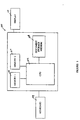
- FIGURE 1 shows a block diagram of an embodiment of the present invention.
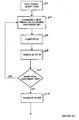
- FIGURES 2A-2B depict a flow chart of the present invention.
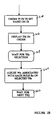
- FIGURE 3 depicts a flow chart of one embodiment of the present invention relating to determining an adaptive measure of association.
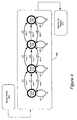
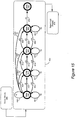
- FIGURE 4 shows a state diagram of a finite non-deterministic automaton in accordance with the present invention.
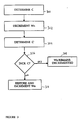
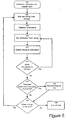
- FIGURE 5 depicts a flow chart of processing using an automaton in accordance with the present invention.
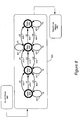
- FIGURE 6 shows a state diagram of a finite non-deterministic automaton featuring processing of optional characters, in accordance with the present invention.
- FIGURE 7 shows a state diagram of another finite non-deterministic automaton featuring processing of optional characters, in accordance with the present invention.
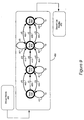
- FIGURE 8 shows a state diagram of a finite non-deterministic automaton featuring processing of repeatable characters, in accordance with the present invention.
- FIGURE 9 shows a state diagram of a finite non-deterministic automaton featuring processing of repeatable and optional characters, in accordance with the present invention.
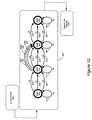
- FIGURE 10 shows a state diagram of a finite non-deterministic automaton featuring processing of multiple allowable characters, in accordance with the present invention.
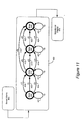
- FIGURE 11 shows a state diagram of a finite non-deterministic automaton featuring processing of multiple allowable character segments, in accordance with the present invention.
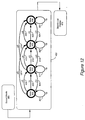
- FIGURE 12 shows a state diagram of another finite non-deterministic automaton featuring processing of multiple allowable character segments, in accordance with the present invention.
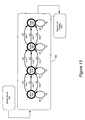
- FIGURE 13 shows a state diagram of a third finite non-deterministic automaton featuring processing of multiple allowable character segments, in accordance with the present invention
- FIGURE 14 shows a state diagram of a finite non-deterministic automaton featuring processing of exchanged adjacent allowable characters, in accordance with the present invention.
- FIGURE 15 shows a state diagram of a finite non-deterministic automaton featuring processing of allowable hyphens and ambiguous spaces, in accordance with the present invention.
- the present invention relates to retrieving words or other information from a document set or other data set stored on a computer.
- a user may wish to retrieve a document, or a portion of a document, based on a search term.
- the present system and method enable retrieval of a variety of "close" text strings from a document set based on the entered search term, and display of the retrieved text strings in an order that reflects an adaptive aspect of the system. This retrieval is accomplished using a finite non-deterministic automaton.
- the present invention addresses that problem by solving a related problem: given a set of rules and associated "penalty" values for making specific changes in a word, determine the least total penalty for using those rules to change a word in the document set so that it would be identical to the search term. That minimal penalty value is then taken as the distance between the word and the search term. All words in the document set may then be ranked according to their distance from the search term. The words with the least distance are then deemed the "closest" to the search term, and displayed accordingly. Fuzzy finite non-deterministic automata of the instant invention provide an efficient means of calculating such minimal penalty distance measures arising from such rule sets.
- Such rules include "different symbol”, the substitution of one symbol for another; “extra symbol” and “missing symbol”, the addition and deletion of symbols; and “exchanged adjacent symbols”, swapping the ordinal positions of two neighboring symbols in a word.
- a mismatch between document set words and search term might arise when a user intends to search on the term “monkey”, but instead types in "mankey” or even “makney”.
- the rule set described then provides the means for changing the document set word "monkey” to either "mankey” or “makney” through various sequences of substitutions, deletions, additions, swaps and other rules.
- each time a rule is used its associated penalty value is accrued to the total penalty for all the changes so far made to a word.
- the penalty value of each rule can be independent of the values of other rules. Hence, there will generally be different accrued penalties for different rule sequences that could each achieve the desired conversion of one word to another. Continuing the above example, if the penalty for substituting an 'a' for an 'o' is 5, the penalty for deletion of an 'a' is 3 and the penalty for addition of an 'o' is 1, then there is less penalty accrued for performing the two-step conversion than for application of the single-step rule.
- the present invention provides a technique for the determination of that minimal penalty value, given a document set, a search term, and a set of rules and penalties.
- the present invention likely retrieves "monkey" and displays the word in a displayed list of retrieved terms.
- the present invention further comprises methods to adjust the individual penalty value for each rule so as to increase the likelihood that the system presents desirable non-literal matches in future searches.
- This capability uses feedback that is obtained from the user, directly or indirectly, on the performance of past searches.
- the present system 100 includes a computer processor 102 that is in communication with an input device 104, such as a keyboard, at least one memory device 106, and an output display device 110.
- the processor 102 also is in communication with a storage medium 108 containing a stored document set.
- the storage medium 108 may be used to store information contained in a document set that is typed, scanned, entered using optical character recognition technology, or entered using any technology known and available to those skilled in the art of document storage.
- the storage medium 108 and the processor 102 are contained within a single housing, forming a self-contained system.
- the storage medium 108 may be located in a remote location, accessible by the processor 102 via a network, cables, or other medium of transferring information.
- FIGURES 2A - 2B show a functional block diagram of the present system 100.
- the processor 102 receives a text string query (TSQ) 200 from the input device 104.
- the query may include a search term, phrase, or any other series of characters or single characters which a user requests from the document set stored in the document storage medium 108.
- the system 100 next considers 202 a first text string in the stored document set.
- the first text string considered 202 may either be the first text string in the stored document set, or may be any one of the text strings in the stored document set designated as a "first" text string for purposes of the present system.
- a dissimilarity value D i next is determined 206 and then assigned 208 to the document text string considered at step 202.
- the D i calculation 206 for any text string is stopped before it completes, when it is determined that the value of D i will exceed a threshold value that may be a function of prior values obtained in the loop of steps 202-210 for other words in the stored document set. If the calculation is stopped, then that text string is given an arbitrarily large D i value, so that it will not be displayed 216.
- the dissimilarity value D i is defined as: wherein r n is the number of times a particular rule R n from the first set of rules stored in memory 106 must be applied to the document text string in coordination with the application of other rules to create a text string that matches the pattern specified by the text string query, k is the number of rules, w n is the non-negative weight assigned to each rule, and the minimization is performed over all possible sequences of rule applications that could successfully convert the document text string to match the pattern of the text string query.
- the first set of rules stored in memory 106 is a set of manipulations that may be considered in the aggregate to modify the document text string such that the document text string matches the pattern specified by the text string query.
- Exemplary manipulations may include extra character, missing character, different character, exchanged adjacent characters, different case character/case sensitive, different case character/case insensitive, extra or missing prefix, suffix, or root characters.
- additional rules that may exist and that may be used, including variations of these defined rules. These exemplary manipulations may be defined as follows:
- Extra character means that the document text string includes an extra character that is not part of the text string query.
- the query is for the word "misuse”
- the document text string is the term "missuse”.
- a single extra character "s" is included in the document text string that does not appear in the query.
- “Missing character” means that a character that is part of the text string query is omitted from the document text string. For example, while the query is for the word “conscious”, the document text string is "consious”, or "concious”.
- Different character means that a character that is part of the document text string is used in place of a desired character. For example, while the query is for the word “bounce”, the document text string is "bounse”, “bownce”, and the like. In each of those examples, a non-matching symbol is to be replaced by a matching letter.
- Exchanged adjacent characters means that adjacent characters in a document text string are exchanged. For example, while the query is for the word “receive”, the document text string is "recieve".
- Different case character/ case sensitive means that, in a case-sensitive search, the document text string includes a mismatched case character. For example, while the text string query is "America”, the document text string is "america”, without the initial capital "A”.
- “Different case character/case insensitive” means that, in a search where the case of the characters is relatively unimportant, the document text string includes a character having a case that does not match its counterpart in the text string query. For example, a document text string appears in all capital letters even though the search is case insensitive and the text string query may or may not include capital letters.
- case sensitivity includes case sensitive/insensitive for every letter in a word, case sensitive only for the initial letter (as in the example above), and case insensitive only for the initial letter but case sensitive for every other letter in a word. Case sensitivity also may depend on location with respect to stems, roots, prefixes, and suffixes.
- Extra or missing prefix, suffix, or root characters means, that a block of adjacent characters are added to or deleted from a document text string. For example, while the text string query is for the word “exist”, if the word "exist” is not found, it may be the case that "preexist” is found and is the closest match.
- the prefix "pre”, constituting a block of adjacent characters, may be deleted from “preexist” with a possibly lower weight than deleting each of the characters "p", "r", and "e” individually.
- Each of the rules defined above may be a single rule, or may represent a class of rules that address the same problem.
- the rule "different character” may be a set of rules having one rule that assigns a penalty associated with the character “I” instead of the numeral "1", another rule that assigns a penalty associated with the character “O” instead of the numeral "0”, and the like for OCR text.
- the set of rules R n are not necessarily exclusive, in the sense that "bounce” also can be obtained from “bounse” by the application of both the extra character rule, to yield “boune", and the missing character rule, to yield the target "bounce”.
- rules in the present system may include heuristic rules such as a thesaurus rule in which related words are found in a search, a phonetic rule in which phonetically equivalent, or nearly equivalent, words are found in a search, a language translation rule, and a prefix/suffix removal rule that finds all words having the same root. Rules may involve specification that a symbol or string of symbols in a search term are optional, or may be repeated, or may be either optional or repeated. A rule may support an extra or omitted hyphen, so that "auto-immune” and "autoimmune” would be treated as equivalent, or nearly equivalent.
- a rule may support the identification of "ofthe” and “of the” as equivalent, or nearly equivalent. Rules may support common spelling errors, such as using the wrong vowel, or spelling "photo” as “foto". Other rules known to those skilled in the art may be included in the rule set and are anticipated as being included in the rule set of the present system.
- Penalties associated with rules may be smaller for characters which appear later in the incoming stream, or for transition to later states in a fuzzy automaton. For example, it may be desirable to regard the strings “tilt” and “tilts” as more similar to each other than the strings “tilt” and “stilt”.
- the next step 210 is a check whether there are additional text strings in the document set to be considered. This loop of steps 202-210 continues, as shown in FIGURE 2A, until each of the text strings in the document set has been assigned a dissimilarity value D i .
- a concordance table or other index may be included in the system.
- the concordance table points to selected text strings in the document set such that not all text strings are assigned a dissimilarity value D i .
- the concordance tables provide indexed search capabilities, wherein each distinct word in the document set has a single entry in the table, each of which is assigned a value D i , so that the much more numerous instances of those words in the document set do not have to be assigned values directly.
- the weight value w n associated with each rule initially may be some predetermined number. In one embodiment, all rules are given the same initial weight, and in another embodiment each rule is given a weight based on some expected weight. In one embodiment, the weight value w n is inversely related to some measure of the likelihood that the rule R n will generate a text match that will be selected by the user. Preferably, the weight value w n is a penalty value associated with each rule R n .
- the weight values w n may be user-specific or application-specific. For example, if a particular user is known to make typographic substitution errors in entering a search query, the initial weight associated with that rule will reflect that tendency. For another example, in a document set that was obtained using OCR technology and stored in memory, a common mismatch may arise from the substitution of the numeral "1" for the letter "I", and vice versa.
- the weight values w n for such a common error initially may be set at some predetermined value based on historical data for the application of the character substitution rule for those OCR situations. In an alternative embodiment of the present invention, different rules may have the same weight value.
- the weight value also may be adjustable or determinable by the user. The weight associated with each rule is important for displaying the search result, as described in further detail below.
- the weight value w n is a penalty attributed to each rule.
- Each penalty may be attributed with an initial value, a range that may be based on the values of the weight of another rule or weights of a plurality of rules, plus various parameters to govern the manner and rate of adaptive change as described in further detail below.
- the penalty may be set to the same value for each rule or may be set to different values based on prior experience or projections of the relative importance of each rule.
- the next step 212 is retrieving a text string set.
- the retrieved document text string set contains location and other information associated with each instance of each of the document text strings.
- the system retrieves a text string set in accordance with a second set of rules stored in a memory device, such as device 107 of FIGURE 1.
- These rules may include: retrieve only those text document strings having a dissimilarity value of zero (i.e., exact matches); retrieve all document text strings having the lowest dissimilarity value D i ; retrieve the first x number of document text strings having the lowest dissimilarity value Di; retrieve only those document text strings having a dissimilarity value below x; retrieve all document text strings having the j lowest dissimilarity values D i ; retrieve one document text string having the lowest dissimilarity value D i per document; and the like.
- the second set of rules may affect the D i values. Where appropriate, such rules may be applicable to text string instances in whole documents, specific sets of documents, or specific portions of one or more documents, depending on the scope and style of the search process.
- each document may have an associated penalty weight that is used to affect the D i values of all document text strings obtained from that document.
- the document weights may be fixed, may be determined by certain document data, or may be determined from user selections of retrieved text strings.
- Document weights may be uniformly applied to all instances of all text strings in that document, or may be made specific to the instances of each distinct document text string.
- the penalty weight associated with a document may be derived from the number of text string instances in that document with dissimilarity values below x.
- the penalty weight associated with a document may be derived from the ratio of text string instances in that document with dissimilarity values below x, as compared to the total amount of text in the document.
- Document weights may also be based on information contained in an index of system-generated or user-defined codes associated with each document.
- the text string set contains a single entry for each distinct document text string occurring in each document. Multiple occurrences of possibly different text strings within a single document may contribute to the calculation of the document penalty weight for a given text string, but exactly one element is established in the retrieved text string set for each different text string which occurs in that document. The number of occurrences of that text string in the document, as well as the locations of each such instance within the document, and other information, are maintained in association with that single element of the set. As a result, a single text string may have many distinct elements in the retrieved text string set, one element for each document in which the string occurs one or more times. In addition, there may be several distinct text strings, with different spellings, which "match" the text string query to within a desired threshold value, and so have distinct entries in the retrieved text string set for each document in which they occur.
- such penalty values, indices and retrieved text set entries may be associated with sets of documents or portions of one or more documents.
- the definition of a "document" is a directed acyclic graph comprised of pages and other documents which do not ultimately contain the defined document.
- the smallest unit of inclusion may be a unit other than a page, such as a character, sentence or paragraph.
- the second set of rules may be applied to the document set, based on any desired level of granularity in the retrieved text string set.
- the retrieved text strings then are ordered 214 based on the dissimilarity value D i associated with each of the text strings in the retrieved text string set.
- the retrieved text string having the lowest dissimilarity value is prioritized over a text string having a higher dissimilarity value.
- a single retrieved text string may appear in the ordered list several times, if it occurs in different documents, depending on the rule from the second set of rules used to retrieve the text string from the document text strings.
- all elements of the retrieved text string set which are for string occurrences within a single document are combined into a single entry for the purposes of display.
- the combined entry is given a dissimilarity value which is based on the individual dissimilarity values of the entries from which it was created. The manner in which combined metric values are obtained is discussed below.
- the display then shows all retrieved text strings for each document, sorted in order of the combined dissimilarity values of the documents.
- the display device 110 displays the ordered retrieved text string set.
- the generated display typically is for the user to view the retrieved text string prior to retrieving an entire page or a portion of a page of the document set containing the retrieved text string.
- a user may wish to retrieve and view the stored medical record of a certain patient "Smith”.
- the present system displays 216 a list of retrieved text strings located in the search.
- the display may contain some contextual information about instances of the name "Smith", as is commonly done in existing search systems.
- the system waits 218 for the selection of a text string from the display 110.
- This selection may be made by a user through the input device 104, which may include a keyboard, mouse, or touch screen.
- the selection is made automatically based on penalty values to facilitate automated report generation.
- Such a selection results in instructions being sent to another system that retrieves a portion of the document, which may include several pages, a single page, or a portion of a page, containing the selected text sting.
- An exemplary system that may be used in conjunction with the present system is disclosed in commonly owned U. S. Patent Application Serial No.08/060,429, which is incorporated herein by reference, together with the corresponding document EP-A-0625757.
- the selected text string may be sent to a processor for interaction with an application program to achieve a spellcheck operation.
- the system identifies a text string in the document being spellchecked and searches through a dictionary, i.e., the document set, to identify a match. The "best" matches are then displayed for a user in the manner substantially as described herein.
- the present invention may also be used in a variety of other systems, including foreign language look-up, practice, citation, and dictionary systems, and the like.
- the weight values w n may be adaptive in nature. Accordingly, the next step 220 involves adjusting the weight value w n associated with each rule, or rules, associated with the retrieved text string TS k selected from the display. For example, in one embodiment, if a user selects one of the displayed text strings TS k , the penalty weight associated with each of the rules that was invoked at steps 204-206 may be decremented or otherwise adjusted. As the system continues to be used, the weight associated with each rule R n of the selected text string is adjusted a small amount up or down in such a manner that the system adapts to both the user and the application environment.
- the weight values w n associated with every rule R n of the rule set are adjusted. In other embodiments, only the weight value w n associated with the rules R n used in retrieving the selected text string TS k are adjusted. In yet another embodiment, the weight values w n associated with selected ones of the rules R n are adjusted.
- the specific manner in which the weight values w n are adjusted depends on the particular embodiment of the invention. Preferably, the system retains the adjusted weight values in memory so that for each subsequent search the adjusted weight values are applied in accordance with the use of their respective rules.
- that value D i is determined based on the adjusted weight values from previous searches.
- the objective of the adjustment of weight values is to arrive at new weights w n in such a manner as to discriminate between the text matches that the user selects and those which the user does not select.
- a preferred method referred to as a perturbation method, determines and uses a measure of correspondence C to adjust the weights w n of all the rules in the first set of rules.
- the weights associated with each of the various rules R n may either be incremented or decremented in such a way as to increase C.
- FIGURE 3 is a flow chart of a preferred system for performing the perturbation method.
- a first step 300 an initial measure of association C is determined, preferably in accordance with the algorithm stated above. This first step typically is taken after the user has made one or more selections from the set of retrieved text strings.
- the weight w n associated with a single rule R n is decremented by a predetermined value. The value may be a constant, such as 1, or may be any selected number.
- the method of performing the decrement may be by subtraction, division, or other mathematical methods known and available to those skilled in the art. All other weights remain unchanged for purposes of performing this method.
- An adjusted measure of association C' is determined 304 using the decremented weight value w n '. In the preferred embodiment, this determination 304 is made in accordance with the algorithm defined above.
- the system checks whether the adjusted measure of association C' determined in step 304 has increased over the initial measure of association C determined in step 300 prior to the decrementing step 302. If C' is increased over C, then the weight value w n ' remains 308 the decremented value. However, if C' is not increased over C, then the weight value w n ' is returned to its original value w n , and then w n is incremented 310 by some predetermined value.
- the steps of 300 through 310 may be performed individually for the weight associated with each rule in the present system. The method of performing the increment may be by addition, multiplication, or other mathematical methods known and available to those skilled in the art.
- the measure of association C may be recalculated after step 310 or otherwise checked against C to verify an improvement.
- the illustrated system of FIGURE 3 may alternatively be performed by initially incrementing the weight value w n, by checking for a decrease in C rather than an increase in C, or both.
- the perturbation method is performed to increase the measure of correspondence.
- the system strives for separation between the dissimilarity value D i of selected text strings and the non-selected text strings. Other methods of determining C may be used.
- the system may further include some selection preference value s q associated with each text string.
- the selection preference value s q may be a binary number designating whether or not a particular text string TS has been selected.
- the selection preference variable s q is assigned a value of 0 if the match is selected by the user, and 1 if it is not selected by the user.
- the user may prioritize the retrieved text strings, assigning numeric values (not restricted to 0 or 1) to indicate preferences among the close matches.
- a lower numeric value indicates a greater interest in a particular close match (e.g ., 1 indicates first choice, 2 indicates second choice, etc.)
- an appropriate measure of correspondence C may be determined in any of several ways as: the Pearson product moment coefficient of correlation between the dissimilarity values D i and the selection preferences s q ; the reciprocal of the probability of the Pearson product moment coefficient of correlation computed under the null hypothesis that there is no correlation between the distances and the selection preferences; negative one multiplied by the probability of the Pearson product moment coefficient of correlation computed under the null hypothesis that there is no correlation between the distances and the selection preferences; the Spearman rho rank-order coefficient of correlation between the dissimilarity values D i and the selection preferences s q ; or, the reciprocal of the probability of the Spearman rho rank-order coefficient of correlation computed under the null hypothesis that there is no correlation between the dissimilarity value D i and the selection preferences s q .
- the weights w n may be normalized. Normalization may be carried out to prevent the values of the weights from becoming too large or too small for precise calculation, and to ensure that dissimilarity values D i determined after separate queries have comparable values.
- Normalization may be applied to the entire set of weights, or to subsets of weights corresponding to categories of related rules R n .
- weights associated with the substitution of typographically similar characters might constitute a subset of weights normalized separately from other weights.
- Normalization may include one or more of the following steps: adding a quantity to the weight w n associated with each rule in a set to achieve a fixed mean or other measure of central tendency; multiplying the weight w n associated with each rule in a set by a quantity to achieve a fixed mean or other measure of central tendency, or to achieve a fixed standard deviation or other measure of dispersion; adding a quantity to the weight w n associated with each rule in a set in order to maintain a particular weight in the set at a fixed value; or multiplying the weight w n associated with each rule in a set by a quantity in order to maintain a particular weight at a fixed value.
- FIGURE 4 there is shown a state diagram depiction of a finite non-deterministic automaton 450 in accordance with the present invention.
- Automaton 450 is implemented in a preferred embodiment by a computer program stored in memory, e.g., 106, and controlling the operation of CPU 102.
- the particular automaton 450 illustrated in FIGURE 4 is designed specifically for the retrieval of a certain English word, i.e., "for”, but it should be apparent that state machines for retrieval of other words or phrases, or for other types of symbols, may readily be constructed either manually or automatically.
- a database of stored words 460 such as may be found in document storage medium 108 of FIGURE 1, are applied to automaton 450.
- search list display 470 which produces a visible or other indication of which of stored words 460 most closely resemble the search term for which automaton 450 was constructed.
- search list display 470 is implemented in a conventional manner by programming CPU 102 of FIGURE 1.
- FIGURE 5 there is shown a flow diagram of processing by an automaton, e.g., 450, a database of stored words 460, and apparatus for search list display 470.
- an automaton such as 450 is constructed 501 for a desired search term or expression. It is apparent from the description below how such an automaton 450 may be implemented.
- a text string is obtained 502 from storage.
- the automaton is then initialized 503 by assigning predetermined values to states of the automaton, as described in detail below.
- a character from the string is then obtained 504, and values of the states of the automaton are updated 505 in response to that character, as is also described in detail below.
- a check 506 is then made to determine whether there are more characters left in the current character string.
- processing returns to 504 to obtain another character. Otherwise, a check 507 is made to determine whether a value of a terminal state of the automaton is less than a predetermined threshold value, as described in greater detail below. If so, the current string is recorded 508 as a hit. In any event, a check 509 is then made to determine whether there are more strings in storage left to examine. If so, processing returns to 502 to obtain another string. If there are no additional strings to examine, the hits are listed 510 for the user.
- finite automata include three types of states: initial states, intermediate states, and terminal states. Each state may be set either to an "on” status or an "off” status, with the state or states turned on at the beginning of processing being termed “initial states.” The transition of an automaton from one state to another depends on the identity of successive symbols from an input symbol set. For non-deterministic automata, more than one state may be current ( i.e., set to "on") at any particular time.
- Transition from one state to another is determined by a set of transition rules that specify the circumstances for changing the status of particular states. As each incoming character is processed, each of the rules is examined to determine which states are to be marked to be set "on". After this examination, each state marked to be set on is set on, and all other states are set to off. If at any time there are no states in the "on" status, the process is considered to have failed to identify any candidate matches.
- a set of the states of such an automaton is designated as a "terminal" set of states, i.e., states that, if reached, indicate that the incoming characters already processed match a pattern that the automaton has been constructed to detect. If a terminal state is found to be set to "on" after the last incoming signal has been processed, the sequence of incoming symbols is deemed to constitute a pattern match for the pattern associated with the terminal state.
- Intermediate states are those which are neither initial states nor terminal states.
- automaton 450 this automaton is a non-deterministic fuzzy (or "extended” or “generalized”) automaton and does not include states that are set to be only either "on” or "off”.
- Each state of automaton 450 is associated with a metric to indicate its status.
- metrics are positive integers that range from 0 (the "on-most” status) to infinity (the "off-most” status). It should be recognized that other systems of metrics could be used as well.
- a transition rule e.g ., 403 provides a transition from a first state, e.g., 400, to a second state, e.g., 410, if the character presently under examination is a specified character, e.g ., "f", resulting in an additional penalty as specified, e.g., 0, to be accrued by the second state upon such transition.
- a transition from state 400 to state 410 at a time when the current character is "f" would result in no additional penalty under rule 403.
- the " ⁇ f" notation for rule 404 means that rule 404 is applicable for any character other than "f".
- rule 402 means that rule 402 is applicable without any new character input; such rules are applied (1) before the first incoming character has been processed, and (2) following the application of all other rules after an incoming character has been processed (or, equivalently, between the processing of characters).
- the "*" notation for rule 401 means that rule 401 is applicable for any character, as rule 401 indicates a transition from state 400 back to state 400.
- the numerals after the diagonal slashes in rules 401-404, as well as in rules 411-414 and 421-424, indicate the magnitudes of the penalties to be accrued for each corresponding transition. Such penalties are added on to augment the metric associated with the state to which the transition is made.
- rule 401 specifies that transition from state 400 to state 400 upon the occurrence of any character increases the metric of state 400 by a penalty of 3.
- rule 404 specifies that transition from state 400 to state 410 upon the occurrence of any character other than "f" increases the metric of state 410 by a penalty of 4.
- the states of a fuzzy non-deterministic finite-state automaton are assigned a sequential order, such that there are no transitions from a later state to an earlier state except for transitions back to the initial state triggered by processing of a hyphen or ambiguous space, as discussed below.
- the automaton is initialized 503 in several steps. First, a value of 0 is assigned to each initial state (i.e., state 400). Rules for transition without character input (i.e. , rules 402, 412, and 422) are then used to assign, in sequential order, values to non-initial states. In this example, rules 402, 412, and 422 are used to assign values 5, 10, and 15 sequentially to states 410, 420, and 430, to deal with the possibility that one or more initial characters may be missing from the incoming character stream.
- rules 402, 412, and 422 are used to assign values 5, 10, and 15 sequentially to states 410, 420, and 430, to deal with the possibility that one or more initial characters may be missing from the incoming character stream.
- states are evaluated immediately before and immediately after examination of an input character. Examination before a character arrives is performed to mark states with values equal to current values plus values associated with the incoming stream containing an extra, unanticipated character. Rules 401, 411, 421, and 431 would be invoked in such a case and would result in the addition of 3 to the values of states 400, 410, 420 and 430, respectively.
- each state is processed in its sequential order, and for the state, each rule is examined to determine which rules provided a transition to another state, which may then be remarked. Any rule that would result in a state having a lower marking than its current marking results in the state being given the new, lower marking. For example, if state 400 has been marked with value 0, state 410 has been marked with value 5, and an incoming character "f" is processed, state 410 can then be remarked with value 0 + 0. Alternatively, if state 400 has been marked with value 0, state 410 has been marked with value 5, and an incoming character "g" is processed, state 410 can then be remarked with value 4. Rules 403, 413, 423, 404, 414, and 424 are used for this purpose in the example.
- the rules are examined again to determine, for each possible state transition (e.g., state 410 to state 420), whether the value for a target state (e.g., state 420) may be reduced by making it equal to the value of the source state (e.g., state 410) plus any penalty for a transition which results from characters missing in the incoming stream (rules 402, 412, and 422).
- the value associated with each state is a measure of the extent to which the initial sequence of incoming characters up to, and including, the most recently input character provides a good match with an initial portion of the pattern or patterns the automaton is designed to detect. If at any time during processing there are no states with a sufficiently low value, processing may terminate for that input string because no sufficiently close match could be identified through further processing. This is a direct consequence of using non-negative penalty values.
- each branch may have its own terminal state or states. If a state machine is built to identify multiple patterns simultaneously, there may be terminal states associated with each of the various patterns.
- the sequence of incoming symbols that has been read is deemed to constitute a perfect pattern match for the pattern associated with the terminal state. Otherwise, the value associated with a terminal state indicates the degree of dissimilarity between the pattern associated with the terminal state and the incoming sequence, and is therefore used as a dissimilarity value D i as described above.
- automata such as automaton 450 for text strings that are desired to be found in a document
- each text string stored in document storage medium 108 may be processed by automaton 450, and if upon completion of processing for each such document text string the value associated with a terminal state is less than a given threshold dissimilarity value, such document text strings are considered as "hits". Therefore, in this application the automaton, e.g., 450, is used as a concordance system to locate concordance between stored text strings and desired text strings.
- the values associated with each state of a fuzzy non-deterministic state machine need not be restricted to non-negative numbers; the elements of an ordered Abelian semigroup or finite crossproduct of ordered Abelian semigroups may be used to measure dissimilarity between a search term and a target symbol sequence.
- the elements of an ordered Abelian semigroup or finite crossproduct of ordered Abelian semigroups may be used to measure dissimilarity between a search term and a target symbol sequence.
- a numeric metric and other metrics that can be used to construct a hierarchy of dissimilarity may be used as well.
- vectors consisting of finite sequences of elements of the Abelian semigroup may be used to determine relative dissimilarity between an incoming character string and a desired pattern.
- the value associated with each state of the automaton may consist of a vector of non-negative numbers, each computed using different sets of penalties for the rules.
- the dissimilarity values D i associated with different sets of penalties may then be examined to evaluate the appropriateness of various sets of penalty values. If two penalty sets differ in penalty values assigned to only one of the rules, the difference in similarity values provides an indication of the sensitivity of the similarity values to the particular rule.
- Such a sensitivity analysis may be used to adaptively modify penalties in order to calculate penalties in such a way that dissimilarity values correspond to a user's rating of similarity between a search term and a target.
- An expression is considered to be a "regular expression" for present purposes where: (i) zero, one, or more symbols or sequences of symbols are available to form such expressions; (ii) a "wild card” may be used to represent any of the possible symbols, or some specific subset of the possible symbols, such as numeric characters, a vowel, a numeral, a capital letter; (iii) a symbol or sequence of symbols may be present once or repeated more than once; (iv) a symbol or sequence of symbols may be absent; or (v) a symbol or sequence of symbols may be absent, present once, or repeated more than once.
- fuzzy non-deterministic finite-state automata described herein are distinct from other non-deterministic finite state automata in that each state of the automaton has a value, possibly different from just 0 or 1, associated with it.
- the value associated with a state changes as characters from an incoming stream are processed.
- the value associated with a terminal state indicates how closely the incoming stream of characters that have been processed match the regular expression.
- fuzzy finite non-deterministic automata may be used not only to detect character strings, but similar symbol-examination may be used in other applications, for instance to detect tokens in a computer program, input from a measuring device such as a digital sphygmomanometer, or information from any other monitoring device.
- automaton 450 in effect evaluates changes that would have to be made in a word currently under observation to transform it into the search expression. Each such change carries with it an associated "penalty” or "weight.” Automaton 450 finds the minimum penalty required to complete the transformation of the target word into the search expression.
- the basic rules employed by automaton 450 are as follows:
- automaton 450 performs the following steps to determine the relative distance metric between "for" and "are”:
- automata may include branches that may or may not reunite, may contain loops, and may contain other kinds of transitions. It should also be recognized that provision for "fuzzy" characteristics, such as modified, extra or missing characters; exchanged adjacent characters; phonetic replacements; optical character recognition errors (e.g ., "m” for "rn”); capitalization; grammatical errors; and affixes may all be handled by including appropriate transitions in an automaton.
- each symbol when used with an OCR system that can provide confidence levels for recognition of particular symbols, each symbol may have associated with it a confidence factor and possible alternate symbols, and penalty values can be adapted from this information.
- FIG. 6 illustrates a fuzzy non-deterministic finite-state automaton for detecting the word "for", but the letter "o” is treated as optional, so that both "for” and “fr” are determined by the automaton to be perfect matches.
- Figure 6 is identical to figure 4 except that it contains three additional transition rules 612, 613, and 614. These transition rules are identical to transition rules 402, 403, and 404, except that they provide for transitions from state 400 to state 420 instead of from state 400 to state 410. The effect of these transition rules is to permit any transition capable of going from state 400 to state 410 to go instead to state 420, bypassing state 410. Since 410 is the state from which the letter "o" provides a penalty-free transition, the new rules 612, 613, and 614 permit the letter "o" to be optionally deleted without penalty.
- Figure 7 illustrates another fuzzy non-deterministic finite-state automaton that produces dissimilarity measurements the same as those produced by the automaton in figure 6.
- Figure 7 is identical to figure 4, except that transition rule 412 has zero penalty, permitting transition from state 410 to state 420 without penalty.
- the automaton illustrated in figure 7 is simpler than the automaton in figure 6, but does not provide a direct transition from state 410 to state 420.
- Fuzzy non-deterministic finite-state automata are able to perform searches for patterns in which portions of the pattern are permitted to be repeated.
- Figure 8 illustrates a fuzzy non-deterministic finite-state automaton for detecting the word "for", but the letter "o” is treated as repeatable, so that "for", “foor”, “fooor”,”foooor", etc. are determined by the automaton to be perfect matches.
- Figure 8 is identical to figure 4 except that it contains one additional transition rule 821 permitting the automaton to remain in state 420 without penalty when the letter "o" is processed in the incoming stream.
- Fuzzy non-deterministic finite-state automata are able to perform searches for patterns in which portions of the pattern are permitted to be either optional or repeated.
- Figure 9 illustrates a fuzzy non-deterministic finite-state automaton for detecting the word "for", but the letter “o” is treated as both optional and repeatable so that "fr", "for", “foor”, “fooor”, “foooor” are all determined by the automaton to be perfect matches.
- Figure 9 is identical to figure 4 except that rule 412 permitting a transition from state 410 to 420 has zero penalty, and there is an additional rule 921 permitting the automaton to remain in state 420 when a letter "o” is processed. Rule 412 permits the letter “o” to be omitted, and rule 921 permits the "o” to be repeated.
- Fuzzy non-deterministic finite-state automata are able to perform searches for patterns in which portions of the pattern are permitted to be selected from sets of characters.
- Figure 10 illustrates a fuzzy non-deterministic finite-state automaton for detecting the words "far", “fir", “for”, and “fur” as perfect matches.
- Figure 10 is identical to figure 4 except that rules 1001, 1002, and 1003 have been added to permit a zero-penalty transition from state 410 to state 420 when characters "a”, "i", "o”, or "u” are received. Since each of these rules has equal penalty values, in this case 0 penalty, no augmentations or additions to rule 414 are necessary. The minimization of marked next-values ensures that the rules 1001, 1002, and 1003 dominate rule 414 for processing of the characters "i", "a” and "u".
- Penalties associated with OCR errors Suppose that an OCR is known to make errors in identifying the letter "o", and that it sometimes identifies a letter “o” as the numeral "0" (zero), or as the letter "e”.
- the technique described in the preceding paragraph (“Sets of characters") may be used to build an automaton which will identify "for", “f0r", and "fer” as perfect or near-perfect matches.
- penalties may be associated with letters based upon the frequency with which the OCR system confuses each such letter with the letter "o". In such instance, more common errors would be assigned a lower penalty. For instance, if the letter "o" is often misread by the OCR system as the numeral "0", and nearly as often misread as the letter "e", a fuzzy, finite-state, non-deterministic automaton could be created permitting a transition from a first state to a second state with a penalty of 0 (zero) if the letter "o" is received, a penalty of 1 if the numeral "0” is received, and a penalty of 2 if the letter "e” is received.
- Figure 12 illustrates a fuzzy non-deterministic finite-state automaton which performs such a search.
- Rule 402 permits a zero-penalty transition from the initial state 400 to state 410 without any incoming character. This allows state 410 to act as though it were an initial state, permitting "o” to act as though it were an initial character.
- Rule 1201 permits a zero-penalty transition from the initial state 400 to state 420 without any incoming character. This allows state 420 to act as though it were an initial state, permitting "r” to act as though it were an initial character.
- Rule 1202 permits a zero-penalty transition from state 410 to state 430 without any incoming character. This allows state 410 to act as though it were a terminal state.
- Rule 422 permits a zero-penalty transition from state 420 to state 430 without any incoming character. This allows state 420 to act as though it were a terminal state.
- Figure 13 solves a problem similar to the fuzzy automaton of figure 12, except that also identifies "fr" as a perfect match. Unlike the situation in figure 11, a perfect match does not have to consist of a series of adjacent characters.
- state 400 is an initial state, but rules 402 and 412 enable states 410 and 420 to also act as though they were initial.
- rules 412 and 422 enable states 410 and 420 to act as though they were terminal states, although state 430 is the only true terminal state.
- Figure 14 illustrates an automaton that identifies "for" as a perfect match (i.e., with zero penalty), but which assigns a penalty of 6 in case either the "f" and "o” have been interchanged, or the "o” and “r” have been interchanged. Note that if “fo” is encountered at the beginning of the incoming stream, states 400, 410, and then 420 are successively assigned a value of 0. However, if "of' is encountered at the beginning of the incoming stream, states 440, and 440 are successively assigned a value of 0, and then state 430 is assigned a value of 6.
- sequence of states 410, 420, and 430 provides for the processing of the sequence of characters "or” without penalty.
- sequence of states 410, 450, and 430 provides for the processing of the sequence of characters "ro" with a penalty of 6.
- the process of providing an alternate route may be applied to any and all pairs of successive paths in a fuzzy automaton in order to assign a special penalty for exchanged adjacent characters.
- Target words containing hyphens or ambiguous spaces It is often the case that OCR errors occur in the detection of spaces between words. Perhaps the word “for” has been read as though it may contain a space between the “f” and the “or”, so that there may be two words “f” and “or”. Since there may be no way of knowing whether a space was intended between the "f” and the “or”, it may be desirable to achieve a hit when searching for any of "for", "f", or "or”.
- Figure 15 shows an automaton that identifies the target word "for", but which also results in a perfect match if "for-lorn” is found in the document, if "be-for” is found in the document, if "for lorn” (containing an ambiguous space) is found in the document, if "be for” (containing an ambiguous space) is found in the document, if "f-or” is found in the document, or if "f or” (containing an ambiguous space) is found in the document.
- a hyphen should be inserted at the beginning of the target word, and another hyphen should be appended at the end of the target word.
- Figure 15 includes a state 460 that serves as a terminal state.
- Rule 433 shows that there is a zero-penalty transition from state 430 to state 460 without processing any incoming character.
- Rule 1501 provides for a zero-penalty transition from initial state 400 to itself when a hyphen or an ambiguous space is processed.
- the notation "- / ⁇ "associated with rule 1501 indicates that the value associated with state 400 is to be reset to zero whenever a hyphen or ambiguous space is encountered in the incoming string so transition rule 1501 can be used.
- Rules 1301, 1302, and 1303 provide a transition back to initial state 400 when a hyphen or ambiguous space is encountered in the incoming string.
- the effect of rules 1501, 1301, 1302, and 1303 is to cause a character following a hyphen or ambiguous space in a target word to be treated as though it could be regarded as the initial character in the incoming stream.
- the notation "-/0" associated with rule 433 indicates that a penalty of zero is to be used when applying rule 433 as the result of encountering a hyphen or ambiguous space in the incoming stream.
- the effect of this rule is to treat any hyphen or ambiguous space in a target word as though the immediately preceding character were the final character in the incoming stream.
- the insertion of an extra hyphen at both the beginning and end of the target word ensures that rule 433 is also applied after the automaton has been initialized, and after all the original characters in the target word have been processed.
- the value associated with state 460 after a target word has been processed in its entirety is the smallest value which had been associated with state 430 at after the processing of any hyphen or ambiguous space.
- rules 1301, 1302, and 1303 create loops in the automaton. Previously the only loops which have been considered have been those which provide a transition from a single state back to itself. These special transitions back to the initial state which are triggered by processing of a hyphen or ambiguous space are to be disregarded in assigning a sequential order to the states 400, 410, 420, 430, and 460.
- a multiple regular fuzzy search expression is comprised of a set of one or more fuzzy search terms.
- Each fuzzy search term in the search expression is associated with several possible found words. Those found words are stings in the target document set which are identified by the fuzzy finite-state, non-deterministic automaton technique to be "close" to the fuzzy search term.
- Each found word is given an individual metric value by that process. That metric is a measure of the distance between the found word and its associated fuzzy search term. As explained previously, this found word metric is defined as an accumulated penalty that is accrued as a function of the minimal application of conversion rules from a set of such rules, each of which has its own penalty value.
- the user selects zero or more of those found words as being useful in the identification and presentation of documents that contain them.
- an algorithm follows a user-established policy to automatically select suitable found words, such as the best N found words for each fuzzy search term. At least one such found word must be selected from the entire set of found words for all the fuzzy search terms in the fuzzy search expression. In another embodiment, at least one such found word must be selected from each specific set of found words for each of the fuzzy search terms in the fuzzy search expression.
- the required set of selections may also be influenced by logical and other operators that establish desired relations between fuzzy search terms, such as OR, AND, and proximity constraints.
- the documents that contain one or more of the selected found words are presented to the user in a list.
- Each document has instance counts for each found word that is contained in that document.
- a metric value is assigned to each document to allow the set of documents to be sorted prior to presentation, and to assist the user in evaluating the suitability of each document in that list with respect to the compound search expression. The user can then select documents from the list for viewing, printing, further searching or other uses.
- the metric that is associated with a document is calculated as a number on the unit interval: [0.0, 1.0].
- new_metric ( 1.0 / ( 1.0 + ( penalty / 12.0 ) )
- Non-zero penalty values corresponding to inexact matches yield new_metric values closer to zero. Any process which converts a penalty of zero into a value of unity, and larger penalties into values closer to zero is suitable in this step.
- the constant 12.0 is found to provide reasonable ranges for new_metric values when using suggested penalty values presented in previous examples, but other constants could also be used.
- the second step is to record for each document the maximum value of new_metric from the set of new_metric values associated with the set of suitable found words that are in a document. This maximum value is determined for each document, thus recording the new_metric value for the suitable found word in that document that has the closest match with its fuzzy search term.
- the maximum value may be the product of the maximum new_metric values for each fuzzy search term in the compound search expression, where only suitable found words that have non-zero instance counts in the particular document are considered, and a default low new_metric type value is used for any fuzzy search term that is not represented by a suitable found word in that particular document. This value will be used as a limiting metric value on the document after normalization, as explained below in connection with the sixth step.
- the third step is to combine the new_metric values of the found words with their respective instance counts. For each document, the sum of the products of instance counts times new_metric values for each found word in the document is calculated. In an alternate embodiment, the instance counts may each be incremented by one and a logarithm taken thereof before multiplication by their associated new_metric values.
- the fourth step is to determine the maximum value of those sums across the whole set of documents that are under consideration.
- the fifth step is to divide each sum by the maximum value determined in the fourth step. This normalizes the sums, so that all the normalized values are on the unit interval.
- the sixth and final step is to multiply all the normalized sums by the maximum new_metric value of the document that has the largest normalized sum (that sum is necessarily of value unity for that document).
- Fuzzy finite non-deterministic state automata as described herein also may be applied to locate best matches in other environments as well, such as a mathematical search tree.
- a fuzzy finite non-deterministic automaton may be applied to a depth-first tree search in a generalized optimization problem.
Landscapes
- Engineering & Computer Science (AREA)
- Theoretical Computer Science (AREA)
- Physics & Mathematics (AREA)
- Computational Linguistics (AREA)
- General Engineering & Computer Science (AREA)
- General Physics & Mathematics (AREA)
- Databases & Information Systems (AREA)
- Audiology, Speech & Language Pathology (AREA)
- General Health & Medical Sciences (AREA)
- Health & Medical Sciences (AREA)
- Artificial Intelligence (AREA)
- Data Mining & Analysis (AREA)
- Information Retrieval, Db Structures And Fs Structures Therefor (AREA)
Applications Claiming Priority (2)
| Application Number | Priority Date | Filing Date | Title |
|---|---|---|---|
| US330968 | 1994-10-28 | ||
| US08/330,968 US5606690A (en) | 1993-08-20 | 1994-10-28 | Non-literal textual search using fuzzy finite non-deterministic automata |
Publications (1)
| Publication Number | Publication Date |
|---|---|
| EP0709788A1 true EP0709788A1 (en) | 1996-05-01 |
Family
ID=23292075
Family Applications (1)
| Application Number | Title | Priority Date | Filing Date |
|---|---|---|---|
| EP95307602A Withdrawn EP0709788A1 (en) | 1994-10-28 | 1995-10-25 | Non-literal textual search using fuzzy finite non-deterministic automata |
Country Status (3)
| Country | Link |
|---|---|
| US (1) | US5606690A (enExample) |
| EP (1) | EP0709788A1 (enExample) |
| JP (1) | JPH08241335A (enExample) |
Cited By (3)
| Publication number | Priority date | Publication date | Assignee | Title |
|---|---|---|---|---|
| WO2001011493A1 (de) * | 1999-08-05 | 2001-02-15 | Sadegh Zadeh Kazem | Verfahren zur fuzzydecodierung und fuzzydechiffrierung von informationen |
| WO2000007094A3 (en) * | 1998-07-31 | 2002-10-10 | Univ California | Method and apparatus for digitally shredding similar documents within large document sets in a data processing environment |
| US11249992B2 (en) | 2018-09-21 | 2022-02-15 | Servicenow, Inc. | Parsing of user queries in a remote network management platform using extended context-free grammar rules |
Families Citing this family (96)
| Publication number | Priority date | Publication date | Assignee | Title |
|---|---|---|---|---|
| US5706497A (en) * | 1994-08-15 | 1998-01-06 | Nec Research Institute, Inc. | Document retrieval using fuzzy-logic inference |
| JP2929963B2 (ja) * | 1995-03-15 | 1999-08-03 | 松下電器産業株式会社 | 文書検索装置および単語索引作成方法および文書検索方法 |
| JP2960340B2 (ja) * | 1995-10-20 | 1999-10-06 | 富士ゼロックス株式会社 | データ検索方法及び装置 |
| US5781909A (en) * | 1996-02-13 | 1998-07-14 | Microtouch Systems, Inc. | Supervised satellite kiosk management system with combined local and remote data storage |
| US6026390A (en) * | 1996-05-29 | 2000-02-15 | At&T Corp | Cost-based maintenance of materialized views |
| GB2314183A (en) * | 1996-06-14 | 1997-12-17 | Sharp Kk | Accessing a database |
| US6457004B1 (en) | 1997-07-03 | 2002-09-24 | Hitachi, Ltd. | Document retrieval assisting method, system and service using closely displayed areas for titles and topics |
| US5745890A (en) * | 1996-08-09 | 1998-04-28 | Digital Equipment Corporation | Sequential searching of a database index using constraints on word-location pairs |
| US5987449A (en) * | 1996-08-23 | 1999-11-16 | At&T Corporation | Queries on distributed unstructured databases |
| US5999926A (en) * | 1996-08-23 | 1999-12-07 | At&T Corp. | View maintenance for unstructured databases |
| JPH10198706A (ja) * | 1996-11-15 | 1998-07-31 | Digital Vision Lab:Kk | 情報検索装置及びその方法 |
| US6400853B1 (en) * | 1997-03-19 | 2002-06-04 | Canon Kabushiki Kaisha | Image retrieval apparatus and method |
| US6052686A (en) * | 1997-07-11 | 2000-04-18 | At&T Corporation | Database processing using schemas |
| US5987448A (en) * | 1997-07-25 | 1999-11-16 | Claritech Corporation | Methodology for displaying search results using character recognition |
| US6018735A (en) * | 1997-08-22 | 2000-01-25 | Canon Kabushiki Kaisha | Non-literal textual search using fuzzy finite-state linear non-deterministic automata |
| US6014664A (en) * | 1997-08-29 | 2000-01-11 | International Business Machines Corporation | Method and apparatus for incorporating weights into data combinational rules |
| US6073098A (en) * | 1997-11-21 | 2000-06-06 | At&T Corporation | Method and apparatus for generating deterministic approximate weighted finite-state automata |
| JP3275816B2 (ja) | 1998-01-14 | 2002-04-22 | 日本電気株式会社 | 記号列検索方法及び記号列検索装置並びに記号列検索プログラムを記録した記録媒体 |
| KR100627195B1 (ko) * | 1998-04-01 | 2006-09-22 | 윌리엄 피터만 | 광학문자인식으로 생성된 전자문서 검색방법 및 그 시스템 |
| EP0947937B1 (en) | 1998-04-02 | 2010-11-03 | Canon Kabushiki Kaisha | Image search apparatus and method |
| US6249779B1 (en) * | 1998-05-13 | 2001-06-19 | Ben A. Hitt | Adaptive fuzzy feature mapping |
| US6424983B1 (en) * | 1998-05-26 | 2002-07-23 | Global Information Research And Technologies, Llc | Spelling and grammar checking system |
| US6144958A (en) * | 1998-07-15 | 2000-11-07 | Amazon.Com, Inc. | System and method for correcting spelling errors in search queries |
| US6578031B1 (en) * | 1998-09-30 | 2003-06-10 | Canon Kabushiki Kaisha | Apparatus and method for retrieving vector format data from database in accordance with similarity with input vector |
| WO2000043989A1 (en) * | 1999-01-21 | 2000-07-27 | Dragon Systems, Inc. | Selecting a target sequence of words that corresponds to an utterance |
| JP4227241B2 (ja) | 1999-04-13 | 2009-02-18 | キヤノン株式会社 | 画像処理装置及び方法 |
| DE19929166A1 (de) * | 1999-06-25 | 2001-03-22 | Tektronix Inc | Verfahren zum Erlernen von Protokollregeln aus beobachteten Kommunikationsabläufen |
| US6459810B1 (en) * | 1999-09-03 | 2002-10-01 | International Business Machines Corporation | Method and apparatus for forming variant search strings |
| WO2001046855A1 (en) * | 1999-12-16 | 2001-06-28 | Justsystem Corporation | Method and apparatus for word stemming using spelling correction algorithms |
| JP3613134B2 (ja) | 2000-05-12 | 2005-01-26 | 日本電気株式会社 | 高速ターボデコーダ |
| US6519557B1 (en) * | 2000-06-06 | 2003-02-11 | International Business Machines Corporation | Software and method for recognizing similarity of documents written in different languages based on a quantitative measure of similarity |
| US7027976B1 (en) * | 2001-01-29 | 2006-04-11 | Adobe Systems Incorporated | Document based character ambiguity resolution |
| US20020143575A1 (en) * | 2001-02-12 | 2002-10-03 | General Electric Company | Interpretation system and method for multi-threaded event logs |
| CA2354372A1 (en) * | 2001-02-23 | 2002-08-23 | Efunds Corporation | Electronic payment and authentication system with debit and identification data verification and electronic check capabilities |
| US6839698B2 (en) * | 2001-08-09 | 2005-01-04 | Northrop Grumman Corporation | Fuzzy genetic learning automata classifier |
| US7130470B1 (en) * | 2002-03-15 | 2006-10-31 | Oracle International Corporation | System and method of context-based sorting of character strings for use in data base applications |
| AU2003259797A1 (en) * | 2002-08-05 | 2004-02-23 | Fish, Robert | System and method of parallel pattern matching |
| US7020804B2 (en) * | 2002-12-03 | 2006-03-28 | Lockheed Martin Corporation | Test data generation system for evaluating data cleansing applications |
| US20040172307A1 (en) * | 2003-02-06 | 2004-09-02 | Gruber Martin A. | Electronic medical record method |
| US20050027717A1 (en) * | 2003-04-21 | 2005-02-03 | Nikolaos Koudas | Text joins for data cleansing and integration in a relational database management system |
| US20040260681A1 (en) * | 2003-06-19 | 2004-12-23 | Dvorak Joseph L. | Method and system for selectively retrieving text strings |
| US7299228B2 (en) * | 2003-12-11 | 2007-11-20 | Microsoft Corporation | Learning and using generalized string patterns for information extraction |
| US7647294B2 (en) * | 2004-10-27 | 2010-01-12 | Fairbanks Jr William E | Indexing and querying engines and methods of indexing and querying |
| CA2657212C (en) | 2005-07-15 | 2017-02-28 | Indxit Systems, Inc. | Systems and methods for data indexing and processing |
| US7567982B2 (en) * | 2005-08-02 | 2009-07-28 | Glynntech, Inc. | Matrix-connected, artificially intelligent address book system |
| US20070260595A1 (en) * | 2006-05-02 | 2007-11-08 | Microsoft Corporation | Fuzzy string matching using tree data structure |
| US7526486B2 (en) | 2006-05-22 | 2009-04-28 | Initiate Systems, Inc. | Method and system for indexing information about entities with respect to hierarchies |
| WO2007143157A2 (en) | 2006-06-02 | 2007-12-13 | Initiate Systems, Inc. | Automatic weight generation for probabilistic matching |
| US8032517B2 (en) * | 2006-06-16 | 2011-10-04 | Omikron Data Quality Gmbh | Method for the automatic evaluation of the similarity of two character strings that are stored in a computer |
| US20080034427A1 (en) * | 2006-08-02 | 2008-02-07 | Nec Laboratories America, Inc. | Fast and scalable process for regular expression search |
| US8145650B2 (en) * | 2006-08-18 | 2012-03-27 | Stanley Hyduke | Network of single-word processors for searching predefined data in transmission packets and databases |
| US7685093B1 (en) * | 2006-09-15 | 2010-03-23 | Initiate Systems, Inc. | Method and system for comparing attributes such as business names |
| GB2455025A (en) | 2006-09-15 | 2009-06-03 | Nielsen Co | Methods and apparatus to identify images in print advertisements |
| US7698268B1 (en) * | 2006-09-15 | 2010-04-13 | Initiate Systems, Inc. | Method and system for filtering false positives |
| US8356009B2 (en) * | 2006-09-15 | 2013-01-15 | International Business Machines Corporation | Implementation defined segments for relational database systems |
| US8359339B2 (en) * | 2007-02-05 | 2013-01-22 | International Business Machines Corporation | Graphical user interface for configuration of an algorithm for the matching of data records |
| US8515926B2 (en) | 2007-03-22 | 2013-08-20 | International Business Machines Corporation | Processing related data from information sources |
| US8423514B2 (en) * | 2007-03-29 | 2013-04-16 | International Business Machines Corporation | Service provisioning |
| US8429220B2 (en) * | 2007-03-29 | 2013-04-23 | International Business Machines Corporation | Data exchange among data sources |
| US8370355B2 (en) * | 2007-03-29 | 2013-02-05 | International Business Machines Corporation | Managing entities within a database |
| WO2008121170A1 (en) * | 2007-03-29 | 2008-10-09 | Initiate Systems, Inc. | Method and system for parsing languages |
| EP2193415A4 (en) | 2007-09-28 | 2013-08-28 | Ibm | METHOD AND SYSTEM FOR ANALYZING A SYSTEM FOR THE ADJUSTMENT OF DATA SETS |
| AU2008304255B2 (en) * | 2007-09-28 | 2013-03-14 | International Business Machines Corporation | Method and system for associating data records in multiple languages |
| US8713434B2 (en) * | 2007-09-28 | 2014-04-29 | International Business Machines Corporation | Indexing, relating and managing information about entities |
| US20090158146A1 (en) * | 2007-12-13 | 2009-06-18 | Concert Technology Corporation | Resizing tag representations or tag group representations to control relative importance |
| US7958107B2 (en) | 2008-04-10 | 2011-06-07 | Abo Enterprises, Llc | Fuzzy keyword searching |
| US8082270B2 (en) * | 2008-11-14 | 2011-12-20 | Ketera Software India Pvt. Ltd. | Fuzzy search using progressive relaxation of search terms |
| US9135396B1 (en) * | 2008-12-22 | 2015-09-15 | Amazon Technologies, Inc. | Method and system for determining sets of variant items |
| US8454956B2 (en) * | 2009-08-31 | 2013-06-04 | National Cheng Kung University | Methods for treating rheumatoid arthritis and osteoporosis with anti-IL-20 antibodies |
| JP5339236B2 (ja) * | 2010-03-05 | 2013-11-13 | 独立行政法人 国立印刷局 | 要素列の近似的な照合又は検索及びその方法を実行するためのプログラムを格納した記録媒体 |
| US10148285B1 (en) | 2012-07-25 | 2018-12-04 | Erich Schmitt | Abstraction and de-abstraction of a digital data stream |
| GB2511072A (en) * | 2013-02-22 | 2014-08-27 | Ibm | Non-deterministic finite state machine module for use in a regular expression matching system |
| US9171207B1 (en) * | 2013-03-15 | 2015-10-27 | Peter L Olcott | Method and system for recognizing machine generated character glyphs in graphic images |
| KR102147935B1 (ko) | 2013-08-29 | 2020-08-25 | 삼성전자주식회사 | 데이터 처리 방법 및 그 전자 장치 |
| US10795858B1 (en) | 2014-02-18 | 2020-10-06 | Erich Schmitt | Universal abstraction and de-abstraction of a digital data stream |
| US10303799B2 (en) | 2016-02-11 | 2019-05-28 | International Business Machines Corporation | Converging tool terminology |
| JP6737117B2 (ja) * | 2016-10-07 | 2020-08-05 | 富士通株式会社 | 符号化データ検索プログラム、符号化データ検索方法および符号化データ検索装置 |
| US10862903B2 (en) | 2017-03-09 | 2020-12-08 | Maxlinear, Inc. | State grouping methodologies to compress transitions in a deterministic automata |
| US9996328B1 (en) * | 2017-06-22 | 2018-06-12 | Archeo Futurus, Inc. | Compiling and optimizing a computer code by minimizing a number of states in a finite machine corresponding to the computer code |
| US10481881B2 (en) * | 2017-06-22 | 2019-11-19 | Archeo Futurus, Inc. | Mapping a computer code to wires and gates |
| GB2595412B8 (en) | 2019-03-28 | 2023-10-11 | Nielsen Consumer Llc | Methods and apparatus to detect a text region of interest in a digital image using machine-based analysis |
| US11410446B2 (en) * | 2019-11-22 | 2022-08-09 | Nielsen Consumer Llc | Methods, systems, apparatus and articles of manufacture for receipt decoding |
| US11810380B2 (en) | 2020-06-30 | 2023-11-07 | Nielsen Consumer Llc | Methods and apparatus to decode documents based on images using artificial intelligence |
| US20220114821A1 (en) | 2020-07-17 | 2022-04-14 | Nielsen Consumer Llc | Methods, systems, articles of manufacture and apparatus to categorize image text |
| US11822216B2 (en) | 2021-06-11 | 2023-11-21 | Nielsen Consumer Llc | Methods, systems, apparatus, and articles of manufacture for document scanning |
| US12229741B2 (en) | 2021-06-24 | 2025-02-18 | Nielsen Consumer Llc | Methods, systems, articles of manufacture, and apparatus for decoding purchase data using an image |
| US12327425B2 (en) | 2021-06-24 | 2025-06-10 | Nielsen Consumer Llc | Methods, systems, articles of manufacture, and apparatus for decoding purchase data using an image |
| US11625930B2 (en) | 2021-06-30 | 2023-04-11 | Nielsen Consumer Llc | Methods, systems, articles of manufacture and apparatus to decode receipts based on neural graph architecture |
| US12175782B2 (en) | 2021-07-12 | 2024-12-24 | Nielsen Consumer Llc | Methods, systems, articles of manufacture and apparatus to label text on images |
| US12288405B2 (en) | 2021-12-22 | 2025-04-29 | Nielsen Consumer Llc | Methods, systems, articles of manufacture and apparatus to extract region of interest text from receipts |
| US12229805B2 (en) | 2021-12-30 | 2025-02-18 | Nielsen Consumer Llc | Methods, systems, articles of manufacture, and apparatus for processing an image using visual and textual information |
| US12315283B2 (en) | 2022-01-14 | 2025-05-27 | Nielsen Consumer Llc | Methods, systems, articles of manufacture, and apparatus for decoding images |
| US12620249B2 (en) | 2022-01-31 | 2026-05-05 | Nielsen Consumer Llc | Methods, systems, articles of manufacture and apparatus to improve tagging accuracy |
| US12700251B2 (en) | 2022-06-07 | 2026-08-04 | Nielsen Consumer Llc | Methods, systems, articles of manufacture, and apparatus to detect lines on documents |
| US12322195B2 (en) | 2022-07-06 | 2025-06-03 | Nielsen Consumer Llc | Methods, systems, articles of manufacture, and apparatus to determine related content in a document |
| US12548360B2 (en) | 2022-09-15 | 2026-02-10 | Nielsen Consumer Llc | Methods, systems, articles of manufacture, and apparatus to tag segments in a document |
Family Cites Families (4)
| Publication number | Priority date | Publication date | Assignee | Title |
|---|---|---|---|---|
| US4453217A (en) * | 1982-01-04 | 1984-06-05 | Bell Telephone Laboratories, Incorporated | Directory lookup method and apparatus |
| DE3751359D1 (de) * | 1986-12-16 | 1995-07-27 | Ibm | Morphologisches/phonetisches Verfahren zur Berechnung von Wortgleichartigkeiten. |
| US5138669A (en) * | 1990-06-29 | 1992-08-11 | Hitachi, Ltd. | Range-conditional character string retrieving method and system |
| US5369577A (en) * | 1991-02-01 | 1994-11-29 | Wang Laboratories, Inc. | Text searching system |
-
1994
- 1994-10-28 US US08/330,968 patent/US5606690A/en not_active Expired - Lifetime
-
1995
- 1995-10-25 EP EP95307602A patent/EP0709788A1/en not_active Withdrawn
- 1995-10-27 JP JP7280952A patent/JPH08241335A/ja active Pending
Non-Patent Citations (10)
| Title |
|---|
| BAEZA-YATES R ET AL: "A NEW APPROACH TO TEXT SEARCHING", COMMUNICATIONS OF THE ASSOCIATION FOR COMPUTING MACHINERY, vol. 35, no. 10, 1 October 1992 (1992-10-01), pages 74 - 82, XP000350361 * |
| BAEZA-YATES R.A.: "Fast String matching with Mismatches", vol. 108, no. 2, 1 February 1994 (1994-02-01), pages 187 - 199, XP000604519, DOI: doi:10.1006/inco.1994.1007 * |
| BARNES B.H.: "A Programmer's View of Automata", ACM COMPUTING SURVEYS, vol. 4, no. 4, 1972, pages 221 - 239 * |
| HALL P.A.V. ET AL: "Approximate String Matching", ACM COMPUTING SURVEYS, vol. 12, 1 December 1980 (1980-12-01), pages 381 - 402, XP000747617 * |
| IBARAKI T.: "Finite Automata Having Cost Functions", INFORMATION AND CONTROL, vol. 31, June 1976 (1976-06-01), pages 153 - 176, XP009039121 * |
| IBARAKI T.: "Finite Automata Having Cost Functions: Nondeterministic models", INFORMATION AND CONTROL, vol. 37, April 1978 (1978-04-01), pages 40 - 69, XP009039175 * |
| MIZUMOTO M. ET AL: "Various Kinds of Automata with Weights", vol. 10, no. 2, April 1975 (1975-04-01), pages 219 - 236, XP009039122 * |
| SUN WU ET AL: "FAST TEXT SEARCHING ALLOWING ERRORS", COMMUNICATIONS OF THE ASSOCIATION FOR COMPUTING MACHINERY, vol. 35, no. 10, pages 83 - 91, XP000331461 * |
| U. MANBER ET AL.: "Approximate string matching with arbitrary costs for text and hypertext", IAPR WORKSHOP ON STRUCTURAL AND SYNTACTIC PATTERN RECOGNITION, BERN, SWITSERLAND, pages 22 - 32, XP000562911 * |
| WAGNER R.A. ET AL: "The String-to-String Correction Problem", JOURNAL OF THE ACM, vol. 21, 1974, pages 168 - 173, XP000600172 * |
Cited By (4)
| Publication number | Priority date | Publication date | Assignee | Title |
|---|---|---|---|---|
| WO2000007094A3 (en) * | 1998-07-31 | 2002-10-10 | Univ California | Method and apparatus for digitally shredding similar documents within large document sets in a data processing environment |
| US6493709B1 (en) | 1998-07-31 | 2002-12-10 | The Regents Of The University Of California | Method and apparatus for digitally shredding similar documents within large document sets in a data processing environment |
| WO2001011493A1 (de) * | 1999-08-05 | 2001-02-15 | Sadegh Zadeh Kazem | Verfahren zur fuzzydecodierung und fuzzydechiffrierung von informationen |
| US11249992B2 (en) | 2018-09-21 | 2022-02-15 | Servicenow, Inc. | Parsing of user queries in a remote network management platform using extended context-free grammar rules |
Also Published As
| Publication number | Publication date |
|---|---|
| US5606690A (en) | 1997-02-25 |
| JPH08241335A (ja) | 1996-09-17 |
Similar Documents
| Publication | Publication Date | Title |
|---|---|---|
| US5606690A (en) | Non-literal textual search using fuzzy finite non-deterministic automata | |
| US6018735A (en) | Non-literal textual search using fuzzy finite-state linear non-deterministic automata | |
| Kukich | Techniques for automatically correcting words in text | |
| EP0639814B1 (en) | Adaptive non-literal textual search apparatus and method | |
| US5488725A (en) | System of document representation retrieval by successive iterated probability sampling | |
| US6826576B2 (en) | Very-large-scale automatic categorizer for web content | |
| Witten et al. | Kea: Practical automated keyphrase extraction | |
| Peterson | Computer programs for detecting and correcting spelling errors | |
| Angell et al. | Automatic spelling correction using a trigram similarity measure | |
| US6654717B2 (en) | Multi-language document search and retrieval system | |
| US7660806B2 (en) | Automated error checking system and method | |
| US7398201B2 (en) | Method and system for enhanced data searching | |
| US8600974B2 (en) | System and method for processing formatted text documents in a database | |
| US8005665B2 (en) | Method and apparatus for generating a language independent document abstract | |
| US20060248440A1 (en) | Systems, methods, and software for presenting legal case histories | |
| Galvez et al. | Approximate personal name‐matching through finite‐state graphs | |
| EP0607340A1 (en) | Natural language retrieval search queries | |
| US5893094A (en) | Method and apparatus using run length encoding to evaluate a database | |
| Yerra et al. | A sentence-based copy detection approach for web documents | |
| Kruger et al. | DEADLINER: Building a new niche search engine | |
| Pearce et al. | TELLTALE: Experiments in a dynamic hypertext environment for degraded and multilingual data | |
| WO2000079426A1 (en) | System and method for detecting text similarity over short passages | |
| Navarro et al. | Matchsimile: a flexible approximate matching tool for searching proper names | |
| US7072827B1 (en) | Morphological disambiguation | |
| US5008818A (en) | Method and apparatus for reconstructing a token from a token fragment |
Legal Events
| Date | Code | Title | Description |
|---|---|---|---|
| PUAI | Public reference made under article 153(3) epc to a published international application that has entered the european phase |
Free format text: ORIGINAL CODE: 0009012 |
|
| AK | Designated contracting states |
Kind code of ref document: A1 Designated state(s): DE FR GB |
|
| 17P | Request for examination filed |
Effective date: 19960911 |
|
| 17Q | First examination report despatched |
Effective date: 19990701 |
|
| GRAP | Despatch of communication of intention to grant a patent |
Free format text: ORIGINAL CODE: EPIDOSNIGR1 |
|
| STAA | Information on the status of an ep patent application or granted ep patent |
Free format text: STATUS: THE APPLICATION HAS BEEN WITHDRAWN |
|
| 18W | Application withdrawn |
Effective date: 20051019 |