EP0707793B1 - Antimicrobial agent - Google Patents
Antimicrobial agent Download PDFInfo
- Publication number
- EP0707793B1 EP0707793B1 EP95116347A EP95116347A EP0707793B1 EP 0707793 B1 EP0707793 B1 EP 0707793B1 EP 95116347 A EP95116347 A EP 95116347A EP 95116347 A EP95116347 A EP 95116347A EP 0707793 B1 EP0707793 B1 EP 0707793B1
- Authority
- EP
- European Patent Office
- Prior art keywords
- silver
- water
- cmc
- content
- crosslinked
- Prior art date
- Legal status (The legal status is an assumption and is not a legal conclusion. Google has not performed a legal analysis and makes no representation as to the accuracy of the status listed.)
- Expired - Lifetime
Links
- 239000004599 antimicrobial Substances 0.000 title claims description 32
- 229910052709 silver Inorganic materials 0.000 claims description 124
- 239000004332 silver Substances 0.000 claims description 124
- 229920002134 Carboxymethyl cellulose Polymers 0.000 claims description 70
- 235000010948 carboxy methyl cellulose Nutrition 0.000 claims description 70
- 238000006467 substitution reaction Methods 0.000 claims description 25
- 239000001768 carboxy methyl cellulose Substances 0.000 claims description 13
- 125000002057 carboxymethyl group Chemical group [H]OC(=O)C([H])([H])[*] 0.000 claims description 11
- 239000008112 carboxymethyl-cellulose Substances 0.000 claims description 11
- 150000001875 compounds Chemical class 0.000 claims description 8
- GGCZERPQGJTIQP-UHFFFAOYSA-N sodium;9,10-dioxoanthracene-2-sulfonic acid Chemical compound [Na+].C1=CC=C2C(=O)C3=CC(S(=O)(=O)O)=CC=C3C(=O)C2=C1 GGCZERPQGJTIQP-UHFFFAOYSA-N 0.000 claims description 4
- 229910052783 alkali metal Inorganic materials 0.000 claims description 3
- 150000001340 alkali metals Chemical class 0.000 claims description 3
- XLYOFNOQVPJJNP-UHFFFAOYSA-N water Substances O XLYOFNOQVPJJNP-UHFFFAOYSA-N 0.000 description 114
- BQCADISMDOOEFD-UHFFFAOYSA-N Silver Chemical compound [Ag] BQCADISMDOOEFD-UHFFFAOYSA-N 0.000 description 109
- SQGYOTSLMSWVJD-UHFFFAOYSA-N silver(1+) nitrate Chemical compound [Ag+].[O-]N(=O)=O SQGYOTSLMSWVJD-UHFFFAOYSA-N 0.000 description 106
- OKKJLVBELUTLKV-UHFFFAOYSA-N Methanol Chemical compound OC OKKJLVBELUTLKV-UHFFFAOYSA-N 0.000 description 69
- LFQSCWFLJHTTHZ-UHFFFAOYSA-N Ethanol Chemical compound CCO LFQSCWFLJHTTHZ-UHFFFAOYSA-N 0.000 description 65
- 229920006184 cellulose methylcellulose Polymers 0.000 description 60
- 229920002785 Croscarmellose sodium Polymers 0.000 description 50
- 239000011734 sodium Substances 0.000 description 35
- 239000000243 solution Substances 0.000 description 29
- 229910001961 silver nitrate Inorganic materials 0.000 description 26
- 238000000034 method Methods 0.000 description 24
- 230000000052 comparative effect Effects 0.000 description 22
- 239000002244 precipitate Substances 0.000 description 19
- VYPSYNLAJGMNEJ-UHFFFAOYSA-N Silicium dioxide Chemical compound O=[Si]=O VYPSYNLAJGMNEJ-UHFFFAOYSA-N 0.000 description 18
- HEMHJVSKTPXQMS-UHFFFAOYSA-M Sodium hydroxide Chemical compound [OH-].[Na+] HEMHJVSKTPXQMS-UHFFFAOYSA-M 0.000 description 18
- SOIFLUNRINLCBN-UHFFFAOYSA-N ammonium thiocyanate Chemical compound [NH4+].[S-]C#N SOIFLUNRINLCBN-UHFFFAOYSA-N 0.000 description 18
- 230000000845 anti-microbial effect Effects 0.000 description 18
- 239000011521 glass Substances 0.000 description 18
- 239000000741 silica gel Substances 0.000 description 18
- 229910002027 silica gel Inorganic materials 0.000 description 18
- -1 silver ions Chemical class 0.000 description 18
- 239000000725 suspension Substances 0.000 description 17
- 239000000203 mixture Substances 0.000 description 16
- 150000008064 anhydrides Chemical class 0.000 description 15
- 238000002360 preparation method Methods 0.000 description 15
- 238000012360 testing method Methods 0.000 description 12
- 230000000844 anti-bacterial effect Effects 0.000 description 11
- 229920002678 cellulose Polymers 0.000 description 11
- 239000001913 cellulose Substances 0.000 description 11
- 239000000123 paper Substances 0.000 description 11
- 230000001954 sterilising effect Effects 0.000 description 10
- 238000004659 sterilization and disinfection Methods 0.000 description 10
- QTBSBXVTEAMEQO-UHFFFAOYSA-N Acetic acid Chemical compound CC(O)=O QTBSBXVTEAMEQO-UHFFFAOYSA-N 0.000 description 9
- 238000010828 elution Methods 0.000 description 8
- 239000000835 fiber Substances 0.000 description 8
- 229910052751 metal Inorganic materials 0.000 description 8
- 239000002184 metal Substances 0.000 description 8
- 239000003795 chemical substances by application Substances 0.000 description 7
- KFZMGEQAYNKOFK-UHFFFAOYSA-N Isopropanol Chemical compound CC(C)O KFZMGEQAYNKOFK-UHFFFAOYSA-N 0.000 description 6
- 239000012153 distilled water Substances 0.000 description 6
- 239000003960 organic solvent Substances 0.000 description 6
- 239000008363 phosphate buffer Substances 0.000 description 6
- 239000000047 product Substances 0.000 description 6
- 239000002904 solvent Substances 0.000 description 6
- BRLQWZUYTZBJKN-UHFFFAOYSA-N Epichlorohydrin Chemical compound ClCC1CO1 BRLQWZUYTZBJKN-UHFFFAOYSA-N 0.000 description 5
- 241000233866 Fungi Species 0.000 description 5
- 229920002125 Sokalan® Polymers 0.000 description 5
- 238000010438 heat treatment Methods 0.000 description 5
- 150000002739 metals Chemical class 0.000 description 5
- 239000004584 polyacrylic acid Substances 0.000 description 5
- PPBRXRYQALVLMV-UHFFFAOYSA-N Styrene Chemical compound C=CC1=CC=CC=C1 PPBRXRYQALVLMV-UHFFFAOYSA-N 0.000 description 4
- 229910021536 Zeolite Inorganic materials 0.000 description 4
- DPXJVFZANSGRMM-UHFFFAOYSA-N acetic acid;2,3,4,5,6-pentahydroxyhexanal;sodium Chemical compound [Na].CC(O)=O.OCC(O)C(O)C(O)C(O)C=O DPXJVFZANSGRMM-UHFFFAOYSA-N 0.000 description 4
- 230000015572 biosynthetic process Effects 0.000 description 4
- 210000004027 cell Anatomy 0.000 description 4
- 229920001577 copolymer Polymers 0.000 description 4
- 238000004132 cross linking Methods 0.000 description 4
- 239000003431 cross linking reagent Substances 0.000 description 4
- HNPSIPDUKPIQMN-UHFFFAOYSA-N dioxosilane;oxo(oxoalumanyloxy)alumane Chemical compound O=[Si]=O.O=[Al]O[Al]=O HNPSIPDUKPIQMN-UHFFFAOYSA-N 0.000 description 4
- 230000000813 microbial effect Effects 0.000 description 4
- 238000002156 mixing Methods 0.000 description 4
- 150000003378 silver Chemical class 0.000 description 4
- 238000003786 synthesis reaction Methods 0.000 description 4
- 239000010457 zeolite Substances 0.000 description 4
- CSCPPACGZOOCGX-UHFFFAOYSA-N Acetone Chemical compound CC(C)=O CSCPPACGZOOCGX-UHFFFAOYSA-N 0.000 description 3
- JPVYNHNXODAKFH-UHFFFAOYSA-N Cu2+ Chemical compound [Cu+2] JPVYNHNXODAKFH-UHFFFAOYSA-N 0.000 description 3
- MUBZPKHOEPUJKR-UHFFFAOYSA-N Oxalic acid Chemical compound OC(=O)C(O)=O MUBZPKHOEPUJKR-UHFFFAOYSA-N 0.000 description 3
- 230000000843 anti-fungal effect Effects 0.000 description 3
- 239000007864 aqueous solution Substances 0.000 description 3
- 239000011230 binding agent Substances 0.000 description 3
- 238000006243 chemical reaction Methods 0.000 description 3
- 239000007810 chemical reaction solvent Substances 0.000 description 3
- 229910001431 copper ion Inorganic materials 0.000 description 3
- TWNIBLMWSKIRAT-VFUOTHLCSA-N levoglucosan Chemical compound O[C@@H]1[C@@H](O)[C@H](O)[C@H]2CO[C@@H]1O2 TWNIBLMWSKIRAT-VFUOTHLCSA-N 0.000 description 3
- 230000007774 longterm Effects 0.000 description 3
- 229920000642 polymer Polymers 0.000 description 3
- 238000006116 polymerization reaction Methods 0.000 description 3
- 239000000843 powder Substances 0.000 description 3
- MYRTYDVEIRVNKP-UHFFFAOYSA-N 1,2-Divinylbenzene Chemical compound C=CC1=CC=CC=C1C=C MYRTYDVEIRVNKP-UHFFFAOYSA-N 0.000 description 2
- KVNYFPKFSJIPBJ-UHFFFAOYSA-N 1,2-diethylbenzene Chemical compound CCC1=CC=CC=C1CC KVNYFPKFSJIPBJ-UHFFFAOYSA-N 0.000 description 2
- SMZOUWXMTYCWNB-UHFFFAOYSA-N 2-(2-methoxy-5-methylphenyl)ethanamine Chemical compound COC1=CC=C(C)C=C1CCN SMZOUWXMTYCWNB-UHFFFAOYSA-N 0.000 description 2
- NIXOWILDQLNWCW-UHFFFAOYSA-N 2-Propenoic acid Natural products OC(=O)C=C NIXOWILDQLNWCW-UHFFFAOYSA-N 0.000 description 2
- 241000894006 Bacteria Species 0.000 description 2
- OKTJSMMVPCPJKN-UHFFFAOYSA-N Carbon Chemical compound [C] OKTJSMMVPCPJKN-UHFFFAOYSA-N 0.000 description 2
- RYGMFSIKBFXOCR-UHFFFAOYSA-N Copper Chemical compound [Cu] RYGMFSIKBFXOCR-UHFFFAOYSA-N 0.000 description 2
- VEXZGXHMUGYJMC-UHFFFAOYSA-N Hydrochloric acid Chemical compound Cl VEXZGXHMUGYJMC-UHFFFAOYSA-N 0.000 description 2
- DGAQECJNVWCQMB-PUAWFVPOSA-M Ilexoside XXIX Chemical compound C[C@@H]1CC[C@@]2(CC[C@@]3(C(=CC[C@H]4[C@]3(CC[C@@H]5[C@@]4(CC[C@@H](C5(C)C)OS(=O)(=O)[O-])C)C)[C@@H]2[C@]1(C)O)C)C(=O)O[C@H]6[C@@H]([C@H]([C@@H]([C@H](O6)CO)O)O)O.[Na+] DGAQECJNVWCQMB-PUAWFVPOSA-M 0.000 description 2
- CDBYLPFSWZWCQE-UHFFFAOYSA-L Sodium Carbonate Chemical compound [Na+].[Na+].[O-]C([O-])=O CDBYLPFSWZWCQE-UHFFFAOYSA-L 0.000 description 2
- QAOWNCQODCNURD-UHFFFAOYSA-N Sulfuric acid Chemical compound OS(O)(=O)=O QAOWNCQODCNURD-UHFFFAOYSA-N 0.000 description 2
- HCHKCACWOHOZIP-UHFFFAOYSA-N Zinc Chemical compound [Zn] HCHKCACWOHOZIP-UHFFFAOYSA-N 0.000 description 2
- ROOXNKNUYICQNP-UHFFFAOYSA-N ammonium persulfate Chemical compound [NH4+].[NH4+].[O-]S(=O)(=O)OOS([O-])(=O)=O ROOXNKNUYICQNP-UHFFFAOYSA-N 0.000 description 2
- 238000001479 atomic absorption spectroscopy Methods 0.000 description 2
- 125000003178 carboxy group Chemical group [H]OC(*)=O 0.000 description 2
- FOCAUTSVDIKZOP-UHFFFAOYSA-N chloroacetic acid Chemical compound OC(=O)CCl FOCAUTSVDIKZOP-UHFFFAOYSA-N 0.000 description 2
- 239000011248 coating agent Substances 0.000 description 2
- 238000000576 coating method Methods 0.000 description 2
- 229910052802 copper Inorganic materials 0.000 description 2
- 239000010949 copper Substances 0.000 description 2
- JXTHNDFMNIQAHM-UHFFFAOYSA-N dichloroacetic acid Chemical compound OC(=O)C(Cl)Cl JXTHNDFMNIQAHM-UHFFFAOYSA-N 0.000 description 2
- 238000010494 dissociation reaction Methods 0.000 description 2
- 230000005593 dissociations Effects 0.000 description 2
- 238000001035 drying Methods 0.000 description 2
- 238000011156 evaluation Methods 0.000 description 2
- LEQAOMBKQFMDFZ-UHFFFAOYSA-N glyoxal Chemical compound O=CC=O LEQAOMBKQFMDFZ-UHFFFAOYSA-N 0.000 description 2
- 238000005342 ion exchange Methods 0.000 description 2
- 239000010985 leather Substances 0.000 description 2
- 239000000178 monomer Substances 0.000 description 2
- 238000000926 separation method Methods 0.000 description 2
- 229940100890 silver compound Drugs 0.000 description 2
- 150000003379 silver compounds Chemical class 0.000 description 2
- 229910052708 sodium Inorganic materials 0.000 description 2
- 235000019812 sodium carboxymethyl cellulose Nutrition 0.000 description 2
- 229920001027 sodium carboxymethylcellulose Polymers 0.000 description 2
- 238000013112 stability test Methods 0.000 description 2
- 238000003756 stirring Methods 0.000 description 2
- 239000000758 substrate Substances 0.000 description 2
- KDYFGRWQOYBRFD-UHFFFAOYSA-N succinic acid Chemical compound OC(=O)CCC(O)=O KDYFGRWQOYBRFD-UHFFFAOYSA-N 0.000 description 2
- 230000008961 swelling Effects 0.000 description 2
- 239000004753 textile Substances 0.000 description 2
- 238000011282 treatment Methods 0.000 description 2
- 238000005303 weighing Methods 0.000 description 2
- 229910052725 zinc Inorganic materials 0.000 description 2
- 239000011701 zinc Substances 0.000 description 2
- LNAZSHAWQACDHT-XIYTZBAFSA-N (2r,3r,4s,5r,6s)-4,5-dimethoxy-2-(methoxymethyl)-3-[(2s,3r,4s,5r,6r)-3,4,5-trimethoxy-6-(methoxymethyl)oxan-2-yl]oxy-6-[(2r,3r,4s,5r,6r)-4,5,6-trimethoxy-2-(methoxymethyl)oxan-3-yl]oxyoxane Chemical compound CO[C@@H]1[C@@H](OC)[C@H](OC)[C@@H](COC)O[C@H]1O[C@H]1[C@H](OC)[C@@H](OC)[C@H](O[C@H]2[C@@H]([C@@H](OC)[C@H](OC)O[C@@H]2COC)OC)O[C@@H]1COC LNAZSHAWQACDHT-XIYTZBAFSA-N 0.000 description 1
- BJEPYKJPYRNKOW-REOHCLBHSA-N (S)-malic acid Chemical compound OC(=O)[C@@H](O)CC(O)=O BJEPYKJPYRNKOW-REOHCLBHSA-N 0.000 description 1
- CSVFWMMPUJDVKH-UHFFFAOYSA-N 1,1-dichloropropan-2-one Chemical compound CC(=O)C(Cl)Cl CSVFWMMPUJDVKH-UHFFFAOYSA-N 0.000 description 1
- UWFRVQVNYNPBEF-UHFFFAOYSA-N 1-(2,4-dimethylphenyl)propan-1-one Chemical compound CCC(=O)C1=CC=C(C)C=C1C UWFRVQVNYNPBEF-UHFFFAOYSA-N 0.000 description 1
- ZAMLGGRVTAXBHI-UHFFFAOYSA-N 3-(4-bromophenyl)-3-[(2-methylpropan-2-yl)oxycarbonylamino]propanoic acid Chemical compound CC(C)(C)OC(=O)NC(CC(O)=O)C1=CC=C(Br)C=C1 ZAMLGGRVTAXBHI-UHFFFAOYSA-N 0.000 description 1
- FPFSGDXIBUDDKZ-UHFFFAOYSA-N 3-decyl-2-hydroxycyclopent-2-en-1-one Chemical compound CCCCCCCCCCC1=C(O)C(=O)CC1 FPFSGDXIBUDDKZ-UHFFFAOYSA-N 0.000 description 1
- 229920001817 Agar Polymers 0.000 description 1
- 241000228245 Aspergillus niger Species 0.000 description 1
- KAKZBPTYRLMSJV-UHFFFAOYSA-N Butadiene Chemical group C=CC=C KAKZBPTYRLMSJV-UHFFFAOYSA-N 0.000 description 1
- OYPRJOBELJOOCE-UHFFFAOYSA-N Calcium Chemical compound [Ca] OYPRJOBELJOOCE-UHFFFAOYSA-N 0.000 description 1
- 229920003043 Cellulose fiber Polymers 0.000 description 1
- ZFIVKAOQEXOYFY-UHFFFAOYSA-N Diepoxybutane Chemical compound C1OC1C1OC1 ZFIVKAOQEXOYFY-UHFFFAOYSA-N 0.000 description 1
- 239000004593 Epoxy Substances 0.000 description 1
- JIGUQPWFLRLWPJ-UHFFFAOYSA-N Ethyl acrylate Chemical compound CCOC(=O)C=C JIGUQPWFLRLWPJ-UHFFFAOYSA-N 0.000 description 1
- WQZGKKKJIJFFOK-GASJEMHNSA-N Glucose Natural products OC[C@H]1OC(O)[C@H](O)[C@@H](O)[C@@H]1O WQZGKKKJIJFFOK-GASJEMHNSA-N 0.000 description 1
- SXRSQZLOMIGNAQ-UHFFFAOYSA-N Glutaraldehyde Chemical compound O=CCCCC=O SXRSQZLOMIGNAQ-UHFFFAOYSA-N 0.000 description 1
- 229920000663 Hydroxyethyl cellulose Polymers 0.000 description 1
- 239000004354 Hydroxyethyl cellulose Substances 0.000 description 1
- WHXSMMKQMYFTQS-UHFFFAOYSA-N Lithium Chemical compound [Li] WHXSMMKQMYFTQS-UHFFFAOYSA-N 0.000 description 1
- GRYLNZFGIOXLOG-UHFFFAOYSA-N Nitric acid Chemical compound O[N+]([O-])=O GRYLNZFGIOXLOG-UHFFFAOYSA-N 0.000 description 1
- 239000000020 Nitrocellulose Substances 0.000 description 1
- BPQQTUXANYXVAA-UHFFFAOYSA-N Orthosilicate Chemical compound [O-][Si]([O-])([O-])[O-] BPQQTUXANYXVAA-UHFFFAOYSA-N 0.000 description 1
- 239000004698 Polyethylene Substances 0.000 description 1
- 239000002202 Polyethylene glycol Substances 0.000 description 1
- 239000004372 Polyvinyl alcohol Substances 0.000 description 1
- 229920001328 Polyvinylidene chloride Polymers 0.000 description 1
- ZLMJMSJWJFRBEC-UHFFFAOYSA-N Potassium Chemical compound [K] ZLMJMSJWJFRBEC-UHFFFAOYSA-N 0.000 description 1
- OFOBLEOULBTSOW-UHFFFAOYSA-N Propanedioic acid Natural products OC(=O)CC(O)=O OFOBLEOULBTSOW-UHFFFAOYSA-N 0.000 description 1
- 229920001131 Pulp (paper) Polymers 0.000 description 1
- 108010073771 Soybean Proteins Proteins 0.000 description 1
- 229920002472 Starch Polymers 0.000 description 1
- FJWGYAHXMCUOOM-QHOUIDNNSA-N [(2s,3r,4s,5r,6r)-2-[(2r,3r,4s,5r,6s)-4,5-dinitrooxy-2-(nitrooxymethyl)-6-[(2r,3r,4s,5r,6s)-4,5,6-trinitrooxy-2-(nitrooxymethyl)oxan-3-yl]oxyoxan-3-yl]oxy-3,5-dinitrooxy-6-(nitrooxymethyl)oxan-4-yl] nitrate Chemical compound O([C@@H]1O[C@@H]([C@H]([C@H](O[N+]([O-])=O)[C@H]1O[N+]([O-])=O)O[C@H]1[C@@H]([C@@H](O[N+]([O-])=O)[C@H](O[N+]([O-])=O)[C@@H](CO[N+]([O-])=O)O1)O[N+]([O-])=O)CO[N+](=O)[O-])[C@@H]1[C@@H](CO[N+]([O-])=O)O[C@@H](O[N+]([O-])=O)[C@H](O[N+]([O-])=O)[C@H]1O[N+]([O-])=O FJWGYAHXMCUOOM-QHOUIDNNSA-N 0.000 description 1
- ACEJAVKSBSDUBN-UHFFFAOYSA-N [4-(hydroxymethyl)-4,5-dihydro-1h-imidazol-5-yl]methanol Chemical compound OCC1NC=NC1CO ACEJAVKSBSDUBN-UHFFFAOYSA-N 0.000 description 1
- 239000003522 acrylic cement Substances 0.000 description 1
- 239000000654 additive Substances 0.000 description 1
- 239000008272 agar Substances 0.000 description 1
- 150000001299 aldehydes Chemical class 0.000 description 1
- 229910052784 alkaline earth metal Inorganic materials 0.000 description 1
- 150000001342 alkaline earth metals Chemical class 0.000 description 1
- 229920000180 alkyd Polymers 0.000 description 1
- BJEPYKJPYRNKOW-UHFFFAOYSA-N alpha-hydroxysuccinic acid Natural products OC(=O)C(O)CC(O)=O BJEPYKJPYRNKOW-UHFFFAOYSA-N 0.000 description 1
- 229920003180 amino resin Polymers 0.000 description 1
- 229910001870 ammonium persulfate Inorganic materials 0.000 description 1
- 150000003863 ammonium salts Chemical class 0.000 description 1
- 239000003242 anti bacterial agent Substances 0.000 description 1
- 239000003429 antifungal agent Substances 0.000 description 1
- 229940121375 antifungal agent Drugs 0.000 description 1
- 239000003963 antioxidant agent Substances 0.000 description 1
- 230000003078 antioxidant effect Effects 0.000 description 1
- MPMBRWOOISTHJV-UHFFFAOYSA-N but-1-enylbenzene Chemical compound CCC=CC1=CC=CC=C1 MPMBRWOOISTHJV-UHFFFAOYSA-N 0.000 description 1
- 229910052791 calcium Inorganic materials 0.000 description 1
- 239000011575 calcium Substances 0.000 description 1
- 150000004653 carbonic acids Chemical class 0.000 description 1
- 239000005018 casein Substances 0.000 description 1
- BECPQYXYKAMYBN-UHFFFAOYSA-N casein, tech. Chemical compound NCCCCC(C(O)=O)N=C(O)C(CC(O)=O)N=C(O)C(CCC(O)=N)N=C(O)C(CC(C)C)N=C(O)C(CCC(O)=O)N=C(O)C(CC(O)=O)N=C(O)C(CCC(O)=O)N=C(O)C(C(C)O)N=C(O)C(CCC(O)=N)N=C(O)C(CCC(O)=N)N=C(O)C(CCC(O)=N)N=C(O)C(CCC(O)=O)N=C(O)C(CCC(O)=O)N=C(O)C(COP(O)(O)=O)N=C(O)C(CCC(O)=N)N=C(O)C(N)CC1=CC=CC=C1 BECPQYXYKAMYBN-UHFFFAOYSA-N 0.000 description 1
- 235000021240 caseins Nutrition 0.000 description 1
- 210000000170 cell membrane Anatomy 0.000 description 1
- 229920002301 cellulose acetate Polymers 0.000 description 1
- 239000007795 chemical reaction product Substances 0.000 description 1
- 239000004927 clay Substances 0.000 description 1
- 239000003086 colorant Substances 0.000 description 1
- 239000004035 construction material Substances 0.000 description 1
- PTVDYARBVCBHSL-UHFFFAOYSA-N copper;hydrate Chemical compound O.[Cu] PTVDYARBVCBHSL-UHFFFAOYSA-N 0.000 description 1
- 239000007822 coupling agent Substances 0.000 description 1
- 229920006037 cross link polymer Polymers 0.000 description 1
- 239000000645 desinfectant Substances 0.000 description 1
- 239000008121 dextrose Substances 0.000 description 1
- 229960005215 dichloroacetic acid Drugs 0.000 description 1
- GYZLOYUZLJXAJU-UHFFFAOYSA-N diglycidyl ether Chemical compound C1OC1COCC1CO1 GYZLOYUZLJXAJU-UHFFFAOYSA-N 0.000 description 1
- WVJOGYWFVNTSAU-UHFFFAOYSA-N dimethylol ethylene urea Chemical compound OCN1CCN(CO)C1=O WVJOGYWFVNTSAU-UHFFFAOYSA-N 0.000 description 1
- AFOSIXZFDONLBT-UHFFFAOYSA-N divinyl sulfone Chemical compound C=CS(=O)(=O)C=C AFOSIXZFDONLBT-UHFFFAOYSA-N 0.000 description 1
- 230000000694 effects Effects 0.000 description 1
- 239000003995 emulsifying agent Substances 0.000 description 1
- GKIPXFAANLTWBM-UHFFFAOYSA-N epibromohydrin Chemical compound BrCC1CO1 GKIPXFAANLTWBM-UHFFFAOYSA-N 0.000 description 1
- 238000006266 etherification reaction Methods 0.000 description 1
- 238000001914 filtration Methods 0.000 description 1
- 239000005357 flat glass Substances 0.000 description 1
- 239000007789 gas Substances 0.000 description 1
- 229940015043 glyoxal Drugs 0.000 description 1
- 235000021384 green leafy vegetables Nutrition 0.000 description 1
- 150000002366 halogen compounds Chemical class 0.000 description 1
- 230000002209 hydrophobic effect Effects 0.000 description 1
- 235000019447 hydroxyethyl cellulose Nutrition 0.000 description 1
- 229910001410 inorganic ion Inorganic materials 0.000 description 1
- 229910017053 inorganic salt Inorganic materials 0.000 description 1
- 239000011810 insulating material Substances 0.000 description 1
- 239000007788 liquid Substances 0.000 description 1
- 229910052744 lithium Inorganic materials 0.000 description 1
- 230000005923 long-lasting effect Effects 0.000 description 1
- VZCYOOQTPOCHFL-UPHRSURJSA-N maleic acid Chemical compound OC(=O)\C=C/C(O)=O VZCYOOQTPOCHFL-UPHRSURJSA-N 0.000 description 1
- 239000011976 maleic acid Substances 0.000 description 1
- 239000001630 malic acid Substances 0.000 description 1
- 235000011090 malic acid Nutrition 0.000 description 1
- 238000004519 manufacturing process Methods 0.000 description 1
- 230000000873 masking effect Effects 0.000 description 1
- 239000000463 material Substances 0.000 description 1
- 230000004060 metabolic process Effects 0.000 description 1
- 125000000007 metacrylic acid group Chemical group 0.000 description 1
- 229910021645 metal ion Inorganic materials 0.000 description 1
- WSFSSNUMVMOOMR-NJFSPNSNSA-N methanone Chemical compound O=[14CH2] WSFSSNUMVMOOMR-NJFSPNSNSA-N 0.000 description 1
- 239000001923 methylcellulose Substances 0.000 description 1
- ZIUHHBKFKCYYJD-UHFFFAOYSA-N n,n'-methylenebisacrylamide Chemical compound C=CC(=O)NCNC(=O)C=C ZIUHHBKFKCYYJD-UHFFFAOYSA-N 0.000 description 1
- 229920005615 natural polymer Polymers 0.000 description 1
- 229910017604 nitric acid Inorganic materials 0.000 description 1
- 229920001220 nitrocellulos Polymers 0.000 description 1
- 239000012299 nitrogen atmosphere Substances 0.000 description 1
- 239000004745 nonwoven fabric Substances 0.000 description 1
- 235000015097 nutrients Nutrition 0.000 description 1
- 150000002894 organic compounds Chemical class 0.000 description 1
- 235000006408 oxalic acid Nutrition 0.000 description 1
- QUBQYFYWUJJAAK-UHFFFAOYSA-N oxymethurea Chemical compound OCNC(=O)NCO QUBQYFYWUJJAAK-UHFFFAOYSA-N 0.000 description 1
- 229950005308 oxymethurea Drugs 0.000 description 1
- PNJWIWWMYCMZRO-UHFFFAOYSA-N pent‐4‐en‐2‐one Natural products CC(=O)CC=C PNJWIWWMYCMZRO-UHFFFAOYSA-N 0.000 description 1
- 229920000058 polyacrylate Polymers 0.000 description 1
- 229920000573 polyethylene Polymers 0.000 description 1
- 229920001223 polyethylene glycol Polymers 0.000 description 1
- 229920001296 polysiloxane Polymers 0.000 description 1
- 229920002635 polyurethane Polymers 0.000 description 1
- 239000004814 polyurethane Substances 0.000 description 1
- 239000011118 polyvinyl acetate Substances 0.000 description 1
- 229920002689 polyvinyl acetate Polymers 0.000 description 1
- 229920002451 polyvinyl alcohol Polymers 0.000 description 1
- 235000019422 polyvinyl alcohol Nutrition 0.000 description 1
- 239000005033 polyvinylidene chloride Substances 0.000 description 1
- 239000011148 porous material Substances 0.000 description 1
- 229910052700 potassium Inorganic materials 0.000 description 1
- 239000011591 potassium Substances 0.000 description 1
- 230000001376 precipitating effect Effects 0.000 description 1
- 239000002994 raw material Substances 0.000 description 1
- 230000027756 respiratory electron transport chain Effects 0.000 description 1
- 230000029058 respiratory gaseous exchange Effects 0.000 description 1
- 150000003839 salts Chemical class 0.000 description 1
- UEJSSZHHYBHCEL-UHFFFAOYSA-N silver(1+) sulfadiazinate Chemical compound [Ag+].C1=CC(N)=CC=C1S(=O)(=O)[N-]C1=NC=CC=N1 UEJSSZHHYBHCEL-UHFFFAOYSA-N 0.000 description 1
- 229910000029 sodium carbonate Inorganic materials 0.000 description 1
- FDRCDNZGSXJAFP-UHFFFAOYSA-M sodium chloroacetate Chemical compound [Na+].[O-]C(=O)CCl FDRCDNZGSXJAFP-UHFFFAOYSA-M 0.000 description 1
- 159000000000 sodium salts Chemical class 0.000 description 1
- 239000007787 solid Substances 0.000 description 1
- 235000019710 soybean protein Nutrition 0.000 description 1
- 235000019698 starch Nutrition 0.000 description 1
- 239000008107 starch Substances 0.000 description 1
- 239000010902 straw Substances 0.000 description 1
- 239000000126 substance Substances 0.000 description 1
- 229960005137 succinic acid Drugs 0.000 description 1
- 239000004094 surface-active agent Substances 0.000 description 1
- 230000002459 sustained effect Effects 0.000 description 1
- 229920001059 synthetic polymer Polymers 0.000 description 1
- 238000010998 test method Methods 0.000 description 1
- 239000012085 test solution Substances 0.000 description 1
- 238000004448 titration Methods 0.000 description 1
- VZCYOOQTPOCHFL-UHFFFAOYSA-N trans-butenedioic acid Natural products OC(=O)C=CC(O)=O VZCYOOQTPOCHFL-UHFFFAOYSA-N 0.000 description 1
- 239000006097 ultraviolet radiation absorber Substances 0.000 description 1
- 239000002023 wood Substances 0.000 description 1
Classifications
-
- A—HUMAN NECESSITIES
- A01—AGRICULTURE; FORESTRY; ANIMAL HUSBANDRY; HUNTING; TRAPPING; FISHING
- A01N—PRESERVATION OF BODIES OF HUMANS OR ANIMALS OR PLANTS OR PARTS THEREOF; BIOCIDES, e.g. AS DISINFECTANTS, AS PESTICIDES OR AS HERBICIDES; PEST REPELLANTS OR ATTRACTANTS; PLANT GROWTH REGULATORS
- A01N59/00—Biocides, pest repellants or attractants, or plant growth regulators containing elements or inorganic compounds
- A01N59/16—Heavy metals; Compounds thereof
-
- A—HUMAN NECESSITIES
- A01—AGRICULTURE; FORESTRY; ANIMAL HUSBANDRY; HUNTING; TRAPPING; FISHING
- A01N—PRESERVATION OF BODIES OF HUMANS OR ANIMALS OR PLANTS OR PARTS THEREOF; BIOCIDES, e.g. AS DISINFECTANTS, AS PESTICIDES OR AS HERBICIDES; PEST REPELLANTS OR ATTRACTANTS; PLANT GROWTH REGULATORS
- A01N43/00—Biocides, pest repellants or attractants, or plant growth regulators containing heterocyclic compounds
- A01N43/02—Biocides, pest repellants or attractants, or plant growth regulators containing heterocyclic compounds having rings with one or more oxygen or sulfur atoms as the only ring hetero atoms
- A01N43/04—Biocides, pest repellants or attractants, or plant growth regulators containing heterocyclic compounds having rings with one or more oxygen or sulfur atoms as the only ring hetero atoms with one hetero atom
- A01N43/14—Biocides, pest repellants or attractants, or plant growth regulators containing heterocyclic compounds having rings with one or more oxygen or sulfur atoms as the only ring hetero atoms with one hetero atom six-membered rings
- A01N43/16—Biocides, pest repellants or attractants, or plant growth regulators containing heterocyclic compounds having rings with one or more oxygen or sulfur atoms as the only ring hetero atoms with one hetero atom six-membered rings with oxygen as the ring hetero atom
Definitions
- the present invention relates to an antimicrobial agent which is applicable to fibrous products, paper, leather and porous material.
- antimicrobial metals such as silver, copper and zinc are known. It is considered that antimicrobial metals exhibit an antimicrobial property because when metal ions are absorbed into microbial cells, they inhibit respiration and basal metabolism of the electron transfer system and the transport of substrate through the cell membrane.
- silver is a safe metal because silver in its metallic state is hardly absorbed by the human body. Thus silver is used as tableware and artificial tooth. In its ionic state (e.g. aqueous solution of silver nitrate), it exhibits an antimicrobial activity as disinfectant.
- ionic state e.g. aqueous solution of silver nitrate
- agents in their liquid state are troublesome to handle and limited in use.
- Some antimicrobial agents support silver on activated carbon. But such agents cannot have a long-term antimicrobial effect because of too rapid elution of the silver ions. Also they are a safety problem.
- solid state antimicrobial agents include those having silver ions supported on zeolite (which is an inorganic ion exchanger) or clay. But such agents cannot have a long-term antimicrobial effect because the silver ions elute. Also, silver ions supported in the inside of a hard three-dimensional structure made of silicate cannot contact microbial cells efficiently and thus are not satisfactory in their function.
- agents consisting of a copolymer of styrene monomers and monomers (such as acrylic acid or metacrylic acid exchanged by silver ions) containing carboxyl group are known (unexamined Japanese patent publication 53-109941).
- compositions having sulfadiazine silver and carboxymethylcellulose dispersed in an acrylic adhesive (unexamined Japanese patent publication 2-147063) and sheets containing zeolite, ion-exchanged by silver and copper ions, and water-absorptive polymers such as carboxymethylcellulose, which keep the freshness of leaf vegetable (unexamined Japanese patent publication 3-148470).
- compositions containing silver or a silver compound and carboxymethylcellulose will not exhibit antimicrobial property safely and effectively if they do not have a predetermined composition. Therefore, such compositions cannot be used as antimicrobial agents, directly mixed or cannot be used to impregnate fiber or other matrices. None of the conventional silver-containing antimicrobial agents have both a long-lasting antimicrobial activity and an affinity to fiber. No antimicrobial agents are available which achieve the required sterilization ratio when mixed in paper or fibrous products. Also, antimicrobial agents containing a silver compound in carboxymethylcellulose are liable to change in properties or color due to heat and light.
- An object of the present invention is to provide a silver-containing antimicrobial agent which has good affinity to fiber and such a good antimicrobial property as to meet the antimicrobial requirement and which is stable to heat and light and will not cause the product to change in color or quality.
- Another object of the present invention is to provide an antimicrobial agent which has water resistance and thus maintains an antimicrobial property in water-contacting environments.
- an antimicrobial agent which comprises carboxymethylcellulose containing silver in the amount of 0.01 to 1% by weight and which has a degree of substitution with carboxymethyl groups of not less than 0.4.
- the degree of substitution to carboxymethyl groups may be 0.4 to 1.
- the carboxymethylcellulose in the agent may be a crosslinked compound.
- the antimicrobial agent according to the present invention is a silver salt of carboxymethylcellulose (hereinafter referred to as CMC).
- CMC carboxymethylcellulose
- CMC is a cellulose derivative
- silver salts of CMC have good affinities for paper and fiber. Because of their flexible structure, it is easy to contact microbial cells. Thus, even if it contains a relatively small amount of silver ions, it will exhibit antibacterial and antifungal properties efficiently. In other words, with the antimicrobial agent of the present invention, the total amount of silver ions necessary to exhibit a sufficient antimicrobial property may be small. Thus, the antimicrobial agent is difficult to be oxidized by visible or ultraviolet light or heat.
- Such silver salts of CMC suppress the dissociation of silver ions, provided that they have a degree of substitution to carboxymethyl groups in a predetermined range and a relatively small amount of silver.
- silver salts of CMC have a high safety standard and high, sustained antimicrobial activity and stability to heat and light. They can provide an excellent antimicrobial agent which is applicable to fibers without any problems.
- Crosslinked CMC are insoluble in water and are usable for applications where they contact water.
- the raw material sodium carboxymethylcellulose hereinafter abbreviated as CMC(Na) has a higher degree of substitution than 0.4, it is soluble in water.
- a crosslinking agent such as epichlorohydrin into a crosslinked form which is insoluble in water.
- the CMC used in the present invention is represented by Formula 1 and has a degree of substitution to carboxymethyl groups per anhydroglucose (hereinafter abbreviated DS) and its silver content restricted in predetermined ranges. It may be a crosslinked CMC.
- DS carboxymethyl groups per anhydroglucose
- the antimicrobial agent of the present invention comprises a silver salt of carboxymethylcellulose represented by the following formula (I): wherein R is replaced with a carboxymethyl group which is one of CH 2 COOH and CH 2 COOM (wherein M is an alkali metal) so that the degree of substitution is not less than 0.4, and further at least one of H in at least part of CH 2 COOH and M in at least part of CH 2 COOM being replaced with silver so that the content of silver will be 0.01 to 1% by weight and wherein n is 100-2000.
- the antimicrobial agent cannot achieve the sterilization ratio of over 40% as measured with the Shake Flask Method at the low silver concentration (12.5ng/ml).
- the silver content is over 1 wt%, the antimicrobial agent will not exhibit an antimicrobial property sufficiently because the silver ions are liable to dissociate. Also, it would be unfavourable because of economic and safety reasons.
- CMC has a DS value of less than 0.4, the number of carboxyl groups which are not substituted with silver would be small so that silver is liable to dissociate from CMC. If CMC has a DS value of over 1.0, CMC would turn from hydrophilic to hydrophobic and would not exhibit the antimicrobial property satisfactorily. Also, the manufacturing process would be complicated particularly in the step of introducing carboxymethyl groups. This would affect economy and utility unfavorably.
- the antimicrobial agent may contain salts of other metals in such contents as not to inhibit the effect by the present invention.
- Such metals may be copper or zinc.
- Alkali metals coexisting with them may be lithium, sodium or potassium.
- Alkaline earth metals such as calcium may coexist with them.
- the antimicrobial agent may contain ammonium salts.
- CMC(Ag) Silver salts of CMC
- CMC(Na) may be manufactured by use of sodium salts of CMC(Na).
- CMC(Na) may be manufactured by etherification, that is, mixing alkaline cellulose and sodium monochloroacetate to dissolve and precipitating with methylalcohol.
- commercially available CMC(Na) may be used such as sodium cellulose glycolate, Carmellose sodium and sodium carboxymethylcellulose.
- the degree of polymerization for CMC should be 100 to 2000, more preferably 200 to 1200.
- the degree of substitution (DS) to carboxymethyl groups was determined with the method described below. It was measured by drying CMC(Na), weighing it, and incinerating at 575°C, titrating the sodium carbonate thus obtained with standard sulfuric acid, and calculating the DS value from the titration value.
- CMC(Ag) may be obtained by substituting sodium in CMC(Na) with silver.
- the CMC(Na) used is water insoluble, it is suspended in water or in an aqueous organic solvent. In case that it is water soluble, it is suspended in an aqueous organic solvent. A required amount of silver nitrate is added to the suspended CMC(Na) for substitution.
- the silver content of the CMC(Ag) obtained was determined by drying the specimen, weighing and incinerating it at 900°C, dissolving the metal silver obtained in a nitric acid solution to generate silver nitrate solution, and titrating it with a standard ammonium thiocyanate (Vollhard method). Alternatively atomic absorption spectroscopy was used to determine the silver content.
- a water-insoluble CMC(Ag) in the form of crosslinked polymer may be obtained by adding one of the following crosslinking agents to CMC(Na) and crosslinking CMC(Na) in a reaction solvent.
- the crosslinking agents may be aldehydes such as formaldehyde, glutaric aldehyde or glyoxal; N-methylol compounds such as dimethylolurea, dimethylolethyleneurea or dimethylol imidazoline; polyhydric carbonic acids such as oxalic acid, maleic acid, butanedioic acid, malic acid or polyacrylic acid; polyhydric epoxy compounds such as ethyleneglycol diglycidyl ether, polyethyleneglycol diglycidyl ether, or diepoxybutane; divinyl compounds such as divinyl sulfone or methylene-bis-acrylamide; polyhydric halogen compounds such as dichloroacetone, dicholoropropanol or dichloroacetic acid; halohydrin compounds such as epichlorohydrin or epibromohydrin.
- aldehydes such as formaldehyde, glutaric aldehyde or glyoxal
- the molar ratio of crosslinking agent to anhydroglucose should be 0.5 to 3, more preferably 0.7 to 2.
- a reaction solvent a mixture of water and organic solvent may be used with the mixing ratio being about 2:8 (water : organic solvent).
- organic solvents for example, isopropyl alcohol, acetone, ethanol or methanol may be used.
- CMC(Ag) in the form of a crosslinked compound may also be manufactured by crosslinking (a) cellulose and carboxymethylating the crosslinked cellulose.
- the degree of polymerization of cellulose before crosslinking should be 100 to 2,000.
- the cellulose may be crosslinked by use of epichlorohydrin at a reaction molar ratio (to anhydroglucose) of 0.7 to 2, using the above described solvents or water only as a reaction solvent.
- the Carboxymethylation may be done with an ordinary solvent method.
- the degree of substitution (DS) of the crosslinked CMC(Na) obtained should be not less than 0.4, more preferably 0.4 to 1.0.
- the degree of swelling of the crosslinked CMC(Na) in water should be small for a practical use. But if the degree of swelling is too large, crosslinking may be repeated.
- the antimicrobial agent comprising CMC(Ag) obtained may be used by dissolving or suspending it in a binder, applying the solution obtained to the surface of an equipment to be protected from bacteria or fungus, removing the solvent, thereby forming a coating of CMC (Ag).
- it may be used by impregnating the material with it and removing the solvent, or mixing it with wood pulp or cellulose fiber in order to produce paper.
- the binder used in coating the agent may be selected according to the application and according to the solubility of CMC(Ag)in water.
- Suitable binders include natural polymers or their derivatives such as starch, casein, soybean protein, cellulose acetate, cellulose nitrate, methylcellulose and hydroxyethyl cellulose; synthetic polymers such as polyvinylacetate and its copolymers, polyvinylalcohol, polyvinylacetal, polyacrylate, polyvinylidene chloride, polyethylene and its copolymers, polystyrene-butadiene copolymers, silicone, amino resin, alkyd resin and polyurethane.
- the antimicrobial agent according to the present invention may be applied or used for impregnating or mixed(for making paper) with boards such as corrugated cardboard, white board and separate sheets; cardboard as construction material; cardboard for core board. Also, it may be used to impregnate fiber, non-woven fabrics, leather, sponge and wood. Further, it may be used with objects which are not cleaned or uncleanable, such as bedding, tatamis (traditional Japanese straw mats), wall paper, wall plates, furniture, porous heat insulating materials, filter documents and shoes.
- the antimicrobial agent according to the present invention may be used with an antioxidant, masking agent, ultraviolet absorber, coloring agent, surface-active agent, coupling agent or other additives.
- the silver content of the crosslinked CMC(Ag) obtained was measured with the ammonium thiocyanate determination method.
- Ammonium thiocyanate determination method Vollhard method
- the specimen was dried, weighed and incinerated at 900 °C.
- the metal silver obtained was dissolved in a nitric solution thereby generating a silver nitrate solution. It was heated to remove NO 2 gas and titrated with standard ammonium thiocyanate with ferric ammonium sulfate added as an indicator.
- Example 1 the silver content was 0.048 wt% (for anhydride) and 0.043 wt% (for water-containing specimen), and the degree of substitution to silver was 0.001.
- the silver content of the crosslinked CMC(Ag) obtained was measured with the ammonium thiocyanate determination method.
- the silver content was 0.048 wt% (for anhydride) and 0.045 wt% (for water-containing specimen), and the degree of substitution to silver was 0.0009.
- the silver content of the crosslinked CMC(Ag) obtained was measured with the ammonium thiocyanate determination method.
- the silver content was 0.114 wt% (for anhydride) and 0.106 wt% (for water-containing specimen), and the degree of substitution to silver was 0.0021.
- step 2 6.0g of the crosslinked CMC(Na) obtained in step 2) was stirred for one hour in a solution at 83°C containing 6.1ml of 4N NaOH, 23ml of water, 2.27g of epichlorohydrin and 111ml of IPA. Then the mixture was neutralized with acetic acid in the same manner as in step 2) and dried with reduced pressure, so that 6.5183g (water content: 16.39 wt%) of re-crosslinked CMC(Na) was obtained.
- the ion-exchange capacity was 2.872 meq/g and DS was 0.60.
- the silver content of the crosslinked CMC(Ag) was measured with the ammonium thiocyanate determination method.
- the silver content was 0.067 wt% (for anhydride) and 0.059 wt% (for water-containing specimen), and the degree of substitution to silver was 0.0013.
- the silver content of the water-soluble CMC(Ag) was measured with the ammonium thiocyanate determination method.
- the silver content was 0.479 wt% (for anhydride) and 0.45 wt% (for water-containing specimen), and the degree of substitution to silver was 0.01.
- the silver content of the water-soluble CMC(Ag) obtained was measured with the ammonium thiocyanate determination method.
- the silver content was 0.048 wt% (for anhydride) and 0.041 wt% (for water-containing specimen), and the degree of substitution to silver was 0.009.
- the silver content of the crosslinked CMC(Ag) obtained was measured with the ammonium thiocyanate determination method.
- the silver content was 0.048 wt% (for anhydride) and 0.037 wt% (for water-containing specimen), and the degree of substitution to silver was 0.0012.
- the silver content of the crosslinked CMC(Ag) obtained was measured with the ammonium thiocyanate determination method.
- the silver content was 0.040 wt% (for anhydride) and 0.037 wt% (for water-containing specimen), and the degree of substitution to silver was 0.001.
- the silver content of the crosslinked CMC(Ag) obtained was measured with the ammonium thiocyanate determination method.
- the silver content was 0.115 wt% (for anhydride) and 0.107 wt% (for water-containing specimen), and the degree of substitution to silver was 0.0028.
- a small amount of each specimen was put in a microtube and heated at 105°C for 72 hours in an oven.
- the specimen after heating was compared with the one before heating for color tone comparison.
- a small amount of each specimen was put in a microtube and exposed to sunlight through a window glass for 20 days.
- the specimen after heating was compared with the one before heating for color tone comparison.
- the silver content of the crosslinked CMC(Ag) obtained was measured with the ammonium thiocyanate determination method.
- the silver content was 18.63 wt% (for anhydride) and 17.68 wt% (for water-containing specimen).
- the silver content of the water-insoluble CMC(Ag) obtained was measured with the ammonium thiocyanate determination method.
- the silver content was 4.973 wt% (for anhydride) and 4.775 wt% (for water-containing specimen).
- the separate residue was washed with water and then ethanol.
- the humid substance obtained was adjusted to pH 10 by dropwise adding sodium hydroxide solution (1g/50ml) while stirring.
- the insoluble portion was centrifugally separated, washed with 50% ethanol and then 100% ethanol, and dried under vacuum to obtain a water-insoluble CMC(Na).
- the silver content of the water-insoluble CMC(Ag) obtained was measured with the ammonium thiocyanate determination method.
- the silver content was 0.064 wt% (for anhydride) and 0.059 wt% (for water-containing specimen).
- the precipitate was filtered with a glass filter, washed with (a) 80% ethanol and then with (a) 100% ethanol and dried with P 2 O 5 + silica gel for three days. 36.9879g of water-soluble CMC(Ag) (water content: 9.50 wt%) was obtained.
- the silver content of the water-soluble CMC(Ag) obtained was measured with the ammonium thiocyanate determination method.
- the silver content was 0.010 wt% (for anhydride) and 0.009 wt% (for water-containing specimen).
- the silver content of the water-soluble CMC(Ag) obtained was measured with the ammonium thiocyanate determination method.
- the silver content was 1.00 wt% (for anhydride) and 0.94 wt% (for water-containing specimen).
- the silver content of the CMC(Ag) obtained was measured with the ammonium thiocyanate determination method.
- the silver content was 0.045 wt% (for anhydride) and 0.040 wt% (for water-containing specimen).
- the precipitate was filtered with a glass filter, washed with 80% methanol and then with 100% methanol and dried with P 2 O 5 + silica gel for three days. 7.2241g of the compound (water content: 27.165 wt%) was obtained.
- the precipitate was filtered with a glass filter, washed with 80% methanol and then with 100% methanol and dried with P 2 O 5 + silica gel for three days. 4.483g of the compound (water content: 4.67 wt%) was obtained.
- Tests were carried out at 30°C by use of phosphate buffer under the Shake Flask Method prescribed by Association of Antibacterial Treatments for Textiles, Japan.
- the test conditions are as follows: Shaking speed: 180 ⁇ 10rpm, Shaking time : 1 hour, the bacteria used: Stapylococcs aureus (IFO 12732): silver concentration: 12.5 ng/ml. It was confirmed that all the specimens containing silver showed 100% sterilization ratio with the final silver concentration of 100 ng/ml or more.
- the sterilization ratio was determined with the silver concentration of 12.5 ng/ml. This was because the antibacterial effect of silver nitrate almost disappears at the silver concentration indicated above. Thus, it is considered that the sterilization ratios shown in Table 2 are not due to the antibacterial effect by free silver ions, but due to fixed silver ions that do not elute.
- the concentration of silver nitrate was adjusted to give the silver contents ( ⁇ g/g) indicated in Table 3.
- Filter paper was disintegrated with distilled water and mixed with the antifungal agent (Example 2 or Comparative Examples 7 and 8) . Paper was made from the mixture. The paper was cut into a size of 50mm square. The specimen thus obtained was tested under TAPPI Standard T-487 pm85 prescribed by Technical Association of the Pulp and Paper Industry, USA.
- Inorganic salt agar medium mixed with 0.5% dextrose as a nutrient for fungus was used.
- Aspergillus niger (TUA 234) was used as the test fungus. Culture was carried out for 14 days. The test results were evaluated in terms of the following three categories:
- Example 1 In order to examine the safety and stability for Example 1 and Comparative Example 1, they were tested for elution of silver.
- the specimen was weighed so that the silver concentration in 10ml was 10 ⁇ g/ml. It was suspended in 10ml of distilled water or phosphate buffer, the same as the one used in the antibacterial property test. The suspension was shaken at 31°C at 180rpm for one hour. After filtering, the concentration of silver that eluted into the solution was determined with the atomic absorption spectroscopy.
- Comparative Example 1 which is a high silver substitution product, shows low elution in distilled water but high elution (40%) in phosphate buffer. This means that its safety and stability are not satisfactory.
- Example 1 which is a low silver substitution product, showed extremely low elution (1% or less) both in distilled water and phosphate buffer. This means that it has excellent safety and stability.
- the antimicrobial agent of the present invention contains a silver salt of carboxymethylcellulose having the degree of substitution to carboxymethyl groups and the silver content restricted to specific ranges. This improves the affinity to fiber and inhibits the elution of silver ions. It exhibits a good sterilization ratio by contact of silver with microbial cells.
Landscapes
- Life Sciences & Earth Sciences (AREA)
- General Health & Medical Sciences (AREA)
- Agronomy & Crop Science (AREA)
- Pest Control & Pesticides (AREA)
- Plant Pathology (AREA)
- Health & Medical Sciences (AREA)
- Engineering & Computer Science (AREA)
- Dentistry (AREA)
- Wood Science & Technology (AREA)
- Zoology (AREA)
- Environmental Sciences (AREA)
- Inorganic Chemistry (AREA)
- Chemical & Material Sciences (AREA)
- Agricultural Chemicals And Associated Chemicals (AREA)
Description
- The present invention relates to an antimicrobial agent which is applicable to fibrous products, paper, leather and porous material.
- As antimicrobial agents applicable to fibrous products, paper, etc., antimicrobial metals such as silver, copper and zinc are known. It is considered that antimicrobial metals exhibit an antimicrobial property because when metal ions are absorbed into microbial cells, they inhibit respiration and basal metabolism of the electron transfer system and the transport of substrate through the cell membrane.
- Among antimicrobial metals, silver is a safe metal because silver in its metallic state is hardly absorbed by the human body. Thus silver is used as tableware and artificial tooth. In its ionic state (e.g. aqueous solution of silver nitrate), it exhibits an antimicrobial activity as disinfectant.
- But agents in their liquid state are troublesome to handle and limited in use. Thus some antimicrobial agents support silver on activated carbon. But such agents cannot have a long-term antimicrobial effect because of too rapid elution of the silver ions. Also they are a safety problem.
- Other solid state antimicrobial agents include those having silver ions supported on zeolite (which is an inorganic ion exchanger) or clay. But such agents cannot have a long-term antimicrobial effect because the silver ions elute. Also, silver ions supported in the inside of a hard three-dimensional structure made of silicate cannot contact microbial cells efficiently and thus are not satisfactory in their function.
- As antimicrobial agents supporting silver on an organic compound, agents consisting of a copolymer of styrene monomers and monomers (such as acrylic acid or metacrylic acid exchanged by silver ions) containing carboxyl group are known (unexamined Japanese patent publication 53-109941).
- Also, as antimicrobial agents using cellulosic polymers which have an affinity to fiber, there are known compositions having sulfadiazine silver and carboxymethylcellulose dispersed in an acrylic adhesive (unexamined Japanese patent publication 2-147063) and sheets containing zeolite, ion-exchanged by silver and copper ions, and water-absorptive polymers such as carboxymethylcellulose, which keep the freshness of leaf vegetable (unexamined Japanese patent publication 3-148470).
- But conventional compositions containing silver or a silver compound and carboxymethylcellulose will not exhibit antimicrobial property safely and effectively if they do not have a predetermined composition. Therefore, such compositions cannot be used as antimicrobial agents, directly mixed or cannot be used to impregnate fiber or other matrices. None of the conventional silver-containing antimicrobial agents have both a long-lasting antimicrobial activity and an affinity to fiber. No antimicrobial agents are available which achieve the required sterilization ratio when mixed in paper or fibrous products. Also, antimicrobial agents containing a silver compound in carboxymethylcellulose are liable to change in properties or color due to heat and light.
- None of such conventional silver-containing antimicrobial agents achieves a sterilization ratio over 40%, which is the minimum effective value at 12.5ng/ml of silver (at this concentration, even silver nitrate cannot have antibacterial activity), when measured with the Shake Flask Method stipulated by the Association of Antibacterial Treatments for Textiles, Japan (hereinafter referred to as "Shake Flask Method").
- An object of the present invention is to provide a silver-containing antimicrobial agent which has good affinity to fiber and such a good antimicrobial property as to meet the antimicrobial requirement and which is stable to heat and light and will not cause the product to change in color or quality.
- Another object of the present invention is to provide an antimicrobial agent which has water resistance and thus maintains an antimicrobial property in water-contacting environments.
- In accordance with the present invention, there is provided an antimicrobial agent which comprises carboxymethylcellulose containing silver in the amount of 0.01 to 1% by weight and which has a degree of substitution with carboxymethyl groups of not less than 0.4.
- The degree of substitution to carboxymethyl groups may be 0.4 to 1.
- The carboxymethylcellulose in the agent may be a crosslinked compound.
- The antimicrobial agent according to the present invention is a silver salt of carboxymethylcellulose (hereinafter referred to as CMC). By limiting its degree of substitution to carboxymethyl groups and the silver content to predetermined ranges, the dissociation rate speed of silver ions is suppressed.
- Since CMC is a cellulose derivative, silver salts of CMC have good affinities for paper and fiber. Because of their flexible structure, it is easy to contact microbial cells. Thus, even if it contains a relatively small amount of silver ions, it will exhibit antibacterial and antifungal properties efficiently. In other words, with the antimicrobial agent of the present invention, the total amount of silver ions necessary to exhibit a sufficient antimicrobial property may be small. Thus, the antimicrobial agent is difficult to be oxidized by visible or ultraviolet light or heat.
- Such silver salts of CMC suppress the dissociation of silver ions, provided that they have a degree of substitution to carboxymethyl groups in a predetermined range and a relatively small amount of silver. Thus silver salts of CMC have a high safety standard and high, sustained antimicrobial activity and stability to heat and light. They can provide an excellent antimicrobial agent which is applicable to fibers without any problems.
- Crosslinked CMC are insoluble in water and are usable for applications where they contact water. In case that the raw material sodium carboxymethylcellulose (hereinafter abbreviated as CMC(Na) has a higher degree of substitution than 0.4, it is soluble in water. Thus, it is reacted with a crosslinking agent such as epichlorohydrin into a crosslinked form which is insoluble in water.
- The CMC used in the present invention is represented by Formula 1 and has a degree of substitution to carboxymethyl groups per anhydroglucose (hereinafter abbreviated DS) and its silver content restricted in predetermined ranges. It may be a crosslinked CMC.
- The antimicrobial agent of the present invention comprises a silver salt of carboxymethylcellulose represented by the following formula (I):wherein R is replaced with a carboxymethyl group which is one of CH2COOH and CH2COOM (wherein M is an alkali metal) so that the degree of substitution is not less than 0.4, and further at least one of H in at least part of CH2COOH and M in at least part of CH2COOM being replaced with silver so that the content of silver will be 0.01 to 1% by weight and wherein n is 100-2000.

- In case that the silver content in CMC is less than 0.01 wt%, the antimicrobial agent cannot achieve the sterilization ratio of over 40% as measured with the Shake Flask Method at the low silver concentration (12.5ng/ml). In case that the silver content is over 1 wt%, the antimicrobial agent will not exhibit an antimicrobial property sufficiently because the silver ions are liable to dissociate. Also, it would be unfavourable because of economic and safety reasons.
- If CMC has a DS value of less than 0.4, the number of carboxyl groups which are not substituted with silver would be small so that silver is liable to dissociate from CMC. If CMC has a DS value of over 1.0, CMC would turn from hydrophilic to hydrophobic and would not exhibit the antimicrobial property satisfactorily. Also, the manufacturing process would be complicated particularly in the step of introducing carboxymethyl groups. This would affect economy and utility unfavorably.
- Provided CMC contains silver as an essential component in the abovementioned content, the antimicrobial agent may contain salts of other metals in such contents as not to inhibit the effect by the present invention. Such metals may be copper or zinc. Alkali metals coexisting with them may be lithium, sodium or potassium. Alkaline earth metals such as calcium may coexist with them. The antimicrobial agent may contain ammonium salts.
- Silver salts of CMC (hereinafter abbreviated as CMC(Ag)) may be manufactured by use of sodium salts of CMC(Na). CMC(Na) may be manufactured by etherification, that is, mixing alkaline cellulose and sodium monochloroacetate to dissolve and precipitating with methylalcohol. Also, commercially available CMC(Na) may be used such as sodium cellulose glycolate, Carmellose sodium and sodium carboxymethylcellulose. The degree of polymerization for CMC should be 100 to 2000, more preferably 200 to 1200.
- The degree of substitution (DS) to carboxymethyl groups was determined with the method described below. It was measured by drying CMC(Na), weighing it, and incinerating at 575°C, titrating the sodium carbonate thus obtained with standard sulfuric acid, and calculating the DS value from the titration value.
- CMC(Ag) may be obtained by substituting sodium in CMC(Na) with silver. In case that the CMC(Na) used is water insoluble, it is suspended in water or in an aqueous organic solvent. In case that it is water soluble, it is suspended in an aqueous organic solvent. A required amount of silver nitrate is added to the suspended CMC(Na) for substitution. As an aqueous organic solvent, aqueous methanol solution (mixing ratio, water: methanol = 2:8) is preferable.
- The silver content of the CMC(Ag) obtained was determined by drying the specimen, weighing and incinerating it at 900°C, dissolving the metal silver obtained in a nitric acid solution to generate silver nitrate solution, and titrating it with a standard ammonium thiocyanate (Vollhard method). Alternatively atomic absorption spectroscopy was used to determine the silver content.
- A water-insoluble CMC(Ag) in the form of crosslinked polymer may be obtained by adding one of the following crosslinking agents to CMC(Na) and crosslinking CMC(Na) in a reaction solvent.
- The crosslinking agents may be aldehydes such as formaldehyde, glutaric aldehyde or glyoxal; N-methylol compounds such as dimethylolurea, dimethylolethyleneurea or dimethylol imidazoline; polyhydric carbonic acids such as oxalic acid, maleic acid, butanedioic acid, malic acid or polyacrylic acid; polyhydric epoxy compounds such as ethyleneglycol diglycidyl ether, polyethyleneglycol diglycidyl ether, or diepoxybutane; divinyl compounds such as divinyl sulfone or methylene-bis-acrylamide; polyhydric halogen compounds such as dichloroacetone, dicholoropropanol or dichloroacetic acid; halohydrin compounds such as epichlorohydrin or epibromohydrin.
- The molar ratio of crosslinking agent to anhydroglucose should be 0.5 to 3, more preferably 0.7 to 2. As a reaction solvent, a mixture of water and organic solvent may be used with the mixing ratio being about 2:8 (water : organic solvent). As organic solvents, for example, isopropyl alcohol, acetone, ethanol or methanol may be used.
- CMC(Ag) in the form of a crosslinked compound may also be manufactured by crosslinking (a) cellulose and carboxymethylating the crosslinked cellulose. The degree of polymerization of cellulose before crosslinking should be 100 to 2,000. The cellulose may be crosslinked by use of epichlorohydrin at a reaction molar ratio (to anhydroglucose) of 0.7 to 2, using the above described solvents or water only as a reaction solvent. The Carboxymethylation may be done with an ordinary solvent method.
- The degree of substitution (DS) of the crosslinked CMC(Na) obtained should be not less than 0.4, more preferably 0.4 to 1.0. The degree of swelling of the crosslinked CMC(Na) in water should be small for a practical use. But if the degree of swelling is too large, crosslinking may be repeated.
- The antimicrobial agent comprising CMC(Ag) obtained may be used by dissolving or suspending it in a binder, applying the solution obtained to the surface of an equipment to be protected from bacteria or fungus, removing the solvent, thereby forming a coating of CMC (Ag). Alternatively, it may be used by impregnating the material with it and removing the solvent, or mixing it with wood pulp or cellulose fiber in order to produce paper.
- The binder used in coating the agent may be selected according to the application and according to the solubility of CMC(Ag)in water. Suitable binders include natural polymers or their derivatives such as starch, casein, soybean protein, cellulose acetate, cellulose nitrate, methylcellulose and hydroxyethyl cellulose; synthetic polymers such as polyvinylacetate and its copolymers, polyvinylalcohol, polyvinylacetal, polyacrylate, polyvinylidene chloride, polyethylene and its copolymers, polystyrene-butadiene copolymers, silicone, amino resin, alkyd resin and polyurethane.
- The antimicrobial agent according to the present invention may be applied or used for impregnating or mixed(for making paper) with boards such as corrugated cardboard, white board and separate sheets; cardboard as construction material; cardboard for core board. Also, it may be used to impregnate fiber, non-woven fabrics, leather, sponge and wood. Further, it may be used with objects which are not cleaned or uncleanable, such as bedding, tatamis (traditional Japanese straw mats), wall paper, wall plates, furniture, porous heat insulating materials, filter documents and shoes.
- In order to improve or adjust the antimicrobial effect, the antimicrobial agent according to the present invention may be used with an antioxidant, masking agent, ultraviolet absorber, coloring agent, surface-active agent, coupling agent or other additives.
- Preparation of crosslinked CMC(Ag) (DS = 0.53, silver content = 0.048 wt%)
- 5.0527g of crosslinked CMC(Na) (DS = 0.53, water content: 12.6 wt%) was suspended in 100ml of water in a 200ml graduated flask. A silver nitrate solution (AgNO3: water = 3.35mg/10ml) was added to the suspension, which was shaken for 71 hours in the dark.
- The precipitate was filtered with a glass filter, washed with 50% ethanol and then with 100% ethanol and dried with P2O5 + silica gel for three days. 4.996g of white powder crosslinked CMC(Ag) (water content: 10.26 wt%) was obtained.
- The silver content of the crosslinked CMC(Ag) obtained was measured with the ammonium thiocyanate determination method. (Ammonium thiocyanate determination method (Vollhard method))
- The specimen was dried, weighed and incinerated at 900 °C. The metal silver obtained was dissolved in a nitric solution thereby generating a silver nitrate solution. It was heated to remove NO2 gas and titrated with standard ammonium thiocyanate with ferric ammonium sulfate added as an indicator.
- As a result, in Example 1, the silver content was 0.048 wt% (for anhydride) and 0.043 wt% (for water-containing specimen), and the degree of substitution to silver was 0.001.
- Preparation of crosslinked CMC(Ag) (DS = 0.53, silver content = 0.048 wt%) by using methanol as a solvent for substitution.
- 3.5g of crosslinked CMC(Na) (DS = 0.53, water content: 14.71 wt%) was suspended in 60ml of 80% methanol in a 200ml graduated flask. A silver nitrate solution (AgNO3: water = 2.91mg/5ml) was added to the suspension, which was shaken for 135 hours in the dark.
- The precipitate was filtered with a glass filter, washed with 50% ethanol and then with 100% ethanol and dried with P2O5 + silica gel for three days. 3.1937g of crosslinked CMC(Ag) (water content: 6.46 wt%) was obtained.
- The silver content of the crosslinked CMC(Ag) obtained was measured with the ammonium thiocyanate determination method.
- As a result, the silver content was 0.048 wt% (for anhydride) and 0.045 wt% (for water-containing specimen), and the degree of substitution to silver was 0.0009.
- Preparation of crosslinked CMC(Ag) (DS = 0.51, silver content = 0.114 wt%)
- 5.896g of crosslinked CMC(Na) (DS = 0.51, water content: 15.22 wt%) was suspended in 100ml of 80% methanol in a 200ml graduated flask. A silver nitrate solution (AgNO3: water = 11.47mg/5ml) was added to the suspension, which was shaken for 112 hours in the dark.
- The precipitate was filtered with a glass filter, washed with 50% ethanol and then with 100% ethanol and dried with P2O5 + silica gel for three days. 5.3370g of crosslinked CMC(Ag) (water content: 6.82 wt%) was obtained.
- The silver content of the crosslinked CMC(Ag) obtained was measured with the ammonium thiocyanate determination method.
- As a result, the silver content was 0.114 wt% (for anhydride) and 0.106 wt% (for water-containing specimen), and the degree of substitution to silver was 0.0021.
- Preparation of crosslinked CMC(Ag) (DS = 0.6, silver content = 0.067 wt%)
- 21.447g of cellulose (CF-11, Whatman, n≒200, water content: 6.75 wt%) was suspended in 320ml of 3% sodium hydroxide. 22.8g of epichlorohydrin was added to the suspension to react at 50°C for one hour. The reaction product was filtered, washed with water and then methanol, and air-dried. 20.68g of crosslinked cellulose (water content: 15.59 wt%) was obtained.
- 7.9347g of crosslinked cellulose (water content: 1.68 wt%) was suspended for 30 minutes in a solution containing 4.07g of sodium hydroxide, 18.53g of water and 86ml of isopropyl alcohol (hereinafter abbreviated as IPA). A solution containing 3.94g of monochloro acetic acid and 8.5ml of IPA was added and the mixture was stirred at 70°C for one hour. After reaction, the mixture was filtered while heating and the residue was neutralized with acetic acid in 80% methanol, fully washed with the solvent and dried under reduced pressure. 12.58g (water content:12.49 wt%) of crosslinked CMC(Na) was obtained. The ion-exchange capacity was 3.037 meq/g, DS was 0.65.
- 6.0g of the crosslinked CMC(Na) obtained in step 2) was stirred for one hour in a solution at 83°C containing 6.1ml of 4N NaOH, 23ml of water, 2.27g of epichlorohydrin and 111ml of IPA. Then the mixture was neutralized with acetic acid in the same manner as in step 2) and dried with reduced pressure, so that 6.5183g (water content: 16.39 wt%) of re-crosslinked CMC(Na) was obtained. The ion-exchange capacity was 2.872 meq/g and DS was 0.60.
- 4.0g of the re-crosslinked CMC(Na) obtained in step 3) (DS = 0.6, water content: 16.39 wt%) was suspended in 70ml of water in a 200ml graduated flask. A silver nitrate aqueous solution (AgNO3: water = 3.24mg/10ml) was added to the suspension and the mixture was shaken for 87 hours in the dark.
- The precipitate was filtered with a glass filter, washed with 50% ethanol and then with 100% ethanol and dried with P2O5 + silica gel for three days. 3.7197g of re-crosslinked CMC(Ag) (water content: 11.55 wt%) was obtained.
- The silver content of the crosslinked CMC(Ag) was measured with the ammonium thiocyanate determination method.
- The silver content was 0.067 wt% (for anhydride) and 0.059 wt% (for water-containing specimen), and the degree of substitution to silver was 0.0013.
- Preparation of water-soluble CMC(Ag) (DS = 0.56, silver content = 0.479 wt%)
- 5.3287g of CMC(Na) (Tokyo Kasei Kogyo Co., Ltd., DS = 0.56, water content: 6.17 wt%, n = 1050) was suspended in 50ml of water in a 200ml graduated flask. A silver nitrate solution (AgNO3: water = 30.6mg/50ml) was added to the suspension, which was shaken for 2 hours in the dark.
- The precipitate obtained by adding 3 liters of methanol was filtered with a glass filter, washed with 100% ethanol and dried with P2O5 + silica gel for three days. 2.5681g of water-soluble CMC(Ag) (water content: 5.21 wt%) was obtained.
- The silver content of the water-soluble CMC(Ag) was measured with the ammonium thiocyanate determination method.
- As a result, the silver content was 0.479 wt% (for anhydride) and 0.45 wt% (for water-containing specimen), and the degree of substitution to silver was 0.01.
- Preparation of water-soluble CMC(Ag) (DS = 0.56, silver content = 0.048 wt%)
- 53.25g of CMC(Na) (Tokyo Kasei Kogyo Co., Ltd., DS = 0.56, water content: 6.17 wt%) was suspended in 1000ml of 80% methanol. A silver nitrate solution (AgNO3: water = 222.5 mg/25ml) was added to the suspension, which was shaken for 153 hours in the dark.
- The precipitate was filtered with a glass filter, washed with 80% ethanol and then with 100% ethanol and dried with P2O5 + silica gel for three days. 39.116 g of water soluble crosslinked CMC(Ag) (water content: 14.00 wt%) was obtained.
- The silver content of the water-soluble CMC(Ag) obtained was measured with the ammonium thiocyanate determination method.
- As a result, the silver content was 0.048 wt% (for anhydride) and 0.041 wt% (for water-containing specimen), and the degree of substitution to silver was 0.009.
- Preparation of crosslinked CMC(Ag) (DS = 1.35, silver content = 0.048 wt%)
- 12.3061 g of crosslinked CMC(Na) (DS = 1.35, water content: 18.74 wt%) was suspended in 200ml of water. A silver nitrate solution (AgNO3: water = 10.68 mg/10ml) was added to the suspension, which was shaken for 158 hours in the dark.
- The precipitate was filtered with a glass filter, washed with 50% ethanol and then with 100% ethanol and dried with P2O5 + silica gel for three days. 11.4479 g of crosslinked CMC(Ag) in form of white powder water content: 21.35 wt%) was obtained.
- The silver content of the crosslinked CMC(Ag) obtained was measured with the ammonium thiocyanate determination method.
- As a result, the silver content was 0.048 wt% (for anhydride) and 0.037 wt% (for water-containing specimen), and the degree of substitution to silver was 0.0012.
- Preparation of crosslinked CMC(Ag) (DS = 1.35, silver content = 0.040 wt%)
- 4.102g of crosslinked CMC(Na) (DS = 1.35, water content: 18.74 wt%) was suspended in 100ml of 80% methanol. A silver nitrate solution (AgNO3: water = 3.63 mg/1ml) was added to the suspension, which was shaken for 144 hours in the dark.
- The precipitate was filtered with a glass filter, washed with 50% ethanol and then with 100% ethanol and dried with P2O5 + silica gel for three days. 3.5059 g of crosslinked CMC(Ag) (water content: 6.22 wt%) was obtained.
- The silver content of the crosslinked CMC(Ag) obtained was measured with the ammonium thiocyanate determination method.
- As a result, the silver content was 0.040 wt% (for anhydride) and 0.037 wt% (for water-containing specimen), and the degree of substitution to silver was 0.001.
- Preparation of crosslinked CMC(Ag) (DS = 1.35, silver content = 0.115 wt%)
- 4.171g of crosslinked CMC(Na) (DS = 1.35, water content: 18.74 wt%) was suspended in 100ml of 80% methanol. A silver nitrate solution (AgNO3: water = 7.23 mg/1ml) was added to the suspension, which was shaken for 95 hours in the dark.
- The precipitate was filtered with a glass filter, washed with 50% ethanol and then with 100% ethanol and dried with P2O5 + silica gel for three days. 3.6062g of crosslinked CMC(Ag) in form of white powder (water content: 6.97 wt%) was obtained.
- The silver content of the crosslinked CMC(Ag) obtained was measured with the ammonium thiocyanate determination method.
- As a result, the silver content was 0.115 wt% (for anhydride) and 0.107 wt% (for water-containing specimen), and the degree of substitution to silver was 0.0028.
- The specimens obtained in Examples 1-9 were tested for (a) heat stability and (b) light stability. The results are shown in Table 1.
- A small amount of each specimen was put in a microtube and heated at 105°C for 72 hours in an oven. The specimen after heating was compared with the one before heating for color tone comparison.
- A small amount of each specimen was put in a microtube and exposed to sunlight through a window glass for 20 days. The specimen after heating was compared with the one before heating for color tone comparison.
- Preparation of crosslinked CMC(Ag) (DS = 0.53, silver content = 18.63 wt%)
- 3.6367g of crosslinked CMC(Na) (DS = 0.53, water content: 12.6 wt%) was suspended in 250ml of water. A silver nitrate solution (AgNO3: water = 1.4167 g/50ml) was added to the suspension, which was shaken for 19 hours in the dark.
- The precipitate was filtered with a glass filter, washed with 50% ethanol and then with 100% ethanol and dried with P2O5 + silica gel for three days. 4.0202 g of crosslinked CMC(Ag) (water content: 5.028 wt%) was obtained.
- The silver content of the crosslinked CMC(Ag) obtained was measured with the ammonium thiocyanate determination method.
- As a result, the silver content was 18.63 wt% (for anhydride) and 17.68 wt% (for water-containing specimen).
- Preparation of water-insoluble CMC(Ag) (DS = 0.12, silver content = 4.973 wt%)
- 3.6299g of CMC(Na) (DS = 0.12, water content: 10.73 wt%) was suspended in 200ml of water. A silver nitrate solution (AgNO3: water = 0.414 g/10ml) was added to the suspension, which was shaken for 19 hours in the dark.
- The precipitate was filtered with a glass filter, washed with 50% ethanol and then with 100% ethanol and dried with P2O5 + silica gel for three days. 3.5099 g of water-insoluble crosslinked CMC(Ag) (water content: 3.96 wt%) was obtained.
- The silver content of the water-insoluble CMC(Ag) obtained was measured with the ammonium thiocyanate determination method.
- As a result, the silver content was 4.973 wt% (for anhydride) and 4.775 wt% (for water-containing specimen).
- Preparation of water-insoluble CMC(Ag) (DS = 0.10, silver content = 0.064 wt%)
- To 23.81g of cellulose (CF-11, Whatman, water content 5.09 wt%), a sodium hydroxide solution (NaOH: water = 38g/86ml) and monochloro-acetic acid (0.12g was dissolved in 20ml of water) were added. The mixture was stirred at 70 C for one hour and then neutralized with 54ml of acetic acid. After adding water, the mixture was subjected to centrifugal separation.
- The residue was washed with water and acidified with 1N hydrochloric acid.
- The separate residue was washed with water and then ethanol. The humid substance obtained was adjusted to pH 10 by dropwise adding sodium hydroxide solution (1g/50ml) while stirring. The insoluble portion was centrifugally separated, washed with 50% ethanol and then 100% ethanol, and dried under vacuum to obtain a water-insoluble CMC(Na).
- 5.7006g of water-insoluble CMC(Na) (DS = 0.10, water content: 12.29 wt%) was suspended in 100ml of water. A silver nitrate solution (AgNO3: water = 5.17mg/10ml) was added to the suspension, which was shaken for 68 hours in the dark.
- The precipitate was filtered with a glass filter, washed with 50% ethanol and then with 100% ethanol and dried with P2O5 + silica gel for three days. 5.5207g of water-insoluble CMC(Ag) (water content: 8.45 wt%) was obtained.
- The silver content of the water-insoluble CMC(Ag) obtained was measured with the ammonium thiocyanate determination method.
- As a result, the silver content was 0.064 wt% (for anhydride) and 0.059 wt% (for water-containing specimen).
- The Comparative Examples 1-3 were tested for (a) heat stability and (b) light stability. The results are shown in Table 1.
- The Table shows that for Examples 1-9 the specimen that was white before testing turned light yellow or yellow or remained white. In contrast, for Comparative Examples 1-3, in which the silver content or the DS value was not within the desired ranges, the specimens showed remarkable browning.
- Preparation of water-soluble CMC(Ag) (DS = 0.56, silver content = 0.010 wt%)
- 53.25g of CMC(Na) (DS = 0.56, water content: 6.17 wt%) was suspended in 1000ml of 80% methanol. A silver nitrate solution (AgNO3: water = 127 mg/25ml) was added to the suspension, which was shaken for 144 hours in the dark.
- The precipitate was filtered with a glass filter, washed with (a) 80% ethanol and then with (a) 100% ethanol and dried with P2O5 + silica gel for three days. 36.9879g of water-soluble CMC(Ag) (water content: 9.50 wt%) was obtained.
- The silver content of the water-soluble CMC(Ag) obtained was measured with the ammonium thiocyanate determination method.
- As a result, the silver content was 0.010 wt% (for anhydride) and 0.009 wt% (for water-containing specimen).
- Preparation of crosslinked CMC(Ag) (DS = 0.53, silver content = 1.00 wt%)
- 3.64g of crosslinked CMC(Na) (DS = 0.53, water content: 12.6 wt%) was suspended in 250ml of water in a 500ml graduated flask. A silver nitrate solution (AgNO3: water = 76 mg/50ml) was added to the suspension, which was shaken for 19 hours in the dark.
- The precipitate was filtered with a glass filter, washed with 50% ethanol and then with 100% ethanol and dried with P2O5 + silica gel for three days. 4.050 g of crosslinked CMC(Ag) (water content: 6 wt%) was obtained.
- The silver content of the water-soluble CMC(Ag) obtained was measured with the ammonium thiocyanate determination method.
- As a result, the silver content was 1.00 wt% (for anhydride) and 0.94 wt% (for water-containing specimen).
- Preparation of CMC(Ag) (DS = 0.4, silver content = 0.045 wt%)
- 12.04g of CMC(Na) (DS = 0.4, water content: 8.81 wt%) was suspended in 250ml of 80% methanol. A silver nitrate solution (AgNO3: water = 8.34 mg/5ml) was added to the suspension, which was shaken for 137 hours in the dark.
- The precipitate was filtered with a glass filter, washed with 80% methanol and then with 100% methanol and dried with P2O5 + silica gel for three days. 11.747g of CMC(Ag) (water content: 11.27 wt%) was obtained.
- The silver content of the CMC(Ag) obtained was measured with the ammonium thiocyanate determination method.
- As a result, the silver content was 0.045 wt% (for anhydride) and 0.040 wt% (for water-containing specimen).
- 150g of aqueous solution containing 0.75g of ammonium persulfate and 7.5g of emulsifier (NOIGEN EA 160, Daiichi Kogyo Seiyaku Co., Ltd.) was added dropwise to a monomeric compound consisting of 50g of styrene, 40g of ethylacrylate, 9g of acrylic acid and 2g of divinylbenzene (containing 45 wt% ethylvinylbenzene and diethylbenzene). Polymerization was started at 70°C while stirring the mixture in a nitrogen atmosphere and maintained for five hours. A white precipitate was formed when the reaction was complete. It was filtered by centrifugal separation, washed with water and then ethanol, and vacuum dried. This produced 118.24g (water content 6.49 wt%) of polyacrylic acid copolymer.
- To 10.41g (dry weight: 9.747g) of the polyacrylic acid copolymer obtained, a silver nitrate solution (AgNO3: water = 3.098g/60ml) was added and the mixture was shaken for one hour in the dark.
- The precipitate was filtered with a glass filter, washed with 80% methanol and then with 100% methanol and dried with P2O5 + silica gel for three days. 7.2241g of the compound (water content: 27.165 wt%) was obtained.
- To 10g (dry weight: 9.36g) of the polyacrylic acid copolymer, 3.6% silver nitrate solution (AgNO3: water = 1.49g/40ml was added. The mixture was shaken for 40 minutes in the dark.
- The precipitate was filtered with a glass filter, washed with 80% methanol and then with 100% methanol and dried with P2O5 + silica gel for three days. 8.2174g of compound (water content: 40.311 wt%) was obtained.
- To 10g (dry weight: 9.36g) of the polyacrylic acid copolymer used in the Comparative Example 4, 0.4% silver nitrate solution (AgNO3: water = 0.144g/40ml) was added. The mixture was shaken for 80 minutes in the dark.
- The precipitate was filtered with a glass filter, washed with 80% methanol and then with 100% methanol and dried with P2O5 + silica gel for three days. 4.483g of the compound (water content: 4.67 wt%) was obtained.
- For the specimens obtained in Examples 2, 3, 6, 7, 10-12, Comparative Examples 1, 3, 4-6, antibacterial tests were performed. Table 2 shows the results of the tests.
- Tests were carried out at 30°C by use of phosphate buffer under the Shake Flask Method prescribed by Association of Antibacterial Treatments for Textiles, Japan. The test conditions are as follows: Shaking speed: 180± 10rpm, Shaking time : 1 hour, the bacteria used: Stapylococcs aureus (IFO 12732): silver concentration: 12.5 ng/ml. It was confirmed that all the specimens containing silver showed 100% sterilization ratio with the final silver concentration of 100 ng/ml or more.
- As will be seen from Table 2, in Comparative Examples 1 and 3 in which the DS value or silver content were not within the desired ranges or Comparative Examples 4-6 in which the high polymers were other than CMC, the sterilization ratio was less than 40%.
- In contrast, all the specimens of the Examples meeting all the requirements showed a sterilization ratio of not less than 40%, which means excellent antibacterial properties. Also, the results of Examples 2 and 6 show that if CMC has the DS value and the silver content in the desired ranges, the antibacterial agent would exhibit a high sterilization ratio irrespective of whether CMC is crosslinked or not.
- In the antibacterial property test, the sterilization ratio was determined with the silver concentration of 12.5 ng/ml. This was because the antibacterial effect of silver nitrate almost disappears at the silver concentration indicated above. Thus, it is considered that the sterilization ratios shown in Table 2 are not due to the antibacterial effect by free silver ions, but due to fixed silver ions that do not elute.
- The concentration of silver nitrate was adjusted to give the silver contents (µg/g) indicated in Table 3.
- The concentration of zeolite ion-exchanged by silver and copper ions (BACTEKILLER, KANEBO) was adjusted to give the silver contents (µg/g) indicated in Table 3.
- For the specimens of the Example 2 and Comparative Examples 7 and 8, the fungus resistance test was carried out. The results are shown in Table 3.
- Filter paper was disintegrated with distilled water and mixed with the antifungal agent (Example 2 or Comparative Examples 7 and 8) . Paper was made from the mixture. The paper was cut into a size of 50mm square. The specimen thus obtained was tested under TAPPI Standard T-487 pm85 prescribed by Technical Association of the Pulp and Paper Industry, USA.
- Inorganic salt agar medium mixed with 0.5% dextrose as a nutrient for fungus was used. As the test fungus, Aspergillus niger (TUA 234) was used. Culture was carried out for 14 days. The test results were evaluated in terms of the following three categories:
-
- 2: Area where hypha grows exceeds one third of the total area
- 1: The area does not exceed one third
- 0: The growth of hypha is not observed
-
- From Table 3, it is apparent that the specimens for Comparative Examples 7 and 8 do not show satisfactory antifungal properties even if the silver content is as much as 10 µg/ml whereas the specimen for Example 2, which contains crosslinked CMC(Ag) and meets the requirements, show remarkable antifungal properties with a silver content of 10 µg/g.
- In order to examine the safety and stability for Example 1 and Comparative Example 1, they were tested for elution of silver.
- The specimen was weighed so that the silver concentration in 10ml was 10 µg/ml. It was suspended in 10ml of distilled water or phosphate buffer, the same as the one used in the antibacterial property test. The suspension was shaken at 31°C at 180rpm for one hour. After filtering, the concentration of silver that eluted into the solution was determined with the atomic absorption spectroscopy.
- The results are shown in Table 4.
- Table 4 shows that Comparative Example 1, which is a high silver substitution product, shows low elution in distilled water but high elution (40%) in phosphate buffer. This means that its safety and stability are not satisfactory.
- In contrast, Example 1, which is a low silver substitution product, showed extremely low elution (1% or less) both in distilled water and phosphate buffer. This means that it has excellent safety and stability.
- The antimicrobial agent of the present invention contains a silver salt of carboxymethylcellulose having the degree of substitution to carboxymethyl groups and the silver content restricted to specific ranges. This improves the affinity to fiber and inhibits the elution of silver ions. It exhibits a good sterilization ratio by contact of silver with microbial cells.
- Also, it exhibits excellent stability to heat and light and its substrate changes little in color or quality.
- If crosslinked CMC is used, the antimicrobial agent is insoluble in water and has a good water resistance. Thus, it has long-term antimicrobial properties in applications where it is in contact with water.


Silver content (µg/g) Evaluation mark Example 2 Crosslinked CMC(Ag) 0.0 2 2.5 2 5.1 2 10.0 0 20.0 0 39.9 0 Comparative Example 7 Silver nitrate 0.0 2 2.5 2 5.0 2 10.0 2 20.0 0 40.0 0 Comparative Example 8 Zeolite ion-exchanged by silver and copper ions 0.0 2 2.6 2 5.1 2 10.3 2 20.5 0 41.0 0 DS value Silver content (wt %) Test solution Concentration of silver added (µg/ml) Concentration of silver eluted (µg/ml) Elution ratio (%) Example 1 0.53 0.048 Distilled water 10.0 < 0.1 < 1 Phosphate buffer 10.1 0.10 1.0 Comparative Example 1 0.53 18.68 Distilled water 9.6 0.15 1.6 Phosphate buffer 10.0 4.07 40.7
Claims (3)
- An antimicrobial agent comprising a silver salt of carboxymethylcellulose represented by the following formula:wherein R is replaced with a carboxymethyl group which is one of CH2COOH and CH2COOM (wherein M is an alkali metal) so that the degree of substitution is not less than 0.4, and further at least one of H in at least part of CH2COOH and M in at least part of CH2COOM being replaced with silver so that the content of silver will be 0.01 to 1% by weight and wherein n is 100-2000.
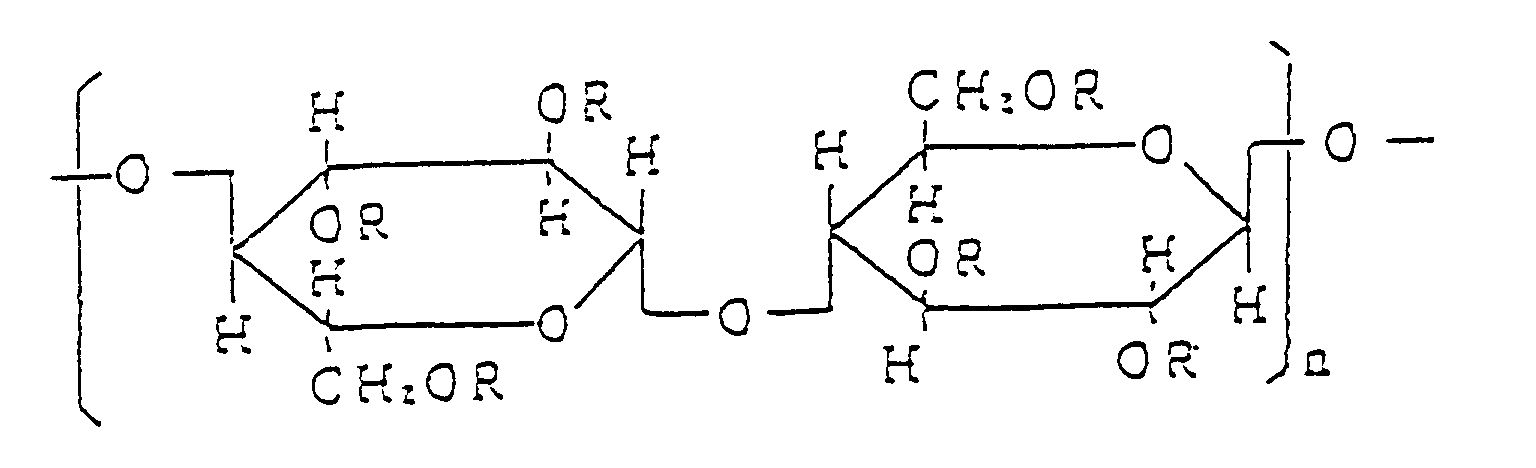
- The antimicrobial agent as claimed in claim 1 wherein the degree of substitution to carboxymethyl groups is 0.4 to 1.
- The antimicrobial agent as claimed in claim 1 or 2 wherein said carboxymethylcellulose is a crosslinked, water-insoluble compound.
Applications Claiming Priority (2)
| Application Number | Priority Date | Filing Date | Title |
|---|---|---|---|
| JP06251939A JP3121503B2 (en) | 1994-10-18 | 1994-10-18 | Antibacterial agent |
| JP251939/94 | 1994-10-18 |
Publications (2)
| Publication Number | Publication Date |
|---|---|
| EP0707793A1 EP0707793A1 (en) | 1996-04-24 |
| EP0707793B1 true EP0707793B1 (en) | 1999-05-06 |
Family
ID=17230229
Family Applications (1)
| Application Number | Title | Priority Date | Filing Date |
|---|---|---|---|
| EP95116347A Expired - Lifetime EP0707793B1 (en) | 1994-10-18 | 1995-10-17 | Antimicrobial agent |
Country Status (7)
| Country | Link |
|---|---|
| US (1) | US5709870A (en) |
| EP (1) | EP0707793B1 (en) |
| JP (1) | JP3121503B2 (en) |
| CN (1) | CN1068761C (en) |
| DE (1) | DE69509464T2 (en) |
| DK (1) | DK0707793T3 (en) |
| ES (1) | ES2132492T3 (en) |
Cited By (2)
| Publication number | Priority date | Publication date | Assignee | Title |
|---|---|---|---|---|
| US8486426B2 (en) | 2002-07-29 | 2013-07-16 | Kimberly-Clark Worldwide, Inc. | Methods and compositions for treatment of dermal conditions |
| US9289378B2 (en) | 2004-09-20 | 2016-03-22 | Avent, Inc. | Antimicrobial amorphous compositions |
Families Citing this family (123)
| Publication number | Priority date | Publication date | Assignee | Title |
|---|---|---|---|---|
| US5961843A (en) * | 1994-10-05 | 1999-10-05 | Toto Ltd. | Antimicrobial solid material, process for producing the same, and method of utilizing the same |
| US6854601B2 (en) * | 1995-12-15 | 2005-02-15 | Microban Products Company | Bacteriostatic filter cartridge |
| US5868933A (en) * | 1995-12-15 | 1999-02-09 | Patrick; Gilbert | Antimicrobial filter cartridge |
| US6283308B1 (en) * | 1998-06-17 | 2001-09-04 | Microban Products Company | Bacteriostatic filter cartridge |
| JP3428381B2 (en) | 1996-08-16 | 2003-07-22 | 三菱マテリアル株式会社 | NOx purification pavement structure |
| US6217892B1 (en) * | 1997-10-24 | 2001-04-17 | Joseph A. King | Water treatment composition |
| JP3051709B2 (en) * | 1997-09-30 | 2000-06-12 | 憲司 中村 | Antimicrobial cellulose fiber and method for producing the same |
| US6605751B1 (en) | 1997-11-14 | 2003-08-12 | Acrymed | Silver-containing compositions, devices and methods for making |
| US6248342B1 (en) | 1998-09-29 | 2001-06-19 | Agion Technologies, Llc | Antibiotic high-pressure laminates |
| US6596401B1 (en) | 1998-11-10 | 2003-07-22 | C. R. Bard Inc. | Silane copolymer compositions containing active agents |
| US6602811B1 (en) * | 1998-12-23 | 2003-08-05 | Malden Mills Industries, Inc. | Anti-microbial enhanced knit fabric |
| US6582715B1 (en) | 1999-04-27 | 2003-06-24 | Agion Technologies, Inc. | Antimicrobial orthopedic implants |
| US6652751B1 (en) * | 1999-04-27 | 2003-11-25 | National Research Council Of Canada | Intrinsically bacteriostatic membranes and systems for water purification |
| US6723428B1 (en) * | 1999-05-27 | 2004-04-20 | Foss Manufacturing Co., Inc. | Anti-microbial fiber and fibrous products |
| EP1216065B1 (en) * | 1999-10-01 | 2008-10-29 | Acrymed | Silver-containing compositions, devices and methods for making |
| US7179849B2 (en) | 1999-12-15 | 2007-02-20 | C. R. Bard, Inc. | Antimicrobial compositions containing colloids of oligodynamic metals |
| US6716895B1 (en) | 1999-12-15 | 2004-04-06 | C.R. Bard, Inc. | Polymer compositions containing colloids of silver salts |
| US6579539B2 (en) | 1999-12-22 | 2003-06-17 | C. R. Bard, Inc. | Dual mode antimicrobial compositions |
| US8679523B2 (en) | 1999-12-30 | 2014-03-25 | Kimberly-Clark Worldwide, Inc. | Oxygen-delivery closed cell foam matrix for wound treatment |
| US6592888B1 (en) * | 2000-05-31 | 2003-07-15 | Jentec, Inc. | Composition for wound dressings safely using metallic compounds to produce anti-microbial properties |
| US6379712B1 (en) | 2000-09-13 | 2002-04-30 | Globoasia, L.L.C. | Nanosilver-containing antibacterial and antifungal granules and methods for preparing and using the same |
| GB2370226A (en) | 2000-09-21 | 2002-06-26 | Acordis Speciality Fibres Ltd | Wound dressing |
| HUP0302554A3 (en) * | 2000-11-29 | 2005-05-30 | Bristol Myers Squibb Company S | Preparation of light stabilized antimicrobial materials |
| AU2002322720B2 (en) | 2001-07-25 | 2008-11-13 | Raptor Pharmaceutical Inc. | Compositions and methods for modulating blood-brain barrier transport |
| CA2458708C (en) * | 2001-09-12 | 2011-08-02 | Acordis Speciality Fibres Limited | Antibacterial wound dressing |
| CN1612804A (en) * | 2001-12-03 | 2005-05-04 | C·R·巴德公司 | Microbe-resistant medical device, microbe-resistant polymeric coating and methods for producing same |
| US20030185889A1 (en) * | 2002-03-27 | 2003-10-02 | Jixiong Yan | Colloidal nanosilver solution and method for making the same |
| FR2838025B1 (en) * | 2002-04-08 | 2005-08-05 | Arjo Wiggins | INFORMATION CARRIER HAVING BIOCIDAL PROPERTIES AND METHOD OF MANUFACTURING THE SAME |
| US6905711B1 (en) | 2002-05-02 | 2005-06-14 | Smart Anti-Microbial Solutions, Llc | Antimicrobial agents, products incorporating said agents and methods of making products incorporating antimicrobial agents |
| US20040106341A1 (en) | 2002-11-29 | 2004-06-03 | Vogt Kirkland W. | Fabrics having a topically applied silver-based finish exhibiting a reduced propensity for discoloration |
| US20040106342A1 (en) * | 2002-11-29 | 2004-06-03 | Sturm Raymond C. | Nonwoven roll towels having antimicrobial characteristics |
| US20040106340A1 (en) * | 2002-11-29 | 2004-06-03 | Kreider Jason L. | Fabrics having a topically applied silver-based finish exhibiting improved wash durability |
| US20040180093A1 (en) * | 2003-03-12 | 2004-09-16 | 3M Innovative Properties Company | Polymer compositions with bioactive agent, medical articles, and methods |
| US20040192132A1 (en) * | 2003-03-20 | 2004-09-30 | Fay Ralph Michael | Fungi resistant asphalt and asphalt sheet materials |
| US20040185204A1 (en) * | 2003-03-20 | 2004-09-23 | Fay Ralph Michael | Fungi growth resistant faced insulation assembly |
| US20040182031A1 (en) * | 2003-03-20 | 2004-09-23 | Fay Ralph Michael | Fungi growth resistant facing and insulation assembly |
| US7132378B2 (en) * | 2003-04-23 | 2006-11-07 | Milliken & Company | Fabrics having a topically applied silver-based finish with a cross-linked binder system for improved high-temperature wash durability |
| US7745509B2 (en) * | 2003-12-05 | 2010-06-29 | 3M Innovative Properties Company | Polymer compositions with bioactive agent, medical articles, and methods |
| US20050123590A1 (en) * | 2003-12-05 | 2005-06-09 | 3M Innovative Properties Company | Wound dressings and methods |
| US20050123621A1 (en) * | 2003-12-05 | 2005-06-09 | 3M Innovative Properties Company | Silver coatings and methods of manufacture |
| EP1781098B1 (en) | 2004-07-30 | 2015-10-07 | Avent, Inc. | Antimicrobial devices and compositions |
| BRPI0513967A (en) | 2004-07-30 | 2008-05-20 | Acrymed Inc | antimicrobial silver compositions |
| US8361553B2 (en) | 2004-07-30 | 2013-01-29 | Kimberly-Clark Worldwide, Inc. | Methods and compositions for metal nanoparticle treated surfaces |
| US20060035039A1 (en) * | 2004-08-12 | 2006-02-16 | 3M Innovative Properties Company | Silver-releasing articles and methods of manufacture |
| US20060034899A1 (en) * | 2004-08-12 | 2006-02-16 | Ylitalo Caroline M | Biologically-active adhesive articles and methods of manufacture |
| WO2006132653A2 (en) * | 2004-08-30 | 2006-12-14 | Southwest Research Institute | Biocidal fibrous and film materials comprising silver and chlorite ions |
| US9364579B2 (en) * | 2004-08-30 | 2016-06-14 | Southwest Research Institute | Biocidal fibrous and film materials utilizing silver ion |
| US7297281B2 (en) * | 2004-09-23 | 2007-11-20 | Yakima Filters, Inc. | Systems having nanostructured adsorption material and methods for purification of fluid |
| US20060068024A1 (en) * | 2004-09-27 | 2006-03-30 | Schroeder Kurt M | Antimicrobial silver halide composition |
| US20060078484A1 (en) * | 2004-10-13 | 2006-04-13 | Greep Darcy W | Wearable hand sanitation devices |
| US7504369B2 (en) * | 2005-02-25 | 2009-03-17 | Solutions Biomed, Llc | Methods and compositions for decontaminating surfaces exposed to chemical and/or biological warfare compounds |
| US7511007B2 (en) * | 2005-02-25 | 2009-03-31 | Solutions Biomed, Llc | Aqueous sanitizers, disinfectants, and/or sterilants with low peroxygen content |
| US7534756B2 (en) * | 2005-02-25 | 2009-05-19 | Solutions Biomed, Llc | Devices, systems, and methods for dispensing disinfectant solutions comprising a peroxygen and transition metal |
| US7462590B2 (en) * | 2005-02-25 | 2008-12-09 | Solutions Biomed, Llc | Aqueous disinfectants and sterilants comprising a peroxide/peracid/transition metal mixture |
| ZA200707893B (en) | 2005-02-25 | 2008-12-31 | Solutions Biomed Llc | Aqueous disinfectants and sterilants |
| US7507701B2 (en) * | 2005-02-25 | 2009-03-24 | Solutions Biomed, Llc | Aqueous disinfectants and sterilants including transition metals |
| US7473675B2 (en) * | 2005-02-25 | 2009-01-06 | Solutions Biomed, Llc | Disinfectant systems and methods comprising a peracid, alcohol, and transition metal |
| US7553805B2 (en) * | 2005-02-25 | 2009-06-30 | Solutions Biomed, Llc | Methods and compositions for treating viral, fungal, and bacterial infections |
| US20080213394A1 (en) * | 2005-03-11 | 2008-09-04 | Tullo Louis J | Polymer-Based Antimicrobial Agents, Methods of Making Said Agents, and Products Incorporating Said Agents |
| US8399027B2 (en) * | 2005-04-14 | 2013-03-19 | 3M Innovative Properties Company | Silver coatings and methods of manufacture |
| CN102379684B (en) | 2005-04-28 | 2014-11-19 | 普罗透斯数字保健公司 | Pharma-informatics system |
| US20070031595A1 (en) * | 2005-08-03 | 2007-02-08 | Fox Richard B | Process for 360 degree soft touch molding on an object core and product made therewith |
| US7297283B2 (en) * | 2005-12-09 | 2007-11-20 | Yakima Filters, Inc. | Container having fluid purification system |
| GB0525504D0 (en) | 2005-12-14 | 2006-01-25 | Bristol Myers Squibb Co | Antimicrobial composition |
| CA2634551C (en) * | 2005-12-23 | 2017-12-05 | Polyworks, Inc. | Methods of making polymeric articles and the polymeric articles formed thereby |
| US20070143942A1 (en) * | 2005-12-23 | 2007-06-28 | Polyworks, Inc. | Handle with soft gel cushioning member |
| US20070154506A1 (en) * | 2005-12-30 | 2007-07-05 | Patton David L | Antimicrobial agent to inhibit the growth of microorganisms on disposable products |
| US20070154508A1 (en) * | 2005-12-30 | 2007-07-05 | Patton David L | Antimicrobial agent to inhibit the growth of microorganisms on outerwear used in the medical profession |
| US20070154507A1 (en) * | 2005-12-30 | 2007-07-05 | Patton David L | Antimicrobial agent to inhibit the growth of microorganism on clothing |
| US20070154505A1 (en) * | 2005-12-30 | 2007-07-05 | Manico Joseph A | Antimicrobial agent to inhibit the growth of microorganisms on building materials |
| US20070166399A1 (en) | 2006-01-13 | 2007-07-19 | 3M Innovative Properties Company | Silver-containing antimicrobial articles and methods of manufacture |
| WO2007100922A2 (en) * | 2006-02-28 | 2007-09-07 | Polyworks, Inc. | Methods of making polymeric articles and polymeric articles formed thereby |
| KR100788997B1 (en) * | 2006-03-10 | 2007-12-28 | 김주영 | Process for producing antimicrobial wet dressing material chemically bonded with silver and its wet dressing material |
| EP2015722B1 (en) * | 2006-04-28 | 2016-11-16 | Avent, Inc. | Antimicrobial site dressings |
| US20070275472A1 (en) * | 2006-05-23 | 2007-11-29 | Eastman Kodak Company | Method for detecting presence of silver-containing antimicrobial agents |
| US7635552B2 (en) * | 2006-07-25 | 2009-12-22 | Endicott Interconnect Technologies, Inc. | Photoresist composition with antibacterial agent |
| KR20090071598A (en) | 2006-09-18 | 2009-07-01 | 랩터 파마슈티컬 인코포레이티드 | Treatment of liver disease by administration of receptor binding protein (RAP) -conjugates |
| US20100098949A1 (en) * | 2006-10-18 | 2010-04-22 | Burton Scott A | Antimicrobial articles and method of manufacture |
| US20080110773A1 (en) * | 2006-11-14 | 2008-05-15 | Greep Darcy W | Wearable devices for dispensing flowable agents |
| WO2008097776A1 (en) * | 2007-02-09 | 2008-08-14 | United Feather & Down, Inc. | Blended fiber containing silver, blended filling containing silver fibers, and method for making same |
| US7520923B2 (en) * | 2007-03-22 | 2009-04-21 | Mvp Textiles & Apparel, Inc. | Antimicrobial filtration article |
| US20090039688A1 (en) * | 2007-04-13 | 2009-02-12 | Polyworks, Inc. | Cushioning medallions, methods of making and methods of using |
| US8871328B2 (en) | 2007-04-13 | 2014-10-28 | Daniel M. Wyner | Impact and vibration absorbing body-contacting medallions, methods of using and methods of making |
| US20080299163A1 (en) * | 2007-06-01 | 2008-12-04 | Haskin Marvin E | Anti-Fomitic Device Incorporating Anti-Microbial Metals |
| US20080302713A1 (en) * | 2007-06-05 | 2008-12-11 | Gilbert Patrick | Antimicrobial filter cartridge |
| US7939149B2 (en) * | 2007-06-12 | 2011-05-10 | M-Tech Corporation | Heat-shrinkable anti-fomitic device incorporating anti-microbial metal |
| US20090004474A1 (en) * | 2007-06-29 | 2009-01-01 | Weyerhaeuser Co. | Lyocell fibers with anti-microbial activity |
| WO2009032203A1 (en) * | 2007-08-30 | 2009-03-12 | Solutions Biomed, Llc | Colloidal metal-containing skin sanitizer |
| US20090130160A1 (en) * | 2007-11-21 | 2009-05-21 | Fiber Innovation Technology, Inc. | Fiber for wound dressing |
| US8464910B2 (en) * | 2008-03-14 | 2013-06-18 | Solutions Biomed, Llc | Multi-chamber container system for storing and mixing fluids |
| US20090246258A1 (en) * | 2008-03-28 | 2009-10-01 | Piyush Shukla | Antimicrobial and odor adsorbing textile |
| CN102046365A (en) * | 2008-04-14 | 2011-05-04 | 宝立沃克斯公司 | Deep drawing method for making shock and vibration absorbing articles and articles formed therefrom |
| US20100047321A1 (en) * | 2008-08-20 | 2010-02-25 | Sandford David W | Silver antimicrobial composition and use |
| US20100120913A1 (en) * | 2008-11-12 | 2010-05-13 | Larson Brian G | Resin catalyzed and stabilized peracid compositions and associated methods |
| US8789716B2 (en) * | 2008-11-12 | 2014-07-29 | Solutions Biomed, Llc | Multi-chamber container system for storing and mixing liquids |
| US8716339B2 (en) | 2008-11-12 | 2014-05-06 | Solutions Biomed, Llc | Two-part disinfectant system and related methods |
| EP2398500B1 (en) | 2009-02-20 | 2019-03-13 | 2-BBB Medicines B.V. | Glutathione-based drug delivery system |
| KR20110127164A (en) * | 2009-03-11 | 2011-11-24 | 라이온 가부시키가이샤 | Granular Detergent Composition |
| ES2942923T3 (en) | 2009-05-06 | 2023-06-07 | Laboratory Skin Care Inc | Dermal delivery compositions comprising complexes of active agent-calcium phosphate particles and methods of use thereof |
| FR2945180B1 (en) | 2009-05-07 | 2013-02-22 | Arjowiggins Security | INFORMATION CARRIER HAVING ANTIVIRAL PROPERTIES AND METHOD FOR MANUFACTURING THE SAME |
| US8719652B2 (en) | 2009-05-12 | 2014-05-06 | Stec, Inc. | Flash storage device with read disturb mitigation |
| EP2504041B1 (en) | 2009-11-25 | 2017-04-12 | Difusion Technologies Inc. | Post-charging of zeolite doped plastics with antimicrobial metal ions |
| BR112012016027B1 (en) | 2009-12-11 | 2019-01-15 | Difusion Technologies, Inc. | production method of polyetheretherketone antimicrobial implants |
| US20110250253A1 (en) * | 2010-04-12 | 2011-10-13 | Cunkle Glen T | Antimicrobial treatment of synthetic nonwoven textiles |
| MX2012012710A (en) | 2010-05-07 | 2013-02-26 | Difusion Technologies Inc | Medical implants with increased hydrophilicity. |
| FR2967074B1 (en) | 2010-11-08 | 2013-06-28 | Arjowiggins Security | FLUID COMPOSITIONS CAPABLE OF FORMING A COATING HAVING ANTIVIRAL PROPERTIES |
| GB201020236D0 (en) | 2010-11-30 | 2011-01-12 | Convatec Technologies Inc | A composition for detecting biofilms on viable tissues |
| CN102132709B (en) * | 2010-12-22 | 2013-06-05 | 太原理工大学 | Method for preparing starch core-shell silver antibacterial agent |
| GB201105829D0 (en) * | 2011-04-06 | 2011-05-18 | Convatec Technologies Inc | Antimicrobial compositions |
| CN102815949B (en) * | 2012-09-03 | 2014-01-01 | 中国地质大学(武汉) | A kind of antifungal additive for ceramic green body and preparation method thereof |
| CN102827544A (en) * | 2012-09-17 | 2012-12-19 | 吴江市物华五金制品有限公司 | Thermosetting water soluble resin antibacterial coating |
| EP2935688A2 (en) | 2012-12-20 | 2015-10-28 | ConvaTec Technologies Inc. | Processing of chemically modified cellulosic fibres |
| GB201308770D0 (en) | 2013-05-15 | 2013-06-26 | Convatec Technologies Inc | Wound Dressing Comprising an Antimicrobial Composition |
| CN103315001A (en) * | 2013-05-23 | 2013-09-25 | 厦门大学 | Antibacterial composite material with silver loaded on polymer nanosphere surfaces and preparation method for antibacterial composite material |
| US9332855B2 (en) | 2014-03-13 | 2016-05-10 | John Robert BAXTER | Personal cellular tissue repair, recovery and regeneration enhancement sleep system |
| JP2015218159A (en) * | 2014-05-21 | 2015-12-07 | 凸版印刷株式会社 | Antimicrobial composition, laminate and compact |
| CN104399106A (en) * | 2014-12-02 | 2015-03-11 | 张凤 | Soluble fiber with anti-bacterial anti-inflammation effects and preparation method of soluble fiber |
| TWI537331B (en) | 2015-04-21 | 2016-06-11 | 王式禹 | Water soluble antimicrobial polyacrylate silver salt |
| TWI567097B (en) * | 2015-04-21 | 2017-01-21 | 王式禹 | A preparation method of water soluble antimicrobial polyacrylate silver salt |
| JP2019199518A (en) * | 2018-05-16 | 2019-11-21 | 日本製紙株式会社 | Metal ion-containing cellulose fiber |
| GB201900020D0 (en) * | 2019-01-02 | 2019-02-13 | Dyson Technology Ltd | Air treatment apparatus |
| GB201900024D0 (en) * | 2019-01-02 | 2019-02-13 | Dyson Technology Ltd | Air treatment apparatus |
| US20210402052A1 (en) | 2020-06-30 | 2021-12-30 | Difusion, Inc. | Medical Implants And Methods Of Manufacture |
Family Cites Families (8)
| Publication number | Priority date | Publication date | Assignee | Title |
|---|---|---|---|---|
| US2072808A (en) * | 1934-10-11 | 1937-03-02 | North American Rayon Corp | Process of producing dull-luster bactericidal filament |
| JPS53109941A (en) | 1977-03-04 | 1978-09-26 | Nitto Electric Ind Co Ltd | Anti-microbial material |
| DE2809244A1 (en) * | 1977-03-04 | 1978-09-21 | Nitto Electric Ind Co | ANTIBACTERIAL AND FUNGICIDAL MATERIAL |
| CA1224003A (en) * | 1984-04-24 | 1987-07-14 | Robert S. Molday | Colloidal sized metal-polysaccharide particles |
| AU620439B2 (en) | 1988-09-12 | 1992-02-20 | Johnson & Johnson Patient Care, Inc. | Antibacterial adhesive composition |
| JP2840331B2 (en) | 1989-10-26 | 1998-12-24 | 大日本印刷株式会社 | How to keep leafy vegetables fresh |
| US5468489A (en) * | 1991-10-29 | 1995-11-21 | Sangi Co., Ltd. | Dentifrice containing antibacterial material |
| EP0671882B1 (en) * | 1992-12-01 | 1998-07-22 | Minnesota Mining And Manufacturing Company | Durable anti-microbial agents |
-
1994
- 1994-10-18 JP JP06251939A patent/JP3121503B2/en not_active Expired - Fee Related
-
1995
- 1995-10-17 EP EP95116347A patent/EP0707793B1/en not_active Expired - Lifetime
- 1995-10-17 DE DE69509464T patent/DE69509464T2/en not_active Expired - Fee Related
- 1995-10-17 CN CN95119948A patent/CN1068761C/en not_active Expired - Fee Related
- 1995-10-17 ES ES95116347T patent/ES2132492T3/en not_active Expired - Lifetime
- 1995-10-17 DK DK95116347T patent/DK0707793T3/en active
- 1995-10-18 US US08/544,532 patent/US5709870A/en not_active Expired - Fee Related
Cited By (2)
| Publication number | Priority date | Publication date | Assignee | Title |
|---|---|---|---|---|
| US8486426B2 (en) | 2002-07-29 | 2013-07-16 | Kimberly-Clark Worldwide, Inc. | Methods and compositions for treatment of dermal conditions |
| US9289378B2 (en) | 2004-09-20 | 2016-03-22 | Avent, Inc. | Antimicrobial amorphous compositions |
Also Published As
| Publication number | Publication date |
|---|---|
| ES2132492T3 (en) | 1999-08-16 |
| DE69509464D1 (en) | 1999-06-10 |
| US5709870A (en) | 1998-01-20 |
| EP0707793A1 (en) | 1996-04-24 |
| JPH08113507A (en) | 1996-05-07 |
| CN1129518A (en) | 1996-08-28 |
| DK0707793T3 (en) | 1999-11-01 |
| CN1068761C (en) | 2001-07-25 |
| DE69509464T2 (en) | 1999-09-02 |
| JP3121503B2 (en) | 2001-01-09 |
Similar Documents
| Publication | Publication Date | Title |
|---|---|---|
| US5709870A (en) | Antimicrobial agent | |
| EP0593042B1 (en) | Antiviral composition | |
| US5296238A (en) | Microbicides | |
| CN107312315B (en) | A kind of lignin/silver compound antibacterial agent and its preparation method and application | |
| CN113712042A (en) | Multifunctional persistent antibacterial composition and preparation method thereof | |
| KR860001054B1 (en) | Functionalized polyacrylamide grafted starch polymer wet strength additives | |
| US5939087A (en) | Antimicrobial polymer composition | |
| CN115216957A (en) | Washable bioactive cellulose fibers with antibacterial and antiviral properties | |
| JPS62238900A (en) | Paper with antibacterial and antifungal functions and its manufacturing method | |
| JPH11222796A (en) | Antibacterial paper and packaging materials | |
| US5015632A (en) | Chitosan pyrithione as an antimicrobial agent useful in personal care products | |
| US4323565A (en) | Antibacterial and antifungal composition | |
| JP2912142B2 (en) | Anti-membrane viral composition and method for producing the same | |
| CN114868767A (en) | High-temperature-resistant composite antibacterial agent and preparation method thereof | |
| JP3218605B2 (en) | Antibacterial phosphate intercalation compound and method for producing the same | |
| US2051910A (en) | Copper fungicides | |
| JPS5946249B2 (en) | Method for producing insoluble etherified cellulose graft copolymer | |
| JP3085750B2 (en) | Antibacterial resin or antibacterial paint | |
| US4301162A (en) | Antibacterial and antifungal composition | |
| CA1134858A (en) | Calcium salts of divinyl ether--maleic anhydride copolymer | |
| JP7707606B2 (en) | Coating material for sustained-release agents and sustained-release agents, granular fertilizers, or granular agricultural chemicals coated with the same | |
| JP2000160027A (en) | Antimicrobial composition | |
| JPH101897A (en) | Antimicrobial paper | |
| JPH03137298A (en) | Antibacterial paper and its preparation | |
| JP3085682B2 (en) | Antimicrobial composition |
Legal Events
| Date | Code | Title | Description |
|---|---|---|---|
| PUAI | Public reference made under article 153(3) epc to a published international application that has entered the european phase |
Free format text: ORIGINAL CODE: 0009012 |
|
| AK | Designated contracting states |
Kind code of ref document: A1 Designated state(s): DE DK ES FR GB IT NL SE |
|
| 17P | Request for examination filed |
Effective date: 19960703 |
|
| 17Q | First examination report despatched |
Effective date: 19970630 |
|
| GRAG | Despatch of communication of intention to grant |
Free format text: ORIGINAL CODE: EPIDOS AGRA |
|
| GRAG | Despatch of communication of intention to grant |
Free format text: ORIGINAL CODE: EPIDOS AGRA |
|
| GRAH | Despatch of communication of intention to grant a patent |
Free format text: ORIGINAL CODE: EPIDOS IGRA |
|
| GRAH | Despatch of communication of intention to grant a patent |
Free format text: ORIGINAL CODE: EPIDOS IGRA |
|
| GRAA | (expected) grant |
Free format text: ORIGINAL CODE: 0009210 |
|
| AK | Designated contracting states |
Kind code of ref document: B1 Designated state(s): DE DK ES FR GB IT NL SE |
|
| REF | Corresponds to: |
Ref document number: 69509464 Country of ref document: DE Date of ref document: 19990610 |
|
| ET | Fr: translation filed | ||
| REG | Reference to a national code |
Ref country code: ES Ref legal event code: FG2A Ref document number: 2132492 Country of ref document: ES Kind code of ref document: T3 |
|
| REG | Reference to a national code |
Ref country code: DK Ref legal event code: T3 |
|
| PLBE | No opposition filed within time limit |
Free format text: ORIGINAL CODE: 0009261 |
|
| STAA | Information on the status of an ep patent application or granted ep patent |
Free format text: STATUS: NO OPPOSITION FILED WITHIN TIME LIMIT |
|
| 26N | No opposition filed | ||
| PGFP | Annual fee paid to national office [announced via postgrant information from national office to epo] |
Ref country code: SE Payment date: 20011005 Year of fee payment: 7 |
|
| PGFP | Annual fee paid to national office [announced via postgrant information from national office to epo] |
Ref country code: DK Payment date: 20011012 Year of fee payment: 7 |
|
| PGFP | Annual fee paid to national office [announced via postgrant information from national office to epo] |
Ref country code: ES Payment date: 20011025 Year of fee payment: 7 |
|
| PGFP | Annual fee paid to national office [announced via postgrant information from national office to epo] |
Ref country code: NL Payment date: 20011031 Year of fee payment: 7 |
|
| REG | Reference to a national code |
Ref country code: GB Ref legal event code: IF02 |
|
| PG25 | Lapsed in a contracting state [announced via postgrant information from national office to epo] |
Ref country code: SE Free format text: LAPSE BECAUSE OF NON-PAYMENT OF DUE FEES Effective date: 20021018 Ref country code: ES Free format text: LAPSE BECAUSE OF NON-PAYMENT OF DUE FEES Effective date: 20021018 |
|
| PG25 | Lapsed in a contracting state [announced via postgrant information from national office to epo] |
Ref country code: DK Free format text: LAPSE BECAUSE OF NON-PAYMENT OF DUE FEES Effective date: 20021031 |
|
| PG25 | Lapsed in a contracting state [announced via postgrant information from national office to epo] |
Ref country code: NL Free format text: LAPSE BECAUSE OF NON-PAYMENT OF DUE FEES Effective date: 20030501 |
|
| EUG | Se: european patent has lapsed | ||
| REG | Reference to a national code |
Ref country code: DK Ref legal event code: EBP |
|
| NLV4 | Nl: lapsed or anulled due to non-payment of the annual fee |
Effective date: 20030501 |
|
| PGFP | Annual fee paid to national office [announced via postgrant information from national office to epo] |
Ref country code: FR Payment date: 20031003 Year of fee payment: 9 |
|
| PGFP | Annual fee paid to national office [announced via postgrant information from national office to epo] |
Ref country code: GB Payment date: 20031016 Year of fee payment: 9 |
|
| PGFP | Annual fee paid to national office [announced via postgrant information from national office to epo] |
Ref country code: DE Payment date: 20031030 Year of fee payment: 9 |
|
| REG | Reference to a national code |
Ref country code: ES Ref legal event code: FD2A Effective date: 20031112 |
|
| PG25 | Lapsed in a contracting state [announced via postgrant information from national office to epo] |
Ref country code: GB Free format text: LAPSE BECAUSE OF NON-PAYMENT OF DUE FEES Effective date: 20041017 |
|
| PG25 | Lapsed in a contracting state [announced via postgrant information from national office to epo] |
Ref country code: DE Free format text: LAPSE BECAUSE OF NON-PAYMENT OF DUE FEES Effective date: 20050503 |
|
| GBPC | Gb: european patent ceased through non-payment of renewal fee |
Effective date: 20041017 |
|
| PG25 | Lapsed in a contracting state [announced via postgrant information from national office to epo] |
Ref country code: FR Free format text: LAPSE BECAUSE OF NON-PAYMENT OF DUE FEES Effective date: 20050630 |
|
| REG | Reference to a national code |
Ref country code: FR Ref legal event code: ST |
|
| PG25 | Lapsed in a contracting state [announced via postgrant information from national office to epo] |
Ref country code: IT Free format text: LAPSE BECAUSE OF NON-PAYMENT OF DUE FEES Effective date: 20051017 |