EP0706980B1 - Composite oxide having oxygen absorbing and desorbing capability and method for preparing same - Google Patents
Composite oxide having oxygen absorbing and desorbing capability and method for preparing same Download PDFInfo
- Publication number
- EP0706980B1 EP0706980B1 EP95307050A EP95307050A EP0706980B1 EP 0706980 B1 EP0706980 B1 EP 0706980B1 EP 95307050 A EP95307050 A EP 95307050A EP 95307050 A EP95307050 A EP 95307050A EP 0706980 B1 EP0706980 B1 EP 0706980B1
- Authority
- EP
- European Patent Office
- Prior art keywords
- oxide
- ion
- cerium
- phase
- weight
- Prior art date
- Legal status (The legal status is an assumption and is not a legal conclusion. Google has not performed a legal analysis and makes no representation as to the accuracy of the status listed.)
- Expired - Lifetime
Links
- 239000002131 composite material Substances 0.000 title claims description 52
- QVGXLLKOCUKJST-UHFFFAOYSA-N atomic oxygen Chemical compound [O] QVGXLLKOCUKJST-UHFFFAOYSA-N 0.000 title claims description 33
- 239000001301 oxygen Substances 0.000 title claims description 33
- 229910052760 oxygen Inorganic materials 0.000 title claims description 33
- 238000000034 method Methods 0.000 title claims description 19
- -1 cerium ion Chemical class 0.000 claims description 41
- 239000000243 solution Substances 0.000 claims description 27
- 229910000420 cerium oxide Inorganic materials 0.000 claims description 23
- BMMGVYCKOGBVEV-UHFFFAOYSA-N oxo(oxoceriooxy)cerium Chemical compound [Ce]=O.O=[Ce]=O BMMGVYCKOGBVEV-UHFFFAOYSA-N 0.000 claims description 23
- 239000000203 mixture Substances 0.000 claims description 22
- 229910052684 Cerium Inorganic materials 0.000 claims description 21
- MUBZPKHOEPUJKR-UHFFFAOYSA-N Oxalic acid Chemical compound OC(=O)C(O)=O MUBZPKHOEPUJKR-UHFFFAOYSA-N 0.000 claims description 21
- RVTZCBVAJQQJTK-UHFFFAOYSA-N oxygen(2-);zirconium(4+) Chemical compound [O-2].[O-2].[Zr+4] RVTZCBVAJQQJTK-UHFFFAOYSA-N 0.000 claims description 20
- 229910001928 zirconium oxide Inorganic materials 0.000 claims description 20
- 239000007864 aqueous solution Substances 0.000 claims description 17
- 239000013078 crystal Substances 0.000 claims description 17
- 229910000449 hafnium oxide Inorganic materials 0.000 claims description 17
- WIHZLLGSGQNAGK-UHFFFAOYSA-N hafnium(4+);oxygen(2-) Chemical compound [O-2].[O-2].[Hf+4] WIHZLLGSGQNAGK-UHFFFAOYSA-N 0.000 claims description 17
- GWXLDORMOJMVQZ-UHFFFAOYSA-N cerium Chemical compound [Ce] GWXLDORMOJMVQZ-UHFFFAOYSA-N 0.000 claims description 14
- 229910052735 hafnium Inorganic materials 0.000 claims description 13
- 229910021645 metal ion Inorganic materials 0.000 claims description 13
- 239000002244 precipitate Substances 0.000 claims description 13
- UQSXHKLRYXJYBZ-UHFFFAOYSA-N Iron oxide Chemical compound [Fe]=O UQSXHKLRYXJYBZ-UHFFFAOYSA-N 0.000 claims description 12
- 238000002441 X-ray diffraction Methods 0.000 claims description 12
- QVQLCTNNEUAWMS-UHFFFAOYSA-N barium oxide Chemical compound [Ba]=O QVQLCTNNEUAWMS-UHFFFAOYSA-N 0.000 claims description 12
- 229910044991 metal oxide Inorganic materials 0.000 claims description 12
- 150000004706 metal oxides Chemical class 0.000 claims description 12
- IATRAKWUXMZMIY-UHFFFAOYSA-N strontium oxide Chemical compound [O-2].[Sr+2] IATRAKWUXMZMIY-UHFFFAOYSA-N 0.000 claims description 12
- QGZKDVFQNNGYKY-UHFFFAOYSA-N Ammonia Chemical compound N QGZKDVFQNNGYKY-UHFFFAOYSA-N 0.000 claims description 10
- ATRRKUHOCOJYRX-UHFFFAOYSA-N Ammonium bicarbonate Chemical compound [NH4+].OC([O-])=O ATRRKUHOCOJYRX-UHFFFAOYSA-N 0.000 claims description 9
- 229910000013 Ammonium bicarbonate Inorganic materials 0.000 claims description 9
- 235000012538 ammonium bicarbonate Nutrition 0.000 claims description 9
- 239000001099 ammonium carbonate Substances 0.000 claims description 9
- BRPQOXSCLDDYGP-UHFFFAOYSA-N calcium oxide Chemical compound [O-2].[Ca+2] BRPQOXSCLDDYGP-UHFFFAOYSA-N 0.000 claims description 8
- 239000000292 calcium oxide Substances 0.000 claims description 8
- ODINCKMPIJJUCX-UHFFFAOYSA-N calcium oxide Inorganic materials [Ca]=O ODINCKMPIJJUCX-UHFFFAOYSA-N 0.000 claims description 8
- 239000000395 magnesium oxide Substances 0.000 claims description 8
- CPLXHLVBOLITMK-UHFFFAOYSA-N magnesium oxide Inorganic materials [Mg]=O CPLXHLVBOLITMK-UHFFFAOYSA-N 0.000 claims description 8
- AXZKOIWUVFPNLO-UHFFFAOYSA-N magnesium;oxygen(2-) Chemical compound [O-2].[Mg+2] AXZKOIWUVFPNLO-UHFFFAOYSA-N 0.000 claims description 8
- 238000002156 mixing Methods 0.000 claims description 8
- 229910052761 rare earth metal Inorganic materials 0.000 claims description 8
- 150000002910 rare earth metals Chemical class 0.000 claims description 8
- 238000001354 calcination Methods 0.000 claims description 7
- 235000006408 oxalic acid Nutrition 0.000 claims description 7
- GBNDTYKAOXLLID-UHFFFAOYSA-N zirconium(4+) ion Chemical compound [Zr+4] GBNDTYKAOXLLID-UHFFFAOYSA-N 0.000 claims description 7
- FRWYFWZENXDZMU-UHFFFAOYSA-N 2-iodoquinoline Chemical compound C1=CC=CC2=NC(I)=CC=C21 FRWYFWZENXDZMU-UHFFFAOYSA-N 0.000 claims description 6
- QPLDLSVMHZLSFG-UHFFFAOYSA-N Copper oxide Chemical compound [Cu]=O QPLDLSVMHZLSFG-UHFFFAOYSA-N 0.000 claims description 6
- 239000005751 Copper oxide Substances 0.000 claims description 6
- VYPSYNLAJGMNEJ-UHFFFAOYSA-N Silicium dioxide Chemical compound O=[Si]=O VYPSYNLAJGMNEJ-UHFFFAOYSA-N 0.000 claims description 6
- GWEVSGVZZGPLCZ-UHFFFAOYSA-N Titan oxide Chemical compound O=[Ti]=O GWEVSGVZZGPLCZ-UHFFFAOYSA-N 0.000 claims description 6
- LTPBRCUWZOMYOC-UHFFFAOYSA-N beryllium oxide Inorganic materials O=[Be] LTPBRCUWZOMYOC-UHFFFAOYSA-N 0.000 claims description 6
- 229910000431 copper oxide Inorganic materials 0.000 claims description 6
- 229910000480 nickel oxide Inorganic materials 0.000 claims description 6
- QGLKJKCYBOYXKC-UHFFFAOYSA-N nonaoxidotritungsten Chemical compound O=[W]1(=O)O[W](=O)(=O)O[W](=O)(=O)O1 QGLKJKCYBOYXKC-UHFFFAOYSA-N 0.000 claims description 6
- TWNQGVIAIRXVLR-UHFFFAOYSA-N oxo(oxoalumanyloxy)alumane Chemical compound O=[Al]O[Al]=O TWNQGVIAIRXVLR-UHFFFAOYSA-N 0.000 claims description 6
- GNRSAWUEBMWBQH-UHFFFAOYSA-N oxonickel Chemical compound [Ni]=O GNRSAWUEBMWBQH-UHFFFAOYSA-N 0.000 claims description 6
- 229910052814 silicon oxide Inorganic materials 0.000 claims description 6
- OGIDPMRJRNCKJF-UHFFFAOYSA-N titanium oxide Inorganic materials [Ti]=O OGIDPMRJRNCKJF-UHFFFAOYSA-N 0.000 claims description 6
- 229910001930 tungsten oxide Inorganic materials 0.000 claims description 6
- 150000002500 ions Chemical class 0.000 claims description 5
- 229910021529 ammonia Inorganic materials 0.000 claims description 4
- 238000000465 moulding Methods 0.000 claims description 4
- 239000000047 product Substances 0.000 claims description 4
- 238000005245 sintering Methods 0.000 claims description 4
- BHPQYMZQTOCNFJ-UHFFFAOYSA-N Calcium cation Chemical compound [Ca+2] BHPQYMZQTOCNFJ-UHFFFAOYSA-N 0.000 claims description 3
- JPVYNHNXODAKFH-UHFFFAOYSA-N Cu2+ Chemical compound [Cu+2] JPVYNHNXODAKFH-UHFFFAOYSA-N 0.000 claims description 3
- JLVVSXFLKOJNIY-UHFFFAOYSA-N Magnesium ion Chemical compound [Mg+2] JLVVSXFLKOJNIY-UHFFFAOYSA-N 0.000 claims description 3
- PXHVJJICTQNCMI-UHFFFAOYSA-N Nickel Chemical compound [Ni] PXHVJJICTQNCMI-UHFFFAOYSA-N 0.000 claims description 3
- LCKIEQZJEYYRIY-UHFFFAOYSA-N Titanium ion Chemical compound [Ti+4] LCKIEQZJEYYRIY-UHFFFAOYSA-N 0.000 claims description 3
- 229910052782 aluminium Inorganic materials 0.000 claims description 3
- 229910001422 barium ion Inorganic materials 0.000 claims description 3
- 229910001423 beryllium ion Inorganic materials 0.000 claims description 3
- PWOSZCQLSAMRQW-UHFFFAOYSA-N beryllium(2+) Chemical compound [Be+2] PWOSZCQLSAMRQW-UHFFFAOYSA-N 0.000 claims description 3
- 229910001424 calcium ion Inorganic materials 0.000 claims description 3
- 229910001431 copper ion Inorganic materials 0.000 claims description 3
- 229910052742 iron Inorganic materials 0.000 claims description 3
- XEEYBQQBJWHFJM-UHFFFAOYSA-N iron Substances [Fe] XEEYBQQBJWHFJM-UHFFFAOYSA-N 0.000 claims description 3
- 229910001425 magnesium ion Inorganic materials 0.000 claims description 3
- 229910001453 nickel ion Inorganic materials 0.000 claims description 3
- 229910052710 silicon Inorganic materials 0.000 claims description 3
- 239000010703 silicon Substances 0.000 claims description 3
- 229910001427 strontium ion Inorganic materials 0.000 claims description 3
- PWYYWQHXAPXYMF-UHFFFAOYSA-N strontium(2+) Chemical compound [Sr+2] PWYYWQHXAPXYMF-UHFFFAOYSA-N 0.000 claims description 3
- 229910052721 tungsten Inorganic materials 0.000 claims description 3
- 239000010937 tungsten Substances 0.000 claims description 3
- 238000007906 compression Methods 0.000 claims description 2
- 230000006835 compression Effects 0.000 claims description 2
- 239000000919 ceramic Substances 0.000 description 7
- 229910052751 metal Inorganic materials 0.000 description 7
- 239000002184 metal Substances 0.000 description 7
- HSJPMRKMPBAUAU-UHFFFAOYSA-N cerium(3+);trinitrate Chemical compound [Ce+3].[O-][N+]([O-])=O.[O-][N+]([O-])=O.[O-][N+]([O-])=O HSJPMRKMPBAUAU-UHFFFAOYSA-N 0.000 description 6
- 230000001747 exhibiting effect Effects 0.000 description 6
- 239000008188 pellet Substances 0.000 description 6
- OERNJTNJEZOPIA-UHFFFAOYSA-N zirconium nitrate Chemical compound [Zr+4].[O-][N+]([O-])=O.[O-][N+]([O-])=O.[O-][N+]([O-])=O.[O-][N+]([O-])=O OERNJTNJEZOPIA-UHFFFAOYSA-N 0.000 description 6
- QCWXUUIWCKQGHC-UHFFFAOYSA-N Zirconium Chemical compound [Zr] QCWXUUIWCKQGHC-UHFFFAOYSA-N 0.000 description 5
- 230000000052 comparative effect Effects 0.000 description 5
- VBJZVLUMGGDVMO-UHFFFAOYSA-N hafnium atom Chemical compound [Hf] VBJZVLUMGGDVMO-UHFFFAOYSA-N 0.000 description 5
- 229910052726 zirconium Inorganic materials 0.000 description 5
- 239000003054 catalyst Substances 0.000 description 4
- 238000000748 compression moulding Methods 0.000 description 3
- 239000007789 gas Substances 0.000 description 3
- 238000010438 heat treatment Methods 0.000 description 3
- 239000000126 substance Substances 0.000 description 3
- NGDQQLAVJWUYSF-UHFFFAOYSA-N 4-methyl-2-phenyl-1,3-thiazole-5-sulfonyl chloride Chemical compound S1C(S(Cl)(=O)=O)=C(C)N=C1C1=CC=CC=C1 NGDQQLAVJWUYSF-UHFFFAOYSA-N 0.000 description 2
- NLXLAEXVIDQMFP-UHFFFAOYSA-N Ammonium chloride Substances [NH4+].[Cl-] NLXLAEXVIDQMFP-UHFFFAOYSA-N 0.000 description 2
- VHUUQVKOLVNVRT-UHFFFAOYSA-N Ammonium hydroxide Chemical compound [NH4+].[OH-] VHUUQVKOLVNVRT-UHFFFAOYSA-N 0.000 description 2
- 235000011114 ammonium hydroxide Nutrition 0.000 description 2
- WUKWITHWXAAZEY-UHFFFAOYSA-L calcium difluoride Chemical compound [F-].[F-].[Ca+2] WUKWITHWXAAZEY-UHFFFAOYSA-L 0.000 description 2
- 229910001634 calcium fluoride Inorganic materials 0.000 description 2
- RCFVMJKOEJFGTM-UHFFFAOYSA-N cerium zirconium Chemical compound [Zr].[Ce] RCFVMJKOEJFGTM-UHFFFAOYSA-N 0.000 description 2
- RKTYLMNFRDHKIL-UHFFFAOYSA-N copper;5,10,15,20-tetraphenylporphyrin-22,24-diide Chemical compound [Cu+2].C1=CC(C(=C2C=CC([N-]2)=C(C=2C=CC=CC=2)C=2C=CC(N=2)=C(C=2C=CC=CC=2)C2=CC=C3[N-]2)C=2C=CC=CC=2)=NC1=C3C1=CC=CC=C1 RKTYLMNFRDHKIL-UHFFFAOYSA-N 0.000 description 2
- 238000004519 manufacturing process Methods 0.000 description 2
- 239000000463 material Substances 0.000 description 2
- SIWVEOZUMHYXCS-UHFFFAOYSA-N oxo(oxoyttriooxy)yttrium Chemical compound O=[Y]O[Y]=O SIWVEOZUMHYXCS-UHFFFAOYSA-N 0.000 description 2
- 239000007784 solid electrolyte Substances 0.000 description 2
- 239000007858 starting material Substances 0.000 description 2
- 229910052727 yttrium Inorganic materials 0.000 description 2
- UGFAIRIUMAVXCW-UHFFFAOYSA-N Carbon monoxide Chemical compound [O+]#[C-] UGFAIRIUMAVXCW-UHFFFAOYSA-N 0.000 description 1
- VEXZGXHMUGYJMC-UHFFFAOYSA-M Chloride anion Chemical compound [Cl-] VEXZGXHMUGYJMC-UHFFFAOYSA-M 0.000 description 1
- UFHFLCQGNIYNRP-UHFFFAOYSA-N Hydrogen Chemical compound [H][H] UFHFLCQGNIYNRP-UHFFFAOYSA-N 0.000 description 1
- 229910002651 NO3 Inorganic materials 0.000 description 1
- NHNBFGGVMKEFGY-UHFFFAOYSA-N Nitrate Chemical compound [O-][N+]([O-])=O NHNBFGGVMKEFGY-UHFFFAOYSA-N 0.000 description 1
- 238000004458 analytical method Methods 0.000 description 1
- 238000000137 annealing Methods 0.000 description 1
- 238000004364 calculation method Methods 0.000 description 1
- 229910002091 carbon monoxide Inorganic materials 0.000 description 1
- 238000000975 co-precipitation Methods 0.000 description 1
- 150000001875 compounds Chemical class 0.000 description 1
- 238000001514 detection method Methods 0.000 description 1
- 238000007580 dry-mixing Methods 0.000 description 1
- 238000001035 drying Methods 0.000 description 1
- 230000002708 enhancing effect Effects 0.000 description 1
- 238000001914 filtration Methods 0.000 description 1
- TZNXTUDMYCRCAP-UHFFFAOYSA-N hafnium(4+);tetranitrate Chemical compound [Hf+4].[O-][N+]([O-])=O.[O-][N+]([O-])=O.[O-][N+]([O-])=O.[O-][N+]([O-])=O TZNXTUDMYCRCAP-UHFFFAOYSA-N 0.000 description 1
- 229930195733 hydrocarbon Natural products 0.000 description 1
- 150000002430 hydrocarbons Chemical class 0.000 description 1
- 239000001257 hydrogen Substances 0.000 description 1
- 229910052739 hydrogen Inorganic materials 0.000 description 1
- 239000011777 magnesium Substances 0.000 description 1
- 150000002739 metals Chemical class 0.000 description 1
- 229910003455 mixed metal oxide Inorganic materials 0.000 description 1
- 230000001590 oxidative effect Effects 0.000 description 1
- MMKQUGHLEMYQSG-UHFFFAOYSA-N oxygen(2-);praseodymium(3+) Chemical compound [O-2].[O-2].[O-2].[Pr+3].[Pr+3] MMKQUGHLEMYQSG-UHFFFAOYSA-N 0.000 description 1
- 239000002245 particle Substances 0.000 description 1
- 229910003447 praseodymium oxide Inorganic materials 0.000 description 1
- 238000000746 purification Methods 0.000 description 1
- 150000003839 salts Chemical class 0.000 description 1
- 239000010409 thin film Substances 0.000 description 1
- 230000007704 transition Effects 0.000 description 1
- 238000005406 washing Methods 0.000 description 1
- XLYOFNOQVPJJNP-UHFFFAOYSA-N water Substances O XLYOFNOQVPJJNP-UHFFFAOYSA-N 0.000 description 1
- VWQVUPCCIRVNHF-UHFFFAOYSA-N yttrium atom Chemical compound [Y] VWQVUPCCIRVNHF-UHFFFAOYSA-N 0.000 description 1
Images

Classifications
-
- B—PERFORMING OPERATIONS; TRANSPORTING
- B01—PHYSICAL OR CHEMICAL PROCESSES OR APPARATUS IN GENERAL
- B01J—CHEMICAL OR PHYSICAL PROCESSES, e.g. CATALYSIS OR COLLOID CHEMISTRY; THEIR RELEVANT APPARATUS
- B01J23/00—Catalysts comprising metals or metal oxides or hydroxides, not provided for in group B01J21/00
- B01J23/10—Catalysts comprising metals or metal oxides or hydroxides, not provided for in group B01J21/00 of rare earths
-
- C—CHEMISTRY; METALLURGY
- C04—CEMENTS; CONCRETE; ARTIFICIAL STONE; CERAMICS; REFRACTORIES
- C04B—LIME, MAGNESIA; SLAG; CEMENTS; COMPOSITIONS THEREOF, e.g. MORTARS, CONCRETE OR LIKE BUILDING MATERIALS; ARTIFICIAL STONE; CERAMICS; REFRACTORIES; TREATMENT OF NATURAL STONE
- C04B35/00—Shaped ceramic products characterised by their composition; Ceramics compositions; Processing powders of inorganic compounds preparatory to the manufacturing of ceramic products
- C04B35/01—Shaped ceramic products characterised by their composition; Ceramics compositions; Processing powders of inorganic compounds preparatory to the manufacturing of ceramic products based on oxide ceramics
- C04B35/48—Shaped ceramic products characterised by their composition; Ceramics compositions; Processing powders of inorganic compounds preparatory to the manufacturing of ceramic products based on oxide ceramics based on zirconium or hafnium oxides, zirconates, zircon or hafnates
- C04B35/486—Fine ceramics
-
- C—CHEMISTRY; METALLURGY
- C04—CEMENTS; CONCRETE; ARTIFICIAL STONE; CERAMICS; REFRACTORIES
- C04B—LIME, MAGNESIA; SLAG; CEMENTS; COMPOSITIONS THEREOF, e.g. MORTARS, CONCRETE OR LIKE BUILDING MATERIALS; ARTIFICIAL STONE; CERAMICS; REFRACTORIES; TREATMENT OF NATURAL STONE
- C04B35/00—Shaped ceramic products characterised by their composition; Ceramics compositions; Processing powders of inorganic compounds preparatory to the manufacturing of ceramic products
- C04B35/50—Shaped ceramic products characterised by their composition; Ceramics compositions; Processing powders of inorganic compounds preparatory to the manufacturing of ceramic products based on rare-earth compounds
Definitions
- This invention relates to a composite oxide having a novel crystal structure and exhibiting particularly excellent oxygen absorbing and desorbing capability which is utilizable for functional ceramics and for a catalyst for purifying exhaust gases, and a method for preparing the same.
- Cerium oxide has hitherto been employed in large quantities as ceramics or as catalysts for purifying exhaust gases.
- cerium oxide is used for enhancing the purification rate of exhaust gas components such as hydrocarbons, carbon monoxide and NO x , taking advantage of its characteristic properties of absorbing oxygen in an oxidative atmosphere and desorbing oxygen in a reducing atmosphere.
- cerium oxide is used in the form of compounds or mixtures with other elements as electrically conductive ceramics such as solid electrolytes, taking advantage of its characteristic properties mentioned above.
- cerium oxide heretofore known is usually prepared, for example by adding oxalic acid or ammonium bicarbonate to a solution of nitrate or chloride of cerium, filtering and washing the resultant precipitate and drying followed by calcining.
- the composite oxide prepared by the above method predominantly composed of cerium oxide has a drawback that it is incapable of sufficiently absorbing and desorbing oxygen at 400 to 700° C, and is deteriorated in performance after heating to a higher temperature, even though it exhibits the oxygen absorbing and desorbing capability.
- cerium-zirconium composite oxide exhibiting high oxygen absorbing and desorbing capability is known and disclosed in Japanese Laid-Open Patent Application No.5-105428 (1993).
- a method including mixing, into a solution containing cerium, zirconium and hafnium ions, a solution containing other metal ions and an aqueous solution of ammonia, ammonium bicarbonate or oxalic acid, to form a compound salt precipitate, and calcining the compound salt precipitate at a temperature not lower than 300°C.
- the calcining temperature contemplated is not higher than 400°C, while there is no disclosure of the crystal structure of the composite oxide having ⁇ phase.
- a composite oxide having oxygen absorbing and desorbing capability which comprises 4.99-98.89% by weight of cerium oxide, 1-94.9% by weight of zirconium oxide, 0.01-20% by weight of hafnium oxide, and 0.1-10% by weight of an additional metal oxide selected from the group consisting of titanium oxide, tungsten oxide, nickel oxide, copper oxide, iron oxide, aluminum oxide, silicon oxide, beryllium oxide, magnesium oxide, calcium oxide, strontium oxide, barium oxide, oxides of rare earth metals other than cerium, and mixtures thereof.
- the composite oxide includes ⁇ phase as a crystal phase, and has an oxygen absorbing and desorbing capability of at least 100 ⁇ mol/g at 400-700°C.
- a method for preparing a composite oxide having oxygen absorbing and desorbing capability which comprises the steps of mixing a first solution containing cerium ion, zirconium ion, hafnium ion and an additional metal ion with a second solution selected from the group consisting of an aqueous solution of ammonia, an aqueous solution of ammonium bicarbonate and an aqueous solution of oxalic acid to prepare a compound salt precipitate and calcining the precipitate at a temperature of at least 400°C to form ⁇ phase.
- the additional metal ion is selected from the group consisting of titanium ion, tungsten ion, nickel ion, copper ion, iron ion, aluminum ion, silicon ion, beryllium ion, magnesium ion, calcium ion, strontium ion, barium ion, ion of rare earth metal other than cerium, and mixtures thereof.
- a method for preparing a composite oxide having oxygen absorbing and desorbing capability which comprises the steps of mixing cerium oxide, zirconium oxide and hafnium oxide with an additional metal oxide selected from the group consisting of titanium oxide, tungsten oxide, nickel oxide, copper oxide, iron oxide, aluminum oxide, silicon oxide, beryllium oxide, magnesium oxide, calcium oxide, strontium oxide, barium oxide, oxides of rare earth metals other than cerium, and mixtures thereof, molding the resulting mixture under compression and sintering the resulting molded product at 700-1500°C to form ⁇ phase as a crystal phase.
- an additional metal oxide selected from the group consisting of titanium oxide, tungsten oxide, nickel oxide, copper oxide, iron oxide, aluminum oxide, silicon oxide, beryllium oxide, magnesium oxide, calcium oxide, strontium oxide, barium oxide, oxides of rare earth metals other than cerium, and mixtures thereof
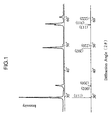
- Fig.1 is a graph showing the results of an X-ray diffraction pattern and a calculated pattern of a composite oxide having ⁇ phase synthesized in Example 1.
- Fig.2 is a graphs showing X-ray diffraction patterns of composite oxides synthesized in Comparative Examples 1 to 4.
- the composite oxide of the present invention exhibiting oxygen absorbing and desorbing capability contains, as indispensable components, 4.99-98.89% by weight of cerium oxide, 1-94.9% by weight of zirconium oxide and 0.01-20% by weight of hafnium oxide.
- the composite oxide contains 0.1-10% by weight of titanium oxide, tungsten oxide, nickel oxide, copper oxide, iron oxide, aluminum oxide, silicon oxide, beryllium oxide, magnesium oxide, calcium oxide, strontium oxide, barium oxide, oxides of rare earth metals other than cerium, or mixtures thereof.
- additional components are referred to herein as an additional metal oxide. If the proportions of these components are outside of such range, the composite oxide is unable to display excellent oxygen absorbing and desorbing capability.
- the composite oxide of the present invention exhibits oxygen absorbing and desorbing capability of not less than 100 ⁇ mol/g and preferably in a range of 100 ⁇ mol/g to 1000 ⁇ mol/g and more preferably in a range of from 150 ⁇ mol/g to 1000 ⁇ mol/g in a temperature range of 400 to 700°C.
- oxygen absorbing and desorbing capability results from change in valency of cerium in the composite oxide from 4 at the time of fabrication to 3 upon heating under deoxidation conditions, e.g. in a hydrogen stream.
- the zirconium and hafnium components contained in the composite oxide promotes the oxygen absorbing and desorbing capability and the valency thereof is constant at 4.
- the composite oxide of the present invention has ⁇ phase as a crystal phase.
- ⁇ phase tetragonal ⁇ phase is known (V. Longo and D. Minichelli, J. Amer. Ceramic Soc., 56 (1973), 600.; P. Duran, M. Gonzalez, C. Moure, J.R. Jurado and C. Pascual, J. Materials Sci., 25 (1990), 5001).
- the formed ⁇ phase contains equal quantities of h-tetragonal phase and CaF 2 -related structure phase.
- This ⁇ phase is a crystal phase exhibiting peaks in the (111), (002), (200), (202), (220), (113), (311) and (222) planes of the calculated X-ray diffraction pattern, and may be identified by X-ray diffraction.
- the calculation of X-ray diffraction pattern is described in B.D. Cullity "Summary of X-ray diffraction, New Edition" issued from KK AGNE and translated by Gentaro Matsumura (1983).
- an additional metal ion selected from the group consisting of titanium ion, tungsten ion, nickel ion, copper ion, iron ion, aluminum ion, silicon ion, beryllium ion, magnesium ion
- the solution containing cerium ion, zirconium ion and hafnium ion may be in the form of, for example, an aqueous solution of cerium nitrate and an aqueous solution of zirconium nitrate and hafnium nitrate.
- the additional metal ion may be any salt of ion if they can be in the form of an aqueous solution.
- the concentration of the solution containing the cerium ion, zirconium ion and hafnium ion is preferably 30-200 g/liter and more preferably 50-100 g/liter in terms of the composite oxide containing the above ions.
- the concentration of the solution of the additional metal ion is preferably 50-100 g/liter in terms of oxide containing the additional metal ion.
- the proportion of the cerium ion, the zirconium ion, the hafnium ion and the additional metal ion in terms of respective oxides is preferably 4.99-98.89:1-94.9:0.01-20:0.1-10. If the mixing ratio of the additional metal ion is less than 0.1% by weight, it becomes difficult to form the ⁇ phase.
- the concentration of the aqueous ammonia solution, as the second solution mixed with the first solution is preferably 1-2 N and more preferably 1-1.5 N.
- the concentration of the aqueous ammonium bicarbonate solution as the second solution mixed with the first solution is preferably 50-200 g/liter and more preferably 100-150 g/liter, while that of the aqueous oxalic acid solution as the second solution mixed with the first solution is preferably 50-100 g/liter and more preferably 50-60 g/liter.
- the mixing ratio of the first solution containing the metal ions to the aqueous ammonia solution, the aqueous ammonium bicarbonate solution or the aqueous oxalic acid solution is preferably 1:1 to 1:10 in weight ratio.
- the compound salt precipitate produced at this time may, for example, be a compound hydroxide or a compound carbonate.
- the compound salt precipitate may be calcined for 1 to 10 hours at a temperature higher than 400°C, preferably at a temperature of 500-1000°C and more preferably at a temperature of 750-1000°C for producing a desired composite oxide having ⁇ phase. If the calcining temperature is not higher than 400°C, the desired ⁇ phase cannot be produced.
- the compound salt precipitate may also be previously hydrothermally treated before proceeding to the calcining process.
- the temperature and the processing time for the hydrothermal processing are preferably 100 to 135°C and 0.5 to 1 hour, respectively.
- an additional metal oxide selected from the group consisting of titanium oxide, tungsten oxide, nickel oxide, copper oxide, iron oxide, aluminum oxide, silicon oxide, beryllium oxide, magnesium oxide, calcium oxide, strontium oxide, barium oxide, oxides of rare earth metals other than cerium and mixtures thereof is admixed to cerium oxide, zirconium oxide and hafnium oxide, and the resulting mixture is molded under pressure and sintered at a pre-set specified temperature.
- a zirconium oxide and hafnium oxide a hafnium-containing zirconium oxide may also be employed.
- the proportions of the metal oxides the composition of 4.99-98.89% by weight of cerium oxide, 1-94.9% by weight of zirconium oxide, 0.01-20% by weight of hafnium oxide and 0.1-10% by weight of the additional metal oxide is used. If the proportion of the mixing ratio of the other metal oxide is less than 0.1% by weight, it becomes difficult to produce ⁇ phase.
- the metal oxides may be mixed together uniformly using a conventional ball mill.
- the mixed metal oxides are compression-molded into pellets under a pressure preferably of 200-1000 kg/cm 2 using, for example a compression molding machine.
- the resulting molded product is then sintered under heating for 1 to 10 hours at 700-1500°C and preferably 900-1300°C for producing a desired composite oxide having ⁇ phase.
- the resulting sintered product is preferably crushed by a crusher, such as a ball mill, preferably to have a particle size of 1.0 to 100 ⁇ m. If the sintering temperature is less than 700°C, the desired ⁇ phase cannot be formed, whereas if the temperature exceeds 1500°C, the oxygen absorbing and desorbing capability is undesirably lowered.
- the composite oxide of the present invention contains cerium oxide, zirconium oxide and hafnium oxide as indispensable components, and having the ⁇ phase as a crystal phase, it displays oxygen absorbing and desorbing capability of not less than 100 ⁇ mol/g in a temperature range of 400-700°C.
- the composite oxide of the present invention is highly useful as a substitute for conventional cerium oxide and cerium-zirconium composite oxide in the field of catalysts and functional ceramics.
- a zirconium nitrate aqueous solution in terms of a zirconium oxide concentration of 25% by weight prepared by dissolving in water a zirconium nitrate solution containing 1.17% by weight of hafnium to the total weight of zirconium
- 8 ml of an aqueous solution of yttrium nitrate in terms of a yttrium oxide concentration of 100 g/liter prepared by dissolving yttrium nitrate (manufactured by SANTOKU METAL INDUSTRY CO., LTD., with a purity of 99.9%) were mixed together to prepare a solution containing cerium, zirconium, hafnium and yttrium ions with a composite oxide concentration of 50 g/liter and with a Ce:Zr:Hf:Y ratio by weight of 49.9:47.8:0.7:1.6.
- the produced compound carbonate was calcined at 900°C for five hours to give 50 g of a composite oxide.
- the composition of the composite oxide was 47.6% by weight of cerium oxide, 50.2% by weight of zirconium oxide, 0.6% by weight of hafnium oxide and 1.6% by weight of yttrium oxide.
- the composite oxide was found by X-ray diffraction to exhibit ⁇ phase.
- the oxygen absorbing and desorbing properties were measured of the resulting composite oxide in the same way as in Example 1. The results are shown in Table 1.
- the resulting pellets were sintered in atmosphere at 1300°C for five hours.
- the pellets were crushed in a ball mill to give a composite oxide.
- the oxygen absorbing and desorbing properties were measured of the resulting composite oxide in the same way as in Example 1.
- the results are shown in Table 1.
- the composition of the composite oxide was 25.6% by weight of cerium oxide, 72.9% by weight of zirconium oxide, 0.9% by weight of hafnium oxide and 0.6% by weight of magnesium oxide.
- the X-ray diffraction of the crystal structure showed the presence of ⁇ phase.
- Composite oxides were prepared by the wet co-precipitation method in the same way as in Example 2 except employing starting materials having the compositions shown in Table 1.
- the oxygen absorbing and desorbing properties were measured of the resulting composite oxides in the same way as in Example 1. The results are shown in Table 1.
- X-ray diffraction was conducted in the same way as in Example 1. The results are shown in Fig.2.
- Composite oxides were prepared by the dry mixing sintering method in the same way as in Example 1 except employing starting materials having the compositions shown in Table 1. The oxygen absorbing and desorbing properties were measured of the resulting composite oxides in the same way as in Example 1. The results are shown in Table 1. Also, X-ray diffraction was conducted in the same way as in Example 1. The results are shown in Fig.2. Composition (wt.% of oxide) Oxygen absorbing and desorbing capability Oxygen ⁇ mol/g Ce Zr Hf Ca Y Mg Ex.1 57.7 41.0 0.5 0.8 - - 935 Ex.2 47.6 50.2 0.6 - 1.6 - 917 Ex.3 25.6 72.9 0.9 - - 0.6 552 Comp.
Landscapes
- Chemical & Material Sciences (AREA)
- Engineering & Computer Science (AREA)
- Materials Engineering (AREA)
- Organic Chemistry (AREA)
- Ceramic Engineering (AREA)
- Manufacturing & Machinery (AREA)
- Chemical Kinetics & Catalysis (AREA)
- Structural Engineering (AREA)
- Composite Materials (AREA)
- Solid-Sorbent Or Filter-Aiding Compositions (AREA)
- Inorganic Compounds Of Heavy Metals (AREA)
- Compounds Of Iron (AREA)
- Compositions Of Oxide Ceramics (AREA)
- Catalysts (AREA)
Description
- This invention relates to a composite oxide having a novel crystal structure and exhibiting particularly excellent oxygen absorbing and desorbing capability which is utilizable for functional ceramics and for a catalyst for purifying exhaust gases, and a method for preparing the same.
- Cerium oxide has hitherto been employed in large quantities as ceramics or as catalysts for purifying exhaust gases. In the field of catalysts, for example, cerium oxide is used for enhancing the purification rate of exhaust gas components such as hydrocarbons, carbon monoxide and NOx, taking advantage of its characteristic properties of absorbing oxygen in an oxidative atmosphere and desorbing oxygen in a reducing atmosphere. In the field of ceramics, cerium oxide is used in the form of compounds or mixtures with other elements as electrically conductive ceramics such as solid electrolytes, taking advantage of its characteristic properties mentioned above. Such cerium oxide heretofore known is usually prepared, for example by adding oxalic acid or ammonium bicarbonate to a solution of nitrate or chloride of cerium, filtering and washing the resultant precipitate and drying followed by calcining.
- However, the composite oxide prepared by the above method predominantly composed of cerium oxide has a drawback that it is incapable of sufficiently absorbing and desorbing oxygen at 400 to 700° C, and is deteriorated in performance after heating to a higher temperature, even though it exhibits the oxygen absorbing and desorbing capability.
- Up to now, cerium-zirconium composite oxide exhibiting high oxygen absorbing and desorbing capability is known and disclosed in Japanese Laid-Open Patent Application No.5-105428 (1993). For preparing the composite oxide, there is known a method including mixing, into a solution containing cerium, zirconium and hafnium ions, a solution containing other metal ions and an aqueous solution of ammonia, ammonium bicarbonate or oxalic acid, to form a compound salt precipitate, and calcining the compound salt precipitate at a temperature not lower than 300°C. However, the calcining temperature contemplated is not higher than 400°C, while there is no disclosure of the crystal structure of the composite oxide having Φ phase. Detailed scrutiny into the crystal structure of such oxide by Comparative Examples given hereinbelow has revealed that the structure is a mixed phase of a CaF2-related structure phase, an h-tetragonal phase and a monoclinic phase. On the other hand, the tetragonal Φ phase has been known as the crystal phase (V. Longo and D. Minichelli, J. Amer. Ceramic Soc., 56(1973), 600.; P. Duran, M. Gonzalez, C. Moure, J.R. Jurado and C. Pascual, J. Materials Sci., 25(1990), 5001). It is reported that this phase is formed after annealing at 993 K for several months, and extremely difficult to manufacture. On the other hand, there has not so far been known a composite oxide containing cerium oxide, zirconium oxide, hafnium oxide and other metal oxides and having Φ phase.
- It is therefore an object of the present invention to provide a novel composite oxide exhibiting superior oxygen absorbing and desorbing capability and containing cerium oxide, zirconium oxide and hafnium oxide, and Φ phase as a crystal phase.
- It is another object of the present invention to provide a method for easily producing on an industrial scale a composite oxide exhibiting superior oxygen absorbing and desorbing capability and containing Φ phase as a crystal phase.
- The above and other objects of the present invention will become apparent from the following description.
- According to the present invention, there is provided a composite oxide having oxygen absorbing and desorbing capability, which comprises 4.99-98.89% by weight of cerium oxide, 1-94.9% by weight of zirconium oxide, 0.01-20% by weight of hafnium oxide, and 0.1-10% by weight of an additional metal oxide selected from the group consisting of titanium oxide, tungsten oxide, nickel oxide, copper oxide, iron oxide, aluminum oxide, silicon oxide, beryllium oxide, magnesium oxide, calcium oxide, strontium oxide, barium oxide, oxides of rare earth metals other than cerium, and mixtures thereof. The composite oxide includes Φ phase as a crystal phase, and has an oxygen absorbing and desorbing capability of at least 100 µmol/g at 400-700°C.
- According to the present invention, there is also provided a method for preparing a composite oxide having oxygen absorbing and desorbing capability which comprises the steps of mixing a first solution containing cerium ion, zirconium ion, hafnium ion and an additional metal ion with a second solution selected from the group consisting of an aqueous solution of ammonia, an aqueous solution of ammonium bicarbonate and an aqueous solution of oxalic acid to prepare a compound salt precipitate and calcining the precipitate at a temperature of at least 400°C to form Φ phase. The additional metal ion is selected from the group consisting of titanium ion, tungsten ion, nickel ion, copper ion, iron ion, aluminum ion, silicon ion, beryllium ion, magnesium ion, calcium ion, strontium ion, barium ion, ion of rare earth metal other than cerium, and mixtures thereof.
- According to the present invention, there is also provided a method for preparing a composite oxide having oxygen absorbing and desorbing capability which comprises the steps of mixing cerium oxide, zirconium oxide and hafnium oxide with an additional metal oxide selected from the group consisting of titanium oxide, tungsten oxide, nickel oxide, copper oxide, iron oxide, aluminum oxide, silicon oxide, beryllium oxide, magnesium oxide, calcium oxide, strontium oxide, barium oxide, oxides of rare earth metals other than cerium, and mixtures thereof, molding the resulting mixture under compression and sintering the resulting molded product at 700-1500°C to form Φ phase as a crystal phase.
- Fig.1 is a graph showing the results of an X-ray diffraction pattern and a calculated pattern of a composite oxide having Φ phase synthesized in Example 1.
- Fig.2 is a graphs showing X-ray diffraction patterns of composite oxides synthesized in Comparative Examples 1 to 4.
- The present invention will now be explained in more detail hereunder.
- The composite oxide of the present invention exhibiting oxygen absorbing and desorbing capability contains, as indispensable components, 4.99-98.89% by weight of cerium oxide, 1-94.9% by weight of zirconium oxide and 0.01-20% by weight of hafnium oxide. In addition, the composite oxide contains 0.1-10% by weight of titanium oxide, tungsten oxide, nickel oxide, copper oxide, iron oxide, aluminum oxide, silicon oxide, beryllium oxide, magnesium oxide, calcium oxide, strontium oxide, barium oxide, oxides of rare earth metals other than cerium, or mixtures thereof. These additional components are referred to herein as an additional metal oxide. If the proportions of these components are outside of such range, the composite oxide is unable to display excellent oxygen absorbing and desorbing capability.
- The composite oxide of the present invention exhibits oxygen absorbing and desorbing capability of not less than 100 µmol/g and preferably in a range of 100 µmol/g to 1000 µmol/g and more preferably in a range of from 150 µmol/g to 1000 µmol/g in a temperature range of 400 to 700°C. Such oxygen absorbing and desorbing capability results from change in valency of cerium in the composite oxide from 4 at the time of fabrication to 3 upon heating under deoxidation conditions, e.g. in a hydrogen stream. The zirconium and hafnium components contained in the composite oxide promotes the oxygen absorbing and desorbing capability and the valency thereof is constant at 4. In addition, the composite oxide of the present invention has Φ phase as a crystal phase. As the Φ phase, tetragonal Φ phase is known (V. Longo and D. Minichelli, J. Amer. Ceramic Soc., 56 (1973), 600.; P. Duran, M. Gonzalez, C. Moure, J.R. Jurado and C. Pascual, J. Materials Sci., 25 (1990), 5001). The formed Φ phase contains equal quantities of h-tetragonal phase and CaF2-related structure phase. This Φ phase is a crystal phase exhibiting peaks in the (111), (002), (200), (202), (220), (113), (311) and (222) planes of the calculated X-ray diffraction pattern, and may be identified by X-ray diffraction. The calculation of X-ray diffraction pattern is described in B.D. Cullity "Summary of X-ray diffraction, New Edition" issued from KK AGNE and translated by Gentaro Matsumura (1983).
- For preparing the composite oxide by the first method of the present invention, a first solution containing, in addition to cerium ion, zirconium ion and hafnium ion, an additional metal ion selected from the group consisting of titanium ion, tungsten ion, nickel ion, copper ion, iron ion, aluminum ion, silicon ion, beryllium ion, magnesium ion, calcium ion, strontium ion, barium ion, ions of rate earth metals other than cerium and mixtures thereof, is mixed with a second solution selected from the group consisting of an aqueous solution of ammonia, an aqueous solution of ammonium bicarbonate and an aqueous solution of oxalic acid, to prepare a compound salt precipitate. The solution containing cerium ion, zirconium ion and hafnium ion may be in the form of, for example, an aqueous solution of cerium nitrate and an aqueous solution of zirconium nitrate and hafnium nitrate. The additional metal ion may be any salt of ion if they can be in the form of an aqueous solution.
- The concentration of the solution containing the cerium ion, zirconium ion and hafnium ion is preferably 30-200 g/liter and more preferably 50-100 g/liter in terms of the composite oxide containing the above ions. On the other hand, the concentration of the solution of the additional metal ion is preferably 50-100 g/liter in terms of oxide containing the additional metal ion. The proportion of the cerium ion, the zirconium ion, the hafnium ion and the additional metal ion in terms of respective oxides is preferably 4.99-98.89:1-94.9:0.01-20:0.1-10. If the mixing ratio of the additional metal ion is less than 0.1% by weight, it becomes difficult to form the Φ phase.
- The concentration of the aqueous ammonia solution, as the second solution mixed with the first solution is preferably 1-2 N and more preferably 1-1.5 N. The concentration of the aqueous ammonium bicarbonate solution as the second solution mixed with the first solution is preferably 50-200 g/liter and more preferably 100-150 g/liter, while that of the aqueous oxalic acid solution as the second solution mixed with the first solution is preferably 50-100 g/liter and more preferably 50-60 g/liter. The mixing ratio of the first solution containing the metal ions to the aqueous ammonia solution, the aqueous ammonium bicarbonate solution or the aqueous oxalic acid solution is preferably 1:1 to 1:10 in weight ratio.
- The compound salt precipitate produced at this time may, for example, be a compound hydroxide or a compound carbonate.
- The compound salt precipitate may be calcined for 1 to 10 hours at a temperature higher than 400°C, preferably at a temperature of 500-1000°C and more preferably at a temperature of 750-1000°C for producing a desired composite oxide having Φ phase. If the calcining temperature is not higher than 400°C, the desired Φ phase cannot be produced. The compound salt precipitate may also be previously hydrothermally treated before proceeding to the calcining process. The temperature and the processing time for the hydrothermal processing are preferably 100 to 135°C and 0.5 to 1 hour, respectively.
- For producing the composite oxide by the second method according to the present invention, an additional metal oxide selected from the group consisting of titanium oxide, tungsten oxide, nickel oxide, copper oxide, iron oxide, aluminum oxide, silicon oxide, beryllium oxide, magnesium oxide, calcium oxide, strontium oxide, barium oxide, oxides of rare earth metals other than cerium and mixtures thereof is admixed to cerium oxide, zirconium oxide and hafnium oxide, and the resulting mixture is molded under pressure and sintered at a pre-set specified temperature. As a zirconium oxide and hafnium oxide, a hafnium-containing zirconium oxide may also be employed. As for the proportions of the metal oxides, the composition of 4.99-98.89% by weight of cerium oxide, 1-94.9% by weight of zirconium oxide, 0.01-20% by weight of hafnium oxide and 0.1-10% by weight of the additional metal oxide is used. If the proportion of the mixing ratio of the other metal oxide is less than 0.1% by weight, it becomes difficult to produce Φ phase.
- The metal oxides may be mixed together uniformly using a conventional ball mill. The mixed metal oxides are compression-molded into pellets under a pressure preferably of 200-1000 kg/cm2 using, for example a compression molding machine. The resulting molded product is then sintered under heating for 1 to 10 hours at 700-1500°C and preferably 900-1300°C for producing a desired composite oxide having Φ phase. The resulting sintered product is preferably crushed by a crusher, such as a ball mill, preferably to have a particle size of 1.0 to 100 µm. If the sintering temperature is less than 700°C, the desired Φ phase cannot be formed, whereas if the temperature exceeds 1500°C, the oxygen absorbing and desorbing capability is undesirably lowered.
- Since the composite oxide of the present invention contains cerium oxide, zirconium oxide and hafnium oxide as indispensable components, and having the Φ phase as a crystal phase, it displays oxygen absorbing and desorbing capability of not less than 100 µmol/g in a temperature range of 400-700°C. Thus, the composite oxide of the present invention is highly useful as a substitute for conventional cerium oxide and cerium-zirconium composite oxide in the field of catalysts and functional ceramics. In addition, it is possible with the method of the present invention to produce the composite oxide having Φ phase easily and in a shorter time.
- The present invention will be explained with reference to Examples and Comparative Examples which are merely illustrative arid are not intended for limiting the present invention.
- 23.9 g of cerium oxide, (manufactured by SANTOKU METAL INDUSTRY CO., LTD. with a purity of 99.9%), 25.7 g of zirconium oxide containing 1.17% by weight of hafnium oxide, (manufactured by SANTOKU METAL INDUSTRY CO., LTD. with a purity of zirconium oxide of 98.83% by weight) and 0.4 g of commercially available calcium oxide with a purity of 99.9%, were mixed together in a ball mill. The resulting mixture was compression-molded by a compression molding machine under a molding pressure of 500 kg/cm2 to form pellets, which were then sintered under an atmospheric pressure at 1500°C for five hours. These pellets were then crushed in a hall mill to give 50 g of a composite oxide. The oxygen absorbing and desorbing characteristic properties of the produced composite oxide was then measured using an electro-chemical oxygen pump type closed system oxygen analyzer disclosed in Shinya Yao and Zensaku Kozuka, Detection of the Phase Transitions of Praseodymium Oxide Thin Film by a Closed System Potentiostatic Technique Employing Solid Electrolyte, Journal of the Electro-Chemical Society of Japan, 61 No.2, p262 (1993). The results are shown in Table 1. Analyses of the crystal structure of the produced composite oxide with an X-ray diffraction apparatus manufactured by SHIMADZU CORP., revealed that the crystal structure had Φ phase. The results are shown in Fig.1. The composition of the resulting composite oxide was 57.7% by weight of cerium oxide, 41.0% by weight of zirconium oxide, 0.5% by weight of hafnium oxide and 0.8% by weight of calcium oxide.
- 79 ml of an aqueous solution of cerium nitrate in terms of a cerium oxide concentration of 300 g/liter prepared by dissolving a high purity cerium nitrate solution (manufactured by SANTOKU METAL INDUSTRY CO., LTD. with a purity of 99.9%), 68 ml of a zirconium nitrate aqueous solution in terms of a zirconium oxide concentration of 25% by weight prepared by dissolving in water a zirconium nitrate solution containing 1.17% by weight of hafnium to the total weight of zirconium, and 8 ml of an aqueous solution of yttrium nitrate in terms of a yttrium oxide concentration of 100 g/liter prepared by dissolving yttrium nitrate (manufactured by SANTOKU METAL INDUSTRY CO., LTD., with a purity of 99.9%) were mixed together to prepare a solution containing cerium, zirconium, hafnium and yttrium ions with a composite oxide concentration of 50 g/liter and with a Ce:Zr:Hf:Y ratio by weight of 49.9:47.8:0.7:1.6.
- To 1 liter of the resulting solution was added and mixed 1 liter of a separately prepared aqueous solution of ammonium bicarbonate with an ammonium bicarbonate concentration of 150 g/liter to give a precipitate of a compound carbonate containing cerium, zirconium, hafnium and yttrium.
- The produced compound carbonate was calcined at 900°C for five hours to give 50 g of a composite oxide. The composition of the composite oxide was 47.6% by weight of cerium oxide, 50.2% by weight of zirconium oxide, 0.6% by weight of hafnium oxide and 1.6% by weight of yttrium oxide. Besides, the composite oxide was found by X-ray diffraction to exhibit Φ phase. The oxygen absorbing and desorbing properties were measured of the resulting composite oxide in the same way as in Example 1. The results are shown in Table 1.
- 12.8 g of cerium oxide (manufactured by SANTOKU METAL INDUSTRY CO., LTD. with a purity of 99.9%), 36.9 g of zirconium oxide containing 1.17% by weight of hafnium oxide (manufactured by SANTOKU METAL INDUSTRY CO., LTD. with a purity of 98.83%), and 0.3 g of magnesium oxide (manufactured by WAKO PURE CHEMICAL INDUSTRIES LTD. with a purity of 99.9%), were mixed together in a ball mill. The resulting mixture was molded to give pellets by a compression molding device under a molding pressure of 500 kg/cm2. The resulting pellets were sintered in atmosphere at 1300°C for five hours. The pellets were crushed in a ball mill to give a composite oxide. The oxygen absorbing and desorbing properties were measured of the resulting composite oxide in the same way as in Example 1. The results are shown in Table 1. The composition of the composite oxide was 25.6% by weight of cerium oxide, 72.9% by weight of zirconium oxide, 0.9% by weight of hafnium oxide and 0.6% by weight of magnesium oxide. The X-ray diffraction of the crystal structure showed the presence of Φ phase.
- Composite oxides were prepared by the wet co-precipitation method in the same way as in Example 2 except employing starting materials having the compositions shown in Table 1. The oxygen absorbing and desorbing properties were measured of the resulting composite oxides in the same way as in Example 1. The results are shown in Table 1. Also, X-ray diffraction was conducted in the same way as in Example 1. The results are shown in Fig.2.
- Composite oxides were prepared by the dry mixing sintering method in the same way as in Example 1 except employing starting materials having the compositions shown in Table 1. The oxygen absorbing and desorbing properties were measured of the resulting composite oxides in the same way as in Example 1. The results are shown in Table 1. Also, X-ray diffraction was conducted in the same way as in Example 1. The results are shown in Fig.2.
Composition (wt.% of oxide) Oxygen absorbing and desorbing capability Oxygen µmol/g Ce Zr Hf Ca Y Mg Ex.1 57.7 41.0 0.5 0.8 - - 935 Ex.2 47.6 50.2 0.6 - 1.6 - 917 Ex.3 25.6 72.9 0.9 - - 0.6 552 Comp. Ex.1 58.2 41.3 0.5 - - - 463 Comp. Ex.2 48.1 51.3 0.6 - - - 655 Comp. Ex.3 42.8 56.5 0.7 - - - 516 Comp. Ex.4 25.8 73.3 0.9 - - - 408
Claims (7)
- A composite oxide having oxygen absorbing and desorbing capability, which comprises 4.99-98.89% by weight of cerium oxide, 1-94.9% by weight of zirconium oxide, 0.01-20% by weight of hafnium oxide, and 0.1-10% by weight of an additional metal oxide selected from titanium oxide, tungsten oxide, nickel oxide, copper oxide, iron oxide, aluminum oxide, silicon oxide, beryllium oxide, magnesium oxide, calcium oxide, strontium oxide, barium oxide, oxides of rare earth metals other than cerium, and mixtures thereof, the composite oxide including Φ phase as a crystal phase, and having oxygen absorbing and desorbing capability of at least 100 µmol/g at 400-700°C.
- The composite oxide as claimed in claim 1, wherein the Φ phase is a crystal phase showing peaks in (111), (002), (200), (202), (220), (113), (311), and (222) planes of X-ray diffraction pattern.
- A method for preparing a composite oxide having oxygen absorbing and desorbing capability which comprises the steps of mixing a first solution containing cerium ion, zirconium ion, hafnium ion and an additional metal ion with a second solution selected from an aqueous solution of ammonia, an aqueous solution of ammonium bicarbonate and an aqueous solution of oxalic acid to prepare a compound salt precipitate and calcining the precipitate at a temperature of at least 400°C to form Φ phase, said additional metal ion being selected from titanium ion, tungsten ion, nickel ion, copper ion, iron ion, aluminum ion, silicon ion, beryllium ion, magnesium ion, calcium ion, strontium ion, barium ion, ion of rare earth metal other than cerium, and mixtures thereof.
- The method as claimed in claim 3 wherein a proportion of the cerium ion, the zirconium ion, the hafnium ion and the additional metal ion, calculated as respective oxides, is 4.99-98.89:1-94.9:0.01-20:0.1-10.
- The method as claimed in claim 3 wherein the compound salt precipitate is calcined at 500-1000°C for 1-10 hours.
- A method for preparing a composite oxide having oxygen absorbing and desorbing capability which comprises the steps of mixing cerium oxide, zirconium oxide, and hafnium oxide with an additional metal oxide selected from titanium oxide, tungsten oxide, nickel oxide, copper oxide, iron oxide, aluminum oxide, silicon oxide, beryllium oxide, magnesium oxide, calcium oxide, strontium oxide, barium oxide, oxides of rare earth metals other than cerium, and mixtures thereof, molding a resulting mixture under compression and sintering a resulting molded product at 700-1500°C to form Φ phase as a crystal phase.
- The method as claimed in claim 6 wherein a proportion of the cerium oxide, the zirconium oxide, the hafnium oxide and the additional metal oxide is 4.99-98.89:1-94.9:0.01-20:0.1-10 by weight.
Applications Claiming Priority (3)
| Application Number | Priority Date | Filing Date | Title |
|---|---|---|---|
| JP24166394A JP3505236B2 (en) | 1994-10-05 | 1994-10-05 | Composite oxide having oxygen absorbing / releasing ability and method for producing the same |
| JP241663/94 | 1994-10-05 | ||
| JP24166394 | 1994-10-05 |
Publications (2)
| Publication Number | Publication Date |
|---|---|
| EP0706980A1 EP0706980A1 (en) | 1996-04-17 |
| EP0706980B1 true EP0706980B1 (en) | 2000-05-17 |
Family
ID=17077674
Family Applications (1)
| Application Number | Title | Priority Date | Filing Date |
|---|---|---|---|
| EP95307050A Expired - Lifetime EP0706980B1 (en) | 1994-10-05 | 1995-10-04 | Composite oxide having oxygen absorbing and desorbing capability and method for preparing same |
Country Status (5)
| Country | Link |
|---|---|
| EP (1) | EP0706980B1 (en) |
| JP (1) | JP3505236B2 (en) |
| KR (1) | KR0185483B1 (en) |
| CN (1) | CN1070459C (en) |
| DE (1) | DE69516968T2 (en) |
Families Citing this family (31)
| Publication number | Priority date | Publication date | Assignee | Title |
|---|---|---|---|---|
| JP4053623B2 (en) * | 1996-12-27 | 2008-02-27 | 阿南化成株式会社 | Zirconium-cerium composite oxide and method for producing the same |
| JP4045002B2 (en) * | 1998-02-02 | 2008-02-13 | 三井金属鉱業株式会社 | Composite oxide and exhaust gas purification catalyst using the same |
| JP4590733B2 (en) * | 2000-02-22 | 2010-12-01 | マツダ株式会社 | Exhaust gas purification catalyst and exhaust gas purification method using the catalyst |
| EP1484282B1 (en) * | 2002-03-08 | 2016-01-13 | Anan Kasei Co., Ltd | Cerium based composite oxide, sintered product thereof and method for preparation thereof |
| JP2003277059A (en) * | 2002-03-22 | 2003-10-02 | Toyota Central Res & Dev Lab Inc | Ceria-zirconia composite oxide |
| JP3797313B2 (en) | 2002-10-28 | 2006-07-19 | トヨタ自動車株式会社 | Method for producing metal oxide particles and catalyst for exhaust gas purification |
| US20040179994A1 (en) * | 2003-01-21 | 2004-09-16 | Fenouil Laurent Alain | Zirconia extrudates |
| CN100351332C (en) * | 2003-09-24 | 2007-11-28 | 杨育旺 | Rust removing oil paint and leather oil |
| JP4756571B2 (en) * | 2003-09-29 | 2011-08-24 | 株式会社豊田中央研究所 | Oxygen storage and release material |
| JP4165419B2 (en) | 2004-03-09 | 2008-10-15 | トヨタ自動車株式会社 | Method for producing metal oxide particles and exhaust gas purification catalyst |
| JP4165443B2 (en) | 2004-04-27 | 2008-10-15 | トヨタ自動車株式会社 | Method for producing metal oxide particles and exhaust gas purification catalyst |
| KR100881300B1 (en) | 2004-04-27 | 2009-02-03 | 도요타 지도샤(주) | Metal Oxide Particle Manufacturing Process and Exhaust Gas Purification Catalyst |
| JP4972868B2 (en) * | 2005-03-17 | 2012-07-11 | 東ソー株式会社 | Surface-modified ceria / zirconia hydrated oxide, oxide thereof, production method thereof, and use thereof |
| JP4185955B2 (en) * | 2006-01-27 | 2008-11-26 | 三井金属鉱業株式会社 | Oxygen scavenger and method for producing oxygen scavenger |
| JP5344805B2 (en) * | 2006-06-20 | 2013-11-20 | 第一稀元素化学工業株式会社 | Zirconia-based composite oxide and method for producing the same |
| JP2008289971A (en) | 2007-05-23 | 2008-12-04 | Toyota Motor Corp | CORE-SHELL STRUCTURE, PROCESS FOR PRODUCING THE SAME, AND EXHAUST GAS PURIFYING CATALYST CONTAINING CORE-SHELL |
| JP2010000481A (en) * | 2008-06-23 | 2010-01-07 | Tokyo Roki Co Ltd | Catalyst for removing nitrogen oxide and apparatus for removing nitrogen oxide |
| JP5547539B2 (en) | 2010-04-13 | 2014-07-16 | 株式会社豊田中央研究所 | Ceria-zirconia composite oxide, production method thereof, and exhaust gas purification catalyst using the ceria-zirconia composite oxide |
| CN103084161A (en) * | 2011-11-04 | 2013-05-08 | 上海华明高纳稀土新材料有限公司 | Ce-Zr-Al-based composite oxide rare earth oxygen-storage material and preparation method thereof |
| JP2013129553A (en) * | 2011-12-21 | 2013-07-04 | Rhodia Operations | Compound oxide, production method thereof and exhaust gas purification catalyst |
| JP2013129554A (en) * | 2011-12-21 | 2013-07-04 | Rhodia Operations | Composite oxide, method for producing the same, and catalyst for exhaust gas purification |
| KR101421825B1 (en) * | 2012-12-12 | 2014-07-22 | 한국가스공사 | Catalysts for preparing syn-gas by steam-carbon dioxide reforming reaction and process for preparing syn-gas using same |
| WO2014124874A1 (en) * | 2013-02-13 | 2014-08-21 | Ceramtec Gmbh | Zirconium oxide-based mono-phase and multi-phase materials |
| JP5763711B2 (en) | 2013-06-13 | 2015-08-12 | 株式会社豊田中央研究所 | Ceria-zirconia composite oxide, production method thereof, and exhaust gas purification catalyst using the ceria-zirconia composite oxide |
| KR101499694B1 (en) * | 2013-06-28 | 2015-03-11 | 한국에너지기술연구원 | Oxygen adsorbent for easy desorption of oxygen and preparation method thereof |
| JP5883425B2 (en) | 2013-10-04 | 2016-03-15 | 株式会社豊田中央研究所 | Ceria-zirconia composite oxide, production method thereof, and exhaust gas purification catalyst using the ceria-zirconia composite oxide |
| CN104492416B (en) * | 2014-12-15 | 2017-09-22 | 薄利轩 | A kind of far infrared burner honeycomb ceramic plate rare earth catalyst coating production |
| CN107841249B (en) * | 2017-09-28 | 2019-10-18 | 东莞市赛亚稀土实业有限公司 | A kind of preparation method of cerium rouge |
| CN109294269A (en) * | 2018-10-12 | 2019-02-01 | 南昌航空大学 | an oxygen absorber |
| CN111704129A (en) * | 2020-07-02 | 2020-09-25 | 张德志 | Preparation method of graphene oxide |
| JP7698597B2 (en) * | 2022-03-10 | 2025-06-25 | 日本化薬株式会社 | Method for producing heterogeneous metal doped cerium oxide |
Family Cites Families (9)
| Publication number | Priority date | Publication date | Assignee | Title |
|---|---|---|---|---|
| JPS58114730A (en) * | 1981-12-28 | 1983-07-08 | Tokuyama Soda Co Ltd | Catalyst for methanol synthesis |
| JPS62202862A (en) * | 1986-02-28 | 1987-09-07 | 日立金属株式会社 | Zro2 sintered body and manufacture |
| AU595655B2 (en) * | 1986-11-04 | 1990-04-05 | Kabushiki Kaisha Toyota Chuo Kenkyusho | Catalyst for the purification of exhaust gas |
| US5015617A (en) | 1988-04-14 | 1991-05-14 | Nippon Shokubai Kagaku Kogyo Co., Ltd. | Catalyst for purifying exhaust gas and method for production thereof |
| US4971933A (en) * | 1989-03-14 | 1990-11-20 | Martin Marietta Energy Systems, Inc. | Ternary ceramic alloys of ZR-CE-HF oxides |
| DK0428753T3 (en) | 1989-06-09 | 1995-07-03 | N E Chemcat Corp | Catalytic converter for cleaning exhaust gas with excellent heat resistance and process for its preparation |
| JPH03197357A (en) * | 1989-12-26 | 1991-08-28 | Tokai Carbon Co Ltd | Zirconia/hafnia refractories |
| JPH044043A (en) * | 1990-04-20 | 1992-01-08 | Nissan Motor Co Ltd | Heat-resistant catalyst for purifying exhaust gas |
| FR2695574B1 (en) * | 1992-09-15 | 1994-11-04 | Rhone Poulenc Chimie | Composition based on ceric oxide, preparation and use. |
-
1994
- 1994-10-05 JP JP24166394A patent/JP3505236B2/en not_active Expired - Lifetime
-
1995
- 1995-10-04 DE DE69516968T patent/DE69516968T2/en not_active Expired - Lifetime
- 1995-10-04 EP EP95307050A patent/EP0706980B1/en not_active Expired - Lifetime
- 1995-10-05 CN CN95119163A patent/CN1070459C/en not_active Expired - Lifetime
- 1995-10-05 KR KR1019950034068A patent/KR0185483B1/en not_active Expired - Lifetime
Also Published As
| Publication number | Publication date |
|---|---|
| JP3505236B2 (en) | 2004-03-08 |
| KR960013452A (en) | 1996-05-22 |
| DE69516968T2 (en) | 2000-10-05 |
| CN1070459C (en) | 2001-09-05 |
| CN1133820A (en) | 1996-10-23 |
| JPH08109021A (en) | 1996-04-30 |
| DE69516968D1 (en) | 2000-06-21 |
| KR0185483B1 (en) | 1999-04-15 |
| EP0706980A1 (en) | 1996-04-17 |
Similar Documents
| Publication | Publication Date | Title |
|---|---|---|
| US5580536A (en) | Composite oxide having oxygen absorbing and desorbing capability and method for preparing same | |
| EP0706980A1 (en) | Composite oxide having oxygen absorbing and desorbing capability and method for preparing same | |
| EP0709351B1 (en) | Composite oxide having oxygen absorbing and desorbing capability | |
| EP0708066B1 (en) | Method for preparing composite oxide having oxygen absorbing and desorbing capability | |
| KR100351381B1 (en) | Composite zirconium-cerium oxide, process for the preparation thereof, and cocatalyst for cleaning exhaust gas | |
| US5582785A (en) | Method for preparing composite oxide having oxygen absorbing and desorbing capability | |
| US5945370A (en) | Composite oxide having oxygen absorbing and desorbing capability and method for preparing the same | |
| US5478543A (en) | Compound oxide having oxygen absorbing and desorbing capability and method for preparing same | |
| EP0360445A1 (en) | Steam reforming catalyst for hydrocarbons and method of producing the same | |
| US4696810A (en) | Wet process for the production of a readily sinterable powder material of perovskite or its solid solution | |
| Otsuka et al. | Decomposition of water by cerium oxide of δ-phase | |
| EP0628515A1 (en) | Cerium and zirconium-containing compounds oxide and method for producing same | |
| JPH11292538A (en) | Method for producing zirconia-ceria composition | |
| WO2003037490A1 (en) | A solid multicomponent mixed proton and electron conducting membrane | |
| JP6670880B2 (en) | Oxygen storage material and method for producing the same | |
| RU2063267C1 (en) | Oxidation catalyst on the base of oxides with structure of perovskite | |
| Harrison et al. | Chemical microengineering in sol-gel derived fluoride and lanthanide modified ceria materials | |
| Tatsuki et al. | New oxychlorides, T∗-type CaRCuO3Cl (R= Y, Ho and Er), prepared under high pressure | |
| SU570392A1 (en) | Catalyst for chemical processes as,for example,for methanol synthesis | |
| JP3084766B2 (en) | Nitrogen oxide decomposition catalyst | |
| Beltran et al. | Synthesis, characterization and catalytic properties of La2− x Sr x NiO4− δ | |
| JPH0710537A (en) | Crystalline hydroxide and production thereof |
Legal Events
| Date | Code | Title | Description |
|---|---|---|---|
| PUAI | Public reference made under article 153(3) epc to a published international application that has entered the european phase |
Free format text: ORIGINAL CODE: 0009012 |
|
| AK | Designated contracting states |
Kind code of ref document: A1 Designated state(s): BE DE FR GB IT |
|
| 17P | Request for examination filed |
Effective date: 19960926 |
|
| 17Q | First examination report despatched |
Effective date: 19970609 |
|
| TPAD | Observations filed by third parties |
Free format text: ORIGINAL CODE: EPIDOS TIPA |
|
| GRAG | Despatch of communication of intention to grant |
Free format text: ORIGINAL CODE: EPIDOS AGRA |
|
| GRAG | Despatch of communication of intention to grant |
Free format text: ORIGINAL CODE: EPIDOS AGRA |
|
| GRAH | Despatch of communication of intention to grant a patent |
Free format text: ORIGINAL CODE: EPIDOS IGRA |
|
| GRAH | Despatch of communication of intention to grant a patent |
Free format text: ORIGINAL CODE: EPIDOS IGRA |
|
| ITF | It: translation for a ep patent filed | ||
| GRAA | (expected) grant |
Free format text: ORIGINAL CODE: 0009210 |
|
| AK | Designated contracting states |
Kind code of ref document: B1 Designated state(s): BE DE FR GB IT |
|
| REF | Corresponds to: |
Ref document number: 69516968 Country of ref document: DE Date of ref document: 20000621 |
|
| ET | Fr: translation filed | ||
| PLBE | No opposition filed within time limit |
Free format text: ORIGINAL CODE: 0009261 |
|
| STAA | Information on the status of an ep patent application or granted ep patent |
Free format text: STATUS: NO OPPOSITION FILED WITHIN TIME LIMIT |
|
| 26N | No opposition filed | ||
| REG | Reference to a national code |
Ref country code: GB Ref legal event code: IF02 |
|
| REG | Reference to a national code |
Ref country code: GB Ref legal event code: 732E |
|
| REG | Reference to a national code |
Ref country code: FR Ref legal event code: TP |
|
| BECA | Be: change of holder's address |
Owner name: *ANAN KASEI CO. LTDAABAN EISU SANNOMLYA BLDG., 1-2 Effective date: 20070628 |
|
| BECH | Be: change of holder |
Owner name: *ANAN KASEI CO. LTD Effective date: 20070628 |
|
| PGFP | Annual fee paid to national office [announced via postgrant information from national office to epo] |
Ref country code: FR Payment date: 20141022 Year of fee payment: 20 Ref country code: GB Payment date: 20141021 Year of fee payment: 20 Ref country code: DE Payment date: 20141022 Year of fee payment: 20 |
|
| PGFP | Annual fee paid to national office [announced via postgrant information from national office to epo] |
Ref country code: IT Payment date: 20141030 Year of fee payment: 20 |
|
| PGFP | Annual fee paid to national office [announced via postgrant information from national office to epo] |
Ref country code: BE Payment date: 20141021 Year of fee payment: 20 |
|
| REG | Reference to a national code |
Ref country code: DE Ref legal event code: R071 Ref document number: 69516968 Country of ref document: DE |
|
| REG | Reference to a national code |
Ref country code: GB Ref legal event code: PE20 Expiry date: 20151003 |
|
| PG25 | Lapsed in a contracting state [announced via postgrant information from national office to epo] |
Ref country code: GB Free format text: LAPSE BECAUSE OF EXPIRATION OF PROTECTION Effective date: 20151003 |