EP0706574B1 - Methods for peptide synthesis and purification - Google Patents
Methods for peptide synthesis and purification Download PDFInfo
- Publication number
- EP0706574B1 EP0706574B1 EP95917774A EP95917774A EP0706574B1 EP 0706574 B1 EP0706574 B1 EP 0706574B1 EP 95917774 A EP95917774 A EP 95917774A EP 95917774 A EP95917774 A EP 95917774A EP 0706574 B1 EP0706574 B1 EP 0706574B1
- Authority
- EP
- European Patent Office
- Prior art keywords
- penl
- polypeptide
- peptide
- fusion polypeptide
- protein
- Prior art date
- Legal status (The legal status is an assumption and is not a legal conclusion. Google has not performed a legal analysis and makes no representation as to the accuracy of the status listed.)
- Expired - Lifetime
Links
- 238000000034 method Methods 0.000 title claims abstract description 72
- 238000000746 purification Methods 0.000 title abstract description 27
- 238000010647 peptide synthesis reaction Methods 0.000 title abstract description 4
- 108090000765 processed proteins & peptides Proteins 0.000 claims abstract description 354
- 102000004196 processed proteins & peptides Human genes 0.000 claims abstract description 189
- 229920001184 polypeptide Polymers 0.000 claims abstract description 155
- 230000004927 fusion Effects 0.000 claims abstract description 136
- 108090000623 proteins and genes Proteins 0.000 claims abstract description 115
- 102000004169 proteins and genes Human genes 0.000 claims description 71
- 210000004027 cell Anatomy 0.000 claims description 58
- 150000001413 amino acids Chemical class 0.000 claims description 44
- 210000001744 T-lymphocyte Anatomy 0.000 claims description 42
- 239000000243 solution Substances 0.000 claims description 38
- 239000013598 vector Substances 0.000 claims description 33
- 238000001556 precipitation Methods 0.000 claims description 32
- 108020004414 DNA Proteins 0.000 claims description 28
- 238000003776 cleavage reaction Methods 0.000 claims description 28
- 230000007017 scission Effects 0.000 claims description 28
- 230000027455 binding Effects 0.000 claims description 25
- 108091028043 Nucleic acid sequence Proteins 0.000 claims description 18
- 210000000612 antigen-presenting cell Anatomy 0.000 claims description 18
- 230000000694 effects Effects 0.000 claims description 14
- 230000028993 immune response Effects 0.000 claims description 11
- 241000124008 Mammalia Species 0.000 claims description 10
- 239000007864 aqueous solution Substances 0.000 claims description 10
- 150000003839 salts Chemical class 0.000 claims description 10
- 239000012634 fragment Substances 0.000 claims description 9
- 108010074860 Factor Xa Proteins 0.000 claims description 8
- 238000002360 preparation method Methods 0.000 claims description 7
- 239000013599 cloning vector Substances 0.000 claims description 6
- 238000000502 dialysis Methods 0.000 claims description 6
- 239000007853 buffer solution Substances 0.000 claims description 5
- 238000000338 in vitro Methods 0.000 claims description 5
- 238000010367 cloning Methods 0.000 claims description 3
- 239000002299 complementary DNA Substances 0.000 claims description 3
- 238000012258 culturing Methods 0.000 claims description 3
- 238000004519 manufacturing process Methods 0.000 claims description 3
- 230000002163 immunogen Effects 0.000 claims description 2
- 230000001131 transforming effect Effects 0.000 claims 2
- 210000004748 cultured cell Anatomy 0.000 claims 1
- 230000006337 proteolytic cleavage Effects 0.000 claims 1
- 238000012216 screening Methods 0.000 claims 1
- 238000002955 isolation Methods 0.000 abstract description 10
- 238000003786 synthesis reaction Methods 0.000 abstract description 7
- 230000015572 biosynthetic process Effects 0.000 abstract description 6
- 235000018102 proteins Nutrition 0.000 description 55
- 150000007523 nucleic acids Chemical group 0.000 description 46
- 239000002585 base Substances 0.000 description 45
- 108020004707 nucleic acids Proteins 0.000 description 45
- 102000039446 nucleic acids Human genes 0.000 description 45
- 235000001014 amino acid Nutrition 0.000 description 43
- 229940024606 amino acid Drugs 0.000 description 43
- 238000003752 polymerase chain reaction Methods 0.000 description 25
- 238000002474 experimental method Methods 0.000 description 19
- 108091034117 Oligonucleotide Proteins 0.000 description 17
- 239000013612 plasmid Substances 0.000 description 17
- 241000588724 Escherichia coli Species 0.000 description 15
- 238000003556 assay Methods 0.000 description 15
- 239000000872 buffer Substances 0.000 description 15
- 239000003795 chemical substances by application Substances 0.000 description 15
- 102000000588 Interleukin-2 Human genes 0.000 description 13
- 108010002350 Interleukin-2 Proteins 0.000 description 13
- 239000001963 growth medium Substances 0.000 description 13
- 238000002965 ELISA Methods 0.000 description 10
- 239000000427 antigen Substances 0.000 description 10
- 108091007433 antigens Proteins 0.000 description 10
- 102000036639 antigens Human genes 0.000 description 10
- 239000013604 expression vector Substances 0.000 description 10
- HEMHJVSKTPXQMS-UHFFFAOYSA-M Sodium hydroxide Chemical compound [OH-].[Na+] HEMHJVSKTPXQMS-UHFFFAOYSA-M 0.000 description 9
- 108020001507 fusion proteins Proteins 0.000 description 9
- 102000037865 fusion proteins Human genes 0.000 description 9
- 239000002773 nucleotide Substances 0.000 description 9
- 125000003729 nucleotide group Chemical group 0.000 description 9
- 239000000047 product Substances 0.000 description 9
- 125000003275 alpha amino acid group Chemical group 0.000 description 8
- 210000004408 hybridoma Anatomy 0.000 description 8
- YBYRMVIVWMBXKQ-UHFFFAOYSA-N phenylmethanesulfonyl fluoride Chemical compound FS(=O)(=O)CC1=CC=CC=C1 YBYRMVIVWMBXKQ-UHFFFAOYSA-N 0.000 description 8
- 241000699670 Mus sp. Species 0.000 description 7
- 230000006052 T cell proliferation Effects 0.000 description 7
- 230000004913 activation Effects 0.000 description 7
- 125000000539 amino acid group Chemical group 0.000 description 7
- 230000004073 interleukin-2 production Effects 0.000 description 7
- PEDCQBHIVMGVHV-UHFFFAOYSA-N Glycerine Chemical compound OCC(O)CO PEDCQBHIVMGVHV-UHFFFAOYSA-N 0.000 description 6
- 230000006044 T cell activation Effects 0.000 description 6
- 230000003053 immunization Effects 0.000 description 6
- 238000002649 immunization Methods 0.000 description 6
- 239000007924 injection Substances 0.000 description 6
- 238000002347 injection Methods 0.000 description 6
- 239000000463 material Substances 0.000 description 6
- 238000002415 sodium dodecyl sulfate polyacrylamide gel electrophoresis Methods 0.000 description 6
- 238000001262 western blot Methods 0.000 description 6
- JLCPHMBAVCMARE-UHFFFAOYSA-N [3-[[3-[[3-[[3-[[3-[[3-[[3-[[3-[[3-[[3-[[3-[[5-(2-amino-6-oxo-1H-purin-9-yl)-3-[[3-[[3-[[3-[[3-[[3-[[5-(2-amino-6-oxo-1H-purin-9-yl)-3-[[5-(2-amino-6-oxo-1H-purin-9-yl)-3-hydroxyoxolan-2-yl]methoxy-hydroxyphosphoryl]oxyoxolan-2-yl]methoxy-hydroxyphosphoryl]oxy-5-(5-methyl-2,4-dioxopyrimidin-1-yl)oxolan-2-yl]methoxy-hydroxyphosphoryl]oxy-5-(6-aminopurin-9-yl)oxolan-2-yl]methoxy-hydroxyphosphoryl]oxy-5-(6-aminopurin-9-yl)oxolan-2-yl]methoxy-hydroxyphosphoryl]oxy-5-(6-aminopurin-9-yl)oxolan-2-yl]methoxy-hydroxyphosphoryl]oxy-5-(6-aminopurin-9-yl)oxolan-2-yl]methoxy-hydroxyphosphoryl]oxyoxolan-2-yl]methoxy-hydroxyphosphoryl]oxy-5-(5-methyl-2,4-dioxopyrimidin-1-yl)oxolan-2-yl]methoxy-hydroxyphosphoryl]oxy-5-(4-amino-2-oxopyrimidin-1-yl)oxolan-2-yl]methoxy-hydroxyphosphoryl]oxy-5-(5-methyl-2,4-dioxopyrimidin-1-yl)oxolan-2-yl]methoxy-hydroxyphosphoryl]oxy-5-(5-methyl-2,4-dioxopyrimidin-1-yl)oxolan-2-yl]methoxy-hydroxyphosphoryl]oxy-5-(6-aminopurin-9-yl)oxolan-2-yl]methoxy-hydroxyphosphoryl]oxy-5-(6-aminopurin-9-yl)oxolan-2-yl]methoxy-hydroxyphosphoryl]oxy-5-(4-amino-2-oxopyrimidin-1-yl)oxolan-2-yl]methoxy-hydroxyphosphoryl]oxy-5-(4-amino-2-oxopyrimidin-1-yl)oxolan-2-yl]methoxy-hydroxyphosphoryl]oxy-5-(4-amino-2-oxopyrimidin-1-yl)oxolan-2-yl]methoxy-hydroxyphosphoryl]oxy-5-(6-aminopurin-9-yl)oxolan-2-yl]methoxy-hydroxyphosphoryl]oxy-5-(4-amino-2-oxopyrimidin-1-yl)oxolan-2-yl]methyl [5-(6-aminopurin-9-yl)-2-(hydroxymethyl)oxolan-3-yl] hydrogen phosphate Polymers Cc1cn(C2CC(OP(O)(=O)OCC3OC(CC3OP(O)(=O)OCC3OC(CC3O)n3cnc4c3nc(N)[nH]c4=O)n3cnc4c3nc(N)[nH]c4=O)C(COP(O)(=O)OC3CC(OC3COP(O)(=O)OC3CC(OC3COP(O)(=O)OC3CC(OC3COP(O)(=O)OC3CC(OC3COP(O)(=O)OC3CC(OC3COP(O)(=O)OC3CC(OC3COP(O)(=O)OC3CC(OC3COP(O)(=O)OC3CC(OC3COP(O)(=O)OC3CC(OC3COP(O)(=O)OC3CC(OC3COP(O)(=O)OC3CC(OC3COP(O)(=O)OC3CC(OC3COP(O)(=O)OC3CC(OC3COP(O)(=O)OC3CC(OC3COP(O)(=O)OC3CC(OC3COP(O)(=O)OC3CC(OC3COP(O)(=O)OC3CC(OC3CO)n3cnc4c(N)ncnc34)n3ccc(N)nc3=O)n3cnc4c(N)ncnc34)n3ccc(N)nc3=O)n3ccc(N)nc3=O)n3ccc(N)nc3=O)n3cnc4c(N)ncnc34)n3cnc4c(N)ncnc34)n3cc(C)c(=O)[nH]c3=O)n3cc(C)c(=O)[nH]c3=O)n3ccc(N)nc3=O)n3cc(C)c(=O)[nH]c3=O)n3cnc4c3nc(N)[nH]c4=O)n3cnc4c(N)ncnc34)n3cnc4c(N)ncnc34)n3cnc4c(N)ncnc34)n3cnc4c(N)ncnc34)O2)c(=O)[nH]c1=O JLCPHMBAVCMARE-UHFFFAOYSA-N 0.000 description 5
- 235000004279 alanine Nutrition 0.000 description 5
- 230000000890 antigenic effect Effects 0.000 description 5
- 238000006243 chemical reaction Methods 0.000 description 5
- 239000008188 pellet Substances 0.000 description 5
- 239000006228 supernatant Substances 0.000 description 5
- TWRXJAOTZQYOKJ-UHFFFAOYSA-L Magnesium chloride Chemical compound [Mg+2].[Cl-].[Cl-] TWRXJAOTZQYOKJ-UHFFFAOYSA-L 0.000 description 4
- 241000699666 Mus <mouse, genus> Species 0.000 description 4
- 108020004511 Recombinant DNA Proteins 0.000 description 4
- 108091008874 T cell receptors Proteins 0.000 description 4
- 102000016266 T-Cell Antigen Receptors Human genes 0.000 description 4
- 210000004899 c-terminal region Anatomy 0.000 description 4
- 238000010276 construction Methods 0.000 description 4
- 238000010790 dilution Methods 0.000 description 4
- 239000012895 dilution Substances 0.000 description 4
- 108010021083 hen egg lysozyme Proteins 0.000 description 4
- -1 phosphate triester Chemical class 0.000 description 4
- 239000002244 precipitate Substances 0.000 description 4
- 238000010561 standard procedure Methods 0.000 description 4
- WEVYAHXRMPXWCK-UHFFFAOYSA-N Acetonitrile Chemical compound CC#N WEVYAHXRMPXWCK-UHFFFAOYSA-N 0.000 description 3
- 241000193830 Bacillus <bacterium> Species 0.000 description 3
- UXVMQQNJUSDDNG-UHFFFAOYSA-L Calcium chloride Chemical compound [Cl-].[Cl-].[Ca+2] UXVMQQNJUSDDNG-UHFFFAOYSA-L 0.000 description 3
- KCXVZYZYPLLWCC-UHFFFAOYSA-N EDTA Chemical compound OC(=O)CN(CC(O)=O)CCN(CC(O)=O)CC(O)=O KCXVZYZYPLLWCC-UHFFFAOYSA-N 0.000 description 3
- 108010034634 Repressor Proteins Proteins 0.000 description 3
- 102000009661 Repressor Proteins Human genes 0.000 description 3
- 102000014400 SH2 domains Human genes 0.000 description 3
- 108050003452 SH2 domains Proteins 0.000 description 3
- 206010070834 Sensitisation Diseases 0.000 description 3
- DTQVDTLACAAQTR-UHFFFAOYSA-N Trifluoroacetic acid Chemical compound OC(=O)C(F)(F)F DTQVDTLACAAQTR-UHFFFAOYSA-N 0.000 description 3
- 239000007983 Tris buffer Substances 0.000 description 3
- 239000002671 adjuvant Substances 0.000 description 3
- 125000003295 alanine group Chemical group N[C@@H](C)C(=O)* 0.000 description 3
- BFNBIHQBYMNNAN-UHFFFAOYSA-N ammonium sulfate Chemical compound N.N.OS(O)(=O)=O BFNBIHQBYMNNAN-UHFFFAOYSA-N 0.000 description 3
- 229910052921 ammonium sulfate Inorganic materials 0.000 description 3
- 235000011130 ammonium sulphate Nutrition 0.000 description 3
- 239000001110 calcium chloride Substances 0.000 description 3
- 229910001628 calcium chloride Inorganic materials 0.000 description 3
- 238000004587 chromatography analysis Methods 0.000 description 3
- 238000007796 conventional method Methods 0.000 description 3
- 230000001939 inductive effect Effects 0.000 description 3
- 230000005764 inhibitory process Effects 0.000 description 3
- 239000003550 marker Substances 0.000 description 3
- 239000011159 matrix material Substances 0.000 description 3
- 238000005259 measurement Methods 0.000 description 3
- 239000002609 medium Substances 0.000 description 3
- 238000010369 molecular cloning Methods 0.000 description 3
- 230000035755 proliferation Effects 0.000 description 3
- 238000011084 recovery Methods 0.000 description 3
- 230000009467 reduction Effects 0.000 description 3
- 230000008313 sensitization Effects 0.000 description 3
- 230000004936 stimulating effect Effects 0.000 description 3
- LENZDBCJOHFCAS-UHFFFAOYSA-N tris Chemical compound OCC(N)(CO)CO LENZDBCJOHFCAS-UHFFFAOYSA-N 0.000 description 3
- LMDZBCPBFSXMTL-UHFFFAOYSA-N 1-ethyl-3-(3-dimethylaminopropyl)carbodiimide Chemical compound CCN=C=NCCCN(C)C LMDZBCPBFSXMTL-UHFFFAOYSA-N 0.000 description 2
- HZAXFHJVJLSVMW-UHFFFAOYSA-N 2-Aminoethan-1-ol Chemical compound NCCO HZAXFHJVJLSVMW-UHFFFAOYSA-N 0.000 description 2
- 102100022406 60S ribosomal protein L10a Human genes 0.000 description 2
- 208000023275 Autoimmune disease Diseases 0.000 description 2
- 108020004705 Codon Proteins 0.000 description 2
- 102000004190 Enzymes Human genes 0.000 description 2
- 108090000790 Enzymes Proteins 0.000 description 2
- 101000755323 Homo sapiens 60S ribosomal protein L10a Proteins 0.000 description 2
- QNAYBMKLOCPYGJ-REOHCLBHSA-N L-alanine Chemical compound C[C@H](N)C(O)=O QNAYBMKLOCPYGJ-REOHCLBHSA-N 0.000 description 2
- 102000003960 Ligases Human genes 0.000 description 2
- 108090000364 Ligases Proteins 0.000 description 2
- CSNNHWWHGAXBCP-UHFFFAOYSA-L Magnesium sulfate Chemical compound [Mg+2].[O-][S+2]([O-])([O-])[O-] CSNNHWWHGAXBCP-UHFFFAOYSA-L 0.000 description 2
- PCLIMKBDDGJMGD-UHFFFAOYSA-N N-bromosuccinimide Chemical compound BrN1C(=O)CCC1=O PCLIMKBDDGJMGD-UHFFFAOYSA-N 0.000 description 2
- 206010028980 Neoplasm Diseases 0.000 description 2
- 108010067902 Peptide Library Proteins 0.000 description 2
- 108010094028 Prothrombin Proteins 0.000 description 2
- 102100027378 Prothrombin Human genes 0.000 description 2
- 108090000783 Renin Proteins 0.000 description 2
- 102100028255 Renin Human genes 0.000 description 2
- 230000005867 T cell response Effects 0.000 description 2
- 239000002253 acid Substances 0.000 description 2
- 230000002378 acidificating effect Effects 0.000 description 2
- 238000007792 addition Methods 0.000 description 2
- 238000004458 analytical method Methods 0.000 description 2
- 230000005875 antibody response Effects 0.000 description 2
- 238000013459 approach Methods 0.000 description 2
- 102000005936 beta-Galactosidase Human genes 0.000 description 2
- 108010005774 beta-Galactosidase Proteins 0.000 description 2
- 230000003115 biocidal effect Effects 0.000 description 2
- 230000004071 biological effect Effects 0.000 description 2
- 201000011510 cancer Diseases 0.000 description 2
- 125000003178 carboxy group Chemical group [H]OC(*)=O 0.000 description 2
- 230000011712 cell development Effects 0.000 description 2
- 238000005119 centrifugation Methods 0.000 description 2
- 239000013611 chromosomal DNA Substances 0.000 description 2
- 230000002860 competitive effect Effects 0.000 description 2
- 230000000295 complement effect Effects 0.000 description 2
- 230000001419 dependent effect Effects 0.000 description 2
- 238000001514 detection method Methods 0.000 description 2
- 208000037265 diseases, disorders, signs and symptoms Diseases 0.000 description 2
- BNIILDVGGAEEIG-UHFFFAOYSA-L disodium hydrogen phosphate Chemical compound [Na+].[Na+].OP([O-])([O-])=O BNIILDVGGAEEIG-UHFFFAOYSA-L 0.000 description 2
- 229910000397 disodium phosphate Inorganic materials 0.000 description 2
- 208000035475 disorder Diseases 0.000 description 2
- 229940088598 enzyme Drugs 0.000 description 2
- 238000004128 high performance liquid chromatography Methods 0.000 description 2
- 238000000099 in vitro assay Methods 0.000 description 2
- 238000001727 in vivo Methods 0.000 description 2
- 230000006698 induction Effects 0.000 description 2
- NOESYZHRGYRDHS-UHFFFAOYSA-N insulin Chemical compound N1C(=O)C(NC(=O)C(CCC(N)=O)NC(=O)C(CCC(O)=O)NC(=O)C(C(C)C)NC(=O)C(NC(=O)CN)C(C)CC)CSSCC(C(NC(CO)C(=O)NC(CC(C)C)C(=O)NC(CC=2C=CC(O)=CC=2)C(=O)NC(CCC(N)=O)C(=O)NC(CC(C)C)C(=O)NC(CCC(O)=O)C(=O)NC(CC(N)=O)C(=O)NC(CC=2C=CC(O)=CC=2)C(=O)NC(CSSCC(NC(=O)C(C(C)C)NC(=O)C(CC(C)C)NC(=O)C(CC=2C=CC(O)=CC=2)NC(=O)C(CC(C)C)NC(=O)C(C)NC(=O)C(CCC(O)=O)NC(=O)C(C(C)C)NC(=O)C(CC(C)C)NC(=O)C(CC=2NC=NC=2)NC(=O)C(CO)NC(=O)CNC2=O)C(=O)NCC(=O)NC(CCC(O)=O)C(=O)NC(CCCNC(N)=N)C(=O)NCC(=O)NC(CC=3C=CC=CC=3)C(=O)NC(CC=3C=CC=CC=3)C(=O)NC(CC=3C=CC(O)=CC=3)C(=O)NC(C(C)O)C(=O)N3C(CCC3)C(=O)NC(CCCCN)C(=O)NC(C)C(O)=O)C(=O)NC(CC(N)=O)C(O)=O)=O)NC(=O)C(C(C)CC)NC(=O)C(CO)NC(=O)C(C(C)O)NC(=O)C1CSSCC2NC(=O)C(CC(C)C)NC(=O)C(NC(=O)C(CCC(N)=O)NC(=O)C(CC(N)=O)NC(=O)C(NC(=O)C(N)CC=1C=CC=CC=1)C(C)C)CC1=CN=CN1 NOESYZHRGYRDHS-UHFFFAOYSA-N 0.000 description 2
- 238000007912 intraperitoneal administration Methods 0.000 description 2
- 239000012139 lysis buffer Substances 0.000 description 2
- 229910001629 magnesium chloride Inorganic materials 0.000 description 2
- 230000014759 maintenance of location Effects 0.000 description 2
- 238000013507 mapping Methods 0.000 description 2
- 239000000203 mixture Substances 0.000 description 2
- 239000013642 negative control Substances 0.000 description 2
- 238000002515 oligonucleotide synthesis Methods 0.000 description 2
- 230000001376 precipitating effect Effects 0.000 description 2
- 125000002924 primary amino group Chemical group [H]N([H])* 0.000 description 2
- 229940039716 prothrombin Drugs 0.000 description 2
- 230000004044 response Effects 0.000 description 2
- 108091008146 restriction endonucleases Proteins 0.000 description 2
- 239000002904 solvent Substances 0.000 description 2
- UCSJYZPVAKXKNQ-HZYVHMACSA-N streptomycin Chemical compound CN[C@H]1[C@H](O)[C@@H](O)[C@H](CO)O[C@H]1O[C@@H]1[C@](C=O)(O)[C@H](C)O[C@H]1O[C@@H]1[C@@H](NC(N)=N)[C@H](O)[C@@H](NC(N)=N)[C@H](O)[C@H]1O UCSJYZPVAKXKNQ-HZYVHMACSA-N 0.000 description 2
- 239000000126 substance Substances 0.000 description 2
- 239000000758 substrate Substances 0.000 description 2
- 238000002198 surface plasmon resonance spectroscopy Methods 0.000 description 2
- 230000009466 transformation Effects 0.000 description 2
- 238000011144 upstream manufacturing Methods 0.000 description 2
- DGVVWUTYPXICAM-UHFFFAOYSA-N β‐Mercaptoethanol Chemical compound OCCS DGVVWUTYPXICAM-UHFFFAOYSA-N 0.000 description 2
- PGOHTUIFYSHAQG-LJSDBVFPSA-N (2S)-6-amino-2-[[(2S)-5-amino-2-[[(2S)-2-[[(2S)-2-[[(2S)-2-[[(2S)-4-amino-2-[[(2S)-2-[[(2S)-2-[[(2S)-2-[[(2S)-2-[[(2S)-5-amino-2-[[(2S)-5-amino-2-[[(2S)-2-[[(2S)-2-[[(2S)-2-[[(2S,3R)-2-[[(2S)-5-amino-2-[[(2S)-2-[[(2S)-2-[[(2S,3R)-2-[[(2S)-2-[[(2S)-2-[[(2S)-2-[[(2S)-2-[[(2S)-5-amino-2-[[(2S)-1-[(2S,3R)-2-[[(2S)-2-[[(2S)-2-[[(2R)-2-[[(2S)-2-[[(2S)-2-[[2-[[(2S)-2-[[(2S)-2-[[(2S)-2-[[(2S)-1-[(2S)-2-[[(2S)-2-[[(2S)-2-[[(2S)-2-amino-4-methylsulfanylbutanoyl]amino]-3-(1H-indol-3-yl)propanoyl]amino]-5-carbamimidamidopentanoyl]amino]propanoyl]pyrrolidine-2-carbonyl]amino]-3-methylbutanoyl]amino]-4-methylpentanoyl]amino]-4-methylpentanoyl]amino]acetyl]amino]-3-hydroxypropanoyl]amino]-4-methylpentanoyl]amino]-3-sulfanylpropanoyl]amino]-4-methylsulfanylbutanoyl]amino]-5-carbamimidamidopentanoyl]amino]-3-hydroxybutanoyl]pyrrolidine-2-carbonyl]amino]-5-oxopentanoyl]amino]-3-hydroxypropanoyl]amino]-3-hydroxypropanoyl]amino]-3-(1H-imidazol-5-yl)propanoyl]amino]-4-methylpentanoyl]amino]-3-hydroxybutanoyl]amino]-3-(1H-indol-3-yl)propanoyl]amino]-5-carbamimidamidopentanoyl]amino]-5-oxopentanoyl]amino]-3-hydroxybutanoyl]amino]-3-hydroxypropanoyl]amino]-3-carboxypropanoyl]amino]-3-hydroxypropanoyl]amino]-5-oxopentanoyl]amino]-5-oxopentanoyl]amino]-3-phenylpropanoyl]amino]-5-carbamimidamidopentanoyl]amino]-3-methylbutanoyl]amino]-4-methylpentanoyl]amino]-4-oxobutanoyl]amino]-5-carbamimidamidopentanoyl]amino]-3-(1H-indol-3-yl)propanoyl]amino]-4-carboxybutanoyl]amino]-5-oxopentanoyl]amino]hexanoic acid Chemical compound CSCC[C@H](N)C(=O)N[C@@H](Cc1c[nH]c2ccccc12)C(=O)N[C@@H](CCCNC(N)=N)C(=O)N[C@@H](C)C(=O)N1CCC[C@H]1C(=O)N[C@@H](C(C)C)C(=O)N[C@@H](CC(C)C)C(=O)N[C@@H](CC(C)C)C(=O)NCC(=O)N[C@@H](CO)C(=O)N[C@@H](CC(C)C)C(=O)N[C@@H](CS)C(=O)N[C@@H](CCSC)C(=O)N[C@@H](CCCNC(N)=N)C(=O)N[C@@H]([C@@H](C)O)C(=O)N1CCC[C@H]1C(=O)N[C@@H](CCC(N)=O)C(=O)N[C@@H](CO)C(=O)N[C@@H](CO)C(=O)N[C@@H](Cc1cnc[nH]1)C(=O)N[C@@H](CC(C)C)C(=O)N[C@@H]([C@@H](C)O)C(=O)N[C@@H](Cc1c[nH]c2ccccc12)C(=O)N[C@@H](CCCNC(N)=N)C(=O)N[C@@H](CCC(N)=O)C(=O)N[C@@H]([C@@H](C)O)C(=O)N[C@@H](CO)C(=O)N[C@@H](CC(O)=O)C(=O)N[C@@H](CO)C(=O)N[C@@H](CCC(N)=O)C(=O)N[C@@H](CCC(N)=O)C(=O)N[C@@H](Cc1ccccc1)C(=O)N[C@@H](CCCNC(N)=N)C(=O)N[C@@H](C(C)C)C(=O)N[C@@H](CC(C)C)C(=O)N[C@@H](CC(N)=O)C(=O)N[C@@H](CCCNC(N)=N)C(=O)N[C@@H](Cc1c[nH]c2ccccc12)C(=O)N[C@@H](CCC(O)=O)C(=O)N[C@@H](CCC(N)=O)C(=O)N[C@@H](CCCCN)C(O)=O PGOHTUIFYSHAQG-LJSDBVFPSA-N 0.000 description 1
- JKMHFZQWWAIEOD-UHFFFAOYSA-N 2-[4-(2-hydroxyethyl)piperazin-1-yl]ethanesulfonic acid Chemical compound OCC[NH+]1CCN(CCS([O-])(=O)=O)CC1 JKMHFZQWWAIEOD-UHFFFAOYSA-N 0.000 description 1
- NLXLAEXVIDQMFP-UHFFFAOYSA-N Ammonia chloride Chemical compound [NH4+].[Cl-] NLXLAEXVIDQMFP-UHFFFAOYSA-N 0.000 description 1
- 239000004475 Arginine Substances 0.000 description 1
- KLKHFFMNGWULBN-VKHMYHEASA-N Asn-Gly Chemical compound NC(=O)C[C@H](N)C(=O)NCC(O)=O KLKHFFMNGWULBN-VKHMYHEASA-N 0.000 description 1
- UKGGPJNBONZZCM-WDSKDSINSA-N Asp-Pro Chemical compound OC(=O)C[C@H](N)C(=O)N1CCC[C@H]1C(O)=O UKGGPJNBONZZCM-WDSKDSINSA-N 0.000 description 1
- CUQDCPXNZPDYFQ-ZLUOBGJFSA-N Asp-Ser-Asp Chemical compound [H]N[C@@H](CC(O)=O)C(=O)N[C@@H](CO)C(=O)N[C@@H](CC(O)=O)C(O)=O CUQDCPXNZPDYFQ-ZLUOBGJFSA-N 0.000 description 1
- 241000194108 Bacillus licheniformis Species 0.000 description 1
- 244000063299 Bacillus subtilis Species 0.000 description 1
- 235000014469 Bacillus subtilis Nutrition 0.000 description 1
- 241000894006 Bacteria Species 0.000 description 1
- 108091003079 Bovine Serum Albumin Proteins 0.000 description 1
- 241000283707 Capra Species 0.000 description 1
- OKTJSMMVPCPJKN-UHFFFAOYSA-N Carbon Chemical compound [C] OKTJSMMVPCPJKN-UHFFFAOYSA-N 0.000 description 1
- 241001227713 Chiron Species 0.000 description 1
- 102000029816 Collagenase Human genes 0.000 description 1
- 108060005980 Collagenase Proteins 0.000 description 1
- 238000001712 DNA sequencing Methods 0.000 description 1
- 230000004568 DNA-binding Effects 0.000 description 1
- 229920002307 Dextran Polymers 0.000 description 1
- 238000012286 ELISA Assay Methods 0.000 description 1
- 241000206602 Eukaryota Species 0.000 description 1
- PXXGVUVQWQGGIG-YUMQZZPRSA-N Glu-Gly-Arg Chemical compound OC(=O)CC[C@H](N)C(=O)NCC(=O)N[C@H](C(O)=O)CCCN=C(N)N PXXGVUVQWQGGIG-YUMQZZPRSA-N 0.000 description 1
- WQZGKKKJIJFFOK-GASJEMHNSA-N Glucose Natural products OC[C@H]1OC(O)[C@H](O)[C@@H](O)[C@@H]1O WQZGKKKJIJFFOK-GASJEMHNSA-N 0.000 description 1
- 239000007995 HEPES buffer Substances 0.000 description 1
- 241000238631 Hexapoda Species 0.000 description 1
- AVXURJPOCDRRFD-UHFFFAOYSA-N Hydroxylamine Chemical compound ON AVXURJPOCDRRFD-UHFFFAOYSA-N 0.000 description 1
- 206010020751 Hypersensitivity Diseases 0.000 description 1
- 102000004877 Insulin Human genes 0.000 description 1
- 108090001061 Insulin Proteins 0.000 description 1
- 102000004195 Isomerases Human genes 0.000 description 1
- 108090000769 Isomerases Proteins 0.000 description 1
- 239000007836 KH2PO4 Substances 0.000 description 1
- ZDXPYRJPNDTMRX-VKHMYHEASA-N L-glutamine Chemical compound OC(=O)[C@@H](N)CCC(N)=O ZDXPYRJPNDTMRX-VKHMYHEASA-N 0.000 description 1
- 229930182816 L-glutamine Natural products 0.000 description 1
- AGPKZVBTJJNPAG-WHFBIAKZSA-N L-isoleucine Chemical compound CC[C@H](C)[C@H](N)C(O)=O AGPKZVBTJJNPAG-WHFBIAKZSA-N 0.000 description 1
- 102000004317 Lyases Human genes 0.000 description 1
- 108090000856 Lyases Proteins 0.000 description 1
- 241001465754 Metazoa Species 0.000 description 1
- 241001529936 Murinae Species 0.000 description 1
- NQTADLQHYWFPDB-UHFFFAOYSA-N N-Hydroxysuccinimide Chemical compound ON1C(=O)CCC1=O NQTADLQHYWFPDB-UHFFFAOYSA-N 0.000 description 1
- 239000004677 Nylon Substances 0.000 description 1
- 241000283973 Oryctolagus cuniculus Species 0.000 description 1
- 229910019142 PO4 Inorganic materials 0.000 description 1
- 229930182555 Penicillin Natural products 0.000 description 1
- JGSARLDLIJGVTE-MBNYWOFBSA-N Penicillin G Chemical compound N([C@H]1[C@H]2SC([C@@H](N2C1=O)C(O)=O)(C)C)C(=O)CC1=CC=CC=C1 JGSARLDLIJGVTE-MBNYWOFBSA-N 0.000 description 1
- 108010087702 Penicillinase Proteins 0.000 description 1
- 206010035226 Plasma cell myeloma Diseases 0.000 description 1
- 229920002873 Polyethylenimine Polymers 0.000 description 1
- 229940124158 Protease/peptidase inhibitor Drugs 0.000 description 1
- 108010076504 Protein Sorting Signals Proteins 0.000 description 1
- 239000012980 RPMI-1640 medium Substances 0.000 description 1
- 241000283984 Rodentia Species 0.000 description 1
- 101150056744 SH2 gene Proteins 0.000 description 1
- 241000235070 Saccharomyces Species 0.000 description 1
- 240000004808 Saccharomyces cerevisiae Species 0.000 description 1
- MTCFGRXMJLQNBG-UHFFFAOYSA-N Serine Natural products OCC(N)C(O)=O MTCFGRXMJLQNBG-UHFFFAOYSA-N 0.000 description 1
- 241001001836 Talpa stankovici Species 0.000 description 1
- 108010006785 Taq Polymerase Proteins 0.000 description 1
- 239000004098 Tetracycline Substances 0.000 description 1
- 102000004357 Transferases Human genes 0.000 description 1
- 108090000992 Transferases Proteins 0.000 description 1
- 108090000631 Trypsin Proteins 0.000 description 1
- 102000004142 Trypsin Human genes 0.000 description 1
- 238000002835 absorbance Methods 0.000 description 1
- LPQOADBMXVRBNX-UHFFFAOYSA-N ac1ldcw0 Chemical compound Cl.C1CN(C)CCN1C1=C(F)C=C2C(=O)C(C(O)=O)=CN3CCSC1=C32 LPQOADBMXVRBNX-UHFFFAOYSA-N 0.000 description 1
- 239000008351 acetate buffer Substances 0.000 description 1
- 150000007513 acids Chemical class 0.000 description 1
- 238000013019 agitation Methods 0.000 description 1
- 229910052783 alkali metal Inorganic materials 0.000 description 1
- 150000001340 alkali metals Chemical class 0.000 description 1
- 229910052784 alkaline earth metal Inorganic materials 0.000 description 1
- 230000007815 allergy Effects 0.000 description 1
- 150000001412 amines Chemical class 0.000 description 1
- AVKUERGKIZMTKX-NJBDSQKTSA-N ampicillin Chemical compound C1([C@@H](N)C(=O)N[C@H]2[C@H]3SC([C@@H](N3C2=O)C(O)=O)(C)C)=CC=CC=C1 AVKUERGKIZMTKX-NJBDSQKTSA-N 0.000 description 1
- 229960000723 ampicillin Drugs 0.000 description 1
- 210000004102 animal cell Anatomy 0.000 description 1
- 238000005571 anion exchange chromatography Methods 0.000 description 1
- 239000003242 anti bacterial agent Substances 0.000 description 1
- 230000030741 antigen processing and presentation Effects 0.000 description 1
- ODKSFYDXXFIFQN-UHFFFAOYSA-N arginine Natural products OC(=O)C(N)CCCNC(N)=N ODKSFYDXXFIFQN-UHFFFAOYSA-N 0.000 description 1
- 125000000637 arginyl group Chemical group N[C@@H](CCCNC(N)=N)C(=O)* 0.000 description 1
- 108010093581 aspartyl-proline Proteins 0.000 description 1
- OHDRQQURAXLVGJ-HLVWOLMTSA-N azane;(2e)-3-ethyl-2-[(e)-(3-ethyl-6-sulfo-1,3-benzothiazol-2-ylidene)hydrazinylidene]-1,3-benzothiazole-6-sulfonic acid Chemical compound [NH4+].[NH4+].S/1C2=CC(S([O-])(=O)=O)=CC=C2N(CC)C\1=N/N=C1/SC2=CC(S([O-])(=O)=O)=CC=C2N1CC OHDRQQURAXLVGJ-HLVWOLMTSA-N 0.000 description 1
- 229960000182 blood factors Drugs 0.000 description 1
- 229940098773 bovine serum albumin Drugs 0.000 description 1
- 238000004113 cell culture Methods 0.000 description 1
- 239000006143 cell culture medium Substances 0.000 description 1
- 230000008614 cellular interaction Effects 0.000 description 1
- 238000011097 chromatography purification Methods 0.000 description 1
- 230000001684 chronic effect Effects 0.000 description 1
- 229960002424 collagenase Drugs 0.000 description 1
- 238000004440 column chromatography Methods 0.000 description 1
- 230000008878 coupling Effects 0.000 description 1
- 238000010168 coupling process Methods 0.000 description 1
- 238000005859 coupling reaction Methods 0.000 description 1
- ATDGTVJJHBUTRL-UHFFFAOYSA-N cyanogen bromide Chemical compound BrC#N ATDGTVJJHBUTRL-UHFFFAOYSA-N 0.000 description 1
- 210000004443 dendritic cell Anatomy 0.000 description 1
- 235000019800 disodium phosphate Nutrition 0.000 description 1
- 238000001962 electrophoresis Methods 0.000 description 1
- 239000003480 eluent Substances 0.000 description 1
- 239000012149 elution buffer Substances 0.000 description 1
- 238000005516 engineering process Methods 0.000 description 1
- 230000002708 enhancing effect Effects 0.000 description 1
- 210000003527 eukaryotic cell Anatomy 0.000 description 1
- 230000001747 exhibiting effect Effects 0.000 description 1
- 239000008103 glucose Substances 0.000 description 1
- 210000002216 heart Anatomy 0.000 description 1
- 238000010438 heat treatment Methods 0.000 description 1
- 238000010348 incorporation Methods 0.000 description 1
- 238000011534 incubation Methods 0.000 description 1
- 239000012678 infectious agent Substances 0.000 description 1
- 230000002401 inhibitory effect Effects 0.000 description 1
- 238000003780 insertion Methods 0.000 description 1
- 230000037431 insertion Effects 0.000 description 1
- 229940125396 insulin Drugs 0.000 description 1
- 238000012482 interaction analysis Methods 0.000 description 1
- 239000007928 intraperitoneal injection Substances 0.000 description 1
- 229960000310 isoleucine Drugs 0.000 description 1
- AGPKZVBTJJNPAG-UHFFFAOYSA-N isoleucine Natural products CCC(C)C(N)C(O)=O AGPKZVBTJJNPAG-UHFFFAOYSA-N 0.000 description 1
- 210000003734 kidney Anatomy 0.000 description 1
- 210000001821 langerhans cell Anatomy 0.000 description 1
- 230000000670 limiting effect Effects 0.000 description 1
- 238000004811 liquid chromatography Methods 0.000 description 1
- 210000002540 macrophage Anatomy 0.000 description 1
- 229910052943 magnesium sulfate Inorganic materials 0.000 description 1
- 201000004792 malaria Diseases 0.000 description 1
- 210000004962 mammalian cell Anatomy 0.000 description 1
- 201000001441 melanoma Diseases 0.000 description 1
- 239000012528 membrane Substances 0.000 description 1
- 210000001616 monocyte Anatomy 0.000 description 1
- 229910000402 monopotassium phosphate Inorganic materials 0.000 description 1
- 201000006417 multiple sclerosis Diseases 0.000 description 1
- 230000035772 mutation Effects 0.000 description 1
- 201000000050 myeloid neoplasm Diseases 0.000 description 1
- 229920001778 nylon Polymers 0.000 description 1
- 210000000056 organ Anatomy 0.000 description 1
- 239000002245 particle Substances 0.000 description 1
- 101150019841 penP gene Proteins 0.000 description 1
- 229940049954 penicillin Drugs 0.000 description 1
- 239000000137 peptide hydrolase inhibitor Substances 0.000 description 1
- 239000010452 phosphate Substances 0.000 description 1
- 239000013641 positive control Substances 0.000 description 1
- 229910052700 potassium Inorganic materials 0.000 description 1
- 239000011591 potassium Substances 0.000 description 1
- XAEFZNCEHLXOMS-UHFFFAOYSA-M potassium benzoate Chemical compound [K+].[O-]C(=O)C1=CC=CC=C1 XAEFZNCEHLXOMS-UHFFFAOYSA-M 0.000 description 1
- GNSKLFRGEWLPPA-UHFFFAOYSA-M potassium dihydrogen phosphate Chemical compound [K+].OP(O)([O-])=O GNSKLFRGEWLPPA-UHFFFAOYSA-M 0.000 description 1
- 210000001236 prokaryotic cell Anatomy 0.000 description 1
- 230000002062 proliferating effect Effects 0.000 description 1
- 230000006916 protein interaction Effects 0.000 description 1
- 230000012743 protein tagging Effects 0.000 description 1
- 230000002797 proteolythic effect Effects 0.000 description 1
- 238000000163 radioactive labelling Methods 0.000 description 1
- 230000002829 reductive effect Effects 0.000 description 1
- 230000008929 regeneration Effects 0.000 description 1
- 238000011069 regeneration method Methods 0.000 description 1
- 238000001226 reprecipitation Methods 0.000 description 1
- 230000002441 reversible effect Effects 0.000 description 1
- 206010039073 rheumatoid arthritis Diseases 0.000 description 1
- 102200015540 rs75295839 Human genes 0.000 description 1
- 238000003118 sandwich ELISA Methods 0.000 description 1
- 238000012163 sequencing technique Methods 0.000 description 1
- 238000013207 serial dilution Methods 0.000 description 1
- 125000003607 serino group Chemical group [H]N([H])[C@]([H])(C(=O)[*])C(O[H])([H])[H] 0.000 description 1
- 230000035939 shock Effects 0.000 description 1
- 210000003491 skin Anatomy 0.000 description 1
- 229910052708 sodium Inorganic materials 0.000 description 1
- 239000011734 sodium Substances 0.000 description 1
- 239000007787 solid Substances 0.000 description 1
- 230000009870 specific binding Effects 0.000 description 1
- 230000000638 stimulation Effects 0.000 description 1
- 239000012089 stop solution Substances 0.000 description 1
- 229960005322 streptomycin Drugs 0.000 description 1
- 239000007929 subcutaneous injection Substances 0.000 description 1
- 238000010254 subcutaneous injection Methods 0.000 description 1
- 238000006467 substitution reaction Methods 0.000 description 1
- 239000004094 surface-active agent Substances 0.000 description 1
- 238000001356 surgical procedure Methods 0.000 description 1
- 238000010189 synthetic method Methods 0.000 description 1
- 229960002180 tetracycline Drugs 0.000 description 1
- 229930101283 tetracycline Natural products 0.000 description 1
- 235000019364 tetracycline Nutrition 0.000 description 1
- 150000003522 tetracyclines Chemical class 0.000 description 1
- WROMPOXWARCANT-UHFFFAOYSA-N tfa trifluoroacetic acid Chemical compound OC(=O)C(F)(F)F.OC(=O)C(F)(F)F WROMPOXWARCANT-UHFFFAOYSA-N 0.000 description 1
- 238000004448 titration Methods 0.000 description 1
- 239000012588 trypsin Substances 0.000 description 1
- 238000002255 vaccination Methods 0.000 description 1
- 229960005486 vaccine Drugs 0.000 description 1
- 239000002699 waste material Substances 0.000 description 1
- 239000003643 water by type Substances 0.000 description 1
Images




Classifications
-
- C—CHEMISTRY; METALLURGY
- C07—ORGANIC CHEMISTRY
- C07K—PEPTIDES
- C07K14/00—Peptides having more than 20 amino acids; Gastrins; Somatostatins; Melanotropins; Derivatives thereof
- C07K14/195—Peptides having more than 20 amino acids; Gastrins; Somatostatins; Melanotropins; Derivatives thereof from bacteria
- C07K14/32—Peptides having more than 20 amino acids; Gastrins; Somatostatins; Melanotropins; Derivatives thereof from bacteria from Bacillus (G)
-
- A—HUMAN NECESSITIES
- A61—MEDICAL OR VETERINARY SCIENCE; HYGIENE
- A61P—SPECIFIC THERAPEUTIC ACTIVITY OF CHEMICAL COMPOUNDS OR MEDICINAL PREPARATIONS
- A61P37/00—Drugs for immunological or allergic disorders
-
- A—HUMAN NECESSITIES
- A61—MEDICAL OR VETERINARY SCIENCE; HYGIENE
- A61P—SPECIFIC THERAPEUTIC ACTIVITY OF CHEMICAL COMPOUNDS OR MEDICINAL PREPARATIONS
- A61P37/00—Drugs for immunological or allergic disorders
- A61P37/02—Immunomodulators
- A61P37/04—Immunostimulants
-
- C—CHEMISTRY; METALLURGY
- C07—ORGANIC CHEMISTRY
- C07K—PEPTIDES
- C07K14/00—Peptides having more than 20 amino acids; Gastrins; Somatostatins; Melanotropins; Derivatives thereof
- C07K14/435—Peptides having more than 20 amino acids; Gastrins; Somatostatins; Melanotropins; Derivatives thereof from animals; from humans
- C07K14/46—Peptides having more than 20 amino acids; Gastrins; Somatostatins; Melanotropins; Derivatives thereof from animals; from humans from vertebrates
- C07K14/465—Peptides having more than 20 amino acids; Gastrins; Somatostatins; Melanotropins; Derivatives thereof from animals; from humans from vertebrates from birds
-
- C—CHEMISTRY; METALLURGY
- C07—ORGANIC CHEMISTRY
- C07K—PEPTIDES
- C07K14/00—Peptides having more than 20 amino acids; Gastrins; Somatostatins; Melanotropins; Derivatives thereof
- C07K14/435—Peptides having more than 20 amino acids; Gastrins; Somatostatins; Melanotropins; Derivatives thereof from animals; from humans
- C07K14/46—Peptides having more than 20 amino acids; Gastrins; Somatostatins; Melanotropins; Derivatives thereof from animals; from humans from vertebrates
- C07K14/47—Peptides having more than 20 amino acids; Gastrins; Somatostatins; Melanotropins; Derivatives thereof from animals; from humans from vertebrates from mammals
- C07K14/4701—Peptides having more than 20 amino acids; Gastrins; Somatostatins; Melanotropins; Derivatives thereof from animals; from humans from vertebrates from mammals not used
- C07K14/4702—Regulators; Modulating activity
- C07K14/4705—Regulators; Modulating activity stimulating, promoting or activating activity
- C07K14/4706—Guanosine triphosphatase activating protein, GAP
-
- C—CHEMISTRY; METALLURGY
- C07—ORGANIC CHEMISTRY
- C07K—PEPTIDES
- C07K14/00—Peptides having more than 20 amino acids; Gastrins; Somatostatins; Melanotropins; Derivatives thereof
- C07K14/435—Peptides having more than 20 amino acids; Gastrins; Somatostatins; Melanotropins; Derivatives thereof from animals; from humans
- C07K14/46—Peptides having more than 20 amino acids; Gastrins; Somatostatins; Melanotropins; Derivatives thereof from animals; from humans from vertebrates
- C07K14/47—Peptides having more than 20 amino acids; Gastrins; Somatostatins; Melanotropins; Derivatives thereof from animals; from humans from vertebrates from mammals
- C07K14/4701—Peptides having more than 20 amino acids; Gastrins; Somatostatins; Melanotropins; Derivatives thereof from animals; from humans from vertebrates from mammals not used
- C07K14/4716—Muscle proteins, e.g. myosin, actin
-
- C—CHEMISTRY; METALLURGY
- C12—BIOCHEMISTRY; BEER; SPIRITS; WINE; VINEGAR; MICROBIOLOGY; ENZYMOLOGY; MUTATION OR GENETIC ENGINEERING
- C12N—MICROORGANISMS OR ENZYMES; COMPOSITIONS THEREOF; PROPAGATING, PRESERVING, OR MAINTAINING MICROORGANISMS; MUTATION OR GENETIC ENGINEERING; CULTURE MEDIA
- C12N15/00—Mutation or genetic engineering; DNA or RNA concerning genetic engineering, vectors, e.g. plasmids, or their isolation, preparation or purification; Use of hosts therefor
- C12N15/09—Recombinant DNA-technology
- C12N15/11—DNA or RNA fragments; Modified forms thereof; Non-coding nucleic acids having a biological activity
- C12N15/62—DNA sequences coding for fusion proteins
-
- C—CHEMISTRY; METALLURGY
- C07—ORGANIC CHEMISTRY
- C07K—PEPTIDES
- C07K2319/00—Fusion polypeptide
- C07K2319/50—Fusion polypeptide containing protease site
-
- C—CHEMISTRY; METALLURGY
- C07—ORGANIC CHEMISTRY
- C07K—PEPTIDES
- C07K2319/00—Fusion polypeptide
- C07K2319/70—Fusion polypeptide containing domain for protein-protein interaction
- C07K2319/72—Fusion polypeptide containing domain for protein-protein interaction containing SH2 domain
-
- C—CHEMISTRY; METALLURGY
- C07—ORGANIC CHEMISTRY
- C07K—PEPTIDES
- C07K2319/00—Fusion polypeptide
- C07K2319/80—Fusion polypeptide containing a DNA binding domain, e.g. Lacl or Tet-repressor
Definitions
- the present invention relates to a novel method for synthesis, isolation and purification of peptides. More particularly, the invention relates to penl fusion polypeptides, peptide synthesis, isolation and purification methods that comprise use of penl fusion polypeptides, and related gene fusion constructs that code for such penl fusion polypeptides.
- Recombinant DNA methods are employed to produce a variety of peptides.
- Recombinant DNA technology includes expression of a gene, either synthesized or isolated, to produce a peptide of interest.
- a desired DNA sequence is ligated into a cloning vector such as a plasmid.
- a host cell such as E. coli, is transformed with the cloning vector and the transformed host is then cultivated under conditions suitable for expression of the peptide coded for by the DNA sequence.
- the thus produced proteins are then isolated from the culture medium and typically must be purified.
- the expressed peptide is often secreted by the host cells into the culture medium and the peptide must be separated from the culture medium and other material in that medium such as cell waste products, other peptides, etc.
- Peptides also may be produced by chemical synthesis techniques, although in many applications a chemical synthetic approach may be less preferred than a recombinant procedure. For example, peptides greater than about forty or fifty amino acids in length often cannot be chemically synthesized in acceptable yields. Further, purification of relatively large chemically synthesized peptides often can be more burdensome than corresponding recombinant peptides.
- hybrid or fusion polypeptides have been employed. These approaches have generally provided construction of a gene fusion that codes for a polypeptide that contains a peptide of interest linked to a peptide that exhibits specific binding characteristics not exhibited by the peptide of interest.
- fusion polypeptide contains a beta-galactosidase moiety linked to a desired peptide through a renin cleavage site.
- the fusion polypeptide is adsorbed to an affinity matrix and, after eluting to remove other proteins, renin is added to the bound complex to cleave the fusion polypeptide and release the peptide of interest while the beta-galactosidase remains bound to the matrix.
- the isolated peptide is purified by anion exchange chromatography.
- the present invention provides a method for synthesis and purification of essentially any peptide (referred to herein as the "target peptide") by formation of a fusion polypeptide comprising the target peptide linked to the penl repressor protein, or the precipitation effective portion of the penl repressor protein.
- the penl repressor protein is produced by Bacillus licheniformis and negatively controls the synthesis of the inducible enzyme penicillinase (penP). See Dubnau, et al., J. Gen. Microbiol., 41 :7-21 (1965); Sheratt, et al., J. Gen. Microbiol., 76 :217-230 (1973). The sequence of the penl gene, expression of that gene in E. coli and purification of the penl protein have been reported. See T. Himeno, et al., J. Bacteriol., 68 :1128-1132 (1986); Wittman, et al., J. Bacteriol., 170 :3206-3212 (1988).
- penl fusion polypeptides of the invention can be purified in a single step after expression of the polypeptide in a transformed host cell. Specifically, it has been found that a penl fusion polypeptide produced in accordance with the invention can be selectively precipitated from a solution by reducing the solution's ionic strength. It has thus been found that crude cell extract or supernatant thereof that contains the fusion polypeptide can be contacted with a low ionic strength aqueous solution to thereby precipitate the polypeptide. Typically a solution having a salt concentration of about 200 mM or less will be sufficient to precipitate the fusion polypeptide.
- a preferred means of precipitation is dialysis of a solution of the fusion peptide against a low ionic strength solution. Further purification of the precipitated material such as by reprecipitation and/or chromatography can be carried out if desired, but is not necessary for many applications.
- the fusion polypeptide of the invention preferably also includes a linking sequence interposed between the penl protein and target peptide. Further preferred is where the linking peptide sequence can be recognized and cleaved by an appropriate cleavage agent, preferably without deleteriously affecting the target protein. Typically the linking sequence will include an enzyme cleavage site such as a factor Xa site.
- the invention further includes DNA fusion vectors that comprise a nucleotide sequence that encodes the penl peptide, or precipitation effective portion thereof, and a sequence coding for the target peptide.
- the vector also includes a nucleotide sequence coding for a linking segment that is interposed between the penl protein and target peptide.
- the linking segment preferably can be recognized and cleaved by an appropriate cleavage agent, preferably without deleteriously affecting the target peptide.
- the invention also includes fusion polypeptides that comprise the penl peptide or a precipitation effective portion thereof fused to the amino acid sequence of the target peptide.
- the polypeptide further includes a linking segment that is interposed between the penl protein and target peptide.
- the linking segment preferably includes an amino acid sequence that can be recognized and cleaved by an appropriate cleavage agent without deleteriously affecting the target peptide.
- the invention also includes methods using penl as an antigenic carrier.
- Use of a fusion polypeptide of the invention for immunization with the penl portion acting as an antigenic carrier is significantly more convenient than prior immunization methods.
- the invention also includes methods for fine epitope mapping of selected peptides and preparation and use of random peptide libraries.
- the invention also provides methods using a fusion polypeptide of the invention as an antigen(s) in in vitro systems, particularly for use in various assays, e.g., to evaluate if a particular target peptide can stimulate or suppress an immune response as may indicated by inducing or enhancing proliferation of T cells, or alternatively inhibiting T cell proliferation.
- Such assays will be useful, among other things, to identify target peptides that can be employed to treat a mammal such as a human that suffers from or is susceptible to an autoimmune disorder such as multiple sclerosis, insulin-dependent diabestes mellitus, rheumatoid arthritis and the like, or for treatment of such mammals suffering from or potentially likely to suffer from an undesired immune response e.g., subjects suffering from chronic allergies or patients undergoing some type of transplant surgery such as transplant of heart, kidney, skin or other organs.
- Such assays will also be useful to identify peptides that invoke an immune response and that may have use in vaccine applications, e.g. to vaccinate a mammal such as a human against an infectious agent or a targeted disorder such as cancer, particularly a melanoma cancer, or other disorder such as malaria.
- fusion polypeptides of the invention can be prepared quite efficiently in good yields, especially relative to yields for obtaining the target peptide itself (i.e., not linked to the penl protein or precipitation effective portion thereof). Accordingly, the invention provides an efficient method for evaluating biological activity or other properties of a variety of target peptides by producing the peptide(s) as a component of a fusion polypeptide of the invention. Additionally, in the case of at least certain target peptides, it is believed that the ability of a peptide to induce or enhance T cell proliferation in vitro or in vivo may be increased when the peptide is fused to a penl protein or effective portion thereof in accordance with the invention. See, for instance, the results of Example 11 which follows.
- a precipitation effective portion of the penl protein is defined to mean a portion of the penl protein that when fused to a target peptide will result in precipitation of the fused polypeptide upon contact (such as by method disclosed in Example 1, infra) with an aqueous solution having a low ionic strength.
- a precipitation effective portion of the penl protein can be readily identified experimentally by those having no more than ordinary skill in the art, i.e., a gene construct can be prepared that contains a DNA sequence coding for a portion of the penl protein and a DNA sequence coding for a target peptide, that gene construct expressed, and the expressed polypeptide contacted with a low ionic strength solution as disclosed herein to determine if precipitation of the fused polypeptide occurs.
- At least about 50 percent of the amino acid sequence of a precipitation effective portion of the penl protein will be the same as the sequence of the penl protein, more typically at least about 70 percent of the amino acid sequence of the precipitation effective portion will be the same as the penl protein, still more typically at least about 90 percent of the amino acid sequence of that effective portion will be the same as the sequence of the penl protein.
- the precipitation effective portion will typically contain at least about 50 percent of the total number of amino acid residues of penl, more typically at least about 80 percent of the total residues of penl.
- Figure 1 illustrates the construction of the cloning vector pCC51 and use of that vector in accordance with the invention.
- Figure 2 illustrates the nucleic acid sequences (SEQ ID NOS: 1-10) and amino acid sequences (SEQ ID NOS: 11-20) of fusion peptides of Examples 1 and 3.
- the sequence of the F1.2-C9 target peptide of the fusion polypeptide is underlined, and the point mutations of the other penl fusion polypeptides (designated as tFP010-tFP018 in the figure) prepared in Example 3 are also underlined.
- Figure 3 shows the results of the real time Biospecific Interaction Analysis (BlAcore analysis) of Example 4.
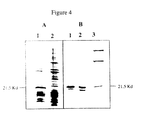
- Figure 4 shows the Western Blot and SDS polyacrylamide gel electrophoresis gel of Penl:Troponin fusion protein produced and purified in accordance with the invention.
- lane A-1 is the SDS PAGE of induced/total protein
- lane A-2 is the SDS PAGE of uninduced/total protein
- lane B-1 shows post cell breakage/western blot/total protein
- lane B-2 shows purified (35% ammonium sulfate cut)/western blot
- lane B-3 shows purified (35% ammonium sulfate cut)/SDS PAGE.
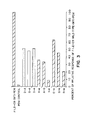
- Figure 5 shows the results of the competitive ELISA assay of fusion peptide of Example 6.
- FIGS 6 and 7 show the results of the immunization of with the Penl:C9 protein as detailed in Example 8.
- the present invention includes preparation of polypeptides by construction of DNA which encodes a fusion polypeptide, i.e. DNA which codes for the penl protein or precipitation effective portion thereof linked to the desired target peptide, which upon expression provides a polypeptide that comprises penl or portion thereof fused to the target peptide.
- the target peptide preferably is linked to the carboxyl terminus of penl protein or portion thereof, either directly or through a linking sequence.
- the target peptide suitably also may be linked to the amino terminus of the penl protein or portion thereof.
- a fusion polypeptide also may be employed where the target peptide is flanked by portions of the penl protein whereby the flanked target peptide precipitates in a low ionic strength solution.
- a fusion polypeptide will contain two separate portions of the penl protein with the target peptide positioned therebetween.
- a fusion polypeptide will contain two cleavage sites for release of the target peptide from the two "flanking" penl portions. This can be accomplished by interposing a linking segment on either side of the target peptide and between the penl protein portions, wherein those linking segments each can be recognized and cleaved by an appropriate cleavage agent.
- preparation of penl fusion peptides of the invention can be accomplished by recombinant DNA techniques, e.g. preparation of plasmid DNA, cleavage of DNA with restriction enzymes, ligation of DNA, transformation and culturing of host cells, etc., that are generally known to those skilled in the art and, e.g., disclosed generally in Sambrook, et al., Molecular Cloning, (2d ed. 1989).
- DNA is obtained coding for the penl protein or a precipitation effective portion thereof.
- One source of that DNA is Bacillus liceniformis, which is publicly available, e.g., from the American Type Culture Collection under Accession nos. 6598, 6634 and 8480. Isolation and cloning of such DNA has been described and includes molecular cloning and polymerase chain reaction. See Wittman, et al., J. Bacteriol., 170: 3206-3212 (1988); and Himeno, et al., J. Bacteriol., 168 :1128-1132 (1986). See also Sambrook, et al., supra, including ch. 14 thereof.
- nucleotide sequence coding for penl or portion thereof, or the sequence of other components of the fusion construct of the invention such as the sequence coding for the target peptide or linking segment also can be synthesized by known methods, e.g. the phosphate triester method. See Oligonucleotide Synthesis, IRL Press (M. J. Gait, ed., 1984). Synthetic oligonucleotides also may be prepared using commercially available automated oligonucleotide synthesizers. The nucleotide and amino acid sequences of the penl protein are shown in Figure 2 of the Drawings.
- the gene coding for penl or effective portion thereof can be amplified by the polymerase chain reaction (PCR) or other means known in the art.
- PCR primers to amplify the penl gene may add restriction sites to the PCR product and include, e.g., an upstream primer of and a downstream primer of
- the penl gene can be amplified directly by standard PCR methods from Bacillus liceniformis chromosomal DNA using such primers or, alternatively, a suitable plasmid containing the penl gene can be used as the template for PCR. See Example 1 which follows, and note that SEQ ID No : 21 is identical to SEQ ID No : 24 and SEQ ID No : 22 is identical to SEQ ID No 25.
- the sequence coding for penl or effective portion is linked to a sequence coding for the target protein by use of suitable ligases.
- DNA coding for the target peptide optionally linked to DNA coding for a linking sequence, can be obtained by isolating the DNA from natural sources or by known synthetic methods as discussed above.
- a nucleotide sequence coding for penl or effective portion thereof may be directly joined to a DNA sequence coding for the target protein or, alternatively, a DNA sequence coding for a suitable linking sequence may be interposed between the sequence coding for penl and the sequence coding for the target peptide and joined using suitable ligases.
- the linking sequence preferably is a nucleotide sequence that codes for a peptide that can be recognized and cleaved by a proteolytic agent that will cleave the fused polypeptide expressed by the gene construct to thereby provide the target peptide.
- a preferred linking sequence has a nucleotide sequence of ATCGAGGTAGG (SEQ ID NO: 23) and codes for the peptide lle-Glu-Gly-Arg, which can be cleaved by blood coagulation factor Xa. See, for example, Nagai et al., Nature, 309:810-812 (1984).
- a variety of other linking sequences and cleavage agents can be employed as will be recognized by those skilled in the art.
- suitable agent will be based on the identity of the sequence of amino acid(s) at the intended cleavage site, particularly the identity of the linking sequence interposed between the penl protein or portion thereof and the target peptide.
- suitable cleavage agents will include trypsin (cleaves at Arg, Lys), collagenase (cleaves at X-Gly-Pro), hydroxylamine (cleaves at Asn-Gly), dilute acid (cleaves at Asp-Pro), cyanogen bromide, N-bromosuccinimide, etc.
- the cleavage agent is selected so that it does not cleave the target protein, but reacts only with intended cleavage sites such as those positioned within the linking sequence and/or the penl protein or portion thereof.
- intended cleavage sites such as those positioned within the linking sequence and/or the penl protein or portion thereof.
- undesired cleavage can be minimized by use of cleavage agent that cleaves at a site present on the linking sequence but which is absent from the target peptide.
- Suitable linking sequences may be obtained by known means including oligonucleotide synthesis.
- nucleotide sequences can be included in the gene fusion construct.
- a promoter sequence which controls expression of the sequence coding for the fused polypeptide, can be included in the construct or present in the expression vector into which the construct is inserted.
- a heat inducible promoter is particularly suitable.
- a signal sequence can be included in the gene construct, if desired, so that the expressed polypeptide can be secreted from the transformed host cells into the culture medium.
- the gene fusion construct as described above can be incorporated into a suitable vector by known methods such as by use of restriction enzymes to make cuts in the vector for insertion of the construct followed by ligation.
- the vector containing the gene construct is then introduced into host cells for expression of the gene fusion. See, generally, Sambrook, et al., supra. Selection of suitable vectors can be made empirically based on factors related to the cloning protocol. For example, the vector should be compatible with, and have the proper replicon for the host cell that is being employed. Further the vector must be able to accommodate the DNA sequence coding for penl protein or portion thereof and the target peptide.
- Suitable host cells will include essentially any eukaryotic or prokaryotic cell, preferably those cells that can be easily transformed and exhibit rapid growth in culture medium.
- Specifically preferred host cells include prokaryotes such as E. coli, Bacillus subtilis, etc. and eukaryotes such as animal cells and yeast strains, e.g., a strain of the genus Saccharomyces such as S. Cerevisiae.
- Other suitable hosts include, e.g., insect cells such as Sf9.
- the transformed host cells are typically multiplied in a selective growth medium, e.g. an antibiotic (assuming the cloning vector includes an appropriate resistance gene).
- the host cell containing the fusion vector is cultured and the fused gene is induced, if necessary, by conventional techniques.
- the PCR product of the penl gene is cloned into a suitable vector such as the E. coli vector pUC19.
- a suitable vector such as the E. coli vector pUC19.
- Other vectors that may be suitably employed are known in the art, may be selected as disclosed above and include, e.g., pBR322.
- the isolated DNA coding for the target peptide is then cloned into the vector containing the penl gene. See, for example, Figure 1 of the Drawings.
- the construct is then used to transform an appropriate host such as E. coli by known methods. See Sambrook, et al., supra.
- transformants are selected by conventional means e.g. by including an appropriate marker gene into the construct which imparts a detectable phenotypic property to transformed cells.
- transformants can be identified by antibiotic (e.g. tetracycline) selection where the transformants contain the appropriate resistance gene.
- the host cell containing the fusion vector is cultured and the fused gene is induced, if necessary, by conventional techniques.
- the cell culture can be suitably incubated by heating with agitation.
- the cells are then harvested and, if necessary or desired, lysed.
- the culture medium can be optionally centrifuged to remove various cell debris and other materials, and then is contacted with an aqueous solution having an ionic strength sufficient to precipitate the fused polypeptide.
- the fused polypeptide is precipitated from the culture medium or other solution by dialysis against a low ionic strength buffer, e.g., a solution having a salt concentration of about 250 or 200 mM or less, more preferably about 100 mM or less.
- a low ionic strength buffer e.g., a solution having a salt concentration of about 250 or 200 mM or less, more preferably about 100 mM or less.
- a 50 mM KCI buffer solution is particularly preferred.
- the fused polypeptide will precipitate from a solution having a salt concentration of about 200 mM or less, typically from a salt concentration of about 200 mM to 50 mM.
- a dialysis procedure as described in Example 1 and elsewhere herein is a particularly preferred method for precipitating the fused polypeptide, although other methods for precipitating the polypeptide by contact with a low ionic strength buffer can be employed.
- the penl fusion polypeptide in solution simply can be admixed with such a low ionic strength solution.
- the conditions under which the polypeptide solution is contacted with the low ionic strength solution e.g., rate of addition of buffer solution, temperature of buffer solution and polypeptide solution, etc.
- the fusion polypeptide solution can be contacted with the low ionic strength solution under selected conditions; yields and purity of the precipitated polypeptide obtained under the varying conditions will indicate the optimal parameters for precipitation of that polypeptide.
- suitable aqueous solutions having an ionic strength sufficient to precipitate the penl fusion polypeptide can be readily identified.
- samples of a fusion polypeptide of the invention in solution can be treated with aqueous solutions having differing ionic strengths to thereby determine the optimum solution for precipitation of that fusion polypeptide.
- the solution used to precipitate the fusion polypeptide preferably contains at least one salt.
- salts known in the art may be employed including alkali metal or alkaline earth metal salts such as a sodium halide salt e.g. NaCI. It is generally preferred to employ a potassium salt, particularly a potassium halide such as KCI.
- the aqueous solution also typically contains a buffer such as Tris or other known agent to maintain pH at a desired level.
- the solution also may include other optional components, e.g., a protease inhibitor such as phenylmethylsulfonyl fluoride (PMSF).
- PMSF phenylmethylsulfonyl fluoride
- the initial concentration of the penl fusion polypeptide in solution prior to precipitation can affect recovery and purity of the precipitated polypeptide.
- the fusion polypeptide be present in solution at a concentration of about 0.3 to 1.0 mg per millimeter of solution, although concentrations outside this preferred range also will be suitable, particularly higher concentrations.
- concentrations of the fused polypeptide in a culture medium can be readily achieved in most cases, particularly when using the vector and heat induction system as described in Example 1 which follows. That vector and induction system typically results in expression wherein the penl-target peptide fusion constitutes about ⁇ 20 wt. % of total cell protein.
- fusion polypeptides of the invention can be isolated in high purity from solution.
- recombinant penl fusion polypeptides of the invention have been isolated from E. coli cells at a purity (HPLC analysis) of 50 percent or greater, and even at a purity of about 85 percent or greater.
- penl fusion polypeptides of the invention can be isolated in high yields from a culture medium, e.g., at about 15 percent or greater of the total expressed polypeptide, and even yields of about 25 percent or greater. More specifically, the yield is often about 3 and 9 mg of polypeptide per 10 11 E. coli cells. As will be appreciated by those skilled in this art, such yields are significantly higher than yields provided by prior isolation and purification methods.
- the precipitated polypeptide may be employed without further purification or, optionally, it may be subjected to further purification steps.
- the polypeptide can be dissolved in a suitable solution of relatively high ionic strength and then precipitated by contact with a low ionic strength buffer, particularly by dialysis against a low ionic strength buffer solution.
- the precipitated polypeptide also can be further purified by conventional techniques such as chromatography.
- the purified polypeptide may be suitably used in its fused form, particularly where the biological properties of the target peptide are not deleteriously inhibited by the penl protein or portion thereof, or by the linking sequence (if present).
- the target peptide can be released from the penl protein or portion thereof by treating the fused polypeptide with a suitable cleavage agent.
- a suitable cleavage agent e.g., a linking segment as discussed above, the polypeptide can be treated with an appropriate cleavage agent to thereby cleave the polypeptide.
- any peptide or protein can be purified in accordance with the present invention as long as the target peptide does not prevent precipitation of the fusion polypeptide of the invention (i.e., the peptide comprising the penl protein and the target peptide) in a low ionic strength buffer as specified above.
- Suitable target peptides can be readily identified by those skilled in the art, e.g., by sequential steps of 1) expressing a fusion vector as described above to provide a polypeptide that comprises penl or precipitation effective portion thereof and the target peptide of interest, 2) contacting that polypeptide in solution with a suitable low ionic strength buffer, and 3) observing the solution for precipitation of the polypeptide.
- the target peptide either individually or in combination potentially can prevent or at least inhibit precipitation of a fusion polypeptide of the present invention.
- the size of the target peptide and the number of charged moieties present on that peptide can affect precipitation of the fusion polypeptide.
- the target peptide comprises about 200 or less amino acids, more preferably about 140 or less amino acids, still more preferably comprising about 120 or less amino acids, even more preferably about 100 or less amino acids, most preferably about 70 to 80 amino acids or less. Larger target peptide portions could interfere with the ability of a fusion polypeptide to precipitate from solution.
- the target peptide does not contain an excessive number of charged groups, i.e., either charged acidic or basic groups, which also could interfere with the ability of the polypeptide to precipitate from solutions of low ionic strength. Accordingly, preferably no more than about 10 to 20 percent of the total number of amino acids of the target protein are acidic or basic amino acids such as Lys, Arg, His, Asp or Glu.
- the invention is not limited to naturally occurring proteins, but also includes preparation and purification of synthetic peptides, i.e. peptides that do not occur in nature, including analogs of the above-mentioned proteins wherein one or more amino acids is different than the naturally occurring peptides, fragments of the above-mentioned naturally occurring peptides, and other synthetic peptides.
- polypeptides produced in accordance with the invention will have a wide variety of uses.
- the fusion polypeptide can be used for immunization with penl or portion thereof acting as an antigenic carrier molecule for the target peptide. See, for instance, Example 8 which follows.
- Such a procedure is significantly more convenient than prior methods for use of non-immunogenic antigen.
- Those prior methods provide for chemical linkage of the previously prepared or isolated antigen to a carrier such as BSA or KLH followed by one or more purification steps.
- a carrier such as BSA or KLH
- an effective antigen can be prepared and isolated in high purity in a single step.
- antigens can be used to produce polyclonal and monoclonal antibodies, specifically by administering a fusion polypeptide of the invention to a mammal such a mouse or rabbit, wherein that administration elicits a desired immune response, i.e., production of antibodies specific for epitope(s) of the polypeptide.
- the harvested antibodies can be used for a variety of applications as will be recognized by those skilled in the art including in various assays and diagnostics.
- the invention also includes epitope mapping or epitope identification of a target peptide.
- a peptide is prepared by the methods of the invention and the binding activity of that peptide with respect to a binding domain of a peptide or polypeptide (e.g., an antibody) is determined.
- the binding activity of a fusion peptide of the invention may be determined or, alternatively, the fusion peptide may be cleaved with an appropriate cleavage agent, the target peptide isolated, and the binding activity of the target peptide evaluated.
- a group of penl fusion polypeptides having related sequences, e.g. each differing by only about 1-5 or 1-3 amino acids, can be isolated by contact with a low ionic strength buffer.
- the binding activity of the isolated peptides to the binding domain of a particular peptide or polypeptide such as a monoclonal or polyclonal antibody can be determined through use of, e.g., a biosensor system using surface plasmon resonance detection, western blot analysis, or ELISA. See, for instance, Examples 3 and 4 which follow.
- the invention also includes preparation and use of a random peptide library.
- DNA sequences encoding a variety of peptides can be cloned into an expression vector system such as those identified above that contains a DNA sequence encoding the penl protein or precipitation effective portion thereof and, optionally, a linking sequence coding for a peptide sequence that contains one or more cleavage sites.
- restriction fragments of an appropriate cDNA library or genomic DNA library are used as the source of sequences inserted into the expression vector.
- those sequences are inserted in the expression vector downstream of the gene coding for penl or portion thereof and linking sequence, if present.
- Suitable host cells e.g.
- E. coli cells are transformed with the vector containing the gene fusion (i.e., the sequence coding for penl or portion thereof and the additional peptide).
- Transformants are cultured under suitable conditions, e.g. grown on a solid substrate such as, a nylon membrane.
- the resulting cells are then screened for expression of fusion polypeptide(s) of interest by standard techniques such as by use of labelled antibody. See Methods in Enzymology, volume 152, Guide to Molecular Cloning Techniques, (S. Berger et al., ed., 1987).
- Polypeptides expressed from the selected clones then can be readily isolated and purified by contact with a low ionic strength solution to precipitate the polypeptide as disclosed above.
- the peptide of interest can be cleaved from the penl segment of the polypeptide if the polypeptide includes a suitable cleavage site such as a factor Xa site within a linking segment.
- the invention also provides methods that comprise use of one or more fusion polypeptides of the invention to modulate the activity of T cells in vitro and in vivo , e.g. to induce or enhance T cell proliferation or to inhibit or inactivate T cell development.
- the invention further provides in vitro assays to identify target peptides exhibiting activity to treat autoimmune diseases or to treat an undesired immune response such as those conditions discussed above, or to identify peptides useful in eliciting a desired immune response, as discussed above.
- T cells for such in vitro methods will be provided by transformed T cell lines such as T cell hybridomas or T cells which are isolated from a mammal, e.g., from a human or from a rodent such as a mouse.
- Suitable T cell hybridomas are publicly available or can be prepared by known methods.
- T cells can be isolated from a mammal by known methods. See, for example, Shimonkevitz, R., et al., (1983) J. Exp. Med. 158:303.
- T cells suitably express a marker that can be assayed and that indicates T cell activation, or modulation of T cell activity after activation.
- a T cell hybridoma such as the murine T cell hybridoma DO 11.10 that expresses interleukine-2 (IL-2) upon activation can be employed.
- IL-2 concentrations can be measured to determine if a particular presenting peptide is capable of modulating activity of the T cell hybridoma.
- IL-2 interleukine-2
- the fusion polypeptide is first applied to antigen presenting cells, which are "professional” cells and capable of transporting the fusion polypeptide into the cells.
- An antigen presenting cell "loaded” with the fusion polypeptide can then react with T cells in such a cell to cell interaction.
- T cells employed in the assays are incubated under conditions suitable for proliferation.
- a DO11.10 T cell hybridoma may be suitably incubated at about 37°C and 5% CO 2 in complete culture medium (RPMI 1640 supplemented with 10% FBS, penicillin/ streptomycin, L-glutamine and 5x10 -5 M 2-mercaptoethanol).
- Serial dilutions of a fusion polypeptide of the invention can be added to the T cell culture medium. Suitable concentrations of the fusion polypeptide added to the T cells typically will be in the range of from 10 -12 to 10 -6 M.
- T cell activation signals are provided by antigen presenting cells (APC) that have been loaded with the appropriate antigenic peptide.
- APC antigen presenting cells
- fusion polypeptide(s) of the invention it is believed that use of antigen dose and APC numbers giving slightly submaximal T cell activation is preferred to detect inhibition of T cell responses with fusion polypeptide(s) of the invention.
- a decrease in production of IL-2 following contact with the fusion polypeptide indicates the fusion complex modulates activity of the T cells and can suppress immune response.
- modulation of T cell activation can be suitably determined by changes in antigen-dependent T cell proliferation as measured by radiolabelling techniques as are recognized in the art.
- a labeled (e.g., tritiated) nucleotide may be introduced to an assay culture medium. Incorporation of such a tagged nucleotide into DNA serves as a measure of T cell proliferation.
- This assay is not suitable for T cells that do not require antigen presentation for growth, e.g., T cell hybridomas. It is suitable for measurement of modulation by the penl fusion polypeptide of T cell activation for untransformed T cells isolated from mammals. A decrease in the level of T cell proliferation following contact with the fusion polypeptide(s) indicates the fusion complex modulates activity of the T cells and can suppress an immune response.
- DNA sequences encoding either a library of random peptides or selected peptides can be cloned into an expression vector system such as those identified above that contains a DNA sequence encoding the penl protein or precipitation effective portion thereof and optionally, a DNA sequence coding for a peptide sequence that contains one or more cleavage sites. Transformation of suitable host cells and expression of the transformants can be carried out as described above.
- restriction fragments of an appropriate cDNA of genomic DNA library are used as a source of the sequences inserted into the expression vector or, alternatively, selected oligonucleotides such as synthetic oligonucleotides of known sequence are used as the inserted sequence.
- Suitable hosts such as a mammalian cells and others identified above, are transformed with the vector containing the gene fusion, e.g., the sequence coding for the penl protein or precipitation effective portion thereof linked to sequence coding for the target peptide. Transformants are cultured under suitable conditions and the cells are screened for expression of the fusion polypeptide of interest by contacting same with selected T cells.
- Assays described above e.g., measurement of IL-2 production or T cell proliferation, are employed to determine if contact with the expressed fusion polypeptide modulates T cell activation.
- a decrease in IL-2 production of APC-stimulated T cells identifies those fusion polypeptides that modulate activity of the T cells and can suppress immune responses.
- An increase in IL-2 production of such APC-stimulated T cells identifies those fusion polypeptides that can increase T cell responses and have use for vaccination applications.
- the penl gene was amplified by the Polymerase Chain Reaction (PCR) using standard techniques from the plasmid pCC34 as template.
- PCR Polymerase Chain Reaction
- the plasmid pCC34 was a PUCl9 vector containing the penl.
- PCR Conditions of the PCR were as follows: 100 ng of the plasmid pCC34 was used as template, 10 pmoles of the primers FX-1 and FX-2 (identified immediately below), 50 mM KCI, 20 mM Tris-HCI pH 8.4, 2 mM MgCl 2 , 100 ⁇ g/ml Bovine Serum Albumin, 50 ⁇ M dNTP, 2.5 units of Taq DNA polymerase (Cetus Perkin-Elmer) in a 100 ⁇ l final volume. The reaction was run for 25 cycles at 95°C, 55°C and 72°C.
- the penl gene also could be amplified by standard PCR techniques directly from Bacillus liceniformis chromosomal DNA using these same primers.
- the above-mentioned PCR primers used to amplify the penl gene were:
- the upstream PCR primer was designed to add a Hindlll restriction site at the 5' end of the PCR product and the downstream PCR primer was designed to add Ncol and BamHI restriction sites at the 3' end of the PCR product.
- the PCR product was digested with Hind lll and Bam HI and cloned into the Hind lll -Bam HI sites of the E. coli vector pUC19.
- this vector (tET002-3) contains the penl gene construct flanked by Hind lll at the 5' end and Nco l and Kpn l at the 3' end.
- the sequence of the cloned penl gene was confirmed using the ABI DNA sequencing apparatus and the M13 (+/-) universal sequencing primers.
- oligonucleotide were annealed to each other as described below and cloned into the Nco l- Kpn l site of the plasmid tET002-3. 100 pmoles of each oligonucleotide were boiled for 10 minutes in the presence of 44 mM EDTA and 66 mM NaCI and cooled slowly to room temperature. These annealed oligos where cloned into the Nco l- Kpn l sites at the 3' end of the penl gene. This plasmid was designated pCC50.
- the gene construct from the Hing lll site 5' of the penl gene to the BamHI site 5' of the Kpn l site, was then subcloned into the expression vector pDG160, via the Hind llll Bam Hl sites, oriented 3' to the PL promoter. When properly expressed, this gene will encode the penl protein fused in frame to the following 9 amino acid peptide: Asp Ser Asp Arg Ala lleu Glu Gly Arg. The first two amino acid residues are P Y which are encoded by the Nco l codons and the following 9 amino acid residues designated C9 herein, are identical to the carboxy terminus of the factor Xa cleaved blood factor prothrombin.
- This plasmid was designed pCC51, and the oligonucleotide sequence between the Nco l and the Sal l sites has also been confirmed as described above.
- a 500 ml culture of strain DG116:pCC51 was grown in M9 medium (Per 1 liter volume, add 6g of Na 2 HPO 4 sodium phosphate dibasic, 3g KH 2 PO 4 , 0.5 g NaCI and 1 g NH 4 Cl and autoclave.
- the cells were harvested and resuspended in 10 ml of Lysis Buffer (LB) (per 200 ml volume add: 20 ml of 1M Tris buffer [pH 8.0], 20 ml of 2M KCI, 0.8 ml of 0.25 EDTA, 04 ml of 1 M CaCl 2 , 1 ml of 2M MgCl 2 , 20 ⁇ l of 0.1M DTT, 12.5 ml of 80% glycerol and 145.28 ml of H2O).
- the cells were then disrupted in a french press at a pressure of 1500 PSI.
- the french press was washed with 10 ml of SB buffer (per 500 ml add: 50 ml of 1M Tris [pH 8.0], 10 ml of 1M CaCl 2 , 0.5 ml of 1M DTT, 259 ml of 80% Glycerol and 189.5 mls of H 2 O) + 200 mM KCI.
- the final volume was recorded at 17 ml.
- a 10% solution of polyethyleneimine was slowly added to a final concentration of 0.6%.
- the sample was centrifuged at 4°C at 6000 RPM in a Beckman J2-HS rotor JA-20. The supernatant was removed and saved.
- pellet To extract pellet (DNA) associated protein, the pellet was resuspended in 5 ml of SB buffer + 600 mM KCI and was shaken at 4°C for 1 hr. The sample was then centrifuged and the supernatant was added to the saved one. The combined supernatant was stirred in an ice bath and ammonium sulfate was slowly added to a final concentration of 35% w/v. The sample was centrifuged at 4°C at 6000 RPM for 1 hr and the pellet kept. The pellet was redissolved in 10 ml of SB buffer + 50 mM KCI, loaded into a dialysis bag and dialyzed with 2 changes of 400 mls of buffer overnight at 4°C overnight.
- the precipitated material is collected by gentle centrifugation, washed with SB+ 50 mM KCI.
- the pellet is redissolved in 300 ⁇ l of 2M KCI, and add 100 ⁇ l of 10X SB buffer and slowly add 600 ⁇ l of H 2 O (final buffer concentration was SB + 600 mM KCI).
- final buffer concentration was SB + 600 mM KCI.
- the oligonucleotide pairs were annealed to each other as described before, cloned into the Nco l- Bam HI site of the vector pCC50 and the DNA sequence was confirmed as described before, and the entire Penl:C9 constructs were subcloned into the pDG160 expression vector as described before.
- Each of these plasmids was introduced into the E. coli strain DG116 as described before, and the cognate penl:C9 peptides expressed and purified as described above.
- the binding of the purified Penl:C9 muteins to the TA1 antibody (TA1) was examined by several methods: 1. Western-Blot analysis. 2. ELISA, and 3. BlACore Analysis.
- TA1 was raised from a mouse that had been immunized with F1.2-C9 KLH by standard procedures; F1.2-C9 is the purified factor Xa cleavage product of prothrombin
- BlAcore surface plasmon resonance detection
- TA1 has been chemically immobilized onto the carboxymethylated dextran matrix of the sensor chip (CM5) using the amine coupling kit and the method provided by the manufacturer (Pharmacia Biosensor).
- TA1 was diluted to 57 ⁇ g/mL in 10 mM Na-acetate buffer pH4.
- NHS N-hydroxysuccinimide
- EDC N-ethyl-N'-(dimethylaminopropyl) carbodiimide
- 5 ⁇ L of the TA1 solution was injected at a flow rate of 3 ⁇ L/min. Residual dextran binding sites were inactivated by treatment of the chip surface with 37 ⁇ L of 1M ethanolamine pH 8.5. This resulted in the immobilization of 4541 resonance units (RU) of TA1.
- the BlAcore program was set up as follows: Flow rate: 5 ⁇ l/min. Injection of 25 ⁇ L of Penl-peptide. Injection of 5 ⁇ L of 25 mM NaOH which regenerates TA1 by stripping of the Penl:C9 peptide. Report points were set 1. at 10 sec before the sample injection (baseline), 2. at 10 sec before the NaOH injection and 3. at 100 sec after the NaOH injection (regeneration).
- Additional penl fusion polypeptides were expressed and isolated, the first including a target peptide containing the 35 amino acid Troponinl epitope (amino acids 26-60, Tnl 35, of the mature human Troponinl, which is recognized by the monoclonal antibodies (mAB's) 2F6.6 and 2B1.9), and the second fusion containing a target peptide portion of the SH2 domain of GAP-N.
- a target peptide containing the 35 amino acid Troponinl epitope amino acids 26-60, Tnl 35, of the mature human Troponinl, which is recognized by the monoclonal antibodies (mAB's) 2F6.6 and 2B1.9
- mAB's monoclonal antibodies
- the DNA fragment encoding Tnl35 was amplified by standard PCR techniques from a plasmid containing the Tnl gene with the following primers:
- the PCR product was digested with Nco l and Bam HI and cloned into the vector pCC51 as described in Example 1 above.
- the resulting plasmid pCC51:Penl-Tnl 35 was introduced into the E. coli strain DG116 and the resulting strain was induced for expression of the fusion protein as described in Example 1 above.
- the soluble fraction of these cells was processed as described before and the purified fusion peptide was analyzed by SDS-PAGE and Western-Blot analysis. See Figure 4. The results indicated that this fusion peptide is expressed up to 20% of total cell protein.
- the fusion peptide was purified as described in Example 1 above except that 10 mM PMSF was added to the buffers used throughout the purification process. Approximately 40% of the recovered peptide has been processed from its carboxy terminus during the purification process, suggesting that this fusion peptide may be labile under these conditions although it is stable intracellularly.
- the SH2 domain of GAP-N (92 amino acids in length) was fused to the Penl gene.
- the DNA fragment encoding the SH2 domain was cloned as follows. An overlap PCR was done using the primers: CLC 107 and CLC 108 were used in a PCR reaction with a DNA template containing Penl gene. CLC 107 places a Hindlll site at the 5' end of the Penl and CLC 108 places a 15 amino acid linker at the 3' end. CLC 109 and CLC 119 were used in a PCR reaction with a DND template containing the GAP-N SH2 gene.
- CLC 109 places the 15 amino acid linker at the 5' end of the GAP-N SH2 and CLC 119 places a BamHI site at the 3' end.
- the resulting PCR products from each reaction were then added together in a new PCR reaction with CLC 107 and CLC 119.
- the resulting fragment containing Penl-linker-SH2 was digested with HinDlll and BamHI and then ligated into the pDG160 expression vector and into the vector pTRP3 downstream from the E. coli Trp promoter.
- This fusion peptide was expressed in E. coli and purified as described in Example 1 above. The results indicate that it is also processed during the purification, similar to the Penl:Tnl35 fusion peptide.
- HPLC monoS purified Penl:C9 muteins and wild type (wt) were tested for their relative binding to the anti-C9 specific protein A purified mAb TA1 in a competitive ELISA.
- the assay was performed using microtiter plates that had been previously coated with Penl:C9(wt) by a passive technique (10m ng protein/well). Dilution of the Penl:C9(wt) and the Penl:C9 muteins were preincubated for 1 hour at room temperature with the mAb TA1 that was at a concentration of 271 ng/ml.
- the plates were washed and 100 ⁇ l/well of each sample was applied and incubated at room temperature for 1/2 hour.
- the wells were washed and 100 ⁇ l/well of a 1:2000 dilution of a Goat anti-mouse lgG HRP conjugate was added.
- the plated were incubated at room temperature for another 1/2 hour.
- the plates were washed again and 100 ⁇ l/well of substrate (ABTS) was added and allowed to react for 8 minutes at room temperature.
- Each well was quenched with 100 ⁇ l of 1% SDS stop solution.
- the ELISA signal was read at 405 nm using a Biotek Plate reader. The data collected was analyzed using EXCEL 4.0 software.
- the maximum (100%) ELISA signal was determined as the average of values seen for dilution of penl lacking C9 that was allowed to react with TA1 as described above. Inhibition of TA1 binding was compared for all Penl:C9 muteins and Penl:C9 (wt) by using the ELISA signals measured at a concentration of 0.2 ⁇ M of the competing Penl:C9 fusion protein. This was the concentration at which Penl:C9 (wt) generated a 50% signal compared to the maximum signal generated in this ELISA.
- Figure 5 of the Drawings shows this data expressed as percent binding to TA1 in a bar graph. The results clearly indicate that not all nine amino acid residues are required for binding.
- the amino terminus of the peptide DSDRAIEGR is shown to be less important to binding to TA1 relative to the carboxy terminus of the peptide. More specifically, the results indicate that the sequence RAIXGR of the peptide contributes to most of the binding of the peptide.
- Tnl35 peptide from the fusion protein Penl:Tnl35 23.7 ⁇ g of purified Penl:Tnl35 were digested with .004 units of Factor Xa (Sigma Diagnostics 870-10) at 37°C for 30 minutes. The sample was then brought to 0.1% trifluoroacetic acid (TFA) and loaded onto a prepacked Pharmacia PepRPC C2/C18 reverse phase column (0.5 x 6 cm, 5 ⁇ m particle size), equilibrated with 0.1% TFA in water (solvent A) and connected to a Waters 625 Liquid Chromatography System.
- TFA trifluoroacetic acid
- the column was eluted with a linear gradient of 0-100% solvent B (0.1% TFA in acetonitrile) in 20 minutes at a flow rate of 1 ml/min.
- the absorbance of 214 nm was monitored to detect the eluted peptide.
- the retention time for Tnl35 cleaved peptide was 12.2 minutes. This retention time was identical to the identical synthetic peptide run as a control.
- mice were bled and assayed for specific antibody response to the C9 peptide as generally described in the Table shown in Figure 7 of the Drawings. Specifically, the mice were immunized on day 70 (first boost) and day 101 (second boost) after sensitization with F1.2-C9 KLH #3 and on day 32 after sensitization with the fusion polypeptide F1.2-C9 penl #1 and assayed for specific antibody response to the F1.2-C9 peptide and F2 (truncated F1.2 protein) by a sandwich ELISA assay with antigen (F2 or F1.2-C9 synthetic peptide conjugated to KLH or Ova) coated microtiter plate wells.
- antigen F2 or F1.2-C9 synthetic peptide conjugated to KLH or Ova
- Controls included sera of mice immunized previously with F1.2-C9 conjugates and TA1 monoclonal (TA1 was raised from a mouse that had been immunized with F1.2-C9 KLH by standard procedures).
- the titer was determined as the highest dilution producing an ELISA signal equal to or greater than twice that of background.
- Penl Ova protein
- ABI oligonucleotide synthesizer ABI oligonucleotide synthesizer
- each oligonucleotide 100 pmole of each oligonucleotide were annealed to each other as described in Example 1 above and cloned into the Ncol-BamHI site of the plasmid pCC51 at the 3' end of the penl gene.
- this gene encodes a penl protein fused in frame to the following 21 amino acid peptide: IEGRISQAVHAAHAEINEAGR (SEQ ID NO: 54) at the carboxy terminus.
- the first four amino acid residues represent a factor Xa cleavage site and the following 17 amino acid residues are identical to the Ova peptide (A. Sette et al., Nature 328 :395 (1987)).
- the resulting plasmid was designated pMB01, and the oligonucleotide sequence of the between the Ncol and the BamHI sites has also been confirmed.
- This plasmid was transferred into the E.coli strain DG116 and the fusion protein Penl:Ova was expressed and purified as described in Example 2 above. 1.4 mg of highly purified Penl:Ova were recovered after conducting a mono-S chromatography purification.
- a penl:Ova fusion polypeptide i.e., a fusion polypeptide containing the penl protein linked to an Ova target peptide
- a penl:Ova fusion polypeptide was employed as well as other materials.
- Three independent experiments were performed utilizing A20 APC and the DO11 T cell myeloma cell line. DO11 cells are specifically responsive to Ova loaded major histocompability complex class II (MHCII) molecules presented by A20 APCs.
- MHCII major histocompability complex class II
- A20 cells were loaded with 5 ⁇ g purified penl:Ova fusion polypeptide or 5 ⁇ g synthetic Ova peptide (positive control synthesized by Mimetics, Chiron Corp.) for 1 hour.
- DO11 cells 1 X 10 5 DO11 cells were added and incubated with the loaded A20 cells for 24 hours. The degree of activation of DO11 cells was determined by the release of Interleukin 2 (IL-2) into the culture medium. After 24 hours of incubation supernatants were collected and analyzed in an ELISA format for IL-2 (using two anti-IL2 antibodies from Pharmacia).
- IL-2 Interleukin 2
- Penl:Ova fusion protein containing the hen egg lysozyme (HEL) peptide preceded by the Factor Xa cleavage recognition site IEGRNLCNIPCSALLSS (SEQ ID NO: 55) and therefore should not stimulate DO11 cells.
- HEL hen egg lysozyme
- the Penl:HEL fusion protein was constructed exactly as Penl:Ova except the following oligonucleotide pair was used: IL-2 release pg/ml Experiment 1 Experiment 2 Experiment 3 DO11 cells only 0 0 0 A20 cells only 0 0 0 DO11 1 and A20 cells 0 0 0 DO11 and Penl:Ova 0 0 0 DO11 and Ova 0 0 0 DO11 and A20 and Penl 0 0 0 DO11 and A20 and Penl:HEL 0 0 0 DO11 and A20 and elution buffer 0 0 0 DO11 and A20 and Penl:Ova 6690 11198 8805 DO11 and A20 and Ova 8786 11146 6778
- results set forth in the above Table show that the Ova peptide and the penl:Ova fusion polypeptide, but none of the negative controls, stimulated DO11 cells.
- the results set forth in the Table indicate the penl:Ova peptide is as effective as the Ova peptide itself in stimulating DO11 cells.
- the results also indicate the penl:Ova fusion peptide is transported and processed by A20 APCs and properly presented to the DO11 TCR (T cell receptor) in the context of MHCII molecules.
Landscapes
- Health & Medical Sciences (AREA)
- Chemical & Material Sciences (AREA)
- Life Sciences & Earth Sciences (AREA)
- Organic Chemistry (AREA)
- Genetics & Genomics (AREA)
- General Health & Medical Sciences (AREA)
- Molecular Biology (AREA)
- Zoology (AREA)
- Biophysics (AREA)
- Biochemistry (AREA)
- Medicinal Chemistry (AREA)
- Engineering & Computer Science (AREA)
- Gastroenterology & Hepatology (AREA)
- Proteomics, Peptides & Aminoacids (AREA)
- Biomedical Technology (AREA)
- Toxicology (AREA)
- Bioinformatics & Cheminformatics (AREA)
- Immunology (AREA)
- Wood Science & Technology (AREA)
- General Engineering & Computer Science (AREA)
- Biotechnology (AREA)
- Pharmacology & Pharmacy (AREA)
- Plant Pathology (AREA)
- Veterinary Medicine (AREA)
- Animal Behavior & Ethology (AREA)
- Physics & Mathematics (AREA)
- Nuclear Medicine, Radiotherapy & Molecular Imaging (AREA)
- General Chemical & Material Sciences (AREA)
- Public Health (AREA)
- Microbiology (AREA)
- Chemical Kinetics & Catalysis (AREA)
- Peptides Or Proteins (AREA)
- Preparation Of Compounds By Using Micro-Organisms (AREA)
- Medicines That Contain Protein Lipid Enzymes And Other Medicines (AREA)
- Medicines Containing Antibodies Or Antigens For Use As Internal Diagnostic Agents (AREA)
Abstract
Description




















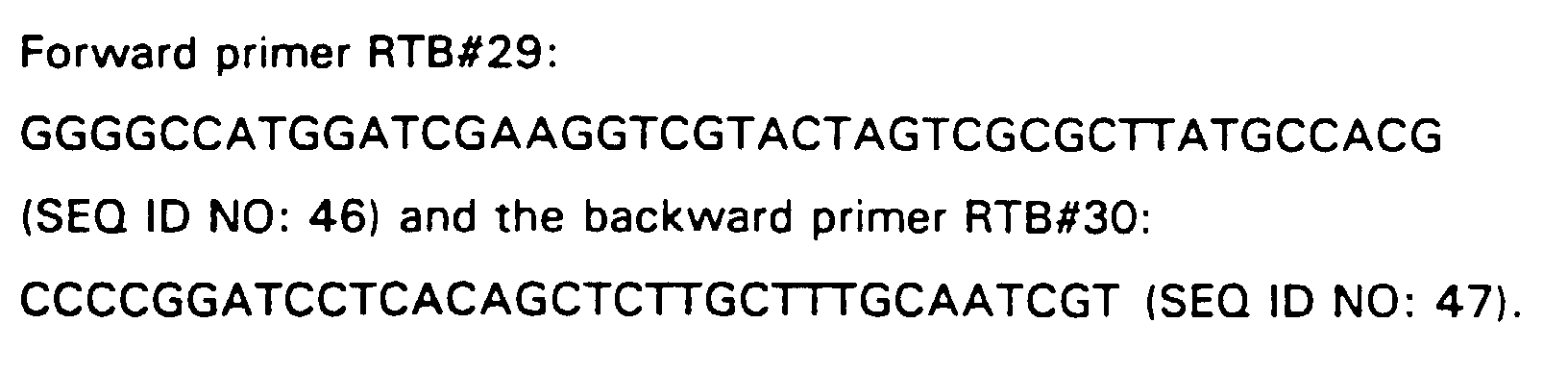






| IL-2 release pg/ | |||
| Experiment | |||
| 1 | | | |
| DO11 cells only | 0 | 0 | 0 |
| A20 cells only | 0 | 0 | 0 |
| | 0 | 0 | 0 |
| DO11 and Penl: | 0 | 0 | 0 |
| DO11 and | 0 | 0 | 0 |
| DO11 and A20 and | 0 | 0 | 0 |
| DO11 and A20 and Penl: | 0 | 0 | 0 |
| DO11 and A20 and | 0 | 0 | 0 |
| DO11 and A20 and Penl:Ova | 6690 | 11198 | 8805 |
| DO11 and A20 and Ova | 8786 | 11146 | 6778 |
| moles Ova peptide per well | IL-2 released pg/ | ||
| Experiment | |||
| 1 | | | |
| 2.4 X 10⁻⁹ | ---- | 4624 | 3675 |
| 1.2 X 10⁻⁹ | ---- | 3702 | 2997 |
| 6.0 X 10⁻¹⁰ | 4011 | 3487 | 2023 |
| 3.0 X 10⁻¹⁰ | 3333 | 2714 | 742 |
| 1.5 X 10⁻¹⁰ | 1878 | 1284 | 0 |
| 7.4 X 10⁻¹¹ | 589 | 216 | 0 |
| 3.7 X 10⁻¹¹ | 0 | 0 | 0 |
| Moles of penl:Ova fusion polypeptide per well | IL-2 released pg/ | ||
| Experiment | |||
| 1 | | | |
| 2.4 X 10⁻⁹ | 5267 | ---- | 3049 |
| 1.2 X 10⁻⁹ | 3420 | ---- | 1452 |
| 6.0 X 10⁻¹⁰ | 1624 | 2944 | 170 |
| 3.0 X 10⁻¹⁰ | 144 | 675 | 0 |
| 1.5 X 10⁻¹⁰ | 0 | 0 | 0 |
| 7.4 X 10⁻¹¹ | 0 | 0 | 0 |
| 3.7 X 10⁻¹¹ | 0 | 0 | 0 |




























































Claims (30)
- A method for producing a target peptide, comprising:(a) providing in solution a fusion polypeptide that comprises a target peptide and a penl protein or precipitation effective portion thereof; and(b) contacting said fusion polypeptide with an aqueous solution having an ionic strength sufficient to precipitate the fusion polypeptide.
- The method of claim 1, wherein the polypeptide is contacted with a buffer solution having a salt concentration of about 200 mM salt or less.
- The method of claim 2, wherein the salt is KCI.
- The method of claim 1, wherein the fusion polypeptide is in solution in a crude cell extract.
- The method of claim 1, wherein a linking sequence is interposed between the penl protein or portion thereof and the target peptide.
- The method of claim 5, wherein the linking sequence comprises a proteolytic cleavage site.
- The method of claim 6, wherein the cleavage site is a Factor Xa site.
- The method of claim 1, wherein the target peptide contains about 200 or less amino acids.
- The method of claim 1, wherein the target peptide contains about 140 or less amino acids.
- The method of claim 1, wherein the target peptide contains about 70 or less amino acids.
- The method of claim 1, wherein the polypeptide is contacted with the solution during a dialysis step.
- The method of claim 11, wherein the polypeptide is dialyzed against an aqueous solution having a salt concentration of about 100 mM or less.
- The method of claim 1, wherein the fusion polypeptide is provided by:(i) providing a cloning vector which expresses the fusion polypeptide in a transformed host cell;(ii) transforming a suitable host cell with the cloning vector; and(iii) culturing the transformed host cell under conditions suitable for the expression of the fusion polypeptide.
- The method of claim 1, further comprising cleaving the target peptide from the fusion polypeptide.
- The method of claim 1, wherein the precipitated fusion polypeptide is dissolved in an aqueous solution and then the polypeptide is contacted with a further aqueous solution having an ionic strength sufficient to precipitate the fusion polypeptide.
- The method of claim 1, wherein said contacting provides the polypeptide in a purity of about 85 percent or greater.
- A DNA fusion vector capable of expressing a penl peptide or effective portion thereof fused to a target peptide, comprising:a DNA sequence coding for the penl protein or precipitation effective portion thereof; anda DNA sequence coding for target peptide.
- The DNA fusion vector of claim 17, further comprising a DNA fragment coding for a linking sequence positioned between said DNA sequence coding for penl protein or portion thereof and said DNA sequence coding for the target peptide.
- The DNA fusion vector of claim 18, wherein the DNA fragment coding for a linking sequence comprises one or more cleavage sites.
- A fusion polypeptide comprising a penl protein or precipitation effective portion thereof fused to a target peptide.
- The polypeptide of claim 20, wherein a linking segment is interposed between the penl protein or effective portion thereof and the target peptide.
- The polypeptide of claim 21, wherein the linking segment comprises one or more cleavage sites.
- Use in an immunogenic preparation of a fusion polypeptide that comprises a penl protein or portion thereof fused to a target peptide for administration to a mammal to elicit a desired immune response by the mammal.
- A method of identifying one or more epitopes of a peptide, comprising:
producing a fusion polypeptide that comprises a target peptide and a penl protein or precipitation effective portion thereof in accordance with claim 1, and determining the binding activity of the fusion polypeptide, or isolated target peptide portion of the fusion polypeptide, to a binding domain of a selected peptide. - The method of claim 24 wherein the selected peptide is an antibody.
- A method for the selection of a target polypeptide comprising:transforming host cells with cloning vectors that each contains a gene construct that codes for a fusion polypeptide comprising a target peptide and a penl protein or precipitation effective portion thereof;culturing the transformed host cells under conditions suitable for expression of the fusion polypeptide; andscreening the cultured cells for those that express the target polypeptide.
- The method of claim 26 wherein the target peptide is encoded by a DNA fragment from a genomic DNA library or cDNA library.
- The method of claim 26 wherein the selected target polypeptide is isolated by contacting the polypeptide with a solution having an ionic strength sufficient to precipitate the polypeptide.
- A method for identification of a peptide that can modulate the activity of T cells, comprising1) contacting antigen presenting cells with a fusion polypeptide that comprises a target peptide and a penl protein or precipitation effective portion thereof; and then2) contacting the antigen presenting cells with T cells.
- The method of claim 29 wherein the antigen presenting cells are contacted with the fusion polypeptide and T cells in vitro.
Applications Claiming Priority (3)
| Application Number | Priority Date | Filing Date | Title |
|---|---|---|---|
| US08/235,178 US5888775A (en) | 1994-04-29 | 1994-04-29 | Peptide synthesis and purification by fusion to penI protein or precipitation effective portion thereof |
| PCT/US1995/005361 WO1995030016A1 (en) | 1994-04-29 | 1995-05-01 | Methods for peptide synthesis and purification |
| US235178 | 1999-01-22 |
Publications (2)
| Publication Number | Publication Date |
|---|---|
| EP0706574A1 EP0706574A1 (en) | 1996-04-17 |
| EP0706574B1 true EP0706574B1 (en) | 1998-09-16 |
Family
ID=22884431
Family Applications (1)
| Application Number | Title | Priority Date | Filing Date |
|---|---|---|---|
| EP95917774A Expired - Lifetime EP0706574B1 (en) | 1994-04-29 | 1995-05-01 | Methods for peptide synthesis and purification |
Country Status (8)
| Country | Link |
|---|---|
| US (2) | US5888775A (en) |
| EP (1) | EP0706574B1 (en) |
| JP (1) | JPH08512210A (en) |
| AT (1) | ATE171217T1 (en) |
| AU (1) | AU696349B2 (en) |
| CA (1) | CA2165413A1 (en) |
| DE (1) | DE69504795T2 (en) |
| WO (1) | WO1995030016A1 (en) |
Families Citing this family (10)
| Publication number | Priority date | Publication date | Assignee | Title |
|---|---|---|---|---|
| US20030105294A1 (en) * | 1998-02-25 | 2003-06-05 | Stephen Gillies | Enhancing the circulating half life of antibody-based fusion proteins |
| US6962790B1 (en) | 1998-09-23 | 2005-11-08 | University Of Massachusetts Medical Center | Predictive assay for immune response |
| DE29822972U1 (en) * | 1998-12-28 | 1999-03-04 | Sarnatech Paulmann & Crone GmbH, 58509 Lüdenscheid | Device for holding beverage containers in motor vehicles |
| DE19939578A1 (en) | 1999-08-20 | 2001-02-22 | Biosyn Arzneimittel Gmbh | New nucleic acid encoding hemocyanin, useful for gene therapy of tumors and for recombinant production of fusion proteins for vaccination |
| CA2365451A1 (en) * | 1999-03-17 | 2000-09-21 | Biosyn Arzneimittel Gmbh | Nucleic acid molecule comprising a nucleic acid sequence coding for a hemocyanin |
| US6358187B1 (en) | 1999-05-19 | 2002-03-19 | Carl M. Smith | Apparatus for monitoring and displaying exertion data |
| FR2807064B1 (en) * | 2000-03-31 | 2004-07-23 | Aventis Cropscience Sa | PHYTOPATOGENIC MUSHROOM GENE 763 AND ITS USE FOR THE IDENTIFICATION OF FUNGICIDAL COMPOUNDS |
| WO2003068934A2 (en) * | 2002-02-14 | 2003-08-21 | Rutter William J | Chimeric molecules for cleavage in a treated host |
| US20040101920A1 (en) * | 2002-11-01 | 2004-05-27 | Czeslaw Radziejewski | Modification assisted profiling (MAP) methodology |
| US8293100B2 (en) | 2009-03-13 | 2012-10-23 | Terrasep, Llc | Methods and apparatus for centrifugal liquid chromatography |
Family Cites Families (8)
| Publication number | Priority date | Publication date | Assignee | Title |
|---|---|---|---|---|
| US4952508A (en) * | 1980-03-10 | 1990-08-28 | Cetus Corporation | Method and vector organism for controlled accumulation of cloned heterologous gene products in Bacillus subtilis |
| EP0244147A3 (en) * | 1986-04-28 | 1989-04-05 | Merck & Co. Inc. | Purification process for hybrid proteins |
| JPH0722509B2 (en) * | 1986-09-12 | 1995-03-15 | 味の素株式会社 | Temperature-sensitive repressor and gene expression method using the same |
| US5215896A (en) * | 1987-03-20 | 1993-06-01 | Creative Biomolecules, Inc. | Leader sequences for the production of recombinant proteins |
| JPH02100685A (en) * | 1988-10-05 | 1990-04-12 | Res Dev Corp Of Japan | Polypeptide secretion expression vector, microorganism transformed with same vector and production of polypeptide by same microorganism |
| US5258502A (en) * | 1989-01-30 | 1993-11-02 | Massachusetts Institute Of Technology | Immobilization and purification of fusion proteins using chitin-binding ability |
| JPH07108232B2 (en) * | 1990-10-09 | 1995-11-22 | エム・ディ・リサーチ株式会社 | Method for producing peptide or protein |
| ATE240394T1 (en) * | 1992-10-23 | 2003-05-15 | Immunex Corp | METHODS FOR PRODUCING SOLUBLE OLIGOMERIC PROTEINS |
-
1994
- 1994-04-29 US US08/235,178 patent/US5888775A/en not_active Expired - Fee Related
-
1995
- 1995-04-25 US US08/428,733 patent/US5763284A/en not_active Expired - Fee Related
- 1995-05-01 CA CA002165413A patent/CA2165413A1/en not_active Abandoned
- 1995-05-01 EP EP95917774A patent/EP0706574B1/en not_active Expired - Lifetime
- 1995-05-01 AU AU23711/95A patent/AU696349B2/en not_active Ceased
- 1995-05-01 WO PCT/US1995/005361 patent/WO1995030016A1/en not_active Ceased
- 1995-05-01 AT AT95917774T patent/ATE171217T1/en not_active IP Right Cessation
- 1995-05-01 JP JP7528454A patent/JPH08512210A/en active Pending
- 1995-05-01 DE DE69504795T patent/DE69504795T2/en not_active Expired - Fee Related
Also Published As
| Publication number | Publication date |
|---|---|
| DE69504795D1 (en) | 1998-10-22 |
| DE69504795T2 (en) | 1999-05-12 |
| CA2165413A1 (en) | 1995-10-30 |
| AU696349B2 (en) | 1998-09-10 |
| US5763284A (en) | 1998-06-09 |
| AU2371195A (en) | 1995-11-29 |
| EP0706574A1 (en) | 1996-04-17 |
| ATE171217T1 (en) | 1998-10-15 |
| JPH08512210A (en) | 1996-12-24 |
| WO1995030016A1 (en) | 1995-11-09 |
| US5888775A (en) | 1999-03-30 |
Similar Documents
| Publication | Publication Date | Title |
|---|---|---|
| JP3755773B2 (en) | Diphtheria toxin vaccine with mutant R domain | |
| US4709017A (en) | Modified toxic vaccines | |
| CA2498502C (en) | Recombinant clostridial toxin fragments with proteolytic activation | |
| EP0722461B1 (en) | Expression of fusion polypeptides transported out of the cytoplasm without leader sequences | |
| JP2865300B2 (en) | Human B cell stimulating factor 2 receptor protein | |
| JP2566933B2 (en) | Eukaryotic fusion protein, production and use thereof, and method | |
| US6660271B2 (en) | Ubiquitin fusion-based vaccine system | |
| EA006232B1 (en) | Streptococcus antigens | |
| EP1154797A2 (en) | Multi-mutant diphtheria toxin vaccines | |
| JPS60222429A (en) | Synthesis of protein by maker peptide | |
| US20120009211A1 (en) | Bimer or an oligomer of a dimer, trimer, quadromer or pentamer of recombinant fusion proteins | |
| Kaul et al. | Expression of bonnet monkey (Macaca radiata) zona pellucida‐3 (ZP3) in a prokaryotic system and its immunogenicity | |
| JP2721256B2 (en) | Immunoglobulin E competitor | |
| EP1220933B3 (en) | Purification of recombinant proteins fused to multiple epitopes | |
| US5763284A (en) | Methods for peptide synthesis and purification | |
| JPH10509038A (en) | High levels of expression and easy purification of proteins, peptides and conjugates for immunological, purification and detection applications | |
| WO2000039310A9 (en) | Rubredoxin fusion proteins, protein expression system and methods | |
| Hass et al. | Preparation of synthetic polypeptide domains of carcinoembryonic antigen and their use in epitope mapping | |
| Löwenadler et al. | Enhanced immunogenicity of recombinant peptide fusions containing multiple copies of a heterologous T helper epitope | |
| Santhanam et al. | Dog Zona Pellucida Glycoprotein-3 (ZP3): Expression inEscherichia coliand Immunological Characterization | |
| JP5099943B2 (en) | Polypeptide, polynucleotide and use thereof | |
| JP2567024B2 (en) | Antigenic peptides of P. falciparum mitotic bodies | |
| US20060121051A1 (en) | Heat shock fusion-based vaccine system | |
| US5348866A (en) | Genes encoding porcine zona pellucida protein PZP-4, expression thereof and contraceptive vaccines comprising expressed (poly) peptides | |
| WO1992012173A1 (en) | A method for constructing antigens |
Legal Events
| Date | Code | Title | Description |
|---|---|---|---|
| PUAI | Public reference made under article 153(3) epc to a published international application that has entered the european phase |
Free format text: ORIGINAL CODE: 0009012 |
|
| 17P | Request for examination filed |
Effective date: 19951218 |
|
| AK | Designated contracting states |
Kind code of ref document: A1 Designated state(s): AT BE CH DE DK ES FR GB IE IT LI NL PT SE |
|
| RIN1 | Information on inventor provided before grant (corrected) |
Inventor name: WITTMAN, VAUGHAN Inventor name: CHAVAILLAZ, PIERRE-ANDRE Inventor name: CASIPIT, CLAYTON Inventor name: WONG, HING, C. Inventor name: TAL, RONY |
|
| 17Q | First examination report despatched |
Effective date: 19961118 |
|
| GRAG | Despatch of communication of intention to grant |
Free format text: ORIGINAL CODE: EPIDOS AGRA |
|
| GRAG | Despatch of communication of intention to grant |
Free format text: ORIGINAL CODE: EPIDOS AGRA |
|
| GRAH | Despatch of communication of intention to grant a patent |
Free format text: ORIGINAL CODE: EPIDOS IGRA |
|
| GRAH | Despatch of communication of intention to grant a patent |
Free format text: ORIGINAL CODE: EPIDOS IGRA |
|
| RAP1 | Party data changed (applicant data changed or rights of an application transferred) |
Owner name: SUNOL MOLECULAR CORPORATION |
|
| GRAA | (expected) grant |
Free format text: ORIGINAL CODE: 0009210 |
|
| AK | Designated contracting states |
Kind code of ref document: B1 Designated state(s): AT BE CH DE DK ES FR GB IE IT LI NL PT SE |
|
| PG25 | Lapsed in a contracting state [announced via postgrant information from national office to epo] |
Ref country code: NL Free format text: LAPSE BECAUSE OF FAILURE TO SUBMIT A TRANSLATION OF THE DESCRIPTION OR TO PAY THE FEE WITHIN THE PRESCRIBED TIME-LIMIT Effective date: 19980916 Ref country code: IT Free format text: LAPSE BECAUSE OF FAILURE TO SUBMIT A TRANSLATION OF THE DESCRIPTION OR TO PAY THE FEE WITHIN THE PRESCRIBED TIME-LIMIT;WARNING: LAPSES OF ITALIAN PATENTS WITH EFFECTIVE DATE BEFORE 2007 MAY HAVE OCCURRED AT ANY TIME BEFORE 2007. THE CORRECT EFFECTIVE DATE MAY BE DIFFERENT FROM THE ONE RECORDED. Effective date: 19980916 Ref country code: ES Free format text: THE PATENT HAS BEEN ANNULLED BY A DECISION OF A NATIONAL AUTHORITY Effective date: 19980916 Ref country code: AT Free format text: LAPSE BECAUSE OF FAILURE TO SUBMIT A TRANSLATION OF THE DESCRIPTION OR TO PAY THE FEE WITHIN THE PRESCRIBED TIME-LIMIT Effective date: 19980916 |
|
| REF | Corresponds to: |
Ref document number: 171217 Country of ref document: AT Date of ref document: 19981015 Kind code of ref document: T |
|
| REG | Reference to a national code |
Ref country code: CH Ref legal event code: NV Representative=s name: KIRKER & CIE SA Ref country code: CH Ref legal event code: EP |
|
| REF | Corresponds to: |
Ref document number: 69504795 Country of ref document: DE Date of ref document: 19981022 |
|
| REG | Reference to a national code |
Ref country code: IE Ref legal event code: FG4D |
|
| ET | Fr: translation filed | ||
| PG25 | Lapsed in a contracting state [announced via postgrant information from national office to epo] |
Ref country code: SE Free format text: LAPSE BECAUSE OF FAILURE TO SUBMIT A TRANSLATION OF THE DESCRIPTION OR TO PAY THE FEE WITHIN THE PRESCRIBED TIME-LIMIT Effective date: 19981216 Ref country code: DK Free format text: LAPSE BECAUSE OF FAILURE TO SUBMIT A TRANSLATION OF THE DESCRIPTION OR TO PAY THE FEE WITHIN THE PRESCRIBED TIME-LIMIT Effective date: 19981216 |
|
| PG25 | Lapsed in a contracting state [announced via postgrant information from national office to epo] |
Ref country code: PT Free format text: LAPSE BECAUSE OF FAILURE TO SUBMIT A TRANSLATION OF THE DESCRIPTION OR TO PAY THE FEE WITHIN THE PRESCRIBED TIME-LIMIT Effective date: 19981218 |
|
| NLV1 | Nl: lapsed or annulled due to failure to fulfill the requirements of art. 29p and 29m of the patents act | ||
| PGFP | Annual fee paid to national office [announced via postgrant information from national office to epo] |
Ref country code: CH Payment date: 19990423 Year of fee payment: 5 |
|
| PG25 | Lapsed in a contracting state [announced via postgrant information from national office to epo] |
Ref country code: IE Free format text: LAPSE BECAUSE OF NON-PAYMENT OF DUE FEES Effective date: 19990501 |
|
| PGFP | Annual fee paid to national office [announced via postgrant information from national office to epo] |
Ref country code: BE Payment date: 19990505 Year of fee payment: 5 |
|
| PLBE | No opposition filed within time limit |
Free format text: ORIGINAL CODE: 0009261 |
|
| STAA | Information on the status of an ep patent application or granted ep patent |
Free format text: STATUS: NO OPPOSITION FILED WITHIN TIME LIMIT |
|
| 26N | No opposition filed | ||
| PG25 | Lapsed in a contracting state [announced via postgrant information from national office to epo] |
Ref country code: LI Free format text: LAPSE BECAUSE OF NON-PAYMENT OF DUE FEES Effective date: 20000531 Ref country code: CH Free format text: LAPSE BECAUSE OF NON-PAYMENT OF DUE FEES Effective date: 20000531 Ref country code: BE Free format text: LAPSE BECAUSE OF NON-PAYMENT OF DUE FEES Effective date: 20000531 |
|
| BERE | Be: lapsed |
Owner name: SUNOL MOLECULAR CORP. Effective date: 20000531 |
|
| REG | Reference to a national code |
Ref country code: CH Ref legal event code: PL |
|
| REG | Reference to a national code |
Ref country code: IE Ref legal event code: MM4A |
|
| REG | Reference to a national code |
Ref country code: GB Ref legal event code: IF02 |
|
| PGFP | Annual fee paid to national office [announced via postgrant information from national office to epo] |
Ref country code: DE Payment date: 20080630 Year of fee payment: 14 |
|
| PGFP | Annual fee paid to national office [announced via postgrant information from national office to epo] |
Ref country code: GB Payment date: 20080529 Year of fee payment: 14 |
|
| GBPC | Gb: european patent ceased through non-payment of renewal fee |
Effective date: 20090501 |
|
| REG | Reference to a national code |
Ref country code: FR Ref legal event code: ST Effective date: 20100129 |
|
| PG25 | Lapsed in a contracting state [announced via postgrant information from national office to epo] |
Ref country code: FR Free format text: LAPSE BECAUSE OF NON-PAYMENT OF DUE FEES Effective date: 20090602 |
|
| PGFP | Annual fee paid to national office [announced via postgrant information from national office to epo] |
Ref country code: FR Payment date: 20080519 Year of fee payment: 14 |
|
| PG25 | Lapsed in a contracting state [announced via postgrant information from national office to epo] |
Ref country code: GB Free format text: LAPSE BECAUSE OF NON-PAYMENT OF DUE FEES Effective date: 20090501 |
|
| PG25 | Lapsed in a contracting state [announced via postgrant information from national office to epo] |
Ref country code: DE Free format text: LAPSE BECAUSE OF NON-PAYMENT OF DUE FEES Effective date: 20091201 |