EP0705266B1 - Process for producing imidazole derivative - Google Patents
Process for producing imidazole derivative Download PDFInfo
- Publication number
- EP0705266B1 EP0705266B1 EP94920047A EP94920047A EP0705266B1 EP 0705266 B1 EP0705266 B1 EP 0705266B1 EP 94920047 A EP94920047 A EP 94920047A EP 94920047 A EP94920047 A EP 94920047A EP 0705266 B1 EP0705266 B1 EP 0705266B1
- Authority
- EP
- European Patent Office
- Prior art keywords
- compound
- chemical formula
- compound represented
- give
- reacting
- Prior art date
- Legal status (The legal status is an assumption and is not a legal conclusion. Google has not performed a legal analysis and makes no representation as to the accuracy of the status listed.)
- Expired - Lifetime
Links
- 238000000034 method Methods 0.000 title claims description 18
- 150000002460 imidazoles Chemical class 0.000 title description 7
- 150000001875 compounds Chemical class 0.000 claims abstract description 50
- 239000000126 substance Substances 0.000 claims description 17
- SIPUZPBQZHNSDW-UHFFFAOYSA-N diisobutylaluminium hydride Substances CC(C)C[Al]CC(C)C SIPUZPBQZHNSDW-UHFFFAOYSA-N 0.000 claims description 9
- OAKJQQAXSVQMHS-UHFFFAOYSA-N Hydrazine Chemical compound NN OAKJQQAXSVQMHS-UHFFFAOYSA-N 0.000 claims description 8
- AZWXAPCAJCYGIA-UHFFFAOYSA-N bis(2-methylpropyl)alumane Chemical compound CC(C)C[AlH]CC(C)C AZWXAPCAJCYGIA-UHFFFAOYSA-N 0.000 claims description 5
- WTCPAFWUNFLPEW-UHFFFAOYSA-N 1,4-dimethylcyclohexa-1,3-diene Chemical compound CC1=CC=C(C)CC1 WTCPAFWUNFLPEW-UHFFFAOYSA-N 0.000 claims description 4
- 125000000217 alkyl group Chemical group 0.000 claims description 4
- CPELXLSAUQHCOX-UHFFFAOYSA-M Bromide Chemical compound [Br-] CPELXLSAUQHCOX-UHFFFAOYSA-M 0.000 claims description 3
- RAABOESOVLLHRU-UHFFFAOYSA-N diazene Chemical compound N=N RAABOESOVLLHRU-UHFFFAOYSA-N 0.000 claims description 3
- 229910000071 diazene Inorganic materials 0.000 claims description 3
- 229910052739 hydrogen Inorganic materials 0.000 claims description 3
- 239000001257 hydrogen Substances 0.000 claims description 3
- 239000007800 oxidant agent Substances 0.000 claims description 3
- 125000003107 substituted aryl group Chemical group 0.000 claims description 3
- GDTBXPJZTBHREO-UHFFFAOYSA-N bromine Substances BrBr GDTBXPJZTBHREO-UHFFFAOYSA-N 0.000 claims 4
- 229910052794 bromium Inorganic materials 0.000 claims 4
- 125000001246 bromo group Chemical group Br* 0.000 claims 4
- PNDPGZBMCMUPRI-UHFFFAOYSA-N iodine Chemical group II PNDPGZBMCMUPRI-UHFFFAOYSA-N 0.000 claims 4
- DGAQECJNVWCQMB-PUAWFVPOSA-M Ilexoside XXIX Chemical group C[C@@H]1CC[C@@]2(CC[C@@]3(C(=CC[C@H]4[C@]3(CC[C@@H]5[C@@]4(CC[C@@H](C5(C)C)OS(=O)(=O)[O-])C)C)[C@@H]2[C@]1(C)O)C)C(=O)O[C@H]6[C@@H]([C@H]([C@@H]([C@H](O6)CO)O)O)O.[Na+] DGAQECJNVWCQMB-PUAWFVPOSA-M 0.000 claims 2
- ZLMJMSJWJFRBEC-UHFFFAOYSA-N Potassium Chemical group [K] ZLMJMSJWJFRBEC-UHFFFAOYSA-N 0.000 claims 2
- 230000003197 catalytic effect Effects 0.000 claims 2
- 125000004435 hydrogen atom Chemical group [H]* 0.000 claims 2
- 239000011591 potassium Chemical group 0.000 claims 2
- 229910052700 potassium Inorganic materials 0.000 claims 2
- 150000003839 salts Chemical class 0.000 claims 2
- 239000011734 sodium Chemical group 0.000 claims 2
- 229910052708 sodium Inorganic materials 0.000 claims 2
- 230000015572 biosynthetic process Effects 0.000 abstract description 11
- 238000003786 synthesis reaction Methods 0.000 abstract description 11
- WYURNTSHIVDZCO-UHFFFAOYSA-N Tetrahydrofuran Chemical compound C1CCOC1 WYURNTSHIVDZCO-UHFFFAOYSA-N 0.000 description 28
- YMWUJEATGCHHMB-UHFFFAOYSA-N Dichloromethane Chemical compound ClCCl YMWUJEATGCHHMB-UHFFFAOYSA-N 0.000 description 21
- 239000000243 solution Substances 0.000 description 20
- 238000006243 chemical reaction Methods 0.000 description 16
- XEKOWRVHYACXOJ-UHFFFAOYSA-N Ethyl acetate Chemical compound CCOC(C)=O XEKOWRVHYACXOJ-UHFFFAOYSA-N 0.000 description 12
- VLKZOEOYAKHREP-UHFFFAOYSA-N n-Hexane Chemical compound CCCCCC VLKZOEOYAKHREP-UHFFFAOYSA-N 0.000 description 12
- HEDRZPFGACZZDS-MICDWDOJSA-N Trichloro(2H)methane Chemical compound [2H]C(Cl)(Cl)Cl HEDRZPFGACZZDS-MICDWDOJSA-N 0.000 description 10
- MARUHZGHZWCEQU-UHFFFAOYSA-N 5-phenyl-2h-tetrazole Chemical compound C1=CC=CC=C1C1=NNN=N1 MARUHZGHZWCEQU-UHFFFAOYSA-N 0.000 description 8
- VYPSYNLAJGMNEJ-UHFFFAOYSA-N Silicium dioxide Chemical compound O=[Si]=O VYPSYNLAJGMNEJ-UHFFFAOYSA-N 0.000 description 8
- FAPWRFPIFSIZLT-UHFFFAOYSA-M Sodium chloride Chemical compound [Na+].[Cl-] FAPWRFPIFSIZLT-UHFFFAOYSA-M 0.000 description 8
- 239000002904 solvent Substances 0.000 description 8
- 238000005160 1H NMR spectroscopy Methods 0.000 description 6
- OKKJLVBELUTLKV-UHFFFAOYSA-N Methanol Chemical compound OC OKKJLVBELUTLKV-UHFFFAOYSA-N 0.000 description 6
- YXFVVABEGXRONW-UHFFFAOYSA-N Toluene Chemical compound CC1=CC=CC=C1 YXFVVABEGXRONW-UHFFFAOYSA-N 0.000 description 6
- -1 imidazole compound Chemical class 0.000 description 6
- 239000010410 layer Substances 0.000 description 6
- 125000002496 methyl group Chemical group [H]C([H])([H])* 0.000 description 6
- 239000000203 mixture Substances 0.000 description 6
- 238000000655 nuclear magnetic resonance spectrum Methods 0.000 description 6
- ZMXDDKWLCZADIW-UHFFFAOYSA-N N,N-Dimethylformamide Chemical compound CN(C)C=O ZMXDDKWLCZADIW-UHFFFAOYSA-N 0.000 description 5
- PMZURENOXWZQFD-UHFFFAOYSA-L Sodium Sulfate Chemical compound [Na+].[Na+].[O-]S([O-])(=O)=O PMZURENOXWZQFD-UHFFFAOYSA-L 0.000 description 5
- 125000001797 benzyl group Chemical group [H]C1=C([H])C([H])=C(C([H])=C1[H])C([H])([H])* 0.000 description 5
- RAXXELZNTBOGNW-UHFFFAOYSA-N imidazole Natural products C1=CNC=N1 RAXXELZNTBOGNW-UHFFFAOYSA-N 0.000 description 5
- 238000010898 silica gel chromatography Methods 0.000 description 5
- 229910052938 sodium sulfate Inorganic materials 0.000 description 5
- 235000011152 sodium sulphate Nutrition 0.000 description 5
- 238000003756 stirring Methods 0.000 description 5
- XLYOFNOQVPJJNP-UHFFFAOYSA-N water Substances O XLYOFNOQVPJJNP-UHFFFAOYSA-N 0.000 description 5
- CSCPPACGZOOCGX-UHFFFAOYSA-N Acetone Chemical compound CC(C)=O CSCPPACGZOOCGX-UHFFFAOYSA-N 0.000 description 4
- 0 CCCCc1nc(C(NNC2=O)=O)c2[n]1Cc1ccc(*)cc1 Chemical compound CCCCc1nc(C(NNC2=O)=O)c2[n]1Cc1ccc(*)cc1 0.000 description 4
- VEXZGXHMUGYJMC-UHFFFAOYSA-M Chloride anion Chemical compound [Cl-] VEXZGXHMUGYJMC-UHFFFAOYSA-M 0.000 description 4
- MZRVEZGGRBJDDB-UHFFFAOYSA-N N-Butyllithium Chemical compound [Li]CCCC MZRVEZGGRBJDDB-UHFFFAOYSA-N 0.000 description 4
- 239000007864 aqueous solution Substances 0.000 description 4
- IKDUDTNKRLTJSI-UHFFFAOYSA-N hydrazine hydrate Chemical compound O.NN IKDUDTNKRLTJSI-UHFFFAOYSA-N 0.000 description 4
- 238000004519 manufacturing process Methods 0.000 description 4
- 239000000843 powder Substances 0.000 description 4
- 238000010992 reflux Methods 0.000 description 4
- 229920006395 saturated elastomer Polymers 0.000 description 4
- 239000000377 silicon dioxide Substances 0.000 description 4
- 239000011780 sodium chloride Substances 0.000 description 4
- 125000002221 trityl group Chemical group [H]C1=C([H])C([H])=C([H])C([H])=C1C([*])(C1=C(C(=C(C(=C1[H])[H])[H])[H])[H])C1=C([H])C([H])=C([H])C([H])=C1[H] 0.000 description 4
- JIAARYAFYJHUJI-UHFFFAOYSA-L zinc dichloride Chemical compound [Cl-].[Cl-].[Zn+2] JIAARYAFYJHUJI-UHFFFAOYSA-L 0.000 description 4
- QTBSBXVTEAMEQO-UHFFFAOYSA-N Acetic acid Chemical compound CC(O)=O QTBSBXVTEAMEQO-UHFFFAOYSA-N 0.000 description 3
- KEAYESYHFKHZAL-UHFFFAOYSA-N Sodium Chemical compound [Na] KEAYESYHFKHZAL-UHFFFAOYSA-N 0.000 description 3
- 238000006880 cross-coupling reaction Methods 0.000 description 3
- 230000000694 effects Effects 0.000 description 3
- 239000012299 nitrogen atmosphere Substances 0.000 description 3
- 239000012044 organic layer Substances 0.000 description 3
- 239000002244 precipitate Substances 0.000 description 3
- 239000011541 reaction mixture Substances 0.000 description 3
- 239000012312 sodium hydride Substances 0.000 description 3
- 229910000104 sodium hydride Inorganic materials 0.000 description 3
- 239000007787 solid Substances 0.000 description 3
- YLQBMQCUIZJEEH-UHFFFAOYSA-N tetrahydrofuran Natural products C=1C=COC=1 YLQBMQCUIZJEEH-UHFFFAOYSA-N 0.000 description 3
- MEKOFIRRDATTAG-UHFFFAOYSA-N 2,2,5,8-tetramethyl-3,4-dihydrochromen-6-ol Chemical compound C1CC(C)(C)OC2=C1C(C)=C(O)C=C2C MEKOFIRRDATTAG-UHFFFAOYSA-N 0.000 description 2
- ICGLPKIVTVWCFT-UHFFFAOYSA-N 4-methylbenzenesulfonohydrazide Chemical compound CC1=CC=C(S(=O)(=O)NN)C=C1 ICGLPKIVTVWCFT-UHFFFAOYSA-N 0.000 description 2
- 229940123413 Angiotensin II antagonist Drugs 0.000 description 2
- 206010007559 Cardiac failure congestive Diseases 0.000 description 2
- RTZKZFJDLAIYFH-UHFFFAOYSA-N Diethyl ether Chemical compound CCOCC RTZKZFJDLAIYFH-UHFFFAOYSA-N 0.000 description 2
- IAZDPXIOMUYVGZ-WFGJKAKNSA-N Dimethyl sulfoxide Chemical compound [2H]C([2H])([2H])S(=O)C([2H])([2H])[2H] IAZDPXIOMUYVGZ-WFGJKAKNSA-N 0.000 description 2
- LFQSCWFLJHTTHZ-UHFFFAOYSA-N Ethanol Chemical compound CCO LFQSCWFLJHTTHZ-UHFFFAOYSA-N 0.000 description 2
- 208000010412 Glaucoma Diseases 0.000 description 2
- 206010019280 Heart failures Diseases 0.000 description 2
- VEXZGXHMUGYJMC-UHFFFAOYSA-N Hydrochloric acid Chemical compound Cl VEXZGXHMUGYJMC-UHFFFAOYSA-N 0.000 description 2
- 206010020772 Hypertension Diseases 0.000 description 2
- 201000001431 Hyperuricemia Diseases 0.000 description 2
- PXHVJJICTQNCMI-UHFFFAOYSA-N Nickel Chemical compound [Ni] PXHVJJICTQNCMI-UHFFFAOYSA-N 0.000 description 2
- 208000001647 Renal Insufficiency Diseases 0.000 description 2
- VMHLLURERBWHNL-UHFFFAOYSA-M Sodium acetate Chemical compound [Na+].CC([O-])=O VMHLLURERBWHNL-UHFFFAOYSA-M 0.000 description 2
- QAOWNCQODCNURD-UHFFFAOYSA-N Sulfuric acid Chemical compound OS(O)(=O)=O QAOWNCQODCNURD-UHFFFAOYSA-N 0.000 description 2
- 239000002333 angiotensin II receptor antagonist Substances 0.000 description 2
- 230000008901 benefit Effects 0.000 description 2
- 125000002915 carbonyl group Chemical group [*:2]C([*:1])=O 0.000 description 2
- 238000001816 cooling Methods 0.000 description 2
- JFMOORPKBSKROK-UHFFFAOYSA-N dimethyl 2-butyl-1-[(4-iodophenyl)methyl]imidazole-4,5-dicarboxylate Chemical compound CCCCC1=NC(C(=O)OC)=C(C(=O)OC)N1CC1=CC=C(I)C=C1 JFMOORPKBSKROK-UHFFFAOYSA-N 0.000 description 2
- 201000006370 kidney failure Diseases 0.000 description 2
- JEHCHYAKAXDFKV-UHFFFAOYSA-J lead tetraacetate Chemical compound CC(=O)O[Pb](OC(C)=O)(OC(C)=O)OC(C)=O JEHCHYAKAXDFKV-UHFFFAOYSA-J 0.000 description 2
- 125000006239 protecting group Chemical group 0.000 description 2
- 239000001632 sodium acetate Substances 0.000 description 2
- 235000017281 sodium acetate Nutrition 0.000 description 2
- 239000000725 suspension Substances 0.000 description 2
- 239000011592 zinc chloride Substances 0.000 description 2
- 235000005074 zinc chloride Nutrition 0.000 description 2
- BQTRMYJYYNQQGK-UHFFFAOYSA-N 1-(bromomethyl)-4-iodobenzene Chemical compound BrCC1=CC=C(I)C=C1 BQTRMYJYYNQQGK-UHFFFAOYSA-N 0.000 description 1
- LOTURENEYGXRNU-UHFFFAOYSA-N 1-phenyl-4-trityl-5h-tetrazole Chemical compound C1N(C=2C=CC=CC=2)N=NN1C(C=1C=CC=CC=1)(C=1C=CC=CC=1)C1=CC=CC=C1 LOTURENEYGXRNU-UHFFFAOYSA-N 0.000 description 1
- AICUCPFYWBDDIP-UHFFFAOYSA-N 2-butyl-1-[(4-iodophenyl)methyl]imidazole-4,5-dicarboxylic acid Chemical compound CCCCC1=NC(C(O)=O)=C(C(O)=O)N1CC1=CC=C(I)C=C1 AICUCPFYWBDDIP-UHFFFAOYSA-N 0.000 description 1
- NLXLAEXVIDQMFP-UHFFFAOYSA-N Ammonium chloride Substances [NH4+].[Cl-] NLXLAEXVIDQMFP-UHFFFAOYSA-N 0.000 description 1
- VHUUQVKOLVNVRT-UHFFFAOYSA-N Ammonium hydroxide Chemical compound [NH4+].[OH-] VHUUQVKOLVNVRT-UHFFFAOYSA-N 0.000 description 1
- GSNUFIFRDBKVIE-UHFFFAOYSA-N DMF Natural products CC1=CC=C(C)O1 GSNUFIFRDBKVIE-UHFFFAOYSA-N 0.000 description 1
- UFHFLCQGNIYNRP-UHFFFAOYSA-N Hydrogen Chemical compound [H][H] UFHFLCQGNIYNRP-UHFFFAOYSA-N 0.000 description 1
- 239000002253 acid Substances 0.000 description 1
- 230000002378 acidificating effect Effects 0.000 description 1
- 230000002411 adverse Effects 0.000 description 1
- 125000003545 alkoxy group Chemical group 0.000 description 1
- 235000011114 ammonium hydroxide Nutrition 0.000 description 1
- 125000003118 aryl group Chemical group 0.000 description 1
- ARQRPTNYUOLOGH-UHFFFAOYSA-N chcl3 chloroform Chemical compound ClC(Cl)Cl.ClC(Cl)Cl ARQRPTNYUOLOGH-UHFFFAOYSA-N 0.000 description 1
- 239000003795 chemical substances by application Substances 0.000 description 1
- HEDRZPFGACZZDS-UHFFFAOYSA-N chloroform Substances ClC(Cl)Cl HEDRZPFGACZZDS-UHFFFAOYSA-N 0.000 description 1
- 238000010276 construction Methods 0.000 description 1
- 238000004132 cross linking Methods 0.000 description 1
- 238000010511 deprotection reaction Methods 0.000 description 1
- NKDDWNXOKDWJAK-UHFFFAOYSA-N dimethoxymethane Chemical compound COCOC NKDDWNXOKDWJAK-UHFFFAOYSA-N 0.000 description 1
- XODOWGJPVFJPEU-UHFFFAOYSA-N dimethyl 2-butyl-1h-imidazole-4,5-dicarboxylate Chemical compound CCCCC1=NC(C(=O)OC)=C(C(=O)OC)N1 XODOWGJPVFJPEU-UHFFFAOYSA-N 0.000 description 1
- 125000005982 diphenylmethyl group Chemical group [H]C1=C([H])C([H])=C(C([H])=C1[H])C([H])(*)C1=C([H])C([H])=C([H])C([H])=C1[H] 0.000 description 1
- 239000003814 drug Substances 0.000 description 1
- 229940079593 drug Drugs 0.000 description 1
- 125000001495 ethyl group Chemical group [H]C([H])([H])C([H])([H])* 0.000 description 1
- 239000000706 filtrate Substances 0.000 description 1
- 238000010438 heat treatment Methods 0.000 description 1
- 238000007327 hydrogenolysis reaction Methods 0.000 description 1
- 239000012442 inert solvent Substances 0.000 description 1
- 229940079865 intestinal antiinfectives imidazole derivative Drugs 0.000 description 1
- 238000010253 intravenous injection Methods 0.000 description 1
- 230000005923 long-lasting effect Effects 0.000 description 1
- CCERQOYLJJULMD-UHFFFAOYSA-M magnesium;carbanide;chloride Chemical compound [CH3-].[Mg+2].[Cl-] CCERQOYLJJULMD-UHFFFAOYSA-M 0.000 description 1
- 239000000463 material Substances 0.000 description 1
- 125000004184 methoxymethyl group Chemical group [H]C([H])([H])OC([H])([H])* 0.000 description 1
- 125000004923 naphthylmethyl group Chemical group C1(=CC=CC2=CC=CC=C12)C* 0.000 description 1
- 229910052759 nickel Inorganic materials 0.000 description 1
- ZBRJXVVKPBZPAN-UHFFFAOYSA-L nickel(2+);triphenylphosphane;dichloride Chemical compound [Cl-].[Cl-].[Ni+2].C1=CC=CC=C1P(C=1C=CC=CC=1)C1=CC=CC=C1.C1=CC=CC=C1P(C=1C=CC=CC=1)C1=CC=CC=C1 ZBRJXVVKPBZPAN-UHFFFAOYSA-L 0.000 description 1
- 239000000047 product Substances 0.000 description 1
- 125000001424 substituent group Chemical group 0.000 description 1
- 230000001988 toxicity Effects 0.000 description 1
- 231100000419 toxicity Toxicity 0.000 description 1
- 238000010792 warming Methods 0.000 description 1
Classifications
-
- C—CHEMISTRY; METALLURGY
- C07—ORGANIC CHEMISTRY
- C07D—HETEROCYCLIC COMPOUNDS
- C07D487/00—Heterocyclic compounds containing nitrogen atoms as the only ring hetero atoms in the condensed system, not provided for by groups C07D451/00 - C07D477/00
- C07D487/22—Heterocyclic compounds containing nitrogen atoms as the only ring hetero atoms in the condensed system, not provided for by groups C07D451/00 - C07D477/00 in which the condensed system contains four or more hetero rings
-
- A—HUMAN NECESSITIES
- A61—MEDICAL OR VETERINARY SCIENCE; HYGIENE
- A61P—SPECIFIC THERAPEUTIC ACTIVITY OF CHEMICAL COMPOUNDS OR MEDICINAL PREPARATIONS
- A61P13/00—Drugs for disorders of the urinary system
- A61P13/02—Drugs for disorders of the urinary system of urine or of the urinary tract, e.g. urine acidifiers
-
- A—HUMAN NECESSITIES
- A61—MEDICAL OR VETERINARY SCIENCE; HYGIENE
- A61P—SPECIFIC THERAPEUTIC ACTIVITY OF CHEMICAL COMPOUNDS OR MEDICINAL PREPARATIONS
- A61P15/00—Drugs for genital or sexual disorders; Contraceptives
-
- A—HUMAN NECESSITIES
- A61—MEDICAL OR VETERINARY SCIENCE; HYGIENE
- A61P—SPECIFIC THERAPEUTIC ACTIVITY OF CHEMICAL COMPOUNDS OR MEDICINAL PREPARATIONS
- A61P27/00—Drugs for disorders of the senses
- A61P27/02—Ophthalmic agents
-
- A—HUMAN NECESSITIES
- A61—MEDICAL OR VETERINARY SCIENCE; HYGIENE
- A61P—SPECIFIC THERAPEUTIC ACTIVITY OF CHEMICAL COMPOUNDS OR MEDICINAL PREPARATIONS
- A61P27/00—Drugs for disorders of the senses
- A61P27/02—Ophthalmic agents
- A61P27/06—Antiglaucoma agents or miotics
-
- A—HUMAN NECESSITIES
- A61—MEDICAL OR VETERINARY SCIENCE; HYGIENE
- A61P—SPECIFIC THERAPEUTIC ACTIVITY OF CHEMICAL COMPOUNDS OR MEDICINAL PREPARATIONS
- A61P43/00—Drugs for specific purposes, not provided for in groups A61P1/00-A61P41/00
-
- A—HUMAN NECESSITIES
- A61—MEDICAL OR VETERINARY SCIENCE; HYGIENE
- A61P—SPECIFIC THERAPEUTIC ACTIVITY OF CHEMICAL COMPOUNDS OR MEDICINAL PREPARATIONS
- A61P9/00—Drugs for disorders of the cardiovascular system
-
- A—HUMAN NECESSITIES
- A61—MEDICAL OR VETERINARY SCIENCE; HYGIENE
- A61P—SPECIFIC THERAPEUTIC ACTIVITY OF CHEMICAL COMPOUNDS OR MEDICINAL PREPARATIONS
- A61P9/00—Drugs for disorders of the cardiovascular system
- A61P9/12—Antihypertensives
Definitions
- the present invention relates to a process for producing an imidazole derivative. More particularly, it relates to a process for producing an imidazole derivative represented by the chemical formula [I]: which is useful for hypertension, congestive heart failure, renal failure, glaucoma, hyperuricemia and the like, in which complicated steps are avoided.
- the above compound is an angiotensin II antagonist and is thus useful as an agent for preventing or treating hypertension, congestive heart failure, renal failure, glaucoma, hyperuricemia and the like.
- drugs of this class have longer shelf life, higher activity, rapid manifestation of action upon intravenous injection, good absorbability into the body upon oral administration, lower toxicity and long-lasting action.
- novel compounds are imidazole derivatives having the hydrazine cross-linking structure represented by the formula: as described in Japanese Patent Application No. 3-277537, No. 3-323474, No. 4-095191 and No. 4216809 and published PCT application WO 93/08193, published 29 April 1993, which claims the benefit thereof.
- the object of the present invention is to provide a process for producing an imidazole derivative having the excellent effects without passing through the complicated synthesis route.
- the present inventors have studied the problems and have found that the imidazole compound can be prepared without passing through a reaction of deprotecting the benzyl group by introducing therein a p-halogenobenzyl group, which resulted in completion of the present invention.
- the present invention provides a process for producing an end compound [I] (Process A) which comprises introducing p-halogenobenzyl group in the compound (1) in place of protecting the compound (1) with benzyl group, subjecting the protected compound to the following route (Reaction Scheme 2) to give a compound (8), subjecting the resulting compound to cross-coupling with phenyltetrazole or suitably protected phenyltetrazole to construct a biphenyltetrazole part, and subjecting the resulting compound to diisobutylaluminium hydride (DIBAH) reduction, and a process for producing an end compound [I] (Process B) which comprises subjecting a compound (8) to diisobutylaluminium hydride reduction to give a compound (9), subjecting it to cross-coupling with phenyltetrazole or suitably protected phenyltetrazole to construct a biphenyltetrazole part
- DIBAH diiso
- alkyl group represented by a variable substituent R there are methoxymethyl, methoxyethoxymethyl, trimethylsilylethoxymethyl and the like.
- optionally substituted aryl group there are benzyl, diphenylmethyl, triphenylmethyl, naphthylmethyl, 9-anthrylmethyl and the like, said aryl being optionally substituted with lower alkyl group such as methyl, ethyl and the like or lower alkoxy group such as methoxy, ethoxy and the like.
- any solvent can be used which has no adverse influence on a reaction, for example, DMF, dichloromethane, tetrahydrofuran and the like.
- the reaction is shown in Reaction Scheme 2.
- a compound (1) is first dissolved in a suitable solvent such as DMF and the like, the solution is, for example, reacted with 4-halogenobenzyl bromide in the presence of an base such as sodium hydride and the like, ant the reaction is heated at refluxing with hydrazine monohydrate to give a compound (6).
- the compound (6) is then dissolved in a suitable solvent such as dichloromethane and the like, the solution is, for example, reacted with 1,4-dimethyl-1,3-cyclohexanediene in the presence of an oxidizing agent such as lead tetraacetate and the like to give a compound (7).
- C ring double bond of the compound (7) is then reduced with a diimide generated by dropping sodium acetate while heating at reflux in the presence of p-toluenesulfonylhydrazine and dimethoxymethane to give a compound (8).
- phenyltetrazole (10) protected with a suitable protecting group such as triphenylmethyl group and the like is dissolved in a suitable solvent such as tetrahydrofuran and the like, the solution is reacted with n-butyl lithium under cooling and further zinc chloride is added thereto to give arylzinc chloride.
- This arylzinc chloride is reacted with the compound (8) in the presence of nickel to construct a biphenyltetrazole part.
- the resulting compound is then is dissolved in a suitable solvent such as tetrahydrofuran and the like, and diisobutylaluminium hydride is added dropwise under cooling to selectively reduce carbonyl at 4-position.
- a protecting group such as triphenylmethyl group and the like is removed with an acid such as dilute sulfuric acid to give an end compound [I].
- a compound at each reaction step can be purified by silica gel column chromatography and the like, if necessary.
- the reaction mixture was stirred at room temperature for 10 hours, acetic acid (0.2 ml) was added to stir for 30 minutes, a saturated aqueous solution of sodium chloride (2 ml) was added to stir for another 30 minutes, and the mixture was allowed to stand to separate THF layer and aqueous layer.
- the THF layer was taken, the aqueous layer was extracted with THF (5 ml), the THF layers were combined, washed with 28% ammonia solution in water (3 ml), dried over sodium sulfate and concentrated under reduced pressure.
- the residue was purified by silica gel column chromatography to give a titled compound (289 mg, 77.4%) as white powders.
Landscapes
- Health & Medical Sciences (AREA)
- Chemical & Material Sciences (AREA)
- Organic Chemistry (AREA)
- Life Sciences & Earth Sciences (AREA)
- General Health & Medical Sciences (AREA)
- Veterinary Medicine (AREA)
- Chemical Kinetics & Catalysis (AREA)
- General Chemical & Material Sciences (AREA)
- Medicinal Chemistry (AREA)
- Nuclear Medicine, Radiotherapy & Molecular Imaging (AREA)
- Bioinformatics & Cheminformatics (AREA)
- Pharmacology & Pharmacy (AREA)
- Engineering & Computer Science (AREA)
- Animal Behavior & Ethology (AREA)
- Public Health (AREA)
- Ophthalmology & Optometry (AREA)
- Heart & Thoracic Surgery (AREA)
- Cardiology (AREA)
- Urology & Nephrology (AREA)
- Endocrinology (AREA)
- Reproductive Health (AREA)
- Pharmaceuticals Containing Other Organic And Inorganic Compounds (AREA)
- Plural Heterocyclic Compounds (AREA)
- Nitrogen Condensed Heterocyclic Rings (AREA)
- Nitrogen And Oxygen Or Sulfur-Condensed Heterocyclic Ring Systems (AREA)
- Compositions Of Macromolecular Compounds (AREA)
Abstract
Description
- The present invention relates to a process for producing an imidazole derivative. More particularly, it relates to a process for producing an imidazole derivative represented by the chemical formula [I]:

- The above compound is an angiotensin II antagonist and is thus useful as an agent for preventing or treating hypertension, congestive heart failure, renal failure, glaucoma, hyperuricemia and the like. The present inventors have found that drugs of this class have longer shelf life, higher activity, rapid manifestation of action upon intravenous injection, good absorbability into the body upon oral administration, lower toxicity and long-lasting action. These novel compounds are imidazole derivatives having the hydrazine cross-linking structure represented by the formula:


- Methods of synthesis of compounds of the formula I are described in WO 93/08193, published 29 April 1993. Another process is discussed in U.S. Patcnt No. 5,039,814.
- The object of the present invention is to provide a process for producing an imidazole derivative having the excellent effects without passing through the complicated synthesis route.
- The present inventors have studied the problems and have found that the imidazole compound can be prepared without passing through a reaction of deprotecting the benzyl group by introducing therein a p-halogenobenzyl group, which resulted in completion of the present invention.
- That is, the present invention provides a process for producing an end compound [I] (Process A) which comprises introducing p-halogenobenzyl group in the compound (1) in place of protecting the compound (1) with benzyl group, subjecting the protected compound to the following route (Reaction Scheme 2) to give a compound (8), subjecting the resulting compound to cross-coupling with phenyltetrazole or suitably protected phenyltetrazole to construct a biphenyltetrazole part, and subjecting the resulting compound to diisobutylaluminium hydride (DIBAH) reduction, and a process for producing an end compound [I] (Process B) which comprises subjecting a compound (8) to diisobutylaluminium hydride reduction to give a compound (9), subjecting it to cross-coupling with phenyltetrazole or suitably protected phenyltetrazole to construct a biphenyltetrazole part These processes do not need the complicated procedures such as protection with benzyl group, deprotection, synthesis of biphenyltetrazole, reaction with imidazole and the like. Further these processes have the advantages such that all the reactions are utilized effectively for construction of an end compound and respective steps have the higher yield.

- As the alkyl group represented by a variable substituent R, there are methoxymethyl, methoxyethoxymethyl, trimethylsilylethoxymethyl and the like. As the optionally substituted aryl group, there are benzyl, diphenylmethyl, triphenylmethyl, naphthylmethyl, 9-anthrylmethyl and the like, said aryl being optionally substituted with lower alkyl group such as methyl, ethyl and the like or lower alkoxy group such as methoxy, ethoxy and the like.
- Regarding the cross-coupling reaction used in the present invention, there is known a process for production of 2-substituted-1-(tetrazol-5-yl)benzenes disclosed in U.S. 5039814 (Reaction Scheme 3). However, this disclosure relates to a process for production of an intermediate (12) which is a biphenyltetrazole part and reports as R group on phenyltetrazole (11) only hydrogen and triphenylmethyl group. Therefore, one could not expect that a reaction proceeds in the higher yield and selectively also in a compound having the complicated structure and higher reactive carbonyl group and the like in the present invention.

- As an inert solvent used in the present invention, any solvent can be used which has no adverse influence on a reaction, for example, DMF, dichloromethane, tetrahydrofuran and the like. The reaction is shown in Reaction Scheme 2. A compound (1) is first dissolved in a suitable solvent such as DMF and the like, the solution is, for example, reacted with 4-halogenobenzyl bromide in the presence of an base such as sodium hydride and the like, ant the reaction is heated at refluxing with hydrazine monohydrate to give a compound (6). The compound (6) is then dissolved in a suitable solvent such as dichloromethane and the like, the solution is, for example, reacted with 1,4-dimethyl-1,3-cyclohexanediene in the presence of an oxidizing agent such as lead tetraacetate and the like to give a compound (7). C ring double bond of the compound (7) is then reduced with a diimide generated by dropping sodium acetate while heating at reflux in the presence of p-toluenesulfonylhydrazine and dimethoxymethane to give a compound (8). Further, for example, phenyltetrazole (10) protected with a suitable protecting group such as triphenylmethyl group and the like is dissolved in a suitable solvent such as tetrahydrofuran and the like, the solution is reacted with n-butyl lithium under cooling and further zinc chloride is added thereto to give arylzinc chloride. This arylzinc chloride is reacted with the compound (8) in the presence of nickel to construct a biphenyltetrazole part. The resulting compound is then is dissolved in a suitable solvent such as tetrahydrofuran and the like, and diisobutylaluminium hydride is added dropwise under cooling to selectively reduce carbonyl at 4-position. Further, a protecting group such as triphenylmethyl group and the like is removed with an acid such as dilute sulfuric acid to give an end compound [I]. In addition, a compound at each reaction step can be purified by silica gel column chromatography and the like, if necessary.
- The following Examples illustrate the present invention in detail.
-

- Dimethyl 2-butylimidazol-4,5-dicarboxylic acid (7.12 g, 29.6 mmol) and 4-iodobenzyl bromide (10.56 g, 35.5 mmol) were dissolved in DMF (50 ml), and 60% oily sodium hydride (1.3 g, 32.5 mmol) was added in small portions while stirring at room temperature. The reaction solution was stirred at room temperature for 2 hours and methanol was added to treat excess sodium hydride. Then the reaction solution was neutralized with 2N HCl and the product was extracted with dichloromethane. The extracted solution was dried over sodium sulfate and concentrated in reduced pressure. The residue was purified by silica gel column chromatography (ethyl acetate:hexane=1:1) to give the titled compound (11.1 g, 82%) as a tan solid (mp:98-99°C, Rf:0.60 silica gel-ethyl acetate/hexane/=1/1). This has the following NMR spectrum.
- 1H-NMR (CDCl3) δppm: 0.88 (3H, t, J=7.4Hz), 1.34 (2H. sex, J=7.4Hz), 1.66 (2H, qui, J=7.4Hz), 2.63 (2H, t, J=7.4Hz), 3.81 (3H, s), 3.92 (3H, s), 5.35 (2H, s), 6.74 (2H, d, J=8.6Hz), 7.64 (2H, d, J=8.6Hz)
-

- A mixture of dimethyl 2-butyl-1-(4-iodobenzyl)imidazol-4,5-dicarboxylic acid (8.68 g, 19.0 mmol) and hydrazine monohydrate (20 ml) was heated at reflux for 1.5 hours. Excess hydrazine was distilled off under reduced pressure, water (40 ml) was added thereto, the reaction solution was made acidic (pH=1) by addition of 12 N HCl and the solution was cooled on ice. The resulting precipitates were filtered, washed successively with ethanol (40 ml x2) and ether (40 ml x2), the filtered material was dried at 50°C under vacuum to give a titled compound (8.4 g, 100%) as white powders (mp>250°C, Rf:0.58 silica gel-chloroform/methanol=10/1). This has the following NMR spectrum.
- 1H-NMR (DMSO-d6) δppm:0.86 (3H, t, J=7.5Hz), 1.33 (2H, sex, J=7.5Hz), 1.66 (2H, qui, J=7.5Hz), 2.70 (2H, t, J=7.5Hz), 5.70 (2H, s), 6.97 (2H, d, J=8.4Hz), 7.66 (2H, d, J=8.4Hz)
-

- 2-Butyl-1-(4-iodobenzyl)imidazo[4,5-d]pyridazine-4,(5H),7,(6H)-dione (7.64 g, 18.0 mmol) and 1,4dimethyl-1,3-cyclohexanediene (purity 64%, 4.6 g, 27.3 mmol) were suspended in dichloromethane (150 ml) and the suspension was cooled to -25°C. Lead tetraacetate (purity 91%, 26.3 g, 54.0 mmol) was added in small portions. The temperature of the reaction mixture was returned slowly to 0°C to react for 2.5 hours. Toluene (100 ml) was added and the resulting precipitates were filtered and washed with dichloromethane. The filtrate and washes were combined and concentrated under reduced pressure and the residue was purified by silica gel column chromatography (ethyl acetate) to give a titled compound (7.65 g, 80%) as pale - yellow powders (mp:157-158°C, Rf:0.51 silica gel-ethyl acetate). This has the following NMR spectrum.
- 1H-NMR (CDCl3) δppm: 0.86 (3H, t, J=7.5Hz), 1.31 (2H, sex, J=7.5Hz), 1.61 (2H, m), 1.69 (2H, qui, J=7.5Hz), 2.13 (3H, s), 2.21 (3H, s), 2.61 (2H, t, J=7.5Hz), 5.59 (2H, AB, JAB=16Hz), 6.36 (2H, AB, JAB=16Hz), 6.81 (2H, d, J=8.4Hz), 7.64 (2H, d, J=8.4Hz)
- 2-Butyl-5,8-dimethyl-5,8-dihydro-5,8-ethano-1-(4iodobenzyl)-1H-1,3,4a,8a-tetraazacyclopentanaphthalene-4,9-dione (3 g, 5.66 mmol) and p-toluenesulfonylhydrazine (8.4 g, 45.1 mmol) were dissolved in DMF (16 ml) and the solution was heated to reflux. A solution obtained by dissolving sodium acetate (7.4 g, 90.2 mmol) in water (16 ml) was added dropwise slowly over 3 hours. The solvent was distilled off under reduced pressure, the residue was dissolved in dichloromethane, washed with water, dried over sodium sulfate and concentrated under reduced pressure. The residue was washed with hexane and dried at 45°C under vacuum to give a titled compound (2.6 g, 87%) as white powders (mp:208-209°C, Rf:0.51 silica gel-ethyl acetate). This has the following NMR spectrum.
- 1H-NMR (CDCl3) δppm: 0.87 (3H, t, J=7.5Hz), 1.33 (2H, sex, J=7.5Hz), 1.61-1.76 (6H, m), 1.81 (3H, s), 1.89 (3H, s), 2.17 (4H, m), 2.64 (2H, t, J=7.5Hz), 5.61 (2H, s), 6.83 (2H, d, J=7.1Hz), 7.65 (2H, d, J=7.1Hz)
- 4-Phenyl-1-triphenylmethyl-1H-tetrazole (365 mg, 0.94 mmol) was dissolved in THF (2 ml), the solution was cooled to -20°C and a 1.6 M solution of n-butyl lithium in hexane (0.7 ml, 1.12 mmol) was added dropwise while stirring under nitrogen atmosphere. The temperature of this solution was raised from -20°C to -10°C over 1 hour and the solution was stirred for a further 30 minutes. A suspension of zinc chloride (153 mg, 1.12 mmol) in THF (1 ml) was added thereto and the reaction was warmed to 0°C to give arylzinc chloride.
- In a separate vessel, bis(triphenylphosphine)nickel (II) dichloride (62.9 mg, 0.096 mmol) was suspended in THF (1 ml) under nitrogen atmosphere, and a 1M solution of methylmagnesium chloride in THF (0.2 ml, 0.2 mmol) was added thereto at room temperature. Then a solution of 2-butyl-5,8-dimethyl-5,8-ethano-1-(iodobenzyl)-5,6,7,8-tetrahydro-1H-1,3,4a,8a-tetraazacyclopentanaphthalene-4,9-dione (250 mg, 0.47 mmol) in THF (6 ml) and a solution of arylzinc chloride in THF as prepared above were added thereto successively. The reaction mixture was stirred at room temperature for 10 hours, acetic acid (0.2 ml) was added to stir for 30 minutes, a saturated aqueous solution of sodium chloride (2 ml) was added to stir for another 30 minutes, and the mixture was allowed to stand to separate THF layer and aqueous layer. The THF layer was taken, the aqueous layer was extracted with THF (5 ml), the THF layers were combined, washed with 28% ammonia solution in water (3 ml), dried over sodium sulfate and concentrated under reduced pressure. The residue was purified by silica gel column chromatography to give a titled compound (289 mg, 77.4%) as white powders.
-

- 2-Butyl-5,8-dimethyl-5,8-ethano-5,6,7,8-tetrahydro-1-[[2'-(1-triphenylmethyl-1H-tetrazol-5-yl)-4-biphenyl]methyl]-1H-1,3,4a,8a-tetraazacyclopentanaphthalene-4,9-dione (93,1 g, 0.12 mmol) was dissolved in THF (1.2 1) while warming, the solution was cooled to -45°C, and a solution of DIBAH (1.5 M solution in toluene, 230 ml, 0.35 mol) was slowly added dropwise under nitrogen atmosphere. The mixture was stirred at the same temperature for 1 hour, a saturated aqueous solution of sodium chloride was added and the mixture was warmed to room temperature. The organic layer was decanted, the precipitates were washed with ethyl acetate, combined with the above organic layer and the mixture was dried over sodium sulfate. The solvent was distilled off under reduced pressure to give a titled compound (96.6 g) as pale yellow solid. This has the following NMR spectrum.
- 1H-NMR (CDCl3) δppm: 0.82 (3H, t, J=7.2Hz), 1.14 (3H, s), 1.20-1.31 (2H, m), 1.49-1.68 (6H, m), 1.71 (3H, s), 2.04-2.14 (4H, m), 2.43 (2H, t, J=8.0Hz), 3.98 (2H, s), 5.46 (2H, s), 6.89-7.51 (22H, m), 7.88 (1H, dd, J=1.5, 7.5Hz)
-

- 2-Butyl-5,8-dimethyl-5,8-ethano-5,6,7,8-tetrahydro-1-[[2'-(1-triphenylmethyl-1H-tetrazol-5-yl)-4-biphenyl]methyl]-1H,4H-1,3,4a,8a-tetraazacyclopentanaphthalene-9-one (96.3 g) was dissolved in acetone (720 ml), 2N HCI (220 ml) was added thereto and the mixture was heated to stir at 55°C for 30 minutes. The reaction mixture was cooled to 0°C, a saturated aqueous solution of sodium chloride was added to adjust to pH 4, acetone was distilled off under reduced pressure and the resulting aqueous layer was extracted with methylene chloride. The organic layer was washed successively with water and saturated aqueous solution of sodium chloride and dried over sodium sulfate. The solvent was distilled off under reduced pressure, the resulting residue was purified by silica gel column chromatography (chloroform-chloroform/mekanol=50/1) to give a titled compound (53.5 g, 91%, 2st eps) as pale yellow solid. This has the following NMR spectrum.
- 1H-NMR (CDCl3) δppm: 0.84 (3H, t, J=7.2Hz), 1.01 (3H, s), 1.22-1.36 (2H, m), 1.51-1.69 (6H, m), 1.58 (3H, s), 1.89-2.01 (4H, m), 2.41 (2H, t, J=7.7Hz), 3.63 (2H, s), 5.43 (2H, s), 6.91 (2H, d, J-8.0Hz), 7.05 (2H, d, J=8.0Hz), 7.44-7.65 (3H, m), 7.87 (1H, d, J=6.8Hz)
Claims (2)
- A process for producing a compound represented by the chemical formula:

reacting a compound represented by the chemical formula:

reacting the above compound with 1,4-dimethyl-1,3-cyclohexanediene in the presence of an oxidizing agent,
subjecting the newly generated double bond to catalytic or diimide reduction and subsequently to diisobutylaluminium hydride reduction to give a compound represented by the chemical formula: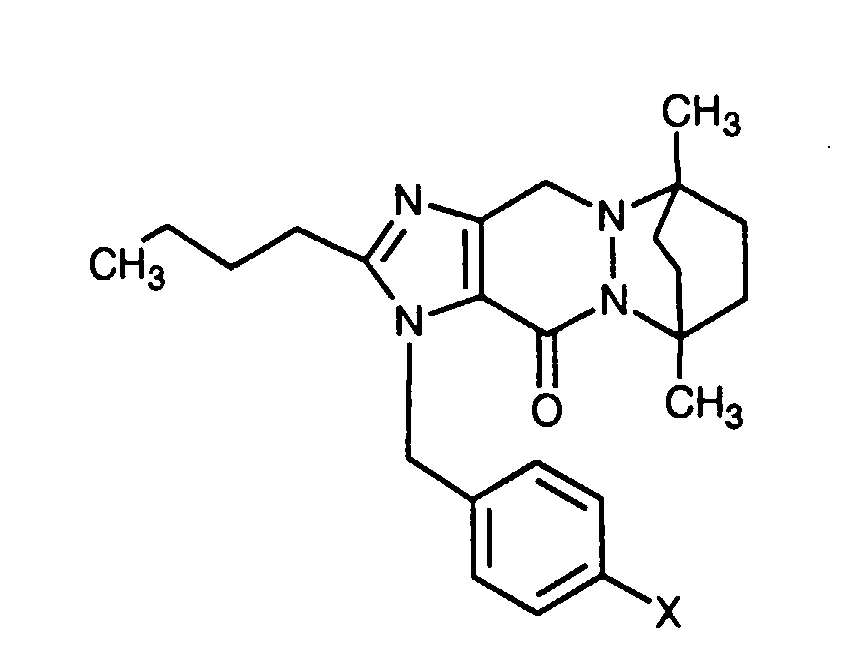
reacting the above compound with a compound represented by the general formula:
- A process for producing a compound represented by the chemical formula:

reacting a compound represented by the chemical formula:

reacting the above compound with 1,4dimethyl-1,3-cyclohexanediene in the presence of an oxidizing agent,
subjecting the newly generated double bond to catalytic or diimide reduction to give a compound represented by the chemical formula:
reacting the above compound with a compound represented by the chemical formula:
subjecting the resulting compound to diisobutylaluminium hydride reduction.
Applications Claiming Priority (3)
| Application Number | Priority Date | Filing Date | Title |
|---|---|---|---|
| JP149132/93 | 1993-06-21 | ||
| JP5149132A JPH0710879A (en) | 1993-06-21 | 1993-06-21 | Preparation of imidazole derivative |
| PCT/US1994/006028 WO1995000517A1 (en) | 1993-06-21 | 1994-06-02 | Process for producing imidazole derivative |
Publications (2)
| Publication Number | Publication Date |
|---|---|
| EP0705266A1 EP0705266A1 (en) | 1996-04-10 |
| EP0705266B1 true EP0705266B1 (en) | 1997-02-26 |
Family
ID=15468443
Family Applications (1)
| Application Number | Title | Priority Date | Filing Date |
|---|---|---|---|
| EP94920047A Expired - Lifetime EP0705266B1 (en) | 1993-06-21 | 1994-06-02 | Process for producing imidazole derivative |
Country Status (9)
| Country | Link |
|---|---|
| EP (1) | EP0705266B1 (en) |
| JP (2) | JPH0710879A (en) |
| AT (1) | ATE149168T1 (en) |
| AU (1) | AU7096794A (en) |
| DE (1) | DE69401822T2 (en) |
| DK (1) | DK0705266T3 (en) |
| ES (1) | ES2099621T3 (en) |
| GR (1) | GR3023031T3 (en) |
| WO (1) | WO1995000517A1 (en) |
Family Cites Families (1)
| Publication number | Priority date | Publication date | Assignee | Title |
|---|---|---|---|---|
| JPH06107661A (en) * | 1991-10-24 | 1994-04-19 | Upjohn Co:The | Imidazole derivative and medicinal composition having same as effective component |
-
1993
- 1993-06-21 JP JP5149132A patent/JPH0710879A/en active Pending
-
1994
- 1994-06-02 EP EP94920047A patent/EP0705266B1/en not_active Expired - Lifetime
- 1994-06-02 JP JP50283395A patent/JP3391402B2/en not_active Expired - Fee Related
- 1994-06-02 DK DK94920047.1T patent/DK0705266T3/en active
- 1994-06-02 AU AU70967/94A patent/AU7096794A/en not_active Abandoned
- 1994-06-02 DE DE69401822T patent/DE69401822T2/en not_active Expired - Fee Related
- 1994-06-02 ES ES94920047T patent/ES2099621T3/en not_active Expired - Lifetime
- 1994-06-02 WO PCT/US1994/006028 patent/WO1995000517A1/en not_active Ceased
- 1994-06-02 AT AT94920047T patent/ATE149168T1/en not_active IP Right Cessation
-
1997
- 1997-04-03 GR GR970400698T patent/GR3023031T3/en unknown
Also Published As
| Publication number | Publication date |
|---|---|
| EP0705266A1 (en) | 1996-04-10 |
| JP3391402B2 (en) | 2003-03-31 |
| JPH08512029A (en) | 1996-12-17 |
| DK0705266T3 (en) | 1997-09-01 |
| AU7096794A (en) | 1995-01-17 |
| DE69401822T2 (en) | 1997-07-03 |
| WO1995000517A1 (en) | 1995-01-05 |
| ES2099621T3 (en) | 1997-05-16 |
| JPH0710879A (en) | 1995-01-13 |
| GR3023031T3 (en) | 1997-07-30 |
| DE69401822D1 (en) | 1997-04-03 |
| ATE149168T1 (en) | 1997-03-15 |
Similar Documents
| Publication | Publication Date | Title |
|---|---|---|
| EP0166533A1 (en) | Quinolone inotropic agents | |
| JPH06505715A (en) | Compound | |
| US20080269499A1 (en) | Crystalline forms and process for preparing spiro-hydantoin compounds | |
| JP2707390B2 (en) | Cycloheptoimidazole derivative, method for producing the same, and drug containing the same | |
| US4801590A (en) | Pyrido(1,8)naphthyridinones, and their use as pharmaceuticals | |
| US6005105A (en) | Process for producing imidazole derivative | |
| KR100302346B1 (en) | A method of preparing 6-hydroxy-2-oxo-1,2,3,4-tetrahydroquinoline | |
| EP0585116B1 (en) | 1-Alkoxy-naphthalene-2-carboxamide derivatives with high affinity for the serotonin 5-HT1A receptor | |
| AU670708B2 (en) | Palladium catalyzed vinylic substitution reactions with 2-substituted-pyridines | |
| CN103224498B (en) | Two kinds of azoles the novel synthesis of quinazolinone fused heterocycle | |
| WO1995000517A1 (en) | Process for producing imidazole derivative | |
| US6054589A (en) | Process for preparing 2-chloro-benzimidazole derivatives | |
| JP3018185B1 (en) | Method for producing quinazoline derivative or salt thereof | |
| JP4512100B2 (en) | Process for producing substituted benzopyran compounds | |
| JP2000309585A (en) | 6-Substituted heteroquinoline carboxylic acid derivatives, addition salts thereof and methods for producing them | |
| JPH061776A (en) | Production of substituted pyrazinecarbonitrile | |
| JPH10500421A (en) | Method for producing benzopyran compound | |
| WO2007049813A1 (en) | BENZO[b]THIOPHEN DERIVATIVE AND PROCESS FOR PRODUCTION THEREOF | |
| EP1472246B1 (en) | Oxadiazoles having antiproliferative activity | |
| WO2000050420A1 (en) | 6-substituted-7- heteroquinoxaline carboxylic acid derivatives and addition salts thereof and processes for the preparation of both | |
| CN121591737A (en) | A benzo[a]azine compound, its preparation method and uses | |
| JP2641879B2 (en) | Preparation of optically active hydantoin derivatives | |
| KR20010075326A (en) | Aminoalkyl-3,4-Dihydroquinoline Derivates As NO-Synthase Inhibitors | |
| HK40089417A (en) | Substituted tricyclic compounds | |
| CN114591247A (en) | A kind of temozolomide intermediate compound |
Legal Events
| Date | Code | Title | Description |
|---|---|---|---|
| PUAI | Public reference made under article 153(3) epc to a published international application that has entered the european phase |
Free format text: ORIGINAL CODE: 0009012 |
|
| 17P | Request for examination filed |
Effective date: 19960111 |
|
| AK | Designated contracting states |
Kind code of ref document: A1 Designated state(s): AT BE CH DE DK ES FR GB GR IE IT LI LU MC NL PT SE |
|
| AX | Request for extension of the european patent |
Free format text: SI PAYMENT 960111 |
|
| RAX | Requested extension states of the european patent have changed |
Free format text: SI PAYMENT 960111 |
|
| GRAG | Despatch of communication of intention to grant |
Free format text: ORIGINAL CODE: EPIDOS AGRA |
|
| 17Q | First examination report despatched |
Effective date: 19960426 |
|
| GRAH | Despatch of communication of intention to grant a patent |
Free format text: ORIGINAL CODE: EPIDOS IGRA |
|
| RAP1 | Party data changed (applicant data changed or rights of an application transferred) |
Owner name: PHARMACIA & UPJOHN COMPANY |
|
| GRAH | Despatch of communication of intention to grant a patent |
Free format text: ORIGINAL CODE: EPIDOS IGRA |
|
| GRAA | (expected) grant |
Free format text: ORIGINAL CODE: 0009210 |
|
| AK | Designated contracting states |
Kind code of ref document: B1 Designated state(s): AT BE CH DE DK ES FR GB GR IE IT LI LU MC NL PT SE |
|
| AX | Request for extension of the european patent |
Free format text: SI PAYMENT 960111 |
|
| REF | Corresponds to: |
Ref document number: 149168 Country of ref document: AT Date of ref document: 19970315 Kind code of ref document: T |
|
| REG | Reference to a national code |
Ref country code: CH Ref legal event code: NV Representative=s name: E. BLUM & CO. PATENTANWAELTE Ref country code: CH Ref legal event code: EP |
|
| REF | Corresponds to: |
Ref document number: 69401822 Country of ref document: DE Date of ref document: 19970403 |
|
| ET | Fr: translation filed | ||
| ITF | It: translation for a ep patent filed | ||
| REG | Reference to a national code |
Ref country code: IE Ref legal event code: FG4D Free format text: 72285 |
|
| REG | Reference to a national code |
Ref country code: ES Ref legal event code: FG2A Ref document number: 2099621 Country of ref document: ES Kind code of ref document: T3 |
|
| REG | Reference to a national code |
Ref country code: PT Ref legal event code: SC4A Free format text: AVAILABILITY OF NATIONAL TRANSLATION Effective date: 19970321 Ref country code: GR Ref legal event code: FG4A Free format text: 3023031 |
|
| REG | Reference to a national code |
Ref country code: DK Ref legal event code: T3 |
|
| PLBE | No opposition filed within time limit |
Free format text: ORIGINAL CODE: 0009261 |
|
| STAA | Information on the status of an ep patent application or granted ep patent |
Free format text: STATUS: NO OPPOSITION FILED WITHIN TIME LIMIT |
|
| 26N | No opposition filed | ||
| REG | Reference to a national code |
Ref country code: GB Ref legal event code: IF02 |
|
| PGFP | Annual fee paid to national office [announced via postgrant information from national office to epo] |
Ref country code: PT Payment date: 20040325 Year of fee payment: 11 Ref country code: LU Payment date: 20040325 Year of fee payment: 11 |
|
| PGFP | Annual fee paid to national office [announced via postgrant information from national office to epo] |
Ref country code: IE Payment date: 20040406 Year of fee payment: 11 |
|
| PGFP | Annual fee paid to national office [announced via postgrant information from national office to epo] |
Ref country code: GR Payment date: 20040427 Year of fee payment: 11 |
|
| PGFP | Annual fee paid to national office [announced via postgrant information from national office to epo] |
Ref country code: GB Payment date: 20040505 Year of fee payment: 11 |
|
| PGFP | Annual fee paid to national office [announced via postgrant information from national office to epo] |
Ref country code: AT Payment date: 20040506 Year of fee payment: 11 |
|
| PGFP | Annual fee paid to national office [announced via postgrant information from national office to epo] |
Ref country code: NL Payment date: 20040510 Year of fee payment: 11 Ref country code: DK Payment date: 20040510 Year of fee payment: 11 |
|
| PGFP | Annual fee paid to national office [announced via postgrant information from national office to epo] |
Ref country code: MC Payment date: 20040601 Year of fee payment: 11 |
|
| PGFP | Annual fee paid to national office [announced via postgrant information from national office to epo] |
Ref country code: FR Payment date: 20040602 Year of fee payment: 11 |
|
| PGFP | Annual fee paid to national office [announced via postgrant information from national office to epo] |
Ref country code: SE Payment date: 20040603 Year of fee payment: 11 |
|
| PGFP | Annual fee paid to national office [announced via postgrant information from national office to epo] |
Ref country code: CH Payment date: 20040608 Year of fee payment: 11 |
|
| PGFP | Annual fee paid to national office [announced via postgrant information from national office to epo] |
Ref country code: ES Payment date: 20040616 Year of fee payment: 11 |
|
| PGFP | Annual fee paid to national office [announced via postgrant information from national office to epo] |
Ref country code: BE Payment date: 20040625 Year of fee payment: 11 |
|
| PGFP | Annual fee paid to national office [announced via postgrant information from national office to epo] |
Ref country code: DE Payment date: 20040630 Year of fee payment: 11 |
|
| PG25 | Lapsed in a contracting state [announced via postgrant information from national office to epo] |
Ref country code: LU Free format text: LAPSE BECAUSE OF NON-PAYMENT OF DUE FEES Effective date: 20050602 Ref country code: IT Free format text: LAPSE BECAUSE OF NON-PAYMENT OF DUE FEES;WARNING: LAPSES OF ITALIAN PATENTS WITH EFFECTIVE DATE BEFORE 2007 MAY HAVE OCCURRED AT ANY TIME BEFORE 2007. THE CORRECT EFFECTIVE DATE MAY BE DIFFERENT FROM THE ONE RECORDED. Effective date: 20050602 Ref country code: IE Free format text: LAPSE BECAUSE OF NON-PAYMENT OF DUE FEES Effective date: 20050602 Ref country code: GB Free format text: LAPSE BECAUSE OF NON-PAYMENT OF DUE FEES Effective date: 20050602 Ref country code: AT Free format text: LAPSE BECAUSE OF NON-PAYMENT OF DUE FEES Effective date: 20050602 |
|
| PG25 | Lapsed in a contracting state [announced via postgrant information from national office to epo] |
Ref country code: SE Free format text: LAPSE BECAUSE OF NON-PAYMENT OF DUE FEES Effective date: 20050603 Ref country code: ES Free format text: LAPSE BECAUSE OF NON-PAYMENT OF DUE FEES Effective date: 20050603 |
|
| PG25 | Lapsed in a contracting state [announced via postgrant information from national office to epo] |
Ref country code: MC Free format text: LAPSE BECAUSE OF NON-PAYMENT OF DUE FEES Effective date: 20050630 Ref country code: LI Free format text: LAPSE BECAUSE OF NON-PAYMENT OF DUE FEES Effective date: 20050630 Ref country code: DK Free format text: LAPSE BECAUSE OF NON-PAYMENT OF DUE FEES Effective date: 20050630 Ref country code: CH Free format text: LAPSE BECAUSE OF NON-PAYMENT OF DUE FEES Effective date: 20050630 Ref country code: BE Free format text: LAPSE BECAUSE OF NON-PAYMENT OF DUE FEES Effective date: 20050630 |
|
| PG25 | Lapsed in a contracting state [announced via postgrant information from national office to epo] |
Ref country code: PT Free format text: LAPSE BECAUSE OF NON-PAYMENT OF DUE FEES Effective date: 20051202 |
|
| PG25 | Lapsed in a contracting state [announced via postgrant information from national office to epo] |
Ref country code: NL Free format text: LAPSE BECAUSE OF NON-PAYMENT OF DUE FEES Effective date: 20060101 |
|
| PG25 | Lapsed in a contracting state [announced via postgrant information from national office to epo] |
Ref country code: GR Free format text: LAPSE BECAUSE OF NON-PAYMENT OF DUE FEES Effective date: 20060103 Ref country code: DE Free format text: LAPSE BECAUSE OF NON-PAYMENT OF DUE FEES Effective date: 20060103 |
|
| REG | Reference to a national code |
Ref country code: CH Ref legal event code: PL |
|
| EUG | Se: european patent has lapsed | ||
| PG25 | Lapsed in a contracting state [announced via postgrant information from national office to epo] |
Ref country code: FR Free format text: LAPSE BECAUSE OF NON-PAYMENT OF DUE FEES Effective date: 20060228 |
|
| GBPC | Gb: european patent ceased through non-payment of renewal fee |
Effective date: 20050602 |
|
| NLV4 | Nl: lapsed or anulled due to non-payment of the annual fee |
Effective date: 20060101 |
|
| REG | Reference to a national code |
Ref country code: DK Ref legal event code: EBP |
|
| REG | Reference to a national code |
Ref country code: IE Ref legal event code: MM4A |
|
| REG | Reference to a national code |
Ref country code: FR Ref legal event code: ST Effective date: 20060228 |
|
| REG | Reference to a national code |
Ref country code: ES Ref legal event code: FD2A Effective date: 20050603 |
|
| BERE | Be: lapsed |
Owner name: *PHARMACIA & UPJOHN CY Effective date: 20050630 |