EP0703259A2 - Urethane modified epoxy resin - Google Patents
Urethane modified epoxy resin Download PDFInfo
- Publication number
- EP0703259A2 EP0703259A2 EP95306610A EP95306610A EP0703259A2 EP 0703259 A2 EP0703259 A2 EP 0703259A2 EP 95306610 A EP95306610 A EP 95306610A EP 95306610 A EP95306610 A EP 95306610A EP 0703259 A2 EP0703259 A2 EP 0703259A2
- Authority
- EP
- European Patent Office
- Prior art keywords
- epoxy resin
- phosphorus compound
- groups
- weight portions
- acid
- Prior art date
- Legal status (The legal status is an assumption and is not a legal conclusion. Google has not performed a legal analysis and makes no representation as to the accuracy of the status listed.)
- Granted
Links
Classifications
-
- C—CHEMISTRY; METALLURGY
- C08—ORGANIC MACROMOLECULAR COMPOUNDS; THEIR PREPARATION OR CHEMICAL WORKING-UP; COMPOSITIONS BASED THEREON
- C08G—MACROMOLECULAR COMPOUNDS OBTAINED OTHERWISE THAN BY REACTIONS ONLY INVOLVING UNSATURATED CARBON-TO-CARBON BONDS
- C08G59/00—Polycondensates containing more than one epoxy group per molecule; Macromolecules obtained by polymerising compounds containing more than one epoxy group per molecule using curing agents or catalysts which react with the epoxy groups
- C08G59/18—Macromolecules obtained by polymerising compounds containing more than one epoxy group per molecule using curing agents or catalysts which react with the epoxy groups ; e.g. general methods of curing
- C08G59/20—Macromolecules obtained by polymerising compounds containing more than one epoxy group per molecule using curing agents or catalysts which react with the epoxy groups ; e.g. general methods of curing characterised by the epoxy compounds used
- C08G59/22—Di-epoxy compounds
- C08G59/30—Di-epoxy compounds containing atoms other than carbon, hydrogen, oxygen and nitrogen
- C08G59/304—Di-epoxy compounds containing atoms other than carbon, hydrogen, oxygen and nitrogen containing phosphorus
-
- C—CHEMISTRY; METALLURGY
- C08—ORGANIC MACROMOLECULAR COMPOUNDS; THEIR PREPARATION OR CHEMICAL WORKING-UP; COMPOSITIONS BASED THEREON
- C08G—MACROMOLECULAR COMPOUNDS OBTAINED OTHERWISE THAN BY REACTIONS ONLY INVOLVING UNSATURATED CARBON-TO-CARBON BONDS
- C08G18/00—Polymeric products of isocyanates or isothiocyanates
- C08G18/06—Polymeric products of isocyanates or isothiocyanates with compounds having active hydrogen
- C08G18/08—Processes
- C08G18/10—Prepolymer processes involving reaction of isocyanates or isothiocyanates with compounds having active hydrogen in a first reaction step
-
- C—CHEMISTRY; METALLURGY
- C08—ORGANIC MACROMOLECULAR COMPOUNDS; THEIR PREPARATION OR CHEMICAL WORKING-UP; COMPOSITIONS BASED THEREON
- C08G—MACROMOLECULAR COMPOUNDS OBTAINED OTHERWISE THAN BY REACTIONS ONLY INVOLVING UNSATURATED CARBON-TO-CARBON BONDS
- C08G18/00—Polymeric products of isocyanates or isothiocyanates
- C08G18/06—Polymeric products of isocyanates or isothiocyanates with compounds having active hydrogen
- C08G18/28—Polymeric products of isocyanates or isothiocyanates with compounds having active hydrogen characterised by the compounds used containing active hydrogen
- C08G18/40—High-molecular-weight compounds
- C08G18/58—Epoxy resins
- C08G18/587—Epoxy resins having phosphorus
-
- C—CHEMISTRY; METALLURGY
- C08—ORGANIC MACROMOLECULAR COMPOUNDS; THEIR PREPARATION OR CHEMICAL WORKING-UP; COMPOSITIONS BASED THEREON
- C08G—MACROMOLECULAR COMPOUNDS OBTAINED OTHERWISE THAN BY REACTIONS ONLY INVOLVING UNSATURATED CARBON-TO-CARBON BONDS
- C08G59/00—Polycondensates containing more than one epoxy group per molecule; Macromolecules obtained by polymerising compounds containing more than one epoxy group per molecule using curing agents or catalysts which react with the epoxy groups
- C08G59/14—Polycondensates modified by chemical after-treatment
- C08G59/1405—Polycondensates modified by chemical after-treatment with inorganic compounds
- C08G59/1422—Polycondensates modified by chemical after-treatment with inorganic compounds containing phosphorus
-
- C—CHEMISTRY; METALLURGY
- C08—ORGANIC MACROMOLECULAR COMPOUNDS; THEIR PREPARATION OR CHEMICAL WORKING-UP; COMPOSITIONS BASED THEREON
- C08G—MACROMOLECULAR COMPOUNDS OBTAINED OTHERWISE THAN BY REACTIONS ONLY INVOLVING UNSATURATED CARBON-TO-CARBON BONDS
- C08G59/00—Polycondensates containing more than one epoxy group per molecule; Macromolecules obtained by polymerising compounds containing more than one epoxy group per molecule using curing agents or catalysts which react with the epoxy groups
- C08G59/14—Polycondensates modified by chemical after-treatment
- C08G59/1433—Polycondensates modified by chemical after-treatment with organic low-molecular-weight compounds
- C08G59/1488—Polycondensates modified by chemical after-treatment with organic low-molecular-weight compounds containing phosphorus
-
- C—CHEMISTRY; METALLURGY
- C08—ORGANIC MACROMOLECULAR COMPOUNDS; THEIR PREPARATION OR CHEMICAL WORKING-UP; COMPOSITIONS BASED THEREON
- C08G—MACROMOLECULAR COMPOUNDS OBTAINED OTHERWISE THAN BY REACTIONS ONLY INVOLVING UNSATURATED CARBON-TO-CARBON BONDS
- C08G59/00—Polycondensates containing more than one epoxy group per molecule; Macromolecules obtained by polymerising compounds containing more than one epoxy group per molecule using curing agents or catalysts which react with the epoxy groups
- C08G59/18—Macromolecules obtained by polymerising compounds containing more than one epoxy group per molecule using curing agents or catalysts which react with the epoxy groups ; e.g. general methods of curing
- C08G59/20—Macromolecules obtained by polymerising compounds containing more than one epoxy group per molecule using curing agents or catalysts which react with the epoxy groups ; e.g. general methods of curing characterised by the epoxy compounds used
- C08G59/22—Di-epoxy compounds
- C08G59/28—Di-epoxy compounds containing acyclic nitrogen atoms
-
- C—CHEMISTRY; METALLURGY
- C08—ORGANIC MACROMOLECULAR COMPOUNDS; THEIR PREPARATION OR CHEMICAL WORKING-UP; COMPOSITIONS BASED THEREON
- C08L—COMPOSITIONS OF MACROMOLECULAR COMPOUNDS
- C08L63/00—Compositions of epoxy resins; Compositions of derivatives of epoxy resins
Definitions
- This invention relates to an urethane modified epoxy resin and a highly water-proof, chemical-proof and adhesive resin composition to be suitably used as an adhesive agent and, more particularly, it relates to a resin composition that can be suitably used as an adhesive agent for iron and non-ferrous metals such as aluminum, zinc, copper and other transition metals and provides, when set, an excellent bonding strength in terms of shearing strength and peeling strength and the like.
- Epoxy resin type adhesive agents are known to be highly effective for bonding metals, glass, concrete, stones and other objects. On the other hand, as they find a broader scope of application in recent years, more and more rigorous requirements are posed on them in terms of peeling strength, shearing strength, thermoresistant adhesive property, water resistant adhesive property, creep characteristics, durability and the like.
- thermoplastic resin is normally added to it so that they are chemically combined to give rise to a reaction product or simply blended to produce an alloy.
- Japanese Patent Application Opened No. 61-228015 discloses an urethane modified epoxy resin obtained by chemically reacting of an urethane-prepolymer produced from a polyhydroxyl compound and a polyisocyanate compound with an epoxy resin.
- Japanese Patent Application Opened No. 62-53527 teaches another urethane modified epoxy resin obtained by chemically reacting of an urethane-prepolymer produced from high and low molecular weight polyhydroxyl compounds and a polyisocyanate compound with a compound containing epoxy and hydroxyl groups.
- Japanese Patent Application Opened No. 58-63758 discloses a condensation product of epoxy resin and phosphoric acid or a phosphate.
- urethane modified epoxy resins may show an appropriate level of flexibility and be highly effective for bonding steel plates, they do not operate satisfactorily for bonding non-ferrous metals.
- phosphorus epoxy resin products are effective for bonding non-ferrous metals such as zinc-plated steel plates and aluminum, and also stainless steel, their shearing strength and peeling strength are very poor and far from satisfactory.
- an adhesive epoxy resin composition that operates satisfactorily as an adhesive agent for metals including ferrous and, especially, non-ferrous metals, showing an excellent level of shearing strength and peeling strength.
- an urethane modified epoxy resin obtained by causing a condensation product of a specific epoxy resin and an acid of a specific phosphorus compound or its salt or ester to react with a specific urethane prepolymer is highly effective as an adhesive agent for non-ferrous metals if used with an active organic hardening agent to form a resin composition.
- the inventors of the present invention also found that an urethane modified epoxy resin obtained by causing epoxy resin to react with a specific urethane prepolymer and then the reaction product to react with an acid of a specific phosphorus compound or its salt or ester as described above also operates effectively as an adhesive agent.
- the present invention is based on these findings.
- the invention also includes processes for producing the resin, for producing an intermediate condensate by reaction of an epoxy resin and phosphorus compound and a process for producing the resin from a preformed urethane modified epoxy resin and phosphorus compound, as well as adhesive compositions containing the new resin and a hardener and their use to adhere metals.
- an urethane modified epoxy resin obtained by reaction of 100 weight portions of a preliminary condensate [A] produced by reaction of an epoxy resin containing in average within a molecule about two epoxy groups and 0.1 or more than 0.1 hydroxy groups and an acid of a phosphorus compound having within a molecule at least a P-OH bond or its salt or ester at a ratio of one (1) equivalent of epoxy group in the epoxy resin to an equivalent between 0.02 and 0.8 of hydroxy group in the phosphorus compound and 5 to 60 weight portions of an isocyanate group-terminated urethane prepolymer [B] produced by reaction of a hydroxy compound and an organic polyisocyanate compound, provided that the equivalent number of hydroxy groups contained in the preliminary condensate [A] is greater than the equivalent number of isocyanate groups contained in the urethane prepolymer [B].
- an adhesive resin composition containing an urethane modified epoxy resin as described above and an active organic hardening agent.
- an urethane modified epoxy resin obtained by preparing an urethane modified epoxy resin [D] from 100 weight portions of an epoxy resin containing in average within a molecule about two epoxy groups and 0.1 or more than 0.1 hydroxy groups and 5 to 60 weight portions of an isocyanate group-terminated urethane prepolymer [B] produced by reaction of a hydroxy compound and an organic polyisocyanate compound, provided that the equivalent number of hydroxy groups contained in the epoxy resin is greater than the equivalent number of isocyanate groups contained in the urethane prepolymer [B], and causing the urethane modified epoxy resin [D] to react with an acid of a phosphorus compound having within a molecule at least a P-OH bond or its salt or ester at a ratio of one (1) equivalent of epoxy group in the epoxy resin to an equivalent between 0.02 and 0.6 of hydroxy group in the phosphorus compound.
- an adhesive resin composition containing an urethane modified epoxy resin as described above and an active organic hardening agent.
- An adhesive epoxy resin composition according to the invention shows excellent peeling strength and shearing strength particularly when used for bonding non-ferrous metals as compared with known resin compositions for general purpose adhesives and adhesives for structures.
- an epoxy resin containing in average within a molecule about two epoxy groups and 0.1 or more than 0.1 hydroxy groups is a reaction product of a substituted or unsubstituted divalent phenol and a compound selected from epihalohydrins, methylepihalohydrins, ethylepihalohydrins and dihalohydrins.
- the reaction product they contain on average of about two (usually up to two but sometimes more than two) glycidylether groups expressed by a general formula below.
- R is a hydrogen atom, a methyl group or an ethyl group.
- the average number of epoxy groups and epoxy groups is determined by analysis to determine the equivalents of such groups and the molecular weight.
- the divalent phenol refers to a phenol compound comprising one or more than one aromatic nuclei that have two replaceable hydroxy groups and may be selected from mono nuclear divalent phenols and poly-nuclear divalent phenols.
- Mono-nuclear divalent phenols that can be used for the present invention include resorcinol, hydroquinone, pyrocatechol, fluorogylcinol. dihydroxynaphthalene and dihydroxyanthraquinone.
- Poly-nuclear divalent phenols that can be used for the present invention are expressed by a general formula below.
- X1 and X2 may be same or differ from each other, each representing an alkyl group such as a methyl, n-propyl, n-butyl or n-hexyl group, preferably an alkyl group having up to four (4) carbon atoms, a halogen atom such as a chlorine, bromine, iodine or fluorine atom or an alkoxy group such as a methoxy, methoxymethyl, ethoxy, ethoxyethyl, n-butoxy or amyloxy group, preferably an alkoxy group having up to four (4) carbon atoms and m and n are integers from 0 to 4 that may be same or different, while R represents an alkylene or alkylidine group having one (1) to three (3) carbon atoms, -CO-, -O-, -S-, -SO-
- divalent phenols examples include 2,2-bis-(p hydroxyphenyl)-propane, 2,4'-dihydroxydiphenylmethane, bis-(4 hydroxyphenyl)-methane, bis-(4-hydroxy-2,6-dimethyl-3-methoxyphenyl)methane, 1,1-bis-(4-hydroxyphenyl)-ethane, 2,2-bis-(3,5-dichloro-4-hydroxyphenyl)-propane, 2,2-bis-(2-isopropyl-4-hydroxyphenyl)-propane, bis-(4-hydroxyphenyl)-sulfone, 2,4'-dihydroxydiphenylsulfone, 5-chloro-2, 4'-dihydroxydiphenylsulfone and the like.
- Examples of epihalohydrins, methylepihalohydrins, ethylepihalohydrins and dihalohydrins that can be used for the purpose of the present invention include epichlorohydrin, epibromohydrin, methylepichlorohydrin, methylepibromohydrin, ethylepichlorohydrin, ethylepibromohydrin, dichlorohydrin, dibromohydrin and the like, of which epichlorohydrin and methylepichlorohydrin are particularly preferable.
- the ratio at which a divalent phenol and a compound selected from epihalohydrins, methylepihalohydrins, ethylepihalohydrins and dihalohydrins are used to react with each other is preferably one (1) mol of the former to one (1) to twenty (20) mols of the latter, more preferably one (1) mol of the former to five (5) to fifteen (15) mols of the latter and the epoxy equivalent (weight) of the obtained substituted or unsubstituted glycidylether compound is preferably between 120 and 500.
- the epoxy equivalent weight of the epoxy resin (and of modified epoxy resins) can be determined by ASTM-1652.
- an acid of a phosphorus compound having within a molecule at least a P-OH bond is preferably selected from orthophosphoric acid, metaphosphoric acid, pyrophosphoric acid, phosphorous acid, polyphosphoric acid and phosphonic acid, of which orthophosphoric acid is most preferable.
- a salt of an acid of a phosphorus compound is preferably selected from salts of the above acids such as potassium salts, sodium salts, lithium salts, calcium salts, zinc salts, aluminum salts, tin salts and barium salts, of which potassium dihydrogen phosphate and sodium dihydrogen phosphate are most preferable.
- an ester of an acid of a phosphorus compound is preferably selected from mono- or di-esters of the above acids such as alkyl esters and hydroxyalkyl esters having up to eight (8) carbon atoms in the alkyl groups. More specifically, preferable candidates include esters having one or more than one ethyl, n-propyl, isopropyl n-butyl, 2-ethylhexyl, hydroxyethyl, hydroxybutyl, hydroxypropyl or hydroxypentyl groups. More preferable candidates are ethyl, n-propyl, isopropyl and n-butyl, mono- or di-esters.
- the reaction between an epoxy resin and a phosphorus compound as described above is conducted at a ratio of one (1) equivalent of epoxy group in the epoxy resin to an equivalent between 0.02 and 0.8, preferably between 0.04 and 0.5, of hydroxy group in the phosphorus compound and the epoxy equivalent of the produced preliminary condensate (A) is preferably not more than 1,000.
- reaction between an epoxy resin and a phosphorus compound may be conducted under a noncatalytic condition for the purpose of the invention, it may alternatively be conducted in the presence of a basic catalyst.
- Catalysts that can preferably be used for the purpose of the invention include inorganic alkalis such as sodium hydroxide and potassium hydroxide, tertiary amines such as triethylamine, triethanolamine and dimethylamine, imidazoles and quaternary ammonium salts such as tetramethylammoniumchloride.
- the reaction is conducted at temperature between 50 and 100°C for a period between one (1) and five (5) hours.
- hydroxy compounds that can be used to produce an isocyanate group-terminated urethane prepolymer (B) include di- or polyvalent polyetherpolyols, polyesterpolyols, caster oil derivatives and tolu oil derivatives. Polyols having a molecular weight between 500 and 3,000 may preferably be used.
- polyetherpolyols examples include diols such as polyoxyethylenepolyol, polyoxypropyleneglycol, polyoxybutyleneglycol and polytetramethyleneglycol and trivalent polyetherpolyols obtained by adding one or more than one propyleneglycols to glycerol or trimethylolpropane.
- polyesterpolyols that can be used for the purpose of the invention may be prepared from polyvalent alcohols such as ethyleneglycol, propylenegrycol, diethyleneglycol, 1,4-butanediol, 1,6-hexanediol, 2-methyl-1,5-pentanediol, 2,2-dimethyl propanediol, glycerol and trimethylolpropane and polybasic acids such as adipic acid, terephthalic acid, isophthalic acid, glutaric acid, azelaic acid, dimer acid and pyromellitic acid. Additionally, lactonepolyols may also preferably be used.
- polyvalent alcohols such as ethyleneglycol, propylenegrycol, diethyleneglycol, 1,4-butanediol, 1,6-hexanediol, 2-methyl-1,5-pentanediol, 2,2-dimethyl propanediol, glycerol
- the isocyanate compound can be selected from toluylene diisocyanate, methylenediphenyl diisocyanate, hexane diisocyanate and isophorone diisocyanate, of which toluylene diisocyanate and isophorone diisocyanate may preferably be used.
- An isocyanate group-terminated urethane prepolymer (B) is prepared for the purpose of the invention by combining one or more than one of the above listed hydroxy compounds and an isocyanate compound selected from the above listed chemicals so that its content of the isocyanate group(s) may be found between 1 and 15%, preferably between 2 and 10%, by weight based on the weight of the isocyanate group-terminated prepolymer [B].
- the reaction between the preliminary condensate (A) of an epoxy resin and an acid of a phosphorus compound having within a molecule at least a P-OH bond or its salt or ester and the urethane prepolymer (B) is usually conducted at a ratio by weight of 100:5 to 100:60, preferably 100:10 to 100:40, provided that the equivalent number of hydroxy groups contained in the preliminary condensate (A) is greater than the equivalent number of isocyanate groups contained in the urethane prepolymer (B).
- the reaction is conducted at temperature between 60 and 140°C, preferably between 70 and 110°C under a noncatalytic condition, although it may alternatively be conducted in the presence of a tertiary amine, lead octylate, or dibutyltinlaurate or the like as a catalyst.
- the epoxy resin and the urethane prepolymer [B] are reacted with each other at a ratio by weight preferably in the range of 100:5 to 100:60, more preferably 100:10 to 100:40. Note, however, that the equivalent number of hydroxy groups contained in the epoxy resin has to be greater than that of isocyanate groups contained in the urethane prepolymer in order to completely consume the urethane prepolymer [B] in the reaction.
- the above reaction is preferably conducted at temperature between 60 and 140°C, more preferably between 70 and 100°C. While the reaction may be conducted under a noncatalytic condition, although it may alternatively be conducted in the presence of a tertiary amine, lead octylate or dibutyltinlaurate as a catalyst.
- the reaction between the urethane modified epoxy resin [D] and the phosphorus compound is suitably conducted at a ratio of one (1) equivalent of epoxy group in the epoxy resin to an equivalent between 0.02 and 0.6, preferably between 0.03 and 0.5, of hydroxy group in the phosphorus compound.
- the ratio is usually in the range 1:(0.02-0.6) based on the epoxy group in the modified resin [D].
- Catalysts that can preferably be used include inorganic alkalis such as sodium hydroxide and potassium hydroxide, tertiary amines such as triethylamine, triethanolamine and dimethylamine, imidazoles and quaternary ammonium salts such as tetramethylammoniumchloride.
- the reaction is preferably conducted at temperature between 50 and 100°C.
- the obtained urethane modified epoxy resin can be hardened to show an excellent peeling strength as well as an outstanding shearing strength with regard to steel plates and non-ferrous metals when crosslinked by an active organic hardening agent.
- the active organic hardening agent may be selected from aliphatic polyamines, aromatic polyamines, polyamides, acid anhydrides, polymercaptans and latent hardening agents that can be used for hardening various epoxy resins.
- Latent hardening agents that can be used for the purpose of the invention include dicyandiamide and its derivatives, imidazoles, boron trifluoride-amine complexes, acid hydrazides such as succinic acid hydrazide and diaminomaleonitrile and derivatives.
- the hardened product obtained by adding a hardening agent and heating shows an excellent shearing strength and an outstanding peeling strength.
- the active organic hardening agent is added at a ratio with which the equivalent number of active hydrogen atoms of the hardening agent is found between 0.90 to 1.10 relative to that of equivalents of epoxy groups of the urethane and phosphorus modified epoxy resin.
- an urethane modified epoxy resin according to the invention can advantageously be used with an active organic hardening agent to produce an adhesive resin composition, which is highly effective for bonding iron and non-ferrous metals such as aluminum, zinc, copper and other transient metals particularly in terms of shearing strength and peeling strength.
- Preliminary condensates (A-2 through 10) were prepared in a manner as described above for Manufacturing Example 1 with the ratios of an epoxy resin and a phosphorus compound and the reaction parameters listed in Table 1 below.
- Prepolymers (B-2 through 7) were prepared in a manner as described above for Manufacturing Example 11 with the ratios of a hydroxy compound and an isocyanate compound and the reaction parameters listed in Table 2 below.
- Urethane modified epoxy resins (Examples 2 through 11) were prepared in a manner as described above for Example 1 with the ratios of a preliminary condensate and an urethane prepolymer and the reaction parameters listed in Table 3 below.
- test plates were aluminum plates (JIS A-5052P) and zinc plated steel plates.
- urethane modified epoxy resins each obtained by causing a specific epoxy resin to react with the urethane prepolymer [B] and then making to react a specific phosphorus compound with the reaction product, will be described below.
- urethane prepolymers No. B-1 through B-7 listed in Table 2 were used.
- Urethane modified epoxy resins (D-2 through D-8) were prepared in a manner as described above for Manufacturing Example 18 with the ratios of an epoxy resin and an urethane prepolymer and the reaction parameters listed in Table 6 below.
- Urethane modified epoxy resins (Examples 13 through 19) were prepared in a manner as described above for Example 12 with the ratios of a urethane modified epoxy resin and a phosphoric compound and the reaction parameters listed in Table 7 below.
Landscapes
- Chemical & Material Sciences (AREA)
- Health & Medical Sciences (AREA)
- Chemical Kinetics & Catalysis (AREA)
- Medicinal Chemistry (AREA)
- Polymers & Plastics (AREA)
- Organic Chemistry (AREA)
- General Chemical & Material Sciences (AREA)
- Inorganic Chemistry (AREA)
- Epoxy Resins (AREA)
- Polyurethanes Or Polyureas (AREA)
- Adhesives Or Adhesive Processes (AREA)
Abstract
Description
- This invention relates to an urethane modified epoxy resin and a highly water-proof, chemical-proof and adhesive resin composition to be suitably used as an adhesive agent and, more particularly, it relates to a resin composition that can be suitably used as an adhesive agent for iron and non-ferrous metals such as aluminum, zinc, copper and other transition metals and provides, when set, an excellent bonding strength in terms of shearing strength and peeling strength and the like.
- Epoxy resin type adhesive agents are known to be highly effective for bonding metals, glass, concrete, stones and other objects. On the other hand, as they find a broader scope of application in recent years, more and more rigorous requirements are posed on them in terms of peeling strength, shearing strength, thermoresistant adhesive property, water resistant adhesive property, creep characteristics, durability and the like.
- While epoxy resin generally shows a relatively high shearing strength, it does not provide a satisfactory level of peeling strength and flexibility required for structures. In order for epoxy resin to operate more satisfactory, therefore, thermoplastic resin is normally added to it so that they are chemically combined to give rise to a reaction product or simply blended to produce an alloy.
- For example, Japanese Patent Application Opened No. 61-228015 discloses an urethane modified epoxy resin obtained by chemically reacting of an urethane-prepolymer produced from a polyhydroxyl compound and a polyisocyanate compound with an epoxy resin.
- Japanese Patent Application Opened No. 62-53527 teaches another urethane modified epoxy resin obtained by chemically reacting of an urethane-prepolymer produced from high and low molecular weight polyhydroxyl compounds and a polyisocyanate compound with a compound containing epoxy and hydroxyl groups.
- Japanese Patent Application Opened No. 58-63758 discloses a condensation product of epoxy resin and phosphoric acid or a phosphate.
- While the above cited urethane modified epoxy resins may show an appropriate level of flexibility and be highly effective for bonding steel plates, they do not operate satisfactorily for bonding non-ferrous metals. Although phosphorus epoxy resin products are effective for bonding non-ferrous metals such as zinc-plated steel plates and aluminum, and also stainless steel, their shearing strength and peeling strength are very poor and far from satisfactory.
- Therefore, it is the object of the present invention to provide an adhesive epoxy resin composition that operates satisfactorily as an adhesive agent for metals including ferrous and, especially, non-ferrous metals, showing an excellent level of shearing strength and peeling strength.
- After a series of intensive research efforts, the inventors of the present invention discovered that an urethane modified epoxy resin obtained by causing a condensation product of a specific epoxy resin and an acid of a specific phosphorus compound or its salt or ester to react with a specific urethane prepolymer is highly effective as an adhesive agent for non-ferrous metals if used with an active organic hardening agent to form a resin composition.
- The inventors of the present invention also found that an urethane modified epoxy resin obtained by causing epoxy resin to react with a specific urethane prepolymer and then the reaction product to react with an acid of a specific phosphorus compound or its salt or ester as described above also operates effectively as an adhesive agent. The present invention is based on these findings.
- According to the invention a new phosphorus and urethane modified epoxy resin is obtained by reacting
- a) 100 weight portions of an epoxy resin containing on average within a molecule about two epoxy groups and 0.1 or more than 0.1 hydroxy groups;
- b) 5 to 75 weight portions of an isocyanate group-terminated urethane prepolymer [B] produced by reaction of a hydroxy compound and an organic polyisocyanate compound, and
- c) an acid of a phosphorus compound having within a molecule at least a P-OH bond or its salt or ester
- The invention also includes processes for producing the resin, for producing an intermediate condensate by reaction of an epoxy resin and phosphorus compound and a process for producing the resin from a preformed urethane modified epoxy resin and phosphorus compound, as well as adhesive compositions containing the new resin and a hardener and their use to adhere metals.
- More specifically, according to an aspect of the invention, there is provided an urethane modified epoxy resin obtained by reaction of 100 weight portions of a preliminary condensate [A] produced by reaction of an epoxy resin containing in average within a molecule about two epoxy groups and 0.1 or more than 0.1 hydroxy groups and an acid of a phosphorus compound having within a molecule at least a P-OH bond or its salt or ester at a ratio of one (1) equivalent of epoxy group in the epoxy resin to an equivalent between 0.02 and 0.8 of hydroxy group in the phosphorus compound and 5 to 60 weight portions of an isocyanate group-terminated urethane prepolymer [B] produced by reaction of a hydroxy compound and an organic polyisocyanate compound, provided that the equivalent number of hydroxy groups contained in the preliminary condensate [A] is greater than the equivalent number of isocyanate groups contained in the urethane prepolymer [B].
- According to another aspect the invention, there is also provided an adhesive resin composition containing an urethane modified epoxy resin as described above and an active organic hardening agent.
- According to still another aspect of the invention, there is also provided an urethane modified epoxy resin obtained by preparing an urethane modified epoxy resin [D] from 100 weight portions of an epoxy resin containing in average within a molecule about two epoxy groups and 0.1 or more than 0.1 hydroxy groups and 5 to 60 weight portions of an isocyanate group-terminated urethane prepolymer [B] produced by reaction of a hydroxy compound and an organic polyisocyanate compound, provided that the equivalent number of hydroxy groups contained in the epoxy resin is greater than the equivalent number of isocyanate groups contained in the urethane prepolymer [B], and causing the urethane modified epoxy resin [D] to react with an acid of a phosphorus compound having within a molecule at least a P-OH bond or its salt or ester at a ratio of one (1) equivalent of epoxy group in the epoxy resin to an equivalent between 0.02 and 0.6 of hydroxy group in the phosphorus compound.
- According to a further aspect of the invention, there is also provided an adhesive resin composition containing an urethane modified epoxy resin as described above and an active organic hardening agent.
- An adhesive epoxy resin composition according to the invention shows excellent peeling strength and shearing strength particularly when used for bonding non-ferrous metals as compared with known resin compositions for general purpose adhesives and adhesives for structures.
- For the purpose of the present invention, "an epoxy resin containing in average within a molecule about two epoxy groups and 0.1 or more than 0.1 hydroxy groups" is a reaction product of a substituted or unsubstituted divalent phenol and a compound selected from epihalohydrins, methylepihalohydrins, ethylepihalohydrins and dihalohydrins. The reaction product they contain on average of about two (usually up to two but sometimes more than two) glycidylether groups expressed by a general formula below.

where R is a hydrogen atom, a methyl group or an ethyl group. The average number of epoxy groups and epoxy groups is determined by analysis to determine the equivalents of such groups and the molecular weight. - For the purpose of the invention, the divalent phenol refers to a phenol compound comprising one or more than one aromatic nuclei that have two replaceable hydroxy groups and may be selected from mono nuclear divalent phenols and poly-nuclear divalent phenols.
- Mono-nuclear divalent phenols that can be used for the present invention include resorcinol, hydroquinone, pyrocatechol, fluorogylcinol. dihydroxynaphthalene and dihydroxyanthraquinone.
- Poly-nuclear divalent phenols that can be used for the present invention are expressed by a general formula below.

where X₁ and X₂ may be same or differ from each other, each representing an alkyl group such as a methyl, n-propyl, n-butyl or n-hexyl group, preferably an alkyl group having up to four (4) carbon atoms, a halogen atom such as a chlorine, bromine, iodine or fluorine atom or an alkoxy group such as a methoxy, methoxymethyl, ethoxy, ethoxyethyl, n-butoxy or amyloxy group, preferably an alkoxy group having up to four (4) carbon atoms and m and n are integers from 0 to 4 that may be same or different, while R represents an alkylene or alkylidine group having one (1) to three (3) carbon atoms, -CO-, -O-, -S-, -SO- or -SO₂-. - Examples of such divalent phenols include 2,2-bis-(p hydroxyphenyl)-propane, 2,4'-dihydroxydiphenylmethane, bis-(4 hydroxyphenyl)-methane, bis-(4-hydroxy-2,6-dimethyl-3-methoxyphenyl)methane, 1,1-bis-(4-hydroxyphenyl)-ethane, 2,2-bis-(3,5-dichloro-4-hydroxyphenyl)-propane, 2,2-bis-(2-isopropyl-4-hydroxyphenyl)-propane, bis-(4-hydroxyphenyl)-sulfone, 2,4'-dihydroxydiphenylsulfone, 5-chloro-2, 4'-dihydroxydiphenylsulfone and the like.
- Examples of epihalohydrins, methylepihalohydrins, ethylepihalohydrins and dihalohydrins that can be used for the purpose of the present invention include epichlorohydrin, epibromohydrin, methylepichlorohydrin, methylepibromohydrin, ethylepichlorohydrin, ethylepibromohydrin, dichlorohydrin, dibromohydrin and the like, of which epichlorohydrin and methylepichlorohydrin are particularly preferable.
- The ratio at which a divalent phenol and a compound selected from epihalohydrins, methylepihalohydrins, ethylepihalohydrins and dihalohydrins are used to react with each other is preferably one (1) mol of the former to one (1) to twenty (20) mols of the latter, more preferably one (1) mol of the former to five (5) to fifteen (15) mols of the latter and the epoxy equivalent (weight) of the obtained substituted or unsubstituted glycidylether compound is preferably between 120 and 500. The epoxy equivalent weight of the epoxy resin (and of modified epoxy resins) can be determined by ASTM-1652.
- For the purpose of the invention, an acid of a phosphorus compound having within a molecule at least a P-OH bond is preferably selected from orthophosphoric acid, metaphosphoric acid, pyrophosphoric acid, phosphorous acid, polyphosphoric acid and phosphonic acid, of which orthophosphoric acid is most preferable.
- For the purpose of the invention, a salt of an acid of a phosphorus compound is preferably selected from salts of the above acids such as potassium salts, sodium salts, lithium salts, calcium salts, zinc salts, aluminum salts, tin salts and barium salts, of which potassium dihydrogen phosphate and sodium dihydrogen phosphate are most preferable.
- For the purpose of the invention, an ester of an acid of a phosphorus compound is preferably selected from mono- or di-esters of the above acids such as alkyl esters and hydroxyalkyl esters having up to eight (8) carbon atoms in the alkyl groups. More specifically, preferable candidates include esters having one or more than one ethyl, n-propyl, isopropyl n-butyl, 2-ethylhexyl, hydroxyethyl, hydroxybutyl, hydroxypropyl or hydroxypentyl groups. More preferable candidates are ethyl, n-propyl, isopropyl and n-butyl, mono- or di-esters.
- For the purpose of the invention, the reaction between an epoxy resin and a phosphorus compound as described above is conducted at a ratio of one (1) equivalent of epoxy group in the epoxy resin to an equivalent between 0.02 and 0.8, preferably between 0.04 and 0.5, of hydroxy group in the phosphorus compound and the epoxy equivalent of the produced preliminary condensate (A) is preferably not more than 1,000.
- While the reaction between an epoxy resin and a phosphorus compound may be conducted under a noncatalytic condition for the purpose of the invention, it may alternatively be conducted in the presence of a basic catalyst. Catalysts that can preferably be used for the purpose of the invention include inorganic alkalis such as sodium hydroxide and potassium hydroxide, tertiary amines such as triethylamine, triethanolamine and dimethylamine, imidazoles and quaternary ammonium salts such as tetramethylammoniumchloride. For the purpose of the invention, the reaction is conducted at temperature between 50 and 100°C for a period between one (1) and five (5) hours.
- For the purpose of the invention, hydroxy compounds that can be used to produce an isocyanate group-terminated urethane prepolymer (B) include di- or polyvalent polyetherpolyols, polyesterpolyols, caster oil derivatives and tolu oil derivatives. Polyols having a molecular weight between 500 and 3,000 may preferably be used.
- Examples of polyetherpolyols that can be used for the purpose of the invention include diols such as polyoxyethylenepolyol, polyoxypropyleneglycol, polyoxybutyleneglycol and polytetramethyleneglycol and trivalent polyetherpolyols obtained by adding one or more than one propyleneglycols to glycerol or trimethylolpropane.
- Examples of polyesterpolyols that can be used for the purpose of the invention may be prepared from polyvalent alcohols such as ethyleneglycol, propylenegrycol, diethyleneglycol, 1,4-butanediol, 1,6-hexanediol, 2-methyl-1,5-pentanediol, 2,2-dimethyl propanediol, glycerol and trimethylolpropane and polybasic acids such as adipic acid, terephthalic acid, isophthalic acid, glutaric acid, azelaic acid, dimer acid and pyromellitic acid. Additionally, lactonepolyols may also preferably be used.
- Any of the above listed hydroxy compounds may be combined for use for any appropriate proportion for the purpose of the invention.
- Of the components of the urethane prepolymer (B), the isocyanate compound can be selected from toluylene diisocyanate, methylenediphenyl diisocyanate, hexane diisocyanate and isophorone diisocyanate, of which toluylene diisocyanate and isophorone diisocyanate may preferably be used.
- An isocyanate group-terminated urethane prepolymer (B) is prepared for the purpose of the invention by combining one or more than one of the above listed hydroxy compounds and an isocyanate compound selected from the above listed chemicals so that its content of the isocyanate group(s) may be found between 1 and 15%, preferably between 2 and 10%, by weight based on the weight of the isocyanate group-terminated prepolymer [B].
- The reaction between the preliminary condensate (A) of an epoxy resin and an acid of a phosphorus compound having within a molecule at least a P-OH bond or its salt or ester and the urethane prepolymer (B) is usually conducted at a ratio by weight of 100:5 to 100:60, preferably 100:10 to 100:40, provided that the equivalent number of hydroxy groups contained in the preliminary condensate (A) is greater than the equivalent number of isocyanate groups contained in the urethane prepolymer (B).
- For the purpose of the invention, the reaction is conducted at temperature between 60 and 140°C, preferably between 70 and 110°C under a noncatalytic condition, although it may alternatively be conducted in the presence of a tertiary amine, lead octylate, or dibutyltinlaurate or the like as a catalyst.
- Next, a technique that can be used for causing the epoxy resin to react with the urethane prepolymer [B] to produce an urethane modified epoxy resin [D] and then making the reaction product [D] further to react with the phosphorus compound to produce an urethane modified epoxy resin according to the invention will be described.
- Firstly, the epoxy resin and the urethane prepolymer [B] are reacted with each other at a ratio by weight preferably in the range of 100:5 to 100:60, more preferably 100:10 to 100:40. Note, however, that the equivalent number of hydroxy groups contained in the epoxy resin has to be greater than that of isocyanate groups contained in the urethane prepolymer in order to completely consume the urethane prepolymer [B] in the reaction.
- The above reaction is preferably conducted at temperature between 60 and 140°C, more preferably between 70 and 100°C. While the reaction may be conducted under a noncatalytic condition, although it may alternatively be conducted in the presence of a tertiary amine, lead octylate or dibutyltinlaurate as a catalyst.
- Secondly, the reaction between the urethane modified epoxy resin [D] and the phosphorus compound is suitably conducted at a ratio of one (1) equivalent of epoxy group in the epoxy resin to an equivalent between 0.02 and 0.6, preferably between 0.03 and 0.5, of hydroxy group in the phosphorus compound. The ratio is usually in the range 1:(0.02-0.6) based on the epoxy group in the modified resin [D].
- While the above reaction may be conducted under a noncatalytic condition, it may alternatively be conducted in the presence of a basic catalyst. Catalysts that can preferably be used include inorganic alkalis such as sodium hydroxide and potassium hydroxide, tertiary amines such as triethylamine, triethanolamine and dimethylamine, imidazoles and quaternary ammonium salts such as tetramethylammoniumchloride. The reaction is preferably conducted at temperature between 50 and 100°C.
- The obtained urethane modified epoxy resin can be hardened to show an excellent peeling strength as well as an outstanding shearing strength with regard to steel plates and non-ferrous metals when crosslinked by an active organic hardening agent.
- The active organic hardening agent may be selected from aliphatic polyamines, aromatic polyamines, polyamides, acid anhydrides, polymercaptans and latent hardening agents that can be used for hardening various epoxy resins.
- Latent hardening agents that can be used for the purpose of the invention include dicyandiamide and its derivatives, imidazoles, boron trifluoride-amine complexes, acid hydrazides such as succinic acid hydrazide and diaminomaleonitrile and derivatives. The hardened product obtained by adding a hardening agent and heating shows an excellent shearing strength and an outstanding peeling strength.
- The active organic hardening agent is added at a ratio with which the equivalent number of active hydrogen atoms of the hardening agent is found between 0.90 to 1.10 relative to that of equivalents of epoxy groups of the urethane and phosphorus modified epoxy resin.
- As described in detail above, an urethane modified epoxy resin according to the invention can advantageously be used with an active organic hardening agent to produce an adhesive resin composition, which is highly effective for bonding iron and non-ferrous metals such as aluminum, zinc, copper and other transient metals particularly in terms of shearing strength and peeling strength.
- The present invention will be described by way of manufacturing examples and other examples, although the present invention is by no means limited thereto. "Portions" in the following description refers to "portions by weight".
- 3 Portions of an orthophosphoric acid was mixed with 100 portions of a bis-phenol-A type diglycidylether ("Adecaresin EP 4100" - trade name: available from ASAHI DENKA KOGYO K.K., epoxy equivalent 190) and the mixture was left for reaction at 75°C for two (2) hours to produce a preliminary condensate (A-1).
- Preliminary condensates (A-2 through 10) were prepared in a manner as described above for Manufacturing Example 1 with the ratios of an epoxy resin and a phosphorus compound and the reaction parameters listed in Table 1 below.
- 15 Portions of an orthophosphoric acid was dropped into and mixed with 100 portions of a bis-phenol-A type diglycidylether ("Adecaresin EP -4100" - trade name: available from ASAHI DENKA KOGYO K.K., epoxy equivalent 190) at 65°C for reaction (P-OH epoxy group=0.85) only to gelate the mixture.

- 100 Portions of a polyoxypropyleneglycol having a molecular weight of 1,000 was mixed with 35 portions of a toluylenediisocyanate and the mixture was made to react at 85°C for three (3) hours to produce a prepolymer (B-1) containing isocyanate groups by 6.3%.
- Prepolymers (B-2 through 7) were prepared in a manner as described above for Manufacturing Example 11 with the ratios of a hydroxy compound and an isocyanate compound and the reaction parameters listed in Table 2 below.

- 100 Portions of the preliminary condensate (A-1) of an epoxy resin and a phosphorus compound was held to 80°C and 20 portions of the urethane prepolymer (B-1) was dropped thereto to cause the mixture to react for four (4) hours and produce an urethane modified epoxy resin with an epoxy equivalent of 285.
- Urethane modified epoxy resins (Examples 2 through 11) were prepared in a manner as described above for Example 1 with the ratios of a preliminary condensate and an urethane prepolymer and the reaction parameters listed in Table 3 below.

- 100 Portions of a bis-phenol-A type diglycidylether ("Adecaresin EP-4100" - trade name: available from ASAHI DENKA KOGYO K.K., epoxy equivalent 190) 20 portions of the urethane prepolymer (B-1) was mixed to cause the mixture to react at 80°C for four (4) hours and produce an urethane modified epoxy resin.
- 100 Portions of the preliminary condensate (A-1) of an epoxy resin and a phosphorus acid was held at 80°C and 3 portions of the urethane prepolymer (B-1) was added thereto to cause the mixture to react for four (4) hours and produce an urethane modified epoxy resin with an epoxy equivalent of 210.
- 100 Portions of the preliminary condensate (A-1) of an epoxy resin and a phosphoric acid was held at 80°C and 80 portions of the urethane prepolymer (B-2) was added thereto to cause the mixture to react for seven (7) hours and produce an urethane modified epoxy resin with an epoxy equivalent of 210.
- 100 Portions of the preliminary condensate (A-1) of an epoxy resin and a phosphoric acid was held at 80°C and 100 portions of the urethane prepolymer (B-1) was added thereto to cause the mixture to react for two (2) hours only to gelate the resin.
- 100 Portions of an urethane modified epoxy resin, 2 to 9 portions of a dicyandiamide as a hardening agent and 50 portions of a calcium carboxide were mixed and kneaded by means of a three-roll device to produce a specimen of thermally hardenable resin composition for each of the Examples and Comparative Examples described above. The rate at which the hardening agent was added was such that the equivalent number of its active hydrogen was found 0.9 relative to that of epoxy groups of the epoxy resin.
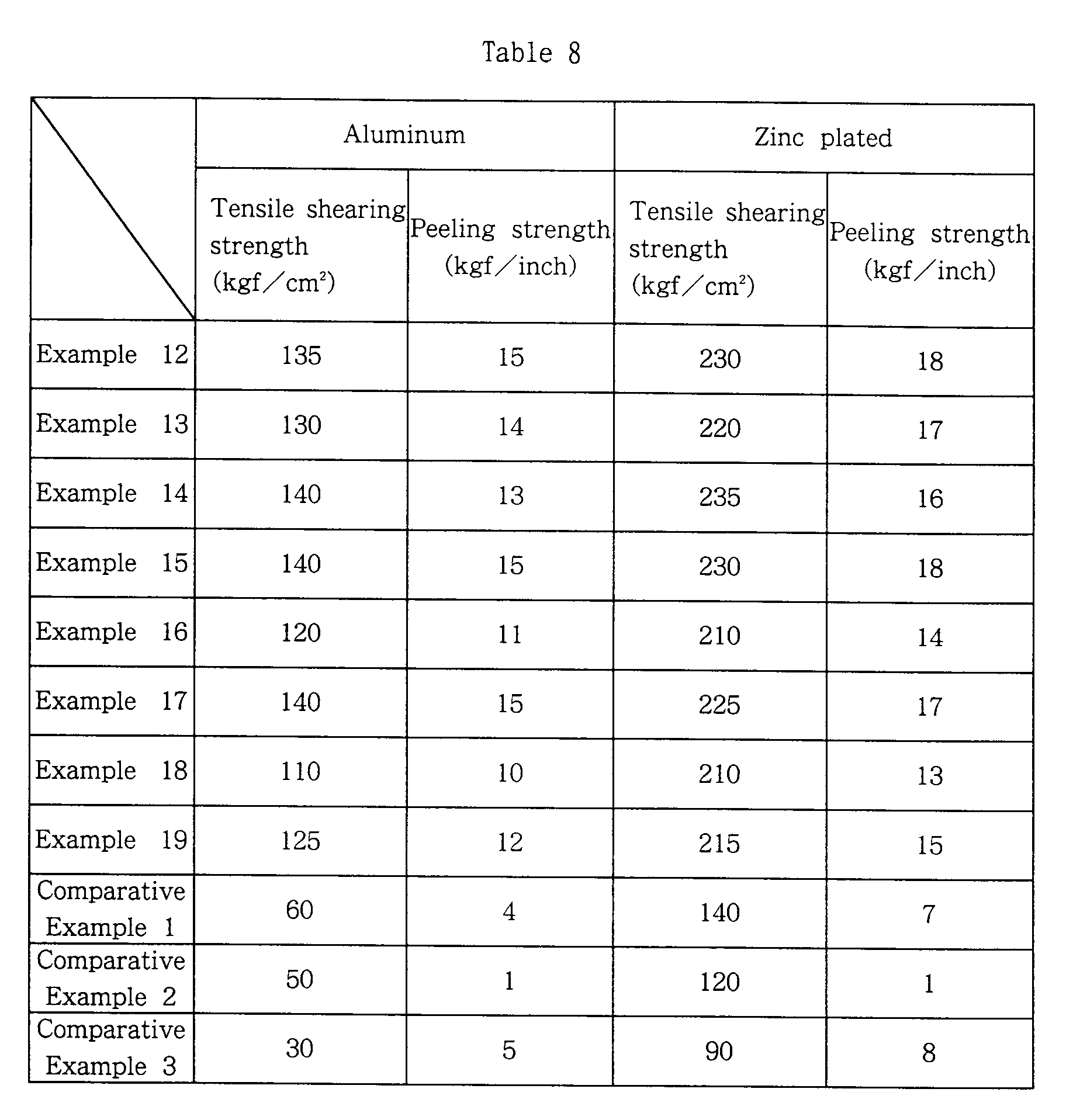
- Subsequently, the specimens were applied to test plates for hardening at 170°C for 30 minutes and then subjected to a shearing strength test and a peeling strength test according to the related JIS Test Standards. The test plates were aluminum plates (JIS A-5052P) and zinc plated steel plates.
- Table 4 below shows some of the obtained results.

- 100 Portions of an urethane modified epoxy resin and 100 portions of a calcium carboxide were kneaded by means of a three-roll device and thereafter a 12 to 40 portions of a hardening agent was added thereto to produce a specimen of thermally hardenable resin composition for each of the Examples and Comparative Examples described above. A modified polyamideamine (available from ASAHI DENKA KOGYO K.K.) having an active hydrogen equivalent number of 115 used as a hardening agent was mixed such that the equivalent number of active hydrogen was equal to 1.0 relative to that of the epoxy resin.
- Subsequently, the specimens were applied to test plates for hardening at 20°C for 7 days and then subjected to a shearing strength test and a peeling strength test as in the case of Test (I) above.
- Table 5 below shows some of the obtained results.

- Next, urethane modified epoxy resins, each obtained by causing a specific epoxy resin to react with the urethane prepolymer [B] and then making to react a specific phosphorus compound with the reaction product, will be described below.
- For the isocyanate group-terminated urethane prepolymer (B), urethane prepolymers No. B-1 through B-7 listed in Table 2 were used.
- 100 Portions of an epoxy resin was held to 80°C and 20 portions of the urethane prepolymer (B-1) was dropped thereto to cause the mixture to react for three (3) hours and produce an urethane modified epoxy resin (D-1) with an epoxy equivalent of 230.
- Urethane modified epoxy resins (D-2 through D-8) were prepared in a manner as described above for Manufacturing Example 18 with the ratios of an epoxy resin and an urethane prepolymer and the reaction parameters listed in Table 6 below.

- 100 Portions of the urethane modified epoxy resin (D-1) and 3 portions of orthophosphoric acid was mixed and caused to react with each other at 55°C for two (2) hours to produce an urethane modified epoxy resin with an epoxy equivalent of 310.
- Urethane modified epoxy resins (Examples 13 through 19) were prepared in a manner as described above for Example 12 with the ratios of a urethane modified epoxy resin and a phosphoric compound and the reaction parameters listed in Table 7 below.

- The specimens of Examples 12 through 19 were then subjected to adhesiveness tests as described above by Test (I) and (II). The obtained results are listed in Tables 8 and 9 below along with those for Comparative Examples 1 through 3.

provided that the equivalent number of hydroxy groups contained in the epoxy resin is greater than the equivalent number of isocyanate groups contained in the urethane prepolymer [B] and that the phosphorus compound is used in an amount such that the ratio of epoxy groups in the epoxy resin to hydroxy groups in the phosphorus compound is 1:(0.02 to 0.8).
Claims (19)
- A urethane and phosphorus modified epoxy resin obtained by reactinga) 100 weight portions of an epoxy resin containing on average within a molecule about two epoxy groups and 0.1 or more than 0.1 hydroxy groups;b) 5 to 75 weight portions of an isocyanate group-terminated urethane prepolymer [B] produced by reaction of a hydroxy compound and an organic polyisocyanate compound, andc) an acid of a phosphorus compound having within a molecule at least a P-OH bond or its salt or esterprovided that the equivalent number of hydroxy groups contained in the epoxy resin is greater than the equivalent number of isocyanate groups contained in the urethane prepolymer [B] and that the phosphorus compound is used in an amount such that the ratio of epoxy groups in the epoxy resin to hydroxy groups in the phosphorus compound is 1:(0.02 to 0.8).
- A modified epoxy resin according claim 1 which is obtained by reaction of
100 weight portions of a preliminary condensate [A] produced by reaction of the said epoxy resin and the phosphorus compound at a ratio of one (1) equivalent of epoxy group in the epoxy resin to an equivalent between 0.02 and 0.8 (preferably 0.04 to 0.5) of hydroxy group in the phosphorus compound and
5 to 60 weight portions (preferably 10 to 40 weight portions) of an isocyanate group-terminated urethane prepolymer [B] produced by reaction of a hydroxy compound and an organic polyisocyanate compound,
provided that the equivalent number of hydroxy groups contained in the preliminary condensate [A] is greater than the equivalent number of isocyanate groups contained in the urethane prepolymer [B]. - A modified epoxy resin according to claim 2 in which the epoxy equivalent weight of the preliminary condensate [A] is not more 1000.
- A modified epoxy resin according to claim 1 which is obtained by preparing a urethane modified epoxy resin [D] from 100 weight portions of the epoxy resin and 5 to 60 weight portions (preferably 10 to 40 weight portions) of the isocyanate group terminated urethane prepolymer [B] provided that the equivalent number of hydroxy groups contained in the epoxy resin is greater than the equivalent number of isocyanate groups contained in the urethane prepolymer [B], and causing the urethane modified epoxy resin [D] to react with the phosphorus compound at a ratio of one equivalent of epoxy groups in the epoxy resin to 0.02 to 0.6 (preferably 0.03 to 0.5) equivalents of hydroxy groups in the phosphorus compound.
- A modified epoxy resin according to any preceding claim in which the phosphorus compound is selected from orthophosphoric acid, metaphosphoric acid, pyrophosphoric acid, phosphorous acid, polyphosphoric acid and phosphonic acid, potassium salts, sodium salts, lithium salts, calcium salts, zinc salts, aluminum salts, tin salts and barium salts and mono- or di-esters of the above acids such as alkyl esters and hydroxyalkyl esters having up to eight (8) carbon atoms in the alkyl groups, preferably selected from orthophosphoric acid, potassium dihydrogen phosphate and sodium dihydrogen phosphate and mono- or di-esters of orthophosphoric acid.
- A modified epoxy resin according to any preceding claim in which the epoxy resin starting material has an epoxy equivalent weight in the range of 120 to 500.
- A process for producing a modified epoxy resin by reactinga) 100 weight portions of an epoxy resin containing on average within a molecule about two epoxy groups and 0.1 or more than 0.1 hydroxy groups;b) 5 to 75 weight portions of an isocyanate group-terminated urethane prepolymer [B] produced by reaction of a hydroxy compound and an organic polyisocyanate compound, andc) an acid of a phosphorus compound having within a molecule at least a P-OH bond or its salt or esterprovided that the equivalent number of hydroxy groups contained in the epoxy resin is greater than the equivalent number of isocyanate groups contained in the urethane prepolymer [B] and that the phosphorus compound is used in an amount such that the ratio of epoxy groups in the epoxy resin to hydroxy groups in the phosphorus compound is 1:(0.02 to 0.8).
- A process according to claim 7 including the steps ofa) reacting the said epoxy resin and the phosphorus compound at a ratio of one (1) equivalent of epoxy group in the epoxy resin to an equivalent between 0.02 and 0.8 (preferably 0.04 to 0.5) of hydroxy group in the phosphorus compound to produce a preliminary condensate [A] andb) reacting the preliminary condensate [A] with 5 to 60 weight portions (preferably 10 to 40 weight portions) of an isocyanate group-terminated urethane prepolymer [B] produced by reaction of a hydroxy compound and an organic polyisocyanate compound,provided that the equivalent number of hydroxy groups contained in the preliminary condensate [A] is greater than the equivalent number of isocyanate groups contained in the urethane prepolymer [B].
- A process according to claim 8 in which the epoxy equivalent weight of the preliminary condensate [A] is not more than 1000.
- A process according to claim 7 including the steps ofa) reacting 100 weight portions of an epoxy resin containing on average within a molecule about two epoxy groups and 0.1 or more than 0.1 hydroxy groups to produce a urethane modified resin [D], andb) causing the urethane modified epoxy resin [D] to react with the phosphorus compound at a ratio of one equivalent of epoxy groups in the epoxy resin to 0.02 to 0.6 (preferably 0.03 to 0.5) equivalents of hydroxy groups in the phosphorus compound.
- A process for producing a urethane and phosphorus modified epoxy resin by reacting a preformed urethane modified epoxy resin [D] formed from 100 weight portions of an epoxy resin containing on average within a molecule about two epoxy groups and 5 to 60 weight portions (preferably 10 to 40 weight portions) of an isocyanate group-terminated urethane prepolymer [B] produced by reaction of a hydroxy compound and an organic polyisocyanate compound, with 0.1 or more than 0.1 hydroxy groups with an acid of a phosphorus compound having within a molecule at least a P-OH bond or its salt or ester such that the ratio of equivalents of epoxy groups in the resin [D] to equivalents of hydroxy groups in the phosphorus compound is in the range 1:(0.02 to 0.6).
- A process for producing a condensate [A] by reacting 100 weight portions of an epoxy resin containing on average within a molecule about two epoxy groups and 0.1 or more than 0.1 hydroxy groups with an acid of a phosphorus compound having within a molecule at least a P-OH bond or its salt or ester at a ratio of equivalents of epoxy groups in the epoxy resin to hydroxy groups in the phosphorus compound in the range of 1:(0.02 to 0.6).
- A process according to any of claims 8 to 12 in which the reaction of the epoxy resin or of the urethane modified epoxy resin [D] with the phosphorus compound is conducted in the presence of a basic catalyst, preferably selected from inorganic alkalis such as sodium hydroxide and potassium hydroxide, tertiary amines such as triethylamine, triethanolamine and dimethylamine, imidazoles and quaternary ammonium salts such as tetramethylammoniumchloride, suitably at a temperature in the range 50 to 100°C.
- An adhesive resin composition containing a urethane and phosphorus modified epoxy resin according to any of claims 1 to 6 and an active organic hardening agent.
- An adhesive resin composition according to claim 14 in which the hardening agent is selected from aliphatic polyamines, aromatic polyamines, polyamides, acid anhydrides, polymercaptans and latent hardening agents selected from dicyandiamide and its derivatives, imidazoles, boron trifluoride-amine complexes, acid hydrazides such as succinic acid hydrazide and diaminomaleonitrile and derivatives.
- An adhesive resin composition according to claim 14 or claim 15 in which the equivalent number of active hydrogen atoms of the hardening agent is found between 0.90 to 1.10 relative to that of equivalents of epoxy groups of the urethane and phosphorus modified epoxy resin.
- Use of a composition according to any of claims 14 to 16 as an adhesive to bond metals.
- Use according to claim 17 in which the metal is selected from ferrous metals, for instance iron, and non-ferrous metals, preferably selected from aluminium, zinc and copper.
- Use according to claim 17 or 18 in which the composition is contacted with the substrates to be adhered and is cured by heating.
Applications Claiming Priority (6)
| Application Number | Priority Date | Filing Date | Title |
|---|---|---|---|
| JP25021594 | 1994-09-20 | ||
| JP250215/94 | 1994-09-20 | ||
| JP25021594 | 1994-09-20 | ||
| JP20679195 | 1995-07-21 | ||
| JP206791/95 | 1995-07-21 | ||
| JP20679195A JP3630336B2 (en) | 1994-09-20 | 1995-07-21 | Urethane modified epoxy resin |
Publications (3)
| Publication Number | Publication Date |
|---|---|
| EP0703259A2 true EP0703259A2 (en) | 1996-03-27 |
| EP0703259A3 EP0703259A3 (en) | 1996-09-25 |
| EP0703259B1 EP0703259B1 (en) | 2002-01-09 |
Family
ID=26515872
Family Applications (1)
| Application Number | Title | Priority Date | Filing Date |
|---|---|---|---|
| EP95306610A Expired - Lifetime EP0703259B1 (en) | 1994-09-20 | 1995-09-20 | Urethane modified epoxy resin |
Country Status (4)
| Country | Link |
|---|---|
| US (2) | US5700884A (en) |
| EP (1) | EP0703259B1 (en) |
| JP (1) | JP3630336B2 (en) |
| DE (1) | DE69524911T2 (en) |
Cited By (3)
| Publication number | Priority date | Publication date | Assignee | Title |
|---|---|---|---|---|
| WO2001040396A3 (en) * | 1999-12-03 | 2002-07-18 | Reichhold Inc | Urethane modified epoxy adhesive composition |
| CN102352176A (en) * | 2011-05-27 | 2012-02-15 | 厦门固克涂料集团有限公司 | Combination of polyurethane modified epoxy resin and modified secondary amine delayed-hardening agent as primer of polyurea elastomer |
| CN109563236A (en) * | 2016-07-29 | 2019-04-02 | 株式会社Adeka | Hardening resin composition and the structural material engagement binder for having used the composition |
Families Citing this family (12)
| Publication number | Priority date | Publication date | Assignee | Title |
|---|---|---|---|---|
| MY130468A (en) * | 2000-05-23 | 2007-06-29 | Toray Industries | Paste, displays member, and process for production of display member |
| JP5022540B2 (en) * | 2001-01-15 | 2012-09-12 | コニカミノルタホールディングス株式会社 | Ink jet head and method of manufacturing ink jet head |
| JP5248798B2 (en) * | 2007-03-28 | 2013-07-31 | 株式会社Adeka | Curable resin composition and automotive structural adhesive containing the same |
| JP5012290B2 (en) * | 2007-07-31 | 2012-08-29 | Dic株式会社 | Epoxy resin composition, cured product thereof, varnish for printed circuit board, novel epoxy resin and production method thereof |
| US8044154B2 (en) * | 2009-06-12 | 2011-10-25 | Trillion Science, Inc. | Latent hardener for epoxy compositions |
| US8067484B2 (en) * | 2010-03-12 | 2011-11-29 | Trillion Science, Inc. | Latent hardener with improved barrier properties and compatibility |
| CN102304215B (en) * | 2011-07-05 | 2013-11-20 | 深圳市华星光电技术有限公司 | Sealant of liquid crystal panel and modification method thereof |
| CN102827342B (en) * | 2012-02-03 | 2014-06-04 | 黑龙江省科学院石油化学研究院 | Epoxy group contained isocyanated acrylate monomer, and preparation method and application thereof |
| KR101666367B1 (en) * | 2014-12-03 | 2016-10-17 | 코오롱글로텍주식회사 | Adhesive for applying to hydrophobic or water-repellent substrate and manufactuting method thereof |
| KR20160136047A (en) | 2015-05-19 | 2016-11-29 | 삼성전기주식회사 | Composite electronic component and board for mounting the same |
| WO2019055129A1 (en) * | 2017-09-12 | 2019-03-21 | Dow Global Technologies Llc | Adhesive formulation |
| BR112022022724A2 (en) * | 2020-06-05 | 2023-02-14 | Dow Global Technologies Llc | COMPOSITION, METHOD FOR PRODUCING THE COMPOSITION, ADHESIVE COMPOSITION, METHOD FOR PRODUCING A LAMINATE, AND, LAMINATE |
Citations (3)
| Publication number | Priority date | Publication date | Assignee | Title |
|---|---|---|---|---|
| JPS5863758A (en) | 1981-10-09 | 1983-04-15 | Asahi Denka Kogyo Kk | Coating composition |
| JPS61228015A (en) | 1985-04-01 | 1986-10-11 | Yokohama Rubber Co Ltd:The | Epoxy resin composition |
| JPS6253527A (en) | 1985-09-03 | 1987-03-09 | Fujitsu Ten Ltd | Optical calling system in mobile radio system |
Family Cites Families (6)
| Publication number | Priority date | Publication date | Assignee | Title |
|---|---|---|---|---|
| US4259472A (en) * | 1980-01-04 | 1981-03-31 | Ford Motor Company | Two component oligomeric phosphate/isocyanate composition |
| US4692382A (en) * | 1986-07-21 | 1987-09-08 | Ppg Industries, Inc. | Elastomeric coating compositions |
| US4835018A (en) * | 1988-05-13 | 1989-05-30 | Desoto, Inc. | Abrasion and corrosion resistant primer coatings |
| US5086094A (en) * | 1988-09-07 | 1992-02-04 | The Dow Chemical Company | Organic solvent solutions of phosphate esters of epoxy resins |
| US5037934A (en) * | 1988-10-28 | 1991-08-06 | Kyowa Hakko Kogyo Co., Ltd. | Magnetic coating formulations and magnetic recording media |
| JP2858160B2 (en) * | 1990-05-11 | 1999-02-17 | 本田技研工業株式会社 | Adhesion structure of Al alloy press-formed plate |
-
1995
- 1995-07-21 JP JP20679195A patent/JP3630336B2/en not_active Expired - Lifetime
- 1995-09-20 EP EP95306610A patent/EP0703259B1/en not_active Expired - Lifetime
- 1995-09-20 US US08/530,887 patent/US5700884A/en not_active Expired - Fee Related
- 1995-09-20 DE DE69524911T patent/DE69524911T2/en not_active Expired - Fee Related
-
1997
- 1997-06-30 US US08/886,025 patent/US5880229A/en not_active Expired - Lifetime
Patent Citations (3)
| Publication number | Priority date | Publication date | Assignee | Title |
|---|---|---|---|---|
| JPS5863758A (en) | 1981-10-09 | 1983-04-15 | Asahi Denka Kogyo Kk | Coating composition |
| JPS61228015A (en) | 1985-04-01 | 1986-10-11 | Yokohama Rubber Co Ltd:The | Epoxy resin composition |
| JPS6253527A (en) | 1985-09-03 | 1987-03-09 | Fujitsu Ten Ltd | Optical calling system in mobile radio system |
Cited By (6)
| Publication number | Priority date | Publication date | Assignee | Title |
|---|---|---|---|---|
| WO2001040396A3 (en) * | 1999-12-03 | 2002-07-18 | Reichhold Inc | Urethane modified epoxy adhesive composition |
| CN102352176A (en) * | 2011-05-27 | 2012-02-15 | 厦门固克涂料集团有限公司 | Combination of polyurethane modified epoxy resin and modified secondary amine delayed-hardening agent as primer of polyurea elastomer |
| CN109563236A (en) * | 2016-07-29 | 2019-04-02 | 株式会社Adeka | Hardening resin composition and the structural material engagement binder for having used the composition |
| EP3492508A4 (en) * | 2016-07-29 | 2019-12-18 | Adeka Corporation | CURABLE RESIN COMPOSITION AND STRUCTURAL MATERIAL BINDING ADHESIVE USING THE SAME |
| US11208579B2 (en) | 2016-07-29 | 2021-12-28 | Adeka Corporation | Curable resin composition and adhesive for bonding structural material using composition |
| CN109563236B (en) * | 2016-07-29 | 2022-02-11 | 株式会社Adeka | Curable resin composition and adhesive for bonding structural materials using same |
Also Published As
| Publication number | Publication date |
|---|---|
| DE69524911T2 (en) | 2002-10-10 |
| US5700884A (en) | 1997-12-23 |
| DE69524911D1 (en) | 2002-02-14 |
| JPH08143639A (en) | 1996-06-04 |
| EP0703259B1 (en) | 2002-01-09 |
| EP0703259A3 (en) | 1996-09-25 |
| US5880229A (en) | 1999-03-09 |
| JP3630336B2 (en) | 2005-03-16 |
Similar Documents
| Publication | Publication Date | Title |
|---|---|---|
| EP0703259B1 (en) | Urethane modified epoxy resin | |
| CN1726242B (en) | Thermohardenable epoxy resin composition with improved low temperature impact toughness | |
| US8076424B2 (en) | Heat-curable compositions comprising low-temperature impact strength modifiers | |
| US4668736A (en) | Fast curing epoxy resin compositions | |
| KR102626996B1 (en) | Blocked polyurethane toughener for epoxy adhesives | |
| CA1250991A (en) | Curable coating composition and epoxy resin adduct useful therein | |
| EP0169066B1 (en) | Fast curing expoxy resin compositions | |
| US4704331A (en) | Method for adhering surfaces using fast curing epoxy resin compositions | |
| EP0581874A1 (en) | Moisture-curing acrylate/epoxy hybrid adhesives. | |
| WO1996041827A1 (en) | Amine curable epoxy coating compositions having an improved adhesion to substrates | |
| US4861832A (en) | Flexible epoxy film from an epoxy resin reacted with a ketimine/amine terminated butadiene/acrylonitrile copolymer blend | |
| US4804710A (en) | Epoxy resin composition | |
| US4916187A (en) | Epoxy resin with polyamine-polyphenol solid salt in liquid poly(alkylene oxide) polyamine-polyphenol | |
| JP2015535868A (en) | Prepolymer toughening agent for crack resistance adhesive of windmill | |
| US3660523A (en) | Aluminum primer containing epoxide resin and isocyanate terminated urethane prepolymer | |
| KR102628558B1 (en) | adhesive formulation | |
| JPH0623369B2 (en) | Epoxy resin adhesive composition | |
| JP3904315B2 (en) | Polyol resin composition | |
| KR20230093272A (en) | 1-component structural adhesive | |
| KR900000973B1 (en) | Advanced epoxy resins having improved impact resistance when cured and coating composition prepared there from | |
| JP3371476B2 (en) | Polyol and resin composition for coating | |
| KR920009737B1 (en) | Epoxy resin composition | |
| EP0434275A2 (en) | Low-temperature curing epoxy resin composition | |
| WO2026068578A1 (en) | Heat-curing epoxy resin composition with high corrosion resistance | |
| JP3517933B2 (en) | Epoxy group-containing polyhydroxypolyether resin and resin composition thereof |
Legal Events
| Date | Code | Title | Description |
|---|---|---|---|
| PUAI | Public reference made under article 153(3) epc to a published international application that has entered the european phase |
Free format text: ORIGINAL CODE: 0009012 |
|
| AK | Designated contracting states |
Kind code of ref document: A2 Designated state(s): DE FR GB |
|
| PUAL | Search report despatched |
Free format text: ORIGINAL CODE: 0009013 |
|
| AK | Designated contracting states |
Kind code of ref document: A3 Designated state(s): DE FR GB |
|
| 17P | Request for examination filed |
Effective date: 19970324 |
|
| GRAG | Despatch of communication of intention to grant |
Free format text: ORIGINAL CODE: EPIDOS AGRA |
|
| 17Q | First examination report despatched |
Effective date: 20010301 |
|
| GRAG | Despatch of communication of intention to grant |
Free format text: ORIGINAL CODE: EPIDOS AGRA |
|
| GRAH | Despatch of communication of intention to grant a patent |
Free format text: ORIGINAL CODE: EPIDOS IGRA |
|
| GRAH | Despatch of communication of intention to grant a patent |
Free format text: ORIGINAL CODE: EPIDOS IGRA |
|
| GRAA | (expected) grant |
Free format text: ORIGINAL CODE: 0009210 |
|
| REG | Reference to a national code |
Ref country code: GB Ref legal event code: IF02 |
|
| AK | Designated contracting states |
Kind code of ref document: B1 Designated state(s): DE FR GB |
|
| REF | Corresponds to: |
Ref document number: 69524911 Country of ref document: DE Date of ref document: 20020214 |
|
| ET | Fr: translation filed | ||
| PLBE | No opposition filed within time limit |
Free format text: ORIGINAL CODE: 0009261 |
|
| STAA | Information on the status of an ep patent application or granted ep patent |
Free format text: STATUS: NO OPPOSITION FILED WITHIN TIME LIMIT |
|
| 26N | No opposition filed | ||
| REG | Reference to a national code |
Ref country code: FR Ref legal event code: CD |
|
| PGFP | Annual fee paid to national office [announced via postgrant information from national office to epo] |
Ref country code: FR Payment date: 20080915 Year of fee payment: 14 |
|
| PGFP | Annual fee paid to national office [announced via postgrant information from national office to epo] |
Ref country code: GB Payment date: 20080924 Year of fee payment: 14 |
|
| PGFP | Annual fee paid to national office [announced via postgrant information from national office to epo] |
Ref country code: DE Payment date: 20081002 Year of fee payment: 14 |
|
| GBPC | Gb: european patent ceased through non-payment of renewal fee |
Effective date: 20090920 |
|
| REG | Reference to a national code |
Ref country code: FR Ref legal event code: ST Effective date: 20100531 |
|
| PG25 | Lapsed in a contracting state [announced via postgrant information from national office to epo] |
Ref country code: FR Free format text: LAPSE BECAUSE OF NON-PAYMENT OF DUE FEES Effective date: 20090930 Ref country code: DE Free format text: LAPSE BECAUSE OF NON-PAYMENT OF DUE FEES Effective date: 20100401 |
|
| PG25 | Lapsed in a contracting state [announced via postgrant information from national office to epo] |
Ref country code: GB Free format text: LAPSE BECAUSE OF NON-PAYMENT OF DUE FEES Effective date: 20090920 |