EP0702997B1 - Process and system for the removal of nitrogen oxides using a catalytic membrane - Google Patents
Process and system for the removal of nitrogen oxides using a catalytic membrane Download PDFInfo
- Publication number
- EP0702997B1 EP0702997B1 EP95305899A EP95305899A EP0702997B1 EP 0702997 B1 EP0702997 B1 EP 0702997B1 EP 95305899 A EP95305899 A EP 95305899A EP 95305899 A EP95305899 A EP 95305899A EP 0702997 B1 EP0702997 B1 EP 0702997B1
- Authority
- EP
- European Patent Office
- Prior art keywords
- catalyst
- membrane
- lean
- alumina
- exhaust stream
- Prior art date
- Legal status (The legal status is an assumption and is not a legal conclusion. Google has not performed a legal analysis and makes no representation as to the accuracy of the status listed.)
- Expired - Lifetime
Links
Images


Classifications
-
- B—PERFORMING OPERATIONS; TRANSPORTING
- B01—PHYSICAL OR CHEMICAL PROCESSES OR APPARATUS IN GENERAL
- B01D—SEPARATION
- B01D67/00—Processes specially adapted for manufacturing semi-permeable membranes for separation processes or apparatus
- B01D67/0039—Inorganic membrane manufacture
- B01D67/0048—Inorganic membrane manufacture by sol-gel transition
-
- B—PERFORMING OPERATIONS; TRANSPORTING
- B01—PHYSICAL OR CHEMICAL PROCESSES OR APPARATUS IN GENERAL
- B01D—SEPARATION
- B01D53/00—Separation of gases or vapours; Recovering vapours of volatile solvents from gases; Chemical or biological purification of waste gases, e.g. engine exhaust gases, smoke, fumes, flue gases, aerosols
- B01D53/22—Separation of gases or vapours; Recovering vapours of volatile solvents from gases; Chemical or biological purification of waste gases, e.g. engine exhaust gases, smoke, fumes, flue gases, aerosols by diffusion
-
- B—PERFORMING OPERATIONS; TRANSPORTING
- B01—PHYSICAL OR CHEMICAL PROCESSES OR APPARATUS IN GENERAL
- B01D—SEPARATION
- B01D53/00—Separation of gases or vapours; Recovering vapours of volatile solvents from gases; Chemical or biological purification of waste gases, e.g. engine exhaust gases, smoke, fumes, flue gases, aerosols
- B01D53/34—Chemical or biological purification of waste gases
- B01D53/92—Chemical or biological purification of waste gases of engine exhaust gases
- B01D53/94—Chemical or biological purification of waste gases of engine exhaust gases by catalytic processes
- B01D53/9404—Removing only nitrogen compounds
- B01D53/9409—Nitrogen oxides
- B01D53/9413—Processes characterised by a specific catalyst
- B01D53/9418—Processes characterised by a specific catalyst for removing nitrogen oxides by selective catalytic reduction [SCR] using a reducing agent in a lean exhaust gas
-
- B—PERFORMING OPERATIONS; TRANSPORTING
- B01—PHYSICAL OR CHEMICAL PROCESSES OR APPARATUS IN GENERAL
- B01D—SEPARATION
- B01D67/00—Processes specially adapted for manufacturing semi-permeable membranes for separation processes or apparatus
- B01D67/0081—After-treatment of organic or inorganic membranes
- B01D67/0083—Thermal after-treatment
-
- B—PERFORMING OPERATIONS; TRANSPORTING
- B01—PHYSICAL OR CHEMICAL PROCESSES OR APPARATUS IN GENERAL
- B01D—SEPARATION
- B01D2255/00—Catalysts
- B01D2255/10—Noble metals or compounds thereof
- B01D2255/104—Silver
-
- B—PERFORMING OPERATIONS; TRANSPORTING
- B01—PHYSICAL OR CHEMICAL PROCESSES OR APPARATUS IN GENERAL
- B01D—SEPARATION
- B01D2255/00—Catalysts
- B01D2255/20—Metals or compounds thereof
- B01D2255/207—Transition metals
- B01D2255/20761—Copper
-
- B—PERFORMING OPERATIONS; TRANSPORTING
- B01—PHYSICAL OR CHEMICAL PROCESSES OR APPARATUS IN GENERAL
- B01D—SEPARATION
- B01D2255/00—Catalysts
- B01D2255/50—Zeolites
-
- B—PERFORMING OPERATIONS; TRANSPORTING
- B01—PHYSICAL OR CHEMICAL PROCESSES OR APPARATUS IN GENERAL
- B01D—SEPARATION
- B01D2323/00—Details relating to membrane preparation
- B01D2323/08—Specific temperatures applied
- B01D2323/081—Heating
-
- B—PERFORMING OPERATIONS; TRANSPORTING
- B01—PHYSICAL OR CHEMICAL PROCESSES OR APPARATUS IN GENERAL
- B01D—SEPARATION
- B01D2323/00—Details relating to membrane preparation
- B01D2323/12—Specific ratios of components used
-
- B—PERFORMING OPERATIONS; TRANSPORTING
- B01—PHYSICAL OR CHEMICAL PROCESSES OR APPARATUS IN GENERAL
- B01D—SEPARATION
- B01D2325/00—Details relating to properties of membranes
- B01D2325/02—Details relating to pores or porosity of the membranes
- B01D2325/0283—Pore size
-
- Y—GENERAL TAGGING OF NEW TECHNOLOGICAL DEVELOPMENTS; GENERAL TAGGING OF CROSS-SECTIONAL TECHNOLOGIES SPANNING OVER SEVERAL SECTIONS OF THE IPC; TECHNICAL SUBJECTS COVERED BY FORMER USPC CROSS-REFERENCE ART COLLECTIONS [XRACs] AND DIGESTS
- Y02—TECHNOLOGIES OR APPLICATIONS FOR MITIGATION OR ADAPTATION AGAINST CLIMATE CHANGE
- Y02A—TECHNOLOGIES FOR ADAPTATION TO CLIMATE CHANGE
- Y02A50/00—TECHNOLOGIES FOR ADAPTATION TO CLIMATE CHANGE in human health protection, e.g. against extreme weather
- Y02A50/20—Air quality improvement or preservation, e.g. vehicle emission control or emission reduction by using catalytic converters
-
- Y—GENERAL TAGGING OF NEW TECHNOLOGICAL DEVELOPMENTS; GENERAL TAGGING OF CROSS-SECTIONAL TECHNOLOGIES SPANNING OVER SEVERAL SECTIONS OF THE IPC; TECHNICAL SUBJECTS COVERED BY FORMER USPC CROSS-REFERENCE ART COLLECTIONS [XRACs] AND DIGESTS
- Y02—TECHNOLOGIES OR APPLICATIONS FOR MITIGATION OR ADAPTATION AGAINST CLIMATE CHANGE
- Y02T—CLIMATE CHANGE MITIGATION TECHNOLOGIES RELATED TO TRANSPORTATION
- Y02T10/00—Road transport of goods or passengers
- Y02T10/10—Internal combustion engine [ICE] based vehicles
- Y02T10/12—Improving ICE efficiencies
Definitions
- This invention relates to lean-NO x catalysts, particularly those providing a high surface area catalyst membrane of controlled pore size to remove nitrogen oxide (NO x ) emissions from lean-burn automobile engines and industrial plants emission systems.
- the present invention also discloses a method of making such catalysts.
- the Environmental Protection Agency has instituted stringent automobile-related environmental regulations.
- a primary focus of the regulation relates to the Corporate Average Fuel Economy (CAFE) standards, which mandate a specified, gradual increase of a corporate fleet's overall fuel economy by the established target dates.
- CAFE standards have spurred industry wide research and development of "lean-burn engines".
- the term "lean-burn engine” used herein is defined as an engine utilising air/fuel mixtures having an oxygen content in excess of the stoichiometric air/fuel ratio (lean mixtures). The use of such lean air/fuel mixtures, reduces the consumption of fuel and thus enhances an automobile's fuel economy. The effort to increase automobile fuel economy has become paramount in the wake of the Environmental Protection Agency's tightening CAFE standards.
- a catalyst exhibits a high activity of oxidation but a low activity of reduction, while the combustion product contains a large amount of oxygen.
- a catalyst exhibits a high activity of reduction but a low activity of oxidation.
- oxidation and reduction are balanced.
- lean-NO x catalyst which efficiently reduces NO x emissions in the presence of a lean fuel mixture.
- lean-NO x catalysts are also valuable in lowering the emissions of stationary power plants that burn fossil fuels.
- a lean-NO x catalyst is defined for purposes of this application as a catalyst that can reduce NO x under lean-burn conditions.
- transition metal-containing zeolite catalysts have been developed to reduce NO x emissions for lean mixtures.
- copperzeolite catalysts have been preferred due to the effectiveness of copper as an ion exchange metal at lower temperatures such as that present in lean-burn engine exhaust.
- Zeolites are crystalline aluminosilicates. Zeolites are commercially available and are characterised by crystal structures having different channels or pore diameters. Zeolites have fine pores (sized at several angstroms), comparable with the size of a molecule, hence they are termed molecular sieves. It is believed that the hydrocarbons are selectively trapped in those pores or sieves. As the transition metal, introduced by ion exchange, forms active sites in the pores, the hydrocarbons are adsorbed therein and react with nitrogen oxides in the presence of excess O 2 . Accordingly, zeolite catalysts have potential application in the removal of NO x from lean fuel mixtures.
- the basic principle behind removing NO x in a lean fuel mixture with a transition metal, e.g., copper, containing zeolite catalyst relies on adsorbing NO x and effectuating a catalytic reaction of the adsorbed NO x with the hydrocarbons contained in the exhausted gas, to reduce the NO x to N 2 .
- a transition metal e.g., copper
- copper-zeolite catalysts have good catalytic activity initially, due to copper's high NO x adsorption ability, copper-zeolite catalysts have a series of limitations which are described below.
- transition metal containing zeolites degrade at high temperatures usually found in automotive exhaust systems. Furthermore, if the zeolite catalyst is exposed to steam-containing air, e.g., automotive exhaust, the activity of the catalyst decreases rapidly. The decrease in activity is also accompanied by dealumination. Steam deactivation of zeolite-based catalysts is the primary reason why such catalysts are not practical in application.
- alumina Al 2 O 3
- metal containing Al 2 O 3 as lean-NO x catalysts
- Alumina is inefficient in NO x reduction such that it is currently impractical for commercial use.
- a catalyst comprising an alumina or alumina/silica membrane produced by a sol-gel process, having a pore size distribution in the range of 20-60 angstroms and being loaded with one or more of the transition metals iron, copper, cobalt, chromium, silver, nickel and manganese is used in a process for removing nitrogen oxide (NO x ) emissions from oxygen-rich combustion gases, in particular those forming the exhaust stream of a lean-burn vehicle engine.
- NO x nitrogen oxide
- ceramic membranes consisting of metal oxides such as TiO 2 and ZrO 2 or oxides of silicon, aluminium, niobium or other transition metals and made by a sol-gel process in separation processes is also disclosed in EP-A 0 425 252, but there is no suggestion therein of loading the ceramic membrane with transition metal or using it as in the present invention.
- DE-A 43 03 610 discloses the use in heterogeneous catalysed reactions such as the hydrogenation of linoleic acid dimethyl ester of microporous membranes produced by a sol-gel process and containing a wide variety of catalytically active components. In these reactions two reagents are separated by the membrane, which is permeable to one reagent but not permeable to the other reagent or to impurities contained therein.
- the invention also provides an emission reduction system as set forth in claim 8. It further provides a NO x reduction system for catalytic reduction under lean-burn conditions in an automobile exhaust stream in which the aforesaid alumina or alumina/silica sol-gel lean-NO x catalyst is combined with a three-way catalyst to provide an emission system which can operate over a broad range of operating conditions.
- the sol-gel process provides inorganic membranes which have customised pore sizes. This flexibility allows the inorganic membranes to in effect mimic the effectiveness of the zeolite pore structure.
- alumina/silica membranes retain high surface area even after high temperature treatment.
- these alumina/silica membranes are thoroughly stable high surface area membranes. The resulting catalyst membrane can thereby have significantly increased hydrothermal stability the consequent improved performance.
- Zeolite membranes are characterised by their crystalline structure.
- sol-gel processed alumina or alumina/silica membranes are amorphous unless sintered at high temperature and are prepared from a sol composition, i.e. a liquid colloidal dispersion.
- a sol in this case is a gel which comprises highly-cross-linked inorganic polymers.
- a sol can be converted to gel by several known methods such as concentrating the sol, heating or cooling the sol.
- These alumina sols can be employed to prepare alumina membranes for use on ceramic monoliths as described in US-A 5 210 062.
- alumina sols were prepared by hydrolysing aluminium alkoxides in water followed by peptisation in the presence of dilute mineral acid.
- the silica sol was concentrated to a gel which was then heated at 250°C and 600°C in a nitrogen atmosphere.
- the sol was prepared from Si(EtO) 4 in ethanol, water and dilute mineral acid.
- Alumina membranes which were then prepared from alumina sols showed a surface area of 230 m 2 /g and pore size of 45 angstroms after heating at 600°C.
- Alumina/silica membranes which were prepared from a mixture of alumina and silica sol and aged at 600°C showed a surface area of 390 m 2 /g and pore size of 45 angstroms.
- alumina/silica materials were prepared from (tBuO) 3 Si-O-Al(OR) 2 and Al(OR) 3 in parent alcohol. These materials also retained high surface area after aging at 1100°C in air.
- a transition metal from the group copper, cobalt, nickel, chromium, iron, manganese, silver and zinc was loaded on to the membrane by dissolving a water soluble salt containing the metal in distilled water to form a transition metal containing solution and impregnating the solution on the sol-gel processed membrane material by the following steps: mixing the membrane material and the solution to form a mixture; stirring the mixture; evaporating water from the mixture to form a paste; drying the paste to form a dried sample; and calcining the dried sample.
- transition metal herein includes both the elemental metal itself and its metal oxide.
- the preferred metal for impregnation on the membrane surface is silver.
- the silver was impregnated on the membrane by mixing the membrane material and the impregnation solution, stirring the mixture, and slowly evaporating water until the mixture turns pasty.
- the impregnating solution contained the known amount of silver nitrate and 5-10 volume percent of concentrated nitric acid.
- the paste was then dried at 50°C overnight and for at least 4 hours at 120°C.
- the dried sample was finally calcined at 550°C for 4 hours.
- the efficiency for lean-NO x reduction was measured under a model reaction condition. A result showed that 80% NO was reduced to nitrogen at 450° to 525°C.
- the ratio of the amount of transition metal to the weight of the sol-gel processed membrane is dependent on the desired transition metal loading on the sol-gel processed material.
- the amount of silver supported on the membrane is generally in the range of 1-8 weight percent of the overall weight. Generally, however, the amount of the transition metal is in the range of 1-20 weight percent of the overall weight.
- the sol-gel processed alumina used has a pore size distribution in the range of 20-60 angstroms. As a result of this ability to control the porosity of the membrane, silver or any other transition metal deposited in these pores has a high surface area, resulting in a membrane with high activity.
- Alumina sols were prepared by hydrolysing aluminium alkoxides (e.g. Al(OBu S ) 3 ) in water followed by peptisation in the presence of diluted mineral acid. The sol was then concentrated to gel which was then heated at 250°C and 600°C in a nitrogen atmosphere.
- Alumina/silica membranes were prepared from a mixture of aluminium sol and silica sol which was obtained from Si(EtO) 4 in ethanol, water, and diluted mineral acid. A sample of alumina/silica membrane was made with uniform pore size around 45 ⁇ and 390m 2 /g. Two samples of sol-gel processed alumina membrane material, SG1 (195 m 2 /g and 40 ⁇ -pore) and SG2 (224 m 2 /g and 39 ⁇ -pore), were used in the following disclosure.
- Water-soluble Ag-containing salts such as AgNO 3 were dissolved in distilled water. The Ag-solution was then used to impregnate the sol-gel processed membrane material. The ratio of the Ag amount to the membrane weight was dependent on the desired Ag loading on the sol-gel processed material. After the impregnation, the material was dried up to 120°C and then heated in air inside a furnace at 500-600°C for 4 hours.
- ZSM-5 is a type of zeolite.
- ZSM-5 is a trademark of Mobil Corporation. It is a siliceous zeolite with a high ratio of SiO 2 to Al 2 O 3 and a high acid strength.
- ZSM-5 has rings of 10 oxygen atoms, it contains very little water of crystallisation, is hydrophobic and has a few acid sites.
- CATALYST 2 2 grams of SG1 powder was used. The solution used for impregnation was the same as that for CATALYST 1. The procedure of preparation was also the same as that for CATALYST 1.
- CATALYST 3 For CATALYST 3, a sample of CATALYST 2 that was prepared according to the procedure above went through the same impregnation and heating steps again. The resulted loading of Ag on CATALYST 3 was two times of that for CATALYST 2.
- CATALYST 4 0.89 gram of CATALYST 1 was added into a solution which was made of 1 ml solution of 0.0178 g Ag/ml and 0.3 ml of distilled water. The water was slowly evaporated till paste was formed. The paste was dried at 110°C for 2 hours. The dried material was again impregnated with the same solution. After drying at 100°C, the sample was heated in air at 525°C for 3 hours.
- the sample was prepared by a typical ion-exchange method using Cu(II)-acetate and H-ZSM-5 zeolite (Table 1). The obtained sample was heated in air at 550°C for 4 hours.
- the efficiency was measured under model reaction conditions: 1 - 10 % O 2 , 500 - 1500 ppm C 3 H 6 , 1000 ppm NO, and space velocities equivalent to 12,500 - 50,000 hr -1 .
- Table 2 shows that CATALYST 1 could reduce NO in range of 3 - 10 % O 2 .
- the efficiency of CATALYST 6 prepared from the commercially available ⁇ -Al 2 O 3 was generally lower than that of CATALYST 1.
- the efficiencies of CATALYST 1 at different space velocities are shown in Table 3.
- the NO-reduction efficiency changed slightly in the range of O 2 -concentration or space velocity applied above.
- the effect of C 3 H 6 -concentration was shown in Table 4.
- Table 5 shows that CATALYST 7, Cu-containing SG2, can reduce NO at lower temperature than Ag/SG1 or Ag/SG2 under the same conditions.
- Type Weight% Support 1 Ag 2 SG2 2 Ag 2 SG1 3 Ag 4 SG1 4 Ag 6 SG2 5 Ag 1 SG1 6 Ag 2 ⁇ -Al 2 O 3 7 Cu 2 SG2 8 Cu 2.9 H-ZSM5 NO-CONVERSION AT DIFFERENT LEVEL OF O 2 (1000 ppm NO, 500 ppm, C 3 H 6 , equivalent space velocity 25,000 hr -1 ) CATALYST O 2 (%) T(°C) NO-Conversion (%) CATALYST 1 3 525 52.2 6 500 54.4 10 500 46.2 CATALYST 6 3 575 31.1 6 550 33.6 10 500 34.2 NO-CONVERSION OVER CATALYST 1 AT DIFFERENT SPACE VELOCITY (1000 PPM NO, 1500 PPM C 3 H 6 , 10% O 2 ) Equivalent Space Velocity T(°C) NO-Conversion (%) 25,000 hr -1 500 83.8 50,000 hr -1 500 76.9 EFFECT OF C 3 H 6 -CON
- Catalytic applications using the disclosed sol-gel processed membrane include: 1) Using such a catalyst in stationary power plants and 2) Using a catalyst having a sol-gel processed membrane in conjunction with a three-way catalyst to allow dual catalytic converters to provide comprehensive emission reductions at a broad range of operating temperatures.
- the three-way catalyst performs effectively at stoichiometric air/fuel ratio to reduce NO x in the lower temperature ranges.
- Fresh Cu ZSM-5 zeolite catalyst is best suited to operate on the 280-400°C range temperature at lean conditions.
- the sol-gel processed catalytic converter works efficiently for NO x reduction at lean conditions in the 400-550°C temperature range.
- the combination provides comprehensive conversion efficiency for the reduction of automobile emissions.
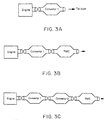
- Fig. 3B illustrates schematically one such NO x reduction system for lean-burn conditions in an automobile exhaust stream, having an upper end near the engine and a lower end near the tail pipe, which includes at least one sol-gel processed alumina or alumina/silica membrane based, lean-burn catalyst in which the substrate is loaded with transition metal (Converter 1) positioned at the upper end of the exhaust stream and a three-way catalyst (TWC) positioned at the lower end of the exhaust stream to provide a system which can operate in a wide range of temperatures.
- transition metal Converter 1
- TWC three-way catalyst
- An additional converter (Converter 2) having a zeolite lean NO x catalyst may be included between Converter 1 and the TWC, as shown in Fig. 3C.
- the above systems would include control means for routing exhaust to each type of catalytic converter depending on the air/fuel ratio present.
- the air/fuel ratio is in excess of stoichiometric conditions (14.6) then the exhaust stream should be routed through the inorganic membrane-based lean NO x catalysts, which may be used in conjunction with the copper ZSM-5 lean-NO x catalyst placed at the lower end of the exhaust stream.
- the air/fuel ratio is fuel rich or less than 14.6 the exhaust stream should be routed through the three-way catalyst.
- the control means may comprise monitoring means positioned near the engine to measure the air/fuel ratio of the exhaust stream and control means to alter the exhaust flow depending on the air/fuel ratio as described above.
- an oxidation catalyst can also be added downstream of the lean-burn catalyst to remove any remaining hydrocarbons which may be present in the emission stream.
- the above system provides an emission reduction system to cover an automobile's varying air/fuel ratio and a spectrum of operating temperatures while still effectively reducing HC, CO and NO x emissions from an exhaust stream.
Landscapes
- Chemical & Material Sciences (AREA)
- Engineering & Computer Science (AREA)
- Chemical Kinetics & Catalysis (AREA)
- Oil, Petroleum & Natural Gas (AREA)
- Analytical Chemistry (AREA)
- Inorganic Chemistry (AREA)
- General Chemical & Material Sciences (AREA)
- Manufacturing & Machinery (AREA)
- Health & Medical Sciences (AREA)
- Environmental & Geological Engineering (AREA)
- Biomedical Technology (AREA)
- Combustion & Propulsion (AREA)
- Dispersion Chemistry (AREA)
- Physics & Mathematics (AREA)
- Thermal Sciences (AREA)
- Catalysts (AREA)
- Exhaust Gas Treatment By Means Of Catalyst (AREA)
- Exhaust Gas After Treatment (AREA)
Description
- Fig. 1
- is a graphic comparison of NO conversion efficiency between an Ag-containing sol-gel processed membrane catalyst and a Cu/ZSM-5 catalyst;
- Fig. 2
- is a graphic comparison of NO conversions between an Ag-containing sol-gel processed membrane catalyst and a commercially available Ag on Y-alumina catalyst;
- Fig. 3
- depicts three embodiments of an emission reduction system, wherein in Fig. 3A a catalytic converter containing an Ag/sol-gel processed alumina membrane is positioned in the exhaust stream of an IC engine, in Fig. 3B this catalytic converter is followed by a three-way catalyst (TWC), and in Fig. 3C two lean-NOx catalysts, namely an Ag/sol-gel processed alumina catalyst and a zeolite catalyst, are used in conjunction with a three-way catalyst.
| LIST OF CATALYSTS | |||
| Metal Used | |||
| Catalyst No. | Type | Weight% | Support |
| 1 | Ag | 2 | SG2 |
| 2 | Ag | 2 | SG1 |
| 3 | Ag | 4 | SG1 |
| 4 | Ag | 6 | SG2 |
| 5 | Ag | 1 | SG1 |
| 6 | Ag | 2 | γ-Al2O3 |
| 7 | Cu | 2 | SG2 |
| 8 | Cu | 2.9 | H-ZSM5 |
| NO-CONVERSION AT DIFFERENT LEVEL OF O2 (1000 ppm NO, 500 ppm, C3H6, equivalent space velocity = 25,000 hr-1) | |||
| CATALYST | O2(%) | T(°C) | NO-Conversion (%) |
| CATALYST 1 | 3 | 525 | 52.2 |
| 6 | 500 | 54.4 | |
| 10 | 500 | 46.2 | |
| CATALYST 6 | 3 | 575 | 31.1 |
| 6 | 550 | 33.6 | |
| 10 | 500 | 34.2 |
| NO-CONVERSION OVER CATALYST 1 AT DIFFERENT SPACE VELOCITY (1000 PPM NO, 1500 PPM C3H6, 10% O2) | ||
| Equivalent Space Velocity | T(°C) | NO-Conversion (%) |
| 25,000 hr-1 | 500 | 83.8 |
| 50,000 hr-1 | 500 | 76.9 |
| EFFECT OF C3H6-CONCENTRATION (1000 ppm NO, 10% O2, equivalent space velocity = 25,000 hr-1) | ||
| C3H6-Concentration (ppm) | T(°C) | NO-Conversion (%) |
| 500 | 500 | 46.2 |
| 1500 | 500 | 83.8 |
| NO-CONVERSION OVER CATALYST 7 (1000 ppm NO, 1500 ppm C3H6, equivalent space velocity = 25,000 hr-1) | ||
| O2(%) | T(°C) | NO-Conversion (%) |
| 1 | 475 | 69.2 |
| 3 | 450 | 54.8 |
| NO-EFFICIENCY COMPARISON (1,000 ppm NO, 1500 ppm C3H6, equivalent space velocity = 25,000 hr-1) | ||||
| CATALYST | ||||
| No. | Description | O2(%) | T(°C) | NO-Conversion (%) |
| 5 | 1 wt% Ag/ | 10 | 525 | 91.6 |
| 2 | 2 wt% Ag/ | 10 | 500 | 96.7 |
| 3 | 4 wt% Ag/ | 10 | 475 | 98.7 |
| 4 | 6 wt% Ag/ | 10 | 450 | 44.8 |
| 1 | 2 wt% Ag/ | 10 | 500 | 95.0 |
| 6 | 2 wt% Ag/γ-Al2O3 | 10 | 500 | 62.6 |
| 8 | 2.9 wt% Cu/ | 6 | 550 | 62.8 |
Claims (15)
- A process for removing nitrogen oxide (NOx) emissions from oxygen-rich combustion gases by using a catalyst comprising an alumina or alumina/silica membrane produced by a sol-gel process, said membrane having a pore size distribution in the range of 20-60 angstroms and being loaded with one or more of the metals iron, copper, cobalt, chromium, silver, nickel and manganese.
- A process as claimed in claim 1, wherein the amount of said metal loaded on the membrane is in the range of 1-20 wt % of the overall weight of the membrane.
- A process as claimed in claim 1 or claim 2, wherein the metal loaded is copper or silver.
- A process as claimed in claim 3, wherein the metal loaded is silver in the amount of 1-8 wt % of the overall weight of the membrane.
- A process as claimed in any preceding claim wherein the catalyst is prepared by impregnating alumina or alumina/silica membrane material produced by a sol-gel process by stirring with an aqueous solution of a salt of the metal to be loaded, evaporating to remove water and form a paste, drying said paste and calcining the dried paste.
- A process as claimed in claim 5, wherein the paste is dried at up to 120°C and calcined at 500-600°C.
- A process as claimed in any preceding claim, wherein the oxygen-containing gases are exhaust gases from an internal combustion engine operated with a lean fuel mixture.
- An emission reduction system for catalytic reduction of nitrogen oxides (NOx) in a vehicle exhaust stream of emissions produced by a lean-burn vehicle engine, said system comprising a lean-burn catalyst positioned in said exhaust stream and comprising an alumina or alumina/silica membrane produced by a sol-gel process, said membrane having a pore size distribution in the range of 20-60 angstroms and being loaded with one or more of the metals iron, copper, cobalt, chromium, silver, nickel and manganese.
- A system as claimed in claim 8, wherein the amount of said metal loaded on the membrane is in the range of 1-20 wt % of the overall weight of the membrane.
- A system as claimed in claim 9, wherein the metal loaded is copper or silver.
- A system as claimed in claim 10, wherein the metal loaded is silver in the amount of 1-8 wt % of the overall weight of the membrane.
- An emission reduction system as claimed in any of claims 8 to 11, also comprising a three-way catalyst positioned in the exhaust stream such that said lean-burn catalyst is positioned closer to the engine than said three-way catalyst, to provide a system which functions over a broad range of operating conditions.
- A system as claimed in claim 12, further comprising a zeolite catalyst positioned in the exhaust stream such that said lean-burn catalyst is closer to the engine than said zeolite catalyst.
- A system as claimed in claim 12 or claim 13, further comprising an oxidation catalyst, positioned in the exhaust stream such that said lean-burn catalyst is closer to the engine than said oxidation catalyst, to substantially remove hydrocarbon emissions from the exhaust stream.
- A system as claimed in claim 12, further comprising monitoring means positioned near the engine to measure the air/fuel ratio of the exhaust stream and control means to alter the exhaust flow depending on the air/fuel ratio, to provide a way to route the exhaust stream to said lean-burn catalyst if said air/fuel ratio is in excess of stoichiometric air/fuel values or to route the exhaust stream to said three-way catalyst if said air/fuel ratio is equal to or less than stoichiometric air/fuel values.
Applications Claiming Priority (2)
| Application Number | Priority Date | Filing Date | Title |
|---|---|---|---|
| US08/311,298 US6232253B1 (en) | 1994-09-23 | 1994-09-23 | Sol-gel alumina membrane for lean NOx catalysts and method of making same |
| US311298 | 1994-09-23 |
Publications (2)
| Publication Number | Publication Date |
|---|---|
| EP0702997A1 EP0702997A1 (en) | 1996-03-27 |
| EP0702997B1 true EP0702997B1 (en) | 2001-07-18 |
Family
ID=23206278
Family Applications (1)
| Application Number | Title | Priority Date | Filing Date |
|---|---|---|---|
| EP95305899A Expired - Lifetime EP0702997B1 (en) | 1994-09-23 | 1995-08-23 | Process and system for the removal of nitrogen oxides using a catalytic membrane |
Country Status (5)
| Country | Link |
|---|---|
| US (1) | US6232253B1 (en) |
| EP (1) | EP0702997B1 (en) |
| JP (1) | JPH08108074A (en) |
| AU (1) | AU720516B2 (en) |
| DE (1) | DE69521755T2 (en) |
Families Citing this family (17)
| Publication number | Priority date | Publication date | Assignee | Title |
|---|---|---|---|---|
| US6139813A (en) * | 1998-12-18 | 2000-10-31 | Ford Global Technologies, Inc. | NOx trapping by metal-zirconia materials during lean-burn automotive engine operation |
| US6165932A (en) * | 1999-01-11 | 2000-12-26 | Ford Global Technologies, Inc. | Transition metal oxides useful in fabrication of NOx absorbent formulations |
| US7081231B1 (en) * | 2000-11-08 | 2006-07-25 | Caterpillar Inc. | Method and system for the combination of non-thermal plasma and metal/metal oxide doped γ-alumina catalysts for diesel engine exhaust aftertreatment system |
| US6703343B2 (en) | 2001-12-18 | 2004-03-09 | Caterpillar Inc | Method of preparing doped oxide catalysts for lean NOx exhaust |
| US6706660B2 (en) | 2001-12-18 | 2004-03-16 | Caterpillar Inc | Metal/metal oxide doped oxide catalysts having high deNOx selectivity for lean NOx exhaust aftertreatment systems |
| JP2003206733A (en) * | 2002-01-16 | 2003-07-25 | Hitachi Ltd | Exhaust gas purification device for internal combustion engine |
| US20040258611A1 (en) * | 2003-06-23 | 2004-12-23 | Mark Barrow | Colloidal composite sol gel formulation with an expanded gel network for making thick inorganic coatings |
| US7399729B2 (en) * | 2003-12-22 | 2008-07-15 | General Electric Company | Catalyst system for the reduction of NOx |
| US7153810B2 (en) * | 2004-06-24 | 2006-12-26 | Caterpillar Inc | Silver doped catalysts for treatment of exhaust |
| US7743602B2 (en) | 2005-06-21 | 2010-06-29 | Exxonmobil Research And Engineering Co. | Reformer assisted lean NOx catalyst aftertreatment system and method |
| US7803338B2 (en) | 2005-06-21 | 2010-09-28 | Exonmobil Research And Engineering Company | Method and apparatus for combination catalyst for reduction of NOx in combustion products |
| US8496896B2 (en) * | 2008-06-27 | 2013-07-30 | Catalytic Solutions, Inc. | Zero platinum group metal catalysts |
| US20140274662A1 (en) | 2013-03-15 | 2014-09-18 | Cdti | Systems and Methods for Variations of ZPGM Oxidation Catalysts Compositions |
| US9511350B2 (en) | 2013-05-10 | 2016-12-06 | Clean Diesel Technologies, Inc. (Cdti) | ZPGM Diesel Oxidation Catalysts and methods of making and using same |
| US9511355B2 (en) | 2013-11-26 | 2016-12-06 | Clean Diesel Technologies, Inc. (Cdti) | System and methods for using synergized PGM as a three-way catalyst |
| US9545626B2 (en) | 2013-07-12 | 2017-01-17 | Clean Diesel Technologies, Inc. | Optimization of Zero-PGM washcoat and overcoat loadings on metallic substrate |
| US9511358B2 (en) | 2013-11-26 | 2016-12-06 | Clean Diesel Technologies, Inc. | Spinel compositions and applications thereof |
Citations (2)
| Publication number | Priority date | Publication date | Assignee | Title |
|---|---|---|---|---|
| US5210062A (en) * | 1991-08-26 | 1993-05-11 | Ford Motor Company | Aluminum oxide catalyst supports from alumina sols |
| DE4303610A1 (en) * | 1993-02-09 | 1994-08-11 | Studiengesellschaft Kohle Mbh | Process for the production of poison-proof catalysts |
Family Cites Families (14)
| Publication number | Priority date | Publication date | Assignee | Title |
|---|---|---|---|---|
| JPS6028826A (en) | 1983-07-26 | 1985-02-14 | Hiroshi Suzuki | Compound film having surface layer of thin film of cage zeolite and preparation thereof |
| DE3642018A1 (en) | 1985-12-21 | 1987-06-25 | Volkswagen Ag | METHOD AND DEVICE FOR REDUCING NITROGEN OXIDES |
| JPS62160121A (en) * | 1985-12-28 | 1987-07-16 | Ngk Insulators Ltd | Porous diaphragm |
| JPH0763631B2 (en) | 1988-04-18 | 1995-07-12 | トヨタ自動車株式会社 | Exhaust gas purification catalyst manufacturing method |
| CA2024154C (en) | 1989-08-31 | 1995-02-14 | Senshi Kasahara | Catalyst for reducing nitrogen oxides from exhaust gas |
| US5342431A (en) * | 1989-10-23 | 1994-08-30 | Wisconsin Alumni Research Foundation | Metal oxide membranes for gas separation |
| US5006248A (en) * | 1989-10-23 | 1991-04-09 | Wisconsin Alumni Research Foundation | Metal oxide porous ceramic membranes with small pore sizes |
| CA2027678C (en) | 1989-10-23 | 2002-05-28 | Marc A. Anderson | Metal oxide porous ceramic membranes with small pore sizes |
| US5100596A (en) | 1990-06-05 | 1992-03-31 | Mobil Oil Corp. | Synthesis of membrane composed of a pure molecular sieve |
| DE4117284A1 (en) * | 1991-05-27 | 1992-12-03 | Studiengesellschaft Kohle Mbh | METHOD FOR PRODUCING MICROPOROUS CERAMIC MEMBRANES FOR THE SEPARATION OF GAS AND LIQUID MIXTURES |
| US5155077A (en) | 1991-09-03 | 1992-10-13 | Ford Motor Company | Catalyst for purification of lean-burn engine exhaust gas |
| US5183788A (en) | 1991-10-10 | 1993-02-02 | Exxon Research And Engineering Company | Modular surface catalyzed membrane containing a microporous membrane catalyst layer and transport layer |
| US5258339A (en) | 1992-03-12 | 1993-11-02 | Worcester Polytechnic Institute | Formation of zeolite membranes from sols |
| JPH06205940A (en) | 1992-12-24 | 1994-07-26 | Wisconsin Alumni Res Found | Method of reducing nox to n2 and h2o by using porous metal oxide ceramic body |
-
1994
- 1994-09-23 US US08/311,298 patent/US6232253B1/en not_active Expired - Fee Related
-
1995
- 1995-07-27 JP JP7192065A patent/JPH08108074A/en active Pending
- 1995-08-23 EP EP95305899A patent/EP0702997B1/en not_active Expired - Lifetime
- 1995-08-23 DE DE69521755T patent/DE69521755T2/en not_active Expired - Fee Related
- 1995-09-11 AU AU30569/95A patent/AU720516B2/en not_active Ceased
Patent Citations (2)
| Publication number | Priority date | Publication date | Assignee | Title |
|---|---|---|---|---|
| US5210062A (en) * | 1991-08-26 | 1993-05-11 | Ford Motor Company | Aluminum oxide catalyst supports from alumina sols |
| DE4303610A1 (en) * | 1993-02-09 | 1994-08-11 | Studiengesellschaft Kohle Mbh | Process for the production of poison-proof catalysts |
Also Published As
| Publication number | Publication date |
|---|---|
| JPH08108074A (en) | 1996-04-30 |
| AU3056995A (en) | 1996-04-04 |
| US6232253B1 (en) | 2001-05-15 |
| EP0702997A1 (en) | 1996-03-27 |
| AU720516B2 (en) | 2000-06-01 |
| DE69521755D1 (en) | 2001-08-23 |
| DE69521755T2 (en) | 2001-11-08 |
Similar Documents
| Publication | Publication Date | Title |
|---|---|---|
| CA2351815C (en) | Exhaust gas purifying catalyst | |
| KR100561584B1 (en) | 4-way diesel exhaust catalyst and method of use | |
| EP0418305B1 (en) | A layered automotive catalytic composite | |
| US5676912A (en) | Process for exhaust gas NOx, CO, and hydrocarbon removal | |
| US4189404A (en) | Catalyst and process of its preparation | |
| AU720516B2 (en) | Sol-gel alumina membrane for lean NOx catalysts and method for making same | |
| US5275795A (en) | Method for purification of lean-burn engine exhaust gas | |
| JPWO1998047605A1 (en) | Exhaust gas purification method and exhaust gas purification catalyst | |
| US20020086793A1 (en) | Mixed zeolite NOx catalyst | |
| US5571763A (en) | Exhaust gas purification system and catalyst therefor | |
| JPH11276907A (en) | Exhaust gas purification catalyst and method for producing the same | |
| US5024824A (en) | Layered automotive catalytic composite | |
| JP3111491B2 (en) | Exhaust gas purification catalyst | |
| JP3295992B2 (en) | Exhaust gas purification catalyst | |
| JP3197711B2 (en) | Exhaust gas purification catalyst | |
| JP2932106B2 (en) | Exhaust gas purification catalyst | |
| JP3787504B2 (en) | Exhaust gas purification catalyst | |
| JPH0817945B2 (en) | Exhaust gas purification catalyst | |
| JP3473245B2 (en) | Exhaust gas purification catalyst | |
| JPH05138035A (en) | Catalyst for purifying exhaust gas | |
| JPH0639292A (en) | Exhaust gas purification catalyst and method for producing the same | |
| JPH05228371A (en) | Exhaust gas purification catalyst | |
| JPH08266901A (en) | Exhaust gas purification catalyst and method for producing the same | |
| HK1026654B (en) | Four-way diesel exhaust catalyst and method of use |
Legal Events
| Date | Code | Title | Description |
|---|---|---|---|
| PUAI | Public reference made under article 153(3) epc to a published international application that has entered the european phase |
Free format text: ORIGINAL CODE: 0009012 |
|
| AK | Designated contracting states |
Kind code of ref document: A1 Designated state(s): DE ES FR GB |
|
| 17P | Request for examination filed |
Effective date: 19960807 |
|
| 17Q | First examination report despatched |
Effective date: 19971111 |
|
| RIC1 | Information provided on ipc code assigned before grant |
Free format text: 7B 01D 53/94 A, 7B 01D 53/22 B, 7B 01D 71/02 B, 7B 01J 35/06 B |
|
| RTI1 | Title (correction) |
Free format text: PROCESS AND SYSTEM FOR THE REMOVAL OF NITROGEN OXIDES USING A CATALYTIC MEMBRANE |
|
| GRAG | Despatch of communication of intention to grant |
Free format text: ORIGINAL CODE: EPIDOS AGRA |
|
| RIC1 | Information provided on ipc code assigned before grant |
Free format text: 7B 01D 53/94 A, 7B 01D 53/22 B, 7B 01D 71/02 B, 7B 01J 35/06 B |
|
| RTI1 | Title (correction) |
Free format text: PROCESS AND SYSTEM FOR THE REMOVAL OF NITROGEN OXIDES USING A CATALYTIC MEMBRANE |
|
| GRAG | Despatch of communication of intention to grant |
Free format text: ORIGINAL CODE: EPIDOS AGRA |
|
| GRAH | Despatch of communication of intention to grant a patent |
Free format text: ORIGINAL CODE: EPIDOS IGRA |
|
| GRAH | Despatch of communication of intention to grant a patent |
Free format text: ORIGINAL CODE: EPIDOS IGRA |
|
| GRAA | (expected) grant |
Free format text: ORIGINAL CODE: 0009210 |
|
| AK | Designated contracting states |
Kind code of ref document: B1 Designated state(s): DE ES FR GB |
|
| REF | Corresponds to: |
Ref document number: 69521755 Country of ref document: DE Date of ref document: 20010823 |
|
| ET | Fr: translation filed | ||
| REG | Reference to a national code |
Ref country code: GB Ref legal event code: IF02 |
|
| PG25 | Lapsed in a contracting state [announced via postgrant information from national office to epo] |
Ref country code: ES Free format text: LAPSE BECAUSE OF FAILURE TO SUBMIT A TRANSLATION OF THE DESCRIPTION OR TO PAY THE FEE WITHIN THE PRESCRIBED TIME-LIMIT Effective date: 20020131 |
|
| PLBE | No opposition filed within time limit |
Free format text: ORIGINAL CODE: 0009261 |
|
| STAA | Information on the status of an ep patent application or granted ep patent |
Free format text: STATUS: NO OPPOSITION FILED WITHIN TIME LIMIT |
|
| 26N | No opposition filed | ||
| PGFP | Annual fee paid to national office [announced via postgrant information from national office to epo] |
Ref country code: GB Payment date: 20030728 Year of fee payment: 9 |
|
| PGFP | Annual fee paid to national office [announced via postgrant information from national office to epo] |
Ref country code: DE Payment date: 20030805 Year of fee payment: 9 |
|
| PGFP | Annual fee paid to national office [announced via postgrant information from national office to epo] |
Ref country code: FR Payment date: 20030813 Year of fee payment: 9 |
|
| REG | Reference to a national code |
Ref country code: FR Ref legal event code: TP |
|
| PG25 | Lapsed in a contracting state [announced via postgrant information from national office to epo] |
Ref country code: GB Free format text: LAPSE BECAUSE OF NON-PAYMENT OF DUE FEES Effective date: 20040823 |
|
| PG25 | Lapsed in a contracting state [announced via postgrant information from national office to epo] |
Ref country code: DE Free format text: LAPSE BECAUSE OF NON-PAYMENT OF DUE FEES Effective date: 20050301 |
|
| GBPC | Gb: european patent ceased through non-payment of renewal fee |
Effective date: 20040823 |
|
| PG25 | Lapsed in a contracting state [announced via postgrant information from national office to epo] |
Ref country code: FR Free format text: LAPSE BECAUSE OF NON-PAYMENT OF DUE FEES Effective date: 20050429 |
|
| REG | Reference to a national code |
Ref country code: FR Ref legal event code: ST |