EP0702076B1 - A method for producing fuel for diesel engines from tyres or the like waste rubber material - Google Patents
A method for producing fuel for diesel engines from tyres or the like waste rubber material Download PDFInfo
- Publication number
- EP0702076B1 EP0702076B1 EP95306187A EP95306187A EP0702076B1 EP 0702076 B1 EP0702076 B1 EP 0702076B1 EP 95306187 A EP95306187 A EP 95306187A EP 95306187 A EP95306187 A EP 95306187A EP 0702076 B1 EP0702076 B1 EP 0702076B1
- Authority
- EP
- European Patent Office
- Prior art keywords
- reactor
- rubber material
- tyres
- mixture
- waste rubber
- Prior art date
- Legal status (The legal status is an assumption and is not a legal conclusion. Google has not performed a legal analysis and makes no representation as to the accuracy of the status listed.)
- Expired - Lifetime
Links
Images
Classifications
-
- C—CHEMISTRY; METALLURGY
- C10—PETROLEUM, GAS OR COKE INDUSTRIES; TECHNICAL GASES CONTAINING CARBON MONOXIDE; FUELS; LUBRICANTS; PEAT
- C10G—CRACKING HYDROCARBON OILS; PRODUCTION OF LIQUID HYDROCARBON MIXTURES, e.g. BY DESTRUCTIVE HYDROGENATION, OLIGOMERISATION, POLYMERISATION; RECOVERY OF HYDROCARBON OILS FROM OIL-SHALE, OIL-SAND, OR GASES; REFINING MIXTURES MAINLY CONSISTING OF HYDROCARBONS; REFORMING OF NAPHTHA; MINERAL WAXES
- C10G1/00—Production of liquid hydrocarbon mixtures from oil-shale, oil-sand, or non-melting solid carbonaceous or similar materials, e.g. wood, coal
- C10G1/10—Production of liquid hydrocarbon mixtures from oil-shale, oil-sand, or non-melting solid carbonaceous or similar materials, e.g. wood, coal from rubber or rubber waste
-
- C—CHEMISTRY; METALLURGY
- C10—PETROLEUM, GAS OR COKE INDUSTRIES; TECHNICAL GASES CONTAINING CARBON MONOXIDE; FUELS; LUBRICANTS; PEAT
- C10G—CRACKING HYDROCARBON OILS; PRODUCTION OF LIQUID HYDROCARBON MIXTURES, e.g. BY DESTRUCTIVE HYDROGENATION, OLIGOMERISATION, POLYMERISATION; RECOVERY OF HYDROCARBON OILS FROM OIL-SHALE, OIL-SAND, OR GASES; REFINING MIXTURES MAINLY CONSISTING OF HYDROCARBONS; REFORMING OF NAPHTHA; MINERAL WAXES
- C10G11/00—Catalytic cracking, in the absence of hydrogen, of hydrocarbon oils
-
- F—MECHANICAL ENGINEERING; LIGHTING; HEATING; WEAPONS; BLASTING
- F02—COMBUSTION ENGINES; HOT-GAS OR COMBUSTION-PRODUCT ENGINE PLANTS
- F02B—INTERNAL-COMBUSTION PISTON ENGINES; COMBUSTION ENGINES IN GENERAL
- F02B3/00—Engines characterised by air compression and subsequent fuel addition
- F02B3/06—Engines characterised by air compression and subsequent fuel addition with compression ignition
Definitions
- This invention relates to a method for producing fuel from tyres or like waste rubber material in accordance with the preamble of claim 1.
- shredded tyres are mixed with spent lubricating oil to obtain a mixture for further processing in a gasifier.
- the gasifier generates low energy gas to be used in a gas turbine for power generation.
- This process includes a number of complex process steps, such as the removal of steel and textile material from the tyre material, and the use of a high pressure and temperature gasifier with sulphur absorption and gas cleaning making it costly. Therefore this known process is applicable only in larger plants.
- Another known process for treating waste rubber material is disclosed in US-A-4108730.
- plastics of different kinds constitute an environmental problem and must be recycled either for reuse or converted for energy production.
- the energy content is similar to that of rubber.
- An aim of the invention is to create a new way of processing spent or scrap tyres or the like waste products so as to provide fuel for diesel engines to be further converted, for example, into electricity and heat.
- a further aim is to avoid the drawbacks of known techniques and to provide a less complicated and more cost effective way of putting into practice such an energy conversion process.
- the aims can be met with a method according to claim 1 and the sub claims.
- liquid hydrocarbons such as diesel oil, heavy fuel oil, lubricating oils, and/or other organic oils, such as vegetable oils, together with crumb rubber and possibly plastics are mixed and cracked in a chemical process so as to provide a homogeneous liquid having an appropriate viscosity to enable it to be pumped into a diesel engine and having an energy content similar to original diesel fuel oil.
- the oils referred to above for mixing with the rubber material can be virgin or used oils and these waste products can with advantage be recirculated.
- a shredding plant for shredding tyres and plastics materials.
- the shredded tyres are fed to a cryogenic plant for cooling to the glass transition temperature to produce crumb rubber and this together with the shredded plastics material are fed to a reactor, e.g. through a sluicing system such as a so-called lock-hopper system.
- a separate pipe feeds oils through a pump into the reactor.
- the reactor is heated by steam or a hot oil system to a temperature of approximately 300-405 °C, preferably from 320-385 °C.
- a decomposition of the solid hydrocarbons takes place in the reactor and the long chained compounds are cracked in the oils thereby creating a homogenous mixture which is pumped out from the bottom of the reactor.
- the high temperature in the reactor makes the solid hydrocarbons and the oils give off gases which may be released from the top of the reactor.
- the released gases can be used together with fuel oil as fuel in a steam boiler or a hot oil system for heating the reactor.
- the liquid fuel produced is cooled and can be fed directly to a diesel engine for power and heat generation or stored in an intermediate tank for later consumption.
- the diesel engine should of course be of a type which is able to operate, when necessary, also on heavy fuel oils or the like, and it should also be equipped with appropriate facilities for cleaning of diesel exhaust gases in order to meet local emission standards.
- the quality of the crumb rubber and milled rubber is better suited for processing in the reactor, and it makes it easier to separate in a classifier the steel wires, textiles and other impurities of the tyres before the rubber material is fed into the reactor.
- the reactor can be continuously used without the need to periodically clean it to remove the steel and textile.
- it may be of advantage to directly feed the shredded tyres into the reactor so as to save the costs of a cryogenic plant, although this entails cleaning the reactor of steel, textile and possibly larger unprocessed rubber parts.
- the shredding of the spent tyres to produce crumb rubber may be performed in any known manner.
- shredding to produce fragmented rubber may be achieved in a mechanical shredder or by the use of high pressure water jets as is known per se .
Landscapes
- Chemical & Material Sciences (AREA)
- Oil, Petroleum & Natural Gas (AREA)
- Engineering & Computer Science (AREA)
- Chemical Kinetics & Catalysis (AREA)
- General Chemical & Material Sciences (AREA)
- Organic Chemistry (AREA)
- Life Sciences & Earth Sciences (AREA)
- Wood Science & Technology (AREA)
- Production Of Liquid Hydrocarbon Mixture For Refining Petroleum (AREA)
- Separation, Recovery Or Treatment Of Waste Materials Containing Plastics (AREA)
- Compounds Of Unknown Constitution (AREA)
- Nitrogen And Oxygen Or Sulfur-Condensed Heterocyclic Ring Systems (AREA)
- Pharmaceuticals Containing Other Organic And Inorganic Compounds (AREA)
- Saccharide Compounds (AREA)
- Processing Of Solid Wastes (AREA)
- Catalysts (AREA)
Abstract
Description
- This invention relates to a method for producing fuel from tyres or like waste rubber material in accordance with the preamble of claim 1.
- In a known process shredded tyres are mixed with spent lubricating oil to obtain a mixture for further processing in a gasifier. The gasifier generates low energy gas to be used in a gas turbine for power generation. This process includes a number of complex process steps, such as the removal of steel and textile material from the tyre material, and the use of a high pressure and temperature gasifier with sulphur absorption and gas cleaning making it costly. Therefore this known process is applicable only in larger plants. Another known process for treating waste rubber material is disclosed in US-A-4108730.
- The disposal of spent tyres constitutes a severe environmental problem. Although it is well known to recycle rubber from tyres, it is usually required that the quality of the finished rubber product should be similar to the original virgin product. This can be achieved by making use of a cryogenic process, known as such, where shredded tyres are cooled to glass transition temperature and the product is thereafter milled and classified with separation of steel wires and textile material from the tyres.
- Rubber that does not meet the quality requirements either has to be burnt in a boiler or dumped on a land fill. Rubber from spent tyres has an energy content of approximately 8 MWh/ton and is constituted by styrene butadiene or similar, carbon black as filler, zinc oxide, sulphur and small parts of various additives.
- Also plastics of different kinds constitute an environmental problem and must be recycled either for reuse or converted for energy production. The energy content is similar to that of rubber.
- An aim of the invention is to create a new way of processing spent or scrap tyres or the like waste products so as to provide fuel for diesel engines to be further converted, for example, into electricity and heat. A further aim is to avoid the drawbacks of known techniques and to provide a less complicated and more cost effective way of putting into practice such an energy conversion process.
- The aims can be met with a method according to claim 1 and the sub claims.
- In accordance with the basic concept of the invention, liquid hydrocarbons, such as diesel oil, heavy fuel oil, lubricating oils, and/or other organic oils, such as vegetable oils, together with crumb rubber and possibly plastics are mixed and cracked in a chemical process so as to provide a homogeneous liquid having an appropriate viscosity to enable it to be pumped into a diesel engine and having an energy content similar to original diesel fuel oil. The oils referred to above for mixing with the rubber material can be virgin or used oils and these waste products can with advantage be recirculated.
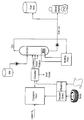
- An embodiment of the invention will now be described in more detail, by way of example only, with particular reference to the accompanying drawing, the sole figure of which schematically illustrates a plant for producing fuel from used tyres or other waste material.
- In the drawing there is shown a shredding plant for shredding tyres and plastics materials. The shredded tyres are fed to a cryogenic plant for cooling to the glass transition temperature to produce crumb rubber and this together with the shredded plastics material are fed to a reactor, e.g. through a sluicing system such as a so-called lock-hopper system. A separate pipe feeds oils through a pump into the reactor. There is a pressure of from 15 - 50 bars, preferably 15-30 bars, in the reactor where the rubber and oils are mixed together. The reactor is heated by steam or a hot oil system to a temperature of approximately 300-405 °C, preferably from 320-385 °C. A decomposition of the solid hydrocarbons takes place in the reactor and the long chained compounds are cracked in the oils thereby creating a homogenous mixture which is pumped out from the bottom of the reactor.
- The high temperature in the reactor makes the solid hydrocarbons and the oils give off gases which may be released from the top of the reactor. However, to obtain favourable diesel fuel features, it is important to keep as much as possible of the gases dissolved in the fuel. This can be achieved by using a low temperature cracking process of catalysts containing, for example, nickel and/or molybdenum. The released gases can be used together with fuel oil as fuel in a steam boiler or a hot oil system for heating the reactor.
- The liquid fuel produced is cooled and can be fed directly to a diesel engine for power and heat generation or stored in an intermediate tank for later consumption.
- The diesel engine should of course be of a type which is able to operate, when necessary, also on heavy fuel oils or the like, and it should also be equipped with appropriate facilities for cleaning of diesel exhaust gases in order to meet local emission standards.
- By making use of the cryogenic process, the quality of the crumb rubber and milled rubber is better suited for processing in the reactor, and it makes it easier to separate in a classifier the steel wires, textiles and other impurities of the tyres before the rubber material is fed into the reactor. Thus, the reactor can be continuously used without the need to periodically clean it to remove the steel and textile. However, in some cases and in a smaller scale utilization of the process, it may be of advantage to directly feed the shredded tyres into the reactor so as to save the costs of a cryogenic plant, although this entails cleaning the reactor of steel, textile and possibly larger unprocessed rubber parts.
- The shredding of the spent tyres to produce crumb rubber may be performed in any known manner. For example, shredding to produce fragmented rubber may be achieved in a mechanical shredder or by the use of high pressure water jets as is known per se.
- The invention is not limited to the embodiment shown and described but several modifications are feasible within the scope of the attached claims.
Claims (11)
- A method of producing fuel from spent tyres or like waste rubber material for use in diesel engines, e.g. for the production of electricity and heating energy, characterised in that it includes the steps of:(a) fragmenting said tyres or the like waste rubber material and feeding the fragmented waste rubber material into a reactor;(b) feeding liquid hydrocarbons into the reactor and mixing them with said rubber material under a pressure of from 15 to 50 bar;(c) heating the mixture in the reactor to a temperature of from 300 to 405 °C to decompose the solid hydrocarbons and crack the long chained compounds into oils to thereby create a homogenous mixture;(d) recovering gases released in the reactor in step (c); and,(e) after step (c), pumping the homogeneous mixture from the reactor and cooling the homogeneous mixture so that it is ready for utilisation as fuel oil in diesel engines.
- A method according to claim 1, characterised in that the waste rubber material is fragmented prior to being fed into the reactor by shredding and breaking down said tyres or waste rubber material to produce crumb rubber material.
- A method according to claim 1 or 2, characterised in that the liquid hydrocarbons comprise diesel oil, heavy fuel oil and/or lubricating oil.
- A method according to claim 1, 2 or 3, characterised in that the pressure in the reactor is from 15 to 30 bar.
- A method according to any of claims 1 to 4, characterised in that the mixture in the reactor is heated to from 320 to 385°C.
- A method according to claim 2 or any one of claims 3 to 5 when dependent on claim 2, characterised in that in step (a), after shredding, the tyres or like waste rubber material are cooled under a cryogenic process to the glass transition temperature.
- A method according to any one of the preceding claims, characterised in that, in step (a), unwanted materials, for example steel wires and textiles, are removed before feeding of the remaining rubber material into the reactor.
- A method according to any one of the preceding claims, characterised in that in step (b), fragmented, e.g. shredded, waste plastic materials are also fed into the reactor.
- A method according to any of one of the preceding claims, characterised in that the mixture in the reactor comprises from about 40-60% of material from said tyres or like waste rubber material.
- A method according to any of the preceding claims, characterised in that in step (c) catalysts, preferably containing nickel and/or molybdenum, are added to the reactor to keep as much as possible of any gases dissolved in the fuel mixture.
- A method according to any one of the preceding claims, characterised in that at least some of the gases released and recovered in step (d) are used as fuel for heating of the reactor.
Applications Claiming Priority (2)
| Application Number | Priority Date | Filing Date | Title |
|---|---|---|---|
| FI944244 | 1994-09-13 | ||
| FI944244A FI944244A0 (en) | 1994-09-13 | 1994-09-13 | Foerfarande Foer framstaellning av dieselmotorbraensle av bildaeck ocjikne avfallsgummimaterial |
Publications (2)
| Publication Number | Publication Date |
|---|---|
| EP0702076A1 EP0702076A1 (en) | 1996-03-20 |
| EP0702076B1 true EP0702076B1 (en) | 1999-03-03 |
Family
ID=8541361
Family Applications (1)
| Application Number | Title | Priority Date | Filing Date |
|---|---|---|---|
| EP95306187A Expired - Lifetime EP0702076B1 (en) | 1994-09-13 | 1995-09-05 | A method for producing fuel for diesel engines from tyres or the like waste rubber material |
Country Status (6)
| Country | Link |
|---|---|
| EP (1) | EP0702076B1 (en) |
| JP (1) | JPH08104881A (en) |
| AT (1) | ATE177138T1 (en) |
| DE (1) | DE69508016T2 (en) |
| DK (1) | DK0702076T3 (en) |
| FI (1) | FI944244A0 (en) |
Families Citing this family (7)
| Publication number | Priority date | Publication date | Assignee | Title |
|---|---|---|---|---|
| US6399393B1 (en) * | 1999-09-21 | 2002-06-04 | The United States Of America As Represented By The Department Of Energy | Cryogenic homogenization and sampling of heterogeneous multi-phase feedstock |
| ITFI20040127A1 (en) * | 2004-06-09 | 2004-09-09 | Franco Fini | PLANT AND PROCEDURE FOR THE PRODUCTION OF COMBUSTIBLE SUBSTANCES BY DEPOLYMERIZATION OF RUBBER PRODUCTS |
| EP2242570B1 (en) * | 2007-11-29 | 2018-02-14 | Energy & Ecology S.r.l. | Method for the thermocatalytic depolymerisation of plastic material |
| US20090267349A1 (en) * | 2008-04-23 | 2009-10-29 | Spitzauer Michael P | Production Processes, Systems, Methods, and Apparatuses |
| JP5984556B2 (en) * | 2012-07-27 | 2016-09-06 | 株式会社タクマ | Diesel fuel production system and diesel fuel production method using the same |
| WO2017009390A1 (en) | 2015-07-14 | 2017-01-19 | Solvay Sa | A process for the treatment of a composition comprising thermoplastics |
| WO2026082774A1 (en) | 2024-10-15 | 2026-04-23 | Sarge R&D Bv | Process for upcycling synthetic and organic wastes into valuable commodities |
Citations (1)
| Publication number | Priority date | Publication date | Assignee | Title |
|---|---|---|---|---|
| EP0599795A1 (en) * | 1992-11-24 | 1994-06-01 | Petrofina S.A. | Polymer conversion process |
Family Cites Families (3)
| Publication number | Priority date | Publication date | Assignee | Title |
|---|---|---|---|---|
| US4108730A (en) * | 1977-03-14 | 1978-08-22 | Mobil Oil Corporation | Method for treatment of rubber and plastic wastes |
| US5061363A (en) * | 1990-10-09 | 1991-10-29 | The United States Of America As Represented By The United States Department Of Energy | Method for co-processing waste rubber and carbonaceous material |
| WO1995006682A1 (en) * | 1993-08-28 | 1995-03-09 | Hainan Yuecheng Development Corp. | A process for producing gasoline and diesel fuel oil from waste plastics and its apparatus |
-
1994
- 1994-09-13 FI FI944244A patent/FI944244A0/en not_active Application Discontinuation
-
1995
- 1995-09-05 EP EP95306187A patent/EP0702076B1/en not_active Expired - Lifetime
- 1995-09-05 DK DK95306187T patent/DK0702076T3/en active
- 1995-09-05 AT AT95306187T patent/ATE177138T1/en not_active IP Right Cessation
- 1995-09-05 DE DE69508016T patent/DE69508016T2/en not_active Expired - Fee Related
- 1995-09-12 JP JP7233989A patent/JPH08104881A/en active Pending
Patent Citations (1)
| Publication number | Priority date | Publication date | Assignee | Title |
|---|---|---|---|---|
| EP0599795A1 (en) * | 1992-11-24 | 1994-06-01 | Petrofina S.A. | Polymer conversion process |
Also Published As
| Publication number | Publication date |
|---|---|
| ATE177138T1 (en) | 1999-03-15 |
| DK0702076T3 (en) | 1999-10-04 |
| FI944244A0 (en) | 1994-09-13 |
| DE69508016T2 (en) | 1999-08-12 |
| EP0702076A1 (en) | 1996-03-20 |
| DE69508016D1 (en) | 1999-04-08 |
| JPH08104881A (en) | 1996-04-23 |
Similar Documents
| Publication | Publication Date | Title |
|---|---|---|
| KR102262779B1 (en) | Methods and devices for pyrolysis emulsifying the continuous injection of waste synthetic resins and flammable wastes, as well as continuous discharge of pyrolysis by-products and producing high-quality without the discharge of fine dust and wastewater | |
| KR101861753B1 (en) | Internal Combustion Engine Generation System and Method for Pyrolysis Liquefaction for Synthetic Polymer Waste | |
| CN112955525B (en) | Process for depolymerizing plastic material for producing hydrocarbons and apparatus therefor | |
| Wu et al. | Life cycle assessment of waste tire recycling: Upgraded pyrolytic products for new tire production | |
| CN103464448B (en) | A kind of rubbish thermal cracking treatment process | |
| EP0702076A1 (en) | A method for producing fuel for diesel engines from tyres or the like waste rubber material | |
| AU2006344570A1 (en) | Waste-tire recycling system | |
| US20020159931A1 (en) | Method and facility for recycling organic wastes without pollution | |
| JPH1067991A (en) | Conversion of plastic waste into oil and apparatus therefor | |
| KR20020072889A (en) | the pyrolysis waste recycling method and system | |
| DE102007047931A1 (en) | Thermal degassing of organic waste uses a main reactor, together with catalyst additives, to give active coke and a gas with an oil content free of tar and dioxin | |
| JP2002060757A (en) | Waste plastic recycling system | |
| JPH0762353A (en) | Method for removing chlorine from molten plastic by blowing nitrogen into general waste plastic oil treatment equipment | |
| JP3611306B2 (en) | Oil recovery method from waste plastic | |
| KR20020095289A (en) | CRACKING PROCESS and EQUIPMENT for The Plastic WASTE | |
| KR100494382B1 (en) | Method of manufacturing the solid fuel using thermal cracking wax of waste plastics | |
| KR20000036903A (en) | Pyrolysis waste recycling method and system | |
| FI98638C (en) | Process for the production of diesel fuel from vehicle tires or similar waste rubber | |
| KR100610446B1 (en) | How to thermally recycle car waste | |
| KR20250037799A (en) | Continuous powered thermal decomposition emulsifier | |
| Abramenko et al. | Innovative approaches to plastic waste recycling using the example of the textile industry | |
| KR102737066B1 (en) | the low temperature pyrolysis emulsifier system among the continuous operation type and method | |
| CN111909714A (en) | Energy conversion processing technology based on continuous treatment of marine plastic waste | |
| US20220275282A1 (en) | Method and apparatus for hydrocracking mineralized refuse pyrolysis oil | |
| KR102879186B1 (en) | Low-temperature pyrolysis oil production device with eco-friendly energy saving structure, high-performance pyrolysis oil production structure and excellent economic feasibility |
Legal Events
| Date | Code | Title | Description |
|---|---|---|---|
| PUAI | Public reference made under article 153(3) epc to a published international application that has entered the european phase |
Free format text: ORIGINAL CODE: 0009012 |
|
| AK | Designated contracting states |
Kind code of ref document: A1 Designated state(s): AT CH DE DK FR GB LI NL SE |
|
| 17P | Request for examination filed |
Effective date: 19960621 |
|
| 17Q | First examination report despatched |
Effective date: 19980311 |
|
| RAP1 | Party data changed (applicant data changed or rights of an application transferred) |
Owner name: WAERTSILAE NSD OY AB |
|
| GRAG | Despatch of communication of intention to grant |
Free format text: ORIGINAL CODE: EPIDOS AGRA |
|
| GRAG | Despatch of communication of intention to grant |
Free format text: ORIGINAL CODE: EPIDOS AGRA |
|
| GRAH | Despatch of communication of intention to grant a patent |
Free format text: ORIGINAL CODE: EPIDOS IGRA |
|
| GRAH | Despatch of communication of intention to grant a patent |
Free format text: ORIGINAL CODE: EPIDOS IGRA |
|
| GRAA | (expected) grant |
Free format text: ORIGINAL CODE: 0009210 |
|
| AK | Designated contracting states |
Kind code of ref document: B1 Designated state(s): AT CH DE DK FR GB LI NL SE |
|
| REF | Corresponds to: |
Ref document number: 177138 Country of ref document: AT Date of ref document: 19990315 Kind code of ref document: T |
|
| REG | Reference to a national code |
Ref country code: CH Ref legal event code: NV Representative=s name: A. BRAUN, BRAUN, HERITIER, ESCHMANN AG PATENTANWAE Ref country code: CH Ref legal event code: EP |
|
| REF | Corresponds to: |
Ref document number: 69508016 Country of ref document: DE Date of ref document: 19990408 |
|
| ET | Fr: translation filed | ||
| REG | Reference to a national code |
Ref country code: DK Ref legal event code: T3 |
|
| PLBE | No opposition filed within time limit |
Free format text: ORIGINAL CODE: 0009261 |
|
| STAA | Information on the status of an ep patent application or granted ep patent |
Free format text: STATUS: NO OPPOSITION FILED WITHIN TIME LIMIT |
|
| 26N | No opposition filed | ||
| PGFP | Annual fee paid to national office [announced via postgrant information from national office to epo] |
Ref country code: AT Payment date: 20010810 Year of fee payment: 7 |
|
| PGFP | Annual fee paid to national office [announced via postgrant information from national office to epo] |
Ref country code: FR Payment date: 20010813 Year of fee payment: 7 |
|
| PGFP | Annual fee paid to national office [announced via postgrant information from national office to epo] |
Ref country code: DK Payment date: 20010814 Year of fee payment: 7 |
|
| PGFP | Annual fee paid to national office [announced via postgrant information from national office to epo] |
Ref country code: SE Payment date: 20010817 Year of fee payment: 7 Ref country code: GB Payment date: 20010817 Year of fee payment: 7 |
|
| PGFP | Annual fee paid to national office [announced via postgrant information from national office to epo] |
Ref country code: NL Payment date: 20010820 Year of fee payment: 7 Ref country code: DE Payment date: 20010820 Year of fee payment: 7 Ref country code: CH Payment date: 20010820 Year of fee payment: 7 |
|
| REG | Reference to a national code |
Ref country code: GB Ref legal event code: IF02 |
|
| PG25 | Lapsed in a contracting state [announced via postgrant information from national office to epo] |
Ref country code: GB Free format text: LAPSE BECAUSE OF NON-PAYMENT OF DUE FEES Effective date: 20020905 Ref country code: AT Free format text: LAPSE BECAUSE OF NON-PAYMENT OF DUE FEES Effective date: 20020905 |
|
| PG25 | Lapsed in a contracting state [announced via postgrant information from national office to epo] |
Ref country code: SE Free format text: LAPSE BECAUSE OF NON-PAYMENT OF DUE FEES Effective date: 20020906 |
|
| PG25 | Lapsed in a contracting state [announced via postgrant information from national office to epo] |
Ref country code: LI Free format text: LAPSE BECAUSE OF NON-PAYMENT OF DUE FEES Effective date: 20020930 Ref country code: DK Free format text: LAPSE BECAUSE OF NON-PAYMENT OF DUE FEES Effective date: 20020930 Ref country code: CH Free format text: LAPSE BECAUSE OF NON-PAYMENT OF DUE FEES Effective date: 20020930 |
|
| PG25 | Lapsed in a contracting state [announced via postgrant information from national office to epo] |
Ref country code: NL Free format text: LAPSE BECAUSE OF NON-PAYMENT OF DUE FEES Effective date: 20030401 Ref country code: DE Free format text: LAPSE BECAUSE OF NON-PAYMENT OF DUE FEES Effective date: 20030401 |
|
| GBPC | Gb: european patent ceased through non-payment of renewal fee |
Effective date: 20020905 |
|
| REG | Reference to a national code |
Ref country code: DK Ref legal event code: EBP |
|
| EUG | Se: european patent has lapsed | ||
| REG | Reference to a national code |
Ref country code: CH Ref legal event code: PL |
|
| PG25 | Lapsed in a contracting state [announced via postgrant information from national office to epo] |
Ref country code: FR Free format text: LAPSE BECAUSE OF NON-PAYMENT OF DUE FEES Effective date: 20030603 |
|
| REG | Reference to a national code |
Ref country code: FR Ref legal event code: ST |