EP0700793B1 - Coloring fluid-containing marking device made of biodegradable plastic resin - Google Patents
Coloring fluid-containing marking device made of biodegradable plastic resin Download PDFInfo
- Publication number
- EP0700793B1 EP0700793B1 EP95112602A EP95112602A EP0700793B1 EP 0700793 B1 EP0700793 B1 EP 0700793B1 EP 95112602 A EP95112602 A EP 95112602A EP 95112602 A EP95112602 A EP 95112602A EP 0700793 B1 EP0700793 B1 EP 0700793B1
- Authority
- EP
- European Patent Office
- Prior art keywords
- marking device
- group
- alkylene group
- cycloalkylene
- solvent
- Prior art date
- Legal status (The legal status is an assumption and is not a legal conclusion. Google has not performed a legal analysis and makes no representation as to the accuracy of the status listed.)
- Expired - Lifetime
Links
Classifications
-
- C—CHEMISTRY; METALLURGY
- C08—ORGANIC MACROMOLECULAR COMPOUNDS; THEIR PREPARATION OR CHEMICAL WORKING-UP; COMPOSITIONS BASED THEREON
- C08G—MACROMOLECULAR COMPOUNDS OBTAINED OTHERWISE THAN BY REACTIONS ONLY INVOLVING UNSATURATED CARBON-TO-CARBON BONDS
- C08G18/00—Polymeric products of isocyanates or isothiocyanates
- C08G18/06—Polymeric products of isocyanates or isothiocyanates with compounds having active hydrogen
- C08G18/28—Polymeric products of isocyanates or isothiocyanates with compounds having active hydrogen characterised by the compounds used containing active hydrogen
- C08G18/40—High-molecular-weight compounds
- C08G18/42—Polycondensates having carboxylic or carbonic ester groups in the main chain
- C08G18/4236—Polycondensates having carboxylic or carbonic ester groups in the main chain containing only aliphatic groups
- C08G18/4238—Polycondensates having carboxylic or carbonic ester groups in the main chain containing only aliphatic groups derived from dicarboxylic acids and dialcohols
-
- C—CHEMISTRY; METALLURGY
- C08—ORGANIC MACROMOLECULAR COMPOUNDS; THEIR PREPARATION OR CHEMICAL WORKING-UP; COMPOSITIONS BASED THEREON
- C08G—MACROMOLECULAR COMPOUNDS OBTAINED OTHERWISE THAN BY REACTIONS ONLY INVOLVING UNSATURATED CARBON-TO-CARBON BONDS
- C08G2230/00—Compositions for preparing biodegradable polymers
-
- C—CHEMISTRY; METALLURGY
- C08—ORGANIC MACROMOLECULAR COMPOUNDS; THEIR PREPARATION OR CHEMICAL WORKING-UP; COMPOSITIONS BASED THEREON
- C08G—MACROMOLECULAR COMPOUNDS OBTAINED OTHERWISE THAN BY REACTIONS ONLY INVOLVING UNSATURATED CARBON-TO-CARBON BONDS
- C08G2390/00—Containers
-
- Y—GENERAL TAGGING OF NEW TECHNOLOGICAL DEVELOPMENTS; GENERAL TAGGING OF CROSS-SECTIONAL TECHNOLOGIES SPANNING OVER SEVERAL SECTIONS OF THE IPC; TECHNICAL SUBJECTS COVERED BY FORMER USPC CROSS-REFERENCE ART COLLECTIONS [XRACs] AND DIGESTS
- Y10—TECHNICAL SUBJECTS COVERED BY FORMER USPC
- Y10T—TECHNICAL SUBJECTS COVERED BY FORMER US CLASSIFICATION
- Y10T428/00—Stock material or miscellaneous articles
- Y10T428/13—Hollow or container type article [e.g., tube, vase, etc.]
- Y10T428/1352—Polymer or resin containing [i.e., natural or synthetic]
-
- Y—GENERAL TAGGING OF NEW TECHNOLOGICAL DEVELOPMENTS; GENERAL TAGGING OF CROSS-SECTIONAL TECHNOLOGIES SPANNING OVER SEVERAL SECTIONS OF THE IPC; TECHNICAL SUBJECTS COVERED BY FORMER USPC CROSS-REFERENCE ART COLLECTIONS [XRACs] AND DIGESTS
- Y10—TECHNICAL SUBJECTS COVERED BY FORMER USPC
- Y10T—TECHNICAL SUBJECTS COVERED BY FORMER US CLASSIFICATION
- Y10T428/00—Stock material or miscellaneous articles
- Y10T428/13—Hollow or container type article [e.g., tube, vase, etc.]
- Y10T428/1352—Polymer or resin containing [i.e., natural or synthetic]
- Y10T428/139—Open-ended, self-supporting conduit, cylinder, or tube-type article
-
- Y—GENERAL TAGGING OF NEW TECHNOLOGICAL DEVELOPMENTS; GENERAL TAGGING OF CROSS-SECTIONAL TECHNOLOGIES SPANNING OVER SEVERAL SECTIONS OF THE IPC; TECHNICAL SUBJECTS COVERED BY FORMER USPC CROSS-REFERENCE ART COLLECTIONS [XRACs] AND DIGESTS
- Y10—TECHNICAL SUBJECTS COVERED BY FORMER USPC
- Y10T—TECHNICAL SUBJECTS COVERED BY FORMER US CLASSIFICATION
- Y10T428/00—Stock material or miscellaneous articles
- Y10T428/13—Hollow or container type article [e.g., tube, vase, etc.]
- Y10T428/1352—Polymer or resin containing [i.e., natural or synthetic]
- Y10T428/1397—Single layer [continuous layer]
Definitions
- the present invention relates to a marking device made of a biodegradable plastic resin which can contribute to reduction of accumulation of waste.
- An object of the present invention is to provide coloring fluid-containing marking devices which use a molded article of a biodegradable plastic resin as a molded part, such as an coloring fluid container, a barrel, or a cap, and still withstand practical use.
- aliphatic polyesters optionally containing urethane bonds synthesized mainly from a glycol and an aliphatic dicarboxylic acid possess both biodegradability and moldability, so that the present inventors studied them as a candidate applicable to parts of marking devices.
- aliphatic polyesters optionally containing urethane bonds exhibit no barrier properties against vapor of solvents commonly employed in coloring fluids of marking devices, such as water, alcohols and xylene. Therefore, where a coloring fluid containing a conventional solvent is used in a marking device made of aliphatic polyester optionally containing urethane bonds molded articles, the solvent would permeate through the molded articles and evaporate, shortly making the device practically useless for writing or painting.
- the marking devices according to the present invention comprise a molded article obtained from an aliphatic polyester optionally containing urethane bonds, which is a biodegradable plastic resin, and a coloring fluid comprising a solvent selected from an aliphatic hydrocarbon, an alicyclic hydrocarbon and a mixture thereof, and a resin soluble in that solvent.
- the present invention provides a marking device comprising a container containing a coloring fluid therein, said container being a molded article of an aliphatic polyester optionally containing urethane bonds, and said coloring fluid comprising a colorant, a solvent mainly comprising a member selected from the group consisting of an aliphatic hydrocarbon, an alicyclic hydrocarbon and a mixture thereof, and a resin soluble in said solvent.
- Illustrative examples of the marking device of the present invention include writing devices, painting devices, etc. such as ball-point pens, marking pens, drawing pens, and the like.
- Illustrative examples of the molded article constituting the marking device of the present invention include ink containers, barrels, caps, pen-tip holding parts, tail plugs, ink containers provided as a separate part, and the like.
- Aliphatic polyesters are polymers obtained by polycondensation using as main components a glycol and an aliphatic dicarboxylic acid and they are commercially available.
- aliphatic polyesters optionally containing urethane bonds having the structure represented by formula (I) or (II) shown below are preferable (cf. unexamined published Japanese patent application 6-41288 corresponding to EP-A2-572256 and U.S. Patent No. 5,310,782, incorporated herein by reference).
- m represents a degree of polymerization making the number average molecular weight 10,000 to 100,000
- M represents an integer of 0 or more
- R 1 and R 2 which may be the same or different, each represent an alkylene group, a cycloalkylene group, or a cycloalkylene-containing alkylene group, the alkylene group or alkylene moiety of which may be straight or branched
- R 3 represents a di- or polyisocyanate residue, wherein m' represents a degree of polymerization making the number average molecular weight 25,000 to 70,000
- R 1 and R 2 which may be the same or different, each represent an alkylene group, a cycloalkylene group, or a cycloalkylene-containing alkylene group, the alkylene group or alkylene moiety of which may be straight or branched.
- the alkylene group, cycloalkylene group and cycloalkylene-containing alkylene group represented by R 1 or R 2 may preferably have 2 to 10 carbon atoms, 3 to 10 carbon atoms, and 4 to 10 carbon atoms, respectively.
- the alkylene group and the alkylene moiety of the cycloalkylene-containing alkylene group may be straight or branched.
- the cycloalkylene-containing alkylene group means an alkylene group having a cycloalkylene group and illustrative examples thereof include a group represented by the formula:
- coloring fluid as used herein is a general term denoting inks, marking liquids, painting liquids, and the like.
- European patent application EP 0565235 A discloses aliphatic polyesters containing urethane bonds and aliphatic polyesters without urethane bonds. The latter have a lower molecular weight than the molecules of formula (II) of the present invention and are used as intermediates in the production of the urethane bond-containing aliphatic polyesters.
- Colorants which can be used in the coloring fluid include solvent dyes, such as Nigrosine Base EX, Oil Black HBB, Vali Fast Red 1308 or 1355, Oil Pink 312, Oil Yellow 101, 105 or 107, Oil Orange 201 or 203, and Oil Blue 613 (all produced by Orient Kagaku Kogyo K.K.), Spilon Yellow C-GNH, Spilon Red CGH, and Spilon Violet CRH (all produced by Hodogaya Chemical Co., Ltd.), Oleosol Black AR and Rhodamine B Base (both produced by Taoka Chemical Co., Ltd.), Neopene Blue 808 and Neptune Red Base 486 (both produced by BASF AG), and Savinyl Blue GLS (produced by Sandoz Ltd.); metallic luster pigments, such as aluminum pigment and gold pigment; inorganic pigments, such as titanium oxide and carbon black; insoluble azo pigments, such as ⁇ -naphthol type, naphthol AS type, benzimidazolone type
- Solvents which can be used in the coloring fluid include aliphatic hydrocarbons, such as n-pentane, n-hexane, 2-methylpentane, 2,2-dimethylbutane, 2,3-dimethylbutane, n-heptane, heptane isomers, n-octane, octane isomers, n-nonane, 2,2,5-trimethylhexane, n-decane, n-dodecane, and mineral spirit; and alicyclic hydrocarbons, such as cyclopentane, methylcyclopentane, cyclohexane, methylcyclohexane, ethylcyclohexane, isopropylcyclohexane, butylcyclohexane, and decalin; and hexane, heptane, methylcyclohexane, and ethylcyclohexan
- glycol solvents compatible with the above-mentioned main solvents such as hexylene glycol or octylene glycol, may be used as auxiliary solvents in an amount of less than 10% by weight based on the total solvents.
- Resins soluble in the above-mentioned solvents include alkyl phenol resins, terpene phenol resins, phenol-modified xylene resins, xylene resins, terpene resins, acrylic resins, methacrylic resins, aliphatic hydrocarbon resins, alicyclic hydrocarbon resins, alkyd resins, vinyl resins, polyester resins, vinyl alkyl ether resins, and styrene-butadiene elastomers, and the like.
- additives such as higher fatty acids (e.g., stearic acid and oleic acid), solid higher alcohols (e.g., myristyl alcohol and cetyl alcohol), animal or vegetable oils (e.g., castor oil and terpene oils), and acidic phosphoric esters, may be added as a solubilizer for the oil-soluble dyes.
- higher fatty acids e.g., stearic acid and oleic acid
- solid higher alcohols e.g., myristyl alcohol and cetyl alcohol
- animal or vegetable oils e.g., castor oil and terpene oils
- acidic phosphoric esters may be added as a solubilizer for the oil-soluble dyes.
- the above-described colorants, solvents, resins, and additives may be used in an amount of 3 to 30% by weight, 40 to 90% by weight, 3 to 30% by weight, and 0 to 5% by weight, respectively, based on the coloring fluid.
- the solvent mainly comprising an aliphatic hydrocarbon, an alicyclic hydrocarbon, or a mixture thereof does not swell aliphatic polyesters optionally containing urethane bonds, and the vapor of the solvent is hardly permeable into a layer of aliphatic polyester optionally containing urethane bonds.
- the marking devices of the present invention comprising a combination of aliphatic polyester optionally containing urethane bonds molded articles and the above-described coloring fluid are practically useful equally to conventional marking devices and yet the molded articles can be biologically degraded in soil after use.
- a marking pen having the following structure was manufactured as a typical example of marking devices and subjected to the tests described below.
- An aliphatic polyester resin containing urethane bonds (“ BIONOLLE #1000", produced by Showa Highpolymer Co., Ltd.) was molded to prepare three parts: a cylindrical barrel with its one end open and with the other end shaped into a small diameter pen-tip holding part, a cap which is designed to fit on the pen-tip holding part hermetically, and a tail plug which is to be fitted into the open end of the barrel.
- a pen-tip of a fiber bundle-resin was inserted into the pen-tip holding part, and an ink absorber made of a fiber bundle having been impregnated with a sample ink was put into the barrel.
- the tail plug was fitted into the open end of the barrel, and the cap was fitted on the pen-tip holding part to complete a sample marking pen.
- the main body of the barrel and the main body of the cap had a wall thickness of from 1.0 to 1.1 mm.
- the main body of the barrel had an outer diameter of 20 mm at the tail end and 18 mm at the front.
- the pen-tip holding part had an outer diameter of 8 mm.
- the total length of the marking pen was 155 mm.
- sample inks A to D and P to S used in the sample marking pens are shown in Table 1.
- Sample inks A to D are the ones using a solvent mainly comprising an aliphatic hydrocarbon and/or an alicyclic hydrocarbon in a proportion of 90% by weight or more based on the total solvents, while sample inks P to S are those using other solvents.
- Sample inks A to D were used in Examples 1 to 4, and sample inks P to S Comparative Examples 1 to 4. Fifteen marking pens were prepared per sample ink; 5 for an aging test at room temperature and 10 for an aging test in a thermostat at 40°C.
- the sample marking pens using a conventional solvent other than the solvents specified in the present invention suffer serious loss of the solvent due to vapor permeation through the container and therefore withstand no practical use.
- the sample marking pens according to the present invention withstand preservation even at a high temperature and are sufficiently applicable to practical use.
- the aliphatic polyester optionally containing urethane bonds used as a container material is biodegradable, i.e., undergoes biodegradation in soil after use, thereby making a contribution to reduction of accumulation of waste.
Landscapes
- Chemical & Material Sciences (AREA)
- Health & Medical Sciences (AREA)
- Chemical Kinetics & Catalysis (AREA)
- Medicinal Chemistry (AREA)
- Polymers & Plastics (AREA)
- Organic Chemistry (AREA)
- Inks, Pencil-Leads, Or Crayons (AREA)
- Pens And Brushes (AREA)
- Coating Apparatus (AREA)
- Biological Depolymerization Polymers (AREA)
Description
- The present invention relates to a marking device made of a biodegradable plastic resin which can contribute to reduction of accumulation of waste.
- Several kinds of naturally degradable plastic resins have recently been proposed, and it has been attempted to apply them in various fields. For example, application to molded parts of marking devices, such as a barrel or a cap, has been attempted. However, biodegradable starch-based polymers are instable against humidity or water, starch-polyethylene-based polymers leave polyethylene undegraded, and photolyzable plastic resins have difficulty in storing before use and in selecting a photosensitizer and also entail a high cost. Aliphatic polyesters which are most expected to be practically useful encounter difficulties when applied as a molding material for a barrel, a cap, etc. of marking devices containing a coloring fluid because these polymers have very high permeability to vapor of the solvent in the coloring fluid. For the time being, application of biodegradable plastic resins to marking devices is limited to barrels of pencils containing no liquid.
- An object of the present invention is to provide coloring fluid-containing marking devices which use a molded article of a biodegradable plastic resin as a molded part, such as an coloring fluid container, a barrel, or a cap, and still withstand practical use.
- Of currently available naturally degradable plastic resins, aliphatic polyesters optionally containing urethane bonds synthesized mainly from a glycol and an aliphatic dicarboxylic acid possess both biodegradability and moldability, so that the present inventors studied them as a candidate applicable to parts of marking devices.
- However, aliphatic polyesters optionally containing urethane bonds exhibit no barrier properties against vapor of solvents commonly employed in coloring fluids of marking devices, such as water, alcohols and xylene. Therefore, where a coloring fluid containing a conventional solvent is used in a marking device made of aliphatic polyester optionally containing urethane bonds molded articles, the solvent would permeate through the molded articles and evaporate, shortly making the device practically useless for writing or painting.
- Taking the above problem into consideration, the inventors have investigated combinations of coloring fluids containing various solvents and aliphatic polyester optionally containing urethane bonds molded articles, and completed the present invention.
- Thus, the marking devices according to the present invention comprise a molded article obtained from an aliphatic polyester optionally containing urethane bonds, which is a biodegradable plastic resin, and a coloring fluid comprising a solvent selected from an aliphatic hydrocarbon, an alicyclic hydrocarbon and a mixture thereof, and a resin soluble in that solvent.
- That is, the present invention provides a marking device comprising a container containing a coloring fluid therein, said container being a molded article of an aliphatic polyester optionally containing urethane bonds, and said coloring fluid comprising a colorant, a solvent mainly comprising a member selected from the group consisting of an aliphatic hydrocarbon, an alicyclic hydrocarbon and a mixture thereof, and a resin soluble in said solvent.
- Illustrative examples of the marking device of the present invention include writing devices, painting devices, etc. such as ball-point pens, marking pens, drawing pens, and the like.
- Illustrative examples of the molded article constituting the marking device of the present invention include ink containers, barrels, caps, pen-tip holding parts, tail plugs, ink containers provided as a separate part, and the like.
- Aliphatic polyesters are polymers obtained by polycondensation using as main components a glycol and an aliphatic dicarboxylic acid and they are commercially available. For the use intended in the present invention, aliphatic polyesters optionally containing urethane bonds having the structure represented by formula (I) or (II) shown below are preferable (cf. unexamined published Japanese patent application 6-41288 corresponding to EP-A2-572256 and U.S. Patent No. 5,310,782, incorporated herein by reference).wherein m represents a degree of polymerization making the number average molecular weight 10,000 to 100,000; M represents an integer of 0 or more; R1 and R2, which may be the same or different, each represent an alkylene group, a cycloalkylene group, or a cycloalkylene-containing alkylene group, the alkylene group or alkylene moiety of which may be straight or branched; and R3 represents a di- or polyisocyanate residue,
 wherein m' represents a degree of polymerization making the number average molecular weight 25,000 to 70,000; and R1 and R2, which may be the same or different, each represent an alkylene group, a cycloalkylene group, or a cycloalkylene-containing alkylene group, the alkylene group or alkylene moiety of which may be straight or branched.
- The alkylene group, cycloalkylene group and cycloalkylene-containing alkylene group represented by R1 or R2 may preferably have 2 to 10 carbon atoms, 3 to 10 carbon atoms, and 4 to 10 carbon atoms, respectively. The alkylene group and the alkylene moiety of the cycloalkylene-containing alkylene group may be straight or branched. The cycloalkylene-containing alkylene group means an alkylene group having a cycloalkylene group and illustrative examples thereof include a group represented by the formula:

- The term "coloring fluid" as used herein is a general term denoting inks, marking liquids, painting liquids, and the like.
- European patent application EP 0565235 A discloses aliphatic polyesters containing urethane bonds and aliphatic polyesters without urethane bonds. The latter have a lower molecular weight than the molecules of formula (II) of the present invention and are used as intermediates in the production of the urethane bond-containing aliphatic polyesters.
- Colorants which can be used in the coloring fluid include solvent dyes, such as Nigrosine Base EX, Oil Black HBB, Vali Fast Red 1308 or 1355, Oil Pink 312, Oil Yellow 101, 105 or 107, Oil Orange 201 or 203, and Oil Blue 613 (all produced by Orient Kagaku Kogyo K.K.), Spilon Yellow C-GNH, Spilon Red CGH, and Spilon Violet CRH (all produced by Hodogaya Chemical Co., Ltd.), Oleosol Black AR and Rhodamine B Base (both produced by Taoka Chemical Co., Ltd.), Neopene Blue 808 and Neptune Red Base 486 (both produced by BASF AG), and Savinyl Blue GLS (produced by Sandoz Ltd.); metallic luster pigments, such as aluminum pigment and gold pigment; inorganic pigments, such as titanium oxide and carbon black; insoluble azo pigments, such as β-naphthol type, naphthol AS type, benzimidazolone type, acetoacetanilide type, and pyrazolone type; phthalocyanine pigments, such as Phthalocyanine Blue; condensed polycyclic pigments, such as threne pigments, indigoid pigments, perinone pigments, and quinacridone pigments; and fluorescent pigments.
- Solvents which can be used in the coloring fluid include aliphatic hydrocarbons, such as n-pentane, n-hexane, 2-methylpentane, 2,2-dimethylbutane, 2,3-dimethylbutane, n-heptane, heptane isomers, n-octane, octane isomers, n-nonane, 2,2,5-trimethylhexane, n-decane, n-dodecane, and mineral spirit; and alicyclic hydrocarbons, such as cyclopentane, methylcyclopentane, cyclohexane, methylcyclohexane, ethylcyclohexane, isopropylcyclohexane, butylcyclohexane, and decalin; and hexane, heptane, methylcyclohexane, and ethylcyclohexane are particularly preferred above all. These solvents occupy at least 90% by weight of the total solvent. These solvents may be used alone or as a mixture of two or more.
- If desired, glycol solvents compatible with the above-mentioned main solvents, such as hexylene glycol or octylene glycol, may be used as auxiliary solvents in an amount of less than 10% by weight based on the total solvents.
- Resins soluble in the above-mentioned solvents include alkyl phenol resins, terpene phenol resins, phenol-modified xylene resins, xylene resins, terpene resins, acrylic resins, methacrylic resins, aliphatic hydrocarbon resins, alicyclic hydrocarbon resins, alkyd resins, vinyl resins, polyester resins, vinyl alkyl ether resins, and styrene-butadiene elastomers, and the like.
- If desired, additives, such as higher fatty acids (e.g., stearic acid and oleic acid), solid higher alcohols (e.g., myristyl alcohol and cetyl alcohol), animal or vegetable oils (e.g., castor oil and terpene oils), and acidic phosphoric esters, may be added as a solubilizer for the oil-soluble dyes.
- The above-described colorants, solvents, resins, and additives may be used in an amount of 3 to 30% by weight, 40 to 90% by weight, 3 to 30% by weight, and 0 to 5% by weight, respectively, based on the coloring fluid.
- The solvent mainly comprising an aliphatic hydrocarbon, an alicyclic hydrocarbon, or a mixture thereof does not swell aliphatic polyesters optionally containing urethane bonds, and the vapor of the solvent is hardly permeable into a layer of aliphatic polyester optionally containing urethane bonds.
- Accordingly, the marking devices of the present invention comprising a combination of aliphatic polyester optionally containing urethane bonds molded articles and the above-described coloring fluid are practically useful equally to conventional marking devices and yet the molded articles can be biologically degraded in soil after use.
- A marking pen having the following structure was manufactured as a typical example of marking devices and subjected to the tests described below.
- An aliphatic polyester resin containing urethane bonds (" BIONOLLE #1000", produced by Showa Highpolymer Co., Ltd.) was molded to prepare three parts: a cylindrical barrel with its one end open and with the other end shaped into a small diameter pen-tip holding part, a cap which is designed to fit on the pen-tip holding part hermetically, and a tail plug which is to be fitted into the open end of the barrel. A pen-tip of a fiber bundle-resin was inserted into the pen-tip holding part, and an ink absorber made of a fiber bundle having been impregnated with a sample ink was put into the barrel. The tail plug was fitted into the open end of the barrel, and the cap was fitted on the pen-tip holding part to complete a sample marking pen.
- The main body of the barrel and the main body of the cap had a wall thickness of from 1.0 to 1.1 mm. The main body of the barrel had an outer diameter of 20 mm at the tail end and 18 mm at the front. The pen-tip holding part had an outer diameter of 8 mm. The total length of the marking pen was 155 mm.
- The compositions of sample inks A to D and P to S used in the sample marking pens are shown in Table 1. Sample inks A to D are the ones using a solvent mainly comprising an aliphatic hydrocarbon and/or an alicyclic hydrocarbon in a proportion of 90% by weight or more based on the total solvents, while sample inks P to S are those using other solvents.

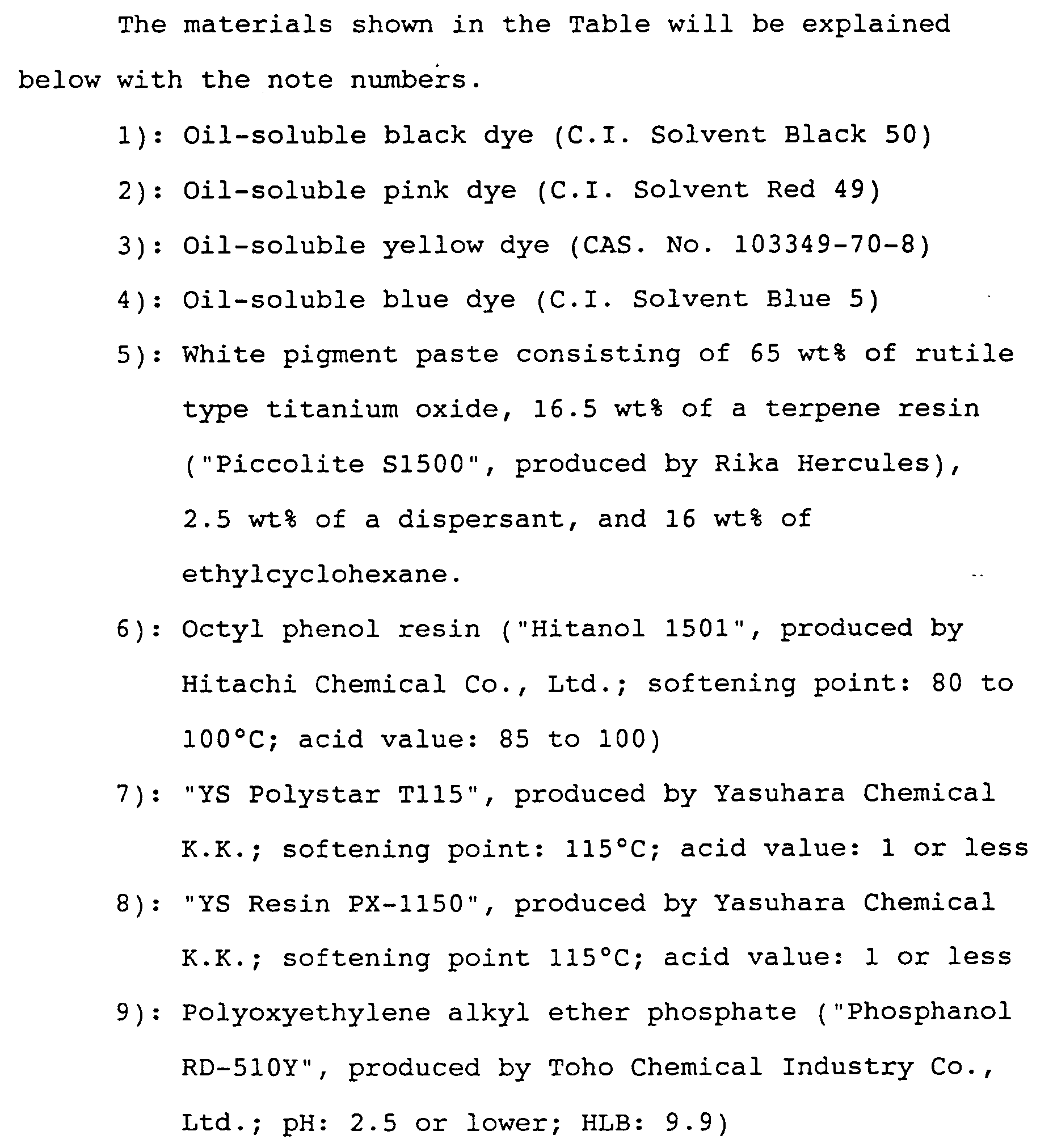
- Sample inks A to D were used in Examples 1 to 4, and sample inks P to S Comparative Examples 1 to 4. Fifteen marking pens were prepared per sample ink; 5 for an aging test at room temperature and 10 for an aging test in a thermostat at 40°C.
- The 5 marking pens (per ink) for a room temperature aging test and 5 marking pens (per ink) for a 40°C aging test were weighed immediately after the preparation and 1, 3, 5, 7 and 9 weeks thereafter an average solvent retention rate of each test group was calculated. The results obtained are shown in Table 2.

- The remaining 5 samples were preserved at 40°C and examined after 30 days and 60 days whether they were still useful for writing. The results obtained are shown in Table 3.
Examples 1 to 4 Comparative Examples 1 to 4 40°C × 30 dys. usable for writting in each case unusable for writing in each case 40°C × 60 dys. usable for writing in each case - - As can be seen from the test results, the sample marking pens using a conventional solvent other than the solvents specified in the present invention suffer serious loss of the solvent due to vapor permeation through the container and therefore withstand no practical use. To the contrary, the sample marking pens according to the present invention withstand preservation even at a high temperature and are sufficiently applicable to practical use.
- In addition, the aliphatic polyester optionally containing urethane bonds used as a container material is biodegradable, i.e., undergoes biodegradation in soil after use, thereby making a contribution to reduction of accumulation of waste.
Claims (7)
- A marking device comprising a container containing a coloring fluid therein, said container being a molded article of an aliphatic polyester optionally containing urethane bonds, and said coloring fluid comprising a colorant, a solvent mainly comprising a member selected from the group consisting of an aliphatic hydrocarbon, an alicyclic hydrocarbon and a mixture thereof, and a resin soluble in said solvent.
- The marking device according to claim 1, wherein said container is a barrel of said marking device.
- The marking device according to claim 1, wherein said marking device comprises a further molded article of an aliphatic polyester.
- The marking device according to claim 1, 2, or 3, wherein said aliphatic polyester optionally containing urethane bonds is represented by formula (I) or (II):wherein m represents a degree of polymerization making the number average molecular weight 10,000 to 100,000;
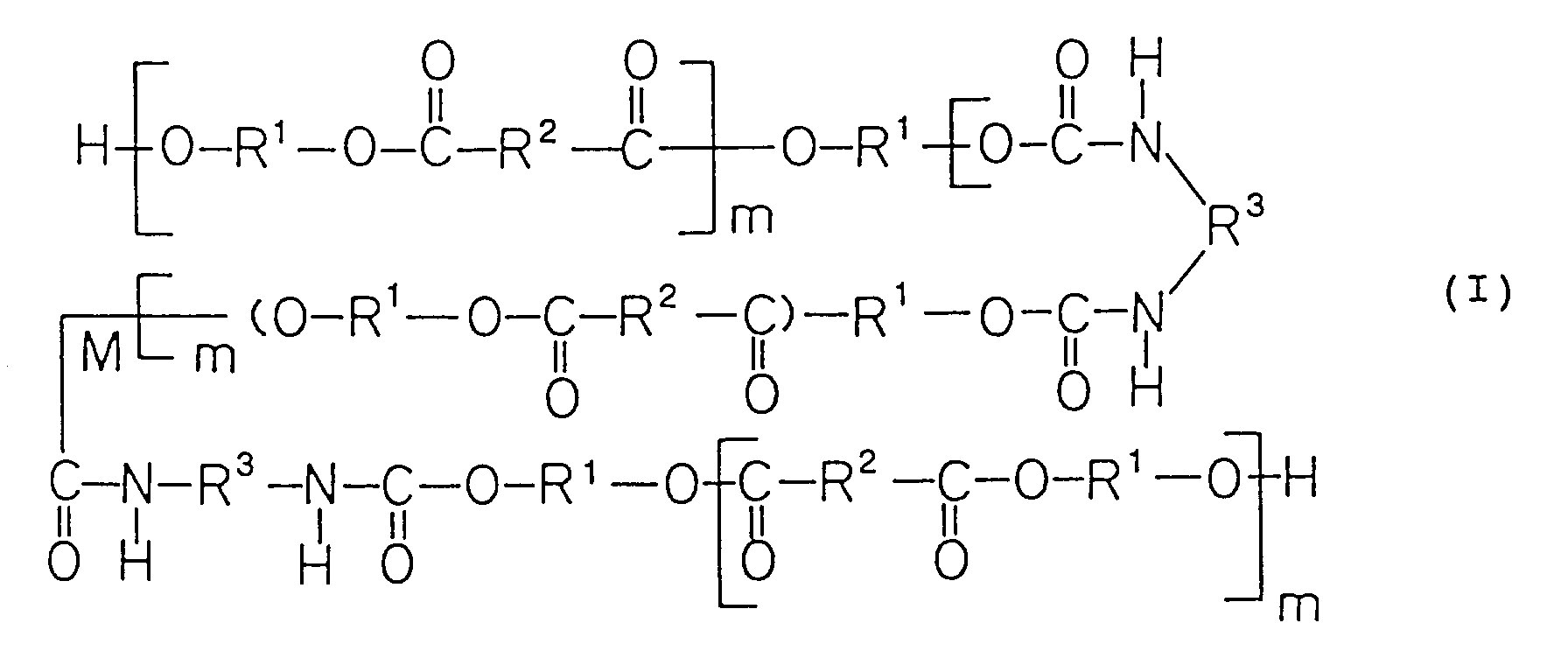 M represents an integer of 0 or more; R1 and R2, which may be the same or different, each represent an alkylene group, a cycloalkylene group, or a cycloalkylene-containing alkylene group, in which the alkylene group or alkylene moiety may be straight or branched; and R3 represents a di- or polyisocyanate residue,wherein m' represents a degree of polymerization making the number average molecular weight 25,000 to 70,000; and R1 and R2, which may be the same or different, each represent an alkylene group, a cycloalkylene group, or a cycloalkylene-containing alkylene group, in which the alkylene group or alkylene moiety may be straight or branched.
- The marking device according to claim 4, wherein R1 and R2, which may be the same or different, each represent an alkylene group having 2 to 10 carbon atoms, a cycloalkylene group having 3 to 10 carbon atoms, or a cycloalkylene-containing alkylene group having 4 to 10 carbon atoms, in which the alkylene group or alkylene moiety may be straight or branched.
- The marking device according to claim 1, wherein 90% by weight or more of the solvent of the coloring fluid is a member selected from the group consisting of an aliphatic hydrocarbon, an alicyclic hydrocarbon and a mixture thereof.
- The marking device according to claim 6, wherein said solvent comprises a member selected from the group consisting of methylcyclohexane, ethylcyclohexane, hexane, heptane, and a mixture of two or more thereof.
Applications Claiming Priority (3)
| Application Number | Priority Date | Filing Date | Title |
|---|---|---|---|
| JP21217194A JP3502998B2 (en) | 1994-08-11 | 1994-08-11 | Biodegradable plastic writing or applicator with built-in colored liquid |
| JP21217194 | 1994-08-11 | ||
| JP212171/94 | 1994-08-11 |
Publications (3)
| Publication Number | Publication Date |
|---|---|
| EP0700793A2 EP0700793A2 (en) | 1996-03-13 |
| EP0700793A3 EP0700793A3 (en) | 1996-08-07 |
| EP0700793B1 true EP0700793B1 (en) | 1999-06-16 |
Family
ID=16618088
Family Applications (1)
| Application Number | Title | Priority Date | Filing Date |
|---|---|---|---|
| EP95112602A Expired - Lifetime EP0700793B1 (en) | 1994-08-11 | 1995-08-10 | Coloring fluid-containing marking device made of biodegradable plastic resin |
Country Status (5)
| Country | Link |
|---|---|
| US (1) | US5700534A (en) |
| EP (1) | EP0700793B1 (en) |
| JP (1) | JP3502998B2 (en) |
| CA (1) | CA2155480A1 (en) |
| DE (1) | DE69510286T2 (en) |
Families Citing this family (7)
| Publication number | Priority date | Publication date | Assignee | Title |
|---|---|---|---|---|
| JP4258027B2 (en) * | 1996-12-26 | 2009-04-30 | ぺんてる株式会社 | Oil-based red ink |
| US7063475B2 (en) * | 2001-08-29 | 2006-06-20 | Mitsubishi Pencil Kabushiki Kaisha | Ink-storing body for writing utensil |
| JP2009046690A (en) * | 2008-10-30 | 2009-03-05 | Pentel Corp | Oil-based red ink |
| US20100272499A1 (en) * | 2009-04-23 | 2010-10-28 | Erik Wysocan | Environmentally friendly disposable pen |
| US9290036B2 (en) | 2013-03-14 | 2016-03-22 | Crayola Llc | Roller ball pen for use with metallic inks |
| US9260617B2 (en) * | 2013-06-20 | 2016-02-16 | Inner Mongolia Xianhong Science Co. Ltd | Inkjet ink composition for printing irremovable trace marks on substrates for enhancing product authenticity and traceability |
| JP7715356B2 (en) * | 2023-01-10 | 2025-07-30 | ▲ケン▼瓏實業股▲分▼有限公司 | Biodegradable Marker Pens |
Citations (1)
| Publication number | Priority date | Publication date | Assignee | Title |
|---|---|---|---|---|
| EP0572256A2 (en) * | 1992-05-29 | 1993-12-01 | Showa Highpolymer Co., Ltd. | Preparation of biodegradable high molecular weight aliphatic polyesters |
Family Cites Families (9)
| Publication number | Priority date | Publication date | Assignee | Title |
|---|---|---|---|---|
| US3427967A (en) * | 1966-04-25 | 1969-02-18 | Donnelley & Sons Co | Method of printing with low condensate printing ink |
| JPS61243873A (en) * | 1985-04-20 | 1986-10-30 | Sakura Color Prod Corp | Ink composition |
| US4923317A (en) * | 1987-03-04 | 1990-05-08 | Avery International Corporation | Brushless white-out correcting fluid applicator |
| US5131776A (en) * | 1990-07-13 | 1992-07-21 | Binney & Smith Inc. | Aqueous permanent coloring composition for a marker |
| JP3179177B2 (en) * | 1992-04-10 | 2001-06-25 | 昭和高分子株式会社 | Aliphatic polyesters containing urethane bonds |
| US5391644A (en) * | 1992-05-08 | 1995-02-21 | Showa Highpolymer Co., Ltd. | Polyester injection-molded articles |
| JPH069910A (en) * | 1992-06-26 | 1994-01-18 | Seiko Epson Corp | Ink composition |
| JPH069010A (en) * | 1992-06-26 | 1994-01-18 | Kawasaki Steel Corp | Roll pallet and loading / unloading stand in automated warehouse |
| US5383737A (en) * | 1993-04-16 | 1995-01-24 | Graphic Controls Corporation | Hand writing device |
-
1994
- 1994-08-11 JP JP21217194A patent/JP3502998B2/en not_active Expired - Fee Related
-
1995
- 1995-08-04 CA CA002155480A patent/CA2155480A1/en not_active Abandoned
- 1995-08-04 US US08/511,150 patent/US5700534A/en not_active Expired - Fee Related
- 1995-08-10 DE DE69510286T patent/DE69510286T2/en not_active Expired - Fee Related
- 1995-08-10 EP EP95112602A patent/EP0700793B1/en not_active Expired - Lifetime
Patent Citations (1)
| Publication number | Priority date | Publication date | Assignee | Title |
|---|---|---|---|---|
| EP0572256A2 (en) * | 1992-05-29 | 1993-12-01 | Showa Highpolymer Co., Ltd. | Preparation of biodegradable high molecular weight aliphatic polyesters |
Also Published As
| Publication number | Publication date |
|---|---|
| US5700534A (en) | 1997-12-23 |
| CA2155480A1 (en) | 1996-02-12 |
| DE69510286D1 (en) | 1999-07-22 |
| EP0700793A2 (en) | 1996-03-13 |
| EP0700793A3 (en) | 1996-08-07 |
| DE69510286T2 (en) | 1999-11-18 |
| JPH0852408A (en) | 1996-02-27 |
| JP3502998B2 (en) | 2004-03-02 |
Similar Documents
| Publication | Publication Date | Title |
|---|---|---|
| US4460727A (en) | Water base pigment ink composition for writing | |
| CN101940890B (en) | Dispersants | |
| KR890003443B1 (en) | Intially erasable ink composition for a ball point writing instrument | |
| US5700534A (en) | Coloring fluid-containing marking device made of biodegradable plastic resin | |
| US7799847B2 (en) | Water-based ink composition for writing instruments | |
| DE344379T1 (en) | FLUORESCENT INK CONTAINING WATER DYE FOR WRITING INSTRUMENTS. | |
| KR100290049B1 (en) | W / 0 type ink | |
| JPH09111176A (en) | Oil-based ink composition for marking pen | |
| JP2010189490A (en) | Oily ink composition | |
| JP3810895B2 (en) | Ink composition for oil-based marking pen | |
| JPH1112518A (en) | Oil-based ink | |
| JP3897320B2 (en) | Oil-based marking pen | |
| CN103562262A (en) | Polyester quaternary salt and its composition | |
| EP3872141A1 (en) | Writing gel ink for pens without follower | |
| US20010009934A1 (en) | Tacky ink and pen using same | |
| JP2003138174A (en) | Oil-based ink | |
| JP2007099860A (en) | Ink composition for oily marking pen | |
| JPH05247400A (en) | Oily marking pen ink composition | |
| JP6337704B2 (en) | Marking pen ink | |
| JP3437326B2 (en) | Oil-based ink for writing surfaces with easily drawn lines | |
| JPH07238234A (en) | Aqueous pigment dispersion and method for producing the same | |
| JP2004262986A (en) | Oil-based ink | |
| JPH10168374A (en) | Ink composition for oil marking pen | |
| JP2025118027A (en) | Water-based ink composition for writing implements and writing implements containing the same | |
| JP2004083881A (en) | Oil-based ink composition for ballpoint pens |
Legal Events
| Date | Code | Title | Description |
|---|---|---|---|
| PUAI | Public reference made under article 153(3) epc to a published international application that has entered the european phase |
Free format text: ORIGINAL CODE: 0009012 |
|
| AK | Designated contracting states |
Kind code of ref document: A2 Designated state(s): DE FR GB IT |
|
| PUAL | Search report despatched |
Free format text: ORIGINAL CODE: 0009013 |
|
| AK | Designated contracting states |
Kind code of ref document: A3 Designated state(s): DE FR GB IT |
|
| 17P | Request for examination filed |
Effective date: 19961017 |
|
| 17Q | First examination report despatched |
Effective date: 19980113 |
|
| GRAG | Despatch of communication of intention to grant |
Free format text: ORIGINAL CODE: EPIDOS AGRA |
|
| GRAG | Despatch of communication of intention to grant |
Free format text: ORIGINAL CODE: EPIDOS AGRA |
|
| GRAH | Despatch of communication of intention to grant a patent |
Free format text: ORIGINAL CODE: EPIDOS IGRA |
|
| GRAH | Despatch of communication of intention to grant a patent |
Free format text: ORIGINAL CODE: EPIDOS IGRA |
|
| GRAA | (expected) grant |
Free format text: ORIGINAL CODE: 0009210 |
|
| AK | Designated contracting states |
Kind code of ref document: B1 Designated state(s): DE FR GB IT |
|
| REF | Corresponds to: |
Ref document number: 69510286 Country of ref document: DE Date of ref document: 19990722 |
|
| ITF | It: translation for a ep patent filed | ||
| ET | Fr: translation filed | ||
| PLBE | No opposition filed within time limit |
Free format text: ORIGINAL CODE: 0009261 |
|
| STAA | Information on the status of an ep patent application or granted ep patent |
Free format text: STATUS: NO OPPOSITION FILED WITHIN TIME LIMIT |
|
| 26N | No opposition filed | ||
| REG | Reference to a national code |
Ref country code: GB Ref legal event code: IF02 |
|
| PGFP | Annual fee paid to national office [announced via postgrant information from national office to epo] |
Ref country code: GB Payment date: 20020807 Year of fee payment: 8 |
|
| PGFP | Annual fee paid to national office [announced via postgrant information from national office to epo] |
Ref country code: FR Payment date: 20020808 Year of fee payment: 8 |
|
| PGFP | Annual fee paid to national office [announced via postgrant information from national office to epo] |
Ref country code: DE Payment date: 20020816 Year of fee payment: 8 |
|
| PG25 | Lapsed in a contracting state [announced via postgrant information from national office to epo] |
Ref country code: GB Free format text: LAPSE BECAUSE OF NON-PAYMENT OF DUE FEES Effective date: 20030810 |
|
| PG25 | Lapsed in a contracting state [announced via postgrant information from national office to epo] |
Ref country code: DE Free format text: LAPSE BECAUSE OF NON-PAYMENT OF DUE FEES Effective date: 20040302 |
|
| GBPC | Gb: european patent ceased through non-payment of renewal fee |
Effective date: 20030810 |
|
| PG25 | Lapsed in a contracting state [announced via postgrant information from national office to epo] |
Ref country code: FR Free format text: LAPSE BECAUSE OF NON-PAYMENT OF DUE FEES Effective date: 20040430 |
|
| REG | Reference to a national code |
Ref country code: FR Ref legal event code: ST |
|
| PG25 | Lapsed in a contracting state [announced via postgrant information from national office to epo] |
Ref country code: IT Free format text: LAPSE BECAUSE OF NON-PAYMENT OF DUE FEES Effective date: 20050810 |