EP0700769A2 - Process for modifying a polyethylene in an extruder - Google Patents
Process for modifying a polyethylene in an extruder Download PDFInfo
- Publication number
- EP0700769A2 EP0700769A2 EP95305665A EP95305665A EP0700769A2 EP 0700769 A2 EP0700769 A2 EP 0700769A2 EP 95305665 A EP95305665 A EP 95305665A EP 95305665 A EP95305665 A EP 95305665A EP 0700769 A2 EP0700769 A2 EP 0700769A2
- Authority
- EP
- European Patent Office
- Prior art keywords
- polyethylene
- extruder
- contact
- process according
- oxygen
- Prior art date
- Legal status (The legal status is an assumption and is not a legal conclusion. Google has not performed a legal analysis and makes no representation as to the accuracy of the status listed.)
- Granted
Links
Classifications
-
- B—PERFORMING OPERATIONS; TRANSPORTING
- B29—WORKING OF PLASTICS; WORKING OF SUBSTANCES IN A PLASTIC STATE IN GENERAL
- B29C—SHAPING OR JOINING OF PLASTICS; SHAPING OF MATERIAL IN A PLASTIC STATE, NOT OTHERWISE PROVIDED FOR; AFTER-TREATMENT OF THE SHAPED PRODUCTS, e.g. REPAIRING
- B29C55/00—Shaping by stretching, e.g. drawing through a die; Apparatus therefor
- B29C55/28—Shaping by stretching, e.g. drawing through a die; Apparatus therefor of blown tubular films, e.g. by inflation
-
- B—PERFORMING OPERATIONS; TRANSPORTING
- B29—WORKING OF PLASTICS; WORKING OF SUBSTANCES IN A PLASTIC STATE IN GENERAL
- B29C—SHAPING OR JOINING OF PLASTICS; SHAPING OF MATERIAL IN A PLASTIC STATE, NOT OTHERWISE PROVIDED FOR; AFTER-TREATMENT OF THE SHAPED PRODUCTS, e.g. REPAIRING
- B29C67/00—Shaping techniques not covered by groups B29C39/00 - B29C65/00, B29C70/00 or B29C73/00
- B29C67/24—Shaping techniques not covered by groups B29C39/00 - B29C65/00, B29C70/00 or B29C73/00 characterised by the choice of material
- B29C67/246—Moulding high reactive monomers or prepolymers, e.g. by reaction injection moulding [RIM], liquid injection moulding [LIM]
-
- B—PERFORMING OPERATIONS; TRANSPORTING
- B29—WORKING OF PLASTICS; WORKING OF SUBSTANCES IN A PLASTIC STATE IN GENERAL
- B29D—PRODUCING PARTICULAR ARTICLES FROM PLASTICS OR FROM SUBSTANCES IN A PLASTIC STATE
- B29D7/00—Producing flat articles, e.g. films or sheets
- B29D7/01—Films or sheets
-
- C—CHEMISTRY; METALLURGY
- C08—ORGANIC MACROMOLECULAR COMPOUNDS; THEIR PREPARATION OR CHEMICAL WORKING-UP; COMPOSITIONS BASED THEREON
- C08F—MACROMOLECULAR COMPOUNDS OBTAINED BY REACTIONS ONLY INVOLVING CARBON-TO-CARBON UNSATURATED BONDS
- C08F8/00—Chemical modification by after-treatment
- C08F8/06—Oxidation
-
- C—CHEMISTRY; METALLURGY
- C08—ORGANIC MACROMOLECULAR COMPOUNDS; THEIR PREPARATION OR CHEMICAL WORKING-UP; COMPOSITIONS BASED THEREON
- C08F—MACROMOLECULAR COMPOUNDS OBTAINED BY REACTIONS ONLY INVOLVING CARBON-TO-CARBON UNSATURATED BONDS
- C08F8/00—Chemical modification by after-treatment
- C08F8/50—Partial depolymerisation
-
- C—CHEMISTRY; METALLURGY
- C08—ORGANIC MACROMOLECULAR COMPOUNDS; THEIR PREPARATION OR CHEMICAL WORKING-UP; COMPOSITIONS BASED THEREON
- C08J—WORKING-UP; GENERAL PROCESSES OF COMPOUNDING; AFTER-TREATMENT NOT COVERED BY SUBCLASSES C08B, C08C, C08F, C08G or C08H
- C08J5/00—Manufacture of articles or shaped materials containing macromolecular substances
- C08J5/18—Manufacture of films or sheets
-
- B—PERFORMING OPERATIONS; TRANSPORTING
- B29—WORKING OF PLASTICS; WORKING OF SUBSTANCES IN A PLASTIC STATE IN GENERAL
- B29C—SHAPING OR JOINING OF PLASTICS; SHAPING OF MATERIAL IN A PLASTIC STATE, NOT OTHERWISE PROVIDED FOR; AFTER-TREATMENT OF THE SHAPED PRODUCTS, e.g. REPAIRING
- B29C48/00—Extrusion moulding, i.e. expressing the moulding material through a die or nozzle which imparts the desired form; Apparatus therefor
-
- B—PERFORMING OPERATIONS; TRANSPORTING
- B29—WORKING OF PLASTICS; WORKING OF SUBSTANCES IN A PLASTIC STATE IN GENERAL
- B29C—SHAPING OR JOINING OF PLASTICS; SHAPING OF MATERIAL IN A PLASTIC STATE, NOT OTHERWISE PROVIDED FOR; AFTER-TREATMENT OF THE SHAPED PRODUCTS, e.g. REPAIRING
- B29C48/00—Extrusion moulding, i.e. expressing the moulding material through a die or nozzle which imparts the desired form; Apparatus therefor
- B29C48/03—Extrusion moulding, i.e. expressing the moulding material through a die or nozzle which imparts the desired form; Apparatus therefor characterised by the shape of the extruded material at extrusion
- B29C48/09—Articles with cross-sections having partially or fully enclosed cavities, e.g. pipes or channels
- B29C48/10—Articles with cross-sections having partially or fully enclosed cavities, e.g. pipes or channels flexible, e.g. blown foils
Definitions
- the present invention relates to a process for modifying a polyethylene in an extruder with a view to improving the properties of the polyethylene, especially when it is being converted into film.
- Some polyethylenes can be converted into film according to the blown extrusion or blown film technique as described, for example, by J.P. Trotumble, J. Verdu, M. Piperaud and A. Dobraczynski in the "Précis de Mataires Plastiques - Structures -propriluss, mise en oeuvre et normalisation” ["Summary of Plastics - Structures - properties, processing and standardization”] 5th edition (1993) published by Afnor and Nathan (Paris-La-Défense - France) pages 122 to 125.
- the technique of film production by blown extrusion consists in extruding, with the aid of an annular die, a thin sleeve which, temporarily nipped, is inflated by means of an air overpressure and drawn with the aid of haul-off rolls or nip rolls until it reaches the required thickness, for example from 10 to 250 ⁇ m.
- the bubble thus formed is cooled by a circulation of air which stops the drawing of the film. This phenomenon is caused by the solidification of the cooled material which then withstands the stresses due to the inflation.
- the film in bubble form is then flattened by a device consisting of two panels which converge towards the nip rolls.
- the product obtained will be capable of being employed in the form of sleeve or film if the sleeve is slit on a generatrix. Blown extrusion now enables the greatest film widths to be obtained. Annular dies which are up to 1.8 m in diameter are actually successfully employed at the present time, and this makes it possible to manufacture sleeves from 5 to 6 m in diameter which, when slit, yield films capable of reaching 20 m in width. Furthermore, it is desired to obtain a maximum flow rate of film which has optimum properties which are often subtly dependent on the entire history with regard to stress, deformation rate and temperature to which the elements of material are subjected when following their path especially in the region of biaxial drawing of the bubble.
- European Patent Application n° 0 121 740 discloses a process for improving surface appearance of a polyethylene transformed by blow molding into molded product (e.g. bottles). Although the process comprises pelletizing polyethylene in the presence of air or oxygen in an extruder, the European Patent Application is not concerned with a process for converting a polyethylene into film by blown extrusion. Furthermore, it gives no information relating to a specific mechanical energy of the extruder and to the values of the loss tangent of the polyethylene before and after the process, characterizing a particular viscoelastic property of the polyethylene in the molten state.
- thermomechanical treatment of a polyethylene melt in an extruder has now been found, combining a preliminary bringing the polymer into contact with oxygen before it melts and a thermomechanical treatment of the melting polymer in the extruder supplying a relatively high specific mechanical energy so as to modify to a desired degree a characteristic parameter of the viscoelastic state of the polymer.
- the process thus makes it possible to adjust certain viscoelastic properties of the polymer, especially by a partial and specific crosslinking by virtue of oxygen or air under particular mechanical stress conditions, by creating some long branching and/or some transverse bonds between macromolecular chains in the macromolecular network.
- the process thus makes it possible to form a polymer with improved viscoelastic properties which are compatible with good conditions of conversion into film by blown extrusion, especially with a considerably increased bubble stability.
- the present invention relates to a process for improving the bubble stability of a linear polyethylene converted into film by blown extrusion, the polyethylene having a density of 0.900 to 0.970, preferably from 0.932 to 0.965 g/cm3, a molecular mass distribution such that the ratio of the weight-average molecular mass, Mw, to that based on the number-average, Mn, is from 8 to 40, preferably from 9 to 30, and a value of the loss tangent measured by dynamic rheometry at 190°C at a frequency of 1.5 10 ⁇ radians per second, ranging from 1.5 to 3, preferably from 1.6 to 2.5, the process being characterized in that, before its complete melting in an extruder, the polyethylene is brought into contact with oxygen or a gas mixture containing oxygen, and the polyethylene thus brought into contact is treated thermomechanically in the molten state in the extruder supplying a specific mechanical energy of 0.15 to 0.5, preferably from 0.17 to 0.35 kWh per kilogram of polyethylene, the
- the process is suitable for a linear polyethylene which has a density of 0.900 to 0.970, preferably from 0.932 to 0.965, in particular from 0.938 to 0.960 g/cm3.
- the polyethylene may be a homopolyethylene as well as a copolymer of ethylene with at least one alpha-olefin, especially C3-C8, for example propylene, 1-butene, 1-hexene, 4-methyl-1-pentene or 1-octene.
- the polyethylene may be prepared by a polymerization process in suspension or preferably in gas phase.
- a catalyst containing a transition metal in particular a catalyst of Ziegler-Natta type, especially based on a titanium, vanadium, chromium or zirconium compound, preferably a halogen compound of these metals, or based on a metallocene compound, especially of the transition metals such as those referred to above, for example a zirconocene, or preferably a catalyst based on chromium oxide thermally activated and optionally modified with titanium, aluminium or fluorine.
- a catalyst containing a transition metal in particular a catalyst of Ziegler-Natta type, especially based on a titanium, vanadium, chromium or zirconium compound, preferably a halogen compound of these metals, or based on a metallocene compound, especially of the transition metals such as those referred to above, for example a zirconocene, or preferably a catalyst based on chromium oxide thermally activated and optionally modified with titanium, aluminium or
- polyethylene prepared in a gas phase polymerization process, especially in a fluidized bed, with the aid of a catalyst based on chromium oxide activated by a heat treatment and optionally modified with aluminium, titanium or fluorine.
- the process is suitable for a linear polyethylene which has a broad or even very broad molecular mass distribution such that the ratio Mw : Mn is from 8 to 40, preferably from 9 to 30, for example from 10 to 25.
- the molecular mass distribution may be of bimodal type.
- the polyethylene may be manufactured by a polymerization process including at least two successive stages.
- a linear polyethylene which has such a broad or very broad molecular mass distribution can also be characterized by a high or even very high ratio of melt indices measured at 190°C under different loads.
- a ratio of melt indices measured under 21.6 kg and 2.16 kg may have a value ranging from 115 to 700, preferably from 120 to 400, in particular from 125 to 300, the melt indices MI 21.6 and MI 2.16 being measured according to the ASTM standards D-1238, conditions F and E respectively. It is also possible to calculate a ratio of melt indices measured at 190°C under 21.6 kg and 8.5 kg (MI 21.6 : MI 8.5 ), which may take a value ranging from 6.5 to 20, preferably from 7 to 17, in particular from 7.5 to 15.
- the polyethylene may have a melt index (MI 21.6 ) measured according to ASTM standard D-1238, condition F, ranging from 1 to 30, preferably from 5 to 25, in particular from 7 to 20 g/10 minutes.
- MI 21.6 melt index measured according to ASTM standard D-1238, condition F, ranging from 1 to 30, preferably from 5 to 25, in particular from 7 to 20 g/10 minutes.
- the polyethylene contains a relatively high number of carbon/carbon double bonds, in particular from 0.05 to 0.2, preferably from 0.06 to 0.15 unsaturations of vinyl, vinylidene and vinylene type per 100 carbon atoms.
- the process is suitable for a linear polyethylene which has a particular viscoelastic property in the molten state, defined especially by the loss tangent i.e. the tangent of the angle of mechanical loss (tg ⁇ ), also called tangent of phase-shift ⁇ between the stress and the strain.
- loss tangent i.e. the tangent of the angle of mechanical loss (tg ⁇ )
- tangent of phase-shift ⁇ between the stress and the strain.
- the value of the loss tangent (tg ⁇ ) of the polyethylenes which are suitable in the process of the present invention ranges from 1.5 to 3, preferably from 1.6 to 2.5. It has been found, in fact, that linear polyethylenes which exhibit the bubble instability defect during conversion by blown extrusion and which are capable of having their defect corrected by the process of the invention, have an initial value, before treatment, of the loss tangent (tg ⁇ ) which lies in the range described above.
- the process consists in treating the polyethylene thermomechanically in an extruder under certain specific conditions.
- the extruder generally comprises one, two or a number of screws and different zones as described on pages 108 to 116 of the "Précis de Mataires Plastiques - Structures -niess, mise en oeuvre et normalisation" referred to above.
- these zones may be, in the direction of the polymer flow in the extruder:
- the process includes bringing the polyethylene before its complete melting in an extruder, especially as described above, into contact with oxygen or a gas mixture containing oxygen.
- the gas mixture may contain from 1 to 50 %, preferably from 2 to 21 %, in particular from 3 to 14 % and more especially from 3 to 9 % by volume of oxygen e.g. when measured in the gas atmosphere of a feed hopper of the extruder.
- oxygen in the form of a gas mixture with an essentially inert gas, in particular nitrogen, for example air or an air enriched or preferably depleted in oxygen, especially containing less than 21 % and more than 2 % by volume of oxygen, preferably from 3 to 9 % by volume of oxygen, preferably measured in the gas atmosphere of a feed hopper of the extruder.
- nitrogen for example air or an air enriched or preferably depleted in oxygen, especially containing less than 21 % and more than 2 % by volume of oxygen, preferably from 3 to 9 % by volume of oxygen, preferably measured in the gas atmosphere of a feed hopper of the extruder.
- the oxygen or the gas mixture containing oxygen is brought into contact with the polyethylene before its complete melting in the extruder.
- the bringing into contact may thus be produced in any part of the extruder, with the exception of the pumping or melt-conveying zone. In particular, it may be brought about in the plasticization or melting zone of the extruder or else in the feed or solid transport zone of the extruder, or, again, in the feed hopper of the extruder. It is preferred to produce the contact in the feed hopper of the extruder because it is thus possible to obtain a more intimate and homogeneous mixing of the oxygen with the polyethylene before the latter is completely melted.
- the gas atmosphere of the feed hopper consists of oxygen or of the gas mixture containing oxygen, described above.
- an inert gas such as nitrogen
- the control of the percentage of oxygen in the gas mixture brought into contact with the polyethylene can be carried out with the aid of an analyser such as a conductometric apparatus or of gas phase chromatography, optionally linked with a stopcock making it possible to increase or to decrease at will and automatically the entry flow rate into the hopper of one of the constituents of the gas mixture, for example an inert gas such as nitrogen.
- an analyser such as a conductometric apparatus or of gas phase chromatography
- a stopcock making it possible to increase or to decrease at will and automatically the entry flow rate into the hopper of one of the constituents of the gas mixture, for example an inert gas such as nitrogen.
- the sensor of the analyser may be situated inside the hopper, preferably in its lower part, near the entry to the extruder's feed zone.
- the feed hopper may be a simple hopper in which the polymer flows especially under gravity towards the screw entry zone, that is to say towards the entry to the feed zone of the extruder.
- the hopper may include a system with a rotary stirrer or a vibration device. It is also possible to employ a feed hopper with a forcing device such as a forcing screw with a deep flight rotating on the axis of the hopper. It is also possible to employ a feed hopper with a metering device such as an auxiliary screw of uniform pitch and flight depth, placed at the bottom of the hopper parallel to the extrusion screw(s), or an oscillating chute or a vibrating chute placed at the bottom of the hopper.
- the polyethylene is employed in the form of a powder consisting of porous particles which may have a bulk density at rest of 0.3 to 0.55, preferably from 0.35 to 0.55 g/cm3, measured under ASTM standard D-1895/89.
- the porosity of the polyethylene at ambient temperature (+20°C) may be characterized by a pore volume ranging from 0.05 to 0.4, preferably 0.1 to 0.2 cm3/g, measured by porosimetry using mercury, and/or by a specific (BET) surface ranging from 0.05 to 1, preferably from 0.1 to 0.5 m/g.
- the polyethylene particles may have a mass-average diameter ranging from 300 to 3000 ⁇ m, preferably from 500 to 2000 ⁇ m, in particular from 600 to 1500 ⁇ m.
- the extruder is a pelletizer or an extruder converting the powder into pellets, especially a twin-screw extruder, for example a twin-screw extruder without interpenetration of flights, also known by the name of an extruder with tangent twin screws, or else an extruder with twin screws with interpenetrating flights rotating either in the same direction, that is to say with corotative screws, or in an opposite direction, that is to say with counterrotative screws.
- An extruder with corotative twin screws with interpenetrating flights is preferred.
- the temperature of the polyethylene at the exit of the extruder may be from 160 to 260°C, preferably from 190 to 250°C, in particular from 230 to 250°C.
- the process of the invention additionally includes a thermomechanical treatment of the polyethylene carried out in the molten state in the extruder under conditions such that the extruder supplies to the polyethylene a specific mechanical energy of 0.15 to 0.5, preferably from 0.17 to 0.40, in particular from 0.20 to 0.35 kWh per kilogram of polyethylene.
- the process is thus conducted in order to arrive at the end of the operations at a reduction in the value of tg ⁇ of the polyethylene within the abovementioned proportions.
- an adjustment in the reduction of tg ⁇ can be made by operating by virtue of the means used according to the invention, that is to say the bringing of the polyethylene into contact with oxygen and the use of an extruder with a specific mechanical energy.
- the amplitude of the reduction in tg ⁇ generally varies in the same direction as the quantity of oxygen employed when the bringing into contact is produced, especially in the gas mixture containing oxygen, or the specific mechanical energy supplied by the extruder.
- thermomechanical treatment in the presence of a relatively small quantity or even, preferably, in the absence of a stabilizing agent of antioxidant type, generally known by the name of "process antioxidant agent” or “short-term antioxidant agent”, such as a phosphite or phosphonite.
- a stabilizing agent of antioxidant type generally known by the name of "process antioxidant agent” or “short-term antioxidant agent”, such as a phosphite or phosphonite.
- a relatively small quantity of short-term antioxidant agent for example in a quantity ranging from 0 to 1000, preferably from 0 to 800 or from 0 to 500, in particular from 0 to 200 parts by weight per million (ppm) relative to the polyethylene.
- the short-term antioxidant agent may be introduced into the feed or melting zone of the extruder, or preferably into the feed hopper of the extruder.
- the process which is conducted in order to arrive at the end of operations at a reduction in tg ⁇ of the polyethylene in the proportions described above may especially comprise an adjustment of the said reduction by varying, in particular, the relatively small quantity of short-term antioxidant agent employed in bringing into contact with the polyethylene before its complete melting.
- the amplitude of the reduction in tg ⁇ generally varies inversely with the quantity of short-term antioxidant agent which is employed.
- the reverse action may be taken, that is to say to increase the quantity of short-term antioxidant agent, or else to bring into action one or more of the other means described above to decrease the amplitude of the reduction in tg ⁇ , or else to combine two or more of all these means.
- the extruder supplies a specific mechanical energy of 0.20 to 0.35 kWh per kilogram of polyethylene and when the treatment is conducted to its completion when the value of tg ⁇ has lost from 35 to 60 % of its initial value.
- no short-term antioxidant agent such as a phosphite or phosphonite be brought into contact with the polyethylene before the complete melting of the latter.
- the polymer temperature at the die may be especially from 230 to 250°C.
- the absence or a reduced quantity of short-term antioxidant agent may, in some cases, produce some yellowing of the processed polyethylene.
- the polyethylene may be advantageously brought into contact in the extruder with a quantity of zinc stearate ranging from 100 to 2000, preferably from 200 to 1500 ppm relative to the polyethylene.
- the zinc stearate may be introduced into the feed or melting zone of the extruder or preferably into the feed hopper of the extruder.
- a short-term antioxidant agent such as a phosphite or phosphonite can nevertheless be brought into contact with the polyethylene when the latter is already in the molten state, that is to say after its complete melting and before it leaves the extruder.
- the short-term antioxidant agent may be introduced into the pumping or melt-conveying zone of the extruder, especially into the second half of this zone, situated near the extruder exit, in particular near the die.
- the quantity of short-term antioxidant agent may in this case be from 50 to 2000, preferably from 200 to 1500 ppm relative to the polyethylene.
- the treatment may, furthermore, be carried out in the presence of long-term antioxidant agent, such as hindered phenols, and of other additives or fillers usually employed, such as slip agents, antiblocking agents, antistatic agents, bonding agents and pigments.
- antioxidant agent such as hindered phenols
- additives or fillers usually employed, such as slip agents, antiblocking agents, antistatic agents, bonding agents and pigments.
- the weight-average molecular mass, the melt index, the molecular mass distribution and the density of the polyethylene do not substantially change.
- a homopolyethylene in the form of a powder consisting of porous particles is employed, manufactured by a gas phase polymerization process in a fluidized bed in the presence of a catalyst based on chromium oxide (1 % by weight of chromium), modified with aluminium (2 % by weight of aluminium), supported on silica and activated by a heat treatment at 500°C, and in the presence of triethylaluminium.
- the homopolyethylene, sold by BP Chemicals under reference "HD 5301" ® has the following characteristics:
- the homopolyethylene stored under an ambient air atmosphere, is introduced into the feed hopper of a twin corotative screw extruder sold by Japan Steel Work under reference "CMP 65 X” ® which has a die with 30 holes, each hole having a diameter of 3 mm.
- a nitrogen entry line provided with a stopcock reaches the feed hopper of the extruder and emerges by virtue of a diffuser in the lower part of the hopper, facing the entry of the feed zone and of the twin screw of the extruder.
- the stopcock allows the nitrogen flow rate to be adjusted at will.
- a sensor of a conductometric analyser is situated inside and in the lower part of the hopper so as to give a value of the percentage of oxygen present in the atmosphere in the hopper.
- Example 2 The operation is exactly as in Example 1, except for the fact that a twin-screw extruder sold by Werner-Pfleiderer under trade reference "ZSK 160" ® is employed.
- Table 3 shows the mixtures of additives employed, the treatment conditions and the results obtained.
- Example 2 The operation is exactly as in Example 1, except for the fact that different polymer and different extruder are employed.
- the polymer is a copolymer of ethylene and 1-butene in the form of a powder consisting of porous particles, manufactured by the same process as the homopolyethylene of Example 1. Sold by BP Chemicals under the reference "MD 3802" ®, it has the following characteristics:
- the copolymer stored under an ambient air atmosphere, is introduced into the feed hopper of a twin corotative screw extruder sold by APV Baker Limited under reference "MP 2065" ®.
- the feed hopper has a nitrogen feed line and a means for oxygen analysis as in Example 1.
- Table 4 shows the mixtures of additives employed, the treatment conditions and the results obtained.
Landscapes
- Chemical & Material Sciences (AREA)
- Engineering & Computer Science (AREA)
- Health & Medical Sciences (AREA)
- Chemical Kinetics & Catalysis (AREA)
- Medicinal Chemistry (AREA)
- Polymers & Plastics (AREA)
- Organic Chemistry (AREA)
- Mechanical Engineering (AREA)
- General Chemical & Material Sciences (AREA)
- Manufacturing & Machinery (AREA)
- Materials Engineering (AREA)
- Extrusion Moulding Of Plastics Or The Like (AREA)
- Addition Polymer Or Copolymer, Post-Treatments, Or Chemical Modifications (AREA)
- Processing And Handling Of Plastics And Other Materials For Molding In General (AREA)
- Compositions Of Macromolecular Compounds (AREA)
- Processes Of Treating Macromolecular Substances (AREA)
- Shaping By String And By Release Of Stress In Plastics And The Like (AREA)
Abstract
Description
- The present invention relates to a process for modifying a polyethylene in an extruder with a view to improving the properties of the polyethylene, especially when it is being converted into film.
- Some polyethylenes can be converted into film according to the blown extrusion or blown film technique as described, for example, by J.P. Trotignon, J. Verdu, M. Piperaud and A. Dobraczynski in the "Précis de Matières Plastiques - Structures -propriétés, mise en oeuvre et normalisation" ["Summary of Plastics - Structures - properties, processing and standardization"] 5th edition (1993) published by Afnor and Nathan (Paris-La-Défense - France) pages 122 to 125. The technique of film production by blown extrusion consists in extruding, with the aid of an annular die, a thin sleeve which, temporarily nipped, is inflated by means of an air overpressure and drawn with the aid of haul-off rolls or nip rolls until it reaches the required thickness, for example from 10 to 250 µm. The bubble thus formed is cooled by a circulation of air which stops the drawing of the film. This phenomenon is caused by the solidification of the cooled material which then withstands the stresses due to the inflation. The film in bubble form is then flattened by a device consisting of two panels which converge towards the nip rolls.
- After reeling, the product obtained will be capable of being employed in the form of sleeve or film if the sleeve is slit on a generatrix. Blown extrusion now enables the greatest film widths to be obtained. Annular dies which are up to 1.8 m in diameter are actually successfully employed at the present time, and this makes it possible to manufacture sleeves from 5 to 6 m in diameter which, when slit, yield films capable of reaching 20 m in width. Furthermore, it is desired to obtain a maximum flow rate of film which has optimum properties which are often subtly dependent on the entire history with regard to stress, deformation rate and temperature to which the elements of material are subjected when following their path especially in the region of biaxial drawing of the bubble.
- It has been noted that some linear high- or low-density polyethylenes do not have a macromolecular structure which is sufficiently adapted to enable them to be converted into film directly by blown extrusion, and they can especially result in bubble instability problems. In this case, to correct the fault, it is necessary to modify the extruder setting and, quite often, to reduce the extruder throughput. It is known, furthermore, that films manufactured under bubble instability conditions have a nonuniform thickness and consequently mediocre mechanical and optical properties.
- European Patent Application n° 0 121 740 discloses a process for improving surface appearance of a polyethylene transformed by blow molding into molded product (e.g. bottles). Although the process comprises pelletizing polyethylene in the presence of air or oxygen in an extruder, the European Patent Application is not concerned with a process for converting a polyethylene into film by blown extrusion. Furthermore, it gives no information relating to a specific mechanical energy of the extruder and to the values of the loss tangent of the polyethylene before and after the process, characterizing a particular viscoelastic property of the polyethylene in the molten state.
- A process for thermomechanical treatment of a polyethylene melt in an extruder has now been found, combining a preliminary bringing the polymer into contact with oxygen before it melts and a thermomechanical treatment of the melting polymer in the extruder supplying a relatively high specific mechanical energy so as to modify to a desired degree a characteristic parameter of the viscoelastic state of the polymer. The process thus makes it possible to adjust certain viscoelastic properties of the polymer, especially by a partial and specific crosslinking by virtue of oxygen or air under particular mechanical stress conditions, by creating some long branching and/or some transverse bonds between macromolecular chains in the macromolecular network. The process thus makes it possible to form a polymer with improved viscoelastic properties which are compatible with good conditions of conversion into film by blown extrusion, especially with a considerably increased bubble stability.
- More particularly, the present invention relates to a process for improving the bubble stability of a linear polyethylene converted into film by blown extrusion, the polyethylene having a density of 0.900 to 0.970, preferably from 0.932 to 0.965 g/cm³, a molecular mass distribution such that the ratio of the weight-average molecular mass, Mw, to that based on the number-average, Mn, is from 8 to 40, preferably from 9 to 30, and a value of the loss tangent measured by dynamic rheometry at 190°C at a frequency of 1.5 10⁻ radians per second, ranging from 1.5 to 3, preferably from 1.6 to 2.5, the process being characterized in that, before its complete melting in an extruder, the polyethylene is brought into contact with oxygen or a gas mixture containing oxygen, and the polyethylene thus brought into contact is treated thermomechanically in the molten state in the extruder supplying a specific mechanical energy of 0.15 to 0.5, preferably from 0.17 to 0.35 kWh per kilogram of polyethylene, the preliminary bringing into contact and the thermomechanical treatment being combined so that the treatment is conducted to its completion when the value of the loss tangent of the polyethylene has lost from 15 to 70 % , preferably from 20 to 65 % of its initial value before treatment and bringing into contact.
- The process is suitable for a linear polyethylene which has a density of 0.900 to 0.970, preferably from 0.932 to 0.965, in particular from 0.938 to 0.960 g/cm³. The polyethylene may be a homopolyethylene as well as a copolymer of ethylene with at least one alpha-olefin, especially C₃-C₈, for example propylene, 1-butene, 1-hexene, 4-methyl-1-pentene or 1-octene. The polyethylene may be prepared by a polymerization process in suspension or preferably in gas phase. It may be prepared in the presence of a catalyst containing a transition metal, in particular a catalyst of Ziegler-Natta type, especially based on a titanium, vanadium, chromium or zirconium compound, preferably a halogen compound of these metals, or based on a metallocene compound, especially of the transition metals such as those referred to above, for example a zirconocene, or preferably a catalyst based on chromium oxide thermally activated and optionally modified with titanium, aluminium or fluorine. It is preferred to employ in particular a polyethylene prepared in a gas phase polymerization process, especially in a fluidized bed, with the aid of a catalyst based on chromium oxide activated by a heat treatment and optionally modified with aluminium, titanium or fluorine.
- The process is suitable for a linear polyethylene which has a broad or even very broad molecular mass distribution such that the ratio Mw : Mn is from 8 to 40, preferably from 9 to 30, for example from 10 to 25. The molecular mass distribution may be of bimodal type. In this case the polyethylene may be manufactured by a polymerization process including at least two successive stages. A linear polyethylene which has such a broad or very broad molecular mass distribution can also be characterized by a high or even very high ratio of melt indices measured at 190°C under different loads. Thus, for example, a ratio of melt indices measured under 21.6 kg and 2.16 kg (MI21.6 : MI2.16) may have a value ranging from 115 to 700, preferably from 120 to 400, in particular from 125 to 300, the melt indices MI21.6 and MI2.16 being measured according to the ASTM standards D-1238, conditions F and E respectively. It is also possible to calculate a ratio of melt indices measured at 190°C under 21.6 kg and 8.5 kg (MI21.6 : MI8.5), which may take a value ranging from 6.5 to 20, preferably from 7 to 17, in particular from 7.5 to 15.
- The polyethylene may have a melt index (MI21.6) measured according to ASTM standard D-1238, condition F, ranging from 1 to 30, preferably from 5 to 25, in particular from 7 to 20 g/10 minutes.
- Good results have been obtained especially when the polyethylene contains a relatively high number of carbon/carbon double bonds, in particular from 0.05 to 0.2, preferably from 0.06 to 0.15 unsaturations of vinyl, vinylidene and vinylene type per 100 carbon atoms.
- The process is suitable for a linear polyethylene which has a particular viscoelastic property in the molten state, defined especially by the loss tangent i.e. the tangent of the angle of mechanical loss (tg δ), also called tangent of phase-shift δ between the stress and the strain. The definition and the method of measurement of the loss tangent (tg δ) are given in:
- "Viscoélasticité des polymères à l'état fondu - Rhéométrie en régime dynamique" ["Viscoelasticity of polymers in the molten state - Rheometry in a dynamic regime"] by J.F. May, published by "Les Techniques de l'Ingénieur" ["The Engineer's Techniques"] (5-1985), "Matériaux non-métalliques" ["Nonmetallic materials"] series, volume AM3, A3617, pages 2 to 10;
- "Rheometrics - Comprendre les essais rhéologiques - Thermoplastiques" ["Rheometrics - Understanding the rheological tests - Thermoplastics"] by Rheometrics, published by Omniplan (Saclay, France), pages 10 to 12.
- When measured by dynamic rheometry at 190°C at a frequency of 1.5 10⁻ radians per second, the value of the loss tangent (tg δ) of the polyethylenes which are suitable in the process of the present invention ranges from 1.5 to 3, preferably from 1.6 to 2.5. It has been found, in fact, that linear polyethylenes which exhibit the bubble instability defect during conversion by blown extrusion and which are capable of having their defect corrected by the process of the invention, have an initial value, before treatment, of the loss tangent (tg δ) which lies in the range described above.
- The process consists in treating the polyethylene thermomechanically in an extruder under certain specific conditions. The extruder generally comprises one, two or a number of screws and different zones as described on pages 108 to 116 of the "Précis de Matières Plastiques - Structures - propriétés, mise en oeuvre et normalisation" referred to above. In particular, these zones may be, in the direction of the polymer flow in the extruder:
- (a) a feed hopper communicating with a feed zone in which the polymer is entirely solid, especially in the form of granules or powder, and is conveyed in the solid, more or less compacted, state, by the screw(s), this zone being also known under the name of solid transport zone,
- (b) a plasticization- or melting zone in which the solid polymer and the molten polymer coexist, and which coincides with at least one compression zone and optionally at least one decompression zone, and
- (c) a pumping or melt-conveying zone in which the polymer is completely melted and is conveyed in the molten state, optionally in the presence of blending and shearing means, towards an extrusion head consisting essentially of a die which gives the polymer the desired section form.
- The process includes bringing the polyethylene before its complete melting in an extruder, especially as described above, into contact with oxygen or a gas mixture containing oxygen. The gas mixture may contain from 1 to 50 %, preferably from 2 to 21 %, in particular from 3 to 14 % and more especially from 3 to 9 % by volume of oxygen e.g. when measured in the gas atmosphere of a feed hopper of the extruder. It is possible especially to employ oxygen in the form of a gas mixture with an essentially inert gas, in particular nitrogen, for example air or an air enriched or preferably depleted in oxygen, especially containing less than 21 % and more than 2 % by volume of oxygen, preferably from 3 to 9 % by volume of oxygen, preferably measured in the gas atmosphere of a feed hopper of the extruder.
- The oxygen or the gas mixture containing oxygen is brought into contact with the polyethylene before its complete melting in the extruder. The bringing into contact may thus be produced in any part of the extruder, with the exception of the pumping or melt-conveying zone. In particular, it may be brought about in the plasticization or melting zone of the extruder or else in the feed or solid transport zone of the extruder, or, again, in the feed hopper of the extruder. It is preferred to produce the contact in the feed hopper of the extruder because it is thus possible to obtain a more intimate and homogeneous mixing of the oxygen with the polyethylene before the latter is completely melted. In this case the gas atmosphere of the feed hopper consists of oxygen or of the gas mixture containing oxygen, described above. This can be produced by introducing the polyethylene and the oxygen or the gas mixture containing oxygen together or separately into the feed hopper. It is also possible to introduce the polyethylene into the feed hopper under a particular gas atmosphere, for example air, and to adjust the desired percentage of oxygen in the hopper by introducing into it either an inert gas such as nitrogen, to form, for example, an oxygen-depleted air, or oxygen or an oxygen-rich gas mixture, to form, for example, an oxygen-enriched air. The control of the percentage of oxygen in the gas mixture brought into contact with the polyethylene can be carried out with the aid of an analyser such as a conductometric apparatus or of gas phase chromatography, optionally linked with a stopcock making it possible to increase or to decrease at will and automatically the entry flow rate into the hopper of one of the constituents of the gas mixture, for example an inert gas such as nitrogen. If the contact takes place in the feed hopper, the sensor of the analyser may be situated inside the hopper, preferably in its lower part, near the entry to the extruder's feed zone.
- The feed hopper may be a simple hopper in which the polymer flows especially under gravity towards the screw entry zone, that is to say towards the entry to the feed zone of the extruder. The hopper may include a system with a rotary stirrer or a vibration device. It is also possible to employ a feed hopper with a forcing device such as a forcing screw with a deep flight rotating on the axis of the hopper. It is also possible to employ a feed hopper with a metering device such as an auxiliary screw of uniform pitch and flight depth, placed at the bottom of the hopper parallel to the extrusion screw(s), or an oscillating chute or a vibrating chute placed at the bottom of the hopper.
- Bringing the polyethylene into contact with the oxygen can be appreciably improved when the polyethylene is employed in the form of a powder consisting of porous particles which may have a bulk density at rest of 0.3 to 0.55, preferably from 0.35 to 0.55 g/cm³, measured under ASTM standard D-1895/89. If a polyethylene in the form of powder consisting of porous particles is employed, the porosity of the polyethylene at ambient temperature (+20°C) may be characterized by a pore volume ranging from 0.05 to 0.4, preferably 0.1 to 0.2 cm³/g, measured by porosimetry using mercury, and/or by a specific (BET) surface ranging from 0.05 to 1, preferably from 0.1 to 0.5 m/g. The polyethylene particles may have a mass-average diameter ranging from 300 to 3000 µm, preferably from 500 to 2000 µm, in particular from 600 to 1500 µm.
- Good results are obtained, moreover, when the extruder is a pelletizer or an extruder converting the powder into pellets, especially a twin-screw extruder, for example a twin-screw extruder without interpenetration of flights, also known by the name of an extruder with tangent twin screws, or else an extruder with twin screws with interpenetrating flights rotating either in the same direction, that is to say with corotative screws, or in an opposite direction, that is to say with counterrotative screws. An extruder with corotative twin screws with interpenetrating flights is preferred. In all cases the temperature of the polyethylene at the exit of the extruder, that is to say at the die, may be from 160 to 260°C, preferably from 190 to 250°C, in particular from 230 to 250°C.
- The process of the invention additionally includes a thermomechanical treatment of the polyethylene carried out in the molten state in the extruder under conditions such that the extruder supplies to the polyethylene a specific mechanical energy of 0.15 to 0.5, preferably from 0.17 to 0.40, in particular from 0.20 to 0.35 kWh per kilogram of polyethylene. The specific mechanical energy of the extruder can be generally calculated as the quotient of the effective mechanical power (in kW) of the extruder and the throughput of the polymer (in kg/h) in the extruder, it being known that the effective mechanical power of the extruder can be usually calculated using the equation:
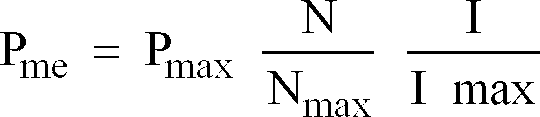
with - Pme =
- effective mechanical power
- Pmax =
- maximum power,
- N =
- number of revolutions of the screw(s) per minute,
- Nmax =
- maximum number of revolutions of the screw(s) per minute,
- I =
- effective motor current
- I max =
- maximum motor current
- It has been observed that the choice of a specific mechanical energy in an extruder, applied to and combined with the use of a polyethylene of particular viscoelastic property and with a preliminary bringing into contact of the polyethylene with oxygen makes it possible to improve the conditions of conversion of polyethylene into film by blown extrusion especially with a particularly high level of bubble stability. This result is obtained especially after the contact has been produced and the thermomechanical treatment conducted in such a way that at the end of treatment the value of the loss tangent (tg δ) of the polyethylene has lost from 15 to 70 %, preferably from 20 to 65 %, in particular from 25 to 60 % of its initial value before treatment and bringing into contact. Under these conditions the required improvement is obtained while a good compromise is maintained in respect of the mechanical properties of the product obtained.
- The process is thus conducted in order to arrive at the end of the operations at a reduction in the value of tgδ of the polyethylene within the abovementioned proportions. In the course of the process an adjustment in the reduction of tg δ can be made by operating by virtue of the means used according to the invention, that is to say the bringing of the polyethylene into contact with oxygen and the use of an extruder with a specific mechanical energy. In particular, the amplitude of the reduction in tg δ generally varies in the same direction as the quantity of oxygen employed when the bringing into contact is produced, especially in the gas mixture containing oxygen, or the specific mechanical energy supplied by the extruder. Thus, if in the process it is desired to increase the amplitude of the reduction in tg δ at the end of treatment within the desired proportions, it is possible, for example, to increase the quantity of oxygen employed when the contact is produced, especially in the gas mixture containing oxygen, or to increase the specific mechanical energy of the extruder especially within the range of the abovementioned values, or else to combine the two means simultaneously. If, on the contrary, it is desired to decrease the amplitude of the reduction in tg δ within the desired proportions, the reverse action may be taken, that is to say to decrease the quantity of oxygen or to decrease the specific mechanical energy of the extruder or else to combine both means.
- It has been observed, furthermore, that it is advantageous to carry out the thermomechanical treatment in the presence of a relatively small quantity or even, preferably, in the absence of a stabilizing agent of antioxidant type, generally known by the name of "process antioxidant agent" or "short-term antioxidant agent", such as a phosphite or phosphonite. It is thus preferred that, before its complete melting, the polyethylene is brought into contact in the extruder with a relatively small quantity of short-term antioxidant agent, for example in a quantity ranging from 0 to 1000, preferably from 0 to 800 or from 0 to 500, in particular from 0 to 200 parts by weight per million (ppm) relative to the polyethylene. In the case where a relatively small proportion is employed, the short-term antioxidant agent may be introduced into the feed or melting zone of the extruder, or preferably into the feed hopper of the extruder. The process which is conducted in order to arrive at the end of operations at a reduction in tg δ of the polyethylene in the proportions described above may especially comprise an adjustment of the said reduction by varying, in particular, the relatively small quantity of short-term antioxidant agent employed in bringing into contact with the polyethylene before its complete melting. In particular, the amplitude of the reduction in tg δ generally varies inversely with the quantity of short-term antioxidant agent which is employed. Thus, if it is desired in the process to increase the amplitude of the reduction in tg δ of the polyethylene at the end of treatment, it is possible, for example, to decrease the quantity of short-term antioxidant agent and even to go so far as to eliminate its use, that is to say not to bring any short-term antioxidant agent into contact with the polyethylene before its complete melting, or else to bring into action one or more of the other means described above to increase the amplitude of the reduction in tg 6, or else to combine two or more of all these means. If, on the contrary, it is desired to decrease the amplitude of the reduction in tg δ within the desired proportions, the reverse action may be taken, that is to say to increase the quantity of short-term antioxidant agent, or else to bring into action one or more of the other means described above to decrease the amplitude of the reduction in tg δ, or else to combine two or more of all these means.
- However, it has been observed that good results are obtained when, before its complete melting, the polyethylene is not brought into contact in the extruder with any short-term antioxidant agent such as a phosphite or phosphonite.
- The best results, especially where the bubble stability of the polymer in blown extrusion or film extrusion is concerned, are obtained when the gas mixture brought into contact with the polymer before its complete melting contains from 3 to 9 % by volume of oxygen preferably measured in the gas atmosphere of a feed hopper of the extruder, the extruder supplies a specific mechanical energy of 0.20 to 0.35 kWh per kilogram of polyethylene and when the treatment is conducted to its completion when the value of tg δ has lost from 35 to 60 % of its initial value. In this case it is preferred that no short-term antioxidant agent such as a phosphite or phosphonite be brought into contact with the polyethylene before the complete melting of the latter. The polymer temperature at the die may be especially from 230 to 250°C.
- It has additionally been noted that the absence or a reduced quantity of short-term antioxidant agent may, in some cases, produce some yellowing of the processed polyethylene. In order to correct this defect it is then preferred to carry out the treatment of the polyethylene in the presence of zinc stearate. In this case, before its complete melting, the polyethylene may be advantageously brought into contact in the extruder with a quantity of zinc stearate ranging from 100 to 2000, preferably from 200 to 1500 ppm relative to the polyethylene. The zinc stearate may be introduced into the feed or melting zone of the extruder or preferably into the feed hopper of the extruder.
- It has advantageously been observed that in the process of the invention a short-term antioxidant agent such as a phosphite or phosphonite can nevertheless be brought into contact with the polyethylene when the latter is already in the molten state, that is to say after its complete melting and before it leaves the extruder. In this case the short-term antioxidant agent may be introduced into the pumping or melt-conveying zone of the extruder, especially into the second half of this zone, situated near the extruder exit, in particular near the die. The quantity of short-term antioxidant agent may in this case be from 50 to 2000, preferably from 200 to 1500 ppm relative to the polyethylene.
- The treatment may, furthermore, be carried out in the presence of long-term antioxidant agent, such as hindered phenols, and of other additives or fillers usually employed, such as slip agents, antiblocking agents, antistatic agents, bonding agents and pigments.
- It has advantageously noticed that in the process of the invention, the weight-average molecular mass, the melt index, the molecular mass distribution and the density of the polyethylene do not substantially change.
- The following nonlimiting examples illustrate the present invention.
- A homopolyethylene in the form of a powder consisting of porous particles is employed, manufactured by a gas phase polymerization process in a fluidized bed in the presence of a catalyst based on chromium oxide (1 % by weight of chromium), modified with aluminium (2 % by weight of aluminium), supported on silica and activated by a heat treatment at 500°C, and in the presence of triethylaluminium. The homopolyethylene, sold by BP Chemicals under reference "HD 5301" ®, has the following characteristics:
- density: 0.950 ± 0.003 g/cm³
- MI21.6 (ASTM-D-1238, condition F) : 8 g/10 minutes
- MI8.5 (melt index measured at 190°C under an 8.5 kg load) : 0.9 g/10 minutes
- Mw/Mn (by GPC) : 15
- loss tangent (tg δ)
(1) : 1.90 - unsaturations of vinyl, vinylidene and vinylene type per 100 carbon atoms : 0.09
- mass-average particle diameter : 1200 µm
- bulk density : 0.37 g/cm³
- pore volume of the particles : 0.12 cm³/g
- specific surface (BET) : 0.3 m/g
(1) measured by dynamic rheometry at 190°C at a frequency of 1.5 10⁻ radians per second, with the aid of the mechanical and dynamic spectrometer sold by Rheometrics under reference "RMS 800/RDS II" ®. - The homopolyethylene, stored under an ambient air atmosphere, is introduced into the feed hopper of a twin corotative screw extruder sold by Japan Steel Work under reference "CMP 65 X" ® which has a die with 30 holes, each hole having a diameter of 3 mm.
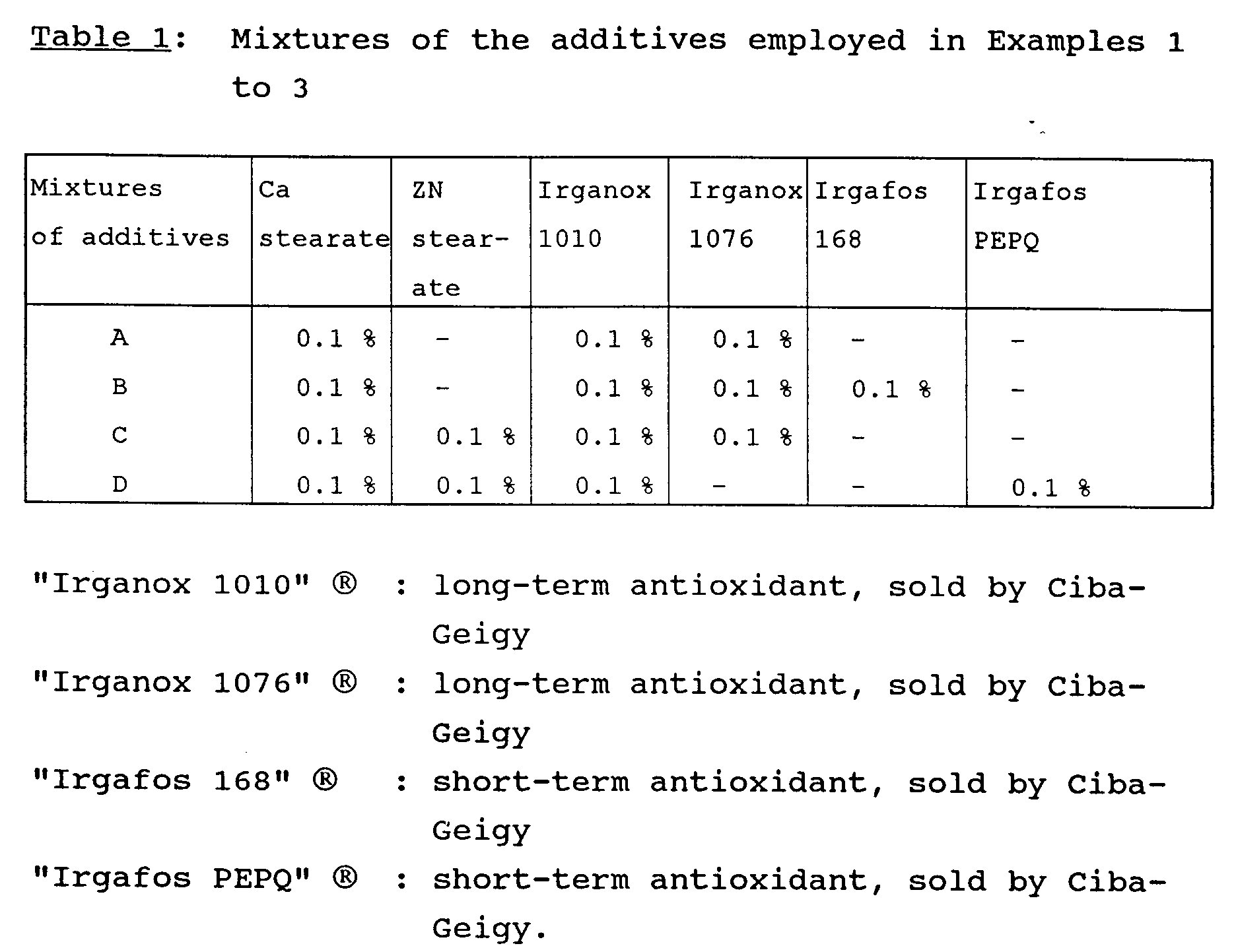
- Various of the additives employed in Examples 1 to 3 are shown in Table 1. The mixture of additives is added to the polyethylene in the feed hopper.
- Furthermore, a nitrogen entry line provided with a stopcock reaches the feed hopper of the extruder and emerges by virtue of a diffuser in the lower part of the hopper, facing the entry of the feed zone and of the twin screw of the extruder. The stopcock allows the nitrogen flow rate to be adjusted at will. A sensor of a conductometric analyser is situated inside and in the lower part of the hopper so as to give a value of the percentage of oxygen present in the atmosphere in the hopper.
- Table 2 shows, for each test:
- the mixture of additives employed;
- the pelletization conditions, especially the percentage by volume of oxygen in the gas mixture prevailing in the atmosphere of the feed hopper, the polymer temperature at the die, the specific mechanical energy (supplied by the extruder per kilogram of polymer), the reduction (% Δ tg δ) in the value of the loss tangent (tg δ) of the pelletized polymer, expressed as a percentage in relation to the initial value of tg δ of the polymer;
- the results obtained, especially a bubble stability index during the conversion of the polymer into film by blown extrusion (marked using a number ranging from 0 to 5, 5 being the maximum value corresponding to an outstanding stability and 0 the minimum value corresponding to a very poor stability), the loss tangent (tg δ) of the polymer after pelletization, measured under the same conditions as above, the polymer swelling ratio (SR) after pelletization, measured at the die exit of the apparatus measuring MI21.6 according to ASTM standard D-1238 condition F, and a whiteness index (WI), measured according to ASTM-E-313.
- Analysis of the results of Table 1 shows that:
- test No. 5 is a test in which the polymer is treated with oxygen, a relatively low specific mechanical energy and in the presence of a short-term antioxidant; the thermomechanical treatment has resulted in a very small reduction (% Δ tg δ) of tg δ of the polymer; the bubble stability index corresponds to a relatively mediocre bubble stability;
- test No. 1 is a test in which the polymer is treated with oxygen and a relatively low specific mechanical energy, but in the absence of short-term antioxidant; the treatment has resulted in a relatively high reduction (% Δ tg δ) in tg δ of the polymer; an improvement in bubble stability is noted when compared with test No. 5.
- tests No. 2 and 4 are tests in which the quantity of oxygen changes from 3 to 7 % respectively, the polymer being moreover treated with a relatively high specific mechanical energy and in the absence of short-term antioxidant; the treatment has resulted in a high reduction (% Δ tg δ) in tg δ of the polymer; a clear improvement in bubble stability is noted when compared with tests No. 1 and 5, as well as an improvement in test No. 4 when compared with test No. 2 because of the increase in the quantity of oxygen;
- test No. 3 is a test in which the oxygen is at 21 % and the polymer is treated with a relatively high specific mechanical energy, in the absence of short-term antioxidant; the treatment has resulted in a high reduction (% Δ tg δ) in tg δ of the polymer; the bubble stability is practically perfect.
- The operation is exactly as in Example 1, except for the fact that a twin-screw extruder sold by Werner-Pfleiderer under trade reference "ZSK 160" ® is employed.
- Table 3 shows the mixtures of additives employed, the treatment conditions and the results obtained.

- Analysis of the results of Table 3 shows that:
- Test No. 6 is an outstanding test in which the polymer is treated with oxygen with a relatively high specific mechanical energy, in the absence of short-term antioxidant; the treatment is conducted to its completion with a high reduction (% Δ tg δ) in tg δ of the polymer; the bubble stability is perfect; the whiteness index is superior to those of the tests of Example 1 by virtue of the use of zinc stearate as additive when the polymer is treated;
- test No. 7 is close to test No. 6, except for the presence of a short-term antioxidant and the treatment being conducted with a very small reduction (% Δ tg δ) in tg δ of the polymer.
- The operation is exactly as in Example 1, except for the fact that different polymer and different extruder are employed.
- The polymer is a copolymer of ethylene and 1-butene in the form of a powder consisting of porous particles, manufactured by the same process as the homopolyethylene of Example 1. Sold by BP Chemicals under the reference "MD 3802" ®, it has the following characteristics:
- density: 0.938 g/cm³
- MI21.6: 16 g/10 minutes
- MI8.5: 2 g/10 minutes
- Mw/Mn (by GPC): 10
- loss tangent (tg δ)
(1): 1.88 - unsaturations of vinyl, vinylidene and vinylene type per 100 carbon atoms: 0.08
- mass-average particle diameter: 1100 µm
- bulk density: 0.35 g/cm³
- pore volume of the particles: 0.11 cm³/g
- specific surface (BET): 0.2 m/g
(1) Measured by dynamic rheometry at 190°C at a frequency of 1.5 10⁻ radians per second, with the aid of the mechanical and dynamic spectrometer sold by Rheometrics under reference "RMS 800/RDS II" ®. - The copolymer, stored under an ambient air atmosphere, is introduced into the feed hopper of a twin corotative screw extruder sold by APV Baker Limited under reference "MP 2065" ®. The feed hopper has a nitrogen feed line and a means for oxygen analysis as in Example 1.
- Table 4 shows the mixtures of additives employed, the treatment conditions and the results obtained.

- Analysis of the results of Table 4 shows that:
- Test No. 8 is a test in which the polymer is treated with oxygen and with a relatively low specific mechanical energy, in the absence of short-term antioxidant; the treatment is conducted to its completion with a relatively high reduction (% Δ tg δ) in tg δ of the polymer; the bubble stability is satisfactory;
- test No. 9 is a test resembling test No. 8, except for the fact that the polymer contains a short-term antioxidant and that the treatment has been conducted with a very small reduction (% Δ tg δ) in tg δ of the polymer; bubble stability is poor.

Claims (13)
- Process for improving the bubble stability of a linear polyethylene converted into film by blown extrusion, the polyethylene having a density of 0.900 to 0.970, preferably from 0.932 to 0.965 g/cm³, a molecular mass distribution such that the ratio of the weight-average molecular mass, Mw, to that based on the number-average, Mn, is from 8 to 40, preferably from 9 to 30, and a value of the loss tangent measured by dynamic rheometry at 190°C at a frequency of 1.5 10⁻ radians per second, ranging from 1.5 to 3, preferably from 1.6 to 2.5, the process being characterized in that, before its complete melting in an extruder, the polyethylene is brought into contact with oxygen or a gas mixture containing oxygen, and the polyethylene thus brought into contact is treated thermomechanically in the molten state in the extruder supplying a specific mechanical energy of 0.15 to 0.5, preferably from 0.17 to 0.35 kWh per kilogram of polyethylene, the preliminary bringing into contact and the thermomechanical treatment being combined so that the treatment is conducted to its completion when the value of the loss tangent of the polyethylene has lost from 15 to 70 %, preferably from 20 to 65 % of its initial value before treatment and bringing into contact.
- Process according to Claim 1, characterized in that the gas mixture contains from 1 to 50 %, preferably from 2 to 21 %, in particular from 3 to 14 % by volume of oxygen.
- Process according to Claim 1 or 2, characterized in that, before its complete melting, the polyethylene is brought into contact in the extruder with a quantity of short-term antioxidant agent ranging from 0 to 1000, preferably from 0 to 500, in particular from 0 to 200 parts by weight per million (ppm) relative to the polyethylene.
- Process according to Claim 1 or 2, characterized in that, before its complete melting, the polyethylene is not brought into contact in the extruder with any short-term antioxidant agent.
- Process according to any one of Claims 1 to 4, characterized in that, after its complete melting and before it leaves the extruder, the polyethylene in the molten state is brought into contact with a short-term antioxidant agent.
- Process according to any one of Claims 3 to 5, characterized in that the short-term antioxidant agent is chosen from phosphites and phosphonites.
- Process according to any one of Claims 1 to 6, characterized in that, before its complete melting, the polyethylene is brought into contact in the extruder with a quantity of zinc stearate ranging from 100 to 2000, preferably from 200 to 1500 ppm relative to the polyethylene.
- Process according to any one of Claims 1 to 7, characterized in that the bringing into contact of the polyethylene with oxygen or the gas mixture containing oxygen is produced in a feed hopper of the extruder.
- Process according to any one of Claims 1 to 8, characterized in that the bringing into contact of the polyethylene with oxygen or the gas mixture containing oxygen is produced in a feed or melting zone of the extruder.
- Process according to any one of Claims 1 to 9, characterized in that the polyethylene contains from 0.05 to 0.2 unsaturations of vinyl, vinylidene and vinylene type per 100 carbon atoms.
- Process according to any one of Claims 1 to 10, characterized in that the polyethylene is prepared in a gas phase polymerization process, with the aid of a catalyst based on chromium oxide activated by a heat treatment.
- Process according to any one of Claims 1 to 11, characterized in that the polyethylene is in the form of a powder consisting of porous particles which have a bulk density of 0.3 to 0.55, preferably from 0.35 to 0.5 g/cm³.
- Process according to any one of Claims 1 to 12, characterized in that the extruder is a twin-screw extruder.
Applications Claiming Priority (2)
| Application Number | Priority Date | Filing Date | Title |
|---|---|---|---|
| FR9410630A FR2723880B1 (en) | 1994-08-30 | 1994-08-30 | PROCESS FOR MODIFYING A POLYETHYLENE IN AN EXTRUDER |
| FR9410630 | 1994-08-30 |
Publications (3)
| Publication Number | Publication Date |
|---|---|
| EP0700769A2 true EP0700769A2 (en) | 1996-03-13 |
| EP0700769A3 EP0700769A3 (en) | 1996-03-20 |
| EP0700769B1 EP0700769B1 (en) | 2000-03-29 |
Family
ID=9466705
Family Applications (1)
| Application Number | Title | Priority Date | Filing Date |
|---|---|---|---|
| EP95305665A Revoked EP0700769B1 (en) | 1994-08-30 | 1995-08-14 | Process for modifying a polyethylene in an extruder |
Country Status (12)
| Country | Link |
|---|---|
| US (1) | US5739266A (en) |
| EP (1) | EP0700769B1 (en) |
| JP (1) | JP3766704B2 (en) |
| KR (1) | KR100365710B1 (en) |
| CA (1) | CA2156894C (en) |
| DE (1) | DE69515944T2 (en) |
| ES (1) | ES2144578T3 (en) |
| FI (1) | FI112494B (en) |
| FR (1) | FR2723880B1 (en) |
| MY (1) | MY112733A (en) |
| NO (1) | NO308953B1 (en) |
| ZA (1) | ZA956934B (en) |
Cited By (10)
| Publication number | Priority date | Publication date | Assignee | Title |
|---|---|---|---|---|
| US5728335A (en) * | 1996-06-26 | 1998-03-17 | Union Carbide Chemicals & Plastics Technology Corporation | Process for extrusion |
| EP0936049A3 (en) * | 1998-02-13 | 1999-09-29 | Union Carbide Chemicals & Plastics Technology Corporation | A process for extrusion |
| US6454976B1 (en) * | 1996-06-26 | 2002-09-24 | Union Carbide Chemicals & Plastics Technology Corporation | Pelletizing of broad molecular weight polyethylene |
| WO2003004539A1 (en) * | 2001-07-03 | 2003-01-16 | Idemitsu Petrochemical Co., Ltd. | Polyethylene type resin and method for producing the same, and inflation film using the same as base material |
| WO2004101674A1 (en) * | 2003-05-12 | 2004-11-25 | Dow Global Technologies Inc | Polymer composition and process to manufacture high molecular weight-high density polyethylene and film therefrom |
| WO2006041605A1 (en) * | 2004-10-08 | 2006-04-20 | Exxonmobil Chemical Patents Inc. | Oxigen tailoring of polyethylene blow molding resins |
| WO2007106417A1 (en) * | 2006-03-10 | 2007-09-20 | Dow Global Technologies Inc. | Polyethylene resins for sheet and thermoforming applications |
| WO2011090914A1 (en) * | 2010-01-19 | 2011-07-28 | Dow Global Technologies LLC (Formerly known as Dow Global Technologies Inc.) | Method for improving the bubble stability of a polyethylene composition suitable for blown film extrusion process |
| US8920891B2 (en) | 2004-12-17 | 2014-12-30 | Dow Global Technologies Llc | Rheology modified relatively high melt strength polyethylene compositions and methods of making pipes, films, sheets, and blow-molded articles |
| CN109435103A (en) * | 2018-12-12 | 2019-03-08 | 张家港永和包装印务有限公司 | A kind of heating device of wrapping paper lamination |
Families Citing this family (19)
| Publication number | Priority date | Publication date | Assignee | Title |
|---|---|---|---|---|
| US6433133B1 (en) | 1999-11-16 | 2002-08-13 | Eastman Chemical Company | Process for reducing the weight average molecular weight and melt index ratio of polyethylenes and polyethylene products |
| JP4814437B2 (en) * | 2001-04-06 | 2011-11-16 | 株式会社プライムポリマー | Process for producing modified polyethylene resin, modified polyethylene resin and film thereof |
| US20050012235A1 (en) * | 2001-11-30 | 2005-01-20 | Schregenberger Sandra D | Oxygen tailoring of polyethylene resins |
| CN1313501C (en) * | 2002-07-03 | 2007-05-02 | 埃克森美孚化学专利公司 | Oxygen tailoring of polyethylene film resins |
| US6878454B1 (en) * | 2003-12-05 | 2005-04-12 | Univation Technologies, Llc | Polyethylene films |
| US7432328B2 (en) * | 2005-06-14 | 2008-10-07 | Univation Technologies, Llc | Enhanced ESCR bimodal HDPE for blow molding applications |
| US7892466B2 (en) * | 2004-08-19 | 2011-02-22 | Univation Technologies, Llc | Oxygen tailoring of polyethylene resins |
| US8202940B2 (en) | 2004-08-19 | 2012-06-19 | Univation Technologies, Llc | Bimodal polyethylene compositions for blow molding applications |
| US20060038315A1 (en) * | 2004-08-19 | 2006-02-23 | Tunnell Herbert R Iii | Oxygen tailoring of polyethylene resins |
| US20070049711A1 (en) | 2005-09-01 | 2007-03-01 | Chi-I Kuo | Catalyst compositions comprising support materials having an improved particle-size distribution |
| DE102006004705A1 (en) * | 2006-01-31 | 2007-08-02 | Basell Polyolefine Gmbh | Production of (co)polyethylene for blown film uses chromium catalyst on silicate support heat-activated under oxidative conditions and melt mixing with sterically-hindered phenol and phosphite antioxidants at sufficient energy input |
| KR100727599B1 (en) * | 2006-04-28 | 2007-06-14 | 이규동 | Water level control device having a double blocking system and its control method, and water purifier using the same |
| US7754834B2 (en) | 2007-04-12 | 2010-07-13 | Univation Technologies, Llc | Bulk density promoting agents in a gas-phase polymerization process to achieve a bulk particle density |
| JP5895482B2 (en) * | 2011-11-30 | 2016-03-30 | 東ソー株式会社 | Ethylene polymer composition |
| JP6047953B2 (en) * | 2011-11-30 | 2016-12-21 | 東ソー株式会社 | Olefinic resin processability modifier and method for producing the same |
| WO2013137953A1 (en) | 2012-03-15 | 2013-09-19 | Exxonmobil Chemical Patents Inc. | Oxygen tailoring of polyethylene |
| WO2017165009A1 (en) | 2016-03-23 | 2017-09-28 | Exxonmobil Chemical Patents, Inc. | Comb-block high density polyethylenes and methods of making them |
| CA3097342A1 (en) | 2018-04-27 | 2019-10-31 | Dow Global Technologies Llc | Non-foam polyolefin compositions for wire and cable coating |
| US12330362B2 (en) | 2019-10-28 | 2025-06-17 | Univation Technologies, Llc | Method of increasing bubble stability of a polyethylene resin |
Family Cites Families (9)
| Publication number | Priority date | Publication date | Assignee | Title |
|---|---|---|---|---|
| DE219789C (en) * | ||||
| US3551943A (en) * | 1966-12-19 | 1971-01-05 | Exxon Research Engineering Co | Controlled degradation |
| US3608001A (en) * | 1969-08-26 | 1971-09-21 | Exxon Research Engineering Co | Controlled degradation of polypropylene in extruder-reactor |
| US3563972A (en) * | 1969-10-15 | 1971-02-16 | Exxon Research Engineering Co | Low melt elasticity composition of polypropylene |
| US3898209A (en) * | 1973-11-21 | 1975-08-05 | Exxon Research Engineering Co | Process for controlling rheology of C{HD 3{B {30 {0 polyolefins |
| JPS5231269B2 (en) * | 1974-06-13 | 1977-08-13 | ||
| JPS59166507A (en) * | 1983-03-12 | 1984-09-19 | Nissan Chem Ind Ltd | Production of resin for blow molding |
| DD219789A1 (en) * | 1983-12-13 | 1985-03-13 | Leuna Werke Veb | INCREASING THE MOLMASSE OF ETHYLENE VINYL ACETATE COPOLYMERS |
| FR2598350B1 (en) * | 1986-05-06 | 1989-11-17 | Bp Chimie Sa | PROCESS AND DEVICE FOR DEGASSING AND FOR CONVERTING POLYOLEFIN PARTICLES OBTAINED BY GAS PHASE POLYMERIZATION |
-
1994
- 1994-08-30 FR FR9410630A patent/FR2723880B1/en not_active Expired - Fee Related
-
1995
- 1995-08-14 ES ES95305665T patent/ES2144578T3/en not_active Expired - Lifetime
- 1995-08-14 EP EP95305665A patent/EP0700769B1/en not_active Revoked
- 1995-08-14 DE DE69515944T patent/DE69515944T2/en not_active Expired - Lifetime
- 1995-08-16 US US08/515,830 patent/US5739266A/en not_active Expired - Lifetime
- 1995-08-18 ZA ZA9506934A patent/ZA956934B/en unknown
- 1995-08-24 CA CA002156894A patent/CA2156894C/en not_active Expired - Lifetime
- 1995-08-29 NO NO953384A patent/NO308953B1/en unknown
- 1995-08-30 MY MYPI95002586A patent/MY112733A/en unknown
- 1995-08-30 FI FI954063A patent/FI112494B/en not_active IP Right Cessation
- 1995-08-30 KR KR1019950027758A patent/KR100365710B1/en not_active Expired - Lifetime
- 1995-08-30 JP JP22242595A patent/JP3766704B2/en not_active Expired - Lifetime
Cited By (13)
| Publication number | Priority date | Publication date | Assignee | Title |
|---|---|---|---|---|
| US6454976B1 (en) * | 1996-06-26 | 2002-09-24 | Union Carbide Chemicals & Plastics Technology Corporation | Pelletizing of broad molecular weight polyethylene |
| US5728335A (en) * | 1996-06-26 | 1998-03-17 | Union Carbide Chemicals & Plastics Technology Corporation | Process for extrusion |
| EP0936049A3 (en) * | 1998-02-13 | 1999-09-29 | Union Carbide Chemicals & Plastics Technology Corporation | A process for extrusion |
| EP1408055A4 (en) * | 2001-07-03 | 2004-12-22 | Idemitsu Petrochemical Co | POLYETHYLENE RESIN AND PROCESS FOR PRODUCING THE SAME AND INFLATION FILM USING THE SAME PROCESS AS BASE MATERIAL |
| WO2003004539A1 (en) * | 2001-07-03 | 2003-01-16 | Idemitsu Petrochemical Co., Ltd. | Polyethylene type resin and method for producing the same, and inflation film using the same as base material |
| EP2256160A2 (en) | 2003-05-12 | 2010-12-01 | Dow Global Technologies Inc. | Polymer composition and process to manufacture high molecular weight-high density polyethylene and film thereform |
| WO2004101674A1 (en) * | 2003-05-12 | 2004-11-25 | Dow Global Technologies Inc | Polymer composition and process to manufacture high molecular weight-high density polyethylene and film therefrom |
| WO2006041605A1 (en) * | 2004-10-08 | 2006-04-20 | Exxonmobil Chemical Patents Inc. | Oxigen tailoring of polyethylene blow molding resins |
| US7285617B2 (en) | 2004-10-08 | 2007-10-23 | Exxonmobil Chemical Patents Inc. | Oxygen tailoring of polyethylene blow molding resins |
| US8920891B2 (en) | 2004-12-17 | 2014-12-30 | Dow Global Technologies Llc | Rheology modified relatively high melt strength polyethylene compositions and methods of making pipes, films, sheets, and blow-molded articles |
| WO2007106417A1 (en) * | 2006-03-10 | 2007-09-20 | Dow Global Technologies Inc. | Polyethylene resins for sheet and thermoforming applications |
| WO2011090914A1 (en) * | 2010-01-19 | 2011-07-28 | Dow Global Technologies LLC (Formerly known as Dow Global Technologies Inc.) | Method for improving the bubble stability of a polyethylene composition suitable for blown film extrusion process |
| CN109435103A (en) * | 2018-12-12 | 2019-03-08 | 张家港永和包装印务有限公司 | A kind of heating device of wrapping paper lamination |
Also Published As
| Publication number | Publication date |
|---|---|
| US5739266A (en) | 1998-04-14 |
| ES2144578T3 (en) | 2000-06-16 |
| EP0700769A3 (en) | 1996-03-20 |
| DE69515944D1 (en) | 2000-05-04 |
| FR2723880B1 (en) | 1997-01-03 |
| DE69515944T2 (en) | 2000-08-17 |
| CA2156894A1 (en) | 1996-03-01 |
| NO308953B1 (en) | 2000-11-20 |
| MY112733A (en) | 2001-08-30 |
| FI954063L (en) | 1996-03-02 |
| NO953384D0 (en) | 1995-08-29 |
| ZA956934B (en) | 1997-02-18 |
| EP0700769B1 (en) | 2000-03-29 |
| FI112494B (en) | 2003-12-15 |
| KR100365710B1 (en) | 2003-02-25 |
| CA2156894C (en) | 2006-06-20 |
| KR960007154A (en) | 1996-03-22 |
| FI954063A0 (en) | 1995-08-30 |
| JPH0890633A (en) | 1996-04-09 |
| FR2723880A1 (en) | 1996-03-01 |
| NO953384L (en) | 1996-03-01 |
| JP3766704B2 (en) | 2006-04-19 |
Similar Documents
| Publication | Publication Date | Title |
|---|---|---|
| EP0700769B1 (en) | Process for modifying a polyethylene in an extruder | |
| US6147167A (en) | Process for producing polyethylene film composition having broad molecular weight distribution and improved bubble stability | |
| EP1627015B1 (en) | Polymer composition and process to manufacture high molecular weight-high density polyethylene and film therefrom | |
| US4525257A (en) | Low level irradiated linear low density ethylene/alpha-olefin copolymers and film extruded therefrom | |
| WO2015145271A1 (en) | Improved extrusion process for polyethylene polymers | |
| JP4426300B2 (en) | Oxygen tailoring of polyethylene resin | |
| EP1395407A1 (en) | Method of compounding a multimodal polyethylene composition | |
| CN120282993A (en) | Process for obtaining polyethylene with reduced gel content | |
| WO1995030713A1 (en) | Medium modulus film comprising substantially linear polyethylene and fabrication method | |
| Tang et al. | Peroxide crosslinking of LLDPE during reactive extrusion | |
| JP4342938B2 (en) | Polyethylene resin, method for producing the same, and inflation film based thereon | |
| CN112469556A (en) | Multilayer foam film and method for producing same | |
| EP1712574B1 (en) | Polyethylene film with improved processability and mechanical properties | |
| EP4389817A1 (en) | Process for producing a blended low density polyethylene composition comprising recycled polymer compositions | |
| JP4814437B2 (en) | Process for producing modified polyethylene resin, modified polyethylene resin and film thereof | |
| EP4098669A1 (en) | Polyethylene powder and shaped object thereof | |
| EP2526126B1 (en) | Method for improving the bubble stability of a polyethylene composition suitable for blown film extrusion process | |
| EP0760278A1 (en) | Process for extruding a polyethylene | |
| EP4389782A1 (en) | Process for modifiyng the melt flow index of low density polyethylene |
Legal Events
| Date | Code | Title | Description |
|---|---|---|---|
| PUAI | Public reference made under article 153(3) epc to a published international application that has entered the european phase |
Free format text: ORIGINAL CODE: 0009012 |
|
| PUAL | Search report despatched |
Free format text: ORIGINAL CODE: 0009013 |
|
| AK | Designated contracting states |
Kind code of ref document: A2 Designated state(s): BE DE ES FR GB IT NL SE |
|
| AK | Designated contracting states |
Kind code of ref document: A3 Designated state(s): BE DE ES FR GB IT NL SE |
|
| 17P | Request for examination filed |
Effective date: 19960830 |
|
| GRAG | Despatch of communication of intention to grant |
Free format text: ORIGINAL CODE: EPIDOS AGRA |
|
| 17Q | First examination report despatched |
Effective date: 19990416 |
|
| GRAG | Despatch of communication of intention to grant |
Free format text: ORIGINAL CODE: EPIDOS AGRA |
|
| GRAH | Despatch of communication of intention to grant a patent |
Free format text: ORIGINAL CODE: EPIDOS IGRA |
|
| GRAH | Despatch of communication of intention to grant a patent |
Free format text: ORIGINAL CODE: EPIDOS IGRA |
|
| GRAA | (expected) grant |
Free format text: ORIGINAL CODE: 0009210 |
|
| AK | Designated contracting states |
Kind code of ref document: B1 Designated state(s): BE DE ES FR GB IT NL SE |
|
| RAP2 | Party data changed (patent owner data changed or rights of a patent transferred) |
Owner name: BP CHEMICALS S.N.C. Owner name: BP CHEMICALS LIMITED |
|
| REF | Corresponds to: |
Ref document number: 69515944 Country of ref document: DE Date of ref document: 20000504 |
|
| ET | Fr: translation filed | ||
| ITF | It: translation for a ep patent filed | ||
| REG | Reference to a national code |
Ref country code: ES Ref legal event code: FG2A Ref document number: 2144578 Country of ref document: ES Kind code of ref document: T3 |
|
| NLT2 | Nl: modifications (of names), taken from the european patent patent bulletin |
Owner name: BP CHEMICALS LIMITED |
|
| PLBI | Opposition filed |
Free format text: ORIGINAL CODE: 0009260 |
|
| PLBQ | Unpublished change to opponent data |
Free format text: ORIGINAL CODE: EPIDOS OPPO |
|
| PLBI | Opposition filed |
Free format text: ORIGINAL CODE: 0009260 |
|
| PLBF | Reply of patent proprietor to notice(s) of opposition |
Free format text: ORIGINAL CODE: EPIDOS OBSO |
|
| 26 | Opposition filed |
Opponent name: BASELL POLYOLEFINS GMBH Effective date: 20001213 |
|
| 26 | Opposition filed |
Opponent name: EXXON CHEMICAL PATENTS, INC. Effective date: 20001227 Opponent name: UNION CARBIDE CORPORATION Effective date: 20001222 Opponent name: BASELL POLYOLEFINE GMBH Effective date: 20001213 |
|
| NLR1 | Nl: opposition has been filed with the epo |
Opponent name: BASELL POLYOLEFINS GMBH |
|
| NLR1 | Nl: opposition has been filed with the epo |
Opponent name: EXXON CHEMICAL PATENTS, INC. Opponent name: UNION CARBIDE CORPORATION Opponent name: BASELL POLYOLEFINE GMBH |
|
| PLBF | Reply of patent proprietor to notice(s) of opposition |
Free format text: ORIGINAL CODE: EPIDOS OBSO |
|
| PLBF | Reply of patent proprietor to notice(s) of opposition |
Free format text: ORIGINAL CODE: EPIDOS OBSO |
|
| PLBF | Reply of patent proprietor to notice(s) of opposition |
Free format text: ORIGINAL CODE: EPIDOS OBSO |
|
| REG | Reference to a national code |
Ref country code: GB Ref legal event code: IF02 |
|
| PLBF | Reply of patent proprietor to notice(s) of opposition |
Free format text: ORIGINAL CODE: EPIDOS OBSO |
|
| RDAH | Patent revoked |
Free format text: ORIGINAL CODE: EPIDOS REVO |
|
| APAC | Appeal dossier modified |
Free format text: ORIGINAL CODE: EPIDOS NOAPO |
|
| APAC | Appeal dossier modified |
Free format text: ORIGINAL CODE: EPIDOS NOAPO |
|
| APAA | Appeal reference recorded |
Free format text: ORIGINAL CODE: EPIDOS REFN |
|
| APBU | Appeal procedure closed |
Free format text: ORIGINAL CODE: EPIDOSNNOA9O |
|
| APBW | Interlocutory revision of appeal recorded |
Free format text: ORIGINAL CODE: EPIDOSNIRAPO |
|
| RAP2 | Party data changed (patent owner data changed or rights of a patent transferred) |
Owner name: BP CHEMICALS S.N.C. Owner name: INNOVENE EUROPE LIMITED |
|
| APAH | Appeal reference modified |
Free format text: ORIGINAL CODE: EPIDOSCREFNO |
|
| NLT2 | Nl: modifications (of names), taken from the european patent patent bulletin |
Owner name: INNOVENE EUROPE LIMITED Effective date: 20050921 |
|
| PLAB | Opposition data, opponent's data or that of the opponent's representative modified |
Free format text: ORIGINAL CODE: 0009299OPPO |
|
| RAP2 | Party data changed (patent owner data changed or rights of a patent transferred) |
Owner name: BP CHEMICALS S.N.C. Owner name: INEOS EUROPE LIMITED |
|
| R26 | Opposition filed (corrected) |
Opponent name: EXXON CHEMICAL PATENTS, INC. Effective date: 20001227 Opponent name: UNION CARBIDE CORPORATION Effective date: 20001222 Opponent name: BASELL POLYOLEFINE GMBH Effective date: 20001213 |
|
| NLT2 | Nl: modifications (of names), taken from the european patent patent bulletin |
Owner name: INEOS EUROPE LIMITED Effective date: 20060816 |
|
| NLR1 | Nl: opposition has been filed with the epo |
Opponent name: EXXON CHEMICAL PATENTS, INC. Opponent name: UNION CARBIDE CORPORATION Opponent name: BASELL POLYOLEFINE GMBH |
|
| RDAD | Information modified related to despatch of communication that patent is revoked |
Free format text: ORIGINAL CODE: EPIDOSCREV1 |
|
| APBP | Date of receipt of notice of appeal recorded |
Free format text: ORIGINAL CODE: EPIDOSNNOA2O |
|
| APAH | Appeal reference modified |
Free format text: ORIGINAL CODE: EPIDOSCREFNO |
|
| REG | Reference to a national code |
Ref country code: ES Ref legal event code: PC2A |
|
| APBQ | Date of receipt of statement of grounds of appeal recorded |
Free format text: ORIGINAL CODE: EPIDOSNNOA3O |
|
| NLS | Nl: assignments of ep-patents |
Owner name: O&D TRADING LIMITED Effective date: 20070323 |
|
| NLT1 | Nl: modifications of names registered in virtue of documents presented to the patent office pursuant to art. 16 a, paragraph 1 |
Owner name: INEOS EUROPE LIMITED Owner name: INNOVENE EUROPE LIMITED |
|
| BECA | Be: change of holder's address |
Owner name: *INEOS EUROPE LTDHAWKSLEASE, CHAPEL LANE, LYNDHURS Effective date: 20070202 |
|
| BECN | Be: change of holder's name |
Owner name: *INEOS EUROPE LTD Effective date: 20070202 |
|
| REG | Reference to a national code |
Ref country code: FR Ref legal event code: TP |
|
| REG | Reference to a national code |
Ref country code: FR Ref legal event code: CD |
|
| REG | Reference to a national code |
Ref country code: FR Ref legal event code: CD Ref country code: FR Ref legal event code: CA |
|
| PLAB | Opposition data, opponent's data or that of the opponent's representative modified |
Free format text: ORIGINAL CODE: 0009299OPPO |
|
| APBU | Appeal procedure closed |
Free format text: ORIGINAL CODE: EPIDOSNNOA9O |
|
| REG | Reference to a national code |
Ref country code: GB Ref legal event code: 732E Free format text: REGISTERED BETWEEN 20090723 AND 20090729 |
|
| RDAD | Information modified related to despatch of communication that patent is revoked |
Free format text: ORIGINAL CODE: EPIDOSCREV1 |
|
| APBM | Appeal reference recorded |
Free format text: ORIGINAL CODE: EPIDOSNREFNO |
|
| APBP | Date of receipt of notice of appeal recorded |
Free format text: ORIGINAL CODE: EPIDOSNNOA2O |
|
| APAH | Appeal reference modified |
Free format text: ORIGINAL CODE: EPIDOSCREFNO |
|
| REG | Reference to a national code |
Ref country code: GB Ref legal event code: 732E Free format text: REGISTERED BETWEEN 20100916 AND 20100922 |
|
| APBQ | Date of receipt of statement of grounds of appeal recorded |
Free format text: ORIGINAL CODE: EPIDOSNNOA3O |
|
| RAP2 | Party data changed (patent owner data changed or rights of a patent transferred) |
Owner name: BP CHEMICALS S.N.C. Owner name: INEOS COMMERCIAL SERVICES UK LIMITED |
|
| REG | Reference to a national code |
Ref country code: GB Ref legal event code: 732E Free format text: REGISTERED BETWEEN 20111201 AND 20111207 |
|
| REG | Reference to a national code |
Ref country code: DE Ref legal event code: R082 Ref document number: 69515944 Country of ref document: DE Representative=s name: LEDERER & KELLER, DE |
|
| PLAB | Opposition data, opponent's data or that of the opponent's representative modified |
Free format text: ORIGINAL CODE: 0009299OPPO |
|
| R26 | Opposition filed (corrected) |
Opponent name: EXXON CHEMICAL PATENTS, INC. Effective date: 20001227 Opponent name: UNION CARBIDE CORPORATION Effective date: 20001222 Opponent name: BASELL POLYOLEFINE GMBH Effective date: 20001213 |
|
| REG | Reference to a national code |
Ref country code: DE Ref legal event code: R082 Ref document number: 69515944 Country of ref document: DE Representative=s name: LEDERER & KELLER PATENTANWAELTE PARTNERSCHAFT , DE Effective date: 20120203 Ref country code: DE Ref legal event code: R081 Ref document number: 69515944 Country of ref document: DE Owner name: INEOS SALES (UK) LIMITED, LYNDHURST, GB Free format text: FORMER OWNER: INEOS EUROPE LTD., LYNDHURST, HAMPSHIRE, GB Effective date: 20120203 Ref country code: DE Ref legal event code: R081 Ref document number: 69515944 Country of ref document: DE Owner name: INEOS COMMERCIAL SERVICES UK LTD., LYNDHURST, GB Free format text: FORMER OWNER: INEOS EUROPE LTD., LYNDHURST, HAMPSHIRE, GB Effective date: 20120203 |
|
| RAP2 | Party data changed (patent owner data changed or rights of a patent transferred) |
Owner name: INEOS SALES (UK) LIMITED Owner name: BP CHEMICALS S.N.C. |
|
| PLAB | Opposition data, opponent's data or that of the opponent's representative modified |
Free format text: ORIGINAL CODE: 0009299OPPO |
|
| R26 | Opposition filed (corrected) |
Opponent name: UNION CARBIDE CORPORATION Effective date: 20001222 |
|
| REG | Reference to a national code |
Ref country code: GB Ref legal event code: 732E Free format text: REGISTERED BETWEEN 20140102 AND 20140108 |
|
| REG | Reference to a national code |
Ref country code: NL Ref legal event code: SD Effective date: 20140224 |
|
| PGFP | Annual fee paid to national office [announced via postgrant information from national office to epo] |
Ref country code: NL Payment date: 20140826 Year of fee payment: 20 Ref country code: DE Payment date: 20140827 Year of fee payment: 20 |
|
| PGFP | Annual fee paid to national office [announced via postgrant information from national office to epo] |
Ref country code: ES Payment date: 20140826 Year of fee payment: 20 Ref country code: SE Payment date: 20140827 Year of fee payment: 20 Ref country code: GB Payment date: 20140827 Year of fee payment: 20 Ref country code: FR Payment date: 20140818 Year of fee payment: 20 |
|
| PGFP | Annual fee paid to national office [announced via postgrant information from national office to epo] |
Ref country code: IT Payment date: 20140825 Year of fee payment: 20 |
|
| REG | Reference to a national code |
Ref country code: DE Ref legal event code: R082 Ref document number: 69515944 Country of ref document: DE Representative=s name: LEDERER & KELLER PATENTANWAELTE PARTNERSCHAFT , DE |
|
| PGFP | Annual fee paid to national office [announced via postgrant information from national office to epo] |
Ref country code: BE Payment date: 20140829 Year of fee payment: 20 |
|
| APBM | Appeal reference recorded |
Free format text: ORIGINAL CODE: EPIDOSNREFNO |
|
| REG | Reference to a national code |
Ref country code: DE Ref legal event code: R082 Ref document number: 69515944 Country of ref document: DE Representative=s name: LEDERER & KELLER PATENTANWAELTE PARTNERSCHAFT , DE Effective date: 20150129 Ref country code: DE Ref legal event code: R081 Ref document number: 69515944 Country of ref document: DE Owner name: INEOS SALES (UK) LIMITED, LYNDHURST, GB Free format text: FORMER OWNER: INEOS COMMERCIAL SERVICES UK LTD., LYNDHURST, HAMPSHIRE, GB Effective date: 20150129 |
|
| REG | Reference to a national code |
Ref country code: DE Ref legal event code: R071 Ref document number: 69515944 Country of ref document: DE |
|
| REG | Reference to a national code |
Ref country code: NL Ref legal event code: V4 Effective date: 20150814 |
|
| REG | Reference to a national code |
Ref country code: GB Ref legal event code: PE20 Expiry date: 20150813 |
|
| REG | Reference to a national code |
Ref country code: SE Ref legal event code: EUG |
|
| PG25 | Lapsed in a contracting state [announced via postgrant information from national office to epo] |
Ref country code: GB Free format text: LAPSE BECAUSE OF EXPIRATION OF PROTECTION Effective date: 20150813 |
|
| REG | Reference to a national code |
Ref country code: ES Ref legal event code: FD2A Effective date: 20151126 |
|
| REG | Reference to a national code |
Ref country code: DE Ref legal event code: R103 Ref document number: 69515944 Country of ref document: DE Ref country code: DE Ref legal event code: R064 Ref document number: 69515944 Country of ref document: DE |
|
| APBU | Appeal procedure closed |
Free format text: ORIGINAL CODE: EPIDOSNNOA9O |
|
| PG25 | Lapsed in a contracting state [announced via postgrant information from national office to epo] |
Ref country code: ES Free format text: LAPSE BECAUSE OF EXPIRATION OF PROTECTION Effective date: 20150815 |
|
| RDAG | Patent revoked |
Free format text: ORIGINAL CODE: 0009271 |
|
| STAA | Information on the status of an ep patent application or granted ep patent |
Free format text: STATUS: PATENT REVOKED |
|
| 27W | Patent revoked |
Effective date: 20160202 |
|
| REG | Reference to a national code |
Ref country code: SE Ref legal event code: ECNC |