EP0698382A2 - Prosthetic bearing element and process for making such an element - Google Patents
Prosthetic bearing element and process for making such an element Download PDFInfo
- Publication number
- EP0698382A2 EP0698382A2 EP95305766A EP95305766A EP0698382A2 EP 0698382 A2 EP0698382 A2 EP 0698382A2 EP 95305766 A EP95305766 A EP 95305766A EP 95305766 A EP95305766 A EP 95305766A EP 0698382 A2 EP0698382 A2 EP 0698382A2
- Authority
- EP
- European Patent Office
- Prior art keywords
- backing
- bearing element
- prosthetic
- liner
- bearing
- Prior art date
- Legal status (The legal status is an assumption and is not a legal conclusion. Google has not performed a legal analysis and makes no representation as to the accuracy of the status listed.)
- Granted
Links
- 238000000034 method Methods 0.000 title claims description 21
- 239000000463 material Substances 0.000 claims abstract description 32
- 229920002635 polyurethane Polymers 0.000 claims abstract description 20
- 239000004814 polyurethane Substances 0.000 claims abstract description 20
- 238000000465 moulding Methods 0.000 claims description 27
- 210000003127 knee Anatomy 0.000 claims description 6
- 239000000835 fiber Substances 0.000 claims description 5
- OKTJSMMVPCPJKN-UHFFFAOYSA-N Carbon Chemical compound [C] OKTJSMMVPCPJKN-UHFFFAOYSA-N 0.000 claims description 4
- 229910052799 carbon Inorganic materials 0.000 claims description 4
- 239000004696 Poly ether ether ketone Substances 0.000 claims description 3
- 229920002530 polyetherether ketone Polymers 0.000 claims description 3
- 239000007943 implant Substances 0.000 claims description 2
- 229920003229 poly(methyl methacrylate) Polymers 0.000 claims description 2
- 239000004926 polymethyl methacrylate Substances 0.000 claims description 2
- 238000002347 injection Methods 0.000 description 42
- 239000007924 injection Substances 0.000 description 42
- 238000012360 testing method Methods 0.000 description 13
- -1 polyethylene Polymers 0.000 description 11
- 238000001816 cooling Methods 0.000 description 9
- 235000019589 hardness Nutrition 0.000 description 9
- 229910052751 metal Inorganic materials 0.000 description 9
- 239000002184 metal Substances 0.000 description 9
- LYCAIKOWRPUZTN-UHFFFAOYSA-N Ethylene glycol Chemical compound OCCO LYCAIKOWRPUZTN-UHFFFAOYSA-N 0.000 description 8
- 239000004698 Polyethylene Substances 0.000 description 7
- 229920000573 polyethylene Polymers 0.000 description 7
- 229920001343 polytetrafluoroethylene Polymers 0.000 description 7
- RTZKZFJDLAIYFH-UHFFFAOYSA-N Diethyl ether Chemical compound CCOCC RTZKZFJDLAIYFH-UHFFFAOYSA-N 0.000 description 6
- WERYXYBDKMZEQL-UHFFFAOYSA-N butane-1,4-diol Chemical compound OCCCCO WERYXYBDKMZEQL-UHFFFAOYSA-N 0.000 description 6
- 239000011257 shell material Substances 0.000 description 6
- 238000010276 construction Methods 0.000 description 5
- 229920001971 elastomer Polymers 0.000 description 5
- 239000000806 elastomer Substances 0.000 description 5
- 238000001746 injection moulding Methods 0.000 description 5
- QGZKDVFQNNGYKY-UHFFFAOYSA-N Ammonia Chemical compound N QGZKDVFQNNGYKY-UHFFFAOYSA-N 0.000 description 4
- TZCXTZWJZNENPQ-UHFFFAOYSA-L barium sulfate Chemical compound [Ba+2].[O-]S([O-])(=O)=O TZCXTZWJZNENPQ-UHFFFAOYSA-L 0.000 description 4
- WGCNASOHLSPBMP-UHFFFAOYSA-N hydroxyacetaldehyde Natural products OCC=O WGCNASOHLSPBMP-UHFFFAOYSA-N 0.000 description 4
- 239000000203 mixture Substances 0.000 description 4
- 229920000642 polymer Polymers 0.000 description 4
- UPMLOUAZCHDJJD-UHFFFAOYSA-N 4,4'-Diphenylmethane Diisocyanate Chemical compound C1=CC(N=C=O)=CC=C1CC1=CC=C(N=C=O)C=C1 UPMLOUAZCHDJJD-UHFFFAOYSA-N 0.000 description 3
- 238000005033 Fourier transform infrared spectroscopy Methods 0.000 description 3
- VVJKKWFAADXIJK-UHFFFAOYSA-N Allylamine Chemical compound NCC=C VVJKKWFAADXIJK-UHFFFAOYSA-N 0.000 description 2
- 229920002873 Polyethylenimine Polymers 0.000 description 2
- 238000013459 approach Methods 0.000 description 2
- QVGXLLKOCUKJST-UHFFFAOYSA-N atomic oxygen Chemical compound [O] QVGXLLKOCUKJST-UHFFFAOYSA-N 0.000 description 2
- 150000002009 diols Chemical class 0.000 description 2
- 239000012530 fluid Substances 0.000 description 2
- 150000002334 glycols Chemical class 0.000 description 2
- 239000003999 initiator Substances 0.000 description 2
- 238000005461 lubrication Methods 0.000 description 2
- 229910052760 oxygen Inorganic materials 0.000 description 2
- 239000001301 oxygen Substances 0.000 description 2
- 239000004417 polycarbonate Substances 0.000 description 2
- 229920000515 polycarbonate Polymers 0.000 description 2
- 238000010791 quenching Methods 0.000 description 2
- 239000004970 Chain extender Substances 0.000 description 1
- PIICEJLVQHRZGT-UHFFFAOYSA-N Ethylenediamine Chemical compound NCCN PIICEJLVQHRZGT-UHFFFAOYSA-N 0.000 description 1
- RYECOJGRJDOGPP-UHFFFAOYSA-N Ethylurea Chemical compound CCNC(N)=O RYECOJGRJDOGPP-UHFFFAOYSA-N 0.000 description 1
- 239000004721 Polyphenylene oxide Substances 0.000 description 1
- 239000004699 Ultra-high molecular weight polyethylene Substances 0.000 description 1
- 239000000853 adhesive Substances 0.000 description 1
- 230000001070 adhesive effect Effects 0.000 description 1
- 229910021529 ammonia Inorganic materials 0.000 description 1
- 239000000919 ceramic Substances 0.000 description 1
- 239000002131 composite material Substances 0.000 description 1
- VKIRRGRTJUUZHS-UHFFFAOYSA-N cyclohexane-1,4-diamine Chemical compound NC1CCC(N)CC1 VKIRRGRTJUUZHS-UHFFFAOYSA-N 0.000 description 1
- UYFMQPGSLRHGFE-UHFFFAOYSA-N cyclohexylmethylcyclohexane;isocyanic acid Chemical compound N=C=O.N=C=O.C1CCCCC1CC1CCCCC1 UYFMQPGSLRHGFE-UHFFFAOYSA-N 0.000 description 1
- 125000005442 diisocyanate group Chemical group 0.000 description 1
- 239000013536 elastomeric material Substances 0.000 description 1
- 238000002474 experimental method Methods 0.000 description 1
- 238000009472 formulation Methods 0.000 description 1
- 238000007542 hardness measurement Methods 0.000 description 1
- XXMIOPMDWAUFGU-UHFFFAOYSA-N hexane-1,6-diol Chemical compound OCCCCCCO XXMIOPMDWAUFGU-UHFFFAOYSA-N 0.000 description 1
- 239000012948 isocyanate Substances 0.000 description 1
- 150000002513 isocyanates Chemical class 0.000 description 1
- 239000000314 lubricant Substances 0.000 description 1
- 238000004519 manufacturing process Methods 0.000 description 1
- 230000000873 masking effect Effects 0.000 description 1
- 238000012986 modification Methods 0.000 description 1
- 230000004048 modification Effects 0.000 description 1
- 229910000069 nitrogen hydride Inorganic materials 0.000 description 1
- 229920000728 polyester Polymers 0.000 description 1
- 229920000570 polyether Polymers 0.000 description 1
- 239000004810 polytetrafluoroethylene Substances 0.000 description 1
- 229920000909 polytetrahydrofuran Polymers 0.000 description 1
- 238000002360 preparation method Methods 0.000 description 1
- 230000002787 reinforcement Effects 0.000 description 1
- 238000004626 scanning electron microscopy Methods 0.000 description 1
- 238000000926 separation method Methods 0.000 description 1
- 238000001228 spectrum Methods 0.000 description 1
- 239000000126 substance Substances 0.000 description 1
- 229920003002 synthetic resin Polymers 0.000 description 1
- 239000000057 synthetic resin Substances 0.000 description 1
- 230000036962 time dependent Effects 0.000 description 1
- DVKJHBMWWAPEIU-UHFFFAOYSA-N toluene 2,4-diisocyanate Chemical compound CC1=CC=C(N=C=O)C=C1N=C=O DVKJHBMWWAPEIU-UHFFFAOYSA-N 0.000 description 1
- 229920000785 ultra high molecular weight polyethylene Polymers 0.000 description 1
Images


Classifications
-
- A—HUMAN NECESSITIES
- A61—MEDICAL OR VETERINARY SCIENCE; HYGIENE
- A61L—METHODS OR APPARATUS FOR STERILISING MATERIALS OR OBJECTS IN GENERAL; DISINFECTION, STERILISATION OR DEODORISATION OF AIR; CHEMICAL ASPECTS OF BANDAGES, DRESSINGS, ABSORBENT PADS OR SURGICAL ARTICLES; MATERIALS FOR BANDAGES, DRESSINGS, ABSORBENT PADS OR SURGICAL ARTICLES
- A61L27/00—Materials for grafts or prostheses or for coating grafts or prostheses
- A61L27/14—Macromolecular materials
- A61L27/18—Macromolecular materials obtained otherwise than by reactions only involving carbon-to-carbon unsaturated bonds
-
- A—HUMAN NECESSITIES
- A61—MEDICAL OR VETERINARY SCIENCE; HYGIENE
- A61F—FILTERS IMPLANTABLE INTO BLOOD VESSELS; PROSTHESES; DEVICES PROVIDING PATENCY TO, OR PREVENTING COLLAPSING OF, TUBULAR STRUCTURES OF THE BODY, e.g. STENTS; ORTHOPAEDIC, NURSING OR CONTRACEPTIVE DEVICES; FOMENTATION; TREATMENT OR PROTECTION OF EYES OR EARS; BANDAGES, DRESSINGS OR ABSORBENT PADS; FIRST-AID KITS
- A61F2/00—Filters implantable into blood vessels; Prostheses, i.e. artificial substitutes or replacements for parts of the body; Appliances for connecting them with the body; Devices providing patency to, or preventing collapsing of, tubular structures of the body, e.g. stents
- A61F2/02—Prostheses implantable into the body
- A61F2/30—Joints
-
- A—HUMAN NECESSITIES
- A61—MEDICAL OR VETERINARY SCIENCE; HYGIENE
- A61F—FILTERS IMPLANTABLE INTO BLOOD VESSELS; PROSTHESES; DEVICES PROVIDING PATENCY TO, OR PREVENTING COLLAPSING OF, TUBULAR STRUCTURES OF THE BODY, e.g. STENTS; ORTHOPAEDIC, NURSING OR CONTRACEPTIVE DEVICES; FOMENTATION; TREATMENT OR PROTECTION OF EYES OR EARS; BANDAGES, DRESSINGS OR ABSORBENT PADS; FIRST-AID KITS
- A61F2/00—Filters implantable into blood vessels; Prostheses, i.e. artificial substitutes or replacements for parts of the body; Appliances for connecting them with the body; Devices providing patency to, or preventing collapsing of, tubular structures of the body, e.g. stents
- A61F2/02—Prostheses implantable into the body
- A61F2/30—Joints
- A61F2/32—Joints for the hip
- A61F2/34—Acetabular cups
-
- A—HUMAN NECESSITIES
- A61—MEDICAL OR VETERINARY SCIENCE; HYGIENE
- A61F—FILTERS IMPLANTABLE INTO BLOOD VESSELS; PROSTHESES; DEVICES PROVIDING PATENCY TO, OR PREVENTING COLLAPSING OF, TUBULAR STRUCTURES OF THE BODY, e.g. STENTS; ORTHOPAEDIC, NURSING OR CONTRACEPTIVE DEVICES; FOMENTATION; TREATMENT OR PROTECTION OF EYES OR EARS; BANDAGES, DRESSINGS OR ABSORBENT PADS; FIRST-AID KITS
- A61F2/00—Filters implantable into blood vessels; Prostheses, i.e. artificial substitutes or replacements for parts of the body; Appliances for connecting them with the body; Devices providing patency to, or preventing collapsing of, tubular structures of the body, e.g. stents
- A61F2/02—Prostheses implantable into the body
- A61F2/30—Joints
- A61F2/38—Joints for elbows or knees
-
- A—HUMAN NECESSITIES
- A61—MEDICAL OR VETERINARY SCIENCE; HYGIENE
- A61L—METHODS OR APPARATUS FOR STERILISING MATERIALS OR OBJECTS IN GENERAL; DISINFECTION, STERILISATION OR DEODORISATION OF AIR; CHEMICAL ASPECTS OF BANDAGES, DRESSINGS, ABSORBENT PADS OR SURGICAL ARTICLES; MATERIALS FOR BANDAGES, DRESSINGS, ABSORBENT PADS OR SURGICAL ARTICLES
- A61L27/00—Materials for grafts or prostheses or for coating grafts or prostheses
- A61L27/14—Macromolecular materials
- A61L27/16—Macromolecular materials obtained by reactions only involving carbon-to-carbon unsaturated bonds
-
- A—HUMAN NECESSITIES
- A61—MEDICAL OR VETERINARY SCIENCE; HYGIENE
- A61F—FILTERS IMPLANTABLE INTO BLOOD VESSELS; PROSTHESES; DEVICES PROVIDING PATENCY TO, OR PREVENTING COLLAPSING OF, TUBULAR STRUCTURES OF THE BODY, e.g. STENTS; ORTHOPAEDIC, NURSING OR CONTRACEPTIVE DEVICES; FOMENTATION; TREATMENT OR PROTECTION OF EYES OR EARS; BANDAGES, DRESSINGS OR ABSORBENT PADS; FIRST-AID KITS
- A61F2/00—Filters implantable into blood vessels; Prostheses, i.e. artificial substitutes or replacements for parts of the body; Appliances for connecting them with the body; Devices providing patency to, or preventing collapsing of, tubular structures of the body, e.g. stents
- A61F2/02—Prostheses implantable into the body
- A61F2/30—Joints
- A61F2/3094—Designing or manufacturing processes
-
- A—HUMAN NECESSITIES
- A61—MEDICAL OR VETERINARY SCIENCE; HYGIENE
- A61F—FILTERS IMPLANTABLE INTO BLOOD VESSELS; PROSTHESES; DEVICES PROVIDING PATENCY TO, OR PREVENTING COLLAPSING OF, TUBULAR STRUCTURES OF THE BODY, e.g. STENTS; ORTHOPAEDIC, NURSING OR CONTRACEPTIVE DEVICES; FOMENTATION; TREATMENT OR PROTECTION OF EYES OR EARS; BANDAGES, DRESSINGS OR ABSORBENT PADS; FIRST-AID KITS
- A61F2/00—Filters implantable into blood vessels; Prostheses, i.e. artificial substitutes or replacements for parts of the body; Appliances for connecting them with the body; Devices providing patency to, or preventing collapsing of, tubular structures of the body, e.g. stents
- A61F2/02—Prostheses implantable into the body
- A61F2/30—Joints
- A61F2/3094—Designing or manufacturing processes
- A61F2/30965—Reinforcing the prosthesis by embedding particles or fibres during moulding or dipping
-
- A—HUMAN NECESSITIES
- A61—MEDICAL OR VETERINARY SCIENCE; HYGIENE
- A61F—FILTERS IMPLANTABLE INTO BLOOD VESSELS; PROSTHESES; DEVICES PROVIDING PATENCY TO, OR PREVENTING COLLAPSING OF, TUBULAR STRUCTURES OF THE BODY, e.g. STENTS; ORTHOPAEDIC, NURSING OR CONTRACEPTIVE DEVICES; FOMENTATION; TREATMENT OR PROTECTION OF EYES OR EARS; BANDAGES, DRESSINGS OR ABSORBENT PADS; FIRST-AID KITS
- A61F2/00—Filters implantable into blood vessels; Prostheses, i.e. artificial substitutes or replacements for parts of the body; Appliances for connecting them with the body; Devices providing patency to, or preventing collapsing of, tubular structures of the body, e.g. stents
- A61F2/02—Prostheses implantable into the body
- A61F2/30—Joints
- A61F2/30988—Other joints not covered by any of the groups A61F2/32 - A61F2/4425
- A61F2/3099—Other joints not covered by any of the groups A61F2/32 - A61F2/4425 for temporo-mandibular [TM, TMJ] joints
-
- A—HUMAN NECESSITIES
- A61—MEDICAL OR VETERINARY SCIENCE; HYGIENE
- A61F—FILTERS IMPLANTABLE INTO BLOOD VESSELS; PROSTHESES; DEVICES PROVIDING PATENCY TO, OR PREVENTING COLLAPSING OF, TUBULAR STRUCTURES OF THE BODY, e.g. STENTS; ORTHOPAEDIC, NURSING OR CONTRACEPTIVE DEVICES; FOMENTATION; TREATMENT OR PROTECTION OF EYES OR EARS; BANDAGES, DRESSINGS OR ABSORBENT PADS; FIRST-AID KITS
- A61F2/00—Filters implantable into blood vessels; Prostheses, i.e. artificial substitutes or replacements for parts of the body; Appliances for connecting them with the body; Devices providing patency to, or preventing collapsing of, tubular structures of the body, e.g. stents
- A61F2/02—Prostheses implantable into the body
- A61F2/30—Joints
- A61F2/38—Joints for elbows or knees
- A61F2/389—Tibial components
-
- A—HUMAN NECESSITIES
- A61—MEDICAL OR VETERINARY SCIENCE; HYGIENE
- A61F—FILTERS IMPLANTABLE INTO BLOOD VESSELS; PROSTHESES; DEVICES PROVIDING PATENCY TO, OR PREVENTING COLLAPSING OF, TUBULAR STRUCTURES OF THE BODY, e.g. STENTS; ORTHOPAEDIC, NURSING OR CONTRACEPTIVE DEVICES; FOMENTATION; TREATMENT OR PROTECTION OF EYES OR EARS; BANDAGES, DRESSINGS OR ABSORBENT PADS; FIRST-AID KITS
- A61F2/00—Filters implantable into blood vessels; Prostheses, i.e. artificial substitutes or replacements for parts of the body; Appliances for connecting them with the body; Devices providing patency to, or preventing collapsing of, tubular structures of the body, e.g. stents
- A61F2/02—Prostheses implantable into the body
- A61F2/30—Joints
- A61F2002/30001—Additional features of subject-matter classified in A61F2/28, A61F2/30 and subgroups thereof
- A61F2002/30003—Material related properties of the prosthesis or of a coating on the prosthesis
- A61F2002/30004—Material related properties of the prosthesis or of a coating on the prosthesis the prosthesis being made from materials having different values of a given property at different locations within the same prosthesis
- A61F2002/30016—Material related properties of the prosthesis or of a coating on the prosthesis the prosthesis being made from materials having different values of a given property at different locations within the same prosthesis differing in hardness, e.g. Vickers, Shore, Brinell
-
- A—HUMAN NECESSITIES
- A61—MEDICAL OR VETERINARY SCIENCE; HYGIENE
- A61F—FILTERS IMPLANTABLE INTO BLOOD VESSELS; PROSTHESES; DEVICES PROVIDING PATENCY TO, OR PREVENTING COLLAPSING OF, TUBULAR STRUCTURES OF THE BODY, e.g. STENTS; ORTHOPAEDIC, NURSING OR CONTRACEPTIVE DEVICES; FOMENTATION; TREATMENT OR PROTECTION OF EYES OR EARS; BANDAGES, DRESSINGS OR ABSORBENT PADS; FIRST-AID KITS
- A61F2/00—Filters implantable into blood vessels; Prostheses, i.e. artificial substitutes or replacements for parts of the body; Appliances for connecting them with the body; Devices providing patency to, or preventing collapsing of, tubular structures of the body, e.g. stents
- A61F2/02—Prostheses implantable into the body
- A61F2/30—Joints
- A61F2002/30001—Additional features of subject-matter classified in A61F2/28, A61F2/30 and subgroups thereof
- A61F2002/30316—The prosthesis having different structural features at different locations within the same prosthesis; Connections between prosthetic parts; Special structural features of bone or joint prostheses not otherwise provided for
- A61F2002/30535—Special structural features of bone or joint prostheses not otherwise provided for
- A61F2002/30563—Special structural features of bone or joint prostheses not otherwise provided for having elastic means or damping means, different from springs, e.g. including an elastomeric core or shock absorbers
-
- A—HUMAN NECESSITIES
- A61—MEDICAL OR VETERINARY SCIENCE; HYGIENE
- A61F—FILTERS IMPLANTABLE INTO BLOOD VESSELS; PROSTHESES; DEVICES PROVIDING PATENCY TO, OR PREVENTING COLLAPSING OF, TUBULAR STRUCTURES OF THE BODY, e.g. STENTS; ORTHOPAEDIC, NURSING OR CONTRACEPTIVE DEVICES; FOMENTATION; TREATMENT OR PROTECTION OF EYES OR EARS; BANDAGES, DRESSINGS OR ABSORBENT PADS; FIRST-AID KITS
- A61F2/00—Filters implantable into blood vessels; Prostheses, i.e. artificial substitutes or replacements for parts of the body; Appliances for connecting them with the body; Devices providing patency to, or preventing collapsing of, tubular structures of the body, e.g. stents
- A61F2/02—Prostheses implantable into the body
- A61F2/30—Joints
- A61F2/30767—Special external or bone-contacting surface, e.g. coating for improving bone ingrowth
- A61F2002/30929—Special external or bone-contacting surface, e.g. coating for improving bone ingrowth having at least two superposed coatings
-
- A—HUMAN NECESSITIES
- A61—MEDICAL OR VETERINARY SCIENCE; HYGIENE
- A61F—FILTERS IMPLANTABLE INTO BLOOD VESSELS; PROSTHESES; DEVICES PROVIDING PATENCY TO, OR PREVENTING COLLAPSING OF, TUBULAR STRUCTURES OF THE BODY, e.g. STENTS; ORTHOPAEDIC, NURSING OR CONTRACEPTIVE DEVICES; FOMENTATION; TREATMENT OR PROTECTION OF EYES OR EARS; BANDAGES, DRESSINGS OR ABSORBENT PADS; FIRST-AID KITS
- A61F2/00—Filters implantable into blood vessels; Prostheses, i.e. artificial substitutes or replacements for parts of the body; Appliances for connecting them with the body; Devices providing patency to, or preventing collapsing of, tubular structures of the body, e.g. stents
- A61F2/02—Prostheses implantable into the body
- A61F2/30—Joints
- A61F2/3094—Designing or manufacturing processes
- A61F2002/30971—Laminates, i.e. layered products
-
- A—HUMAN NECESSITIES
- A61—MEDICAL OR VETERINARY SCIENCE; HYGIENE
- A61F—FILTERS IMPLANTABLE INTO BLOOD VESSELS; PROSTHESES; DEVICES PROVIDING PATENCY TO, OR PREVENTING COLLAPSING OF, TUBULAR STRUCTURES OF THE BODY, e.g. STENTS; ORTHOPAEDIC, NURSING OR CONTRACEPTIVE DEVICES; FOMENTATION; TREATMENT OR PROTECTION OF EYES OR EARS; BANDAGES, DRESSINGS OR ABSORBENT PADS; FIRST-AID KITS
- A61F2240/00—Manufacturing or designing of prostheses classified in groups A61F2/00 - A61F2/26 or A61F2/82 or A61F9/00 or A61F11/00 or subgroups thereof
- A61F2240/001—Designing or manufacturing processes
-
- A—HUMAN NECESSITIES
- A61—MEDICAL OR VETERINARY SCIENCE; HYGIENE
- A61F—FILTERS IMPLANTABLE INTO BLOOD VESSELS; PROSTHESES; DEVICES PROVIDING PATENCY TO, OR PREVENTING COLLAPSING OF, TUBULAR STRUCTURES OF THE BODY, e.g. STENTS; ORTHOPAEDIC, NURSING OR CONTRACEPTIVE DEVICES; FOMENTATION; TREATMENT OR PROTECTION OF EYES OR EARS; BANDAGES, DRESSINGS OR ABSORBENT PADS; FIRST-AID KITS
- A61F2250/00—Special features of prostheses classified in groups A61F2/00 - A61F2/26 or A61F2/82 or A61F9/00 or A61F11/00 or subgroups thereof
- A61F2250/0014—Special features of prostheses classified in groups A61F2/00 - A61F2/26 or A61F2/82 or A61F9/00 or A61F11/00 or subgroups thereof having different values of a given property or geometrical feature, e.g. mechanical property or material property, at different locations within the same prosthesis
- A61F2250/0019—Special features of prostheses classified in groups A61F2/00 - A61F2/26 or A61F2/82 or A61F9/00 or A61F11/00 or subgroups thereof having different values of a given property or geometrical feature, e.g. mechanical property or material property, at different locations within the same prosthesis differing in hardness, e.g. Vickers, Shore, Brinell
-
- A—HUMAN NECESSITIES
- A61—MEDICAL OR VETERINARY SCIENCE; HYGIENE
- A61F—FILTERS IMPLANTABLE INTO BLOOD VESSELS; PROSTHESES; DEVICES PROVIDING PATENCY TO, OR PREVENTING COLLAPSING OF, TUBULAR STRUCTURES OF THE BODY, e.g. STENTS; ORTHOPAEDIC, NURSING OR CONTRACEPTIVE DEVICES; FOMENTATION; TREATMENT OR PROTECTION OF EYES OR EARS; BANDAGES, DRESSINGS OR ABSORBENT PADS; FIRST-AID KITS
- A61F2310/00—Prostheses classified in A61F2/28 or A61F2/30 - A61F2/44 being constructed from or coated with a particular material
- A61F2310/00389—The prosthesis being coated or covered with a particular material
- A61F2310/00952—Coating, pre-coating or prosthesis-covering structure made of bone cement, e.g. pre-applied PMMA cement mantle
Definitions
- This invention relates to a prosthetic bearing element and to a process for making such an element.
- orthopaedic devices for joint construction and reconstruction comprise polyethylene bearings on metal or ceramic or metal on metal for articulation.
- the polyethylene bearing is often held in a metal shell, for example in hip constructions or a tray in knee constructions.
- Conveniently bearing liners made from ultra-high molecular weight polyethylene are fixed via a snap fit into the metal backing.
- the present invention therefore is related to a prosthetic bearing element which uses an elastomeric polyurethane bearing material and to a method of manufacturing such a bearing element which overcomes some of the difficulties referred to above.
- a prosthetic bearing element comprises a backing which supports a bearing liner having a bearing surface, said backing being made from a "rigid” polymeric material having a minimum hardness value of 65 N/mm and said bearing liner being made from a "soft” elastomeric polyurethane material having a hardness value of 3.0 to 9.0 N/mm.
- bearing elements of this type can be made by a moulding process with the surprising result that when the elastomeric material is applied onto a "rigid" polyurethane backing the stability of the interface appears to be better than that predicted by simple mechanical fit. It is not clear whether there is some form of chemical bond and what precisely causes the excellent adhesion between the two materials. It is possible that an interpenetrating network of the "soft" elastomeric polyurethane into the rigid polymer results.
- the liner is bonded to the backing and the backing itself can also be made from a range of rigid polyurethanes.
- Suitable polyurethane formulations include those based upon macrogycols formed from polyether glycols i.e. polytetramethylene ether glycol, or polyhexamethylene ether glycol, or polyoctamethylene ether glycol or polydecamethylene ether glycol, or polyester based glycols i.e. poly hexamethylene adipate glycol.
- the aforementioned macroglycols which are suited to reaction with suitable diisocyanates i.e.
- Corothane 75D a rigid segmented linear polyurethane polymer comprising of a polycarbonate based macroglycol, poly(1,6-hexyl 1,2-ethyl carbonate)diol reacted with 4,4'-methylene bisphenyl diisocyanate and chain extended using 1,4-butanediol.
- the hardness being determined by the ratio of hard segments (formed by the isocyanate and chain extended domains) to the soft segments (formed by the macrogycol portion of the polymer chain)(Corothane is a Registered Trade Mark of Corvita Corporation) or polymethylmethacrylate, or carbon fibre reinforced polybutyleneterphthlate (CFR-PBT).
- CFR-PBT carbon fibre reinforced polybutyleneterphthlate
- Another alternative material which can be used is carbon fibre reinforced polyetheretherketone (CFR-PEEK).
- the bearing liner is made from Corothane 80A.
- a soft segmented linear polyurethane polymer comprising of a polycarbonate based macroglycol, poly(1,6-hexyl 1,2-ethyl carbonate)diol reacted with 4,4'-methylene bisphenyl diisocyanate and chain extended using 1,4-butanediol.
- the invention can be applied to an acetabular cup or any other suitable prosthetic bearing.
- bearing element can be used in this manner in the form of a meniscal or conventional bearing for use in a knee prosthesis.
- the invention also includes a prosthetic implant incorporating a bearing element as set forth above.
- a process, according to the invention, for making a prosthetic bearing element as set forth above can include a two stage moulding process in which the backing or liner is moulded first and the appropriate liner or backing is moulded onto it.
- the two parts are moulded consecutively rather than simultaneously.
- This FTIR technique allows the ratio of hard to soft segments in the linear polyetherurethanes to be quantified.
- the results show that the structure has been modified in the Corothane 75D to gradually change the composition from the interface zone to approximately 50 microns into the bulk as a result of the second moulding operation using Corothane 80A. It is this structural modification that occurs via the overmoulding of the rigid shell materials (Corothane 75D) with the elastomer (Corothane 80A) that appears to provide the adhesion between the two linear polyetherurethanes.
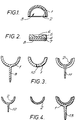
- Figure 1 is a cross-section through a prosthetic hip cup according to the invention and which comprises an outer backing 1 which is made from a "rigid" polymeric material having a minimum hardness value of 65 N/mm.
- the backing 1 supports a bearing liner 2 made from a "soft” elastomeric polyurethane material having a hardness value of 3.0 to 9.0 N/mm and a range thickness 1 to 5 mm.
- Figure 2 shows a meniscal bearing surface for use with the tray of a knee prosthesis.
- the bearing comprises a backing 4 made of a "rigid" polymeric material having a minimum hardness value of 65/Nmm and an upper liner 5 having a bearing surface 6 and a lower liner 7 having a bearing surface 8.
- the liners 5 and 7 are made from a "soft" elastomeric polyurethane material having a hardness value of 3.0 to 9.0 N/mm and a range of thickness 1 to 5 mm.
- Figure 3 shows diagrammatically a process for moulding a bearing element of the kind shown in Figure 1.
- the backing 1 is moulded first in a suitable injection mould and which leaves a sprue 9.
- the backing is now taken out of the mould and the sprue 9 removed.
- a hole 10 is drilled through the backing 1 which is then replaced in the mould and the liner 2 is moulded by utilising the hole 10.
- the sprue left by the liner 2 is indicated by reference numeral 11. this is then removed to provide the completed bearing.
- Figure 4 shows an alternative way of moulding the bearing element and in this arrangement the liner 2 is moulded first and there is a sprue 12.
- the liner 2 is taken out of the mould, the sprue 12 removed and the liner replaced in the mould where the backing 1 is moulded onto it. This again produces a sprue which is subsequently removed to provide the finished bearing element.
- Figure 5 shows a suitable injection mould which can be used in the process.
- the general construction of the mould will be familiar to those skilled in the art and will not therefore be described in detail.
- the mould includes a pair of backing plates 15, 16 which together form a mould cavity 18 which can be fed from an injection moulding machine through an opening 19.
- the mould is in two general parts, 20 and 21, and can be opened along a line 23.
- the part of the mould carries a mounting 24 on which can be secured a male moulding element 25. This is secured by a bolt 26.
- a suitably dimensioned moulded element 25 is secured in place together with appropriate backing plates 15 and 16 and the mould press is operated to inject material through the opening 19 into the moulding space 18 to form a backing of the kind shown at the left hand side of figure 3.
- the mould is now opened along the line 23 and the moulded element 25 together with the backing 1 is detached.
- the backing, as moulded, is then removed from the mould element 25 and the sprue 9 which has formed in the opening 19 is removed.
- a hole 10 is now drilled in the backing and the backing is replaced in the mould with a different mould element 25 of smaller dimensions so that there is now a mould opening between the backing 1 and the surface of the mould element 25.
- Moulding material is now injected through the opening 19 and the hole 10 in the backing 1 so that it fills the space between the backing and the mould element 25.
- the moulded bearing element separated from the moulding element 25 and the sprue 11 which has formed in the opening 19 is removed.
- a hole 10 is now drilled in the backing and the backing is replaced in the mould with a different mould element 25 of smaller dimensions so that there is now a mould opening between the backing 1 and the surface of the mould element 25.
- Moulding material is now injected through the opening 19 and the hole 10 in thebacking so that it fills the space between the backing and the mould element 25.
- the moulded bearing element separated from the moulding element 25 and the sprue 11 which has formed in the opening 19 is removed.
- Figure 6 shows a typical commercial injection moulding machine and in which the injection moulding barrel is indicated by reference numeral 30.
- the various areas along the extending length of the barrel 30 are indicated by reference numerals Z1, Z2, Z3 and Z4. Reference to the temperatures in the barrel are shown in the following examples.
- the screw speed and injection speed referred to are dimensionless covering an analogue range from 1.0 to 5.0. They are varied from time to time dependent upon cavity volume or melt viscosity.
- Moulding CSIR0 85A (lot no 1267-1193)onto Corothane C75D Injection conditions Times: Inj (15 s); Holding (20 s) Pressure: Injection (50 bar), Hold (25 bar) Cooling mould: 10°C (20 s) Screw speed: 3.0 Injection speed: 4.0 Injection temp 205°C (Z1) barrel 201°C (Z2) barrel 201°C (Z3) barrel 191°C (Z4) Peel test samples No. 40 to 45 using ptfe tape as crack initiator. 2.
- Moulding Choroflex AL80A (lot no CF 137) onto Corothane C75D Injection conditions Times: Inj (15 s); Holding (20 s) Pressure: Injection (63 bar), Hold (30 bar) Cooling mould: 10°C (20 s) Screw speed: 3.0 Injection speed: 5.0 Injection temp 205°C (Z1) barrel 201°C (Z2) barrel 201°C (Z3) barrel 191°C (Z4) Peel test samples No. 71 to 87 using ptfe tape as crack indicators. 4. Moulding Pellethane 80A (lot no.
- rigid backing materials can be used for example what are usually referred to as Composites, that is a synthetic resin material with, for example, a fibre reinforcement.
- Composites that is a synthetic resin material with, for example, a fibre reinforcement.
- Example A set out below was the use of carbon fibre reinforced polybutyleneterphthlate (CFR-PBT).
- CFR-PEEK polyetheretherketone
- a peel test was performed on replicate specimens to assess the bond between the rigid backing and the flexible "soft" layer.
- the test used is a standard test in which a 3mm thick flexible layer is bonded to an 8mm thick rigid backing with the last 35mm unbonded by masking the interface using PTFE tape.
- the flexible layer is gripped and pulled at a peel angle of 60° in a Lloyd R6000 Universal testing machine. The force required to peel the layers apart is recorded as the peeling continues for about 50mm.
- N is the mean peel force
- Strain Energy is the area under the force vs. peel distance curve
- adhesive Fracture Energy is the energy released per unit of new surface created on separating the interface.
Landscapes
- Health & Medical Sciences (AREA)
- General Health & Medical Sciences (AREA)
- Orthopedic Medicine & Surgery (AREA)
- Public Health (AREA)
- Oral & Maxillofacial Surgery (AREA)
- Transplantation (AREA)
- Veterinary Medicine (AREA)
- Life Sciences & Earth Sciences (AREA)
- Animal Behavior & Ethology (AREA)
- Chemical & Material Sciences (AREA)
- Heart & Thoracic Surgery (AREA)
- Cardiology (AREA)
- Engineering & Computer Science (AREA)
- Biomedical Technology (AREA)
- Vascular Medicine (AREA)
- Chemical Kinetics & Catalysis (AREA)
- Epidemiology (AREA)
- Medicinal Chemistry (AREA)
- Dermatology (AREA)
- Physical Education & Sports Medicine (AREA)
- Prostheses (AREA)
- Materials For Medical Uses (AREA)
- Injection Moulding Of Plastics Or The Like (AREA)
Abstract
Description
- This invention relates to a prosthetic bearing element and to a process for making such an element.
- At the present time wear of the well known polyethylene acetabular components in hips, the tibial component in knees, and other prosthetic bearing inserts limits the life of these artificial joints. Normally orthopaedic devices for joint construction and reconstruction comprise polyethylene bearings on metal or ceramic or metal on metal for articulation. The polyethylene bearing is often held in a metal shell, for example in hip constructions or a tray in knee constructions. Conveniently bearing liners made from ultra-high molecular weight polyethylene are fixed via a snap fit into the metal backing.
- The possible use of elastomers in bearings to provide fluid film lubrication at low velocity, and with a low viscosity lubricant such as in a reconstructed joint has been published in laboratory studies which show that such "soft" bearings provide lower coefficient of friction compared with standard polyethylene versus metal bearings. Such a material is polyurethane.
- Because of the fluid film lubrication, it is far less likely that the two bearing surfaces touch during use and thus wear is lower.
- It is however difficult to apply this concept for a number of reasons. One difficulty lies in selecting a polyurethane or other elastomer which will not be degraded by the human body so great care must be taken in selecting the polyurethane material used. As mentioned above polyethylene bearing are usually held by physical means in, for example, a metal shell but it is not possible to use this approach with polyurethane because as its stiffness is so much lower than the metal it would be possible for it to extrude from the shell or be easily moved relative to the shell causing damage. Also lower stiffness would lead to greater interface strain.
- Because of the above difficulties the Applicants have tried several different approaches. Initially, for ease of use and conventional appearance, it was attempted to bond a polyurethane liner onto a polyethylene backing, similar to pre-existing polyethylene components. This assembly could then be held in a metal shell or cemented depending on the surgeon's preference and clinical judgement.
- The present invention therefore is related to a prosthetic bearing element which uses an elastomeric polyurethane bearing material and to a method of manufacturing such a bearing element which overcomes some of the difficulties referred to above.
- According to the present invention a prosthetic bearing element comprises a backing which supports a bearing liner having a bearing surface, said backing being made from a "rigid" polymeric material having a minimum hardness value of 65 N/mm and said bearing liner being made from a "soft" elastomeric polyurethane material having a hardness value of 3.0 to 9.0 N/mm.
- It has been found that bearing elements of this type can be made by a moulding process with the surprising result that when the elastomeric material is applied onto a "rigid" polyurethane backing the stability of the interface appears to be better than that predicted by simple mechanical fit. It is not clear whether there is some form of chemical bond and what precisely causes the excellent adhesion between the two materials. It is possible that an interpenetrating network of the "soft" elastomeric polyurethane into the rigid polymer results.
- Preferably therefore the liner is bonded to the backing and the backing itself can also be made from a range of rigid polyurethanes. Suitable polyurethane formulations include those based upon macrogycols formed from polyether glycols i.e. polytetramethylene ether glycol, or polyhexamethylene ether glycol, or polyoctamethylene ether glycol or polydecamethylene ether glycol, or polyester based glycols i.e. poly hexamethylene adipate glycol. The aforementioned macroglycols which are suited to reaction with suitable diisocyanates i.e. 4,4'-methylene bisphenyl diisocyanate, or 4,4'-methylene biscyclohexane diisocyanate, or 2,4-toluene diisocyanate and reacted further with chain extenders i.e. 1,4-butanediol, 1,6-hexanediol, ethylene diamine, 1,4-cyclohexane diamine. Polyurethane of different compositions can be synthesised by those skilled in the art from a range of these materials in many combinations.
- A suitable material is Corothane 75D, a rigid segmented linear polyurethane polymer comprising of a polycarbonate based macroglycol, poly(1,6-hexyl 1,2-ethyl carbonate)diol reacted with 4,4'-methylene bisphenyl diisocyanate and chain extended using 1,4-butanediol. The hardness being determined by the ratio of hard segments (formed by the isocyanate and chain extended domains) to the soft segments (formed by the macrogycol portion of the polymer chain)(Corothane is a Registered Trade Mark of Corvita Corporation) or polymethylmethacrylate, or carbon fibre reinforced polybutyleneterphthlate (CFR-PBT). Another alternative material which can be used is carbon fibre reinforced polyetheretherketone (CFR-PEEK).
- In a preferred construction the bearing liner is made from Corothane 80A.
- A soft segmented linear polyurethane polymer comprising of a polycarbonate based macroglycol, poly(1,6-hexyl 1,2-ethyl carbonate)diol reacted with 4,4'-methylene bisphenyl diisocyanate and chain extended using 1,4-butanediol.
- The invention can be applied to an acetabular cup or any other suitable prosthetic bearing.
- If desired two or more bearing liners can be provided on the backing thus, the bearing element can be used in this manner in the form of a meniscal or conventional bearing for use in a knee prosthesis.
- The invention also includes a prosthetic implant incorporating a bearing element as set forth above.
- A process, according to the invention, for making a prosthetic bearing element as set forth above can include a two stage moulding process in which the backing or liner is moulded first and the appropriate liner or backing is moulded onto it.
- Thus, the two parts are moulded consecutively rather than simultaneously.
- Investigative studies by scanning electron microscopy (SEM), dynamic contact angle (DCA) and fourier transform infra-red spectroscopy (FTIR) have been undertaking to examine the interfacial region to determine the structural changes that occur.
- The introduction of barium sulphate (BaSO₄) at 5% m/m into the elastomer, Corothane 80A, have shown the interface zone to be discrete at 2 - 5 micron and reproducible. In addition the structural composition of the Corothane 80A and Corothane 75D polyetherurethanes has been examined by recording their spectra over a series of sectors (5µM X 220µM) across a section through the interface region.
- This FTIR technique allows the ratio of hard to soft segments in the linear polyetherurethanes to be quantified. The results show that the structure has been modified in the Corothane 75D to gradually change the composition from the interface zone to approximately 50 microns into the bulk as a result of the second moulding operation using Corothane 80A. It is this structural modification that occurs via the overmoulding of the rigid shell materials (Corothane 75D) with the elastomer (Corothane 80A) that appears to provide the adhesion between the two linear polyetherurethanes.
- The invention can be performed in various ways and some embodiments together with details of the moulding process will now be described by way of example and with reference to the accompanying drawings in which :
- Figure 1 is a cross-sectional view through a typical acetabular cup incorporating the invention;
- Figure 2 is a cross-sectional view through a meniscal bearing for use in a knee prosthesis incorporating the invention;
- Figure 3 diagrammatically illustrates three stages of moulding a prosthetic bearing element in which the backing is moulded first in a two-part process;
- Figure 4 is a diagrammatic illustration showing the stages of moulding a similar bearing element to that shown in Figure 1 moulding the bearing liner first in a two-part process;
- Figure 5 is a cross-sectional view through an injection mould for use in the process according to the invention; and,
- Figure 6 is a diagrammatic side elevation of an injection moulding machine showing various areas of the injection moulding barrel.
- Figure 1 is a cross-section through a prosthetic hip cup according to the invention and which comprises an outer backing 1 which is made from a "rigid" polymeric material having a minimum hardness value of 65 N/mm. The backing 1 supports a
bearing liner 2 made from a "soft" elastomeric polyurethane material having a hardness value of 3.0 to 9.0 N/mm and a range thickness 1 to 5 mm. - The terms "rigid" and "soft" are used throughout the specification to indicate the relative properties of the material from which the backing and the liner are made.
- The bearing surface of the cup shown in Figure 1 is indicated by
reference numeral 3. - Figure 2 shows a meniscal bearing surface for use with the tray of a knee prosthesis. The bearing comprises a
backing 4 made of a "rigid" polymeric material having a minimum hardness value of 65/Nmm and anupper liner 5 having a bearing surface 6 and alower liner 7 having abearing surface 8. Theliners - Figure 3 shows diagrammatically a process for moulding a bearing element of the kind shown in Figure 1. The backing 1 is moulded first in a suitable injection mould and which leaves a sprue 9. The backing is now taken out of the mould and the sprue 9 removed. A
hole 10 is drilled through the backing 1 which is then replaced in the mould and theliner 2 is moulded by utilising thehole 10. The sprue left by theliner 2 is indicated byreference numeral 11. this is then removed to provide the completed bearing. - Figure 4 shows an alternative way of moulding the bearing element and in this arrangement the
liner 2 is moulded first and there is asprue 12. Theliner 2 is taken out of the mould, thesprue 12 removed and the liner replaced in the mould where the backing 1 is moulded onto it. This again produces a sprue which is subsequently removed to provide the finished bearing element. - Figure 5 shows a suitable injection mould which can be used in the process. The general construction of the mould will be familiar to those skilled in the art and will not therefore be described in detail. The mould includes a pair of
backing plates mould cavity 18 which can be fed from an injection moulding machine through anopening 19. - The mould is in two general parts, 20 and 21, and can be opened along a
line 23. - The part of the mould carries a mounting 24 on which can be secured a
male moulding element 25. This is secured by abolt 26. - In order to mould bearing elements of different sizes a number of
backing plates mould elements 25 are provided. - In order to mould in the process shown in Figure 3, that is by moulding the backing element 1 first, a suitably dimensioned moulded
element 25 is secured in place together withappropriate backing plates opening 19 into themoulding space 18 to form a backing of the kind shown at the left hand side of figure 3. The mould is now opened along theline 23 and the mouldedelement 25 together with the backing 1 is detached. The backing, as moulded, is then removed from themould element 25 and the sprue 9 which has formed in theopening 19 is removed. Ahole 10 is now drilled in the backing and the backing is replaced in the mould with adifferent mould element 25 of smaller dimensions so that there is now a mould opening between the backing 1 and the surface of themould element 25. Moulding material is now injected through theopening 19 and thehole 10 in the backing 1 so that it fills the space between the backing and themould element 25. With moulding completed the mould is again split, the moulded bearing element separated from themoulding element 25 and thesprue 11 which has formed in theopening 19 is removed. Ahole 10 is now drilled in the backing and the backing is replaced in the mould with adifferent mould element 25 of smaller dimensions so that there is now a mould opening between the backing 1 and the surface of themould element 25. Moulding material is now injected through theopening 19 and thehole 10 in thebacking so that it fills the space between the backing and themould element 25. With moulding completed the mould is again split, the moulded bearing element separated from themoulding element 25 and thesprue 11 which has formed in theopening 19 is removed. - In order to mould according to the process shown in Figure 4 with the same apparatus the process is carried out by using appropriately
sized backing plates mould element 25 to produce the inner lining. With thesprue 12 removed the lining is replaced in the mould but this time withdifferent backing plates liner 2 and the edges of thecavity 18. The backing is now moulded in place, is removed in a manner described above and thesprue 13 is removed. - It will be appreciated that the above is a relatively simple way of moulding according to the process and other moulding techniques can be employed.
- Using the above type of apparatus the following combinations of materials have been moulded using the process set forth and have produced satisfactory examples.
- Figure 6 shows a typical commercial injection moulding machine and in which the injection moulding barrel is indicated by
reference numeral 30. The various areas along the extending length of thebarrel 30 are indicated by reference numerals Z1, Z2, Z3 and Z4. Reference to the temperatures in the barrel are shown in the following examples. - The screw speed and injection speed referred to are dimensionless covering an analogue range from 1.0 to 5.0. They are varied from time to time dependent upon cavity volume or melt viscosity.
1. Moulding CSIR0 85A (lot no 1267-1193)onto Corothane C75DInjection conditions Times: Inj (15 s); Holding (20 s) Pressure: Injection (50 bar), Hold (25 bar) Cooling mould: 10°C (20 s) Screw speed: 3.0 Injection speed: 4.0 Injection temp 205°C (Z1) barrel 201°C (Z2) barrel 201°C (Z3) barrel 191°C (Z4)
2. Moulding Tecothane 93A onto Corothane C75DInjection conditions Times: Inj (15 s); Holding (20 s); cooling (20s) Pressure: Injection (050 bar), Hold (25 bar) Cooling mould: 10°C Screw speed: 3.0 Injection speed: 4.0 Injection temp 205°C (Z1) barrel 201°C (Z2) barrel 200°C (Z3) barrel 191°C (Z4)
3. Moulding Choroflex AL80A (lot no CF 137) onto Corothane C75DInjection conditions Times: Inj (15 s); Holding (20 s) Pressure: Injection (63 bar), Hold (30 bar) Cooling mould: 10°C (20 s) Screw speed: 3.0 Injection speed: 5.0 Injection temp 205°C (Z1) barrel 201°C (Z2) barrel 201°C (Z3) barrel 191°C (Z4)
4. Moulding Pellethane 80A (lot no. 2363) onto Corothane C75DInjection conditions Times: Inj (15 s); Holding (20 s) Pressure: Injection (50 bar), Hold (25 bar) Cooling mould: 10°C (20 s) Screw speed: 3.0 Injection speed: 5.0 Injection temp 205°C (Z1) barrel 201°C (Z2) barrel 191°C (Z3) barrel 160°C (Z4)
5. Moulding Corothane 55D (lot no PEA0072) onto Corothane C75DInjection conditions Times: Inj (15 s); Holding (20 s) Pressure: Injection (50 bar), Hold (25 bar) Cooling mould: 10°C (20 s) Screw speed: 3.0 Injection speed: 5.0 Injection temp 222°C (Z1) barrel 218°C (Z2) barrel 209°C (Z3) barrel 190°C (Z4)
6. Moulding Corothane 80A (lot no PEA00038) onto Tecothane C75D.Injection conditions Times: Inj (15 s); Holding (20 s) Pressure: Injection (50 bar), Hold (25 bar) Cooling mould: 10°C (20 s) Screw speed: 3.0 Injection speed: 5.0 Injection temp 216°C (Z1) barrel 216°C (Z2) barrel 205°C (Z3) barrel 160°C (Z4)
Peel test samples No. 117 to 141 using ptfe tape as crack indicator. - Rigid backing pieces were moulded from Corothane 75D as follows.
Injection conditions Times: Inj (15 s); Holding (20 s) Pressure: Injection (50 bar), Hold (25 bar) Cooling mould: Ambiient (20 s) Screw speed: 3.0 Injection speed: 5.0 Injection temp 229°C (Z1) barrel 223°C (Z2) barrel 211°C (Z3) 200°C (Z4) - Such backing pieces were ready for use with suitable liners.
- Liners themselves were also made individually from Corothane 80A under the following conditions.
Injection conditions Times: Inj (15 s); Holding (20 s) Pressure: Injection (59 bar), Hold (25 bar) Cooling mould: 10°C (20 s) Screw speed: 3.0 Injection speed: 5.0 Injection temp 208°C (Z1) barrel 203°C (Z2) barrel 191°C (Z3) barrel 160°C (Z4) - These liners were suitable for use with backing of suitable material.
- Further "rigid" backing materials can be used for example what are usually referred to as Composites, that is a synthetic resin material with, for example, a fibre reinforcement. Example A set out below was the use of carbon fibre reinforced polybutyleneterphthlate (CFR-PBT).
- Times:
- Inj (4s); Holding (4s)
- Pressure:
- Injection (40 bar), Hold (10 bar)
- Temp:
- Injection 240°C
Mould 80°C - Another alternative material which was successfully injected was polyetheretherketone (CFR-PEEK) as follows.
- Times:
- Inj (4s); Holding (4s)
- Pressure:
- Injection (40 bar), Hold (12 bar)
- Temp:
- Injection 390°C
Mould 180°C - These materials were successfully used as backings, again with, for example, Corothane 80A.
- Experiments were carried out to establish the relative hardnesses of different materials and hardness testing of the various elastomers was undertaken using BS 2782;
Pt 3 Method 365D (Test load 49N - Shore 80 - 93A; Test load 358N - Shore 75D). - The results of the hardness examination are shown below

- As will be seen the difference between "rigid" and "soft" are apparent.
- A peel test was performed on replicate specimens to assess the bond between the rigid backing and the flexible "soft" layer. the test used is a standard test in which a 3mm thick flexible layer is bonded to an 8mm thick rigid backing with the last 35mm unbonded by masking the interface using PTFE tape. The flexible layer is gripped and pulled at a peel angle of 60° in a Lloyd R6000 Universal testing machine. The force required to peel the layers apart is recorded as the peeling continues for about 50mm.
- The table below shows the results of this test where N is the mean peel force, the Strain Energy is the area under the force vs. peel distance curve and the adhesive Fracture Energy is the energy released per unit of new surface created on separating the interface.

NH₃ (ammonia plasma)
Allylamine (allyamine to quench radicals by an oxygen plasma)
PEI (polyethylenimine to quench radicals generated by an oxygen plasma) - It will be seen that the peel force required for the first six combinations of materials is very low but immediately "rigid" and "soft" materials are applied together the peel force required rises dramatically.
- This ability to resist separation is utilised in the preparation of the bearing elements of the kind set forth in the present invention.
Claims (13)
- A prosthetic bearing element comprising a backing which supports a bearing liner having a bearing surface, said backing being made from a "rigid" polymeric material having a minimum hardness value of 65 N/mm and said bearing liner being made from a "soft" elastomeric polyurethane material having a hardness value of 3.0 to 9.0 N/mm.
- A prosthetic bearing element as claimed in claim 1 in which said liner is bonded to said backing.
- A prosthetic bearing element as claimed in claim 2 in which said backing is made from polyurethane.
- A prosthetic bearing element as claimed in claim 3 in which said polyurethane is Corothane 75D.
- A prosthetic bearing element as claimed in claim 2 in which said backing is made from carbon fibre reinforced polybutyleneterphthlate (CFR-PBT).
- A prosthetic bearing element as claimed in claim 2 in which said backing material is made from polyetheretherketone (CFR-PEEK).
- A prosthetic bearing element as claimed in claim 2 in which said backing material is made from polymethylmethacrylate.
- A prosthetic bearing element as claimed in any one of the proceeding claims in which the bearing liner is made from Corothane 80A.
- A prosthetic bearing element as claimed in claims 1 to 8 which is in the form of an acetabular cup.
- A prosthetic bearing element as claimed in any one of the preceding claims 1 to 8 in which two or more being liners are provided on said backing.
- A prosthetic bearing element as claimed in claim 9 which is in the form of a bearing insert for use in a knee prosthesis
- A prosthetic orthopaedic or maxillofacial implant incorporating a bearing element as set forth in any one of the preceding claims.
- A process for making a prosthetic bearing element as claimed in claim 1 which includes a two stage moulding process in which the backing or liner is moulded first and the appropriate liner or backing is moulded onto it.
Applications Claiming Priority (2)
| Application Number | Priority Date | Filing Date | Title |
|---|---|---|---|
| GB9417288A GB9417288D0 (en) | 1994-08-25 | 1994-08-25 | Prosthetic bearing element and process for making such an element |
| GB9417288 | 1994-08-25 |
Publications (3)
| Publication Number | Publication Date |
|---|---|
| EP0698382A2 true EP0698382A2 (en) | 1996-02-28 |
| EP0698382A3 EP0698382A3 (en) | 1996-09-18 |
| EP0698382B1 EP0698382B1 (en) | 2000-04-05 |
Family
ID=10760459
Family Applications (1)
| Application Number | Title | Priority Date | Filing Date |
|---|---|---|---|
| EP95305766A Expired - Lifetime EP0698382B1 (en) | 1994-08-25 | 1995-08-18 | Prosthetic bearing element and process for making such an element |
Country Status (7)
| Country | Link |
|---|---|
| US (1) | US5879387A (en) |
| EP (1) | EP0698382B1 (en) |
| JP (1) | JPH0947504A (en) |
| AT (1) | ATE191330T1 (en) |
| CA (1) | CA2156476A1 (en) |
| DE (2) | DE69516059T2 (en) |
| GB (1) | GB9417288D0 (en) |
Cited By (20)
| Publication number | Priority date | Publication date | Assignee | Title |
|---|---|---|---|---|
| EP0803234A1 (en) * | 1996-04-23 | 1997-10-29 | Biomet Limited | Acetabular cups and methods of their manufacture |
| WO1997041809A1 (en) * | 1996-05-03 | 1997-11-13 | Bmp S.A. | Intra-bone implant |
| EP0867159A1 (en) * | 1997-03-25 | 1998-09-30 | Sulzer Orthopädie AG | Artificial hip joint acetabular cup having two shells and its manufacture |
| EP0806192A3 (en) * | 1996-05-11 | 1998-11-18 | Heraeus Kulzer GmbH | Semi-finished product for precision manufacturing of a prosthesis to be implanted |
| WO1999024084A1 (en) * | 1997-11-07 | 1999-05-20 | Salviac Limited | Biostable polycarbonate urethane products |
| AU705294B2 (en) * | 1996-02-13 | 1999-05-20 | Stryker Technologies Corporation | Polyetheretherketone (PEEK) retaining ring for an acetabular cup assembly |
| EP1208819A1 (en) * | 2000-11-07 | 2002-05-29 | Benoist Girard Sas | Cementless prosthetic bearing element |
| WO2003099156A3 (en) * | 2002-05-23 | 2004-03-25 | Discure Ltd | Joint and dental implants |
| EP1454602A1 (en) * | 2003-03-05 | 2004-09-08 | Howmedica International S. De R.L. | Method for making a prosthetic bearing element |
| US20050143836A1 (en) * | 1995-09-04 | 2005-06-30 | Amiram Steinberg | One piece snap fit acetabular cup |
| WO2005030281A3 (en) * | 2003-09-26 | 2005-07-07 | Hexabio 4 Al Du Doyen Brus Soc | Biocompatible elastomer material for mould prosthesises implantable in a human body |
| EP1304981A4 (en) * | 2000-03-14 | 2005-11-30 | Chondrosite Inc | Cartilage repair plug |
| EP1242008B1 (en) * | 1999-12-17 | 2006-03-08 | Cartificial A/S | A prosthetic device |
| GB2431354A (en) * | 2005-10-24 | 2007-04-25 | Benoist Girard Sas | A prosthetic glenoid component with soft bearing surface |
| EP1884220A1 (en) | 2005-04-19 | 2008-02-06 | Benoist Girard Sas | Flexible acetabular cup and method of manufacture thereof |
| WO2009036576A1 (en) * | 2007-09-17 | 2009-03-26 | Synergy Biosurgical Ag | Medical implant |
| US9398927B2 (en) | 2007-07-03 | 2016-07-26 | Synergy Biosurgical Ag | Medical implant |
| US9402725B2 (en) | 2009-11-30 | 2016-08-02 | DePuy Synthes Products, Inc. | Expandable implant |
| US10111696B2 (en) | 2011-08-25 | 2018-10-30 | DePuy Synthes Products, Inc. | Implant |
| US20230030743A1 (en) * | 2007-05-01 | 2023-02-02 | Moximed, Inc. | Extra-articular implantable mechanical energy absorbing systems |
Families Citing this family (59)
| Publication number | Priority date | Publication date | Assignee | Title |
|---|---|---|---|---|
| US7255712B1 (en) | 1997-04-15 | 2007-08-14 | Active Implants Corporation | Bone growth promoting implant |
| US6972039B2 (en) | 1999-03-01 | 2005-12-06 | Biomet, Inc. | Floating bearing knee joint prosthesis with a fixed tibial post |
| US20050209703A1 (en) * | 1999-04-02 | 2005-09-22 | Fell Barry M | Surgically implantable prosthetic system |
| US7491235B2 (en) * | 1999-05-10 | 2009-02-17 | Fell Barry M | Surgically implantable knee prosthesis |
| US6875235B2 (en) * | 1999-10-08 | 2005-04-05 | Bret A. Ferree | Prosthetic joints with contained compressible resilient members |
| RU2269954C2 (en) * | 2000-06-09 | 2006-02-20 | Дайэбитиз Дайэгностикс, Инк. | Cap for lancet device for punching dermal tissue (versions), cap for lancet device for punching tip of finger, cap for lancet device for punching curvilinear dermal tissue and lancet device for punching dermal tissue |
| DE10051437B4 (en) * | 2000-10-17 | 2006-04-06 | Tutech Innovation Gmbh | Tibial bearing component of a knee endoprosthesis with graded material structure |
| GB0027210D0 (en) | 2000-11-07 | 2000-12-27 | Benoist Girard & Cie | Prosthesis bearing component |
| EP1357863B1 (en) * | 2001-01-02 | 2010-11-10 | Advanced Ceramics Research, Inc. | Compositions and methods for biomedical applications |
| US7497874B1 (en) | 2001-02-23 | 2009-03-03 | Biomet Manufacturing Corp. | Knee joint prosthesis |
| US20020120340A1 (en) | 2001-02-23 | 2002-08-29 | Metzger Robert G. | Knee joint prosthesis |
| ES2337886T3 (en) | 2001-12-04 | 2010-04-30 | Active Implants Corporation | IMPLANTS THAT CARRY A PAD FOR LOAD SUPPORT APPLICATIONS. |
| CA2497278C (en) * | 2002-09-02 | 2010-05-11 | Synthes Usa, Llc | Intervertebral implant comprising a three-part articulation |
| WO2004026170A2 (en) * | 2002-09-20 | 2004-04-01 | Impliant Ltd. | Mechanically attached elastomeric cover for prosthesis |
| AU2003261497B2 (en) * | 2002-11-08 | 2009-02-26 | Howmedica Osteonics Corp. | Laser-produced porous surface |
| US20060147332A1 (en) | 2004-12-30 | 2006-07-06 | Howmedica Osteonics Corp. | Laser-produced porous structure |
| US6994730B2 (en) * | 2003-01-31 | 2006-02-07 | Howmedica Osteonics Corp. | Meniscal and tibial implants |
| US20070027547A1 (en) * | 2003-06-27 | 2007-02-01 | Advanced Bio Surfaces, Inc. | System and method for ankle arthroplasty |
| GB0322145D0 (en) * | 2003-09-22 | 2003-10-22 | Howmedica Internat S De R L | Apparatus for use in the regeneration of structured human tissue |
| US7879275B2 (en) * | 2004-12-30 | 2011-02-01 | Depuy Products, Inc. | Orthopaedic bearing and method for making the same |
| DE102005001255B4 (en) * | 2005-01-11 | 2010-08-26 | Mathys Ag Bettlach | Inverse shoulder joint endoprosthesis with one-piece middle part |
| US20060178497A1 (en) * | 2005-02-04 | 2006-08-10 | Clemson University And Thordon Bearings, Inc. | Implantable biomedical devices including biocompatible polyurethanes |
| GB0519490D0 (en) * | 2005-09-23 | 2005-11-02 | Benoist Girard Sas | Prosthetic joints |
| US8728387B2 (en) * | 2005-12-06 | 2014-05-20 | Howmedica Osteonics Corp. | Laser-produced porous surface |
| CA2572095C (en) * | 2005-12-30 | 2009-12-08 | Howmedica Osteonics Corp. | Laser-produced implants |
| US8147861B2 (en) * | 2006-08-15 | 2012-04-03 | Howmedica Osteonics Corp. | Antimicrobial implant |
| US8163028B2 (en) | 2007-01-10 | 2012-04-24 | Biomet Manufacturing Corp. | Knee joint prosthesis system and method for implantation |
| US8562616B2 (en) | 2007-10-10 | 2013-10-22 | Biomet Manufacturing, Llc | Knee joint prosthesis system and method for implantation |
| WO2008118247A1 (en) | 2007-01-10 | 2008-10-02 | Biomet Manufacturing Corp. | Knee joint prosthesis system and method for implantation |
| US8187280B2 (en) | 2007-10-10 | 2012-05-29 | Biomet Manufacturing Corp. | Knee joint prosthesis system and method for implantation |
| US8328873B2 (en) | 2007-01-10 | 2012-12-11 | Biomet Manufacturing Corp. | Knee joint prosthesis system and method for implantation |
| US20080183291A1 (en) * | 2007-01-29 | 2008-07-31 | Howmedica Osteonics Corp. | Resurfacing the tibial plateau |
| US8142886B2 (en) | 2007-07-24 | 2012-03-27 | Howmedica Osteonics Corp. | Porous laser sintered articles |
| US8128703B2 (en) | 2007-09-28 | 2012-03-06 | Depuy Products, Inc. | Fixed-bearing knee prosthesis having interchangeable components |
| US8632600B2 (en) | 2007-09-25 | 2014-01-21 | Depuy (Ireland) | Prosthesis with modular extensions |
| US20110035018A1 (en) * | 2007-09-25 | 2011-02-10 | Depuy Products, Inc. | Prosthesis with composite component |
| US8715359B2 (en) | 2009-10-30 | 2014-05-06 | Depuy (Ireland) | Prosthesis for cemented fixation and method for making the prosthesis |
| US9204967B2 (en) | 2007-09-28 | 2015-12-08 | Depuy (Ireland) | Fixed-bearing knee prosthesis having interchangeable components |
| CA2706233C (en) * | 2009-06-04 | 2015-05-05 | Howmedica Osteonics Corp. | Orthopedic peek-on-polymer bearings |
| US20110015752A1 (en) * | 2009-07-14 | 2011-01-20 | Biomet Manufacturing Corp. | System and Method for Acetabular Cup |
| US8393862B2 (en) * | 2009-08-07 | 2013-03-12 | Chia-Teh Chen | Ceiling fan positioning structure for shielding a hanging portion of a ceiling fan |
| EP2338530B1 (en) * | 2009-12-22 | 2015-04-22 | Arthrex, Inc. | Hybrid polymer/metal plug for treating chondral defects |
| US9011547B2 (en) * | 2010-01-21 | 2015-04-21 | Depuy (Ireland) | Knee prosthesis system |
| US20130131805A1 (en) * | 2010-02-09 | 2013-05-23 | Marc Hendriks | Orthopedic implant |
| US8308808B2 (en) * | 2010-02-19 | 2012-11-13 | Biomet Manufacturing Corp. | Latent mobile bearing for prosthetic device |
| US8317870B2 (en) | 2010-09-30 | 2012-11-27 | Depuy Products, Inc. | Tibial component of a knee prosthesis having an angled cement pocket |
| US8287601B2 (en) | 2010-09-30 | 2012-10-16 | Depuy Products, Inc. | Femoral component of a knee prosthesis having an angled cement pocket |
| US9364896B2 (en) | 2012-02-07 | 2016-06-14 | Medical Modeling Inc. | Fabrication of hybrid solid-porous medical implantable devices with electron beam melting technology |
| US9180010B2 (en) | 2012-04-06 | 2015-11-10 | Howmedica Osteonics Corp. | Surface modified unit cell lattice structures for optimized secure freeform fabrication |
| US9135374B2 (en) | 2012-04-06 | 2015-09-15 | Howmedica Osteonics Corp. | Surface modified unit cell lattice structures for optimized secure freeform fabrication |
| DE102013104388B4 (en) * | 2013-04-30 | 2019-02-21 | Phitea GmbH | Application-specific coating and structuring of implantable prostheses using laser techniques |
| EP3400912B1 (en) | 2017-05-10 | 2019-11-20 | Howmedica Osteonics Corporation | Patient specific composite knee replacement |
| US11298747B2 (en) | 2017-05-18 | 2022-04-12 | Howmedica Osteonics Corp. | High fatigue strength porous structure |
| EP3658078B1 (en) | 2017-07-28 | 2021-05-19 | Active Implants LLC | Two-piece floating joint replacement device with a rigid backing material |
| WO2019023619A1 (en) | 2017-07-28 | 2019-01-31 | Active Implants LLC | Floating joint replacement device with supportive sidewall |
| FR3071188B1 (en) * | 2017-09-21 | 2019-10-18 | Jtekt Europe | CAGE BI-MATERIAL WITH CUSHIONETS FOR A BALL |
| CN108836576A (en) * | 2018-07-18 | 2018-11-20 | 北京爱康宜诚医疗器材有限公司 | replacement prosthesis |
| WO2021094382A1 (en) * | 2019-11-12 | 2021-05-20 | Depuy Ireland Unlimited Company | Composite orthopaedic prosthesis and method of making the same |
| CN115697254A (en) * | 2020-05-29 | 2023-02-03 | 帝斯曼知识产权资产管理有限公司 | Medical implant for cartilage replacement and method for producing such an implant |
Family Cites Families (20)
| Publication number | Priority date | Publication date | Assignee | Title |
|---|---|---|---|---|
| DE2247721A1 (en) * | 1972-09-28 | 1974-04-04 | Hoffmann Daimler Siegfried Dr | JOINT PROSTHESIS |
| US4267608A (en) * | 1978-10-04 | 1981-05-19 | Bora Jr F William | Prosthetic joint |
| GB2126096A (en) * | 1982-06-22 | 1984-03-21 | George Kenneth Mckee | Improvements in prosthesis |
| EP0203719B1 (en) * | 1985-04-30 | 1989-10-18 | Vitek Inc. | Implant for reconstruction of temporomandibular joint |
| US4778472A (en) * | 1985-04-30 | 1988-10-18 | Vitek, Inc. | Implant for reconstruction of temporomanibular joint |
| GB8715176D0 (en) * | 1987-06-29 | 1987-08-05 | Howmedica | Making prosthetic component |
| US4911718A (en) * | 1988-06-10 | 1990-03-27 | University Of Medicine & Dentistry Of N.J. | Functional and biocompatible intervertebral disc spacer |
| DE3824243C1 (en) * | 1988-07-16 | 1990-04-12 | Friedrichsfeld Gmbh Keramik- Und Kunststoffwerke, 6800 Mannheim, De | |
| US5030402A (en) * | 1989-03-17 | 1991-07-09 | Zachariades Anagnostis E | Process for producing a new class of ultra-high-molecular-weight polyethylene orthopaedic prostheses with enhanced mechanical properties |
| DE59003145D1 (en) * | 1989-09-28 | 1993-11-25 | Sulzer Ag | Finger joint prosthesis. |
| US5067964A (en) * | 1989-12-13 | 1991-11-26 | Stryker Corporation | Articular surface repair |
| FR2662930B1 (en) * | 1990-06-06 | 1998-01-30 | Bouvet Jean Claude | BALL JOINT FOR PROSTHESIS. |
| US5047054A (en) * | 1990-10-17 | 1991-09-10 | Smith & Nephew Richards, Inc. | Triazine resin coated prosthetic implants |
| EP0497079B1 (en) * | 1991-01-18 | 1996-05-15 | SULZER Medizinaltechnik AG | Knee joint prosthesis |
| ATE124620T1 (en) * | 1991-01-18 | 1995-07-15 | Sulzer Medizinaltechnik Ag | IMPLANT MADE OF TWO SLIDER PARTNERS. |
| US5201881A (en) * | 1991-08-13 | 1993-04-13 | Smith & Nephew Richards Inc. | Joint prosthesis with improved shock absorption |
| US5344459A (en) * | 1991-12-03 | 1994-09-06 | Swartz Stephen J | Arthroscopically implantable prosthesis |
| US5609646A (en) * | 1992-01-23 | 1997-03-11 | Howmedica International | Acetabular cup for a total hip prosthesis |
| FR2695063B3 (en) * | 1992-09-03 | 1994-11-25 | Fernand Lecoent | Process for manufacturing plastic parts by controlled molding-thermoforming. |
| EP0681845B1 (en) * | 1994-04-11 | 1999-09-22 | Bristol-Myers Squibb Company | Polymer composite implant and method of making the same |
-
1994
- 1994-08-25 GB GB9417288A patent/GB9417288D0/en active Pending
-
1995
- 1995-08-18 AT AT95305766T patent/ATE191330T1/en not_active IP Right Cessation
- 1995-08-18 CA CA002156476A patent/CA2156476A1/en not_active Abandoned
- 1995-08-18 EP EP95305766A patent/EP0698382B1/en not_active Expired - Lifetime
- 1995-08-18 DE DE69516059T patent/DE69516059T2/en not_active Expired - Fee Related
- 1995-08-24 DE DE29513619U patent/DE29513619U1/en not_active Expired - Lifetime
- 1995-08-25 JP JP7217446A patent/JPH0947504A/en active Pending
-
1997
- 1997-09-19 US US08/932,573 patent/US5879387A/en not_active Expired - Lifetime
Non-Patent Citations (1)
| Title |
|---|
| None |
Cited By (33)
| Publication number | Priority date | Publication date | Assignee | Title |
|---|---|---|---|---|
| US20050143836A1 (en) * | 1995-09-04 | 2005-06-30 | Amiram Steinberg | One piece snap fit acetabular cup |
| AU705294B2 (en) * | 1996-02-13 | 1999-05-20 | Stryker Technologies Corporation | Polyetheretherketone (PEEK) retaining ring for an acetabular cup assembly |
| US5879404A (en) * | 1996-04-23 | 1999-03-09 | Biomet Limited | Acetabular cups and methods of their manufacture |
| EP0803234A1 (en) * | 1996-04-23 | 1997-10-29 | Biomet Limited | Acetabular cups and methods of their manufacture |
| WO1997041809A1 (en) * | 1996-05-03 | 1997-11-13 | Bmp S.A. | Intra-bone implant |
| EP0806192A3 (en) * | 1996-05-11 | 1998-11-18 | Heraeus Kulzer GmbH | Semi-finished product for precision manufacturing of a prosthesis to be implanted |
| EP0867159A1 (en) * | 1997-03-25 | 1998-09-30 | Sulzer Orthopädie AG | Artificial hip joint acetabular cup having two shells and its manufacture |
| WO1999024084A1 (en) * | 1997-11-07 | 1999-05-20 | Salviac Limited | Biostable polycarbonate urethane products |
| AU729736B2 (en) * | 1997-11-07 | 2001-02-08 | Salviac Limited | Biostable polycarbonate urethane products |
| EP1242008B1 (en) * | 1999-12-17 | 2006-03-08 | Cartificial A/S | A prosthetic device |
| US7244273B2 (en) | 1999-12-17 | 2007-07-17 | Cartificial A/S | Prosthetic device |
| US7993566B2 (en) | 1999-12-17 | 2011-08-09 | Dsm Ip Assets B.V. | Method for the production of medical implants |
| EP1304981A4 (en) * | 2000-03-14 | 2005-11-30 | Chondrosite Inc | Cartilage repair plug |
| AU779337B2 (en) * | 2000-11-07 | 2005-01-20 | Stryker European Holdings I, Llc | Cementless prosthetic bearing element |
| EP1208819A1 (en) * | 2000-11-07 | 2002-05-29 | Benoist Girard Sas | Cementless prosthetic bearing element |
| WO2003099156A3 (en) * | 2002-05-23 | 2004-03-25 | Discure Ltd | Joint and dental implants |
| CN100586398C (en) * | 2002-05-23 | 2010-02-03 | 活性移植公司 | implant |
| EP1454602A1 (en) * | 2003-03-05 | 2004-09-08 | Howmedica International S. De R.L. | Method for making a prosthetic bearing element |
| WO2005030281A3 (en) * | 2003-09-26 | 2005-07-07 | Hexabio 4 Al Du Doyen Brus Soc | Biocompatible elastomer material for mould prosthesises implantable in a human body |
| EP1884220A1 (en) | 2005-04-19 | 2008-02-06 | Benoist Girard Sas | Flexible acetabular cup and method of manufacture thereof |
| GB2431354A (en) * | 2005-10-24 | 2007-04-25 | Benoist Girard Sas | A prosthetic glenoid component with soft bearing surface |
| US20230030743A1 (en) * | 2007-05-01 | 2023-02-02 | Moximed, Inc. | Extra-articular implantable mechanical energy absorbing systems |
| US9398927B2 (en) | 2007-07-03 | 2016-07-26 | Synergy Biosurgical Ag | Medical implant |
| US10278747B2 (en) | 2007-07-03 | 2019-05-07 | Medacta International S.A. | Medical implant |
| KR20100085914A (en) * | 2007-09-17 | 2010-07-29 | 씨너지 바이오써지컬 아게 | Medical implant |
| WO2009036576A1 (en) * | 2007-09-17 | 2009-03-26 | Synergy Biosurgical Ag | Medical implant |
| US20120129131A1 (en) * | 2007-09-17 | 2012-05-24 | Synergy Biosurgical Ag | Medical implant ii |
| US8777618B2 (en) | 2007-09-17 | 2014-07-15 | Synergy Biosurgical Ag | Medical implant II |
| US9457125B2 (en) | 2007-09-17 | 2016-10-04 | Synergy Biosurgical Ag | Medical implant with electromagnetic radiation responsive polymer and related methods |
| US9402725B2 (en) | 2009-11-30 | 2016-08-02 | DePuy Synthes Products, Inc. | Expandable implant |
| US10022228B2 (en) | 2009-11-30 | 2018-07-17 | DePuy Synthes Products, Inc. | Expandable implant |
| US10111696B2 (en) | 2011-08-25 | 2018-10-30 | DePuy Synthes Products, Inc. | Implant |
| US11179182B2 (en) | 2011-08-25 | 2021-11-23 | DePuy Synthes Products, Inc. | Method of securing an implant |
Also Published As
| Publication number | Publication date |
|---|---|
| DE29513619U1 (en) | 1995-12-21 |
| GB9417288D0 (en) | 1994-10-19 |
| JPH0947504A (en) | 1997-02-18 |
| ATE191330T1 (en) | 2000-04-15 |
| DE69516059D1 (en) | 2000-05-11 |
| EP0698382B1 (en) | 2000-04-05 |
| DE69516059T2 (en) | 2000-10-12 |
| US5879387A (en) | 1999-03-09 |
| EP0698382A3 (en) | 1996-09-18 |
| CA2156476A1 (en) | 1996-02-26 |
Similar Documents
| Publication | Publication Date | Title |
|---|---|---|
| EP0698382B1 (en) | Prosthetic bearing element and process for making such an element | |
| EP1686932B1 (en) | System for ankle arthroplasty | |
| US5645594A (en) | Polymer composite implant and method of making the same | |
| JP5752035B2 (en) | Hydrophilic interpenetrating polymer network derived from hydrophobic polymer | |
| EP1722717B1 (en) | Hydrogels having charged surfaces for cartilage replacement | |
| US8361147B2 (en) | Meniscus prosthetic devices with anti-migration features | |
| US8016884B2 (en) | Tensioned meniscus prosthetic devices and associated methods | |
| US7991599B2 (en) | Meniscus prosthetic device selection and implantation methods | |
| US20060178497A1 (en) | Implantable biomedical devices including biocompatible polyurethanes | |
| US20060282169A1 (en) | System and method for upper extremity joint arthroplasty | |
| US20070067032A1 (en) | Meniscus preserving implant method and apparatus | |
| US20060247787A1 (en) | Method and system for toe arthroplasty | |
| US20090259313A1 (en) | Manufacturing and material processing for prosthetic devices | |
| EP3597152A1 (en) | Meniscus prosthetic device | |
| US6302916B1 (en) | Polyurethane and so forth containing joints | |
| Lee | Advances in Biomaterials | |
| Currier et al. | In vitro simulation of contact fatigue damage found in ultra-high molecular weight polyethylene components of knee prostheses | |
| Quigley et al. | Selection of elastomeric materials for compliant-layered total hip arthroplasty | |
| WO2005025451A2 (en) | Method and materials for interpositional arthroplasty implant | |
| EP1454602B1 (en) | Method of improving the performance of a prosthetic bearing element | |
| Gul | Improved UHMWPE for use in total joint replacement | |
| Das et al. | Wear performance of UHMWPE and PCU artificial disc materials | |
| Hoeltzel et al. | The effects of femoral head size on the deformation of ultrahigh molecular weight polyethylene acetabular cups | |
| Becker et al. | Novel" composite" materials using porous sintered stainless steel adherends mechanically" bonded" with synthetic elastomers | |
| Blamey | Improved tribology and materials for a new generation of hip prostheses |
Legal Events
| Date | Code | Title | Description |
|---|---|---|---|
| PUAI | Public reference made under article 153(3) epc to a published international application that has entered the european phase |
Free format text: ORIGINAL CODE: 0009012 |
|
| 17P | Request for examination filed |
Effective date: 19950825 |
|
| AK | Designated contracting states |
Kind code of ref document: A2 Designated state(s): AT BE CH DE DK ES FR GB GR IE IT LI LU NL |
|
| PUAL | Search report despatched |
Free format text: ORIGINAL CODE: 0009013 |
|
| AK | Designated contracting states |
Kind code of ref document: A3 Designated state(s): AT BE CH DE DK ES FR GB GR IE IT LI LU NL |
|
| GRAG | Despatch of communication of intention to grant |
Free format text: ORIGINAL CODE: EPIDOS AGRA |
|
| 17Q | First examination report despatched |
Effective date: 19990226 |
|
| GRAG | Despatch of communication of intention to grant |
Free format text: ORIGINAL CODE: EPIDOS AGRA |
|
| GRAG | Despatch of communication of intention to grant |
Free format text: ORIGINAL CODE: EPIDOS AGRA |
|
| GRAH | Despatch of communication of intention to grant a patent |
Free format text: ORIGINAL CODE: EPIDOS IGRA |
|
| GRAH | Despatch of communication of intention to grant a patent |
Free format text: ORIGINAL CODE: EPIDOS IGRA |
|
| GRAA | (expected) grant |
Free format text: ORIGINAL CODE: 0009210 |
|
| AK | Designated contracting states |
Kind code of ref document: B1 Designated state(s): AT BE CH DE DK ES FR GB GR IE IT LI LU NL |
|
| PG25 | Lapsed in a contracting state [announced via postgrant information from national office to epo] |
Ref country code: NL Free format text: LAPSE BECAUSE OF FAILURE TO SUBMIT A TRANSLATION OF THE DESCRIPTION OR TO PAY THE FEE WITHIN THE PRESCRIBED TIME-LIMIT Effective date: 20000405 Ref country code: GR Free format text: LAPSE BECAUSE OF NON-PAYMENT OF DUE FEES Effective date: 20000405 Ref country code: ES Free format text: THE PATENT HAS BEEN ANNULLED BY A DECISION OF A NATIONAL AUTHORITY Effective date: 20000405 Ref country code: BE Free format text: LAPSE BECAUSE OF FAILURE TO SUBMIT A TRANSLATION OF THE DESCRIPTION OR TO PAY THE FEE WITHIN THE PRESCRIBED TIME-LIMIT Effective date: 20000405 Ref country code: AT Free format text: LAPSE BECAUSE OF FAILURE TO SUBMIT A TRANSLATION OF THE DESCRIPTION OR TO PAY THE FEE WITHIN THE PRESCRIBED TIME-LIMIT Effective date: 20000405 |
|
| REF | Corresponds to: |
Ref document number: 191330 Country of ref document: AT Date of ref document: 20000415 Kind code of ref document: T |
|
| ITF | It: translation for a ep patent filed | ||
| REG | Reference to a national code |
Ref country code: CH Ref legal event code: NV Representative=s name: BRAUN & PARTNER PATENT-, MARKEN-, RECHTSANWAELTE Ref country code: CH Ref legal event code: EP |
|
| REF | Corresponds to: |
Ref document number: 69516059 Country of ref document: DE Date of ref document: 20000511 |
|
| REG | Reference to a national code |
Ref country code: IE Ref legal event code: FG4D |
|
| PG25 | Lapsed in a contracting state [announced via postgrant information from national office to epo] |
Ref country code: DK Free format text: LAPSE BECAUSE OF FAILURE TO SUBMIT A TRANSLATION OF THE DESCRIPTION OR TO PAY THE FEE WITHIN THE PRESCRIBED TIME-LIMIT Effective date: 20000705 |
|
| ET | Fr: translation filed | ||
| PG25 | Lapsed in a contracting state [announced via postgrant information from national office to epo] |
Ref country code: LU Free format text: LAPSE BECAUSE OF NON-PAYMENT OF DUE FEES Effective date: 20000818 |
|
| NLV1 | Nl: lapsed or annulled due to failure to fulfill the requirements of art. 29p and 29m of the patents act | ||
| PLBE | No opposition filed within time limit |
Free format text: ORIGINAL CODE: 0009261 |
|
| STAA | Information on the status of an ep patent application or granted ep patent |
Free format text: STATUS: NO OPPOSITION FILED WITHIN TIME LIMIT |
|
| 26N | No opposition filed | ||
| REG | Reference to a national code |
Ref country code: GB Ref legal event code: IF02 |
|
| REG | Reference to a national code |
Ref country code: CH Ref legal event code: PFA Free format text: HOWMEDICA INTERNATIONAL INC. TRANSFER- HOWMEDICA INTERNATIONAL S. DE R.L. |
|
| REG | Reference to a national code |
Ref country code: FR Ref legal event code: CD |
|
| PGFP | Annual fee paid to national office [announced via postgrant information from national office to epo] |
Ref country code: IT Payment date: 20060831 Year of fee payment: 12 |
|
| PGFP | Annual fee paid to national office [announced via postgrant information from national office to epo] |
Ref country code: DE Payment date: 20080829 Year of fee payment: 14 Ref country code: CH Payment date: 20080708 Year of fee payment: 14 |
|
| PG25 | Lapsed in a contracting state [announced via postgrant information from national office to epo] |
Ref country code: IT Free format text: LAPSE BECAUSE OF NON-PAYMENT OF DUE FEES Effective date: 20070818 |
|
| REG | Reference to a national code |
Ref country code: CH Ref legal event code: PL |
|
| PG25 | Lapsed in a contracting state [announced via postgrant information from national office to epo] |
Ref country code: LI Free format text: LAPSE BECAUSE OF NON-PAYMENT OF DUE FEES Effective date: 20090831 Ref country code: CH Free format text: LAPSE BECAUSE OF NON-PAYMENT OF DUE FEES Effective date: 20090831 |
|
| PG25 | Lapsed in a contracting state [announced via postgrant information from national office to epo] |
Ref country code: DE Free format text: LAPSE BECAUSE OF NON-PAYMENT OF DUE FEES Effective date: 20100302 |
|
| PGFP | Annual fee paid to national office [announced via postgrant information from national office to epo] |
Ref country code: IE Payment date: 20100709 Year of fee payment: 16 |
|
| PGFP | Annual fee paid to national office [announced via postgrant information from national office to epo] |
Ref country code: FR Payment date: 20100819 Year of fee payment: 16 |
|
| PGFP | Annual fee paid to national office [announced via postgrant information from national office to epo] |
Ref country code: GB Payment date: 20100708 Year of fee payment: 16 |
|
| GBPC | Gb: european patent ceased through non-payment of renewal fee |
Effective date: 20110818 |
|
| REG | Reference to a national code |
Ref country code: FR Ref legal event code: ST Effective date: 20120430 |
|
| REG | Reference to a national code |
Ref country code: IE Ref legal event code: MM4A |
|
| PG25 | Lapsed in a contracting state [announced via postgrant information from national office to epo] |
Ref country code: IE Free format text: LAPSE BECAUSE OF NON-PAYMENT OF DUE FEES Effective date: 20110818 |
|
| PG25 | Lapsed in a contracting state [announced via postgrant information from national office to epo] |
Ref country code: FR Free format text: LAPSE BECAUSE OF NON-PAYMENT OF DUE FEES Effective date: 20110831 Ref country code: GB Free format text: LAPSE BECAUSE OF NON-PAYMENT OF DUE FEES Effective date: 20110818 |