EP0697872B1 - Tricyclopolyazamacrocyclophosphonic acids, complexes and derivatives thereof, for use as contrast agents - Google Patents
Tricyclopolyazamacrocyclophosphonic acids, complexes and derivatives thereof, for use as contrast agents Download PDFInfo
- Publication number
- EP0697872B1 EP0697872B1 EP94916043A EP94916043A EP0697872B1 EP 0697872 B1 EP0697872 B1 EP 0697872B1 EP 94916043 A EP94916043 A EP 94916043A EP 94916043 A EP94916043 A EP 94916043A EP 0697872 B1 EP0697872 B1 EP 0697872B1
- Authority
- EP
- European Patent Office
- Prior art keywords
- formula
- compound
- alkyl
- complex
- pharmaceutically
- Prior art date
- Legal status (The legal status is an assumption and is not a legal conclusion. Google has not performed a legal analysis and makes no representation as to the accuracy of the status listed.)
- Expired - Lifetime
Links
- 0 CC*(C*)CC1*=C(CI)CCC1 Chemical compound CC*(C*)CC1*=C(CI)CCC1 0.000 description 9
- CSRLVDNJZSRBMV-UHFFFAOYSA-N BN(CC1N=C(C2)C(C)CC1)C[IH][IH]CCN2S Chemical compound BN(CC1N=C(C2)C(C)CC1)C[IH][IH]CCN2S CSRLVDNJZSRBMV-UHFFFAOYSA-N 0.000 description 1
Classifications
-
- C—CHEMISTRY; METALLURGY
- C07—ORGANIC CHEMISTRY
- C07D—HETEROCYCLIC COMPOUNDS
- C07D471/00—Heterocyclic compounds containing nitrogen atoms as the only ring hetero atoms in the condensed system, at least one ring being a six-membered ring with one nitrogen atom, not provided for by groups C07D451/00 - C07D463/00
- C07D471/12—Heterocyclic compounds containing nitrogen atoms as the only ring hetero atoms in the condensed system, at least one ring being a six-membered ring with one nitrogen atom, not provided for by groups C07D451/00 - C07D463/00 in which the condensed system contains three hetero rings
- C07D471/18—Bridged systems
-
- C—CHEMISTRY; METALLURGY
- C07—ORGANIC CHEMISTRY
- C07D—HETEROCYCLIC COMPOUNDS
- C07D471/00—Heterocyclic compounds containing nitrogen atoms as the only ring hetero atoms in the condensed system, at least one ring being a six-membered ring with one nitrogen atom, not provided for by groups C07D451/00 - C07D463/00
- C07D471/22—Heterocyclic compounds containing nitrogen atoms as the only ring hetero atoms in the condensed system, at least one ring being a six-membered ring with one nitrogen atom, not provided for by groups C07D451/00 - C07D463/00 in which the condensed systems contains four or more hetero rings
-
- C—CHEMISTRY; METALLURGY
- C07—ORGANIC CHEMISTRY
- C07F—ACYCLIC, CARBOCYCLIC OR HETEROCYCLIC COMPOUNDS CONTAINING ELEMENTS OTHER THAN CARBON, HYDROGEN, HALOGEN, OXYGEN, NITROGEN, SULFUR, SELENIUM OR TELLURIUM
- C07F9/00—Compounds containing elements of Groups 5 or 15 of the Periodic Table
- C07F9/02—Phosphorus compounds
- C07F9/547—Heterocyclic compounds, e.g. containing phosphorus as a ring hetero atom
- C07F9/6561—Heterocyclic compounds, e.g. containing phosphorus as a ring hetero atom containing systems of two or more relevant hetero rings condensed among themselves or condensed with a common carbocyclic ring or ring system, with or without other non-condensed hetero rings
-
- G—PHYSICS
- G01—MEASURING; TESTING
- G01R—MEASURING ELECTRIC VARIABLES; MEASURING MAGNETIC VARIABLES
- G01R33/00—Arrangements or instruments for measuring magnetic variables
- G01R33/20—Arrangements or instruments for measuring magnetic variables involving magnetic resonance
- G01R33/28—Details of apparatus provided for in groups G01R33/44 - G01R33/64
- G01R33/281—Means for the use of in vitro contrast agents
Definitions
- This invennon concerns ligands that are tricyclopolyazamacrocyclophosphonic acids, complexes and derivatives thereof, for use as contrast agents in magnetic resonance imaging (MRI).
- MRI magnetic resonance imaging
- MRI is a non-invasive diagnostic technique which produces well resolved cross-sectional images of soft tissue within an animal body, preferably a human body.
- This technique is based upon the property of certain atomic nuclei (e.g water protons) which possess a magnetic moment [as defined by mathematical equations; see G M Barrow, Physical Chemistry , 3rd Ed., McGraw-Hill, NY (1973)] to align in an applied magnetic field.
- this equilibrium state can be perturbed by applying an external radio frequency (RF) pulse which causes the protons to be tilted out of alignment with the magnetic field.
- RF radio frequency
- the relaxation time consists of two parameters known as spin-lattice (T1) and spin-spin (T2) relaxation and it is these relaxation measurements which give information on the degree of molecular organization and interaction of protons with the surrounding environment.
- paramagnetic chelates possessing a symmetric electronic ground state can dramatically affect the T1 and T2 relaxation rates of juxtaposed water protons and that the effectiveness of the chelate in this regard is related, in part, to the number of unpaired electrons producing the magnetic moment [e.g., Magnetic Resonance Annual , 231-266, Raven Press, NY (1985)]. It has also been shown that when a paramagnetic chelate of this type is administered to a living animal, its effect on the T1 and T2 of various tissues can be directly observed in the magnetic resonance (MR) images with increased contrast being observed in the areas of chelate localization.
- MR magnetic resonance
- paramagnetic metal ions there are a number of paramagnetic metal ions which can be considered when undertaking the design of an MRI contrast agent.
- the most useful paramagnetic metal ions are gadolinium (Gd +3 ), iron (Fe +3 ), manganese (Mn +2 ) and (Mn +3 ), and chromium (Cr +3 ), because these ions exert the greatest effect on water protons by virtue of their large magnetic moments.
- GdCl 3 non-complexed form
- these metal ions are toxic to an animal, thereby precluding their use in the simple salt form.
- organic chelating agent also referred to as a ligand
- a fundamental role of the organic chelating agent is to render the paramagnetic metal non-toxic to the animal while preserving its desiraote influence on T1 and T2 relaxation rates of the surrounding water protons.
- U.S. Patent 4,899,755 discloses a method of alternating the proton NMR relaxation times in the liver or bile duct of an animal using Fe + 3-ethylene-bis(2-hydroxyphenylglycine) complexes and its derivatives, and suggests among various other compounds the possible use of a pyridine macrocyclomethylenecarboxylic acid.
- U.S. Patent 4,880,008 (a CIP of U.S. Patent 4,899,755) discloses additional imaging data for liver tissue of rats, but without any additional complexes being shown.
- U S Patent 4,980,148 discloses gadolinium complexes for MRI which are non-cyclic compounds.
- C. J. Broan et al. J . Chem. Soc ., Chem. Commun., 1739-1741 (1990)] describe some bifunctional macrocyclic phosphinic acid compounds.
- C. J. Broan et al. J. Chem. Soc ., Chem. Commun., 1738-1739 (1990)] describe compounds that are triazabicyclo compounds.
- I. K. Adzamli et al J. Med. Chem. 32 , 139-144 (1989)] describes acyclic phosphonate derivatives of gadolinium complexes for NMR imaging.
- the only commercial contrast agents available in the U.S. are the complex of gadolinium with diethylenetriaminepentaacetic acid (DTPA-Gd +3- MagnevistTM by Schering) and a D03A derivative [1,4,7-tris(carboxymethyl)-10-(2-hydroxypropyl)-1,4,7,10-tetraazacyclododecanato]gadolinium (ProhanceTM by Squibb).
- MagnevistTM and ProhanceTM are considered as non-specific/perfusion agents since they freely distribute in extracellular fluid followed by efficient elimination through the renal system.
- MagnevistTM has proven to be extremely valuable in the diagnosis of brain lesions since the accompanying breakdown of the blood/brain barrier allows perfusion of the contrast agent into the affected regions.
- Guerbet is commercially marketing a macrocyclic perfusion agent [1,4,7,10-tetrakis(carboxymethyl)-1,4,7,10-tetraazacyclododecanato]gadolinium (DotaremTM) which presently is only available in Europe.
- DotaremTM macrocyclic perfusion agent
- ProhanceTM is shown to have fewer side effects than MagnevistTM.
- a number of other potential contrast agents are in various stages of development.
- the present invention is directed to novel ligands that are tri- and tetra-cyclopolyazamacrocyclic compounds, and derivatives thereof, of the formula: wherein:
- the complexes of this invention can be designed to provide a specific overall charge which advantageously influences the in vivo biolocalization and image contrast. For example, when the metal ion is + 3 the following can be obtained:
- the complexes may be formulated to be in a pharmaceutically acceptable form for administration to an animal.
- One aspect of the present invention concerns development of contrast agents having synthetic modifications to the paramagnetic chelate enabling site specific delivery of the contrast agent to a desired tissue.
- the advantage being increased contrast in the areas of interest based upon tissue affinity as opposed to contrast arising from non-specific perfusion which may or may not be apparent with an extracellular agent.
- the specificity of the ligand of Formula (I) may be controlled by adjusting the total charge and lipophilic character of the complex.
- the overall range of the charge of the complex is from -3 to + 1 as indicated above.
- the overall charge is highly negative and bone uptake is expected; whereas when the overall charge of the complex is 0 (thus neutral, TP3(O-Alk)P, and TP3(Alk)P), the complex may have the ability to cross the blood brain barrier and normal brain uptake may be possible.
- the complex displays bone uptake.
- Tissue specificity may also be realized by ionic or covalent attachment of the chelate to a naturally occurring or synthetic molecule having specificity for a desired target tissue.
- a paramagnetic chelate to a macromolecule can further increase the contrast agent efficiency resulting in improved contrast relative to the unbound chelate.
- Lauffer U.S. Patents 4,880,008 and 4,899,755 has demonstrated that variations in lipophilicity can result in tissue-specific agents and that increased lipophilic character favors non-covalent interactions with blood proteins resulting in enhancement of relaxivity.
- bifunctional chelating agents described herein [represented by Formula (I)] can be used to chelate or sequester the metal ions so as to form metal ion chelates (also referred to herein as "complexes").
- salts means any salt or mixtures of salts of a compound of Formula (I) which is sufficiently non-toxic to be useful in diagnosis of animals, preferably mammals. Thus, the salts are useful in accordance with this invention.
- salts formed by standard reactions from both organic and inorganic sources include, for example, sulfuric, hydrochloric, phosphoric, acetic, succinic, citric, lactic, maleic, fumaric, palmitic, cholic, palmoic, mucic, glutamic, gluconic acid, d -camphoric, glutaric, glycolic, phthalic, tartaric, formic, lauric, steric, salicylic, methanesulfonic, benzenesulfonic, sorbic, picric, benzoic, cinnamic acids and other suitable acids.
- salts formed by standard reactions from both organic and inorganic sources such as ammonium or 1-deoxy-1-(methylamino)-D-glucitol, alkali metal ions, alkaline earth metal ions, and other similar ions.
- Particularly preferred are the salts of the compounds of Formula (I) where the salt is potassium, sodium, or ammonium.
- mixtures of the above salts are also included.
- the compounds of Formula (I) are prepared by various processes. Typical general synthetic approaches to such processes are provided by the reaction schemes given below.
- the hydrolysis in Scheme 2 is done by known aqueous acid conditions, such as using 3 to 12M hydrochloric acid.
- the pH of the reaction is maintained below 3. Temperature is at reflux. Pressure is not critical so that ambient pressure is used.
- phosphorous acid, hydrochloric acid and excess formaldehyde are used.
- the pH of the reaction is below 2. Temperature is at reflux. Pressure is not critical so that ambient pressure is used.
- the hydrolysis in Scheme 3 is done under known aqueous basic conditions, such as using excess alkali metal hydroxide, such as sodium or potassium hydroxide.
- the pH of the reaction is above 9. Temperature is at reflux. Pressure is not critical so that ambient pressure is used.
- Scheme 4 shows the preparation of the compounds of Formula (I) when R is methyl.
- Y 1 is defined as before for Y when (A) and when (B) the nitrogen atom is substituted with hydrogen
- Y 5 is defined as before for Y when (A) and when (B) the nitrogen atom is substituted with -CH 2 -PO(OH)CH 3 .
- the hydrolysis in Scheme 4 is done under known aqueous basic conditions, such as using excess alkali metal hydroxide, such as sodium or potassium hydroxide.
- the pH of the reaction is above 9. Temperature is at reflux. Pressure is not critical so that ambient pressure is used.
- Scheme 5 shows the preparation of the compounds of Formula (I) when R is ethyl.
- Y 1 is defined as before for Y when (A) and when (B) the nitrogen atom is substituted with hydrogen
- Y 6 is defined as before for Y when (A) and when (B) the nitrogen atom is substituted with -CH 2 -PO(OH)C 2 H 5 .
- the reaction in Scheme 5 is under acidic conditions with a hydrochloric acid.
- the pH of the reaction is below 3.
- Temperature is at reflux.
- Pressure is not critical so that ambient pressure is used.
- Scheme 6 shows the preparation of the compounds of Formula (I) when one T is a bifunctional moiety; and the other T is defined above for Formula (I).
- Y 1 is defined as before for Y when (A) and when (B) the nitrogen atom is substituted with hydrogen
- Y 7 is defined as before for Y when (A) and when (B) the nitrogen atom is substituted with -CH 2 CO 2 H.
- the phosphonic acid derivatives outlined in Scheme 2 can be prepared by initial alkylation of the amine with a trialkyl phosphite and paraformaldehyde, resulting in an organic soluble perester. This ester is then hydrolyzed under refluxing acid conditions to give the desired aminophosphonic acids.
- the phosphonic acid can be prepared under acidic conditions by employing phosphorous acid in combination with formaldehyde and hydrochloric acid.
- Phosphonate half esters are prepared as shown in Scheme 3 by initial formation of the dialkyl phosphonate ester, followed by hydrolysis under basic conditions. Base hydrolysis gives exclusive conversion to the half ester.
- Scheme 4 illustrates the methodology for synthesizing the methyl phosphinate derivatives using diethoxymethylphosphine as the nucleophile and paraformaldehyde. Condensation can be conducted in solvents such as tetrahydrofuran (THF), dimethylformamide (DMF), dioxane, acetonitrile, or alcoholic media. The resulting phosphinate ester is then hydrolyzed under acidic conditions (e.g. 6N HCl, 80-100°C) or basic conditions (excess base, 40-100°C) to give the corresponding methylphosphonic acid.,Alternatively, as outlined in Scheme 5, the method devised by A. D. Sherry et al. ( Inorg. Chem., submitted 1991) using ethylphosphonic acid generated in situ can be used to obtain phosphinate derivatives having increased lipophilic character.
- THF tetrahydrofuran
- DMF dimethylformamide
- dioxane
- Scheme 6 illustrates the preparation of bifunctional compounds of Formula (I) which may then be attached to a biologically active material.
- the metal ions used to form the complexes of this invention are Gd +3 , Mn +2 , Fe +3 and available commercially, e.g. from Aldrich Chemical Company.
- the anion present is halide, preferably chloride, or salt free (metal oxide).
- a "paramagnetic nuclide” of this invention means a metal ion which displays spin angular momentum and/or orbital angular momentum.
- the two types of momentum combine to give the observed paramagnetic moment in a manner that depends largely on the atoms bearing the unpaired electron and, to a lesser extent, upon the environment of such atoms.
- the paramagnetic nuclides found to be useful in the practice of the invention are gadolinium (Gd +3 ), iron (Fe +3 ) and manganese (Mn +2 ), with Gd +3 being preferred.
- the complexes are prepared by methods well known in the art. Thus, for example, see Chelating Agents and Metal Chelates, Dwyer & Meilor, Academic Press (1964), Chapter 7. See also methods for making amino acids in Synthetic Production and Utilization of Amino Acids, (edited by Kameko, et al .) John Wiley & Sons (1974).
- An example of the preparation of a complex involves reacting a bicyclopolyazamacrocyclophosphonic acid with the metal ion under aqueous conditions at a pH from 5 to 7.
- the complex formed is by a chemical bond and results in a stable paramagnetic nuclide comoosition, e.g. stable to the disassociation of the paramagnetic nuclide from the ligand
- the complexes of the present invention are administered at a ligand to metal molar ratio of at least about 1: 1, preferably from 1: 1 to 3: 1, more preferably from 1: 1 to 1.5:1.
- a large excess of ligand is undesirable since uncomplexed ligand may be toxic to the animal or may result in cardiac arrest or hypocalcemic convulsions.
- This invention is used with a physiologically acceptable carrier, excipient or vehicle therefore.
- the methods for preparing such formulations are well known.
- the formulations may be in the form of a suspension, injectable solution or other suitable formulations.
- Physiologically acceptable suspending media, with or without adjuvants, may be used.
- an "effective amount" of the formulation is used for diagnosis.
- the dose will vary depending on the disease and physical parameters of the animal, such as weight.
- In vivo diagnostics are also contemplated using formulations of this invention.
- chelants of the present invention may include the removal of undesirable metals (i.e. iron) from the body, attachment to polymeric supports for various purposes, e.g. as diagnostic agents, and removal of metal ions by selective extraction.
- the ligands of Formula (I) having in at least two R terms T equal to P(O)R 1 OH may be used for metal ion control as scale inhibitors. Some of these ligands can be used in less than stoichiometric amounts. Similar uses are known for compounds described in U.S. Patents 2,609,390; 3,331,773; 3,336,221; and 3,434,969.
- a stock 159 GdCl 3 (or 153 SmCl 3 ) solution was prepared by adding 2 ⁇ L of 3x10 -4 M 159 GdCl 3 in 0.1N HCl to 2 mL of a 3x10 -4 M GdCl 3 carrier solution.
- Appropriate ligand solutions were then prepared in deionized water.
- the pH of the solution was then raised to 7.0 using 0.1N NaOH.
- the percent metal as a complex was then determined by passing a sample of the compiex solution through a SephadexTM G-50 column eluting with 4:1 saline (85% NaCl/NH 4 OH) and collecting 2 x 3 mL tractions. The amount of radioactivity in the combined elutions was then compared with that left on the resin (non-complexed metal is retained on the resin).
- the pH stability profile was generated by adjusting the pH of an aliquot of the complex solution using 1M NaOH or 1M HCl and determining the percent of the metal existing as a complex using the ion exchange method described above. The Sm results are known by experimental comparison to be identical for complexation and biodistribution of the ligands of this invention.
- NMR spectra were recorded on a Bruker AC-250 MHz spectrometer equipped with a multi-nuclear quad probe ( 1 H, 13 C, 31 P, and 19 F) at 297°K unless otherwise indicated.
- 1 H spectra in D 2 O were recorded by employing solvent suppression pulse sequence ("PRESAT", homo-nuclear presaturation).
- 1 H spectra are referenced to residual chloroform (in CDCl 3 ) at ⁇ 7.26 or external dioxane (in D 2 O) at ⁇ 3.55.
- 13 C and 31 P spectra reported are proton decoupled (broad band).
- N,N'-ditosyl-2,11-diaza[3.3](2,6)pydinophane (5.24 g, 9.5 mmol), prepared in Example A, was dissolved in 90% H 2 SO 4 (48 mL) and heated at 110°C with stirring for 2 hr. After the solution was cooled to room temperature, it was slowly diluted with deionized water (50 mL) while chilling in an ice bath. The resulting solution was then poured into a 25% NaOH solution (200 mL) which was cooled in an ice bath.
- N,N',N"-tritosyl-2,11,20-triaza[3.3.3](2,6)pydinophane (0.5 g, 0.61 mmol), prepared in Example C was dissolved in 90% H 2 SO 4 (6 mL) and heated at 110°C with stirring for 2 hr. The solution was then cooled to room temperature and slowly diluted with deionized water (6 mL) while chilling in a ice bath. The resulting solution was then poured into a 25% NaOH solution (22 ml) which was cold in an ice bath.
- Metal ligand complexes were prepared by various methods. The methods included mixing of the metal and ligand in aqueous solution and adjusting the pH to the desired value. Complexation was done in solutions containing salts and/or buffers as well as water. Sometimes heated solutions were found to give higher complex yields than when the complexation was done at ambient temperatures
- a ligand/metal complex was then prepared by combining the ligand solution with aqueous SmCl 3 ⁇ H 2 O (3x10 -4 M in 0.01 N HCl) containing tracer 153 SmCl 2
- tne percent metal as a complex was determined by passing a sample of the complex solution through a SephadexTM column, eluting with 4:1 saline (0.85% NaCl/NH 4 OH), and collecting 2 x 3 mL fractions. The amount of radioactivity in the combined elutions was then compared with that left on the resin. Under these conditions, complex was removed with the eluent and non-compiexed metal is retained on the resin. By this method compiexation was determined to usually be about 95% or greater.
- the corresponding gadolinium complexes may be prepared.
- Sprague Dawley rats were allowed to acclimate for five days then injected with 100 ⁇ L of the complex solution via a tail vein. The rats weighed between 150 and 250 g at the time of injection. After 30 min. the rats were killed by cervical dislocation and dissected The amount of radioactivity in each tissue was determined by counting in a Nal scintillation counter coupled to a multichannel analyzer. The counts were compared to the counts in 100 ⁇ L standards in order to determine the percentage of the dose in each tissue or organ.
- the percent dose in blood was estimated assuming blood to be 6.5% of the total body weight.
- the percent dose in bone was estimated by multiplying the percent dose in the femur by 25.
- the percent dose in muscle was estimated assuming muscle to be 43% of the total body weight.
Landscapes
- Chemical & Material Sciences (AREA)
- Organic Chemistry (AREA)
- Health & Medical Sciences (AREA)
- Life Sciences & Earth Sciences (AREA)
- Biochemistry (AREA)
- General Health & Medical Sciences (AREA)
- Molecular Biology (AREA)
- Physics & Mathematics (AREA)
- Optics & Photonics (AREA)
- Condensed Matter Physics & Semiconductors (AREA)
- General Physics & Mathematics (AREA)
- Medicines Containing Antibodies Or Antigens For Use As Internal Diagnostic Agents (AREA)
- Nitrogen Condensed Heterocyclic Rings (AREA)
- Investigating Or Analysing Biological Materials (AREA)
- Luminescent Compositions (AREA)
- Organic Low-Molecular-Weight Compounds And Preparation Thereof (AREA)
Abstract
Description
- This invennon concerns ligands that are tricyclopolyazamacrocyclophosphonic acids, complexes and derivatives thereof, for use as contrast agents in magnetic resonance imaging (MRI). To better understand this invention, a brief background on MRI is provided in the following section.
- MRI is a non-invasive diagnostic technique which produces well resolved cross-sectional images of soft tissue within an animal body, preferably a human body. This technique is based upon the property of certain atomic nuclei (e.g water protons) which possess a magnetic moment [as defined by mathematical equations; see G M Barrow, Physical Chemistry, 3rd Ed., McGraw-Hill, NY (1973)] to align in an applied magnetic field. Once aligned, this equilibrium state can be perturbed by applying an external radio frequency (RF) pulse which causes the protons to be tilted out of alignment with the magnetic field. When the RF pulse is terminated, the nuclei return to their equilibrium state and the time required for this to occur is known as the relaxation time. The relaxation time consists of two parameters known as spin-lattice (T1) and spin-spin (T2) relaxation and it is these relaxation measurements which give information on the degree of molecular organization and interaction of protons with the surrounding environment.
- Since the water content of living tissue is substantial and variations in content and environment exist among tissue types, diagnostic images of biological organisms are obtained which reflect proton density and relaxation times. The greater the differences in relaxation times (T1 and T2) of protons present in tissue being examined, the greater will be the contrast in the obtained image [e.g., J. Magnetic Resonance 33, 83-106 (1979)].
- It is known that paramagnetic chelates possessing a symmetric electronic ground state can dramatically affect the T1 and T2 relaxation rates of juxtaposed water protons and that the effectiveness of the chelate in this regard is related, in part, to the number of unpaired electrons producing the magnetic moment [e.g., Magnetic Resonance Annual, 231-266, Raven Press, NY (1985)]. It has also been shown that when a paramagnetic chelate of this type is administered to a living animal, its effect on the T1 and T2 of various tissues can be directly observed in the magnetic resonance (MR) images with increased contrast being observed in the areas of chelate localization. It has therefore been proposed that stable, non-toxic paramagnetic chelates be administered to animals in order to increase the diagnostic information obtained by MRI [e.g., Frontiers of Biol. Energetics I, 752-759 (1978); J. Nucl. Med. 25, 506-513 (1984); Proc. of NMR Imaging Symp. (Oct. 26-27, 1980); F. A. Cotton et al., Adv. Inorg. Chem. 634-639 (1966)]. Paramagnetic metal chelates used in this manner are referred to as contrast enhancement agents or contrast agents.
- There are a number of paramagnetic metal ions which can be considered when undertaking the design of an MRI contrast agent. In practice, however, the most useful paramagnetic metal ions are gadolinium (Gd+3), iron (Fe+3), manganese (Mn+2) and (Mn+3), and chromium (Cr+3), because these ions exert the greatest effect on water protons by virtue of their large magnetic moments. In a non-complexed form (e.g. GdCl3), these metal ions are toxic to an animal, thereby precluding their use in the simple salt form. Therefore, a fundamental role of the organic chelating agent (also referred to as a ligand) is to render the paramagnetic metal non-toxic to the animal while preserving its desiraote influence on T1 and T2 relaxation rates of the surrounding water protons.
- Art in the MRI field is quite extensive, such that the following summary, not intended to be exhaustive, is provided only as a review of this area and other compounds that are possibly similar in structure. U.S. Patent 4,899,755 discloses a method of alternating the proton NMR relaxation times in the liver or bile duct of an animal using Fe + 3-ethylene-bis(2-hydroxyphenylglycine) complexes and its derivatives, and suggests among various other compounds the possible use of a pyridine macrocyclomethylenecarboxylic acid. U.S. Patent 4,880,008 (a CIP of U.S. Patent 4,899,755) discloses additional imaging data for liver tissue of rats, but without any additional complexes being shown. U S Patent 4,980,148 discloses gadolinium complexes for MRI which are non-cyclic compounds. C. J. Broan et al. [J. Chem. Soc., Chem. Commun., 1739-1741 (1990)] describe some bifunctional macrocyclic phosphinic acid compounds. C. J. Broan et al. [J. Chem. Soc., Chem. Commun., 1738-1739 (1990)] describe compounds that are triazabicyclo compounds. I. K. Adzamli et al [J. Med. Chem. 32, 139-144 (1989)] describes acyclic phosphonate derivatives of gadolinium complexes for NMR imaging.
- At the present time, the only commercial contrast agents available in the U.S. are the complex of gadolinium with diethylenetriaminepentaacetic acid (DTPA-Gd+3-Magnevist™ by Schering) and a D03A derivative [1,4,7-tris(carboxymethyl)-10-(2-hydroxypropyl)-1,4,7,10-tetraazacyclododecanato]gadolinium (Prohance™ by Squibb). Magnevist™ and Prohance™ are considered as non-specific/perfusion agents since they freely distribute in extracellular fluid followed by efficient elimination through the renal system. Magnevist™ has proven to be extremely valuable in the diagnosis of brain lesions since the accompanying breakdown of the blood/brain barrier allows perfusion of the contrast agent into the affected regions. In addition to Magnevist™, Guerbet is commercially marketing a macrocyclic perfusion agent [1,4,7,10-tetrakis(carboxymethyl)-1,4,7,10-tetraazacyclododecanato]gadolinium (Dotarem™) which presently is only available in Europe. Prohance™ is shown to have fewer side effects than Magnevist™. A number of other potential contrast agents are in various stages of development.
- The present invention is directed to novel ligands that are tri- and tetra-cyclopolyazamacrocyclic compounds, and derivatives thereof, of the formula:

wherein: - Y is either

- T is

- where: R is OH, C1-C5 alkyl or -O-(C1-C5 alkyl);
- with the proviso that both T moieties are the same or
- pharmaceutically-acceptable salts thereof.
- When the above ligands of Formula (1) have:
- R equal to OH, or the pharmaceutically-acceptable salts thereof, the ligands are referred to herein as BP2P for (A) and TP3P for (B);
- R equal to -O-(C1-C5 alkyl), or the pharmaceutically-acceptable salts thereof, the ligands are referred to herein as BP2(O-Alk)P for (A) and TP3(O-Alk)P for (B); and
- R equal to C1-C5 alkyl, or the pharmaceutically-acceptable salts thereof, the ligands are referred to herein as BP2(Alk)P for (A) and TP3(Alk)P for (B).
- The complexes of this invention can be designed to provide a specific overall charge which advantageously influences the in vivo biolocalization and image contrast. For example, when the metal ion is + 3 the following can be obtained:
- an overall charge of -3 - when Formula (I) is TP3P, which are useful as calcific tissue contrast agents;
- an overall charge of -1 - when Formula (I) is BP2P, which are useful as calcific tissue contrast agents;
- an overall charge of 0 - when Formula (I) is TP3(O-Alk)P, or TP3(Alk)P, which are useful as general perfusion contrast agents; and
- an overall charge of + 1 - when Formula (I) is BP2(O-Alk)P, or BP2(Alk)P, which are useful as calcific tissue contrast agents.
- The complexes may be formulated to be in a pharmaceutically acceptable form for administration to an animal.
- The compounds of Formula (I) are numbered for nomenclature purposes as follows:
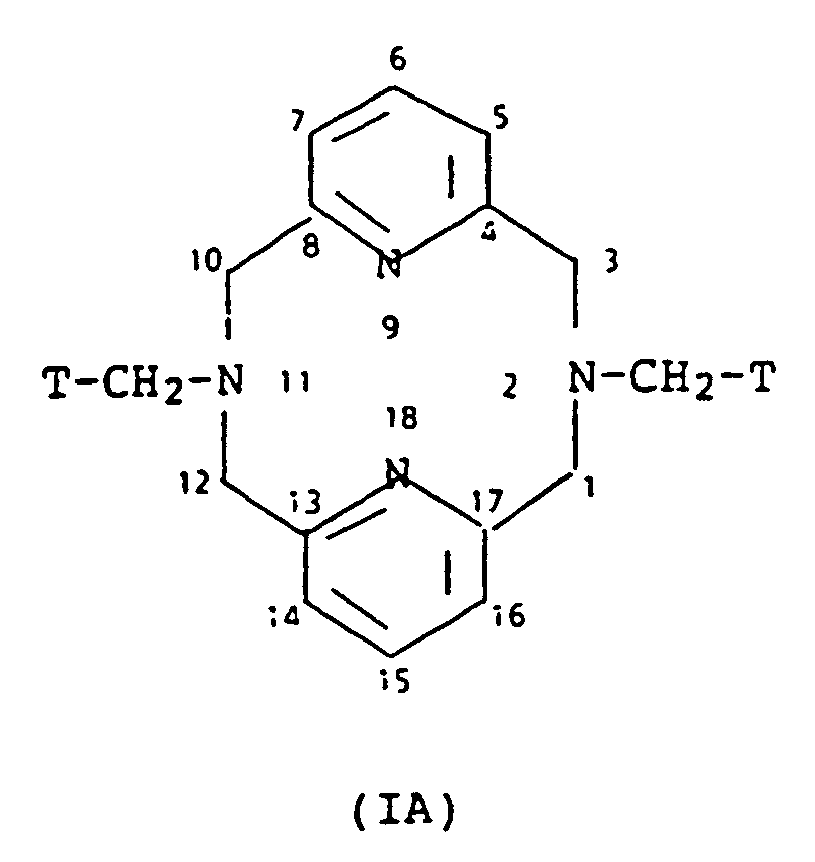

- One aspect of the present invention concerns development of contrast agents having synthetic modifications to the paramagnetic chelate enabling site specific delivery of the contrast agent to a desired tissue. The advantage being increased contrast in the areas of interest based upon tissue affinity as opposed to contrast arising from non-specific perfusion which may or may not be apparent with an extracellular agent. The specificity of the ligand of Formula (I) may be controlled by adjusting the total charge and lipophilic character of the complex. The overall range of the charge of the complex is from -3 to + 1 as indicated above. For example, for a complex having 2 or 3 PO3H2 groups (BP2P and TP3P), the overall charge is highly negative and bone uptake is expected; whereas when the overall charge of the complex is 0 (thus neutral, TP3(O-Alk)P, and TP3(Alk)P), the complex may have the ability to cross the blood brain barrier and normal brain uptake may be possible. Unexpectedly, for a complex having an overall charge of + 1 [BP2(O-Alk)P, and BP2(Alk)P], the complex displays bone uptake.
- While not wishing to be bound by theory, it is believed that when a charged complex of the invention is made (e.g. possibly -3 for bone, - 1 for liver, or + 1 for heart), the variations in that chelate ionic charge can influence biolocalization.
- Tissue specificity may also be realized by ionic or covalent attachment of the chelate to a naturally occurring or synthetic molecule having specificity for a desired target tissue. One possible application of this approach is through the use of chelate conjugated monoclonal antibodies which would transport the paramagnetic chelate to diseased tissue enabling visualization by MRI. In addition, attachment of a paramagnetic chelate to a macromolecule can further increase the contrast agent efficiency resulting in improved contrast relative to the unbound chelate. Recent work by Lauffer (U.S. Patents 4,880,008 and 4,899,755) has demonstrated that variations in lipophilicity can result in tissue-specific agents and that increased lipophilic character favors non-covalent interactions with blood proteins resulting in enhancement of relaxivity.
- The terms used in Formula (I) and for this invention are further defined as follows:
- "C1-C5 alkyl" includes both straight and branched chain alkyl groups.
- "Animal" includes a warmblooded mammal, preferably a human being.
- "Complex" refers to a complex of the compound of the invention, e.g. Formula (I), complexed with a metal ion, where at least one metal atom is chelated or sequestered.
- "Biologically active material" refers to a dextran, peptide, or molecules that have specific affinity for a receptor, or preferably antibodies or antibody fragments.
- "Antibody" refers to any polyclonal, monoclonal, chimeric antibody or heteroantibody, preferably a monoclonal antibody; "antibody fragment" includes Fab fragments and F(ab')2 fragments, and any portion of an antibody having specificity toward a desired epitope or epitopes. When using the term "radioactive metal chelate/antibody conjugate" or "conjugate", the "antibody" is meant to include whole antibodies and/or antibody fragments, including semisynthetic or genetically engineered variants thereof. Possible antibodies are 1116-NS-19-9 (anti-colorectal carcinoma), 1116-NS-3d (anti-CEA), 703D4 (anti-human lung cancer), 704A1 (anti-human lung cancer), CC49, CC83 and B72.3. The hybridoma cell lines 1116-NS-19-9, 1116-NS-3d, 703D4, 704A1, CC49, CC83 and B72.3 are deposited with the American Type Culture Collection, having the accession numbers ATCC HB 8059, ATCC CRL 8019, ATCC HB 8301, ATCC HB 8302, ATCC HB 9459, ATCC HB 9453 and ATCC HB 8108, respectively.
- The bifunctional chelating agents described herein [represented by Formula (I)] can be used to chelate or sequester the metal ions so as to form metal ion chelates (also referred to herein as "complexes").
- As used herein, "pharmaceutically-acceptable salts" means any salt or mixtures of salts of a compound of Formula (I) which is sufficiently non-toxic to be useful in diagnosis of animals, preferably mammals. Thus, the salts are useful in accordance with this invention. Representative of those salts formed by standard reactions from both organic and inorganic sources include, for example, sulfuric, hydrochloric, phosphoric, acetic, succinic, citric, lactic, maleic, fumaric, palmitic, cholic, palmoic, mucic, glutamic, gluconic acid, d-camphoric, glutaric, glycolic, phthalic, tartaric, formic, lauric, steric, salicylic, methanesulfonic, benzenesulfonic, sorbic, picric, benzoic, cinnamic acids and other suitable acids. Also included are salts formed by standard reactions from both organic and inorganic sources such as ammonium or 1-deoxy-1-(methylamino)-D-glucitol, alkali metal ions, alkaline earth metal ions, and other similar ions. Particularly preferred are the salts of the compounds of Formula (I) where the salt is potassium, sodium, or ammonium. Also included are mixtures of the above salts.
- The compounds of Formula (I) are prepared by various processes. Typical general synthetic approaches to such processes are provided by the reaction schemes given below.
- In Scheme 2, (There is no "Scheme I") the compounds of Formula (I) are prepared wherein Y is (A) or (B), and all T moieties are

where: R is OH.
wherein: Y1 is defined as before for Y when (A) and when (B) the nitrogen atom is substituted with hydrogen; Y3 is defined as before for Y when (A) and when (B) the nitrogen atom is substituted with -CH2-PO3H2. - The hydrolysis in Scheme 2 is done by known aqueous acid conditions, such as using 3 to 12M hydrochloric acid. The pH of the reaction is maintained below 3. Temperature is at reflux. Pressure is not critical so that ambient pressure is used. Alternatively, when the reaction is run in one step, phosphorous acid, hydrochloric acid and excess formaldehyde are used. The pH of the reaction is below 2. Temperature is at reflux. Pressure is not critical so that ambient pressure is used.
- In Scheme 3, the compounds of Formula (I) are prepared wherein Y is (A) or (B), all T moieties are

where: R is -O-(C1-C5 alkyl).
wherein: Y1 is defined as before for Y when (A) and when (B) the nitrogen atom is substituted with hydrogen; Y4 is defined as before for Y when (A) and when (B) the nitrogen atom is substituted with -CH2-PO2HR; and
R is -O-(C1-C5 alkyl). - The hydrolysis in Scheme 3 is done under known aqueous basic conditions, such as using excess alkali metal hydroxide, such as sodium or potassium hydroxide. The pH of the reaction is above 9. Temperature is at reflux. Pressure is not critical so that ambient pressure is used.
- In Scheme 4, the compounds of Formula (I) are prepared wherein Y is (A) or (B), all T moieties are

where: R is C1-C5 alkyl. - Scheme 4 shows the preparation of the compounds of Formula (I) when R is methyl.

wherein: Y1 is defined as before for Y when (A) and when (B) the nitrogen atom is substituted with hydrogen; Y5 is defined as before for Y when (A) and when (B) the nitrogen atom is substituted with -CH2-PO(OH)CH3. - The hydrolysis in Scheme 4 is done under known aqueous basic conditions, such as using excess alkali metal hydroxide, such as sodium or potassium hydroxide. The pH of the reaction is above 9. Temperature is at reflux. Pressure is not critical so that ambient pressure is used.
- In Scheme 5, the compounds of Formula (I) are prepared wherein Y is (A) or (B), all T moieties are

where: R is C1-C5 alkyl. - Scheme 5 shows the preparation of the compounds of Formula (I) when R is ethyl.

wherein: Y1 is defined as before for Y when (A) and when (B) the nitrogen atom is substituted with hydrogen; Y6 is defined as before for Y when (A) and when (B) the nitrogen atom is substituted with -CH2-PO(OH)C2H5. - The reaction in Scheme 5 is under acidic conditions with a hydrochloric acid. The pH of the reaction is below 3. Temperature is at reflux. Pressure is not critical so that ambient pressure is used.
- Scheme 6 shows the preparation of the compounds of Formula (I) when one T is a bifunctional moiety; and the other T is defined above for Formula (I).

wherein: Y1 is defined as before for Y when (A) and when (B) the nitrogen atom is substituted with hydrogen; Y7 is defined as before for Y when (A) and when (B) the nitrogen atom is substituted with -CH2CO2H. - In the above Schemes, the general process description illustrates specific steps that may be used to accomplish a desired reaction step. The general description of these process steps follows.
- The general synthetic methodology for preparing the 2:2 and 3:3 macrocyclic precursors outlined in Schemes 2-6 is described by Pappalerdo et al., J. Org. Chem. 53, 3521-3529 (1988). The carboxylate derivatives described in Scheme 1 are prepared by conventional alkylation procedures utilizing chloro- or bromo-acetic acid under basic aqueous conditions and utilizing the appropriate secondary amine macrocyclic starting material.
- The phosphonic acid derivatives outlined in Scheme 2 can be prepared by initial alkylation of the amine with a trialkyl phosphite and paraformaldehyde, resulting in an organic soluble perester. This ester is then hydrolyzed under refluxing acid conditions to give the desired aminophosphonic acids. Alternatively, the phosphonic acid can be prepared under acidic conditions by employing phosphorous acid in combination with formaldehyde and hydrochloric acid.
- Phosphonate half esters are prepared as shown in Scheme 3 by initial formation of the dialkyl phosphonate ester, followed by hydrolysis under basic conditions. Base hydrolysis gives exclusive conversion to the half ester.
- Scheme 4 illustrates the methodology for synthesizing the methyl phosphinate derivatives using diethoxymethylphosphine as the nucleophile and paraformaldehyde. Condensation can be conducted in solvents such as tetrahydrofuran (THF), dimethylformamide (DMF), dioxane, acetonitrile, or alcoholic media. The resulting phosphinate ester is then hydrolyzed under acidic conditions (e.g. 6N HCl, 80-100°C) or basic conditions (excess base, 40-100°C) to give the corresponding methylphosphonic acid.,Alternatively, as outlined in Scheme 5, the method devised by A. D. Sherry et al. (Inorg. Chem., submitted 1991) using ethylphosphonic acid generated in situ can be used to obtain phosphinate derivatives having increased lipophilic character.
- Scheme 6 illustrates the preparation of bifunctional compounds of Formula (I) which may then be attached to a biologically active material.
- The metal ions used to form the complexes of this invention are Gd+3, Mn+2, Fe+3 and available commercially, e.g. from Aldrich Chemical Company. The anion present is halide, preferably chloride, or salt free (metal oxide).
- A "paramagnetic nuclide" of this invention means a metal ion which displays spin angular momentum and/or orbital angular momentum. The two types of momentum combine to give the observed paramagnetic moment in a manner that depends largely on the atoms bearing the unpaired electron and, to a lesser extent, upon the environment of such atoms. The paramagnetic nuclides found to be useful in the practice of the invention are gadolinium (Gd+3), iron (Fe+3) and manganese (Mn+2), with Gd+3 being preferred.
- The complexes are prepared by methods well known in the art. Thus, for example, see Chelating Agents and Metal Chelates, Dwyer & Meilor, Academic Press (1964), Chapter 7. See also methods for making amino acids in Synthetic Production and Utilization of Amino Acids, (edited by Kameko, et al.) John Wiley & Sons (1974). An example of the preparation of a complex involves reacting a bicyclopolyazamacrocyclophosphonic acid with the metal ion under aqueous conditions at a pH from 5 to 7. The complex formed is by a chemical bond and results in a stable paramagnetic nuclide comoosition, e.g. stable to the disassociation of the paramagnetic nuclide from the ligand
- The complexes of the present invention are administered at a ligand to metal molar ratio of at least about 1: 1, preferably from 1: 1 to 3: 1, more preferably from 1: 1 to 1.5:1. A large excess of ligand is undesirable since uncomplexed ligand may be toxic to the animal or may result in cardiac arrest or hypocalcemic convulsions.
- This invention is used with a physiologically acceptable carrier, excipient or vehicle therefore. The methods for preparing such formulations are well known. The formulations may be in the form of a suspension, injectable solution or other suitable formulations. Physiologically acceptable suspending media, with or without adjuvants, may be used.
- An "effective amount" of the formulation is used for diagnosis. The dose will vary depending on the disease and physical parameters of the animal, such as weight. In vivo diagnostics are also contemplated using formulations of this invention.
- Other uses of some of the chelants of the present invention may include the removal of undesirable metals (i.e. iron) from the body, attachment to polymeric supports for various purposes, e.g. as diagnostic agents, and removal of metal ions by selective extraction. The ligands of Formula (I) having in at least two R terms T equal to P(O)R1OH may be used for metal ion control as scale inhibitors. Some of these ligands can be used in less than stoichiometric amounts. Similar uses are known for compounds described in U.S. Patents 2,609,390; 3,331,773; 3,336,221; and 3,434,969.
- The invention will be further clarified by a consideration of the following examples, which are intended to be purely exemplary of the present invention.
- Some terms used in the following examples are defined as follows:
- LC = liquid chromatography, purifications were carried out at low pressure using Dionex 2010i system fitted with a hand-packed Q-Sepharose™ anion exchange column (23 x 2 cm).
- DMF = dimethylformamide.
- AcOH = acetic acid.
- g = gram(s).
- mg = milligrams.
- kg = kilogram(s).
- mL = milliliter(s).
- µL = microliter(s).
- A stock 159GdCl3 (or 153SmCl3) solution was prepared by adding 2 µL of 3x10⁻⁴M 159GdCl3 in 0.1N HCl to 2 mL of a 3x10⁻⁴M GdCl3 carrier solution. Appropriate ligand solutions were then prepared in deionized water. The 1:1 ligand/metal complexes were then prepared by combining the ligands (dissolved in 100-500 µL of deionized water) with 2 mL of the stock 159GdCl3 solution, followed by through mixing to give an acidic solution (pH = 2). The pH of the solution was then raised to 7.0 using 0.1N NaOH. The percent metal as a complex was then determined by passing a sample of the compiex solution through a Sephadex™ G-50 column eluting with 4:1 saline (85% NaCl/NH4OH) and collecting 2 x 3 mL tractions. The amount of radioactivity in the combined elutions was then compared with that left on the resin (non-complexed metal is retained on the resin). The pH stability profile was generated by adjusting the pH of an aliquot of the complex solution using 1M NaOH or 1M HCl and determining the percent of the metal existing as a complex using the ion exchange method described above. The Sm results are known by experimental comparison to be identical for complexation and biodistribution of the ligands of this invention.
- All reagents were obtained from commercial suppliers and used as received without further purification. NMR spectra were recorded on a Bruker AC-250 MHz spectrometer equipped with a multi-nuclear quad probe (1H, 13C, 31P, and 19F) at 297°K unless otherwise indicated. 1H spectra in D2O were recorded by employing solvent suppression pulse sequence ("PRESAT", homo-nuclear presaturation). 1H spectra are referenced to residual chloroform (in CDCl3) at δ7.26 or external dioxane (in D2O) at δ3.55. 13C and 31P spectra reported are proton decoupled (broad band). Assignments of 13C {1H} chemical shifts were aided by DEPT (Distortionless Enhancement by Polarization Transfer) experiments. 13C {1H} spectra are referenced to center peak of CDCl3 at δ77.00 (in CDCl3) and external dioxane at δ66.66 (in D2O). 31P {1H} spectra were referenced to external 85% H3PO4 at δ0.00. Melting points were determined by capillary melt methods and were uncorrected. Semipreparative ion-exchange chromatographic separations were performed at low pressure (<600 psi) using a standard glass column fitted with hand-packed Q-Sepharose™ (anion exchange) or SP-Sepharose™ (cation exchange) glass column, and with on-line UV detector at 263 nm for eluent monitoring. GC/MS spectra were performed on a Hewlett Packard 5890A Gas Chromatograph/5970 Mass Selective Detector.
- To a stirred solution of tosylamide, sodium salt (TsNHNa), (13.52 g. 70 mmol) in anhydrous DMF (1.3 L) at 80°C was added dropwise (1.5 hr) under a N2 atmosphere a solution of 2,6-bis(chloromethyl)pyridine (12.32 g. 70 mmol) in DMF (200 mL). After 1 hr, solid TsNHNa (13.52 g. 70 mmol) was added all at once, and the mixture was stirred at 80°C for additional 16 hr. The reaction mixture was then cooled to room temperature and decanted. The solvent was removed in vacuo and tne resulting residue was combined with acetone and filtered to give a waxy solid which was continuously extracted (Soxlet) with acetone (300 mL) for 48 hr The product was isolated as the precipitate at the bottom of the heating flask. Upon drying, the product was isolated as white powder (5.24 g, 27%): mp = 246- 248°C and further characterized by:
- 1H NMR (DMSO-d6)
- δ 2.42 (s, 6H), 4.38 (s, 8H), 6.99 (d, 4H), 7.40-7.49 (m, 6H), 7.88 (d, 4H); and
- 13C {1H} NMR (DMSO-d6)
- δ 20.91, 55.55, 122.12, 126.92, 129.88, 135.99, 137.03, 143.30, 154.71; and is illustrated by the formula

- N,N'-ditosyl-2,11-diaza[3.3](2,6)pydinophane (5.24 g, 9.5 mmol), prepared in Example A, was dissolved in 90% H2SO4 (48 mL) and heated at 110°C with stirring for 2 hr. After the solution was cooled to room temperature, it was slowly diluted with deionized water (50 mL) while chilling in an ice bath. The resulting solution was then poured into a 25% NaOH solution (200 mL) which was cooled in an ice bath. The resulting white solid was extracted with CHCl3 (3 X 100 mL), dried over anhydrous MgSO4, filtered, and concentrated in vacuo to dryness to give the titled product as a waxy white solid (1.69 g, 74%) and further characterized by:
- 1H NMR (CDCl3)
- δ 3.91 (s, 8 H), 6.47 (d, 4H), 7.06 (t, 2H); and
- 13C {1H} NMR (CDCl3)
- δ 55.89, 119.73, 135.71, 159.36;
- CG/mass spectra m/z M + 240; and is illustrated by the formula

- Isolated as a by-product from the reaction used for preparation of N,N'-ditosyl-2,11-diaza[3.3](2,6)pydinophane, prepared in Example A, (remaining part on the extractor thimble after Soxlet extraction) mp 260 - 262°C; and further characterized by:
- 1H NMR (DMSO-d6)
- δ 2.31 (s, 9H), 4.08 (s, 12H), 7.01 (d, 4H), 7.30 (d, 6H), 7.52 (t, 3H), 7.67 (d, 6H); and
- 13C {1H} NMR(DMSO-d6)
- δ 20.92, 54.03,120.55,127.13, 129.83, 135.12, 136.83, 143.45,155.47; and is illustrated by the formula:

- N,N',N"-tritosyl-2,11,20-triaza[3.3.3](2,6)pydinophane (0.5 g, 0.61 mmol), prepared in Example C was dissolved in 90% H2SO4 (6 mL) and heated at 110°C with stirring for 2 hr. The solution was then cooled to room temperature and slowly diluted with deionized water (6 mL) while chilling in a ice bath. The resulting solution was then poured into a 25% NaOH solution (22 ml) which was cold in an ice bath. The resulting white solid was extracted with CHCl3 (2 X 30 mL), dried over anhydrous MgSO4, filtered, and concentrated in vacuo to dryness to give the titled product as a waxy white solid (0.167 g, 76%); and further characterized by:
- 1H NMR (CDCl3)
- δ 3.03 (s, 3H), 3.93 (s, 12H), 7.08 (d, 6H), 7.54 (t. 3H); and
- 13C {1H} NMR (CDCl3)
- δ 54.58, 120.72, 136.50. 158.64;
- GC/mass spectra m/z M 360; and is illustrated by the formula:

- The product prepared in Example B, 2,11-diaza[3:3](2,6)pydinophane (276.4 mg, 1.15 mmol) was combined with paraformaldehyde (138 mg, 4.60 mmol, excess) and trimethylphosphite (0.814 mL, 855 mg, 4.60 mmol, excess). After the mixture was gently stirred for 10 min to obtain a well mixed slurry, it was heated to 85°C and maintained for 1 hr. After the excess reagents and byproducts were removed in vacuo (1 hr at 110°C/0.01 mmHg), the dark brown residue was dissolved in CHCl3 (20 mL) and washed with deionized water (5 X 15 mL). The organic layer was dried over anhydrous MgSO4, filtered, and the solvent was removed in vacuo to give the product as a yellow waxy solid (363 mg, 65%); and further characterized by:
- 1H NMR (CDCl3)
- δ 3.39 (d, 4H), 3.88 (d, 12H), 4.08 (s, 8H), 6.84 (d, 4H), 7.13 (t, 2H); and
- 13C{1H} NMR(CDCl3)
- δ 52.75 (d), 54.88 (d), 65.21 (d), 122.71, 135.69, 157.14; and
- 31P NMR (CDCl3)
- δ 27.22; and is illustrated by the formula

- The product prepared in Example B, 2,11-diaza[3.3](2,6)pydinophane (0.47 g, 1.96 mmol) was combined with paraformaldehyde (235 mg, 7.84 mmol, excess) and triethylphosphite (1.34 mL, 1.30 g, 7.84 mmol, excess). After the mixture was gently stirred for 10 min to obtain a well mixed slurry, it was heated to 90°C for 1 hr. After the excess reagents and byproducts were removed in vacuo (1 hr at 125°C/0.01 mmHg), the resulting dark brown residue was dissolved in CHCl3 (20 mL) and washed with deionized water (5 X 15 mL). The organic layer was dried over anhydrous MgSO4, filtered, and the solvent was removed in vacuo to give the product as a yellow waxy solid (957 mg, 91%); and further characterized by:
- 1H NMR (CDCl3)
- δ 1.24 (t, 12H), 3.20 (d, 4H), 3.94 (s, 8H), 4.07 (q, 8H), 6.71 (d, 4H), 6.98 (t, 2H); and
- 13C{1H} NMR(CDCl3)
- δ 16.48, 55.36 (d), 61.75 (d), 65.14 (d), 122.52, 135.41, 157.04; and
- 31P{1H} NMR (CDCl3)
- δ 24.60; and is illustrated by the formula

- A conc. HCl solution (37%, 4 mL) of N,N'-bis(methylenedimethylphosphonate)-2,11-diaza[3.3](2,6)pydinophane, prepared in Example E, (255 mg, 0.53 mmol) was heated at reflux for 2.5 hr. After cooling, the solution was evaporated to dryness, followed by coevaporation with fresh deionized water (3 X 2 mL) to eliminate excess HCl. The final product was isolated as a hydroscopic brown solid upon freeze-drying of the concentrated aqueous solution; and characterized by:
- 1H NMR (D2O)
- δ 3.55 (d, 4H), 4.46 (br s, 8H), 6.90 (d, 4H), 7.37 (t, 2H); and
- 13C {1H} NMR (D2O)
- δ 57.80 (d), 63.74 (d), 127.02, 144.18, 152.96; and
- 31P {1H} NMR (D2O)
- δ 11.71.Ligands: Preparation of dimethylenephosphonate half esters as shown in Scheme 3.
- The product prepared in Example F, N,N'-bis(methylenediethylphosphonate)-2,11-diaza[3.3](2,6)pydinophane, (957 mg, 1.77 mmol) was combined with 0.1M KOH (7.2 mL) and heated at 60°C for 16 hr. The solution was then cooled and freeze-dried to give a residue which was dissolved into CHCl3/C2H5OH (95/5), and filtered. Upon evaporation of solvent and concentration in vacuo, the product was isolated as a pale yellow powder (657 mg, 66%); and characterized by:
- 1H NMR (D2O)
- δ 1.10 (t, 6H), 2.97 (d, 4H), 3.81 (q, 4H), 3.84 (s, 8H), 6.73 (d, 4H), 7.09 (t, 2H); and
- 13C {1H} NMR (D2O)
- δ 18.98, 58.76 (d), 63.69 (d), 66.53 (d), 126.35, 140.09, 159.37; and
- 31P{1H} NMR(D2O)
- δ 20.65.
- Metal ligand complexes were prepared by various methods. The methods included mixing of the metal and ligand in aqueous solution and adjusting the pH to the desired value. Complexation was done in solutions containing salts and/or buffers as well as water. Sometimes heated solutions were found to give higher complex yields than when the complexation was done at ambient temperatures
- For example, a solution of the ligand is prepared by dissolving the ligand in deionized water (about pH = 2). A ligand/metal complex was then prepared by combining the ligand solution with aqueous SmCl3·H2O (3x10⁻⁴M in 0.01 N HCl) containing tracer 153SmCl2 After thorougn mixing, tne percent metal as a complex was determined by passing a sample of the complex solution through a Sephadex™ column, eluting with 4:1 saline (0.85% NaCl/NH4OH), and collecting 2 x 3 mL fractions. The amount of radioactivity in the combined elutions was then compared with that left on the resin. Under these conditions, complex was removed with the eluent and non-compiexed metal is retained on the resin. By this method compiexation was determined to usually be about 95% or greater.
- Using the above procedure, the complexes of samarium with
N,N'-diacetic acid-2,11-diaza[3.3](2,6)pydinophane (BP2A), ligand:metal ratio of 4:1, 99%;
N,N',N"-triacetic acid-2,11,20-diaza[3.3.3](2,6)pydinophane (TP3A), ligand:metal ratio of 3:1, 98.6%;
N,N'-bis(methylenephosphonic acid)-2,11-diaza[3.3](2,6)pydinophane (BP2P), ligand:metal ratio of 3:1, 95%; and
N,N'-bis(methylenephosphonic acid ethyl ester)-2,11-diaza[3.3](2,6)pydinophane (BP2EP), ligand:metal ratio of 4:1, 98%;
were made. However, in an analogous manner the corresponding gadolinium complexes may be prepared. - Sprague Dawley rats were allowed to acclimate for five days then injected with 100 µL of the complex solution via a tail vein. The rats weighed between 150 and 250 g at the time of injection. After 30 min. the rats were killed by cervical dislocation and dissected The amount of radioactivity in each tissue was determined by counting in a Nal scintillation counter coupled to a multichannel analyzer. The counts were compared to the counts in 100 µL standards in order to determine the percentage of the dose in each tissue or organ.
- The percent dose in blood was estimated assuming blood to be 6.5% of the total body weight. The percent dose in bone was estimated by multiplying the percent dose in the femur by 25. The percent dose in muscle was estimated assuming muscle to be 43% of the total body weight.
- In addition to organ biodistribution, chelates of the compounds of Formula (I) were evaluated for efficiency of bone localization since phosphonates are known for their ability to bind to hydroxyapitite. The results of these tests are given below.
- When the complex 153Sm[N,N'-bis(methylenephosphonic acid)-2,11-diaza[3.3](2,6)pydinophane] (153Sm-BP2P) was evaluated, the results are given in Table III below. The numbers represent 3 rats per data point at 2 hours post injection.
TABLE III BIODISTRIBUTION OF 153Sm-BP2P % INJECTED DOSE ORGAN AVERAGE Bone 60.08 Liver 3.71 Kidney 1.21 Spleen 0.05 Muscle 1.53 Blood 0.87 Heart 0.07 Lung 0.17 Brain 0.01 Stomach 0.20 Small Intestine 0.39 Large Intestine 0.13 TABLE III RATIOS FOR 153Sm-BP2P AVERAGE % INJECTED DOSE Bone/Blood Bone/Muscle Bone/Liver Bone/Spleen 69 39 16 1,201 - When the complex 153Sm[N,N'-bis(methylenephosphonic acid ethyl ester)-2,11-diaza[3.3](2,6)pydinophane] (153Sm-BP2EP) was evaluated, the results are given in Table IV below. The numbers represent 3 rats per data point at 2 hours post injection.
TABLE IV BIODISTRIBUTION OF 153Sm-BP2EP % INJECTED DOSE ORGAN AVERAGE Bone 39.82 Liver 5.97 Kidney 0.74 Spleen 0.32 Muscle 1.21 Blood 0.45 Heart 0.04 Lung 0.19 Brain 0.01 Stomach 0.36 Small Intestine 0.33 Large Intestine 0.25 TABLE IV RATIOS FOR 153Sm-BP2E AVERAGE % INJECTED DOSE Bone/Blood Bone/Muscle Bone/Liver Bone/Spleen 88 33 7 124 - Other embodiments of the invention will be apparent to those skilled in the art from a consideration of this specification or practice of the invention disclosed herein. It is intended that the specification and examples be considered as exemplary only, with the true scope and spirit of the invention being indicated by the following claims.
Claims (17)
- Tri- and tetra-cyclopolyazamacrocyclic compounds of the formula

wherein:Y is either T is
T is where: R is OH, C1-C5 alkyl or -O-(C1-C5 alkyl); with the proviso that both T moieties are the same or apharmaceutically-acceptable salt thereof.
 - A compound of Claim 1 wherein all T are -CH2-P(O)ROH, where R is OH.
- A compound of Claim 2 wherein the compound is of Formula (IA) where R is OH, (N,N'-bis(methylenephosphonic acid)-2,11-diaza[3.3](2,6)pydinophane) or a pharmaceutically-acceptable salt thereof.
- A compound of Claim 1 wherein R is -O-(C1-C5 alkyl).
- A compound of Claim 4 wherein the compound is of Formula (IA) wherein T is -CH2-P(O)ROH, and R is -O-(C1-C5 alkyl), or pharmaceutically-acceptable salts thereof.
- A compound of Claim 5 wherein R is ethoxy, or pharmaceutically-acceptable salts thereof (N,N'-bis(methylenephosphonic acid ethyl ester)-2,11-diaza[3.3](2,6)pydinophane).
- A compound of Claim 1 wherein all T are -CH2-P(O)ROH, where R is C1-C5 alkyl.
- A complex which comprises a tri- and tetra-cyclopolyazamacrocyclic compound of the formula

wherein:Y is either T is
T is where: R is OH, C1-C5 alkyl or -O-(C1-C5 alkyl); with the proviso that both T moieties are the same orpharmaceutically-acceptable salts thereof;complexed with a metal ion selected from Gd+3, Mn+2 or Fe+3.
 - A complex of Claim 8 wherein the metal is Gd+3.
- A complex of Claim 8 wherein all T are -CH2-P(O)ROH, where R is OH, and the metal is Gd+3.
- A complex of Claim 10 wherein the compound is of Formula (IA) where R is OH, (N,N'-bis(methylenephosphonic acid)-2,11-diaza[3.3](2,6)pydinophane) or a pharmaceutically-acceptable salt thereof.
- A complex of Claim 8 wherein R is -O-(C1-C5 alkyl), and the metal is Gd+3.
- A complex of Claim 12 wherein the compound is of Formula (IA) where R is -O-(C1-C5 alkyl), or a pharmaceutically-acceptable salt thereof.
- A complex of Claim 13 wherein R is ethoxy, or a pharmaceutically-acceptable salts thereof.
- A complex of Claim 8 wherein R is C1-C5 alkyl, and the metal is Gd+3.
- A pharmaceutical formulation comprising a complex of of any one of Claims 8 to 15 with a pharmaceutically-acceptable carrier.
- A process for preparing a compound according to Claim 1,
which comprises any one of the following:(A) reacting a compound of the formula
wherein: Y1 is defined as in Formula (I) for Y when (A) and when (B) the nitrogen atom is substituted with hydrogen; and
with phosphorous acid in hydrochloric acid and excess formaldehyde, at a pH below about 2, at reflux temperature;
to provide a compound of Formula (I) above where (A) has two T equal -CH2-PO3H2 and where (B) has three T equal -CH2-PO3H2: or(B) reacting a compound of the formula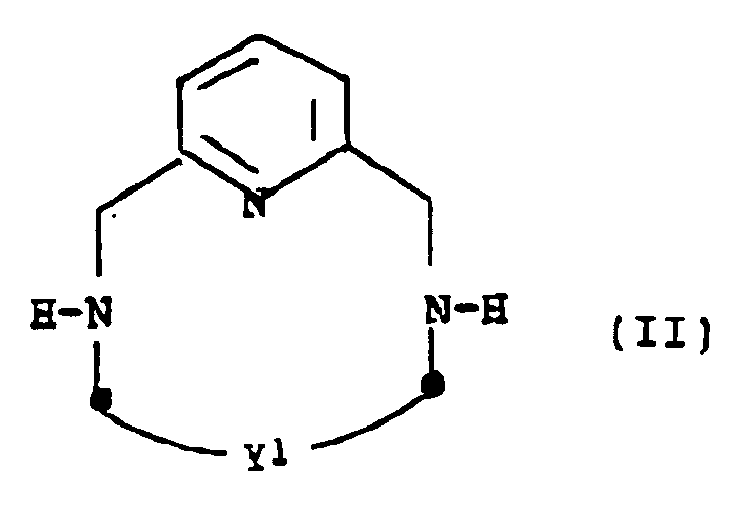
wherein: Y1 is defined as in Formula (I) for Y when (A) and when (B) the nitrogen atom is substituted with hydrogen; and
with P(OR)3 where R is C1-C4 alkyl in formaldehyde, followed by hydrolysis using 3 to 12M hydrochloric acid, at a pH below about 3, at reflux temperature;
to provide a compound of Formula (I) above where (A) has two T equal -CH2-PO3H2 and where (B) has three T equal -CH2-PO3H2; or(C) reacting a compound of the formula
wherein: Y1 is defined as in Formula (I) for Y when (A) and when (B) the nitrogen atom is substituted with hydrogen; and
with P(OR)3 where R is C1-C4 alkyl in formaldehyde, followed by hydrolysis using excess alkali metal hydroxide, at a pH above about 12, at reflux temperature;
to provide a compound of Formula (I) above where (A) has two T equal -CH2-PO2HR where R is-O-(C1-C5 alkyl) and where (B) has three T equal -CH2-PO2HR where R is -O-(C1-C5 alkyl); or(D) reacting a compound of the formula
wherein: Y1 is defined as in Formula (I) for Y when (A) and when (B) the nitrogen atom is substituted with hydrogen; and
with H3C-P(OEt)2 in formaldehyde and tetrahydrofuran, followed by hydrolysis using excess alkali metal hydroxide, at a pH above about 12, at reflux-temperature or with HP(O)OH-C2H5 in formaldehyde and hydrochloric acid, at a pH below about 3, at reflux temperature;
to provide a compound of Formula (I) above where (A) has two T equal -CH2-PO(OH)R where R is C1-C5 alkyl and where (B) has three T equal-CH2-PO(OH)R where R is C1-C5 alkyl.
Applications Claiming Priority (3)
| Application Number | Priority Date | Filing Date | Title |
|---|---|---|---|
| US58622 | 1993-05-06 | ||
| US08/058,622 US5385893A (en) | 1993-05-06 | 1993-05-06 | Tricyclopolyazamacrocyclophosphonic acids, complexes and derivatives thereof, for use as contrast agents |
| PCT/US1994/005071 WO1994026276A1 (en) | 1993-05-06 | 1994-05-06 | Tricyclopolyazamacrocyclophosphonic acids, complexes and derivatives thereof, for use as contrast agents |
Publications (3)
| Publication Number | Publication Date |
|---|---|
| EP0697872A1 EP0697872A1 (en) | 1996-02-28 |
| EP0697872A4 EP0697872A4 (en) | 2003-04-02 |
| EP0697872B1 true EP0697872B1 (en) | 2006-01-25 |
Family
ID=22017946
Family Applications (1)
| Application Number | Title | Priority Date | Filing Date |
|---|---|---|---|
| EP94916043A Expired - Lifetime EP0697872B1 (en) | 1993-05-06 | 1994-05-06 | Tricyclopolyazamacrocyclophosphonic acids, complexes and derivatives thereof, for use as contrast agents |
Country Status (17)
| Country | Link |
|---|---|
| US (1) | US5385893A (en) |
| EP (1) | EP0697872B1 (en) |
| JP (1) | JP3553940B2 (en) |
| KR (1) | KR960702462A (en) |
| CN (1) | CN1125906A (en) |
| AT (1) | ATE316377T1 (en) |
| AU (1) | AU687400B2 (en) |
| BG (1) | BG100194A (en) |
| CA (1) | CA2162172A1 (en) |
| DE (1) | DE69434618T2 (en) |
| FI (1) | FI955336L (en) |
| HU (1) | HUT72649A (en) |
| LV (1) | LV11429B (en) |
| NO (1) | NO954441L (en) |
| PL (1) | PL311649A1 (en) |
| SG (1) | SG46496A1 (en) |
| WO (1) | WO1994026276A1 (en) |
Families Citing this family (73)
| Publication number | Priority date | Publication date | Assignee | Title |
|---|---|---|---|---|
| US5645818A (en) * | 1989-03-24 | 1997-07-08 | Guerbet S.A. | Diagnostic compositions comprising a complex formed by a nitrogenous macrocyclic ligand with metal ions |
| US5739294A (en) * | 1991-12-10 | 1998-04-14 | The Dow Chemical Company | Bicyclopol yazamacrocyclophosphonic acid complexes for use as contrast agents |
| US5714604A (en) * | 1993-05-06 | 1998-02-03 | The Dow Chemical Company | Process for the preparation of azamacrocyclic or acyclic aminophosphonate ester derivatives |
| US5672335A (en) * | 1994-11-30 | 1997-09-30 | Schering Aktiengesellschaft | Use of metal complexes as liver and gallbladder X-ray diagnostic agents |
| US6207826B1 (en) * | 1995-03-27 | 2001-03-27 | Isis Pharmaceuticals, Inc. | Macrocyclic compounds having nitrogen-containing linkages |
| US6107482A (en) | 1995-03-27 | 2000-08-22 | Isis Pharmaceuticals, Inc. | Nitrogenous macrocyclic compounds |
| DE19546234C1 (en) * | 1995-12-04 | 1997-08-28 | Schering Ag | New macrobicyclic compounds, processes for their preparation and pharmaceutical compositions containing these macrobicyclic compounds |
| US5834456A (en) * | 1996-02-23 | 1998-11-10 | The Dow Chemical Company | Polyazamacrocyclofluoromonoalkylphosphonic acids, and their complexes, for use as contrast agents |
| KR20000010533A (en) * | 1996-04-19 | 2000-02-15 | 텍사스 테크 유니버시티 | Fluorescent chelates as visual tissue specific imaging agents |
| CA2333649C (en) | 1998-06-15 | 2010-04-06 | Unilever Plc | Bleach catalysts and formulations containing them |
| WO2001028567A2 (en) * | 1999-10-18 | 2001-04-26 | The Dow Chemical Company | Aminoalkylenephosphonates for treatment of bone disorders |
| US6794371B1 (en) * | 1999-10-18 | 2004-09-21 | The Dow Chemical Company | Aminoalkylenephosphonates for treatment of bone disorders |
| WO2006020779A2 (en) * | 2004-08-10 | 2006-02-23 | Dow Global Technologies Inc. | Targeting chelants and chelates |
| ES2579805T3 (en) | 2004-09-23 | 2016-08-16 | Genentech, Inc. | Antibodies and conjugates engineered with cysteine |
| US20100111856A1 (en) | 2004-09-23 | 2010-05-06 | Herman Gill | Zirconium-radiolabeled, cysteine engineered antibody conjugates |
| WO2007140371A2 (en) | 2006-05-30 | 2007-12-06 | Genentech, Inc. | Antibodies and immunoconjugates and uses therefor |
| AU2007308792B2 (en) | 2006-10-27 | 2013-01-24 | Genentech, Inc. | Antibodies and immunoconjugates and uses therefor |
| BRPI0806403A2 (en) | 2007-02-09 | 2011-09-06 | Genentech Inc | anti-robo4 antibody, use an antibody and imaging method |
| ATE543835T1 (en) | 2007-07-16 | 2012-02-15 | Genentech Inc | ANTI-CD79B ANTIBODIES AND IMMUNE CONJUGATES AND METHODS OF APPLICATION |
| ES2528922T3 (en) | 2007-07-16 | 2015-02-13 | Genentech, Inc. | Humanized and immunoconjugate anti-CD79b antibodies and methods of use |
| PT2247620T (en) | 2008-01-31 | 2016-08-23 | Genentech Inc | ANTIBODIES AND IMMUNOCONJUGATES ANTI-CD79B AND METHODS OF USE |
| CA2757382A1 (en) | 2009-04-01 | 2010-10-21 | Kristi Elkins | Anti-fcrh5 antibodies and immunoconjugates |
| PT2437785E (en) | 2009-06-04 | 2015-04-20 | Novartis Ag | Methods for identification of sites for igg conjugation |
| ES2533072T3 (en) * | 2009-09-18 | 2015-04-07 | Weylchem Switzerland Ag | Process for the preparation of bridged manganese complex compounds of triazacyclononane |
| RU2016105962A (en) | 2009-12-04 | 2018-11-23 | Дженентек, Инк. | MULTI-SPECIFIC ANTIBODIES, ANTIBODIES ANALOGUES, COMPOSITIONS AND METHODS |
| BR112012029866A2 (en) | 2010-06-03 | 2017-03-07 | Genentech Inc | method for determining the presence of a steap-1 protein |
| SG185428A1 (en) | 2010-06-08 | 2012-12-28 | Genentech Inc | Cysteine engineered antibodies and conjugates |
| BR112014029403A2 (en) | 2012-07-04 | 2018-10-09 | F. Hoffmann-La Roche Ag | conjugates, antibody and pharmaceutical formulation |
| JP6324376B2 (en) | 2012-07-04 | 2018-05-16 | エフ.ホフマン−ラ ロシュ アーゲーF. Hoffmann−La Roche Aktiengesellschaft | Anti-theophylline antibodies and methods of use |
| BR112014030844A2 (en) | 2012-07-04 | 2019-10-15 | Hoffmann La Roche | humanized anti-biotin antibody, pharmaceutical formulation and antibody use |
| EP3089759B1 (en) | 2014-01-03 | 2018-12-05 | F. Hoffmann-La Roche AG | Covalently linked polypeptide toxin-antibody conjugates |
| EP3089758B1 (en) | 2014-01-03 | 2021-01-27 | F.Hoffmann-La Roche Ag | Covalently linked helicar-anti-helicar antibody conjugates and uses thereof |
| ES2895752T3 (en) | 2014-01-03 | 2022-02-22 | Hoffmann La Roche | Bispecific anti-hapten/anti-blood brain barrier receptor antibodies, complexes thereof and their use as shuttles across the blood brain barrier |
| TW201625688A (en) | 2014-09-12 | 2016-07-16 | 建南德克公司 | Cysteine engineered antibodies and conjugates |
| JP6618539B2 (en) | 2014-12-17 | 2019-12-11 | エフ.ホフマン−ラ ロシュ アーゲーF. Hoffmann−La Roche Aktiengesellschaft | Method for enzyme-mediated polypeptide conjugation using sortase |
| EP3353314A1 (en) | 2015-09-25 | 2018-08-01 | H. Hoffnabb-La Roche Ag | Transamidation employing sortase a in deep eutectic solvents |
| JP6998862B2 (en) | 2015-09-25 | 2022-02-04 | エフ.ホフマン-ラ ロシュ アーゲー | Soluble sortase A |
| JP6895953B2 (en) | 2015-09-25 | 2021-06-30 | エフ.ホフマン−ラ ロシュ アーゲーF. Hoffmann−La Roche Aktiengesellschaft | Method for making thioester using sortase A |
| EP3353201B1 (en) | 2015-09-25 | 2021-09-08 | F. Hoffmann-La Roche AG | Recombinant immunoglobulin heavy chains comprising a sortase conjugation loop and conjugates thereof |
| US10494379B2 (en) | 2015-11-26 | 2019-12-03 | Debreceni Egyetem | 6-oxa-3,9,15-triaza-bicyclo[9.3.1]pentadeca-1(14),11(15),12-triene derivatives based compounds and their application as ligands of essential metal ion based MRI and 52MN based PET contrast agents |
| EP3380472A1 (en) | 2015-11-26 | 2018-10-03 | Debreceni Egyetem | New 3,6,9, 15-tetraaza-bicyclo [9.3.1 ]pentadeca- 1(14), 11(15), 12-triene based compounds and their application as ligands of essential metal ion based mri and 52mn based pet contrast agents |
| EP3380473A1 (en) * | 2015-11-26 | 2018-10-03 | Debreceni Egyetem | New 2, 1 l -diaza-[3.3](2,6)pyridinophane compounds and their application as ligands of essential metal ion based mri contrast agents and 52mn based pet contrast agents |
| FR3045053B1 (en) * | 2015-12-09 | 2018-01-05 | Cisbio Bioassays | TRIAZAPYRIDINOPHANE WATER-SOLUBLE COMPLEXING AGENTS AND CORRESPONDING FLUORESCENT LANTHANIDE COMPLEXES |
| CN109072212B (en) | 2016-03-30 | 2022-10-04 | 豪夫迈·罗氏有限公司 | Improved sortase |
| WO2018191389A1 (en) | 2017-04-12 | 2018-10-18 | Roche Sequencing Solutions, Inc. | A method for sequencing reaction with tagged nucleoside obtained via pictet spengler reaction |
| EP4707307A2 (en) | 2017-07-13 | 2026-03-11 | Roche Diagnostics GmbH | New binding agent and assay for pivka |
| EP3697813A1 (en) | 2017-10-20 | 2020-08-26 | H. Hoffnabb-La Roche Ag | Copy protection for antibodies |
| CN111918876B (en) | 2017-11-30 | 2024-02-02 | 豪夫迈·罗氏有限公司 | Anti-PD-L1 antibodies and methods of detecting PD-L1 using the same |
| WO2019175127A1 (en) | 2018-03-14 | 2019-09-19 | F. Hoffmann-La Roche Ag | Novel anti-troponint antibodies |
| WO2019175131A1 (en) | 2018-03-14 | 2019-09-19 | F. Hoffmann-La Roche Ag | Method for affinity maturation of antibodies |
| WO2019201901A1 (en) | 2018-04-18 | 2019-10-24 | F. Hoffmann-La Roche Ag | Novel anti-thymidine kinase antibodies |
| CN112639475A (en) | 2018-08-31 | 2021-04-09 | 豪夫迈·罗氏有限公司 | Thymidine kinase (TK-1) in prognostic index of DLBCL |
| CN116271117A (en) | 2018-09-28 | 2023-06-23 | 伊麦吉纳博公司 | CD8 imaging constructs and methods of use thereof |
| JP2022542056A (en) | 2019-07-22 | 2022-09-29 | エフ.ホフマン-ラ ロシュ アーゲー | S100A6 as a blood biomarker for non-invasive diagnosis of endometriosis |
| WO2021013781A1 (en) | 2019-07-22 | 2021-01-28 | F. Hoffmann-La Roche Ag | Substance p as blood biomarker for the non-invasive diagnosis of endometriosis |
| EP4004552A1 (en) | 2019-07-22 | 2022-06-01 | F. Hoffmann-La Roche AG | S100a12 as blood biomarker for the non-invasive diagnosis of endometriosis |
| EP4004553A1 (en) | 2019-07-22 | 2022-06-01 | F. Hoffmann-La Roche AG | S100a8 as blood biomarker for the non-invasive diagnosis of endometriosis |
| EP4004554A1 (en) | 2019-07-22 | 2022-06-01 | F. Hoffmann-La Roche AG | S100a9 as blood biomarker for the non-invasive diagnosis of endometriosis |
| BR112022002376A2 (en) | 2019-08-09 | 2022-04-26 | Hoffmann La Roche | Antibodies that specifically bind human cardiac troponin t, antibodies, nucleic acid molecules, vector, composition and method for determining human cardiac troponin t |
| JP7783809B2 (en) | 2019-11-15 | 2025-12-10 | エフ. ホフマン-ラ ロシュ アーゲー | Derivatization of β-lactam antibiotics for mass spectrometric determination in patient samples |
| EP4237855A1 (en) | 2020-10-30 | 2023-09-06 | F. Hoffmann-La Roche AG | Timp1 as a marker for cholangiocarcinoma |
| WO2022090455A1 (en) | 2020-11-02 | 2022-05-05 | F. Hoffmann-La Roche Ag | Sars-cov-2 nucleocapsid antibodies |
| WO2022207628A1 (en) | 2021-03-30 | 2022-10-06 | F. Hoffmann-La Roche Ag | Scf as blood biomarker for the non-invasive diagnosis of endometriosis |
| WO2022207685A1 (en) | 2021-04-01 | 2022-10-06 | F. Hoffmann-La Roche Ag | Psp94 as blood biomarker for the non-invasive diagnosis of endometriosis |
| CN117337394A (en) | 2021-05-17 | 2024-01-02 | 豪夫迈·罗氏有限公司 | sFRP4 as a blood biomarker for non-invasive diagnosis of adenomyosis |
| WO2023072904A1 (en) | 2021-10-26 | 2023-05-04 | F. Hoffmann-La Roche Ag | Monoclonal antibodies specific for sars-cov-2 rbd |
| CN118382636A (en) | 2021-12-17 | 2024-07-23 | 豪夫迈·罗氏有限公司 | A new antibody for detecting amyloid beta 42 (Aβ42) |
| WO2023131594A1 (en) | 2022-01-05 | 2023-07-13 | F. Hoffmann-La Roche Ag | Derivatization of compounds in patient samples for therapeutic drug monitoring (tdm) |
| WO2023247752A1 (en) | 2022-06-23 | 2023-12-28 | F. Hoffmann-La Roche Ag | Method for diagnosing endometriosis and for classifying the stage of endometriosis |
| US20260036596A1 (en) | 2022-07-22 | 2026-02-05 | Roche Diagnostics Operations, Inc. | Leukotriene a4 hydrolase (lta4h) as (blood) biomarker for the diagnosis of polycystic ovarian syndrome |
| CN119585618A (en) | 2022-07-22 | 2025-03-07 | 豪夫迈·罗氏有限公司 | Fibroblast growth factor binding protein 1 (FGFBP1) as a (blood) biomarker for the diagnosis of polycystic ovary syndrome |
| EP4558825A1 (en) | 2022-07-22 | 2025-05-28 | F. Hoffmann-La Roche AG | Meteorin-like protein (metrnl) as (blood) biomarker for the diagnosis of polycystic ovarian syndrome |
| WO2025026908A1 (en) | 2023-07-28 | 2025-02-06 | Roche Diagnostics Gmbh | Serum epha1 as biomarker for endometriosis |
Family Cites Families (14)
| Publication number | Priority date | Publication date | Assignee | Title |
|---|---|---|---|---|
| US2609390A (en) * | 1950-06-01 | 1952-09-02 | Frederick C Bersworth | Phosphonic alkylene polyamino acids and method of producing same |
| US3336221A (en) * | 1964-11-05 | 1967-08-15 | Calgon Corp | Method of inhibiting precipitation and scale formation |
| US3331773A (en) * | 1966-07-22 | 1967-07-18 | Grace W R & Co | Process for inhibiting precipitation in water |
| US3434969A (en) * | 1967-08-11 | 1969-03-25 | Calgon Corp | Scale inhibiting |
| GB1441081A (en) * | 1974-01-09 | 1976-06-30 | Ici Ltd | Tetra-aza-macrocycles and their metal complexes |
| US4980148A (en) * | 1985-02-06 | 1990-12-25 | Mallinckrodt, Inc. | Methods for enhancing magnetic resonance imaging |
| US4899755A (en) * | 1985-05-08 | 1990-02-13 | The General Hospital Corporation | Hepatobiliary NMR contrast agents |
| US4880008A (en) * | 1985-05-08 | 1989-11-14 | The General Hospital Corporation | Vivo enhancement of NMR relaxivity |
| DE3825040A1 (en) * | 1988-07-20 | 1990-01-25 | Schering Ag, 13353 Berlin | 5- OR 6-RING MACROCYCLIC POLYAZA COMPOUNDS, METHOD FOR THE PRODUCTION THEREOF AND PHARMACEUTICAL AGENTS CONTAINING THEM |
| US5247077A (en) * | 1989-06-23 | 1993-09-21 | Celltech Limited | Tri-aza macrocycles and processes for their preparation |
| DK0570575T3 (en) * | 1991-12-10 | 1998-08-24 | Dow Chemical Co | Bicycloazamacrocyclophosphonic acid, complexes, conjugates, contrast agents and preparation thereof |
| DE69230970T2 (en) * | 1991-12-10 | 2001-01-04 | The Dow Chemical Co., Midland | BICYLCLIC, POLYAZAMACROCYCLOCARBONIC ACID COMPLEXES, CONJUGATES, PRODUCTION AND USE AS CONTRASTING SUBSTANCES |
| ZA929578B (en) * | 1991-12-10 | 1994-06-10 | Dow Chemical Co | Bicyclopolyazamacrocyclocarboxylic acid complexes their conjugates processes for their preparation and use as radiopharmaceuticals |
| US5428139A (en) * | 1991-12-10 | 1995-06-27 | The Dow Chemical Company | Bicyclopolyazamacrocyclophosphonic acid complexes for use as radiopharmaceuticals |
-
1993
- 1993-05-06 US US08/058,622 patent/US5385893A/en not_active Expired - Lifetime
-
1994
- 1994-05-06 HU HU9502023A patent/HUT72649A/en unknown
- 1994-05-06 WO PCT/US1994/005071 patent/WO1994026276A1/en not_active Ceased
- 1994-05-06 KR KR1019950704947A patent/KR960702462A/en not_active Withdrawn
- 1994-05-06 JP JP52558694A patent/JP3553940B2/en not_active Expired - Fee Related
- 1994-05-06 CA CA002162172A patent/CA2162172A1/en not_active Abandoned
- 1994-05-06 AU AU67849/94A patent/AU687400B2/en not_active Ceased
- 1994-05-06 EP EP94916043A patent/EP0697872B1/en not_active Expired - Lifetime
- 1994-05-06 FI FI955336A patent/FI955336L/en unknown
- 1994-05-06 SG SG1996005135A patent/SG46496A1/en unknown
- 1994-05-06 CN CN94192528A patent/CN1125906A/en active Pending
- 1994-05-06 PL PL94311649A patent/PL311649A1/en unknown
- 1994-05-06 AT AT94916043T patent/ATE316377T1/en not_active IP Right Cessation
- 1994-05-06 DE DE69434618T patent/DE69434618T2/en not_active Expired - Fee Related
-
1995
- 1995-11-06 NO NO954441A patent/NO954441L/en unknown
- 1995-12-05 BG BG100194A patent/BG100194A/en unknown
- 1995-12-06 LV LVP-95-361A patent/LV11429B/en unknown
Also Published As
| Publication number | Publication date |
|---|---|
| DE69434618D1 (en) | 2006-04-13 |
| FI955336A7 (en) | 1995-12-22 |
| NO954441L (en) | 1996-01-05 |
| FI955336A0 (en) | 1995-11-06 |
| EP0697872A4 (en) | 2003-04-02 |
| PL311649A1 (en) | 1996-03-04 |
| EP0697872A1 (en) | 1996-02-28 |
| BG100194A (en) | 1996-12-31 |
| NO954441D0 (en) | 1995-11-06 |
| AU687400B2 (en) | 1998-02-26 |
| LV11429A (en) | 1996-08-20 |
| JP3553940B2 (en) | 2004-08-11 |
| LV11429B (en) | 1997-04-20 |
| DE69434618T2 (en) | 2006-08-10 |
| US5385893A (en) | 1995-01-31 |
| ATE316377T1 (en) | 2006-02-15 |
| CN1125906A (en) | 1996-07-03 |
| SG46496A1 (en) | 1998-02-20 |
| HU9502023D0 (en) | 1995-09-28 |
| KR960702462A (en) | 1996-04-27 |
| HUT72649A (en) | 1996-05-28 |
| WO1994026276A1 (en) | 1994-11-24 |
| JPH08511003A (en) | 1996-11-19 |
| FI955336L (en) | 1995-12-22 |
| AU6784994A (en) | 1994-12-12 |
| CA2162172A1 (en) | 1994-11-24 |
Similar Documents
| Publication | Publication Date | Title |
|---|---|---|
| US5385893A (en) | Tricyclopolyazamacrocyclophosphonic acids, complexes and derivatives thereof, for use as contrast agents | |
| EP0711300B1 (en) | 2-pyridylmethylenepolyazamacrocyclophosphonic acids, complexes and derivatives thereof, for use as contrast agents | |
| US5750660A (en) | Bicyclopolyazamacrocyclophosphonic acid half esters | |
| US5480990A (en) | Bicyclopolyazamacrocyclocarboxylic acid complexes for use as contrast agents | |
| US7186400B2 (en) | Multidentate aza ligands able to complex metal ions and the use thereof in diagnostics and therapy | |
| EP0570575B1 (en) | Bicycloazamacrocyclophosphonic acid, conjugates, contrast agents and preparation | |
| NZ252554A (en) | Bicyclopolyazamacrocyclophosphonic acid compounds, complexes, conjugates, as contrast imaging agents | |
| WO1994026313A1 (en) | Bicyclopolyazamacrocyclocarboxylic acid complexes, their conjugates, processes for their preparation, and use as contrast agents | |
| KR100306331B1 (en) | Bicyclo polyaza macrocyclocarboxylic acid complex, its conjugate, its preparation method and its use as contrast agent | |
| AU4237993A (en) | Bicyclopolyazamacrocyclocarboxylic acid complexes, their conjugates, processes for their preparation, and use as contrast agents | |
| HK1006654B (en) | Bicycloazamacrocyclophosphonic acid, conjugates, contrast agents and preparation | |
| CA2162136A1 (en) | Bicyclopolyazamacrocyclophosphonic acids, their complexes and conjugates, for use as contrast agents, and processes for their preparation |
Legal Events
| Date | Code | Title | Description |
|---|---|---|---|
| PUAI | Public reference made under article 153(3) epc to a published international application that has entered the european phase |
Free format text: ORIGINAL CODE: 0009012 |
|
| 17P | Request for examination filed |
Effective date: 19951113 |
|
| AK | Designated contracting states |
Kind code of ref document: A1 Designated state(s): AT BE CH DE DK ES FR GB GR IE IT LI LU NL SE |
|
| RAP3 | Party data changed (applicant data changed or rights of an application transferred) |
Owner name: THE DOW CHEMICAL COMPANY |
|
| RAP1 | Party data changed (applicant data changed or rights of an application transferred) |
Owner name: DOW GLOBAL TECHNOLOGIES INC. |
|
| A4 | Supplementary search report drawn up and despatched |
Effective date: 20030220 |
|
| RIC1 | Information provided on ipc code assigned before grant |
Ipc: 7A 61K 51/04 B Ipc: 7A 61K 49/06 B Ipc: 7G 01N 24/08 B Ipc: 7C 07K 13/00 B Ipc: 7C 07F 9/40 B Ipc: 7C 07F 9/38 B Ipc: 7C 07F 9/30 B Ipc: 7C 07D 471/22 B Ipc: 7C 07D 471/18 B Ipc: 7A 61K 31/675 B Ipc: 7A 61K 31/44 A |
|
| 17Q | First examination report despatched |
Effective date: 20040326 |
|
| GRAP | Despatch of communication of intention to grant a patent |
Free format text: ORIGINAL CODE: EPIDOSNIGR1 |
|
| RAP1 | Party data changed (applicant data changed or rights of an application transferred) |
Owner name: DOW GLOBAL TECHNOLOGIES INC. |
|
| GRAS | Grant fee paid |
Free format text: ORIGINAL CODE: EPIDOSNIGR3 |
|
| GRAA | (expected) grant |
Free format text: ORIGINAL CODE: 0009210 |
|
| RIC1 | Information provided on ipc code assigned before grant |
Ipc: A61K 51/00 00000000ALI20051201BHEP Ipc: A61K 49/00 19800101ALI20051201BHEP Ipc: G01N 24/08 19800101ALI20051201BHEP Ipc: C07F 9/40 19680901ALI20051201BHEP Ipc: C07F 9/38 19680901ALI20051201BHEP Ipc: C07F 9/30 19680901ALI20051201BHEP Ipc: C07D 471/22 19850101ALI20051201BHEP Ipc: C07D 471/18 19850101ALI20051201BHEP Ipc: A61K 31/675 19850101ALI20051201BHEP Ipc: A61K 31/44 19850101AFI20051201BHEP |
|
| AK | Designated contracting states |
Kind code of ref document: B1 Designated state(s): AT BE CH DE DK ES FR GB GR IE IT LI LU NL SE |
|
| PG25 | Lapsed in a contracting state [announced via postgrant information from national office to epo] |
Ref country code: NL Free format text: LAPSE BECAUSE OF FAILURE TO SUBMIT A TRANSLATION OF THE DESCRIPTION OR TO PAY THE FEE WITHIN THE PRESCRIBED TIME-LIMIT Effective date: 20060125 Ref country code: LI Free format text: LAPSE BECAUSE OF FAILURE TO SUBMIT A TRANSLATION OF THE DESCRIPTION OR TO PAY THE FEE WITHIN THE PRESCRIBED TIME-LIMIT Effective date: 20060125 Ref country code: IT Free format text: LAPSE BECAUSE OF FAILURE TO SUBMIT A TRANSLATION OF THE DESCRIPTION OR TO PAY THE FEE WITHIN THE PRE;WARNING: LAPSES OF ITALIAN PATENTS WITH EFFECTIVE DATE BEFORE 2007 MAY HAVE OCCURRED AT ANY TIME BEFORE 2007. THE CORRECT EFFECTIVE DATE MAY BE DIFFERENT FROM THE ONE RECORDED.SCRIBED TIME-LIMIT Effective date: 20060125 Ref country code: CH Free format text: LAPSE BECAUSE OF FAILURE TO SUBMIT A TRANSLATION OF THE DESCRIPTION OR TO PAY THE FEE WITHIN THE PRESCRIBED TIME-LIMIT Effective date: 20060125 Ref country code: BE Free format text: LAPSE BECAUSE OF FAILURE TO SUBMIT A TRANSLATION OF THE DESCRIPTION OR TO PAY THE FEE WITHIN THE PRESCRIBED TIME-LIMIT Effective date: 20060125 Ref country code: AT Free format text: LAPSE BECAUSE OF FAILURE TO SUBMIT A TRANSLATION OF THE DESCRIPTION OR TO PAY THE FEE WITHIN THE PRESCRIBED TIME-LIMIT Effective date: 20060125 |
|
| REG | Reference to a national code |
Ref country code: GB Ref legal event code: FG4D |
|
| REG | Reference to a national code |
Ref country code: CH Ref legal event code: EP |
|
| REG | Reference to a national code |
Ref country code: IE Ref legal event code: FG4D |
|
| REF | Corresponds to: |
Ref document number: 69434618 Country of ref document: DE Date of ref document: 20060413 Kind code of ref document: P |
|
| PG25 | Lapsed in a contracting state [announced via postgrant information from national office to epo] |
Ref country code: SE Free format text: LAPSE BECAUSE OF FAILURE TO SUBMIT A TRANSLATION OF THE DESCRIPTION OR TO PAY THE FEE WITHIN THE PRESCRIBED TIME-LIMIT Effective date: 20060425 Ref country code: DK Free format text: LAPSE BECAUSE OF FAILURE TO SUBMIT A TRANSLATION OF THE DESCRIPTION OR TO PAY THE FEE WITHIN THE PRESCRIBED TIME-LIMIT Effective date: 20060425 |
|
| PG25 | Lapsed in a contracting state [announced via postgrant information from national office to epo] |
Ref country code: ES Free format text: LAPSE BECAUSE OF FAILURE TO SUBMIT A TRANSLATION OF THE DESCRIPTION OR TO PAY THE FEE WITHIN THE PRESCRIBED TIME-LIMIT Effective date: 20060506 |
|
| PG25 | Lapsed in a contracting state [announced via postgrant information from national office to epo] |
Ref country code: IE Free format text: LAPSE BECAUSE OF NON-PAYMENT OF DUE FEES Effective date: 20060508 |
|
| NLV1 | Nl: lapsed or annulled due to failure to fulfill the requirements of art. 29p and 29m of the patents act | ||
| ET | Fr: translation filed | ||
| REG | Reference to a national code |
Ref country code: CH Ref legal event code: PL |
|
| PLBE | No opposition filed within time limit |
Free format text: ORIGINAL CODE: 0009261 |
|
| STAA | Information on the status of an ep patent application or granted ep patent |
Free format text: STATUS: NO OPPOSITION FILED WITHIN TIME LIMIT |
|
| 26N | No opposition filed |
Effective date: 20061026 |
|
| PG25 | Lapsed in a contracting state [announced via postgrant information from national office to epo] |
Ref country code: GR Free format text: LAPSE BECAUSE OF FAILURE TO SUBMIT A TRANSLATION OF THE DESCRIPTION OR TO PAY THE FEE WITHIN THE PRESCRIBED TIME-LIMIT Effective date: 20060426 |
|
| PG25 | Lapsed in a contracting state [announced via postgrant information from national office to epo] |
Ref country code: LU Free format text: LAPSE BECAUSE OF NON-PAYMENT OF DUE FEES Effective date: 20060506 |
|
| PGFP | Annual fee paid to national office [announced via postgrant information from national office to epo] |
Ref country code: DE Payment date: 20080515 Year of fee payment: 15 |
|
| PGFP | Annual fee paid to national office [announced via postgrant information from national office to epo] |
Ref country code: GB Payment date: 20080507 Year of fee payment: 15 |
|
| GBPC | Gb: european patent ceased through non-payment of renewal fee |
Effective date: 20090506 |
|
| REG | Reference to a national code |
Ref country code: FR Ref legal event code: ST Effective date: 20100129 |
|
| PG25 | Lapsed in a contracting state [announced via postgrant information from national office to epo] |
Ref country code: FR Free format text: LAPSE BECAUSE OF NON-PAYMENT OF DUE FEES Effective date: 20090602 |
|
| PGFP | Annual fee paid to national office [announced via postgrant information from national office to epo] |
Ref country code: FR Payment date: 20080514 Year of fee payment: 15 |
|
| PG25 | Lapsed in a contracting state [announced via postgrant information from national office to epo] |
Ref country code: GB Free format text: LAPSE BECAUSE OF NON-PAYMENT OF DUE FEES Effective date: 20090506 |
|
| PG25 | Lapsed in a contracting state [announced via postgrant information from national office to epo] |
Ref country code: DE Free format text: LAPSE BECAUSE OF NON-PAYMENT OF DUE FEES Effective date: 20091201 |